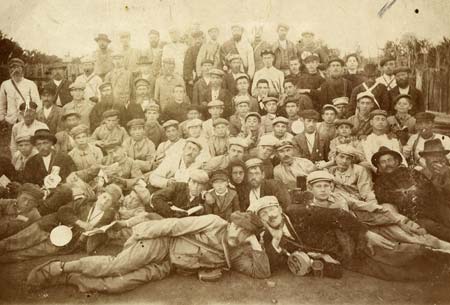
My Father’s Family, Part I: The Cohens

My surname is Cohen, and it always has been.  I have always been proud to be a Cohen.  It is a clear marker to the outside world that I am Jewish.  Because I grew up in a secular home and did not go to Hebrew School like almost all my Jewish classmates, some of them expressed skepticism about whether I was “really” Jewish, but my name always gave me some authenticity.

The Cohens (Cohanim) are the high priests, a line that is supposed to descend from Aaron, Moses’ older brother.  Observant Orthodox Jews who are Cohanim do not go into cemeteries or attend a funeral or touch a dead body in order to maintain their priestly purity.  In a traditional service, there is a special ritual where the Cohanim bless the congregation.  Cohanim get the first aliyah for the reading of the Torah.

Birkhat cohanim 4

Birkhat cohanim 4 (Photo credit: Wikipedia)

Although I do not believe in any of the “special holiness” of the Cohen tribe and in fact am not even sure my family are true Cohanim, I do feel proud to have the name and some of the tradition and history that goes along with it.  It was one reason that I did not change my name when I got married.  I wanted to remain a Cohen—it was my name, it was my family’s name, and it was my ancestors’ name.

So perhaps it is not surprising that one of my first genealogical tasks was to trace the Cohen line.  It was fairly easy to get as far back as my great-great-great-grandfather Hart Levy Cohen, who was born around 1772 in Amsterdam and emigrated to England as a young man.  The English records and then the American records on my Cohen line were clear and easy to find through ancestry.com, and thus within a short period of time I was able to create a tree that went from Hart Levy Cohen to Jacob Cohen, my great-great-grandfather, to Emanuel Cohen, my great-grandfather, to John Nusbaum Cohen, my grandfather, to John Nusbaum Cohen, Jr., my father, to me.  I have census reports going back as early as 1841 in England and 1850 in the United States as well as tax records and a marriage record from England.  I have the names of Hart’s children, his grandchildren, his great-grandchildren and so on.  I compiled a lot of information very quickly, but now I need to go back and learn from all those documents and see what I can find out about Hart Levy Cohen and all his descendants and also to see if I can find his ancestors from Amsterdam and before.

This research will require learning about English records and census reports and also about Pennsylvania records.  From the little bit of initial work I’ve done this week, I already know that it will be more difficult to obtain Pennsylvania records than New York City records.  There is not much online and not much available through the Family History Library.  Most of it will require snail mail requests or traveling to places that are not as accessible to me as New York City.  I do not foresee traveling to Harrisburg in the near future, so it may require hiring someone there to retrieve documents for me.  And as for the English records, well, a trip to London sounds a lot more fun than a trip to Harrisburg, but I don’t think it’s too likely either.

So I have a big learning curve ahead.  I am up for the challenge and ready to learn more about my Cohen relatives and about genealogical research.  I will start by posting what I already know, and then I will fill in the details as I learn more.

Meanwhile, I will also continue to look for more information about the Brotmans, the Goldschlagers, and the Rosenzweigs.  Tomorrow I hope to talk to David Goldschlager’s son and grandson and maybe learn more about the Goldschlagers. I am still hoping to work with Larry Brotman about a Brotmanville connection.  I am still hoping to hear from my cousin Lois about her family and Lizzie and Ray Rosenzweig.  I have written to descendants of Ray Strolowitz Adler and Zusi Rosenzweig Mintz, and I hope to hear back from them.  So at the moment I am depending on these others to help me break down the brick walls that remain on my mother’s side.  Without their help, I am at an impasse for now, but will keep on looking for any and all clues.


Enhanced by Zemanta

Pet Photo Gallery

It seemed a lot of people enjoyed my post about our family pets, and some have shared pet stories with me by email or in the comments.  My sister also sent me some photos of two of her dogs, Pablo and Roxanne, as well as some of my parents’ cat Honey.

IMG_0023

IMG_0011

Pablo

IMG_0334

Roxanne

IMG_0250

Honey

IMG_0270 IMG_0434 IMG_0471 IMG_0227


If anyone else wants to add more pets to the “family tree,” just send me a photo, and I will add it here.

Thanks!


Enhanced by Zemanta

The rest of the family: Four legged variety

I was inspired by a post on one of my favorite genealogy blogs, The Family Kalamazoo, a while back.  Currentdescendent, the blog owner and author, posted a series of photographs of her family’s dogs going back over a hundred years.  I am a huge animal lover and have had cats and dogs all my life.  My parents are both big animal lovers also, as were my grandparents Gussie and Isadore.  My mother even remembers playing with a kitten at her grandmother Bessie Brotman’s apartment when my mother was a very little girl.  My uncle Maurice Goldschlager was also a big animal lover; I remember that his last home was filled with cats, dogs, even a horse, I believe.

Unlike Currentdescendent, I do not have photographs of family pets going back that far.  But I want to share what I have because these pets are a big part of my family’s story.  I know from talking to many of my cousins on both sides of my mother’s family that they also are big animal lovers.  I’d love to build a family tree of pet photos, so send them along if you want to share them.

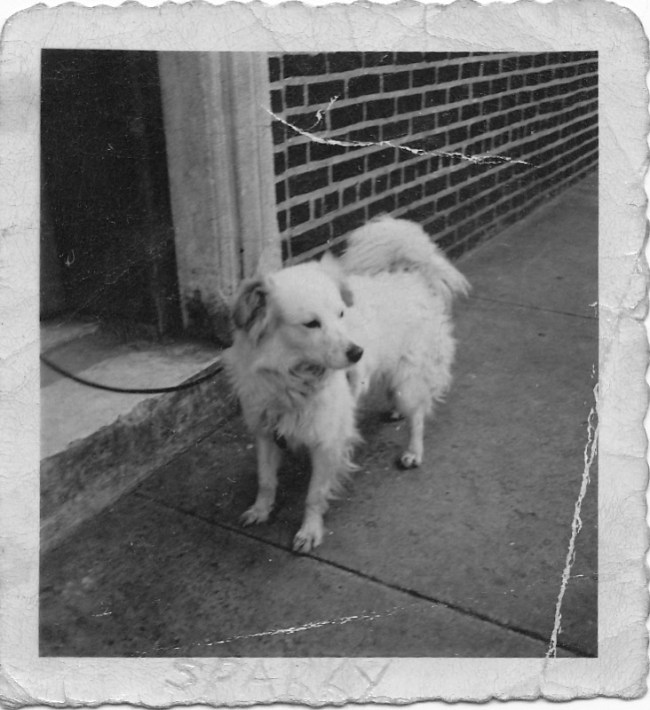
But for now, these are the pets who lived with my immediate family, starting with my mother’s childhood pet, her dog Sparky.
Image

On the back of this photo my mother wrote,”The Cutest Thing in the World.”  My mother still gets teary-eyed when she sees this picture of her beloved dog.  Obviously he gave her a tremendous amount of joy and love when she was a little girl growing up in Brooklyn.

When I turned nine, I got my very first camera, and the very first photograph I ever took is this one:

Image

As you can see, this is my cat Pixie.  He was my first ever pet, and we got him when I was about two years old.  He was not a cat that everyone could love.  He tended to hiss and growl quite a bit, but never at me.  He let me carry him around like a doll and place him in my doll carriage.  As I grew up, he slept with me every night.  He truly had nine lives—surviving rat poison and being injured either by a car or animal.  He lived until I went away to college, and to this day I believe he died of a broken heart because I had left him behind.

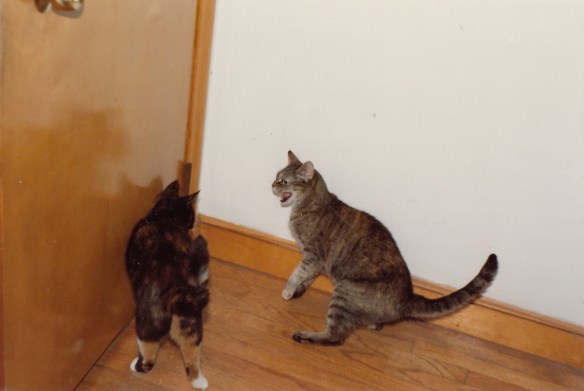
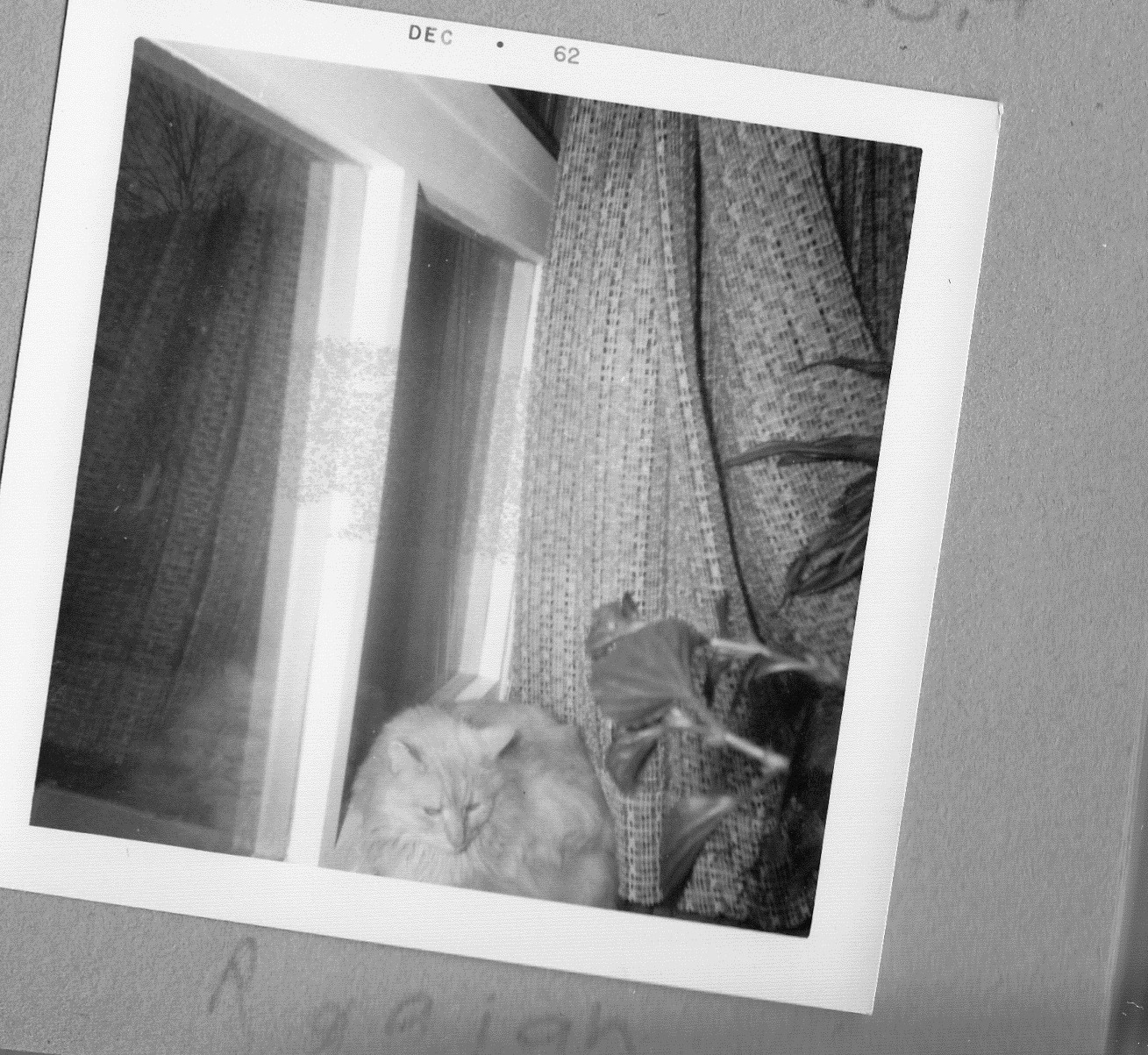
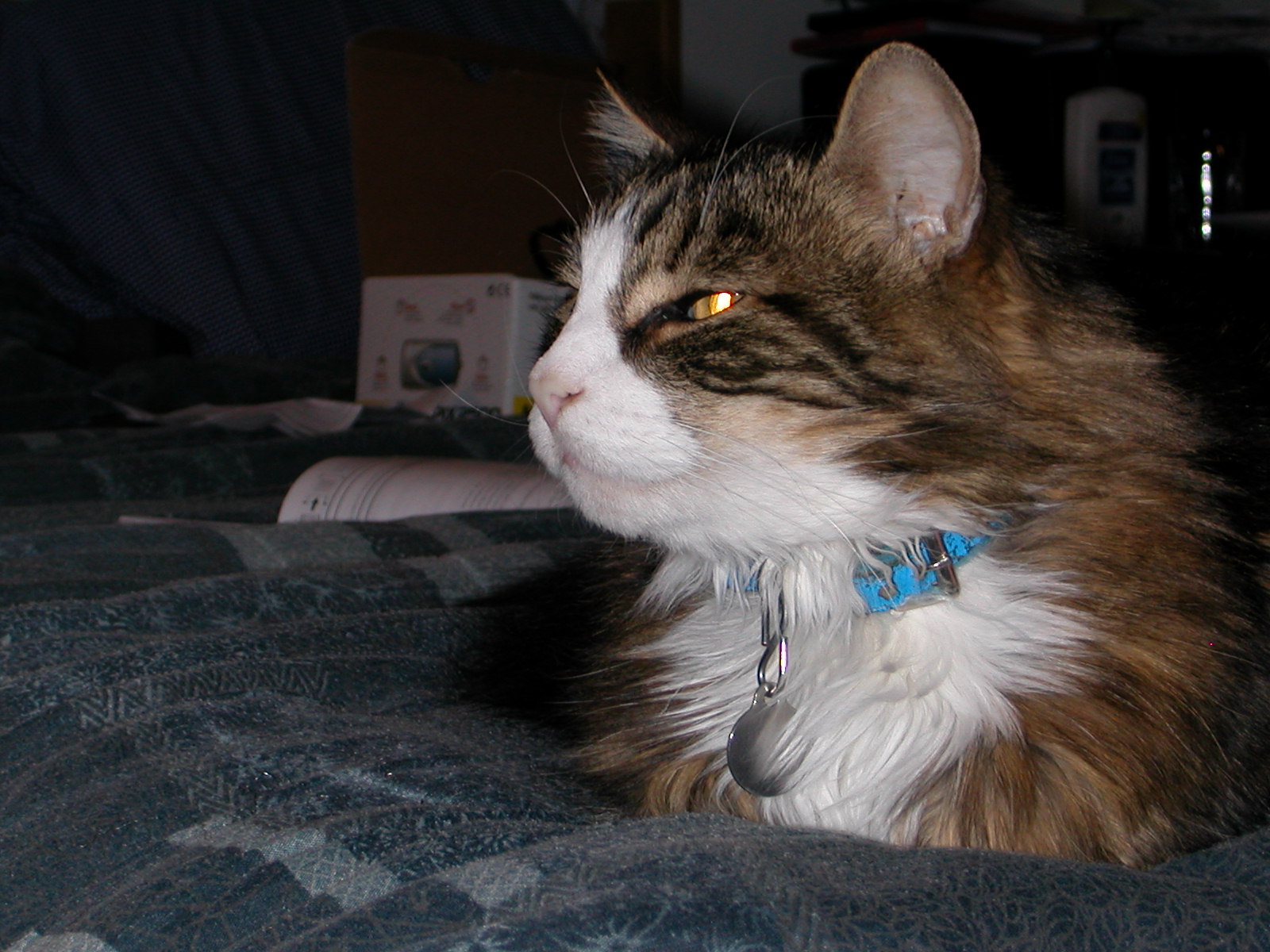
I don’t have pictures of two cats who only lived with us a short time: Fearless and Cleopatra, and I don’t really remember them.  According to my parents, one jumped out of our window in Parkchester, never to return, and one ran away when we moved to the suburbs.  Our next cat, however, was originally my grandmother’s cat, the elegant long-haired tabby, Rajah.Image
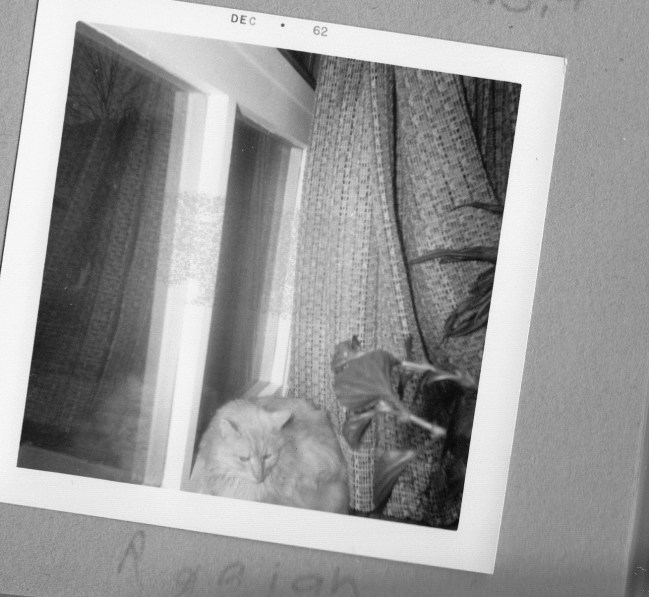
(Note the creative spelling of his name.)  He was Pixie’s cousin–their mothers were littermates who had belonged to friends of my parents.  My parents took Pixie and gave Rajah to my grandmother.  Rajah was as sweet as Pixie was snarly.  He was a gorgeous and very smart cat who somehow put up with my grandmother washing his face with a wet washcloth.  When we were little and would visit my grandmother, he would always hide under the furniture.  But when we adopted him when my grandmother for some reason no longer wanted to care for him, he became a friendly and loving pet.  As he aged, he got a little senile and would insist on drinking water from an eye cup my mother kept in her bathroom.  He lived to be eighteen years old.

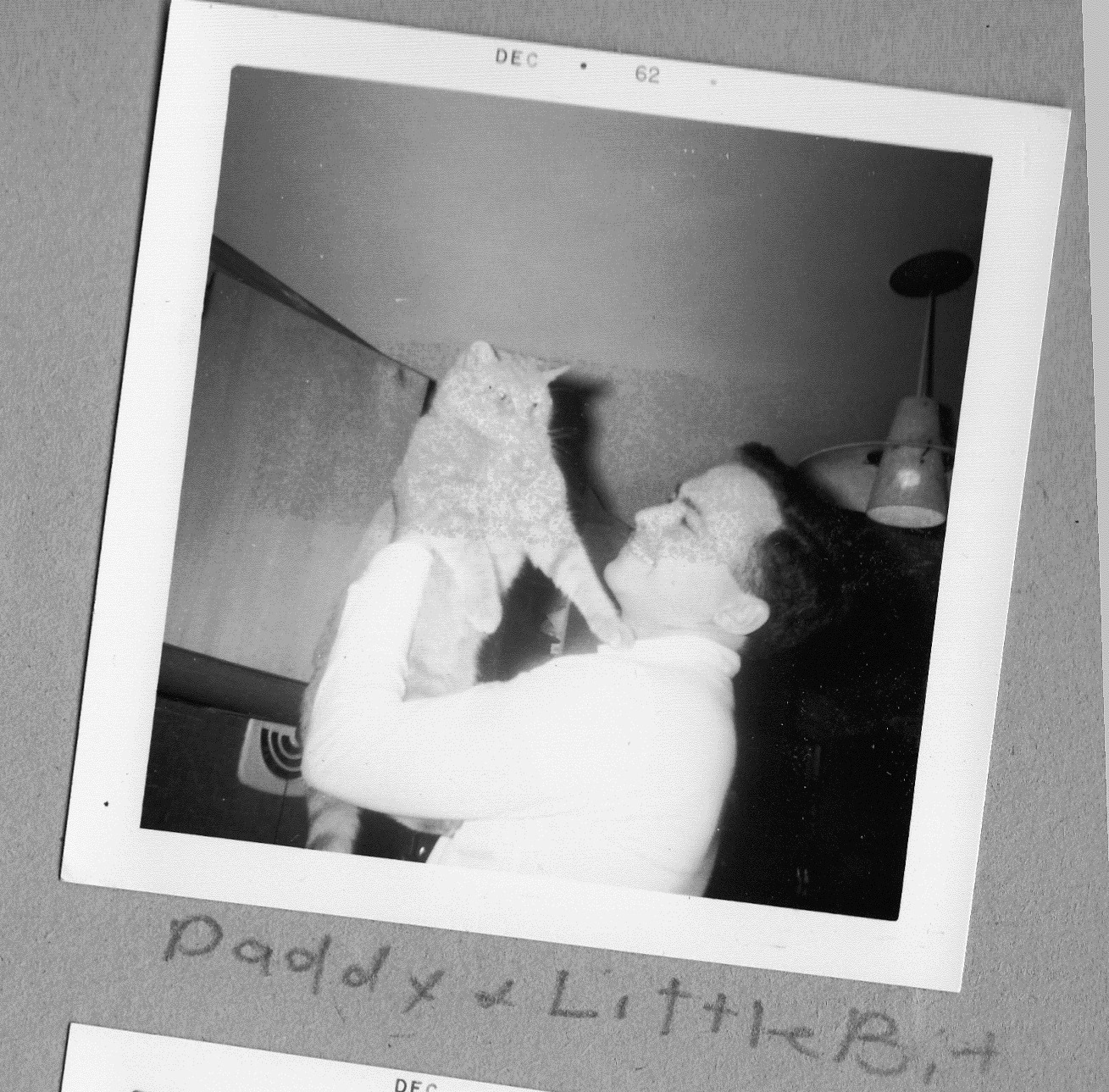
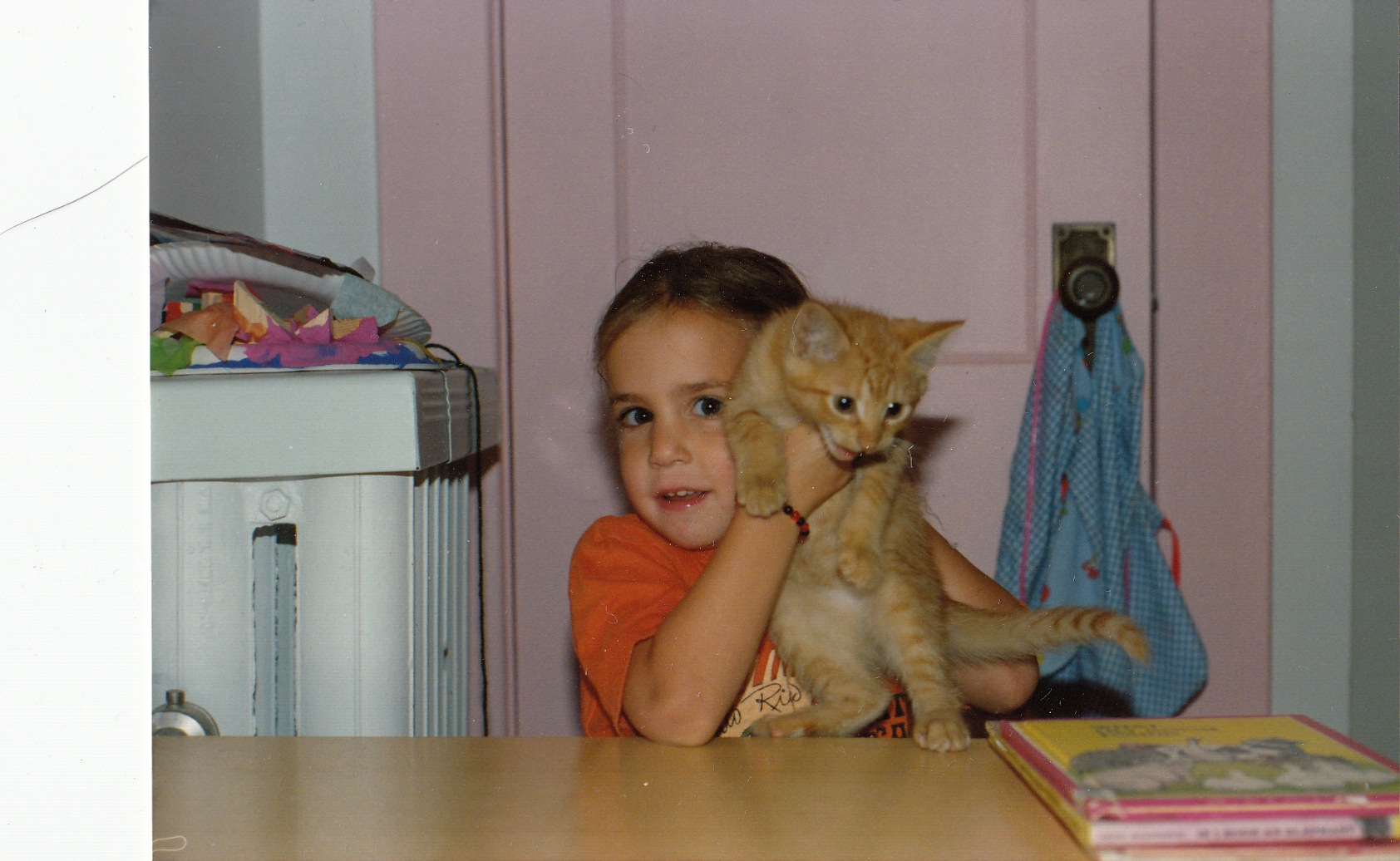
But two cats were not enough for me, so for my sixth birthday I wanted a kitten.  That kitten was Little Bit.Image


I wanted to call him Lucky, but my parents didn’t really like that name for some reason, so we compromised on Little Bit of Luck.  For a long time I called him Lucky, and they called him Little Bit.  Eventually I gave in, and he became Little Bit.  He was a funny and not too bright cat who didn’t have a mean bone in his body.  He was just a dumb, lovable creature who had to find his place with two much more dominant cats, with Pixie being without a question the alpha cat of the bunch.

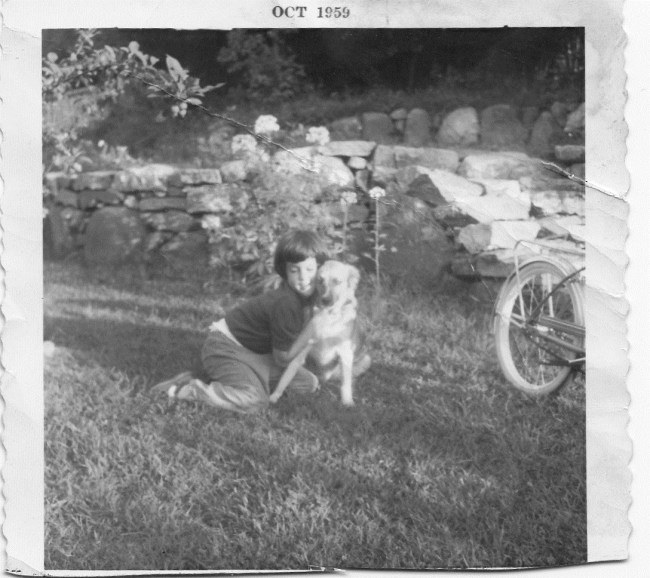
But even with three cats in a small three bedroom ranch house, I was not content.  I wanted a dog, and I just kept asking for a dog.  After much persistence and a trip to the animal shelter, my parents agreed and we adopted our first dog, Colleen.  She was not a particularly pretty dog—just a mutt, and she was probably a few years old when we got her.  But she was my first dog, and I thought she was gorgeous.
Image

That’s me, hugging her to death in our backyard in 1959.  Our family was complete: three cats and a dog.  For most of my childhood, those were our family pets.  Colleen proved to be a wonderful dog, and she followed me everywhere.  We were very lackadaisical back then, and my parents would just open the door and three cats and a dog would run out and roam the neighborhood.  Colleen developed a reputation in the neighborhood for scavenging for food at other people’s houses.  Once she reportedly ate the food right off someone’s outdoor grill.  She once followed me all the way to a friend’s house in a different neighborhood.  My father came to pick me up in the car and figured Colleen would just find her way home.  But Colleen thought I was still in the house and refused to leave, so my father had to go back to get her.

We were very lucky for a long time that nothing bad happened to our roaming pets, but our luck ran out in April, 1964, when Colleen was hit by a truck right in front of my eyes.  She died at the vet’s office a few hours later, and I was bereft.  She’d been my companion for five years, those Wonder Years from seven to almost twelve, and I was heartbroken.

My parents could not stand my sadness as well as their own and that of my siblings, so they almost immediately went back to the dog shelter and brought home another dog for the family.  Although it took me a while to bond with this new dog, eventually I loved her  dearly as well. Here she is probably not long after we got her with Pixie and my cousin June Marie behind us.Image
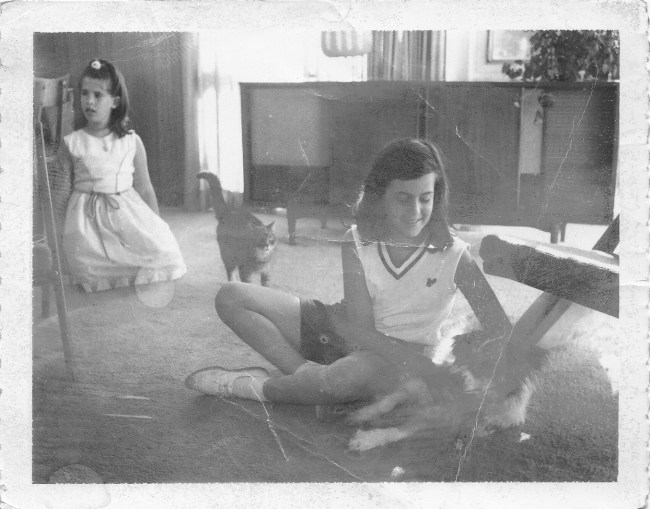
Velvet was also a mutt, but she had collie-like markings with some setter or something else mixed in.  She was also a few years old when we got her, and she became a devoted pet like Colleen.  We all used to chuckle at the way she would cross her front legs in a very ladylike way.  By the time we got her, I was moving on from the innocence of childhood to the preoccupations of adolescence, and so she spent more time with my younger siblings than she did with me.

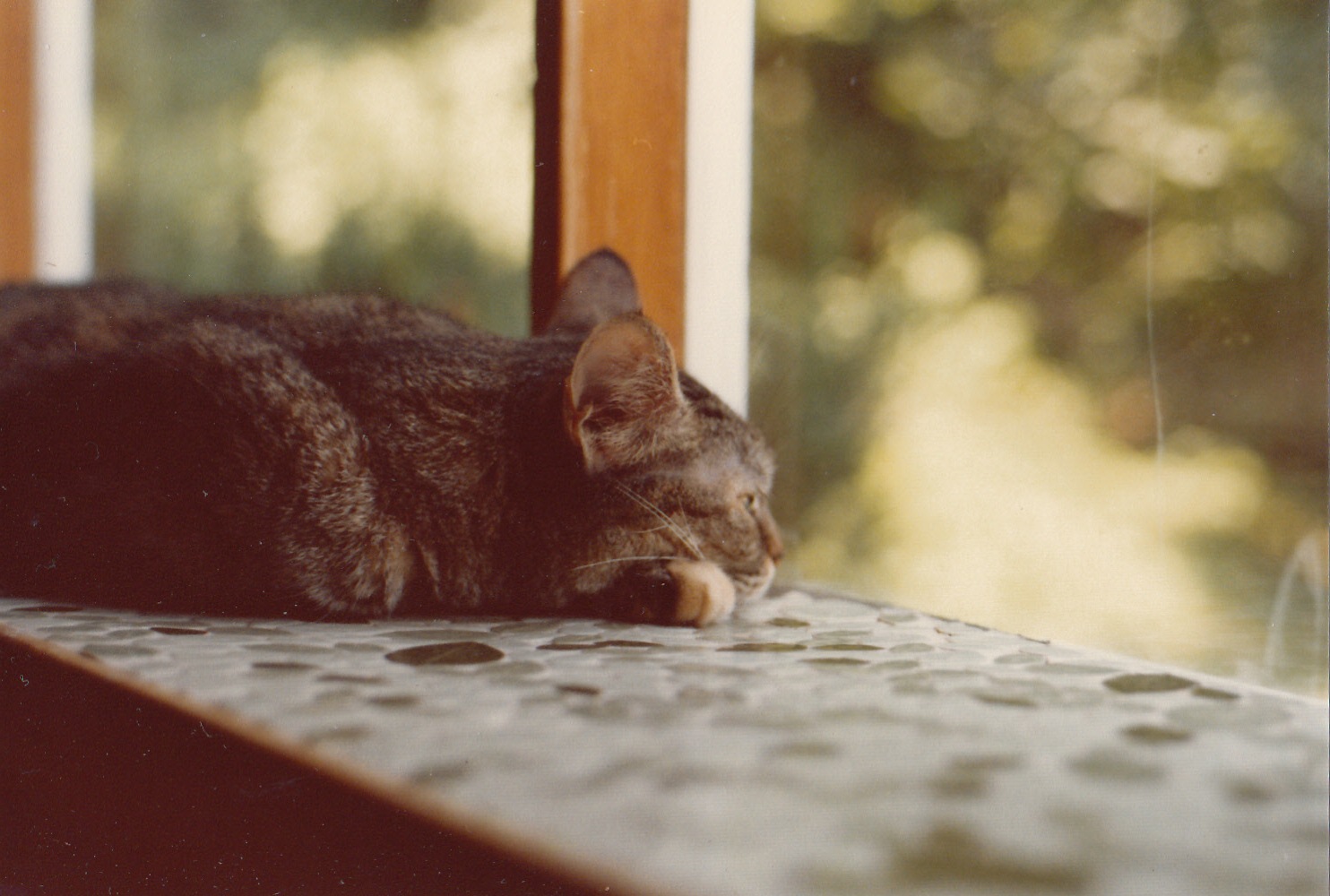
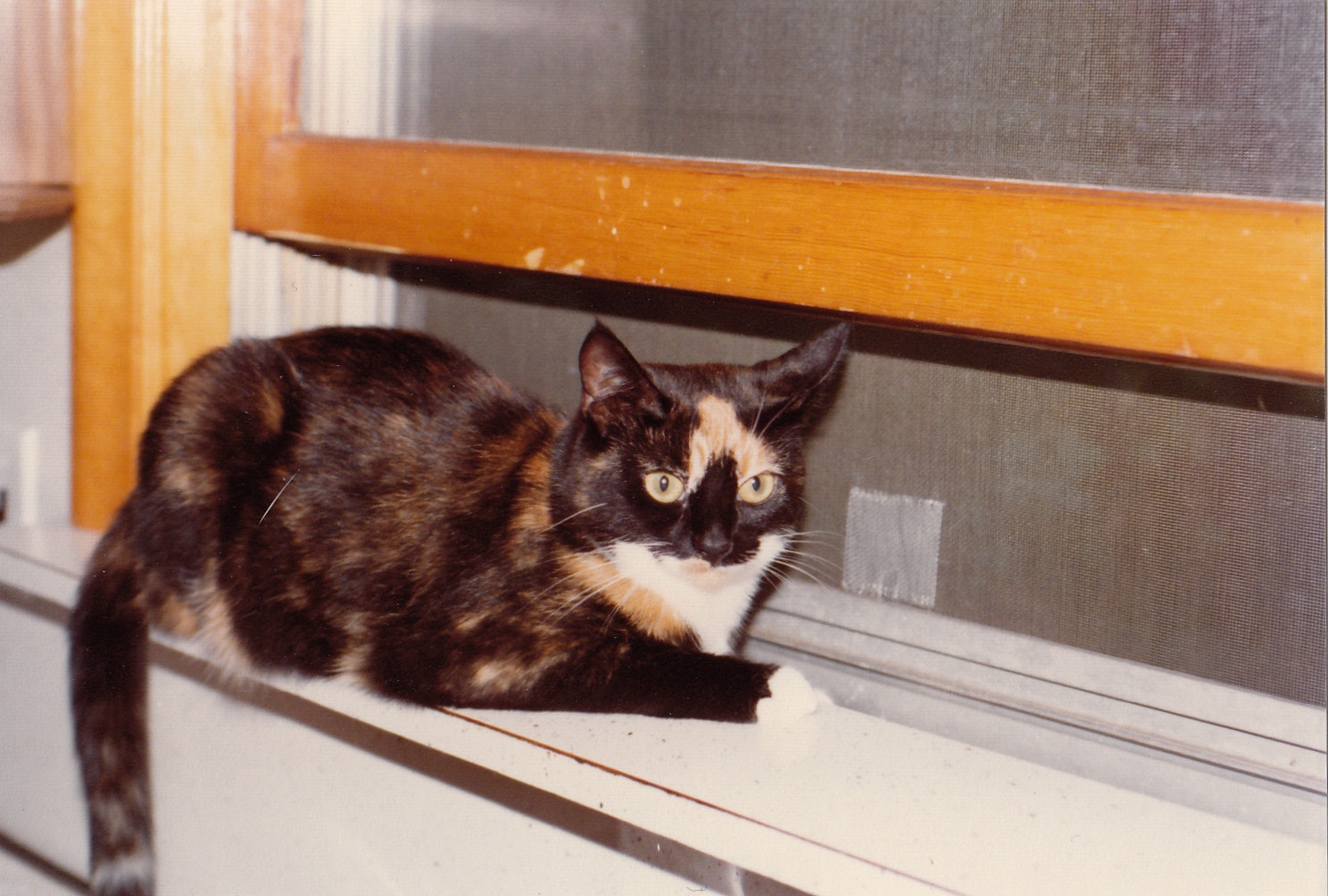
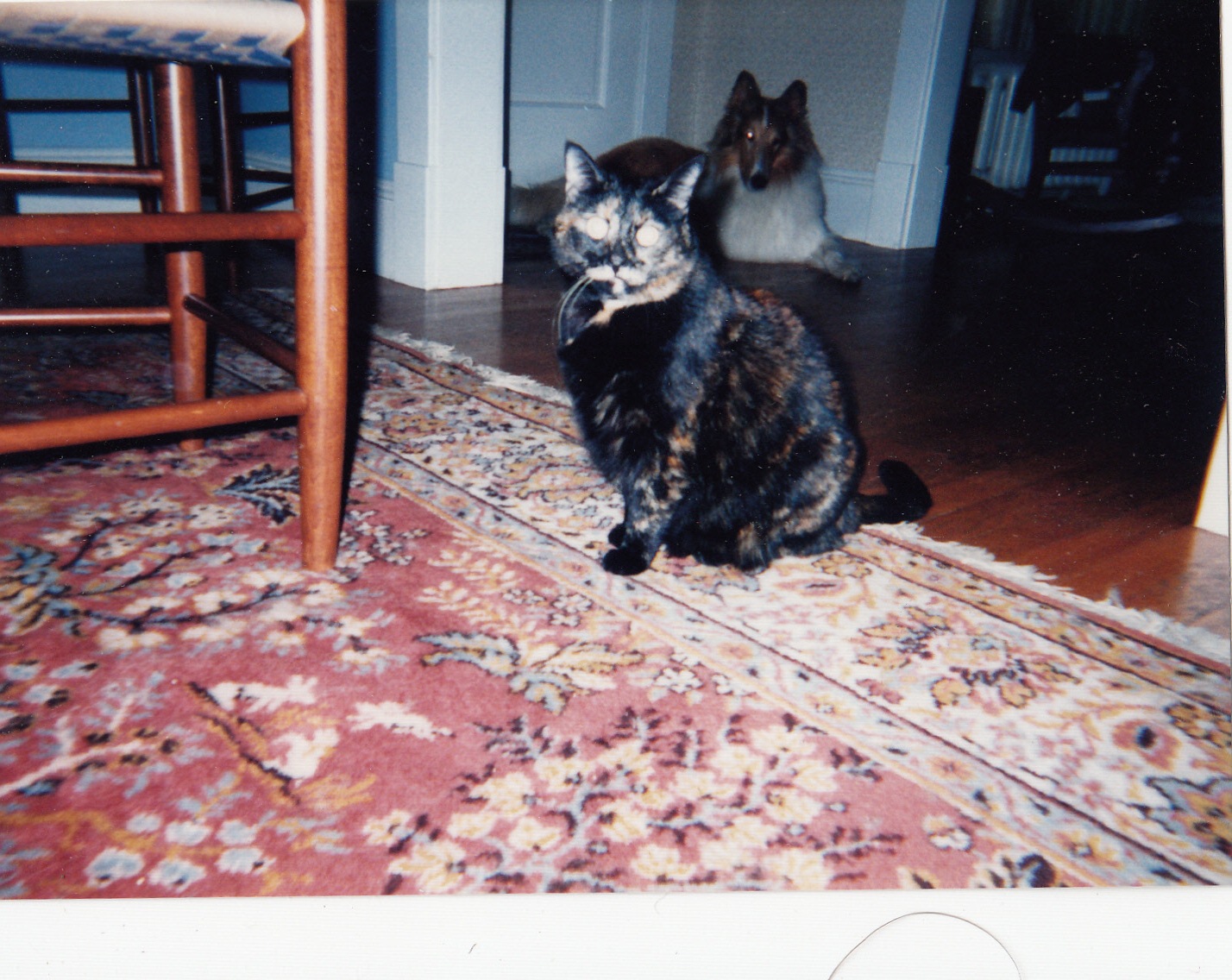
When I was in junior high school, we lost Little Bit to feline leukemia at a fairly young age.  Sometime thereafter we got another cat Phoebe, who was a calico with an attitude—proud, smart, and independent.

phoebe

After Pixie died, my parents adopted Missy—-a truly neurotic but gorgeous cat who was half Siamese and half tabby with the silliest half mustache under her nose.  She was a jumpy, anxious cat, but because she was beautiful, my mother decided to let her get pregnant.  We’d always spayed and neutered all our pets, but somehow Missy escaped the knife.  She did get pregnant and had four kittens: Louie, Susie, Bulldog, and Charlie, but my parents could only find a home for Charlie, so we ended up keeping Louis, Susie and Bulldog (who was renamed Taurus to make it sound more classy).  No way were we taking our kittens to the shelter! So there we were with a dog (Velvet), three adult cats (Rajah, Phoebe, and Missy) and three kittens.  Or six cats within a short period of time.  I was mostly gone at this point—in college and thereafter.  But I loved those kittens dearly.  We lost Louie at a very young age, but Susie and Taurus lived fairly long lives.  I will have to add pictures of Missy and her brood at some later point.

My parents went on to have more cats and now have Honey as their sole pet, the others all being long gone.  But beginning in 1975 I started having my own home with my own pets.  Our first cat was Kahlua, inspired not by her looks but by the ingredient in my then favorite drink, a Black Russian.  Kahlua was not the prettiest or the smartest or the sweetest cat, but she was our first cat together, and we loved her.
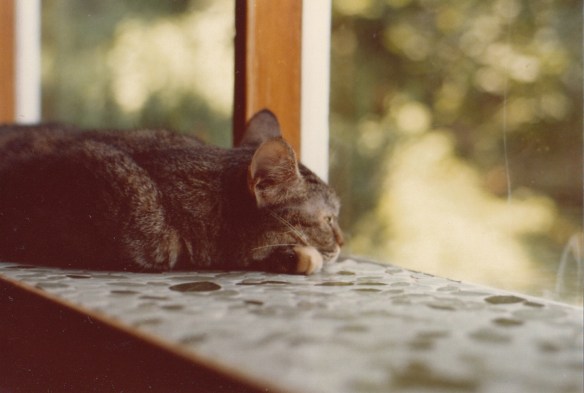
Kahlua

A few years later we adopted Blaze, a kitten from a litter of one of my Connecticut cousins’ cats.  She was gorgeous and affectionate and funny, and I was heartbroken when she disappeared one day, never to return.  I posted signs everywhere, called everywhere, but never could find her.  Somehow I still had not learned that cats are not safe roaming around the streets of suburbia.  I was so devastated that we did not get a second cat for a long time after that.  Instead we had human babies, who kept our lives busy and filled with love.

blaze

Blaze and Kahlua

Blaze and Kahlua

Kahlua lived as a solo pet for many years until our own children clamored for a kitten.  We adopted Wheatie, who looked just like Little Bit to me, and my younger daughter Maddy dragged him around just as I had dragged Pixie around three decades earlier.  But we still had not learned our lesson, and Wheatie was killed by a car as a young cat, and we were once again heartbroken.
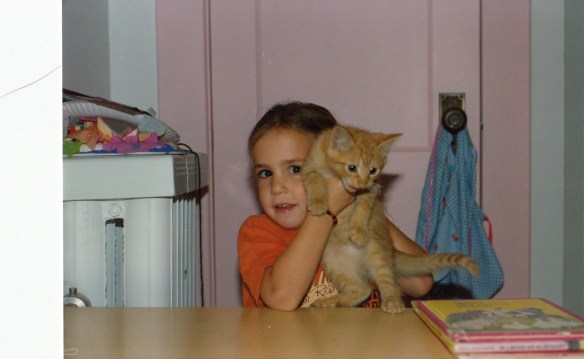
Maddy and Wheatie
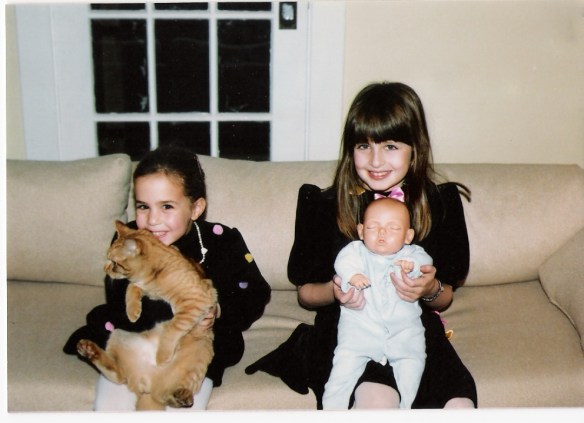
Maddy and Wheatie

1987

1987

But then we got Sneakers.  And he was the best cat we ever had (until the two we now have who rival Sneakers in personality and sweetness).  I picked him out at a vet’s office that had a litter they were trying to find homes for, and I picked him because he walked right up to me.  I knew he was a people cat, unlike Kahlua, and I knew he would be great with my kids.  And he was.  He was playful all his life and affectionate and smart and clean and independent.  When I taught at night, I would come home to nap first, and I would place him next to me; his purring would put me to sleep.  He regularly slept with Maddy, cuddled up around her head.  Once he disappeared for a week, and that was when we finally stopped letting our cats outside.  I knew I would never forgive myself if we lost Sneakers.  He would frequently bolt out the door, and we would all race outside, chasing him around the yard and the neighborhood  until we caught him and brought him home.  Sheakers lived a good long life, and he was a true gentleman until the end.

Sneakers

Sneakers

sneakersMaddy and Sneakers

When Kahlua died also at a ripe old age, we got Lily, who, to be honest, was not really a people cat.  She did not like to be held, and she preferred her own company most of the time.

Lilly


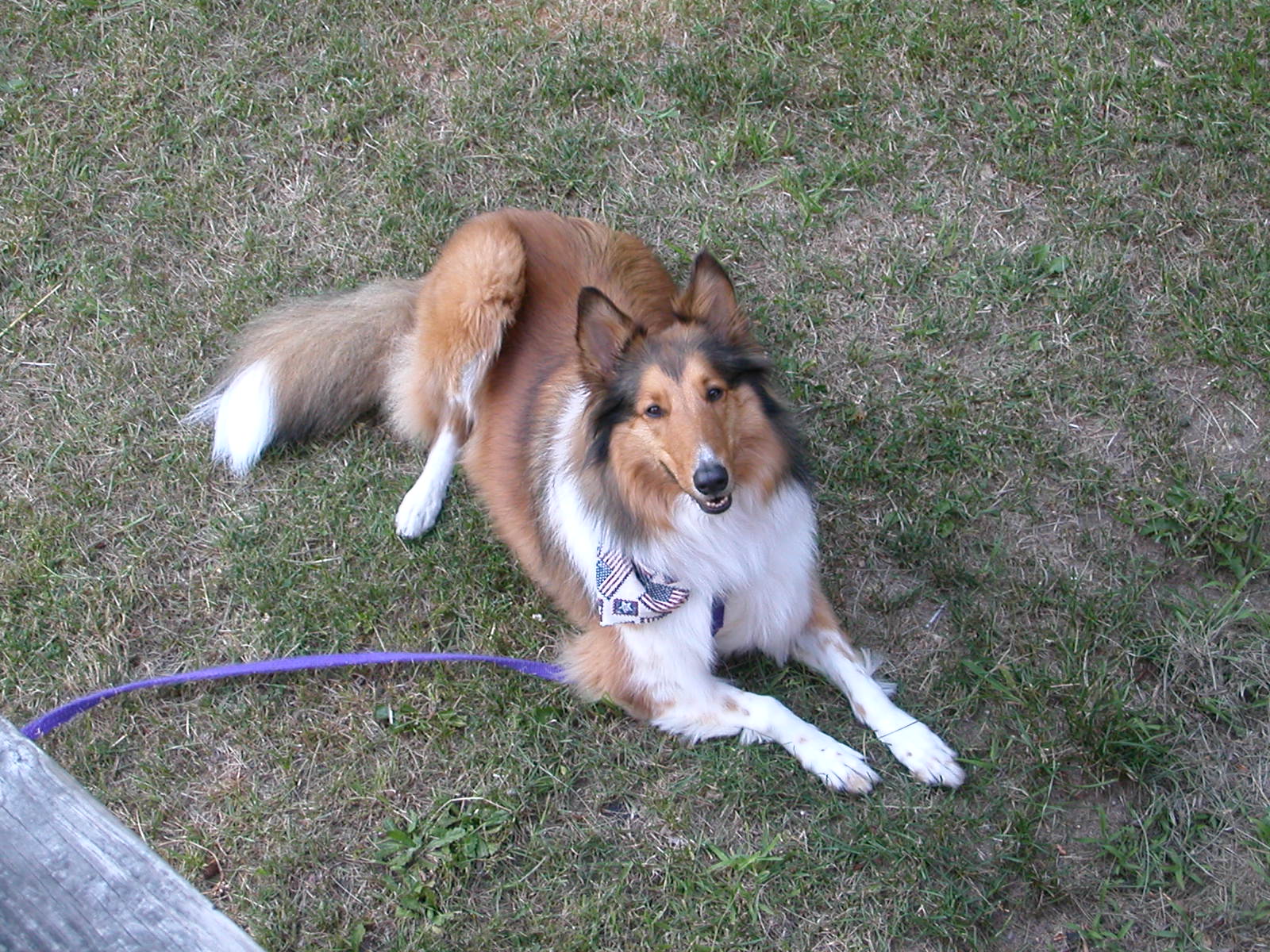
And then we got a dog.  Just as I had wanted a dog as a child, Maddy wanted a dog and kept asking for a dog until we finally agreed.  I’d been reluctant because dogs are a lot more work than cats, and we were both working full time and had little time for anything besides our kids and cats.  But inside I also missed having a dog.  And so I started looking until I saw an ad for a year old collie.  Having grown up watching Lassie religiously, I’d always wanted a collie.  One cold January morning in 1994, Harvey and I drove to Ware, about 20 miles away, and met Zapper.  He was a big and beautiful collie, living in a small apartment with a couple and their three children under five years old.  The wife did not want to keep the dog, but the husband was heartbroken to give him away.  We assured him that we would take good care of him, and we did.  He was a wonderful dog—sweet, protective, playful, smart and so beautiful.  Aside from barking way too much and jumping up on people until we trained him not to, he never did anything wrong.  Except get sick far too young.  He was only seven when he died.
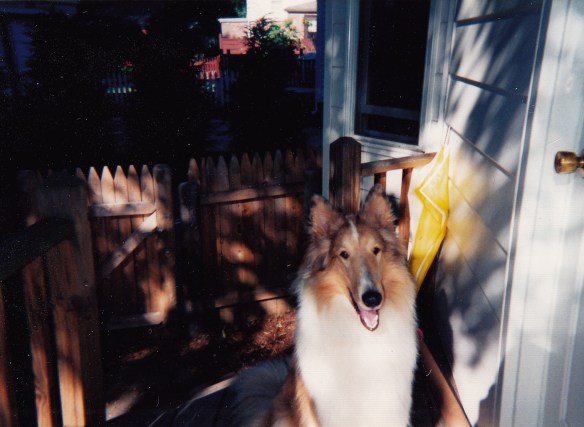
Zapper

Zapper

Around the same time we lost Zap, we also lost a cat we had for only a short time named Simon.  He was the funniest cat I’ve ever had—he just was mischievous and would sit in the funniest positions.  He made me laugh every day until the day he ate some lilies we had the house.  We never knew that they were poisonous to cats, and Simon died within a day of getting into those flowers.  Between Simon and Zapper, I wasn’t sure I’d ever get another pet again.

But I did.  Six months later I saw an ad for a female collie who was at the local pound.  We went to see her–she was skinny, dirty and hyper as could be.  Maddy and Harvey (Rebecca was off at college) thought I was crazy, but I wanted her and knew she would be a great dog.  And she is.  She is now almost fourteen and has been with us for almost thirteen years.  She was a bit wild and skittish at first, but soon settled into be the best dog in the world.  Like Zapper, she is sweet and smart and playful, and she doesn’t bark or jump on people.  She just wants to be with her people and be loved.  She’s deaf now and has trouble walking, but she is still a magnificent dog.

Cassie

Cassie

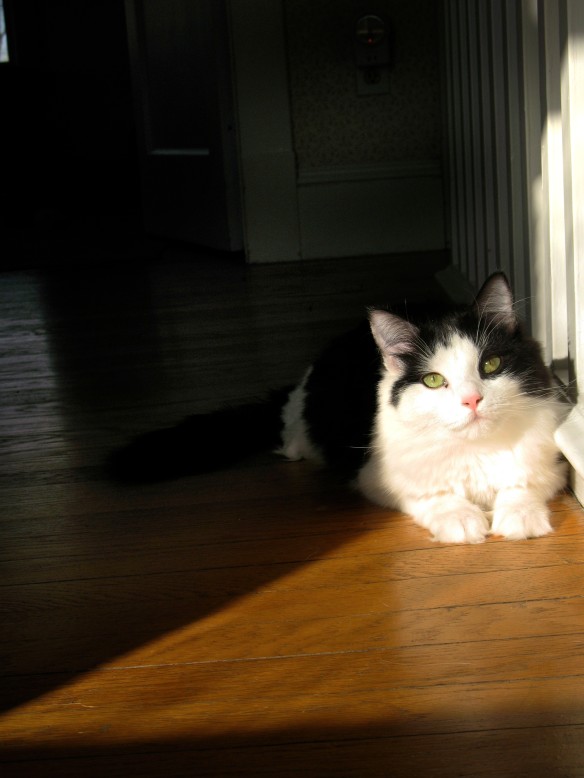
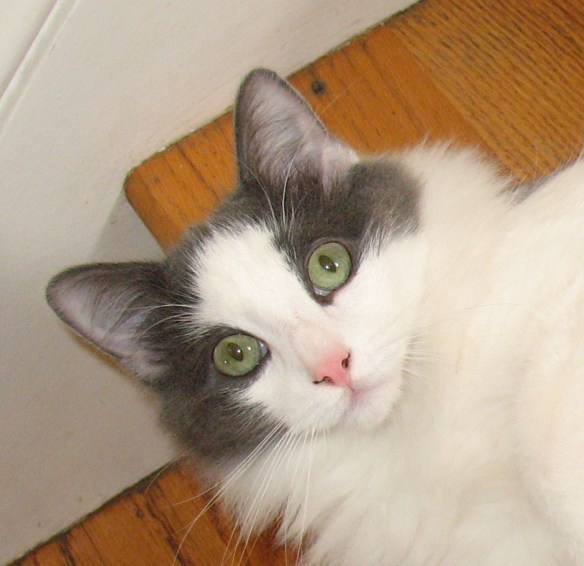
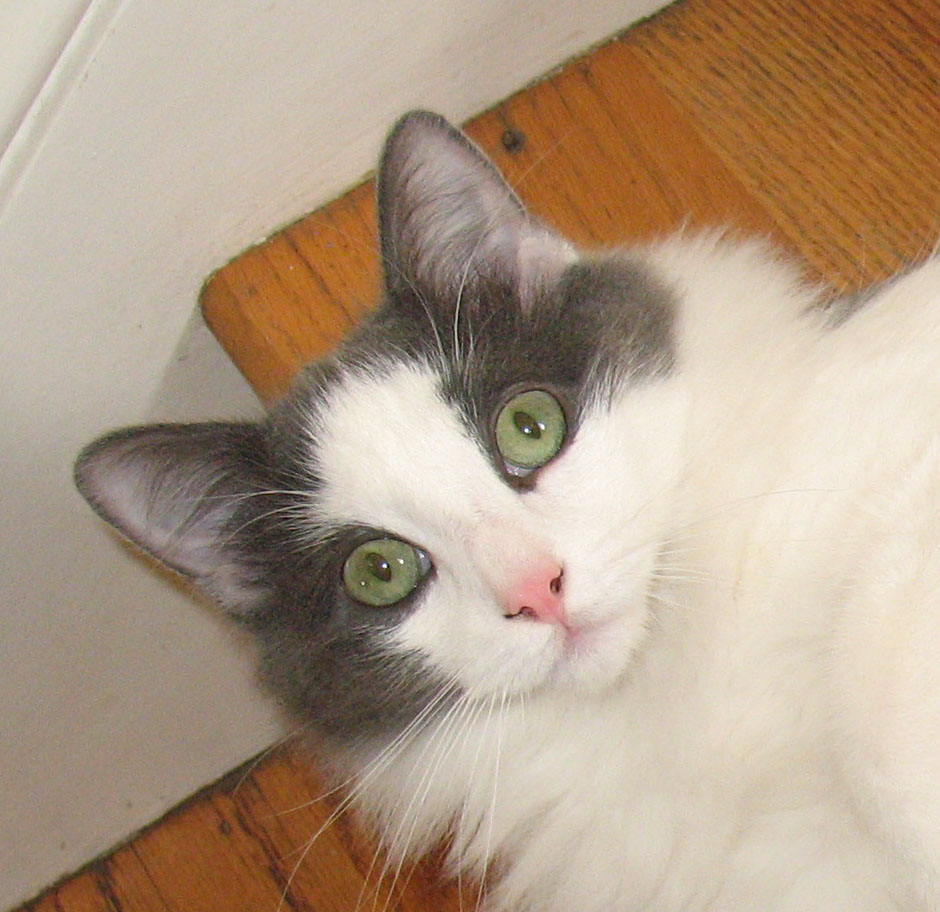
When Sneakers and Lily were both gone, we decided that we would adopt two cats from the same litter so that they would have each other for company.  By this time (2008), our kids were grown and out of the house, and we did not want a solo cat to be lonely all day while we were working.  So we adopted Smokey and Luna.  I can’t even begin to describe how much I love these two cats.  Smokey thinks he is Cassie’s baby and still tries to nurse on the poor old dog, who loves him and plays with him and tolerates anything he does.  Luna is like Sneakers—a people cat from day one.  She is a cuddler, constantly purring, and doesn’t know how to hiss as far as we can tell (nor does Smokey).  These two have never been outside and never will.  I will keep them safe for as long as I can.  They are my babies.

smokey luna sibling love

Luna

Luna

Smokey

Smokey

So now you know that I will one day be that crazy cat lady.  Or maybe I already am….

Enhanced by Zemanta

The Fusgeyers, Part IV: Romania Today

St_Andrew_Str_no_26_0002

Where my grandfather was born in 1888 in Iasi, Romania

As noted in my last post, the population of Jews in Romania has declined precipitously over the last one hundred years as a result of emigration before World War I and thereafter and also as a result of the murder of about 300,000 of them during the Holocaust.  From a peak of 800,000 after World I, there are now just a few thousand Jews living in Romania today. What is it like in Romania today, and, more specifically, what is it like to be a Jew living in Romania today? What  legacy is there in Romania from the once substantial Jewish community, and what do current residents know or remember of the Jewish communities and of the Fusgeyer movement that led many of those Jewish residents out of Romania?  Beyond the cold, hard statistical facts, what is left of Jewish Romania?

I have consulted only two sources of information to answer these questions, so my views are based on limited information and possibly inaccurate.  But those two sources left somewhat different impressions, so perhaps the truth lies somewhere in between.  Jill Culiner’s book, Finding Home, paints a rather gray and dismal picture of life in Romania in general and specifically of the Jewish legacy there.  Stuart Tower, author of The Wayfarers, has a more positive impression of Romania today and of its people as seen in the photographs he took first in the 1980s and then in 2005 and also from what he shared with me by email.  Culiner and Tower visited different cities and towns for the most part, but there was some overlap; both visited Barlad and Sinaia within a few years of each other.  Both ultimately paint a picture of a country that once had many thriving Jewish communities but that now has virtually no Jewish communities and few residents who remember the communities that once were there.

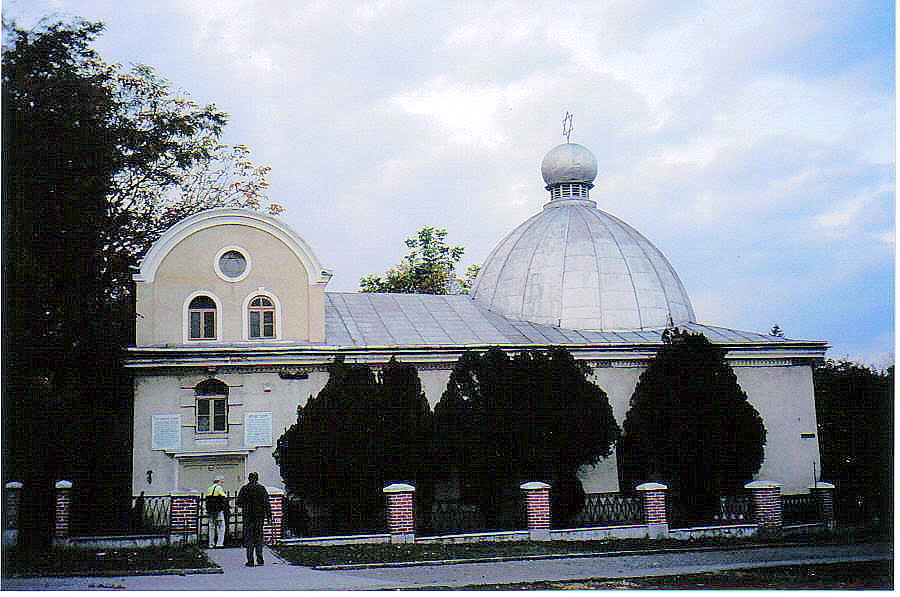
Tower based his book around the town of Barlad; it is where the three Americans, grandfather, father and son, go to learn about their ancestral roots and meet the rabbi there who tells them the story of the Barlad Fusgeyers.  Tower’s story is fictional, and he told me that he’d never actually met a rabbi in Barlad, but both Culiner’s book and Tower’s book talk about a very small Jewish community continuing to exist in that city and the beautiful synagogue that still stands there.  In Tower’s novel, the rabbi describes a community of thirty people who still keep kosher and observe shabbat, but who have trouble forming a regular minyan.  The elderly rabbi’s children have all moved away, and he knows that he will be the last rabbi in Barlad (spelled Birlad in the novel).

Culiner started her Romanian travels in Adjud, where she got off the train and began her Fusgeyer-inspired walk.  Her description of Adjud is disheartening:

Here, fields lie flat under a grueling sun, and cars, trucks and buses roar with giddy impunity over pot-holed, uneven main roads.  Under thirsty-looking trees outside the station, lining the street are unlovely lean-tos, modern bars and patios. All claim to be discos, all pump loud American music into the hot air.

Culiner, p, 35.

Culiner also said that “there were no buildings left from the pre-Communist era and certainly nothing of beauty.” (Culiner, p. 35)  Her encounters with the local people are no more heart-warming.  No one could tell her where there was a hotel or room to stay in, and she described the people she saw as “exhausted..expressionless, resigned.”  Culiner, p.36.  No one in town remembered  that there ever was a Jewish community there or a synagogue, although there had been a community of about a thousand Jews there in 1900.  The man who showed her where the non-Jewish cemetery was located demanded an exorbitant fee for his troubles.  By the end of this first chapter, I was already feeling rather depressed about her experience and about  life in Romania.

In contrast, here are some of Tower’s photos of the Romanian countryside that left me with a different impression.  Thank you to Stuart Tower for giving me permission to post these:

Recently%2520Updated%25201112 Recently%2520Updated%25201113 Casa Elena in Voronets Fall foliage in the Bicaz Gorge Romania%25202005%2520262 Romania%25202005%2520263 Romania%25202005%2520264

Culiner’s experience at her second stop, Podu Turcului, was not any better.  The townspeople warned her that her plans to walk through Romania were dangerous and that she would be better off visiting more modern cities elsewhere.  There were no Jews left in this town, and no one there remembered there ever being a synagogue, although there was a Jewish cemetery.  Only one man acknowledged that there once was a Jewish community there, a workman who had been curious about the Jews while in school and had learned where the Jewish residents had once lived in town, now just a neighborhood of faceless housing from the Communist era.  This man told Culiner that he had been unable to learn more about the Jewish community in his town because discussing such matters was prohibited during the Communist era.

Culiner and her companion next arrived in Barlad, a city of 79,000 people, the city where Tower’s characters stayed and learned about the Fusgeyers and were in awe of the beautiful synagogue.  Culiner is less enthusiastic.  Her first impression of the city is its “potholed, deteriorated sidewalks” and the “[r]are trees [that] gasp out their life in the dense cloud of exhaust fumes, providing little shelter from the pitiless sun.” (Culiner, p. 55) Culiner once again encountered skepticism about her plans and ignorance about the Jewish history of the city.  She was particularly disappointed that in this city where the Fusgeyer movement began, no one seemed to remember anything about them.  Even she, however, was impressed with the synagogue, to an extent:

Despite its rather austere, unassuming exterior, the synagogue is magnificent.  Dating from 1788, the walls and ceilings are decorated with paintings of birds, flowers, leaves and imagined scenes of Jerusalem.  Yet, despite its beauty, there is a strange feeling of loss, the aura of a building struggling to exist in a world that has little place for it.  It has become a relic.

Culiner, p. 58.

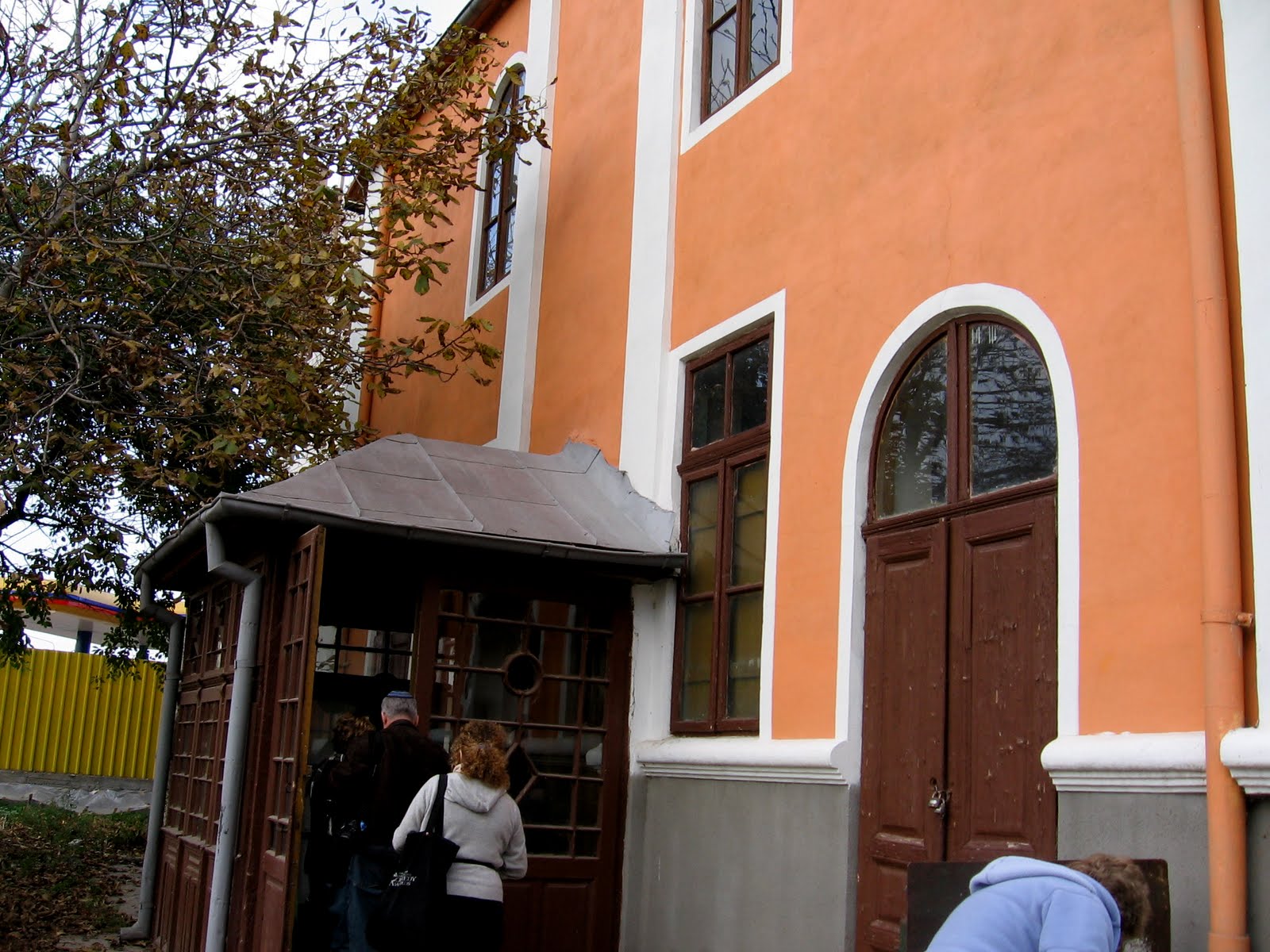
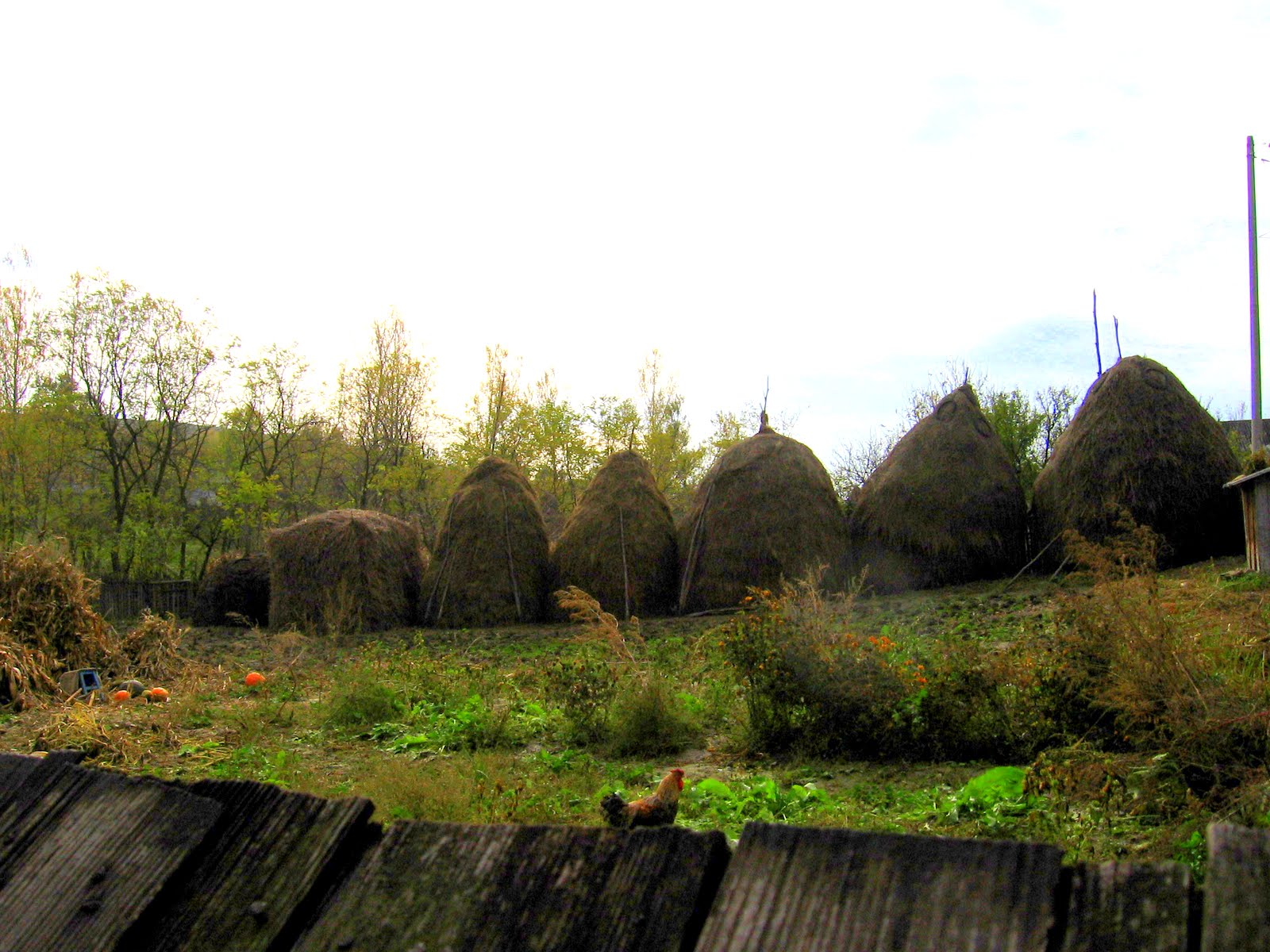
Although Tower also described a dying Jewish community in his novel, there was still some life, some people who cared in Barlad.  Culiner saw the glass as half-empty whereas Tower saw it as half-full.  Here are some pictures of the Barlad synagogue and some other towns visited by Tower that show a far less dismal impression of  in Romania.  All photos courtesy of Stuart Tower.

Synagogue in Barlad courtesy of Stuart Tower

Synagogue in Barlad  Photos courtesy of Stuart Tower

President Alexander Coitru

Stuart Tower reading from The Wayfarers at the Barlad Synagogue

Stuart Tower reading from The Wayfarers at the Barlad Synagogue

birlad shul interior

Romanian countryside

Romanian countryside

Romanian woman

Romanian woman

Romania%25202005%2520090 Romania%25202005%2520175

17th Century wooden synagogue in Piatra Neamts

17th Century wooden synagogue in Piatra Neamts

Piatra Neamts Sinagogaodd haystack, neighboring farm Troop Popa Tarpesht villagers and their War Lord

Culiner’s experiences in the towns and cities she visited after Barlad were not much different from her first three stops: ignorance and indifference to the history of the Jewish communities in those towns, ugly scenery, and disappointment.  She did meet some friendly and helpful people along the way, including some who were Jewish or were descended from Jews, but for the most part she found most Romanians at best ignorant and at worst rude and even hostile.

In Focsani, no one seemed to be able to help her find the synagogue, sending her on a wild goose chase only to find it right near her hotel.   On the other hand, Focsani had a fairly active Jewish community (relatively speaking), as the synagogue regularly drew about twenty people for shabbat services and more on major holidays.  Culiner was bewildered by the fact that the non-Jewish residents did not even know where the synagogue was located despite its central location.

In Kuku, Culiner met a friendly, helpful woman who likely lived in a building that was once the hostel where the Fusgeyers stayed while traveling through that town, but that woman also knew nothing about where the Jewish community had gone or about the Fusgeyers.   In Ramnicu Sarat, Culiner spent time with a woman whose mother was Jewish and who remembered the days of an active and close Jewish community.  The woman told Culiner that the Communists had demolished the synagogue that had once stood in the town.  She also talked about being unable to be openly Jewish during the Communist era.

Similarly, in Buzau she talked to a Jewish man who refused to take her inside the synagogue because he was ashamed of its condition; there were not enough Jews left in the town to make a minyan and not enough money to maintain the building.  This man told her that “the greatest threat is that all will be forgotten.” Culiner, p.122.   In Campina, another Jewish man told her, “The Jews will die out.  We will go to the cemetery.  And no one will replace us.” Culiner, p. 144.

Only in Sinaia did Culiner find anything of beauty in the countryside, but again not without some negative observations. She wrote: “The scenery is a slice out of a romantic painting and Watteau would have delighted in the mossy banks, the majestic spread of trees, although he might have taken artistic liberty, ignored the discarded shoes and packaging stuffed into vegetation, the tattered plastic and ripped shreds of fabric caught on branches in the river.”  Culiner, p. 146.  Tower’s photographs of Sinaia reveal all the beauty without the observations of garbage mentioned by Culiner.

Peles Castle, Sinaia and surrounding countryside

Peles Castle, Sinaia and surrounding countryside

cottage on the grounds Romania%25202005%2520042 Romania%25202005%2520044 October snowfall, near Peles

Before I read Culiner’s book, I had been giving serious thought to an eventual trip to Romania, in particular to Iasi.  After reading her book, I put that thought on the far back burner.  Her book left me with a vision of an ugly country filled with ugly people who hated Jews.  After looking at Tower’s photos and corresponding with him about his travels in Romania, I am reconsidering my decision to put a visit there on the back burner.  Just as I would like to visit Galicia to honor my Brotman family’s past, I would like to visit Iasi—to see where my grandfather was born and spent his first sixteen years, to honor his past and the lives of his family—-the Rosenzweigs and the Goldschlagers.  I have no illusions about what I will find there.  I know not to expect a lively Jewish community or even any Jewish community.  It’s all about walking where they walked and remembering their travails and their courage.  Maybe the scenery is not as idyllic as in some of Tower’s photos.  Maybe the people are not as colorful and friendly as they seem in his photos.  But that, after all, is not the point, is it?

Culiner did not visit Iasi, our ancestral town in Romania, on her trip, but Tower did, and I thought I would end this post by posting his pictures of Iasi and some of its people as well as those taken by my Romanian researcher Marius Chelcu.  Maybe someday I will get to be there in person and walk down St Andrew’s Street where my grandfather was born and pay tribute.

If we don’t, who will? Will we allow the story of the Fusgeyers and of the Jews of Romania to be forgotten for all time? That, in some ways, is the message of both Tower’s book and Culiner’s book: we need to learn and retell the story of our ancestors so that those stories and those people will not be forgotten.


Stuart Tower’s photos of Iasi

1670 Synagogue in Iasi

1670 Synagogue in Iasi

Traian Hotel, Iasi

Hotel

Father of Yiddish Theater

Father of Yiddish Theater, plaque in Iasi

National Theater, Iasi

National Theater, Iasi

Gypsy wagon, near Iasi (Yash) Astoria Hotel, Iasi Yash) Iasi street Recently%2520Updated%25201108 Lady/Man (?) walking toward Yash (Iasi) Gypsy family (Iasi), wanted food and money Iasi (yash) Ladies of Iasi (Yash)


Marius Chelcu’s photos of Iasi:

St_Andrew_Str_no_26_0003 St_Andrew_Str_no_26_0001 Near St Andrew Str_11 Near St Andrew Str_10 Near St Andrew Str_4 Near St Andrew Str_5 Near St Andrew Str_6 Near St Andrew Str_7 Near St Andrew Str_8 Near St Andrew Str_2

Photos taken near St Andrew Street where the Goldschlagers lived

Photos taken near St Andrew Street where the Goldschlagers lived


Enhanced by Zemanta

The Fusgeyers, Part III:  What Came Afterwards

In my last two posts, I wrote about the vast emigration of Jews from Romania between the late nineteenth century and World War I in the face of widespread anti-Semitism and poverty. According to one source, almost thirty percent of Romanian Jews migrated to the United States or Canada between 1871 and 1914; many others migrated to what was then Palestine.[1]  Wikipedia estimates that about 70,000 Jews emigrated from Romania, almost a quarter of the total Romanian Jewish population in that period.

Many of those who left were part of the Fusgeyer movement, groups who walked from their home towns across Romania to escape, often depending on donations raised by entertaining the crowds in towns throughout their route to freedom.  My grandfather was one of these walkers, and so perhaps were his siblings, cousins and other family members, though I’ve not heard any other descendant report that their grandparent walked across Romania.  According to Culiner, there are no statistics on how many people were a part of this movement or how long it lasted.  Groups ranged in size from forty people to 300 people, and in 1903 about 200 to 300 Jews were leaving Romania each week, many on foot. (Culiner, p. 20).

Although Jacob Finkelstein’s report of the experiences of his 1900 Fusgeyer group painted a generally rosy picture of their trek, being welcomed and well-fed in most places they visited, other groups faced greater struggles.  One observer reported that he saw groups where people were famished, in some cases starving, and living in horrible conditions.  He wrote:

One has to imagine 300 people, men, women and children wandering through the cemetery [where they were then living] like famished wolves, burnt by the sun during the day, tormented by mosquitoes in the night, all three hundred of them with bare feet, sick, some moaning, others crying: fever-racked women who are incapable of feeding their young, the children pale and suffering.[2]

Is it any wonder that my grandfather never talked about his life in Romania, other than to mention the music and beautiful horses he remembered? I’ve asked many of my newly-found Rosenzweig and Goldschlager cousins if they knew anything about their ancestors’  lives in the “old country,” and the response I’ve heard over and over is that their grandparent never wanted to talk about those days, but wanted to focus on the present and the future.  Given the conditions they endured both living in Romania and leaving it, why would they want to remember any of it?

Jewish population per county in Greater Romani...

Despite this large-scale emigration of Jews before World War I, there were close to 800,000 Jews remaining in Romania at the end of that war. (This large increase resulted from the addition of Bukovina, Transylvania, and Bessarabia to the territory controlled by Romania in accordance with the terms of the 1919 Paris Peace Conference after World War I.)


the death train from Iaşi

the death train from Iaşi (Photo credit: Wikipedia)

By the end of World War II, that community had been further decimated.  Approximately 300,000 Jews were murdered in the Holocaust between 1941 and 1944 by the Romanian government, the largest number of people killed by any Nazi ally other than Germany itself.  Nevertheless, unlike in many other countries in Europe, the majority of the Jews in Romania survived the war.  Estimates vary, but approximately 300,000 Romanian Jews survived.  Most, however, did not return to or remain very long in Romania. The Communist era resulted in further reduction of the Jewish population with many who had returned emigrating to Israel or the United States or elsewhere. Wikipedia includes this chart of the declining population of Jews in Romania:


Historical population
Year Pop.   ±%  
1866 134,168
1887 300,000 +123.6%
1899 256,588 −14.5%
1930 728,115 +183.8%
1956 146,264 −79.9%
1966 42,888 −70.7%
1977 24,667 −42.5%
1992 8,955 −63.7%
2002 5,785 −35.4%
2011 3,271 −43.5%
Censuses in 1948, 1956, 1966, 1977, 1992, 2002 and 2011 covered Romania’s present-day territory
Source: Demographic history of Romania


These facts are important in order to put into context my next post: what Romania is like today, as seen through Jill Culiner’s eyes in her book Finding Home and through Stuart Tower’s eyes as depicted in his photographs of Romania.


[1] Joseph Kissman, “The Immigration of Romanian Jews Up to 1914,” YIVO Annual of Jewish Social Science (New York 1947-1948), p. 165, as cited in Jill Culiner, Finding Home: In the Footsteps of the Jewish Fusgeyers (Sumach Press 2004), p. 19.


[2] Isaac Astruc, “Israelites de Roumanie,” p. 43, as translated by and quoted by Culiner, p. 23.


Enhanced by Zemanta

The Fusgeyers, Part II: How They Did It

A Group of Fusgeyers from Iasi, c. 1900 http://epyc.yivo.org/content/photos/14_q_RM-RUMANI-4_lg.jpg

Yesterday’s post described some of the reasons that Jews like my grandfather and his relatives decided to leave Romania in the early years of the 20th century: rampant anti-Semitism, poverty, violence, false accusations, and laws depriving Jews of access to education and to most means of earning a living as well as denying them the legal rights of citizens.  Thousands of Jews left Romania between 1900 and 1910, many of them on foot, including my grandfather.  In both The Wayfarers by Stuart Tower and Finding Home by Jill Culiner, there are vivid descriptions of how these people managed to accomplish the task of walking about 1500 miles to cross the border from their homes in eastern Romania to Hungary or Galicia, where many then caught trains that would eventually bring them to the ports where they could sail to the United States.

Both Tower and Culiner relied heavily on the unpublished manuscript written by Jacob Finkelstein around 1942, describing his personal experience as a member of the first group of Fusgeyers.  Finkelstein’s memoir appears to be the most important primary source regarding the Fusgeyers, and Culiner begins most of her chapters with an excerpt from that manuscript.  The first group of Fusgeyers walked out of Romania in 1900, traveling by foot from Barlad to Predeal and crossing into Hungary.  As detailed in both Tower’s and Culiner’s books and as described by Finkelstein, that first group was an outgrowth of a club of young people in Barlad who put on theatrical works to raise money for charitable causes.  Members of the group decided that they could use their talents to raise money to pay for their travels out of Romania.  They raised some initial money through donations and from fees collected from those who wished to join them, and eventually there were seventy-five men and three women who joined the group and left Barlad in April, 1900.

The Gheorghe Rosca Codreanu Lyceum in Barlad (...

Barlad, Romania

Română: Timisul de Jos,Predeal,Brasov,Romania.

Română: Timisul de Jos,Predeal,Brasov,Romania. (Photo credit: Wikipedia)

One person was selected to be the leader of the group, and others were appointed to various roles: treasurer, medical care, scouts, and security.  They had flyers printed to distribute in the towns they planned to visit, and the people of Barlad provided not only financial support, but food and supplies to the group.  The group then walked from town to town across Romania, often being treated very well; in some places people provided them with food, shelter, and generous donations.  The group would stage musical performances to raise money.  Many newspapers publicized the movement, bringing even more donations and larger audiences to greet and support the Fusgeyers.  Moreover, this first group inspired new groups to form and to leave their homes as well.  My grandfather, who loved music and was smart and funny, might very well have been one of the Fusgeyers who left Iasi in 1904.

Sometimes, however, the group met up with hostility.  In Ramnicu Sarat, the police confiscated the passports of that first Barlad group, telling them to keep themselves from being noticed.  The passports were, however, returned once they left the town.  The group was threatened with arrest if they entered the town of Mizil, so they stayed out, sleeping in tents in the rain instead, and they were told to avoid the next town as well, resulting in another night of sleeping in the rain.  There was even trouble within the group; money was wrongfully taken by one of the group representatives.  Overall, however, at least according to Finkelstein, his group’s experience was a huge success—enabling not only that group to escape, but also inspiring thousands of other Romanians to do the same.

I cannot capture or describe all the details of the experiences of the Fusgeyers.  All I have as primary material in Finkelstein’s memoir, but Stuart Tower’s book takes the skeleton of facts provided by Finkelstein and builds from those facts a novelized version of that experience that helps to bring to life the Fusgeyers’ trek through Romania.  He developed characters and storylines that add an extra layer of humanity to this basic story.

The Wayfarers (Paperback) ~ Stuart Tower (Author) Cover Art


When I was doing some additional research about the Fusgeyers yesterday, I happened upon a website that described plans to turn Tower’s novel into a documentary about the Fusgeyers.  I did not realize it at first, but the website was a page on Kickstarter, a crowd-sourced fundraising site that helps people raise funds for private projects—in the arts and otherwise.  The Kickstarter page for The Wayfarers movie had not yet attracted any donors.  I made a small donation and also left a comment for the contact person of the page, Ron Richard, explaining my interest and expressing my concern that there had not yet been any other donations for the project.

I have heard back now both from Ron Richard and from Stuart Tower, the author of The Wayfarers.  Tower sent me some wonderful photographs of Romania from a Fusgeyer tour he ran in 2005, and I am hoping to get permission to post some of those photos here.  If any of you would also like to help Ron Richard and Stuart Tower make this film about the Romanian Fusgeyers, please check out their Kickstarter site at  https://www.kickstarter.com/projects/1552736981/the-wayfarers-the-story-of-the-fusgeyers?ref=live  It may be the best opportunity many of us have to see Romania and to understand better the experiences of our ancestors.

Jill Culiner’s book takes a different approach to exploring the Fusgeyer experience.  After reading Finkelstein’s memoir, she decided to re-enact the walk of the Fusgeyers, also walking from Berlad to Predeal, but not with a large group, just with one companion.   Her experiences doing this provide a chilling post-script to the story of the Jews in Romania, one that I found moving and haunting even re-reading it.  I will post more about her book and her experiences tomorrow.


Enhanced by Zemanta

The Fusgeyers: Why They Left Romania

Isadore Goldschlager

Isadore Goldschlager

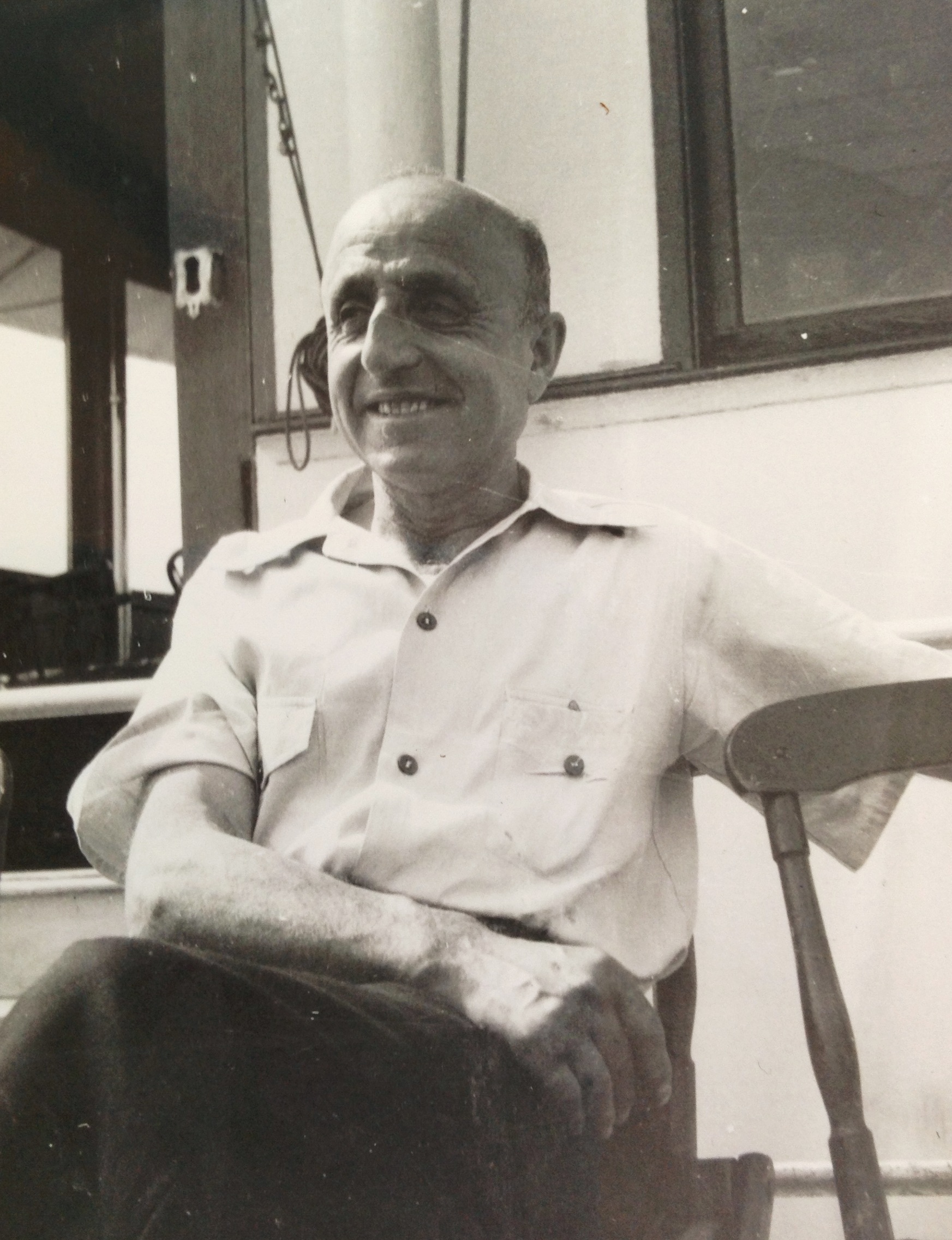
“Grandpa walked out of Romania to escape from the Romanian army.”  That was the one story I knew about my grandfather’s life before he came to the US as a teenager.  I knew a few other snippets about him in general—that he loved music and animals, that he knew multiple languages, that he was a union activist and very left-wing in his political views, that he was a milkman, and that he was a terrible tease and had a great sense of humor.  But the story about him walking out of Romania was the one that always intrigued me the most.  I would ask my mother questions: Did he go alone?  Where did he walk to? How did he get to the United States? But she knew nothing more than that barebones story—that as a teenager, he decided to run away from the army and walked across the country to escape.

When I first started researching my grandfather’s family, I wanted to know more about this story.  Was it just a myth, or was there any factual basis to it?  I did some initial research and learned that there was in fact an entire movement of Jews who left Romania by foot beginning in the early 1900s, around the same time my grandfather left (1904).  These walkers were known as the Fusgeyers or “foot-goers.”  Unfortunately, I could not find many sources of information about this movement.  I found only two books devoted in depth to the topic.   One is a novel called The Wayfarers by Stuart F. Tower; although written as a novel, it was inspired by the author’s actual search to learn about the Fusgeyers.  It tells the story of an American man whose grandfather left Romania by foot.  The grandson, now an adult, takes his own teenage son and his elderly father to Romania to learn more about his grandfather’s escape from Romania.  The author describes long conversations that the lead character had with a rabbi living in Romania who was familiar with the Fusgeyer movement.  Although this book gave me a taste of what the movement was like, I wanted to read something more fact-based and scholarly to understand and know more about the Fusgeyers.[1]

I found that in the second book about the Fusgeyers: Finding Home: In the Footsteps of the Jewish Fusgeyers by Jill Culiner.  This book, a work of non-fiction, is fascinating and heart-breaking.   After reading Jacob Finkelstein’s “Memoir of a Fusgeyer from Romania to America,” an unpublished Yiddish manuscript written around 1942 and held by the New York-based YIVO Institute, Culiner, not herself a descendant of Romanian Jewss, decided to retrace the routes taken by the Fusgeyers as they walked out of Romania.  She actually walked these routes, visiting all the towns and cities along the way, asking current residents what they remembered of the Fusgeyers and of the Jewish communities that existed in those towns before the Holocaust.  What she learned about the past and present in Romania is what makes the book both fascinating and heart-breaking, and in a subsequent post, I will write more about that.  But first, I want to set the scene by describing what I learned from this book and elsewhere about why the Jews left Romania in the early 1900s.

As reported by Culiner and others[2], Jews had likely been living in the two principalities that became Romania, Walachia and Moldavia, since Roman times.   The Jewish population increased significantly in the second half of the 14th century when many Jews from Hungary and Poland immigrated there after being expelled from their home countries. (Wikipedia).  Ironically, Romania eventually became one of the most anti-Semitic of the European countries.  In 1640, the Church Codes of Walachia and Moldavia declared Jews heretics and banned all relationships between Christians and Jews. (Culiner, p. 15). During the 17th and 18th century, there were repeated “blood libel” accusations against Jews—being accused of killing Christian children for their blood— followed by violence and persecution.  (Culiner, p. 15; Wikipedia).

The widespread anti-Semitism really came to a head in the mid-nineteenth century during the movement for Romanian independence and the unification of Walachia and Moldavia into the independent nation of Romania. As the report on Romanian anti-Semitism on file with Yad Vashem reports, after the Crimean War and the defeat of Russia, which had previously controlled Walachia and Moldavia, the European powers (primarily France and Britain) put a great deal of pressure on the leaders of the independence movement in the region to grant Jews full legal status in the new country.  Although the leaders had originally argued for such rights during the uprisings against Russia, the external pressure created a great deal of resentment, and in the end the European powers backed off from insisting on full legal rights for the Jewish residents of the newly-united nation of Romania.  (Yad Vashem report).

The Yad Vashem report continues:  “A real explosion of openly expressed antisemitism occurred as the prospect of achieving national independence became more certain. During discussions of the new Constitution of 1866, Romanian leaders began to portray Jews as a principal obstacle to Romanian independence, prosperity, and culture.”  As finally drafted, Article 7 of the new Constitution for Romania provided that “[t]he status of Romanian citizen is acquired, maintained, and forfeited in accordance with rules established through civil legislation. Only foreign individuals who are of the Christian rite may acquire Romanian citizenship.”  Culiner described this development, saying that “anti-Semitism had now become part of the national identity.” (Culiner, p. 15)

Despite protests and outcry from western European countries, the new country persisted in its anti-Semitic views and practices.  Between 1866 and 1900, a number of laws were enacted restricting the business and other activities of Jewish residents in Romania.  Jews could not become officers in the military, customs officials, journalists, craftsmen or clerks.  Jews could not vote or obtain licenses to sell alcohol.  Jews could not own or cultivate land.  Jews could not own or manage pharmacies.  They could not work in psychiatric institutions or receive care as free patients in hospitals.  Jews could not sell tobacco or soda water or certain baked goods. Fewer than ten percent of Jewish children were allowed to attend public schools, and Jews were prohibited from opening their own schools.  Jews were not allowed to work as peddlers, which was sometimes interpreted to include owning shops.  Jewish homes were randomly destroyed as “unsanitary.”  (Culiner, pp. 16-17)

Culiner wrote:  “Eventually, 20,000 Jews found themselves on the streets of Romania and dying of starvation.  There were many suicides in Iasi, Bacu, and Roman….In 1899 and 1900, harvests were poor and a severe depression gripped the country.  Anti-Semitic decrees were applied with new severity and anti-Jewish speeches were delivered in parliament.  Riots took place in several towns, and…a pogrom broke out in Iasi.”  (Culiner, pp. 17, 19) (See also Wikipedia  and the Yad Vashem report on Anti-Semitism in Romania.)

That pogrom in Iasi was described in the American Jewish Yearbook of 1900: “For several hours there was fighting, merciless blows, pillaging and devastation, all under the paternal eyes of the police authorities and the army, which interfered only to hinder the Jews from defending themselves.”[3]

In 1900, my grandfather was twelve years old.  He lived in Iasi.  He experienced this horrible violence and hatred.  By that time his uncle Gustave and his aunt Zusi had already left for America.  Is it any surprise that this young teenager would have wanted to escape from his homeland and seek refuge someplace else?

Isadore age 27

Isadore age 27

As I will report in a later post, he and thousands of other Jews did leave, many on foot, walking out of Romania to find a better life.  My grandfather followed his uncle and his aunt, who had left in the late 1880s, but he left alone, without his parents or siblings.  His first cousin Srul Srulovici, who became Isador Adler, had left two years before him in 1902, also alone and without his parents and siblings.  My grandfather left in 1904, and by 1910 the rest of his family—his siblings, mother and father and the rest of his Srulovici cousins—had also arrived.  I don’t know the details of how any of them got out or whether they were also Fusgeyers, but they all  followed their two oldest sons and brothers, both to be called Isadore in the United States.

So  my grandfather left Romania on foot, but not only to escape the Romanian army.  He escaped a life of poverty, of hatred, of discrimination.  He was only sixteen, but he was brave enough, smart enough, and strong enough to get out of a place that held no future for him.  He led his family to freedom.  Whatever life brought them in America, and it wasn’t easy, it was better than what they had left behind.


[1] Apparently the novel is being turned into a documentary about the Fusgeyer movement.  See https://www.kickstarter.com/projects/1552736981/the-wayfarers-the-story-of-the-fusgeyers

[2] Wikipedia has a long and detailed article on the history of the Jews in Romania at http://en.wikipedia.org/wiki/History_of_the_Jews_in_Romania.  I also consulted other sources, such as a report on Romanian anti-Semitism filed on the Yad Vashem website at http://www.yadvashem.org/yv/en/about/events/pdf/report/english/1.1_roots_of_romanian_antisemitism.pdf

[3][3] “Romania since the Berlin Treaty,” The American Jewish Yearbook (Philadelphia: The Jewish Publication Society of America, 1900), p. 83, as quoted in Culiner, p, 19.

Enhanced by Zemanta

Gratitude

I am sitting in North Truro on the Outer Cape, looking out at the bay and Provincetown.  The Pilgrim Monument stands tall above

English: The Pilgrim Monument in Provincetown,...

English: The Pilgrim Monument in Provincetown, Massachusetts from the north. The Pilgrim Monument Museum can be seen in the foreground. (Photo credit: Wikipedia)

everything else on the horizon, reminding us that this was the place where the Pilgrims first landed before making a permanent settlement in Plymouth, just across the bay.  I have often walked near the steps where those first immigrants first walked on American soil.  I have spent time trying to imagine what it must have looked like back then—before all the roads and houses and cars and tourists were here, when it was just open land, sea, forests, dunes, and the local tribe who lived here first.  How magnificent it must have seemed, how frightening as well.

My own ancestors made their pilgrimages over two centuries later, and their first visions of America must have been far different from those of the Pilgrims—a crowded, dirty city, thousands of people, noisy streets, a jumble of different languages they could not understand.  It must have been magnificent, but in a far different way, and certainly it was just as frightening.

I woke this morning, filled with gratitude. This has been a transitional week for me.  I have not had much time to focus on research, and I am also in a holding pattern, waiting for documents and for some clues from relatives to help me make some breakthroughs.  I’ve been busy with the end of the semester tasks, and I’ve been concerned about a dear friend.  But this morning I am taking a moment to be grateful.  My friend is feeling better. My students left me some wonderful gifts, including a large poster signed by them, wishing me well on my retirement.  My exams are written, and the students are preparing to take them.  And I am in the place I love best with the person I love best, staring at a scene that always brings me comfort and perspective. So I am grateful.

When I think about my life compared to the lives of my ancestors, of those who came to America back in the late 19th, early 20th century, how could I not be grateful? I get to travel to places out of choice, to see those places for pleasure, to experience the beauty in the world for the sake of that experience.  They traveled because they had to—to escape from a difficult place and to attempt to create a better life somewhere else.  I get to live where I want to live.  In all my adult life, I have only lived in five different homes.  One thing that has struck me as I’ve done my research is how often my ancestors moved.  One cousin explained this by saying that every time a landlord raised the rent, the family would move, often not paying any rent due because they had no money.  When I have moved, it has always been out of choice—to a bigger home, for a better job, for a better location—not because I had to move.

My ancestors probably never knew the concept of leisure time.  Life was hard work all the time.  Although my grandparents were able to take some time away in the country during the summers when my mother was a young child, those were short vacations, a brief respite away from the hot city.  I have the luxury now of retiring and choosing every day how I will spend my time:  Will it be yoga or the elliptical at the gym today? Will I take a class or tutor a child?  Will I write my book or research my family? Should I do the NYTimes crossword puzzle or read a book?  I still cannot fully grasp what that will be like on a daily basis, but I am so grateful that I will have that opportunity to figure out how to spend my time.

Often I take all my freedom for granted and forget how lucky I am.  But today, sitting here, looking at the Pilgrim Monument, thinking of those Pilgrims and of my own ancestral pilgrims, I am filled with gratitude for all that those pilgrims and Pilgrims did, for all that I have, and for all the people I love.DSCN0396


Enhanced by Zemanta

A Personal Reflection: Yesterday, Today and Tomorrow

Yesterday was a turning point in my life.  Since August, 1982, I have been a law professor.  Over the course of thirty-two years, I have taught over 4000 students various law courses, including copyright law, trademark law, antitrust law and contracts.  The students I’ve taught have been overall very hard-working, determined, and excited to be in law school.  I’ve enjoyed every semester, though perhaps not every day that I’ve taught during those semesters.  Sometimes I was tired, impatient, or disappointed; sometimes the students were bored or unprepared or frustrated.  But those were the rare days.  Almost all the time, I loved being in the classroom.  I loved helping students to learn, laughing with them, pushing them to try harder, and delighting in their successes.  It was never boring for me; it was almost always fun and rewarding.

Yesterday was my last day teaching law students.  After thirty-two years, I’ve decided to retire from the law school faculty and pursue other interests, including but not limited to genealogy.  I was not tired of the students or teaching, but it was time for a change.   I hope to find new ways to use my skills and love of teaching as a volunteer, working with a different type of student, teaching something other than law.  I want to learn new things myself.  I want time to do the things that I’ve not been able to do while working full time.  But I will miss teaching law students and preparing them for a profession that they are so excited and proud to enter.

Yesterday I said goodbye to my students.  I got choked up.  It caught me by surprise how emotional I was, how sad I felt.  I thought I would want to celebrate.  I’d been counting down the days all year.  Until this last week.  Then suddenly I no longer was counting the days.  It suddenly felt scary and sad.  Don’t get me wrong.  I have no second thoughts; I know this is the right thing for me and the right time to do it. But after 32 years, if I didn’t feel a little sad, what would that say about those 32 years? As my brother-in-law once said in a different context, if it doesn’t hurt when it’s over, it could not have been worth very much.

Yesterday is over; today I am processing what it meant.  But tomorrow I will start thinking about what is ahead.  I still have exams to grade, recommendation letters to write, one more faculty meeting, and graduation to attend.  But after that I get to start a brand new chapter of my life.  The third chapter.  Chapter One was preparing to be an adult: childhood, adolescence, and education.  Chapter Two was being an adult: raising a family, owning a home, having a profession.  Chapter Three?  I don’t know what Chapter Three will bring.  I hope it brings new challenges, new experiences, new discoveries.  I hope it brings time to reflect, time to give back, time to be with those I love, time to learn and write and think and read—all the things I love best.  I know that a big part of Chapter Three will be learning more about my ancestors, more about my family.  I know that this blog will be a big part of it as well.  All my life I have wanted to write.  This is my chance.  This is my time.  Tomorrow is here; yesterday is over.


Enhanced by Zemanta

Assessment time

It’s time for my periodic review of what I have learned and where I am going in my research.  I keep a Word document with lists of things I need to do, but sometimes I need to step back and see the whole picture, then step forward and see the details.

English: Forest trees Part of the forest which...

English: Forest trees Part of the forest which is a bit more mature than some of the other parts along the path here. (Photo credit: Wikipedia)

On the Brotman side, I think I am in fairly good shape.  I have found descendants of all but one of Joseph and Bessie Brotman’s children, although I am not in touch with all of the descendants.  The only missing link is Sophie Brotman; I’ve had absolutely no luck finding any records for her.  I don’t know when she arrived, whether she married and, if so, who she married, where she lived, where she died.  And sadly, I don’t think I ever will.  There is no one left alive to ask about Sophie; none of the descendants I’ve spoken with know anything about her.  Perhaps one of Abraham’s descendants might know something, so I will contact Paula, the one Abraham descendant I’ve been in touch with, and see if she has ever heard of an aunt named Sophie.

Bessie

Bessie

The big research area remaining for me on the Brotman side is finding out whether we are related to any other Brotmans, in particular the Brotmans who settled in Brotmanville.  I am in touch with a few of Moses Brotman’s descendants, and one is a genealogist, so we plan to collaborate and see whether we can find the connection between our families.  If we can, that may also lead me to other clues about where in Galicia Joseph and Bessie lived and to clues about other family members.

Moses Brotman

Moses Brotman—Joseph’s brother?

On the Goldschlager branch, I think I am also in fairly good shape.  I have found the descendants of Moritz, my great-grandfather, and of Betty and David Goldschlager, my grandfather’s siblings, and I know about the lives of Betty and David and their children.  I’d love to go back and research Moritz Goldschlager’s family, but since his parents died when he was a young child, there does not seem to be too much more I can learn.  My Romanian researcher did not find anything more related to my Goldschlager relatives, so I may have reached the brick wall with respect to that line.

Moritz Goldschlager

Moritz Goldschlager

On the other hand, the Rosenzweig branch, my great-grandmother Ghitla’s family, still has a number of unanswered questions.  I have been able to learn a great deal about most of the children of David and Esther Rosenzweig, my great-great-grandparents, but Zusi Rosenzweig remains a mystery.  Her descendants were not responsive to my inquiries, so I may have to find another way to get closure on Zusi and her son Nathan and her husband Harry Mintz.  I’ve had better luck with Tillie Rosenzweig Strolowitz Adler and her children and grandchildren and have been in touch with two of her great-grandchildren.  There are still some loose ends there, but for the most part I have been able to find a fair amount about the children of Tillie and Jankel and even about their grandchildren and great-grandchildren.

Ghitla Rosenzweig Goldschlager

Ghitla Rosenzweig Goldschlager

As for the family of Gustave and Gussie Rosenzweig, I still have some open questions, mostly about the daughters Lillie, Lizzie and Ray.  This week I spoke with one of Sarah’s granddaughters, and I am hoping that she will also be able to help me find out more about her grandmother’s sisters, but as of right now, I have not been able to find any of the descendants of Lillie, Lizzie or Ray.

So that’s where I am in this journey to find my mother’s family.  I feel as though I am seeing the light at the end of the tunnel, though there is still plenty of tunnel to get through.

Tunnel

What do I do now besides continue to search for answers to the remaining questions?  I have a number of thoughts.

For one, I want to continue to build the relationships I’ve made with all my new cousins on both sides of my mother’s family—the Brotmans and the Goldschlager/Rosenzweigs.  Having found them, I don’t want to lose them again.  Facebook and email make this so much easier, but it will still take effort.  I also want to see if I can organize a meeting for the Rosenzweig/Goldschlager cousins like we had for the Brotmans earlier this month.

I also want to pull all my research together into a format that will make it more easily accessible.  I’d like to tell the story of the Brotmans, Goldschlagers and Rosenzweigs as a chronological story so that someone can pick it up and get the whole story without having to jump from blog post to blog post, searching for the next discovery.  That is a larger project, and I don’t even know how to start it, but that is what I see as my ultimate goal—to write the book that tells the stories so that our descendants will have it and know who their ancestors were.

And then there is the next huge research task: my father’s side.  That will be a very different research experience.  His family has been in this country for about fifty years longer than my mother’s family.  They came from Germany and from England.  They settled and lived in other places: Philadelphia, western Pennsylvania, New Jersey, New Mexico, among other places.  There will be a lot more American and European records available, which will make the task both easier and harder.  I’ve already traced one of my father’s lines back to the 1750s or so in Amsterdam, a full century earlier than I’ve been able to trace any of my mother’s relatives.  I look forward to this research with some trepidation because of the size of the task ahead.  But I am also excited by the idea that I have more discoveries, more stories, more understanding of my family and of myself ahead of me.


Enhanced by Zemanta