Another Sad Story: Harry Rosenzweig

I have already told the story of Gustave and Gussie’s son David who died shortly after his first birthday.  I’ve also talked about the records that indicate that Gustave and Gussie suffered the loss of many infants—perhaps as many as nine babies who did not survive.  But I have not yet told the story of their son Harry Rosenzweig.

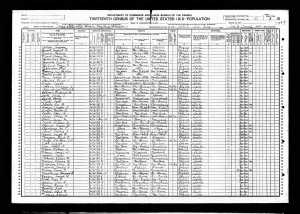
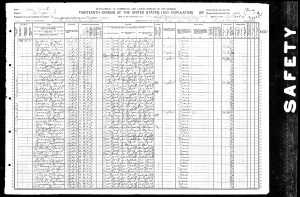
Harry was born in July 1897, two years after Jacob and a year before Joseph.  He appeared on the census reports with the family in 1900, 1905, and 1910, but then he disappeared from the records.  He is not on the 1915 census or any later census report.  Since he would have been eighteen in 1915, I thought perhaps he was serving in the military like his brothers Abraham and Jack, but I could not find any military record or draft registration with his name.  Where could he have been?

Fearing the worst, I checked the death index for NYC and sadly saw that indeed a Harry Rosenzweig had died on July 9, 1913. He would only have been sixteen years old—could this be the same Harry? If so, why did he die so young?  I sent for the death certificate, which I received the other day.

Harry Rosenzweig death certificate

Harry Rosenzweig death certificate

As you can see, it is in fact the death certificate for Harry, the son of Gustave Rosenzweig and Gussie Sachs.  His cause of death is given as drowning.

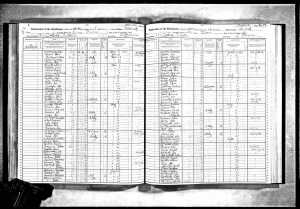
I then searched for and found this brief news article from the Brooklyn Standard Union of July 8, 1913, p. 6, which explains some of the circumstances surrounding Harry’s death.

Brooklyn Standard Union July 8, 1913 page 6

Brooklyn Standard Union July 8, 1913 page 6

Can you imagine what his father must have felt, going to the police station and seeing his son’s clothing? Why was Harry off by himself, swimming alone and away from the others in his gray flannel bathing suit? The article almost seems to imply that there was something suspicious about his behavior.  Was his drowning other than accidental? The police obviously did locate his body the next day, as indicated on the death certificate, but the rest of the story remains a mystery.

The other question that lingers for me is whether or not Harry’s death occurred before or after Gustave and Gussie had separated. By the time of the 1915 census, Gussie and Gustave were apparently separated, as Gustave is not listed as living at 1914 Pacific Street with Gussie, Abraham, Jacob, Joseph, Lizzie and Ray.  I have yet to find Gustave anywhere on the 1915 census.  I searched the address given in the news report on Harry’s drowning in 1913, 1166 Nostrand Avenue, and Gustave is not listed as living at that address in 1915.  In 1910 the family was living at 677 Franklin Avenue in Brooklyn and in 1905 they were living on Fulton Street in Brooklyn.  Had they moved to Nostrand Avenue between 1910 and 1913 and then moved again between 1913 and 1915 to Pacific Street? Or had Gustave already left the home by 1913 and thus was living by himself on Nostrand Avenue?  Where was he then in 1915? I will have to keep searching.  By 1920 he seemed to be living in upper Manhattan as a boarder, and by 1920 he was remarried.

If Harry died before Gustave and Gussie separated, one has to wonder whether his death precipitated the end of their marriage.  And if he died after they separated, one has to wonder whether the end of their marriage was in any way a factor in his swimming alone, away from everyone else on the beach.

Of course, his death could have been an accident, or he might have been swimming alone for any number of possible reasons.  Whichever version of the story is true, the death of Harry Rosenzweig as a young teenager must have been a terrible tragedy for his family, a family which had already suffered the deaths of so many of their children.

Which makes it even more remarkable that at least some of his surviving siblings grew up to be such loving, warm and fun-loving adults, as my post tomorrow will discuss.

Enhanced by Zemanta

Blog Update

Just a quick note to let you know that I have updated the page for David and Esther Rosenzweig’s Descendants to include the newly found children and other descendants of Gustave and Gussie Rosenzweig.  There is also an updated family tree (see the link) and some new photos, so check it out when you get a chance.  The page is found by clicking on the appropriate title at the top of the blog page under the main title.

Enjoy!

Enhanced by Zemanta

Abraham Rosenzweig: Update

A week ago I wrote about my search for Gustave Rosenzweig’s son Abraham and the process I used to narrow it down from the thirteen possible Abraham Rosenzweigs who were born in New York between 1885 and 1895 to the one who seemed to be the most likely possibility.  That one was the Abraham who married a woman named Rebecca, had two sons named Max and Irving, and who worked for a bakery company.  But I needed some specific evidence proving that that Abraham was the son of Gustave Rosenzweig.

I searched the New York marriage record index over and over and finally decided that Abraham and Rebecca had not been married in New York City, but in Pennsylvania where Rebecca was born.  Abraham, Gustave’s son, had been stationed in Pennsylvania while in the Navy, and I assume that that was when they met.  I looked for a Pennsylvania marriage record, but have not found it.

I was, however, able to find a death notice for that Abraham in the New York Times dated May 14, 1961.  It named his wife Rebecca, his two sons Max and Irving, and his four grandchildren.

Abraham Rosenzweig death certificate May 14, 1961 NYTimes

Abraham Rosenzweig death certificate May 14, 1961 NYTimes

From this death notice and the date of death I was able to find where he was buried, Mt Lebanon Cemetery in Queens.  I called the cemetery and asked whether there was any record of his father’s name.  The woman there said that they did not keep that kind of record; however, they would take a photograph of the headstone for a fee and email it.  I gave her my credit card number and ordered the photograph.

While waiting for that photograph, I hoped that it would in fact have his full Hebrew name with his father’s name.  If it only had his English name, I’d be back to square one.  It would be hard to obtain a death certificate since he had only died in 1961, barely 50 years ago.  It would mean waiting a few months to get the answer.

But fortunately the headstone does have his full Hebrew name as you can see below:

Abraham Rosenzweig headstone Mt Lebanon Cemetery

Abraham Rosenzweig headstone Mt Lebanon Cemetery

Avraham ben Gedalia ha Levi.  Abraham son of Gedalia the Levite.  Remember that Gustave’s birth name was Ghitale.  Ghitale is the Romanian equivalent of Gedalia, Hebrew for God is great.   Abraham Rosenzweig, the son of Gustave Rosenzweig, married Rebecca from Pennsylvania, worked for a bakery, and had two sons and four grandchildren.  Now I will try to find them.

Enhanced by Zemanta

Leah Strolowitz Adler: An American Immigrant Success Story

I think I changed something so that the link didn’t work. So I am reblogging this. Hope this works!

Leah Strolowitz Adler: An American Immigrant Success Story

As I have written before, one of the fascinating aspects of doing this research is what I’ve learned about the experience of Jewish immigrants in the late 19th and early 20th centuries.  It is remarkable to me how children who arrived without speaking English and living in poverty were able to assimilate successfully into American society and make a good life for themselves and their children in this country.

Leah Strolowitz Adler is a good example of this remarkable transformation from a poor Romanian immigrant to an American success story.  Thanks to her granddaughter Jean, I’ve been able to learn a fair amount about Leah and to obtain several pictures of her.  Leah was born on May 25, 1900, in Iasi, Romania, the seventh and youngest child of Jankel Srulovici and Tillie Rosenzweig.  She was only seven years old when she immigrated with her parents and siblings to New York City, where soon afterwards her father either died or disappeared.  She lived with her mother and siblings and her two cousins, Isadore and Betty Goldschlager, in a tenement in East Harlem.  While her older siblings went to work in sweatshops to support the family, Leah went to Public School 101 in Harlem on 109th Street, where she completed eighth grade in 1915.  Jean recalled that Leah told her that although she was happy to leave Romania, she found the transition to America difficult.  Leah remembered standing on line at the public school in NYC and being teased for speaking Yiddish.  Obviously, however, Leah soon learned English and even went on to Julia Richmond High School.

After she finished school,  Leah lived with her mother and sisters, working in a millinery shop, until she married Ben Schwartz on June 26, 1921.  Jean shared with me the story of how Leah met Ben.  Leah had been friendly with or briefly dated Ben’s brother Emmanuel. While Emmanuel was overseas during World War I, Leah dropped by his optometry office for an eye exam and met Ben. Ben asked Leah out for a cup of coffee.   The family story is that when Leah finished her piece of cake, Ben offered to buy her a second piece, and she knew right then that “he was a keeper.” Ben was American born and also an optometrist, according to his draft registration and various census reports.

Here are some photos of Leah, taken by Ben, during their courtship around 1920. She looks like a genuine American woman of the 1920s.  She certainly seems to have left her poor immigrant beginnings behind her.

Leah c. 1920

Leah c. 1920

leah

leah

This is Leah and Ben around 1920:

1920 Leah with Ben Schwartz

1920 Leah with Ben Schwartz

Here is a photograph of Leah around 1921, reading a Yiddish newspaper, the Jewish Morning Journal.

Leah c. 1921

Leah c. 1921

Leah and Ben moved to the Bronx and had a son Ira (named for Isidor, Leah’s oldest brother), born in 1923, and a daughter Theodora (“Teddy”)(named for Tillie, Leah’s mother) born in 1927.  Here is a photograph of Leah, wearing a fur coat and holding Teddy in February, 1929, when Teddy was two years old.  Notice the price of the baby clothes in the window of the shop behind them:  79 cents.

Leah and Teddy February 1929

Leah and Teddy February 1929

Sometime in the 1930s, Leah’s divorced sister Bertha came to live with the Schwartz family for a number of years (at least until 1940, according to the US census of that year).  Teddy still remembers her mother Leah commenting that it was a good thing that her father Jankel could not see them all working on Shabbos, suggesting that Jankel must have been an observant Jew.

According to Jean, Bertha taught Teddy to sew, but Leah was upset because she wanted her daughter to do more with her life than the sewing work that Leah and her sisters had done.  I found this remarkable, given that women had so few choices back in the 1930s, but Leah clearly had a progressive vision and did not want her daughter to limit herself in anyway.

Teddy and Leah and Ben 1944 after her high school graduation

Teddy and Leah and Ben
1944 after her high school graduation

Teddy did grow up to be independent. After graduating from Taft high school in 1944, she attended NYU and became an occupational therapist, a professional woman long before that was common.  Because she hated the cold, she moved by herself to Atlanta, Georgia, after seeing an advertisement for a job there.  She soon met the man who would become her husband, Abner Cohen, whose family had deep roots in Atlanta. Teddy and Abner stayed in Atlanta where they raised their three children.

Jean recalled that Leah was scared to death to fly and so she and Ben would take the seventeen hour trip by train from NYC to Atlanta once or twice a year. Jean remembered, “At the station, while we waited for the train to arrive, we placed copper pennies on the track and after she disembarked and her train left, we would collect the flattened Abe. Grandma baked wonderful rugelach and some round brown sugar cookies. We made such a to do about her cookies that she would arrive toting the dough already mixed and  formed ready to bake.”

Leah and Ben

Leah and Ben

Leah in 1968 with a cousin Margie

Leah in 1968 with a cousin Margie

Leah and Ben's 50th anniversary 1971Leah and Ben’s 50th anniversary 1971

Eventually Teddy’s parents Leah and Ben moved to Atlanta, where they lived the rest of their lives.

So Leah Strolowitz Adler, who was born in Iasi and moved to America at age 7, not speaking English and living in a Harlem tenement, grew up and lived a comfortable life in New York, raised a daughter who became a health care professional, and retired with Ben to Atlanta, where she was able to get to know her grandchildren, including Jean, my fellow family historian.  To me, it is a remarkable story, another example of the amazing resilience and persistence of the immigrant generation who made life possible for all of us today.


Enhanced by Zemanta

Brotmans, Resslers, Rosenzweigs, and Goldschlagers: All Roads Meet on Pacific Street in Brooklyn

Gussie and Isadore

Gussie and Isadore

This is probably the most moving discovery yet for me personally.  I am so excited that I don’t know where to start.  This story involves the Brotman family and the Ressler family AND the Rosenzweig family and the Goldschlager family.  It’s the final piece of the puzzle about how my grandparents met.  It came as a posthumous gift from my much beloved Aunt Elaine, who truly was not only our family matriarch, but also our family historian.  Aunt Elaine, you always wanted to tell me these stories, and I was too young and dumb to care.  I know you would be so happy that I am finally interested and recording them for all time.

Fortunately, someone was interested in her stories back then.  It seems that not only did my brother listen to my aunt, so did my cousin Jody’s husband Joel, my aunt’s son-in-law.  He interviewed her about the family and took careful notes.  Jody and Joel just found his notes while going through some boxes in their house, and Jody emailed them to me.  There is so much information in there that it will take me a while to digest it all and write it up for the blog.  Joel’s notes cover stories and anecdotes about the family and reveal some new things as well as things we now know but that I did not know a year ago.  But here’s the story that made me say out loud, “Oh, my God!”  And then to stop and sit in amazement.

You may recall that a while back I wrote a post about how various members of my family met their spouses, including my grandmother and grandfather.  I wrote:  “My grandfather Isadore supposedly saw my grandmother sitting in the window of her sister Tillie’s grocery store in Brooklyn and was taken by her beauty.”  That was the family story passed down the generations.

When I wrote about this story recently, what I couldn’t figure out was what my grandfather was doing in Brooklyn.  He had always lived in East Harlem since arriving in New York and did not live or work in Brooklyn in 1915. So what would have brought him to Brooklyn from East Harlem when he first saw my grandmother?

The answer is revealed in the notes Jody and Joel just sent me.  The story begins with my aunt telling Joel that my grandmother Gussie Brotman used to go to her sister Tillie’s grocery store after school.Gussie at Tillie's storeIn case you cannot read that, it says, “After school on Friday Gussie would go to Tillie’s house in Brooklyn at her grocery store.”

In 1915 Tillie and Aaron were living at 1997 Pacific Street in Brooklyn.    As Joel’s notes continue:

Isadore sees Gussie

“Isidore Goldschlager visiting a cousin who lived down the street from the grocery store. As he got off the trolley he saw Gussie on milk box and said to his cousin there is a very beautiful girl.  Isadore said he wants to meet her.” (emphasis added)

 In  1915, the Rosenzweigs were living at 1914 Pacific Street, right down the block from 1997 Pacific Street where Tillie and Aaron Ressler lived. When I wrote that post back on February 5, I did not yet know about Gustave Rosenzweig and his family.  I had no idea that my grandfather had cousins living in Brooklyn on the same street where my grandmother was living.

Rosenzweigs 1915

Rosenzweigs 1915

Gussie living with TIllie 1915

Gussie living with TIllie 1915

So the cousin that my grandfather was visiting was one of the sons of Gustave Rosenzweig.  In 1915, Abraham was 26, Jacob  was 21, and Joseph was 17.  Abraham and Jacob were in the Navy, and Joseph was working as a driver’s helper.  My grandfather was 27 in 1915, so my guess is that he was hanging out with Abraham, who was closest to him in age.

Isadore age 27

Isadore age 27

I have wondered whether my grandfather ever saw these cousins once they all got to NYC, whether he knew them well.  Well, obviously he did.  If he had not been close to them, he would never have come to Brooklyn.  He would never have seen that beautiful red haired woman sitting on the milk box.  And this would never have happened:

Isadore Goldschlager and Bessie Brotman  marriage certificate

Isadore Goldschlager and Gussie Brotman
marriage certificate

Isadore and Gussie marriage cert 2And if that hadn’t happened, then my Aunt Elaine and my Uncle Maurice and my mother would never have been born, and then all my first cousins and my siblings and I would never have been born.

That little stroll down Pacific Street brought the Rosenzweig/Goldschlager family together with the Brotman family and thus created my family.  How could this not be my favorite story ever?

This is another one of those moments when all the time spent studying census reports pays off.  If I had not found the 1915 census reports for the Resslers and the Rosenzweigs, I would never have known they lived down the street from each other.  If I hadn’t looked at all those other documents, I would never have learned about my grandfather’s cousins and his uncle Gustave.  If I hadn’t started this blog, Jody and Joel might never have found these notes in their boxes of papers and provided the last piece of the puzzle. If Joel hadn’t listened to his mother-in-law, we wouldn’t have her memories and stories to tie it all together.  It should remind us all to ask questions and take notes and listen to our parents, our aunts and uncles, and our grandparents  so that we can learn everything we can while we can.

Thank you, Jody and Joel.  Thank you, Aunt Elaine.  Thank you, Uncle Gustave, for moving to Brooklyn.  Thank you, Aunt Tillie, for taking my grandmother to Brooklyn. And thank you, Abraham Rosenzweig, for taking my grandfather for that walk down Pacific Street so that he could meet and marry my grandmother.

Enhanced by Zemanta

Joseph Rosenzweig: Update

I am delighted to say that I have been in touch with three of Joseph Rosenzweig’s grandchildren and that they have confirmed that he was indeed the son of Gustave Rosenzweig, my great-great uncle, my great-grandmother Ghitla Rosenzweig Goldschlager’s brother.  I am very happy that I am able to share with them the information I have learned about their great-grandfather and all his relatives, and I am looking forward to learning more from them and about them.

Image

Joseph Rosenzweig, Gustave’s youngest son

Ron, one of the grandsons, sent me this picture of his grandfather Joseph.  It made me smile—he looks so happy and fun-loving.

This is perhaps one of the greatest rewards of doing family history research: finding people who share that history and being able to connect and share with them.  I learned that first from finding my Brotman cousins and have now had the same experience finding my Goldschlager and Rosenzweig cousins.

Enhanced by Zemanta

Joseph Rosenzweig: The Process of Elimination

The other day I wrote about the steps I took to narrow down the thirteen possible Abraham Rosenzweigs in the 1915 NYS census to the one who I am reasonably certain was the Abraham who was the son of Gustave and Gussie Rosenzweig and thus my grandfather’s first cousin.  Over the last two days I have been engaged in the same process to determine which of the many Joseph Rosenzweigs I found in the US and NYS census reports was the younger brother of Abraham and also Gustave’s son.  I am once again reasonably certain that I have found the right Joseph, but I want to record the process I used to get there, both for my own record-keeping and to invite others to question my reasoning and my conclusions.

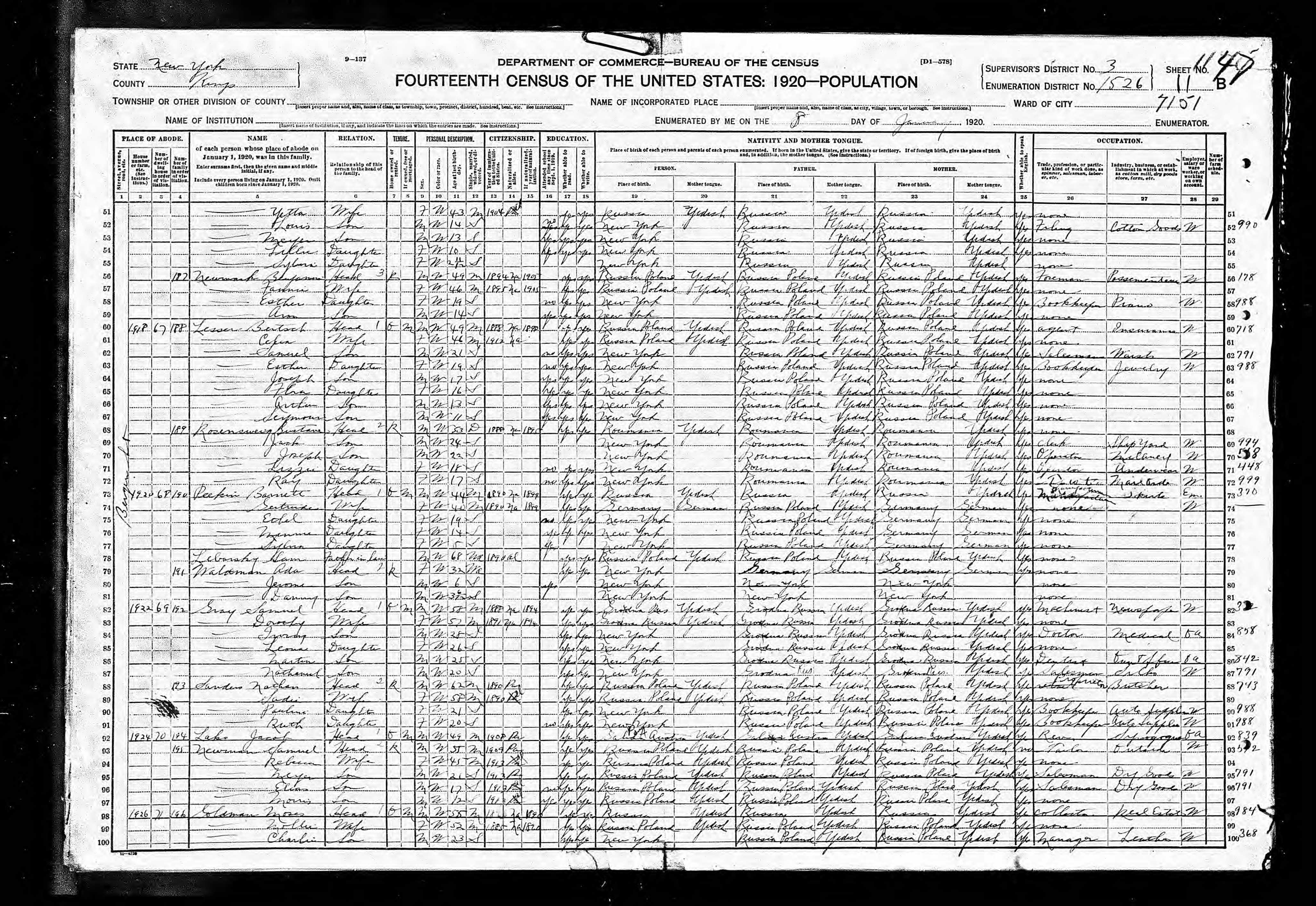
In many ways the search for the right Joseph was easier than the search for Abraham.  For one thing, there were far fewer Joseph Rosenzweigs than there were Abraham Rosenzweigs.  For another, Joseph was born in 1898 and thus was almost ten years younger than Abraham.  That meant that I had five census reports in which Joseph was living with his parents and siblings: 1900, when he was two years old, 1905 (seven years old), 1910 (twelve years old), 1915 (seventeen years old) and 1920 (22 years old).  I also found what is definitely Joseph’s draft registration and World War I service record; I know these are for the same Joseph because his address on these two forms, 1882 Bergen Street in Brooklyn, is the same address where the family was living in 1920 according to the 1920 US census.

From these documents I learned a fair amount about Joseph’s early adult life.  In 1915 he was employed as a driver’s helper, according to the 1915 census.

Rosenzweigs 1915

Rosenzweigs 1915

In 1917 when he registered for the draft he was working for the BRT, or the Brooklyn Rapid Transit Company, which eventually merged into the BMT or Brooklyn-Manhattan Transit Company.  It is difficult to decipher the handwriting, but it looks like he was a guard for the BRT, perhaps the same as being a driver’s helper as he had reported in 1915.

Joseph Rosenzweig draft registration World War I

Joseph Rosenzweig draft registration World War I

His draft registration also indicated that Joseph was the sole supporter of his mother at this time. By this time Gustave and Gussie had separated or divorced, and on the 1915 census two years before Gussie had been living not only with Joseph, but also with Abraham and Jacob, both already in the US Navy, and Lizzie and Rachel, both still in school and young teenagers. Apparently by 1917, only Joseph was providing support for his mother and presumably his two younger sisters.  According to the 1918 abstract of Joseph’s military service during World War I, he served as a Seaman, Second Class, in the US Navy at the Brooklyn Navy Yard from February 8, 1918 until November 11, 1918, Armistice Day, the end of World War I.

Joseph Rosenzweig military service

Joseph Rosenzweig military service

After the war, according to the 1920 US census, Joseph was still living with his mother and Jacob (Jack), Lizzie and Rachel (Ray) at 1882 Bergen Street and working as an operator in a millinery shop; in other words he was a hat maker.  It is this occupation that became critical to my analysis as I moved past the 1920 census to the 1925 NYS census and the 1930 and 1940 US census reports.

There are only two Joseph Rosenzweigs listed on the 1925 NYS census born in New York around 1898.  One was living with his parents, whose names were Aaron and Rose, so clearly not our Joseph.  The other Joseph was married to a woman named Sadie and had a four year old daughter named Irene.  They were living at 308 East 98th Street in Brooklyn, and most importantly, Joseph’s occupation is listed as a hatter.  His wife Sadie had been in the United States for 12 years and was born in Russia.  Although I have yet to find a marriage record for Joseph and Sadie, it appeared that they must have gotten married in 1920 since they already had a four year old child by 1925.  I will continue to search for their marriage certificate as it will provide more definite evidence that the Joseph who married Sadie was the son of Gustave and Gussie Rosenzweig.

Rosenzweigs 1920 census

Rosenzweigs 1920 census

Joseph and Sadie 1925

Joseph and Sadie 1925

Although I would like additional evidence to link this Joseph to Gustave, I am reasonably certain that it must be the right person.  The age and birthplace are correct, the occupation is the same as the occupation held by Joseph when he was still living at home with his mother, and there was only one other Joseph Rosenzweig listed in this age range in the 1925 NYS census.

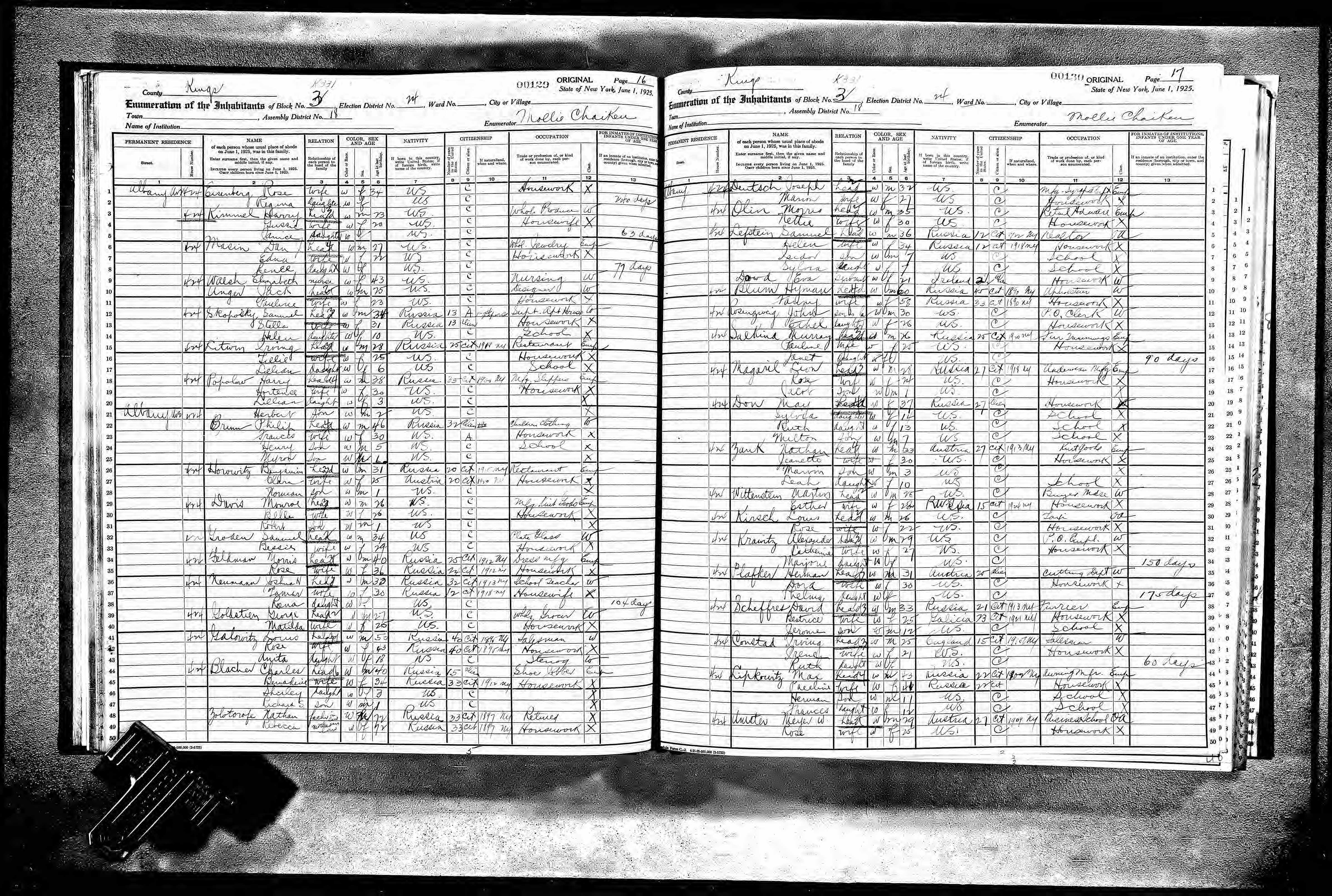
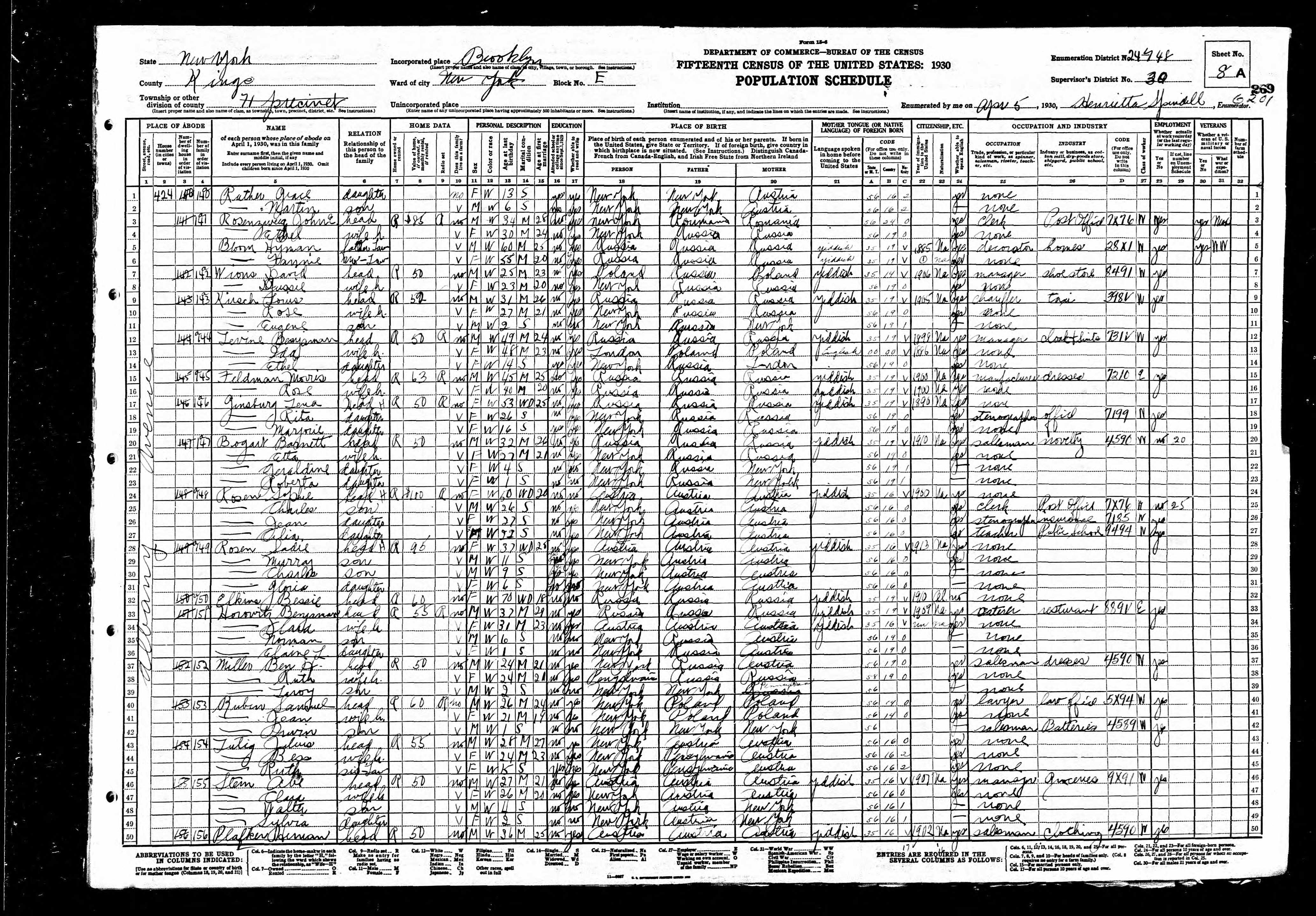
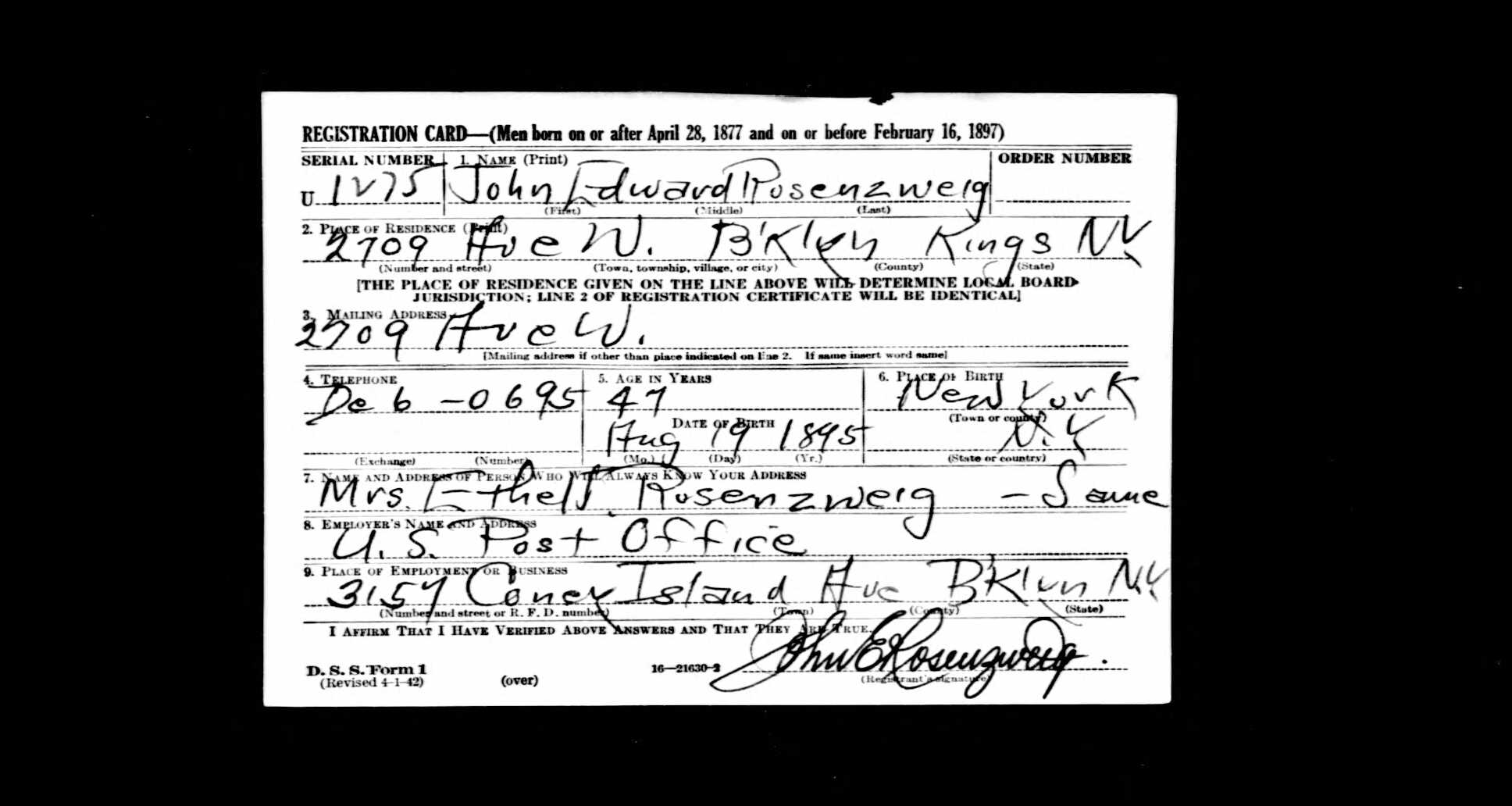
Thus, I moved on to the 1930 census to see if any other Joseph Rosenzweigs were included there who could match the right criteria.  On the 1930 census I found two Joseph Rosenzweigs.  The first Joseph was born in 1898, but he was living with a brother named David, and Gustave and Gussie did not have a son named David who survived until 1930.  The second Joseph was the Joseph who married Sadie.  The census reported that he was born in 1897 and had been married to Sadie for ten years, making 1920 again the likely year of their marriage.  Sadie’s sister Tilda Kablanski was living with them, and they now had two daughters, Irene (nine years old) and Mildred (four years old).  They were still living on East 98th Street in Brooklyn, and Joseph was still employed as a hat maker.  There was also a John Rosenzweig who had Romanian parents, which looked promising, and he was living on Albany Avenue in Brooklyn, married to Ethel Bloom.  He was working as a postal clerk.  Although he was born in 1890 and thus older than Gustave’s son and had the wrong name, I held him aside as a possibility.

The only information in the 1930 census for the Joseph that married Sadie that conflicts with what I know about Joseph, Gustave’s son, is that it reports that his parents were born in Russia, not Romania.  I would be more troubled by this if I had not already seen so many errors on census reports: my grandmother’s name listed as Maurica when it was Gussie, my great-grandmother’s name given as Pauline when it was Bessie or Pessel, ages that are inaccurate, relationships described incorrectly, and so on.  I had to remind myself not to use this inconsistency to dismiss Joseph and Sadie; genealogists often are reminded that census takers took information often from neighbors or children or anyone who was around when the occupant was not home.  So given that there were only two Joseph Rosenzweigs of the right age born in NYC listed on the 1930 census, I decided that it was still more likely that the Joseph who married Sadie was Gustave’s son than the John who was almost ten years older and working as a postal clerk or the Joseph who was living with a brother named David.

Joseph and Sadie 1930 census

Joseph and Sadie 1930 census

So I moved ahead to the 1940 census to see if I could find anything that would help to nail down the identity of the correct Joseph.  There were four Josephs (plus the John who married Ethel; since his name was listed as John again, I decided that this was not a census taker’s mistake and eliminated him from my pile.)  Once again, there was Joseph who married Sadie, living with their two daughters Irene and Mildred on Rockaway Parkway in Brooklyn.  Joseph’s birth year was given as 1899 this time, and his occupation was still in hat-making.  There was a second Joseph married to a Sadye, living in Manhattan, but he was older (born in 1894). There was a third Joseph married to a Jenny, also living in Manhattan, who was a salesman of knit goods, but he was also older, born in 1893.  And finally there was a Joseph born in 1897, married to Sarah and living in the Bronx.  He was a clerk in a rubber factory.  Of the four Josephs, it still seemed to me that the one who was most likely Gustave’s son was the Joseph who married Sadie: he lived in Brooklyn, where our Joseph grew up; he was a hatter, which our Joseph had been in 1920; and he was the correct age, unlike two of the other three.

Joseph and Sadie 1940

Joseph and Sadie 1940

Obviously I cannot be 100% sure unless and until I can find a marriage certificate for Joseph and Sadie which reveals his parents’ names or unless and until I can find a descendant of Joseph and Sadie who may know whether their great-grandfather was named Gustave and whether their great-grandmother was named Gussie.  I have sent messages to a few of those descendants, and I am hoping that one of them will be able to help.  In the meantime I will continue to search for more evidence linking Joseph to my great-great uncle Gustave Rosenzweig, in particular the marriage certificate or the death certificate for the Joseph who married Sadie.

Enhanced by Zemanta

It Takes A Village: Mystery Solved!

Immigrant children, Ellis Island, New York.

Immigrant children, Ellis Island, New York. (Photo credit: Wikipedia)

I received a lot of exciting documents today, but I cannot write about them all at once.  I want to write first about the one that resolved a longstanding mystery I had almost despaired of ever solving.

Just to refresh your recollection (or to tell you the story for the first time), my great-great aunt Tillie Strulowitz arrived at Ellis Island with her husband Jankel and three of her seven children, the older four having already emigrated.  They were detained at Ellis Island because of questions about Jankel’s health, and I was able to obtain, with the help of the generous people at JewishGen, the file for the immigration hearing. From that I knew that he had been admitted to the United States and had not been deported or died before arriving in the US, as some of his descendants believed.

But I still could find no evidence of what happened to him after January, 1908, when he was admitted.  He was not on the 1910 census with Tillie and the children. Tillie was listed as a widow, but I could not find a death certificate or a cemetery burial that proved he had died. I began to wonder whether Jankel had abandoned them or been institutionalized or returned to Romania.

I wrote to the JewishGen discussion group for a second time to ask for help, and I received many very helpful and creative suggestions.  I pursued each one of them, but with no success.  The only one that I had still not been able to put closure on was a suggestion from a man named Barry Chernick who had found a death recorded for a Jankof Israelwitch in April 1908.  Barry hypothesized that this might be Jankel because Israelwitch could be an Americanization of Strulowitz or Srulovici.  Since Srul is Yiddish for Israel, perhaps the family had switched their name after leaving Ellis Island.  It seemed like a long shot, but I figured it was worth a try and wrote away for the death certificate.

Well, today I received the death certificate for Jankof Israelwitch, and I am certain that it is the death certificate for Jankel Srulovici.  My conclusion is based on the following clues: his birth place (Romania), length of time in the US (4 months—he died in April 1908 and arrived in the US at the very end of December 1907), his father’s name (Israel—Jankel’s first born son was named Israel or Srul in Romania), his residence (East Harlem, where his family was living from 1910 and afterwards), and his age (57).

Jankel Srulovici death certificate

Jankel Srulovici death certificate

The death certificate also revealed on the reverse side that he was buried at Mt Zion cemetery, so I went to their website and searched for Jankof Israelwitch, and there I was now able to find that he is in fact buried there under that name.  The fact that Tillie and Isidor and Pincus are also buried at Mt Zion (though not in the same sections) is further corroboration that this is the right person.

reverse side

reverse side

And so now, thanks to the assistance of so many people at JewishGen and especially Renee and Barry, I can put closure on the life of Jankel Srulovici.  He did not abandon his family, he was not deported, he was not institutionalized, he did not divorce Tillie.  No, he died what must have been a painful death from a metastatic growth in his ribs.

Like my great-grandfather Moritz, Jankel’s brother-in-law, Jankel died soon after arriving in America.  How awful it must have been for the two sisters, Tillie and Ghitla, to lose their husbands after making the brave and difficult decision to leave home and start anew in this country.  Yet somehow they both continued on, they raised their children, and they made a life for themselves as widows in the United States.  I continue to be amazed by the resilience of the immigrant generation.

Enhanced by Zemanta

David Rosenzweig and The Reality of Infant Mortality

In the course of researching Abraham Rosenzweig’s life, I discovered a tenth child born to Gustave and Gussie Rosenzweig.  On the 1910 census there were nine children, all but one born in New York City between 1888 and 1904.  (Lillian, the first child, was born in Romania around 1884.) There were four boys, Abraham, Jacob/Jack, Harry and Joseph, and five girls, Lillian, Sarah, Rebecca, Lizzie and Rachel.  The NYC birth index covers those years, so I started my research of Abraham by looking for a birth record.  I had several records indicating that he was born sometime around 1890, but I could not (and still have not) found a record for Abraham’s birth.

Gustave Rosenzweig and family 1900 census

Gustave Rosenzweig and family 1900 census

I expanded my search to look for any Rosenzweig born around 1890-1892, using FamilySearch as my tool as it allows for liberal use of wild card searching and, unlike ancestry.com or other sites, reveals the names of the parents in the search results.  I still did not see any Abrahams or Abes, but in scanning the results, I noticed a child named David who was born to Gadaly and Ghitel Saak Rosentveig.  Before receiving the Romanian records for Gustave and Gussie I might not have recognized that these were their Yiddish names: Ghidale Rosentvaig and Ghitla Zacu on their marriage records from Romania.Ghidale Rosentzveig with Ghitil Zacu_Marriage Record_1884_5  I knew that this could not be a coincidence, that this baby had to be their son, born September 5, 1891.  Since I still have not found Abraham on the birth index, I cannot be sure whether David was born before or after Abraham.  What I did realize was that David must have been named for my great-great-grandfather, David Rosentvaig, who had been alive in 1884 when Gustave married Gussie in Iasi but who must have died sometime before the birth of this new David.

But where was the new David in 1900, only nine years later? Since he was not listed on the 1900 census, I assumed the worst, as I have gotten accustomed to doing, and checked the death index.  Sure enough a one year child named David Rosenzweig had died on December 25, 1892.  Although I have not yet seen the death certificate for this child, I have to assume that this was Gustave and Gussie’s son David.  My great-great-grandfather’s namesake had died before his second birthday.

I have expressed in an earlier post my thoughts and feelings about the impact the deaths of babies and children must have had on their parents and their siblings.  The numbers are staggering.  On the 1900 census Gussie Rosenzweig reported that she had had thirteen children, only eight of whom were then living (Rachel was not yet born).  In 1910, she reported eighteen births and only nine living children.  Had she had five more infants die between 1900 and 1910? My great-grandmother Bessie Brotman reported in 1900 that she had given birth to nine children, only four of whom were living (Sam was not yet born).  We also know that Hyman Mintz died within a month of birth and Max Coopersmith within a day of birth.

These infant deaths were not at all unusual for that time period.  According to a PBS website for a program called The First Measured Century, “[p]rior to 1900, infant mortality rates of two and three hundred [per one thousand births] obtained throughout the world. The infant mortality rate would fluctuate sharply according to the weather, the harvest, war, and epidemic disease. In severe times, a majority of infants would die within one year. In good times, perhaps two hundred per thousand would die. So great was the pre-modern loss of children’s lives that anthropologists claim to have found groups that [did] not name children until they have survived a year.”

This same source reports that most of these deaths were caused by poor infant nutrition, disease and poor sanitary conditions.  In the early 20th century substantial efforts were made to deal with these causes of infant and other deaths.  “Central heating meant that infants were no longer exposed to icy drafts for hours. Clean drinking water eliminated a common path of infection. More food meant healthier infants and mothers. Better hygiene eliminated another path of infection. Cheaper clothing meant better clothing on infants. More babies were born in hospitals, which were suddenly being cleaned up as the infectious nature of dirt became clear. Later in the century, antibiotics and vaccinations join the battle.”  The infant mortality rate began to decline, and today it is well under ten deaths per thousand within the first year of life in the United States.

Infant mortality

But what impact did this high death rate for babies have on their parents?  There have been many books written by sociologists, social historians and psychologists on the history of society’s view and treatment of children.  According to this research, until the 18th century, children were not valued highly by parents, perhaps in part because of the high infant mortality rate.  The likelihood of losing a child was so great that it made it difficult for parents to become too attached.  In Europe often parents did not even attend the funerals of their children and even wealthy parents had their children buried as paupers. See, e.g., Viviana A. Rotman Zelizer, Pricing the Priceless Child: The Changing Social Value of Children (1994); Linda A. Pollock, Forgotten Children: Parent-Child Relations from 1500 to 1900 (1984). Both authors also observe that the attitude towards children changed during the 18th and 19th centuries as people began to be more concerned about their children’s growth and development and families started to become more child-oriented and affectionate.  This change in attitudes contributed to the increased efforts to reduce infant mortality.

It’s so difficult for me to imagine that these parents were indifferent or unaffected by the deaths of so many of their babies.  I know I live in another era, an era when parenting has become not just a part of life, but in some ways an obsession. I plead guilty to being a helicopter parent, to being probably too involved in my children’s lives as they were growing up.   We live in a time of thousands of books on parenting, dealing with every issue imaginable.  There are experts to help you before a baby is born and experts to help you deal with every imaginable childrearing issue that can arise after they are born: doulas, lactation consultants, sleep consultants, life coaches, tutors, college admissions consultants, and probably some I don’t even know about.    So many of us center our lives on our children.  Losing a child is often said to be the worst thing anyone can experience.

Could it really have been so different back then? Were children really seen as disposable and replaceable? Is that why people had so many children—in order to ensure that at least some would survive to adulthood?  Or was it simply the absence of effective birth control, not the desire for so many children, that led to these huge families?  Did those huge families make it easier to accept the loss of so many babies? Were even those who survived devalued and distanced as a defense mechanism against their possible death?  It seems unlikely they were as doted upon and cherished as children of today, given both the cultural attitudes and the economic and environmental conditions of the time.

Maybe that made those children stronger and more self-reliant, less indulged and less entitled.  But it also had to have left its scars.  Maybe it is why so many of them did not want to talk about their families, their childhoods, their feelings.

Enhanced by Zemanta