
A World Apart, Part 2: Life in Galicia

In the segment of the book I read last night, Margoshes described his childhood and in particular two aspects of it: his education and the role of the synagogue in his life.  One thing that had not been clear to me in the first part of the book is that Margoshes and his family dressed in traditional Hasidic clothing.  That is, even though they considered themselves maskilim and not Hasidic, they dressed like Hasidim and not in modern clothing.

Here is what Margoshes has to say about his teachers in Lemberg, where he lived until he was fourteen: “I don’t have much to recount about the [teachers] I had in my youth.  One thing I realize now is that they knew very little themselves and were therefore incapable of accomplishing anything substantial with their students, even though their pupils included boys with good heads on their shoulders.”  (p. 39)  Some of his teachers were worse than incompetent—they were psychologically and physically abusive, though no one would have thought of it that way back then.  Margoshes reports that there was an understanding among the boys at the school that they would not report what the teachers were doing to them.  Only when a servant noticed a huge bruise on Margoshes’ leg from a teacher’s painful pinching did his parents learn of the abuse and have him change schools (though not have the teacher removed or disciplined).  Although Margoshes did have one teacher whom he found effective and knowledgeable, overall his experience in school was not a positive force in his life.

The school was for boys only; there is no discussion of what girls his age would be doing while he was in school.  Margoshes did have two girls who became his friends when he would visit their house to pick up papers for his father.  He would sit and play cards with them while he waited, but he never told his family about the friendships because apparently playing cards and being friends with girls would not have been considered acceptable behavior.

Other than these two girls, Margoshes only discusses male friends—boys he would read and discuss books with in an area where they would gather in front of the synagogue, books that he describes as Haskalah books.  He does not explain what that means, but from what I can infer, these were books written in Hebrew that went beyond traditional prayer or holy books and discussed broader issues and views of the world.  There were 15-20 boys who would gather every night to do this.  Margoshes wrote, ”Above everything, we would talk a lot and wonder at the young people of Lemberg who had thrust themselves into the wide world several years earlier.  … [This] was our ideal, and we all aspired to reach those heights.”  (p. 47) Interestingly, although these boys knew Yiddish, Hebrew, and some German, they did not know Polish, the language of their country, and had no desire to learn it.  “Our spirits were focused on ideals and we had no interest in practical life.” (p. 48)

The institution that played a huge part in the daily life of Margoshes and his community was the synagogue or “kloyz,” as they called it.  Men attended the kloyz twice a day every day and drew people from across the region.  Poor people as well as wealthy people prayed at the Lemberg Kloyz. There were many wealthy men in the community, and the kloyz was also where they made business connections.  Overall, however, it was more a place for religious and social gathering and played a central role in the lives of these people.  Margoshes wrote, “I loved the Kloyz with all of my heart and always felt at home there; after all, I was there twice a day over several years for prayers.” (p. 51) He considers it the place where the best times of his childhood took place.

When he was fourteen and after his father had died, Margoshes and his family moved to Tarnow, a city where there were over 15,000 Jews (somewhat smaller than Lemberg). Sadly for Margoshes, he did not find a similar community of boys in Tarnow who were interested in reading Haskalah books.  His traditional education continued with one of the most respected rabbis in Tarnow, but his intellectual life and interest in more worldly matters seems to have been limited after the move away from Lemberg.

Although the descriptions of his education and religious life were interesting, I found this whole section of the book somewhat frustrating.  Margoshes grew up in a relatively wealthy home (they had servants, after all) and a home where he was encouraged to receive a traditional education.  But the book nowhere reveals up to this point what life was like for those who were not so fortunate.  What did the girls do while the boys were at school? What about children from poor families? Did they get any education? Margoshes is rightly proud of his accomplished family, but it would be more interesting to me (and I assume others) if he had revealed more about the rest of his society.  Perhaps that will come now in the next section which describes his marriage and presumably a more adult perspective.

Maybe Joseph and Bessie were among the educated and wealthy Jews in their community, but it seems more likely that they were not.  I am hoping that Margoshes at some point talks about the lives of people from different social and economic backgrounds.

A World Apart, Part 1: Life in Galicia in the late 19th Century

As I mentioned a few weeks ago, I ordered a book on what life was like in Galicia in the late 19th century.  The book is A World Apart: A Memoir of Jewish Life in Nineteenth Century Galicia by Joseph Margoshes. (The book was written in Yiddish in 1936, but translated into English in 2010 by Rebecca Margolis and Ira Robinson.)  Margoshes was born in 1866 in Lemberg (Lvov/Lviv), which is now part of Ukraine.  According to the introduction to the book, he was born into a family with a “distinguished rabbinical ancestry” and “received a traditional Jewish education in Bible and Talmud, as well as grounding in the German language and European culture.” (p.vii)  As an adult, he spent several years administering agricultural estates in western Galicia, the region where our family most likely lived.  He emigrated to America at the turn of the century and became a well-known writer for the Yiddish press in New York City.

He wrote A World Apart as a memoir not only of his life, but of the culture and world he left behind.  The book is considered to be an important documentation of what life was like in Galicia during that time period.  As Margoshes himself wrote in his forward to the book, “I have lived in a different generation and under completely different circumstances from my own children and many of my friends and acquaintances.  I thus hope that it might interest them to read the memoirs of my past.” (p.3)

Since the author lived in Galicia and left Galicia during the years that Joseph and Bessie, Abraham, Max, Hyman and Tillie lived in and left Galicia, I hope to be able to get a better picture of what their world was like.  I’ve only read the first thirty-five pages or so, but can already report some sense of that world.  What struck me most about the first segment of the book was its portrayal of a diverse Jewish society.  In my mind I had an image of Fiddler on the Roof where everyone was relatively indifferent to secular education and the secular world and completely immersed in Jewish life.  Margoshes immediately breaks down that image.

In fact, Jewish society in Galicia was not unlike Jewish society in Israel or the US today with a wide range of subgroups with varying degrees of religious observance— from the Hasidim to what we might now call Modern Orthodox to very assimilated or what Margoshes refers to as “German” Jews.  By that he does not mean that they were from Germany, but rather that they had abandoned traditional Hasidic garb, wore modern clothes, did not keep kosher, and spoke German more than Yiddish.  Margoshes family itself had representatives across the spectrum.  His father was descended from a long line of scholarly rabbis and considered themselves “maskils” or members of the Haskalah or Enlightenment Movement, which promoted not only Jewish education but also secular education, much as the Modern Orthodox movement does today in the US.  They were deeply observant, but not cut off from the outside world, unlike the Hasidim who lived much more insular lives and were not interested at all in secular education.  On the other hand, Margoshes’ maternal grandfather was a highly educated cloth merchant who traveled to Vienna for business and raised thirteen children, only two of whom were religious.  His sons were all “Germans,” and his daughters were well-educated and read the German classics.

Margoshes’ mother, however, was one of the two children who were religious, although she was well-educated.  Her first marriage ended when her husband began to dress and act “German-style.”  She then married Margoshes’ father, who was himself a maskil —religious, but not Hasidic.  (Interestingly, Margoshes’ father was a widower whose first wife was his niece, an indication of how liberally families allowed marriage among close relatives, as Joseph and Bessie reputedly were.)

After providing this family background, Margoshes describes events surrounding a major rift in the Galician Jewish society.  His father had originally belonged to an association of educated but religious Jews (maskilim) called the Shomer Yisrael Society.  In the late 1860s, however, his father left the Shomer Yisrael Society because it had become far too assimilationist.  For example, the Society submitted a proposal to the Imperial Ministry in Vienna that would restrict who could be a rabbi recognized by the state to those with more “German” tendencies and that would also impose reforms to the education provided in the Jewish schools, such as requiring German language classes and limiting Talmud classes to those twelve or older.  The Ministry was in favor of these proposals, as it favored modernization of the Jewish society.  Margoshes’ father and others were vehemently opposed and aligned themselves with the Hasidim to fight the proposal.  They formed an opposition group called Machzikei Hadas to organize their opposition to the Shomer Yisrael Society.

Margoshes wrote in detail about the long political battle between these two groups and how the maskilim and Hasidim worked together to fight the assimilationist Shomer Yisrael Society.  He also describes the overall status of Jewish society in the Galician world:  “In that era, the leaders of the province of Galicia were adopting a more liberal outlook.  Jews were granted full rights as citizens and they were allowed to vote as well as to be elected to the Galician Landtag and the Austrian Reichsrat.” (p. 18) The battle between the two groups became therefore also a battle for political representation of the Jewish citizens in the secular governments, not just a battle over religious practice and education.

In order for Machzikei Hadas to function as a legitimate association and publish newsletters legally, it had to obtain state permission.  The Shomer Yisrael Society engaged in political maneuvering to prevent this, but ultimately Machzikei Hadas was able to obtain approval and publish a newspaper after some political maneuvering of its own. Their ultimate coup was in 1879 when they were able to elect the Krakow Rabbi, a Hasid, to the Austrian Reichsrat, the first rabbi to be elected to such a position. As Margoshes wrote, “The election of the Krakow Rabbi to the Austrian Reichsrat made a tremendous impression on the entire Jewish world, and Galician Jews anticipated salvation.  It gave them enormous pleasure to see even a single Rabbi achieve the major honor of sitting among so many great personages.” (p. 24)

As I read these pages, it raised several questions and thoughts for me.  First, I was struck by the fact that Jews even then (and before then) fought among themselves over issues of observance versus assimilation, rather than trying to unite against the non-Jewish majority who controlled the laws and the government.  I thought of that old joke about the Jew found after being stranded on a deserted island for several years.  His rescuers noticed he had built two structures and asked him what they were.  His response:  “This one is my shul, and that is the “other” shul.”  We always need some group of other Jews with whom to disagree and debate, don’t we?

Second, I was surprised by the fact that at least at that time, Jews were not necessarily poor or poorly treated by the Austrian people or government.  Perhaps more will be revealed as I read further, or perhaps Margoshes’ family were more elite and comfortable than most others.

Finally, his description of the various segments of the Jewish society made me wonder where on the spectrum our great-grandparents lived.  Were they Hasidic, maskilim, or “German” in the way they lived their lives? Were they educated in worldly matters? Did Joseph wear payes and a streimel or did he dress in modern clothes? My guess is that they were not Hasidic, not even very observant, but only because I know that my grandmother was not religious (though she did have a kosher home), but I really don’t know.  She was born here, and perhaps Joseph and Bessie changed and assimilated once they settled in America.

To be continued, as I continue to read….


Tillie’s Story

Image

Although I have no memory of meeting Aunt Tillie, I heard her name all the time when I was growing up. (I don’t know which spelling she preferred; sometimes it is Tilly, sometimes Tillie.  I have used both spellings throughout the blog.)  She was very close to my grandmother Gussie, and my mother and her sister and brother adored her.    She was described to me as a lot of fun: vivacious, outgoing, funny and loving.  It seems she was the one who provided a lot of the happy experiences for my mother and her siblings growing up.

Like my grandmother, she had a tough life.  She was born in 1884 and came to the US with Bessie and Chaim when she was 6 or 7 (census reports are in conflict; some say 1890, some say 1891).  In 1900 when she was sixteen, she was living on Ridge Street with her parents, her brother Hyman, and her two little sisters, Gussie, who was five, and Frieda, was three.  When her father Joseph died a year later, my guess is that Tillie must have become a second parent to Gussie, Frieda and the infant Sam.

In 1905 when she was 22, Tillie married Aaron Ressler.  At the time she was still living on Ridge Street with her mother and siblings.  Aaron was 26 at the time and was also living in the Lower East Side.  By 1910, Tillie and Aaron had three sons, Leo, Joseph, and Harry, all under five.  They were living at 94 Broadway in Brooklyn, where they owned a grocery store at 100 Broadway.  In addition, Gussie had moved in with them, choosing to live with Tillie instead of moving in with Bessie after she had married Phillip Moskowitz.  (Bessie and Phillip were still living on the Lower East Side in 1910, so moving to Brooklyn must have been a big deal for twelve year old Gussie.) Gussie helped take care of the boys while Aaron and Tillie worked in the store.  Family lore has it that my grandfather spotted my grandmother while she was sitting in the window of Tillie and Aaron’s store.

Life must have seemed pretty good for the Ressler family in 1910.  By 1918, however, things had changed.  On Aaron’s draft registration form of that year, he reported that he was not employed and was suffering from locomotor ataxia, a condition that causes pain and loss of muscle control and movements.  The 1920 census did report that Aaron worked at a grocery store, although it also said he worked at home.  They no longer lived on Broadway, but on Ralph Avenue in Brooklyn.  Aaron died six years later in February, 1926, leaving behind Tillie and three sons aged 20, 19, and 17.

Tillie continued to run the grocery store for some time after Aaron died. I cannot find any record of Tillie and her two younger sons in the 1930 census, but in 1940 she was living on the Grand Concourse in the Bronx with Joe and Harry (Leo had married Mildred and moved to Connecticut by then).  According to the census, she had also lived at this same address in 1935, so at some point Tillie had left Brooklyn as a widow with two almost grown sons and moved all the way to the Bronx.  She never remarried and died at age 72 in 1956 after suffering from painful arthritis.  My mother remembers that she was treated with cortisone, perhaps excessively, and ended up dying in a public hospital on Welfare Island in NYC, where my grandmother would go to see her every week.

I don’t know why she moved to the Bronx, perhaps to make a fresh start.  My mother remembers that Aunt Tillie lived in an apartment on the then-glamorous Grand Concourse with her two adult sons, Joe and Harry.  I don’t know how she supported herself after Aaron died, but somehow she did.  My mother was born after Aaron died, and so she only knew Tillie as a widow, yet she remembers Tillie as a happy, upbeat person who would bring my mother baked goods (and once a large easel) that she carried on the subway from the Bronx to Brooklyn on her weekly trips. Tillie was the one who held the family together—the one who encouraged my aunt Elaine to go stay with Leo and Mildred in Connecticut to broaden her horizons, who took my mother to baseball games, who could occasionally get my shy grandmother to socialize. When my sister was born in 1955, Tillie brought treats not only for my mother, but also for the other new mothers who were sharing the same hospital room.   She was a woman who was born in Europe, but spoke English like an American, who brought up three sons, took care of her sisters and brothers, and was one of the most positive influences on my mother and her siblings. She was strong and positive despite all the hardships she had faced.  I wish I had had a chance to know her.

What’s next?

I am currently waiting for three more documents that I am hoping will provide some clues to where our family lived in Galicia: Hyman and Sophie’s marriage certificate, Tilly’s death certificate, and Max’s naturalization papers. It may be quite a while before I get these three documents since (1) the FHL is currently not processing requests because it is upgrading its system; (2) I just ordered Tilly’s death certificate from NYC, and that will take at least a few weeks, and (3) USCIS estimates a 90 day wait for naturalization records, and I only made that request four weeks ago.  Thus, I may not have any new information for quite a while. From my experience with marriage and death certificates, I am not too hopeful that I will get anything too helpful from the first two; I have no idea what the naturalization papers may provide, but they may be our best chance for finding another clue as to the hometown.  I remain determined to find the answer to the question of where our family lived.

I also may not soon have an answer for the other big question: are we related to the Brotmanville Brotmans, and if so, how? Without some way to learn more about Moses Brotman’s parents, I can’t make a connection between Moses and Joseph. Even though I was able to find two of Moses’ living descendants, neither can answer any questions about his parents, and the other living descendants have been unwilling to respond to my inquiries.  To be honest, I doubt they would have that information anyway.

To answer either of these questions will require access to documents from Galicia that date back before 1890, documents that are obviously not in English.  Although many Galician records exist and are indexed on various websites, I have not been able yet to find anything that relates to our ancestors or Moses’ Brotman’s ancestors.  I need more help, more training, more experience before I can do that effectively.  I will be consulting with some others with more experience to see how to get the education I need. I have just joined a Yahoo Group for people interested in genealogy research in the Tarnozbreg region of Poland, which is where Dzikow is located, the town I think may be the most likely place our family lived in Galicia. I just have to be patient and willing to work hard, and I believe I will find the answers to these questions.

That does not mean that there is nothing to do until then.  There is still a lot to do to make the blog a real resource for our family and for future generations.  I need your help for that.  Yes, more photos and documents would be great.  But I’ve been thinking that it would also be nice to add more personal information about some of the family members I never knew. I’ve added some personal touches to the descriptions of my grandparents, aunt and uncle, but I didn’t know Abraham, Max, Hyman, Tilly or any of their children.  I need help from the rest of you to add a personal dimension to their portraits. Right now I am working on a portrait of Tilly and her life, for example.  Even a brief description of a person’s career, interests, or personality will add some “flesh” to the facts and dates that are currently reported on the blog pages. Are any of you are interested in writing either a “guest post” or in providing a few words to add to the page about your parents or grandparents?  What would you like future generations of Brotmans to know about their ancestors?

Miracles

There has been more than enough media attention paid to the fact that Hanukkah coincides with Thanksgiving this year.  There have been menu suggestions, historical comparisons, mathematical calendar explanations, and rabbinic messages regarding the coincidence.  It’s all been fun and interesting, but in the end nothing too serious since it only will happen this year for any of us living today and for hundreds of generations to come.  (Apparently the next time it happens will be almost 80,000 years from now.)  It’s a once in many lifetimes coincidence with no deeper hidden meaning.  And yet here I am, looking for meaning.

Aside from planning to have latkes with the turkey, I hadn’t given this whole thing much thought myself, but now that the two events are about to occur, I have been thinking about what this means to me.  Both holidays celebrate freedom and specifically freedom of religion.  The Pilgrims left England and came to the New World to be able to practice their own form of Christianity; the Maccabees fought the Syrian army in order to be able to practice Judaism. When we light the menorah, we not only celebrate the miracle of the oil lasting eight days. we also celebrate the miracle that we have survived—not only then, but every time before and after that time when some army, some nation, some maniac tried to exterminate the Jewish people.  It is indeed a miracle that we, the Jewish people, are here.

Although Thanksgiving has no particular miracle associated with it (aside from the miracle that at least for a short time, the settlers were not trying to kill the natives who lived here first), we celebrate the miracle of America—its bounty, its beauty, and its identity as a place of refuge not only for the Pilgrims, but for all the immigrants who came later to escape religious, political or economic oppression.  This year when we eat the turkey and light the candles, I will be grateful not only for what I have now, but for all those who came before me.  I will think of Joseph and Bessie and be grateful for their courage and determination.  It is in many ways a miracle that they were able to come here with their children and survive with few resources or skills other than hard work, determination, hope, and love.  I am so thankful for all they did and for everything their descendants—my grandparents and my parents —have done to provide me with the life I live today.  It is indeed a miracle that we, all of our family members, all of the descendants, are here.

Of course, this year I am also grateful to have found all of you, my long-lost cousins, and for all my relatives everywhere.  Enjoy this crazy coincidence of Thanksgivukah in whatever way you celebrate it, and let’s hope for continuing miracles in our lives and the lives of all people everywhere.  It is indeed a miracle that we are here.

A Brief Introduction to Genealogical Research

Some of you might be interested in how to do genealogical research yourselves, so I thought I’d provide a very brief introduction for those who might want to try.

I would start (and did start) with ancestry.com.   You can get a short free trial subscription (14 days) just to see if you are intrigued. (And no, I don’t get a kickback from ancestry if you subscribe!) Ancestry provides digital copies of many documents including all US census reports up through the 1940  census (the later census reports are not yet available), except for the 1890 census which was destroyed in a fire. (That is particularly frustrating and sad for people researching ancestors who arrived in the 1880s.  We will likely never know where Joseph, Abraham and Max first settled, although it appears that all three arrived sometime between 1888 and 1890. )

Ancestry also has many other records available in digital form: some naturalization papers, some draft registration forms, some yearbooks, phone books, directories, and ship manifests.  Many records, however, are not directly accessible through ancestry.  For example, NYC birth, death and marriage certificates are not viewable through ancestry; you may find a record that indicates some of the information found on such certificates, but not the entire certificate.  For that, you have to order a digital copy or a photocopy elsewhere.

I have found the Family History Library to be a great resource for this.  The FHL is run by the Mormon Church in Salt Lake City; apparently the Mormons are trying to collect the names of anyone who ever lived as part of a religious mission to save everyone’s souls.  Fortunately, you don’t have to be a Mormon or support their mission in order to be able to use their services.  I guess the Church sees helping others find their relatives to be part of that overall mission.

At any rate, to request documents from the FHL, you need to find the NYC certificate number[1] and then the FHL film number.  Sometimes ancestry.com will have the certificate numbers, but usually I go to another website, http://www.germangenealogygroup.com/records-search/, to locate the certificate number.  It provides an index of NYC birth, death, and marriage certificates, but only for those years for which NYC has made them accessible to the general public.  For example, death certificates only run up to 1948; birth certificates are even more limited in terms of availability.  (I assume this is for privacy reasons, just as with the census reports.)  If, however, the certificate you are seeking falls within the date range, you can find the certificate number and dates through the germangenealogy website.

Once I have that information, I then go to another website, http://stevemorse.org/vital/filmnotes.html, where I can enter the information into the appropriate boxes, and then obtain FHL film number.  That website also includes a link to the FHL Photoduplication Request form.  By filling out that form with the numbers I now have, I can make a request to FHL for the certificates I am seeking.  There is a limit of five per month, and it can take several weeks to receive them, but it is free.  Amazing, it is free!

For other documents, for example, more recent death certificates and other documents like Social Security applications or immigration papers, the process can be more complicated, involving notarized documents, some fees, and much longer waits.  But starting with ancestry.com and using the FHL process can give you a good start on finding out more about your ancestors.  I found most of the documents that I have used in my research and reported here through those two sources and have only turned to the less efficient means of obtaining information more recently.

Of course, there have been lots of other sources of information: all of you who gave me clues and information, my mentor Renee and other experienced genealogists who helped me dig up clues, and many other websites like http://www.jewishgen.org/ and Findagrave.com.  There are still lots of other sources I have yet to explore, but those will require more time and more training before I can use them very effectively.


[1] This website only indexes NYC documents and some Nassau/Suffolk County documents.  For other locations in New York State and other states, you need to check the appropriate website for vital records for that county or state.

Jewish Naming Patterns

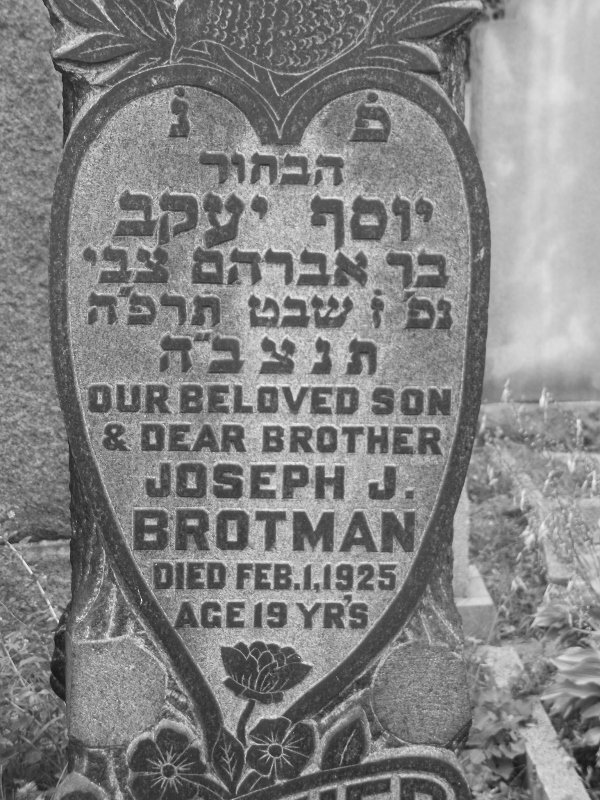
Most people know that in Jewish tradition, a child is often named after a relative who is no longer alive.[1]  It is also Jewish practice to identify a person in Hebrew with his or her father’s first name added to that person’s own first name.  For example, on his headstone Joseph’s name appears in Hebrew as Yosef Yakov ben Avraham, meaning that his father’s name was Abraham.  These naming patterns are a great help to genealogical research since often you can find names recurring through several generations, providing a means of establishing family relationships.

For example, we know that Bessie’s Hebrew name was Pessel and that her mother was named Gittel.  Bessie named her daughter Gussie for her own mother—in Hebrew, Gussie’s name was Hannah Gittel.  Then, in turn, I was named for Gussie’s mother, Bessie—in Hebrew, Pessel.  I then named my older daughter Rebecca Grace for my grandmother; her Hebrew name is Rivka Gittel.  So both Gittel and Pessel are names that recur through the generations and perhaps go back even further and perhaps will stretch further into the future.

Similarly, my brother Ira was named for our grandfather Isadore, whose Hebrew name was Ira.  Isadore’s father was Moritz/Moshe, and Isadore was named for Moshe’s father Ira.  Isadore in turn named his son Maurice for his father, and Maurice named his son James Ian and one of his daughters Robin Inez, the I being for Maurice’s father Isadore.  So the M’s and the I’s keep recurring in our family.  My younger daughter Madeline (Mazal Ahava) was named in part for my uncle Maurice (as well as for my husband’s uncle Murray), and there are several other M’s in the family among the fifth generation.

I am sure each of you can find similar recurring patterns in your own branches of the family.  There certainly are many B/P names and J names that run throughout our family tree.   Some of them undoubtedly are for Bessie/Pessel and Joseph or one of their descendants.

Why do I bring this up now? Well, after receiving Abraham’s death certificate and being bewildered by the fact that it records his parents’ names as Harry and Anna, I consulted with my mentor Renee.  She asked me several questions that reassured me that the death certificate is most likely incorrect.  First, she said look for naming patterns.  That reminded me that Abraham’s oldest son was named Joseph Jacob—Yosef Yakov on his headstone.Image  If Abraham’s father was named Harry, then why would he have named his son Joseph and not Harry? In fact, there are no Harrys or H names among Abraham’s children or grandchildren.

In addition, Renee pointed out that Abraham’s full name on his headstone is Avraham Zvi ben Yosef Yakov.  Zvi is a Hebrew name that means “deer” and in Yiddish was usually translated into Hersh or some Americanized version: Harry, Herbert, or (as in the case of my husband) Harvey.  Renee also pointed out that Abraham’s American name was Abraham H. Brotman.  She said it was extremely unlikely that his father’s name would have been Harry or Hersh/Zvi also (unless, of course, his father had died before Abraham was born, which does not seem likely).  By looking at the naming patterns, I am now convinced that it is unlikely that Abraham’s father’s name was Harry and that the death certificate is not correct and the headstone is.  Perhaps the Zvi/H in his name was for his maternal grandfather. Maybe that’s how it ended up on his death certificate.

So, cousins, do you know who you were named for? Do you know what your Hebrew name is? What your parents’ Hebrew names are? It would be really helpful and interesting to me and perhaps to others to know this information as it may open other doors for more research.  If you are willing to share that information, please let me know by using the comment box below so that we can all share this information.  Thank you!


[1][1] At least that has been the tradition among Ashkenazi East European Jews.  German Jews apparently did not always adhere to this tradition.  For example, my father’s name is the same as his father, John Nusbaum Cohen, and until he was an adult, he used “junior” after his name.  Moreoever, his sister’s name was the same as their mother—Eva.

Max Brotman: Who was his mother?

Yesterday I received Max Brotman’s death certificate from the City of Mount Vernon.  It has been quite a task tracking down this document.  Although I knew from Judy and the picture of his headstone that he had died in 1946, I could not find any record of his death certificate.  There is a public index of NYC death certificates that runs through 1948, so if he had died in 1946, it should have been there.  But it wasn’t.  Death certificates dated after 1948 from NYC are much harder to obtain; to get Abraham’s I had to use snail mail (!) and a notarized form and fee and self-addressed envelope sent to the NYC Department of Vital Records.  I was hoping that I could just obtain Max’s electronically through the Family History Library, which is faster, easier and free.  Unfortunately, the FHL does not have non-NYC certificates, and I could not find Max in the NYC register.

I was fortunate to find a volunteer in NYC who checked the paper records and found a reference indicating that Max, a NYC resident, had died “upstate.”   But where upstate?  It’s a big state! I recalled that Max had had a summer home in Congers, NY, and since he died in late May, I thought that perhaps he had died while up there. Image I contacted the town registrar in Congers, sent them a written request, check, and envelope, but they sent it back, saying that they had no record for Max Brotman.

So I was stumped.  I asked Renee, my mentor, for advice, and she suggested calling the cemetery where he was buried to see if they had a record for where he had died.  I called Beth David Cemetery on Long Island, and sure enough, they did have such a record and were willing to divulge where he died without a written letter, check and envelope.  They said he had died in Mount Vernon, New York, not far from where I grew up.

I asked Judy if she had any idea what he might have been doing in Mount Vernon at the time of his death.  She didn’t know.  I wrote to Mount Vernon (yes, a notarized letter, check and envelope), and finally received the long-sought-after document yesterday.Image

So what does it say? Well, it explains what he was doing in Mount Vernon.  He was a patient at the Mount Vernon Convalescent Home, where he was suffering from liver cancer.  It looks like he was there for three weeks, as the doctor who signed the certificate had cared for him from May 6 through May 27 when he died.

What else does it report? It lists Joseph Brotman as his father (phew!), but Adda Browman as his mother.  That conflicted with his marriage certificate which said his mother’s name was Chaye. Image And Browman? Is that just a misspelling of Brotman? Or was her maiden name really Browman? I consulted with Renee, and she said that Chaye was often Americanized to Ida, which is close to Adda.  (She said immigrants tended to Americanize even the names of ancestors who never left Europe.)  So maybe Adda is Chaye? Or maybe Richard Jones, who was Max’s son-in-law and the informant on the certificate, misunderstood or was misunderstood.  I don’t know and probably won’t know until I can learn how to research records from Europe.

The good news is that it’s just one more bit of evidence confirming that Max was Joseph’s son.  The bad news is that the document brings us no closer to knowing the town in Galicia from which they all came.

Max Brotman: When was he born?

Here’s another example of the inconsistency of records when it comes to birthdays.  On the 1900 US Census, Max gave his birthday as April, 1878.[1]  [Edited: On his naturalization application in 1900, he listed his birthdate as April 1877.] On the 1910 Census, he reported being thirty years old, meaning he was born around 1880.  On his draft registration in 1918, he gave his birthday as July 7, 1878.  On the 1920 Census, he said he was 45, making his birth year 1875.  In 1930, he said he was 50, meaning he was born in 1880.  In 1940, he claimed to be 60, again meaning he was born in 1880.  On his draft registration in 1942, he put his birthday as March 26, 1880. [2]

Today I received his death certificate.[3]  It has his birthdate as July 27, 1882!  He just kept getting younger (like we all wish we could, I suppose).  Since Hyman was born in either 1882 or 1883 and had a different mother than Max, it seems unlikely that Max was born in 1882.  I am going to assume that the earliest documents are more reliable (when he had less incentive to make himself younger) so that 1878 is the mostly likely year of birth.  As to the month? Who knows? Could be March, April, or July.  As I said in an earlier post, birthdays were not a big deal to Jews in Europe, so maybe he never knew the month, but wouldn’t people know what year they were born? We know Joseph’s age is equally mysterious—he could have been born any time between 1825 and 1855, depending on which document you read.  And Hyman also had two different birth years on his records.

The other inconsistency in these records is the year of immigration for Max.  The 1900 Census says he came in 1888; the 1910 and 1920 say it was 1890.  Finally, the 1930 Census says it was 1893.  I have applied for a copy of his naturalization records (which take 90 days to process, so it will be at least another two months before I get it), so perhaps those will be more accurate. [Edited: The naturalization application said 1882, when Max was at most five years old.]

Sometimes I wonder whether there was a certain level of paranoia among immigrants—people who had faced such hostility and oppression at the hand of the governments of the countries where they were born.  Maybe they just didn’t want to give the US government too much personal information.   Or maybe census takers just weren’t very careful note takers or very good listeners. Or maybe our relatives just liked to lie about their ages.


[1] All the documents are consistent with respect to his place of birth being Austria, though none specifies the town or city. [Edited: The naturalization application said Germany.]

[2] These documents are available on ancestry.com.  If anyone is interested, I can download them and post them on the blog.

[3] More on his death certificate tomorrow.  I want to scan it and won’t get a chance tonight.

Family Trees: Blog Tip

It seems that some people are having trouble locating the family trees on the blog.  If you click [1]on the words “Joseph’s Descendants: Family Trees” near the top of the page (under the blog title), a page will open that has a list of family trees. There is one for Joseph, which goes only to the third generation (Joseph’s grandchildren).  Then there are separate trees for each of Joseph’s children, following through a few more generations.  The trees are all quite large, so you will need to zoom in to read the names, but then you can move around that page to see the various relationships.  You can also save the trees to your own computer.  They are in PDF format.

Hope that helps.


[1] If you just let your mouse hover over those words, a dropdown menu displays the names of Joseph’s seven children.  If you click on one of those names, it will open that person’s page.  You need to click on “Joseph’s Descendants: Family Trees” to open the family tree page.