Gelle Blumenfeld Rothschild’s Middle Children: Isaak, Gitel, and Betty

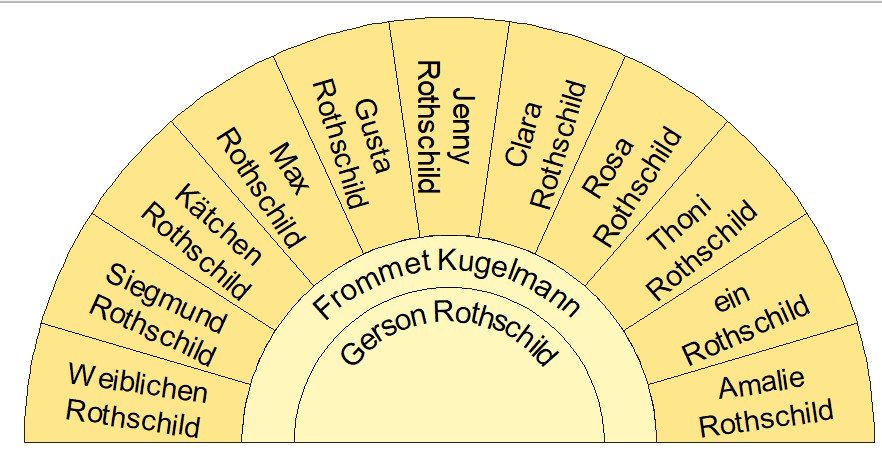
Returning now to the Blumenfeld branch of my family tree, it’s time to see where I am in that saga. I am still on the oldest child of my four-times great-grandparents Abraham Blumenfeld and Geitel Katz—-their son Moses I. I have completed the stories of Moses’ first two children, Abraham IIA and Isaac I, and have been working through the children of Moses’ youngest child, his daughter Gelle Blumenfeld Rothschild. I have so far covered the first four of Gelle’s twelve children: Seligmannq, Abraham, Levi, and Moses. Here’s a chart to show my slow progress through the Blumenfeld family. I’ve only gotten as far as that arrow on the upper left side.

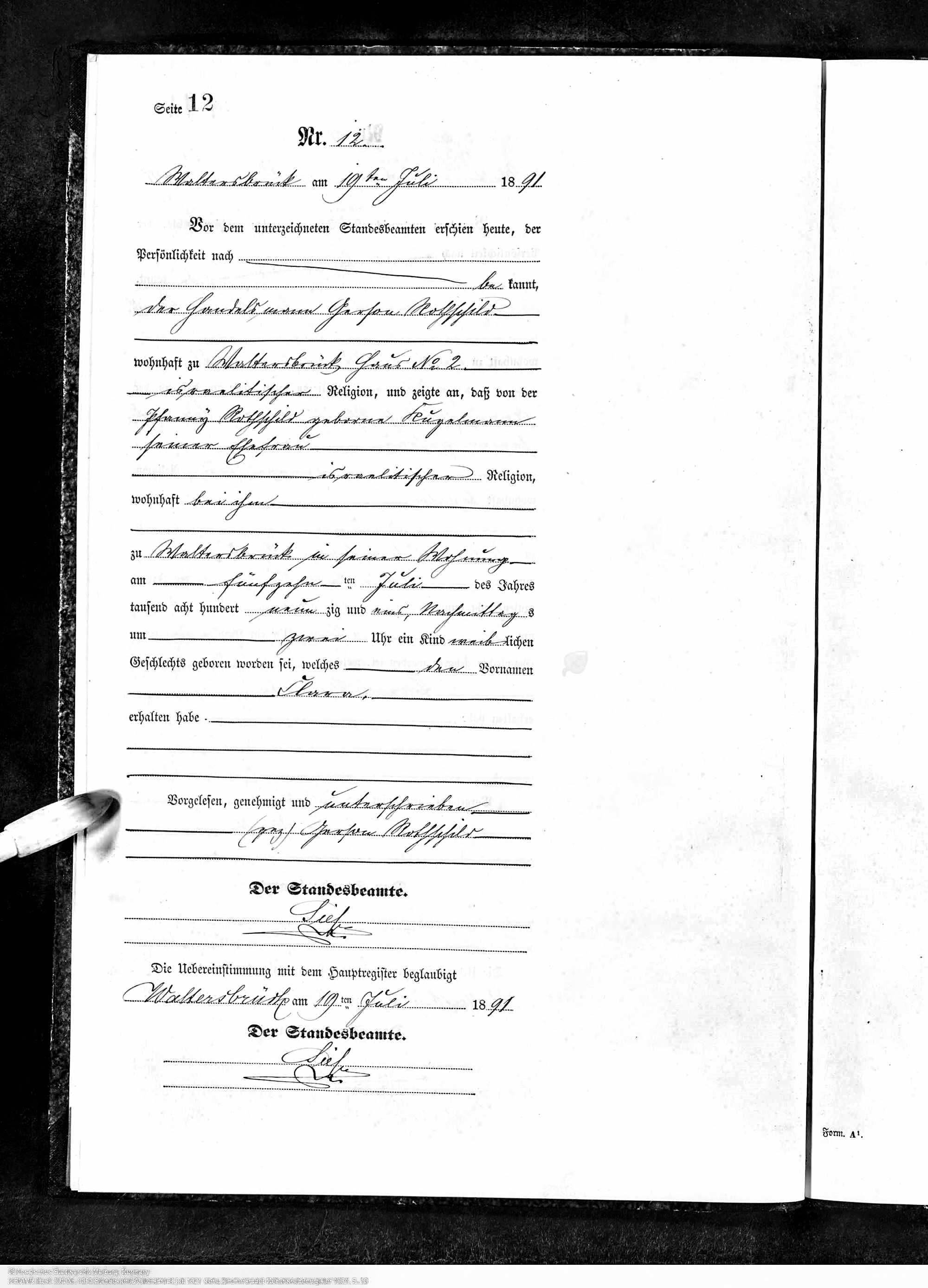
Now I turn to the next group of Gelle’s children, and for better or worse, there is not a lot to say about the next three: Isaak, Gitel, and Betty, their fifth, sixth, and seventh children.

Isaak is an unsolved brick wall. He was born January 15, 1850, in Zimmersrode. But there is no further record of him. No marriage record, no death record. I have searched high and low, and I’ve noticed that no other researcher on Ancestry or MyHeritage or elsewhere has any dates for Isaak’s death. My hunch is that he died in infancy, perhaps at birth, but I have no record to prove it. Here, however, is his birth record:

Isaak Rothschild birth record, Arcinsys Archives in Hessen, HHStAW Fonds 365 No 893, p.23

I thought perhaps the note on the far right would reveal more about Isaak’s life, but unfortunately it does not. All it says is “war noch nicht eingetragen, geschieht nachtraeglich,” which translates as “was not yet registered, will happen later.”

The child born after Isaak was Gitel Rothschild. Sadly, for her I have both her birth and death records. She was born on January 7, 1852, in Zimmersrode, and died there just over a year later on February 11, 1853.

Gitel Rothschild birth record, Arcinsys Archives of Hessen, HHStAW Fonds 365 No 893, p. 24

Gitel Rothschild death record, Arcinsys Archives of Hessen, HHStAW Fonds 365 No 896, p 21

Following Gitel came Beschen or Betty, born on June 22, 1853, just a few months after her sister Gitel died.

Beschen Rothschild birth record, Arcinsys Archives of Hesse, HHStAW Fonds 365 No 893, p. 25

Fortunately, Betty survived to adulthood. On February 4, 1876, in Kassel, Germany, she married Isaac Rosenblatt, the son of Meier Rosenblatt and Hannchen Loewenberg. Isaac was born in Malsfeld, Germany, on December 31, 1846.

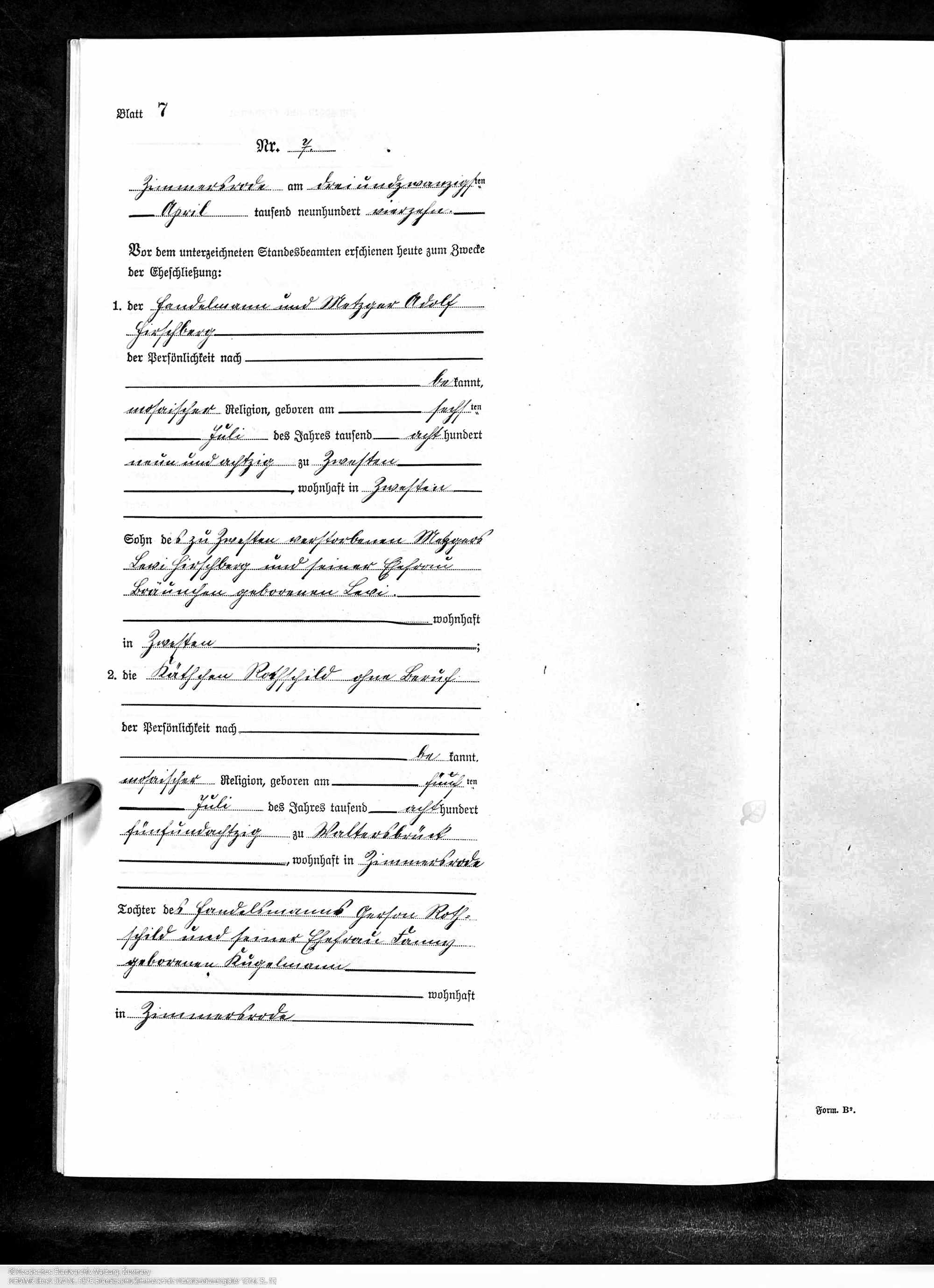
Beschen Rothschild and Isaac Rosenblatt marriage record, Hessisches Hauptstaatsarchiv; Wiesbaden, Deutschland; Bestand: 910, Ancestry.com. Hesse, Germany, Marriages, 1849-1930,

I did not find any records showing children for Betty and Isaac. Isaac died on November 13, 1916, in Kassel.1 Betty died there ten years later on February 28, 1926.

Beschen Rothschild death record, Hessisches Hauptstaatsarchiv; Wiesbaden, Deutschland; Personenstandsregister Sterberegister; Signatur: 5603; Laufende Nummer: 910, Ancestry.com. Hesse, Germany, Deaths, 1851-1958

Thus, there are no known descendants for Isaak, Gitel, or Betty Rothschild as far as I have been able to determine.

The story of Gelle Blumenfeld Rothschild’s ninth child Gerson is a more complete one but filled with tragedy. That story begins in my next post.


  1. Isaak Rösenblatt, [Isaak Rosenblatt] Death Age 69, Birth Date abt 1847,
    Death Date 13 Nov 1916, Death Place Kassel, Hessen (Hesse), Deutschland (Germany), Civil Registration Office Kassel I, Father Meier Rösenblatt Mother
    Hannihan Rösenblatt Certificate Number 1490, Hessisches Hauptstaatsarchiv; Wiesbaden, Deutschland; Personenstandsregister Sterberegister; Signatur: 5546; Laufende Nummer: 910, Ancestry.com. Hesse, Germany, Deaths, 1851-1958 

Simon’s Secret—Some Readers’ Reviews

Thank you to those of you who have purchased my latest book, Simon’s Secret. I’d love to know your thoughts once you have read it. These readers have already left reviews on Amazon, and they are all wonderfully positive. Thank you so much for this feedback!
————
Simon’s Secret is a slender book, packed throughout with history, empathy, joy, pain and understanding. It led me to tears repeatedly as I learned the history of this remarkable family. For anyone who experiences the gift of a multi-generational family, there is much here to which we can relate. Yes, all lives are full of joy, sadness, success, failure, injustice, vindication, fear and confidence. To be given a view of this family over the years and permission to share in their experiences is a gift. Hannah opens her family like a flower, with each layer of petals revealing more of the story.
————–

A fascinating, multigenerational account of a real family. The author deftly intertwines real family history with her imagined account of their lived experiences. A tribute to the trials and tribulations of migrants the world over, the account highlights how hard work and determination are the foundations of success for the Handler family. Simultaneously, she sensitively portrays the psychological toll years of toil and hardship take as part and parcel of the immigrant experience. Well worth reading.

—————

Amy Cohen’s family history novels are such a treat to read. I love history, especially the stories of everyday people who lived during historical events. Amy’s stories are based on real individuals from her own family history, and Simon’s Secret is no different. She’s taken a scaffolding of the lives of actual people and fleshed them out into an engaging fictionalized story.

———————–

Amy Cohen has written a beautiful novel which is historically based. The technique of storytelling through the journal of one character and the backstory of another tightly draws the reader in and weaves the tale. I highly recommend this book.

——————

Read it in one afternoon! I just became engrossed with the family and needed to keep reading. I loved the diary format- a very engrossing read. The family history entwined with the actual historical times was fascinating.

———————-

An enjoyable read!! A well-written, thoughtful story of family history and dynamics.

————————-

Beginning in the nineteenth century and spanning two continents, Hannah’s moving account of her highs and desperate lows are sensitively recorded in her memoir of family life. As the years advance, Hannah feels compelled to unearth more about her reserved father Simon’s life in Germany before his migration to America. What is he hiding from? For anyone who is a diarist, this book is a must-read.

———————

Simon’s Secret is a wonderful story spanning multiple generations extending from Germany to the United States. Told in a diary format the characters are endearing and the story captures your attention. It is beautifully written with great tenderness and feeling. A great book. I highly recommend it.

—————–

It is a very touching story of a family with a secret which wasn’t shared until the very end. The story is fast paced and kept me enthralled. I loved this book!

I hope these reviews encourage you to read Simon’s Secret! And if you already have, please leave a review on Amazon.

You can find Simon’s Secret here on Amazon.

The Devastating Effects of Terrorism

Today I am honored and moved to share an essay written by my fourth cousin, once removed, Miki Katzenstein Dror. Miki is the daughter of Arie Katzenstein1, an Israeli who was killed by terrorists on February 10, 1970, at the Munich airport while he was traveling with his father Heinz on business.

As I wrote here and here, Arie sacrificed his own life by throwing his body on a grenade, thus saving the lives of many others, including his father, who had fled to Israel from Nazi Germany in the 1930s. Miki and her two siblings were just young children at the time. Because of this horrible act of terror, they grew up without their beloved and courageous father.

Arye Katzenstein Courtesy of his family

As Miki wrote almost a year a half ago, the city of Munich decided to create a memorial to honor the memory of her father Arie and the others who were injured and terrorized on that day in 1970. On February 10, 2025, Miki and her siblings and other family members traveled to Munich to participate in the dedication of that memorial.

This video, in Hebrew but with English subtitles, includes interviews with Miki and her siblings and more information about Arie Katzenstein’s tragic murder. This video in German shows what the memorial looks like and also some images from the ceremony itself, including images of Miki and her brother and sister speaking at the ceremony. It also has some historic footage from coverage of the attack in 1970. Richard Bloomfield has provided me with this translation of the text of the second video.

55 years ago, members of a Palestinian terrorist organization tried to hijack an El Al Israeli airline plane. The victims and the heroes of the attack were commemorated today at the former tower.

Three golden clocks symbolize the times of the three detonations on February 10, 1970. They are located in front of the tower of the former airport in Munich-Riem. The artist Alicja Kwade created the work of art. At today’s inauguration of the memorial, Arie Katzenstein’s three children commemorated their father, who, through his courage, saved the lives of others exactly 55 years ago by throwing himself on a hand grenade. Palestinian terrorists had attacked the passengers during a stopover in Munich, killing the German-Israeli Katzenstein and injuring others. The captain of the aircraft also put up a courageous fight. The extent of the terrorist act had been clearly underestimated, said the mayor of Munich.

[The mayor] “However, I also find it shameful that it has taken half a century for us to finally publicly commemorate the terrible attack here in Munich on February 10, 1970. For this, I apologize. I am glad that we have finally found a worthy way to commemorate it.”

Brainlab, which is now located at the former tower, the city and the family worked closely together.

[Arie’s son] “It will remind people who come here of what happened. And it will make them think.”

A memorial plaque and a website [https://munich1970.de/en/] provide information about the attack. This is to keep the memory of the victims and heroes of Munich-Riem alive.

Here’s a photograph of the memorial:

I asked Miki if she would share with me and my readers her thoughts and feelings about the dedication and the memorial itself. This is what she wrote:

Finally, after fifty-five years, our heroic father was commemorated at the site of his murder in Munich, Germany.

On the afternoon of February 10, 1970, EL AL Flight 435 landed in Munich on its way to London. While waiting for the connecting flight, a squad of three terrorists attacked the passengers by firing pistols and throwing hand grenades.

Our father, the late Arie Katzenstein, who flew with his late father Heinz, for business, threw himself at one of the hand grenades that were thrown at the passengers, thus saving many others, but was killed on the spot.

At his death, he left behind a young widow and three small children between the ages of three months and six years: Miki Dror, Tami Meirovich and Ofer Katzenstein.

About a decade after his death, our mother received a letter from the President of Israel at the time, the late Yitzhak Navon, in which he wrote, among other things, that the State of Israel would cherish the memory of our father among its other heroes. Unfortunately, this promise was never kept, despite our many inquiries on the subject.

On the other hand, about five years ago, representatives of the Munich municipality contacted us, following a request from our German friends. They announced that the municipality intended to commemorate our father at the site of the attack – the old airport in Munich–Riem. As the Germans are using a newer airport these days, the old one is used as a big convention center and a high-tech park. From that moment on, a long process of conversations, meetings and discussions began between us and the Munich municipality regarding the manner of commemoration. At an early point, the high-tech company Brainlab joined the effort. Its offices are currently located in the area where the attack took place.

The company expressed its most generous consent to the existence of the memorial site on its premises and funded a work of art by the famous internationally acclaimed artist Alicja Kwade, to be displayed there.

On February 10, 2025, exactly fifty-five years after the murder of our father, the inauguration ceremony was held in the presence of the President of the Bavarian Parliament, Mrs. Ilse Aigner, the Mayor of Munich, Mr. Dieter Reiter, Founder of Brainlab, Mr. Stefan Viltsmeier, the Consul General of Israel in Munich, Ms. Talia Lador, the artist Alicja Kwade, family members of our Germans friends, other families of the victims and many, many more.

From left to right: Ms. Talia Lador, Consul of Israel to Munich; Mrs. Ilse Aigner, President of Bavarian Parliament; Ofer Katzenstein; Tami Katzenstein; Mr. Dieter Reiter, Mayor of Munich; Miki Katzenstein Dror;  and Mr. Stefan Viltsmeier, founder of Brainlab

During the ceremony, the German dignitaries gave moving speeches, and we, his three children, spoke about our father, his absence, and the long journey that had brought us to this day. In addition, we thanked the German government and their ambassador in Israel for their support in the struggle for the release of the Israeli hostages from Gaza and asked that they not give up until the last of the abductees was brought home.

The Katzenstein family attending the memorial dedication in Munich, February 10, 2025

The singing of opera singers Hagar Sharvit and Noa Beinart and pianist Amiel Bushkevich did not leave a dry eye.

We arrived to the ceremony with a full family lineup, including all of our father’s grandchildren, but unfortunately our mother Bilha, who passed away not long ago, did not get to attend this exciting event. At the end of the ceremony, we read Kaddish, and laid flowers, an Israeli flag, and a scarf of the Hapoel Haifa soccer team – which our father loved so much.

Ofer Katzenstein saying Kaddish at the memorial site for his father Arie Katzenstein

For us, this is a moment of partial closure and unparalleled excitement. After so many years of action, our father’s sacrifice is finally officially recognized.

Now, we have a place where we can come to with our families, relate to, and remember. We couldn’t have asked for more.

We would like to take this opportunity to thank everyone who has helped us over the past few years to get to know our father better, to speak about him and to spread his heroic deeds.

And finally, I’m writing this post on the day that Hamas, the terror organization, released the bodies of Kfir and Ariel Bibas, two babies who were taken to Gaza as hostages more than a year ago. So sad that after 55 years it seems as if nothing has changed, and terror still strike Jews, in Israel and in the world.

When I received the email from Miki sharing this essay, I also was struck by the fact, as Miki observed, that this was the same day that the bodies of the two Bibas children were returned to Israel—two beautiful, innocent babies who were murdered by Hamas after they and their parents were kidnapped by Hamas on October 7, 2023. After first sending the wrong remains, Hamas later released the actual remains of their mother, Shiri Bibas. Their father Yarden Bibas survived his capture and confinement and was released back to Israel, but without his wife and children. Like the children of Arie Katzenstein and so many others, Yarden Bibas has had his family destroyed by terrorism.

Terrorism against Jews began centuries ago with the pogroms that chased some of my ancestors out of Europe, continued with the murder of six million Jews, including many of my relatives, during the Holocaust, and tragically continues to this very day with the nightmare of October 7, 2023, and its aftermath.

And it isn’t only Jews who have suffered because of the hatred, violence, and terror inflicted on one group by another. We still are seeing across the globe the bloodshed and tragedy that hatred produces.

How many more children will grow up without a parent? How many more parents will have to mourn their children? Will we ever learn?

May the memory of Arie Katzenstein be for a blessing, as well as the memories of Kfir, Ariel, and Shiri Bibas, and all the other victims of October 7. And may we someday finally learn, to paraphrase Martin Luther King, that only love can drive out hatred, only light can drive out darkness.


  1. Sometimes transliterated from Hebrew as Aryeh or Arye. 

A Brick Wall Tumbles: The Fates of August Felix Katzenstein and Julius Katzenstein, Orphaned Sons of Meier Katzenstein, Part II

Thanks to some new sources and documents and the help of my cousin Richard Bloomfield, I was able to fill in many of the holes in my earlier research about my cousin August Felix Katzenstein, as we saw in my prior post. August was one of the two surviving sons of Meier Katzenstein; his little half-brother Julius was the other surviving child. Both were orphaned after losing their mothers and then their father Meier.

Despite being orphaned at age eight, August had been raised by his relatives, the Bachenheimers, and had married their daughter Rosa when he was twenty-four. They had had two children, Margarete and Hans Jacob, and two grandchildren, and August had had a brilliant career as a teacher in a Jewish school until his retirement in 1936.

But then the entire family was wiped out by the Nazis—August, his wife Rosa, their two children, and their two grandchildren.

But what about August’s younger half-brother Julius Katzenstein, who was only five when he was orphaned? Had he survived? Did he also get killed by the Nazis? Who took care of him? After my cousin Miki Katzenstein Dror learned of a family in Israel descended from a man named Julius Katzenstein, she asked me if this could possibly be the same Julius Katzenstein. I knew the name was not uncommon, but I figured it was worth searching again for information about little Julius.

I turned to my friend Aaron Knappstein for some help, and after a long wait, Aaron somehow was able to locate records in the archives in Jesberg that revealed more about the life of my cousin Julius Katzenstein. The papers were part of a “certificate of inheritance” file that included the death record for Julius Katzenstein. Julius died on February 3, 1894. He was not yet fifteen years old.

Aaron kindly translated the document below. It reads as follows:

No. 6 – 04.02.1894

The death is announced by Selig Katzenstein, address: Uslar No. 15

Person who died:

Julius Katzenstein, merchant apprentice, 14 years, 11 months and 13 days old, Jewish, address: Uslar 15, born in Jesberg, son of the merchant Meyer Katzenstein and Bertha née Speyer, both dead.

Julius died the 3rd of February 1894 in Uslar No. 15, 10 PM

The second page of the document contains the following information, as translated by Aaron:

  • First wife of Meyer Katzenstein was Auguste née Wolff – she died the 19th of September 1876 – with her he had a son: August Katzenstein, born the 13th of September 1876
  • Second wife was Bertha née Speyer, she died the 8th of April 1881 and with her he had two children: Julius Katzenstein, born the 18th of March 1879 and Ida Katzenstein, born the 2nd of July 1880 – she died the 1st of April 1881.

Sadly, these documents proved that little Julius Katzenstein, the son of Meier Katzenstein and Bertha Speyer, had not lived to adulthood, but had died as a teenager.

What was most puzzling about this information, however, was where Julius had been living and with whom. Julius had lived in the town of Uslar, a town that was more than sixty miles from Jesberg and in a different state, Saxony, not Hesse. And he had been living with a man named Selig Katzenstein—-who was he? Was he a relative? He wasn’t on my family tree, and I had no clue whether he was related to my Katzenstein family. I searched for some familial connection, but could not find one.

I checked with David Baron, who is married to my cousin Roger Cibella and whose Katzenstein research I’ve often relied upon. I asked him if he knew of any connection between “our” Katzenstein family from Jesberg and Selig Katzenstein of Uslar.  He wrote that he had not been able to find any familial connection between our Katzenstein family and the Uslar Katzenstein family except through marriage.

This is what David had found: Selig Katzenstein of Uslar was the grandson of Joseph Katzenstein of Grebenstein. Joseph Katzenstein’s sister Lea Katzenstein of Grebenstein had married Meyer Goldschmidt of Oberlistingen. Are you still with me?

Meyer Goldschmidt was the brother of my three-times great-grandfather Seligmann Goldschmidt, whose daughter Eva Goldschmidt (my great-great-grandmother) married Gerson Katzenstein (my great-great-grandfather) of Jesberg. Gerson Katzenstein was the half-brother of Jacob Katzenstein, who was the grandfather of little Julius Katzenstein.

Now that is one crazy, twisted path from Julius to Selig Katzenstein, but given how small all these little towns were and the relatively small number of Jews living in each of those towns, maybe that was enough of a connection for Julius to end up living in Uslar with Selig. Maybe there is a slightly more direct path, but for now, that’s the best I can do.

Although I am glad I can now complete the story of Meier Katzenstein and his family, it has left me with a terribly empty feeling. They died so young: Meier, his two wives Auguste and Bertha, and two of his three children, Ida and Julius. The only child who managed to survive to adulthood was August, and he and his wife Rosa and their two children Margarete and Hans Jacob and their two grandchildren Klaus and Klara were all murdered by the Nazis.

There are thus no living descendants of Meier Katzenstein. I am glad to have knocked down this brick wall with the invaluable help of Aaron Knappstein and Richard Bloomfield, but I sure wish I had been able to find that somehow someone in this family line had survived.


A Brick Wall Tumbles: The Fates of August Felix Katzenstein and Julius Katzenstein, Orphaned Sons of Meier Katzenstein, Part I

Thanks to my friend Aaron Knappstein and my cousin Richard Bloomfield, an old brick wall has recently come down. Over seven years ago I wrote about the tragic story of Meier Katzenstein and his family. You can find all the sources, citations, and details here. But I will briefly outline their story.

Meier, my great-grandmother Hilda Katzenstein Schoenthal’s first cousin, lost his first wife Auguste Wolf in 1876, shortly after she gave birth to their son August Felix Katzenstein. Meier remarried and had two more children with his second wife Bertha Speier:  Julius Katzenstein, born in 1879, and Ida Katzenstein, born in 1880. Both Ida and her mother Bertha died in April 1881, less than a year after Ida’s birth. Meier was left with two young sons, August, who was five years old, and Julius, who was two.

And then Meier himself died three years later in 1884, leaving August and Julius orphaned at eight and five, respectively. I couldn’t imagine what had happened to those two little boys. Who took care of them? What happened to them? This post will follow up on August, and the one to follow will be about his half-brother Julius.

I had been able to find out some of what happened to August as an adult when I initially wrote about him over seven years. He had married his first cousin, once removed, Rosa Bachenheimer in Kirchain, Germany, in 1900 when he was twenty-four years old. August and Rosa had two children, Margarete and Hans-Peter. All four of them were killed by the Nazis during the Holocaust. I knew that much, but there were still some gaping holes in my research. Where had August lived after his father died? Did he have any grandchildren? If so, did they survive the Holocaust?

So I went back now to to double-check my research and see if I could find anything more about August Felix Katzenstein and his family. I am so glad I did.

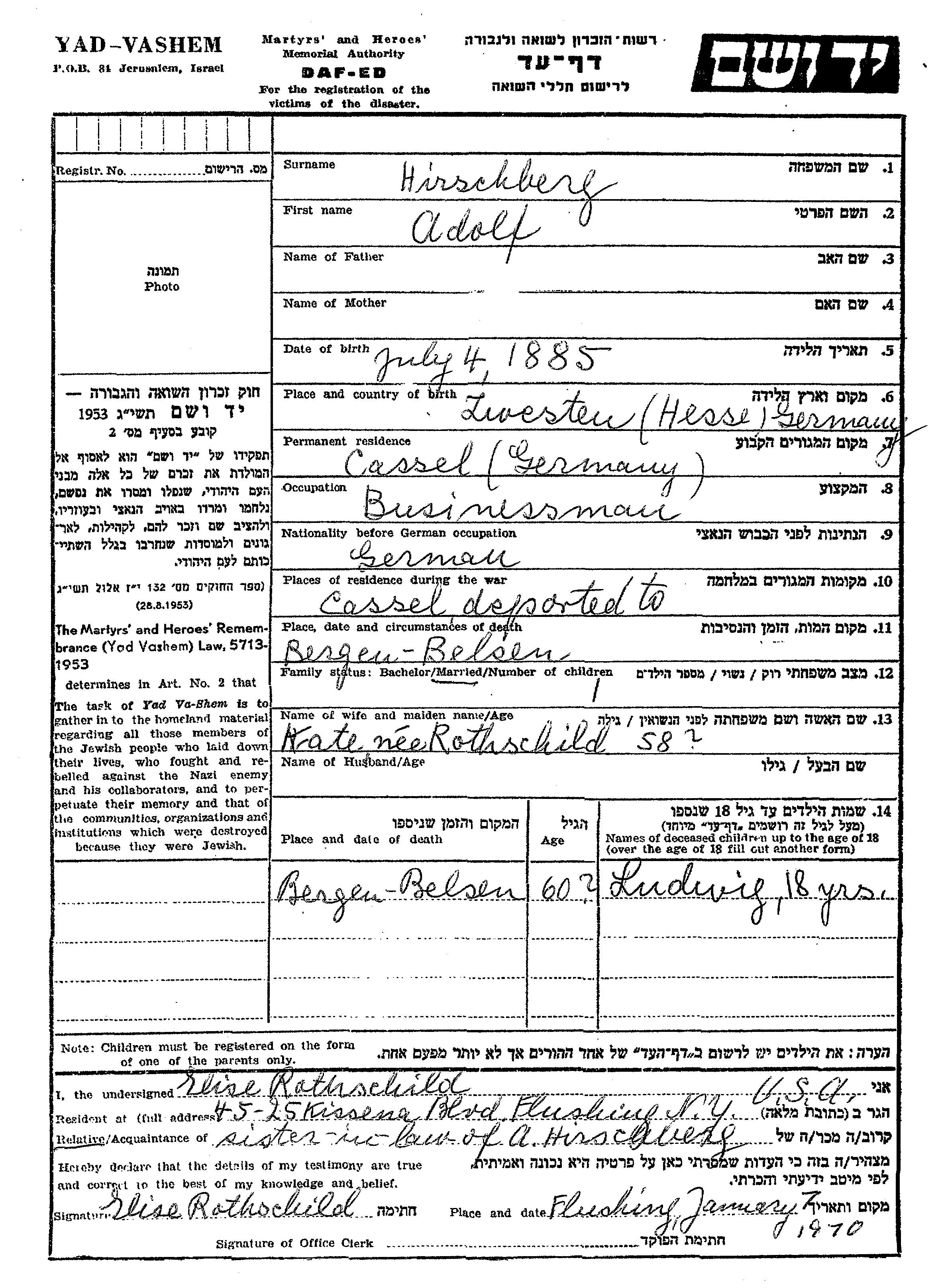
First, I learned at Yad Vashem that August and Rosa’s daughter Margarete had married Rudolf Loewenstein and had had two children with him: Klaus, born March 16, 1930, in Soest, Germany, and Klara, born June 9, 1932, in Soest, Germany. Unfortunately, Rudolf, Margarete and their two young children were also killed along with their grandparents and uncle during the Holocaust.

Then I found this Stolpersteine biography of August Katzenstein on a website about the history of the community of Essen, revised in 2024 by Mr. and Mrs. Hülskemper-Niemannn. It provides in part, as translated by Google Translate:

August Katzenstein was orphaned at a very early age. He then lived for a long time in the household of the parents of his future wife Rosa Bachenheimer from Kirchhain, whom he married around the turn of the century. The couple had two children: Margarethe (1901, later Loewenstein) and Hans (1905). August Katzenstein moved with his family to Steele in 1908 and took up a position as a teacher in the one-class Jewish elementary school at Isinger Tor.

After 1933, the Katzensteins’ lives changed radically. In 1937, the Gestapo arrested the couple because they were allegedly managing the assets of a dissolved Jewish organization. After a search of their apartment and rigorous interrogation and warnings, the couple were released. Even worse happened to August Katzenstein, who taught at the Jewish elementary school in Essen on Sachsenstrasse after the Jewish elementary school in Steele was closed, during and after the November pogrom. The apartment on Grendtor (then Ruhrstrasse) was destroyed and looted, and he and his disabled son Hans were arrested. While the 62-year-old father was released from police prison after 11 days, Hans was taken to Dachau despite written requests from his parents, from where he was only released after four weeks.

In the autumn of 1941, the deportation of Jews began across the Reich, including in Essen. … Half a year later, Katzenstein and his entire family were deported to Izbica. 

So now I know who had taken care of August after his father died: Rosa’s parents Sussman Bachenheimer and his wife Esther Ruelf, my second cousin, twice removed. I wrote about them here. I also now know that August had become a teacher and lived in Steele, Germany, a suburb of Essen, Germany.

I found additional information about August and his family at Yad Vashem. The website has been updated since I had last researched August Katzenstein, and I found these documents I had not seen before from the Yizkor Book for the Jews of the Essen community who had been killed during the Holocaust. I asked my cousin Richard Bloomfield to translate these pages, and he graciously (and quickly!) agreed to do so.

Richard’s translation provides:

August Katzenstein was a Mensch.

He was a German citizen and of the Jewish faith, whose teachings shaped his life. He was born on September 13, 1876, in Jesberg/Hesse and lived in the Jewish community of Steinheim in Westphalia until 1908, where he held the office of teacher and religious official. With his wife Rosa, née Bachenheimer, he had a daughter Margarete, born in 1901, and a son Jacob (Hans), born in 1905.

August Katzenstein saw his work as a teacher not just as a profession, but as a vocation. In his eyes, the teacher was not only an imparter of knowledge, he was also a leading figure in the Jewish community who had to ensure a harmonious relationship between the community and school life.

Beginning at the age of 20, August Katzenstein decided to represent not only the interests of his community and pupils, but also those of German citizens of the Jewish faith as a whole.

He joined the “Central Association of German Citizens of the Jewish Faith” “Central-Verein deutscher Staatsbürger jüdischen Glaubens”.

Until he moved to Essen in 1908, he was a representative of the C.-V. local group in Steinheim.

After moving to Essen Steele, he taught at the Jewish elementary school there. The importance that Katzenstein attached to the new self-image of Jews as German citizens of the Jewish faith can be seen in his speech on the occasion of the 50th anniversary of the Jewish school, in which he states,

“For 50 years now, the youth of the Jewish community has received their education in the Jewish school to become faithful Israelites and loyal citizens who love their fatherland, in addition to their general education. May the Jewish school continue to work beneficially for God, for the fatherland and for humanity, true to its guiding principles.”

The mission of the independent order “Bnai Brith” founded in the USA, spiritual self-education, the promotion of science and art, help for the persecuted and needy and the defense of Jewish citizens in the event of anti-Semitic attacks led August Katzenstein to join the Glück-Auf-Lodge of “Bnai Brith” in Essen in 1911 and of which he was president until April 1935.

Until his retirement in 1937, he also headed the Jewish relief organization in Essen-Steele. But despite his retirement, he did not neglect the members of the community whose employ he had left.

The ban and immediate dissolution of the “Bnai Brith” order by Himmler’s decree of April 10, 1937, resulted in August Katzenstein’s arrest on April 19, 1937, after his apartment and all the rooms of the Glück-Auf-Loge had already been searched two days earlier.

August Katzenstein then had to endure hours of interrogation under threat of state police measures. He was forced to sign a declaration that he had no further property belonging to the Glück-Auf-Lodge at his disposal and that he was not aware of where further material might be hidden, as documented in the Gestapo protocol of the same day.

During the so-called Reichskristallnacht on November 9, 1938, the Katzenstein family’s home at Ruhrstrasse 24 was also severely damaged. One day later, August Katzenstein and his disabled son were arrested again. They were held in the police prison in Essen until November 19, 1938. After his release, August Katzenstein wrote a letter to the Gestapo asking them to release his son, who had been sent to Dachau concentration camp. His son Jacob (Hans) then returned on December 21, 1938.

However, not only the care of his family, but also the suffering of the community entrusted to him had become his life’s purpose. Even the destruction of the school and synagogue as the center of the community during the November pogrom could not break August Katzenstein’s will to live in the Jewish faith.

In January 1939, August Katzenstein carried out his last community-related activity, officiating at the wedding of a young couple in the wife’s parental home.

On April 22, 1942, August Katzenstein, his wife Rosa, his son Hans, his daughter Margarete, his son-in-law Rudolf Loewenstein and his two grandchildren were deported to Izbica. No trace of them remains.

His strong faith and the willpower born of it made him a lovable, upright person whose care for his Jewish community defined his life.

Contemporary Jewish witnesses describe August Katzenstein as a wonderful person of integrity, very wise, reserved and fully committed to his Judaism. As a teacher, he was not only a person of respect for the children, but “more like a father.” August Katzenstein was a man whose life was simply snuffed out because he was Jewish.

Nikolaus-Gross, Abendgymnasium Essen, Semester 4

I wondered whether August’s “retirement” from teaching was voluntary or forced upon him by the Nazis, and although it’s still not clear, Richard also found this article about August’s retirement published on November 1, 1936, in the Jüdische Schulzeitung [Monthly journal for education, instruction and school policy; official publication of the Reich Association of Jewish Teachers’ Associations], (p.6):

Richard translated the article for me:

On September 30, 1936, after 40 years of beneficial work in the service of Jewish schools and 7 years of work at the local Jewish elementary school in Essen, teacher and preacher August Katzenstein of Essen-Steele, who recently turned 60, retired. With him, one of the best representatives of the older Jewish generation of teachers leaves the teaching profession.

The school held a farewell party in the festively decorated classroom. Principal Isaac paid tribute to the departing teacher’s services to Jewish schools in general and to the Jewish Elementary School in Essen in particular. Principal Buchheim of Dortmund conveyed the wishes of the Association of Israelite Teachers of the Rhineland and Westphalia. Mr. Lieblich spoke as a representative of the Steele Synagogue community.

The children of the class that Mr. Katzenstein taught last, as well as the school choir led by teacher Levisohn, contributed to the ceremony with poems and songs.

Finally, colleague Katzenstein gave a heartfelt thank you.

Obviously, August was a well-loved, well-respected teacher and community leader. His early childhood was quite miserable—losing his mother, then his stepmother and half-sister, then his father—all before he was nine years old. But despite that tragic beginning, he lived a full and productive life, filled with meaning, faith, family, and love. How someone recovers from so much tragedy is amazing to me.

But then the Nazis came to power and destroyed August’s life and his family. I am so glad I went back to see if I could learn more about his life, and I am so grateful to Richard for his translation of the documents from the Essen Yizkor Book and for finding the article about August’s retirement. I found comfort in knowing that despite his tragic beginning and ending, August found fulfillment and meaning in his life.

But what about his younger brother Julius? I had known even less about him when I first researched this family. I couldn’t find anything that revealed what happened to him after his parents died. I couldn’t find a marriage record, a death record, a birth record for any children—-not one thing. Fortunately, he was not listed at Yad Vashem, so presumably had not shared the fate of his brother August. But where had he gone? Who had taken care of this little orphaned boy?

I will report on what I’ve learned about Julius in my next post.


Aron Rothschild: An Elusive Subject

Returning now to the story of Gelle Blumenfeld Rothschild’s son Moses Rothschild, this post is about his youngest child, Aron Rothschild. We’ve already seen that Aron married Martha Schoenholz in 1918 and that they had a son Melville born in 1919. In 1920 Aron was in his own business selling beads and novelties. Finding Aron after 1920 proved to be a challenging search.

I could not find Aron on the 1930 census, but I did find his wife Martha and son Melville (10) on that census; they were living with Martha’s mother Clothilde Schoenholz in Manhattan; Aron was not listed in the household, but Martha still listed her status as married. She was working as a salesperson in a department store. Where was Aron? I do not know. Somehow he eluded the census enumerator in 1930. Or so it seems.

Martha Rothschild 1930 US census, Year: 1930; Census Place: Manhattan, New York, New York; Page: 20A; Enumeration District: 0512; FHL microfilm: 2341295, Ancestry.com. 1930 United States Federal Census

Aron does, however, turn up on the 1940 census, living in the Bronx as a lodger with Nathan and Anna Braverman, two Russian immigrants. He listed his marital status as single and his employment as a salesman in a house furnishings store.1

Meanwhile, Aron’s wife Martha and their son Melville were still living with Martha’s mother in 1940; they were in Manhattan, and Martha, still listing her status as married, was working as a “saleslady” in a dress store. Melville, now twenty, was working as a junior salesman in a pleating factory.2

So although Aron had listed himself as single on the 1940 census, Martha still claimed that she was married in 1940. It would seem, however, that their marital relationship had ended by 1940, whether legally dissolved or not.

Aron’s 1942 World War II draft registration reported that he was then living in Manhattan and was self-employed. He listed “M. Alexander” as the person who would always know his address. That referred to his brother-in-law Max Alexander, who was married to Aron’s sister Theresa and living at that address.

Aron Rothschild, World War II draft registration, The National Archives At St. Louis; St. Louis, Missouri; Record Group Title: Records of the Selective Service System; Record Group Number: 14
Ancestry.com. U.S., World War II Draft Registration Cards, 1942

Aron’s son Melville registered for the World War II draft on October 16, 1940; at that time he was living in Los Angeles and would not provide the name of his employer, according to the registration. He joined the US Army on February 22, 1943, and was discharged on January 11, 1946. He served in the Pacific and received the American Service medal and the Philippines Liberation Ribbon.3

Melville Rothschild, World War II draft registration, National Archives at St. Louis; St. Louis, Missouri; Wwii Draft Registration Cards For California, 10/16/1940-03/31/1947; Record Group: Records of the Selective Service System, 147; Box: 1559 Ancestry.com. U.S., World War II Draft Cards Young Men, 1940-1947

National Archives at St. Louis; St. Louis, Missouri; Wwii Draft Registration Cards For California, 10/16/1940-03/31/1947; Record Group: Records of the Selective Service System, 147; Box: 1559
Ancestry.com. U.S., World War II Draft Cards Young Men, 1940-1947

On December 7, 1946, in New York, Melville Rothschild took out a license to marry Barbara Sichel.4 Barbara may still be living although she would be over 100; I cannot find a death record or obituary. Melville and Barbara would have two children. I was unable to locate the family on the 1950 US census.

I had a lot of trouble locating Aron Rothschild on the 1950 census or thereafter, but after much investigation, I believe I found him. Here’s my research path:

According to an entry on FindAGrave, Aron died on March 17, 1955, at the age of 73 and is buried in Mount Carmel Cemetery in Queens, New York. But I was skeptical about the reliability of that information. First, Aron’s name was spelled “Aaron” both on FindAGrave and on the cemetery records listed on the Mount Carmel website.  Also, although I have Aron’s Social Security Number, he is not listed in the Social Security Death Index. The FindAGrave entry has his correct birth date, but says he was born in Manhattan Beach in Maryland. I assume the creator of that entry confused Manhattan Beach with Manhattan, New York. But given these inaccuracies—the spelling of the name and the error in the birth place—I worried that the FindAGrave entry could be for an entirely different A[a]ron Rothschild. 5

So I decided to search a little deeper. On FamilySearch, I found a record for an Aaron Rothschild who died in Islip, New York, on March 17, 1955, the same date of death for the Aaron Rothschild buried at Mount Carmel Cemetery and listed on FindAGrave. That listing in the New York State Death Index on FamilySearch gives Aaron Rothschild’s age at death as 71, but my Aron would have been 73 on March 17, 1955.6 So I remained doubtful.

I went back to search the 1950 census again to see if I could find the Aaron Rothschild who died in Islip, and I found him there, a patient at the Pilgrim State Hospital for the Care and Treatment of the Mentally Ill. His marital status was listed as “sep” or separated. His birthplace was “USA” (although transcribed on Ancestry as Virginia). And his age was 68. My cousin Aron Rothschild would have been 68 in April, 1950, when that census record was created.7 Had Aron suffered from mental illness? Was Aron the patient at the Pilgrim State Hospital?

Things certainly were pointing towards this being my Aron with his name misspelled. To know for sure, I needed more information. I could not get a copy of the actual death certificate because I am not a close enough relative to qualify. Instead, I wrote to the Mount Carmel cemetery to ask what information they had about the Aaron Rothschild buried there. Two days later, I received the following information in an email dated January 23, 2025: “The information the Cemetery has on Aaron Rothschild is as follows:  He died at the age of 71 on March 17, 1955, in W Brentwood, New York, and was interred on March 21, 1955.  Sam and Rudolph Rothschild were the lot owners.” [emphasis added.]

That seemed to confirm that the A(a)ron Rothschild who died on March 17, 1955, and is buried at Mount Carmel Cemetery in Queens, New York, was my cousin Aron Rothschild, son of Moses and Mathilde Rothschild. Brentwood is a small hamlet near Islip, New York, where the Pilgrim State Hospital was located. Although the age of the deceased is off by two years (Aron would have been 73, not 71), the fact that the cemetery plot was owned by Samuel and Rudolph Rothschild, Aron’s oldest brothers, convinced me that the man buried in that plot was their brother Aron.

In fact, Aron’s mother Mathilde, his brothers Samuel and Rudolph, Samuel’s wife Sallye, and Samuel’s grandson Ronald are also buried at Mount Carmel in the same section, 1-B-3-746. Aron’s sister Theresa and her husband Max Alexander are also buried at Mount Carmel in a nearby section, 1-B-4, and Rose Katz Rothschild, Albert Rothschild’s wife, is buried in section 1-C-9. All this further confirms that Aron Rothschild died on March 17, 1955, and is buried at Mount Carmel Cemetery.

As for Aron’s family, his wife Martha Schoenholz Rothschild is listed on the 1950 US census, still living with her mother in Manhattan and working as a “salesgirl” in a dress shop. (She was 59 years old at the time.) Now she listed her marital status as widowed. Was this just a way of avoiding listing her status as divorced? Since Aron was still alive in 1950, Martha was not yet a widow.8 Martha died on April 3, 1959; she was 68 and is buried in Ferncliff Cemetery and Mausoleum in Hartsdale, New York.9 She and Aron were survived by their son Melville.

Melville died on June 9, 1978, in Perth Amboy, New Jersey, at the age of 58. According to his obituary, he had lived in Edison, New Jersey for 27 years and had been a self-employed retail merchant for many years before spending the last ten years as a security agent for Wells Fargo. Melville was survived by his wife and child.10

This brings me to the end of the saga of Moses Rothschild and his family. Next I will turn to the younger siblings of Moses Rothschild, the remaining seven children of Gelle Blumenfeld Rothschild. Unlike Moses, all seven (as well as the three older children already discussed) remained in Germany for their entire lives. Moses was the only one of the eleven children of Gelle to come to the US and settle there. So it’s back to German research that I now return.

But first a short update on an earlier post about some of my Katzenstein relatives.


,


  1. Aron Rothschild, 1940 US census, Year: 1940; Census Place: New York, Bronx, New York; Roll: m-t0627-02469; Page: 6A; Enumeration District: 3-344, Ancestry.com. 1940 United States Federal Census 
  2. Martha Rothschild and family, 1940 US census, Year: 1940; Census Place: New York, New York, New York; Roll: m-t0627-02646; Page: 2A; Enumeration District: 31-935, Ancestry.com. 1940 United States Federal Census 
  3. Melville A Rothschild, Race White, Marital Status Single, with dependents (Single), Rank Private, Birth Year 1919, Nativity State or Country New York, Citizenship Citizen
    Residence New York, New York, Education 1 year of high school, Enlistment Date 22 Feb 1943, Enlistment Place New York City, New York, Service Number 32812468
    Branch Branch Immaterial – Warrant Officers, USA, Component Selectees (Enlisted Men), Source Civil Life, Height 69, Weight 150, National Archives at College Park; College Park, Maryland, USA; Electronic Army Serial Number Merged File, 1938-1946; NAID: 1263923; Record Group Title: Records of the National Archives and Records Administration, 1789-ca. 2007; Record Group: 64; Box Number: 05692; Reel: 233, Ancestry.com. U.S., World War II Army Enlistment Records, 1938-1946. Melville A Rothschild, Rank Private 1st Class, Birth Date 1919, Service Number 32 812 468
    Service Branch US Army, Discharge Date 11 Jan 1946, Death Date 1978, Cemetery Floral Park Cemetery, Cemetery Location Deans, New Jersey, US, National Archives at St. Louis; St. Louis, MO, USA; Applications for Headstones and Markers, 7/1/1970-9/30/1985; NAID: 6016127; Record Group Number: 15; Record Group Title: Records of the Department of Veterans Affairs, 1773-2007, Ancestry.com. U.S., Headstone Applications for Military Veterans, 1861-1985. “Melville A. Rothschild, was clothing merchant,” The Central New Jersey Home News, June 12, 1978, p. 26. 
  4. Melville A Rothschild, Gender Male, Marriage License Date 7 Dec 1946, Marriage License Place Manhattan, New York City, New York, USA, Spouse Barbara T Sichel
    License Number 41647, New York City Municipal Archives; New York, New York; Borough: Manhattan; Volume Number: 60, Ancestry.com. New York, New York, U.S., Marriage License Indexes, 1907-2018 
  5. Find a Grave, database and images (https://www.findagrave.com/memorial/96201100/aaron-rothschild: accessed January 16, 2025), memorial page for Aaron Rothschild (17 Aug 1881–17 Mar 1955), Find a Grave Memorial ID 96201100, citing Mount Carmel Cemetery, Glendale, Queens County, New York, USA; Maintained by Dave Davisson (contributor 36744121). 
  6. “New York, State Death Index, 1880-1956”, , FamilySearch (https://www.familysearch.org/ark:/61903/1:1:QGK2-WMK4 : Thu Mar 07 21:57:06 UTC 2024), Entry for Aaron Rothchild, 17 Mar 1955. 
  7. Aaron Rothschild, 1950 US census, National Archives at Washington, DC; Washington, D.C.; Seventeenth Census of the United States, 1950; Year: 1950; Census Place: Islip, Suffolk, New York; Roll: 5886; Page: 126; Enumeration District: 52-209B, Ancestry.com. 1950 United States Federal Census 
  8. Martha Rothschild, 1950 US census, National Archives at Washington, DC; Washington, D.C.; Seventeenth Census of the United States, 1950; Year: 1950; Census Place: New York, New York, New York; Roll: 2622; Page: 15; Enumeration District: 31-1077, Ancestry.com. 1950 United States Federal Census 
  9. Marth Rothschild, Age 65, Birth Date abt 1894, Death Date 3 Apr 1959, Death Place Manhattan, New York, New York, USA, Certificate Number 7707, Ancestry.com. New York, New York, U.S., Death Index, 1949-1965 
  10. Melville Rothschild, Social Security Number 084-03-7768, Birth Date 22 Jul 1919
    Issue year Before 1951, Issue State New York, Last Benefit 08817, Edison, Middlesex, New Jersey, USA. Death Date Jun 1978, Social Security Administration; Washington D.C., USA; Social Security Death Index, Master File, Ancestry.com. U.S., Social Security Death Index, 1935-2014. “Melville A. Rothschild, was clothing merchant,” The Central New Jersey Home News, June 12, 1978, p. 26. 

Simon’s Secret! Now Available on Amazon!

Simon’s Secret is now available on Amazon in e-book, paperback, and hardcover!

My third family history novel, Simon’s Secret, is a story inspired by the lives of two of my Goldschmidt relatives, Simon and his daughter Hannah. Simon came to the US in the 1840s with a secret, one he wanted to hide from his family and his new country. His daughter Hannah never understood why he was such a curmudgeon. What was Simon’s secret? Will Hannah ever find out? And will she understand her father better if she does? Like all children, Hannah struggles to understand her father and his secrets.

This book follows the life of the fictionalized version of Simon Goldschmidt from Germany to America. We see how Simon and his family adapt to their new country while also trying to keep the traditions of Judaism that he brought with him from Germany. The story begins in 1826 and extends over a hundred years as we see what happens to Simon, Hannah, and Hannah’s children and grandchildren.

This is a story about a Jewish family, but its lessons are universal. Every generation has its secrets, and every immigrant brings their strengths and weaknesses to their new country as well as the gifts that will come with their descendants.

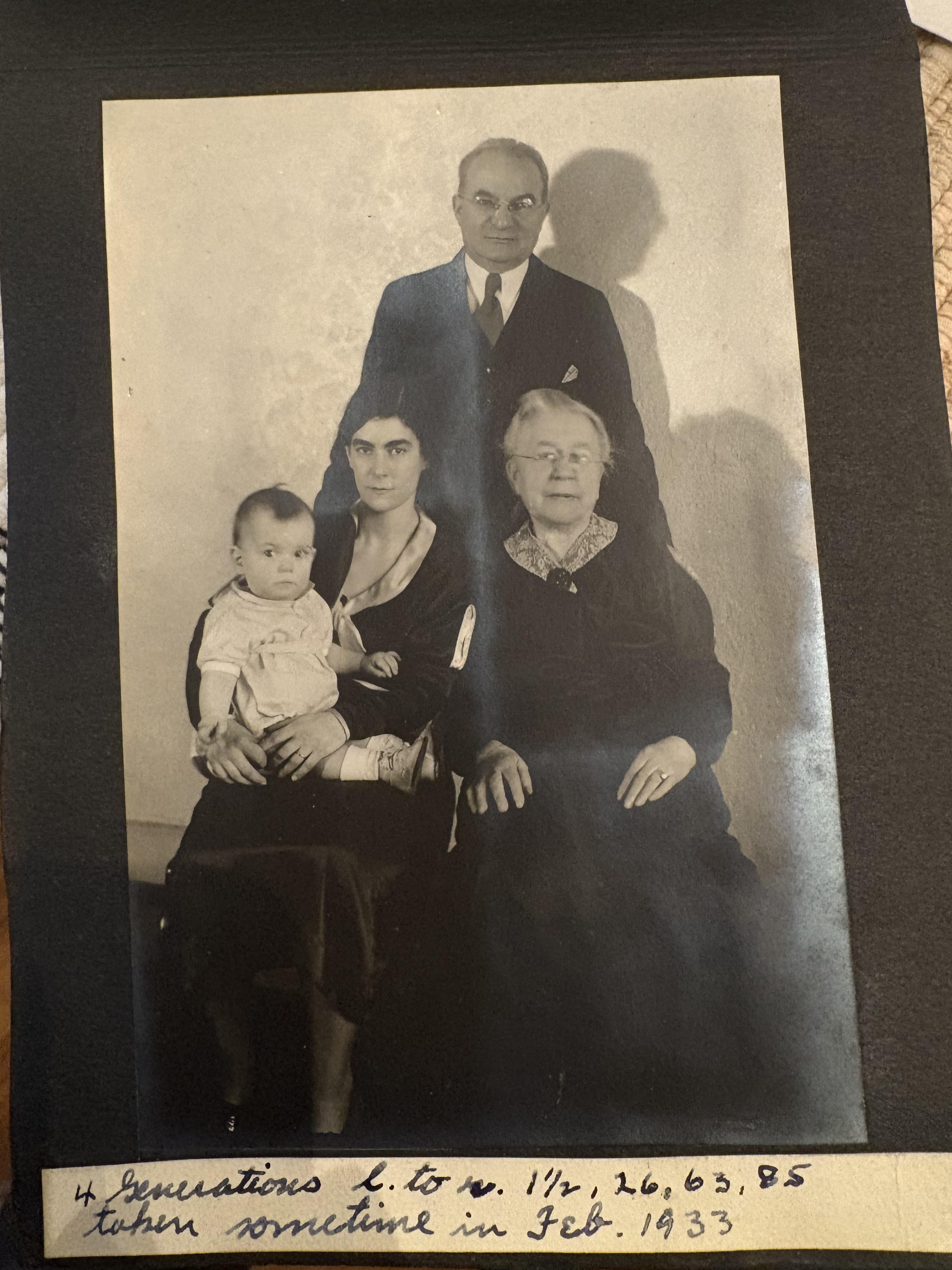
Celebration of the real Hannah Goldsmith Benedict’s 90th birthday in 1938.

You can find Simon’s Secret here on Amazon. I hope you enjoy it, and if so, please tell your friends and family and leave a review on Amazon.

Thank you!!

Update! Gertrude Rothschild Lancellotti Died on January 1, 1971

Just a quick update to report that, thanks to two amazing researchers, Kaye Prince Hollenberg of Tracing the Tribe and John Schroedel, I now know that Gertrude died on January 1, 1971. Details are in the update of the original post from yesterday.

Thanks also to Eilene Lyons for pointing out that I did have information on the name of Dolores De Villasante’s mother, thus leading me to find the names of both of her parents. (Eilene also pointed out a typo—damn typos!)

As always, I am so grateful to the genealogy village!

Gertrude Rothschild Lancellotti: When and Where Did She Die? Mystery Solved!

Today I will turn to Moses and Mathilde Rothschild’s fourth child Gertrude Rothschild Lancellotti/Lancelot and her family and their lives from 1930 onward. I have records for most of the vital information, except that I cannot find a death record or obituary or any other information about the death of Gertrude herself. If anyone can help, please let me know!

In 1930 Gertrude was living with her husband Charles Lancelot (sometimes it was shortened this way from Lancellotti, which was also sometimes spelled Lancelotti) in the Bronx, and Charles continued to work as an artist. Neither of their two children, Milton and Estelle, was living with them, and I couldn’t find either of them elsewhere on the 1930 census. Milton would have been 22, and Estelle would have been 19. Was this just a mistaken omission? Or were Milton and Estelle living elsewhere? I don’t know.1

I did find a marriage license record for their daughter Estelle and a man named George Hodges taken out on September 1, 1926, when Estelle was only fifteen,2 but that marriage appears to have been over fairly soon as there was a divorce action by Estelle against George Hodges on August 11, 1927. Because Estelle was a minor, her father Charles acted as her representative and guardian in the divorce action. Where Estelle was living in 1930 after that divorce is still unknown.

Estelle Lancelotti divorce action, Year or Volume: Volume L 1914 – 1938, Ancestry.com. Bronx County, New York, U.S., Divorce and Civil Case Records, 1914

Estelle remarried in 1936 when she was 25. She married Dante V. Somma that year in New Jersey.3 Dante was born on February 21, 1904, in New York to Giovanni/John Somma and Eugenia Mortola. He had been previously married to Josephine Blake Clark, but that marriage had not lasted.4 Prior to marrying Estelle, Dante had been working as a furniture salesman and living in the Bronx.5 Dante and Estelle would have have two children.

Estelle’s brother Milton Lancelot also reappeared in 1936 when he married Dolores De Villasante on September 17, 1936, in Manhattan.6 Dolores was born in Bilbao, Spain, on April 13, 1916, and had immigrated to the US in 1930 from Mexico. Her parents were Alberto De Villasante and Maria Luisa Vidal.7 [Thank you to Eilene Lyons for pointing out that Dolores’ mother was living with Milton and Dolores in 1940, leading me to find the names of Dolores’ parents.] Perhaps Milton had been in Mexico in 1930 when the US census was taken and had met Dolores there? Milton and Dolores would have two children.

In 1940, Gertrude and Charles were still living in the Bronx at 1501 Undercliff Avenue, and Charles was still working as an artist.8 Charles’ 1942 World War II draft registration reports that his employer was Standard-Koppel Engraving Company.

Charles Lancelotti, World War II draft registration, The National Archives At St. Louis; St. Louis, Missouri; Record Group Title: Records of the Selective Service System; Record Group Number: 147, Ancestry.com. U.S., World War II Draft Registration Cards, 1942

Milton and Dolores were living in Manhattan in 1940 with Dolores’ mother and sister. Milton was a salesman for a lithography company.9 His 1940 World War II draft registration revealed that his employer was Robert Teller Sons & Dorner.

Milton Lancelot, World War II draft registration, National Archives at St. Louis; St. Louis, Missouri; Wwii Draft Registration Cards For New York City, 10/16/1940 – 03/31/1947; Record Group: Records of the Selective Service System, 147, Ancestry.com. U.S., World War II Draft Cards Young Men, 1940-1947

Estelle and Dante were living in the Bronx in 1940, on the same street (1630 Undercliff Avenue) as Estelle’s parents. Dante was a salesman for a decorating business;10 his 1942 World War II draft registration reveals two things: he and Estelle were now living at the same address on Undercliff Avenue (1501) as Gertrude and Charles, and he was working for The Nahon Company.

Dante Somma, World War II draft registration, National Archives at St. Louis; St. Louis, Missouri; Wwii Draft Registration Cards For New York City, 10/16/1940 – 03/31/1947; Record Group: Records of the Selective Service System, 147, Ancestry.com. U.S., World War II Draft Cards Young Men, 1940-1947

Gertrude and Charles were still living at 1501 Undercliff Avenue in the Bronx in 1950. Charles was still a commercial artist. Their daughter Estelle and her husband Dante were also living at that address with their children, and Dante was working as a wholesale furniture salesman.11

Milton, however, had moved by 1950 with his family to the suburbs—to New Rochelle, New York.12 A June 17, 1948, article in the New Rochelle Standard-Star reported that he had purchased a home in that town.13 Milton was still selling lithography. In 1960, Milton legally changed his name from Lancellotti to Lancelot,14 although he had been using that abbreviated version of his surname for many years at that point.

Estelle Lancellotti Somma died on December 26, 1952, at the age of only 41.15 I could not find an obituary or any other document that provided a cause of death. She was survived by her parents Gertrude and Charles, her husband Dante, who died on May 30, 1986,15 and her two children.

Her father Charles Lancellotti died August 31, 1967, in New York; he was 84.16 I could not find any record at all for what happened to Charles’ wife and my cousin Gertrude Rothschild Lancellotti—no death record, no obituary. If anyone knows what happened to Gertrude, I hope they will find me and fill me in.

UPDATE!! Thanks to two researchers, Kaye Prince Hollenberg on Tracing the Tribe and John Schroedel, I now know when Gertrude died! She died on January 1, 1971, in New Rochelle, New York, where her son Milton was then living. John found the document below on FamilySearch, and Kaye found her in the New York State Death Index.

New York, Probate Records, 1629-1971,” images, FamilySearch (https://familysearch.org/ark:/61903/3:1:3QSQ-G99R-NNYM?cc=1920234&wc=Q75G-DPF%3A213305501%2C235998202 : 28 May 2014), Westchester > Wills and letters index 1813-1983 Labate, Luigi-Lawson, Marie G. > image 934 of 3213; county courthouses, New York.

As for Charles and Gertrude’s son Milton, he died on January 4, 1994, in Stamford, Connecticut, at the age of 85.17 According to his obituary, Milton was “an award-winning book designer and author of several books on sports, naval history, and the development of aerial combat” as well as “an avid historian and theater-goer.”18  By googling his name I was able to find several books that are still in print that were authored or co-authored by Milton. Milton was survived by his wife Dolores and their children. Although I could find no death record for Dolores, a brief obituary for her states that she died on July 13, 2018, in New Smyrna, Georgia. (Thank you to Aaron Knappstein for reminding me that I had this obituary!)

This brings me to the last child of Moses Rothschild, his son Aron.


  1. Charles and Gertrude Lancelot, 1930 US census, Year: 1930; Census Place: Bronx, Bronx, New York; Page: 2A; Enumeration District: 0162; FHL microfilm: 2341203, Ancestry.com. 1930 United States Federal Census 
  2. Estelle T Lancelot, Gender Female, Marriage License Date 1 Sep 1926, Marriage License Place Manhattan, New York City, New York, USA, Spouse George M Hodges
    License Number 24473, New York City Municipal Archives; New York, New York; Borough: Manhattan; Volume Number: 10, Ancestry.com. New York, New York, U.S., Marriage License Indexes, 1907-2018 
  3. Estelle Lancelot, Maiden Name Lancelot, Gender Female, Marriage Date 1936
    Marriage Place New Jersey, USA, Spouse Dante Somma, New Jersey State Archives; Trenton, New Jersey; Marriage Indexes; Index Type: Bride; Year Range: 1936; Surname Range: A – Z; Reel Number: 34, Ancestry.com. New Jersey, U.S., Marriage Index, 1901-2016 
  4. Dante Summa, Birth Date 21 Feb 1904, Birth Place Manhattan, New York, USA
    Certificate Number 9980, Ancestry.com. New York, New York, U.S., Extracted Birth Index, 1878-1909; “New York, New York City Marriage Records, 1829-1938”, , FamilySearch (https://www.familysearch.org/ark:/61903/1:1:24W8-SK9 : Mon Mar 11 20:54:31 UTC 2024), Entry for Dante V. Somma and Josephine B. Clark, 14 August 1927. 
  5. Dante Somma, 1930 US census, Year: 1930; Census Place: Bronx, Bronx, New York; Page: 1B; Enumeration District: 0595; FHL microfilm: 2341221, Ancestry.com. 1930 United States Federal Census 
  6. Milton Lancelot, Gender Male, Marriage Date 17 Sep 1936, Marriage Place Manhattan, New York, USA, Spouse Dolores DeVilladante, Certificate Number 23730, Ancestry.com. New York, New York, U.S., Extracted Marriage Index, 1866-1937 
  7. Dolores Lancelot, Race Spanish, Record Type Naturalization Petition, Birth Date 13 Apr 1916, Birth Place Bilbao, Spain, Departure Place Veracruz, Mexico, Arrival Date 21 Oct 1930, Arrival Place New York, New York, Petition Place New York, USA, Spouse
    Milton, Petition Number 301464, The National Archives in Washington, DC; Washington, DC; NAI Title: Index to Petitions For Naturalizations Filed in Federal, State, and Local Courts in New York City, 1792-1906; NAI Number: 5700802; Record Group Title: Records of District Courts of the United States, 1685-2009; Record Group Number: Rg 21, Ancestry.com. New York, U.S., State and Federal Naturalization Records, 1794-1943. Alberto MA. De Villasante, [Alberto Maria De Villasante] Gender Hombre (Male)
    Marriage Age 22 Event Type Marriage Birth Date 1887 Marriage Date 15 feb 1909
    Marriage Place San Cosme y San Damián (San Cosme), Distrito Federal, México
    Spouse Maria de la Paz Vicente Vidal,  Film Number 004023378, Ancestry.com. Mexico, Select Church Records, 1537-1966. 
  8. Charles and Gertrude Lancelot, 1940 US census, Year: 1940; Census Place: New York, Bronx, New York; Roll: m-t0627-02498; Page: 5A; Enumeration District: 3-1473,
    Ancestry.com. 1940 United States Federal Census 
  9. Milton Lancelot and family, 1940 US census, Year: 1940; Census Place: New York, New York, New York; Roll: m-t0627-02675; Page: 4B; Enumeration District: 31-2066,
    Ancestry.com. 1940 United States Federal Census 
  10. Dante Somma and family, 1940 US census, Year: 1940; Census Place: New York, Bronx, New York; Roll: m-t0627-02498; Page: 15A; Enumeration District: 3-1476A, Ancestry.com. 1940 United States Federal Census 
  11. Charles Lancelot and family, 1950 US census, National Archives at Washington, DC; Washington, D.C.; Seventeenth Census of the United States, 1950; Year: 1950; Census Place: New York, Bronx, New York; Roll: 4107; Page: 82; Enumeration District: 3-305, Ancestry.com. 1950 United States Federal Census; Dante Somma and family, 1950 US census, National Archives at Washington, DC; Washington, D.C.; Seventeenth Census of the United States, 1950; Year: 1950; Census Place: New York, Bronx, New York; Roll: 4107; Page: 30; Enumeration District: 3-305, Ancestry.com. 1950 United States Federal Census 
  12. Milton Lancelot and family, 1950 US census, National Archives at Washington, DC; Washington, D.C.; Seventeenth Census of the United States, 1950; Year: 1950; Census Place: New Rochelle, Westchester, New York; Roll: 2089; Page: 10; Enumeration District: 67-24, Ancestry.com. 1950 United States Federal Census 
  13. “13 Homes Sold, Broker Reports,” The New Rochelle (NY) Standard Star, June 17, 1948, p. 10. 
  14. Estelle Somma, Age 42, Birth Date abt 1910, Death Date 26 Dec 1952
    Death Place Manhattan, New York, New York, USA, Certificate Number 27685, Ancestry.com. New York, New York, U.S., Death Index, 1949-1965 
  15. Dante Somma, Age 82, Birth Date 8 Feb 1904, Death Date 30 May 1986
    Death Place Orange City, Essex, New Jersey, USA, New Jersey State Archives; Trenton, New Jersey; New Jersey, Death Indexes, 1904-2000, Ancestry.com. New Jersey, U.S., Death Index, 1848-1878, 1901-2017 
  16. Charles G Lancellotti, Gender Male, Age 84, Birth Date abt 1883, Residence Place New Rochelle, Westchester, New York, USA, Death Date 31 Aug 1967, Death Place New York, USA, Certificate Number 64838, New York State Department of Health; Albany, NY, USA; New York State Death Index; URL: https://www.health.ny.gov/vital_records, Ancestry.com. New York State, U.S., Death Index, 1957-1972 
  17. Milton L Lancelot, Gender Male, Birth Date 23 Nov 1908, Death Date 14 Jan 1994
    Claim Date 14 Aug 1973, SSN 090051155, Ancestry.com. U.S., Social Security Applications and Claims Index, 1936-2007 
  18. “Milton L. Lancelot, Author,” The Portchester (NY) Daily Item, January 16, 1994, p. 26. 

Two Sisters Married to Two Brothers: The Younger Daughters of Albert Rothschild

This post will tell about the lives of the three youngest children of Albert and Rose (Katz) Rothschild, their daughters Theresa, Lillian and Dorothy, from 1940 and after.

The third  and fourth daughters, Theresa Rothschild Blumenfeld and her younger sister Lillian Rothschild Blumenfeld, were living together in 1940 in the Bronx, along with their husbands, Arnold and Max, respectively, and Theresa and Arnold’s two children, Albert (13) and their eleven year old daughter Doris. Remember that Arnold and Max were brothers so there were two sisters married to two brothers all in the same household.

Max Blumenfeld and family 1940 US census, Year: 1940; Census Place: New York, Bronx, New York; Roll: m-t0627-02492; Page: 5A; Enumeration District: 3-1276, Ancestry.com. 1940 United States Federal Census

Perhaps the decision to move in together was not just due to the family connection, but also a sign that the Depression had had some impact on these couples. Arnold, Theresa’s husband, was working as a taxi driver; his brother Max, Lillian’s husband, was a salesman in the pleating industry. His World War II draft registration revealed the name of that company—Ideal Pleating. His wife Lillian was a clerk at Twentieth Century Fox.

Max Blumenfeld World War II draft registration, National Archives at St. Louis; St. Louis, Missouri; Wwii Draft Registration Cards For New York City, 10/16/1940 – 03/31/1947; Record Group: Records of the Selective Service System, 147, Ancestry.com. U.S., World War II Draft Cards Young Men, 1940-1947

Whatever the reasons behind the decision to all live together, the two couples were no longer living in one household by 1950. Theresa and Arnold were living with their daughter, who had married in 1947 and who may still be living, her husband and their young son in Queens, New York. Theresa and Arnold’s son-in-law was a lawyer, and Arnold was a wholesale candy salesman.1

Theresa and Arnold’s son Albert Blumenfeld also had married by the time of the 1950 census. First, Albert served in the US Navy, enlisting on October 2, 1944, when he was eighteen, discharged on June 24, 1946.2 He then married Ruth Aronow sometime after March 17, 1949, when they took out a marriage license in New York.3 Ruth was the daughter of Moe Aronow and Mollie Schulter and born in New York on July 22, 1929.4

Arnold Blumenfeld died October 6, 1956, in New York; he was only 56 years old.5 Theresa survived him by less than eight years; she died in January, 1964.6 She was 58. Arnold and Theresa were survived by their two children and their grandchildren. Their son Albert also did not live a very long life; he was 63 when he died on October 19, 1989.7

As for Theresa’s sister Lillian and her husband Max Blumenfeld, Arnold’s brother, in 1950 they had moved from the Bronx and were living in Queens with their son, and Max was still a salesman for the pleating company.8 Max died on April 13, 1971, at the age of 67.9 Lillian survived him by almost seventeen years; she was 78 when she died on January 7, 1988.10 Max and Lillian were survived by their son.

Finally, the youngest of the sisters, Dorothy and her husband Sidney Spiegel were living in the Bronx in 1940; Sidney was working as a typewriter mechanic.11 Sidney joined the US Army on October 8, 1943, and was discharged on May 6, 1946.12 I couldn’t find Sidney and Dorothy on the 1950 US census. At some point they relocated to Florida, where Dorothy died on September 3, 1979, at the age of 6413. She was survived by her husband Sidney, who died three years later on October 27, 1982.14 He was 71. I was not able to determine if Dorothy and Sidney had any children.

Longevity was definitely not a trait shared by Albert Rothschild and his family. He died at 39, his wife Rose at 57, and their son Milton died when he was just a year old. Of their five daughters, only two made it to 65.  Although Josephine lived an extraordinarily long life, making it past 100, and Lillian at least made it to 78, the other three sisters did not have long lives—Rae was only 54, Theresa 58, and Dorothy 64. Their husbands didn’t live very long either.  It must have been very hard for Josephine to see not only her brother die as a baby, her father die when he was only 39, her mother when she was 57, and then to lose all four of her sisters before they reached a ripe old age. It seems quite miraculous that Josephine lived as long as she did, given all those losses she had suffered and her family history.


  1. Arnold Blumenfeld and family, 1950 US census, National Archives at Washington, DC; Washington, D.C.; Seventeenth Census of the United States, 1950; Year: 1950; Census Place: New York, Queens, New York; Roll: 5432; Page: 23; Enumeration District: 41-1418, Ancestry.com. 1950 United States Federal Census 
  2. Albert Blumenfeld, Gender Male, Birth Date 9 Sep 1926, Death Date 19 Oct 1989
    Cause of Death Natural, SSN 054200492, Enlistment Branch NAVY, Enlistment Date 2 Oct 1944, Discharge Date 24 Jun 1946, Ancestry.com. U.S., Department of Veterans Affairs BIRLS Death File, 1850-2010 
  3. Albert Blumenfeld, Gender Male, Marriage License Date 17 Mar 1949, Marriage License Place Bronx, New York City, New York, USA, Spouse Ruth Aronow
    License Number 2084, New York City Municipal Archives; New York, New York; Borough: Bronx, Ancestry.com. New York, New York, U.S., Marriage License Indexes, 1907-2018 
  4. Ruth Aronow, Birth Date Jul 1929, Birth Place Bronx, New York City, New York, USA, Certificate Number 10300, Ancestry.com. New York, New York, U.S., Birth Index, 1910-1965; “New York, New York City Marriage Records, 1829-1938”, , FamilySearch (https://www.familysearch.org/ark:/61903/1:1:Q2CJ-256Y : Thu Mar 07 12:25:58 UTC 2024), Entry for Moe Aronow and Mollie Schulter, 27 October 1928. 
  5. Arnol[d] Blumenfeld, Age 56, Birth Date abt 1900, Death Date 6 Oct 1956
    Death Place Queens, New York, New York, USA, Certificate Number 9506, Ancestry.com. New York, New York, U.S., Death Index, 1949-1965 
  6. Death notice for Theresa Blumenfeld, The New York Times, January 30, 1964, p. 29. 
  7. Albert Blumenfeld, Gender Male, Race White, Birth Date 9 Sep 1926, Birth Place NY Bx, New York, Death Date 19 Oct 1989, Father Arnold Blumenfeld Mother Theresa Rothschild, SSN 054200492, Ancestry.com. U.S., Social Security Applications and Claims Index, 1936-2007 
  8. Max Blumenfeld and family, 1950 US census, National Archives at Washington, DC; Washington, D.C.; Seventeenth Census of the United States, 1950; Year: 1950; Census Place: New York, Queens, New York; Roll: 1920; Page: 22; Enumeration District: 41-601, Ancestry.com. 1950 United States Federal Census 
  9. Max Blumenfeld, Social Security Number 056-09-6623, Birth Date 18 Feb 1904
    Issue year Before 1951, Issue State New York, Last Residence 11367, Flushing, Queens, New York, USA, Death Date Apr 1971, Social Security Administration; Washington D.C., USA; Social Security Death Index, Master File, Ancestry.com. U.S., Social Security Death Index, 1935-2014 
  10. Lillian Blumenfeld, Social Security Number 056-10-4503, Birth Date 9 Dec 1909
    Issue year Before 1951, Issue State New York, Last Residence 11360, Flushing, Queens, New York, USA, Death Date 7 Jan 1988, Social Security Administration; Washington D.C., USA; Social Security Death Index, Master File, Ancestry.com. U.S., Social Security Death Index, 1935-2014 
  11. Sidney Spiegel and family, 1940 US census, Year: 1940; Census Place: New York, Bronx, New York; Roll: m-t0627-02498; Page: 16B; Enumeration District: 3-1476A, Ancestry.com. 1940 United States Federal Census 
  12. Sidney Spiegel, Gender Male, Birth Date 28 Sep 1911, Death Date 27 Oct 1982
    SSN 109142052, Enlistment Branch ARMY, Enlistment Date 29 Oct 1943, Discharge Date 6 May 1946, Ancestry.com. U.S., Department of Veterans Affairs BIRLS Death File, 1850-2010 
  13. Dorothy Violet Spiegel, Race White, Age at Death 64, Birth Date 3 Dec 1914
    Death Date 3 Sep 1979 Death Place Broward, Florida, United States, Ancestry.com. Florida, U.S., Death Index, 1877-1998 
  14. See Note 12, supra.