Boy, Is My Face Red. The Real Story of Milton Josephs’ Death and a Few Important Research Lessons

In my earlier post this morning, I wrote about little Milton Josephs, not yet two years old, whose cause of death was listed as marasmus on the Federal Census Mortality Schedule for 1880.  I was horrified that a child living in Philadelphia in a middle class home in 1880 could have died from starvation.

My medical consultant, whose expertise is in pediatrics and anesthesia (and who is also my brother, for those of you who haven’t figured it out), also thought that it seemed strange that a child would have died from severe malnutrition without there being some other underlying cause such as cancer or some syndrome that prevented him from being able to absorb nutrients.

His questions made me go back to see if I could find the actual death certificate for Milton on line.  My initial searches on both ancestry.com and FamilySearch.org had failed to pick up Milton’s death certificate no matter how I tried searching or spelling his name.  But this time I realized there was another way to search.  Ancestry.com had a record for Milton in the index of Philadelphia death certificates, but no image of that actual certificate.  But the record included the FHL film number, that is, the catalog number for the microfilm in the Family History Library in Salt Lake City.

For some reason, I’d never before tried searching by the FHL number on FamilySearch.   I know to those out there who are experienced genealogists this must seem like a terrible rookie mistake, and I am quite embarrassed that I’d never thought to do that before.

But it worked. Plugging the film number into the FamilySearch search engine resulted in the retrieval of this document:

Milton Joseph's death certificate  "Pennsylvania, Philadelphia City Death Certificates, 1803-1915," index and images, FamilySearch (https://familysearch.org/pal:/MM9.3.1/TH-266-11063-42231-79?cc=1320976 : accessed 14 December 2014), 004058647 > image 406 of 969; Philadelphia City Archives and Historical Society of Pennsylvania, Philadelphia.

Milton Joseph’s death certificate
“Pennsylvania, Philadelphia City Death Certificates, 1803-1915,” index and images, FamilySearch (https://familysearch.org/pal:/MM9.3.1/TH-266-11063-42231-79?cc=1320976 : accessed 14 December 2014), 004058647 > image 406 of 969; Philadelphia City Archives and Historical Society of Pennsylvania, Philadelphia.

It is a bit hard to read, but if you look carefully you can see that on the certificate it says Milton died from bronchial pneumonia, not marasmus.  My brother agreed that this was a much more likely cause of death for a boy living at home with his family in Philadelphia than starvation, and he thought it was unlikely that somehow marasmus led to pneumonia or vice versa.

Then why would the 1880 Federal Census Mortality Schedule have said the cause of death was marasmus? Well, once again I am embarrassed.  I looked more closely at the mortality schedule, and sure, it says M. Josephs, and sure, ancestry.com retrieved it as relating to Milton Josephs, but I should have looked more closely.  Because now that I have looked again, I realize that the schedule says that M. Josephs was 5/12, that is, five months old.

Milton Joseph on the Federal Mortality Schedule 1880

Milton Joseph on the Federal Mortality Schedule 1880

And a little more research uncovered the death of a child name Mike Josephs who died of marasmus in December 1879 at five months of age.  So stupid mistake number two:  I too quickly assumed that M. Josephs was Milton without reading the document carefully and without even stopping to think that Milton had died in November, 1880, too late to have been listed on the Federal Census Mortality Schedule for 1880, which was dated May 31, 1880.

So I apologize for my carelesness and for maligning the reputation of my ancestors whose son died from pneumonia, not starvation.

Do I feel any better about Milton, knowing that he did not die from starvation?  I suppose that I better understand how a toddler can die from pneumonia than starvation, especially in the era before antibiotics.  But no, I don’t feel better.  A little boy died what still must have been a painful death, and his family still lost a beloved child.

And another family, that of Mike Josephs, did lose a five month old baby to starvation.

There is no good news here, but I did learn a few important lessons.  Thanks to my brother, I was able to find my mistakes and set the record straight.

The Struggles of My Three-times Great-grandparents in the 1870s

The 1870s were not an easy decade for my three-times great-grandparents, John and Jeanette Nusbaum.  Like Jeanette’s sisters Caroline and Mathilde and their families, the Nusbaums confronted some of the effects of the economic depression affecting the country.[1]

By 1870 John and Jeanette only had two children living at home with them, Miriam, now 12, and Lottie, who was seven.  Adolphus, Simon, and Julius, their three sons, were all living in Peoria, and Frances was married and living in Santa Fe with her husband Bernard Seligman and their three children, Eva, my great-grandmother, James, and Minnie.  In 1871, Frances and Bernard’s son Arthur was born, giving John and Jeanette a fourth grandchild.[2]

In 1872, Adolphus married Fannie Fox in Laporte, Indiana, but they settled together in Peoria.  Until at least 1873, Adolphus and his brother Simon remained proprietors of the Union Mill Distillery, and their younger brother Julius continued to work as a clerk in their father’s store in Peoria.

But something changed by 1876, and in the Peoria directory for that year, although Adolphus was still listed as a distiller and Julius is still a clerk at John Nusbaum’s store, Simon was now in a different firm, Kingsland and Nusbaum, a firm engaged in the wholesale and commercial sales of liquor.  Had there been a falling out between Simon and Adolphus, or had Simon just formed a separate business to distribute the liquor distilled by his brother’s company?


http://www.gettyimages.com/detail/121333164

As I started studying the occupations of the younger generation of men in the extended Nusbaum-Dreyfuss-Simon clan, I was struck by the fact that whereas the older generation was involved primarily in the sale of clothing and other “dry goods,” the younger generation was definitely more into “wet goods.”  Albert Nusbaum, Leman Simon, and Adolphus and Simon Nusbaum were all now in the liquor trade.  In addition, Moses Simon ended up in the liquor business as well.  Was this a sign of the times? Were people drinking more because of the economic conditions, thus making this an attractive business for the entrepreneurial cousins?  Or was it more that once one cousin had success, the others figured they’d go into that line of business as well?

Apparently, Peoria was once known as the “Whiskey Capital of the World” and had over 24 breweries and 73 distilleries during the period between 1837 and 1919.  The 1860s and 1870s were the high point of Peoria’s liquor production and distribution, so it is not surprising that Adolphus and Simon became involved in the liquor business.  As for Albert, Leman, and Moses, it would appear that they followed the trend that the Nusbaum brothers had started.  Interestingly, this is also a period when the movement for prohibition of alcohol also started gaining momentum, making the liquor business a risky venture in the long term.  But for the 1870s, it might have been a wise business move.

The three Nusbaum brothers remained in Peoria throughout the 1870s, although by 1880, as we will see, Simon had relocated. Meanwhile, back in Philadelphia, their parents must have been having some problems.  The 1877 census had John listed as living at the same address at 943 North 6th Street in Philadelphia, but without an occupation.  John was now 63 years old, and at first I thought that he had simply retired.  But the 1877 Peoria directory also had a listing for John Nusbaum, and this is the first time that it includes a residential listing.  Was this a mistake? Or was John spending part of his time in Peoria? Had John’s Philadelphia store closed?

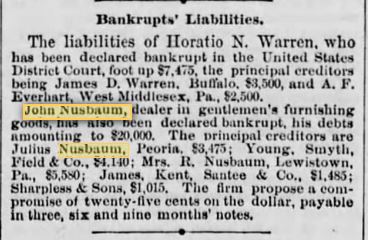
Perhaps these two news clippings from 1878 can shed some light on what was going on:

John Nusbaum bankrupt Aug 23 1878 Phil Times p 4

Philadelphia Times, August 23, 1878, p. 4

John N bankruptcy October 1878 p 1

Philadelphia Times October 31, 1878 p. 1

John was bankrupt, in debt for $20,000, and his principal creditors included two of his relatives: his son Julius, who was working at the Peoria store, and his sister-in-law Rose, widow of his brother Leopold, who had moved to Lewistown, Pennsylvania, after living with John and Jeanette during the period after Leopold died in 1866.  The bankruptcy settlement allowed John to pay them a quarter of what he owed them.

I wish I could find out more about this, and perhaps there is some way of finding some documents about the bankruptcy proceedings.  If anyone has any suggestions, let me know.  It just seems odd that Julius, who was working in his father’s store in Peoria, was owed almost $3500.  And how did John become indebted to his widowed sister-in-law for over $3500? But obviously John was having financial problems, another family member feeling the impact from the economic crisis of the 1870s.

John was again listed without an occupation in the 1879 Philadelphia directory, and although he is listed as being in the dry goods business again in the 1880 Philadelphia directory, there also appears to be something else going on.  On the 1880 US census, John Nusbaum is listed as living in Santa Fe, New Mexico with his daughter Frances Nusbaum Seligman and her family.  John’s son and Frances’ brother Simon is also living with the family (as is Bernard’s brother Adolph).  John’s occupation is described as “retired merchant,” and Simon is a bookkeeper.  Why did Simon leave Peoria? What had happened to his liquor business? And what was John doing in Santa Fe…without his wife?

Seligman and Nusbaums on 1880 US census santa fe

John and Simon Nusbaum with Bernard and Frances Seligman in Santa Fe 1880 US census

Jeanette was not with John nor were their two younger daughters. Rather, Jeanette, along with her youngest daughter Lottie, was listed in the 1880 census living at her other daughter Miriam’s house at 1120 Master Street in Philadelphia.  Miriam had married Gustav Josephs on March 20, 1878.  Gustav was listed as being in the handkerchief business in the 1880 Philadelphia directory and in the embroidery business on the 1880 census, so my guess is he either sold or made embroidered handkerchiefs at that time.  Gustav and Miriam had had a son Milton, who was born on December 28, 1878.  Yes, I realize that that means that Milton was born just nine months after his parents were married, but that certainly happens.  These are dates from the family bible, and while perhaps not as official as a government record, for my money and from my experience, the family bible has proven to be at least as reliable if not more reliable than many government records.

So Jeanette was in Philadelphia while John was in Santa Fe.   Since John was retired, it does not appear that this was a business decision.  Did the experience of bankruptcy lead him to leave Philadelphia for some time? Was there tension between Jeanette and John due to financial stress?

Jeanette Nusbaum 1880 US census in Philadelphia

Jeanette Nusbaum 1880 US census in Philadelphia

I do not know, but I do know that by 1881, John was back in Philadelphia where he would live the remainder of his days.  In 1881 he also was living at 1120 Master Street and thus presumably reunited with Jeanette, living in the home of Miriam and her husband Gustav.

Gustav and Miriam had had a second child, Florence, born on July 28, 1880, but just a few months later, the family suffered a sad loss. On November 17, 1880, Gustav and Miriam’s toddler son Milton died from marasmus.  Marasmus is a severe form of malnutrition caused by a lack of protein and calories.  Poor little Milton essentially starved to death.  He was one month short of his second birthday.  Today this is something we think of as a third world problem, but here he was, the grandson of a once-successful merchant, living in one of the biggest cities in the US at the time.  It’s hard to imagine how this could have happened.

IMPORTANT UPDATE: Please see my next post here.  Milton did not die from marasmus, but from pneumonia.

Milton Joseph on the Federal Mortality Schedule 1880

Milton Joseph (third from bottom) on the Federal Mortality Schedule 1880

Thus, the 1870s were a tough decade for my three-times great-grandparents, both personally and professionally. By 1880 John had also lost another sibling in addition to Leopold, who had died in 1866, and Isaac, who had died in 1870.  But that will wait for another post.

But not all the news was bad news.  Two more of their children had married, Adolphus and Miriam, and John and Jeanette had two new grandchildren, Florence Josephs, Miriam’s daughter, and Arthur Seligman, Frances’ son, the grandson who would one day be the governor of New Mexico.  There definitely were better days ahead for the Nusbaum family.

tunnel-336693_1280


[1] My brother told me that titling my posts “The Long Depression” was not a way to entice readers, so I’ve changed it a bit for this one.  I am not sure that does much more to make this into uplifting reading, but these were tough times.

[2] That does not count Florence Seligman, who was born in August, 1867 and died a few weeks later, as I’ve written about previously.

The Long Depression, Part 2: Moving Back Home or Moving Away

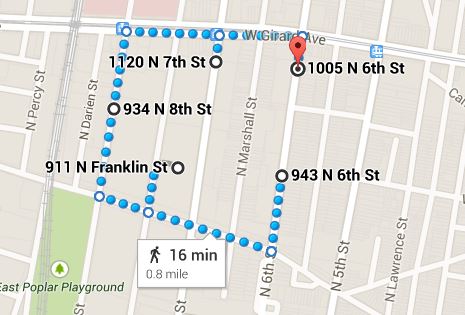
In the early 1870s Moses and Caroline (Dreyfuss) Wiler were living at 905 Franklin Avenue, just a few houses down from Caroline’s sister, Mathilde (Dreyfuss Nusbaum) Pollock and just three blocks away from their third sister, Jeanette (Dreyfuss) Nusbaum and her husband John, my three-times great-grandparents.  Ernst Nusbaum and his wife Clarissa were living down the block from his brother John. The area is known as the Poplar neighborhood in North Philadelphia. Plotting all their addresses on the map made me smile.  They must have all been so close, not only geographically but emotionally, to live so close to their siblings.  Imagine all the first cousins (some double first cousins) growing up within a short walk of each other.

map of nusbaum wiler simon homes 1870s

But as I wrote in my last post, things were not quite so idyllic in the 1870s.  The Panic of 1873 and the depression that followed had an impact on the family.  Like Mathilde and Moses Pollock, Caroline and Moses Wiler also must have felt some of that impact.  In 1873 Moses Wiler was listed in the directory without an occupation.  His partnership with his brother-in-law Moses Pollock had ended.  In 1875 he was still listed without an occupation, and they had moved from Franklin Avenue to 920 North 7th Street, still within two blocks of Caroline’s sisters.

Caroline and Moses Wiler’s son Simon also seems to have been affected by the Long Depression.  He had been part of the Simon and Pollock cloak and dry goods partnership of the late 1860s and early 1870s with his father and uncle.  After that business ended, Simon had a separate listing in the 1875 directory as a salesman, living at 701 North 6th Street, again in the same neighborhood as his extended family, just a few blocks south.  Simon was 32 and not married and presumably was doing well enough to afford his own place.  By 1877, however, he had moved back home with his parents at 920 North 7th Street.

In 1879, Moses Wiler was in the dry goods business, and his son Simon was a salesman, both living at 902 North 7th Street, as they were in 1880.  According to the 1880 census, Simon was a paper salesman, and Moses, who was 63, was a retired merchant.  Perhaps Moses had retired as early as 1873 when his listing no longer included an occupation.  Maybe he had done well enough to cope with the economic depression that occurred in 1873.

Poplar Street houses

House on Poplar Street, perhaps like those lived in by the extended Nusbaum-Dreyfuss family in the 1870s https://ssl.cdn-redfin.com/photo/93/bigphoto/440/6336440_0.jpg

By 1880, the three daughters of Caroline and Moses Wiler were no longer living with their parents.  Eliza Wiler had married Leman Simon in 1863, and in 1870 they had two children living with them, Joseph, who was five, and Flora, who was three. Sadly, in 1869, they had had a baby who was still born.   In 1870 they were living at 718 Coates Street, an address that appears not to exist anymore but was located where Fairmount Avenue is now located between the Delaware River and Old York Avenue.  Leman was in business with his brother Samuel, as he was in 1871. That business must have then ended.  According to the 1872 directory, Leman was then in the cloak business with his father Sampson Simon, who was living at the same address on Coates Street.  In 1874, Leman and Eliza had another child, Nellie, born on November 18 of that year.

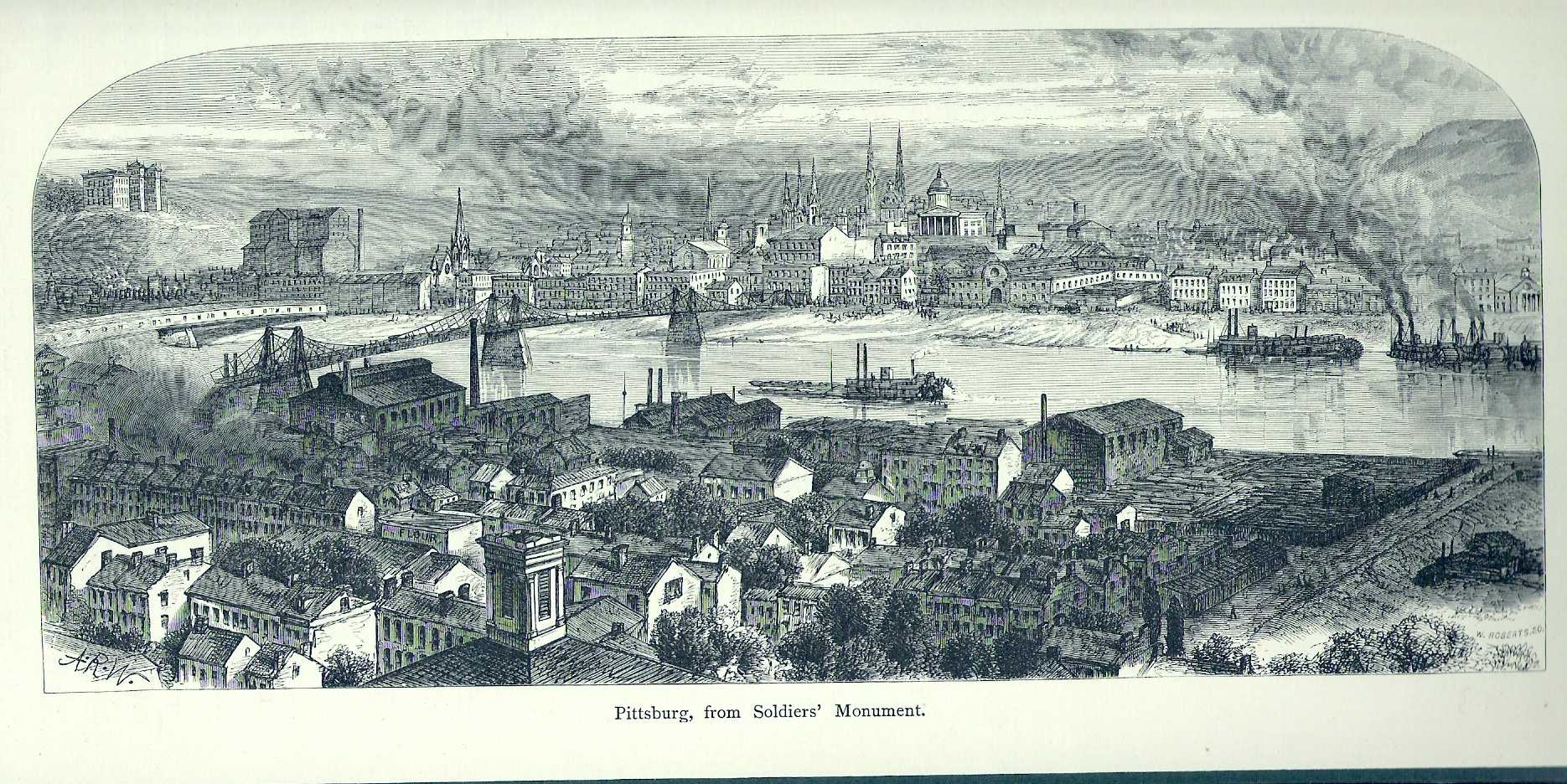
By 1876, Leman was listed as a salesman, living at 920 North 7th Street with his in-laws, Moses and Caroline Wiler.  Like Simon Wiler, Leman must have been feeling the effects of that Long Depression to have moved in with his in-laws after having his own home.   The next time Leman showed up in my search, he and Eliza were living in Pittsburgh, and Leman was working in the liquor business, like his cousin Albert Nusbaum.  Although I cannot find Leman on an 1877, 1878, or 1879 directory in any city, Leman and Eliza had another child, Leon, who was born in Pittsburgh on June 13, 1878, so the family must have relocated to Pittsburgh from Philadelphia by then.

Leman and Eliza also had a daughter Minnie, who was apparently born in 1877.  I say “apparently” because I cannot find a birth record for her, and there are only two census reports that include her, the 1880 and 1900 census reports.  The first says she was 2, meaning she was born either in 1877 or 1878; the latter says she was born in December, 1877.  But if she was born in December, 1877, then Eliza could not have given birth to Leon in June, 1878, just six months later.  I do have an official record for Leon’s birthdate with Eliza Wiler and Leman Simon named as his parents, so either Minnie was born sometime before September, 1877 or she is not Eliza’s child.

There are no other records I can find to determine Minnie’s precise birthdate; her death certificate also only specified her age, not an exact date of birth, and it also is consistent with a birth year of either 1877 or 1878.  Minnie died on August 5, 1904, at age 26 (more on that in a later post), meaning she was born on or before August 5, 1878, but not any earlier than August 6, 1877.  Somehow it seems quite unlikely that Caroline gave birth in August 1877, got almost immediately pregnant, and then had another child ten months after Minnie, but….stranger things have happened.  Or perhaps Minnie was adopted. Since I cannot find a birth record for a Minnie Simon in Pennsylvania for either 1877 or 1878, that certainly is a possibility.

In any event, in 1880, Eliza (Wiler) and Leman Simon were living far from their families in Pittsburgh with their five children, Joseph, Flora, Nellie, Minnie, and Leon.  Leman was in the liquor sales business, and perhaps life was a little easier out in the western part of Pennsylvania than it was in Philadelphia.

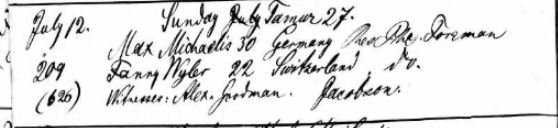
Eliza’s younger sister Fanny Wiler married Max Michaelis on July 12, 1874, in Philadelphia.  I am still working on Fanny’s story, and there are a lot of holes so that will wait for a later post.

The youngest child of Caroline (Dreyfuss) and Moses Wiler was Clara Wiler, born in 1850.  In 1871, she married Daniel Meyers, a German born clothing merchant operating in the 1870s under the firm name D. Meyers and Company.  He and Clara were living at 718 Fairmount Street, and their family grew quickly in the 1870s.  First, their daughter Bertha was born on December 4, 1972.  Less than two years later, their son Leon was born on June 12, 1874, followed the next year by Samuel on December 15, 1875.  A fourth child, Harry, was born January 15, 1878, and Isadore on September 25, 1879.  Five children in seven years.  Wow.

And they were not yet done.  But that would bring us into the 1880s, and I am not there yet.   But Daniel’s firm must have been weathering the storm of the 1870s depression better than most, including many in the extended family.  In 1880, he was supporting five children plus his wife Clara and himself in their house on Fairmount Street.

Thus, the Wiler family like the Pollock family had its ups and downs during the 1870s.  There were marriages and babies, but also some economic struggles for at least some of the members of the family.  Adult children had to move back home, and some had to leave town to find new opportunities for making a living.

The Long Depression:  The Family of Mathilde Dreyfuss Nusbaum Pollock


Embed from Getty Images

If the 1860s were mostly a decade of good things—weddings, babies, prosperity, and little impact from the Civil War, the 1870s were in contrast a more difficult decade for the extended Nusbaum-Dreyfuss-Dinkelspiel-Simon clan, both personally and economically.  This post will focus on the family of Mathilde Dreyfuss Nusbaum Pollock, and the next will focus on the family of Caroline Dreyfuss Wiler, my two three-times great grand aunts, sisters of Jeanette Dreyfuss.  The posts that follow will focus on the family of my three times great-grandparents John and Jeanette (Dreyfuss) Nusbaum and the families of John’s siblings Ernst Nusbaum, Leopold Nusbaum, and Mathilde (Nusbaum) Dinkelspiel during the 1870s.

First, the Pollocks. Mathilde (Dreyfuss Nusbaum) and Moses Pollock had relocated from Harrisburg to Philadelphia in the mid-1860s. Moses was engaged in the retail dry goods business. In June 1870 when the census was taken, the Pollocks had a very full house.  Mathilde’s daughter Flora and her new husband Samuel were living with them along with their new baby Meyer. Samuel was working on the wholesale side of clothing sales. In addition, Mathilde’s son Albert Nusbaum, now 19 and working as a clerk in a dry goods store (presumably his stepfather’s business), was living with them as well as Mathilde and Moses’ children, Emanuel (14) and Miriam (11), who were both in school.  In addition, there were three domestic servants living with them.  Moses must have been doing quite well.

It’s a good thing they had those servants because there were also three young children living with them, Annie (5), Alice (4), and Wilhelmina Jastrow (seven months old) plus another young woman, Augusta Wolfsohn, who was 22 years old.  Annie and Alice were born in Hesse-Darmstadt, but their baby sister Wilhelmina had been born in Pennsylvania in September, 1869.  Who were they? Where were their parents? Augusta was born in Prussia and does not appear to be the mother of the three young girls.  Who was she?  None of these girls was living with the Pollocks as of the 1880 census.

Fortunately, this was a mystery that did not take long to solve.  A little research on Ancestry.com, and I was able to find a happy ending to the story.  The Jastrow girls had parents, Marcus and Bertha (Wolfsohn) Jastrow.  By the second enumeration of the 1870 census in Philadelphia, they and their aunt Augusta Wolfsohn were all under the same roof as their parents and other siblings.  I don’t know why they were with the Pollocks during the earlier enumeration, but I assume that they were very recent immigrants who did not have enough room to accommodate everyone, and Moses and Mathilde were kind enough to take in the three youngest children and their aunt.

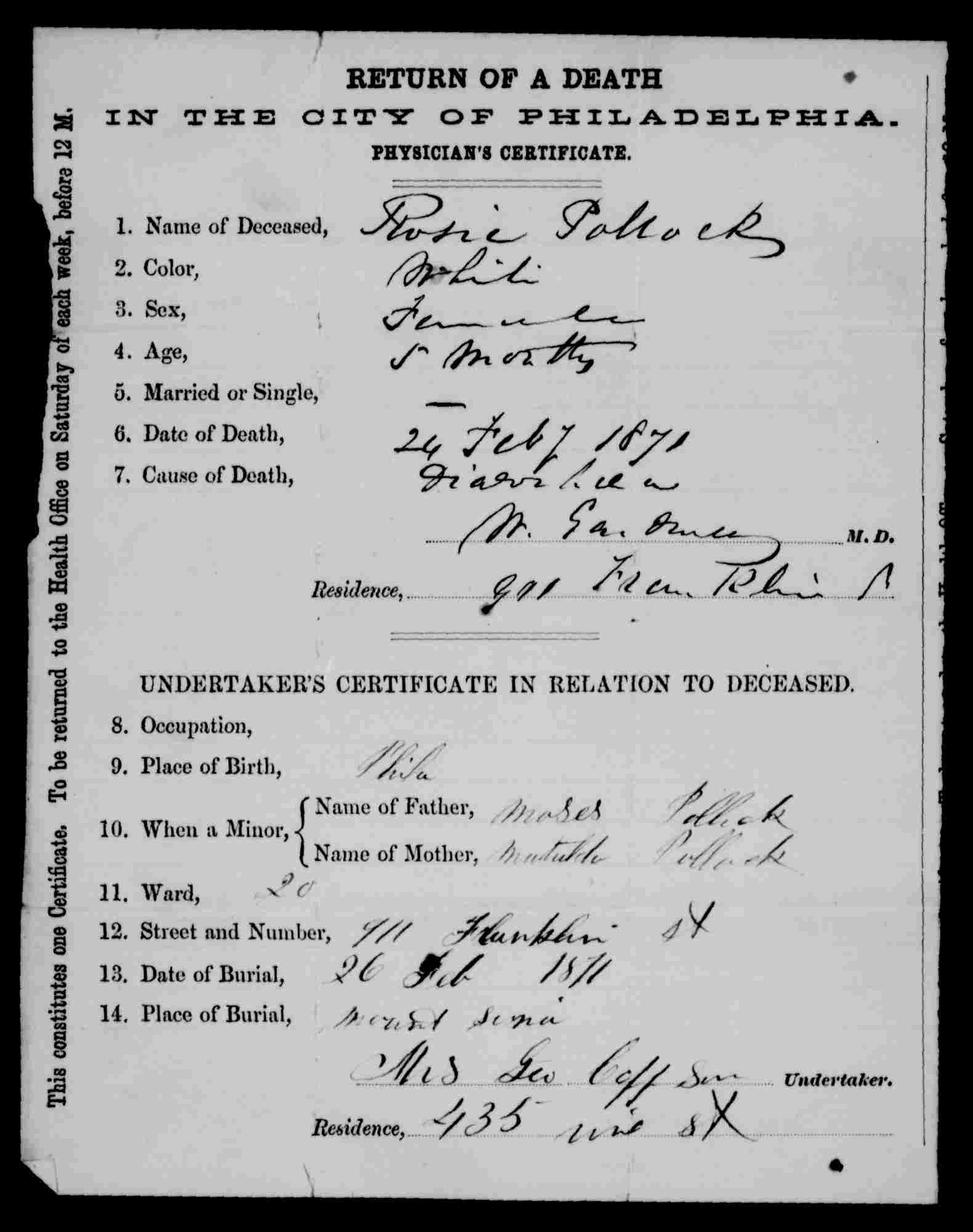
But fate was not kind to Moses and Mathilde despite their kindness to the Jastrows.  In September 1870, they had a third child together (a fifth for Mathilde), Rosia, but Rosia did not live long.  On February 26, 1871, she died, only five months old, from diarrhea.  Mathilde was 45 years old when Rosia was born, making me doubt my skepticism about the parentage of Lottie Nusbaum. Perhaps women just kept having babies into the mid to late 40s back then with more frequency than I would have thought.

Rosia Pollock death certificate 1871

Rosia Pollock death certificate 1871

What makes this late birth seem even stranger is that Mathilde had become a grandmother just nine months before Rosia was born when her grandson Meyer was born in January, 1870. Meyer and his parents Flora and Samuel Simon were living with the Pollocks in June of 1870 when Mathilde was pregnant with Rosia.  It is hard to imagine being pregnant and a grandmother, but times were different then.

Flora (Nusbaum) and Samuel Simon were still living with Flora’s family at 911 Franklin Street in 1871, but seem to have moved to their own place in 1872, and I say “seemed to” because their address was 909 Franklin Street, so right next door to Mathilde and Moses Pollock. Then in 1873, they are back at 911 Franklin.   Samuel was in business with his brother Leman in 1871, but seems to be on his own after that. He has no occupation listed in 1873 in the directory. Perhaps Flora and Simon could no longer afford to have their own place and returned to the Pollock residence.

According to the 1871 and 1872 Philadelphia directories, Moses Pollock had gone into business with his brother-in-law Moses Wiler, husband of Caroline Dreyfuss, Mathilde’s sister.  By 1873 it also appears that Moses Pollock and Moses Wiler were no longer in business together.  Moses Wiler is listed in the directories for 1873 and 1875 without an occupation, and Moses Pollock is listed in one as a salesman and another as a clerk.

What was going on around them? Why had these two family business partnerships ended?  It’s always important to keep the historical and socioeconomic context in mind when doing family research, and perhaps the most important development both in the US and worldwide in the 1870s was the so-called “Long Depression.”  The period after the Civil War brought widespread economic growth with railroad construction, technological developments, and expansion of exports to European markets.  However, in a way not dissimilar to more recent economic crashes, the economy tumbled in 1873 when banks and investment firms did not realize the profits they had expected from investing in the railroads and could no longer cover the loans they had made in the frenzy of the post-Civil War boom.[1]  In addition, an economic crisis abroad resulted in decreased demand for American exports.

The credit crisis led to panic with many investors withdrawing their money from the banks, thus worsening the precarious position of the banks.  Although the government intervened to try and stop the crisis, the overall confidence in the economy was gone, jobs dried up, people stopped buying, and railroad construction came to a halt.  There was also evidence of a great deal of corruption that was uncovered during this time.  The effects of this crisis were felt across the United States for at least five years with widespread unemployment, poverty, and social unrest.


It could very well have been this economic downturn that caused Moses Pollock and Moses Wiler to end this business partnership and also caused Leman and Samuel Simon to end their business partnership.

Moses Pollock continued to have some inconsistency in his occupation for the rest of the decade. In 1876 Mathilde and Moses Pollock are listed in business together selling “gentlemen’s furnishings” at 107 North 9th Street and were still living at 911 Franklin Street.  By 1878, they had moved to 934 North 8th Street, where they remained for many years.  Moses is listed as a salesman in the 1878, 1879, and 1880 Philadelphia directories, and according to the 1880 census he was working in a cloak store.  In 1880 he and Mathilde still had Albert Nusbaum, now 28, as well as Emanuel (24) and Miriam (21) living with them at home as well as one servant.  Albert had been working as a liquor salesman since 1873 when he was 21.  Emanuel had been in dry goods sales since 1877 when he was 21. Miriam and her mother Mathilde were “keeping house.”

Mathilde’s other daughter, Flora (Nusbaum) Simon and her husband Samuel meanwhile had had a second child.  Their daughter Minnie was born in 1873 or 1874 (documents vary).  Flora and Samuel seem to have moved out of the Pollock household sometime shortly thereafter and out of Philadelphia altogether by the end of the decade and perhaps even earlier.  It’s hard to know for sure because Samuel Simon was not an uncommon name.

There are three Samuel Simons listed in the 1874 Philadelphia directory: one was a laborer, one a restaurant worker, and a third was working in the ladies’ furnishings business.  None of the addresses line up with other members of the family, so I cannot tell which, if any of these Samuel Simons were married to Flora.  The ladies’ furnishings Samuel seems like the most likely, given the family’s pre-existing businesses, but I cannot be sure.  In 1875, there are two Samuel Simons, a laborer and a gardener.  Neither one seems likely to be Flora’s Samuel.

In 1876, there is only one Samuel Simon listed, a superintendent, and in 1877 again only one, a furrier.  In 1878 there was only Samuel the laborer, but in 1879 there were three Samuels: the laborer, the gardener, and a third selling produce.  My best hunch is that Samuel and Flora (Nusbaum) Simon had left Philadelphia by 1875.  According to the 1880 census, they were then living in Elkton, Maryland, about 50 miles from Philadelphia and 60 miles from Baltimore.  Samuel was working at a hotel there.  Again, my assumption is that the economic slowdown had contributed to this move away from their families in Philadelphia.

As will be evident as I examine each of the families, the Pollock line was not the only one that felt the impact of the Long Depression of the 1870s.


[1] I am greatly oversimplifying the causes and the effects of the Long Depression that began in 1873.  For more information, see http://www.socialwelfarehistory.com/eras/the-long-depression/   http://en.wikipedia.org/wiki/Panic_of_1873   http://macromarketmusings.blogspot.com/2010/05/about-that-long-depression-of-1870s_27.html

Four Weddings and a Funeral: More Twists and Turns

My last post covered the migration of several Nusbaum/Dreyfuss family members to Peoria, Illinois in the 1860s. Meanwhile, back in Pennsylvania, the rest of the Nusbaum/Dreyfuss clan was growing during the 1860s.  In Philadelphia, two of the Nusbaum brothers and two of the Dreyfuss sisters were seeing their families grow and their children grow.  Other family members were still in Harrisburg. By the end of the decade, even more of the family would have relocated to Philadelphia.

The Civil War was having at least some minor financial impact on the family.  For example, John Nusbaum was liable for $26.79 in income tax to the federal government in 1862 under the terms of the Internal Revenue Act of 1862 That law was enacted to raise money to help pay for the expenses incurred by the Union in fighting the Civil War.  It was the first progressive income tax imposed by the federal government.  For anyone whose income exceeded $600 a year, a tax was imposed based on the level of income.

For John Nusbaum, whose income was valued at $892.96 in 1862, that meant a tax of $26.79.  According to one inflation calculator, $892.96 in 1862 would be worth about $20,000 in 2014.     For someone with stores in Philadelphia and Peoria (and possibly still some interest in a store in Harrisburg) and who reported $6000 in real estate and $20,000 in personal property in 1860,[1] that does not seem like a lot of income, but I have no idea how that was determined back then.

Ancestry.com. U.S. IRS Tax Assessment Lists, 1862-1918 [database on-line]. Provo, UT, USA: Ancestry.com Operations Inc, 2008.

Ancestry.com. U.S. IRS Tax Assessment Lists, 1862-1918 [database on-line]. Provo, UT, USA: Ancestry.com Operations Inc, 2008.

By 1863 John and Jeanette (Dreyfuss) Nusbaum, my three-times great-grandparents, had seen their two older sons move to Peoria, but they still had one son, Julius, and two daughters at home in 1863: Frances, my great-great-grandmother, who was eighteen, and Miriam, who was only five years old in 1863.  Plus 1863 had started off with another new baby in the family.  Lottie Nusbaum was born on January 1, 1863.  Jeanette would have been almost 46 years old, and her first born child Adolphus was going on 23.

I have to admit that I have some questions about whether Lottie was actually the child of John and Jeanette.  Jeanette must have been close to the end of her child-bearing years.  They had not had a child in five years.  Could Lottie have been a child of one of their sons, raised as the child of her actual grandparents?  Or a child they adopted?  I have no way of knowing.  Lottie had no children, so even if I could figure out some way to use DNA to answer my doubts, there are no descendants to use for DNA testing.

On Lottie’s death certificate, the informant was Mrs. E. Cohen, that is, my great-grandmother Eva Seligman Cohen, Lottie Nusbaum’s niece and Frances Nusbaum Seligman’s daughter.  Eva filled in the father’s name as John, but put unknown for the mother’s maiden name.  Eva certainly knew her grandmother Jeanette’s name.  (Eva is the one who held and maintained the family bible for many years.) Did she not know her grandmother’s maiden name? Was she too grief-stricken to remember? Or was she suggesting that Jeanette was not in fact Lottie’s real mother?  I do not know, and there is no one left to ask.  But it did not do anything to resolve my doubts about the identity of Lottie’s parents.   Maybe I am too skeptical.  Maybe she was just a menopause baby. Maybe John and Jeanette were missing their boys so much that they decided to have one more child. Or maybe not.  What do you all think?

Lottie Nusbaum death certificate  Ancestry.com. Pennsylvania, Death Certificates, 1906-1963 [database on-line]. Provo, UT, USA: Ancestry.com Operations, Inc., 2014.

Lottie Nusbaum death certificate
Ancestry.com. Pennsylvania, Death Certificates, 1906-1963 [database on-line]. Provo, UT, USA: Ancestry.com Operations, Inc., 2014.

In any event, just as John and Jeanette were emptying their household of their sons, they had a new baby to raise.  The family was still living at 433 Vine Street in 1862, according to the Philadelphia city directory, but in 1864 they are listed at 455 York Avenue.  That address is about two and a half miles north of Vine Street, and as I’ve discussed earlier, Jews began to move north in Philadelphia as their socioeconomic status improved.

By 1865, John and Jeanette’s house on York Avenue was a little emptier.  By that time Julius had joined his brothers in Peoria, and on March 28, 1865, my great-great-grandmother Frances married Bernard Seligman.  For several years they lived in Philadelphia, and Bernard was apparently in business with his brothers-in-law in a firm called Nusbaum Brothers and Company.  They had four children between 1866 and 1869, including my great-grandmother Eva.  Then in 1870, Bernard returned full time to Santa Fe with Frances and their children where Frances and Bernard lived for almost all of the rest of their lives, as discussed in my Seligman blog posts.

Nusbaum Brothers and Company 1867 Philadelphia Directory  Ancestry.com. U.S. City Directories, 1821-1989 [database on-line]. Provo, UT, USA: Ancestry.com Operations, Inc., 2011.

Nusbaum Brothers and Company 1867 Philadelphia Directory
Ancestry.com. U.S. City Directories, 1821-1989 [database on-line]. Provo, UT, USA: Ancestry.com Operations, Inc., 2011.

John’s brother Ernst was also in Philadelphia during the early 1860s.  He was a clothier, working at 55 North Third Street and living at 626 North 6th Street.  He and his wife Clarissa had another child in 1861, Frank, bringing their family up to six children ranging in age from newborn to ten years old.  So both Ernest, who was 45 when Frank was born, and John, who was 49 when Lottie was born, had new babies in their homes in the 1860s.

Jeanette (Dreyfuss) Nusbaum also had a sibling living in Philadelphia.  Her sister Caroline (Dreyfuss) Wiler had also moved from Harrisburg to Philadelphia by 1860.  She and her husband Moses Wiler were living at 466 North 4th Street in 1862 with their four children, who ranged in age from Eliza who was twenty to Clara who was twelve.  Moses was in the cloak business.

The following year the Wiler household became a bit smaller when Eliza Wiler married Leman Simon on September 9, 1863, in Philadelphia.  Yes, Leman Simon.  Do you remember that name? He was the brother of Moses Simon, who married Paulina Dinkelspiel and started the migration of Nusbaums to Peoria.  So once again, my family tree groans and twists a bit.  Eliza and Paulina were already related, at least by marriage.  Eliza’s mother Caroline Dreyfuss was the sister-in-law of John Nusbaum, Paulina Dinkelspiel’s uncle.  Sometimes these people make me want to pull out my hair!  Imagine, I am casually researching Eliza, and I see her husband’s name and think, “Leman Simon.  Hmmm, that sounds familiar.”

So by 1863 the Simons, Nusbaums, Dinkelspiels, and Dreyfusses were all somehow interrelated, often in more than one way.

But it gets worse.

By 1866, Moses Pollock and Mathilde (Dreyfuss Nusbaum) Pollock had also moved to Philadelphia from Harrisburg. In 1868, Flora Nusbaum, the daughter of Mathilde Dreyfuss and Maxwell Nusbaum and step-daughter of Moses Pollock, married Samuel Simon.  I have mentioned this before because Flora Nusbaum is my double first cousin four times removed since both of her parents were siblings of one of my three times great-grandparents, Flora’s father being John Nusbaum’s brother, her mother being Jeanette Dreyfuss Nusbaum’s sister.  Now Flora was marrying her first cousin Paulina’s brother-in-law Samuel Simon, who was also her cousin Eliza’s brother-in law.

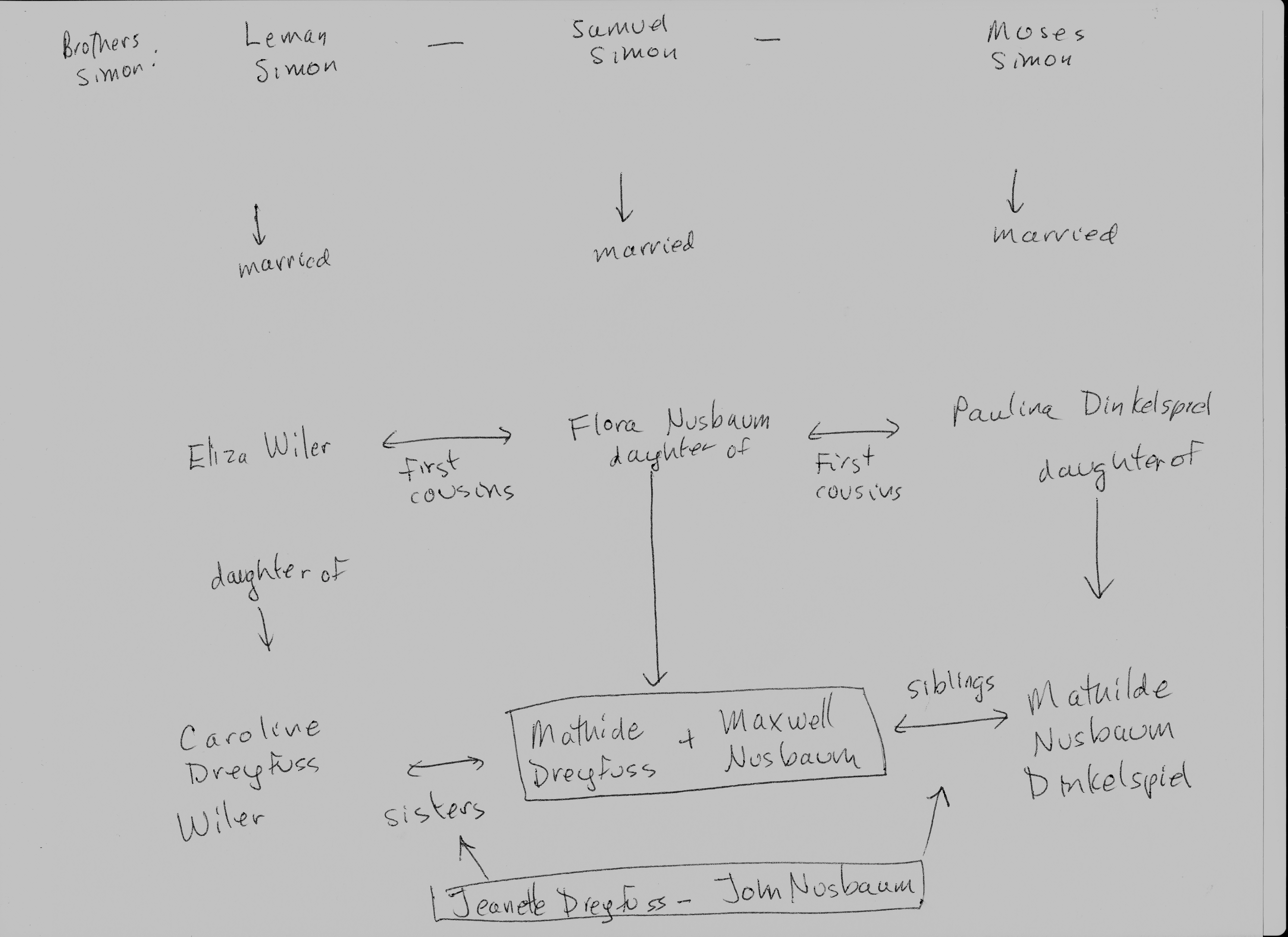
Groan…. Maybe this chart will help.

chart_NEW

So all three Simon brothers were now married to someone in the clan: Samuel to Flora Nusbaum, Leman to Eliza Wiler, and Moses to Paulina Dinkenspiel.

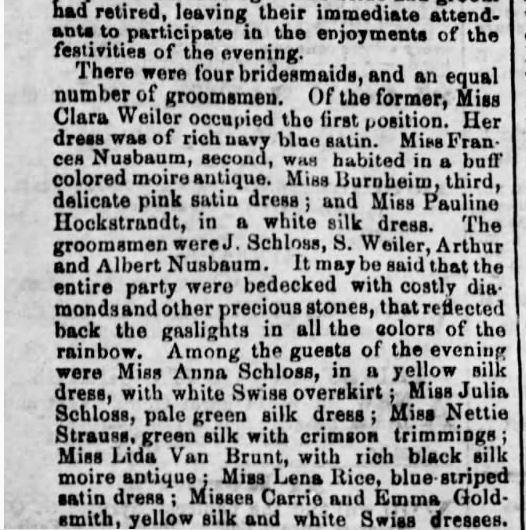
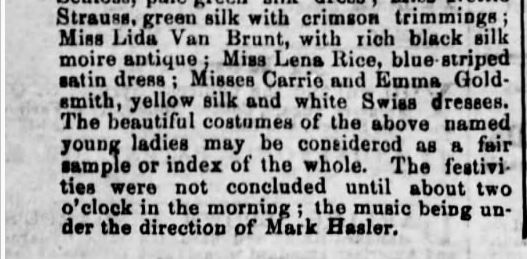
The wedding of Samuel Simon to Flora Nusbaum (Pollock) seems to have been a celebration worthy of all that interconnectedness.  Here is an article from the Harrisburg Telegraph of October 20, 1868, republishing an article from the Philadelphia Sunday Mercury that described their Philadelphia wedding.  It’s really worth reading to get the full flavor of both the wedding and “social media” in the 1860s.

flora pollock wedding part 1

flora pollock wedding part 2

flora pollock part 3

The strangest part of this article is not the detailed description of the lavish, extravagant wedding celebration, but the reporter’s mistaken assertion that Flora was not Jewish.  Certainly her parents were both Jewish, and even her stepfather Moses Pollock was Jewish.  The reporter’s statement that “the pure religion of love had broken down all sectarian barriers” seems a bit strange for a wedding announcement, even if it had been an interfaith wedding.  But why would the reporter have thought Flora wasn’t Jewish?

The overlapping branches of the family were well represented in the bridal party: Clara Wiler and Simon Wiler, the children of Moses and Caroline (Dreyfuss) Wiler; Frances Nusbaum, the daughter of John and Jeanette (Dreyfuss) Nusbaum; Arthur Nusbaum, son of Ernst and Clara Nusbaum; and Albert Nusbaum, son of Maxwell and Mathilde (Dreyfuss) Nusbaum and brother of the bride.  I do not know who the Schloss family is or the Goldsmiths, at least not yet, but I fear more double twists yet to be uncovered.

So the extended family was doing quite well, and there were lots of new families being formed and babies born, but unfortunately there also was one big loss in the 1860s.  Leopold Nusbaum, who was still living in Harrisburg in the 1860s, died on December 24, 1866.  He was buried at Mt. Sinai Cemetery in Philadelphia.  His widow Rosa and sixteen year old daughter Francis moved shortly thereafter to Philadelphia, where they moved in with John and Jeanette Nusbaum, whose household had been reduced by two when Julius moved to Peoria and Frances married.

Below is a photo I found while searching for old images of Harrisburg.  I was so excited when I saw the name on the store at the far upper right—Leo Nusbaum!  Although this photo was dated 1889, Leopold Nusbaum’s name was still on the store even though he had died almost 25 years earlier.

Harrisburg Market Square with Leo Nusbaum store

Harrisburg Market Square with Leo Nusbaum store http://explorepahistory.com/displayimage.php?imgId=1-2-EC

The only Nusbaum family members left in Harrisburg by the end of the 1860s were Mathilde (Nusbaum) Dinkenspiel, her husband Isaac, and their daughter Sophia.  Their daughter Paulina (Dinkenspiel) Simon was living in Baltimore, and their son Adolph was in Peoria.  Their youngest child Sophia married Herman Marks, a Prussian born clothing merchant, in 1869, and they settled in Harrisburg as well.  Perhaps they were the ones to keep Mathilde’s brother’s name on the store.

Thus, by the end of the 1860s, most of the extended family was living in Philadelphia, with a small number living in Peoria, a few in Harrisburg, and a few in Baltimore.


[1] $600 in 1860 would be worth about $17,000 today, and $20,000 in 1860 would be worth about $571,000 today.  Not too shabby for someone who had come to America around 1840.

But Will It Play in Peoria?


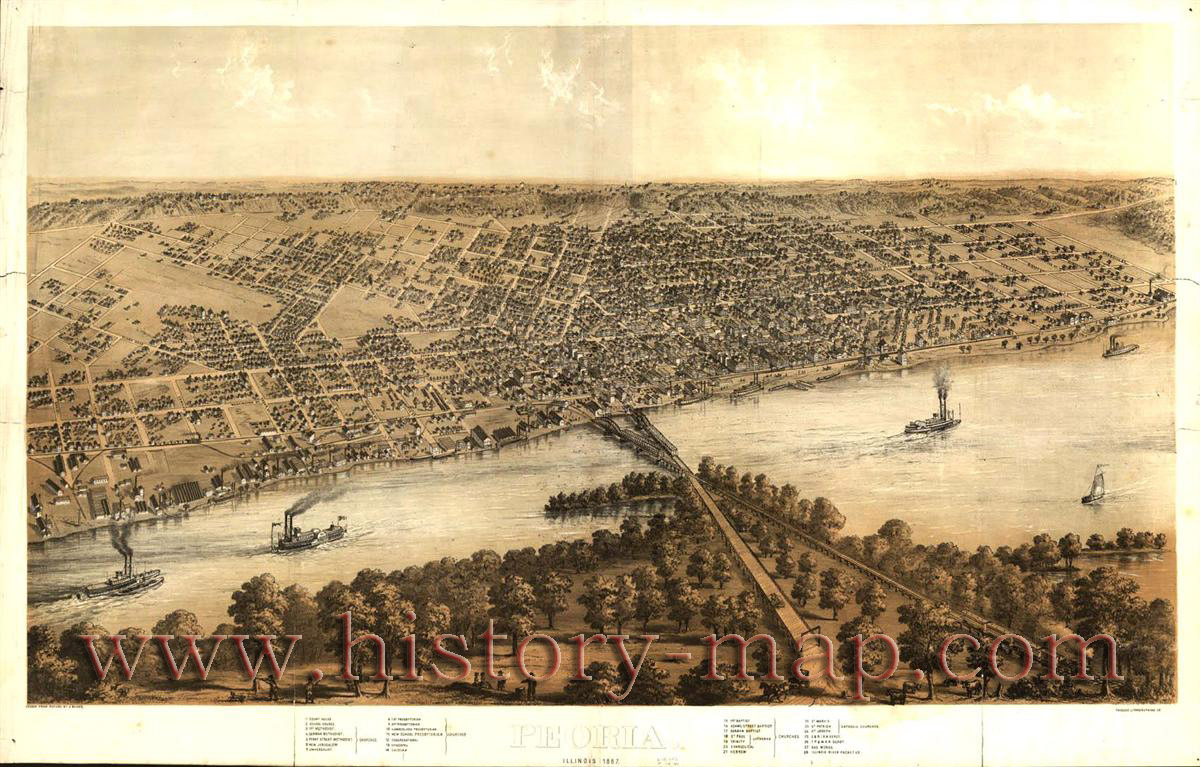
My father’s family has lived in some places that were surprising to me—Cohens in Des Moines and Kansas City, Seligmans in Santa Fe, and Nusbaums in Harrisburg and other small towns in Pennsylvania.  In the 1860s, some of the Nusbaums and their Dreyfuss, Dinkelspiel and Simon relatives ended up in Peoria.   All I knew about Peoria was the old line, “Will it play in Peoria?” As explained on the official website for Peoria, Illinois:

The phrase “Will It Play in Peoria?” originated in the early ’20s and ’30s during the US vaudeville era. At that time, Peoria was one of the country’s most important stops for vaudeville acts and performances. If an act did well in Peoria, vaudeville companies knew that it would work throughout the nation. The saying was popularized by movies with Groucho Marx, and on radio programs such as Jack Benny and Fibber McGee.  Because of it’s [sic] location and demographics, Peoria has since become a well known test market to gauge the popularity of products and ideas nationwide.

Peoria has become a symbol of mainstream America, a short-hand way of referring to the typical “Middle American,” as Richard Nixon might say.  So perhaps I should not be surprised that my entrepreneurial Nusbaum/Dreyfuss ancestors struck out for Peoria after succeeding in Harrisburg and Philadelphia.  It was a new market to exploit as the US population continued to expand and move west.

Location map of Peoria, Illinois

Location map of Peoria, Illinois (Photo credit: Wikipedia)

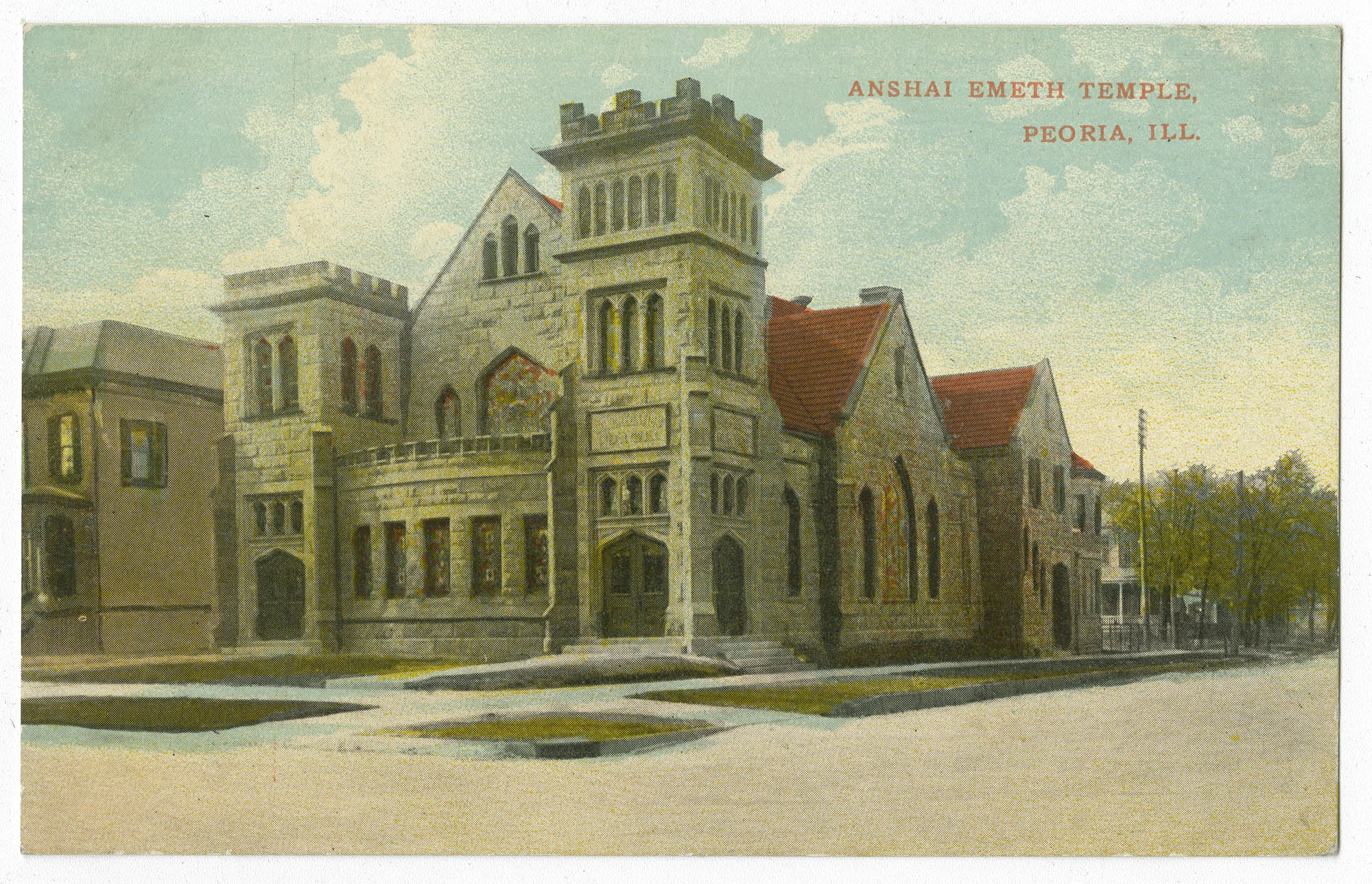
But were there Jews there in the 1860s? Surprisingly, there was an established Jewish community. According to the Jewish Virtual Library’s entry for Illinois, “The oldest Jewish community [in Illinois] outside of Chicago is Peoria, where the first Jews arrived in 1847. A benevolent society was organized in 1852 and the first congregation, Anshai Emeth, was formed in 1859.”     The website for Anshai Emeth reveals only a little bit more about the early history of Jews in Peoria:

The first Jewish settlers came to Peoria in approximately 1847. They soon organized themselves into groups and worshiped in private homes. Early settlers included Jacob Liebenstein (1848), Henry Ullman and Leopold Rosenfeld (1849), Abraham Schradski and Leopold Ballenberg (1851), and Aaron, Harry and David Ulman (1852), and Henry Schwabacker. Many of their descendants continue to live in the Peoria community.  Religious school classes were organized by 1852. In the same year, these Jewish settlers organized a burial association and bought a lot for the use as a cemetery. With this purchase grew the first organized Jewish life in Peoria. Religious services were held in various halls including Washington House on North Washington Street.  Abraham Frank, A. Rosenblat, Hart Ancker, A. Ackerland, Arnold Goodheart, and Abraham Solomon formally organized a congregation in 1859 and named themselves “Anshai Emeth,” or “People of Truth.”

Although in 1860 the Nussbaum/Dreyfuss clan was settled either in Harrisburg or Philadelphia, as early as  1862 some of the next generation began moving to Peoria.  Paulina Dinkelspiel, the daughter of Mathilde Nusbaum and Isaac Dinkelspiel, married a man named Moses Simon in 1862.  Moses was born in 1835 in what is now the Hesse region of Germany.  He and his brothers Leman and Samuel had a business in Peoria as early as 1861, as did their father Sampson.

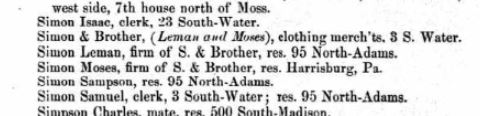
The Simons in Peoria 1861 Peoria directory

The Simons in Peoria 1861 Peoria directory

But as the directory indicated, Moses was residing in Harrisburg in 1861.  Perhaps Moses had a business relationship with the Nusbaum business; perhaps that is how he obtained his merchandise for their business in Peoria.  But while living in Harrisburg, Moses must have met Paulina. And after they were married, they moved to Peoria where their first two children were born, Joseph in 1862 and Francis in 1864.

Not long after, Paulina’s younger brother Adolph Dinkenspiel arrived in Peoria.  Although he is not listed in the 1861 directory, he does appear in the 1863 directory. While the Simon brothers and their father were all living at 95 North Adams Street that year, Adolph was boarding at the corner of North Adams and Hamilton Street, right down the block, and working as a clerk at 73 Main Street.

What was going on at 73 Main Street?  The Simon Brothers business was at 5 North Adams Street, so young Adolph was not working for his sister’s husband.  A look at the 1863 directory for Peoria under N revealed that John Nusbaum, my three-times great-grandfather, had a business at that location as a “fancy and staple dry goods merchant.”  Although John was still residing in Philadelphia, he is listed in the directory as are two of his sons.  His oldest son Adolphus, was residing at Peoria House, a hotel, I assume, and working for a firm called “Adler, N. & Higbie.” A further look through the 1863 directory uncovered a listing for a distillery called Adler, Nusbaum & Higbie.  John’s second son Simon is also listed in the 1863 Peoria directory, working as the business manager of his father’s store at 73 Main Street with his cousin Adolph Dinkenspiel and residing at 36 North Adams Street.

nusbaum 1863 peor

Nusbaums in Peoria 1863 Peoria directory

By 1863, the country was in the throes of the Civil War, yet it appears that my Peoria relatives were not serving in the war.  I did find a document that indicates that both Simon and Adolphus Nusbaum registered for the draft in 1863 for the Civil War, but I cannot find any other documentation of their service in that war.

National Archives and Records Administration (NARA); Consolidated Lists of Civil War Draft Registration Records (Provost Marshal General's Bureau; Consolidated Enrollment Lists, 1863-1865); Record Group: 110, Records of the Provost Marshal General's Bureau (Civil War); Collection Name: Consolidated Enrollment Lists, 1863-1865 (Civil War Union Draft Records); ARC Identifier: 4213514; Archive Volume Number: 2 of 5

National Archives and Records Administration (NARA); Consolidated Lists of Civil War Draft Registration Records (Provost Marshal General’s Bureau; Consolidated Enrollment Lists, 1863-1865); Record Group: 110, Records of the Provost Marshal General’s Bureau (Civil War); Collection Name: Consolidated Enrollment Lists, 1863-1865 (Civil War Union Draft Records); ARC Identifier: 4213514; Archive Volume Number: 2 of 5

Not one of these young men in the family appears in any of the databases listing those who served. I searched not only Ancestry, Fold3, and FamilySearch, but also the National Park Service database, the Civil War Soldiers and Sailors System, found here, and found nothing.

How had they all avoided service?  Simon and Adolphus registered, but I can’t even find registration evidence for Adolph Dinkelspiel.  The Draft Act of 1863 applied to all male citizens between 20 and 45 years old; in 1863 Adolphus was 21 and Simon and Adolph were 20.  Adolphus and Simon were born in the US and were thus citizens, but Adolph Dinkelspiel was born in Baden.  However, the Draft Act also applied to men who intended to become citizens.  Perhaps Adolph avoided registration by not declaring such an intention.  But how would his cousins Adolphus and Simon have avoided service?  Apparently there were two ways to avoid being drafted: hire a substitute or pay $300.  Perhaps that’s what the two Nusbaum brothers did.  Or maybe I just haven’t found the documentation of their service.    See also Michael T. Meier, “Civil War Draft Records: Exemptions and Enrollments,” Prologue Magazine (Winter, 1994) found online here.

All three of John’s sons were listed in the 1865 Peoria directory.  Julius joined Simon as a clerk at the Nusbaum dry goods store, now located at the corner of North Adams and Main Street, two blocks up from its 1863 location.  Adolphus, although still listed in the directory, was reported to be living in Philadelphia in 1865, but still associated with the Adler, Nusbaum & Higbie firm.  In addition, John’s older brother Isaac is listed in the 1865 Peoria directory, boarding at 36 North Adams Street, the same address given for Julius.  This is the first document evidencing Isaac’s presence in the US, so perhaps he was a late arrival and sent to Peoria to keep an eye on his nephews Julius and Simon Nusbaum and Adolph Dinkelspiel, who were single and only 17, 22, and 22 respectively in 1865.

Thus, in 1865, there were four male members of the extended Nusbaum family living in Peoria. Some members of the clan had left by then. Moses and Paulina (Dinkelspiel) Simon and Moses’ brothers Leman and Samuel and their father Sampson were gone from Peoria. Moses and Paulina had relocated to Baltimore where Moses was a “fancy goods” merchant. They had two more children between 1865 and 1870: Leon was born in 1866, and Flora in 1868, both born in Baltimore.  On the 1870 census, Moses described himself as a dealer in all kinds of leather. [1] Thus, Moses Simon who started the migration of the Nusbaums to Peoria was himself gone by 1865.

Adolphus was not listed as living in Peoria in 1865, but he did eventually return to Peoria in 1868.  There is an 1864 IRS tax report that lists the income for Adolphus and for the Adler, Nusbaum & Higbie distillery, so Adolphus was still in business in 1864 in Peoria.   The 1865 Peoria directory reported that he was living in Philadelphia though still in business in Peoria.

In 1867 the only members of the Nussbaum/Dreyfuss/Dinkelspiel/Simon clan listed as living in Peoria were Isaac Nusbaum, Julius Nusbaum, and Adolph Dinkelspiel.  However, the 1868 directory lists Isaac, Julius, S. (Simon?) and A. (Adolphus?) Nusbaum as well as Adolph Dinkelspiel.  The four younger men are also listed in the 1870 directory.  Simon and Adolphus were now in the distillery business together under the name Union Mills Distillery, and Julius was still working in his father’s “staple and fancy dry goods” business along with his cousin Adolph Dinkelspiel.  Thus, three of my great-great-grandmother’s brothers as well as my first cousin four times removed, Isaac Dinkenspiel, were living in Peoria in 1870.

Isaac Nusbaum, their uncle, had died in January, 1870. He was not yet sixty years old.  I could find no actual record of his death aside from the entry in the Nusbaum family bible and this rather peculiar news article from the January 25, 1870 Peoria Daily Transcript.

Peoria Daily Transcript January 25, 1870 p. 3

Peoria Daily Transcript January 25, 1870 p. 3

What does this mean? Why would his brother John have ordered the body returned to Peoria? Why had it first been en route to Philadelphia? How did Isaac die?  There was no obituary.  Isaac is a mystery to me.  I don’t know where he was before 1865.  It appears that he never married or had children.  If it had not been for the family bible, I might never have even known to look for him.

http://www.findagrave.com/cgi-bin/fg.cgi?page=pv&GRid=143048598&PIpi=117463912 Note says he is buried between two unrelated people.

http://www.findagrave.com/cgi-bin/fg.cgi?page=pv&GRid=143048598&PIpi=117463912
Note says he is buried between two unrelated people.

By 1870, the four young Nusbaum descendants were grown men.  Even the youngest, Julius, was 22.  All four would spend the next decade in Peoria as well; two of them would spend most of the rest of their lives there.

So yes, it played well in Peoria for the Nusbaum/Dreyfuss family.


[1] For some reason on the second enumeration of the 1870 census, Moses and his brothers Samuel and Leman are listed with their parents in Philadelphia; I assume that the parents were confused when asked about the members of their family and reported all three sons as living with them when in fact all three sons were married by then and living with their wives and children.

The Nusbaum and Dreyfuss Families Settle into America: 1850-1860

Market Square, Harrisburg in 1860

Market Square, Harrisburg in 1860  http://pahousearchives.org/?p=digitallibrary/digitalcontent&id=92

As I wrote in my last post about the Nusbaums, the 1850s were for the most part a decade of growth for the Nusbaum and Dreyfuss families although there were two tragedies during that decade.  I have already written about the tragic death of Maxwell Nusbaum in the 1851 Great Fire in San Francisco.  Maxwell died trying to protect the property of another merchant, and his death left his wife Mathilde Dreyfuss Nusbaum with two very young children, Flora and Albert.  Mathilde remarried a few years later, marrying Moses Pollock, with whom she had two more children in 1856 and 1859, Emanuel and Miriam.  Moses was employed as a merchant in Harrisburg, according to the 1860 census.  Since Mathilde was my three-times great-grandmother Jeanette’s sister, her children with Maxwell were cousins both maternally and paternally.

Because the Nusbaum and Dreyfuss families were so entwined, it seems appropriate to discuss them together rather than as two separate lines in my family.  Why return to Harrisburg (and Peoria) twice? (Nothing against those two cities; it just seems to make sense to discuss the two families together.)

In the 1850s a number of the Nusbaum/Dreyfuss siblings were living in Harrisburg, Pennsylvania.  In 1860, Mathilde Nusbaum (sister of Maxwell, John, Leopold and Ernst) and her husband Isaac Dinkelspiel were still living in Harrisburg with their three children, now all adolescents: Paulina (19), Adolph (17), and Sophie (12).  Isaac was working as an “agent,” which I assume means he was an agent in the Nusbaum merchant business.  His son Adolph was working as a clerk, again presumably for the Nusbaum family business.

Mathilde Nusbaum Dinkelspiel’s brother Leopold Nusbaum had also moved to Harrisburg during the 1850s, leaving Blythe, Pennsylvania where he had been a butcher.  Perhaps they moved in the aftermath of his family’s personal tragedy.  Their son Adolph, born in 1848, died on June 6, 1852.  He was only four years old.  He died from acute gastritis.  The death certificate says it was “accompanied by” a word I cannot decipher.  Can anyone read it?  He was buried at Mikveh Israel cemetery in Philadelphia.  I found it interesting that the family, though living in Harrisburg, buried their child in Philadelphia.  Perhaps the Jewish cemetery in Harrisburg had not yet opened.[1]

UPDATE:  My medical consultant says that the other cause of death is cerebritis, meaning a brain infection or abscess.

Death certificate of Adolph Nusbaum, son of Leopold and Rosa Nusbaum

Death certificate of Adolph Nusbaum, son of Leopold and Rosa Nusbaum

Leopold and his wife Rosa had a second child, Francis, who was born in 1850.  Although Francis is listed as a boy on both the 1850 census and the 1860 census, by 1870 she is identified as female and is so thereafter.[2] Her name, however, is almost always spelled as Francis, and I suppose that must have confused the first two census takers as ordinarily Francis is a boy’s name and Frances is the way it is spelled for a girl.  At any rate, it is pretty clear that Francis was a girl even in 1850 and 1860.

Leopold seems to have given up on being a butcher when he moved to Harrisburg.  According to the 1860 census, he, like his brothers John and Ernest, was now a merchant.  Also listed as living with Leopold, Rosa, and Francis on the 1860 census was “A. Dinkelspiel,” presumably Adolph Dinkelspiel, Leopold’s nephew, Mathilde’s son.  Since Adolph was also listed in his parents’ household, my guess is that he may have been living with Leopold and working as a clerk in his store, but that his parents had also counted him as part of their household.

Leopold and Rosa Nusbaum and family 1860 census

Leopold and Rosa Nusbaum and family 1860 census

In addition to the two Nusbaum siblings Leopold and Mathilde (Dinkelspiel), Harrisburg was also the home of Caroline Dreyfuss Wiler for some part of the 1850s.  Caroline, the sister of Jeanette Dreyfuss Nusbaum and Mathilde Dreyfuss Nusbaum Pollock, was married to Moses Wiler.  They had four children, Eliza (1842), Simon (1843), Fanny (1846), and Clara (1849). Simon was born in Philadelphia, and Clara was born in Gettysburg (nothing more specific than Pennsylvania is given for Eliza or Fanny), so Caroline and Moses must have been moving around quite a bit within Pennsylvania during the 1840s.  I assume he was a peddler and thus the family kept moving until he could open a more permanent business.

Although they are listed as living in Harrisburg in 1850, by 1860 they were living in Philadelphia with their four children, at that point three teenagers and one eleven year old.  Moses was working as a merchant, apparently doing quite well.  He had $8000 worth of real estate and $22,000 worth of personal assets; they also had a 27 year old servant living with them.

Moses and Caroline Dreyfuss WIler and family 1860 census

Moses and Caroline Dreyfuss WIler and family 1860 census

John Nusbaum, my three-times great-grandfather, had also moved to Philadelphia by 1860.  In fact, their fifth child, Miriam, was born in Philadelphia on October 30, 1858, so the family must have relocated from Harrisburg by that time.  According to the 1859 Philadelphia directory, John Nusbaum and his family were living at 433 Vine Street, and his place of business was located nearby at 132 North Third Street in Philadelphia.

John and Ernst Nusbaum in the 1859 Philadelphia direcotry

John and Ernst Nusbaum in the 1859 Philadelphia direcotry

John and Jeanette and all five of their children were living, like the Wilers, in the 12th Ward of Philadelphia.[3]  John was occupied as a merchant and had $6000 in real estate and $20,000 in personal property, so like his brother-in-law Moses Wiler, he was doing quite well.  In fact, the Nusbaums had two servants living with them at that time.  My great-great-grandmother Frances, the future wife of Bernard Seligman, was fourteen years old in 1860, and her brothers were 12, 17, and 18, plus there was two year old Miriam, so it must have been quite a handful for those two servants—four adolescents and a toddler.[4]

John Nusbaum and family 1860 census

John and Jeanette Dreyfuss Nusbaum and family 1860 census


John and Jeanette not only had Jeanette’s sister Caroline and her family living nearby, they also had John’s brother Ernst and his family living about a mile away.  According to the 1859 Philadelphia directory (see above), Ernst Nusbaum was living at 521 Buttonwood and working at 55 North Third Street, down the block from his brother John.  Ernst had been living in Philadelphia since at least 1851 since his first child Arthur was born on December 31 of that year.  In 1852, he and his wife Clarissa Arnold and their infant son were living at 191 North 10th Street, and Ernst was working as a merchant at 70 ½ North Third Street.  By 1854 they had moved to Buttonwood Street, and in the 1859 directory Ernst is listed as a clothier doing business with Simon W. Arnold (Clarissa’s brother) and Jacob Nirdlinger.

Ernst Nusbaum 1859 Philadelphia directory

Ernst Nusbaum 1859 Philadelphia directory

On the 1860 census, Ernst’s occupation is listed as “M’s Tailor,” or what I assume is men’s tailor.  Was that his role in the clothing business with his brother-in-law Simon?  Or was it more that they were selling men’s clothing?  Ernst had $20,000 in personal assets and two servants living in the home in addition to his wife Clara and their five children: Arthur (1851), Myer (1852), Fanny (1856), Edgar (1858), and Henrietta (1860 and just two months old at the time of the census).  Unlike his brother John, Ernst had a household of young children in 1860, five children under ten years old.

Ernst and Clarissa Arnold Nusbaum 1860 census

Ernst and Clarissa Arnold Nusbaum 1860 census

Thus, whether in Harrisburg or Philadelphia, the Dreyfuss sisters and their husbands and the Nusbaum siblings and their spouses were all adjusting to life in America, and their families were growing.  Although they suffered two very tragic losses early in the decade of the 1850s, by 1860 it appears that all were doing well.

The next decade would bring changes as the next generation entered adulthood and the country faced the Civil War.

[1] I am awaiting a book on the Jewish history of Harrisburg and should know more once it arrives.

[2] Thus, my reference to two sons in my prior post was mistaken.

[3] The Nusbaum businesses were located about a mile north of where my Cohen relatives were operating their pawnshop business during this same time period.  It would be interesting to know how often their paths crossed even before Flora Cohen married Jacob Weil in 1908.

[4] The ten year gap between Julius and Miriam makes me wonder whether there weren’t other children born during that time who did not survive.

More Blessings and More Insight into My Seligmann Ancestors

This morning I woke up to another email that made me smile to start my day. But to understand why, I need to backtrack a bit.

One of the passages that was translated by Ralph Baer from Ludwig Hellriegel’s book on the history of the Jews of Gau-Algesheim indicated that Moritz Seligmann had originally come from Gaulsheim, a town that is only five miles from Gau-Algesheim.  In this passage, Hellriegel described Moritz Seligmann’s attempt to get permission to move to Gau-Algesheim in 1828.  He was denied permission the first time because the mayor concluded that there were already too many Jews in the town.  He then appealed, and although the mayor still wanted to deny him permission, Seligmann prevailed because he was legally entitled to move to the town.

This passage gave me a clue as to where Moritz, my three-times great-grandfather, might have been born, and Ralph suggested I contact the archives in Gaulsheim for more information.  I found an organization called Arbeitskreis Judische Bingen, or a study group of Jews in Bingen. (Bingen now includes the town of Gaulsheim.)  I wrote to the organization, asking for any information that they might have on Moritz Seligmann or his family.

And that brings me to my happy morning email.  A woman from the Arbeitskreis named Beate Goetz sent me a copy of the marriage record for Moritz Seligmann and Eva Schoenfeld.  Not only did this email confirm that Moritz was born in Gaulsheim (on January 10, 1800) and that he married Eva Schoenfeld (on February 27, 1829), it told me the names of my four-times great-grandparents, Jacob Seligmann and Martha nee Jacob/Mayer (my guess is that Mayer was the surname adopted by her father Jacob when surnames were required in the early 19th century).

In addition, I know now when Eva Schoenfeld was born (June 2, 1806) and where she was born (in Erbes-Budenheim), and I know her parents’ names: Bernhard Schoenfeld and Rosina Goldmann.  Assuming that Eva and Babetta, Moritz’s second wife, were sisters, Bernhard and Rosina were also my four-times great-grandparents.  Now I need to see what records I can find in Erbes-Budenheim to determine if in fact Eva and Babetta were sisters.  Beate said that she would also continue to look for a birth record for Moritz (who was born Moises) and any other relevant records.

Marriage record for Moritz Seligmann and Eva Schoenfeld February 27, 1829 Gaulsheim, Germany

Marriage record for Moritz Seligmann and Eva Schoenfeld February 27, 1829 Gaulsheim, Germany

I also know from Ralph’s additional translation of the marriage record that Jacob Seligmann and Bernhard Schoenfeld were both traders as was Moritz.  The record also indicated that the bride’s parents did not attend the wedding; as Ralph explained, this was probably a second ceremony for purposes of civil law and thus not as important as the religious wedding ceremony, which presumably the couple’s parents did attend.

Thus, thanks to Ralph Baer’s translation of a passage in the Hellriegel book, I now have learned the names of four more of my ancestors.

The Hellriegel book just continues to be a treasure chest of information.  Thanks to Matthias Steinke, I also have a translation of another few passages of Ludwig Hellriegel’s book, which shed some additional light on the character of my ancestor Moritz Seligmann.

In one passage, Hellriegel discussed the education of Jewish children in Gau-Algesheim.  He reported that until 1841, Jewish boys were taught Hebrew and other important subjects by their fathers, but in 1841 they were permitted to attend the Christian school in town.  Apparently, this was difficult for the Jewish children, so Moritz Seligmann applied in 1850 to remove his children from the school.  He then hired a private teacher named Benjamin Mayer from Essenheim to come to Gau-Algesheim to teach the children. (Essenheim is about ten miles from Gau-Algesheim.)

Apparently, however, Mayer ran into trouble in Gau-Algesheim for speaking badly about the Catholic Church, saying in front of the children and two other witnesses that those who believe in the Catholic faith are “downright stupid.”  He reportedly left Gau-Algesheim shortly after this incident.

I found this passage interesting in many ways, but mostly for what it told me about my great-great-great-grandfather Moritz.  He was a man who was determined to see that his children received a good education and in a setting where they were comfortable. That is a value that has certainly been passed down the generations in my family.  Moritz also was apparently a man of some means since he had the money to hire a private teacher.

Coat of arms of Gau-Algesheim

Coat of arms of Gau-Algesheim (Photo credit: Wikipedia)

Matthias also helped me better understand a passage about Moritz and his knowledge of German.  According to Matthias’ reading of this paragraph, Moritz had some role in the synagogue as an educated man.  He was in charge of writing the lists of Hebrew prayers to be assigned to those who made contributions to the synagogue.  (This is somewhat unclear to me.  Perhaps these were prayers for certain members to lead or perhaps these were prayers for the benefit of certain members, or maybe the book is referring to payment in order to receive the honor of reading Torah in synagogue.)

A man from Mainz, Mr. Landauer, commented that Moritz was able to write German very well in compiling these lists, but that he had trouble with “unpunctured” Hebrew.  I asked Ralph Baer what he thought unpunctured would mean in this context, and he explained that the German word could also be translated as undotted and that the reference to undotted Hebrew most likely meant that Moritz had a hard time reading Hebrew without vowel markings.  So Moritz was more fluent in writing and reading in German than he was in Hebrew.

1024px-Hebrew_Alphabet.svg

By Assyrio (Own work) [Public domain], via Wikimedia Commons


The final passage that Matthias helped me understand involved Julius Seligmann, the grandson of Moritz and son of August Seligmann, discussed previously.  He was the Seligmann who converted to Catholicism upon marrying a Catholic woman.  What I had not been able to understand before were references to Julius closing his business in 1935 in Gau-Algesheim and being the last Jew in Gau-Algesheim when he and his family left in 1939.  He and his family moved to Bingen, and the book states that there the police chief did nothing against him and that his two sons Herbert and Walter were even allowed to enlist in the army, although dismissed shortly afterwards.

With a better idea of what the words say, I now think that I understand the significance of this passage.  It seems that Julius, despite converting, was still seen as a Jew when the Nazis came to power and thus was forced to close his business.  However, once he relocated to Bingen, he was not harassed by the police, perhaps because they did not know he was Jewish.  And perhaps the significance of the sons being able to enlist also relates to this ability to deny their Jewish roots, at least for a short time.

I am obviously still reading between the lines, and without being able to read the entire book and read everything in context, I fear that I may be misreading some of these isolated passages.  It’s a long term project to be able to understand the whole book and the whole story of the Jews of Gau-Algesheim.  But already this little book has enabled me to learn so much more about my Seligmann ancestors.

By the way, Seligmann means “blessed man” in German.  The more I learn about the Seligman(n)s, both German and American, the more it seems to be an appropriate surname for the family to have adopted, especially for those Seligmans who were fortunate enough to have left Germany before the Holocaust.


The Great Fire of San Francisco 1851 and My Twisted Family Tree

By 1850, as I wrote previously, John Nusbaum and his siblings Mathilde, Leopold, Ernst, and Maxwell were all settled somewhere in Pennsylvania and involved in selling merchandise (except for Leopold, who was a butcher).  In the next decade the family would move around a bit, see their families grow, and endure some terrible tragedies.

The first of those tragedies involved Maxwell.  In 1850 Maxwell was living in Lewistown, working as a merchant in a store that carried his name, M. Nusbaum’s.  He and his wife, Mathilde nee Dreyfuss, the sister of my three-times great-grandmother Jeanette Dreyfuss Nusbaum, had a daughter Flora who was born in 1848.  And Mathilde must have been pregnant in 1850 because on January 30, 1851, their son Albert was born.  Maxwell and Mathilde must have moved to Harrisburg by then because Albert’s birth took place in Harrisburg.

When I searched for Maxwell and his family on the 1860 census, I could not find Maxwell or Mathilde at all, but I did find Albert and Flora Newsbaum, living with an M. Pollock, a Swiss born merchant in Harrisburg.  Unfortunately, the census was barely legible, and the transcriber had had a lot of difficulty recording the names on the census, but by searching generally for M. Pollock born in Switzerland and living in Harrisburg, I was eventually able to find out that M. Pollock was Moses Pollock and that he was married to Mathilde.  The other names on that 1860 census, although transcribed as Mary Pollock, Michael Pollock, and Mary Pollock, were really Mathilde, Emanuel, and Miriam Pollock.  Emanuel and Miriam were Mathilde’s children with Moses, born in 1856 and 1859 respectively.

Mathilde Dreyfuss Nusbaum Pollock and family 1860 census

Mathilde Dreyfuss Nusbaum Pollock and family 1860 census

But what had happened to Maxwell? I could find no record of him after the 1850 census, not a directory, census, or death record.  So I turned to newspapers.com and found this terrible news item:


Sunbury (PA) American,  July 5, 1851, p. 2

Sunbury (PA) American, July 5, 1851, p. 2

Maxwell had died in San Francisco while trying to protect the property of another business from the raging fires that destroyed much of San Francisco in the spring and summer of 1851.

Before the fire Wikipedia

San Francisco before the 1851 fires Library of Congress CALL NUMBER: DAG no. 1331

The first 1851 fire was described graphically on the website honoring the San Francisco Fire Department, GuardiansoftheCity.org:

The great fire on this day actually began after 11:00 PM on May 3rd, in a store on the south side of Portsmouth Plaza.  A known habitue of villainous Sydney-Town was seen running from the store moments before it exploded in flame and simultaneous fires erupted in the business district.  Water evaporated to steam as swift winds sent the roaring flames everywhere through the great blow-pipe-like hollows beneath the plank streets.  Men in their anguish, ran for shelter within new, fancied “fireproof” brick and iron buildings, only to perish miserably when the metal shutters and doors expanded and couldn’t be opened.  Three-fourths of the city was lost, yet, in ten days, San Franciscans rebuilt one-fifth of their city.

Six weeks later, there was a second horrendous fire:

On June 22, 1851, just before 11:00 AM, a fire, clearly the work of an incendiary, broke out in a frame house on Pacific Street near Powell. Strong summer sea-breezes drove the flames south and east.  Firefighter’s fearless battles were of no avail against the fire’s intense heat and speed.  Ten blocks and portions of six others were destroyed between Powell, Sansome, Clay and Broadway.  The raging demon swept away relics of an older time. City Hall was consumed, born in 1846, and the Jenny Lind Theatre burned for the sixth time.  The Old Adobe Custom House burned, and Sam Brannan’s House, in which were exhibited the first specimens of gold brought from the Placers, met the same fate.  San Franciscans quickly rebuilt again, this time, with water tanks on many roofs.

1851 after fire Berkely site

After the June 1851 fire in San Francisco http://content.cdlib.org/ark:/13030/tf4j49p3ww/


For some reason, neither of these reports indicates how many people were killed in the fire, nor have I yet found any other source that reveals that information.  I have to believe that there were many people killed in addition to my third great-grand uncle Maxwell Nusbaum and his clerk Rosenthal.

I was surprised to learn that Maxwell was all the way in San Francisco, presumably for business.  Was he transporting merchandise to this other merchant in San Francisco? How did he get all the way there? His wife was home with a three year old daughter and a five month old son.  How long would he have been away? How long did it take in 1851 for the news to get back to Mathilde that her husband had died in the fire? Unfortunately, I cannot find the answers to these questions, but I can imagine how dreadful it must have been for her, a relatively recent immigrant with two very young children, losing her husband.

Fortunately, Mathilde had lots of family around for support.  Her sister Jeanette Dreyfuss Nusbaum, my three-times great-grandmother, was also in Harrisburg, as was her other sister Caroline Dreyfuss, who was married to Moses Wiler, and her mother, Mary Dreyfuss, aged 65, born in Germany.  I cannot be completely certain that Mary Dreyfuss was the mother of Jeanette, Mathilde, and Caroline, but given the name, age, place of birth, and the fact that she was living with Caroline, I believe that she was in fact their mother.  Research by others indicated that their mother was named Miriam (Marianna) Samson nee Bernheim Dreyfuss, and the similarity in the name and age to Mary Dreyfuss seems fairly persuasive evidence that Mary Dreyfuss had come with or followed her three daughters to Pennsylvania. (When I first saw the names Mathilde Pollock and Caroline Wiler in the Nusbaum family bible, I assumed they were John’s sisters; only after a lot of research did I finally realize that they were both sisters of Jeanette Dreyfuss Nusbaum.)

Caroline Dreyfuss Wiler and family 1850 US census

Caroline Dreyfuss Wiler and family 1850 US census

Also living in Caroline and Moses Wiler’s household, in addition to Mary Dreyfuss and the Wiler’s four children, Eliza (1842), Simon (1843), Fanny (1846), and Clara (1850), was an eighteen year old man named Leopold Pollock, reportedly born in Germany, according to the 1850 census.  I do not know what his connection to the household was, but further research revealed that he, like Moses Pollock, was born in Switzerland, not Germany.   My hunch is that Leopold and Moses Pollock were brothers. Moses Wiler, who was about ten to fifteen years older than the two Pollocks and also born in Switzerland, was probably either a relative or friend from back in Switzerland.  The Pollock brothers likely came to Harrisburg in order to be near Moses Wiler, and the Wilers had taken in the teenaged Leopold when he arrived.

When Mathilde was suddenly a widow after Maxwell was killed in the 1851 fire, perhaps her sister Caroline introduced her to Moses Pollock.  Mathilde and Moses must have been married within a few years after Maxwell’s death, given that their first child Emanuel was born in 1856.  I cannot locate Moses Pollock on the 1850 census, so perhaps he arrived after his brother Leopold and then soon thereafter married Mathilde.

These relationships get rather unwieldy since two branches of my family are entwined.  Jeannette Dreyfuss was my three-times great-grandmother, making her two sisters Mathilde and Caroline, my three-times great-grand aunts (or four-times great-aunt, as some prefer).  Since Mathilde married Maxwell, who was the brother of my three-times great-grandfather, that means that my three-times great-grand aunt married my three-times great-grand uncle.  That makes their children, Flora Nusbaum and Albert Nusbaum, my first cousins four times removed both on the Nusbaum side through Maxwell and on the Dreyfuss side through Mathilde.  And so on through their descendants.

And then it gets even more twisted a generation later when Flora Nusbaum, my double first cousin four times removed, married Samuel Simon. Samuel Simon had a brother named Moses Simon.  Moses Simon married Paulina Dinkelspiel, who was the daughter of Mathilde Nusbaum Dinkelspiel, another of my three-times great-grand aunts, another sister of John Nusbaum. So Flora and Paulina were both first cousins (since Maxwell Nusbaum and Mathilde Nusbaum Dinkelspiel were siblings) and sisters-in-law.

And, of course, the children that Mathilde Dreyfuss had with Moses Pollock and the children that Caroline Dreyfuss had with Moses Wiler are also my first cousins four times removed, but only on the Dreyfuss side.

I know.  It’s confusing.  I’d make a chart, but would it help?

It was a small and somewhat twisted world.  No wonder they say DNA testing for Ashkenazi Jews is not terribly accurate.  We are all cousins of each other of some kind or another.


Thanksgiving: More Gifts, More Gratitude

cemetery sign for Mikveh Israel

It’s been a week or so of amazing gifts.  First there was the package from Gau-Algesheim with the records and book relating to my Seligmann ancestors and the amazing help I received from Ralph Baer and Matthias Steinke with translation of these items.

Then a day or so after the Gau-Algesheim package arrived, I received a gift from my third cousin once removed Todd Graham.  Todd is the great-great-great-grandson of Jacob Cohen, my great-great-grandfather.  Todd wrote to tell me that he had been to the Federal Street cemetery in Philadelphia where many of our mutual Cohen ancestors are buried and that he had taken photographs.  He asked if I wanted to see the photos, and I said of course.  So here are the photographs I received from Todd.

First is a photograph of where our ancestor Hart Levy Cohen is buried.  There is no stone visible, and the rabbi at the cemetery explained to Todd that they believed that the stone had sunk beneath the surface and was buried underground.  I have written to the rabbi and asked whether there is anything we can do to uncover the stone or to mark the gravesite in some other way.

Burial Site of Hart Levy Cohen

Burial Site of Hart Levy Cohen

This photo shows where Hart’s children Lewis and Elizabeth are buried.  Again, the stones are not visible, but this is the location of their graves.


Burial sites for Elizabeth Cohen and Lewis Cohen (Hart's children)

Burial sites for Elizabeth Cohen and Lewis Cohen (Hart’s children)

Todd also took photographs of the stone for Jacob and Sarah Cohen.  Although I had a photo of this stone before from Rabbi Albert Gabbai, I am hoping that these will be easier to read so that I can learn what the Hebrew inscription says.

Jacob and Sarah Cohen monument Jacob Cohen headstone by Todd Jacob Cohen monument by Todd jacob headstone edit 1


Todd also found the stones for three of Jacob’s children.  First, a new photograph of the headstone for my great-grandparents Emanuel and Eva (Seligman) Cohen and my grandfather John Nusbaum Cohen, Sr.

Headstone for Emanuel, Eva and John Cohen

Headstone for Emanuel, Eva and John Cohen

Side of Emanuel Eva and John by Todd

Next are photographs of the headstones for Emanuel’s brother Reuben and his wife Sallie Livingston Cohen and of their son Jacob Livingston Cohen.

Reuben and Sallie Livingston Cohen

Reuben and Sallie Livingston Cohen

Jacob Livingston Cohen

Jacob Livingston Cohen


And finally, this is a photograph of the headstone for Todd’s great-great-grandparents Lewis and Carrie (Dannenbaum) Cohen and his grandparents William and Helen (Cohen) Bacharach.  Lewis Cohen was also the brother of my great-grandfather Emanuel Cohen.

Bacharach and Cohen headstone

Bacharach and Cohen headstone

Thank you so much, Todd, for these photographs, and I hope that we can do something to honor the graves of Hart, Lewis, and Elizabeth Cohen.

There is one more gift I want to acknowledge, and it came totally unsolicited and from a total stranger.  About two weeks ago I received a comment on the blog from someone who had found a set of matches on a website selling vintage items.  The matches were for a business called Selinger Associates at an address in Washington, DC.  Kimberly Crosson, the woman who commented on the blog, had purchased these matches and was now asking me whether this business was connected to the Selingers on my blog.  I was skeptical at first, I must admit.  I thought it was some kind of scam or spam.  But I emailed Kim and found out that not only was she not looking to make money, she was incredibly kind-hearted and generous and just wanted to get the matches to someone in the family—for no charge.

I checked the address and found that this was Eliot Selinger’s business.  Then I tracked down a descendant of Eliot Selinger and asked him if he was interested in the matches, and he was, so I put him in touch with Kim so that she could send him the matches.  I asked only for some pictures of the matches, so here is what Kim sent to me.  You can tell these are from a different era once you see the picture on the matches.

Selinger matches cover Selinger matches reverse


So once again, let me express my thanks to all these generous people, especially Todd and Kim for these photos, but to all who have helped and continue to help me with my research. I could never have done all this on my own.

And now I will be taking a short break from blogging for Thanksgiving.  May you all have a wonderful Thanksgiving, and thank you all for supporting me and providing me with so much help as I continue to learn about the lives of my ancestors.