Back to the Real World and the 1870s…

And I am back from vacation.  We had a wonderful time, and not having reliable internet access may have been a blessing.  I couldn’t do any new research or posting to the blog so my brain had a chance to clear.  Always a good thing.  I did, however, have one more post “in the bank” that I prepared before I left, so here it is. I was awaiting a few more documents, hoping they would answer a few questions, and I received some while away that I have just reviewed.

I wish I could post a somewhat more uplifting post for the holiday season, but I can’t deny the sad fact that some of my relatives suffered considerable sadness in their lives.  On the other hand, researching and writing about the families of Leopold Nusbaum and his sister Mathilde Nusbaum Dinkelspiel only made me appreciate all my blessings.  So in that sense it is perhaps appropriate.  Nothing can make you appreciate all you have more than realizing how little others have.

So here is the story of two of the Nusbaum siblings, one of the brothers and one of the sisters of my three-times great-grandfather John Nusbaum.

Leopold Nusbaum had died in 1866 when he was 58 years old, leaving his widow Rosa and daughter Francis (how she apparently spelled it for most of her life) behind. Leopold and Rosa had lost a son, Adolph, who died when he was just a young boy.  Francis was only 16 when her father died.  After Leopold died, Rosa and Francis moved from Harrisburg to Philadelphia and were living in 1870 with Rosa’s brother-in-law, John Nusbaum.

Late in 1870, Francis Nusbaum married Henry N. Frank.  Henry, the son of Nathan and Caroline Frank, was born in Lewistown, Pennsylvania, where Leopold’s brother Maxwell Nusbaum and his family had once lived before relocating to Harrisburg.  Henry’s father Nathan Frank was in the dry goods business, so the Nusbaums and Franks might have known each other from those earlier times. Nathan, Caroline, and their children had relocated to Philadelphia by 1870 and were living on Franklin Avenue right near the Simons, Wilers, and other members of the Nusbaum/Dreyfuss clan.  Perhaps that is how Francis and Henry met, if not from an earlier family connection.

Not long after they were married, Henry and Francis must have moved back to Lewistown because their first child, Leopold, was born there on August 11, 1871.  Leopold was obviously named for Francis’ father.  A second child, Senie, was born in May 1876, and then another, Cora, was born in 1877.  In 1880, Henry and Francis were living in Lewistown with their three young children as well as Francis’ mother Rosa and Henry’s father Nathan. Maybe Nathan was shuttling back and forth between Lewistown and Philadelphia because he is listed on the 1880 census in both places, once with Henry and Francis and then again with Caroline and their other children.  Both Henry and his father Nathan listed their occupations as merchants.

Lewistown Town Square By KATMAAN (Own work) [CC BY-SA 3.0 (http://creativecommons.org/licenses/by-sa/3.0) or GFDL (http://www.gnu.org/copyleft/fdl.html)], via Wikimedia Commons

Lewistown Town Square
By KATMAAN (Own work) [CC BY-SA 3.0 (http://creativecommons.org/licenses/by-sa/3.0) or GFDL (http://www.gnu.org/copyleft/fdl.html)%5D, via Wikimedia Commons

Unfortunately, there is not much else I can find about Henry, Francis, or their children during the 1870s because Lewistown does not appear to have any directories on the ancestry.com city directory database. Lewistown’s population in 1880 was only a little more than three thousand people, which, while a 17% increase from its population of about 2700 in 1870, is still a fairly small town.  It is about 60 miles from Harrisburg, however, and as I’ve written before, well located for trade, so the Frank family must have thought that it was still a good place to have a business even if the rest of the family had relocated to Philadelphia.

Mathilde Nusbaum Dinkelspiels’ family is better documented.  She and her husband Isaac had settled and stayed in Harrisburg, which is where they were living as the 1870s began. Isaac was working as a merchant.  Both of their children were out of the house.  Adolph was living in Peoria at the same address as his cousin Julius Nusbaum and working with him in John Nusbaum’s dry goods store in that city.  On January 4, 1871, Adolph Dinkelspiel married Nancy Lyon in Peoria, and their daughter Eva was born a year later on January 25, 1872.  Adolph and Nancy remained in Peoria, and by 1875 Adolph was listed as the “superintendent” of John Nusbaum’s store.  (Julius does not appear in the 1875 directory, though he does reappear in Peoria in 1876.)

On November 28, 1879, his daughter Eva died from scarlet fever.  She was not quite eight years old.  Adolph and Nancy did not have other children, and this must have been a devastating loss.

eva dinkelspiel death cert

In fact, shortly thereafter Adolph, who had been in Peoria for over sixteen years, and Nancy, who was born there and still had family there, left Peoria and relocated to Philadelphia.  On the 1880 census, Adolph was working as a clothing salesman and Nancy as a barber.  (At least that’s what I think it says.  What do you think?)  Perhaps Adolph and Nancy left to find better opportunities or perhaps they left to escape the painful memories.  Whatever took them away from Peoria, however, was enough that they never lived there again.

adolph dinkelspiel snip 1880 census

Adolph and Nancy did not remain in Philadelphia for very long, however.  By 1882 Adolph and Nancy had relocated to St. Louis, Missouri, where Adolph worked as a bookkeeper for many years.  They remained in St. Louis for the rest of their lives.  Adolph died on November 25, 1896, and Nancy less than a year and a half later on March 5, 1898. Adolph was only 53, and Nancy was not even fifty years old.

My cousin-by-marriage Ned Lewison sent me a copy of Nancy’s obituary from the March 7, 1898 Peoria Evening Star.  It reported the following information about Nancy and Adolph Dinkelspiel:

“She married Adolph Dinkelspiel, at that time manager of the Philadelphia store on the corner of Main and Adams Street, one of the leading dry goods houses in Peoria.  When the house failed, they removed to St. Louis and lived happily together until the death of Mr. Dinkelspiel, when his widow came to this city.  But she preferred St. Louis for a residence, and although she made frequent visits to Peoria, she did not take up residence here.”

I found two points of interest in this obituary.  One, there is no mention of their daughter Eva.  And two, it reveals that the Nusbaum store in Peoria had closed, prompting Nancy and Adolph to relocate.  Thus, Adolph and Nancy not only suffered a terrible personal loss, like many others in the family and in the country, they were negatively affected by the economic conditions of the 1870s.

Nancy and Adolph are both buried, along with their daughter Eva, in Peoria.  Only death, it seems, could bring them back to Peoria.

dinkelspiel headstone

Adolph’s sisters Paulina and Sophia Dinkelspiel did not have lives quite as sad as that of their brother, but they did have their share of heartbreak.  Sophia, who had married Herman Marks in 1869, and was living in Harrisburg, had a child Leon who was born on October 15, 1870.  Leon died when he was just two years old on October 24, 1872.  I do not know the cause of death because the only record I have for Leon at the moment is his headstone.  (Ned’ s research uncovered yet another child who died young, May Marks, but I cannot find any record for her.)
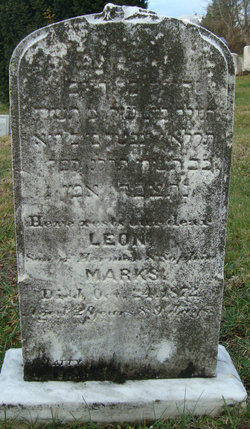
leon marks headstone

Sophia and Herman did have three other children in the 1870s who did survive: Hattie, born May 30, 1873, just seven months after Leon died; Jennie, born August 24, 1876; and Edgar, born August 27, 1879.  Herman worked as a clothing merchant, and during the 1870s the family lived at the same address as the store, 435 Market Street in Harrisburg.

Paulina (Dinkelspiel) and Moses Simon, meanwhile, were still in Baltimore in the 1870s.  In 1870 Moses was a dealer “in all kinds of leather,” according to the 1870 census. At first I thought that Moses and Paulina had relocated to Philadelphia in 1871 because I found a Moses Simon in the Philadelphia directories for the years starting in 1871 who was living near the other family members and dealing in men’s clothing.  But since Moses and Paulina Simon are listed as living in Baltimore for the 1880 census and since Moses was a liquor dealer in Baltimore on that census, I realized that I had been confused and returned to look for Moses in Baltimore directories for that decade.

Sure enough, beginning in 1871 Moses was in the liquor business, making me wonder whether the 1870 census taker had heard “liquor” as “leather.”  After all, who says they deal in all kinds of leather?  All kinds of liquor makes more sense.  Thus, like the other members of the next generation, Adolphus and Simon Nusbaum in Peoria, Leman Simon in Pittsburgh, and Albert Nusbaum in Philadelphia, Moses Simon had become a liquor dealer.


http://www.gettyimages.com/detail/114527609

Moses and Paulina had a fourth child in 1872, Nellie. The other children of Moses and Paulina were growing up in the 1870s.  By the end of the decade, Joseph was eighteen, Leon was fourteen, Flora was twelve, and little Nellie was eight.

Ned Lewison, my more experienced colleague and Dinkelspiel cousin, found a fifth child Albert born in 1875 who died August 25, 1876 and a sixth child Miriam born in July 1877 who died October 30, 1878, both of whom are buried at Oheb Shalom cemetery in Harrisburg, where their parents would also later be buried.  Thus, Paulina lost two babies in the 1870s.  For her parents, Mathilde and Isaac, that meant the deaths of four grandchildren in the 1870s alone.

As for Mathilde and Isaac Dinkelspiel themselves, although they began and ended the decade in Harrisburg, my research suggests that for at least part of that decade, they had moved to Baltimore.  Isaac has no listing in the 1875 and 1876 Harrisburg directories (there were no directories for Harrisburg on line for the years between 1870 and 1874), but he does show up again in the Harrisburg directories for 1877 and 1878.  When I broadened the geographic scope of my search, I found an Isaac Dinkelspiel listed in the Baltimore directories for the years 1872, 1873, 1874, and 1875 as a liquor dealer.  This seemed like it could not be coincidental.  It’s such an unusual name, and Isaac’s son-in-law Moses Simon was a liquor dealer in Baltimore.  It seems that for at least four years, Isaac and Mathilde had left Harrisburg for Baltimore, leaving their other daughter Sophia and her husband Herman Marks in charge of the business at 435 Market Street in Harrisburg, where Isaac and Mathilde lived when they returned to Harrisburg in 1877.

Market Street in Harrisburg 1910  By Wrightchr at en.wikipedia [Public domain], via Wikimedia Commons

Market Street in Harrisburg 1910
By Wrightchr at en.wikipedia [Public domain], via Wikimedia Commons

The extended Dinkelspiel family as well as the Nusbaum family suffered another major loss before the end of the decade.  According to Ned Lewison’s research, Mathilde Nusbaum Dinkelspiel died on June 20, 1878. Another Nusbaum sibling had died, leaving only John and Ernst alive of the original six who had emigrated from Germany to America; Maxwell, Leopold, Isaac, and now Mathilde were gone. Mathilde is buried at Oheb Shalom cemetery in Harrisburg.

What happened to Isaac Dinkelspiel after his wife Mathilde died? Although Isaac appeared in the 1880 Harrisburg directory at 435 Market Street, the same address as his son-in-law Herman and daughter Sophia (Dinkelspiel) Marks, he does not appear with them on the 1880 census at that address.  In fact, I cannot find him living with any of his children or anywhere else on the 1880 census, although he is again listed in the Harrisburg directory at 435 Market Street for every year between 1880 and 1889 (except 1881, which is not included in the collection on ancestry.com).  I assume the omission from the census is just that—an omission, and that Isaac was in fact living with Sophia and Herman during 1880 and until he died on October 26, 1889, in Harrisburg.  He is buried with his wife Mathilde at Oheb Shalom cemetery in Harrisburg.

Thus, the Dinkelspiels certainly suffered greatly in the 18070s.  Five children died in the 1870s—Eva Dinkelspiel, May Marks, Leon Marks, Albert Simon, and Miriam Simon.  And their grandmother, Mathilde Nusbaum Dinkelspiel, also passed away, joining her brothers Maxwell, Leopold, and Isaac, leaving only John and Ernst left of the six Nusbaum siblings who left Schopfloch beginning in the 1840s to come to America.

And so I leave you with this thought as we start looking forward to a New Year.  Don’t take your children or your grandchildren for granted.  Cherish every moment you get to share with them.  And be grateful for modern medicine and the way it has substantially reduced the risks of children being taken from us so cruelly.


Florence and Grace Cohen:  The Baltimore Sisters

Baltimore City Hall

Baltimore City Hall (Photo credit: Wikipedia)

Florence and Grace Cohen were the sixth and seventh of the nine children of Moses, Jr. and Henrietta Cohen.  They were born just a year and a half apart, Florence in February, 1876, and Grace in September, 1877.  They spent their entire lives living close to each other and following many parallel paths.

Florence married Harry Panitz, a salesman from Baltimore, in October, 1898, and Grace married William Katz, German born but living in Baltimore when they married in January, 1901.  Florence moved to Baltimore after marrying Harry, and they had one child who died before she was a year old, Helen, and a second child, Aline, born in 1902.  Grace and William also moved to Baltimore soon after marrying, and their first child Hilda was born there on December 10, 1901.  On the 1910 census the two sisters and their families were living about six miles apart in Baltimore.  Harry was a traveling clothing salesman, and William was the manager of a furniture business.

In 1920, Harry was now the owner of his own clothing manufacturing business. Aline was eighteen. William was now in the jewelry business with his father’s extended family, S. N. Katz Jewelers.  (The business grew to many stores over the years and is still in existence today.)

S.N. Katz Jewelry advertisement 1921

S.N. Katz Jewelry advertisement 1921

He and Grace now had three children, Hilda (19), Morton (12), and Zerlina (6).   The two families had both moved from where they’d lived in 1910 and were now just over a mile apart.  I would imagine that the families were quite close, and that Hilda and Aline, being so close in age, might also have been close cousins.

Between 1920 and 1930, both Hilda and Aline would get married. Aline Panitz married Fred Katzner, a Baltimore native, on October 22, 1922, and Hilda Katz married Alfred Himmerich, a Baltimore native as well,  around 1929.  Both newlywed couples settled in Baltimore.  Fred Katzner was the vice president and secretary of Stadium Underwear Company.  Alfred Himmerich was the proprietor of an oil business.

By 1930 the two Cohen sisters, Florence and Grace, had moved even closer together.  Both families were living in the same apartment building, 2601 Madison Avenue, as were Aline and Fred Katzner.  Hilda and Alfred Himmerich, meanwhile, were less than a mile away at 2202 Park Avenue.  Morton Katz, now 22, was still living at home and working at the Katz family jewelry business with his father and uncles, while Harry Panitz was still in the clothing business. Zerlina was only sixteen and living at home.  So all but one of the immediate family members of the two Cohen sisters were living in one apartment building, and the other, Hilda, was only minutes away.

2601 Madison Avenue, Baltimore

2601 Madison Avenue, Baltimore

In the next two decades, much would change.  Although Aline and Fred Katzner did not have any children, Hilda and Alfred Himmerich had two children born in the 1930s.  Grace Cohen Katz died on November 17, 1939, and her sister Florence Cohen Panitz died six years later on October 23, 1945.  Once again, their lives paralleled, both dying before their husbands; Harry Panitz died on July 5, 1949, and William Katz died in May, 1963.

Aline Panitz Katzner and her sister-in-law Anna Katzner Robinson

Aline Panitz Katzner and her sister-in-law Anna Katzner Robinson Courtesy of Ellen Leopold, Anna’s granddaughter

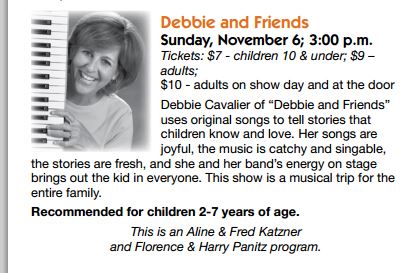
Aline Panitz Katzner became a widow at a young age when her husband Fred died on February 17, 1950.  Aline traveled a great deal after Fred’s death—to Scotland, Italy, Puerto Rico, and other places, and she never remarried.  She died October 27, 1982.  There is a fund created in the names of Aline, her husband and her parents used to support various types of programming, Jewish and other, in the Baltimore area.  If you Google “Aline & Fred Katzner and Florence & Harry Panitz program,” you will see the numerous programs supported by this fund.

Ad from the Baltimore JCC Program Guide Fall 2011

Ad from the Baltimore JCC Program Guide Fall 2011

As for the children of Grace and William Katz, in addition to the family of Hilda and Alfred Himmelrich and their children and many grandchildren, Morton Katz married Hannah Needle sometime before 1937, and in 1940 he was working as a salesman, perhaps still in the family jewelry business.  He and his wife Hannah had three children.  Morton died in 1974, and Hannah died in 2009, according to the Social Security Death Index.  Zerlina Katz married I. Morris Harris, who was in the wire and cable business in 1956.  I am not sure where or when Zerlina married Morris, but they lived in southern California from at least 1956 until their deaths, Morris in 1980 and Zerlina in 1995.

Remarkably, although some family members did move away from the Baltimore area, most including many of the great-grandchildren of Grace Cohen Katz and Florence Cohen Panitz, stayed in Baltimore.  The two Cohen sisters, born close in time, both married Baltimore businessmen, both moved to Baltimore to live, had daughters close in age, and lived near each other all their lives.  They both died before reaching seventy, they both predeceased their husbands.[1] Their children all stayed in Baltimore as well. Their daughters both married Baltimore businessmen. Looking at it from the perspective of how we live our lives in 2014 where family members rarely live in the same state let alone the same city, it all seems quite remarkable.

Baltimore, Maryland Skyline from the Inner Harbor

Baltimore, Maryland Skyline from the Inner Harbor (Photo credit: Wikipedia)


[1] Interestingly, they are not buried at the same cemetery.  Harry and Florence Panitz are buried at the Baltimore Hebrew Friendship cemetery where the extended Panitz family is buried, and Grace and William Katz are buried at Oheb Shalom cemetery where the extended Katz family is buried.  The two cemeteries are only two miles apart, so even in death the family is fairly close together.

Fact versus Fiction


The story of Jacob M. Cohen II who allegedly stole jewelry from his father’s store, pawned it, and ran away to St. Louis generated some discussion among some of my readers.  I had speculated that he did it in the aftermath of the death of  his brother Munroe (or Monroe, as it is sometimes spelled in various accounts).  The discussions have caused me to go back and try to piece together the facts and to create a timeline.

The first news story about Munroe’s death was published on March 23, 1903, a Monday.  It said that Monroe died on Saturday, which would have been March 21, but that the accident that led to his death occurred on Thursday, which would have been March 19.  The second news story, dated March 24, said his body was returned to Washington for the funeral, which was to take place the next day, March 25, 1903.

The Kingston Daily Freeman, Volume 01, March 23 1903, Page 3

The Kingston Daily Freeman, Volume 01, March 23 1903, Page 3

The first news story I found about Jacob’s alleged crime was dated March 27, 1903, and said that “several days ago” Jacob had disappeared from his home and that his father thereafter discovered that jewelry was missing from his store.  The police had thought that Jacob would return for Monroe’s funeral, but he had not done so.  I inferred from this that Jacob had disappeared sometime after his brother died or at least after his accident on March 19, since “several” ordinarily means more than two but not more than seven.  If it had been more than a week, I would think that the newspaper would have said “over a week,” not “several days.”  Also, if the police thought Jacob would return for his brother’s funeral, they must have had reason to think that Jacob knew that his brother had died. Thus, I do not think that Monroe’s accident was precipitated by Jacob’s disappearance, as one skeptical reader suggested.  It seems possible, however, that Jacob’s disappearance was precipitated by his brother’s accident and death, as I speculated.

Jacob Cohen son of Hart 1903 arrested


(“Son’s Alleged Dishonesty” Date: Friday, March 27, 1903, Evening Star (Washington (DC), DC)   Page: 15)

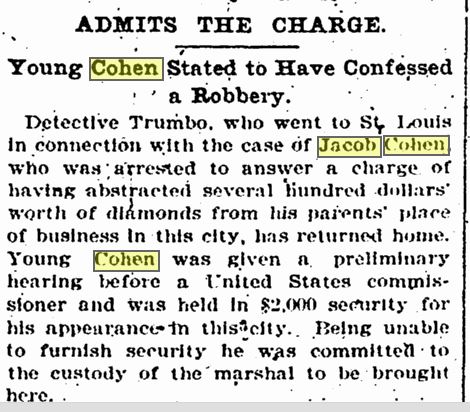
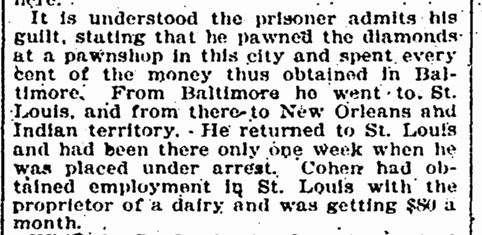
I had forgotten to post one other article about the Jacob story in my post yesterday.  In this article, dated October 5, 1903, a few more details of Jacob’s activities were provided.  Jacob admitted stealing the jewelry, pawning it in Washington, spending the money in Baltimore, and then traveling to St. Louis, New Orleans, and Indian Territory before returning to St. Louis, where he was arrested.  He had gotten a job in a dairy in St. Louis and was there a week when he was arrested.  There had been a hearing in St. Louis, and Jacob was unable to provide the security needed for his release and thus was in the custody of a marshal to be returned to Washington.  One reader speculated that he had never actually stolen the jewelry, but had simply run away; the reader wondered whether his parents had created the story of the stolen jewelry to get the assistance of the police in locating their son.  It seems that Jacob’s admission is inconsistent with that speculation, but anything is possible.

Jacob confession pt 1

Jacob confession pt 2

(“Admits the Crime,” Monday, October 5, 1903, Evening Star (Washington (DC), DC), page: 11)


The final story, posted yesterday and dated October 20, 1903, detailed Jacob’s arrest and the items allegedly stolen.  One reader pointed out that in the final sentence of that article it states “it is thought” that Jacob’s parents would not press charges against him when he was returned to the city.  That would explain why I could not find any further reports of a trial or sentence in the case.  To me, this is also consistent with my speculation that Jacob acted out of grief or upset in the aftermath of his brother’s death.

Jacob son of Hart arrested in St Louis


(“Charged with Grand Larceny,” October 20, 1903, Washington Evening Star, p. 11)

Do I know for sure? Of course not.  Certainly most people do not engage in criminal behavior while grieving.  Maybe Jacob just wanted to run away and needed the money to do so.  Maybe he was angry with his parents for reasons completely unrelated to Monroe’s death.  Maybe he just was being a rebellious teenager.  Maybe he was crying out for attention.  Who knows?  The facts suggest he reconciled with and lived with his parents for years after this incident and was not in any other trouble.  I find it unlikely that these two incidents—Monroe’s death and Jacob’s disappearance—were not related.

What do you think?


The Twentieth Century for the Descendants of Moses and Adeline Cohen 1900-1910

The first decade of the twentieth century must have been a very difficult one for the extended Cohen family in Washington, DC.  First, on March 21, 1903, Hart’s son Munroe was killed in Kingston, New York, in a gruesome accident while working as a brakeman for the West Shore railroad. He was trying to couple two railcars when he slipped and fell between the cars.  He sustained serious injuries and died of shock resulting from those injuries, according to the Kingston Daily Freeman.  He was only 22 years old.  His body was returned to Washington, DC, where he was buried on March 24, 1903.

The Kingston Daily Freeman, Volume 01, March 23 1903, Page 3, found athttp://news.hrvh.org/cgi-bin/newshrvh?a=d&cl=search&d=kingstondaily19030323.2.32&srpos=1&e=-------20-PubMetakingstondaily-1----monroe+cohen-all

The Kingston Daily Freeman, Volume 01, March 23 1903, Page 3 found at http://news.hrvh.org/cgi-bin/newshrvh?a=d&cl=search&d=kingstondaily19030323.2.32&srpos=1&e=——-20-PubMetakingstondaily-1—-monroe+cohen-all

Monroe Cohen body 1903

It appears that at or around or perhaps right after the time of Munroe’s accident and subsequent death, his younger brother Jacob, then seventeen years old, stole about $700 worth of jewelry from his father’s store and pawned it to another pawnbroker.  As the article below indicates, the police were hoping he would return for his brother’s funeral, so it would seem that Jacob’s theft occurred close to the time of his brother’s death.

Jacob Cohen son of Hart 1903 arrested

(“Son’s Alleged Dishonesty” Date: Friday, March 27, 1903, Evening Star (Washington (DC), DC)   Page: 15)

It took six months for the police to track Jacob down, and when they did, they found him in St. Louis.  He was arrested and admitted to the crime and was then returned to Washington.

Jacob son of Hart arrested in St Louis

(“Charged with Grand Larceny,” October 20, 1903, Washington Evening Star, p. 11)

I have not found anything to indicate what happened next, but in 1910, Jacob was living with his parents in Washington, and working as a chauffeur.  I don’t know what could have motivated Jacob to steal the jewelry, but the fact that this occurred at the time his brother died makes me believe that it was related in some way to the grief he felt from his brother’s death.  It seems that Jacob had no further run-ins with the law and that his parents took him back into their home since he was living there as a 24 year old in 1910.

Unfortunately, that was not the end of the tragedies for the extended DC Cohen family in that first decade of the twentieth century.  Just a few months later, on January 24, 1904, Ella Cohen Greenberg, the daughter of Moses, Jr. and Henrietta Baer Cohen, died at age 29, leaving behind her husband Jacob and their eight year old daughter, Marjorie.  I do not have a death certificate (yet) for Ella, so I do not know why she died.  Jacob was remarried by 1909 to a woman named Hattie with whom he had a son, Theodore.

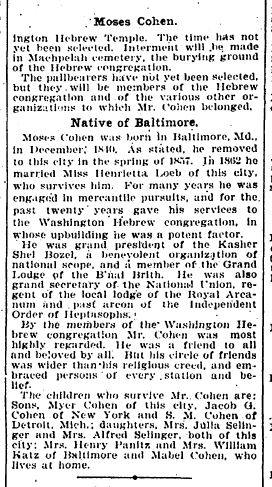
And then just nine months after Ella’s death, Moses, Jr. himself died on November 24, 1904.  He was 63 years old.  According to his obituary, his death was sudden, the result of a heart attack.  The obituary paints a portrait of a successful business man who was very active in his synagogue and in various other Jewish communal and charitable organizations.  It described him as a “pioneer Hebrew citizen” of Washington, DC, and as “highly esteemed” and “highly regarded.”  One interesting error in the obituary is that it says that he was the father of eight children, all of whom survived him.  Moses and Henrietta had had nine children, and Ella had predeceased him.  Had the newspaper just made an error, or had there been some falling out between Ella and her family?  I will assume the first since I have no basis for concluding otherwise, and Ella was included with an insert into the family portrait, which obviously was taken some time between her death and the death of her father nine months later.

Moses Jr obit part 1

moses jr obit part 2

(“Moses Cohen Dead,”  November 25, 1904, Washington Evening Star, p.3)

It’s ironic that despite emphasizing Moses’ Jewish identity in several places, the obituary’s subtitle describes him as a strong supporter of his “church.”

The other thing that I found interesting was Moses, Jr.’s headstone.  Unlike his father Moses, Sr.’s headstone, which was a very traditional Jewish headstone engraved mostly in Hebrew and with the symbol for the Cohanim, Moses, Jr’s headstone has no Hebrew at all. Given how involved he was in the Washington Hebrew Congregation as both an employee and a congregant, I found this surprising.  Perhaps it is a sign of assimilation that the family chose a headstone in English and not Hebrew.

Moses Cohen, Sr. headstone

Moses Cohen, Sr. headstone

Moses Cohen, Jr. headstone

Moses Cohen, Jr. headstone

But the decade was not completely sad.  The eight surviving children of Moses, Jr. and Henrietta were doing well, and the next generation was growing up.

  1. Augusta and Julius’s five children were young adults and teenagers, the three oldest all working as jewelers like their father.
  2. Myer Cohen and his wife Helen had one more child, Myer, Jr., born in 1907, and their children were also teenagers. Myer continued to practice law.
  3. Jacob and Ida Cohen and their two children, Aimee and Gerson, moved from New York City to Yonkers, New York. In 1905 and in 1910, Jacob was working as the manager of a dry goods store.
  4. Alfred Selinger, Fannie Cohen’s husband, was a tailor. Their daughter Selma was also a teenager in 1910.
  5. Florence and Harry Panitz were still living in Baltimore, and Harry was still a salesman. Their daughter Aline was still a young child.
  6. Grace Cohen married William Katz on January 20, 1901, and they had two children in the next decade: Hilda (1901) and Morton (1907). William was a manager in a furniture store, and the family was living in Washington, DC.
  7. Solomon, the youngest son of Moses, Jr., and Henrietta, married Estelle Spater in 1906, where the couple then resided. Solomon was employed as a manager of a mail order business.  Solomon and Estelle had a son Ralph born in 1908 and a son Theodore, born in 1910.  Sadly, Theodore died on November 21, 1912 when he was only two years old.
    Theodore P. Cohen death certificate

    Theodore P. Cohen death certificate

    When I found the death certificate for Theodore, I was confused by a number of things.  First, he died in Seneca, Lenawee County, Michigan, not Detroit, where his family lived.  I thought perhaps he had died in an accident, but the cause of death was indigestion.  I found that very puzzling, but then saw that a contributory cause was Little’s Disease.  I looked up Little’s Disease and learned that it was a form of cerebral palsy.  I am not sure how indigestion caused his death, but obviously it was related to his underlying condition.  I also found it very strange that his birth date was unknown, that there was no information about the birth place of either of his parents or his mother’s maiden name, and that the informant was neither of his parents.  My guess is that Theodore was in a hospital or home for children with similar conditions since it appears that he was not living with family.

  8. In 1910, Moses, Jr., and Henrietta’s youngest child, Mabel, was residing at the Maryland Asylum and Training School for the Feeble Minded in Baltimore; she was 27 and unable to read or write.

In June 1909, there was a large family celebration of the 25th anniversary of Augusta and Julius Selinger at their home.  From this description in the Washington Evening Star, one can get a sense of the lifestyle of the family during this decade.

Augusta and Julius 25th anniversary party

Augusta and Julius 25th anniversary party

(Sunday, June 20, 1909, Evening Star (Washington (DC), DC),   Page: 61)


As for Moses, Sr., and Adeline’s other children, JM and Belle Cohen were still living in Sioux City, Iowa, in 1905, but by 1910, they had moved to Kansas City, Missouri, where their daughter Fannie Sybil had moved sometime after marrying Sigmund Stern, a German-born immigrant who had arrived in the United States in 1892 as a fourteen year old and who was living in Sioux City in 1900, where he was residing as a lodger along with his two brothers, Henry and Morris, in what appears to be a boarding house.  Sigmund and his older brother Morris were both working as clothing merchants.   Sometime before 1906 Sigmund and Sybil, as she was known, had moved to Kansas City, as their daughter Judith was born there in 1906.  Although I cannot find a 1910 census report for Sigmund and Sybil Stern, Sybil’s parents JM and Belle and her sister Ruth were listed as living in Kansas City that year; JM was retired at age 57.

The other two children of Hart and Henrietta (aside from Munroe and Jacob M. II, discussed above) were Frances and Isadore.  In 1910, Frances was single and living with her parents and had no occupation.  Isadore had married Frances David in about 1907, according to the 1910 census, and their first child, Monroe, was born April 14, 1910.  Isadore was working as a clerk for the post office at that time.

As for Rachel and Frederick Selinger, they were still living in Washington with their son Monroe in 1910, and Frederick was still working in a furniture store.  Their daughter Fannie had married Aaron Hartstall sometime before 1910, and their son Morton was born January 20, 1910.  Aaron was employed as a paper hanger, and they also were living in Washington, DC.

So the family had grown in numbers and the children were growing to be adults in the first ten years of the twentieth century.  There had been some big losses and a fair number of births.  The next ten years would see additional growth and additional challenges as the family and the world faced World War I and the younger generation began to reach adulthood and have families of their own.


A Brick Wall Tumbles, Thanks Once Again to the Genealogy Village

When I learned that my brother’s Y-DNA did not match the Y-DNA of a descendant of Moses Cohen of Washington, DC, I was sorely disappointed.  I was sure that all the circumstantial and documentary evidence I had found supported my hunch that Moses was the brother of my great-great-grandfather Jacob Cohen and son of my three-times great-grandfather, Hart Levy Cohen.  But DNA does not lie, and I was very surprised by the results.

I had one small glimmer of hope when I learned about a family story that indicated that Moses Cohen, Sr., was not the biological father of Moses Cohen, Jr., who was in fact the biological great-great-grandfather of the living descendant whose DNA had been compared to that of my brother.  But how would I ever prove that?  It seemed hopeless.

Nevertheless, I decided to see what I could find that might help answer some of my questions.  Where and when was Moses, Jr., born? When and where did Moses, Sr., marry his mother Adeline Himmel? I could not find any American records showing a marriage or an immigration record for Adeline and her son Moses, Jr.  All I had were census records from 1850 and 1860 showing that Moses, Sr. and Adeline were already married by 1850 and that in 1850, Moses, Jr., was eleven years old.  Later census records indicated that both Moses, Jr., and Adeline were born in Germany and that Moses, Sr., was born in England (though a few later census reports filed after Moses, Sr.’s death by his children said he was also born in Germany).  Some of Moses, Jr.’s and Adeline’s records were even more specific, several naming Baden as her place of birth.

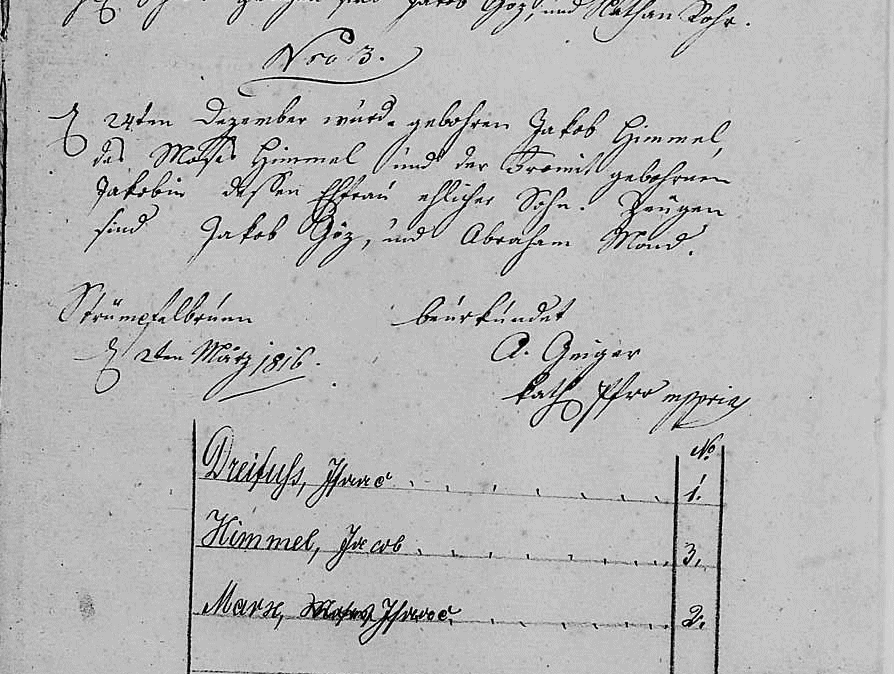
Several months ago when I first discovered the DC branch of the Cohen family, I had tried without success to find where in Baden Adeline had lived.  I sent a message on the GerSIG listserv (German Special Interest Group) of JewishGen.org asking for help.  I received many suggestions, but the most helpful one was from a man named Rodney.  First, he looked up the surname Himmel in Lars Menk’s “Dictionary of German-Jewish Surnames” and found that there was only one Jewish community in Germany where the name Himmel appeared, in  the Eberbach region of Baden.  Then he pointed me to a website that compiled various birth, death and marriage records from various towns in Germany, the Landesarchiv, and specifically to a book of the Jewish records for a town in Eberbach called Strumpfelbrunn where Rodney found a birth record for Jacob Himmel that he translated for me.  The record said, “On the 24th December 1815 was born Jakob Himmel, legitimate son of Moses Himmel and his wife Bromit nee Jakobin(?). Witnesses are Jakob Goez and Abraham Mond.”

(Generallandesarchiv Karlsruhe 390 Nr. 1137, Bild 8
Permalink: http://www.landesarchiv-bw.de/plink/?f=4-1121353-8
Standesbücher / (1691-) 1775-1875 (-1958)
Kernlaufzeit 1810-1870 > Amtsgerichtsbezirk Eberbach >
Strümpfelbrunn, israelitische Gemeinde: Standesbuch 1810-1866 / 1810-1866)

Jacob Himmel birth record

Jacob Himmel birth record

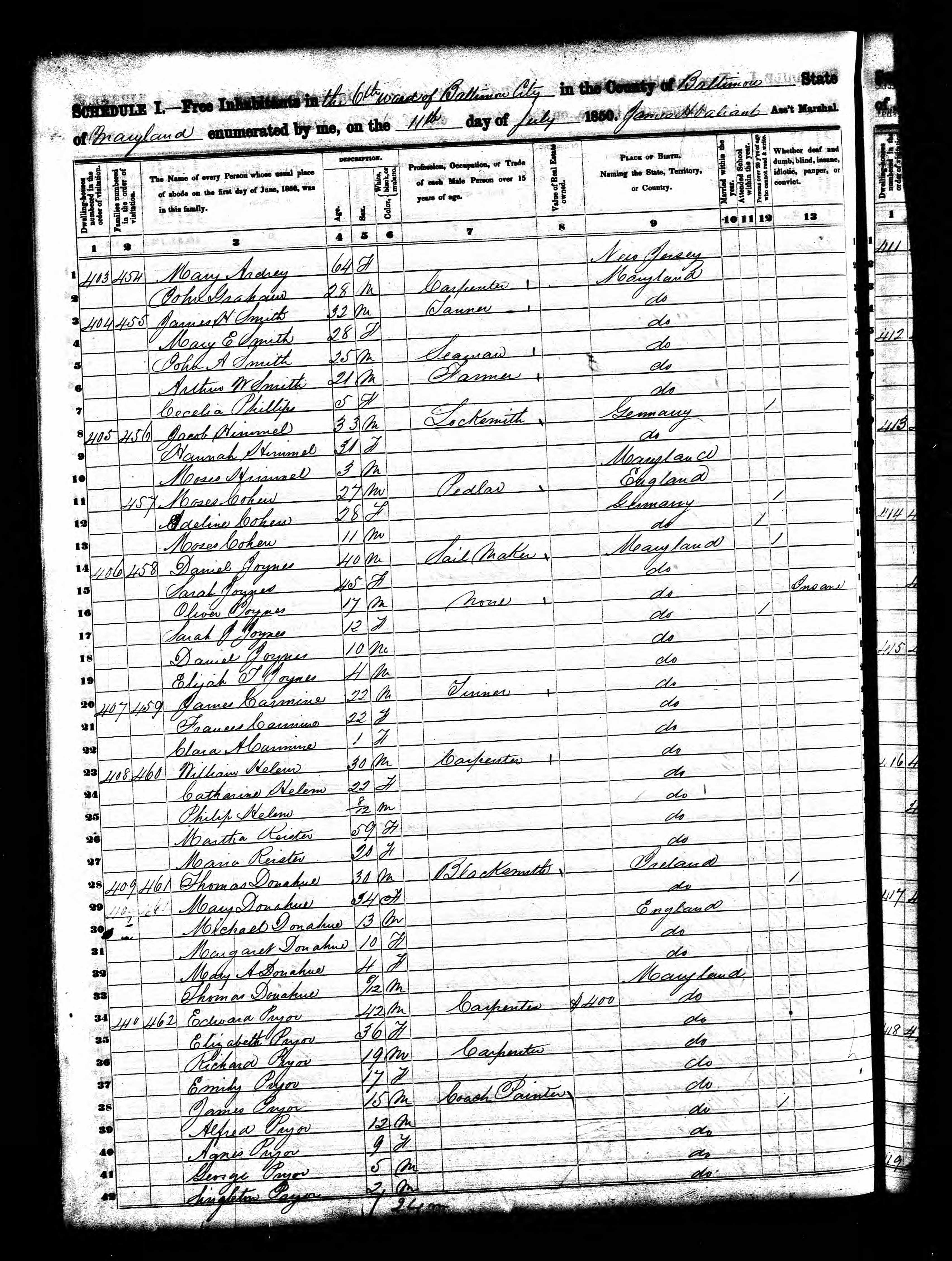
I immediately wondered whether this Jakob Himmel could be the same as the one living next door to Moses, Adeline, and Moses, Jr., in Baltimore in 1850, the one I suspected was the brother of Adeline.

Moses Cohen and family 1850 census

Moses Cohen and family and Jacob Himmel and family  1850 census

Rodney suggested that I look for other records in the Strumpfelbrunn book, but it was written in old German script that looks like what you see above.  I wouldn’t even recognize my own name written in that script.  I tried my best, but after a few pages, I gave up and said that there had to be an easier way.  But there was not.  These records are not digitized or translated anywhere yet.  So I returned to American records and moved on, figuring I’d either never find Moses, Jr.’s records or I’d find them some other way.

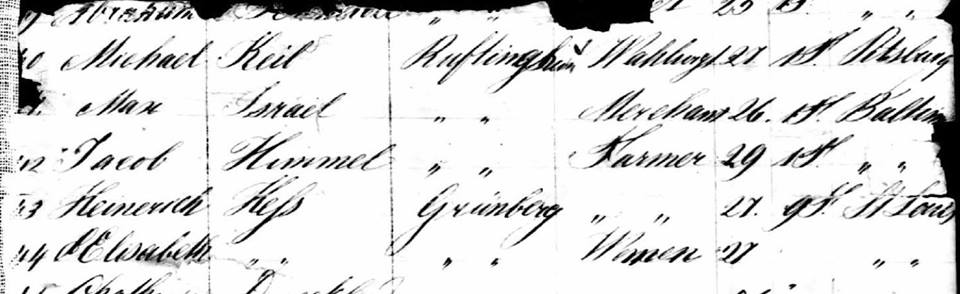
Then in the last few weeks I found the passenger manifest for Jacob Himmel.

Jacob Himmel ship manifest

Jacob Himmel ship manifest

Detail

Detail

I posted it to a Facebook group called Baden Genealogy for help in deciphering the town listed as Jacob’s place of last residence, which looked like Rutlingheim to me and to most others.  But there was no such town in Baden, no town that had a name that looked even close.  I tried searching for the two men who appeared to be traveling with Jacob from “Rutlingheim” and had no luck at all locating them in the US.  Then two days ago, I posted again to the Baden Facebook group, asking whether the town could be Billigheim, a town reasonably close to Strumpfelbrunn where a Jacob Himmel had been born.

Monica, a member of that group, responded, and when I explained why Strumpfelbrunn was my point of reference, she invited me to send her the birth record I had and the source where I had found it and she would translate it for me.  Her translation was consistent with that of Rodney except that she read Jacob’s mother’s name as Fromit, not Bromit.  She, like Rodney, said I should look for other mentions of Himmel in the record.  The book is close to 300 pages long, and I told her that I just could not decipher the old German script.  Then she made a brilliant suggestion; she sent me a link to the font for that old script, had me install it into Word, and then suggested I type out Himmel and any other relevant names in the script and compare it to what I could find on the pages of the records book.

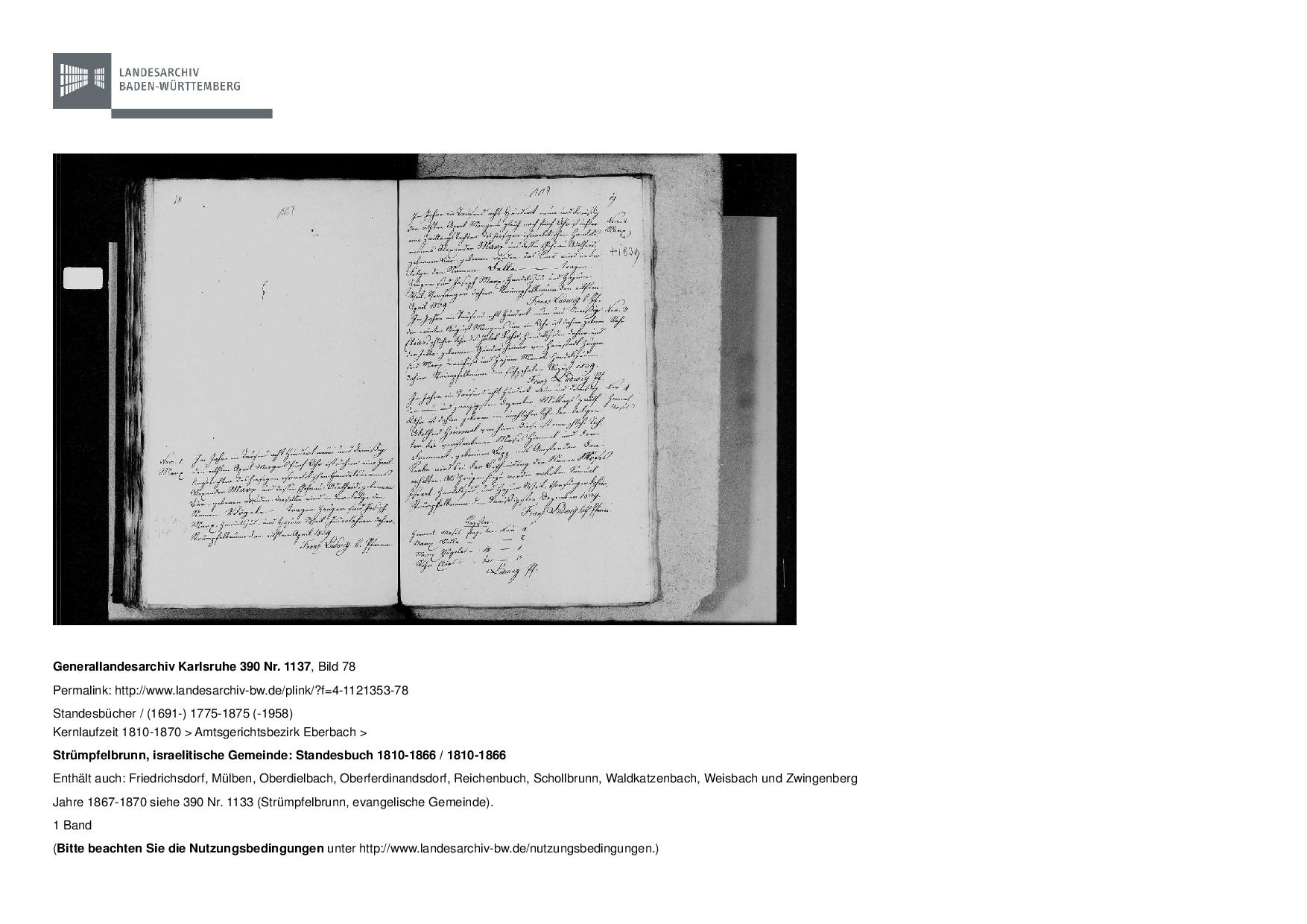
And so I did, and on page 78, I found a record that looked like it had the name Moses Himmel in that old script.

Moses Himmel birth record 1839

Moses Himmel birth record 1839

Moses Himmel birth record 1839 detail

Moses Himmel birth record 1839 detail

I sent it to Monica, who translated it as follows: “In the year 1839 29th Dec at noon an illegitimate son of the spinster Adelheid Himmel was born.  She is the legitimate daughter of the deceased Moses Himmel and of Frommat nee Lagg from Amsterdam.  The boy will be named Moses at his circumcision.”  It then names some witnesses.

When I received that email with the translation, I felt those bricks tumbling down.  Could this be anyone other than Adeline Himmel Cohen and her son Moses? Does this not provide evidence that the family story that Moses, Jr., was not the biological child of Moses Cohen, Sr., is reliable? Doesn’t it explain why Moses, Jr.’s great-great-grandson does not share DNA with my brother, who is a direct descendant of Hart Levy Cohen, who was Moses, Sr.’s father, but not the biological grandfather of Moses, Jr.?

I then found another page, 26, that also seemed to have the name Himmel.  Monica translated that one as well.  “On the 5th of May 1820 in the morning 4 o’clock he died and was buried at noon.  Moses Himmel was married with Fromat Lagg (or Lugg or Legg) from Holland.  Age forty and four years.”  This was the death notice for Moses Himmel, the father of Adelheid or Adeline Himmel.  She named her illegitimate son for her father, not as a junior for Moses Cohen, the man she would later marry, probably in the United States.

Moses Himmel the grandfather of Moses Himmel

Moses Himmel the grandfather of Moses Himmel

Of course, there are many questions remaining.  I still don’t know when Moses, Sr., married Adeline.  Nor can I be 100% certain this is the right Adeline, though it certainly would appear to be so.  These discoveries also open up some new doors for my research.  If Adeline’s mother was named Fromat Lagg or Lugg or Legg and she lived in Holland, perhaps there is a connection to my Dutch ancestors in Amsterdam.  Her name was given as Jakobin on Jacob’s birth record; perhaps she was part of the same family as Rachel and/or Sarah Jacobs, my three-times and two-times great-grandmothers.  Now I need to return to the Dutch research and see what I can find.

In any event, once again the generosity of my fellow genealogy researchers has been demonstrated.  I never could have done this without the help of Rodney and Monica, two people I’ve never met, and the larger GerSIG and Baden Genealogy Facebook group communities.  It is astonishing what can be accomplished when people work together instead of fighting and killing each other.


Science versus Inference:  Was Moses Cohen the Brother of Jacob Cohen?

The case for concluding that Moses Cohen, Sr., who lived in Baltimore (1850) and Washington, D.C. (1860), was the brother of my great-great-grandfather Jacob Cohen is built almost entirely on inference.  As I’ve described before, I have tentatively concluded that they were brothers based on the following bits of evidence:

  1. The 1841 English census that lists as the children of Hart and Sarah Cohen the following: Elizabeth (20), Moses (20), Jacob (15), and John (14).

    Hart Cohen and family 1841 English census

    Hart Cohen and family 1841 English census

  2. A passenger manifest for the ship New York Packet, dated July 7, 1848, that lists the following passengers: Jacob Cohen, Sarah Cohen, Fanny Cohen, Moses Cohen, and an infant named John Cohen.  Jacob Cohen and family ship manifestMoses Cohen page on ship manifestSource Citation
    Year: 1848
    Description
    Ship or Roll Number : Roll 073
    Source InformationAncestry.com. New York, Passenger Lists, 1820-1957 [database on-line]. Provo, UT, USA: Ancestry.com Operations, Inc., 2010.
    Original data: Passenger Lists of Vessels Arriving at New York, New York, 1820-1897. Microfilm Publication M237, 675 rolls. Records of the U.S. Customs Service, Record Group 36. National Archives at Washington, D.C.Passenger and Crew Lists of Vessels Arriving at New York, New York, 1897-1957. Microfilm Publication T715, 8892 rolls. Records of the Immigration and Naturalization Service; National Archives at Washington, D.C.Supplemental Manifests of Alien Passengers and Crew Members Who Arrived on Vessels at New York, New York, Who Were Inspected for Admission, and Related Index, compiled 1887-1952. Microfilm Publication A3461, 21 rolls. ARC ID: 3887372. RG 85, Records of the Immigration and Naturalization Service, 1787-2004; Records of the Immigration and Naturalization Service; National Archives, Washington, D.C. Index to Alien Crewmen Who Were Discharged or Who Deserted at New York, New York, May 1917-Nov. 1957. Microfilm Publication A3417. ARC ID: 4497925. National Archives at Washington, D.C.Passenger Lists, 1962-1972, and Crew Lists, 1943-1972, of Vessels Arriving at Oswego, New York. Microfilm Publication A3426. ARC ID: 4441521. National Archives at Washington, D.C.
  3. Headstones that identify the Hebrew name of the father of both Jacob and Moses Cohen as Naftali Ha Cohen (Hart being the Dutch and English equivalent of a deer, the tribe symbol for the tribe of Naftali)
    Jacob Cohen headstone cropped and enhanced

    Jacob Cohen’s headstone

    Moses Cohen, Sr. headstone

    Moses Cohen, Sr. headstone

  4. The fact that both Jacob and Moses named a son Hart, the same name as Jacob’s, and presumably Moses,’ father, Hart Levy Cohen.
  5. The fact that Moses had a granddaughter named Grace Cohen and that a bridesmaid of one of Jacob’s granddaughters was a Grace Cohen from Washington, DC.

These five bits of evidence were enough for me to reach the tentative conclusion that Jacob and Moses were brothers and that therefore the descendants of Moses Cohen were also my relatives.  There was also additional “evidence” in my failure to find a Moses Cohen other than the DC Moses who fit as well; there were two Moses Cohens of the right age on the 1851 English census, but neither was the right one.  I sent for marriage certificates for both of them, and they were not the sons of Hart and Rachel. I’ve already dug fairly deeply into the history of Moses Cohen and his children and grandchildren based on that hunch and those bits of evidence.

But I wanted something more scientific and definitive.  I was very fortunate to find someone who was a direct descendant of Moses’ son, Moses, Jr.  He had already done a DNA test with FamilyTreeDNA, so I asked my brother to do the same so that we could compare the results.  That was almost two months ago, and I finally received the results late last week.  I was very disappointed to see that my brother was not in the same haplogroup with the descendant of Moses, Jr., meaning that there was no genetic link between the two.  I was bewildered and discouraged.  I looked at all the hours I had spent researching Moses’ family and felt as if I had wasted a tremendous amount of time.

I am in touch with the wife of the Moses, Jr., descendant who was tested, and she also was disappointed, but not as surprised as I was.  She told me that there was a family story suggesting that Moses, Jr., had been adopted and was not in fact the biological child of Moses, Sr.   Suddenly, other bits of evidence started to make more sense.

The earliest document I have for Moses, Jr. is the 1850 US census. It lists Moses, Sr., living in Baltimore with his wife Adeline and eleven year old son Moses, Jr. Moses, Jr., is reported to have been born in Germany, and since he was eleven, born in 1839.

Moses Cohen and family 1850 census

Moses Cohen and family 1850 census

Other documents record his year of birth as 1840.  But Moses, Sr., was living in London in 1841, as seen on the English census of that year.  I had been confused by that before, but had assumed it was some error.

Also, Moses, Sr. is variously reported to have been born in years ranging from 1820 to 1828, depending on the document. His headstone says he was 32 in 1860 when he died, giving him a birth year of 1828.  Even assuming it was 1820, he would only have been twenty when Moses, Jr., was born.  How would he have met a German woman at such a young age, had a child with her in Germany, but then been living without her in London a year or more after the child was born? And where were Adeline and Moses, Jr.,  in 1848 when Moses emigrated from London to the US on the same ship with his brother Jacob?

I decided I needed to find out more about Adeline, the woman who married Moses and the mother of Moses, Jr.  I know that her birth name was Himmel from a birth record for their son Hart.  I cannot find a passenger list for Adeline or Moses, Jr., nor can I find a birth record or a marriage record linking Moses, Sr. and Adeline with Moses, Jr.  The earliest document I have found for Adeline is the 1850 US census above.

That 1850 census, seen above, show that living in the home next door to Adeline and Moses was a family with the surname Himmel: Jacob, Hannah and Moses Himmel.  Jacob, like Adeline, was born in Germany.  Both Jacob and Adeline Himmel had sons named Moses.  I am going to guess that Adeline was Jacob’s sister, though I’ve yet to find anything to corroborate that.

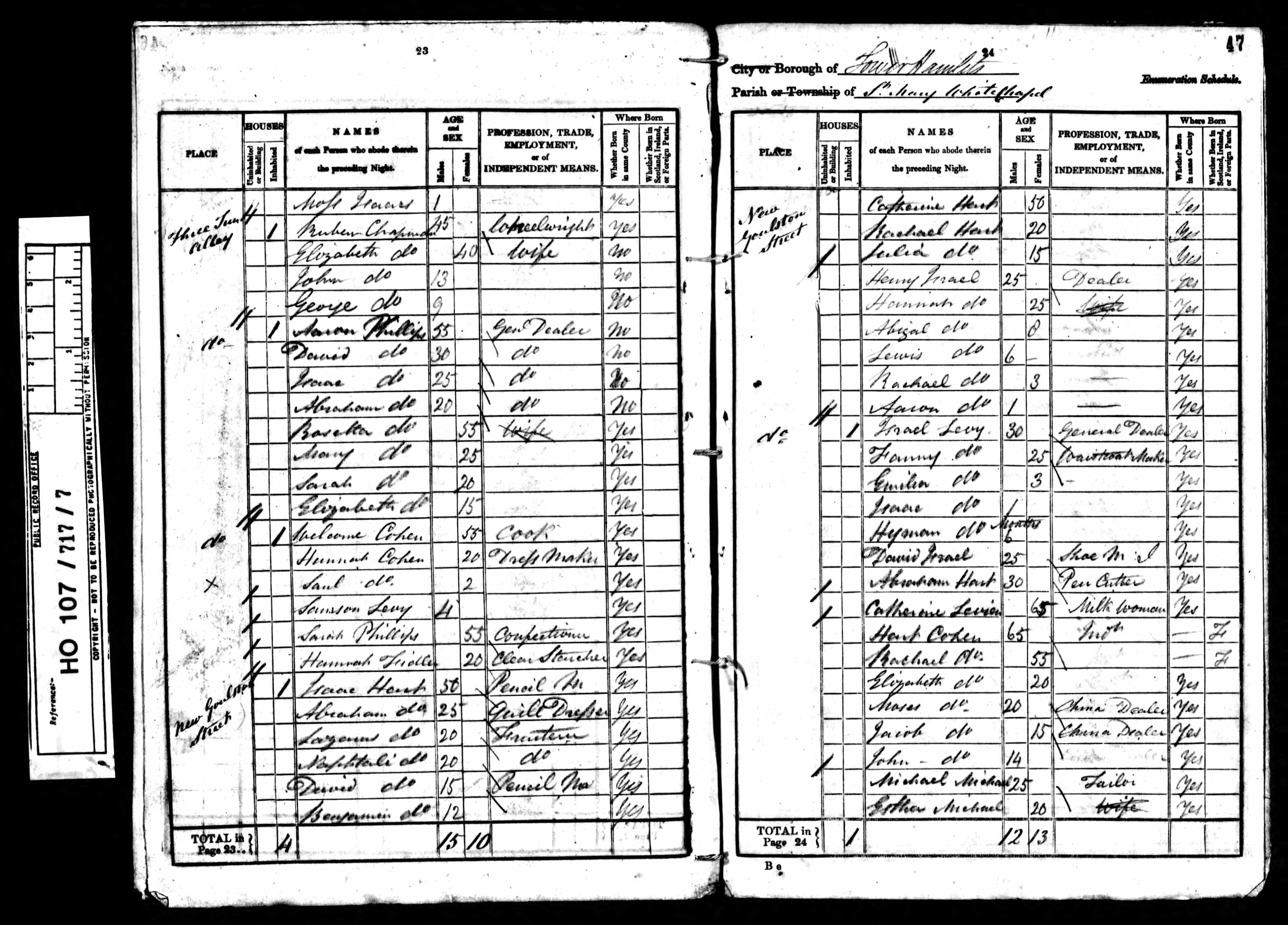
So this is my new challenge: to find records that will indicate where and when Moses, Jr., was born and where and when Moses, Sr., married his mother Adeline.  I am also going to focus on finding a biological descendant of Moses, Sr., so that perhaps I can find some scientific evidence to back up my inferences.  In the meantime, I am going to continue to assume that Moses, Sr., was the older brother of my great-great-grandfather and thus to tell his story as best I can as well as the story of his children and grandchildren, including Moses, Jr.