Big Brotman Family Update!

I’ve been focused on the Goldschlagers these last few weeks, but I have not at all forgotten my Brotman cousins.  I have just not had anything new to report as I am still awaiting a few documents and also hoping to break the brick wall that prevents me from finding out about our Galician home and our earlier ancestors.

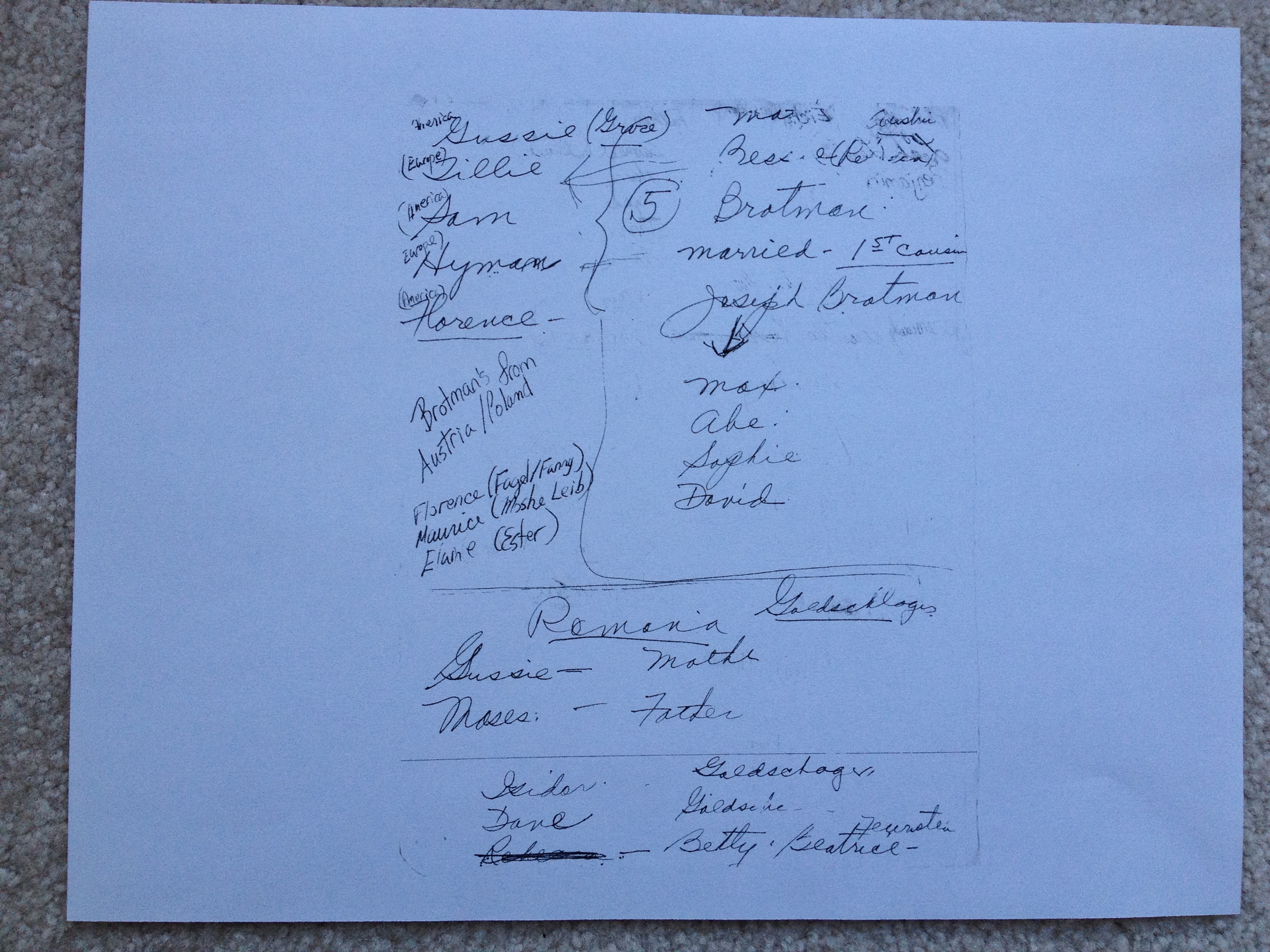
But today I actually have some news about the Brotman family.  My first cousin Jody sent me the document depicted below:

Family Tree drawn by Elaine Goldschlager Lehbraum

Family Tree drawn by Elaine Goldschlager Lehbraum

It’s a family tree written by her mother, my aunt Elaine Goldschlager Lehrbaum, my mother’s sister.  At first I didn’t realize there was anything new about it until I read it over a second, third and now fourth time.  My aunt provided the names of all the other children of Joseph Brotman, including Max and Abraham, confirming what we already knew, that is, that they were Joseph’s sons from his first marriage.  But now we have the names of the other two children from that first marriage: David and Sophie!  This is huge news for me and gives me a new start to researching the other Brotman cousins.

Also, note that my aunt said that Joseph and Bessie were first cousins.  (No wonder our gene pool carries so many repeating traits—like those distinctive cheekbones.)  That may help me locate them in Europe since we now know that they had the same grandparents.

Finally, I never knew that my aunt’s Hebrew name was Esther.  That was Gisella’s mother’s name—Esther, married to David Rosensweig.  So my aunt was named for her great-grandmother.  I wonder if she knew that.

Another one of those days when a small document can just bring tears and smiles to my eyes.

Jody also sent some wonderful pictures which I will post later.  Thanks, Jo!

Enhanced by Zemanta

Pessel bat Yosef

We decided to go to synagogue for Shabbat services this morning, and for the first time in a very long time, I had an aliyah.  When the gabbai asked me for my Hebrew name to insert in the blessing, I said “Pessel bat Yosef.”  I had not used my Hebrew name in any public way since I started doing all the genealogy research, and beforehand it had not meant anything too layered for me.  It was just my Hebrew name. 

The “Pessel” I knew was for my great-grandmother Bessie, but I knew almost nothing about her.

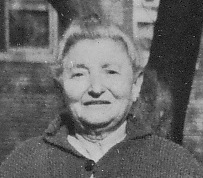
Bessie

Bessie

The “Yosef” was manufactured by the rabbi who married us back in 1976.  He had asked me for my father’s Hebrew name for the ketubah, and I didn’t know what it was.  When I asked my father (whose  English name is John), he said he had never had one.  He’d not had a bar mitzvah, but had been confirmed in a Reform congregation which did not use Hebrew names.  So the rabbi picked Yosef, figuring it was at least a name that started with a similar letter to John.  That was fine with me.  For a while I thought I’d switch to Yohanatan, figuring it was closer to John, but then I thought I should stick with what was on the ketubah (and easier to say).

So when I told the gabbai this morning that my name was Pessel bat Yosef, I felt a real connection to Bessie Brot Brotman, my great-grandmother, and I had a revelation.  I didn’t know it in 1976 when I was married; I hadn’t even known it when I last had an aliyah several years ago.  But now I know that Pessel bat Yosef was Bessie’s Hebrew name as well.  Her father’s name was Joseph.  So that rabbi in 1976 did not realize it, but he had in fact given me the same Hebrew name as my great-grandmother.  When I realized that for the first time this morning, it gave me the chills.

Bessie headstone enhanced

Now that I know so much more about Bessie and her life, I feel particularly honored and moved to share her name. I am proud to be called Pessel bat Yosef, carrying her name and her memory into the present day and into the future.

Enhanced by Zemanta

Looking back on the first six months: Seven lessons learned by doing genealogy

As my semester has drawn to an end, as the year draws to an end, I want to take some time to reflect on what I have learned in the last six months or so since I began this project in earnest and what I still want to learn and to accomplish as we start a new year.

So first, what have I learned?

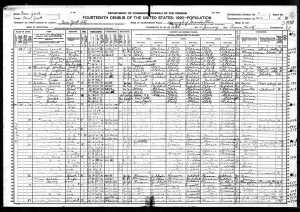
1.  I’ve learned that I had two great-uncles whom I’d never known about.  For at least two months of my research, I was sure that Joseph and Bessie had only had five children: Hyman, Tillie, Gussie, Frieda and Sam.  When I kept running into a Max Brotman married to Sophie with children named Rosalie and Renee, I just figured Hyman had changed his name to Max.  My mother didn’t know about her cousins Joseph, Saul and Manny, but she had met Rosalie and Renee, and I was sure they were Hyman’s daughters.  My mother knew that Hyman’s wife’s name was Sophie.  So instead of looking harder, I just assumed Max was Hyman and that the other Hyman Brotman married to a Sophie was not my relative.  Only when I was able to find Max’s granddaughter Judy and Hyman’s grandson Bruce did I learn that Max and Hyman were BOTH my great-uncles, that both had married women named Sophie, and that Rosalie and Renee were the daughters of Max, not Hyman.  That was a HUGE turning point for me and a big lesson.  Lesson learned? Don’t trust memory alone, and don’t assume that documents are wrong just because family memories conflict with those documents.
Herman and Sophie with sons 1920

Herman and Sophie with sons 1920

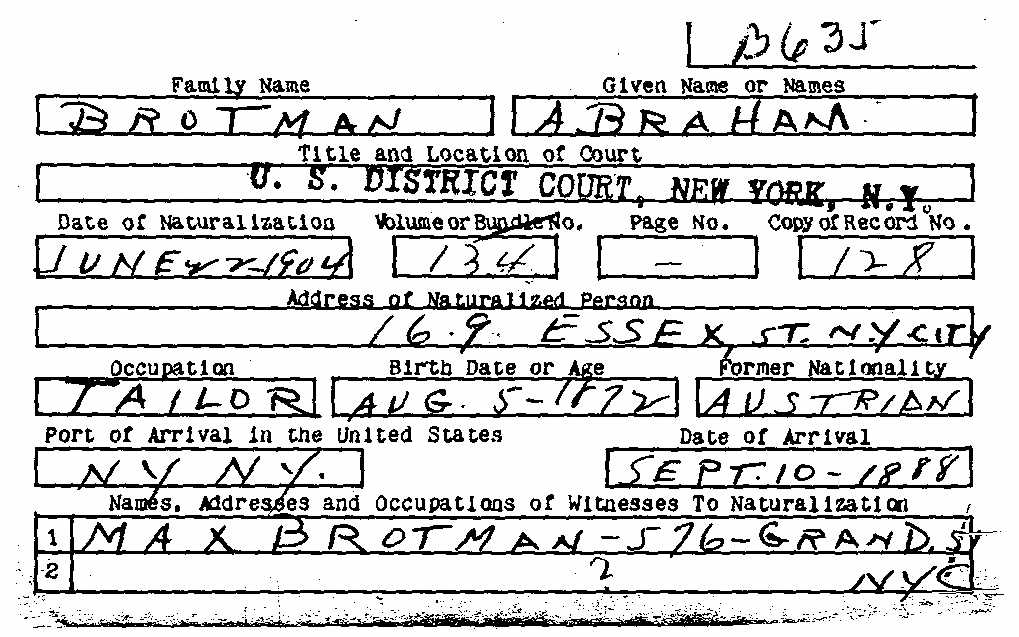
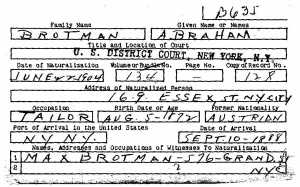
2. The second new great-uncle was Abraham, and finding him was also somewhat of a lucky break.  I ran across many Brotmans in my research, but most I assumed were not our relatives because I could not find any document linking them to our relatives and because no one in our family had ever heard of them.  I can’t even remember all the details, but I recall that it was my brother Ira who found Abraham’s naturalization papers—I think (I am sure he will remember and correct me if I am wrong) it was in the course of looking into the Brotmanville Brotmans.  When I saw Max’s name on those papers, I did not assume it was the same Max.  (There were many Max Brotmans living in NYC at that time.)  Once I checked the address for the Max on Abraham’s card against the address I had for Max on the census form from that same time period, I knew it was in fact “our” Max.  That led me on the search that brought me to Abraham’s headstone and death certificate, indicating that his father was also Joseph Jacob Brotman.  Lesson learned? Don’t dismiss any clue.  You never know where one document may lead you, even if in a direction you never expected.
Naturalization of Abraham Brotman Max as Witness

Naturalization of Abraham Brotman
Max as Witness

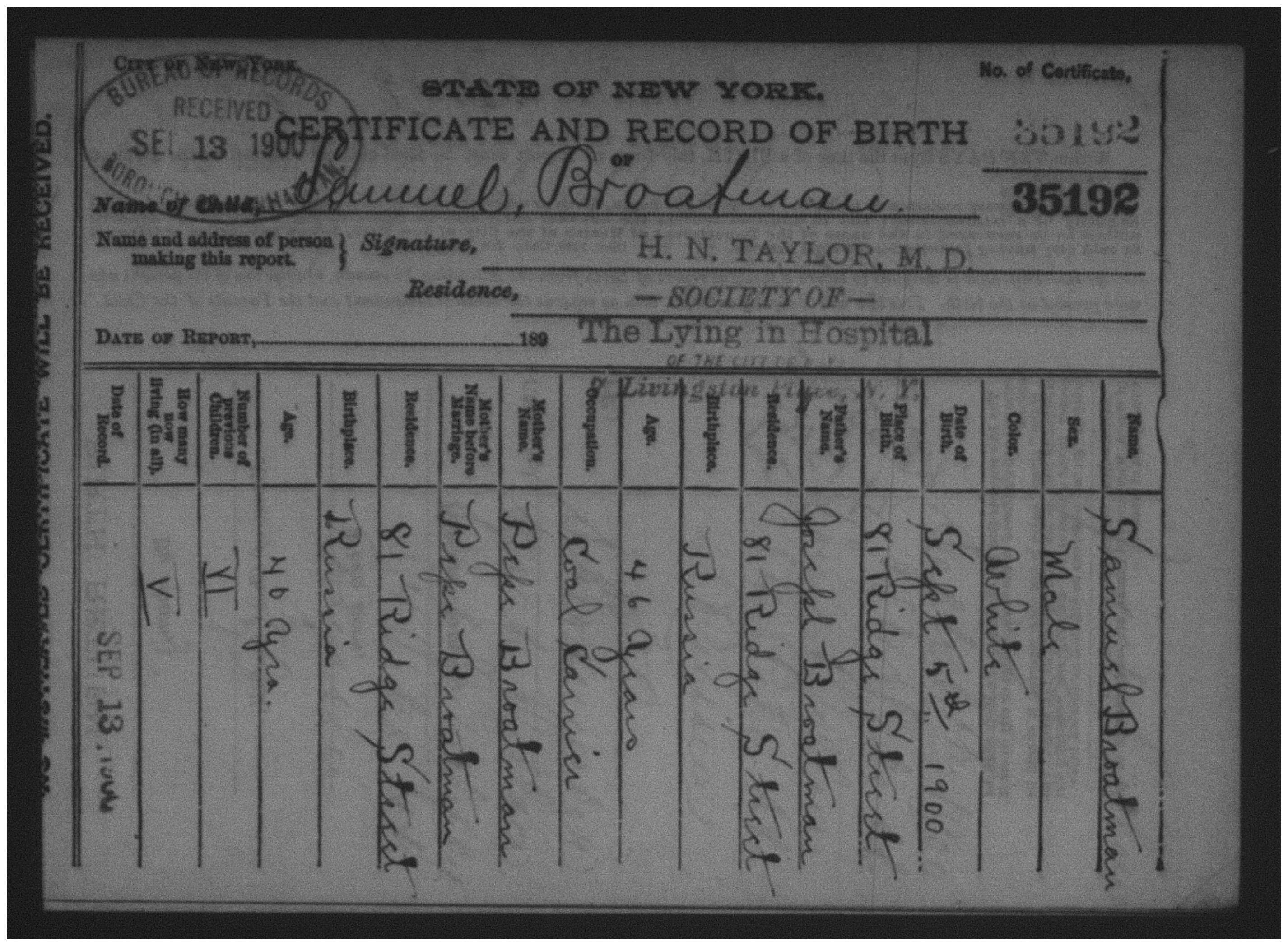
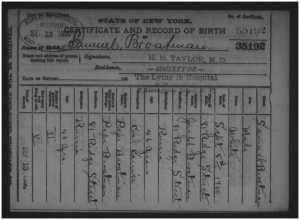
3.  Contrary to Lesson #1 and Lesson #2, I have also learned that often you cannot trust documents.  Documents lie.  People lie.  People give bad information, and bureaucrats transcribe information inaccurately.  People who transcribe handwritten documents for indexing purposes make errors.  In particular, our relatives were entirely inconsistent when it came to birth dates and birth places.  I now know why one relative found it so easy to lie about her age.  It was family tradition.  So lesson #3: Don’t assume that because it is written on some “official document” that it is reliable in any way.
Sam's Birth Certificate Joseph was NOT 42!

Sam’s Birth Certificate
Joseph was NOT 46!

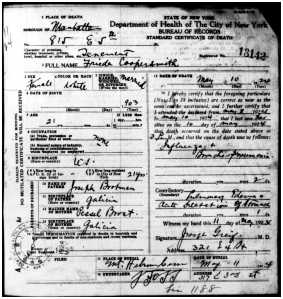
4. One of my most rewarding accomplishments was finding out what happened to Frieda Brotman. Now we know who she married and how she died and even the name of her infant son Max, who only lived one day.    We even know what happened to her husband Harry Coopersmith after she died.  I never thought I’d be able to track down her story.  That experience is what will keep me going as I continue to look for the answers to more questions.  Lesson #4: Do not give up.  Do not give up. Do NOT give up!
Frieda Brotman Coopersmith death certificate

5. There are more helpful and supportive people in the world than there are mean or evil people.  I know we hear all the time about all the evil in the world, and there is far too much of it.  And even if not evil, there are also many people who are rude, incompetent and unhelpful.  We all know that.  But we often forget that there are also many, many more people who are kind, helpful and competent.  In my six months of doing this research, I have gotten help from many strangers—government employees who patiently helped me find a document, FHL volunteers who helped me track down a document request I had made, JewishGen and GesherGalicia members and other genealogists who have gone far out of their way to teach me how to find documents and how to connect with other researchers, who have photographed gravestones and given me directions to gravestones, who have translated documents for me, who have helped me find a clue when I was sure I had hit a brick wall.  I cannot tell you how much these people have touched me and changed my views on human nature.

I want to express special thanks and deep appreciation to Renee Steinig, who contacted me many months ago in response to my cry for help on GesherGalicia and who has truly been my teacher and is now my friend as I have gone from being a total newbie to a fairly competent novice with her guidance. She is the one who found the obituary of Renee that led to me finding Judy.  She is the one who suggested I post an inquiry on a bulletin board that led me to Bruce.  When I look back, in fact, I know it was Renee who got me to where I am today.  Thank you, Renee, for everything.

Lesson #5: If you ask for help, there will be generous and kind people who will reach out and help you.  Don’t do this alone.

6. I have also learned that I have many second cousins and second cousins once and twice removed—people I would never have discovered if I had not started down this path.  This has been probably the biggest gift of all from doing this research.  What a wonderful and interesting group of people I have gotten to know—by email, by phone, by pictures and stories.  When I look at the pictures and see the distinctive Brotman cheekbones shared by so many of you and your parents and your children, it gives me such a great sense of connection.  This may be the best lesson I’ve learned: everyone is looking for connections, everyone is looking to find their place in time and in the world.  I am so glad to have made these connections with so many of you, people who never even knew my name until this fall but whom I now consider not just cousins, but friends.

7. Finally, and in some ways the point of this whole adventure, I have really learned more than I ever could have hoped about my great-grandparents and their children and how they lived in the United States.  Joseph and Bessie were nothing but names to me six months ago; now they are flesh and blood people, my flesh and blood.  Their drive and courage is an inspiration to me, as it must have been to their own children.  After all, Abraham, Hyman and Tillie all named a son for their father Joseph, and perhaps some of the great-grandchildren were named for him as well.  I was so blessed to have been named for Bessie, as were some of you.  Bessie and Joseph—they are the real heroes of this story.  That’s the real lesson.
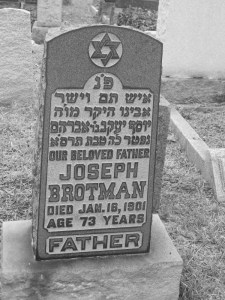
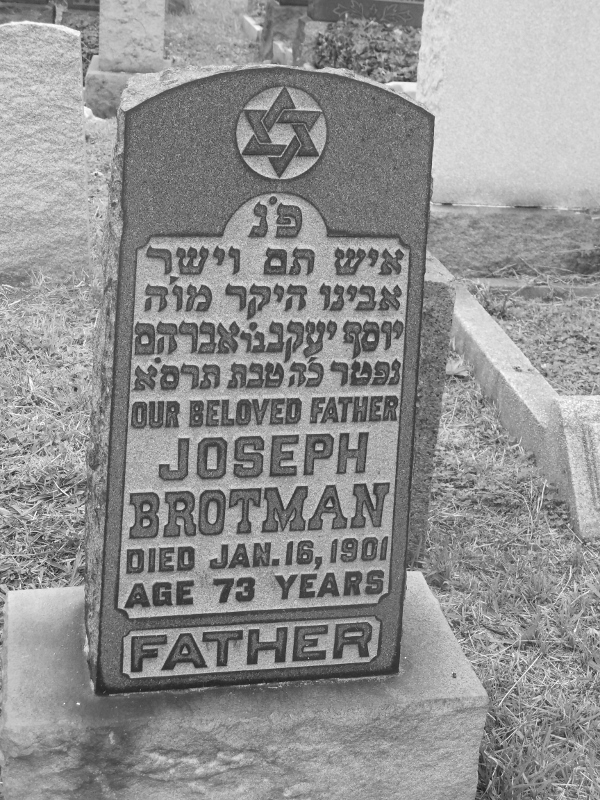
Joseph's headstone

Joseph’s headstone

Bessie Brotman

Bessie Brotman

Next post: Looking forward to the next six months

A Call to Israel!

Just to show that I never give up, I thought I’d report on a phone call I made this morning to Shmuel Brotman of Kiryat Tivon in Israel.   Renee, my mentor, made the suggestion that I look for any Brotmans who had lived in Dzikow by checking both JRI-Poland and the database at Yad Vashem.  Both sources found one family, the family of Shmuel and Zipporah Brotman, who had resided in Dzikow/Tarnobrzeg.  It looked like the entire family had died in the Holocaust, but Renee suggested I contact the person who had submitted the names to Yad Vashem, Shmuel’s daughter-in-law Chana Brotman.

I then had to track down Chana Brotman.  I knew from the Yad Vashem submission that she had lived in Kiryat Tivon in 1997 when she submitted the names of Shmuel and his family, and so I made a request on both the JewishGen website and on Gesher Galicia for help in locating the family.  By this morning I had several responses, including two that gave me phone numbers, one for Chana and one for her son Shmuel.  The person who provided me with Shmuel’s number had just spoken with him and said he was awaiting my call.

I jotted down some notes and then called Shmuel.  He’s about my age and fluent in English.  He was very happy to help me, and we spent about half an hour, comparing notes and trying to figure out whether there is a connection between our families.

At the moment I still don’t know what the connection is, but it seems likely that there is one.  His grandfather Shmuel Brotman was born around 1888 in Dzikow, and his great-grandfather’s name was Moshe.  I don’t yet know where Moshe Brotman was born.  He could even be the same Moses Brotman who ended up in Brotmanville.  We still have to sort more things out.

He did tell me that he has done some research and believes that the Brotman family originally came from Georgia in the former Soviet Union and left to escape the pogroms.  He believes they changed their name to Brotman to get across the border.  According to Shmuel, some Brotmans went to the US, some to Romania, and some to Poland, including his family.  Whether our ancestors were also part of that family I don’t yet know, but it is a possibility.

So just as I was about to give up hope of finding more traces of our family, I received a glimmer of hope this morning from Israel.  No matter where this goes, it was another one of those uplifting experiences where strangers helped me find someone and that someone ended up being welcoming and hopeful that we are related.

Research update: Bad News, Good News, Bad News

As you may recall, on October 31, I sent a request to the USCIS  for the naturalization papers for Max Brotman in the hope that they would reveal where Max and thus the other family members were born in Galicia.  According to the automated message on the USCIS phone, it could take at least 90 days to get a response.  Well, I figured the news wasn’t going to be good when I received a response yesterday only 35 days after making my request.  And it wasn’t—they had no records for a Max Brotman who fit the dates I had submitted.  In fact, all their naturalization records start in 1906, and I should have known that Max was naturalized before 1906 since he was the witness for Abraham in 1904.

I then went back to ancestry.com and rechecked my search of their naturalization records where I had been able to find records for both Abraham and Hyman.  I checked and rechecked pages and pages of indices, searching for anything that might relate.  I found one for a Max Bratman born in Germany who worked as a conductor for the railroad and emigrated in 1882, but dismissed it because the name, place of birth, and date of immigration seemed wrong.

Max "Bratman" Naturalization Card

Max “Bratman” Naturalization Card

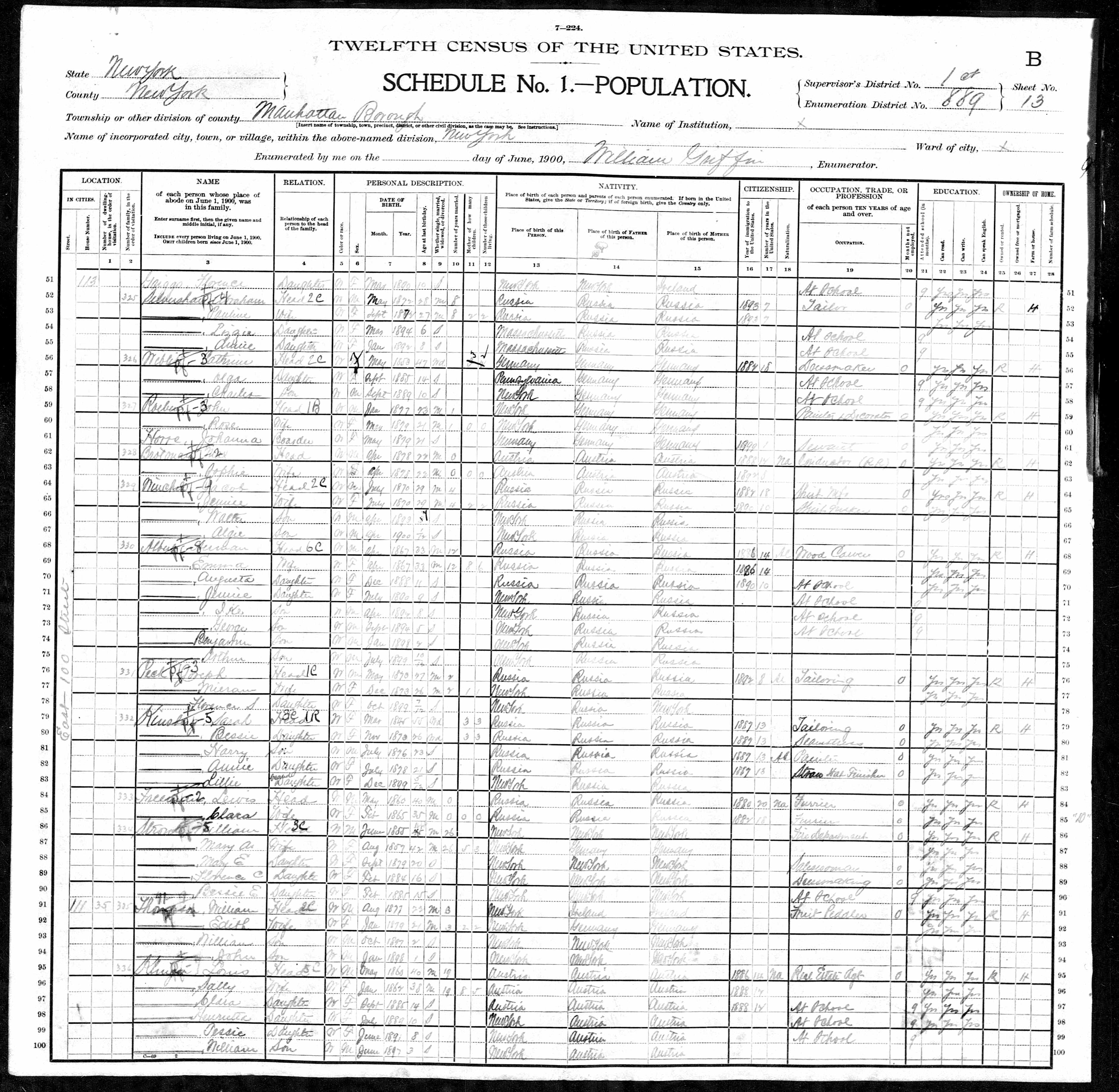
Then I went back to the records I already have for Max, including several census reports, his marriage certificate and his death certificate.  While reading through the 1900 census, I noticed that it said Max was a conductor.  At that time he and Sophie were just married (the census was taken in June; they had married in April) and were living at 113 East 100th Street in Manhattan.  When I saw the entry that he was a conductor, I knew it rang a bell, but at that point I could not remember where else I had seen it.

1900 US Census Report for Max and Sophie Brotman

1900 US Census Report for Max and Sophie Brotman

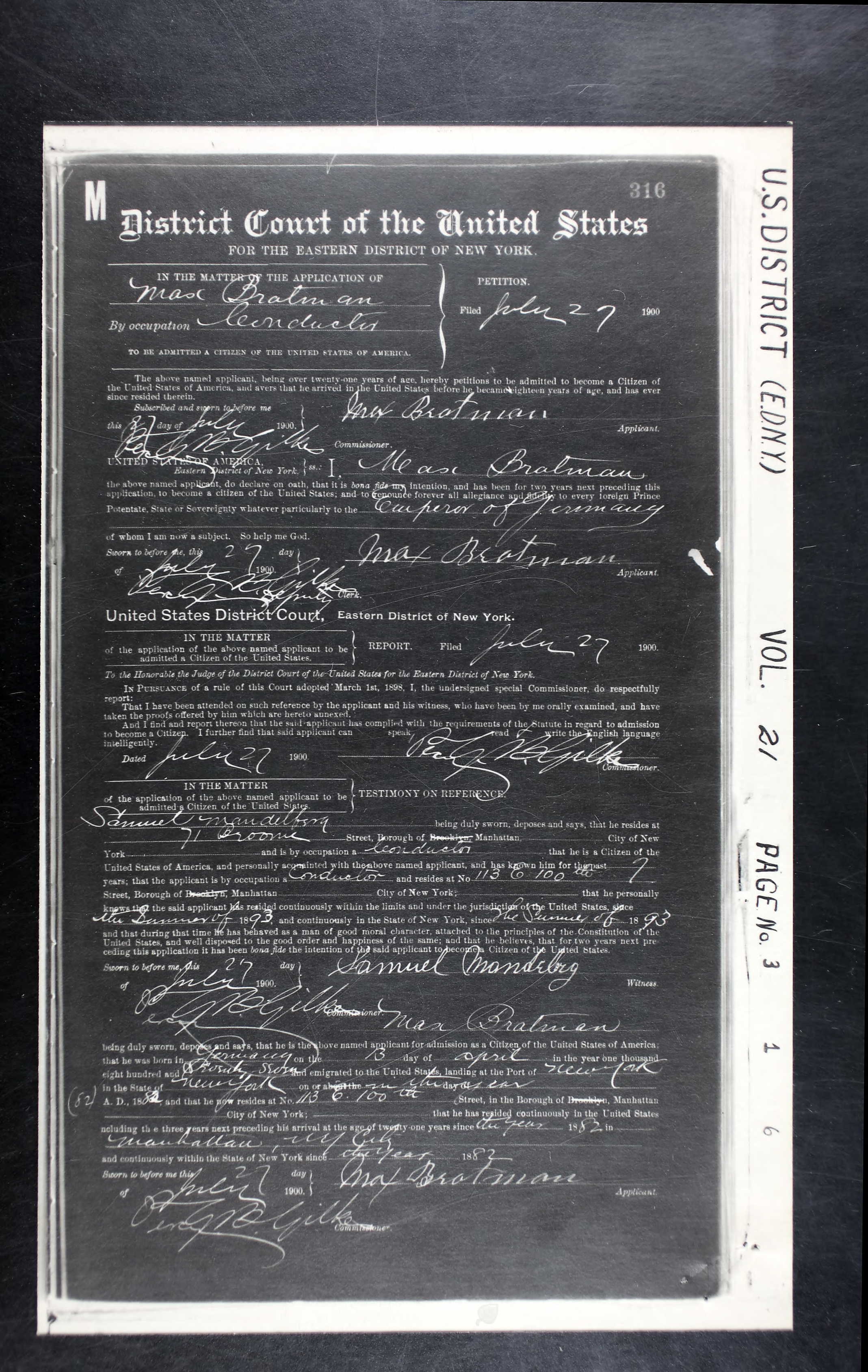
I began to search through the naturalization records again and could not find any reference to a Max Brotman who was a conductor.  I started thinking that I was losing my mind! Then I remembered that there had been a Max BrAtman and searched for him, and lo and behold, found the naturalization card again for the conductor.  I looked at the address on that form and sure enough, Max Bratman was living at 113 East 100th Street in Manhattan in 1900 when he filed this application.  Obviously this was the same person, our Max, but why did he spell his name wrong? Why did he say he was born in Germany and emigrated in 1882? The birth dates also did not exactly line up, but I am used to the fact that no one ever reported their birthday consistently.

When I looked at the handwritten application, I saw that the signature was definitely Max BrOtman, not BrAtman.

Max Brotman naturalization petition

Max Brotman naturalization petition

My guess is that the clerk who filled out the card just could not decipher the handwriting.  As for the wrong date, I have no guess except that Max was confused, wasn’t clear, or was trying to make it seem he’d been in the US for more than just 12 years.  As for why Germany? I wish I knew.  I know from Joseph Margoshes’ book that secularized, modern Jews were referred to as “German” in Galicia. Perhaps that’s why Max said Germany.  Perhaps the clerk thought he was German because of his name, accent and use of Yiddish and suggested it to him and Max just agreed? I have no clue.

The census form was filled out just a month earlier than the naturalization form.  The census says his place of birth was Austria as does every other document listing Max’s place of birth.  The census says he emigrated in 1888, which is also consistent with almost all the other forms.  It would have made little sense for Max to have emigrated in 1882 when he was only four years old.  So once again, we have evidence that forms are unreliable, that our ancestors were not too reliable, and that much must be left to conjecture and speculation.

So where does that leave us in terms of identifying where our family lived in Galicia? Hanging on the thin thread of Hyman’s own unreliable documents, our best guess is Dzikow near Tarnobrzeg.  I contacted Stanley Diamond who manages the archives of documents for JRI-Poland, and he sent me a list of all the records of all Brotmans and Brots from that area.  They are almost all of people born after 1900, and Stanley said that the records for that area are rather limited.  He said it would probably take a trip to archives in a few cities in Poland to learn if there is anything else and that that is probably a long shot.

And thus, my cousins and friends, I think that for now I have hit a wall. I am still waiting for Tillie’s death certificate and Hyman’s marriage certificate, but I am not putting any hope into finding out more information about their place of birth from those documents. I am in touch with a researcher in Poland, and I am hoping to travel there perhaps in 2015, but for now I guess we have to accept that the best we can do is hang our hopes on Hyman’s references to Jeekief and Giga and assume that Dzikow near Tarnobrzeg is our ancestral home.

Rosalind Haber and Dan Dombey’s wedding photos

Thanks to Naomi, we have some new pictures to add to the blog.  I will also post these to Max’s page, but thought I’d also post them this way so that everyone sees them.  I already posted about the photo of the groomsmen including Sam Brotman, but here are several more.

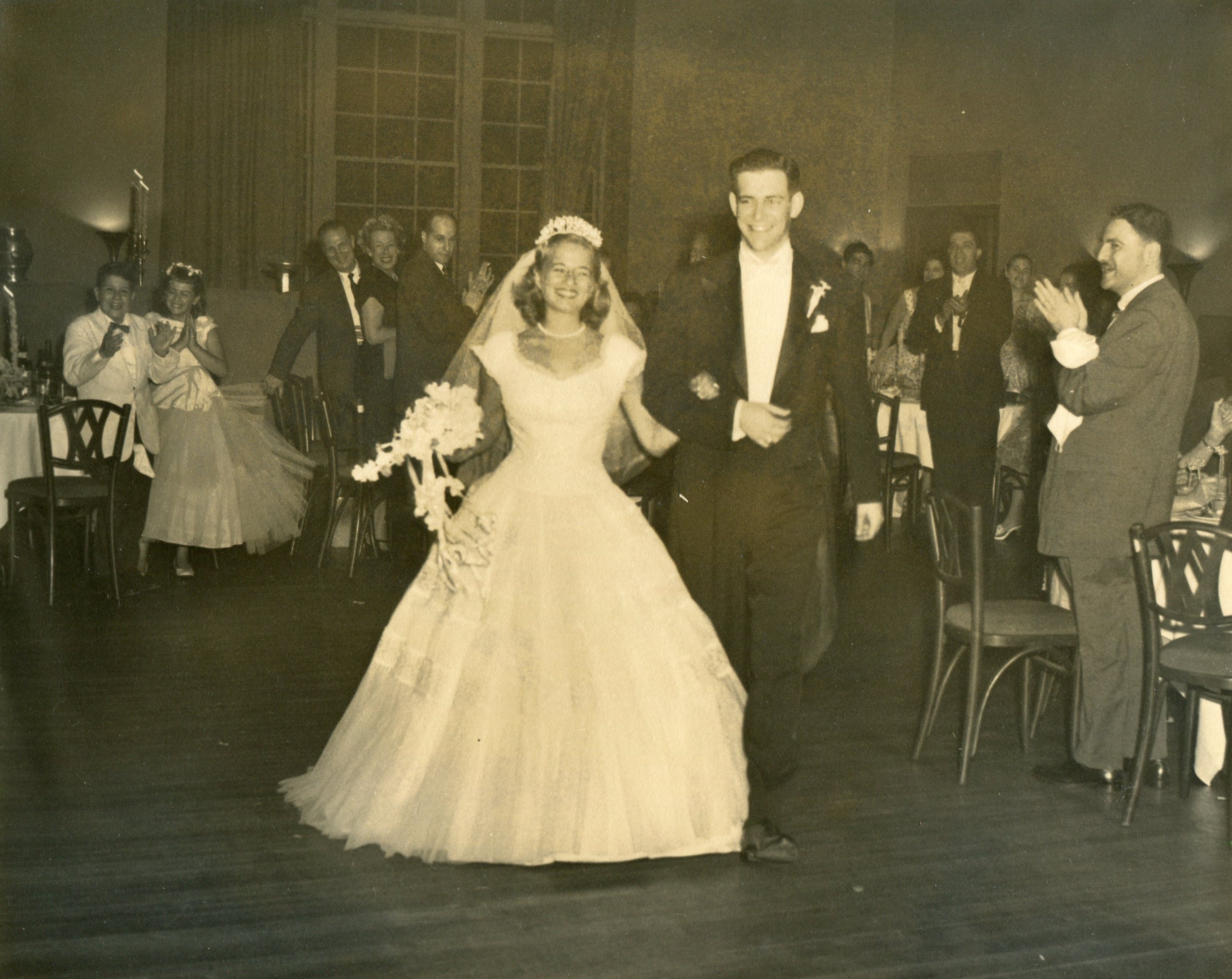
First, the bride and groom, Rosalind and Dan. Notice the two young people in the background to the left—that’s cousins Tom Jones, son of Rosalie and Dick Jones, and Judy Haber Ruzicka, daughter of Renee and Charles and the bride’s sister.

Image

Here are the bride’s parents, Renee Brotman Haber and Charles Haber.

Image

And here are the bride’s aunt and uncle, Rosalie Brotman Jones and Dick Jones.Image

Finally, here’s one of the Haber family, including Renee, Charles, Susan and Judy, and the Dombey family.

Image

I tried to look at the faces in the background of these pictures to see if any other Brotman family members are shown, but no one besides those mentioned looked familiar to me.  Do any of you recognize any of those faces?