This Made My Day!

Yesterday was one of those winter days where I didn’t leave the house all day.  I read the paper, did the crossword puzzle, and played on the computer.  It was quiet, relaxing, but not exciting.  Then late yesterday afternoon, I received an email from Judy, Max’s granddaughter, that made my day.  Attached to the email was a document that Judy’s sister, Susan, had found while going through some old papers.  It’s a family tree sketched out by hand by Renee Brotman Haber, one of Max Brotman’s daughters and Roz, Susan and Judy’s mother.

Take a look at it:

Image

If you now compare this to the family tree on the blog for Abraham and his descendants, you will immediately realize that Renee had written out the family tree of her father’s brother Abraham.  Judy and Susan don’t know when she did it or where, but this is definitely written by Renee and it is definitely Abraham’s family.

Paula Newman, Abraham’s granddaughter, commented on the blog a couple of months ago that she believed she had met Rosalie and Dick Jones in Florida years ago when she was there with her parents.  Rosalie was Renee’s sister, and Judy said that both families used to go to Florida every year at Christmas time.  Perhaps it was during one of those vacations that Paula’s family met with Renee and Rosalie’s families and provided Renee with the information she sketched out on the family tree.

This is the third piece of evidence that supports the conclusion that Abraham and Max were brothers and that Abraham, like Max, was Joseph’s son from his first marriage.  First, we have the fact that Max was the witness on Abraham’s naturalization papers.  Second, we have the fact that Abraham’s Hebrew name was Avraham ben Yosef Yaakov, named for his grandfather Avraham whose son was Yosef Yaakov.  (Recall that Joseph’s Hebrew name was Yosef Yaakov ben Avraham.  Also, Abraham named his son Yosef Yaakov shortly after Joseph died, as did Hyman and Tillie.) And now we have evidence that Renee met or spoke with Abraham’s daughter or granddaughter to write down this family tree.  I don’t know how they found each other, or , more sadly, how they had all lost each other beforehand and then afterwards.

I guess you can tell how much this all means to me that receiving this document made me so happy.  Who cares about snow and sleet and cold when there is a new discovery linking our families!!

This should also be an inspiration to the rest of you to look for things like this—old letters, cards, postcards, pictures. You never know what you will find. Come on, make my day!  

Streets: Conclusion (Bella’s adolescence)

The rest of the book was harder to read.  As Bella turned twelve and became less innocent, she became more aware of the squalor and ugliness of her world.  She wrote, “I was now twelve and acutely conscious of the sordidness of the life about me.  To escape, I hid behind my books and built up a life of my own in the public school I attended on East Broadway and at the settlement house on Madison Street.” (p. 66)

Her mother married one of the long time boarders and soon was pregnant.  Although their first year of marriage seemed fine to Bella, after the baby was born and soon developed a medical condition that left him scarred and covered with sores, her stepfather abandoned her mother, who was already pregnant with another child. They never saw him again. (There is no explanation of her brother’s condition, but it seemed to continue for several years so was not just a short-term childhood illness like measles or chicken pox.)

Supporting an extra child as a single parent created enough of an additional financial burden for Fanny that she and her children had to move to a less desirable street in the Lower East Side, Goerck Street.  Bella described it as a “tough block” where there were several bars, a lumberyard, and a garbage heap.  There were frequent bottle fights.   Most of the residents of the street were Galician Jews, but there were also Hungarian, German and Russian Jews as well as many Italian immigrants.

Fanny and her children moved their belongings to the new tenement with a pushcart, taking several trips to do so. Bella described the new building as follows:

“Our house, like the others, had four families on each floor, two to the rear and two to the front.  There were two windows to the front room which either faced the street or the yard, one window in the kitchen that faced an extremely narrow, lightless airshaft, and in the bedroom a tiny square window that faced the hall. … Separating the front room from the kitchen is what my mother called a ‘blind window.’  It was simply a square hole, framed by woodwork, which allowed some of the front light to filter into the kitchen and stop at the entrance to the bedroom.” (p. 82)

In this small, dark and airless space, Fanny and Bella found cockroaches and rats.  As before, Fanny took in numerous boarders to help her pay the rent and also took on sewing jobs to supplement her income.

Bella graduated from grade school and was determined to go to high school, unlike many of her classmates and friends who had to go to work in one of the factories in order to help support their families.  Fanny was fully supportive of Bella’s desire to go on to high school, even though she was told by many that she was foolish and should make Bella get a job instead.  Bella enrolled at George Washington High School in Manhattan, about two miles away from the Lower East Side, and was excited to be continuing her education.

Bella, however, did also take on a part-time job, working Sundays as a trimmer at a man’s coat shop on their street.  Her mother also received financial assistance and other support from the United Hebrew Charities and worked long, long hours sewing to earn extra income.   When the second baby was born in May, 1913, the charity covered her rent for the time that Fanny could not work. In return, however, the charity wanted Fanny to consider sending Bella to work full time.  Fanny resisted, and Bella continued to go to high school.  Bella resented having to justify her desire to continue school to the charity.

Bella, however, was now much more aware of the precariousness of their financial condition, and it was often a struggle to pay the rent, which was often paid late and in partial payments.  When she was not at school, Bella took care of her two baby brothers while her mother continued to work as much as possible, taking in sewing work.

Bella’s feelings at this time are poignantly conveyed in the memoir:

“I looked at the sleeping tenements and down at the street strewn with garbage and wet newspapers. Was this living?… It was all so hopeless.  When would it end?”  (pp. 103-104)

Although Bella still loved school and had friends with whom she had some good times, it is apparent that she no longer felt the somewhat joyful attitude she had had as a child.  Although it does seem that their financial condition was worse than it might have been earlier, the poverty and squalor she described must also have been very much present in the neighborhood where she lived when she was younger.   It is likely that as Bella was exposed to more of the outside world through school and books, she also became much more discerning and outraged by the conditions of her own world.

When Fanny finally was unable to pay the rent one month in 1914 and received an eviction notice, Bella offered to quit school.  Fanny refused to consider it, saying that Bella was “going to be a lady. Not like me, a schnorrer!” (p.110) Fanny swallowed her pride and begged the United Hebrew Charities for assistance.  They agreed to give her fourteen dollars, which she used to move her family out of the Lower East Side and up to First Avenue and 49th Street (where the UN now sits).  The charity also provided her with some sewing work.

Thus, Fanny and her children left the Lower East Side and moved to what was then called the Dead End neighborhood, an area of slums that were torn down in the 1920s.  This was not a move up, but a move to a cheaper neighborhood.

The last chapter focuses on Bella’s experiences while living in that neighborhood, a more mixed neighborhood where she had many non-Jewish neighbors.  The accommodation was comparable to what they had had on the Lower East Side, a three room tenement apartment.  Fanny was heavily dependent on United Hebrew Charities for support and grew increasingly despondent over her situation and over the health of her older son. At one point her relationship with Bella was so fraught with tension that Fanny lost her temper and began hitting Bella quite violently.  Bella realized that she needed to get away and spent the summer before her senior year working at a boy’s school in the Catskills as a chamber maid and waitress.

Bella somehow managed to graduate from high school while also holding down various part-time jobs, including working in another factory, tutoring, and helping her mother with extra sewing work.  She also continued to take care of her little brothers.  Right after she graduated from George Washington High School in June, 1917, whatever was left of Bella’s childhood innocence ended abruptly when her sickly little brother died from whatever medical condition had burdened him since infancy.  That is where Bella abruptly ends her memoirs as well.

In an afterword written by Lois Raeder Elias[1], who knew Bella for over thirty years, Elias commented that although Bella ultimately found great personal and financial success, saw the world, and knew many important and impressive people, she was permanently scarred and haunted by her years of poverty, growing up on the Lower East Side.  She never felt financially secure and lived always in fear of poverty.

If the chapters about Bella’s early childhood left me feeling somewhat hopeful about how our family lived on the Lower East Side, the rest of the book left me feeling incredibly sad.  How did our grandparents and great-grandparents cope with these conditions? How did Max, Hyman, and Tillie, all of whom were born in Europe, manage to pull themselves out of poverty and become a cigar dealer, a liquor store owner, and a grocery store owner in one generation?  How did all our grandparents manage to support and raise their children, who all somehow managed to achieve comfortable middle class or better lives in good neighborhoods in NYC and its suburbs?

Reading this book filled me with renewed respect and gratitude for our great-grandparents and grandparents.  We should never forget what they accomplished and what a gift that has been for all of us.

Bessie

Bessie


[1] There was a surprise gift inside this book when I received it.  I had ordered the book from a third party vendor through amazon.com, and inside the book I found a handwritten note by Lois Raeder Elias to friends named Sheila and Alan.  The note reads,”At last we have received copies of Bella’s memoirs. We thought they would never come.  This one is for you.  I hope you enjoy it.  I’ll talk to you this weekend.  On to Turkey! Love,  Arthur and Lois.”

I hope that Sheila and Alan, whoever they were, appreciated this book.  I fear that they just passed it on without ever noticing the card left inside by their friends, Arthur and Lois.

Swimming Brotmans

In the course of getting some information about a few cousins I had not yet researched, the daughters of Joseph Brotman, son of Hyman and Sophie Brotman, I learned that Merle (“Miki”), one of the daughters, had been a competitive swimmer. She was an alternate on the US Olympic swim team and missed the team by one stroke; she was also named to the Maccabiah swim team.

I also learned that her father Joe had also been a competitive swimmer and had once raced against Johnny Weissmuller. Her uncle Manny, Joe’s brother, was a Big Ten varsity swimmer.  Joe and Manny’s brother Saul was also an excellent athlete and a star basketball player.

Manny’s grandsons  Michael, Frank and Matt were also competitive swimmers in high school, and Matt was captain of his swim team in high school and swam throughout college also.  Also, Manny’s grandson Brian was also captain of his high school swim team; his brother Marc was also a competitive swimmer.

My cousin Jeffrey was also a competitive swimmer, as are his two children, Zachary and Jessie.

Could we have a Brotman swimming gene floating around?  🙂  Although athletics have never been my personal forte (major understatement there), it’s good to know that there are some athletic members of the family.

Any other stars in the family, in or out of the pool, on or off the fields? Maybe a Nobel Prize winner? An Oscar winner? Even a Publishers’ Clearinghouse winner??

Let’s share these family stories and accomplishments!

Streets: A Memoir of the Lower East Side by Bella Spewack, Part II (up to age 12)

It was interesting to read about Bella’s childhood and developing American and Jewish identity growing up in the Lower East Side.  Not surprisingly, there was a wide range in the level of religious observance among the Jews on the Lower East Side.  Some Jews were very observant. Bella described the household of one of her childhood friends as follows:

“It was a decidedly quiet house—and more so on Friday and Saturday when religious observance forbade everything that would tend to introduce noise.  On Friday before sundown, the four girls of the family would comb their hair, the mother helping the youngest who had to wear hers in curls.  Before going to bed each would draw a cap over the freshly combed and plaited hair.  In the morning, the cap was removed but no comb touched the hair until Sunday morning.”  (p. 53)

On the other hand, Bella and Fanny seemed to live a very secular life.  A few pages after this passage, Bella described how she spent her Friday nights.  She would meet all her girlfriends and play loud and active games of tag and other outdoor games.  Bella also wrote that she felt “no everyday kinship with the synagogue” and “had an idea that it belonged to the menfolk only.”  (p. 47)   She wrote that she only went to the synagogue on holidays.

Bella in fact experienced real confusion over her religious identity and at one point decided that she wanted to be Christian, not Jewish, much to her mother’s dismay.  This desire seemed to have been rooted in Bella’s perception that Christians were more refined: they were gloves, had clean nails, and spoke perfect English.  Some of it may also have been rooted in her experiences with anti-Semitism, such as the time she and her mother were lost, walking in a strange neighborhood, and were accosted by a group of boys who called them sheenies and grabbed and poked at them.

Most of Bella’s childhood years, however, were spent focused on her friends, books, and school.  In the introduction to the book, Ruth Limmer wrote that the schools Bella attended “were both ideal and wretched—wretched in their overcrowding (class size was forty-five to fifty); ideal…in that they were rigid in their demand that the students seriously attend to learning English.”  (p. xx)

The mission of the schools was to Americanize the children of the immigrants (of all backgrounds) by immersing them in English literature, American and British history, physical training and athletics, and culture. Limmer asserted that as a result, parents often became dependent on their children, who spoke English and who were much more comfortable with the American way of doing things.

The schools also tried to instill values, including discipline and obedience.   Limmer wrote: “The routines began when they arrived at school each morning.  No horsing around.  They were required to line up in order of height on sex-segregated lines and, at the bell, were marched silently to their classrooms.”  (p. xxii)  Bella’s description of her day at school is consistent with Limmer’s overview:

“At school, there was first the assembly period when doors rolled back and mediocre schoolrooms became a vast auditorium.  You marched in with your class holding yourself straight and stiff, turning square corners with military exactitude.  You looked out furtively from beneath your lashes to see if your teacher… noticed that your shoulders were back and your stomach in.” (p. 66)

The students would then salute the flag and listen to readings from the Bible every day, apparently a common practice in the NYC public schools until after World War II, a practice that certainly conflicts with Constitutional principles as we understand them today.

Bella was also a regular visitor to the city’s public libraries and spent her school vacations at the library, reading as much as she could.

Seward Park Library

Seward Park Library

Obviously, she was well-served by those crowded schools and those libraries, as she grew up to be not only capable of communicating in English, but to be a very successful professional writer who contributed to the American culture in which she had been immersed.

Bella’s life was very much confined to her neighborhood; she was at least ten years old before she did much venturing outside of the Lower East Side.  Once she and a friend tried to walk to Andrew Carnegie’s house uptown, but got no further than Fourteenth Street, where they were mesmerized by the department store and its escalator.  Another time she participated in a play with other immigrant children organized by the neighborhood settlement house, another agency engaged in Americanizing immigrant children.  The group of children performing the play went as far uptown as 96th Street, which Bella said was as far from the Lower East Side as any of them had ever been.

Otherwise, Bella and her friends stayed in their neighborhood, where she engaged in common childhood activities, including piano lessons and a sewing club.  There is no mention of religious education.  Overall, Bella’s childhood, despite the poverty and those incidents of abuse and anti-Semitism, was a happy one up through age twelve.  She was a smart, studious girl, but one who had many friends and who knew how to have fun.

Perhaps Bella was looking back with rose-colored glasses, but I’d like to take away from her depiction of her childhood a better feeling about my grandmother’s childhood in the Lower East Side with her siblings.  Yes, they did not have an easy life, and losing their father so young must have been terrible.  But they had their sisters and brothers and a mother whom they all adored.  I hope that like Bella, my grandmother also enjoyed school, played games, and had a network of similarly situated friends with whom to share some of the joys of childhood.

Streets: A Memoir of the Lower East Side by Bella Spewack, Part I

I am now reading another memoir, Streets: A Memoir of the Lower East Side.  The author, Bella Spewack, had quite an interesting life.  She moved with her mother, Fanny Cohen, from Transylvania to NYC in 1902 when she was just three years old.  Fanny Cohen was just a teenager herself and had been abandoned by Bella’s father shortly after Bella was born.  They arrived in NYC with no resources, no money, no relatives to help them, and yet somehow Bella grew up to be a successful journalist first and then a very successful Broadway playwright along with her husband, Sam Spewack.  They are perhaps best known for the Tony award-winning play, Kiss Me Kate.

Bella wrote Streets in the 1920s while living in Berlin with her husband as foreign correspondents, but like A World Apart, it was not published until relatively recently (1995).  I chose to read this book to get an idea of what life was like for our family when they were living on the Lower East Side in the 1890s and early 20th century.

Whereas A World Apart failed to convey what life was like for poor Jews living in Galicia, Spewack does not shy away from depicting the hardships endured by Jewish immigrants living on the Lower East Side in the first two decades of the 20th century.  In the first chapter, Spewack describes how her mother scratched together a living in the early years after they first arrived in New York.  Like many young immigrant women, Fanny started by looking for employment as a house servant right after she arrived in the US. Fanny and Bella lived behind a restaurant those first days and shared a bed with two strangers.   When after some time, Fanny finally secured a position as a servant, she found the man of the house at her bedside in the middle of the night.  Fanny left and returned to the restaurant and started looking again.  Her second position was in Canarsie (Brooklyn), where she lasted somewhat longer until Fanny intervened to protect a girl living in that home from sexual assault.

My eyes opened wide when I read that they then returned to the Lower East Side and stayed with a woman they called the Peckacha who lived on Ridge Street. (The woman had a pock-marked face, and I assume that’s what the nickname meant.) This would have been in 1902, the year after Joseph died, when Bessie and the children were living on Ridge Street.  Since Frieda was then five and Gussie was seven, it is entirely possible that little Bella knew our family.  Of course, since there were probably thousands of people living on Ridge Street, it’s also possible and probably likely that they never met, but it made reading this section more meaningful for me as it helped me imagine what life was like for those other two little girls, my grandmother and her little sister.  Unfortunately, Bella’s experience with the Peckacha and her children was not a pleasant one.   The children would pick on her, both verbally and physically, while Fanny was out working.

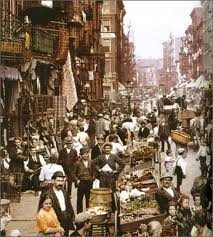
Bella described Attorney Street, the street one block west of Ridge as like Orchard Street, “a market where fruit and vegetable dealers sell to the street and store vendors.  Cases, bulging with oranges or apples and watermelon, line the streets, while men with live, dirty hands darted among them with eyes that took in everything.  People live on these streets as well, rotting in their cases with the overripe fruits.” (p. 8)

lower east side

Fanny soon decided that she would prefer working in a factory to being a house servant.  Her next job was working as an operator in a ladies’ shirtwaist factory for $7.50 a week.  Bella and Fanny moved to Cannon Street where they lived with a widow named Pincus.  Bella went to a day nursery while her mother was at work.  The nursery was located in the basement of a building on Cannon Street, which Bella described as “gloomy but much warmer than the rooms all of us had just left.”  Overall, Bella’s experience at the day nursery sounded positive, with pleasant caretakers, but the days were very long, stretching past seven at night, and the space was overcrowded with too many babies and young children.

Unfortunately, once again Bella experienced some abuse.  Fanny trusted Mrs. Pincus, her landlady, to get Fanny up and to the nursery, and Mrs. Pincus ended up hitting and pinching Bella, once leaving her with such a huge bruise that Bella had to admit to her mother that Mrs. Pincus was abusing her. These experiences finally led Fanny to decide that she needed to find a place of her own where she would take in boarders to help pay the rent and provide her with some income.  She found a place in a new building on Cannon Street near Rivington Street, a three room apartment (bedroom, kitchen and dining room) with its own bathroom, and took in several boarders.

In the foreword to the book, Ruth Limmer provided a description of early tenement houses: “horrific five- and six- story dwellings that…lacked toilets, running water, fire escapes, and landlord-supplied hear and cooking stoves.” (p. xix)  By 1903, however, newer buildings had been built that were somewhat of an improvement.  “Now each apartment had, in addition to its windowed “front room”…another room that opened onto an air shaft, and interior windows were cut into the walls in order to permit a flow of air.  Little by little, the apartments were fitted with piping for illuminating gas. And instead of backyard privies, families got to share indoor toilets, two per four-apartment floor.  The law also required that fire escapes be affixed to all buildings.”  (p. xix)  The tenements were built on lots originally intended for single family dwellings ( 25 feet by 100 feet), but they housed over twenty families plus boarders in each building.

les interior

I imagine that this is like the apartment that Fanny and Bella were renting in 1903 and likely also what the Brotmans were living in on Ridge Street.  The census from 1900 did not list boarders as living in the Brotman household; perhaps Joseph’s income as a coal carrier/dealer was sufficient to support the family, though I doubt their standard of living would be acceptable to any of us today.

inside tenement

Bella described the many boarders, both men and women, who shared their small space, men sleeping in the kitchen, women in the living room and bedroom with Bella and Fanny.  You can imagine the goose bumps I got when I read that two of the young girls living with them at the beginning were named Frieda and Gussie.  Obviously, those girls were not our Frieda and Gussie, and those were common names for Jewish girls at that time, but nevertheless, once again the book made me realize that I was reading not about some foreign land or a work of fiction, but a work that reflects what life must have been like for the Brotman family living on Ridge Street in 1900.

More to come….

My Grandparents

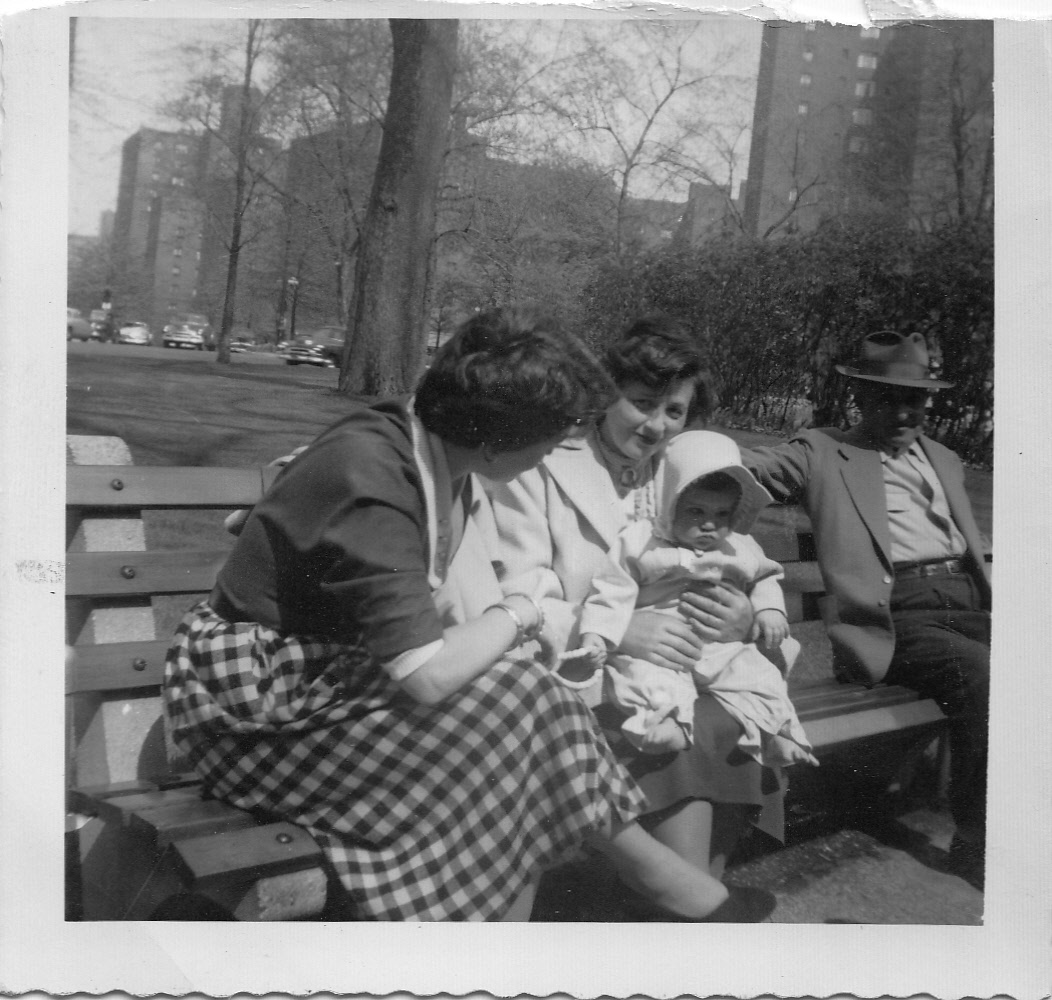
I was scanning an old album of photographs I have yesterday, and I decided to try and inspire some of you to do the same by posting a few photographs of my grandmother and my grandfather with me when I was a little girl.  These pictures brought back the feelings I had as a little girl for my grandparents.  Although I have only vague memories of my grandfather who died in May, 1957,  when I was almost five, looking at these pictures reminded me of how much time I spent with him as a small child.  My grandparents lived right near us in Parkchester until we moved to Elmsford in January, 1957, just a few months before my grandfather died.  I must have seen them almost every day.  We also spent summers together in a rented cottage on Long Pond near Mahopac, NY.  Here are a few of those photographs.

Gussie and Amy 1953

Gussie and Amy 1953

My Grandparents, my mother and me, 1953

My Grandparents, my mother and me, 1953

Grandma and Amy 1954

Grandma and Amy 1954

spring 1955

Long Pond Summer 1954

Long Pond Summer 1954

My Grandparents

My Grandparents

My Grandparents with me OCtober 1956

My Grandparents with me October 1956

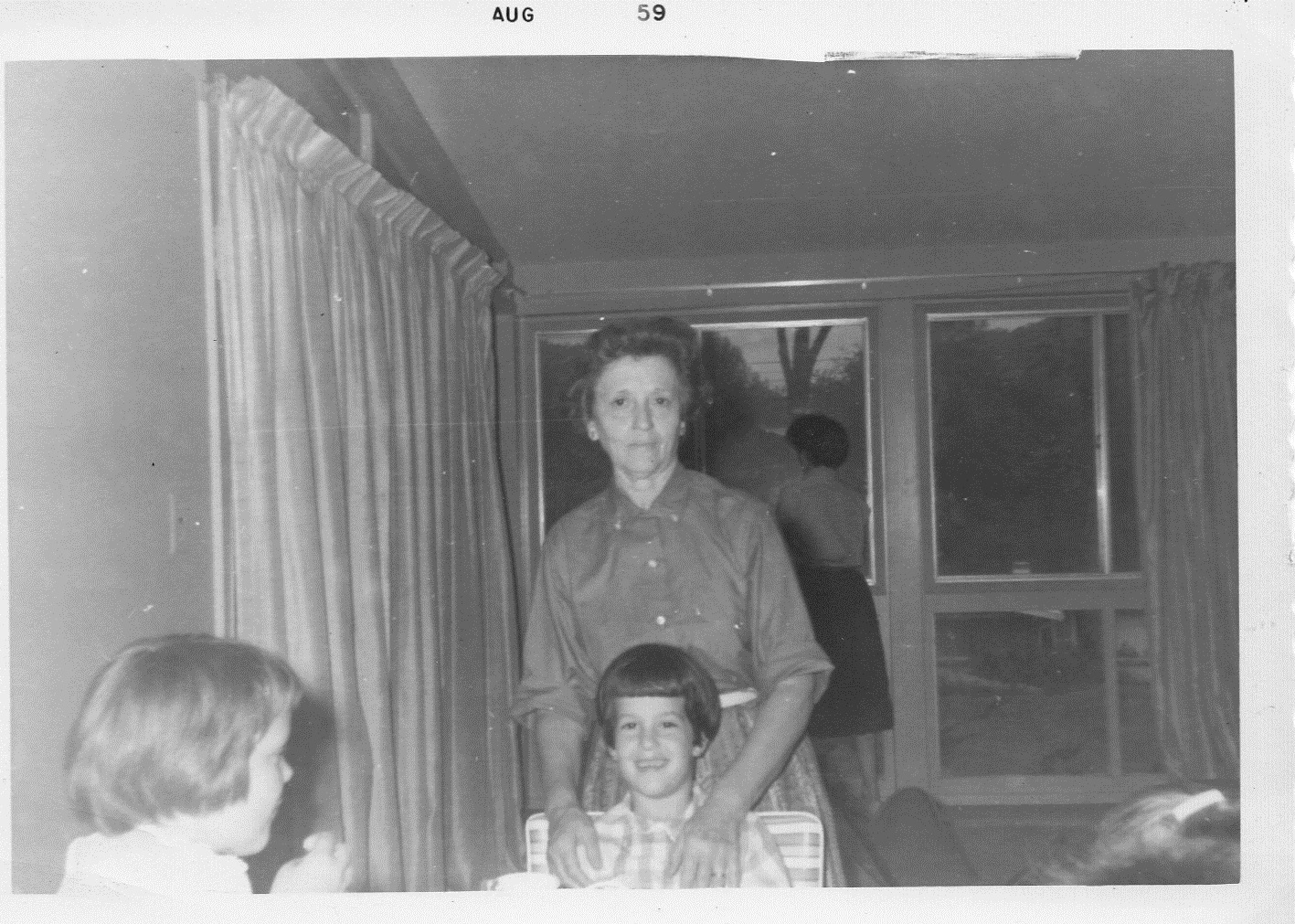
My seventh birthday party

My seventh birthday party

Tillie’s Death Certificate

I received Tillie’s death certificate yesterday, and as I expected, it did not contain any new information about where our family lived in Galicia.  It does, however, confirm that she was the daughter of Joseph and Bessie Brotman (not that I had any doubts) and was born in Austria. Of course, it has a different birthdate from other documents; some documents say she was born in 1884, some 1887, and this one says 1882. The ship manifest which lists her as a passenger in 1891 has her age as six years old, giving her a birth year of 1884 or 1885.  The month of her birth is also inconsistent. The 1900 census said her birthday was in February; the death certificate says August.

Tillie Ressler's death certificate

Tillie Ressler’s death certificate

Interestingly, the death certificate itself has two different ages listed for Tillie at her death.  On the left side (filled out by her son Joseph, as far as I can tell), it says she was born in 1882 and was 73 years old at the time of her death, i.e., February 1956, which would be consistent with a birthday of August 23, 1882.  It also says she was a resident of NYC for 71 of those years, however, meaning she arrived when she was two years old, i.e, in 1884.  Well, we know she came in 1891, so that can’t be correct. On the right side, typed in by the hospital, it says her approximate age was 70 years old at the time of her death, meaning she would have been born in 1886.  So…let’s compromise and say she was born in February, 1884, which is what her own parents told the census taker in 1900.

What the certificate really confirmed for me, however, is what an excellent memory my mother has.  She had just told me over Thanksgiving that Tillie had lived on the Grand Concourse with her sons Joe and Harry and that she had died at a hospital on Welfare Island.  I have to say that when I saw both those facts confirmed in the death certificate, I was very impressed (though not surprised) that my mother had remembered such specific details, especially since I often can’t remember things that happened much more recently.

I was curious about Bird S. Coler Hospital where Tillie died because my mother had very sad memories of visiting her aunt there.  It had opened in 1952 as a public hospital on Welfare Island (now called Roosevelt Island) as a rehabilitation and long-term nursing facility, so it was a relatively new hospital at the time Tillie was there.  It still exists today, now called Coler-Goldwater Specialty Hospital and Nursing Facility, and still functions as a public chronic care facility.

I am now just waiting for Hyman and Sophie’s marriage certificate, and I think I will have all the American “vital records” that exist for Joseph and Bessie and their seven children.

A Call to Israel!

Just to show that I never give up, I thought I’d report on a phone call I made this morning to Shmuel Brotman of Kiryat Tivon in Israel.   Renee, my mentor, made the suggestion that I look for any Brotmans who had lived in Dzikow by checking both JRI-Poland and the database at Yad Vashem.  Both sources found one family, the family of Shmuel and Zipporah Brotman, who had resided in Dzikow/Tarnobrzeg.  It looked like the entire family had died in the Holocaust, but Renee suggested I contact the person who had submitted the names to Yad Vashem, Shmuel’s daughter-in-law Chana Brotman.

I then had to track down Chana Brotman.  I knew from the Yad Vashem submission that she had lived in Kiryat Tivon in 1997 when she submitted the names of Shmuel and his family, and so I made a request on both the JewishGen website and on Gesher Galicia for help in locating the family.  By this morning I had several responses, including two that gave me phone numbers, one for Chana and one for her son Shmuel.  The person who provided me with Shmuel’s number had just spoken with him and said he was awaiting my call.

I jotted down some notes and then called Shmuel.  He’s about my age and fluent in English.  He was very happy to help me, and we spent about half an hour, comparing notes and trying to figure out whether there is a connection between our families.

At the moment I still don’t know what the connection is, but it seems likely that there is one.  His grandfather Shmuel Brotman was born around 1888 in Dzikow, and his great-grandfather’s name was Moshe.  I don’t yet know where Moshe Brotman was born.  He could even be the same Moses Brotman who ended up in Brotmanville.  We still have to sort more things out.

He did tell me that he has done some research and believes that the Brotman family originally came from Georgia in the former Soviet Union and left to escape the pogroms.  He believes they changed their name to Brotman to get across the border.  According to Shmuel, some Brotmans went to the US, some to Romania, and some to Poland, including his family.  Whether our ancestors were also part of that family I don’t yet know, but it is a possibility.

So just as I was about to give up hope of finding more traces of our family, I received a glimmer of hope this morning from Israel.  No matter where this goes, it was another one of those uplifting experiences where strangers helped me find someone and that someone ended up being welcoming and hopeful that we are related.

Research update: Bad News, Good News, Bad News

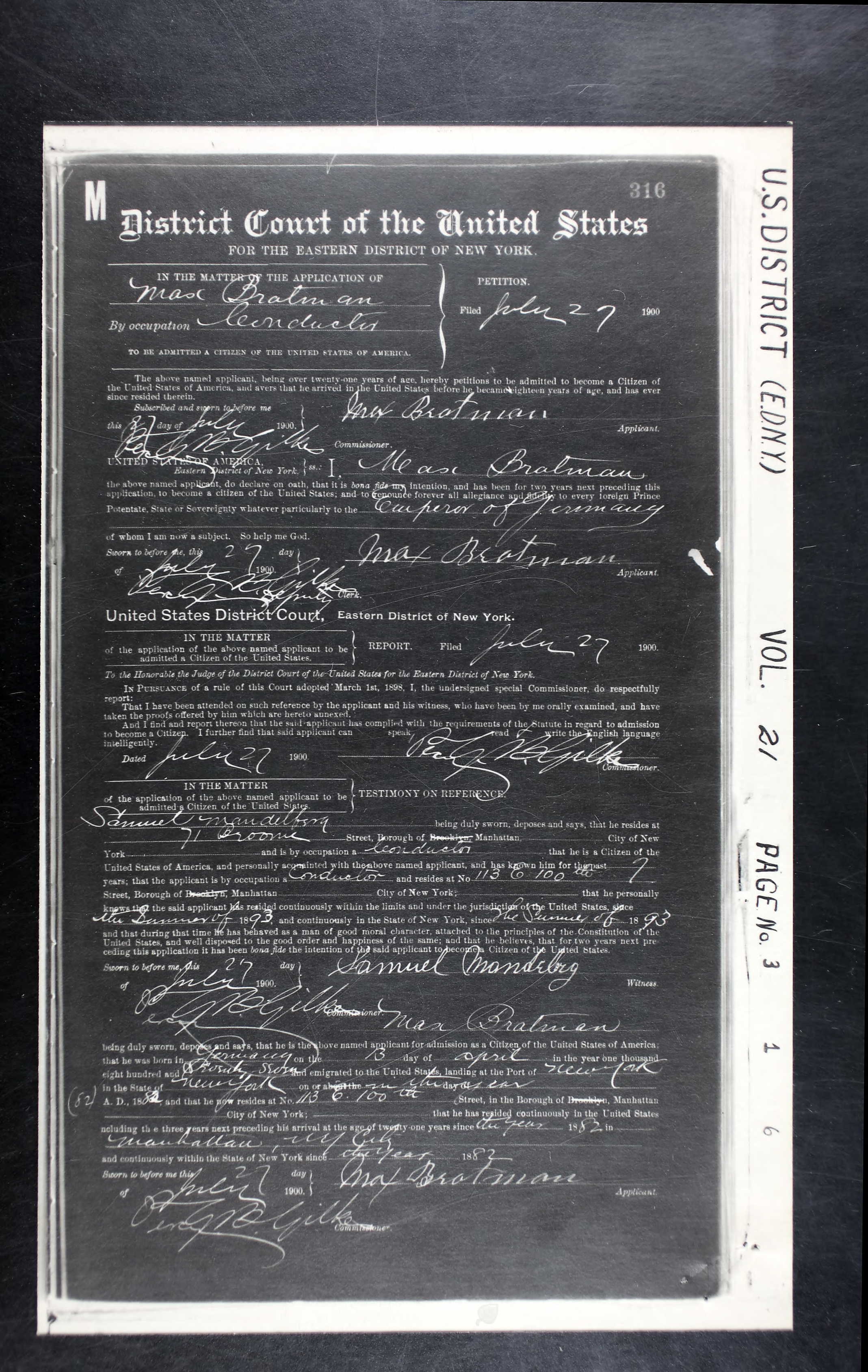
As you may recall, on October 31, I sent a request to the USCIS  for the naturalization papers for Max Brotman in the hope that they would reveal where Max and thus the other family members were born in Galicia.  According to the automated message on the USCIS phone, it could take at least 90 days to get a response.  Well, I figured the news wasn’t going to be good when I received a response yesterday only 35 days after making my request.  And it wasn’t—they had no records for a Max Brotman who fit the dates I had submitted.  In fact, all their naturalization records start in 1906, and I should have known that Max was naturalized before 1906 since he was the witness for Abraham in 1904.

I then went back to ancestry.com and rechecked my search of their naturalization records where I had been able to find records for both Abraham and Hyman.  I checked and rechecked pages and pages of indices, searching for anything that might relate.  I found one for a Max Bratman born in Germany who worked as a conductor for the railroad and emigrated in 1882, but dismissed it because the name, place of birth, and date of immigration seemed wrong.

Max "Bratman" Naturalization Card

Max “Bratman” Naturalization Card

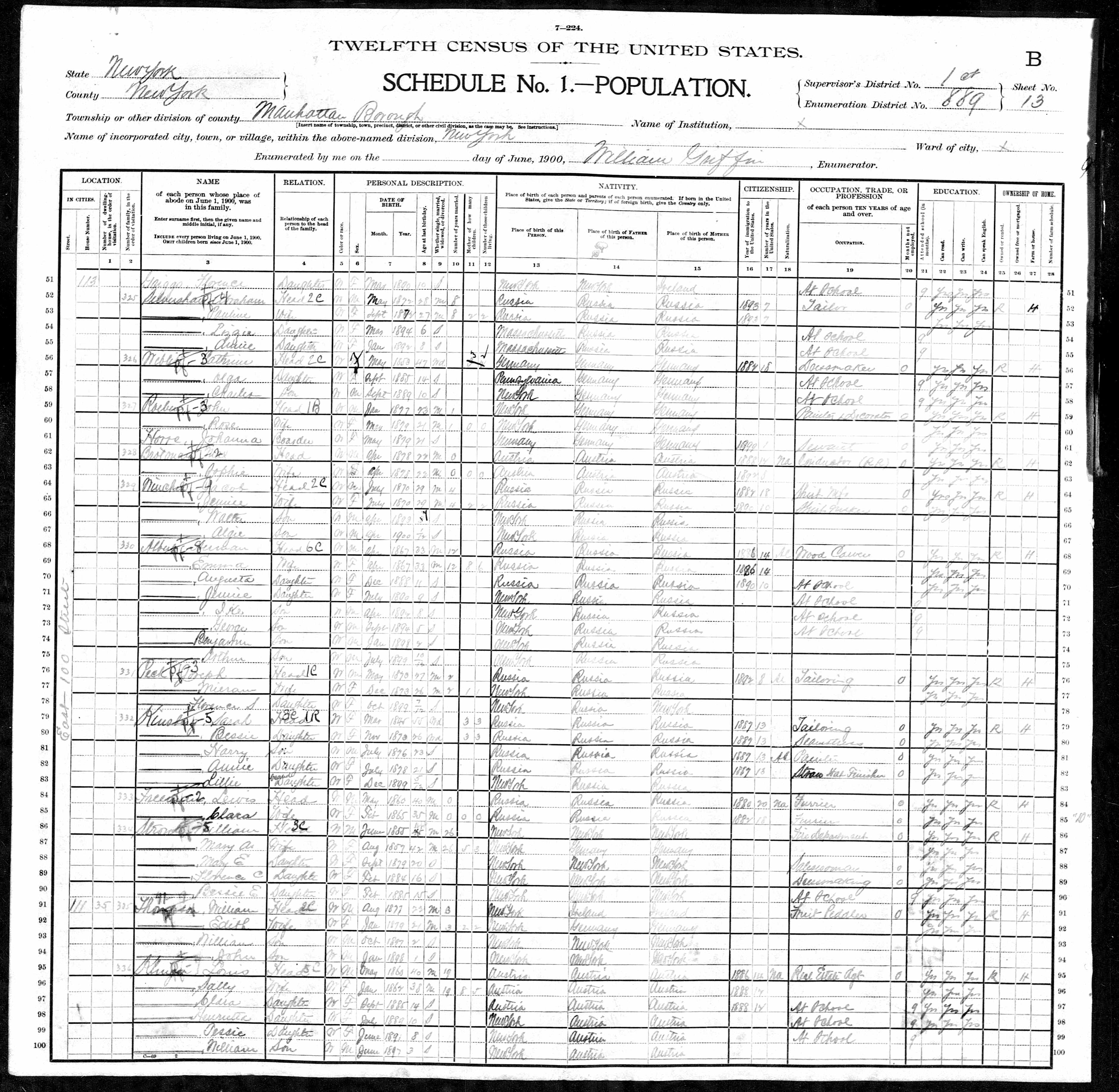
Then I went back to the records I already have for Max, including several census reports, his marriage certificate and his death certificate.  While reading through the 1900 census, I noticed that it said Max was a conductor.  At that time he and Sophie were just married (the census was taken in June; they had married in April) and were living at 113 East 100th Street in Manhattan.  When I saw the entry that he was a conductor, I knew it rang a bell, but at that point I could not remember where else I had seen it.

1900 US Census Report for Max and Sophie Brotman

1900 US Census Report for Max and Sophie Brotman

I began to search through the naturalization records again and could not find any reference to a Max Brotman who was a conductor.  I started thinking that I was losing my mind! Then I remembered that there had been a Max BrAtman and searched for him, and lo and behold, found the naturalization card again for the conductor.  I looked at the address on that form and sure enough, Max Bratman was living at 113 East 100th Street in Manhattan in 1900 when he filed this application.  Obviously this was the same person, our Max, but why did he spell his name wrong? Why did he say he was born in Germany and emigrated in 1882? The birth dates also did not exactly line up, but I am used to the fact that no one ever reported their birthday consistently.

When I looked at the handwritten application, I saw that the signature was definitely Max BrOtman, not BrAtman.

Max Brotman naturalization petition

Max Brotman naturalization petition

My guess is that the clerk who filled out the card just could not decipher the handwriting.  As for the wrong date, I have no guess except that Max was confused, wasn’t clear, or was trying to make it seem he’d been in the US for more than just 12 years.  As for why Germany? I wish I knew.  I know from Joseph Margoshes’ book that secularized, modern Jews were referred to as “German” in Galicia. Perhaps that’s why Max said Germany.  Perhaps the clerk thought he was German because of his name, accent and use of Yiddish and suggested it to him and Max just agreed? I have no clue.

The census form was filled out just a month earlier than the naturalization form.  The census says his place of birth was Austria as does every other document listing Max’s place of birth.  The census says he emigrated in 1888, which is also consistent with almost all the other forms.  It would have made little sense for Max to have emigrated in 1882 when he was only four years old.  So once again, we have evidence that forms are unreliable, that our ancestors were not too reliable, and that much must be left to conjecture and speculation.

So where does that leave us in terms of identifying where our family lived in Galicia? Hanging on the thin thread of Hyman’s own unreliable documents, our best guess is Dzikow near Tarnobrzeg.  I contacted Stanley Diamond who manages the archives of documents for JRI-Poland, and he sent me a list of all the records of all Brotmans and Brots from that area.  They are almost all of people born after 1900, and Stanley said that the records for that area are rather limited.  He said it would probably take a trip to archives in a few cities in Poland to learn if there is anything else and that that is probably a long shot.

And thus, my cousins and friends, I think that for now I have hit a wall. I am still waiting for Tillie’s death certificate and Hyman’s marriage certificate, but I am not putting any hope into finding out more information about their place of birth from those documents. I am in touch with a researcher in Poland, and I am hoping to travel there perhaps in 2015, but for now I guess we have to accept that the best we can do is hang our hopes on Hyman’s references to Jeekief and Giga and assume that Dzikow near Tarnobrzeg is our ancestral home.

Tillie’s Story

Image

Although I have no memory of meeting Aunt Tillie, I heard her name all the time when I was growing up. (I don’t know which spelling she preferred; sometimes it is Tilly, sometimes Tillie.  I have used both spellings throughout the blog.)  She was very close to my grandmother Gussie, and my mother and her sister and brother adored her.    She was described to me as a lot of fun: vivacious, outgoing, funny and loving.  It seems she was the one who provided a lot of the happy experiences for my mother and her siblings growing up.

Like my grandmother, she had a tough life.  She was born in 1884 and came to the US with Bessie and Chaim when she was 6 or 7 (census reports are in conflict; some say 1890, some say 1891).  In 1900 when she was sixteen, she was living on Ridge Street with her parents, her brother Hyman, and her two little sisters, Gussie, who was five, and Frieda, was three.  When her father Joseph died a year later, my guess is that Tillie must have become a second parent to Gussie, Frieda and the infant Sam.

In 1905 when she was 22, Tillie married Aaron Ressler.  At the time she was still living on Ridge Street with her mother and siblings.  Aaron was 26 at the time and was also living in the Lower East Side.  By 1910, Tillie and Aaron had three sons, Leo, Joseph, and Harry, all under five.  They were living at 94 Broadway in Brooklyn, where they owned a grocery store at 100 Broadway.  In addition, Gussie had moved in with them, choosing to live with Tillie instead of moving in with Bessie after she had married Phillip Moskowitz.  (Bessie and Phillip were still living on the Lower East Side in 1910, so moving to Brooklyn must have been a big deal for twelve year old Gussie.) Gussie helped take care of the boys while Aaron and Tillie worked in the store.  Family lore has it that my grandfather spotted my grandmother while she was sitting in the window of Tillie and Aaron’s store.

Life must have seemed pretty good for the Ressler family in 1910.  By 1918, however, things had changed.  On Aaron’s draft registration form of that year, he reported that he was not employed and was suffering from locomotor ataxia, a condition that causes pain and loss of muscle control and movements.  The 1920 census did report that Aaron worked at a grocery store, although it also said he worked at home.  They no longer lived on Broadway, but on Ralph Avenue in Brooklyn.  Aaron died six years later in February, 1926, leaving behind Tillie and three sons aged 20, 19, and 17.

Tillie continued to run the grocery store for some time after Aaron died. I cannot find any record of Tillie and her two younger sons in the 1930 census, but in 1940 she was living on the Grand Concourse in the Bronx with Joe and Harry (Leo had married Mildred and moved to Connecticut by then).  According to the census, she had also lived at this same address in 1935, so at some point Tillie had left Brooklyn as a widow with two almost grown sons and moved all the way to the Bronx.  She never remarried and died at age 72 in 1956 after suffering from painful arthritis.  My mother remembers that she was treated with cortisone, perhaps excessively, and ended up dying in a public hospital on Welfare Island in NYC, where my grandmother would go to see her every week.

I don’t know why she moved to the Bronx, perhaps to make a fresh start.  My mother remembers that Aunt Tillie lived in an apartment on the then-glamorous Grand Concourse with her two adult sons, Joe and Harry.  I don’t know how she supported herself after Aaron died, but somehow she did.  My mother was born after Aaron died, and so she only knew Tillie as a widow, yet she remembers Tillie as a happy, upbeat person who would bring my mother baked goods (and once a large easel) that she carried on the subway from the Bronx to Brooklyn on her weekly trips. Tillie was the one who held the family together—the one who encouraged my aunt Elaine to go stay with Leo and Mildred in Connecticut to broaden her horizons, who took my mother to baseball games, who could occasionally get my shy grandmother to socialize. When my sister was born in 1955, Tillie brought treats not only for my mother, but also for the other new mothers who were sharing the same hospital room.   She was a woman who was born in Europe, but spoke English like an American, who brought up three sons, took care of her sisters and brothers, and was one of the most positive influences on my mother and her siblings. She was strong and positive despite all the hardships she had faced.  I wish I had had a chance to know her.