I’m Ba-a-a-ck! With an Update on Lillian Rosenzweig

After a week away in the beautiful Florida Keys where we were able to put the miserable New England winter weather behind us and enjoy the outdoors, kayaking, swimming, walking, and seeing wildlife including dolphins and alligators, I am back in New England with the miserable winter temperatures outside, but happy knowing that spring is at least here on the calendar if not in the weather quite yet.  It has to get above freezing soon, doesn’t it?

While I was away I received a number of documents, mostly confirming the hunches I’d had about Lillian and Rebecca Rosenzweig.  Today I will focus on Lillian.  About ten days ago I posted what I knew and thought I knew about Lillian.  I believed that she had married Toscano Bartolini in July, 1901, had had a son William born in March, 1902, and then lost her husband in 1904.  All of those facts are now confirmed by the marriage certificate, William’s birth certificate, and Toscano’s death certificate, all of which I received late last week.

First, as you can see from the marriage certificate, Lillian and Toscano were married by an alderman, not a rabbi, on July 6, 1901. This is clearly the right Lillian Rosenzweig, as her parents’ names are Gustav and Gussie nee Sagg.  According to the certificate, Lillian was then eighteen years old, which would have made her birth date 1883—a year before her parents married.  Lillian must have lied about her age in order to get married without parental consent.  I have speculated elsewhere that she was likely born in 1885 since her parents were married in June, 1884.  Also, Lillian’s address is given as 320 East 9th Street—not in Brooklyn where her parents were living.  She must have moved out before she married Toscano, who was living on Sullivan Street at that time.  These inferences are consistent with the family story that Lillie’s marriage to someone who was not Jewish led to disapproval and perhaps some estrangement from her family.

Bartolini Rosenzweig marriage certificate

Bartolini Rosenzweig marriage certificate

From William’s birth certificate, another inference seems possible.  William was born on March 9, 1902, just eight months after Lillie and Toscano had married.  Perhaps Lillie was already pregnant at the time of the wedding, although I am not sure she would have known that at the time since she would have been just one month pregnant.  It is, of course, entirely possible that William was a month premature. William was born at home—177 Houston Street in NYC.  Interestingly, Lillie’s age is now reported as seventeen—a year younger than she had reported on her marriage certificate a year earlier.  If she was in fact seventeen in March, 1902, her birth year would have been 1885, as I suspected.  It also means she was only sixteen when she married Toscano.

William Bartolini birth certificate

William Bartolini birth certificate

The other interesting fact gathered from this certificate is that Lillie had already had a child before William’s birth, but that that child was no longer living.  When could she have had that child?  Her marriage certificate reported that her marriage to Toscano was her first marriage.  Had she had a child with him before they married? Had she had an out-of-wedlock child with someone else? Had that child really died or had she given that child up for adoption and simply reported it as if he had died?  I have no idea and no idea how to try and figure that out. (It’s also sad that on the 1910 census when Lillie was back living with her parents, she is listed as single and having no children.)

The third document in this trilogy is Toscano’s death certificate.  Toscano died on April 27, 1904, from chronic nephritis, kidney disease, at age 27.  He’d been working as a bartender and died at 69 Carmine Street in NYC.  He had only been in the US for five years, had been married for less than three years, and left behind his 19 year old wife and 2 year old son.  I don’t know what causes chronic nephritis, although it looks like uremia is given as a contributing cause of death.   But I’ve never heard of someone dying at age 27 from that today.

Toscano Bartolini death certificate

Toscano Bartolini death certificate

The rest of the story, as reported earlier, shows a family in disarray.  Lillie and William moved back to Brooklyn and were living with Gustave and Gussie and the family in 1905, indicating at least a temporary reconnection.  In 1906, however, William was living at the Brooklyn Hebrew Orphanage.  Although it appeared that he was released back to his mother for some time, by 1910 William was living at St. John’s Home in Brooklyn and in 1915 at the NY Catholic Protectory.  Lillian, who was living with her parents in 1910 without William, then disappears from the records.

I still have not found either William or Lillian after that.  I don’t know what happened to either of them.  Joseph’s grandchildren told me that at some point Lillie was back in touch with her siblings, but no one knows anything more specific than that.  I will keep looking for some new clue, but for now I’ve hit the proverbial brick wall with Lillie and William Bartolini.

What I do know is an incredibly sad story of a young woman, emigrating with her family from Romania when she was only a young child, having two children before she was eighteen years old, losing one apparently to death and another to institutional care, losing a young husband after just a few years of marriage, and losing the support of her family as well for at least some period of time.  It’s a story to contrast with the story of Leah Strolowitz Adler, the daughter of Tillie Rosenzweig and Jacob Srulovici, who also came to the US as young girl but found the American dream.

The story of Lillie Rosenzweig raises so many questions: how did she, a young Jewish immigrant living in Brooklyn, meet and get involved with a young Italian immigrant who was living in the Lower East Side, not Brooklyn? Who was the father of her first child, and what happened to that child? What happened to William after he left the Catholic Protectory? Did he have any contact with his mother or her family? And what happened to Lillie after 1910? Did she remarry and regain custody of William? Did she also die at a tragically young age? These loose ends make me crazy—I want some endings to the story, but I may have to accept that I may never know what happened.
Enhanced by Zemanta

The Story behind the Photograph

Florence Cohen

Florence Goldschlager Cohen

A while back I posted about this photograph of my mother, a photograph I’d never seen before.  My cousin Robin had sent it to me, but neither of us knew when it was taken.  It looked like a professional photograph, and I could not figure out who took it or why my mother was sitting for a formal photograph.

I finally got around to asking my mother about the photo a few weeks ago.  At first she could not recall when it was taken.  What she remembered was that she had purchased the sweater while visiting her brother and sister-in-law in West Hartford.  My Aunt Lynn had taken her shopping, and my mother remembered what a good time they had and how much she enjoyed visiting with them for a long weekend.  She thought that perhaps the photograph was taken by my Uncle Maurice.

But I pointed out to her that it looked like a professional photograph.  I asked her when she had cut her hair short since I knew that it was long when she graduated from high school in 1948 and short by the time she married my father three years later.  She could not remember the exact year, but said that she had cut it after an interview with the Barbizon School of Modeling.  The people there had suggested that she cut her hair, and so my mother did, much to my grandmother’s dismay.  She recalled that she must have visited my aunt and uncle shortly thereafter and purchased the sweater then.  She then went back to the Barbizon School to have a professional photograph taken.  Although she never pursued a modeling career, that photograph certainly is evidence that she could have.

Enhanced by Zemanta

Great-grandparents

Ron, Joe and Sadie Rosenzweig’s grandson, sent me these wonderful photographs of Joe and Sadie with their great-grandson Bradley as a newborn in 1982 and then as a toddler in 1982.

Joe and Sadie Rosenzweig in 1982 with Bradley Marc, their great grandson

Joe and Sadie Rosenzweig in 1982 with Bradley Marc, their great grandson

1983

1983

These photos reminded me of some pictures I have of my parents with their great-grandson Nate.  As magical as it is to be a grandparent, I can only imagine what it must be like to be a great-grandparent—to see yet another generation, your grandchild’s child, enter the world and become a person.

My father with Nate June 2010

My father with Nate June 2010

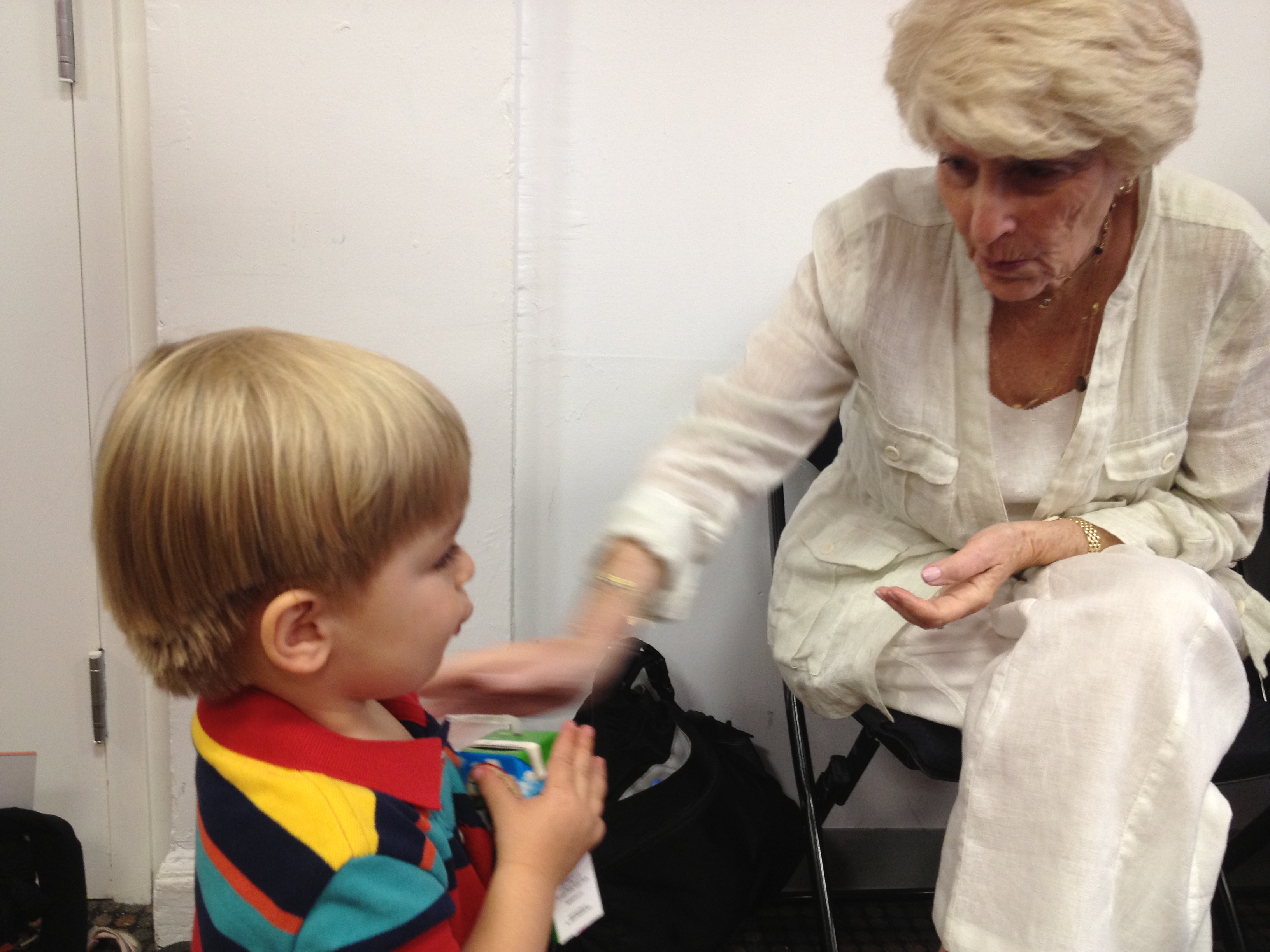
My mother with Nate 2012

My mother with Nate 2012

Today it is not all that rare for people to live to see great-grandchildren.  What a contrast to the experience of those who were born in the late 19th and early 20th century.  My great-grandfather Joseph Brotman lived to see just one grandchild’s birth, Ethel Brotman, Abraham’s daughter. My great-grandfather Moritz Goldschlager died before any of his grandchildren were born.  My great-grandmothers were much more fortunate; they both lived long enough to see the births of all their grandchildren, but none of their great-grandchildren.

We are so much luckier today.  Every minute I spend with my grandson Nate is a joyful, magical moment for which I am so grateful. When I see these pictures of children with their great-grandparents, it makes me realize how lucky those children are and how lucky those great-grandparents are to be able to have those moments together.

Rose Fischer Schoenfeld

Rose Fischer Schoenfeld

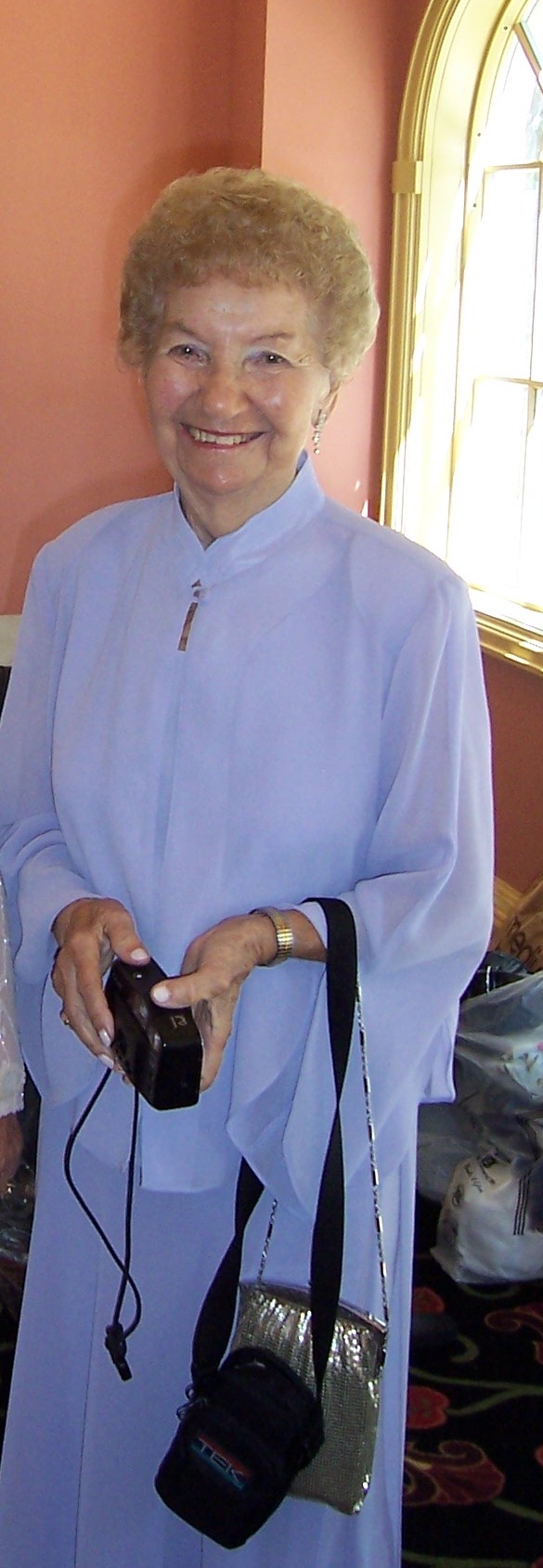
In loving memory of Rose Fischer Schoenfeld, who passed away last night at the age of ninety-eight.  She was my son-in-law Brian’s beloved grandmother and Nate’s adoring great-grandmother.  She was blessed to live to see  and know many great-grandchildren, including Aaron, Ben and Nate.  May her memory be a blessing.

A Celebrity Connection: Louis Gossett, Junior

Actor Louis Gossett, Jr. at the 16th Annual Mo...

Actor Louis Gossett, Jr. at the 16th Annual MovieGuide Faith and Values Awards Gala (Photo credit: Wikipedia)

Sometimes when doing genealogy research, the world seems very small.  Six degrees of separation becomes more than a Kevin Bacon game, but a reality.  Little did I know that I was six degrees of separation from living with Oscar Award winner  Louis Gossett, Junior.

The story is really about Sarah Rosenzweig, Gustave and Gussie’s second daughter.  Sarah was born in New York City around 1888, according to several census reports.  (I’ve yet to locate her actual birth record.)  She appears on the 1900, 1905, and 1910 census reports living with her parents and siblings.  In 1900, she was in school; in 1905 she was doing housework; and in 1910 she was a “saleslady” in a department store.

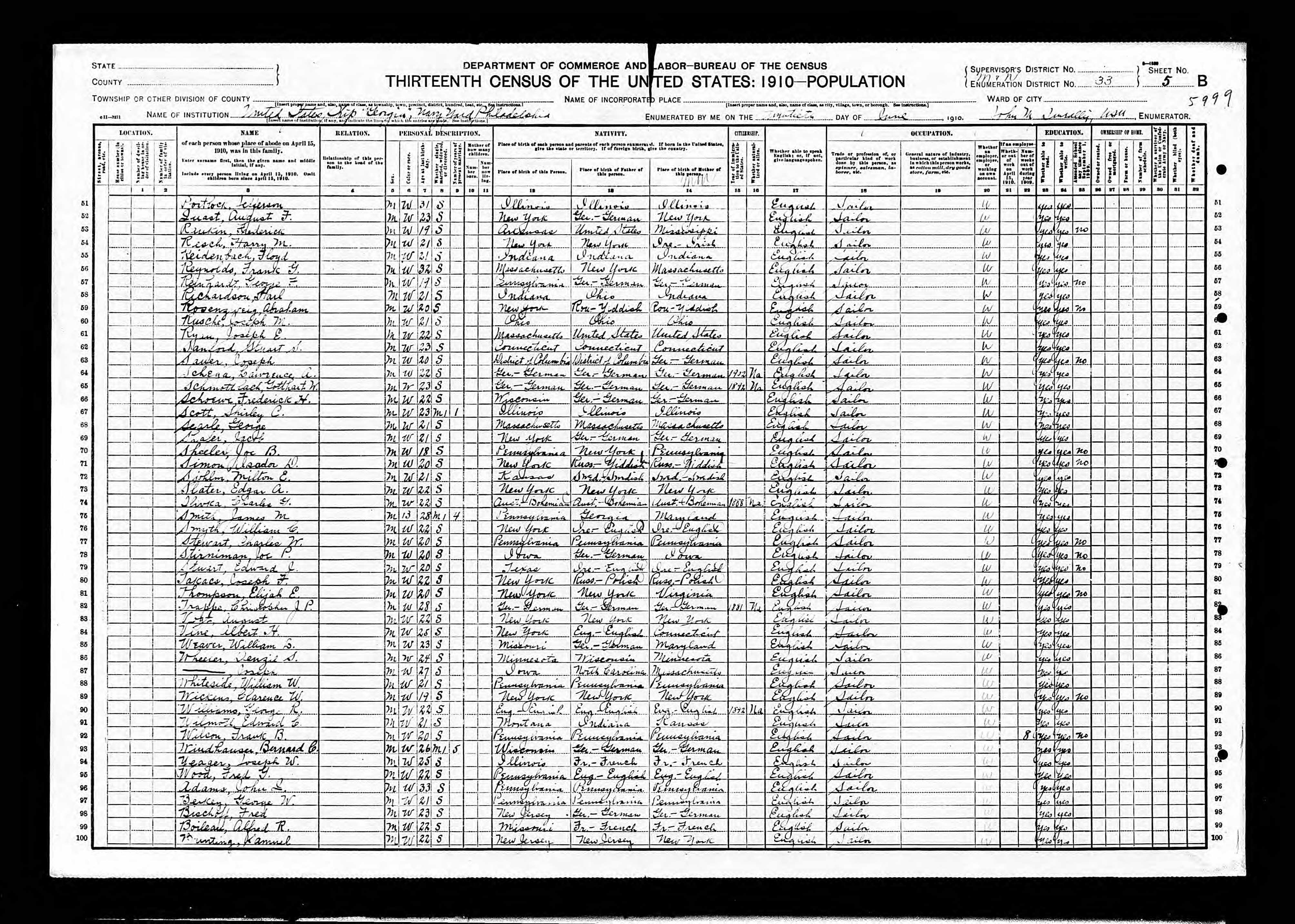
Gustave Rosenzweig and family 1900 census

Gustave Rosenzweig and family 1900 census

Gustave Rosenzweig family on the 1905 NYS census

Gustave Rosenzweig family on the 1905 NYS census

Gustave Rosenzweig and family 1910 census

Gustave Rosenzweig and family 1910 census

On March 26, 1911, Sarah married Samuel Kurtz, born in Brooklyn to Lena and Solomon Kurtz.

Sarah Rosenzweig and Samuel Kurtz marriage certificate

Sarah Rosenzweig and Samuel Kurtz marriage certificate

Sarah and Sam settled in Brooklyn, and in 1915 Sam was working as a clerk in a department store while Sarah was home.  Their first child, Solomon, named for Sam’s father, was born in 1918, and in 1920 Sam and Sarah were living on Howard Avenue in Brooklyn.  Sam was employed as a driver for a laundry business. Their second child, Benjamin, was born later that year.  In 1924, Sam and Sarah’s daughter Rebecca was born.

Kurtz family 1920

Kurtz family 1920

Although I have not found the Kurtz family on the 1925 census, I did find them on the 1930 census, living on Neptune Avenue with the three children and two lodgers, Victor Oleson, a 64 year old Swedish-born house painter (like Sarah’s father) and Louis Gossett, an eighteen year old born in South Carolina, working as a newsboy.  As soon as I saw the name, I thought, “Could this be Louis Gossett, Junior’s father?” I checked the box for race on the census, where it was reported that Louis Gossett was “neg” or Negro.  I began to think this could be more than coincidental.

kurtz family 1930

kurtz family 1930

So I googled Louis Gossett, Jr., and I saw that he was born in Brooklyn in 1936, making it quite possible that his father had been living in Brooklyn six years before.

I then found  a blog describing an episode of Who Do You Think You Are, the television show that was a part of what had inspired me to start researching my family history.  One of the episodes had traced the family history of Louis Gossett, Jr.  I had seen this episode, but forgotten the specific details. The blog post retraces Gossett’s family history all the way back to the mid-1800s including his father’s birth in South Carolina and includes a snip from the 1930 census when Louis Gossett, Sr. was living with my grandfather’s cousin, Sarah Rosenzweig Kurtz.

So I think that’s within six degrees, right? Louis Gossett, Jr—Louis Gossett, Sr—Sarah Rosenzweig—Gustave Rosenzweig—Ghitla Rosenzweig—Isadore Goldschlager—Florence Cohen—me.  Okay, seven degrees.  But really, who’s counting?

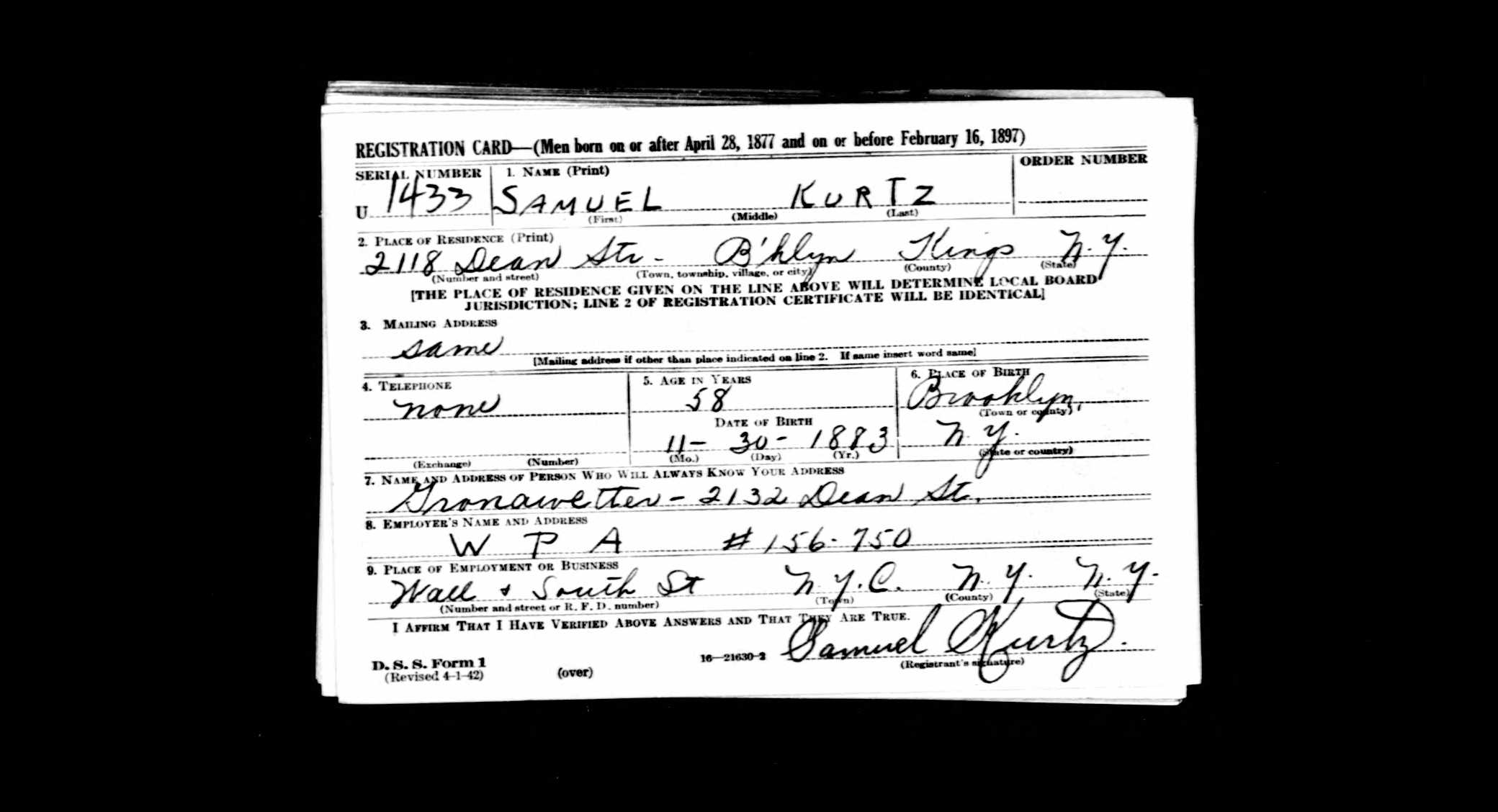
As for Sam and Sarah Kurtz, by 1940 their two sons and their lodgers were no longer living with them, but their daughter Rebecca was still living with them on Dean Street in Brooklyn, where they also resided in 1942 when Sam registered for the draft.  That is the last record I have of either of them so far.  I have not found any death records yet.  I am also still in the process of researching the lives of their three children, Solomon, Benjamin, and Rebecca.

Sam and Sarah Kurtz 1940 census

Sam and Sarah Kurtz 1940 census

Sam Kurtz World War II draft registration

Sam Kurtz World War II draft registration

But what I learned from researching Sarah’s life up through 1942 is that you never know what surprises you may uncover while doing family research.  You never know who crossed paths with your ancestors or what stories may lie beneath the cold hard data you can find on the records.  It is endlessly fascinating.

Enhanced by Zemanta

Women are Difficult…to Find and Track, Part I: Lillian Rosenzweig

One thing that has been clear to me for a long time is that women are much harder to track in vital records than men, largely because they traditionally changed their names when they married. The Rosenzweig daughters are a case in point.

I have now located and tracked from birth to death the five sons of Gustave and Gussie: Abraham, David, Jacob, Harry and Joe. For those who survived to adulthood, I know who they married, where they lived, and what they did for a living and their military service.  I still need to trace the children of Abraham and Jack, but I wanted to see what I could find about the five daughters of Gustave and Gussie first.  I’ve been looking all along, but kept hitting walls and so decided to focus on one daughter at a time.  Here’s what I know about Lillian.

The oldest child and the only one born in Romania was Lillie or Lillian.  According to the 1900 census, she was born in July, 1884, in Romania, but since that was only a month after Gustave and Gussie’s marriage, it seems likely that this was an error and that Lilly was probably born during 1885. The census also says that Lillie arrived in 1884, but her father’s naturalization papers say that he arrived in 1887.  In 1900 when she was only fifteen years old, Lillie was working as a typist while her younger siblings were all in school.

Gustave Rosenzweig and family 1900 census

Gustave Rosenzweig and family 1900 census

In 1905 the family had moved to Fulton Street in Brooklyn, and Lillian, now 21 according to the census, was doing housework as her employment.  In addition to the siblings listed on the 1900 census, there were now two additions, Rachel, who was four, and William, who was three.  William is described as a son of the head of the household, which led me to believe that he was another child of Gustave and Gussie.  I was unable, however, to locate William on the birth index as William Rosenzweig, nor did he reappear on the 1905 or 1910 census with the family.

Gustave Rosenzweig family on the 1905 NYS census

Gustave Rosenzweig family on the 1905 NYS census

Once again I searched the death index for a child of Gustave and Gussie, but could not find a death record for William Rosenzweig either.  If he was not living with his “parents” and siblings in 1905, where could he be? I searched on ancestry.com for William Rosenzweig and found him living at the Brooklyn Hebrew Orphanage in 1906.  I knew it was the right boy by his age (four years old), the address from where he was taken (1021 Fulton Street, Brooklyn), and his mother’s name—Lillian nee Rosenzweig.

William Rosenzweig at the Brooklyn Hebrew Orphanage in 1906

William Rosenzweig at the Brooklyn Hebrew Orphanage in 1906

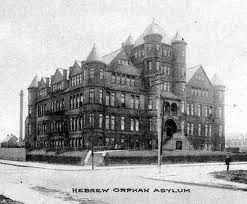
Brooklyn Hebrew Orphanage

Brooklyn Hebrew Orphanage

William was not Gustave and Gussie’s son, but Lillian’s son.  His father is only identified as “Frank (dead),” with no surname.  For the other children listed, their father’s first name is also all that is supplied, but that’s because the child presumably has that surname.  For William, his surname is the same as his mother’s—Rosenzweig, and no surname is given for his father.  I could not find any marriage record for a Lillie or Lillian Rosenzweig between 1900 and 1902 to a Frank, so had Lillian had William out of wedlock? Who was Frank? Was he really dead?

I did find a Frank Cramer who died between 1902 and 1906 and a William Cramer born on March 2, 1902, the birth date provided for William on the orphanage records.  I sent for the birth certificate for William Cramer, but unfortunately that William’s parents were not named Frank and Lillian.

Then last night I went back once again to the marriage index and looked again for a marriage record for Lillian Rosenzweig, but this time I did not limit my search to grooms named Frank.  I restricted the dates to 1900 to 1902, based on the fact that Lillie was single in the 1900 census and that William was born in March, 1902.  I found one marriage of a Lillie Rosenzweig in July, 1901, to a Toscano Bartolini.  Could Frank have been his more American nickname?  I turned to the death index and searched for a death record, and there it was—Toscano Bartolini had died on April 27, 1904, at 27 years old.  Finally I looked for a birth record for a William Bartolini and found one—born March 9, 1902, a mere eight months after Lillie’s wedding to Toscano in July, 1901.  It was all starting to come together.  I obviously have to send away for all these records to be sure that Lillie is Gustave’s daughter and that William is Lillie’s son, but it certainly seems likely that the records will back up my hunches here.  In fact, I checked today on FamilySearch for Toscano Bartolini and found a more thorough description of the marriage record, including a reference to the bride’s parents’ names, Gustav and Gussie.  I will still order a copy of the certificate, but I am now certain that Lillie married Toscano, who died just a few years later, leaving her with a two year old son named William.

UPDATE:  All these facts were confirmed by the documents.  See my more recent post with images of the documents.

After finding all this, I remembered something that Joe’s grandson Ron had told me—that one of Gustave’s daughters had married someone who wasn’t Jewish, and Ariela had said she thought one of the sisters had married someone with an Italian name.  Ron had told me that the family was not happy about this, and that for a long time there was some estrangement.  Despite whatever they felt, however, in 1905 after Frank/Toscano died, Gustave and Gussie took both Lillian and her son into their home.

It also occurred to me that perhaps the reason Lillie used the name Rosenzweig for William and not Bartolini was based on the fact that he was being taken to a Jewish institution.  Obviously Rosenzweig would seem more clearly Jewish than Bartolini.

But why he was taken from the home in 1906 is not explained by the records. The orphanage record indicates that William was discharged to his mother on September 3, 1906, and reports that her address was then 307 East 120th Street in Manhattan, so perhaps there was a falling out with the family.   But in 1910, Lillian was living again with her parents and siblings in Brooklyn, and William was not living with her.  Lillian’s occupation was listed as a trained nurse at a hospital, and she was listed as single, not widowed.  But where was William?

Gustave Rosenzweig and family 1910 census

Gustave Rosenzweig and family 1910 census

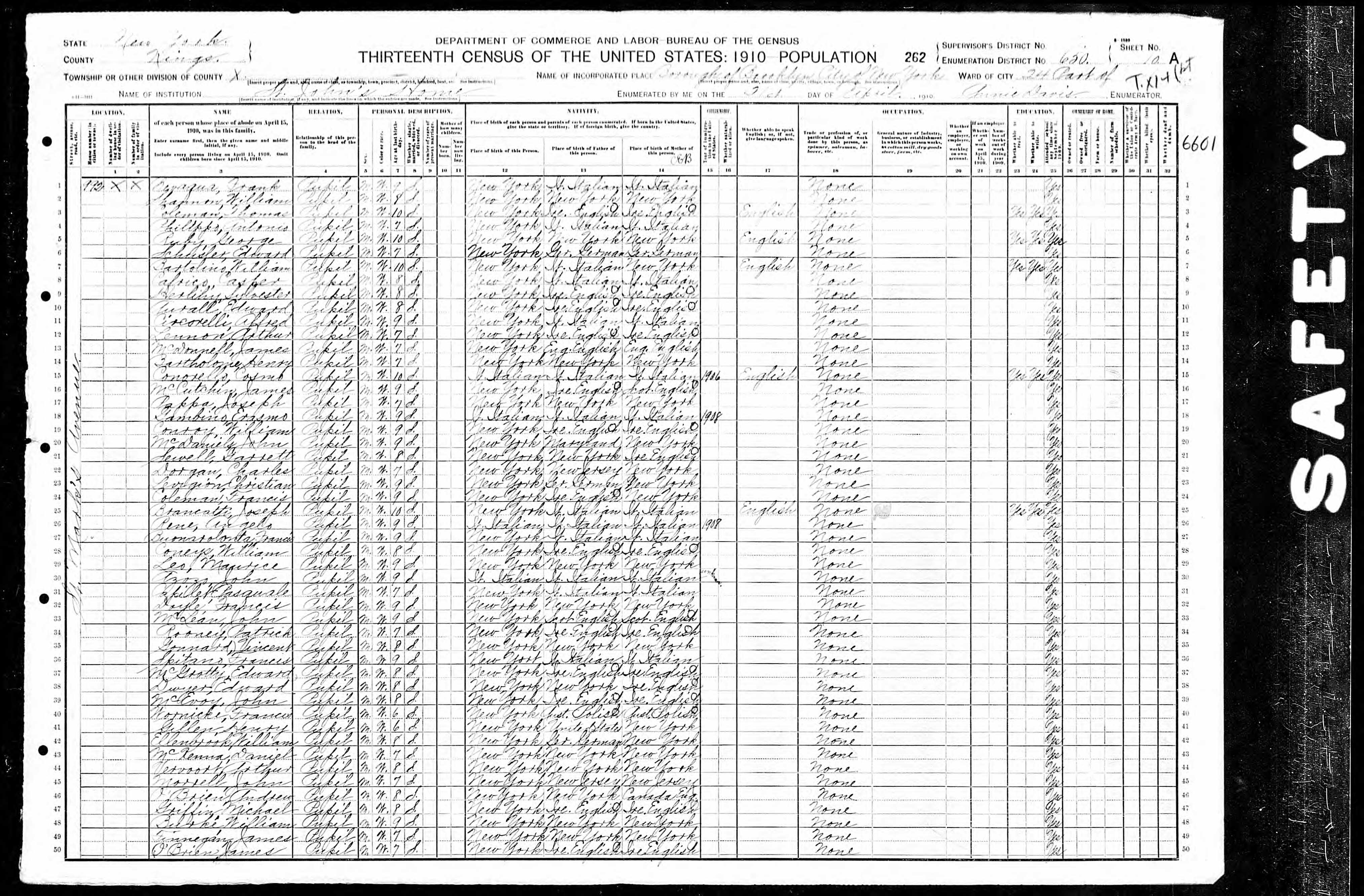
I had not been able to find him as William Rosenzweig in the 1910 census, but now I searched for William Bartolini and found him, living at a residential facility, St. John’s Home in Brooklyn.

William Bartolini 1910 at St John's Home, Brooklyn

William Bartolini 1910 at St John’s Home, Brooklyn

Maybe Lillie placed him there so that she could get training to be a nurse.  Perhaps she just could not take care of him.  Perhaps I can find some records from St John’s Home.

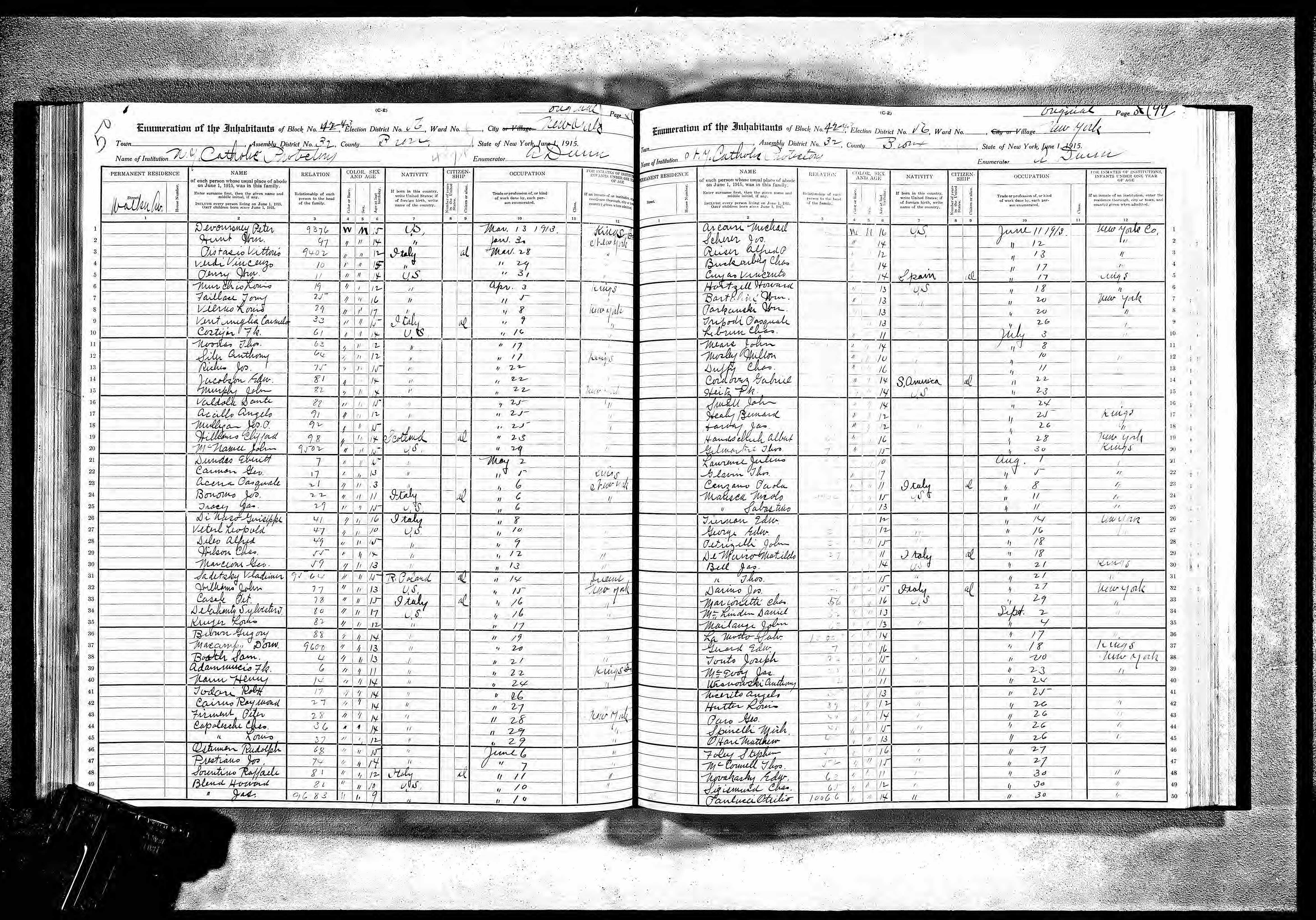
I also was able to find where William was in 1915: another home for children, this one the New York  Catholic Protectory, in the Bronx. (Interestingly, this facility was located where Parkchester is today; Parkchester is an apartment building complex developed by Metropolitan Life Insurance Company in the Bronx and is where my grandparents, my aunt and uncle, and my parents once lived; I lived there also until I was four and half years old.)

William Bartolini 1915 Catholic Protection Bronx

William Bartolini 1915 Catholic Protecory Bronx

It seems that in both 1910 and 1915 William had been placed in Catholic institutions after being at a Jewish orphanage briefly in 1906.  Had Lillie given up her parental rights? Was neither set of grandparents interested or able to take care of the boy? Was William troubled or disabled in some way that made caring for him at home a problem for everyone?  I don’t know the answers, but will try to find out what happened to William after 1915.  Apparently you can order microfilm from the Family History Library and see the actual records for the children who resided there, which I plan to do.

And I cannot find Lillie in 1910 or thereafter.  She was not living with her mother and siblings in 1915 or in 1920.  I cannot find her as Lillie Rosenzweig or as Lillie Bartolini.  Perhaps she remarried and changed her name, but I have not yet found a marriage record.  But now I know that I just have to keep looking.  I almost gave up after Frank Cramer did not pan out.  And then last night I looked a different way and found Toscano Bartolini. I hope I can eventually uncover what happened to Lillie and to William.

Enhanced by Zemanta

Document Updates on David and Jack Rosenzweig

Last week I wrote about Gustave and Gussie’s one year old son David, who died on December 25, 1892.  Today I received David’s death certificate, and it confirmed that this was their son.  It also revealed his cause of death: meningitis.  Having known a young child who had meningitis when he was just a few months old, reading this caused me to stop and once again be thankful that we live in an era of modern medicine where most children survive what were once deadly illnesses, although meningitis remains a danger to children and adults.

David Rosenzweig death certificate

David Rosenzweig death certificate

I also am not sure what to make of the notation here that a contributing cause to his death was teething.  Really?  Teething? I will have to ask my brother whether there is or was anything that linked teething to meningitis and/or death.

The certificate also indicates that the doctor had cared for David from December 6 until December 18, but had not seen the baby in his last week.  He wrote, “Child lingered hopelessly for the last week therefore no MD was called in during last days.” How awful that must have been—to watch a one year old child just literally pass away and not be able to do anything about it.

I also received the marriage certificate for Jacob/Jack/John Rosenzweig and Ethel Bloom, confirming that this was the correct Jacob, as indicated by the names of his parents provided on the certificate.

Jacob Rosenzweig and Ethel Bloom marriage certificate

Jacob Rosenzweig and Ethel Bloom marriage certificate

Interestingly, Jack and Ethel each gave the same residence: 327 Howard Avenue.  I doubt they were living together before they were married (it was 1923), so either they were providing their expected address for after the wedding or they had been living in the same building on Howard Avenue.  Jack was 28 years old, and although he had been living with his family on Bergen Street in 1920, perhaps he had moved out on his own to Howard Avenue and met Ethel there.

Enhanced by Zemanta

The Rosenzweig Brothers: A Family Portrait

Abraham Joseph and John (Jack) Rosenzweig

Abraham Joseph and John (Jack) Rosenzweig

I have now been able to trace the outline of the lives of the three Rosenzweig brothers who survived to adulthood:  Abraham, Jack, and Joe.  I posted elsewhere about Abraham and Joe, so let me fill in the details of Jack’s life.  His name shifted throughout the records from Jacob to Jack back to Jacob and then to John Jacob and finally to John Edward, but based on both clues in the records and confirmation from Joe’s granddaughter Ariela, I am certain that all the records refer to the same person, born Jacob Rosenzweig on August 19, 1895, in New York City to Gustave and Gussie Rosenzweig.

Like his older brother Abraham and his younger brother Joseph, Jacob served in the US Navy.  Like Abraham, he already was a sailor in 1915 before the US entered World War I.

Rosenzweigs 1915

Rosenzweigs 1915

On his draft registration Jack claimed that both his mother and his father were dependent on him.

John Jacob Rosenzweig World War I draft registration

John Jacob Rosenzweig World War I draft registration

I found this interesting for two reasons: first, why would his father be depending on him? Wasn’t he still working as a painter? Also, Joseph had claimed on his draft registration that he was his mother’s sole source of support.  According to his 1917 draft registration, Jack, like Joseph, was then employed by the Brooklyn Rapid Transit Company.  The brothers must have been quite close, living together and working together.  In 1920, Jack was still living with his mother and siblings in Brooklyn and working as a clerk in the shipyard.

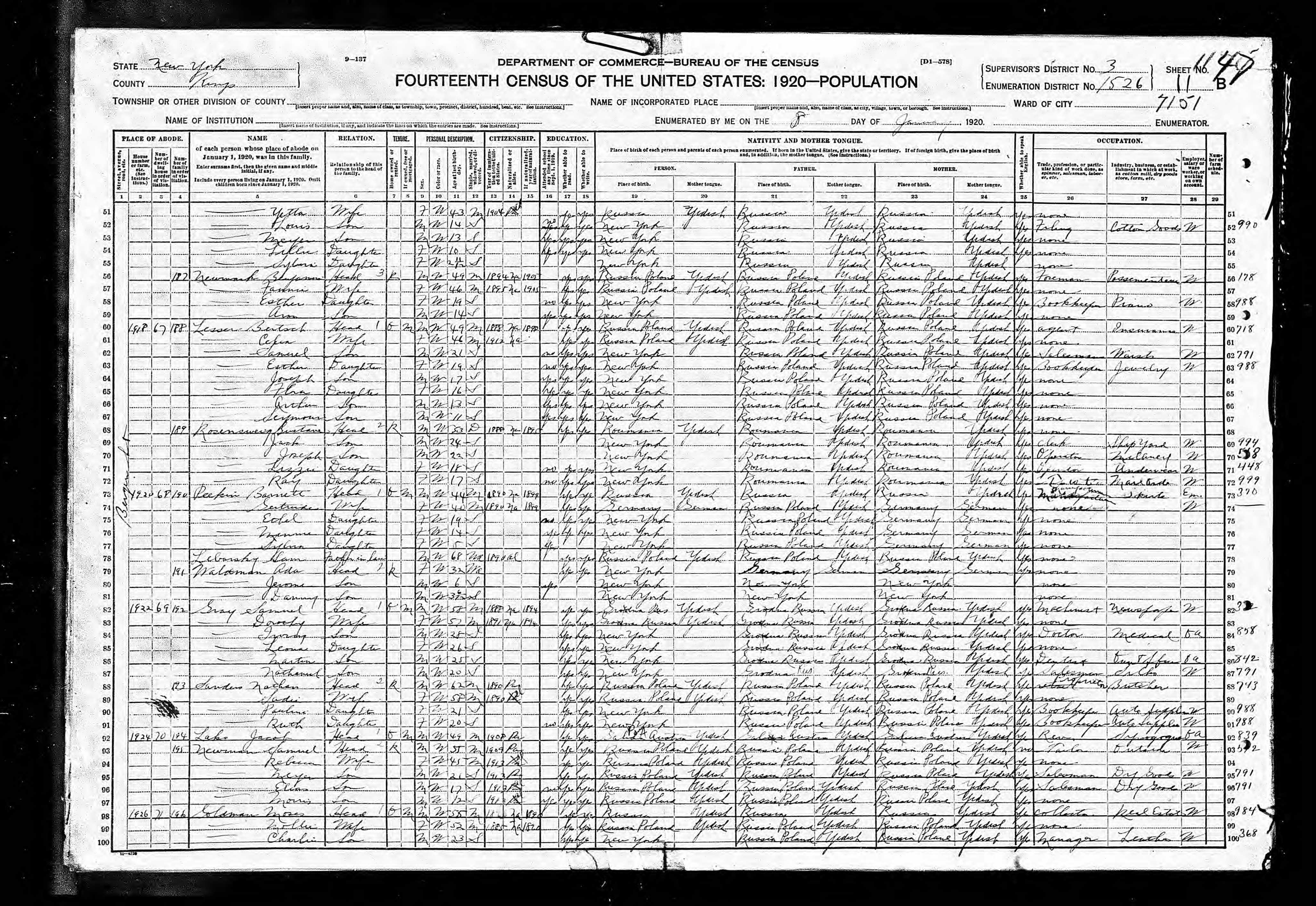
Rosenzweigs 1920 census

Rosenzweigs 1920 census

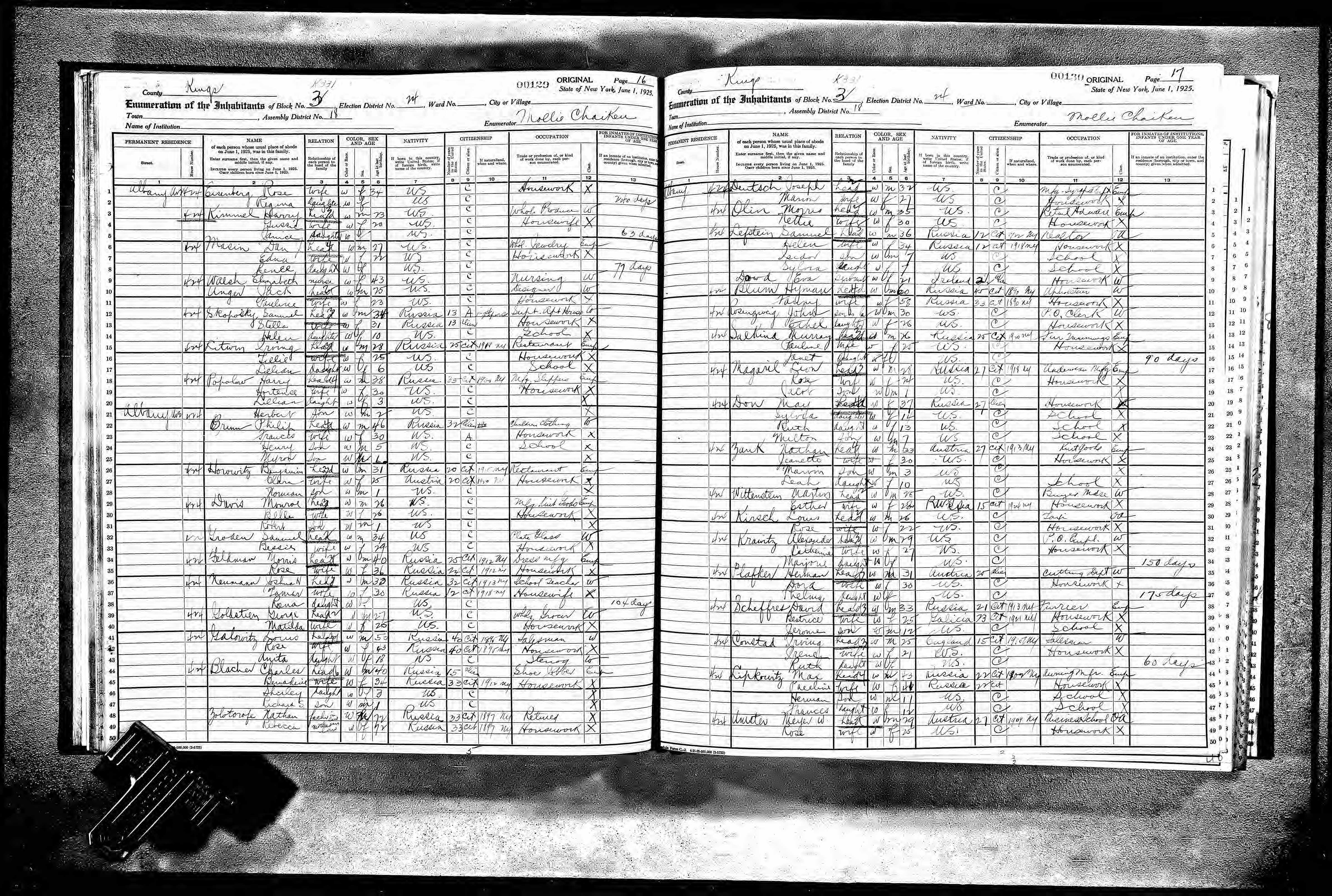
On November 26, 1923, he married Ethel Bloom and was now identifying as John Rosenzweig. In 1925, he and Ethel were living with her parents Fanny and Hyman Bloom in Brooklyn, and Jack was working as a postal clerk.

John E Rosenzweig 1925 NYS census

John E Rosenzweig 1925 NYS census

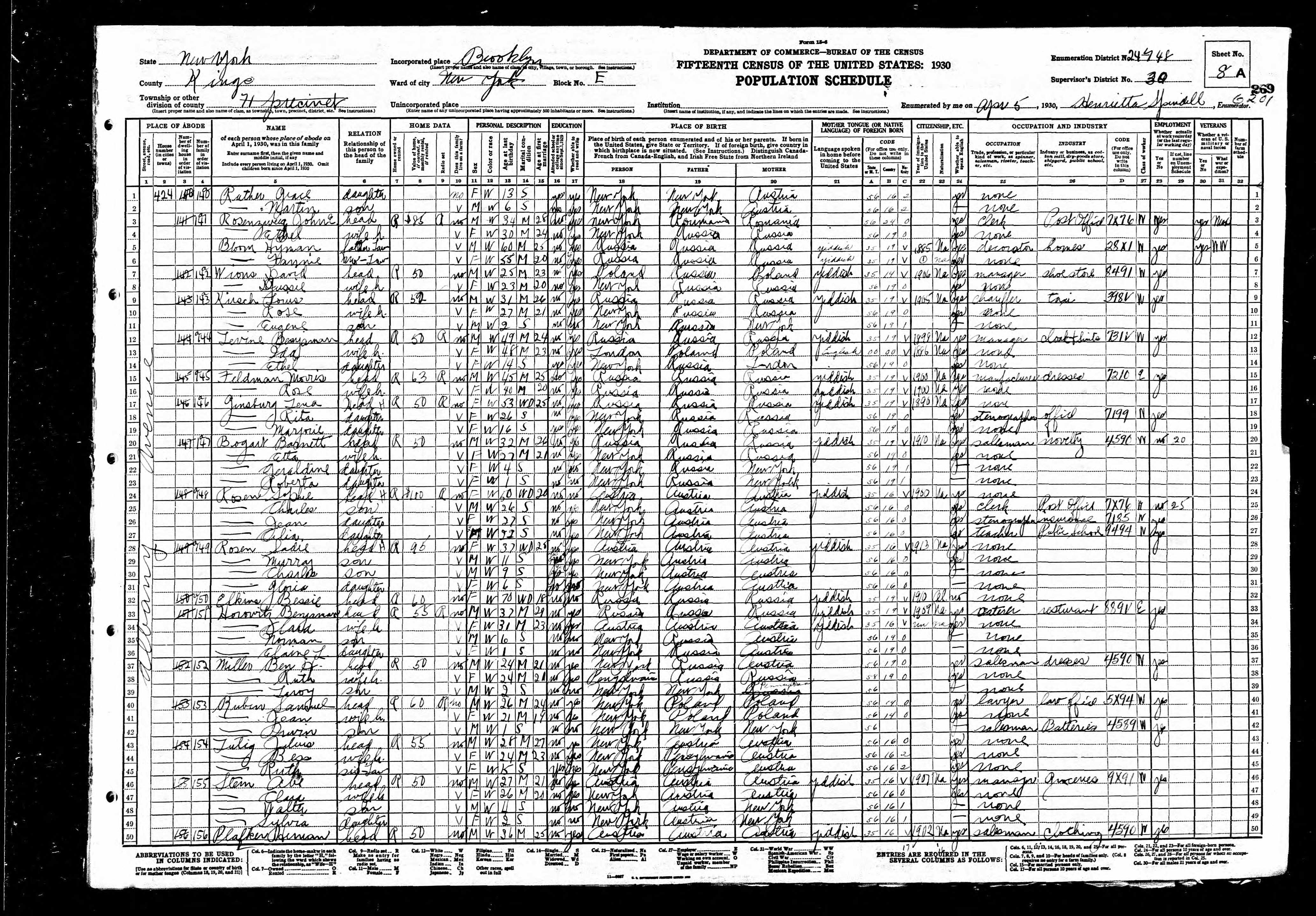
In 1930 Jack is listed as John E. on the census, still working as postal clerk, but now listed as the head of household with his in-laws living with him.

John E Rosenzweig 1930 census

John E Rosenzweig 1930 census

In 1935 Jack and Ethel’s daughter Mona was born, as indicated on the 1940 census.  On that census Jack was still working as a postal clerk.

John Rosenzweig 1940 census

John Rosenzweig 1940 census

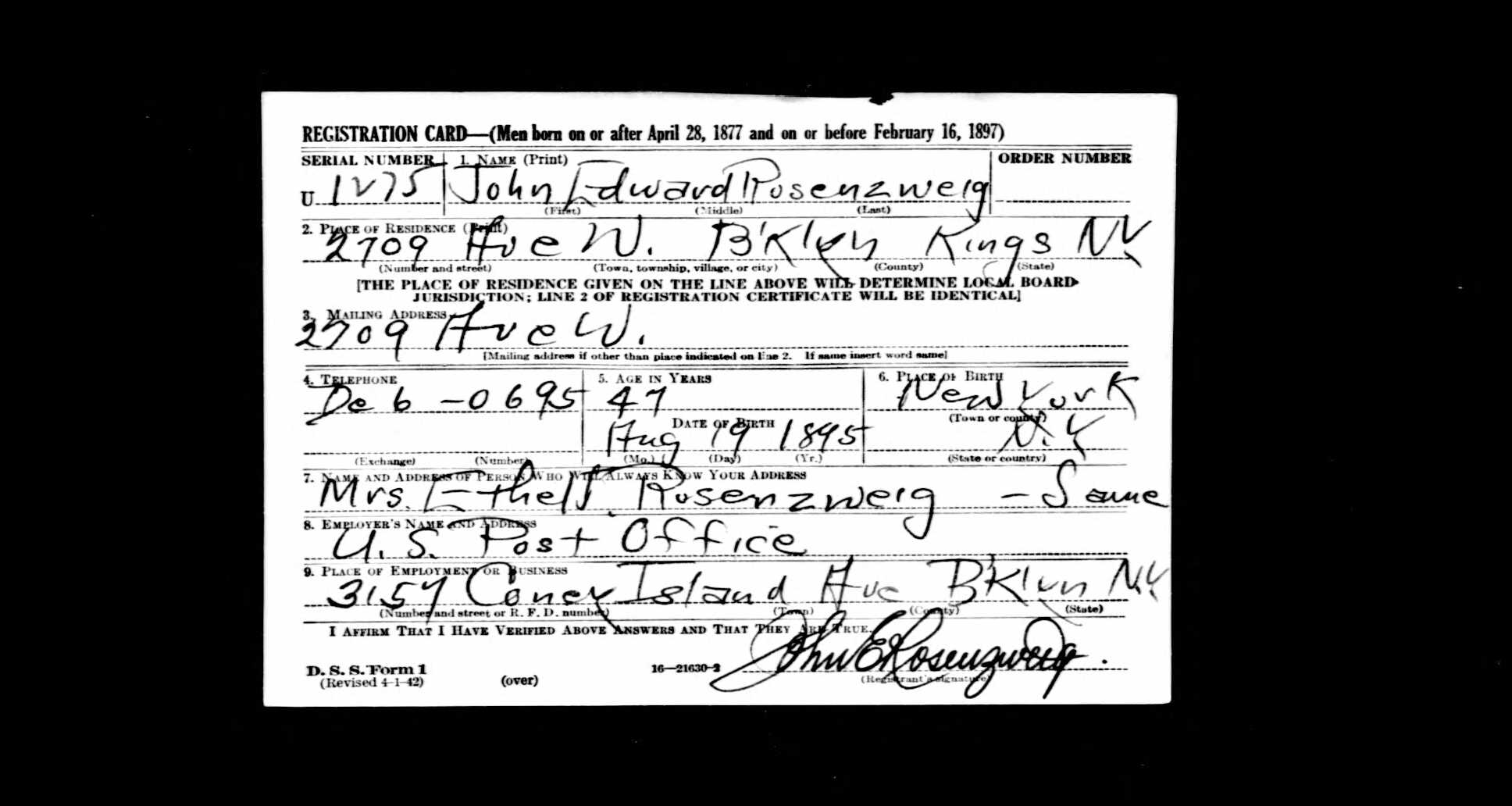
According to his  World War II draft registration in 1942, he and his family were still living in Brooklyn, and Jack was still working for the post office.

John Rosenzweig World War II draft registration

John Rosenzweig World War II draft registration

Sometime after his 1942 draft registration, Jack and his family moved out to Patchogue, Long Island.  Jack died in June 1981, when he was 86 years old.

Jack may have changed his name a few times, but otherwise he seems like an incredibly constant and consistent man.  He remained close to his family, he had a long marriage to one woman, and he worked for the US Postal Service his whole career.

Putting together what I have learned about Abraham, Jack, and Joe from these records and, more importantly from Joe’s grandchildren, I believe that I have a good sense of what these siblings were like.  Despite having endured some terrible family tragedies growing up—the deaths of several siblings in infancy, including David, and of one as teen, Harry, and the apparent divorce of their parents around the time that Harry died, the brothers grew up to be warm, fun-loving and close to each other and to at least two of their sisters, Lizzie and Ray. They were all salt-of-the-earth men—a bakery driver, a postal worker, and a hat maker. Joe quit school after 3rd grade. He was very active in the union as well as an active Mason. He not only supported his own wife Sadie and his daughters Irene and Mildred; he also brought Sadie’s family over from Russia.  Her family lived in his home until they were able to move out on their own.    These three brothers, first generation Americans, worked hard, played hard and loved their children and grandchildren.

I was very touched by the fact that all the grandchildren with whom I have spoken or emailed have such strong feelings of love and affection for their grandfather Joe and grandmother Sadie.  All  mentioned how much they still missed them after all these years.  

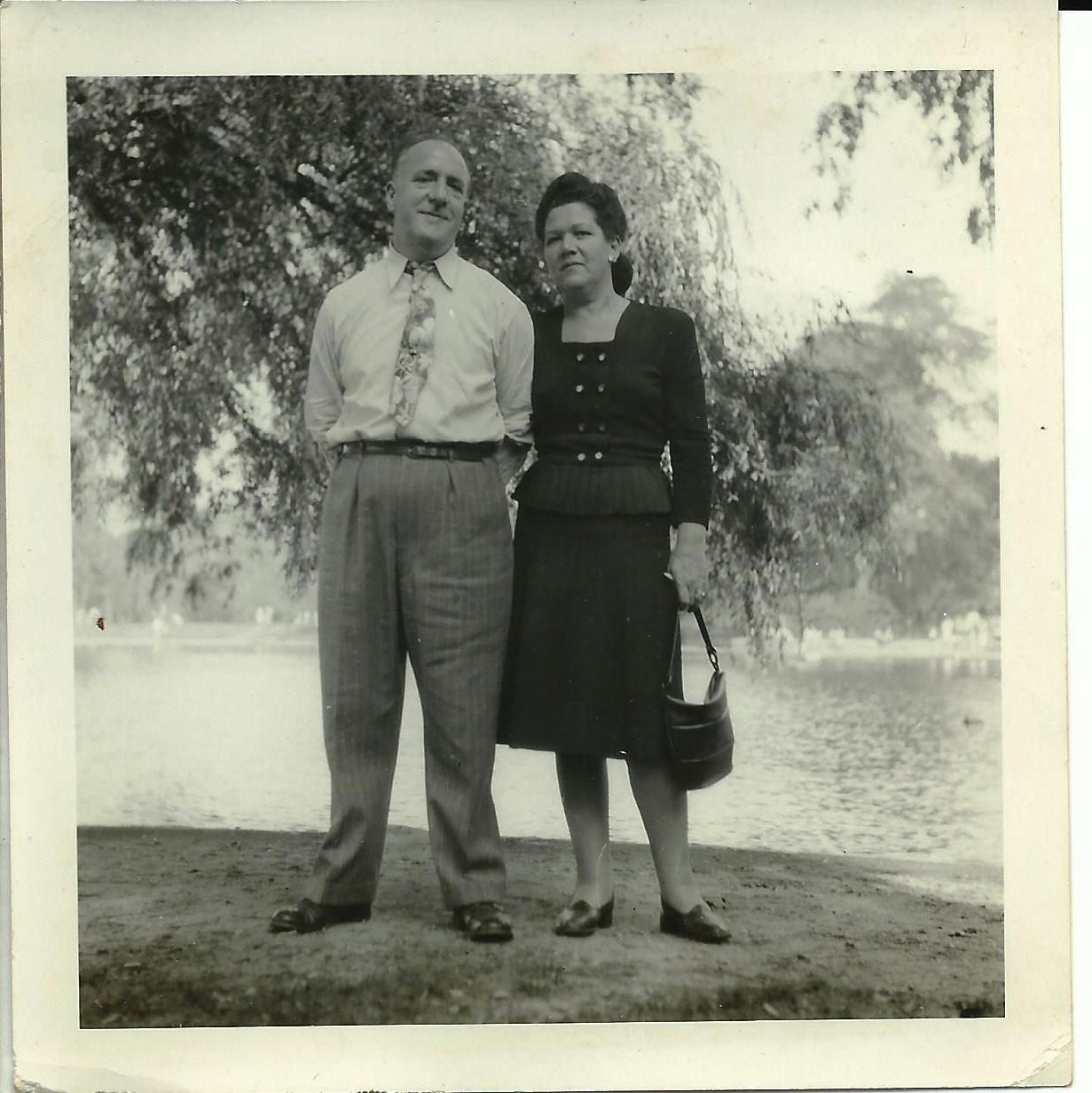
Joe and Sadie

Joe and Sadie

Joe and Sadie

Joe and Sadie

In a comment on the blog, Hava shared that she named her first-born son for Joe and that she sees him as a gift from her grandfather.  She wrote, “My older son is named for him, and I believe the first thing Joe did when he got to heaven was send my Joe’s soul to be born to me! I’d been trying to get pregnant 5 years and we conceived the night Joe passed away.” 

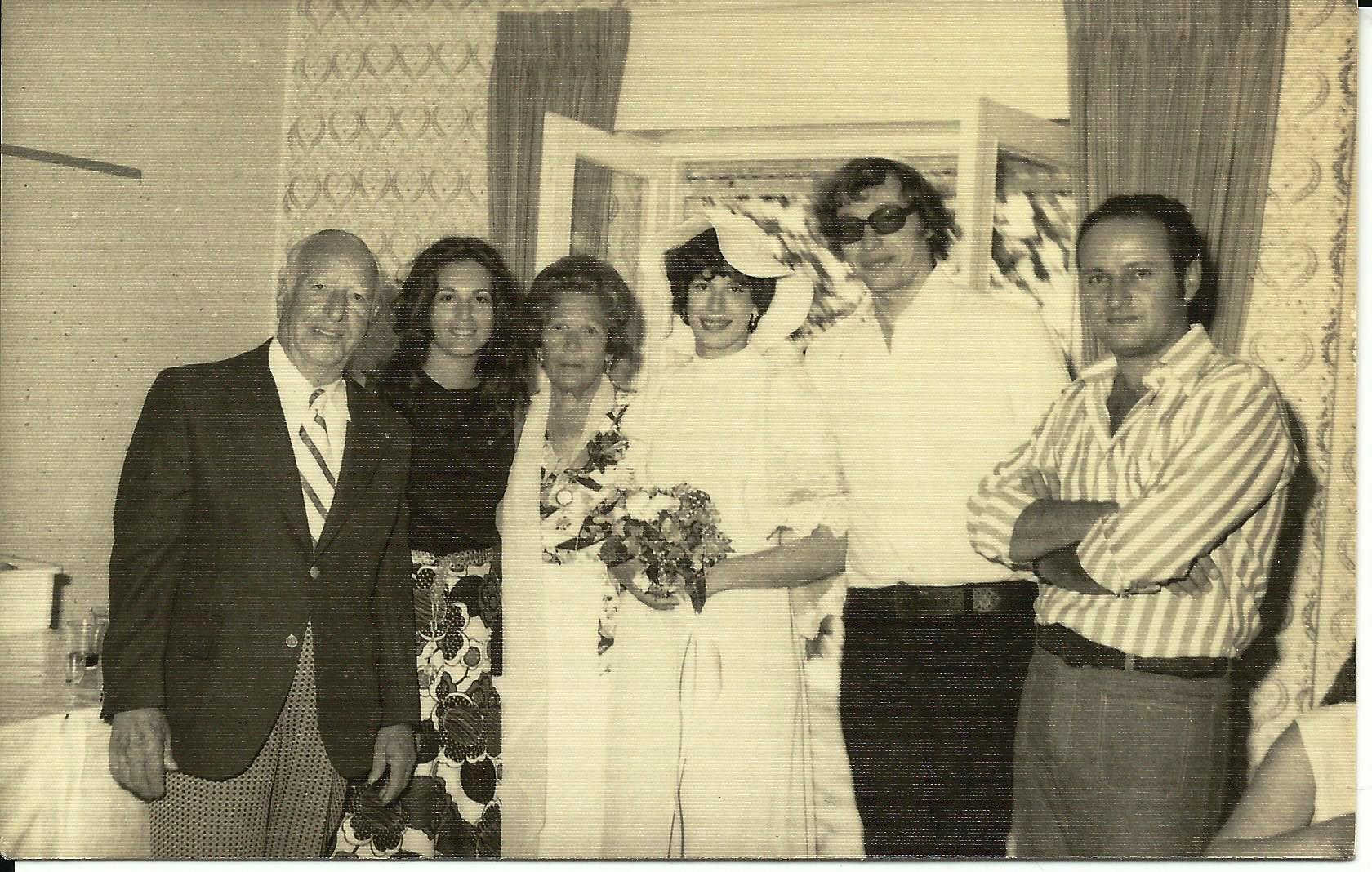
Ariela described her grandfather Joe as very fun-loving and outgoing.  She said that he “loved children – and children loved him.  He would walk around with pistachio nuts and Hershey’s Kisses and M&M’s in his pockets and distribute them to any child he would meet. He was warm, loving and nurturing and generous.  He would sometimes stop the car in the middle of the road and start dancing to the music on the radio.” 

Joe at Ariela and Uri's wedding in 1974

Joe at Ariela and Uri’s wedding in 1974

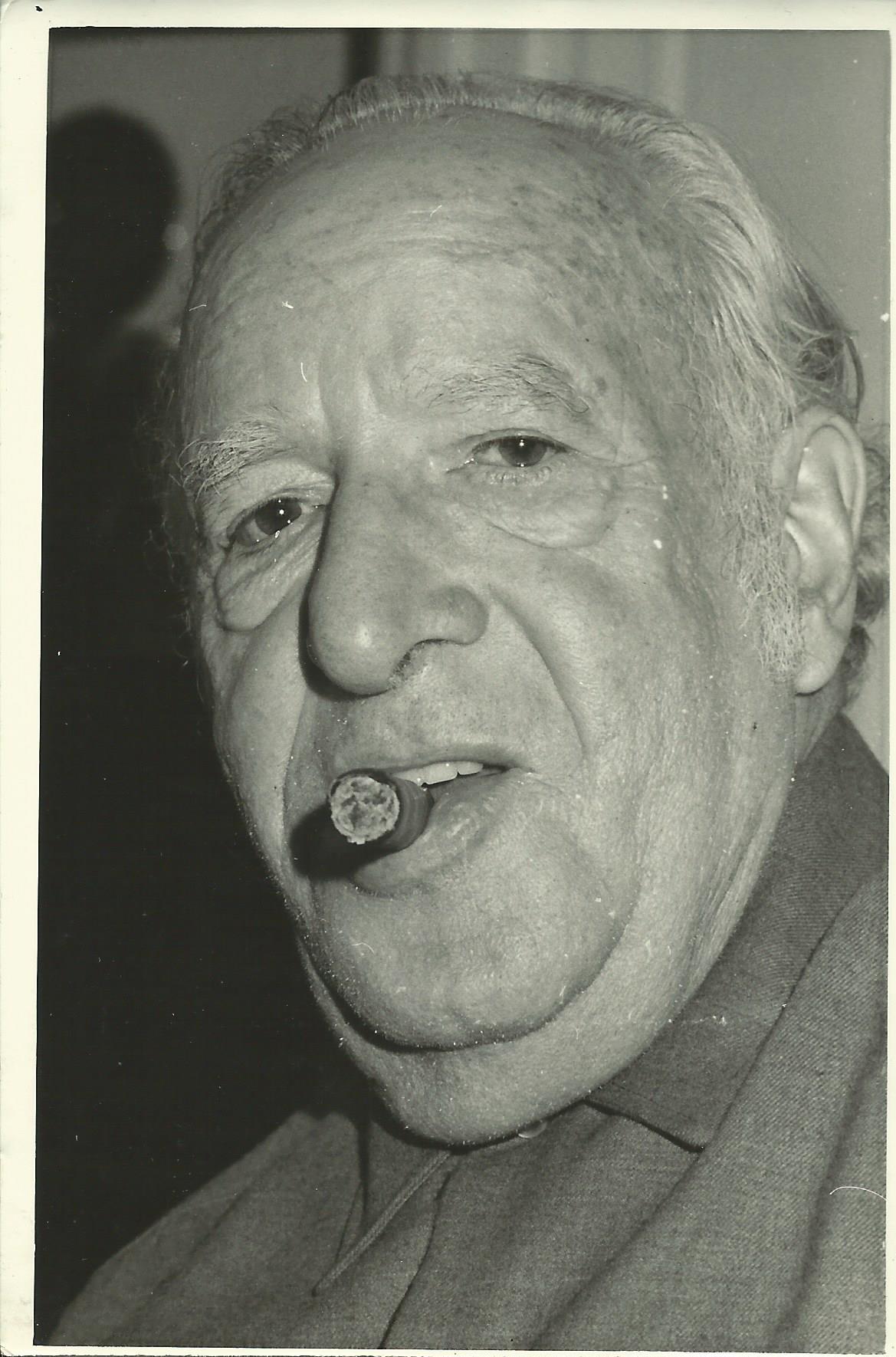
Ariela also remembered how Joe would bring his grandchildren rolls of ribbons and beautiful hats.   He always had a cigar in his mouth and loved a drink of scotch.

Joe

Joe

Ron told me that his grandparents Joe and Sadie were incredibly devoted and committed to having a relationship with him after their daughter Mildred, Ron’s mother, passed away when Ron was only 15 months old.    They worked hard to stay in touch with him, and Ron remembers visiting them not only when he was a child, but also as an adult when Sadie and Joe lived in Brighton Beach near Ron’s in-laws.  It was very clear to me that Joe and Sadie were exceptional people and exceptional grandparents to have developed such strong, close and lasting bonds with their grandchildren.

Although I have yet to find the grandchildren or children of Abraham, Jack, Lizzie or Ray, from the recollections of Ariela and Ron, it seems that the siblings were all warm, fun-loving and close.  Ariela remembers that Abraham was quite a practical joker; she commented that he “used to hide behind a curtain and put his set of false teeth around and click the top and bottom together and scare me half to death. He was as fun loving as Joe was.”  Ron remembers his grandfather Joe talking about going out to Patchogue to visit Jack, even when they were both relatively old men.  Ariela also said that Ray and Lizzie were outgoing and warm and fun-loving.

To me, it is remarkable how happy and well-adjusted these siblings appear to have been. They endured so much loss and heartache.  How did they grow up to be so seemingly functional and joyful?  My impression from the historical data about their father Gustave has always been that he was a devoted and caring person who did whatever he could do to help his entire extended family.  I don’t have as clear a picture of Gussie, but she also must have loved her children very much.  It is therefore perhaps not that surprising that these children grew up to be so close and so devoted to their families.

Enhanced by Zemanta

Another Sad Story: Harry Rosenzweig

I have already told the story of Gustave and Gussie’s son David who died shortly after his first birthday.  I’ve also talked about the records that indicate that Gustave and Gussie suffered the loss of many infants—perhaps as many as nine babies who did not survive.  But I have not yet told the story of their son Harry Rosenzweig.

Harry was born in July 1897, two years after Jacob and a year before Joseph.  He appeared on the census reports with the family in 1900, 1905, and 1910, but then he disappeared from the records.  He is not on the 1915 census or any later census report.  Since he would have been eighteen in 1915, I thought perhaps he was serving in the military like his brothers Abraham and Jack, but I could not find any military record or draft registration with his name.  Where could he have been?

Fearing the worst, I checked the death index for NYC and sadly saw that indeed a Harry Rosenzweig had died on July 9, 1913. He would only have been sixteen years old—could this be the same Harry? If so, why did he die so young?  I sent for the death certificate, which I received the other day.

Harry Rosenzweig death certificate

Harry Rosenzweig death certificate

As you can see, it is in fact the death certificate for Harry, the son of Gustave Rosenzweig and Gussie Sachs.  His cause of death is given as drowning.

I then searched for and found this brief news article from the Brooklyn Standard Union of July 8, 1913, p. 6, which explains some of the circumstances surrounding Harry’s death.

Brooklyn Standard Union July 8, 1913 page 6

Brooklyn Standard Union July 8, 1913 page 6

Can you imagine what his father must have felt, going to the police station and seeing his son’s clothing? Why was Harry off by himself, swimming alone and away from the others in his gray flannel bathing suit? The article almost seems to imply that there was something suspicious about his behavior.  Was his drowning other than accidental? The police obviously did locate his body the next day, as indicated on the death certificate, but the rest of the story remains a mystery.

The other question that lingers for me is whether or not Harry’s death occurred before or after Gustave and Gussie had separated. By the time of the 1915 census, Gussie and Gustave were apparently separated, as Gustave is not listed as living at 1914 Pacific Street with Gussie, Abraham, Jacob, Joseph, Lizzie and Ray.  I have yet to find Gustave anywhere on the 1915 census.  I searched the address given in the news report on Harry’s drowning in 1913, 1166 Nostrand Avenue, and Gustave is not listed as living at that address in 1915.  In 1910 the family was living at 677 Franklin Avenue in Brooklyn and in 1905 they were living on Fulton Street in Brooklyn.  Had they moved to Nostrand Avenue between 1910 and 1913 and then moved again between 1913 and 1915 to Pacific Street? Or had Gustave already left the home by 1913 and thus was living by himself on Nostrand Avenue?  Where was he then in 1915? I will have to keep searching.  By 1920 he seemed to be living in upper Manhattan as a boarder, and by 1920 he was remarried.

If Harry died before Gustave and Gussie separated, one has to wonder whether his death precipitated the end of their marriage.  And if he died after they separated, one has to wonder whether the end of their marriage was in any way a factor in his swimming alone, away from everyone else on the beach.

Of course, his death could have been an accident, or he might have been swimming alone for any number of possible reasons.  Whichever version of the story is true, the death of Harry Rosenzweig as a young teenager must have been a terrible tragedy for his family, a family which had already suffered the deaths of so many of their children.

Which makes it even more remarkable that at least some of his surviving siblings grew up to be such loving, warm and fun-loving adults, as my post tomorrow will discuss.

Enhanced by Zemanta

Leah Strolowitz Adler: An American Immigrant Success Story

As I have written before, one of the fascinating aspects of doing this research is what I’ve learned about the experience of Jewish immigrants in the late 19th and early 20th centuries.  It is remarkable to me how children who arrived without speaking English and living in poverty were able to assimilate successfully into American society and make a good life for themselves and their children in this country.

Leah Strolowitz Adler is a good example of this remarkable transformation from a poor Romanian immigrant to an American success story.  Thanks to her granddaughter Jean, I’ve been able to learn a fair amount about Leah and to obtain several pictures of her.  Leah was born on May 25, 1900, in Iasi, Romania, the seventh and youngest child of Jankel Srulovici and Tillie Rosenzweig.  She was only seven years old when she immigrated with her parents and siblings to New York City, where soon afterwards her father either died or disappeared.  She lived with her mother and siblings and her two cousins, Isadore and Betty Goldschlager, in a tenement in East Harlem.  While her older siblings went to work in sweatshops to support the family, Leah went to Public School 101 in Harlem on 109th Street, where she completed eighth grade in 1915.  Jean recalled that Leah told her that although she was happy to leave Romania, she found the transition to America difficult.  Leah remembered standing on line at the public school in NYC and being teased for speaking Yiddish.  Obviously, however, Leah soon learned English and even went on to Julia Richmond High School.

After she finished school,  Leah lived with her mother and sisters, working in a millinery shop, until she married Ben Schwartz on June 26, 1921.  Jean shared with me the story of how Leah met Ben.  Leah had been friendly with or briefly dated Ben’s brother Emmanuel. While Emmanuel was overseas during World War I, Leah dropped by his optometry office for an eye exam and met Ben. Ben asked Leah out for a cup of coffee.   The family story is that when Leah finished her piece of cake, Ben offered to buy her a second piece, and she knew right then that “he was a keeper.” Ben was American born and also an optometrist, according to his draft registration and various census reports.

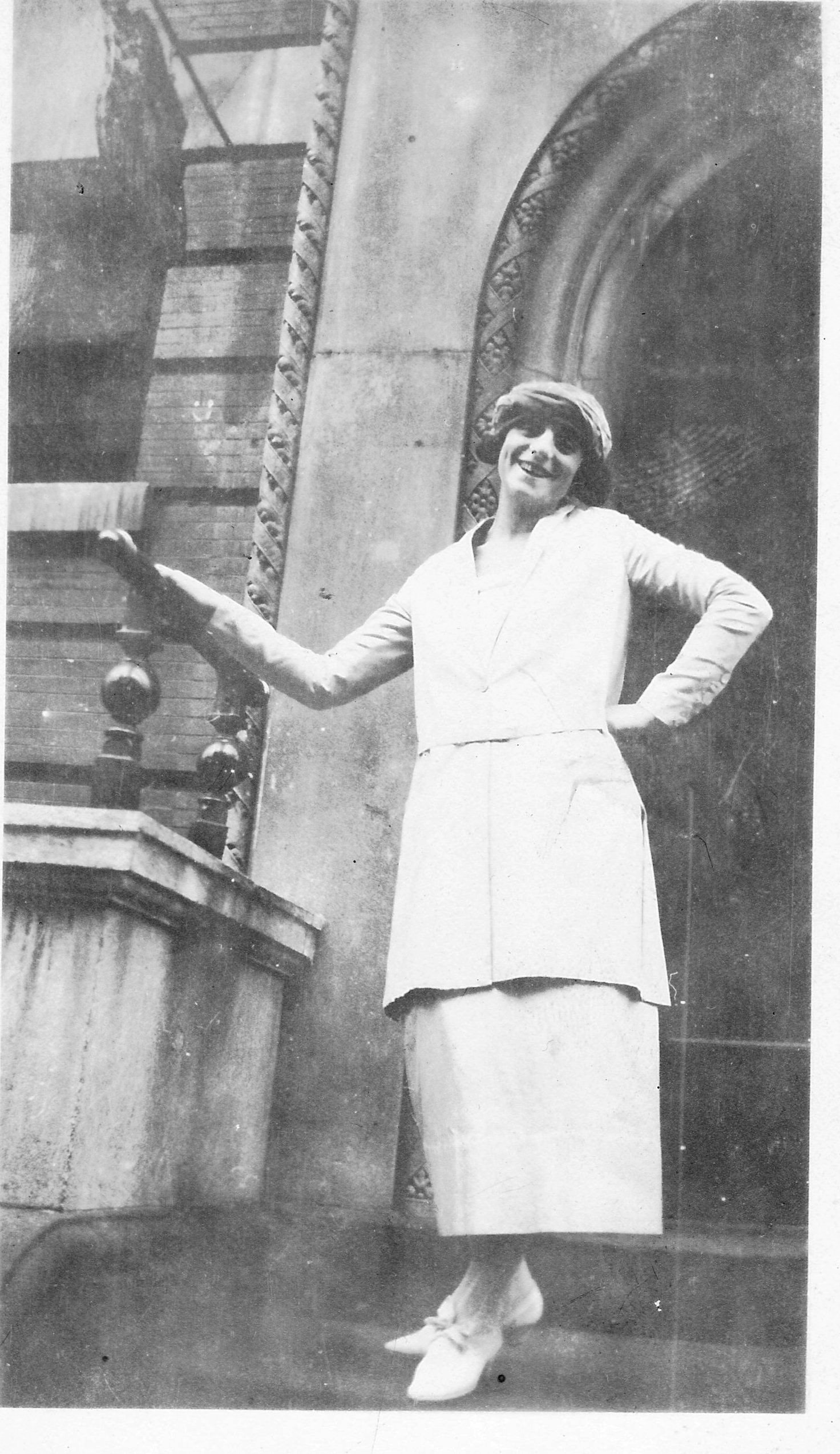
Here are some photos of Leah, taken by Ben, during their courtship around 1920. She looks like a genuine American woman of the 1920s.  She certainly seems to have left her poor immigrant beginnings behind her.

Leah c. 1920

Leah c. 1920

leah

leah

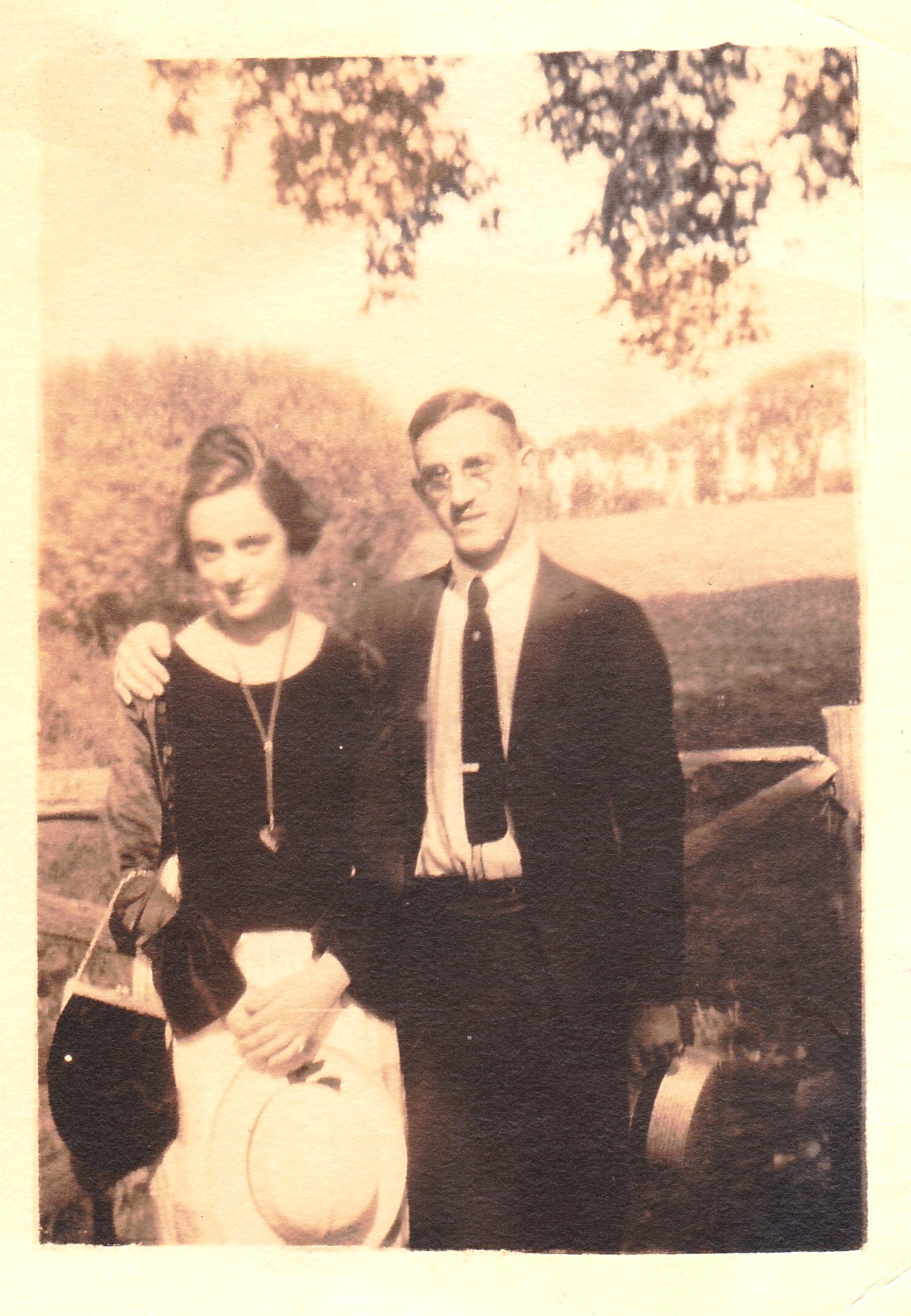
This is Leah and Ben around 1920:

1920 Leah with Ben Schwartz

1920 Leah with Ben Schwartz

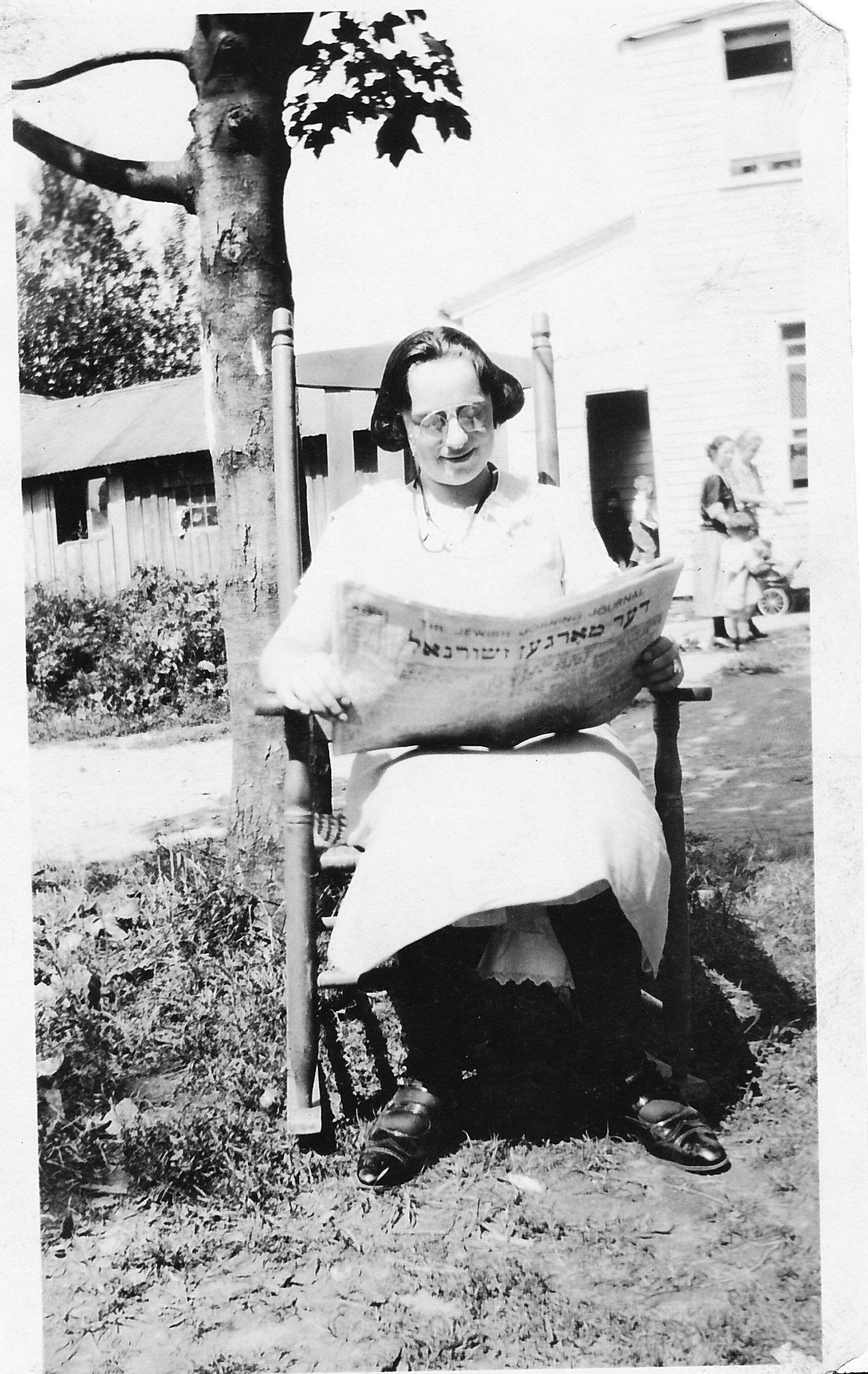
Here is a photograph of Leah around 1921, reading a Yiddish newspaper, the Jewish Morning Journal.

Leah c. 1921

Leah c. 1921

Leah and Ben moved to the Bronx and had a son Ira (named for Isidor, Leah’s oldest brother), born in 1923, and a daughter Theodora (“Teddy”)(named for Tillie, Leah’s mother) born in 1927.  Here is a photograph of Leah, wearing a fur coat and holding Teddy in February, 1929, when Teddy was two years old.  Notice the price of the baby clothes in the window of the shop behind them:  79 cents.

Leah and Teddy February 1929

Leah and Teddy February 1929

Sometime in the 1930s, Leah’s divorced sister Bertha came to live with the Schwartz family for a number of years (at least until 1940, according to the US census of that year).  Teddy still remembers her mother Leah commenting that it was a good thing that her father Jankel could not see them all working on Shabbos, suggesting that Jankel must have been an observant Jew.

According to Jean, Bertha taught Teddy to sew, but Leah was upset because she wanted her daughter to do more with her life than the sewing work that Leah and her sisters had done.  I found this remarkable, given that women had so few choices back in the 1930s, but Leah clearly had a progressive vision and did not want her daughter to limit herself in anyway.

Teddy and Leah and Ben 1944 after her high school graduation

Teddy and Leah and Ben
1944 after her high school graduation

Teddy did grow up to be independent. After graduating from Taft high school in 1944, she attended NYU and became an occupational therapist, a professional woman long before that was common.  Because she hated the cold, she moved by herself to Atlanta, Georgia, after seeing an advertisement for a job there.  She soon met the man who would become her husband, Abner Cohen, whose family had deep roots in Atlanta. Teddy and Abner stayed in Atlanta where they raised their three children.

Jean recalled that Leah was scared to death to fly and so she and Ben would take the seventeen hour trip by train from NYC to Atlanta once or twice a year. Jean remembered, “At the station, while we waited for the train to arrive, we placed copper pennies on the track and after she disembarked and her train left, we would collect the flattened Abe. Grandma baked wonderful rugelach and some round brown sugar cookies. We made such a to do about her cookies that she would arrive toting the dough already mixed and  formed ready to bake.”

Leah and Ben

Leah and Ben

Leah in 1968 with a cousin Margie

Leah in 1968 with a cousin Margie

Leah and Ben's 50th anniversary 1971Leah and Ben’s 50th anniversary 1971

Eventually Teddy’s parents Leah and Ben moved to Atlanta, where they lived the rest of their lives.

So Leah Strolowitz Adler, who was born in Iasi and moved to America at age 7, not speaking English and living in a Harlem tenement, grew up and lived a comfortable life in New York, raised a daughter who became a health care professional, and retired with Ben to Atlanta, where she was able to get to know her grandchildren, including Jean, my fellow family historian.  To me, it is a remarkable story, another example of the amazing resilience and persistence of the immigrant generation who made life possible for all of us today.


Enhanced by Zemanta

Brotmans, Resslers, Rosenzweigs, and Goldschlagers: All Roads Meet on Pacific Street in Brooklyn

Gussie and Isadore

Gussie and Isadore

This is probably the most moving discovery yet for me personally.  I am so excited that I don’t know where to start.  This story involves the Brotman family and the Ressler family AND the Rosenzweig family and the Goldschlager family.  It’s the final piece of the puzzle about how my grandparents met.  It came as a posthumous gift from my much beloved Aunt Elaine, who truly was not only our family matriarch, but also our family historian.  Aunt Elaine, you always wanted to tell me these stories, and I was too young and dumb to care.  I know you would be so happy that I am finally interested and recording them for all time.

Fortunately, someone was interested in her stories back then.  It seems that not only did my brother listen to my aunt, so did my cousin Jody’s husband Joel, my aunt’s son-in-law.  He interviewed her about the family and took careful notes.  Jody and Joel just found his notes while going through some boxes in their house, and Jody emailed them to me.  There is so much information in there that it will take me a while to digest it all and write it up for the blog.  Joel’s notes cover stories and anecdotes about the family and reveal some new things as well as things we now know but that I did not know a year ago.  But here’s the story that made me say out loud, “Oh, my God!”  And then to stop and sit in amazement.

You may recall that a while back I wrote a post about how various members of my family met their spouses, including my grandmother and grandfather.  I wrote:  “My grandfather Isadore supposedly saw my grandmother sitting in the window of her sister Tillie’s grocery store in Brooklyn and was taken by her beauty.”  That was the family story passed down the generations.

When I wrote about this story recently, what I couldn’t figure out was what my grandfather was doing in Brooklyn.  He had always lived in East Harlem since arriving in New York and did not live or work in Brooklyn in 1915. So what would have brought him to Brooklyn from East Harlem when he first saw my grandmother?

The answer is revealed in the notes Jody and Joel just sent me.  The story begins with my aunt telling Joel that my grandmother Gussie Brotman used to go to her sister Tillie’s grocery store after school.Gussie at Tillie's storeIn case you cannot read that, it says, “After school on Friday Gussie would go to Tillie’s house in Brooklyn at her grocery store.”

In 1915 Tillie and Aaron were living at 1997 Pacific Street in Brooklyn.    As Joel’s notes continue:

Isadore sees Gussie

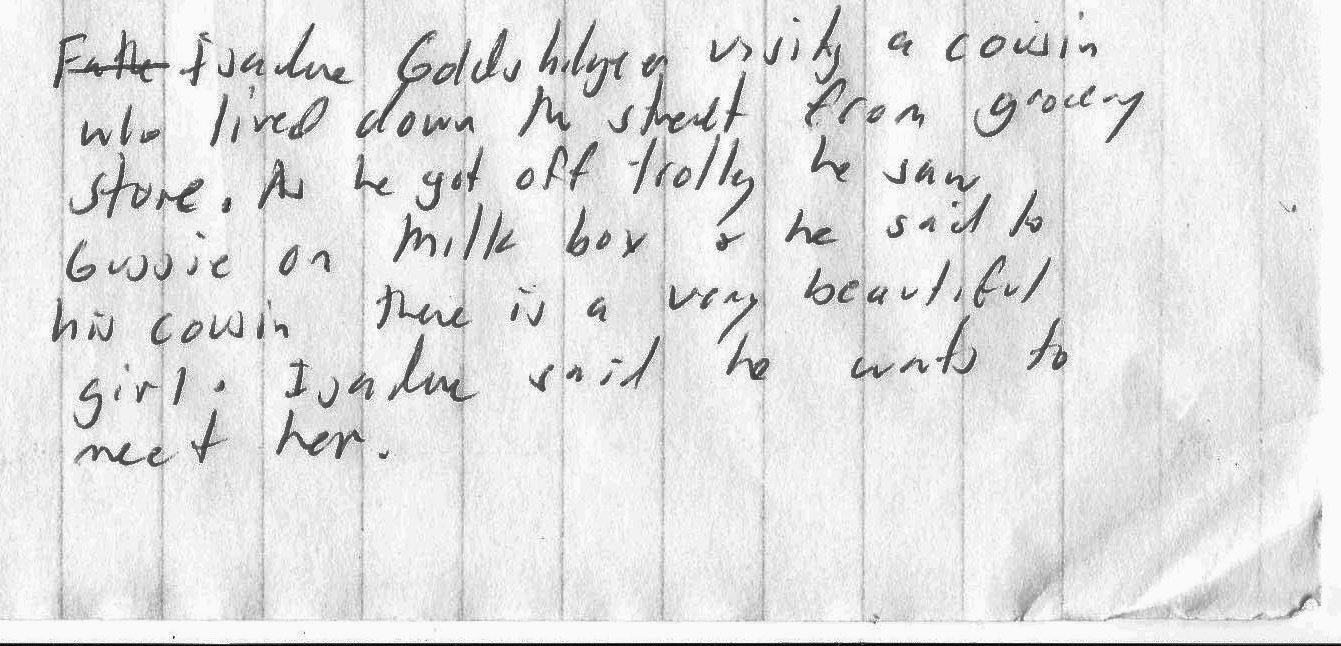
“Isidore Goldschlager visiting a cousin who lived down the street from the grocery store. As he got off the trolley he saw Gussie on milk box and said to his cousin there is a very beautiful girl.  Isadore said he wants to meet her.” (emphasis added)

 In  1915, the Rosenzweigs were living at 1914 Pacific Street, right down the block from 1997 Pacific Street where Tillie and Aaron Ressler lived. When I wrote that post back on February 5, I did not yet know about Gustave Rosenzweig and his family.  I had no idea that my grandfather had cousins living in Brooklyn on the same street where my grandmother was living.

Rosenzweigs 1915

Rosenzweigs 1915

Gussie living with TIllie 1915

Gussie living with TIllie 1915

So the cousin that my grandfather was visiting was one of the sons of Gustave Rosenzweig.  In 1915, Abraham was 26, Jacob  was 21, and Joseph was 17.  Abraham and Jacob were in the Navy, and Joseph was working as a driver’s helper.  My grandfather was 27 in 1915, so my guess is that he was hanging out with Abraham, who was closest to him in age.

Isadore age 27

Isadore age 27

I have wondered whether my grandfather ever saw these cousins once they all got to NYC, whether he knew them well.  Well, obviously he did.  If he had not been close to them, he would never have come to Brooklyn.  He would never have seen that beautiful red haired woman sitting on the milk box.  And this would never have happened:

Isadore Goldschlager and Bessie Brotman  marriage certificate

Isadore Goldschlager and Gussie Brotman
marriage certificate

Isadore and Gussie marriage cert 2And if that hadn’t happened, then my Aunt Elaine and my Uncle Maurice and my mother would never have been born, and then all my first cousins and my siblings and I would never have been born.

That little stroll down Pacific Street brought the Rosenzweig/Goldschlager family together with the Brotman family and thus created my family.  How could this not be my favorite story ever?

This is another one of those moments when all the time spent studying census reports pays off.  If I had not found the 1915 census reports for the Resslers and the Rosenzweigs, I would never have known they lived down the street from each other.  If I hadn’t looked at all those other documents, I would never have learned about my grandfather’s cousins and his uncle Gustave.  If I hadn’t started this blog, Jody and Joel might never have found these notes in their boxes of papers and provided the last piece of the puzzle. If Joel hadn’t listened to his mother-in-law, we wouldn’t have her memories and stories to tie it all together.  It should remind us all to ask questions and take notes and listen to our parents, our aunts and uncles, and our grandparents  so that we can learn everything we can while we can.

Thank you, Jody and Joel.  Thank you, Aunt Elaine.  Thank you, Uncle Gustave, for moving to Brooklyn.  Thank you, Aunt Tillie, for taking my grandmother to Brooklyn. And thank you, Abraham Rosenzweig, for taking my grandfather for that walk down Pacific Street so that he could meet and marry my grandmother.

Enhanced by Zemanta