A World Apart, part 4: The Rich and the Poor in Galicia

In my last post, I wrote about Margoshes’ marriage to the daughter of Mordecai Shtiglitz, the manager and lessor of a substantial estate in Zgursk, not far from Radomishla.  After checking Google maps, I realized that Radomishla is only about 60 miles from Dzikow where our family might have lived, so Margoshes and Joseph and Bessie may have lived quite near each other in the 1880s.  Whether their lifestyle was anything like his we do not know, but it made reading his story even more compelling to me.

After Margoshes married, there was a three year period of what he called “kest.”  According to the glossary provided in the book, kest referred to the practice where the family of the groom provided financial support to the groom and bride after the wedding to enable the groom to study without having to worry about earning a living.  Margoshes and his new wife lived with his in-laws, both of whom worked very hard to manage and oversee the estate.  Margoshes, however, spent the early days of his marriage being idle, reading and eating a lot of fruit. At one point his father-in-law arranged for him to oversee the cutting down of trees for lumber on a nearby property where the Polish owner needed assistance and agreed to allow Margoshes to keep the profits in exchange for overseeing the labor.  Margoshes did not do any of the physical labor himself, but would ride out to make sure that the work was being done.  He hired a Jewish man to help him supervise the work.  After a short period of time, Margoshes decided not to pursue the lumber business any further.  He wrote that he found it tedious and that his father-in-law and wife found it beneath his dignity.  He sold the business to someone else and returned to his “kest” lifestyle.

About a year and half after he was married, Margoshes and his wife moved to Yozefov, a 450 acre estate about a mile away from Zgursk, where his wife’s sister and her husband had lived.  The land was owned by a non-religious Jew who had leased the land to Margoshes’ father-in-law as a place where his older daughter and her husband could live and work.  When the older daughter’s husband died, Margoshes and his wife were essentially told that they had to move to Yozefov and take over managing the estate.  Margoshes lived there for ten years and, as he described it, was his own boss for the first time.  The financial arrangement, however, put Margoshes in a risk-free situation.  His father-in-law covered the expenses and took the profits, but Margoshes and his wife were able to live without cost in exchange for overseeing the estate.  When the lease was up after ten years, Margoshes still had the original dowry from when he married plus the livestock and equipment from Yozefov which he then used to set up his own business.

In this section of the book, there is a little more light shed on how “the other half lived.”  First, it is clear that there were many Jews who were not wealthy at all. As described by Margoshes, “Jewish economic life in Galicia was always uncertain.  People who had done well for years and lived an upper class existence suddenly became paupers due to unforeseen circumstances.” (p. 58) Margoshes  observed many poor Jews while living in Zgursk: “…itinerant paupers were constantly wandering through.  A day rarely passed that 10-15 poor Jews did not appear in the manor yard.  These vagrants would often wander in whole families: man and wife, several children, and sometimes even infants at the breast. Every poor person …received a generous portion of hot food, and a big piece of bread for the road, along with two kreuzer in alms.  They were just not allowed to spend the night in the manor yard; their ranks included a lot of undesirable people and thieves.  They were sent away to the nearby inn, or if space was short, to the [poor house] in Radomishla.” (p. 67)

Margoshes claimed that he was the only person in the region with the ability or desire to read books in Hebrew, German or Polish, and when his brother-in-law Mikhl wanted to learn, there was no one but Margoshes to teach him.  Margoshes found Radomishla to be more sophisticated than other towns and shtetls nearby.  In the other towns, the Jews had cows as the source of most of their income.  They would milk and feed the cows themselves and tend to their own gardens to provide a meager living for their families.  (Margoshes’ tone in describing these hard-working farmers is blatantly condescending.)  In contrast, he found the Jews in Radomishla to be far more successful merchants who engaged in trade and did not own or take care of cows. There were timber traders, cattle dealers, and many money lenders—many people who were extremely wealthy.  Although Margoshes recognized that there were also poor people in Radomishla, he claimed that there were not as destitute as poor people in the other towns and shtetls.

Often I feel really annoyed by Margoshes.  He was what we might call today a very entitled young man—someone whose family was wealthy and who never really had to do any physical labor at all and barely any other hard work of any kind.  He was handed everything on a silver platter, yet has the nerve to express disdain for those who were less fortunate.  I may react this way in part because I imagine that our ancestors, Joseph and Bessie, were probably among those poor farmers Margoshes was looking down at from up on his high horse as the fortunate son and son-in-law of two wealthy men. I am still hoping that somewhere in his story, Margoshes developed some perspective and some empathy for those who were less fortunate.

Link

Here’s a map that shows where Joseph Margoshes lived from birth through the early years of his marriage.  You may have to zoom out once to see the three locations: Lviv, Tarnow and Radomishla.

A World Apart, part 3: Marriage in Galicia

I am continuing to read Joseph Margoshes’ A World Apart in order to learn about life in Galicia in the late 19th century.  Last night I learned something about arranged marriages in Galicia.  When Margoshes was only fourteen years old, his mother began to look for a prospective bride for her son.  Since Margoshes’ father had died, Margoshes was a candidate for an early marriage in order to relieve his mother of the burden of supporting him and caring for him.  Margoshes also said that early marriage was a way “to avoid moral lassitude, or strange and sinful thoughts, God forbid.” (p. 58)

Margoshes then described how shadken, or matchmakers, would come to his school to observe and evaluate the young boys in his class as potential grooms. Margoshes was considered a very attractive candidate: he was tall, good-looking, well-educated and from a well-regarded family.  His mother was presented with many different potential matches. Margoshes reported that parents never spoke to their children about these potential matches; it was all out of their hands and determined by the parents.  His mother rejected a number of potential brides because they were “unrefined upstarts of a very low social status…[who] would bring shame to his father’s grave…” (p. 60)

Eventually his mother agreed to an appropriate match, the daughter of a very successful man, Mordecai Stiglitz, who lived in Zgursk, a village near Radomisha, a town not too far from Tarnow where Margoshes and mother and brother were then living.  As described by Margoshes, Stiglitz had a big estate that he had acquired through successful leasing arrangements with the descendant of a Polish count who had owned several thousand acres in the area.  Stiglitz’s estate was itself thousands of acres, and he had many head of cattle, 40 horses, 40 oxen,  70-80 milk cows, and about 30 peasants who lived and worked on the estate.  They grew grain and grass on the estate and needed workers to tend to the livestock and to cut and care for the grain and grass, which they baled and sold in the market.

The Stiglitz family met Margoshes’ mother’s standards, and Margoshes was subjected to an evaluation of his knowledge of Gemara, Talmud and Jewish law in general.  He passed the test and was approved as a groom for Stiglitz’s daughter (whose name is never mentioned by Margoshes in his telling of this story).  Margoshes was only sixteen years old at that point.

After a lavish wedding with three feasts, including one for the poor Jews and beggars who lived in the area, Margoshes moved to Zgursk to live with his new bride on her father’s estate.  As Margoshes wrote, “Initially I did not really know my bride; we had only seen each other and talked very little during the engagement ceremony, and then not even exchanged a letter.  However, as soon as we got to know each other better after the wedding, we became as intimiate and loving as if we had known one another for many years.  This heart felt love has continued to this day, thank God, for over fifty years and will remain until the end of our lives.” (p. 65)  Two teenagers whose marriage was arranged by their parents and who did not know each other at all somehow managed to fall in love and create a long and happy life together.

I have heard and read about arranged marriages before, not only in Jewish families, but in many other cultures as well.  We recently watched an excellent movie, “Fill the Void,” about contemporary Israel and arranged marriages among the Hasidim today.  I know that often these marriages did not end up so happily, but it does seem that more often they worked—that two people who did not know each other somehow fell in love or at least developed a strong enough bond to create a lasting relationship.  It is so foreign to my own experience—I cannot imagine letting my parents select a life partner for me or marrying someone I’d only met once.   Yet I also cannot pass judgment on the practice since it does seem that often parents do know what is best for their children.

I have to assume that Joseph’s marriage to Bessie was itself an arranged marriage.  Joseph was a widow (or so we assume; perhaps his first wife had left him) with at least two young sons, Abraham, who would have been about nine, and Max, who would have been about three.  Bessie was his cousin and at least ten years younger than Abraham and about 24 when she married him.  Based on the customs of the day and the circumstances, most likely a matchmaker put together these two cousins so that Bessie would have a husband and so Joseph would have a wife and a mother for his children.  Did they grow to love each other? Or was it purely a convenient arrangement? The inscription on Joseph’s footstone certainly suggests that he was a good husband and father, so I’d like to think that, like Margoshes and his bride, Joseph and Bessie developed a loving marriage.  But then I am a hopeless romantic!

A World Apart, Part 1: Life in Galicia in the late 19th Century

As I mentioned a few weeks ago, I ordered a book on what life was like in Galicia in the late 19th century.  The book is A World Apart: A Memoir of Jewish Life in Nineteenth Century Galicia by Joseph Margoshes. (The book was written in Yiddish in 1936, but translated into English in 2010 by Rebecca Margolis and Ira Robinson.)  Margoshes was born in 1866 in Lemberg (Lvov/Lviv), which is now part of Ukraine.  According to the introduction to the book, he was born into a family with a “distinguished rabbinical ancestry” and “received a traditional Jewish education in Bible and Talmud, as well as grounding in the German language and European culture.” (p.vii)  As an adult, he spent several years administering agricultural estates in western Galicia, the region where our family most likely lived.  He emigrated to America at the turn of the century and became a well-known writer for the Yiddish press in New York City.

He wrote A World Apart as a memoir not only of his life, but of the culture and world he left behind.  The book is considered to be an important documentation of what life was like in Galicia during that time period.  As Margoshes himself wrote in his forward to the book, “I have lived in a different generation and under completely different circumstances from my own children and many of my friends and acquaintances.  I thus hope that it might interest them to read the memoirs of my past.” (p.3)

Since the author lived in Galicia and left Galicia during the years that Joseph and Bessie, Abraham, Max, Hyman and Tillie lived in and left Galicia, I hope to be able to get a better picture of what their world was like.  I’ve only read the first thirty-five pages or so, but can already report some sense of that world.  What struck me most about the first segment of the book was its portrayal of a diverse Jewish society.  In my mind I had an image of Fiddler on the Roof where everyone was relatively indifferent to secular education and the secular world and completely immersed in Jewish life.  Margoshes immediately breaks down that image.

In fact, Jewish society in Galicia was not unlike Jewish society in Israel or the US today with a wide range of subgroups with varying degrees of religious observance— from the Hasidim to what we might now call Modern Orthodox to very assimilated or what Margoshes refers to as “German” Jews.  By that he does not mean that they were from Germany, but rather that they had abandoned traditional Hasidic garb, wore modern clothes, did not keep kosher, and spoke German more than Yiddish.  Margoshes family itself had representatives across the spectrum.  His father was descended from a long line of scholarly rabbis and considered themselves “maskils” or members of the Haskalah or Enlightenment Movement, which promoted not only Jewish education but also secular education, much as the Modern Orthodox movement does today in the US.  They were deeply observant, but not cut off from the outside world, unlike the Hasidim who lived much more insular lives and were not interested at all in secular education.  On the other hand, Margoshes’ maternal grandfather was a highly educated cloth merchant who traveled to Vienna for business and raised thirteen children, only two of whom were religious.  His sons were all “Germans,” and his daughters were well-educated and read the German classics.

Margoshes’ mother, however, was one of the two children who were religious, although she was well-educated.  Her first marriage ended when her husband began to dress and act “German-style.”  She then married Margoshes’ father, who was himself a maskil —religious, but not Hasidic.  (Interestingly, Margoshes’ father was a widower whose first wife was his niece, an indication of how liberally families allowed marriage among close relatives, as Joseph and Bessie reputedly were.)

After providing this family background, Margoshes describes events surrounding a major rift in the Galician Jewish society.  His father had originally belonged to an association of educated but religious Jews (maskilim) called the Shomer Yisrael Society.  In the late 1860s, however, his father left the Shomer Yisrael Society because it had become far too assimilationist.  For example, the Society submitted a proposal to the Imperial Ministry in Vienna that would restrict who could be a rabbi recognized by the state to those with more “German” tendencies and that would also impose reforms to the education provided in the Jewish schools, such as requiring German language classes and limiting Talmud classes to those twelve or older.  The Ministry was in favor of these proposals, as it favored modernization of the Jewish society.  Margoshes’ father and others were vehemently opposed and aligned themselves with the Hasidim to fight the proposal.  They formed an opposition group called Machzikei Hadas to organize their opposition to the Shomer Yisrael Society.

Margoshes wrote in detail about the long political battle between these two groups and how the maskilim and Hasidim worked together to fight the assimilationist Shomer Yisrael Society.  He also describes the overall status of Jewish society in the Galician world:  “In that era, the leaders of the province of Galicia were adopting a more liberal outlook.  Jews were granted full rights as citizens and they were allowed to vote as well as to be elected to the Galician Landtag and the Austrian Reichsrat.” (p. 18) The battle between the two groups became therefore also a battle for political representation of the Jewish citizens in the secular governments, not just a battle over religious practice and education.

In order for Machzikei Hadas to function as a legitimate association and publish newsletters legally, it had to obtain state permission.  The Shomer Yisrael Society engaged in political maneuvering to prevent this, but ultimately Machzikei Hadas was able to obtain approval and publish a newspaper after some political maneuvering of its own. Their ultimate coup was in 1879 when they were able to elect the Krakow Rabbi, a Hasid, to the Austrian Reichsrat, the first rabbi to be elected to such a position. As Margoshes wrote, “The election of the Krakow Rabbi to the Austrian Reichsrat made a tremendous impression on the entire Jewish world, and Galician Jews anticipated salvation.  It gave them enormous pleasure to see even a single Rabbi achieve the major honor of sitting among so many great personages.” (p. 24)

As I read these pages, it raised several questions and thoughts for me.  First, I was struck by the fact that Jews even then (and before then) fought among themselves over issues of observance versus assimilation, rather than trying to unite against the non-Jewish majority who controlled the laws and the government.  I thought of that old joke about the Jew found after being stranded on a deserted island for several years.  His rescuers noticed he had built two structures and asked him what they were.  His response:  “This one is my shul, and that is the “other” shul.”  We always need some group of other Jews with whom to disagree and debate, don’t we?

Second, I was surprised by the fact that at least at that time, Jews were not necessarily poor or poorly treated by the Austrian people or government.  Perhaps more will be revealed as I read further, or perhaps Margoshes’ family were more elite and comfortable than most others.

Finally, his description of the various segments of the Jewish society made me wonder where on the spectrum our great-grandparents lived.  Were they Hasidic, maskilim, or “German” in the way they lived their lives? Were they educated in worldly matters? Did Joseph wear payes and a streimel or did he dress in modern clothes? My guess is that they were not Hasidic, not even very observant, but only because I know that my grandmother was not religious (though she did have a kosher home), but I really don’t know.  She was born here, and perhaps Joseph and Bessie changed and assimilated once they settled in America.

To be continued, as I continue to read….


What’s next?

I am currently waiting for three more documents that I am hoping will provide some clues to where our family lived in Galicia: Hyman and Sophie’s marriage certificate, Tilly’s death certificate, and Max’s naturalization papers. It may be quite a while before I get these three documents since (1) the FHL is currently not processing requests because it is upgrading its system; (2) I just ordered Tilly’s death certificate from NYC, and that will take at least a few weeks, and (3) USCIS estimates a 90 day wait for naturalization records, and I only made that request four weeks ago.  Thus, I may not have any new information for quite a while. From my experience with marriage and death certificates, I am not too hopeful that I will get anything too helpful from the first two; I have no idea what the naturalization papers may provide, but they may be our best chance for finding another clue as to the hometown.  I remain determined to find the answer to the question of where our family lived.

I also may not soon have an answer for the other big question: are we related to the Brotmanville Brotmans, and if so, how? Without some way to learn more about Moses Brotman’s parents, I can’t make a connection between Moses and Joseph. Even though I was able to find two of Moses’ living descendants, neither can answer any questions about his parents, and the other living descendants have been unwilling to respond to my inquiries.  To be honest, I doubt they would have that information anyway.

To answer either of these questions will require access to documents from Galicia that date back before 1890, documents that are obviously not in English.  Although many Galician records exist and are indexed on various websites, I have not been able yet to find anything that relates to our ancestors or Moses’ Brotman’s ancestors.  I need more help, more training, more experience before I can do that effectively.  I will be consulting with some others with more experience to see how to get the education I need. I have just joined a Yahoo Group for people interested in genealogy research in the Tarnozbreg region of Poland, which is where Dzikow is located, the town I think may be the most likely place our family lived in Galicia. I just have to be patient and willing to work hard, and I believe I will find the answers to these questions.

That does not mean that there is nothing to do until then.  There is still a lot to do to make the blog a real resource for our family and for future generations.  I need your help for that.  Yes, more photos and documents would be great.  But I’ve been thinking that it would also be nice to add more personal information about some of the family members I never knew. I’ve added some personal touches to the descriptions of my grandparents, aunt and uncle, but I didn’t know Abraham, Max, Hyman, Tilly or any of their children.  I need help from the rest of you to add a personal dimension to their portraits. Right now I am working on a portrait of Tilly and her life, for example.  Even a brief description of a person’s career, interests, or personality will add some “flesh” to the facts and dates that are currently reported on the blog pages. Are any of you are interested in writing either a “guest post” or in providing a few words to add to the page about your parents or grandparents?  What would you like future generations of Brotmans to know about their ancestors?

Max Brotman: Who was his mother?

Yesterday I received Max Brotman’s death certificate from the City of Mount Vernon.  It has been quite a task tracking down this document.  Although I knew from Judy and the picture of his headstone that he had died in 1946, I could not find any record of his death certificate.  There is a public index of NYC death certificates that runs through 1948, so if he had died in 1946, it should have been there.  But it wasn’t.  Death certificates dated after 1948 from NYC are much harder to obtain; to get Abraham’s I had to use snail mail (!) and a notarized form and fee and self-addressed envelope sent to the NYC Department of Vital Records.  I was hoping that I could just obtain Max’s electronically through the Family History Library, which is faster, easier and free.  Unfortunately, the FHL does not have non-NYC certificates, and I could not find Max in the NYC register.

I was fortunate to find a volunteer in NYC who checked the paper records and found a reference indicating that Max, a NYC resident, had died “upstate.”   But where upstate?  It’s a big state! I recalled that Max had had a summer home in Congers, NY, and since he died in late May, I thought that perhaps he had died while up there. Image I contacted the town registrar in Congers, sent them a written request, check, and envelope, but they sent it back, saying that they had no record for Max Brotman.

So I was stumped.  I asked Renee, my mentor, for advice, and she suggested calling the cemetery where he was buried to see if they had a record for where he had died.  I called Beth David Cemetery on Long Island, and sure enough, they did have such a record and were willing to divulge where he died without a written letter, check and envelope.  They said he had died in Mount Vernon, New York, not far from where I grew up.

I asked Judy if she had any idea what he might have been doing in Mount Vernon at the time of his death.  She didn’t know.  I wrote to Mount Vernon (yes, a notarized letter, check and envelope), and finally received the long-sought-after document yesterday.Image

So what does it say? Well, it explains what he was doing in Mount Vernon.  He was a patient at the Mount Vernon Convalescent Home, where he was suffering from liver cancer.  It looks like he was there for three weeks, as the doctor who signed the certificate had cared for him from May 6 through May 27 when he died.

What else does it report? It lists Joseph Brotman as his father (phew!), but Adda Browman as his mother.  That conflicted with his marriage certificate which said his mother’s name was Chaye. Image And Browman? Is that just a misspelling of Brotman? Or was her maiden name really Browman? I consulted with Renee, and she said that Chaye was often Americanized to Ida, which is close to Adda.  (She said immigrants tended to Americanize even the names of ancestors who never left Europe.)  So maybe Adda is Chaye? Or maybe Richard Jones, who was Max’s son-in-law and the informant on the certificate, misunderstood or was misunderstood.  I don’t know and probably won’t know until I can learn how to research records from Europe.

The good news is that it’s just one more bit of evidence confirming that Max was Joseph’s son.  The bad news is that the document brings us no closer to knowing the town in Galicia from which they all came.

Another day, another death certificate, and more confusion

Sometimes I wonder why we have death certificates.  Just about every single one I have seen has raised more questions than it has provided answers.  I’ve been told by an expert genealogist that death certificates are notoriously unreliable because usually the person providing the information is a close relative still in shock and mourning the death of a loved one.  No wonder Hyman’s said he was born in Philadelphia and Bessie’s said her mother’s name was Bessie.  And so on.

All that leads me to today’s mysterious death certificate, that of Abraham Brotman of Brooklyn.  You may recall that Abraham’s headstone revealed that his Hebrew name was Abraham ben Yosef Yaakov, just as Joseph’s revealed that his was Yosef Yaakov ben Abraham, providing me with the additional clues that helped me conclude that Abraham was Joseph’s son and Max’s brother.Image

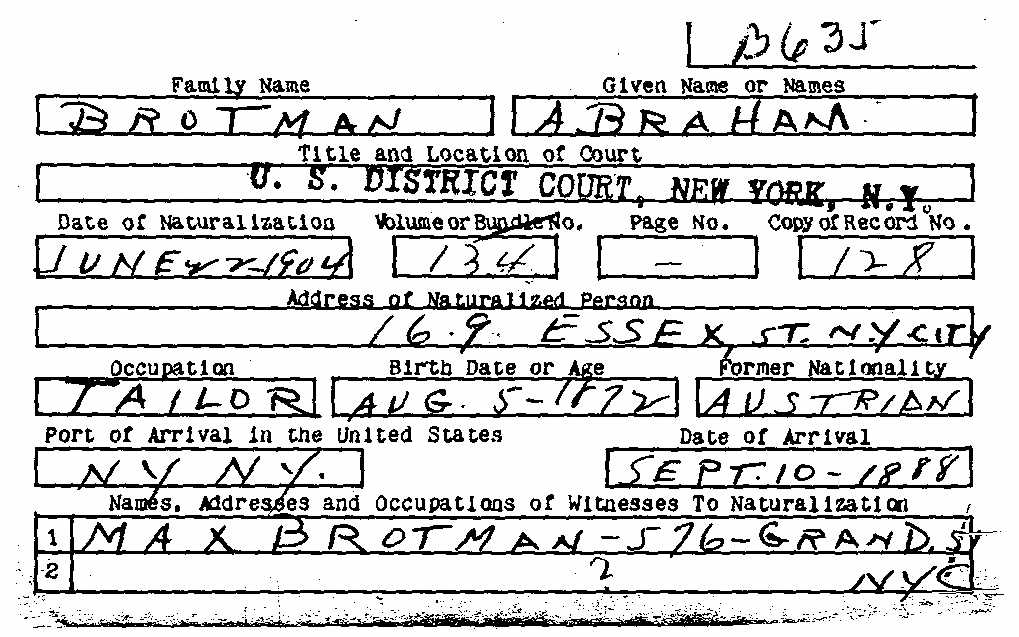
(You may also recall that Max was the witness on Abraham’s naturalization application.)

Naturalization of Abraham Brotman Max as Witness

Naturalization of Abraham Brotman
Max as Witness

I had ordered Abraham’s death certificate in order to obtain more confirmation of those relationships as well as to get some information about the place where they were all from in Galicia.

Unfortunately, Abraham’s death certificate confirmed nothing and just added to the confusion.  His birth place is listed as Russia, despite the fact that every census report and his naturalization papers list his birth place as Austria.  His parents’ names are listed as Harry and Anna.

Image

I emailed Abraham’s grandchildren, Paula Newman and Morty Grossman (whose mother Ethel provided the information on the certificate), but neither of them knows anything about Abraham’s parents.  So now what? Do I assume that it’s just another mistake on the death certificate? Is it more likely that the headstone is right than the death certificate? Since the place of birth is wrong, why should I trust any of the information on the death certificate? Perhaps Ethel Grossman was thinking of her mother’s parents, not her father’s parents?   Abraham’s wife Bessie Brotman was born in Russia, so maybe her parents were Harry and Anna? Grrrr…now I am ordering another death certificate to see who HER parents were.  But why would I trust that one either?

Very frustrating! So no new information and just more confusion.

I can’t wait to see what misinformation Max’s death certificate provides.  That should be arriving in a day or so.

Research update

I am once again in a holding pattern, waiting for a few more documents to arrive: Max’s naturalization papers (which take 90 days for USCIS to process, so another 75 days to wait for those), Max’s death certificate, Abraham’s death certificate, and a few others from the Family History Library in Salt Lake City. My principal research goal right now is to find out where our family came from in Galicia.

I’ve been trying to search for European records, but that is much more complicated than searching for US documents. JewishGen.com offers a course online that provides instruction on how to do that, and I plan to take that course when it is next offered in May, 2014. That’s a long way off for someone who is as impatient a researcher as I am. I am meanwhile making inquiries of other researchers who are researching Galicia and searching several genealogy websites, but so far, I’ve still come up empty.
So I figured that while I was waiting, I would learn what I can about life in Galicia in the 19th century and life on the Lower East Side in the late 19th, early 20th centuries. I’ve ordered some books and will provide whatever information or reviews I find interesting and helpful once I have read them. If anyone has any recommendations on books on either of those topics, please provide them in the comment box below.

Meanwhile, I would still love some pictures (hint, hint!) from other members of the family.

Hope you all are well, and I will report back when I get some new documents or have anything else to report.

The Illusion of Accuracy: Hyman Brotman’s Story

One of the many things I have learned over the past several months is just how unreliable so-called “vital records” can be.  Again and again, there are errors and inconsistencies in the documents and records of our ancestors.  Names are spelled wrong, birth dates change from document to document, places of birth are inconsistent from one document to another, as are the names of parents listed on those documents.

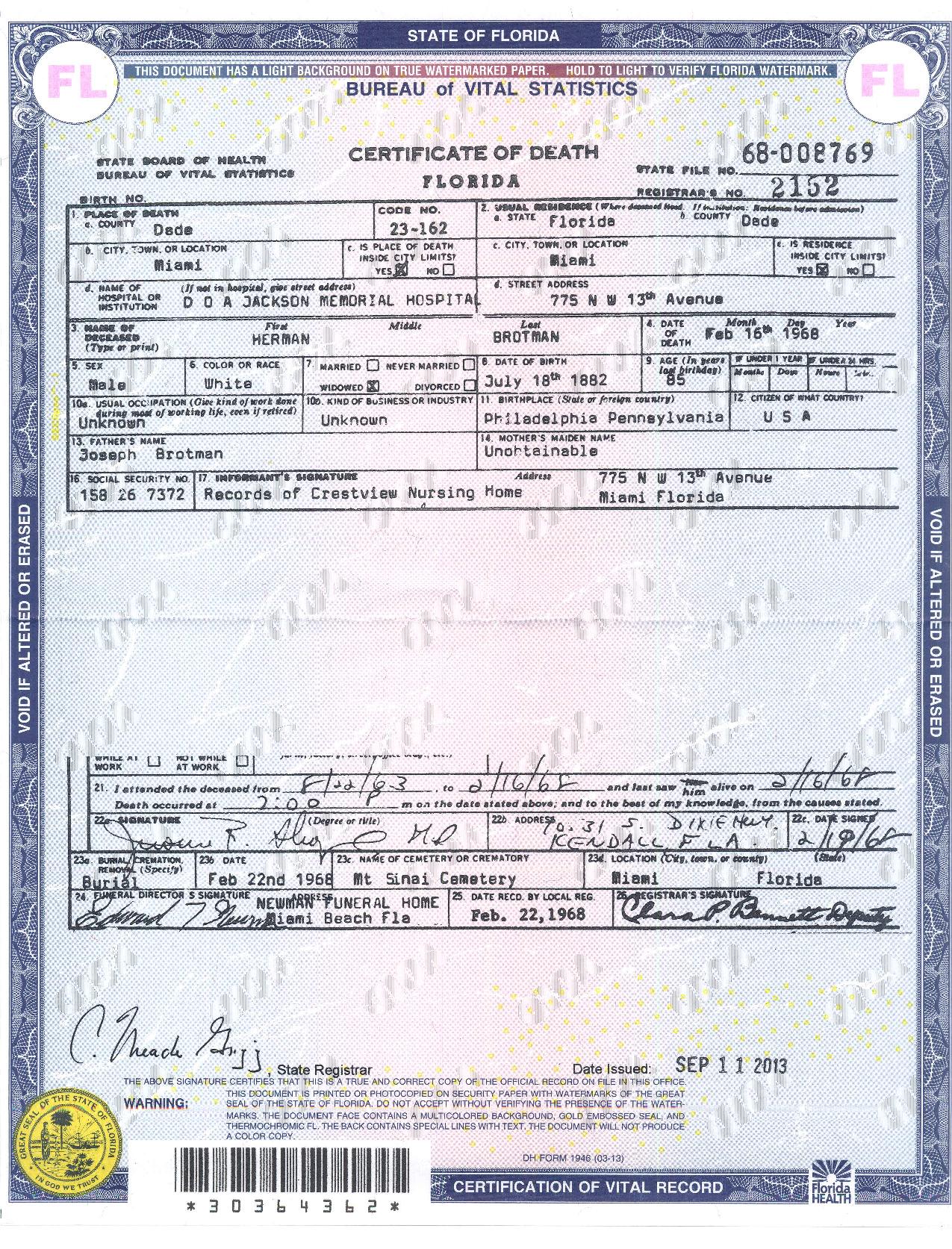
Herman Brotman is a good example.  First of all, his name kept changing.  He was Chaim Brodmann on the ship manifest when he emigrated, Hyman Brotman on the 1900 census while living with his parents at home, and then at some point he became Herman Brotman, though his family always called him Hymie or Hyman.  These were, however, not mistakes, but actual changes he made to his name.

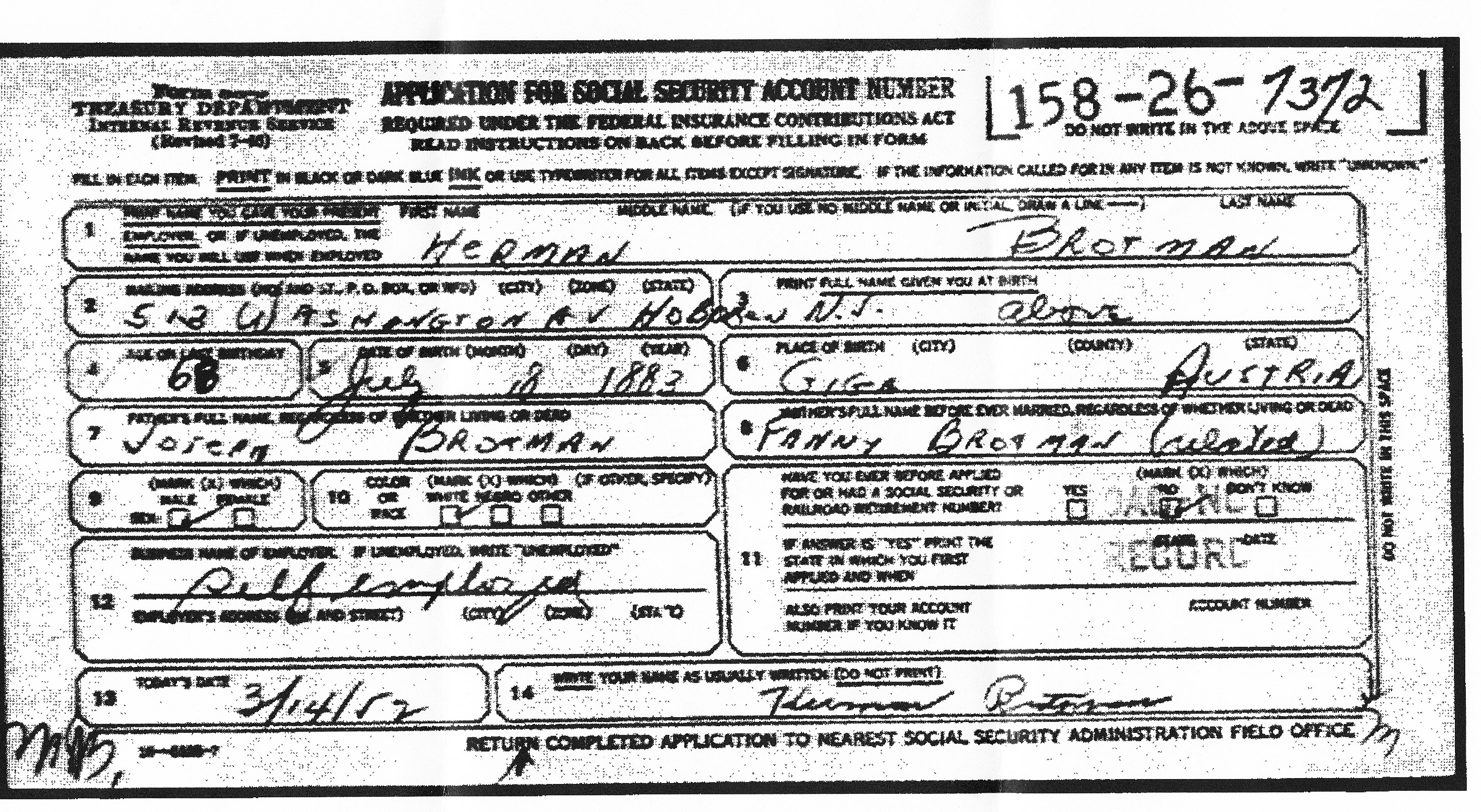
On his naturalization papers, he listed his place of birth as Jeekief.  On his death certificate, his place of birth is Philadelphia.  His mother’s name on the death certificate was “unobtainable.”  Now I have received his social security application, which he filed in 1952.  It lists his birth date as July 18, 1883, whereas his death certificate lists it as July 18, 1882.  On his naturalization papers he wrote his birth date as January 10, 1883.  The social security application lists his mother’s name as Fanny Brotman, not Bessie.  And it identifies his place of birth as Giga, Austria.  It’s enough to make a researcher crazy!

Image

Image


Herman Brotman's death certificate

Herman Brotman’s death certificate

Now the birth date I am willing to chalk up to absence of records; I’ve read that in the Old Country no one celebrated birthdays so it just didn’t matter.  The place of birth? Well, obviously Philadelphia is just wrong.  And I imagine that little Chaim, who was about eight years old when they left Galicia, probably never learned how to spell the name of the town, so both times he was trying to do it phonetically—Dzikow, which may be the town where they were from, is pronounced  Gee-kuff, so Giga, Jeekief? Close enough.

But I was really thrown by his use of Fanny.  Could he have forgotten his mother’s name in 1952 and written Fanny by mistake? That just seems so unlikely.  He knew enough to note that she was related to her husband in order to explain why her maiden name was also Brotman.  He had grandchildren who were named for her, using the B in Bessie.   He must have known his mother’s name.

I consulted with my mentor, Renee Steinig, who suggested that perhaps Bessie had a double name, which was not uncommon even then—a first and middle name.  I then recalled that Bessie DID have two names on her headstone—Pessl Feiga!

Image

I looked up Feiga on the web and learned that it was often Americanized to Fanny.  I have never, ever heard of Bessie referred to as Fanny, but perhaps she was.  And maybe 68 year old Herman who was also Hyman and Chaim decided to use one of his mother’s alternative names on that government form.   I don’t know, but it seems like the only logical explanation.  I guess I will now order Hyman and Sophie’s marriage certificate and see what he listed there for his mother’s name.

Have any of you ever heard of her referred to as Fanny?

The Brotmanville Brotmans

One of the questions raised early on by several of the Brotman cousins was whether and how we were related to the Brotmans of Brotmanville, NJ.  The history of Brotmanville is quite interesting and something I knew nothing about until I started this project; in fact, I’d never heard of Brotmanville at all.

Brotmanville was established by Abraham Brotman to provide jobs to the Jewish community that had settled in nearby Alliance, New Jersey.  Alliance was founded to be an agricultural community for Jewish immigrants and funded by the Baron de Rothschild.  As The New York Times reported:

In the 1880’s, pogroms and anti-Semitic laws in Russia caused a historic exodus of Jews. Most ended up crowded into tenements in American cities. But some Jewish thinkers urged their brethren, as one of them wrote, “to become tillers of the soil and thus shake off the accusation that we were petty mercenaries living upon the toil of others.” And so hundreds of Jews established agricultural colonies on land bought for them by charities and philanthropists.

http://www.nytimes.com/2005/06/22/nyregion/22colony.html

As Richard Brotman, Abraham Brotman’s great-grandson, reports in a film he made in the 1980s about Brotmanville, the land was difficult to farm, and many people needed an alternative way to earn a living.

Abraham Brotman, himself a recent immigrant from Galicia, had established a successful coat factory in Brooklyn, NY, and decided to relocate it near Alliance to provide jobs for the people who lived there.  Abraham moved with his wife Minnie and their children and his father Moses and his wife and children to southern New Jersey, where eventually a portion of the community was named in his honor.

Many of the Brotmans descended from Moses and/or Abraham Brotman stayed in the southern New Jersey/Philadelphia area, including Judge Stanley Brotman, Rich Brotman’s father, who recently retired from the federal bench at age 89.  In addition, Moses’ granddaughter (through a child of Moses’ second wife), Elaine Ashin, still lives in nearby Vineland.  I spoke with Elaine last week to try and find out more about her grandfather, but unfortunately he died when she was just a few months old so she knew very little about him or his background.

Moses Brotman (photo courtesy of Elaine Ashin)

Image

Bruce and Dennis Brotman remembered meeting with Judge Brotman many years ago and attempting to trace some family connection.  Although they cannot recall finding anything specific, they all left believing that there was some family tie.

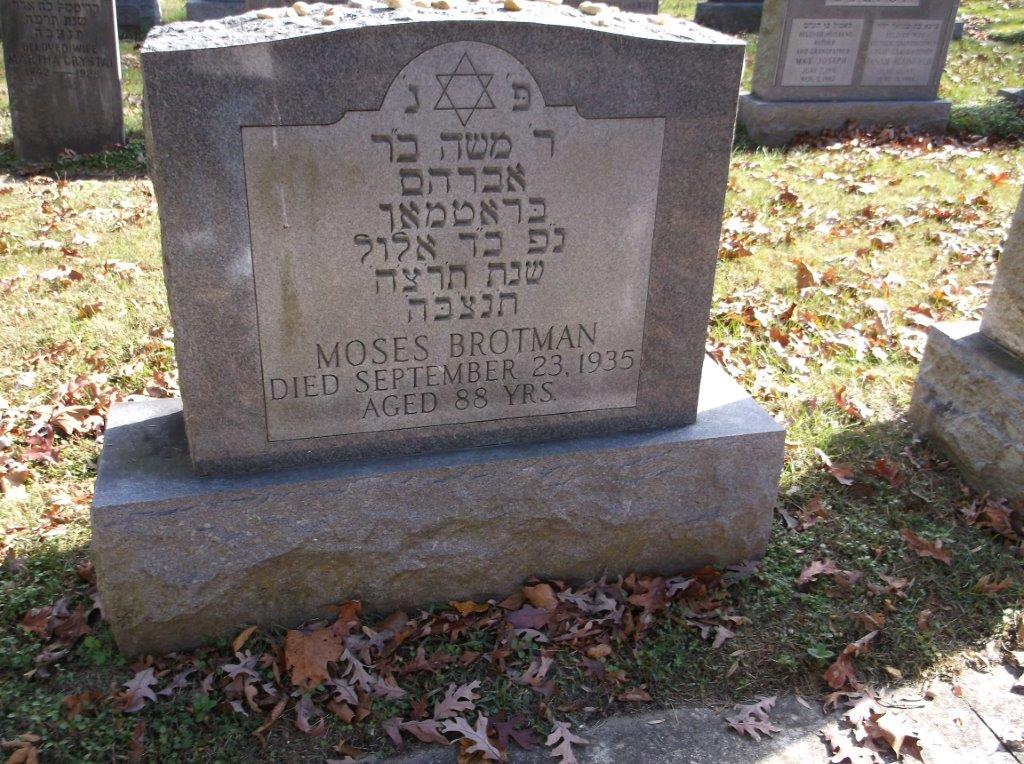
Unfortunately, I have yet to find anything that reliably demonstrates that tie.  Moses Brotman was born in Austria in 1847, making him a contemporary of our Joseph Brotman.  Elaine Ashin sent me this photo of Moses’ headstone last week, and I was very excited when I saw it because Moses’ father’s name was Abraham.  I thought perhaps Moses and Joseph were brothers, making us all closely related to the Brotmanville Brotmans.

Photo courtesy of Elaine Ashin

Image

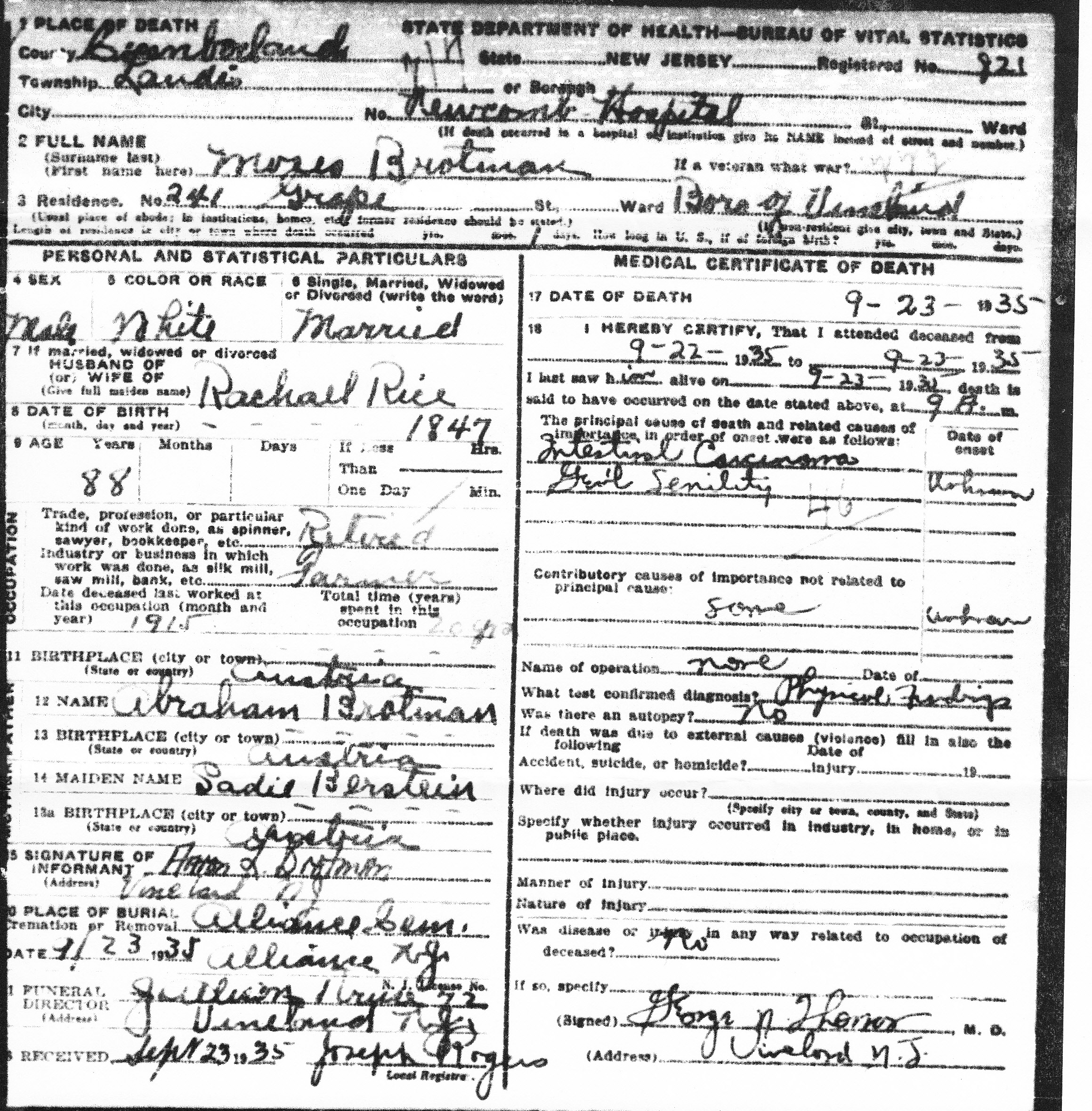
I ordered a copy of Moses’ death certificate from Trenton, NJ, and it arrived the other day.  It confirmed that Moses’ father’s name was Abraham.  However, it listed Moses’ mother’s name as Sadie Bernstein, not Yetta as listed on Joseph’s death certificate.

Image

So I see four possibilities: one, Moses and Joseph are not related at all, but it’s just coincidence that they both had fathers named Abraham Brotman.  Two, either Joseph’s death certificate is wrong as to his mother’s name or Moses’ death certificate is wrong as to his mother’s name, and they are brothers.  Given that we have seen that so many records, even death certificates, have errors (Frieda’s birth year,Hyman’s place of birth, etc.), it certainly is possible that one is wrong, that both are wrong or that both are right.  Three, it could be that Moses and Joseph are half-brothers and that Abraham had two wives and children with both, just as Moses and Joseph both did.  Four, perhaps they are distant cousins sharing a common ancestor named Abraham for whom both their fathers were named.

Unfortunately, we may never know.  In order to learn more, I would need to find documents from Galicia that would trace the history back further.  So far I am still not even sure what town our family came from nor where Moses’ family came from, so that is a difficult task.

So at the moment, the lawyer in me says there is just not enough evidence to conclude with any degree of certainty that we are related in any direct way to the Brotmans of Brotmanville.  But I have not given up, and I will keep looking or find someone in Poland who perhaps can search for me.