Malchen Rothschild, Part I: A Large Family

Having now completed the stories of the family of Gerson Rothschild and Fanny Kupermann, it is time once again to see where I am in the overall Blumenfeld family. Gerson was the eighth of the eleven children of Gelle Blumenfeld and Simon Rothschild. And Gelle Blumenfeld was the third of the three children of Moses Blumenfeld I and Gidel Loeb. And Moses Blumenfeld was the older brother of my three-times great-grandmother Breine Blumenfeld Katzenstein. So seeing this in a visual format, this is where I am:

Here is a chart of where I am in the descendants of Moses Blumenfeld I:

That looks like a lot of progress, doesn’t it?

But this is where I am in the overall family of Abraham Blumenfeld I and Geitel Katz, my 4x-great-grandparents:

So I still have a long, long way to go. (One thing not reflected here is that I have already covered the family and descendants of my three-times great-grandmother Breine Blumenfeld Katzenstein, the third child of Abraham I and Geitel.)

Now I will move on to the ninth of the children of Gelle Blumenfeld and Simon Rothschild, their daughter, Malchen. She was born on March 3, 1857, in Waltersbrueck, Germany.

Malchen Rothschild birth record, Arcinsys Archives of Hessen, HHStAW Fonds 365 No 893, p. 28

On May 12, 1878, Malchen married Daniel Rosenblatt in Waltersbrueck. Daniel, the son of Feist Rosenblatt and Minna Heilbrunn, was born on December 20, 1851, in Beisefoerth, Germany (now known as Malsfeld, Germany).

Malchen Rothschild and Daniel Rosenblatt marriage record, Hessisches Hauptstaatsarchiv; Wiesbaden, Deutschland; Bestand: 920; Laufende Nummer: 8404, Year Range: 1878, Ancestry.com. Hesse, Germany, Marriages, 1849-1930

Malchen and Daniel had seven children.

Their first born was Julchen or Julie Rosenblatt; she was born February 3, 1879, in Beisefoerth.

Julchen Rosenblatt birth record, Hessisches Hauptstaatsarchiv; Wiesbaden, Deutschland; Bestand: 920; Laufende Nummer: 4410, Year Range: 1879, Ancestry.com. Hesse, Germany, Births, 1851-1901

The second child was Jette, born February 8, 1880, in Beisefoerth.

Jette Rosenblatt birth record, Arcinsys Archives of Hessen, HHStAW, 365, 66, pp. 76-77

Felix, the third child, was born December 15, 1881, but in Zimmersrode, so the family must have relocated from Beisefoerth by then.
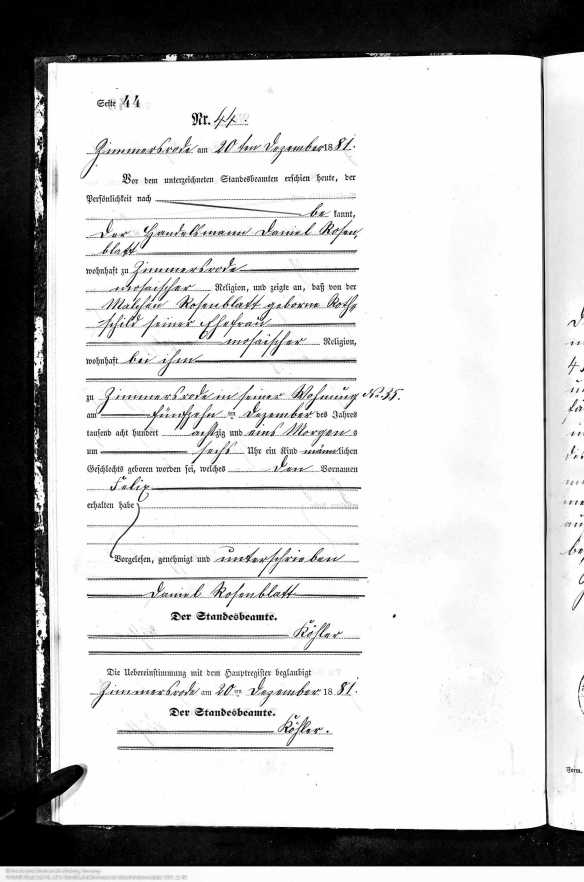
Felix Rosenblatt birth record, Hessisches Hauptstaatsarchiv; Wiesbaden, Deutschland; Bestand: 920; Laufende Nummer: 9519, Year Range: 1881, Ancestry.com. Hesse, Germany, Births, 1851-1901

The fourth child was Auguste, born in Zimmersrode on February 6, 1883.
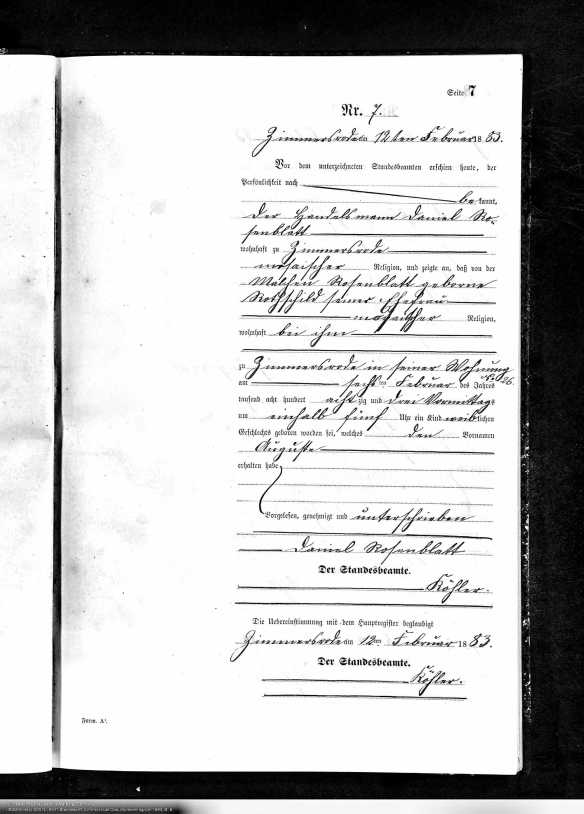
Auguste Rosenblatt birth record, Hessisches Hauptstaatsarchiv; Wiesbaden, Deutschland; Bestand: 920; Laufende Nummer: 9521, Year Range: 1883, Ancestry.com. Hesse, Germany, Births, 1851-1901

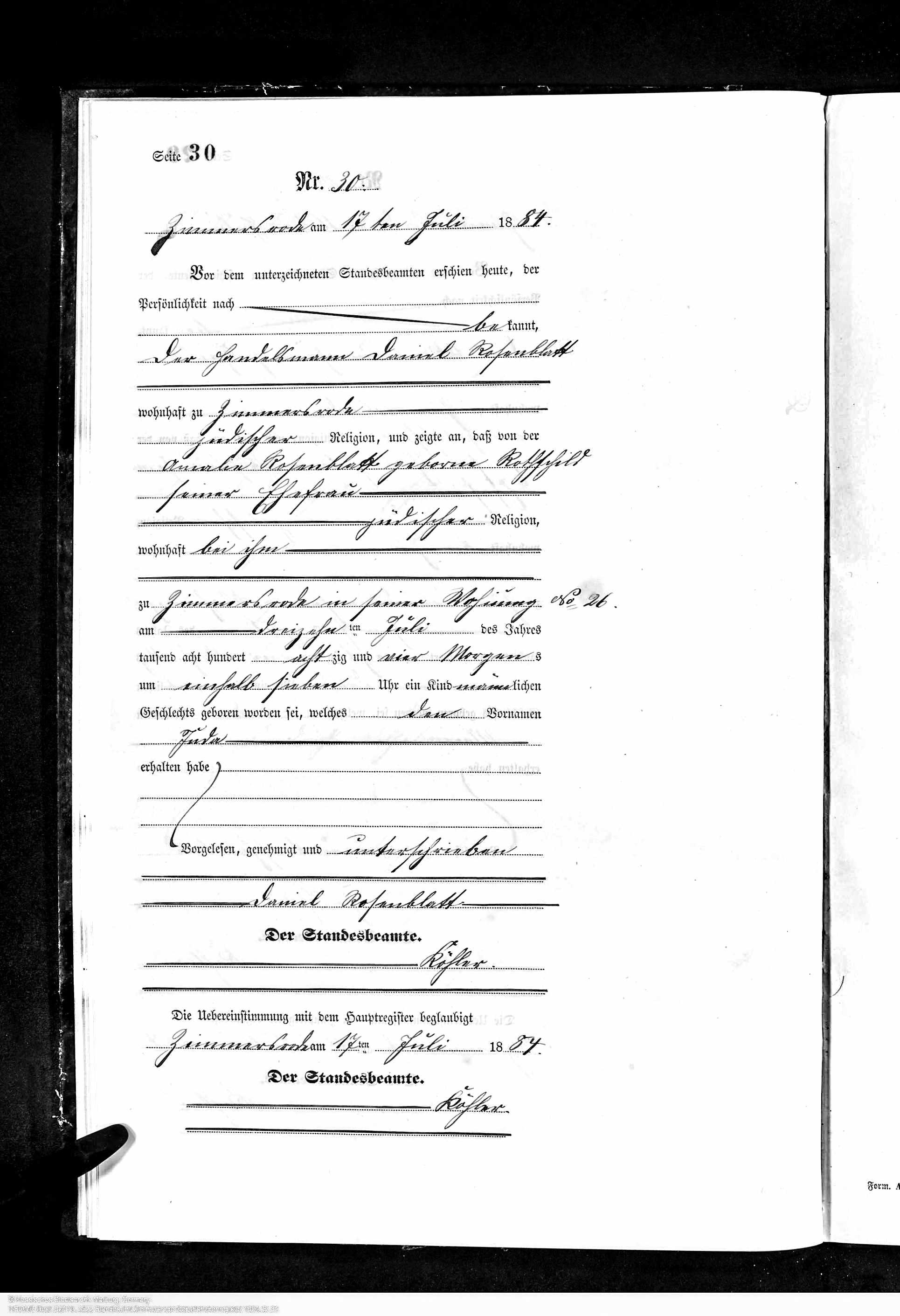
The fifth child, another boy, was Juda or Julius Rosenblatt, also born in Zimmersrode, on July 13, 1884.
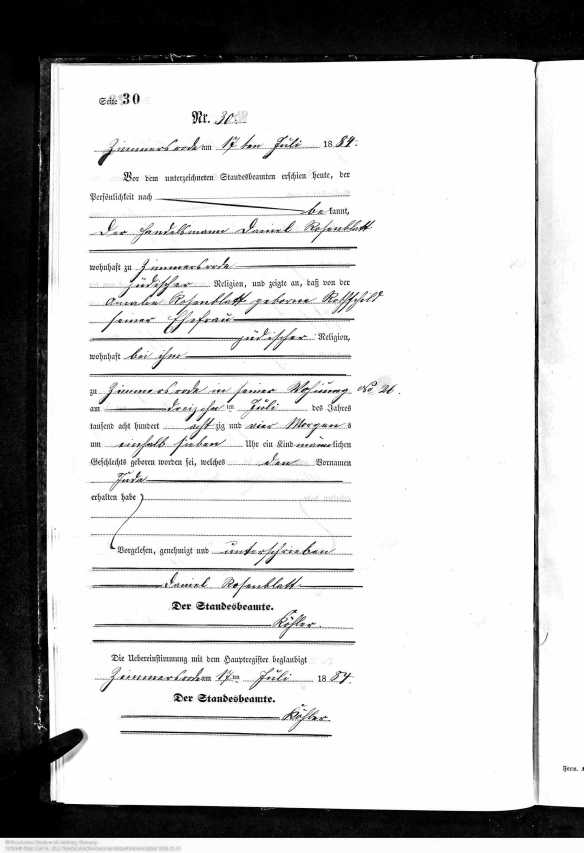
Juda Rosenblatt birth record, Hessisches Hauptstaatsarchiv; Wiesbaden, Deutschland; Bestand: 920; Laufende Nummer: 9522, Year Range: 1884, Ancestry.com. Hesse, Germany, Births, 1851-1901

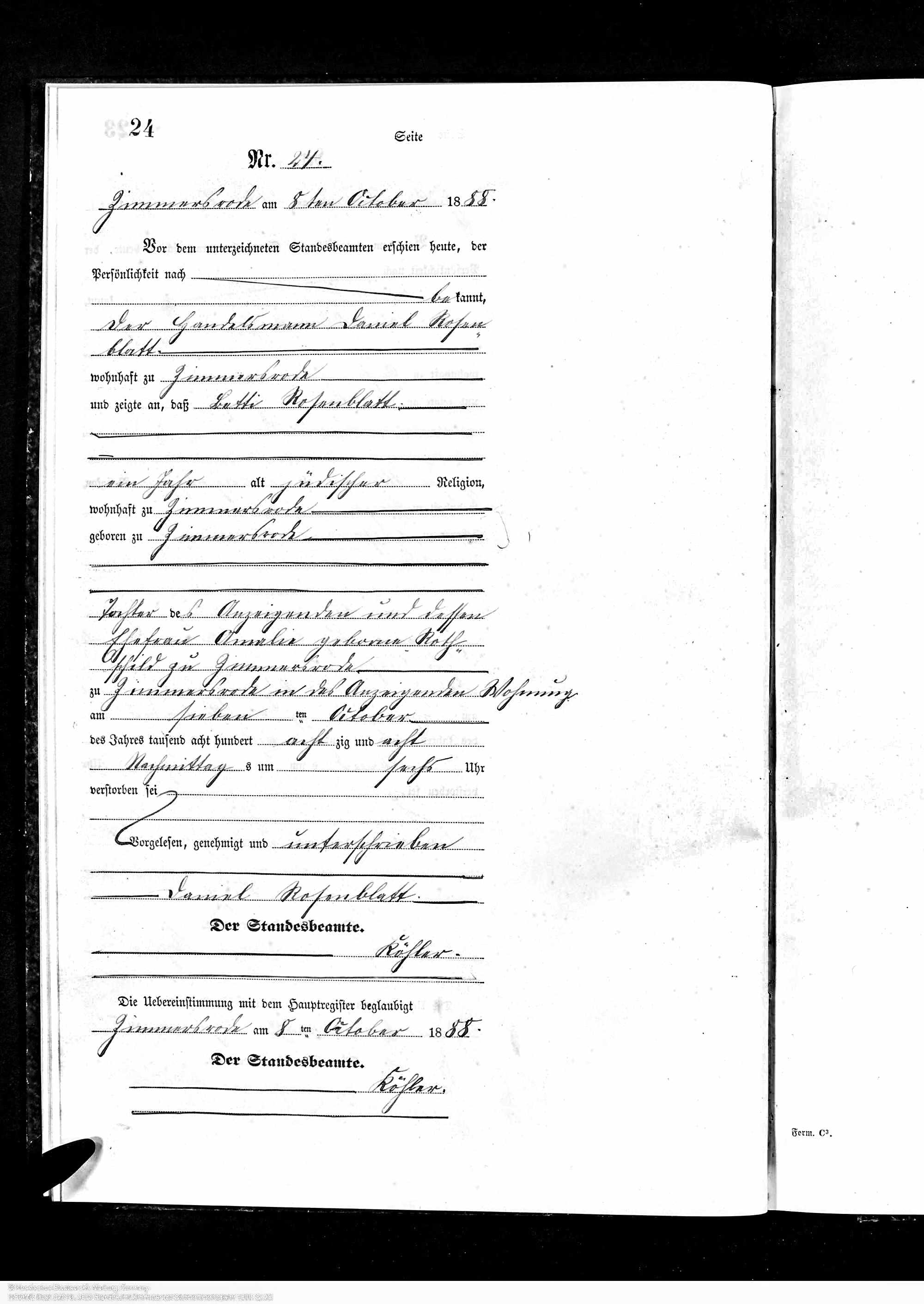
After Juda came Betty Rosenblatt, born January 8, 1887, in Zimmersrode. Sadly, Betty did not make it to her second birthday; she died on October 7, 1888, in Zimmersrode.

Betty Rosenblatt birth record, Hessisches Hauptstaatsarchiv; Wiesbaden, Deutschland; Bestand: 920; Laufende Nummer: 9525, Year Range: 1887, Ancestry.com. Hesse, Germany, Births, 1851-1901

Betty Rosenblatt death record, Hessisches Hauptstaatsarchiv; Wiesbaden, Deutschland; Personenstandsregister Sterberegister; Bestand: 9603; Laufende Nummer: 920, Year Range: 1888, Ancestry.com. Hesse, Germany, Deaths, 1851-1958

Finally, Malchen gave birth to her seventh child, Siegmund, on November 15, 1889, in Zimmersrode.

Siegmund Rosenblatt birth record, Hessisches Hauptstaatsarchiv; Wiesbaden, Deutschland; Bestand: 920; Laufende Nummer: 9527, Year Range: 1889. Ancestry.com. Hesse, Germany, Births, 1851-1901

Julchen, Jette, Felix, Auguste, Juda, and Siegmund all survived to adulthood. Finding records for some of their children has proven to be a challenge.

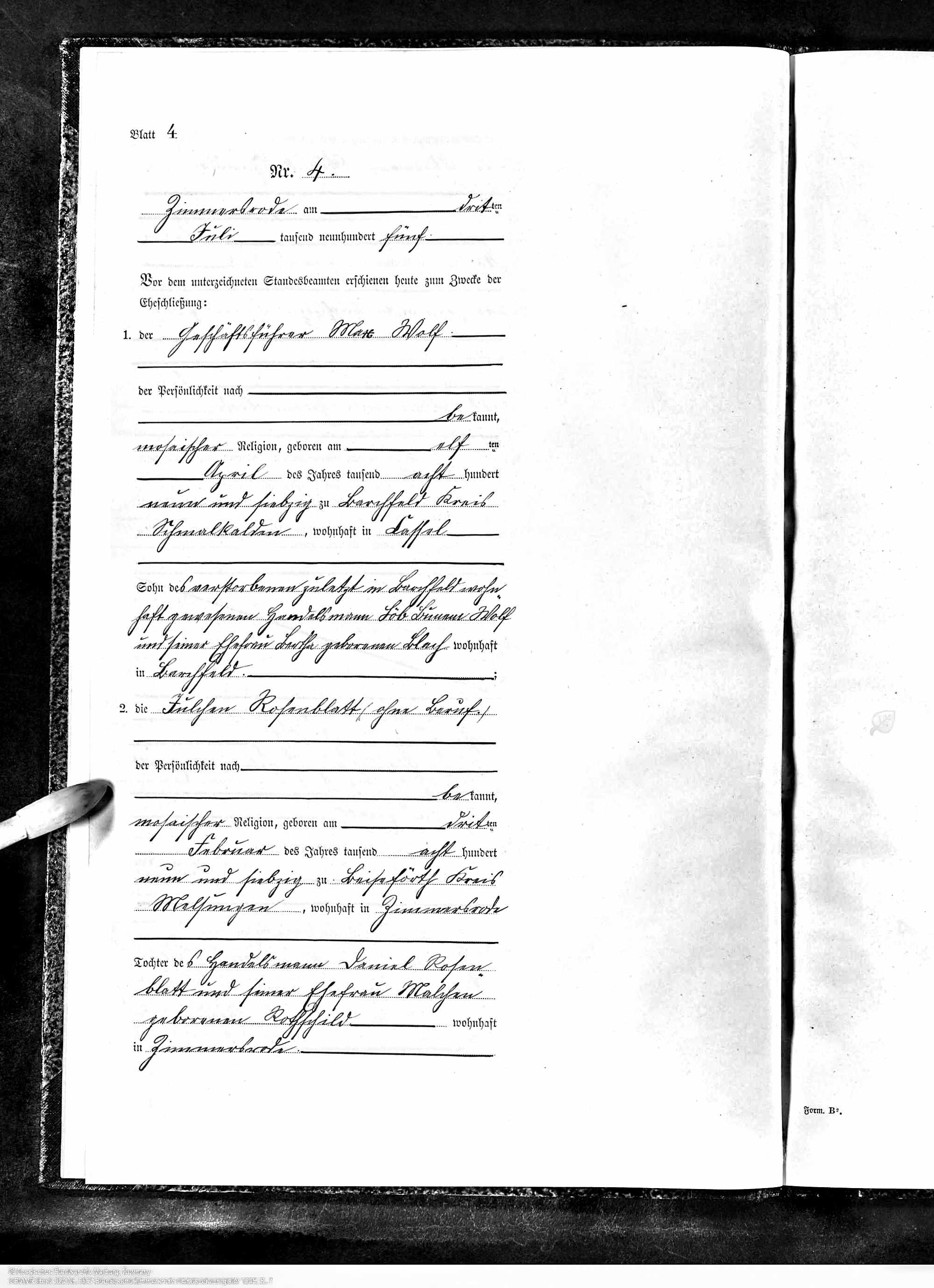
On July 3, 1905, Julchen Rosenblatt married Max Wolf in Zimmersrode. Max, the son of Loeb Bunum Wolf and Bertha Blach, was born on April 11, 1879, in Barchfeld, Germany.
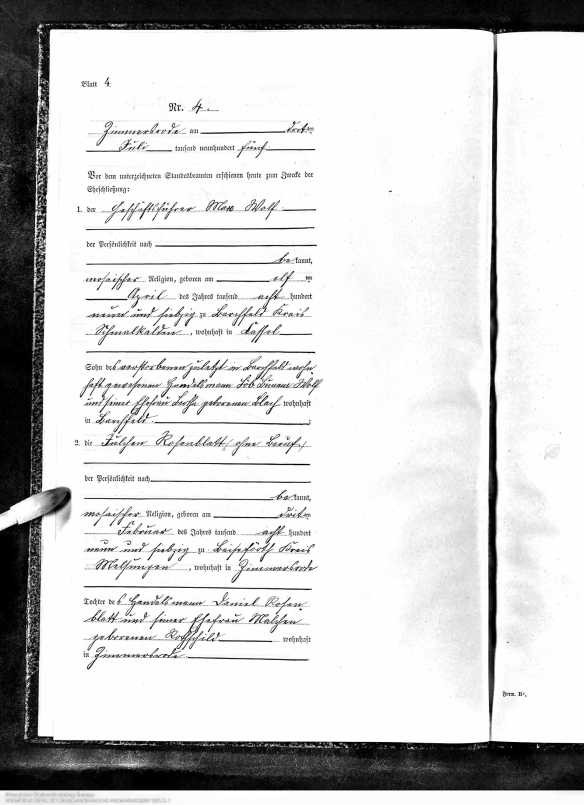
Julchen Rosenblatt and Max Wolf marriage record, Hessisches Hauptstaatsarchiv; Wiesbaden, Deutschland; Bestand: 920; Laufende Nummer: 9567, Year Range: 1905, Ancestry.com. Hesse, Germany, Marriages, 1849-1930

Julchen and Max had one child, Edgar, who died on March 2, 1909, in Kassel, when he was only one year old.

Edgar Wolf death record, Hessisches Hauptstaatsarchiv; Wiesbaden, Deutschland; Personenstandsregister Sterberegister; Signatur: 5501; Laufende Nummer: 910,  Year Range: 1909, Ancestry.com. Hesse, Germany, Deaths, 1851-1958

As far as I have been able to determine, Julchen and Max did not have any other children.

Jette Rosenblatt, the second child, does not appear to have married or had children.

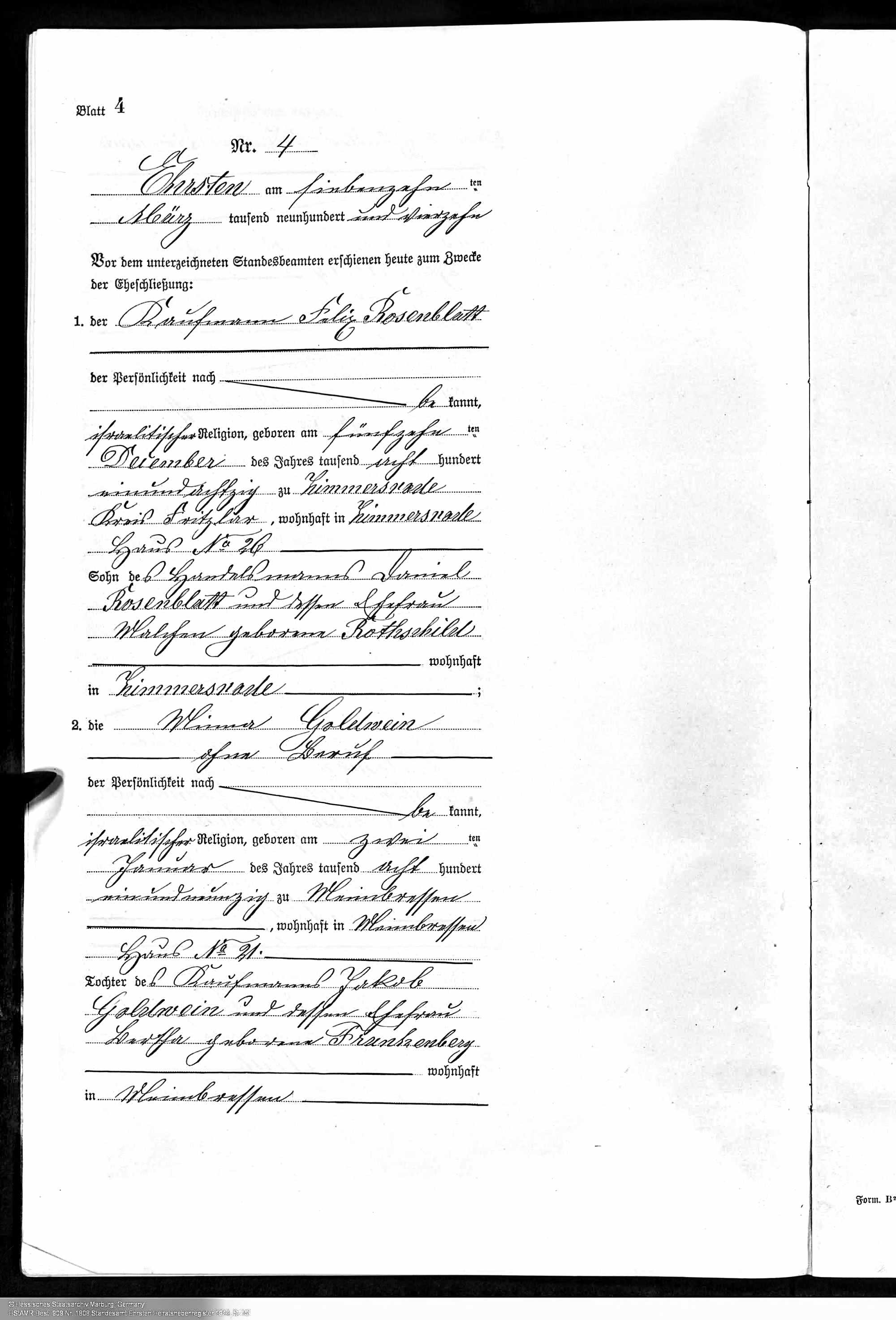
Felix Rosenblatt, the third child, married Minna Goldwein on March 17, 1914, in Ehrsten, Germany.  Minna was born in Meimbressen, Germany on January 2, 1891, to Jakob Goldwein and Bertha Frankenberg. (Minna is likely very distantly related to Manfred Goldwein, who married my cousin Margaret Sluizer.) I have no primary sources to prove that Felix and Minna had children, just unsourced family trees on Ancestry and on Geneanet and Geni/MyHeritage, but those trees and sites show that Felix and Minna had two children born in Zimmersrode: Siegfried, born January 23, 1915, and Ludwig, born November 15, 1919.

Felix Rosenblatt and Minna Goldwein marriage record, Hessisches Hauptstaatsarchiv; Wiesbaden, Deutschland; Signatur: 1808, Year Range: 1914, Ancestry.com. Hesse, Germany, Marriages, 1849-1930

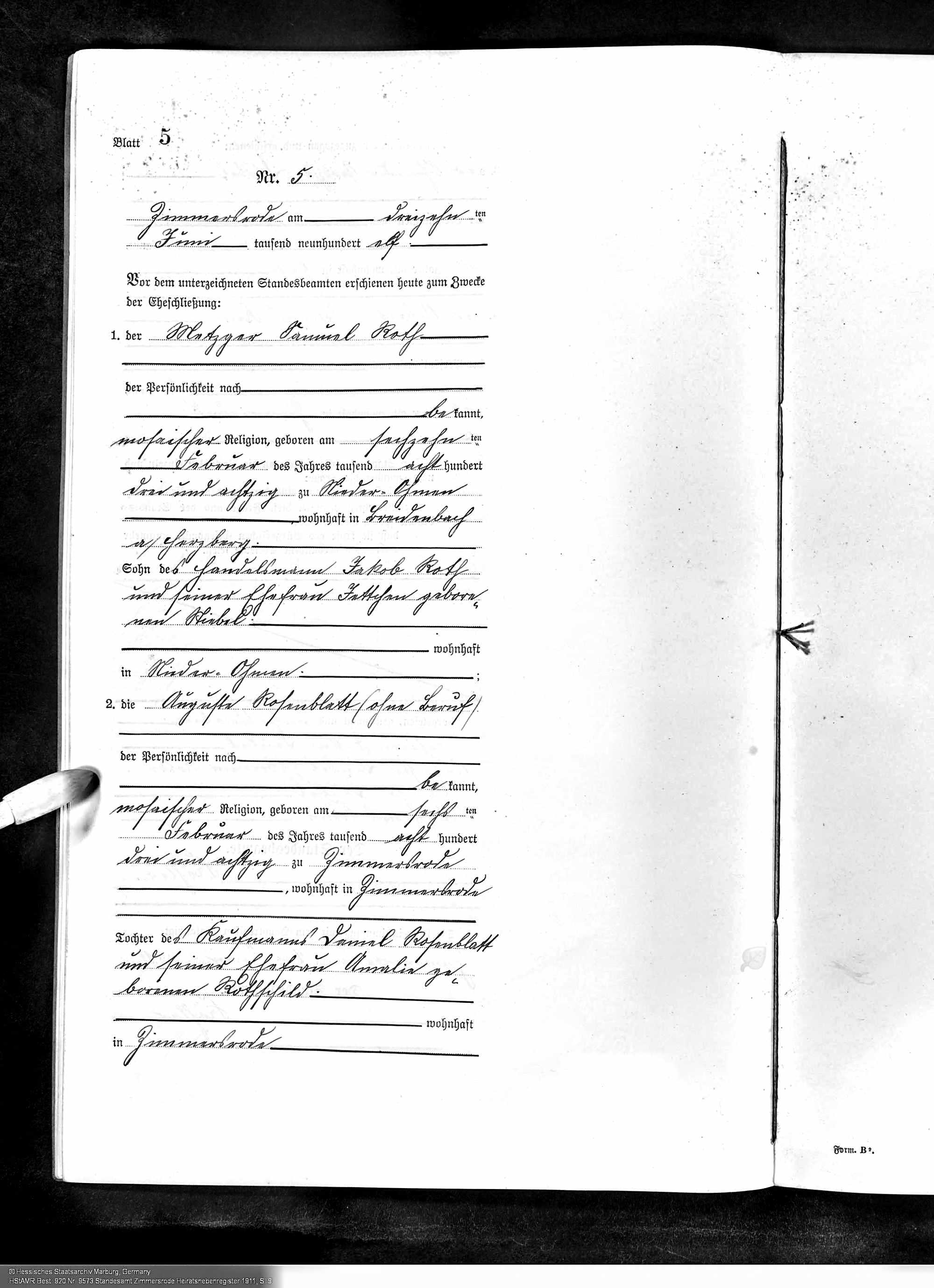
Auguste Rosenblatt, the fourth child of Malchen Rothschild and Daniel Rosenblatt, married Samuel Roth on June 13, 1911. Samuel was born February 16, 1883, in Nieder-Ohmen, Germany. He was the son of Jakob Roth and Jettchen Stiebel. Auguste and Samuel had four children born in Breitenbach, Germany, according to various secondary sources, Holocaust documents, and a few primary sources for marriage or death: Irma, born May 26, 1912;1 Friedel, born December 15, 1913;2 Lothar, born January 15, 1915;3 and Gretl, November 12, 1919.4

Auguste Rosenblatt and Samuel Solly Roth marriage record, Hessisches Hauptstaatsarchiv; Wiesbaden, Deutschland; Bestand: 920; Laufende Nummer: 9573, Year Range: 1911, Ancestry.com. Hesse, Germany, Marriages, 1849-1930

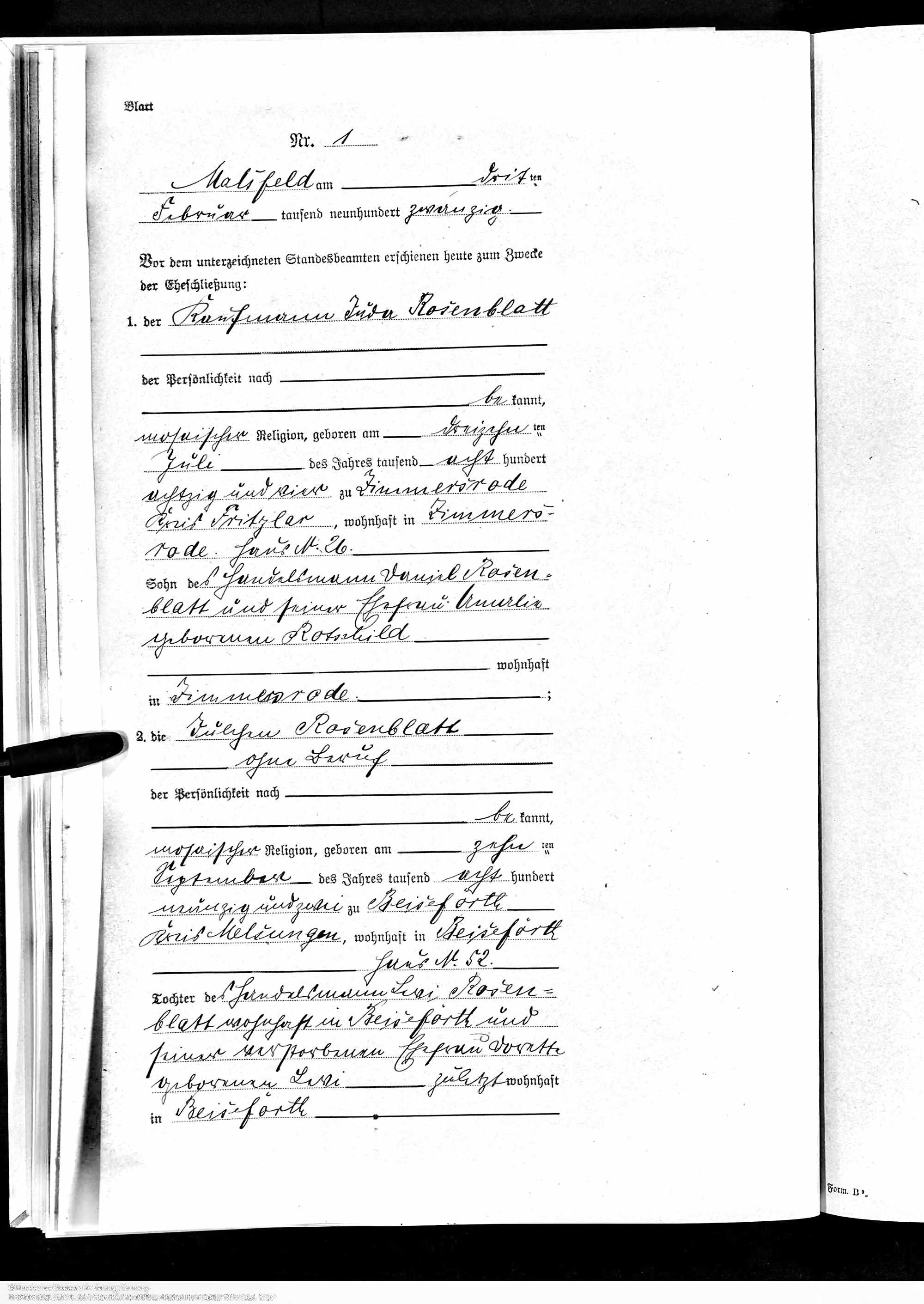
Juda Rosenblatt married Julchen Rosenblatt on February 3, 1920. No, not his sister—this Julchen Rosenblatt was his first cousin. Julchen, Juda’s wife, was born on September 10, 1892, in Malsfeld (formerly Beisefoerth), Germany, to Levi Rosenblatt and Dorette Levi. Levi Rosenblatt was Daniel Rosenblatt’s brother.
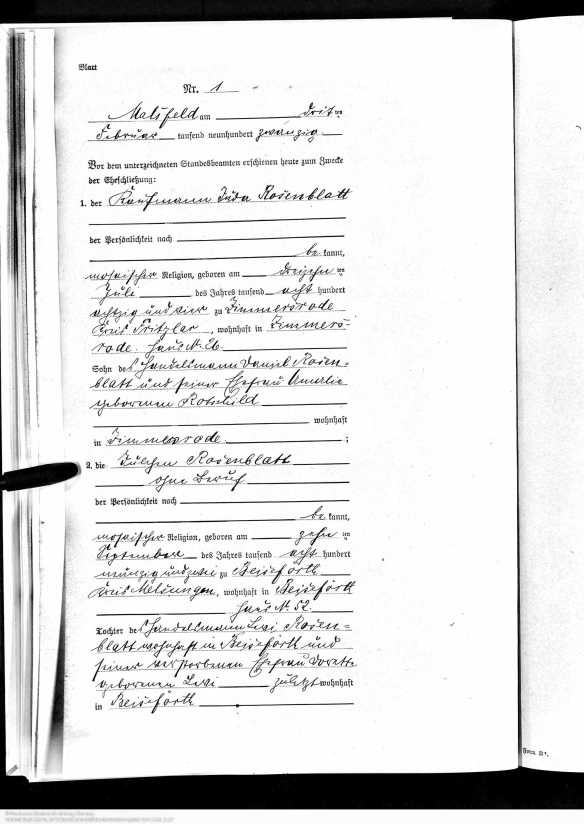
Juda Rosenblatt and Julchen Rosenblatt marriage record, Hessisches Hauptstaatsarchiv; Wiesbaden, Deutschland; Bestand: 920; Laufende Nummer: 4473, Year Range: 1918-1924, Ancestry.com. Hesse, Germany, Marriages, 1849-1930

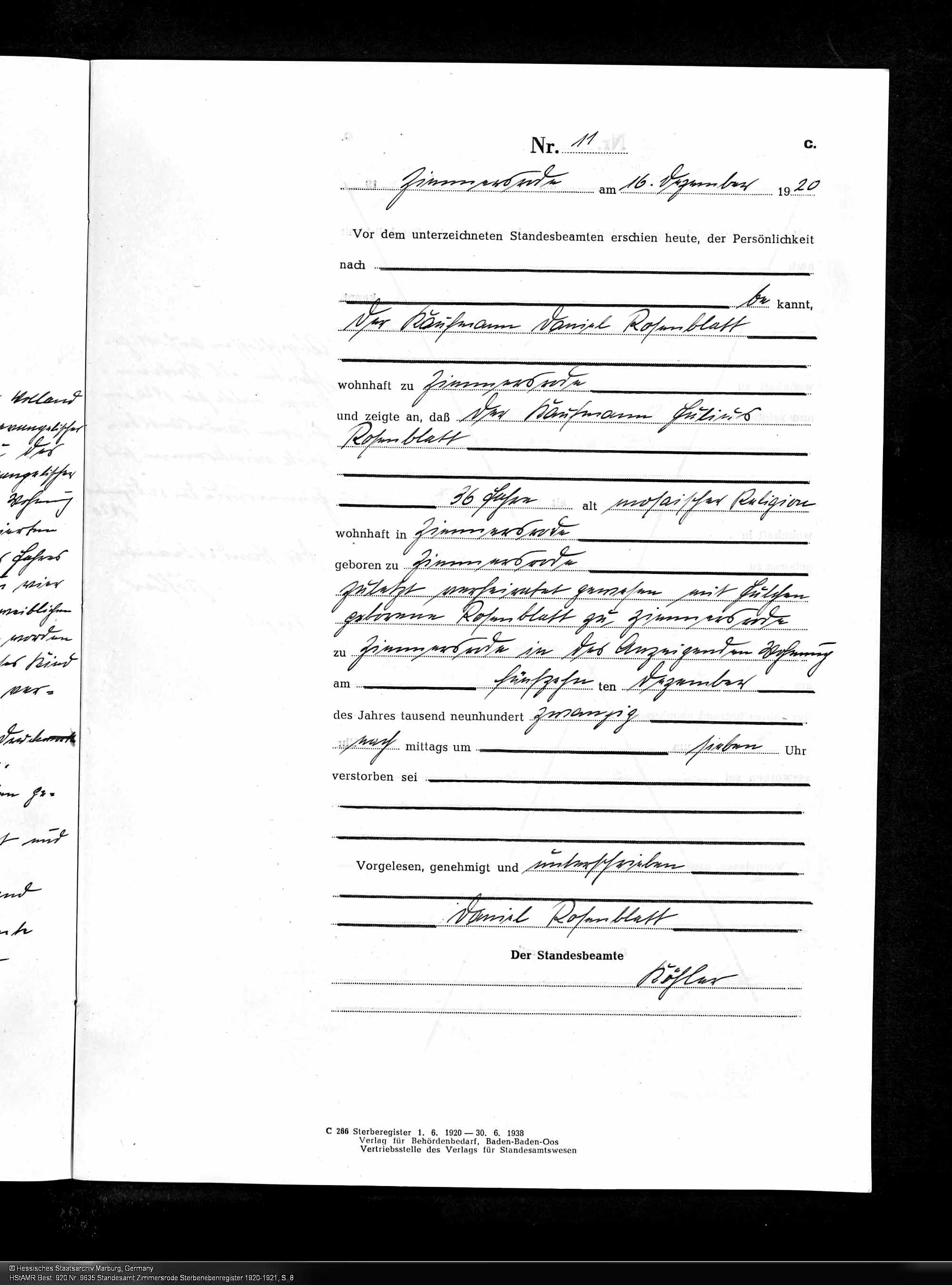
Tragically, Juda died just ten months later on December 15, 1920. He was only thirty-six years old. I believe that Juda and Julie had one child before Juda died: a son Manfred born on August 11, 1920. More on that to come in a subsequent post.

Juda Julius Rosenblatt death record, Hessisches Hauptstaatsarchiv; Wiesbaden, Deutschland; Personenstandsregister Sterberegister; Bestand: 9635; Laufende Nummer: 920, Year Range: 1920-1921, Ancestry.com. Hesse, Germany, Deaths, 1851-1958

Siegmund Rosenblatt, the youngest sibling, married Else Schwab in Schlitz, Germany, on February 9, 1920, six days after his brother Jude’s wedding. Else was born on November 1, 1896, in Schlitz, Germany, to Abraham Schwab and Franziska Strauss. Once again several unsourced trees and sites list Siegmund and Else with two or three children: Arno and Ruth and Margot. I have no primary sources for those children.
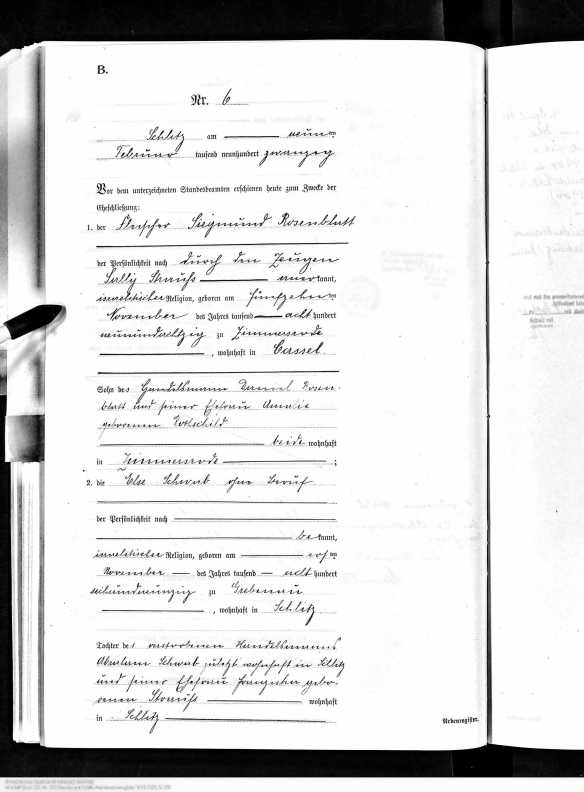
Siegmund Rosenblatt and Else Schwab marriage record, Hessisches Hauptstaatsarchiv; Wiesbaden, Deutschland; Bestand: 921; Laufende Nummer: 902, Year Range: 1915-1925, Ancestry.com. Hesse, Germany, Marriages, 1849-1930

Thus, as you can see, my research of many of the grandchildren of Malchen Rothschild and Daniel Rosenblatt rests largely on unsourced trees and websites. I am not sure where I could find more reliable information since the birth records for the towns and years where and when these grandchildren were born are not available online. But I will keep searching.

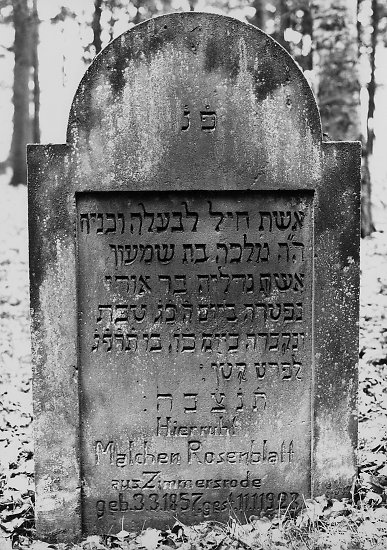
Sadly, Malchen Rothschild Rosenblatt died before any of those grandchildren had reached their teenage years. She was 65 when she died on January 11, 1923, in Kassel, Germany.5 She was survived by her husband Daniel, five of her seven children, and her grandchildren.

“Rosenblatt, Malchen née Rothschild (1923) – Haarhausen,” in: Jewish Gravesites <https://www.lagis-hessen.de/de/subjects/idrec/sn/juf/id/2330&gt; (accessed June 5, 2012)

Her gravestone reads:

Here rests

a capable housewife for her husband and children.

This is Malchen, daughter of Simon,

Wife of Gedaliah, son of Uri.

She died on Thursday, 23 Tevet,

and was buried on the 25th of the same [5] 683

after the small count.

Her soul is bound in the bond of life.

(German inscription below:)

Here rests

Malchen Rosenblatt

from Zimmersrode

born March 3, 1857, died January 11, 1923

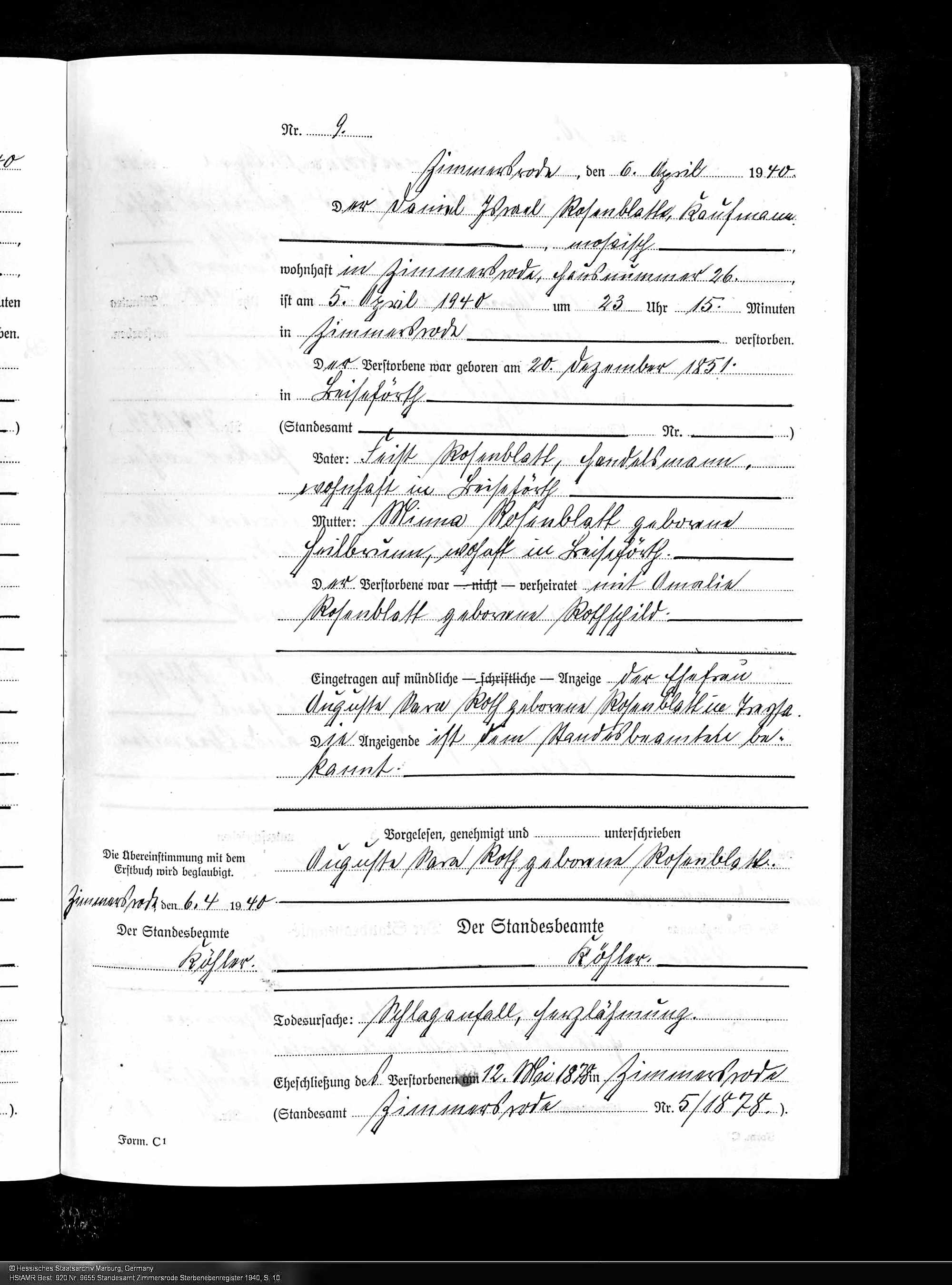
Her husband Daniel Rosenblatt lived long enough to experience Nazi persecution and the beginning of World War II. He died on April 5, 1940, in Zimmersrode.

Daniel Rosenblatt death record, Hessisches Hauptstaatsarchiv; Wiesbaden, Deutschland; Personenstandsregister Sterberegister; Bestand: 9655; Laufende Nummer: 920, Year Range: 1940, Ancestry.com. Hesse, Germany, Deaths, 1851-1958

Notice that his death record has his name as Daniel “Israel” Rosenblatt, reflecting the Nazi requirement that all Jewish men add Israel as their middle name. He was 88 years old and died of a stroke.6

Malchen and Daniel were spared seeing what would happen to their three daughters and their families during the Holocaust.

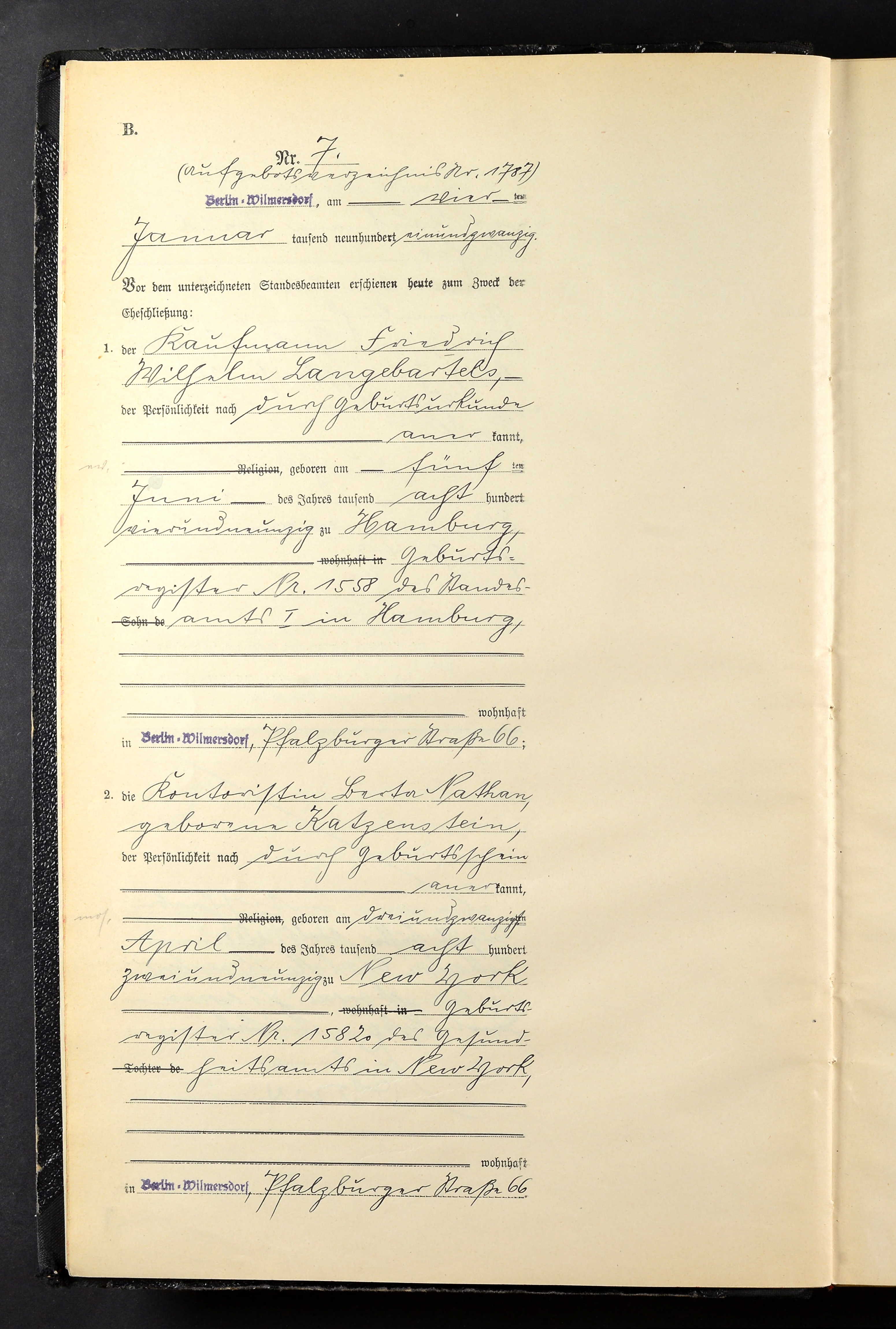


  1. Irma Roth marriage record, Landesarchiv Berlin; Berlin, Deutschland; Personenstandsregister Heiratsregister, Ancestry.com. Berlin, Germany, Marriages, 1874-1940 
  2. Friedel Roth death record, Hessisches Hauptstaatsarchiv; Wiesbaden, Deutschland; Personenstandsregister Sterberegister; Signatur: 598; Laufende Nummer: 926, Ancestry.com. Hesse, Germany, Deaths, 1851-1958 
  3. Lothar or Lotario Roth burial record on JewishGen, JOWBR database, found at https://www.jewishgen.org/databases/cemetery/jowbr.php?rec=J_ARGENTIN_0200287&#160;
  4. Gretel Roth, Arolsen Archives; Bad Arolsen, Germany; Record Group 1 Incarceration Documents; Reference: 1.2.1.1, Ancestry.com. Germany, Incarceration Documents, 1933-1945 
  5. “Rosenblatt, Malchen née Rothschild (1923) – Haarhausen,” in: Jewish Gravesites <https://www.lagis-hessen.de/de/subjects/idrec/sn/juf/id/2330&gt; (accessed June 5, 2012) 
  6. Daniel Rosenblatt, Arolsen Archives, Digital Archive; Bad Arolsen, Germany; Lists of Persecutees 2.1.1.1, Description Reference Code: 02010101 oS, Ancestry.com. Free Access: Europe, Registration of Foreigners and German Persecutees, 1939-1947 

Another update: Alfred Meyer Survived The Holocaust

Almost five years ago I wrote about Alfred Meyer, son of Regina Goldschmidt and Aaron Meyer and my third cousin, twice removed. He was born in Frankfurt, Germany, on June 16, 1875, and that was almost all I knew about him. The only other records I could find for Alfred were two Holocaust era records on file at the Arolsen Archives. Both indicated that Alfred had left Germany for France on April 24, 1939, and was still there as of November 3, 1939. I couldn’t find any other records for him.

Had he ever married? Did he have children? I didn’t know. Had he died in the Holocaust? There were no records for him at Yad Vashem or at the US Holocaust Memorial and Museum. I was left without any further information.

Until, that is, a few weeks ago when I received an email from another researcher named Ofra Karo. Ofra and I had been in touch over a year ago about a different branch of my tree, but now she was writing to say that she had found additional information about Alfred Meyer. For one thing, she had found a marriage record for Alfred indicating that he had married Augustine Marguerite K/Brat in Paris, France on August 11, 1911.

Alfred Meyer marriage record, Archives de Paris; Paris, France; État-Civil 1792-1902, Certificate Number: 0553-0836, Paris, France, Births, Marriages, and Deaths, 1555-1929

At first I was skeptical. What was Alfred doing in France in 1911 if he was in Frankfurt in 1939? Was this the same Alfred Meyer? But after studying the marriage record and relying on my rusty high school French, I saw that this was indeed the same man—-son of Regina Goldschmidt and Aaron Meyer, born in Frankfurt, Germany, on June 16, 1875. And he was at that time residing in Paris. Given that Alfred was a grandson of Jacob Goldschmidt, whose family owned the international art and antiques business, it wasn’t really surprising that Alfred was living in Paris in 1911, perhaps working for the family’s business.

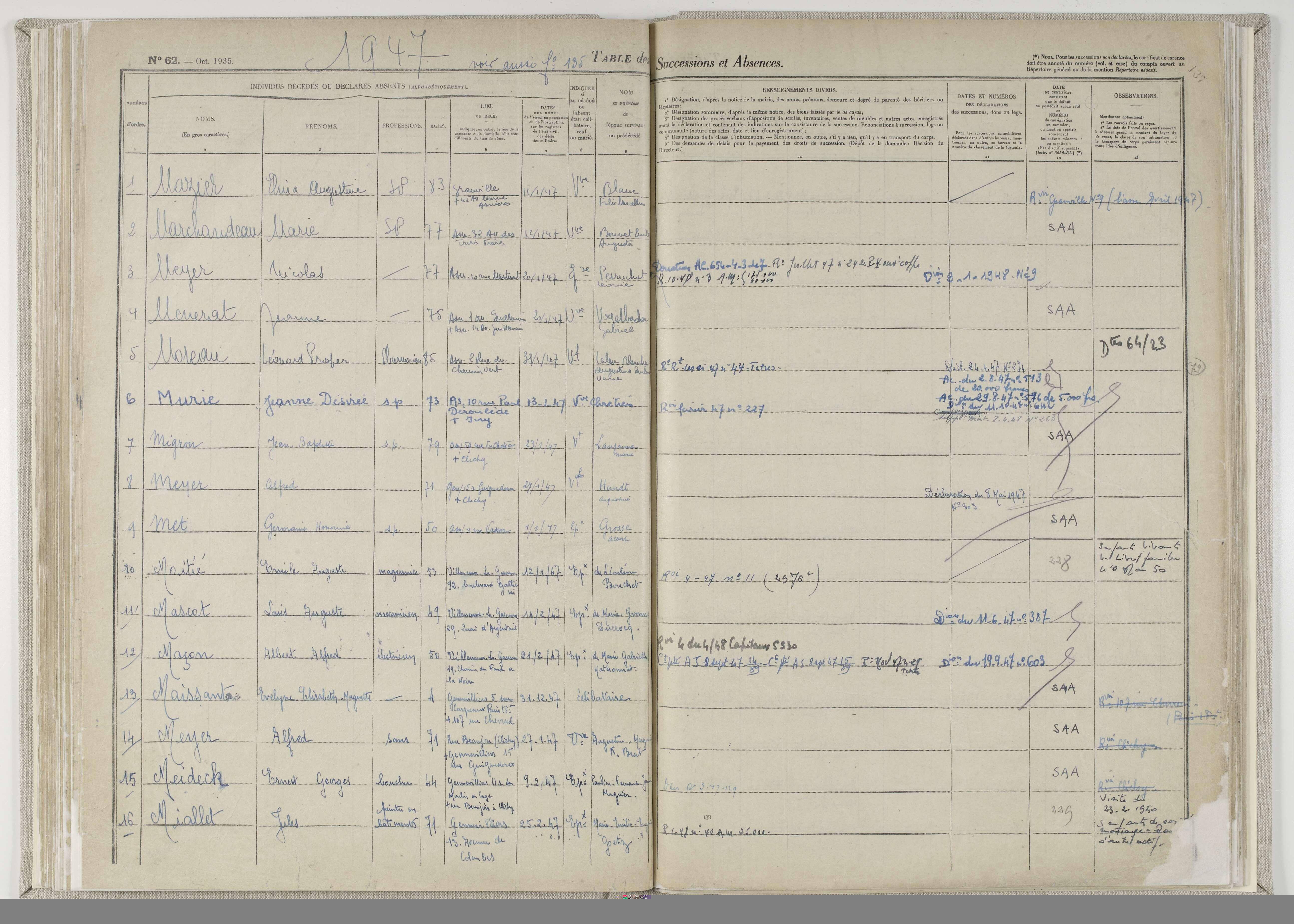
Ofra also directed me to a death record for Alfred. He had not died in the Holocaust, but had lived long enough to die after World War II. He died on January 27, 1947, in Gennevilliers, France, and had been residing in Clichy, France, a suburb of Paris just a few miles from where he died. He was 71 and a widower at the time of his death. No occupation was listed.1

Unfortunately, I have no other sources at this time for Alfred. Ofra found a tree on Ancestry that appears to be created by Alfred’s granddaughter and has many photos of family members. I tried to contact that tree owner through Ancestry without success, and I have looked to see if I could find her outside of Ancestry without success. Because I cannot confirm the information in that tree, I am not comfortable relying on it. If it is accurate, it does appear that Alfred had a son and has living descendants, but I cannot confirm that at this time.

At any rate, I do now know that Alfred did not die in the Holocaust. How he survived remains a mystery.


  1. There are two men named Alfred Meyer on this page—same age, same day of death, both with spouses with the first name Augustine. Ofra suggested that the one on Line 14 is a correction of the one on Line 8. That seems a reasonable assumption. 

Two Updates: Why Didn’t Mathilde Rothschild Leave Germany With Her Family? And How did Albert Alexander Meet His Wife?

Before I continue the stories of the children of Gerson Rothschild and Fanny Kugelmann, I have three updates to earlier posts that I’d like to share. All three are possible because other researchers and family members found this blog and contacted me. These are true gifts from the genealogy village. I am so grateful.

Some of you may recall that back in May 2024, I wrote about my relative Hirsch “Harry” Rothschild and his three children, all of whom escaped from Nazi Germany to the United States before World War II started. But unfortunately Harry’s wife Mathilde did not escape with her family and was ultimately murdered by the Nazis.

In my blog post about this family I wondered why Mathilde had not come with Harry and her children when they left Germany. Was she ill, I speculated? I had no answers.

Now I have more information about the family of Harry Rothschild. A man named Fredo Behrens recently contacted me after seeing my blog post. He lives in Oldenburg, Germany, and as he told me in his email, he worked for the “Nordwestdeutsches Museum für Industriekultur” in Delmenhorst for several years 25 years ago, where his area of responsibility was museum education, exhibitions and a regional “Topography of the Nazi Era.” He also is on the board of the “Friends and Supporters of the Jewish Community of Delmenhorst,” and heads the Delmenhorst City History Working Group. More specifically, he has done research into the history of the Jewish people of Delmenhorst, including the Rothschild family.1

Fredo told me about a monograph by Dr. Enno Meyer from 1985 entitled “Die Geschichte der Delmenhorster Juden 1695-1945”, or the History of the Jews of Delmenhorst 1695-1945. Dr. Meyer was the head of “Gesellschaft für christlich-jüdische Zusammenarbeit” (Society for Christian-Jewish Cooperation) for at least 30 years, according to Fredo. Fredo sent me both a copy of Dr. Meyer’s monograph (in German) and also a copy of an article that Fredo himself wrote about the Jews of Delmenhorst that excerpts parts of Meyer’s monograph and adds to it.2 I was able to use DeepL to translate Fredo’s work and learn more about the Rothschild family’s life in Delmenhorst.

According to the works of Meyer and Behrens, Dr. Harry Rothschild came to Delmenhorst from Hesse in 1914 and was the first Jewish doctor to practice in that town. By 1925, he was one of the top two taxpayers in the town. Harry was not active in the organized Jewish community, however, until after the Nazis came to power.3 According to Fredo’s research, the growing antisemitism in the early 1930s prompted Harry to become more involved. By 1933 he was chairman of the local Zionist organization and on the Jewish community board.

When the Nuremberg Laws were adopted and Jews were no longer allowed to employ Aryans, Harry and his Aryan cleaning woman petitioned the mayor for permission to continue their employment relationship, but their petition was rejected.4

Fredo kindly shared with me this photograph showing the street where the Rothschild family lived in Delmenhorst in 1930. The arrow points to where Harry Rothschild practiced medicine and lived before he left Germany in 1939.

Rothschild house and office in Delmenhorst, 1930, courtesy of Fredo Behrens: Jüdisches Leben in der Langen Straße nach 1933. In: Die Lange Straße in Delmenhorst : Biographie einer alten Straße ; Begleitveröffentlichung zur Ausstellung in den Museen der Stadt Delmenhorst auf der Nordwolle vom 24.6. – 2.9.2001. Hg. vom Stadtmuseum Delmenhorst. Isensee, Oldenburg 2001, p. 60

Then on October 10, 1937, Harry and a number of other Jewish residents of Delmenhorst were arrested by the Gestapo without warning or warrants. According to the observations of a fellow prisoner who became Harry’s cellmate, Harry was particularly humiliated by this experience and was called a “dirty stinking Jew” by one of the Gestapo agents. Harry and his cellmate were in solitary confinement, and Harry remained in prison until the spring of 1938. Harry’s condition had deteriorated greatly during his imprisonment.5

On November 10, 1938 in the aftermath of Kristallnacht, Harry was again arrested and was one of fourteen Jewish men who were arrested and sent to the concentration camp at Sachsenhausen.6

By that time all three of Harry and Mathilde’s children had left Germany for the United States. Harry left in the spring of 1939 and went to Cuba, and he was finally able to join his children in the US in December 1939.

But as we know, Mathilde did not come with him, and she was eventually deported to Minsk and died there. Dr. Meyer shed some light on this in his monograph, also quoted in Fredo Behren’s work. On page 85 of his history of the Delmenhorst Jews, Enno Meyer wrote that Mathilde had stayed behind to try and sell the family house; then when the war started in September 1939, she was trapped in Germany and could not leave.7

If only Mathilde had left with Harry and had not tried to sell the family’s home, this family’s story would have had a much happier ending. There may be more to this story that we will never know, but if this account is accurate, it shows how one decision affected an entire family’s fate during the Holocaust.

I want to thank Fredo Behrens again for providing me with the information and the photograph used in this post and for the work he does to preserve the Jewish history of Delmenhorst.


The second update came from two newly found cousins—my fifth cousin Charles Alexander and his daughter Kate. They also found me through my blog. Charles is the grandson of Theresa Rothschild Alexander, and I wrote about that family here. Check out the update there and learn how Charles’ parents, Albert Alexander and Mary Jane Deiches, actually met. My original speculation proved to be incorrect.

Also, I’ve added to that post a photo Charles gave me from his father’s yearbook. I am also adding it here since I could not place it properly in the original post.


Finally, the third update will have to wait until next week.


  1. Email from Fredo Behrens, March 25, 2025. 
  2. Fredo Behrens, “Jüdisches Leben in der Langen Straße nach 1933. In: Die Lange Straße in Delmenhorst : Biographie einer alten Straße; Begleitveröffentlichung zur Ausstellung in den Museen der Stadt Delmenhorst auf der Nordwolle vom 24.6. – 2.9.2001. Hg. vom Stadtmuseum Delmenhorst. Isensee, Oldenburg 2001. 
  3. Enno Meyer, “Die Geschichte der Delmenhorster Juden 1695-1945,” (1985), pp. 48, 55, 60, as cited in Behrens,  Note 2, supra. 
  4. Behrens, Note 2, supra, citing a letter dated November 14, 1936, response from the mayor dated December 3, 1936. Exhibition “Delmenhorst in National Socialism.   based on a letter dated September 24, 1955, affidavit from Wilhelm Schroers for Dr. Rothschild. Exhibition “Delmenhorst under National Socialism.” 
  5. Letter dated September 24, 1955, affidavit from Wilhelm Schroers for Dr. Rothschild. Exhibition “Delmenhorst under National Socialism.” as quoted in Behrens, Note 2, supra. 
  6. Behrens, Note 2, supra. 
  7. Enno Meyer, “Die Geschichte der Delmenhorster Juden 1695-1945,” (1985), p. 85, as cited in Behrens, Note 2, supra. 

Gerson and Fanny Rothschild’s Children: From A Large Family to Small Families

Gerson Rothschild’s wife Fanny gave birth to eleven children between 1883 and 1901, but three of those babies did not survive. Two died at birth, and one died at seven weeks. That left eight surviving children: Siegmund (1884), Katchen (1885), Max (1886), Auguste (1888), Jenny (1890), Clara (1891), Rosa (1893), and Amalie (1901). Two sons, six daughters.

But from such a large family, only one of those eight surviving children would have more than two children, and they all married at a later age than was typical of those times. They almost all married in their thirties. It made me wonder why these siblings delayed marriage and had so few children after coming from such a large family. Were they so close to each other that they didn’t want to leave home? Were the older ones helping to care for the younger ones? Did the fact that three babies did not survive make them wary of having more that one or two children? Or was it simply a matter of economics or the trend in the 1920s in Germany? I don’t know, but here are the facts.

Siegmund, the first born, was 35 when he married Elise Olga Block on December 22, 1919, in Frankfurt. Elise, the daughter of Max Block and Fanny Schaefer, was born in Ratiburg, Germany, on April 4, 1892.

Siegmund Rothschild and Elsa Block marriage record, Hessisches Hauptstaatsarchiv; Wiesbaden, Deutschland; Bestand: 903, Year Range: 1919, Ancestry.com. Hesse, Germany, Marriages, 1849-1930

Siegmund and Elise had two sons: Ernst, born March 1, 1922,1 and Werner, who is still living as far as I’ve been able to determine. Both were born in Frankfurt.

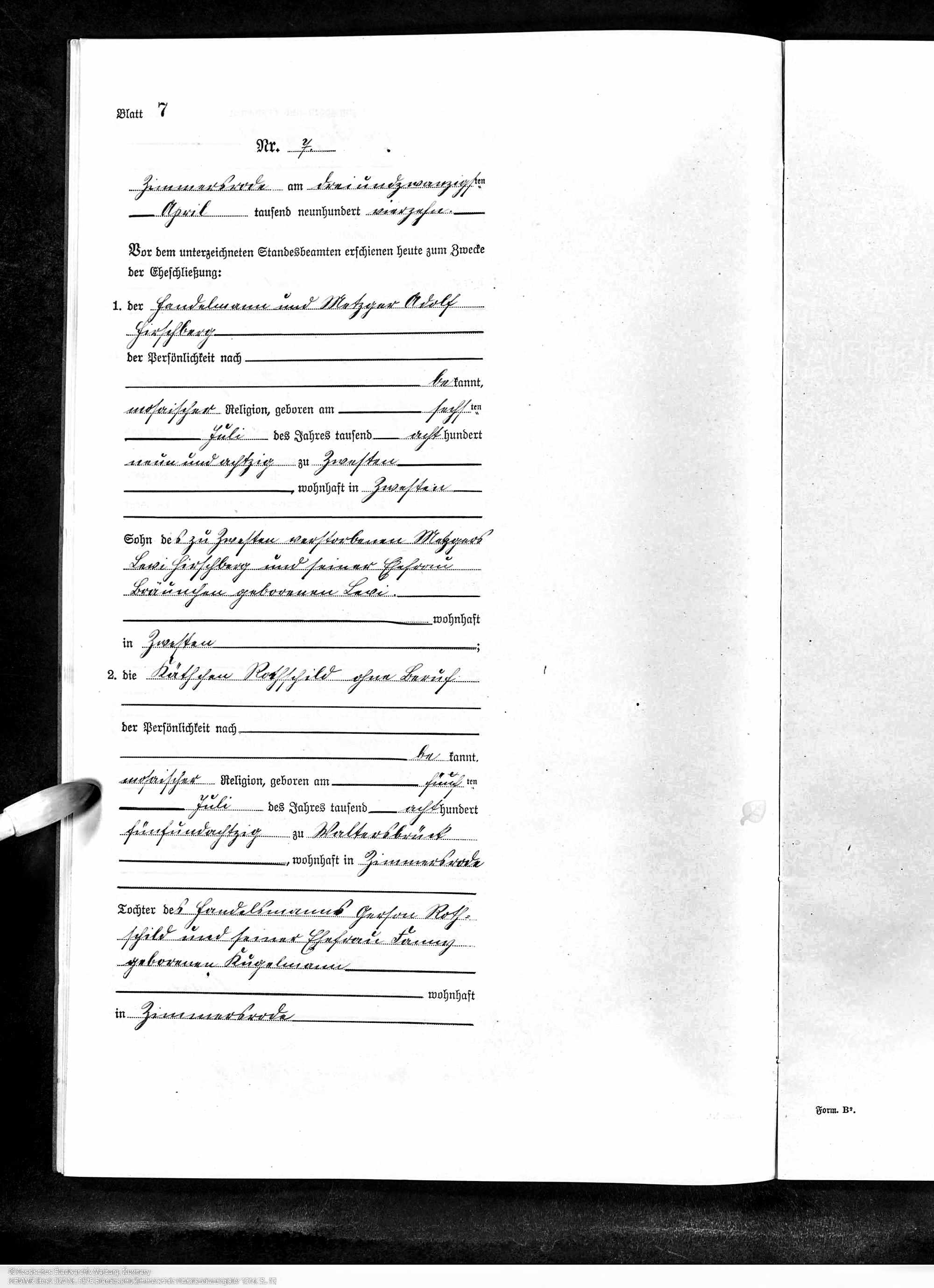
Katchen Rothschild was 28 when she married Adolf Hirshberg on April 23, 1914, in Zimmersrode. Adolf was born July 6, 1889, in Bad Zwesten, Germany, to Levi Hirshberg and Braunchen Levi.

Katchen Rothschild and Adolf Hirschberg marriage record, Hessisches Hauptstaatsarchiv; Wiesbaden, Deutschland; Bestand: 920; Laufende Nummer: 9576, Year Range: 1914, Ancestry.com. Hesse, Germany, Marriages, 1849-1930

Katchen and Adolf had one child, a son Ludwig, born in Kassel, Germany, on February 1, 1920.2

Max Rothschild was 32 when he married Johanna Katz in Zimmersrode on October 19, 1919. Johanna was the daughter of Jacob Katz and Karoline Rosenblatt, and she was born Neuenhain, Germany, on May 1, 1892.

Max Rothschild and Johanna Katz marriage record, Hessisches Hauptstaatsarchiv; Wiesbaden, Deutschland; Bestand: 920; Laufende Nummer: 9581, Year Range: 1919-1920, Ancestry.com. Hesse, Germany, Marriages, 1849-1930

Max and Johanna had two sons: Erich, supposedly born on May 13, 1921, and Richard, supposedly born October 24, 1922, both in Zimmersrode.3

Auguste Rothschild was thirty when she married Wolf Feldheim on March 18, 1919, in Zimmersrode. Wolf was born April 4, 1875 in Graudenz, then part of Prussia, now part of Poland. His parents were Aron Feldheim and Lena London. Wolf had been previously married and had four young children when he married Auguste.

Auguste Rothschild and Wolf Feldheim marriage record, Hessisches Hauptstaatsarchiv; Wiesbaden, Deutschland; Bestand: 920; Laufende Nummer: 9581, Year Range: 1919-1920, Ancestry.com. Hesse, Germany, Marriages, 1849-1930

Auguste and Wolf had one son, Bruno, according to several trees, but I am still looking for a record that ties Bruno to Auguste and Wolf. I did find records for a Bruno Feldheim born in Fulda, Germany, on November 12, 1921, but those records do not identify Bruno as the son of Auguste and Wolf.4

Jenny Rothschild was thirty when she married Salomon Abraham on November 11, 1920, in Zimmersrode. Salomon was born in Durboslar, Germany, on August 14, 1891. I am still looking for a record to confirm the names of his parents.

Jeanette Rothschild and Salomon Abraham marriage record, Hessisches Hauptstaatsarchiv; Wiesbaden, Deutschland; Bestand: 920; Laufende Nummer: 9582, Year Range: 1920-1921, Ancestry.com. Hesse, Germany, Marriages, 1849-1930

Jenny and Salomon had two children, Walter, born September 13, 1921, in Zimmersrode5 and Herta, born August 26, 1928, born in Kassel.6

Clara Rothschild was thirty when she married Moritz Katz in Zimmersrode on November 1, 1921. Moritz was born on November 4, 1894, in Neuenhain, Germany. He was the son of Jakob Katz and Karoline Rosenblatt and the younger brother of Johanna Katz, who had married Clara’s brother Max.

Clara Rothschild and Moritz Katz marriage record, Hessisches Hauptstaatsarchiv; Wiesbaden, Deutschland; Bestand: 920; Laufende Nummer: 9582 Description Year Range: 1920-1921 Source Information Ancestry.com. Hesse, Germany, Marriages, 1849-1930

Clara and Moritz had three children: Otto, born September 5, 1922, in Neuenhain;7 Helmut (later Harold) born in Neuenhain in 1924,8 and Ilse, born on May 19, 1928, in Kassel, Germany.9 Since Harold may still be living, I will not report on his exact birth date.

The last two children of Gerson Rothschild and Fanny Kugelmann, their daughters Rosa and Amalie, married after 1930 and had children after Hitler came to power.  I will write about their husbands and children in a subsequent post.

Isn’t it interesting how late these eight children married and how few children they had after being from such a large family? I’d love to know more about their decisions, but alas, all I have is speculation.

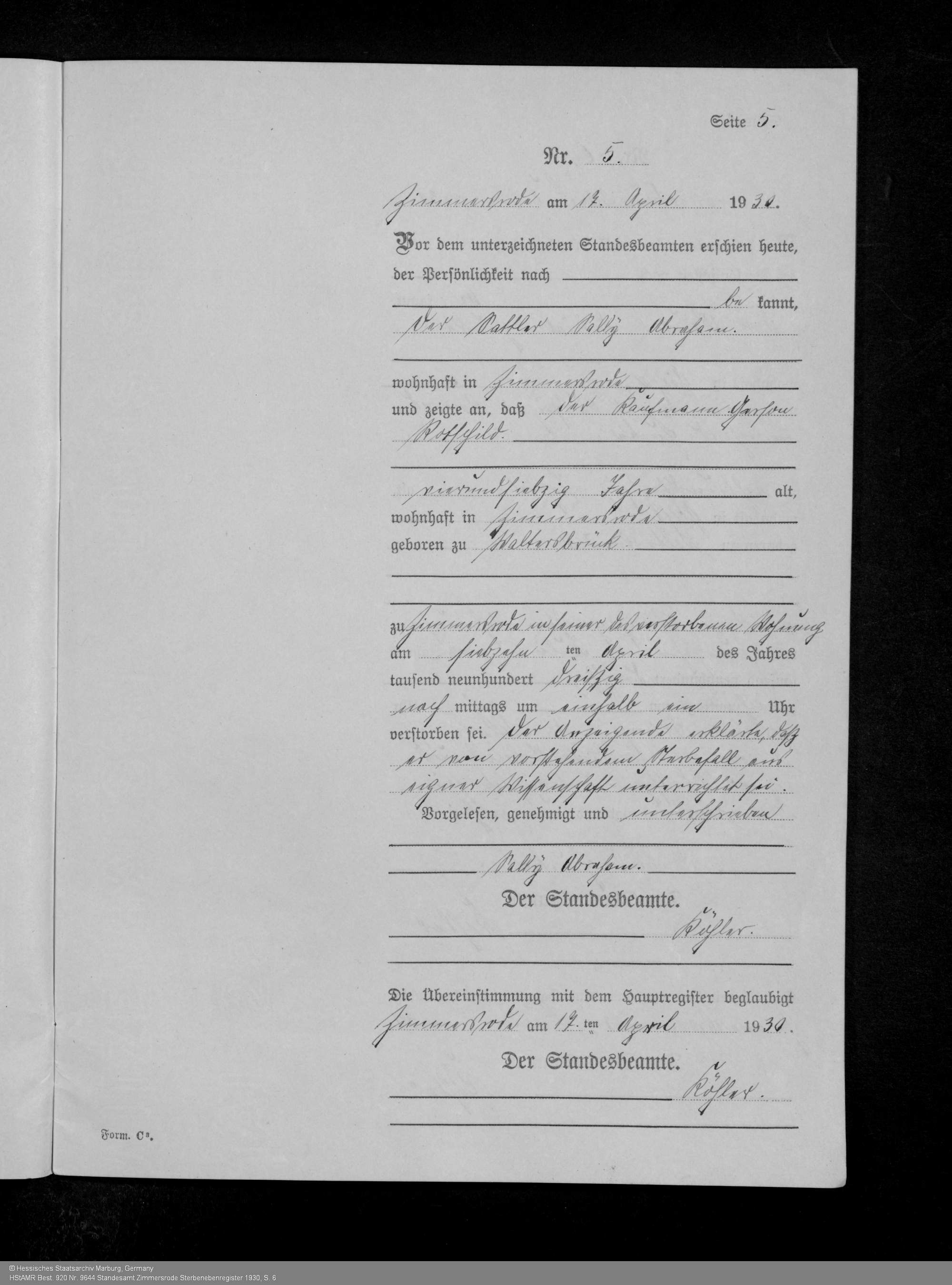
Their father Gerson Rothschild passed away on April 17, 1930, at the age of 74.

Gerson Rothschild death record, LAGIS Hessen Archives, HStAMR Best. 920 Nr. 9644 Standesamt Zimmersrode Sterbenebenregister 1930, S. 6

Gerson had lived to see all eight of his surviving children reach adulthood, and before he died, he saw the six oldest of those children marry and have children of their own. As of his death, Gerson had ten grandchildren. His daughter Rosa would later have one child and his daughter Amalie two, meaning that Gerson and Fanny at one time had thirteen grandchildren from their eight surviving children.

Gerson may have been blessed to die before Hitler came to power and before he would know what would happen to so many of those children and grandchildren.


  1. Ernest Simon Rothschild, Race White, Age 23, Birth Date 1 Mar 1922, Birth Place Frankfort, Germany, Registration Date 30 Jun 1945, Registration Place New York City, New York, Employer Hugo Brand, Next of Kin Siegmund Rothschild,  National Archives at St. Louis; St. Louis, Missouri; Wwii Draft Registration Cards For New York City, 10/16/1940 – 03/31/1947; Record Group: Records of the Selective Service System, 147, Ancestry.com. U.S., World War II Draft Cards Young Men, 1940-1947 
  2. Ludwig Hirschberg J., Gender männlich (Male), Nationality Deutsch Juden
    Record Type Miscellaneous, Birth Date 01 Feb 1920 (1 Feb 1920), Birth Place Kassel
    Residence Place Kassel, Kassel, Notes Lists of judicial and official files concerning foreigners and German Jews, Reference Number 02010101 oS, Document ID 70443311, Arolsen Archives, Digital Archive; Bad Arolsen, Germany; Lists of Persecutees 2.1.1.1, Ancestry.com. Free Access: Europe, Registration of Foreigners and German Persecutees, 1939-1947 
  3. I could not find any actual birth records for Erich Rothschild or Richard Rothschild. There are no online birth records for Zimmersrode for 1921 or 1922. These dates, however, appear on numerous trees on Ancestry. I do not know how reliable that specific information is. I am still searching for birth records for these two sons, but I do have other records for them that place their birthdates as approximately in 1921 and 1922. I will discuss those other records in a later post. In addition, one tree included a third son, Fritz Simon Rothschild, but I have no records that support the existence of that son. 
  4. Bruno Feldheim, Palestine Immigration file, found at the Israel State Archives website at https://search.archives.gov.il/&#160;
  5. Walter Abraham, Birth Date 13 Sept 1921, Birth Place Zimmerrode, Residence Street Address 26 Johann-Georg-Strasse, Residence Place Berlin, [Halensee]
    Occupation Bãcker [Baker], Description Deportationen, URL https://collections.arolsen-archives.org/de/document/127213170 , Arolsen Archives; Bad Arolsen, Germany; Record Group 1 Incarceration Documents; Reference: 1.2.1.1, Ancestry.com. Germany, Incarceration Documents, 1933-1945 
  6. Herta Abraham, Birth Date 26 Aug 1926, Birth Place Kassel, Residence Kassel
    Camp Riga/Stutthof, Ancestry.com. Poland, German Jews at Stutthof Concentration Camp, 1940-1945 
  7. Otto Katz, Race White, Age 19, Birth Date 5 Sep 1922, Birth Place Neuenhaus [sic], Germany, Registration Date, 15 Feb 1942, Registration Place, New York City, New York, Employer Kenneth Miller, Next of Kin Clara Katz, National Archives at St. Louis; St. Louis, Missouri; Wwii Draft Registration Cards For New York City, 10/16/1940 – 03/31/1947; Record Group: Records of the Selective Service System, 147, Name Range: Katz, Bernard-Katz, Sam, Ancestry.com. U.S., World War II Draft Cards Young Men, 1940-1947 
  8. Helmut Katz [Harold Katz] Race White Age 18 Birth Date 1924, Birth Place Neuenhain, Germany, Registration Date 19 Dec 1942, Registration Place New York City, New York, Employer Student, Next of Kin Clara Katz, National Archives at St. Louis; St. Louis, Missouri; Wwii Draft Registration Cards For New York City, 10/16/1940 – 03/31/1947; Record Group: Records of the Selective Service System, 147, Ancestry.com. U.S., World War II Draft Cards Young Men, 1940-1947 
  9. This date came from Dennis Aron’s Ancestry tree, and Dennis obtained his information from Ilse’s brother, Harold Katz. I have no other source for this, but given that it came from her brother, for now I assume it is accurate. 

Eleven Babies in Eighteen Years

My cousin Gerson Rothschild’s wife Fanny Kugelmann gave birth to eleven children, starting in 1883 with the last one born eighteen years later in 1901. It is impossible for me to imagine what that was like.

Unfortunately, the first baby, a girl, died at birth (or was stillborn) on March 28, 1883:

Stillborn female child, Hessisches Hauptstaatsarchiv; Wiesbaden, Deutschland; Personenstandsregister Sterberegister; Bestand: 8460; Laufende Nummer: 920
Year Range: 1883, Ancestry.com. Hesse, Germany, Deaths, 1851-1958

The note on the death/birth record was translated by my cousin Richard Bloomfield and reads:

Mrs. Fanni Rothschild née Kugelmann of Jewish religion in the apartment of her husband, the merchant Gerson Rothschild of Jewish religion at Waltersbrück in house no. 2 on the eighth and twentieth of March this year in the afternoon at five o’clock birthed a child of female sex and that this child died in childbirth. Mrs. Waßmuth explained that she had been present at the confinement of Mrs. Fanni Rothschild.

A second child, Siegmund Rothschild, was born less than one year later on March 4, 1884, in Waltersbrueck:

Siegmund Rothschild birth record, Hessisches Hauptstaatsarchiv; Wiesbaden, Deutschland; Bestand: 920; Laufende Nummer: 8386, Year Range: 1884, Ancestry.com. Hesse, Germany, Births, 1851-1901

Sixteen months after Siegmund’s arrival, Fanny gave birth to Katchen Rothschild on July 5, 1885, also in Waltersbrueck:

Katchen Rothschild birth record, Hessisches Hauptstaatsarchiv; Wiesbaden, Deutschland; Bestand: 920; Laufende Nummer: 8387, Year Range: 1885, Ancestry.com. Hesse, Germany, Births, 1851-1901

Sixteen months after Katchen came another son, Max, born November 22, 1886, in Waltersbrueck:

Max Rothschild birth record, Hessisches Hauptstaatsarchiv; Wiesbaden, Deutschland; Bestand: 920; Laufende Nummer: 8388, Year Range: 1886, Ancestry.com. Hesse, Germany, Births, 1851-1901

Then Fanny gave birth to another daughter,  Guste or Auguste, in Waltersbrueck on September 11, 1888. Imagine that—-a gap of almost two years after Max. I wonder whether Fanny had miscarried at some point in between Max and Auguste.

Auguste Rothschild birth record, Hessisches Hauptstaatsarchiv; Wiesbaden, Deutschland; Bestand: 920; Laufende Nummer: 8390, Year Range: 1888, Ancestry.com. Hesse, Germany, Births, 1851-1901

Johanette (“Jenny”) Rothschild, Gerson and Fanny’s sixth child, was born on February 13, 1890, also in Waltersbrueck, seventeen months after Auguste:

Johannette Rothschild birth record, Hessisches Hauptstaatsarchiv; Wiesbaden, Deutschland; Bestand: 920; Laufende Nummer: 8392, Year Range: 1890, Ancestry.com. Hesse, Germany, Births, 1851-1901

Their seventh child Clara was born on July 15, 1891, in Waltersbrueck, seventeen months after Jenny:

Clara Rothschild birth record, Hessisches Hauptstaatsarchiv; Wiesbaden, Deutschland; Bestand: 920; Laufende Nummer: 8393, Year Range: 1891, Ancestry.com. Hesse, Germany, Births, 1851-1901

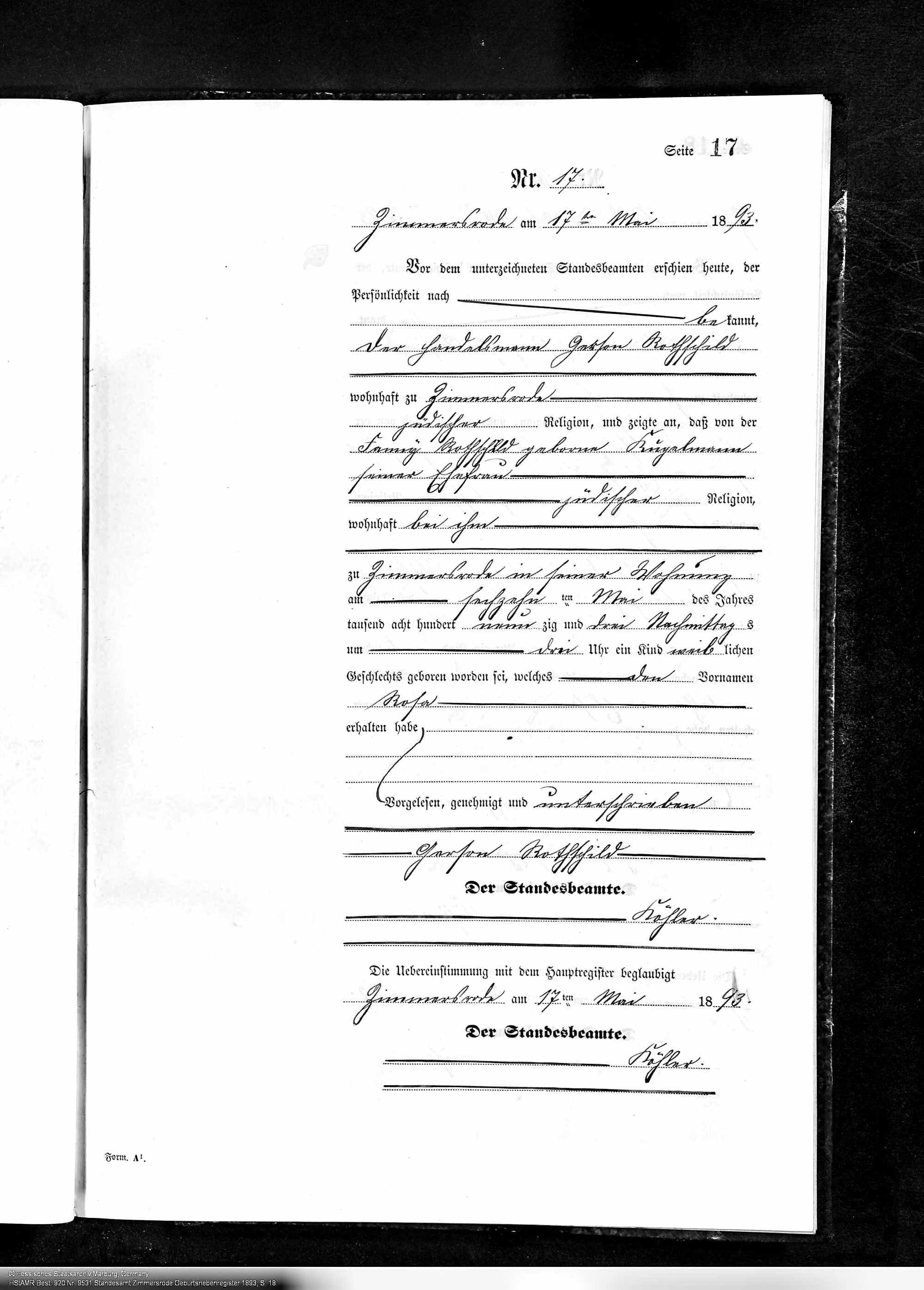
Number eight arrived May 16, 1893, almost two years after Clara; her name was Rosa. She was born in Zimmersrode where the family was now residing. Zimmersrode is a larger town about a mile and a half from Waltersbrueck.

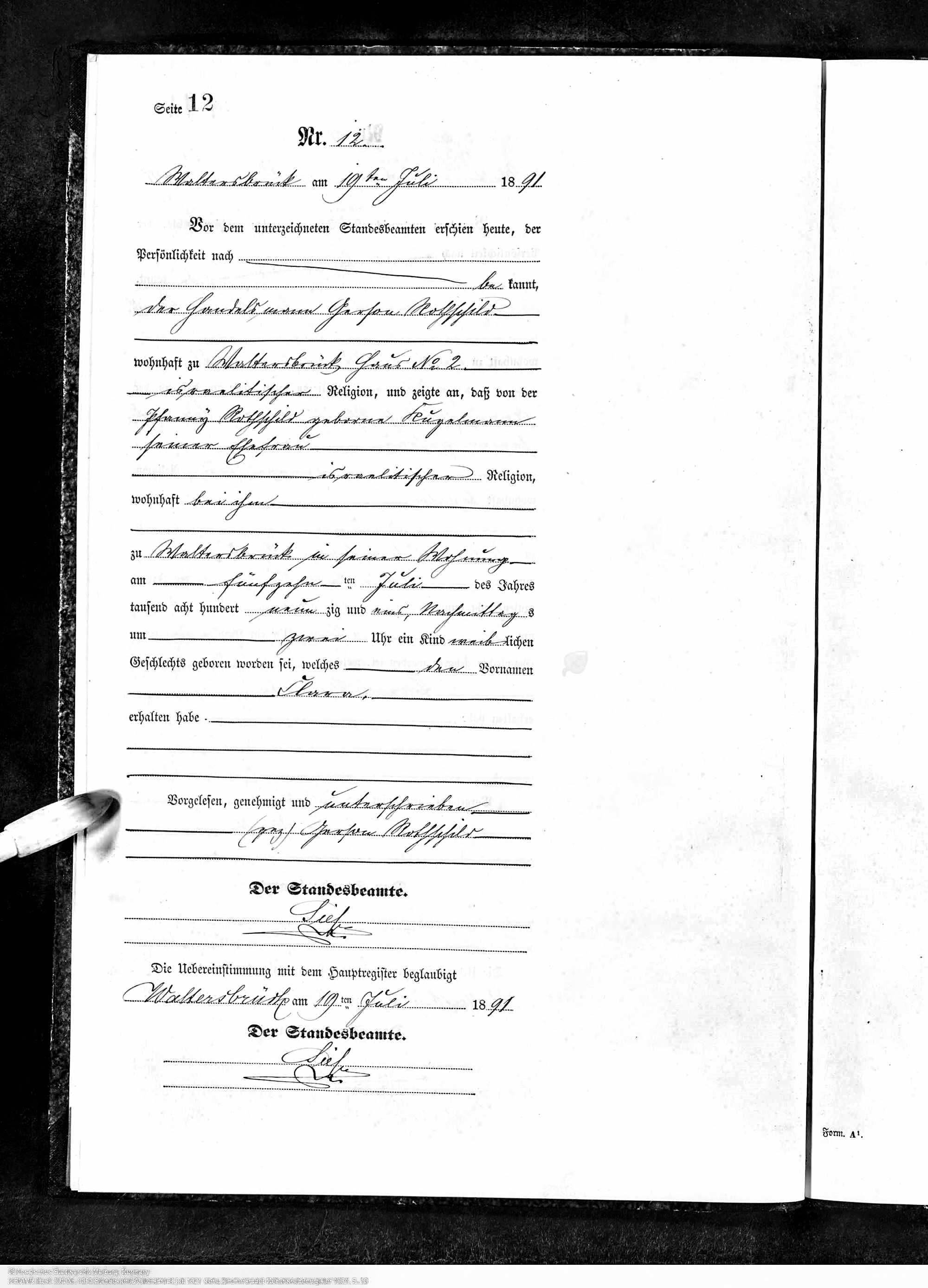
Rosa Rothschild birth record, Hessisches Hauptstaatsarchiv; Wiesbaden, Deutschland; Bestand: 920; Laufende Nummer: 9531, Year Range: 1893, Ancestry.com. Hesse, Germany, Births, 1851-1901

Gerson and Fanny’s ninth child Thoni only lived seven weeks; she was born on April 27, 1895, in Zimmersrode, and died there on June 20, 1895:

Thoni Rothschild birth record, Hessisches Hauptstaatsarchiv; Wiesbaden, Deutschland; Bestand: 920; Laufende Nummer: 9533, Year Range: 1895, Ancestry.com. Hesse, Germany, Births, 1851-1901

Thoni Rothschild death record, Hessisches Hauptstaatsarchiv; Wiesbaden, Deutschland; Personenstandsregister Sterberegister; Bestand: 9610; Laufende Nummer: 920, Year Range: 1895, Ancestry.com. Hesse, Germany, Deaths, 1851-1958

Sadly, their tenth child, like their first child, died at childbirth, this time a boy. Richard also translated the note on this death record for me.

Male Child stillborn of Gerson Rothschild, Hessisches Hauptstaatsarchiv; Wiesbaden, Deutschland; Personenstandsregister Sterberegister; Bestand: 9614; Laufende Nummer: 920
Year Range: 1899, Ancestry.com. Hesse, Germany, Deaths, 1851-1958

Today the personally known tradesman Gerson Rothschild, residing in Zimmersrode, appeared before the undersigned registrar and reported that

The wife of the reporting person of Jewish religion, Fanny Rothschild, née Kugelmann, also of the Jewish religion, gave birth to a male child at two o’clock in the morning on March 28th of this year in the home of the reporting party, and that the child died during birth.

Read, approved and signed

Gerson Rothschild

In a rather creepy coincidence, this baby was delivered on March 28, 1899, exactly sixteen years to the day after Fanny lost her first child in childbirth on March 28, 1883.

Fortunately, Fanny had better fortune with her eleventh and final baby, Amalie Rothschild, born in Zimmersrode on April 26, 1901. I do not have a birth record for Amalie but found her birth date on records from the Nazi era.1

Fanny Kugelmann Rothschild was 43 years old when she gave birth to Amalie, her last child. She had been either pregnant or nursing a baby for almost twenty years. She had suffered losing two of those babies at birth and one at only seven weeks old. But her other eight children survived to adulthood—-until the rise of the Nazis.

Here’s a timeline showing the birth dates of Fanny and Gerson’s eleven babies:

March 28, 1883—March 4, 1884—July 5, 1885—November 22, 1886—September 11, 1888—February 13, 1890—July 15, 1891—May 16, 1893—April 27, 1895—March 28, 1899—April 26, 1901

More on this family in the posts to come.


  1. Amalie Rothschild Stiefel, Arolsen Archives, Digital Archive; Bad Arolsen, Germany; Lists of Persecutees 2.1.1.1, Ancestry.com. Free Access: Europe, Registration of Foreigners and German Persecutees, 1939-1947 

The Blumenfeld-Rothschild Brain Teaser

Here’s a good brain teaser for those of you who like puzzles, especially genealogy relationship puzzles:

Gerson Rothschild was the eighth child born to Gelle Blumenfeld and Simon Rothschild. He was born on May 1, 1855, in Waltersbrueck, Germany.

Gerson Rothschild birth record, Arcinsys Archives of Hesse, HHStAW Fonds 365 No 893, p. 27

Gerson married Frommet “Fanny” Kugelmann on September 13, 1881, in Waltersbrueck. She was born in Wohra, Germany, on September 11, 1857.

Gerson Rothschild marriage to Frommet Kugelmann, Hessisches Hauptstaatsarchiv; Wiesbaden, Deutschland; Bestand: 920; Laufende Nummer: 8407, Ancestry.com. Hesse, Germany, Marriages, 1849-1930

When I saw Frommet Kugelmann’s name, it rang a bell, but I wasn’t sure why. I searched my tree, and sure enough, I had a Frommet Kugelmann already on my tree. I wrote about her here. She had married Isaac Blumenfeld I, Gelle Blumenfeld’s older brother, and had died March 18, 1842, five days after giving birth to her son Abraham Blumenfeld III. She was about twenty years old when she died.

Frommet Kugelmann Blumenfeld death record, Lagis Hessen Archive, HHStAW Abt. 365 Nr. 630, S. 8

But was there a connection between the Frommet Kugelmann who had married Isaac Blumenfeld I and the Frommet Kugelmann who married Isaac’s nephew Gerson Rothschild, Gelle’s son? That was not immediately obvious.

From the marriage record for Gerson and his Frommet (to be referred to hereinafter as Fanny to keep them distinct), I knew that Fanny’s parents were Joseph Kugelmann and Male Katten. After searching for more information about Joseph Kugelmann, I learned that he was the son of Hiskias Kugelmann and Knentel Adorn.1 Flipping back to Isaac Blumenfeld’s wife Frommet, I saw that her parents were also Hiskias Kugelmann and Knentel Adorn.2 In other words, Joseph Kugelmann had named his daughter Frommet Fanny Kugelmann for his deceased sister Frommet Kugelmann, Isaac Blumenfeld’s wife.

Gerson and Fanny were thus related through the marriage of Gerson’s uncle Isaac to Fanny’s aunt and namesake, Frommet Kugelmann.

Gerson and Fanny would have eleven children, though two died at birth and one as an infant.

Here’s the brain teaser.

How were the children of Gerson Rothschild and Fanny Kugelmann related to Abraham Blumenfeld III, the son of Isaac Blumenfeld I and his first wife Frommet Kugelmann?

[Jeopardy! Music plays for thirty seconds…]


Here’s the answer:

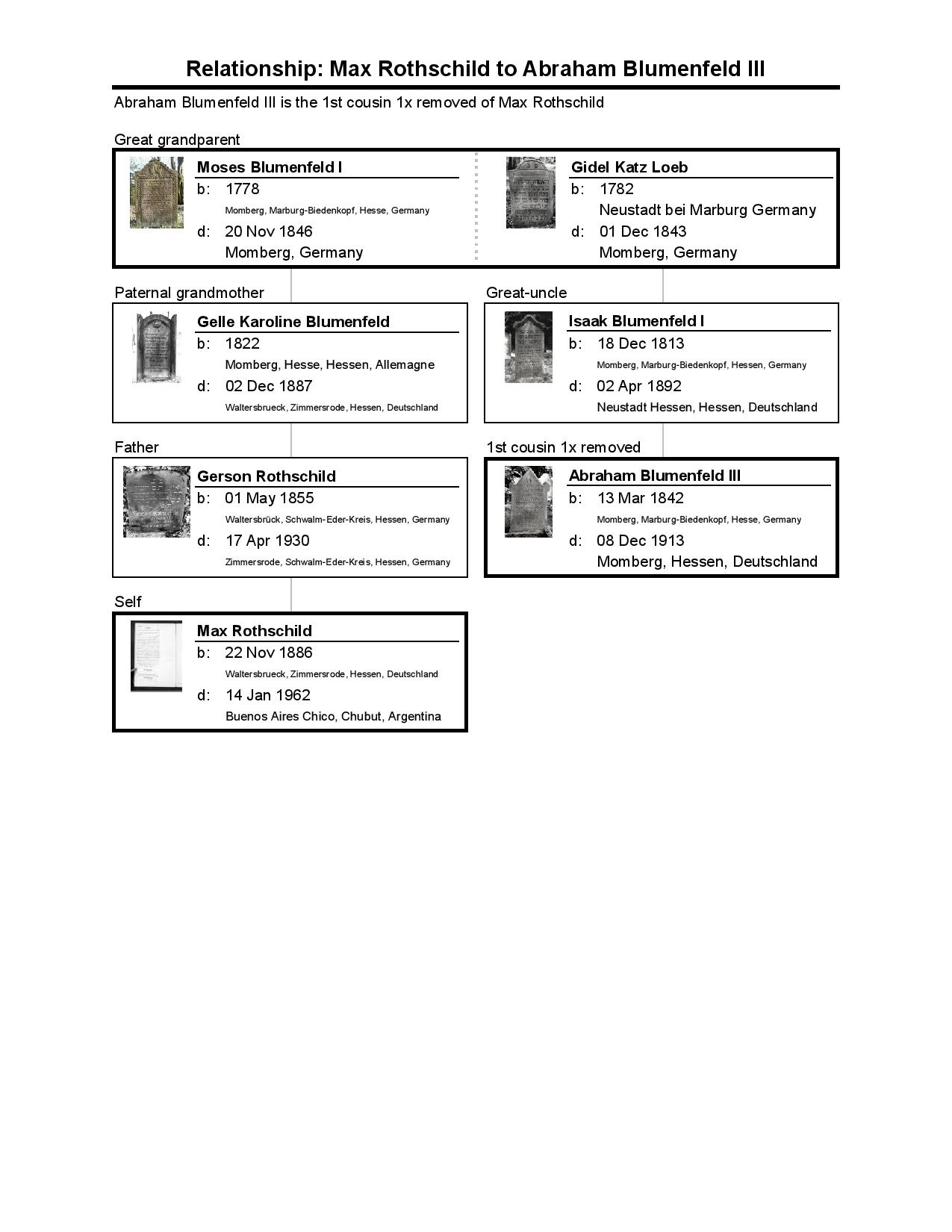
They were his first cousins, once removed, on the Kugelmann side because their mother Fanny was Abraham III’s first cousin; Abraham III’s mother Frommet Kugelmann and Fanny’s father Joseph Kugelmann were siblings.

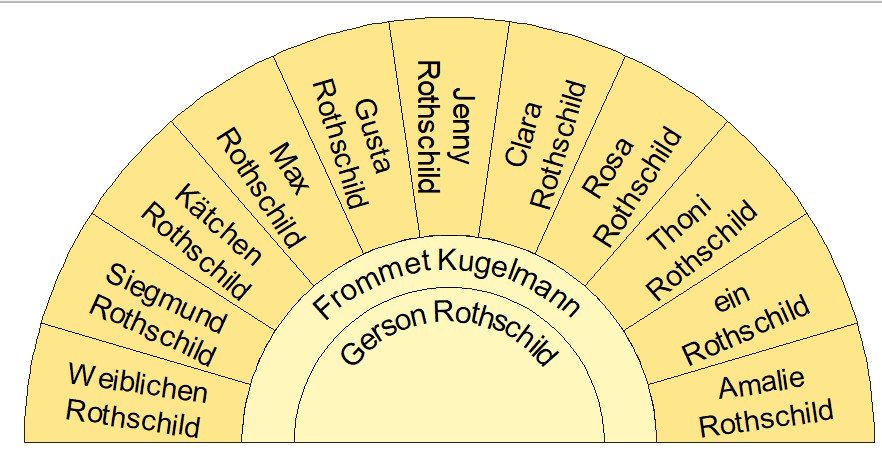
Here’s a chart showing that relationship, using one of Gerson and Fanny’s children (Max Rothschild) as an example:

But they were also related to Abraham III through the Blumenfeld side since Abraham’s father Isaac Blumenfeld I and Gerson’s mother Gelle Blumenfeld Rothschild were siblings, making Abraham and Gerson first cousins, thus making Max Rothschild and  Gerson and Fanny’s other children first cousins, once removed, to Abraham Blumenfeld III through that connection.

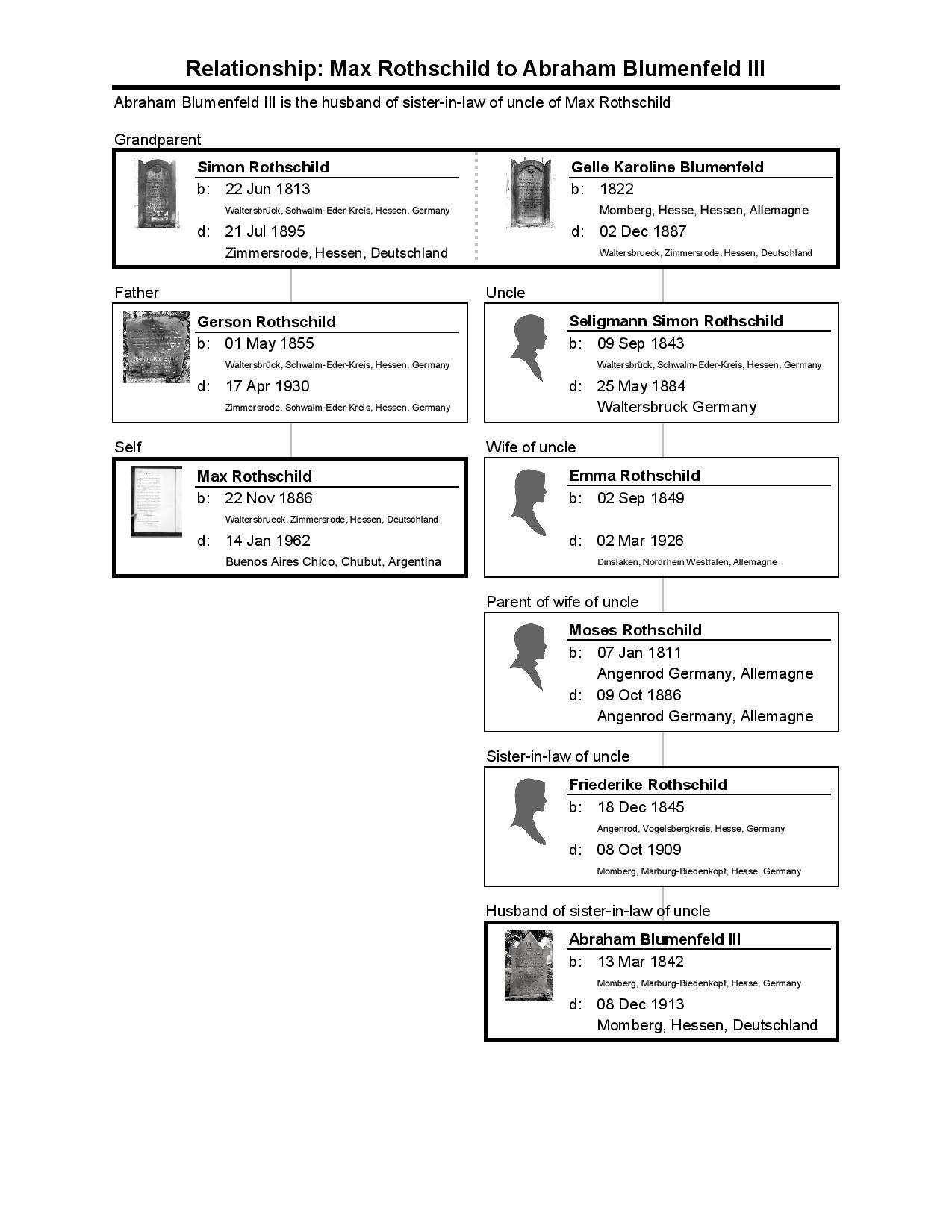
There is a third connection through Abraham Blumenfeld III’s marriage to Friedericke Rothschild—-but I will spare you that one.

OK, since you insist, here’s a chart for that one…

So once again, the family tree twists and groans from the weight of its interconnected branches, twigs, and leaves.

Coming up…the stories of the eleven children of Gerson and Fanny.


  1. Joseph Kugelmann death record, Hessisches Hauptstaatsarchiv; Wiesbaden, Deutschland; Personenstandsregister Sterberegister; Bestand: 9981; Laufende Nummer: 915, Description Year Range: 1900, Ancestry.com. Hesse, Germany, Deaths, 1851-1958 
  2. Frommet Kugelmann Blumenfeld death record, Sterberegister der Juden von Neustadt 1824-1875 (HHStAW Abt. 365 Nr. 630), p. 8. Arcinsys Archives of Hessen, at https://arcinsys.hessen.de/arcinsys/digitalisatViewer.action?detailid=v1900007&selectId=45915616&#160;

Gelle Blumenfeld Rothschild’s Middle Children: Isaak, Gitel, and Betty

Returning now to the Blumenfeld branch of my family tree, it’s time to see where I am in that saga. I am still on the oldest child of my four-times great-grandparents Abraham Blumenfeld and Geitel Katz—-their son Moses I. I have completed the stories of Moses’ first two children, Abraham IIA and Isaac I, and have been working through the children of Moses’ youngest child, his daughter Gelle Blumenfeld Rothschild. I have so far covered the first four of Gelle’s twelve children: Seligmannq, Abraham, Levi, and Moses. Here’s a chart to show my slow progress through the Blumenfeld family. I’ve only gotten as far as that arrow on the upper left side.

Now I turn to the next group of Gelle’s children, and for better or worse, there is not a lot to say about the next three: Isaak, Gitel, and Betty, their fifth, sixth, and seventh children.

Isaak is an unsolved brick wall. He was born January 15, 1850, in Zimmersrode. But there is no further record of him. No marriage record, no death record. I have searched high and low, and I’ve noticed that no other researcher on Ancestry or MyHeritage or elsewhere has any dates for Isaak’s death. My hunch is that he died in infancy, perhaps at birth, but I have no record to prove it. Here, however, is his birth record:

Isaak Rothschild birth record, Arcinsys Archives in Hessen, HHStAW Fonds 365 No 893, p.23

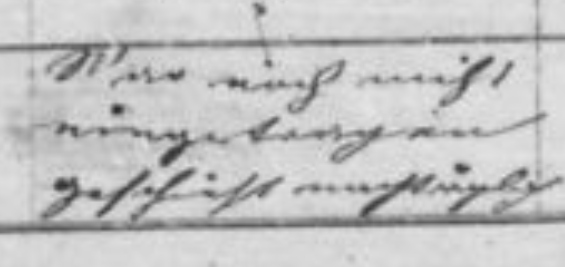
I thought perhaps the note on the far right would reveal more about Isaak’s life, but unfortunately it does not. All it says is “war noch nicht eingetragen, geschieht nachtraeglich,” which translates as “was not yet registered, will happen later.”

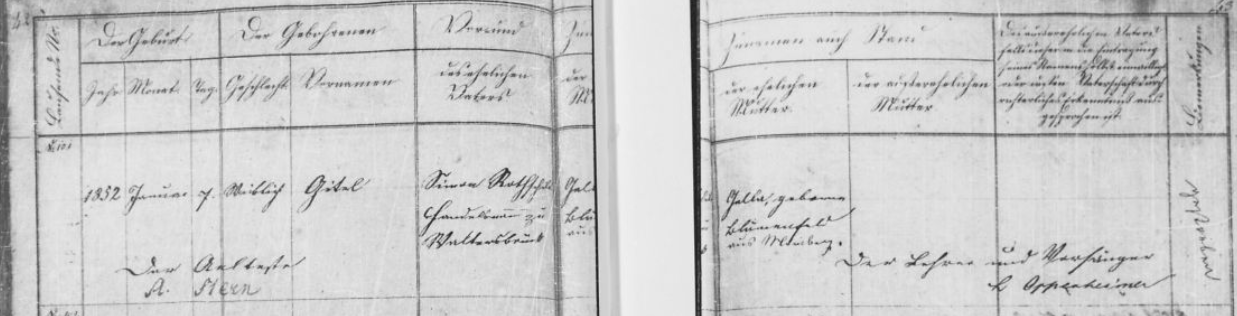
The child born after Isaak was Gitel Rothschild. Sadly, for her I have both her birth and death records. She was born on January 7, 1852, in Zimmersrode, and died there just over a year later on February 11, 1853.

Gitel Rothschild birth record, Arcinsys Archives of Hessen, HHStAW Fonds 365 No 893, p. 24

Gitel Rothschild death record, Arcinsys Archives of Hessen, HHStAW Fonds 365 No 896, p 21

Following Gitel came Beschen or Betty, born on June 22, 1853, just a few months after her sister Gitel died.

Beschen Rothschild birth record, Arcinsys Archives of Hesse, HHStAW Fonds 365 No 893, p. 25

Fortunately, Betty survived to adulthood. On February 4, 1876, in Kassel, Germany, she married Isaac Rosenblatt, the son of Meier Rosenblatt and Hannchen Loewenberg. Isaac was born in Malsfeld, Germany, on December 31, 1846.

Beschen Rothschild and Isaac Rosenblatt marriage record, Hessisches Hauptstaatsarchiv; Wiesbaden, Deutschland; Bestand: 910, Ancestry.com. Hesse, Germany, Marriages, 1849-1930,

I did not find any records showing children for Betty and Isaac. Isaac died on November 13, 1916, in Kassel.1 Betty died there ten years later on February 28, 1926.

Beschen Rothschild death record, Hessisches Hauptstaatsarchiv; Wiesbaden, Deutschland; Personenstandsregister Sterberegister; Signatur: 5603; Laufende Nummer: 910, Ancestry.com. Hesse, Germany, Deaths, 1851-1958

Thus, there are no known descendants for Isaak, Gitel, or Betty Rothschild as far as I have been able to determine.

The story of Gelle Blumenfeld Rothschild’s ninth child Gerson is a more complete one but filled with tragedy. That story begins in my next post.


  1. Isaak Rösenblatt, [Isaak Rosenblatt] Death Age 69, Birth Date abt 1847,
    Death Date 13 Nov 1916, Death Place Kassel, Hessen (Hesse), Deutschland (Germany), Civil Registration Office Kassel I, Father Meier Rösenblatt Mother
    Hannihan Rösenblatt Certificate Number 1490, Hessisches Hauptstaatsarchiv; Wiesbaden, Deutschland; Personenstandsregister Sterberegister; Signatur: 5546; Laufende Nummer: 910, Ancestry.com. Hesse, Germany, Deaths, 1851-1958 

A Brick Wall Tumbles: The Fates of August Felix Katzenstein and Julius Katzenstein, Orphaned Sons of Meier Katzenstein, Part II

Thanks to some new sources and documents and the help of my cousin Richard Bloomfield, I was able to fill in many of the holes in my earlier research about my cousin August Felix Katzenstein, as we saw in my prior post. August was one of the two surviving sons of Meier Katzenstein; his little half-brother Julius was the other surviving child. Both were orphaned after losing their mothers and then their father Meier.

Despite being orphaned at age eight, August had been raised by his relatives, the Bachenheimers, and had married their daughter Rosa when he was twenty-four. They had had two children, Margarete and Hans Jacob, and two grandchildren, and August had had a brilliant career as a teacher in a Jewish school until his retirement in 1936.

But then the entire family was wiped out by the Nazis—August, his wife Rosa, their two children, and their two grandchildren.

But what about August’s younger half-brother Julius Katzenstein, who was only five when he was orphaned? Had he survived? Did he also get killed by the Nazis? Who took care of him? After my cousin Miki Katzenstein Dror learned of a family in Israel descended from a man named Julius Katzenstein, she asked me if this could possibly be the same Julius Katzenstein. I knew the name was not uncommon, but I figured it was worth searching again for information about little Julius.

I turned to my friend Aaron Knappstein for some help, and after a long wait, Aaron somehow was able to locate records in the archives in Jesberg that revealed more about the life of my cousin Julius Katzenstein. The papers were part of a “certificate of inheritance” file that included the death record for Julius Katzenstein. Julius died on February 3, 1894. He was not yet fifteen years old.

Aaron kindly translated the document below. It reads as follows:

No. 6 – 04.02.1894

The death is announced by Selig Katzenstein, address: Uslar No. 15

Person who died:

Julius Katzenstein, merchant apprentice, 14 years, 11 months and 13 days old, Jewish, address: Uslar 15, born in Jesberg, son of the merchant Meyer Katzenstein and Bertha née Speyer, both dead.

Julius died the 3rd of February 1894 in Uslar No. 15, 10 PM

The second page of the document contains the following information, as translated by Aaron:

  • First wife of Meyer Katzenstein was Auguste née Wolff – she died the 19th of September 1876 – with her he had a son: August Katzenstein, born the 13th of September 1876
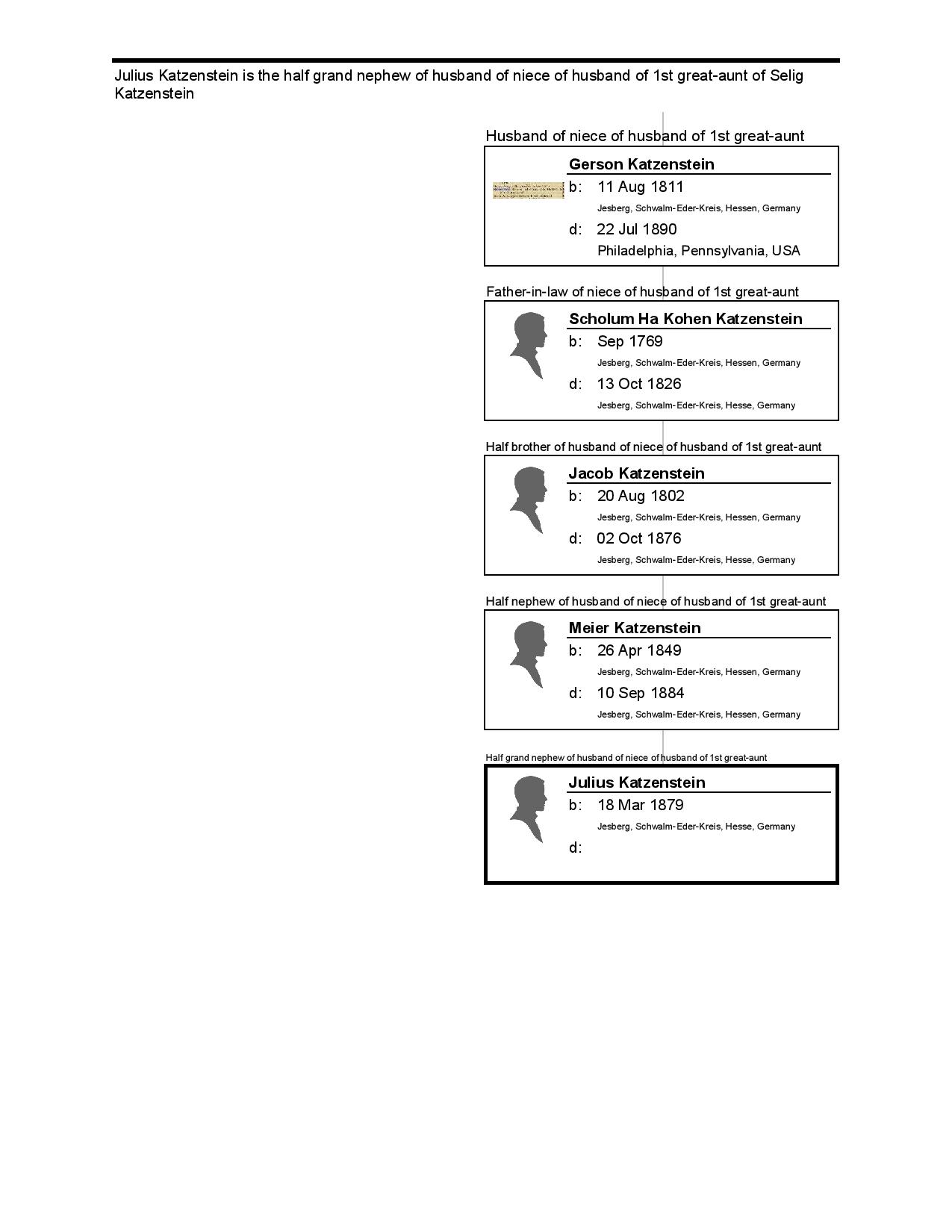
  • Second wife was Bertha née Speyer, she died the 8th of April 1881 and with her he had two children: Julius Katzenstein, born the 18th of March 1879 and Ida Katzenstein, born the 2nd of July 1880 – she died the 1st of April 1881.

Sadly, these documents proved that little Julius Katzenstein, the son of Meier Katzenstein and Bertha Speyer, had not lived to adulthood, but had died as a teenager.

What was most puzzling about this information, however, was where Julius had been living and with whom. Julius had lived in the town of Uslar, a town that was more than sixty miles from Jesberg and in a different state, Saxony, not Hesse. And he had been living with a man named Selig Katzenstein—-who was he? Was he a relative? He wasn’t on my family tree, and I had no clue whether he was related to my Katzenstein family. I searched for some familial connection, but could not find one.

I checked with David Baron, who is married to my cousin Roger Cibella and whose Katzenstein research I’ve often relied upon. I asked him if he knew of any connection between “our” Katzenstein family from Jesberg and Selig Katzenstein of Uslar.  He wrote that he had not been able to find any familial connection between our Katzenstein family and the Uslar Katzenstein family except through marriage.

This is what David had found: Selig Katzenstein of Uslar was the grandson of Joseph Katzenstein of Grebenstein. Joseph Katzenstein’s sister Lea Katzenstein of Grebenstein had married Meyer Goldschmidt of Oberlistingen. Are you still with me?

Meyer Goldschmidt was the brother of my three-times great-grandfather Seligmann Goldschmidt, whose daughter Eva Goldschmidt (my great-great-grandmother) married Gerson Katzenstein (my great-great-grandfather) of Jesberg. Gerson Katzenstein was the half-brother of Jacob Katzenstein, who was the grandfather of little Julius Katzenstein.

Now that is one crazy, twisted path from Julius to Selig Katzenstein, but given how small all these little towns were and the relatively small number of Jews living in each of those towns, maybe that was enough of a connection for Julius to end up living in Uslar with Selig. Maybe there is a slightly more direct path, but for now, that’s the best I can do.

Although I am glad I can now complete the story of Meier Katzenstein and his family, it has left me with a terribly empty feeling. They died so young: Meier, his two wives Auguste and Bertha, and two of his three children, Ida and Julius. The only child who managed to survive to adulthood was August, and he and his wife Rosa and their two children Margarete and Hans Jacob and their two grandchildren Klaus and Klara were all murdered by the Nazis.

There are thus no living descendants of Meier Katzenstein. I am glad to have knocked down this brick wall with the invaluable help of Aaron Knappstein and Richard Bloomfield, but I sure wish I had been able to find that somehow someone in this family line had survived.


A Brick Wall Tumbles: The Fates of August Felix Katzenstein and Julius Katzenstein, Orphaned Sons of Meier Katzenstein, Part I

Thanks to my friend Aaron Knappstein and my cousin Richard Bloomfield, an old brick wall has recently come down. Over seven years ago I wrote about the tragic story of Meier Katzenstein and his family. You can find all the sources, citations, and details here. But I will briefly outline their story.

Meier, my great-grandmother Hilda Katzenstein Schoenthal’s first cousin, lost his first wife Auguste Wolf in 1876, shortly after she gave birth to their son August Felix Katzenstein. Meier remarried and had two more children with his second wife Bertha Speier:  Julius Katzenstein, born in 1879, and Ida Katzenstein, born in 1880. Both Ida and her mother Bertha died in April 1881, less than a year after Ida’s birth. Meier was left with two young sons, August, who was five years old, and Julius, who was two.

And then Meier himself died three years later in 1884, leaving August and Julius orphaned at eight and five, respectively. I couldn’t imagine what had happened to those two little boys. Who took care of them? What happened to them? This post will follow up on August, and the one to follow will be about his half-brother Julius.

I had been able to find out some of what happened to August as an adult when I initially wrote about him over seven years. He had married his first cousin, once removed, Rosa Bachenheimer in Kirchain, Germany, in 1900 when he was twenty-four years old. August and Rosa had two children, Margarete and Hans-Peter. All four of them were killed by the Nazis during the Holocaust. I knew that much, but there were still some gaping holes in my research. Where had August lived after his father died? Did he have any grandchildren? If so, did they survive the Holocaust?

So I went back now to to double-check my research and see if I could find anything more about August Felix Katzenstein and his family. I am so glad I did.

First, I learned at Yad Vashem that August and Rosa’s daughter Margarete had married Rudolf Loewenstein and had had two children with him: Klaus, born March 16, 1930, in Soest, Germany, and Klara, born June 9, 1932, in Soest, Germany. Unfortunately, Rudolf, Margarete and their two young children were also killed along with their grandparents and uncle during the Holocaust.
Then I found this Stolpersteine biography of August Katzenstein on a website about the history of the community of Essen, revised in 2024 by Mr. and Mrs. Hülskemper-Niemannn. It provides in part, as translated by Google Translate:

August Katzenstein was orphaned at a very early age. He then lived for a long time in the household of the parents of his future wife Rosa Bachenheimer from Kirchhain, whom he married around the turn of the century. The couple had two children: Margarethe (1901, later Loewenstein) and Hans (1905). August Katzenstein moved with his family to Steele in 1908 and took up a position as a teacher in the one-class Jewish elementary school at Isinger Tor.

After 1933, the Katzensteins’ lives changed radically. In 1937, the Gestapo arrested the couple because they were allegedly managing the assets of a dissolved Jewish organization. After a search of their apartment and rigorous interrogation and warnings, the couple were released. Even worse happened to August Katzenstein, who taught at the Jewish elementary school in Essen on Sachsenstrasse after the Jewish elementary school in Steele was closed, during and after the November pogrom. The apartment on Grendtor (then Ruhrstrasse) was destroyed and looted, and he and his disabled son Hans were arrested. While the 62-year-old father was released from police prison after 11 days, Hans was taken to Dachau despite written requests from his parents, from where he was only released after four weeks.

In the autumn of 1941, the deportation of Jews began across the Reich, including in Essen. … Half a year later, Katzenstein and his entire family were deported to Izbica. 

So now I know who had taken care of August after his father died: Rosa’s parents Sussman Bachenheimer and his wife Esther Ruelf, my second cousin, twice removed. I wrote about them here. I also now know that August had become a teacher and lived in Steele, Germany, a suburb of Essen, Germany.

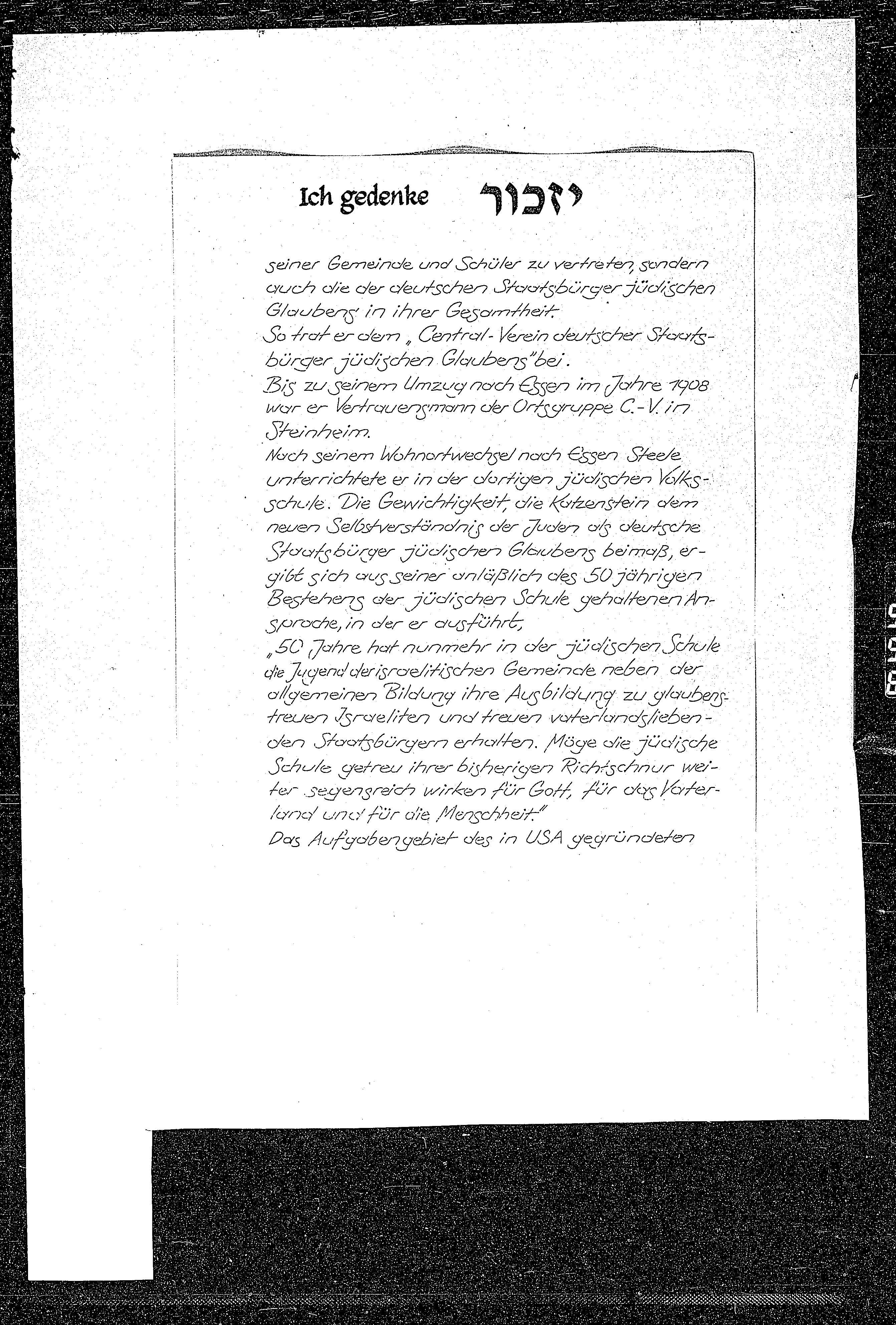
I found additional information about August and his family at Yad Vashem. The website has been updated since I had last researched August Katzenstein, and I found these documents I had not seen before from the Yizkor Book for the Jews of the Essen community who had been killed during the Holocaust. I asked my cousin Richard Bloomfield to translate these pages, and he graciously (and quickly!) agreed to do so.

Richard’s translation provides:

August Katzenstein was a Mensch.

He was a German citizen and of the Jewish faith, whose teachings shaped his life. He was born on September 13, 1876, in Jesberg/Hesse and lived in the Jewish community of Steinheim in Westphalia until 1908, where he held the office of teacher and religious official. With his wife Rosa, née Bachenheimer, he had a daughter Margarete, born in 1901, and a son Jacob (Hans), born in 1905.

August Katzenstein saw his work as a teacher not just as a profession, but as a vocation. In his eyes, the teacher was not only an imparter of knowledge, he was also a leading figure in the Jewish community who had to ensure a harmonious relationship between the community and school life.

Beginning at the age of 20, August Katzenstein decided to represent not only the interests of his community and pupils, but also those of German citizens of the Jewish faith as a whole.

He joined the “Central Association of German Citizens of the Jewish Faith” “Central-Verein deutscher Staatsbürger jüdischen Glaubens”.

Until he moved to Essen in 1908, he was a representative of the C.-V. local group in Steinheim.

After moving to Essen Steele, he taught at the Jewish elementary school there. The importance that Katzenstein attached to the new self-image of Jews as German citizens of the Jewish faith can be seen in his speech on the occasion of the 50th anniversary of the Jewish school, in which he states,

“For 50 years now, the youth of the Jewish community has received their education in the Jewish school to become faithful Israelites and loyal citizens who love their fatherland, in addition to their general education. May the Jewish school continue to work beneficially for God, for the fatherland and for humanity, true to its guiding principles.”

The mission of the independent order “Bnai Brith” founded in the USA, spiritual self-education, the promotion of science and art, help for the persecuted and needy and the defense of Jewish citizens in the event of anti-Semitic attacks led August Katzenstein to join the Glück-Auf-Lodge of “Bnai Brith” in Essen in 1911 and of which he was president until April 1935.

Until his retirement in 1937, he also headed the Jewish relief organization in Essen-Steele. But despite his retirement, he did not neglect the members of the community whose employ he had left.

The ban and immediate dissolution of the “Bnai Brith” order by Himmler’s decree of April 10, 1937, resulted in August Katzenstein’s arrest on April 19, 1937, after his apartment and all the rooms of the Glück-Auf-Loge had already been searched two days earlier.

August Katzenstein then had to endure hours of interrogation under threat of state police measures. He was forced to sign a declaration that he had no further property belonging to the Glück-Auf-Lodge at his disposal and that he was not aware of where further material might be hidden, as documented in the Gestapo protocol of the same day.

During the so-called Reichskristallnacht on November 9, 1938, the Katzenstein family’s home at Ruhrstrasse 24 was also severely damaged. One day later, August Katzenstein and his disabled son were arrested again. They were held in the police prison in Essen until November 19, 1938. After his release, August Katzenstein wrote a letter to the Gestapo asking them to release his son, who had been sent to Dachau concentration camp. His son Jacob (Hans) then returned on December 21, 1938.

However, not only the care of his family, but also the suffering of the community entrusted to him had become his life’s purpose. Even the destruction of the school and synagogue as the center of the community during the November pogrom could not break August Katzenstein’s will to live in the Jewish faith.

In January 1939, August Katzenstein carried out his last community-related activity, officiating at the wedding of a young couple in the wife’s parental home.

On April 22, 1942, August Katzenstein, his wife Rosa, his son Hans, his daughter Margarete, his son-in-law Rudolf Loewenstein and his two grandchildren were deported to Izbica. No trace of them remains.

His strong faith and the willpower born of it made him a lovable, upright person whose care for his Jewish community defined his life.

Contemporary Jewish witnesses describe August Katzenstein as a wonderful person of integrity, very wise, reserved and fully committed to his Judaism. As a teacher, he was not only a person of respect for the children, but “more like a father.” August Katzenstein was a man whose life was simply snuffed out because he was Jewish.

Nikolaus-Gross, Abendgymnasium Essen, Semester 4

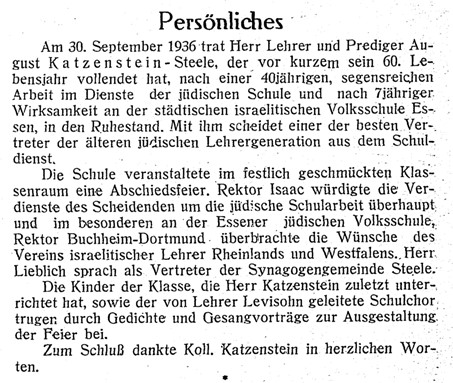
I wondered whether August’s “retirement” from teaching was voluntary or forced upon him by the Nazis, and although it’s still not clear, Richard also found this article about August’s retirement published on November 1, 1936, in the Jüdische Schulzeitung [Monthly journal for education, instruction and school policy; official publication of the Reich Association of Jewish Teachers’ Associations], (p.6):

Richard translated the article for me:

On September 30, 1936, after 40 years of beneficial work in the service of Jewish schools and 7 years of work at the local Jewish elementary school in Essen, teacher and preacher August Katzenstein of Essen-Steele, who recently turned 60, retired. With him, one of the best representatives of the older Jewish generation of teachers leaves the teaching profession.

The school held a farewell party in the festively decorated classroom. Principal Isaac paid tribute to the departing teacher’s services to Jewish schools in general and to the Jewish Elementary School in Essen in particular. Principal Buchheim of Dortmund conveyed the wishes of the Association of Israelite Teachers of the Rhineland and Westphalia. Mr. Lieblich spoke as a representative of the Steele Synagogue community.

The children of the class that Mr. Katzenstein taught last, as well as the school choir led by teacher Levisohn, contributed to the ceremony with poems and songs.

Finally, colleague Katzenstein gave a heartfelt thank you.

Obviously, August was a well-loved, well-respected teacher and community leader. His early childhood was quite miserable—losing his mother, then his stepmother and half-sister, then his father—all before he was nine years old. But despite that tragic beginning, he lived a full and productive life, filled with meaning, faith, family, and love. How someone recovers from so much tragedy is amazing to me.

But then the Nazis came to power and destroyed August’s life and his family. I am so glad I went back to see if I could learn more about his life, and I am so grateful to Richard for his translation of the documents from the Essen Yizkor Book and for finding the article about August’s retirement. I found comfort in knowing that despite his tragic beginning and ending, August found fulfillment and meaning in his life.

But what about his younger brother Julius? I had known even less about him when I first researched this family. I couldn’t find anything that revealed what happened to him after his parents died. I couldn’t find a marriage record, a death record, a birth record for any children—-not one thing. Fortunately, he was not listed at Yad Vashem, so presumably had not shared the fate of his brother August. But where had he gone? Who had taken care of this little orphaned boy?

I will report on what I’ve learned about Julius in my next post.


Aron Rothschild: An Elusive Subject

Returning now to the story of Gelle Blumenfeld Rothschild’s son Moses Rothschild, this post is about his youngest child, Aron Rothschild. We’ve already seen that Aron married Martha Schoenholz in 1918 and that they had a son Melville born in 1919. In 1920 Aron was in his own business selling beads and novelties. Finding Aron after 1920 proved to be a challenging search.

I could not find Aron on the 1930 census, but I did find his wife Martha and son Melville (10) on that census; they were living with Martha’s mother Clothilde Schoenholz in Manhattan; Aron was not listed in the household, but Martha still listed her status as married. She was working as a salesperson in a department store. Where was Aron? I do not know. Somehow he eluded the census enumerator in 1930. Or so it seems.

Martha Rothschild 1930 US census, Year: 1930; Census Place: Manhattan, New York, New York; Page: 20A; Enumeration District: 0512; FHL microfilm: 2341295, Ancestry.com. 1930 United States Federal Census

Aron does, however, turn up on the 1940 census, living in the Bronx as a lodger with Nathan and Anna Braverman, two Russian immigrants. He listed his marital status as single and his employment as a salesman in a house furnishings store.1

Meanwhile, Aron’s wife Martha and their son Melville were still living with Martha’s mother in 1940; they were in Manhattan, and Martha, still listing her status as married, was working as a “saleslady” in a dress store. Melville, now twenty, was working as a junior salesman in a pleating factory.2

So although Aron had listed himself as single on the 1940 census, Martha still claimed that she was married in 1940. It would seem, however, that their marital relationship had ended by 1940, whether legally dissolved or not.

Aron’s 1942 World War II draft registration reported that he was then living in Manhattan and was self-employed. He listed “M. Alexander” as the person who would always know his address. That referred to his brother-in-law Max Alexander, who was married to Aron’s sister Theresa and living at that address.
Aron Rothschild, World War II draft registration, The National Archives At St. Louis; St. Louis, Missouri; Record Group Title: Records of the Selective Service System; Record Group Number: 14
Ancestry.com. U.S., World War II Draft Registration Cards, 1942

Aron’s son Melville registered for the World War II draft on October 16, 1940; at that time he was living in Los Angeles and would not provide the name of his employer, according to the registration. He joined the US Army on February 22, 1943, and was discharged on January 11, 1946. He served in the Pacific and received the American Service medal and the Philippines Liberation Ribbon.3

Melville Rothschild, World War II draft registration, National Archives at St. Louis; St. Louis, Missouri; Wwii Draft Registration Cards For California, 10/16/1940-03/31/1947; Record Group: Records of the Selective Service System, 147; Box: 1559 Ancestry.com. U.S., World War II Draft Cards Young Men, 1940-1947

National Archives at St. Louis; St. Louis, Missouri; Wwii Draft Registration Cards For California, 10/16/1940-03/31/1947; Record Group: Records of the Selective Service System, 147; Box: 1559
Ancestry.com. U.S., World War II Draft Cards Young Men, 1940-1947

On December 7, 1946, in New York, Melville Rothschild took out a license to marry Barbara Sichel.4 Barbara may still be living although she would be over 100; I cannot find a death record or obituary. Melville and Barbara would have two children. I was unable to locate the family on the 1950 US census.

I had a lot of trouble locating Aron Rothschild on the 1950 census or thereafter, but after much investigation, I believe I found him. Here’s my research path:

According to an entry on FindAGrave, Aron died on March 17, 1955, at the age of 73 and is buried in Mount Carmel Cemetery in Queens, New York. But I was skeptical about the reliability of that information. First, Aron’s name was spelled “Aaron” both on FindAGrave and on the cemetery records listed on the Mount Carmel website.  Also, although I have Aron’s Social Security Number, he is not listed in the Social Security Death Index. The FindAGrave entry has his correct birth date, but says he was born in Manhattan Beach in Maryland. I assume the creator of that entry confused Manhattan Beach with Manhattan, New York. But given these inaccuracies—the spelling of the name and the error in the birth place—I worried that the FindAGrave entry could be for an entirely different A[a]ron Rothschild. 5

So I decided to search a little deeper. On FamilySearch, I found a record for an Aaron Rothschild who died in Islip, New York, on March 17, 1955, the same date of death for the Aaron Rothschild buried at Mount Carmel Cemetery and listed on FindAGrave. That listing in the New York State Death Index on FamilySearch gives Aaron Rothschild’s age at death as 71, but my Aron would have been 73 on March 17, 1955.6 So I remained doubtful.

I went back to search the 1950 census again to see if I could find the Aaron Rothschild who died in Islip, and I found him there, a patient at the Pilgrim State Hospital for the Care and Treatment of the Mentally Ill. His marital status was listed as “sep” or separated. His birthplace was “USA” (although transcribed on Ancestry as Virginia). And his age was 68. My cousin Aron Rothschild would have been 68 in April, 1950, when that census record was created.7 Had Aron suffered from mental illness? Was Aron the patient at the Pilgrim State Hospital?

Things certainly were pointing towards this being my Aron with his name misspelled. To know for sure, I needed more information. I could not get a copy of the actual death certificate because I am not a close enough relative to qualify. Instead, I wrote to the Mount Carmel cemetery to ask what information they had about the Aaron Rothschild buried there. Two days later, I received the following information in an email dated January 23, 2025: “The information the Cemetery has on Aaron Rothschild is as follows:  He died at the age of 71 on March 17, 1955, in W Brentwood, New York, and was interred on March 21, 1955.  Sam and Rudolph Rothschild were the lot owners.” [emphasis added.]

That seemed to confirm that the A(a)ron Rothschild who died on March 17, 1955, and is buried at Mount Carmel Cemetery in Queens, New York, was my cousin Aron Rothschild, son of Moses and Mathilde Rothschild. Brentwood is a small hamlet near Islip, New York, where the Pilgrim State Hospital was located. Although the age of the deceased is off by two years (Aron would have been 73, not 71), the fact that the cemetery plot was owned by Samuel and Rudolph Rothschild, Aron’s oldest brothers, convinced me that the man buried in that plot was their brother Aron.

In fact, Aron’s mother Mathilde, his brothers Samuel and Rudolph, Samuel’s wife Sallye, and Samuel’s grandson Ronald are also buried at Mount Carmel in the same section, 1-B-3-746. Aron’s sister Theresa and her husband Max Alexander are also buried at Mount Carmel in a nearby section, 1-B-4, and Rose Katz Rothschild, Albert Rothschild’s wife, is buried in section 1-C-9. All this further confirms that Aron Rothschild died on March 17, 1955, and is buried at Mount Carmel Cemetery.

As for Aron’s family, his wife Martha Schoenholz Rothschild is listed on the 1950 US census, still living with her mother in Manhattan and working as a “salesgirl” in a dress shop. (She was 59 years old at the time.) Now she listed her marital status as widowed. Was this just a way of avoiding listing her status as divorced? Since Aron was still alive in 1950, Martha was not yet a widow.8 Martha died on April 3, 1959; she was 68 and is buried in Ferncliff Cemetery and Mausoleum in Hartsdale, New York.9 She and Aron were survived by their son Melville.

Melville died on June 9, 1978, in Perth Amboy, New Jersey, at the age of 58. According to his obituary, he had lived in Edison, New Jersey for 27 years and had been a self-employed retail merchant for many years before spending the last ten years as a security agent for Wells Fargo. Melville was survived by his wife and child.10

This brings me to the end of the saga of Moses Rothschild and his family. Next I will turn to the younger siblings of Moses Rothschild, the remaining seven children of Gelle Blumenfeld Rothschild. Unlike Moses, all seven (as well as the three older children already discussed) remained in Germany for their entire lives. Moses was the only one of the eleven children of Gelle to come to the US and settle there. So it’s back to German research that I now return.

But first a short update on an earlier post about some of my Katzenstein relatives.


,


  1. Aron Rothschild, 1940 US census, Year: 1940; Census Place: New York, Bronx, New York; Roll: m-t0627-02469; Page: 6A; Enumeration District: 3-344, Ancestry.com. 1940 United States Federal Census 
  2. Martha Rothschild and family, 1940 US census, Year: 1940; Census Place: New York, New York, New York; Roll: m-t0627-02646; Page: 2A; Enumeration District: 31-935, Ancestry.com. 1940 United States Federal Census 
  3. Melville A Rothschild, Race White, Marital Status Single, with dependents (Single), Rank Private, Birth Year 1919, Nativity State or Country New York, Citizenship Citizen
    Residence New York, New York, Education 1 year of high school, Enlistment Date 22 Feb 1943, Enlistment Place New York City, New York, Service Number 32812468
    Branch Branch Immaterial – Warrant Officers, USA, Component Selectees (Enlisted Men), Source Civil Life, Height 69, Weight 150, National Archives at College Park; College Park, Maryland, USA; Electronic Army Serial Number Merged File, 1938-1946; NAID: 1263923; Record Group Title: Records of the National Archives and Records Administration, 1789-ca. 2007; Record Group: 64; Box Number: 05692; Reel: 233, Ancestry.com. U.S., World War II Army Enlistment Records, 1938-1946. Melville A Rothschild, Rank Private 1st Class, Birth Date 1919, Service Number 32 812 468
    Service Branch US Army, Discharge Date 11 Jan 1946, Death Date 1978, Cemetery Floral Park Cemetery, Cemetery Location Deans, New Jersey, US, National Archives at St. Louis; St. Louis, MO, USA; Applications for Headstones and Markers, 7/1/1970-9/30/1985; NAID: 6016127; Record Group Number: 15; Record Group Title: Records of the Department of Veterans Affairs, 1773-2007, Ancestry.com. U.S., Headstone Applications for Military Veterans, 1861-1985. “Melville A. Rothschild, was clothing merchant,” The Central New Jersey Home News, June 12, 1978, p. 26. 
  4. Melville A Rothschild, Gender Male, Marriage License Date 7 Dec 1946, Marriage License Place Manhattan, New York City, New York, USA, Spouse Barbara T Sichel
    License Number 41647, New York City Municipal Archives; New York, New York; Borough: Manhattan; Volume Number: 60, Ancestry.com. New York, New York, U.S., Marriage License Indexes, 1907-2018 
  5. Find a Grave, database and images (https://www.findagrave.com/memorial/96201100/aaron-rothschild: accessed January 16, 2025), memorial page for Aaron Rothschild (17 Aug 1881–17 Mar 1955), Find a Grave Memorial ID 96201100, citing Mount Carmel Cemetery, Glendale, Queens County, New York, USA; Maintained by Dave Davisson (contributor 36744121). 
  6. “New York, State Death Index, 1880-1956”, , FamilySearch (https://www.familysearch.org/ark:/61903/1:1:QGK2-WMK4 : Thu Mar 07 21:57:06 UTC 2024), Entry for Aaron Rothchild, 17 Mar 1955. 
  7. Aaron Rothschild, 1950 US census, National Archives at Washington, DC; Washington, D.C.; Seventeenth Census of the United States, 1950; Year: 1950; Census Place: Islip, Suffolk, New York; Roll: 5886; Page: 126; Enumeration District: 52-209B, Ancestry.com. 1950 United States Federal Census 
  8. Martha Rothschild, 1950 US census, National Archives at Washington, DC; Washington, D.C.; Seventeenth Census of the United States, 1950; Year: 1950; Census Place: New York, New York, New York; Roll: 2622; Page: 15; Enumeration District: 31-1077, Ancestry.com. 1950 United States Federal Census 
  9. Marth Rothschild, Age 65, Birth Date abt 1894, Death Date 3 Apr 1959, Death Place Manhattan, New York, New York, USA, Certificate Number 7707, Ancestry.com. New York, New York, U.S., Death Index, 1949-1965 
  10. Melville Rothschild, Social Security Number 084-03-7768, Birth Date 22 Jul 1919
    Issue year Before 1951, Issue State New York, Last Benefit 08817, Edison, Middlesex, New Jersey, USA. Death Date Jun 1978, Social Security Administration; Washington D.C., USA; Social Security Death Index, Master File, Ancestry.com. U.S., Social Security Death Index, 1935-2014. “Melville A. Rothschild, was clothing merchant,” The Central New Jersey Home News, June 12, 1978, p. 26.