A Decade of Heartache for Caroline’s Family

The 19th century ended badly for the extended family of Caroline Dreyfuss and Moses Wiler.  Their daughter Eliza Wiler Simon died in August 1897, and their son-in-law Daniel Meyers, Clara’s husband, died in 1902, following several years of financial distress and legal problems.   Unfortunately, it only got worse as the 20th century began.

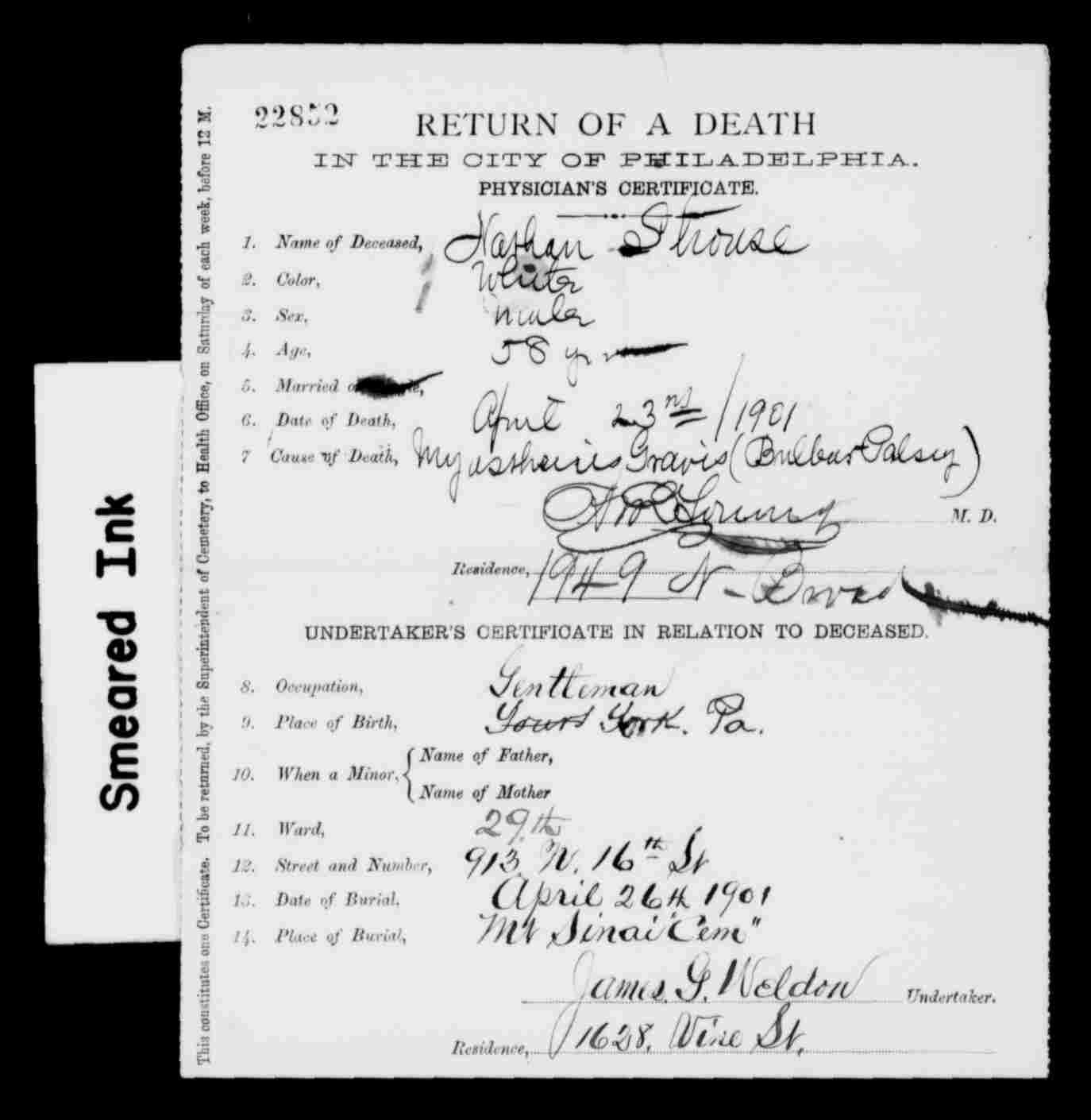
First, on April 23, 1901, Flora Simon’s husband Nathan Strouse died from myasthenia gravis.  He was 24 years older than Flora, but only 58 years old when he died.  Their son Lester was only thirteen years old when he lost his father.  I found it rather interesting that Nathan’s occupation on the death certificate was given as “gentleman.”

Nathan Strouse death certificate

“Pennsylvania, Philadelphia City Death Certificates, 1803-1915,” index and images, FamilySearch (https://familysearch.org/pal:/MM9.1.1/JDLH-SJ1 : accessed 11 February 2015), Nathan Strouse, 23 Apr 1901; citing cn 22852, Philadelphia City Archives and Historical Society of Pennsylvania, Philadelphia; FHL microfilm 1,845,290.


Two years later Flora married Alfred C. Heulings, a New Jersey lawyer who, in contrast to her first husband, was almost twelve years younger than Flora.

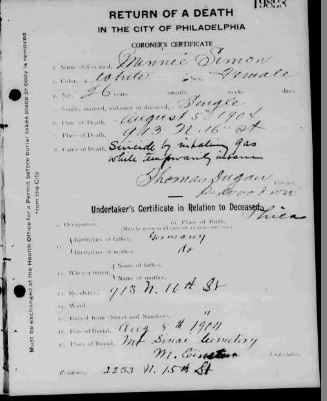
Then in 1904, there was another disaster for the family.  Minnie Simon, the younger daughter of Eliza Wiler and Leman Simon, committed suicide.  Her death certificate stated that she took her life “by inhaling gas while temporarily insane.”

minnie simon death cert 1904

“Pennsylvania, Philadelphia City Death Certificates, 1803-1915,” index and images, FamilySearch (https://familysearch.org/pal:/MM9.1.1/JDGP-4DQ : accessed 11 February 2015), Minnie Simon, 05 Aug 1904; citing cn 19898, Philadelphia City Archives and Historical Society of Pennsylvania, Philadelphia; FHL microfilm 1,004,045.


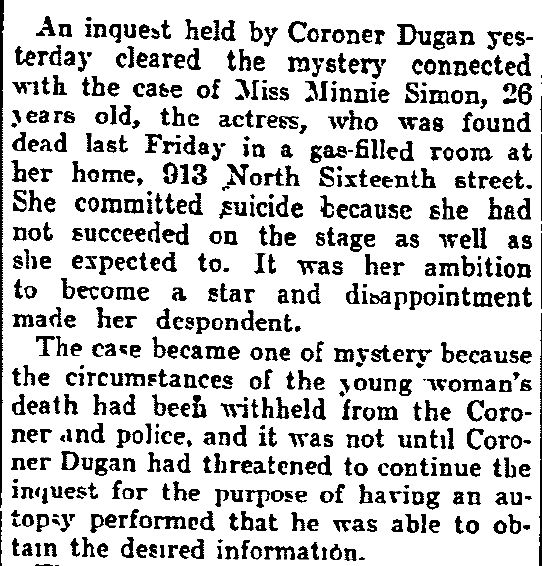
Apparently her death created some controversy based on this news article from the Philadelphia Inquirer, August 9, 1904,  covering the coroner’s inquest:

minnie suicide 1


minnie suicide 2


minnie suicide 3

minnie suicide 4

Paper: Philadelphia Inquirer (Philadelphia, PA) Volume: 151 Issue: 40 Page: 5 August 9, 1904

From Joseph’s description of his sister’s personality, today she might have been diagnosed and treated for bipolar disease or depression.  But in 1904 that was not possible, and so Minnie succumbed to mental illness and took her own life.  She was only 26 years old.

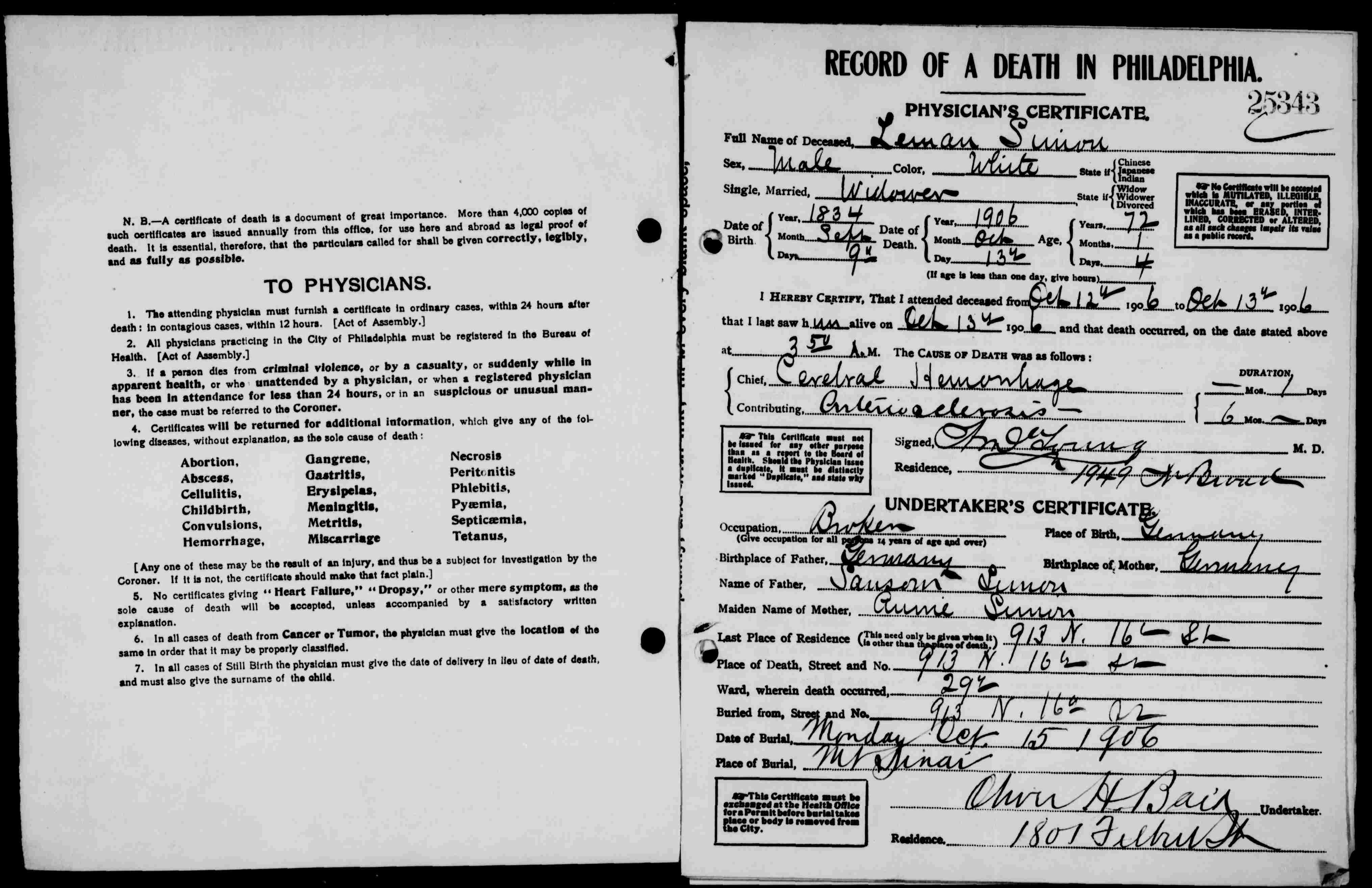
Two years after losing his daughter Minnie and nine years after losing his wife Eliza, Leman Simon passed away on October 13, 1906, from a cerebral hemorrhage.  He was 72 years old.

Leman Simon death cert

“Pennsylvania, Philadelphia City Death Certificates, 1803-1915,” index and images, FamilySearch (https://familysearch.org/pal:/MM9.1.1/JK98-3Q6 : accessed 11 February 2015), Leman Simon, 13 Oct 1906; citing cn 25343, Philadelphia City Archives and Historical Society of Pennsylvania, Philadelphia; FHL microfilm 1,319,469.


Thus, in the ten years between 1897 and 1906, the family lost five members:  Eliza Wiler Simon, Nathan Strouse, Daniel Meyers, Minnie Simon, and Leman Simon.  The Simon family in particular must have been quite devastated.

Not all was sad, however, in the first ten years of the 20th century.  Nellie Simon married Louis Boughen Loux on April 30, 1908.  They were married in the Eleventh Street Methodist Episcopal Church in Philadelphia.  Louis was 21, and Nellie was 33.  Like her sister Flora’s second marriage, this was a marriage between a man and a significantly older woman, which must have been quite unusual in those days.

Thus, by 1910, the family had changed quite a bit.  Leman and Eliza Simon were both gone, as was their daughter Minnie.  Flora was living with her second husband Albert Heulings and her son Lester Strouse at 913 North 16th Street.  Albert was practicing law.  Lester, who had graduated from the University of Pennsylvania in 1909, was now 21 and working in the advertising business for the Quaker City Publicity Company.  There were also two servants in the household.

As for Flora’s siblings, I am once again having a terrible time finding them on the census.  Nellie Simon and her husband Louis Loux had a child Florie born on March 3, 1910, in Philadelphia, but I only know this from Florie’s death certificate.  I cannot find a birth record, nor can I find Nellie and Louis on the 1910 census.  I found a Leon Simon listed in the 1908 Philadelphia directory at 541 Fernon Street, working as a bookkeeper, but he is not at that address on the 1910 census.  Joseph Simon’s address in 1904 was 136 Farson Street in West Philadelphia, according to the news article about his sister Minnie’s death.  But he is not at that address on the 1910 census.  I have some possible listings for Joseph, but given how common his name was, I just am not certain.

As for the family of Clara Wiler Meyers, Clara in 1910 was a widow, still living at the long-time family home at 920 Franklin Street, with nine of her children. Her oldest son Leon Meyers (36 in 1910) had by 1902 become an optician and was still living at home as late as 1904.  In 1910 he was living at 1628 North 13th Street, according to the Philadelphia directory, yet he is not listed there on the 1910 census, nor is he listed on the census at 1904 Somerset Street, where he is listed as residing in the 1911 directory.  I think Leon, like his Simon cousins, just eluded the census taker.  His younger brother, Benjamin Franklin Meyers, 25 years old in 1910, was living as a boarder in Trenton, New Jersey, where he was working as a watch maker in a watch factory.

The other nine Meyers children were still living with their mother Clara.  All were unmarried.  Samuel (34) was like his brother Leon an optician.  Harry (33) was a tailor.  Isador (30) was a “commercial traveler” for a men’s clothing business.  Max (28) was a draftsman for a machine works business. Clarence (24) was a cotton yarn salesman. Frank (22) was an optician like his two older brothers Leon and Samuel.  The three youngest children Lottie (20), Miriam (17), and Milton (14) were all at home and not occupied.

Source Citation Year: 1910; Census Place: Philadelphia Ward 20, Philadelphia, Pennsylvania; Roll: T624_1394; Page: 4B; Enumeration District: 0334; FHL microfilm: 1375407

Source Citation
Year: 1910; Census Place: Philadelphia Ward 20, Philadelphia, Pennsylvania; Roll: T624_1394; Page: 4B; Enumeration District: 0334; FHL microfilm: 1375407

I cannot imagine what this house looked like that accommodated all of those people.  I’ve tried to locate a photograph, but have had no luck.  Google Street View shows a modern apartment building at that address today.

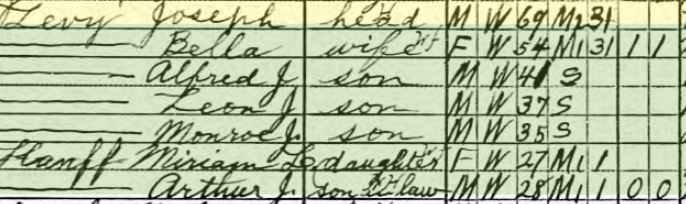
Fanny Wiler Levy’s three sons were also still single and living with their father Joseph and stepmother Bella at home at 2122 Camac Street in 1910.   Their father Joseph Levy was living on his “own income,” according to the 1910 census.  Alfred, now 41, was a lumber salesman, and Leon (37) and Monroe (35) were clothing salesman.  Their half-sister Miriam (27) was married to Arthur Hanff, a traveling shirt salesman.

Levy family 1910

Year: 1910; Census Place: Philadelphia Ward 32, Philadelphia, Pennsylvania; Roll: T624_1403; Page: 10B; Enumeration District: 0750; FHL microfilm: 1375416


Levy occupations 1910

Simon Wiler, the only son of Caroline Dreyfuss and Moses Wiler, was living in a large boarding house on Spruce Street in 1910.  He was working as a salesman in a paper warehouse.  Simon died the following year on October 23, 1911.  He died from shock after a prostatectomy, according to the death certificate.  Although the death certificate says he was residing at 1905 Diamond Street prior to his death, he is not listed there on the 1910 census.  The informant on the certificate was A. Freed, the undertaker, who did not know the names of Simon’s parents, but given the name, the age, and the occupation, it seems reasonable to conclude that this was Simon, the son of Caroline and Moses.  Like the other members of his family, he was buried at Mt. Sinai cemetery.

Ancestry.com. Pennsylvania, Death Certificates, 1906-1963 [database on-line]. Provo, UT, USA: Ancestry.com Operations, Inc., 2014. Original data: Pennsylvania (State). Death certificates, 1906–1963. Series 11.90 (1,905 cartons). Records of the Pennsylvania Department of Health, Record Group 11. Pennsylvania Historical and Museum Commission, Harrisburg, Pennsylvania

Ancestry.com. Pennsylvania, Death Certificates, 1906-1963 [database on-line]. Provo, UT, USA: Ancestry.com Operations, Inc., 2014.
Original data: Pennsylvania (State). Death certificates, 1906–1963. Series 11.90 (1,905 cartons). Records of the Pennsylvania Department of Health, Record Group 11. Pennsylvania Historical and Museum Commission, Harrisburg, Pennsylvania

Thus, as of 1911, the only child of Caroline Dreyfuss and Moses Wiler who was still alive was Clara Wiler Meyers. Between 1897 and 1911, there had been many deaths, but only two weddings and only one birth.  There were a number of adult cousins still living at home with their parents.  The next ten years  brought continued heartache and loss.


Why Did Daniel Meyers Fail to Pay the Beneficiaries of Caroline Dreyfuss Wiler’s Estate?

In my last post, I wrote about the fact that Daniel Meyers, husband of Clara Wiler, had failed to honor the terms of the will of his mother-in-law Caroline Dreyfuss Wiler when he failed to pay Caroline’s grandchildren the money they had been promised.  Why hadn’t Daniel paid? What would have led him to breach his duties as executor and trustee of the estate?

And who was Daniel Meyers? Why was he appointed to be the executor and trustee? Caroline’s husband Moses was still alive when Caroline died as was her son Simon. But Caroline may not have wanted to have her husband or son in charge of the estate in order to have a more “objective” person in charge.  I assume that a woman could not be appointed trustee/executor in 1885, but Caroline had two other sons-in-law, Leman Simon and Joseph Levy.  So why Daniel?  Leman Simon was in Pittsburgh until the mid-1880s; he and Eliza did not move back until around the time or after the time Caroline died, so he was not around.  Perhaps Caroline wanted someone closer to home.  As for Joseph Levy, by 1878, his wife Fanny had died, and he had remarried, so Caroline might not have thought he was an appropriate choice.   Daniel Meyers was in Philadelphia, married to Clara, and in 1885 had a stable business.  He must have seemed like the obvious choice.

Daniel Meyers was, like Leman Simon and Joseph Levy, a German Jewish immigrant.  He was born in 1846 in Bavaria, and according to his passport application, immigrated in 1864.  He and his brother Samuel were in the clothing business together in 1867.  By 1872, a year after marrying Clara Wiler, Daniel was listed in the Philadelphia directory doing business under the firm name D. Meyers and Company in business with Isaac Samler.  The family was living at 718 Fairmount Avenue throughout the 1870s and in 1880, but in 1881, Daniel’s home address is 960 North 7th Street, just a few blocks away.  By 1885 they had moved again to 927 Franklin Street, and then in 1891 to 920 Franklin Street, where they stayed for many years.  In 1886, Isaac Samler retired from the business, and Daniel became the sole propietor of the business that carried his name.

Philadelphia Inquirer December 31, 1886, p. 3

Philadelphia Inquirer December 31, 1886, p. 3

Meanwhile, Daniel and Clara had on average a new baby every year and a half between 1872 and 1896.  Daniel and Clara had five children by 1880 and eight more between 1880 and 1900, but one was stillborn and one, Bertha, died from heart disease before she was ten years old. Thus, Daniel was supporting eleven children as well as Clara and himself in the 1880s and 1890s.  By 1895 the oldest son Leon was working out of house, first as a foreman in 1895 and then as a salesman in 1897, but still living at home. But the other ten children were still at home and not yet working.

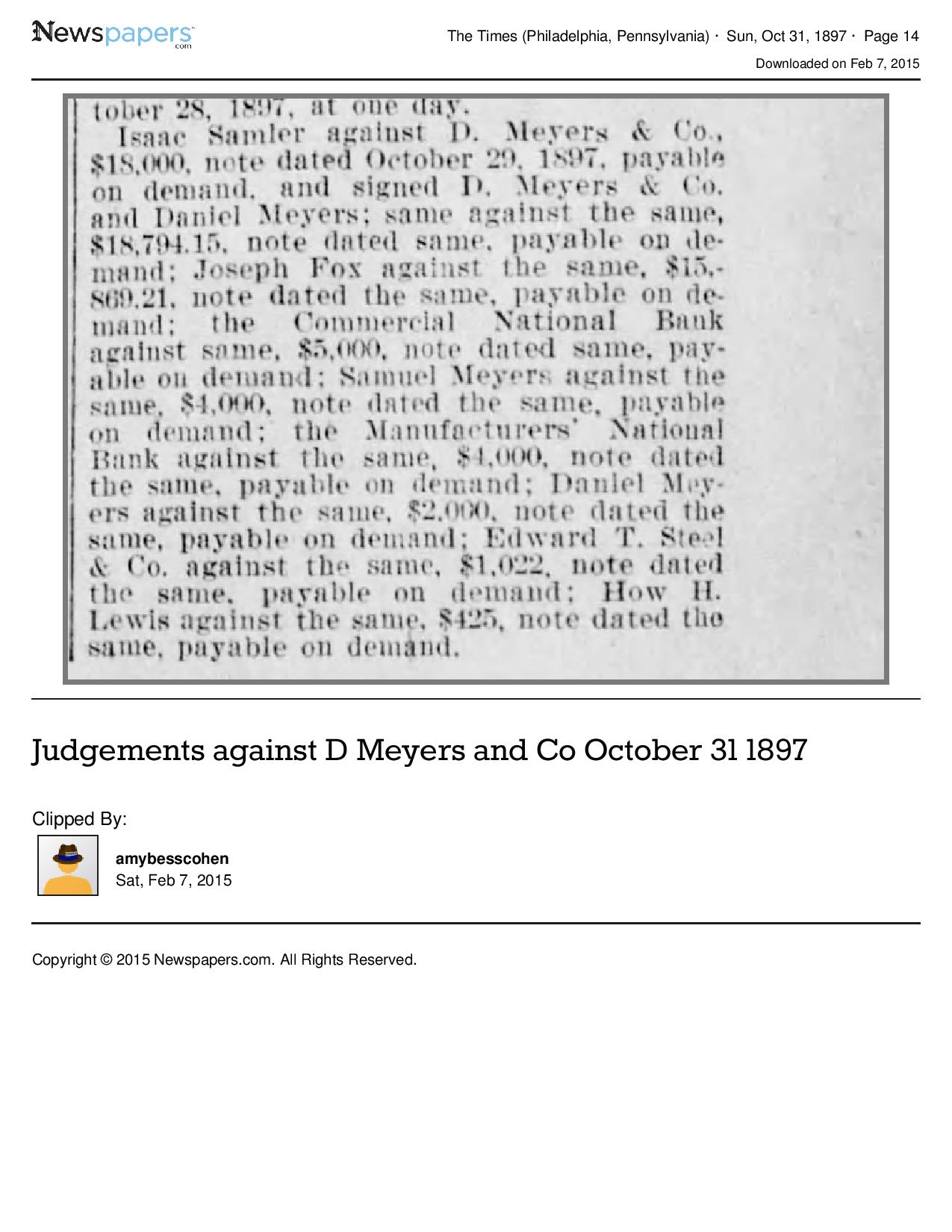
Maybe it was all too much of a financial strain for Daniel. This article from The Philadelphia Times of October 31, 1897, reported a large number of judgments executed against D. Meyers & Co., including two very large ones for over $18,000.  One of those was in favor of Isaac Samler, Daniel’s former partner.  Keep in mind that $18,000 in 1897 would be equivalent to about $500,000 in today’s dollars.

Judgements_against_D_Meyers_and_Co_October_31_1897-page-001

A fellow family historian descended from a relative of Daniel Meyers shared this news story with me that revealed that on November 1, 1897, D. Meyers and Company was forced to close.

Philadelphia Inquirer, November 1, 1897, p. 9

Philadelphia Inquirer, November 1, 1897, p. 9

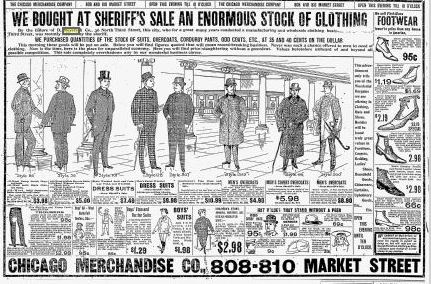
The assets of the business were sold at a sheriff’s sale, as this advertisement, also shared by the fellow family historian, in the Philadelphia Inquirer from November 13, 1897, page 16, revealed:

AD november 13 1897 phil inq p 16

The text says, “We Bought at Sheriff’s Sale an Enormous Stock of Cothing By the failure of D. Meyers & Co., 36 North Third Street, this City, who for a great many years conducted a manufacturing and wholesale clothing business at 36 North Third Street, was recently sold out by the Sheriff.”

There were numerous other attachments brought against Daniel Meyers d/b/a D.Meyers & Co. after the business was closed. I also found the article below indicating that there was a sheriff’s sale of property belonging to Daniel Meyers and D. Meyers and Company in September, 1898, for over $16,000.

Sheriff__039_s_sale_against_Daniel_Meyers-page-001

Perhaps this explains why Daniel did not distribute the principal of Caroline’s estate to her grandchildren as he was legally obligated to do after Eliza Simon died in 1897.   Perhaps that money was gone.

By 1900 six of Daniel and Clara’s sons, Leon, Samuel, Harry, Isadore, Benjamin, and Max, were now working, Samuel as a clothing merchant, Harry as a tailor, Leon, Isadore and Benjamin as salesmen, and Max as a draftsman.  Although this might have alleviated the financial burden carried by Daniel to some extent, it appears not to have been sufficient. The other five younger children were all still at home.  In April, 1902, a judgment was entered against Daniel and Clara in the amount of $5,678, apparently for defaulting on a mortgage loan with a building and loan association.  I can’t help but notice that the amount they owed was almost to the dollar the amount of money that had been the principal in Caroline’s estate.  Had they borrowed this amount to satisfy the attachment obtained by the new trustee of Caroline’s estate and then not had sufficient assets to pay back the lender?

Clara_and_Daniel_Meyers_judgment__against_them_on_mtge-page-001

Six months after this judgment was entered, Daniel Meyers died on October 14, 1902, from “organic disease of the heart, embolism, paralysis, and general atheromas.”  He was sixty years old.  I don’t know what if any relationship there was between his financial troubles, the legal problems, and the resulting family problems, on the one hand, and his health on the other, but I tend to think they were not unrelated.

ennsylvania, Philadelphia City Death Certificates, 1803-1915," index and images, FamilySearch (https://familysearch.org/pal:/MM9.1.1/JD22-R89 : accessed 8 February 2015), Daniel Meyers, 14 Oct 1902; citing cn 7658, Philadelphia City Archives and Historical Society of Pennsylvania, Philadelphia; FHL microfilm 1,853,857.

Pennsylvania, Philadelphia City Death Certificates, 1803-1915,” index and images, FamilySearch (https://familysearch.org/pal:/MM9.1.1/JD22-R89 : accessed 8 February 2015), Daniel Meyers, 14 Oct 1902; citing cn 7658, Philadelphia City Archives and Historical Society of Pennsylvania, Philadelphia; FHL microfilm 1,853,857.


The Grandchildren of John and Jeanette Nusbaum: First Cousins, Four Times Removed

When I last wrote about the direct descendants of my three-times great-grandparents, John and Jeanette (Dreyfuss) Nusbaum, I left off saying that I would return to their surviving grandchildren in a later post.  Having already written about the children of their daughter Frances Nusbaum Seligman, Eva, James, and Arthur, there were four other grandchildren to discuss: the two children of Gustavus and Miriam Nusbaum Josephs, Florence and Jean, and the two children of Simon and Dora Rutledge Nusbaum, Nellie Rogers and John Bernard Nusbaum.  I was hoping that I’d be able to find answers to some remaining questions before posting, but I’ve run into a few tough ones.

Florence Joseph’s story is still incomplete as I hit a brick wall around 1925, but I will share what I do know.  Florence married Louis Siegel in 1903 when she was 23 years old.  Louis, the son of Abraham Siegel and Minnie Rosenthal, was born in Philadelphia on January 11, 1870, making him ten years older than Florence.  In 1910, Florence and Louis were living in New York City, and Louis was working as a traveling salesman, selling athletic goods.

Sometime thereafter, Louis must have become ill.  He died on September 30, 1915, at the State Hospital for the Insane in Norristown, Pennsylvania.  According to his death certificate, he had been ill for three years and had been hospitalized since November 19, 1913.  His cause of death was general paralysis of the insane or paresis.  He was only 43 years old.

Although I only have one document to support this, it appears that in 1913, Florence and Louis had had a child, a daughter Marion.  On the 1920 census, Florence Siegel was living with her father Gustavus Josephs and her brother Jean Josephs, both of whom were working at a mill as manufacturers, presumably of fabrics, as discussed in an earlier post.  Included in the household was a seven year old girl named Marion Siegel.  Although she is described as the daughter of the head of household, it seems apparent that Marion was Florence’s daughter, given her age and her surname.

Gustavus Josephs 1920 census

When her father Gustavus died in May 1924, Florence continued to live in the home at 2020 North Park Avenue; she is listed as a dressmaker in the 1925 Philadelphia directory residing at that address.  Unfortunately, that is the last document I have for Florence.  I cannot find a marriage record or a death record for her, nor can I find any definitive document for her daughter Marion.

There were two other Marion Siegels in the Philadelphia area, but after tracing them both, I had to accept that neither was the right Marion.  One, Marion Siegele, even had a mother named Florence, but that Florence was married to Harry Siegele and that Marion was born in 1918.  The second Marion Siegel seemed more likely, but I was able to find her parents and brother, and they were again not Florence and Louis Siegel.  Maybe my Marion died outside of Pennsylvania before 1930 (she would have been about 17 years old at the time of the census), maybe her mother remarried and Marion took the new husband’s surname.  But I have searched for every Florence and Marion living together as mother and daughter on the 1930 census, and I’ve come up empty.

In searching for Florence and Marion Siegel, however, I did find this obituary of Gustavus Josephs that reveals more about his military service in the Civil War as a musician:

Philadelphia Inquirer May 25, 1924 p. 18

Philadelphia Inquirer May 25, 1924 p. 18

Although I did hit some roadblocks researching Florence, I had better luck with her brother Jean.  Jean was much younger than his sister Florence.  He was born in 1893 and presumably named for his recently deceased grandfather, John Nusbaum.  In fact, Jean’s middle initial is N, perhaps for Nusbaum.  As noted above, Jean worked with his father Gustavus as a mill owner and listed himself as a self-employed manufacturer on his World War I draft registration in 1917.  He married Ruth Breidenbach on March 4, 1920.  Ruth was the daughter of Lazarus and Sophia Breidenback, and her father was an engraver in Philadelphia.  Ruth was born on March 11, 1900, in Pennsylvania.

By 1930, Ruth and Jean had two children, Janet and Jean, Jr.  Jean was still a manufacturer, and the census report for 1930 is more specific as to what he was manufacturing: draperies.  The family was living at 1531 Lindley Avenue in Philadelphia.  The following year Jean and Ruth had a third child, Jay.

In 1940, Jean and Ruth were still living at 1531 Lindley with their three children, and Jean’s occupation was recorded as general manager, textile manufacturer.  Less than a year later, on February 4, 1941, Jean Josephs died from an intestinal obstruction and peritonitis.  He was 47 years old, and his children were still living at home.  Jean’s widow Ruth was 40 years old

Ruth remarried in 1946.  Just six years later, Ruth was widowed once again when her second husband died from heart failure at age 47 on October 3, 1952.  By that time her children were grown.

As for the two children of Simon and Dora Nusbaum, Nellie Rogers Nusbaum was Dora’s daughter from her first marriage.  In about 1921, Nellie married Ellis B. Healy, who owned the Santa Fe Book and Stationery Company.  Nellie’s life was cut short on May 9, 1932, when she died giving birth to her daughter.

simon nusbaum daughter obit

The Santa Fe New Mexican, May 9, 1932

In 1940, Nellie’s widower Ellis and her young daughter were living in Santa Fe with a servant and a lodger.  Ellis listed his occupation as an office supply merchant.  By 1942, Ellis must have remarried as he is listed as “Healy EB (Mildred)” in the 1942 Santa Fe directory, indicating that he had a wife named Mildred.  He still owned the Santa Fe Book and Stationery Company.  He and Mildred were still listed together in 1960.

Although Nellie was not the biological child of Simon Nusbaum, and I do not know whether he ever adopted her legally as she was still listed as his stepdaughter on the 1920 census, she must have adopted his name since her name on her headstone is Nellie Nusbaum Healy.  She is buried at Fairview Cemetery in Santa Fe.

Simon and Dora’s other child, John Bernard Nusbaum, was only sixteen when his father died in 1921.   In 1930, he married Esther Maltby.  They settled in Albuquerque, New Mexico, where John was the vice-president of the Albuquerque Stationery Company.   John was listed as the manager of the stationery store in 1940 and continued to be associated with the company at least as late as 1954.  John and Esther had two daughters.  John died on July 25, 1976, in Albuquerque, but is buried at Fairview Cemetery in Santa Fe where both of his parents are buried.  His wife Esther died in 2002 and is buried there as well.  I have tried contacting some of their descendants, but have not had any responses.

So I am going to focus on finding a descendant of these four cousins of mine in order to fill in some of the gaps and tie up those loose ends.


There Were No Survivors: A Tragic Ending to a Family with Plenty of Tragedy

Some families seem to suffer more misfortune than others.  This is one of those families.  It is the story of the family of Mathilde Dreyfuss, sister of my three-times great-grandmother Jeanette, and her family.  Her first husband was  John Nusbaum’s brother Maxwell Nusbaum, making this particular line related to me both on my Dreyfuss side and my Nusbaum side.  That is, Mathilde and Maxwell’s children are my double first cousins, four times removed.

As I have written, Maxwell Nusbaum and Mathilde Dreyfuss had two children, a daughter Flora born in 1848 and a son Albert born in 1851.  Less than seven months after Albert’s birth, Maxwell died in the 1851 Great Fire in San Francisco.  By 1856 Mathilde had married Moses Pollock, with whom she had three more children, Emanuel, Miriam, and Rosia.  The family lived in Harrisburg for many years, but by 1866 had relocated to Philadelphia.

In the 1870s, the Pollocks were living in Philadelphia where Moses was a dry goods merchant.  Their youngest child Rosia died in 1871 when she was just five months old.

Rosie Pollock daughter of Moses and Mathilde death cert 1871

Pennsylvania, Philadelphia City Death Certificates, 1803-1915,” index and images, FamilySearch (https://familysearch.org/pal:/MM9.1.1/JK3P-DBS : accessed 22 January 2015), Rosie Pollock, 26 Feb 1871; citing 1075, Philadelphia City Archives and Historical Society of Pennsylvania, Philadelphia; FHL microfilm 2,020,735.

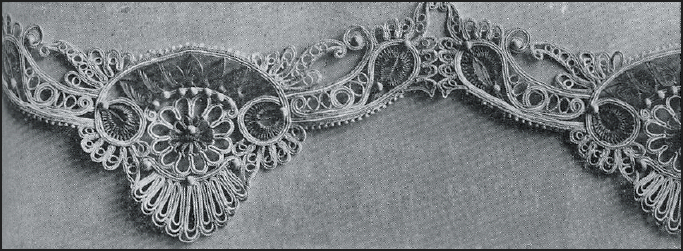
Mathilde’s daughter Flora had married Samuel Simon, one of the three brothers to marry into the Nusbaum/Dreyfuss clan, and they had two children in the 1870s, Meyer (mostly likely named for his grandfather Maxwell) and Minnie.  By 1880, Flora and Samuel had moved to Elkton, Maryland, where Samuel was running a hotel.  Meanwhile, Moses and Mathilde (Dreyfuss Nusbaum) Pollock were still in Philadelphia, and the other surviving children—Albert Nusbaum and Emanuel and Miriam Pollock—were still living at home with them, according to the 1880 census. Moses was in the cloak business, Albert was in the liquor trade, and Emanuel was in the dry goods business.  Moses’ line of trade seemed to change to trimmings or finishings during the 1880s and 1890s with various directories listing his businesses as plaiting, laces, embroidery, school bags, and accordion pleating.

Mathilde’s family was struck by tragedy again on September 1, 1885, when Miriam Pollock, just 26 years old, died from consumption or tuberculosis.  Mathilde had lost her first husband to a fire, her daughter Rosia at five months, and then her daughter Miriam at 26.  Sometimes life is just not fair.

miriam pollock death cert FHL 2070682

“Pennsylvania, Philadelphia City Death Certificates, 1803-1915,” index and images, FamilySearch (https://familysearch.org/pal:/MM9.1.1/JFSV-LHQ : accessed 22 January 2015), Miriam Pollock, 01 Sep 1885; citing , Philadelphia City Archives and Historical Society of Pennsylvania, Philadelphia; FHL microfilm 2,070,682.


Then Moses Pollock died on December 5, 1894 of encephalomalacia, defined in Wikipedia as “localized softening of the brain substance, due to hemorrhage or inflammation.”  Like so many other family members, he was buried at Mt. Sinai cemetery in Philadelphia.  He was 69 years old.

Moses Pollock death cert

“Pennsylvania, Philadelphia City Death Certificates, 1803-1915,” index and images, FamilySearch (https://familysearch.org/pal:/MM9.1.1/JKS4-32N : accessed 22 January 2015), Moses Pollock, 05 Dec 1894; citing cn 11116, Philadelphia City Archives and Historical Society of Pennsylvania, Philadelphia; FHL microfilm 1,872,200.

Both Albert Nusbaum and Emanuel Pollock had continued to live with their parents throughout the 1880s and 1890s, and in 1900, they and their mother were still living together at the same address, 934 North Eighth Street.  Mathilde, now widowed twice in addition to losing two children, was working outside the house as a manufacturer of bags—presumably, the school bags listed as one of the items Moses was selling on the last directory entry before his death.  Albert was still a liquor salesman, and Emanuel was selling bicycles.  In addition, Meyer Simon, Flora’s son and Mathilde’s grandson, now 30 years old, was also living with them and was working with his grandmother in the bag manufacturing business as a manager.

Mathilde’s daughter Flora Nusbaum and her husband Samuel Simon, meanwhile, had left Elkton, Maryland, and moved to Baltimore by 1885.  Samuel was in the liquor business, as was his brother Moses, who was married to Paulina Dinkelspiel, Flora’s first cousin.[2]  My hunch is that they were business together.

In 1900, Samuel was still in the liquor business in Baltimore, but his brother Moses had died the year before.  Samuel and Flora still had their daughter Minnie living at home with them, but their son Meyer, as noted above, was living in Philadelphia with his grandmother and uncles Albert and Emanuel and managing the bag manufacturing business.

Although Meyer Simon was listed as single on the 1900 census, the 1910 census reported him as married for 12 years. I figured that this must have been a mistake, especially since he was still living at his grandmother’s address even in the 1901 directory.  It seemed he could not have been married for 12 years in 1910.

But then I found something strange.  After some further research and review, I found in the Pennsylvania, Marriages 1709-1940 data base on familysearch.org a marriage between Meyer Simon and Tillie Perry on September 18, 1897, in Allegheny, Pennsylvania. Meyer’s wife’s name on the 1910 census was Matilda, so I knew this was the correct marriage.  Matilda or Tillie Perry was the daughter of William and Matilda Perry; she was born in Philadelphia in 1876 and baptized in the Episcopal church in 1878. But if Meyer and Matilda were married in 1897, why was Meyer listed as single on the 1900 census, and where was Matilda?[3]

I found Matilda Perry on the 1900 census living with her parents in Philadelphia, and that census report stated that she was married and had been married for three years, which is consistent with the marriage record I found on familysearch. Had Meyer and Matilda married and then lived separately for at least three years?  It seems strange, but perhaps they could not yet afford a place of their own. Or perhaps they were temporarily separated.  Or perhaps the religious differences had made it difficult for those families to support the marriage.    After all, Meyer listed his marital status as single.  I suppose it is also possible that he had kept the marriage a secret from his family.  After all, they were married in Allegheny, not in Philadelphia or in Baltimore where their families lived. Allegheny was a city across the river from Pittsburgh that merged with Pittsburgh in 1907.   It would have been therefore over 300 miles from Philadelphia and about 250 miles from Baltimore.

Thus, as of 1900, Mathilde Dreyfuss Nusbaum Pollock was a widow, living in Philadelphia with her two sons, Albert and Emanuel.  Her daughter Flora was living with her husband Samuel Simon in Baltimore with their daughter Minnie, and their son Meyer was married, but not yet living with his wife Matilda.

The decade that followed must have been a very painful one.  First, on March 21, 1904, Mathilde Pollock died.  She was 79 years old.  The death certificate says she died of old age, which shows you how perspectives on aging and longevity have changed.  It also says that she died from “senile pneumonia,” a term for which I could find no easily understood definition for my non-medical brain to grasp, but which I gather is a form of pneumonia that affects the elderly.  (Feel free to provide a more scientifically accurate definition.)  The death certificate also says that Mathilde had ascites, another term not easily defined but which Wikipedia defines as “gastroenterological term for an accumulation of fluid in the peritoneal cavity.”   Don’t even get me started on trying to understand where the peritoneal cavity is, but from what I read, ascites seems to have something to do with liver disease, often cirrhosis.

Mathilde Pollock death cert

Mathilde’s death was followed three years later by the death of her son Emanuel Pollock on February 16, 1907.  He was only fifty years old and died of tuberculosis.  Three years after that his half-brother Albert Nusbaum died on August 28, 1910 from apoplexy brought on by arteriosclerosis.  He was 59 years old.  Mathilde and both of her sons were buried at Mt. Sinai cemetery.

That left only Flora Nusbaum Simon as the surviving child of Mathilde Dreyfuss Nusbaum Pollock.  She had lost both of her parents and all four of her siblings.  She was also the only child who had children of her own as none of her siblings ever married or had children. Flora and Samuel appear to have relocated from Baltimore to Philadelphia by 1905, the year after her mother died, as Samuel appears in the Philadelphia directory living at 2225 North 13th Street, the same address where the family is listed in the 1910 and 1920 census reports.

Flora’s brother Albert had been living with them at that address in April when the 1910 census was taken, just four months before he died.  Neither Samuel nor Albert nor anyone else in the household was employed at that time, yet they still had a servant living in the home.  Minnie, Flora and Samuel’s daughter, was 27 and single, living with her parents and uncle.  It feels like it must have been a very sad time for the family.

Flora and Samuel’s son Meyer and his wife Matilda were living about two miles away at 2200 Susquehanna Avenue in 1910.  Meyer was a clothing salesman.  There were two boarders living with them, but no children. When Meyer registered for the World War I draft in 1917, he and Matilda were living at 3904 North Marshall Street, two and a half miles north of his parents and his sister.  Meyer was employed as a clothing salesman for Harry C. Kahn and Son, according to his draft registration.

On February 18, 1919, Flora Nusbaum Simon suffered yet another loss when her husband Samuel Simon died from a cerebral hemorrhage at age 79.  She and her daughter Minnie were living together in 1920 at their home at 2225 North 13th Street.  Flora herself died almost four years to the day after her husband Samuel on February 20, 1923.  She was 74 years old and died from chronic interstitial nephritis.  She had outlived all of her siblings by over 13 years.  She, like all the rest of them, was buried at Mt. Sinai cemetery with her husband Samuel.

Ancestry.com. Pennsylvania, Death Certificates, 1906-1963 [database on-line]. Provo, UT, USA: Ancestry.com Operations, Inc., 2014.

Ancestry.com. Pennsylvania, Death Certificates, 1906-1963 [database on-line]. Provo, UT, USA: Ancestry.com Operations, Inc., 2014.

After her mother Flora died, Minnie Simon lived with her brother Meyer and his wife Matilda in the house on North 13th Street where Flora had died, number 2336, across the street from where they had lived for many years at 2225.  Meyer was employed as a clothing salesman, and his niece Matilda (a fifth Matilda in his life) was also living with them.  Meyer lost his sister Minnie six years later when she died from liver cancer on December 14, 1936; she was 63 years old.

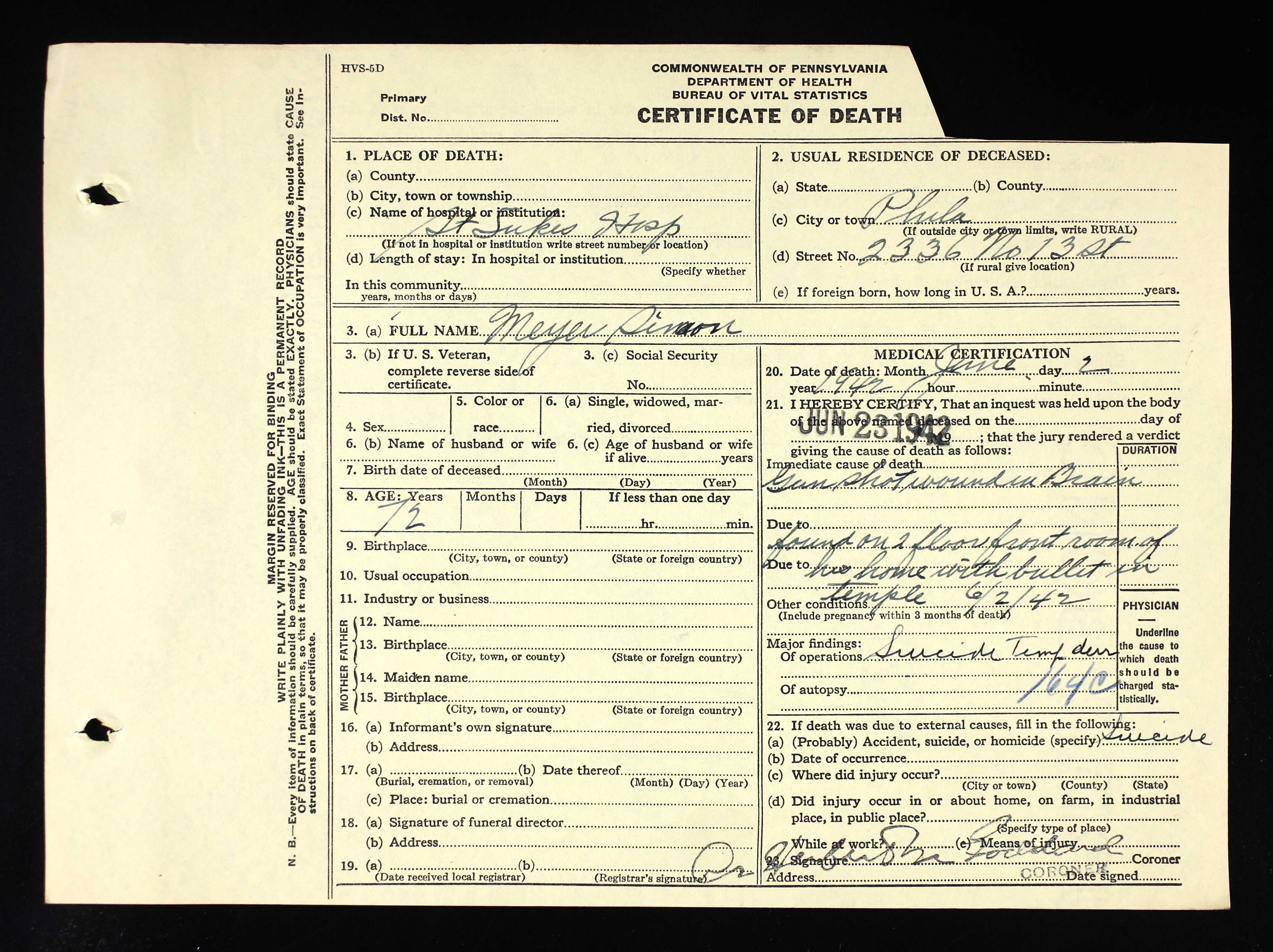
Meyer was the only member of his family left.  He had no siblings, no nieces or nephews on his side.  It must have been just too much for him when his wife Matilda then died on April 27, 1940, at age 63 from cerebral thrombosis and chronic nephritis.  Two years later on June 2, 1942, Meyer took his own life.  He was found on the second floor of his home at 2336 North 13th Street with a gunshot wound to his head.  He had no survivors.  Although Meyer was buried with his family at Mt. Sinai, he was not buried with his wife Matilda.  She was buried at a non-denominational cemetery instead (Northwood); because she was not Jewish, she could not be buried at Mt. Sinai.  How sad.

meyer simon death cert pre inquest

Ancestry.com. Pennsylvania, Death Certificates, 1906-1963 [database on-line]. Provo, UT, USA: Ancestry.com Operations, Inc., 2014.

Meyer Simon death cert coroner's inquest

Ancestry.com. Pennsylvania, Death Certificates, 1906-1963 [database on-line]. Provo, UT, USA: Ancestry.com Operations, Inc., 2014.

This story fills me with such sadness.  How lonely Meyer must have been.  He’d lost his grandparents, his parents, his aunts and uncles, his sister, and his wife.  And there were no children or nieces or nephews left to comfort him. Certainly there were other Nusbaum cousins nearby in Philadelphia, but it must not have been enough.

From the start of the story of the life of Meyer’s grandmother Mathilde Dreyfuss, this family suffered such tragedy: Maxwell’s death in the Great Fire of San Francisco and two daughters who died young.  Of Mathilde’s four children who grew to adulthood, only Flora married and had children, and there were no grandchildren to carry on the family line after Flora and Samuel Simon and their two children Meyer and Minnie died.   There are no living descendants of Mathilde Dreyfuss or Maxwell Nusbaum.  No one likely remembers their names.  Except now they have been found and can be remembered for the tough lives they lived and for the courage and hope they must have had when they arrived in Pennsylvania in the middle of the 1800s.


[1] Isaac died without any children in 1870, so unfortunately that was the end of that sibling’s line.

[2] Flora’s father Maxwell Nusbaum was the brother of Paulina Dinkelspiel’s mother, Mathilde Nusbaum Dinkelspiel.

[3] Poor Meyer had at least four Mathilde/Matildas in his life: his mother, his wife, his mother-in-law, and one of his aunts.  And today I don’t know one woman named Mathilde or Matilda or Tillie.

Thank You, Grandpa, for the Gift of My New Cousins

It was about three years ago that I first started wondering more about my grandfather Isadore Goldschlager.  I knew almost nothing about his life before he came to the US in 1904 from Iasi, Romania.  I didn’t know too much about his life when he got to the US either.  It was my interest in his life in particular that first prompted me to go on ancestry.com and start searching for answers.  I soon hit a wall and gave up, only returning to ancestry a year later and starting my search for my Brotman relatives instead.

Then I returned to my grandfather again, a somewhat more experienced researcher, and this time I had better luck.  In fact, as I have written, I found not only his parents—I found his mother’s siblings Gustav and Tillie and Zusi Rosenzweig, and then I found their children and many of their grandchildren and great-grandchildren.  I was able to piece together a better picture of my grandfather’s extended family and even figured out how he met my grandmother Gussie, who happened to be living down the street from his Rosenzweig cousins in 1915 on Pacific Street in Brooklyn.

Last night I got to meet some of my Rosenzweig cousins for the very first time.    Four of the great-great-grandchildren of David and Esther Rosenzweig were there—Gerry, Ron, Michael and me.  Gerry, Ron and Michael are all the great-grandsons of Gustave Rosenzweig, the brother of my great-grandmother Ghitla/Gussie Rosenzweig Goldschlager.  Gerry is the grandson of Abraham Rosenzweig, and Michael and Ron are the grandsons of Joe Rosenzweig, the brother of Abraham.

Here is a picture of Abraham, Joe and Jack Rosenzweig:

Abraham Joseph and John (Jack) Rosenzweig

Abraham Joseph and John (Jack) Rosenzweig

And here is a picture of their first cousin Isadore Goldschlager, my grandfather.

Isadore Goldschlager

Isadore Goldschlager

It was a wonderful evening.  Even though many of us had never, ever met before, we quickly connected and found common bonds—all having grown up in greater New York, all enjoying a good laugh, all loving dogs and our grandchildren (not in that order), and all being unable to digest raw onions.  It was a great time, and even if we never knew each other as children, there was definitely a feeling of family.

Here we all are with our spouses.  Thanks to the lovely newlywed couple who not only put up with our noisy conversations, but also graciously offered to take this picture (on about five different smartphones).

Rosenzweig cousins Jan 24 2014

So keep looking for your cousins—you will never know how much joy you can experience.

Children Losing Parents: The Family of Leopold Nusbaum

I’ve written quite a bit about how terrible it makes me feel when I read about parents losing their children.  The number of babies and young children who died from disease or accidents before the mid-20th century is appalling.  But in the story of the family of Leopold Nusbaum, I saw a different type of tragedy recur a number of times: young children losing a parent.  That pattern began with Leopold Nusbaum’s own daughter. Leopold Nusbaum had died in 1866, predeceased by his four year old son Adolph and survived by his widow Rosa and daughter Francis. Francis was only sixteen when her father died.

Francis had married Henry Frank in 1870, and in 1880 they were living with her mother Rosa and their three children, Leopold (named for his grandfather), Senie and Cora, in Lewistown, Pennsylvania, where Henry was a merchant.  Their fourth child David Henry Frank was born in April 1884.  By 1884 the family had returned to Philadelphia, where Henry was in the cloak manufacturing business with a firm called E. Rubel and Company.  The family was residing at 1234 Marshall Street.  Rosa Nusbaum, Francis’ mother, died February 16, 1887, in Philadelphia.

By 1889 Henry was with a new firm, Patterson, Frank, and Company, still manufacturing cloaks.  By 1894 he had his own firm, H.N. Frank & Co., and the family had relocated to 1633 Franklin Avenue.  The children were now growing up: Leopold was 23, Senie was 18, Cora was 17, and David just ten years old.  By 1899 they had relocated again to 2351 Park Avenue, and Leopold was now a salesman in his father’s business.

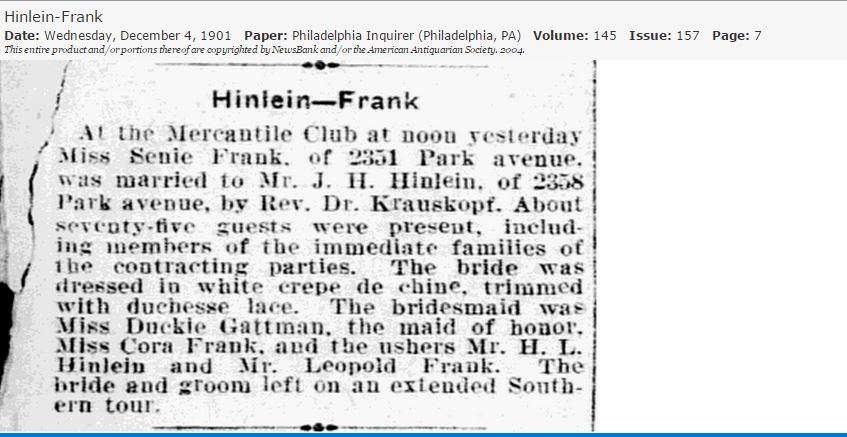
The 20th century saw the children of Francis Nusbaum and Henry Frank beginning to move on as adults.  In 1901, Senie married Joseph H. Hinlein.
Senie Frank marriage announcement

Joseph Hinlein was a widower; his wife Clara Falk Hinlein had died at age 29 from an aneurysm in June, 1900, leaving Joseph with three young children: Florette, Stanley, and Milton.  When Senie Frank married Joseph Hinlein, she thus had an instant family.[1]  Joseph Hinlein was a manufacturer.  In 1900 the census merely says he was a manufacturer, but in 1910 it says braids and in 1920 ladies’ trimmings.  I assume the braids were decorative trimmings for women’s clothing.

There are some very strange things about the census records for Joseph and his children.  For one thing, Joseph’s birthplace varies widely from census to census: Germany (1900), Pennsylvania (1910), Wisconsin (1920 and 1930), and Ohio (1940).  His passport application in 1946 lists Prairie du Chien, Wisconsin as his place of birth as does a ship manifest from 1928 for a trip he took with Senie.   Was this evidence of the unreliability of the census reports or of Joseph himself?  A little more digging, and I found Joseph on the 1870 census when he was just a baby, living with his parents in Prairie du Chien, Wisconsin.  That census indicated that Joseph and his parents were born in Bavaria.   Did Joseph forget where he was born in 1920 and thereafter? Or was he lying to be more American? Or perhaps the census taker in 1870 was mistaken or misunderstood where the baby in the home was born.

But there are other strange things about the Hinlein family and the census.  Although Milton is consistently reported as born in September 1895, Stanley is reported as born in 1893 on the 1900 census, but on every document after that his birth year is generally about 1900.  When I found his World War I draft registration, I thought—Aha! That will have his birthdate.  But it was blank except for his name.

Registration State: Pennsylvania; Registration County: Philadelphia; Roll: 1907759; Draft Board: 36

Registration State: Pennsylvania; Registration County: Philadelphia; Roll: 1907759; Draft Board: 36

And Florette’s age is also mysterious.  On the 1900 census it says she was born in December 1898 and only a year old.  But in 1910 she is seventeen years old, meaning a birth year of 1892 or 1893.  Every other census is consistent with the earlier birth year, and her Social Security death index entry and her headstone say she was born in 1892.  Plus she married in 1913; it seems more likely that she was 21 than 15 when she married.  When I examined the 1900 census more closely, although it clearly says December 1898, the “1” for her age could easily have been a “9.”  Maybe the census taker changed the birth year when he thought that she was one, not nine, years old.

Florette Hinlein 1900 census

Florette Hinlein 1900 census

During the 1910s, the three Hinlein children were moving out on their own.  As mentioned above, Florette married in 1913; her husband Jerome Lehman was from New Jersey, and Florette and Jerome settled in Newark, New Jersey where Jerome, a graduate of Princeton, was working in his father’s food business in 1917, according to his World War I draft registration.  Jerome and Florette had one child, a daughter who was born in 1915.[2]  By 1920 they were living in West Orange, New Jersey, and Jerome was now the vice-president of the grocery business.

Florette’s brother Stanley graduated from Princeton University in 1922 (when he was either 22 or 29, depending on which birth year is correct) and also married Beatrice Silverman in Philadelphia that year.  Stanley followed his father Joseph into the braid manufacturing business.  He and Beatrice settled in the Philadelphia area and had a daughter in 1925.

The third Hinlein child was Milton.  He married Reta Greenwald in 1919.  They also settled in Philadelphia.  I need help deciphering Milton’s occupation on the 1920 census.  I think it says “—- trimmings,” so I assume he also like his brother went into his father’s business.  Milton and Reta would have three children in the 1920s.

Milton Hinlein 1920 census

Milton Hinlein 1920 census

Senie’s younger sister Cora Frank had married just two years after Senie.  She married Jacques Jacob Gattman in Philadelphia in 1903.  Jacques was born in 1875 in Mississipppi where his father, a native New Yorker, was a banker.  By 1894, however, the family had relocated to Philadelphia, as Jacques’ father is listed in the Philadelphia directory for that year as a malt merchant.  On the 1900 census, Jacques is living with his parents and working as a salesman.

After marrying in 1903, Cora and Jacques settled in Philadelphia and had a daughter Dorothy in 1905.  Then at age 31, Jacques died from cerebral apoplexy or a stroke on January 19, 1906.  Cora was a 29 year old widow with a baby less than a year old. Her daughter Dorothy, like her Hinlein stepcousins, lost a parent at a very young age.  Cora and Dorothy moved back into Henry and Francis Nusbaum Frank’s home at 2351 Park Avenue, where Cora is listed as residing in the 1908 and 1909 directories as well as on the 1910 census.

Cora remarried in 1913.  Her second husband was Joseph Gustav Lehman.  I immediately thought that there had to be some connection between Joseph Lehman and Jerome Lehman, who married Florette Hinlein, Cora’s stepniece, that same year.  I have yet to find that connection, however. As noted above, Jerome Lehman was born in New Jersey in 1896, and his father Leser Lehman was also born in New Jersey.  Joseph Lehman, on the other hand, was born in Ohio in 1876, and his father Gustav was born in Germany in about 1845. Could there be a connection? Of course.  But I have yet to find it.

Joseph Lehman was 37 when he married Cora; she was 36.  They settled with Cora’s daughter Dorothy in Dayton, Ohio, where Joseph had lived his whole life.  His father Gustav was a dealer in hides, and in 1900 Joseph was working as a bookkeeper.  By 1910 his father had died, and Joseph and his brother Jacob had taken over the hides business.  After marrying Cora in 1913, Joseph became the secretary of the Hewitt Soap Company, according to his World War I draft registration in 1917.  The 1920 census lists his occupation as secretary of a steel company.   The transition from hides to steel is a telling one, revealing the shifts in the US economy by 1920.

Cattle hides

Cattle hides


Dorothy, now a teenager, was living with Joseph and Cora.  Unfortunately, I have been unable to locate Dorothy after 1926 when she was listed as Dorothy Gattmann and as a student in the Dayton city directory.  I cannot find her as Dorothy Lehman or Dorothy Gattmann.  I assume that she married and changed her name, but I don’t know where she lived or who she married.

David Frank, the youngest of the children of Henry and Francis Nusbaum Frank, also was married by 1910.  He married Rhea Heilbron, who was from Reading, Pennsylvania.  They had been married a year at the time of the 1910 census and were living in Philadelphia.  David was working as an inspector in a suit factory.  By 1920 they had relocated to New York City where David was now working as a wholesale merchant in “waists” or women’s clothing.  David and Rhea did not have any children.

The last of the Frank children to marry was the oldest, Leopold Frank.  In 1910 when he was 38 he was living at home and working with his father in the clothing business.  On his passport application dated April 25, 1914, he described himself as single and residing in Philadelphia and a cloak and suit manufacturer.  I cannot locate him on the 1920 census (perhaps he was overseas), but on a June, 1921, ship manifest he is listed as residing at 601 West 115th Street in New York City.  Then, in 1925, Leopold shows up on the NY State census, living with his brother David and sister-in-law Rhea and married to a woman named Nellie.  David and Leopold were both working as dress salesman.  For a long time I could not figure out when Leopold had married Nellie or anything about her life before 1925.

But then I looked over everything again and found some clues.  Also living with David, Rhea, Leopold and Nellie Frank in 1925 was a nineteen year old young man named Raphael Austrian, identified as the nephew of the head of household, that is, David’s nephew.  At first glance I had assumed that this was Rhea’s sibling’s child since the last name, Austrian, did not match any of David’s siblings.  But when I later searched for some history for Nellie on familysearch.org, looking for a woman born around 1885 in Hungary, the first name on the search results list was a Nellie Austrian from the 1905 NY State census.  I almost dismissed this listing because it said Nellie was married.  But when I looked back again at the 1925 NY census and saw Raphael Austrian again, it clicked.  Nellie Austrian was the woman now married to Leopold Frank, and she had a son Raphael who was the nephew of David Frank, the head of household listed in the 1925 census.

David and Rhea Frank's household on the 1925 NYS census

David and Rhea Frank’s household on the 1925 NYS census

So I went back to research Nellie as Nellie Austrian.  On the 1905 census, I found that Nellie was married to an American-born publisher named Julian Austrian.  Further searching for Julian Austrian (thank goodness for some unusual names) revealed that he was born in Reading, Pennsylvania in 1876. In 1900, he was still single and living in Reading.   I was then able to find him and Nellie and Raphael on the 1910 census living in New York City and also on the 1915 NYS census.  Julian’s World War I draft registration reported his occupation as editor and publisher of the F. Stallknecht Publishing Company, and googling that name revealed that they were engaged in the business of trade publications, for example, for the fur trade.

But on October 31, 1919, Julian died of heart failure back home in Berks County, Pennsylvania.  He was just 42 years old.  Once again, there was a young widow, and once again, there was a young child who lost a parent.  Like Francis Nusbaum who lost her father Leopold when she was 16, like the Hinlein children who lost their mother Clara when they were younger than ten years old, like Dorothy Gattman who lost her father Jacques before she could even know him, young Raphael Austrian lost his father when he was only fifteen years old.

In 1920, a year after Julian Austrian died, Raphael and his mother Nellie were living in New York City with a woman named “Diona” Wolkenstein, listed as Nellie’s sister, and from that census entry I finally learned what Nellie’s birth name was, Wolkenstein.  Nellie herself was now listed as a publisher.

I then searched the NYC marriage records for a bride named Nellie Austrian and found one entry for September 30, 1922.  Although the groom’s name was not included in the index, this obviously had to be Nellie’s marriage to Leopold Frank.  Even after marrying Leopold Frank on September 30, 1922, she continued to use the name Nellie Austrian in her listings in the New York City directory as a publisher.  Looking back again at the 1925 census, I now realized that David and Rhea Frank not only had Leopold and Nellie and Raphael living with them; Nellie’s sister “Diona” (indexed as “Siona” here, but more likely “Ilona”) Wolkerstein was also living in the household.

By 1925, all four of the children of Francis Nusbaum and Henry Frank were thus finally on their own.  Senie was living in Philadelphia with her husband Joseph Hinlein, and her three stepchildren were all married and out of the house.  Cora and her husband Joseph Lehman were living in Dayton, Ohio, and her daughter Dorothy was a student.  David Frank and his brother Leopold Frank and their wives were living in New York City where David and Leopold were apparently working together in the dress business.

Their father, Henry Frank, died June 18, 1925, of heart disease.  He is buried at Mt. Sinai cemetery.

Ancestry.com. Pennsylvania, Death Certificates, 1906-1963 [database on-line]. Provo, UT, USA: Ancestry.com Operations, Inc., 2014.

Ancestry.com. Pennsylvania, Death Certificates, 1906-1963 [database on-line]. Provo, UT, USA: Ancestry.com Operations, Inc., 2014.

The 1930s and after

By 1930 Francis Nusbaum Frank, now a widow, had moved in with her daughter Senie and son-in-law Joseph Hinlein in Cheltenham, outside of Philadelphia.  Her daughter Cora and her husband were still in Dayton, Ohio, and Joseph was now in the airplane parts business (maybe the same as the 1920 company, but I cannot tell).  The 1933 directory lists him as the treasurer of the United Aircraft Company, as does the 1936 directory.  Cora’s daughter Dorothy Gattman was no longer living with her mother and stepfather.

As of 1930, David and Rhea Frank were still living in New York City, and David was still in the women’s clothing business. In 1930 Leopold Frank and his wife Nellie were also still in New York; Nellie was still a publisher, and Leopold, like his brother David, was still selling women’s clothing.

In November, 1935, David Frank died at age 53; he was residing in Philadelphia at the time and is buried at Mt. Sinai cemetery.  I’ve been unable to locate a death certificate for him or an obituary, but according to two family trees on ancestry, he died in Atlantic City.  Rhea Frank returned to her home town of Reading, Pennsylvania,[3] where she died seven years later in October, 1941; she was also 53.  They are buried together at Mt. Sinai.

After losing her youngest child David in 1935, Francis Nusbaum Frank died on September 13, 1938, of a stroke.  She was 86 years old.  Like the other family members, she was buried with her husband Henry at Mt. Sinai.

Ancestry.com. Pennsylvania, Death Certificates, 1906-1963 [database on-line]. Provo, UT, USA: Ancestry.com Operations, Inc., 2014.

Ancestry.com. Pennsylvania, Death Certificates, 1906-1963 [database on-line]. Provo, UT, USA: Ancestry.com Operations, Inc., 2014.

In 1940, Senie and Joseph Hinlein were living with their son Stanley Hinlein and his family in Cheltenham.  Joseph Hinlein died in 1950 at 81, and Senie died the following year on May 22, 1951.  She was 74 and died of heart disease.  She and Joseph are buried at Mt. Sinai cemetery in Philadelphia.  Their three children all lived long lives; Florette died in 1993 at 100 years old.  Stanley died in 1983 at 90, and Milton died in 1982 at 87.

Cora and Joseph Lehman were still in Dayton in 1940, and Joseph was the treasurer of an aircraft company.  The last record I have for them is a record of Joseph’s death on June 14, 1959.  Cora was still alive at that point, but I have no further record for her or for her daughter Dorothy Gattman.

Leopold Frank and his wife Nellie seem to have disappeared after 1930.  I cannot find either of them on the 1940 census.  I know that Nellie’s son Raphael was married and living on Long Island in 1940, but I cannot find a trace of his mother or stepfather.

Looking back at the family line that began with Leopold and Rosa Nusbaum, I see a family with a lot of tragedies.  Leopold and Rosa lost their young son Adolph when he was just a little boy.  Their daughter Francis had four children.  The oldest three all had either children or stepchildren who had lost a parent when those children were still quite young.  Both Leopold and Senie married people who had lost a young spouse, and Cora suffered the loss of her first husband at a very young age. (David had no children.)  By 1940, there were no biological descendants of Leopold and Rosa living other than Dorothy Gattman, who I cannot locate.  The family lines of the Hinlein children, who were raised in large part by Senie Frank and whose children undoubtedly saw her as their grandmother, did continue on, and I am hoping to find some of those descendants to fill in some of the gaps left in this story.


[1] Senie and Joseph did not have any biological children together.

[2] Since I have not yet been able to get permission from living descendants, for privacy reasons I am not disclosing the names of those born in or after 1915.

[3] Since Rhea Heilbron, David’s wife, was also from Reading, Pennsylvania, I wonder whether she was friendly with the Austrian family and thus introduced Nellie to Leopold after Julian died.

 

Does Anybody Really Care about a Fifth Cousin?  Are Collateral Lines Relevant?

y Sg647112c (Own work) [CC BY-SA 3.0 (http://creativecommons.org/licenses/by-sa/3.0)], via Wikimedia Commons

y Sg647112c (Own work) [CC BY-SA 3.0 (http://creativecommons.org/licenses/by-sa/3.0)%5D, via Wikimedia Commons

I have been spending many hours recently researching the children, grandchildren and other descendants of the siblings of my three-times great-grandparents.  Sometimes I find myself thinking, “Why am I researching these people?  They are my third cousins twice removed or my fifth cousins or my second cousins four times removed…or whatever.”  Although I’ve had moments of wondering this before, it’s been especially true for the Nusbaum clan, who for the most part flew under the radar and did not have lots of juicy or interesting stories to tell—they were mostly law abiding merchants; they lived their lives quietly and out of the public eye.  They were not politicians or inventors or criminals or performers.  They did not change history.  Sometimes when I learn that a particular relative had no children, I am relieved.  One more line has been completed.

So why do this?  Does anybody really care about such distant relatives? Do I even care? Is it just my general compulsive need for a sense of completion? For being thorough? Or is there something pushing me forward, person by person, line by line?

Some of it is definitely my neurotic need to finish things.  Until recently I would finish any book I started even if I hated it.  Then finally I realized, “Hey, I hate this book.  I do not need to finish it.”  It was tough, but I started realizing no one was grading me if I put the book away.  And it is not just books.  When we moved into our new home five years ago, I stayed up past 3 am just to put away every last dish, fork, pot, and coffee mug in the kitchen.  Craziness.

But I do think that something else impels me to keep researching and writing about all these distant cousins.  First, it gives me the big picture about the lives of my ancestors.  I start to see trends and patterns.  For example, I would not have seen how important the liquor trade became in the family and the country if I had not followed all those Simon and Nusbaum relatives who started selling liquor in the 1870s.  I would not have understood how important the peddler trade was to early German Jewish immigrants if I did not study all the Nusbaum siblings. I would not have sensed the broad impact of the 1870s depression by studying just my direct ancestors.   And as I move into the 20th century, I would perhaps not have seen how suddenly education became a much bigger factor in the lives of these families as both sons and daughters started getting a college education.

So in order to appreciate the larger society in which our ancestors lived, it is important to research not just your direct line but those collateral to it.  But there is more there.  Because I could do all that research and not blog about these people.  I am no fool; I know that it doesn’t make for sexy reading to follow the life of someone who was born, grew up, sold hats, got married, had children, and died.  So why even bother posting on the blog about that ordinary person? Partly because we all live ordinary lives.  Most people are never in the paper for anything “interesting.” Most of us are not politicians or entertainers or criminals.  Most of us are born, grow up, go to work, have families, and die.  Don’t we matter? Won’t our grandchildren want to be able to tell their grandchildren something about their ancestors?  I hope so.

By Citynoise (Own work) [CC BY-SA 4.0 (http://creativecommons.org/licenses/by-sa/4.0)], via Wikimedia Commons

By Citynoise (Own work) [CC BY-SA 4.0 (http://creativecommons.org/licenses/by-sa/4.0)%5D, via Wikimedia Commons

And then there is this other thing.  It hasn’t happened a lot, but it’s happened to me enough that I know it can happen.  Someone googles their great-grandfather’s name, say Simon Nusbaum, for example.  They land on my blog, and they learn something about their great-grandfather that they never knew—for example, that he was Jewish or that he was the son of a once successful merchant in Philadelphia. And they leave a comment on the blog, and I now have a new cousin with whom I share a family history and some smidgeon of DNA.

Isn’t that worth it?  Right now I am searching for the living descendants of my three-times great-grandparents and their many siblings, and I have found a number of them.  They are mostly my fifth cousins with a few fourth cousins mixed in.  Some I have already emailed, others I will today.  I have not heard back from those I emailed, as is often the case.  Maybe they think I am a crazy person.  Maybe they have no interest today.  But maybe in a month or a year they will wonder about their ancestors and find my blog or find me.

And even if just one of them responds to me, it is worth it.  Maybe they will have a picture of John Nusbaum and Jeanette Dreyfuss or one of their children.  Even if they don’t, I will have helped them learn about their family’s history, and that will make all of this worthwhile.


The Children of John and Jeanette Nusbaum from 1890 to 1925

John Nusbaum died in 1889, leaving behind his widow Jeanette and their six children: Adolphus in Peoria, Simon and Frances both in Santa Fe, Julius in Iowa, and Miriam and Lottie both in Philadelphia.  By 1925 Jeanette and all six children were gone.  This post will describe their lives in the decades between 1890 and 1925.

Jeanette and Lottie: In 1890, Jeanette Dreyfuss Nusbaum was a widow, living in Philadelphia with her daughter Lottie.   In 1900, Jeanette and Lottie were still living together in Philadelphia.  According to the 1900 census, they were living as boarders in the home of another German-born widow named Jenette Oberdorf and her children. Lottie was working as a stenographer, according to two Philadelphia directories in the 1890s.

Miriam and Gustavus: In 1890, Miriam and her husband Gustavus Josephs had one surviving child, Florence, who was now ten years old. Their son Jean was born in 1893.  After researching more about Gustavus, I learned that he had served in the Civil War as a musician.  According to Wikipedia, “The rank of Musician was a position held by military band members, particularly during the American Civil War. The rank was just below Corporal, and just above Private. In some units it was more or less equal to the rank of Private.  During the American Civil War, military leaders with the Union and Confederate Armies relied on military musicians to entertain troops, position troops in battle, and stir them on to victory — some actually performing concerts in forward positions during the fighting.”

Perhaps Gustavus is one of the musicians depicted in one of these videos:


He did not, however, pursue music as a profession after the war.  On the 1880 census, he listed his occupation as an embroiderer, and on various city directories in the 1880s he had been listed as a salesman.  In 1894 and 1896, he is listed as being in the curtains business, and in 1897 he is listed in business with Laurence Frank in the cotton goods business under the firm name Josephs and Frank Co.  Then in 1898 he is still in the cotton goods business, but with a new partner, Louis Wertheimer.

On the 1900 census, Gustavus and Miriam were living with their two children, Florence, now nineteen, and Jean, just six years old.  The 1900 census asked women how many children they had had and how many were still living.  For Miriam, the census reported that she had only had two children, both of whom were still living.  This was obviously not true, as Miriam and Gustavus had had two other children, Milton and Gertrude, who had died.  Was this just bad information given by someone who did not know the facts?  Or were Miriam and Gustavus just in denial?

Gustavus’ occupation on the 1900 census was listed as manufacturing without specifying the type of goods.  The 1901 directory, however, indicates that he was in the upholstered goods business.  Then in 1905 he listed his occupation on the directory as “silks.”  It appears that he was still in the silk business as of the 1910 census, but I cannot quite make out the word that follows “silk.”  I believe it says “silk winder.”  According to the Hall Genealogy website list of old occupations, a silk winder “Wound the silk from the silkworm cocoons onto bobbins.”

Interestingly, by 1914 Gustavus had returned to the embroidery business, or perhaps that was what he’d been doing even in 1910 as a silk winder.  He is listed as an embroiderer thereafter in subsequent directories as well, although on the 1920 census he is listed as a manufacturer in the mill industry.  I am not quite sure what to make of Gustavus’ career path.  Were these really all related businesses or even the same business? He certainly seemed to be involved with fabrics throughout in one way or another.

English: A man sitting cross-legged on a stoop...

English: A man sitting cross-legged on a stoop and embroidering a piece of silk. (Photo credit: Wikipedia)

Adolphus and Fanny: In 1890, the oldest child of John and Jeanette, Adolphus Nusbaum, was still living in Peoria with his wife Fanny, but he was no longer in business with his brother younger brother Julius. The last Peoria directory to include Julius was the one published in 1887.  Adolphus is listed with only a residential address in the 1890 and 1891 Peoria directories, but beginning with the 1895 directory, he is listed as being in the feed business.  He was still in the feed business as of the 1900 census and the 1900 Peoria directory.

Then on February 8, 1902, Adolphus died “20 miles from Chicago while en route to Chicago,” according to the Nusbaum family bible.  I did not know what this could possibly mean, and I was even more confused when I found a Philadelphia death certificate for Adolphus, given that the last address I had for him was in Peoria.

adolph nusbaum

adolph nusbaum death rec inquest pending

Why did Philadelphia issue a death certificate?  Why was there a Philadelphia address given as the residence?  And why was there an inquest pending? I am still searching for an answer to the last two questions and some answer as to the results of the inquest, but I found some answers in this article from the February 9, 1902, Chicago Daily Tribune:

Chicago Daily Tribune, February 9, 1902, p. 4

Chicago Daily Tribune, February 9, 1902, p. 4

But this article also raised more questions.  As far as I know, in 1902, Adolphus did not have a brother in Philadelphia, unless Julius had relocated there at that time.  Simon was still living in Santa Fe.  And what had Adolphus been doing in Washington?  He must have been traveling by train.  Did he have a heart attack or stroke while traveling? Was his wife Fanny with him?  I don’t know.  It’s also interesting that despite having lived in Peoria since he was barely in his 20s and having married a woman who had been living in Indiana in 1863, Adolphus was buried at Mt. Sinai cemetery in Philadelphia with the other members of the extended family, including his father John.

UPDATE on the coroner’s report can be found here.

Frances and Bernard: In 1890, two of the children of John and Jeanette continued to live in Santa Fe, my great-great-grandmother Frances Nusbaum Seligman and her brother Simon Nusbaum.  Frances was busy with her charitable and social activities in Santa Fe.  Her children Eva, James, Minnie and Arthur all went off to Swarthmore in Philadelphia in the 1880s, where Minnie died at age eighteen in 1887, as I’ve written about previously.  Frances herself died in July, 1905, two years after her husband Bernard.  She was 59 years old.  As I described when writing about Frances and Bernard, both were warmly praised and well-loved by the Santa Fe community.  Both were buried, however, back in Philadelphia at Mt. Sinai cemetery.

It must have been terrible for Jeanette to lose her son Adolphus in 1902 and her daughter Frances 1905, not that many years after losing her husband John as well as so many grandchildren.  Jeanette herself died on January 12, 1908, from edema of her lungs, according to the death certificate.  She was 90 years old.  She was buried along with her husband, her children Frances and Adolphus, and numerous grandchildren and other relatives at Mt. Sinai cemetery in Philadelphia.

Ancestry.com. Pennsylvania, Death Certificates, 1906-1963 [database on-line]. Provo, UT, USA: Ancestry.com Operations, Inc., 2014.

Ancestry.com. Pennsylvania, Death Certificates, 1906-1963 [database on-line]. Provo, UT, USA: Ancestry.com Operations, Inc., 2014.

Julius: As for Julius Nusbaum, who had once been Adolphus’ business partner in Peoria, as noted above he was last listed in the Peoria directory in 1887 and then disappeared from Peoria.  He next surfaced in 1900 in Grinnell, Iowa, living alone as a single man and working as a tobacco merchant. Grinnell is over two hundred miles from Peoria and over a thousand miles from Philadelphia.

Restored Rock Island Line station in Grinnell,...

Restored Rock Island Line station in Grinnell, built in 1892. Now a restaurant. (Photo credit: Wikipedia)

What had taken him to Iowa and when had he gotten there? Had he gone into the tobacco business for the same reasons that his father John had gone into the cigar business in the mid-1880s?  In 1891 Julius is listed in the Waterloo, Iowa directory as a cigar dealer, and on the 1905 Iowa State Census he is living in Grinnell.  It does not thus seem like he was living in Philadelphia in 1902 when Adolphus and Fannie came to visit.  Was the newspaper just wrong about that detail, or was the 1905 directory wrong? Certainly Adolphus had other family members to visit in Philadelphia, including his mother Jeanette, his sister Lottie, and his sister Miriam and her family.

Julius is not listed in either the 1904 or the 1906 Waterloo, Iowa business directory, and  I cannot find him on the 1910 census anywhere, so I do not know whether he was still living in Iowa at that point. But by 1920 he had returned to Philadelphia, listing his occupation on the 1920 census as a retired cigar merchant and living as a boarder.  Living in the same residence with him in 1920 also as a boarder was a 62 year old widow named Fannie Nusbaum who had been born in Germany; this was obviously Adolphus’ widow, Julius’ sister-in-law.

I could create all kind of romantic stories about Julius and Fannie, but they would be speculative for sure.  Julius had lived with Adolphus and Fannie in Peoria and had been in business with his brother.  Suddenly after working together for over twenty years, Julius left Peoria and moved to Iowa, where he presumably knew no one and where he started an entirely new business selling cigars.  Then Adolphus died in 1902, and I can’t find Julius or Fannie anywhere on the 1910 US census or in city directories.  Ten years later, Julius and Fannie ended up living together in Philadelphia.  Where were they both in 1910?  Of course, it could be completely innocent: a devoted brother taking care of the widow of his older brother.  And it probably was.  I’ve likely read too many novels and seen too many movies.  I have no evidence of any such scandalous events.  I am sure the story is far less interesting than all that.

Simon: Meanwhile, back in Santa Fe, the other Nusbaum brother, Simon, had settled in as part of the community by 1890.  The Santa Fe New Mexican reported in September 1889 that he had returned from a month’s vacation and “looked like a new man,” having gained twenty pounds.  There was no further explanation for the comment, but perhaps Simon had had a rough time after losing his father in January of 1889.  After that, his life seems to have taken a positive turn.  Having served first as a clerk and then as assistant postmaster in Santa Fe, Simon was appointed by President McKinley to be the postmaster there in May, 1898.

His appointment was enthusiastically approved by the press and the people of Santa Fe.  On May 5, 1898, the Santa Fe New Mexican opined on page 2, “As good a piece of news as Santa Fe has received for some time was that of the appointment of Simon Nusbaum to be postmaster of this city.  This appointment was one that had been strongly recommended by the best and leading citizens of this city and indeed by all those desiring a competent official and a honest and proper man in that important office.  Mr. Nusbaum’s political support was also very powerful….He is a skilled accountant and book-keeper, in fact one of the best in the southwest.  He … had held several positions of trust and importance in big business establishments, in this territory and in eastern cities.”

The Santa Fe newspaper also quoted from the Peoria Evening Star, which said, “Years ago Nusbaum & Co. were the great dry goods firm of this city.  One of the members was Simon Nusbaum.  He was a smart, active, pushing man….”  Santa Fe New Mexican, May 19, 1898, p. 2.

Simon was still a single man at that point.  In 1899 he reportedly bought a fruit farm near Tesuque, New Mexico, apparently for a very good price.

Santa Fe New Mexican, September 28, 1899, p. 4

Santa Fe New Mexican, September 28, 1899, p. 4

He later began breeding high bred Belgian hares in partnership with one of his clerks at the post office.

Santa Fe New Mexican, December 6, 1900, p.4

Santa Fe New Mexican, December 6, 1900, p.4

Although Simon was still single as of the 1900 census, he married Dora Rutledge in 1903. It was the first marriage for Simon, who was 57 years old.  Dora was only forty.  She had a daughter from an earlier marriage, Nellie Rogers, who was born in 1897.   Simon and Dora’s son John Bernard Nusbaum, was born on May 15, 1904.  On the 1910 census, Simon was now the assistant New Mexico Territorial Treasurer, and he and Dora and the children must have been living in a boarding house because they had seven lodgers living with them.  In fact, the 1920 census reveals that Simon and Dora were the owners of that boarding house, which was being managed by Dora.  Simon was now 76 years old and Dora was 49.

1916-1925: Years of Loss

When Jeanette Nusbaum died in 1908 at age 90, she had outlived two of her children, Adolphus and Frances, and many of her grandchildren, as well as her husband John.  Four of her children had survived her: Simon, Julius, Miriam and Lottie.  By 1925, all of those children would be gone.  On February 13, 1916, Miriam died of heart disease.  She was 57 years old and survived by her husband Gustavus and two children, Florence, who was 36, and Jean, who was 23.  Gustavus died eight year later at age 75 of pectoris angina.

Ancestry.com. Pennsylvania, Death Certificates, 1906-1963 [database on-line]. Provo, UT, USA: Ancestry.com Operations, Inc., 2014.

Ancestry.com. Pennsylvania, Death Certificates, 1906-1963 [database on-line]. Provo, UT, USA: Ancestry.com Operations, Inc., 2014.

Simon Nusbaum died on February 25, 1921.  He was 76.  Unlike his siblings, he was not buried at Mt Sinai in Philadelphia, but in Santa Fe, where he had lived the last forty or so years of his life.  He was survived by his wife Dora, stepdaughter Nellie, and son John, who was only 16 years old.  Thanks to my cousin Pete, I have a copy of Simon’s obituary.  It reports that Simon had had a stroke in September, 1920 and had not been himself since, but that prior to the stroke, he had been “able to walk around as briskly as he had for decades, and he was a familiar figure in the plaza and sitting on the swing in front of his apartment house on Washington Avenue.”  Here is the full obituary:

simon obit santa fe new mexican feb 25 19221

(Santa Fe New Mexican, February 25, 1921)

I winced at the references to “bad Indians” and “red chiefs,” trying to keep in mind that this was 1921.  I was intrigued by the references to Simon’s time living in Missouri and South Dakota, as I have seen no documentation of his time in either place.  He was still in Philadelphia in 1860 when he was 17, and he was in Peoria starting in 1863 until 1877.  By 1880 he was in Santa Fe.  So perhaps he had spent those years in between in Missouri and South Dakota.

The image of Simon as the postmaster sorting the mail in his nightgown at midnight is wonderful.

Just two years later, Simon’s brother Julius Nusbaum died in Philadelphia on January 3, 1923.  He was 74 years old and died from “Dil of heart, superinduced by acute indigestion.”  I googled this phrase and found that it was often used as description of a cause of death in the early 20th century, but I could not find any medical dictionary that explained what this meant.  Dilation of the heart refers to an enlarged heart that cannot adequately pump blood, what we might refer to today as heart failure.  But I have no idea what “superinduced by acute indigestion” means or whether that is today considered even medically accurate.  Perhaps my medical consultant will fill me in.

Update here.

Ancestry.com. Pennsylvania, Death Certificates, 1906-1963 [database on-line]. Provo, UT, USA: Ancestry.com Operations, Inc., 2014.

Ancestry.com. Pennsylvania, Death Certificates, 1906-1963 [database on-line]. Provo, UT, USA: Ancestry.com Operations, Inc., 2014.

 Finally, the last of the children of John and Jeanette Nusbaum, Lottie died on December 23, 1925, of nephritis and diabetes.  She was 64 years old.  Both Julius and Lottie did not have any children.

Lottie Nusbaum death cert

Thus, as of 1925, all six children of John and Jeanette were gone. Three of them had no children to survive them, Adolphus, Julius, and Lottie.  The other three siblings had together six surviving children: the three surviving children of Frances Nusbaum and Bernard Seligman, Eva, James, and Arthur; the two surviving children of Miriam Nusbaum and Gustavus Josephs, Florence and Jean; and the son of Simon Nusbaum and Dora Rutledge, John Bernard Nusbaum.  If I include Simon’s stepdaughter Nellie, who was after all referred to as his daughter in his obituary, that would make seven surviving children.  And there were the four grandchildren who had died as children, Florence and Minnie Seligman and Milton and Gertrude Josephs.

I have already written about the surviving Seligman children, my great-grandmother Eva and her brothers James and Arthur.  In a later post, I will follow up on the other surviving grandchildren of Jeanette Dreyfuss and John Nusbaum, Florence and Jean Josephs and Nellie and John Nusbaum and their families.


John Nusbaum 1814-1889: The Family Patriarch

By 1880, my three-times great-grandparents, Jeanette (Dreyfuss) and John Nusbaum, and their extended families had not only grown in size but spread across a wider swath of the northeastern United States.  Some were still in Harrisburg or Philadelphia, but others were in Peoria, Baltimore, and Pittsburgh.  Although many were still dry goods merchants, the younger generations were also involved in various aspects of the liquor trade.  The family had endured the economic crisis of the 1870s, seeing some bankruptcies and the closings of several stores and businesses.  A number of young children had died, and by 1880, of the siblings of John and Jeanette Dreyfuss, only Ernst and John were still alive on the Nusbaum side, while Jeanette’s two sisters Caroline and Mathilde were both still living.

The next two decades brought with it more changes, more weddings, more new children, and sadly more deaths.  In my next series of Nusbaum/Dreyfuss posts I will try to bring the various branches up to the 20th century, focusing first on my direct ancestors, John and Jeanette and their children and grandchildren.

As I’ve written, in 1880 John and Jeanette were listed on the census in two different locations, living thousands of miles apart.  John was living with their daughter Frances and her husband Bernard Seligman (my great-great-grandparents) in Santa Fe along with his son Simon.  Jeanette, on the other hand, was living in Philadelphia with their daughter Miriam and her husband Gustavus Josephs along with Lottie Nusbaum, the youngest child of John and Jeanette, and Milton Josephs, the young son of Miriam and Gustavus who would die from bronchial pneumonia just a few months after the 1880 census was taken.  These must have been very hard times for my ancestors, and I will never know whether John moved to Santa Fe for financial reasons or because of marital problems.  I will never know whether he was there for a month or a year.

English: A Areal map of Santa Fe, New Mexico d...

English: A Areal map of Santa Fe, New Mexico during the Railroad era in 1882. (Photo credit: Wikipedia)

But I do know that John is listed in the 1881 Philadelphia directory as residing at 1129 Master Street, the same address where the Josephs family and Jeanette and Lottie were living on the 1880 census.  Whether John was actually back or not is hard to say for sure, but he does not appear again on any Philadelphia directory until 1886, when he is listed as being in the “segar” business and living at 524 North 11th Street, the same address given for his daughter Lottie.  Although Gustavus and his family are not listed in the 1881 directory, they show up in the 1884 directory still living on Master Street, so it would seem that sometime between 1881 and 1886, John and Lottie and presumably Jeanette had moved to their own home on North 11th Street.

I found it puzzling that John, after over forty years in the dry goods business, had entered the cigar business.  But his store had gone bankrupt, and perhaps this seemed to be a good way to make a fresh start in the 1880s.  John was already in his 70s by 1886, so it is even more surprising that he was starting in a new trade instead of just retiring.  I did some reading about the tobacco industry and learned that the John Bonsack invented the cigarette rolling machine in 1881, leading to a widespread increase in cigarette smoking (previously, tobacco was either chewed, smoked in a pipe, or hand rolled into a cigar or cigarette).   I don’t know whether this technological development had any effect on John’s decision to sell cigars, and I don’t know whether he sold only cigars or also cigarettes, but the timing does seem to be enough for me to think this was not just coincidental.  In 1887, John again is listed at the same residence and as being in the “segar” business.

English: Trade card of a cigar dealer after a ...

English: Trade card of a cigar dealer after a photograph of Napoleon Sarony, using Oscar Wilde’s popularity during his American trip of 1882 (Photo credit: Wikipedia)

Meanwhile, the children of John and Jeanette were also finding their way in the 1880s.  Adolphus and Julius were still in Peoria, working in the dry goods business, now called Nusbaum Bros.  Since Julius had been one of his father’s creditors in the bankruptcy proceedings, perhaps the business was now owned by the brothers instead of their father.  Julius was living with his brother Adolphus and sister-in-law Fannie, who had no children.

Simon, meanwhile, had remained in Santa Fe and was still unmarried and living with his sister, my great-great-grandmother Frances Nusbaum Seligman, and her family in 1885 according to the New Mexico Territorial Census of that year.   In 1887 Simon was appointed to be a clerk in the US post office in Santa Fe, a position he continued to hold for many years, being promoted to assistant postmaster by 1889 and ultimately to postmaster in 1898.

Miriam and Lottie, the remaining two children of John and Jeanette, were living in Philadelphia.  Miriam and her husband Gustavus had a third child in 1882, Gertrude, after losing Milton in 1880.  Their second child Florence was then two years old.  On November 28, 1888, Gertrude died from diphtheria (croupus form, according to the death certificate). She had just celebrated her sixth birthday less than a month before.  Eight year old Florence was once again an only child.  The family had lost yet another young child.  For Miriam and Gustavus to lose two young children in the space of eight years must have been completely devastating.

gertrude josephs death certificate

As for Lottie, John and Jeanette’s youngest child, she was just seventeen in 1880 and still living at home, as she did throughout the decade.

The decade drew near a close on another sad note for the family when my three-times great-grandfather John Nusbaum died on January 24, 1889.  He was 74 years old.  According to his death certificate, he died from lobular heart disease, chronic cystitis, and diabetes.  Notice also that the residential address on both Gertrude Josephs’ and John Nusbaum’s death certificates is the same: 1617 North 13th Street.

John Nusbaum death certificate

John Nusbaum was born in Schopfloch, Germany, in 1814, the sixth child of Amson Nusbaum and Voegele Welsch.  He had been one of the pioneers in the family, coming to Pennsylvania in the 1840s, probably starting as a peddler and then establishing himself as a merchant first in Harrisburg and then in Philadelphia.  He had seen much success and some failure in his business; he had helped out his siblings and their widows when his brothers Maxwell and Leopold died.  He and Jeanette had been the common link that brought together many connections between the Nusbaum, Dreyfuss, Dinkelspiel, Wiler, and Simon families.  I imagine that it must have been very hard for the family to lose him.  Sadly, I cannot find one obituary or death notice for him.

John Nusbaum’s name lived on in other ways, however. Four years after he died, his daughter Miriam and her husband Gustavus had one last child on July 26, 1893, five years after they had lost Gertrude and eleven years since Miriam had last given birth.  They named their son Jean, I assume in honor of Miriam’s father.

Two years later in 1895, John Nusbaum’s granddaughter Eva Seligman Cohen had a fourth son whom she and her husband Emanuel Cohen named John Nusbaum Cohen.  He was my grandfather, named for his great-grandfather.  Eva must have known her grandfather John Nusbaum very well, not only when she was a young child living in Philadelphia and not only when he had lived with her family for some period of time in Santa Fe, but also because she had moved to Philadelphia for college and then settled there after marrying my great-grandfather in 1886.  She must have seen a great deal of him in those last few years of his life.

John Nusbaum Cohen c. 1894

John Nusbaum Cohen c. 1895

When Simon Nusbaum married at a late age, he and his wife also named a son for Simon’s father.  John Bernard Nusbaum was born on May 15, 1904, in Santa Fe. (I assume that the Bernard was for Simon’s brother-in-law Bernard Seligman, who had died the year before.)

And, of course, John Nusbaum’s name lives on today through my father, John Nusbaum Cohen, Jr.  It’s a legacy that my three-times great-grandfather well deserved.  We may not have a photograph to remember his face, but we will always remember his name.


One More Chapter in the 1870s: Ernst Nusbaum and Family

The 1870s were a pretty tough decade for my Nusbaum relatives.  There were business and financial troubles as well as numerous deaths of children and others.  So I admit that it is not with great enthusiasm that I return to the 1870s, but at least this is the last branch of the family to cover during that decade.  I’ve covered my three-times great-grandparents, John Nusbaum and Jeannette Dreyfuss, and their children, as well as the families of  Jeanette’s two sisters, Mathilde and Caroline, and also those of John’s sister Mathilde and the surviving families of John’s brothers Maxwell and Leopold.  That leaves only the 1870s story of John’s brother Ernst and his wife Clarissa and their children.

Ernst was the closest sibling in age to John, just two years younger, and he was apparently the only sibling who settled in Philadelphia perhaps as early as 1851  and stayed there for the rest of his life.  He had married Clarissa Arnold, a Pennsylvania native born in 1830 who was fourteen years younger than Ernst.  Ernst and Clarissa seemed to have been quite comfortable in the 1850s and 1860s.  By 1861, they had six children.  Ernst was in the men’s clothing business in a firm called Arnold, Nusbaum, and Nirdlinger.  (I assume the Arnold was one of his wife’s relatives.) By 1870, Ernst and Clarissa’s children were almost all teenagers or almost teenagers: Arthur was 19, Myer 18, Fannie 14, Edgar 12, Henrietta 10, and Frank was nine years old.  They were still living at 625 North 6th Street, the same home they had been in since at least 1861.  They also still had two servants living with them.

But in 1870, Ernst’s firm went bankrupt, as seen in this December 5, 1870, article from the Philadelphia Inquirer:

Bankrptcy of Adler Nusbaum Dec 5 1870 phil inq p 3

The Philadelphia Inquirer, December 5, 1870, p. 3


Three years later Ernst is listed in the notions business at 518 Arch Street in the 1873 directory.  Interestingly, his son Arthur and his wife Clarissa seem to have had a ladies’ furnishings business at the same address called Clares & Arthurs.  Arthur was still living at home, and the family had moved to 1000 North 6th Street by 1873.   Was this a move necessitated by the economic downturn?  Did Clarissa want to start working out of the house because they needed more money or was it just that her youngest child was twelve years old and the others well into their teens or twenties so she had the time and interest in doing so?

I do not know, but the following year, it appears that Clares & Arthurs no longer existed.  Ernst is listed without a business address, Clarissa has no listing, and Arthur is listed as a clerk. The next year, 1875, has Ernst living at 2103 Green Street without any occupation listed and Arthur listed as residing at the same address and working as a salesman at 730 Chestnut Street.  His younger brother Myer is also listed at the 2103 Green Street residential address.  In 1876, Myer is listed as working as a bookkeeper, but Arthur and Ernst simply have the residential address.  Same in 1877 and 1878 for Ernst and Myer, but Arthur is not listed at all. So had Ernst retired?  Or had he simply stopped working due to the recession? And where was Arthur?

Well, in 1879, when the recession was starting to end, Ernst is once again listed with an occupation—in the cloaks business.  Myer is still listed as a bookkeeper, and now Edgar, his younger brother, is listed as a salesman.  All three are still listed as residing at 2103 Green Street in the 1879 Philadelphia directory.

And where was Arthur?  I cannot find him in the directory listings for 1877 through 1879.  He had married Henrietta Hilbronner in 1876, and they had had a daughter Florence born in 1877 and a son Sydney born in 1879.  According to the 1880 census, they were all living with Henrietta’s parents on North Seventh Street.  Henrietta’s father Morris was a clothing merchant with his own business, and Arthur was working as a clothing cutter, presumably for his father-in-law.

The other children of Ernst and Clarissa were also getting married in the late 1870s.  Fannie Nusbaum married Jacob L. Hano on February 28, 1877, and they also had two children born by 1880: Louis F. Hano, born in Youngstown, Ohio, on November 30, 1877, and Ernst Nusbaum Hano, born May 16, 1880, also in Youngstown, Ohio.  Jacob Hano was born in Philadelphia in 1850 and had lived his whole life there.  In 1874 he’d been working as a salesman in Philadelphia, residing at 2026 Green Street, right across the street from Fannie and her family.  He had attended Crittenden’s Philadelphia Commercial College.  Perhaps he moved Fannie to Youngstown after they married because he believed that there were better business opportunities there.  Unfortunately, however, like others in the family and the country, he faced financial problems and declared bankruptcy in May, 1878.

jacob hano bankruptcy cleveland plain dealer may 15 1878 p 4

The Cleveland Plain Dealer, May 15, 1878, p. 4

He and the family remained in Youngstown, however, and he is listed on the 1880 census living there with Fannie, their two young sons, and his brother Benjamin as well as a servant.  He listed his occupation as a clothier, and his brother was working as a clerk in a department store. Thus, Jacob must have rebounded from his bankruptcy and started a new business.  They did not remain long in Youngstown, however, as we shall see.

Description: Postcard of Youngstown Sheet & Tu...

Description: Postcard of Youngstown Sheet & Tube (early 20th century) (Photo credit: Wikipedia)

Myer Nusbaum, Ernst and Clarissa’s third child, also married and had two children in the 1870s.  He married Rosalie Aub, and their first child Corinne was born on May 19, 1878.  Her brother Jacob was born the next year on June 24, 1879.  As noted above, Myer was working as a bookkeeper throughout the 1870s and was still employed as a bookkeeper in 1880 according to the census of that year.

Although the 1900 census indicates that Edgar Nusbaum married Viola Baritt in 1879 when he was 21 and she was eighteen, on the 1880 census he is still listed as living at home with his parents at 2105 Green Street and single.  My guess is that they did not marry until 1880, and their first  and only child Selina was born a year later on November 16, 1881.   As noted above, Edgar was listed as a salesman in the 1879 directory, and the same occupation is given in the 1880 Philadelphia directory, although the 1880 US census lists his occupation as a clerk.

Ernst and Clarissa’s youngest two children, Henrietta and Frank, were also still at home in 1880 at 2103 Green Street, depicted below.  Henrietta was 20 and Frank 19.  Frank was working as a clerk like his brother Edgar.  Their father Ernst listed his occupation as a manufacturer.  So perhaps the slowdown of the 1870s had eased, and Ernst and his sons were all then once again gainfully employed.


And now we can move on to the next decade. The 1880s may not have presented the same economic challenges as the 1870s, but as we will see, it presented other challenges and other changes for the extended Nusbaum family.