Blog Stuff

I have made a change in the privacy settings on the blog.  As you know, the blog is a public blog.  When we first started the blog, I did not know whether anyone would ever read it at all, inside or outside of the family, but over the last few months, I have found that I am seeing some visits from people outside of the family.  For me, this is a good thing. Most of these other readers are also doing genealogy work.  I want feedback, I want interaction with others who are doing genealogy research so that I can do a better job, and I want to be able to share my experiences and what I’ve learned about doing this research with others doing similar work.  So I am happy to have as many readers as are interested in checking in.

On the other hand, I have always been and will continue to be careful about protecting the privacy of the members of my family.  For that reason, I have not included birth dates or any other information about living individuals aside from occasional references to a name, usually by first name only.  All the information I have about deceased individuals is available from public records (and a frightening amount of information is also publicly available about living individuals).  In today’s internet environment, our ideas about privacy have had to shift (and that’s without even considering whether or not the NSA is reading our email or listening to our phone calls).  Nevertheless, I do want to respect the privacy interests of my relatives as best I can.

In order to ensure that I continue to protect the privacy of my relatives, I’ve made one new adjustment to the blog.  The family trees are no longer publicly available. The trees do not have much personal information anyway, but I decided that no one outside the family needs to have access to that information.  In order to access those trees, you will now need a password.  I am happy to share that password with anyone who is on the family tree.  If you want the password, please email me directly.  In the future, if I have a post that I consider to be directed only to family members, I will also protect it with that same password.

It’s sad that we cannot be more trusting, but I guess better safe than sorry.

Thank you.

The American Immigrant Experience: The Brotman Story

I’ve been looking over the data I have for all the people on our family tree, starting with Joseph through the children born in the 21st century.  By looking at the various ways our family members have supported themselves, we can see a snapshot of the American immigrant story.

On Gussie’s birth certificate in 1895, Joseph’s employment is listed as a wood and coal dealer. According to the 1900 US census, Joseph worked as a coal agent in the Lower East Side. His death certificate also listed his employment as coal agent; on Sam’s birth certificate he is described as a coal carrier.  As you can imagine, this was hard and dirty work. In an article on the coal industry in Michigan, a son recalled how is father would look after working at a coal yard in Michigan: “Dad would use twine to tie his pants and cuffs so not so much coal would get on his skin. He looked like a clown with his pants blowing out, neckerchief around his neck….The dust would crawl up his pant legs—he’d soak his feet up to his knees every night.”  Another son of a man who delivered coal recalled how black the water would be in the tub after his father took a bath.

In a website devoted to the history of a coal company based in Camden, New Jersey, there is the following description of the type of work Joseph did:

“The man would arrive in a wagon with sacks of coal neatly stacked on top. He would climb onto the wagon and move the sacks to the edge ready for unloading. His face and hands would be completely black from coal dust and he wore a cap or head cloth, which hung down his back. He would grab hold of a sack at the top, turn round, bend forward and pull it onto his back. He then had to walk quite a few yards to the coal cellar, maybe down some steps and then ‘pour’ the coal out of the bag.”

At that same time, Joseph’s older children were also working.  In the 1900 census, Hyman is listed as working as a buttonhole maker and Tilly as a flower maker, obviously both working in the sweatshops described in Streets.  They were both just teenagers at the time.  (That same census reported that neither Joseph nor Hyman could read, write or speak English at that time.)

Joseph’s children, however, were able to free themselves from these oppressive and backbreaking forms of employment.

Hyman was still working as a buttonhole maker in 1917 according to his draft registration papers and his naturalization papers, but soon thereafter left the sweatshops. In 1920 he was working as a chauffeur.  In 1925 he was working in Jersey City as a confectioner, and in 1930 he was working as a storekeeper in a cigar store (perhaps for Max?) and apparently supporting not only his wife and children, but also his father-in-law and his brother-in-law and his wife.  In 1940 his occupation is listed as a bookseller in a bookshop, and in 1942 he simply listed himself as self-employed on his draft registration card.  We know from his grandchildren and from my mother that at some point he owned a liquor store in Hoboken.  So Hyman went from being a poor boy on the Lower East Side, working in a sweatshop and not speaking or reading English, to an independent business owner over the course of his adult life.

Max, a conductor on the railroad in 1900, had his own cigar business by 1910, which continued to be his source of income through the 1940s. Tillie also left the sweatshop world after she married, and she and her husband Aaron owned a grocery store in Brooklyn.  Gussie, who helped Tillie and Aaron by caring for their children while they ran their grocery store, married Isadore, who worked at a dairy company as a milkman.  Abraham worked as a tailor for almost all of his working life and in a restaurant in Brooklyn later in his life.  Frieda was working as a “finisher” in the feather business, which I assume was in the garment industry, in 1920, not too long before she married.  Sam worked as a stock clerk, then in the Brooklyn Navy Yard, and ultimately as a cab driver in New York City.

Thus, by 1920 or so, all of Joseph’s children had left the Lower East Side and had found occupations that took them out of the sweatshops.   Three of them became independent business owners, and the others found work in various trades that did not involve breathing in coal dust and carrying heavy loads of coal to tenement buildings.

The next generation continued that trend.  Joseph’s grandchildren became professionals and business owners: teachers, a lawyer, a pharmacist, advertising firms, real estate investment, and retail stores.   When I look at the list of occupations of Joseph’s great-grandchildren, my generation, born in the 1940s through the 1960s, that trend continues.  Although there are fewer of us who own our own businesses, consistent with the decline of the small family-owned business throughout the country, there are still a number of entrepreneurs.  We are also lawyers (fifteen of us, including descendants, their spouses and our children), doctors, teachers of all types, and school administrators.  We are involved in business, finance, sales, banking, the computer industry, and the arts.

Our children, those born in the 1970s through the 1990s, continue in these fields and others—there are a number working in the creative arts and the music industry as well as medicine and the health care, finance, law, business, and the restaurant industry.  You name the field—we probably have someone related to us working in the field.

As for the next generation, those who are still  at home going to school, maybe even still in diapers, we’d like to hope that the possibilities are limitless.  Yes, the world is a more competitive place, houses are much more expensive relative to income than they were for us, the cost of a college education is beyond what anyone would consider reasonable, and the economy is tougher and tighter than it was for many of us when we first entered the job market.

But if a 50-something year old man could drag coal from tenement to tenement to support his family, if our grandparents could rise from sweatshops to become storeowners and tradespeople, if our parents could go the next step and become professionals and business owners, then certainly we cannot be anything but grateful and appreciative and hopeful.  After all, it was only 125 or so years ago that our ancestors first stepped off the boat and into the streets of New York City with nothing to their names, speaking a foreign language, and risking all they had known to take a chance that this life could be better than what they had known.

This Made My Day!

Yesterday was one of those winter days where I didn’t leave the house all day.  I read the paper, did the crossword puzzle, and played on the computer.  It was quiet, relaxing, but not exciting.  Then late yesterday afternoon, I received an email from Judy, Max’s granddaughter, that made my day.  Attached to the email was a document that Judy’s sister, Susan, had found while going through some old papers.  It’s a family tree sketched out by hand by Renee Brotman Haber, one of Max Brotman’s daughters and Roz, Susan and Judy’s mother.

Take a look at it:

Image

If you now compare this to the family tree on the blog for Abraham and his descendants, you will immediately realize that Renee had written out the family tree of her father’s brother Abraham.  Judy and Susan don’t know when she did it or where, but this is definitely written by Renee and it is definitely Abraham’s family.

Paula Newman, Abraham’s granddaughter, commented on the blog a couple of months ago that she believed she had met Rosalie and Dick Jones in Florida years ago when she was there with her parents.  Rosalie was Renee’s sister, and Judy said that both families used to go to Florida every year at Christmas time.  Perhaps it was during one of those vacations that Paula’s family met with Renee and Rosalie’s families and provided Renee with the information she sketched out on the family tree.

This is the third piece of evidence that supports the conclusion that Abraham and Max were brothers and that Abraham, like Max, was Joseph’s son from his first marriage.  First, we have the fact that Max was the witness on Abraham’s naturalization papers.  Second, we have the fact that Abraham’s Hebrew name was Avraham ben Yosef Yaakov, named for his grandfather Avraham whose son was Yosef Yaakov.  (Recall that Joseph’s Hebrew name was Yosef Yaakov ben Avraham.  Also, Abraham named his son Yosef Yaakov shortly after Joseph died, as did Hyman and Tillie.) And now we have evidence that Renee met or spoke with Abraham’s daughter or granddaughter to write down this family tree.  I don’t know how they found each other, or , more sadly, how they had all lost each other beforehand and then afterwards.

I guess you can tell how much this all means to me that receiving this document made me so happy.  Who cares about snow and sleet and cold when there is a new discovery linking our families!!

This should also be an inspiration to the rest of you to look for things like this—old letters, cards, postcards, pictures. You never know what you will find. Come on, make my day!  

Tillie’s Death Certificate

I received Tillie’s death certificate yesterday, and as I expected, it did not contain any new information about where our family lived in Galicia.  It does, however, confirm that she was the daughter of Joseph and Bessie Brotman (not that I had any doubts) and was born in Austria. Of course, it has a different birthdate from other documents; some documents say she was born in 1884, some 1887, and this one says 1882. The ship manifest which lists her as a passenger in 1891 has her age as six years old, giving her a birth year of 1884 or 1885.  The month of her birth is also inconsistent. The 1900 census said her birthday was in February; the death certificate says August.

Tillie Ressler's death certificate

Tillie Ressler’s death certificate

Interestingly, the death certificate itself has two different ages listed for Tillie at her death.  On the left side (filled out by her son Joseph, as far as I can tell), it says she was born in 1882 and was 73 years old at the time of her death, i.e., February 1956, which would be consistent with a birthday of August 23, 1882.  It also says she was a resident of NYC for 71 of those years, however, meaning she arrived when she was two years old, i.e, in 1884.  Well, we know she came in 1891, so that can’t be correct. On the right side, typed in by the hospital, it says her approximate age was 70 years old at the time of her death, meaning she would have been born in 1886.  So…let’s compromise and say she was born in February, 1884, which is what her own parents told the census taker in 1900.

What the certificate really confirmed for me, however, is what an excellent memory my mother has.  She had just told me over Thanksgiving that Tillie had lived on the Grand Concourse with her sons Joe and Harry and that she had died at a hospital on Welfare Island.  I have to say that when I saw both those facts confirmed in the death certificate, I was very impressed (though not surprised) that my mother had remembered such specific details, especially since I often can’t remember things that happened much more recently.

I was curious about Bird S. Coler Hospital where Tillie died because my mother had very sad memories of visiting her aunt there.  It had opened in 1952 as a public hospital on Welfare Island (now called Roosevelt Island) as a rehabilitation and long-term nursing facility, so it was a relatively new hospital at the time Tillie was there.  It still exists today, now called Coler-Goldwater Specialty Hospital and Nursing Facility, and still functions as a public chronic care facility.

I am now just waiting for Hyman and Sophie’s marriage certificate, and I think I will have all the American “vital records” that exist for Joseph and Bessie and their seven children.

A Call to Israel!

Just to show that I never give up, I thought I’d report on a phone call I made this morning to Shmuel Brotman of Kiryat Tivon in Israel.   Renee, my mentor, made the suggestion that I look for any Brotmans who had lived in Dzikow by checking both JRI-Poland and the database at Yad Vashem.  Both sources found one family, the family of Shmuel and Zipporah Brotman, who had resided in Dzikow/Tarnobrzeg.  It looked like the entire family had died in the Holocaust, but Renee suggested I contact the person who had submitted the names to Yad Vashem, Shmuel’s daughter-in-law Chana Brotman.

I then had to track down Chana Brotman.  I knew from the Yad Vashem submission that she had lived in Kiryat Tivon in 1997 when she submitted the names of Shmuel and his family, and so I made a request on both the JewishGen website and on Gesher Galicia for help in locating the family.  By this morning I had several responses, including two that gave me phone numbers, one for Chana and one for her son Shmuel.  The person who provided me with Shmuel’s number had just spoken with him and said he was awaiting my call.

I jotted down some notes and then called Shmuel.  He’s about my age and fluent in English.  He was very happy to help me, and we spent about half an hour, comparing notes and trying to figure out whether there is a connection between our families.

At the moment I still don’t know what the connection is, but it seems likely that there is one.  His grandfather Shmuel Brotman was born around 1888 in Dzikow, and his great-grandfather’s name was Moshe.  I don’t yet know where Moshe Brotman was born.  He could even be the same Moses Brotman who ended up in Brotmanville.  We still have to sort more things out.

He did tell me that he has done some research and believes that the Brotman family originally came from Georgia in the former Soviet Union and left to escape the pogroms.  He believes they changed their name to Brotman to get across the border.  According to Shmuel, some Brotmans went to the US, some to Romania, and some to Poland, including his family.  Whether our ancestors were also part of that family I don’t yet know, but it is a possibility.

So just as I was about to give up hope of finding more traces of our family, I received a glimmer of hope this morning from Israel.  No matter where this goes, it was another one of those uplifting experiences where strangers helped me find someone and that someone ended up being welcoming and hopeful that we are related.

Research update: Bad News, Good News, Bad News

As you may recall, on October 31, I sent a request to the USCIS  for the naturalization papers for Max Brotman in the hope that they would reveal where Max and thus the other family members were born in Galicia.  According to the automated message on the USCIS phone, it could take at least 90 days to get a response.  Well, I figured the news wasn’t going to be good when I received a response yesterday only 35 days after making my request.  And it wasn’t—they had no records for a Max Brotman who fit the dates I had submitted.  In fact, all their naturalization records start in 1906, and I should have known that Max was naturalized before 1906 since he was the witness for Abraham in 1904.

I then went back to ancestry.com and rechecked my search of their naturalization records where I had been able to find records for both Abraham and Hyman.  I checked and rechecked pages and pages of indices, searching for anything that might relate.  I found one for a Max Bratman born in Germany who worked as a conductor for the railroad and emigrated in 1882, but dismissed it because the name, place of birth, and date of immigration seemed wrong.

Max "Bratman" Naturalization Card

Max “Bratman” Naturalization Card

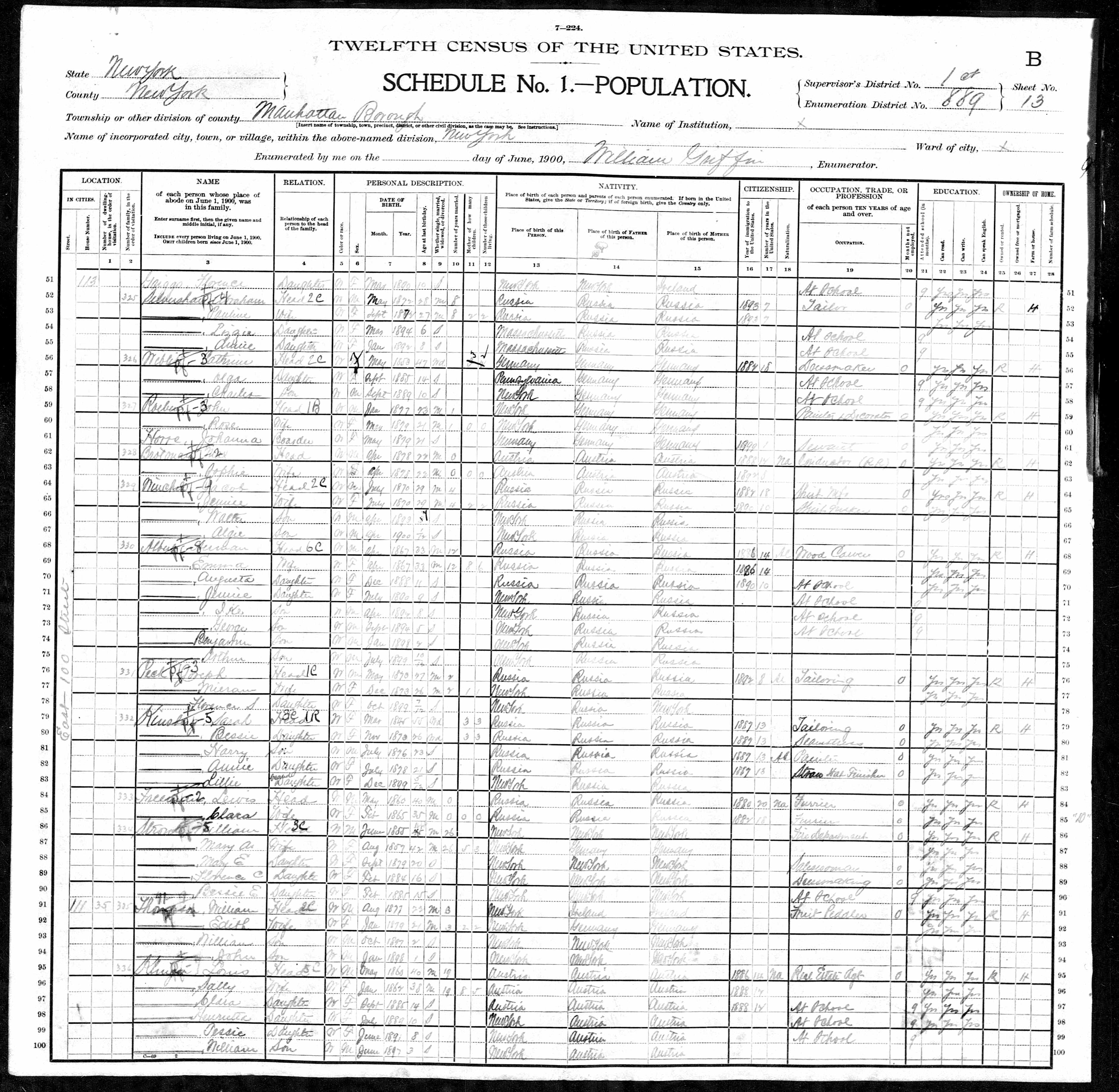
Then I went back to the records I already have for Max, including several census reports, his marriage certificate and his death certificate.  While reading through the 1900 census, I noticed that it said Max was a conductor.  At that time he and Sophie were just married (the census was taken in June; they had married in April) and were living at 113 East 100th Street in Manhattan.  When I saw the entry that he was a conductor, I knew it rang a bell, but at that point I could not remember where else I had seen it.

1900 US Census Report for Max and Sophie Brotman

1900 US Census Report for Max and Sophie Brotman

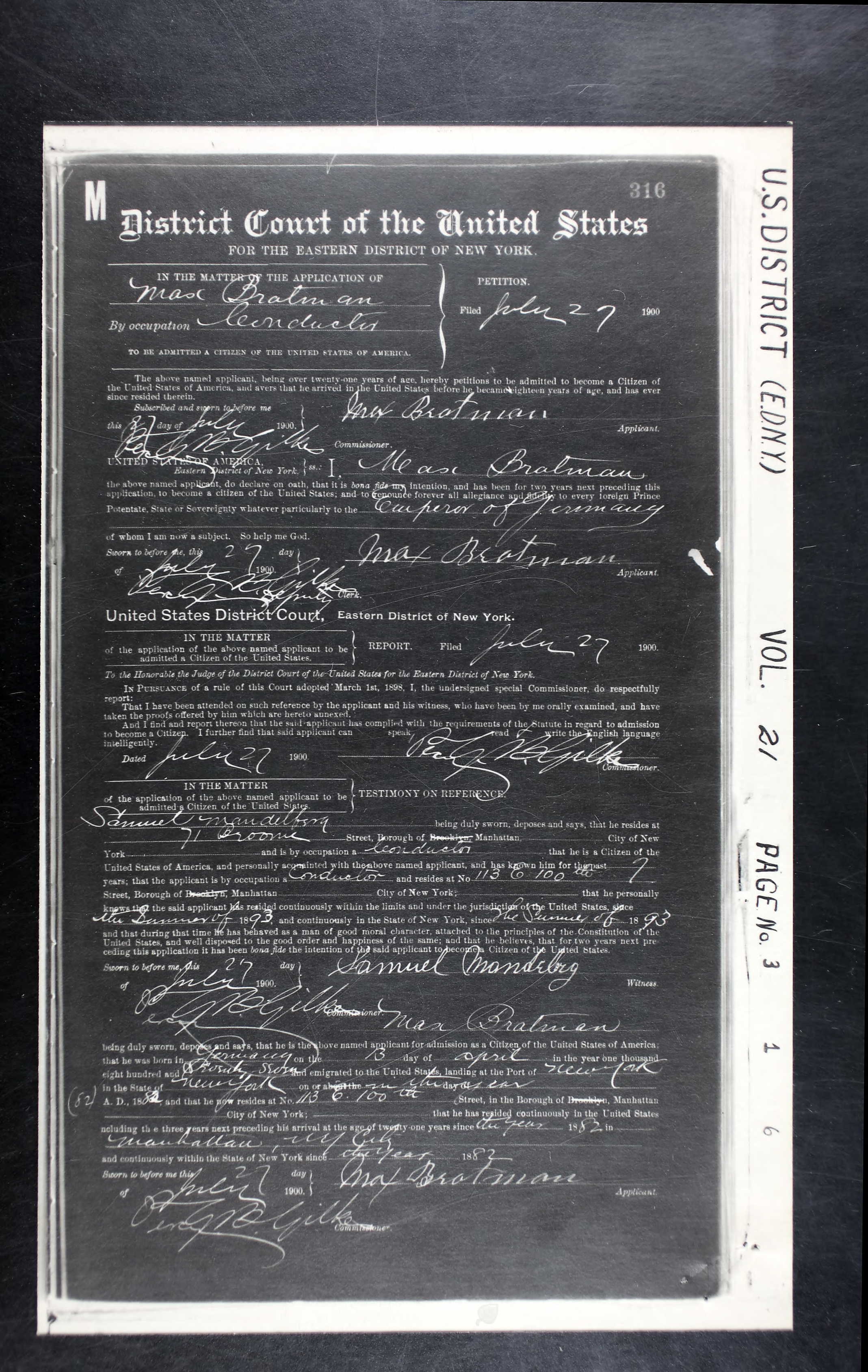
I began to search through the naturalization records again and could not find any reference to a Max Brotman who was a conductor.  I started thinking that I was losing my mind! Then I remembered that there had been a Max BrAtman and searched for him, and lo and behold, found the naturalization card again for the conductor.  I looked at the address on that form and sure enough, Max Bratman was living at 113 East 100th Street in Manhattan in 1900 when he filed this application.  Obviously this was the same person, our Max, but why did he spell his name wrong? Why did he say he was born in Germany and emigrated in 1882? The birth dates also did not exactly line up, but I am used to the fact that no one ever reported their birthday consistently.

When I looked at the handwritten application, I saw that the signature was definitely Max BrOtman, not BrAtman.

Max Brotman naturalization petition

Max Brotman naturalization petition

My guess is that the clerk who filled out the card just could not decipher the handwriting.  As for the wrong date, I have no guess except that Max was confused, wasn’t clear, or was trying to make it seem he’d been in the US for more than just 12 years.  As for why Germany? I wish I knew.  I know from Joseph Margoshes’ book that secularized, modern Jews were referred to as “German” in Galicia. Perhaps that’s why Max said Germany.  Perhaps the clerk thought he was German because of his name, accent and use of Yiddish and suggested it to him and Max just agreed? I have no clue.

The census form was filled out just a month earlier than the naturalization form.  The census says his place of birth was Austria as does every other document listing Max’s place of birth.  The census says he emigrated in 1888, which is also consistent with almost all the other forms.  It would have made little sense for Max to have emigrated in 1882 when he was only four years old.  So once again, we have evidence that forms are unreliable, that our ancestors were not too reliable, and that much must be left to conjecture and speculation.

So where does that leave us in terms of identifying where our family lived in Galicia? Hanging on the thin thread of Hyman’s own unreliable documents, our best guess is Dzikow near Tarnobrzeg.  I contacted Stanley Diamond who manages the archives of documents for JRI-Poland, and he sent me a list of all the records of all Brotmans and Brots from that area.  They are almost all of people born after 1900, and Stanley said that the records for that area are rather limited.  He said it would probably take a trip to archives in a few cities in Poland to learn if there is anything else and that that is probably a long shot.

And thus, my cousins and friends, I think that for now I have hit a wall. I am still waiting for Tillie’s death certificate and Hyman’s marriage certificate, but I am not putting any hope into finding out more information about their place of birth from those documents. I am in touch with a researcher in Poland, and I am hoping to travel there perhaps in 2015, but for now I guess we have to accept that the best we can do is hang our hopes on Hyman’s references to Jeekief and Giga and assume that Dzikow near Tarnobrzeg is our ancestral home.

Tillie’s Story

Image

Although I have no memory of meeting Aunt Tillie, I heard her name all the time when I was growing up. (I don’t know which spelling she preferred; sometimes it is Tilly, sometimes Tillie.  I have used both spellings throughout the blog.)  She was very close to my grandmother Gussie, and my mother and her sister and brother adored her.    She was described to me as a lot of fun: vivacious, outgoing, funny and loving.  It seems she was the one who provided a lot of the happy experiences for my mother and her siblings growing up.

Like my grandmother, she had a tough life.  She was born in 1884 and came to the US with Bessie and Chaim when she was 6 or 7 (census reports are in conflict; some say 1890, some say 1891).  In 1900 when she was sixteen, she was living on Ridge Street with her parents, her brother Hyman, and her two little sisters, Gussie, who was five, and Frieda, was three.  When her father Joseph died a year later, my guess is that Tillie must have become a second parent to Gussie, Frieda and the infant Sam.

In 1905 when she was 22, Tillie married Aaron Ressler.  At the time she was still living on Ridge Street with her mother and siblings.  Aaron was 26 at the time and was also living in the Lower East Side.  By 1910, Tillie and Aaron had three sons, Leo, Joseph, and Harry, all under five.  They were living at 94 Broadway in Brooklyn, where they owned a grocery store at 100 Broadway.  In addition, Gussie had moved in with them, choosing to live with Tillie instead of moving in with Bessie after she had married Phillip Moskowitz.  (Bessie and Phillip were still living on the Lower East Side in 1910, so moving to Brooklyn must have been a big deal for twelve year old Gussie.) Gussie helped take care of the boys while Aaron and Tillie worked in the store.  Family lore has it that my grandfather spotted my grandmother while she was sitting in the window of Tillie and Aaron’s store.

Life must have seemed pretty good for the Ressler family in 1910.  By 1918, however, things had changed.  On Aaron’s draft registration form of that year, he reported that he was not employed and was suffering from locomotor ataxia, a condition that causes pain and loss of muscle control and movements.  The 1920 census did report that Aaron worked at a grocery store, although it also said he worked at home.  They no longer lived on Broadway, but on Ralph Avenue in Brooklyn.  Aaron died six years later in February, 1926, leaving behind Tillie and three sons aged 20, 19, and 17.

Tillie continued to run the grocery store for some time after Aaron died. I cannot find any record of Tillie and her two younger sons in the 1930 census, but in 1940 she was living on the Grand Concourse in the Bronx with Joe and Harry (Leo had married Mildred and moved to Connecticut by then).  According to the census, she had also lived at this same address in 1935, so at some point Tillie had left Brooklyn as a widow with two almost grown sons and moved all the way to the Bronx.  She never remarried and died at age 72 in 1956 after suffering from painful arthritis.  My mother remembers that she was treated with cortisone, perhaps excessively, and ended up dying in a public hospital on Welfare Island in NYC, where my grandmother would go to see her every week.

I don’t know why she moved to the Bronx, perhaps to make a fresh start.  My mother remembers that Aunt Tillie lived in an apartment on the then-glamorous Grand Concourse with her two adult sons, Joe and Harry.  I don’t know how she supported herself after Aaron died, but somehow she did.  My mother was born after Aaron died, and so she only knew Tillie as a widow, yet she remembers Tillie as a happy, upbeat person who would bring my mother baked goods (and once a large easel) that she carried on the subway from the Bronx to Brooklyn on her weekly trips. Tillie was the one who held the family together—the one who encouraged my aunt Elaine to go stay with Leo and Mildred in Connecticut to broaden her horizons, who took my mother to baseball games, who could occasionally get my shy grandmother to socialize. When my sister was born in 1955, Tillie brought treats not only for my mother, but also for the other new mothers who were sharing the same hospital room.   She was a woman who was born in Europe, but spoke English like an American, who brought up three sons, took care of her sisters and brothers, and was one of the most positive influences on my mother and her siblings. She was strong and positive despite all the hardships she had faced.  I wish I had had a chance to know her.

What’s next?

I am currently waiting for three more documents that I am hoping will provide some clues to where our family lived in Galicia: Hyman and Sophie’s marriage certificate, Tilly’s death certificate, and Max’s naturalization papers. It may be quite a while before I get these three documents since (1) the FHL is currently not processing requests because it is upgrading its system; (2) I just ordered Tilly’s death certificate from NYC, and that will take at least a few weeks, and (3) USCIS estimates a 90 day wait for naturalization records, and I only made that request four weeks ago.  Thus, I may not have any new information for quite a while. From my experience with marriage and death certificates, I am not too hopeful that I will get anything too helpful from the first two; I have no idea what the naturalization papers may provide, but they may be our best chance for finding another clue as to the hometown.  I remain determined to find the answer to the question of where our family lived.

I also may not soon have an answer for the other big question: are we related to the Brotmanville Brotmans, and if so, how? Without some way to learn more about Moses Brotman’s parents, I can’t make a connection between Moses and Joseph. Even though I was able to find two of Moses’ living descendants, neither can answer any questions about his parents, and the other living descendants have been unwilling to respond to my inquiries.  To be honest, I doubt they would have that information anyway.

To answer either of these questions will require access to documents from Galicia that date back before 1890, documents that are obviously not in English.  Although many Galician records exist and are indexed on various websites, I have not been able yet to find anything that relates to our ancestors or Moses’ Brotman’s ancestors.  I need more help, more training, more experience before I can do that effectively.  I will be consulting with some others with more experience to see how to get the education I need. I have just joined a Yahoo Group for people interested in genealogy research in the Tarnozbreg region of Poland, which is where Dzikow is located, the town I think may be the most likely place our family lived in Galicia. I just have to be patient and willing to work hard, and I believe I will find the answers to these questions.

That does not mean that there is nothing to do until then.  There is still a lot to do to make the blog a real resource for our family and for future generations.  I need your help for that.  Yes, more photos and documents would be great.  But I’ve been thinking that it would also be nice to add more personal information about some of the family members I never knew. I’ve added some personal touches to the descriptions of my grandparents, aunt and uncle, but I didn’t know Abraham, Max, Hyman, Tilly or any of their children.  I need help from the rest of you to add a personal dimension to their portraits. Right now I am working on a portrait of Tilly and her life, for example.  Even a brief description of a person’s career, interests, or personality will add some “flesh” to the facts and dates that are currently reported on the blog pages. Are any of you are interested in writing either a “guest post” or in providing a few words to add to the page about your parents or grandparents?  What would you like future generations of Brotmans to know about their ancestors?

A Brief Introduction to Genealogical Research

Some of you might be interested in how to do genealogical research yourselves, so I thought I’d provide a very brief introduction for those who might want to try.

I would start (and did start) with ancestry.com.   You can get a short free trial subscription (14 days) just to see if you are intrigued. (And no, I don’t get a kickback from ancestry if you subscribe!) Ancestry provides digital copies of many documents including all US census reports up through the 1940  census (the later census reports are not yet available), except for the 1890 census which was destroyed in a fire. (That is particularly frustrating and sad for people researching ancestors who arrived in the 1880s.  We will likely never know where Joseph, Abraham and Max first settled, although it appears that all three arrived sometime between 1888 and 1890. )

Ancestry also has many other records available in digital form: some naturalization papers, some draft registration forms, some yearbooks, phone books, directories, and ship manifests.  Many records, however, are not directly accessible through ancestry.  For example, NYC birth, death and marriage certificates are not viewable through ancestry; you may find a record that indicates some of the information found on such certificates, but not the entire certificate.  For that, you have to order a digital copy or a photocopy elsewhere.

I have found the Family History Library to be a great resource for this.  The FHL is run by the Mormon Church in Salt Lake City; apparently the Mormons are trying to collect the names of anyone who ever lived as part of a religious mission to save everyone’s souls.  Fortunately, you don’t have to be a Mormon or support their mission in order to be able to use their services.  I guess the Church sees helping others find their relatives to be part of that overall mission.

At any rate, to request documents from the FHL, you need to find the NYC certificate number[1] and then the FHL film number.  Sometimes ancestry.com will have the certificate numbers, but usually I go to another website, http://www.germangenealogygroup.com/records-search/, to locate the certificate number.  It provides an index of NYC birth, death, and marriage certificates, but only for those years for which NYC has made them accessible to the general public.  For example, death certificates only run up to 1948; birth certificates are even more limited in terms of availability.  (I assume this is for privacy reasons, just as with the census reports.)  If, however, the certificate you are seeking falls within the date range, you can find the certificate number and dates through the germangenealogy website.

Once I have that information, I then go to another website, http://stevemorse.org/vital/filmnotes.html, where I can enter the information into the appropriate boxes, and then obtain FHL film number.  That website also includes a link to the FHL Photoduplication Request form.  By filling out that form with the numbers I now have, I can make a request to FHL for the certificates I am seeking.  There is a limit of five per month, and it can take several weeks to receive them, but it is free.  Amazing, it is free!

For other documents, for example, more recent death certificates and other documents like Social Security applications or immigration papers, the process can be more complicated, involving notarized documents, some fees, and much longer waits.  But starting with ancestry.com and using the FHL process can give you a good start on finding out more about your ancestors.  I found most of the documents that I have used in my research and reported here through those two sources and have only turned to the less efficient means of obtaining information more recently.

Of course, there have been lots of other sources of information: all of you who gave me clues and information, my mentor Renee and other experienced genealogists who helped me dig up clues, and many other websites like http://www.jewishgen.org/ and Findagrave.com.  There are still lots of other sources I have yet to explore, but those will require more time and more training before I can use them very effectively.


[1] This website only indexes NYC documents and some Nassau/Suffolk County documents.  For other locations in New York State and other states, you need to check the appropriate website for vital records for that county or state.

Jewish Naming Patterns

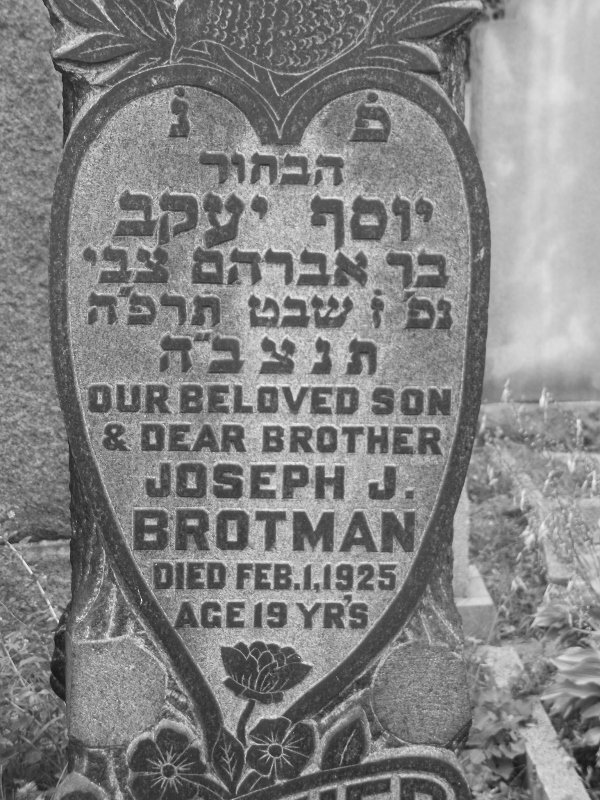
Most people know that in Jewish tradition, a child is often named after a relative who is no longer alive.[1]  It is also Jewish practice to identify a person in Hebrew with his or her father’s first name added to that person’s own first name.  For example, on his headstone Joseph’s name appears in Hebrew as Yosef Yakov ben Avraham, meaning that his father’s name was Abraham.  These naming patterns are a great help to genealogical research since often you can find names recurring through several generations, providing a means of establishing family relationships.

For example, we know that Bessie’s Hebrew name was Pessel and that her mother was named Gittel.  Bessie named her daughter Gussie for her own mother—in Hebrew, Gussie’s name was Hannah Gittel.  Then, in turn, I was named for Gussie’s mother, Bessie—in Hebrew, Pessel.  I then named my older daughter Rebecca Grace for my grandmother; her Hebrew name is Rivka Gittel.  So both Gittel and Pessel are names that recur through the generations and perhaps go back even further and perhaps will stretch further into the future.

Similarly, my brother Ira was named for our grandfather Isadore, whose Hebrew name was Ira.  Isadore’s father was Moritz/Moshe, and Isadore was named for Moshe’s father Ira.  Isadore in turn named his son Maurice for his father, and Maurice named his son James Ian and one of his daughters Robin Inez, the I being for Maurice’s father Isadore.  So the M’s and the I’s keep recurring in our family.  My younger daughter Madeline (Mazal Ahava) was named in part for my uncle Maurice (as well as for my husband’s uncle Murray), and there are several other M’s in the family among the fifth generation.

I am sure each of you can find similar recurring patterns in your own branches of the family.  There certainly are many B/P names and J names that run throughout our family tree.   Some of them undoubtedly are for Bessie/Pessel and Joseph or one of their descendants.

Why do I bring this up now? Well, after receiving Abraham’s death certificate and being bewildered by the fact that it records his parents’ names as Harry and Anna, I consulted with my mentor Renee.  She asked me several questions that reassured me that the death certificate is most likely incorrect.  First, she said look for naming patterns.  That reminded me that Abraham’s oldest son was named Joseph Jacob—Yosef Yakov on his headstone.Image  If Abraham’s father was named Harry, then why would he have named his son Joseph and not Harry? In fact, there are no Harrys or H names among Abraham’s children or grandchildren.

In addition, Renee pointed out that Abraham’s full name on his headstone is Avraham Zvi ben Yosef Yakov.  Zvi is a Hebrew name that means “deer” and in Yiddish was usually translated into Hersh or some Americanized version: Harry, Herbert, or (as in the case of my husband) Harvey.  Renee also pointed out that Abraham’s American name was Abraham H. Brotman.  She said it was extremely unlikely that his father’s name would have been Harry or Hersh/Zvi also (unless, of course, his father had died before Abraham was born, which does not seem likely).  By looking at the naming patterns, I am now convinced that it is unlikely that Abraham’s father’s name was Harry and that the death certificate is not correct and the headstone is.  Perhaps the Zvi/H in his name was for his maternal grandfather. Maybe that’s how it ended up on his death certificate.

So, cousins, do you know who you were named for? Do you know what your Hebrew name is? What your parents’ Hebrew names are? It would be really helpful and interesting to me and perhaps to others to know this information as it may open other doors for more research.  If you are willing to share that information, please let me know by using the comment box below so that we can all share this information.  Thank you!


[1][1] At least that has been the tradition among Ashkenazi East European Jews.  German Jews apparently did not always adhere to this tradition.  For example, my father’s name is the same as his father, John Nusbaum Cohen, and until he was an adult, he used “junior” after his name.  Moreoever, his sister’s name was the same as their mother—Eva.