
Update: The Strolowitz/Adler Family, My Grandfather’s Cousins

As I have written, in 1910, after my great-grandfather died the day before his daughter Betty arrived and before my great-grandmother and her son David arrived, Betty and her brother Isadore lived with their aunt Tillie Rosensweig Strolovitz and her seven children on East 109th Street in New York City.  Tillie had arrived with her husband Itic Yankel Srulovici and their three youngest children, Beckie, Pincus and Leah, in late December, 1907.  Their four oldest children had left Iasi, Romania, before them: Isidor in 1901, Bertha and Bella in 1906, and David in January, 1907.
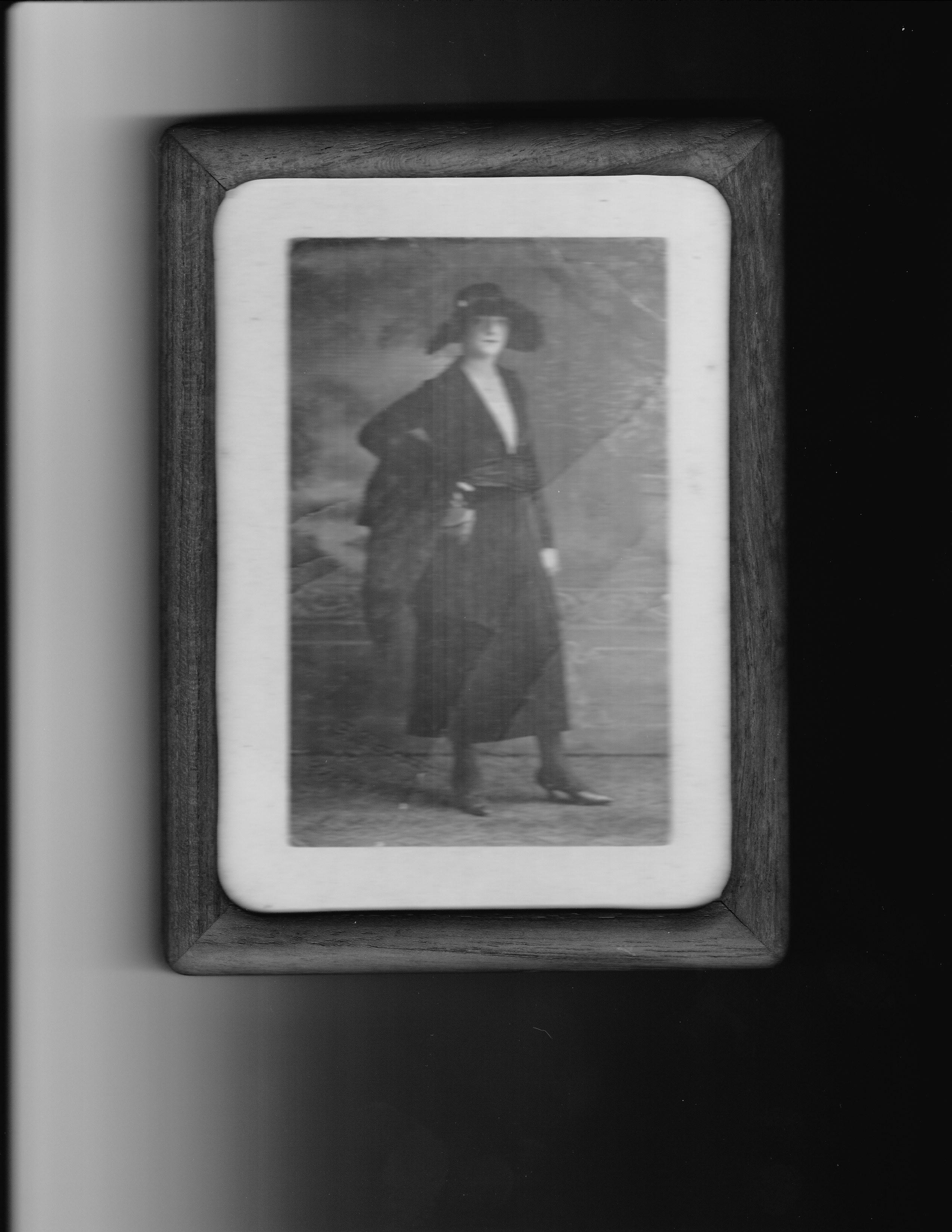
Leah Adler c. 1920

Leah Adler c. 1920

Although I have not yet found a ship manifest for Isidor, the oldest child, I do now have manifests for all the other members of the family, having just located David’s last night.  Among the many documents I received this week were David’s naturalization papers, which provided his date of arrival and the name of the ship.  Although his first name was partially torn off the paper, with a little trick of the trade I learned from Renee, I was able to obtain a copy of the ship manifest as well.  David is listed as “…vid Stubowicz” on the manifest, yet another variation on the family name.  He named his brother, Israel (presumably Isidor) Stubowicz, as the person paying for his ticket and meeting him in New York.   Interestingly, although David’s certificate of arrival has his name as Strubewicz, his petition for naturalization was made under the name David Adler.
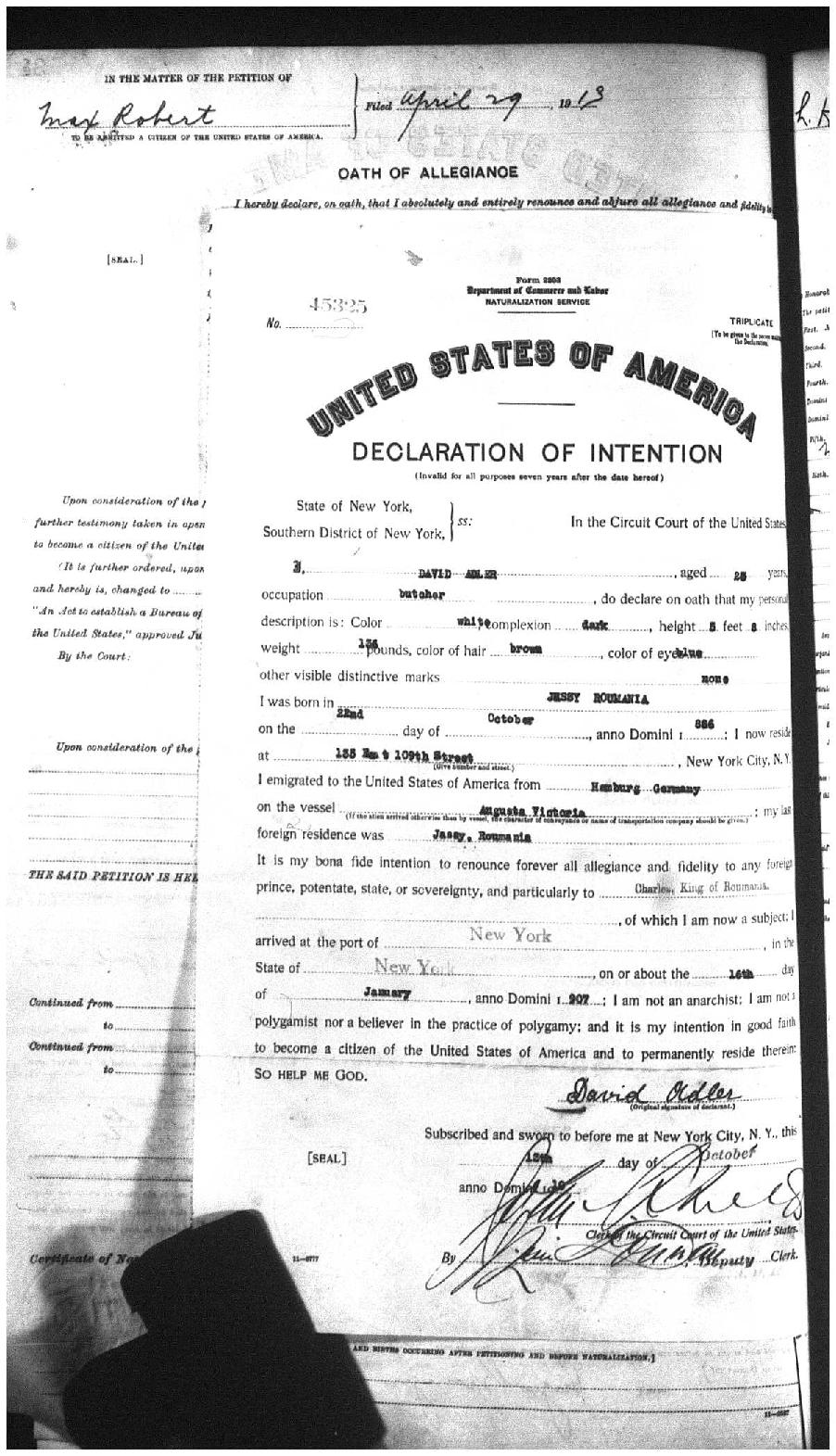
David Adler petition for naturalization

David Adler petition for naturalization

I had already found the manifests for Bertha and Bella and for Tillie, Jacob and the other children, and interestingly, every member of the family used some variation of Srulovici/Strubowicz/Strolovitz on the manifests, not Adler.  It appears that the Adler name was not used officially by the family until after they came to the United States.  Whether Isidor had already adopted it and then the others eventually followed I do not know.  In 1910, we know that only David and Isidor were using Adler, but as already discussed, eventually every member of the family was using it at least part of the time.
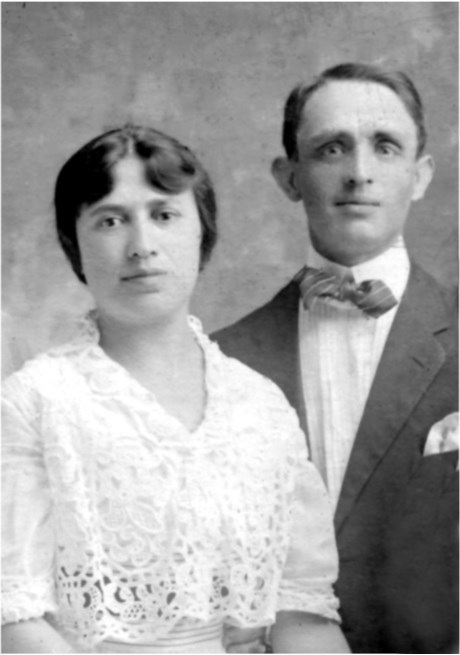
David Adler and his wife Bertha

David Adler and his wife Bertha

In addition to David’s naturalization papers, I received several other documents related to the Adler family.  (For simplicity sake, I will refer to them as the Adlers, except where the Strolowitz name is relevant for a particular reason.)  I had hoped to find something that would help me learn what had happened to Jacob. To recap what I already knew and did not know, I had not found any record of Itic Yankel after the ship manifest of 1907, and family lore said that he had never left Ellis Island.  The ship manifest, however, indicated that he was admitted, after being briefly detained for a doctor’s examination of his eyes.  There is no record of deportation.  I thought perhaps that he had died shortly thereafter, and I ordered the death certificate of the only Jacob Adler I could find who might fit in terms of age and year of death.  I now have that certificate, but unfortunately it was not for the correct Jacob Adler.  The certificate is for a Jacob Adler from Germany who had been in the US since 1880 at the time of his death in 1910.  So I still have no answers to the question of what happened to Jacob, Tillie’s husband.  I am awaiting his immigration papers from the National Archives and hope that they will provide some clues.

I had requested several other documents in order to confirm what I assumed was true: that Tillie was the sister of my great-grandmother Gisella Rosensweig and that Itic Yankel Srulovici and Jacob Adler were the same person and the father of all of the seven children.  Not surprisingly, they all do confirm one or both of those facts.  First, Tillie’s death certificate lists her parents as David and Esther Rosenzweig (no maiden name for Esther, unfortunately), my great-great grandparents, confirming that Tillie was my great-grandmother Gisella’s sister.  Her death certificate was witnessed by her son David, signing as Strulowitz, confirming that Yankel Srulovici was his father and not some other husband named Adler.  (Tillie is also a Strulowitz on the certificate.)
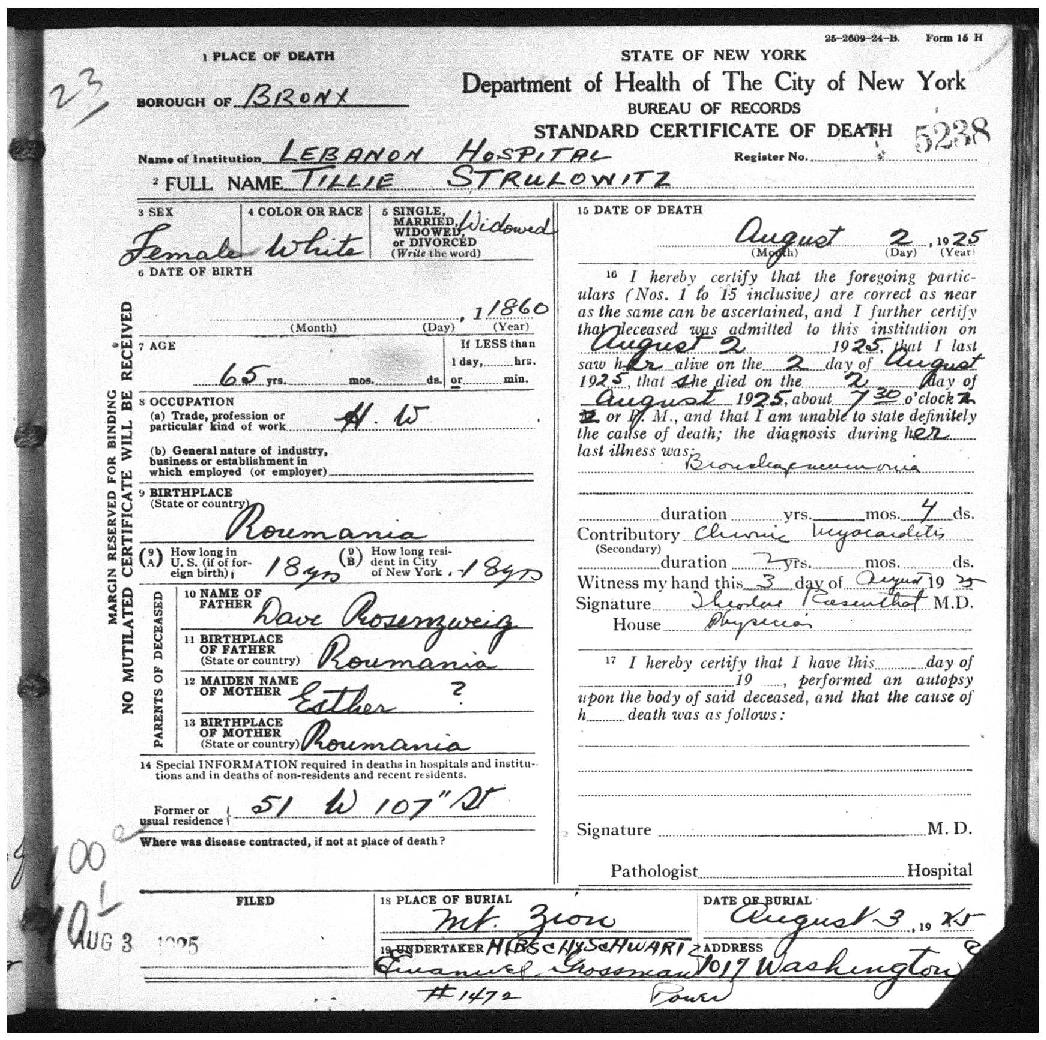
Tillie Strulowitz death certificate

Tillie Strulowitz death certificate

Second, Isidor’s death certificate confirms that he died young—in 1915 of liver cancer at age 31. Although he is identified as Isidor Adler, his parents’ names are given as Tillie Rosenzweig and Jacob Strulowitz. Bertha’s marriage certificate gives her parents’ names also that way, with Bertha also now using Strulowitz.  On the other hand, Leah’s marriage certificate uses Adler and lists her father’s name as simply Jacob (and her mother as Tillie Rosensweig). Finally, David’s death certificate gives his father’s name as Jacob Adler (and David’s name as David Adler), and his mother’s as Tillie Rosensweig.  Certainly this is enough documentation to prove that Jacob Adler and Yankel Srulovici were the same person and the father of the seven children.

Isidor Adler death certificate

Isidor Adler death certificate

Thus, many open questions were answered by these latest documents, but there remains still the question of what happened to Jacob Srulovici/Strolovitz/Strulowitz/Adler after he arrived at Ellis Island.

In addition, the marriage certificate of Bertha contains the signature of a Gustav Rosenzweig as a witness to the marriage.  Could this be Tillie and Gisella’s brother? Or a nephew? Cousin? And thus begins yet another search for a possible member of the extended Goldschlager-Rosensweig family.
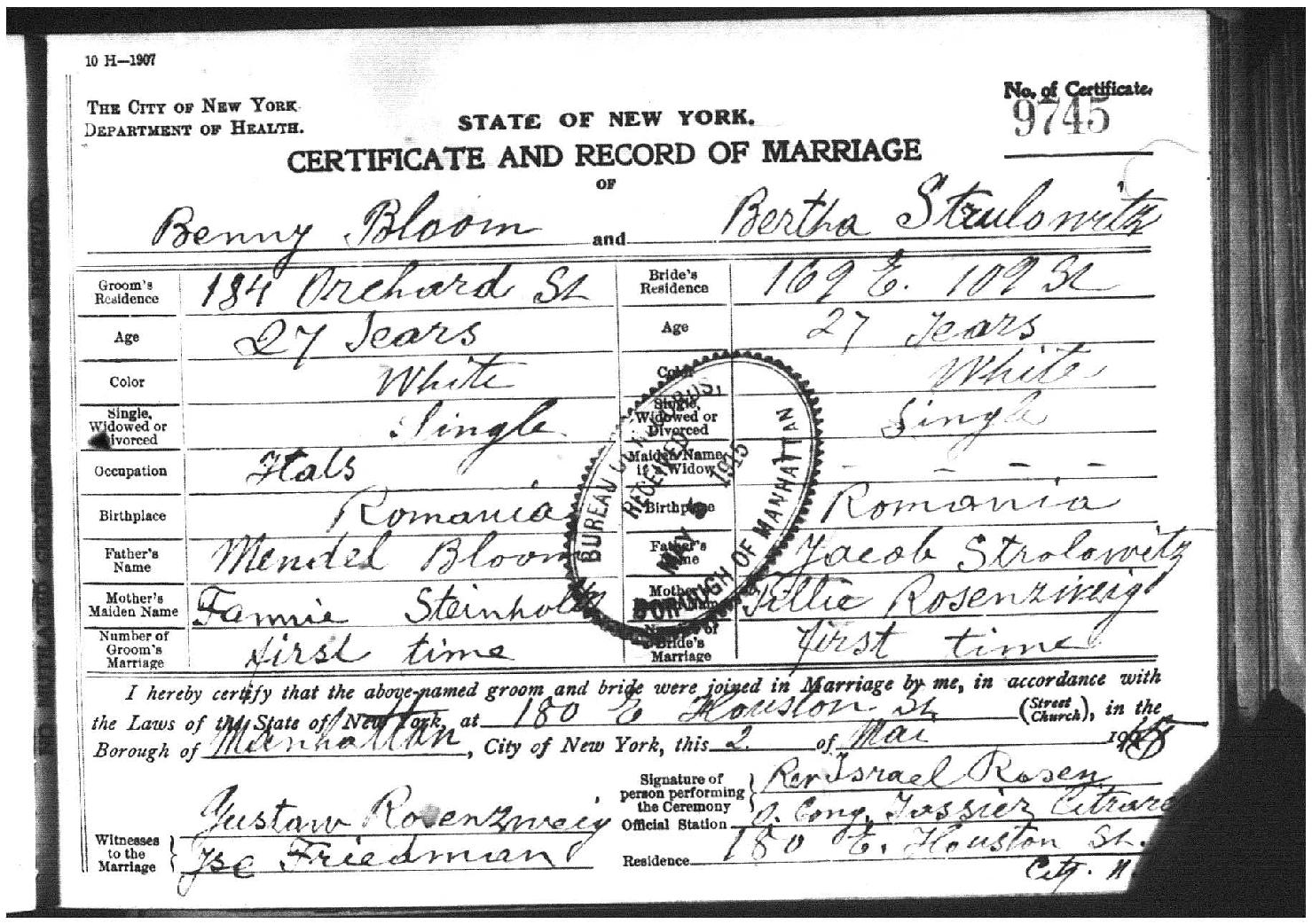
Bertha Strulowitz marriage certificate witnessed by Gustav Rosensweig

Bertha Strulowitz marriage certificate witnessed by Gustav Rosensweig
Enhanced by Zemanta

Isadore and David Goldschlager: More than Brothers?

Yesterday I decided to try and fill some of the gaps in David Goldschlager’s history.  I had his birth record from Iasi, saying he was born November 4, 1889, a year after my grandfather, and the ship manifest from the Patricia saying that he had arrived on October 27, 1904.  But then there was a big gap.  He did not appear on the 1905 New York State census, although I had found Isadore, living alone in Manhattan.  Nor did David appear on the 1910 census, although both Isadore and Betty were living with their aunt Tillie Strolovitz and her seven children.  But where was David? It made no sense to me that he was not living with his family in either 1905 or 1910.  He first shows up on an official census in 1915, when he was living with his mother Gittel/Gisella and his siblings Isadore and Betty.

Also, I was curious as to how and why he ended up living in Pennsylvania when Murray was born in 1922.  I had not yet found a marriage record for David and Rebecca, although I knew they were married by 1917 because David so reported on his draft registration card filed that year.  Also, the 1920 census had them living in Manhattan.  I also knew that David had been working as a hat maker since at least 1915 because that was his occupation listed on the 1915 New York census, as it was also on his draft registration and the 1920 census and each one thereafter.  So what took him to Scranton?

I thought perhaps that Rebecca was from Scranton, so I started searching for her records.  I did not know her maiden name, and I could not find any record of their marriage in the NYC marriage index.  I was stumped.  But then I found her naturalization papers, and they were a goldmine of information.  From these papers I learned that Rebecca’s maiden name was Schwar(t)z, that she was born in Berlad, Romania, on April 29, 1889, that she had arrived in March, 1903 on the SS Astoria via Glasgow, and that she had married David Goldschlager on February 20, 1916, in Newark, New Jersey.  I also confirmed that their son Murray was born in Scranton, PA, and that Sidney was born in Newark, New Jersey.

Rebecca Goldschlager's naturalization papers

Rebecca Goldschlager’s naturalization papers

From there, I was able to find Rebecca’s family on the SS Astoria ship manifest and find the names of her mother and many siblings and the name of her father Solomon Schwartz, who was meeting them and resided in Newark, New Jersey.  When I followed up with census reports for the Schwartz family in Newark, I learned that Solomon was, like David, also a hat maker.  Perhaps David had met Solomon in the circles of the hatmaking trade, and Solomon had then introduced David to his daughter Rebecca? It now made sense why David had gotten married and at one point lived in Newark, but why Scranton? I am still trying to figure that out.

Rebecca’s family’s story is itself worth telling, and I will in my next post.  But for me personally, the bigger story comes back to David and Isadore.  While reviewing Rebecca’s naturalization papers, I noticed that it said that David had himself arrived in New York on November 4, 1910, not October 27, 1904, as reported on the ship manifest for the SS Patricia.  I thought either that it was a clerical mistake or a memory mistake and dismissed it.  But then I looked back at a few of the census reports for David and Rebecca and noticed that on those reports as well, his arrival date was reported as 1910, not 1904.  I had also earlier dismissed that as an error.  But now I was starting to wonder—how likely was it that the same 1910 date was reported so many times and yet wrong?

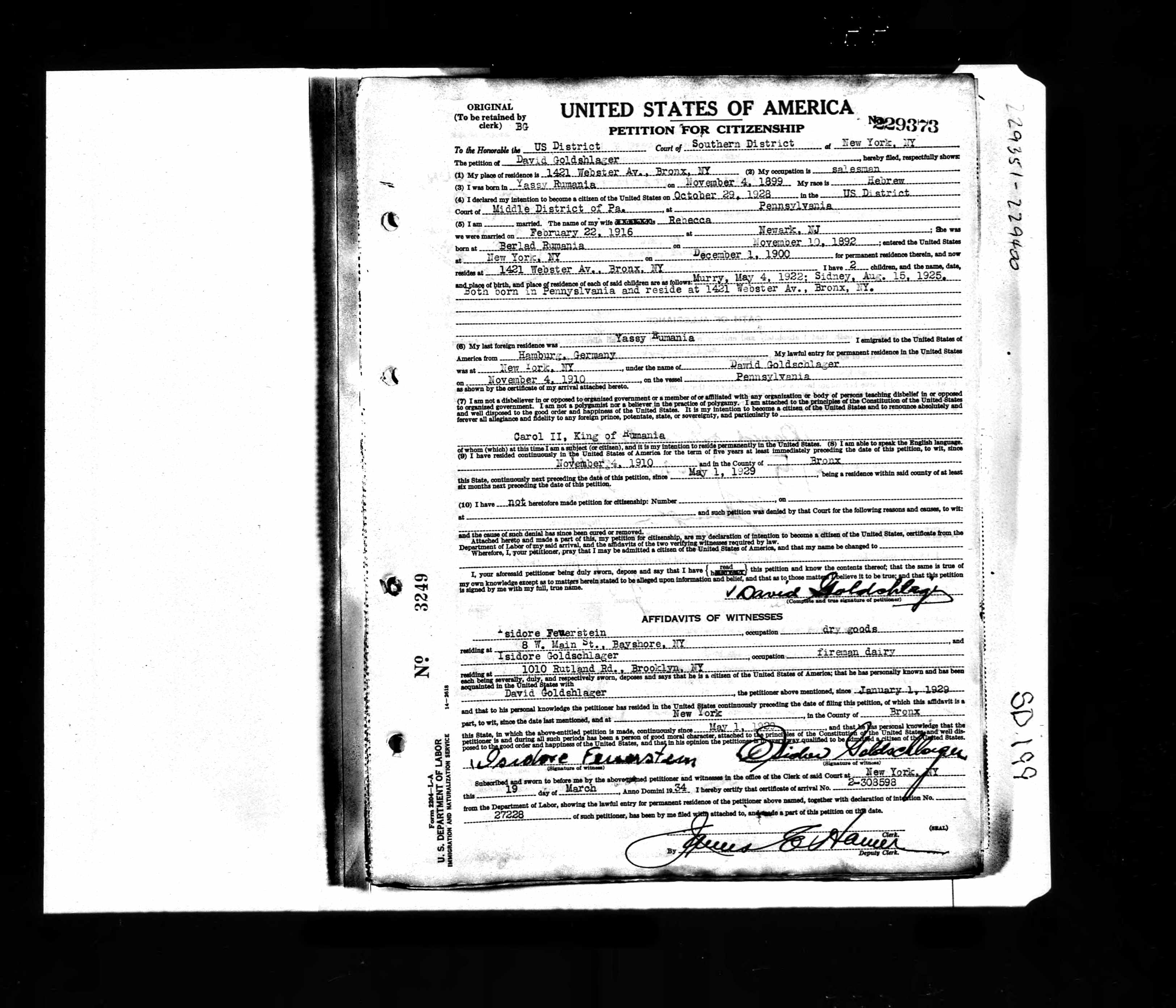
I went back to look at the naturalization papers I had for David and saw that those also reported his arrival date as November 4, 1910.  Now I was really puzzled.  When I first found David’s naturalization papers, I had not focused on this, nor did I realize then that there is a second page to the naturalization papers.  I turned to the next page and found this:

David Goldschlager Naturalization Record

David Goldschlager Naturalization Record

First thing I noticed was that my grandfather Isadore had signed David’s application with his very distinctive and florid signature; the second witness was Isidor Feuerstein, Betty Goldschlager’s husband.  Then I looked more closely at the information provided on the form.  It clearly said that David had arrived on the SS Pennsylvania from Hamburg on November 4, 1910.  Now I was convinced that the 1904 date must be wrong.

I searched for the manifest for the SS Pennsylvania arriving in NYC on that date, and sure enough I found David’s name, indicating that he was being met in New York City by his father Moritz Goldschlager.  Only then did my slow brain react and realize that this was the very same ship that Gittel/Gisella, David’s mother, sailed on when she arrived in New York.  I went back to double-check, and sure enough, it was the same exact ship.  I don’t know why Gittel and David were not listed together on the manifest.  If they had been, I would have noticed this long ago.  But clearly it makes sense that David and his mother came together, both arriving in New York, expecting to be met by Moritz, only to be met instead by Isadore, who had to tell them that Moritz had died in April, seven months before.

So then why was there a 1904 ship manifest for a sixteen year old named David Goldschlager from Jassy, Romania?  Well, I see three possibilities.  One, there were two David Goldschlagers about the same age in Jassy.  That certainly is a possibility, although I have not found another David Goldschlager from Romania (there is one from Austria) on any of the census reports in New York.  Two, David went back to Romania and then returned again with his mother in 1910.  That is also possible, but would he have left so soon after arriving that he was gone by the time of the 1905 census?

Three, and the possibility that makes perhaps the most sense and that brought tears to my eyes, the David Goldschlager who arrived in 1904 was really my grandfather, Isadore Goldschlager.  Isadore was 16 on October 27, 1904 (David was actually only fifteen).  Isadore did arrive in 1904 according to several census reports.  And Isadore was trying to avoid the draft, so very well might have had to use an assumed name to get out of Romania.  And I have not been able to locate any other ship manifest that has Isadore’s name on it.  He may have walked out of Romania, but he certainly did not walk across the Atlantic Ocean.

After much searching, I have just an hour ago located the index number for Isadore’s naturalization papers from 1917.  I have added them to the list of documents I am ordering, and it is the document I am most anxious to see.  Perhaps it will reveal when Isadore arrived and on what ship.  Maybe it will reveal that Isadore did, in fact, arrive under his brother’s name.

If so, I have to rewrite some of the Goldschlager family history.  It would mean that Isadore was here alone for five years before his father arrived in 1909.  It would mean that he was here alone to deal with his father’s death in April, 1910, and to comfort his sister Betty, who arrived the following day.  It would mean that he alone had to tell his mother and his brother that their husband and father had died when they arrived at Ellis Island in November, 1910, seven months after Moritz had died.  It’s far too much pain and suffering for me to imagine one very young man enduring.

UPDATE:  See my post updating the research on this page.

Isadore age 27

Isadore age 27

Enhanced by Zemanta

My Grandfather and Alma Gluck

In a recent conversation with my mother about her father, my grandfather Isadore Goldschlager, she said that one of the things that my grandfather remembered fondly about Iasi was the music.  From the photograph of the house where he was born, you can see a cathedral towering in the background.  My mother wondered whether that was where her father heard the music he loved.

One of the other stories my mother recalled was that my grandfather used to say that he babysat for Alma Gluck.  I knew nothing in detail about Alma Gluck, except that she was a famous opera singer and recording star, so I decided to do some research and see if I could figure out a link between my grandfather and Alma Gluck.

Alma Gluck

Cover of Alma Gluck

In reading a number of biographies online, I first learned that Alma Gluck was born Reba Fiersohn, daughter of Leon and Zara Fiersohn in 1884 in Romania; some sources say she was born in Bucharest, but others say she was born in Iasi.  Perhaps her family and the Goldschlager family were friends or at least acquaintances.   Since my grandfather was born in 1888 in Iasi, he obviously did not literally babysit for Alma Gluck herself since she was four years older; he must have babysat for her child.

Reba Fiersohn arrived in the United States in 1890, brought to the United States by her older sister Cecile, according to a biography from the Jewish Women’s Archive.  They lived in the Lower East Side, where Reba went to school and then worked as an office clerk.  On May 25, 1902, she married Bernard Glick, with whom she had a daughter, Abigail Marcia, who was born on June 9, 1903.  In 1906, Reba was discovered by an associate of her husband and began training to become an opera singer.  She debuted with the Metropolitan Opera in 1909 and became a very successful concert performer and recording star under the name Alma Gluck.  She traveled throughout the United States and was considered the most successful recording star of the time.

Here is one of her best known recordings, Carry Me Back to Old Virginny.  You can find several others online.

She divorced Bernard Glick in 1912 and subsequently in 1914 married Efrem Zimbalist, the violinist, with whom she traveled, performed and recorded.  She and Zimbalist had two children, Maria, born in 1915, and Efrem, Jr., the actor, director and writer.  Although she continued to tour and record for a few more years, her voice had become strained, and she retired in 1924.  Alma Gluck died in 1938 from cirrhosis of the liver.

English: Russian-born American composer, condu...

English: Russian-born American composer, conductor and violinist Efrem Zimbalist (1890-1985) with his wife American opera singer Alma Gluck (1884-1938) (Photo credit: Wikipedia)

So where in this story might my grandfather fit? My best guess is that he babysat for Abigail, Alma Gluck’s child with her first husband Bernard.  As noted above, Abigail was born in 1903; my grandfather arrived some time in 1903 or early 1904.  In 1905 he was living alone at 2213 Second Avenue in New York, working as a grocery store clerk.  He was seventeen years old at the time.  That same year, according to the 1905 New York State census, Bernard and Reba Glick were living with their two year old daughter Abigail at 2 St. Nicholas Terrace in New York.  Bernard was an insurance agent, and Reba, the future star, was doing housework.  Could Isadore have been babysitting for little Abigail? St. Nicholas Terrace is crosstown from where my grandfather was living, about a half hour walk according to Google Maps.  It does not seem likely that the Glicks knew Isadore from the neighborhood, unless the store where he was working was located in their neighborhood north of Morningside Park.  Unfortunately, that’s a fact I will not be able to determine.

In 1909, Isadore was living at 440 East (?) 147th Street, according to the ship manifest for his father Moritz.  Google Maps could not find such an address in Manhattan, only in the Bronx, so perhaps it was 440 West 147th Street, about a mile north of where the Glicks had been living in 1905 and on the same side of Manhattan.  In 1910, Isadore was living with his aunt Tillie Strolovitz and her children on East 109th Street, back on the East Side.  The Glick family was living at 325 West 93rd Street, two and half miles away crosstown from where Isadore was living.  Again, unless there was some other connection—from back in Iasi or some Romanian community connection, it is not obvious how Isadore would have ended up babysitting for Abigail.

By 1912, Reba Fiersohn Glick had become the famous Alma Gluck, divorced from Bernard and traveling around the country.  One source reported that she fought Bernard for custody of Abigail and prevailed after a bitter court battle.  I cannot find where Abigail or either of her parents were living in 1915, but since by that time her mother was famous, wealthy and remarried, Abigail herself was twelve, and Isadore was 27 and working full time as a milkman, I doubt very much that he was babysitting for Abigail in 1915 or thereafter.

So is there any truth to the story that my grandfather babysat for Alma Gluck?  I, of course, am inclined to believe my grandpa—who wouldn’t? And it is entirely possible that he had a connection through ties in Iasi to the family of Reba Fiersohn.  He was a new immigrant when Abigail was just a toddler and himself alone and just a teenager.  Perhaps there was some outreach from former residents of his home city who arranged for him to earn some money as a babysitter for the future Alma Gluck, even if he was living crosstown.  We will never know with any certainty, but I believe that my grandfather babysat for little Abigail.

If he did, I wonder whether he knew how famous Abigail herself became.  Abigail Glick grew up to become a well-known writer under the name Marcia Davenport.  Among other works, she wrote the novel East Side, West Side, which became the basis of the well-known movie by the same name.  She was on the staff of The New Yorker for several years and wrote a very well-regarded biography of Mozart.  She also wrote an autobiography entitled Too Strong for Fantasy.  I have just ordered a copy—maybe she will talk about the young teenage boy who babysat for her when she was a young child? Unlikely, given all the other much more glamorous and interesting things that happened to her in her life, but I will be reading it with an eye open for any such reference.

We may never know a lot of things with absolute certainty.  Sometimes we just have to accept the versions of the truth we have learned.

Enhanced by Zemanta

Playing detective: Searching for Gold(schlagers)

My first genealogical search efforts about a year and half ago related to my grandfather’s family, the Goldschlagers.  I started there because I figured (somewhat incorrectly) that Goldschlager was an uncommon name and thus would be an easier family to research, unlike Cohen, Brotman, Schoenthal, Seligman—my other family lines.  I also was very curious about my grandfather’s life because I had always heard about how he had walked out of Romania.  It also helped that we knew where he had lived in Romania, the city of Iasi (sometimes spelled Jassy, sometimes Yassy) and that we knew the names of his parents and siblings.

I started by focusing on finding other descendants of the Goldschlager clan.  We knew that Isadore had a brother David and a sister Betty.  My brother had already found some of the relevant records from Ellis Island.  We also knew that David had had two sons, Murray and Sidney, and that Betty had had two daughters, Frieda and Estelle. I figured that I would start with Murray and Sidney since I assumed (again incorrectly) that since they were men, their names would be Goldschlager and they would be easy to find.

I was not very experienced in my research techniques back then and did not get very far.  Since the US Census records are only available up through the 1940 census, I could not get too far using ancestry.com at that point.  I was lucky, however, to find Sidney Goldschlager’s obituary by googling his name.  From that obituary, I learned that his brother Murray had changed his last name to Leonard and was living with his wife Edna in Tucson, Arizona.  (Murray and Edna were listed as survivors of Sidney along with his wife Nora; there were no others mentioned, so I assumed (this time correctly) that Sidney and Nora had not had children.)

Once I knew that Murray was using the name Murray Leonard, I searched for him online by googling his name and Tucson and found a news article about the closing of a chain of women’s clothing stores called Vicky Wayne in the Tuscon area owned by Murray and Edna Leonard.  After that, however, I hit a wall.  Although I could find a telephone listing for Murray Leonard, I was not comfortable making a telephone call blindly. At that point I gave up and turned to searching for Frieda and Estelle, but because I had no idea what their married names were, that ended up as a dead end also.  That was, as I said, about a year and half ago.  I figured I had done all I could do to find the Goldschlagers.

Then this past summer I got an email from a man who was also searching for Goldschlagers.  He had seen my family tree on ancestry.com and was interested in sharing information.  Although we were not able to find any connection between our trees, he did inspire me to start looking again.  He gave me the name of a researcher he had found in Iasi, Romania, and I contacted him to look for records for my Goldschlager ancestors.  As I wrote in my prior post about the Goldschlagers, he was able to obtain several records about my grandfather, about my great-grandparents, and about David, my great-uncle.

Those findings were what really lit a fire for me and inspired me to start my research again.  Although I did not get any further with finding Goldschlagers, it was at that point that I turned to the Brotman line and became fully immersed in learning how to do genealogical research.

With the benefit of this new knowledge and the tools I now knew how to use, I returned to researching my Goldschlager relatives.  This time I knew to dig deeper in order to find other descendants. First, I was able to find some records for Betty and her daughters.  I found a census report for Betty Feuerstein living with her husband Isadore, her mother (listed as Gussie Gold), and her two daughters in Bayshore, Long Island.

Betty Feuerstein and family 1940 census

Betty Feuerstein and family 1940 census

By researching the Feuerstein family, I was able to link with a descendant of that family, who sent me pictures of Frieda and of Betty.  He also knew their married names; Frieda married Abe Adler, and Estelle married I. Kenner, known as Kenny. I found a listing for an Estelle Kenner in Florida, but that’s as far as I have gotten.  My contact did not know whether they had had children or where Frieda had lived.

Last week I returned to the search for David’s descendants. I re-read the article about the Vicky Wayne stores and saw that the stores had been named for a niece of Murray and Edna Leonard.  I googled Vicky Wayne and found many references to a mail order clothing store and then ultimately a reference to the name in an obituary for a woman named Anne Steinberg.  I read the obituary and saw that Anna was survived by two sisters, Faye and Edna.  I thought that perhaps Edna Leonard was Anne’s sister, and so I searched for a record on ancestry that would have listed three sisters on a census named Anne, Edna and Faye.  I found one, the daughters of Ben and Sarah Kaufman living in NYC.

Kaufman family 1930 census

Kaufman family 1930 census

From there I looked at the names of Anne’s children in the obituary and googled them and searched for them on Facebook.  Once I found a few of them on Facebook, I looked to see if they had any friends with the last name Leonard, figuring that Murray and Edna’s children would be cousins of Anna’s children and grandchildren.  Sure enough, Anne’s daughter had a “friend” named Richard Leonard from Tucson, now living in Australia.  I contacted Richard through Facebook and LinkedIn, and within an hour I’d heard back from him, confirming that he is Murray and Edna’s son, David Goldschlager’s grandson, and my second cousin. I had indeed found another Goldschlager descendant.

Richard and I spoke at length by Skype (despite a 13 hour time difference) the other night, and he filled me in on his parents and his grandparents.  His father, though born in Scranton, PA, had grown up in the Bronx and is a loyal Yankee fan (sigh…), as is Richard.  His parents had moved to Tucson in 1958  shortly after marrying in NYC.  Edna’s sister Anna had moved there, and they all worked in the business together, eventually dividing it into two parts, the mail order business and the retail stores.  Sometime in the early 1970s, Murray moved his parents, David and Rebecca Goldschlager, to Tucson as well, where they lived nearby and where Richard was able to see them often.

Richard said that his grandfather did not talk to him about his life in Romania or his family, but was more focused on the present and enjoyed spending time with Richard as he was growing up.  I’ve asked Richard to see if his father, now 92, knows any more about David’s life and family, and he said that he will do so and let me know what he learns.  I also asked Richard if he knew anything about our great-aunt Betty or her daughters Frieda and Estelle, but unfortunately he did not.

Once again, I am amazed by how much you can find in public sources if you are persistent and thorough enough.  I will continue to look for Frieda and Estelle and their descendants, if any.  Now I am expanding the search, looking for other possible relatives of the Goldschlager family.  I believe I have found my great-grandmother’s sister and her family, but that’s a post for another day.

Enhanced by Zemanta

The Goldschlagers

Having reached (for now) a dead end on my research of the Brotman family, I have decided to turn to, or rather return to, my research of my grandfather’s family, my Goldschlager relatives.  I had previously done a fair amount of research on the Goldschlager line, but had put it aside when I found my Brotman cousins. For some of you, the Goldschlager story will be perhaps of less interest, although it is itself a wonderful story of American Jewish immigration.  For others, in particular my first cousins and siblings and my mother, the Goldschlager story will be of great interest.  And for those who are interested in genealogy generally and/or the history of Jews in Europe and America, this story should also be a great interest.

So although this blog is called the Brotmanblog (and will continue to be so titled), I have created a new page for my Goldschlager ancestors and relatives.  If you are interested, please check it out.  I also will be writing some posts to describe the research I’ve done to uncover the story of my grandfather, his siblings and his parents and grandparents.

In this first Goldschlager post, I want to tell the story of my grandfather Isadore.  Isadore was born in Iasi (or Jassy), Romania.  He was the oldest child of Moritz (Moses, Moshe, or Morris)and Gitla (Gittel or Gussie) Goldschlager.  He was born in August, 1888; his younger brother David was born the following year, and their younger sister Betty was born in 1896.  Isadore was named for his grandfather, Ira Goldschlager.  I was very fortunate to find a researcher in Iasi who located and translated several documents relating to these relatives, including birth records and marriage records for Moritz and Gitla, my great-grandparents.

Moritz and Gittel's marriage certificate

Moritz and Gittel’s marriage certificate

He even took a photograph of the house were my grandfather and his parents and siblings lived in Iasi.

The Goldschlager House in Iasi

The Goldschlager House in Iasi

When my grandfather was 16 years old, he left Iasi and walked through Romania to escape the tzar’s army and persecution.  Romania was one of the most anti-Semitic and oppressive countries in Europe at the time, and many Jewish residents decided to escape in the early years of the 20th century. In a subsequent post, I will write more about the conditions in Romania and the history of the Fusgeyers—the “foot goers” who left Romania on foot.  My mother said that she does not remember her father talking about Romania very much, except to talk about the horses and the music, two things that he loved very much.

My teenaged grandfather arrived in New York City in 1904 without any relatives and under his brother’s name.  In 1905 he had a job as a storekeeper in a grocery store and lived in what is now East Harlem at 113th Street, apparently alone or perhaps in a boarding house.  His father Moritz arrived in 1909, and his mother Gittel, brother David, and sister Betty in 1910.  Sadly, it appears that Gittel, David and Betty arrived shortly after Moritz had died.

By 1915, Isadore and his mother and siblings were living together in East Harlem.  David was working at a hat maker, Betty as a dressmaker.  Isadore’s occupation unfortunately is not legible on the 1915 census form.  Edit:  On closer examination, I believe it says “Driver Milk,” which is consistent with what he was doing for the rest of his working life.

1905 NY census

1905 NY census

1915 NY Census for the Goldschlagers

1915 NY Census for the Goldschlagers

By 1917, when Isadore registered for the draft, he was working as a driver for a dairy company and married to my grandmother Gussie and living in Brooklyn.

Isadore's World War I draft registration

Isadore’s World War I draft registration

He continued working for dairy companies and eventually became a foreman.  He and my grandmother had three children. As a milkman, my grandfather worked at night to deliver the milk by morning.  When he delivered milk to people in the poor communities, they all loved him so much that they would bring him food.

My grandparents moved to Parkchester in the 1940s with my mother, who was only twelve at the time.  When I was born ten years later, my parents also lived in Parkchester, just a few buildings away from my grandparents, so I spent my first four and half years living right near my grandparents.

My grandparents and me 1956

My grandparents and me 1956

Although my grandfather died before I was five years old and thus my memories of him are vague, I do have a memory of him as a loving grandfather.  Perhaps it is the stories I’ve heard all my life about him rather than my own memories—it’s hard to know.  I know that my mother and her siblings loved him a great deal, that he was a big tease with a great sense of humor, and that although he left Romania at fifteen and never received a high school education, he spoke several languages and was a very smart and witty man.  He must have been an incredibly strong person to have left his family at such a young age; most likely he helped the rest of his family come to the United States once he got here.

I wish I had known him longer, and I wish I knew more about his life both in Romania and in New York.  Perhaps as I pursue this line of research I will learn more.  I have just located one of David’s grandsons, Richard, and David’s son Murray is 92 and living in Arizona.  I am hoping that Murray may know more about David’s life in Romania and the relationship between the two brothers, David and Isadore.

Enhanced by Zemanta