Another new relative: Gustave Rosenzweig

As I wrote yesterday, I was excited in reading the case file of Jankel Srulovici to see that the principal witness who came forward to vouch for him at the hearing to determine his admission into the US was a brother-in-law named Gustave Rosenzweig.  Gustave is the fourth child of my great-grandparents David Rosenzweig and Esther Gelberman whom I have been able to locate.   He was my great-grandmother Ghitla’s older brother and also Tillie and Zusi’s brother.  I had already noted his name on Bertha Strolowitz’s marriage certificate in 1915, but now I have some verification that he was in fact a member of the same family.  Not simply because he testified for Jankel and helped post the bond for his admission, but because he described Jankel and Tillie in his testimony as his brother-in-law and sister.

I have now done research to learn more about this man, my great-great uncle, who had $6000 in assets in 1908 and a painting supply business in Brooklyn and who had already impressed me with his character for helping out his family.  From various records, I have learned that Gustave was born in Romania in September, 1861.  He married his first wife, Gussie, in 1882, according to the 1900 census.

Gustave Rosenzweig and family 1900 census

Gustave Rosenzweig and family 1900 census

It is not at all clear exactly when Gustave and Gussie arrived in NYC, and I have not yet found a ship manifest for either of them.  On his naturalization papers in January of 1892, Gustave wrote that he had arrived on April 12, 1887.

naturalization petition gustave rosenzweig

naturalization petition gustave rosenzweig

Some of the census reports indicate that Gussie and Gustave emigrated in 1881, others say 1888. According to the 1900 census, their first child Lilly was born in Romania in 1884, and if Lilly was born in Romania, the later date seems to be more accurate.  On the other hand, the 1905 and 1910 census reports say that Lilly was born in the United States, and, according to the 1905 census, that Gussie and Gustave had been in the US for 22 years, i.e., since 1883.  At any rate, Gustave and Gussie were certainly in the United States by 1888, and thus he was the earliest of the Rosenzweig children to come to America, at least a few years before Zusi, 13 years before his nephew Isidor Strolowitz, 15 years before my grandfather Isadore Goldschlager, and almost 20 years before Tillie, over 20 years before Ghitla.

Gustave Rosenzweig family on the 1905 NYS census

Gustave Rosenzweig family on the 1905 NYS census

The earliest record I have of Gustave in NYC is an 1892 New York City directory listing him as a painter, living on Eldridge Street in the Lower East Side.  His naturalization papers also indicated that he was a painter, as was Jankel Srulovici and his two sons Isidor and David.  It makes me wonder whether Jankel and Gustave had been in business together as painters back in Iasi.  Jankel would have been about ten years older, so perhaps he trained Gustave and brought him into his business.  Gustave might have felt some sense of gratitude to him as well as brotherly love for his sister Tillie, motivating him even more so to help bring Jankel into the country.
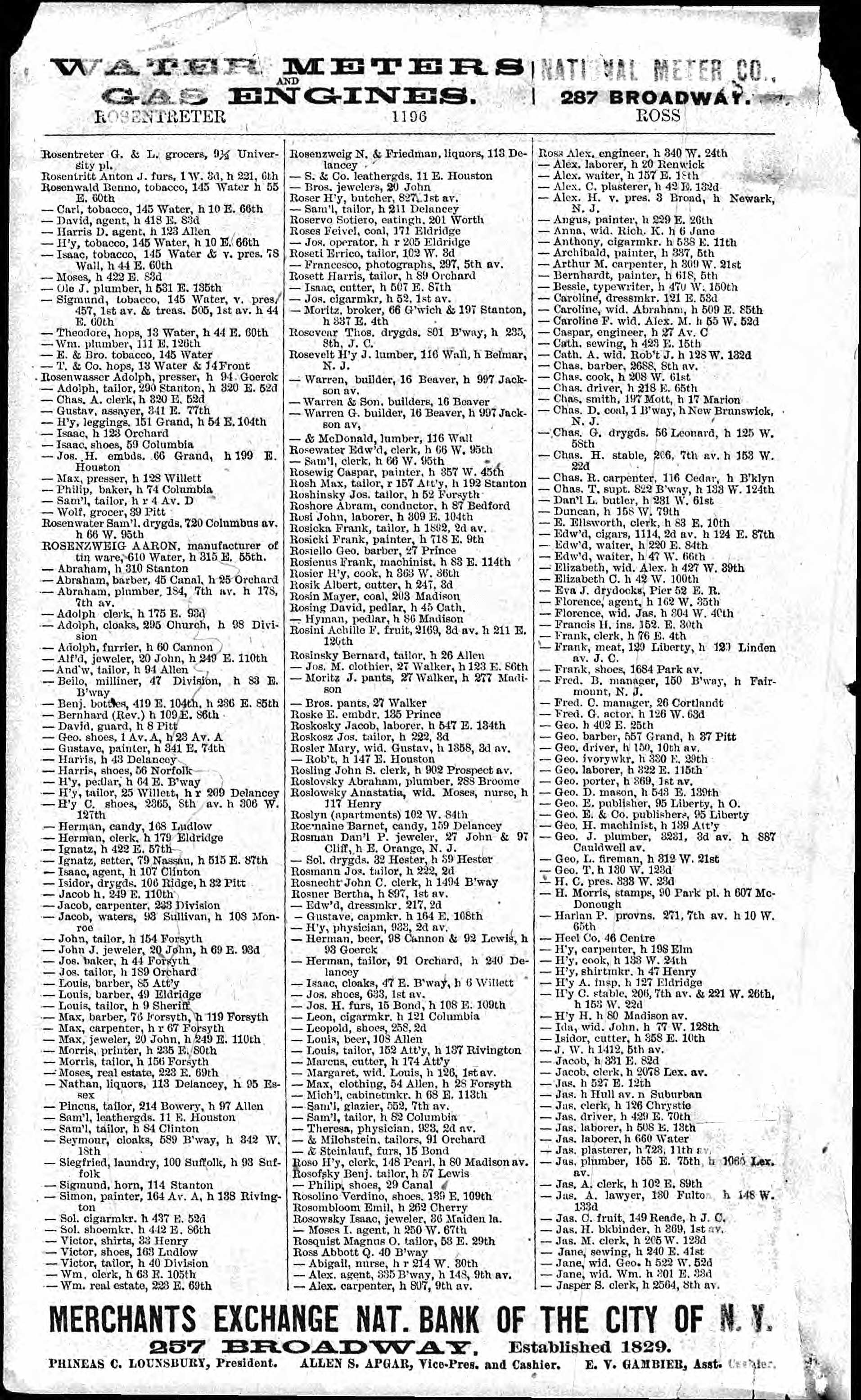
1894 NYC directory

1894 NYC directory

Gussie and Gustave moved several times after 1892—uptown on East 74th Street in 1894, downtown to E. 6th Street in 1900, and to Brooklyn by 1905, where they first lived in Fulton Street and then on Franklin Avenue, where they were living in 1908 at the time of Jankel’s hearing.  Throughout this period of time, Gustav was a painter, eventually owning his own paint supply business, and he and Gussie were having many children: after Lilly came Sarah (1888), Abraham (1890), Rebecca (1894), Jacob (1895), Harry (1897), Joseph (1898), Lizzie (1900) and Rachel (1903).  Apparently there were five others who died, as the 1900 census reports that Gussie had had thirteen children, eight of whom were then living.

It’s mind-boggling on many levels.  First, how did the support and feed all those children and where did they fit them?  And secondly, how did they endure the deaths of five children?  I’ve seen this many times.  In fact, on the 1900 census for Bessie Brotman, my great-grandmother, it reports that she had had nine children, only four of whom where then living.  I cannot imagine how these mothers coped with losing these babies.  Did it make them less able to bond with each newborn, fearing they would not survive, or did it make them cherish each new child even more, knowing how fragile life was and how difficult it was for a child to survive?

In addition, it appears that one of the children who survived infancy, Harry, died as a teenager in 1913.  Perhaps all this did take its toll on the family.  By 1915 it appears that Gustave and Gussie had separated or divorced. Gussie is living alone with the children in 1915; I cannot find Gustav at all on the 1915 census. The census reports for 1920 also had me somewhat confused.  I found Gustave on two reports, one in Brooklyn on Bergen Street, living with the four youngest children, and another in Manhattan on East 110th Street, living as a boarder with another family.  In the Brooklyn census report, Gustave is listed as having no profession; on the Manhattan one it says he was a painter.  And I could not find Gussie anywhere, though the Brooklyn census said that Gustave was divorced.  What I finally concluded was that the Gustave in Brooklyn was really Gussie, despite the fact that it said Gustave and listed him as male.  My guess is that, as was often the case, the census taker was given or heard confusing information and misinterpreted it.   It makes more sense, given the times, that the children would be with their mother and that a woman would not be employed outside the home.  The Manhattan Gustave, the painter, is obviously the actual Gustave Rosenzweig.

Rosenzweigs in Brooklyn 1920

Rosenzweigs in Brooklyn 1920

Gustave Rosenzweig in Manhattan 1920

Gustave Rosenzweig in Manhattan 1920

By 1925 Gustave was remarried to a woman named Selma Nadler.  I was able to find a family tree containing Gustave and Selma which included this photograph, apparently of Selma and Gustave.  Selma had also been previously married and had ten children of her own.

Gustave and Selma Rosenzweig

Gustave and Selma Rosenzweig

Between them, Selma and Gustave had nineteen living children in 1925.  Imagine what that family reunion would look like.  The last record I have for Gustave is the 1930 census.  I have not found him yet on the 1940 census.  I have found two death records for men named Gustave Rosenzweig, one in 1942, the other in 1944.  I have ordered them both to determine whether either one is our Gustave.

Meanwhile, Gussie continued to live with one or more of her children in 1925, 1930 and 1940.  I do not yet have a death record for her either.  I have been able to trace the nine children with varying degrees of success.  Lilly appears to have had a child out of wedlock in 1902 named William who was living with Gustave and Gussie for some time in 1905, but who was placed in an orphanage (father listed as Frank with no surname and deceased) for a short time in 1906. William Rosenzweig at Hebrew Orphanage Then Lilly reappears on the 1910 census living with her parents and without William.  I’ve not yet learned what happened to either Lilly or William.

Similarly, the other four daughters Sarah, Rebecca, Rachel and Lizzie, all became untraceable after they left home since I have no idea what their married names were.  As for the sons, Abraham married and had two daughters, who for similar reasons I cannot find after 1940.  Jacob/Jack also had two daughters, and Joseph I’ve not yet found past 1920.   So at the moment I have not located any current descendants, but I will continue to look to see if I can somehow find out the married names of some of Gustave’s granddaughters.  The NYC marriage index only contains records up to 1937, and these grandchildren would not yet have been married by then; thus, I have no readily available public source to find their married names.  It may take a trip to NYC to see if those records are available in person.  Or perhaps I can find a wedding announcement.

UPDATE: Much of the information in the preceding paragraph has been updated here, here, here, here, here, here, and other posts on the blog on Joseph, Jack, Rebecca and Sarah.

So that is the story of Gustave Rosenzweig as I know it to date: a Romanian born painter who married twice, had nine children, real estate and a painting business, and who came to the rescue of his sister and her family.  It would be wonderful to know what happened once they all settled in America.  Gustave obviously stayed in touch with Tillie and her children, as he was present at Bertha’s wedding.  Did he help out Zusi, his little sister, when her husband died? I had hoped to find her living with him on one of those census reports, but did not.  Did he help out my grandfather when he arrived as a 16 year old boy in NYC in 1904? Did he help out my great-grandmother when she arrived in 1910, a widow without any means of support aside from her children? I certainly wish there was some way of knowing the answers to these questions.  From his conduct at the hearing for Jankel in 1908, I’d like to think that Gustave was there for them all, but we will never know.

Enhanced by Zemanta

Itic Jankel Srulovici

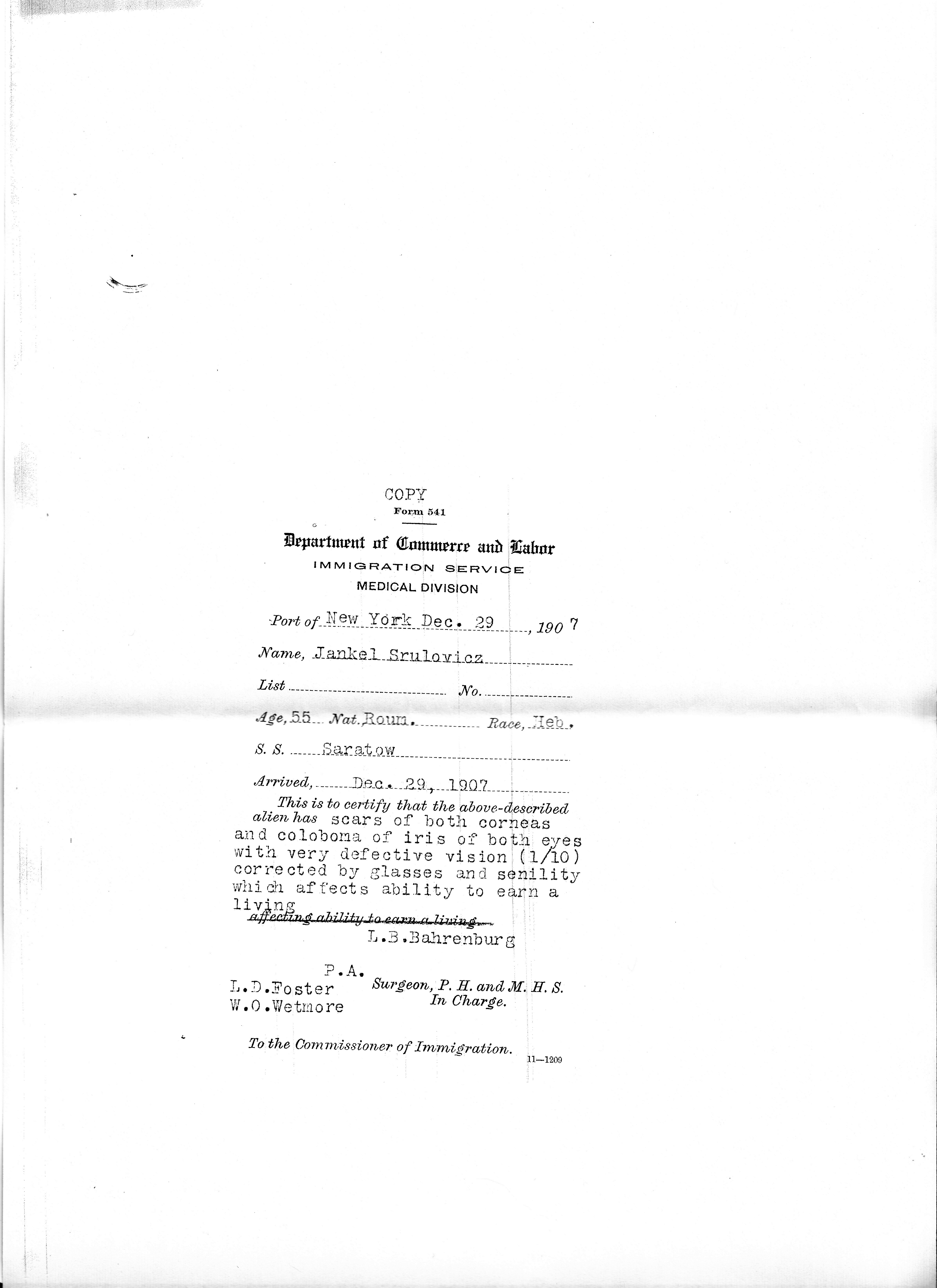
As you may recall, one of the mysteries I was having trouble solving was the fate of Itic Jankel Srulovic, aka Jacob Strolowitz or Adler, aka a number of other possible spellings of both his first and last name.  He was the husband of Tillie Rosenzweig Strolowitz, my great-grandmother Ghitla Rosenzweig Goldschlager’s sister.  He had arrived with his wife and his three youngest children on December 29, 1907, aboard the SS Saratov and had been detained because of problems with his eyes—scars on his corneas and coloboma on both irises.  Family lore suggested that he had never left Ellis Island, either having been deported or dying there, but the passenger manifest was stamped “Admitted,” indicating that a bond had been posted.

I had requested the case file for Jankel Srulovici from NARA, the National Archives and Records Administration in Washington, DC, a few weeks ago, and it arrived yesterday.  I have been studying it ever since.  The papers are fascinating not only because of what they reveal about Jankel and his family, but also because they provide some insight into the times and the experiences of immigrants. I will post scans of the documents in their entirety for those who are interested in the general history as well as those who are interested in the particulars of the family history.

The first document, dated December 31, 1907, is a recommendation from the Acting Commissioner of the Immigration Service, Joseph Murray, that Jankel Srulovic [sic] be admitted to the United States based on a bond of $1000 that was being posted. Commissioner Murray then described Jankel’s eye problems as causing “very defective vision (1/10), corrected by glasses,” but also said that Jankel was suffering from senility which affected his ability to earn a living.  He was only 55 years old; why was he suffering from senility?  What was this diagnosis based upon? There is later testimony that Jankel could not read or write; perhaps the diagnoses was based on his illiteracy, or maybe his illiteracy and his apparent senility was really more a misdiagnosis based on the fact that he did not speak English. Or, of course, perhaps he was really senile.

acting commissioner's recommendation

Enclosed with the recommendation were the report of the doctor’s exam of Jankel, as described in the Acting Commissiner’s letter,doctor's report and a transcript of the hearing held on December 30, 1907.  The transcript names the parties detained and subject to the inquiry as Itie Jankel Srulovic, 55, Roumanian Hebrew, and his wife Tille, 48, and children Riwke [Beckie, then Ray], 15, Pinkus, 9, and Lea, 7.  There is then what I assume to be a translation of some of the testimony given by Jankel.  He named his four older children already residing in the United States, Srul [Isidore], 26, Judel [David?], 21, Brucha [Bertha], 23, and Bluma [Bella], 18.  He testified that he could not read or write, that he was a painter, that he paid his own passage on the Saratov, and that he had $100, which he showed to the hearing officers.  He then was asked whether he had worked before coming to the US or been supported by his children, and he responded, “I supported myself without assistance from my children.”

transcript

transcript

A few things struck me by this testimony. First, I had an immediate reaction of surprise and anger that Jankel was identified by his religion.  Why was the fact that he was “Hebrew” at all relevant, especially in the context of a legal hearing to determine his right to enter the country, a country supposedly founded in large part on the principle of freedom of religious exercise?  Second, I could almost feel Jankel’s humiliation; he was asked whether he needed his children to support him.  He had to admit that he could not read and write.  On the other hand, he had $100—was that a lot or a little for an immigrant to have with them back then? And he had a trade—he was a painter.

The next paragraph made me smile because the next witness was Gustave Rosenzweig.  You may recall that I had noticed on Bertha Strulowitz’s marriage certificate that one of the witnesses was named Gustave Rosenzweig, and I had wondered whether this could be Tillie’s brother and thus also my great-grandmother’s brother.  Well, here he was, testifying at the hearing where the future of Tillie and her husband and children were at stake.  Gustave testified that he wanted [to help?] his sister, brother-in-law and their children.  He said, “I am worth $6000, all told; have a business of Painter Supplies,” and further said, “I will do the best I can for them.”  When asked whether Jankel could work, Gustav responded,”He has no business to work at all.  I will keep him in my house.”  He further testified that Jankel had “four grown children here to take care of them and able to take care of them.”

I was impressed both by the fact that Gustav had $6000 in assets and that he was so generous in coming forward to help his sister and her family.  He could not have been in the US that long himself, and he had to have some concern and fears about facing an official governmental agency, but he stood up for Jankel and his family.  Based on this testimony, the board of inquiry recommended that Jankel be “given this opportunity” to apply for admission on bond.

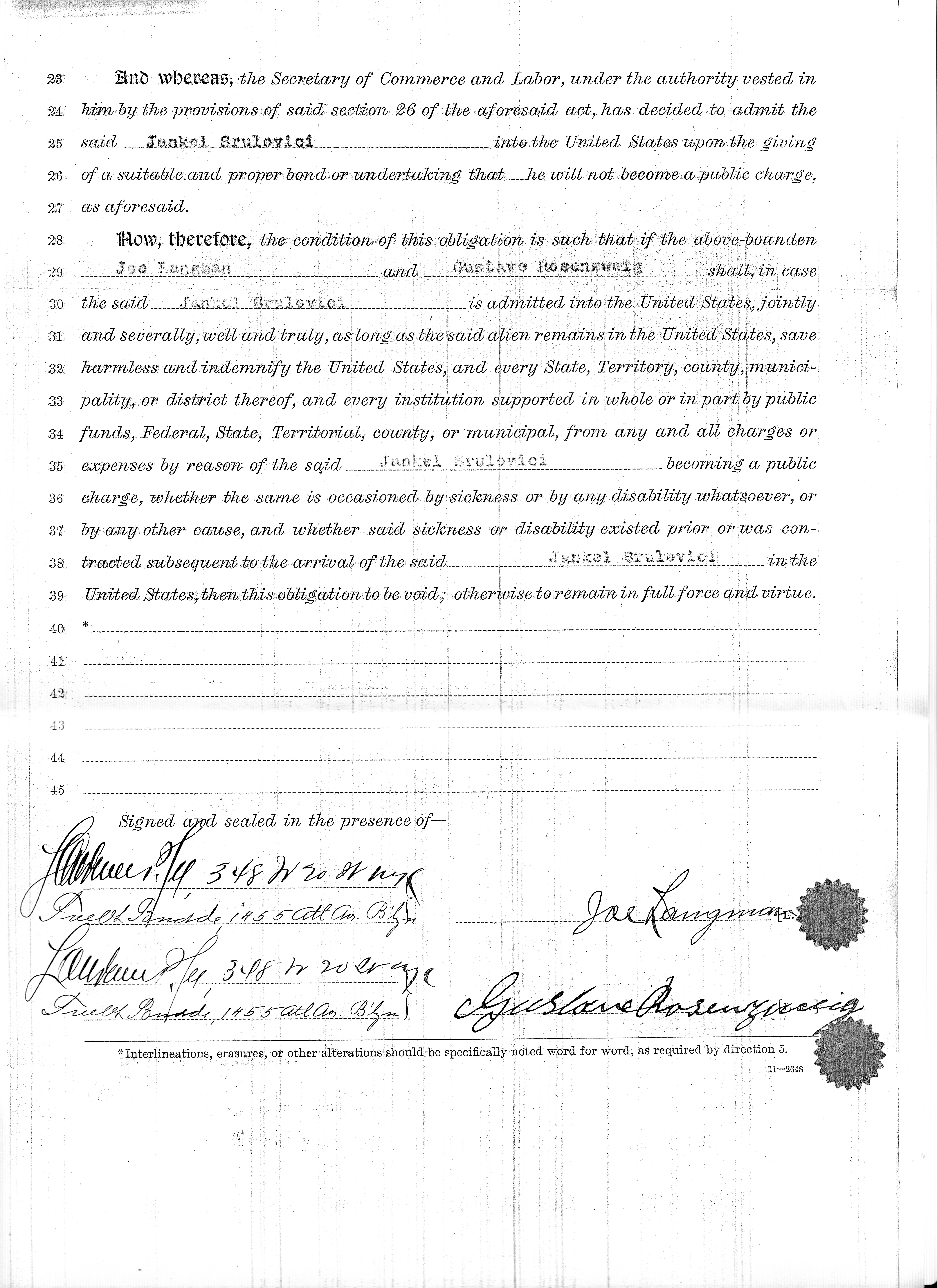
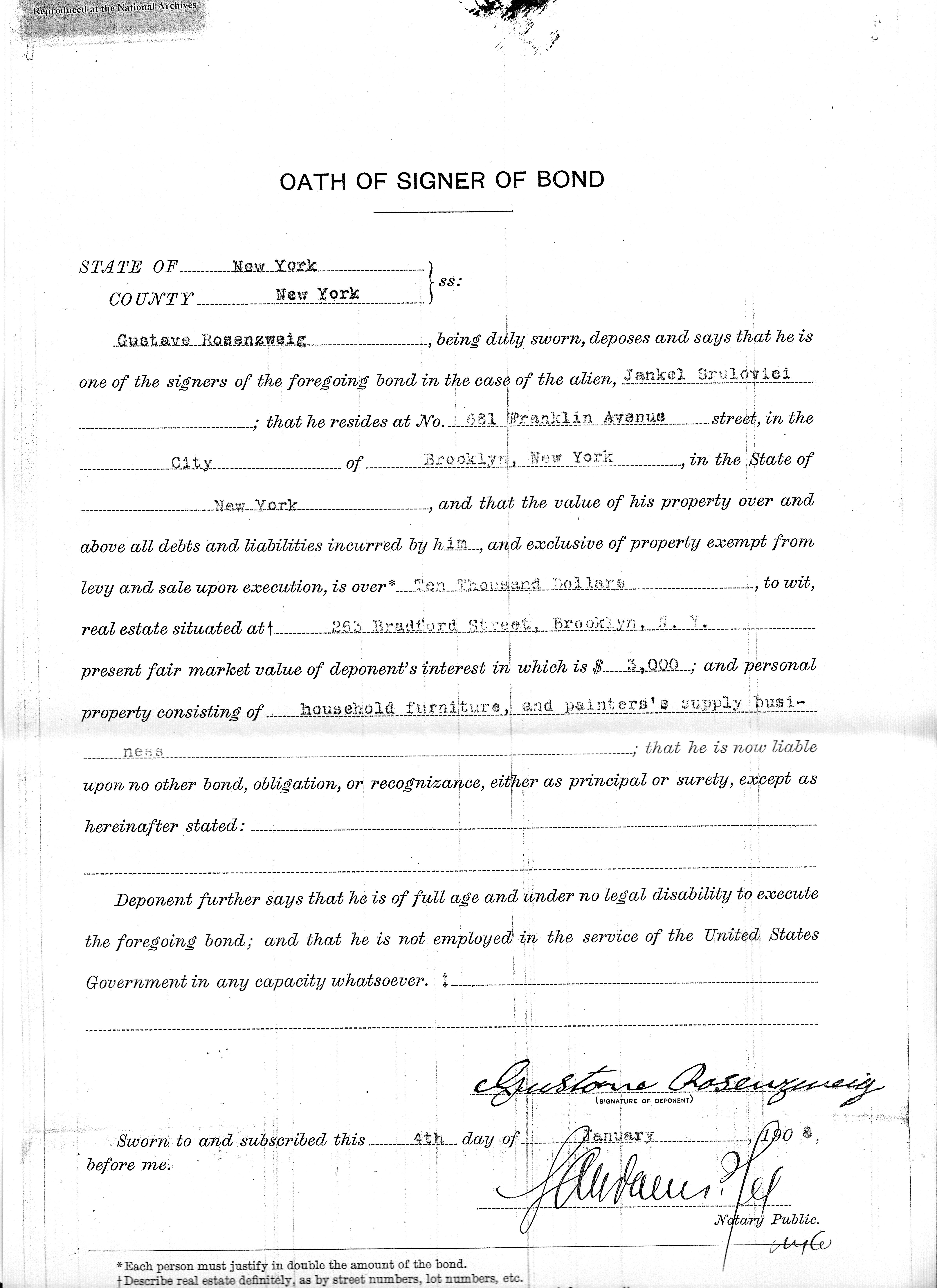
The remaining pages included with the Acting Commissioner’s recommendation are the bond, the application for the bond, and the oaths made by those providing the bond, Gustave Rosenzweig and Joe Langman.  Although I have only done some preliminary research on Joe Langman, it appears that he was also from Iasi and had been in the US for some time before this hearing.  I do not know whether there is any family connection, or whether he was just a landsman helping out another Romanian from Iasi.  Langman signed an oath claiming to have real property in Manhattan worth over $60,000, which must have been quite a substantial sum back then.  Gustave also signed a similar oath, asserting that he had $3000 worth of interest in real estate located in Brooklyn as well as personal property consisting of furniture and his painters’ supply business (presumably worth the other $3000).  Based on these oaths, a bond was issued for $1000 and presented in order that Jankel “shall not become a public charge” and be allowed to enter the country.

bond application p.1

bond application p.1

page 2

page 2

Oath of Joe Langman

Oath of Joe Langman

Oath of Gustave Rosenzweig

Oath of Gustave Rosenzweig

One other interesting thing I noticed about these documents: at the bottom of the page containing the oath is a footnote that reads, “In case signer of bond is a woman, insert here [on a line on the oath] “that deponent is an unmarried woman.” “ I had to stop and think about that for a minute, and then I realized what it meant.  Only an unmarried woman could post a bond because a married woman had no independent claim to property.  Boy, between being Jewish and a married woman, I would have had no rights back in 1908.

The final document in the file is the recommendation of the Commissioner of Immigration Services to the Secretary of Commerce and Labor, agreeing with the Acting Commissioner’s recommendation and recommending that Jankel Srulovici be granted admission on bond.  Although there is no response from the Secretary, I would assume that in general the Secretary deferred to the Commissioner and his hearing officers, and that Jankel and his family were in fact admitted into the United States and that he was not left on Ellis Island or deported.commissioner's recommendation

And yet, despite spending hours again last night searching for some record of his death or a gravesite, I still cannot find anything that reveals what happened to Jankel after January, 1908, when he was admitted, and April 29, 1910, when, according to the 1910 US census, Tillie was already a widow.

I’ve also been tracking down records for Gustav Rosenzweig and Joe Langer, but more on that in the next post.

Enhanced by Zemanta

And A New Branch for the Goldschlager Tree: The Third Rosenzweig Sister

These last few days have been very exciting ones for me.  Not only did I find persuasive evidence of another member of the Brotman family, I also have persuasive evidence of a new member of the Goldschlager family, a third Rosenzweig sister, Zusia, also called Sonsa, Celie, Susie and Susan.  I am still piecing together her life and need to obtain more documentation to do that, but this is what I know so far.

Ghitla Rosenzweig Goldschlager

Ghitla Rosenzweig Goldschlager

First, some background: Moritz Goldschlager, my great-grandfather, married Ghitla Rosenzweig, daughter of David and Esther Rosenzweig, according to the records found by my researcher in Iasi, Romania.  Ghitla, who was also called Gittel, Gussie and Gisella, emigrated to the United States in 1910 with her son David, following my grandfather Isadore in 1904, her husband Moritz in 1909, and her daughter Betty in 1910.  As described before, her husband died in April, 1910, and her two children, Isadore and Betty, moved in with Tillie Strolowitz, herself a widow, and her seven children.  According to Tillie’s death certificate, her birth name was Tillie Rosenzweig, and her parents were also David and Esther Rosensweig.  Tillie had emigrated with her husband and her three youngest children in 1907, following her older children who had emigrated over the years 1901 through 1907.  I was quite excited when I figured out that Tillie was my grandfather’s aunt and had taken him and Betty in after their father had died.

Then a few weeks ago, I reviewed my grandfather’s ship manifest from 1904 (under his brother David’s name) and noticed again that he was supposed to meet an uncle, Morsche or Moische Mintz, in New York City.  I had not been able to find this uncle before, and I was stymied again when I searched for him.  Then I located a document indicating that my grandfather had been shortly detained at Ellis Island, apparently because his uncle had not been able to meet him.  Instead he was met by an aunt Zusie Mintz, who lived at 110 East 117th Street.  But who was she?

Record of Detained Aliens Isadore listed as David Goldschlager

Record of Detained Aliens
Isadore listed as David Goldschlager meeting Zusie Mintz

By searching the NYC marriage index, I was able to locate a Zusie Rosenzweig married to a Harry Mintz and wondered whether this could be the aunt who met Isadore and whether she was another sister of Ghitla and Tillie.   I ordered a copy of the marriage certificate and also looked for further documentation of Zusie Mintz.  I found one census reference for a Sonsa Mintz, living with cousins Jacob and Rachel Reitman in 1900 as a widow.  If this was the same person as Zusie Mintz, it explained why the uncle had not been available in 1904; he had died.  But was Sonsa also Zusie, and who were the Reitmans?
I looked for Zusie or Sonsa or Susie on the later census reports, but could not find her on any of them.  Had she remarried and changed her name? Had she died?

I then looked for and found a death certificate for a Susie Mintz dated March 11, 1931, and I ordered that as well.  At that point I decided to wait for these two documents to arrive before going on what might be a wild goose chase.  I received those documents two days ago, the same day I received the documents evidencing that David Brotman was my great-uncle.  Could I have struck gold twice in one day?

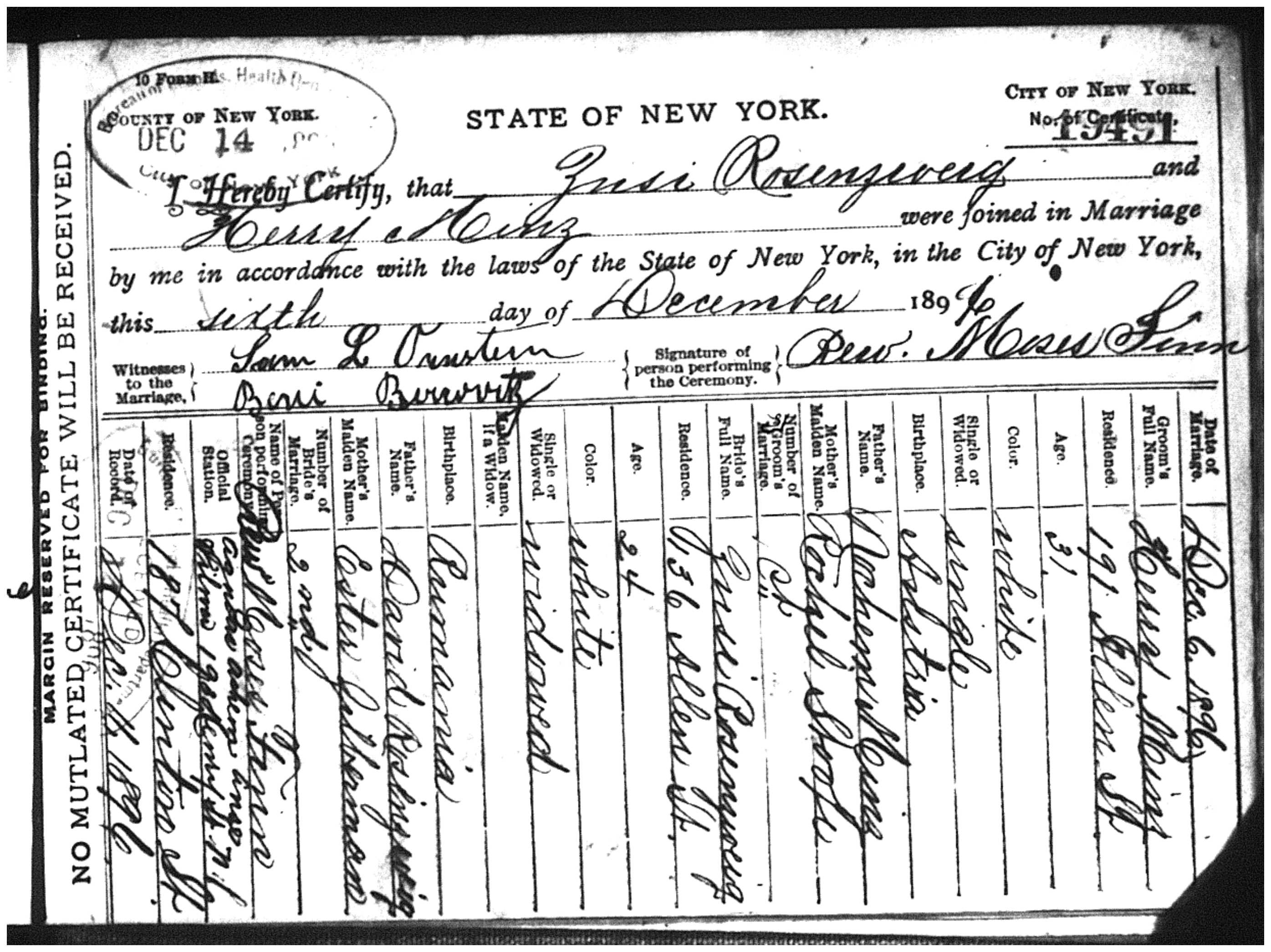
Yes, I could, and I did.  The marriage certificate, dated December 6, 1896, confirmed that the Zusi Rosenzweig who married Harry Mintz was the daughter of David Rosenzweig and Esther Gilberman, revealing for the first time Esther’s birth name.  The certificate confirmed also that Zusi was from Romania.  Zusi had been living at 136 Allen Street, and Harry was living at 191 Allen Street, so presumably they had met in the neighborhood.  Harry was 31 years old, born in Austria, and was marrying for the first time. Zusi was 24 years old, but already a widow.

Zusi Rosenzweig and Harry Mintz marriage certificate

Zusi Rosenzweig and Harry Mintz marriage certificate

Had she married before she left Romania, or since arriving in NYC? Why had she gone back to her birth name, Rosenzweig?  These are questions for which I still do not have answers.

The second document I received, the death certificate for Susie Mintz who died on March 11, 1931, also confirmed that Zusi, now Susie, was the daughter of David and Esther Rosenzweig, born in Romania.  Susie was 54 years old at the time of her death, meaning that she was born in 1877, whereas if she had been 24 in 1896, her birth year would have been 1872.  The death certificate also indicated that she was a widow, and it provided her current address: 523 East 108th Street in the Bronx.

Susie Mintz death certificate

Susie Mintz death certificate

The reverse side of her death certificate contained some surprising information. It revealed that the undertaker had been employed by “Mr. Mintz,” Susie’s son.  Susie had a son? If so, where was he in 1900 when Sonsa was living with Jacob Reitman? Or was that really Susie/Zusi? If Susie had a son, perhaps she had other descendants as well.  But what was her son’s name? When was he born?

reverse of death certificate

reverse of death certificate

Using the address on the death certificate, I worked backwards to see if I could find Susie on the 1930 census, since I assumed she had not moved between the 1930 census and the time of her death in March, 1931.  This took some doing, as you have to scan through all the pages within a specific enumeration district to find the address; there is no index by address.  I finally found her address, and then I found her listing: she was living at the same address, listing herself as  Susan Mintz, 42 years old, a dressmaker, and as married.  Married? She was living with a boarder named Hannah Kassel, an older woman who was a widow.  When I looked at the form more closely, I realized that the M for married also could be a W for widowed.  I think the indexers read it incorrectly, and that Susie was in fact still a widow in 1930, as she was in 1900 and at her death.

Susan Mintz 1930 census

Susan Mintz 1930 census

From the 1930 census, I then went to see if she had been at that address ten years earlier for the 1920 census.  After more scanning and searching, I found her once again at the same address, but now using the name Celie, or at least that is how the census taker recorded it.  She was listed as a widow, a dressmaker, and 42 years old (I guess she did not want to admit being any older ten years later in 1930).  Zusi/Susie/Celie was living alone at that time.

Celie Mintz 1920 census

Celie Mintz 1920 census

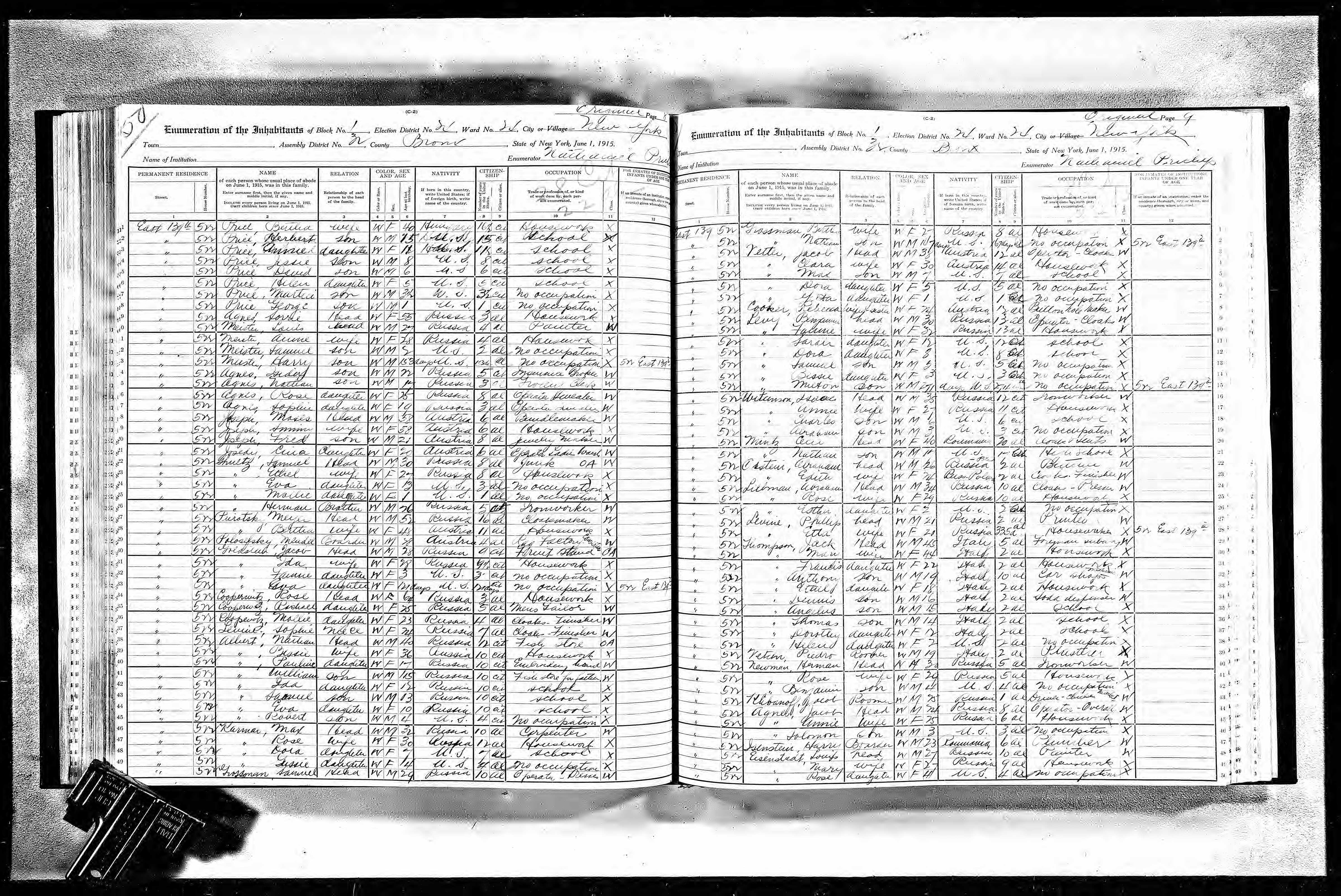
Next came the 1915 New York State census—could I find her again at that address?  I searched for Celie Mintz this time, and without having to scan the census, I found her on the next block at 522 East 139th Street in the Bronx, working at a cloak and suit factory, and living with her son, Nathan.  Her son!  I had found a record for her son.

Celie and Nathan Mintz 1915 NYS census

Celie and Nathan Mintz 1915 NYS census

I could not find either of them on the 1910 census or the 1905 New York State census, at least not yet, but now I had her son’s name and could search for him.

I checked the New York City birth index for a birth certificate for a baby named Nathan Mintz and found one dated December 6, 1897, exactly a year after Harry Mintz had married Zusi Rosenzweig.  This certainly could be the right Nathan, but I now need to obtain that certificate to be sure.

I did find Nathan’s 1917 draft registration for World War I, listing his mother as Cecile Mintz living at 523 East 138th Street in the Bronx, the same address where she was living from 1920 until her death.  Cecile is closer to Zusi and Susie than Celie, and looking at the 1915 census it does look more like Ceci than Celie.  The fact that Nathan’s address in 1917 was the same as that on Susie Mintz’s death certificate confirms that Susie and Cecile and Celie and Susan were all the same woman.

Nathan Mintz draft registration 1917

Nathan Mintz draft registration 1917

I then found a Nathan Mintz who married Gertrude Friedman in 1930. I need to order that certificate as well, but  I suspect that this is the correct Nathan because on the 1940 census, Nathan and Gertrude have an eight year old daughter, born then in 1932, named Susanne.  If this is the right Nathan, it makes perfect sense that he would name his first born child after his mother Susie one year after her death.

Nathan, Gertrude and Susanne Mintz 1940 census

Nathan, Gertrude and Susanne Mintz 1940 census

But there are obviously many unanswered questions.  I can’t find a death certificate for Harry—did he really die, or did he just disappear? Who are Jacob and Rachel Reitman? How, if it all, were they related to Zusi? And where was Nathan living if that was Zusi living with the Reitmans in 1900?  Zusi was the one who met my grandfather at Ellis Island in 1904, but he was living alone in 1905.  Where was Zusi living in 1905? 1910? She was not living with either of her sisters in 1910, so where did she go?   And where was Nathan in those years and between 1917 when he registered for the draft and 1930 when he married Gertrude?

Yes, there are a lot of holes and a lot of questions, but I remain fairly certain that Zusi Rosenzweig Mintz was my great-grandmother’s sister and thus my great-great aunt and that Nathan Mintz was therefore a first cousin to Isadore, David and Betty Goldschlager and to all the Strolowitz children.  Did they know him? And, of course, if Susanne Mintz was Nathan’s daughter, then she would have been my mother’s second cousin.  And if Susanne had children, then they would be my third cousins.

So stay tuned—more to come once I receive more information.

The Schwartz Family

As I wrote yesterday, in trying to fill the holes in David Goldschlager’s story, I ended up researching his wife Rebecca’s family and their story.  Although her family is not technically related to mine except through marriage, now that I am in touch with her grandson Richard (and now, her nephew Jon), I feel connected to this story and touched by it as well.

As I wrote in the last post, I was curious as to why David and Rebecca left New York City sometime after 1920, when David’s mother and sister were living with them, and moved to Scranton, Pennsylvania.  Their son, Murray, was born there,[1] and they were living in Scranton as late as 1928 because that is where David was living when he filed his naturalization application.  By 1930, however, they had returned to New York and were living in the Bronx, where they lived until they retired and moved to Arizona to live near Murray and his wife Edna and their grandson Richard.

I hypothesized that Rebecca’s family lived in Scranton because I could not figure out what else would have drawn David away from his family and place of employment.  As I wrote last, I started digging around for Rebecca’s family, and after learning her maiden name was Schwar(t)z from her naturalization form, I was able to locate the ship manifest for Rebecca and her family on the SS Astoria, sailing from Glasgow, Scotland in March, 1903.

Schwarz Family on the SS Astoria 1903

Schwarz Family on the SS Astoria 1903

The family was from Romania, and Rebecca was one of seven children on the manifest, traveling with her mother Louise.  Rebecca was the oldest child, thirteen years old, followed by Etta (11), Annette (9), Rosa (7), Sophie (4), Abram (2), and Henrie (9 months old).  Henrie’s name had a line drawn through it, and in the left margin next to Henrie’s name, it looks like the word “died” followed by some other illegible words were written.  It looked like Henrie, the baby, had died on board.  Imagine being the mother of seven young children, caring for them on this long, uncomfortable voyage, and losing one of your children while at sea.[2]

The manifest also identified who was meeting the family in the United States: their husband and father S. Schwarz of Newark, New Jersey.  By searching the 1910 US census, I was able to locate the Schwartz family in Newark.  Rebecca’s father’s name was Solomon, and he was employed as a hat finisher in a hat factory.  He and Louise (Lizzie, on this census) were living with their six children who had survived the trip from Romania plus two more born in New Jersey, Meyer and Jennie.  Rebecca was now 20 and, like her father, working as a hat finisher in a hat factory.

The Schwartz Family in Newark (Rebecca standing in the rear middle)

The Schwartz Family in Newark (Rebecca standing in the rear middle)

Is this how she met David? As a hat maker? Did the factory where she and her father worked have a connection to the factory where David was working? David had been working as a hatter since at least 1915, as indicated on the 1915 NYS census. On his World War I draft registration dated June 5, 1917 (after he and Rebecca were married), David listed his employment as a hatter for Sam Burk at 419 Lafayette Street, New York.  Who knows? Maybe there was a hatmakers union meeting where Rebecca and/or her father met David.  At any rate, they were married in Newark in 1916, but lived in New York City as of the 1920 census.

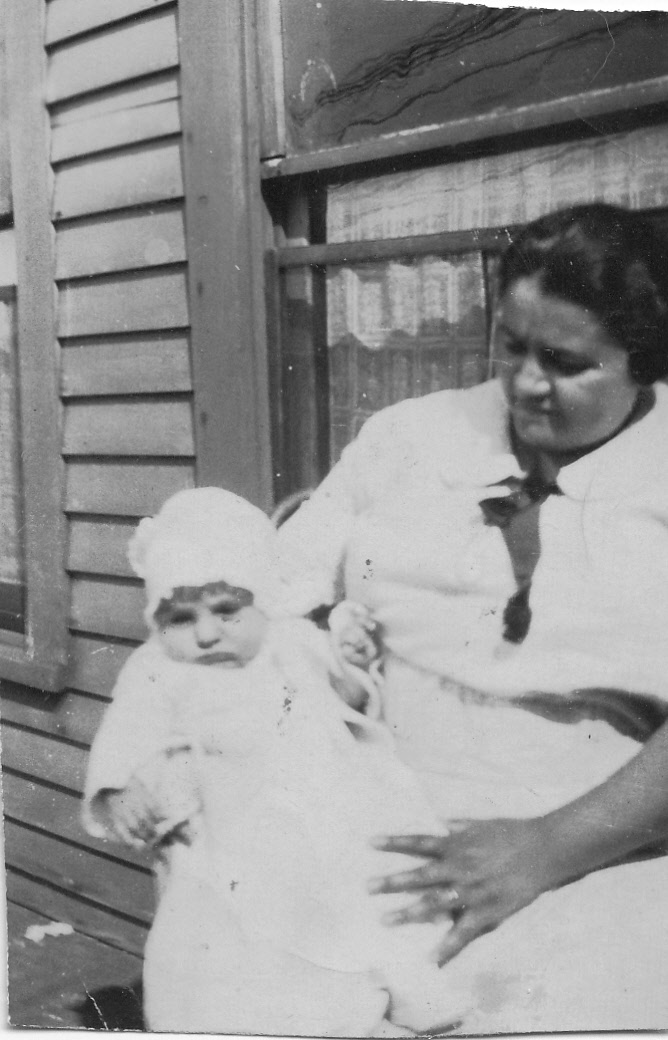
Rebecca and Sidney Goldschlager

Rebecca and Sidney Goldschlager

Meanwhile, the Schwartz family had suffered another tragedy.  On the 1920 census, I noticed that although Etta, Annette, Rosie, Sophie, Abram (now Abie), and Jennie were still listed as living at home, there was no entry for Meyer, who had been only six years old in 1910.  I had to assume that something had happened to Meyer, and I learned from Jon Schwartz, one of Solomon’s grandsons, that Meyer had died from a ruptured appendix in 1913 when he was not yet nine years old.  As Jon said, his father Abram (who became Arnold) was the only son of Solomon and Louise to survive to adulthood.

In 1930, most of the Schwartz family was still living under one roof: Solomon, Louise, Annette, Sophie, Arnold (formerly Abram), and Jeanette (formerly Jennie).  I don’t know where Etta and Rosie were, perhaps they were married.  Sadly, Solomon Schwartz died three years later at age 71.  Louise died in 1948.  I have not yet traced what happened to the Schwartz children after their father died, although by 1933, even the youngest child would have been in her twenties.  I am hoping to learn more from Jon, who is Arnold’s son and who I was able to contact by finding his family tree on ancestry.

One other interesting fact that I did learn from Jon is that Solomon Schwartz had lived in Iasi before marrying Louise, who was from Berlad.  He then moved to Berlad where their first seven children were born before they emigrated to the United States.  Maybe that led to the connection between Rebecca and David? Maybe the Schwartz family in Iasi knew the Goldschlager family, and perhaps when Solomon was looking for a match for his oldest daughter Rebecca, he reached out to people from the American Iasi community and found David, a fellow hatter, newly arrived from America and the same age as his daughter. There is likely no one alive who knows how David and Rebecca met, so all we can do is speculate, creating stories to fill the gaps between the data we can find through these documents.

Meanwhile, despite all these discoveries, I still don’t know why David and Rebecca ended up in Scranton, Pennsylvania.  So far all I know is that there were two hat companies in Scranton at the time, the Lackawanna Hat Company and the Keystone Hat Company.  There were also two families named Goldschlager living in Scranton at that time.  So maybe these Scranton Goldschlagers were also our relatives?

Washington Avenue, Scranton, Pennsylvania, Uni...

Washington Avenue, Scranton, Pennsylvania, United States. (Photo credit: Wikipedia)

The research continues….


[1] It appears that Sidney was born in Newark, NJ, in 1925, according to his mother’s naturalization form and the 1940 US census.  However, on David’s naturalization, it says both sons were born in Pennsylvania.  The 1930 census says both were born in New York, which must be wrong.  So perhaps they were living in Newark when Sidney was born and then returned to Scranton, assuming that Rebecca and the 1930 census are correct as to where Sidney was born.

[2] According to Jonathan Schwartz, one of the grandchildren of Solomon and Louise Schwartz, Henrie never left Europe, but this seems inconsistent with this manifest as well as a separate document listing passengers on the SS Astoria for this voyage.  Henrie’s name appears on both.  Maybe the family could not bear the truth and created a story that Henrie continued to live in Romania.

Enhanced by Zemanta

Isadore and David Goldschlager: More than Brothers?

Yesterday I decided to try and fill some of the gaps in David Goldschlager’s history.  I had his birth record from Iasi, saying he was born November 4, 1889, a year after my grandfather, and the ship manifest from the Patricia saying that he had arrived on October 27, 1904.  But then there was a big gap.  He did not appear on the 1905 New York State census, although I had found Isadore, living alone in Manhattan.  Nor did David appear on the 1910 census, although both Isadore and Betty were living with their aunt Tillie Strolovitz and her seven children.  But where was David? It made no sense to me that he was not living with his family in either 1905 or 1910.  He first shows up on an official census in 1915, when he was living with his mother Gittel/Gisella and his siblings Isadore and Betty.

Also, I was curious as to how and why he ended up living in Pennsylvania when Murray was born in 1922.  I had not yet found a marriage record for David and Rebecca, although I knew they were married by 1917 because David so reported on his draft registration card filed that year.  Also, the 1920 census had them living in Manhattan.  I also knew that David had been working as a hat maker since at least 1915 because that was his occupation listed on the 1915 New York census, as it was also on his draft registration and the 1920 census and each one thereafter.  So what took him to Scranton?

I thought perhaps that Rebecca was from Scranton, so I started searching for her records.  I did not know her maiden name, and I could not find any record of their marriage in the NYC marriage index.  I was stumped.  But then I found her naturalization papers, and they were a goldmine of information.  From these papers I learned that Rebecca’s maiden name was Schwar(t)z, that she was born in Berlad, Romania, on April 29, 1889, that she had arrived in March, 1903 on the SS Astoria via Glasgow, and that she had married David Goldschlager on February 20, 1916, in Newark, New Jersey.  I also confirmed that their son Murray was born in Scranton, PA, and that Sidney was born in Newark, New Jersey.

Rebecca Goldschlager's naturalization papers

Rebecca Goldschlager’s naturalization papers

From there, I was able to find Rebecca’s family on the SS Astoria ship manifest and find the names of her mother and many siblings and the name of her father Solomon Schwartz, who was meeting them and resided in Newark, New Jersey.  When I followed up with census reports for the Schwartz family in Newark, I learned that Solomon was, like David, also a hat maker.  Perhaps David had met Solomon in the circles of the hatmaking trade, and Solomon had then introduced David to his daughter Rebecca? It now made sense why David had gotten married and at one point lived in Newark, but why Scranton? I am still trying to figure that out.

Rebecca’s family’s story is itself worth telling, and I will in my next post.  But for me personally, the bigger story comes back to David and Isadore.  While reviewing Rebecca’s naturalization papers, I noticed that it said that David had himself arrived in New York on November 4, 1910, not October 27, 1904, as reported on the ship manifest for the SS Patricia.  I thought either that it was a clerical mistake or a memory mistake and dismissed it.  But then I looked back at a few of the census reports for David and Rebecca and noticed that on those reports as well, his arrival date was reported as 1910, not 1904.  I had also earlier dismissed that as an error.  But now I was starting to wonder—how likely was it that the same 1910 date was reported so many times and yet wrong?

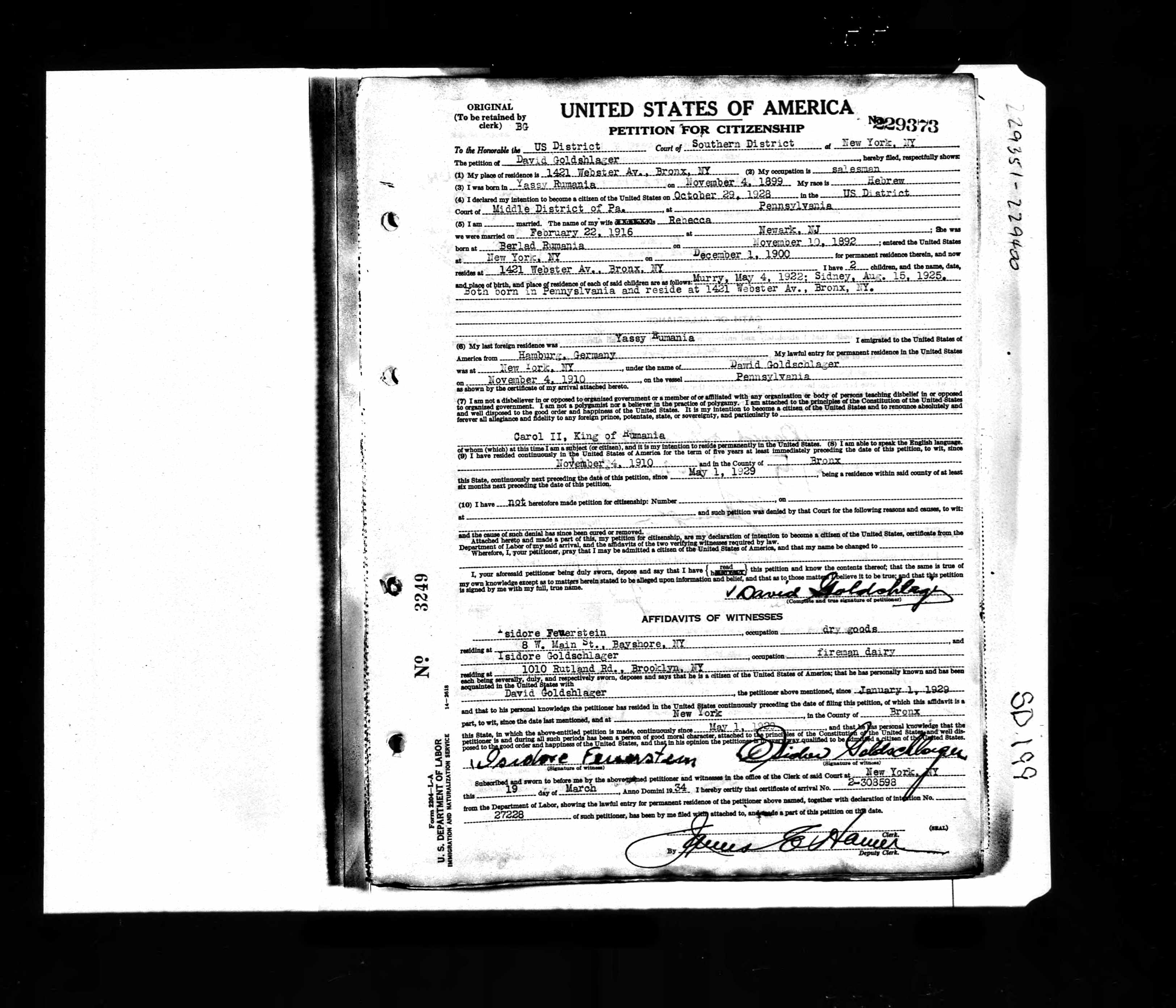
I went back to look at the naturalization papers I had for David and saw that those also reported his arrival date as November 4, 1910.  Now I was really puzzled.  When I first found David’s naturalization papers, I had not focused on this, nor did I realize then that there is a second page to the naturalization papers.  I turned to the next page and found this:

David Goldschlager Naturalization Record

David Goldschlager Naturalization Record

First thing I noticed was that my grandfather Isadore had signed David’s application with his very distinctive and florid signature; the second witness was Isidor Feuerstein, Betty Goldschlager’s husband.  Then I looked more closely at the information provided on the form.  It clearly said that David had arrived on the SS Pennsylvania from Hamburg on November 4, 1910.  Now I was convinced that the 1904 date must be wrong.

I searched for the manifest for the SS Pennsylvania arriving in NYC on that date, and sure enough I found David’s name, indicating that he was being met in New York City by his father Moritz Goldschlager.  Only then did my slow brain react and realize that this was the very same ship that Gittel/Gisella, David’s mother, sailed on when she arrived in New York.  I went back to double-check, and sure enough, it was the same exact ship.  I don’t know why Gittel and David were not listed together on the manifest.  If they had been, I would have noticed this long ago.  But clearly it makes sense that David and his mother came together, both arriving in New York, expecting to be met by Moritz, only to be met instead by Isadore, who had to tell them that Moritz had died in April, seven months before.

So then why was there a 1904 ship manifest for a sixteen year old named David Goldschlager from Jassy, Romania?  Well, I see three possibilities.  One, there were two David Goldschlagers about the same age in Jassy.  That certainly is a possibility, although I have not found another David Goldschlager from Romania (there is one from Austria) on any of the census reports in New York.  Two, David went back to Romania and then returned again with his mother in 1910.  That is also possible, but would he have left so soon after arriving that he was gone by the time of the 1905 census?

Three, and the possibility that makes perhaps the most sense and that brought tears to my eyes, the David Goldschlager who arrived in 1904 was really my grandfather, Isadore Goldschlager.  Isadore was 16 on October 27, 1904 (David was actually only fifteen).  Isadore did arrive in 1904 according to several census reports.  And Isadore was trying to avoid the draft, so very well might have had to use an assumed name to get out of Romania.  And I have not been able to locate any other ship manifest that has Isadore’s name on it.  He may have walked out of Romania, but he certainly did not walk across the Atlantic Ocean.

After much searching, I have just an hour ago located the index number for Isadore’s naturalization papers from 1917.  I have added them to the list of documents I am ordering, and it is the document I am most anxious to see.  Perhaps it will reveal when Isadore arrived and on what ship.  Maybe it will reveal that Isadore did, in fact, arrive under his brother’s name.

If so, I have to rewrite some of the Goldschlager family history.  It would mean that Isadore was here alone for five years before his father arrived in 1909.  It would mean that he was here alone to deal with his father’s death in April, 1910, and to comfort his sister Betty, who arrived the following day.  It would mean that he alone had to tell his mother and his brother that their husband and father had died when they arrived at Ellis Island in November, 1910, seven months after Moritz had died.  It’s far too much pain and suffering for me to imagine one very young man enduring.

UPDATE:  See my post updating the research on this page.

Isadore age 27

Isadore age 27

Enhanced by Zemanta

The Wonderful Generosity of Genealogists

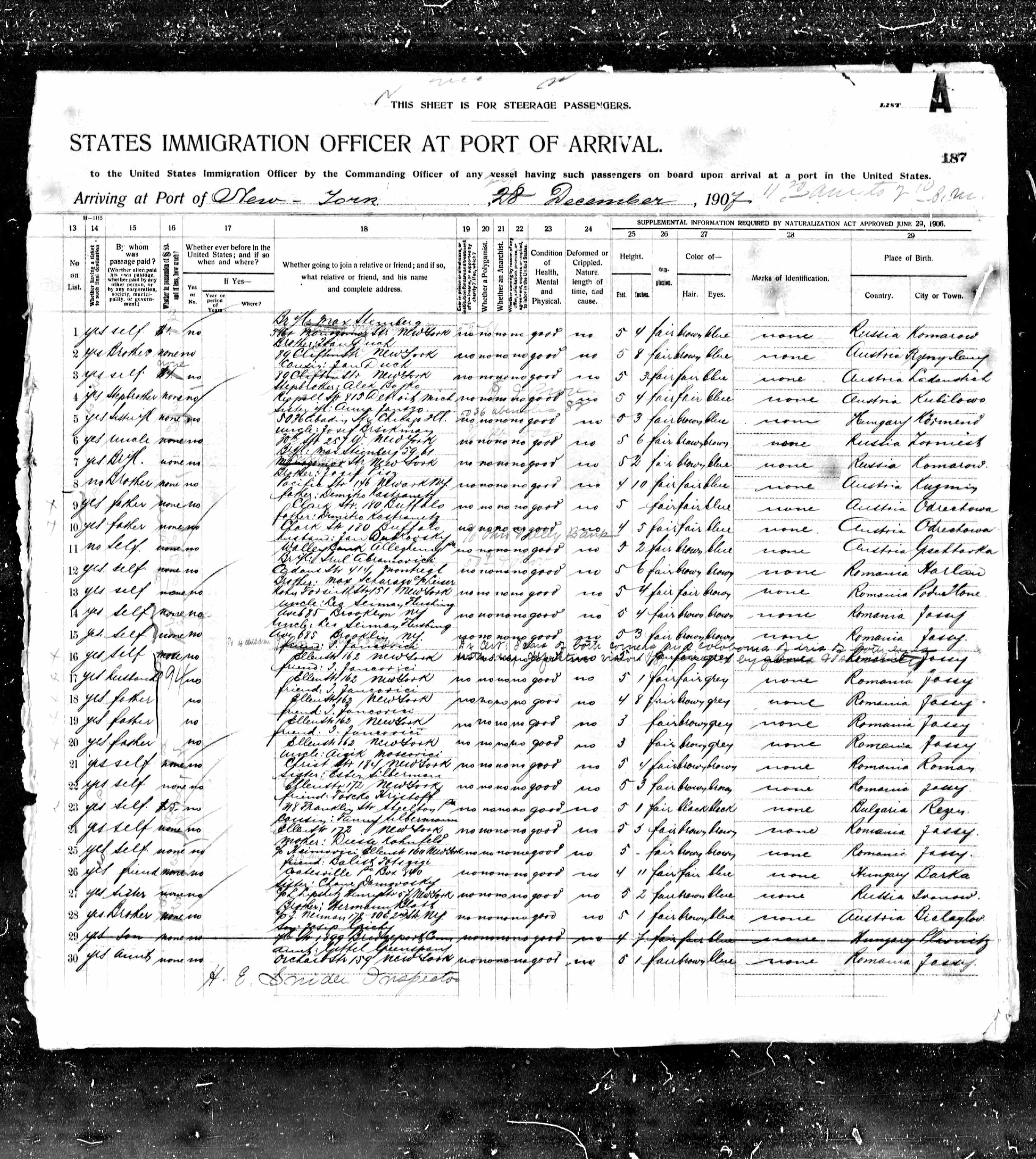
I have been working the last couple of days on the search for what happened to the husband of my great-great aunt, Tillie Rosensweig Srulovic/Strolowitz/Strulowitz/Adler.  The last record I have of him is on the manifest for the ship that brought him along with Tillie and their three youngest children to the United States in December, 1907.  On the manifest, as previously discussed, his name is Itic Yankel Srulovici.  There are notations on the manifest that indicate that although he first was considered in good health, a later notation written over that finding indicates that he had scars on his corneas and coloboma in both irises.  However, the record also indicated that he was examined by a Doctor Snider and is stamped “admitted,” though it also indicates that the family was held for several days and a bond had to be posted for their release.

ship manifest 1907

ship manifest 1907

page 2 of manifest

page 2 of manifest

I did some research on the history of Ellis Island, and apparently there was a contagious eye condition, trachoma, that was commonly a basis for refusing entry to an immigrant.  Perhaps when the inspectors saw something strange about Itic’s eyes, they decided to hold him for further examination.  Reading this the first time, however, I wasn’t sure how to interpret the “admitted”—did that mean he was admitted after the exam? Was it possible they had deported him? And if he stayed, when did he become Jacob Adler, and when did he die?

And why is there no record of him after leaving Ellis Island?  In my emails with Itic’s great-granddaughter Jean, she said that family lore is that her great-grandfather never left Ellis Island.   Did that mean he had died on Ellis Island? Had he been deported?  I could not determine how to figure this out.

Immigrants just arrived from Foreign Countries...

Immigrants just arrived from Foreign Countries–Immigrant Building, Ellis Island, New York Harbor. (Half of a stereo card) (Photo credit: Wikipedia)

And that’s where the generosity of genealogists comes in.  I posted an inquiry on the JewishGen discussion list, asking for opinions and help in figuring out what had happened to Itic/Jacob.  And within less than an hour, I started receiving responses and continue to receive very helpful responses.  I have said this before, but I continue to be amazed and touched by how helpful, supportive and generous with their time and energies these experienced genealogists are.  Renee Steinig continues be an incredible source of support—with ideas, suggestions, and documents that she finds for me on her own time.  Others also have gone out of their way, including Bette (whose last name I don’t even know but who has helped me before on other questions), Phyllis Kramer, Marian Smith, Don Solomon, Sally Bruckheimer, David Crook, Diane Jacobs, Adelle Gloger, and several more.

And so what have I Iearned? Well, most of these people advised me that it is very unlikely that he was deported.  If the document is marked “admitted,” then he was admitted.  There would be some notation in the file if he had been deported.  Several people gave me websites and search engines to use to see if I could find a death record or gravesite where Itic/Jacob appeared.  So far I have not found any record other than the the death certificate for a Jacob Adler who died in 1910, but I can’t find a gravesite for that person.  I hope to have the death certificate by the end of next week, so perhaps if it identifies him as Tillie’s husband, we will have an answer.

I also was advised to request a document from the National Archives and was even provided with the document identification information by someone who was looked it up on an index I wouldn’t otherwise have been able to access.  I called the National Archives, and I am now waiting for them to call me back.  So I am hoping that by the end of next week I will have some documentation that may fill out the story and tell us what happened to Tillie’s husband, Gisella’s brother-in-law.

I could never have gotten as far on this journey without all this help.  Thank you again to every person who has provided me with help.  I look forward to paying it forward to another new genealogy researcher some day soon.  I can never pay all of you back for what you have given me.

Enhanced by Zemanta

Passenger Ship Manifests and The Heartrending Stories They Tell

English: Ellis Island's Immigrant Landing Stat...

English: Ellis Island’s Immigrant Landing Station, February 24, 1905. (Photo credit: Wikipedia)

One of my favorite documents to locate is a ship manifest listing one of our ancestors as a passenger, bringing them from Europe to America. I have read and seen enough about these ships and the hardships that the passengers endured to know that these were not pleasant cruises across the Atlantic Ocean. People suffered from disease, malnutrition, terrible hygienic conditions, and frequently even death. Yet I tend to romanticize these journeys, despite the facts. I imagine how frightened but also how excited these travelers must have been, thrown together with other people from all different countries and of all different backgrounds, all of whom were dreaming of a better life in the United States. The stories told by ship manifests I’ve found do much to break down that romantic ideal.

I was only able to find two ship manifests for the Brotman immigrants. The first exciting find was the manifest for the Obdam, the ship that brought Bessie, Hyman and Tillie to New York in January, 1891. Their names were listed as Pessel, Chaim and Temy Brodmann. One column lists how many pieces of luggage each passenger brought, and for Bessie, Hyman and Tillie, they brought only two pieces of luggage. Imagine fitting the clothing of three people plus any other possessions you wanted to keep with you into just two pieces of luggage. When we go away for a weekend, we often need more than that for just two of us. Hyman was only 8, Tillie 6, and somehow they endured this long voyage at sea with their mother. When I fast-forward to how American they became as adults, I find it remarkable.

The Obdam 1891

The Obdam 1891

The only other ship manifest I located for the Brotman family is one I believe is for Max, but cannot tell for sure. It lists a Moshe (?) Brodmann as a ten year old boy, traveling with one bag, on a ship called the City of Chicago in 1890. This very well could be Max, but there is no other Brodmann or anyone else with a similar name traveling with him. If I have a hard time imagining Hyman and Tillie coming with their mother, it is really unfathomable to imagine a ten year old boy traveling alone across the ocean. None of the names above or on the page following his sound like possible relatives, friends or even neighbors since for the most part they are listed as coming from Russia, not Austria. If that is in fact our Max, I imagine that this must have been an incredible experience—frightening, even horrifying, and lonely. Perhaps an experience like that explains how these children then endured the working and living conditions they found in the United States. They had already survived much worse.

I’ve had no luck yet locating a manifest that includes Joseph or Abraham Brotman, but I will keep looking.

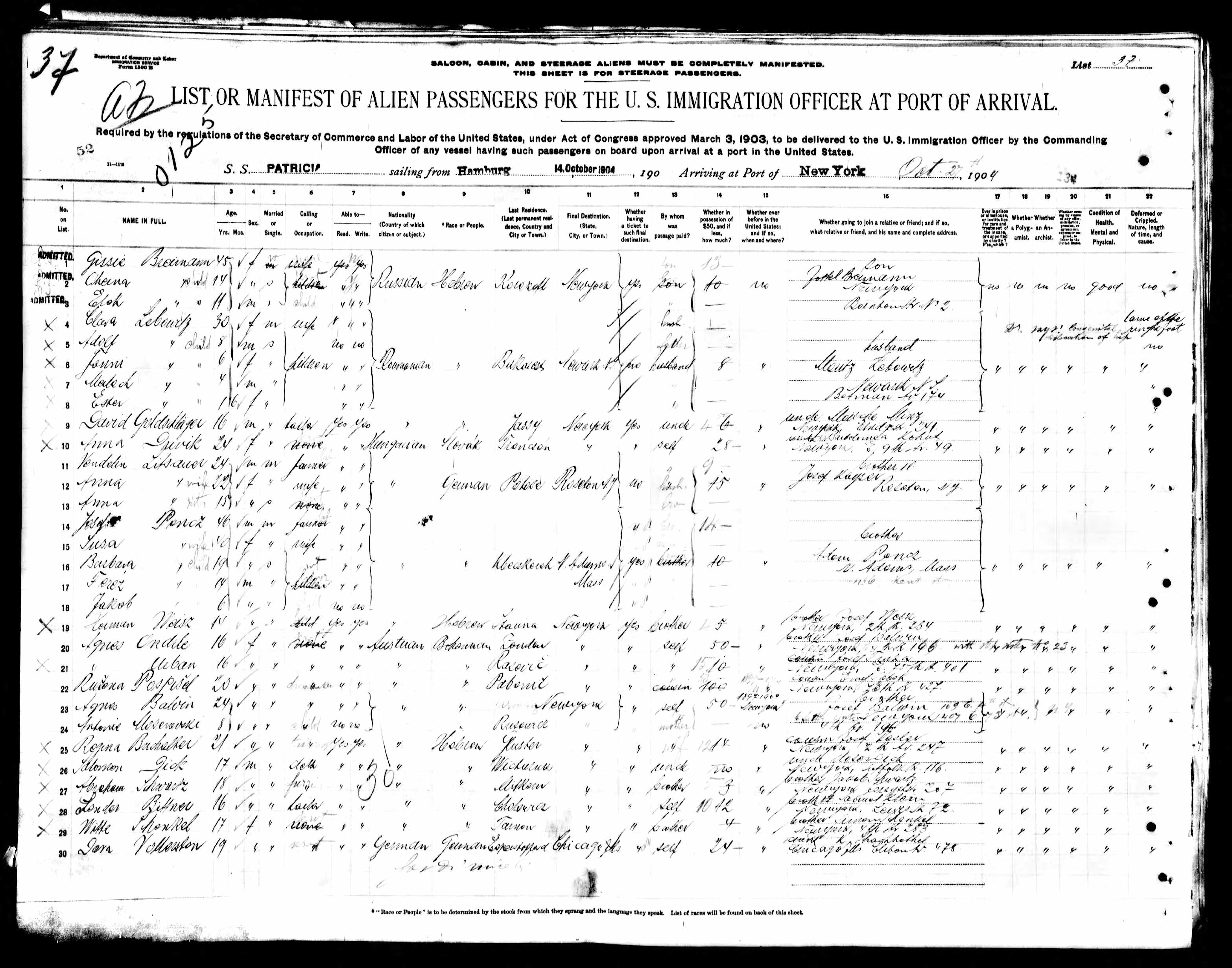
On the Goldschlager side, I’ve had more success. I have found a ship manifest for Moritz, Gisella, David and Betty, each of whom came separately, but nothing for my grandfather Isadore. These manifests also tell interesting and some heart-breaking stories. David came in 1904 on the Patricia, which departed out of Hamburg. (Perhaps like his brother, David also walked out of Romania to get to Hamburg.) This manifest contains far more information than the two above. First, it asks for information about who paid for the ticket and the name, address and relationship of any relative or friend the passenger was joining at their destination. David said his uncle paid his passage and that he was going to join that uncle in New York. From what I can decipher, it looks like the uncle’s name was Moishe Minz.

David Goldschlager ship manifest

David Goldschlager ship manifest

I have searched many times and ways to figure out who this person was and how he was an uncle to David. Was he a brother-in-law of Moritz or of Gisella/Gittel/Gussie? Since his last name is neither Goldschlager or Rosensweig (Gisella’s maiden name), I assume he is not a brother. Or perhaps he is a half-brother. Whoever he was, I cannot find him yet. I also find it puzzling that David listed this uncle and not his brother Isadore. Perhaps because Isadore himself was still just a minor, he would not have been a satisfactory person to list as the connection for David in the United States. The other interesting bit of information gleaned from this manifest is the amount of money David was carrying with him: six dollars. He was 16 years old, traveling alone, with six dollars to his name.

The next to arrive was Isadore and David’s father, Moritz. He arrived in August 1909 on the ship La Touraine out of Havre. His occupation is listed as a tailor, and his age as 46 years old. This manifest did not ask who you were meeting in the United States, but instead who you were leaving behind in your old place of residence. Moritz listed his wife, Gisella Goldschlager. So by August 1909, the three males in the family had emigrated from Iasi, and Gisella and her daughter Betty were left behind. This seems consistent with the pattern in the Brotman family: Joseph came first, then his two sons from his first marriage, and then his wife and younger children.

Moritz Goldschlager ship manifest

Moritz Goldschlager ship manifest

Betty’s arrival story is more complicated and very sad. On the ship manifest filed at Ellis Island, Betty had listed her father as the person she was joining in New York. Betty arrived in April 4, 1910, on the ship Kaiserin Auguste Victoria. However, she was detained at Ellis Island for a short time. On a document titled “Record of Detained Aliens,” the cause given for detention simply says “to father.”

Betty Goldschlager Detention of Aliens

Betty Goldschlager Detention of Aliens

According to his headstone, her father Moritz died on April 3, 1910, the day before Betty arrived on the Kaiserin August Victoria. It is hard to believe that her father died the day before she arrived, but if the records and headstone are accurate, that is what happened.

Moritz Goldschlager headstone

Moritz Goldschlager headstone

Betty must have been kept at Ellis Island until another person could meet her. On that form for detained aliens, she listed an aunt, Tillie Srulowitz, under “Disposition,” which I interpret to mean that Betty was released to her aunt on April 4 at 3 pm. (More about Tillie Srulowitz in my next post.)

This story breaks my heart. Moritz had only been in the United States since August, just eight months, when he died. He did not live to see his daughter or his wife again. He was only fifty years old. I don’t have his death certificate yet, but will see if I can obtain it and learn why he died. Imagine how Isadore and David must have felt—waiting four to five years to see their father, only to lose him eight months later. And imagine how Betty must have felt—coming to America, taking that awful voyage, only to be greeted with the news that her father had died just before she arrived.

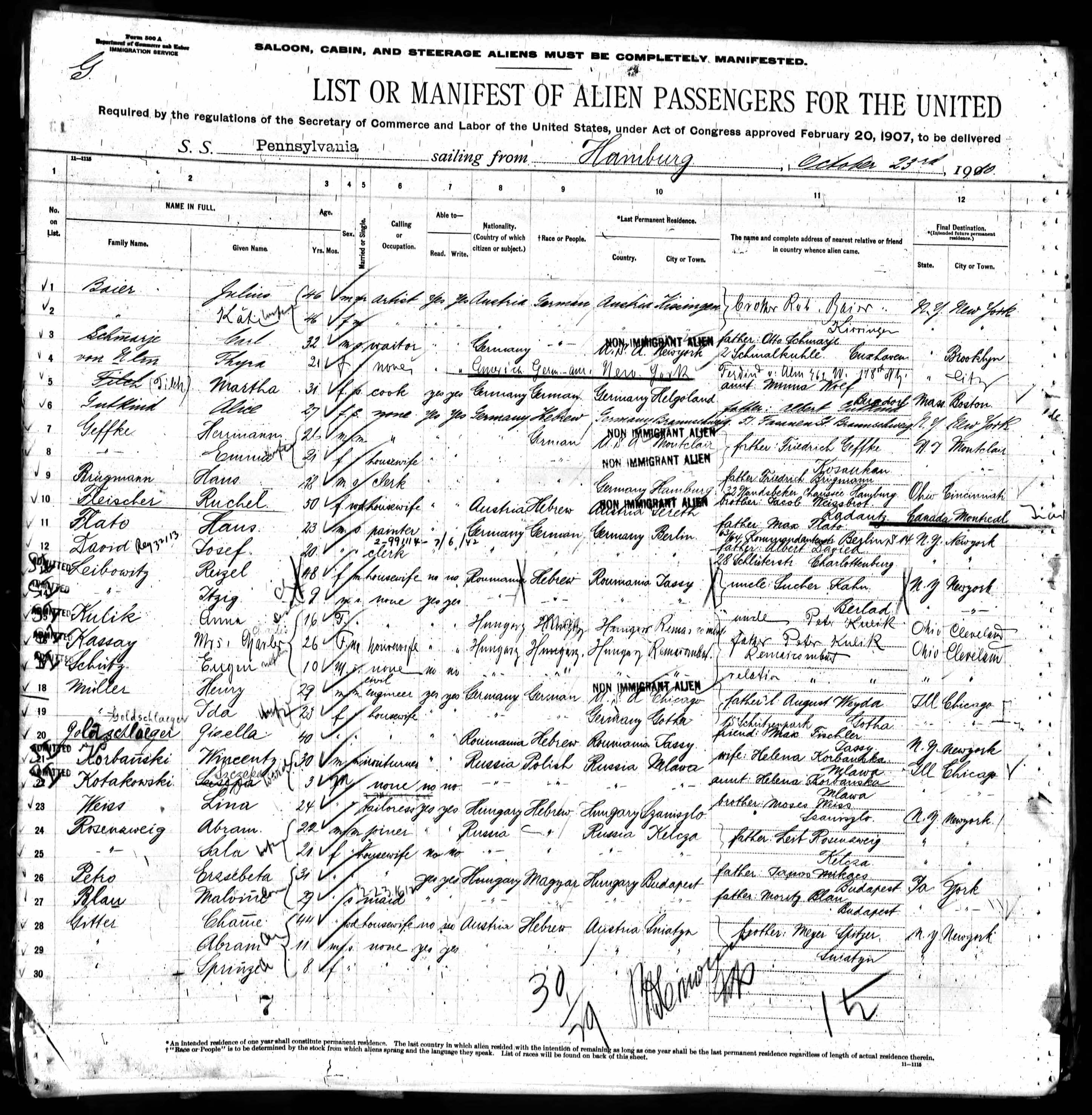
And finally, think about his wife Gisella. She arrived in NYC in November, 1910, seven months after her husband had died. Did she know what was awaiting her? She sailed on the ship Pennsylvania out of Hamburg; the ship manifest does not list who was waiting for her, only the name of someone who resided in her old home, a friend named Max Fischler.

Gisella Goldschlager ship manifest

Gisella Goldschlager ship manifest

But the record from Ellis Island indicates that she had expected to join her husband Morris Goldschlager, but was instead released to her son Isadore. I have no idea how immigrants communicated with their relatives back in Europe in those days or how quickly news could travel from place to place, but since the ship manifest indicates that the ship sailed from Hamburg on October 23, 1910, over six months after Moritz had died, Gisella must not have known that he had died, or why would she have listed him as the person receiving her in New York when she got to Ellis Island? It appears that Gisella did not know until she arrived in New York that her husband had died the previous April. It is heart-breaking to imagine what her reunion with her sons and daughter must have been like under those circumstances.

EDITED: Some of the facts in this post have been updated with subsequent research.  See my post of January 22, 2014, entitled “Update: My Grandfather’s Arrival.”   Also, this one.

English: Immigrants entering the United States...

English: Immigrants entering the United States through Ellis Island, the main immigrant entry facility of the United States from 1892 to 1954. Español: Inmigrantes entran a los Estados Unidos a traves de la Isla Ellis, el mayor lugar de entrada a los Estados Unidos entre 1892 y 1954. (Photo credit: Wikipedia)

Enhanced by Zemanta

The American Immigrant Experience: The Brotman Story

I’ve been looking over the data I have for all the people on our family tree, starting with Joseph through the children born in the 21st century.  By looking at the various ways our family members have supported themselves, we can see a snapshot of the American immigrant story.

On Gussie’s birth certificate in 1895, Joseph’s employment is listed as a wood and coal dealer. According to the 1900 US census, Joseph worked as a coal agent in the Lower East Side. His death certificate also listed his employment as coal agent; on Sam’s birth certificate he is described as a coal carrier.  As you can imagine, this was hard and dirty work. In an article on the coal industry in Michigan, a son recalled how is father would look after working at a coal yard in Michigan: “Dad would use twine to tie his pants and cuffs so not so much coal would get on his skin. He looked like a clown with his pants blowing out, neckerchief around his neck….The dust would crawl up his pant legs—he’d soak his feet up to his knees every night.”  Another son of a man who delivered coal recalled how black the water would be in the tub after his father took a bath.

In a website devoted to the history of a coal company based in Camden, New Jersey, there is the following description of the type of work Joseph did:

“The man would arrive in a wagon with sacks of coal neatly stacked on top. He would climb onto the wagon and move the sacks to the edge ready for unloading. His face and hands would be completely black from coal dust and he wore a cap or head cloth, which hung down his back. He would grab hold of a sack at the top, turn round, bend forward and pull it onto his back. He then had to walk quite a few yards to the coal cellar, maybe down some steps and then ‘pour’ the coal out of the bag.”

At that same time, Joseph’s older children were also working.  In the 1900 census, Hyman is listed as working as a buttonhole maker and Tilly as a flower maker, obviously both working in the sweatshops described in Streets.  They were both just teenagers at the time.  (That same census reported that neither Joseph nor Hyman could read, write or speak English at that time.)

Joseph’s children, however, were able to free themselves from these oppressive and backbreaking forms of employment.

Hyman was still working as a buttonhole maker in 1917 according to his draft registration papers and his naturalization papers, but soon thereafter left the sweatshops. In 1920 he was working as a chauffeur.  In 1925 he was working in Jersey City as a confectioner, and in 1930 he was working as a storekeeper in a cigar store (perhaps for Max?) and apparently supporting not only his wife and children, but also his father-in-law and his brother-in-law and his wife.  In 1940 his occupation is listed as a bookseller in a bookshop, and in 1942 he simply listed himself as self-employed on his draft registration card.  We know from his grandchildren and from my mother that at some point he owned a liquor store in Hoboken.  So Hyman went from being a poor boy on the Lower East Side, working in a sweatshop and not speaking or reading English, to an independent business owner over the course of his adult life.

Max, a conductor on the railroad in 1900, had his own cigar business by 1910, which continued to be his source of income through the 1940s. Tillie also left the sweatshop world after she married, and she and her husband Aaron owned a grocery store in Brooklyn.  Gussie, who helped Tillie and Aaron by caring for their children while they ran their grocery store, married Isadore, who worked at a dairy company as a milkman.  Abraham worked as a tailor for almost all of his working life and in a restaurant in Brooklyn later in his life.  Frieda was working as a “finisher” in the feather business, which I assume was in the garment industry, in 1920, not too long before she married.  Sam worked as a stock clerk, then in the Brooklyn Navy Yard, and ultimately as a cab driver in New York City.

Thus, by 1920 or so, all of Joseph’s children had left the Lower East Side and had found occupations that took them out of the sweatshops.   Three of them became independent business owners, and the others found work in various trades that did not involve breathing in coal dust and carrying heavy loads of coal to tenement buildings.

The next generation continued that trend.  Joseph’s grandchildren became professionals and business owners: teachers, a lawyer, a pharmacist, advertising firms, real estate investment, and retail stores.   When I look at the list of occupations of Joseph’s great-grandchildren, my generation, born in the 1940s through the 1960s, that trend continues.  Although there are fewer of us who own our own businesses, consistent with the decline of the small family-owned business throughout the country, there are still a number of entrepreneurs.  We are also lawyers (fifteen of us, including descendants, their spouses and our children), doctors, teachers of all types, and school administrators.  We are involved in business, finance, sales, banking, the computer industry, and the arts.

Our children, those born in the 1970s through the 1990s, continue in these fields and others—there are a number working in the creative arts and the music industry as well as medicine and the health care, finance, law, business, and the restaurant industry.  You name the field—we probably have someone related to us working in the field.

As for the next generation, those who are still  at home going to school, maybe even still in diapers, we’d like to hope that the possibilities are limitless.  Yes, the world is a more competitive place, houses are much more expensive relative to income than they were for us, the cost of a college education is beyond what anyone would consider reasonable, and the economy is tougher and tighter than it was for many of us when we first entered the job market.

But if a 50-something year old man could drag coal from tenement to tenement to support his family, if our grandparents could rise from sweatshops to become storeowners and tradespeople, if our parents could go the next step and become professionals and business owners, then certainly we cannot be anything but grateful and appreciative and hopeful.  After all, it was only 125 or so years ago that our ancestors first stepped off the boat and into the streets of New York City with nothing to their names, speaking a foreign language, and risking all they had known to take a chance that this life could be better than what they had known.

Streets: Conclusion (Bella’s adolescence)

The rest of the book was harder to read.  As Bella turned twelve and became less innocent, she became more aware of the squalor and ugliness of her world.  She wrote, “I was now twelve and acutely conscious of the sordidness of the life about me.  To escape, I hid behind my books and built up a life of my own in the public school I attended on East Broadway and at the settlement house on Madison Street.” (p. 66)

Her mother married one of the long time boarders and soon was pregnant.  Although their first year of marriage seemed fine to Bella, after the baby was born and soon developed a medical condition that left him scarred and covered with sores, her stepfather abandoned her mother, who was already pregnant with another child. They never saw him again. (There is no explanation of her brother’s condition, but it seemed to continue for several years so was not just a short-term childhood illness like measles or chicken pox.)

Supporting an extra child as a single parent created enough of an additional financial burden for Fanny that she and her children had to move to a less desirable street in the Lower East Side, Goerck Street.  Bella described it as a “tough block” where there were several bars, a lumberyard, and a garbage heap.  There were frequent bottle fights.   Most of the residents of the street were Galician Jews, but there were also Hungarian, German and Russian Jews as well as many Italian immigrants.

Fanny and her children moved their belongings to the new tenement with a pushcart, taking several trips to do so. Bella described the new building as follows:

“Our house, like the others, had four families on each floor, two to the rear and two to the front.  There were two windows to the front room which either faced the street or the yard, one window in the kitchen that faced an extremely narrow, lightless airshaft, and in the bedroom a tiny square window that faced the hall. … Separating the front room from the kitchen is what my mother called a ‘blind window.’  It was simply a square hole, framed by woodwork, which allowed some of the front light to filter into the kitchen and stop at the entrance to the bedroom.” (p. 82)

In this small, dark and airless space, Fanny and Bella found cockroaches and rats.  As before, Fanny took in numerous boarders to help her pay the rent and also took on sewing jobs to supplement her income.

Bella graduated from grade school and was determined to go to high school, unlike many of her classmates and friends who had to go to work in one of the factories in order to help support their families.  Fanny was fully supportive of Bella’s desire to go on to high school, even though she was told by many that she was foolish and should make Bella get a job instead.  Bella enrolled at George Washington High School in Manhattan, about two miles away from the Lower East Side, and was excited to be continuing her education.

Bella, however, did also take on a part-time job, working Sundays as a trimmer at a man’s coat shop on their street.  Her mother also received financial assistance and other support from the United Hebrew Charities and worked long, long hours sewing to earn extra income.   When the second baby was born in May, 1913, the charity covered her rent for the time that Fanny could not work. In return, however, the charity wanted Fanny to consider sending Bella to work full time.  Fanny resisted, and Bella continued to go to high school.  Bella resented having to justify her desire to continue school to the charity.

Bella, however, was now much more aware of the precariousness of their financial condition, and it was often a struggle to pay the rent, which was often paid late and in partial payments.  When she was not at school, Bella took care of her two baby brothers while her mother continued to work as much as possible, taking in sewing work.

Bella’s feelings at this time are poignantly conveyed in the memoir:

“I looked at the sleeping tenements and down at the street strewn with garbage and wet newspapers. Was this living?… It was all so hopeless.  When would it end?”  (pp. 103-104)

Although Bella still loved school and had friends with whom she had some good times, it is apparent that she no longer felt the somewhat joyful attitude she had had as a child.  Although it does seem that their financial condition was worse than it might have been earlier, the poverty and squalor she described must also have been very much present in the neighborhood where she lived when she was younger.   It is likely that as Bella was exposed to more of the outside world through school and books, she also became much more discerning and outraged by the conditions of her own world.

When Fanny finally was unable to pay the rent one month in 1914 and received an eviction notice, Bella offered to quit school.  Fanny refused to consider it, saying that Bella was “going to be a lady. Not like me, a schnorrer!” (p.110) Fanny swallowed her pride and begged the United Hebrew Charities for assistance.  They agreed to give her fourteen dollars, which she used to move her family out of the Lower East Side and up to First Avenue and 49th Street (where the UN now sits).  The charity also provided her with some sewing work.

Thus, Fanny and her children left the Lower East Side and moved to what was then called the Dead End neighborhood, an area of slums that were torn down in the 1920s.  This was not a move up, but a move to a cheaper neighborhood.

The last chapter focuses on Bella’s experiences while living in that neighborhood, a more mixed neighborhood where she had many non-Jewish neighbors.  The accommodation was comparable to what they had had on the Lower East Side, a three room tenement apartment.  Fanny was heavily dependent on United Hebrew Charities for support and grew increasingly despondent over her situation and over the health of her older son. At one point her relationship with Bella was so fraught with tension that Fanny lost her temper and began hitting Bella quite violently.  Bella realized that she needed to get away and spent the summer before her senior year working at a boy’s school in the Catskills as a chamber maid and waitress.

Bella somehow managed to graduate from high school while also holding down various part-time jobs, including working in another factory, tutoring, and helping her mother with extra sewing work.  She also continued to take care of her little brothers.  Right after she graduated from George Washington High School in June, 1917, whatever was left of Bella’s childhood innocence ended abruptly when her sickly little brother died from whatever medical condition had burdened him since infancy.  That is where Bella abruptly ends her memoirs as well.

In an afterword written by Lois Raeder Elias[1], who knew Bella for over thirty years, Elias commented that although Bella ultimately found great personal and financial success, saw the world, and knew many important and impressive people, she was permanently scarred and haunted by her years of poverty, growing up on the Lower East Side.  She never felt financially secure and lived always in fear of poverty.

If the chapters about Bella’s early childhood left me feeling somewhat hopeful about how our family lived on the Lower East Side, the rest of the book left me feeling incredibly sad.  How did our grandparents and great-grandparents cope with these conditions? How did Max, Hyman, and Tillie, all of whom were born in Europe, manage to pull themselves out of poverty and become a cigar dealer, a liquor store owner, and a grocery store owner in one generation?  How did all our grandparents manage to support and raise their children, who all somehow managed to achieve comfortable middle class or better lives in good neighborhoods in NYC and its suburbs?

Reading this book filled me with renewed respect and gratitude for our great-grandparents and grandparents.  We should never forget what they accomplished and what a gift that has been for all of us.

Bessie

Bessie


[1] There was a surprise gift inside this book when I received it.  I had ordered the book from a third party vendor through amazon.com, and inside the book I found a handwritten note by Lois Raeder Elias to friends named Sheila and Alan.  The note reads,”At last we have received copies of Bella’s memoirs. We thought they would never come.  This one is for you.  I hope you enjoy it.  I’ll talk to you this weekend.  On to Turkey! Love,  Arthur and Lois.”

I hope that Sheila and Alan, whoever they were, appreciated this book.  I fear that they just passed it on without ever noticing the card left inside by their friends, Arthur and Lois.

Max Brotman: When was he born?

Here’s another example of the inconsistency of records when it comes to birthdays.  On the 1900 US Census, Max gave his birthday as April, 1878.[1]  [Edited: On his naturalization application in 1900, he listed his birthdate as April 1877.] On the 1910 Census, he reported being thirty years old, meaning he was born around 1880.  On his draft registration in 1918, he gave his birthday as July 7, 1878.  On the 1920 Census, he said he was 45, making his birth year 1875.  In 1930, he said he was 50, meaning he was born in 1880.  In 1940, he claimed to be 60, again meaning he was born in 1880.  On his draft registration in 1942, he put his birthday as March 26, 1880. [2]

Today I received his death certificate.[3]  It has his birthdate as July 27, 1882!  He just kept getting younger (like we all wish we could, I suppose).  Since Hyman was born in either 1882 or 1883 and had a different mother than Max, it seems unlikely that Max was born in 1882.  I am going to assume that the earliest documents are more reliable (when he had less incentive to make himself younger) so that 1878 is the mostly likely year of birth.  As to the month? Who knows? Could be March, April, or July.  As I said in an earlier post, birthdays were not a big deal to Jews in Europe, so maybe he never knew the month, but wouldn’t people know what year they were born? We know Joseph’s age is equally mysterious—he could have been born any time between 1825 and 1855, depending on which document you read.  And Hyman also had two different birth years on his records.

The other inconsistency in these records is the year of immigration for Max.  The 1900 Census says he came in 1888; the 1910 and 1920 say it was 1890.  Finally, the 1930 Census says it was 1893.  I have applied for a copy of his naturalization records (which take 90 days to process, so it will be at least another two months before I get it), so perhaps those will be more accurate. [Edited: The naturalization application said 1882, when Max was at most five years old.]

Sometimes I wonder whether there was a certain level of paranoia among immigrants—people who had faced such hostility and oppression at the hand of the governments of the countries where they were born.  Maybe they just didn’t want to give the US government too much personal information.   Or maybe census takers just weren’t very careful note takers or very good listeners. Or maybe our relatives just liked to lie about their ages.


[1] All the documents are consistent with respect to his place of birth being Austria, though none specifies the town or city. [Edited: The naturalization application said Germany.]

[2] These documents are available on ancestry.com.  If anyone is interested, I can download them and post them on the blog.

[3] More on his death certificate tomorrow.  I want to scan it and won’t get a chance tonight.