Arthur Lewis Wilde Cohen 1890-1955: Family Lore and The Tricks of Memory

Arthur Lewis Wilde Cohen, Sr.

Arthur Lewis Wilde Cohen, Sr.


When I first started researching my Cohen relatives about a year and a half ago, I was very fortunate to find one branch on that tree already recorded on ancestry.com by one of the direct descendants of Reuben Cohen, my great-granduncle.  The tree was created by the grandchild of Reuben and Sallie’s son Arthur Lewis Wilde Cohen.  I contacted the tree’s owner, and we exchanged a series of emails that established our family connection and that provided me with some wonderful background on Arthur Lewis Wilde’s children and grandchildren as well as some photographs.  This newly found third cousin of mine, Jim, was very helpful when it came to his father’s generation, but said he knew very little about the lives of his grandfather Arthur Lewis Wilde Cohen, Sr.,or his great-grandfather Reuben.

I filed away all the information and the photos my new cousin Jim shared with me, and then began to focus on my Brotman relatives, putting the Cohen research to the side for many months.  When I returned to the Cohens this spring, I dug up the information I’d gotten from Jim. In researching more deeply into the life of Arthur Lewis Wilde Cohen and his family, I experienced what all family researchers experience—that although family stories can almost always be very helpful in providing clues and richness to family history, you have to take into account that details often get blurry as stories are passed down from one generation to the next and that some facts are lost along the way. It took me some doing to untangle the family stories and find the facts, but with more research and more email conversations with Jim, I think I can now piece together the life of Arthur Lewis Wilde Cohen and his family.

Number eleven out of seventeen, Arthur Lewis Wilde was born on February 26, 1890.  In 1910, he was a clerk in a “brokerage.”  At first I thought this referred to the pawnbroker business, but since his two brothers Reuben, Jr. and Lewis II, were listed as clerks in a loan office, not a brokerage, I was not sure.  Apparently he was an insurance broker, as I found out from his draft registrations.

In December 1915, when he was 25, Arthur became engaged to Gertrude Fanny Bowman of Richmond, Virginia, and they were married on March 27, 1916, in Richmond.

arthur engagement

(“Will Hold Reception December 26,” Date: Sunday, December 19, 1915 Paper: Philadelphia Inquirer (Philadelphia, PA) Volume: 173 Issue: 172 Section: News Page: 5)

According to his 1917 World War I draft registration, Arthur was self-employed as an insurance broker, and he and his wife Gertrude were living in Philadelphia at 2250 North 20th Street.

Arthur LW Cohen, Sr. World War I draft registration

Arthur LW Cohen, Sr. World War I draft registration


Arthur enlisted in the Navy in April, 1918, and was honorably discharged in December, 1920.  By 1920, however, Gertrude was back in Richmond, living with her sister and identifying as single and working as a stenographer.

Gertrude Fanny Bowman 1920 census

Gertrude Fanny Bowman 1920 census

I cannot find Arthur on the 1920 census as he was serving in the military and perhaps overseas, but presumably the marriage with Gertrude was over.  Gertrude apparently never remarried and died in 1963 in Richmond.

Emilie Wiley Cohen

Emilie WIley Cohen

By 1930 Arthur had married a woman named Emilie Wiley, who had also been previously married.  Emilie had married Frank G. Brown in 1905 and had had two daughters with him, Dorothy, born in 1906, and Jean or Jenette, born in 1908.  Emilie also was divorced or separated by 1920, and sometime after the 1920 census she married Arthur LW Cohen.  They had two children, Arthur, Jr., and Emilie, who were 8 and almost 5, respectively, at the time of the 1930 census.

Living with Arthur and Emilie in 1930 in Philadelphia, in addition to their two own children Arthur, Jr. and Emilie,  were Emilie’s mother, aged 81, Emilie’s daughter Jean Harral, and Jean’s son Richard Harral, Jr.  Emilie’s older daughter, Dorothy (or Dot, according to my cousin) had married Leroy Lewis in 1928 in Norristown, Pennsylvania, and was living out that way in 1930.  She and Leroy had one daughter, and Dot lived in Norristown until her death in 1992.

Jean had also married sometime before 1927 when Richard Harral, Jr. was born.  Although she still listed her status as married in 1930, she was apparently no longer living with Richard Harral, Sr., who eventually remarried and lived in Upper Darby, Pennsylvania for the rest of his life with his second wife and their two children.

Sometime after 1930, Arthur and Emilie moved permanently to Cape May, New Jersey, where they lived in the house at 208 Ocean Street that had been in Arthur’s family for many years as the summer home of Reuben and Sallie and their children when Arthur was growing up.  Although I cannot find Arthur on the 1940 census, according to his World War II draft registration, he was still living at 208 Ocean Street in 1942 and was self-employed, working at the Land Title Building in Philadelphia.
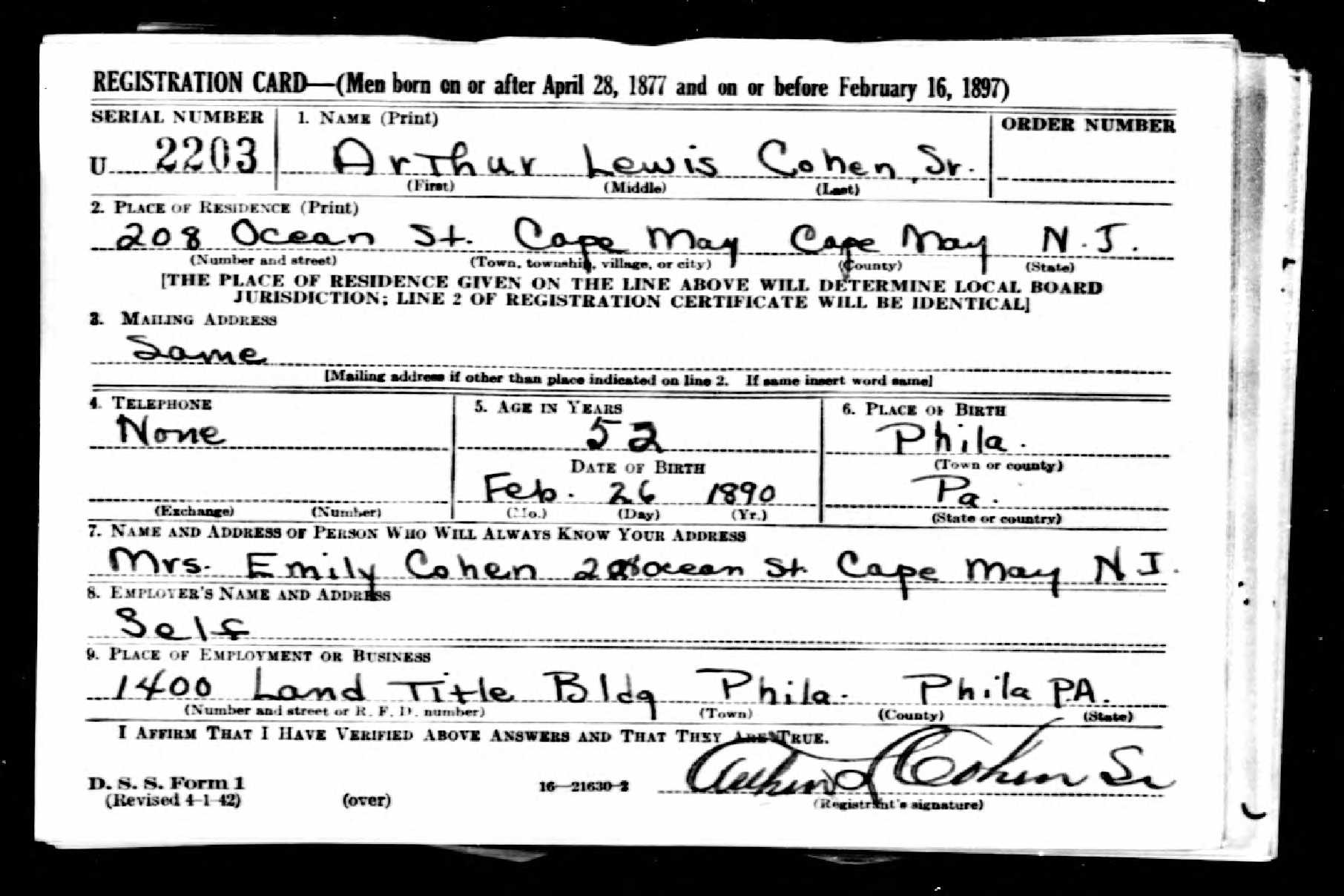
ALWC ww2 reg

Arthur Sr’s grandson Jim believed that his grandfather had been a jeweler, but I cannot find any evidence of that in the records as it appears that at least up until 1942, Arthur Sr. was still working in the insurance business in Philadelphia. What Jim did share with me was that his grandfather was well-respected and loved by many people.  He was a very humble and generous man who never wanted recognition for his generosity.

Arthur, Sr, was also someone who fought off death several times.  According to Jim, “He was erroneously pronounced dead four separate times (shades of Simon), all as a result of heart attacks. According to stories told by my father and aunt, on one of the occasions he woke as an orderly was wheeling him to the morgue. When he did, the orderly fainted.  The fifth and final pronouncement was also from heart attack he suffered in the family home on Ocean St. This time, it was permanent.”

He died in 1955 at age 65 and was buried at Presbyterian Cemetery in Cold Spring, New Jersey, less than four miles from the family home at 208 Ocean Street.

His widow Emilie applied for a military headstone for Arthur and requested a Christian, not a Hebrew, symbol to be placed on that headstone.  Although his mother Sallie may not have been Jewish, as noted earlier, Arthur had been confirmed in Mickve Israel Synagogue in Philadelphia when he was fifteen years old.  Then again, his father Reuben had made a donation to the Episcopal Church in Cape May.  I asked Jim about the family’s religious affiliation, and he told me that he was not sure whether his grandmother Emilie was born Jewish, but that both of his grandparents practiced Christianity after they were married. Despite this, Jim said that his father, Arthur LW Cohen, Jr., was Jewish and Jim himself is Jewish.  As Jim described his parents’ approach, I was amazed by how inclusive his parents were in their approach, letting each of their children find a path that worked for them, each parent maintaining their own chosen path but also sharing in and respecting the other’s chosen path.   Apparently his grandparents had done the same.

Arthur L W Cohen, Sr. Military Headstone application

Arthur L W Cohen, Sr.
Military Headstone application

Jim was able to tell me a great deal about Arthur and Emilie’s children, Arthur, Jr., and his sister Emilie.  With his permission, I am quoting directly from his messages to me about his parents:

My father, Arthur, Jr. (“Bud”), was also a jeweler. After he came home from World War II, he opened a repair and retail jewelry store on the first floor of the family home at 208 Ocean St. in Cape May, NJ. It remained open for the next 48 years until his death in 1991.

Arthur Lewis Wilde Cohen, Jr.

Arthur Lewis Wilde Cohen, Jr.

He was very active in the Cape May community and loved the city dearly. He was president of the Mall Merchant’s Association for over 20 years, was instrumental in having the entire city declared a National Historic Landmark (it’s one of the few full towns registered as such) for its standing Victorian-era homes and history; and if there was any event – from silly pet parades to building dedications, Memorial Day ceremonies, Easter, Halloween, Christmas parades, and so on, you name it – he was always the Master of Ceremonies. He had a fatal heart attack in the early-morning hours of February 18, 1991.

My mother, Martha, was a music teacher and opera Soprano who attended the Juilliard School of Music. She retired from her opera career almost as soon as it started so that she could marry my father. She became a music teacher and sang at many events and functions. The Goodyear family always contacted her to sing at their family events – mainly weddings and funerals (which always amused me). She died in 2005 following a series of strokes.

He also told me this about his Aunt Emilie:

Aunt Emily Marion Cohen-Brown (who went by “Marion” or, as a nickname I’ve never understood, “Mitchell”), was a first-class florist and lived here in Cape May until her death from cancer in 2003. She had one son, Gary, who lived in Oregon and made unbelievable fudge. I know he had a wife and kids, but we’ve lost contact. He predeceased her, also from cancer. I never met her husband, Harry, who died before I was born. She made the absolute best Navy bean soup you could ever taste, and I wish I had the recipe.

Although not a genetic relative of the Cohens, the story of Arthur Sr.’s stepdaughter Jean Harral and her son Richard is part of the family lore of Arthur Lewis Wilde Cohen and his descendants, so I will share it here.  Richard was mentally disabled, and at some point he and his mother Jean moved to New York City together.  Richard was working as a messenger for a company in New York, and his favorite pastime was sailing a model sailboat on the pond in Central Park.  In November, 1975, he was stabbed to death, apparently by a friend.  I could find no record of a trial or further development in the case aside from these few news articles from the New York Times.

Richard Harral murder part 1-page-001


Richard Harral murder-page-001

In December, 1975, just a month after Richard’s murder, his mother Jean died; accordingly to family lore, she starved herself to death out of grief over the death of her son.

I am deeply indebted to my cousin Jim for sharing his family’s stories with me as well as the photographs posted here.  There is nothing more meaningful for me in doing this project than hearing about my long-lost relatives from those who knew them best.


The Pawnbrokers: Not Reality TV, but Realities

Tradition symbol of pawnbrokers--three connect...

Tradition symbol of pawnbrokers–three connected balls (Photo credit: Wikipedia)

Growing up, I always heard my father’s family’s business referred to as jewelry and/or china dealers; I don’t recall them being described as pawnbrokers.  Maybe I just wasn’t listening (quite likely), or maybe that’s how my father explained it when I was too young to understand what “pawnshop” meant.

Anyway, I never thought of them as pawnbrokers.  My image of a pawnbroker was based on what I saw on crime shows on television, in movies like The Pawnbroker, and through windows as we drove through poor neighborhoods in New York.  The pawnshop was a place for either desperate people in need of money or criminals fencing stolen goods.  The pawnbroker was someone who was thus taking advantage of someone’s misfortune or the willing or unwitting participant in a crime.  I know of two incidents where my ancestors aided the police in solving crimes, so I am hoping that they were not complicit in receiving stolen goods, but were they taking advantage of the misfortunes of others?  Was this just a stereotype promoted in popular culture? Were pawnbrokers actually parasites, usurers, or were they providing a much needed service?

The Pawnbroker (film)

The Pawnbroker (film) (Photo credit: Wikipedia)

Interestingly, I had not really focused on this as I was researching until I could not decipher a word on the 1910 census for Joseph Cohen’s occupation, as I posted earlier this week.  I had asked for help here and elsewhere to decipher the word.  Several people expressed the same opinion—that the word is “loan office.”  As one person commented, it was just a nicer term for a pawnbroker.  Joseph may have been attempting to convey a less controversial image of his occupation.

I decided to do some reading to see what I could learn about pawnbrokers.  First, I wanted to better understand how the pawn business works.  I know that there are now a few reality television shows based on pawnshops, most notably Pawn Stars.  (One of my students brought this up in class this year during a discussion of bailment contracts, and I was sure he had said PORN Stars.  Just shows how uncool I can be….)  I read a few definitions and websites online about how pawning works, and this one seemed to be fairly accurate and concise, from Dictionary.com: “a dealer licensed to lend money at a specified rate of interest on the security of movable personal property, which can be sold if the loan is not repaid within a specified period.”

Wikipedia has a more expanded definition:  “If an item is pawned for a loan, within a certain contractual period of time the pawner may redeem it for the amount of the loan plus some agreed-upon amount for interest. The amount of time, and rate of interest, is governed by law or by the pawnbroker’s policies. If the loan is not paid (or extended, if applicable) within the time period, the pawned item will be offered for sale by the pawnbroker. Unlike other lenders, the pawnbroker does not report the defaulted loan on the customer’s credit report, since the pawnbroker has physical possession of the item and may recoup the loan value through outright sale of the item. The pawnbroker also sells items that have been sold outright to them by customers.”

So a person who needs money but for some reason cannot obtain a bank loan—insufficient credit, time pressure, some other reason that makes a bank an impractical choice—can take their property—jewelry, household items, clothing, whatever—to the pawnshop; the pawnbroker assesses the value of the items and provides a loan of cash to the person who agrees to pay with interest within a set period of time or to forfeit the personal property.

Since the pawnbroker must be licensed and since there are numerous state and federal regulations that apply to the business, there is nothing inherently shady about this business. It is a legal method of loaning money to those who choose not to go to a traditional bank.  So why is there an aura of shadiness often associated with the business?

Wendy A. Woloson wrote a book entitled In Hock, Pawning in America from Independence through the Great Depression (2006) that addressed just this question.  She wrote:

Pawnbrokers were at once essential to the continued well-being of this economic system and important scapegoats for the various social ills that the financial difficulties it brought.  Loans from pawnshops supplemented substandard wages, enabling workers to continue to feed their families and producers to continue to exploit their workers.  Although industrialists indirectly benefited from the services pawnbrokers provided, it was also in their interest to encourage the idea that pawnbrokers were fringe operators whose business had no place in the “mainstream” economic system. (p. 21)

Woloson contended that these capitalists promoted an image of pawnbrokers as hard-hearted, greedy and criminally inclined foreigners who used shady practices to exploit their customers. She also asserted that there was a fair degree of anti-Semitism behind these stereotypes.   Although not all pawnbrokers were Jewish, many were.  As Woloson explains, “Jews’ involvement with pawnbroking resulted not from any inherent character flaws or moral failings, as the popular press often posited. Rather, they took up pawnbroking and like occupations largely because they were barred from other trades, especially the mechanical and artisanal, and so necessarily developed an acumen dealing in consumer goods as peddlers, used clothing dealers, and auctioneers.”  (p. 71)

Of course, the negative stereotype of the Jewish moneylender is far more ancient than 19th century America; Shakespeare’s character Shylock from Elizabethan times is evidence of the way society and popular culture have long depicted Jews who were involved in the lending business.  Woloson elaborated on the role this stereotype and the anti-Semitism in society in general had on the popular assumptions about pawnbrokers—that they were Jewish opportunists taking money from hard working Americans.  (pp. 21-24)

Pawnbrokers were aliens in a commercial world populated by supposedly moral and upright Christian entrepreneurs, and the very nature of the business set it apart from ‘normal’ economic dealings.  The antithesis of merchants, pawnbrokers doled out money instead of taking it in, profiting from customers who lacked capital rather than possessed it. (p. 29)

As Woloson wrote, “Jews’ affiliation with pawnbroking and affiliated trades, such as dealing in used clothing and auctioneering, created among them a cohesive, commercially defined group; yet it also reinscribed outsiders’ perception that they operated beyond the currents of mainstream trade.” (p. 25-26)  Woloson explained that since most Americans in the early 19th century did not know many Jews, their preconceived image of the Jew as a greedy moneylender was reinforced by the fact that many pawnbrokers were Jewish. “It mattered little whether or not individual pawnbrokers were Jewish. Because they were all assumed to be, people scrutinized their business practices and questioned their ethics.” (p. 26)

Even as many Jews achieved substantial economic success through other businesses and finance in the 19th century, there was a common assumption that they had done so illegally, and the stereotype of the greedy, heartless moneylender persisted as part of popular culture. (p.28)  Pawnbrokers became common stock characters in works of popular culture, further promoting the negative and anti-Semitic stereotypes; Woloson catalogs a number of examples of novels and plays using such characters based on this stereotypes (pp. 28-53).

Woloson then provides evidence that in fact pawnshops served important public functions and were set up in ways to prevent exploitation of those who used their services. She describes how as cities grew and people outside the wealthy classes needed access to cash on short notice—to pay taxes or acquire assets they need to live or to work, there was a need for the services of pawnbrokers.  In the early 19th century, cities began to adopt regulations for pawnbroking.  I saw many legal notices in the Philadelphia Inquirer announcing the issuance of pawnbroking licenses to my ancestors and others. These required the posting of an expensive bond and thus ensured a commitment by the pawnbrokers to run their businesses in compliance with the regulations.  (pp.  54-57)

These local regulations controlled both the interest rate a pawnbroker could charge and the period a pawnbroker had to wait before the customer’s goods would be forfeited to the shop and available for sale.  For example, in Philadelphia in the 1860s, the interest rate could not exceed 6% and the pawnshop had to hold collateral for a year before reselling it. (p. 58)

Pawnbrokers hoped that this would add some legitimacy to their business and to their image, but apparently that did not occur.  As Woloson wrote:

Pawnbrokers were hardworking people who offered what was fast becoming a necessary service in maturing American cities, providing short-term loans on modest forms of collateral. Yet their profession, like dogcatching, was not one that people aspired to. Unlike clerks and mechanics, who received education through apprenticelike training and shared social activities, pawnbrokers enjoyed neither professional prestige, identity, specialized education, nor occupational camaraderie.  (p. 58)

According to Woloson, most pawnbrokers learned the trade by starting out as general dealers in goods, learning how to assess the value of those goods.  This is consistent with the experience of my ancestors.  First, they sold used goods and then perhaps newer goods, including china and clothing primarily.  Then they became pawnbrokers.  “A lasting and successful career in pawnbroking rested on one’s ability to identify local market niches and to accurately appraise a miscellany of goods.” (p. 60)

In Woloson’s opinion, these pawnbrokers provided substantial benefits to the people and the cities they lived in.  The money borrowed from the brokers helped not only their customers, but the economy of the city by enabling those people to buy goods and services and thus support local businesses.

She also discusses the typical patterns of the pawnbroking business in various cities, including Philadelphia.  Woloson noted that pawnshops tended to locate in areas that sold used clothing and furniture and other second hand goods rather than in the commercial heart of the cities where more elite retail centers would be located.  In Philadelphia, that meant that most pawnshops were located either north or south of the center of the city in areas, for example, like South Street where my great-grandfather’s pawnshop and home were located for many years.  Woloson provides this insightful description of that neighborhood in the mid-19th century:

Unburdened by any systematic police control, the diverse population and its many activities brought a liveliness to these areas. The very rich and the very poor mingled freely, as did members of various ethnicities and races. While this social mixing may have been scandalous to outside observers, residents themselves shared the collective ambition of getting ahead. The neighborhood’s mixed population at midcentury engaged in many enterprises. They drank, whored, pilfered, and occasionally rioted their way down South Street. By 1839 there were at least sixty-two taverns in the ten-block area.39 Men had their pick of brothels. ….  Some back alleys harbored “houses of prostitution of the lowest grade, the resort of pickpockets and thieves of every description.” Strangers were “earnestly admonished to not go there.” In contrast, another brothel only a few blocks away was home to a respectable “swarm of yellow [mulatto] girls, who promenade up and down Chestnut Street every evening, with their faces well powdered.” The lower sorts needed pawnbrokers to get them through the exigencies of the day and to fund their debauchery at night. Ten of the city’s thirteen pawnbrokers in 1850 were on South Street or within one block of the corridor. Rooted, the shops continued to hem the southern and northern fringes of the city until the end of the century.  (pp. 64-65; footnotes omitted)

H. Williams & Co. Ltd. Pawnbrokers

H. Williams & Co. Ltd. Pawnbrokers (Photo credit: christopher.woo)

This description gave me a far different impression than I previously had about how and where my great-grandfather Emanuel and his many siblings grew up; whereas I had never assumed that this was a wealthy neighborhood, I had assumed it was fairly safe and middle-class since Jacob had servants and a business that supported so many people.  Did my great-grandfather grow up hungry?  Probably not, but neither did he grow up in some swanky suburb or upscale city neighborhood.  He grew up surrounded by thieves, pickpockets, brothels, and bars.

These locations were, in Woloson’s view, business necessities.  The people who needed the services of the pawnbrokers were not the wealthy who shopped at fancy stores, but the working class and poor residents who could not get by without a quick and fairly easy loan.  Woloson opines that in some ways pawnbrokers were more straightforward businesspeople than those who used sales techniques to manipulate customers into buying goods.  In Woloson’s view, “Pawnbrokers made no pretense that they did anything other than loan money, and in this way many may have been more honest professionals than the retailers pushing goods on the other side of the city.” (p. 67-68)

Another pattern observed by Woloson was the tendency of pawnbrokers to expand and pass down their businesses within their families.  “Established, successful pawnshops were often passed down through single families rather than being taken over by outside partners; younger generations grew up in the trade and learned from fathers, uncles, and brothers, thus providing steady income to families over generations and contributing to social and economic stability where pawnbrokers resided.”  (p. 74)

Finally, Woloson also discusses the relative economic success of pawnbrokers, debunking the myth that many were wealthy as a result of the exploitation of those of lesser means.  She wrote:

Like many other businessmen operating in interstitial markets, most pawnbrokers worked the margins. Once they reached their professional apex, they typically did not advance much beyond the class of their customers and failed to accumulate enough capital to invest in larger financial endeavors that would have elevated them socially and economically. A pawnbroker’s profits were tied to the economic fortunes of his customers, and he often suffered losses at auctions of unredeemed collateral, especially during economic crunches. Pawnbrokers running shops in smaller cities necessarily supplemented the lending business with other petty entrepreneurial activities. Average pawnbrokers made enough money to support their families and to keep the business going, but probably not much more.  (p. 75)

I am really glad that I found this book because it has really given me a new perspective on my Cohen ancestors.  Compared to my Brotman and Goldschlager relatives, I’d always imagined that my Cohen relatives were wealthy and established.  Of course, by the late 19th century, early 20th century when my mother’s family started to arrive from Galicia and Romania, the Cohens had already been here for about 50 years and were well-settled, owning their own businesses, speaking English, and American-born.  They had the advantages of being here much earlier and so were far ahead economically when my mother’s family arrived.  But they were not the wealthy elite; they were probably at most middle class business people who were working in unpleasant neighborhoods, subjected to negative stereotypes based on their trade as well as their religion, and engaged in a business that required some risk-taking and business acumen but was not well-regarded.  That must have been very painful and frustrating.

Having this new perspective will help me better understand their lives as I continue to move forward in telling their story.


.

Enhanced by Zemanta

All Things Considered, I’d Rather Be in Philadelphia

W.C. Fields, who was born in Philadelphia, used to make fun of his birthplace as a staid and boring place by threatening to have the line, “All things considered, I’d rather be in Philadelphia,” as the epitaph on his gravestone.  (Apparently, that threat was never carried out.)  Philadelphia has often been overshadowed by New York to its north and by Washington to its south.  I remember traveling to Philadelphia to visit my relatives when I was a child, my siblings and I fidgeting in the back seat of the car as my father fought through the traffic on the ugly New Jersey Turnpike.

English: W.C. Fields

English: W.C. Fields (Photo credit: Wikipedia)

My grandmother Eva Cohen and her second husband Frank Crocker lived in what I remember as a small apartment in Philadelphia, and somehow it was always hot and humid whenever we visited.  I was only nine when my grandmother died, so my memories are somewhat vague, but I do remember watching a baseball game with Poppy Frank, as we called him, discussing the merits of Sandy Koufax versus Don Drysdale (the Phillies were obviously playing the Dodgers that particular visit).  We would sit and visit for a while, have lunch or dinner, and then pile back in the car, suffer through the Jersey Turnpike again, fidgeting and bickering in the backseat.  So I guess I could relate to W.C. Fields’ sentiments about his hometown.  Somehow I associated Philadelphia with long car rides, being tortured by my siblings, and hot, humid weather.  I wish I could remember more about my grandmother, but as a child, I was focused on childish things. Well, and baseball.  As I wrote before, I remember her as beautiful, reserved, and very dignified, a true gentle-woman in both senses of the word.

So given my somewhat skewed views of the City of Brotherly Love, I did wonder why my Cohen relatives (and in fact all of my father’s lines) ended up in Philadelphia.  They sailed into New York City—why did they leave the Greatest City in the World to go to its poor stepsibling to the south? I asked my father, who was born and raised in Philadelphia, this question the other day, and he said something about William Penn and how Philadelphia was a Quaker city and probably more tolerant of Jews.

I decided to do some research to answer a couple of questions: What was Philadelphia like for Jews in the 1840s and 1850s when the Cohens arrived? Where did they live in the city, and what were the socioeconomic conditions like in those areas? What drew them there instead of New York or some other American city?

I found a wonderful resource, a book by Robert P. Swierenga, a historian who has published several books about the Dutch in the United States.  The book I relied on is titled The Forerunners: Dutch Jewry in the North American Diaspora (Wayne State University Press 1994), and in it Swierenga traced the immigration of Dutch Jews to America and their settlements in several US cities, including Philadelphia.  I read the chapter on Philadelphia and learned not only about the Dutch Jews who settled there, but more generally about the history of Jews in Philadelphia.  After reading this chapter, I better understand why the Cohen family decided to settle there.

Philadelphia had one of the earliest Jewish communities in the United States.  In 1776 it had the third largest Jewish population of American cities, after New York and Charleston; there were 300 Jews living in Philadelphia at that time.  That number grew to 200 families by 1778 as Jews sought refuge there during the Revolutionary War.  The population was largely Sephardic, and the first synagogue was formed in 1782, Congregation Mikveh Israel, an Orthodox Sephardic synagogue.  Once the war ended, however, many of the Jews returned to their prior homes, and by 1790 there were only 25 Jewish families or about 150 people.  (Swierenga, pp. 118-119)

English: Former home of Mikveh Israel Synagogu...

Former home of Mikveh Israel Synagogue

There was a growing number of non-Sephardic Jews settling in Philadelphia after the Revolution, however, as immigrants from Germany, Poland and the Netherlands began to arrive, and in 1790 these people formed a new synagogue, Rodeph Shalom, which would adhere to Ashkenazi practices.  Rodeph Shalom was the first Ashkenazi synagogue in North America, and most of its first congregants were Dutch.  (Swierenga, pp. 119-120)

Rodeph Shalom Synagogue on the NRHP since Augu...

Rodeph Shalom Synagogue on the NRHP since August 7, 2007. At 607–615 North Broad St., in the Poplar neighborhood of Philadelphia. (Photo credit: Wikipedia)

The Jewish population really started to grow in the early 19th century.  In 1820, there were 450 Jews in Philadelphia; in 1830 there were 730.  By 1840, there were 1500, and then there was a huge surge to 6000 by 1850 and to 10,000 by 1860.  This, of course, was the period my Cohen relatives began to arrive in Philadelphia—between about 1848 and 1851.  In fact, according to Swierenga, a substantial number of these Jewish immigrants were Dutch Jews.  (p. 120)

In his discussion of Dutch Jews, Swierenga included not only those who came directly from the Netherlands (meaning primarily Amsterdam), but also those, like my ancestors, who had emigrated from Amsterdam to England before coming to America.  Based on his research, he concluded that for the most part the Dutch Jews who came to Philadelphia tended to come directly from Amsterdam whereas those who had first stopped in London tended to end up in New York.  Swierenga found that in 1850 and 1860 there were only two Dutch Jewish families in Philadelphia who had had children born in England. (Swierenga, p. 125)  Was he counting my relatives? Hart Levy Cohen’s children were born in England, but did they count as “children?” On the other hand, Jacob’s daughter Fannie was born in England, and although his later children were born in the US, his family must have been one of those two families.

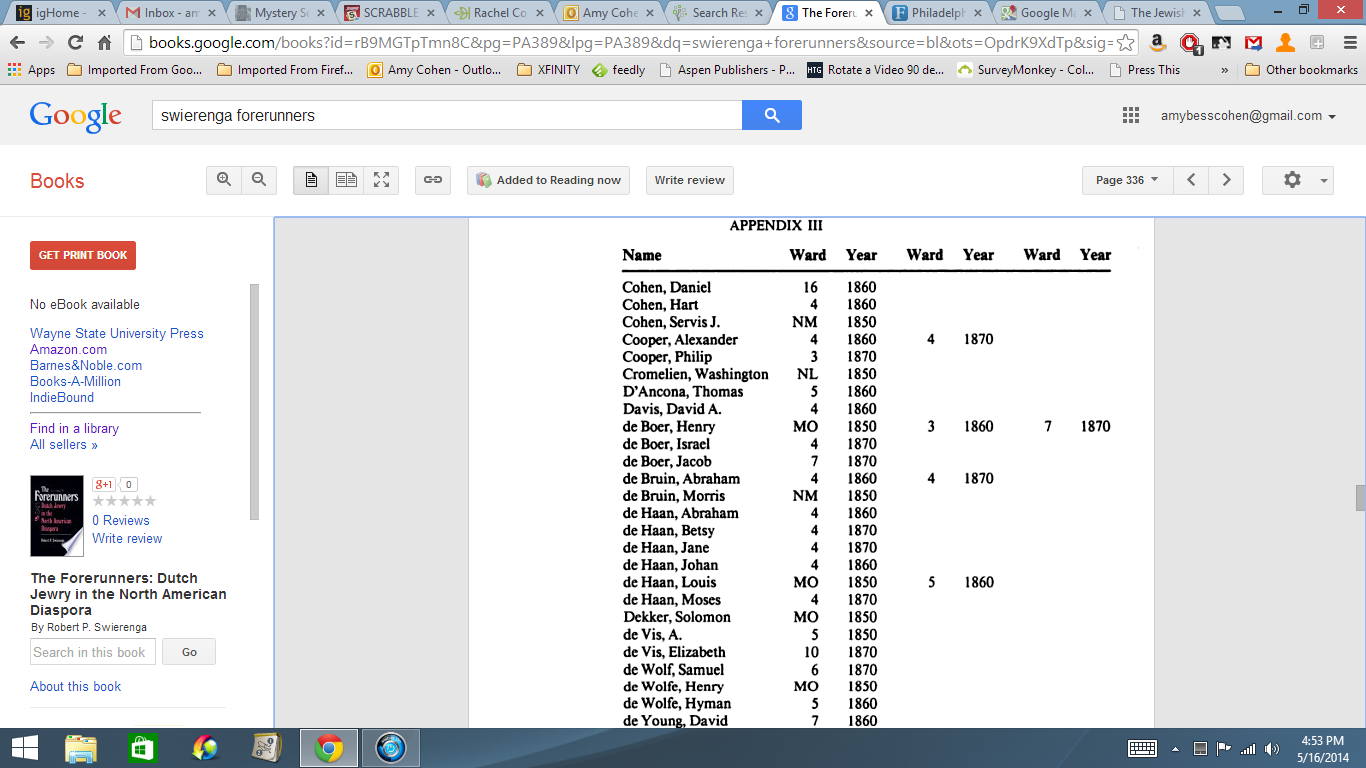
In fact, this screenshot from Appendix III in Swierenga’s book, captioned “Dutch Jewish Household Heads and Working Adults in Philadelphia 1850, 1860 and 1870,” shows that Swierenga did count Hart Cohen as one of those Dutch Jews.

Appendix III from Swierenga. The Forerunners

Appendix III from Swierenga. The Forerunners

Based on this data as compared to his findings that there was a greater number of Dutch Jewish families in New York with children born in England, Swierenga reached the following conclusion: “Clearly, the Dutch Jews in Philadelphia had been better off economically in the Netherlands, and they immigrated earlier than those settling in New York, who out of economic necessity spent a longer sojourn in London.  For the Philadelphia Dutch Jews, a London stopover or two-stage migration was not as necessary or desirable.” (p. 126)

I found this observation very interesting. Obviously, my ancestors did make that two-stage migration.  Did they do that because they could not afford to get directly to the US, or did they originally plan to stay in London?  Does this mean that Hart and Rachel were not as well-off as many of the other young couples who left Amsterdam at the end of the 18th century?

The Dutch Jewish community was located in the south side of Philadelphia. With the large wave of German immigrants in the 1840s, the Dutch Jews had moved south to Wards 1 through 5, and primarily Wards 4 and 5, located between what is now Broad Street and the Delaware River and South Street to the south and 2d Street to the north.  Swierenga described these two wards as slums.  Ward 4 is where Jacob and his family lived for many years at 136 South Street.   Was he living in a slum with his large family and three servants? It seems unlikely.  The neighborhood must have been somewhat economically diverse to attract what Swierenga himself had described as a fairly comfortable Dutch Jewish population.  (pp. 139-146)

This growing community of Dutch Jews eventually decided to form their own synagogue and leave Rodeph Shalom, which had become increasingly made up of congregants who had emigrated from Germany.  Also, Rodeph Shalom and Mikveh Israel as well as a third synagogue, Beth Israel, were all located in the north side of Philadelphia.  (Swierenga, pp. 127-129) Thus, in 1852 the Dutch Jewish families formed their own synagogue, B’nai Israel, on the south side where Jacob and Rachel were living in 1850. (pp. 130-145)

Between the 1850s and 1880, however, the Dutch Jews increasingly left the south side of Philadelphia and moved to neighborhoods further north.  Those who remained could not support their own synagogue, and B’nai Israel was closed in 1879.  By the end of the 19th century, the Dutch Jewish community had integrated into the larger Jewish community and had disappeared as a separate cultural subgroup.  (pp. 135, 320)  As I move forward from 1860 in tracing my Cohen relatives, I will keep in mind this shift to see whether or not they were a part of that trend.

After reading this material and understanding more about the history of the Jewish community in Philadelphia in the first half of the 19th century, I better understand why my ancestors chose Philadelphia.  It had a distinct Dutch Jewish community, which might have been very attractive to them after the Chut experience as outsiders in London.  It had a long history of a diverse but cooperative overall Jewish population.  And perhaps, like today, it seemed less overwhelming and more affordable than New York City.

I now read, “All things considered, I’d rather be in Philadelphia” in a whole new light.

Enhanced by Zemanta

Hart Cohen and Family 1851-1860: Philadelphia

Philadelphia, circa 1860, from the Library of Congress Prints and Photographs Division

By 1860, almost all my Cohen relatives had left England and moved to Philadelphia.  Only Moses Cohen remained behind.  My great-great grandfather Jacob Cohen had emigrated from England to Philadelphia in 1848 with his wife Sarah and his daughter Fannie.  Although I am not certain as to when Lewis, the oldest brother, left England, these naturalization papers dated October 27, 1848, appear to be his, meaning that he had left England earlier than Jacob.

UPDATE:  I now believe that Moses also had left England around 1848.  See my subsequent post.

Lewis H Cohen naturalization ED PA 1848

Lewis H Cohen naturalization ED PA 1848

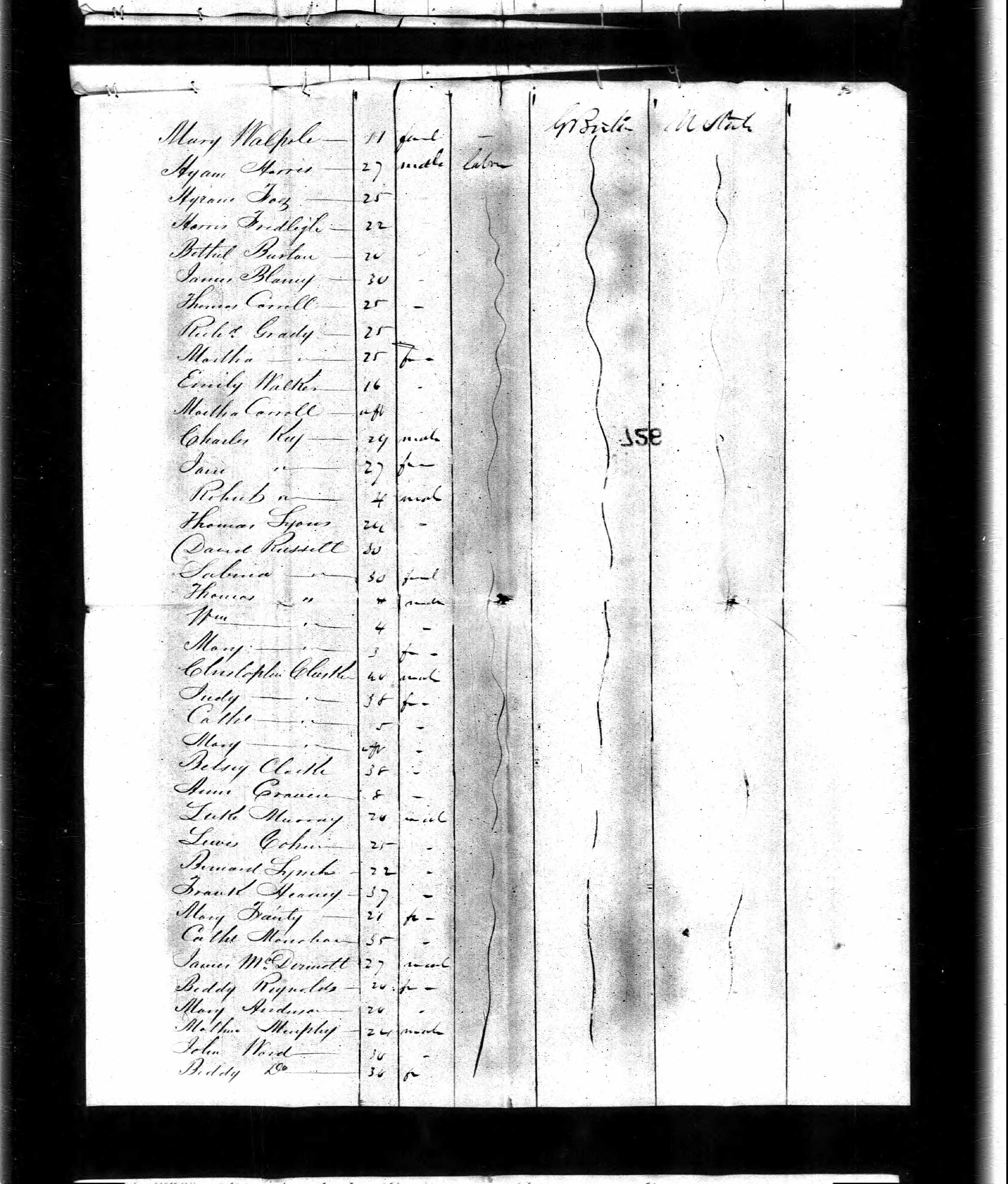
I have located one 1846 ship manifest from England to New York with the name Lewis Cohen on it.  The ship manifest is for the passenger ship Ward Chipman, sailing from Liverpool to New York, arriving in New York on August 12, 1846.
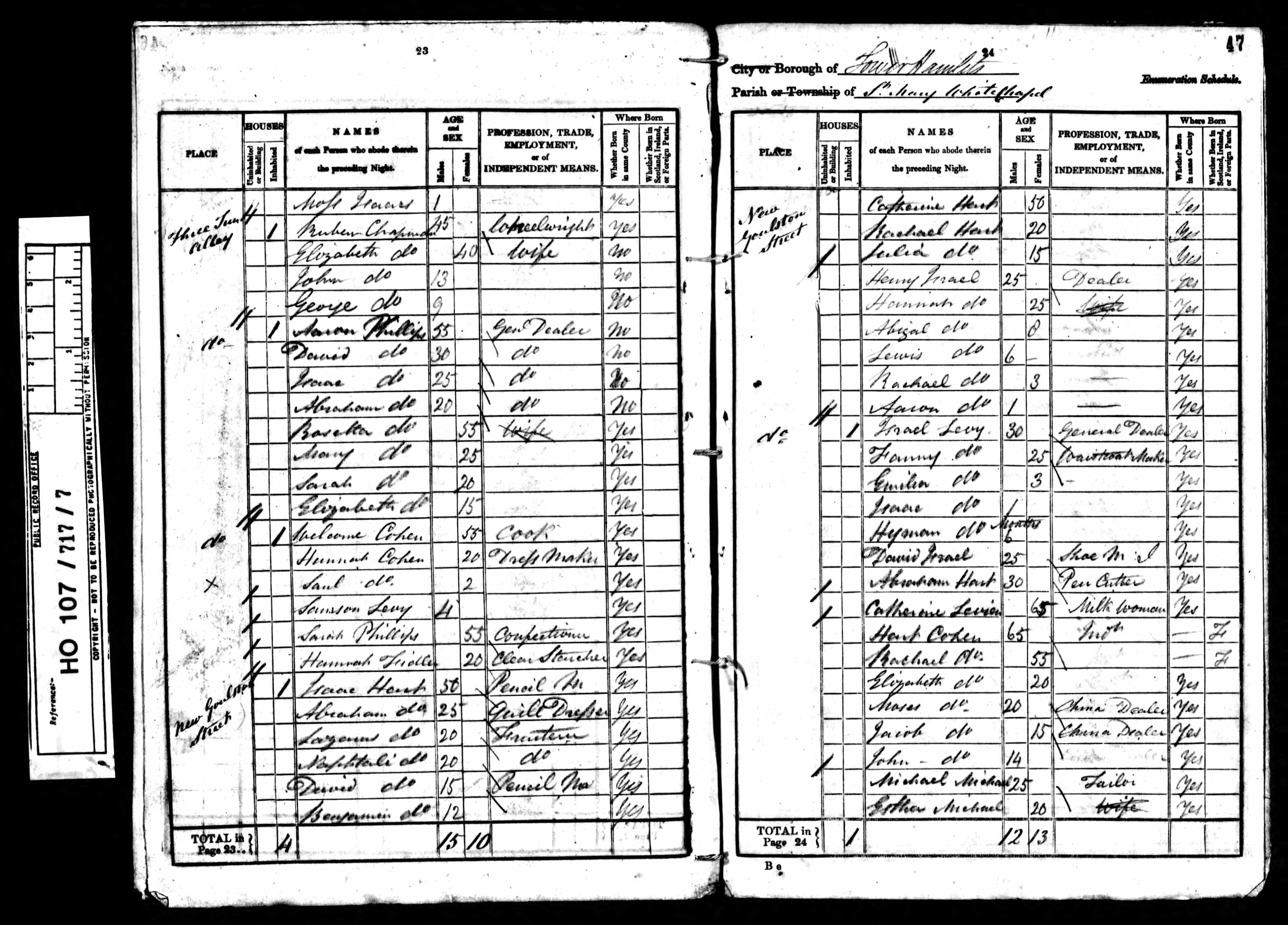
Lewis Cohen ship manifest 1846

Lewis Cohen ship manifest 1846

Neither the ship manifest  nor the naturalization papers have enough detail for me to be absolutely certain that either or both relate to my relative, but from the 1860 US census I know that by 1860 Lewis was definitely in Philadelphia, living with his father and siblings.

Hart, Elizabeth, Lewis and Jonah Cohen 1860 US census

Hart, Elizabeth, Lewis and Jonah Cohen 1860 US census

Just last night I located the ship manifest for Hart, Elizabeth and Jonah.  They left England together on the ship Julia Richmond and arrived in New York in September, 1851.  Jonah was identified as a dealer, and the manifest indicates that they were coming with only one box.

Hart, Jonas and Elizabeth Cohen ship manifest September 1, 1851

Hart, Jonas and Elizabeth Cohen ship manifest September 1, 1851

Interestingly, I also found a document that indicates that Hart may have made a trip to the Netherlands in June, 1851 from England.  Although the name is only listed as “HL Cohen” and gives his occupation as “schoenmaker,” or shoemaker, it does give his birthplace as Amsterdam, so it could very well have been Hart.  Perhaps he was visiting his birthplace one more time before crossing the Atlantic.  Perhaps he was taking Rachel’s body to be buried there.  Once I locate Rachel’s death record, I may know more about this trip.

H L Cohen arrival in England June 17, 1851

H L Cohen arrival in England June 19, 1851

Thus, by 1860, all of the then living descendants of Hart and Rachel Cohen aside from Moses were living in Philadelphia. (I am assuming that Jonas and the John listed in 1841 were the same person.)  By 1860 my great-grandparents Jacob and Sarah had had many children.  As I have already written, by 1850 they had three children, Fanny, who was born in 1846 in England, and Joseph and Isaac, born in Philadelphia in 1848 and 1850, respectively.  In the next decade, Sarah gave birth to six more children: Hart (1851), Rachel (1853), Reuben (1854), Maria (1856), Hannah (1857) and Elizabeth (1858). All of the children except the youngest three were in school.  That made a grand total of nine children born between 1846 and 1858, and there were several more born in the next decade as well, including my great-grandfather Emanuel.  I find it interesting that contrary to the traditional Jewish practice of naming a child after a deceased relative, Jacob named a son Hart in 1851 before his father Hart had died and named a daughter Elizabeth while his sister Elizabeth was still alive.  Rachel presumably was named for Jacob’s mother who had died before 1853.

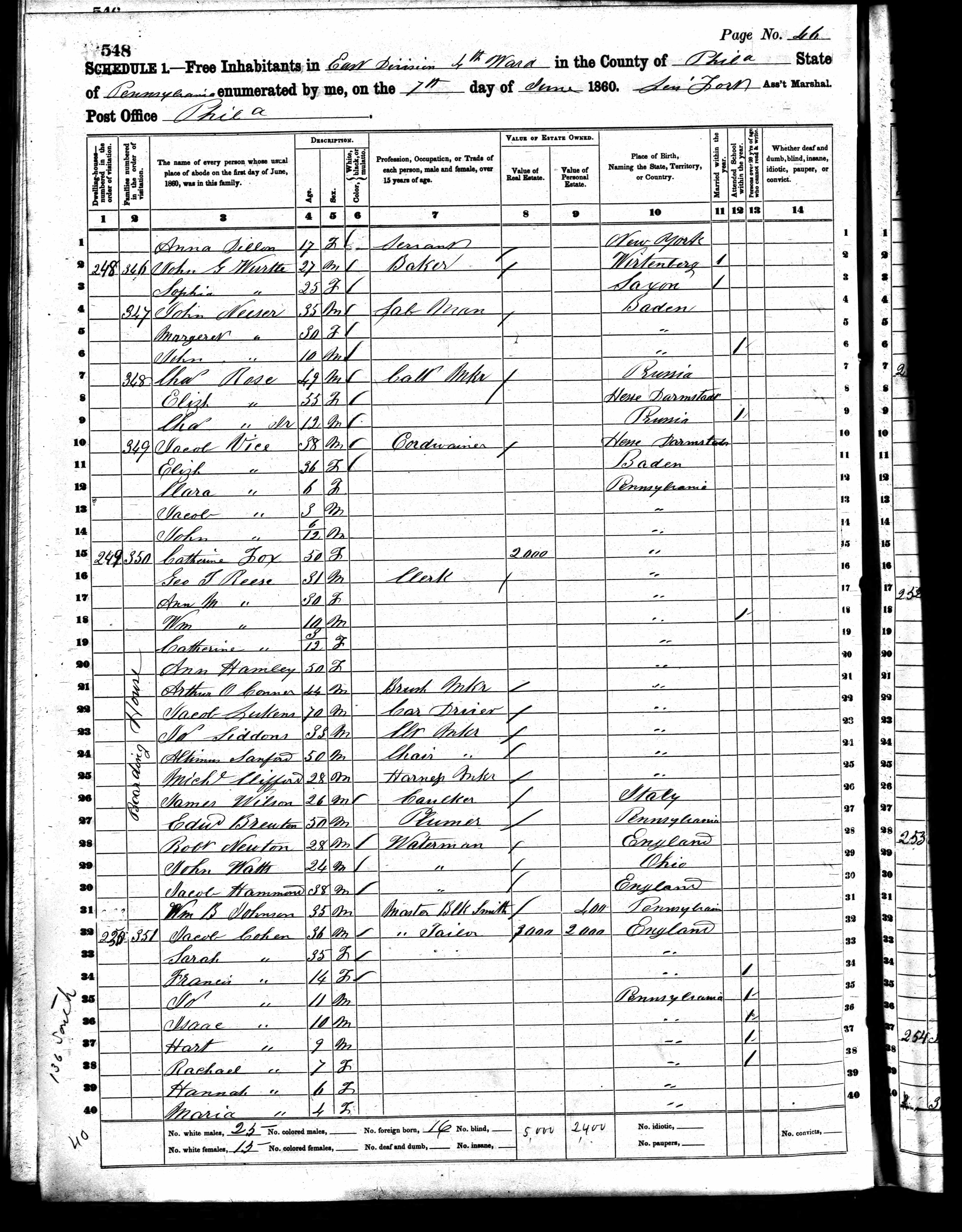
Although Jacob’s occupation is listed as a tailor on the 1860 US census, this seems inconsistent with the earlier census in 1850 when he was a dealer in second hand goods and with the 1841 English census when he was working as a china dealer.  Perhaps the census taker heard “dealer” as “tailor”?  Since Jacob also had the most assets of anyone else listed on this page of the census, $1000 in real estate and $2000 in personal property, it seems more likely that he was a merchant than a tailor.  He also had three servants living in the household: Eliza Mackey, Mary McDonough, and Margaret Gallagher.  There was also a 24 year old man named Lazarus Jacobs living with the family; this might have been a cousin through Jacob’s mother and/or his wife Sarah since both were Jacobs by birth.  Jacob thus had nine children, an adult relative, three servants as well as his wife Sarah and himself to support in 1860.  Could he have been making such a good living as a tailor?

Jacob and Sarah Cohen and family 1860 US census

Jacob and Sarah Cohen and family 1860 US census

Interestingly, Lewis and Jonah were also listed as tailors on the 1860 census.  They were living in the same district as Jacob, the 4th Ward, East Division, and the census appears to have been taken by the same census taker, although the signature is hard to decipher.  Were their accents so difficult for this census taker to understand? Or were these three brothers really tailors?  Lewis, Jonah, Elizabeth and their father Hart were all living together and had $1000 in personal assets, more in line with the shop owners on the census pages than the tailors, but perhaps the three Cohen brothers were all very successful tailors. However, according to the 1863 Pennsylvania Septennial Census, a census taken of all taxable residents, Lewis and Jonas were then engaged in sales and Jacob was listed as a dealer, not as tailors, so I am still inclined to think that the 1860 census taker heard “dealer” as “tailor” for all the Cohen men.

Lewis and Jonas Cohen on the 1863 PA Septennial Census

Lewis and Jonas Cohen on the 1863 PA Septennial Census

Jacob Cohen PA Septicentennial Census 1863

Jacob Cohen PA Septicentennial Census 1863

As I puzzled over this particular question of whether or not they were tailors, I became curious about the neighborhood they lived in and the socioeconomic character of that neighborhood. This led me to wonder about the history of Jews in Philadelphia and to ask why this family settled in Philadelphia, not New York, despite having sailed into New York when immigrating to this country. I am now doing some preliminary research into those questions and will report back on what I learn.

What has struck me as particularly interesting as I research and report on the immigration of my Cohen ancestors to Philadelphia is how different it feels from the immigration of my mother’s family, the Brotmans, Goldschlagers and Rosenzweigs.  Unlike the rather desperate conditions that my mother’s family faced in their home countries and the poverty they experienced after coming to the US, my Cohen ancestors left England not because they were oppressed or poor but for better conditions and opportunities here in America.  Although I am sure they faced some anti-Semitism and some isolation as Chuts and were not wealthy but at best middle class merchants, they came to America for less drastic reasons and with far more advantages than my mother’s relatives.  Not only were they more economically secure, they came speaking English.  They did not have to struggle to understand a new language, which must have made their adjustment far easier than it did for my Galician and Romanian ancestors who spoke no English when they arrived.

By 1860, the Cohens were settled in America and some of them were already or soon to be American citizens.  They were here a good 40 years before the Brotmans and some of the Rosenzweigs and about 50 years or more before many of the Goldschlagers and the other Rosenzweigs.   My father’s other lines also arrived here far earlier than my mother’s family.  My parents represent in many ways a merger of the two distinct waves of Jewish immigration to America.  When they were growing up, there was still a distinct class line between the older Jews from Western Europe and the newer Jews from Eastern Europe.  Today we don’t even think about those distinctions, except in historical terms.  But the two groups started differently and arrived under different conditions, creating for many years an economic and cultural gap between them.


Enhanced by Zemanta

Hart Cohen and family 1841-1851: Before the Move to America

be

By 1851, the time of the second English census, my great-great grandfather Jacob Cohen had already moved with his family to Philadelphia.  Much of the rest of his family of origin, however, was still in London.  According to the 1851 census, Hart, my three-times great grandfather, was now a widower and 75 years old, living with two of his children, Elizabeth, now listed as 28 despite having been listed as 20 ten years earlier, and Jonas, who was 22.  Jonas was not even listed as living with the family in 1841 when he would have been only 12 years old.   All three were listed as general dealers and living at 55 Landers Buildings in Spitalfields parish in Tower Hamlets.

Hart, Elizabeth and Jonas Cohen 1851 England Census

Hart, Elizabeth and Jonas Cohen 1851 England Census

Although I thought this might indicate a move to a new neighborhood, my research revealed that Landers Buildings were on Middlesex Street, which was just one blog from New Goulston Street where the family had been living in 1841.  The English genealogy site Genuki indicates that Spitalfields was a district within the parish of Whitechapel for at least some point in London’s history.

I do not know when Rachel, my three-times great grandmother died.  My search of the BMDIndex, the English index of births, marriages and deaths that began to be registered in 1837, revealed quite a few Rachel Cohens who died between 1841 and 1851.  I have ordered one certificate on a hunch that it might be the right one, but I need to do more investigating before I know for certain when she died.

Hart’s son, Moses, now 30 years old, had married Clara Michaels in the fall of 1843, according to the BMDIndex.  I need to obtain a copy of the actual record to be sure, but on the 1851 census, Moses Cohen was married to a woman named Clara and had three daughters, Judith (6), Hannah (2), and Sophia (six months).  He was employed as a general dealer and living at 35 Cobbs Yard in the parish of Christchurch in Tower Hamlets.

UPDATE:  I now know that Moses in fact had left England with Jacob in 1848.  This is not the correct Moses.

Moses Cohen and family 1851 census

Moses Cohen and family 1851 census

This neighborhood is about three miles west of where Moses had been living with his parents in 1841. Moses must have been fairly comfortable as they also had a servant living with them, although the Charles Booth Poverty Map depicted this area as poor in 1898.

The oldest son, Lewis, has been more difficult to track.  He was not living with the family in 1841 nor was he living with his father and younger siblings in 1851.  I would not even have known that he existed except for the fact that he appears on the 1860 US census reports living with his siblings Elizabeth and Jonas and his father Hart and on the 1880 census living with Elizabeth and Jonas.  So where was he in 1841? 1851?  According to those two US census reports, he was born in 1820, so would have been Hart and Rachel’s second child after Elizabeth.  He might have been living independently in 1841, married, or perhaps just not home.  The FamilySearch website indicates that the 1841 census had many holes; if someone was not staying at a home that night, they were not included in the census for that household.  I found three Lewis Cohens on the 1841 Census, but none of them was a good fit.  One was too old, one was living with different parents, and one was not born in England.  But since the 1841 was the first true census taken in England, I assumed that perhaps Lewis was just not among those counted.

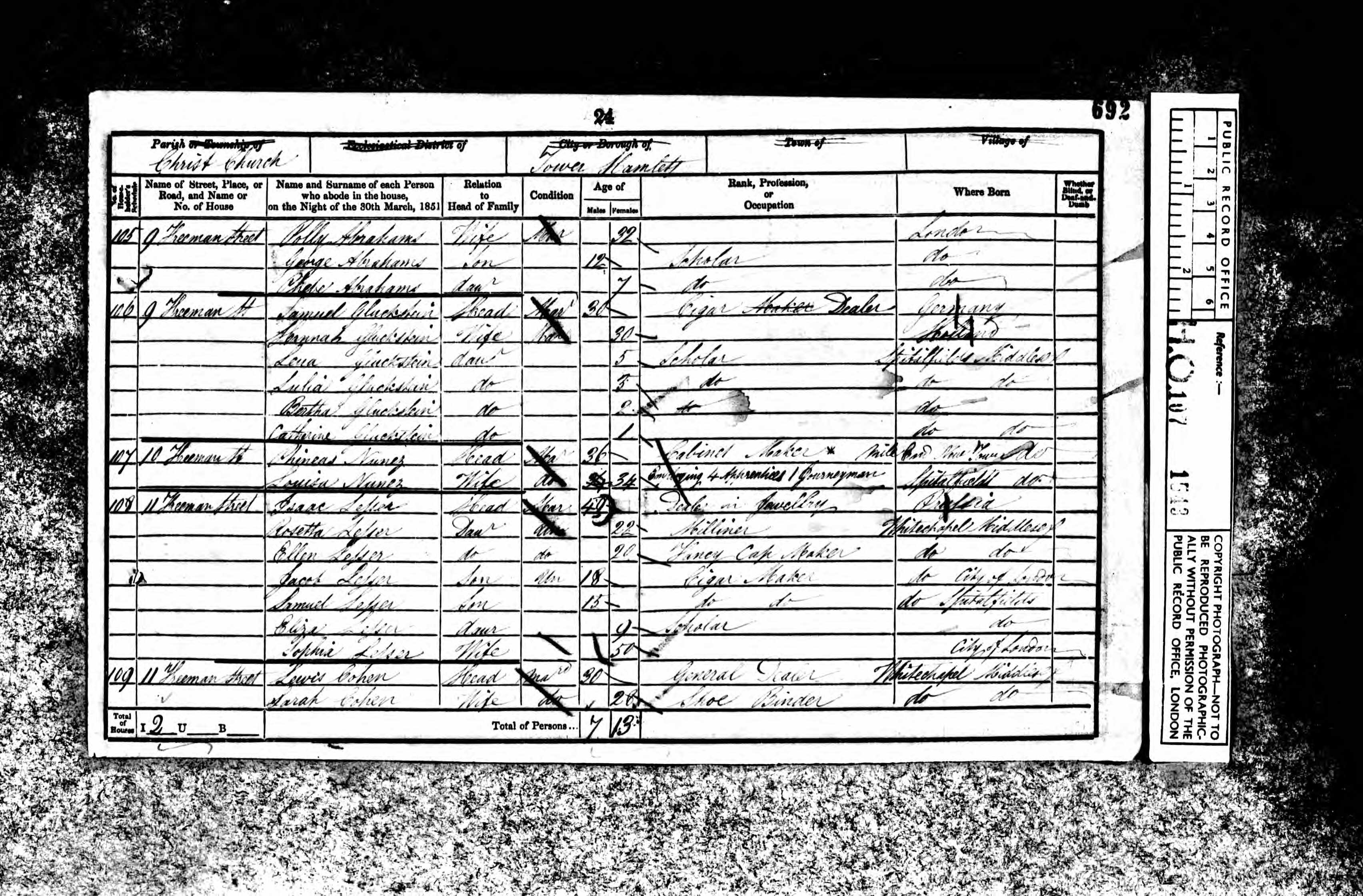
The 1851 English census did not provide any greater information on Lewis.   There were several Lewis Cohens again, but only one who was a possible fit: he was born in Middlesex County in Spitalfields, Christchurch, around 1821 and was married to a woman named Sarah.  They were living with Sarah’s mother, Ann Solomon.

Lewis Cohen 1851 census (not sure this is the correct Lewis)

Lewis Cohen 1851 census (not sure this is the correct Lewis)

I have found a marriage for this Lewis and Sarah in 1848 on the BMD Index and will write away for the record, but since Lewis was single in 1860 according to the US census, if this is the right Lewis, either Sarah had died or divorced him between 1851 and 1860.  I searched for a death record for a Sarah Cohen who died between 1851 and 1860, and there were several on the BMD Index.  I am not sure how to determine which ones might be relevant, but will order any that appear to be possibilities once I know that this was the correct Lewis.

UPDATE:  I know now that Lewis had in fact emigrated from England to the US in 1846.  This is not the correct Lewis.

The other possibility is that Lewis had immigrated to the US before the 1851 census or even the 1841 census.  I cannot find him on either the 1840 or 1850 US census, but I did find some immigration records for a Lewis H. Cohen who was naturalized in Philadelphia in 1848.

Lewis H Cohen naturalization ED PA 1848

Lewis H Cohen naturalization ED PA 1848

Since Lewis is listed on the 1860 US census as Lewis H. Cohen, I am inclined to think that this is the right person.  If so, then I also may have found a passenger ship manifest for Lewis, arriving in the US in 1846, which would have made him the first Cohen to immigrate to the US, not my great-great grandfather Jacob.  I need to check further into this, but it seems quite possible that the reason Lewis is not on the 1851 census in England is that he was already in the US.  But then why can’t I find him on the 1850 US census either?

The other mystery child of Hart and Rachel Cohen is the son identified on the 1841 census as John, the youngest child on that census whose age was given as 14, giving him a birth year of 1827.  In my initial research on the family, I thought that John had become Alfred J. Cohen, who was also born in 1827.  Alfred married Mary A. Cohen and remained in England where eventually they had seven children.

In reviewing my earlier work from last year, however, I am now doubtful that this was in fact the child of Hart and Rachel. Although I will order a marriage record for Alfred to be sure, I now think that the John in the 1841 census was actually Jonas, the youngest son of Hart and Rachel and the son who was living with Hart in 1851 in London and in 1860 in Philadelphia.  My reasoning is that Jonas was not listed on the 1841 census when he would have been only twelve years old.  Where else would he have been if not living with his parents? Also, since Jacob’s age was off by a few years on the 1841 census, it seems quite possible that there was an error in “John’s” age and also his name.  Jonas is close enough to John, at least the first syllable, so a census taker might have just recorded it or heard it incorrectly.  On the US census reports, Jonas’ age jumps around, making it difficult to pinpoint a correct year of birth.  Although I am going to order whatever vital records I can for Alfred and for Jonas, right now my hunch is that Jonas and John were the same person, the youngest son of Hart and Rachel Cohen, born sometime between 1825 and 1830.

UPDATE:  It seems quite clear to me now that “John” was Jonas.

So I have a lot of unanswered questions about my Cohen ancestors between 1841 and 1851. When did Rachel, my three-times great grandmother die?  Where was Lewis in 1841? Did he marry in England?  Did he in fact immigrate to the US in 1846? If so, why isn’t he on the 1850 US census? Are John and Jonas the same person, or were there in fact two sons younger than Jacob?

It will take some time to get the records that may help to answer these questions, so while I am waiting for those documents,  I will move on to the next decade and the story of my Cohen ancestors in the United States.


My Ancestor was a Chut: More on Dutch and English Jews

The Chuts” Synagogue Sandy’s Row London

After I wrote my last post saying I was going to put aside for now any attempt to find my four times great-grandfather’s family in Holland, I decided to look more generally into the question of why a Dutch Jew would have emigrated from Holland to England in the late 18th century.  After all, life seemed to be pretty good for the Jews in Amsterdam at that point.  They had acquired full legal rights as citizens, many were comfortable both socially and economically, and England was in fact still forty years away from giving Jews the same legal rights as Christian residents.  Why would someone have left Amsterdam to move to London?

Su Leslie of Shaking the Tree mentioned in a comment that she had seen some episodes of the British version of Who Do You Think You Are involving famous British Jews and recalled that there had been discussion of an immigration of Jews from Holland to England in the late 18th century.  I decided to search on line for more information and learned that there was in fact a whole community of Dutch Jews who settled in London during that time.  My research led me to several websites discussing this community, including the Bishopsgate Institute website describing a recent oral history project about this community being sponsored by the Institute and created under the direction of Rachel Lichtenstein, a well-known writer and artist.  According to this site:

The oldest Ashkenazi synagogue in London, Sandys Row in Spitalfields, was established by Dutch Jewish immigrants in 1854, who began arriving in the city from the 1840s onwards. They came in search of a better life, rather than fleeing persecution like the thousands of Ashkenazi Jews who came after them in the 1880s from the Pale of Settlements.  Mostly from Amsterdam, many settled in a small quarter of narrow streets in Spitalfields known as the Tenterground. Here they continued to practise the trades they had bought with them from Holland, which were predominately cigar making, diamond cutting and polishing, and slipper and cap making. Many small workshops were established in the area and businesses were passed on within generations of families.

With their own practises and customs, many of which were different from other Ashkenazi Jewish groups, they became a distinctive, tight knit community of about a thousand people. To the frustration of the more established Anglo-Jewish population living in the area at the time, ‘the Chuts’ (as they were known locally) refused to join any of the existing synagogues…

Sandys Row Synagogue

Sandys Row Synagogue (Photo credit: FarzanaL)

So my four times great grandfather Hart Levy Cohen was a Chut—a term I’d never heard before and a community I’d never known about before.  Other sites confirmed this information and also provided some other details.  Wikipedia provided this explanation for the name “Chuts.”

The origin of the name Chuts is uncertain. A popular assumption is that it derives from the Dutch word goed (meaning “good”) and is imitative of the foreign-language chatter that others heard. It is also Hebrew חוץ for “outside” or “in the street” and may have been applied to the Dutch Jews of London either because they were socially isolated or because many were street vendors. Another possibility is that the Hebrew word would have appeared increasingly in Amsterdam synagogue records as more and more emigrated to London, and others who followed would have “gone chuts” (i.e., emigrated).

Sandys Row Synagogue, London

Sandys Row Synagogue, London (Photo credit: nicksarebi)

The About Jewishness website revealed where in London the Chuts lived:

They settled mostly in a small system of streets in Spitalfields known as the Tenterground, formerly an enclosed area where Flemish weavers stretched and dried cloth on machines called tenters (hence the expression “on tenterhooks”). By the 19th century, the site had been built upon with housing, but remained an enclave where the Dutch immigrants lived as a close-knit and generally separate community. Demolished and rebuilt during the twentieth century, the area is now bounded by White’s Row, Wentworth Street, Bell Lane and Toynbee Street (formerly Shepherd Street).

I looked up these streets on the map of London and was not surprised that this area is very close to New Goulston Street where my ancestors were living in 1841.

The About Jewishness site also provided some insight into what happened to this community and perhaps why my ancestors left London and moved to the US.  According to this site, “the successful introduction of machinery for the mass-production of cigarettes ultimately led to the collapse of the cigar-making economy on which the Chuts community depended. Many Chuts returned to improved conditions in Amsterdam, some emigrated further afield to places such as Australia and the USA, some assimilated into other Jewish families, and some eventually lost their Jewish identity altogether.”

In addition, the huge influx of Eastern European Jewish immigrants in the late 19th century caused tensions between the older established Chuts community and the newer immigrants, most of whom were poor, not as well skilled, and not used to living in a big city.  Interestingly, the Chuts community had traditions and practices that made them different both from the older Sephardic community and from the newer Eastern European Ashkenazi community.  Again, from the About Jewishness site:

[T]he Chuts were treated with suspicion by other Jews because the former had developed specific customs and practices, many of their families having lived in Amsterdam since the first synagogues were established there in the early years of the 17th century. Uniquely in Amsterdam, Ashkenazim (so-called “German Jews”) and Sephardim (so-called “Spanish Jews”) lived in close proximity for centuries, resulting in a cultural blend not found elsewhere. Most remarkably, the Dutch Jews were well accustomed to the sea, and ate seafoods considered not kosher by other Jewish communities.

From this information, it seems reasonable to infer a couple of things.  First, it seems that despite the fact that the Amsterdam Jewish community was fairly well-established, there must have been those, my ancestor Hart among them, who believed that there was greater opportunity for financial success in London.  These Dutch Jews decided to emigrate in order to achieve greater economic security.  Secondly, it seems that at some point many of those Dutch Jews either left or assimilated into the greater Jewish or non-Jewish society.  Some may have left because economic conditions were not as good as they had hoped; others may have left because as a “Chut,” they were not well integrated into the world of London’s Jews.  With different traditions, different practices, different synagogues, they may have felt isolated and disrespected.  I don’t know specifically what motivated my ancestors first to leave Amsterdam and then to leave London, but I’d imagine it was a combination of these factors.

Once again I am finding out new things about my own history and about Jewish history by doing genealogy.  I never knew about the Chuts, and I certainly never knew I was descended from one.  I have written to Rachel Lichtenstein to learn more about her project and will report back with whatever else I learn.

Also, in researching more about the Dutch Jews in general, I came across a genealogy blog I’d not seen before written by Kerry Farmer called Family History Research.  Kerry had a post from two years ago about searching for a Dutch Jewish ancestor using information she was able to obtain from a book compiling information about marriages performed at the Great Synagogue in London, Harold and Miriam Lewin’s Marriage Records of the Great Synagogue- London 1791-1885.  I was very excited when I read this post and contacted Kerry, who generously looked up Hart Levy Cohen and Rachel Jacobs’ wedding for me in the Lewin book.  She was able to provide me with the information she found there:

(Groom) Cohen Hart Levy

(Groom’s father) Leib Katz

(Groom’s patronymic) Hertz b. Leib Katz

(Groom’s address) Not listed

(Bride) Jacobs Rachel

(Bride’s father) Yaakov

(Bride’s patronymic) Rechel b. Yaakov

She also suggested that I contact the owners of the Akevoth site to see if this additional information would help in locating the records of my ancestors, and I have done that.  Now I will wait to see if they can provide any further assistance.

So yesterday I was ready to put aside the search for my Dutch ancestors, and then, with the help of Su Leslie and Kerry Farmer, I was able to make some progress in understanding who they were and why they left Amsterdam and why they left London.  Once again I am humbled by and grateful for the generosity of the genealogy community.  Su and Kerry are from New Zealand and Australia, respectively, and they have helped me in my search to find a Dutch Jew who lived in England and moved to America.  What a small world it is when you find such wonderful, helpful and knowledgeable people.


Enhanced by Zemanta

The Brick Dyke in Amsterdam?

Before I write about the next phase in the life of Hart Levy Cohen and his children, I want to explain what I have learned or rather tried to learn about his life and his family before he came to London.  From the English census of 1841, I knew he was born in “foreign parts” outside of Great Britain.  The 1851 English census was more specific; it said that he was born in Holland.  The 1860 US census was even more specific than that.  It reported his place of birth as Amsterdam.

photo 1 (3)IMG_1060

Knowing his Hebrew name, his father’s Hebrew name, his English name and his approximate year of birth, I thought that I would be able to find some record of Hart’s birth and of his family in Holland fairly easily.  When I first found this information over a year ago, I searched every way I could on a site called Akevoth, which has a huge database and lots of information on Dutch Jewry.  It’s a wonderful resource, but I was soon overwhelmed.  There were just too many people with the names Hart(og), Levie, and Cohen or some combination of two of those three.  I had no way to figure out whether any of those people were my relatives.  I’ve just looked again, and now I remember why I was overwhelmed.  It’s like looking for a needle in a haystack.  Last time I had not known about FamilySearch, so I have now looked there as well, and once again, I have not found anything definitive there or on ancestry.com.

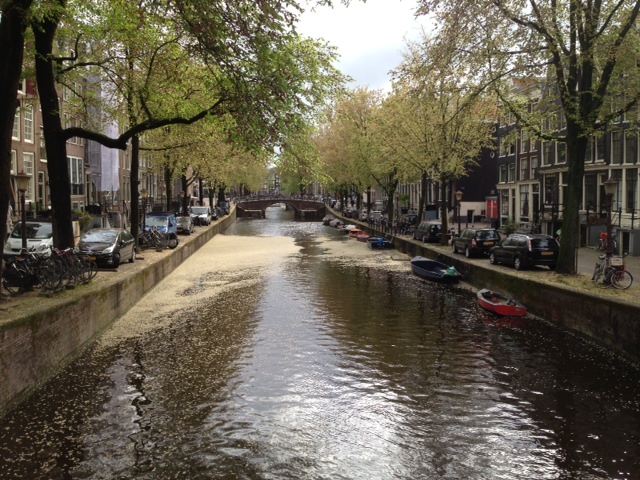
I’ve also had a chance to try and find evidence of Hart not only online, but also in Amsterdam itself.  Last spring we took a weeklong trip to Amsterdam.  We had an amazing time and loved the city.  It was not a trip we took for genealogical purposes, but rather a general interest trip to see the art, walk the canals, visit the museums, drink the beer, and learn about the history of Amsterdam.  Part of that history is, of course, the history of the Jews in Amsterdam, and in addition to an incredibly moving visit to Anne Frank’s house, we also took a walking tour of Jewish Amsterdam with Jeannette Loeb, a Dutch Jew herself with expertise in the history of the Jews in Amsterdam.

From Jeannette and other sources, I’ve learned some of the long history of the Jews in Amsterdam.  Like England and like the United States, the earliest Jews in Amsterdam were Sephardic—traders from Portugal and Spain. When the Netherlands established their independence from Spain, religious freedom was one of the important tenets of the new state, allowing not only Protestants but also Jews to practice their religion.  The Sephardic Jewish community became well-integrated both socially and economically in Amsterdam, although Jews were not given the full legal rights of citizens.

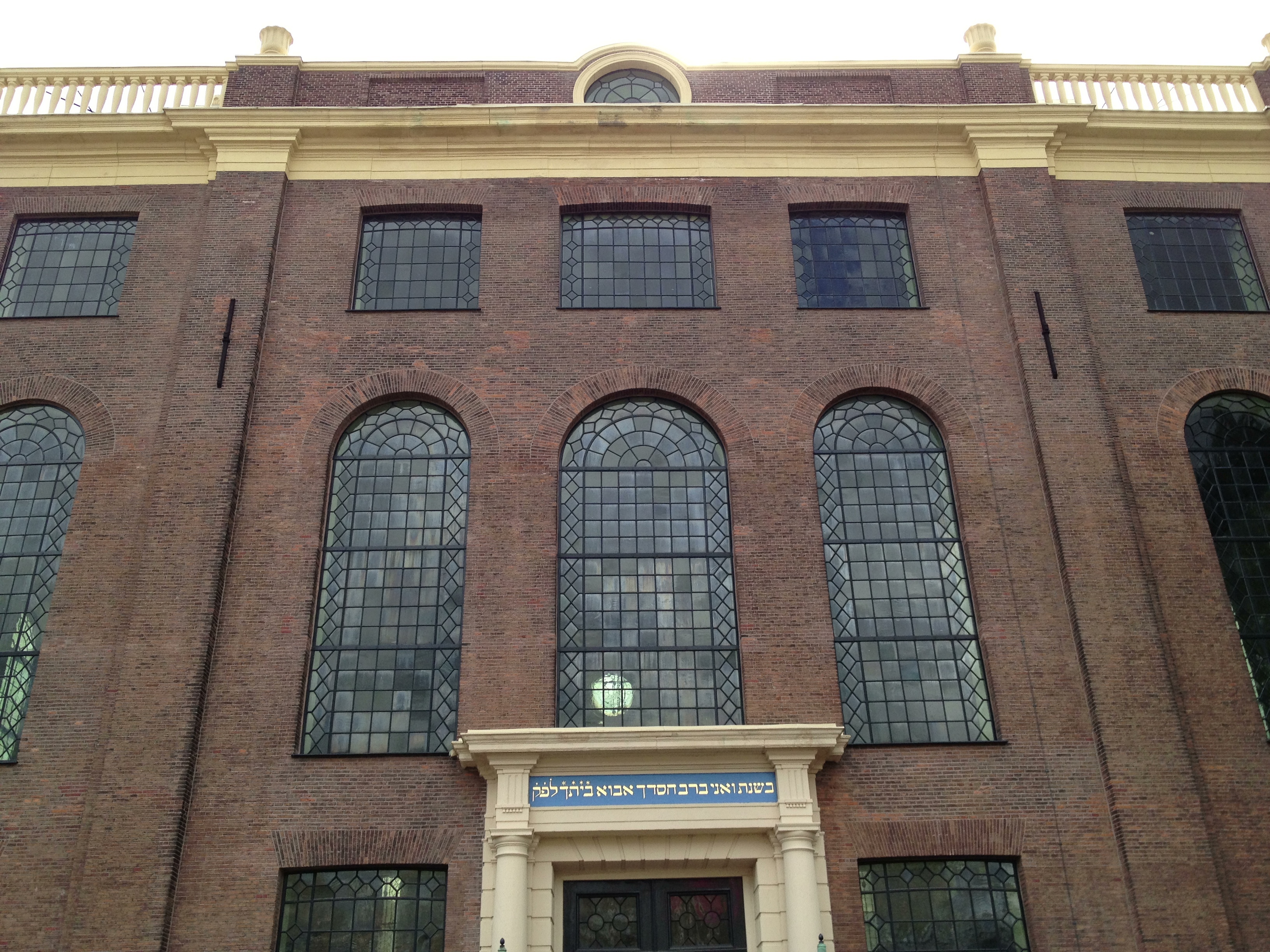
Portuguese Synagogue Amsterdam

Portuguese Synagogue Amsterdam

It was not until the late 17th century that Ashkenazi Jews from Germany and Poland began to settle in Amsterdam to escape persecution and poverty.  These immigrants were helped by the established Sephardic community, although the two communities retained their own languages, practices and synagogues.  Although they  started off poverty-stricken, the Ashkenazi community became more economically stable over the years.  In 1792 Jews were finally given full legal rights in the Netherlands, certainly late but nevertheless a full forty years before Jews were given such rights in England.

Joods Historisch Museum (Jewish Historical Mus...

Joods Historisch Museum (Jewish Historical Museum) in Amsterdam, Holland. {| cellspacing=”0″ style=”width:400px; text-align:left; color:#000; background:#ddd; border:1px solid #bbb; margin:1px; direction:ltr;” class=”layouttemplate” | style=”width:22px; height:22px;” | 20px|link= | style=”font-size:8pt; padding:1pt; line-height:1.1em;” | This is a photo of rijksmonument number 265 |} 00000265 (Photo credit: Wikipedia)


Before World War II, there were 80,000 Jews living in Amsterdam, about 10% of the overall population.  Almost all of them were killed during the Holocaust, leaving only 20,000 Jews in Amsterdam after the war.  Today there is a small Jewish community in Amsterdam, but nothing like that large and active Jewish community that existed before the Holocaust.

Holocaust Memorial Amsterdam

Holocaust Memorial Amsterdam

Thus, in the late 18th century when Hart was born, the Ashkenazi Jewish community in Amsterdam was fairly well established, and Jews had full legal rights by the time he was a young adult in 1792.  Why did he leave? What was the economic situation of his family? Who was his family?

While we were on our walking tour, I asked Jeannette Loeb where I might be able to get some help in tracking my Dutch ancestor, Hart Levy Cohen.  She suggested that I visit the Amsterdam city archives and ask for some help in searching the city records.  I followed her advice and spent a couple of hours there with an archivist who specialized in Dutch Jewish genealogy.  He sifted through many books of records of births and circumcisions, but was unable to come up with anything definitive.  As he explained to me, until 1812 most Ashkenazi Jews in Amsterdam (and in Europe generally) did not have surnames.  People were known only by their patronyms, that is, by their Hebrew name paired with their father’s Hebrew name.  Because of that, it is nearly impossible to identify specific families.  Rather, there are just a very large number of people with very similar names.  Hart was probably Hartog in Amsterdam, a Dutch version of Hirts, and there were many Hartog Cohens.  Cohen was also probably a patronymic label, referring to the Cohanim tribe, not a specific family.

Thus, for now I am going to once again put aside any attempt to find Hart Levy Cohen’s father or other relatives and ancestors.  Perhaps I will have another chance to go to Amsterdam or find some other clues to help me sift through all the data.  Perhaps there will be some hole in this “brick dyke” that will allow me to find my ancestors.  For now instead I will bring the story forward and trace Hart’s children and grandchildren all the way to my father and to his children.


Enhanced by Zemanta

Hart Levy Cohen and A Very Brief History of Jews in London

In my research so far, Hart Levy Cohen is the earliest verified ancestor I have found.  There are some others on other lines on my father’s side that are earlier, but not yet verified.  But I am quite certain that Hart was my three-times great grandfather based on the census reports I have been able to locate in both English and American records.

The earliest reference I have to Hart is a transcription of his wedding record from the Great Synagogue of London. I found this on a website called Synagogue Scribes, which provides a free, searchable database of transcriptions of the information from marriage and other records from the Ashkenazi synagogues in London.  According to this site, Hart Levy Cohen, whose Hebrew name was Hirts and whose father’s Hebrew name was Leib, married Rachel Jacobs on January 29, 1812.  I was thrilled when I first found this record because it provided me with not only my three-times great grandmother’s name, but also because it revealed my four-times great-grandfather’s first name.  It also revealed that by 1812 Hart was living in England.[1]

The Great Synagogue of London: This engraving ...

The Great Synagogue of London

The earliest actual record I have for Hart is the 1841 English census, which lists Hart, his wife Rachael (sp?), and four of his children, Elizabeth, Moses, John and Jacob.[2]  Jacob was my great-great grandfather. According to the census, Hart was then 65 years old, giving him a birth year of 1776.  Rachel was 55, giving her a birth year of 1786.  Elizabeth and Moses were both listed as twenty years old, Jacob was 15, and John was 14.  All of the children were listed as born in England, but Rachel and Hart were listed as foreign born.  Hart’s occupation was described as “Ind’t,” meaning he was of independent means, and Moses and Jacob were both described as china dealers.

Hart Cohen and family 1841 English census

Hart Cohen and family 1841 English census

The family was residing on New Goulston Street in the St. Mary Whitechapel parish of Middlesex County in East London.  Scanning through the names and occupations of other residents of that street and nearby streets, I noticed that many of the names were Jewish and that many of the residents were merchants of some sort or tradespeople.  I knew nothing about the history of Jews in London, and thus studying this census led me to research that history in order to learn more about the neighborhood where my ancestors lived in the early 19th century.  That, in turn, led me to read more about the history of Jews in England overall and specifically in London.

Although I cannot do justice to the long and complicated history of the Jews in England here, a very brief overview may suffice.  According to a number of sources, Jews had first settled in England during the reign of William I in the 11th century, but were expelled from England in 1290 by an edict of King Edward I, and there was no Jewish community thereafter until the 17th century when a community of Sephardic Jews from Spain arrived, although many of these Jews hid their religious identities.  Eventually for political and economic reasons, the English acquiesced in the growth of the Jewish community, although there was still a great deal of anti-Semitism.  Jews were not allowed to be citizens and were denied many of the legal rights of non-Jewish English citizens.

In the 18th century, the Sephardic community grew both in size and in wealth and became quite successful, but Jews were still denied full legal rights.  There was a short lived naturalization law passed in 1754 to enable Jewish men to become citizens, but it was repealed one year later due to widespread popular opposition.  It was not until 1833 that Jewish men were emancipated and given full legal rights as English citizens.

Meanwhile, there was also a growing Ashkenazi community during the 18th and 19th centuries, referred to as “Dutch Jews.”  My three-times great grandfather Hart Levy Cohen would have been one of those Dutch Jews, probably arriving at the end of the 18th century.   According to the Jewish Encyclopedia, “the bulk of the Ashkenazic community consisted of petty traders and hawkers, not to speak of the followers of more disreputable occupations.”  They settled in East London in the parish of Whitechapel, as did my ancestor Hart.  Whitechapel in the 1840s was described in Wikipedia as “classic “Dickensian” London, with problems of poverty and overcrowding.”

It would appear from the 1841 census listing, however, that Hart and his family were not among those poor.  Hart appears to have been retired, and his two sons were china dealers.  Perhaps their particular section of Whitechapel was not as poor as other sections.  For example, their street was very close to the Petticoat Market, a clothing manufacturing center that catered to the well-to-do of London.

File:Thomas Rowlandson - Rag Fair or Rosemary Lane - Google Art Project.jpg

Petticoat Market in the early 19th century

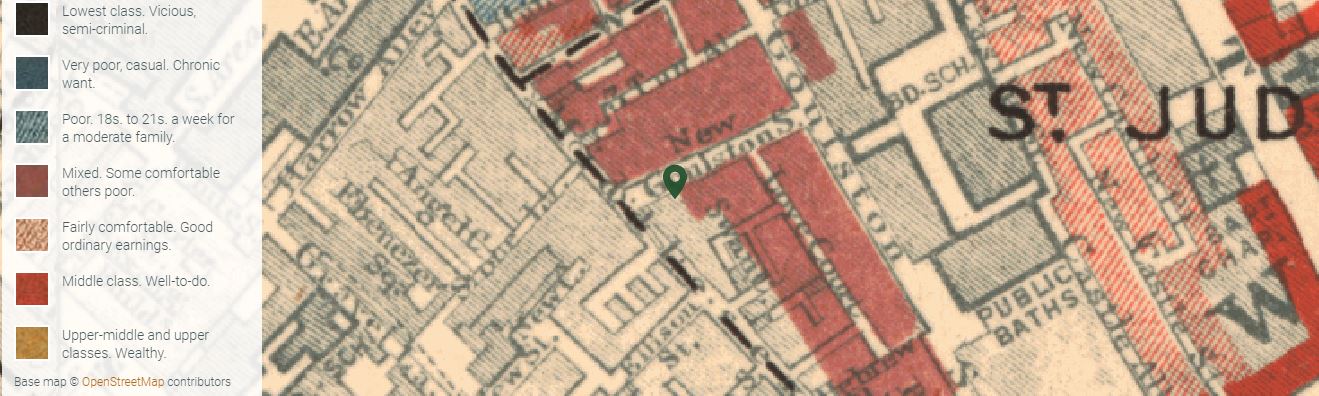
UPDATE:  Thanks to the help of my fellow blogger Su Leslie from Shaking the Tree, another of my very favorite genealogy blogs, I was able to find a map prepared by Charles Booth in the late 19th century that shows street by street the economic standing of the residents.  He rated each street on a seven level scale from poorest to upper class.  New Goulston Street appears to be purple on his map, meaning it was a mixed neighborhood with some poor residents and some comfortable residents.  That also seems consistent with my scan of the census of their street.

Charles Booth poverty map of London, New Goulston Street marked in center
https://booth.lse.ac.uk/map/18/-0.0757/51.5160/100/0?marker=533621.0,181427.0

In the later part of the 19th century, there was a tremendous influx of poor European Jewish immigrants to London, just as there was in New York and other American cities, coming to escape the oppression, violence and poverty in East Europe. There was also a large immigration of poor people from Ireland during this same period. The Whitechapel neighborhood became even more poverty-stricken, and crime became rampant, including widespread prostitution.  It was also during this period that Jack the Ripper, the serial killer, committed a string of murders and caused widespread terror.

By this time, however, most of my Cohen relatives had left England and come to the United States.  Only two of Hart’s six children remained in England by 1860.  Why did they leave? And why did Hart come to England from Holland in the first place? Those are questions that I want to answer if I can as I dig more deeply into my Cohen ancestors.


[1] I also thought I had found earlier records for Hart in tax records from 1798, but I now think that those records were for a different person because I found a record dated 1768 at the same address, also for a man named Hart Cohen.  These records require deeper investigation.


[2] There were six children altogether.  Lewis and Jonah are not accounted for on this census.  Lewis would have been 21, so perhaps was not living at home, but I have not yet found him elsewhere.  Jonah would have been 12, so I cannot account for the fact that he is not listed, except to note that this was the first English attempt for a comprehensive census and undoubtedly mistakes were made.


Enhanced by Zemanta

My Father’s Family, Part I: The Cohens

My surname is Cohen, and it always has been.  I have always been proud to be a Cohen.  It is a clear marker to the outside world that I am Jewish.  Because I grew up in a secular home and did not go to Hebrew School like almost all my Jewish classmates, some of them expressed skepticism about whether I was “really” Jewish, but my name always gave me some authenticity.

The Cohens (Cohanim) are the high priests, a line that is supposed to descend from Aaron, Moses’ older brother.  Observant Orthodox Jews who are Cohanim do not go into cemeteries or attend a funeral or touch a dead body in order to maintain their priestly purity.  In a traditional service, there is a special ritual where the Cohanim bless the congregation.  Cohanim get the first aliyah for the reading of the Torah.

Birkhat cohanim 4

Birkhat cohanim 4 (Photo credit: Wikipedia)

Although I do not believe in any of the “special holiness” of the Cohen tribe and in fact am not even sure my family are true Cohanim, I do feel proud to have the name and some of the tradition and history that goes along with it.  It was one reason that I did not change my name when I got married.  I wanted to remain a Cohen—it was my name, it was my family’s name, and it was my ancestors’ name.

So perhaps it is not surprising that one of my first genealogical tasks was to trace the Cohen line.  It was fairly easy to get as far back as my great-great-great-grandfather Hart Levy Cohen, who was born around 1772 in Amsterdam and emigrated to England as a young man.  The English records and then the American records on my Cohen line were clear and easy to find through ancestry.com, and thus within a short period of time I was able to create a tree that went from Hart Levy Cohen to Jacob Cohen, my great-great-grandfather, to Emanuel Cohen, my great-grandfather, to John Nusbaum Cohen, my grandfather, to John Nusbaum Cohen, Jr., my father, to me.  I have census reports going back as early as 1841 in England and 1850 in the United States as well as tax records and a marriage record from England.  I have the names of Hart’s children, his grandchildren, his great-grandchildren and so on.  I compiled a lot of information very quickly, but now I need to go back and learn from all those documents and see what I can find out about Hart Levy Cohen and all his descendants and also to see if I can find his ancestors from Amsterdam and before.

This research will require learning about English records and census reports and also about Pennsylvania records.  From the little bit of initial work I’ve done this week, I already know that it will be more difficult to obtain Pennsylvania records than New York City records.  There is not much online and not much available through the Family History Library.  Most of it will require snail mail requests or traveling to places that are not as accessible to me as New York City.  I do not foresee traveling to Harrisburg in the near future, so it may require hiring someone there to retrieve documents for me.  And as for the English records, well, a trip to London sounds a lot more fun than a trip to Harrisburg, but I don’t think it’s too likely either.

So I have a big learning curve ahead.  I am up for the challenge and ready to learn more about my Cohen relatives and about genealogical research.  I will start by posting what I already know, and then I will fill in the details as I learn more.

Meanwhile, I will also continue to look for more information about the Brotmans, the Goldschlagers, and the Rosenzweigs.  Tomorrow I hope to talk to David Goldschlager’s son and grandson and maybe learn more about the Goldschlagers. I am still hoping to work with Larry Brotman about a Brotmanville connection.  I am still hoping to hear from my cousin Lois about her family and Lizzie and Ray Rosenzweig.  I have written to descendants of Ray Strolowitz Adler and Zusi Rosenzweig Mintz, and I hope to hear back from them.  So at the moment I am depending on these others to help me break down the brick walls that remain on my mother’s side.  Without their help, I am at an impasse for now, but will keep on looking for any and all clues.


Enhanced by Zemanta

The Fusgeyers, Part IV: Romania Today

St_Andrew_Str_no_26_0002

Where my grandfather was born in 1888 in Iasi, Romania

As noted in my last post, the population of Jews in Romania has declined precipitously over the last one hundred years as a result of emigration before World War I and thereafter and also as a result of the murder of about 300,000 of them during the Holocaust.  From a peak of 800,000 after World I, there are now just a few thousand Jews living in Romania today. What is it like in Romania today, and, more specifically, what is it like to be a Jew living in Romania today? What  legacy is there in Romania from the once substantial Jewish community, and what do current residents know or remember of the Jewish communities and of the Fusgeyer movement that led many of those Jewish residents out of Romania?  Beyond the cold, hard statistical facts, what is left of Jewish Romania?

I have consulted only two sources of information to answer these questions, so my views are based on limited information and possibly inaccurate.  But those two sources left somewhat different impressions, so perhaps the truth lies somewhere in between.  Jill Culiner’s book, Finding Home, paints a rather gray and dismal picture of life in Romania in general and specifically of the Jewish legacy there.  Stuart Tower, author of The Wayfarers, has a more positive impression of Romania today and of its people as seen in the photographs he took first in the 1980s and then in 2005 and also from what he shared with me by email.  Culiner and Tower visited different cities and towns for the most part, but there was some overlap; both visited Barlad and Sinaia within a few years of each other.  Both ultimately paint a picture of a country that once had many thriving Jewish communities but that now has virtually no Jewish communities and few residents who remember the communities that once were there.

Tower based his book around the town of Barlad; it is where the three Americans, grandfather, father and son, go to learn about their ancestral roots and meet the rabbi there who tells them the story of the Barlad Fusgeyers.  Tower’s story is fictional, and he told me that he’d never actually met a rabbi in Barlad, but both Culiner’s book and Tower’s book talk about a very small Jewish community continuing to exist in that city and the beautiful synagogue that still stands there.  In Tower’s novel, the rabbi describes a community of thirty people who still keep kosher and observe shabbat, but who have trouble forming a regular minyan.  The elderly rabbi’s children have all moved away, and he knows that he will be the last rabbi in Barlad (spelled Birlad in the novel).

Culiner started her Romanian travels in Adjud, where she got off the train and began her Fusgeyer-inspired walk.  Her description of Adjud is disheartening:

Here, fields lie flat under a grueling sun, and cars, trucks and buses roar with giddy impunity over pot-holed, uneven main roads.  Under thirsty-looking trees outside the station, lining the street are unlovely lean-tos, modern bars and patios. All claim to be discos, all pump loud American music into the hot air.

Culiner, p, 35.

Culiner also said that “there were no buildings left from the pre-Communist era and certainly nothing of beauty.” (Culiner, p. 35)  Her encounters with the local people are no more heart-warming.  No one could tell her where there was a hotel or room to stay in, and she described the people she saw as “exhausted..expressionless, resigned.”  Culiner, p.36.  No one in town remembered  that there ever was a Jewish community there or a synagogue, although there had been a community of about a thousand Jews there in 1900.  The man who showed her where the non-Jewish cemetery was located demanded an exorbitant fee for his troubles.  By the end of this first chapter, I was already feeling rather depressed about her experience and about  life in Romania.

In contrast, here are some of Tower’s photos of the Romanian countryside that left me with a different impression.  Thank you to Stuart Tower for giving me permission to post these:

Recently%2520Updated%25201112 Recently%2520Updated%25201113 Casa Elena in Voronets Fall foliage in the Bicaz Gorge Romania%25202005%2520262 Romania%25202005%2520263 Romania%25202005%2520264

Culiner’s experience at her second stop, Podu Turcului, was not any better.  The townspeople warned her that her plans to walk through Romania were dangerous and that she would be better off visiting more modern cities elsewhere.  There were no Jews left in this town, and no one there remembered there ever being a synagogue, although there was a Jewish cemetery.  Only one man acknowledged that there once was a Jewish community there, a workman who had been curious about the Jews while in school and had learned where the Jewish residents had once lived in town, now just a neighborhood of faceless housing from the Communist era.  This man told Culiner that he had been unable to learn more about the Jewish community in his town because discussing such matters was prohibited during the Communist era.

Culiner and her companion next arrived in Barlad, a city of 79,000 people, the city where Tower’s characters stayed and learned about the Fusgeyers and were in awe of the beautiful synagogue.  Culiner is less enthusiastic.  Her first impression of the city is its “potholed, deteriorated sidewalks” and the “[r]are trees [that] gasp out their life in the dense cloud of exhaust fumes, providing little shelter from the pitiless sun.” (Culiner, p. 55) Culiner once again encountered skepticism about her plans and ignorance about the Jewish history of the city.  She was particularly disappointed that in this city where the Fusgeyer movement began, no one seemed to remember anything about them.  Even she, however, was impressed with the synagogue, to an extent:

Despite its rather austere, unassuming exterior, the synagogue is magnificent.  Dating from 1788, the walls and ceilings are decorated with paintings of birds, flowers, leaves and imagined scenes of Jerusalem.  Yet, despite its beauty, there is a strange feeling of loss, the aura of a building struggling to exist in a world that has little place for it.  It has become a relic.

Culiner, p. 58.

Although Tower also described a dying Jewish community in his novel, there was still some life, some people who cared in Barlad.  Culiner saw the glass as half-empty whereas Tower saw it as half-full.  Here are some pictures of the Barlad synagogue and some other towns visited by Tower that show a far less dismal impression of  in Romania.  All photos courtesy of Stuart Tower.

Synagogue in Barlad courtesy of Stuart Tower

Synagogue in Barlad  Photos courtesy of Stuart Tower

President Alexander Coitru

Stuart Tower reading from The Wayfarers at the Barlad Synagogue

Stuart Tower reading from The Wayfarers at the Barlad Synagogue

birlad shul interior

Romanian countryside

Romanian countryside

Romanian woman

Romanian woman

Romania%25202005%2520090 Romania%25202005%2520175

17th Century wooden synagogue in Piatra Neamts

17th Century wooden synagogue in Piatra Neamts

Piatra Neamts Sinagogaodd haystack, neighboring farm Troop Popa Tarpesht villagers and their War Lord

Culiner’s experiences in the towns and cities she visited after Barlad were not much different from her first three stops: ignorance and indifference to the history of the Jewish communities in those towns, ugly scenery, and disappointment.  She did meet some friendly and helpful people along the way, including some who were Jewish or were descended from Jews, but for the most part she found most Romanians at best ignorant and at worst rude and even hostile.

In Focsani, no one seemed to be able to help her find the synagogue, sending her on a wild goose chase only to find it right near her hotel.   On the other hand, Focsani had a fairly active Jewish community (relatively speaking), as the synagogue regularly drew about twenty people for shabbat services and more on major holidays.  Culiner was bewildered by the fact that the non-Jewish residents did not even know where the synagogue was located despite its central location.

In Kuku, Culiner met a friendly, helpful woman who likely lived in a building that was once the hostel where the Fusgeyers stayed while traveling through that town, but that woman also knew nothing about where the Jewish community had gone or about the Fusgeyers.   In Ramnicu Sarat, Culiner spent time with a woman whose mother was Jewish and who remembered the days of an active and close Jewish community.  The woman told Culiner that the Communists had demolished the synagogue that had once stood in the town.  She also talked about being unable to be openly Jewish during the Communist era.

Similarly, in Buzau she talked to a Jewish man who refused to take her inside the synagogue because he was ashamed of its condition; there were not enough Jews left in the town to make a minyan and not enough money to maintain the building.  This man told her that “the greatest threat is that all will be forgotten.” Culiner, p.122.   In Campina, another Jewish man told her, “The Jews will die out.  We will go to the cemetery.  And no one will replace us.” Culiner, p. 144.

Only in Sinaia did Culiner find anything of beauty in the countryside, but again not without some negative observations. She wrote: “The scenery is a slice out of a romantic painting and Watteau would have delighted in the mossy banks, the majestic spread of trees, although he might have taken artistic liberty, ignored the discarded shoes and packaging stuffed into vegetation, the tattered plastic and ripped shreds of fabric caught on branches in the river.”  Culiner, p. 146.  Tower’s photographs of Sinaia reveal all the beauty without the observations of garbage mentioned by Culiner.

Peles Castle, Sinaia and surrounding countryside

Peles Castle, Sinaia and surrounding countryside

cottage on the grounds Romania%25202005%2520042 Romania%25202005%2520044 October snowfall, near Peles

Before I read Culiner’s book, I had been giving serious thought to an eventual trip to Romania, in particular to Iasi.  After reading her book, I put that thought on the far back burner.  Her book left me with a vision of an ugly country filled with ugly people who hated Jews.  After looking at Tower’s photos and corresponding with him about his travels in Romania, I am reconsidering my decision to put a visit there on the back burner.  Just as I would like to visit Galicia to honor my Brotman family’s past, I would like to visit Iasi—to see where my grandfather was born and spent his first sixteen years, to honor his past and the lives of his family—-the Rosenzweigs and the Goldschlagers.  I have no illusions about what I will find there.  I know not to expect a lively Jewish community or even any Jewish community.  It’s all about walking where they walked and remembering their travails and their courage.  Maybe the scenery is not as idyllic as in some of Tower’s photos.  Maybe the people are not as colorful and friendly as they seem in his photos.  But that, after all, is not the point, is it?

Culiner did not visit Iasi, our ancestral town in Romania, on her trip, but Tower did, and I thought I would end this post by posting his pictures of Iasi and some of its people as well as those taken by my Romanian researcher Marius Chelcu.  Maybe someday I will get to be there in person and walk down St Andrew’s Street where my grandfather was born and pay tribute.

If we don’t, who will? Will we allow the story of the Fusgeyers and of the Jews of Romania to be forgotten for all time? That, in some ways, is the message of both Tower’s book and Culiner’s book: we need to learn and retell the story of our ancestors so that those stories and those people will not be forgotten.


Stuart Tower’s photos of Iasi

1670 Synagogue in Iasi

1670 Synagogue in Iasi

Traian Hotel, Iasi

Hotel

Father of Yiddish Theater

Father of Yiddish Theater, plaque in Iasi

National Theater, Iasi

National Theater, Iasi

Gypsy wagon, near Iasi (Yash) Astoria Hotel, Iasi Yash) Iasi street Recently%2520Updated%25201108 Lady/Man (?) walking toward Yash (Iasi) Gypsy family (Iasi), wanted food and money Iasi (yash) Ladies of Iasi (Yash)


Marius Chelcu’s photos of Iasi:

St_Andrew_Str_no_26_0003 St_Andrew_Str_no_26_0001 Near St Andrew Str_11 Near St Andrew Str_10 Near St Andrew Str_4 Near St Andrew Str_5 Near St Andrew Str_6 Near St Andrew Str_7 Near St Andrew Str_8 Near St Andrew Str_2

Photos taken near St Andrew Street where the Goldschlagers lived

Photos taken near St Andrew Street where the Goldschlagers lived


Enhanced by Zemanta