The Fusgeyers, Part III:  What Came Afterwards

In my last two posts, I wrote about the vast emigration of Jews from Romania between the late nineteenth century and World War I in the face of widespread anti-Semitism and poverty. According to one source, almost thirty percent of Romanian Jews migrated to the United States or Canada between 1871 and 1914; many others migrated to what was then Palestine.[1]  Wikipedia estimates that about 70,000 Jews emigrated from Romania, almost a quarter of the total Romanian Jewish population in that period.

Many of those who left were part of the Fusgeyer movement, groups who walked from their home towns across Romania to escape, often depending on donations raised by entertaining the crowds in towns throughout their route to freedom.  My grandfather was one of these walkers, and so perhaps were his siblings, cousins and other family members, though I’ve not heard any other descendant report that their grandparent walked across Romania.  According to Culiner, there are no statistics on how many people were a part of this movement or how long it lasted.  Groups ranged in size from forty people to 300 people, and in 1903 about 200 to 300 Jews were leaving Romania each week, many on foot. (Culiner, p. 20).

Although Jacob Finkelstein’s report of the experiences of his 1900 Fusgeyer group painted a generally rosy picture of their trek, being welcomed and well-fed in most places they visited, other groups faced greater struggles.  One observer reported that he saw groups where people were famished, in some cases starving, and living in horrible conditions.  He wrote:

One has to imagine 300 people, men, women and children wandering through the cemetery [where they were then living] like famished wolves, burnt by the sun during the day, tormented by mosquitoes in the night, all three hundred of them with bare feet, sick, some moaning, others crying: fever-racked women who are incapable of feeding their young, the children pale and suffering.[2]

Is it any wonder that my grandfather never talked about his life in Romania, other than to mention the music and beautiful horses he remembered? I’ve asked many of my newly-found Rosenzweig and Goldschlager cousins if they knew anything about their ancestors’  lives in the “old country,” and the response I’ve heard over and over is that their grandparent never wanted to talk about those days, but wanted to focus on the present and the future.  Given the conditions they endured both living in Romania and leaving it, why would they want to remember any of it?

Jewish population per county in Greater Romani...

Despite this large-scale emigration of Jews before World War I, there were close to 800,000 Jews remaining in Romania at the end of that war. (This large increase resulted from the addition of Bukovina, Transylvania, and Bessarabia to the territory controlled by Romania in accordance with the terms of the 1919 Paris Peace Conference after World War I.)


the death train from Iaşi

the death train from Iaşi (Photo credit: Wikipedia)

By the end of World War II, that community had been further decimated.  Approximately 300,000 Jews were murdered in the Holocaust between 1941 and 1944 by the Romanian government, the largest number of people killed by any Nazi ally other than Germany itself.  Nevertheless, unlike in many other countries in Europe, the majority of the Jews in Romania survived the war.  Estimates vary, but approximately 300,000 Romanian Jews survived.  Most, however, did not return to or remain very long in Romania. The Communist era resulted in further reduction of the Jewish population with many who had returned emigrating to Israel or the United States or elsewhere. Wikipedia includes this chart of the declining population of Jews in Romania:


Historical population
Year Pop.   ±%  
1866 134,168
1887 300,000 +123.6%
1899 256,588 −14.5%
1930 728,115 +183.8%
1956 146,264 −79.9%
1966 42,888 −70.7%
1977 24,667 −42.5%
1992 8,955 −63.7%
2002 5,785 −35.4%
2011 3,271 −43.5%
Censuses in 1948, 1956, 1966, 1977, 1992, 2002 and 2011 covered Romania’s present-day territory
Source: Demographic history of Romania


These facts are important in order to put into context my next post: what Romania is like today, as seen through Jill Culiner’s eyes in her book Finding Home and through Stuart Tower’s eyes as depicted in his photographs of Romania.


[1] Joseph Kissman, “The Immigration of Romanian Jews Up to 1914,” YIVO Annual of Jewish Social Science (New York 1947-1948), p. 165, as cited in Jill Culiner, Finding Home: In the Footsteps of the Jewish Fusgeyers (Sumach Press 2004), p. 19.


[2] Isaac Astruc, “Israelites de Roumanie,” p. 43, as translated by and quoted by Culiner, p. 23.


Enhanced by Zemanta

The Fusgeyers, Part II: How They Did It

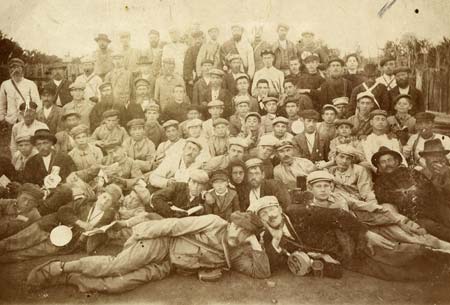
A Group of Fusgeyers from Iasi, c. 1900 http://epyc.yivo.org/content/photos/14_q_RM-RUMANI-4_lg.jpg

Yesterday’s post described some of the reasons that Jews like my grandfather and his relatives decided to leave Romania in the early years of the 20th century: rampant anti-Semitism, poverty, violence, false accusations, and laws depriving Jews of access to education and to most means of earning a living as well as denying them the legal rights of citizens.  Thousands of Jews left Romania between 1900 and 1910, many of them on foot, including my grandfather.  In both The Wayfarers by Stuart Tower and Finding Home by Jill Culiner, there are vivid descriptions of how these people managed to accomplish the task of walking about 1500 miles to cross the border from their homes in eastern Romania to Hungary or Galicia, where many then caught trains that would eventually bring them to the ports where they could sail to the United States.

Both Tower and Culiner relied heavily on the unpublished manuscript written by Jacob Finkelstein around 1942, describing his personal experience as a member of the first group of Fusgeyers.  Finkelstein’s memoir appears to be the most important primary source regarding the Fusgeyers, and Culiner begins most of her chapters with an excerpt from that manuscript.  The first group of Fusgeyers walked out of Romania in 1900, traveling by foot from Barlad to Predeal and crossing into Hungary.  As detailed in both Tower’s and Culiner’s books and as described by Finkelstein, that first group was an outgrowth of a club of young people in Barlad who put on theatrical works to raise money for charitable causes.  Members of the group decided that they could use their talents to raise money to pay for their travels out of Romania.  They raised some initial money through donations and from fees collected from those who wished to join them, and eventually there were seventy-five men and three women who joined the group and left Barlad in April, 1900.

The Gheorghe Rosca Codreanu Lyceum in Barlad (...

Barlad, Romania

Română: Timisul de Jos,Predeal,Brasov,Romania.

Română: Timisul de Jos,Predeal,Brasov,Romania. (Photo credit: Wikipedia)

One person was selected to be the leader of the group, and others were appointed to various roles: treasurer, medical care, scouts, and security.  They had flyers printed to distribute in the towns they planned to visit, and the people of Barlad provided not only financial support, but food and supplies to the group.  The group then walked from town to town across Romania, often being treated very well; in some places people provided them with food, shelter, and generous donations.  The group would stage musical performances to raise money.  Many newspapers publicized the movement, bringing even more donations and larger audiences to greet and support the Fusgeyers.  Moreover, this first group inspired new groups to form and to leave their homes as well.  My grandfather, who loved music and was smart and funny, might very well have been one of the Fusgeyers who left Iasi in 1904.

Sometimes, however, the group met up with hostility.  In Ramnicu Sarat, the police confiscated the passports of that first Barlad group, telling them to keep themselves from being noticed.  The passports were, however, returned once they left the town.  The group was threatened with arrest if they entered the town of Mizil, so they stayed out, sleeping in tents in the rain instead, and they were told to avoid the next town as well, resulting in another night of sleeping in the rain.  There was even trouble within the group; money was wrongfully taken by one of the group representatives.  Overall, however, at least according to Finkelstein, his group’s experience was a huge success—enabling not only that group to escape, but also inspiring thousands of other Romanians to do the same.

I cannot capture or describe all the details of the experiences of the Fusgeyers.  All I have as primary material in Finkelstein’s memoir, but Stuart Tower’s book takes the skeleton of facts provided by Finkelstein and builds from those facts a novelized version of that experience that helps to bring to life the Fusgeyers’ trek through Romania.  He developed characters and storylines that add an extra layer of humanity to this basic story.

The Wayfarers (Paperback) ~ Stuart Tower (Author) Cover Art


When I was doing some additional research about the Fusgeyers yesterday, I happened upon a website that described plans to turn Tower’s novel into a documentary about the Fusgeyers.  I did not realize it at first, but the website was a page on Kickstarter, a crowd-sourced fundraising site that helps people raise funds for private projects—in the arts and otherwise.  The Kickstarter page for The Wayfarers movie had not yet attracted any donors.  I made a small donation and also left a comment for the contact person of the page, Ron Richard, explaining my interest and expressing my concern that there had not yet been any other donations for the project.

I have heard back now both from Ron Richard and from Stuart Tower, the author of The Wayfarers.  Tower sent me some wonderful photographs of Romania from a Fusgeyer tour he ran in 2005, and I am hoping to get permission to post some of those photos here.  If any of you would also like to help Ron Richard and Stuart Tower make this film about the Romanian Fusgeyers, please check out their Kickstarter site at  https://www.kickstarter.com/projects/1552736981/the-wayfarers-the-story-of-the-fusgeyers?ref=live  It may be the best opportunity many of us have to see Romania and to understand better the experiences of our ancestors.

Jill Culiner’s book takes a different approach to exploring the Fusgeyer experience.  After reading Finkelstein’s memoir, she decided to re-enact the walk of the Fusgeyers, also walking from Berlad to Predeal, but not with a large group, just with one companion.   Her experiences doing this provide a chilling post-script to the story of the Jews in Romania, one that I found moving and haunting even re-reading it.  I will post more about her book and her experiences tomorrow.


Enhanced by Zemanta

The Fusgeyers: Why They Left Romania

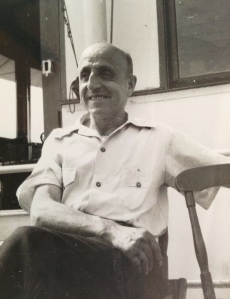
Isadore Goldschlager

Isadore Goldschlager

“Grandpa walked out of Romania to escape from the Romanian army.”  That was the one story I knew about my grandfather’s life before he came to the US as a teenager.  I knew a few other snippets about him in general—that he loved music and animals, that he knew multiple languages, that he was a union activist and very left-wing in his political views, that he was a milkman, and that he was a terrible tease and had a great sense of humor.  But the story about him walking out of Romania was the one that always intrigued me the most.  I would ask my mother questions: Did he go alone?  Where did he walk to? How did he get to the United States? But she knew nothing more than that barebones story—that as a teenager, he decided to run away from the army and walked across the country to escape.

When I first started researching my grandfather’s family, I wanted to know more about this story.  Was it just a myth, or was there any factual basis to it?  I did some initial research and learned that there was in fact an entire movement of Jews who left Romania by foot beginning in the early 1900s, around the same time my grandfather left (1904).  These walkers were known as the Fusgeyers or “foot-goers.”  Unfortunately, I could not find many sources of information about this movement.  I found only two books devoted in depth to the topic.   One is a novel called The Wayfarers by Stuart F. Tower; although written as a novel, it was inspired by the author’s actual search to learn about the Fusgeyers.  It tells the story of an American man whose grandfather left Romania by foot.  The grandson, now an adult, takes his own teenage son and his elderly father to Romania to learn more about his grandfather’s escape from Romania.  The author describes long conversations that the lead character had with a rabbi living in Romania who was familiar with the Fusgeyer movement.  Although this book gave me a taste of what the movement was like, I wanted to read something more fact-based and scholarly to understand and know more about the Fusgeyers.[1]

I found that in the second book about the Fusgeyers: Finding Home: In the Footsteps of the Jewish Fusgeyers by Jill Culiner.  This book, a work of non-fiction, is fascinating and heart-breaking.   After reading Jacob Finkelstein’s “Memoir of a Fusgeyer from Romania to America,” an unpublished Yiddish manuscript written around 1942 and held by the New York-based YIVO Institute, Culiner, not herself a descendant of Romanian Jewss, decided to retrace the routes taken by the Fusgeyers as they walked out of Romania.  She actually walked these routes, visiting all the towns and cities along the way, asking current residents what they remembered of the Fusgeyers and of the Jewish communities that existed in those towns before the Holocaust.  What she learned about the past and present in Romania is what makes the book both fascinating and heart-breaking, and in a subsequent post, I will write more about that.  But first, I want to set the scene by describing what I learned from this book and elsewhere about why the Jews left Romania in the early 1900s.

As reported by Culiner and others[2], Jews had likely been living in the two principalities that became Romania, Walachia and Moldavia, since Roman times.   The Jewish population increased significantly in the second half of the 14th century when many Jews from Hungary and Poland immigrated there after being expelled from their home countries. (Wikipedia).  Ironically, Romania eventually became one of the most anti-Semitic of the European countries.  In 1640, the Church Codes of Walachia and Moldavia declared Jews heretics and banned all relationships between Christians and Jews. (Culiner, p. 15). During the 17th and 18th century, there were repeated “blood libel” accusations against Jews—being accused of killing Christian children for their blood— followed by violence and persecution.  (Culiner, p. 15; Wikipedia).

The widespread anti-Semitism really came to a head in the mid-nineteenth century during the movement for Romanian independence and the unification of Walachia and Moldavia into the independent nation of Romania. As the report on Romanian anti-Semitism on file with Yad Vashem reports, after the Crimean War and the defeat of Russia, which had previously controlled Walachia and Moldavia, the European powers (primarily France and Britain) put a great deal of pressure on the leaders of the independence movement in the region to grant Jews full legal status in the new country.  Although the leaders had originally argued for such rights during the uprisings against Russia, the external pressure created a great deal of resentment, and in the end the European powers backed off from insisting on full legal rights for the Jewish residents of the newly-united nation of Romania.  (Yad Vashem report).

The Yad Vashem report continues:  “A real explosion of openly expressed antisemitism occurred as the prospect of achieving national independence became more certain. During discussions of the new Constitution of 1866, Romanian leaders began to portray Jews as a principal obstacle to Romanian independence, prosperity, and culture.”  As finally drafted, Article 7 of the new Constitution for Romania provided that “[t]he status of Romanian citizen is acquired, maintained, and forfeited in accordance with rules established through civil legislation. Only foreign individuals who are of the Christian rite may acquire Romanian citizenship.”  Culiner described this development, saying that “anti-Semitism had now become part of the national identity.” (Culiner, p. 15)

Despite protests and outcry from western European countries, the new country persisted in its anti-Semitic views and practices.  Between 1866 and 1900, a number of laws were enacted restricting the business and other activities of Jewish residents in Romania.  Jews could not become officers in the military, customs officials, journalists, craftsmen or clerks.  Jews could not vote or obtain licenses to sell alcohol.  Jews could not own or cultivate land.  Jews could not own or manage pharmacies.  They could not work in psychiatric institutions or receive care as free patients in hospitals.  Jews could not sell tobacco or soda water or certain baked goods. Fewer than ten percent of Jewish children were allowed to attend public schools, and Jews were prohibited from opening their own schools.  Jews were not allowed to work as peddlers, which was sometimes interpreted to include owning shops.  Jewish homes were randomly destroyed as “unsanitary.”  (Culiner, pp. 16-17)

Culiner wrote:  “Eventually, 20,000 Jews found themselves on the streets of Romania and dying of starvation.  There were many suicides in Iasi, Bacu, and Roman….In 1899 and 1900, harvests were poor and a severe depression gripped the country.  Anti-Semitic decrees were applied with new severity and anti-Jewish speeches were delivered in parliament.  Riots took place in several towns, and…a pogrom broke out in Iasi.”  (Culiner, pp. 17, 19) (See also Wikipedia  and the Yad Vashem report on Anti-Semitism in Romania.)

That pogrom in Iasi was described in the American Jewish Yearbook of 1900: “For several hours there was fighting, merciless blows, pillaging and devastation, all under the paternal eyes of the police authorities and the army, which interfered only to hinder the Jews from defending themselves.”[3]

In 1900, my grandfather was twelve years old.  He lived in Iasi.  He experienced this horrible violence and hatred.  By that time his uncle Gustave and his aunt Zusi had already left for America.  Is it any surprise that this young teenager would have wanted to escape from his homeland and seek refuge someplace else?
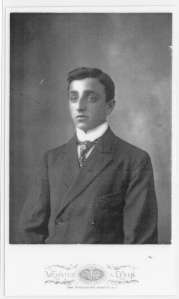
Isadore age 27

Isadore age 27

As I will report in a later post, he and thousands of other Jews did leave, many on foot, walking out of Romania to find a better life.  My grandfather followed his uncle and his aunt, who had left in the late 1880s, but he left alone, without his parents or siblings.  His first cousin Srul Srulovici, who became Isador Adler, had left two years before him in 1902, also alone and without his parents and siblings.  My grandfather left in 1904, and by 1910 the rest of his family—his siblings, mother and father and the rest of his Srulovici cousins—had also arrived.  I don’t know the details of how any of them got out or whether they were also Fusgeyers, but they all  followed their two oldest sons and brothers, both to be called Isadore in the United States.

So  my grandfather left Romania on foot, but not only to escape the Romanian army.  He escaped a life of poverty, of hatred, of discrimination.  He was only sixteen, but he was brave enough, smart enough, and strong enough to get out of a place that held no future for him.  He led his family to freedom.  Whatever life brought them in America, and it wasn’t easy, it was better than what they had left behind.


[1] Apparently the novel is being turned into a documentary about the Fusgeyer movement.  See https://www.kickstarter.com/projects/1552736981/the-wayfarers-the-story-of-the-fusgeyers

[2] Wikipedia has a long and detailed article on the history of the Jews in Romania at http://en.wikipedia.org/wiki/History_of_the_Jews_in_Romania.  I also consulted other sources, such as a report on Romanian anti-Semitism filed on the Yad Vashem website at http://www.yadvashem.org/yv/en/about/events/pdf/report/english/1.1_roots_of_romanian_antisemitism.pdf

[3][3] “Romania since the Berlin Treaty,” The American Jewish Yearbook (Philadelphia: The Jewish Publication Society of America, 1900), p. 83, as quoted in Culiner, p, 19.

Enhanced by Zemanta

A Passover Post-Script

Passover - Shalom

Passover – Shalom (Photo credit: paurian)


Our first seder is over and done, the rented table has been returned, the food has been eaten or put away,  and the house is (somewhat) back in order and far too quiet now that the guests are gone.  We have the second seder tonight at my brother-in-law and sister-in-law’s house, so now I get to be the guest and sit back a bit.  But before I move on from last night, I wanted to share my thoughts as a follow-up to my original Passover post.


I wrote in that post, based on last year’s seder, that Nate was too young to understand the story of Passover.  What a difference a year makes! He not only understood the story of Passover—he taught it to all of us.  He told us about how the “pharaoh guy, the bad guy” made all the people work too hard and how they never had a break.  He told us that Moses asked pharaoh to let his people go, but pharaoh said “No, no, no,” and so God sent frogs and locusts to punish him.  “The sky was so thick that the people could not see.”  He described how the people were in a hurry and had to carry the dough on their backs and how “the ocean snapped open so they could get on the island, and then it snapped closed so the soldiers could not get to the island.” And he closed the story by telling us that the people opened their backpacks once they were safe on the island.


Horsemen of Pharaoh

Horsemen of Pharaoh (Photo credit: Nick in exsilio)

Sure, a few details are missing and a few geographical facts are slightly off, but he got it.  He got the idea that the people were unfairly treated and that they wanted to be free.  He understood how important freedom is and how we have to stand up to the bad guys when they deprive us of that freedom.  He knows that the journey may be dangerous, but that you can cross the ocean and reach a place where you are free to open your backpacks and live in peace.


Isn’t that exactly the right lesson to learn from the Passover story? To cherish freedom, to stand up to evil, and to take steps, even dangerous steps, to ensure that you and your loved ones can live in peace?  My ancestors must have been smiling down on my three year old grandson with such pride.  As was I.  As were we all.


Enhanced by Zemanta

Passover wishes and thoughts


Passover Seder Plate

Passover Seder Plate (Photo credit: Wikipedia)


As we approach the first night of Passover on Monday evening, I am feeling a bit overwhelmed, as I usually am this time of year.  There is the cleaning, shopping, cooking, and all the other details that go into preparing the house for Passover and for the seder.  I am also feeling torn because there are so many things I want to do in connection with my research and the blog.  I have lots of photos to scan and post, both from my Brotman relatives and my Rosenzweig relatives, stories that need to be written, documents to request, people to contact.  But I do not have time.  So while the kugel is baking and before I start turning over the dishes and pots and pans for the holiday, I thought I’d take a few minutes to ponder what Passover means to me this year.


Passover was once my favorite holiday of the year.  I loved the seder because as a child, it was my only formal exposure to Jewish history and Jewish rituals.  I grew up in a secular home.  We did not belong to a synagogue, I did not go to Hebrew school, and there were no bar or bat mitzvahs celebrated in our family when we were children.  It was just fine with me, but I was also very curious about what it meant to be Jewish.  Passover gave me a taste of what being Jewish meant and could mean.  My Uncle Phil, my Aunt Elaine’s husband, had grown up in a traditional Jewish home, and although he was not terribly religious either, he wanted to have a seder.


So every year we had a seder, first only at my aunt’s house, and then my mother started doing a second seder at our house.  My uncle, the only one who knew Hebrew, would chant all the blessings and sing all the songs, and the rest we would read in English from the Haggadah for the American Family (not Maxwell House).  I was enchanted—I loved the music, the stories and all the rituals. I looked forward to it every year.


As an adult, I began my own exploration of what it means to be Jewish.  I married a man from a traditional family, and he wanted to keep the traditions and rituals that were part of his childhood.  I also wanted to learn more and do more.  I took classes, I read, I got involved with the synagogue, and over time the Jewish holidays and rituals and prayers and services became second nature to me and provided me with meaning and comfort and joy.

Passover has become just one small part of my Jewish life and identity now, and over time, it has lost its magic.  It no longer is my favorite holiday of the year.  The matzoh gives me indigestion, the chore of changing the dishes and pots and pans has become tiresome, and the seder is so familiar that it no longer feels fresh and new and exciting.


If I look at it through my grandson’s eyes, I can feel some of that old excitement, but he is still too young to ask questions or to understand the stories.  He just likes the songs and looking for the afikomen and being with his family, which is more than enough for now.  This picture, one of my favorite pictures ever, captures some of that feeling.  From generation to generation, traditions are being preserved.

L'dor v'dor  Harvey and Nate

L’dor v’dor Harvey and Nate


But this Passover I will try to take the time to think about things a little differently.  I will think not just about Moses and the Israelites crossing the Red Sea and going from slavery to freedom.  I will think about all my maternal ancestors who made their own Exodus by leaving poverty and oppression and prejudice and war in Romania and Galicia to come to the place where they hoped to find streets lined with gold.


I will think of my grandfather Isadore, the first Goldschlager to come, leading the way for his father, his mother, his sister and his brother.  I will think of how he traveled under his brother David’s name to escape from the army and come to America.


I will think of his aunt, Zusi Rosenzweig, who met him at the boat at Ellis Island.  I will think of his uncle Gustave Rosenzweig, who was the first Rosenzweig to come to the United States back in about 1888, with his wife Gussie and infant daughter Lillie, a man who stood up for his extended family on several occasions. And I will think of his aunt Tillie Rosenzweig Strolowitz, who came to the US with her husband and her children, who lost her husband shortly after they arrived in the US.  I will remember how she took in my grandfather and his sister Betty when their father, Moritz, died, and their own mother and brother David had not yet arrived.


And I will think about my great-grandfather Joseph Brotman, who came here alone in about 1888 from Galicia, whose sons Abraham and David from his first marriage came next, and whose son Max as just a ten year old boy may have traveled to America all alone.  I will think of Bessie, my great-grandmother for whom I am named, who brought two small children, Hyman and Tillie, on that same trip a few years later, and who had three more children with Joseph between 1891 when she arrived and 1901, when Joseph died.  The first of those three children was my grandmother Gussie Brotman, who married my grandfather Isadore Goldschlager after he spotted her on Pacific Street while visiting his Rosenzweig cousins who lived there as well.


All of these brave people, like the Israelites in Egypt before them, pulled up their stakes, left their homes behind, carrying only what they could carry, to seek a better life.  I don’t know how religious any of them were or whether they saw themselves as brave, as crossing a Red Sea of their own.  But when I sit and listen to the blessings and the traditional Passover songs this year, I will focus on my grandson and see in him all the courage and determination his ancestors had to have so that he could be here, free to live as he wants to live and able to ask us, “Ma Nish Ta Na Ha Leila Ha Zeh?” Why is this night different?


Why is this night different from all other nights? It isn’t because we are free; it’s because on Passover we remember what it was like not to be free and to be grateful for the gifts of those who enabled us to be free.

Happy Passover to all, and thank you to all my  Brotman, Goldschlager and Rosenzweig relatives for making this such an exciting journey for me.


Enhanced by Zemanta

Itic Jankel Srulovici

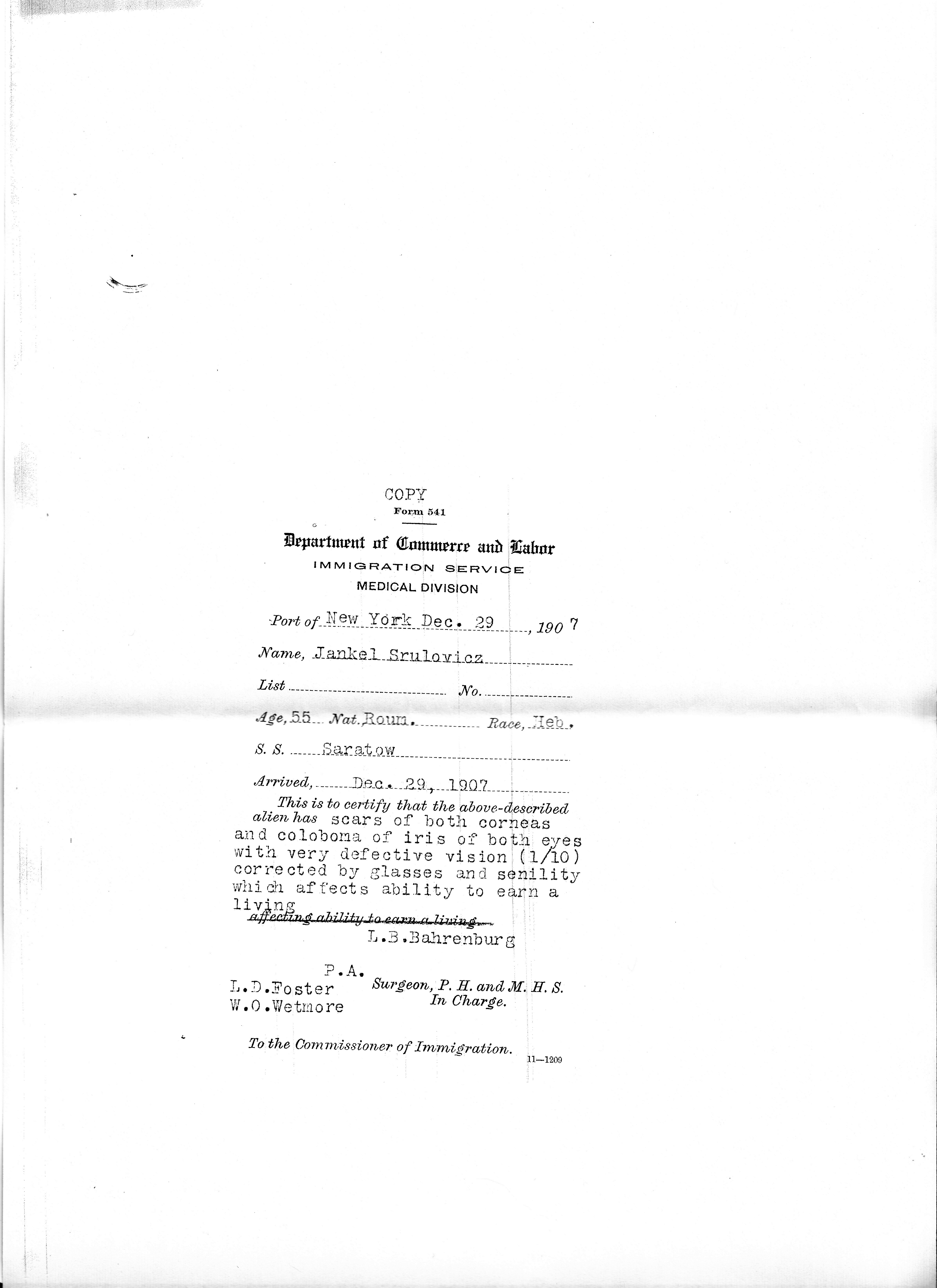
As you may recall, one of the mysteries I was having trouble solving was the fate of Itic Jankel Srulovic, aka Jacob Strolowitz or Adler, aka a number of other possible spellings of both his first and last name.  He was the husband of Tillie Rosenzweig Strolowitz, my great-grandmother Ghitla Rosenzweig Goldschlager’s sister.  He had arrived with his wife and his three youngest children on December 29, 1907, aboard the SS Saratov and had been detained because of problems with his eyes—scars on his corneas and coloboma on both irises.  Family lore suggested that he had never left Ellis Island, either having been deported or dying there, but the passenger manifest was stamped “Admitted,” indicating that a bond had been posted.

I had requested the case file for Jankel Srulovici from NARA, the National Archives and Records Administration in Washington, DC, a few weeks ago, and it arrived yesterday.  I have been studying it ever since.  The papers are fascinating not only because of what they reveal about Jankel and his family, but also because they provide some insight into the times and the experiences of immigrants. I will post scans of the documents in their entirety for those who are interested in the general history as well as those who are interested in the particulars of the family history.

The first document, dated December 31, 1907, is a recommendation from the Acting Commissioner of the Immigration Service, Joseph Murray, that Jankel Srulovic [sic] be admitted to the United States based on a bond of $1000 that was being posted. Commissioner Murray then described Jankel’s eye problems as causing “very defective vision (1/10), corrected by glasses,” but also said that Jankel was suffering from senility which affected his ability to earn a living.  He was only 55 years old; why was he suffering from senility?  What was this diagnosis based upon? There is later testimony that Jankel could not read or write; perhaps the diagnoses was based on his illiteracy, or maybe his illiteracy and his apparent senility was really more a misdiagnosis based on the fact that he did not speak English. Or, of course, perhaps he was really senile.

acting commissioner's recommendation

Enclosed with the recommendation were the report of the doctor’s exam of Jankel, as described in the Acting Commissiner’s letter,doctor's report and a transcript of the hearing held on December 30, 1907.  The transcript names the parties detained and subject to the inquiry as Itie Jankel Srulovic, 55, Roumanian Hebrew, and his wife Tille, 48, and children Riwke [Beckie, then Ray], 15, Pinkus, 9, and Lea, 7.  There is then what I assume to be a translation of some of the testimony given by Jankel.  He named his four older children already residing in the United States, Srul [Isidore], 26, Judel [David?], 21, Brucha [Bertha], 23, and Bluma [Bella], 18.  He testified that he could not read or write, that he was a painter, that he paid his own passage on the Saratov, and that he had $100, which he showed to the hearing officers.  He then was asked whether he had worked before coming to the US or been supported by his children, and he responded, “I supported myself without assistance from my children.”

transcript

transcript

A few things struck me by this testimony. First, I had an immediate reaction of surprise and anger that Jankel was identified by his religion.  Why was the fact that he was “Hebrew” at all relevant, especially in the context of a legal hearing to determine his right to enter the country, a country supposedly founded in large part on the principle of freedom of religious exercise?  Second, I could almost feel Jankel’s humiliation; he was asked whether he needed his children to support him.  He had to admit that he could not read and write.  On the other hand, he had $100—was that a lot or a little for an immigrant to have with them back then? And he had a trade—he was a painter.

The next paragraph made me smile because the next witness was Gustave Rosenzweig.  You may recall that I had noticed on Bertha Strulowitz’s marriage certificate that one of the witnesses was named Gustave Rosenzweig, and I had wondered whether this could be Tillie’s brother and thus also my great-grandmother’s brother.  Well, here he was, testifying at the hearing where the future of Tillie and her husband and children were at stake.  Gustave testified that he wanted [to help?] his sister, brother-in-law and their children.  He said, “I am worth $6000, all told; have a business of Painter Supplies,” and further said, “I will do the best I can for them.”  When asked whether Jankel could work, Gustav responded,”He has no business to work at all.  I will keep him in my house.”  He further testified that Jankel had “four grown children here to take care of them and able to take care of them.”

I was impressed both by the fact that Gustav had $6000 in assets and that he was so generous in coming forward to help his sister and her family.  He could not have been in the US that long himself, and he had to have some concern and fears about facing an official governmental agency, but he stood up for Jankel and his family.  Based on this testimony, the board of inquiry recommended that Jankel be “given this opportunity” to apply for admission on bond.

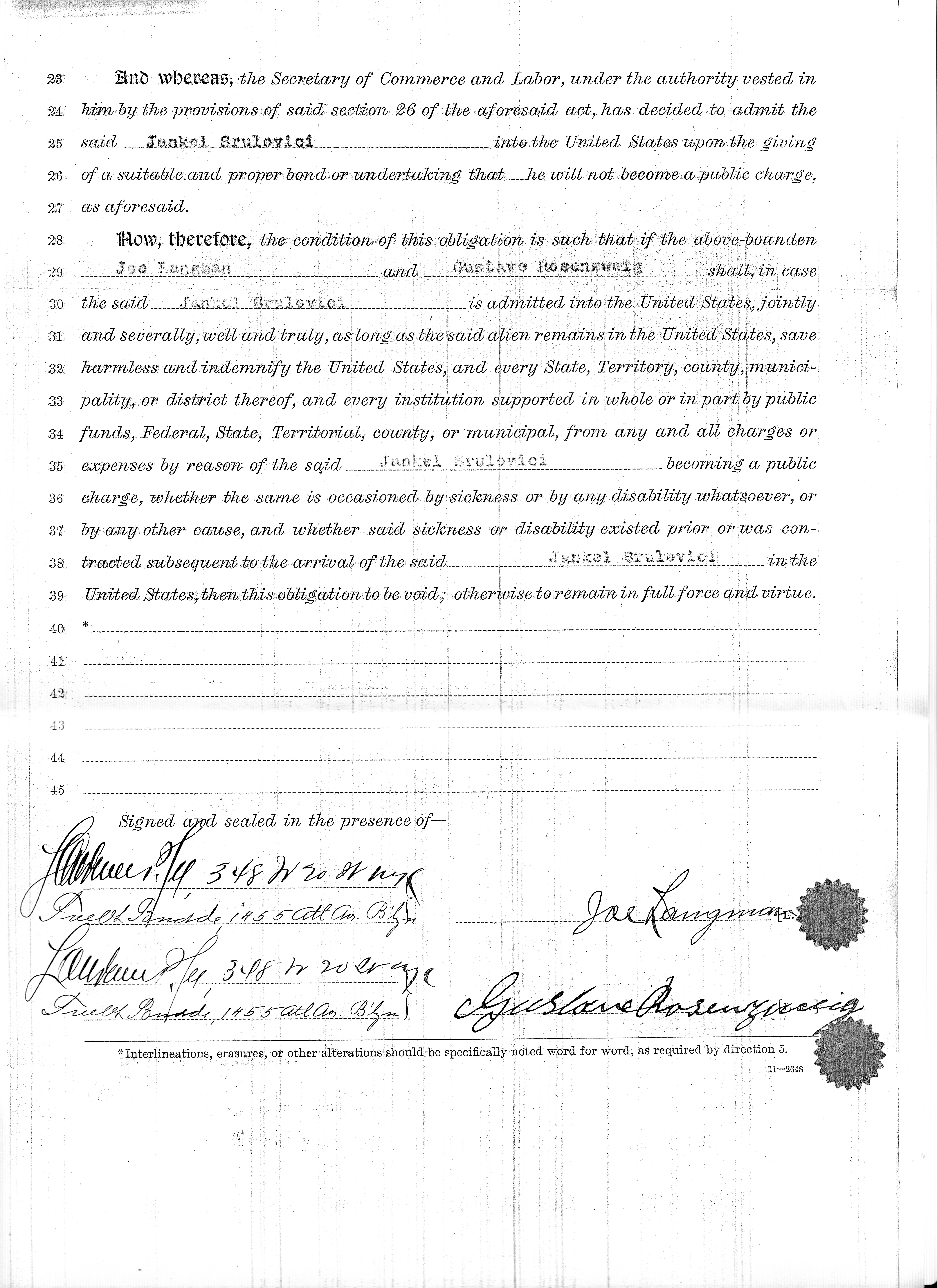
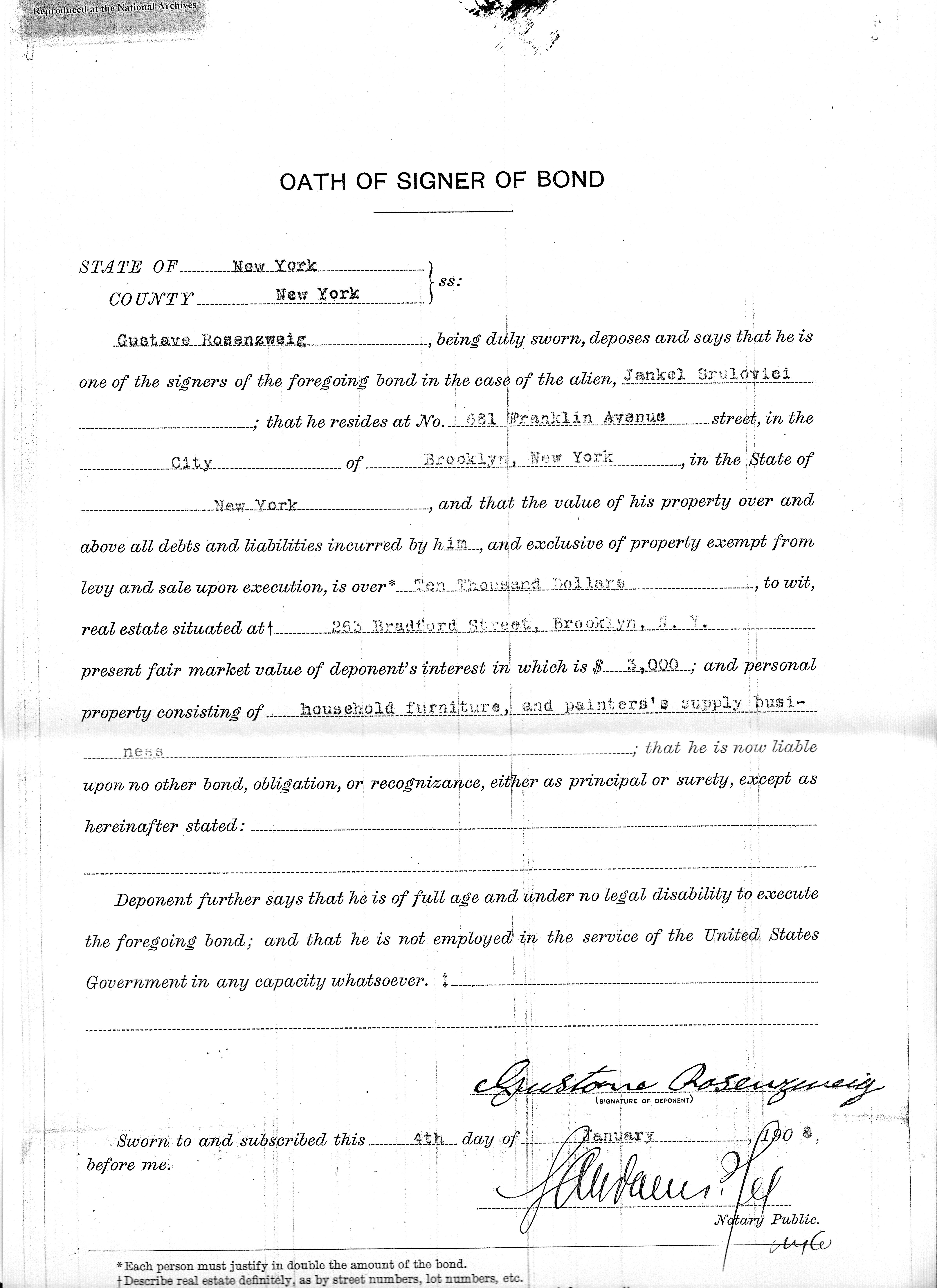
The remaining pages included with the Acting Commissioner’s recommendation are the bond, the application for the bond, and the oaths made by those providing the bond, Gustave Rosenzweig and Joe Langman.  Although I have only done some preliminary research on Joe Langman, it appears that he was also from Iasi and had been in the US for some time before this hearing.  I do not know whether there is any family connection, or whether he was just a landsman helping out another Romanian from Iasi.  Langman signed an oath claiming to have real property in Manhattan worth over $60,000, which must have been quite a substantial sum back then.  Gustave also signed a similar oath, asserting that he had $3000 worth of interest in real estate located in Brooklyn as well as personal property consisting of furniture and his painters’ supply business (presumably worth the other $3000).  Based on these oaths, a bond was issued for $1000 and presented in order that Jankel “shall not become a public charge” and be allowed to enter the country.

bond application p.1

bond application p.1

page 2

page 2

Oath of Joe Langman

Oath of Joe Langman

Oath of Gustave Rosenzweig

Oath of Gustave Rosenzweig

One other interesting thing I noticed about these documents: at the bottom of the page containing the oath is a footnote that reads, “In case signer of bond is a woman, insert here [on a line on the oath] “that deponent is an unmarried woman.” “ I had to stop and think about that for a minute, and then I realized what it meant.  Only an unmarried woman could post a bond because a married woman had no independent claim to property.  Boy, between being Jewish and a married woman, I would have had no rights back in 1908.

The final document in the file is the recommendation of the Commissioner of Immigration Services to the Secretary of Commerce and Labor, agreeing with the Acting Commissioner’s recommendation and recommending that Jankel Srulovici be granted admission on bond.  Although there is no response from the Secretary, I would assume that in general the Secretary deferred to the Commissioner and his hearing officers, and that Jankel and his family were in fact admitted into the United States and that he was not left on Ellis Island or deported.commissioner's recommendation

And yet, despite spending hours again last night searching for some record of his death or a gravesite, I still cannot find anything that reveals what happened to Jankel after January, 1908, when he was admitted, and April 29, 1910, when, according to the 1910 US census, Tillie was already a widow.

I’ve also been tracking down records for Gustav Rosenzweig and Joe Langer, but more on that in the next post.

Enhanced by Zemanta

The Goldschlagers

Having reached (for now) a dead end on my research of the Brotman family, I have decided to turn to, or rather return to, my research of my grandfather’s family, my Goldschlager relatives.  I had previously done a fair amount of research on the Goldschlager line, but had put it aside when I found my Brotman cousins. For some of you, the Goldschlager story will be perhaps of less interest, although it is itself a wonderful story of American Jewish immigration.  For others, in particular my first cousins and siblings and my mother, the Goldschlager story will be of great interest.  And for those who are interested in genealogy generally and/or the history of Jews in Europe and America, this story should also be a great interest.

So although this blog is called the Brotmanblog (and will continue to be so titled), I have created a new page for my Goldschlager ancestors and relatives.  If you are interested, please check it out.  I also will be writing some posts to describe the research I’ve done to uncover the story of my grandfather, his siblings and his parents and grandparents.

In this first Goldschlager post, I want to tell the story of my grandfather Isadore.  Isadore was born in Iasi (or Jassy), Romania.  He was the oldest child of Moritz (Moses, Moshe, or Morris)and Gitla (Gittel or Gussie) Goldschlager.  He was born in August, 1888; his younger brother David was born the following year, and their younger sister Betty was born in 1896.  Isadore was named for his grandfather, Ira Goldschlager.  I was very fortunate to find a researcher in Iasi who located and translated several documents relating to these relatives, including birth records and marriage records for Moritz and Gitla, my great-grandparents.

Moritz and Gittel's marriage certificate

Moritz and Gittel’s marriage certificate

He even took a photograph of the house were my grandfather and his parents and siblings lived in Iasi.

The Goldschlager House in Iasi

The Goldschlager House in Iasi

When my grandfather was 16 years old, he left Iasi and walked through Romania to escape the tzar’s army and persecution.  Romania was one of the most anti-Semitic and oppressive countries in Europe at the time, and many Jewish residents decided to escape in the early years of the 20th century. In a subsequent post, I will write more about the conditions in Romania and the history of the Fusgeyers—the “foot goers” who left Romania on foot.  My mother said that she does not remember her father talking about Romania very much, except to talk about the horses and the music, two things that he loved very much.

My teenaged grandfather arrived in New York City in 1904 without any relatives and under his brother’s name.  In 1905 he had a job as a storekeeper in a grocery store and lived in what is now East Harlem at 113th Street, apparently alone or perhaps in a boarding house.  His father Moritz arrived in 1909, and his mother Gittel, brother David, and sister Betty in 1910.  Sadly, it appears that Gittel, David and Betty arrived shortly after Moritz had died.

By 1915, Isadore and his mother and siblings were living together in East Harlem.  David was working at a hat maker, Betty as a dressmaker.  Isadore’s occupation unfortunately is not legible on the 1915 census form.  Edit:  On closer examination, I believe it says “Driver Milk,” which is consistent with what he was doing for the rest of his working life.

1905 NY census

1905 NY census

1915 NY Census for the Goldschlagers

1915 NY Census for the Goldschlagers

By 1917, when Isadore registered for the draft, he was working as a driver for a dairy company and married to my grandmother Gussie and living in Brooklyn.

Isadore's World War I draft registration

Isadore’s World War I draft registration

He continued working for dairy companies and eventually became a foreman.  He and my grandmother had three children. As a milkman, my grandfather worked at night to deliver the milk by morning.  When he delivered milk to people in the poor communities, they all loved him so much that they would bring him food.

My grandparents moved to Parkchester in the 1940s with my mother, who was only twelve at the time.  When I was born ten years later, my parents also lived in Parkchester, just a few buildings away from my grandparents, so I spent my first four and half years living right near my grandparents.

My grandparents and me 1956

My grandparents and me 1956

Although my grandfather died before I was five years old and thus my memories of him are vague, I do have a memory of him as a loving grandfather.  Perhaps it is the stories I’ve heard all my life about him rather than my own memories—it’s hard to know.  I know that my mother and her siblings loved him a great deal, that he was a big tease with a great sense of humor, and that although he left Romania at fifteen and never received a high school education, he spoke several languages and was a very smart and witty man.  He must have been an incredibly strong person to have left his family at such a young age; most likely he helped the rest of his family come to the United States once he got here.

I wish I had known him longer, and I wish I knew more about his life both in Romania and in New York.  Perhaps as I pursue this line of research I will learn more.  I have just located one of David’s grandsons, Richard, and David’s son Murray is 92 and living in Arizona.  I am hoping that Murray may know more about David’s life in Romania and the relationship between the two brothers, David and Isadore.

Enhanced by Zemanta

Streets: A Memoir of the Lower East Side by Bella Spewack, Part II (up to age 12)

It was interesting to read about Bella’s childhood and developing American and Jewish identity growing up in the Lower East Side.  Not surprisingly, there was a wide range in the level of religious observance among the Jews on the Lower East Side.  Some Jews were very observant. Bella described the household of one of her childhood friends as follows:

“It was a decidedly quiet house—and more so on Friday and Saturday when religious observance forbade everything that would tend to introduce noise.  On Friday before sundown, the four girls of the family would comb their hair, the mother helping the youngest who had to wear hers in curls.  Before going to bed each would draw a cap over the freshly combed and plaited hair.  In the morning, the cap was removed but no comb touched the hair until Sunday morning.”  (p. 53)

On the other hand, Bella and Fanny seemed to live a very secular life.  A few pages after this passage, Bella described how she spent her Friday nights.  She would meet all her girlfriends and play loud and active games of tag and other outdoor games.  Bella also wrote that she felt “no everyday kinship with the synagogue” and “had an idea that it belonged to the menfolk only.”  (p. 47)   She wrote that she only went to the synagogue on holidays.

Bella in fact experienced real confusion over her religious identity and at one point decided that she wanted to be Christian, not Jewish, much to her mother’s dismay.  This desire seemed to have been rooted in Bella’s perception that Christians were more refined: they were gloves, had clean nails, and spoke perfect English.  Some of it may also have been rooted in her experiences with anti-Semitism, such as the time she and her mother were lost, walking in a strange neighborhood, and were accosted by a group of boys who called them sheenies and grabbed and poked at them.

Most of Bella’s childhood years, however, were spent focused on her friends, books, and school.  In the introduction to the book, Ruth Limmer wrote that the schools Bella attended “were both ideal and wretched—wretched in their overcrowding (class size was forty-five to fifty); ideal…in that they were rigid in their demand that the students seriously attend to learning English.”  (p. xx)

The mission of the schools was to Americanize the children of the immigrants (of all backgrounds) by immersing them in English literature, American and British history, physical training and athletics, and culture. Limmer asserted that as a result, parents often became dependent on their children, who spoke English and who were much more comfortable with the American way of doing things.

The schools also tried to instill values, including discipline and obedience.   Limmer wrote: “The routines began when they arrived at school each morning.  No horsing around.  They were required to line up in order of height on sex-segregated lines and, at the bell, were marched silently to their classrooms.”  (p. xxii)  Bella’s description of her day at school is consistent with Limmer’s overview:

“At school, there was first the assembly period when doors rolled back and mediocre schoolrooms became a vast auditorium.  You marched in with your class holding yourself straight and stiff, turning square corners with military exactitude.  You looked out furtively from beneath your lashes to see if your teacher… noticed that your shoulders were back and your stomach in.” (p. 66)

The students would then salute the flag and listen to readings from the Bible every day, apparently a common practice in the NYC public schools until after World War II, a practice that certainly conflicts with Constitutional principles as we understand them today.

Bella was also a regular visitor to the city’s public libraries and spent her school vacations at the library, reading as much as she could.

Seward Park Library

Seward Park Library

Obviously, she was well-served by those crowded schools and those libraries, as she grew up to be not only capable of communicating in English, but to be a very successful professional writer who contributed to the American culture in which she had been immersed.

Bella’s life was very much confined to her neighborhood; she was at least ten years old before she did much venturing outside of the Lower East Side.  Once she and a friend tried to walk to Andrew Carnegie’s house uptown, but got no further than Fourteenth Street, where they were mesmerized by the department store and its escalator.  Another time she participated in a play with other immigrant children organized by the neighborhood settlement house, another agency engaged in Americanizing immigrant children.  The group of children performing the play went as far uptown as 96th Street, which Bella said was as far from the Lower East Side as any of them had ever been.

Otherwise, Bella and her friends stayed in their neighborhood, where she engaged in common childhood activities, including piano lessons and a sewing club.  There is no mention of religious education.  Overall, Bella’s childhood, despite the poverty and those incidents of abuse and anti-Semitism, was a happy one up through age twelve.  She was a smart, studious girl, but one who had many friends and who knew how to have fun.

Perhaps Bella was looking back with rose-colored glasses, but I’d like to take away from her depiction of her childhood a better feeling about my grandmother’s childhood in the Lower East Side with her siblings.  Yes, they did not have an easy life, and losing their father so young must have been terrible.  But they had their sisters and brothers and a mother whom they all adored.  I hope that like Bella, my grandmother also enjoyed school, played games, and had a network of similarly situated friends with whom to share some of the joys of childhood.

A World Apart, part 4: The Rich and the Poor in Galicia

In my last post, I wrote about Margoshes’ marriage to the daughter of Mordecai Shtiglitz, the manager and lessor of a substantial estate in Zgursk, not far from Radomishla.  After checking Google maps, I realized that Radomishla is only about 60 miles from Dzikow where our family might have lived, so Margoshes and Joseph and Bessie may have lived quite near each other in the 1880s.  Whether their lifestyle was anything like his we do not know, but it made reading his story even more compelling to me.

After Margoshes married, there was a three year period of what he called “kest.”  According to the glossary provided in the book, kest referred to the practice where the family of the groom provided financial support to the groom and bride after the wedding to enable the groom to study without having to worry about earning a living.  Margoshes and his new wife lived with his in-laws, both of whom worked very hard to manage and oversee the estate.  Margoshes, however, spent the early days of his marriage being idle, reading and eating a lot of fruit. At one point his father-in-law arranged for him to oversee the cutting down of trees for lumber on a nearby property where the Polish owner needed assistance and agreed to allow Margoshes to keep the profits in exchange for overseeing the labor.  Margoshes did not do any of the physical labor himself, but would ride out to make sure that the work was being done.  He hired a Jewish man to help him supervise the work.  After a short period of time, Margoshes decided not to pursue the lumber business any further.  He wrote that he found it tedious and that his father-in-law and wife found it beneath his dignity.  He sold the business to someone else and returned to his “kest” lifestyle.

About a year and half after he was married, Margoshes and his wife moved to Yozefov, a 450 acre estate about a mile away from Zgursk, where his wife’s sister and her husband had lived.  The land was owned by a non-religious Jew who had leased the land to Margoshes’ father-in-law as a place where his older daughter and her husband could live and work.  When the older daughter’s husband died, Margoshes and his wife were essentially told that they had to move to Yozefov and take over managing the estate.  Margoshes lived there for ten years and, as he described it, was his own boss for the first time.  The financial arrangement, however, put Margoshes in a risk-free situation.  His father-in-law covered the expenses and took the profits, but Margoshes and his wife were able to live without cost in exchange for overseeing the estate.  When the lease was up after ten years, Margoshes still had the original dowry from when he married plus the livestock and equipment from Yozefov which he then used to set up his own business.

In this section of the book, there is a little more light shed on how “the other half lived.”  First, it is clear that there were many Jews who were not wealthy at all. As described by Margoshes, “Jewish economic life in Galicia was always uncertain.  People who had done well for years and lived an upper class existence suddenly became paupers due to unforeseen circumstances.” (p. 58) Margoshes  observed many poor Jews while living in Zgursk: “…itinerant paupers were constantly wandering through.  A day rarely passed that 10-15 poor Jews did not appear in the manor yard.  These vagrants would often wander in whole families: man and wife, several children, and sometimes even infants at the breast. Every poor person …received a generous portion of hot food, and a big piece of bread for the road, along with two kreuzer in alms.  They were just not allowed to spend the night in the manor yard; their ranks included a lot of undesirable people and thieves.  They were sent away to the nearby inn, or if space was short, to the [poor house] in Radomishla.” (p. 67)

Margoshes claimed that he was the only person in the region with the ability or desire to read books in Hebrew, German or Polish, and when his brother-in-law Mikhl wanted to learn, there was no one but Margoshes to teach him.  Margoshes found Radomishla to be more sophisticated than other towns and shtetls nearby.  In the other towns, the Jews had cows as the source of most of their income.  They would milk and feed the cows themselves and tend to their own gardens to provide a meager living for their families.  (Margoshes’ tone in describing these hard-working farmers is blatantly condescending.)  In contrast, he found the Jews in Radomishla to be far more successful merchants who engaged in trade and did not own or take care of cows. There were timber traders, cattle dealers, and many money lenders—many people who were extremely wealthy.  Although Margoshes recognized that there were also poor people in Radomishla, he claimed that there were not as destitute as poor people in the other towns and shtetls.

Often I feel really annoyed by Margoshes.  He was what we might call today a very entitled young man—someone whose family was wealthy and who never really had to do any physical labor at all and barely any other hard work of any kind.  He was handed everything on a silver platter, yet has the nerve to express disdain for those who were less fortunate.  I may react this way in part because I imagine that our ancestors, Joseph and Bessie, were probably among those poor farmers Margoshes was looking down at from up on his high horse as the fortunate son and son-in-law of two wealthy men. I am still hoping that somewhere in his story, Margoshes developed some perspective and some empathy for those who were less fortunate.

A World Apart, part 3: Marriage in Galicia

I am continuing to read Joseph Margoshes’ A World Apart in order to learn about life in Galicia in the late 19th century.  Last night I learned something about arranged marriages in Galicia.  When Margoshes was only fourteen years old, his mother began to look for a prospective bride for her son.  Since Margoshes’ father had died, Margoshes was a candidate for an early marriage in order to relieve his mother of the burden of supporting him and caring for him.  Margoshes also said that early marriage was a way “to avoid moral lassitude, or strange and sinful thoughts, God forbid.” (p. 58)

Margoshes then described how shadken, or matchmakers, would come to his school to observe and evaluate the young boys in his class as potential grooms. Margoshes was considered a very attractive candidate: he was tall, good-looking, well-educated and from a well-regarded family.  His mother was presented with many different potential matches. Margoshes reported that parents never spoke to their children about these potential matches; it was all out of their hands and determined by the parents.  His mother rejected a number of potential brides because they were “unrefined upstarts of a very low social status…[who] would bring shame to his father’s grave…” (p. 60)

Eventually his mother agreed to an appropriate match, the daughter of a very successful man, Mordecai Stiglitz, who lived in Zgursk, a village near Radomisha, a town not too far from Tarnow where Margoshes and mother and brother were then living.  As described by Margoshes, Stiglitz had a big estate that he had acquired through successful leasing arrangements with the descendant of a Polish count who had owned several thousand acres in the area.  Stiglitz’s estate was itself thousands of acres, and he had many head of cattle, 40 horses, 40 oxen,  70-80 milk cows, and about 30 peasants who lived and worked on the estate.  They grew grain and grass on the estate and needed workers to tend to the livestock and to cut and care for the grain and grass, which they baled and sold in the market.

The Stiglitz family met Margoshes’ mother’s standards, and Margoshes was subjected to an evaluation of his knowledge of Gemara, Talmud and Jewish law in general.  He passed the test and was approved as a groom for Stiglitz’s daughter (whose name is never mentioned by Margoshes in his telling of this story).  Margoshes was only sixteen years old at that point.

After a lavish wedding with three feasts, including one for the poor Jews and beggars who lived in the area, Margoshes moved to Zgursk to live with his new bride on her father’s estate.  As Margoshes wrote, “Initially I did not really know my bride; we had only seen each other and talked very little during the engagement ceremony, and then not even exchanged a letter.  However, as soon as we got to know each other better after the wedding, we became as intimiate and loving as if we had known one another for many years.  This heart felt love has continued to this day, thank God, for over fifty years and will remain until the end of our lives.” (p. 65)  Two teenagers whose marriage was arranged by their parents and who did not know each other at all somehow managed to fall in love and create a long and happy life together.

I have heard and read about arranged marriages before, not only in Jewish families, but in many other cultures as well.  We recently watched an excellent movie, “Fill the Void,” about contemporary Israel and arranged marriages among the Hasidim today.  I know that often these marriages did not end up so happily, but it does seem that more often they worked—that two people who did not know each other somehow fell in love or at least developed a strong enough bond to create a lasting relationship.  It is so foreign to my own experience—I cannot imagine letting my parents select a life partner for me or marrying someone I’d only met once.   Yet I also cannot pass judgment on the practice since it does seem that often parents do know what is best for their children.

I have to assume that Joseph’s marriage to Bessie was itself an arranged marriage.  Joseph was a widow (or so we assume; perhaps his first wife had left him) with at least two young sons, Abraham, who would have been about nine, and Max, who would have been about three.  Bessie was his cousin and at least ten years younger than Abraham and about 24 when she married him.  Based on the customs of the day and the circumstances, most likely a matchmaker put together these two cousins so that Bessie would have a husband and so Joseph would have a wife and a mother for his children.  Did they grow to love each other? Or was it purely a convenient arrangement? The inscription on Joseph’s footstone certainly suggests that he was a good husband and father, so I’d like to think that, like Margoshes and his bride, Joseph and Bessie developed a loving marriage.  But then I am a hopeless romantic!