Rosenzweig Update: Who Signed that Death Certificate?

One of the biggest mysteries I encountered in researching my Rosenzweig cousins was the mystery of Lilly Rosenzweig, the first child of Gustave and Gussie Rosenzweig.  Lilly was my grandfather Isadore Goldschlager’s first cousin.  Lilly had married Toscano Bartolino in 1901 and had had a child William with him, born March 9, 1902.  Then just two years later on April 27, 1904, Toscano had died from kidney disease at age 27, leaving Lilly a twenty year old widow with a two year old child.

Bartolini Rosenzweig marriage certificate

Bartolini Rosenzweig marriage certificate


William Bartolini birth certificate

William Bartolini birth certificate

Toscano Bartolini death certificate

Toscano Bartolini death certificate


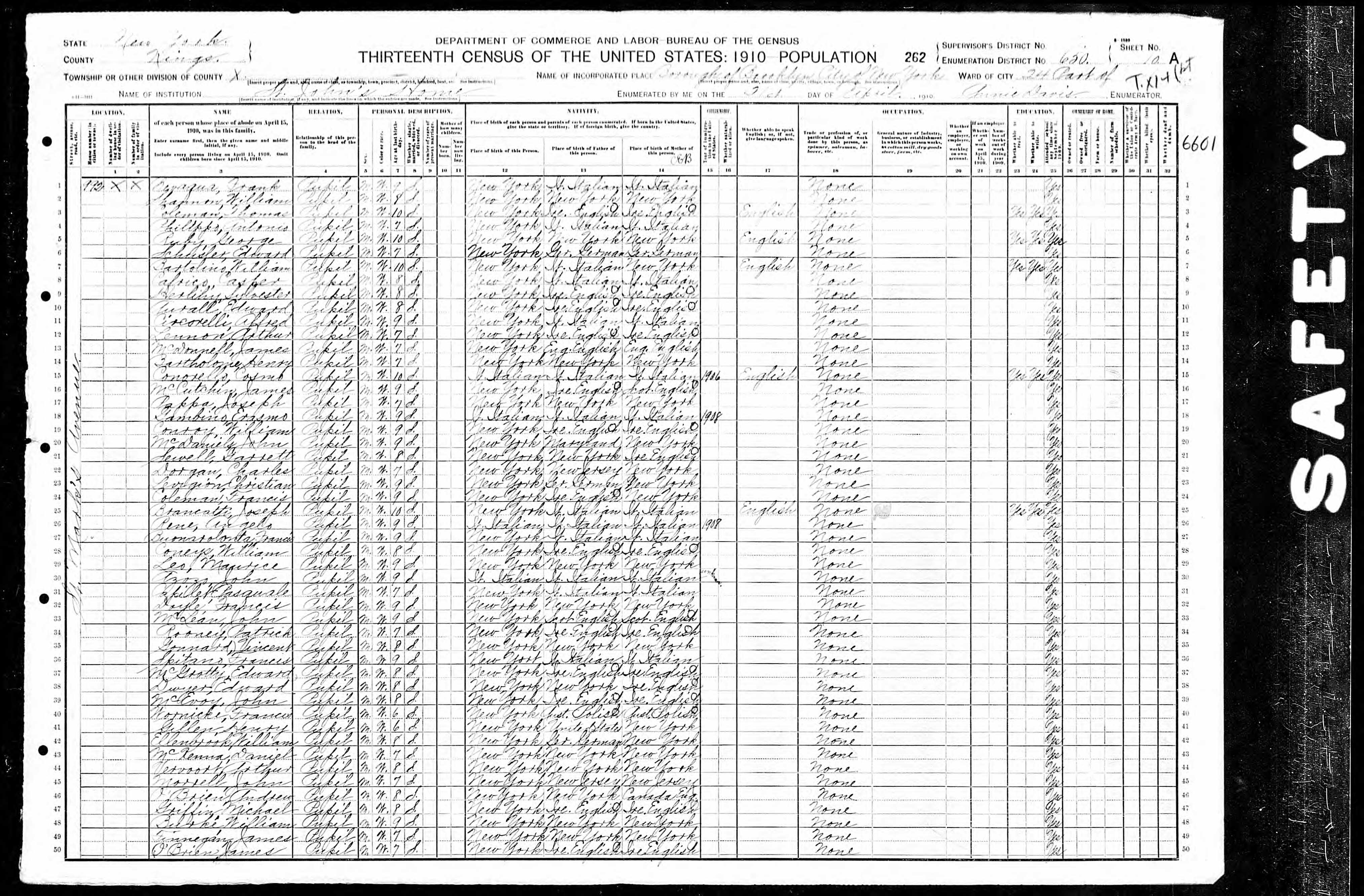
Lilly and her son William were living with Gustave and Gussie in 1905, but by 1910, William was no longer living with his mother and grandparents, but was in St. John’s Home for Boys in Brooklyn.

Gustave Rosenzweig family on the 1905 NYS census

Gustave Rosenzweig family on the 1905 NYS census

William Bartolini 1910 at St John's Home, Brooklyn

William Bartolini 1910 at St John’s Home, Brooklyn


Lilly was still living with her parents in 1910 and working as a nurse.  In 1915, William was at a different residential home, but I could not find Lilly at all on the 1915 NYS census nor could I find her anywhere after that.  None of the great-grandchildren of Gustave and Gussie knew what had happened to her, except that they thought she had remarried and moved to New Jersey at some point.  No one knew her married name or whether she had more children.  I was stuck and could not get any further.

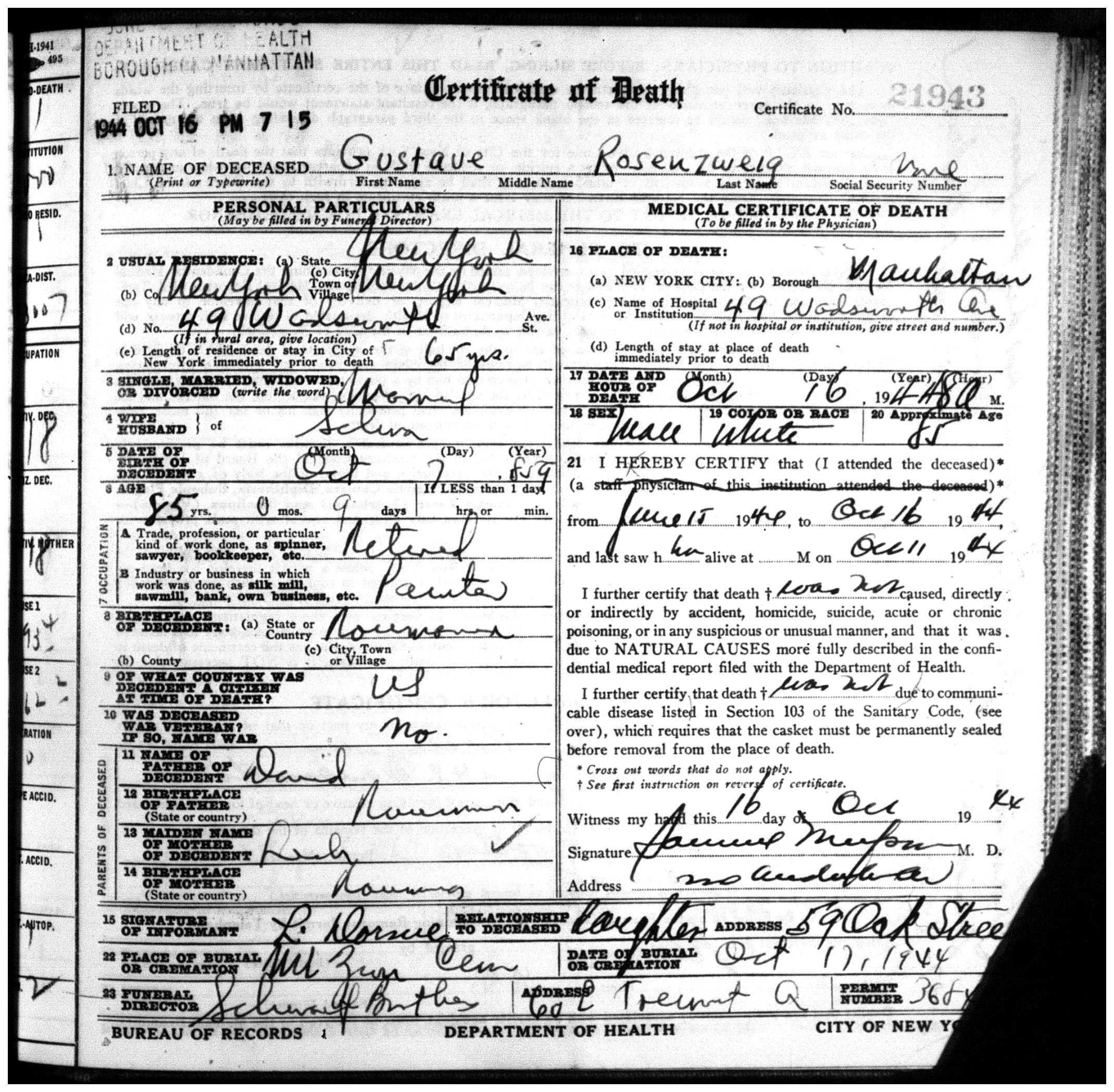
I thought I had a new clue when I obtained Gustave’s 1944 death certificate.  It was signed by an informant I thought might be Lilly.  I posted the signature on the blog, hoping someone would be able to decipher it more clearly than I could, but every possible reading of the signature led me nowhere, even using wildcard searches and as many variations as I could.  I put Lilly aside and figured it was a lost cause.

Gustav Rosenzweig death cert 1

And then? Well, this past weekend I received a call from Harriet, one of Lilly’s nieces.  She not only remembered Lilly well—she remembered the first name of her second husband—Carmen. And she said they had lived in Jersey City. She remembered Lilly fondly and described her as funny and fun-loving, like all the Rosenzweig siblings.

So I now had two more clues.  Lilly had married someone named Carmen, and they had lived in Jersey City, New Jersey.  Armed with just those additional pieces of information, I was able to design a search on FamilySearch using the two first names and the location.  The first result on the results list was a Lilly and Carmen Dorme living in Rutherford, New Jersey in 1940.

Carmen and Lillian Dorme 1940 US census

Carmen and Lillian Dorme 1940 US census


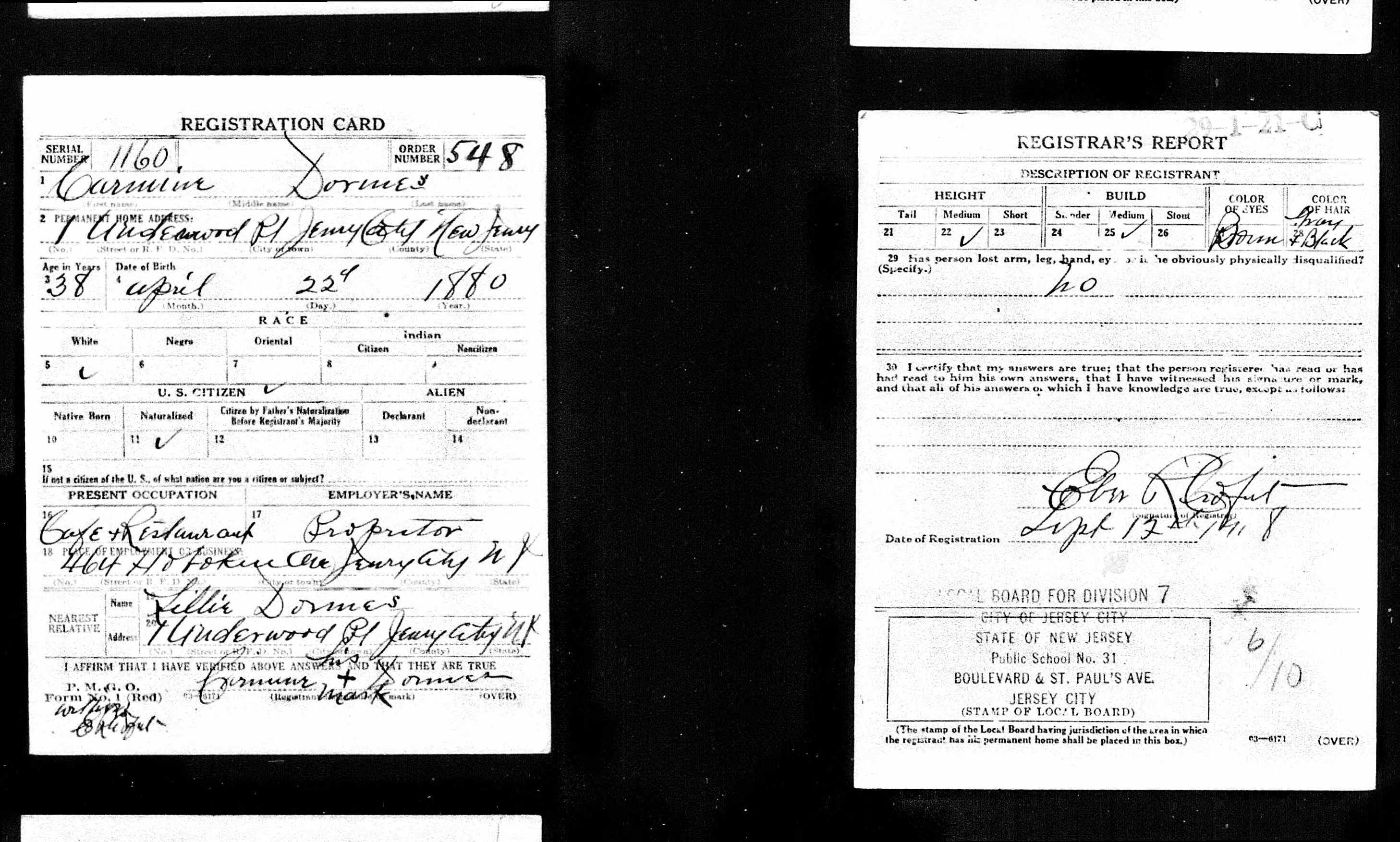
Rutherford was not Jersey City, but it was close by, so I decided to try that surname.  Using Dorme, I was able to search more thoroughly and found that Lilly and Carmen Dorme were already married by 1918 when Carmen  (using Carmine Dormes then) registered for the World War I draft and that they were living in Jersey City.  This had to be my long-missing cousin Lilly.

Carmine Dormes World War I draft registration

Carmine Dormes World War I draft registration


After that, I was also able to find Lilly and Carmen in several Jersey City directories and in the 1930 US census, which revealed that Lilly and Carmen had a child, Louis, who was then sixteen years old.

Dorme family on the 1930 US census

Dorme family on the 1930 US census

Further searching uncovered a Louis Dorme’s entry on the Social Security Death Index, indicating that he was born in New York on May 13, 1913, and had died in 1977.  This was consistent with the age and birthplace for Louis on the 1930 census, so I am reasonably certain that this is the correct person.

I still cannot find the family on the 1920 census, and since they were living in Jersey City both before and after 1920, I assumed that they would have been there then as well.  But although Carmen is listed in both the 1918 and the 1925 Jersey City directories, he is not in the 1922 directory (the intermediate years are not available online).  Harriet thought that Lilly had served as a nurse overseas during World War I, so perhaps that is where the family was located during that period.  I cannot, however, find a military record for Carmen, so I have no way to know for sure where they were during that period.

And although I do know when Louis died (1977) and when Carmen died (1962) from the SSDI, I cannot find Lilly on the SSDI nor can I find any other record of her death.  Harriet does remember Lilly’s death (in fact, Harriet’s mother reported that Lilly’s last words was a request for a corned beef sandwich!), but not the specific year or place.

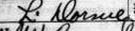
But I do have one clue, and it goes back to Gustave’s death certificate.  As soon as I saw that Lilly’s married name was Dorme, something clicked in my head.  I went back to look at Gustave’s death certificate, and now it seemed strikingly clear that the informant’s name was L. Dorme.

Lilly as informant

How could I not have seen that or found her before?  I just don’t know.  But now I knew that it was in fact Lilly who signed her father’s death certificate.  And so I know that she was still alive as of October 16, 1944, when Gustave died.  I am sure with a few more clues I will be able to narrow down the year and perhaps find her death record as well.

So in the space of one afternoon with the help of a new cousin, I was able to resolve one of the biggest questions I had remaining about my grandfather’s Rosenzweig first cousins.  Thank you, Harriet!


Final Chapter: The Dreyfuss Family in America

My three-times great-grandmother Jeanette Dreyfuss Nusbaum and her two sisters, Mathilde Dreyfuss Nusbaum Pollock and Caroline Dreyfuss Wiler, came to America and along with their husbands they settled in Pennsylvania where their husbands started as peddlers and then became merchants.  Two of the sisters married Nusbaum brothers: my three-times great grandfather John Nusbaum and his brother Maxwell Nusbaum.  They all had several children.  They all suffered financial hardship, untimely deaths of family members, and in some cases, terrible tragedies.  Today there are no living descendants of Mathilde Dreyfuss.   Jeanette Dreyfuss and John Nusbaum have a number of living descendants, myself included, of course.

As for the family of Caroline Dreyfuss and Moses Wiler, I have written about the lives of their daughter Fanny Wiler and her children and of their son Simon Wiler.  Of their daughter Eliza’s five children, Flora and Nellie were the only ones still alive in 1920, and the only grandchild alive was Flora’s son Lester Strouse.  In 1920, Lester was 32 and working in advertising, living at home with his mother Flora.  In 1928, Lester married Mabel Schoultz; he was forty, and she was 37.  Mabel was born in Pennsylvania, and her parents were born in Sweden.  In 1930, she and Lester were living in the Plaza Hall apartments in Philadelphia.  Lester was still in the advertising business, a field in which he remained for his career.

Lester’s mother Flora was living as a boarder in 1930 at 1712 Mt. Vernon Street in Philadelphia; she listed her marital status as widowed.  In 1940 she was living as a boarder at 2008 Spring Garden Street; her son Lester and his wife Mabel were living in Cheltenham, a suburban community thirteen miles north of Philadelphia.


In August, 1941, Nellie Simon Loux, died at 66 of breast cancer, and her nephew Lester paid the bill for her funeral.  A year later Flora Simon Strouse Heulings, Lester’s mother and Nellie’s sister, died in November 1942 from chronic myocarditis. She was 76 years old.  Flora had been residing at the Majestic Hotel before becoming a patient at the Bella Vista Sanitarium in Springfield, Pennsylvania, where she died.  Nellie and Flora were buried at Mt. Sinai cemetery with their parents and siblings.

Flora’s death certificate is yet another example of how unreliable these documents can be.  It says her father’s name was Simon Weiler, when in fact her father was Leman Simon.  Wiler was her mother Eliza’s maiden name.  Apparently whoever filled this out conflated the two surnames.  The certificate also represents that Flora was widowed, which she was when her first husband Nathan Strouse died.  But the husband listed here, Albert C. Heulings, was alive and well and living in Chicago with his second wife.  As the 1920 census had indicated, Flora was divorced, not a widow. Although the 1930 census said she was a widow and the 1940 listed her as single, the 1920 is likely the most accurate.  It’s not surprising that someone grieving would make these mistakes.

Thus, by the end of 1942, all of the children of Eliza and Leman Simon had now passed away.  Their only surviving descendant was their grandson Lester.  That last descendant died on October 14, 1960, from coronary thrombosis; he was 71 years old.  Lester, an advertising salesman all his career, was survived by his wife Mabel.  There were no children, and thus that was the end of the family line for Eliza Wiler and Leman Simon.

That left only the children of Clara Wiler and Daniel Meyers to carry on the line of Caroline Dreyfuss and Moses Wiler.  As of 1920, Daniel and Clara as well as their children Bertha, Samuel, and Harry were gone.  I also discussed Leon Meyers’ death in my last post.  By 1920, all the other children except for Milton, the youngest, were married and had settled on careers, and many had had children.  In the rest of this post I will review how each of those children fared.

In 1920 Isadore Meyers was a clothing manufacturer, married to Elsie Goodman, with two sons, Robert and David.  I had not had much luck finding Isadore in any city directories until I found a listing that included his company’s name, which was Meyers & Obermayer.  I was able to find the company listed as early as 1911, selling “pantaloons.”  Here is a small classified ad from 1915 that I found in which they were looking to purchase a second hand pressing machine for their trousers business.

Philadelphia Inquirer  January 31, 1915 p. 11

Philadelphia Inquirer January 31, 1915 p. 11

The last listing I could find for Meyers & Obermayer in Philadelphia was in 1925.  There are also listings for a clothing manufacturer called Obermyer & Myers in Norristown during the 1910s and 1920s, but I don’t know whether that is just a coincidence or the same business.

In 1930 Isadore, Elsie and their sons were living at 1228 65th Avenue, and Isadore was still a clothing manufacturer.  I was unable to find any records for the family between 1930 and 1940, but the 1940 census finds Isadore, Elsie and David still living at 1228 65th Avenue.   Their older son Robert must have been living elsewhere.

By 1950, Isadore’s business was known as Meyers and Sons, as listed in the 1950 Philadelphia phonebook.  Isadore died on November 1, 1960, from heart disease.  He was 81 years old.  His wife Elsie died fourteen years later on December 23, 1974.  She was 92 years old.  They are buried at Mt. Sinai cemetery.
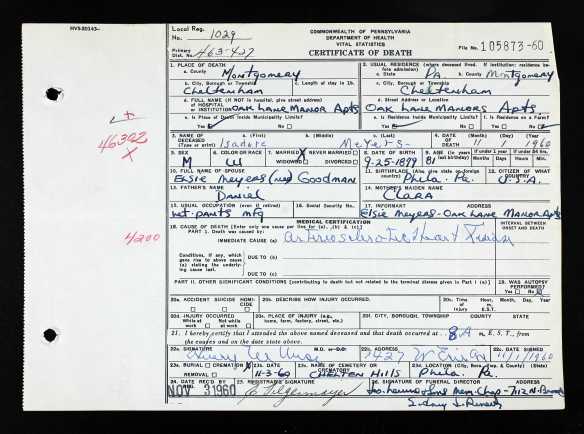
Isadore Meyers death cert

Ancestry.com. Pennsylvania, Death Certificates, 1906-1963 [database on-line]. Provo, UT, USA: Ancestry.com Operations, Inc., 2014. Original data: Pennsylvania (State). Death certificates, 1906–1963. Series 11.90 (1,905 cartons). Records of the Pennsylvania Department of Health, Record Group 11. Pennsylvania Historical and Museum Commission, Harrisburg, Pennsylvania.

Max, the next son, was a mechanical engineer working at Newton Machine Tool Works and married to Henrietta Klopfer.  They had a son Donald, born in 1918, and a daughter Dorothy born in 1923.  Almost every year, Max, Henrietta, and their children took a cruise together.  On December 1, 1939, just a few months after their last cruise, Max died from prostate cancer.  He was only 58 years old.  His widow Henrietta lived until April 1977; they are both buried at Mt. Sinai.

Ancestry.com. Pennsylvania, Death Certificates, 1906-1963 [database on-line]. Provo, UT, USA: Ancestry.com Operations, Inc., 2014. Original data: Pennsylvania (State). Death certificates, 1906–1963. Series 11.90 (1,905 cartons). Records of the Pennsylvania Department of Health, Record Group 11. Pennsylvania Historical and Museum Commission, Harrisburg, Pennsylvania.

Ancestry.com. Pennsylvania, Death Certificates, 1906-1963 [database on-line]. Provo, UT, USA: Ancestry.com Operations, Inc., 2014.
Original data: Pennsylvania (State). Death certificates, 1906–1963. Series 11.90 (1,905 cartons). Records of the Pennsylvania Department of Health, Record Group 11. Pennsylvania Historical and Museum Commission, Harrisburg, Pennsylvania.

In 1920, Benjamin and Leona (Faulcher) Meyers were living in Collingswood, New Jersey, with Leona’s parents, and Benjamin was working as an optometrist.  Benjamin and Leona had two children in the 1920s, Margaret born in 1924, and Clara, named for his mother, born in 1926.  In 1930, the family was back in Philadelphia at 6418 North 16th Street, and Benjamin was now working as a manager in a cotton yarns business, presumably that of his younger brother Clarence, discussed in my last post and below.  The family was still living at that address in 1940 (Margaret was now listed as Rosebud), and Benjamin’s occupation was now reported to be a superintendent in a factory, again his brother Clarence’s yarn business.  He and Leona were now in their fifties and their daughters were teenagers.  His 1942 World War II draft registration confirmed that Benjamin was working with his brother Clarence.

The National Archives at St. Louis; St. Louis, Missouri; World War II draft cards (Fourth Registration) for the State of Pennsylvania; State Headquarters: Pennsylvania; Microfilm Series: M1951; Microfilm Roll: 212

The National Archives at St. Louis; St. Louis, Missouri; World War II draft cards (Fourth Registration) for the State of Pennsylvania; State Headquarters: Pennsylvania; Microfilm Series: M1951; Microfilm Roll: 212


Benjamin and Leona moved to Camden, New Jersey, the following year.  He died on October 21, 1956, from heart disease.  He was 73 years old.  He and Leona were then living in Audobon, New Jersey, and his occupation was reported to be a superintendent for Clarence L. Meyers & Company.  Leona died less than three years later on April 3, 1959, also of heart disease.  She was 73.

Clarence, the cotton yarns manufacturer, had been in that business since 1910, originally operating as the Elm Converting Company.  In 1920, he and his wife Estelle were living at 2251 North Park Avenue with their one year old daughter, Nancy.  Clarence and Estelle apparently loved to travel.  From as early as 1924 and all through the 1930s and 1940s, the family traveled to many places, according to the numerous ship manifests I located.  His business was seemingly quite successful as at least two of his brothers, Benjamin and Milton, as well as at least one of his nephews were also at one time or another working in the business.

In 1940 Clarence, Estelle, and Nancy were living at 707 Medary Avenue, along with Estelle’s mother, a butler, and a servant.  They were still living there in 1942 when Clarence registered for the draft and also in 1950, according to the 1950 Philadelphia phonebook.

Sadly, on February 5, 1951, Clarence lost his wife Estelle to cancer.  She was sixty years old.  Clarence continued to travel after Estelle died, including a cruise around the world in 1953 and trips to Argentina and to Italy in 1954 and 1955. Clarence died in April, 1961, in Dade County, Florida.  He was 75 years old.  He and Estelle are buried in Mt. Sinai cemetery, as is their daughter Nancy, who died just three years after her father Clarence.

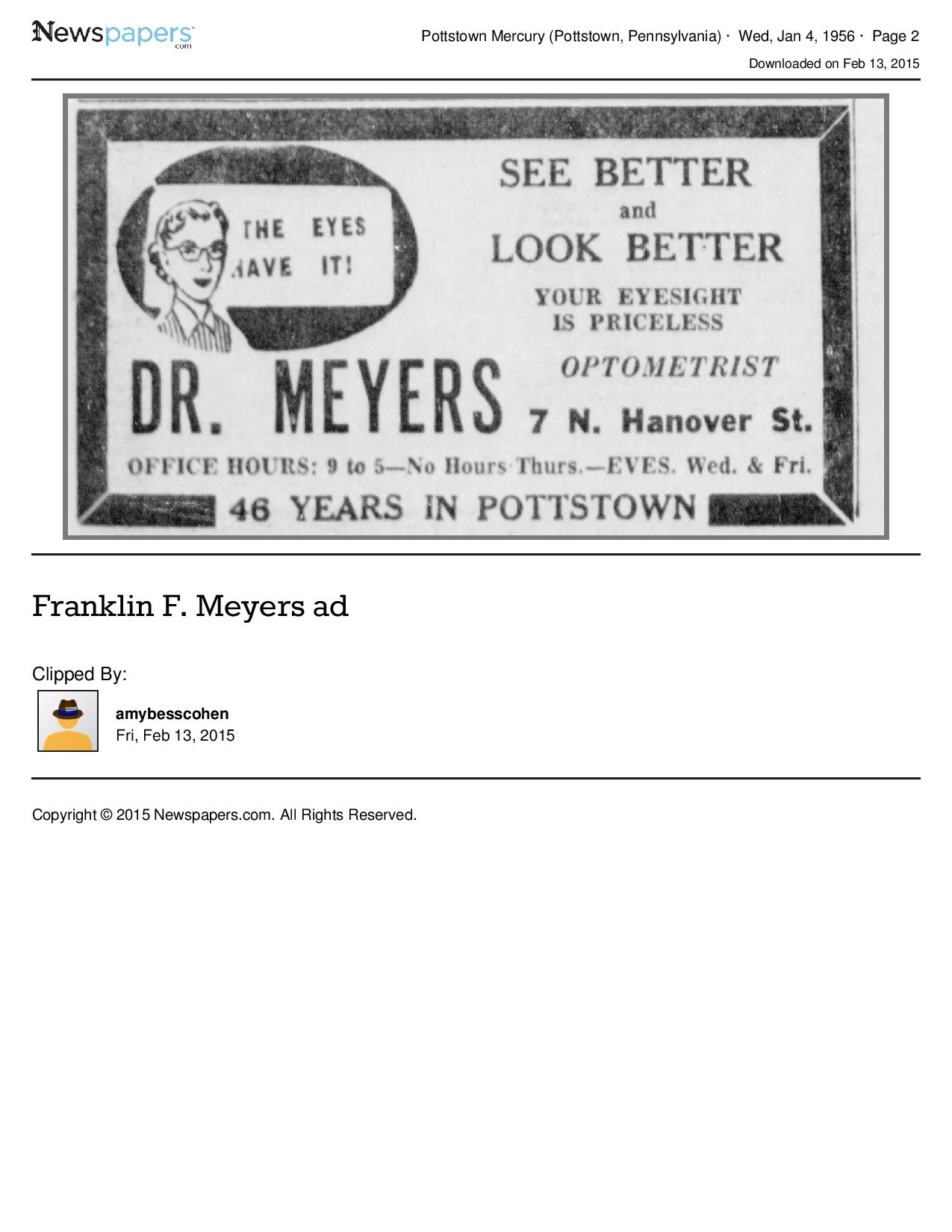
The next brother was Franklin, an optometrist, who in 1920 was living with his wife Mae in Pottstown, Pennsylvania, where he had been since about 1914.  Franklin and Mae had a daughter Carolyn born in 1922.  Franklin and Mae remained in Pottstown throughout the 1920s, 1930s, 1940s and 1950s, and Franklin had an optometry practice there throughout all those years.

Franklin_F__Meyers_ad-page-001

Franklin died on January 23, 1956, and I was able to find this detailed obituary published in the Pottsdown Mercury, the local newspaper, on January 24, 1956, pp. 1, 5:
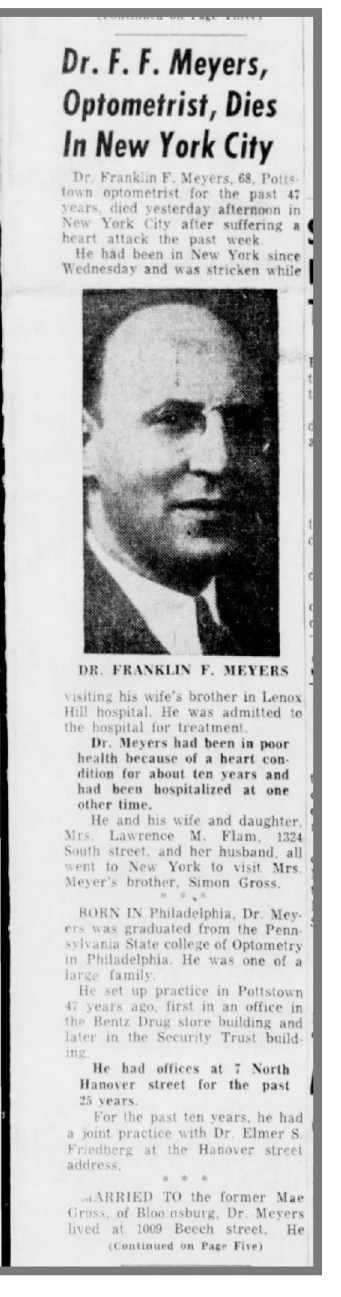
Part_1_of_obit ff meyers-page-001

obit part 2

Like so many of his siblings, he died from heart related issues.  He was 68.  Despite living in Pottstown for over 40 years, he was buried back in Philadelphia at Mt. Sinai.  His widow Mae died twenty years later in Pottstown, and she also was buried at Mt. Sinai.

Miriam Meyers Strauss was married to Abram Strauss, a doctor, and living with him at 1836 North 17th Street in 1920. From a decision of the Pennsylvania Workmen’s Compensation Board in 1921, I was able to learn that Abram was a dermatologist.    He and Miriam had two sons, Daniel and Richard.  By 1930, they had moved to the suburb of Cheltenham, where they were also living in 1940.

After that I have no records for them until Miriam’s death on July 26, 1975.  I do not have her death certificate because the death is too recent, and I cannot locate an obituary, but I know that she is buried at Mt. Sinai cemetery with her with her parents and her siblings, but not with Abram.  I cannot find any record for Abram after his 1942 draft registration.

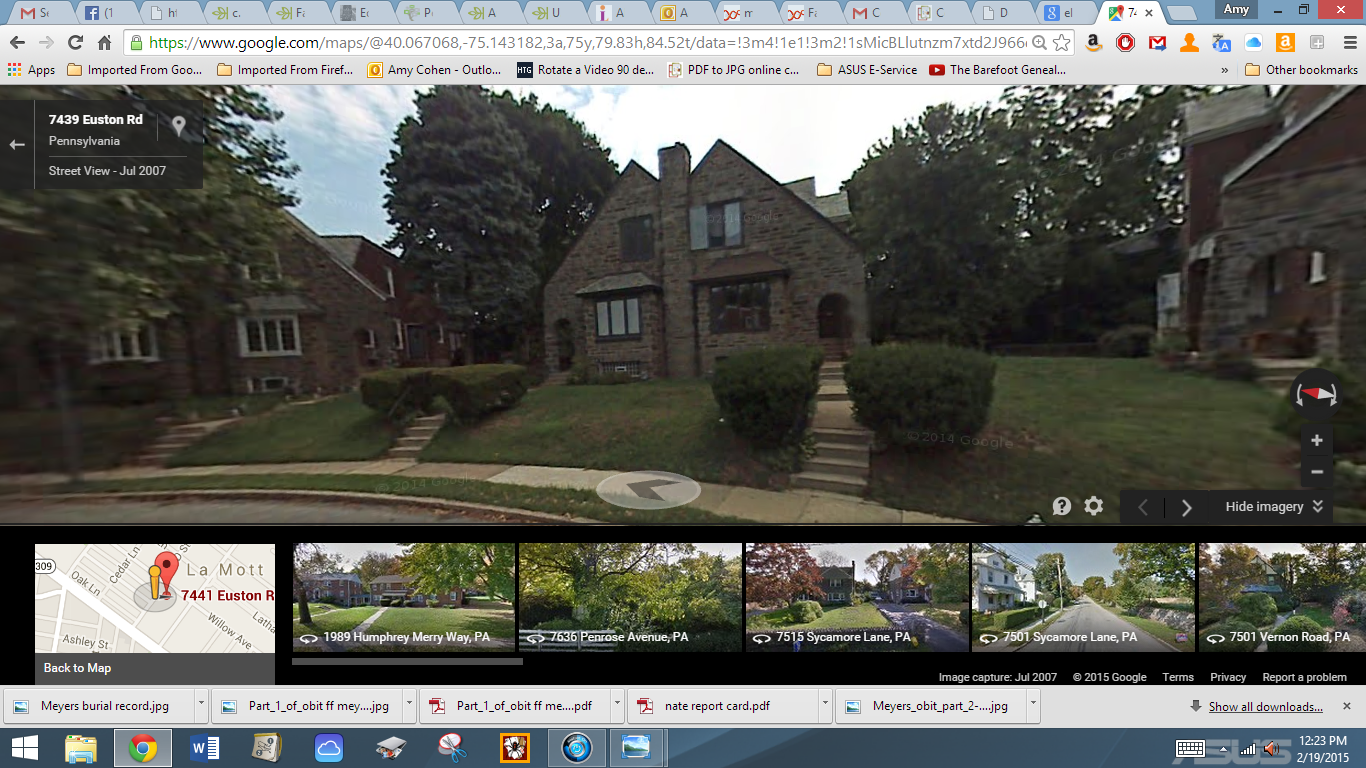
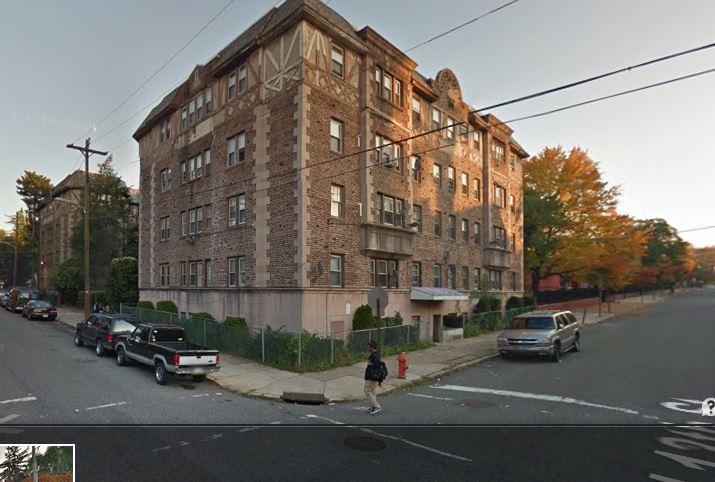
Miriam’s younger sister Charlotte was married to J. Albert Field, and in 1920, they were living at 1905 Diamond Street with her brothers Leon and Milton.  In 1930, they were still living at 1905 Diamond Street, but without any other family members or boarders.  Albert was still a department store manager.  Charlotte and Albert took a cruise together to Bermuda in 1931.  In 1940 they had moved to the Oak Lane Tower apartments.  Albert was continuing to work as a department store manager.

Charlotte died on October 8, 1940, just a few months after the 1940 census.  Although I have her burial records at Mt. Sinai, as with her sister Miriam, I cannot find a death certificate so I do not know her cause of death.  Also like Miriam, Charlotte was buried with her parents and siblings and not her husband.  However, Albert listed Charlotte’s brother Clarence as the person who would always know his address on his World War II registration in 1942.  It appears that Albert did remarry sometime after Charlotte died as his marital status at the time was married, and the name of his wife on his death certificate in 1958 was Frances.  Charlotte and Albert had not had any children.

Historical Society of Pennsylvania; Historic Pennsylvania Church and Town Records

Historical Society of Pennsylvania; Historic Pennsylvania Church and Town Records

Finally, we come to Milton, the baby of the family. In 1920, he was living with Charlotte, Albert, and Leon at 1905 Diamond Street, and he was working at Clarence’s yarn factory.  Milton married Beatrice Kaufmann sometime between 1920 and 1923 because their son James was born in 1924.  Beatrice was born in Baltimore, Maryland, the daughter of a merchant.  In 1926 their second son Gordon was born.  On the 1930 census, they owned a house worth $35,000 in Cheltenham/Elkins Park.  Milton listed his occupation as a manufacturer of cotton yarns, still in business with his brother Clarence.  They were living in the same house in 1940 (now given a value of only $20,000 after ten years of the Depression), and Milton’s occupation remained the same.  Milton’s World War II draft registration is also consistent with these facts.

Throughout these years and the 1950s, Milton and Beatrice traveled frequently, taking trips to Cuba, England, and Argentina, for example.  Milton died May 8, 1975. He was living in Fort Lauderdale, Florida, at the time and was 79 years old.  He was buried in Mt. Sinai cemetery.  His widow Beatrice died in 1996 at age 93.  Her obituary fills in some of the details of her life:

Beatrice Kaufmann Meyers, 93, died Tuesday of cancer at her home in Jenkintown. Mrs. Meyers, who was a graduate of Beechwood Finishing School (now Beaver College), was the widow of Milton Meyers, owner of Clarence L. Meyers & Co., textile manufacturers.  She was a driver for the American Women’s Volunteer Services during World War II, and was active in the Orphan’s Guardian Program, which was similar to Big Brothers/Big Sisters.  She was a member of Philmont Country Club for more than 70 years, and of Rodeph Shalom Congregation.

(The Philadelphia Inquirer, June 20, 1996, p. B04)      Interestingly, Beatrice was not buried at Mt. Sinai with her husband but at Shalom Memorial Park in Lower Moreland, Pennsylvania.

And that brings me to the end of the story of Caroline Dreyfuss and Moses Wiler, their children, and their grandchildren.    Of course, there are other descendants, many of whom are still living.  Looking back on this line of my family, I see a family that truly suffered greatly.  Deaths from tuberculosis, a child killed by matches, financial crises, many adults who did not live to see their grandchildren.  But I also see a resilient family.  The children of Clara Wiler and Daniel Meyers in particular were able to overcome their father’s business problems and create their own businesses that were quite successful, allowing them to travel and provide homes and continuity for their children.

It’s another example of the much sought after American dream.  In seventy years the family started by two people born in Germany who came to the United States in the mid-19th century with little more than their diligence and persistence had grown to include a number of successful descendants: a clothing manufacturer, a cotton yarn manufacturer, several optometrists, and a mechanical engineer.  They overcame incredible tragedies and losses, but they nevertheless thrived in this country that had attracted their grandparents for just those opportunities for success.  So although this particular chapter has at times been very sad and upsetting, in the end it is an uplifting chapter.



Rachel Cohen 1853-1925: An Ordinary Life

As I move down the list of my great-grandparents’ thirteen children, I will face a few new obstacles.  First, there are several daughters among the middle group of siblings, and as noted before several times, women have a tendency to disappear if I cannot figure out their married names.  Second, as these children were born later, many also died after 1924, making it much more difficult to obtain their death certificates and other vital records on line.  That means I will either have to order documents from the Pennsylvania archives or visit a local branch of the Family History Library where I can view microfilm sent from Salt Lake City.  Those visits will have to wait until the fall probably as I will not have ready access to a branch until then.  For now I will report what I know based on what I can find and then update my findings as I obtain more documents and information.

I have reported on the first four children of Jacob and Sarah, my great-great grandparents: Fanny, Joseph, Isaac, and Hart.  Rachel is the next child.  She was born in Philadelphia in 1853 and spent her childhood at 136 South Street with her family.  In 1879 she married Lewis I. Weil, who was born in Pennsylvania of German-born parents.  In 1880 Rachel and Lewis were living at 406 South 2d Street with a servant.  Lewis was in the gentlemen’s furnishings business, and Rachel was at home.  (It is hard to imagine what a young woman with no children did at home all day, given that she had a servant, but times were different back then.)

Rachel and Lewis Weil 1880 US census

Rachel and Lewis Weil 1880 US census

Rachel and Lewis had six children: Sallie (1880), Benjamin (1882), Jacob (1883), Blanche (1888), Irene (1891), and Joseph (1893).  All but Benjamin survived to adulthood; Benjamin died when he was six months old from enteritis, an inflammation of the small intestine usually caused by a bacterial infection.

Benjamin Weil death certificate

Benjamin Weil death certificate

On a separate record of Benjamin’s death, it identified the attending physician as “Sarah Cohen.”  Since this was 1882, it seems unlikely that this was really a doctor, but rather Rachel’s mother, Sarah, my great-great grandmother.

UPDATE:  See the comments below from rustica2389.  It seems there was a Dr. Sarah Cohen practicing in Philadelphia at that time!  I should never make assumptions….

Benjamin Weil death record

Benjamin Weil death record

That must have been an awful loss for Rachel and Lewis, but like so many others, they went on to have four additional children.  In 1900, Rachel and Lewis still had all five surviving children living with them, and Lewis was still engaged in the business of men’s clothing.  They also still had a servant living with them, now at 1401 Ridge Avenue.

Rachel and Lewis Weil 1900 US census

Rachel and Lewis Weil 1900 US census

By 1910, the family had moved to 606 Diamond Street, and only Sallie (who never married), Irene, 19, and Joseph, now 17, were still living at home. Lewis was still working in men’s furnishings, and Joseph was working in the same business.  Sallie was a salesperson in a department store, and Irene was at home.  Lewis’ brother Simon was also living with them.

Rachel and Lewis Weil 1910 US census

Rachel and Lewis Weil 1910 US census

In 1908 Jacob had married Flora Cohen and was selling men’s neckwear in 1910, and the following year his younger sister Blanche had married Alexander Klein who was a “manager” in some kind of manufacturing, according to the 1910 census.

Marriage certificate of Blanche Weil and Alexander Klein

Marriage certificate of Blanche Weil and Alexander Klein

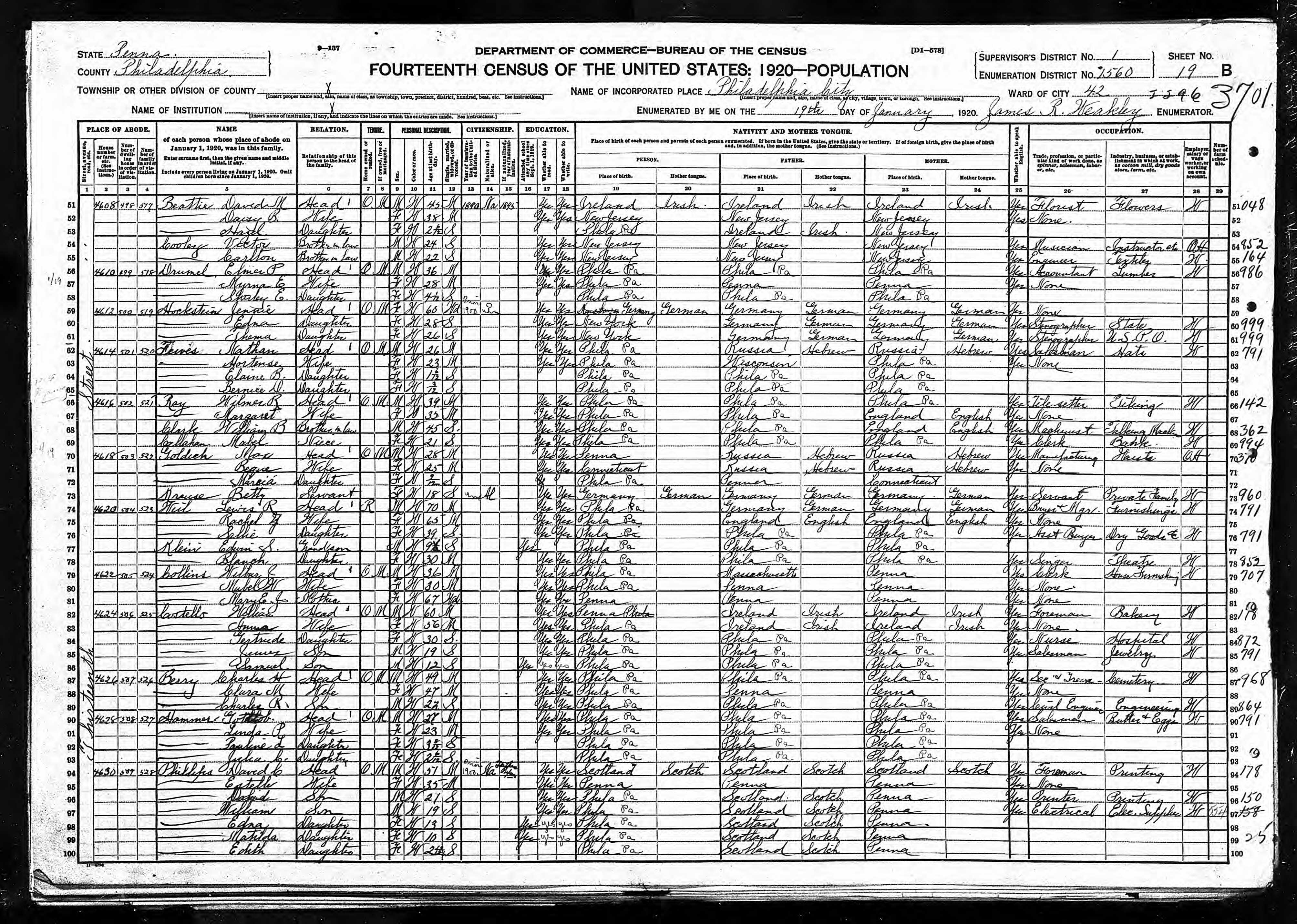
Ten years later in 1920 Rachel and Lewis were living with Sallie, Blanche, and Blanche’s son Edwin, who was nine years old, born in 1911.  They now lived at 4620 Thirteenth Street, and Lewis was working as a buyer and manager in “furnishings,” I assume men’s clothing.  Sallie was an assistant buyer of dry goods, and Blanche was a singer in the theater. (Each of these moves from Second Street to Ridge to Diamond to 13th Street took the family further and further north, consistent with other family members and Jews in general in Philadelphia.)

Rachel and Lewis Weil 1920 US census

Rachel and Lewis Weil 1920 US census

Although Blanche was still listed as married, her husband Alexander was not living with her, but was living with his brother Lewis at 4510 York Drive.  He was in the shoe business.  He also is listed as married.

Alexander Klein 1920 census

Alexander Klein 1920 census

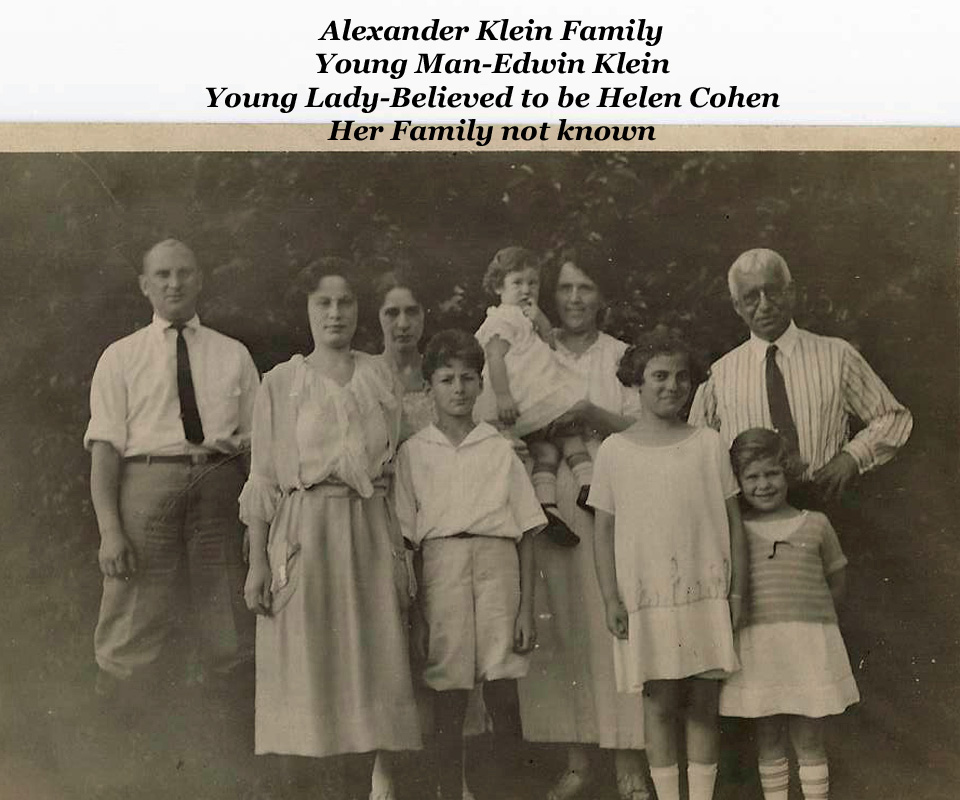
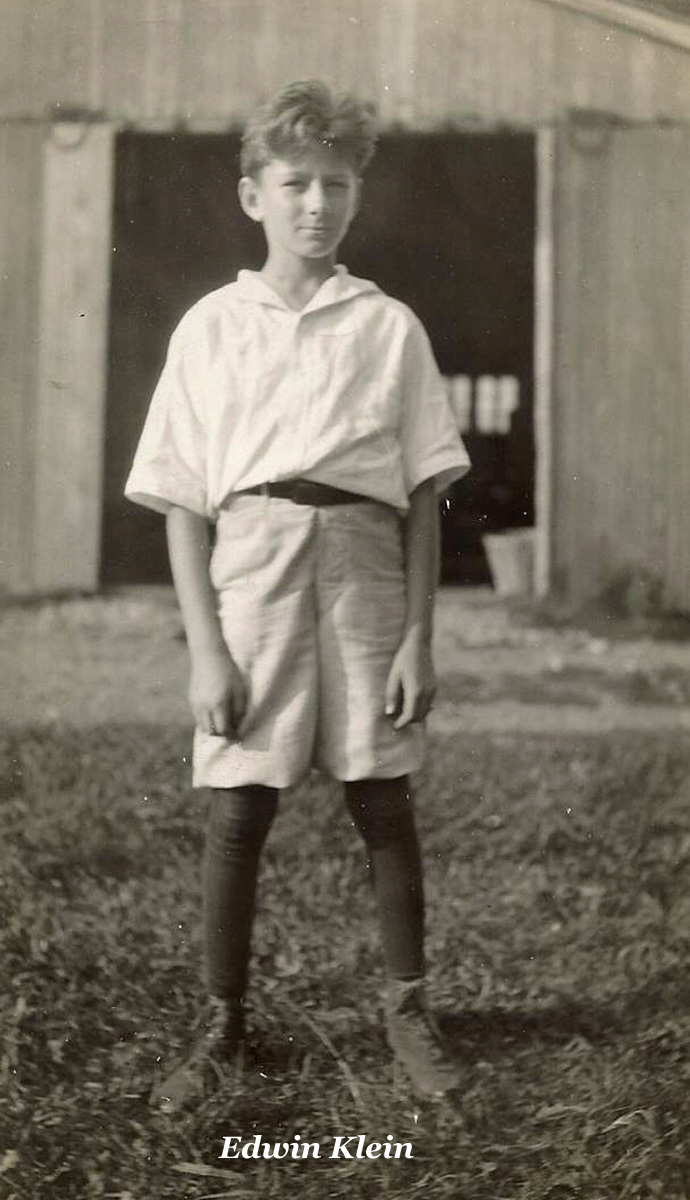
Since Blanche and Edwin were also living without Alexander in 1930, I assume they never reconciled, although perhaps they also never divorced. Thanks to Gil Weeder, a relative by marriage to the Weil family, I now have these photographs of young Edwin Klein with his father’s family, presumably with his mother Blanche next to him sometime before Blanche and Alexander separated.Klein Family Edwin Klein


Blanche and Edward Klein 1930 US census

Blanche and Edward Klein 1930 US census

Rachel and Lewis Weil’s daughter Irene had married James Doran in 1915.   They had a long marriage, living in Philadelphia for almost twenty years before moving to Camden, New Jersey in the 1930s where they lived for at least another ten years.  I have not found any records for either of them after 1945, except for a record of Irene’s death on April 8, 1977 in Erie, Pennsylvania, on the Social Security Death Index.  Both Irene and James were buried at West Laurel Hill cemetery in Bala Cynwyd, Pennsylvania, but no dates are recorded for James, so I am not sure when he died.  They left no descendants.

Rachel and Lewis’ youngest child, Joseph, married Goldie Kret on June 17, 1912.  He was only 19, though his age on the marriage certificate is 21.  Goldie was recorded to be 18.  They were married in Wilmington, Delaware, and Joseph’s sister Blanche and brother-in-law Alexander Klein were the witnesses on the certificate.  Goldie was the daughter of Jacob Kret and Sarah nee Newman.

Joseph Weil and Goldie Kret marriage certificate

Joseph Weil and Goldie Kret marriage certificate

Interestingly, Joseph was residing in Boston at the time and working as a salesman.  Why is this interesting? Because I have been in touch with someone who is a relative of Flora Cohen, Jacob Weil’s wife, and he has a copy of a baby book created for Jacob and Flora’s daughter, Maizie Weil, in which there is a reference to a trip to Boston to visit “Daddy.”  Maizie was born in 1912, so perhaps Jacob and his younger brother Joseph were living in Boston for work during that time period. Since both Jacob and Joseph were living in Philadelphia in 1910, this marriage certificate is the first document I’ve found that has a reference to anyone in the family living in Boston.

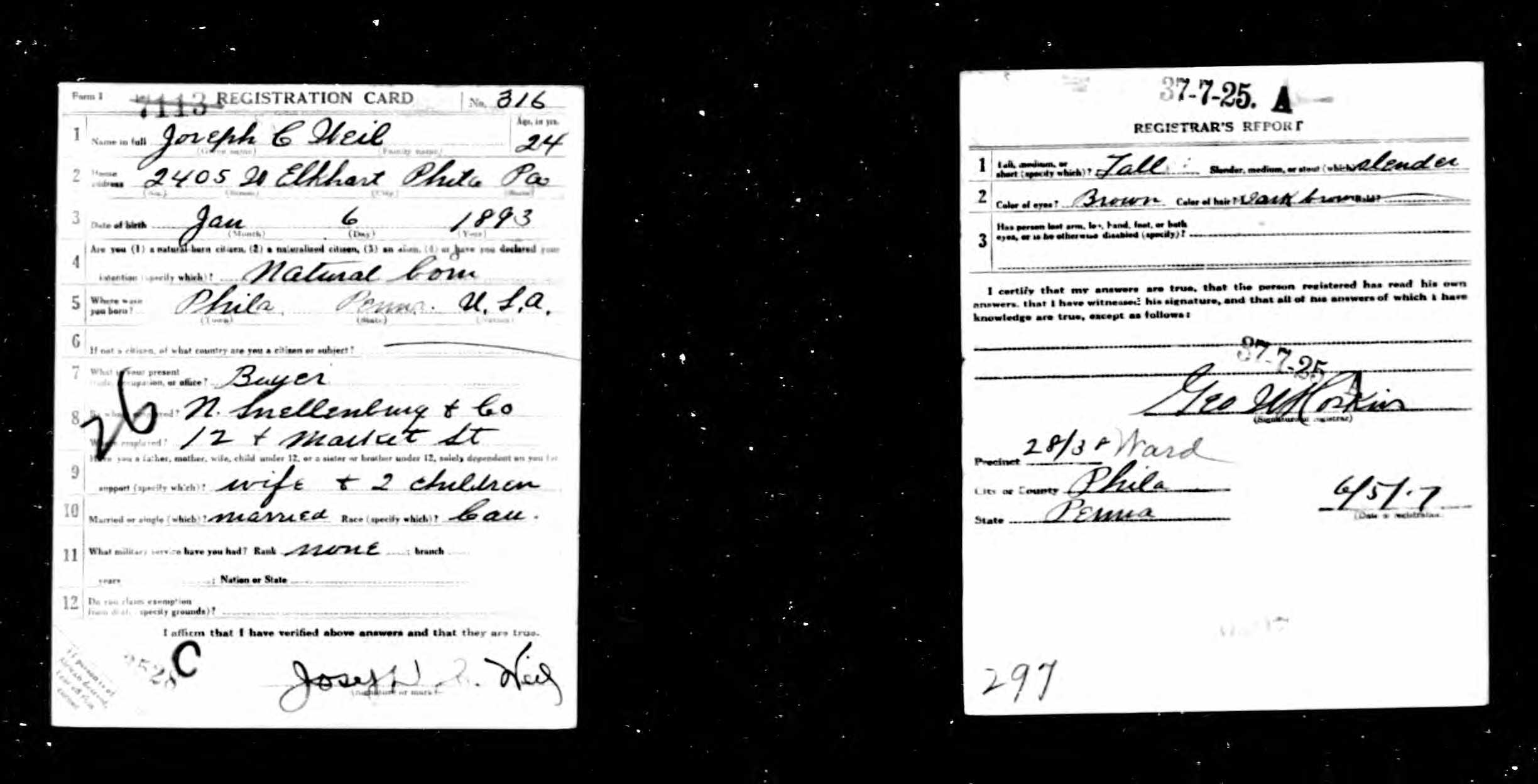
By 1917, however, Joseph was living back in Philadelphia, according to his World War I draft registration.  The registration also says that Joseph was married with two children, living at 2405 South Elkhart Street, and working as a buyer at N. Snellenburg and Company.  Joseph’s uncle, Joseph Cohen (Rachel’s brother) had married Caroline Snellenburg, so I imagine that this was a store owned by his uncle’s father-in-law’s family.

Joseph Weil World War I draft registration

Joseph Weil World War I draft registration

I cannot find Joseph or Goldie or either of their daughters on the 1920 census, although there is a man named Weil living as a boarder in a home in Tampa, Florida, with no other identifying entries in the listing.  By 1922, however, it is evident that the marriage between Joseph and Goldie had ended, as Goldie married Edwin Hoffman that year, and in 1930, she and her two daughters with Joseph, Lillian and Barbara, were living with her second husband in Newark, New Jersey.

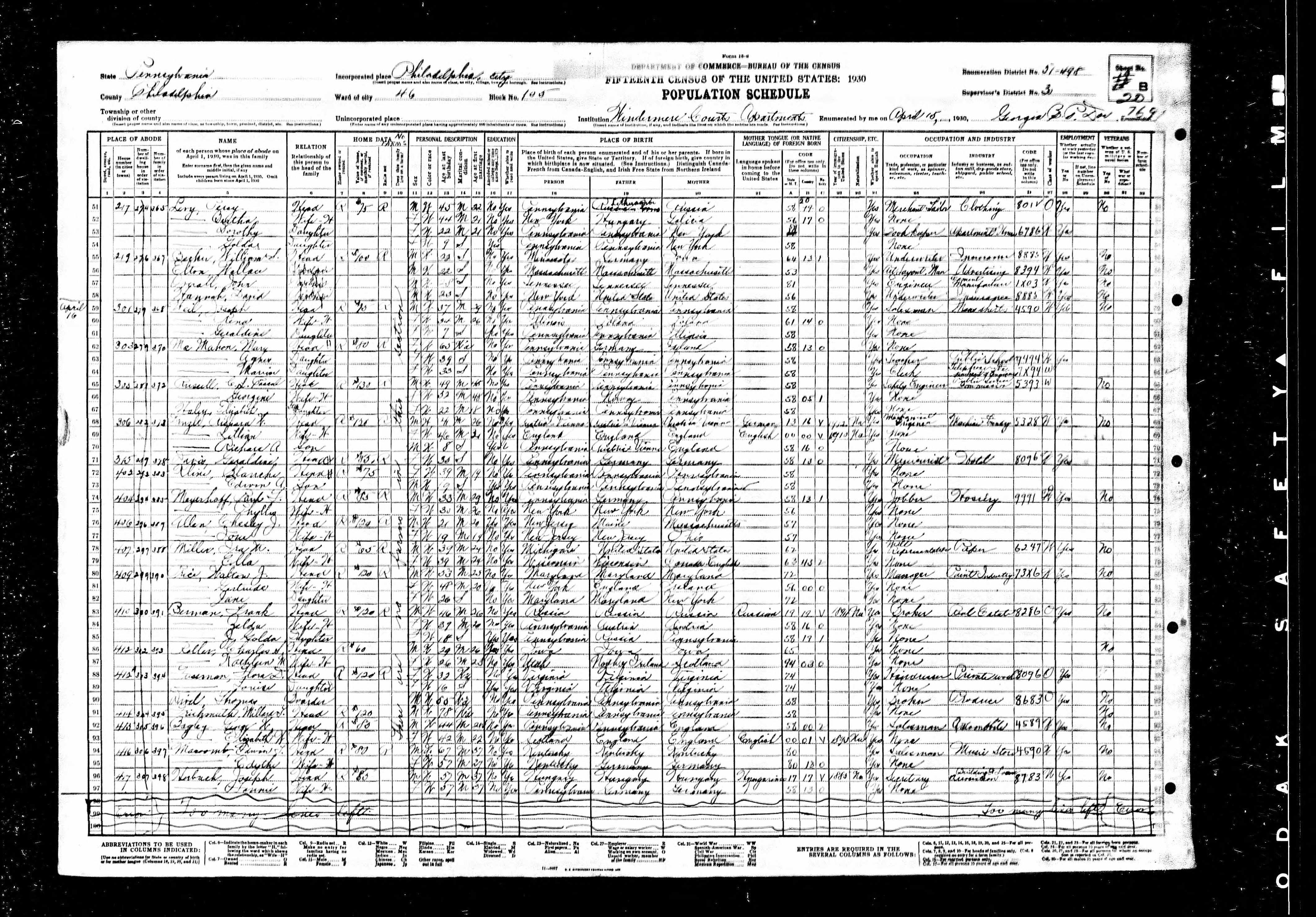
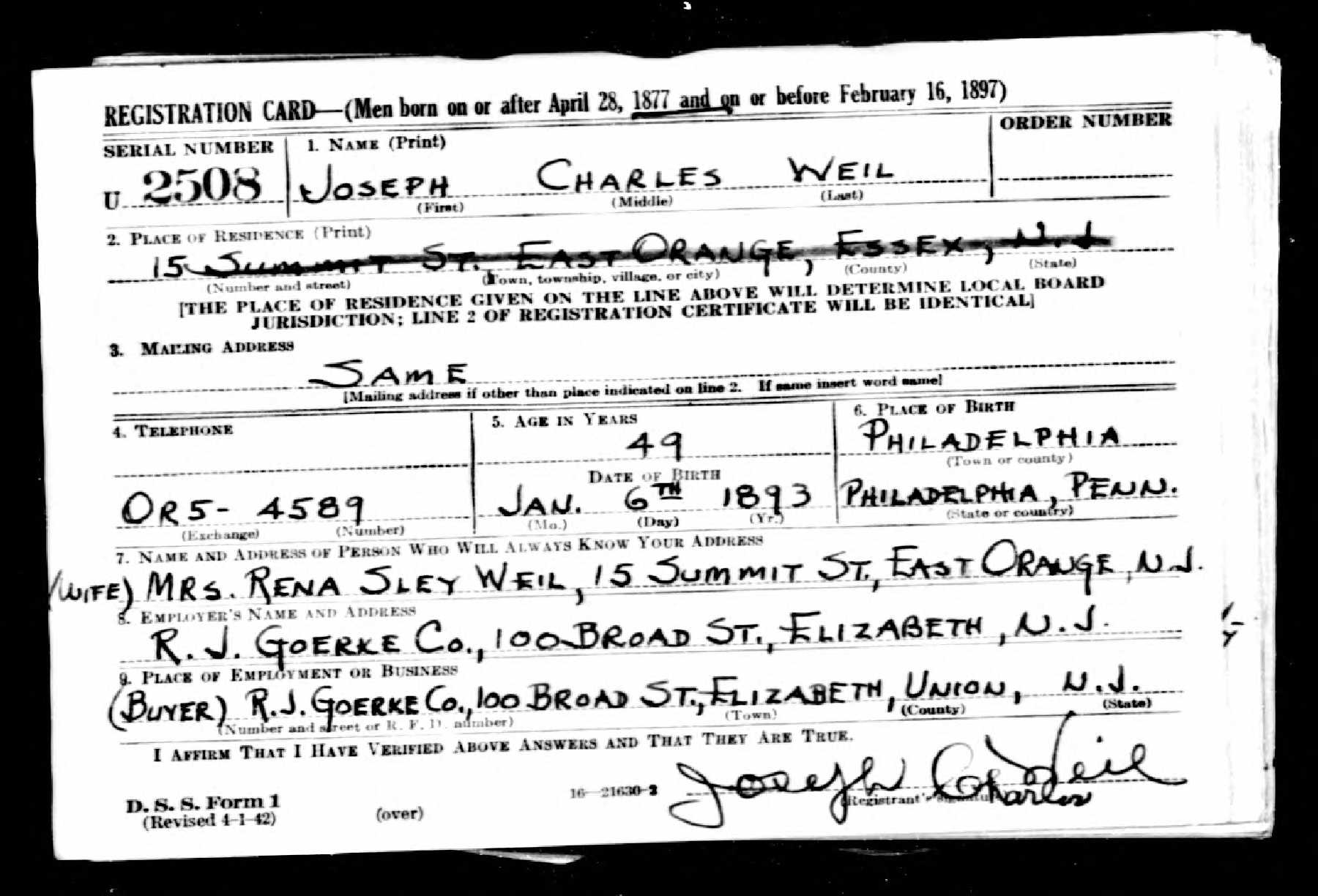
Joseph, meanwhile, had also remarried by then.  He had married Rose “Rena” Sley in 1921.  On the 1930 census, he was living with Rena, and their daughter Geraldine, who was then seven years old.  Joseph was selling men’s shirts.  In 1935, they were living in Hackensack, New Jersey, and in 1940 in Irvington, New Jersey.  Two cousins were living with them as well. Joseph was a buyer at a department store; according to his World War II draft registration, he was working for R.J. Goerke Company in Elizabeth, New Jersey, and living in East Orange in 1942.

Joseph Weil World War II Draft Registration

Joseph Weil World War II Draft Registration

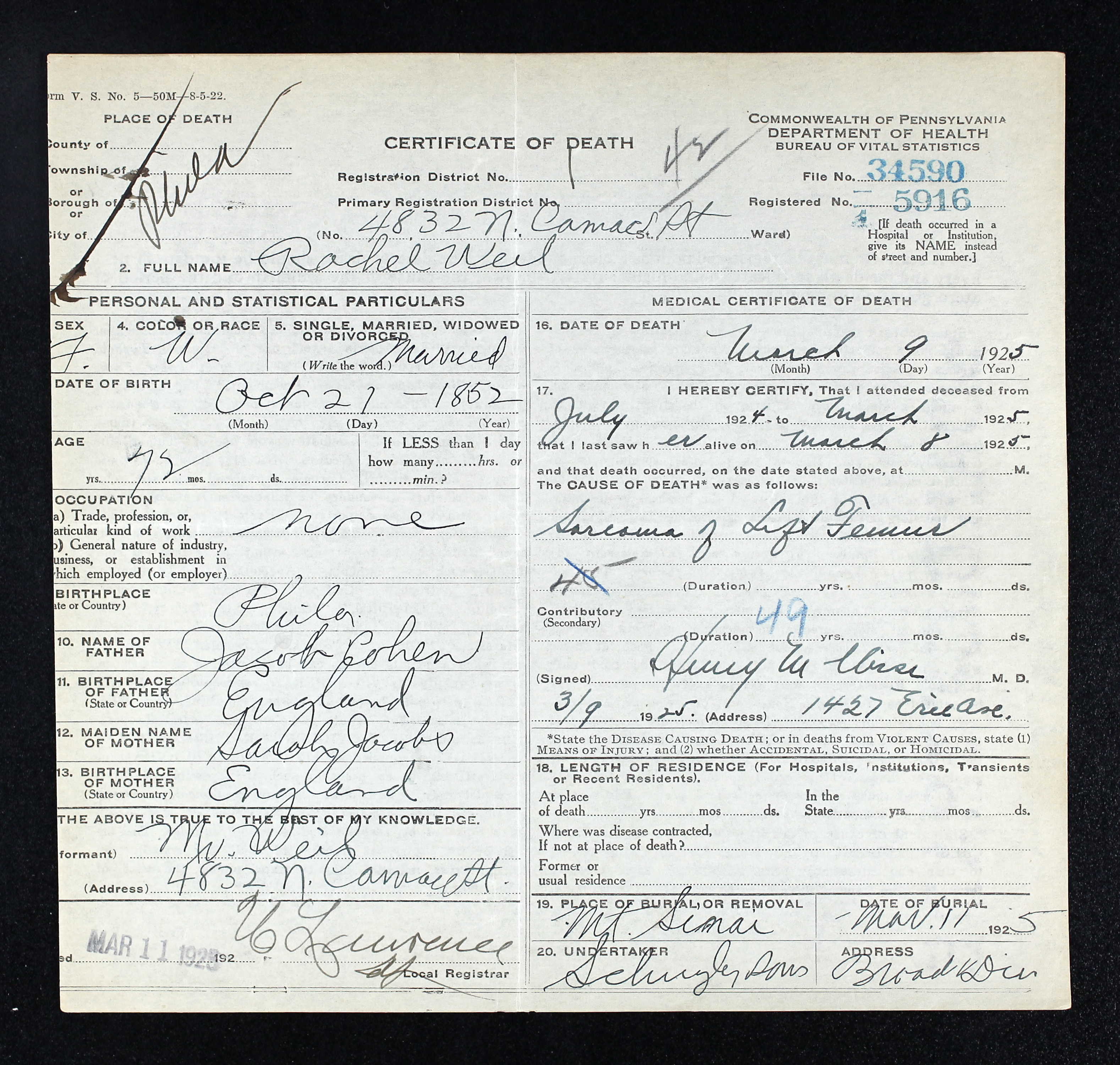
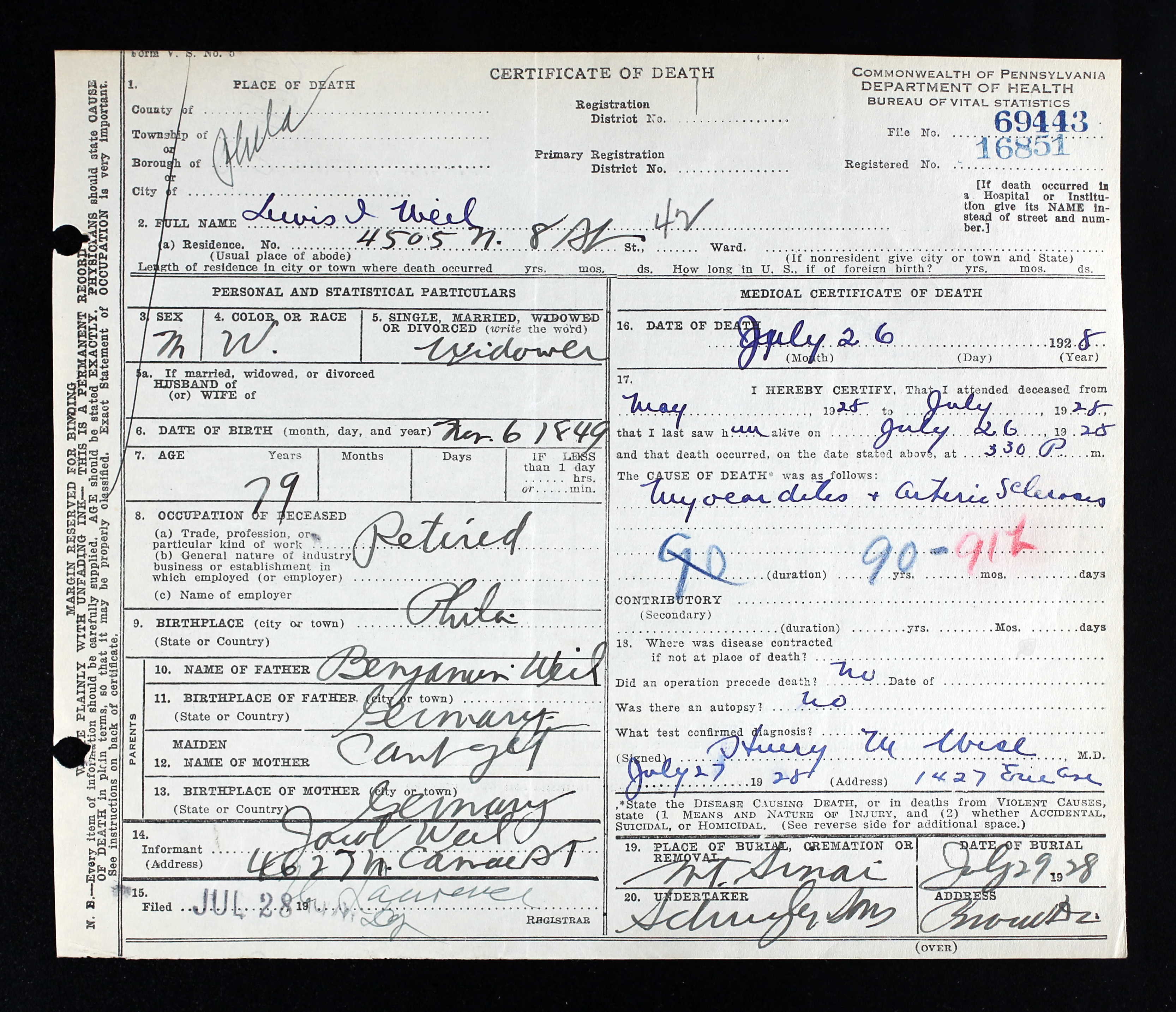
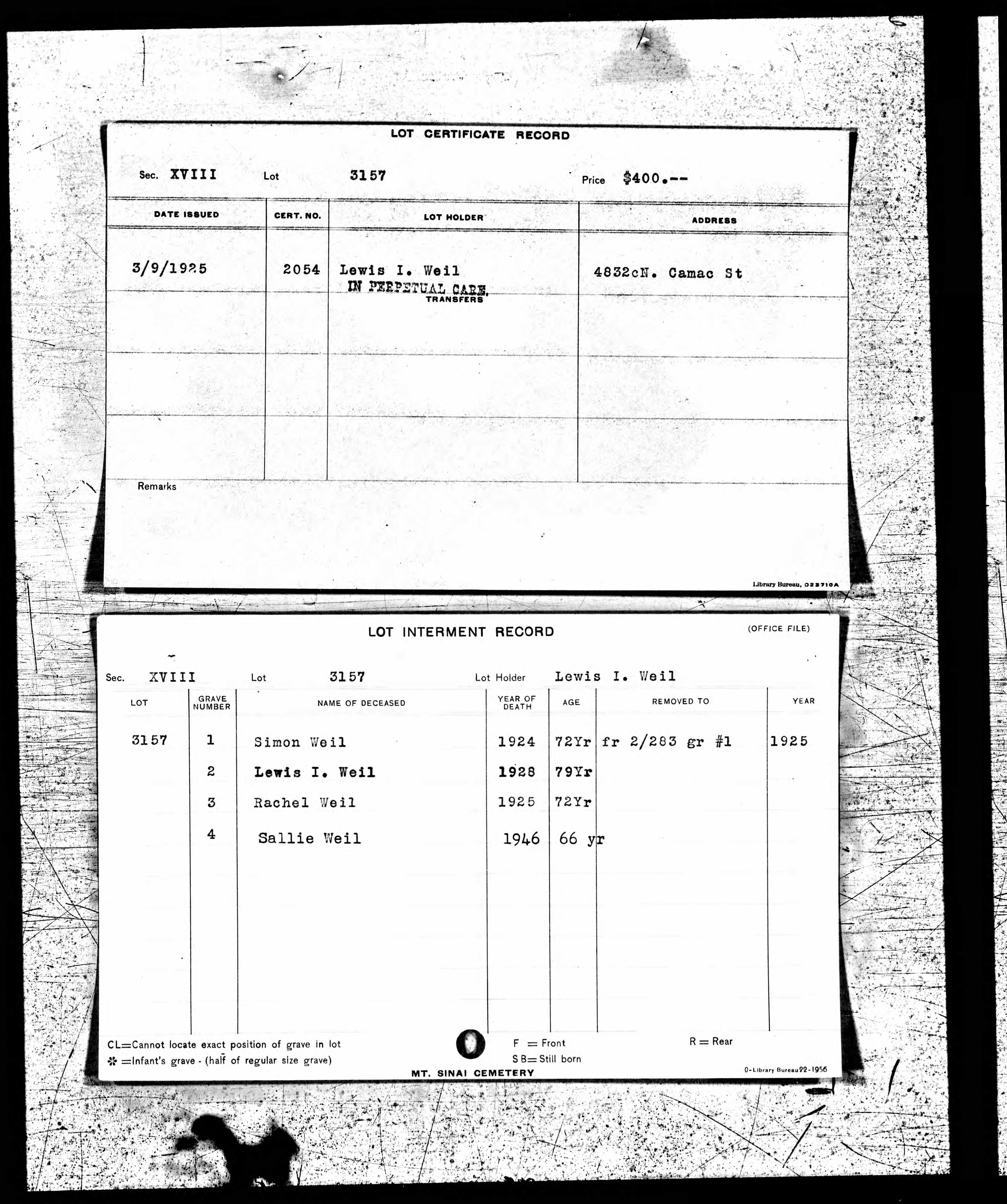
Meanwhile, on March 9, 1925, his mother Rachel, my great-grandaunt,  had died at age 72 of what looks like bone cancer: carcinoma of the left femur; she, like so many in her family, was buried at Mt Sinai cemetery.  Her husband Lewis died three years later on July 26, 1928, of heart disease and was buried beside her.

Rachel Cohen Weil death cert 1925

Rachel Cohen Weil death certificate 1925


Lewis Weil death certificate 1925

Lewis Weil death certificate 1925

Rachel and Lewis Weil death record

Rachel and Lewis Weil death record

Rachel’s life story is not dramatic.  It was in fact a bit of a relief after researching her brother Hart.  Rachel’s life seems to have been without scandal.  Her husband had a steady occupation throughout.  They suffered the loss of a child early in their marriage and perhaps other losses that are not documented in public records, but they also raised five children to adulthood.  Two of those children may have had some marital issues, but overall there were, aside from Benjamin’s death, no apparent tragedies or scandals. Rachel and Lewis stayed married to each other for almost 50 years.  They both lived into their seventies, unlike Rachel’s older siblings who did not live to see 70.  It was not a remarkable life, but it was a life not unlike many lives.  It may not make for an exciting story, but nor do most lives.  Their story is a family story, a story that many people aspire to live for themselves.


Assessment time

It’s time for my periodic review of what I have learned and where I am going in my research.  I keep a Word document with lists of things I need to do, but sometimes I need to step back and see the whole picture, then step forward and see the details.

English: Forest trees Part of the forest which...

English: Forest trees Part of the forest which is a bit more mature than some of the other parts along the path here. (Photo credit: Wikipedia)

On the Brotman side, I think I am in fairly good shape.  I have found descendants of all but one of Joseph and Bessie Brotman’s children, although I am not in touch with all of the descendants.  The only missing link is Sophie Brotman; I’ve had absolutely no luck finding any records for her.  I don’t know when she arrived, whether she married and, if so, who she married, where she lived, where she died.  And sadly, I don’t think I ever will.  There is no one left alive to ask about Sophie; none of the descendants I’ve spoken with know anything about her.  Perhaps one of Abraham’s descendants might know something, so I will contact Paula, the one Abraham descendant I’ve been in touch with, and see if she has ever heard of an aunt named Sophie.

Bessie

Bessie

The big research area remaining for me on the Brotman side is finding out whether we are related to any other Brotmans, in particular the Brotmans who settled in Brotmanville.  I am in touch with a few of Moses Brotman’s descendants, and one is a genealogist, so we plan to collaborate and see whether we can find the connection between our families.  If we can, that may also lead me to other clues about where in Galicia Joseph and Bessie lived and to clues about other family members.

Moses Brotman

Moses Brotman—Joseph’s brother?

On the Goldschlager branch, I think I am also in fairly good shape.  I have found the descendants of Moritz, my great-grandfather, and of Betty and David Goldschlager, my grandfather’s siblings, and I know about the lives of Betty and David and their children.  I’d love to go back and research Moritz Goldschlager’s family, but since his parents died when he was a young child, there does not seem to be too much more I can learn.  My Romanian researcher did not find anything more related to my Goldschlager relatives, so I may have reached the brick wall with respect to that line.

Moritz Goldschlager

Moritz Goldschlager

On the other hand, the Rosenzweig branch, my great-grandmother Ghitla’s family, still has a number of unanswered questions.  I have been able to learn a great deal about most of the children of David and Esther Rosenzweig, my great-great-grandparents, but Zusi Rosenzweig remains a mystery.  Her descendants were not responsive to my inquiries, so I may have to find another way to get closure on Zusi and her son Nathan and her husband Harry Mintz.  I’ve had better luck with Tillie Rosenzweig Strolowitz Adler and her children and grandchildren and have been in touch with two of her great-grandchildren.  There are still some loose ends there, but for the most part I have been able to find a fair amount about the children of Tillie and Jankel and even about their grandchildren and great-grandchildren.

Ghitla Rosenzweig Goldschlager

Ghitla Rosenzweig Goldschlager

As for the family of Gustave and Gussie Rosenzweig, I still have some open questions, mostly about the daughters Lillie, Lizzie and Ray.  This week I spoke with one of Sarah’s granddaughters, and I am hoping that she will also be able to help me find out more about her grandmother’s sisters, but as of right now, I have not been able to find any of the descendants of Lillie, Lizzie or Ray.

So that’s where I am in this journey to find my mother’s family.  I feel as though I am seeing the light at the end of the tunnel, though there is still plenty of tunnel to get through.

Tunnel

What do I do now besides continue to search for answers to the remaining questions?  I have a number of thoughts.

For one, I want to continue to build the relationships I’ve made with all my new cousins on both sides of my mother’s family—the Brotmans and the Goldschlager/Rosenzweigs.  Having found them, I don’t want to lose them again.  Facebook and email make this so much easier, but it will still take effort.  I also want to see if I can organize a meeting for the Rosenzweig/Goldschlager cousins like we had for the Brotmans earlier this month.

I also want to pull all my research together into a format that will make it more easily accessible.  I’d like to tell the story of the Brotmans, Goldschlagers and Rosenzweigs as a chronological story so that someone can pick it up and get the whole story without having to jump from blog post to blog post, searching for the next discovery.  That is a larger project, and I don’t even know how to start it, but that is what I see as my ultimate goal—to write the book that tells the stories so that our descendants will have it and know who their ancestors were.

And then there is the next huge research task: my father’s side.  That will be a very different research experience.  His family has been in this country for about fifty years longer than my mother’s family.  They came from Germany and from England.  They settled and lived in other places: Philadelphia, western Pennsylvania, New Jersey, New Mexico, among other places.  There will be a lot more American and European records available, which will make the task both easier and harder.  I’ve already traced one of my father’s lines back to the 1750s or so in Amsterdam, a full century earlier than I’ve been able to trace any of my mother’s relatives.  I look forward to this research with some trepidation because of the size of the task ahead.  But I am also excited by the idea that I have more discoveries, more stories, more understanding of my family and of myself ahead of me.


Enhanced by Zemanta

Hyman and Sophie Brotman’s Sons: A Family Album


Sophie and Hyman Brotman

Sophie and Hyman Brotman

One of the benefits of getting to meet six of my Brotman second cousins was that I was able to obtain a lot more photographs of my Brotman relatives.  All six of the living grandchildren of Sophie and Hyman Brotman, my grandmother’s older brother, were able to attend our “reunion”—the three children of Saul and Vicky Brotman and the three children of Manny and Freda Brotman.  Sadly, the two daughters of Joseph Brotman, Hyman and Sophie’s oldest son, have passed away.  But I now have a good collection of pictures of Hyman, Sophie, their three sons, and their grandchildren.

Hyman Brotman was born in Galicia and arrived with  his mother, my great-grandmother Bessie,  and his sister Tillie in 1891 when he was about eight years old.  He lived on Ridge Street with his family until he married Sophie Weiss on March 12, 1904.  Hyman and Sophie had three sons.  Joseph Jacob was born on February 4, 1905, and was named for Hyman’s father, my great-grandfather Joseph Jacob Brotman.  Their second son, Saul, was born on April 27, 1907, and their third son Emanuel or Manny was born on May 9, 1910.

Hyman worked at various occupations, including as a chauffeur and in the sweatshops of NYC, but in the early 1920s he and his family moved to Hoboken, NJ, where he opened a liquor store.  My mother has childhood memories of visiting her uncle and aunt in Hoboken, though by that time the three boys were all grown, and sadly she has no memories of her cousins.

Hyman, Bruce and Sophie in the Hoboken liquor store

Bruce, Hyman and Sophie in the Hoboken liquor store


As their children reported, all three Brotman brothers were very close and very athletic.  They were all excellent swimmers and loved competing against each other, always arguing over who was the fastest.

Saul Sophie Joe and Manny

Saul Sophie Joe and Manny

Joe married Perle Gorlin on May 1, 1935, and they lived in Queens where Joe was employed as a salesman for Abbott Laboratories, according to the 1940 census. Joe was a pharmacist in New York, but later moved to Florida where he became involved in commercial real estate.

Joe and Perle Brotman 1940 census

Joe and Perle Brotman 1940 census

Joe and Perle had two daughters, Barbara, born in 1939 and probably named for Bessie, who had died just five years earlier, and Merle or Miki, born in 1941.  Here are some photos of Joe and Perle and other family members:

Perle, Joe and Sophie Brotman

Perle, Joe and Sophie Brotman


Hyman (second from left) and Joe (far right) and two unknown men

Hyman (second from left) and Joe (far right) and two unknown men

Joe and Saul Brotman

Joe and Saul Brotman

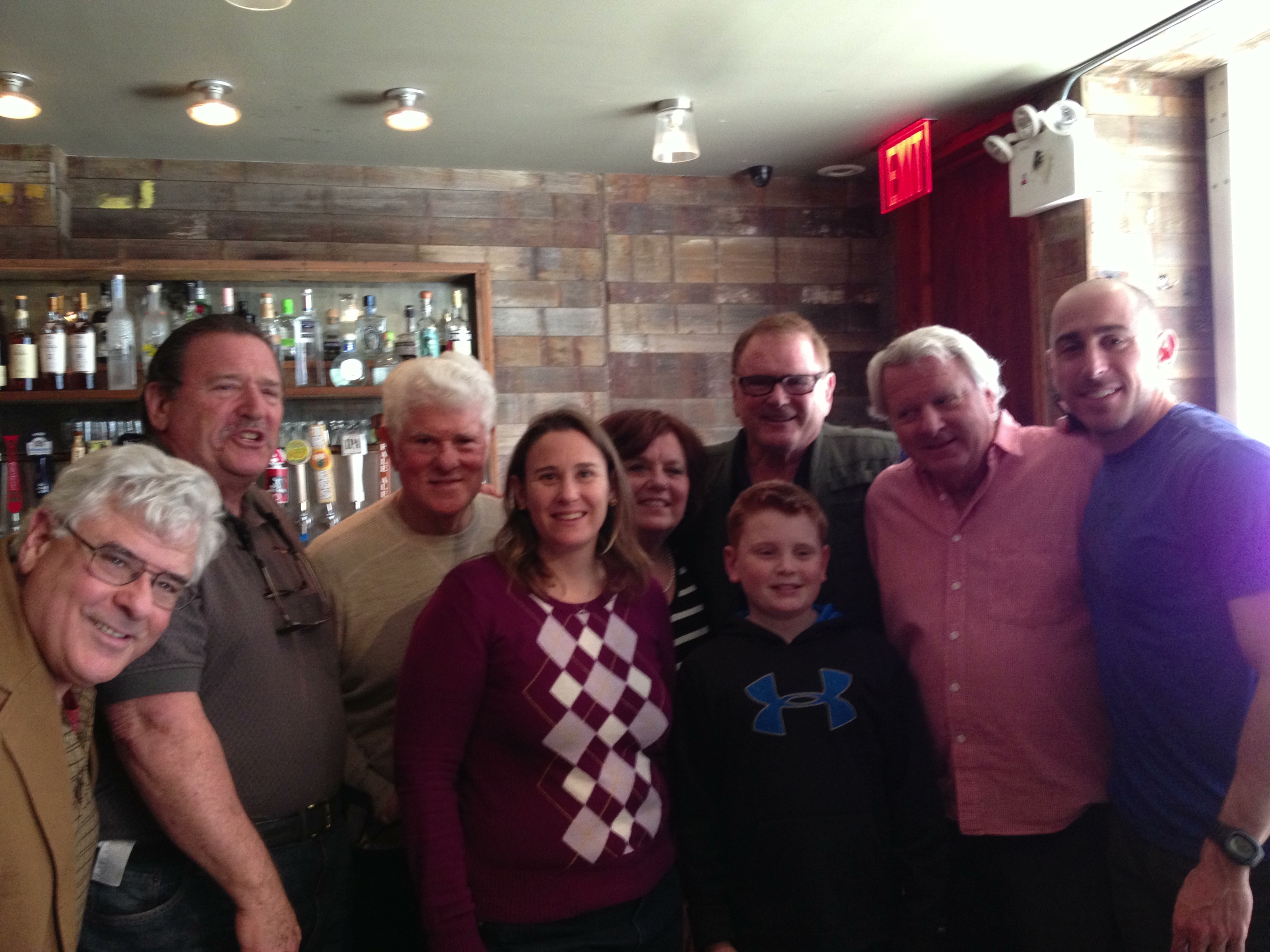
From Front Center, Clockwise: Joel, Herman, Sophie, Joe, Perle, Manny, Freda, Denny, Saul , and Vicky Brotman

From Front Center, Clockwise: Joel, Herman, Sophie, Joe, Perle, Manny, Freda, Denny, Saul , and Vicky Brotman

Saul Brotman was an excellent athlete, especially in swimming and handball.  He graduated from Hoboken High School and started college at the New Jersey College of Pharmacy in 1926; he then transferred to and graduated from Panzer College, which has since merged with Montclair State University in New Jersey.  He later got a master’s from Rutgers University.

1932 Panzer College yearbook

1932 Panzer College yearbook

Saul at Panzer College

Saul at Panzer College

Saul

Saul

Saul

Saul

In a comment posted in response to an earlier blog post, Bruce wrote the following about how his parents Saul and Vicky met:

In Manhattan Beach (Brooklyn) there was a beach club, Manhatten Private. It had pools, handball courts, tennis and other sports. My parents were playing handball, my parents were both fine athletes, but not with each other. The ball from my mom’s court was accidently hit toward my dad’s court some distance away. My mom called to my dad saying “ball please”. Dad picked it up and threw it to mom. He then turned to his cousin, with whom he was playing and said “I’m going to marry that girl”. That was about 1940 or 41 I guess. He asked her out several times but she refused. On December 7 1941 my cousin Mel was born. Somehow my father found out and went to the hospital. (Mel was mom’s older brother Al’s first child). Mom asked dad what he was doing there – he said that he thought she might need some help, noting that Pearl Harbor had just been attacked. She apparently knew at that moment that she loved him. The rest is history.”

Vicky Horowitz Brotman

Vicky Horowitz Brotman

Saul and Vicky were married in 1942.

Saul served in the US Army during World War II and won a handball championship while serving in the army. After the war, he became a teacher in New Jersey, where he coached many state championship teams.  After 32 years as a teacher,  he left teaching after being assaulted by the parent of one of his students.  Saul then became the pension director for a union.

Saul in the army

Saul in the army

Saul and Vicky 1940s

Saul and Vicky 1940s

Saul and Vicky had three sons, Bruce, Ronald and Lester.

les bruce ron

Les, Bruce and Ron

Bruce, Ron and Les Brotman

Bruce, Ron and Les Brotman

Saul, Bruce and Vicky at Bruce's bar mtizvah

Saul, Bruce and Vicky at Bruce’s bar mtizvah

Saul remained a great athlete all his life.  In fact, Bruce told me that when Saul was in his seventies, Bruce challenged him to a game of handball, thinking that he could easily beat his father. Instead, Saul soundly defeated his much younger son;  he won four straight games, with Bruce unable to score a single point in any of the four games.

Saul and Bruce

Saul and Bruce

Saul and Vicky

Saul and Vicky

Manny, the youngest of Hyman and Sophie’s sons, was also an excellent athlete like his older brothers.

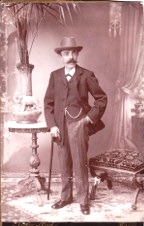
Manny (far left) at camp in 1925

Manny (far left) at camp in 1925

manny 1926

Manny November 1928

Manny November 1928


Like his brother Saul, he began college at the New Jersey College of Pharmacy, but he transferred to the University of Iowa, from which he graduated.

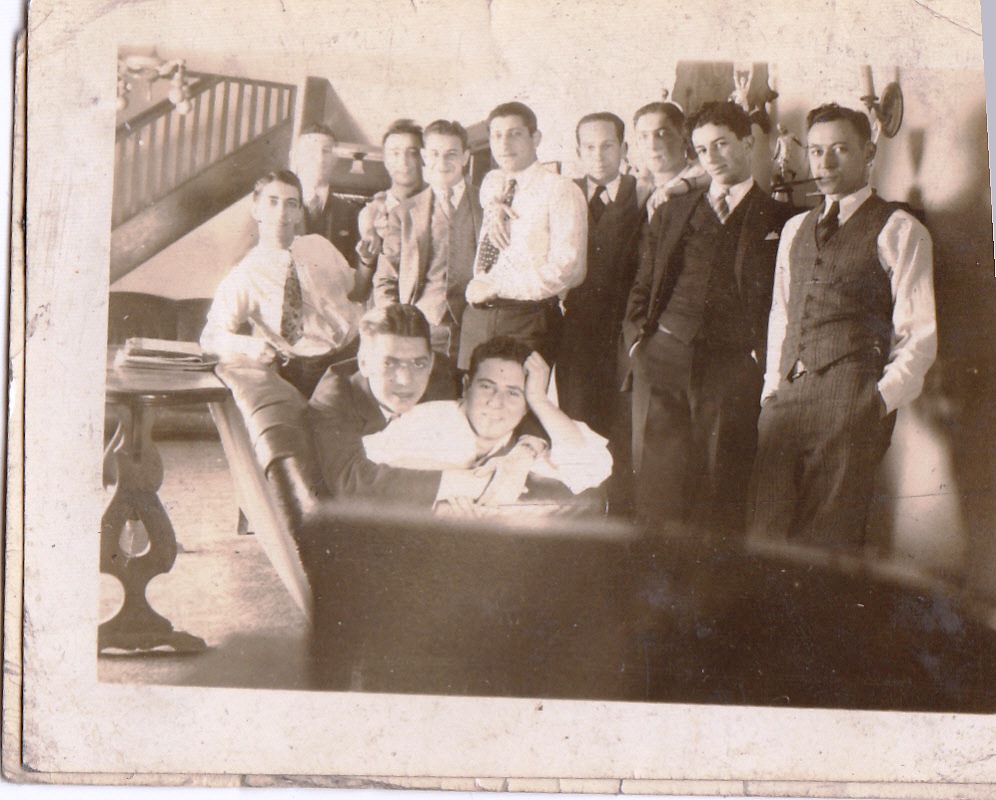
Manny with his fraternity brothers at U Iowa

Manny with his fraternity brothers at U Iowa

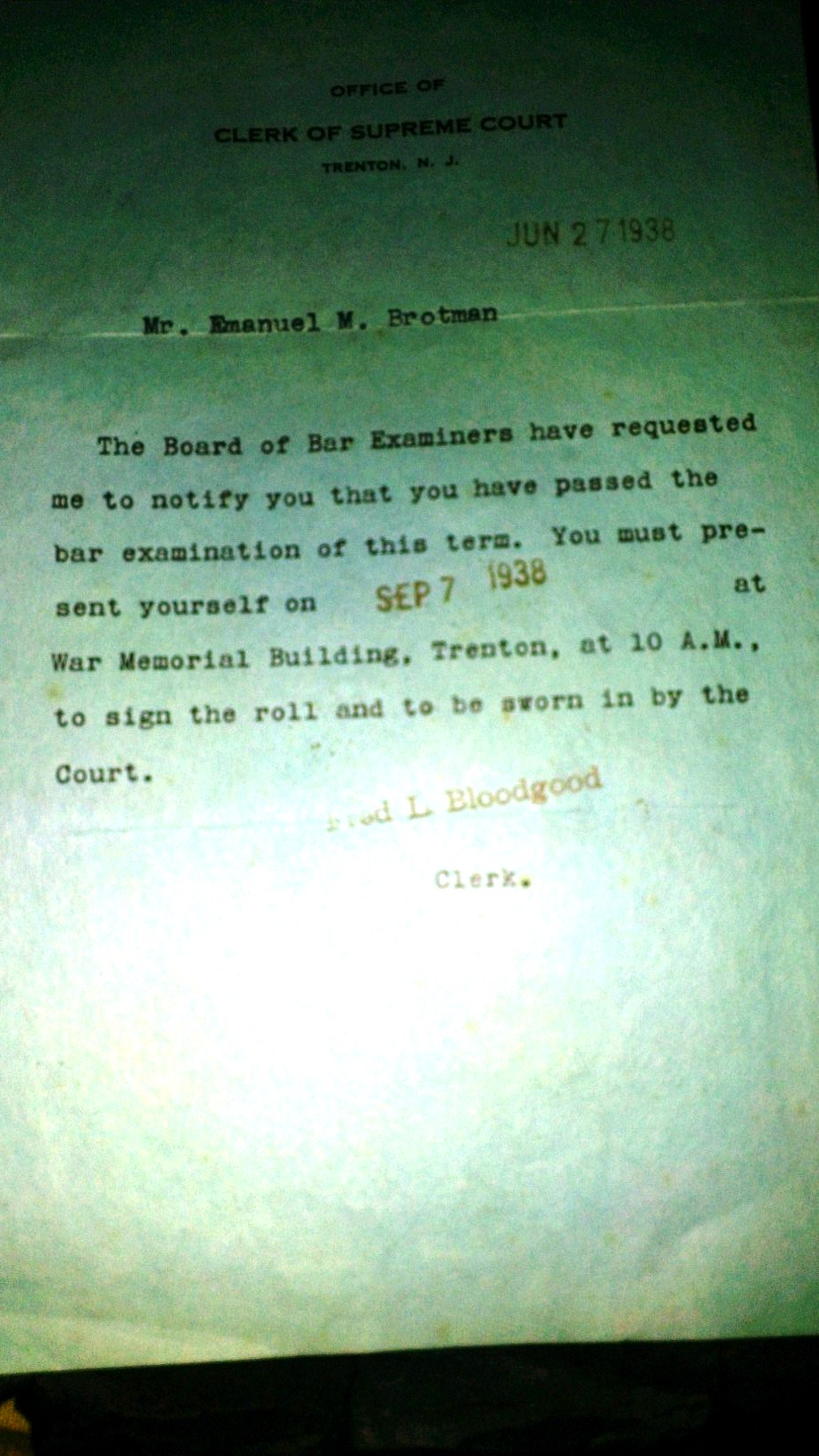
He also graduated from John Marshall Law School (New Jersey), which was later taken over by Seton Hall University. Manny became a member of the New Jersey bar in 1938.

Letter informing Manny that he has passed the New Jersey bar exam

Letter informing Manny that he has passed the New Jersey bar exam

Manny married Freda Feinman on December 22,  1940.

Freda and Manny's wedding invitation 194?

Freda and Manny’s wedding invitation 1940

Manny and Freda 1940s

Manny and Freda 1940s

Manny enlisted in the US Army in 1944 during World War II.

Manny Brotman

Manny Brotman

Manny practiced law for some time, but then joined J.I. Kislak Mortgage Corporation, a subsidiary of J.I. Kislak, Inc.  J.I.Kislak, Inc. was a residential and commercial Realtor, originally based in Hoboken and then in Jersey City, and Kislak Mortgage was primarily a residential mortgage banking company, one of the largest in NJ at the time, based in Newark.  He was president and then chairman of Kislak Mortgage for many years, was president of the Mortgage Bankers Association of NJ, and a long-time board member and two-term Treasurer of the Mortgage Bankers Association of America, where he received the Distinguished Service award. Kislak Realty, a commercial mortgage firm, where he became the president.  He was often quoted as an expert on veteran’s housing and housing in general in various newspaper articles.  Here is one example of an article that ran in several newspapers across the country:  Lebanon_Daily_News_July_10__1971_Lebanon__PA_Manny_Brotman

Manny and Freda had three children: Joel, Denny and Bonnie.  Here are some pictures of Manny and his family:

Manny, Joel and Freda

Manny, Joel and Freda

Denny, Bonnie and Freda

Denny, Bonnie and Freda

The Feinman and Brotman families June 16, 1932

The Feinman and Brotman families June 16, 1937

From left to right: Aron Feinman, Hyman Brotman, Mary Feinman, Sophie Brotman, Manny Brotman, Sam Feinman, Freda Feinman, Saul Brotman (according to the back of this photograph)


I did not know Hyman or Sophie or any of their sons, but I was very fortunate to meet six members of the next generation, my second cousins Bruce, Ron, Les, Joel, Denny, and Bonnie.  They all made the effort to come to New York City, some from as far away as Florida and Ohio.  I really enjoyed meeting and talking to each one of them and getting a chance to meet some of their children, four of whom also showed up during the course of the weekend.

What a wonderful tribute to their grandparents and parents that these cousins and their children cared enough about the extended family, including some second cousins they’d never met,  to make such a united effort to come to New York so that we could all be together.


Saul and Manny's descendants

Six of Hyman and Sophie’s grandchildren and three of their great-grandchildren


Enhanced by Zemanta

More Manna from Heaven: Of Bessie, Joseph, Max and the Brotmanville Brotmans

As I wrote yesterday, the notes of the conversation with my Aunt Elaine about the family history are remarkably accurate.  Although much of what was in there I had learned either from my mother or brother or cousins or from my own research, there were a few stories in the notes, a few comments, that revealed something I had not known for sure before.  Keeping in mind the overall accuracy of the information that my aunt gave to Joel, it is very interesting to think about this additional information.

For example, there are some details about Bessie and Joseph that were revealing.  According to the notes, Bessie and Joseph were first cousins.first cousins  Although family lore did say that Joseph and Bessie were cousins, I did not realize that they were first cousins. Since both Joseph and Bessie had the surname Brotman or Brot, it seems that their fathers must have been brothers. What’s odd about this is that it means that Joseph’s father Abraham had a brother who was also apparently named Joseph, if the records are accurate.  It seems unlikely, given Jewish naming patterns, that Abraham would have named his son the same name as his brother, unless the brother had died.  Since Bessie was younger than Joseph (her husband), that is not possible.  The other possibility is that Bessie’s father and Joseph were both named for the same ancestor.  And, of course, the final possibility is that the records that indicated that Bessie’s father’s name was Joseph were incorrect.

Joel’s notes also indicate that after Joseph’s first wife died, leaving him with four children, “they decided” that Bessie should marry Joseph to help with the children.they decided  The notes don’t indicate who made the decision, but it probably was not Bessie. It’s sad to think of my great-grandmother being put in that situation, and it certainly takes the idea of any romance out of the equation.  But Joseph and Bessie went on to have five children of their own, so I’d like to assume that although it may have started as an arranged marriage for the convenience of Joseph, that love grew with time and the shared experiences and children that Joseph and Bessie had.  Call me a romantic.  I know that I am.

After Joseph himself died in 1901, the notes report that Bessie did laundry work to make money to support herself and her children, including Sam, who was just an infant, Frieda, Gussie, Tillie, and Hyman.  Tillie and Hyman were working in sweatshops, so Gussie, my not-yet-seven year old grandmother, stayed home to take care of Frieda and Sam.  Not long after, out of desperation, Bessie married “the shoemaker Moskowitz,” who my aunt reported to be very stingy.  He had five children of his own. moskowitz

I assume that my aunt’s source for these stories was my grandmother, who obviously resented Philip Moskowitz and chose to live with her sister Tillie in Brooklyn instead of staying with her mother and Sam and Frieda when Bessie remarried, so I know I have to consider the source.  My great-grandmother Bessie lived with Philip for many years, more years than she lived with Joseph, and she was buried near him, not Joseph, when she died. Bessie and Philip Moskowitz headstones As with her marriage to Joseph, her relationship with Philip may have started out of need and convenience, but it also must have developed into something more.  Or at least I hope it did.

Bessie Brotman

Bessie Brotman

Of course, it is also possible that the source of this information was Bessie herself.  Bessie did not die until 1934, when my aunt was seventeen years old.  Knowing my aunt’s interest in the family history, I assume that she must have talked to her grandmother Bessie herself as she grew up, so perhaps the stories are not just my grandmother’s version of the facts, but Bessie’s version as well.

One other comment from these notes is a rather sweet one that I hope Max Brotman‘s grandchildren and great-grandchildren will appreciate:

max mason


Obviously, Max, who was probably the most successful businessman of the Brotman children, was also a very generous man.  He provided food to my mother’s family during the Depression.  Here is a great-uncle I’d never even heard of, someone my mother was too young then to remember, who helped out my grandmother and her family in a time of need.  Thank you, Max.

Max Brotman

Max Brotman


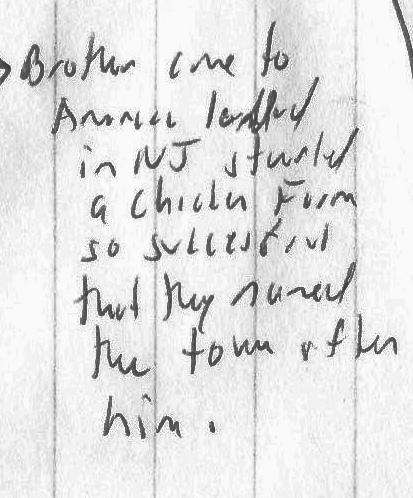
The final tidbit from the notes from Joel’s conversation with my aunt is this one:brotmanville


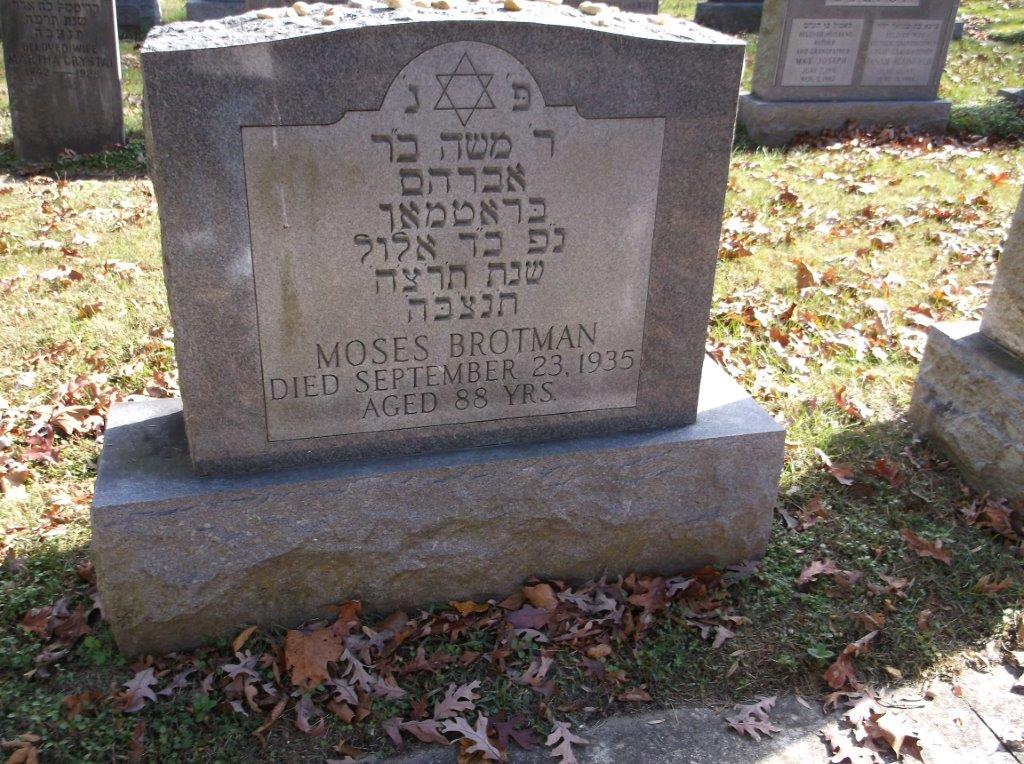
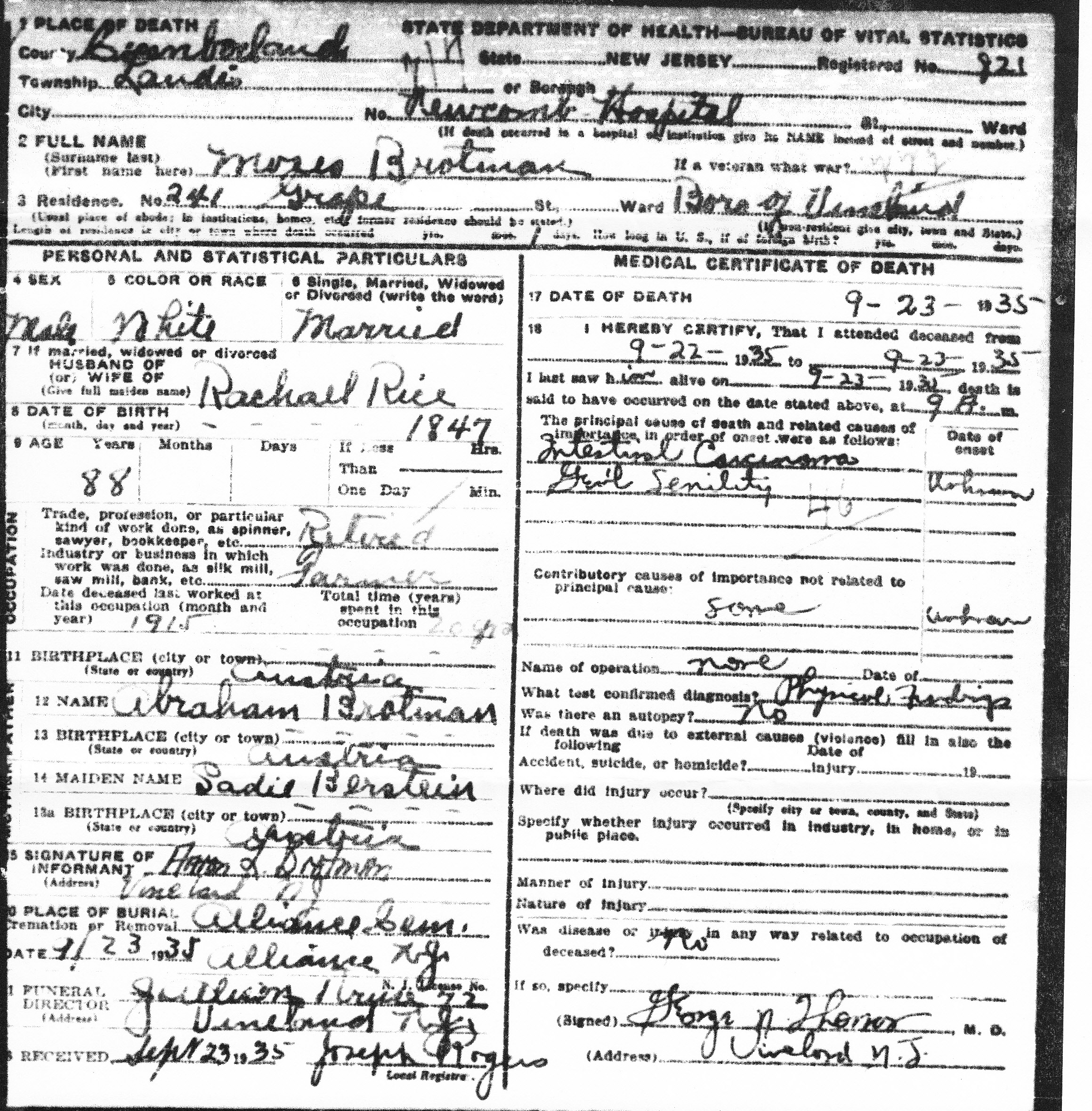
In case you cannot read that, it says, “Brother came to America landed in NJ started a chicken farm. So successful that they named the town after him.”  The quote points back to Joseph.  This is obviously a reference to Brotmanville.  Although it is not entirely accurate—Brotmanville was named for Abraham Brotman, who started a manufacturing business to employ the residents whose farms were failing, not for Abraham’s father Moses, who had the chicken farm—the note nevertheless provides support for the claim that we are in fact related to the Brotmanville Brotmans.  As you may recall, Moses Brotman also had a father named Abraham, as revealed by his headstone and death certificate.Moses Brotman headstone Moses Brotman death certificate_0001_NEW


He was born in 1847 in Galicia, making him a contemporary of Joseph, my great-grandfather.  I cannot rely on these notes alone to assert with any certainty that Moses and Joseph were brothers, but given the overall accuracy of what my aunt told Joel, it is enough evidence for me to start once again to try and find a connection.  If we can find that connection and also learn where Moses Brotman lived in Galicia, it will help to answer a number of lingering questions.

Moses BrotmanHe certainly has the Brotman cheekbones.  Could this be what Joseph looked like also?


Enhanced by Zemanta

Maurice Goldschlager

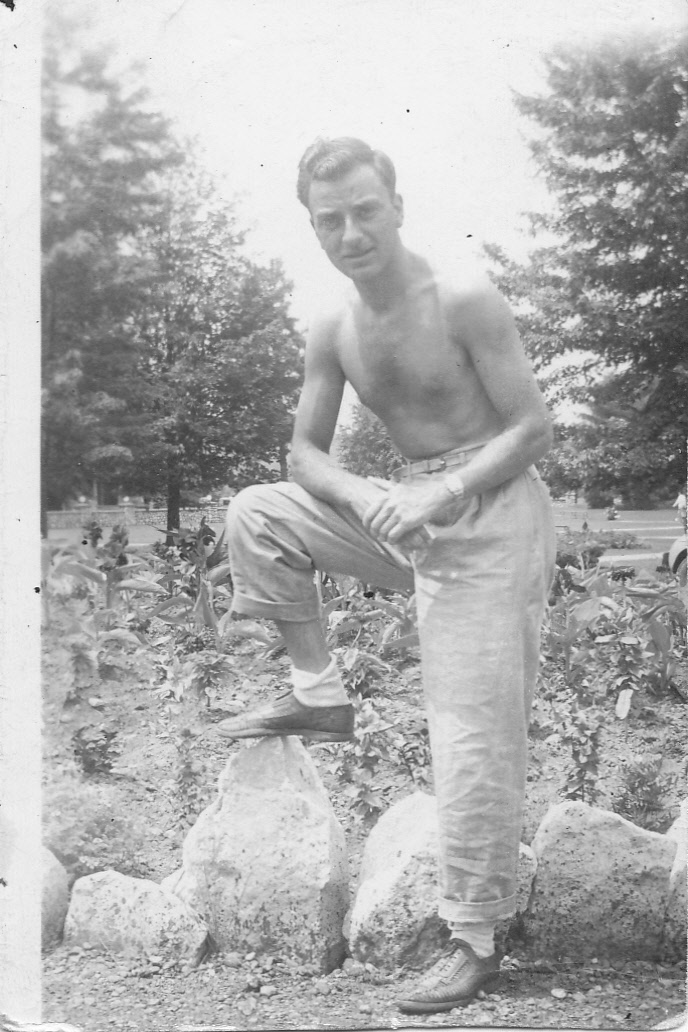
A number of the photographs I received from Robin were of her father, my uncle, Maurice (Mike) Goldschlager.  I asked Robin to provide me with some information about her father’s life to fill in what I know so that I could write a short biography to go with her photos.  Much of this was new information to me.  What I knew of my uncle was that he was a man who had a wonderful sense of humor, a big tease who pinched our ears whenever we saw him, a man who loved his family, animals and the outdoors, a good businessman, a man who had served his country proudly, a man who was full of passion and loved life.

Isadore Gussie Maurice and Elaine about 1923

Isadore Gussie Maurice and Elaine about 1923

Maurice Lawrence (really Leon but he hated that name) was born June 10, 1919, the second child of Isadore and Gussie Goldschlager.  He was named for Isadore’s father, Moritz.  My mother has a book with some notes that her big brother wrote about his activities when he was a boy, and as I recall, he was keeping track of the number of animals he had captured.  I don’t have access to the notebook right now, but that’s my vague recollection.  Once I can get that notebook again, I will update this and scan some of his handwritten notes.

Maurice 1939

Maurice 1939

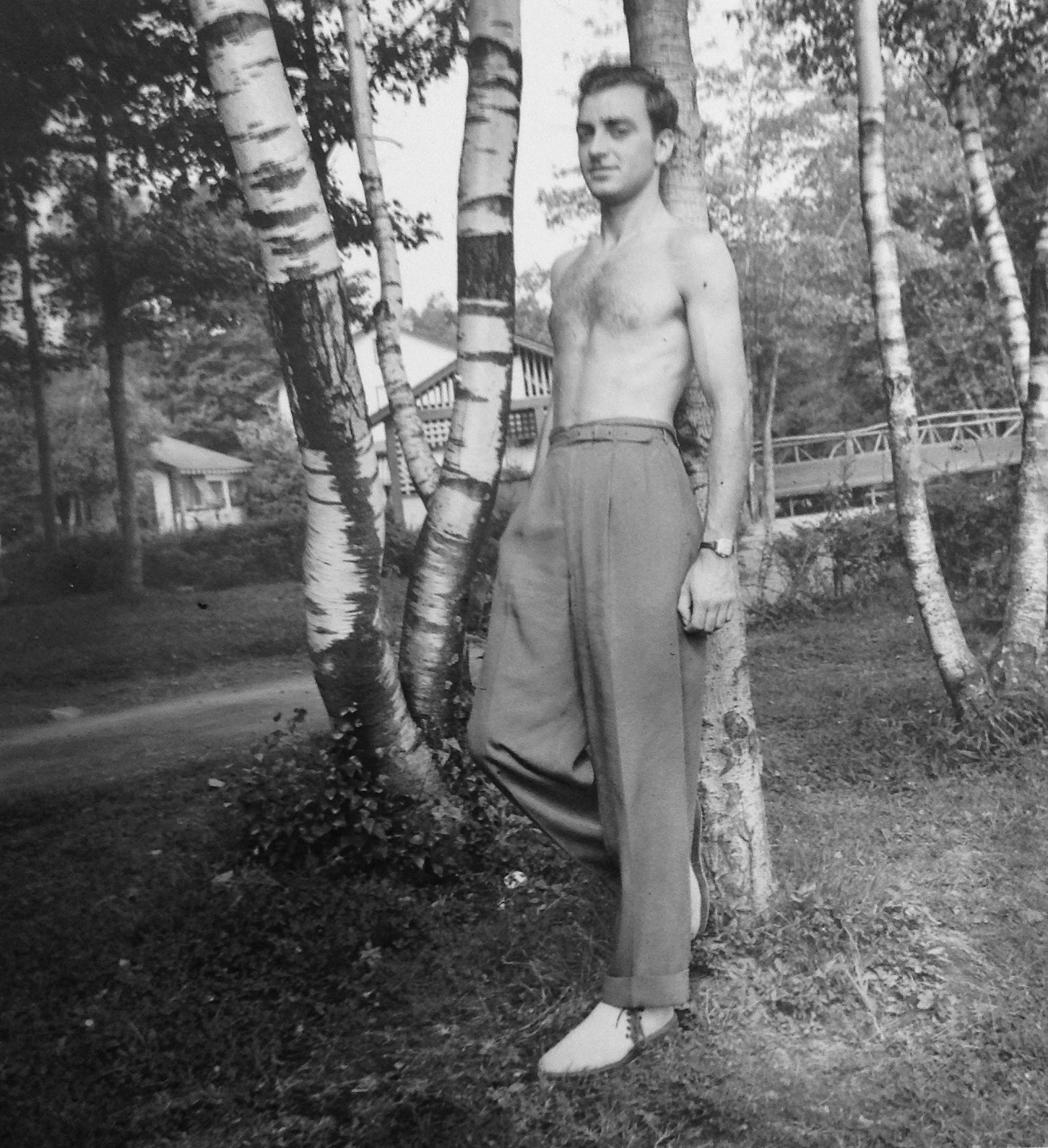
Here is a picture of Maurice in 1941 when he was twenty-two before he enrolled in the Army Air Corps to serve in World War II.

Maurice Labor Day 1941

Maurice Labor Day 1941

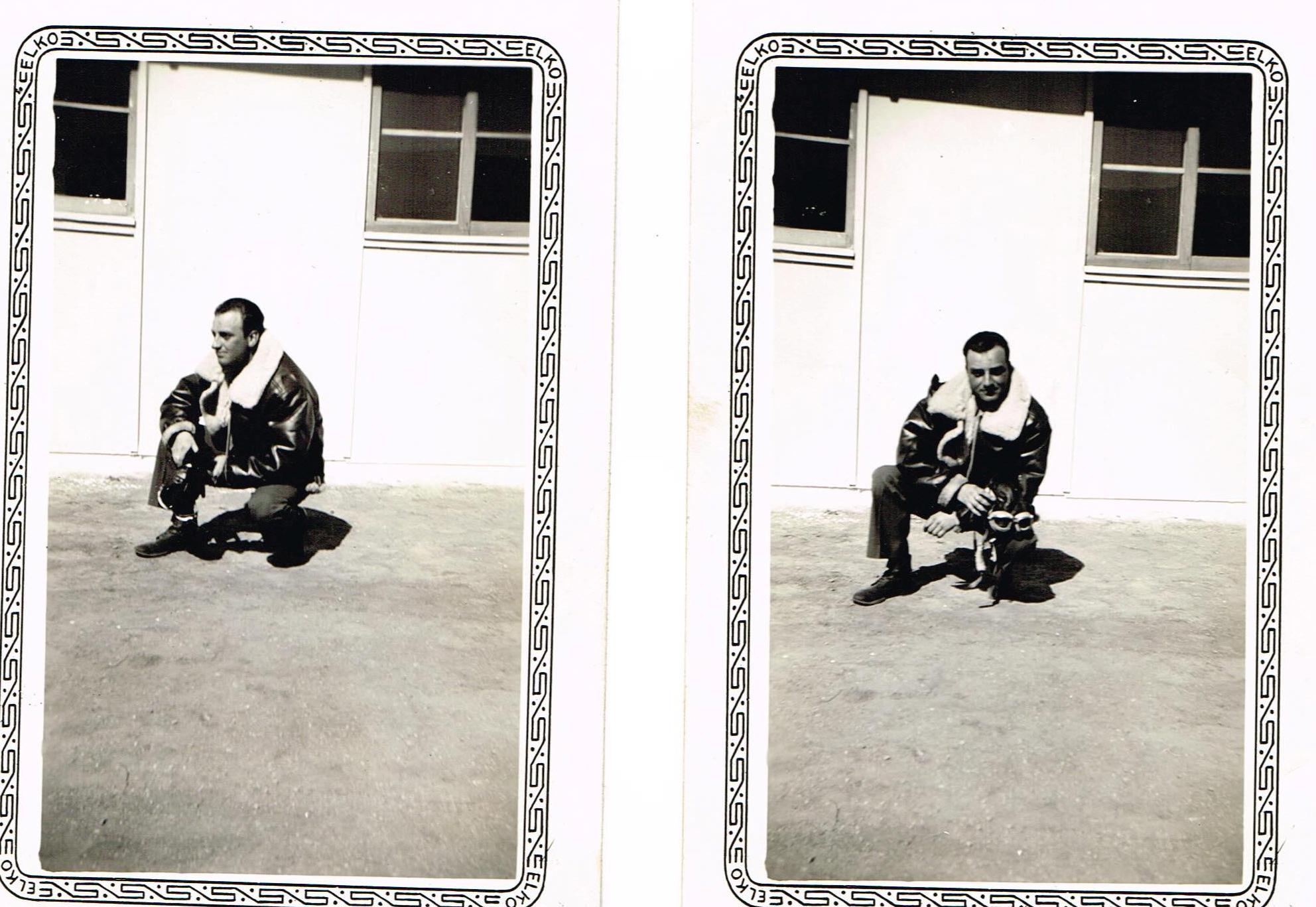
He enrolled on September 25, 1942 and served until the end of the war.  He was a staff sergeant and a tail gunner on a B 12 bomber.  He was stationed in North Africa and flew missions over Italy and France.  The day before he returned to the US, his tent caught fire, and he lost everything but what he was wearing.  Although I never heard my uncle talk specifically about his war experiences, we all knew that he was very proud of his service and remained close to many of his army buddies.  He had his wings made into an ID bracelet which his son Jim now wears in his memory.

Maurice at Aerial Gunnery School in Kingman, AZ

Maurice at Aerial Gunnery School in Kingman, AZ

Maurice 1942

Maurice 1942

Tilly with nephew Maurice 1944

Tilly with nephew Maurice 1944

Maurice 1942

At the end of the war he was stationed in New Jersey where he met Lynn Brodsky.  As Robin reported in my earlier post, it was love at first sight, and they were married on his birthday, June 10, 1945.

Maurice and Lynn 1946

Maurice and Lynn 1946

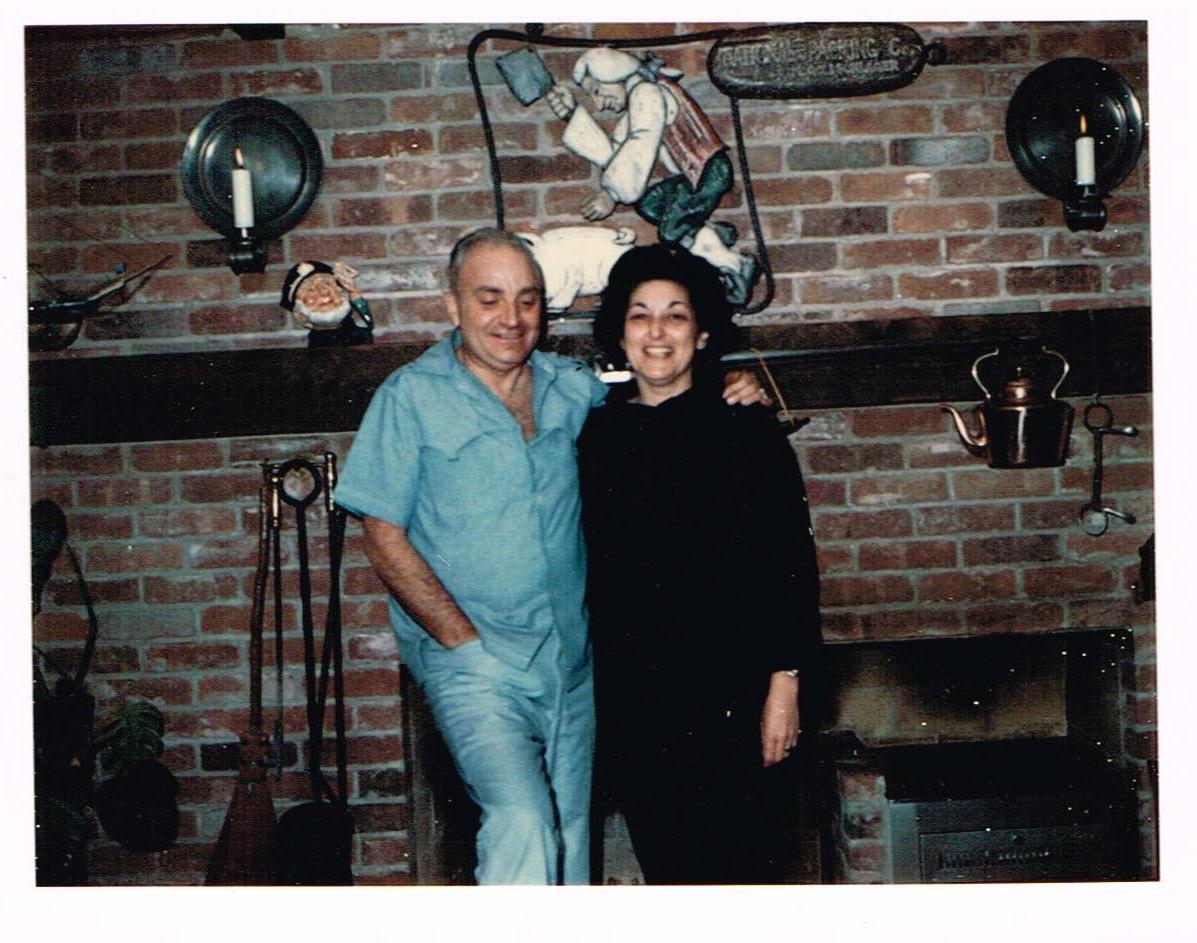
  They settled in New Jersey until Maurice had a run-in with his boss and lost his job.  Lynn’s uncle, Kurt Leopold, owned a meat packing company, Union Meat, in Hartford, Connecticut, and offered Maurice a job and a place to live until he and Lynn could get settled in Connecticut.  Maurice worked for Union Meat for several years and then started his own business with his partners Eric and Kurt Strauss called National Packing.  Lynn had a sign made with the National Packing logo that hung in their family room in West Hartford; my cousin Beth now has it hanging in her kitchen.

National Packing sign on fireplace behind Maurice and Lynn

National Packing sign on fireplace behind Maurice and Lynn

Maurice and Lynn 1967

Maurice and Lynn 1967

Maurice and Lynn had three daughters, my cousins Beth, Suzie and Robin.  Sadly, Lynn’s life was cut short on September 5, 1967 when she died of breast cancer at age 44.

Maurice was very fortunate to find love again with Diane Crone Schaler, who happened to be Lynn’s first cousin.  He and Diane married and had a son, Jim (James Ian).  In addition, Diane had two children from her first marriage, George and Leslie, and they all moved in together in Bloomfield, Connecticut, in a house that not only was filled with teenagers and one small boy, but also lots of animals—dogs, cats, horses, even chickens, ducks and geese, as I recall.

Beth, George, Sue, Leslie, Jim/Jamie, Robin

Beth, George, Sue, Leslie, Jim/Jamie, Robin

Diane and Maurice

Diane and Maurice

The whole family in BloomfieldThe whole family in Bloomfield plus some visitors

But tragedy struck again on April 24, 1978, when Maurice was killed in a freak accident while riding a lawn mower down an incline on the property in Bloomfield.  He was only 58 years old.   It was hard to believe that a man who was so full of love and life was gone so suddenly.  His name lives on through his many namesakes and in our memories and in these pictures.

.

Enhanced by Zemanta

The Schwartz Family

As I wrote yesterday, in trying to fill the holes in David Goldschlager’s story, I ended up researching his wife Rebecca’s family and their story.  Although her family is not technically related to mine except through marriage, now that I am in touch with her grandson Richard (and now, her nephew Jon), I feel connected to this story and touched by it as well.

As I wrote in the last post, I was curious as to why David and Rebecca left New York City sometime after 1920, when David’s mother and sister were living with them, and moved to Scranton, Pennsylvania.  Their son, Murray, was born there,[1] and they were living in Scranton as late as 1928 because that is where David was living when he filed his naturalization application.  By 1930, however, they had returned to New York and were living in the Bronx, where they lived until they retired and moved to Arizona to live near Murray and his wife Edna and their grandson Richard.

I hypothesized that Rebecca’s family lived in Scranton because I could not figure out what else would have drawn David away from his family and place of employment.  As I wrote last, I started digging around for Rebecca’s family, and after learning her maiden name was Schwar(t)z from her naturalization form, I was able to locate the ship manifest for Rebecca and her family on the SS Astoria, sailing from Glasgow, Scotland in March, 1903.

Schwarz Family on the SS Astoria 1903

Schwarz Family on the SS Astoria 1903

The family was from Romania, and Rebecca was one of seven children on the manifest, traveling with her mother Louise.  Rebecca was the oldest child, thirteen years old, followed by Etta (11), Annette (9), Rosa (7), Sophie (4), Abram (2), and Henrie (9 months old).  Henrie’s name had a line drawn through it, and in the left margin next to Henrie’s name, it looks like the word “died” followed by some other illegible words were written.  It looked like Henrie, the baby, had died on board.  Imagine being the mother of seven young children, caring for them on this long, uncomfortable voyage, and losing one of your children while at sea.[2]

The manifest also identified who was meeting the family in the United States: their husband and father S. Schwarz of Newark, New Jersey.  By searching the 1910 US census, I was able to locate the Schwartz family in Newark.  Rebecca’s father’s name was Solomon, and he was employed as a hat finisher in a hat factory.  He and Louise (Lizzie, on this census) were living with their six children who had survived the trip from Romania plus two more born in New Jersey, Meyer and Jennie.  Rebecca was now 20 and, like her father, working as a hat finisher in a hat factory.

The Schwartz Family in Newark (Rebecca standing in the rear middle)

The Schwartz Family in Newark (Rebecca standing in the rear middle)

Is this how she met David? As a hat maker? Did the factory where she and her father worked have a connection to the factory where David was working? David had been working as a hatter since at least 1915, as indicated on the 1915 NYS census. On his World War I draft registration dated June 5, 1917 (after he and Rebecca were married), David listed his employment as a hatter for Sam Burk at 419 Lafayette Street, New York.  Who knows? Maybe there was a hatmakers union meeting where Rebecca and/or her father met David.  At any rate, they were married in Newark in 1916, but lived in New York City as of the 1920 census.

Rebecca and Sidney Goldschlager

Rebecca and Sidney Goldschlager

Meanwhile, the Schwartz family had suffered another tragedy.  On the 1920 census, I noticed that although Etta, Annette, Rosie, Sophie, Abram (now Abie), and Jennie were still listed as living at home, there was no entry for Meyer, who had been only six years old in 1910.  I had to assume that something had happened to Meyer, and I learned from Jon Schwartz, one of Solomon’s grandsons, that Meyer had died from a ruptured appendix in 1913 when he was not yet nine years old.  As Jon said, his father Abram (who became Arnold) was the only son of Solomon and Louise to survive to adulthood.

In 1930, most of the Schwartz family was still living under one roof: Solomon, Louise, Annette, Sophie, Arnold (formerly Abram), and Jeanette (formerly Jennie).  I don’t know where Etta and Rosie were, perhaps they were married.  Sadly, Solomon Schwartz died three years later at age 71.  Louise died in 1948.  I have not yet traced what happened to the Schwartz children after their father died, although by 1933, even the youngest child would have been in her twenties.  I am hoping to learn more from Jon, who is Arnold’s son and who I was able to contact by finding his family tree on ancestry.

One other interesting fact that I did learn from Jon is that Solomon Schwartz had lived in Iasi before marrying Louise, who was from Berlad.  He then moved to Berlad where their first seven children were born before they emigrated to the United States.  Maybe that led to the connection between Rebecca and David? Maybe the Schwartz family in Iasi knew the Goldschlager family, and perhaps when Solomon was looking for a match for his oldest daughter Rebecca, he reached out to people from the American Iasi community and found David, a fellow hatter, newly arrived from America and the same age as his daughter. There is likely no one alive who knows how David and Rebecca met, so all we can do is speculate, creating stories to fill the gaps between the data we can find through these documents.

Meanwhile, despite all these discoveries, I still don’t know why David and Rebecca ended up in Scranton, Pennsylvania.  So far all I know is that there were two hat companies in Scranton at the time, the Lackawanna Hat Company and the Keystone Hat Company.  There were also two families named Goldschlager living in Scranton at that time.  So maybe these Scranton Goldschlagers were also our relatives?

Washington Avenue, Scranton, Pennsylvania, Uni...

Washington Avenue, Scranton, Pennsylvania, United States. (Photo credit: Wikipedia)

The research continues….


[1] It appears that Sidney was born in Newark, NJ, in 1925, according to his mother’s naturalization form and the 1940 US census.  However, on David’s naturalization, it says both sons were born in Pennsylvania.  The 1930 census says both were born in New York, which must be wrong.  So perhaps they were living in Newark when Sidney was born and then returned to Scranton, assuming that Rebecca and the 1930 census are correct as to where Sidney was born.

[2] According to Jonathan Schwartz, one of the grandchildren of Solomon and Louise Schwartz, Henrie never left Europe, but this seems inconsistent with this manifest as well as a separate document listing passengers on the SS Astoria for this voyage.  Henrie’s name appears on both.  Maybe the family could not bear the truth and created a story that Henrie continued to live in Romania.

Enhanced by Zemanta

The Brotmanville Brotmans

One of the questions raised early on by several of the Brotman cousins was whether and how we were related to the Brotmans of Brotmanville, NJ.  The history of Brotmanville is quite interesting and something I knew nothing about until I started this project; in fact, I’d never heard of Brotmanville at all.

Brotmanville was established by Abraham Brotman to provide jobs to the Jewish community that had settled in nearby Alliance, New Jersey.  Alliance was founded to be an agricultural community for Jewish immigrants and funded by the Baron de Rothschild.  As The New York Times reported:

In the 1880’s, pogroms and anti-Semitic laws in Russia caused a historic exodus of Jews. Most ended up crowded into tenements in American cities. But some Jewish thinkers urged their brethren, as one of them wrote, “to become tillers of the soil and thus shake off the accusation that we were petty mercenaries living upon the toil of others.” And so hundreds of Jews established agricultural colonies on land bought for them by charities and philanthropists.

http://www.nytimes.com/2005/06/22/nyregion/22colony.html

As Richard Brotman, Abraham Brotman’s great-grandson, reports in a film he made in the 1980s about Brotmanville, the land was difficult to farm, and many people needed an alternative way to earn a living.

Abraham Brotman, himself a recent immigrant from Galicia, had established a successful coat factory in Brooklyn, NY, and decided to relocate it near Alliance to provide jobs for the people who lived there.  Abraham moved with his wife Minnie and their children and his father Moses and his wife and children to southern New Jersey, where eventually a portion of the community was named in his honor.

Many of the Brotmans descended from Moses and/or Abraham Brotman stayed in the southern New Jersey/Philadelphia area, including Judge Stanley Brotman, Rich Brotman’s father, who recently retired from the federal bench at age 89.  In addition, Moses’ granddaughter (through a child of Moses’ second wife), Elaine Ashin, still lives in nearby Vineland.  I spoke with Elaine last week to try and find out more about her grandfather, but unfortunately he died when she was just a few months old so she knew very little about him or his background.

Moses Brotman (photo courtesy of Elaine Ashin)

Image

Bruce and Dennis Brotman remembered meeting with Judge Brotman many years ago and attempting to trace some family connection.  Although they cannot recall finding anything specific, they all left believing that there was some family tie.

Unfortunately, I have yet to find anything that reliably demonstrates that tie.  Moses Brotman was born in Austria in 1847, making him a contemporary of our Joseph Brotman.  Elaine Ashin sent me this photo of Moses’ headstone last week, and I was very excited when I saw it because Moses’ father’s name was Abraham.  I thought perhaps Moses and Joseph were brothers, making us all closely related to the Brotmanville Brotmans.

Photo courtesy of Elaine Ashin

Image

I ordered a copy of Moses’ death certificate from Trenton, NJ, and it arrived the other day.  It confirmed that Moses’ father’s name was Abraham.  However, it listed Moses’ mother’s name as Sadie Bernstein, not Yetta as listed on Joseph’s death certificate.

Image

So I see four possibilities: one, Moses and Joseph are not related at all, but it’s just coincidence that they both had fathers named Abraham Brotman.  Two, either Joseph’s death certificate is wrong as to his mother’s name or Moses’ death certificate is wrong as to his mother’s name, and they are brothers.  Given that we have seen that so many records, even death certificates, have errors (Frieda’s birth year,Hyman’s place of birth, etc.), it certainly is possible that one is wrong, that both are wrong or that both are right.  Three, it could be that Moses and Joseph are half-brothers and that Abraham had two wives and children with both, just as Moses and Joseph both did.  Four, perhaps they are distant cousins sharing a common ancestor named Abraham for whom both their fathers were named.

Unfortunately, we may never know.  In order to learn more, I would need to find documents from Galicia that would trace the history back further.  So far I am still not even sure what town our family came from nor where Moses’ family came from, so that is a difficult task.

So at the moment, the lawyer in me says there is just not enough evidence to conclude with any degree of certainty that we are related in any direct way to the Brotmans of Brotmanville.  But I have not given up, and I will keep looking or find someone in Poland who perhaps can search for me.