
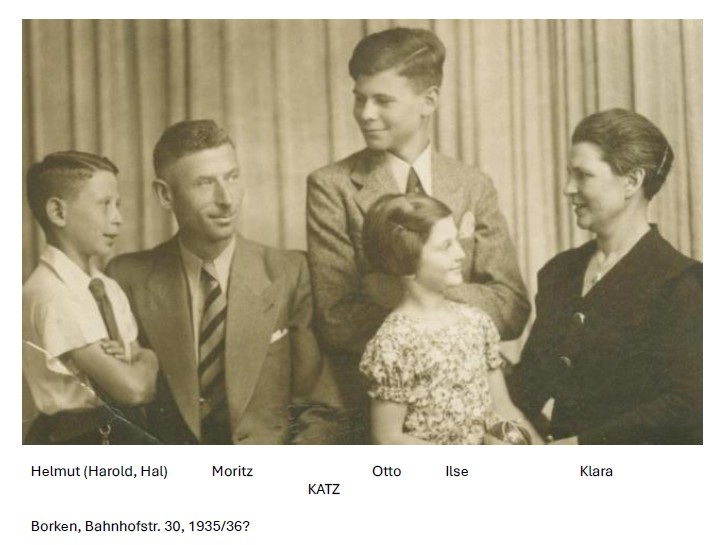
After Moritz Katz and his fifteen year old son Otto arrived in New York in August, 1937, they shared a furnished room in the Bronx that they rented from some cousins of Moritz. Moritz started working in a meat processing plant, and Otto, who was fifteen, went to school during the day and worked at a grocery store after school. In an interview with his daughter Judy in 2000, Otto told her that he didn’t know any English, and the teacher, who would occasionally speak to him in German, was not a good teacher and didn’t care if the students learned or understood the material.1
Otto quit school after that year and got a full-time job working as a delivery boy at Kenneth Miller Company; he then began doing tracing and sketching designs for the company and was promoted. Otto stayed with that company for his entire career, leaving only during his time in the army during World War II but returning to the company (later called Custom Bed Covers) after he was discharged. He eventually made enough money to buy the company and worked there until 1990 when he retired!
When Clara arrived in New York in late April 1938, with Hal and Ilse (who were thirteen and almost ten, respectively), Moritz rented an apartment for the family in Washington Heights, the neighborhood in Manhattan where many German Jews settled after escaping Nazi Germany. The apartment was quite large, but Ilse shared a room with her parents and Otto and Hal shared another room so that the other rooms could be rented to boarders to generate more income to support the family.
Otto remembered that it was still Passover when his mother and siblings arrived on April 21, 1938 (it was the eighth day, the last day, of the holiday). He also remembered that when the family signed up with Con Edison, the electric company in New York City, they were offered three appliances for twenty-five dollars. They selected a toaster, a radio, a floor lamp, and an iron, and paid off the purchases by paying two dollars a month for a year. Otto seemed particularly excited about the radio since they had not had one in Germany and commented on the “five buttons—one for each station” in his interview with his daughter Judy in 2013.
In that same interview, Otto also recalled that the man who delivered and unloaded the crate that Clara had packed and shipped from Germany broke the legs off her sewing machine when he unloaded it, causing Clara to cry. I wonder whether some of Clara’s sadness was not only about the broken sewing machine, but also about leaving her sisters and her mother Fanny behind in Europe and about her worries about what her life in America would be like.
Hal and Ilse started school in New York and much to Hal’s chagrin, they were placed in first grade because they didn’t know English. Hal was fourteen and humiliated to be in a class with six-year-olds. But soon he was able to move up to a class with his peers.
Here is the family on the 1940 US census, living at 535 West 163rd Street in Washington Heights. Moritz is listed as a butcher in a butcher shop and Otto as a cutter in a factory. They were paying $45 a month in rent, and there were two lodgers living in their apartment.

Moritz Katz and family, 1940 census, Year: 1940; Census Place: New York, New York, New York; Roll: m-t0627-02677; Page: 15A; Enumeration District: 31-2144, Ancestry.com. 1940 United States Federal Census
Moritz worked in the meat packing plant until he was able to buy a small retail shop that sold sweets. He and Clara then worked in their sweet shop, which was called “C & M” for Clara and Moritz.
The United States declared war against Japan, Germany, and Italy in December 1941, joining the Allied powers in World War II. Otto registered for the draft on February 15, 1942. Here is his draft registration:


Otto Katz, World War II draft registration, National Archives at St. Louis; St. Louis, Missouri; Wwii Draft Registration Cards For New York City, 10/16/1940 – 03/31/1947; Record Group: Records of the Selective Service System, 147, Ancestry.com. U.S., World War II Draft Cards Young Men, 1940-1947
Here is Hal’s draft registration dated December 19, 1942; he was eighteen and still using the name Helmut at that time, but had already adopted Harold as his Americanized name. He was a student at the Manhattan High School of Aviation Trades.


Helmut Harold Katz, World War II draft registration, National Archives at St. Louis; St. Louis, Missouri; Wwii Draft Registration Cards For New York City, 10/16/1940 – 03/31/1947; Record Group: Records of the Selective Service System, 147, Ancestry.com. U.S., World War II Draft Cards Young Men, 1940-1947
The two brothers both served overseas in Europe during the war. My next post will describe their time in the service, as told to Judy in three separate interviews, one with Otto in 2001 and another in 2016 and one with Hal in 2019.


















 Brotmanblog: A Family Journey