The Long Depression, Part 2: Moving Back Home or Moving Away

In the early 1870s Moses and Caroline (Dreyfuss) Wiler were living at 905 Franklin Avenue, just a few houses down from Caroline’s sister, Mathilde (Dreyfuss Nusbaum) Pollock and just three blocks away from their third sister, Jeanette (Dreyfuss) Nusbaum and her husband John, my three-times great-grandparents.  Ernst Nusbaum and his wife Clarissa were living down the block from his brother John. The area is known as the Poplar neighborhood in North Philadelphia. Plotting all their addresses on the map made me smile.  They must have all been so close, not only geographically but emotionally, to live so close to their siblings.  Imagine all the first cousins (some double first cousins) growing up within a short walk of each other.
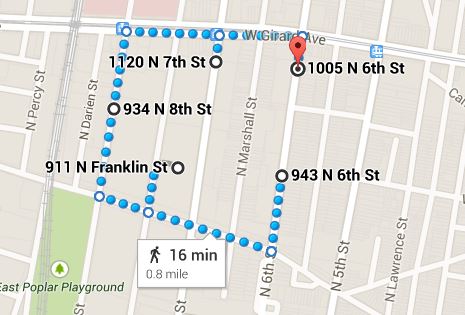
map of nusbaum wiler simon homes 1870s

But as I wrote in my last post, things were not quite so idyllic in the 1870s.  The Panic of 1873 and the depression that followed had an impact on the family.  Like Mathilde and Moses Pollock, Caroline and Moses Wiler also must have felt some of that impact.  In 1873 Moses Wiler was listed in the directory without an occupation.  His partnership with his brother-in-law Moses Pollock had ended.  In 1875 he was still listed without an occupation, and they had moved from Franklin Avenue to 920 North 7th Street, still within two blocks of Caroline’s sisters.

Caroline and Moses Wiler’s son Simon also seems to have been affected by the Long Depression.  He had been part of the Simon and Pollock cloak and dry goods partnership of the late 1860s and early 1870s with his father and uncle.  After that business ended, Simon had a separate listing in the 1875 directory as a salesman, living at 701 North 6th Street, again in the same neighborhood as his extended family, just a few blocks south.  Simon was 32 and not married and presumably was doing well enough to afford his own place.  By 1877, however, he had moved back home with his parents at 920 North 7th Street.

In 1879, Moses Wiler was in the dry goods business, and his son Simon was a salesman, both living at 902 North 7th Street, as they were in 1880.  According to the 1880 census, Simon was a paper salesman, and Moses, who was 63, was a retired merchant.  Perhaps Moses had retired as early as 1873 when his listing no longer included an occupation.  Maybe he had done well enough to cope with the economic depression that occurred in 1873.

Poplar Street houses

House on Poplar Street, perhaps like those lived in by the extended Nusbaum-Dreyfuss family in the 1870s https://ssl.cdn-redfin.com/photo/93/bigphoto/440/6336440_0.jpg

By 1880, the three daughters of Caroline and Moses Wiler were no longer living with their parents.  Eliza Wiler had married Leman Simon in 1863, and in 1870 they had two children living with them, Joseph, who was five, and Flora, who was three. Sadly, in 1869, they had had a baby who was still born.   In 1870 they were living at 718 Coates Street, an address that appears not to exist anymore but was located where Fairmount Avenue is now located between the Delaware River and Old York Avenue.  Leman was in business with his brother Samuel, as he was in 1871. That business must have then ended.  According to the 1872 directory, Leman was then in the cloak business with his father Sampson Simon, who was living at the same address on Coates Street.  In 1874, Leman and Eliza had another child, Nellie, born on November 18 of that year.

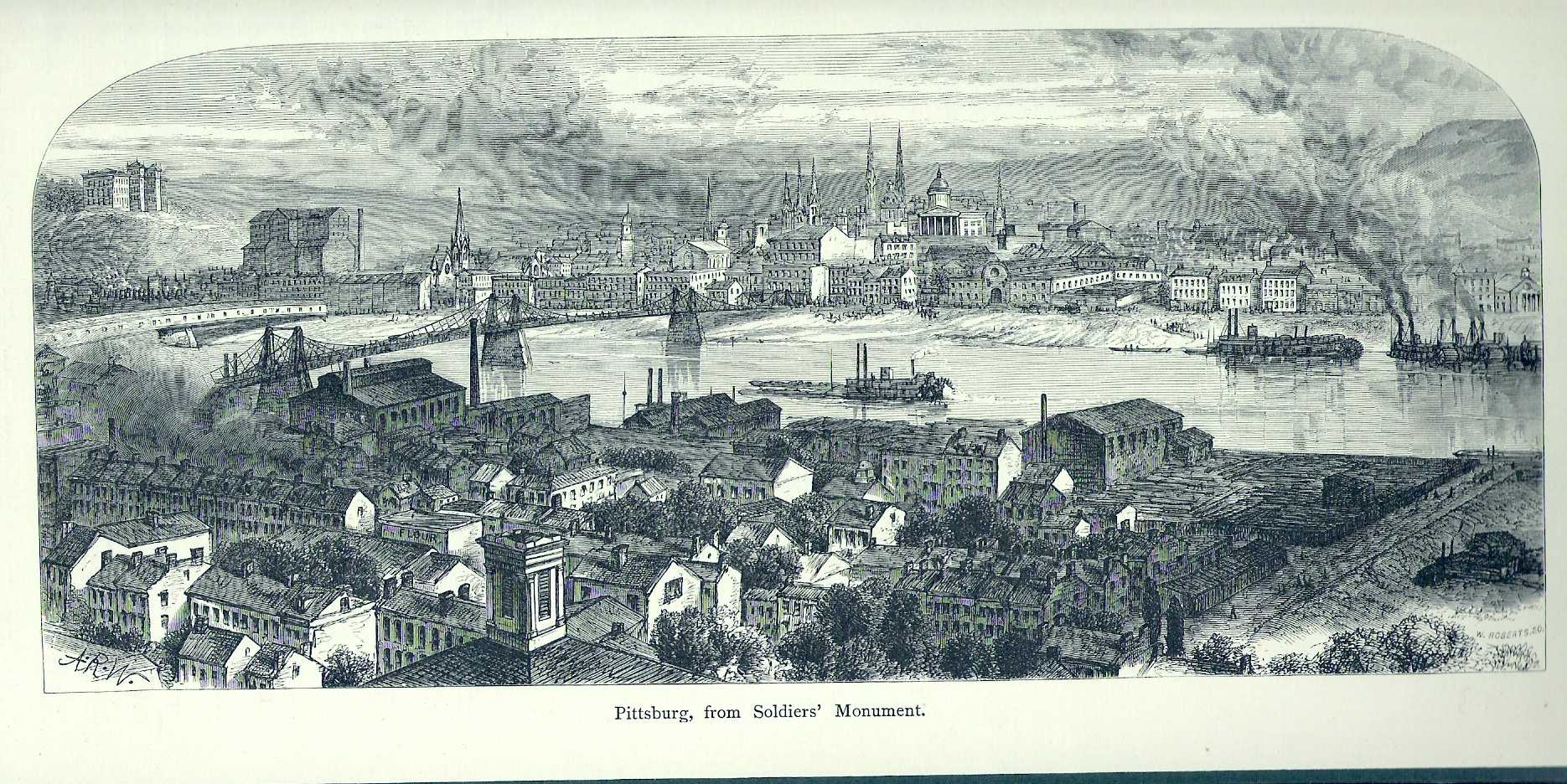
By 1876, Leman was listed as a salesman, living at 920 North 7th Street with his in-laws, Moses and Caroline Wiler.  Like Simon Wiler, Leman must have been feeling the effects of that Long Depression to have moved in with his in-laws after having his own home.   The next time Leman showed up in my search, he and Eliza were living in Pittsburgh, and Leman was working in the liquor business, like his cousin Albert Nusbaum.  Although I cannot find Leman on an 1877, 1878, or 1879 directory in any city, Leman and Eliza had another child, Leon, who was born in Pittsburgh on June 13, 1878, so the family must have relocated to Pittsburgh from Philadelphia by then.

Leman and Eliza also had a daughter Minnie, who was apparently born in 1877.  I say “apparently” because I cannot find a birth record for her, and there are only two census reports that include her, the 1880 and 1900 census reports.  The first says she was 2, meaning she was born either in 1877 or 1878; the latter says she was born in December, 1877.  But if she was born in December, 1877, then Eliza could not have given birth to Leon in June, 1878, just six months later.  I do have an official record for Leon’s birthdate with Eliza Wiler and Leman Simon named as his parents, so either Minnie was born sometime before September, 1877 or she is not Eliza’s child.

There are no other records I can find to determine Minnie’s precise birthdate; her death certificate also only specified her age, not an exact date of birth, and it also is consistent with a birth year of either 1877 or 1878.  Minnie died on August 5, 1904, at age 26 (more on that in a later post), meaning she was born on or before August 5, 1878, but not any earlier than August 6, 1877.  Somehow it seems quite unlikely that Caroline gave birth in August 1877, got almost immediately pregnant, and then had another child ten months after Minnie, but….stranger things have happened.  Or perhaps Minnie was adopted. Since I cannot find a birth record for a Minnie Simon in Pennsylvania for either 1877 or 1878, that certainly is a possibility.

In any event, in 1880, Eliza (Wiler) and Leman Simon were living far from their families in Pittsburgh with their five children, Joseph, Flora, Nellie, Minnie, and Leon.  Leman was in the liquor sales business, and perhaps life was a little easier out in the western part of Pennsylvania than it was in Philadelphia.
Eliza’s younger sister Fanny Wiler married Max Michaelis on July 12, 1874, in Philadelphia.  I am still working on Fanny’s story, and there are a lot of holes so that will wait for a later post.

The youngest child of Caroline (Dreyfuss) and Moses Wiler was Clara Wiler, born in 1850.  In 1871, she married Daniel Meyers, a German born clothing merchant operating in the 1870s under the firm name D. Meyers and Company.  He and Clara were living at 718 Fairmount Street, and their family grew quickly in the 1870s.  First, their daughter Bertha was born on December 4, 1972.  Less than two years later, their son Leon was born on June 12, 1874, followed the next year by Samuel on December 15, 1875.  A fourth child, Harry, was born January 15, 1878, and Isadore on September 25, 1879.  Five children in seven years.  Wow.

And they were not yet done.  But that would bring us into the 1880s, and I am not there yet.   But Daniel’s firm must have been weathering the storm of the 1870s depression better than most, including many in the extended family.  In 1880, he was supporting five children plus his wife Clara and himself in their house on Fairmount Street.

Thus, the Wiler family like the Pollock family had its ups and downs during the 1870s.  There were marriages and babies, but also some economic struggles for at least some of the members of the family.  Adult children had to move back home, and some had to leave town to find new opportunities for making a living.

Four Weddings and a Funeral: More Twists and Turns

My last post covered the migration of several Nusbaum/Dreyfuss family members to Peoria, Illinois in the 1860s. Meanwhile, back in Pennsylvania, the rest of the Nusbaum/Dreyfuss clan was growing during the 1860s.  In Philadelphia, two of the Nusbaum brothers and two of the Dreyfuss sisters were seeing their families grow and their children grow.  Other family members were still in Harrisburg. By the end of the decade, even more of the family would have relocated to Philadelphia.

The Civil War was having at least some minor financial impact on the family.  For example, John Nusbaum was liable for $26.79 in income tax to the federal government in 1862 under the terms of the Internal Revenue Act of 1862 That law was enacted to raise money to help pay for the expenses incurred by the Union in fighting the Civil War.  It was the first progressive income tax imposed by the federal government.  For anyone whose income exceeded $600 a year, a tax was imposed based on the level of income.

For John Nusbaum, whose income was valued at $892.96 in 1862, that meant a tax of $26.79.  According to one inflation calculator, $892.96 in 1862 would be worth about $20,000 in 2014.     For someone with stores in Philadelphia and Peoria (and possibly still some interest in a store in Harrisburg) and who reported $6000 in real estate and $20,000 in personal property in 1860,[1] that does not seem like a lot of income, but I have no idea how that was determined back then.

Ancestry.com. U.S. IRS Tax Assessment Lists, 1862-1918 [database on-line]. Provo, UT, USA: Ancestry.com Operations Inc, 2008.

Ancestry.com. U.S. IRS Tax Assessment Lists, 1862-1918 [database on-line]. Provo, UT, USA: Ancestry.com Operations Inc, 2008.

By 1863 John and Jeanette (Dreyfuss) Nusbaum, my three-times great-grandparents, had seen their two older sons move to Peoria, but they still had one son, Julius, and two daughters at home in 1863: Frances, my great-great-grandmother, who was eighteen, and Miriam, who was only five years old in 1863.  Plus 1863 had started off with another new baby in the family.  Lottie Nusbaum was born on January 1, 1863.  Jeanette would have been almost 46 years old, and her first born child Adolphus was going on 23.

I have to admit that I have some questions about whether Lottie was actually the child of John and Jeanette.  Jeanette must have been close to the end of her child-bearing years.  They had not had a child in five years.  Could Lottie have been a child of one of their sons, raised as the child of her actual grandparents?  Or a child they adopted?  I have no way of knowing.  Lottie had no children, so even if I could figure out some way to use DNA to answer my doubts, there are no descendants to use for DNA testing.

On Lottie’s death certificate, the informant was Mrs. E. Cohen, that is, my great-grandmother Eva Seligman Cohen, Lottie Nusbaum’s niece and Frances Nusbaum Seligman’s daughter.  Eva filled in the father’s name as John, but put unknown for the mother’s maiden name.  Eva certainly knew her grandmother Jeanette’s name.  (Eva is the one who held and maintained the family bible for many years.) Did she not know her grandmother’s maiden name? Was she too grief-stricken to remember? Or was she suggesting that Jeanette was not in fact Lottie’s real mother?  I do not know, and there is no one left to ask.  But it did not do anything to resolve my doubts about the identity of Lottie’s parents.   Maybe I am too skeptical.  Maybe she was just a menopause baby. Maybe John and Jeanette were missing their boys so much that they decided to have one more child. Or maybe not.  What do you all think?

Lottie Nusbaum death certificate  Ancestry.com. Pennsylvania, Death Certificates, 1906-1963 [database on-line]. Provo, UT, USA: Ancestry.com Operations, Inc., 2014.

Lottie Nusbaum death certificate
Ancestry.com. Pennsylvania, Death Certificates, 1906-1963 [database on-line]. Provo, UT, USA: Ancestry.com Operations, Inc., 2014.

In any event, just as John and Jeanette were emptying their household of their sons, they had a new baby to raise.  The family was still living at 433 Vine Street in 1862, according to the Philadelphia city directory, but in 1864 they are listed at 455 York Avenue.  That address is about two and a half miles north of Vine Street, and as I’ve discussed earlier, Jews began to move north in Philadelphia as their socioeconomic status improved.

By 1865, John and Jeanette’s house on York Avenue was a little emptier.  By that time Julius had joined his brothers in Peoria, and on March 28, 1865, my great-great-grandmother Frances married Bernard Seligman.  For several years they lived in Philadelphia, and Bernard was apparently in business with his brothers-in-law in a firm called Nusbaum Brothers and Company.  They had four children between 1866 and 1869, including my great-grandmother Eva.  Then in 1870, Bernard returned full time to Santa Fe with Frances and their children where Frances and Bernard lived for almost all of the rest of their lives, as discussed in my Seligman blog posts.

Nusbaum Brothers and Company 1867 Philadelphia Directory  Ancestry.com. U.S. City Directories, 1821-1989 [database on-line]. Provo, UT, USA: Ancestry.com Operations, Inc., 2011.

Nusbaum Brothers and Company 1867 Philadelphia Directory
Ancestry.com. U.S. City Directories, 1821-1989 [database on-line]. Provo, UT, USA: Ancestry.com Operations, Inc., 2011.

John’s brother Ernst was also in Philadelphia during the early 1860s.  He was a clothier, working at 55 North Third Street and living at 626 North 6th Street.  He and his wife Clarissa had another child in 1861, Frank, bringing their family up to six children ranging in age from newborn to ten years old.  So both Ernest, who was 45 when Frank was born, and John, who was 49 when Lottie was born, had new babies in their homes in the 1860s.

Jeanette (Dreyfuss) Nusbaum also had a sibling living in Philadelphia.  Her sister Caroline (Dreyfuss) Wiler had also moved from Harrisburg to Philadelphia by 1860.  She and her husband Moses Wiler were living at 466 North 4th Street in 1862 with their four children, who ranged in age from Eliza who was twenty to Clara who was twelve.  Moses was in the cloak business.

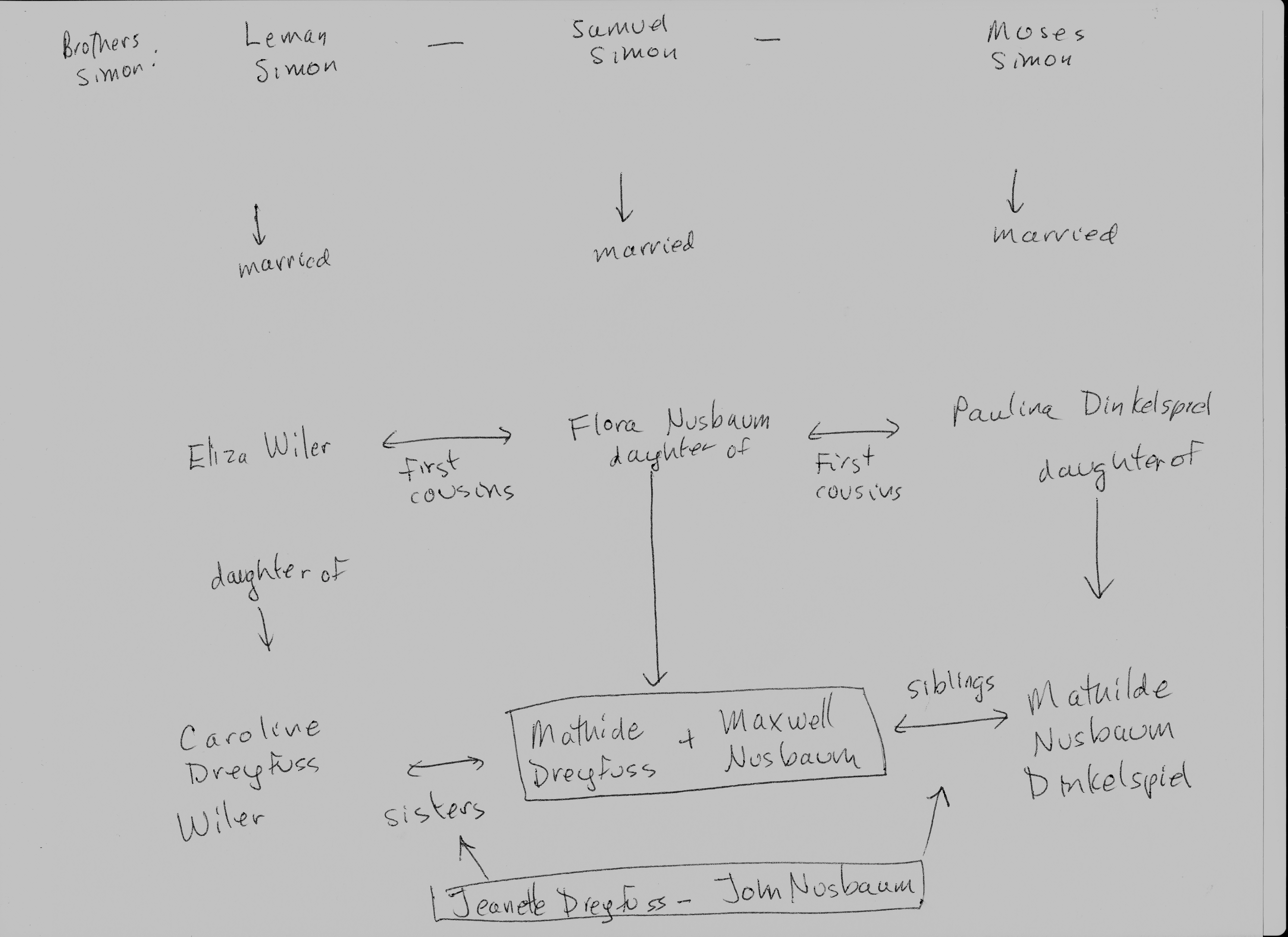
The following year the Wiler household became a bit smaller when Eliza Wiler married Leman Simon on September 9, 1863, in Philadelphia.  Yes, Leman Simon.  Do you remember that name? He was the brother of Moses Simon, who married Paulina Dinkelspiel and started the migration of Nusbaums to Peoria.  So once again, my family tree groans and twists a bit.  Eliza and Paulina were already related, at least by marriage.  Eliza’s mother Caroline Dreyfuss was the sister-in-law of John Nusbaum, Paulina Dinkelspiel’s uncle.  Sometimes these people make me want to pull out my hair!  Imagine, I am casually researching Eliza, and I see her husband’s name and think, “Leman Simon.  Hmmm, that sounds familiar.”

So by 1863 the Simons, Nusbaums, Dinkelspiels, and Dreyfusses were all somehow interrelated, often in more than one way.

But it gets worse.

By 1866, Moses Pollock and Mathilde (Dreyfuss Nusbaum) Pollock had also moved to Philadelphia from Harrisburg. In 1868, Flora Nusbaum, the daughter of Mathilde Dreyfuss and Maxwell Nusbaum and step-daughter of Moses Pollock, married Samuel Simon.  I have mentioned this before because Flora Nusbaum is my double first cousin four times removed since both of her parents were siblings of one of my three times great-grandparents, Flora’s father being John Nusbaum’s brother, her mother being Jeanette Dreyfuss Nusbaum’s sister.  Now Flora was marrying her first cousin Paulina’s brother-in-law Samuel Simon, who was also her cousin Eliza’s brother-in law.

Groan…. Maybe this chart will help.

chart_NEW

So all three Simon brothers were now married to someone in the clan: Samuel to Flora Nusbaum, Leman to Eliza Wiler, and Moses to Paulina Dinkenspiel.

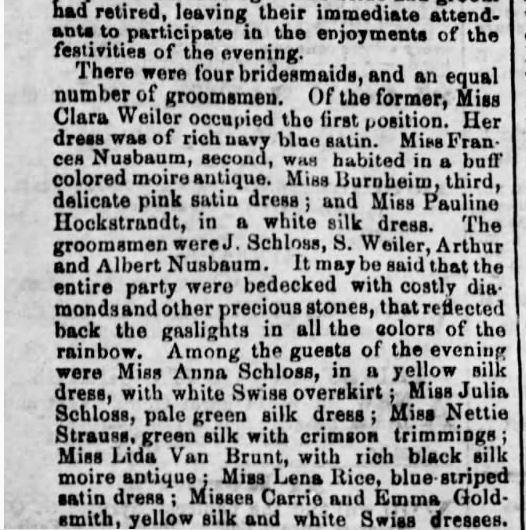
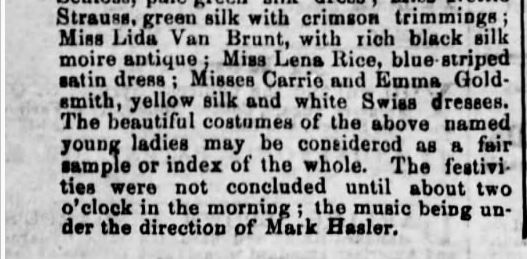
The wedding of Samuel Simon to Flora Nusbaum (Pollock) seems to have been a celebration worthy of all that interconnectedness.  Here is an article from the Harrisburg Telegraph of October 20, 1868, republishing an article from the Philadelphia Sunday Mercury that described their Philadelphia wedding.  It’s really worth reading to get the full flavor of both the wedding and “social media” in the 1860s.

flora pollock wedding part 1

flora pollock wedding part 2

flora pollock part 3

The strangest part of this article is not the detailed description of the lavish, extravagant wedding celebration, but the reporter’s mistaken assertion that Flora was not Jewish.  Certainly her parents were both Jewish, and even her stepfather Moses Pollock was Jewish.  The reporter’s statement that “the pure religion of love had broken down all sectarian barriers” seems a bit strange for a wedding announcement, even if it had been an interfaith wedding.  But why would the reporter have thought Flora wasn’t Jewish?

The overlapping branches of the family were well represented in the bridal party: Clara Wiler and Simon Wiler, the children of Moses and Caroline (Dreyfuss) Wiler; Frances Nusbaum, the daughter of John and Jeanette (Dreyfuss) Nusbaum; Arthur Nusbaum, son of Ernst and Clara Nusbaum; and Albert Nusbaum, son of Maxwell and Mathilde (Dreyfuss) Nusbaum and brother of the bride.  I do not know who the Schloss family is or the Goldsmiths, at least not yet, but I fear more double twists yet to be uncovered.

So the extended family was doing quite well, and there were lots of new families being formed and babies born, but unfortunately there also was one big loss in the 1860s.  Leopold Nusbaum, who was still living in Harrisburg in the 1860s, died on December 24, 1866.  He was buried at Mt. Sinai Cemetery in Philadelphia.  His widow Rosa and sixteen year old daughter Francis moved shortly thereafter to Philadelphia, where they moved in with John and Jeanette Nusbaum, whose household had been reduced by two when Julius moved to Peoria and Frances married.

Below is a photo I found while searching for old images of Harrisburg.  I was so excited when I saw the name on the store at the far upper right—Leo Nusbaum!  Although this photo was dated 1889, Leopold Nusbaum’s name was still on the store even though he had died almost 25 years earlier.

Harrisburg Market Square with Leo Nusbaum store

Harrisburg Market Square with Leo Nusbaum store http://explorepahistory.com/displayimage.php?imgId=1-2-EC

The only Nusbaum family members left in Harrisburg by the end of the 1860s were Mathilde (Nusbaum) Dinkenspiel, her husband Isaac, and their daughter Sophia.  Their daughter Paulina (Dinkenspiel) Simon was living in Baltimore, and their son Adolph was in Peoria.  Their youngest child Sophia married Herman Marks, a Prussian born clothing merchant, in 1869, and they settled in Harrisburg as well.  Perhaps they were the ones to keep Mathilde’s brother’s name on the store.

Thus, by the end of the 1860s, most of the extended family was living in Philadelphia, with a small number living in Peoria, a few in Harrisburg, and a few in Baltimore.


[1] $600 in 1860 would be worth about $17,000 today, and $20,000 in 1860 would be worth about $571,000 today.  Not too shabby for someone who had come to America around 1840.

The Nusbaum and Dreyfuss Families Settle into America: 1850-1860

Market Square, Harrisburg in 1860

Market Square, Harrisburg in 1860  http://pahousearchives.org/?p=digitallibrary/digitalcontent&id=92

As I wrote in my last post about the Nusbaums, the 1850s were for the most part a decade of growth for the Nusbaum and Dreyfuss families although there were two tragedies during that decade.  I have already written about the tragic death of Maxwell Nusbaum in the 1851 Great Fire in San Francisco.  Maxwell died trying to protect the property of another merchant, and his death left his wife Mathilde Dreyfuss Nusbaum with two very young children, Flora and Albert.  Mathilde remarried a few years later, marrying Moses Pollock, with whom she had two more children in 1856 and 1859, Emanuel and Miriam.  Moses was employed as a merchant in Harrisburg, according to the 1860 census.  Since Mathilde was my three-times great-grandmother Jeanette’s sister, her children with Maxwell were cousins both maternally and paternally.

Because the Nusbaum and Dreyfuss families were so entwined, it seems appropriate to discuss them together rather than as two separate lines in my family.  Why return to Harrisburg (and Peoria) twice? (Nothing against those two cities; it just seems to make sense to discuss the two families together.)

In the 1850s a number of the Nusbaum/Dreyfuss siblings were living in Harrisburg, Pennsylvania.  In 1860, Mathilde Nusbaum (sister of Maxwell, John, Leopold and Ernst) and her husband Isaac Dinkelspiel were still living in Harrisburg with their three children, now all adolescents: Paulina (19), Adolph (17), and Sophie (12).  Isaac was working as an “agent,” which I assume means he was an agent in the Nusbaum merchant business.  His son Adolph was working as a clerk, again presumably for the Nusbaum family business.

Mathilde Nusbaum Dinkelspiel’s brother Leopold Nusbaum had also moved to Harrisburg during the 1850s, leaving Blythe, Pennsylvania where he had been a butcher.  Perhaps they moved in the aftermath of his family’s personal tragedy.  Their son Adolph, born in 1848, died on June 6, 1852.  He was only four years old.  He died from acute gastritis.  The death certificate says it was “accompanied by” a word I cannot decipher.  Can anyone read it?  He was buried at Mikveh Israel cemetery in Philadelphia.  I found it interesting that the family, though living in Harrisburg, buried their child in Philadelphia.  Perhaps the Jewish cemetery in Harrisburg had not yet opened.[1]

UPDATE:  My medical consultant says that the other cause of death is cerebritis, meaning a brain infection or abscess.

Death certificate of Adolph Nusbaum, son of Leopold and Rosa Nusbaum

Death certificate of Adolph Nusbaum, son of Leopold and Rosa Nusbaum

Leopold and his wife Rosa had a second child, Francis, who was born in 1850.  Although Francis is listed as a boy on both the 1850 census and the 1860 census, by 1870 she is identified as female and is so thereafter.[2] Her name, however, is almost always spelled as Francis, and I suppose that must have confused the first two census takers as ordinarily Francis is a boy’s name and Frances is the way it is spelled for a girl.  At any rate, it is pretty clear that Francis was a girl even in 1850 and 1860.

Leopold seems to have given up on being a butcher when he moved to Harrisburg.  According to the 1860 census, he, like his brothers John and Ernest, was now a merchant.  Also listed as living with Leopold, Rosa, and Francis on the 1860 census was “A. Dinkelspiel,” presumably Adolph Dinkelspiel, Leopold’s nephew, Mathilde’s son.  Since Adolph was also listed in his parents’ household, my guess is that he may have been living with Leopold and working as a clerk in his store, but that his parents had also counted him as part of their household.

Leopold and Rosa Nusbaum and family 1860 census

Leopold and Rosa Nusbaum and family 1860 census

In addition to the two Nusbaum siblings Leopold and Mathilde (Dinkelspiel), Harrisburg was also the home of Caroline Dreyfuss Wiler for some part of the 1850s.  Caroline, the sister of Jeanette Dreyfuss Nusbaum and Mathilde Dreyfuss Nusbaum Pollock, was married to Moses Wiler.  They had four children, Eliza (1842), Simon (1843), Fanny (1846), and Clara (1849). Simon was born in Philadelphia, and Clara was born in Gettysburg (nothing more specific than Pennsylvania is given for Eliza or Fanny), so Caroline and Moses must have been moving around quite a bit within Pennsylvania during the 1840s.  I assume he was a peddler and thus the family kept moving until he could open a more permanent business.

Although they are listed as living in Harrisburg in 1850, by 1860 they were living in Philadelphia with their four children, at that point three teenagers and one eleven year old.  Moses was working as a merchant, apparently doing quite well.  He had $8000 worth of real estate and $22,000 worth of personal assets; they also had a 27 year old servant living with them.

Moses and Caroline Dreyfuss WIler and family 1860 census

Moses and Caroline Dreyfuss WIler and family 1860 census

John Nusbaum, my three-times great-grandfather, had also moved to Philadelphia by 1860.  In fact, their fifth child, Miriam, was born in Philadelphia on October 30, 1858, so the family must have relocated from Harrisburg by that time.  According to the 1859 Philadelphia directory, John Nusbaum and his family were living at 433 Vine Street, and his place of business was located nearby at 132 North Third Street in Philadelphia.

John and Ernst Nusbaum in the 1859 Philadelphia direcotry

John and Ernst Nusbaum in the 1859 Philadelphia direcotry

John and Jeanette and all five of their children were living, like the Wilers, in the 12th Ward of Philadelphia.[3]  John was occupied as a merchant and had $6000 in real estate and $20,000 in personal property, so like his brother-in-law Moses Wiler, he was doing quite well.  In fact, the Nusbaums had two servants living with them at that time.  My great-great-grandmother Frances, the future wife of Bernard Seligman, was fourteen years old in 1860, and her brothers were 12, 17, and 18, plus there was two year old Miriam, so it must have been quite a handful for those two servants—four adolescents and a toddler.[4]

John Nusbaum and family 1860 census

John and Jeanette Dreyfuss Nusbaum and family 1860 census


John and Jeanette not only had Jeanette’s sister Caroline and her family living nearby, they also had John’s brother Ernst and his family living about a mile away.  According to the 1859 Philadelphia directory (see above), Ernst Nusbaum was living at 521 Buttonwood and working at 55 North Third Street, down the block from his brother John.  Ernst had been living in Philadelphia since at least 1851 since his first child Arthur was born on December 31 of that year.  In 1852, he and his wife Clarissa Arnold and their infant son were living at 191 North 10th Street, and Ernst was working as a merchant at 70 ½ North Third Street.  By 1854 they had moved to Buttonwood Street, and in the 1859 directory Ernst is listed as a clothier doing business with Simon W. Arnold (Clarissa’s brother) and Jacob Nirdlinger.

Ernst Nusbaum 1859 Philadelphia directory

Ernst Nusbaum 1859 Philadelphia directory

On the 1860 census, Ernst’s occupation is listed as “M’s Tailor,” or what I assume is men’s tailor.  Was that his role in the clothing business with his brother-in-law Simon?  Or was it more that they were selling men’s clothing?  Ernst had $20,000 in personal assets and two servants living in the home in addition to his wife Clara and their five children: Arthur (1851), Myer (1852), Fanny (1856), Edgar (1858), and Henrietta (1860 and just two months old at the time of the census).  Unlike his brother John, Ernst had a household of young children in 1860, five children under ten years old.

Ernst and Clarissa Arnold Nusbaum 1860 census

Ernst and Clarissa Arnold Nusbaum 1860 census

Thus, whether in Harrisburg or Philadelphia, the Dreyfuss sisters and their husbands and the Nusbaum siblings and their spouses were all adjusting to life in America, and their families were growing.  Although they suffered two very tragic losses early in the decade of the 1850s, by 1860 it appears that all were doing well.

The next decade would bring changes as the next generation entered adulthood and the country faced the Civil War.

[1] I am awaiting a book on the Jewish history of Harrisburg and should know more once it arrives.

[2] Thus, my reference to two sons in my prior post was mistaken.

[3] The Nusbaum businesses were located about a mile north of where my Cohen relatives were operating their pawnshop business during this same time period.  It would be interesting to know how often their paths crossed even before Flora Cohen married Jacob Weil in 1908.

[4] The ten year gap between Julius and Miriam makes me wonder whether there weren’t other children born during that time who did not survive.

Caps for Sale: Peddlers and Merchants

As I wrote in my last post, by 1852 or before, five of the eight children of Amson and Voegele Nusbaum had settled in Pennsylvania.  Two of the siblings had settled in Harrisburg, one in Lewistown, one in Blythe, and one in Philadelphia.  According to the 1850 census, John Nusbaum was a merchant in Harrisburg, and his brother-in-law Isaac Dinkelspiel was a peddler there, married to John’s sister Mathilde.  Leopold Nusbaum was a butcher in Blythe, Maxwell was a merchant in Lewistown, and Ernst was a merchant in Philadelphia.

It is not surprising to me that Ernst would have settled in Philadelphia, which, as I have written about in the context of my Cohen ancestors, had a fairly large German Jewish community by the mid 1800s.  But why were John Nusbaum and Isaac Dinkelspiel and their families in Harrisburg?  Even more surprising, what were Leopold and Maxwell doing in relatively small towns like Lewistown and Blythe?  What would have taken these new German Jewish immigrants away from the big cities and to smaller towns and cities in Pennsylvania?

The choice of Harrisburg is not really that surprising.  By the time John Nusbaum arrived in the US, perhaps as early as 1840 or even before but certainly by 1850, Harrisburg had been the Pennsylvania state capital for many years already, i.e., since 1812.  It had been settled in the early 18th century and because of its location on the Susquehanna River where there was an opening between the mountains, it had developed into an important trading post for trade and expansion to the west.  By the 1830s the railroad and the Pennsylvania Canal passed through Harrisburg, further increasing its economic importance for westward expansion.  By 1840 the population of Harrisburg was almost six thousand people.  By comparison, the population of Philadelphia in 1840 was over 93,000 people.


Capitol. (Harrisburg, Pennsylvania.), by A. G....

Capitol. (Harrisburg, Pennsylvania.), by A. G. Keet (Photo credit: Wikipedia)

Jewish immigrants began to arrive in Harrisburg in the 1840s, primarily from Germany and England.  The first synagogue, Ohev Sholom, was begun in 1853, first as an Orthodox congregation, and then in 1867 it became a Reform congregation.   The Jewish population, however, was not very large.  There were sixteen members of the congregation in 1853, and even as late as 1900 there were only 35 members.

So how would my three-times great-grandfather John Nusbaum have ended up here?  I do not know for sure, but I can speculate that like many German Jewish immigrants, he arrived in Harrisburg as a peddler and, once finding a strong and stable economic base there, eventually opened his own store.  Harrisburg was obviously an important location for trade not only for its residents but also for those who stopped there as they moved westward in the United States.  It was likely an ideal location for a merchant.  Unlike his three-times great-granddaughter (and her immediate relatives), he must have been a very able entrepreneur.

This pathway to economic success—from peddler to merchant—was quite common among German Jewish immigrants.  According to Hasia Diner in “German Jews and Peddling in America,” (hereinafter “Peddling”) located here:

In Nashville, 23 percent of the adult male Jews in 1860 peddled, as did 25 percent of those in Boston between 1845 and 1861. In Easton, Pennsylvania, a town which occupied the strategic meeting point of the Delaware and Lehigh Rivers, 46 percent peddled in 1840, but just five years later, the number jumped to 70 percent. By 1850 the number had dropped to 55 percent, still a significant figure for any one occupation among a relatively small number of people. Of the 125 Jewish residents in Iowa in the 1850s, 100 peddled around the state, as did two-thirds of all the Jews in Syracuse, New York in that same decade before the Civil War.

See also  Rudolf Glanz, “Notes on Early Jewish Peddling in America,” Jewish Social Studies ( Indiana University Press, Vol. 7, No. 2, April,  1945)  located here.

In a different article, “German Immigrant Period in the United States,” (hereinafter “German Immigrant”) located here in the Jewish Women’s Archive, Hasia Diner explained why peddling was so widespread among German Jewish immigrants.

Americans in the hinterlands had little access to finished goods of all sorts, since few retail establishments existed outside the large cities. Jewish men overwhelmingly came to these remote areas as peddlers, an occupation that required little capital for start-up and that fit the life of the single man. In the large regional cities, Jewish immigrant men would load themselves up with a pack of goods, weighing sometimes as much as one hundred pounds, and then embark on a journey by foot, or eventually, if a peddler succeeded, by horse and wagon.

In “German Immigrant,” Diner opined that because many of these German Jewish immigrants came as single men, they were not tied down to families in a particular location when they first arrived and could thus take on the itinerant life of the peddler.  In her “Peddling” article, Diner further explained the popularity of peddling, pointing out that many of these German Jewish men came from families in Germany where their fathers had been peddlers.  That was certainly true for John Nusbaum and his brothers; their father Amson had been a peddler.  This was an occupation with which they were familiar.  Diner also stated that the Jewish German immigrants had networks of families and friends who could extend credit and help them get started on a peddling business.

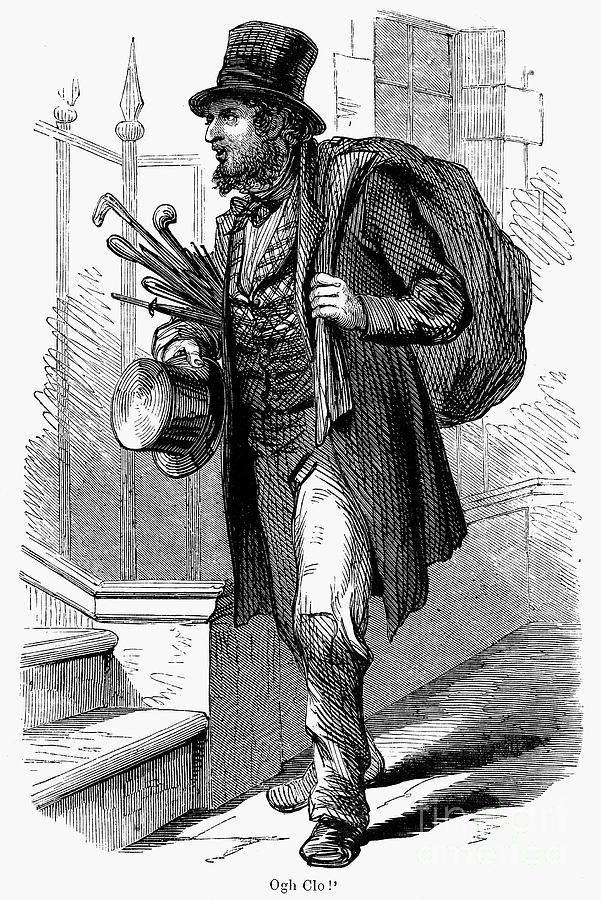
19th century etching of a peddler by Granger found at http://fineartamerica.com/featured/1-peddler-19th-century-granger.html

19th century etching of a peddler by Granger found at http://fineartamerica.com/featured/1-peddler-19th-century-granger.html

In “Peddling,” Diner provided this vivid description of the life of the peddler:

The peddlers operated on a weekly cycle. They left their base on Sunday or Monday, depending on how far they had to go. They would, if necessary, take the railroad or canal barges to get to their territories.  They peddled all week and on Friday headed back to the town from which they had gotten their goods. Here on the Jewish Sabbath and, depending on geography, on Sundays as well, they rested, experiencing fellowship with the other immigrant Jewish peddlers who also operated out of this town. The peddlers engaged with the settled Jewish families, some of whom either operated boarding houses for peddlers or merely extended home hospitality to the men during their brief respites off the road. On the weekends the peddlers could partake of Sabbath religious services and consume some of the good food associated with Jewish holy time, food prepared in the distinctive manners of the various central European regions. Saturday night, after sundown, when the restrictions of the Sabbath lifted, the peddlers came to the shopkeepers and or other creditors to whom they owed money, paid up from the goods they had sold that week, and then filled up their bags, ready for another week on the road.

Rudolf Glanz wrote in “Notes on Early Jewish Peddling in America,” Jewish Social Studies ( Indiana University Press, Vol. 7, No. 2, April,  1945) located here, that these that peddlers played a crucial role in the economic growth and population growth in the unsettled parts of the United States in the 19th century because they provided the pioneers with access to goods that they otherwise would not have had.  This freed the pioneers from having to carry or manufacture these products themselves as they migrated west, thus enabling them to survive and adapt to the frontier conditions.  Glanz, pp. 121-122.  Diner described in “Peddling” the types of goods these peddlers generally sold:

The peddlers did not sell food or fuel. Rather they sold a jumble of goods that might be considered quasi-luxuries. In their bags they carried needles, threads, lace, ribbons, mirrors, pictures and picture frames, watches, jewelry, eye glasses, linens, bedding, and other sundry goods, sometimes called “Yankee notions.” They carried some clothing and cloth, as well as patterns for women to sew their own clothes, and other items to be worn. At times they carried samples of clothes and shoes, measured their customers, and then on return visits brought the finished products with them. When the peddlers graduated from selling from packs on their backs to selling from horse and wagon, they offered more in the way of heavy items, such as stoves and sewing machines.

As Diner points out, often these peddlers were the first Jews in a particular town or village.  Once a peddler had saved enough money to start a permanent store and become a merchant, they would often pick one of these towns where they had had success as peddlers, gotten to know the residents, and established a rapport and a reputation.  Both Diner and Glanz discuss this evolution from peddler to merchant.   According to Diner in “Peddling,” most peddlers did not peddle for long periods, but were able to become storeowners, marry, and start families within a reasonably short period of time. Most became at least moderately successful, and some became the owners of some of the biggest department stores in the US, such as Gimbel’s and Macy’s.

My hypothesis is that John Nusbaum also started out as a peddler.  He must have started from Philadelphia or perhaps New York as a single man and peddled goods through Pennsylvania until he accumulated enough capital and was able to settle in Harrisburg, a prime location for a merchant for the reasons stated above.  Perhaps it was only once he had done so that he married Jeanette and started a family in the 1840s.

When his brother-in-law Isaac Dinkelspiel arrived with his wife Mathilde Nusbaum Dinkelspiel sometime later, it would have made sense for them to settle in Harrisburg.  Since Isaac also started out as a peddler, as seen on the 1850 census, as a married peddler with children, it is not surprising that they would have moved to a place where Mathilde would have had family nearby while her husband Isaac was on the road.  In addition, it is very likely that John was supplying Isaac with the products he was peddling.  According to Diner, it was Jewish merchants who supplied the peddlers with the goods that they then carried out to the less settled regions to sell to those who lived there.  Jewish peddlers needed Jewish merchants for their inventory, and Jewish merchants benefited from the increased market they could reach through the peddlers.

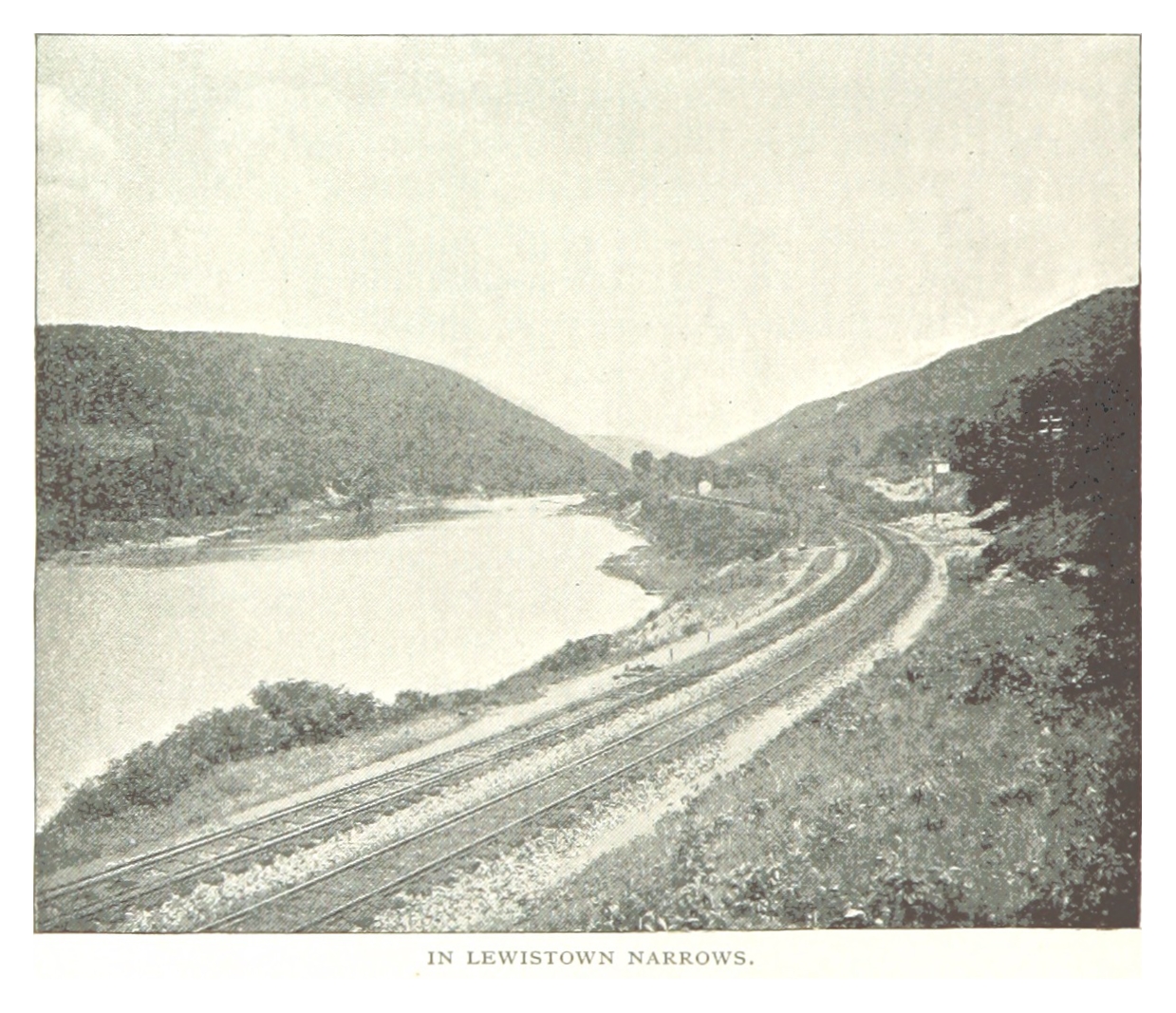
Maxwell, John’s youngest brother, was also a merchant by 1850, but he was in Lewistown, sixty miles from Harrisburg and about 160 miles from Philadelphia.  What was he doing there? Unlike Harrisburg, it was not the state capital, and unlike Philadelphia, it was not a major seaport city.  But it was by 1850 itself an important trading center based on its location near the Pennsylvania Canal and the railroads.  Mifflin County, where Lewistown is located, had a population of close to 15,000 people in 1850 so it was not an insignificant location.  I assume that Maxwell, arriving after his brother John, had also started as a peddler, selling the wares he obtained from his brother, and traveling around the state, until he was able to save enough money and establish a store in his own territory, close enough to his brothers, but not so close as to compete for business.

According to the JewishGen KehillaLinks page for Lewistown, Pennsylvania, found here , the Mifflin County Historical Society had no records of Jews before 1862, but obviously Maxwell was already there. In fact, there was a street named for him:

A map of Lewistown in 1870 shows that Nathan Frank had a store at Brown and Market Streets, listed in a business directory of the time as Franks — Dry Goods, Carpets, Clothing, Furnishings, Goods, Etc.”  Spruce Street was at that time listed as Nusbaum Street and in April, 1880 M. Nusbaum — Clothing & Gents Furnishings was advertised. By 1907 however Nusbaum & Co. was no longer listed in the directory.

The biggest mystery to me is why Leopold Nusbaum ended up in Blythe as a butcher. Blythe is sixty miles from Harrisburg and a hundred miles from Philadelphia.  Like Lewistown, it was also located near railroads and the canals.  I cannot find anything about its population in 1850, but even today its population is under a thousand.  Schuykill County, where Blythe is located, however, had an overall population of over sixty thousand in 1850, which was a doubling of its 1840 population.  Something must have been happening there, but I’ve not yet been able to figure out why its population exploded in that ten year period.  Perhaps that explains why Leopold was living there with his wife Rosa and two young sons in 1850.  But why was he a butcher? Certainly he could not have been a kosher butcher; even today the Jewish population of Blythe is 0%.  At any rate, by 1860, as we will see, Leopold and his family had left Blythe and moved to Harrisburg, where Leopold also followed in his brother’s footsteps and became a merchant.

Thus, the Nusbaum story is not unlike the story of many of those German Jewish immigrants who came to the US, started off as peddlers, and then became merchants, owning stores all over the United States. It must have taken a lot of hard work and a courageous spirit to move to this new country, carrying a heavy pack hundreds of miles through undeveloped territory, dealing with strangers who spoke a strange language, on your own and alone for most of the week.  It must have taken much determination and persistence to do this week after week, maybe for a few years or more, until you had made enough money to find one town to settle in and establish a store.  And then it must have been a hard life, living as perhaps the only Jewish family in that town far away from other family members and other Jews.  In my posts to follow, I will trace the lives of my Nusbaum peddler and merchant relatives and how they progressed in America.


The Nusbaums Come to America

PA Harrisburg 1855

PA Harrisburg 1855 (Photo credit: Wikipedia)

I am having a hard time finding a place to start the rest of the story of my Nusbaum ancestors.  I just keep going in circles and hitting walls.  I have been able to locate most of the children of Amson and Voegele Nusbaum in the US, but for some have not been able to find very much about them.  I am still searching and hoping more will turn up, but the Nusbaums seem so far to have stayed pretty much under the radar, unlike the Seligmans for sure and even more so than the Cohens, about whom I found a number of newspaper articles.

So I will start with what I have and hope that as I go along, I will find more and learn more about the elusive Nusbaums.  From the report compiled by Rolf Hofmann based on the research of Angelika Brosig, I know that Amson and Voegele had eight children.  Guetel, the oldest, reportedly born in 1805, I have not had any luck finding either in Germany or in the United States.  I assume she married in Germany since she would have been in her mid-thirties by the time her other siblings left Germany in the 1840s.  Without access to marriage records or death records in Schopfloch, I have hit a dead end on Guetel.  At least for now.

I also have had no luck finding anything about Amson and Voegele’s fifth child, Sara, for what I assume are the same reasons.  Sara, born July 8, 1812, according to Angelika Brosig’s research, also was probably married before her siblings left Schopfloch.  Neither Guetel nor Sara appear in the Nusbaum family bible that belongs to my father, so I have to assume that they did not ever move to the United States.

On the other hand, I was able to find all five of Amson and Voegel’s sons in the United States without too much trouble, and I even was able to find their other daughter, Madel or Mathilde.  She was born on July 20, 1806, according to Angelika Brosig. My search for Mathilde was more successful than those for her two sisters because once again I was very fortunate to find someone who is related to me (and to Mathilde) by marriage.

I had posted a question on JewishGen seeking help in researching my Nus(s)baum ancestors from Schopfloch, and I received an email from a fellow researcher, Ned Lewison, who said that he doubted that he had anything helpful, but that one of his relatives, Isaac Dinkelspiel, also with ancestral ties to Schopfloch, had married someone named Mathilde Nusbaum, and that they had lived in Harrisburg, Pennsylvania.  (He also said that another relative had married another Nusbaum, but more on that in a later post.)  I knew right away that that could not be just coincidence since I already knew that John Nusbaum had settled also in Harrisburg.  Further research (to be described later) confirmed that Mathilde Nusbaum Dinkelspiel was John’s sister.

So I know of six Nusbaum children who came to the United States: Mathilde, Leopold, Isaac, John, Ernst, and Maxwell.  The earliest record I have found that might relate to my Nusbaum ancestors is an entry for a John Nussbaum on the 1840 census living in Harrisburg, Pennsylvania.

Unfortunately, the 1840 census does not provide a lot of information.  It only lists the male heads of household with check marks indicating the numbers of males and females within certain age ranges living in that household.  The entry for John Nussbaum has check marks for one male between 30 and 40 years old, one female between 20 and 30 years old, and one female between five and ten years old.  My three-times great-grandfather John Nusbaum would have been 36 in 1850, his wife Jeanette would have been 33, and they did not yet have any children that I am aware of.  In fact, the family bible lists their marriage date as July 1, 1841 and their first child, Adolphus, born in 1842.

Could this be my ancestor on the 1840 census?  I am not sure.  His wife’s age could be wrong, the family bible could be wrong about the marriage date, but who was the five to ten year old daughter?  Could John have had another wife and a child before Jeanette? I cannot be sure.  There are no birth records or death records on file in Pennsylvania before 1877 except for scattered church records and some local civil records.  There are some marriage records, but they are not complete, and I cannot find any Nusbaum marriage recorded that early.  I do know, however, that John was in Harrisburg by 1850. So maybe this is my ancestor on the 1840 census, maybe not.  I have written to the local historical society in Harrisburg and hope to get some answers.

I cannot find any of the other Nusbaum siblings on the 1840 census.  The next document I have that may relate to my Nusbaum ancestors is an immigration record for Leopold, John’s older brother. Since I only so far have the index entry and not the full ship manifest, this is also not a very helpful record.  According to the index, a Leopold Nussbaum, aged 35, arrived from Germany to New York on June 9, 1847. The family bible does not have a birthdate for Leopold (though it does have his date of death).  The Brosig records indicated that Leopold (Loew) was born on April 26, 1808, and the census records for Leopold in America conflict with each other, but suggest he was born between 1810 and 1812.  I do not know for sure, therefore, whether this is the same Leopold Nussbaum, and perhaps seeing the full ship manifest will tell me more.  But 1847 seems to be a reasonable date for the arrival of Leopold.

Although I have not been able to find any immigration records for any of the other Nusbaum siblings, I know that by 1850 four of them were already in the US because they appear on the 1850 census.  John was living in Harrisburg’s South Ward and working as a merchant.  He and his wife (listed as Shamet here) had four children: Adolphus (8), Simon (6), Frances (my great-great-grandmother, 4), and Julius (2), all born in Pennsylvania.[1]  They also had eight other unrelated adults living with them, two servants and six whose occupation was given as “clerk,” presumably in John’s store.  So by 1850 John Nusbaum was quite comfortably settled in Harrisburg.

John Nusbaum 1850 census Harrisburg, PA

John Nusbaum 1850 census Harrisburg, PA

As I indicated above, his older sister Mathilde was also living in Harrisburg with her husband Isaac Dinkelspiel.  Isaac was working as a peddler, and he and Mathilde had three children: Paulina (8), Adolph (6), and Sophia (2).  Since all three children were listed as born in Germany, this would suggest that Isaac and Mathilde had been in the United States for less than two years at the time of the 1850 census.  Mathilde and her husband Isaac had no servants living with them and presumably were not yet as comfortable as her brother John and his family, who may have been in Harrisburg for ten years at that point.

Mathilde and Isaac Dinkelspiel 1850 US census Harrisburg, PA

Mathilde and Isaac Dinkelspiel 1850 US census Harrisburg, PA

I did not find a definite listing for Leopold Nusbaum on the 1850 census, but I believe that this listing for L. Nussbaum is the right person.

L. Nusbaum 1850 census Lewistown, PA

L. Nusbaum 1850 census Blythe, PA

L. Nusbaum is listed as a butcher, 38 years old (which would give him a birth year of 1812), and married to Rosannah, both born in Germany, with two children: Adolph (2) and Francis (seven months), as well as a non-related person, perhaps a servant. Both children were born in Pennsylvania, meaning that Leopold and Rosannah had been in Pennsylvania since at least 1847, consistent with the ship manifest. They were living in Blythe, Pennsylvania, a town about seventy miles from Harrisburg.

Why do I believe this is Leopold? Because I know from later documents that Leopold’s wife was Rosa and that he had a son named Francis and a son named Adolph.   Both John and Leopold had children named Adolph/us and Francis/Frances.   Perhaps the two Adolphs were for Amson, the two Francis/Frances for Voegele. (Mathilde and Isaac Dinkelspiel also had a child named Adolph.)

The fourth sibling listed on the 1850 census is Maxwell (Meier) Nusbaum, the youngest of the Nusbaum siblings, born September 14, 1819.  In 1850, he was living with his wife Mathilde Dreyfuss Nusbaum and their two year old daughter Flora in Lewistown, Pennsylvania, which is about sixty miles from Harrisburg. Flora might also have been named for Voegele.  Maxwell was a merchant, and he had a clerk living in his household.  His wife Mathilde was the sister of Jeanette Dreyfuss Nusbaum, the wife of Maxwell’s brother John Nusbaum.  (More on the Dreyfuss family in a later post.)

Maxwell Nusbaum 1850 US census Lewistown, PA

Maxwell Nusbaum 1850 US census Lewistown, PA

Although I cannot find Ernst Nusbaum on the 1850 census, I did find a listing for an Ernest Nusbaum, a merchant in Philadelphia, on the 1852, 1854, and 1859 city directories for Philadelphia.  Given the name and the occupation and the fact that Ernst and his family show up on the 1860 census living in Philadelphia, I think it is reasonable to assume that Ernst was in Philadelphia by 1852. (Unfortunately, the 1860 census did not include street address information so I cannot compare it to the 1850s directories.)

Ernest Nusbaum in the 1852 Philadelphia city directory

Ernest Nusbaum in the 1852 Philadelphia city directory located at https://archive.org/details/mcelroysphiladel1852amce

As for Isaac Nusbaum, the remaining sibling who emigrated to the US, I have no record for him before 1865 in Peoria, Illinois.  I do not know when he arrived or where he was in 1850.

Thus, what I know with a reasonable degree of certainty is that by 1850 (1852 for Ernst), John, Mathilde, Leopold, Maxwell, and Ernst Nusbaum had settled in Pennsylvania, John and Mathilde in Harrisburg, Leopold in Blythe, Maxwell in Lewistown, and Ernst in Philadelphia.  What were they doing living in these places spread out miles from each other? In my next post I will address that question.

Nusbaum 1850 map

Google Maps


[1] The family bible says that Adolphus was born in Newville, Pennsylvania, which is about 32 miles from Harrisburg.  Simon, Frances, and Julius were all born in Harrisburg.

How They Met: The Cohens

In a much earlier post, I wrote about how some of my maternal relatives met—my grandparents, my aunts and uncles, my parents, and others.  When researching my great-grandparents Emanuel and Evalyn Cohen and my grandparents John and Eva Cohen, I wondered how they had met.  Fortunately, my brother had heard the stories years ago and shared them with me.

My great-grandmother Evalyn Seligman Cohen was born in Philadelphia in 1866, but her family had moved to Santa Fe, New Mexico, before 1880 (more on that at a later time).   Evalyn (later Eva May) was probably the first woman in my family to go to college.  She came back to Philadelphia to start college at Swarthmore College and met Emanuel Cohen.  They fell in love and married in 1886, and Evalyn never finished college.  (Maybe if she had, Swarthmore would have accepted me back in 1970 when I applied there. But then again, if she had, I would never have been born.)  She was only twenty years old when they married.  If not for her ambitious and independent spirit, she might never have traveled east and met my great-grandfather.

Swarthmore College

Swarthmore College (Photo credit: Wikipedia)


My grandparents also only met because my grandmother Eva Schoenthal Cohen was willing to make the long trip back east.  She also was born in Pennsylvania, but her parents, Isadore and Hilda Schoenthal, had moved west to Denver, Colorado, by the time Eva was six years old.  Sometime in 1922 when she was eighteen years old (she had graduated from high school that June, so perhaps over the summer), she came east to visit with some of her family in Philadelphia.  She met my grandfather John Cohen at some social event while visiting Philadelphia, and as the family story goes, he was so smitten with her that he followed her back to Colorado to woo her and ask her to marry him.  She accepted his proposal, and they were married on January 7, 1923, when he was 27 and she was 19 years old.  As with her mother-in-law, if my grandmother had not been brave enough to travel from Denver to Philadelphia, my grandparents might never have met.

Denver Capital building

My father, the third Cohen man to fall in love quickly and marry a very young woman, also only met my mother because of her willingness to travel, although not across the country.  As I’ve recounted before, they met at Camp Log Tavern in the Poconos where my father was working as a waiter at an adult camp in the summer of 1950.  My mother, who was nineteen and living in the Bronx, came for a vacation, and my father fell in love with her at first sight.  She was less interested, so he had to track her down in the Bronx phonebook after she left.  They married in 1951 when she was twenty years old and he was twenty-four.  They will be celebrating their 63rd anniversary this September.

Camp Log Tavern Milford, PA

Camp Log Tavern Milford, PA

Do you see a pattern here? Not only the serendipity of how each couple met, but both my father and my grandfather had to pursue the woman they loved, my grandfather by taking a train across the country, my father by searching through phonebooks to find my mother.  Thank goodness for those impulsive and determined Cohen men and the traveling women they met and married, or my siblings and I would not be here today.

Florence and John Cohen 1951

Florence and John Cohen 1951


The Genealogy Village: An Update on Maria Cohen and William Levy

Over three weeks ago, I blogged about Maria Cohen, Jacob and Sarah’s seventh child, and her life.  She had married William Levy, and they had had four sons, one of whom committed suicide as a teenager, and two others who predeceased her, Lewis, who died when he was 38 in 1915 only five years after marrying Emma Fogle, and Jacob, who died the following year when he also was only 38.  Only one son, Isaac, survived her.

At the time I wrote the blog, I could not find any records for Maria or William after 1900, except as names on their sons’ death certificates.  I did not know when either of them died.  In addition, although I had a death certificate for their son Lewis and was able to find his headstone through FindAGrave, I was confused by the fact that the headstone referred to Lewis and his wife Emma as father and mother, but I had no record of any child born to Lewis and Emma.  I put those questions aside after much searching, figuring I would return.

So I returned to Maria and William after the updates to the Pennsylvania death certificate database earlier this week.   First, I called Adath Jeshurun cemetery in Philadelphia to see if Maria and William were buried there.  Since all three of the sons who had died were buried there, I assumed that Maria and William would have been also, and that hunch paid off.  The very helpful woman at Adath Jeshurun gave me the dates that Maria and William died and were buried.

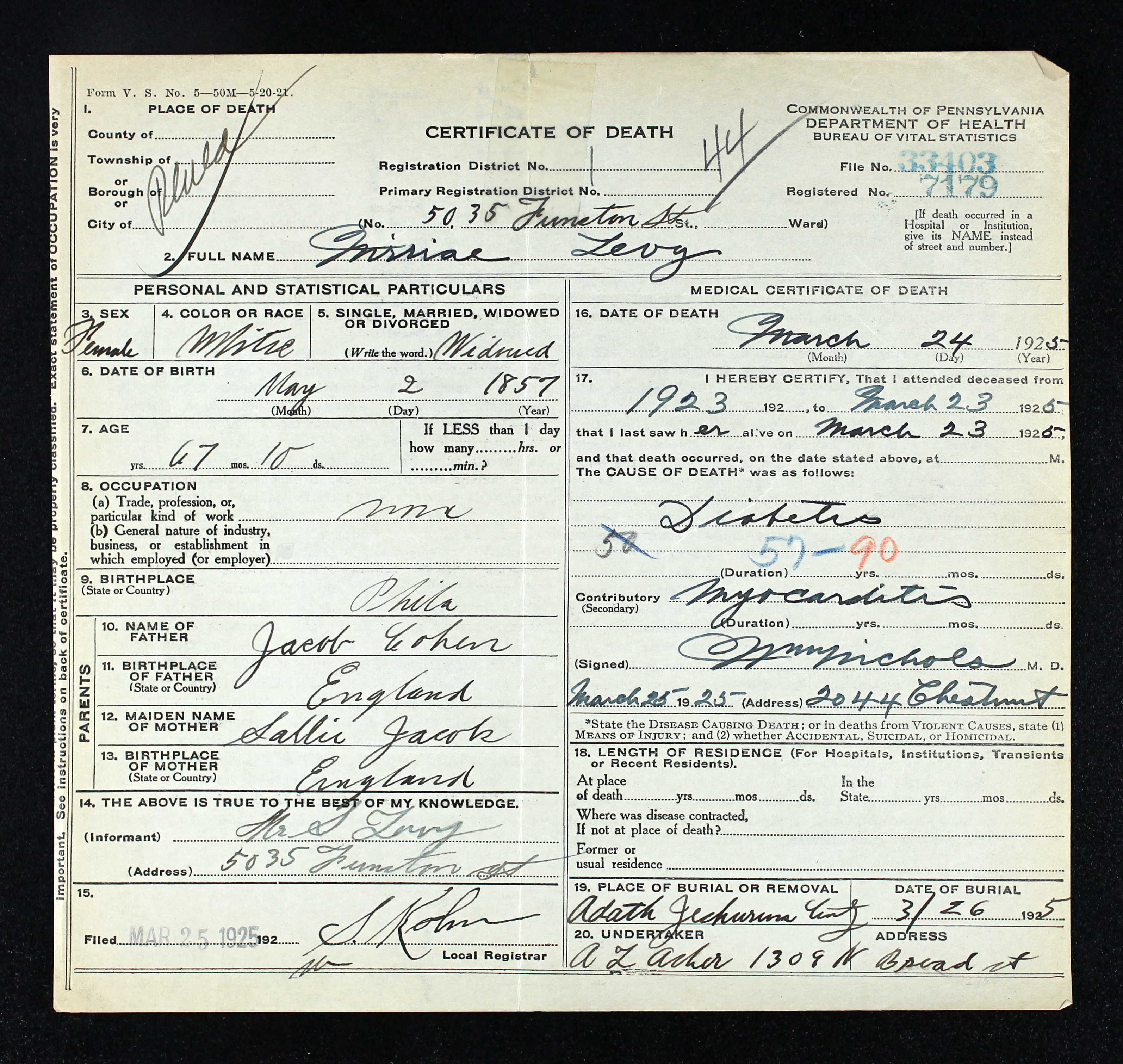
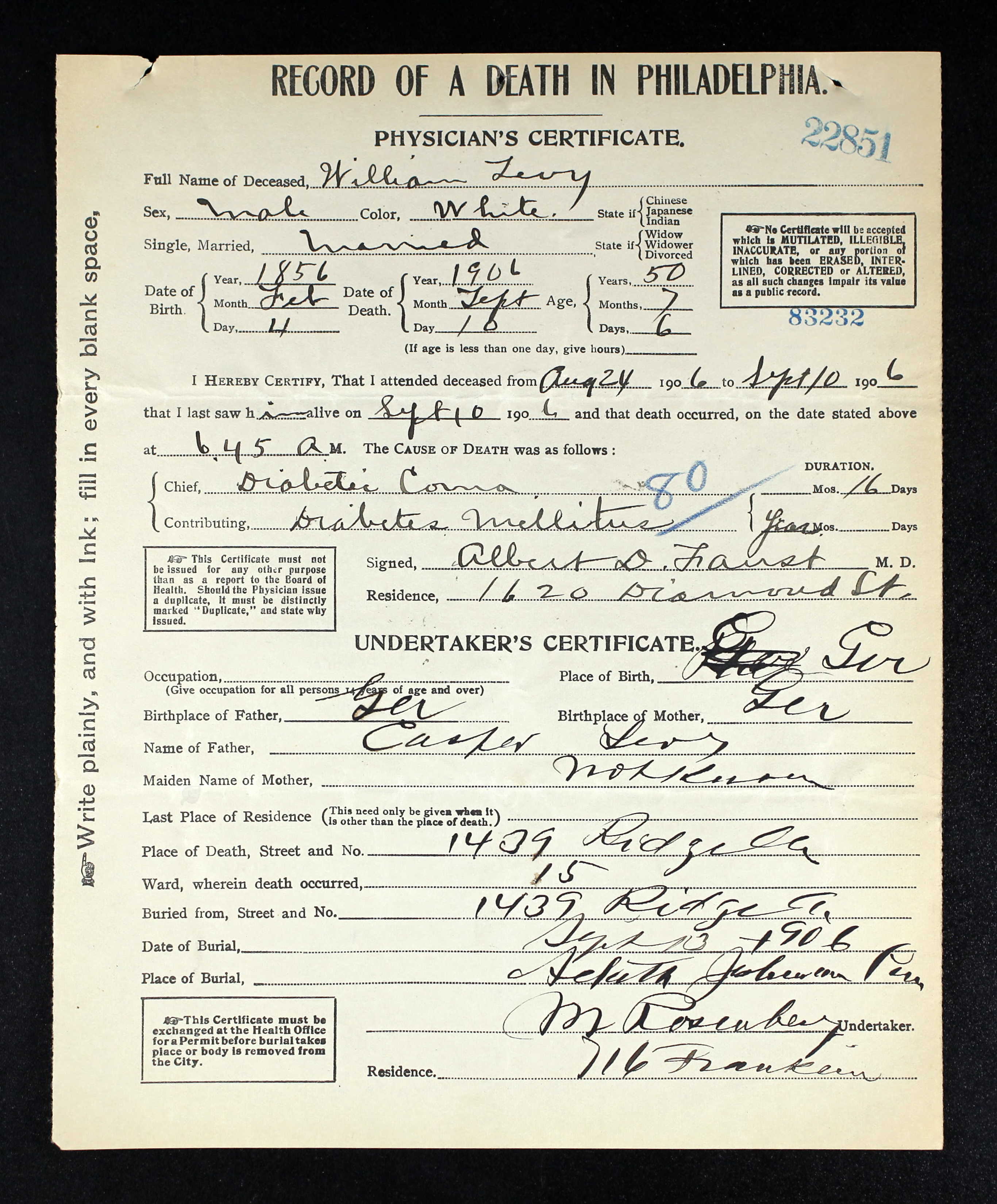
William had died September 10, 1906 when Maria was only 49 and had already lost her son Benjamin.  She would lose two more sons in the next ten years.  Maria herself died March 24, 1925.  I now had their dates of death, but still no death certificates.  Even with the new update, I could not find a death certificate for either William or Maria even though both had died before 1944.  I was bewildered.

I then searched for all people named Levy who died in 1925 and finally found Maria—spelled Mrriac in the ancestry.com index.  What?? Mrriac?? No wonder I couldn’t find it.  But it was clearly Maria—daughter of Jacob Cohen and “Sallie Jacob.”  She had died from diabetes and myocarditis and had been living at 5035 Funston Street in Philadelphia at the time of her death.  The informant on the certificate was Mr. S. Levy of the same address.  Since her only surviving child was her son Isaac Harry Levy, I had no idea who S. Levy was, unless he was the son of Lewis and Emma Levy.

Maria Cohen death certificate 1925

Maria Cohen death certificate 1925

I still could not find William Levy’s death certificate nor could I figure out how to find Lewis and Emma’s child.  I turned to others for help.  There is a Pennsylvania Genealogy group on Facebook and also a Tracing the Tribe group focused on Jewish genealogy.  I posted my questions on both groups, and within a few minutes, someone on the TTT group suggested I search the Pennsylvania death index by William’s date of death instead of by his name, and tada! There it was.  William also had died from diabetes.

William Levy death certificate 1906

William Levy death certificate 1906

But that still left me without an answer to the next question: who was the child of Emma and Lewis Levy?  Another half hour later I had that answer as well.  Somehow someone else with fresh eyes found Emma Levy, a widow, on the 1920 census, living with an eight year old daughter named Henrietta as well as two relatives named Fogel.  This was obviously the right Emma, and I now knew her daughter’s name.

Emma Levy 1920 census

Emma Levy 1920 census

They also appeared together on the 1930 census, but on the 1940 census, Henrietta was gone.  Now I need to find her married name.  Two kind people from the Pennsylvania group are continuing to help me.

I still do not know who Mr. S. Levy was on Maria’s death certificate, nor do I know what happened to Henrietta. I also have not found Maria on the 1920 census.  But with the help of others, I am able to put some closure on the sad life of Maria and William Levy.

Pennsylvania, I love you!

OK, perhaps a bit of an overstatement, but yesterday morning I woke up to read online that the Pennsylvania death certificates up through 1944 were now available on ancestry.com.  (Previously, only those up through 1924 were available.)  As soon as I’d had my breakfast, I started searching for all my previously researched Cohen relatives who died between 1925 and 1944 to find their death certificates.  Within a half an hour I had found eleven of them.  Although they did not contain any amazing revelations, I was able to learn when and why several of my relatives had died.

I have updated the relevant blog posts for Hannah Cohen, Lewis Weil, Rachel Cohen, Martin A. Wolf and his wife Marie Morgan, Laura Wolf, Harry Frechie, and Samuel Rosenblatt, Jr.  I also have certificates for Reuben Cohen, Sr., Emanuel Cohen, and Abraham Cohen which will be discussed in later posts.  The only one of these that I was particularly interested in was that of Samuel Rosenblatt, Jr., who had died when he was only twenty and was his parents’ only child; he died of leukemia.  Laura and Martin A. Wolf, siblings and the children of Hannah and Martin Wolf, also died at relatively young ages—in their 40s, Laura of diabetes and Martin A. of ulcerative colitis.

If you are interested in seeing the certificates, I have posted them at the relevant blog posts as linked to above.

It was good to put some closure on some of those lives, although sad to be reminded again of how many of my ancestors died so young.  Thank you to the Commonwealth of Pennsylvania for opening up your records so that family histories can be told.

Did My Great-Grandfather’s First Cousin Live Two Separate Lives?

I have started tracking down the lives of the children of Jacob and Sarah Cohen, my great-great-grandparents, and all was going pretty well until I started to research their son Hart.  It seems he might have been living two lives, one in Philadelphia, one in Washington, DC.   Or perhaps not.  Here’s what I have found; see if you have any ideas on how to resolve this one.

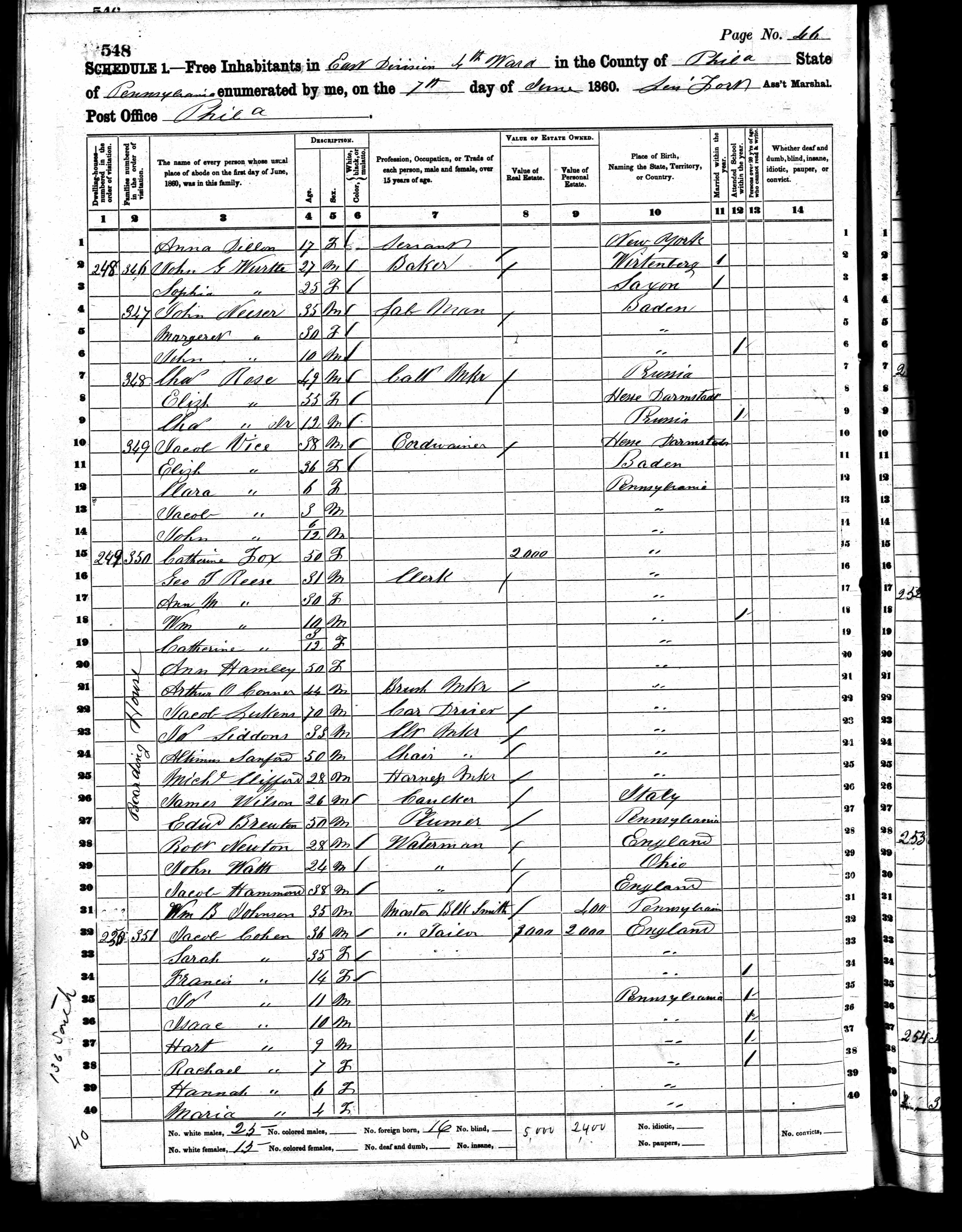
The first mention of Hart, obviously named for his grandfather Hart Levy Cohen who was still alive when he was born, is on the 1860 US census, listing little Hart as nine years old, so born in 1850 or 1851, depending on whether his birthday was before or after June 7th, the date in 1860 when the census was taken.  Since he was not listed on the 1850 census taken on July 25, 1850, he was obviously born sometime between July 25, 1850 and June 7, 1851 if he was actually nine on June 7, 1860.

Jacob and Sarah Cohen and family 1860 US census

Jacob and Sarah Cohen and family 1860 US census

Things start getting weird in 1870.  I found two census reports for Jacob and Sarah and their children for 1870, one taken in June, one in November.  The second one is labeled “Second Enum” for second enumeration so for some reason the census taker went to the neighborhood twice.  What’s odd is that Hart is listed as 20 on the June version and 19 on the November version.  I’ve seen age mistakes so often that this did not faze me in the least, but it does not help pin down Hart’s precise birth date.

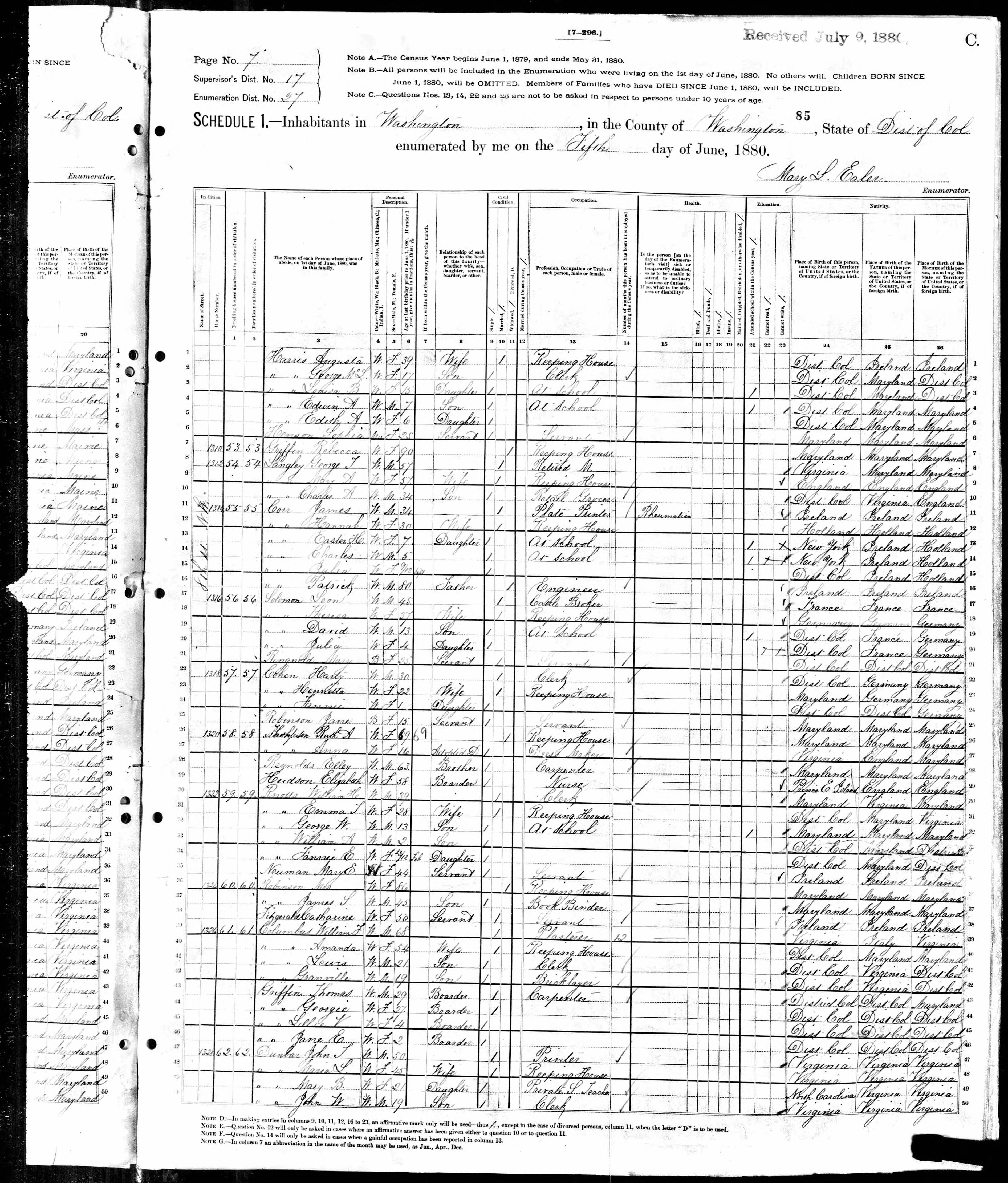
It is the 1880 census, however, that really threw me.  In 1880 there are also two census reports for Hart Cohen born in 1850 or 1851.  One is clearly the right Hart:  He was living in Philadelphia, working as a storekeeper, and was born in Pennsylvania of parents born in England. He is 30 years old, giving him a birth year of 1850 or 1851.  This Hart was married to a woman named Henreta or probably Henrietta and had three children, Jacob (6), Sarah (5), and Julia (4).  If Hart and Henrietta had a six year old child, then presumably they would have been married no later than 1873, and in fact I was able to find a record of a marriage of Hart Cohen to a Henrietta Brunswick in Philadelphia on February 12, 1873 in the Pennsylvania marriage index.

Hart Cohen and family Philadelphia 1880 US census

Hart Cohen and family Philadelphia 1880 US census

All seemed to be making sense until I found another 1880 census report for a Hart and Henrietta Cohen residing in Washington, DC. This Hart was also 30 years old.  I was ready to dismiss this as just as bizarre coincidence since this Hart was listed as having parents who were born in Germany.  His own birthplace was given as Washington, DC.  This seemed like it had to be a different person.  The DC Hart and Henrietta had one child, a daughter named Fanny who was only a year old.

Hart Cohen and family Washington, DC 1880 US census

Hart Cohen and family Washington, DC 1880 US census

I have a city directory for Philadelphia listing Hart Cohen as a pawnbroker in 1886, so I was convinced that the DC Hart was just a fluky coincidence of someone with the same name and age as my Hart marrying a woman also named Henrietta.  The 1890 census was destroyed by fire, so I had to skip ahead to 1900 to see if I could follow up on the two Hart and Henrietta Cohens.

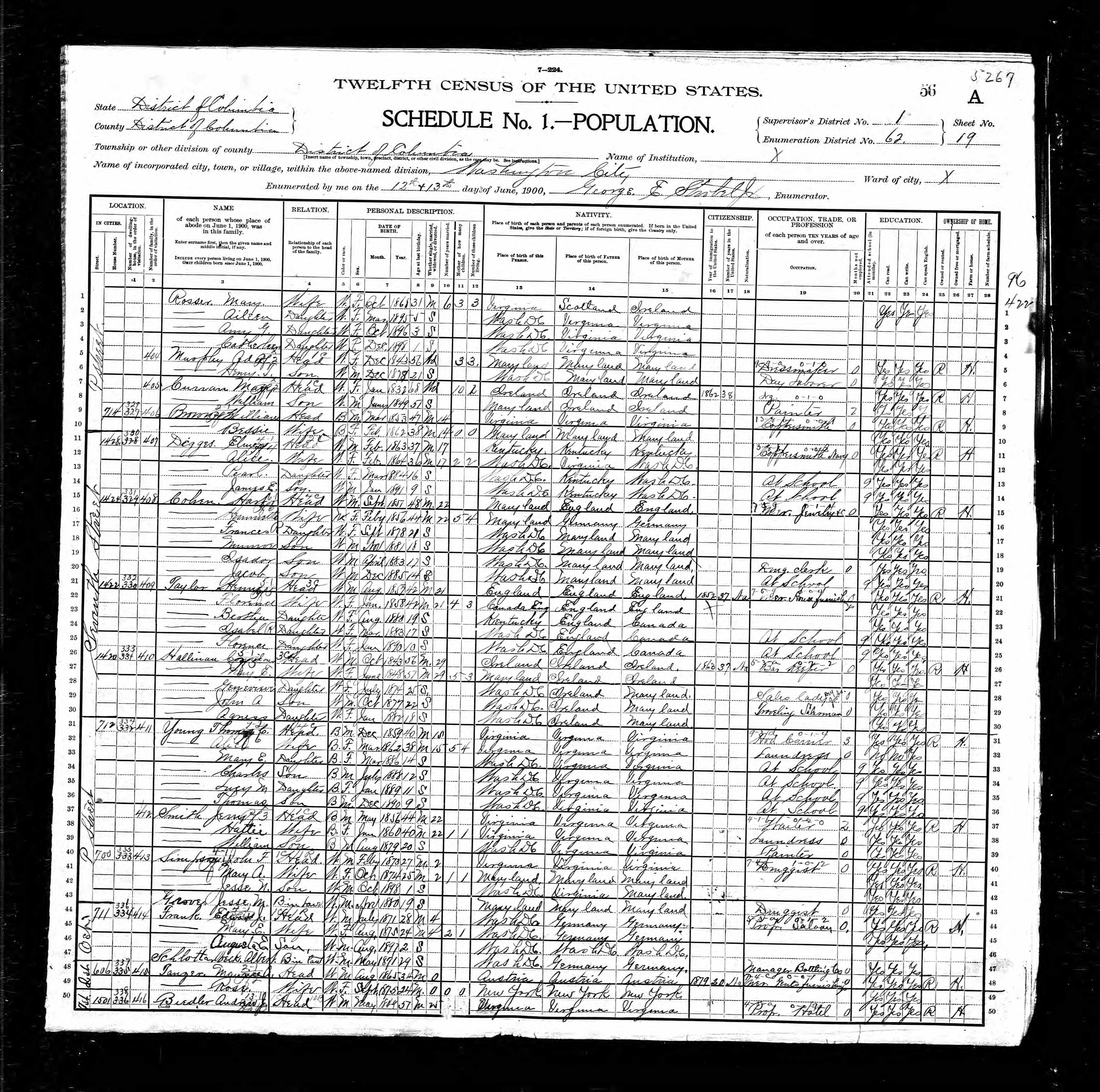
I could not find the Philadelphia Hart and Henrietta on either the 1900 or the 1910 census, but I did find the DC Hart and Henrietta on both.  The 1900 census for the DC Hart provided a more specific birthdate—September, 1851—and had his birth place as Maryland, but this census listed his parents’ birthplace as England, not Germany as on the 1880 census. DC Hart was working in a jewelry store, a retail business not unlike those of my ancestors, so that seemed strange as well. Hart and Henrietta now had four children, Frances, Munroe, Isador and Jacob.  But this Jacob was only 14 in 1900 so could not be the same Jacob who was 6 in 1880 and thus born in 1874.  Once again I felt pretty certain that this was still not the same Hart Cohen who was Jacob and Sarah’s son.  Despite the fact that his parents were now reported to be English-born, that he was a jeweler, that he married a woman named Henrietta and that he was also 30 years old, I again said that this was just a coincidence.

Hart Cohen and family in Washington, DC 1900 US census

Hart Cohen and family in Washington, DC 1900 US census

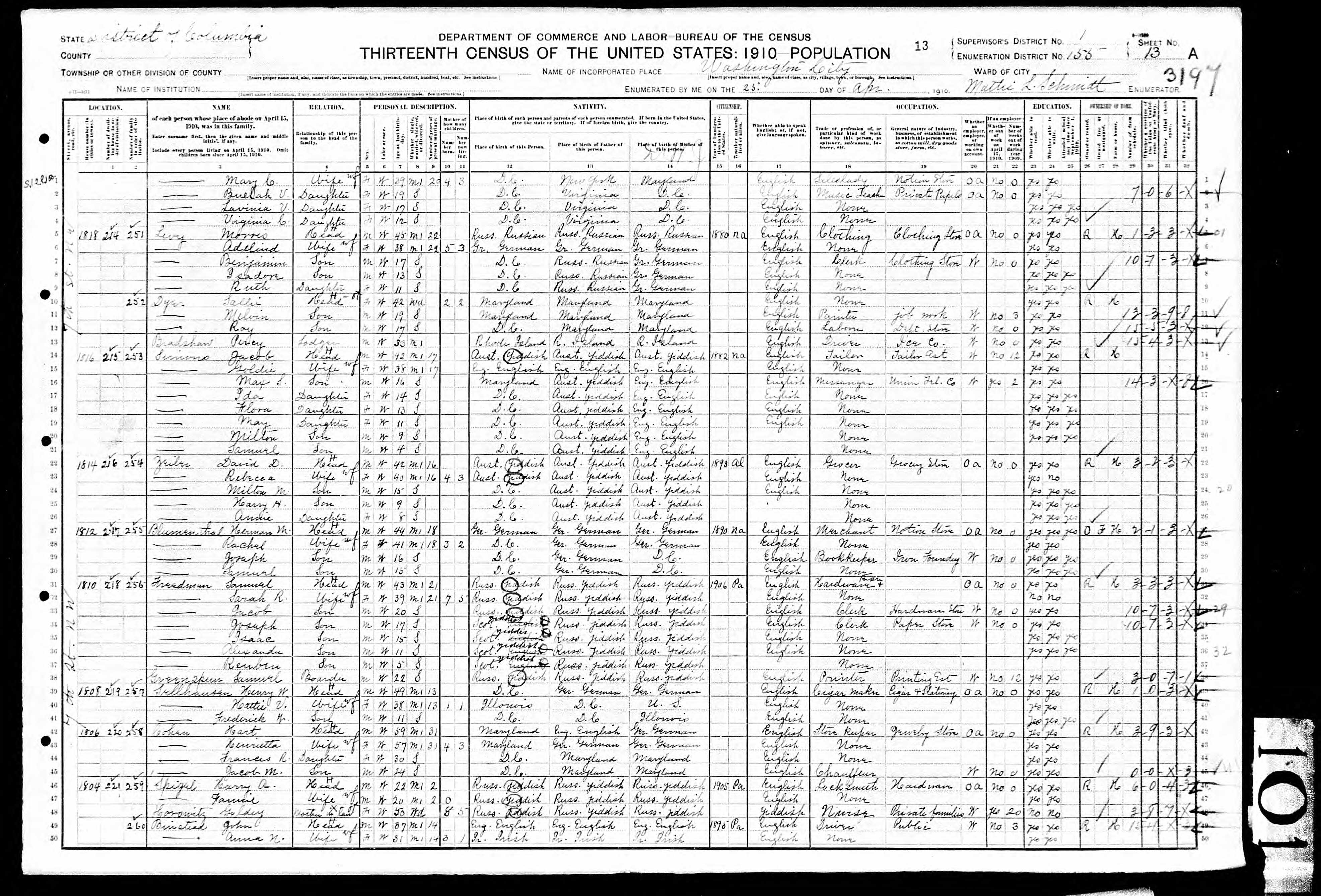
On the 1910 census report for the DC Hart and Henrietta,  Hart still had a jewelry store and was married to Henrietta and living with Frances and Jacob, two of their children.  His birthplace was listed as Maryland, and now his parents’ birthplaces were reported as England for his father and Germany for his mother.  This also seemed to suggest that this was not the Philadelphia Hart.

Hart Cohen and family Washington, DC 1910 US Census

Hart Cohen and family Washington, DC 1910 US Census

But because I could not find the Philadelphia Hart on the 1900 or the 1910 census, I was a bit perplexed.  Could he have died? Had he moved to DC?   Even if that were the case, it would not explain the two 1880 census reports.  Was he living a double life, having two wives both named Henrietta, one in Philadelphia and one in DC, and two different sets of children?

I decided to search for a death record for any Hart Cohen born around 1850, and I found one dated January 3, 1911.  Since this   record was from the District of Columbia Selected Deaths and Burials database, I assumed that this related to the DC Hart especially since the report said that the deceased was living in DC at the time of his death, but on a closer look I saw that it said that he had been born and was buried in Philadelphia.

I then found a second record in the Philadelphia Death Certificates Index that made it quite clear that this was the Philadelphia Hart, not the DC Hart: it listed his parents’ names as Jacob Cohew (sic) and Rachel Jacobs, both of whom were born in England.

Pennsylvania Death Certificates Index

Pennsylvania Death Certificates Index


Further research revealed that Hart’s body had been moved from its original burial location twice by two of his children, Jesse Cohen and Sarah Cohen Jonas, ending in a move in 1944 to a location in Mt Sinai Cemetery where both his son Jacob H. Cohen and a Ralph Brunswick were also buried.  Since the Henrietta who married Jacob was born Henrietta Brunswick, this seemed (no pun intended) to be the final nail in the coffin establishing that the Jacob who died in January, 1911, was the Philadelphia Hart, son of Jacob and Sarah Cohen, my great-great grandparents.

If that conclusion is correct, then Philadelphia Hart was actually living in Washington, DC, at the time of his death in January, 1911, just nine months after the 1910 census recorded DC Hart (and no other Hart) living with his wife Henrietta and two children Frances and Jacob at 1806 4th Street.  Philadelphia Hart’s residence at his time of death was reported as 1737 N. 15th Street in Washington.  He was also a widower, and I was able to locate a death record for a Henrietta B. Cohen who was born in Lengnau, Switzerland and died in November, 1902.  Had he moved to DC after Henrietta died? If so, why? And what, if any connection, might there be to the “other” Hart and Henrietta?

The other Hart, the DC Hart, was still alive in 1920 and living with his daughter Frances in the District of Columbia.  He also was a widower at this time and retired.  The census report lists his and his parents’ birthplaces as DC, but that is clearly wrong, at least for his parents, whose birthplaces had previously been reported at various times as England and Germany.

Hart Cohen Washington, DC 1920 US Census

Hart Cohen Washington, DC 1920 US Census

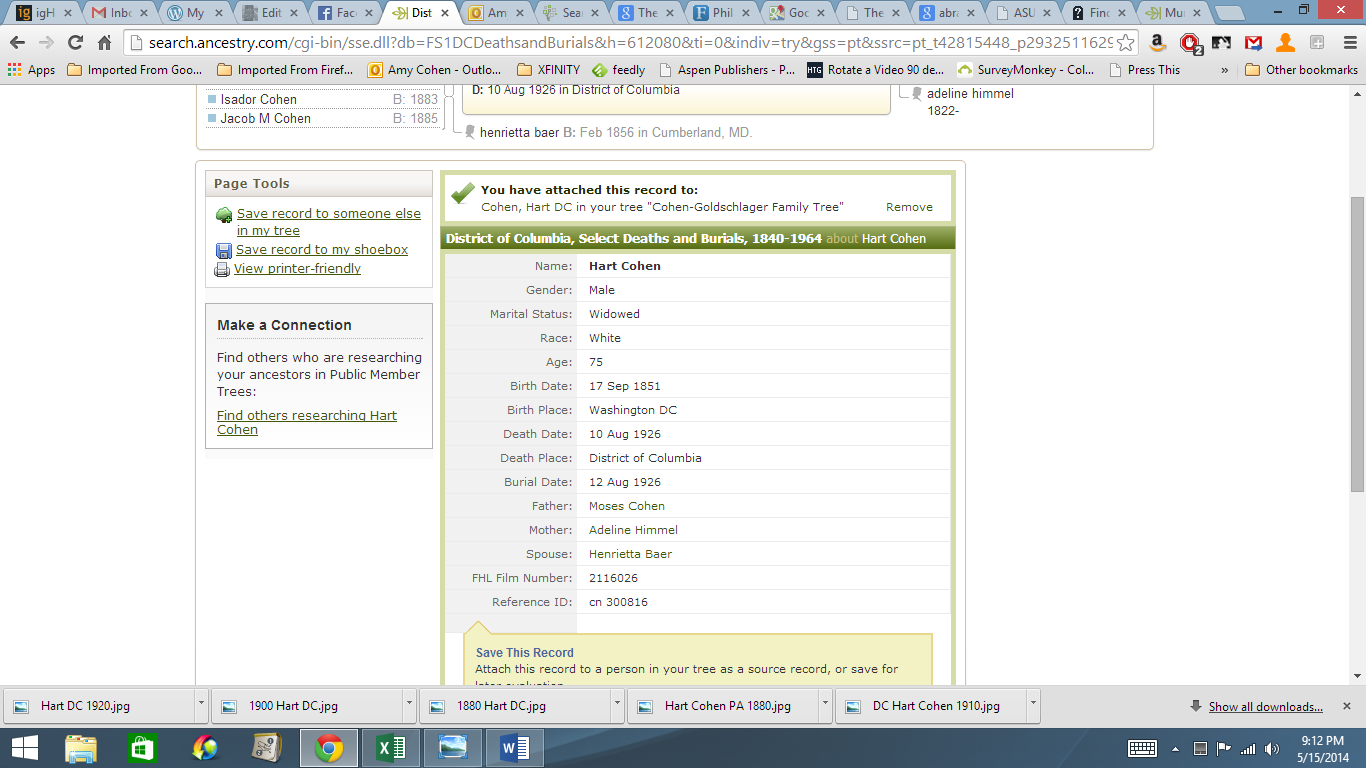
My next find was a record of DC Hart’s death. He died August 10, 1926, in Washington, DC.  His parents’ names were listed on this record: Moses Cohen and Adeline Himmel.  His wife’s name was Henrietta Baer.  So not only did both Philadelphia Hart and  DC Hart marry women named Henrietta, they both married Henriettas  with a birth name that started with a B.  It is no wonder that I was confused, and there are numerous trees on ancestry.com that have mixed together the two Hart and Henrietta Cohen families.

Screenshot (3)

When I saw the name Moses Cohen as DC Hart’s father, it stopped me in my tracks.  Could this be my great-great grandfather Jacob’s brother Moses, the one I thought had stayed behind in England? So far I have not been able to find whether there is a connection.  Although I did find a ship manifest with a Moses Cohen emigrating from England to New York in 1848, the same year Jacob left England, I have no idea whether this is the right Moses Cohen.  Tracking Moses Cohen and Adeline Himmel, I know that they had a son also named Moses before Hart and that Moses the younger was born in Baden, Germany around 1839.  Adeline was born in Germany, and Moses must have gone there, married her, had Moses his son, and then moved sometime between 1839 and 1850 to the United States and settled in Maryland where DC Hart was born.

If this was in fact Moses, the son of Hart Levy Cohen, my three times great grandfather, it would explain why Moses named his son Hart.  It might also explain why Philadelphia Hart was living for some time in Washington.  Perhaps he wanted to be closer to his cousin DC Hart and his family.  On the other hand, if there is no connection, then it is just a very, very strange series of coincidences.

What do you think?


Enhanced by Zemanta

My Father’s Family, Part I: The Cohens

My surname is Cohen, and it always has been.  I have always been proud to be a Cohen.  It is a clear marker to the outside world that I am Jewish.  Because I grew up in a secular home and did not go to Hebrew School like almost all my Jewish classmates, some of them expressed skepticism about whether I was “really” Jewish, but my name always gave me some authenticity.

The Cohens (Cohanim) are the high priests, a line that is supposed to descend from Aaron, Moses’ older brother.  Observant Orthodox Jews who are Cohanim do not go into cemeteries or attend a funeral or touch a dead body in order to maintain their priestly purity.  In a traditional service, there is a special ritual where the Cohanim bless the congregation.  Cohanim get the first aliyah for the reading of the Torah.

Birkhat cohanim 4

Birkhat cohanim 4 (Photo credit: Wikipedia)

Although I do not believe in any of the “special holiness” of the Cohen tribe and in fact am not even sure my family are true Cohanim, I do feel proud to have the name and some of the tradition and history that goes along with it.  It was one reason that I did not change my name when I got married.  I wanted to remain a Cohen—it was my name, it was my family’s name, and it was my ancestors’ name.

So perhaps it is not surprising that one of my first genealogical tasks was to trace the Cohen line.  It was fairly easy to get as far back as my great-great-great-grandfather Hart Levy Cohen, who was born around 1772 in Amsterdam and emigrated to England as a young man.  The English records and then the American records on my Cohen line were clear and easy to find through ancestry.com, and thus within a short period of time I was able to create a tree that went from Hart Levy Cohen to Jacob Cohen, my great-great-grandfather, to Emanuel Cohen, my great-grandfather, to John Nusbaum Cohen, my grandfather, to John Nusbaum Cohen, Jr., my father, to me.  I have census reports going back as early as 1841 in England and 1850 in the United States as well as tax records and a marriage record from England.  I have the names of Hart’s children, his grandchildren, his great-grandchildren and so on.  I compiled a lot of information very quickly, but now I need to go back and learn from all those documents and see what I can find out about Hart Levy Cohen and all his descendants and also to see if I can find his ancestors from Amsterdam and before.

This research will require learning about English records and census reports and also about Pennsylvania records.  From the little bit of initial work I’ve done this week, I already know that it will be more difficult to obtain Pennsylvania records than New York City records.  There is not much online and not much available through the Family History Library.  Most of it will require snail mail requests or traveling to places that are not as accessible to me as New York City.  I do not foresee traveling to Harrisburg in the near future, so it may require hiring someone there to retrieve documents for me.  And as for the English records, well, a trip to London sounds a lot more fun than a trip to Harrisburg, but I don’t think it’s too likely either.

So I have a big learning curve ahead.  I am up for the challenge and ready to learn more about my Cohen relatives and about genealogical research.  I will start by posting what I already know, and then I will fill in the details as I learn more.

Meanwhile, I will also continue to look for more information about the Brotmans, the Goldschlagers, and the Rosenzweigs.  Tomorrow I hope to talk to David Goldschlager’s son and grandson and maybe learn more about the Goldschlagers. I am still hoping to work with Larry Brotman about a Brotmanville connection.  I am still hoping to hear from my cousin Lois about her family and Lizzie and Ray Rosenzweig.  I have written to descendants of Ray Strolowitz Adler and Zusi Rosenzweig Mintz, and I hope to hear back from them.  So at the moment I am depending on these others to help me break down the brick walls that remain on my mother’s side.  Without their help, I am at an impasse for now, but will keep on looking for any and all clues.


Enhanced by Zemanta