My Seligman Great-Great-Grandparents:  Two Pioneers Who Made A Difference with Integrity and Kindness

By the 1890s, my great-great-grandparents were “empty nesters.”  Their daughter Eva, my great-grandmother, was married to Emanuel Cohen and raising her family in Philadelphia.  (I’ve written about my Cohen great-grandparents here.) Their son James was working as a draftsman for the Department of Interior in Salt Lake City, Utah; he would marry Ruth V.B. Stevenson in 1893 in Salt Lake City, and have two children, Morton Tinslar Seligman, born July 1, 1895, in Salt Lake City, and Beatrice Grace Seligman, born December 4, 1898, also in Salt Lake City.  By 1900, however, James, Ruth and the children had moved to Santa Fe, where they were living next door to Bernard and Frances.  James was working as a clerk in a dry goods store, presumably the Seligman store.

Bernard Seligman and James Seligman and families 1900 US census

Bernard Seligman and James Seligman and families 1900 US census  Year: 1900; Census Place: Santa Fe Ward 4, Santa Fe, New Mexico; Roll: 1002; Enumeration District: 0126; FHL microfilm: 1241002

Arthur, the youngest child of Bernard and Frances, had returned to Santa Fe after college in Philadelphia, and in 1896, he married a widow named Frankie E. Harris in Cleveland, Ohio.

Marriage certificate of Arthur Seligman and Frankie E. Harris

Marriage certificate of Arthur Seligman and Frankie E. Harris Cuyahoga County Archive; Cleveland, Ohio; Cuyahoga County, Ohio, Marriage Records, 1810-1973; Volume: Vol 42-43; Page: 489; Year Range: 1892 Sep – 1896 Jul

Frankie had an eight year old daughter Richie from her first marriage who became a part of the Seligman family.  In fact for her ninth birthday on August 3, 1897, Bernard and Frances hosted a birthday party for Richie and 42 of her friends in their Santa Fe home.

Ritchie Harris birthday snip

City News Items Date: Tuesday, August 3, 1897 Paper: New Mexican (Santa Fe, NM) Volume: 34 Issue: 138 Page: 4

(This same “gossip column” also reported that Arthur and James Seligman and some friends were going on a two week fishing trip soon after this birthday party.)

Arthur and Frankie had a son together just a year later; Otis Perry Seligman was born on February 14, 1898, in Santa Fe.  Thus, by 1900, Bernard and Frances had four grandchildren living in Santa Fe plus three more grandsons living in Philadelphia, including my grandfather John Nusbaum Cohen.

On the professional side, I could not find any specific references to Bernard’s political activities or his business activities during the 1890s although the 1900 census listed his occupation as a dry goods merchant.  In 1894 he seems to have taken an extended trip to Europe, including to Germany and to Italy.

Traveling Seligmans 1894

Saturday Small Talk Date: Saturday, October 27, 1894 Paper: New Mexican (Santa Fe, NM) Volume: 31 Issue: 214 Page: 4

From this clipping it is hard to know whether or not he was traveling with Frances.  I also wonder who the relatives were in Italy and who he was visiting on the Rhine.  Was this purely for pleasure or was it a business trip?  I don’t know.

At some point after this trip, however, Bernard and Frances moved back to Philadelphia.   Bernard was living in Philadelphia when he died on February 3, 1903, at age 65 from myocarditis.  He was residing at 1606 Diamond Street at the time.

Bernard Seligman death certificate

When I looked back to see where my great-grandmother Eva was living at that time, I was hardly surprised to see that she, her husband Emanuel Cohen, and their three sons were also living at 1606 Diamond Street as of the 1900 census.  In fact, in 1900, Emanuel’s brother Isaac and nephew were also living at 1606 Diamond Street after the death of Isaac’s wife.  Thus, Eva and Emanuel Cohen, my great-grandparents, were housing not only their three children, but also at least four other family members, Eva’s parents and Emanuel’s brother and nephew.

According to his obituary, Bernard (and presumably Frances) had moved back to Philadelphia three years before his death, to “recuperate from over-work.”  The obituary goes on to say that Bernard had been doing well until sometime in the prior year when he had a “severe stroke of paralysis which weakened him considerably.”  The paper noted, however, that he had been improving and that no one thought that he was near death.  The obituary described his death as “shocking” and reported that the day before his death he had appeared fine and had even sent a dispatch relating to business matters to his son Arthur.

bernardseldeathnmex

“A Good and True Man Called Hence,” Santa Fe New Mexican, February 3, 1903, p. 1

The obituary recounts all of Bernard’s many accomplishments, both political and business, and describes him as follows:

“Mr. Seligman was a pioneer in New Mexico, and during his residence of over forty years in this city and territory, was one of the most progressive, shrewdest and brightest businessmen and citizens of the commonwealth.  He was a man of the strongest integrity and keen perception and high courage, public spirited and thoroughly posted on public affairs, indeed a valuable and good citizen in every sense of the word, a loving husband and a kind and indulgent, yet at the same time, a firm and sensible father.  He was a prominent and important factor in the building up of the commercial, educational, civic, moral, and material interests in this city and county and of the entire territory.  A good and true man has gone to the great beyond.”

What can I possibly add to that? Only that I wish that I had known him.  I stand a bit taller knowing that I am descended from Bernard Seligman.

Just two years later, my great-great-grandmother Frances Nusbaum Seligman also died.  She died in Philadelphia on July 27, 1905, at age 59.

Frances Seligman death certificate

She had been living at 1431 Diamond Street at the time of her death.  Again, I checked to see where my great-grandparents Eva and Emanuel Cohen were living, and 1905 Philadelphia directory, their address was, not surprisingly, 1431 Diamond Street, and they still had their three sons and Isaac living with them in 1910 as well.

Frances was described in her obituary in very loving terms:

“She was a beautiful and accomplished woman, as good as she was beautiful and as beautiful as she was good, and of a most lovable and gentle disposition.  She was an exemplary wife, a fond and good mother, and a dutiful and loving daughter.  Indeed she was all that is implied in the phrase ‘a thoroughly good and moral woman.’  … She will be especially remembered by the poor people of [Santa Fe], to whom she was particularly kind.  Many and many truly charitable deeds have been put to her credit.”

The obituary further commented:

“From the moment of her arrival to within a few years ago, when she commenced to spend most of her time in Philadelphia, she was a social leader, admired, respected and popular.  She was a woman without guile and always ready to lend a helping hand in social as well as in charitable work.”

frances seligman obit July-27-1905 new mexican

(“Gentle, Good Woman Gone,” Santa Fe New Mexican, July 27, 1905, p. 1)

While I was impressed and proud when I read my great-great-grandfather’s obituary, I was very moved and emotional in reading about my great-great-grandmother Frances.  The words “good,” “gentle,” and “kind” are the same words that I have heard my father and my cousin Marjorie use to describe their grandmother, Eva Seligman Cohen, the daughter of Frances Nusbaum and Bernard Seligman.  She seems to have inherited or learned those very traits from her parents, two people who left the city of Santa Fe a better place by the time and the effort that they spent in caring for their community while they lived there.  As I will describe, their surviving children also left their mark, my great-grandmother Eva by her kindness and caring for others, and her two brothers James and especially Arthur by their service to Santa Fe and New Mexico.

bernard

Bernard Seligman

francis

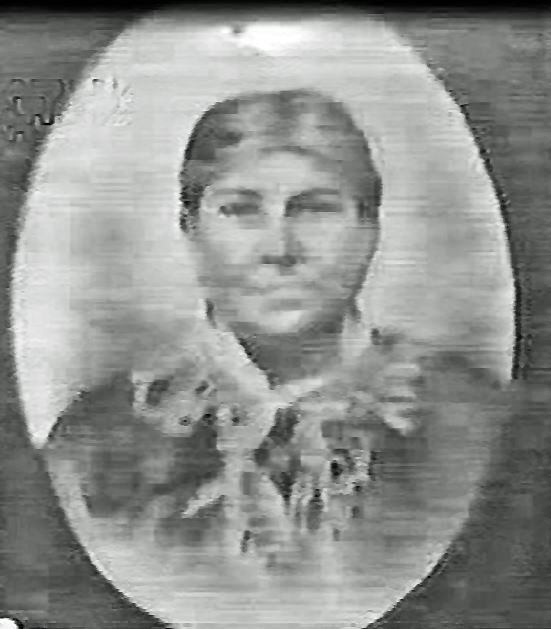
Frances Nusbaum Seligman

These two photos were given to me by my cousin Arthur Scott.  They were taken from a video made by his sister of family photos in their home.  The one of my great-great-grandmother Frances is so far the only photograph I have of her.


Bernard Seligman: His Political Career and His Family 1870-1890

I want to thank my cousin Arthur “Pete” Scott for all his help with finding newspaper clippings (including some of the ones appearing in this post) and other information to try and fill in the timeline  for Bernard and the other Seligmans. He has also contributed a great deal of information about our family at the Voces de Santa Fe website.  Like my father, Pete is a great-grandson of Bernard Seligman and thus my second cousin once removed.


I have been having a hard time tracking the whereabouts of my great-great-grandfather Bernard in the 1870s.  Although I know that Bernard and his family had moved back to Santa Fe sometime before their youngest child Arthur was born in June, 1871, it seems that Bernard was in and out of town during the 1870s.  In 1873, he withdrew from the Seligman Brothers partnership:

Date: Thursday, January 2, 1873 Paper: Santa Fe Daily New Mexican (Santa Fe, NM) Page: 1

Date: Thursday, January 2, 1873 Paper: Santa Fe Daily New Mexican (Santa Fe, NM) Page: 1

The firm of S. Seligman and Brother was dissolved, and a new firm owned by Sigmund and Adolph Seligman and Julius Nusbaum was created named Seligman Bros. and Company.  Who was Julius Nusbaum?  He was Bernard’s brother-in-law, the brother of Frances Nusbaum, Bernard’s wife.

Daily New Mexican, January 13, 1873

Daily New Mexican, January 13, 1873


I cannot find an explanation for Bernard’s withdrawal, and he certainly was involved in the business again in later years. He had applied for a passport on April 3, 1873, and he served as a representative to the Vienna Exposition  of 1873, so maybe that prompted his withdrawal.

Bernard Seligman passport application 1873

Bernard Seligman passport application 1873


Maybe it’s my modern skepticism that is coloring my perception, but it also seems possible that Bernard withdrew only in name, placing his wife’s brother in the firm in his stead.  Was this done for political purposes to avoid at least the appearance of any conflicts of interest?

Henry Tobias, author of The History of the Jews of New Mexico (University of New Mexico Press, 1990), writing about New Mexico in the 1880s and 1890s, described Bernard Seligman as “probably the most political of all the Santa Fe Jews” during that era (Tobias, p. 117).   Ralph Emerson Twitchell, author of Old Santa Fe: The Story of New Mexico’s Ancient Capital (Rio Grande Press, 1925), wrote, “A public speaker of great force and convincing power, [Bernard Seligman] found time to engage in the public affairs of the country of his adoption and was elected and appointed to many positions of profit and trust.”  (Twitchell, p. 477)  Twitchell also pointed out that Bernard “was a linguist of rare ability; speaking with fluency the English, German, French, Spanish, Italian, and Hebrew idioms.” (Ibid.) Bernard must have been well suited for a career in politics and government in bilingual New Mexico.

Tobias wrote that Bernard became a member of the territorial legislature in 1880. (Tobias, p. 117) Both Bernard’s obituary  (“A Good and True Man called Home,” Santa Fe New Mexican, February 3, 1903, p. 1)  and Twitchell (p. 477 ) also state that Bernard served several terms in the Legislative Assembly for New Mexico.  Another source reported that Bernard was instrumental in the passage of the mechanic’s lien law while he served in the territorial government, a law considered to be very important at that time. (George B. Anderson, History of New Mexico: Its Resources and Its People, Vol. 2 (Pacific States Pub. Co. 1907)).

One newspaper clipping shows that Bernard was the Democratic Party’s nominee for Santa Fe County Commissioner in 1884.(Las Vegas Daily Gazette., October 22, 1884, Image 2, at http://chroniclingamerica.loc.gov/lccn/sn90051703/1884-10-22/ed-1/seq-2/#date1=1873&index=5&rows=20&words=Bernard+Seligman&searchType=basic&sequence=0&state=New+Mexico&date2=1903&proxtext=bernard+seligman&y=4&x=6&dateFilterType=yearRange&page=1 ).  Twitchell wrote that Bernard was chairman of the board of the Santa Fe County Commission for three terms, presumably in the mid-1880s. (Twitchell, p. 477)

Bernard and the Santa Fe County Commission ran into some legal trouble when a local resident and attorney, Thomas Catron, sued the Commission, alleging fraud.  Catron claimed that in 1886 the Commission had issued warrants to raise money for a new courthouse that would increase the county debt beyond the limits set by a new federal statute; he alleged that to avoid that new limitation, the Commission had falsely stated the issuance date of the warrants so that they predated the effective date of that new law. Bernard Seligman is named in the case as the chair of the Commission at the time of this alleged fraud.  The Supreme Court of the Territory of New Mexico found that Catron had stated sufficient facts, if proven, to support a claim against the Commission and remanded the case for trial.  Unfortunately, I cannot find any report on the final outcome of the case on the merits.[1]  Given Bernard’s future political success, perhaps Catron lost the case.

Bernard also encountered some controversy when the Governor of the New Mexico Territory, Edmund Ross, named him as his choice to be the treasurer of the territory. Thomas Catron was again involved in the fight against Bernard. Catron was himself a political leader in New Mexico, having served as Attorney General and US Attorney for the territory and later serving as one of its first US Senators when New Mexico became a state.

English: Thomas Benton Catron, Senator of the ...

English: Thomas Benton Catron, Senator of the United States from New Mexico (Photo credit: Wikipedia)

In July, 1886, the Santa Fe New Mexican reported that Governor Ross might appoint Bernard as treasurer:

Bernard Seligman medicine man to be treasurer

Date: Friday, July 16, 1886 Paper: New Mexican (Santa Fe, NM) Page: 2

I am curious about the reference to Bernard as a “medicine man;” I have no idea what it means in this context.

Governor Ross did in fact appoint Bernard Seligman to be territorial treasurer, but that appointment was then resisted by a man who claimed to be the sitting treasurer, Antonio Ortiz y Salazar, who refused to turn over his office to Seligman. Ortiz, represented by the same Thomas Catron who was suing Bernard for fraud in his role as County Commissioner, argued that the governor had not had authority to appoint Seligman because there was no vacancy to fill as Ortiz still held the seat and had not resigned or died.

Seligman brought a mandamus action against Ortiz, seeking to have him hand over the incidents of the treasurer’s office.  Seligman claimed that the oath taken by Ortiz when sworn in for a second term in 1884 was void because of some irregularities.  Ortiz responded that he had been properly sworn into office in 1882 for his first term, and thus he still had a valid claim to the treasurer’s office despite the governor’s appointment of Seligman.  The trial court judge disagreed and ruled that Seligman’s appointment was valid and that Ortiz had to give up his seat.  Ortiz requested a rehearing, and on review, a different judge reversed the first court’s decision and ruled in favor of Ortiz, concluding that the appointment of Seligman as treasurer was not valid because Ortiz still properly held the seat.

Seligman v Ortiz treasurer-page-001

Date: Thursday, August 19, 1886 Paper: Santa Fe Weekly New Mexican and Livestock Journal (Santa Fe, NM) Page: 4

Henry Tobias saw this incident as an example of the resentment some New Mexico residents felt about the success of the Jewish merchants in New Mexico.  In response to his appointment of Seligman, Ross was advised by one prominent resident that there were already too many Jews in Santa Fe politics and government.  (Tobias, pp. 119-120.)


Edmund G. Ross. Library of Congress descriptio...

Edmund G. Ross. Library of Congress description: “Hon. E. G. Ross of Kansas” (Photo credit: Wikipedia) Governor of New Mexico Territory 1885-1889

In December 1886, Governor Ross made a statement explaining his choice of my great-great-grandfather that upset some residents of the territory because of the insulting and discriminatory assumptions underlying that statement:

governor ross appoints bernard seligman-page-001

Date: Wednesday, December 29, 1886 Paper: Santa Fe Daily New Mexican (Santa Fe, NM) Page: 2

Perhaps there was prejudice on both sides: anti-Mexican prejudice by Ross and anti-Semitic prejudice on the part of those opposing the appointment of my great-great-grandfather.

Several sources, however, state that Bernard Seligman did serve as territorial treasurer: his obituary, Twitchell, and Tobias all refer to the fact that he served as treasurer. The Legislative Blue Book of the Territory of New Mexico (1911) lists Bernard Seligman as territorial treasurer from 1886 through 1891.     None of these sources explain, however, what happened that allowed Seligman to continue in office after the court decision in favor of Ortiz in 1889.

Thus, for much of the 1880s Bernard was pursuing his political career. However, he also must have been somewhat involved in the Seligman Brothers business.  This news clipping dated April 8, 1889, certainly suggests that Bernard was active in the business:

bernard trip back east 1889

New Mexican (Santa Fe, NM), Monday, April 8, 1889 , Volume: 26, Issue: 41,Page: 4

Meanwhile, at home his children were growing up.  In 1881, my great-grandmother Eva, then fifteen years old, left Santa Fe for Philadelphia where she went to Swarthmore[2] and later married my great-grandfather Emanuel Cohen in 1886.   Her younger brother James also went to Swarthmore, where he was a member of the class of 1888 and a member of the literary society.

Eva Cohen in the Swarthmore Bulletin

James Seligman in Swarthmore register 1920

Bernard and Frances’ next child, Minnie, also followed in her siblings’ footsteps and enrolled at Swarthmore as did her younger Arthur.  Although Arthur was two years younger than Minnie, they both enrolled at Swarthmore the same year—1885-1886.  In that year James, Minnie and Arthur were all students at Swarthmore, James a sophomore in the college and Arthur and Minnie as juniors in the preparatory school.  I am not sure where Eva was living that year as she appears to have finished her studies at Swarthmore in 1884 and did not marry Emanuel until 1886.

With at least three of their children living in Philadelphia and Bernard busy with politics, I wonder whether Frances had also returned to Philadelphia to be closer both to her Nusbaum family and her children and whether Eva was also living with her mother there.  Although Eva and Frances are listed on the 1885 New Mexico Territorial Census, so are the other three children, despite the fact that those three were enrolled at school in Philadelphia that same year.  The news clipping above reported that Frances had stayed behind in Philadelphia “with friends” in 1889 when Bernard had returned to Santa Fe.

The family suffered a tragic loss on January 14, 1887, when Minnie, only seventeen years old, died from meningitis while in Philadelphia.  The address on the death certificate was 829 North 5th Street, Philadelphia.  Although I cannot find where the other Nusbaums were living in 1887, earlier Philadelphia directories list several members of the extended Nusbaum family living at residences nearby on North 6th Street and North Marshall Street.


Minnie Seligman death certificate 1887

Minnie Seligman death certificate 1887

This note in a Quaker publication says that Minnie died at the home of a relative:

friends' intelligencer 44 p 59

Friends’ Intelligencer United with the Friends’ Journal, Volume 44 (Google eBook), p. 59

Minnie was buried in Philadelphia at Mt Sinai cemetery, the same cemetery where her infant sister Florence had been buried in 1867 and where her uncle Sigmund Seligman had been buried in 1876 and where her parents and her sister Eva would later be buried.  Although the family may have left Philadelphia for Santa Fe almost twenty years before, it is pretty clear to me that the ties back to Philadelphia remained very strong for the family of Bernard Seligman.


[1] Catron v. Board of Commissioners, 21 P. 60 (N.M. 1889)

[2] Swarthmore had a preparatory school as well as a college in those days, and my great-grandmother and her siblings all attended the preparatory school and then most attended the college for at least some time as well.


Sigmund Seligman: “A Beloved Friend to Humanity and an Uncompromising Lover of His Country”

"La Ciudad de Santa Fe." Engraving f...

“La Ciudad de Santa Fe.” Engraving from “Report of Lt. J. W. Abert of his Examination of New Mexico in the Years 1846-1847.” (Photo credit: Wikipedia)


My great-great-uncle Sigmund Seligman must have been an impressive human being.  Born in 1830, he came by himself to the US from a small town in Germany before he was even twenty years old.  Although I have no records of his arrival or where he might have settled first (although other facts suggest he first settled in Philadelphia), historical sources report that by 1849 he had settled in Santa Fe, first working as a photographer there and then joining up with Charles Clever to start the trading business that became Seligman and Clever and eventually Seligman Brothers, a business that flourished and eventually supported not only Sigmund, but also his two brothers, Bernard and Adolph, and their families.


By 1857, he had applied for US citizenship in Philadelphia, and by 1860 he reported on the US census that he had $20,000 worth of personal property and the same in 1870.  According to two different websites I found for converting 1860 dollars to today’s money, that amount would be the equivalent of over $400,000 today.  Not too bad for a thirty year old entrepreneur.

I found a number of interesting news articles about Sigmund, including one dated June 6, 1871, that announced Sigmund’s return to Santa Fe after being away for a year “in the states and Germany.”  I would love to know what took Sigmund back to Germany in 1870-1871.  There must have still been family members there, but I have no idea who he might have been visiting.  Maybe he was looking for a wife—as Parish had said, many men traveled back east or to Germany to find a Jewish woman to marry.  If that was the purpose of Sigmund’s travels, he seems not to have been successful as he never married.

Sigmund Welcome Home 1871-page-001

Santa Fe Daily New Mexican June 6, 1871, p.1


I assume that his travels in the states included Philadelphia, where his brother Bernard and his family were living during at least some part of that time.  Perhaps Bernard was traveling back and forth, as I suggested in an earlier post, to keep an eye on the business while Sigmund was away. Sigmund had applied for a US passport on April 26, 1870, in Philadelphia, presumably for this trip.  Written across the letter are the words “Nat Dis Court Santa Fe, New Mexico, December 15, 1856. Paid.”   I don’t know what the December 15, 1856 date refers to, but I assume that Sigmund applied for this passport in order to take his trip back to Germany.  He also had become a US citizen on April 26, 1870, also in Philadelphia, signed by the same notary who wrote in support of his passport application.

Sigmund Seligman passport application

Sigmund Seligman passport application 1870 National Archives and Records Administration (NARA); Washington D.C.; Passport Applications, 1795-1905; Collection Number: ARC Identifier 566612 / MLR Number A1 508; NARA Series: M1372; Roll #: 165.

Sigismund Seligman naturalization affidavit

National Archives and Records Administration (NARA); Washington D.C.; Passport Applications, 1795-1905; Collection Number: ARC Identifier 566612 / MLR Number A1 508; NARA Series: M1372; Roll #: 165.


A year is a long time to leave a thriving business, and Sigmund reportedly received a “hearty welcome from his numerous friends” when he returned.  (Santa Fe Daily New Mexican (Santa Fe, NM), June 6, 1871, p. 1)  Sigmund was apparently quite well liked.  In an editorial dated May 21, 1875, the Santa Fe New Mexican singled out Sigmund for his generosity and civic-mindedness based on his support of a project to provide sprinklers for the streets of Santa Fe to control the dust that tended to develop there on what I assume were dirt roads.

Sigmund praised for sprinklers-page-001

(Santa Fe New Mexican, May 21, 1875, p. 1)

Unfortunately, Sigmund’s life was cut short when he was only 46 years old on October 4, 1876.  He died at Fort Craig, New Mexico, a site that is 181 miles from Santa Fe, so quite a distance; it was a US Army fort, the largest in the Southwest.  As his obituary described it, he was in a “far off portion of the Territory.”


English: Former officers' quarters, Fort Craig...

English: Former officers’ quarters, Fort Craig, New Mexico, USA (Photo credit: Wikipedia)


He died of apoplexy, according to one death record, and his obituary indicated that he died “from a sudden and resistless stroke of disease.”  According to MedlinePlus, “When the word apoplexy (with no organ specified) is used alone, it often refers to stroke symptoms that occur suddenly. Such symptoms can be caused by bleeding into the brain or by a blood clot in a brain blood vessel. Conditions such as subarachnoid hemorrhage or stroke are sometimes called apoplexy.”  http://www.nlm.nih.gov/medlineplus/ency/article/000328.htm

The public reaction to his death was described in expressive terms in Sigmund’s obituary in the Santa Fe New Mexican dated October 10, 1876.  The paper reported, “At no time in the history of our citizens has there been a more spontaneous outpouring of the people to show a becoming respect to the memory of a departed fellow-citizen and friend.”  A Jewish “burial service” was read by Lehman Spiegelberg, another Santa Fe merchant, and Sigmund was buried at Odd Fellows cemetery in Santa Fe on October 9, 1876. A eulogy was given by Edmund F. Dunne, “portraying in most affecting, generous and glowing terms the many virtues and excellent qualities of the deceased as a brother, friend, citizen and correct man of business.” The paper described him as “a beloved friend to humanity and an uncompromising lover of his country, her institutions and laws.”

sigmund obit full page from voces

Obituary of Sigmund Seligman 1876 Daily New Mexican page one Personal collection of Arthur Scott http://www.vocesdesantafe.org/index.php/explore-our-history/historical-documents2/item/301-the-daily-new-mexican-ocotober-10-1876


There was only one thing that puzzled me about this obituary.  It does not mention Bernard or his family at all.  In fact, the paper describes Adolph as “the surviving brother” as if there was no other.    Since Arthur Seligman, Bernard’s son was born in Santa Fe in 1871 and since Bernard appears as living there on both the 1870 and 1880 US census reports as well as serving on the Board of Trustees of the Santa Fe Academy in 1878, I would have assumed that Bernard would have been in Santa Fe in 1876.


Although Sigmund was initially buried in Santa Fe, his body was moved to Philadelphia in April, 1877, six months after his death, where he was buried at Mt Sinai cemetery, the same cemetery where his brother Bernard would later be buried as well as other members of Bernard’s family.  Putting this information together with Bernard’s absence from Sigmund’s funeral makes me wonder whether Bernard had in fact moved back to Philadelphia between 1876 and 1877 and decided to have his brother buried in a proper Jewish cemetery rather than in Santa Fe’s Odd Fellows cemetery.

Sigmund Seligman death record, Philadelphia

Sigmund Seligman death record, Philadelphia “Pennsylvania, Philadelphia City Death Certificates, 1803-1915,” index and images, FamilySearch (https://familysearch.org/pal:/MM9.3.1/TH-266-11110-64044-12?cc=1320976 : accessed 29 Sep 2014), 004000970 > image 141 of 448; citing Department of Records.


I am sorry that I do not have any photographs of Sigmund.  He must have been an interesting man—adventurous, courageous, generous, respected, and well-liked by his fellow Santa Fe citizens.  His life may have been short, but by going to Santa Fe, he not only made a good life for himself, he helped out his community, and he provided a good foundation for his two younger brothers and their families.


The Seligmans: My New Mexican Ancestors—An Introduction

State flag of New Mexico copyright friendly picture

Flag of New Mexico

Although my parents did not talk very much about their ancestors or families when I was a child, one of the claims my father often made with pride was that his great-uncle had been the governor of New Mexico.  I used to find this both amusing and irrelevant.  A seemingly distant relative who died 20 years before I was born?  Why would I care about that? And New Mexico? How could we possibly have a relative—a Jewish relative—who came from New Mexico? We were from New York and Philadelphia—we were not from the Southwest; we were not cowboys.  Who was this relative, and how in the world did he get to be a governor?  It all seemed rather preposterous—like saying we were descended from Napoleon or George Washington.

Not that I doubted that my father was telling the truth. It just seemed unimportant to me—until I started to delve into my family’s history.  As I started to research and read about this side of my family, I realized how remarkable and interesting a story it is and what a uniquely American story it is.  But before I get to that story, I need to begin at the end and explain how the story of the New Mexican Seligmans is part of my family’s story.

I have written quite a bit about my great-grandparents, Emanuel and Eva M. Cohen, and in particular about my great-grandmother Eva.  You may recall that it was Emanuel and Eva who took in Emanuel’s brother Isaac and his teenage son when Isaac’s wife died.  It was Emanuel and Eva who opened their home for Emanuel’s uncle Jonas’ funeral.  And it was Eva who took care of my father and his sister for almost ten years when my grandparents were both unable to do so.  Both my father and his cousin Marjorie have described Eva as the sweetest, most loving, and kindest woman.

Eva was a Seligman, the daughter of Bernard Seligman and Frances Nusbaum.  She was born in 1866 in Philadelphia, but moved with her parents to Santa Fe, New Mexico when she was a young girl.  She returned east to go to Swarthmore College outside of Philadelphia, and while there, she met Emanuel Cohen and married him in 1886 when she was only twenty years old.

Eva Cohen in the Swarthmore Bulletin

Eva Cohen in the Swarthmore Bulletin 1885-1886

https://archive.org/details/annualcatalogueo1885swar


Marriage announcement of Emanuel Cohen and Eva Seligman

Marriage announcement of Emanuel Cohen and Eva Seligman

(Matrimony Notice,  Friday, February 5, 1886, Jewish Messenger (New York, NY)   Volume: 59   Issue: 6   Page: 6)

Together she and Emanuel had four sons, one of whom, Herbert, died as a toddler.  Their son Maurice ended his own life after suffering from cancer, and their son John, my grandfather, was disabled by multiple sclerosis as a young man when my father was just a little boy.  So Eva endured more than her fair share of tragedy, yet somehow she remained a positive and loving person who seemed to have an incredible ability to care for others.

One of my great disappointments was not having a photograph of Eva.  She wrote inscriptions on many of the photographs I have of my father and his sister, but she must have been taking many of the pictures and thus is not in any of those in my family’s collection.  I suppose that is consistent with what I know about her—someone who was focused on others and not on herself.

My father and his cousin Marjorie are the only surviving grandchildren of Eva and Emanuel Cohen, and my siblings and I are the only great-grandchildren.  In the last few weeks, I’ve been very fortunate to receive from Marjorie’s maternal cousin Lou a number of photographs of Marjorie and others, and I was thrilled to be able to see the face of the woman with whom I’d had such wonderful conversations this summer.  Below are several photographs of Marjorie as a child and as a young woman, including some with and of  her parents Stanley and Bess Cohen.

Stanley Cohen World War I

Stanley Cohen World War I


Marjorie and her mother Bess Craig Cohen

Marjorie and her mother Bess


Set Marjorie and Stan

Marjorie and her father Stanley

Stanley Cohen 1928

Stanley Cohen 1928

Marjorie 1933

Marjorie 1933

Marjorie and Bess 1933

Marjorie and Bess 1933

Marjorie Cohen

Marjorie Cohen with Pete-page-001

Marjorie with Pete from Our Gang

Marjorie and her parents Stanley and Bess Cohen at her graduation from Trinity (DC), c. 1947

Marjorie and her parents at her graduation from Trinity (DC), c. 1947

Marjorie as a student at NY Dramatic Arts Academy

Marjorie as a student at NY Dramatic Arts Academy

Marjorie model 2-page-001


Marjorie and her father Stanley 1981

Marjorie and her father Stanley 1981

Included in that group of photographs was a photograph that Lou had labeled as Bess and Stanley 1923, but when I showed it to my father, he said that it was his parents, John and Eva (Schoenthal) Cohen.  When I compared it to the only other photograph I have of my grandparents together, it was obvious that this was John and Eva, not Stanley and Bess.  I was delighted to have another picture of my grandparents.

Eva Schoenthal and John Cohen, Jr. 1923

Eva (Schoenthal) and John Cohen, Jr. 1923


John and Eva Cohen  c. 1930

John and Eva Cohen
c. 1930

Also mixed into the group of photos from Marjorie’s cousin Lou were a few taken in Atlantic City during the summer of 1932 that finally allow me to see the face of my great-grandmother Eva Seligman Cohen.  I will post those in a later post.

Looking back:  The Cohen Family from Amsterdam to England to Philadelphia and Washington and beyond


Amsterdam coat of arms

Two months ago I wrote a summary of my perspective on the descendants of Jacob and Sarah Jacobs Cohen and their thirteen children, including my great-grandfather Emanuel Cohen.  I wrote about the way they managed to create a large network of pawnshops that provided support for the generations to come.  Many of the Philadelphia Cohens stayed in the pawnshop business into the 20th century.  The generation that followed, those born in the 20th century, began to move away from the pawn business and from Philadelphia.  Descendants began to go to college and to become professionals.  Today the great-great-grandchildren of Jacob and Sarah live all over the country and are engaged in many, many different fields.  Few of us today can imagine living with twelve siblings over a pawnshop in South Philadelphia.  We can’t fathom the idea of losing child after child to diseases that are now controlled by vaccinations and medicine.  We take for granted the relative luxurious conditions in which we live today.

File:Flag of Philadelphia, Pennsylvania.svg

Philadelphia flag


The story of the Cohen family in Washington is much the same in some ways, different in other ways.  Jacob’s brother Moses and his wife Adeline also started out as immigrants in the pawnshop business , first in Baltimore and then Washington.  But unlike Jacob who lived to see his children become adults, Moses Cohen died at age 40 when his younger children were still under ten years old.  Adeline was left to raise those young children on her own as she had likely raised her first born son, Moses Himmel Cohen, on her own until she married Moses Cohen, Sr.  When I look at what those children accomplished and what their children then accomplished, I am in awe of what Adeline was able to do.   For me, the story of the DC Cohens is primarily the story of Adeline Himmel Cohen for it was she, not Moses, who raised the five children who thrived here in the US.  She somehow instilled in those children a drive to overcome the loss of their father, to take risks, to get an education, and to make a living.

Her son Moses, Jr., an immigrant himself, had nine children; his son, Myer, became a lawyer.  To me it is quite remarkable that a first generation American, the son of a Jewish immigrant, was able to go to law school in the late 19th century.  Myer himself went on to raise a large family, including two sons who became doctors and one who became a high ranking official at the United Nations in its early years after World War II.  Moses, Jr.’s other children also lived comfortable lives, working in their own businesses and raising families.  These were first generation Americans who truly worked to find the American dream.

Adeline and Moses, Sr.’s other three children who survived to adulthood, Hart, JM, and Rachel Cohen, all took a big risk and moved, for varying periods of time, to Sioux City, Iowa.  Even their mother Adeline lived out on the prairie for some years.  JM stayed out west, eventually moving to Kansas City; he was able to send his two daughters to college, again something that struck me as remarkable for those times.  His grandchildren were very successful professionally.  Hart, who lost a son to an awful accident, had a more challenging life.  His sister Rachel also had some heartbreak—losing one young child and a granddaughter Adelyn, but she had two grandsons who both appear to have been successful.

Three of the DC Cohen women married three Selinger brothers or cousins.  Their children included doctors, a popular singer, and a daughter who returned to England several generations after her ancestors had left.  The family tree gets quite convoluted when I try to sort out how their descendants are related, both as Cohens and as Selingers.

There were a number of heart-breaking stories to tell about the lives of some of these people, but overall like the Philadelphia Cohens, these were people who endured and survived and generally succeeded in having a good life, at least as far as I can tell.  The DC Cohens, like the Philadelphia Cohens, have descendants living all over the United States and elsewhere and are working in many professions and careers of all types.

flag of Washington, DC

Looking back now at the story of all the Cohens,  all the descendants of Hart Levy Cohen and Rachel Jacobs, I feel immense respect for my great-great-great grandparents.  They left Amsterdam for England, presumably for better economic opportunities than Amsterdam offered at that time.  In England Hart established himself as a merchant, but perhaps being a Dutch Jew in London was not easy, and so all five of Hart and Rachel’s children came to the US, Lewis, Moses, Jacob, Elizabeth, and Jonas, again presumably for even better opportunities than London had offered them.  Eventually Hart himself came to the US, uprooting himself for a second time to cross the Atlantic as a man already in his seventies so that he could be with his children and his grandchildren.  Rachel unfortunately did not survive to make that last move.

Flag of the City of London.svg

The flag of the City of London

Arriving in the US by 1850 in that early wave of Jewish immigration gave my Cohen ancestors a leg up over the Jewish immigrants who arrived thirty to sixty years later, like my Brotman, Goldschlager, and Rosenzweig ancestors.  Of course, the Cohens had the advantage of already speaking English, unlike my Yiddish speaking relatives on my mother’s side.  They also had the advantage of arriving at a time when there wre fewer overall immigrants, Jewish immigrants in particular and thus faced less general hostility than the masses of Jewish, Italian, and other immigrants who arrived in the 1890s and early 20th century.  Also, my Cohen relatives may not have been wealthy when they arrived, but Hart and his children already had experience as merchants and were able to establish their own businesses fairly quickly.  Thus, by the time my mother’s ancestors started arriving and settling in the Lower East Side of NYC or in East Harlem, working in sweatshops and struggling to make ends meet, my father’s ancestors were solidly in the middle and upper classes in Philadelphia, Washington, Sioux City, Kansas City, Detroit, and Baltimore.

When I look at these stories together, I see the story of Jewish immigration in America.  I see a first wave of Jews, speaking English, looking American, and living comfortably, facing a second wave who spoke Yiddish, looked old-fashioned, and lived in poverty.  No wonder there was some tension between the two groups.  No wonder they established different synagogues, different communities, different traditions.

A recent study suggests that all Ashkenazi Jews were descended from a small group of about 350 ancestors.  We all must share some DNA to some extent.  We are really all one family.  But we have always divided ourselves and defined our subgroups differently—Orthodox, Conservative, Reform; Galitizianer or Litvak; Sephardic or Ashkenazi; Israeli or American; so on and so forth.  We really cannot afford to do that in today’s world; we never really could.  Today very few of us make distinctions based on whether our ancestors came in 1850 or 1900 because we are all a mix of both and because we have blurred the economic and cultural distinctions that once were so obvious.  But we still have a long way to go to eradicate the divisions among us and to overcome the prejudices that continue to exist regarding those who are different, whether Jewish or non-Jewish.


The Cohens: Questions Left to Answer

Now that I have gone through all the lines descending from Hart Levy Cohen and Rachel Jacobs through their children and grandchildren up to current descendants, I have to look back and see what I missed.  What are the big questions and small questions that remain unanswered?  Otherwise, I may leave some things unsolved and accept gaps in my research.  So this blog post is my attempt to outline those unanswered questions as a way to remind myself not to be too self-satisfied with what I have done.

File:Questionmark.svg


Overall, I am quite amazed by how much I was able to find.  It really helped that (1) there were generations in the US going back as far as 1848 because US records are much more accessible to me and (2) that most of my Cohen relatives lived in Pennsylvania, a state that has made many of its records available online.  It also helped that both the Philadelphia Inquirer and the Washington Evening Star covered society happenings like parties, engagements, and weddings because it was through those resources that I was able to find a lot of the married names of the Cohen women.

So what is there left to research?  First and foremost, I would love to be able to find the parents and grandparents and other ancestors of Hart Levy Cohen.  I don’t know that I will ever be able to do this, given how little luck I had at the archives in Amsterdam and also given that surnames were not adopted by Jews until the early 1800s.  But new records are uncovered all the time, so I will not give up hope yet.  Related to that, of course, is finding the ancestors for my great-great-great grandmother Rachel Jacobs.

As for the next generation after Hart and Rachel, the big questions left unanswered relate to Hart and Rachel’s son Moses.  Although I do not have DNA proof that the Moses who married Adeline Himmel was their son, I am confident that he was based on the weight of the circumstantial evidence.  Maybe a descendant of Isadore Baer Cohen will come along, but even without that, I am convinced that this was the right Moses.  Rather, the real unanswered question for me is when and where did Moses meet and marry Adeline Himmel?  When did she come to the United States from Baden?  I have no evidence yet relating to either of these questions.

The remaining questions are not as important to me in terms of the overall story of the family.  They almost all relate to the absence of death records.  Among those for whom I have no death records are: Joseph Cohen’s daughter Fannie; Abraham’s son Arthur; Harry Selinger, Augusta and Julius Selinger’s son; Rachel Cohen Selinger; Aaron Hartstall; Monroe Selinger; JM Cohen’s son Arthur; Hart DC’s son Jacob Cohen; Estelle Spater Cole, Sol’s wife; Gary Cole, Jacob G. Cole’s son; and Lewis Cohen, son of Reuben Cohen, Sr.

Then there are a number of people for whom I have a date of death from an index, but no death certificate, like Simon L.B Cohen—why did he die so young?  There are also many for whom I have a marriage record from an index, but no marriage certificate.  I am not sure how important it is to see the actual document where I am otherwise certain of the identity of the individuals who married or died, but eventually if those documents become available, I should obtain them.

And there are also a few cases where I could not determine whether a person had any children—such as Violet Cohen, daughter of Reuben Cohen, Sr.; Jonas Cohen, Jr.; and Morton and Kathryn Selinger. I was unable to find out whether Caroline Hamberg married Robert Daley or anyone else. Finally, there are the two children of Sallie R. Cohen who were orphaned after Sallie and her husband Ellis Abrams died; I do not know what happened to them.

Listing all those names makes me feel like there is so much more to do, but I also have to remind myself of how much I’ve already done.  I realize that this is perhaps not the most exciting blog post for those reading it, but it will serve as an important post for me to return to when I need to remember the questions that I still have to answer.

My next post will be more reflective; I need to step back, look at the story of my Cohen relatives, and think about what I have learned about them and about history and about myself by doing this research.

Hart Cohen of DC: The Rest of the Story

It’s been a week since I last posted anything new about the DC Cohen family.  I had last written about Solomon Monroe Cohen and his family, the son of Moses, Jr., and Henrietta Cohen.  Although I will continue to try and fill the gaps left in the research of the children of Moses, Jr. and Henrietta Cohen, I am now going to move on to the other children of Moses, Sr., and Adeline Cohen, first focusing on their son Hart, who was born in 1851 in Maryland.

It was this Hart (whom I’ve referred to as Hart DC) who had me confused because of the similarities between some of his biographical facts and those of his first cousin, my great-grandfather Emanuel’s brother, Hart Cohen of Philadelphia.  They had the same name, were born the same year, and were both married to women named Henrietta. It was this Hart who led me to the discovery of the DC branch of the Cohen family. Hart and his wife Henrietta Baer had four children: Frances, Munroe, Isadore, and Jacob.   Their son Munroe was killed in an awful accident while working as a brakeman on the railroad in Kingston, New York, in 1903.  Isadore had married Frances David in 1907, so in 1910, Hart and Henrietta had two children living at home, Frances (32) and Jacob (25). Jacob was working as a chauffeur, and Hart was working in a jewelry store. On August 8, 1914, Hart’s wife Henrietta Baer Cohen died; she was only 62.

Isadore and Frances had had a son Monroe born in 1910, presumably named for Isadore’s brother. In 1916, they had another son, Burton.  In 1917, Isadore was working as a department manager for a hotel according to his World War I draft registration.

Isadore Baer Cohen World War I draft registration

Isadore Baer Cohen World War I draft registration

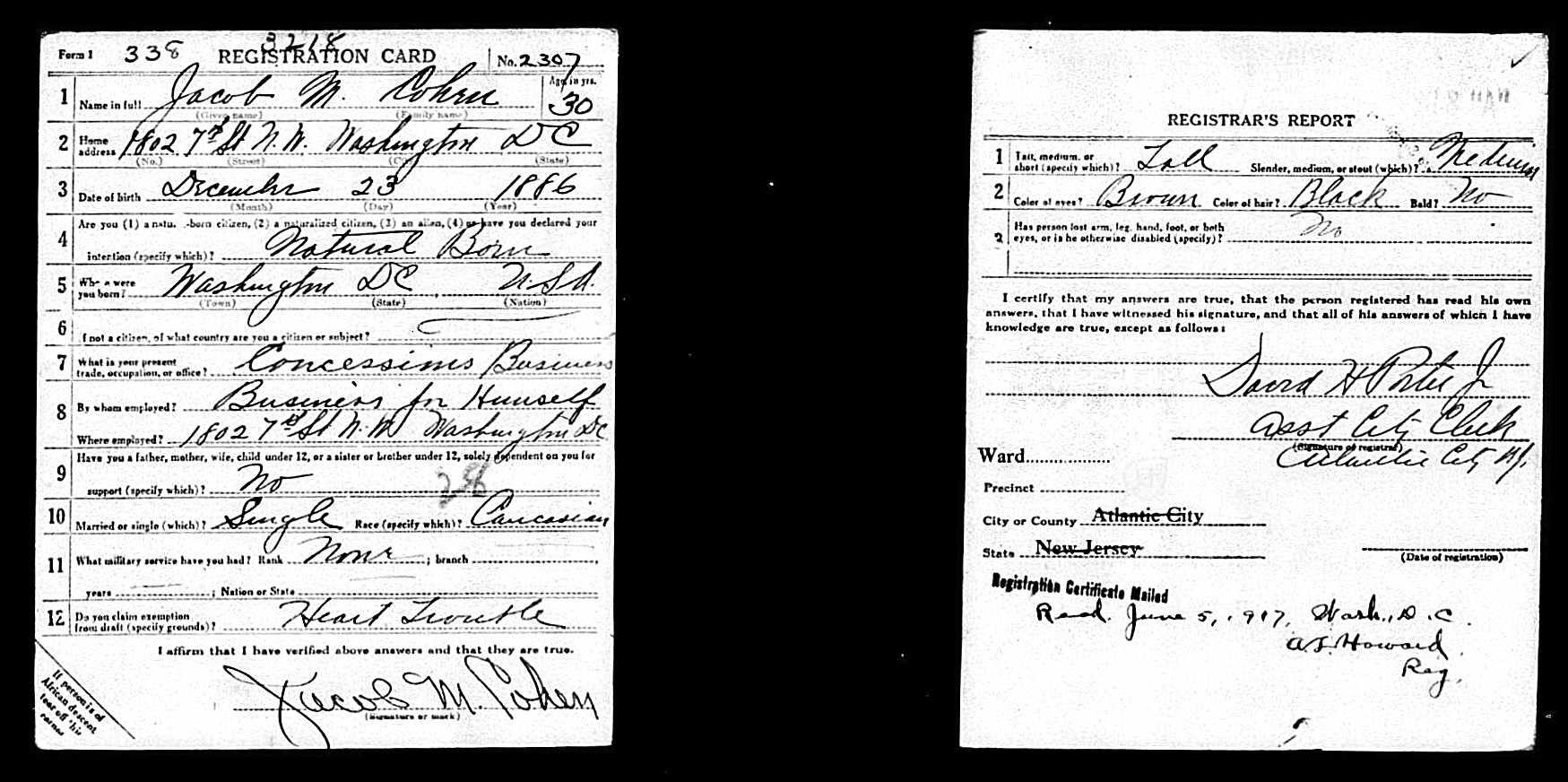
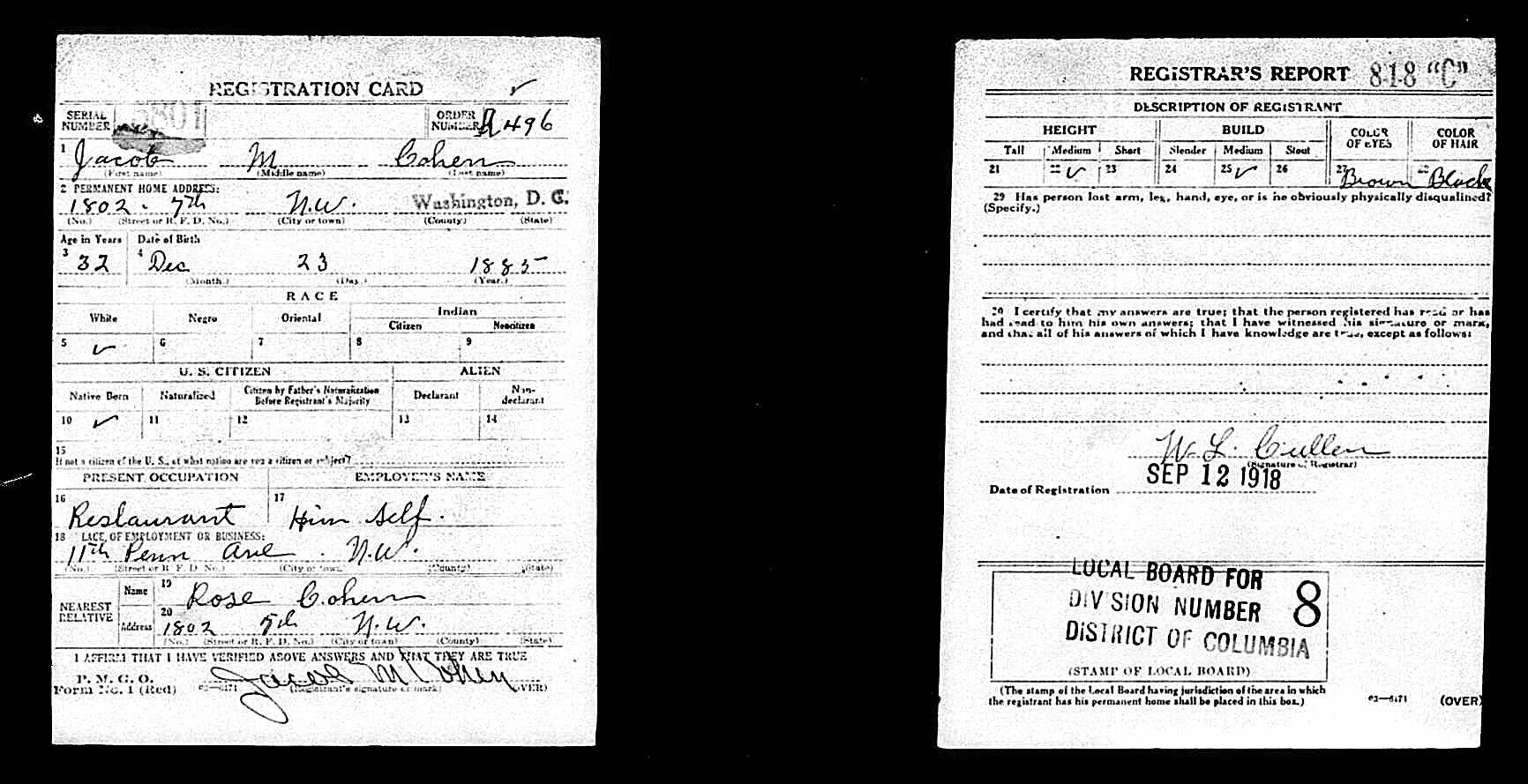
I found two World War I draft registrations for Jacob.  The earlier one, dated June, 1917, listed Jacob’s business as the concessions business and said he suffered from heart trouble.  His marital status was single, and he was living with his father and his sister Frances at 1802 7th Street NW in Washington.  The second one, dated September 1918, had a number of changes:  he was working in the restaurant business and was self-employed, he was married, and there was no mention of heart trouble.

Jacob M. Cohen World War I registration (first)

Jacob M. Cohen World War I registration (first)

Jacob M. Cohen World War I registration (second)

Jacob M. Cohen World War I registration (second)

According to the Philadelphia marriage index, Jacob had married Rose Serge in Philadelphia in 1918.  He was 33, and she was thirty when they married.   In 1918, they were living at 1802 7th Street with Jacob’s father and sister Frances.

In 1920, Hart and his daughter Frances were still living at 1802 7th Street, but Jacob and Rose had moved to their own place in Washington.  Jacob was still in the restaurant business.  Isadore and his family were also still living in Washington, and Isadore was still in the hotel business.

On August 10, 1926, Hart died at the age of 75.  His daughter Frances continued to live in the same residence at 1802 7th Street, now living alone and working as a retail merchant in the dry goods business, a business she had been working in since at least 1915.  She would continue to work in that business until her death in February, 1941, at age 62, the same age her mother had been when she died.  Frances’ death notice said that she had died suddenly. She was buried at Washington Hebrew Cemetery.  There is no mention of her brother Jacob in her death notice, only mention of her brother Isadore.  Frances never married or had children.

Ancestry.com. Historical Newspapers, Birth, Marriage, & Death Announcements, 1851-2003 [database on-line]. Provo, UT, USA: Ancestry.com Operations Inc, 2006.

Ancestry.com. Historical Newspapers, Birth, Marriage, & Death Announcements, 1851-2003 [database on-line]. Provo, UT, USA: Ancestry.com Operations Inc, 2006.

In 1930 Jacob and Rose were living in Philadelphia, where Jacob was the manager of a restaurant.  I could not find Jacob or Rose on the 1940 census, nor can I find a death record for Jacob, but given that he was not listed in his sister’s obituary and that he had had a history of heart trouble, my guess is that he had died before the 1940 census. He would have been younger than 55 years old when he died.  He and Rose did not have any children.

Although I could not find Rose on the 1940 census, she was still alive in 1949, as I found her on a ship manifest traveling to Hawaii. According to the ship manifest Rose was living at 41 Emory Street in Jersey City, New Jersey, in 1949. Rose had lived in Jersey City as a child, and 41 Emory Street is where her mother had been living in 1925 and where two of her sisters were living in 1930. Obviously, Rose had returned to her hometown after Jacob died.  She was still alive in 1952 when her sister Minnie died, but after that I cannot find any mention or record for her.  I tried contacting the funeral home that had handled other deaths in the Serge family, Wien and Wien in New Jersey, but sadly their records for the Jersey City funeral home were burned in a fire fifteen years ago.  I also called the cemetery where Minnie is buried to see if they have any records for Jacob or Rose Cohen, but have not heard back from them.

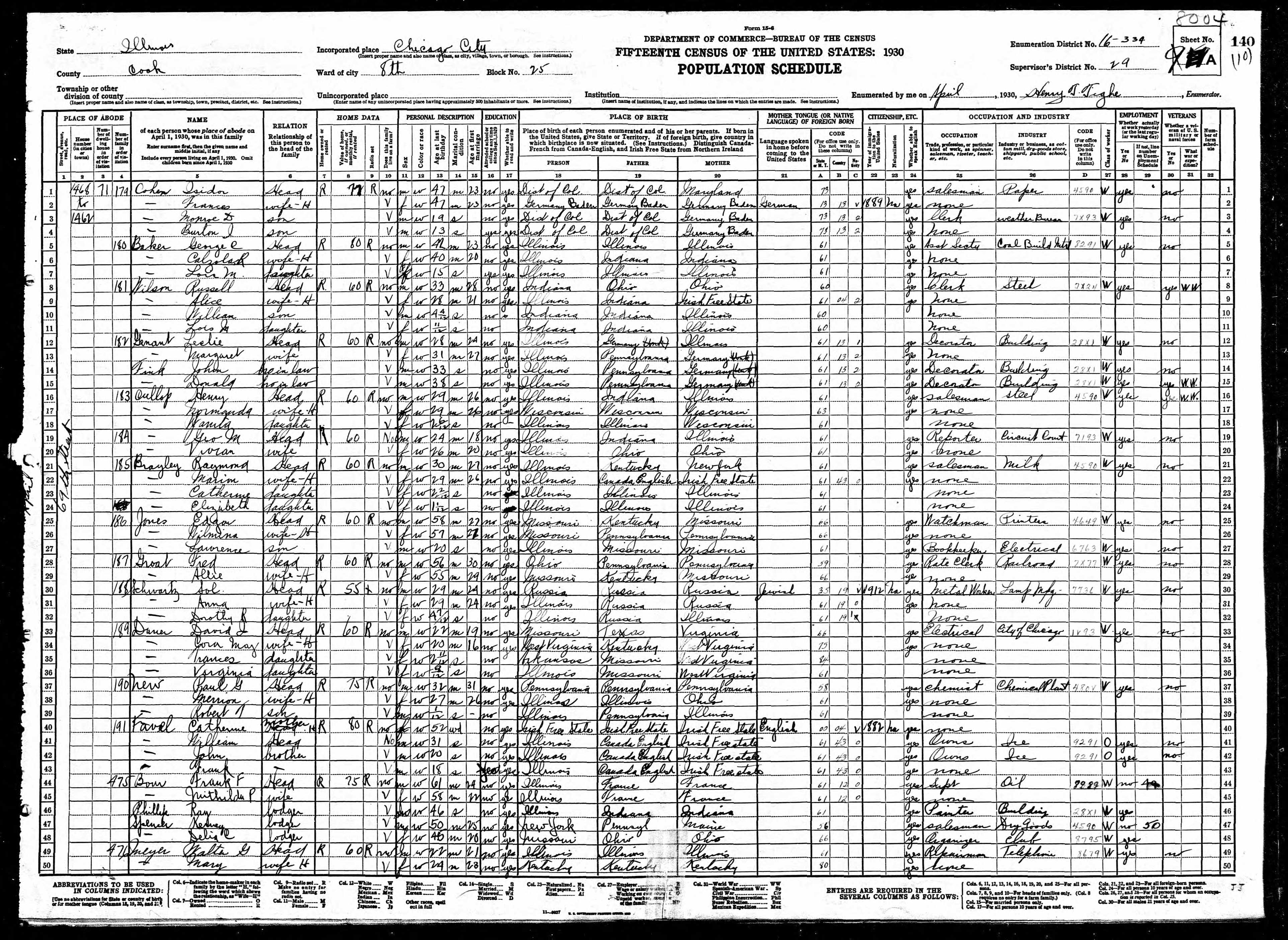
As for Isadore, in 1930, he and his family were living in Chicago, where Isadore was working as a salesman in the paper industry.  His son Monroe was a clerk in the weather bureau there.  I wonder what prompted the move to Chicago and the career change for Isadore.

Isadore Baer Cohen and family 1930 census

Isadore Baer Cohen and family 1930 census

In 1940, the family was still living together in Chicago, and Isadore was a book salesman. Both Monroe and Burton had changed their surname from Cohen to Coulter, though their parents were still using Cohen.   Although Monroe was now 30 and Burton 24, there is no occupation listed for either of them on the 1940 census.

Isadore Baer Cohen and family 1940 census

Isadore Baer Cohen and family 1940 census

By 1942, Isadore had retired, according to his draft registration.  He gave Burton’s name as his contact person, which I found interesting since his wife Frances was still alive at that time.

Isadore Baer Cohen World War II draft registration

Isadore Baer Cohen World War II draft registration

Sometime between 1942 and 1949, Isadore and Frances moved to California, where Frances died in 1949.  Isadore died in 1958 when he was 77 years old.  He lived a much longer life than any of his siblings or his mother.  His father Hart was the only other one to live past seventy.
According to his obituary in the Chicago Tribune of September 8, 1996, Isadore’s son Monroe Coulter had enlisted in the Army Air Corps before World War II and was an electrical engineer.  He married Fannie Simon on November 25, 1942, in Chicago and appears to have settled in Illinois. They had two children.   Monroe worked on the Air Force missile program and retired from the military in 1970 with the rank of lieutenant colonel.  He was living in Itasca, Illinois, when he died on September 6, 1996, and is buried at Shalom Memorial Park in Arlington Heights, Illinois.
His brother Burton moved to California in the 1950s.  He was married and had two children.  In 1952 he was working as the deputy county assessor in Alhambra, California, according to a directory for that city. Then, according to Sacramento city directories,  from at least 1959 through 1966 he lived in Sacramento and worked as an appraiser for the California Department of Equalization, a state agency responsible for administering the state tax laws.   Burton died in Los Angeles, California in 1978.  He was only 61 years old and thus was another family member who did not live to see seventy.

The family line of Hart and Henrietta Cohen thus is somewhat limited.  Of the four children of Hart and Henrietta, only Isadore lived past seventy, and only Isadore had children. Frances never married, and Jacob married, but did not have children. Munroe, Jacob, and Frances all died at relatively young ages, as did their mother Henrietta.  Although Munroe died in an accident, I do not know what led to the early deaths of Henrietta, Frances and Jacob, but will see if I can find out.

I am hoping that one of Isadore’s descendants will be able to provide a Y-DNA test to provide evidence of the genetic link between Moses Cohen, Sr., and my great-great-grandfather Jacob Cohen, but I am having some trouble making contact with them.  They are the only direct male genetic descendants of Moses Cohen, Sr. and thus my only option for finding that genetic connection between Moses and Jacob.  Maybe one of them will find this blog post and find me.
 

Wonderful Surprises and Gifts

I had two wonderful surprises this week.  Usually I am hunting down family members, hoping for a response.  Twice this week I heard from relatives who found me.

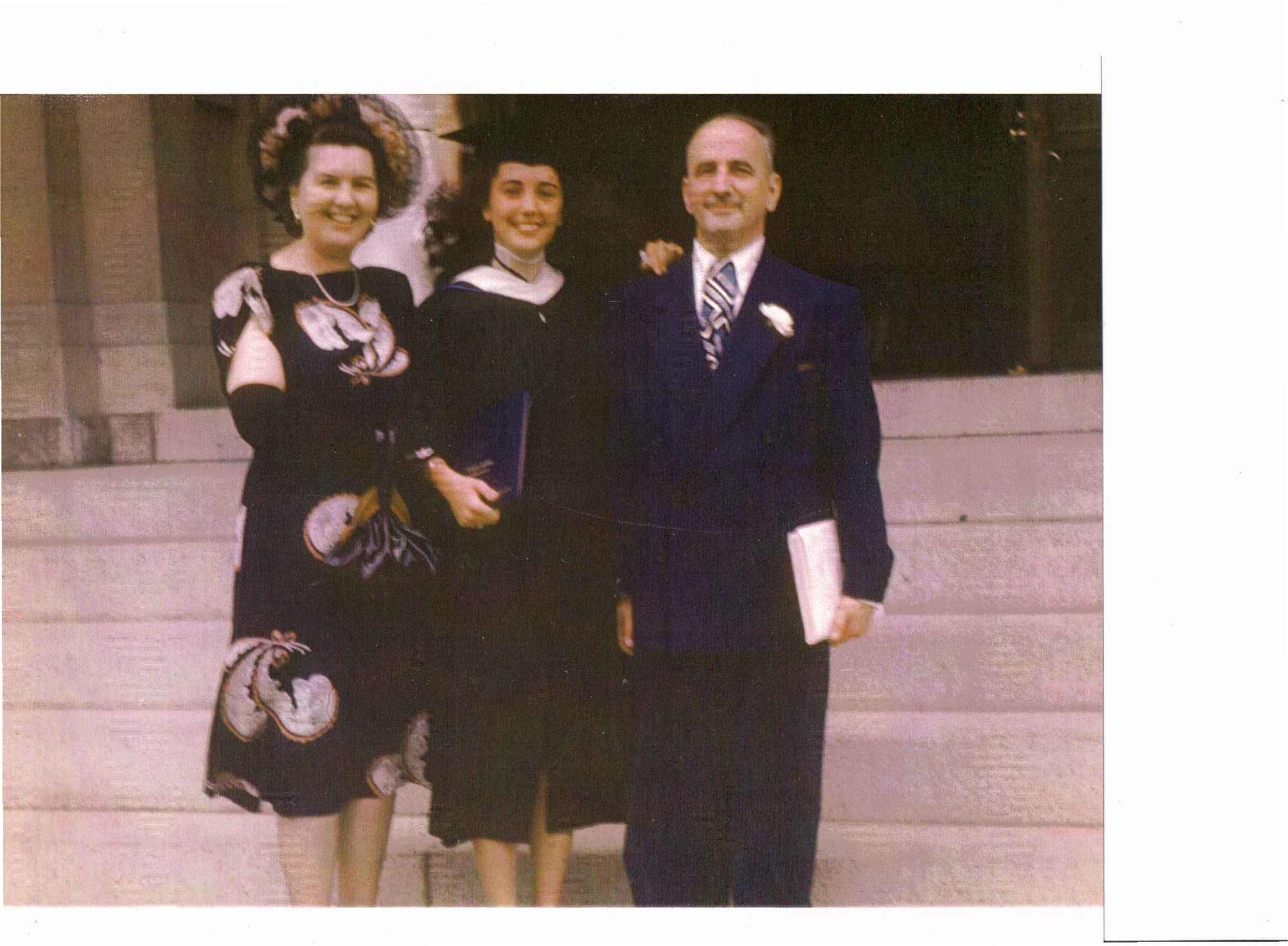
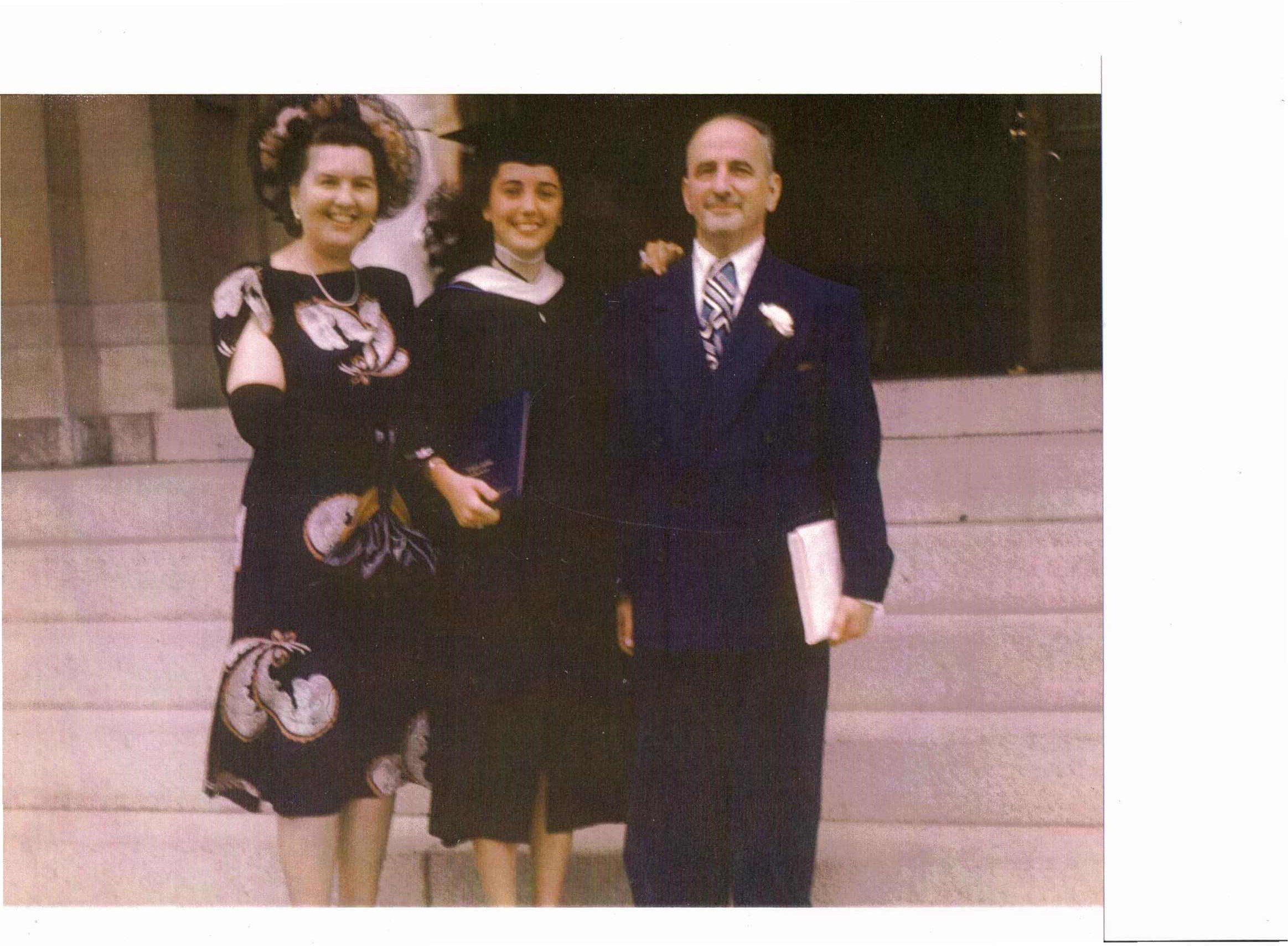
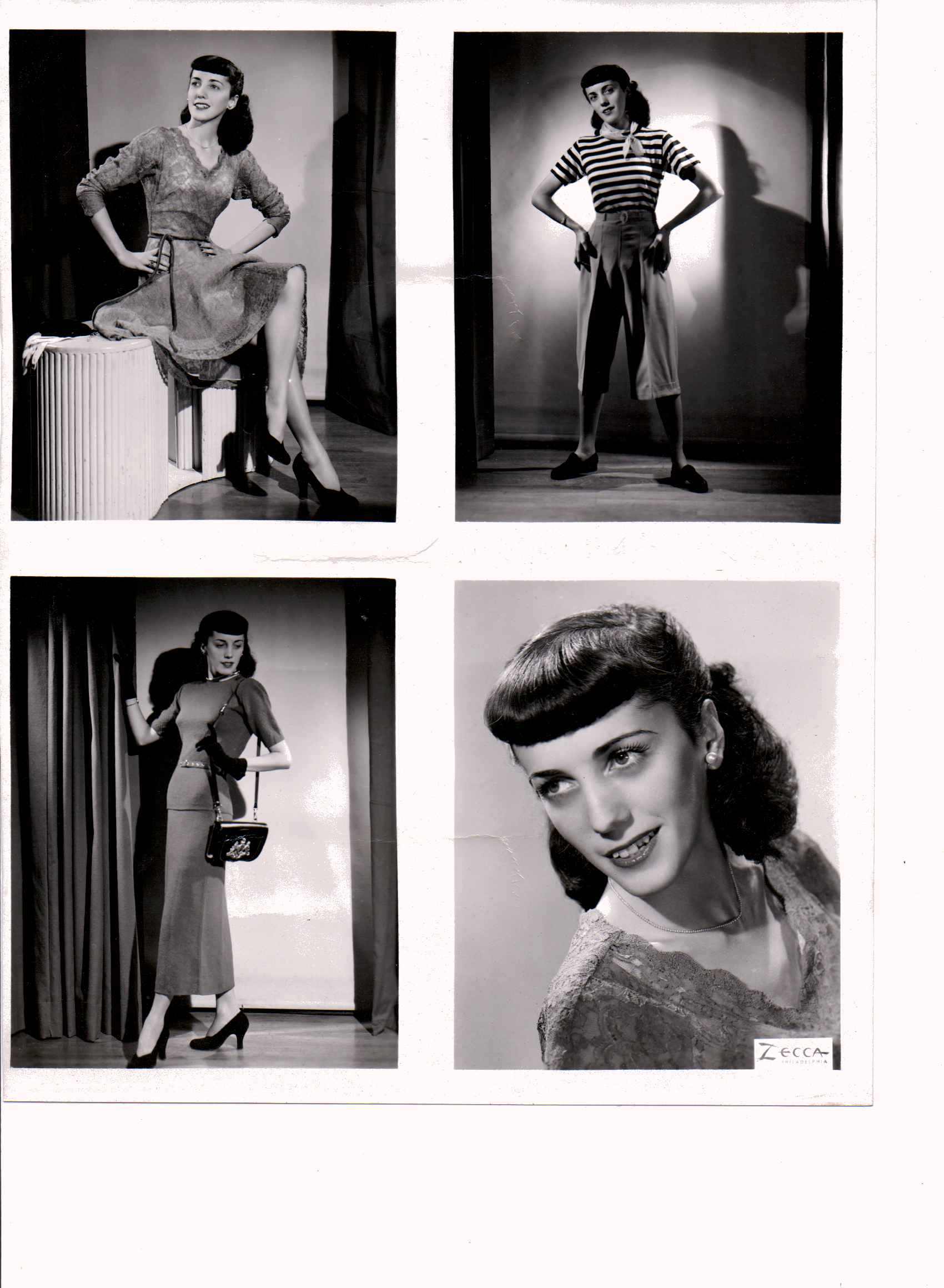
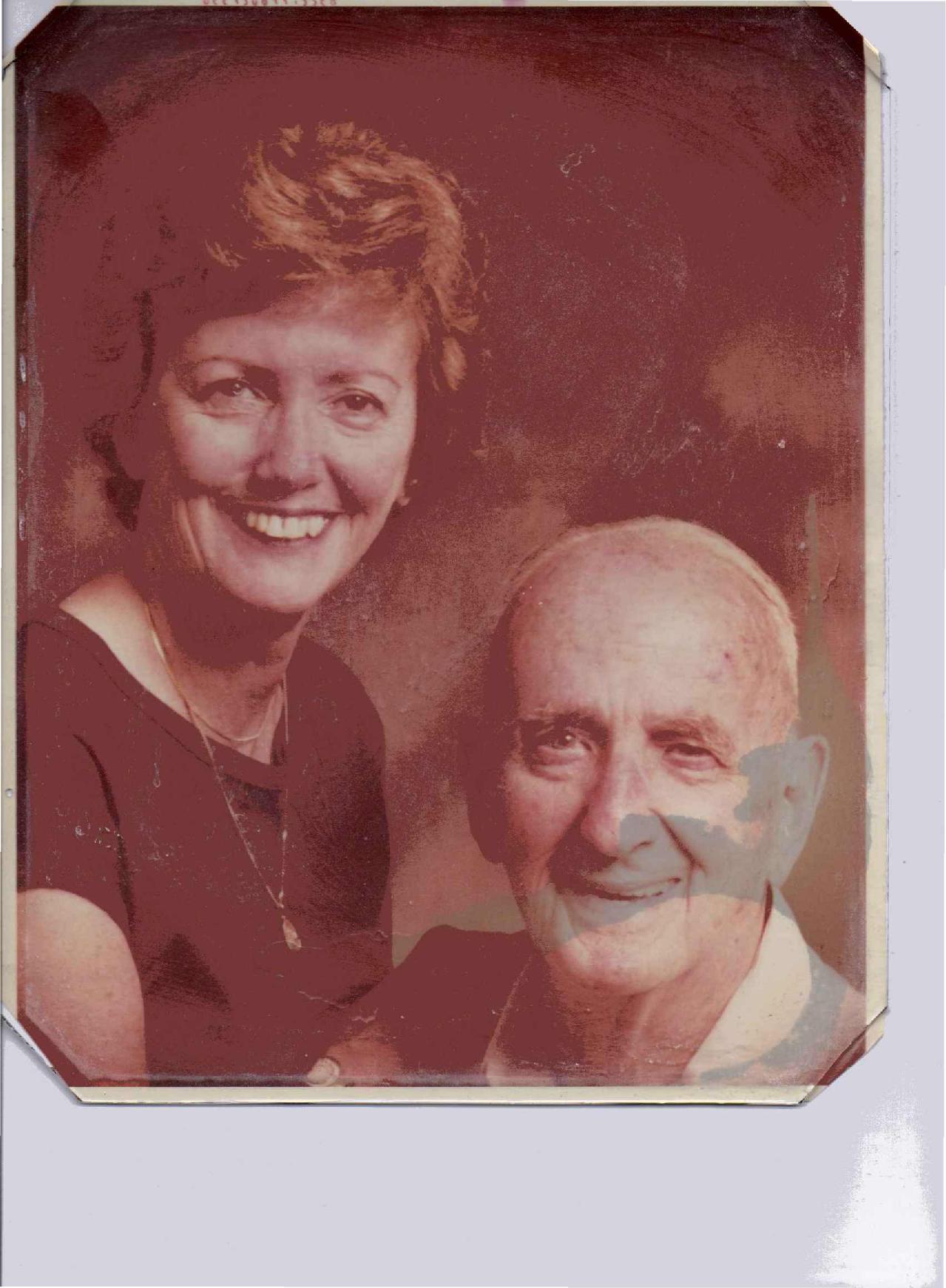
Lou, a relative by marriage, is a cousin of my cousin Marjorie.  He had visited Marjorie recently and heard about my contact with her.  He sent me two wonderful photographs of Marjorie.  One is posted here: a photograph of Marjorie and her parents, Bessie and Stanley Cohen, at her graduation from Trinity College in Washington, DC, probably around 1947.  I’d never seen a picture of any of these family members before, and it was so meaningful to be able to see Marjorie’s face after spending time getting to know her on the phone this summer.  I hope to be able to meet her in person in the coming months.  I also was excited to see what my great-uncle Stanley looked like and what his wife Bessie looked like.   It really helps to bring these people to life when you can put a face to the name.  Bessie and Stanley look so proud of their daughter, a college graduate back when most women did not even dream of going to college.  (The second photograph I will post when I get to my Seligman relatives as it depicts two of them.)

Bessie and Stanley Cohen with their daughter Marjorie at her graduation

Bessie and Stanley Cohen with their daughter Marjorie at her graduation

The second wonderful surprise came in the form of a comment on the blog from a descendant of Julius and Augusta Selinger, their great-grandson Cito.  He had just accidentally found the blog while searching for something else and was pleased to see and learn more about his family’s history.

He then sent me this wonderful photograph of his great-grandfather Julius’ jewelry store.  Although the photograph is not dated, if you look at it closely, you can read the larger sign in the window that says “Sale…Watches…$4,” and see at the bottom “Price during the War +15.”  I am not exactly sure what that means, but I assume that the reference is to World War I, dating the photograph during the second decade of the 20th century.

Selinger's Jewelry Store 820 F Street, Washington, DC

Selinger’s Jewelry Store 820 F Street, Washington, DC

That makes sense because the young woman to the right standing in the doorway is assumed by the family to be Eleanor Selinger, the daughter of Julius and Augusta who married Henry Abbot and moved to London in 1926.  Eleanor would have been about 22 years old in 1917 when the US entered World War I.  I love being able to see Eleanor’s face also.  She has such a searching, pensive look on her face—what was she thinking?  You can see the reflections of a crowd of people looking into the window as well as some of the buildings across the way.  The store was at 820 F Street in Washington, DC.  Perhaps some of you recognize that location?

Thanks to both Lou and Cito for generously sharing these photographs and for contacting me.  I am so happy that you both were able to find me.  I also received photographs from another family member this week, my cousin Jack, the great-grandson of Joseph Cohen, who was my great-grandfather Emanuel’s older brother.  I will post some of those photographs next week after I have a chance to scan them.

So it’s been a great week to be doing genealogy research.  I am feeling very fortunate for all the gifts that genealogy has provided to me.  Happy Labor Day Weekend, everyone!


Elizabeth Cohen’s Descendants: The Story Continued

In an earlier post, I detailed the difficult search for the story of Elizabeth Cohen and the lucky break I had in finding one little newspaper mention of a charitable donation that opened the door to the rest of her story: that she had first married Benjamin Heyman and had two children, Florence and Herbert, that Benjamin had died before Herbert was two years old, and that Elizabeth later married Bernard Sluizer with whom she had another child, Mervyn Sluizer.  That was where the post ended.

I have been very lucky again in finding one of Bernard and Elizabeth Sluizer’s great-granddaughters, Janet Elizabeth Sluizer (named for her great-grandmother, Elizabeth Cohen Sluizer).  I now know more about Bernard and about their descendants including some photographs that bring these names to life.  Bernard was the first born child of Meyer and Margaret (nee Lince) Sluizer, who were both born in Holland in the early 1830s.  The records conflict as to when they arrived in the US, but by 1860 they were certainly living in Philadelphia as Meyer filed a Declaration of Intent to become a citizen that year and Bernard was also born in Philadelphia in 1860.  Meyer was first a tobacconist and later became a china dealer, according to several Philadelphia directories.  He and Margaret had six more children, the last born in 1877.  Meyer died in 1880, leaving Margaret with many young children still at home.  Margaret lived to be 88, dying on August 20, 1921.

Bernard, who was twenty when his father died, was employed as a salesman in 1880, but no specific business was given on the 1880 census.  He remained a salesman of some kind at least until he married my great-grandaunt Elizabeth Cohen in 1892, when not surprisingly he became a pawnbroker.  As I’ve already written, Bernard took in Elizabeth’s two children from her prior marriage to Benjamin Heyman, and then in 1893, Bernard and Elizabeth had a child of their own, Mervyn.

Mervyn married Irma Wise in 1916 when he was 23 years old and she was 21.

Mervyn Sluizer, Sr.

Mervyn Sluizer, Sr.

Irma Wise Sluizer

Irma Wise Sluizer

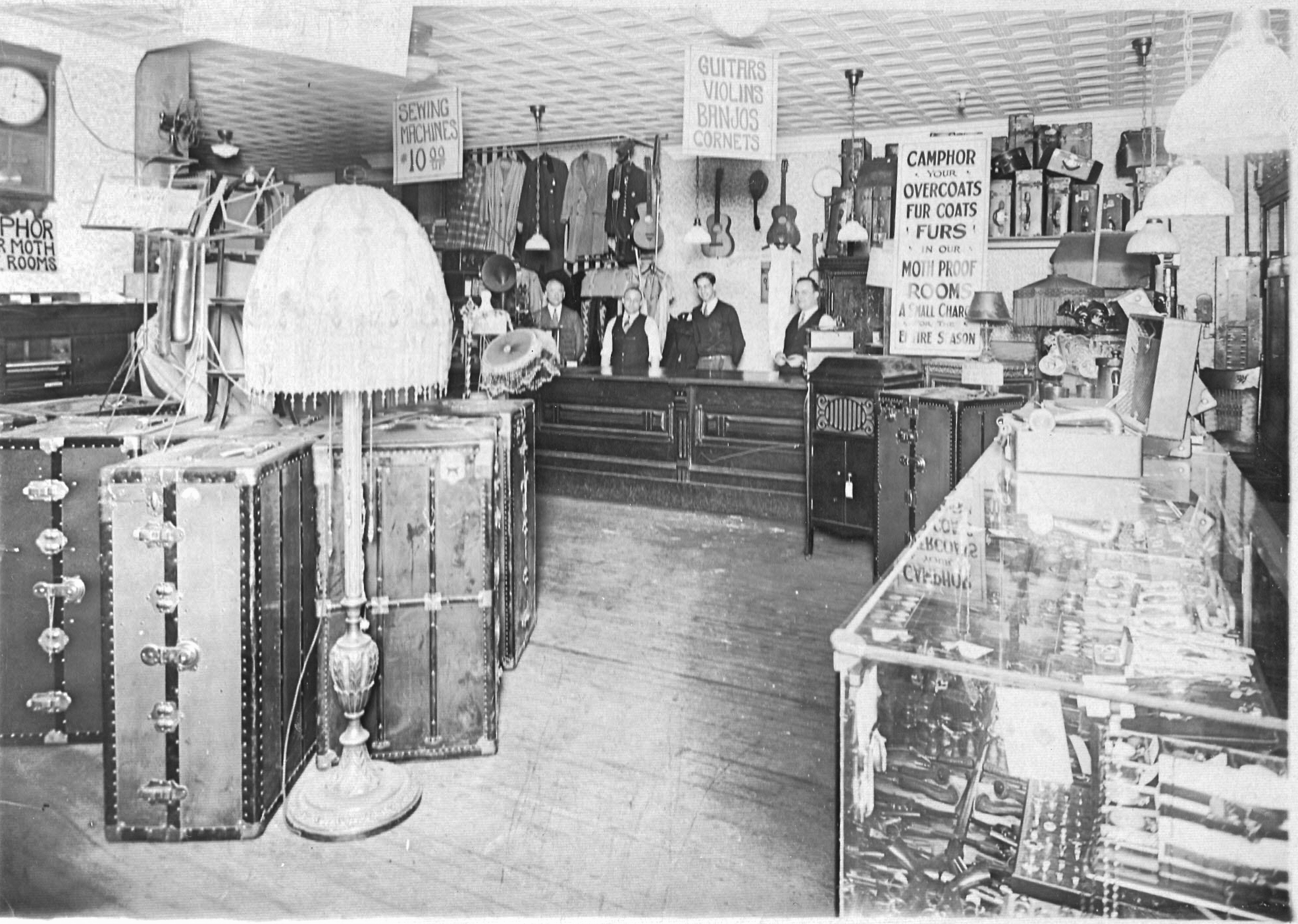
Mervyn also became a pawnbroker, working in his father’s store. Here is a wonderful photograph of Bernard (far left) and his son Mervyn (far right), working in his pawnshop.  This is the first photograph I have seen of one of the many family pawnshops.  I love the musical instruments in the background, the huge trunks in the foreground, and all the other signs and details that help convey a sense of what these stores were like.

Bernard Sluizer's pawnshop Bernard, far left; his son, Mervyn, Sr., far right

Bernard Sluizer’s pawnshop
Bernard, far left; his son, Mervyn, Sr., far right

Mervyn and Irma had two children, Mervyn, Jr., born in 1920, and Margaret, born in 1924.  Margaret must have been named for Mervyn’s grandmother, Bernard’s mother, Margaret.  It is a little surprising that Mervyn did not name his daughter for his mother, Elizabeth, who had died in 1923, instead of his grandmother, but perhaps it was just too close to the time she had died.  In 1930, Bernard, now a widower, was living with Mervyn, Irma, and their children.

Sometime between 1932 and 1935, Mervyn and Irma divorced, according to their granddaughter Jan Sluizer.  On the 1940 census, Irma was living with her two children, Mervyn, Jr. and Margaret.  Mervyn, Sr., had remarried by 1940 and was living with his new wife, Anne, and her two children from a prior marriage, Bernard and Sidney Riskin.  Mervyn Sr.’s father Bernard was also living with him and his new family.  Mervyn, Sr., and Anne moved to Atlantic City sometime after the census and were living there for several years.

Mervyn Sluizer's house in Atlantic City

Mervyn Sluizer’s house in Atlantic City

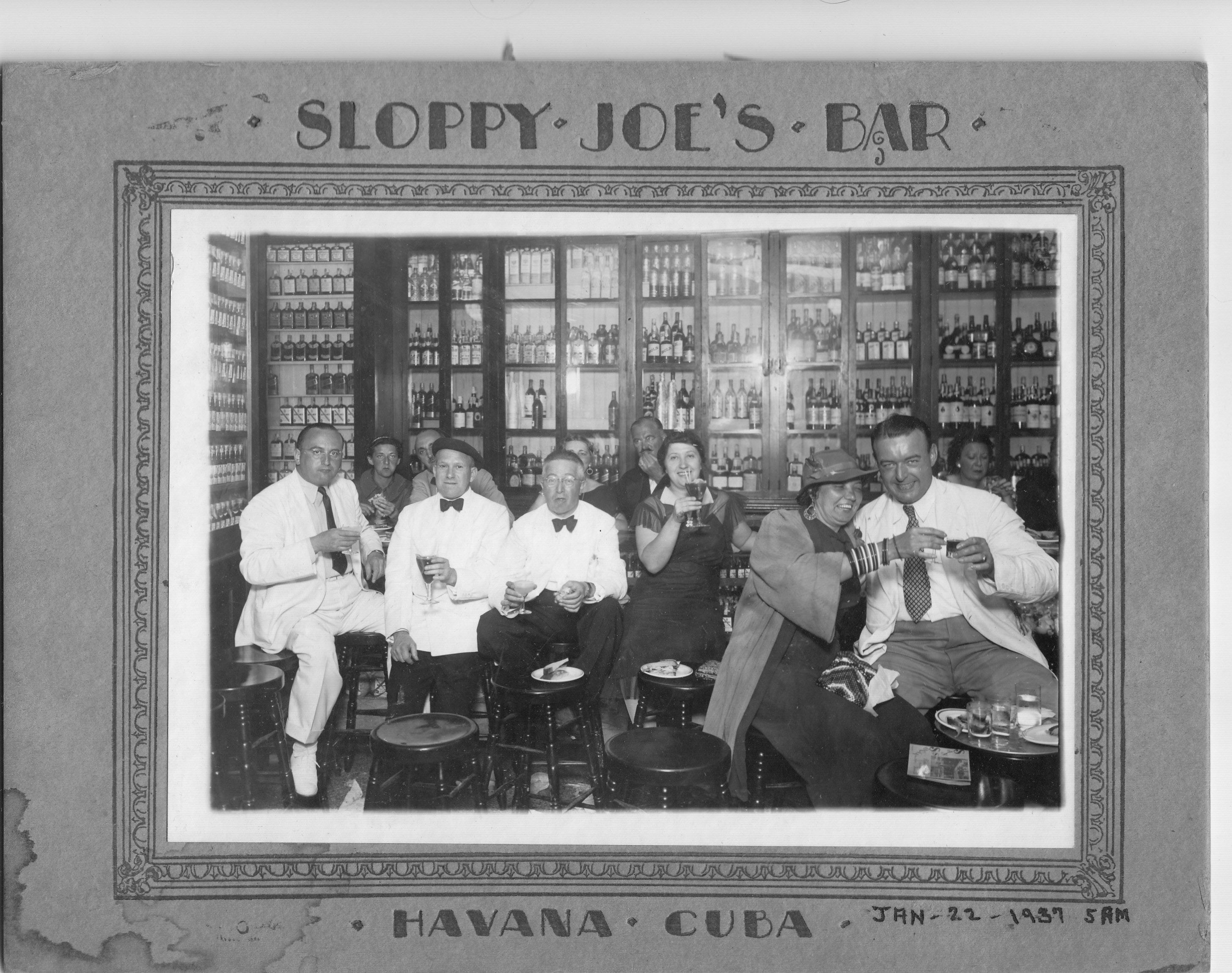
Mervyn, Sr. (far left) and Anne (center) in Havana, 1937

Mervyn, Sr. (far left) and Anne (center) in Havana, 1937

Mervyn Sluizer, Sr., third from right

Mervyn Sluizer, Sr., third from right

Anne and Mervyn Sluizer, Sr., far left

Anne and Mervyn Sluizer, Sr., far left

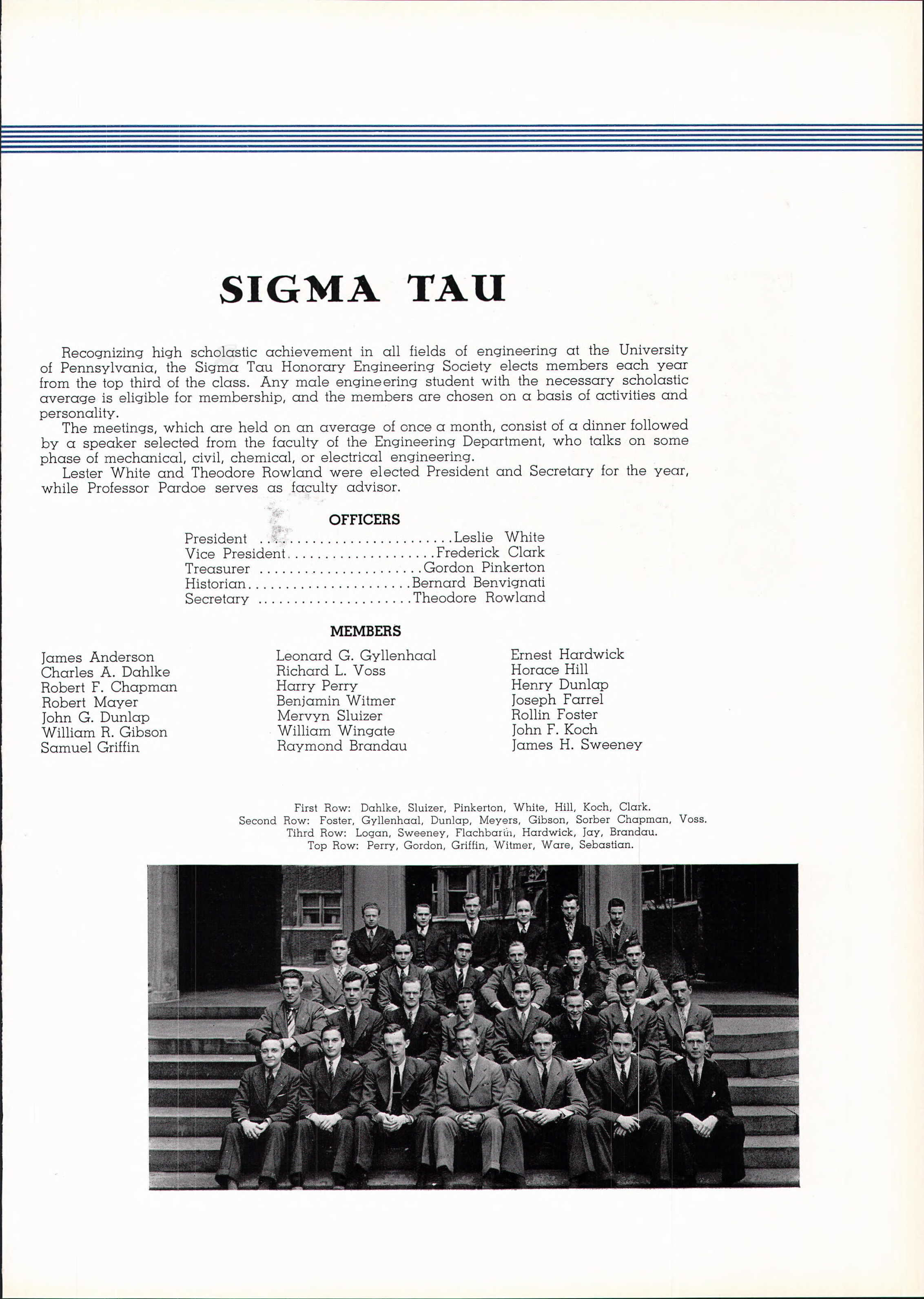
In 1941, Merv, Jr., graduated from the University of Pennsylvania, where he was an engineering student and a member of Sigma Tau, the engineering honor society.

1940 University of Pennsylvania Yearbook

1940 University of Pennsylvania Yearbook

Merv Penn 2

(Ancestry.com. U.S. School Yearbooks [database on-line]. Provo, UT, USA: Ancestry.com Operations, Inc., 2010.
Original data: Various school yearbooks from across the United States.)

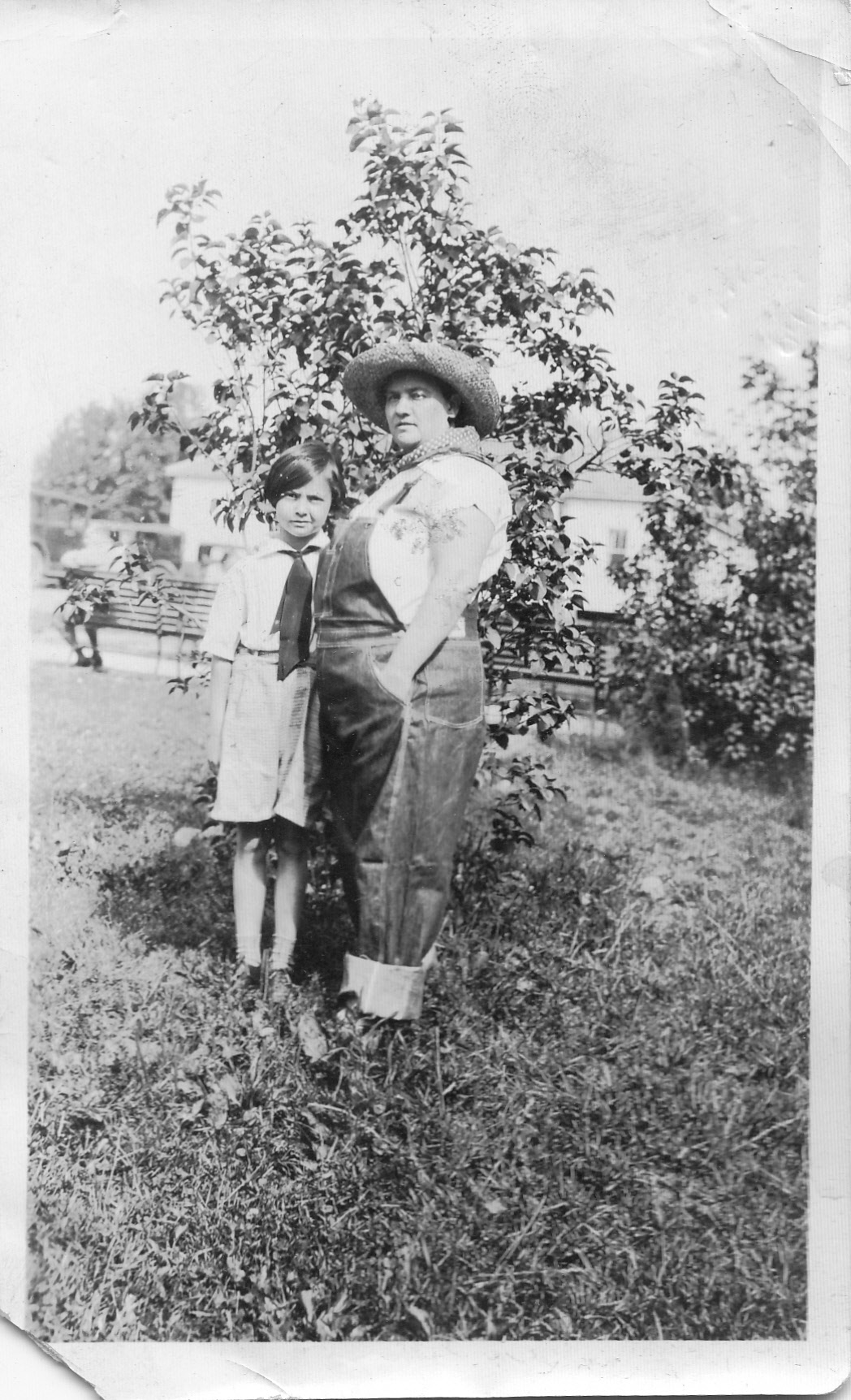
His grandfather Bernard died in 1944, and six years later his father Mervyn, Sr., died also.  Mervyn, Sr., was only 57 years old.  Meanwhile, in 1942 Mervyn, Jr., had married Shirley Harkaway, whom he had met at the University of Pennsylvania.  Here is a picture of Shirley as a young child with her mother Ida,  as well as a picture of Ida as a child with her sisters:

Shirley Harkaway with her mother Ida Lutsky Harkaway

Shirley Harkaway with her mother Ida Lutsky Harkaway

Ida Lutsky, rear center, with her sisters

Ida Lutsky, rear, right, with her sisters


Mervyn, Jr. and Shirley had two children, including Jan, the cousin who has supplied me with all of the wonderful photos posted here.

Mervyn Sluizer, Jr.

Mervyn Sluizer, Jr.

Mervyn, Jr.’s sister Margaret also married and had three children.  Her husband, Dr. Manfred Goldwein, had been one of the children who had been taken out of Europe to England on the Kinder Transport to escape the Nazis; the rest of his family was killed in the Holocaust.  He became a medical doctor and one of the top rated doctors in Philadelphia.

Jan also provided me with two newspaper articles about her father, Mervyn, Jr., including his obituary.  Both portray a man who was a lifelong volunteer in his community and one who had a special passion for the Boy Scouts. The first article, published by the Philadelphia Jewish Exponent in August, 1962, when Mervyn, Jr., was 42, described his history of service to his community.  According to this article, Mervyn, Jr., was active in the Allied Jewish Appeal in Philadelphia and had recently been named Chairman of its Metropolitan Division after serving as Vice Chairman and also playing an active role in the organization since 1948.  He also was active in B’Nai Brith and on the national board of trustees of his college fraternity.   He had been actively involved in scouting since he was a boy and was at that time the scoutmaster of Troop 185, which was affiliated with Adath Jeshurun synagogue.  Mervyn Jr.’s grandfather, August Wise, his mother’s father, had been one of the founding members of Adath Jeshurun.  Mervyn was himself a member of Beth Tikvah synagogue and served at one time as its president.

Mervyn Sluizer, Jr.

Mervyn Sluizer, Jr.

Philadelphia Jewish Exponent August 1962

Philadelphia Jewish Exponent August 1962

Irma Wise Sluizer (1895-1969)

Irma Wise Sluizer
(1895-1969)

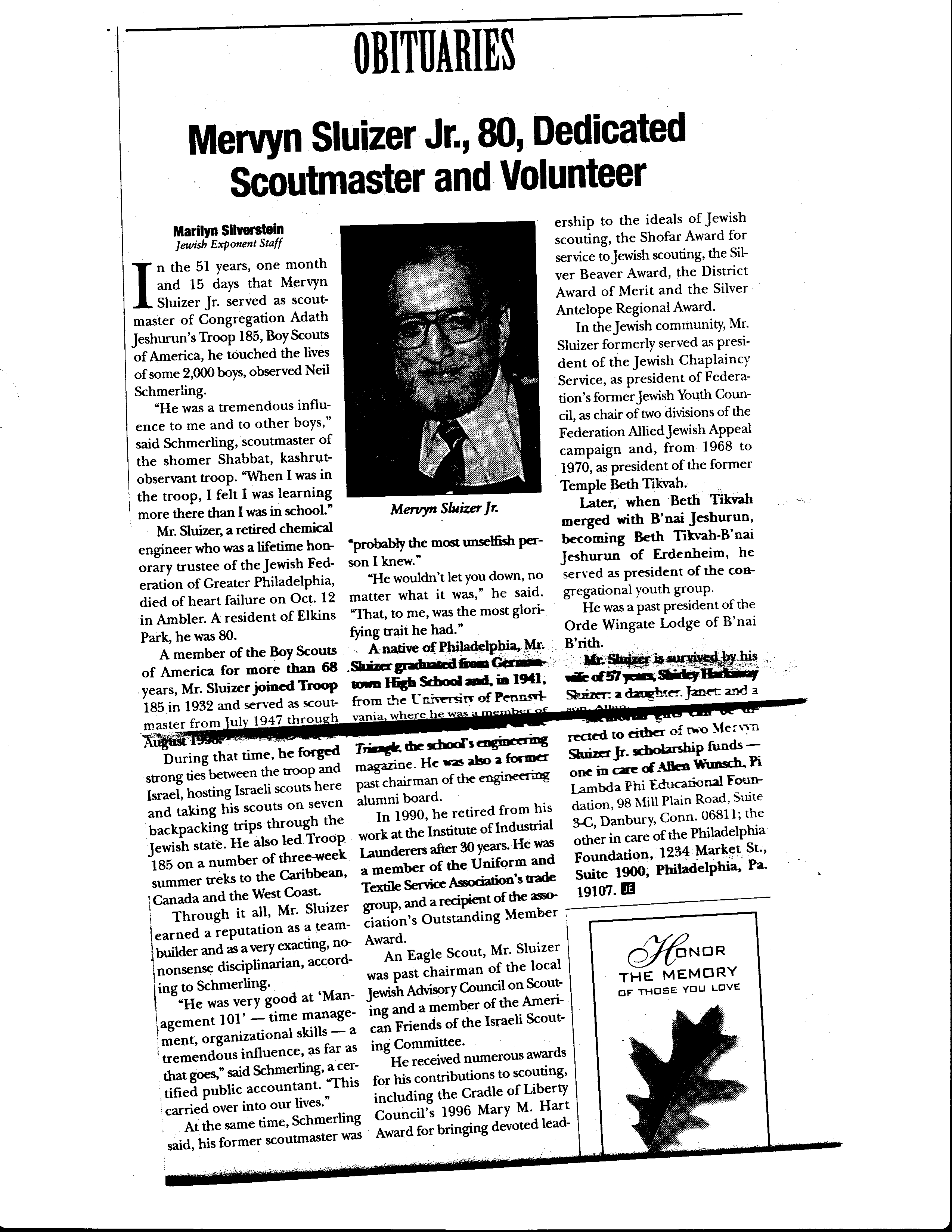
Mervyn Sluizer, Jr., died on October 12, 2000.  He was eighty years old.  The obituary below, which appeared in the Philadelphia Jewish Exponent, also portrays a man who lived a full life, dedicated to service and to his profession as well as to his family.  There is a scholarship in his name created by alumni of his troop, Philadelphia Troop 185, to honor his memory and to provide financial support for Philadelphia area Boy Scouts pursuing higher education. It is specifically provided to Eagle Scouts, as Mervyn spent a great deal of time helping scouts achieve that difficult level of scouting.   There is also a second scholarship in his name sponsored by his fraternity at the University of Pennsylvania, Pi Lambda Phi.

Mervyn Sluizer, Jr. obituary

Mervyn Sluizer, Jr. obituary

My great-grandaunt Elizabeth Cohen, who died when her grandson Mervyn, Jr., was only three years old, would undoubtedly have been very proud that he grew up to be such a generous and decent man, a college educated professional, one of the first in the family, and a man who gave so much to his community.  He would have turned 94 just this past weekend on July 12.


Seeing the Forest: In Memory of Jacob and Sarah Cohen and All their Children


When doing genealogy research, I often find I get very focused on one person or one couple or sometimes one nuclear family and forget to think about the bigger picture, the extended family and their history.  This has been particularly true in researching my great-great grandparents Jacob and Sarah Cohen and their thirteen children.  Each one of those children was a story unto itself; each of their nuclear units told a complete story.  Doing the research for each of them brought me into their individual lives—their relationships, their careers, their children, their achievements, and their tragedies.

Leaf lamina. The leaf architecture probably ar...

Leaf lamina. The leaf architecture probably arose multiple times in the plant lineage (Photo credit: Wikipedia)

It was only when I got to child number eleven, my great-grandfather Emanuel, that I realized I had lost the bigger picture.  His life was not only about his adulthood—his wife and his children and grandchildren, but was also shaped by and always affected by what was happening with his extended family—his parents, his siblings, his nieces and nephews. It was then that I looked at the overall timeline to see what was happening outside his nuclear family as well as within it.

Now looking back and trying to get that bigger picture overall, I can make some fairly general observations about these thirteen children and their extended family.  First, they were all very interconnected in their work as well as their personal lives.  Almost all the men, including many of the brothers-in-law and sons-in-law, were pawnbrokers.  I don’t have a very good sense of how many separate stores there were in the Cohen pawnshop industry, but obviously there were enough to support more than a dozen families, including a family as large as that of Reuben Cohen, Sr., with his many children.  Yes, there were some trouble spots and some disputes undoubtedly, but this was a family that worked together and lived together, often within blocks of each other.  One project I have in mind at some point is creating a map to show where they all were living at a given point in time.  This was a family where almost everyone stayed in Philadelphia or perhaps New Jersey for multiple generations at least until the 1930s or 1940s.

Every tragedy—the deaths of so many young children, the premature deaths of so many young adults, the horrible accidents—must have rippled through the entire family in some way.  This was a family that suffered greatly over and over again—perhaps no more than any other of its time, but nevertheless, more than most of us can imagine today.  Almost every one of them lost at least one young child; some lost several.   Reuben and Sally lost ten children.  Some, like my great-grandparents and Reuben, not only lost a young child, but also lost adult children who died too young.

Yet this was also a family that triumphed.  Most of them lived fairly comfortably, if not luxuriously.  They moved to the northern sections of Philadelphia away from the increasingly poor sections where Jacob and Sarah had settled at 136 South Street.  Many had servants living with them, even when they had only a few or even no children.  These were not college-educated people.  Most did not even finish high school.  But they were savvy business people who, as far as I can tell, for the most part operated their businesses honestly but successfully, as the profile of Reuben Cohen described.  They saw themselves as money lenders, as the banks for those who could not borrow money from a traditional, established bank. Some were more successful than others, but overall this was a family that came to America in the 1840s and made a good life for themselves and their descendants.

Looking back on those times makes me wonder what happened.  How did this large, interconnected family lose touch with each other?  It’s not just my father’s immediate line that was disconnected; every Cohen descendant I’ve been able to locate says the same thing—that they had no idea about all these other cousins and Cohen relatives.  My father said he had no idea that his father had cousins.  I counted sixty-nine grandchildren born to Jacob and Sarah Cohen.  Even if you subtract the many who did not survive childhood, there were probably fifty—meaning that my grandfather had fifty living first cousins, mostly living in Philadelphia, yet my father did not know of any of them.

I suppose that that is how it is as families grow, children marry, grandchildren are born.  You no longer can fit everyone around the table even for special occasions.  Other families also need attention—the in-laws and all their relatives.  Especially back then, before the telephone and the automobile and certainly before the internet, Facebook, Google, email, and cellphones, it was just too hard and too expensive to stay in touch if someone was not in your immediate neighborhood and your day-to-day life.  We all know how hard it is to stay in touch even with all those modern means of communication.

So people moved away, grew apart, and lost touch.  At least now we can all benefit from knowing the bigger picture, from looking at our shared history, and knowing that even if we do not know each other, we are all part of the same tree.


Thanks to Rabbi Albert Gabbai of Mikveh Israel Congregation in Philadelphia, I now have photos of the headstones for Jacob and Sarah.

jacob headstone enhanced 2

Headstone for Jacob and Sarah Cohen

Jacob Cohen's headstone enhanced

They are not very legible, but you can clearly see Jacob’s name in English, and with the help of others, I’ve been told that the Hebrew includes Jacob’s name, Yaakov ben Naftali ha Cohen, and his date of death, 13 Iyar 5648, or April 24, 1888.  It also apparently has a reference to London as his birthplace.

Jacob headstone from FB

The side for Sarah (the second one above)  is almost completely eroded, so no one could decipher it.    Rabbi Gabbai also found the stone for Hart Levy Cohen, but he said it was nothing but a plain stone as all the engraving had eroded so he did not take a picture.  I wish that he had, but did not have the heart to ask him to go back to the cemetery.

All that is left is for us to remember them and their children and their grandchildren.