The Surviving Children of Reuben and Sallie Cohen, Part I: Minnie, Rae, Reuben, Jr., Lewis and Violet Mae

As I wrote last week, Reuben and Sallie Cohen had seventeen children, but ten of them predeceased their parents. Eight of the children died before they were four years old of various illnesses or, in the case of one child, as a result of a horrific accident.  Two of the children survived to adulthood, but then succumbed to illnesses in the early years of their adult lives.

That meant that Reuben and Sallie had only seven of their seventeen children alive when they died.  All but one of those children lived relatively full lives, living at least into their sixties if not beyond.  I will try and capture those lives, going in birth order.

The fourth child born after Sallie R., Jacob, and Hart, all of whom had died before their parents, was Minnie.  Minnie was born on September 25, 1882, and lived with her family in Philadelphia and Cape May.  On August 5, 1900, the Philadelphia Inquirer made this comment about Minnie in an article about summer visitors to Cape May:  “Miss Minnie Cohen is one of the prettiest girls at the resort.  Her bathing costume is always the picture of neatness.”  (“Cape May’s August Days,” Sunday, August 5, 1900, Philadelphia Inquirer (Philadelphia, PA)   Volume: 143   Issue: 36)

It was not until eighteen years later when she was almost 36 that Minnie married Harry Frechie in February, 1918.  The Philadelphia Inquirer had this to say about her wedding:

Minnie wedding

(“Matrimony Notice,” Friday, February 15, 1918, Philadelphia Inquirer (Philadelphia, PA)   Volume: 178   Issue: 46   Page: 10)  Mrs. S. Rosenblatt was her sister Rae, discussed below.  Violet Mae was her youngest sister, also discussed below.

Minnie and Harry were married for many years, but did not have any children. Like his father-in-law and many other family members, Harry was a pawnbroker. They appear to have traveled quite a bit, including a Caribbean cruise in 1939.  I have not yet been able to find a death record for Harry, but the 1950 Philadelphia city directory has a listing for Mrs. Harry Frechie alone, suggesting that Harry may have died sometime between the 1940 census and 1950. I also could not find a World War II draft registration for Harry, which could suggest he died before 1942.

UPDATE: With the release of the Pennsylvania death certificates through 1944, I am now able to update this post and the information regarding Harry Frechie.  Harry did die before 1942; he died on September 27, 1940.  No cause of death was given as there was a pending coroner’s inquest.  I will have to see if I can learn more about that.

Harry Frechie death certificate 1940

Harry Frechie death certificate 1940

At any rate, Minnie appears to have lived a life without much controversy as I cannot find any newspaper references to either Harry or Minnie aside from the wedding notice.  Minnie died in Philadelphia in 1977 when she was 95 years old.

Minnie’s sister and matron of honor, Rae, was the next child who survived.  She was born in 1886.  Rae married Samuel Rosenblatt in 1910.[1]  Sam was in the business of dress manufacturing according to the 1920 census, more specifically children’s dresses according to both the 1930 and 1940 census reports. They had one son, Samuel Rosenblatt, Jr., born in 1913, who died in July, 1933.  I have not found anything yet to explain why Samuel, Jr., died at such a young age.  The Philadelphia death certificates through 1944 are supposed to be online soon, so I am hoping to find out eventually what happened to Rae and Samuel’s only child.  Rae died in 1959 at age 73.  Her husband Samuel died in 1973.

UPDATE:  As noted above, I now have access to the Pennsylvania death certificates through 1944, including that of Samuel Rosenblatt, Jr.  Sadly, Samuel died from leukemia.

Samuel Rosenblatt, Jr. death certificate 1933

Samuel Rosenblatt, Jr. death certificate 1933


The next child of Sallie and Reuben Cohen to survive his parents was Reuben Cohen, Jr., born November 5, 1888.  Although at age 21 he was working as a clerk in a loan office according to the 1910 census, he appears not to have stayed in the pawnbroker business for his entire career.  In 1914, he married Leona Mayer, and according to the 1915 Philadelphia directory, he was a notary public by occupation at that time.  I don’t know how that would be a full time occupation, so perhaps he was still working in the “loan office” at that time as well.  In fact, on his World War I draft registration he listed his employer as his father, Reuben Cohen, Sr., so he must have still been working the pawnshop at that time.  In 1920, his occupation on the census is described as manager of a brokerage house, presumably a pawn brokerage, not a stock brokerage.  But in 1930 Reuben’s occupation was listed as a textile designer, and then in 1940 he is described as a salesman in textile manufacturing.  On his 1942 World War II draft registration, he listed his employment as “own business.”  Thus, it appears that Reuben, Jr., went out on his own and left the Cohen family pawnbroker business.

Reuben, Jr., and Leona had one child, Elinor Cohen, born in April, 1915, who married Melvin Beard.  I am now trying to contact their descendants.  Reuben Cohen, Jr. died January 28, 1958, when he was 69 years old.  His wife Leona died in 1970 at age 78.  Their daughter Elinor died thirteen years ago in 2001.

Reuben Jr.’s younger brother Arthur was the next sibling to survive their parents, but I am going to defer telling his story until I get a little more information from one of his descendants.

Of the seven surviving children, the one I have had the hardest time tracking is Lewis Cohen, who was born in September, 1892, the thirteenth child of Reuben and Sallie.  According to his World War I draft registration in 1917, he suffered from “nervous trouble.”

Lewis Cohen World War I draft registration

Lewis Cohen World War I draft registration


He was working as a real estate broker, and I was able to find a number of his real estate broker’s advertisements in the Philadelphia Inquirer as well as a news story about a large real estate transaction he brokered for a client in 1922.  On the 1920 census he was still living at his parents’ home at age 28, and as far as I can tell, he never married or had children.

It’s very odd, but I cannot find Lewis on either the 1930 census or the 1940 census, and at first I thought that perhaps he had died.  Then I found his 1942 World War II registration, in which he described himself as self-employed.  He was then living at the Roosevelt Hotel in Rittenhouse Square in Philadelphia, and his emergency contact person was a woman named Hilda Eskin, also at that location.

Lewis Cohen World War II draft registration

Lewis Cohen World War II draft registration

Where was he between 1920 and 1942?    I just cannot seem to find him. Is there any significance to the scar on his left wrist? To the fact that he was cross-eyed?  And who was Hilda Eskin? The only Hilda Eskin I could find in 1940 in Philadelphia was a divorced 45 year old woman, living with her parents; she owned a millinery shop.  She and her parents were living in 1940 at 329 South 63rd Street, about four miles west and across the Schuylkill River from the Roosevelt Hotel.  Since Hilda was not an employee of the hotel in 1940 and owned her own business, my hunch is that she was Lewis’ girlfriend in 1942, living with him at the Roosevelt Hotel.  I could not find Lewis living at that address in 1940.  I did find one Lewis Cohen as a prisoner at the Eastern State Penitentiary in Philadelphia whose age, birth place, and parents’ birth places all fit my Lewis Cohen, but then there were many Lewis Cohens living in Philadelphia who could have been the one in prison.  Maybe I can find something more about the person in prison?

The only other records I found for Lewis related to his death in November, 1964.  He is buried at Beverly National Cemetery in Burlington, NJ, as a veteran who served in the US Navy during World War I. So despite whatever the reference to “nervous trouble” meant on his draft registration for that war, he did serve in the Navy and was buried as a veteran of that war.  I will continue to look to see if I can fill the gaps in Lewis’ life and military service.

The youngest daughter of Sallie and Reuben Cohen was Violet Mae.  She was born May 7, 1895, and was living at home until 1921 when she married Abram E. Stern, who was born and lived in Washinton, DC.  Violet and Abram lived in Washington, DC, where Abram worked in the store fixture manufacturing business. They had two children in the years after they first married.  By 1940, they had divorced, and Abram was remarried.  Violet Mae died in December, 1974, in Silver Spring, MD, at the age of 79.  I am hoping I can track down her descendants and learn more about her.

Simon, the youngest child of Sallie and Reuben Cohen, did not live as long a life as the other six siblings who survived their parents. His story is another I will tell in a subsequent post once I get more information from one of Reuben’s descendants.

These five children of Reuben and Sallie Cohen all lived relatively long lives for those times and, in the case of Minnie, a very long life.    They all also lived lives that were, at least as far as I can tell, relatively trauma and drama free.  Yes, Violet was divorced, Rae lost her son when he was only 20, and certainly Lewis, Reuben, Jr., and Minnie must have also had some difficult times in their lives.  But given the family tragedies their parents endured, losing so many children, it is somewhat remarkable that these five led fairly quiet and, at least outwardly, regular lives.  But who knows what happened beneath the cold hard facts of census reports and city directories? Certainly losing ten siblings must have had some impact on these people.  Did Minnie not have children for fear of losing them as her parents had? Is that also why Rae and Reuben, Jr., each had just one child?  Did Lewis suffer from “nervous trouble” as a result of experiencing so many deaths?  I don’t know, but I have to believe that growing up as they did, seeing death occur over and over again, had to have affected all of them.


[1] There was also an entry on the Philadelphia marriage index for a Rae W. Cohen who married Isador Landau in 1913, but since I cannot find any other evidence of Mr. Landau and since Rae and Samuel Rosenblatt were together on the 1920, 1930, and 1940 census reports, I have to assume this was an error in indexing.

A Little More on Reuben and Sallie Cohen

Reuben Cohen

Reuben Cohen

Since ancestry.com was still not fully functional and I thus could not get access to many of the documents I need to complete the story of the children of Reuben and Sallie Cohen, I spent time  looking for news articles about the family on genealogybank.com, a site that has remained untouched by the attack on ancestry.  Here are a few interesting additional little peeks into their lives.

First, I was excited to find the picture above of Reuben Cohen published in the Philadelphia Inquirer on April 1, 1917, in honor of his birthday. (Sunday, April 1, 1917, Philadelphia Inquirer (Philadelphia, PA)   Volume: 176   Issue: 91   Section: News   Page: 2)  It’s always good to be able to visualize what someone looked like, and since I have not been able to locate many photographs of any of these relatives, this was an exciting find.

Reuben and Sallie were also at least twice the victims of crimes.  In 1885 Reuben was the victim of an assault and battery while trying to stop a thief.  He was commended by the judge for his conduct. The accused was sentenced to eighteen months in prison for stealing a $7 roll of cloth.  It’s not clear whether he stole it from Reuben’s store or whether Reuben was just trying to aid in his arrest. I also found it disturbing that the defendant’s race was mentioned for no possible relevant reason other than the blatant racism of those times. (” Civil and Criminal. Suits and Prosecutions from the Court Reports,”  Wednesday, November 11, 1885 Philadelphia Inquirer (Philadelphia, PA) Volume: CXIII Page: 3 )

reuben assault story


Then in 1903 Reuben and Sallie were themselves the victims of theft when a household employee of theirs stole a diamond ring in a “grip” belonging to Sallie when she asked him to carry it for her when she returned to Philadelphia from Cape May.  The accused admitted the theft and also admitted that he had been stealing from the Cohens for some time.  (“Says He Stole Jewelry,” Sunday, August 30, 1903, Philadelphia Inquirer (Philadelphia, PA)   Volume: 149   Issue: 61   Section: First   Page: 6)


jewelry stolen


Finally, I was puzzled by this news item, describing a donation by Reuben to the Episcopal Church in Cape May of a silver plate to be used for communion.

church donation

Why was Reuben making a gift to the church?  Although Sallie may not have been Jewish, it does seem that they raised their children as Jews for here is an article announcing the confirmation of their son Arthur at Mickve Israel synagogue. (“A Minute’s Chat,” Wednesday, February 25, 1903, Philadelphia Inquirer (Philadelphia, PA) Volume: 148 Issue: 56 Page: 8 )

arthur confirmation

In addition, Reuben, Sallie, and all of the ten children who predeceased them are all buried in Mickve Israel cemetery.  Was this just a generous gift to an important institution in Cape May? Or were the Cohens also church members? Perhaps I can do some research of the church records to find out more.

There were also other articles about anniversary parties, trips to Cape May, and other family events and celebrations. This series of news stories reveals a little more of Reuben’s character and of his social and financial standing in the Philadelphia and Cape May communities.  It also reveals that despite all the heartbreak his family endured, they also continued to prosper socially and economically and apparently to enjoy life.

An Important Clue Buried in A Wedding Announcement

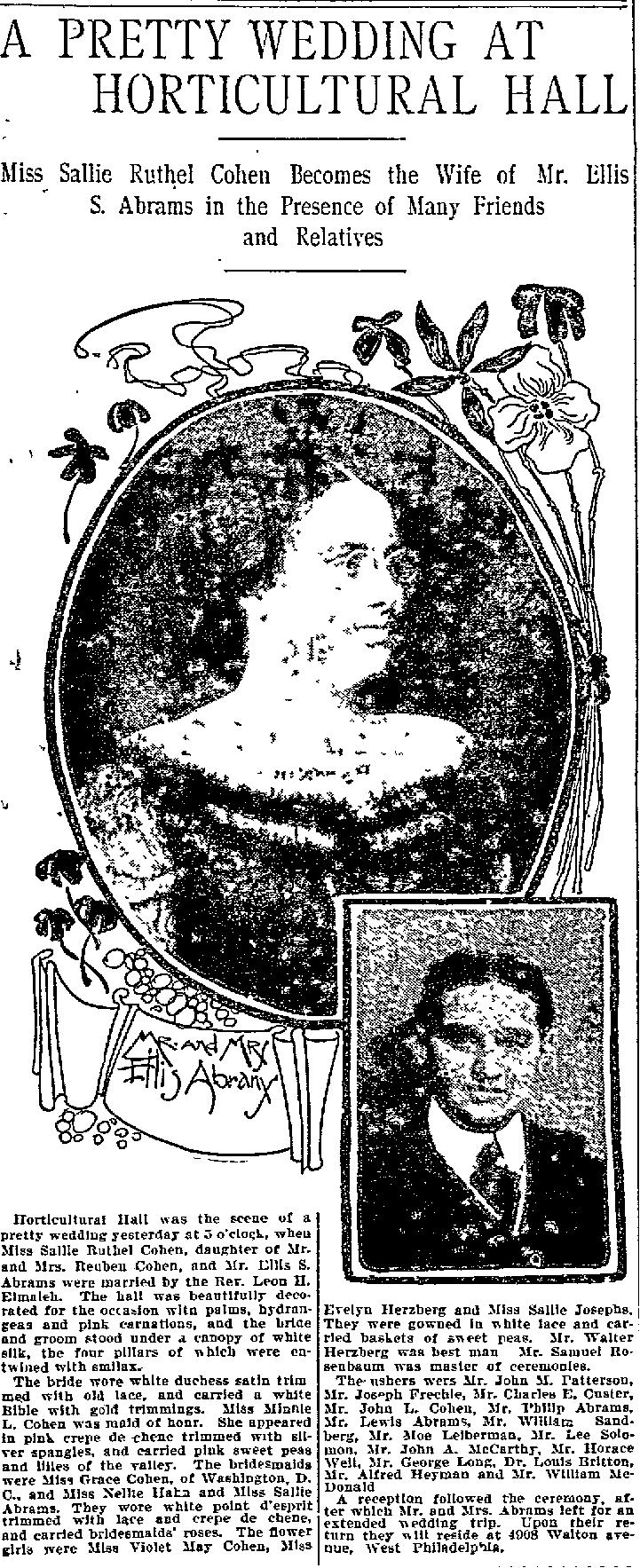
As I was finishing up my research on Sallie R. Cohen and her life, I found this article in the Philadelphia Inquirer about her wedding:

Sallie R. Cohen and Ellis Abrams wedding story

Sallie R. Cohen and Ellis Abrams wedding story

(“Matrimony Notice,”  Tuesday, May 22, 1900,Philadelphia Inquirer (Philadelphia, PA) Volume: 142 Issue: 142 Page: 2)

Not only does this provide further evidence of the social and economic success of Reuben and Sallie Cohen, it also provides a very important clue to one of my biggest questions about the Cohen clan.  Remember the two Hart Cohens that had me confused a few weeks ago—one in Philadelphia and one in Washington, DC? After much searching and thinking I had developed a strong hunch that they were first cousins and that Jacob Cohen of Philadelphia and Moses Cohen, Sr., of Washington were brothers, both sons of my great-great-great grandparents Hart Levy Cohen and Rachel Jacobs.  I am in touch with Moses Cohen’s descendant Scott, and we are awaiting DNA test results to see whether he and my brother share enough DNA to conclude that we are all in fact descended from Hart Levy Cohen.

But now I have another fairly persuasive bit of evidence linking the Moses Cohen family in DC to my Philadelphia Cohens.  If you can read the announcement, you will see that one of the bridesmaids is Grace Cohen of Washington, DC.  Grace Cohen was the daughter of Moses Cohen, Jr., and his wife Henrietta.  She was born in 1877, two years before Sallie R. Cohen, daughter of Reuben Cohen, and was  thus her second cousin, assuming that Jacob and Moses were brothers and thus their respective sons, Reuben and Moses, Jr., were first cousins.

This is the kind of almost accidental discovery that just makes my day.  It’s the kind of thing that I could easily have missed or read and not thought about carefully.  Although the DNA test results may provide more scientific evidence that DC Moses and my great-great grandfather Jacob were brothers, this little tidbit in a wedding announcement is certainly fairly persuasive evidence on its own.

Reuben Cohen 1854-1926: You Really Do Not Want to Read This

As I wrote in an earlier post, I skipped over Reuben Cohen, my great-great-grandparents’ sixth child and fifth son, in order to wait for some information from one of Reuben’s direct descendants.  I have to admit that I had other reasons as well.  My initial research indicated that Reuben and his wife Sallie Livingston had twelve children.  The thought of researching another huge family was a bit overwhelming.  In addition, my preliminary research had uncovered a number of very sad stories about those children, and I just did not have the heart to research, write, or even think about them after researching the story of Reuben’s older brother Hart.  Little did I know that his sisters, whose lives I’d not previously researched very far, also had more than their fair share of heartbreak as well.

Once I returned to the story of Reuben and did more research, I learned that his story was worse than I had even originally thought. His life started out well.  He was born in April, 1854, and grew up at 136 South Street with his parents and siblings. By the time he was sixteen he was working as a clerk in a store, presumably his father’s pawnshop.  In 1878 when he was 24, he married Sallie Livingston, and in 1880 they were living at 1725 Bainbridge Street and already had two children, Sallie R., who was a year old, and Jacob, who was a month old.  Reuben was working as a pawnbroker at 635 South 17th Street in 1881.

Reuben Cohen 1880 census

Reuben Cohen 1880 census

Originally I thought that the 1880s must have been fairly happy years for Reuben and Sallie, as Reuben continued to work as a pawnbroker and their family continued to grow.  In addition to Sallie R. and Jacob, I originally found that five more children were born between 1881 and 1890:  Minnie (1882), Hortense (1887), Rae (1887), Reuben, Jr. (1888), and Arthur (1890). The family continued to live at 1725 Bainbridge Street.

Then in 1891, tragedy struck.  Little Hortense, only three years old, was run over and killed by a cable car owned by the Philadelphia Traction Company.

Hortense Cohen death certificate

Hortense Cohen death certificate

The company had only been in business since 1883. I found this gruesome description of the accident in the June 14, 1891 edition of the Philadelphia Inquirer:

[According to a witness who saw the accident], the child, who was with two other children, started across the street to reach the house of her grandmother, Mrs. Livingstone, at 607 South Ninth Street, with whom she had been living. When she had crossed the tracks she saw a carriage coming, and she made an attempt to run back.  The child got bewildered, and as she reached the middle of the track the car struck her. The front wheel jammed the head against the track. It required the united efforts of [three police officers] to lift the car off the child’s head.
(“Killed by a Cable Car Little Hortense Cohen Becomes Bewildered and is Run Down,” Sunday, June 14, 1891, Philadelphia Inquirer (Philadelphia, PA),  Volume: 124   Issue: 165   Page: 5) The conductor and gripman were arrested.  Little Hortense was taken to the hospital where she died.

This story raises so many hard questions.  What was a three year old child doing alone without an adult? Who were the other two children, and how old were they? Were they her siblings? What a terrible impact this must have had on them as well as the rest of the family.  And why was Hortense living with her grandmother?  Were any of the other children living with Mrs. Livingston?  I don’t have any answers to these questions.

Obviously, times were different.  There were no helicopter parents, and children were much more likely to be left to their own devices than children are allowed to be today.  Also, cable cars were a recent addition to the city streets, and perhaps parents and children were not yet aware of the dangers they presented, nor were these companies likely regulated to any degree to prevent such accidents from occurring.  But one thing must have been true even in those days: the absolute horror the family must have endured after losing a child in such a terrible way.

Somehow the family went on.  My original research found that two more children were born in the next few years:  Lewis in 1892 and Penrose in 1894.  The family moved from their Bainbridge Street home sometime after Hortense’s death. In 1893 Reuben’s store was at 625 South 17th Street, and he and his family were residing at 623 South 17th Street.  They remained in that residence for many years.  In 1895 Violet was born, and in 1896 Irene was born, bringing the number of children living in the family to eleven.

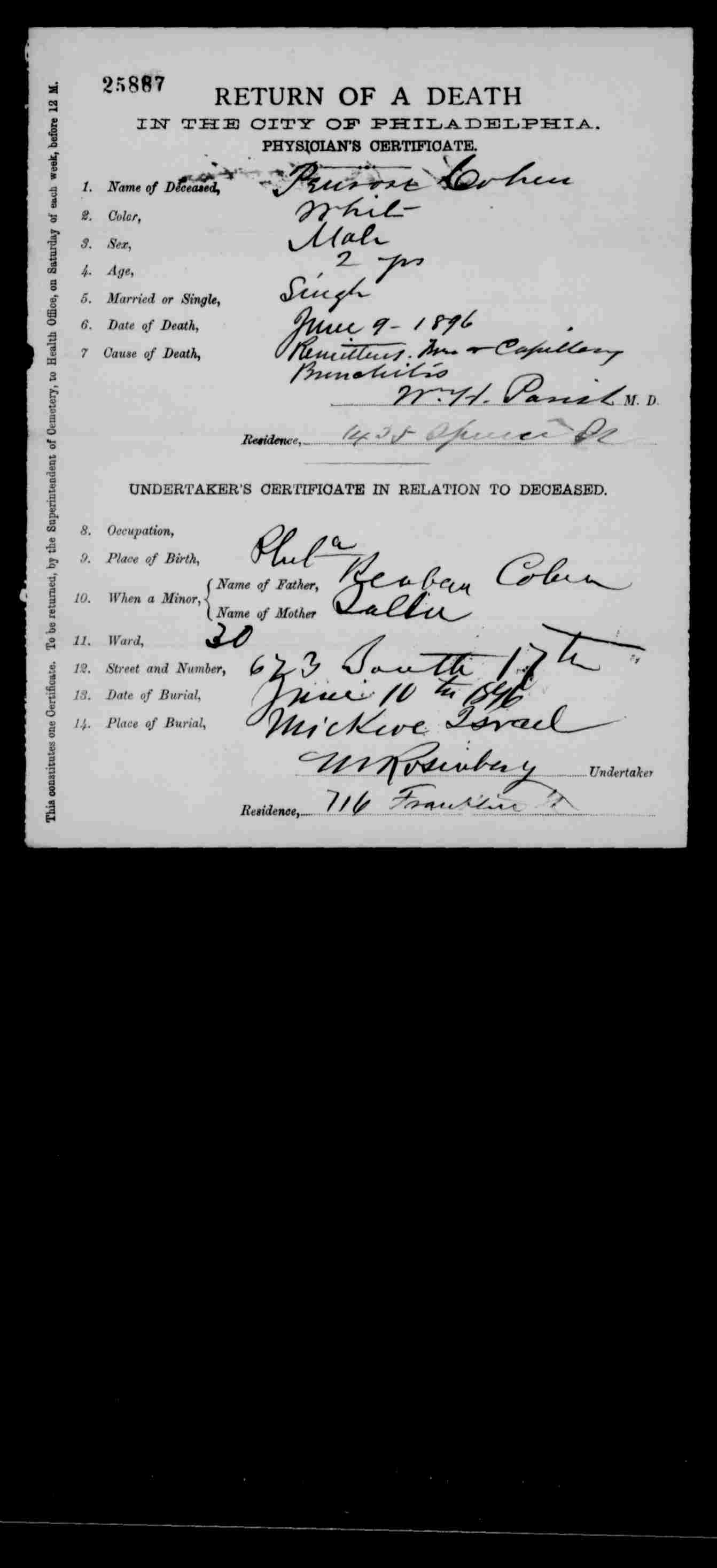
Then another tragedy occurred in 1896.  Two year old Penrose died from some form of capillary bronchitis.  Perhaps someone can help me decipher and interpret the rest of the description of his cause of death.  As if the family had not suffered enough, a year and a half later baby Irene, only a year old, died also from capillary bronchitis.  The family had lost three young children between 1891 and 1897.  The last child, Simon, was born in 1898, bringing the number of children to nine out of the twelve that I first thought had been born to Reuben and Sallie.

Penrose Cohen death certificate

Penrose Cohen death certificate

Irene Cohen death certificate

Irene Cohen death certificate

I wish I could say that that was the end of Reuben and Sallie’s heartbreak, but I cannot.  There was a period of relative calm.  In 1900 the family was living in Cape May, New Jersey, at the time of the census.

Reuben Cohen and family at 208 Ocean Street 1900 US census

Reuben Cohen and family at 208 Ocean Street 1900 US census

They were living back in Philadelphia by 1902, so I do not know whether the time in Cape May was a long stay or perhaps just a shorter stay for the summer.  I do know from one of Reuben’s descendants that Reuben owned a home in Cape May built in 1864 at 208 Ocean Street that eventually became the home of his son Arthur and his descendants.  It seems that during Reuben’s life this was not the year-round home, but perhaps just a summer home.  Reuben must have been quite successful to have two residences.  I found the house currently listed for sale on Trulia.com,with a description of the house and many exterior and interior pictures, such as this one.

208 Ocean Street, Cape May, NJ

208 Ocean Street, Cape May, NJ

1900 also was a good year for the family in other ways.  Their daughter Sallie R. was married that year to Ellis Samuel Abrams in what appears to have been quite a society event. There had been a large engagement party the year before at Reuben and Sallie’s home where an orchestra played throughout the evening “behind a bower of palm trees.”  The guest list was very long and included many of the aunts, uncles, and cousins I have written about on the blog: the Wolfs, the Sluizers, the Hambergs, and, of course, many Cohens.(“Melange of Events,”  Sunday, December 31, 1899, Philadelphia Inquirer (Philadelphia, PA) Volume: 141 Issue: 184 Page: 14)   Before the wedding took place on May 21, 1900, the Philadelphia Inquirer published a drawing of Sallie R., announcing the upcoming nuptials.  Clearly the Cohen family was part of the elite of Philadelphia Jewish society.

Sallie Cohen

Sallie Cohen

But all the business success in the world was not worth the personal losses that the family suffered. In 1907, Sallie R.’s young husband Ellis died from acute appendicitis.  He was 30 years old, and they had only been married for seven years.  They had had two children, Dorothy, born around 1905, and Simon, born around 1907.

Ellis Abrams death certificate

Ellis Abrams death certificate

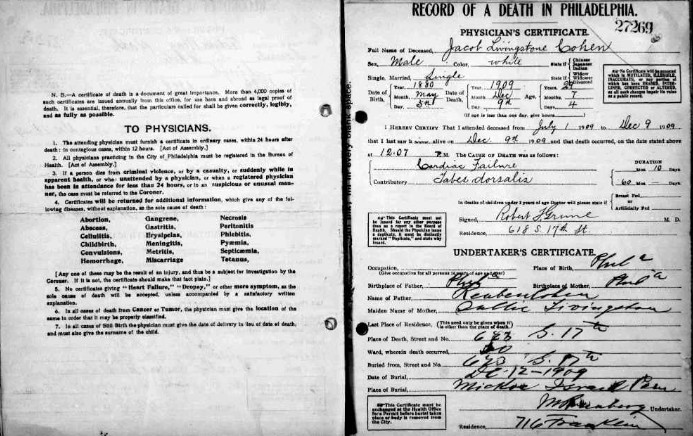
Then, two years later, in 1909, Reuben and Sallie’s son Jacob died of cardiac failure secondary to tabes dorsalis, or late stage syphilis.  He was only 29 years old when he died.  From his death certificate it appears that he had been sick and under a doctor’s care for five months before he died in December, 1909.

Jacob Livingston Cohen death certificate

Jacob Livingston Cohen death certificate

And then, just four years later in 1913, Jacob’s older sister Sallie R., Ellis’ widow, Reuben and Sallie Livingston’s oldest child, died at age 34 from nephritis, kidney disease.  That left Sallie R. and Ellis’ two children, Dorothy and Simon, orphaned at ages eight and six, respectively.

Sallie J. Cohen death certificate

Sallie J. Cohen death certificate

On the 1920 census, both children were living with their grandparents, Reuben and Sallie.  So far, I have had no luck finding out what happened to them next.

Reuben Cohen and family 1920 census

Reuben Cohen and family 1920 census

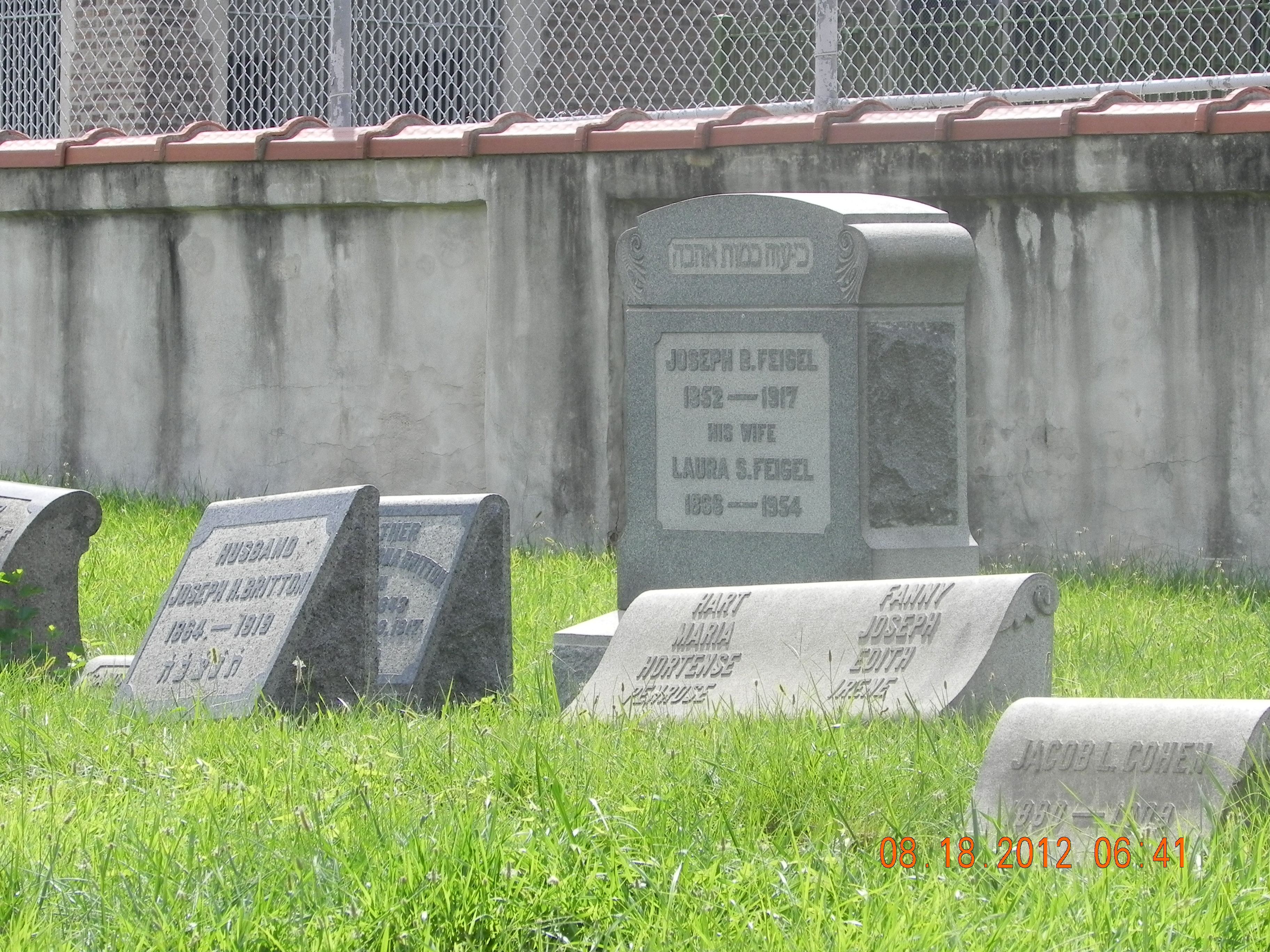
But what I did find was even more disturbing.  In doing some last minute checks for additional documents on Sallie J. and Jacob, I found their headstones on FindAGrave.  And to the left behind Jacob’s headstone, I spotted a headstone with eight names on it.  Some were familiar:  Hortense, Penrose, Irene.  But five were new to me: Maria, Fanny, Joseph, Hart, and Edith.  Who were they? When I saw it, I sighed so loudly that my husband wondered what was wrong.  I took a deep breath and then started looking for these other five children.

Since none of these names had appeared on either the 1880 census or the 1900 census (and since the 1890 census was destroyed by fire), I assumed that they were born after the 1880 census and died before 1900 census.  Eventually I found all five of these children, all of whom died before they were four years old.

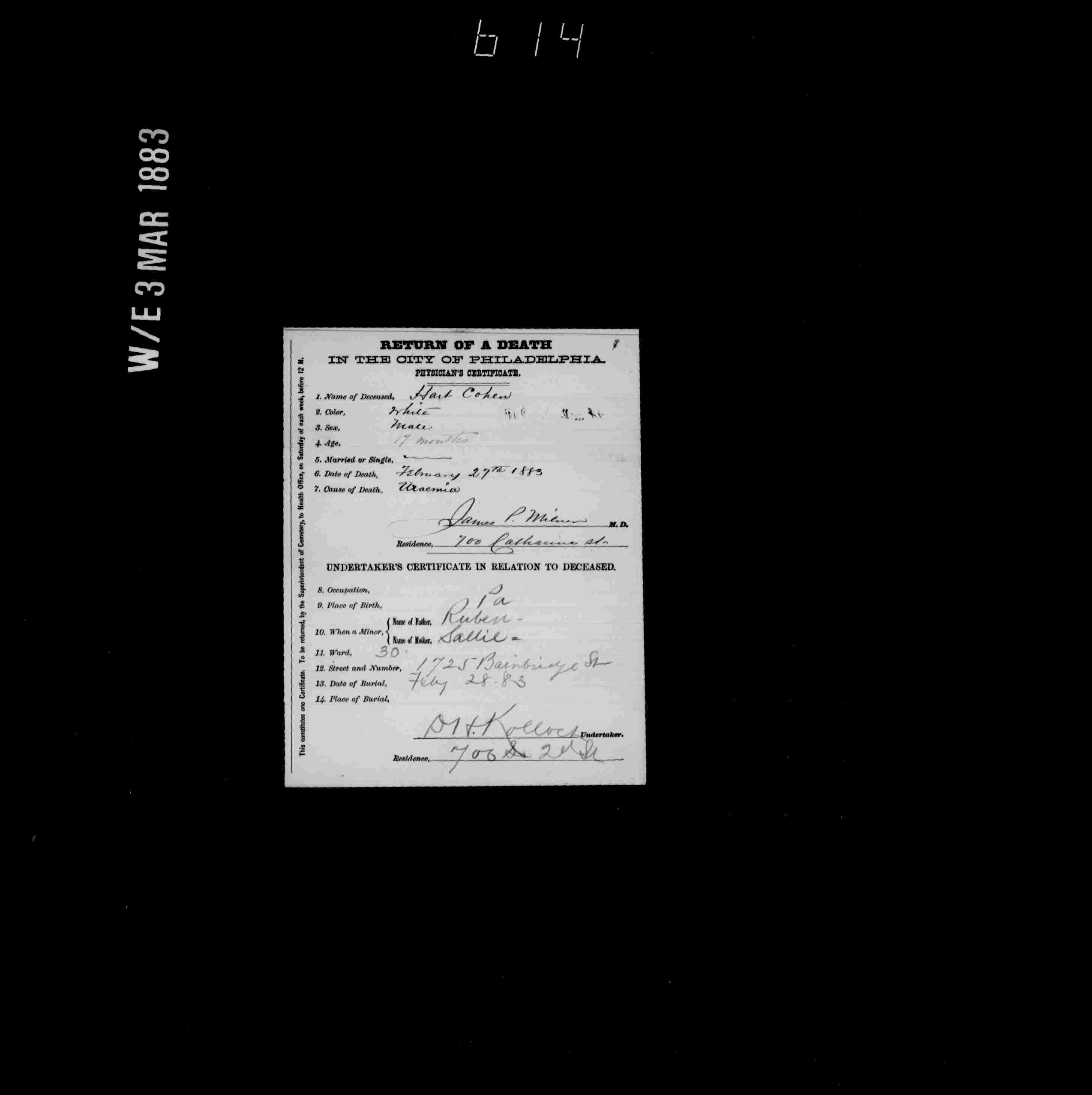
As I mentioned above, I had originally thought that the 1880s were a happy decade for Reuben and his family, but this additional research revealed the opposite.  After Sallie R. and Jacob were born, the third child, Hart, was born in 1881.  He died February 27, 1883, when he was seventeen months old from uremia.  In between Minnie was born in 1882.

Hart Cohen death certificate

Hart Cohen death certificate

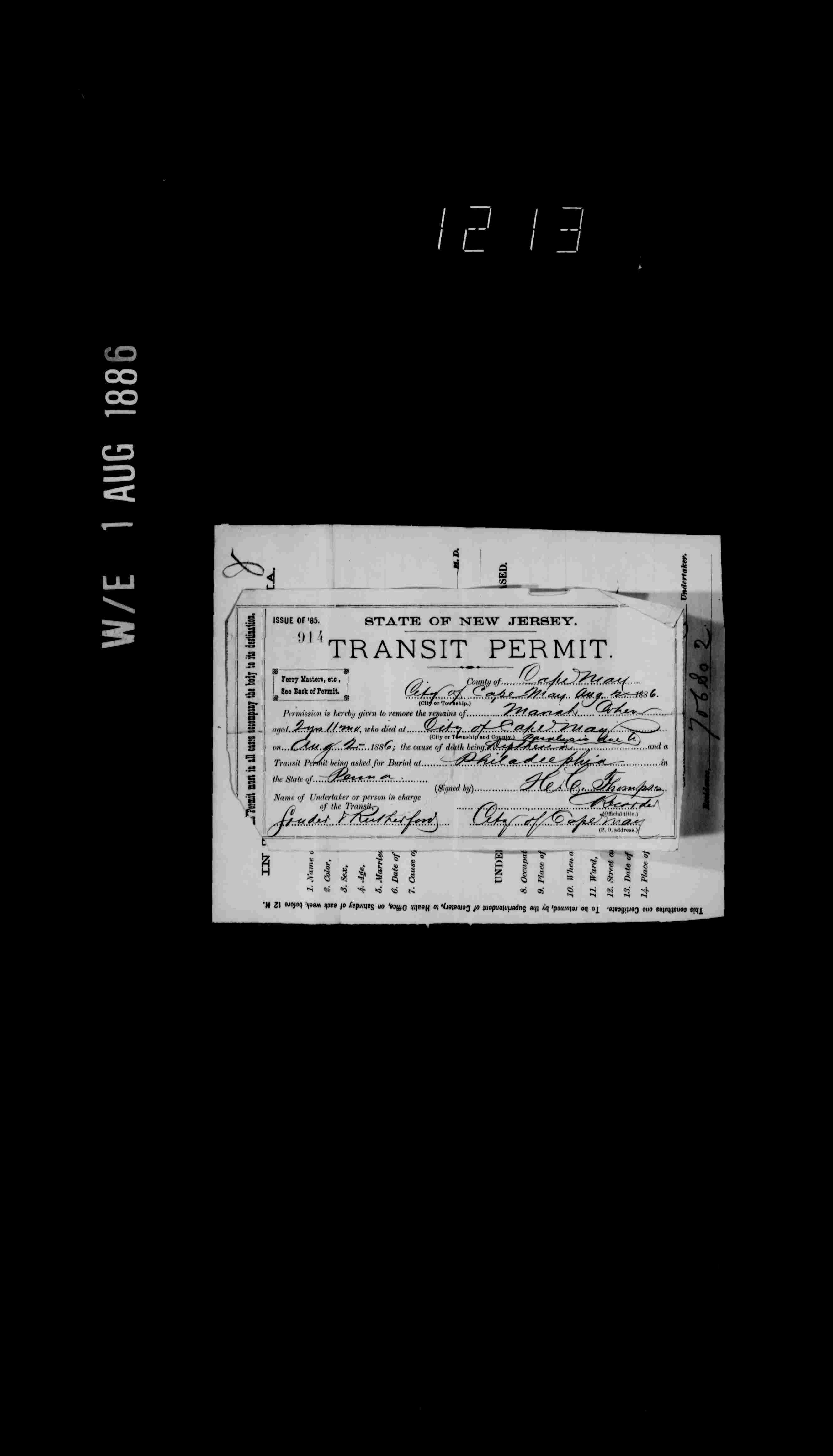
The next child, Maria, was born in September, 1883, meaning Sallie was pregnant with Maria when Hart died.  Maria died in Cape May, New Jersey on August 2, 1886, just shy of three years old, from paralysis caused by diphtheria (also evidence that the family had been spending summers in Cape May for quite some time before 1900).

Maria Cohen death certificate

Maria Cohen death certificate

But in between Minnie and Maria, Reuben and Sallie had had two other children, both of whom died before they were a year old.  In January, 1884, Fanny was born, and six months later in July, 1884, she died from enterocolitis.  On April 17, 1885, Joseph was born, and he died on August 9, 1885, not yet four months old.  Thus, in each year from 1883 through 1886, Reuben and Sallie buried one of their children. Perhaps that is why some of the children were living with Sallie’s mother?

Fanny Cohen death certificate

Fanny Cohen death certificate

Then came the tragic accident involving three year old Hortense in June, 1891.  What I had not known before I found the additional names on the headstone is that in July, 1891, the very next month, Sallie had given birth to Edith.  Perhaps that was some relief, but only for a very brief time because Edith died less than a year later on April 24, 1892, from “Diptheritic Laryngitis.”  I am not sure what that means, but it seems like it must be some complication from diphtheria. And then, as described above, Penrose died in 1896 and Irene in 1897.

Finally, there were the untimely deaths of Jacob L. and Sallie R. as adults.  So between 1883 and 1913, Reuben and Sallie had lost ten of their seventeen children and also had two young grandchildren who were left without either a mother or a father. Aside from Hortense, who died from an accident, all the other young children died from an illness that today would likely have been either prevented by a vaccine (diphtheria) or treated with antibiotics or somehow otherwise controlled by medicine.  Reading about all these babies’ deaths made me aware once again of how grateful we all should be for the developments of 20th century medicine.

How did Reuben and Sallie go on? It is unfathomable.  But they did. Did they find strength in the seven children who survived? Or did these deaths leave them bitter, angry, depressed? How does a marriage survive all that stress? Did they find strength in religion? In their large extended family? I do not know; I only know that in the last few days as I researched this family’s saga, I also was spending time with my newborn grandson and my four year old grandson, both of whom are so precious to me, not to mention their parents and other grandparents, aunts, uncles, cousins, and great-grandparents.  Seeing either grandson cry over even the smallest pain or disappointment breaks my heart.  I found myself so disturbed by reading about Reuben and Sallie’s children that I was not sure that I could bear to write this story down. But then I had to do it, if only so that those little children could be perhaps more than just names on a headstone.  Someone should know that they lived and were loved.

Reuben and Sallie had seventeen children (at least—perhaps others lived who have not been recorded somewhere).  They were married for many years.  Somehow there was enough love to keep them together so that they could continue to raise the children who survived, including their two grandchildren from Sallie R.

Reuben died on December 31, 1926; he was 72 years old.  His wife Sallie died four years later in 1930 when she also was 72.  There were seven children left who survived them, and almost all of them lived long lives, but I will leave their stories for a later post.

Elizabeth Cohen 1859-1923: Twists and Turns in Life and in Genealogy

In my post about Hannah Cohen, I wrote about how difficult it can be to research a woman’s life once her name was changed at marriage.  Some women, like some of the Rosenzweig women, I have not yet found at all.  Sometimes, as when marriage records are searchable by a bride’s name, it is relatively easy.  And sometimes it just takes a little luck and some good hunches to find her married name. In the case of Elizabeth Cohen, the ninth child and youngest daughter of my great-great-grandparents, it took both some good hunches and a lot of luck.  It also involved some misdirection and some confusion.

Elizabeth was born on December 25, 1859, in Philadelphia.  When I did a search for records for her on ancestry.com, she appeared with her parents on the census reports of 1860, 1870, and 1880. But then I could not find anything for an Elizabeth Cohen after those reports until I happened upon her death certificate.  It’s odd to find the death certificate first, to see how a life ended before knowing the earlier years, but her death certificate appeared because it had her father’s name on it.  Ancestry.com had the certificate listed under both her birth name (Elizabeth Cohen) and her married name, “Shirzer.”   At least, that’s how it was spelled on the ancestry index. I was certain that this was the right person based on her father’s name, his birthplace, her birthplace, and her age.  I also thus knew that she had been related, perhaps married, to someone named Bernard Shirzer, the informant on the certificate.

Elizabeth Cohen death certificate 1923

Elizabeth Cohen death certificate 1923


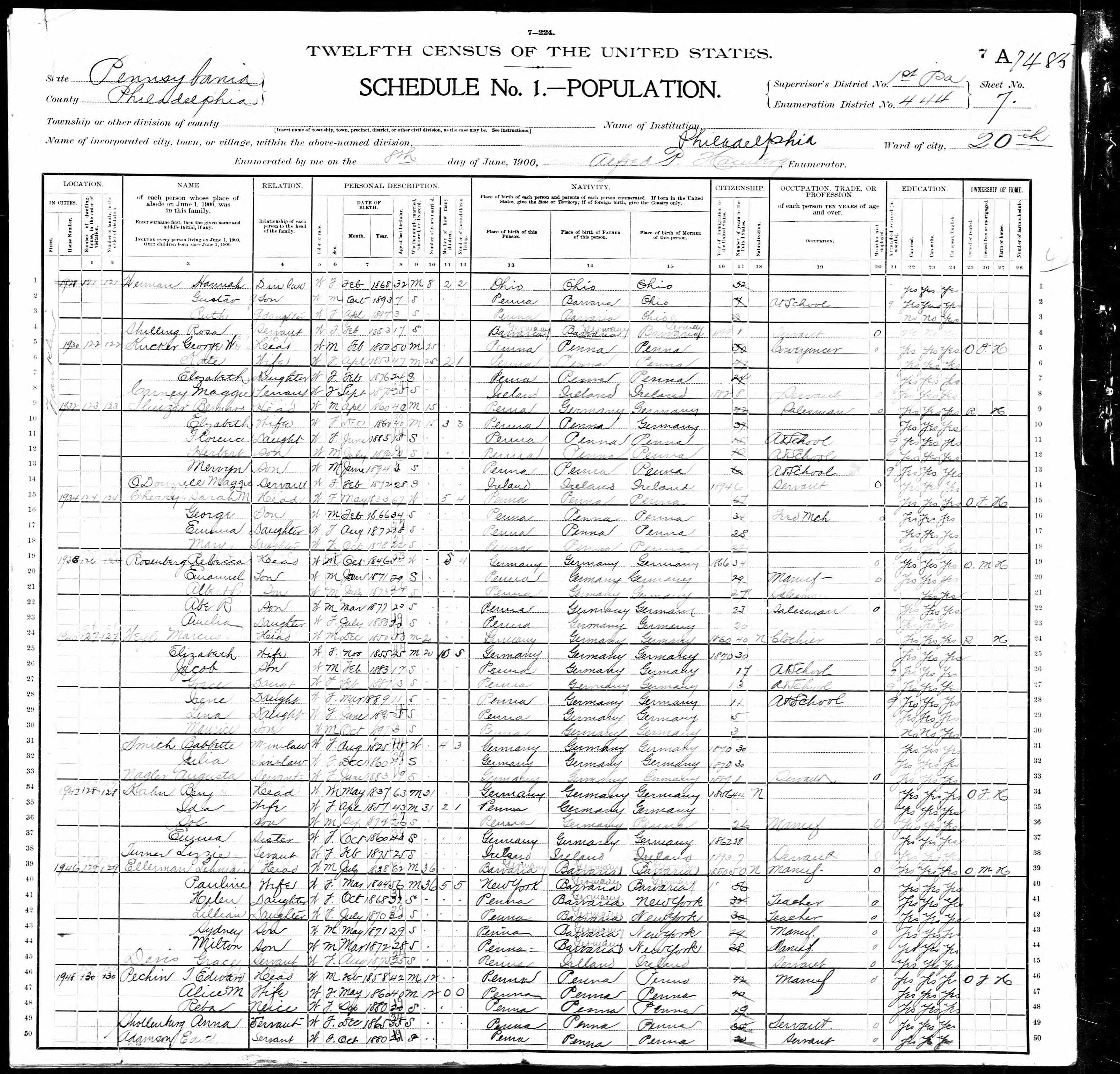
I then started searching for her as Elizabeth Shirzer and also searching for Bernard Shirzer.  I found nothing under either name, but wild card searches led me to the 1900 census where they were indexed as Sluizer and the 1920 where they were indexed as Shezer.  I stared and studied the handwriting on the death certificate and these two census reports, but still wasn’t sure which, if any, of these were their actual names.  I was able, however, to learn the names of their children.  In 1900 they were living with three children: Florence (15), Herbert (10), and Mervyn (3).  In 1920 Bernard and Elizabeth were empty nesters, living alone.  I could not and still have not find them in 1910.

Elizabeth and Bernard Sluizer 1900 census

Elizabeth and Bernard Sluizer 1900 census

Elizabeth and Bernard Sluizer 1920 census

Elizabeth and Bernard Sluizer 1920 census

From the ages of the children, I assumed that Bernard and Elizabeth had to have married sometime before 1885.  I could not locate a marriage record in the online index, but since the index available online starts in 1885, that did not trouble me.

I decided to search for the two sons to see if I could find something that would confirm which name was the actual name, and since Mervyn seemed relatively unusual, I focused on him, and using again various wildcard searching techniques, found several records, including his draft registration forWorld War II with the name spelled Sluizer that also included his father’s name, Bernard Sluizer.  The birth year and place and the first name and Bernard’s name were sufficient clues to confirm that the name was Sluizer.

Mervyn Sluizer World War II draft registration

Mervyn Sluizer World War II draft registration

I then went back to look for Bernard Sluizer to be sure this was the right one and found some early records for him that also seemed to corroborate that this was the correct name and thus Elizabeth Cohen’s married name.  But then I found a record on the marriage index showing that Bernard Sluizer had married Elizabeth Heyman in 1892.  It seemed so unlikely that there were two Bernard Sluizers married to Elizabeths that I was truly confused.  Could the name on the marriage index be wrong?  Of course, it could.  But how could the date also be wrong? Bernard had to have married Elizabeth before 1885 if Florence was born in 1885.

The other problem was that I could not find any record for either Florence Sluizer or Herbert Sluizer after 1900.  Not being able to find Florence was not troubling; I assumed she married and had changed her name.  But where was Herbert? I couldn’t find one trace—not a draft record, not a marriage record, not a death record.  Nothing. I was mystified.

I figured it was worth a search on genealogybank.com for newspaper articles that might reveal more about the Sluizers.  And that’s where luck helped me out.  Searching for Bernard Sluizer, I found an article about a charity raising money for the Doylestown Farm School, and listed among the donations was a reference to a donation by Bernard Sluizer in memory of his son, Herbert Heyman. (“$50,000 Donated to Aid Progress of Farm School Donations for Doylestown Institution One Feature of Anniversary,” Monday, June 10, 1907, Philadelphia Inquirer (Philadelphia, PA) Volume: 156 , Issue: 161, Page: 4, 1 )  Herbert Heyman? How could he have a son with a different surname?  Sons don’t change their names.

When I searched for Herbert Heyman, knowing he had died before June 10, 1907 , the date of the newspaper article, I found his death certificate, which identified his mother as Elizabeth Cohen, but his father as Benjamin Heyman.  Who was he??

Herbert Heyman death certificate

Herbert Heyman death certificate

My search then for Benjamin Heyman uncovered a death certificate for someone of that name who had died of uremia on July 23, 1890, at age 30.

Benjamin Heyman death certificate

Benjamin Heyman death certificate

This must have been Elizabeth Cohen’s first husband.  It explained both of the confusing records.  Bernard Sluizer had married Elizabeth Heyman; that was her married name when she married him, but she was born Elizabeth Cohen.  And Bernard Sluizer had been in many ways, even if not legally, the father of Herbert Heyman because he had married Elizabeth in 1892 when Herbert was only three years old.  Herbert’s biologicial father Benjamin had died when he was only a year old.

Having finally found all the little pieces of the puzzle, I think I now have the story of Elizabeth’s life.  She must have married Benjamin Heyman sometime before 1885 and had two children with him: Florence, born in 1885, and Herbert, born in 1889.  Then her first husband died in 1890, leaving her with two very young children.  She married Bernard Sluizer in 1892 and had a third child, Mervyn, with him the following year.  The 1900 census indicates that Bernard was a salesman; the 1920 census is more specific—a salesman for a pawnbroker.  Another relative in the family business.

Having lost her first husband so tragically young, Elizabeth then endured a second terrible loss when her son Herbert died from pneumonia in 1906 when he was sixteen.  What a sad, short life he had lived, losing his father when he was not even two years old and dying before he was seventeen years old.

Elizabeth herself died on September 28, 1923, when she was only 63 years old from “cancer of the womb.” Her husband Bernard continued to work as a pawnbroker and was living with their son Mervyn and his wife and children in 1930.  Bernard had remarried in 1928, but appears not to have been married as of the time of the 1930 census.  He died on September 2, 1944, at age 84.

Elizabeth’s life story, like those of so many other women, would have disappeared, and I might never have been able to figure it out, if not for the fact that her husband Bernard Sluizer made a donation to a charity in memory of his stepson Herbert Heyman.  If there had been no such donation, I might never have been able to figure out that Elizabeth had had a first husband who died at a very young age leaving her with two young children.  I would never have been able to figure out that the Elizabeth Heyman who married Bernard Sluizer was born Elizabeth Cohen but for the fact that her son Herbert Heyman died and her birth name was on his death certificate.  So in a very sad twist of fate, the fact that Herbert died so young enabled me to preserve the story of not only his life but that of his mother, my great-grandaunt Elizabeth Cohen.

Hannah Cohen 1858-1927: A Life to Remember

The further I delve into the story of my ancestors, the more aware I am of how much the lives of women have changed in the last 100 years—actually, more like the last 50 years, but since I am focusing on the women born between 1850 and 1900 right now, the 100 year line seems more appropriate.  I’ve said numerous times that women are harder to research because they changed their names when they married.  If you cannot figure out who they married, then they just disappear and their stories are never completed.

I obviously have a personal perspective on the question of taking on a new name when you marry.  When I married back in 1976, most women still took their husband’s names when they married, but some women were starting to resist and keeping their birth names.  Some women argued that keeping your father’s name was just as much a concession to male dominance as taking your husband’s name.  I struggled with this issue; I was never a radical or a pioneer.  But in the end, I wanted to keep my name.  My reasons were varied; some of it was definitely based on the values of the women’s movement that was exploding around me during my years in college.  Mostly, however, it was just about holding on to my identity, the one I had had for over twenty years.  How could I not be Amy Cohen?  It just felt wrong.

So I kept my name.  And despite the occasional strange looks I got (and sometimes still get) from people who think it odd and despite the awkwardness of making calls on behalf of my children and having to use two different surnames to identify who they were and who I was, I am very glad that I did.  Especially now when I see how many women disappeared into thin air historically when they changed their names, I realize how much it can matter to have your own identity, including your own name.

In the case of Jacob and Sarah Cohen’s daughters, I was actually able to figure out their married names, and so they did not disappear into thin air.  Sometimes it was really easy to find them because there was an entry in the online marriage records that revealed both the groom’s and bride’s names.  Other times it was rather serendipitous.

For example, in the case of Hannah Cohen, Jacob and Sarah’s eighth child, it was a tiny little death notice for Hannah’s troubled brother Hart that caught my eye.  I wasn’t even researching Hannah at the time, but the death notice made reference to calling hours for Hart being at the home of Mrs. Martin Wolf.  I thought that Mrs. Martin Wolf might very well be one of Hart’s many sisters.  I searched for Martin Wolf on ancestry.com and FamilySearch, and I found one in Philadelphia on the 1900 census with a wife named Hannah.

Hannah and Martin Wolf and family 1900 census

Hannah and Martin Wolf and family 1900 census


According to the 1900 census, Martin and Hannah had been married for 20 years.   Hannah’s birth year on the 1900 census was consistent with earlier census reports.  Martin and Hannah had three children living with them in 1900: Laura (1882), Edgar (1885), and Martin A. (1889). Martin was in the wholesale liquor business, apparently his family’s business as the city directories list him as working for S. Wolf and Sons, and Martin’s father’s name was Solomon Wolf.  It appears that he worked for this business for all or almost all of his adult life.

As I was researching Hannah and Martin’s life, at first it seemed that their life would be like Hannah’s sister Rachel’s life—fairly uneventful.  But as I researched more deeply, unfortunately it seemed her life had plenty of unhappy events, though not as overwhelmingly sad as that of her sister Maria.

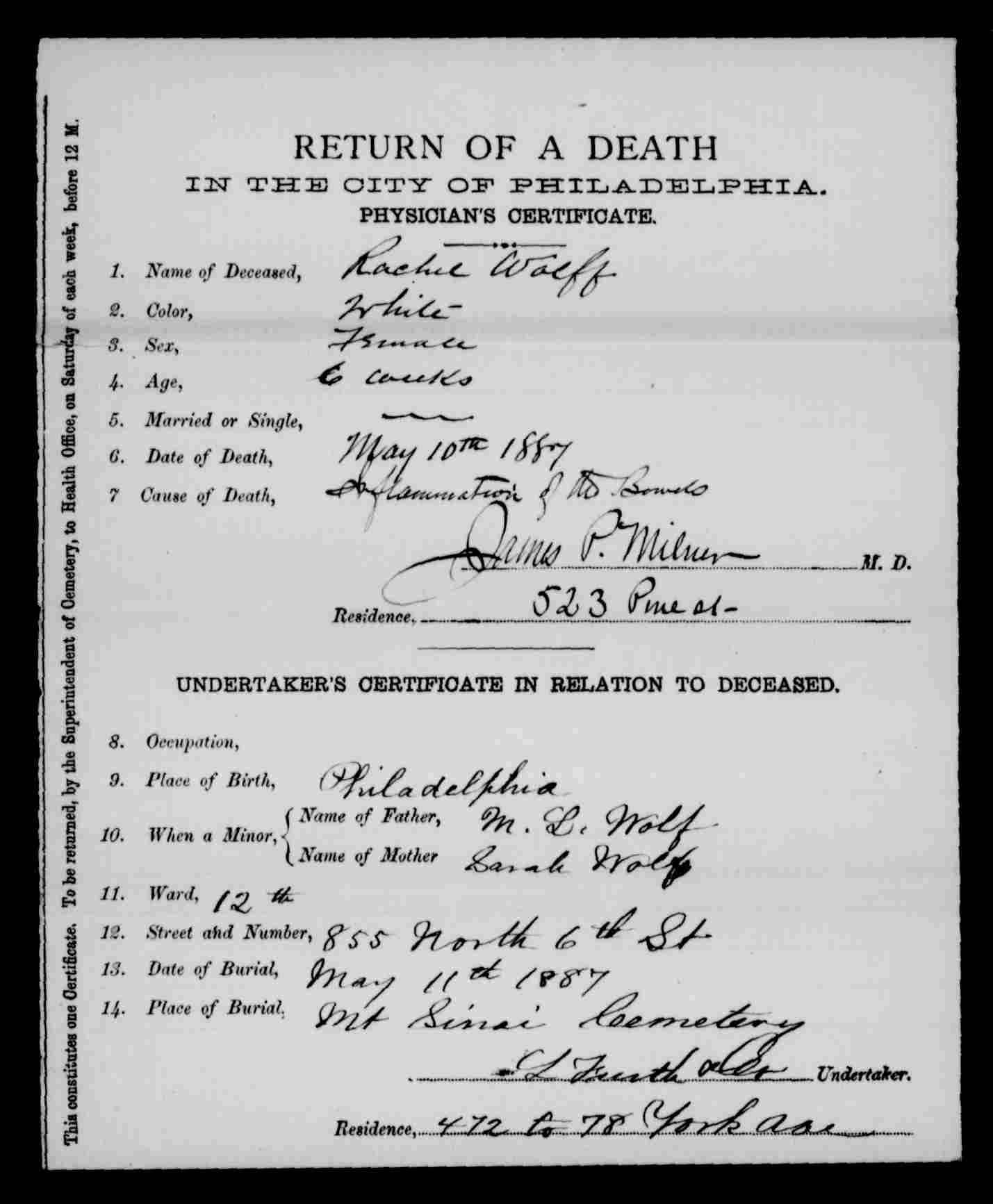
First, I saw on burial records at Mt Sinai that there was an entry for a fifteen day old infant “Ray Wolf” who died in 1887 located in the same lot as Hart Cohen (Hannah’s brother) and other members of the Wolf family.  I found a death certificate for a Rachel Wolff who died on May 10, 1887, at six weeks, daughter of M.L. Wolf and Sarah Wolf, living at 855 North 6th Street, the same address in the city directory for Martin L. Wolf of S. Wolf and Son in that year.  Despite the error in the mother’s name and the inconsistent age at death, this is obviously the child of Martin and Hannah.  Little Rachel died of inflammation of the bowels.

Rachel Wolf death certificate 1887

Rachel Wolf death certificate 1887

Those same burial records also included an entry for a Carrie Wolf, aged three years, who died in 1894.  Once again, further research revealed another terrible loss for Hannah and Martin.  Their daughter Caroline died from typhoid fever, the disease that had also killed two of her first cousins, a child of Fanny and Ansel Hamberg and a child of Joseph and Caroline Cohen.  If little Caroline was named in honor of her aunt Caroline, that must have been an awful irony to see her niece die from the same disease that had killed their son Hart.

Caroline Wolf death certificate 1894

Caroline Wolf death certificate 1894

So between 1887 and 1894, Hannah and Martin had lost two young children.  Somehow they continued on, Martin continuing to work in his family’s liquor business and Hannah home with the remaining children, who by 1900 ranged in age from 11 to 17.  In 1901 and 1902, the family was living in Atlantic City, where Martin was still involved in the liquor business.  Perhaps his family business was expanding, or perhaps the family just needed a change of scenery.  Laura, their oldest daughter,married Albert Hochstadter in 1901 when she was nineteen years old.  Albert was a hotel proprietor in Atlantic City, so perhaps she had met him while her family was living there.  Albert and Laura had a son, Martin Hochstadter, born in 1904.

It might have seemed that life had settled down and that the worst was over, but then there were more changes and losses ahead.  On the 1910 census, Laura, married only nine years before, was living at home with her parents (who had returned to Philadelphia by 1903) and, according to the census report, widowed.

Hannah and Martin Wolf and family 1910 census

Hannah and Martin Wolf and family 1910 census

At first I thought, “How awful.  Her husband died before they were married ten years,” but I said she was widowed “according to the census report” because I found a death certificate for Albert Hochstadter, dated June 5, 1912. Albert was still alive at the time of the 1910 census when Laura claimed to be a widow.  Moreover, his death certificate says that he was divorced.  Did Laura lie to the census taker, embarrassed to be divorced, or did the census taker just get it wrong? At any rate, it’s a bit eerie that Albert did in fact die just two years later when he was only 46 years old.  His cause of death was reported to be uremia.

Albert Hochstadter death certificate 1912

Albert Hochstadter death certificate 1912

Laura had quickly moved on and was already remarried by the time her first husband Albert had died.  On the 1910 census, when Laura was living with her parents in Philadelphia, there was a boarder living there named William K. Goldenberg who was a treasurer for a theater.  Within a year, Laura had married William, and by 1920, Laura, William, and Laura’s son Martin Hochstadter were living together.  William had advanced to become the manager of the theater, an occupation he continued to hold for many years.

Laura and William Goldenberg 1920 census

Laura and William Goldenberg 1920 census

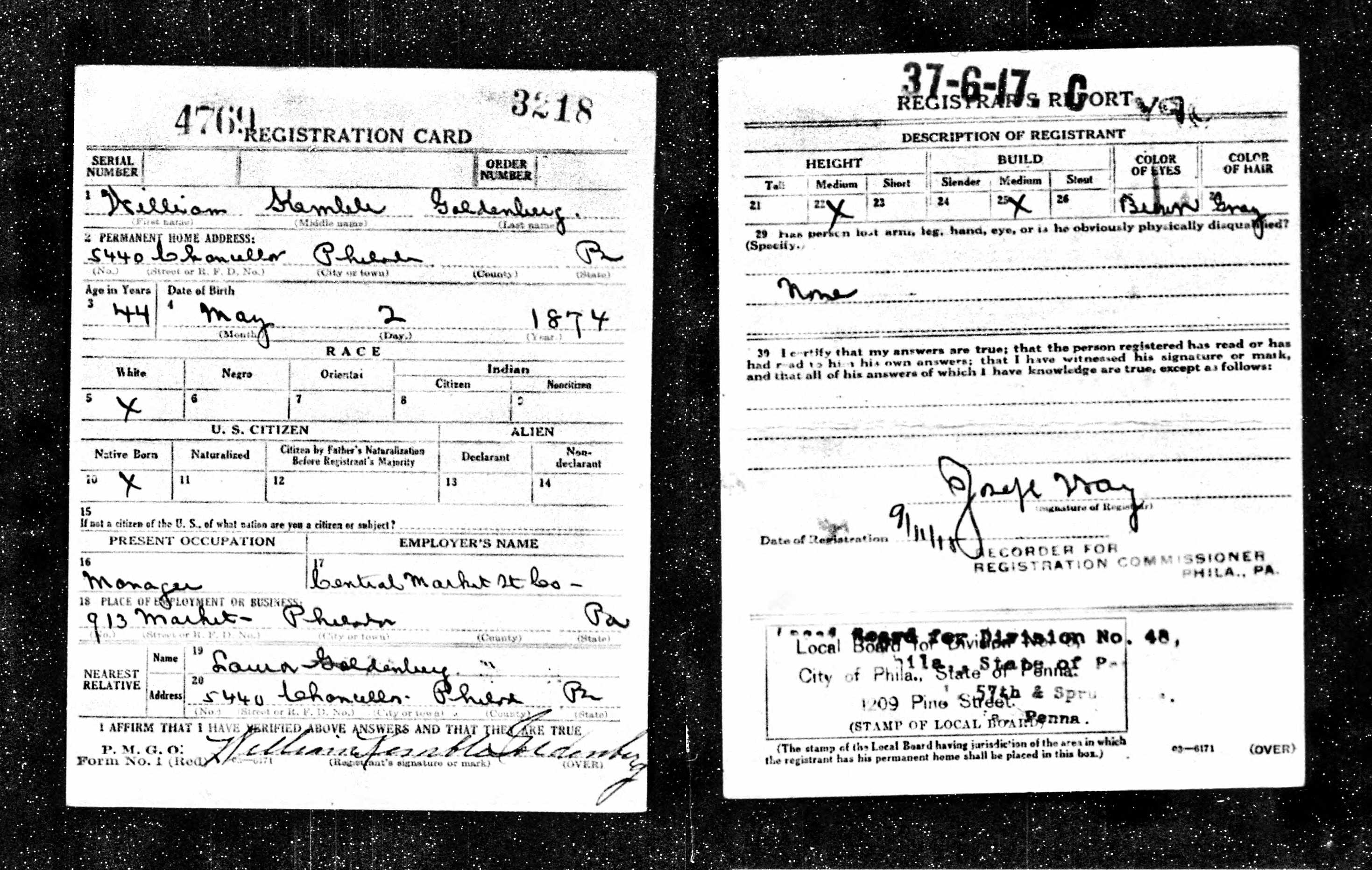
Both of Martin’s sons registered with the draft, and both were employed at the Central Market Street Company at the time of their registration, as was their brother-in-law William Goldenberg.  I assume that that was the company that owned the theater where William was the manager.  It seems he took good care of his brothers-in-law by providing them with employment.

martin a ww1 edgar ww1 William ww1

But in 1918 the family suffered another loss.  Hannah’s husband Martin died from acute myocarditis, an inflammation of the heart, while in Eddystone, Pennsylvania, which is about 16 miles south of Philadelphia (and once the hometown of Jennifer Aniston, for you trivia fans). The certificate is definitely for the same Martin L. Wolf; it indicates that Martin’s former or usual residence was 1737 North 15th Street in Philadelphia, the same address listed for Martin L. Wolf in the 1918 city directory and in the 1912 directory that also provided his business address for the liquor business.

Screenshot (7) Screenshot (8)

But the certificate raises some questions.  It says that Martin’s occupation was as a laborer for Remmington Arms in Eddystone.  According to Wikipedia, Remmington Arms, the rifle manufacturer, had opened a plant there during World War I, and “a large portion of the rifles used by American soldiers in France during World War I were made at Eddystone.”  What was Martin doing there?  He was 63 years old, too old to be drafted and serve in the war.  Was this his way of making a contribution to the war effort?  Or perhaps more likely the social forces that eventually succeeded in leading to the 18th Amendment and nationwide prohibition of liquor sales had already led to a decline in Martin’s liquor sales, thus causing him to get a job in the munitions industry during the war.  It’s total speculation, but it does seem very strange that after a career in the liquor business Martin would have taken up work in Eddystone making rifles.

Nine years later in 1927, Hannah also died from myocarditis, arteriosclerosis, and diabetes.  She was sixty-nine years old.

Hannah Cohen Wolf death certificate 1927

Hannah Cohen Wolf death certificate 1927

She and Martin were both buried at Mt Sinai with their two daughters Caroline and Rachel.

Mt Sinai burial records

Mt Sinai burial records

In some ways the timing of  Hannah’s death may have been a blessing because three years later her daughter Laura died at age 47 from complications of diabetes on February 10, 1930, leaving her husband and her 26 year old son, Martin, who had already lost his father when he was only eight years old.

Laura Wolf Goldenberg death certificate 1930

Laura Wolf Goldenberg death certificate 1930

On the 1930 census Martin was listed as William’s son and had adopted his surname Goldenberg as well.  He was also employed as a theater manager, another member of the family finding employment through William Goldenberg. Martin married later that year, and in 1940 he was continuing to work as a theater manager.

William and Martin Goldenberg 1930 census

William and Martin Goldenberg 1930 census

Two years after Laura died, her brother Martin A. Wolf died from chronic ulcerative colitis on September 20, 1932, at age 43.  He also left behind a wife and a nine-year old son.  Martin A. also had continued to work as a theater manager.  His wife Marie died seven years later in 1939, leaving their son Martin without parents at age sixteen. On the 1940 census he was living as a lodger with a couple named Magee and working as an usher, following in the footsteps of his father and other relatives.

Martin A Wolf death certificate 1932

Martin A Wolf death certificate 1932

That left Edgar as the only surviving child of the five children of Hannah and Martin Wolf.  Edgar had married in 1916 and had had a son in 1921, and like his brother Martin, his brother-in-law William Goldenberg, and his nephews Martin Goldenberg and Martin A. Wolf, he also continued to work as a theater manager in Philadelphia.  Edgar died in 1966.  He was eighty years old and was the only one of his siblings to live a full and long life.  No one else had made it to 50, let alone 80.

When I look back on Hannah’s life, as with the lives of so many of the women I have researched, I realize how completely a woman’s life was defined by her husband and her children in those days.  Whereas I can report on the men’s occupations and their military careers, for the women I seem only to be able to mention where they lived, who they married, and how many children they had.  Unless a woman remained unmarried, she did not work outside the home. These women had hard times and raised their families under often difficult circumstances, losing babies and children to disease and having more pregnancies and childbirths than I can imagine, and probably even more than are reported.  It was the way women lived for most of history: family and home centered and dependent financially on their fathers and then their husbands.  It is a very different life from the one most women I know live today, for better in many ways, but also for worse in other ways.

If women’s lives and their value was based primarily on their children, then losing a child must have been especially awful for these mothers, losing two unimaginable. At least Hannah did not live to see that two more of her children would die prematurely. She had lost two babies and her husband. Nine of her siblings, including some younger than she, had predeceased her.  Those are enough losses for any person to have to endure.

If I had not found that little death notice mentioning a Mrs. Martin Wolf, Hannah Cohen might never have been found.  As you will see, it was an equally serendipitous discovery that allowed me to learn the story of her younger sister Elizabeth. Hannah’s life was a life with plenty of heartbreak.  She did not make any scientific discoveries or make a lot of money or change the world.  It was nevertheless a life that should not disappear simply because she changed her name when she married or because she never worked outside the home.  I am glad that I was able to help to preserve her name and her life for posterity.

Maria Cohen 1856-?: A Hard Story to Find, A Harder One to Tell

It took me a long time to find the story of Maria Cohen, the seventh[1] child of my great-grandparents, Jacob and Sarah, and once I did, I wished I hadn’t. Things started easily enough, as I was able to find a record in the Philadelphia marriage index identifying her husband as William Levi. They married on December 15, 1875.  I was able to find them on both the 1880 and 1900 census reports with their sons Lewis, Jacob, and Isaac, but on both there were entries that were inconsistent with the facts I know about Maria.  On the 1880 census, it says her parents were born in Germany, and in 1900 it says her parents were born in Russia, when I know that her parents were in fact both born in England.

Had the census taker received erroneous information or did I have the wrong Maria?  Certainly her sons’ names, Lewis, Jacob and Isaac, were all names that ran in the Cohen family.  The age given for Maria on the census reports seemed close enough.  In 1880 Maria would have been 24; the census says she was 21 with two sons ages two and one.  If she really married in 1875, that means she would have been only 16 when she married, which seems unlikely.  In 1900, Maria would have been 44; the 1900 census reports it as 40.  I am accustomed to census errors, and these were not any worse than others I’ve seen.

So this could be the right Maria Cohen, but I cannot be absolutely sure because after 1900 she and her husband disappear from the records.  I cannot find Maria or William Levi on the 1910, 1920, or 1930 census.  Perhaps they both died between 1900 and 1910, but I also cannot find any death records or burial records for either of them. At first I thought perhaps they all changed their names, but after a lot of looking I was able to find death records for three of their four sons, and that is where this story gets harder to tell.

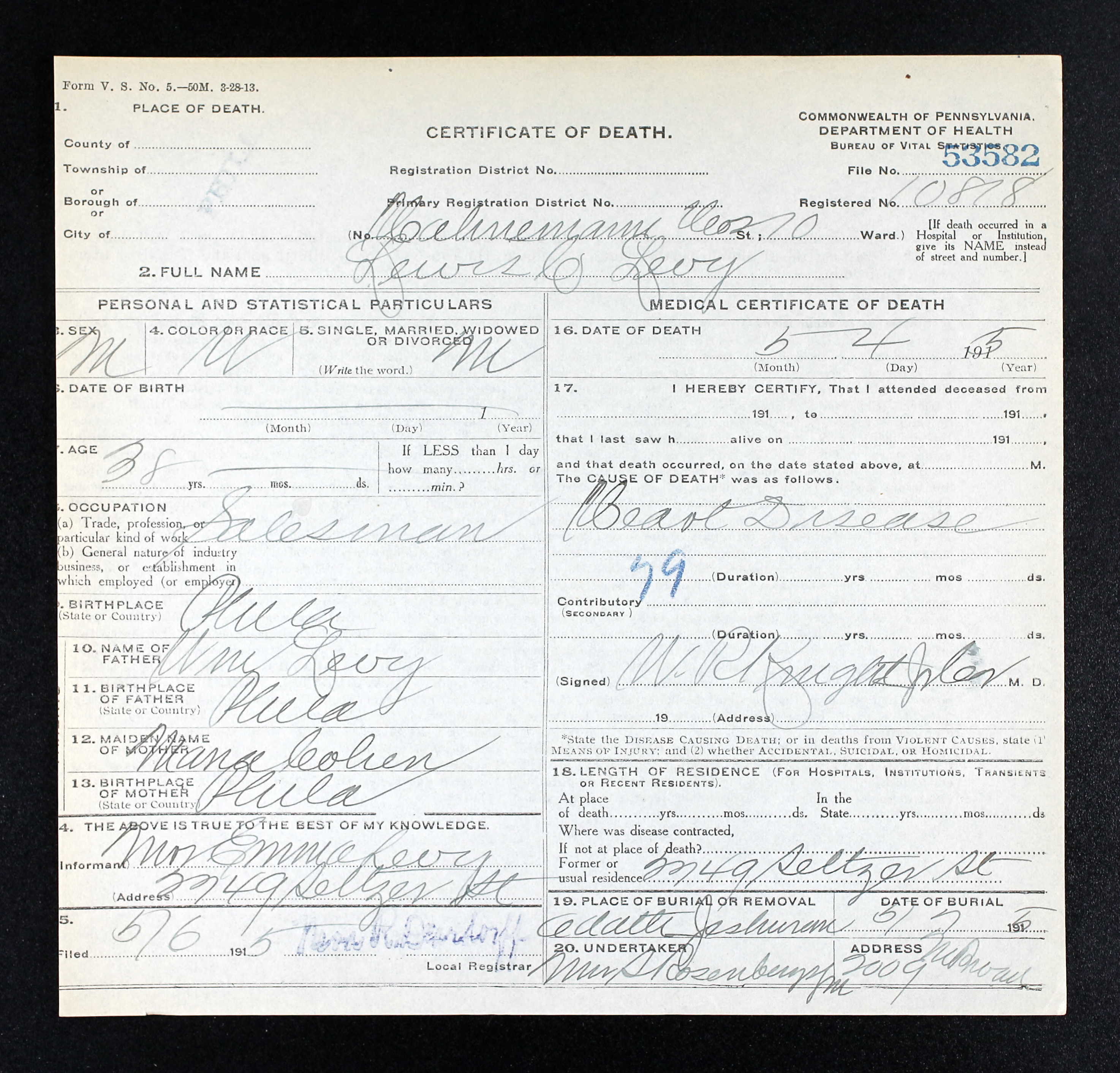
The first record I found was for their oldest son Lewis, who died on May 4, 1915, from heart disease at age 38.

Lewis C. Levy death certificate

Lewis C. Levy death certificate

His wife Emma Fogle, whom he had only married five years before in 1910, lived another almost 50 years, but was buried beside him at Adath Jeshurun cemetery and apparently never remarried.  Since the headstone is marked “father” and “mother,” there must have been at least one child born during that brief marriage, but so far I have not been able to locate that child.

Lewis and Emma Levy headstone

Lewis and Emma Levy headstone

This morning, after much looking, I found a death certificate for Maria and William’s second son Jacob, who also died at a young age.  He died only a year and half after his brother Lewis on December 22, 1916, from tuberculosis. He also was 38 when he died.  The death certificate reveals that he had been residing at the Norristown State Hospital for the Insane when he died and had been there for just over ten years.  He also was buried at Adath Jeshurun.

Jacob Levy death certificate

Jacob Levy death certificate

I was already feeling sad for Maria and William for losing two sons before either reached forty years of age when the story got even worse.

In searching for records for Maria, William and their sons this morning, I was surprised to see a death record for a Benjamin Levy, son of William Levy.  It was the first time I knew that Maria and William had had a fourth son, Benjamin, born in 1881.  Since he was born in 1881, he was not on the 1880 census.  Since he died in 1897, he was not on the 1990 census.  I had missed him completely in doing my initial research of Maria and her family.  I gasped when I found his death certificate and saw his cause of death: “found drowned.”

Benjamin Levy death certificate

Benjamin Levy death certificate

I looked to see if I could find any other information and found this story, quoted in its entirety from the Philadelphia Inquirer dated March 18, 1897.

The body of the young man which was found on Monday in the Delaware River at the foot of Callowhill street was that of Benjamin Levy, aged 16, who lived at 1580 Fontaine Street, and who has been missing since January 9. It is thought that he committed suicide.

Before going away, he said to his brother: “Good-bye, Jake, forever.  I’m going to jump overboard.”  He was not seen alive afterwards.  It is believed he drowned himself because he had been rebuked for drinking.

(“A Young Suicide,” Thursday, March 18, 1897,Philadelphia Inquirer (Philadelphia, PA)   Volume: 136   Issue: 77   Page: 10 )

Benjamin had been missing for two months when his body was found.  I cannot begin to imagine how his family felt.  Could it possibly be that just getting scolded for drinking led him to commit suicide? Or was there something else behind the story? Was there underlying mental illness, as was the case with his older brother Jacob?

Although the death certificate for Jacob said that he had been hospitalized since October, 1896, ten years, one month and 28 days before his death, this news story about Benjamin seemed to indicate that Jacob was still home when Benjamin committed suicide in March, 1897.  One has to wonder whether Jacob’s mental illness was precipitated or at least exacerbated by his little brother’s death and thus whether Jacob’s death certificate was off by a year in describing his stay at the state hospital.  Did Jacob feel guilty, knowing that his younger brother had talked about suicide but Jacob had not being able to stop him? How did Maria and William cope with these two traumas?

It was less than twenty years later that their son Lewis died in 1915, with Jacob dying a year later in 1916.  Only Isaac remained, their youngest son.  Fortunately, Isaac’s story is not tragic.  In 1909, he had married Rose Hicks, who was a few years older than Isaac and had a son William from a previous marriage. Although marrying an older divorced woman with a child might have been somewhat unusual back then, given what this family had been through, that must have been small potatoes to them.  In 1910, he and Rose were living at 133 Walnut Street in 1910 with several boarders, and Isaac, now using the name Harry, was working at a pawnshop.

Isaac "Harry" Levy and Emma Levy 1910 census

Isaac “Harry” Levy and Emma Levy 1910 census

In fact, it was his uncle Lewis Cohen’s pawnshop, as revealed in Harry’s World War I draft registration (and as confirmed by an address check for Lewis Cohen in 1917).

Isaac "Harry" Levy draft registration World War I

Isaac “Harry” Levy draft registration World War I

Harry, Rose, and Rose’s son William as well as her nephew were living on Reno Street in 1920, and Harry and Rose continued to live in Philadelphia at least until 1942 when Harry’s draft registration for World War II continues to provide a Philadelphia address at 222 North 52nd Street.  Harry was working for the WPA in Philadelphia at that time.

Isaac "Harry" Levy World War 2 draft registration

Isaac “Harry” Levy World War 2 draft registration

It does not appear that Harry and Rose had any biological children of their own.  I cannot yet find any record for Harry or Rose after 1942, nor have I yet had any luck locating any records for Maria or William after the 1900 census.   I plan to contact Adath Jeshurun cemetery in Philadelphia to see if they have records for Harry/Isaac, Rose, Maria or William Levy.  Since the other members of the family were all buried at that cemetery, I am hoping that I will be able to get at least some greater information about the others.

Genealogical research is filled with twists and turns.  I spent many hours this week, focused on Maria Cohen and her family with William Levy, and until this morning I had found almost nothing except their marriage record and  those two census reports.  I went to sleep feeling that I would never know the rest of the story.  Then with just a few lucky keystrokes this morning, I opened the door to a terribly tragic family story.  I almost wish that I hadn’t.  Careful what you wish for, as they say.  I hope I can put some closure on Maria’s life.  Only time, persistence, and lots of good luck will tell.


[1] Reuben was the sixth child, but I am skipping over him for now as I wait to hear from one of his descendants.

Enhanced by Zemanta

Rachel Cohen 1853-1925: An Ordinary Life

As I move down the list of my great-grandparents’ thirteen children, I will face a few new obstacles.  First, there are several daughters among the middle group of siblings, and as noted before several times, women have a tendency to disappear if I cannot figure out their married names.  Second, as these children were born later, many also died after 1924, making it much more difficult to obtain their death certificates and other vital records on line.  That means I will either have to order documents from the Pennsylvania archives or visit a local branch of the Family History Library where I can view microfilm sent from Salt Lake City.  Those visits will have to wait until the fall probably as I will not have ready access to a branch until then.  For now I will report what I know based on what I can find and then update my findings as I obtain more documents and information.

I have reported on the first four children of Jacob and Sarah, my great-great grandparents: Fanny, Joseph, Isaac, and Hart.  Rachel is the next child.  She was born in Philadelphia in 1853 and spent her childhood at 136 South Street with her family.  In 1879 she married Lewis I. Weil, who was born in Pennsylvania of German-born parents.  In 1880 Rachel and Lewis were living at 406 South 2d Street with a servant.  Lewis was in the gentlemen’s furnishings business, and Rachel was at home.  (It is hard to imagine what a young woman with no children did at home all day, given that she had a servant, but times were different back then.)

Rachel and Lewis Weil 1880 US census

Rachel and Lewis Weil 1880 US census

Rachel and Lewis had six children: Sallie (1880), Benjamin (1882), Jacob (1883), Blanche (1888), Irene (1891), and Joseph (1893).  All but Benjamin survived to adulthood; Benjamin died when he was six months old from enteritis, an inflammation of the small intestine usually caused by a bacterial infection.

Benjamin Weil death certificate

Benjamin Weil death certificate

On a separate record of Benjamin’s death, it identified the attending physician as “Sarah Cohen.”  Since this was 1882, it seems unlikely that this was really a doctor, but rather Rachel’s mother, Sarah, my great-great grandmother.

UPDATE:  See the comments below from rustica2389.  It seems there was a Dr. Sarah Cohen practicing in Philadelphia at that time!  I should never make assumptions….

Benjamin Weil death record

Benjamin Weil death record

That must have been an awful loss for Rachel and Lewis, but like so many others, they went on to have four additional children.  In 1900, Rachel and Lewis still had all five surviving children living with them, and Lewis was still engaged in the business of men’s clothing.  They also still had a servant living with them, now at 1401 Ridge Avenue.

Rachel and Lewis Weil 1900 US census

Rachel and Lewis Weil 1900 US census

By 1910, the family had moved to 606 Diamond Street, and only Sallie (who never married), Irene, 19, and Joseph, now 17, were still living at home. Lewis was still working in men’s furnishings, and Joseph was working in the same business.  Sallie was a salesperson in a department store, and Irene was at home.  Lewis’ brother Simon was also living with them.

Rachel and Lewis Weil 1910 US census

Rachel and Lewis Weil 1910 US census

In 1908 Jacob had married Flora Cohen and was selling men’s neckwear in 1910, and the following year his younger sister Blanche had married Alexander Klein who was a “manager” in some kind of manufacturing, according to the 1910 census.

Marriage certificate of Blanche Weil and Alexander Klein

Marriage certificate of Blanche Weil and Alexander Klein

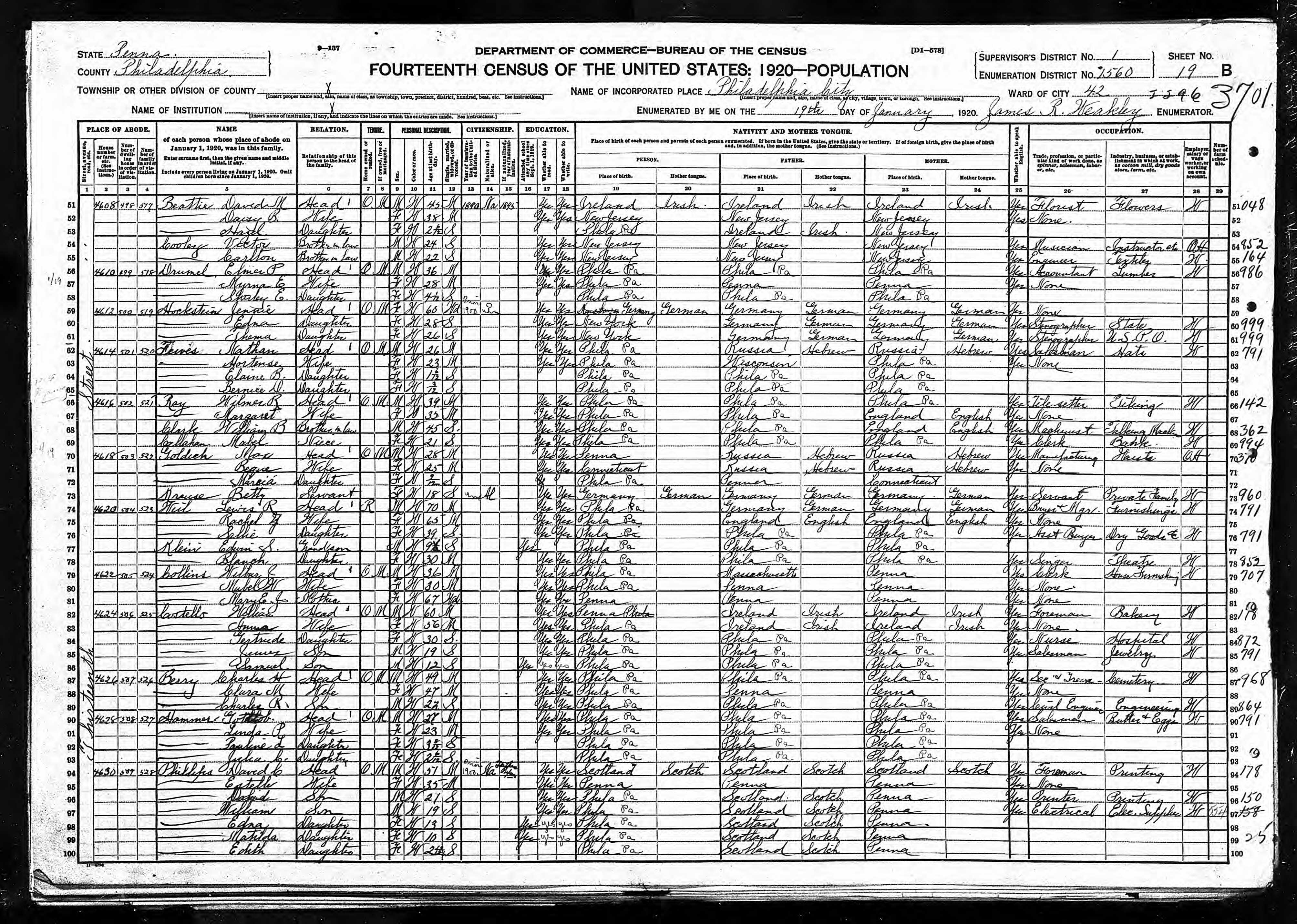
Ten years later in 1920 Rachel and Lewis were living with Sallie, Blanche, and Blanche’s son Edwin, who was nine years old, born in 1911.  They now lived at 4620 Thirteenth Street, and Lewis was working as a buyer and manager in “furnishings,” I assume men’s clothing.  Sallie was an assistant buyer of dry goods, and Blanche was a singer in the theater. (Each of these moves from Second Street to Ridge to Diamond to 13th Street took the family further and further north, consistent with other family members and Jews in general in Philadelphia.)

Rachel and Lewis Weil 1920 US census

Rachel and Lewis Weil 1920 US census

Although Blanche was still listed as married, her husband Alexander was not living with her, but was living with his brother Lewis at 4510 York Drive.  He was in the shoe business.  He also is listed as married.

Alexander Klein 1920 census

Alexander Klein 1920 census

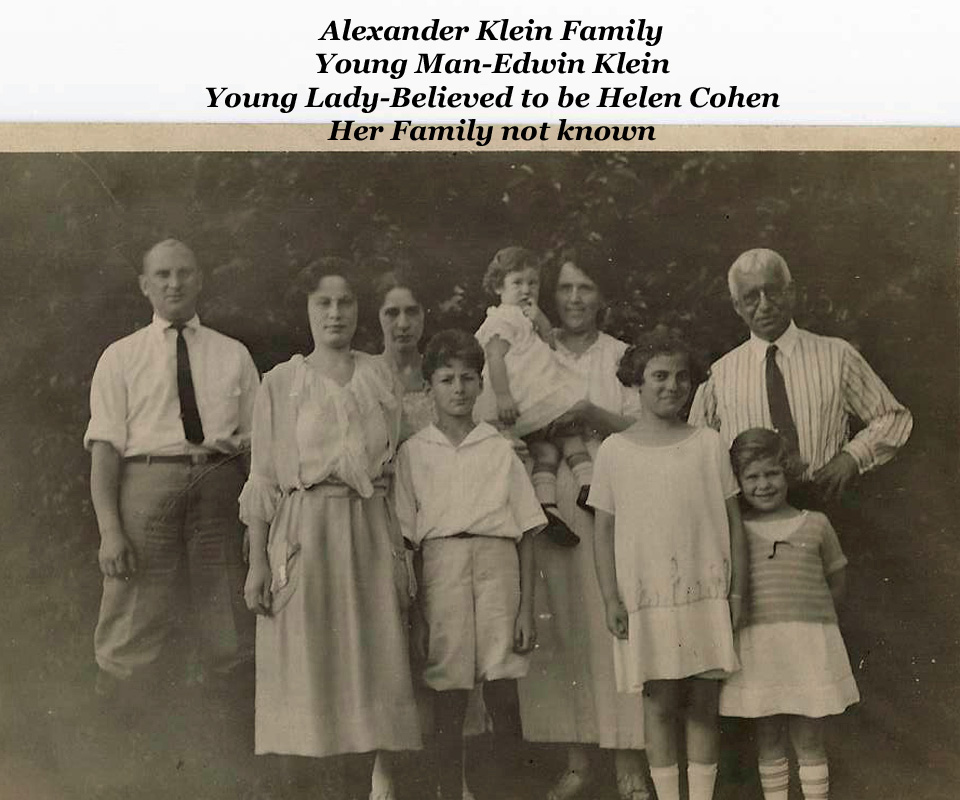
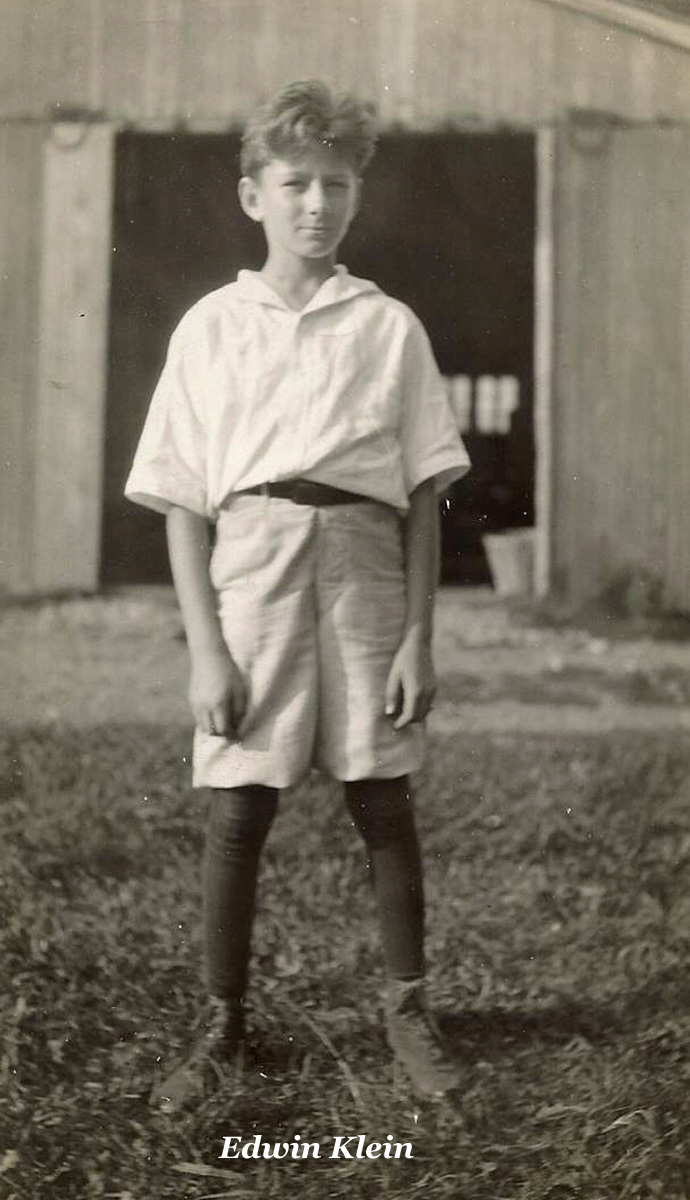
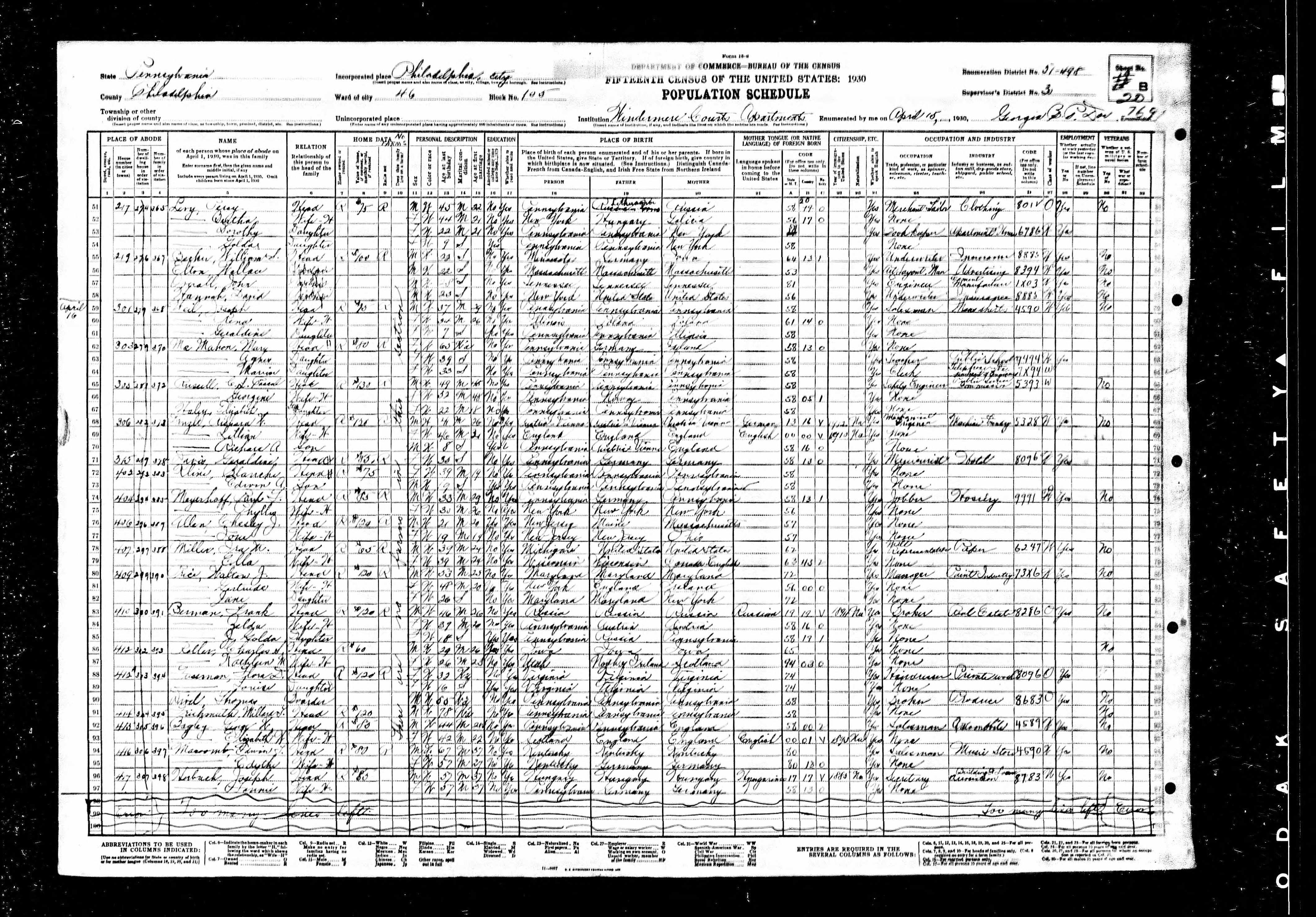
Since Blanche and Edwin were also living without Alexander in 1930, I assume they never reconciled, although perhaps they also never divorced. Thanks to Gil Weeder, a relative by marriage to the Weil family, I now have these photographs of young Edwin Klein with his father’s family, presumably with his mother Blanche next to him sometime before Blanche and Alexander separated.Klein Family Edwin Klein


Blanche and Edward Klein 1930 US census

Blanche and Edward Klein 1930 US census

Rachel and Lewis Weil’s daughter Irene had married James Doran in 1915.   They had a long marriage, living in Philadelphia for almost twenty years before moving to Camden, New Jersey in the 1930s where they lived for at least another ten years.  I have not found any records for either of them after 1945, except for a record of Irene’s death on April 8, 1977 in Erie, Pennsylvania, on the Social Security Death Index.  Both Irene and James were buried at West Laurel Hill cemetery in Bala Cynwyd, Pennsylvania, but no dates are recorded for James, so I am not sure when he died.  They left no descendants.

Rachel and Lewis’ youngest child, Joseph, married Goldie Kret on June 17, 1912.  He was only 19, though his age on the marriage certificate is 21.  Goldie was recorded to be 18.  They were married in Wilmington, Delaware, and Joseph’s sister Blanche and brother-in-law Alexander Klein were the witnesses on the certificate.  Goldie was the daughter of Jacob Kret and Sarah nee Newman.

Joseph Weil and Goldie Kret marriage certificate

Joseph Weil and Goldie Kret marriage certificate

Interestingly, Joseph was residing in Boston at the time and working as a salesman.  Why is this interesting? Because I have been in touch with someone who is a relative of Flora Cohen, Jacob Weil’s wife, and he has a copy of a baby book created for Jacob and Flora’s daughter, Maizie Weil, in which there is a reference to a trip to Boston to visit “Daddy.”  Maizie was born in 1912, so perhaps Jacob and his younger brother Joseph were living in Boston for work during that time period. Since both Jacob and Joseph were living in Philadelphia in 1910, this marriage certificate is the first document I’ve found that has a reference to anyone in the family living in Boston.

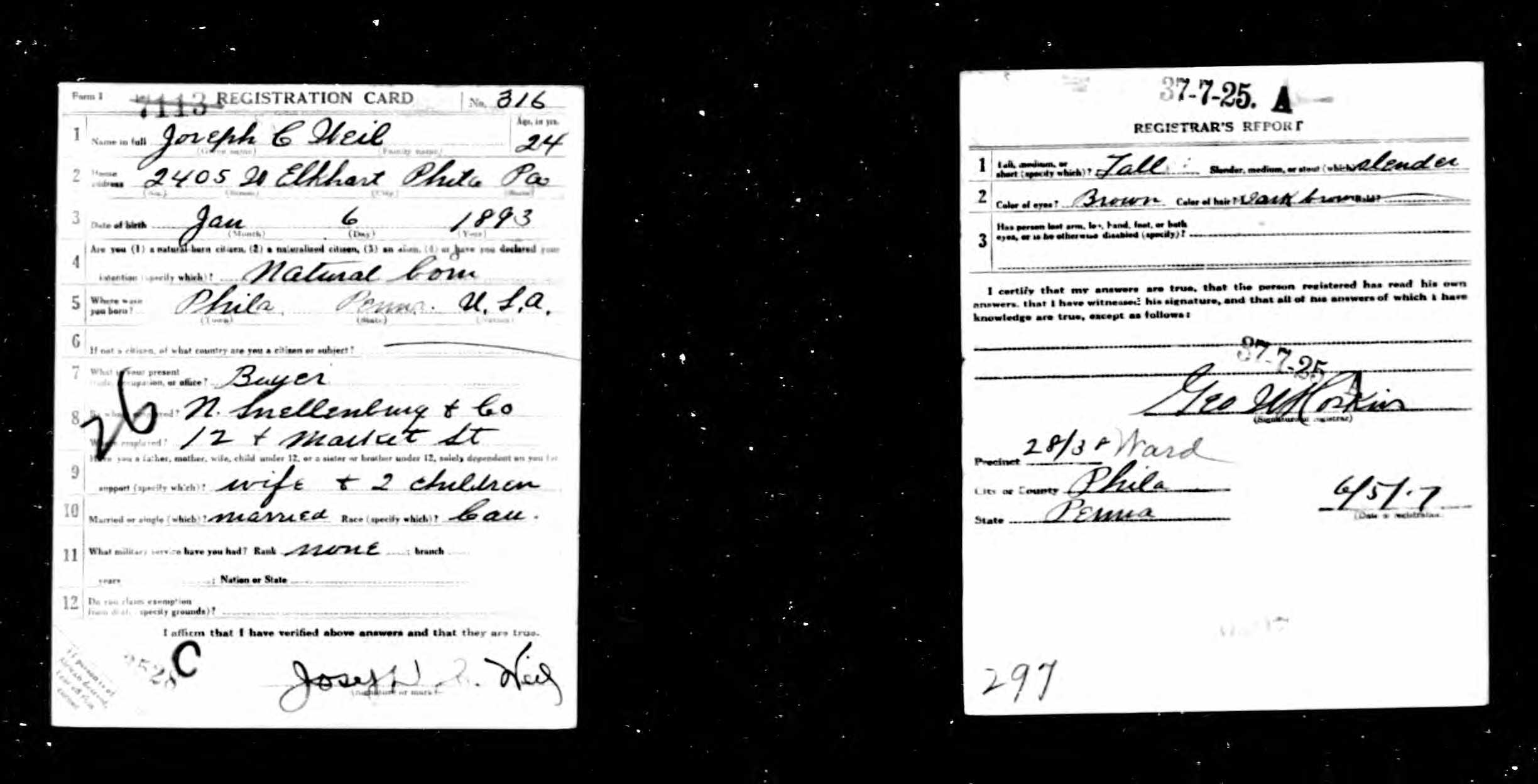
By 1917, however, Joseph was living back in Philadelphia, according to his World War I draft registration.  The registration also says that Joseph was married with two children, living at 2405 South Elkhart Street, and working as a buyer at N. Snellenburg and Company.  Joseph’s uncle, Joseph Cohen (Rachel’s brother) had married Caroline Snellenburg, so I imagine that this was a store owned by his uncle’s father-in-law’s family.

Joseph Weil World War I draft registration

Joseph Weil World War I draft registration

I cannot find Joseph or Goldie or either of their daughters on the 1920 census, although there is a man named Weil living as a boarder in a home in Tampa, Florida, with no other identifying entries in the listing.  By 1922, however, it is evident that the marriage between Joseph and Goldie had ended, as Goldie married Edwin Hoffman that year, and in 1930, she and her two daughters with Joseph, Lillian and Barbara, were living with her second husband in Newark, New Jersey.

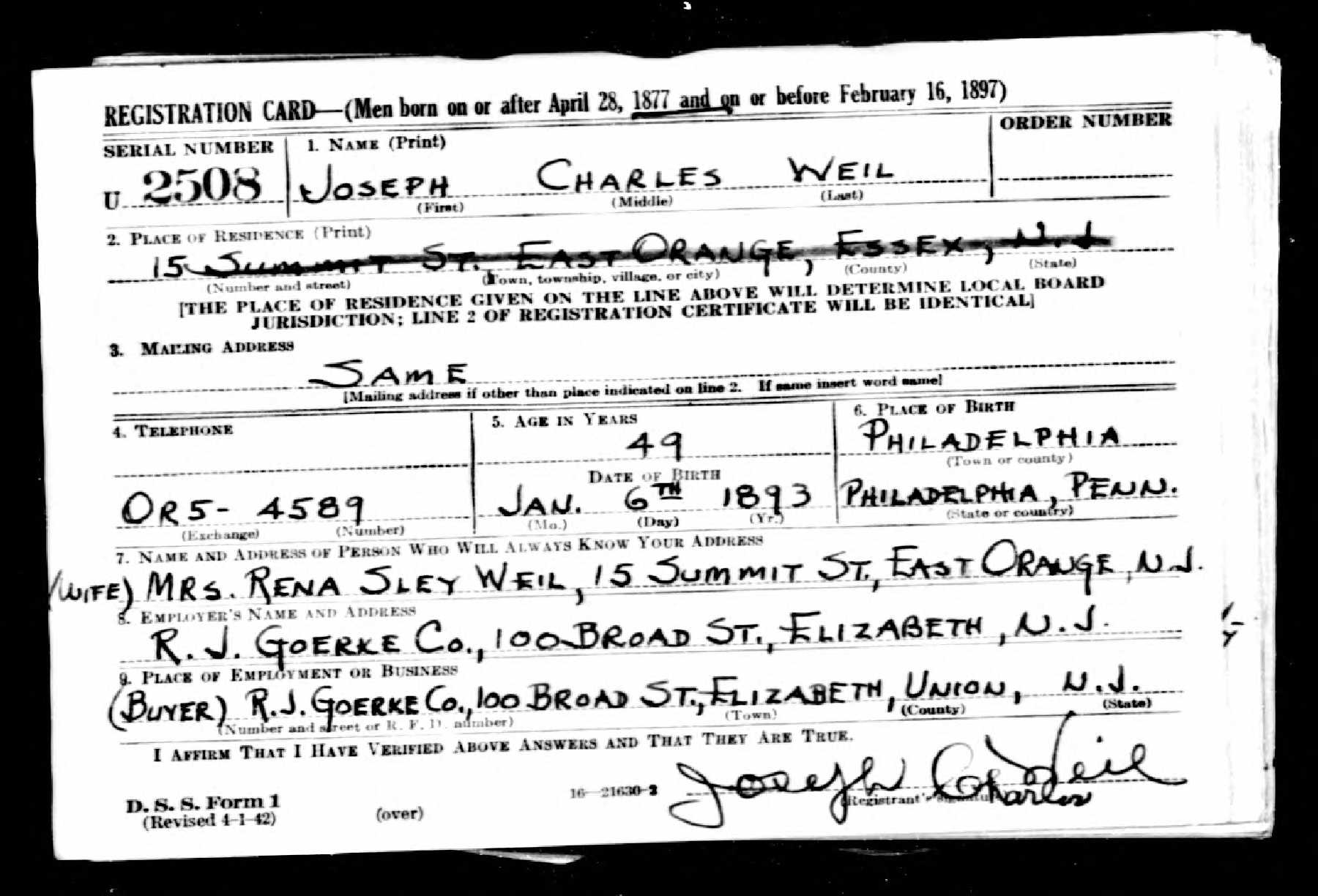
Joseph, meanwhile, had also remarried by then.  He had married Rose “Rena” Sley in 1921.  On the 1930 census, he was living with Rena, and their daughter Geraldine, who was then seven years old.  Joseph was selling men’s shirts.  In 1935, they were living in Hackensack, New Jersey, and in 1940 in Irvington, New Jersey.  Two cousins were living with them as well. Joseph was a buyer at a department store; according to his World War II draft registration, he was working for R.J. Goerke Company in Elizabeth, New Jersey, and living in East Orange in 1942.

Joseph Weil World War II Draft Registration

Joseph Weil World War II Draft Registration

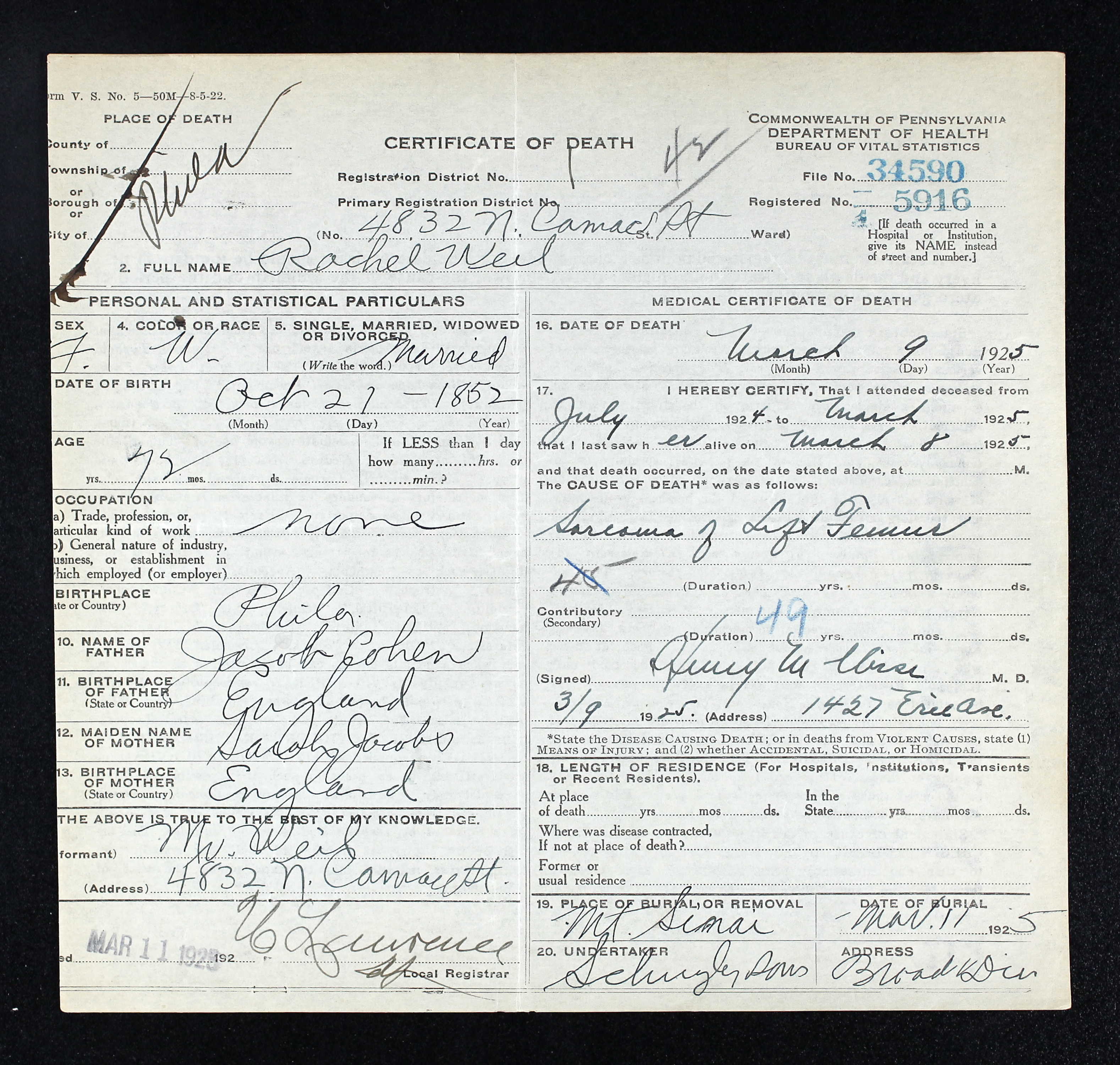
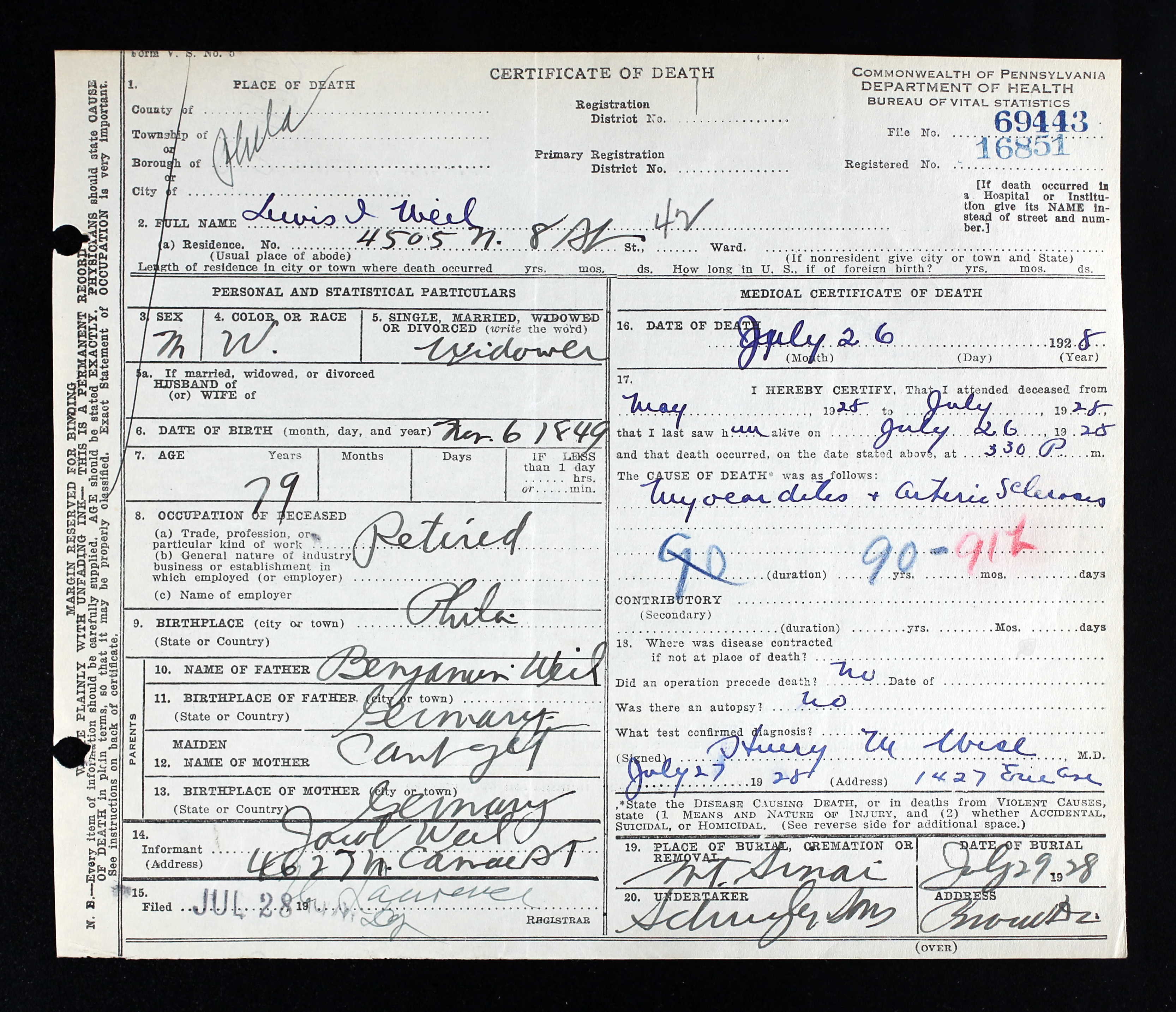
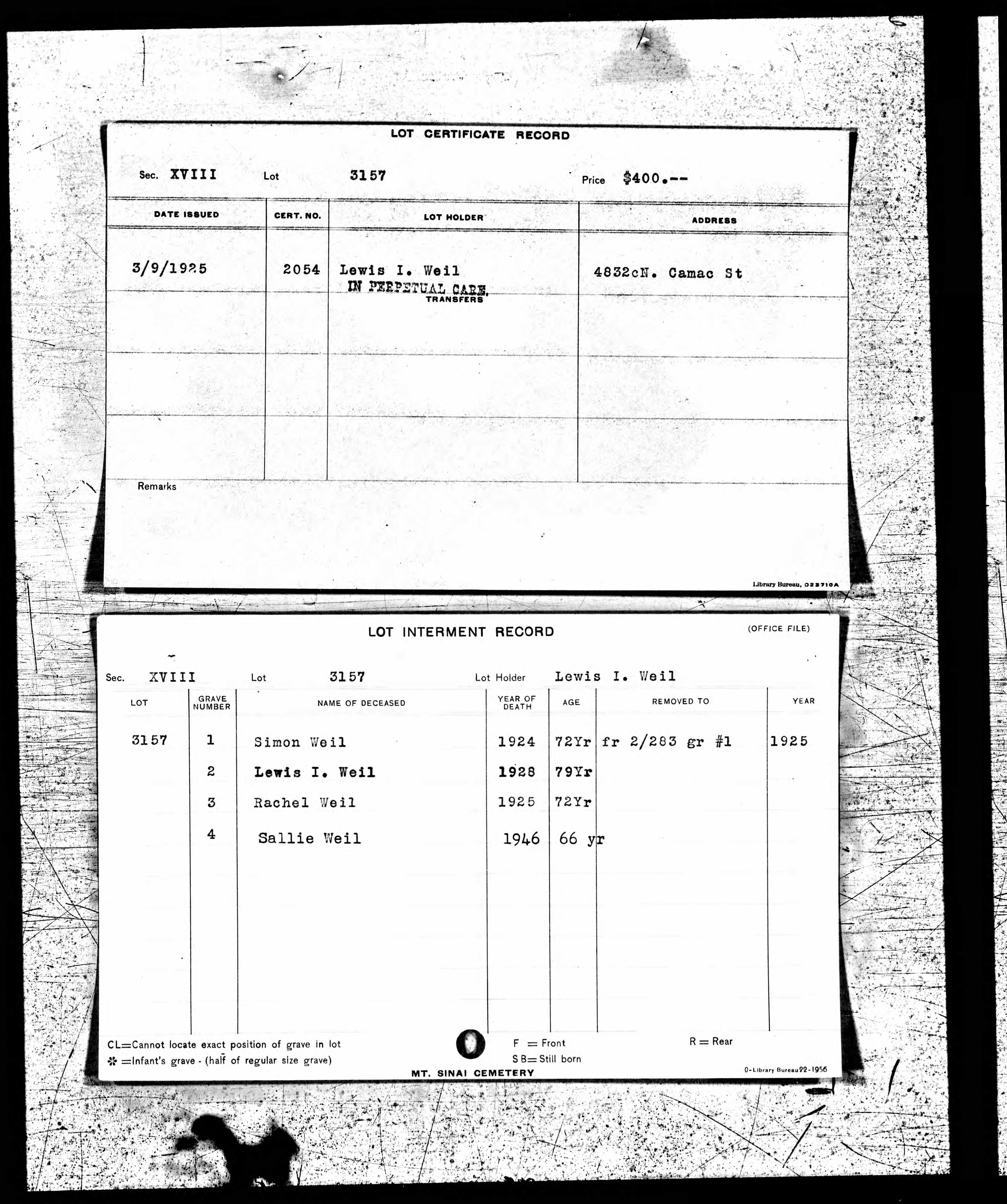
Meanwhile, on March 9, 1925, his mother Rachel, my great-grandaunt,  had died at age 72 of what looks like bone cancer: carcinoma of the left femur; she, like so many in her family, was buried at Mt Sinai cemetery.  Her husband Lewis died three years later on July 26, 1928, of heart disease and was buried beside her.

Rachel Cohen Weil death cert 1925

Rachel Cohen Weil death certificate 1925


Lewis Weil death certificate 1925

Lewis Weil death certificate 1925

Rachel and Lewis Weil death record

Rachel and Lewis Weil death record

Rachel’s life story is not dramatic.  It was in fact a bit of a relief after researching her brother Hart.  Rachel’s life seems to have been without scandal.  Her husband had a steady occupation throughout.  They suffered the loss of a child early in their marriage and perhaps other losses that are not documented in public records, but they also raised five children to adulthood.  Two of those children may have had some marital issues, but overall there were, aside from Benjamin’s death, no apparent tragedies or scandals. Rachel and Lewis stayed married to each other for almost 50 years.  They both lived into their seventies, unlike Rachel’s older siblings who did not live to see 70.  It was not a remarkable life, but it was a life not unlike many lives.  It may not make for an exciting story, but nor do most lives.  Their story is a family story, a story that many people aspire to live for themselves.


The Pawnbrokers: Not Reality TV, but Realities

Tradition symbol of pawnbrokers--three connect...

Tradition symbol of pawnbrokers–three connected balls (Photo credit: Wikipedia)

Growing up, I always heard my father’s family’s business referred to as jewelry and/or china dealers; I don’t recall them being described as pawnbrokers.  Maybe I just wasn’t listening (quite likely), or maybe that’s how my father explained it when I was too young to understand what “pawnshop” meant.

Anyway, I never thought of them as pawnbrokers.  My image of a pawnbroker was based on what I saw on crime shows on television, in movies like The Pawnbroker, and through windows as we drove through poor neighborhoods in New York.  The pawnshop was a place for either desperate people in need of money or criminals fencing stolen goods.  The pawnbroker was someone who was thus taking advantage of someone’s misfortune or the willing or unwitting participant in a crime.  I know of two incidents where my ancestors aided the police in solving crimes, so I am hoping that they were not complicit in receiving stolen goods, but were they taking advantage of the misfortunes of others?  Was this just a stereotype promoted in popular culture? Were pawnbrokers actually parasites, usurers, or were they providing a much needed service?

The Pawnbroker (film)

The Pawnbroker (film) (Photo credit: Wikipedia)

Interestingly, I had not really focused on this as I was researching until I could not decipher a word on the 1910 census for Joseph Cohen’s occupation, as I posted earlier this week.  I had asked for help here and elsewhere to decipher the word.  Several people expressed the same opinion—that the word is “loan office.”  As one person commented, it was just a nicer term for a pawnbroker.  Joseph may have been attempting to convey a less controversial image of his occupation.

I decided to do some reading to see what I could learn about pawnbrokers.  First, I wanted to better understand how the pawn business works.  I know that there are now a few reality television shows based on pawnshops, most notably Pawn Stars.  (One of my students brought this up in class this year during a discussion of bailment contracts, and I was sure he had said PORN Stars.  Just shows how uncool I can be….)  I read a few definitions and websites online about how pawning works, and this one seemed to be fairly accurate and concise, from Dictionary.com: “a dealer licensed to lend money at a specified rate of interest on the security of movable personal property, which can be sold if the loan is not repaid within a specified period.”

Wikipedia has a more expanded definition:  “If an item is pawned for a loan, within a certain contractual period of time the pawner may redeem it for the amount of the loan plus some agreed-upon amount for interest. The amount of time, and rate of interest, is governed by law or by the pawnbroker’s policies. If the loan is not paid (or extended, if applicable) within the time period, the pawned item will be offered for sale by the pawnbroker. Unlike other lenders, the pawnbroker does not report the defaulted loan on the customer’s credit report, since the pawnbroker has physical possession of the item and may recoup the loan value through outright sale of the item. The pawnbroker also sells items that have been sold outright to them by customers.”

So a person who needs money but for some reason cannot obtain a bank loan—insufficient credit, time pressure, some other reason that makes a bank an impractical choice—can take their property—jewelry, household items, clothing, whatever—to the pawnshop; the pawnbroker assesses the value of the items and provides a loan of cash to the person who agrees to pay with interest within a set period of time or to forfeit the personal property.

Since the pawnbroker must be licensed and since there are numerous state and federal regulations that apply to the business, there is nothing inherently shady about this business. It is a legal method of loaning money to those who choose not to go to a traditional bank.  So why is there an aura of shadiness often associated with the business?

Wendy A. Woloson wrote a book entitled In Hock, Pawning in America from Independence through the Great Depression (2006) that addressed just this question.  She wrote:

Pawnbrokers were at once essential to the continued well-being of this economic system and important scapegoats for the various social ills that the financial difficulties it brought.  Loans from pawnshops supplemented substandard wages, enabling workers to continue to feed their families and producers to continue to exploit their workers.  Although industrialists indirectly benefited from the services pawnbrokers provided, it was also in their interest to encourage the idea that pawnbrokers were fringe operators whose business had no place in the “mainstream” economic system. (p. 21)

Woloson contended that these capitalists promoted an image of pawnbrokers as hard-hearted, greedy and criminally inclined foreigners who used shady practices to exploit their customers. She also asserted that there was a fair degree of anti-Semitism behind these stereotypes.   Although not all pawnbrokers were Jewish, many were.  As Woloson explains, “Jews’ involvement with pawnbroking resulted not from any inherent character flaws or moral failings, as the popular press often posited. Rather, they took up pawnbroking and like occupations largely because they were barred from other trades, especially the mechanical and artisanal, and so necessarily developed an acumen dealing in consumer goods as peddlers, used clothing dealers, and auctioneers.”  (p. 71)

Of course, the negative stereotype of the Jewish moneylender is far more ancient than 19th century America; Shakespeare’s character Shylock from Elizabethan times is evidence of the way society and popular culture have long depicted Jews who were involved in the lending business.  Woloson elaborated on the role this stereotype and the anti-Semitism in society in general had on the popular assumptions about pawnbrokers—that they were Jewish opportunists taking money from hard working Americans.  (pp. 21-24)

Pawnbrokers were aliens in a commercial world populated by supposedly moral and upright Christian entrepreneurs, and the very nature of the business set it apart from ‘normal’ economic dealings.  The antithesis of merchants, pawnbrokers doled out money instead of taking it in, profiting from customers who lacked capital rather than possessed it. (p. 29)

As Woloson wrote, “Jews’ affiliation with pawnbroking and affiliated trades, such as dealing in used clothing and auctioneering, created among them a cohesive, commercially defined group; yet it also reinscribed outsiders’ perception that they operated beyond the currents of mainstream trade.” (p. 25-26)  Woloson explained that since most Americans in the early 19th century did not know many Jews, their preconceived image of the Jew as a greedy moneylender was reinforced by the fact that many pawnbrokers were Jewish. “It mattered little whether or not individual pawnbrokers were Jewish. Because they were all assumed to be, people scrutinized their business practices and questioned their ethics.” (p. 26)

Even as many Jews achieved substantial economic success through other businesses and finance in the 19th century, there was a common assumption that they had done so illegally, and the stereotype of the greedy, heartless moneylender persisted as part of popular culture. (p.28)  Pawnbrokers became common stock characters in works of popular culture, further promoting the negative and anti-Semitic stereotypes; Woloson catalogs a number of examples of novels and plays using such characters based on this stereotypes (pp. 28-53).

Woloson then provides evidence that in fact pawnshops served important public functions and were set up in ways to prevent exploitation of those who used their services. She describes how as cities grew and people outside the wealthy classes needed access to cash on short notice—to pay taxes or acquire assets they need to live or to work, there was a need for the services of pawnbrokers.  In the early 19th century, cities began to adopt regulations for pawnbroking.  I saw many legal notices in the Philadelphia Inquirer announcing the issuance of pawnbroking licenses to my ancestors and others. These required the posting of an expensive bond and thus ensured a commitment by the pawnbrokers to run their businesses in compliance with the regulations.  (pp.  54-57)

These local regulations controlled both the interest rate a pawnbroker could charge and the period a pawnbroker had to wait before the customer’s goods would be forfeited to the shop and available for sale.  For example, in Philadelphia in the 1860s, the interest rate could not exceed 6% and the pawnshop had to hold collateral for a year before reselling it. (p. 58)

Pawnbrokers hoped that this would add some legitimacy to their business and to their image, but apparently that did not occur.  As Woloson wrote:

Pawnbrokers were hardworking people who offered what was fast becoming a necessary service in maturing American cities, providing short-term loans on modest forms of collateral. Yet their profession, like dogcatching, was not one that people aspired to. Unlike clerks and mechanics, who received education through apprenticelike training and shared social activities, pawnbrokers enjoyed neither professional prestige, identity, specialized education, nor occupational camaraderie.  (p. 58)

According to Woloson, most pawnbrokers learned the trade by starting out as general dealers in goods, learning how to assess the value of those goods.  This is consistent with the experience of my ancestors.  First, they sold used goods and then perhaps newer goods, including china and clothing primarily.  Then they became pawnbrokers.  “A lasting and successful career in pawnbroking rested on one’s ability to identify local market niches and to accurately appraise a miscellany of goods.” (p. 60)

In Woloson’s opinion, these pawnbrokers provided substantial benefits to the people and the cities they lived in.  The money borrowed from the brokers helped not only their customers, but the economy of the city by enabling those people to buy goods and services and thus support local businesses.

She also discusses the typical patterns of the pawnbroking business in various cities, including Philadelphia.  Woloson noted that pawnshops tended to locate in areas that sold used clothing and furniture and other second hand goods rather than in the commercial heart of the cities where more elite retail centers would be located.  In Philadelphia, that meant that most pawnshops were located either north or south of the center of the city in areas, for example, like South Street where my great-grandfather’s pawnshop and home were located for many years.  Woloson provides this insightful description of that neighborhood in the mid-19th century:

Unburdened by any systematic police control, the diverse population and its many activities brought a liveliness to these areas. The very rich and the very poor mingled freely, as did members of various ethnicities and races. While this social mixing may have been scandalous to outside observers, residents themselves shared the collective ambition of getting ahead. The neighborhood’s mixed population at midcentury engaged in many enterprises. They drank, whored, pilfered, and occasionally rioted their way down South Street. By 1839 there were at least sixty-two taverns in the ten-block area.39 Men had their pick of brothels. ….  Some back alleys harbored “houses of prostitution of the lowest grade, the resort of pickpockets and thieves of every description.” Strangers were “earnestly admonished to not go there.” In contrast, another brothel only a few blocks away was home to a respectable “swarm of yellow [mulatto] girls, who promenade up and down Chestnut Street every evening, with their faces well powdered.” The lower sorts needed pawnbrokers to get them through the exigencies of the day and to fund their debauchery at night. Ten of the city’s thirteen pawnbrokers in 1850 were on South Street or within one block of the corridor. Rooted, the shops continued to hem the southern and northern fringes of the city until the end of the century.  (pp. 64-65; footnotes omitted)

H. Williams & Co. Ltd. Pawnbrokers

H. Williams & Co. Ltd. Pawnbrokers (Photo credit: christopher.woo)

This description gave me a far different impression than I previously had about how and where my great-grandfather Emanuel and his many siblings grew up; whereas I had never assumed that this was a wealthy neighborhood, I had assumed it was fairly safe and middle-class since Jacob had servants and a business that supported so many people.  Did my great-grandfather grow up hungry?  Probably not, but neither did he grow up in some swanky suburb or upscale city neighborhood.  He grew up surrounded by thieves, pickpockets, brothels, and bars.

These locations were, in Woloson’s view, business necessities.  The people who needed the services of the pawnbrokers were not the wealthy who shopped at fancy stores, but the working class and poor residents who could not get by without a quick and fairly easy loan.  Woloson opines that in some ways pawnbrokers were more straightforward businesspeople than those who used sales techniques to manipulate customers into buying goods.  In Woloson’s view, “Pawnbrokers made no pretense that they did anything other than loan money, and in this way many may have been more honest professionals than the retailers pushing goods on the other side of the city.” (p. 67-68)

Another pattern observed by Woloson was the tendency of pawnbrokers to expand and pass down their businesses within their families.  “Established, successful pawnshops were often passed down through single families rather than being taken over by outside partners; younger generations grew up in the trade and learned from fathers, uncles, and brothers, thus providing steady income to families over generations and contributing to social and economic stability where pawnbrokers resided.”  (p. 74)

Finally, Woloson also discusses the relative economic success of pawnbrokers, debunking the myth that many were wealthy as a result of the exploitation of those of lesser means.  She wrote:

Like many other businessmen operating in interstitial markets, most pawnbrokers worked the margins. Once they reached their professional apex, they typically did not advance much beyond the class of their customers and failed to accumulate enough capital to invest in larger financial endeavors that would have elevated them socially and economically. A pawnbroker’s profits were tied to the economic fortunes of his customers, and he often suffered losses at auctions of unredeemed collateral, especially during economic crunches. Pawnbrokers running shops in smaller cities necessarily supplemented the lending business with other petty entrepreneurial activities. Average pawnbrokers made enough money to support their families and to keep the business going, but probably not much more.  (p. 75)

I am really glad that I found this book because it has really given me a new perspective on my Cohen ancestors.  Compared to my Brotman and Goldschlager relatives, I’d always imagined that my Cohen relatives were wealthy and established.  Of course, by the late 19th century, early 20th century when my mother’s family started to arrive from Galicia and Romania, the Cohens had already been here for about 50 years and were well-settled, owning their own businesses, speaking English, and American-born.  They had the advantages of being here much earlier and so were far ahead economically when my mother’s family arrived.  But they were not the wealthy elite; they were probably at most middle class business people who were working in unpleasant neighborhoods, subjected to negative stereotypes based on their trade as well as their religion, and engaged in a business that required some risk-taking and business acumen but was not well-regarded.  That must have been very painful and frustrating.

Having this new perspective will help me better understand their lives as I continue to move forward in telling their story.


.

Enhanced by Zemanta