A Brief History of Jews in Western Pennsylvania: 1840-1900

Pittsburgh 1874 By Otto Krebs [Public domain], via Wikimedia Commons

Pittsburgh 1874
By Otto Krebs [Public domain], via Wikimedia Commons

One of the questions I had when I started researching my Schoenthal relatives and their lives in western Pennsylvania was what kind of Jewish community existed in that region during the second half of the 19th century.  Learning more about my great-great-uncle Henry Schoenthal made me even more curious about that community.   I now have found two resources that help answer that question.

Susan Melnick, who is doing a project on the history of Jews in western Pennsylvania, told me about Jacob Feldman’s The Jewish Experience in Western Pennsylvania: A History 1755-1945 (1986, The Historical Society of Western Pennsylvania), and I ordered a copy.  According to Feldman, although there were a number of Jews who traveled to the Pittsburgh area to transact trade and a few who even briefly settled in the region or purchased land there for investment in the mid-1700s, there was no established Jewish community in the region until the 19th century.  In fact, Jews were slow to move to Pittsburgh even in the first half of the 19th century even though the Jewish population of the US was growing as many more Jewish immigrants arrived from Europe.  Jews were settling in places like Cleveland, Cincinnati, and New Orleans, but not in Pittsburgh because it was at that point less accessible.  Although Pittsburgh was itself growing as the coal industry and manufacturing developed, there was no real Jewish community in western Pennsylvania’s largest city or elsewhere in the region as of 1840.  (Feldman, pp. 3-12)

Slowly in the early 1840s, Jewish peddlers and merchants began to arrive in Pittsburgh, and some settled there.  But as Feldman wrote, “Certainly, this tiny group of Jews could not muster a minyan, a quorum of ten men aged thirteen and over, for the religious services they held in private homes unless a few itinerant peddlers or visitors also were stopping off in town.” (Feldman, p. 16)

As transportation to and from Pittsburgh improved after 1845, the Jewish population grew, with most of the men engaged in sales of dry goods.  By 1848 Jews had organized a cemetery (Troy Hill), a mourner’s society, and a synagogue in Pittsburgh, Shaare Shamayim. Feldman estimated that by 1850 there were 35 Jewish men in Pittsburgh, three times the number of Jews that had been there just three years earlier—before the cemetery and synagogue had been founded.   These were predominantly immigrants from Germany, Lithuania, and Russia.  They were engaged primarily in making and selling clothing as well as sales of dry goods. (Feldman, 17-20)

Photo courtesy of Lisa Albanese

Troy HIll cemetery Photo courtesy of Lisa Albanese

The arrival of the railroad in the 1850s led to another substantial increase in Pittsburgh’s overall population and economy, and poor economic conditions in Germany also led to an increase in the number of Jewish immigrants leaving Germany and arriving in western Pennsylvania, including my cousins Marcus and Mina (Schoenthal) Rosenberg and Simon and Fanny (Schoenthal) Goldschmidt (later Goldsmith).  Pittsburgh was also experiencing some significant industrial development, including the beginnings of a glass manufacturing industry.  Jews expanded beyond the dry goods and clothing fields to sales of liquor and of livestock.  Many were drovers, like Amalie Schoenthal’s husband, Elias Wolfe. (Feldman, 21-23)

As the Jewish population grew, so did the number of Jewish institutions in Pittsburgh, including a benevolent society to help new arrivals, a burial society, a kosher butcher, and a new synagogue.  A  number of members split from the first synagogue, Shaare Shamayim, and formed Rodef Shalom in 1855.  The population could not support two separate congregations, however, and as more and more members joined Rodef Shalom, Shaare Shamayim suffered and in 1860 merged with Rodef Shalom, which became the name of the surviving synagogue.  In 1861, the cornerstone was laid for a synagogue building, which would be the first building owned by a Jewish congregation not only in Pittsburgh, but anywhere in western Pennsylvania.  It opened to great fanfare in 1862.  (Feldman, 23-31.)

Rodef Shalom Temple, Pittsburgh, Pennsylvania,...

Rodef Shalom Temple, Pittsburgh, Pennsylvania, USA. (Photo credit: Wikipedia) (Current building, not the original)

During the 1860s and 1870s, the Jewish population of Pittsburgh continued to grow.  Rodef Shalom faced challenges as it moved from an Orthodox practice to Reform under the influence of its German-American leaders.  Those who wanted to continue an Orthodox practice left to form Tree of Life congregation.  Because services at Rodef Shalom were conducted in German,  other members left a few years later and formed another new congregation, Emanuel, also Reform but with services in English. Now the Jewish population in the city was large enough to support three congregations.  Thus, by the time some of my Schoenthal ancestors were moving to Pittsburgh in the 1870s and 1880s, there was a well-established Jewish community in Pittsburgh. (Feldman, 33-54)

But what about “Little Washington,” a much smaller town 30 miles from Pittsburgh? What kind of Jewish community existed there when Henry Schoenthal arrived in 1866 and when my great-grandfather arrived fifteen years later in 1881? Feldman reported that in 1853 my cousin Jacob Goldsmith may have been the first Jew in Washington, Pennsylvania,  followed by four more Jews within the next five or six years.  According to Feldman, when one of them, David Wolfe (possibly a relative of Amalie’s husband Elias Wolfe?) was killed accidentally by some rowdy soldiers in 1863, all the other Jews left Little Washington. (Feldman, p. 57)

According to my records, Jacob Goldsmith is listed as living in Washington, PA, even before 1853. The 1850 US census has him listed as living there and working as a tailor.  He was still there for the 1860 census and also registered for the Civil War draft in Washington in 1863. His father Simon, widow of Fanny Schoenthal, was also living in Washington by 1860. And Jacob Goldsmith was still there when his cousin Henry Schoenthal arrived there in 1866, according to Henry’s diary and the Beers biography of Henry, which says that Henry clerked in Jacob’s store for three years after he arrived in Washington.

But Jacob Goldsmith had moved to Philadelphia by 1870 and Simon Goldsmith had returned to Pittsburgh by then as well, so Henry Schoenthal and his family must have been among a very small number of Jewish residents of Washington in 1870.   Feldman noted that in 1860 there were only 250 Jews, “mostly of German origin,” living in western Pennsylvania in places other than Pittsburgh, spread out over an area of about 15,000 square miles, meaning that there were not too many Jews in any one locality.  (Feldman, p. 58)  In places like Washington, the few Jews who lived there would meet in private homes for prayer services. My great-great-uncle Henry was one of those who hosted and led such services. As of 1880, only Pittsburgh and two other towns in western Pennsylvania, Altoona and Erie, had actual synagogues. (Feldman, p. 63)

By 1890, things began to change in Little Washington.  In that year the very small Jewish community established a synagogue, Beth Israel, a congregation which exists to this day.  I was very fortunate to connect with Marilyn A. Posner, a past president of Beth Israel as well as the author of the centennial history of the synagogue, The House of Israel, A Home in Washington: 100 Years of Beth Israel Congregation, 1891-1991 / 5652-5752 (1991, Congregation Beth Israel, Washington, Pennsylvania).  As Posner’s book describes, in 1890 the congregation hired a young rabbi named Jacob Goldfarb as its first spiritual leader.  Rabbi Goldfarb was a recent immigrant from Lithuania.  As described by Posner, “He was fluent in the Lithuanian, Russian, German, Hebrew and Yiddish languages.  He was a mohel, able to perform ritual circumcisions; a shochet, or ritual butcher; a chazzan or cantor; and he studied Talmud and Torah.” (Posner, p. 1.)  If that’s not killing multiple birds with one stone, I don’t know what is!

Photo courtesy of Marilyn Posner from her book, "The House of Israel, A Home in Washington: 100 Years of Beth Israel Congregation, 1891-1991 / 5652-5752

Photo courtesy of Marilyn A. Posner from her book,
“The House of Israel, A Home in Washington: 100 Years of Beth Israel Congregation, 1891-1991 / 5652-5752


Beth Israel’s services were at first held in the home of one of its members, Nathan Samuels.  Then the congregation met in rented facilities for some years.

House of Nathan Samuels in Washiington PA where Beth Israel congregants first met Photo courtesy of Marily Posner from her book, "The House of Israel, A Home in Washington: 100 Years of Beth Israel Congregation, 1891-1991 / 5652-5752

House of Nathan Samuels in Washiington PA where Beth Israel congregants first met
Photo courtesy of Marilyn A. Posner from her book, “The House of Israel, A Home in Washington: 100 Years of Beth Israel Congregation, 1891-1991 / 5652-5752

Among the nine original members of the congregation were four of my relatives, my great-grandfather Isidore Schoenthal and two of his brothers, Henry and Nathan[1], and S.J. Katzenstein, my great-grandmother Hilda’s brother.  (Posner, p. 2).  Henry also became the president of the local branch of B’nai Brith, the Jewish fraternal organization.  (Feldman, p. 231)  My relatives were not, however, on the list of those who signed the original synagogue charter in 1901.  Feldman explained it as follows:

Beth Israel, unlike some nearby synagogues, was not Hungarian or Galician.  When its charter was taken out in 1901, twenty-four of its twenty-seven subscribers were Lithuanian …. The few Germans in Washington, Henry Schoenthal among them, were absent from the charter.

(Feldman, p. 199)

With the synagogue officially chartered, ground was broken for building a permanent home for the congregation and a cornerstone was laid on June 29, 1902.  By that time the Washington Jewish community had become one of the leading Jewish communities in western Pennsylvania outside of Pittsburgh.

Sketch of the original Beth Israel synagogue building. Courtesy of Marilyn Posner from her book, "The House of Israel, A Home in Washington: 100 Years of Beth Israel Congregation, 1891-1991 / 5652-5752

Sketch of the original Beth Israel synagogue building.
Courtesy of Marilyn A. Posner from her book,
“The House of Israel, A Home in Washington: 100 Years of Beth Israel Congregation, 1891-1991 / 5652-5752

With this history in mind, I better understand why my relatives settled in western Pennsylvania and specifically in Washington and why they felt comfortable living there.   Many of the Schoenthal descendants continued to live there for many years, and there are still quite a few living in Pittsburgh to this day.

———-

[1] My research indicates that Nathan was no longer living in western Pennsylvania, let alone Washington, in 1890, but that he had moved to Washington, DC, ten years before and was living in either Richmond, VA, or Philadelphia by 1890.

Those Who Left Western Pennsylvania: The Schoenthals 1880-1900

Although most of the extended Schoenthal family was located in western Pennsylvania during the 1880s, a few family members had moved further east.  I’ve already written about Julius Schoenthal and his life and his family in Washington, DC.  He was a German and US veteran, a shoemaker, and the father of four children.  In the 1880s he and his wife Minnie were busy raising their family.

What I had not mentioned in my post about Julius was that by 1879, he was joined in Washington, DC, by his younger (by nine years) brother Nathan.  On the 1880 census, Nathan was living in DC, not married, and working as a clerk in a “fancy store.” I am not sure what that is, but according to the Free Dictionary, it is “one where articles of fancy and ornament are sold.”   Nathan and Julius were not living in the same enumeration district, and the 1880 census did not provide street addresses, so I don’t know how close together the brothers were living.  I don’t know why Nathan left Washington, PA, for Washington, DC, but I would assume that having a brother there was a factor.

Washington, D.C. (Sept. 26, 2003) - Aerial vie...

Washington, D.C. (Sept. 26, 2003) – Aerial view of the Washington Monument with the White House in the background. (Photo credit: Wikipedia)

By 1883, however, Nathan had moved again.  He was then living in Richmond, Virginia, working as a salesman, according to the city directory for that year.  He was still in Richmond in 1888.  According to the 1900 census, Nathan married a woman named Alice in 1890.  I have not been able find out very much about Alice except that she was born in South Carolina in 1865.  I don’t know her birth name, I don’t know anything about her family, and I don’t know where she married Nathan.


English: Looking east on Main Street, Richmond...

English: Looking east on Main Street, Richmond, Virginia, ca. 1901-1907. (Photo credit: Wikipedia)

Perhaps Alice had been living in Philadelphia; in 1891 and 1892, Nathan appeared in the Philadelphia city directory, working as a “supt,” which I assume means he was a superintendent.  But of what?

Philadelphia City Hall, Philadelphia, Pennsylv...

Philadelphia City Hall, Philadelphia, Pennsylvania, USA. (Photo credit: Wikipedia)

Well, in 1896 Nathan Schoenthal is listed in the directory for Lancaster, Pennsylvania, working as an assistant superintendent for Prudential Insurance Company, so I assume that that is what he was also doing in Philadelphia and perhaps even in Richmond.  He is also listed as an insurance agent in the 1898 Lancaster directory.

English: North Duke Street in Lancaster, Penns...

English: North Duke Street in Lancaster, Pennsylvania (Photo credit: Wikipedia)

But he was not done moving because in 1900 he and Alice were living in Newport News, Virginia, where Nathan continued to work as an insurance agent.  They had been married for ten years, as mentioned above, and had no children.


Embed from Getty Images

A year later they moved once again, this time to Petersburg, Virginia, a city about 24 miles south of Richmond.  According to the 1901 directory for Petersburg, Nathan was now an assistant superintendent for the Insurance Company of Virginia.  He was still in that position there in 1905, but in the 1909 directory for Petersburg he is listed as a solicitor without further description.

Exchange Building (Petersburg, Virginia).(cropped)

Exchange Building (Petersburg, Virginia).(cropped) (Photo credit: Wikipedia)


And then in 1910, Nathan Schoenthal is listed in the Baltimore directory as a manager, but I’ve no idea of what.  Is it possible that this is not the same Nathan Schoenthal?  I don’t know.  But this is the last record I have for Nathan.  I cannot find him or Alice on the 1910 census, and in June 1912, an “Alice Shoenthal” married a man named John Alexander Mallory in Petersburg, Virginia.  Had Nathan died? Had their marriage ended?  Had he moved to Baltimore without Alice? Had she finally gotten fed up with moving from place to place? I don’t know.

Nathan Schoenthal wife remarries


I’ve hit one of those brick walls, and I have no answers.  Nathan Schoenthal, a man who moved from place to place and then disappeared, will be in my “To Be Done” folder for a while.

Yet another brick wall.

Yet another brick wall. (Photo credit: Wikipedia)


The third Schoenthal brother who left western Pennsylvania, in addition to Julius and Nathan, was Simon.  Simon had moved to Philadelphia by 1880, where he continued to work as a bookbinder.  Unlike his brother Nathan, Simon’s life was remarkably stable and consistent.  He was still working as a bookbinder and living in Philadelphia in 1890.

The 1880s were productive years at home for Simon and his wife Rose nee Mansbach.  By 1880, they’d had five children: twins, Ida and Harry, born in 1873; then Gertrude, born in 1875; Louis, born in 1878, and Maurice, born in 1879, all of whom were born in western Pennsylvania.  After that they had five more who were born in Philadelphia: Martin (1881), Jacob (1883), Hettie (1885), Estelle (1888), and Sidney (1891).  Rose had been pregnant nine times, almost every other year over almost twenty years.  Wow.

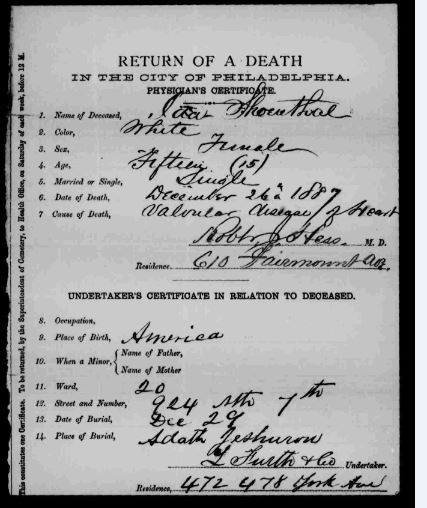
In 1887, the oldest daughter Ida died from heart disease; she was only fourteen years old.  No matter how many children they had, losing the first born daughter Ida must have been devastating for the family.  It must have been especially hard for Harry, her twin.

Ida Shoenthal death certificate

Ida Shoenthal death certificate “Pennsylvania, Philadelphia City Death Certificates, 1803-1915,” database with images, FamilySearch (https://familysearch.org/pal:/MM9.3.1/TH-267-12895-183388-90?cc=1320976 : accessed 28 October 2015), 004008625 > image 605 of 612; Philadelphia City Archives and Historical Society of Pennsylvania, Philadelphia

By 1890, Simon and Rose had nine children living with them, ranging in age from Harry, who was seventeen, to Sidney, who was an infant.  Interestingly, around this time Simon changed occupations.  He is listed as selling “segars” in the 1891 and 1892 Philadelphia directories.

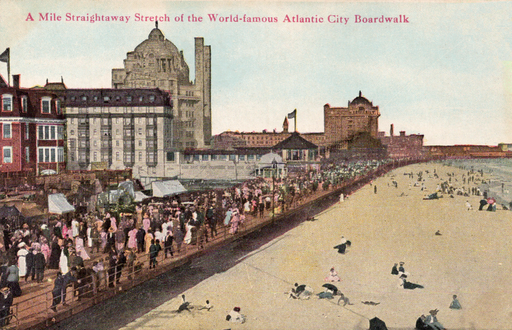
By 1898, Simon and Rose had relocated to  Atlantic City, where Simon now owned a “notion and bric-a-brac store” that was destroyed by a fire on February 7 of that year.

Fire in Atl City store of Simon Schoenthal


By 1900, however, Simon was back in business in Atlantic City, as reported on the 1900 census.  He was then operating a cigar and stationery store.  Six of their nine children were living with Rose and Simon: Louis was working as a cigar salesman, and Martin and Jacob were working as “laundrymen.”  Hettie, Estelle, and Sidney were also living at home.

There were three children missing from Simon and Rose’s Atlantic City household on the 1900 census:  Harry, Gertrude, and Maurice.  Harry, now 27, was a student at Juniata College in Huntingdon in 1900, as listed on the census.  Juniata was at that time a  relatively new college, founded in 1876 by the Church of the Brethren, a Protestant sect started in Germany.  I would be interested in knowing what drew Harry to Juniata and what classes he took while there. Two years later, Harry was living in Atlantic City where his parents and most of his siblings were living; he was working for Atlantic Wine and Liquor, according to a city directory.

As for Simon and Rose’s daughter Gertrude, she had married a man named Jacob J. Miller in Atlantic City on February 12, 1898, when she was 23.  Jacob was born in Germany on June 6, 1873, and had immigrated to the US sometime in the 1880s.  A year after marrying, Jacob and Gertrude were living in Tucson, Arizona, where Jacob was working for the Crescent Cigar Company, the same industry in which his father-in-law Simon and brother-in-law Louis were engaged.  In 1900, they had an infant daughter Juliette and were living in Pima, Arizona.  Jacob was working as a grocer.  Gertrude and Jacob would have two more children: Harry in 1902 and Sylvester in 1906.

A stunning view of Cluff Ranch Pond near Pima,...

A stunning view of Cluff Ranch Pond near Pima, Arizona. (Photo credit: Wikipedia)

As for Maurice, although I cannot find him with the family or elsewhere on the 1900 census, he and three of his brothers are all listed in the 1904 Atlantic City directory, as seen below:

Atlantic City directory 1904

Atlantic City directory 1904 Ancestry.com. U.S. City Directories, 1822-1989 [database on-line]. Provo, UT, USA: Ancestry.com Operations, Inc., 2011.

All four brothers were living at 22 Delaware Avenue in Atlantic City, their mother at 23 Delaware.  It appears that Martin and Jacob were running a laundry called Incomparable Laundry at 1432-1434 Atlantic Avenue and that Louis was running a cigar, tobacco, stationery and sporting goods business at the same location.  Louis also listed a billiards and pool hall on “S Virginia av n Beach.”  Maurice is listed as a manager at “S Virginia av, Ocean end.”  I think that those two addresses are likely the same location and that Maurice was managing the pool hall.

As the listings also reveal, Rose was a widow by the time of the 1904 directory’s publication.  Simon died on March 26, 1904, in Atlantic City; he was buried at Mt. Sinai cemetery in Philadelphia.  He was 55 years old and the first of my great-grandfather’s siblings to die.

I will follow up with what happened to Simon’s children and other descendants in the 20th century in a later post.


A Legitimate Part of the Family


In my last post about the Schoenthals, I mentioned that Hannah Schoenthal, my great-grandfather Isidore’s oldest sibling, had had a child out of wedlock in 1865, a daughter she named Sara (later spelled Sarah).

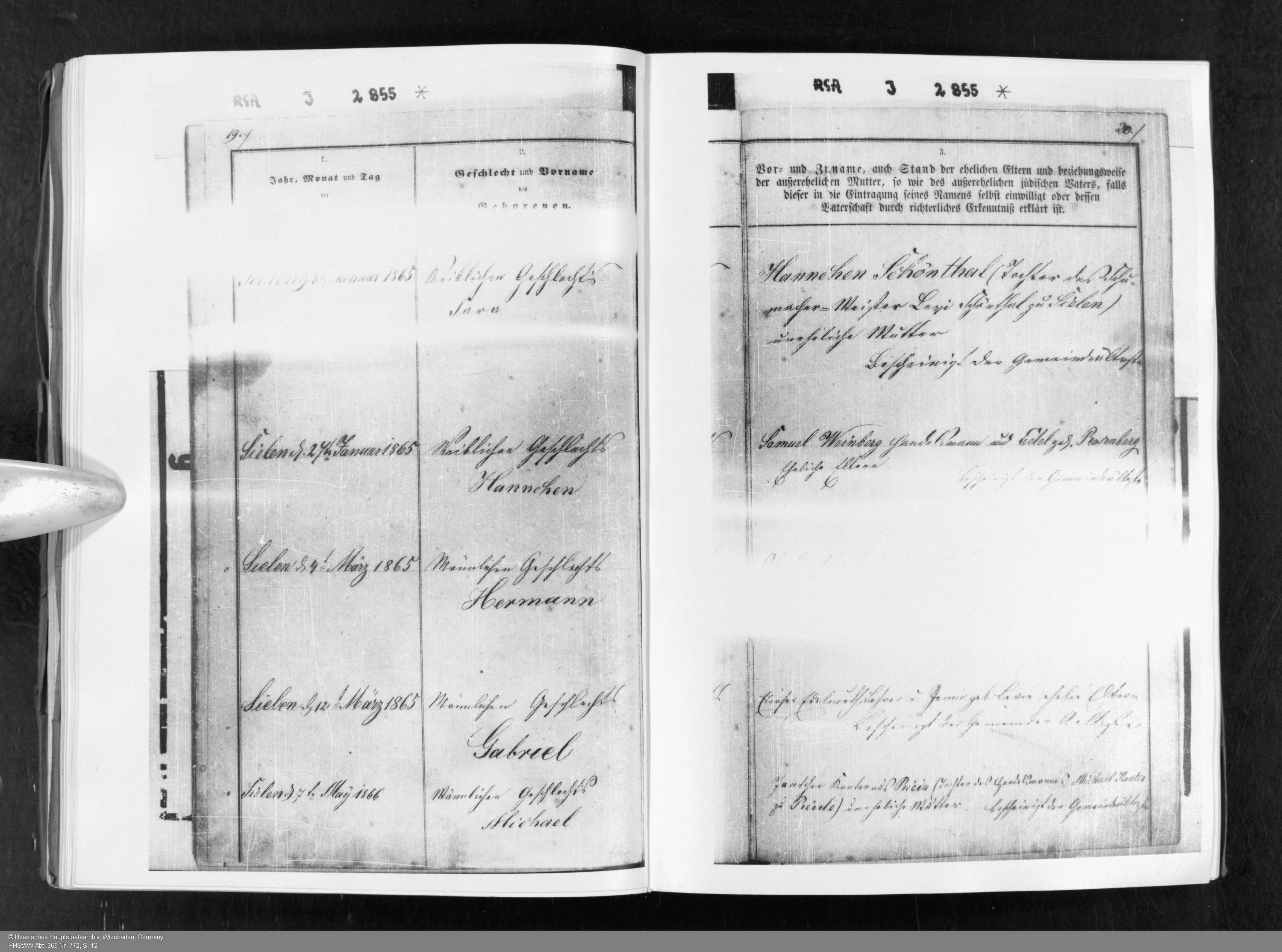
Sara Schoenthal birth record HHStAW Abt. 365 Nr. 772, S. 12

Sara Schoenthal birth record
HHStAW Abt. 365 Nr. 772, S. 12

I wondered how such a child would be treated under Jewish law and by society at that time.  According to Jewish law, a child born to an unmarried couple is not treated any differently for religious or marital purposes than one born to a married couple, unless  the mother was married to someone else or there was an incestuous relationship between the parents.   Even if the father was not Jewish, the child would still be considered a legitimate member of the Jewish community.  Although some sources indicated that there was disapproval by the Jewish community of unwed mothers, other sources said that there was no stigma attached to a child born to a single woman.  Sarah’s story indicates that she was fully accepted as part of her mother’s extended family and that there was no stigma.

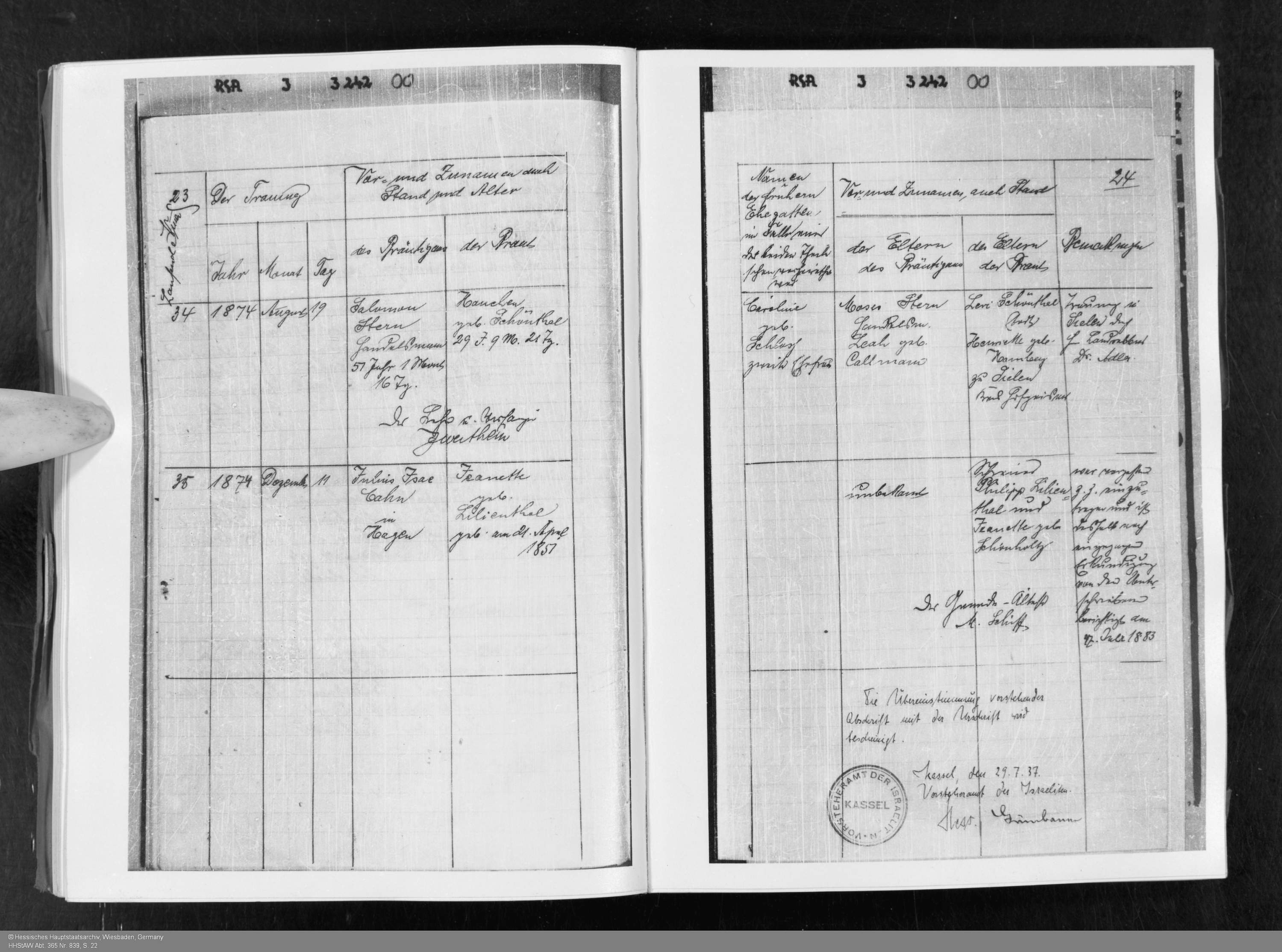
In 1874, nine years after Sarah was born,  her mother Hannah married a man named Solomon Stern with whom she had three children, Jennie, Edith, and Louis, all born between 1875 and 1879.

Marriage record for Hannah Schoenthal and Solomon Stern HHStAW Abt. 365 Nr. 839, S. 22

Marriage record for Hannah Schoenthal and Solomon Stern
HHStAW Abt. 365 Nr. 839, S. 22

Solomon died in February, 1888, and Hannah emigrated from Germany that year, settling in Pittsburgh where several other Schoenthal relatives were living.  Although I could not find with any certainty a ship manifest for Hannah, at the time of the 1900 census she was living with two of her children, Edith and Louis, in Pittsburgh.  Also living with them was Hannah’s 44 year old stepson, Morris Stern. All four said they had arrived in 1888.

Hannah Stern and children 1900 US census Year: 1900; Census Place: Allegheny Ward 6, Allegheny, Pennsylvania; Roll: 1356; Page: 9A; Enumeration District: 0058; FHL microfilm: 1241356

Hannah Stern and children 1900 US census
Year: 1900; Census Place: Allegheny Ward 6, Allegheny, Pennsylvania; Roll: 1356; Page: 9A; Enumeration District: 0058; FHL microfilm: 1241356

As for Jennie, I did find a possible ship manifest dated December 10, 1888, for a sixteen year old named Jenny Stern from Germany; the index on Ancestry said her destination was Pittsburgh, but to be honest, I think that the manifest says that she was destined for New York.  Hannah’s daughter would have been only thirteen, not sixteen like the Jenny Stern on the manifest.  So I am not convinced this was my Jennie Stern. See the last entry below and the column on the far right indicating the destination.

Ship manifest for the Italy with Jenny Stern Year: 1888; Arrival: New York, New York; Microfilm Serial: M237, 1820-1897; Microfilm Roll: Roll 528; Line: 1; List Number: 1643

Ship manifest for the Italy with Jenny Stern
Year: 1888; Arrival: New York, New York; Microfilm Serial: M237, 1820-1897; Microfilm Roll: Roll 528; Line: 1; List Number: 1643

Thus, when I didn’t see Jennie on the 1900 census with Hannah, Edith, and Louis, I wasn’t sure that she had immigrated with her family, but then I found Jennie’s death certificate:

Ancestry.com. Pennsylvania, Death Certificates, 1906-1963 [database on-line]. Provo, UT, USA: Ancestry.com Operations, Inc., 2014. Original data: Pennsylvania (State). Death certificates, 1906–1963. Series 11.90

Ancestry.com. Pennsylvania, Death Certificates, 1906-1963 [database on-line]. Provo, UT, USA: Ancestry.com Operations, Inc., 2014.
Original data: Pennsylvania (State). Death certificates, 1906–1963. Series 11.90

This was obviously the right Jennie, given her parents’ names, and now I knew that her husband’s name had been Max Arnold and that she also had been living in Pittsburgh.  I then found Jennie and Max and their family on the 1900 census:

Jennie and Max Arnold 1900 census Year: 1900; Census Place: Allegheny Ward 2, Allegheny, Pennsylvania; Roll: 1354; Page: 3B; Enumeration District: 0009; FHL microfilm: 1241354

Jennie and Max Arnold 1900 census
Year: 1900; Census Place: Allegheny Ward 2, Allegheny, Pennsylvania; Roll: 1354; Page: 3B; Enumeration District: 0009; FHL microfilm: 1241354

But what about Hannah’s first child, Sarah? Had she left her illegitimate daughter behind? Had she put her up for adoption after she was born? Or had Sarah died? I had no idea, and I could not find Sarah in any records.

Until I saw that social announcement in the paper about Henry Floersheim’s party for the Schoenthal and Katzenstein families:

The Daily Republican (Monongahela, Pennsylvania) 11 Aug 1887, Thu • Page 4

The Daily Republican
(Monongahela, Pennsylvania)
11 Aug 1887, Thu • Page 4

Who was Sarah Stern, and what was she doing at this party? The dim lightbulb in my head slowly lit up:  Sarah Stern had to be Hannah’s first child, the one she had before marrying Solomon Stern, who must have given her his name when he married Hannah.

But was I right?

The document that helped to answer that question was, surprisingly enough, an entry in the California Death index on Ancestry.com for a Sarah Oestreicher, who died on February 5, 1940, in Los Angeles.  How did I know that this was Hannah’s Schoenthal’s daughter Sarah?  Because the index said her father’s surname was Stern, her mother’s Schoenthal, and that she had been born January 8, 1867, in a foreign country.  Although the birth record I had for Hannah’s daughter Sara recorded her birth date as January 8, 1865, the other facts certainly made it clear to me that Sarah Oestreicher was in fact the daughter of Hannah Schoenthal and that she had just made herself two years younger than she actually was.

Now that I had Sarah’s married name, it was not hard to find other records for her.  I found a Sarah Oestreicher living in Pittsburgh on the 1900 census with her husband Gustav Oestreicher and their three children, Sidney (9), Francis (6), and Helen (4).   Sarah reported her birthdate as January 1865, her birthplace as Germany, and her arrival date as 1884.

Oestreicher family 1900 census Year: 1900; Census Place: Pittsburgh Ward 21, Allegheny, Pennsylvania; Roll: 1362; Page: 10A; Enumeration District: 0254; FHL microfilm: 1241362

Oestreicher family 1900 census
Year: 1900; Census Place: Pittsburgh Ward 21, Allegheny, Pennsylvania; Roll: 1362; Page: 10A; Enumeration District: 0254; FHL microfilm: 1241362

The 1910 and 1930 census reports also gave an 1884 arrival date for Sarah.  (The 1920 census said she arrived in 1895, but that is obviously not correct, especially since it says she was naturalized in 1894.)  Thus, Sarah had arrived before her stepfather Solomon Stern had died and before her mother Hannah and her half-siblings immigrated in 1888.  It thus makes sense that she, a young woman living without her immediate family, would have been invited along with her two uncles, Henry and Isidore Schoenthal, to the party given by Henry Floersheim in 1887.  Perhaps she was even living with her uncle Henry at that time in Washington, Pennsylvania, or maybe she was living in Pittsburgh with another relative.

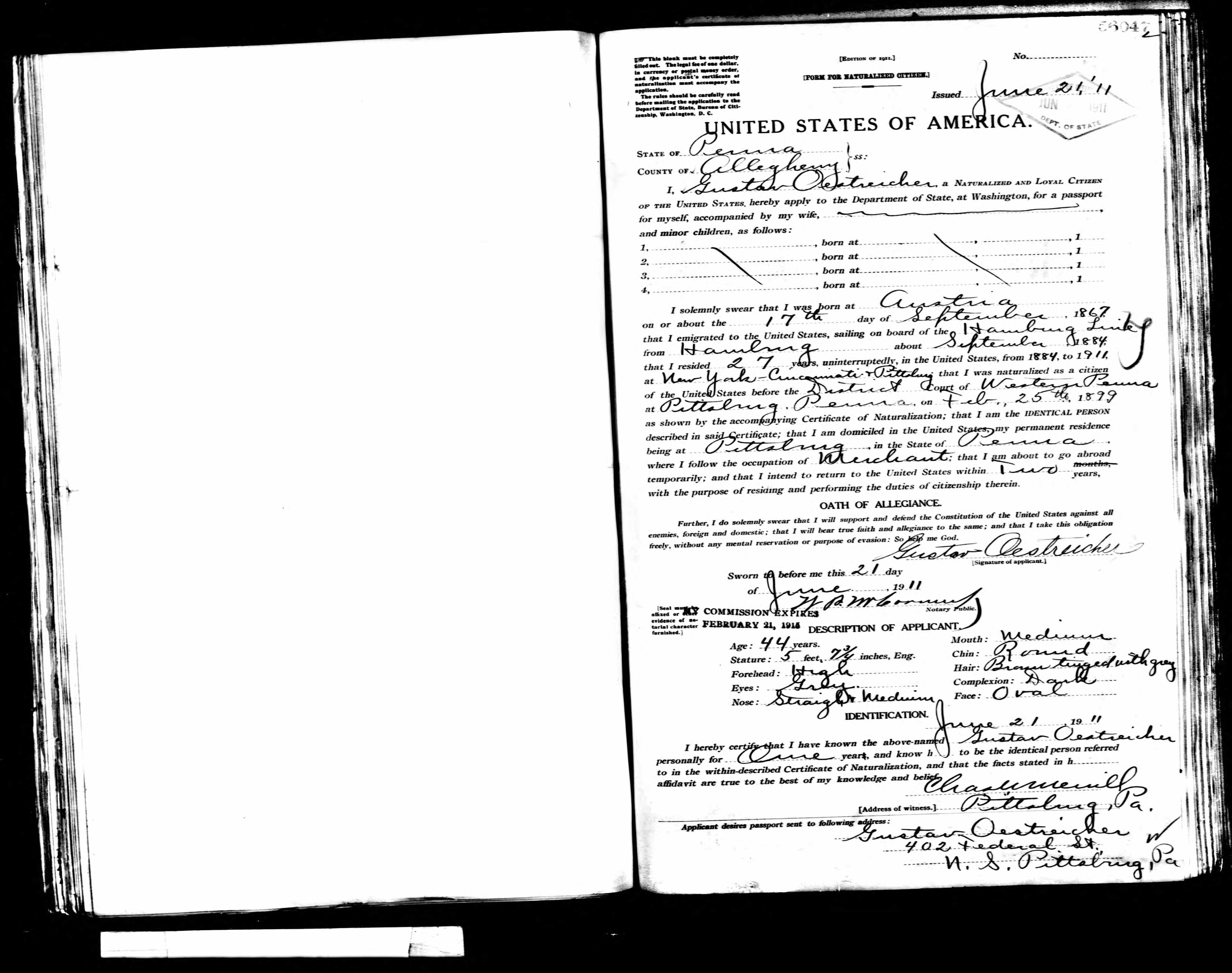
According to the 1900 census record, she and Gustav had been married for ten years, meaning they had married in 1890 or 1889.  According to his passport application filed in 1911, Gustav was born in Austria on September 17, 1867, and had arrived in the United States in September, 1884.  He had lived in New York and Cincinnati before settling in Pittsburgh.  In 1900, he was working as an artist, doing painting and photography, according to the census record for that year.

Gustav Oestreicher passport application National Archives and Records Administration (NARA); Washington D.C.; NARA Series: Passport Applications, January 2, 1906 - March 31, 1925; Roll #: 141; Volume #: Roll 0141 - Certificates: 55972-56871, 23 Jun 1911-05 Jul 1911

Gustav Oestreicher passport application
National Archives and Records Administration (NARA); Washington D.C.; NARA Series: Passport Applications, January 2, 1906 – March 31, 1925; Roll #: 141; Volume #: Roll 0141 – Certificates: 55972-56871, 23 Jun 1911-05 Jul 1911

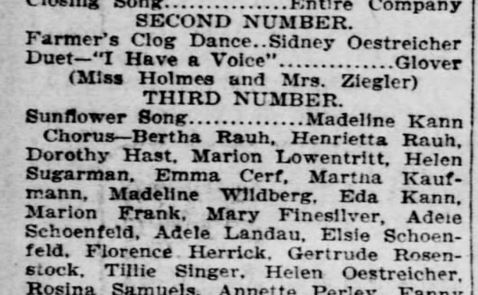
Sarah and Gustav appear to have been connected to the Pittsburgh Jewish community.  In 1907, both Sidney and Helen participated in the Purim festivities held by the sisterhood of the Rodeph Shalom synagogue.

Purim part 1

Pittsburgh Daily Post (Pittsburgh, Pennsylvania) 24 Feb 1907, Sun • Page 7

Pittsburgh Daily Post
(Pittsburgh, Pennsylvania)
24 Feb 1907, Sun • Page 7

In 1910 Sarah and Gustav and their three children were still living in Pittsburgh, where Gustav was now working as a merchant, apparently having abandoned artistic pursuits. Their two sons, Sidney and Francis, now 18 and 16, respectively, were working as clerks, perhaps in their father’s store.

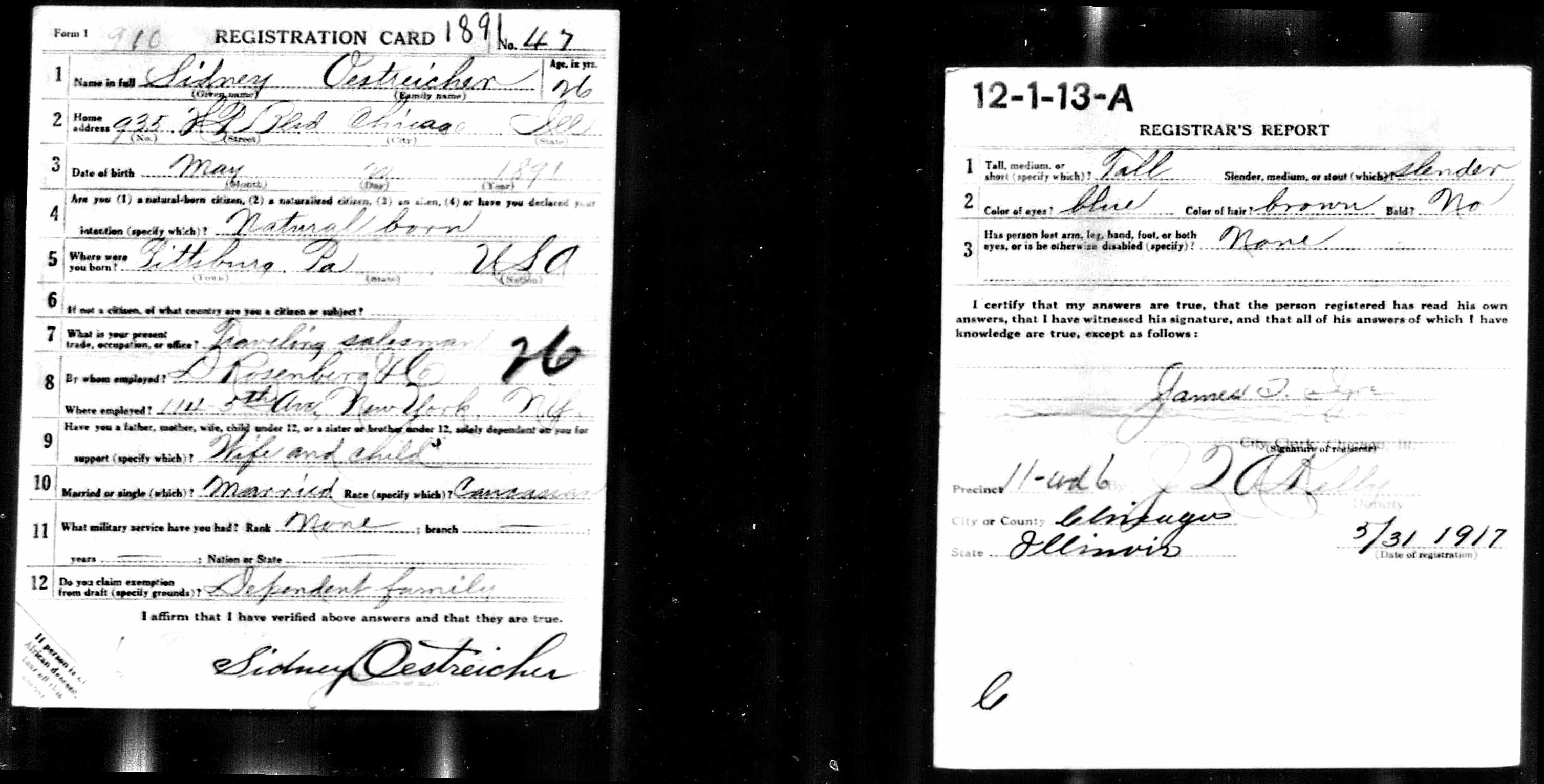
The oldest Oestreicher child, Sidney, married Esther Siff in 1915. Esther was the daughter of Isaac and Rosa Siff, who were immigrants either from Germany and Austria or from Russia, depending on the census record. Isaac had been a coppersmith, but was working as a traveling salesman in 1920.  Esther was born and raised in Chicago. When Sidney registered for the draft in 1918, they were living in Chicago, and he was working as a traveling salesman for a New York based company.

Sidney Oestreicher WW I draft registration Registration State: Illinois; Registration County: Cook; Roll: 1439758; Draft Board: 13

Sidney Oestreicher WW I draft registration
Registration State: Illinois; Registration County: Cook; Roll: 1439758; Draft Board: 13

Perhaps Sidney had met Esther’s father during their traveling as salesmen?  In 1920 Sidney and Esther were living in Chicago where Sidney was still working as a traveling salesman, selling women’s undergarments.  They had two children by then, Gerald (1916) and Florence Betty (1919).

In 1920, Sarah and Gustav were still living in Pittsburgh with their other two children, Francis and Helen, and Gustav was still a retail merchant. Francis was now a salesman; he had served in the US Army during World War I and had participated in the Meuse Argonne offensive in that war, fighting against the country where his mother had been born.  As described here, it was the major offensive of US troops during World War I:

The Meuse-Argonne Offensive was the greatest American battle of the First World War. In six weeks the AEF lost 26,277 killed and 95,786 wounded. It was a very complex operation involving a majority of the AEF ground forces fighting through rough, hilly terrain the German Army had spent four years fortifying. Its objective was the capture of the railroad hub at Sedan which would break the rail net supporting the German Army in France and Flanders and force the enemy’s withdrawal from the occupied territories.

English: Ruined church at Montfaucon-d'Argonne...

English: Ruined church at Montfaucon-d’Argonne just behind the American Monument. The blocky structure on the left is a German WWI observation post. (Photo credit: Wikipedia)

It’s hard to know what impact this had on Francis, though it’s hard to believe it did not have some major effect on him.

On March 3, 1920, Helen Oestreicher married Robert Steel Kann, the son of Myer Kann and Bertha Friendlander of Pittsburgh.  Myer was a Pittsburgh native, the son of a German immigrant father and a Pennsylvania born mother; he had been a steel manufacturer (hence, his son’s middle name) and had died from gall bladder cancer just three months before the wedding.  Robert was also working in the steel industry in 1920.  Tragically, Robert’s life was cut short less than two years after he married Helen.  He died from acute lobar pneumonia when he just 26 years old.

Robert Steel Kann death certificate Ancestry.com. Pennsylvania, Death Certificates, 1906-1963 [database on-line]. Provo, UT, USA: Ancestry.com Operations, Inc., 2014. Original data: Pennsylvania (State). Death certificates, 1906–1963. Series 11.90

Robert Steel Kann death certificate
Ancestry.com. Pennsylvania, Death Certificates, 1906-1963 [database on-line]. Provo, UT, USA: Ancestry.com Operations, Inc., 2014.
Original data: Pennsylvania (State). Death certificates, 1906–1963. Series 11.90

Helen remarried sometime between 1925 and 1929.  Her second husband was named Aaron Mitchel Siegel. He was born in Barre, Vermont, in 1895, the son of Russian (or Polish, depending on the census) immigrants, Harry and Gertrude Siegel.  Harry was a clothing dealer in Vermont in 1900, and the family was still living there in 1910.  Sometime thereafter, the family to Brooklyn, where Aaron was living when he registered for the draft for World War I.  In 1920 Aaron was selling cotton goods and living with his parents, as he was in 1925 as well.  But sometime after that he must have met and married Helen Oestreicher Kann because their daughter Betty was born in about 1929 in New York.  I wish I knew the story of how Helen, a young widow from Pittsburgh, met Aaron, a Vermont-born young man living in Brooklyn.

By 1930 Gustav Oestreicher had retired, and he and Sarah had moved to Atlantic City, New Jersey.  Their son Sidney and his family had returned to Pittsburgh by 1930, for Sidney to take over the store once operated by his father.  Sidney and Esther’s two children, Gerald and Florence Betty (known as Betty) would both graduate from high school in Pittsburgh during the 1930s.  In 1931, Sidney and Esther had another child, Elaine.

The 1930s and the Great Depression were not kind to the Oestreicher’s longstanding Pittsburgh retail store.  In the spring of 1933, Sidney Oestreicher filed for bankruptcy on behalf of himself, his brother, and their store, The People’s Store.

Pittsburgh Post-Gazette March 28, 1933 p. 18

Pittsburgh Post-Gazette
March 28, 1933 p. 18

During the 1930s, most of the family relocated to Los Angeles.  Gustav and Sarah were living there by 1935, according to the 1940 census.   Helen and Aaron Siegel also relocated there by 1935, and Aaron was working as salesman for a textile company. Francis Oestreicher also moved to LA by 1942, according to his draft registration for World War II.  It appears that Francis was not married, as he listed his sister Helen as his contact person and also indicated that he was living with Helen at that time.

World War II Draft Cards (4th Registration) for the State of California; State Headquarters: California; Microfilm Roll: 603155

World War II Draft Cards (4th Registration) for the State of California; State Headquarters: California; Microfilm Roll: 603155

By this time Francis had changed his surname from Oestreicher to Striker; I am not sure whether that was a change done to make it easier to say and spell or to avoid sounding German or Austrian during World War II or to make it seem less Jewish, but it was a change made by his brother Sidney as well.

In  1940, Sidney was still using Oestreicher, and he and his family were still living in Pittsburgh; Sidney was selling ladies’ lingerie.  But by 1942, Sidney’s draft registration showed some recent changes.  Oestreicher was crossed out and replaced with Striker, the same name being used by his brother Francis.  And the Pittsburgh address was crossed out and replaced with an address in the Bronx, though his mailing address and the address for his wife Esther remained the address in Pittsburgh.  Perhaps Sidney was working out of New York when he registered for the draft.

The National Archives at St. Louis; St. Louis, Missouri; World War II draft cards (Fourth Registration) for the State of Pennsylvania; State Headquarters: Pennsylvania; Microfilm Series: M1951; Microfilm Roll: 308

The National Archives at St. Louis; St. Louis, Missouri; World War II draft cards (Fourth Registration) for the State of Pennsylvania; State Headquarters: Pennsylvania; Microfilm Series: M1951; Microfilm Roll: 308

Sarah Stern Ostreicher died on February 5, 1940.  She was seventy-five years old.

Pittsburgh Post-Gazette, February 7, 1940 p. 24

Pittsburgh Post-Gazette, February 7, 1940 p. 24

Her husband Gustav died ten years later on December 22, 1950.  He was 83.  They are both buried in Los Angeles at Forest Lawn Memorial Park.

All three of their children lived very long lives.  Sidney died in 1985; he was 94.  Francis died at 97 in 1990.  Their sister Helen died in 1989; she was 94.  As far as I can tell, Sarah and Gustav’s three granddaughters are all still living, and their grandson Gerald lived to 97.  Those are some fairly amazing genes for longevity.

Sarah may have started life off with the potential disadvantage of being born out of wedlock, but it certainly appears that her mother, siblings, aunts, uncles, and grandparents fully embraced her as did her stepfather Solomon Stern, whose name she took.  She traveled alone to the US as young woman, settled in Pittsburgh near her extended family, and married a fellow immigrant with whom she raised three children, each of whom lived over 90 years.  She appears to have had a good life surrounded by lots of loving family.

Sarah and Gustav lived many years in Pittsburgh, where Sarah’s mother Hannah and many of her other family members were living, but she and Gustav ended their lives together in Los Angeles.   There is almost something Hollywood-like about their story, so Los Angeles seems quite an appropriate final destination for my cousin Sarah and her husband Gustav.

English: The Hollywood Sign, shot from an airc...

English: The Hollywood Sign, shot from an aircraft at about 1,500′ MSL. (Photo credit: Wikipedia)

My Great-grandfather Comes to America: The Schoenthals in Western Pennsylvania 1880-1890

Map of Pennsylvania highlighting Allegheny County

Map of Pennsylvania highlighting Allegheny County (Photo credit: Wikipedia)

Or how my great-grandfather met my great-grandmother.  I love finding stories about how couples met each other.  From a little tiny news item in a small local paper in 1887, I may have found a clue as to how my Schoenthal/Katzenstein grandparents met each other.

Isidore Schoenthal

Isidore Schoenthal

By 1880, many of the members of the family of Heinemann Schoenthal and Hendel Beerenstein had moved from Sielen, Germany, to the United States.  Their two daughters had arrived first: Fanny and her husband Simon Goldsmith and Mina and her husband Marcus Rosenberg.  They were followed by six of the children of Levi Schoenthal (Fanny and Mina’s brother) and Henrietta Hamberg: Henry, Julius, Amalie, Simon, Nathan, and Felix.

Their father Levi died in 1874; their mother Henrietta was still living in Germany in 1880. Four of the children of Levi and Henrietta were also still in Germany in 1880: Hannah, Jacob, Rosalie, and my great-grandfather Isidore.  All but Jacob would soon be in the United States.

Jacob had married Charlotte Lilienfeld in 1879 and was a merchant living in Cologne (or Koln), Germany.  Charlotte was the daughter of Meyer Lilienfeld and Hannchen Meiberg of Gudensberg, another small town in the Kassel district of Hessen, not far from Sielen.   Charlotte was the half-sister of Helen Lilienfeld, who had married Jacob’s brother Henry in 1872.   Although Jacob and Charlotte never emigrated from Germany, they had two sons who did: Lee, born in 1881, and Meyer, born in 1883. More on them in a later post.

HStAMR Best. 920 Nr. 2610 Standesamt Gudensberg Heiratsnebenregister 1879, S. 10

HStAMR Best. 920 Nr. 2610 Standesamt Gudensberg Heiratsnebenregister 1879, S. 10

Eine Vervielfältigung oder Verwendung dieser Seite in anderen elektronischen oder gedruckten Publikationen und deren Veröffentlichung (auch im Internet) ist nur nach vorheriger Genehmigung durch das Hessische Staatsarchivs Marburg, Friedrichsplatz 15, D-35037 Marburg, Germany gestattet.

HStAMR Best. 920 Nr. 2610 Standesamt Gudensberg Heiratsnebenregister 1879, S. 10

As for the many Schoenthal family members already in the United States, as of 1880 only Henry and his wife Helen (Lilienfeld) and their two young children, Hilda (six) and Lionel (three), were still living in Washington, Pennsylvania, where Henry owned a retail variety store.  Living with them and described as their adopted son was a twelve year old boy named Samuel Hamberg, who was born in South Carolina.  I have to believe that Samuel Hamberg was somehow related to Henry’s mother’s family, the Hambergs of Breuna, but I cannot find the connection.[1]  Henry and Helen would have one more child in the 1880s, a son born in 1883 named Meyer Lilienfeld Schoenthal, named for Helen’s father.

Henry Schoenthal and family 1880 census Year: 1880; Census Place: Washington, Washington, Pennsylvania; Roll: 1202; Family History Film: 1255202; Page: 596A; Enumeration District: 271

Henry Schoenthal and family 1880 census
Year: 1880; Census Place: Washington, Washington, Pennsylvania; Roll: 1202; Family History Film: 1255202; Page: 596A; Enumeration District: 271


Although Henry was the only Schoenthal sibling still in Washington, Pennsylvania in 1880, others were not too far away.  Amalie and her husband Elias Wolfe were now living in Allegheny (today part of Pittsburgh so from hereon I will refer to both Allegheny and Pittsburgh as Pittsburgh), Pennsylvania.  According to the entry in the census record, Elias was a “drover.”  I’d never heard this term before, but according to the Merriam-Webster dictionary online, a drover is “a person who moves groups of animals (such as cattle or sheep) from one place to another.”     Amalie and Elias had three children at the time of the census: Morris was 7, Florence was 5, and Lionel was 2.  A fourth child was born in June, 1880, shortly after the census, a son named Ira.   Two more were born in the 1880s: Henrietta (1883) and Herbert (1885).

Amalie Schoenthal Wolfe and family 1880 census Year: 1880; Census Place: Allegheny, Allegheny, Pennsylvania; Roll: 1086; Family History Film: 1255086; Page: 153C; Enumeration District: 006; Image: 0310

Amalie Schoenthal Wolfe and family 1880 census
Year: 1880; Census Place: Allegheny, Allegheny, Pennsylvania; Roll: 1086; Family History Film: 1255086; Page: 153C; Enumeration District: 006; Image: 0310


As noted in my earlier post, Felix Schoenthal was also still relatively close to Washington, Pennsylvania, living with his wife  Maggie in West Newton, about 25 miles away, where Felix was working as a clerk at the paper mill.  Felix and Maggie also had two children during the 1880s: Rachel (1881) and Yetta (1884).

The other siblings had moved further east.  Julius was in Washington, DC, working as a shoemaker, as described in my last post.  His brother Nathan was also now in DC, working as a clerk in a “fancy store.”  Simon Schoenthal had also moved further east by 1880.  Although he and his family were living in Pittsburgh in 1879, by 1880 he and Rose and their five children had moved to Philadelphia.  Simon was still working as a bookbinder. In the 1880s they would have four more children: Martin (1881), Jacob (1883), Hettie (1886), and Estelle (1889).  In 1891, one more child was added to the family, Sidney.

Simon Schoenthal and family 1880 census Year: 1880; Census Place: Philadelphia, Philadelphia, Pennsylvania; Roll: 1179; Family History Film: 1255179; Page: 12D; Enumeration District: 382; Image: 0218

Simon Schoenthal and family 1880 census
Year: 1880; Census Place: Philadelphia, Philadelphia, Pennsylvania; Roll: 1179; Family History Film: 1255179; Page: 12D; Enumeration District: 382; Image: 0218


But other members of the extended Schoenthal clan still lived in western Pennsylvania.  Fanny Schoenthal Goldsmith’s widower Simon Goldsmith was living in Pittsburgh with their daughter Hannah and her family.  Hannah’s husband Joseph Benedict was a rag dealer, and in 1880 they had three sons: Jacob (10), Hershel (9), and Harry (3).[2]

Simon Goldsmith and Joseph Benedict families on 1880 census Year: 1880; Census Place: Pittsburgh, Allegheny, Pennsylvania; Roll: 1092; Family History Film: 1255092; Page: 508D; Enumeration District: 122; Image: 0683

Simon Goldsmith and Joseph Benedict families on 1880 census
Year: 1880; Census Place: Pittsburgh, Allegheny, Pennsylvania; Roll: 1092; Family History Film: 1255092; Page: 508D; Enumeration District: 122; Image: 0683

As described in an earlier post, Mina Schoenthal Rosenberg and her husband Marcus Rosenberg and their daughter Julia were living in Elk City, Pennsylvania, in 1880.  Their daughter Hannah and her husband Herman Hirsh were living in Pittsburgh with their five children in 1880.  Their daughter Mary and her husband Joseph Podolsky and children were living in Ohio.  Mina’s other two children, Rachel and Harry, are missing from the 1880 census.

Thus, by 1880, there were still a large number of family members in western Pennsylvania; it was still home to most of the extended Schoenthal clan.  It is not surprising that when my great-grandfather Isidore arrived with his mother and sister Rosalie, they ended up in western Pennsylvania as well.

My great-grandfather Isidore, his mother Henrietta Hamberg Schoenthal, and his younger sister Rosalie arrived in New York on September 3, 1881, upon the ship Rhein, which had sailed from Bremen.  Isidore was 22, Rosalie was seventeen, and Henrietta was 64 years old.  They settled in Washington, Pennsylvania, where Henry was living. Isidore worked as a clerk in Henry’s variety store.

Henrietta died just a year later in December, 1882; she was buried at Troy Hill cemetery in Pittsburgh.  Washington did not yet have a Jewish cemetery.  Although I could not find an American death certificate, Henrietta’s death was recorded back in Sielen even though she had died in the US.

Henrietta Hamberg Schoenthal death record from Sielen HHStAW Abt. 365 Nr. 773, S. 10

Henrietta Hamberg Schoenthal death record from Sielen
HHStAW Abt. 365 Nr. 773, S. 10

Henrietta’s brother-in-law Simon Goldsmith died a few months later on March 17, 1883.  He also was buried at Troy Hill.

Rosalie Schoenthal, the youngest child of Levi and Henrietta, returned to Germany where she married William or Willie Heymann in Geldern, Germany, on December 8, 1884.  She and Willie would have four children born in Geldern: Lionel (1887, for Rosalie’s father Levi, presumably), Helen (1890), Max (1893), and Hilda (1898).  I assume that either Helen or Hilda was named for Rosalie’s mother Henrietta.  The two sons ended up immigrating to the United States; the two daughters and their families perished in the Holocaust.  But more on that in a later post.

There would be one more Schoenthal sibling who would immigrate to the US: the oldest child, Hannah.  Hannah had had a child out of wedlock in 1865, a daughter named Sarah whose father is unknown.

birth of Sarah Schoenthal, daughter of Hannah HHStAW fonds 365 No 772 p12

birth of Sarah Schoenthal, daughter of Hannah Schoenthal, in Sielen, 1865
HHStAW fonds 365 No 772 p12

[Translation: “Hannchen Schönthal (Tochter des Schuhmacher=Meister Levi Schönthal zu Sielen) uneheliche Mutter.”…..Hannchen Schönthal (daughter of the master shoemaker (cobbler) Levi Schönthal of Sielen) unmarried mother.]

Hannah later married Solomon Simon Stern in Sielen, Germany, on August 19, 1874, five months after her father Levi died.  She was 29 years old at that time.  Solomon was 57.

Marriage of Solomon Stern to Hannah Schoenthal HHStAW Abt. 365 Nr. 839, S. 22

Marriage of Solomon Stern to Hannah Schoenthal in Sielen
HHStAW Abt. 365 Nr. 839, S. 22

Together they would have three children: Jennie, born June 20, 1875; Edith, born September 7, 1877; and Louis, born May 17, 1879.  Solomon Stern died February 20, 1888, and Hannah and their three children emigrated from Germany shortly thereafter.  According to later census records, Hannah and the three children all emigrated in 1888.

Solomon Stern gravestone inscription HHStAW Abt. 365 Nr. 842, S. 11

Solomon Stern gravestone inscription
HHStAW Abt. 365 Nr. 842, S. 11

Hannah and her children settled in Pittsburgh, where her sister Amalie and her husband Elias Wolfe and their six children, named above, were still living.  Elias continued to work as a drover.  Hannah and Amalie’s brother Felix also was in Pittsburgh by that time, having relocated there from West Newton by 1882.  He was working as a bookkeeper.  In 1889 he opened his own store:

 Pittsburgh Daily Post, 9 Apr 1889, Tue, Page 3

Pittsburgh Daily Post, 9 Apr 1889, Tue, Page 3

Also living in Pittsburgh in the 1880s was their Schoenthal cousin, Hannah Goldsmith Benedict, and her husband Joseph and three children, Jacob, Herschel, and Harry; Joseph was selling rags and paper stock.  Joseph became entangled in a rather gruesome lawsuit involving the sale of rags to a paper mill.  The purchaser had failed to pay the purchase price, and Joseph had sued for payment.  The purchaser alleged that they were not liable for the purchase price because the rags had been infected with the smallpox virus, and several of the purchaser’s employees had taken ill, causing the shutdown of the purchaser’s mills.  Thus, the purchaser claimed it had been damaged by loss of business in an amount exceeding what it allegedly owed Joseph Benedict.

 Pittsburgh Post-Gazette, 5 Sep 1882, Tue, Page 1

Pittsburgh Post-Gazette, 5 Sep 1882, Tue, Page 1

This would have been a fun case for me to teach in my days as a law professor teaching Contracts.  It is similar to a famous case taught in most Contracts courses called Hadley v. Baxendale.  Was the shutdown of the paper mill a foreseeable consequence of the seller’s defective product? Here there are also issues of negligence, breach of warranty, damages, and so on.  It would have been a great exam question. Fortunately for Joseph Benedict, the court refused to set aside the judgment in his favor, and the paper mill was held liable for the purchase price of the rags.

Another Schoenthal cousin, Hannah Rosenberg Hirsh, and her husband Herman and their five children, Morris, Nathan, Carrie, Harry, and Sidney, were also living in Pittsburgh; Herman was in the varnish business, at first for the Michigan Furniture Company and then in his own business manufacturing varnish.

Hannah thus had many family members close by in Pittsburgh to provide support as she raised her three children alone in the new country.

My great-grandfather Isidore lived in Pittsburgh for some time also around 1887 through 1889, working as a floor walker in a retail store, at least according to the listings in the Pittsburgh city directories for those years.  But sometime in early 1888 he married my great-grandmother Hilda Katzenstein in Philadelphia.  Hilda was the daughter of Eva Goldschmidt and granddaughter of Seligmann Goldschmidt.  As discussed in an earlier post, Seligmann Goldschmidt was the brother of Simon Goldschmidt, who became Simon Goldsmith and who had married Isidore’s aunt, Fanny Schoenthal. Thus, Hilda and Isidore were already related to each by marriage. In addition, Hilda’s brother S.J. Katzenstein was a merchant, living in Washington, Pennsylvania.  I don’t know whether my great-grandparents met through S.J. in Washington, Pennsylvania, or through their mutual cousins, the Goldsmiths, or perhaps even through Isidore’s brother Simon, who lived in Philadelphia, where Hilda had been born and raised.

But I did find this important clue:

The Daily Republican (Monongahela, Pennsylvania) 11 Aug 1887, Thu • Page 4

The Daily Republican
(Monongahela, Pennsylvania)
11 Aug 1887, Thu • Page 4

Was this when Isidore and Hilda met—at a gathering at the house of a man named Henry Florsheim who lived in Finleyville? And who was he?  A little research revealed that Henry Florsheim was born in 1842 in Gudensberg, Germany, the same town where Helen and Charlotte Lilienfeld were born, the wives of Henry Schoenthal and Jacob Schoenthal, respectively.

Henry (Hienemann) Florsheim birth record HHStAW Abt. 365 Nr. 384, S. 35

Henry (Heinemann) Florsheim birth record from Gudensberg
HHStAW Abt. 365 Nr. 384, S. 35

In fact, according to research done by Hans-Peter Klein as reflected on his incredibly helpful website found here, Henry Florsheim’s sister married Helen Lilienfeld’s brother in Gudensberg in 1872, the same year that Helen Lilienfeld married Henry Schoenthal.  According to the 1910 census, Henry Florsheim came to the US in 1876, so the two families were already related by marriage when he arrived.  In 1880 Henry Florsheim was a merchant, living in Union Township in Washington County, Pennsylvania, about 20 miles from the city of Washington, PA.  An article in the January 31, 1887, Pittsburgh Daily Post (p.4) , reported that he was the proprietor of the Union Valley coal mines and had been presented with a gold watch by the citizens of Finleyville, a town about 16 miles from Washington and two miles from Union Township. Thus, in just a decade, Henry Florsheim had made quite a mark on his community.  Was this successful businessman the one who was responsible for bringing my great-grandparents together?  If so, thank you, Mr. Florsheim![3]

Hilda Katzenstein Schoenthal

Hilda Katzenstein Schoenthal

That was not the end of Henry Florsheim’s role in my great-grandparents’ lives.  In 1889, he hired my great-grandfather to work in his store in Finleyville; this news article suggests that they were still living in Pittsburgh before that opportunity arose.

The Daily Republican (Monongahela, Pennsylvania) 8 Nov 1889, Fri • Page 1

The Daily Republican
(Monongahela, Pennsylvania)
8 Nov 1889, Fri • Page 1

Isidore and Hilda’s first child, my great-uncle Lester Henry Schoenthal, was born on December 3, 1888.  I assume that, like all the Lionels and Leo and Lee, he was named for Isidore’s father Levi.  About three years later on January 20, 1892, Isidore and Hilda had a second son, Gerson Katzenstein Schoenthal, named for Hilda’s father.  Their third child, Harold, and their fourth and youngest child, my grandmother Eva, would not arrive until after the 20th century had begun.

Thus, by 1890, the Schoenthal family had deep and wide connections to western Pennsylvania.  My next post will catch up with those family members who were living elsewhere in the 1880s: Washington DC, Ohio, and Philadelphia.


[1] All I can find about Samuel’s background is that he appears to have been the son of Charles Hamberg, who was born in Germany and emigrated before 1850; in 1853, Charles married Mary E. Hanchey in New Hanover, North Carolina.  She, however, was not Samuel’s mother because she was murdered on November 18, 1866.  On the 1870 census, Charles was living with a 21 year old woman named Tenah Hamberg and two year old Samuel. Since the 1870 census did not report information about the relationships among those in a household, I don’t know for sure whether Tenah was Charles’ wife or Samuel’s mother. Charles died in 1879, and the administrix of his intestate estate was a woman named Amalia Hamberg.  I don’t know who Amalia was or how she was related to Charles.  But by 1880, twelve year old Samuel had moved to Washington, Pennsylvania, to live with Henry.

[2] There were also two young boys, Jacob and Benjamin Goldsmith, living with them and a 21 years old named Jacob Basch.  They were labeled “grandsons,” but they had to be Simon’s grandsons, not Joseph and Hannah’s grandsons.  Jacob Basch was the son of Simon’s daughter Lena from his first marriage, who had married Gustav Basch.  I don’t know who the parents of Jacob and Benjamin Goldsmith were.

[3] That little article about Henry Florsheim’s party also led me to another question: who was the woman named Sarah Stern who also attended this gathering? I assumed she must have been a relative since everyone else at the Floersheim event was part of the Schoenthal or Katzenstein families, and I only knew of one Stern in the family—Solomon Stern who had married Hannah Schoenthal, the older sister of Henry, Isidore, and the other children of Levi Schoenthal.  Hannah’s first child, born before she married Solomon Stern, was named Sarah.  Was this Sarah Stern the same person, taking on her stepfather’s surname? Further investigation would support that conclusion, as I will describe in a later post.

The Mystery of Fanny Wiler: Final Chapter (I think)

If you’ve been following this blog for a while, you know that one of my most challenging mysteries involves my cousin Fanny Wiler, the daughter of Caroline Dreyfuss and Moses Wiler and first cousin of my great-great-grandmother Frances Nusbaum.  Caroline was my three-times great-grandaunt, the sister of Jeanette Dreyfuss, my three-times great-grandmother.  Her daughter Fanny had simply vanished after the 1860 census, and I was determined to find her.  As I wrote here and here and here, it was a long and twisting path involving a different Fanny who married a man who killed himself and a daughter in a fire, a mishandled estate of Fanny’s mother Caroline and ensuing litigation, and finally the discovery of Fanny and her three sons with her husband Joseph Levy.

I know now that Fanny had married Joseph in 1866 and had had three sons with him.  I know that Joseph had remarried sometime before 1879 because he had a daughter Miriam with his second wife Bella Strouse.  And there was a NYC birth record for a Bertha Levi, daughter of Joseph Levi and Fanny Wieler, dated November 30, 1866, but I had not been able to trace her to my Fanny.

I assumed that Fanny had died, but when and where? I had no death record for her, no burial record, no obituary.  Once again she had disappeared. All I could find was an entry on FindAGrave for a Fannie Levy with the dates 1846-1877, buried at Troy Hill  Jewish cemetery in Pittsburgh.  There was no photo or any other information on the FindAGrave page, but something told me that this could be my Fanny.  The dates and the name seemed right, and Miriam Levy, the child of Joseph and Bella, was born in Pittsburgh in November, 1879.  Thus, at some point Joseph had lived in Pittsburgh, so it was not out of the question to think that Fanny had also lived and then died there.

Photo courtesy of Lisa Albanese

Troy Hill Jewish Cemetery Photo courtesy of Lisa Albanese

But how could I prove that the Fanny buried at Troy Hill was my Fanny?  There was no statewide requirement for the filing of death certificates before 1906 in Pennsylvania, and unlike Philadelphia, there is no readily accessible database for all deaths in Pittsburgh.  I searched directories for a Joseph Levy in Pittsburgh, and although there were one or two, there was no way to tell from the directory whether those were the correct men.

I decided first to look where Fanny’s sons and her husband were buried, and almost all were buried at Rodeph Shalom in Philadelphia.  The remains of those buried at Rodeph Shalom had been moved to Roosevelt Cemetery after Rodeph Shalom closed, and I emailed that cemetery, but they had no remains for a Fanny Levy. I also emailed the Special Collections Research Center at Temple University in Philadelphia, where the archives of Rodeph Shalom synagogue are now kept, to ask if they had any records for Fanny Wiler Levy, and an archivist there did a search but did not find anything. I also concluded after much searching that Fanny was not buried at Mt. Sinai cemetery in Philadelphia, where her parents and many of her relatives were buried.  At that point I began to think that Fanny was not buried in Philadelphia at all if she was neither where her children nor where her parents were buried.

Rodeph Shalom Synagogue on the NRHP since Augu...

Rodeph Shalom Synagogue on the NRHP since August 7, 2007. At 607–615 North Broad St., in the Poplar neighborhood of Philadelphia. (Photo credit: Wikipedia)

Pittsburgh thus became a realistic alternative location for her burial.  I searched online for sources about Jewish records in Pittsburgh and found a link to Martha Berg, who is the archivist for Rodeph Shalom synagogue in Pittsburgh (I do not believe there is an affiliation between the two synagogues). Martha did an exhaustive search for me of records, newspapers, and cemeteries, and did not turn up any identifying information that would help me establish whether the Fannie Levy buried at Troy Hill was my Fanny Wiler Levy.  She did, however, find the precise burial date for the Fannie Levy buried at Troy Hill—April 17, 1877.  That proved to be very helpful.

By Nyttend (Own work) [Public domain], via Wikimedia Commons

By Nyttend (Own work) [Public domain], via Wikimedia Commons Rodeph Shalom Synagogue in Pittsburgh

From there, I got advice from the Pennsylvania genealogy group on Facebook, suggesting I contact the Carnegie Library in Pittsburgh where they have death records for Pittsburgh dating back to 1875. I called the Carnegie Library and requested a search for a death record for Fanny Levy who died around April 17, 1877.  I then sat and waited to see if they could uncover something.

Finally, a package arrived in the mail the other day, and this was inside:

Fanny Wiler Levy death cert

This has to be my elusive cousin Fanny.  She was born in Harrisburg in 1846, so would have been 31 in 1877.  Her prior residence had been in Philadelphia.  She was married. I am quite certain I have finally found Fanny.

So now I know that Fanny Wiler Levy died on April 16, 1877, in Pittsburgh, from phythisis pulmonalis, or the wasting form of tuberculosis.  I also know now that she had only lived in Pittsburgh for a year at the time of her death, which explains why all three of her sons were born in Philadelphia. Fanny was 31 years old and left at least three very young children behind and her husband.  She was one more member of my family killed by tuberculosis.  It is very sad that she lies buried so far from all of her family, all of whom are buried in Philadelphia.

Finally, I have some closure on Fanny Wiler. The remaining questions?  Was Bertha Levi, the child born to a Joseph Levi and a Fanny Wieler in 1866 in NYC, my Fanny’s daughter? And what happened to her?  Why can’t I find Joseph and his family on either the 1870 or the 1880 census?

There are always more questions.


Those Wily Wilers: Where were They in 1900?

Remember Fanny Wiler, the daughter of Caroline Dreyfuss and Moses Wiler, the one I could not find and thought might have been married to a man who killed himself and a child in a fire? Well, I still had not had any luck finding the real Fanny Wiler despite several more hours of going back over my research and looking more deeply into the sources.   Although I was doing pretty well with the rest of her family up through 1880, they also proved to be elusive as they approached the 20th century.

In 1880, Caroline and Moses Wiler were living in Philadelphia, and Moses had retired from his career as a merchant.  Their son Simon, then 37, was still living with his parents and working as a salesman.  Their daughter Eliza and her husband Leman Simon had moved to Pittsburgh where Leman was in the liquor business, and they had five children, Joseph, Flora, Nellie, Minnie, and Leon. While going back over my research, I discovered that Eliza and Leman had had one other child, Isadore, born in July, 1871, who died at 28 months on August 16, 1873.  I cannot decipher the cause of death.  Can anyone tell what it says?

UPDATE:  My expert says it says “Inflammation Brain.” Apparently doctors are trained to read each other’s awful handwriting.

Isadore A Simon death certificate FHL

“Pennsylvania, Philadelphia City Death Certificates, 1803-1915,” index and images, FamilySearch (https://familysearch.org/pal:/MM9.1.1/JKQ7-78S : accessed 6 February 2015), Isadore A Simon, 16 Aug 1873; citing , Philadelphia City Archives and Historical Society of Pennsylvania, Philadelphia; FHL microfilm 2,021,999.


When I last wrote about Eliza and Leman Simon, I was a bit puzzled by the seemingly impossibly close birth dates of Minnie and Leon, their youngest two children.  Two census reports indicated that Minnie was born in 1877, no earlier than August 1877 and possibly as late as December 1877, and Leon’s death certificate said he was born on June 13, 1878.  It just seemed very unlikely that Leon was born ten months (at most) after Minnie, but it was, of course, entirely possible.

But I went back to look again and realized that while Minnie was listed with the family on the 1880 census, Leon was not.  Further research uncovered this bill from his funeral, indicating that his birth date was June 13, 1881, not 1878, which makes a lot more sense.  Thus, the death certificate was most likely inaccurate (and there are other questions about that document, but I will get to that later).

Leon Simon funeral bill

Historical Society of Pennsylvania; Historic Pennsylvania Church and Town Records


Caroline and Moses Wiler’s youngest child, Clara, and her husband Daniel Meyers, a clothing merchant, were living in Philadelphia with their five children (as of 1880), Bertha, Leon, Samuel, Harry, and Isadore.

Thus, in 1880, I could account for Caroline Dreyfuss and Moses Wiler and three of their four children (all but Fanny) and their ten grandchildren.  Then things start getting a bit more difficult.  Although I found burial records for Caroline indicating that she had died on December 21, 1885, and was buried at Mt. Sinai cemetery in Philadelphia, I cannot locate a death certificate for her in the Philadelphia City Death Certificates 1803-1915 database on familysearch.org.  On the other hand, I was able to locate a death certificate for her husband Moses in that database; he died almost exactly two years later on December 26, 1887, and was also buried at Mt. Sinai.

Moses Wiler death certificate

“Pennsylvania, Philadelphia City Death Certificates, 1803-1915,” index and images, FamilySearch (https://familysearch.org/pal:/MM9.1.1/J6S6-XY5 : accessed 6 February 2015), Moses Simon, 27 Jan 1897; citing cn 15654, Philadelphia City Archives and Historical Society of Pennsylvania, Philadelphia; FHL microfilm 1,869,753.


Moses Wiler was residing at 1638 Franklin Street at the time of his death in 1887, and that is the same address listed for his son-in-law Leman Simon in the 1887 Philadelphia directory.  I don’t know whether Moses had moved in with Leman, Eliza, and their children, or vice versa.  Since Leman and Eliza had been listed in the 1884 directory for Pittsburgh, it could be that they had moved back to Philadelphia sometime around or after Caroline’s death to be with Moses.  Leman’s occupation is listed as “salesman” in that 1887 Philadelphia directory without any indication of whether he was still selling liquor.

Assuming that Eliza and Leman returned to Philadelphia around 1885 or so, their children would have been still relatively young: Joseph 21, Flora 19, Nellie 11, Minnie 7, and Leon 4.  Certainly the youngest three would still have been living at home.  Joseph appears to have been in Pittsburgh until at least 1886, as there is a Joseph L. Simon listed there, selling cigars and tobacco products, a business line that was being practiced by other members of the family during that time, including Joseph’s great-uncle John Nusbaum.  After that, however, he does not appear in the Pittsburgh directory as far as I can tell.

Eliza and Leman’s daughter Flora married Nathan Strouse in Philadelphia in 1888 when she was 22 and he was 46. Their son Lester Nathan Strouse was born on December 15 of that year.  In the 1890 Philadelphia directory, Nathan was listed as associated with Strouse, Loeb, and Company, clothiers.

Leman and Eliza were still living at 1638 Franklin until 1890 when they are listed at 1821 Franklin Street.  Joseph also is listed in the 1890 directory at that address, so he must have been living with his parents at that time along with the three younger children, Nellie, Minnie, and Leon.  Joseph was working as a clerk.  He may have moved out by 1892 because there are two Joseph Simons listed as salesman in the Philadelphia directory for that year, though I cannot be completely certain either is the correct Joseph Simon.

In 1897, Leman and Eliza (Wiler) Simon were living at 1537 Montgomery Street.  Eliza died of apoplexy on August 18, 1897.  She was 55 years old.  Leman continued to live at 1537 Montgomery Street through 1899, according to the Philadelphia directory of that year, which listed him once again as a salesman.

Eliza Simon death certificate 1897

“Pennsylvania, Philadelphia City Death Certificates, 1803-1915,” index and images, FamilySearch (https://familysearch.org/pal:/MM9.3.1/TH-266-11571-16485-19?cc=1320976 : accessed 6 February 2015), 004009659 > image 190 of 1791; Philadelphia City Archives and Historical Society of Pennsylvania, Philadelphia.


Now things get very sticky.  I had a very hard time locating the family of Eliza and Leman Simon on the 1900 census.  The only one I am certain about is Flora and her husband Nathan Strouse and son Lester Strouse.  On the 1900 census, Flora, Nathan, and Lester were living at 913 North 16th Street, and Nathan was 57 years old and did not provide an occupation for the census.  Living with them was a 30 year old woman named Nettie Dreifuss, born in 1870 in Illinois whose parents were born in Germany and Pennsylvania, as were Flora’s parents.  She is identified as the niece of the head of the household, Nathan.

Flora and Nathan Strouse 1900 census

I first wondered whether this was Nellie, Flora’s sister.  But Nellie was born in 1874 in Pennsylvania, not 1870 in Illinois, and she was Nathan’s sister-in-law, not his niece.  I then spent most of a day trying to find out whether Nathan had a sister who married a Dreifuss.  He did have several sisters: Rebecca, who never married; Gussie, who married Joseph DeYoung and had one daughter Harriet; Henrietta, who married Leopold Lewis and had two daughters, Minnie and Fanny; and Rachel, who married Ed Henrinan (?), but apparently was divorced and had no children.  I thought that perhaps it was one of Henrietta and Leopold Lewis’ daughters, but neither was named Nettie, and I located both elsewhere on the 1900 census.  So the “niece” did not appear to be Nathan’s niece.

If Nettie Dreifus was not Nathan’s niece, was she Flora’s niece? None of Flora’s siblings was married in 1900; none of them had had children.   I still don’t know who Nettie was.  But her name was Dreifuss, Caroline Wiler’s birth name.  Could this be a daughter of a Dreifuss/Dreyfuss brother whom I’ve yet to find?  That’s a research path I will need to pursue further.

But at least I knew where Flora and her family were living in 1900.  Her father and her siblings proved much more elusive.  I had a very hard time locating Leman Simon and his son Leon on the 1900 census, but I believe that this is Leman and Leon living together at 1514 Brown Street as Leon, Sr., and Leon, Jr.

Leman and Leon 1900 census

Why do I think this is Leman? Because he is a 64 year old widow born in Germany who immigrated in 1866 and who was working as a salesman.  Although my records show that Leman would have been 65 and that he immigrated in 1856, the numbers are close enough, given the general unreliability of census data.  In addition, Leon, Jr. fits with my Leon roughly also: born in 1880 in Pennsylvania to parents born in Germany and working as a clerk.  Again, it’s not perfect.  Leon was born in 1881, and his mother Eliza was born in Pennsylvania. So I am not at all positive that this is Leman and Leon, but they are the closest matches I can find on the 1900 census.

Despite using as many resources and wildcard searches as I could imagine, I cannot find Joseph at all on the 1900 census.  I even had assistance from Antoinette from the Facebook Pennsylania Genealogy group, but neither of us could find him.  There is a Joseph L. Simon living at 2137 North 18th Street in the 1901 Philadelphia directory, the same address that is given for Le(h)man Simon for that year, so I assume that is the right Joseph, working as a clerk with his father working as a salesman.  But Joseph is not listed at that address in the 1900 census nor is Leman, so they must have moved there in 1901.

As for Minnie and Nellie, I think I found them on the 1900 census, but cannot be 100% sure.  I found a Minnie Simon and a “Millie” Simon living at 2628 Diamond Street on the 1900 census.  Both are listed as boarders.  Minnie is listed as a single woman born in 1877 in Pennsylvania with a mother born in Pennsylvania and a father born in Germany; that matches Minnie correctly.  No occupation is given.

Year: 1900; Census Place: Philadelphia Ward 32, Philadelphia, Pennsylvania; Roll: 1473; Enumeration District: 0809; FHL microfilm: 1241473

Year: 1900; Census Place: Philadelphia Ward 32, Philadelphia, Pennsylvania; Roll: 1473; Enumeration District: 0809; FHL microfilm: 1241473

I was quite certain that this was Minnie, but it took me a while to think that “Millie” was Nellie because although they are both at the same address, Minnie is listed as a boarder in the household of Bertha Lipper, and Millie is listed as the head of household in a boarding house at the exact same address with sixteen boarders.  “Millie” was a single woman born in 1874 in Pennsylvania whose parents are listed as born in Germany, both mother and father.  Although Nellie’s mother was born in Pennsylvania, not Germany, the age and marital status are correct, and the name is quite similar.  Once again, I cannot be completely certain that this is Nellie, but I am pretty sure.  I think it was really one large boarding house where the two sisters were living.  I am not sure why “Millie” was also described as a head of household.

Thus, if my hunches here are all correct about Leman Simon and his children, only Joseph Simon was really missing from the 1900 census.  Leman was living as a boarder with his son Leon; Nellie was living as a boarder with her sister Minnie.  Flora was married and living with her husband Nathan Strouse and son Lester and a mysterious niece.  When I mapped out where they all were living, I realized that Flora was living just a few blocks from where Leman and Leon might have been living, but Minnie and Nellie were about two miles further north.  If Joseph was already living at 2137 North 18th Street sometime during that year, he was less than a mile from Minnie and Nellie.

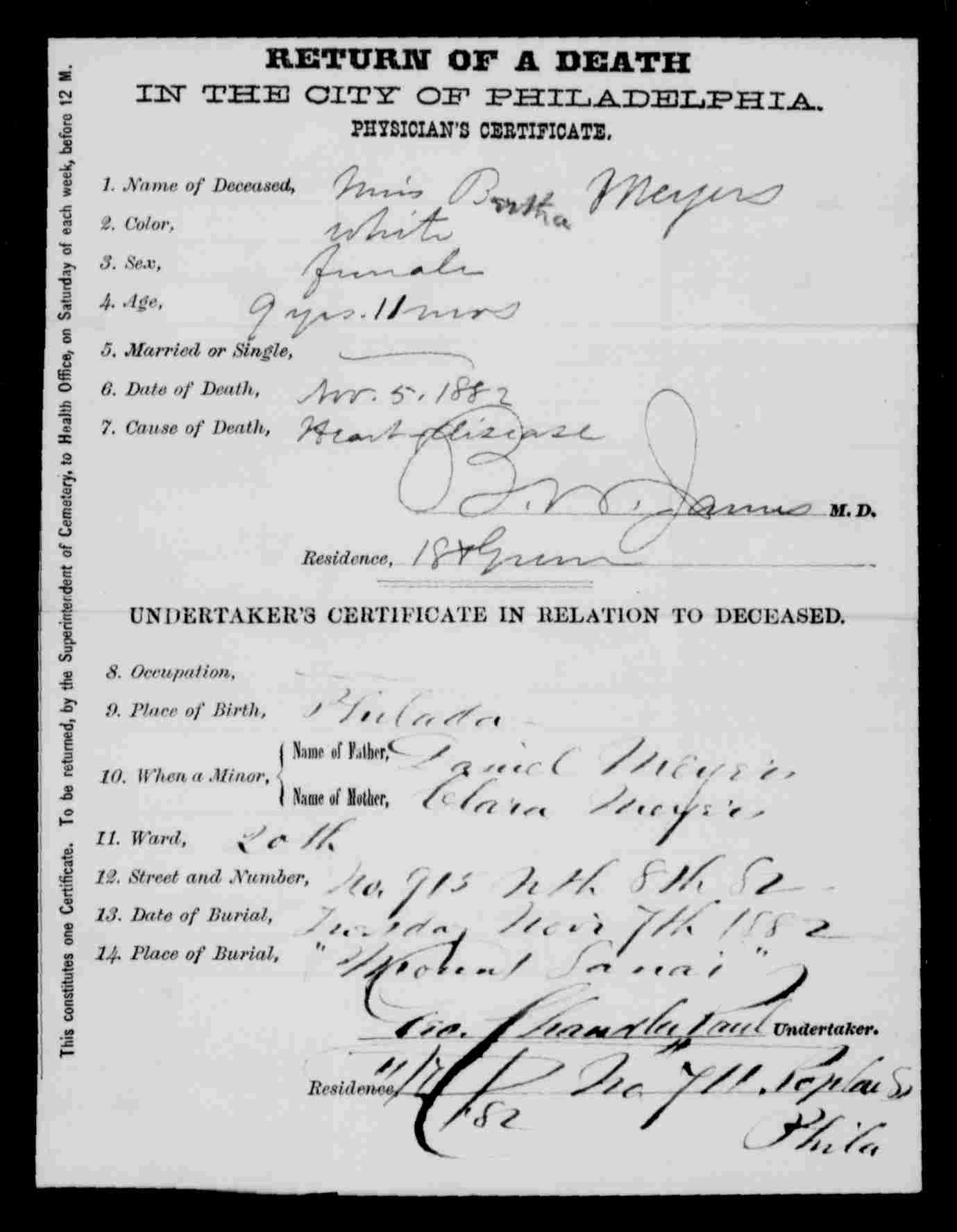
As for the other children of Caroline Dreyfuss and Moses Wiler, Simon, Fanny, and Clara, Simon was working as a clerk in a hotel where he also resided in 1900 at 152 North 7th Street. He was single and 56 years old.  Clara and her husband Daniel Meyers were now living at 920 North Franklin Street.  Clara and Daniel had had five children as of 1880; between 1880 and 1896 they had had eight more children, including one stillbirth.  But in 1882, they lost their first born child Bertha to heart disease.  She was only nine years old.

"Pennsylvania, Philadelphia City Death Certificates, 1803-1915," index and images, FamilySearch (https://familysearch.org/pal:/MM9.3.1/TH-267-11083-70387-38?cc=1320976 : accessed 6 February 2015), 004058695 > image 726 of 994; Philadelphia City Archives and Historical Society of Pennsylvania, Philadelphia.

“Pennsylvania, Philadelphia City Death Certificates, 1803-1915,” index and images, FamilySearch (https://familysearch.org/pal:/MM9.3.1/TH-267-11083-70387-38?cc=1320976 : accessed 6 February 2015), 004058695 > image 726 of 994; Philadelphia City Archives and Historical Society of Pennsylvania, Philadelphia.

Thus, as of 1900, Clara Wiler and Daniel Meyers had eleven surviving children, all of them still living at home.

And, of course, Fanny Wiler still remained unaccounted for.  Or was she? Stay tuned…