Jeanette “Jenny” Rothschild Abraham: An Entire Family Murdered

Turning now to Jeanette or Jenny Rothschild, the fifth of the eight Rothschild children who survived to adulthood, we saw that she married Salomon Abraham on November 11, 1920, and that they had two children: Walter, born in 1921, and Herta, born in 1928.

This photograph is possibly of Jenny and Salomon:

Maybe Jenny Rothschild Abraham
Courtesy of the family

Unfortunately, Jenny and her family suffered a fate like those of her older sisters Katchen and Auguste and not like those of her older brothers Siegmund and Max, both of whom survived the Holocaust. Jenny, Salomon, Walter, and Herta were all murdered in the Holocaust.

This document from the census taken in 1938-1939 by the Nazis of any household where a resident had at least one Jewish grandparent shows us that Jenny and Salomon and their children were living in Kassel at that time. It also shows that none of them had finished high school or vocational school and that all of them had four Jewish grandparents.
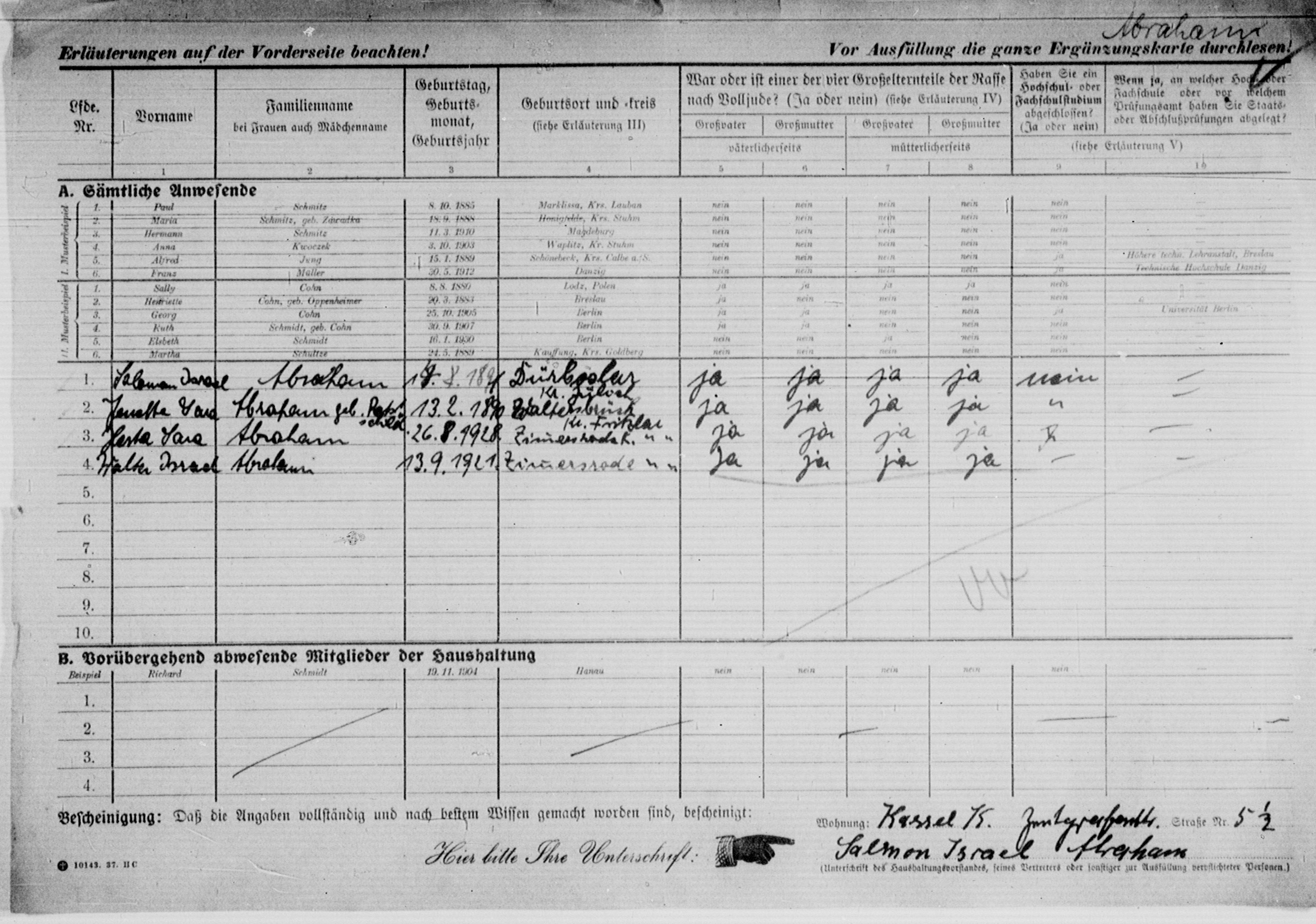
Salomon Abraham and family, RG-14.013M.0216.00000011, German minority census of 1939, United States Holocaust Museum and Memorial, also summarized at MyHeritage at   https://www.myheritage.com/research/record-10901-14585/herta-greta-abraham-in-german-minority-census?fbclid=IwY2xjawJyNahleHRuA2FlbQIxMAABHjMpngFoUVAHvZ8hfTE5lCsMwdc-9bHAeMU5opyaipBCxYmQYX8bXBPReDTp_aem_DvzcPxQysQHhqKjX3STcgw

Another document created by the International Tracing Service reveals that in 1939-1940, Salomon Abraham was working in Kassel for the Georg Sauer railway, road, and underground construction company.1

Yad Vashem files and the Gedenkbuch report that on December 9, 1941, Salomon, Jenny, and their thirteen-year-old daughter Herta were deported along with over a thousand other Jews from Kassel and surrounding towns and sent to the Jewish ghetto established by the Nazis in Riga, Latvia. According to an article about the transport on Yad Vashem, “The deportees were told to bring a sum of 50 Reichmarks, a suitcase, a set of clothes, suitable shoes, bedding, tableware, and food supplies for a few days. They were also required to produce an inventory of all their properties. In the Kassel district, the Jews received notification that all furniture was to be carefully packed and placed in one room of the apartment. Household valuables were to be deposited in a closet together with a list of contents.”

The train took three days to get to Riga, arriving on December 12, 1941; according to one account by a survivor as quoted in the same Yad Vashem article, “The temperature was 40 degrees below freezing. Most of the luggage was left at the train station and we never saw it again. We had to walk to the ghetto while a terrible snow storm was blowing.”

Unfortunately, I do not have any specific information about what happened to Salomon or Jenny after arriving in Riga, except I know that they did not survive. Readers may recall that Jenny’s sisters Auguste and Katchen as well as Katchen’s husband Adolf Hirschberg and their son Ludwig Hirschberg were also deported to Riga on December 9, 1941, and that none of them survived the Holocaust either. According to the Yad Vashem article, “little is known about the further fate of the deportees from Kassel in the Riga ghetto. More than 900 Jews were shot in several “Aktionen” in the Bikerniki forest. Others were transported to Auschwitz-Birkenau or to Stutthof concentration camp for forced labour. According to the historian Monica Kingreen only 137 Jews from this transport survived.”

Records show that little Herta was one of those transported to the Stutthof concentration camp. The report from the ITS on Herta Abraham states that she was sent to Stutthof on October 1, 1944.2  I do not know what happened to Herta after that, but she also did not survive the Holocaust.

As for Walter Abraham, he had moved to Berlin sometime after the 1939 Minority Census was taken and was working as a baker. One document seems to suggest he had left Kassel on April 28, 1940. Unfortunately Walter’s move to Berlin did not save his life. On December 7, 1943, he was deported from Berlin to Auschwitz. I don’t know when exactly Walter was killed there, but like his mother, father, and sister, he was murdered by the Nazis.3

There thus are no descendants of Jenny Rothschild Abraham. Her entire family was wiped out by the Nazis.


  1. Tracing and documentation case no. 416.705 for ABRAHAM, SALOMON born 14.08.1898, Reference Code 06030302.0.382.916, 6 Records of the ITS and its predecessors / 6.3 Inquiry processing / 6.3.3 ITS case files as of 1947 / 6.3.3.2 Repository of T/D cases / Tracing and documentation cases with (T/D) numbers between 250.000 and 499.999 / Tracing and documentation cases with (T/D) numbers between 416.500 and 416.999 ITS Digital Archive, Arolsen Archives 
  2. See Note 1, supra. 
  3. Welle 61 – 47. Osttransport in das KL Auschwitz, 07.12.1943, 1 Inhaftierungsdokumente / 1.2 Verschiedenes / 1.2.1 Deportationen und Transporte / 1.2.1.1 Deportationen / Deportationen aus dem Gestapobereich Berlin /  Signatur 15510056b, Entstehungszeitraum. 1943-12-07 – 1943-12-10, Anzahl Dokumente 4, ITS Digital Archive, Arolsen Archive 

Katchen Rothschild Hirschberg: A Family Destroyed

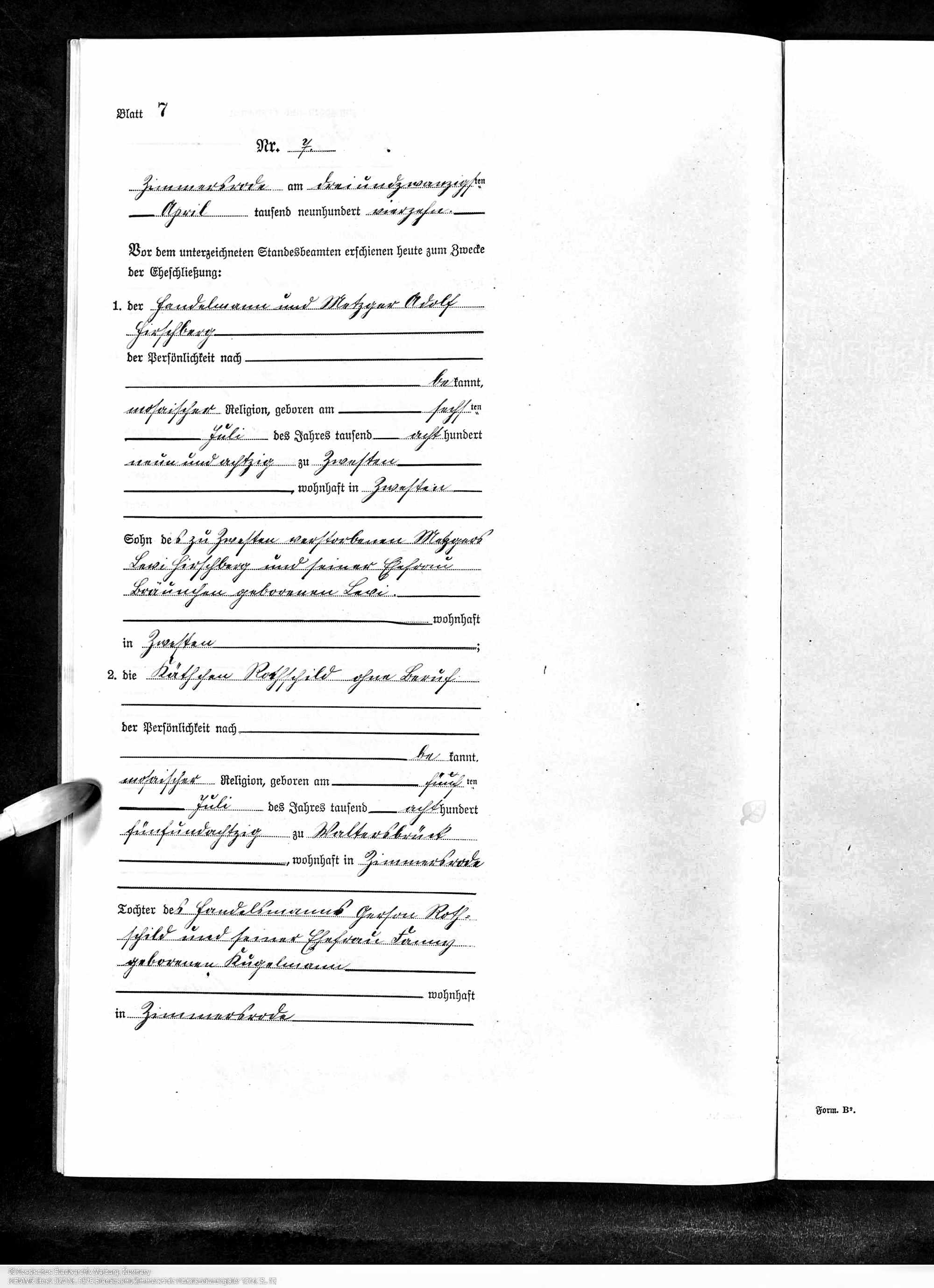
The second oldest child of Gerson Rothschild and Fanny Kugelmann was their daughter Katchen, born in 1885 in Waltersbrueck. As we saw, she married Adolf Hirschberg in 1914, and they had one child, a son Ludwig born in 1920. According to their marriage record, Adolf was a merchant and a butcher. They were living in Kassel, Germany, when Ludwig was born in 1920. Unfortunately, I do not know much more about their lives before the Nazi era. But I know that all three were persecuted and killed during the Holocaust. But the records of where and how they died are in conflict.

Katchen Rothschild and Adolf Hirschberg marriage record, Hessisches Hauptstaatsarchiv; Wiesbaden, Deutschland; Bestand: 920; Laufende Nummer: 9576, Year Range: 1914, Ancestry.com. Hesse, Germany, Marriages, 1849-1930

First, there are records at the Arolsen Archives showing that both Adolf and Ludwig were incarcerated at Buchenwald for some period of time after Kristallnacht in 1938.

Then, according to entries in the Gedenbuch (“Victims of the Persecution of Jews under the National Socialist Tyranny in Germany 1933 – 1945″ prepared by the German Federal Archives) as recorded at Yad Vashem, Katchen, Adolf, and Ludwig Hirschberg were all deported from Kassel on December 9, 1941, to the Riga ghetto in Latvia. As best I can determine from records at Yad Vashem, Katchen died in the Riga ghetto, but no date was given. For Adolf, the Gedenbuch reported that he died there on August 24, 1943.

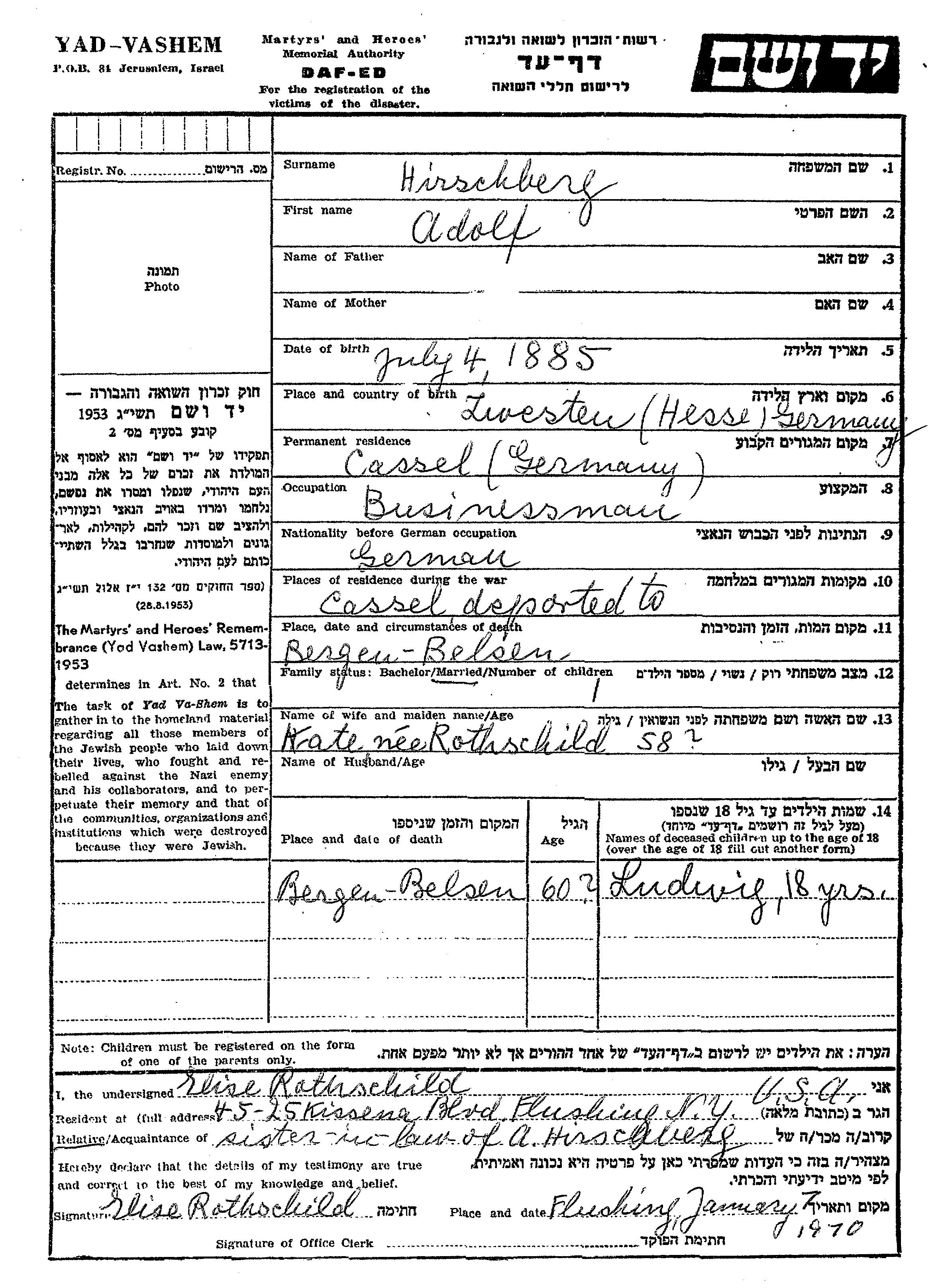
Pages of Testimony were filed at Yad Vashem for Katchen, Adolf, and Ludwig by Katchen’s sister-in-law, Elise Block Rothschild, the wife of Siegmund Rothschild, one of the few siblings to survive the Holocaust. Elise filed many Pages of Testimony for the family members murdered by the Nazis, as we will see. Her Pages of Testimony for Katchen and Adolf state that they died at the Bergen-Belsen concentration camp, but after searching the Arolsen Archives lists of those killed at Bergen-Belsen, I was unable to find either Adolf or Katchen’s name, so I do not know how accurate Elise’s information was. Did they die in Riga, or were they at some point transferred to Bergen-Belsen and killed there? I don’t know.

Adolf Hirschberg Page of Testimony filed at Yad Vashem, found at https://collections.yadvashem.org/en/names/14982438

Katchen Rothschild Hirschberg Page of Testimony filed at Yad Vashem, found at https://collections.yadvashem.org/en/names/645337

As for Ludwig, there is also conflicting information. The Gedenbuch summary at Yad Vashem reports that Ludwig was killed at the Natzweiler-Struthof concentration camp in France on December 24, 1944. A record in the Arolsen Archives also indicates that he died at Natzweiler-Struthof on that date, and there is also a record on Ancestry that seems to confirm that Ludwig was imprisoned at Natzweiler-Struthof during the Holocaust.1 Both records indicate that Ludwig was transferred to Natzweiler-Struthof from the camp in Dautmergen, a town in southwest Germany about 100 miles from Natzweiler-Struthof in France.

Ludwig Hirschberg record at Arolsen Archives, 2 Registration of Foreigners and German Persecutees by Public Institutions, Social Securities and Companies (1939 – 1947) / 2.3 Post-war Evaluations of Various Organizations / 2.3.3 Haut-Commissariat de la République Française en Allemagne / 2.3.3.1 Card file of persecutees in the later French zone and of French persecutees in other areas / Documents without (captured) names and names from A; further sub-structure available /, Reference Code
02030301001.474

But other records on JewishGen and Ancestry2 indicate that Ludwig was at the Stutthof concentration camp in Poland. Those records, however, are confusing because they say “Riga/Stutthof/Natzweiler.” Did they mean Stutthof, or did they mean Struthof/Natzweiler?

But this card from the Arolsen Archives is clearly marked only Stutthof and indicates that Ludwig Hirschberg was incarcerated there.

Ludwig Hirschberg at Stutthof, 1 Incarceration Documents / 1.1 Camps and Ghettos / 1.1.41 Stutthof Concentration Camp / 1.1.41.2 Individual Documents Stutthof / Personal Files – Stutthof Concentration Camp / Files with names from HERZ , Reference Code
01014102 047.243found at https://collections.arolsen-archives.org/en/document/4493200

Could he have been at both camps? Or is one of these records incorrect? After all Struthof and Stutthof could be easily confused. The Page of Testimony filed by Elise Block Rothschild does not resolve this confusion because it only reported that his place of death was unknown.

Ludiwg Hirschberg page of testimony at Yad Vashem, found at https://collections.yadvashem.org/en/names/622945

Only to add to the confusion, the Projekt Judische Leben Frankfurt states that Ludwig was one of the passengers on the St. Louis, the ship that was turned back in 1939 after being refused entry by both Cuba and the United States, and that he was later killed at Auschwitz. I searched the list of St. Louis passengers on file at the US Holocaust Museum and Memorial, however, and did not find Ludwig Hirschberg on that list. Nor does any record at Yad Vashem or on JewishGen or on Ancestry indicate that Ludwig was murdered at Auschwitz.

One might conclude that Ludwig was at Natzweiler-Struthof based on the larger number of records so indicating, but how did he get there from the Riga ghetto? They are more than 1200 miles apart. Not that Riga is close to Stutthof either (469 miles), but still much closer. Also, the JewishGen database devoted to Stutthof includes a description that states, “The Stutthof camp was originally not designed to hold Jews, but, beginning in 1944, substantial numbers (30,000-50,000) of Jews were sent there, primarily from Kovno, Rīga and Auschwitz.” So it would make sense that Ludwig would have been sent from Riga to Stutthof, not to Natzweiler-Struthof.

Unless Ludwig was in fact on the St Louis? Since many of those passengers did end up in France after being turned back by the US and Cuba, that might explain how Ludwig ended up in Natzweiler-Struthof. But if he was on the St Louis in 1939 and then sent to France, how could he have been deported to Riga from Kassel with his parents in 1941? Something didn’t add up.

I was very fortunate to speak with Ludwig’s first cousin Hal Katz on May 8, 2025, and he confirmed that Ludwig was not on the St. Louis. That makes it even less likely that Ludwig ended up in France and thus in Natzweiler-Struthof. My best guess at this point is that Ludwig was sent to Stuffhof along with other prisoners from Riga. My hunch, totally speculative, is that somewhere someone mixed up Struthof and Stutthof and wrote the wrong name on one of Ludwig’s records.

Sadly, in the end, these details do not change the ultimate outcome. Katchen, Adolf, and Ludwig Hirschberg were all murdered by the Nazis during the Holocaust. One family story shared with me in my conversation with Hal Katz and his daughter Sandy and niece Judy is that Ludwig survived in the camp and was shot in cold blood by a guard on the day the camp was to be liberated.

May the names and memories of Katchen, Adolf, and Ludwig be preserved forever.


  1. Name Ludwig Hirschberg, Nationality German Jew, Birth Date 1 Feb 1920
    Transfer Place In Dautmergen, Death Date 24 Dec 1944, Prisoner Number 34908
    Microfilm/Roll/Section A3355/2/4, Alphabetical/Roll/Section A3355/76/GOE-HUA
    Record Number 24120, Irvin Horn, comp. France, Natzweiler-Struthof Concentration Camp Record Book, 1940-1945 
  2. Ludwig Hirschberg, Birth Date 1 Feb 1920, Birth Place Kassel, Residence Kassel, Camp Riga/Stutthof/Natzweiler, Ancestry.com. Poland, German Jews at Stutthof Concentration Camp, 1940-1945. See also the same information at JewishGen found at https://www.jewishgen.org/databases/jgdetail_2.php