The Sisters Rosensweig[1]

One of the things that confused me about the ship manifest for David Goldschlager, before I knew that it was really my grandfather Isadore on the ship using his brother’s name, was that David did not list his brother Isadore as the person meeting him in New York.  Instead, he listed an uncle whose name appeared to be Morishe (?) Mintz.  I had no idea who this was, and I could not turn up anyone on any document who might have been this mysterious uncle.  Also, if Isadore had arrived first, why wasn’t he meeting his brother David?
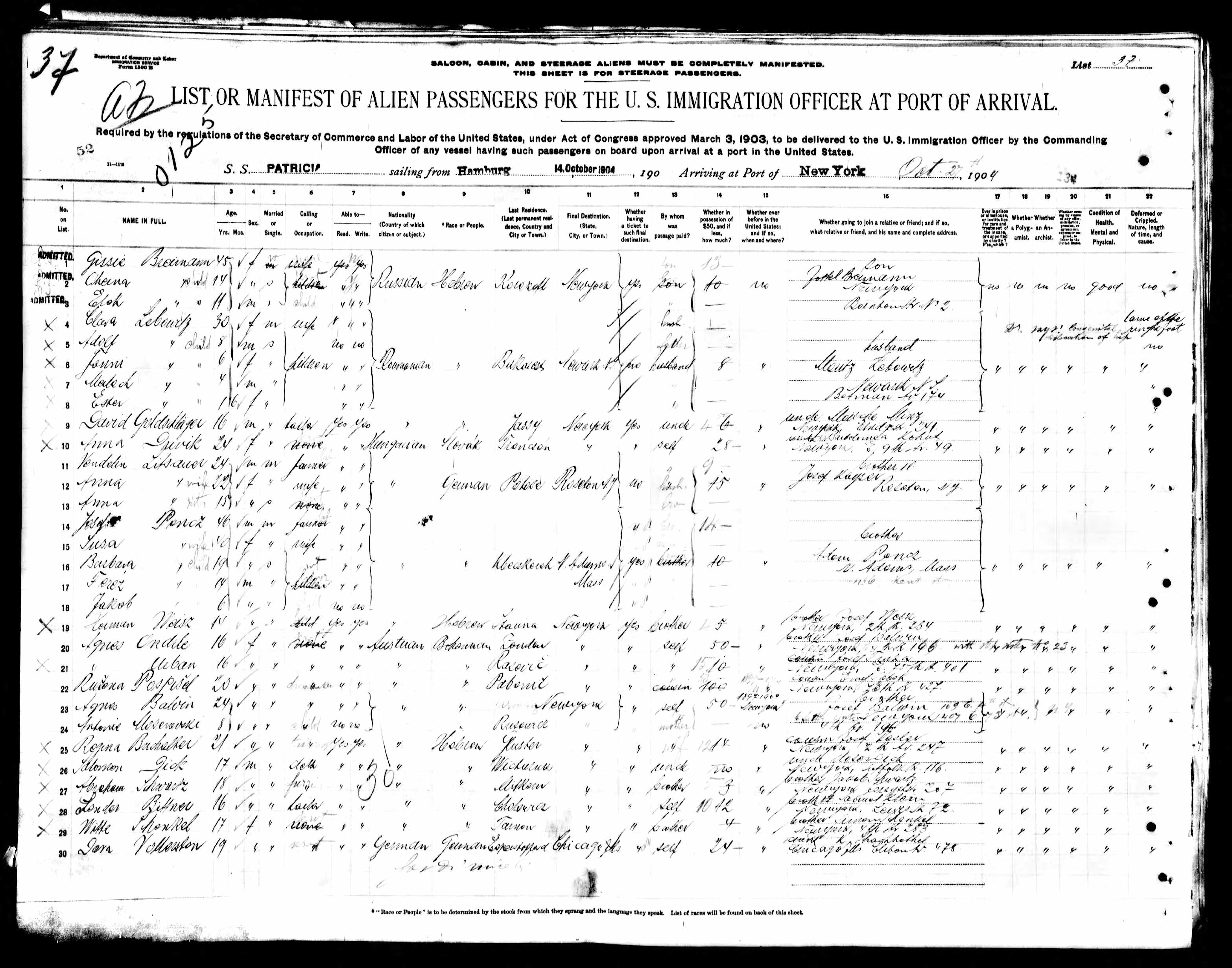
Isadore Goldschlager ship manifest (under David's name)

Isadore Goldschlager ship manifest (under David’s name)

Once I established that in fact Isadore was the one who had arrived on the Patricia in October, 1904, I went back to look more closely at the manifest and to search again for Uncle M. Mintz, with no luck.  I did, however, find a separate document that I had not seen before relating to Isadore’s (“David’s”) arrival at Ellis Island, a Record of Detained Aliens, shown below.

Record of Detained Aliens Isadore listed as David Goldschlager

Record of Detained Aliens
Isadore listed as David Goldschlager

I am familiar with this type of document now because I had seen the one issued for Gisella Goldschlager, who had listed her husband Moritz as the person meeting her.  Because her husband had died, she was apparently detained and released to her son Isadore instead.  It appears that the same type of occurrence detained my grandfather.  On the document it says the cause of detention was “to uncle,” and then in the next column for “Disposition,” it says “Aunt Zusie (?)  Mintz, 177 East 111th Street, New York City.”  From this I surmised that something prevented Uncle Mintz from meeting Isadore and that instead his wife Zusie had picked him up instead.

That led to a search for the aunt and uncle.  I could not find any M  Mintz on the 1900 census from Romania who could fit.  I searched the NYC marriage index and also had no luck—until I searched for all men named Mintz who had married between 1880 and 1904.  I checked every one of them to see what their bride’s names were and was excited when I found a bride named Zusia ROSENSWEIG married to a Harry Minz in 1896.  Could this be a third Rosensweig sister?

If so, she would have been the youngest sister, about 14 years younger than Tillie, ten years younger than Ghitla/Gisella.  Why would she have left Romania first and not her older sisters? Her sisters did not arrive until 1907 and 1910, respectively, when they were already married and had children.  But Zusia was still single, and thus more able to pick up and leave earlier, as did her nephew Isadore at age sixteen.

Harry and Zusia were married in 1896, so I looked again on the 1900 census using the name Harry with a wife with a name that could be Zusia.  No luck.  I decided to look just for an S or Z Mintz and found a Sonsa Mintz, a widow, living with Jason and Rachel Reitman and their one year old daughter Clara.  Sonsa was identified as a cousin of the head of household and as a widow.  Assuming that this is the same woman who had married Harry Mintz, it means that her husband died less than four years after they were married.  It obviously would explain why he was unable to meet Isadore/David at the boat in 1904. I have not located a death certificate for Harry, however, nor do I know for sure yet that Sonsa is the same person as Zusia or really the sister of Tillie and Gisella.

Unfortunately, I cannot find a Sonsa, Zusia, Susan, or Susie Mintz in any later census.  I did find a reference for a Susie Mintz who died in the Bronx in 1931 and is buried in New Jersey, but I do not know if this is the same person.  I will order the death certificate to see, but at the moment I have no other records for Sonsa Mintz after 1900.  I assume she may have remarried, but I did not find a marriage record either.

The only other possible record relating to the third Rosensweig sister is a ship manifest listing an eighteen year old girl named Sural Rosensweig from Romania, arriving in New York on September 30, 1890.  The age and name are close enough that it could be the same person, but I cannot know for sure.  (On the 1900 census, Sonsa Rosensweig’s birthdate is April, 1874, and her arrival date is 1891, whereas on the manifest her birth year would have been 1872 and arrival year 1890.)

Although I’ve hit a wall so far with Sonsa and with Harry, her husband, I did look to see if I could figure out how Sonsa was a cousin to the Reitmans.  Was it through Harry? Through Jacob or through his wife Rachel? Although I was able to find a number of records for the Reitmans, up through their great-grandchildren, I have not yet figured out the relationship.  They, like Sonsa, were from Romania, but beyond that, I have no clues.  I have sent an email to one of the great-grandchildren, but it seems quite unlikely that they would know anything about a woman named Sonsa Mintz who lived with their great-grandparents in 1900.

I will have to hope that the 1896 marriage certificate for Harry Mintz and the 1931 death certificate for Susie Mintz have some clues.


[1] With apologies to Wendy Wasserstein.  No connection to her play is intended….

Enhanced by Zemanta

The Schwartz Family: Updates, Documents and Pictures

First, a few comments about my last post about the Schwartz family.  My mother pointed out to me that David Goldschlager’s wife Rebecca was always called Becky, not Rebecca. Richard, her grandson, confirmed this, so from now on I will refer to her as Becky.  Also, both my mother and Richard described Becky as a warm, outgoing person with a wonderful laugh (and a great apple strudel, according to Richard.)  Looking at the wonderful pictures below, I can see that Becky came from a large, but close family, and that despite losing two brothers and overcoming the adjustments to living in America, there must have been happy times in their childhood here.

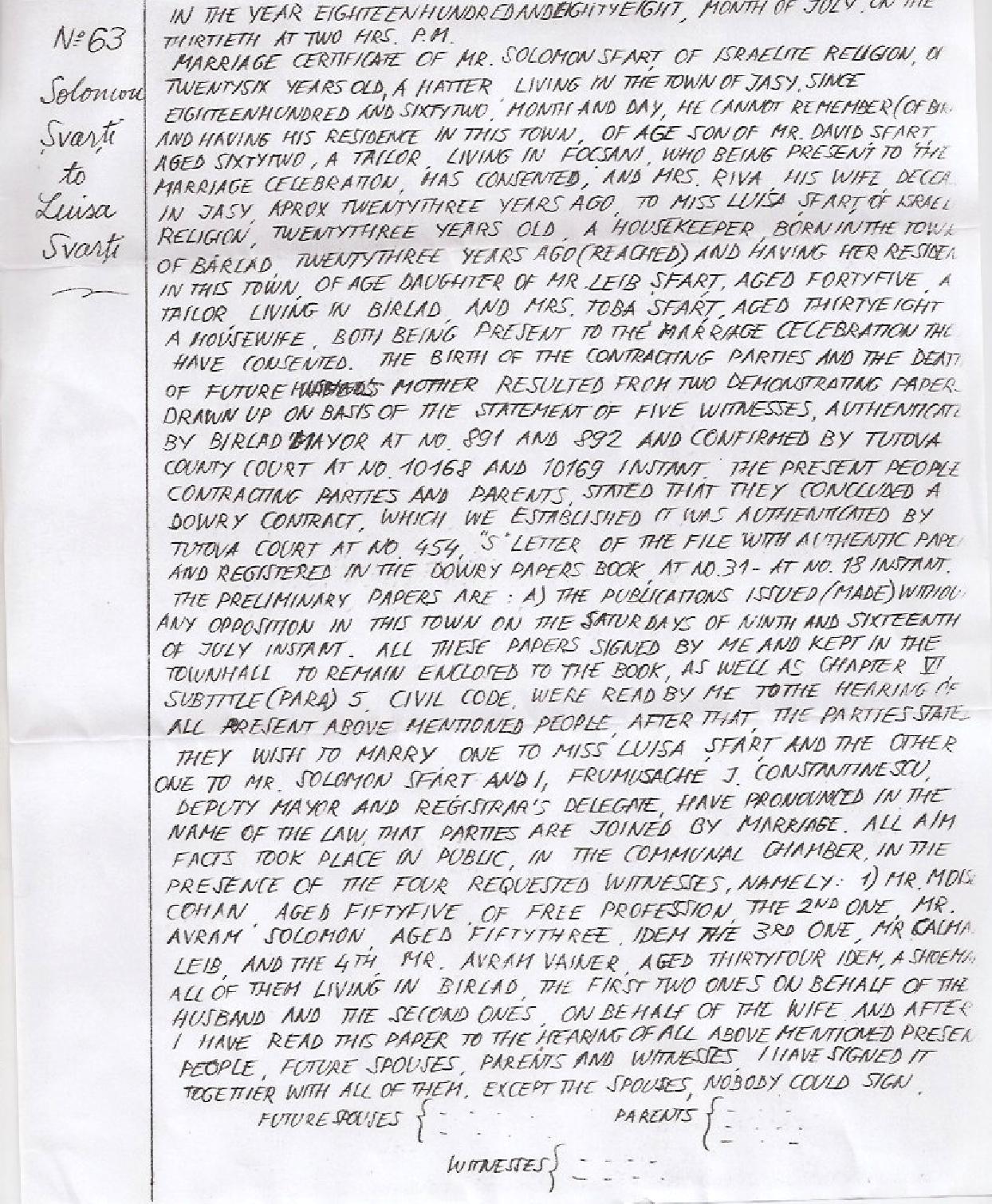
Thanks to Jon Schwartz, Becky’s nephew, I have some wonderful documents and photographs to share of the Schwartz family.  First, Jon has shared the marriage certificate of his grandparents Solomon Schwartz and Louise Schwartz, or Solomon Svarti to Luisa Svarti in Romanian.  Here is the English translation:

Marriage record for Solomon and Louise Schwartz 1888

Marriage record for Solomon and Louise Schwartz 1888

Two things are interesting here.  First, Jon wonders whether his grandparents were cousins since both had the surname Sfarti before they married, just as we believe that Joseph and Bessie Brotman were related, both sharing the same surname before marriage.  It was apparently not uncommon for families to arrange marriages between cousins.  Also, note that Solomon was from Jassy (Iasi), and Luisa from Berlad.  According to Google Maps, the two cities are about 80 miles apart and would take even today two hours to travel between.  It seems unlikely that Solomon met Luisa without some prior arrangement so a family connection makes sense.

It’s also interesting that Solomon came from Iasi.  Perhaps he knew the Goldschlager family growing up, which might explain how David Goldschlager ended up marrying Solomon’s daughter Becky.  What makes this seem a bit more possible is the fact that Solomon was a hatter even in Romania.  Although David was born after Solomon had married and left Iasi, it is interesting that David, a hatter from Iasi, ended up marrying the daughter of Solomon, a hatter from Iasi.

Jon also sent me the birth certificate, both in Romanian and in English, for Rebecca (Becky), Solomon and Luisa’s first child, born in April, 1889, ten months after their wedding.  Here is the English version below:

Rebecca Schwartz birth certificate translated

Rebecca Schwartz birth certificate translated

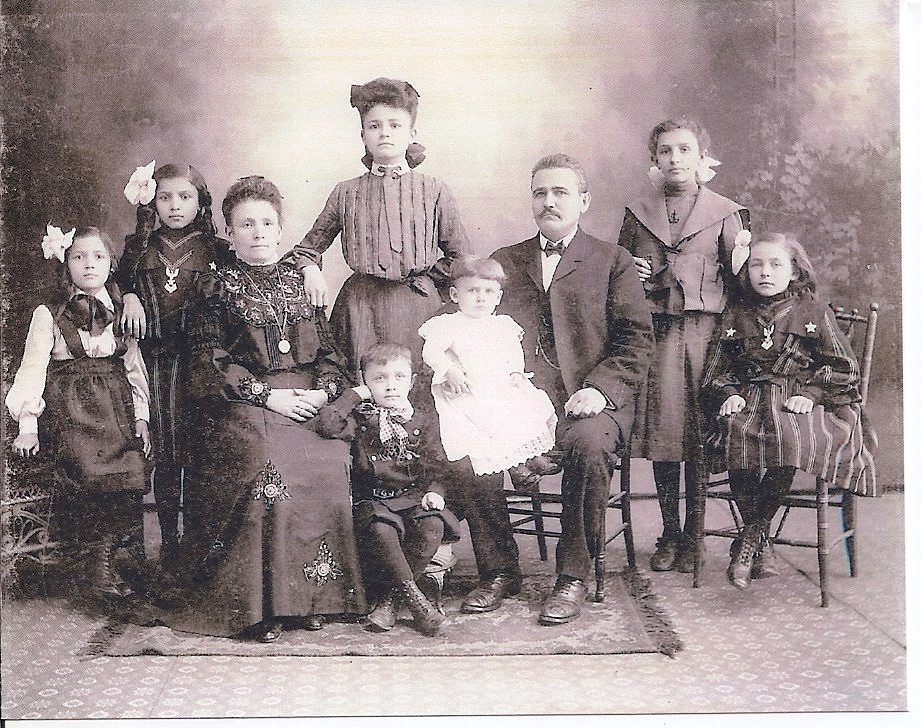
Jon also has some wonderful photographs of his father’s parents and siblings.  My favorite is this one, depicting the Schwartz family probably a year or so after they arrived in Newark.

The Schwartz family c. 1905

The Schwartz family c. 1905

From left to right, they are Sophie, Annette, Louise (sitting), Becky, Abram, Solomon, Meyer, Etta and Rose.

Jon thought that the baby was Jennie, the Schwartz’s youngest child born in 1907, but since the picture does not include the other child born in the US, Meyer, who was born in 1904, I think the baby is Meyer.  Also, the ship manifest said Abram was two at the time they left Romania(1903), and in this picture Abram (the little boy leaning on his mother’s knee) looks too young for him to be six or seven, which he would have been when Jennie was a baby in 1907.  I would date this picture between 1904 and 1905, and I believe that the baby is Meyer, the poor little boy who died of a burst appendix when he was nine years old.

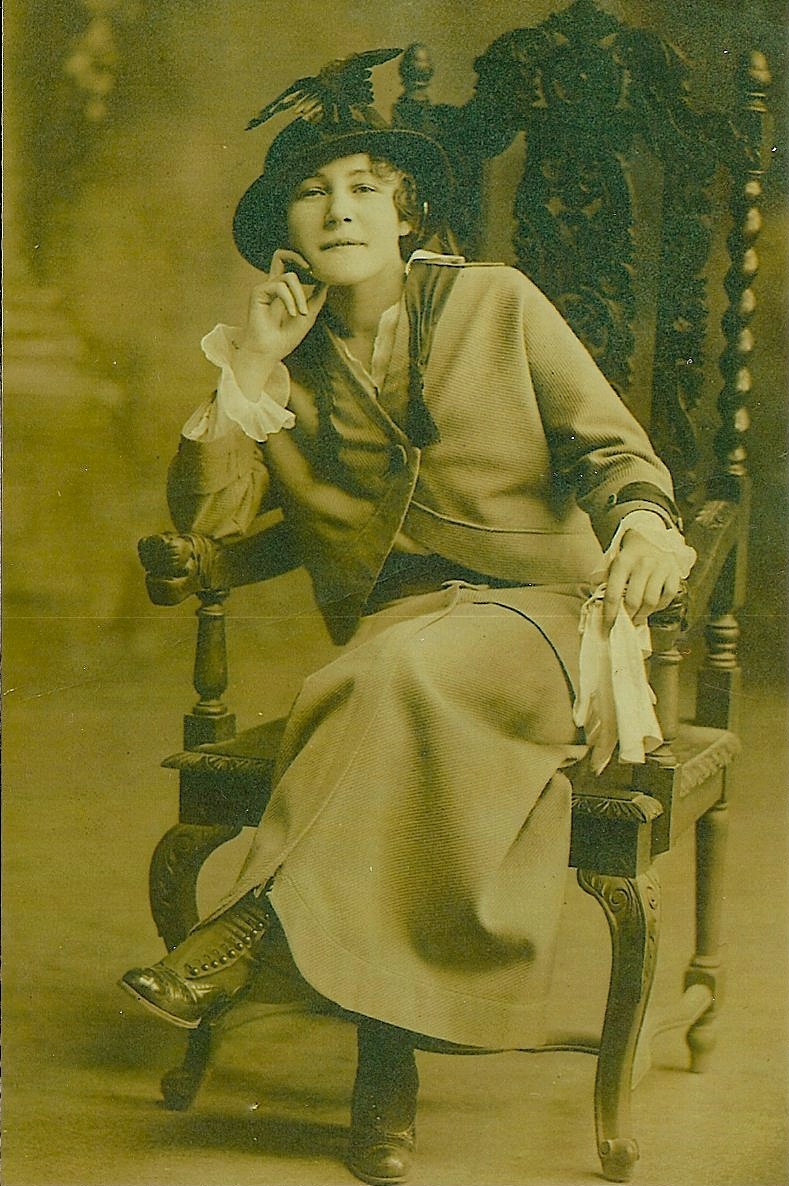
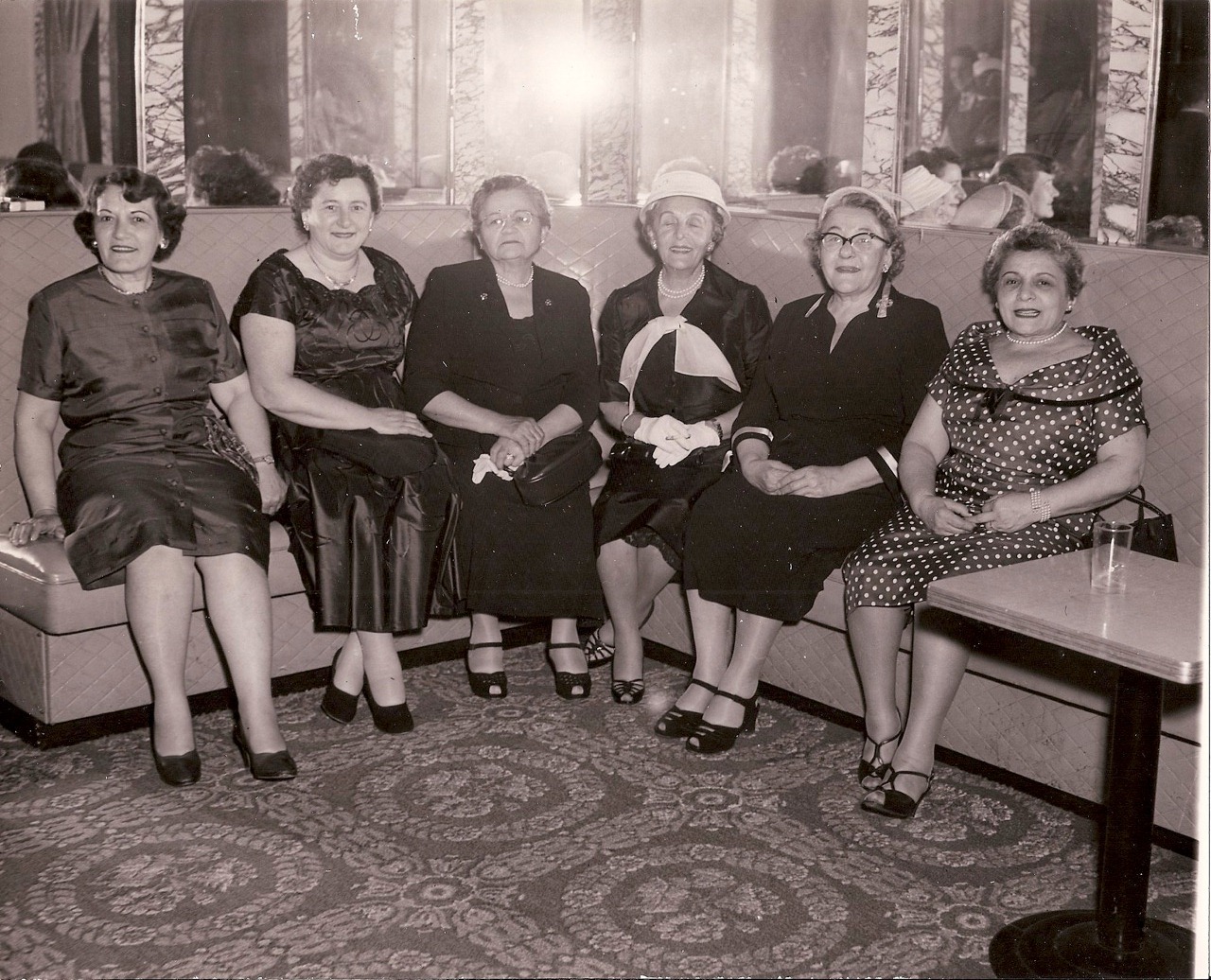
The other Schwartz children all grew to adulthood, Abram becoming Arnold, the only brother among six sisters.  He had a painting business for some time, but when it failed during the Depression, he became a route salesman. He had two sons, Stephen and Jonathan. The sisters all married except for Sophie, and all but Jeanette had children.  Here are two pictures of the Schwartz sisters, courtesy of their nephew Jon.

Rose Schwartz

Rose Schwartz

Schwartz sisters 1956

Schwartz sisters 1956

Sophie (aka Sherry), Jeannette, Rebecca, Etta, Rose, Annette

Enhanced by Zemanta

Update: My Grandfather’s Arrival

Statue of Liberty National Monument, Ellis Isl...

Statue of Liberty National Monument, Ellis Island and Liberty Island, Manhattan, in New York County (Photo credit: Wikipedia)

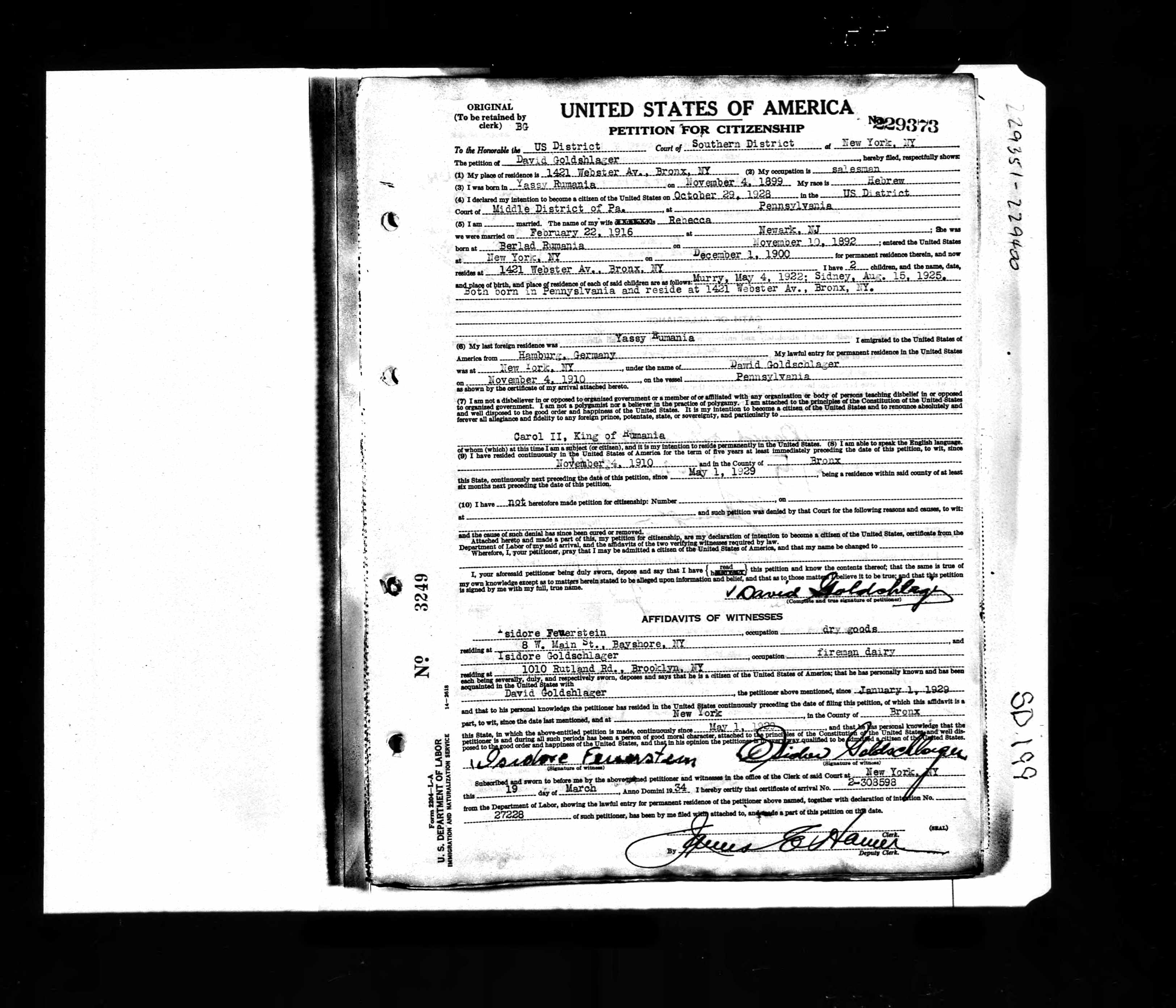
Yesterday I received eight new documents, and I will report on them all over the next couple of days.  But for me, the most exciting document is my grandfather’s naturalization application.  It is always touching to see a document written in the handwriting of someone who means a lot to you, so that alone would have made it exciting.  It’s also exciting to see the names of my grandmother and aunt and uncle on his petition.  It’s exciting to see his distinctive signature.

But what made these pages particularly exciting is that they resolved a question that has been unanswered for a long time.  A number of years ago my brother tried to find the ship manifest for our grandfather Isadore at Ellis Island.  He was able to locate the manifests for David, Betty, Moritz and Gisella, but not Isadore.  When I started my own research almost two years ago, I also tried to find something that documented when Isadore arrived in New York, but found only the same information that Ira had found.  I had given up and moved on to other things.

When I returned to researching the Goldschlagers a few weeks ago, I once again looked, figuring that with my improved research skills and newer research tools, maybe I would finally find a ship manifest for my grandfather, but once again, nothing turned up.  I resigned myself to the idea that I would never find a record for his arrival.

Then the other day, as I wrote in my post entitled “Isadore and David Goldschlager: More than Brothers,” I realized that there were two ship manifests for David Goldschlager: one dated October 27, 1904, and the other dated November 4, 1910.  I also realized that it was the later one that was accurate.  Every other document said David had arrived in 1910: his naturalization papers, several census reports, and his wife’s naturalization papers.  It also made sense that David had waited with his mother and sailed with her to America.

That left me thinking that the David Goldschlager on the 1904 manifest was not David, but Isadore, my grandfather.  That manifest was for a ship called the Patricia, sailing from Hamburg, and arriving in the United States on October 27, 1904.  I was hoping that Isadore’s naturalization papers would reveal what ship brought my grandfather to America.  I hoped that I had finally found the evidence of how and when Isadore traveled to his new home.

Well, I opened the naturalization papers today, holding my breath, scanning quickly to see if the answer was revealed.  And there it was: Isadore wrote that he arrived on October 28, 1904, on the Patricia, sailing from Hamburg.  Isadore had in fact used his younger brother’s name to escape from Romania.

Isadore Goldschlager naturalization papers page 1

Isadore Goldschlager naturalization papers
page 1

page 2

page 2

page 3

page 3

I was always told that he left Romania to avoid the draft.  He turned sixteen in August, 1904, and was presumably then draft age.  David, on the other hand, was a year younger and would not turn sixteen until 1905.  Perhaps Isadore took David’s passport to get out of Romania.  Or maybe he just used his name.  (That leaves me wondering how David managed to stay safe until he left in 1910, but I am afraid we will never know the answer to that question.)

When I told my mother what I had found, she said that she was not surprised that her father figured out a way to get out of the country.  He was a very clever and resourceful man who knew how to get what he wanted.  He used his wits to survive.  As one of his namesakes who never knew him likes to say, “If at all possible, lie.” It seems that that approach may have saved our grandfather’s life and enabled his three children, his nine grandchildren, his fourteen great-grandchildren, and the ever-increasing number of great-great grandchildren to come into this world.

Thank you, Grandpa, for being so clever and for escaping Romania, and thank you, David, for letting him borrow your name.

SS Patricia, the ship that brought my grandfather to America

SS Patricia, the ship that brought my grandfather to America

Enhanced by Zemanta

Isadore and David Goldschlager: More than Brothers?

Yesterday I decided to try and fill some of the gaps in David Goldschlager’s history.  I had his birth record from Iasi, saying he was born November 4, 1889, a year after my grandfather, and the ship manifest from the Patricia saying that he had arrived on October 27, 1904.  But then there was a big gap.  He did not appear on the 1905 New York State census, although I had found Isadore, living alone in Manhattan.  Nor did David appear on the 1910 census, although both Isadore and Betty were living with their aunt Tillie Strolovitz and her seven children.  But where was David? It made no sense to me that he was not living with his family in either 1905 or 1910.  He first shows up on an official census in 1915, when he was living with his mother Gittel/Gisella and his siblings Isadore and Betty.

Also, I was curious as to how and why he ended up living in Pennsylvania when Murray was born in 1922.  I had not yet found a marriage record for David and Rebecca, although I knew they were married by 1917 because David so reported on his draft registration card filed that year.  Also, the 1920 census had them living in Manhattan.  I also knew that David had been working as a hat maker since at least 1915 because that was his occupation listed on the 1915 New York census, as it was also on his draft registration and the 1920 census and each one thereafter.  So what took him to Scranton?

I thought perhaps that Rebecca was from Scranton, so I started searching for her records.  I did not know her maiden name, and I could not find any record of their marriage in the NYC marriage index.  I was stumped.  But then I found her naturalization papers, and they were a goldmine of information.  From these papers I learned that Rebecca’s maiden name was Schwar(t)z, that she was born in Berlad, Romania, on April 29, 1889, that she had arrived in March, 1903 on the SS Astoria via Glasgow, and that she had married David Goldschlager on February 20, 1916, in Newark, New Jersey.  I also confirmed that their son Murray was born in Scranton, PA, and that Sidney was born in Newark, New Jersey.

Rebecca Goldschlager's naturalization papers

Rebecca Goldschlager’s naturalization papers

From there, I was able to find Rebecca’s family on the SS Astoria ship manifest and find the names of her mother and many siblings and the name of her father Solomon Schwartz, who was meeting them and resided in Newark, New Jersey.  When I followed up with census reports for the Schwartz family in Newark, I learned that Solomon was, like David, also a hat maker.  Perhaps David had met Solomon in the circles of the hatmaking trade, and Solomon had then introduced David to his daughter Rebecca? It now made sense why David had gotten married and at one point lived in Newark, but why Scranton? I am still trying to figure that out.

Rebecca’s family’s story is itself worth telling, and I will in my next post.  But for me personally, the bigger story comes back to David and Isadore.  While reviewing Rebecca’s naturalization papers, I noticed that it said that David had himself arrived in New York on November 4, 1910, not October 27, 1904, as reported on the ship manifest for the SS Patricia.  I thought either that it was a clerical mistake or a memory mistake and dismissed it.  But then I looked back at a few of the census reports for David and Rebecca and noticed that on those reports as well, his arrival date was reported as 1910, not 1904.  I had also earlier dismissed that as an error.  But now I was starting to wonder—how likely was it that the same 1910 date was reported so many times and yet wrong?

I went back to look at the naturalization papers I had for David and saw that those also reported his arrival date as November 4, 1910.  Now I was really puzzled.  When I first found David’s naturalization papers, I had not focused on this, nor did I realize then that there is a second page to the naturalization papers.  I turned to the next page and found this:

David Goldschlager Naturalization Record

David Goldschlager Naturalization Record

First thing I noticed was that my grandfather Isadore had signed David’s application with his very distinctive and florid signature; the second witness was Isidor Feuerstein, Betty Goldschlager’s husband.  Then I looked more closely at the information provided on the form.  It clearly said that David had arrived on the SS Pennsylvania from Hamburg on November 4, 1910.  Now I was convinced that the 1904 date must be wrong.

I searched for the manifest for the SS Pennsylvania arriving in NYC on that date, and sure enough I found David’s name, indicating that he was being met in New York City by his father Moritz Goldschlager.  Only then did my slow brain react and realize that this was the very same ship that Gittel/Gisella, David’s mother, sailed on when she arrived in New York.  I went back to double-check, and sure enough, it was the same exact ship.  I don’t know why Gittel and David were not listed together on the manifest.  If they had been, I would have noticed this long ago.  But clearly it makes sense that David and his mother came together, both arriving in New York, expecting to be met by Moritz, only to be met instead by Isadore, who had to tell them that Moritz had died in April, seven months before.

So then why was there a 1904 ship manifest for a sixteen year old named David Goldschlager from Jassy, Romania?  Well, I see three possibilities.  One, there were two David Goldschlagers about the same age in Jassy.  That certainly is a possibility, although I have not found another David Goldschlager from Romania (there is one from Austria) on any of the census reports in New York.  Two, David went back to Romania and then returned again with his mother in 1910.  That is also possible, but would he have left so soon after arriving that he was gone by the time of the 1905 census?

Three, and the possibility that makes perhaps the most sense and that brought tears to my eyes, the David Goldschlager who arrived in 1904 was really my grandfather, Isadore Goldschlager.  Isadore was 16 on October 27, 1904 (David was actually only fifteen).  Isadore did arrive in 1904 according to several census reports.  And Isadore was trying to avoid the draft, so very well might have had to use an assumed name to get out of Romania.  And I have not been able to locate any other ship manifest that has Isadore’s name on it.  He may have walked out of Romania, but he certainly did not walk across the Atlantic Ocean.

After much searching, I have just an hour ago located the index number for Isadore’s naturalization papers from 1917.  I have added them to the list of documents I am ordering, and it is the document I am most anxious to see.  Perhaps it will reveal when Isadore arrived and on what ship.  Maybe it will reveal that Isadore did, in fact, arrive under his brother’s name.

If so, I have to rewrite some of the Goldschlager family history.  It would mean that Isadore was here alone for five years before his father arrived in 1909.  It would mean that he was here alone to deal with his father’s death in April, 1910, and to comfort his sister Betty, who arrived the following day.  It would mean that he alone had to tell his mother and his brother that their husband and father had died when they arrived at Ellis Island in November, 1910, seven months after Moritz had died.  It’s far too much pain and suffering for me to imagine one very young man enduring.

UPDATE:  See my post updating the research on this page.

Isadore age 27

Isadore age 27

Enhanced by Zemanta

First Cousins: The Grandchildren of David and Esther Rosensweig

Immigrants just arrived from Foreign Countries...

Immigrants just arrived from Foreign Countries–Immigrant Building, Ellis Island, New York Harbor. (Half of a stereo card) (Photo credit: Wikipedia)

Genealogy research can be both very frustrating and very exhilarating.  Sometimes you feel like you have hit a wall and can get no further.  Every stone you turn leads nowhere.  People don’t respond to requests for information, documents have been lost or destroyed, and you feel like you will never find anything new.  Then there are the times that are exhilarating.  You find a document that tells a story and reveals a relative you never knew about.  You contact a long lost cousin and make a new friend.  You put together pieces of a puzzle and see a picture of your family that touches you in ways you never anticipated.

Yesterday was one of those exhilarating days.  I had found an email address for someone I thought could be one of Leah Adler’s grandsons and had taken a chance that it was the right person and that he would respond.  It was a long shot—we are fairly distant cousins—third cousins—and it was very unlikely that my name and background would mean much to him.  Well, I hit the jackpot!  He forwarded my email to his sister Jean, who is herself someone with 30 years of experience in genealogy.  Jean wrote to me right away, and we have since exchanged several emails and lots of information.  Through this contact, I have been able to learn a lot more about my great-grandmother’s sister Tillie and her family.

Some might wonder why I care so much about these individuals and their lives.  Well, these were my grandfather’s first cousins.  He and his brother David were close in age to Isidor, Bertha, Bella, David, Pincus and Becky, and his sister Betty would have been close in age to Leah.  These could have been their playmates as children in Iasi.  They all had the same grandparents, David and Esther Rosensweig.  Tillie and Ghitla both named sons for their father David.

Moreover, Tillie took in my grandfather and his sister in 1910 when she herself was a single mother already caring for her seven children.  My grandfather and his sister must have been mourning their father, who had died in April, 1910, and awaiting their mother, who arrived in November.  (One mystery: I cannot find David Goldschlager on any 1910 census, though he shows up living with his mother and siblings in 1915.)

So what have I learned from Jean about my grandfather’s aunt and her children? For one thing, it now seems quite clear that Itic Yankel Srulivici and Jacob Adler were one and the same person.  Jean said that family lore in her family is that Jacob never left Ellis Island.  The ship manifest does indicate that he was admitted in 1907, but perhaps something happened after that to block his ability to leave Ellis Island.  The ship manifest does indicate that he was examined by a doctor and had scars on his corneas and coloboma of both irises.  Could that have been enough to block his entry and have him deported?  I have ordered a death certificate for a Jacob Adler who died in 1910, and I have asked my Romanian researcher to look for a record for Itic in Romania.

Jean was also able to confirm much of the information that I had found in public documents: that Bertha had been briefly married, that David died in the 1930s, and that her mother Teddy had married Abner Cohen.  She also told me that Bertha had been killed in an accident in the 1960s, that Bella had married Baer Rothschild and had had no children, and that Beckie, who became Ray as an adult, had married Ben Seamon and had four children, including a daughter Thelma with whom Jean had corresponded in the late 1970s and who had filled Jean in on many of these details.  Sadly, Thelma was also killed in a freak accident in 2000.

It seems no one knows what happened to Isidor, and I have sent for one death certificate that might be his from 1915.  If it is in fact his death certificate, it would mean he died very young, as did his brother Pincus.  The Adler family had more than their fair share of tragedies—losing Jacob, Isidor, Pincus and David at such young ages and losing Bertha and Thelma to freak accidents.  As with my grandfather as well as his brother David Goldschlager, it seems that Leah and her siblings also did not like discussing their past or their childhood family.  Perhaps the hardships of leaving Iasi where they had lived as children, coming to America as immigrants, and fighting to survive the poverty and the language and cultural differences left them all with scars that made it too painful to recall the past.

I don’t know anything about what their childhoods were like in Iasi.  I’ve read enough to know that there was terrible anti-Semitism in Romania during those years and also terrible poverty.  But children often are immune to those external factors in many ways because they know nothing else.  I’d like to think that the Goldschlager-Rosensweig-Srulivici children as young children had some joyfulness in their lives.  I’d like to imagine that Isadore, David and Betty Goldschlager and Isidor, Bertha, Bella, David, Beckie, Pincus and Leah Srulivic/Adler were all young cousins who played together and grew up together in Iasi, just as I was fortunate enough to grow up with my first cousins Jeff and Jody, who lived less than 20 minutes away from us during my childhood. All my first cousins—Jeff, Jody, Beth, Suzie, Robin and Jamie (Jim)– added so much laughter and joy to my life as a child, and I would hope that the same was true for my grandfather, his siblings and his first cousins.

Isadore and Gussie’s nine grandchildren 

Jeff and Jim 1971

Jeff and Jim 1971

jody julie and ira 1963

jody julie and ira 1963

Beth 1954

Beth 1954

Julie, Robin, Amy, Suzie, and Ira 1962

Julie, Robin, Amy, Suzie, and Ira 1962

Elaine Jeff and Amy 1953

Amy and Jeff (with Elaine) 1953

Enhanced by Zemanta

Who was Tillie Srulowitz? Another mystery solved?

As I mentioned in my post about the ship manifests, Betty Goldschlager was released from Ellis Island to someone she identified as her aunt, Tillie Srulowitz.  I had no idea who this could be when I first saw this many months ago.

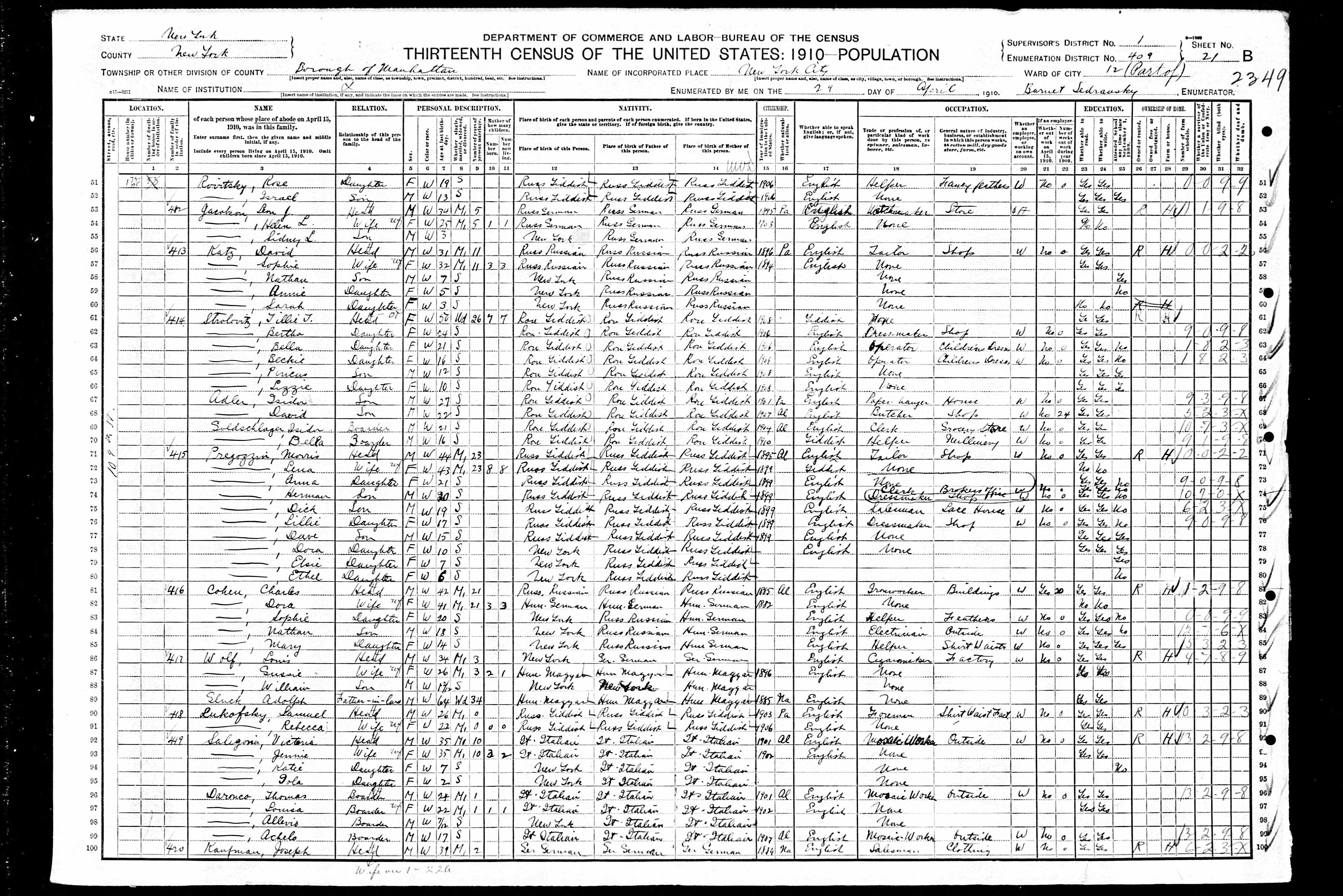
In reviewing my Goldschlager research this past week or so, however, I looked more closely at the census report from 1910, as seen below.

The Strolovitz Adler family with Isadore and Betty in 1910

The Strolovitz Adler family with Isadore and Betty in 1910

Isadore and “Bella” Goldschlager are listed as boarders living with….Tillie Strolowitz and her many children.  When I first looked at this, I had no idea who the Strolowitz family was and just assumed that Isadore and Betty were living there as boarders, not relatives.  This time I remembered the name on the ship manifest and made the connection: this was the aunt that met Betty at Ellis Island.

So who were these people?  Tillie was listed as a widow and had five children named Strolowitz: Beckie, Bertha, Bella, Lizzie and Pincus.  She also had two sons with the last name Adler, David and Isidor.  I assumed David and Isidor were children of a first marriage, and the others children of her second marriage, but since David is younger than Bertha, that did not make sense.  Of course, knowing how unreliable census reports are, it is also likely that that is just an error and that David was in fact older than Bertha.  The census also reports that Tillie’s present marriage was 26 years old, but I don’t know whether that means she’d been married to Mr. Strolovitz for 26 years when he died or whether it had been 26 years since she had married him.  All her children named Strolovitz were younger than 26, whereas Isidor was 27.

I then decided to see what I could find about the Strolovitz family and the possible connection to the Goldschlager family.  On the Ellis Island site, I found entries for two sisters, Betty and Bruche Strulovici from Jassy, who arrived together in 1906 on the Noordam when Betty was 17 and Bruche was 20 with thirty dollars between them.  That information matched the ages and dates of arrival for Bella and Bertha Strolovitz on the 1910 census, so it could very well be them.  I so far have not been able to locate any other Ellis Island records for Tillie Strolovitz’s family.

When I searched for later US census records, I could find almost nothing at first for anyone named Strolovitz with similar first names or for Szrulowitz or Strulowitz or any other reasonable variation.  I then turned to search for David and Isidor Adler and ran into the problem of too many people with those names and no certain way of determining which ones were Tillie’s sons.  I think I have narrowed it down, but am still not certain that I have found the right David or Isidor.

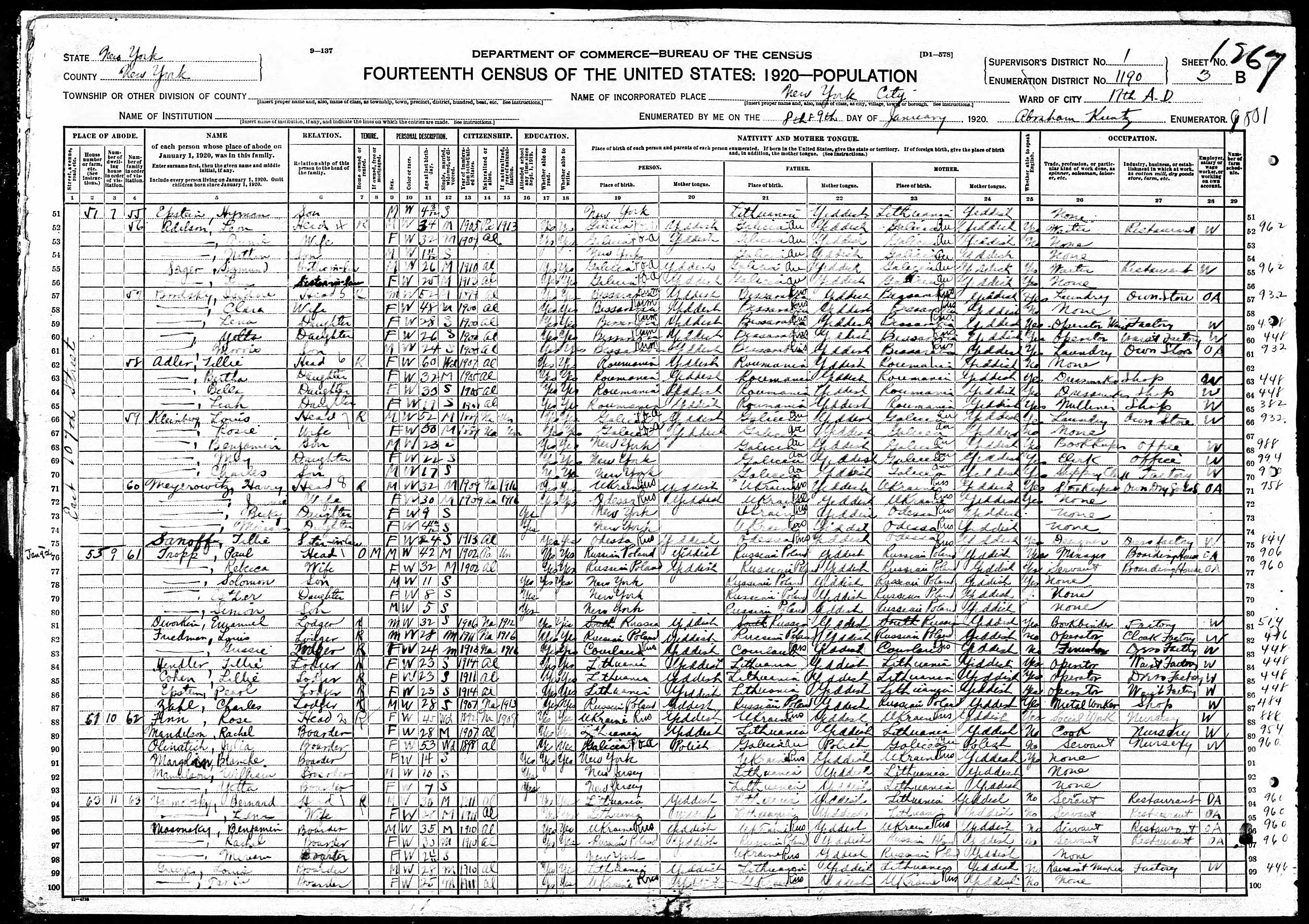
On the other hand, while searching for Adlers on the US census I found this one:

Tillie, Bertha, Bella and Leah Adler 1920

Tillie, Bertha, Bella and Leah Adler 1920

Tillie, Bertha, Bella and Leah Adler, listed as mother and daughters, of the approximate ages that Tillie Strolovitz and her daughters would have been in 1920, from Romania.  This seemed too unlikely to be a coincidence, and I feel fairly certain that for some reason, Tillie and her daughters had changed from being Strolovitz to Adler.  I could not find any records under either last name for Tillie or the daughters, except for death certificate for a Tillie Adler dated 1925 for a woman of the correct age.  I have ordered that certificate and will wait to see what it contains.

Having concluded that Tillie and her daughters were now using Adler, I thought that perhaps her son Pincus had also switched from Strolovitz to Adler, so I searched for him.  I found a South Carolina death certificate for Pincus Adler dated July, 1919, age 19, born in Romania, whose father’s name was Jacob Adler, and whose mother’s maiden name was Tillie Rosensweig.

Pincus Adler Death Certificate 1919

Pincus Adler Death Certificate 1919

The informant on the death certificate was David Adler of West 68th Street, New York, New York.   I am fairly certain that this is the same David Adler and the same Pincus Strolovitz AKA Pincus Adler, although the age may be off by a year or so (not anything surprising in these records).  Everything else lines up: mother is Tillie and brother is David Adler from NYC.  Pincus Adler was also buried at Mount Zion cemetery in Queens, not in South Carolina.  Perhaps Pincus ended up in South Carolina after World War I.  I’ve yet to find a draft registration under either name, but am continuing to look.

So why does any of this matter? When I first saw what Tillie’s maiden name, it didn’t mean anything to me.  Like so many other times in the research, I had to move away from it. Several hours later, while doing something completely unrelated, a lightbulb went off.  Rosensweig was Gisella Goldschlager’s maiden name also! Gisella and Tillie were sisters—Tillie, after all, was listed as Betty’s (and thus, David’s and Isadore’s) aunt on that Ellis Island form.  Her children—Bertha, Bella, Beckie, Pincus, Lizzie, David and Isidor— were my grandfather’s first cousins.

I still have more work to do to figure out the Strolovitz/Adler family.  Why did they use two different last names?  I found a Tillie Strulowitz buried at Mount Zion on August 4, 1925, the day after the date of death for Tillie Adler; this must be the same person, but one place she is Adler, the other she is Strulowitz.  Why is Jacob Adler listed by David Adler as Pincus’ father?  Was there ever a Mr. Strolovitz or was Jacob Adler the father of all seven children? Why did Tillie switch back and forth? Why did her daughters become Adlers?

This stuff just never gets boring to me; there is always another mystery, another surprise around each corner.

Enhanced by Zemanta

Playing detective: Searching for Gold(schlagers)

My first genealogical search efforts about a year and half ago related to my grandfather’s family, the Goldschlagers.  I started there because I figured (somewhat incorrectly) that Goldschlager was an uncommon name and thus would be an easier family to research, unlike Cohen, Brotman, Schoenthal, Seligman—my other family lines.  I also was very curious about my grandfather’s life because I had always heard about how he had walked out of Romania.  It also helped that we knew where he had lived in Romania, the city of Iasi (sometimes spelled Jassy, sometimes Yassy) and that we knew the names of his parents and siblings.

I started by focusing on finding other descendants of the Goldschlager clan.  We knew that Isadore had a brother David and a sister Betty.  My brother had already found some of the relevant records from Ellis Island.  We also knew that David had had two sons, Murray and Sidney, and that Betty had had two daughters, Frieda and Estelle. I figured that I would start with Murray and Sidney since I assumed (again incorrectly) that since they were men, their names would be Goldschlager and they would be easy to find.

I was not very experienced in my research techniques back then and did not get very far.  Since the US Census records are only available up through the 1940 census, I could not get too far using ancestry.com at that point.  I was lucky, however, to find Sidney Goldschlager’s obituary by googling his name.  From that obituary, I learned that his brother Murray had changed his last name to Leonard and was living with his wife Edna in Tucson, Arizona.  (Murray and Edna were listed as survivors of Sidney along with his wife Nora; there were no others mentioned, so I assumed (this time correctly) that Sidney and Nora had not had children.)

Once I knew that Murray was using the name Murray Leonard, I searched for him online by googling his name and Tucson and found a news article about the closing of a chain of women’s clothing stores called Vicky Wayne in the Tuscon area owned by Murray and Edna Leonard.  After that, however, I hit a wall.  Although I could find a telephone listing for Murray Leonard, I was not comfortable making a telephone call blindly. At that point I gave up and turned to searching for Frieda and Estelle, but because I had no idea what their married names were, that ended up as a dead end also.  That was, as I said, about a year and half ago.  I figured I had done all I could do to find the Goldschlagers.

Then this past summer I got an email from a man who was also searching for Goldschlagers.  He had seen my family tree on ancestry.com and was interested in sharing information.  Although we were not able to find any connection between our trees, he did inspire me to start looking again.  He gave me the name of a researcher he had found in Iasi, Romania, and I contacted him to look for records for my Goldschlager ancestors.  As I wrote in my prior post about the Goldschlagers, he was able to obtain several records about my grandfather, about my great-grandparents, and about David, my great-uncle.

Those findings were what really lit a fire for me and inspired me to start my research again.  Although I did not get any further with finding Goldschlagers, it was at that point that I turned to the Brotman line and became fully immersed in learning how to do genealogical research.

With the benefit of this new knowledge and the tools I now knew how to use, I returned to researching my Goldschlager relatives.  This time I knew to dig deeper in order to find other descendants. First, I was able to find some records for Betty and her daughters.  I found a census report for Betty Feuerstein living with her husband Isadore, her mother (listed as Gussie Gold), and her two daughters in Bayshore, Long Island.

Betty Feuerstein and family 1940 census

Betty Feuerstein and family 1940 census

By researching the Feuerstein family, I was able to link with a descendant of that family, who sent me pictures of Frieda and of Betty.  He also knew their married names; Frieda married Abe Adler, and Estelle married I. Kenner, known as Kenny. I found a listing for an Estelle Kenner in Florida, but that’s as far as I have gotten.  My contact did not know whether they had had children or where Frieda had lived.

Last week I returned to the search for David’s descendants. I re-read the article about the Vicky Wayne stores and saw that the stores had been named for a niece of Murray and Edna Leonard.  I googled Vicky Wayne and found many references to a mail order clothing store and then ultimately a reference to the name in an obituary for a woman named Anne Steinberg.  I read the obituary and saw that Anna was survived by two sisters, Faye and Edna.  I thought that perhaps Edna Leonard was Anne’s sister, and so I searched for a record on ancestry that would have listed three sisters on a census named Anne, Edna and Faye.  I found one, the daughters of Ben and Sarah Kaufman living in NYC.

Kaufman family 1930 census

Kaufman family 1930 census

From there I looked at the names of Anne’s children in the obituary and googled them and searched for them on Facebook.  Once I found a few of them on Facebook, I looked to see if they had any friends with the last name Leonard, figuring that Murray and Edna’s children would be cousins of Anna’s children and grandchildren.  Sure enough, Anne’s daughter had a “friend” named Richard Leonard from Tucson, now living in Australia.  I contacted Richard through Facebook and LinkedIn, and within an hour I’d heard back from him, confirming that he is Murray and Edna’s son, David Goldschlager’s grandson, and my second cousin. I had indeed found another Goldschlager descendant.

Richard and I spoke at length by Skype (despite a 13 hour time difference) the other night, and he filled me in on his parents and his grandparents.  His father, though born in Scranton, PA, had grown up in the Bronx and is a loyal Yankee fan (sigh…), as is Richard.  His parents had moved to Tucson in 1958  shortly after marrying in NYC.  Edna’s sister Anna had moved there, and they all worked in the business together, eventually dividing it into two parts, the mail order business and the retail stores.  Sometime in the early 1970s, Murray moved his parents, David and Rebecca Goldschlager, to Tucson as well, where they lived nearby and where Richard was able to see them often.

Richard said that his grandfather did not talk to him about his life in Romania or his family, but was more focused on the present and enjoyed spending time with Richard as he was growing up.  I’ve asked Richard to see if his father, now 92, knows any more about David’s life and family, and he said that he will do so and let me know what he learns.  I also asked Richard if he knew anything about our great-aunt Betty or her daughters Frieda and Estelle, but unfortunately he did not.

Once again, I am amazed by how much you can find in public sources if you are persistent and thorough enough.  I will continue to look for Frieda and Estelle and their descendants, if any.  Now I am expanding the search, looking for other possible relatives of the Goldschlager family.  I believe I have found my great-grandmother’s sister and her family, but that’s a post for another day.

Enhanced by Zemanta

The Goldschlagers

Having reached (for now) a dead end on my research of the Brotman family, I have decided to turn to, or rather return to, my research of my grandfather’s family, my Goldschlager relatives.  I had previously done a fair amount of research on the Goldschlager line, but had put it aside when I found my Brotman cousins. For some of you, the Goldschlager story will be perhaps of less interest, although it is itself a wonderful story of American Jewish immigration.  For others, in particular my first cousins and siblings and my mother, the Goldschlager story will be of great interest.  And for those who are interested in genealogy generally and/or the history of Jews in Europe and America, this story should also be a great interest.

So although this blog is called the Brotmanblog (and will continue to be so titled), I have created a new page for my Goldschlager ancestors and relatives.  If you are interested, please check it out.  I also will be writing some posts to describe the research I’ve done to uncover the story of my grandfather, his siblings and his parents and grandparents.

In this first Goldschlager post, I want to tell the story of my grandfather Isadore.  Isadore was born in Iasi (or Jassy), Romania.  He was the oldest child of Moritz (Moses, Moshe, or Morris)and Gitla (Gittel or Gussie) Goldschlager.  He was born in August, 1888; his younger brother David was born the following year, and their younger sister Betty was born in 1896.  Isadore was named for his grandfather, Ira Goldschlager.  I was very fortunate to find a researcher in Iasi who located and translated several documents relating to these relatives, including birth records and marriage records for Moritz and Gitla, my great-grandparents.

Moritz and Gittel's marriage certificate

Moritz and Gittel’s marriage certificate

He even took a photograph of the house were my grandfather and his parents and siblings lived in Iasi.

The Goldschlager House in Iasi

The Goldschlager House in Iasi

When my grandfather was 16 years old, he left Iasi and walked through Romania to escape the tzar’s army and persecution.  Romania was one of the most anti-Semitic and oppressive countries in Europe at the time, and many Jewish residents decided to escape in the early years of the 20th century. In a subsequent post, I will write more about the conditions in Romania and the history of the Fusgeyers—the “foot goers” who left Romania on foot.  My mother said that she does not remember her father talking about Romania very much, except to talk about the horses and the music, two things that he loved very much.

My teenaged grandfather arrived in New York City in 1904 without any relatives and under his brother’s name.  In 1905 he had a job as a storekeeper in a grocery store and lived in what is now East Harlem at 113th Street, apparently alone or perhaps in a boarding house.  His father Moritz arrived in 1909, and his mother Gittel, brother David, and sister Betty in 1910.  Sadly, it appears that Gittel, David and Betty arrived shortly after Moritz had died.

By 1915, Isadore and his mother and siblings were living together in East Harlem.  David was working at a hat maker, Betty as a dressmaker.  Isadore’s occupation unfortunately is not legible on the 1915 census form.  Edit:  On closer examination, I believe it says “Driver Milk,” which is consistent with what he was doing for the rest of his working life.

1905 NY census

1905 NY census

1915 NY Census for the Goldschlagers

1915 NY Census for the Goldschlagers

By 1917, when Isadore registered for the draft, he was working as a driver for a dairy company and married to my grandmother Gussie and living in Brooklyn.

Isadore's World War I draft registration

Isadore’s World War I draft registration

He continued working for dairy companies and eventually became a foreman.  He and my grandmother had three children. As a milkman, my grandfather worked at night to deliver the milk by morning.  When he delivered milk to people in the poor communities, they all loved him so much that they would bring him food.

My grandparents moved to Parkchester in the 1940s with my mother, who was only twelve at the time.  When I was born ten years later, my parents also lived in Parkchester, just a few buildings away from my grandparents, so I spent my first four and half years living right near my grandparents.

My grandparents and me 1956

My grandparents and me 1956

Although my grandfather died before I was five years old and thus my memories of him are vague, I do have a memory of him as a loving grandfather.  Perhaps it is the stories I’ve heard all my life about him rather than my own memories—it’s hard to know.  I know that my mother and her siblings loved him a great deal, that he was a big tease with a great sense of humor, and that although he left Romania at fifteen and never received a high school education, he spoke several languages and was a very smart and witty man.  He must have been an incredibly strong person to have left his family at such a young age; most likely he helped the rest of his family come to the United States once he got here.

I wish I had known him longer, and I wish I knew more about his life both in Romania and in New York.  Perhaps as I pursue this line of research I will learn more.  I have just located one of David’s grandsons, Richard, and David’s son Murray is 92 and living in Arizona.  I am hoping that Murray may know more about David’s life in Romania and the relationship between the two brothers, David and Isadore.

Enhanced by Zemanta

A Call to Israel!

Just to show that I never give up, I thought I’d report on a phone call I made this morning to Shmuel Brotman of Kiryat Tivon in Israel.   Renee, my mentor, made the suggestion that I look for any Brotmans who had lived in Dzikow by checking both JRI-Poland and the database at Yad Vashem.  Both sources found one family, the family of Shmuel and Zipporah Brotman, who had resided in Dzikow/Tarnobrzeg.  It looked like the entire family had died in the Holocaust, but Renee suggested I contact the person who had submitted the names to Yad Vashem, Shmuel’s daughter-in-law Chana Brotman.

I then had to track down Chana Brotman.  I knew from the Yad Vashem submission that she had lived in Kiryat Tivon in 1997 when she submitted the names of Shmuel and his family, and so I made a request on both the JewishGen website and on Gesher Galicia for help in locating the family.  By this morning I had several responses, including two that gave me phone numbers, one for Chana and one for her son Shmuel.  The person who provided me with Shmuel’s number had just spoken with him and said he was awaiting my call.

I jotted down some notes and then called Shmuel.  He’s about my age and fluent in English.  He was very happy to help me, and we spent about half an hour, comparing notes and trying to figure out whether there is a connection between our families.

At the moment I still don’t know what the connection is, but it seems likely that there is one.  His grandfather Shmuel Brotman was born around 1888 in Dzikow, and his great-grandfather’s name was Moshe.  I don’t yet know where Moshe Brotman was born.  He could even be the same Moses Brotman who ended up in Brotmanville.  We still have to sort more things out.

He did tell me that he has done some research and believes that the Brotman family originally came from Georgia in the former Soviet Union and left to escape the pogroms.  He believes they changed their name to Brotman to get across the border.  According to Shmuel, some Brotmans went to the US, some to Romania, and some to Poland, including his family.  Whether our ancestors were also part of that family I don’t yet know, but it is a possibility.

So just as I was about to give up hope of finding more traces of our family, I received a glimmer of hope this morning from Israel.  No matter where this goes, it was another one of those uplifting experiences where strangers helped me find someone and that someone ended up being welcoming and hopeful that we are related.