My Great-grandparents: Thank You

When I started doing genealogy research about four years ago, I only had seen pictures of two of my eight great-grandparents:  Isidore Schoenthal and Hilda Katzenstein, parents of my paternal grandmother Eva Schoenthal Cohen.

Hilda Katzenstein Schoenthal

Hilda Katzenstein Schoenthal

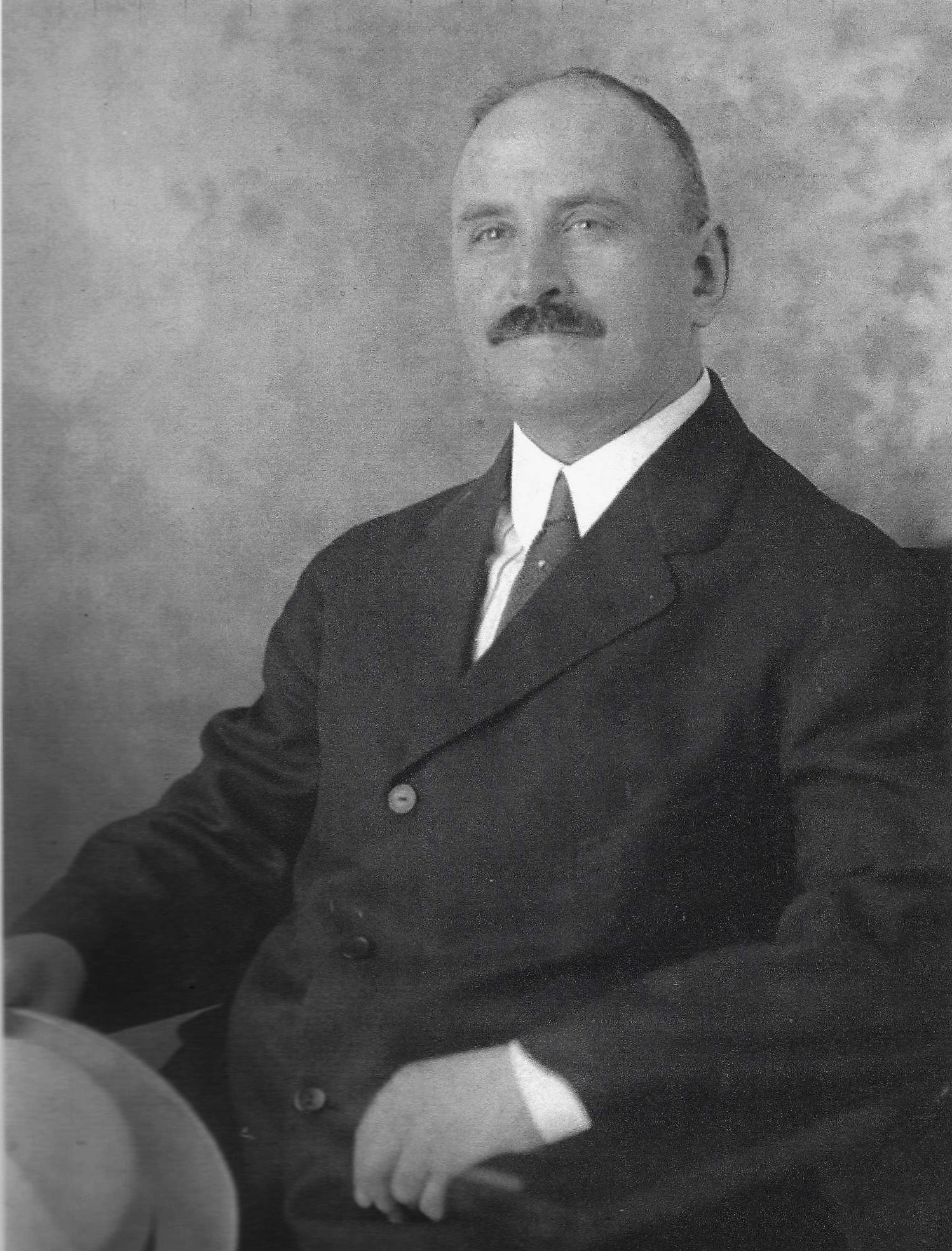
Isidore Schoenthal

Isidore Schoenthal


I had no idea what any of my other six great-grandparents looked like.  Over time I have been very fortunate to find cousins who had pictures of four of those other six.  For example, I now have pictures of Moritz Goldschlager and Ghitla Rosenzweig, parents of my maternal grandfather Isadore Goldschlager.

Ghitla Rosenzweig Goldschlager

Ghitla Rosenzweig Goldschlager

Moritz Goldschlager

Moritz Goldschlager


Another cousin had pictures of my great-grandmother Eva Seligman, but I did not have a photograph of my great-grandfather, Emanuel Cohen.  Until now.  One of the photos in my Aunt Eva’s suitcase was a photograph of Emanuel Cohen. I was so excited to be able to see his face.  It’s amazing how a photograph can bring to life someone you’ve never seen.

So I now have pictures of Eva Seligman and Emanuel Cohen, parents of my paternal grandfather, John N. Cohen, Sr.

Eva Seligman Cohen

Eva Seligman Cohen

Emanuel Cohen

Emanuel Cohen

That leaves me missing only one photograph in the collection of photographs of my great-grandparents.  I am fortunate to have a picture of my great-grandmother, Bessie—the person for whom I named.  But I do not have a picture of Joseph Brotman, my great-grandfather.  The Brotmans remain the most elusive of my ancestral families, and they were the ones who started me on this search and to the blog.  How I would love to know what Joseph looked like, but none of my cousins has a photograph, and somehow it seems very unlikely that any will turn up.  But here is my great-grandmother Bessie Brod/Brot/Brotman, the mother of my maternal grandmother Gussie Brotman Goldschlager.

Bessie Brotman

Bessie Brotman

When I scan through these photographs and think of my eight great-grandparents, I feel somehow comforted and inspired.  It makes me feel good to know that they are remembered and that their stories are being told, at least as well as I can tell them.  Five of the eight were born in Europe and immigrated here to make a better lives for themselves and for their children and those who followed. They came from Sielen, Germany, from Iasi, Romania, and from Tarnobrzeg, Poland.  The other three were the children of immigrants from Gau-Algesheim and Jesberg, Germany and from London, England; they benefited from the risks taken by their parents, my great-great-grandparents, but they each took risks of their own.  In America, my great-grandparents lived in Washington (Pennsylvania), Philadelphia, New York, Denver, and Santa Fe.  Each in his or her own way was a pioneer.  Each one is an inspiration to me.

On this week of Thanksgiving, I am grateful to them for all they did and proud to be their great-granddaughter.


Love That Dirty Water—Boston, You’re My Town: Great-great-uncle Felix


Embed from Getty Images

I lived in the Boston area for six years and still live just 90 miles to the west of the Hub; my older daughter went to college there; my younger daughter has lived there for almost ten years.  I have other family and friends in the area. And I’ve been a Boston Red Sox fan for over half my life.  So it gave me quite a smile to see that Felix Schoenthal, one of my great-grandfather’s brothers, ended up in the Boston area—Brookline, to be specific, a town that borders Boston and is known as the birthplace of President John F. Kennedy and the longtime center of the Boston Jewish community.

Felix and Margaret Schoenthal from 1919 passport application, National Archives and Records Administration (NARA); Washington D.C.; NARA Series: Passport Applications, January 2, 1906 - March 31, 1925; Roll #: 728; Volume #: Roll 0728 - Certificates: 70500-70749, 19 Mar 1919-20 Mar 1919

Felix and Margaret Schoenthal from 1919 passport application,
National Archives and Records Administration (NARA); Washington D.C.; NARA Series: Passport Applications, January 2, 1906 – March 31, 1925; Roll #: 728; Volume #: Roll 0728 – Certificates: 70500-70749, 19 Mar 1919-20 Mar 1919

But before he got to Boston, my great-great-uncle Felix had lived, like his siblings, in western Pennsylvania after immigrating from Sielen, Germany in 1872.  As I wrote earlier, Felix married Margaret or Maggie Swem in 1878; Margaret was born in West Newton, Pennsylvania, the daughter of John and Rachel Swem; her father was a blacksmith there.

UPDATE: Thanks to Diane Young Decker who commented on this post, I now know a bit more about the family of Margaret Swem.  Margaret’s father John was Diane’s great-great-great grandmother’s brother.  Margaret wrote the following about her great-great-great grandmother Abigail Swem Wilson: “[The family] was Baptist or another fairly straight-laced Protestant denomination. Life was very very different on the hardscrabble prairies of Iowa, which is where David and Abigail Swem Wilson settled and finished raising their family. They were desperately poor, particularly during the Civil War years, when four of their boys went to war, leaving David, who was only able to get around on crutches, Abigail and the young daughters to handle the farm. One of the boys, Eli Wilson, was killed in the war and another never returned to the home place for any length of time.” Diane would love to hear from anyone else with Swem relatives.

Felix and Margaret must have been an interesting couple: a fairly recently arrived German Jewish immigrant and a Baptist daughter of a blacksmith from western Pennsylvania.

Felix and Margaret had two daughters in the 1880s: Rachel (1881) and Yetta (1884).  I assume that Rachel was named for Margaret’s mother and that Yetta was named for Felix’s mother, my great-great-grandmother Henriette Hamberg Schoenthal, who had died in 1882.

In 1880, Felix was working as a bookkeeper for the paper mill in West Newton. Then in 1883, the mill was shut down.  This news article sheds interesting light on both the ways of business back then and the character of Felix Schoenthal:

"Why They Shut Down," The Indiana (PA) Democrat, June 14, 1883, p. 7

“Why They Shut Down,” The Indiana (PA) Democrat, June 14, 1883, p. 7

If I understood this correctly, the owner of the mill wanted employees, including Felix, to sign affidavits that falsely stated the cost of manufacturing paper.  I assume he was trying to justify his prices.  When Felix refused to do so, he was assaulted by the mill owner; other employees were fired for refusing to sign the affidavit.  As a result of the unrest, the mill was shut down.

Felix and Margaret relocated to Pittsburgh, where Felix continued to work as a bookkeeper according to directory listings in 1883; his listings in the 1884 and 1888 Pittsburgh directories are the same—bookkeeper.

Then in April, 1889, Felix opened a women’s clothing store.

Felix Schoenthal 1889 new store

Pittsburgh Daily Post, April 9, 1889, p. 3

Although this article only refers to “Mr. Schoenthal,” this listing in the 1889 Pittsburgh directory for “F. Schoenthal—Ladies’ Fine Furnishings” provides a home address, 144 Jackson Avenue, that matches the home address given for Felix Schoenthal in the 1888 Pittsburgh directory and earlier.

But it appears that the store venture did not last too long.  These ads in the October 19, 1889 Pittsburgh Post-Gazette suggest that Felix was already closing down the store six months later:

F Schoenthal store closeout october 1889

And in the 1890 Pittsburgh city directory, he listed his occupation as an accountant, not a merchant. In 1892, the Pittsburgh directory lists Felix as a cashier, and in 1896, he was an advertising manager. Then in 1897 he was again a bookkeeper.

It might have seemed like Felix was struggling to find his niche, but in fact Felix had developed quite a reputation.  According to Felix’s obituary, “Henry M. Whitney of Boston came to know of Mr. Schoenthal’s skilled operations in accountancy and interested him in association with New England Gas & Coke Company and Dominion Coal Company and Dominion Iron & Steel Company of Canada, for which vast enterprise he was general auditor.” Boston Herald, August 26, 1926., p. 6.  Felix took the job and moved to Boston, where he was listed in the 1898 and 1899 city directories as an auditor.

On the 1900 census, Felix and his wife Maggie and their two daughters, now 19 and 16, were living at 8 Kenwood Street in Brookline.  Felix was still working as an auditor for the coke and coal companies.

From September 23, 1901, until April 24, 1904, Felix and his family lived in Montreal, Canada, according to his 1919 passport application. I assume he continued to work for the same company since it had a Canadian division.

Felix Schoenthal passport application, National Archives and Records Administration (NARA); Washington D.C.; NARA Series: Passport Applications, January 2, 1906 - March 31, 1925; Roll #: 728; Volume #: Roll 0728 - Certificates: 70500-70749, 19 Mar 1919-20 Mar 1919

Felix Schoenthal 1919 passport application, National Archives and Records Administration (NARA); Washington D.C.; NARA Series: Passport Applications, January 2, 1906 – March 31, 1925; Roll #: 728; Volume #: Roll 0728 – Certificates: 70500-70749, 19 Mar 1919-20 Mar 1919


This news item in the September 8, 1901, Boston Herald announced the family’s upcoming move:

Felix Schoenthal move to Montreal 1901


After over three years in Montreal, they returned to Brookline and moved to 26 Kenwood Street (a different house from their prior home, which was at 8 Kenwood Street), according to the 1905 Brookline directory. Here is a photo of the house, which according to Zillow was built in 1905, so it was new when my relatives moved in.


26 Kenwood Street, Brookline, Massachusetts

26 Kenwood Street, Brookline, Massachusetts

At that point, Felix was still working as an auditor, but the following year’s directory lists Felix’s occupation as “typewriter,” and that is the occupation given in every Brookline directory thereafter.[1]

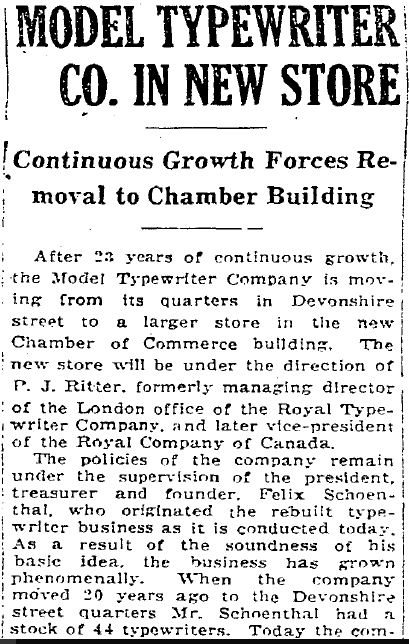
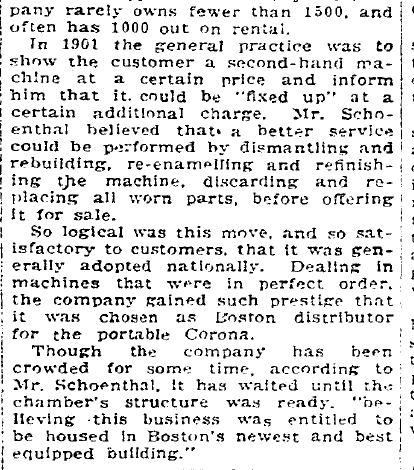
What was Felix doing with typewriters? According to an article written in the Boston Herald on July 13, 1924, Felix Schoenthal was the founder of the Model Typewriter Company in Boston.  The article described how Felix transformed the typewriter business not only for this company but nationally:

Felix Schoenthal typewriter story part 1

Felix Schoenthal Typewriter story part 2

Boston Herald, July 13, 1924, p. 31

Thus, Felix took a risk leaving his job as the auditor for the coke and coal corporations, a risk that seemed to pay off.  His innovation—refurbishing typewriters rather than selling them in need of repairs—is something that today has become part of many business models, whether it’s computers, cars, electronic equipment, or appliances.

Meanwhile, Felix and Margaret’s daughters had grown up.  In 1910, Rachel (also known as Ray) was 29, and Yetta was 25.  Both were still living at home and not working outside the home.   In the Boston Herald of May 28, 1911,  Felix and Margaret announced the engagement of their daughter Yetta to David Edward Moeser.


Yetta Schoenthal engagement
David Moeser was a year younger than Yetta and was born in Montreal in 1885.  He immigrated to Boston around 1904 or 1905, soon after Felix Schoenthal and his family had returned to Boston from Montreal.  David would have been only 19 when he left Canada for Boston.  Call me a crazy romantic, but I think David must have followed Yetta to Boston—a teenage love affair.  Or alternatively, Felix was a friend of his family and offered to help David get started on a career in Boston.  I like the first version better.

In 1905 David was working as a cashier, and in 1906 he was an accountant, leading some credence to the second alternative, that Felix, an accountant, was helping him start his career. He was also living in Brookline, less than two miles from the Schoenthals.  In 1910 his directory listing description is as a financial manager, still living in Brookline.

After marrying on August 11, 1911, David and Yetta lived with Felix, Margaret, and Rachel at 26 Kenwood.  In 1918, when David registered for the World War I draft, they were still living at 26 Kenwood.

David Moeser World War I draft registration Registration State: Massachusetts; Registration County: Norfolk; Roll: 1685068

David Moeser World War I draft registration
Registration State: Massachusetts; Registration County: Norfolk; Roll: 1685068

David was by then a naturalized citizen and the treasurer and general manager of Conrad and Company, Incorporated, a women’s clothing store that grew into a department store on Winter Street in Boston.


Boston Herald, January 4, 1928, p. 10

Boston Herald, January 4, 1928, p. 10

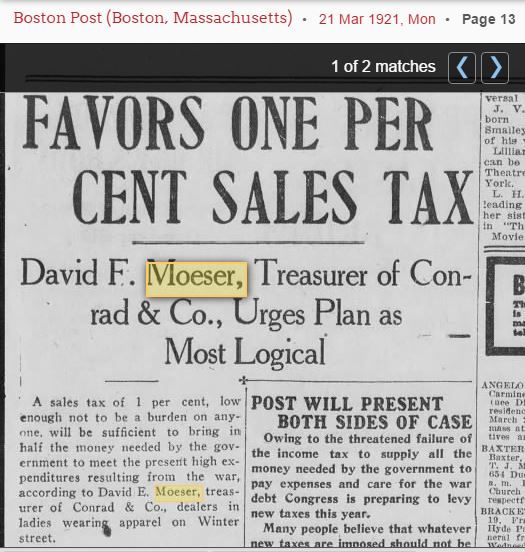
By 1921, David had established himself sufficiently as a knowledgeable business person that he was quoted in the Boston Post on the issue of whether or not a sales tax should be instituted to raise revenue:

David Moeser on sales tax 1921


Yetta and David were still living at 26 Kenwood Street in 1920 with Felix and Margaret Schoenthal, according to the 1920 census.  Rachel, however, was no longer living there.  In 1915 she had married Samuel Kronberg, who was almost twenty years older than Rachel and a widower.  His first wife, Nannie, an opera singer, had died in 1907.

Samuel was born in about 1862 in Russia-Poland (records conflict), the son of Marcus/Max and Tobie Kronberg, who had immigrated to Boston where Max was a merchant.  According to his obituary (see below), Samuel was a music student from an early age and studied in Europe for several years.  He then taught music and was the director of the Knickerbocker Opera Company in New York before returning to Boston where he became a successful music impresario.

Samuel was perhaps best known for producing a performance of Richard Wagner’s opera Siegfried at Harvard Stadium in 1915, the year Samuel Kronberg married Rachel Schoenthal.

Springfield Sunday Republican, May 9, 1915, p. 18

Siegfried part 2

Springfield Sunday Republican, May 9, 1915, p. 18

(I was tickled to see that one of the performers was Alma Gluck, who,  according to family lore, knew my maternal grandfather Isadore Goldschlager.)

Samuel’s younger brother Louis Kronberg was also well-known in the arts.  He was a painter whose work was supported by Isabella Stewart Gardner, the famed Boston patron of the arts, and many of his works are in her collection at the Isabella Stewart Gardner Museum in Boston; Kronberg also has paintings at the Metropolitan Museum in New York and elsewhere.

La Gitano by Louis Kronberg, about 1920, at the Isabella Stewart Gardner Museum, Boston

La Gitano by Louis Kronberg, about 1920, at the Isabella Stewart Gardner Museum, Boston http://www.gardnermuseum.org/collection/browse?filter=artist:3297

In 1920, Samuel and Rachel were living at 1742 Commonwealth Avenue in the Brighton section of Boston, an area I know well since my younger daughter lived about half a mile away from that building when she first moved to Boston.  Unfortunately, Rachel’s marriage to Samuel was not long-lived as he died two years later on February 3, 1922, less than seven years after marrying Rachel.

Samuel Kronberg obituary

Rachel was only 41 years old when her husband died; she never remarried.  In 1926 she was living with her parents at 341 St. Paul Street in Brookline, another familiar address as my daughter lived on St. Paul Street for several years before moving to her current apartment.

Four years later the family suffered another loss when my great-great-uncle Felix Schoenthal died on August 26, 1926.  He was 69 years old.

Boston Herald, August 26, 1926., p. 6

Felix Schoenthal obit Boston Herald 8 26 1926 p 6

Boston Herald, August 26, 1926., p. 6


His widowed wife and widowed daughter Rachel moved in together and in 1930 were living at 4 Chiswick Street in Boston; neither was employed outside the home.  Yetta and her husband David Moeser had also moved out of the house at 26 Kenwood Street; in 1930 they were living at 20 Chapel Street/Longwood Towers in Brookline; David was still working for Conrad and Company.  He and Yetta had no children.

In 1940, Margaret Schoenthal and her daughter Rachel Schoenthal Kronberg were still living together on Chiswick Street; Margaret was now 80 years old, Rachel was 58.  Neither was employed.  Felix’s success in the typewriter business and Samuel’s success as an impresario must have been keeping them secure.

By 1940, David and Yetta (Schoenthal) Moeser had moved to 534 Beacon Street in the Back Bay neighborhood of Boston where my younger daughter lives now.  David’s World War II draft registration indicates that he was still working for Conrad and Company in 1942.

David Moeser World War II draft regisration The National Archives at St. Louis; St. Louis, Missouri; World War II Draft Cards (Fourth Registration) for the State of Massachusetts; State Headquarters: Massachusetts; Microfilm Series: M2090; Microfilm Roll: 107

David Moeser World War II draft regisration
The National Archives at St. Louis; St. Louis, Missouri; World War II Draft Cards (Fourth Registration) for the State of Massachusetts; State Headquarters: Massachusetts; Microfilm Series: M2090; Microfilm Roll: 107


I have been unable to find a death record for Margaret Swem Schoenthal; the last document I have for her is the 1948 Boston directory which lists her residing still at 4 Chiswick Road in Boston.  In 1951, only her daughter Rachel is listed at that address, so I assume that Margaret had died sometime between 1948 and 1951.  She would have been at least 89 years old.  Her daughter Rachel died on June 4, 1953, according to the Boston city directory for that year.  She was 72 years old.

By 1953 David Moeser was the president and treasurer of Conrad and Company, and he and Yetta were back in Brookline, living in the Longwood Towers on Chapel Street, according to the city directory for that year.

David Moeser Boston Daily Record, November 4, 1955, p. 53

David Moeser
Boston Daily Record, November 4, 1955, p. 53


In 1968, David Moeser was chairman of the board and treasurer of Conrad & Chandler, the company produced when Conrad and Company merged with another department store, Chandler and Company, in 1957.  David Moeser had been instrumental in that merger, which changed the face of shopping in Boston, according to this article.

David Moeser died on July 12, 1969; he was 84 years old and had been quite a prominent businessman in Boston.

David E. Moeser obituary

David E. Moeser obituary Boston Herald, July 14, 1969, p. 22

Just one month later almost to the day, on August 11, 1969, his wife Yetta also died.  She was 85 when she died. She and David had known each other probably since they were teenagers and had been married for 58 years.


Yetta Schoenthal death notice


Since neither Rachel nor Yetta had had children, Yetta’s death ended Felix Schoenthal’s line in the family. That is a real shame; they were an interesting group of people.  Felix was obviously a very smart and creative entrepreneur.  He started as an immigrant coming to the US as a teenager and rose to own a very successful business in Boston.  His two sons-in-law were also creative and successful; Samuel Kronberg was a dedicated and well-known impresario, and David Moeser for many years oversaw one of the best known department stores in Boston .

I love having an old Boston family to claim as my own.  Not exactly the Cabots and Lodges, but a more recent and more ethnic version of the Boston elite.  When I think of Felix and his family living in Boston, I wonder whether he took his family to the newly-opened Fenway Park in 1912, whether he cheered for the Red Sox, and whether he ever saw Babe Ruth play for the Sox before he was traded to the Yankees in 1920.

1918 Boston Red Sox at Fenway Park

1918 Boston Red Sox at Fenway Park (Photo credit: Wikipedia)


Did Felix take his family to the Museum of Fine Arts, which opened the building at its current location on Huntington Avenue in 1909? Did they stroll down the streets in Back Bay and downtown Boston to go shopping? Did they picnic in the Boston Public Garden and ride the swan boats, which had been there since 1877?

Embed from Getty Images

I am sure they visited David Moeser’s Conrad’s store on Winter Street and listened to Samuel Kronberg’s musical performances at Copley Plaza.  They likely also visited the Isabella Stewart Gardner Museum in order to see the paintings of Samuel’s brother Louis.
Copley Plaza, Boston, with Boston Public Libra...

Copley Plaza, Boston, with Boston Public Library at left. (Photo credit: Wikipedia)

I know these streets, and I know these places.  Unlike when I write about my relatives in places like Pittsburgh or Santa Fe or Philadelphia or even New York City, I really can envision my Schoenthal relatives living in in Boston and Brookline.  The next time I am there, I will think of them and smile.

English: Boston skyline at night, as seen from...

English: Boston skyline at night, as seen from Cambridge (Photo credit: Wikipedia)


[1] For some reason the 1910 census states that he was a clothing merchant, but that was clearly an error.  Perhaps a neighbor gave the information, just another example of how unreliable census information can be.

An Adventurous Spirit: Amalie Schoenthal and Her Children

When I read my great-great-uncle Henry Schoenthal’s diary and learned that his little sister Malchen (later, Amalie, then Amelia, but I will call her Amalie throughout) was the first of his siblings to express an interest in following him from Germany to the US, I was intrigued.  She was only twenty years old and not yet married.  Who was this adventurous young woman?

Amalie Schoenthal arrived in Pennsylvania in September, 1867, and in 1870, she was living in Pittsburgh with her aunt Fanny Schoenthal Goldmith and her family and working as a domestic.  In 1872, she married Elias Wolfe, the cattle drover, with whom she had six children between 1873 and 1885: Maurice, Florence (usually referred to as Flora), Lee (named for Amalie’s father Levi), Ira, Henrietta (or Etta, named for Amalie’s mother Henriette), and Herbert.  Although Amalie’s life was likely very traditional for a married woman with six children, some of her children seemed to have inherited her adventurous spirit.  Unlike most of the children and grandchildren of her older sister Hannah who stayed in Pittsburgh and the surrounding area for generations, most of the children of Amalie and Elias Wolfe ventured to places quite distant from Pittsburgh.

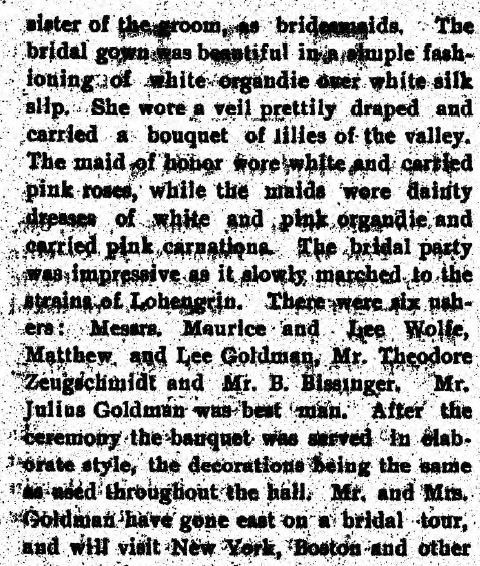
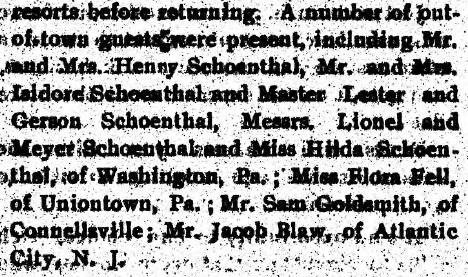
In 1899, Flora Wolfe, then 24 years old, was the first of the children of Amalie and Elias to marry.  She married Lehman Goldman on June 1, 1899, as described here:
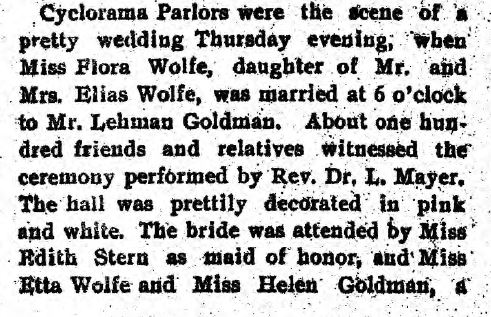
Flora Wolfe wedding pt 1 Jewish Criterion 6 2 1899

FLora Wolfe wedding pt 2

Flora Wolfe wedding pt 3

Jewish Criterion, June 2, 1899, pp.8-9


From the description of the wedding, it would seem that Elias Wolfe must have been doing quite well in his business as a cattle drover.  A fancy wedding attended by over a hundred people would probably have been considered quite large in those times.  Flora’s maid of honor was her first cousin, Edith Stern, daughter of Hannah Schoenthal Stern.  Among the many guests, the last paragraph lists my great-grandparents, Isidore and Hilda (Katzenstein) Schoenthal, and their sons, my great-uncles Lester and Gerson, who would have been ten and seven years old at the time, respectively.

Flora’s groom, Lehman (sometimes spelled Leman) Goldman, was born in Baltimore in 1876, as was his father, Samuel Goldman, who was working as an insurance agent in 1900, according to the census.  After marrying, Flora and Lehman were living with Lehman’s family in Pittsburgh, and Lehman was working as a traveling salesman in the “furnishing goods” business.  I assume that that is another term for dry goods or clothing.

Flora and Lehman had four children in the first nine years of their marriage: Kenneth LeRoy (1901), Helen (1903), Donald (1905), and Marjorie (1907).

Flora’s sister and four brothers were still living at home with their parents Amalie (now called Amelia) and Elias Wolfe in 1900.  Elias was still a drover.  Maurice, now 27, and Lee, now 22, were clerks in a furnishings store. Ira was nineteen and working as a stenographer.  The two youngest children, Henrietta, seventeen, and Herbert, twelve, were still in school.

Elias Wolfe and family, 1900 census Year: 1900; Census Place: Allegheny Ward 2, Allegheny, Pennsylvania; Roll: 1355; Page: 14B; Enumeration District: 0018; FHL microfilm: 1241355

Elias Wolfe and family, 1900 census
Year: 1900; Census Place: Allegheny Ward 2, Allegheny, Pennsylvania; Roll: 1355; Page: 14B; Enumeration District: 0018; FHL microfilm: 1241355

Lee must have married shortly after 1900 (although I cannot find any record or news story to confirm it) because he and his wife Wilhelmina (Minnie) Heisch had a son named Lloyd on February 25, 1902, and a daughter named Ruth in 1905.  Minnie’s parents, John Heisch and Christine Kress, were born in Germany, and John was a carpenter.  Although I found newspaper announcements of engagements and marriages for Minnie’s siblings, I did not find one for Minnie and Lee nor did I find any mention of the marriage in the Jewish Criterion.  According to the entry in the 1908 Pittsburgh city directory, Lee was in the paper bag business.

His brother Maurice, the oldest son, was living with his parents in 1908 and working as a salesman.  Their sister Etta was working as a bookkeeper and also living at home.

Etta Wolfe 1908 directory

Ancestry.com. U.S. City Directories, 1822-1989 [database on-line]. Provo, UT, USA: Ancestry.com Operations, Inc., 2011.

Ancestry.com. U.S. City Directories, 1822-1989 [database on-line]. Provo, UT, USA: Ancestry.com Operations, Inc., 2011.

By 1910 and perhaps even earlier, Ira Wolfe had left Pennsylvania and moved to San Francisco.  He was 28 years old, working as a cashier for a lamp company, and lodging in someone’s home, according to the 1910 census. Herbert, the youngest child of Amalie and Elias Wolfe had also moved away by 1910; Herbert was 25 and had moved to Detroit where in 1910 he was working as a machinist and in 1911 as a sign writer. Thus, by 1910, the two youngest sons of Amalie and Elias had left for far off places.  I can’t help but wonder what drove them to move away from the place where their extended family was living.  Did they inherit their mother’s adventurous spirit? Or was it something else?

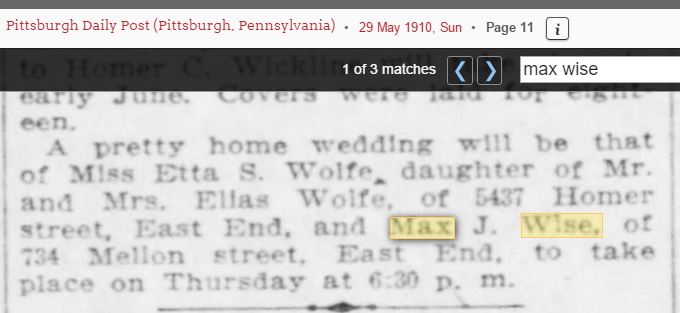
All the other Wolfes were still in Pittsburgh in 1910.  Etta was living with her parents at the time of the census in April, but she married Maximillian Joseph Wise on June 2, 1910.  Max was a German immigrant; although I cannot find him on the 1900 census, there was a Max Wise listed on the 1910 census who was living in Pittsburgh on Mellon Street, the same address given in the marriage announcement in the Pittsburgh Post Gazette.
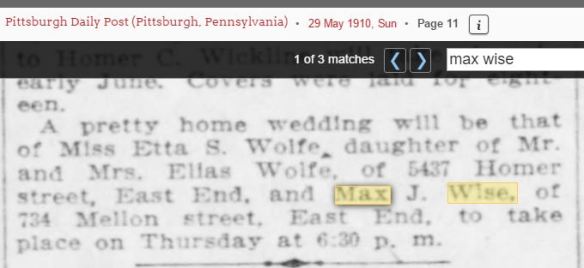
Etta Wolfe wedding notice


Max Wise was a traveling salesman residing as a lodger in the residence of others at the time of the 1910 census.

I cannot find Maurice Wolfe on the 1910 census, but he is listed as living in Canonsburg in both the 1909 and 1911 directories for Washington, Pennsylvania, selling men’s furnishings.  His brother Lee was still living in Pittsburgh with his wife Minnie and their two children, Lloyd and Ruth; Lee was then a wrapping paper salesman.

As for Flora (Florence, here), at the time of the 1910 census she and her husband Lehman Goldman were also still living in Pittsburgh where Lehman was a clothing merchant.  Their four children were eight, six, four, and just about two years old when the census was taken on April 15, 1910.
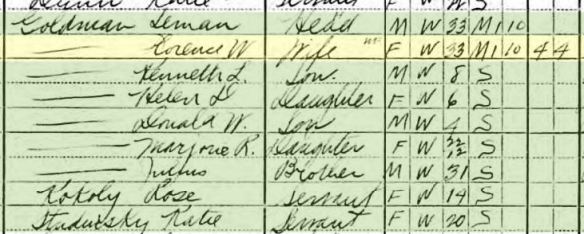
Year: 1910; Census Place: Pittsburgh Ward 11, Allegheny, Pennsylvania; Roll: T624_1302; Page: 2A; Enumeration District: 0416; FHL microfilm: 1375315

Year: 1910; Census Place: Pittsburgh Ward 11, Allegheny, Pennsylvania; Roll: T624_1302; Page: 2A; Enumeration District: 0416; FHL microfilm: 1375315

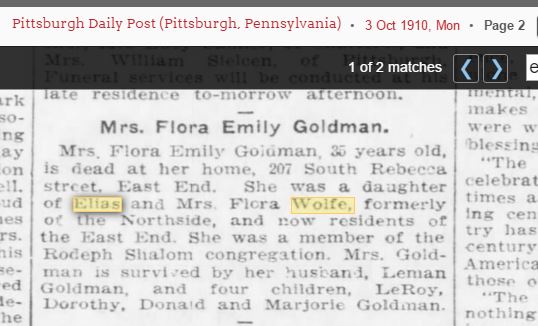
Just five months later the Wolfe/Goldman families suffered a terrible loss.  Flora Wolfe Goldman, only 35 years old, died on September 30, 1910, from puerperal fever, also known as childbed fever.

Flora Wolfe death certificate Ancestry.com. Pennsylvania, Death Certificates, 1906-1963 [database on-line]. Provo, UT, USA: Ancestry.com Operations, Inc., 2014. Original data: Pennsylvania (State). Death certificates, 1906–1963. Series 11.90 (1,905 cartons). Records of the Pennsylvania Department of Health, Record Group 11. Pennsylvania Historical and Museum Commission, Harrisburg, Pennsylvania.
Flora Wolfe death certificate
Ancestry.com. Pennsylvania, Death Certificates, 1906-1963 [database on-line]. Provo, UT, USA: Ancestry.com Operations, Inc., 2014.
Original data: Pennsylvania (State). Death certificates, 1906–1963. Series 11.90 (1,905 cartons). Records of the Pennsylvania Department of Health, Record Group 11. Pennsylvania Historical and Museum Commission, Harrisburg, Pennsylvania.

Pittsburgh Daily Post, October 3, 1910, p. 2

Pittsburgh Daily Post, October 3, 1910, p. 2

According to Medicinenet.com, puerperal fever is:

Fever due to an infection after childbirth, usually of the placental site within the uterus. If the infection involves the bloodstream, it constitutes puerperal sepsis. Childbed fever was once a common cause of death for women of childbearing age, but it is now comparatively rare in the developed world due to improved sanitary practices in midwifery and obstetrics. Also known as childbirth fever and puerperal fever.

Since there is no record of another child born to Flora and Lehman, I assume that either the baby was stillborn or died shortly thereafter or that Flora had miscarried.  Flora left behind her 34 year old husband and four very young children.  Lehman remarried three years later on March 8, 1913; his second wife was Helene Hoffa, and they would have four more children together between 1914 and 1923.

Six months after Flora died, on March 3, 1911, Etta and Max Wise had their first child, a daughter whom they named Florence Emily, undoubtedly for Etta’s sister.  A second child, a boy named Irving, was born the following year on October 12, 1912.  In 1913, Etta and Max Wise relocated to Middletown, Ohio, where he opened a clothing store, as evidenced by the obituary written years later when Max Wise died,  seen below.

I was curious about Middletown, Ohio and what drew Max and Etta to relocate there.  Middletown is located roughly halfway between Cinncinati, Ohio, and Dayton, Ohio, and is about 280 miles west of Pittsburgh.  According to the Middletown Historical Society website, the town, which started as an agricultural community, experienced tremendous growth in the 19th and early 20th century due to industrialization:

During the 1800’s and early 1900s Middletown became this bustling municipality due to the growth of industry.  Many entrepreneurs developed their businesses and with the addition of ARMCO (now AK Steel) founded by George M. Verity, and Sorg Paper Company founded by Paul J. Sorg.

As reported on Wikipedia, the population of Middletown surged in these years, going from about 3,000 people in 1870 to over 9,000 by 1900 and to more than 23,000 by 1920.  Max Wise must have seen it as a place of great opportunity; as they say on the old commercial for Barney’s clothing store in New York City, everyone needs clothes.

But were there Jews there? From the American Jewish Archives website, I found this information about the Jewish community in Middletown when Max and Etta Wise moved there:

In 1903, ten Orthodox Jewish families rented a small room on Clinton Street in which to hold services.  Under the leadership of new Russian immigrant, Mr. Schomer, they rented a single Torah and created a makeshift Ark.  As the Orthodox community grew, the rented shul on Clinton Street became too small for weekly Shabbat services, and in 1915, the community bought a structure on First Avenue, across from the public library.  Rabbi Gilsey assumed the pulpit, and a regular religious school was formed. Three years later, in 1918, the shul was incorporated under the laws of the State of Ohio under the name “Anshe Sholom Yehudah Congregation.”  By 1920 there were approximately thirty-five families in the congregation, all of whom spoke mainly Yiddish.

The tragic death of Flora Wolfe Goldman in 1910 was not the only loss that the Wolfe family would suffer during the decade of the 1910s. On December 27, 1913, Elias Wolfe died at age 74 from heart disease.

Elias Wolfe death certificate Ancestry.com. Pennsylvania, Death Certificates, 1906-1963 [database on-line]. Provo, UT, USA: Ancestry.com Operations, Inc., 2014. Original data: Pennsylvania (State). Death certificates, 1906–1963. Series 11.90 (1,905 cartons). Records of the Pennsylvania Department of Health, Record Group 11. Pennsylvania Historical and Museum Commission, Harrisburg, Pennsylvania.

Elias Wolfe death certificate
Ancestry.com. Pennsylvania, Death Certificates, 1906-1963 [database on-line]. Provo, UT, USA: Ancestry.com Operations, Inc., 2014.
Original data: Pennsylvania (State). Death certificates, 1906–1963. Series 11.90 (1,905 cartons). Records of the Pennsylvania Department of Health, Record Group 11. Pennsylvania Historical and Museum Commission, Harrisburg, Pennsylvania.

Sometime after Elias died, Amalie Schoenthal Wolfe moved to Middletown, Ohio, as she is listed in the Middletown city directory for 1917.  Amalie obviously wanted to be closer to her only surviving daughter and her Ohio grandchildren.

Etta and Max Wise had four more sons after moving to Ohio: Richard Elias (1915), Max, Jr. (1917), Robert (1919), and Warren Harding Wise, born on September 19, 1920.  I guess we know who Max and Etta (if she voted since the 19th amendment had just been ratified on August 19, 1920) voted for in the 1920 Presidential election—the native son candidate from Ohio, Warren Harding.  I wonder how little Warren Harding Wise felt when he learned that his namesake was involved in the Teapot Dome scandal as well as other scandals, which were revealed in the years after Harding’s untimely death in office in 1923.

English: Warren G. Harding, by Harris & Ewing.

English: Warren G. Harding, by Harris & Ewing. (Photo credit: Wikipedia)


Meanwhile, out in California, Ira Wolfe was having his own troubles.  On June 29, 1911, he married Ada Piver in San Francisco. Just over six months later in January, 1912, Ada sued him for divorce, claiming “extreme cruelty,” as detailed in these two news articles.
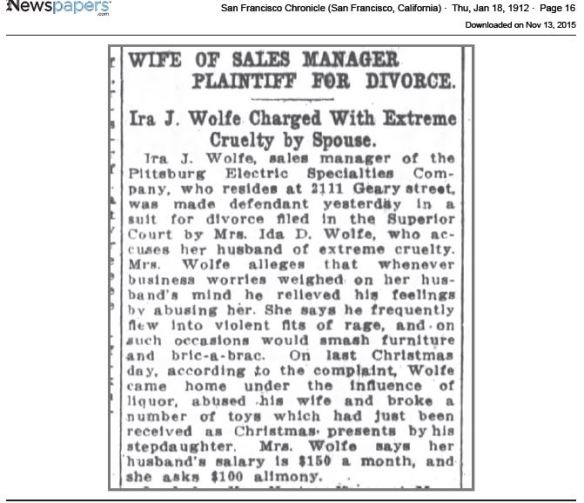
San Francisco Chronicle, January 18, 1912, p. 16
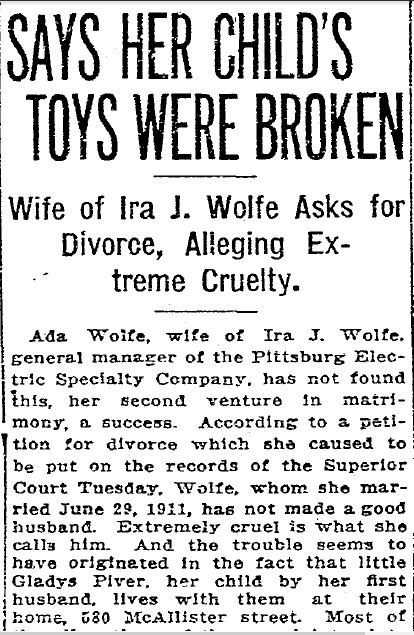
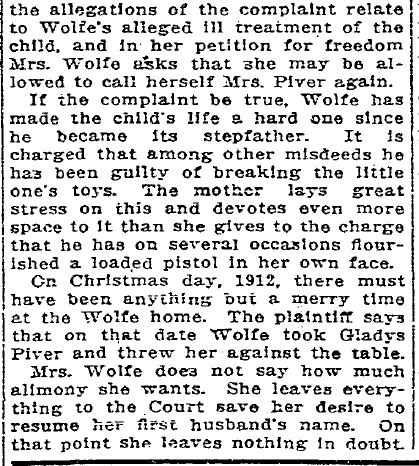
San Francisco Chronicle, January 18, 1912, p. 16


Ira Wolfe divorce 2

Ira Wolfe broken toys

San Francisco Chronicle, May 15, 1913, p. 10

And if we think that social media and tabloids today have undermined all attempts at maintaining some privacy and dignity, this news article indicates that the public’s taste for gossip has always been a way of selling newspapers:
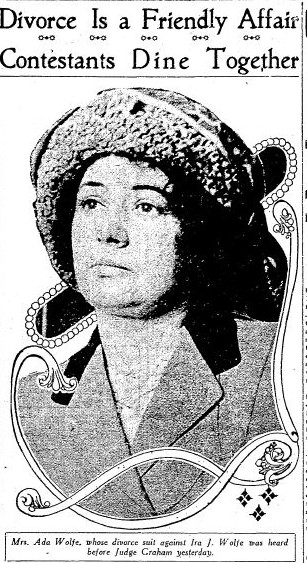
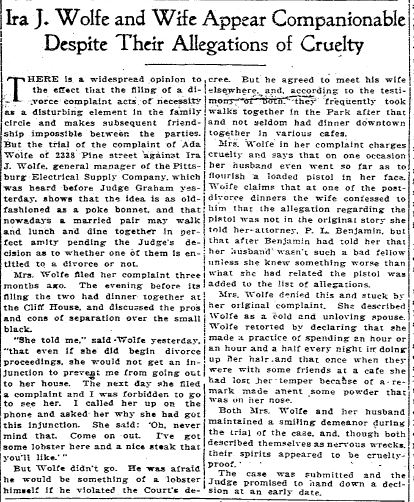
Ira and Ada Wolfe dine together

Ira Wolfe and Ada dine together

There’s no way of knowing the truth of Ada’s allegations (and I could find no follow-up story describing the court’s ruling in the case).  Assuming there was some truth to her descriptions of Ira’s temper, drinking, and violent nature, perhaps it is not surprising that he had moved so far from his home in Pittsburgh.

Ira’s younger brother Herbert, still living in Detroit, married Elsa Repp on June 24, 1916.  Elsa was a Detroit native, the daughter of John and Amelia Repp, who were also both American-born.  In 1910, John Repp was working as a metal polisher, and Elsa was working as a box maker in a laboratory.

Back in the Pittsburgh area, only two of Amalie and Elias Wolfe’s children remained.  Maurice Wolfe had married by 1917 according to his World War I draft registration.  I’ve not been able to find anything about his wife’s background; all I know is that her first name was May and that she was born around 1880 in New York, according to the 1920 census record.  In 1917, Maurice and May were living in Pittsburgh, and Maurice, who was lame in one leg, was working as an inspector for Westinghouse. As far as I can tell, they did not have any children.
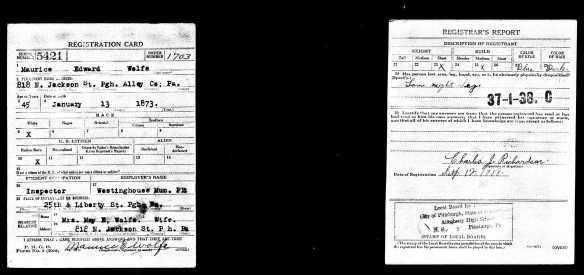
Maurice Wolfe World War I draft registration Registration State: Pennsylvania; Registration County: Allegheny; Roll: 1909278; Draft Board: 18

Maurice Wolfe World War I draft registration
Registration State: Pennsylvania; Registration County: Allegheny; Roll: 1909278; Draft Board: 18

By 1917, Lee Wolfe and his wife Minnie had moved to Dormont, Pennsylvania, a suburb of Pittsburgh about four miles south.  Lee was the local manager of the Interstate Folding Box Company.  On the 1920 census, Lee, Minnie, and their two children, now teenagers, were still living in Dormont, and Lee was still working for a paper company as a commercial salesman.
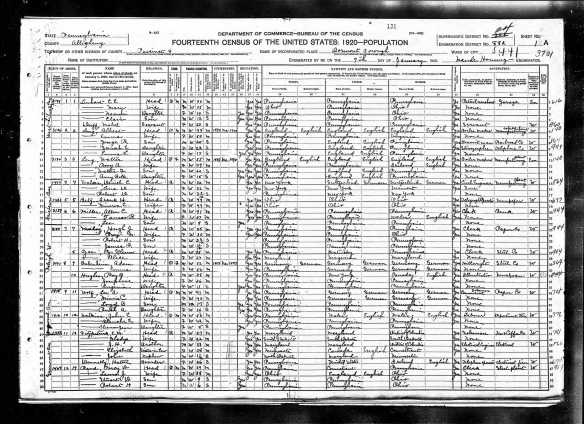
Lee Wolfe and family, 1920 census Year: 1920; Census Place: Dormont, Allegheny, Pennsylvania; Roll: T625_1511; Page: 1A; Enumeration District: 882; Image: 267

Lee Wolfe and family, 1920 census
Year: 1920; Census Place: Dormont, Allegheny, Pennsylvania; Roll: T625_1511; Page: 1A; Enumeration District: 882; Image: 267

Lee’s brother Maurice was also still in Pittsburgh in 1920, working as a government clerk, but by 1923 he had relocated to Middletown, Ohio, where his mother and his sister Etta were living.  I cannot find Maurice on the 1930 census, but he was listed in the Middletown directory for that year.  On the 1940 census, he was still in Middletown, working as a salesman, and divorced.  Although I can’t be certain, I assume his marriage ended before he left Pittsburgh, but since I have no records for his wife May other than Maurice’s draft registration and the 1920 census, I can’t be sure.

In 1920, Max and Etta and their children continued to live in Middletown where Max was the proprietor of a clothing store.  Herbert Wolfe and his wife Elsa were still living in Detroit where Herbert was now working as an installer for the telephone company according to the 1920 census.

Although Ira Wolfe was listed as a salesman in the 1917 San Francisco directory, I cannot find a World War I draft registration for him nor can I find him on the 1920 census.  The last possible record I have for him is a listing on the Chicago, Illinois marriage index showing an Ira J. Wolfe marrying a woman named Agnes Resa on July 17, 1920.  I did find Agnes on the 1920 census, taken before she married.  She was thirty years old, born in Illinois, and living with her mother and brother in Chicago.  Agnes was working as a comptometer for the railroad.  What is a comptometer, I wondered? Apparently it was not itself an occupation, but a machine—a very early form of what today we would call an adding machine or a calculator.  I assume that Agnes operated a comptometer for the railroad.

English: Comptometer - model E Français : Comp...

English: Comptometer – model E Français : Comptomètre – modèle E (Photo credit: Wikipedia)


Thus, as of 1923, of the five surviving children of Amalie Schoenthal Wolfe, only Lee Wolfe was still living in Pittsburgh.  Maurice and Etta were in Middletown, Ohio; Herbert was in Detroit; Ira was in Chicago.  And Flora Wolfe Goldman’s children were living in Atlantic City, where Lehman and his family had moved by 1920.

Their mother Amalie/Amelia Schoenthal Wolfe was living in Middletown when she died on February 10, 1924.
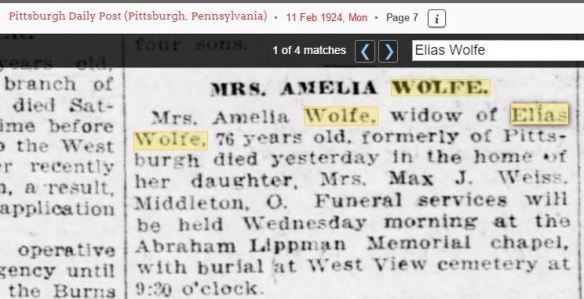
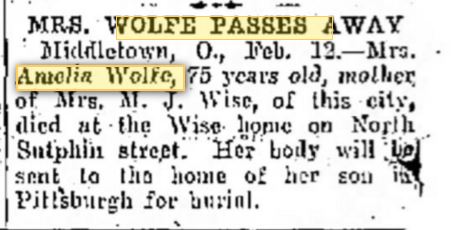
Amelia Wolfe death notice

Hamilton (Ohio) Evening Journal. February 12, 1924, p. 2

Hamilton (Ohio) Evening Journal. February 12, 1924, p. 2

Just ten days later, her will was filed for probate:
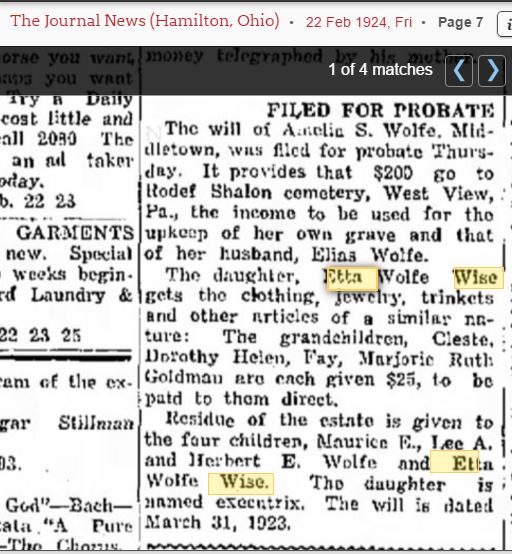
Amelia Wolfe will

I found this very interesting.  I am not surprised that Amalie (or Amelia) left her personal property to her only surviving daughter Etta; after all, she had been living with her for many years.  But I did find it surprising that she named her daughter Etta, not one of her sons, as the one to execute her will, in an era where men primarily took on such roles.

In addition, Amalie left $25 to each of her Goldman granddaughters—including Fay and Celeste, who were not even her blood relatives, but born to Lehman Goldman and his second wife Helen.  Why not any of her grandsons? I understand why she only left the money to the Goldman grandchildren; since she was leaving the remainder of her estate to her surviving children, Flora’s children needed to be taken care of separately.  But why not the boys? I’d like to think that Amalie was protecting the women in the family—making her daughter the executrix and only leaving money to her granddaughters.  Perhaps she thought that the boys would be more able to take care of themselves in a world where women were still very dependent on men for support. I would like to think that Amalie, that adventurous young woman who had been eager to move to America , was somewhat of a feminist, treating her daughter and granddaughters favorably in her will to encourage their own independence.

I also noticed that she did not include her son Ira as one of her five surviving children in her will.  When I saw that, I assumed that Ira had been disowned or had died by the time of Amalie’s death.  Then I found this news article on page 14 of the Daily Register-Gazette of Rockford, Illinois, dated July 24, 1924, five months after Amalie died:
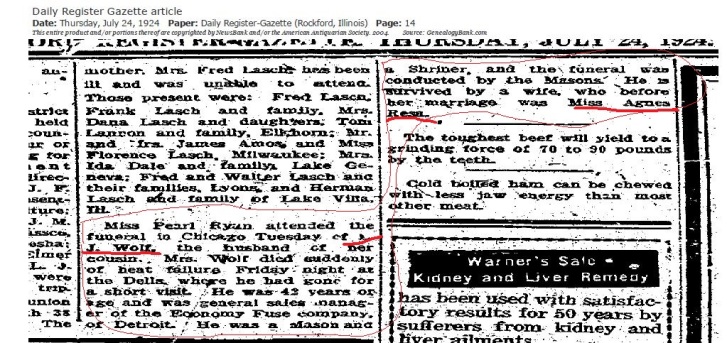
Ira Wolfe death highlights


This is clearly the same Ira J. Wolfe who married Agnes Resa on July 20, 1917, in Chicago.  Can I be certain that this was Ira J. Wolfe, the son of Amalie and Elias Wolfe? According to the 1900 census, their son Ira J. Wolfe was born in June 1880, so he would have been 44, not 42, in July, 1924.  Close enough?  According to this article, he had been a general sales manager for a fuse company in Detroit; my Ira J. Wolfe had been a salesman for Pittsburgh Electric Company in San Francisco, so in the same field of electrical products.  My Ira had a brother, Herbert, living in Detroit and then working for the phone company.  Is this enough circumstantial evidence to support my assumption that the Ira J. Wolfe who married Agnes Resa and died in July, 1924, was the son of Amalie Schoenthal Wolfe?  If so, he was still living when his mother Amalie died and thus was intentionally excluded from her will.

The 1930 census records for the surviving Wolfe siblings show that not much changed between 1920 and 1930.  Lee was still in the paper business in Pittsburgh; his two children were now in their 20s.  Lloyd, 28, was still living at home and working as a gas station attendant.  His sister Ruth, 25, was also living at home and not employed.

Max and Etta were still in Middletown, Ohio, living with all of their children, who now ranged in age from nine to nineteen; Max still owned a clothing store.   Etta’s brother Maurice was also still living in Middletown, as noted above.  Herbert and Elsa continued to live in Detroit, where Herbert was a car salesman now.  They had had a child in 1925.

As for the children of Flora Wolfe Goldman, by 1930 they were adults. Kenneth LeRoy (known as LeRoy K.) Goldman, Flora’s oldest child, was still living with his father and stepmother and half-siblings in 1930, working as a men’s clothing salesman. His sister Helen Goldman had married Bertie Kenneth Paget in 1926 and was living with him and their two year old daughter in Queens, New York, in 1930.  Bertie was in the publishing business.  Donald Goldman was living in Atlantic City in 1930 and was married to Marguerite Simpson; their daughter was born in 1931.  Marjorie Goldman married John Lynn in 1929, and in 1930 they were living in Philadelphia where John was an insurance salesman.  They would have two children in the 1930s.

On November 19, 1934, Max Wise died at age 60:
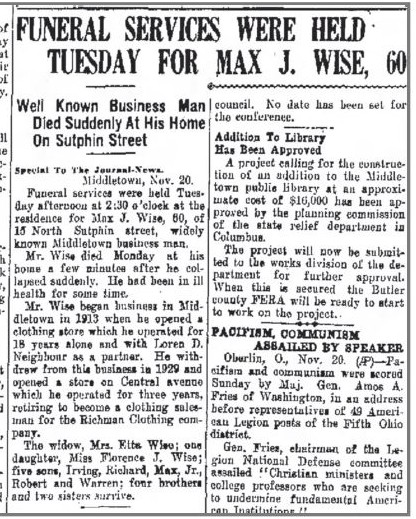
Obituary for Max J. Wise, The Journal News (Hamilton, Ohio) , November 20, 1934 p 2.

Obituary for Max J. Wise,
The Journal News (Hamilton, Ohio) , November 20, 1934 p 2.

According to the obituary, Max had been in poor health, but died rather suddenly.  He was survived by Etta, who was 50 years old, and his six children, who ranged from fourteen to 23 when they lost their father.

The 1940 census found all the remaining Wolfe siblings in the same locations as 1930: Maurice was in Middletown working as a salesman. Etta was also in Middletown with five of her six children still living with her; they all were now in their 20s, except Warren, who was 19.  Only Irving had moved out; he was married and living in Miamisburg, Ohio, less than fifteen miles from Middletown.  Lee Wolfe was still in Pittsburgh, still selling paper, and living with his wife and his two children, who were now in their 30s. Herbert continued to live with his wife and child in Detroit where he was the sales manager for the Detroit Auto Club.  Thus, although the Wolfe siblings other than Lee had spread quite far from Pittsburgh, once they settled elsewhere, they stayed put.

Maurice Wolfe died in Middletown, Ohio, in 1941.  His brother Herbert died in Detroit in 1951.  Etta Wolfe Wise died in Middletown in 1957.  Lee Wolfe lived to be almost 100 years old, dying in 1975 in the Pittsburgh area where he had lived his entire life.

Today we take for granted that our children will move away from the town where they were raised and that we will have to travel to see them.  I sometimes wish for the “olden days” when children and grandchildren grew up in the same place where they were raised and multiple generations lived close by—whether it was a shtetl in Poland, a small town in Germany, or the Lower East Side of New York.  I am sure I have romanticized the notion far beyond the reality.  Nevertheless, it certainly was the general rule at least until after World War II that in many families, family members tended to stay put.  My Cohen and Nussbaum relatives stayed for the most part in Philadelphia; my Brotman and Goldschlager relatives stayed in the greater NYC area.

The children of Amalie Schoenthal Wolfe seemed to be ahead of their times, moving far from home and from each other.  I don’t know what motivated them all to move apart, but I’d like to think that it was the same spirit of adventure that led their mother Amalie, when she was still Malchen Schoenthal, to be the first sibling to express a desire to leave Sielen, Germany, and move to the United States to join her big brother Henry.



The Pittsburgh Schoenthals, Part I: Hannah Schoenthal and Her Descendants

During the years that my great-grandfather Isidore Schoenthal and his brother Henry were living in Washington, PA, a number of their siblings and cousins were living in Pittsburgh about thirty miles away.  I wrote about these family members and their lives up to 1890 here, but now want to catch up with what they were doing in the years that followed.

I will start with the oldest sibling, Hannah, who was the last sibling to arrive, coming to Pittsburgh in 1888 as a widow with her three children from her marriage to Solomon Stern: Jennie, Edith, and Louis.  (I’ve already written about Hannah’s first born child, Sarah, and her life story here.) When they arrived, Jennie was thirteen, Edith was eleven, and Louis was nine.  I have no idea how Hannah supported herself and three growing children, but there is no occupation listed for her in the several listings included in Pittsburgh directories during the 1890s.  Perhaps her brothers and sisters helped her; perhaps her husband Solomon had left her enough money to support her family.  I don’t know.  But obviously her children were too young to be working, and there is no indication that Hannah was working outside the home.

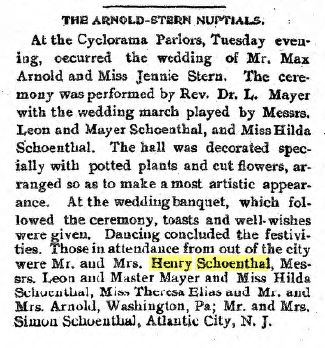
In 1896, Hannah’s daughter Jennie, then 21, was engaged to marry Max Arnold.

As you can see, it was quite an elaborate affair, and Jennie’s uncles Henry and Simon were there as were her cousins Lionel (Leon here), Meyer (Mayer here) and Hilda.  I wonder why my great-grandparents were not in attendance or at least not mentioned.

Jennie’s husband Max was also a recent immigrant from Germany; according to the 1900 census, he arrived in 1884.  He was ten years older than Jennie.  Within the first two years of their marriage, they had two children: Jerome, born October 20, 1897, and Hattie, born October 3, 1899.  Max was employed as a drover, like his brother-in-law Elias Wolfe.

Hannah was living with her two youngest children, Edith and Louis, in 1900, as well as with her stepson Morris Stern, who must have been Solomon Stern’s son from an earlier marriage; he was 44 years old in 1900.  Perhaps he had been a source of income for Hannah during the 1890s.  Morris was working as an oil merchant, Edith as a saleswoman, and Louis as a bookkeeper.  Interestingly, Hannah reported that she had had seven children, but only four were still living, meaning that sometime before emigrating, she had lost three children.

The first decade of the 20th century was one of growth for Hannah’s adult children.  Jennie (Stern) and Max Arnold had two more children in addition to Jerome and Hattie: Bernice, October 3, 1901 (same birthday as Hattie and third child born in October), and Sylvan, December 25, 1903.

Jennie’s sister Edith married Leo Good on October 24, 1904.

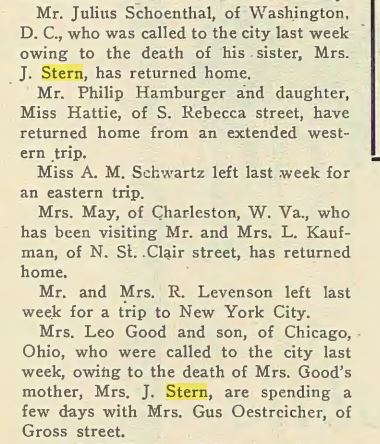
The wedding took place at her sister Sarah’s home, and this time the guest list did include my great-grandparents as well as Henry Schoenthal and his wife and daughter Hilda.

Edith’s husband Leo was four years younger than she and was a recent immigrant from Switzerland.  Their son Bernard was born on November 24, 1907.  Although the wedding article stated that Edith and Leo would be living in Johnstown, Pennsylvania, by 1910 they were living in Pittsburgh.  According to the 1910 census, Leo was a commercial traveler in dry goods, which I interpret to mean a traveling salesman.  Living with Edith, Leo, and their son Bernard in 1910 was Edith’s mother Hannah and Edith’s brother Louis, who was also working as a commercial traveler, but in bronze goods.  Leo’s cousin Sam Jacobs was also living with them.

In 1910 Jennie and Max Arnold and their children were still living in Pittsburgh, and Max continued to work as a cattle dealer.  On April 5, 1911, they would have one more child, Max, Jr., bringing the total number of children in their family to five.

Sometime shortly after the 1910 census, Edith and Leo Good and their son Bernard left Pittsburgh and moved to Chicago.  This article in The Jewish Criterion, dated September 8, 1911, reports that Edith had come to Pittsburgh to visit her sister Sarah (Mrs. Gus Oestreicher) and returned to home in Chicago.  There is also a 1914 article reporting that Hannah Stern, Edith’s mother, had gone to Chicago to visit Edith.


Hannah Schoenthal Stern died the following year in Pittsburgh on May 20, 1915.  She was 73 years old and died from arteriosclerosis and diabetes.  The informant on the death certificate was G. Oestreicher, the husband of Hannah’s first born child, Sarah.

Hannah Schoenthal Stern death certificate Ancestry.com. Pennsylvania, Death Certificates, 1906-1963 [database on-line]. Provo, UT, USA: Ancestry.com Operations, Inc., 2014. Original data: Pennsylvania (State). Death certificates, 1906–1963. Series 11.90 (1,905 cartons). Records of the Pennsylvania Department of Health, Record Group 11. Pennsylvania Historical and Museum Commission, Harrisburg, Pennsylvania

Hannah Schoenthal Stern death certificate
Ancestry.com. Pennsylvania, Death Certificates, 1906-1963 [database on-line]. Provo, UT, USA: Ancestry.com Operations, Inc., 2014.
Original data: Pennsylvania (State). Death certificates, 1906–1963. Series 11.90 (1,905 cartons). Records of the Pennsylvania Department of Health, Record Group 11. Pennsylvania Historical and Museum Commission, Harrisburg, Pennsylvania

Although I could not find an obituary for Hannah, the Jewish Criterion did report that her brother Julius had come from Washington, DC, and her daughter Edith and her family from Chicago when she died.

Hannah’s story is one of resilience.  She had a child out of wedlock when she was quite young; then she married a much older man with whom she had three more children.   When he died in 1888 and those children were still young, Hannah brought them to Pittsburgh where they could grow up near their aunts, uncles, and cousins.   She raised them as a single mother in a new country.  That must have taken a lot of strength and a lot of courage.

Now to follow up with Hannah’s three children with Solomon Stern and their lives after the death of their mother:

Jennie Stern Arnold and Her Children

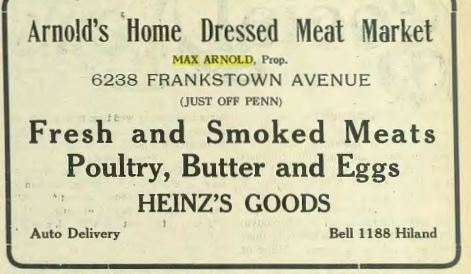
After losing her mother Hannah in 1915, Jennie would soon suffer another loss, her husband Max.  On the 1920 census, Max listed his occupation as “stock yards,” so he was still in the cattle business. From this ad in the March 12, 1915 Jewish Criterion, it would appear that Max was not only a livestock broker, but also the owner of a meat market:

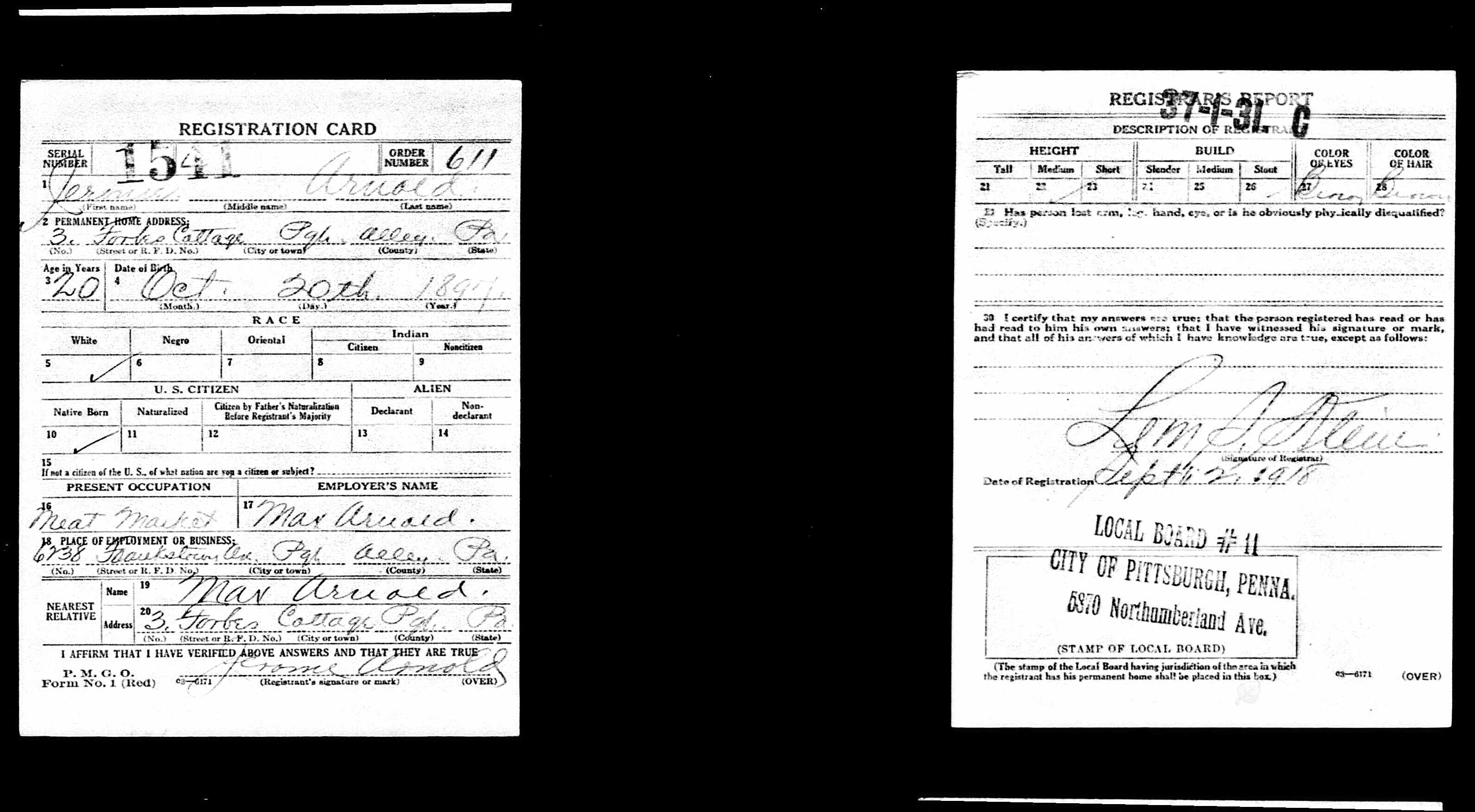
Their children were all still living at home; Jerome was now 22, Hattie 20, Bernice 18, Sylvan 16, and Max, Jr. was eight years old.  Although the census does not list an occupation for Jerome, according to his World War I draft registration, he was working for his father in the meat market.

Registration State: Pennsylvania; Registration County: Allegheny; Roll: 1909238; Draft Board: 11

Registration State: Pennsylvania; Registration County: Allegheny; Roll: 1909238; Draft Board: 11

Ten months after the census was taken, Max died at age 55 on October 25, 1920, from diabetes.  His death certificate listed his occupation as livestock broker.  Like her mother, Jennie was a young widow, only 45 when Max died, and still housing and supporting four children, including little Max, Jr.

Max Arnold, Sr. death certificate Ancestry.com. Pennsylvania, Death Certificates, 1906-1963 [database on-line]. Provo, UT, USA: Ancestry.com Operations, Inc., 2014. Original data: Pennsylvania (State). Death certificates, 1906–1963. Series 11.90 (1,905 cartons). Records of the Pennsylvania Department of Health, Record Group 11. Pennsylvania Historical and Museum Commission, Harrisburg, Pennsylvania.

Max Arnold, Sr. death certificate
Ancestry.com. Pennsylvania, Death Certificates, 1906-1963 [database on-line]. Provo, UT, USA: Ancestry.com Operations, Inc., 2014.
Original data: Pennsylvania (State). Death certificates, 1906–1963. Series 11.90 (1,905 cartons). Records of the Pennsylvania Department of Health, Record Group 11. Pennsylvania Historical and Museum Commission, Harrisburg, Pennsylvania.

Soon, however, her older children would marry and move on.  Her daughter Hattie married Martin Schulherr, on May 10, 1921.

Martin was a German immigrant who had arrived just ten years before and who had become a naturalized citizen just a month before their marriage, according to his passport application.  On the 1920 census, he had been living with his uncle in Pittsburgh and working as a jewelry salesman.  Martin and Hattie would have one child, a daughter born in 1929.

Martin Schulherr passport application, p 2 National Archives and Records Administration (NARA); Washington D.C.; NARA Series: Passport Applications, January 2, 1906 - March 31, 1925; Roll #: 1582; Volume #: Roll 1582 - Certificates: 24750-25125, 26 Apr 1921-27 Apr 1921

Martin Schulherr passport application, p 2
National Archives and Records Administration (NARA); Washington D.C.; NARA Series: Passport Applications, January 2, 1906 – March 31, 1925; Roll #: 1582; Volume #: Roll 1582 – Certificates: 24750-25125, 26 Apr 1921-27 Apr 1921


Hattie’s older brother Jerome also married in the 1920s.  In May, 1924, he married Ellen Schwabrow, with whom he had his first child in 1925 with two more to follow in the next ten years.  Ellen was born in upstate New York to German immigrant parents and had moved to Pittsburgh by the time she was twelve years old.

Bernice Arnold, Jennie’s second daughter, married Julius Averbach on September 5, 1926, according to this news item:

Pittsburgh Post Gazette August 29, 1926 p. 44

Pittsburgh Post Gazette August 29, 1926 p. 44


Julius was the youngest and only American-born child of Russian immigrants.  His father Meyer was a traveling dry goods salesman, living in Pittsburgh.

In August, 1927, the fourth of Jennie’s five children married.  Sylvan Arnold married Ada Feigenbaum, who was also born and raised in Pittsburgh.  Her father Morris was in the produce business, and Ada was the youngest of their ten children.  Sylvan and Ada would have two children born in 1929 and 1932.

Thus, by 1930 Jennie’s four oldest children were married, and she was living with just nineteen year old Max, Jr., who was working at what had been his father’s butcher shop.  His older brother Jerome was also working in the meat market and living with his wife Ellen, her parents, and their two sons in Pittsburgh.  Sylvan was also working in the family meat business and living with his wife Ada and their son in Pittsburgh.  Obviously Max Arnold, Sr., had established a very successful business that it could support his three sons and their families.

As for Jennie and Max Arnold’s daughters, in 1930, Hattie and her husband Martin Schulherr and their daughter were also living in Pittsburgh, and Martin was a jewelry importer.  The 1930 census reports that Bernice and her husband Julius Averbach were living in Beaver Falls; Julius was in the men’s furnishings business.

On November 24, 1932, Max Arnold, Jr., married Cecilia Lefkowitz, another Pittsburgh native.


Her parents were Hungarian immigrants, and her father Morris was a tailor.  By 1935, Max and Cecilia had moved to Morgantown, West Virginia, where Max was working as the manager of the Morgan Theater.  By 1937, however, Max is no longer listed in the Morgantown directory, and in 1940, he and Cecilia were living back in Pittsburgh where Max was now the owner of a beauty supply equipment business.  Their first child was born later that year. A second child was born in 1947.

In 1940, Jennie and four of her five children were still living in Pittsburgh.  Jennie was living with her daughter Hattie and her husband Martin, who was still in the jewelry business.  Jerome was still working as a butcher in the family grocery business, and two of his children were also working in the store.  Sylvan was also working as a butcher in the business.  Bernice was still married to Julius Averbach and living in Beaver Falls.

Bernice and Julius appear together on the 1930 and 1940 census reports; there are no children listed.  Sometime after 1940, Bernice married a second time.  Her second husband, Abe Sultanov, was a widower with two children, and Bernice is mentioned in various wedding and birth announcement as the grandmother of Abe’s grandchildren.

Jennie Stern Arnold, my first cousin twice removed, died on June 25, 1945.  She was seventy years old and died from coronary occlusion and other heart related ailments.

Jennie Stern Arnold death certificate Ancestry.com. Pennsylvania, Death Certificates, 1906-1963 [database on-line]. Provo, UT, USA: Ancestry.com Operations, Inc., 2014. Original data: Pennsylvania (State). Death certificates, 1906–1963. Series 11.90 (1,905 cartons). Records of the Pennsylvania Department of Health, Record Group 11. Pennsylvania Historical and Museum Commission, Harrisburg, Pennsylvania.

Jennie Stern Arnold death certificate
Ancestry.com. Pennsylvania, Death Certificates, 1906-1963 [database on-line]. Provo, UT, USA: Ancestry.com Operations, Inc., 2014.
Original data: Pennsylvania (State). Death certificates, 1906–1963. Series 11.90 (1,905 cartons). Records of the Pennsylvania Department of Health, Record Group 11. Pennsylvania Historical and Museum Commission, Harrisburg, Pennsylvania.

She had been a widow for 25 years, but was fortunate enough to have all five of her children plus many of her other relatives living close by in Pittsburgh and the surrounding area. Jennie was survived by all five of her children and ten grandchildren.

Edith Stern Good and Her Family

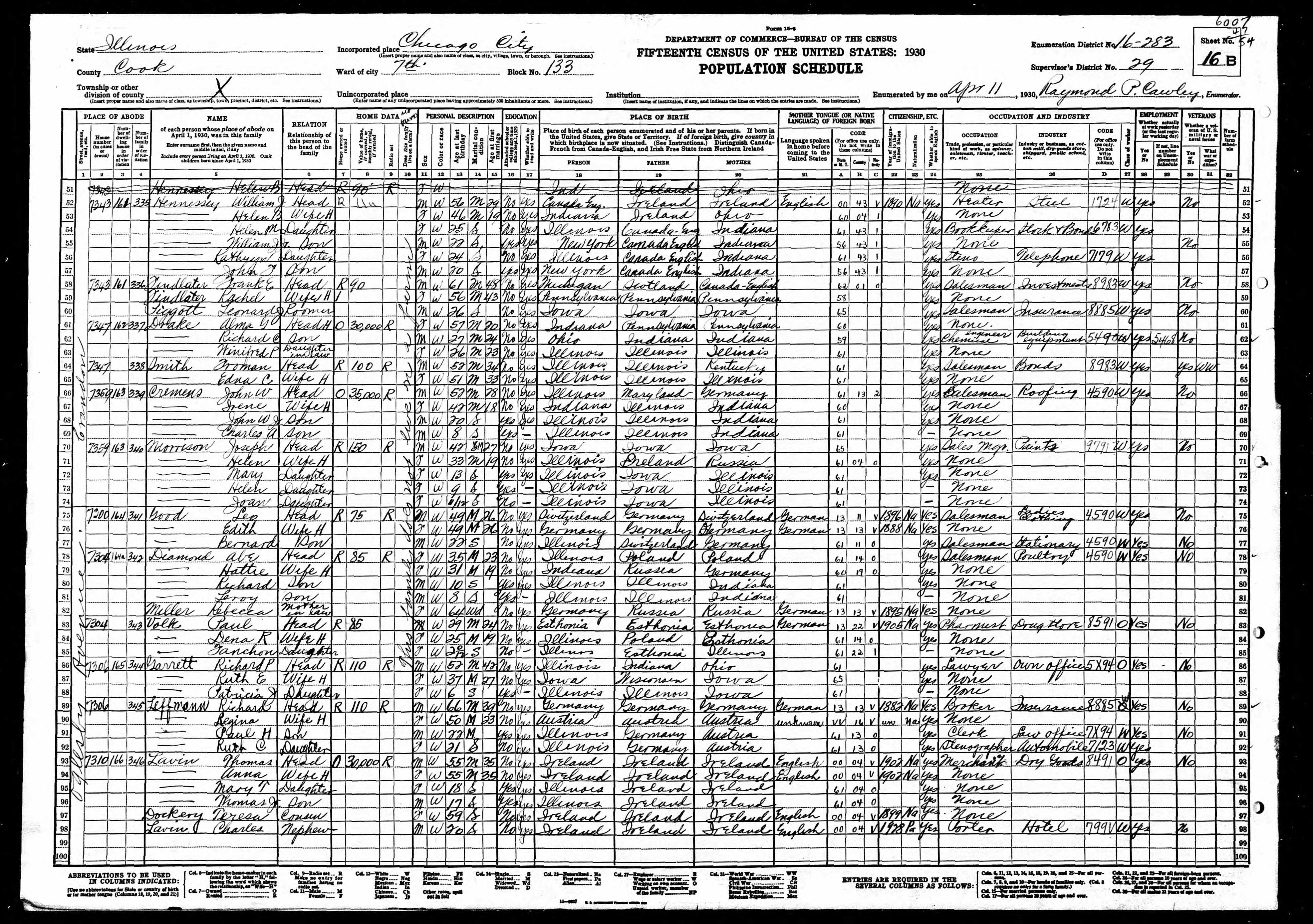
Unlike her sister Jennie, who remained in Pittsburgh her whole life after emigrating from Germany as a child, Edith Stern had left Pittsburgh by 1911 with her husband Leo Good and son Bernard to move to Chicago, where she lived for the rest of her life.  According to several Chicago directories between 1912 and 1920, Leo was a manufacturer’s agent, but I don’t know for which or what type of manufacturer.  I could not find Leo and Edith on the 1920 census, but on the 1930 census Leo described his occupation as a salesman of ladies’ clothing, so perhaps he had been engaged in that field all along.  By 1930 their son Bernard was 22 and working as a stationery salesman.

Leo, Edith, and Bernard Good 1930 census Year: 1930; Census Place: Chicago, Cook, Illinois; Roll: 425; Page: 16B; Enumeration District: 0283; Image: 561.0; FHL microfilm: 2340160

Leo, Edith, and Bernard Good 1930 census
Year: 1930; Census Place: Chicago, Cook, Illinois; Roll: 425; Page: 16B; Enumeration District: 0283; Image: 561.0; FHL microfilm: 2340160

Bernard Good married Fannie Dorothy Herzfeld in Dade County, Florida, in 1935.  Fannie Dorothy was born in Alabama and had been living with her parents in Miami in 1935. By 1939 (if not before) Bernard and Dorothy were living in Chicago where their one child was born that year.  In 1940 Bernard was working in sportswear sales, according to the 1940 census.

In 1940, Leo and Edith (Stern) Good were still living in Chicago, and Leo was a traveling salesman selling ladies’ ready-to-wear lingerie.  Four years later Edith died in Chicago on September 7, 1944; she was 66 years old.  Her husband Leo died five years later on April 19, 1949; he was 67.  Leo died in Los Angeles, where I assume his son Bernard had moved since Bernard died in Los Angeles also; he died on May 15, 1973.

Louis Wolf Stern

Hannah Schoenthal Stern’s youngest child was her only son, Louis.  In 1910 Louis had been living with his mother and his sister Edith and her family; he’d been working as a traveling salesman in bronze goods.  By 1918, Louis had moved to Newark, New Jersey, according to his World War I draft registration.  He was then working as a bookkeeper for H.H. Garfunkle.  He listed his sister Sarah (Mrs. G. Oestreicher) as his next of kin and also reported that he had filed his first papers for naturalization as a US citizen.  He was then 38 years old.

After that Louis disappears for a while.  I cannot find him on the 1920 census in New Jersey, Pennsylvania, New York, or anywhere else.  But in 1930 he resurfaced in New York City, working as a process server.  He was living as a lodger in the home of someone named Morris Cohn.  His marital status was single.  As far as I can tell, Louis never married.

According to the 1940 census, Louis was still living in New York in 1935, but by 1940 he had returned to Pittsburgh where he was working as a bookkeeper for a beauty supply equipment company, perhaps that owned by his nephew, Max Arnold, Jr.  As he had in New York, Louis was living as a lodger in someone’s home.

Louis died in Pittsburgh from a cerebral hemorrhage on January 29, 1942.  He was only 61 years old.  His sister Jennie was the informant on the death certificate.  Despite being Hannah’s youngest child, he was the second to die, two years after his oldest sister Sarah.

Louis W. Stern death certificate Ancestry.com. Pennsylvania, Death Certificates, 1906-1963 [database on-line]. Provo, UT, USA: Ancestry.com Operations, Inc., 2014. Original data: Pennsylvania (State). Death certificates, 1906–1963. Series 11.90 (1,905 cartons). Records of the Pennsylvania Department of Health, Record Group 11. Pennsylvania Historical and Museum Commission, Harrisburg, Pennsylvania.

Louis W. Stern death certificate
Ancestry.com. Pennsylvania, Death Certificates, 1906-1963 [database on-line]. Provo, UT, USA: Ancestry.com Operations, Inc., 2014.
Original data: Pennsylvania (State). Death certificates, 1906–1963. Series 11.90 (1,905 cartons). Records of the Pennsylvania Department of Health, Record Group 11. Pennsylvania Historical and Museum Commission, Harrisburg, Pennsylvania.

Thus, all of Hannah Schoenthal Stern’s children died within four years of each other: Sarah in 1940, Louis in 1942, Edith in 1944, and Jennie in 1945.  Only Jennie made it to seventy years old.   Hannah had had nine grandchildren,  Sarah’s three children, Jennie’s five children, and Edith’s one.  Because their grandmother had had the courage to bring her children to the US from Germany after her husband died in 1888, Hannah’s grandchildren were saved from the fate of their cousins and relatives who stayed in Germany.  Had Hannah’s husband not died and had she and her children stayed in Germany, those children might not have been able to continue the line of Levi Schoenthal and Henrietta Hamberg’s oldest child, Hannah.


Henry and Isidore:  The Schoenthal Brothers in Little Washington 1890-1910

Now that I have a better feel for my great-great-uncle Henry Schoenthal and the man he was, I will return to telling his story and that of the extended Schoenthal family with a fresh perspective.  In this post, I will cover the 1890s and the first decade of the 20th century in Washington, Pennsylvania.

Old Fairgrounds Washington, PA 1897 http://www.washingtonpa.us/washingtons-past/

Old Fairgrounds Washington, PA 1897
http://www.washingtonpa.us/washingtons-past/

My great-grandfather Isidore Schoenthal had arrived in Washington, Pennsylvania in 1881, twenty-five years after his older brother Henry.  By 1890, Isidore had married my great-grandmother Hilda Katzenstein, and they were settled in Washington, Pennsylvania, with their first son Lester.   Their second child, Gerson, was born in 1892.  Although there were several family members just 30 miles away in Pittsburgh, the only other Schoenthal family member in Washington was Henry and his family.  Henry and his wife Helen nee Lilienfeld had three children; in 1890, Hilda was sixteen; Lionel, thirteen, and Meyer, seven.

Henry continued to own a book and stationery store in Washington, as this ad from the 1892 yearbook for Washington and Jefferson College indicates:

Ancestry.com. U.S., School Yearbooks, 1880-2012 [database on-line]. Provo, UT, USA: Ancestry.com Operations, Inc., 2010.

Ancestry.com. U.S., School Yearbooks, 1880-2012 [database on-line]. Provo, UT, USA: Ancestry.com Operations, Inc., 2010.

In October 1895, Henry’s store suffered $10,000 worth of damage from a fire that also damaged two adjoining stores.

Pittsburgh Daily Post, October 29, 1895, p.4

Pittsburgh Daily Post, October 29, 1895, p.4


Two years later Henry sold his store:

Daily Republican (Monongahela, PA), January 6, 1897, p.1

Daily Republican (Monongahela, PA), January 6, 1897, p.1


As the news article reveals, Henry was by then involved in the Washington Glass Company, which had been chartered in September 1896 with Henry as one of the founding directors.

Henry Schoenthal Washington Glass Company

Henry is listed in the 1897 Washington city directory as the secretary and treasurer of the Washington Glass Company.

Along with steel and coal mining, glass manufacturing apparently was one of the principal industries in Washington County and in western Pennsylvania generally.  Among the major glass manufacturing companies that existed in the area while my family was living in Washington County were Duncan & Miller Glass Company, founded in 1865 and operating in some capacity until 1980, and Pittsburgh Plate Glass Company, founded in 1883 and still in existence today.  Here are an illustration of a product made by Duncan & Miller and also a photograph of its factory in Washington, PA.

Duncan and Miller ruby pitcher By Nomoreforme at English Wikipedia [Public domain], via Wikimedia Commons

Duncan and Miller ruby pitcher
By Nomoreforme at English Wikipedia [Public domain], via Wikimedia Commons

According to Glass & Pottery World, Volume 4, (January 1, 1896, Trade Magazine Assocation), Washington Glass Manufacturing Company “was a new company, just commencing the manufacture of lamp shades, globes, chimneys, and specialties.  A. W. Pollack is president, Henry Schoenthal, secretary, and C.N.L Brudenwald, general manager.  They occupy the plant of the old Washington factory, and are all prominent men and have the prospect of success before them.”

1897 was a big year for Henry in other ways.  He and Helen celebrated their 25th wedding anniversary that year.

Pittsburgh Daily Post May 16, 1897 p. 10

Pittsburgh Daily Post May 16, 1897 p. 10

Thanks to Carly at the Heinz History Center at the University of Pittsburgh, I now finally have a photograph of Henry Schoenthal and of his family.  The photo was taken in 1897 on the occasion of Henry and Helen’s 25th anniversary and was used again in 1922 when they celebrated their 50th anniversary.  It is on file with the Rauh Jewish Archives at the Heinz History Center.

Henry certainly was a prominent man.  He was described this way in the Beers biography written in 1893: “Henry Schoenthal … by a life of plodding industry and judicious economy, coupled with keen foresight and characteristic prudence, has risen to no small degree of prominence as one of the well-to-do and progressive citizens of Washington borough.”  He was a member of four secret societies: A. F. & A. M., Heptasophs, Royal Arcanum, and Protected Home Circle as well as president of the local B’nai Brith lodge and a founding member of Beth Israel, the synagogue.

Prospect Avenue, Washington, PA 1890 http://www.washingtonpa.us/washingtons-past/

Prospect Avenue, Washington, PA 1890
http://www.washingtonpa.us/washingtons-past/

I am not sure exactly what my great-grandfather Isidore was doing for a living in the early part of the decade, but by 1897 he was listed in several business categories in the Washington directory: cutlery, china, glassware, lamps, and house furnishings.  I assume that his lamps and glassware were at least in part the products of his brother’s company.

Isidore Schoenthal

Isidore Schoenthal

On the 1900 census, Henry described himself as a china merchant.  All three of his children were still single and living at home.  Lionel, 23, was a merchant and a violinist. He had graduated from Washington and Jefferson College in 1899 with a Bachelor of Science and had also participated in the Glee Club and played the violin in the Mandolin Club.

Old Main of Washington & Jefferson Colege, Was...

Old Main of Washington & Jefferson Colege, Washington, Pennsylvania, United States. (Photo credit: Wikipedia)

When the new courthouse was dedicated in Washington in November 1900, Lionel led a twelve piece string orchestra at the festivities.

Washginton County Courthouse By Canadian2006 (Own work) [CC BY-SA 3.0 (http://creativecommons.org/licenses/by-sa/3.0) or GFDL (http://www.gnu.org/copyleft/fdl.html)], via Wikimedia Commons

Washginton County Courthouse
By Canadian2006 (Own work) [CC BY-SA 3.0 (http://creativecommons.org/licenses/by-sa/3.0) or GFDL (http://www.gnu.org/copyleft/fdl.html)%5D, via Wikimedia Commons

Henry and Helen’s younger son Meyer was sixteen in 1900 and was working as a china salesman.  Their daughter Hilda and her mother Helen were not employed outside the home.

My great-grandfather also listed himself as a merchant on the 1900 census.  His children Lester and Gerson were now eleven and eight years old, respectively. A third child, their son Harold, was born in Washington on August 28, 1901.  In the 1903 directory for Washington, Pennsylvania, Isadore and Hilda were living at 47 South College Street, and Isadore’s store was at 106 South Main Street; he was selling china, glassware, and house furnishings. He even had a telephone.

Sometime between 1900 and 1903, Henry’s older son Lionel married Irma Silverman; he seemed to be in a business competing to some extent with his uncle Isidore, as he was also selling china as well as books, stationery, toys, and fancy goods. Lionel had phones both in his store and at his residence.

In 1903, his father Henry was living at 203 East Beau Street with his wife Helen and their other two children, Hilda and Meyer, both of whom were working as clerks for their brother Lionel.  Henry was now an agent for New York Life Insurance Company.

Schoenthals 1903 directory 1

1903 directory for Washington, PA Ancestry.com. U.S. City Directories, 1822-1989 [database on-line]. Provo, UT, USA: Ancestry.com Operations, Inc., 2011.

1903 directory for Washington, PA
Ancestry.com. U.S. City Directories, 1822-1989 [database on-line]. Provo, UT, USA: Ancestry.com Operations, Inc., 2011.

On March 4, 1904, my great-grandparents had their fourth child and first and only daughter, my grandmother Eva.  She was a truly beautiful baby.

My Grandma Eva

My Grandma Eva

In 1905, another child joined the family.  Henry and Helen’s son Lionel and his wife Irma had a baby girl on March 22, whom they named Florence.

Aside from these new babies in the family, nothing much changed between 1903 and 1905, as seen in the Washington directory for 1905.

1905 directory for Washington, PA Ancestry.com. U.S. City Directories, 1822-1989 [database on-line]. Provo, UT, USA: Ancestry.com Operations, Inc., 2011.

1905 directory for Washington, PA
Ancestry.com. U.S. City Directories, 1822-1989 [database on-line]. Provo, UT, USA: Ancestry.com Operations, Inc., 2011.

My great-grandfather was still selling china and glassware, now at 15 North Main Street, and the family had moved to 196 Allison Avenue; Lester, however, was living at the 47 South College Street.  He would have been seventeen years old; the directory says he was a student, so I assume he was living at and attending Washington and Jefferson College.

Henry was still living at 203 East Beau Street and working for New York Life; Hilda and Meyer were still living at home, and Lionel was living with his wife and child elsewhere in town.  Lionel was still running his store, as described above.

North Main Street, Washington, PA http://www.washingtonpa.us/washingtons-past/

North Main Street, Washington, PA
http://www.washingtonpa.us/washingtons-past/

But things did not stay the same after that.  My great-grandparents may have thought that they were permanently settled in the comfortable surroundings of Washington, Pennsylvania, with Henry and his family close by and other relatives not too far away.  But their son Gerson had developed asthma, and the doctors had recommended that they move to a drier climate.  So by 1907 Isidore and Hilda and their four children had moved all the way to Denver, Colorado.  The 1907 Denver directory only has a listing for Isidore and their residence without an occupation, but in 1908 there is a listing for Lester as a bookkeeper.  Isidore still has no occupation listed.  In 1909, however, he is listed as working as a clerk for the Carson Crockery Company, a well-established distributor of fine china.

Carson Crockery

By 1910, he was the manager of the crockery store, according to the census report and this advertisement I found in the December 15, 1911 edition of the Denver Post (p.2).


isidore schoenthal mgr carsons

My great-uncle Lester, now 21, was a hospital apprentice for the US Navy. His brother Gerson, now 18, had a clerical position in an office.  All four children were still living with their parents.  Harold was nine, and my grandmother was six years old.

Things were also changing back in Pennsylvania for my great-great-uncle Henry Schoenthal and his family.  As Hilda wrote in her biography of her father, her brother Lionel moved to New York where he worked for Gimbels.  On the 1910 census he listed his occupation as a china buyer.  His parents moved to New York City to be near him in March, 1909, according to Hilda, and in 1910 they were living with Lionel, his wife Irma, and their daughter Florence. Henry was still working as an agent for New York Life.
The former New York Life Insurance Company Bui...

The former New York Life Insurance Company Building, also known as the Clock Tower Building, at 346 Broadway between Catherine and Leonard, was expanded from the original building by Stephen Decatur Hatch and McKim, Mead & White, between 1894 and 1899. (Photo credit: Wikipedia)

I found a detailed biography of Henry and Helen’s other son Meyer written in 1922, which reported on Meyer’s early life as well as his adult life:

The public schools of his native city afforded Meyer L. Schoenthal his early education, and after leaving school he gained most valuable experience through his association with his father and older brother in the china and glass business and the manufacturing of glassware. With these lines of enterprise he continued his active connection at Washington, Pennsylvania, until 1907, when he was called to Belleville, Illinois, to assume charge of the promotion of a theater enterprise. He remained there one year, and met with success in effecting the erection and equipment of a modern theater, and for the ensuing two years he represented New York manufacturers in .the Middle West. In 1910 he married, and in the same year he and his wife established their home at Los Angeles, California…

(John Brown, Jr. and James Boyd, History of San Bernardino and Riverside Counties, Volume III, the Western Historical Association, 1922, The Lewis Publishing Company, Chicago, ILL. Transcribed by Peggy Hooper 2011)

In 1910, Meyer married the former Mary McKinnie, as seen in this news clipping from The Daily Post (Canonsburg, Pennsylvania, January 10, 1910), p. 1:

The Daily Notes (Canonsburg, PA, January 10, 1910). p. 1

The Daily Notes (Canonsburg, PA, January 10, 1910). p. 1

The Washington Seminary was a Presbyterian seminary for women.  I wonder what Henry Schoenthal thought of his son Meyer marrying a young woman who was not Jewish and from so far away.  The 1910 census reports that Meyer and Mary Schoenthal were living in Los Angeles, and Meyer was working as a manager for an investment company.

I could not locate Hilda Schoenthal, Henry and Helen’s daughter, on the 1910 census, but she appears in the 1911 directory for Washington, DC, working as a stenographer.

Thus, by 1910 all of Henry Schoenthal’s family had left Little Washington as had the family of my great-grandfather Isidore.   In both cases it was their children who had provided the reason for the move.  Isidore and Hilda moved to find a better place for their son Gerson.  Henry and Helen moved to be closer to their son Lionel.  Little Washington must have been too small to provide sufficient opportunities for the next generation.

They all had left before the big centennial celebration in Washington, commemorating its founding in 1810.

There were, however, representatives of the extended family still there: the sons of Jacob Schoenthal, the Schoenthal brother who never left Germany.  More on them in a later post. First, I need to catch up with the members of the family who were living in Pittsburgh as the 19th century moved into the 20th.


My Great-great-uncle Henry: The Real Man Revealed

This was a major find, a discovery that has greatly inspired me and uplifted me.

I’ve been researching the Schoenthals in depth for quite a while now, and I’ve been so fortunate to find as much as I have about the family both in German and American records.    As I was preparing a post about Henry and Isidore, my great-grandfather, I decided to see if I could find a picture of Henry.  After all, he was a prominent man in Washington, Pennsylvania for many years.  There had to be a picture of him in a newspaper or archive somewhere.  So I tried Google.

Unfortunately, I didn’t find a photograph of Henry.  But what I found was amazing and did in fact give me a better picture of Henry.  The Jacob Radosh Marcus Center of the American Jewish Archives at Hebrew Union College in Cincinnati, Ohio, had four entries for Schoenthal in its collection: three labeled Henry Schoenthal, one Hilda Schoenthal.   They were titled as papers, a biography, a diary, and a sermon.  I saw this the other evening and was excited, but had no idea how I could see these papers without going to Cincinnati.   So the next morning I called the Marcus Center and spoke to an extremely helpful man there named Joe.  Joe explained that they would scan all the pages of the documents for me for 25 cents a page and email them to me.  There were forty pages in total, and so in less than hour and for only ten dollars, I had the four files in my email.

The folder of Henry’s papers, which date from 1863 to 1866, are in German.  I am going to have to find someone to help me translate them.  But here’s one that confirms Henry’s  (then Heinemann) birth date and place and his father’s name; I think it is a certificate of his training to be a Jewish teacher at the seminary in Cassel, Germany:

Israelitische Lehrerbildungs for Henry Schoenthal Available at the Marcus Center, Cincinnati, Ohio

Israelitische Lehrerbildungs for Henry Schoenthal
Available at the Marcus Center, Cincinnati, Ohio


The biography is a one page biography of Henry Schoenthal written by his daughter Hilda in 1952.  Although much of it was information I already knew, it adds another dimension to this man, making him come to life for me.  I want to look first at the first section of that biography because it will provide greater background to the diary and to the sermon, the remaining two files I received.

Hilda Schoenthal, Biography of Henry Schoenthal dated January 16, 1952. Available at the Marcus Center, Cincinnati, Ohio

Hilda Schoenthal, Biography of Henry Schoenthal dated January 16, 1952. Available at the Marcus Center, Cincinnati, Ohio


Again, although I knew most of the facts reported here, it was wonderful to read it in words written by Henry’s own daughter. I didn’t know how he met his wife or that her father, Meyer Lilienfeld, was a cantor.  And I did not know that Henry was a shochet (kosher butcher) and a chazzan (cantor) as well as a teacher back in Germany.  I wish Hilda had expanded on the political and economic conditions that drove her father to emigrate.  And I found it interesting that Washington was considered somewhat of a center of culture and intellectual activity because of the presence of Washington and Jefferson College in the town. It also gave me a sense of Henry as someone interested in the life of the mind—someone who preferred selling books to students than selling clothing.


English: Western side of on the campus of in W...

Western side of McMillan Hall on the campus of Washington & Jefferson College in Washington, Pa. .. Built in 1793, it is listed on the National Register of Historic Places (Wikipedia)

The diary, which starts in 1866 when Henry arrived in America, starts out in German, but after the first several pages, Henry began to write in English and to use script which I can read.  Reading those pages was very moving, and I will share some of them below.  Thanks to my friend Matthias Steinke, I was able to get the initial pages translated into English.

The diary begins on July 10, 1866, just a few weeks after Henry had arrived in New York, and says that he had just arrived in Washington, PA, and was working for his cousin Jacob Goldsmith in his clothing store (for some reason “clothing store” is written in English).

Diary of Henry Schoenthal 1866-1868 Available at the Marcus Center, Cincinnati, Ohio

Diary of Henry Schoenthal 1866-1868
Available at the Marcus Center, Cincinnati, Ohio

By the next day he had written to his parents and sent them three gold dollars.  He did not receive his first letter from his parents until August 9th and immediately responded, sending them ten dollars in “greenbacks.”   On August 16th, he described a visit from the Democratic candidate for governor of Pennsylvania, Hiester Clymer, and the fanfare surrounding that.  Then there is a long entry about the some criminal activities going on in the town.  Most of the pages in German report on his correspondence with various people back home.

By January 1867, Henry was writing in fluent English.  Just six months in the US, and he was already comfortable with and even preferring to write in English.  I was impressed.  Much of what he continued to write about was his correspondence— naming those to whom he had written and those who had written to him.   This page, with several entries dated in April, 1867, I found particularly interesting.

Henry Schoenthal diary p 9


On Tuesday, April 12,  1867, Henry mentioned that he was beginning to give German lessons to some residents of the town.   On these pages, he also mentioned writing letters not only to his “dear parents” and sending them money, but also writing to his uncle Juda Hamberg from Breuna, who was his mother’s older brother, and to Helene and Recha Lilienfeld.  Helene would later become his wife, and there are numerous mentions of correspondence between Henry and the two Lilienfeld sisters.  On this page he also mentioned that he sent the Lilienfeld sisters his pictures.  I sure wish I could see a copy of those pictures.

Of greatest interest to me on this page, however, is Henry’s comment on Monday, April 22, that he went to Pittsburgh “last Friday and stayed there for the first two days of Passover.”  I was touched that Henry was making an effort to hold on to his traditions and heritage while alone without his parents and siblings nearby.  Of his family members already in the US in 1867, the only one likely to have been in Pittsburgh was Simon Goldsmith, widower of Fanny Schoenthal and thus Henry’s uncle by marriage.

Although Henry may have had his heart set on Helene (also called Helen) Lilienfeld, he was not sitting home.  He mentioned at the bottom of this page that in May 1867 he went to a show with a Miss Emma ? and a Mrs. Flora Conner (?) and did not get home until half past eleven.

One of my favorite diary entries also is dated in May 1867:

Henry SChoenthal diary p 10 A


Why do I like this entry?  Because it mentions my great-grandfather and by his original name, Isaac.  Henry referred to all his siblings by their original names.  Malchen was Amalie, Hannchen was Hannah.  Selig became Felix.  I also liked that Julius was listed, confirming once again that Julius Schoenthal was a sibling.  I imagine Henry writing all those names and looking at the pictures his “dear parents” had sent to him and being somewhat homesick.

But there was some news to alleviate that homesickness.  He mentioned on the next page that Malchen wanted to come to the United States.  He said that she was “anxious to come to this country and I expect to let her come by next fall.”  This seems to suggest that the decision was up to Henry, not his parents or his sister Malchen.  Was this about money?  Henry often mentioned sending money home to his family.

Henry Schoenthal diary p 10 B

But on June 18, Henry wrote that his sister Malchen and brother Simon “intend to come over here next fall,” so perhaps he really did not have control over their decisions to emigrate.

Henry Schoenthal diary p 11


Although Henry was continuing to correspond with “dear Helene” and her sister, he was also exchanging pictures with a Miss Therese Libenfeld in Frankfort and teaching German to several young women in Washington.

On September 9, 1867, Henry reported that he had received a letter from his parents informing him that his brother and sister, Simon and Malchen, had left Bremen on August 17 to sail on the ship SS Watchen.  This is consistent with the ship manifest I found for Simon and Amalie, which has them arriving in New York on September 23, 1867.  The only inconsistency is that the ship manifest record states that the ship was named Wagen, not Watchen.  Close enough.

Henry Schoenthal diary p 13

After that the diary peters out with very few entries between September 1867 and February 1868, the date of the last entry.  My guess is that Henry was busy with his siblings, helping them to adjust to the new country, and perhaps less in need of keeping track of his correspondence.

The very last entry, dated February 24, 1868, records a piece of US history.  Henry wrote: “The House of Representatives just resolved to impeach President Andrew Johnson.”  Unfortunately Henry expressed no opinion or reaction to this occurrence.  Was it upsetting to him? How did he feel about American democracy?  I wish I knew.

Henry Schoenthal diary p 14


I loved reading the diary.  Although it is not terribly intimate or revealing in its content, I can imagine this young man in his early 20s sitting down to keep track of everyone from back home with whom he corresponded.  The fact that the diary ends shortly after the arrival of his sister and brother make me think that the diary’s purpose had at that point been served.  Henry now had some of his family with him and no longer needed the ritual of the diary to help him feel connected.

Returning to Hilda’s biography of her father and her description of his life after 1868:

Hilda bio of Henry Schoenthal p 2

I found Hilda’s final paragraph particularly interesting:

HIlda bio of Henry Schoenthal p 3

This was not the image I had of Henry from the documents I’d found or even the newspaper articles.  Henry wasn’t just a successful businessperson.  He was a committed Jew working hard to create and maintain a Jewish community in this small town in western Pennsylvania.  He was still a teacher many years after leaving Trendelburg, Germany, a man interested in books and students and Jewish traditions.  Now I see a whole new dimension to this man who was my great-great-uncle.

The remaining file that I obtained from the Marcus Center was the so-called sermon. For me, this was the most exciting document of all.  The sermon was written by Henry in 1912, three years after he had moved away from Washington to live near his son Lionel in New York City, as mentioned by Hilda.  Henry was by this time almost 70 years old.  From what I can infer, the sermon or speech was to a fraternal organization in Washington given on the occasion of Henry’s return to Washington for a visit.  I will quote the portions I found most touching and most revealing:

Henry Schoenthal 1912 Sermon p 1

He wrote:

I love to come back to Washington to revisit the scenes of my early manhood. For to this place I had come a stranger and you had taken me in.  Here I have spent the greater portion of my years and Washington has been my real home.  To this place I had brought my bride and here my children were born and educated.  Here I made many, many friends and possibly a few enemies.  Here I have lived many happy days and my full share of the other kind.  The latter I have forgotten long ago, the former are ever present in my memory and help to brighten and to make happy the declining days of my years.

Henry Schoenthal 1912 sermon p 2

I do not know whether I shall pass this way again, for the shades of evening are lengthening and the goal may not be very far off.  I gratefully acknowledge that God has been very gracious unto me and that he has blessed me beyond my merits.  He has guided me with a father’s hand to reach and to pass safely the 3 score and ten of which the Psalmist has spoken, and if it should be his holy will to grant me another short space of years, I may even reach the limit of four scores.

Henry Schoenthal Sermon 1912 p 3

Henry Schoenthal 1912 sermon p 4

But whether this should be the last time it is destined for me to have the happiness to meet with you, you may rest assured that I shall always remember this evening, that I shall never forget the courtesy you have shown, the friendship and the fraternal feelings you have extended to me.  And I shall always pray for your happiness and in parting I shall bless you, bless you not in my own words, but the in the words of the High Priest of old when he stood before the assembled multitudes stretching forth his hand and pronouncing the words:

May the Lord bless you and keep you!

May the Lord cause his light to shine upon you and be gracious unto you!

May the Lord turn his face unto you and grant you peace, now and forever more.  Amen!

I admit that my eyes well up with tears every time I read and re-read these words. I am moved by so much of what he said here: his attachment to Washington, PA, as his home, a place that had welcomed a very young man in 1866 and given him a safe place to settle and work.  He mentioned good times and bad, but overall his memories of this place are filled with love for the people he knew there.  I feel his love for this place and for the people and his joy in being there and the sadness he feels in leaving it and perhaps not being able to return another time.  We all have those feelings about places we have lived–whether it is a childhood home, a college campus, a first apartment.  We move on, but a piece of our heart remains behind.

I am also moved by the beauty of his writing.  It’s hard to believe that English was not his first language, as with my cousin Lotte.  Henry’s writing is so poetic, so evocative.  I read it with wonder.

And then Henry closed with the traditional priestly blessing read even today in Jewish prayer services and used as a blessing on many occasions in Jewish life. A blessing we said to our own daughters on Friday nights when they were children.  A blessing that Jews have said and shared for centuries.  I am moved knowing that my ancestor shared in this tradition as well.

Henry had left the seminary, but that experience had never left him.  He remained, as his daughter said, committed to his heritage and proud of it.  He remained a religious man.

Finding these papers was another one of many highlights in my continuing search for the story of my ancestors.  They inspire me to keep looking for more and to keep telling the stories.  Henry Schoenthal wanted history and traditions to continue, and I want his story to live on as well.


A Legitimate Part of the Family


In my last post about the Schoenthals, I mentioned that Hannah Schoenthal, my great-grandfather Isidore’s oldest sibling, had had a child out of wedlock in 1865, a daughter she named Sara (later spelled Sarah).

Sara Schoenthal birth record HHStAW Abt. 365 Nr. 772, S. 12

Sara Schoenthal birth record
HHStAW Abt. 365 Nr. 772, S. 12

I wondered how such a child would be treated under Jewish law and by society at that time.  According to Jewish law, a child born to an unmarried couple is not treated any differently for religious or marital purposes than one born to a married couple, unless  the mother was married to someone else or there was an incestuous relationship between the parents.   Even if the father was not Jewish, the child would still be considered a legitimate member of the Jewish community.  Although some sources indicated that there was disapproval by the Jewish community of unwed mothers, other sources said that there was no stigma attached to a child born to a single woman.  Sarah’s story indicates that she was fully accepted as part of her mother’s extended family and that there was no stigma.

In 1874, nine years after Sarah was born,  her mother Hannah married a man named Solomon Stern with whom she had three children, Jennie, Edith, and Louis, all born between 1875 and 1879.

Marriage record for Hannah Schoenthal and Solomon Stern HHStAW Abt. 365 Nr. 839, S. 22

Marriage record for Hannah Schoenthal and Solomon Stern
HHStAW Abt. 365 Nr. 839, S. 22

Solomon died in February, 1888, and Hannah emigrated from Germany that year, settling in Pittsburgh where several other Schoenthal relatives were living.  Although I could not find with any certainty a ship manifest for Hannah, at the time of the 1900 census she was living with two of her children, Edith and Louis, in Pittsburgh.  Also living with them was Hannah’s 44 year old stepson, Morris Stern. All four said they had arrived in 1888.

Hannah Stern and children 1900 US census Year: 1900; Census Place: Allegheny Ward 6, Allegheny, Pennsylvania; Roll: 1356; Page: 9A; Enumeration District: 0058; FHL microfilm: 1241356

Hannah Stern and children 1900 US census
Year: 1900; Census Place: Allegheny Ward 6, Allegheny, Pennsylvania; Roll: 1356; Page: 9A; Enumeration District: 0058; FHL microfilm: 1241356

As for Jennie, I did find a possible ship manifest dated December 10, 1888, for a sixteen year old named Jenny Stern from Germany; the index on Ancestry said her destination was Pittsburgh, but to be honest, I think that the manifest says that she was destined for New York.  Hannah’s daughter would have been only thirteen, not sixteen like the Jenny Stern on the manifest.  So I am not convinced this was my Jennie Stern. See the last entry below and the column on the far right indicating the destination.

Ship manifest for the Italy with Jenny Stern Year: 1888; Arrival: New York, New York; Microfilm Serial: M237, 1820-1897; Microfilm Roll: Roll 528; Line: 1; List Number: 1643

Ship manifest for the Italy with Jenny Stern
Year: 1888; Arrival: New York, New York; Microfilm Serial: M237, 1820-1897; Microfilm Roll: Roll 528; Line: 1; List Number: 1643

Thus, when I didn’t see Jennie on the 1900 census with Hannah, Edith, and Louis, I wasn’t sure that she had immigrated with her family, but then I found Jennie’s death certificate:

Ancestry.com. Pennsylvania, Death Certificates, 1906-1963 [database on-line]. Provo, UT, USA: Ancestry.com Operations, Inc., 2014. Original data: Pennsylvania (State). Death certificates, 1906–1963. Series 11.90

Ancestry.com. Pennsylvania, Death Certificates, 1906-1963 [database on-line]. Provo, UT, USA: Ancestry.com Operations, Inc., 2014.
Original data: Pennsylvania (State). Death certificates, 1906–1963. Series 11.90

This was obviously the right Jennie, given her parents’ names, and now I knew that her husband’s name had been Max Arnold and that she also had been living in Pittsburgh.  I then found Jennie and Max and their family on the 1900 census:

Jennie and Max Arnold 1900 census Year: 1900; Census Place: Allegheny Ward 2, Allegheny, Pennsylvania; Roll: 1354; Page: 3B; Enumeration District: 0009; FHL microfilm: 1241354

Jennie and Max Arnold 1900 census
Year: 1900; Census Place: Allegheny Ward 2, Allegheny, Pennsylvania; Roll: 1354; Page: 3B; Enumeration District: 0009; FHL microfilm: 1241354

But what about Hannah’s first child, Sarah? Had she left her illegitimate daughter behind? Had she put her up for adoption after she was born? Or had Sarah died? I had no idea, and I could not find Sarah in any records.

Until I saw that social announcement in the paper about Henry Floersheim’s party for the Schoenthal and Katzenstein families:

The Daily Republican (Monongahela, Pennsylvania) 11 Aug 1887, Thu • Page 4

The Daily Republican
(Monongahela, Pennsylvania)
11 Aug 1887, Thu • Page 4

Who was Sarah Stern, and what was she doing at this party? The dim lightbulb in my head slowly lit up:  Sarah Stern had to be Hannah’s first child, the one she had before marrying Solomon Stern, who must have given her his name when he married Hannah.

But was I right?

The document that helped to answer that question was, surprisingly enough, an entry in the California Death index on Ancestry.com for a Sarah Oestreicher, who died on February 5, 1940, in Los Angeles.  How did I know that this was Hannah’s Schoenthal’s daughter Sarah?  Because the index said her father’s surname was Stern, her mother’s Schoenthal, and that she had been born January 8, 1867, in a foreign country.  Although the birth record I had for Hannah’s daughter Sara recorded her birth date as January 8, 1865, the other facts certainly made it clear to me that Sarah Oestreicher was in fact the daughter of Hannah Schoenthal and that she had just made herself two years younger than she actually was.

Now that I had Sarah’s married name, it was not hard to find other records for her.  I found a Sarah Oestreicher living in Pittsburgh on the 1900 census with her husband Gustav Oestreicher and their three children, Sidney (9), Francis (6), and Helen (4).   Sarah reported her birthdate as January 1865, her birthplace as Germany, and her arrival date as 1884.

Oestreicher family 1900 census Year: 1900; Census Place: Pittsburgh Ward 21, Allegheny, Pennsylvania; Roll: 1362; Page: 10A; Enumeration District: 0254; FHL microfilm: 1241362

Oestreicher family 1900 census
Year: 1900; Census Place: Pittsburgh Ward 21, Allegheny, Pennsylvania; Roll: 1362; Page: 10A; Enumeration District: 0254; FHL microfilm: 1241362

The 1910 and 1930 census reports also gave an 1884 arrival date for Sarah.  (The 1920 census said she arrived in 1895, but that is obviously not correct, especially since it says she was naturalized in 1894.)  Thus, Sarah had arrived before her stepfather Solomon Stern had died and before her mother Hannah and her half-siblings immigrated in 1888.  It thus makes sense that she, a young woman living without her immediate family, would have been invited along with her two uncles, Henry and Isidore Schoenthal, to the party given by Henry Floersheim in 1887.  Perhaps she was even living with her uncle Henry at that time in Washington, Pennsylvania, or maybe she was living in Pittsburgh with another relative.

According to the 1900 census record, she and Gustav had been married for ten years, meaning they had married in 1890 or 1889.  According to his passport application filed in 1911, Gustav was born in Austria on September 17, 1867, and had arrived in the United States in September, 1884.  He had lived in New York and Cincinnati before settling in Pittsburgh.  In 1900, he was working as an artist, doing painting and photography, according to the census record for that year.

Gustav Oestreicher passport application National Archives and Records Administration (NARA); Washington D.C.; NARA Series: Passport Applications, January 2, 1906 - March 31, 1925; Roll #: 141; Volume #: Roll 0141 - Certificates: 55972-56871, 23 Jun 1911-05 Jul 1911

Gustav Oestreicher passport application
National Archives and Records Administration (NARA); Washington D.C.; NARA Series: Passport Applications, January 2, 1906 – March 31, 1925; Roll #: 141; Volume #: Roll 0141 – Certificates: 55972-56871, 23 Jun 1911-05 Jul 1911

Sarah and Gustav appear to have been connected to the Pittsburgh Jewish community.  In 1907, both Sidney and Helen participated in the Purim festivities held by the sisterhood of the Rodeph Shalom synagogue.

Purim part 1

Pittsburgh Daily Post (Pittsburgh, Pennsylvania) 24 Feb 1907, Sun • Page 7

Pittsburgh Daily Post
(Pittsburgh, Pennsylvania)
24 Feb 1907, Sun • Page 7

In 1910 Sarah and Gustav and their three children were still living in Pittsburgh, where Gustav was now working as a merchant, apparently having abandoned artistic pursuits. Their two sons, Sidney and Francis, now 18 and 16, respectively, were working as clerks, perhaps in their father’s store.

The oldest Oestreicher child, Sidney, married Esther Siff in 1915. Esther was the daughter of Isaac and Rosa Siff, who were immigrants either from Germany and Austria or from Russia, depending on the census record. Isaac had been a coppersmith, but was working as a traveling salesman in 1920.  Esther was born and raised in Chicago. When Sidney registered for the draft in 1918, they were living in Chicago, and he was working as a traveling salesman for a New York based company.

Sidney Oestreicher WW I draft registration Registration State: Illinois; Registration County: Cook; Roll: 1439758; Draft Board: 13

Sidney Oestreicher WW I draft registration
Registration State: Illinois; Registration County: Cook; Roll: 1439758; Draft Board: 13

Perhaps Sidney had met Esther’s father during their traveling as salesmen?  In 1920 Sidney and Esther were living in Chicago where Sidney was still working as a traveling salesman, selling women’s undergarments.  They had two children by then, Gerald (1916) and Florence Betty (1919).

In 1920, Sarah and Gustav were still living in Pittsburgh with their other two children, Francis and Helen, and Gustav was still a retail merchant. Francis was now a salesman; he had served in the US Army during World War I and had participated in the Meuse Argonne offensive in that war, fighting against the country where his mother had been born.  As described here, it was the major offensive of US troops during World War I:

The Meuse-Argonne Offensive was the greatest American battle of the First World War. In six weeks the AEF lost 26,277 killed and 95,786 wounded. It was a very complex operation involving a majority of the AEF ground forces fighting through rough, hilly terrain the German Army had spent four years fortifying. Its objective was the capture of the railroad hub at Sedan which would break the rail net supporting the German Army in France and Flanders and force the enemy’s withdrawal from the occupied territories.

English: Ruined church at Montfaucon-d'Argonne...

English: Ruined church at Montfaucon-d’Argonne just behind the American Monument. The blocky structure on the left is a German WWI observation post. (Photo credit: Wikipedia)

It’s hard to know what impact this had on Francis, though it’s hard to believe it did not have some major effect on him.

On March 3, 1920, Helen Oestreicher married Robert Steel Kann, the son of Myer Kann and Bertha Friendlander of Pittsburgh.  Myer was a Pittsburgh native, the son of a German immigrant father and a Pennsylvania born mother; he had been a steel manufacturer (hence, his son’s middle name) and had died from gall bladder cancer just three months before the wedding.  Robert was also working in the steel industry in 1920.  Tragically, Robert’s life was cut short less than two years after he married Helen.  He died from acute lobar pneumonia when he just 26 years old.

Robert Steel Kann death certificate Ancestry.com. Pennsylvania, Death Certificates, 1906-1963 [database on-line]. Provo, UT, USA: Ancestry.com Operations, Inc., 2014. Original data: Pennsylvania (State). Death certificates, 1906–1963. Series 11.90

Robert Steel Kann death certificate
Ancestry.com. Pennsylvania, Death Certificates, 1906-1963 [database on-line]. Provo, UT, USA: Ancestry.com Operations, Inc., 2014.
Original data: Pennsylvania (State). Death certificates, 1906–1963. Series 11.90

Helen remarried sometime between 1925 and 1929.  Her second husband was named Aaron Mitchel Siegel. He was born in Barre, Vermont, in 1895, the son of Russian (or Polish, depending on the census) immigrants, Harry and Gertrude Siegel.  Harry was a clothing dealer in Vermont in 1900, and the family was still living there in 1910.  Sometime thereafter, the family to Brooklyn, where Aaron was living when he registered for the draft for World War I.  In 1920 Aaron was selling cotton goods and living with his parents, as he was in 1925 as well.  But sometime after that he must have met and married Helen Oestreicher Kann because their daughter Betty was born in about 1929 in New York.  I wish I knew the story of how Helen, a young widow from Pittsburgh, met Aaron, a Vermont-born young man living in Brooklyn.

By 1930 Gustav Oestreicher had retired, and he and Sarah had moved to Atlantic City, New Jersey.  Their son Sidney and his family had returned to Pittsburgh by 1930, for Sidney to take over the store once operated by his father.  Sidney and Esther’s two children, Gerald and Florence Betty (known as Betty) would both graduate from high school in Pittsburgh during the 1930s.  In 1931, Sidney and Esther had another child, Elaine.

The 1930s and the Great Depression were not kind to the Oestreicher’s longstanding Pittsburgh retail store.  In the spring of 1933, Sidney Oestreicher filed for bankruptcy on behalf of himself, his brother, and their store, The People’s Store.

Pittsburgh Post-Gazette March 28, 1933 p. 18

Pittsburgh Post-Gazette
March 28, 1933 p. 18

During the 1930s, most of the family relocated to Los Angeles.  Gustav and Sarah were living there by 1935, according to the 1940 census.   Helen and Aaron Siegel also relocated there by 1935, and Aaron was working as salesman for a textile company. Francis Oestreicher also moved to LA by 1942, according to his draft registration for World War II.  It appears that Francis was not married, as he listed his sister Helen as his contact person and also indicated that he was living with Helen at that time.

World War II Draft Cards (4th Registration) for the State of California; State Headquarters: California; Microfilm Roll: 603155

World War II Draft Cards (4th Registration) for the State of California; State Headquarters: California; Microfilm Roll: 603155

By this time Francis had changed his surname from Oestreicher to Striker; I am not sure whether that was a change done to make it easier to say and spell or to avoid sounding German or Austrian during World War II or to make it seem less Jewish, but it was a change made by his brother Sidney as well.

In  1940, Sidney was still using Oestreicher, and he and his family were still living in Pittsburgh; Sidney was selling ladies’ lingerie.  But by 1942, Sidney’s draft registration showed some recent changes.  Oestreicher was crossed out and replaced with Striker, the same name being used by his brother Francis.  And the Pittsburgh address was crossed out and replaced with an address in the Bronx, though his mailing address and the address for his wife Esther remained the address in Pittsburgh.  Perhaps Sidney was working out of New York when he registered for the draft.

The National Archives at St. Louis; St. Louis, Missouri; World War II draft cards (Fourth Registration) for the State of Pennsylvania; State Headquarters: Pennsylvania; Microfilm Series: M1951; Microfilm Roll: 308

The National Archives at St. Louis; St. Louis, Missouri; World War II draft cards (Fourth Registration) for the State of Pennsylvania; State Headquarters: Pennsylvania; Microfilm Series: M1951; Microfilm Roll: 308

Sarah Stern Ostreicher died on February 5, 1940.  She was seventy-five years old.

Pittsburgh Post-Gazette, February 7, 1940 p. 24

Pittsburgh Post-Gazette, February 7, 1940 p. 24

Her husband Gustav died ten years later on December 22, 1950.  He was 83.  They are both buried in Los Angeles at Forest Lawn Memorial Park.

All three of their children lived very long lives.  Sidney died in 1985; he was 94.  Francis died at 97 in 1990.  Their sister Helen died in 1989; she was 94.  As far as I can tell, Sarah and Gustav’s three granddaughters are all still living, and their grandson Gerald lived to 97.  Those are some fairly amazing genes for longevity.

Sarah may have started life off with the potential disadvantage of being born out of wedlock, but it certainly appears that her mother, siblings, aunts, uncles, and grandparents fully embraced her as did her stepfather Solomon Stern, whose name she took.  She traveled alone to the US as young woman, settled in Pittsburgh near her extended family, and married a fellow immigrant with whom she raised three children, each of whom lived over 90 years.  She appears to have had a good life surrounded by lots of loving family.

Sarah and Gustav lived many years in Pittsburgh, where Sarah’s mother Hannah and many of her other family members were living, but she and Gustav ended their lives together in Los Angeles.   There is almost something Hollywood-like about their story, so Los Angeles seems quite an appropriate final destination for my cousin Sarah and her husband Gustav.

English: The Hollywood Sign, shot from an airc...

English: The Hollywood Sign, shot from an aircraft at about 1,500′ MSL. (Photo credit: Wikipedia)

My Great-grandfather Comes to America: The Schoenthals in Western Pennsylvania 1880-1890

Map of Pennsylvania highlighting Allegheny County

Map of Pennsylvania highlighting Allegheny County (Photo credit: Wikipedia)

Or how my great-grandfather met my great-grandmother.  I love finding stories about how couples met each other.  From a little tiny news item in a small local paper in 1887, I may have found a clue as to how my Schoenthal/Katzenstein grandparents met each other.

Isidore Schoenthal

Isidore Schoenthal

By 1880, many of the members of the family of Heinemann Schoenthal and Hendel Beerenstein had moved from Sielen, Germany, to the United States.  Their two daughters had arrived first: Fanny and her husband Simon Goldsmith and Mina and her husband Marcus Rosenberg.  They were followed by six of the children of Levi Schoenthal (Fanny and Mina’s brother) and Henrietta Hamberg: Henry, Julius, Amalie, Simon, Nathan, and Felix.

Their father Levi died in 1874; their mother Henrietta was still living in Germany in 1880. Four of the children of Levi and Henrietta were also still in Germany in 1880: Hannah, Jacob, Rosalie, and my great-grandfather Isidore.  All but Jacob would soon be in the United States.

Jacob had married Charlotte Lilienfeld in 1879 and was a merchant living in Cologne (or Koln), Germany.  Charlotte was the daughter of Meyer Lilienfeld and Hannchen Meiberg of Gudensberg, another small town in the Kassel district of Hessen, not far from Sielen.   Charlotte was the half-sister of Helen Lilienfeld, who had married Jacob’s brother Henry in 1872.   Although Jacob and Charlotte never emigrated from Germany, they had two sons who did: Lee, born in 1881, and Meyer, born in 1883. More on them in a later post.

HStAMR Best. 920 Nr. 2610 Standesamt Gudensberg Heiratsnebenregister 1879, S. 10

HStAMR Best. 920 Nr. 2610 Standesamt Gudensberg Heiratsnebenregister 1879, S. 10

Eine Vervielfältigung oder Verwendung dieser Seite in anderen elektronischen oder gedruckten Publikationen und deren Veröffentlichung (auch im Internet) ist nur nach vorheriger Genehmigung durch das Hessische Staatsarchivs Marburg, Friedrichsplatz 15, D-35037 Marburg, Germany gestattet.

HStAMR Best. 920 Nr. 2610 Standesamt Gudensberg Heiratsnebenregister 1879, S. 10

As for the many Schoenthal family members already in the United States, as of 1880 only Henry and his wife Helen (Lilienfeld) and their two young children, Hilda (six) and Lionel (three), were still living in Washington, Pennsylvania, where Henry owned a retail variety store.  Living with them and described as their adopted son was a twelve year old boy named Samuel Hamberg, who was born in South Carolina.  I have to believe that Samuel Hamberg was somehow related to Henry’s mother’s family, the Hambergs of Breuna, but I cannot find the connection.[1]  Henry and Helen would have one more child in the 1880s, a son born in 1883 named Meyer Lilienfeld Schoenthal, named for Helen’s father.

Henry Schoenthal and family 1880 census Year: 1880; Census Place: Washington, Washington, Pennsylvania; Roll: 1202; Family History Film: 1255202; Page: 596A; Enumeration District: 271

Henry Schoenthal and family 1880 census
Year: 1880; Census Place: Washington, Washington, Pennsylvania; Roll: 1202; Family History Film: 1255202; Page: 596A; Enumeration District: 271


Although Henry was the only Schoenthal sibling still in Washington, Pennsylvania in 1880, others were not too far away.  Amalie and her husband Elias Wolfe were now living in Allegheny (today part of Pittsburgh so from hereon I will refer to both Allegheny and Pittsburgh as Pittsburgh), Pennsylvania.  According to the entry in the census record, Elias was a “drover.”  I’d never heard this term before, but according to the Merriam-Webster dictionary online, a drover is “a person who moves groups of animals (such as cattle or sheep) from one place to another.”     Amalie and Elias had three children at the time of the census: Morris was 7, Florence was 5, and Lionel was 2.  A fourth child was born in June, 1880, shortly after the census, a son named Ira.   Two more were born in the 1880s: Henrietta (1883) and Herbert (1885).

Amalie Schoenthal Wolfe and family 1880 census Year: 1880; Census Place: Allegheny, Allegheny, Pennsylvania; Roll: 1086; Family History Film: 1255086; Page: 153C; Enumeration District: 006; Image: 0310

Amalie Schoenthal Wolfe and family 1880 census
Year: 1880; Census Place: Allegheny, Allegheny, Pennsylvania; Roll: 1086; Family History Film: 1255086; Page: 153C; Enumeration District: 006; Image: 0310


As noted in my earlier post, Felix Schoenthal was also still relatively close to Washington, Pennsylvania, living with his wife  Maggie in West Newton, about 25 miles away, where Felix was working as a clerk at the paper mill.  Felix and Maggie also had two children during the 1880s: Rachel (1881) and Yetta (1884).

The other siblings had moved further east.  Julius was in Washington, DC, working as a shoemaker, as described in my last post.  His brother Nathan was also now in DC, working as a clerk in a “fancy store.”  Simon Schoenthal had also moved further east by 1880.  Although he and his family were living in Pittsburgh in 1879, by 1880 he and Rose and their five children had moved to Philadelphia.  Simon was still working as a bookbinder. In the 1880s they would have four more children: Martin (1881), Jacob (1883), Hettie (1886), and Estelle (1889).  In 1891, one more child was added to the family, Sidney.

Simon Schoenthal and family 1880 census Year: 1880; Census Place: Philadelphia, Philadelphia, Pennsylvania; Roll: 1179; Family History Film: 1255179; Page: 12D; Enumeration District: 382; Image: 0218

Simon Schoenthal and family 1880 census
Year: 1880; Census Place: Philadelphia, Philadelphia, Pennsylvania; Roll: 1179; Family History Film: 1255179; Page: 12D; Enumeration District: 382; Image: 0218


But other members of the extended Schoenthal clan still lived in western Pennsylvania.  Fanny Schoenthal Goldsmith’s widower Simon Goldsmith was living in Pittsburgh with their daughter Hannah and her family.  Hannah’s husband Joseph Benedict was a rag dealer, and in 1880 they had three sons: Jacob (10), Hershel (9), and Harry (3).[2]

Simon Goldsmith and Joseph Benedict families on 1880 census Year: 1880; Census Place: Pittsburgh, Allegheny, Pennsylvania; Roll: 1092; Family History Film: 1255092; Page: 508D; Enumeration District: 122; Image: 0683

Simon Goldsmith and Joseph Benedict families on 1880 census
Year: 1880; Census Place: Pittsburgh, Allegheny, Pennsylvania; Roll: 1092; Family History Film: 1255092; Page: 508D; Enumeration District: 122; Image: 0683

As described in an earlier post, Mina Schoenthal Rosenberg and her husband Marcus Rosenberg and their daughter Julia were living in Elk City, Pennsylvania, in 1880.  Their daughter Hannah and her husband Herman Hirsh were living in Pittsburgh with their five children in 1880.  Their daughter Mary and her husband Joseph Podolsky and children were living in Ohio.  Mina’s other two children, Rachel and Harry, are missing from the 1880 census.

Thus, by 1880, there were still a large number of family members in western Pennsylvania; it was still home to most of the extended Schoenthal clan.  It is not surprising that when my great-grandfather Isidore arrived with his mother and sister Rosalie, they ended up in western Pennsylvania as well.

My great-grandfather Isidore, his mother Henrietta Hamberg Schoenthal, and his younger sister Rosalie arrived in New York on September 3, 1881, upon the ship Rhein, which had sailed from Bremen.  Isidore was 22, Rosalie was seventeen, and Henrietta was 64 years old.  They settled in Washington, Pennsylvania, where Henry was living. Isidore worked as a clerk in Henry’s variety store.

Henrietta died just a year later in December, 1882; she was buried at Troy Hill cemetery in Pittsburgh.  Washington did not yet have a Jewish cemetery.  Although I could not find an American death certificate, Henrietta’s death was recorded back in Sielen even though she had died in the US.

Henrietta Hamberg Schoenthal death record from Sielen HHStAW Abt. 365 Nr. 773, S. 10

Henrietta Hamberg Schoenthal death record from Sielen
HHStAW Abt. 365 Nr. 773, S. 10

Henrietta’s brother-in-law Simon Goldsmith died a few months later on March 17, 1883.  He also was buried at Troy Hill.

Rosalie Schoenthal, the youngest child of Levi and Henrietta, returned to Germany where she married William or Willie Heymann in Geldern, Germany, on December 8, 1884.  She and Willie would have four children born in Geldern: Lionel (1887, for Rosalie’s father Levi, presumably), Helen (1890), Max (1893), and Hilda (1898).  I assume that either Helen or Hilda was named for Rosalie’s mother Henrietta.  The two sons ended up immigrating to the United States; the two daughters and their families perished in the Holocaust.  But more on that in a later post.

There would be one more Schoenthal sibling who would immigrate to the US: the oldest child, Hannah.  Hannah had had a child out of wedlock in 1865, a daughter named Sarah whose father is unknown.

birth of Sarah Schoenthal, daughter of Hannah HHStAW fonds 365 No 772 p12

birth of Sarah Schoenthal, daughter of Hannah Schoenthal, in Sielen, 1865
HHStAW fonds 365 No 772 p12

[Translation: “Hannchen Schönthal (Tochter des Schuhmacher=Meister Levi Schönthal zu Sielen) uneheliche Mutter.”…..Hannchen Schönthal (daughter of the master shoemaker (cobbler) Levi Schönthal of Sielen) unmarried mother.]

Hannah later married Solomon Simon Stern in Sielen, Germany, on August 19, 1874, five months after her father Levi died.  She was 29 years old at that time.  Solomon was 57.

Marriage of Solomon Stern to Hannah Schoenthal HHStAW Abt. 365 Nr. 839, S. 22

Marriage of Solomon Stern to Hannah Schoenthal in Sielen
HHStAW Abt. 365 Nr. 839, S. 22

Together they would have three children: Jennie, born June 20, 1875; Edith, born September 7, 1877; and Louis, born May 17, 1879.  Solomon Stern died February 20, 1888, and Hannah and their three children emigrated from Germany shortly thereafter.  According to later census records, Hannah and the three children all emigrated in 1888.

Solomon Stern gravestone inscription HHStAW Abt. 365 Nr. 842, S. 11

Solomon Stern gravestone inscription
HHStAW Abt. 365 Nr. 842, S. 11

Hannah and her children settled in Pittsburgh, where her sister Amalie and her husband Elias Wolfe and their six children, named above, were still living.  Elias continued to work as a drover.  Hannah and Amalie’s brother Felix also was in Pittsburgh by that time, having relocated there from West Newton by 1882.  He was working as a bookkeeper.  In 1889 he opened his own store:

 Pittsburgh Daily Post, 9 Apr 1889, Tue, Page 3

Pittsburgh Daily Post, 9 Apr 1889, Tue, Page 3

Also living in Pittsburgh in the 1880s was their Schoenthal cousin, Hannah Goldsmith Benedict, and her husband Joseph and three children, Jacob, Herschel, and Harry; Joseph was selling rags and paper stock.  Joseph became entangled in a rather gruesome lawsuit involving the sale of rags to a paper mill.  The purchaser had failed to pay the purchase price, and Joseph had sued for payment.  The purchaser alleged that they were not liable for the purchase price because the rags had been infected with the smallpox virus, and several of the purchaser’s employees had taken ill, causing the shutdown of the purchaser’s mills.  Thus, the purchaser claimed it had been damaged by loss of business in an amount exceeding what it allegedly owed Joseph Benedict.

 Pittsburgh Post-Gazette, 5 Sep 1882, Tue, Page 1

Pittsburgh Post-Gazette, 5 Sep 1882, Tue, Page 1

This would have been a fun case for me to teach in my days as a law professor teaching Contracts.  It is similar to a famous case taught in most Contracts courses called Hadley v. Baxendale.  Was the shutdown of the paper mill a foreseeable consequence of the seller’s defective product? Here there are also issues of negligence, breach of warranty, damages, and so on.  It would have been a great exam question. Fortunately for Joseph Benedict, the court refused to set aside the judgment in his favor, and the paper mill was held liable for the purchase price of the rags.

Another Schoenthal cousin, Hannah Rosenberg Hirsh, and her husband Herman and their five children, Morris, Nathan, Carrie, Harry, and Sidney, were also living in Pittsburgh; Herman was in the varnish business, at first for the Michigan Furniture Company and then in his own business manufacturing varnish.

Hannah thus had many family members close by in Pittsburgh to provide support as she raised her three children alone in the new country.

My great-grandfather Isidore lived in Pittsburgh for some time also around 1887 through 1889, working as a floor walker in a retail store, at least according to the listings in the Pittsburgh city directories for those years.  But sometime in early 1888 he married my great-grandmother Hilda Katzenstein in Philadelphia.  Hilda was the daughter of Eva Goldschmidt and granddaughter of Seligmann Goldschmidt.  As discussed in an earlier post, Seligmann Goldschmidt was the brother of Simon Goldschmidt, who became Simon Goldsmith and who had married Isidore’s aunt, Fanny Schoenthal. Thus, Hilda and Isidore were already related to each by marriage. In addition, Hilda’s brother S.J. Katzenstein was a merchant, living in Washington, Pennsylvania.  I don’t know whether my great-grandparents met through S.J. in Washington, Pennsylvania, or through their mutual cousins, the Goldsmiths, or perhaps even through Isidore’s brother Simon, who lived in Philadelphia, where Hilda had been born and raised.

But I did find this important clue:

The Daily Republican (Monongahela, Pennsylvania) 11 Aug 1887, Thu • Page 4

The Daily Republican
(Monongahela, Pennsylvania)
11 Aug 1887, Thu • Page 4

Was this when Isidore and Hilda met—at a gathering at the house of a man named Henry Florsheim who lived in Finleyville? And who was he?  A little research revealed that Henry Florsheim was born in 1842 in Gudensberg, Germany, the same town where Helen and Charlotte Lilienfeld were born, the wives of Henry Schoenthal and Jacob Schoenthal, respectively.

Henry (Hienemann) Florsheim birth record HHStAW Abt. 365 Nr. 384, S. 35

Henry (Heinemann) Florsheim birth record from Gudensberg
HHStAW Abt. 365 Nr. 384, S. 35

In fact, according to research done by Hans-Peter Klein as reflected on his incredibly helpful website found here, Henry Florsheim’s sister married Helen Lilienfeld’s brother in Gudensberg in 1872, the same year that Helen Lilienfeld married Henry Schoenthal.  According to the 1910 census, Henry Florsheim came to the US in 1876, so the two families were already related by marriage when he arrived.  In 1880 Henry Florsheim was a merchant, living in Union Township in Washington County, Pennsylvania, about 20 miles from the city of Washington, PA.  An article in the January 31, 1887, Pittsburgh Daily Post (p.4) , reported that he was the proprietor of the Union Valley coal mines and had been presented with a gold watch by the citizens of Finleyville, a town about 16 miles from Washington and two miles from Union Township. Thus, in just a decade, Henry Florsheim had made quite a mark on his community.  Was this successful businessman the one who was responsible for bringing my great-grandparents together?  If so, thank you, Mr. Florsheim![3]

Hilda Katzenstein Schoenthal

Hilda Katzenstein Schoenthal

That was not the end of Henry Florsheim’s role in my great-grandparents’ lives.  In 1889, he hired my great-grandfather to work in his store in Finleyville; this news article suggests that they were still living in Pittsburgh before that opportunity arose.

The Daily Republican (Monongahela, Pennsylvania) 8 Nov 1889, Fri • Page 1

The Daily Republican
(Monongahela, Pennsylvania)
8 Nov 1889, Fri • Page 1

Isidore and Hilda’s first child, my great-uncle Lester Henry Schoenthal, was born on December 3, 1888.  I assume that, like all the Lionels and Leo and Lee, he was named for Isidore’s father Levi.  About three years later on January 20, 1892, Isidore and Hilda had a second son, Gerson Katzenstein Schoenthal, named for Hilda’s father.  Their third child, Harold, and their fourth and youngest child, my grandmother Eva, would not arrive until after the 20th century had begun.

Thus, by 1890, the Schoenthal family had deep and wide connections to western Pennsylvania.  My next post will catch up with those family members who were living elsewhere in the 1880s: Washington DC, Ohio, and Philadelphia.


[1] All I can find about Samuel’s background is that he appears to have been the son of Charles Hamberg, who was born in Germany and emigrated before 1850; in 1853, Charles married Mary E. Hanchey in New Hanover, North Carolina.  She, however, was not Samuel’s mother because she was murdered on November 18, 1866.  On the 1870 census, Charles was living with a 21 year old woman named Tenah Hamberg and two year old Samuel. Since the 1870 census did not report information about the relationships among those in a household, I don’t know for sure whether Tenah was Charles’ wife or Samuel’s mother. Charles died in 1879, and the administrix of his intestate estate was a woman named Amalia Hamberg.  I don’t know who Amalia was or how she was related to Charles.  But by 1880, twelve year old Samuel had moved to Washington, Pennsylvania, to live with Henry.
[2] There were also two young boys, Jacob and Benjamin Goldsmith, living with them and a 21 years old named Jacob Basch.  They were labeled “grandsons,” but they had to be Simon’s grandsons, not Joseph and Hannah’s grandsons.  Jacob Basch was the son of Simon’s daughter Lena from his first marriage, who had married Gustav Basch.  I don’t know who the parents of Jacob and Benjamin Goldsmith were.

[3] That little article about Henry Florsheim’s party also led me to another question: who was the woman named Sarah Stern who also attended this gathering? I assumed she must have been a relative since everyone else at the Floersheim event was part of the Schoenthal or Katzenstein families, and I only knew of one Stern in the family—Solomon Stern who had married Hannah Schoenthal, the older sister of Henry, Isidore, and the other children of Levi Schoenthal.  Hannah’s first child, born before she married Solomon Stern, was named Sarah.  Was this Sarah Stern the same person, taking on her stepfather’s surname? Further investigation would support that conclusion, as I will describe in a later post.

The Other Sister: Mina Schoenthal

It’s fascinating to me how finding one more ancestor—in this case, my great-great-grandfather’s younger sister Mina–leads to so many more descendants, so many more stories.  Sometimes I do think that eventually I will find myself related to every Jewish person I know if not every person I know.

While searching for Hamberg relatives in the Breuna marriage archives, I ran across a record for a “Minna Schoenthal” who married a Markus Rosenberg.  I was surprised to see the name Schoenthal in Breuna, but saved the document to study later.  I thought Minna could be a relative, but I was focused on the Hambergs at that moment, and I couldn’t decipher Minna’s parents’ names, so put it on the back burner.

Marriage of Minna Schoenthal and Markus Rosenberg September 1849 HHStAW Abt. 365 Nr. 92, S. 9

Marriage of Minna Schoenthal and Markus Rosenberg September 1849
HHStAW Abt. 365 Nr. 92, S. 9

I did the same when I saw a Breuna birth record for a child named Hendel whose mother’s birth name had been Mina Schoenthal, father Noah Braunsberg.  I was a bit confused—was this the same woman as the Minna married to Markus Rosenberg? Was this a relative?  Again, I put it on the back burner.

Birth of Hendel Braunsberg August 1847 HHStAW Abt. 365 Nr. 90, S. 12

Birth of Hendel Braunsberg
August 1847
HHStAW Abt. 365 Nr. 90, S. 12


When I returned to the children of Levi Schoenthal and Henrietta Hamberg, first David Baron and Roger Cibella shared their discovery of Levi Schoenthal’s sister Fradchen/Fanny, and her marriage to Simon Goldschmidt/Goldsmith.   That led to the discovery that more than twenty years before Henry Schoenthal had arrived in America in 1866, his aunt and uncle had settled in western Pennsylvania with their children Jacob and Hannah.  I had assumed that Henry had been the pioneer in the family, but in fact he was following in the footsteps of Fanny and Simon Goldsmith and their children.

Then Hans-Peter Klein informed me that Levi Schoenthal had had a third sister, Mina, and I recalled that I had seen the above-mentioned records in the Breuna archives.  I sent them to Hans-Peter, and he confirmed that both records were for Levi’s sister Mina; the marriage record to Markus Rosenberg indicated that her parents were Hienemann Schoenthal and Hendel Beerenstein, who were also the parents of Levi Schoenthal and Fanny Schoenthal Goldsmith.  That is, Mina, like Fanny, was my three-times great-aunt.

Hans-Peter also explained that Mina had first married Noah Braunsberg and had the child for whom I’d found the birth record, that is, Hendel, born in August 1847. Mina had then gotten married again, this time to Markus Rosenberg in September 1949, and they had also had a child, a daughter named Malchen who died two months after she was born in 1850.  Hans-Peter sent me Madchen’s birth and death records, and with some additional searching I found both the marriage record for Mina Schoenthal and Noah Braunsberg and the death record for Noah Braunsberg, who died in 1847, just a year after marrying Mina and months after the birth of their daughter Hendel.

Mina Schoenthal marriage to Noah Braunsberg June 10, 1846 HHStAW Abt. 365 Nr. 92, S. 8

Mina Schoenthal marriage to Noah Braunsberg June 10, 1846
HHStAW Abt. 365 Nr. 92, S. 8

Hans-Peter had concluded that Mina and Markus had not had any other children after Madchen died.  But after entering Markus Rosenberg into my family tree on Ancestry, a number of shaky leafs, as the hint system on Ancestry calls them, popped up.  I figured that they would be hints for a different man named Marcus Rosenberg, so I was pleasantly surprised when I saw that it was a US census report for a Marcus Rosenberg with a wife named Mena and several children.  I searched a bit further, and once I saw that this family had been living in Washington, Pennsylvania, in 1860, I knew that this had to be the same Markus and Mina Rosenberg from Breuna, Germany, and thus my three-times great-aunt and her husband. Marcus was working as a shoemaker, just like his father-in-law back in Germany, and he and Mina had in fact had a number of children after Madchen died—some born in Germany, some in the United States.

Markus Rosenberg and family 1860 US census Year: 1860; Census Place: Washington, Washington, Pennsylvania; Roll: M653_1192; Page: 1141; Image: 580; Family History Library Film: 805192

Markus Rosenberg and family 1860 US census
Year: 1860; Census Place: Washington, Washington, Pennsylvania; Roll: M653_1192; Page: 1141; Image: 580; Family History Library Film: 805192

From this advertisement, it appears that Marcus had been in business in Washington, Pennsylvania, for some time before 1860:

Advertisement Date: Thursday, July 19, 1860 Paper: Washington Reporter (Washington, Pennsylvania) Volume: LII Issue: 53 Page: 4

Advertisement
Date: Thursday, July 19, 1860 Paper: Washington Reporter (Washington, Pennsylvania) Volume: LII
Issue: 53 Page: 4

To figure out when they had immigrated to the US, I tried to find records for the children reported to have been born in Germany on the 1860 US census record: Hannah (1848) and Rachel (1852).  If the birth year for Hannah was really 1848, that would mean she was born before Mina married Marcus and that she was probably the child named Hendel born to Mina and her first husband Noah Braunsberg.  The birth year was inferred by Ancestry as 1848 because Hannah was reported to have been twelve on the 1860 census and 22 on the 1870 census, but she also could have been born in August, 1847, as Hendel had been, and just not yet have   celebrated her next birthday at the time of the census.  Although I cannot be sure, I am fairly certain that Hannah was in fact the daughter of Noah Braunsberg, not Marcus Rosenberg.  Rachel, born in 1852, would then be the first child born to Mina and Marcus Rosenberg.

But where was Rachel born? On the 1860 census, she is listed as nine years old and born in Germany, thus presumably born in 1851.  The 1870 census reports that Rachel was then nineteen, but that she was born in Maryland.  Using the closer in time rule, it would seem more likely that she was born in Germany as the 1860 census reports.  I’ve yet to find a German birth record for her, however.

Marcus Rosenberg 1870 US census Year: 1870; Census Place: Philadelphia Ward 18 District 55, Philadelphia, Pennsylvania; Roll: M593_1403; Page: 338B; Image: 356; Family History Library Film: 552902

Marcus Rosenberg 1870 US census
Year: 1870; Census Place: Philadelphia Ward 18 District 55, Philadelphia, Pennsylvania; Roll: M593_1403; Page: 338B; Image: 356; Family History Library Film: 552902


The next child listed as a child of Mina and Marcus Rosenberg was Julia, who according to the 1860 census was born in 1854 in Maryland.  Of course, there are inconsistencies in later records.  The 1870 census says she was born in Hesse-Darmstadt; the 1880 census says she was born in Pennsylvania.  Since two out of three say she was born in the US, and the closest in time to her birth (1860) says she was born in the US, I am willing to discount the 1870 census.  She was then living as a lodger with her sister Hannah, and the census taker could have gotten bad information from someone else in the household.

Thus, if in fact Julia was born in the US (whether Maryland or Pennsylvania) in 1854, that meant that Mina had herself immigrated by that time. If Rachel was born in the United States in 1851, then the family had immigrated even earlier.   Although I still have not found a passenger manifest for Mina or her two oldest children, Hannah and Rachel, I was able to find this one listing Marcus Rosenberg.   He arrived on the ship Ocean on August 9, 1850, five years after Fanny and Simon Goldsmith, and sixteen years before Henry Schoenthal.  If Rachel was born in 1851 in Germany, as one of the census records suggests, Mina must have been pregnant when Marcus left for the United States.

Marcus Rosenberg ship manifest National Archives and Records Administration (NARA); Washington, DC; Records of the US Customs Service, RG36; Series: M255; Roll: 8

Marcus Rosenberg ship manifest
National Archives and Records Administration (NARA); Washington, DC; Records of the US Customs Service, RG36; Series: M255; Roll: 8

A fourth daughter named Mary was three in 1860 and fourteen in 1870 and born in Pennsylvania, according to the census records. (She is missing from the first enumeration of the 1870 census, but appears in the second enumeration.)  Thus, she was likely born in 1856. Mina and Marcus had another child, a son named Henry on the 1870 census, but listed as Harry on later records.  Harry was reported as nine years old on the 1870 census, so was born probably in 1861.

Thus, not only was Henry Schoenthal preceded by Fanny and Simon Goldsmith in coming to Washington, Pennsylvania; Fanny’s sister Mina and her husband Marcus Rosenberg had also gotten here before Henry and had also lived in Washington, Pennsylvania.

But the Rosenberg family did not stay in Washington.  By 1870 and perhaps earlier, they had relocated to Philadelphia, where Marcus was working as a tailor, according to the 1870 US census.  Rachel, Julia, Mary, and Henry were still living with them.  Their oldest daughter, Hannah, had married Herrman (later Herman) Hirsh on November 5, 1867, in Philadelphia, so it is possible that by 1867 the family as a whole had already moved to Philadelphia.  But Herman and Hannah moved back to the western part of Pennsylvania not too long after their marriage; their first child, Morris, was born in Pittsburgh on August 12, 1869, and his brother Nathan was born the following year.  In 1870, Herman and Hannah Hirsh and their two sons were living in Allegheny City (today part of Pittsburgh), and Herman was working in the retail clothing business.  Herman was also born in Germany and a fairly recent immigrant.

Herman Hirsh and family 1870 census Year: 1870; Census Place: Allegheny Ward 3, Allegheny, Pennsylvania; Roll: M593_1290; Page: 308A; Image: 617; Family History Library Film: 552789

Herman Hirsh and family 1870 census
Year: 1870; Census Place: Allegheny Ward 3, Allegheny, Pennsylvania; Roll: M593_1290; Page: 308A; Image: 617; Family History Library Film: 552789

During the 1870s, Herman and Hannah (Rosenberg) Hirsh had three more children, a daughter Carrie born in 1872, and two sons: Harry (1874) and Sidney (1878).

By 1880, Marcus and Mina only had Julia living with them at home in Elk City, Pennsylvania.  Marcus was working in the retail clothing business.  Elk City is about 90 miles northeast of Pittsburgh and over 300 miles from Philadelphia.  I am not sure what took Marcus, Mina and Julia back to the western part of Pennsylvania, yet to a place not close to their other family members in Pittsburgh and Washington, Pennsylvania.

Marcus Rosenberg and family 1880 US census Year: 1880; Census Place: Elk, Clarion, Pennsylvania; Roll: 1117; Family History Film: 1255117; Page: 131C; Enumeration District: 068; Image: 0267

Marcus Rosenberg and family 1880 US census
Year: 1880; Census Place: Elk, Clarion, Pennsylvania; Roll: 1117; Family History Film: 1255117; Page: 131C; Enumeration District: 068; Image: 0267

Their youngest daughter Mary had married Joseph Podolsky sometime between 1870 and 1878, when their first child Flora was born.  Harry followed in 1879, and Birdie in 1880.  According to the 1880 census, Joseph was a clothing dealer born in Prussia.  They were living in Millersburg, Ohio, about 120 miles from Pittsburgh, where Mary’s sister Hannah was living, and almost 170 miles from Elk City, where Mary’s parents and sister Julia were living.

Joseph Podolsky and family 1880 US census Year: 1880; Census Place: Millersburg, Holmes, Ohio; Roll: 1034; Family History Film: 1255034; Page: 292A; Enumeration District: 128; Image: 0305

Joseph Podolsky and family 1880 US census
Year: 1880; Census Place: Millersburg, Holmes, Ohio; Roll: 1034; Family History Film: 1255034; Page: 292A; Enumeration District: 128; Image: 0305

I cannot account for where the other two children of Mina and Marcus Rosenberg were in 1880. I cannot find Rachel or Harry on the 1880 census.  In fact, I can’t locate Rachel on any document after 1870.  Perhaps Rachel had married, but I can’t find her.  I think it is more likely that she died.  Harry would have been only 19 in 1880.  Where could he have gone? He does reappear later, but I’ve no idea where he was in 1880.

By 1880, my various Schoenthal relatives were thus getting more spread out, though still for the most part in Pennsylvania and mostly in the western part of the state.  The next two decades would bring new family members into the fold—both by birth and by immigration.


The Schoenthals Come to America: 1866-1880

One of the things that I have found touching in researching many of the lines in my family is the way that families stayed together even after settling in the United States.  Although family members would sometimes move away as their children grew up and the job opportunities changed, brothers and sisters and cousins and others tended to all end up near each other when they first migrated.  In the case of the Schoenthal family, it’s even more striking since almost all of them ended up in a relatively small city, Washington, Pennsylvania.

Washington, PA 1897 By Thaddeus Mortimer Fowler & James B. Moyer [Public domain], via Wikimedia Commons

Washington, PA 1897
By Thaddeus Mortimer Fowler & James B. Moyer [Public domain], via Wikimedia Commons

As I mentioned in my last post, my great-great-uncle Henry Schoenthal was the first sibling of my great-grandfather Isidore to emigrate from Germany to the United States. His aunt Fanny Schoenthal Goldsmith had preceded him with her husband Simon in 1845.  Henry was the second oldest child and the oldest son of Levi Schoenthal and Henrietta Hamberg, born on May 20, 1843, in Sielen.  His German name was Hienemann, named for Levi’s father, Hienemann Schoenthal, but he changed it to Henry after settling in the United States.

According to the Beers biography referred to here, “Henry Schoenthal attended the school of his native village up to his fourteenth year, at the same time learning his father’s trade [shoemaking], beginning when only ten and one-half years old, and working at the same until he was fifteen years old. For two years after this he took private literary instruction, and in the year 1859 was admitted into the Jewish Seminary in Cassel, Germany, an institution where young men were educated to become teachers in Jewish schools, and leaders of the service in the synagogue. At the end of the third year he passed an examination, and then taught school for three years in one place [Trendelburg].”[1]    His role as a teacher is also mentioned on the Alemannia-Judaica page for Trendelburg.

Despite being quite educated and having what would appear to be a good position, Henry must have decided that there were greater opportunities in America where his uncle Simon Goldsmith and his family had moved in 1845. Henry, still using the name Hienemann, sailed on the S.S. Hansa from Bremen, Germany, arriving in New York City on June 18, 1866.

Henry Schoenthal 1866 ship manifest, line 85 Year: 1866; Arrival: New York, New York; Microfilm Serial: M237, 1820-1897; Microfilm Roll: Roll 267; Line: 1; List Number: 679

Henry Schoenthal 1866 ship manifest, line 85
Year: 1866; Arrival: New York, New York; Microfilm Serial: M237, 1820-1897; Microfilm Roll: Roll 267; Line: 1; List Number: 679

As the Beers biography reports, Henry settled in Washington, Pennsylvania. “Selecting as his abiding place in the land of his adoption the thriving town of Washington, this county, he clerked for three years in the clothing store of [his first cousin] Jacob Goldsmith, at the sign of the “Golden Eagle,” in the room now occupied by C. A. House as a music store.”  Henry’s cousin had been well-established in Washington since at least 1854 as this August 23, 1854 article from the Washington Reporter (p. 2) reports:

Jacob Goldsmith ad 1854

On September 23, 1867, Henry’s younger brother Simon, born February 14, 1849, arrived in New York City on the S.S. D.H. Wagen, listing his occupation as a bookbinder and his destination as Pennsylvania.  Sailing with Simon was their sister Amalie, born Malchen on January 1, 1847, in Sielen. She also was headed to Pennsylvania.

Simon Schoenthal and Amalie Schoenthal 1867 ship manifest, lines 230 and 231 Year: 1867; Arrival: New York, New York; Microfilm Serial: M237, 1820-1897; Microfilm Roll: Roll 286; Line: 1; List Number: 1004

Simon Schoenthal and Amalie Schoenthal 1867 ship manifest, lines 230 and 231
Year: 1867; Arrival: New York, New York; Microfilm Serial: M237, 1820-1897; Microfilm Roll: Roll 286; Line: 1; List Number: 1004

The Beers biography continues, “Then in 1869, Mr. Schoenthal bought out the stationery business of Rev. James McFarland, at the “Green Tree Corner,” and has ever since conducted a prosperous and lucrative trade in books, stationery, notions, etc., at the same stand.”

Advertisement Date: Wednesday, June 7, 1871 Paper: Washington Reporter (Washington, Pennsylvania) Volume: LXIII

Advertisement
Date: Wednesday, June 7, 1871 Paper: Washington Reporter (Washington, Pennsylvania) Volume: LXIII

In 1870, Henry (now using Henry) and Simon were living together in Washington in what appears to be a hotel.  Henry was a book merchant, and Simon a bookbinder.

Henry and Simon Schoenthal 1870 census, lines 20 and 21 Year: 1870; Census Place: Washington, Washington, Pennsylvania; Roll: M593_1463; Page: 150B; Image: 290; Family History Library Film: 552962

Henry and Simon Schoenthal 1870 census, lines 20 and 21
Year: 1870; Census Place: Washington, Washington, Pennsylvania; Roll: M593_1463; Page: 150B; Image: 290; Family History Library Film: 552962

Simon book bindery 1870

Henry was also actively involved in the cultural life in Washington, bringing music to the people who lived there:

Henry Schoenthal music


In 1870, their sister Amalie Schoenthal was living in Pittsburgh with their uncle Simon Goldsmith, who had relocated to Pittsburgh by then.  His daughter Hannah had married Joseph Benedict, and they had a five month old baby Jacob at the time of the 1870 census.  Joseph was in the retail business (no product identified), and his father-in-law Simon was listed as a retired tailor.  Amalie’s occupation was reported as a “domestic.”  I don’t know whether that means she was working as a servant for her cousin or in the household of someone else.  I am curious as to who Eliza Brocksmith and her baby Jacob were, also listed in the household, but I’ve not yet found the connection.  Perhaps she was Joseph’s sister.

Amalie Schoenthal with Simon Goldsmith and the Benedict family 1870 census Year: 1870; Census Place: Pittsburgh Ward 5, Allegheny, Pennsylvania; Roll: M593_1295; Page: 567A; Image: 439; Family History Library Film: 552794

Amalie Schoenthal with Simon Goldsmith and the Benedict family 1870 census
Year: 1870; Census Place: Pittsburgh Ward 5, Allegheny, Pennsylvania; Roll: M593_1295; Page: 567A; Image: 439; Family History Library Film: 552794

Meanwhile, another sibling, Nathan arrived not long after the 1870 census.  Nathan, who was born August 6, 1854 in Sielen, was only sixteen years old when he sailed on the Frankfurt from Bremen to New York, arriving July 16, 1870.  He also settled in Washington, Pennsylvania, with his two older brothers.

Nathan Schoenthal 1870 ship manifest line 167 Year: 1870; Arrival: New York, New York; Microfilm Serial: M237, 1820-1897; Microfilm Roll: Roll 332; Line: 1; List Number: 683

Nathan Schoenthal 1870 ship manifest line 167
Year: 1870; Arrival: New York, New York; Microfilm Serial: M237, 1820-1897; Microfilm Roll: Roll 332; Line: 1; List Number: 683

In 1872, Henry returned to Germany where on May 8, 1872, he married Hewa (Helen) Lilienfeld of Gudensberg, the daughter of Meyer Lilienfeld and Malchen Engelbert.  Gudensberg is another town in the Kassel district of Hessen located about 55 km from Sielen.  I would love to know how that marriage was arranged.  Henry had been in the US for six years at that point and was 29 years old.  Had his parents made this arrangement for him?

Henry Schoenthal and Hewa Lilienfeld marriage record HHStAW Abt. 365 Nr. 386, S. 37

Henry Schoenthal and Hewa Lilienfeld marriage record
HHStAW Abt. 365 Nr. 386, S. 37

Henry and his new bride returned to the United States on May 24, 1872, sailing from Bremen on the Danae.  Strangely, Helen was listed under her birth name, Lilienfeld, not Schoenthal.  There are also two entries for Amalie Mannsbach, an eighteen year old, listed in between Helen(e) and Henry.  (I assume there were not two women with that name, but an error in the manifest.  Or maybe there were two cousins with the same name and of the same age.)  Since Henry’s brother Simon married a woman named Rose Mansbach in 1872, I am wondering whether Amalie became Rose in the US and whether Henry was bringing this young woman back for his younger brother.  But right now that is just speculation.

Henry Schoenthal and Helene Lilienfeld 1872 ship manifest lines 95 to 98 Year: 1872; Arrival: New York, New York; Microfilm Serial: M237, 1820-1897; Microfilm Roll: Roll 359; Line: 1; List Number: 484

Henry Schoenthal and Helene Lilienfeld 1872 ship manifest lines 95 to 98
Year: 1872; Arrival: New York, New York; Microfilm Serial: M237, 1820-1897; Microfilm Roll: Roll 359; Line: 1; List Number: 484

Meanwhile, a fifth Schoenthal sibling had arrived in western Pennsylvania while Henry was in Germany, getting married.  Felix, born Seligmann Schoenthal on December 15, 1856, in Sielen, arrived on May 11, 1872, according to the passport application he filed in 1919.  Although I scanned the entire ship manifest for the ship that arrived on that date from Bremen, I could not find his name.  Felix also asserted on his passport application that he was naturalized in the Court of Common Pleas in Pittsburgh on August 17, 1878. In 1880, he was living with his wife of two years, Maggie (or Margaret), in West Newton, Pennsylvania, and working as a clerk in the paper mill.  West Newton is about 32 miles east of Washington and about 25 miles southeast of Pittsburgh, so he was not too far from his siblings.

Felix Schoenthal 1880 US census Year: 1880; Census Place: West Newton, Westmoreland, Pennsylvania; Roll: 1204; Family History Film: 1255204; Page: 8C; Enumeration District: 109

Felix Schoenthal 1880 US census
Year: 1880; Census Place: West Newton, Westmoreland, Pennsylvania; Roll: 1204; Family History Film: 1255204; Page: 8C; Enumeration District: 109

A sixth Schoenthal sibling also had arrived from Germany by 1880—Julius.  He, however, has proven to be more difficult to pin down.  I have been unable to locate a passenger manifest that includes him, and if it weren’t for the fact that the Beers biography mentioned a brother named Julius who lived in Washington, DC, I probably would not have assumed that the Julius Schoenthal that I found in DC was related to my Schoenthal family.  When I found Julius on the 1880 census, the only clue I had to support the conclusion that he was related was the fact that, like Levi Schoenthal, he was a shoemaker.

Julius Schoenthal 1880 US census Year: 1880; Census Place: Georgetown, Washington, District of Columbia, District of Columbia; Roll: 121; Family History Film: 1254121; Page: 9A; Enumeration District: 012; Image: 0498

Julius Schoenthal 1880 US census
Year: 1880; Census Place: Georgetown, Washington, District of Columbia, District of Columbia; Roll: 121; Family History Film: 1254121; Page: 9A; Enumeration District: 012; Image: 0498

I didn’t have a German birth record for Julius so I assumed he was born before 1846 when the Breuna birth records that are available online began. Things got even more confusing when I tried to find information about when Julius arrived in the US and what he was doing in the 1870s.  What a hodge-podge of confusing and conflicting clues.

First, the 1910 census reports that Julius arrived in 1869, but the 1900 census said he arrived in 1875.  According to the District of Columbia, Select Marriages, 1830-1921, database on Ancestry, Julius married Minnie Dahl on March 15, 1874, in DC., so I knew Julius had to have been in the US by 1874 and that the 1900 census could not be right.  Then I found an entry for a Julius Schoenthal in the U.S., Civil War Pension Index: General Index to Pension Files, 1861-1934, on Ancestry that indicated that Julius had filed a claim for a pension in 1897 as an invalid; it also indicated that Julius had served in the Signal Corps, but there were no dates of service indicated on the index card in that database.

Julius Schoenthal pension index card U.S., Civil War Pension Index: General Index to Pension Files, 1861-1934

Julius Schoenthal pension index card
U.S., Civil War Pension Index: General Index to Pension Files, 1861-1934

I was confused.  If Julius arrived in 1869 or 1875, how could he have served in the Civil War, which ended in 1865?

I decided to look for news articles, hoping I’d find something to shed light on when Julius had immigrated, and I found an article dated September 14, 1914, from the Washington Evening Star (p. 12) that added one more fact to the mix, bewildering me even further.

Julius Schoenthal news article re Germany WW I

If Julius had served in the Franco-Prussian War in 1870-1871, how could he have served in the US Civil War?  Had he immigrated to the US, enlisted in the US Army, and then returned to Germany to serve in that country’s army against France?  I thought maybe I should order his service file from the National Archives, but  it was fairly expensive, so I decided to hold off and see what else I could find.

I turned once again to the genealogy village and the Ancestry.com Facebook group to see if there was someone who was more expert with the U.S., Civil War Pension Index: General Index to Pension Files, 1861-1934 database.  I was very fortunate to get tremendous help from a member there named Lillian.  First, she informed me that the so-called Civil War Pension Index covers more than just Civil War veterans, a fact that had not been clear to me when I read the database description.  Then Lillian pointed me to a document on Fold3, a genealogy website primarily focused on military records.  That document stated that Julius had enlisted in the US Army in 1873, eight years after the Civil War ended.

I’d seen this document earlier, but had dismissed it for a couple of reasons.  First, it said that Julius was born in Berlin.  That seemed not likely to be the right person since all of my great-grandfather’s other siblings were born in Sielen, not anywhere close to Berlin.  Secondly, it said he enlisted from Chicago.  I couldn’t imagine that my Julius would have enlisted from Chicago since no one else in the family was there, so I had dismissed this record.  Looking a second time at Lillian’s suggestion, I saw that Julius had been discharged in Washington, DC, on June 5, 1874, making it more likely that this could be my Julius.  But I was and am not 100% certain that it is.

It would make more sense, however, for Julius to have enlisted in 1873, not during the Civil War.  Maybe he had arrived in 1869 and had returned home to fight for Germany in the Franco-Prussian War.  Or maybe the 1910 census does not accurately record his arrival date and Julius had arrived after serving in the Franco-Prussian War, perhaps in 1872, and then enlisted in the US Army from Chicago.  He married Minnie Dahl, who was born in Germany, but I don’t know where he met her.  Assuming it was in Washington, that might explain why they settled there once he was discharged from the army in 1874 less than two months after they were married.

English: Pres. U.S. Grant (between 1870 and 18...

English: Pres. U.S. Grant (between 1870 and 1880) Français : Le président américain Ulysses Grant (Photo prise entre 1870 and 1880) (Photo credit: Wikipedia)

Lillian found one more piece of evidence that may provide more answers.  On May 12, 1873, a man named Julius Schoenthal wrote a letter to then US President Ulysses S. Grant, and that letter is in the Ulysses S. Grant Presidential Collection at Mississippi State University.  I have ordered a copy of the letter and hope to receive it within a week or so.  I am hoping that perhaps it will be the right Julius Schoenthal and that it will reveal something about his life before being discharged from the army and marrying Minnie Dahl.  Maybe I will find some clue, some evidence that ties him to my Schoenthals and explains some of the confusing and conflicting evidence I’ve found so far. And now I am curious enough about Julius that I broke down and ordered his pension file, but found someone who could retrieve it for me for a more reasonable price.

Assuming that Julius was in fact my great-grandfather’s brother, it would mean that by 1880 five of the seven surviving sons and one of the three daughters of Levi Schoenthal and Jette Hamberg had left Sielen, Germany, and moved to the United States.  All but Julius were living in western Pennsylvania in 1880. As the Beers biography points out, by 1880, Henry and Helen Schoenthal had had three children, “Madaline, born March 16, 1873, died in infancy; Hilda, born June 25, 1874; Lionel, born April 14, 1877.”  Amalie and her husband Elias Wolfe had had three: Maurice (1873), Florence (1875), and Lionel (Lee) (1877).  I assume the two Lionels were named for their grandfather Levi Schoenthal, who had died back in Sielen in 1874. Simon and his wife Rose had had five children in the 1870s: Ida (1873), Harry (1873), Gertrude (1875), Louis (1877—probably also named for Levi), and Maurice (1878).  Julius and his wife Minnie had four children in the 1870s: Leo (1875—also probably for Levi), Rosalia (1876), Sylvester (1878), and Moretto (1879).  Thus, in one decade the Schoenthal siblings had produced fifteen new American born children.

Levi Schoenthal death record March 1874 HHStAW Abt. 365 Nr. 773, S. 9

Levi Schoenthal death record March 1874
HHStAW Abt. 365 Nr. 773, S. 9


In the next decade, my great-grandfather Isidore would arrive as well as his mother and two other sisters.  There would be only one Schoenthal left in Germany, at least for a while.  Almost all the descendants of Levi and Henrietta (Hamberg) Schoenthal would be born in the United States.


[1] Text taken from page 1057 of:

Beers, J. H. and Co., Commemorative Biographical Record of Washington County, Pennsylvania (Chicago: J. H. Beers & Co., 1893).

Transcribed March 1997 by Neil and Marilyn Morton of Oswego, IL as part of the Beers Project.

Published March 1997 on the Washington County, PA USGenWeb pages at http://www.chartiers.com/.