
Since it’s been a while since I wrote about the Blumenfeld clan, let me recap where I was. I was writing about the family of Malchen Rothschild, the ninth child of Gelle Blumenfeld and Simon Rothschild. Malchen and her husband Daniel Rosenblatt had seven children, one of whom died as a child (Betti) and one, Julius, who died in 1920 as a thirty-six year old newlywed whose wife Julie Rosenblatt had just recently given birth to their son, Manfred or Friedel/Fredi (hereinafter “Fredi.”)
Thus, when Hitler came to power in 1933, there were five living children of Malchen and Daniel: their daughters Julchen, Jette, and Auguste, and their sons Felix and Siegmund. Also living was their daughter-in-law Julie and their grandson Manfred/Fredi.
But as we saw, the three daughters were all killed by the Nazis as were some of their family members. Fortunately their two sons and their daughter-in-law Julie survived as did two of the children of Auguste. And that is where we will now pick up.
As I wrote in my last post about this family, I was able to find a descendant of Julius and Julie Rosenblatt, their grandson Julio, named for his grandfather Julius. I finally had a chance to zoom with Julio on September 10, and he was able to fill me on on the story of the surviving branches of Malchen and Daniel’s family.1
As noted above, Julio’s father Fredi was born just three months before his father Julius Rosenblatt died in December 1920. I asked Julio how his grandmother Julie Rosenblatt (wife and first cousin of Julius) coped with raising a baby without her husband. Julio told me that after Julius died, his grandmother moved from Zimmersrode where they’d been living back to Beisefoerth where her father and two of her brothers were still living. Julie and Fredi lived with them and, as Julio said, she not only raised her son but also took care of her father and brothers.
Here is a photograph taken in about 1931 of Fredi and some of his cousins in Beisefoerth. Fredi is the boy in the front, “driving” the motorcycle. The motorcycle belonged to his uncle Ferdinand Rosenblatt, his mother’s brother.

Lothar Rosenblatt, Claire Rosenblatt, Doris Rosenblatt and Fredi Rosenblatt on the motorcycle of Ferdinand Rosenblatt at Beiseförth in about 1931, 1932. Courtesy of Julio Rosenblatt
Once Hitler came to power, the family experienced antisemitism. When Fredi was fourteen or fifteen years old, boys threw rocks and apples at him. After Kristallnacht, Julie knew it was time to leave Germany.
This is a photograph of Fredi taken in Beisefoerth in 1938 the day before he left Germany.

Fredi Rosenblatt c. 1938 Courtesy of Julio Rosenblatt
Julio explained how his grandmother Julie and father Fredi ended up in Uruguay. Julie’s brother Ferdinand Rosenblatt had a sister-in-law, his wife Flori’s sister, who owned a well-known cafe in Frankfurt called Cafe Falk. The Uruguay Consul General Florencio Rivas was a regular customer at the cafe, and after the Nuremberg Laws were enacted, he offered to help the family get visas to immigrate to Uruguay.
Florencio Rivas not only helped the Rosenblatt family; he helped hundreds of German Jews survive the Holocaust. As The New York Times reported:2
While serving as consul general in Germany, Rivas harbored more than 150 Jews on embassy grounds during Kristallnacht in 1938, when Nazi-inspired mobs attacked synagogues and Jews. He then issued them all passports and visas ensuring passage to Uruguay.
Ferdinand Rosenblatt and his wife and son were the first Rosenblatts to leave Germany and go to Uruguay. Fredi left in 1938, and after Kristallnacht in November 1938, Julio’s grandmother Julie Rosenblatt joined them in Montevideo, Uruguay.
This photograph is of Ferdinand Rosenblatt and his wife Flori Goldschmidt. In the middle is their niece, Martha Rosenblatt.

Ferdinand Rosenblatt, Martha Rosenblatt, and Flory Goldschmidt. Courtesy of Julio Rosenblatt
I asked Julio about the family’s transition from Germany to Uruguay, and he told me that Uruguay has always been a very open and accepting country to immigrants. As The New York Times commented:3
Unlike Argentina and many other Latin American countries, Uruguay has been a liberal, secular democracy for much of its history. It became a republic in 1830 and has remained one, with the exception of right-wing dictatorships in the periods of 1932-38 and 1973-85. It separated church and state in 1917. And by 1890, it had enacted a ”policy of the open door,” encouraging immigration by issuing visas free of charge and even providing a hostel for new arrivals.
Julio said that his grandmother quickly found work as a maid in Montevideo and that his father Fredi worked making tapestries to cover furniture. They were welcomed and did not encounter any antisemitism. Julio clearly loves his country and feels deeply grateful that Uruguay took in his grandmother, father, and other relatives and gave them a place to be safe and to prosper.
Fredi Rosenblatt married Erika Katz in 1949 in Uruguay. Here they are on their wedding day:
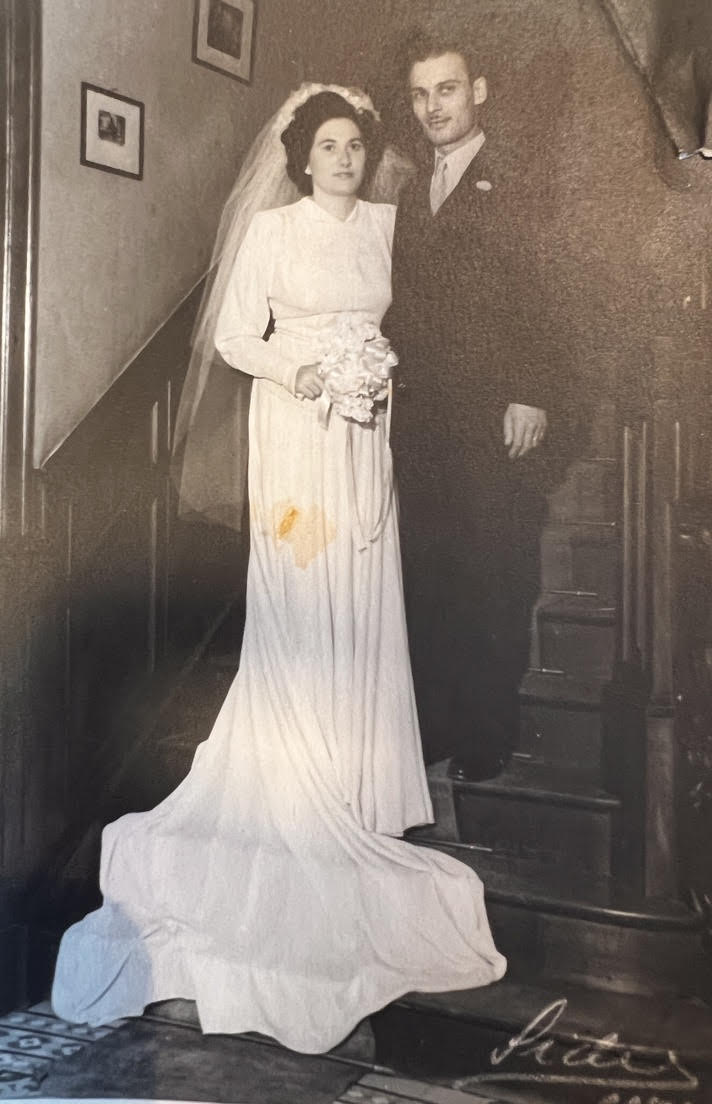
Erika Katz and Fredi Rosenblatt on their wedding day in 1949. Courtesy of Julio Rosenblatt

wedding of Fredi Rosenblatt and Erika Katz 1949. Courtesy of Julio Rosenblatt
Julio was the only child of Fredi Rosenblatt and Erika Katz. Here is a photo of him with his parents, taken in 1954.
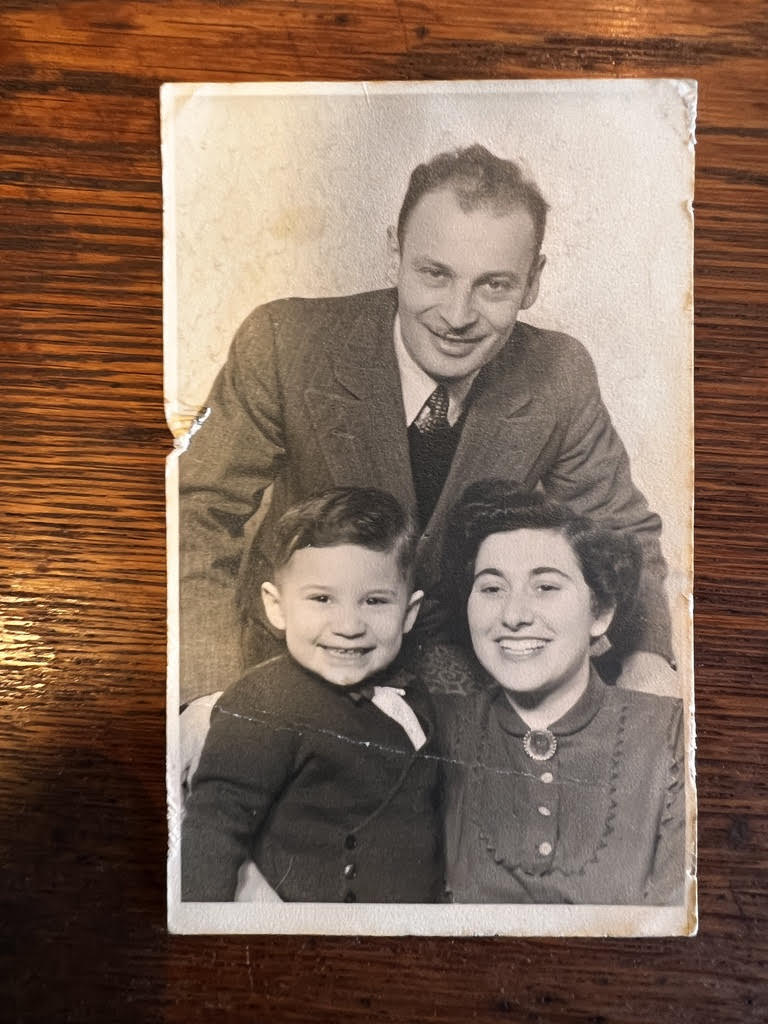
Fredi Rosenblatt, top; Julio Rosenblatt and Erika Katz, bottom. Courtesy of Julio Rosenblatt
Julio is married to Ana Bogacz, and they have two children. This photograph is of Ana with her daughter Beatriz and Julio’s grandmother, Julie Rosenblatt Rosenblatt.
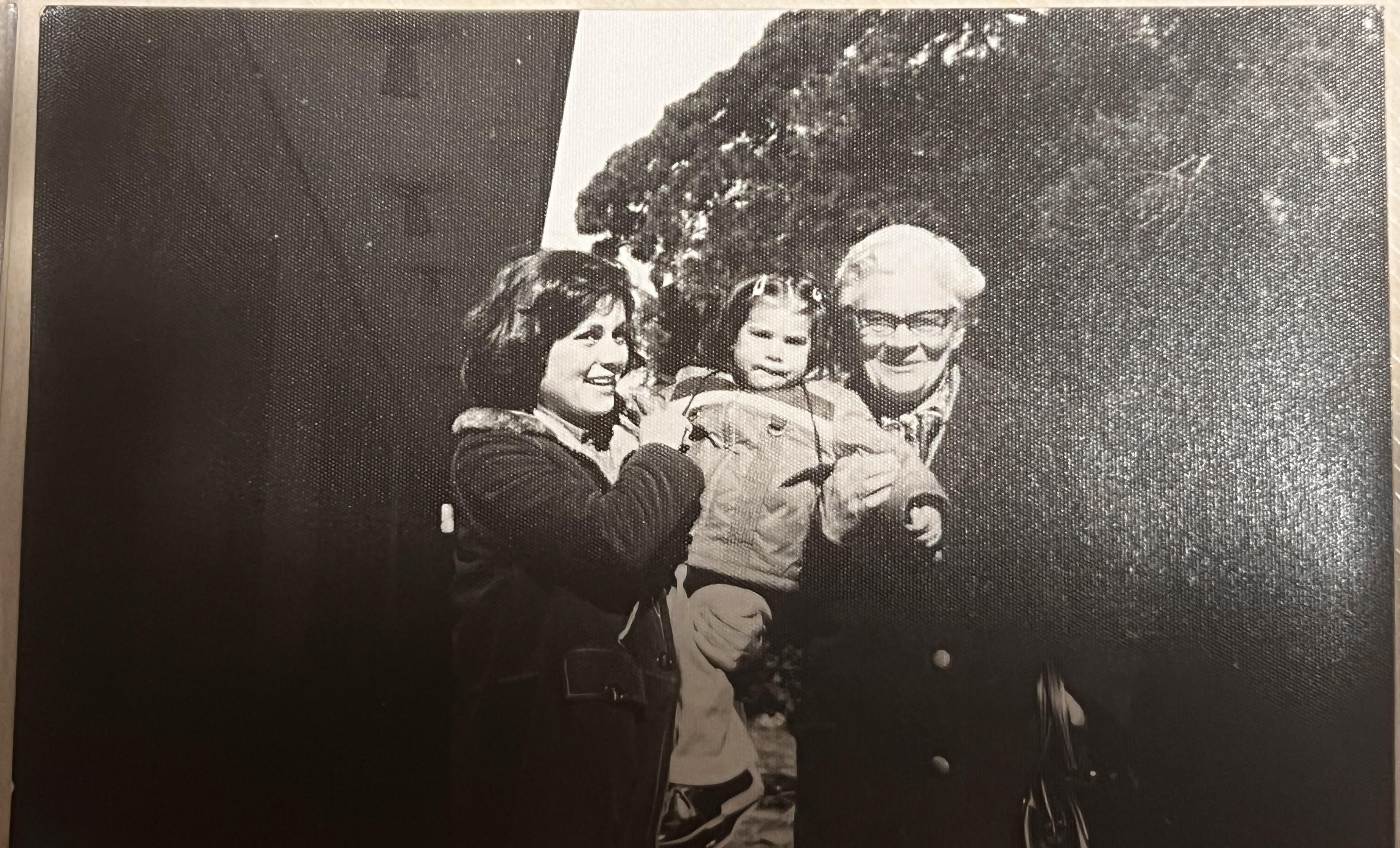
Ana Bogacz, Beatriz Rosenblatt, and Julie Rosenblatt Rosenblatt, in 1976. Courtesy of Julio Rosenblatt
Julio and Ana have two children. One lives in Uruguay and and the other in England. They also have three grandchildren, one in Uruguay and two in England. So Julius Rosenblatt, who died when his son Fredi was just a baby, and his wife, Julie Rosenblatt, have living great-grandchildren living across the world because Julie Rosenblatt Rosenblatt was smart enough and strong enough and lucky enough to leave Germany when she did.
Thank you to my cousin Julio for sharing his stories and these amazing photographs of his family. I am so glad we connected!
 Brotmanblog: A Family Journey