
I have been unable to do any new research in these last few weeks since the horrendous massacre in Israel by Hamas on October 7. I just can’t seem to focus on research right now. Fortunately I had several blog posts ready in my queue and will publish those, including this one. Perhaps the best way I can support Israel right now is to educate and remind people about the long history of persecution of Jews and antisemitism so that they best understand why Israel exists and why it must survive.
Although Friederike’s oldest child Jakob died in 1937 and his widow and daughter were killed by the Nazis, her other three surviving children all managed to escape the Nazis.
Friederike’s son Moses, more commonly known as Moritz, wanted to leave Germany quite early. As described by his son Kurt Leopold Schoen in the oral history interview he did with the US Holocaust Memorial and Museum, Moritz had had a successful wholesale and retail shoe business in Kassel, but once the Nazis came to power the business suffered. Non-Jews boycotted the store, and Moritz had to close the business and work as a shoemaker.1
But leaving Germany was difficult. The family needed affidavits from someone in the US to get a visa to enter the country, and the relatives in the US were reluctant to sponsor a family with three young children. Fortunately, Moritz and Else’s fourteen-year-old daughter Alice was given an opportunity to leave when the National Council of the Jewish Women in the US organized a rescue mission that brought many children out of Germany.2 Alice came to the US on May 13, 1938, and was sent to live with a Jewish family in San Antonio, Texas, the Rosenbergs, as seen on the 1940 US census.3


Alice Schoen passenger manifest, The National Archives and Records Administration; Washington, D.C.; Passenger and Crew Lists of Vessels Arriving at and Departing from Ogdensburg, New York, 5/27/1948 – 11/28/1972; Microfilm Serial or NAID: T715, 1897-1957
Ancestry.com. New York, U.S., Arriving Passenger and Crew Lists (including Castle Garden and Ellis Island), 1820-1957
The website for the Holocaust Memorial Museum of San Antonio reported that Abe and Bella Rosenberg “took [Alice] into their lives as if she were a long lost relative. The Rosenberg children, Miriam and Stanley, and a host of aunts, uncles, and cousins who treated her with affection and kindness made her adjustment to a new life easier.” In his oral history interview, Alice’s brother Kurt mentioned that the Rosenbergs were a very nice family, but nevertheless Alice was naturally very homesick. She did not see her family again until 1940.4
But Alice was able to get help from the Rosenberg family to bring her father Moritz to the US from Germany. As reported on the website for the Holocaust Memorial Museum of San Antonio, they signed affidavits pledging financial support for him.
Once he had an affidavit from the Rosenbergs, Moritz was able to go to the US consulate in Germany and receive a visa. But before he could leave, he was arrested during the Kristallnacht riots in November, 1938. According to his son Kurt, Moritz was not sent to Buchenwald like so many other Jewish men were after Kristallnacht because he already had a visa to leave Germany. He was released within a day or two from police custody in Kassel and prepared to leave for the US.5
Moritz arrived on December 3, 1938, seven months after Alice’s arrival, and settled in New York City. His ship manifest lists his wife Else as the person he was leaving behind in Kassel, Germany, and his sister-in-law Betty Lutz (born Babette Freimark) as the person he was going to in the US. He listed his occupation as a shoemaker.6
Meanwhile, back in Germany, Else and her two young sons Manfred and Kurt moved to Frankfurt; the boys were sent to a Jewish orphanage and Else moved in with one of her sisters. Kurt described the orphanage as a place where he and his brother were well treated. They went to school and learned English. Finally in April 1939, they were released and reunited with their mother and allowed to leave Germany for the US. Kurt, who was eleven at the time, recalled that the Nazis tore through their luggage and stole everything Else had packed except one small teapot.7
Else arrived in New York with Manfred and Kurt (listed as Kurt Leopold Israel on the manifest) on May 19, 1939.
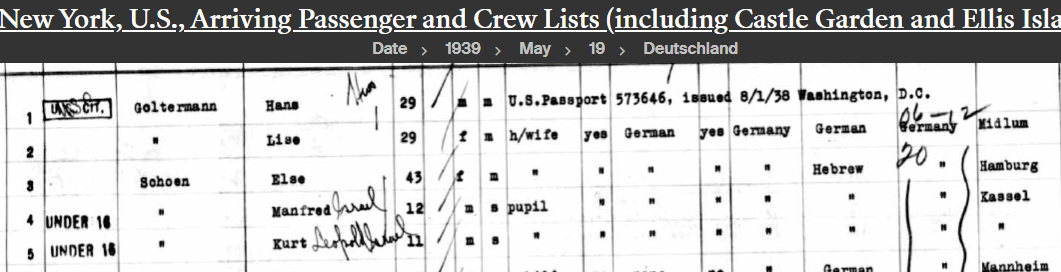
Else Schoen and children, passenger manifest, The National Archives and Records Administration; Washington, D.C.; Passenger and Crew Lists of Vessels Arriving at and Departing from Ogdensburg, New York, 5/27/1948 – 11/28/1972; Microfilm Serial or NAID: T715, 1897-1957
Ship or Roll Number: Deutschland, Ancestry.com. New York, U.S., Arriving Passenger and Crew Lists (including Castle Garden and Ellis Island), 1820-1957
The family moved into a small apartment riddled with bed bugs; Moritz worked doing shoe repairs and barely made a living. But as Kurt said, they were happy to be out of Germany and safely living in New York. They moved frequently from one apartment to another in order to get the benefit of one or two free months of rent being offered by landlords. Manfred and Kurt started school where they quickly learned English and rose from the lower levels of their grade to the highest within a year.8
Alice was reunited with her parents and brothers sometime in 1940 when the Rosenberg family brought her to New York after taking a trip to Canada to see the Dionne Quintuplets. She married just three years later when she was nineteen, according to her brother Kurt.9 Her husband, Albert Bernhard Schwarz, was born on October 22, 1922, in Busenberg, Germany, to Alfred Lazarus Schwarz and Berta Levy. Like Alice, he was refugee from Germany; he had arrived on August 13, 1938.10 He was the only member of his family to survive. His parents and all his siblings were killed by the Nazis.11
Albert entered the US Army on March 26, 1943, listing his marital status as single.12 He and Alice must have married later that year. According to one biography of Albert, he was assigned to Camp Ritchie in Maryland and trained for military intelligence. As a Ritchie Boy, as they were known, Albert was trained to interrogate German prisoners of war. Starting in October 1944 he was with the 7th Armored Division of the II English Army in France and the northern part of Belgium. On November 5-6, 1944, during the Battle of the Bulge, Albert’s jeep hit a German mine near a bridge over the Meuse River. Albert suffered severe head injuries from which he suffered the rest of his life. He was in a coma for over a month in a English military hospital and remained there until February, 1945. He returned to the US in the spring of 1945, but was hospitalized until July. On Aug. 02, 1945, he was discharged from military service at Camp Edward, Massachusetts.13
Alice and Albert had three children born after the war. In 1950 they were living in New York City, and Albert was working as a butcher.14 Alice’s parents Moritz and Else Schoen and her brothers Manfred and Kurt (listed as Leo here) were also living in New York City. Moritz now owned his own shoemaking business. Manfred was an industrial engineer, and Leo/Kurt was a chemist in a cosmetics company.
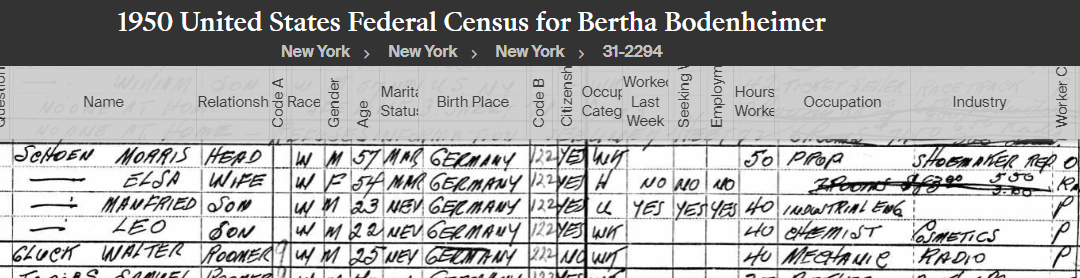
Morris Schoen and family, 1950 US census, National Archives at Washington, DC; Washington, D.C.; Seventeenth Census of the United States, 1950; Year: 1950; Census Place: New York, New York, New York; Roll: 3572; Page: 9; Enumeration District: 31-2294, Ancestry.com. 1950 United States Federal Census
Meanwhile, Moritz’s two remaining siblings had survived the war in Shanghai, China. More on that in my next post.
- Many of the personal details in this post came from Kurt Leopold Schoen’s interview with the USHMM. Kurt L. Schoen, July 24, 2004 interview, Accession Number: 1997.A.0441.512 | RG Number: RG-50.462.0512, United States Holocaust Memorial Museum Collection, Gift of the Gratz College Holocaust Oral History Archive, found at https://collections.ushmm.org/search/catalog/irn566135. Although Kurt is listed as Leopold or Leo on many US records, he used the name Kurt for most of his adult life in the US and will be referred to here as Kurt for that reason. ↩
- See Note 1, supra. ↩
- Alice Schoen, 1940 US Census, Year: 1940; Census Place: San Antonio, Bexar, Texas; Roll: m-t0627-04201; Page: 61A; Enumeration District: 259-6, Ancestry.com. 1940 United States Federal Census ↩
- See Note 1, supra. ↩
- See Note 1, supra. ↩
- Moses Schoen, passenger manifest, The National Archives and Records Administration; Washington, D.C.; Passenger and Crew Lists of Vessels Arriving at and Departing from Ogdensburg, New York, 5/27/1948 – 11/28/1972; Microfilm Serial or NAID: T715, 1897-1957, Ship or Roll Number: Hamburg, Ancestry.com. New York, U.S., Arriving Passenger and Crew Lists (including Castle Garden and Ellis Island), 1820-1957 ↩
- See Note 1, supra. ↩
- See Note 1, supra. ↩
- See Note 1, supra. ↩
-
Albert Schwarz, Declaration of Intention, The National Archives at Philadelphia; Philadelphia, PA; NAI Title: Declarations of Intention For Citizenship, 1/19/1842 – 10/29/1959; NAI Number: 4713410; Record Group Title: Records of District Courts of the United States, 1685-2009; Record Group Number: 21, Description
Description: (Roll 610) Declarations of Intention For Citizenship, 1842-1959 (No 481301-482200), Ancestry.com. New York, U.S., State and Federal Naturalization Records, 1794-1943 ↩ - Family history of Schwarz family, Arbeitskreis Judentum im Wasgau, Elisabeth & Otmar Weber, Schillerstraße 10b, 66994, found at /https://judentum-im-wasgau.de/images/geschichte/jugemeinden/jufbusenberg/02_schwarz_jakob_hauptstr_49_bu.pdf ↩
-
Albert B Schwarz, Race White, Marital Status Single, without dependents (Single)
Rank Private, Birth Year 1922, Nativity State or Country Danzig or Germany, Citizenship Not Yet a Citizen, Residence New York, New York, Education 2 years of high school
Civil Occupation Stock clerks, Enlistment Date 26 Mar 1943, Enlistment Place New York City, New York, Service Number 32874464, Branch No branch assignment, Component Selectees (Enlisted Men), National Archives at College Park; College Park, Maryland, USA; Electronic Army Serial Number Merged File, 1938-1946; NAID: 1263923; Record Group Title: Records of the National Archives and Records Administration, 1789-ca. 2007; Record Group: 64; Box Number: 05772; Reel: 241, Ancestry.com. U.S., World War II Army Enlistment Records, 1938-1946 ↩ - See Note 11, supra. ↩
- Albert Schwarz and family, 1940 US census, National Archives at Washington, DC; Washington, D.C.; Seventeenth Census of the United States, 1950; Year: 1950; Census Place: New York, New York, New York; Roll: 6203; Page: 6; Enumeration District: 31-1913, Ancestry.com. 1950 United States Federal Census ↩



 Brotmanblog: A Family Journey