The Final Chapter for Jakob Schoenthal and His Descendants

As of 1947, the four surviving children and two grandchildren of Jakob Schoenthal and Charlotte Lilienfeld were all settled in western Pennsylvania, living close to each other, Johanna and Erna in Pittsburgh and Lee and Meyer nearby in Washington, Pennsylvania.  Johanna and Erna had survived the Holocaust, as had Erna’s son Werner Haas and the son of their sister Henriette, Helmut Levi.

The next two decades were, however, not kind to the children of Jakob Schoenthal and Charlotte Lilienfeld.  First, on February 7, 1956, Johanna’s husband Heinrich Stern died at age 79; he’d been suffering from arteriosclerosis for years, according to his death certificate, and had been residing in the Jewish Home for the Aged in Pittsburgh.  His doctor had been caring for him since 1953, so Heinrich must have been in poor health for much of his time in the US.


Heinrich Stern death certificate Ancestry.com. Pennsylvania, Death Certificates, 1906-1963 [database on-line]. Provo, UT, USA: Ancestry.com Operations, Inc., 2014. Original data: Pennsylvania (State). Death certificates, 1906–1963. Series 11.90 (1,905 cartons). Records of the Pennsylvania Department of Health, Record Group 11. Pennsylvania Historical and Museum Commission, Harrisburg, Pennsylvania.

Heinrich Stern death certificate
Ancestry.com. Pennsylvania, Death Certificates, 1906-1963 [database on-line]. Provo, UT, USA: Ancestry.com Operations, Inc., 2014.
Original data: Pennsylvania (State). Death certificates, 1906–1963. Series 11.90 (1,905 cartons). Records of the Pennsylvania Department of Health, Record Group 11. Pennsylvania Historical and Museum Commission, Harrisburg, Pennsylvania.

Then the following year, the oldest sibling, Lee Schoenthal, died at age 75 on May 11, 1957.  He also suffered from arteriosclerosis and died from congestive heart failure.  His doctor had been caring for him since 1949, according to the death certificate.  Lee appears to have been the backbone of the family, the one who employed and housed his younger brother Meyer for some years and who also helped his two younger sisters Johanna and Erna as well as his nephew Helmut Levi come to and settle in the US.


Lee Schoenthal death certificate Ancestry.com. Pennsylvania, Death Certificates, 1906-1963 [database on-line]. Provo, UT, USA: Ancestry.com Operations, Inc., 2014. Original data: Pennsylvania (State). Death certificates, 1906–1963. Series 11.90 (1,905 cartons). Records of the Pennsylvania Department of Health, Record Group 11. Pennsylvania Historical and Museum Commission, Harrisburg, Pennsylvania.

Lee Schoenthal death certificate
Ancestry.com. Pennsylvania, Death Certificates, 1906-1963 [database on-line]. Provo, UT, USA: Ancestry.com Operations, Inc., 2014.
Original data: Pennsylvania (State). Death certificates, 1906–1963. Series 11.90 (1,905 cartons). Records of the Pennsylvania Department of Health, Record Group 11. Pennsylvania Historical and Museum Commission, Harrisburg, Pennsylvania.

It was almost three years later that Meyer himself died.  He was 76 years old, and the principal cause of death was a coronary occlusion.  But looking more closely at the death certificate revealed information that might have explained why Meyer had not appeared in any city directories after 1931 and why his sisters and nephew all listed only Lee as the person they knew in the US and not Meyer. It also explains why Lee had not listed Meyer on his World War II draft registration as the person who would always know his address.


Meyer N Schoenthal death certificate Ancestry.com. Pennsylvania, Death Certificates, 1906-1963 [database on-line]. Provo, UT, USA: Ancestry.com Operations, Inc., 2014. Original data: Pennsylvania (State). Death certificates, 1906–1963. Series 11.90 (1,905 cartons). Records of the Pennsylvania Department of Health, Record Group 11. Pennsylvania Historical and Museum Commission, Harrisburg, Pennsylvania.

Meyer N Schoenthal death certificate
Ancestry.com. Pennsylvania, Death Certificates, 1906-1963 [database on-line]. Provo, UT, USA: Ancestry.com Operations, Inc., 2014.
Original data: Pennsylvania (State). Death certificates, 1906–1963. Series 11.90 (1,905 cartons). Records of the Pennsylvania Department of Health, Record Group 11. Pennsylvania Historical and Museum Commission, Harrisburg, Pennsylvania.

Meyer suffered from manic depression (more commonly referred to as bipolar disorder today), which the doctor described as a contributing factor in his death.  Meyer had been living at Torrance State Hospital in Westmoreland, Pennsylvania, for over two and a half years at the time of his death on January 10, 1960.  In other words, he had been hospitalized shortly after his brother Lee’s death in May 1957.  Lee must have been caring for him up to that point.

Lee and Meyer were buried next to each other in Beth Israel cemetery in Washington, Pennsylvania.


The family’s heartbreak continued two years later when young Werner Haas died from Laennec’s cirrhosis of the liver, a form of cirrhosis associated with alcoholism.  According to the death certificate, he had been suffering for months and died after 48 hours in a hepatic coma.  He was only 36 years old.


Werner Haas death certificate Ancestry.com. Pennsylvania, Death Certificates, 1906-1963 [database on-line]. Provo, UT, USA: Ancestry.com Operations, Inc., 2014. Original data: Pennsylvania (State). Death certificates, 1906–1963. Series 11.90 (1,905 cartons). Records of the Pennsylvania Department of Health, Record Group 11. Pennsylvania Historical and Museum Commission, Harrisburg, Pennsylvania.

Werner Haas death certificate
Ancestry.com. Pennsylvania, Death Certificates, 1906-1963 [database on-line]. Provo, UT, USA: Ancestry.com Operations, Inc., 2014.
Original data: Pennsylvania (State). Death certificates, 1906–1963. Series 11.90 (1,905 cartons). Records of the Pennsylvania Department of Health, Record Group 11. Pennsylvania Historical and Museum Commission, Harrisburg, Pennsylvania.

His life had not been an easy one.  He had lost his father before he was five years old, and he had been uprooted from his home in Darmstadt, Germany, and brought to the US.  Then he had served in the US Navy as a fireman, a skilled technician, during World War II.  After the war he had been briefly married to Lillian Angeloff; at the time of his death he was married to Margaret Rusnack, who was more than ten years older than Werner and had a son from a prior marriage.  He had worked as a salesman before and after the war, but in 1950 he had changed occupations and was a driver.  In 1952 he was a construction worker, and then in 1958 and 1959 he was again a driver.  After that he does not appear in the Pittsburgh directories.

It’s hard to imagine what those years between 1953 and 1962 must have been like for the two remaining siblings.  Johanna lost a husband, two brothers, and a nephew, and Erna also lost her brothers, her brother-in-law, and her son.

Erna then lost her remaining sibling, Johanna, on February 23, 1967.  The only close relative who was left was her nephew Helmut Levi (who by that time was named Henry Lyons).  Henry and his wife Pauline continued to live at the same address in Rego Park, New York, until Henry’s death on December 18, 1986.  He was only 67 years old when he died.


Aufbau February 13, 1987 p. 41

Aufbau, February 13, 1987 p. 41


Erna Schoenthal Haas, the youngest child of Jakob and Charlotte, had outlived her parents, her husband, her siblings, her nieces and nephews, and even her son.  Despite all the terrible losses she had suffered including being widowed at a very young age, escaping from Nazi Germany, and losing her only child, she had persevered and even maintained a positive outlook, as this June 14, 1984 article from the Jewish Chronicle of Pittsburgh reveals:


Jewish Chronicle of Pittsburgh, June 14, 1984, p. 23 ewish+Chronicle+Vol.+23+No.+18 Formed+by+the+union+of:+Jewish+criterion+;++and:+American+Jewish+outlook. http://doi.library.cmu.edu/10.1184/pmc/CHR/CHR_1984_023_018_06141984

Jewish Chronicle of Pittsburgh, June 14, 1984, p. 23
Jewish+Chronicle+Vol.+23+No.+18
Formed+by+the+union+of:+Jewish+criterion+;++and:+American+Jewish+outlook.
http://doi.library.cmu.edu/10.1184/pmc/CHR/CHR_1984_023_018_06141984


Notice that Erna only mentioned one brother, presumably Lee, and also explained how her family knew Daniel-Henry Kahnweiler, the renowned art dealer and collector.

Erna died on January 17, 1989, the only sibling to make it to eighty years old, let alone ninety.  She is buried not where her brothers or her sister or even her son is buried, but at Chesed Shel Emeth cemetery near Pittsburgh.

Writing about the lives of Jakob Schoenthal and his children provided a stark contrast to the experience I had writing about Simon Schoenthal and his children.  These two brothers, born just a year apart, had such different lives and legacies. Both died too young and also just a year apart, Jakob in 1903, Simon in 1904. But although Simon and his wife Rose had suffered heartbreak when their daughter Ida died at a young age, overall their lives and their legacy were happy ones.  Simon’s nine surviving children almost all lived very long and happy lives filled with adventures, long marriages, children, and close relationships with each other.


The nine surviving children of Simon and Rose (Mansbach) Schoenthal Photo courtesy of the family of Hettie Schoenthal Stein

The nine surviving children of Simon and Rose (Mansbach) Schoenthal
Photo courtesy of the family of Hettie Schoenthal Stein


Jakob’s five children, on the other hand, were not so fortunate.  Henriette was killed in the Holocaust along with her husband.  Johanna was deported from her home to a camp in France and then somehow survived, probably hiding in France.  As far as I know, Johanna never had children.   Lee Schoenthal and Meyer Schoenthal never married or had children, and Meyer spent some part of his life struggling with mental illness.

I know of  only two grandchildren of Jakob and Charlotte Schoenthal.  Erna had one son, Werner, who died from liver disease, presumably caused by alcoholism, when he was only 36.  Henriette had a son Helmut, who married but had no children. Thus, neither of Jakob’s two grandsons had children.  There are no descendants to carry on that particular family’s line.

I can’t help but wonder how things might have turned out differently for Jakob and Charlotte and their children if they, like their siblings, had chosen to come to the US instead of staying in Germany.


The Children of Jakob Schoenthal and Charlotte Lilienfeld, Part III: Lee and Meyer Come to America

As I wrote in my two last posts, after following a rather convoluted research path, I had discovered that  my great-great-uncle Jakob Schoenthal and his wife Charlotte Lilienfeld had had five children born in Cologne, Germany: Johanna, born in 1880; Lee, born in 1881; Meyer, born in 1883; Henriette, born in 1885; and Erna, born in 1898.[1]   Their father Jakob had died in 1903 when Erna in particular was quite young.  Their mother Charlotte died in 1935.

Four of their five children immigrated to the US: the two sons Lee and Meyer arrived in Washington, Pennsylvania, in the early decades of the twentieth century.  Erna arrived in 1938 with her son Werner; she was a young widow when she arrived. (I am still looking for information about her husband Arnold and hope to have an update soon.) Johanna and her husband Heinrich Stern arrived in 1947, having somehow survived the war and last residing in Lyons, France.

Tragically, Jakob and Charlotte’s remaining child, Henriette, had been murdered by the Nazis along with her husband Julius Levi.  Their son Helmut, however, had left in time.  He came to the US in 1939 and eventually changed his name to Henry Lyons.  He and his wife Pauline nee Schwartz lived for many years in Rego Park, Queens, New York.

Rego Park, Queens, NY By Frank Hindimith [GFDL (http://www.gnu.org/copyleft/fdl.html) or CC-BY-SA-3.0 (http://creativecommons.org/licenses/by-sa/3.0/)], via Wikimedia Commons

Rego Park, Queens, NY
By Frank Hindimith [GFDL (http://www.gnu.org/copyleft/fdl.html) or CC-BY-SA-3.0 (http://creativecommons.org/licenses/by-sa/3.0/)%5D, via Wikimedia Commons

In the next few posts I will address these four children, Lee, Meyer, Erna, and Johanna, as well as the two grandsons Werner and Henry. Who were these people? What were their lives like once they got to the US?  I will discuss Lee and Meyer first and their early years in the US and then their sisters and nephews and what happened to them all during and after World War II.

Lee and Meyer were not the easiest to research.  Not only did I have the problem of distinguishing them from their first cousins with the same names, Lee and Meyer, the sons of Henry Schoenthal, I also had a very difficult time finding them on census reports.   Lee only appears on the 1920 census, Meyer only on the 1930 census.  I have no idea how they evaded so many census enumerators.

Figuring out when each of the brothers arrived was also a puzzle. I can’t find an early passenger manifest for either of them. The 1920 census reports that Lee arrived in the US in 1899, when he would have been eighteen years old, but Lee does not appear on the 1900 census nor does he appear in any of the available Washington, Pennsylvania directories until 1909, when he is listed as a tailor working at 12 East Cherry Avenue in Washington.

In 1911, Lee went back to Germany, presumably to visit his family.  On the ship manifest for that trip (line 26), Lee stated that he had been living at 18 East Cherry Avenue, Washington, Pennsylvania, from 1907 through 1911, but I cannot find him on the 1910 census.


1911 ship manifest for Lee Schoenthal page 1

1911 ship manifest for Lee Schoenthal, line 26 Ancestry.com. New York, Passenger Lists, 1820-1957 [database on-line]. Provo, UT, USA: Ancestry.com Operations, Inc., 2010. Original data: Passenger Lists of Vessels Arriving at New York, New York, 1820-1897. Microfilm Publication M237, 675 rolls. NAI: 6256867. Records of the U.S. Customs Service, Record Group 36. National Archives at Washington, D.C.

1911 ship manifest for Lee Schoenthal, line 26
Ancestry.com. New York, Passenger Lists, 1820-1957 [database on-line]. Provo, UT, USA: Ancestry.com Operations, Inc., 2010.
Original data: Passenger Lists of Vessels Arriving at New York, New York, 1820-1897. Microfilm Publication M237, 675 rolls. NAI: 6256867. Records of the U.S. Customs Service, Record Group 36. National Archives at Washington, D.C.

He does, however, appear in the Washington directories throughout the 1910s beginning in 1911, and he registered for the World War I draft in 1918.  Throughout, Lee was working as a tailor.  My best guess is that he had arrived in the US between 1907 and 1909.


Lee Schoenthal World War I draft registration Ancestry.com. U.S., World War I Draft Registration Cards, 1917-1918 [database on-line]. Provo, UT, USA: Ancestry.com Operations Inc, 2005. Original data: United States, Selective Service System. World War I Selective Service System Draft Registration Cards, 1917-1918. Washington, D.C.: National Archives and Records Administration. M1509, 4,582 rolls. Imaged from Family History Library microfilm.

Lee Schoenthal World War I draft registration
Ancestry.com. U.S., World War I Draft Registration Cards, 1917-1918 [database on-line]. Provo, UT, USA: Ancestry.com Operations Inc, 2005.
Original data: United States, Selective Service System. World War I Selective Service System Draft Registration Cards, 1917-1918. Washington, D.C.: National Archives and Records Administration. M1509, 4,582 rolls. Imaged from Family History Library microfilm.

Meyer, on the other hand, appears in the 1903 and 1905 Washington directories, working as a clerk for Rudolph Hanau and residing at 19 Sherman Avenue, as listed in both directories.  Lee does not appear in either of those directories.  Meyer, like Lee, is not on the 1910 census nor the 1920 census, nor does he appear in the 1909 directory or any other available Washington, Pennsylvania, directory between 1906 and 1928.  According to the 1930 census, the one census which includes Meyer, he arrived in the US in 1923.  But then how explain his listings in 1903 and 1905?  Had he left the US and returned to Germany for all those years, not returning until the 1920s?

I have two ship manifests showing Meyer traveling between Germany and the US, once in 1927 and once in 1929.  The 1927 manifest listing for Meyer states that his occupation was a merchant, that he was 44 years old, born in Koln, and last resided in Washington, Pennsylvania.


Meyer N Schoenthal 1927 ship manifest Year: 1927; Arrival: New York, New York; Microfilm Serial: T715, 1897-1957; Microfilm Roll: Roll 4123; Line: 1; Page Number: 134

Meyer N Schoenthal 1927 ship manifest
Year: 1927; Arrival: New York, New York; Microfilm Serial: T715, 1897-1957; Microfilm Roll: Roll 4123; Line: 1; Page Number: 134


The second page states that his contact in Germany was his brother-in-law, Julius Levi, and that his contact in the US was his cousin, the above-mentioned Rudolph Hanau of 26 Sherman Avenue, Washington, Pennsylvania.


Meyer N Schoenthal 1927 ship manifest, page 2 Year: 1927; Arrival: New York, New York; Microfilm Serial: T715, 1897-1957; Microfilm Roll: Roll 4123; Line: 1; Page Number: 134

Meyer N Schoenthal 1927 ship manifest, page 2
Year: 1927; Arrival: New York, New York; Microfilm Serial: T715, 1897-1957; Microfilm Roll: Roll 4123; Line: 1; Page Number: 134


Of course, when I saw that Rudolph Hanau was Meyer’s cousin, I had to figure out the connection.  After a few hours of looking at Ancestry and the Hessen archives online, I learned that Rudolph’s wife was Johanna Levi, daughter of Moses Levi and Rechel Lilienfeld.  Yep, Lilienfeld.  Rechel Lilienfeld was the sister of Helen and Charlotte Lilienfeld.  Thus, Johanna Levi was Meyer’s first cousin (and also, obviously, a first cousin to Lee, Johanna, Henriette, and Erna Schoenthal).

Her husband Rudolph Hanau was, like my great-grandfather Isidore and his brother Henry, a merchant in the china business in Washington, Pennsylvania. He must have known my great-grandfather well.   Thus, there were a number of other members of the extended family living in Little Washington whom I had not located earlier.

The second page of the 1927 manifest for Meyer’s trip to Germany notes that he had previously been in the US from 1911 through 1927.  This would explain why he is not on the 1910 census, but it doesn’t explain his absence from the 1920 census, unless he had been out of town then also.  It also is inconsistent with the fact that he appears in the 1903 and 1905 directories as well with the information on the 1930 census stating he had arrived in 1923.

The 1929 manifest for Meyer is similar in content to the 1927 manifest, but he now lists his mother Charlotte as his contact in Germany and his brother Lee as his contact in Washington.  Here he claims he had previously been in the US only since 1923, consistent with what he later reported on the 1930 census, but inconsistent with both the directory listings in 1903 and 1905 and the passenger manifest from 1927, just two years earlier.  Could the time periods listed on these manifests report times lived at a very specific address in the US, not time periods in the US generally?

Meyer N Schoenthal 1929 ship manifest page 1

Meyer N Schoenthal 1929 ship manifest page 2

Lee Schoenthal 1929 ship manifest Ancestry.com. New York, Passenger Lists, 1820-1957 [database on-line]. Provo, UT, USA: Ancestry.com Operations, Inc., 2010. Original data: Passenger Lists of Vessels Arriving at New York, New York, 1820-1897. Microfilm Publication M237, 675 rolls. NAI: 6256867. Records of the U.S. Customs Service, Record Group 36. National Archives at Washington, D.C.

Thus, both Lee and Meyer likely arrived in the US in the first decade of the 1900s, but may have spent time back in Germany for various periods.  Lee seems to have been permanently settled in the US by the 1910s, Meyer by the 1920s.

The 1929 directory for Washington, Pennsylvania, lists both Lee and Meyer as tailors, living at different addresses, Lee at 321 Burton Avenue, Meyer at 143 North Avenue, but only about a half mile apart.  As reported on the 1930 census, Meyer was living as a lodger in someone’s home.  In 1931, both Lee and Meyer are again listed as tailors in the directory and both residing at the same addresses provided in 1929.  But for some reason, Lee does not appear on the 1930 census.  (Residing at 321 Burton Avenue on the 1930 census was a couple named Jacob and Ruth Weber, owners of a grocery store; Lee is not listed as living with them.)


1931 Washington PS directory Ancestry.com. U.S. City Directories, 1822-1995 [database on-line]. Provo, UT, USA: Ancestry.com Operations, Inc., 2011.

1931 Washington PS directory
Ancestry.com. U.S. City Directories, 1822-1995 [database on-line]. Provo, UT, USA: Ancestry.com Operations, Inc., 2011.

Lee is listed on several Washington directories in the 1930s, but Meyer is not in any directory after the 1931 issue.  Where was Meyer, and why isn’t he included in the directories after 1931? I was puzzled by his absence.  More on that in a later post.

Thus, by the early 1930s, both Lee and Meyer had been settled in the US for quite some time.  Their sisters were all still living in Germany as was their mother.  That, of course, would all change once Hitler came to power.


[1] The thirteen year gap between Henriette and Erna and the fact that Charlotte would have been 43 in 1898 made me somewhat skeptical of Erna’s birth year, but three sources corroborate that as the correct year, so I have to assume it’s correct. Plus there was a gap of twelve years between my mother and her sibling closest in age, so I know it happens.

Jakob Schoenthal and Charlotte Lilienfeld, Part II: Finding Their Children and Grandchildren

In my last post, I talked about the twisted path I took to find my great-great-uncle Jakob Schoenthal and his wife Charlotte Lilienfeld.  After discovering that their daughter Henriette Schoenthal and her husband Julius Levi had been killed in the Holocaust, I was determined to find out what had happened to Henry Lyons, who was the son of Henriette and Julius Levi and who had filed Pages of Testimony for his parents with Yad Vashem.

I thought that would be easy.  After all, I had a name and a specific address from the Pages of Testimony—99-30 59th Avenue, Rego Park, New York.  And I did almost immediately find a Public Records listing with his name at that address that provided me with his birthdate, October 17, 1919.  But that didn’t tell me much more than what I knew from the Pages of Testimony.

Yad Vashem page of testimony for Henriette Schoenthal Levi


Searching a bit further using the Rego Park address listed on the Pages of Testimony, I found a Pauline Lyons listed at that same address; I assumed that she was Henry’s wife.  Having both names made the search a bit easier since Henry Lyons itself is not exactly a unique name. I was able to use their two names together to find that they are both buried at Calverton National Cemetery and that Henry had died on December 18, 1986, and Pauline on November 30, 2007.  Henry had served in the US military during World War II, beginning his service on November 28, 1942, and thus was entitled to a military burial.  Imagine coming to America as a young man to escape Hitler and then fighting against the country of your birth.

When had he come to the US? Had he and Pauline had children? I wanted to know more.  I assumed Henry had arrived in the US sometime in the mid-to late 1930s.  I also assumed that he had arrived under the surname Levi, not Lyons.  After I wasted a lot of time searching for him under the wrong name, a member of the NYC Genealogy Group found a record for a man named Helmut Levi who had changed his name to Henry Lyons on October 5, 1953, in the city courts in New York.


Helmut Levi change of name to Henry Lyons Ancestry.com. U.S. Naturalization Record Indexes, 1791-1992 (Indexed in World Archives Project) [database on-line]. Provo, UT, USA: Ancestry.com

Helmut Levi change of name to Henry Lyons
Ancestry.com. U.S. Naturalization Record Indexes, 1791-1992 (Indexed in World Archives Project) [database on-line]. Provo, UT, USA: Ancestry.com

Armed with the information about what was probably his original name, I was able to find Helmut Levi on the 1940 census, living as a lodger at 204 West 87th Street in NYC and working as a watchmaker.  I was pretty certain I had found the right person when I saw on the census record that he had been living in Cologne, Germany, in 1935.

I also then found him on a passenger manifest (see line 26 on each page below):

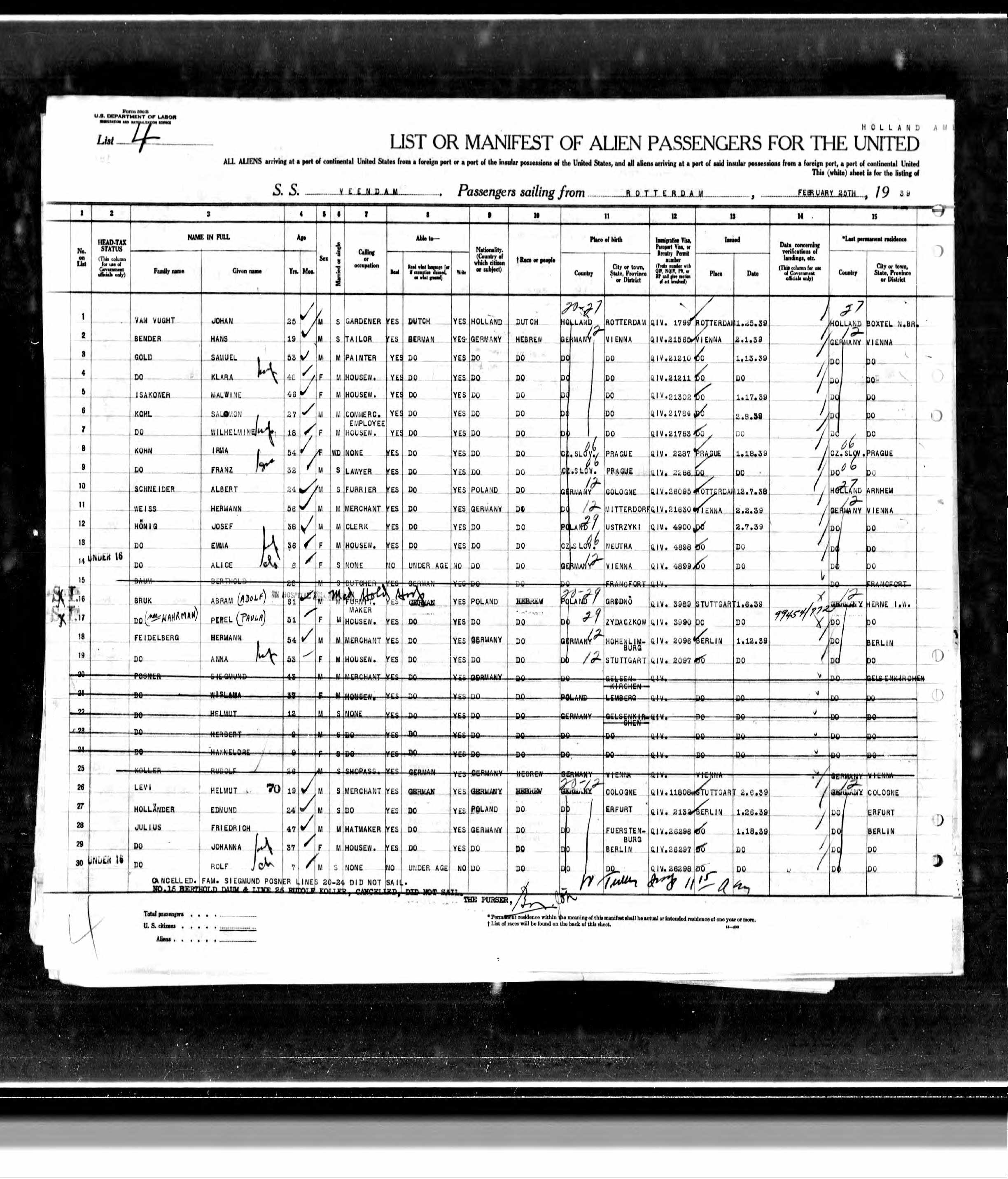
Helmut Levy ship manifest p 1

Helmut Levi ship manifest Henry Lyons

Year: 1939; Arrival: New York, New York; Microfilm Serial: T715, 1897-1957; Microfilm Roll: Roll 6293; Line: 1; Page Number: 188


Helmut Levi had arrived in NYC on February 25, 1939.  According to the ship manifest, he was a nineteen year old merchant born and last residing in Cologne, leaving behind his father Julius Levi of Breitstrasse in Cologne and going to his uncle Lee Schoenthal of Washington, Pennsylvania.  This was obviously my cousin, the man later known as Henry Lyons.

I also found him on a second passenger manifest dated July 4, 1948, arriving in NYC from Bremerhaven, Germany.  Henry had returned to Germany after the war.  What a devastating trip that must have been.  The photo below shows what his home city of Cologne looked like after Allied bombing during the war.  Henry had not only lost his parents, but the place where he had lived as a child and a teenager.


By U.S. Department of Defense. Department of the Army. Office of the Chief Signal Officer. [2] [Public domain], via Wikimedia Commons

By U.S. Department of Defense. Department of the Army. Office of the Chief Signal Officer. [2] [Public domain], via Wikimedia Commons

From that 1948 passenger manifest (line 10), I saw that Helmut Levi was then living in Washington, Pennsylvania, where his two uncles, Lee and Meyer, were also living, that is, his mother’s brothers, the two sons of Jakob and Charlotte mentioned in my last post.  Like so many Schoenthal relatives before him, Helmut had spent time living in western Pennsylvania.  The ship manifest also indicated that by 1948, Helmut had married, although Pauline is not listed as traveling with him.


Helmut Levi aka Henry Lyons 1948 ship manifest

Helmut Levi 1948 ship manifest Year: 1948; Arrival: New York, New York; Microfilm Serial: T715, 1897-1957; Microfilm Roll: Roll 7624; Line: 10; Page Number: 9


But I still didn’t know whether Helmut/Henry and Pauline had had children or whether there were other family members I might have missed.  I called Calverton National Cemetery, but they had no additional information.  I searched in the newspaper databases for articles or obituaries that might reveal more about Henry and Pauline Lyons.  At first I limited myself to New York papers, but then I realized that that was too narrow, given that he had once lived in western Pennsylvania.  I broadened my search and found this obituary from the January 19, 1989, Pittsburgh Press:


Erna Schoenthal Haas obit 1989


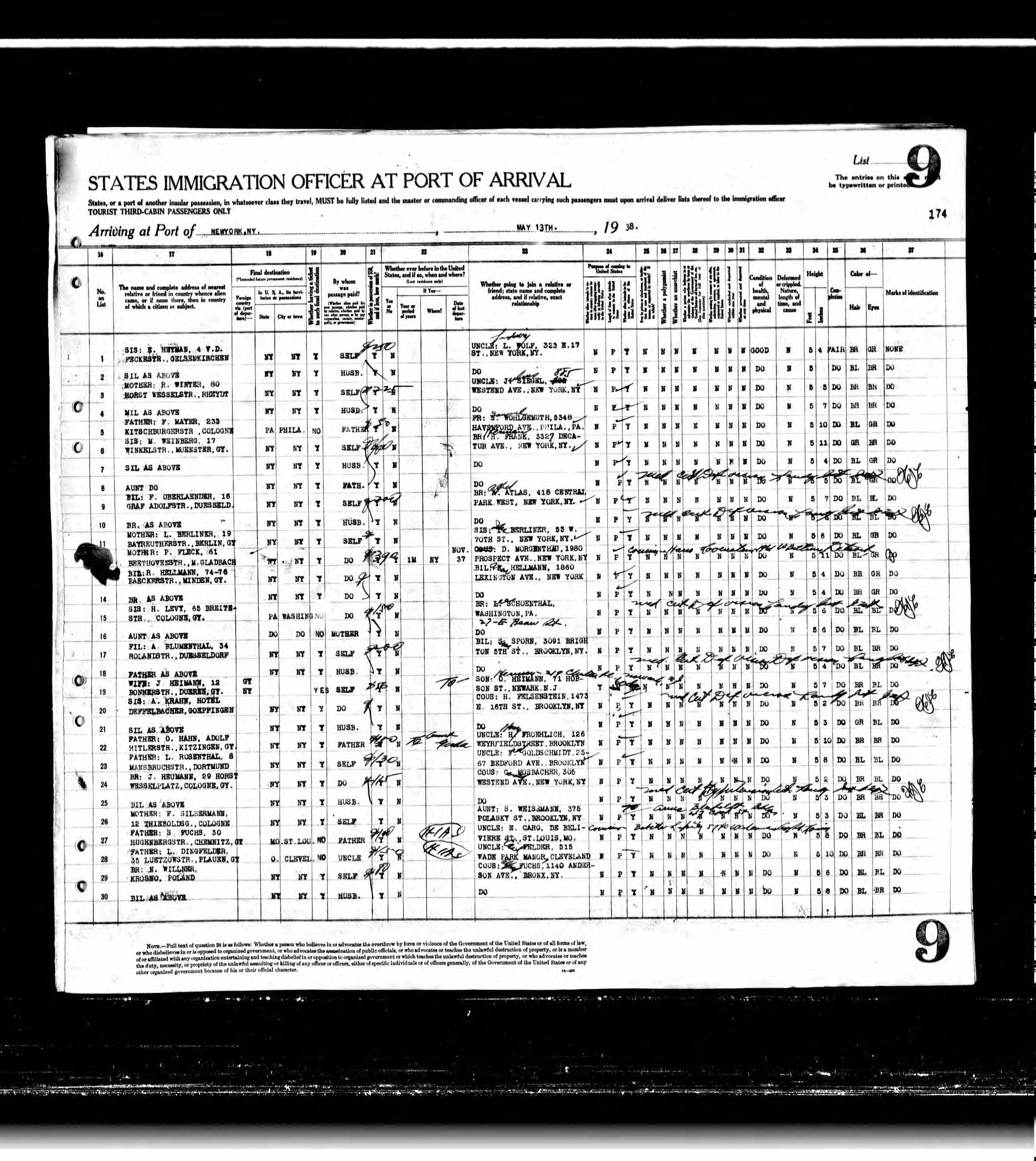
Who was Erna Haas? And was she Henry’s aunt or Pauline’s aunt? And who was Yohana Stern? I had more work to do.  I searched for Erna Haas, an unusual enough name, and was very excited to find this ship manifest (see lines 15 and 16):


Erna Haas ship manifest p 1

Year: 1938; Arrival: New York, New York; Microfilm Serial: T715, 1897-1957; Microfilm Roll: Roll 6152; Line: 1; Page Number: 174


Erna and her twelve year old son Werner had sailed from Hamburg, Germany on May 4, 1938; Erna was a beautician coming from Cologne.  I assumed that therefore her connection would be to Henry, a native of Cologne, not to Pauline, who was American-born.  Turning to the second page of the manifest, my hunch was confirmed (again, see lines 15 and 16):


Erna Haas ship manifest p 2

Year: 1938; Arrival: New York, New York; Microfilm Serial: T715, 1897-1957; Microfilm Roll: Roll 6152; Line: 1; Page Number: 174


Who was the person she named as living in the place she had left? Her sister, H. Levy of Breitstrasse in Cologne—that is, Henriette Schoenthal Levi, who had lived on that street as seen in the Köln directories in my last post. And who was she going to be with in the US? Her brother, Lee Schoenthal in Washington, Pennsylvania.  Erna Haas was another child of Jakob Schoenthal and Charlotte Lilienfeld.  She was also my grandmother’s first cousin.  And the aunt of Henry Lyons.  She was born Erna Schoenthal. I had found a fourth child of Jakob and Charlotte Schoenthal.

In 1940, Erna was listed on the census living with her son Werner in Pittsburgh, Erna working in cosmetics sales, Werner in newspaper sales.  Erna was a widow, so I assume that her husband Arnold had died in Germany, as I have no record of him in the US.  Unfortunately I have not yet found a record for him in Germany either.

But what about Yohana Stern, who had been listed in Erna’s obituary as her sister? I found this obituary for her husband Heinrich while searching for more information about Erna Haas:

Heinrich Stern obit


And then I located a ship manifest for Johanna Stern and Heinrich Stern (lines 3 and 4):


Ship manifest p 1 Johanna Schoenthal and Heinrich Stern


Ship manifest p 2 for Johanna Schoenthal and Heinrich Stern

Year: 1947; Arrival: New York, New York; Microfilm Serial: T715, 1897-1957; Microfilm Roll: Roll 7389; Line: 4; Page Number: 107


They had not arrived in the US until June 10, 1947, when they were 66 and 70 years old.  Notice that Johanna was born in Cologne, presumably around 1880.  How had she and Heinrich survived the Holocaust?  The manifest lists them as “stateless” and notes that they had last resided in “Lyon, France” and that their visas had been issued in “Marseille, France.”

The second page indicates that the person they were leaving behind at their last residence was a friend named Henry Kahnweiler of Paris (more on him in my next post) and the person they were going to see in the US was Johanna’s brother Lee Schoenthal of Washington, Pennsylvania.  Their final destination was Washington, Pennsylvania.  Yohana or Johanna Stern was born Johanna Schoenthal, a fifth child of Jakob and Charlotte Schoenthal. Another of my grandmother’s first cousins.


Thus, Jakob and Charlotte had had five children.  Their two sons Lee and Meyer had emigrated from Germany long before Hitler came to power; they had both settled near their aunt and uncle in Washington, Pennsylvania.    Jakob and Charlotte’s three daughters had stayed behind.  One, Henriette, was murdered by the Nazis with her husband Julius Levi at the Chelmno death camp in 1942, but their son Helmut Levi, aka Henry Lyons, left Germany in 1939 and survived.  Another daughter, Erna, left Germany with her son Werner in 1938.  And finally a third daughter, Johanna, somehow survived the war by going to France, and she and her husband Heinrich Stern came to the US in 1947.

It was a long and twisty road finding these five children, and it was heartbreaking to read of more cousins killed in the Holocaust.  But four of those five children survived and came to the US as did two of Jakob and Charlotte’s grandsons, Henry Lyons and Werner Haas.  More on the lives of these four children and their descendants in my next post.

My Great-great-uncle Henry: The Real Man Revealed

This was a major find, a discovery that has greatly inspired me and uplifted me.

I’ve been researching the Schoenthals in depth for quite a while now, and I’ve been so fortunate to find as much as I have about the family both in German and American records.    As I was preparing a post about Henry and Isidore, my great-grandfather, I decided to see if I could find a picture of Henry.  After all, he was a prominent man in Washington, Pennsylvania for many years.  There had to be a picture of him in a newspaper or archive somewhere.  So I tried Google.

Unfortunately, I didn’t find a photograph of Henry.  But what I found was amazing and did in fact give me a better picture of Henry.  The Jacob Radosh Marcus Center of the American Jewish Archives at Hebrew Union College in Cincinnati, Ohio, had four entries for Schoenthal in its collection: three labeled Henry Schoenthal, one Hilda Schoenthal.   They were titled as papers, a biography, a diary, and a sermon.  I saw this the other evening and was excited, but had no idea how I could see these papers without going to Cincinnati.   So the next morning I called the Marcus Center and spoke to an extremely helpful man there named Joe.  Joe explained that they would scan all the pages of the documents for me for 25 cents a page and email them to me.  There were forty pages in total, and so in less than hour and for only ten dollars, I had the four files in my email.

The folder of Henry’s papers, which date from 1863 to 1866, are in German.  I am going to have to find someone to help me translate them.  But here’s one that confirms Henry’s  (then Heinemann) birth date and place and his father’s name; I think it is a certificate of his training to be a Jewish teacher at the seminary in Cassel, Germany:

Israelitische Lehrerbildungs for Henry Schoenthal Available at the Marcus Center, Cincinnati, Ohio

Israelitische Lehrerbildungs for Henry Schoenthal
Available at the Marcus Center, Cincinnati, Ohio


The biography is a one page biography of Henry Schoenthal written by his daughter Hilda in 1952.  Although much of it was information I already knew, it adds another dimension to this man, making him come to life for me.  I want to look first at the first section of that biography because it will provide greater background to the diary and to the sermon, the remaining two files I received.

Hilda Schoenthal, Biography of Henry Schoenthal dated January 16, 1952. Available at the Marcus Center, Cincinnati, Ohio

Hilda Schoenthal, Biography of Henry Schoenthal dated January 16, 1952. Available at the Marcus Center, Cincinnati, Ohio


Again, although I knew most of the facts reported here, it was wonderful to read it in words written by Henry’s own daughter. I didn’t know how he met his wife or that her father, Meyer Lilienfeld, was a cantor.  And I did not know that Henry was a shochet (kosher butcher) and a chazzan (cantor) as well as a teacher back in Germany.  I wish Hilda had expanded on the political and economic conditions that drove her father to emigrate.  And I found it interesting that Washington was considered somewhat of a center of culture and intellectual activity because of the presence of Washington and Jefferson College in the town. It also gave me a sense of Henry as someone interested in the life of the mind—someone who preferred selling books to students than selling clothing.


English: Western side of on the campus of in W...

Western side of McMillan Hall on the campus of Washington & Jefferson College in Washington, Pa. .. Built in 1793, it is listed on the National Register of Historic Places (Wikipedia)

The diary, which starts in 1866 when Henry arrived in America, starts out in German, but after the first several pages, Henry began to write in English and to use script which I can read.  Reading those pages was very moving, and I will share some of them below.  Thanks to my friend Matthias Steinke, I was able to get the initial pages translated into English.

The diary begins on July 10, 1866, just a few weeks after Henry had arrived in New York, and says that he had just arrived in Washington, PA, and was working for his cousin Jacob Goldsmith in his clothing store (for some reason “clothing store” is written in English).

Diary of Henry Schoenthal 1866-1868 Available at the Marcus Center, Cincinnati, Ohio

Diary of Henry Schoenthal 1866-1868
Available at the Marcus Center, Cincinnati, Ohio

By the next day he had written to his parents and sent them three gold dollars.  He did not receive his first letter from his parents until August 9th and immediately responded, sending them ten dollars in “greenbacks.”   On August 16th, he described a visit from the Democratic candidate for governor of Pennsylvania, Hiester Clymer, and the fanfare surrounding that.  Then there is a long entry about the some criminal activities going on in the town.  Most of the pages in German report on his correspondence with various people back home.

By January 1867, Henry was writing in fluent English.  Just six months in the US, and he was already comfortable with and even preferring to write in English.  I was impressed.  Much of what he continued to write about was his correspondence— naming those to whom he had written and those who had written to him.   This page, with several entries dated in April, 1867, I found particularly interesting.

Henry Schoenthal diary p 9


On Tuesday, April 12,  1867, Henry mentioned that he was beginning to give German lessons to some residents of the town.   On these pages, he also mentioned writing letters not only to his “dear parents” and sending them money, but also writing to his uncle Juda Hamberg from Breuna, who was his mother’s older brother, and to Helene and Recha Lilienfeld.  Helene would later become his wife, and there are numerous mentions of correspondence between Henry and the two Lilienfeld sisters.  On this page he also mentioned that he sent the Lilienfeld sisters his pictures.  I sure wish I could see a copy of those pictures.

Of greatest interest to me on this page, however, is Henry’s comment on Monday, April 22, that he went to Pittsburgh “last Friday and stayed there for the first two days of Passover.”  I was touched that Henry was making an effort to hold on to his traditions and heritage while alone without his parents and siblings nearby.  Of his family members already in the US in 1867, the only one likely to have been in Pittsburgh was Simon Goldsmith, widower of Fanny Schoenthal and thus Henry’s uncle by marriage.

Although Henry may have had his heart set on Helene (also called Helen) Lilienfeld, he was not sitting home.  He mentioned at the bottom of this page that in May 1867 he went to a show with a Miss Emma ? and a Mrs. Flora Conner (?) and did not get home until half past eleven.

One of my favorite diary entries also is dated in May 1867:

Henry SChoenthal diary p 10 A


Why do I like this entry?  Because it mentions my great-grandfather and by his original name, Isaac.  Henry referred to all his siblings by their original names.  Malchen was Amalie, Hannchen was Hannah.  Selig became Felix.  I also liked that Julius was listed, confirming once again that Julius Schoenthal was a sibling.  I imagine Henry writing all those names and looking at the pictures his “dear parents” had sent to him and being somewhat homesick.

But there was some news to alleviate that homesickness.  He mentioned on the next page that Malchen wanted to come to the United States.  He said that she was “anxious to come to this country and I expect to let her come by next fall.”  This seems to suggest that the decision was up to Henry, not his parents or his sister Malchen.  Was this about money?  Henry often mentioned sending money home to his family.

Henry Schoenthal diary p 10 B

But on June 18, Henry wrote that his sister Malchen and brother Simon “intend to come over here next fall,” so perhaps he really did not have control over their decisions to emigrate.

Henry Schoenthal diary p 11


Although Henry was continuing to correspond with “dear Helene” and her sister, he was also exchanging pictures with a Miss Therese Libenfeld in Frankfort and teaching German to several young women in Washington.

On September 9, 1867, Henry reported that he had received a letter from his parents informing him that his brother and sister, Simon and Malchen, had left Bremen on August 17 to sail on the ship SS Watchen.  This is consistent with the ship manifest I found for Simon and Amalie, which has them arriving in New York on September 23, 1867.  The only inconsistency is that the ship manifest record states that the ship was named Wagen, not Watchen.  Close enough.

Henry Schoenthal diary p 13

After that the diary peters out with very few entries between September 1867 and February 1868, the date of the last entry.  My guess is that Henry was busy with his siblings, helping them to adjust to the new country, and perhaps less in need of keeping track of his correspondence.

The very last entry, dated February 24, 1868, records a piece of US history.  Henry wrote: “The House of Representatives just resolved to impeach President Andrew Johnson.”  Unfortunately Henry expressed no opinion or reaction to this occurrence.  Was it upsetting to him? How did he feel about American democracy?  I wish I knew.

Henry Schoenthal diary p 14


I loved reading the diary.  Although it is not terribly intimate or revealing in its content, I can imagine this young man in his early 20s sitting down to keep track of everyone from back home with whom he corresponded.  The fact that the diary ends shortly after the arrival of his sister and brother make me think that the diary’s purpose had at that point been served.  Henry now had some of his family with him and no longer needed the ritual of the diary to help him feel connected.

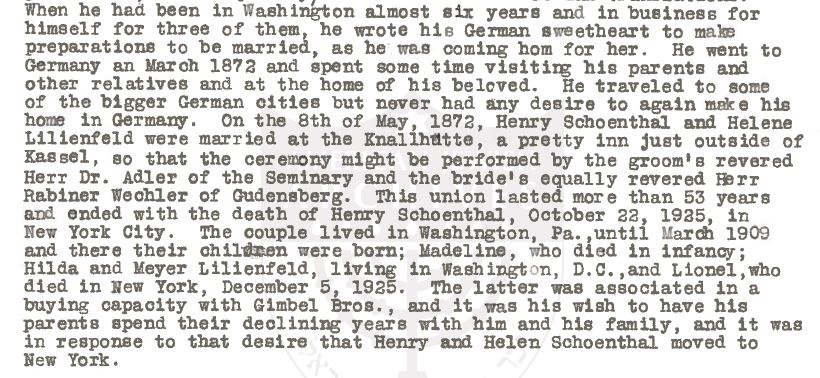
Returning to Hilda’s biography of her father and her description of his life after 1868:

Hilda bio of Henry Schoenthal p 2

I found Hilda’s final paragraph particularly interesting:

HIlda bio of Henry Schoenthal p 3

This was not the image I had of Henry from the documents I’d found or even the newspaper articles.  Henry wasn’t just a successful businessperson.  He was a committed Jew working hard to create and maintain a Jewish community in this small town in western Pennsylvania.  He was still a teacher many years after leaving Trendelburg, Germany, a man interested in books and students and Jewish traditions.  Now I see a whole new dimension to this man who was my great-great-uncle.

The remaining file that I obtained from the Marcus Center was the so-called sermon. For me, this was the most exciting document of all.  The sermon was written by Henry in 1912, three years after he had moved away from Washington to live near his son Lionel in New York City, as mentioned by Hilda.  Henry was by this time almost 70 years old.  From what I can infer, the sermon or speech was to a fraternal organization in Washington given on the occasion of Henry’s return to Washington for a visit.  I will quote the portions I found most touching and most revealing:

Henry Schoenthal 1912 Sermon p 1

He wrote:

I love to come back to Washington to revisit the scenes of my early manhood. For to this place I had come a stranger and you had taken me in.  Here I have spent the greater portion of my years and Washington has been my real home.  To this place I had brought my bride and here my children were born and educated.  Here I made many, many friends and possibly a few enemies.  Here I have lived many happy days and my full share of the other kind.  The latter I have forgotten long ago, the former are ever present in my memory and help to brighten and to make happy the declining days of my years.

Henry Schoenthal 1912 sermon p 2

I do not know whether I shall pass this way again, for the shades of evening are lengthening and the goal may not be very far off.  I gratefully acknowledge that God has been very gracious unto me and that he has blessed me beyond my merits.  He has guided me with a father’s hand to reach and to pass safely the 3 score and ten of which the Psalmist has spoken, and if it should be his holy will to grant me another short space of years, I may even reach the limit of four scores.

Henry Schoenthal Sermon 1912 p 3

Henry Schoenthal 1912 sermon p 4

But whether this should be the last time it is destined for me to have the happiness to meet with you, you may rest assured that I shall always remember this evening, that I shall never forget the courtesy you have shown, the friendship and the fraternal feelings you have extended to me.  And I shall always pray for your happiness and in parting I shall bless you, bless you not in my own words, but the in the words of the High Priest of old when he stood before the assembled multitudes stretching forth his hand and pronouncing the words:

May the Lord bless you and keep you!

May the Lord cause his light to shine upon you and be gracious unto you!

May the Lord turn his face unto you and grant you peace, now and forever more.  Amen!

I admit that my eyes well up with tears every time I read and re-read these words. I am moved by so much of what he said here: his attachment to Washington, PA, as his home, a place that had welcomed a very young man in 1866 and given him a safe place to settle and work.  He mentioned good times and bad, but overall his memories of this place are filled with love for the people he knew there.  I feel his love for this place and for the people and his joy in being there and the sadness he feels in leaving it and perhaps not being able to return another time.  We all have those feelings about places we have lived–whether it is a childhood home, a college campus, a first apartment.  We move on, but a piece of our heart remains behind.

I am also moved by the beauty of his writing.  It’s hard to believe that English was not his first language, as with my cousin Lotte.  Henry’s writing is so poetic, so evocative.  I read it with wonder.

And then Henry closed with the traditional priestly blessing read even today in Jewish prayer services and used as a blessing on many occasions in Jewish life. A blessing we said to our own daughters on Friday nights when they were children.  A blessing that Jews have said and shared for centuries.  I am moved knowing that my ancestor shared in this tradition as well.

Henry had left the seminary, but that experience had never left him.  He remained, as his daughter said, committed to his heritage and proud of it.  He remained a religious man.

Finding these papers was another one of many highlights in my continuing search for the story of my ancestors.  They inspire me to keep looking for more and to keep telling the stories.  Henry Schoenthal wanted history and traditions to continue, and I want his story to live on as well.


My Great-grandfather Comes to America: The Schoenthals in Western Pennsylvania 1880-1890

Map of Pennsylvania highlighting Allegheny County

Map of Pennsylvania highlighting Allegheny County (Photo credit: Wikipedia)

Or how my great-grandfather met my great-grandmother.  I love finding stories about how couples met each other.  From a little tiny news item in a small local paper in 1887, I may have found a clue as to how my Schoenthal/Katzenstein grandparents met each other.

Isidore Schoenthal

Isidore Schoenthal

By 1880, many of the members of the family of Heinemann Schoenthal and Hendel Beerenstein had moved from Sielen, Germany, to the United States.  Their two daughters had arrived first: Fanny and her husband Simon Goldsmith and Mina and her husband Marcus Rosenberg.  They were followed by six of the children of Levi Schoenthal (Fanny and Mina’s brother) and Henrietta Hamberg: Henry, Julius, Amalie, Simon, Nathan, and Felix.

Their father Levi died in 1874; their mother Henrietta was still living in Germany in 1880. Four of the children of Levi and Henrietta were also still in Germany in 1880: Hannah, Jacob, Rosalie, and my great-grandfather Isidore.  All but Jacob would soon be in the United States.

Jacob had married Charlotte Lilienfeld in 1879 and was a merchant living in Cologne (or Koln), Germany.  Charlotte was the daughter of Meyer Lilienfeld and Hannchen Meiberg of Gudensberg, another small town in the Kassel district of Hessen, not far from Sielen.   Charlotte was the half-sister of Helen Lilienfeld, who had married Jacob’s brother Henry in 1872.   Although Jacob and Charlotte never emigrated from Germany, they had two sons who did: Lee, born in 1881, and Meyer, born in 1883. More on them in a later post.

HStAMR Best. 920 Nr. 2610 Standesamt Gudensberg Heiratsnebenregister 1879, S. 10

HStAMR Best. 920 Nr. 2610 Standesamt Gudensberg Heiratsnebenregister 1879, S. 10

Eine Vervielfältigung oder Verwendung dieser Seite in anderen elektronischen oder gedruckten Publikationen und deren Veröffentlichung (auch im Internet) ist nur nach vorheriger Genehmigung durch das Hessische Staatsarchivs Marburg, Friedrichsplatz 15, D-35037 Marburg, Germany gestattet.

HStAMR Best. 920 Nr. 2610 Standesamt Gudensberg Heiratsnebenregister 1879, S. 10

As for the many Schoenthal family members already in the United States, as of 1880 only Henry and his wife Helen (Lilienfeld) and their two young children, Hilda (six) and Lionel (three), were still living in Washington, Pennsylvania, where Henry owned a retail variety store.  Living with them and described as their adopted son was a twelve year old boy named Samuel Hamberg, who was born in South Carolina.  I have to believe that Samuel Hamberg was somehow related to Henry’s mother’s family, the Hambergs of Breuna, but I cannot find the connection.[1]  Henry and Helen would have one more child in the 1880s, a son born in 1883 named Meyer Lilienfeld Schoenthal, named for Helen’s father.

Henry Schoenthal and family 1880 census Year: 1880; Census Place: Washington, Washington, Pennsylvania; Roll: 1202; Family History Film: 1255202; Page: 596A; Enumeration District: 271

Henry Schoenthal and family 1880 census
Year: 1880; Census Place: Washington, Washington, Pennsylvania; Roll: 1202; Family History Film: 1255202; Page: 596A; Enumeration District: 271


Although Henry was the only Schoenthal sibling still in Washington, Pennsylvania in 1880, others were not too far away.  Amalie and her husband Elias Wolfe were now living in Allegheny (today part of Pittsburgh so from hereon I will refer to both Allegheny and Pittsburgh as Pittsburgh), Pennsylvania.  According to the entry in the census record, Elias was a “drover.”  I’d never heard this term before, but according to the Merriam-Webster dictionary online, a drover is “a person who moves groups of animals (such as cattle or sheep) from one place to another.”     Amalie and Elias had three children at the time of the census: Morris was 7, Florence was 5, and Lionel was 2.  A fourth child was born in June, 1880, shortly after the census, a son named Ira.   Two more were born in the 1880s: Henrietta (1883) and Herbert (1885).

Amalie Schoenthal Wolfe and family 1880 census Year: 1880; Census Place: Allegheny, Allegheny, Pennsylvania; Roll: 1086; Family History Film: 1255086; Page: 153C; Enumeration District: 006; Image: 0310

Amalie Schoenthal Wolfe and family 1880 census
Year: 1880; Census Place: Allegheny, Allegheny, Pennsylvania; Roll: 1086; Family History Film: 1255086; Page: 153C; Enumeration District: 006; Image: 0310


As noted in my earlier post, Felix Schoenthal was also still relatively close to Washington, Pennsylvania, living with his wife  Maggie in West Newton, about 25 miles away, where Felix was working as a clerk at the paper mill.  Felix and Maggie also had two children during the 1880s: Rachel (1881) and Yetta (1884).

The other siblings had moved further east.  Julius was in Washington, DC, working as a shoemaker, as described in my last post.  His brother Nathan was also now in DC, working as a clerk in a “fancy store.”  Simon Schoenthal had also moved further east by 1880.  Although he and his family were living in Pittsburgh in 1879, by 1880 he and Rose and their five children had moved to Philadelphia.  Simon was still working as a bookbinder. In the 1880s they would have four more children: Martin (1881), Jacob (1883), Hettie (1886), and Estelle (1889).  In 1891, one more child was added to the family, Sidney.

Simon Schoenthal and family 1880 census Year: 1880; Census Place: Philadelphia, Philadelphia, Pennsylvania; Roll: 1179; Family History Film: 1255179; Page: 12D; Enumeration District: 382; Image: 0218

Simon Schoenthal and family 1880 census
Year: 1880; Census Place: Philadelphia, Philadelphia, Pennsylvania; Roll: 1179; Family History Film: 1255179; Page: 12D; Enumeration District: 382; Image: 0218


But other members of the extended Schoenthal clan still lived in western Pennsylvania.  Fanny Schoenthal Goldsmith’s widower Simon Goldsmith was living in Pittsburgh with their daughter Hannah and her family.  Hannah’s husband Joseph Benedict was a rag dealer, and in 1880 they had three sons: Jacob (10), Hershel (9), and Harry (3).[2]

Simon Goldsmith and Joseph Benedict families on 1880 census Year: 1880; Census Place: Pittsburgh, Allegheny, Pennsylvania; Roll: 1092; Family History Film: 1255092; Page: 508D; Enumeration District: 122; Image: 0683

Simon Goldsmith and Joseph Benedict families on 1880 census
Year: 1880; Census Place: Pittsburgh, Allegheny, Pennsylvania; Roll: 1092; Family History Film: 1255092; Page: 508D; Enumeration District: 122; Image: 0683

As described in an earlier post, Mina Schoenthal Rosenberg and her husband Marcus Rosenberg and their daughter Julia were living in Elk City, Pennsylvania, in 1880.  Their daughter Hannah and her husband Herman Hirsh were living in Pittsburgh with their five children in 1880.  Their daughter Mary and her husband Joseph Podolsky and children were living in Ohio.  Mina’s other two children, Rachel and Harry, are missing from the 1880 census.

Thus, by 1880, there were still a large number of family members in western Pennsylvania; it was still home to most of the extended Schoenthal clan.  It is not surprising that when my great-grandfather Isidore arrived with his mother and sister Rosalie, they ended up in western Pennsylvania as well.

My great-grandfather Isidore, his mother Henrietta Hamberg Schoenthal, and his younger sister Rosalie arrived in New York on September 3, 1881, upon the ship Rhein, which had sailed from Bremen.  Isidore was 22, Rosalie was seventeen, and Henrietta was 64 years old.  They settled in Washington, Pennsylvania, where Henry was living. Isidore worked as a clerk in Henry’s variety store.

Henrietta died just a year later in December, 1882; she was buried at Troy Hill cemetery in Pittsburgh.  Washington did not yet have a Jewish cemetery.  Although I could not find an American death certificate, Henrietta’s death was recorded back in Sielen even though she had died in the US.

Henrietta Hamberg Schoenthal death record from Sielen HHStAW Abt. 365 Nr. 773, S. 10

Henrietta Hamberg Schoenthal death record from Sielen
HHStAW Abt. 365 Nr. 773, S. 10

Henrietta’s brother-in-law Simon Goldsmith died a few months later on March 17, 1883.  He also was buried at Troy Hill.

Rosalie Schoenthal, the youngest child of Levi and Henrietta, returned to Germany where she married William or Willie Heymann in Geldern, Germany, on December 8, 1884.  She and Willie would have four children born in Geldern: Lionel (1887, for Rosalie’s father Levi, presumably), Helen (1890), Max (1893), and Hilda (1898).  I assume that either Helen or Hilda was named for Rosalie’s mother Henrietta.  The two sons ended up immigrating to the United States; the two daughters and their families perished in the Holocaust.  But more on that in a later post.

There would be one more Schoenthal sibling who would immigrate to the US: the oldest child, Hannah.  Hannah had had a child out of wedlock in 1865, a daughter named Sarah whose father is unknown.

birth of Sarah Schoenthal, daughter of Hannah HHStAW fonds 365 No 772 p12

birth of Sarah Schoenthal, daughter of Hannah Schoenthal, in Sielen, 1865
HHStAW fonds 365 No 772 p12

[Translation: “Hannchen Schönthal (Tochter des Schuhmacher=Meister Levi Schönthal zu Sielen) uneheliche Mutter.”…..Hannchen Schönthal (daughter of the master shoemaker (cobbler) Levi Schönthal of Sielen) unmarried mother.]

Hannah later married Solomon Simon Stern in Sielen, Germany, on August 19, 1874, five months after her father Levi died.  She was 29 years old at that time.  Solomon was 57.

Marriage of Solomon Stern to Hannah Schoenthal HHStAW Abt. 365 Nr. 839, S. 22

Marriage of Solomon Stern to Hannah Schoenthal in Sielen
HHStAW Abt. 365 Nr. 839, S. 22

Together they would have three children: Jennie, born June 20, 1875; Edith, born September 7, 1877; and Louis, born May 17, 1879.  Solomon Stern died February 20, 1888, and Hannah and their three children emigrated from Germany shortly thereafter.  According to later census records, Hannah and the three children all emigrated in 1888.

Solomon Stern gravestone inscription HHStAW Abt. 365 Nr. 842, S. 11

Solomon Stern gravestone inscription
HHStAW Abt. 365 Nr. 842, S. 11

Hannah and her children settled in Pittsburgh, where her sister Amalie and her husband Elias Wolfe and their six children, named above, were still living.  Elias continued to work as a drover.  Hannah and Amalie’s brother Felix also was in Pittsburgh by that time, having relocated there from West Newton by 1882.  He was working as a bookkeeper.  In 1889 he opened his own store:

 Pittsburgh Daily Post, 9 Apr 1889, Tue, Page 3

Pittsburgh Daily Post, 9 Apr 1889, Tue, Page 3

Also living in Pittsburgh in the 1880s was their Schoenthal cousin, Hannah Goldsmith Benedict, and her husband Joseph and three children, Jacob, Herschel, and Harry; Joseph was selling rags and paper stock.  Joseph became entangled in a rather gruesome lawsuit involving the sale of rags to a paper mill.  The purchaser had failed to pay the purchase price, and Joseph had sued for payment.  The purchaser alleged that they were not liable for the purchase price because the rags had been infected with the smallpox virus, and several of the purchaser’s employees had taken ill, causing the shutdown of the purchaser’s mills.  Thus, the purchaser claimed it had been damaged by loss of business in an amount exceeding what it allegedly owed Joseph Benedict.

 Pittsburgh Post-Gazette, 5 Sep 1882, Tue, Page 1

Pittsburgh Post-Gazette, 5 Sep 1882, Tue, Page 1

This would have been a fun case for me to teach in my days as a law professor teaching Contracts.  It is similar to a famous case taught in most Contracts courses called Hadley v. Baxendale.  Was the shutdown of the paper mill a foreseeable consequence of the seller’s defective product? Here there are also issues of negligence, breach of warranty, damages, and so on.  It would have been a great exam question. Fortunately for Joseph Benedict, the court refused to set aside the judgment in his favor, and the paper mill was held liable for the purchase price of the rags.

Another Schoenthal cousin, Hannah Rosenberg Hirsh, and her husband Herman and their five children, Morris, Nathan, Carrie, Harry, and Sidney, were also living in Pittsburgh; Herman was in the varnish business, at first for the Michigan Furniture Company and then in his own business manufacturing varnish.

Hannah thus had many family members close by in Pittsburgh to provide support as she raised her three children alone in the new country.

My great-grandfather Isidore lived in Pittsburgh for some time also around 1887 through 1889, working as a floor walker in a retail store, at least according to the listings in the Pittsburgh city directories for those years.  But sometime in early 1888 he married my great-grandmother Hilda Katzenstein in Philadelphia.  Hilda was the daughter of Eva Goldschmidt and granddaughter of Seligmann Goldschmidt.  As discussed in an earlier post, Seligmann Goldschmidt was the brother of Simon Goldschmidt, who became Simon Goldsmith and who had married Isidore’s aunt, Fanny Schoenthal. Thus, Hilda and Isidore were already related to each by marriage. In addition, Hilda’s brother S.J. Katzenstein was a merchant, living in Washington, Pennsylvania.  I don’t know whether my great-grandparents met through S.J. in Washington, Pennsylvania, or through their mutual cousins, the Goldsmiths, or perhaps even through Isidore’s brother Simon, who lived in Philadelphia, where Hilda had been born and raised.

But I did find this important clue:

The Daily Republican (Monongahela, Pennsylvania) 11 Aug 1887, Thu • Page 4

The Daily Republican
(Monongahela, Pennsylvania)
11 Aug 1887, Thu • Page 4

Was this when Isidore and Hilda met—at a gathering at the house of a man named Henry Florsheim who lived in Finleyville? And who was he?  A little research revealed that Henry Florsheim was born in 1842 in Gudensberg, Germany, the same town where Helen and Charlotte Lilienfeld were born, the wives of Henry Schoenthal and Jacob Schoenthal, respectively.

Henry (Hienemann) Florsheim birth record HHStAW Abt. 365 Nr. 384, S. 35

Henry (Heinemann) Florsheim birth record from Gudensberg
HHStAW Abt. 365 Nr. 384, S. 35

In fact, according to research done by Hans-Peter Klein as reflected on his incredibly helpful website found here, Henry Florsheim’s sister married Helen Lilienfeld’s brother in Gudensberg in 1872, the same year that Helen Lilienfeld married Henry Schoenthal.  According to the 1910 census, Henry Florsheim came to the US in 1876, so the two families were already related by marriage when he arrived.  In 1880 Henry Florsheim was a merchant, living in Union Township in Washington County, Pennsylvania, about 20 miles from the city of Washington, PA.  An article in the January 31, 1887, Pittsburgh Daily Post (p.4) , reported that he was the proprietor of the Union Valley coal mines and had been presented with a gold watch by the citizens of Finleyville, a town about 16 miles from Washington and two miles from Union Township. Thus, in just a decade, Henry Florsheim had made quite a mark on his community.  Was this successful businessman the one who was responsible for bringing my great-grandparents together?  If so, thank you, Mr. Florsheim![3]

Hilda Katzenstein Schoenthal

Hilda Katzenstein Schoenthal

That was not the end of Henry Florsheim’s role in my great-grandparents’ lives.  In 1889, he hired my great-grandfather to work in his store in Finleyville; this news article suggests that they were still living in Pittsburgh before that opportunity arose.

The Daily Republican (Monongahela, Pennsylvania) 8 Nov 1889, Fri • Page 1

The Daily Republican
(Monongahela, Pennsylvania)
8 Nov 1889, Fri • Page 1

Isidore and Hilda’s first child, my great-uncle Lester Henry Schoenthal, was born on December 3, 1888.  I assume that, like all the Lionels and Leo and Lee, he was named for Isidore’s father Levi.  About three years later on January 20, 1892, Isidore and Hilda had a second son, Gerson Katzenstein Schoenthal, named for Hilda’s father.  Their third child, Harold, and their fourth and youngest child, my grandmother Eva, would not arrive until after the 20th century had begun.

Thus, by 1890, the Schoenthal family had deep and wide connections to western Pennsylvania.  My next post will catch up with those family members who were living elsewhere in the 1880s: Washington DC, Ohio, and Philadelphia.


[1] All I can find about Samuel’s background is that he appears to have been the son of Charles Hamberg, who was born in Germany and emigrated before 1850; in 1853, Charles married Mary E. Hanchey in New Hanover, North Carolina.  She, however, was not Samuel’s mother because she was murdered on November 18, 1866.  On the 1870 census, Charles was living with a 21 year old woman named Tenah Hamberg and two year old Samuel. Since the 1870 census did not report information about the relationships among those in a household, I don’t know for sure whether Tenah was Charles’ wife or Samuel’s mother. Charles died in 1879, and the administrix of his intestate estate was a woman named Amalia Hamberg.  I don’t know who Amalia was or how she was related to Charles.  But by 1880, twelve year old Samuel had moved to Washington, Pennsylvania, to live with Henry.

[2] There were also two young boys, Jacob and Benjamin Goldsmith, living with them and a 21 years old named Jacob Basch.  They were labeled “grandsons,” but they had to be Simon’s grandsons, not Joseph and Hannah’s grandsons.  Jacob Basch was the son of Simon’s daughter Lena from his first marriage, who had married Gustav Basch.  I don’t know who the parents of Jacob and Benjamin Goldsmith were.

[3] That little article about Henry Florsheim’s party also led me to another question: who was the woman named Sarah Stern who also attended this gathering? I assumed she must have been a relative since everyone else at the Floersheim event was part of the Schoenthal or Katzenstein families, and I only knew of one Stern in the family—Solomon Stern who had married Hannah Schoenthal, the older sister of Henry, Isidore, and the other children of Levi Schoenthal.  Hannah’s first child, born before she married Solomon Stern, was named Sarah.  Was this Sarah Stern the same person, taking on her stepfather’s surname? Further investigation would support that conclusion, as I will describe in a later post.

Another Twisted Family Tree Story: The Goldsmiths/Goldschmidts

One thing that has amazed me before in my research is how often various lines in my family interconnect, like the Hano, Nusbaums, and Cohens in Philadelphia.  In researching the Schoenthals, I’ve once again encountered one of those twists in my family tree.

In my September 25 post I shared the numerous records I was able to find, with the help of several others, for my Schoenthal ancestors, including the marriage record of my great-great-grandparents, Levi Schoenthal and Jhette (or Henrietta) Hamberg in 1839.  That record revealed that Levi’s father was Heinemann Schoenthal and his mother Hendel (or Handel) Beerenstein.  For the moment that is as far back as I’ve been able to go with my Schoenthal line, though I hope to be able to find more about the earlier history of both the Schoenthal line and the Beerenstein line.

Marriage record for Levi Schoenthal and Jhette Hamberg HHStAW, 365, 386

Marriage record for Levi Schoenthal and Jhette Hamberg
HHStAW, 365, 386

Thanks to the research done by David Baron and my third cousin Roger Cibella, I now know that Heinemann and Hendel had at least one other child, a daughter named Fradchen or Fanny, who was born in 1800 in Sielen, making her twelve years older than her brother Levi. (Hans-Peter Klein has uncovered another sibling, Minna, but that’s a story for another day.)

Unfortunately I’ve not yet found a birth record for Fanny, but there is a marriage record to support that conclusion.  David and Roger sent me a copy of this marriage record dated September 10, 1844 from Oberlistingen, a town very close to Breuna (and now one of the districts of the town Breuna).

Marriage of Simon Goldschmidt and Fradchen Schoenthal HHStAW Abt. 365 Nr. 669, S. 11

Marriage of Simon Goldschmidt and Fradchen Schoenthal
HHStAW Abt. 365 Nr. 669, S. 11

As translated for me by Matthais Steinke, the record records the marriage of Fradchen Schoenthal, daughter of Heinemann Schoenthal and Hendel Beerentstein, to Simon Goldschmidt, son of Jacob Goldschmidt and Hewa Seligmann.  (No, I do not think Hewa Seligmann was related to my Seligmanns, but who knows? But that’s not the twist here.)  The record lists Fanny as 37 years old in 1844, thus born in 1807.  Simon is listed as 42 on the marriage record and is described as a master tailor.

According to David and Roger’s research, Simon had been married once before to Edeline or Ella Katzenstein. (I also don’t know if Simon’s first wife was related to my Katzensteins, but I am looking into that.  But that also is not the twist here.)  Simon and Ella had five children before Ella died in 1840. Their children ranged from Jacob, who was 16 when his mother died, down to Josias, who was only a year old when Ella died. There were also two daughters, Lena and Hewa (Eva), and another son, Joseph.  Four years after Ella died, Simon married Fanny.

Almost exactly a year after their wedding, Simon, Fanny, and Simon’s nine year old daughter Eva (Hewa) from his first marriage emigrated from Germany to the United States, arriving in Baltimore on the ship Marianne on September 20, 1845. Simon listed his occupation as a tailor on the ship manifest.

Passenger manifest for Simon Goldschmidt, Fanny Schoenthal and Eva Goldschmidt Ancestry.com. Baltimore, Passenger Lists, 1820-1964 [database on-line]. Provo, UT, USA: Ancestry.com Operations Inc, 2006. Original data: Selected Passenger and Crew Lists and Manifests. National Archives, Washington, D.C.

Passenger manifest for Simon Goldschmidt, Fanny Schoenthal and Eva Goldschmidt
Ancestry.com. Baltimore, Passenger Lists, 1820-1964 [database on-line]. Provo, UT, USA: Ancestry.com Operations Inc, 2006.
Original data: Selected Passenger and Crew Lists and Manifests. National Archives, Washington, D.C.

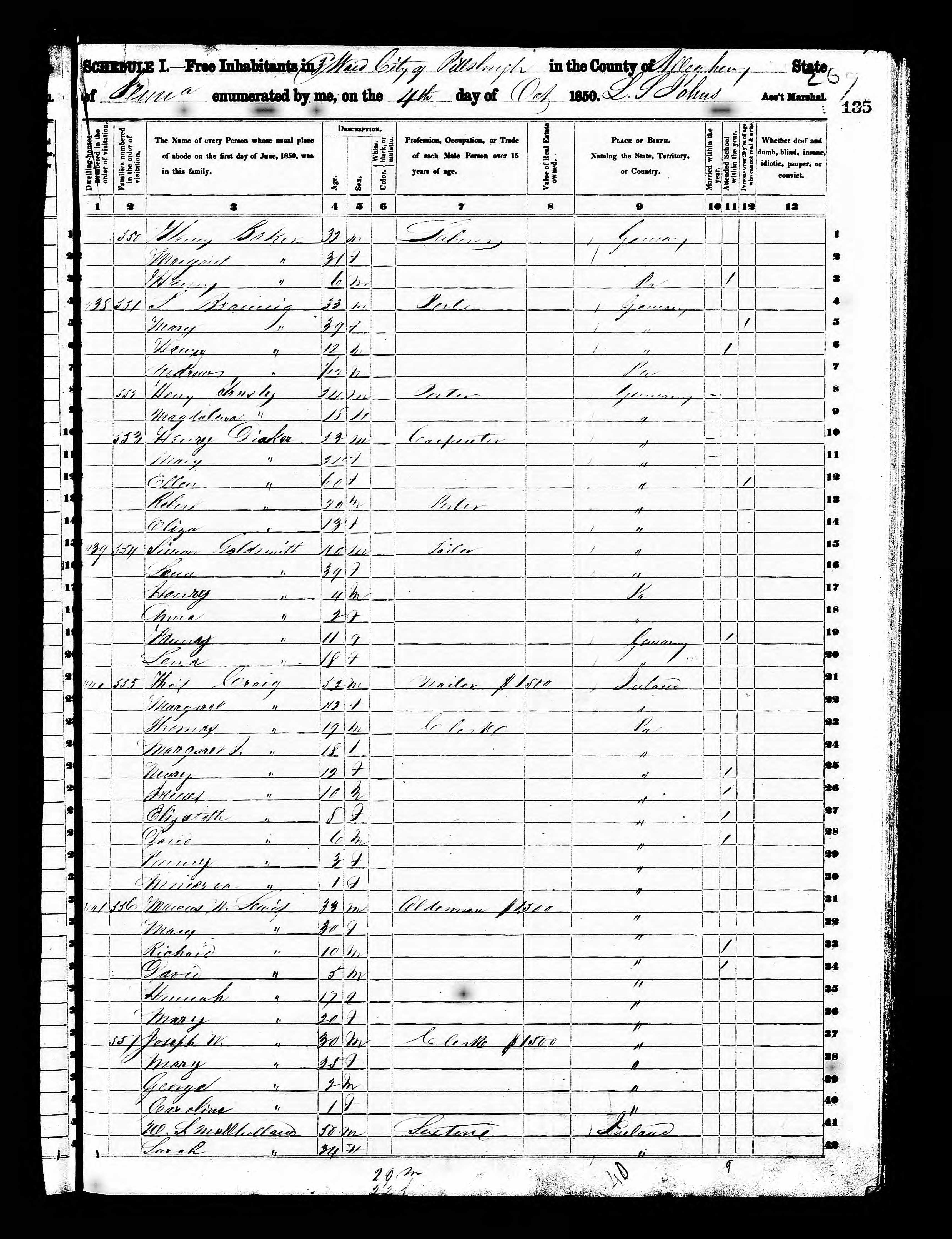
On January 10, 1847, Fanny gave birth to a son, Henry.  One year later Fanny and Simon had another child, a daughter named Hannah, born on June 5, 1848.  Both Henry and Hannah were born in Baltimore, Maryland.[1]  In 1850, the family was living in Pittsburgh along with Simon’s two daughters from his first marriage, Eva and Lena.  (The census record has many errors, but it is clear that this is Simon and Fanny’s family even though the record has the names mixed up and the ages inaccurate.)

Simon Goldsmith 1850 US census

Simon Goldsmith and family 1950 US Census Year: 1850; Census Place: Pittsburgh Ward 3, Allegheny, Pennsylvania; Roll: M432_745; Page: 135A; Image: 274

Tragically for the family, just two years after giving birth to Hannah, Fanny died in 1850.  She was buried at Troy Hill Jewish Cemetery in Pittsburgh.   Some readers might remember that that is also where the elusive Fanny Wiler is buried, another mother who left young children behind after an untimely death.

Fanny Schoenthal Goldsmith Troy Hill Pittsburgh

By 1860, Simon Goldsmith had moved with his two young children to Washington, Pennsylvania, a town about 28 miles to the southwest of Pittsburgh.    Simon, Henry, and Hannah were living with Simon’s son from his first marriage, Jacob, who was now 35 years old, according to the 1860 census, and working as a merchant.  Jacob and his wife had six young daughters of their own by 1860, so it must have been quite a crowded household.[2]

Simon Goldsmith and family 1860 US census Year: 1860; Census Place: Washington, Washington, Pennsylvania; Roll: M653_1192; Page: 1188; Image: 627; Family History Library Film: 805192

Simon Goldsmith and family 1860 US census
Year: 1860; Census Place: Washington, Washington, Pennsylvania; Roll: M653_1192; Page: 1188; Image: 627; Family History Library Film: 805192


Washington, Pennsylvania (called “Little Washington” by some locals) was then a town of 3,587 people, according to the 1860 census reports, and had grown by 34% since the prior census in 1850. There was not yet a railroad line to the town at that time.  What drew all those people to this town?  The town’s website does not provide many clues in its history section:

With immigrants from the west of Scotland and the north of Ireland, and with many transferring their homes from the eastern and central parts of Virginia, the vicinity of Washington was settled in 1768. The Pennsylvania legislature passed an act on March 28, 1781, erecting the County of Washington and naming Catfish Camp as the place for holding the first election. This was the first county in the U.S. to bear the name of Washington.

David Hoge laid out a plan of lots immediately after the action of the legislature. His original plot bears the name “Bassett, alias Dandridge Town,” but before the plot was recorded, lines were drawn through “Bassett, alias Dandridge Town” with ink, and the word “Washington” was written above.

The town started with every evidence of progressive tendencies, as the original plot dedicated a tract of ground to the people for recreational purposes. A lot was given for a courthouse where the current building now stands, and Lots 43 and 102, according to the plan, were presented by Mr. Hoge to “His Excellency, General Washington, and Mrs. Washington.” Part of the townsite had been the camp of Tingoocqua, who was a chief in the Kuskuskee tribe of Indians.

The town was incorporated as a borough on February 13, 1810, and became a city of the third class in 1924.

Map of Washington County, Pennsylvania, United...

Map of Washington County, Pennsylvania, United States Public School Districts (Photo credit: Wikipedia)

There is a very detailed history[3] of Washington, Pennsylvania, available online through the University of Pittsburgh Historic Pittsburgh websiteOne tidbit I picked up from this history was that Jacob Goldsmith served on the town council in 1858.

Unfortunately, most of this text is devoted to describing the political history of the area and the individuals who were political leaders, and I could not get a sense of what drew people to the area initially.  Was it the proximity to Pittsburgh? Was it a good location for trade? Was agriculture the primary source of income? Whatever the reason that drew people there initially, the town had existed for many years by the time my relatives arrived.   From the 1860 census, I know that Jacob was a merchant, and I assume that with a town of over 3,500 people, there would have been a large enough population to support many merchants.

English: Map of Washington Pennsylvania from 1897

English: Map of Washington Pennsylvania from 1897 (Photo credit: Wikipedia)

One thing seems clear, however.  When Simon Goldsmith lived in Washington, Pennsylvania, in 1860, there was no synagogue there.  The first synagogue in all of Washington County, Beth Israel, was not founded until 1891. Although my ancestors had lived in small towns in Germany with very small Jewish communities, they had at least had synagogues and schools and cemeteries for their community.  I am not sure that when Simon arrived, there were any such facilities.

Why, you might wonder, am I dwelling on this town in western Pennsylvania where the widower of my great-great-grandfather’s sister lived with his two children? Because six years later, my great-grandfather’s brother Henry Schoenthal arrived in Washington with his wife and children, and some of his siblings followed in the years after.  Last to come in 1881 was my great-grandfather Isidore, accompanied by his mother Henrietta and his sister Rosalie.  And 23 years later in 1904, my grandmother Eva Schoenthal was born in Washington, Pennsylvania, the youngest child and only daughter of Isidore Schoenthal and Hilda Katzenstein.  It seems to me that Henry did not choose Washington randomly, but rather based on the fact that his first cousin Jacob Goldsmith and his aunt’s widower Simon Goldsmith were living there.

But I promised you a twist, and I still haven’t delivered.  Here it is. Simon Goldsmith was not only my great-great-aunt’s husband; he was also my four-times great-uncle himself.   Simon Goldsmith, husband of Fanny Schoenthal, had a brother named Seligmann Goldschmidt.  Seligmann had a daughter named Eva, just as his brother Simon did (both named for their grandmother, Simon and Seligmann’s mother Hewa).  Seligmann’s daughter Eva Goldschmidt was my great-great-grandmother; she married Gerson Katzenstein, my great-great-grandfather, and they were the parents of Hilda Katzenstein, who married Isidore Schoenthal, nephew of Fanny Schoenthal. Hilda Katzenstein and Isidore Schoenthal were my great-grandparents.

Stated as simply as possible, Simon Goldsmith was my four times great-uncle.  His wife Fanny Schoenthal was my three times great-aunt.   My grandmother Eva Schoenthal was a first cousin once removed from Henry Goldsmith, Simon and Fanny’s son, through her father’s side and his mother’s side:

Relationship_ Henry Goldsmith to Eva Schoenthal

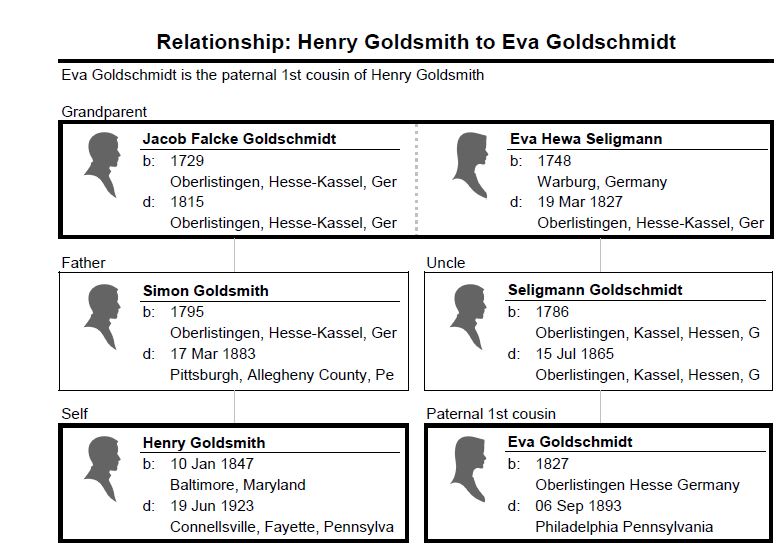
She was also his first cousin twice removed through her mother’s side and his father’s side:

Relationship_ Henry Goldsmith to Eva GoldschmidtRelationship_ Eva Schoenthal to Eva Goldschmidt


They may have all left Germany, but they were still marrying within families they knew from back home.  Just another twist in my increasingly twisted family tree.  And more evidence of the limited gene pool created by endogamy and of the limited value of DNA predictions for Ashkenazi Jews.


[1] Fanny’s headstone says she was born in 1800.  I think it’s unlikely that Fanny had two children at ages 47 and 48, which is what she would have been if born in 1800 as her headstone indicates.  If, as her marriage record and the passenger manifest suggest, she was born in 1807, then she would have been having children at 40 and 41, which seems much more realistic.

[2] One thing that bothers me is that I cannot find out what happened to some of the other children of Simon Goldsmith and Ella Katzenstein.  Lena moved to Columbus, Ohio, after marrying Gustav Basch, and Joseph had died as a baby in Germany even before Ella died.  Eva immigrated with her father and step-mother, but then disappeared after the 1850 census; I assume she married. I’ve no idea what happened to Josias; perhaps he died before Simon left Germany, or maybe Simon left him behind with another family member.  Since they are not directly related to me, I am trying not to get too distracted looking for them, but eventually I will have to try and find out what happened to Josias and Eva.

[3] Title: History of Washington County, Pennsylvania: with biographical sketches of many of its pioneers and prominent men

Authors: Crumrine, Boyd, 1838-1916, Ellis, Franklin, 1828-1885, Hungerford, Austin N.

Collection: Historic Pittsburgh General Text Collection