In my last post I posted and transcribed three letters written to Francis Oestreicher aka Frank Striker by various relatives between 1907 and 1939. In this post I want to share the letters that Frank wrote home while he was serving in World War I. These letters were all written in the fall of 1918, beginning before Frank was sent overseas and ending with one in December, 1918, a month or so after the war had ended.
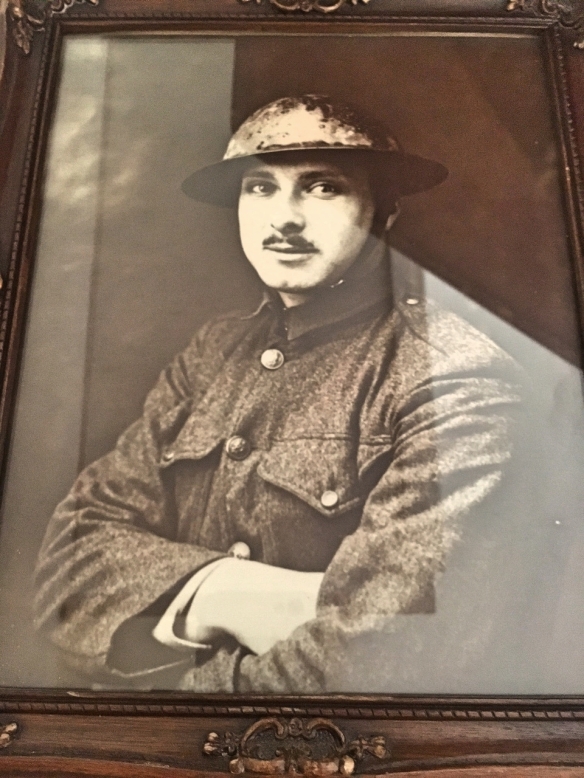
Francis Oestreicher in World War I
As with the last post, I have tried to keep the transcriptions true to the text of the letters, only making some punctuation changes and some spelling changes and adding paragraphing to make them more easily read.
The first letter was written from Camp Meritt, New Jersey, on September 20, 1918.
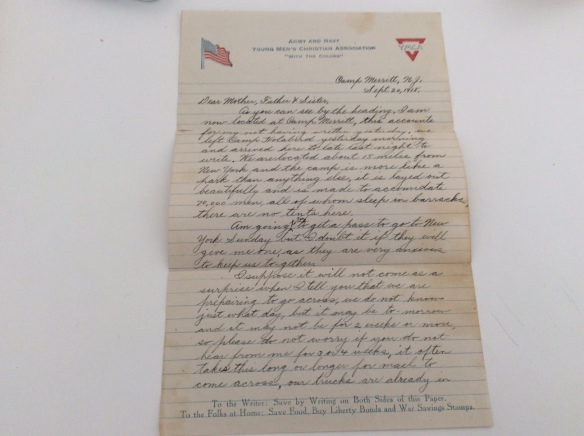
Camp Meritt, NJ September 20, 1918
Dear Mother, Father & Sister,
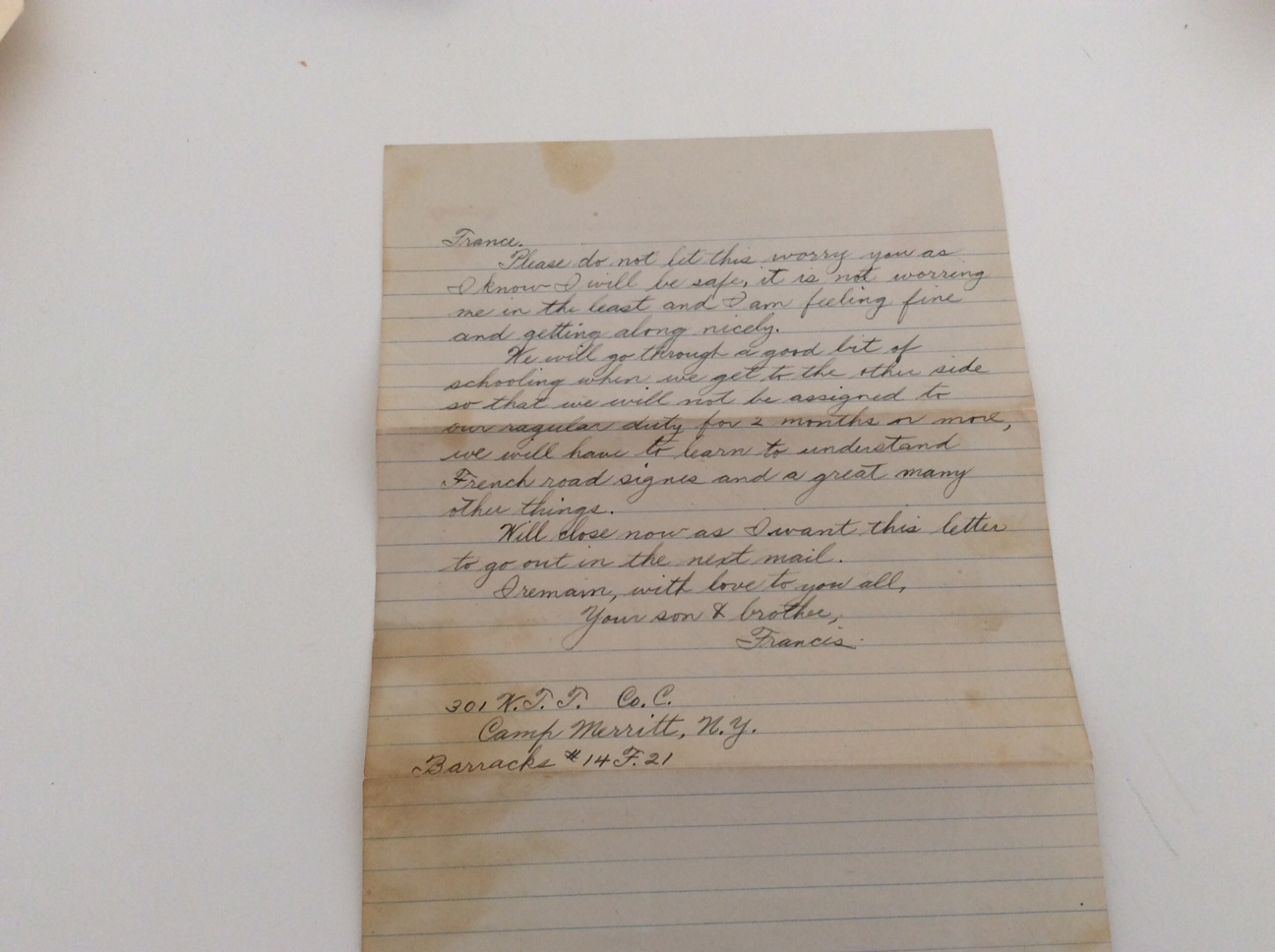
As you can see by the heading, I am now located at Camp Merrit. This accounts for my not having written yesterday. We left Camp Holabird yesterday morning and arrived here to[o] late last night to write. We are located about 15 miles from New York and the camp is more like a park than anything else. It is layed out beautifully and is made to accomidate 70,000 men, all of whom sleep in barracks. There are no tents here.
Am going to try to get a pass to go to New York Sunday, but I doubt it if they will give me one, as they are very anxious to keep us together.
I suppose it will not come as a surprise when I tell you that we are prepairing to go across, we do not know just what day, but it may be to-morrow and it may not be for 2 weeks or more, so please do not worry if you do not hear from me for 3 or 4 weeks. It often takes this long or longer for mail to come across. Our trucks are already in France.
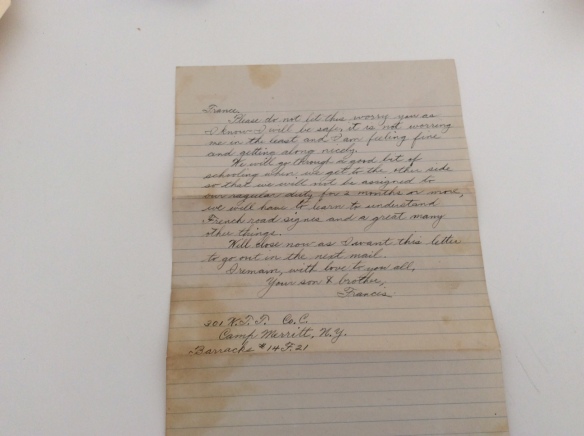
Please do not let this worry you as I know I will be safe. It is not worrying me in the least and I am feeling fine and getting along nicely.
We will go through a good bit of schooling when we get to the other side so that we will not be assigned to our regular duty for 2 months or more. We will have to learn to understand French road signs and a great many other things.
Will close now as I want this letter to go out in the next mail.
I remain, with love to you all,
Your son & brother,
Francis
I love the tone of this letter—a young man trying to reassure his parents that he is and will be fine. How can he possibly say he knows he will be safe? I had to laugh at the idea that his parents would not worry when their child was going off to fight in a war that had already seen a tremendous number of fatalities. But so far Frank hadn’t seen anything but American army camps.
The second letter was written while Frank was sailing to Europe with the army:
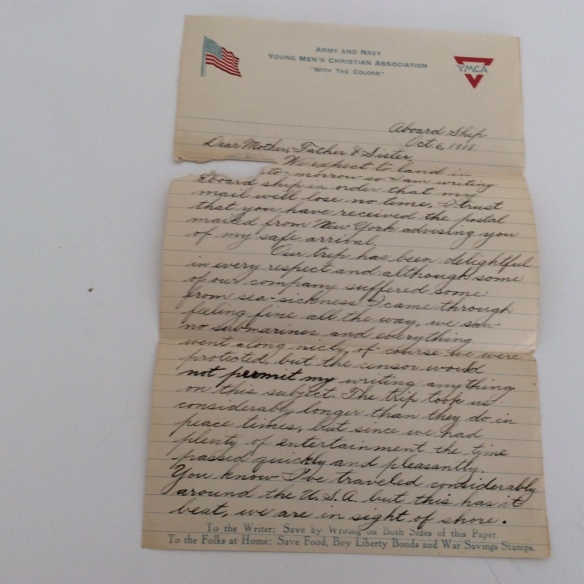
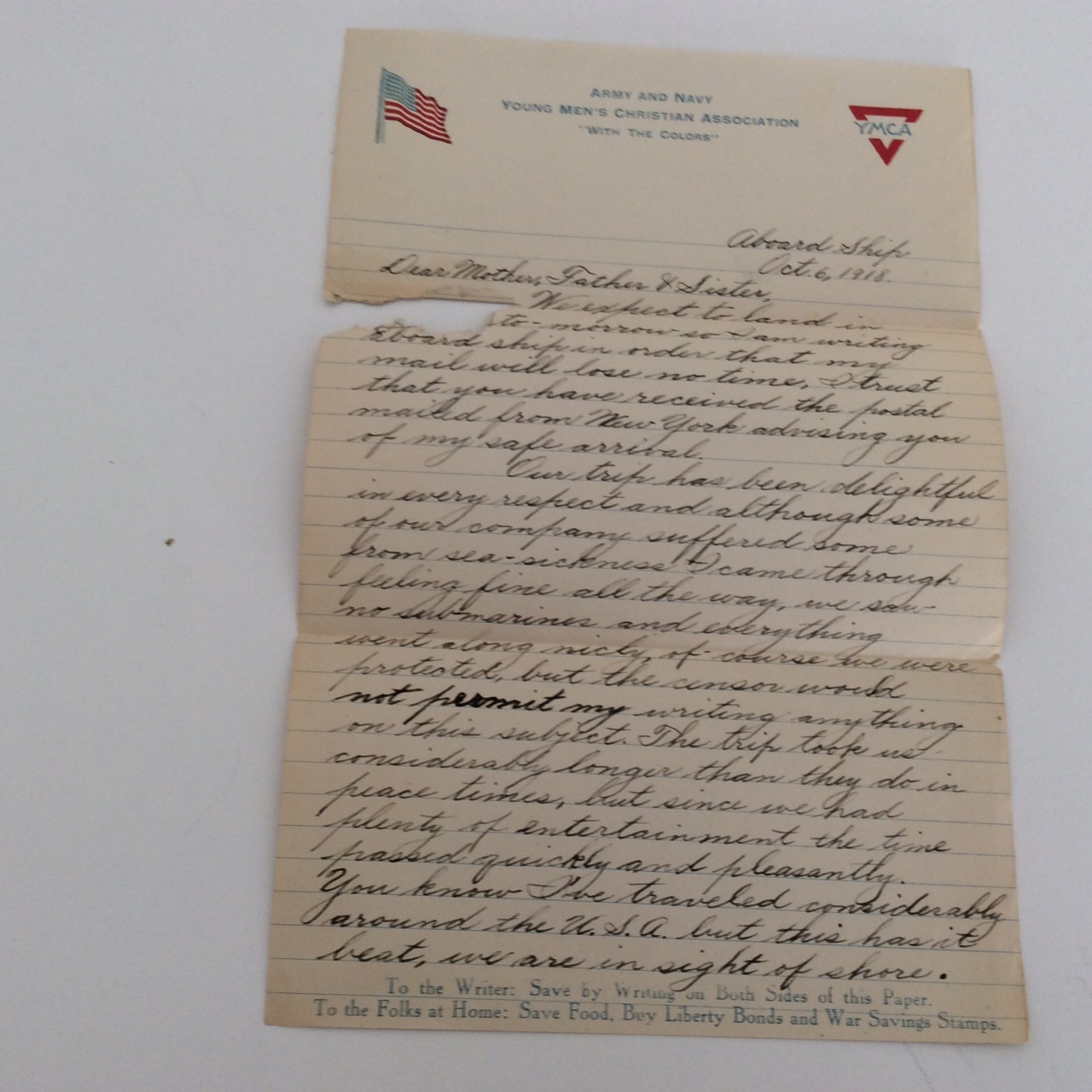
Aboard ship October 6, 1918
Dear Mother, Father, & Sister,
We expect to land in [place name torn off] tomorrow so I am writing aboard ship in order that my mail will lose no time. I trust that you have received the postal mailed from New York advising you of my safe arrival.
Our trip has been delightful in every respect and although some of our company suffered some from sea-sickness, I came through feeling fine all the way. We saw no submarines and everything went along nicely. Of course we were protected, but the censor would not permit my writing anything on this subject. The trip took us considerably longer than they do in peace times, but since we had plenty of entertainment the time passed quickly and pleasantly. You know I’ve traveled considerably around the U.S.A. but this has it beat, we are in sight of shore.
[Letter ends there; not sure if there was more as there is no signature.]
Once again, Frank is being reassuring. He writes as if he’s on a cruise, traveling to Europe, except for the hints about censorship and submarines. Was he really feeling as calm as his letter claims?
There are no letters between this one and the end of the war on November 11, 1918. I don’t know whether that means Frank didn’t write any letters during that time or just that they have not been preserved or located.
The next letter was written two days after the armistice:
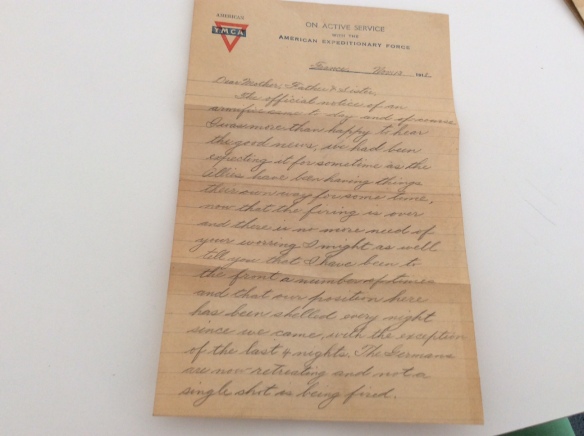
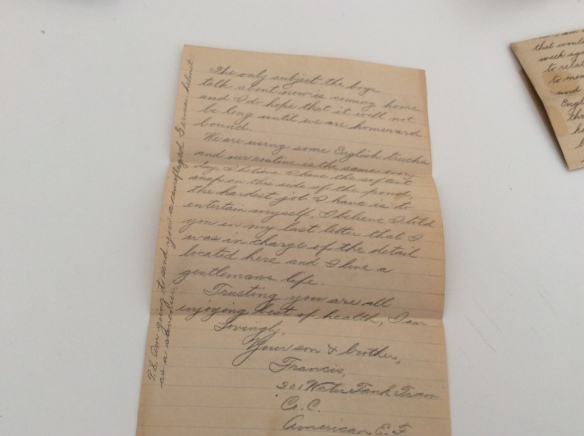
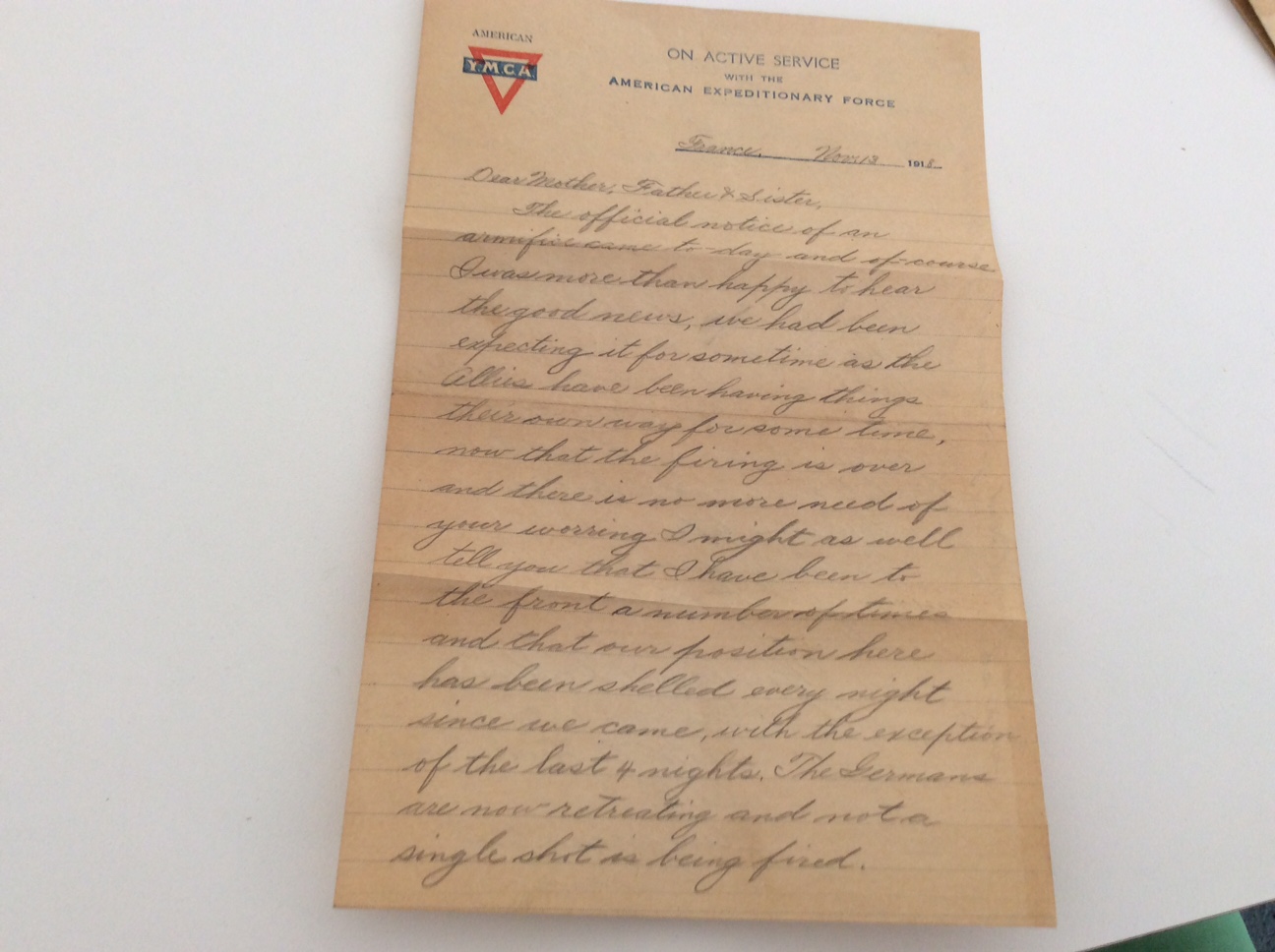
France November 13, 1918
Dear Mother, Father & Sister,
The official notice of an armistice came to-day and of course I was more than happy to hear the good news. We had been expecting it for sometime as the Allies have been having things their own way for some time. Now that the firing is over and there is no more need of your worring, I might as well tell you that I have been to the front a number of times and that our position here has been shelled every night since we came, with the exception of the last 4 nights. The Germans are now retreating and not a single shot is being fired.
The only subject the boys talk about now is coming home and I do hope that it will not be long until we are homeward bound.
We are using some English trucks and our routine is the same every day. I believe I have the softest snap on this side of the pond. The hardest job I have is to entertain myself. I believe I told you in my last letter that I was in charge of the detail located here and I live a gentleman’s life.
Trusting you are all enjoying the best of health, I am
Lovingly
Your son and brother
Francis
PS I am going to send you a camouflaged German helmet as a souvenir.
The tone of this letter is markedly different from the first two. One would expect a soldier to be excited and upbeat that the war had ended. But this letter seems more somber. Although Frank says he now living a gentleman’s life and just waiting to come home, his brief allusions to the war—being shelled every night—make it clear that he has seen more than he is mentioning. Somehow he seems to have changed from that young man excited to be traveling overseas to a young man eager to get home and away from the war.
The next letter came four days later.
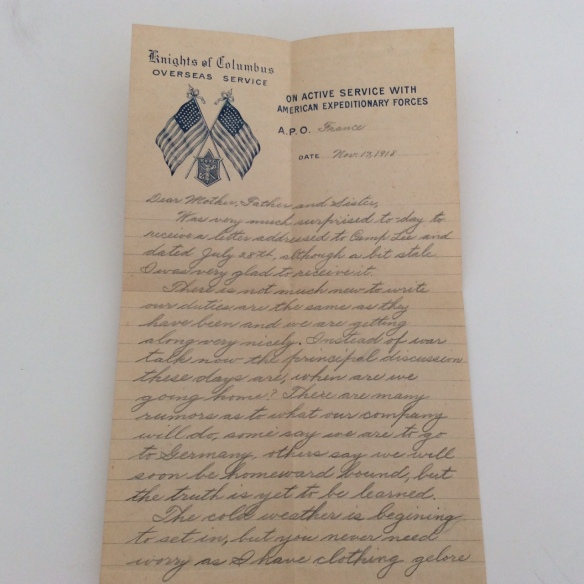
November 17, 1918
Dear Mother, Father, and Sister,
Was very much surprised to-day to receive a letter addressed to Camp Lee and dated July 28th. Although a bit stale I was very glad to receive it.
There is not much new to write. Our duties are the same as they have been and we are getting along nicely. Instead of war talk now the principal discussion these days are when are we going home. There are many rumors as to what our company will do. Some say we are to go to Germany, others say we will soon be homeward bound, but the truth is yet to be learned.
The cold weather is beginning to set in, but you never need worry as I have clothing gelore. I have a heavy overcoat, sweater and gum boots that I have never worn also heavy wollen socks.
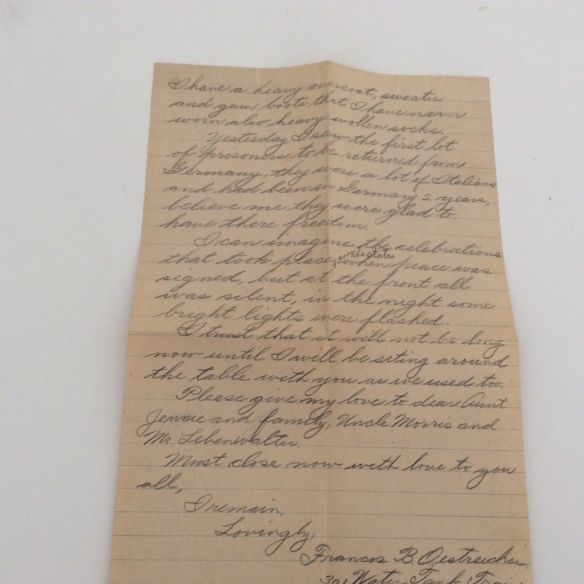
Yesterday I saw the first lot of prisoners to be returned from Germany. They were a lot of Italians who had been in Germany 2 years. Believe me they were glad to have there freedom
I can imagine the celebrations that took place in the states when peace was signed, but at the front all was silent. In the night some bright lights flashed.
I trust that it will not be long now until I will be siting around the table with you as we used too.
Please give my love to dear Aunt Jennie and family, Uncle Morris, and Mr Lebenwalter.
Must close now with love to you all,
I remain
Lovingly
Francis B. Oestreicher
Frank obviously was longing to be home. And again the tone is more somber. His line contrasting what he expects the celebrations were like back home to the silence at the front is telling. There was no celebrating by those who had fought in the war. They just wanted to go home.
Eleven days later he wrote this letter:
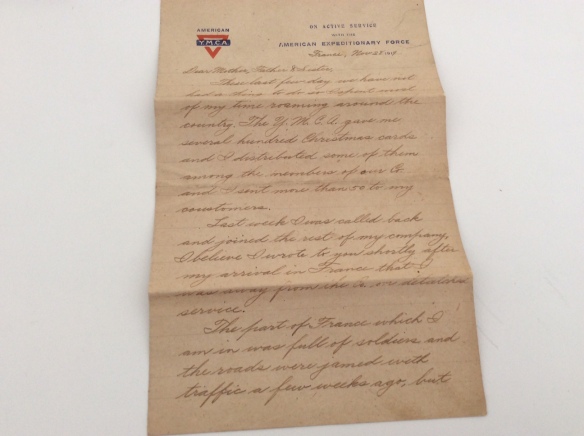
France, November 28, 1918
Dear Mother, Father & Sister,
These last few days we have not had a thing to do so I spent most of my time roaming around the country. The YMCA gave me several hundred Christmas cards and I distributed some of them among the members of our Co. and I sent more than 50 to my customers.
Last week I was called back and joined the rest of my company. I believe I wrote to you shortly after my arrival in France that was away from the Co. on detached service.
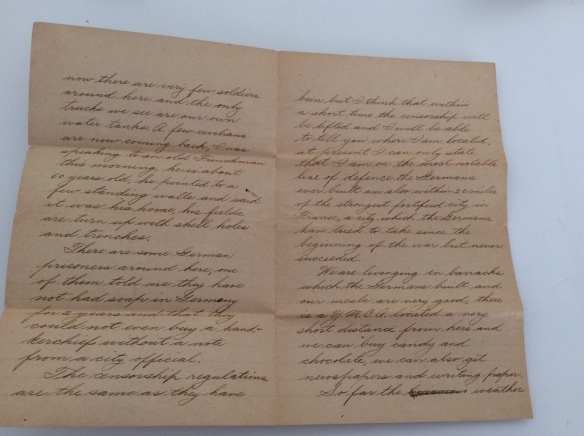
The part of France which I am in was full of soldiers and the roads were jammed with traffic a few weeks ago, but now there are very few soldiers around here and the only trucks we see are our own water tanks. A few civilians are now coming back. I was speaking to an old Frenchman this morning. He is about 60 years old. He pointed to a few standing walls and said it was his home. His fields are turn [torn?] up with shell holes and trenches.
There are some German prisoners around here. One of them told me they have not had soap in Germany for 2 years and that they could not even buy a handkerchief without a note from a city official.
The censorship regulations are the same as they have been, but I think that within a short time the censorship will be lifted and I will be able to tell you where I am located. At present I can only state that I am in the most notable line of defence the Germans ever built. Am also within 20 miles of the strongest fortified city in France, a city which the Germans have tried to take since the beginning of the war but never succeeded.
We are living in barracks which the Germans built and our meals are very good. There is a YMCA located a very short distance from here and we can buy candy and chocolate. We can also get newspapers and writing paper.
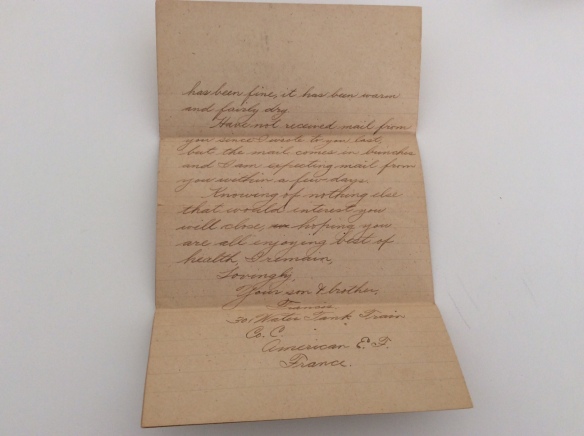
So far the weather has been fine. It has been warm and fairly dry.
Have not received mail from you since I wrote to you last, but the mail comes in bunches, and I am expecting mail from you within a few days.
Knowing of nothing else that would interest you, will close, hoping you are all enjoying the best of health, I remain,
Lovingly
Your son and brother
Francis
Two images stand out for me here: the Frenchman surveying his destroyed home and fields and the German soldier revealing the desperate economic situation in Germany. How interesting that Frank conversed with someone who just weeks before had been the enemy. And he sounds somewhat sympathetic to the conditions endured by that enemy.
It’s also interesting that Frank was now allowed to reveal more details about his location. That location was made much more clear in the letter that follows.
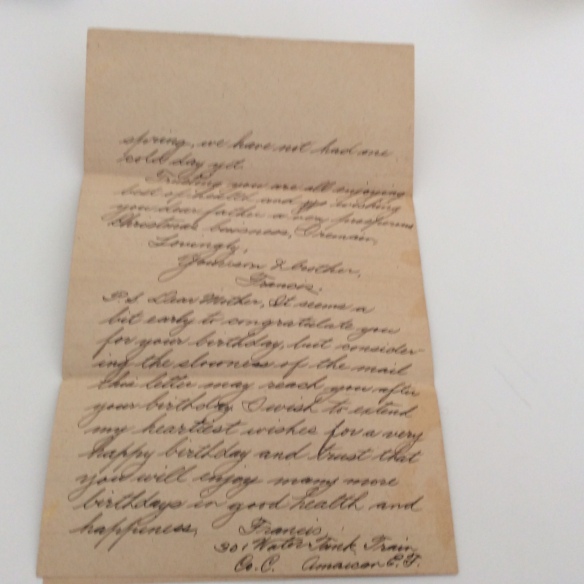
France December 8, 1918
Dear Mother, Father, & Sister,
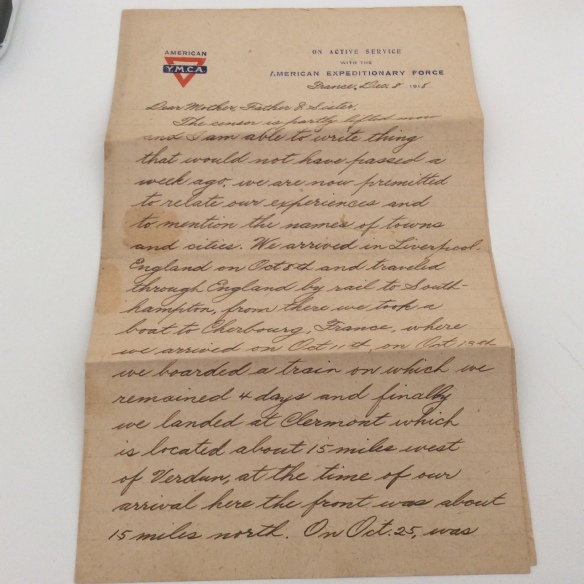
The censor is partly lifted now and I am able to write things that would not have passed a week ago. We are now permitted to relate our experiences and to mention the names of the towns and cities. We arrived in Liverpool, England on October 8th and traveled through England by rail to South-hampton. From there we took a boat to Cherbourg, France, where we arrived on October 11th. On October 13th we boarded a train on which we remained 4 days and finally we landed at Clermont which is located about 15 miles west of Verdun. At the time of our arrival here the front was 15 miles north. On October 25 was sent on detatched service with some others in our Co. and we located at Montfucon which is about 22 miles north of Clairmont. At the time of our arrival at Montfucon the trenches were a very short distance and we were able to get a fair idea of what modern war really is.
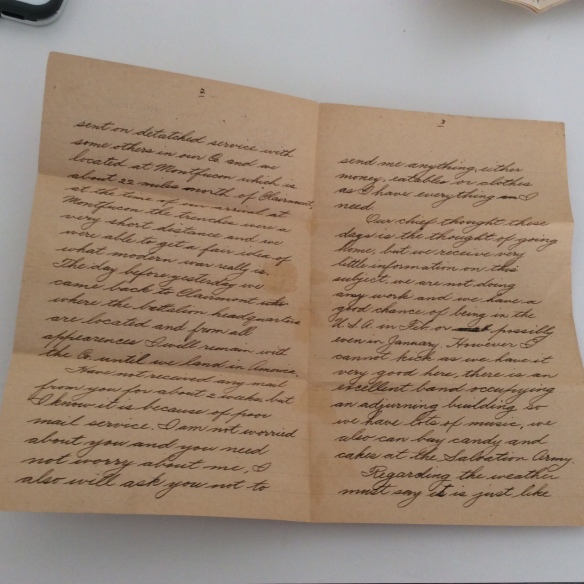
The day before yesterday we came back to Clairmont where the battalion headquarters are located and from all appearances I will remain with the Co. until we land in America.
Have not received any mail from you for about 2 weeks, but I know it is because of poor mail service. I am not worried about you and you need not worry about me. I also will ask you not to send me anything, either money, eatables or clothes, as I have everything I need.
Our chief thought these days is the thought of going home, but we receive very little information on this subject. We are not doing any work and we have a good chance of being in the U.S.A. in Feb or possibly even in January. However I cannot kick as we have it very good here. There is an excellent band occupying an adjurning building so we have lots of music. We also can buy candy and cakes at the Salvation Army.
Regarding the weather must say it is just like spring. We have not had one cold day yet.
Trusting you are all enjoying the best of health and wishing you dear father a very prosperous Chrismas business, I remain
Lovingly
Your son and brother,
Francis
PS Dear Mother, It seems a bit early to congratulate you for your birthday, but considering the slowness of the mail this letter may reach you after your birthday. I wish to extend my heartiest wishes for a very happy birthday and trust that you will enjoy many more birthdays in good health and happiness. [Sarah’s birthday was January 8.]
Francis
I looked on a map to try and determine where Frank was located based on this letter. I knew he had been involved in the Meuse Argonne offensive, so that also helped. I believe “Clairmont” is Clermont-en-Argonne and “Montfuscon” is Montfaucon-d’Argonne. On this map you can see Verdun, the “most fortified city in France,” as Frank described it in his earlier letter, and the cemetery at Meuse-Argonne where those killed in that offensive are buried.
Even though the censorship was reduced and Frank could reveal where he had been, he still does not discuss what he saw during the fighting or how he felt. He makes reference to “getting a fair idea of what modern war is,” but he doesn’t share what that was like. I wonder if he ever did. But it is clear that he is anxious to get home and hopes to be there by January or February, at the latest.
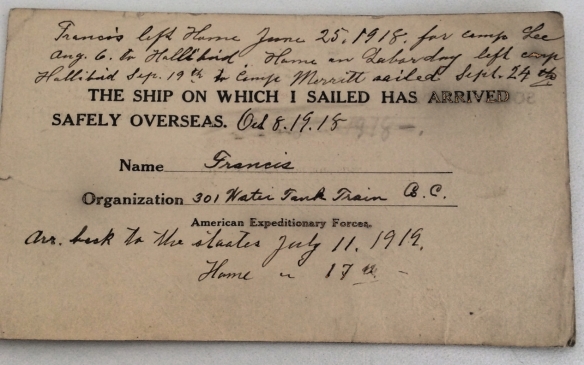
Frank’s military dates as revealed on this postcard, however, indicate that he did not in fact get back to the US until July. I wonder what they had him doing for the next six months.
That is the last of the letters written by Frank that I received from Steve. I don’t know whether Frank wrote more. I imagine he did. Perhaps more letters will show up. But even these six letters written over a short period of time reveal in subtle ways the experiences Frank lived through between September 20, 1918, and December 8, 1918.