John Nusbaum 1814-1889: The Family Patriarch

By 1880, my three-times great-grandparents, Jeanette (Dreyfuss) and John Nusbaum, and their extended families had not only grown in size but spread across a wider swath of the northeastern United States.  Some were still in Harrisburg or Philadelphia, but others were in Peoria, Baltimore, and Pittsburgh.  Although many were still dry goods merchants, the younger generations were also involved in various aspects of the liquor trade.  The family had endured the economic crisis of the 1870s, seeing some bankruptcies and the closings of several stores and businesses.  A number of young children had died, and by 1880, of the siblings of John and Jeanette Dreyfuss, only Ernst and John were still alive on the Nusbaum side, while Jeanette’s two sisters Caroline and Mathilde were both still living.

The next two decades brought with it more changes, more weddings, more new children, and sadly more deaths.  In my next series of Nusbaum/Dreyfuss posts I will try to bring the various branches up to the 20th century, focusing first on my direct ancestors, John and Jeanette and their children and grandchildren.

As I’ve written, in 1880 John and Jeanette were listed on the census in two different locations, living thousands of miles apart.  John was living with their daughter Frances and her husband Bernard Seligman (my great-great-grandparents) in Santa Fe along with his son Simon.  Jeanette, on the other hand, was living in Philadelphia with their daughter Miriam and her husband Gustavus Josephs along with Lottie Nusbaum, the youngest child of John and Jeanette, and Milton Josephs, the young son of Miriam and Gustavus who would die from bronchial pneumonia just a few months after the 1880 census was taken.  These must have been very hard times for my ancestors, and I will never know whether John moved to Santa Fe for financial reasons or because of marital problems.  I will never know whether he was there for a month or a year.

English: A Areal map of Santa Fe, New Mexico d...

English: A Areal map of Santa Fe, New Mexico during the Railroad era in 1882. (Photo credit: Wikipedia)

But I do know that John is listed in the 1881 Philadelphia directory as residing at 1129 Master Street, the same address where the Josephs family and Jeanette and Lottie were living on the 1880 census.  Whether John was actually back or not is hard to say for sure, but he does not appear again on any Philadelphia directory until 1886, when he is listed as being in the “segar” business and living at 524 North 11th Street, the same address given for his daughter Lottie.  Although Gustavus and his family are not listed in the 1881 directory, they show up in the 1884 directory still living on Master Street, so it would seem that sometime between 1881 and 1886, John and Lottie and presumably Jeanette had moved to their own home on North 11th Street.

I found it puzzling that John, after over forty years in the dry goods business, had entered the cigar business.  But his store had gone bankrupt, and perhaps this seemed to be a good way to make a fresh start in the 1880s.  John was already in his 70s by 1886, so it is even more surprising that he was starting in a new trade instead of just retiring.  I did some reading about the tobacco industry and learned that the John Bonsack invented the cigarette rolling machine in 1881, leading to a widespread increase in cigarette smoking (previously, tobacco was either chewed, smoked in a pipe, or hand rolled into a cigar or cigarette).   I don’t know whether this technological development had any effect on John’s decision to sell cigars, and I don’t know whether he sold only cigars or also cigarettes, but the timing does seem to be enough for me to think this was not just coincidental.  In 1887, John again is listed at the same residence and as being in the “segar” business.

English: Trade card of a cigar dealer after a ...

English: Trade card of a cigar dealer after a photograph of Napoleon Sarony, using Oscar Wilde’s popularity during his American trip of 1882 (Photo credit: Wikipedia)

Meanwhile, the children of John and Jeanette were also finding their way in the 1880s.  Adolphus and Julius were still in Peoria, working in the dry goods business, now called Nusbaum Bros.  Since Julius had been one of his father’s creditors in the bankruptcy proceedings, perhaps the business was now owned by the brothers instead of their father.  Julius was living with his brother Adolphus and sister-in-law Fannie, who had no children.

Simon, meanwhile, had remained in Santa Fe and was still unmarried and living with his sister, my great-great-grandmother Frances Nusbaum Seligman, and her family in 1885 according to the New Mexico Territorial Census of that year.   In 1887 Simon was appointed to be a clerk in the US post office in Santa Fe, a position he continued to hold for many years, being promoted to assistant postmaster by 1889 and ultimately to postmaster in 1898.

Miriam and Lottie, the remaining two children of John and Jeanette, were living in Philadelphia.  Miriam and her husband Gustavus had a third child in 1882, Gertrude, after losing Milton in 1880.  Their second child Florence was then two years old.  On November 28, 1888, Gertrude died from diphtheria (croupus form, according to the death certificate). She had just celebrated her sixth birthday less than a month before.  Eight year old Florence was once again an only child.  The family had lost yet another young child.  For Miriam and Gustavus to lose two young children in the space of eight years must have been completely devastating.

gertrude josephs death certificate

As for Lottie, John and Jeanette’s youngest child, she was just seventeen in 1880 and still living at home, as she did throughout the decade.

The decade drew near a close on another sad note for the family when my three-times great-grandfather John Nusbaum died on January 24, 1889.  He was 74 years old.  According to his death certificate, he died from lobular heart disease, chronic cystitis, and diabetes.  Notice also that the residential address on both Gertrude Josephs’ and John Nusbaum’s death certificates is the same: 1617 North 13th Street.

John Nusbaum death certificate

John Nusbaum was born in Schopfloch, Germany, in 1814, the sixth child of Amson Nusbaum and Voegele Welsch.  He had been one of the pioneers in the family, coming to Pennsylvania in the 1840s, probably starting as a peddler and then establishing himself as a merchant first in Harrisburg and then in Philadelphia.  He had seen much success and some failure in his business; he had helped out his siblings and their widows when his brothers Maxwell and Leopold died.  He and Jeanette had been the common link that brought together many connections between the Nusbaum, Dreyfuss, Dinkelspiel, Wiler, and Simon families.  I imagine that it must have been very hard for the family to lose him.  Sadly, I cannot find one obituary or death notice for him.

John Nusbaum’s name lived on in other ways, however. Four years after he died, his daughter Miriam and her husband Gustavus had one last child on July 26, 1893, five years after they had lost Gertrude and eleven years since Miriam had last given birth.  They named their son Jean, I assume in honor of Miriam’s father.

Two years later in 1895, John Nusbaum’s granddaughter Eva Seligman Cohen had a fourth son whom she and her husband Emanuel Cohen named John Nusbaum Cohen.  He was my grandfather, named for his great-grandfather.  Eva must have known her grandfather John Nusbaum very well, not only when she was a young child living in Philadelphia and not only when he had lived with her family for some period of time in Santa Fe, but also because she had moved to Philadelphia for college and then settled there after marrying my great-grandfather in 1886.  She must have seen a great deal of him in those last few years of his life.

John Nusbaum Cohen c. 1894

John Nusbaum Cohen c. 1895

When Simon Nusbaum married at a late age, he and his wife also named a son for Simon’s father.  John Bernard Nusbaum was born on May 15, 1904, in Santa Fe. (I assume that the Bernard was for Simon’s brother-in-law Bernard Seligman, who had died the year before.)

And, of course, John Nusbaum’s name lives on today through my father, John Nusbaum Cohen, Jr.  It’s a legacy that my three-times great-grandfather well deserved.  We may not have a photograph to remember his face, but we will always remember his name.


One More Chapter in the 1870s: Ernst Nusbaum and Family

The 1870s were a pretty tough decade for my Nusbaum relatives.  There were business and financial troubles as well as numerous deaths of children and others.  So I admit that it is not with great enthusiasm that I return to the 1870s, but at least this is the last branch of the family to cover during that decade.  I’ve covered my three-times great-grandparents, John Nusbaum and Jeannette Dreyfuss, and their children, as well as the families of  Jeanette’s two sisters, Mathilde and Caroline, and also those of John’s sister Mathilde and the surviving families of John’s brothers Maxwell and Leopold.  That leaves only the 1870s story of John’s brother Ernst and his wife Clarissa and their children.

Ernst was the closest sibling in age to John, just two years younger, and he was apparently the only sibling who settled in Philadelphia perhaps as early as 1851  and stayed there for the rest of his life.  He had married Clarissa Arnold, a Pennsylvania native born in 1830 who was fourteen years younger than Ernst.  Ernst and Clarissa seemed to have been quite comfortable in the 1850s and 1860s.  By 1861, they had six children.  Ernst was in the men’s clothing business in a firm called Arnold, Nusbaum, and Nirdlinger.  (I assume the Arnold was one of his wife’s relatives.) By 1870, Ernst and Clarissa’s children were almost all teenagers or almost teenagers: Arthur was 19, Myer 18, Fannie 14, Edgar 12, Henrietta 10, and Frank was nine years old.  They were still living at 625 North 6th Street, the same home they had been in since at least 1861.  They also still had two servants living with them.

But in 1870, Ernst’s firm went bankrupt, as seen in this December 5, 1870, article from the Philadelphia Inquirer:

Bankrptcy of Adler Nusbaum Dec 5 1870 phil inq p 3

The Philadelphia Inquirer, December 5, 1870, p. 3


Three years later Ernst is listed in the notions business at 518 Arch Street in the 1873 directory.  Interestingly, his son Arthur and his wife Clarissa seem to have had a ladies’ furnishings business at the same address called Clares & Arthurs.  Arthur was still living at home, and the family had moved to 1000 North 6th Street by 1873.   Was this a move necessitated by the economic downturn?  Did Clarissa want to start working out of the house because they needed more money or was it just that her youngest child was twelve years old and the others well into their teens or twenties so she had the time and interest in doing so?

I do not know, but the following year, it appears that Clares & Arthurs no longer existed.  Ernst is listed without a business address, Clarissa has no listing, and Arthur is listed as a clerk. The next year, 1875, has Ernst living at 2103 Green Street without any occupation listed and Arthur listed as residing at the same address and working as a salesman at 730 Chestnut Street.  His younger brother Myer is also listed at the 2103 Green Street residential address.  In 1876, Myer is listed as working as a bookkeeper, but Arthur and Ernst simply have the residential address.  Same in 1877 and 1878 for Ernst and Myer, but Arthur is not listed at all. So had Ernst retired?  Or had he simply stopped working due to the recession? And where was Arthur?

Well, in 1879, when the recession was starting to end, Ernst is once again listed with an occupation—in the cloaks business.  Myer is still listed as a bookkeeper, and now Edgar, his younger brother, is listed as a salesman.  All three are still listed as residing at 2103 Green Street in the 1879 Philadelphia directory.

And where was Arthur?  I cannot find him in the directory listings for 1877 through 1879.  He had married Henrietta Hilbronner in 1876, and they had had a daughter Florence born in 1877 and a son Sydney born in 1879.  According to the 1880 census, they were all living with Henrietta’s parents on North Seventh Street.  Henrietta’s father Morris was a clothing merchant with his own business, and Arthur was working as a clothing cutter, presumably for his father-in-law.

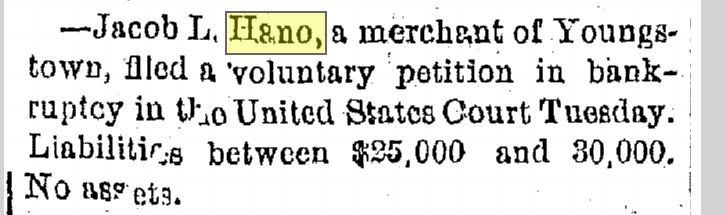
The other children of Ernst and Clarissa were also getting married in the late 1870s.  Fannie Nusbaum married Jacob L. Hano on February 28, 1877, and they also had two children born by 1880: Louis F. Hano, born in Youngstown, Ohio, on November 30, 1877, and Ernst Nusbaum Hano, born May 16, 1880, also in Youngstown, Ohio.  Jacob Hano was born in Philadelphia in 1850 and had lived his whole life there.  In 1874 he’d been working as a salesman in Philadelphia, residing at 2026 Green Street, right across the street from Fannie and her family.  He had attended Crittenden’s Philadelphia Commercial College.  Perhaps he moved Fannie to Youngstown after they married because he believed that there were better business opportunities there.  Unfortunately, however, like others in the family and the country, he faced financial problems and declared bankruptcy in May, 1878.

jacob hano bankruptcy cleveland plain dealer may 15 1878 p 4

The Cleveland Plain Dealer, May 15, 1878, p. 4

He and the family remained in Youngstown, however, and he is listed on the 1880 census living there with Fannie, their two young sons, and his brother Benjamin as well as a servant.  He listed his occupation as a clothier, and his brother was working as a clerk in a department store. Thus, Jacob must have rebounded from his bankruptcy and started a new business.  They did not remain long in Youngstown, however, as we shall see.

Description: Postcard of Youngstown Sheet & Tu...

Description: Postcard of Youngstown Sheet & Tube (early 20th century) (Photo credit: Wikipedia)

Myer Nusbaum, Ernst and Clarissa’s third child, also married and had two children in the 1870s.  He married Rosalie Aub, and their first child Corinne was born on May 19, 1878.  Her brother Jacob was born the next year on June 24, 1879.  As noted above, Myer was working as a bookkeeper throughout the 1870s and was still employed as a bookkeeper in 1880 according to the census of that year.

Although the 1900 census indicates that Edgar Nusbaum married Viola Baritt in 1879 when he was 21 and she was eighteen, on the 1880 census he is still listed as living at home with his parents at 2105 Green Street and single.  My guess is that they did not marry until 1880, and their first  and only child Selina was born a year later on November 16, 1881.   As noted above, Edgar was listed as a salesman in the 1879 directory, and the same occupation is given in the 1880 Philadelphia directory, although the 1880 US census lists his occupation as a clerk.

Ernst and Clarissa’s youngest two children, Henrietta and Frank, were also still at home in 1880 at 2103 Green Street, depicted below.  Henrietta was 20 and Frank 19.  Frank was working as a clerk like his brother Edgar.  Their father Ernst listed his occupation as a manufacturer.  So perhaps the slowdown of the 1870s had eased, and Ernst and his sons were all then once again gainfully employed.


And now we can move on to the next decade. The 1880s may not have presented the same economic challenges as the 1870s, but as we will see, it presented other challenges and other changes for the extended Nusbaum family.


This is NOT a test even if it looks and sounds like one!

As promised, here is a chart to illustrate one possible way that my mother Florence, Elaine and Frieda are all connected.

New PDF Chart showing relationships of Moses Joseph Bessie et al-page-001


There are a LOT of unknowns and assumptions here.

First, we are assuming that Joseph Brotman and Bessie Brot were first cousins, as family lore says.  If so, then one of Joseph’s parents was a sibling to one of Bessie’s parents.  On this chart, I am assuming that Joseph’s father Abraham was a sibling to Bessie’s mother Gittel Brot because I don’t think Abraham would have named a son Joseph if he had a living brother named Joseph.

Second, we are assuming based on DNA results that Joseph Brotman and Moses Brotman were brothers, making their children first cousins and their grandchildren, here Florence and Elaine, second cousins.  The DNA results seem to support that assumption.

Third, we are assuming that Florence and Frieda are also second cousins based on the DNA results, meaning that Gussie Brotman and Sabina Brod were first cousins, meaning that one of Gussie’s parents and one of Sabina’s parents were siblings.  Here, I am making the assumption that Bessie Brot, Gussie’s mother, was the sister of Sabina’s mother, but it could be that Bessie was Sabina’s father’s sister.  I don’t know whether Brod was a name Sabina got from her mother or her father because in Galicia in those times, the state often treated Jewish children as illegitimate if their parents had only a Jewish marriage ceremony and thus assigned the mother’s name to the children instead of the father’s.  So either is possible here.

So what does this all mean? Well, hold on because this is where it gets a bit slippery. Taking the above chart as true (which is still very speculative), it means that Elaine, Florence, and Frieda are all third cousins since they all have the same great-great-grandparents, i.e., whoever were the parents of Abraham Brotman and Gittel Brot.  (I don’t know whether Brotman and Brot were two versions of the same name or two completely different names in the family; both exist as surnames so they could be as unrelated as someone named Rosen is to someone named Rosenberg, for example.)

BUT Elaine and Florence are also second cousins (as well as third cousins) since they are the children of first cousins (Louis and Gussie) and the grandchildren of siblings (Moses and Joseph Brotman).  AND the same is true for Florence and Frieda: they are second cousins because they are the children of first cousins (Gussie and Sabina) and the grandchildren of siblings (Bessie and the parent of Sabina).

Cousin_tree

So my mother is a second cousin to both Elaine and Frieda (since her grandparents were first cousins), BUT Elaine and Frieda are not second cousins, only third cousins.  Their grandparents (Moses Brotman and Sabina’s parent) were not first cousins, just second cousins.

That is consistent with the DNA results which showed my mother as a second cousin to Elaine and also to Frieda but showed Elaine and Frieda as likely third to fifth cousins.

I have no idea whether that is a help or not.  In fact, I think I am more confused now than before.  Please tell me if that makes no sense.  Ask me questions.  Test my thinking.  Please.

And a big THANK YOU to my new cousin Phyllis for helping me sort through all of this!

Brotman Update! The Trials and Tribulations of DNA Testing

Animation of the structure of a section of DNA...

Animation of the structure of a section of DNA. The bases lie horizontally between the two spiraling strands. (Photo credit: Wikipedia)


I am now delving into a part of genealogy research that is the hardest thing I’ve yet done in this project: DNA testing.  I am not and never was a science or math person.  My head starts spinning when I see too many numbers and/or scientific terms.  Reading about DNA results is like reading Russian or Chinese for me.  The words are not at all familiar, and the numbers have no meaning in the world in which I am used to operating.  Terms like SNP, centimorgan, autosomal, and others I can’t even keep in my head at all mean little or nothing to me, even after reading several articles and websites defining the terms.

I say all this by way of disclaimer.  Everything I am writing about today is foreign to me, and I am still trying to get help to be able to comprehend these test results more fully and to figure out what I can learn from them.

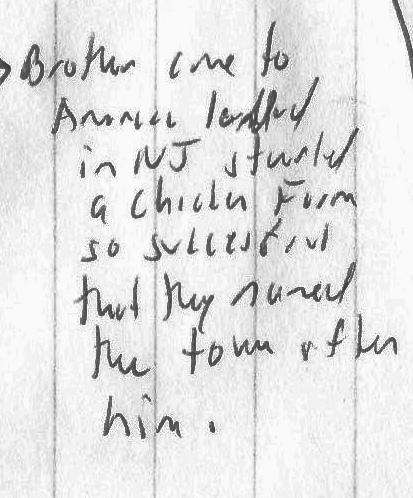
Having said all that, here’s the story.  Those who have followed this blog for a long time know that one of my brick walls was trying to find out whether my Brotman great-grandparents, Joseph and Bessie, were related to the Brotmans who settled in southern New Jersey in the 1890s and founded the town that is called Brotmanville.  My Aunt Elaine had told my cousin Jody and her husband Joel that Joseph had had a brother who moved to New Jersey where the town was named after him. Through my research and contacts with members of the Brotmanville Brotman family, I learned that Moses Brotman, a contemporary of Joseph Brotman, also had a father named Abraham and also was from Galicia, as was Joseph.  The Brotmanville Brotmans believed that Moses was from Przemyl, which is about 100 miles from Tarnobrzeg.  But none of us had any documentation of the family in Galicia or anything more than anecdotal evidence of a connection or birthplace.

brotmanville

My aunt’s story about Brotmanville

So last spring I decided to try DNA testing to see if I could break through this brick wall.  My first thought was to do a Y-DNA test on a male descendant of Moses and a male descendant of Joseph.  It had to be a father-son-grandson-great-grandson connection to get a reliable Y chain as Y DNA is only passed from fathers to sons.  I found one great-grandson of Moses Brotman who qualified and also asked one of my second cousins who was a direct male descendant of Joseph. We had the tests done by Family Tree DNA or FTDNA.  It took about three months for both test results to return, and it showed that my Moses descendant Larry and my Joseph descendant Bruce shared 34 of 37 markers on their Y-DNA.

English: A DNA microarray. Français : Une puce...

English: A DNA microarray. Français : Une puce à ADN. (Photo credit: Wikipedia)

I had no clue what that meant.  According to a woman who works for FTDNA, it meant that there is a high likelihood of “some genetic connection,” especially since the two lines share the same surname, Brotman. By “some genetic connection,” she meant that at some point in time the NY Brotmans had a common ancestor with the Brotmanville Brotmans.  It might have been as recently as Abraham Brotman, the father of Joseph and perhaps the father of Moses, or it might have been centuries ago.  The fact that Bruce and Larry have 34 out of 37 markers that were identical indicates that there is some family tie—but those three different markers suggest that there were mutations.  Those mutations might have occurred between Bruce and his father or his father and his grandfather or even earlier.  Or they might have been on Larry’s side.  There was no way to know from the Y DNA results alone.

So my contact at FTDNA suggested that the next step would be to try a different DNA test called an autosomal DNA test, which is better at predicting the degree of connection—i.e., would better tell us whether Joseph and Moses were brothers, both sons of the same Abraham Brotman.  My contact at FTDNA said that if we could get two of the grandchildren of Joseph and Moses to take the autosomal test, it would tell us if they are likely second cousins.

As I understand it (and remember the disclaimer above), autosomal DNA is DNA we inherit from both of our parents.  We got an X from our mothers and either a Y or an X from our fathers to determine our sex.  The other 22 pairs of chromosomes are also made up of genetic material we get from both parents, and those 22 pairs are our autosomal DNA.  But it is not obvious which half of each pair came from which parent.  This is where I start getting that deer in headlights look and feel.

But what I’ve been told and what I’ve read indicates that autosomal DNA testing is quite useful in figuring out the degree of relationship between two people.  So I asked Elaine, Moses’ granddaughter, and my mother, Joseph’s granddaughter, if they would take the autosomal DNA test through FTDNA, called the Family Finder test.  If the test showed that they were second cousins, we would have fairly strong evidence that their grandfathers, Moses and Joseph, were brothers.  My mother and Elaine agreed to take the test, and once again we waited for results.

English: The structure of DNA showing with det...

English: The structure of DNA showing with detail showing the structure of the four bases, adenine, cytosine, guanine and thymine, and the location of the major and minor groove. (Photo credit: Wikipedia)

Those results came in about a week ago.  First, I got Elaine’s results, and then a few days later, I received my mother’s results.  And they matched!  FTDNA predicts their relationship to be second cousins!  Of course, this is not definitive proof.  DNA testing is just a prediction, but at this degree of closeness, it is considered quite strong evidence, especially with the anecdotal evidence behind it, that is, the shared surnames, the shared father’s name, my aunt’s story, etc.  Elaine and my mother share 334 centimorgans.  That seems to suggest close cousins.

And then there was more.  Although Elaine and my mother were each other’s closest matches, my mother had a second very close match to a woman named Frieda.  She shared 292 centimorgans with Frieda, and Frieda was another predicted second cousin.  But Elaine was not a close match to Frieda, although she was listed as a possible third to fifth cousin.  So who was this Frieda?  The FTDNA page listed Brod as one of her ancestral names and one of her ancestral towns as Radomysl nad Sanem, which is about 20 miles from Tarnobrzeg, where I believe Joseph and Bessie lived.

I emailed the person in charge of Frieda’s results, her niece Phyllis, and we have now started trying to figure out how Frieda is related to my mother.  Since Frieda is listed as a likely second cousin, she could have shared a great-grandparent with my mother.  But since Frieda is not as close a match to Elaine, they did not share a great-grandparent. That could mean that Frieda and my mother are both the great-granddaughters of  the parents of Bessie Brot/Brotman whereas my mother and Elaine are both the great-granddaughters of  the parents of Joseph Brotman and Moses Brotman.

And since Bessie was Joseph’s first cousin, that could explain why Elaine is a more distant cousin than my mother is to Frieda but still related to both.  Elaine is not directly descended from Bessie’s line, but is directly descended from Moses Brotman, who would also have been Bessie’s first cousin if Moses and my great-grandfather Joseph were brothers.  Elaine would have some of the same genetic material as Frieda as a third cousin, but not as much as she has with my mother, her presumed second cousin.

Screenshot (24)

A screenshot of the chromosome browser showing where on my mother’s chromosomes Elaine and Frieda match her DNA

Have I lost you yet?  I am trying to create a chart and will post it once I am sure I have it right.

This was incredible news for me.  First, finding the connection between Elaine and my mother was corroborating evidence of our tie to the Brotmanville Brotmans.  Second, finding Frieda gives me an opening to find out more about Bessie and Joseph and where they lived.

But I am once again at a stumbling block.  Phyllis knows only that her great-grandmother, Frieda’s grandmother, was named Sabina Brod and was from Radomysl nad Sanem.  She does not know anything more about Sabina’s family—who her parents were or who her siblings were.  Sabina moved to Germany with her husband in the early 20th century and died there in the 1930s.  As far as Phyllis knew, Sabina had no relatives who were in the US.  Neither Phyllis nor I have found any definite records of our Brod or Brodman or Brotman relatives in Galicia.

So for now all we have is the DNA results.   And I am struggling to understand them and to learn more from them.  And it is a struggle for me.  If there is anyone out there reading this who is comfortable with this type of data, I’d love an advisor who can assist me.

But for now it feels like I have found another opening into the mystery of my Brotman ancestors.  I feel one step closer to knowing where they lived and who their families were.

English: DNA replication or DNA synthesis is t...

English: DNA replication or DNA synthesis is the process of copying a double-stranded DNA molecule. This process is paramount to all life as we know it. (Photo credit: Wikipedia)


Who is the little boy?

For my first 2015 post, I have some wonderful new photos from my cousin Lou.  These are photos he scanned from our mutual cousin Marjorie’s photo collection, but we don’t yet know who some of the people are in these photos.  We are hoping Marjorie will be able to tell us.  Some of these are quite intriguing as I am hoping that they will be photographs of family members I’ve never seen before.

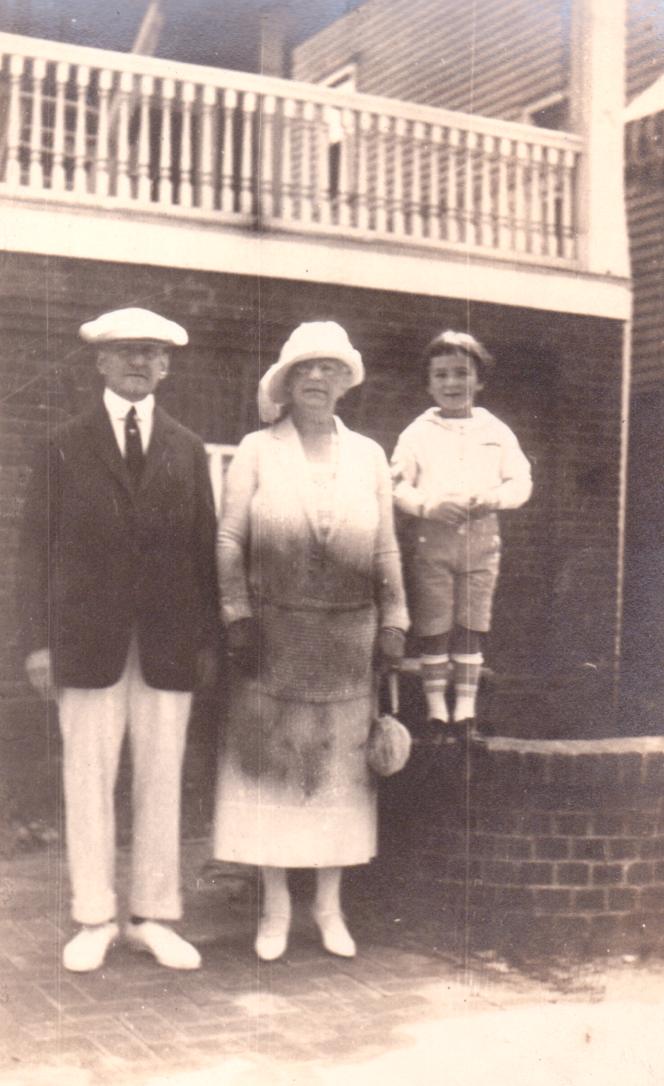
For example, here is a photograph of my great-grandmother, Eva Seligman Cohen, wife of Emanuel Cohen, daughter of Bernard Seligman and Frances Nusbaum.  But who is the man to her right? And who is the little boy to her left? Or is the little boy a little girl? Possibly Marjorie?

I showed my father the photograph, and he could not identify either person.  Could the man be Emanuel Cohen, my great-grandfather?  That would be the first photograph I’ve ever seen of him.  The little boy might be one of my father’s first cousins, Maurice Cohen, Junior, or Emanuel “Buddy” Cohen. If the older man is Emanuel, the photograph had to be taken in 1926 or before, as he died in February, 1927, and this is a photograph taken in the summertime.  Junior was born in 1917, Buddy in 1922, so it is possible that this is my great-grandparents standing with one of their grandsons.  I hope Marjorie can help us.

Eva Seligman Cohen with unknown man and boy

Here is another photograph of that little boy.  The man to his left is Stanley Cohen, my great-uncle, Marjorie’s father.   Marjorie album 58


But who is the man to his right?  Could it be my other great-uncle, Maurice Cohen, Senior?  I’ve never seen a picture of him nor have I seen a picture of either of his two sons, Junior and Buddy.  Maurice died in 1931; if this was taken in 1926 or so, this certainly could be him.  Maurice would have been 38 in 1926, Stanley would have been 37.

Finally, there is this photograph of the little boy.  Marjorie album 19

Who is that man?  It’s not the same man standing with my great-uncle Stanley in the prior photograph.  He seems to be a fair amount younger than both that other man and Stanley.

All those photographs seem to have been taken on the same day in Atlantic City, maybe around the same time as this photograph taken in 1932:

Eva M. Cohen, center, 1932 (Arthur Seligman, right)

Eva M. Cohen, center, 1932 (Arthur Seligman, right)

It looks like my great-grandmother was wearing the same or a similar hat and outfit to those she was wearing in the first photograph.

I am anxious to hear what Lou learns from Marjorie when he sees her.