Sitta Blumenfeld Spier and Her Daughter Gisela—A Story of Survival and Hope in the Midst of Despair and Death

Although three of the four surviving children of Gerson Blumenfeld II—Friedrich, Katinka, and Mina/Meta—and all their children escaped from Germany to the US and avoided being murdered by the Nazis, the fourth surviving child, Sitta Blumenfeld Spier, and her husband Siegfried Spier and their two children Manfred and Gisela were not as fortunate. As explained by Gisela’s son Simeon Spier in the eulogy he wrote for his mother, “[Siegfried] tried frantically to get the family out of Germany but since he was a wounded veteran from World War I – he had been awarded the Iron Cross for bravery and still had a bullet lodged in his lung – he was considered a health risk and emigration to other countries was not possible.”1

What a cruel irony—because he was wounded fighting for Germany, Siegfried could not escape German persecution twenty years later.

Sitta, Siegfried, Manfred, and Gisela were all deported to the concentration camp at Theriesenstadt on September 7, 1942.2 Manfred was sixteen and Gisela thirteen at that time. Gisela was “allowed” to participate as an athlete in games filmed by the Nazis for propaganda purposes—to show how “humanely” the camp prisoners were being treated.3 You can read more about the propaganda film created by the Nazis and see a clip from it here.

By October, 1944, all four members of Sitta’s family had been transported from Theriesenstadt to Auschwitz where Sitta and Siegfried were immediately sent to the gas chambers. Manfred was transferred several days later to the Dachau concentration where he died from starvation and typhus on April 18, 1945, just a few weeks before Germany surrendered and the war in Europe ended. He was nineteen years old.4
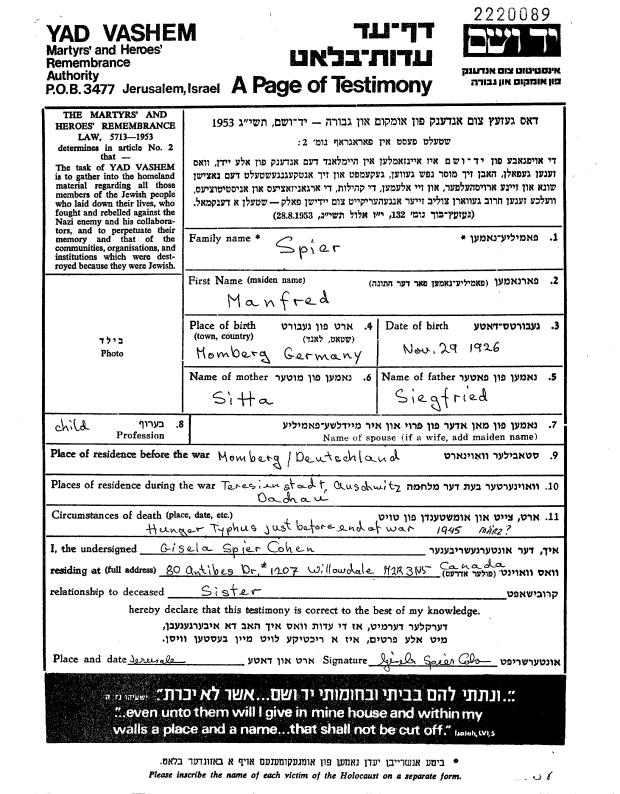
Manfred Spier Page of Testimony at Yad Vashem, found at https://yvng.yadvashem.org/nameDetails.html?language=en&itemId=1879134&ind=1

The only member of Sitta’s family to survive was her daughter Gisela. She was sent from Auschwitz on October 12, 1944,5 to the concentration camp in Flossenburg, Germany, a camp where prisoners worked as slave labor to build fighter planes and other equipment for the German military. The US Holocaust Museum and Memorial  provided this description of conditions at Flossenburg:

The conditions under which the camp authorities forced the prisoners to work and the absence of even rudimentary medical care facilitated the spread of disease, including dysentery and typhus. In addition to the dreadful living conditions, the prisoners suffered beatings and arbitrary punishments.

About 30,000 people died there, but somehow Gisela survived.

On April 29, 1945, as the Allied forces were approaching Flossenburg, the Nazis began to evacuate the camp and transport the prisoners elsewhere. Gisela was transferred from Flossenburg to the Mauthausen concentration camp,6 where she was liberated by the Allies on May 5, 1945. She was sixteen years old and weighed 46 pounds when she was freed.7

In his eulogy for his mother, Gisela’s son Simeon Spier wrote this description of Gisela’s life after she was liberated in May, 1945.8

She travelled with a friend she met in a displaced persons camp to Paris.  They were on one of the first trains to arrive in Paris at Gare de l’Est after the war’s end and were mobbed by frantic people looking for word of loved ones.  It was at that time she realized she had survived an atrocity of epic proportions.

She searched for her brother through refugee organizations.  She found out he had died of hunger and exhaustion at Dachau.  She saw 2 men on the streets of Paris wearing Magen David.  She asked them why they were wearing Stars of David now that the war was over. They told her they were part of a brigade building the Jewish state in Palestine.  They told her if she wanted to go to Palestine there was a boat leaving from the port of Marseille in several days.

With no family left, she set off to Marseille and boarded the ship, the Mataroa, to Palestine.  Since Jewish immigration to Palestine was illegal under the British Mandate, she was detained by the British army upon reaching Palestine.  She was imprisoned in Atlit ….  The Jewish underground broke her free from Atlit.  Her name was changed to escape British authorities.  She became Yael Blumenfeld – Gisela to Gazella to Yaela to Yael.  Blumenfeld for her mother’s maiden name.  She said when she became Yael Blumenfeld, she finally felt free.

She lived in the youth village of Ben Shemen, joined the Palmach army and fought in the Israeli War of Independence.  She was a decorated veteran of the 1948 war.

In 1950, Gisela came to New York with the help of her mother’s siblings and then got a job in Montreal as a secretary for a synagogue. She met her husband Israel Cohen in Canada, where they were married in 1956.9

Gisela and Israel had three children, each named for one of Gisela’s family members who had been killed in the Holocaust— a daughter Sitta, named in memory of Gisela’s mother Sitta Blumenfeld Spier, a son Simeon, named in memory of Gisela’s father Siegfried Spier, and a daughter Michall, named in memory of Gisela’s brother Manfred. The family lived in Montreal and later in Toronto.10

Once her children were grown, Gisela devoted a great deal of her time and energy to Holocaust education, including regularly traveling back to Momberg and other towns in Germany, to educate German children about what had happened to her family and many other Jewish families.11

Here is a very moving video of Gisela produced by the Sarah and Chaim Neuberger Holocaust Education Centre at the UJA Federation of Greater Toronto as part of Gisela’s efforts to provide education about the Holocaust. I highly recommend you watch this eight-minute interview so that you can see and hear this remarkable woman.

Gisela died on February 19, 2016, in Toronto. She was 87 years old and had endured and experienced so much. Simeon ended his eulogy for his mother Gisela in words that bring tears to my eyes each time I re-read them.12

My mother was overwhelmed by the good fortune her life had brought her after suffering such unbearable loss early in life.  As her life neared its end, she became at peace with herself having lived a full life bearing witness to history’s most brutal atrocity.

Death, to her meant two things. She would be re-united with her family and the ability to have a real grave with a tombstone – something her family never had.  She had always mourned that according to Jewish tradition, a son must say Kaddish at the grave of his parents and that no one had been able to say Kaddish for her parents and brother.  Today, we will go to the cemetery and say Kaddish at her grave – for her, her mother, father, and brother.  And for this, we are all very happy.

Gisela Spier Cohen was survived by her three children and her grandchildren. Her life exemplified courage and persistence and hope against all odds. I feel so moved and honored to be able to share her story and that of her family.

Special thanks to my cousin Simeon Spier for allowing me to quote extensively from the beautiful eulogy he wrote for his mother.


  1. “In Loving Memory of Yael Gisela Spier Cohen,” by Simeon Spier, published February 28, 2016, found here
  2. See the entries at Yad Vashem at the links in the text. 
  3. Obituary for Gisela Spier Cohen in Oberhesslische Press, March 23, 2016, found at https://www.op-marburg.de/Landkreis/Ostkreis/Zeitzeugin-verstirbt-fern-ihres-Geburtsortes 
  4. Manfred Spier, Nationality: German or Austrian, Birth Date: 29 Nov 1925, Birth Place: Momberg, Prior Residence: Momberg, Street Address: Marburg a. d. L, Arrival Date: 10 Oct 1944, Arrival Country: Germany, Death Date: 18 Apr 1945, Prisoner Number: 115317, Arrival Notes: 10 Oct 1944 from Auschwitz, Disposition Notes: died 18 Apr 1945, Description: prisoner German or Austrian Jew, Page: 5440/Bg.
    Original Notes (desc. / arr. / dis.): Sch. DR. J./ 10 Oct 1944 v. Au./ gest. 18 Apr 1945, JewishGen volunteers, comp. Germany, Dachau Concentration Camp Records, 1945 
  5. Gizela Spier, Nationality: German, Born: 29 Nov 1928, Prisoner Number: 54367
    Classification: Jew, Arrival: 12 Oct 1944, Record Source: Reel 2, Image #: 269, Page #: 1000, JewishGen Volunteers. Germany, Flossenbürg Concentration Camp Records, 1938-1945 
  6. Gisela Spier, Date of Birth: 29 Nov 1928, Nationality: German. Prisoner Number: 54,367, Category: Jew, Town/Camp: Freiberg, Factory: Hildebrandt, Transferred from (camp name): Auschwitz, Date transferred: 12 Oct 1944, Transferred to (camp name): Mauthausen, Date transferred: 29 Apr 1945, Ancestry.com. Germany, Women in Flossenbürg Branch Camps (Hans Brenner Book Lists), 1944-1945 
  7. See Note 1, supra. 
  8. See Note 1, supra. 
  9. See Note 1, infra. 
  10. See Note 1, supra. 
  11. See Note 1, supra. See also Note 3, supra. 
  12. See Note 1, supra. 

Gerson Blumenfeld II, Part IV: Leaving Germany

Three of the four surviving children of Gerson Blumenfeld II made it out of Germany in time to escape from the Nazis.

The family of Mina Blumenfeld Simon were the first descendants of Gerson Blumenfeld II to leave Germany. Mina’s son Josef arrived in New York on February 5, 1937. He listed his occupation as a butcher and his prior residence as Wetzlar, a town near Hermannstein where he was born.

Josef Simon ship manifest, Year: 1937; Arrival: New York, New York, USA; Microfilm Serial: T715, 1897-1957; Line: 10; Page Number: 35, New York Passenger Lists, 1820-1957, Ancestry.com

His brother Kurt arrived eight months later on October 1, 1937; he listed his occupation as a merchant and last residence as Wetzlar.

Kurt Simon ship manifest, Year: 1937; Arrival: New York, New York, USA; Microfilm Serial: T715, 1897-1957; Line: 3; Page Number: 38, Ship or Roll Number: New York, Ancestry.com. New York, U.S., Arriving Passenger and Crew Lists (including Castle Garden and Ellis Island), 1820-1957

The rest of the family—Albert, Mina, and Grete—arrived the following year on August 18, 1938. They also had been living in Wetzlar where Albert was a merchant.

Albert Meta Grete Simon passenger manifest, Year: 1938; Arrival: New York, New York, USA; Microfilm Serial: T715, 1897-1957; Line: 12; Page Number: 8, Ship or Roll Number: Washington
Ancestry.com. New York, U.S., Arriving Passenger and Crew Lists (including Castle Garden and Ellis Island), 1820-1957

Mina had officially changed her name from Mina Blumenfeld Simon to Meta Simon by the time she filed her Declaration of Intention to become a US citizen on January 24, 1939.

Meta Blumenfeld Simon declaration of intention, The National Archives at Philadelphia; Philadelphia, PA; NAI Title: Declarations of Intention For Citizenship, 1/19/1842 – 10/29/1959; NAI Number: 4713410; Record Group Title: Records of District Courts of the United States, 1685-2009; Record Group Number: 21, (Roll 549) Declarations of Intention For Citizenship, 1842-1959 (No 427401-428300), Ancestry.com. New York, U.S., State and Federal Naturalization Records, 1794-1943

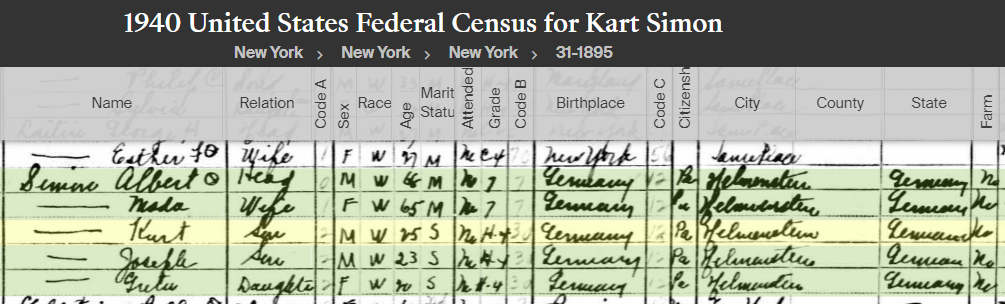
The family was reunited and living together as of the 1940 US census. They were living in New York City, and Albert and his two sons Kurt and Joseph (as spelled here) were working as butchers.

Albert Simon and family 1940 US census, Year: 1940; Census Place: New York, New York, New York; Roll: m-t0627-02670; Page: 11B; Enumeration District: 31-1895, Ancestry.com. 1940 United States Federal Census

Friedrich Blumenfeld and his family, including his mother Berta Alexander Blumenfeld, were the next family members to arrive in the US. They left shortly after Kristallnacht.

I had the great pleasure of Zooming with two of Friedrich’s grandsons last week, Steven and Milton, and they shared with me a story about their grandmother Berta’s reaction to Kristallnacht. Apparently when the Nazis came around to arrest Jewish men in the aftermath of Kristallnacht, Berta was so angry that she took the medals awarded to the family in honor of  Moritz and Isaak, the two sons who died fighting for Germany in World War I, and threw them at the Nazi soldiers, yelling that she had lost two sons already. According to the family, the soldiers backed off and left the family alone. Soon thereafter the family was able to get visas to leave Germany.1

Friedrich, Berta, and their two children arrived in the US on January 13, 1939. Friedrich’s occupation on the ship manifest is listed as shoe manufacturing, but his grandsons told me he was actually a dry goods salesman in Momberg.

Friedrich Blumenfeld and family passenger manifest, Year: 1939; Arrival: New York, New York, USA; Microfilm Serial: T715, 1897-1957; Line: 23; Page Number: 150, Ship or Roll Number: Hansa
Ancestry.com. New York, U.S., Arriving Passenger and Crew Lists (including Castle Garden and Ellis Island), 1820-1957

I cannot locate them on the 1940 census, but on October 16, 1939, they were all living together in the Bronx, according to Friedrich’s Declaration of Intention filed on that date. Friedrich was unemployed at that time.

Friedrich Blumenfeld declaration of intention, The National Archives at Philadelphia; Philadelphia, PA; NAI Title: Declarations of Intention For Citizenship, 1/19/1842 – 10/29/1959; NAI Number: 4713410; Record Group Title: Records of District Courts of the United States, 1685-2009; Record Group Number: 21,  (Roll 567) Declarations of Intention For Citizenship, 1842-1959 (No 444001-444900), Ancestry.com. New York, U.S., State and Federal Naturalization Records, 1794-1943

Katinka Blumenfeld Rosenberg was the last of the children of Gerson Blumenfeld II to escape Nazi Germany in time. Their departure was delayed because, as I learned from Katinka’s son Heinz/Henry, after Kristallnacht, Katinka’s husband Emanuel and son Walter were taken to Buchenwald where Walter spent two months and Emanuel spent five weeks. After they were released in early 1939, the family was determined to leave, but it was very difficult to find a sponsor to help them get permission to immigrate to the US. Finally a stranger from Texas who was not even related to the family came forward with an affidavit and sponsored the family. They took a train to Italy and sailed to the US from Genoa. As Henry and I discussed during our conversation, it is somewhat miraculous that they were to get out of Germany after World War II had started since for so many the borders closed after September 1, 1939.2

Katinka, her husband Emanuel Rosenberg, and their three sons Walter, Guenter, and Heinz arrived in New York on February 1, 1940. Emanuel listed his occupation as a trader, and Momberg was their last residence.

Emanuel Rosenberg and family passenger manifest, Year: 1940; Arrival: New York, New York, USA; Microfilm Serial: T715, 1897-1957; Line: 6; Page Number: 37, Ship or Roll Number: Conte Di Savoia, Ancestry.com. New York, U.S., Arriving Passenger and Crew Lists (including Castle Garden and Ellis Island), 1820-1957

Henry said they at first lived with cousins in the Bronx, but soon moved to Washington Heights in Manhattan where so many German Jewish refugees settled in the 1930s and 1940s. Henry quickly learned English and soon was able to not only catch up with his classmates but to excel in school.3

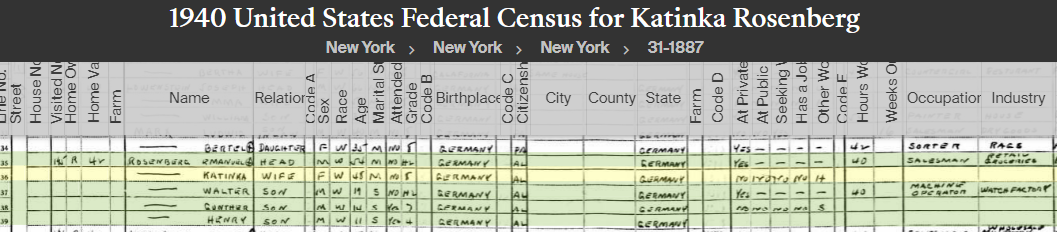
When the 1940 US census was taken a few months after their arrival, the Rosenbergs were all living in New York City. Emanuel was working in a grocery store, and Walter was a machine operator in a watch factory.

Emanuel Rosenberg and family 1940 US census,Year: 1940; Census Place: New York, New York, New York; Roll: m-t0627-02670; Page: 9A; Enumeration District: 31-1887, Ancestry.com. 1940 United States Federal Census

Thus, Mina, Friedrich, and Katinka and their families were able to escape to the US in time and survived the Holocaust.

Tragically, the youngest child of Gerson Blumenfeld II, Sitta Blumenfeld Spier, did not leave Germany in time to escape the Holocaust.  Her family’s story in my next post.


I will be taking next week off to be with my family, who are coming to visit for Thanksgiving. Have a great Thanksgiving to all my US readers!


  1. Zoom with Steven Hamburger and Milton Hamburger, November 10, 2022. 
  2. Phone conversation with Henry Rosenberg, October 30, 2022 
  3. See Note 2, supra. 

Gerson Blumenfeld II, Part III: The Nazis Come to Momberg

As we saw, Gerson Blumenfeld II died on July 29, 1919, in the aftermath of losing two of his sons—Moritz and Isaak—during their service to Germany in World War I. He was survived by his wife Berta, one remaining son Friedrich, and his three daughters, Mina, Katinka, and Sida, as well as Mina’s husband Albert Simon, and their children.

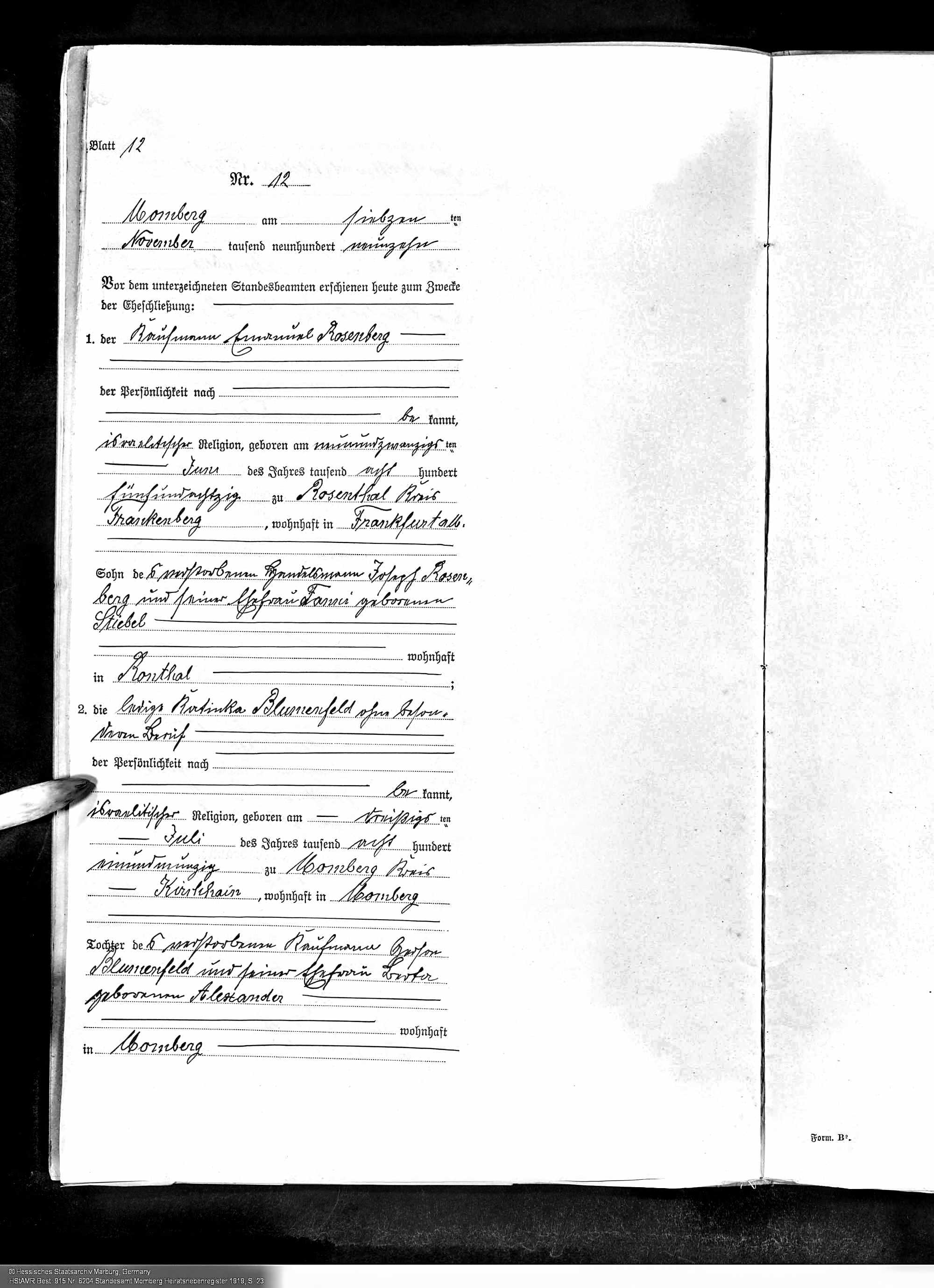
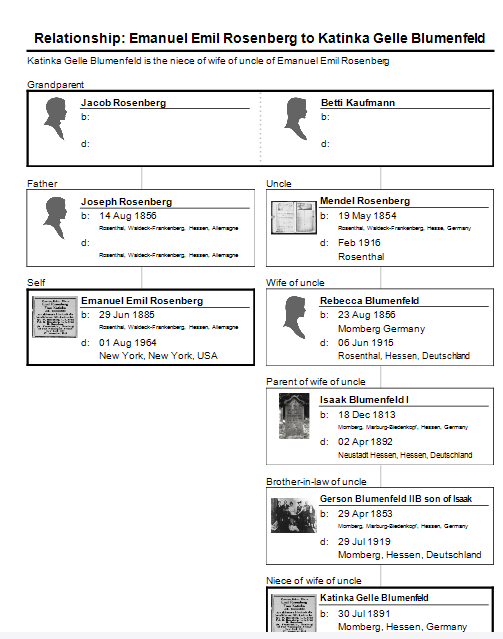
Fortunately, the family continued to grow after the war. Katinka married Emanuel Emil Rosenberg on November 7, 1919. Emanuel was born on June 19, 1885, in Rosenthal, Germany, to Joseph Rosenberg and Fanni Stiebel. He was also the nephew of Mendel Rosenberg, who was married to Katinka’s aunt Rebecca Blumenfeld, her father Gerson’s sister.

Katinka Blumenfeld marriage to Emanuel Rosenberg, Hessisches Hauptstaatsarchiv; Wiesbaden, Deutschland; Bestand: 915; Laufende Nummer: 6204, Year Range: 1919, Ancestry.com. Hesse, Germany, Marriages, 1849-1930

Katinka and Emanuel had three sons: Walter, born in Frankfurt, Germany, on October 17, 1920;1 Guenther, born in Frankfurt on July 7, 1925;2 and Heinz, born in 1928.3

Katinka’s older brother Friedrich married Lina Neuhaus on October 26, 1921, in Braach, Germany. She was born on September 19, 1894, in Braach (sometimes listed as Baumbach, which is less than two miles from Braach) to Samuel Neuhaus and Bertha Wallach.

Siegmund Friedrich Blumenfeld marriage to Lina Neuhaus, Hessisches Hauptstaatsarchiv; Wiesbaden, Deutschland; Bestand: 907; Laufende Nummer: 510, Year Range: 1921, Ancestry.com. Hesse, Germany, Marriages, 1849-1930

Friedrich and Lina had two children: Gretel was born August 21, 1922, in Momberg,4 and Gunter was born on February 22, 1926, in Momberg.5

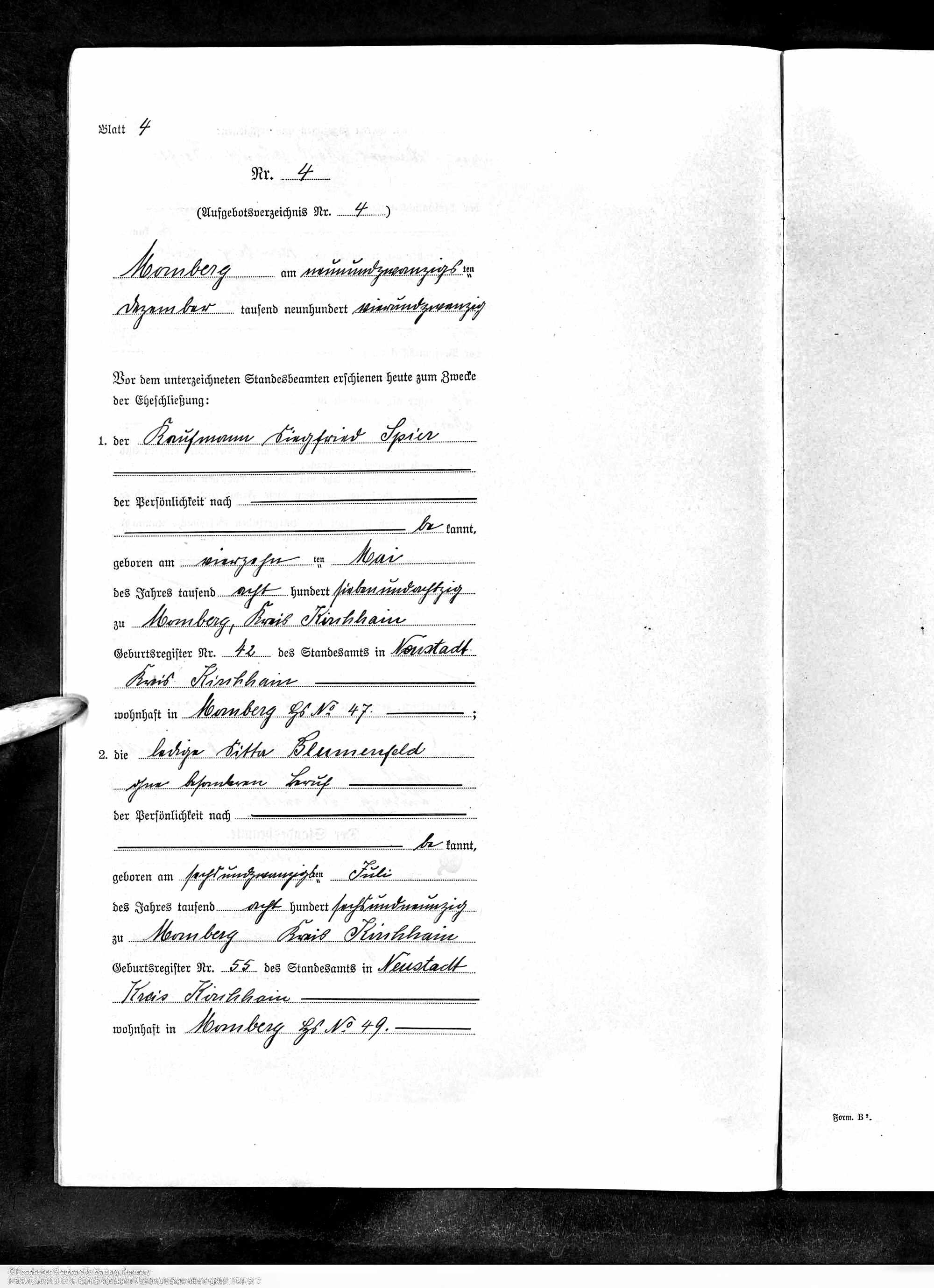
Sida Blumenfeld, the youngest child of Gerson II and Berta, married Siegfried Spier on December 29, 1924, in Momberg. Her name is spelled Sitta on the marriage record, and I will use that spelling going forward. Siegfried was also a native of Momberg; he was born there on May 14, 1887, to Michael Spier and Veilchen Nussbaum. He was the owner of a matza factory.6

Sitta Blumenfeld marriage to Siegfried Spier, Hessisches Hauptstaatsarchiv; Wiesbaden, Deutschland; Bestand: 915; Laufende Nummer: 6209, Year Range: 1924, Ancestry.com. Hesse, Germany, Marriages, 1849-1930

Sitta and Siegfried had two children, Manfred, born on November 29, 1925, in Momberg,7 and Gisela, born exactly four years later on November 29, 1929.8

Gisela’s son Simeon Spier wrote this beautiful description of his mother’s family’s life in Momberg before the Nazis came to power in the 1930s.9

Momberg was like a storybook village of gingerbread cookies and green rolling hills.  Her family had lived there since the 17th century.  Her father, Siegfried Spier, owned a matza factory started by her great grandfather.  Her mother, Sida, was a deeply religious woman.   Her paternal grandmother lived in her house and her maternal grandmother lived across the street.  It was a world of German folk songs and Jewish religion.  She played soccer with her brother and cousins, attended the village school and went to the tiny village shul on Shabbos.

I also had the great pleasure of speaking to Katinka’s son Heinz (now Henry) Rosenberg just a week or so ago. He also spent his early childhood years in Momberg. He pointed out that since Gisela’s father Siegfried Spier owned a matza factory that employed many of the town’s residents, even after Hitler first came to power in 1933, no one bothered the Jews in Momberg at first because they were grateful to have jobs in the factory.10

That idyllic life would soon come to an end with Kristallnacht in November, 1938. Simeon Spier described what happened in Momberg to his mother and her family:11

On the 9th of November 1938 her world was destroyed by the Nazis during the Kristallnacht. The synagogue was burned down and the men were taken to concentration camps. Her brother’s Bar Mitzvah could not take place later that month as there was not a minyan of 10 adult Jewish men in the village. This saddened her all her life since her brother had been practicing his parsha and haftorah for months. She too knew the words and could recite them the rest of her life.

Jews were kicked out of the village school and Gisela and her brother were sent to an orphanage in Frankfurt. There, away from her family at 10 years old she would spend countless hours in the school’s gymnasium on the horizontal bar. Her love of sports helped her escape what was happening. She lived on Pfingsfeid Strasse near the zoo. Jews were not allowed in the zoo so all she could see was the head of the giraffe. She was forced to wear a yellow star.

Heinz/Henry Rosenberg also was unable to go to school for two years and still clearly remembers seeing the destruction of the Momberg synagogue on Kristallnacht. He shared with me the moving story of his family’s rescue of a Torah scroll that had belonged to his grandfather Gerson Blumenfeld and had been damaged during the violence of Kristallnacht. They brought that scroll with them to the US, and Henry read from it at his bar mitzvah in 1941 as did his grandson over seventy years later.

Fortunately, like that Torah scroll, almost all of Gerson Blumenfeld’s children and grandchildren got out of Germany in time and survived the Holocaust. Almost all.


  1. Walter Joseph Rosenberg, Gender: Male, Petition Age: 24, Birth Date: 17 Oct 1920
    Birth Place: Frankfurt, Germany, Record Type: Naturalization Petition, Petition Number: 1788, National Archives and Records Administration – Southeast Region (Atlanta); Atlanta, GA; Petitions For Naturalization, Compiled 1922-1964; Series Number: 648598; Record Group Title: Records of District Courts of the United States; Record Group Number: 21, Ancestry.com. Louisiana, U.S., Naturalization Records, 1836-2001 
  2. Guenther Rosenberg, [George G Rosenberg], [George Rosenberg], Gender: Male
    Race: White, Birth Date: 7 Jul 1925, Birth Place: Frankfurt MA, Federal Republic of Germany, Death Date: 27 Oct 1998. Father: Emil Rosenberg. Mother: Katinka Blumenfeld, SSN: 093129735, Ancestry.com. U.S., Social Security Applications and Claims Index, 1936-2007 
  3. Heinz, Record Type: Naturalization Declaration., Birth Date: — 1928, Birth Place: Frankfurt, Germany, Court: U.S. District Court for the Southern District of New York, Father: Emanuel Rosenberg, Box Number: 338, The National Archives at Philadelphia; Philadelphia, PA; NAI Title: Declarations of Intention For Citizenship, 1/19/1842 – 10/29/1959; NAI Number: 4713410; Record Group Title: Records of District Courts of the United States, 1685-2009; Record Group Number: 21, Source Information
    Ancestry.com. New York, U.S., State and Federal Naturalization Records, 1794-1943. Because Heinz/Henry is still living, I am not disclosing his exact birth date. 
  4. Gretel Blumenfeld, [Grethe Blumenfeld], Gender: Female, Race: White, Declaration Age: 18, Record Type: Naturalization Declaration, Birth Date: 21 Aug 1922
    Birth Place: Momberg, Germany, Court: U.S. District Court for the Southern District of New York, Declaration Number: 493628, Box Number: 366, The National Archives at Philadelphia; Philadelphia, PA; NAI Title: Declarations of Intention For Citizenship, 1/19/1842 – 10/29/1959; NAI Number: 4713410; Record Group Title: Records of District Courts of the United States, 1685-2009; Record Group Number: 21, Ancestry.com. New York, U.S., State and Federal Naturalization Records, 1794-1943 
  5. Gunter Blumenfeld, Petition Age: 19, Record Type: Naturalization Petition, Birth Date: 22 Feb 1926, Birth Place: Momberg, Germany, Departure Place: Momberg, Germany, Petition Place: Augusta, Augusta-Richmond, Georgia, USA, Ship: Hansa
    Description: Augusta Naturalization Petitions 9/1943-12/1953 (Box 2), National Archives and Records Administration; Washington, DC; ARC Title: Petitions For Naturalization, Compiled 1909 – 1970; ARC Number: 2143321; Record Group Title: Records of District Courts of the United States; Record Group Number: 21, Ancestry.com. Georgia, U.S., Naturalization Records, 1794-1993 
  6. “In Loving Memory of Yael Gisela Spier Cohen,” by Simeon Spier, published February 28, 2016, found here
  7. Manfred Spier, Nationality German or Austrian, Birth Date 29 Nov 1925, Birth Place Momberg, Prior Residence Momberg, Street Address Marburg a. d. L., Arrival Date 10 Oct 1944, Arrival Country Germany, Death Date 18 Apr 1945, Prisoner Number 115317
    Arrival Notes 10 Oct 1944 from Auschwitz, Disposition Notes died 18 Apr 1945, Description prisoner German or Austrian Jew, Page 5440/Bg., Original Notes (desc. / arr. / dis.) Sch. DR. J./ 10 Oct 1944 v. Au./ gest. 18 Apr 1945, JewishGen volunteers, comp. Germany, Dachau Concentration Camp Records, 1945 
  8. Giesela Sara Spier, Gender: weiblich (Female), Nationality: Deutsch Juden, Record Type: Inventory, Birth Date: 29 Nov 1928, Birth Place: Momberg, Last Residence: Momberg, Residence Place: Momberg, Marburg an der Lahn
    Notes: Inventories of personal estates of foreigners and especially German Jews
    Reference Number: 02010103 oS, Document ID: 85950815, Arolsen Archives, Digital Archive; Bad Arolsen, Germany; Lists of Persecutees 2.1.1.3, Ancestry.com. Free Access: Europe, Registration of Foreigners and German Persecutees, 1939-1947 
  9. See Note 6, supra. 
  10. Phone conversation with Henry Rosenberg, October 30, 2022. 
  11. See Note 6, supra. 

Gerson Blumenfeld II, Part II: Two Sons Killed in World War I Fighting for Germany

In the summer of 1914 after the assassination of the Archduke Franz Ferdinand of Austria-Hungary, the countries of Europe and of the wider world declared war on each other based on mutual protection agreements those countries had previously formed. On one side were the Central Powers including Austria-Hungary, Germany, and Turkey; on the other side were the Allies, including France, England, Italy, Russia, Japan, and later the US.

The three sons of Gerson Blumenfeld II and his wife Berta Alexander—Moritz, Friedrich, and Isaak—all served in the German army for the Central Powers. But only one of those sons came home alive.

Moritz, their oldest son, was killed on the Eastern Front of the War in Niedzieliska, Poland, on December 11, 1914, according to his German death record.1 The report of his death came from the commander of his reserve infantry unit, as indicated on the death record, and stated that he’d been shot in the abdomen.2

Moritz Blumenfeld, Death Age: 27, Birth Date: abt 1887, Death Date: 11. Dez 1914 (11 Dec 1914)
Death Place: Momberg, Hessen (Hesse), Deutschland (Germany), Civil Registration Office: Momberg, Father: Gerson Blumenfeld, Mother: Bertha Blumenfeld, Certificate Number: 1, Hessisches Hauptstaatsarchiv; Wiesbaden, Deutschland; Personenstandsregister Sterberegister; Bestand: 6225; Laufende Nummer: 915, Ancestry.com. Hesse, Germany, Deaths, 1851-1958

Niedzieliska was a small village about 42 miles east of Krakow. During the summer and into the fall of 1914, the Russians were successfully fighting the German and Austrian troops in that general area, winning an important battle in Lemberg (now Lviv) in the late summer of 1914 and then moving west and capturing Przemysl in the spring of 1915.

I am very grateful to Eric Feinstein of the GerSIG Facebook group for providing me with access to a description of the battle of Niedzieliska from a book entitled (as translated) Reserve Infantry Regiment No. 83: edited from official and private war diaries by Hans Wahrenburg, published in 1924 by Stalling Verlag in Berlin. Eric pointed me to page 42 which describes the Niedzieliska battle, and I used DeepL to translate it, though some of the references are not clear.

At 12:12, II and III Battalions will be moved out of the forward line during the morning and III Battalion will be housed and fed at Niedzieliska. At 1.30 a.m. the II Battalion also follows there, while at the same time the III Battalion from the eastern exit of the Dorsel is deployed for another assault against the Russian position at the windmill Wszeliwn in the subsection of the 49 RJB.

Heavy flank fire from the right initially hampered the advance of the companies and only after the arrival of II Battalion on the obstructed right wing did the assault proceed briskly, especially since the enemy apparently had little artillery, but was able to bring the assault to a halt with even more intense infantry and M.C. fire.

Exhausting effort! 4 o’clock in the morning the position on the Wszelimn-Dsief road was taken by assault, during which, among others, the leader of 12 Company, Captain a D Rudel, and by roughing up the enemy MC Sergeant Emilius and Muss. Cohn 11 Compagnie, Ref. Zinf. Kriegsfreim. Ludwig and Ref. harms 12th Compagnie and Ref. Deja quite particularly distinguish.

About 1500 prisoners and 12 MC find the spoils of the day. I Battalion advanced as a division reserve to the west exit of Niedzieliska, but failed to enter.

It was sometime during this battle that Moritz Blumenfeld II, oldest child of Gerson Blumenfeld II and Berta Alexander, was mortally wounded.

His younger brother Isaak was killed on the Western Front. Although I do not have a death certificate for Isaak, I have information from the lists of German casualties located on Ancestry and elsewhere. Isaak died in a field hospital in Sainghin-en-Weppes in the north of France on January 8, 1915, after being seriously wounded. He was only 21 at the time.

Isaack Blumenfeld, Residence Year: 1914, Residence Country: Deutschland (Germany)
List Date: 30. Jan 1915 (30 Jan 1915), List Number: 0345, Volume: 1915_VII, Ancestry.com. Germany, World War I Casualty Lists, 1914-1919

Isaack Blumenfeld Residence Year: 1914 Residence Country: Deutschland (Germany) List Date: 20. Jan 1915 (20 Jan 1915) List Number: 0331 Volume: 1915_VII, Ancestry.com. Germany, World War I Casualty Lists, 1914-1919

Like Niedzieska where Moritz was killed, Sainghin was just a small village with no obvious strategic importance, but it was located in the region of France where during this time period, thousands of soldiers on both sides were killed during trench warfare where the two sides were essentially deadlocked, going back and forth slaughtering each other’s young soldiers and others.

This UK website on World War I described it in these terms:

By the end of 1914 the battles of movement in the first weeks of the war had been  brought to a halt. The fierce defence of strategic landmarks by the Allied forces resulted in a situation which became one of deadlock. Carefully selecting the most favourable high ground the Imperial German Army began the construction of a strong defensive line from early in 1915.

The consolidation of the Front Lines consisted of trenches, wire defences, mined dugouts and deep bunkers, reinforced concrete emplacements and selected strongpoints, usually a reinforced farm, in an Intermediate, Second and Third defensive line. Gradually the building and digging was carried on on both sides of the wire along a distance of approximately 450 miles, creating a more or less continous line of trenches separating the warring belligerents along the length of The Western Front.

In 1915, 1916 and 1917 both sides made attempts to break the deadlock with major battle offensives. The characteristics of siege warfare which developed on the Western Front in these three years created conditions never witnessed before. Instead of expecting to achieve objectives at a considerable distance from the start of an offensive, the type of trench warfare fighting created a situation where attacks were carried out in phases with short distance objectives and usually following a bombardment of enemy trench lines beforehand. This strategy led to prolonged periods of fighting with success counted in gains hundreds of yards rather than miles. The human cost of casualties and dead in such a grinding type of siege warfare would be recorded in the thousands in the space of a single day.

Isaak Blumenfeld, Gerson II and Berta’s youngest son, was killed during the early days of this period of warfare, less than a month after the death of his brother Moritz.

A January 29, 1914 article in the Frankfurter Israelitisches Familienblatt reported, “The G. Blumenfeld family was hit by a heavy loss. Two hopeful sons both suffered heroic deaths for their fatherland. Both stood out from the enemy with their outstanding bravery honored, the eldest carried a seriously wounded man out of the most terrible shell fire at great risk to his life. The youngest last stood as a teacher in Petershagen on the Weser.”

The deaths of Moritz and Isaak left Gerson and Berta with just one surviving son, their middle son Friedrich. But Friedrich also served in the German armed forces. His great-nephew Michael Rosenberg shared with me Friedrich’s military record, including translations of the information on each page done by Richard Bloomfield.

As translated by Richard, this record indicates that Friedrich began his military service for Germany on August 24, 1915, just months after the deaths of both of his brothers. He was transferred to the homeland and away from the front in January 1917, perhaps because the family had already lost Isaak and Moritz. Friedrich was discharged from service on December 26, 1918, six weeks after the war ended, and came home alive.

His father Gerson Blumenfeld II, however, died in Momberg on July 29, 1919, just seven months after Friedrich returned home. Although Gerson was 66 and thus was not particularly young for that era when he died, I nevertheless wonder whether losing two of this three sons in some way hastened his death.

UPDATE: My cousin Gary Rosenberg, Gerson II’s great-grandson, shared these images of Gerson II’s grave and also translated the Hebrew side for me. It reads:

Here Is buried A man that was unblemished (or complete) from an early age, a Tzadik in all his ways and a Chasid in all his doings, Father to the poor and to orphans – Gershon the son of Yitzchak the Cohen who died on the 2nd day of the month of Av 5679  And was buried with great honor on the 4th day of Av May his soul be bound up in the bond of eternal life.

Gravestone of Gerson Blumenfeld II Courtesy of Gary Rosenberg

Gravestone of Gerson Blumenfeld II Courtesy of Gary Rosenberg

One might have thought that sacrificing two sons to the cause of Germany in World War I would have somehow kept the rest of this family safe from the Nazis, but it was not to be, as we will see.


  1. At least one secondary source reports that his death occurred on December 12, 1914, but I am relying on his actual death record. See the list of Jewish World War I casualties for Germany at http://denkmalprojekt.org/verlustlisten/rjf_orte_m_wk1.htm 
  2. Thank you to the members of the GerSIG: German Jewish Genealogy Special Interest Group on Facebook for transcribing and translating this record.