
Although two daughters of Moses Max Rothschild appear to have survived the Holocaust, his son Erwin was not as fortunate. The only official records I have for Erwin Rothschild are two that relate to his death, but they also include his birth date and his parents’ names. He was born on December 5, 1904, in Nordeck, Germany, and he died of typhus on March 28, 1945, in the Bergen-Belsen concentration camp. These two records also both provide evidence that Erwin was a dentist and that he was married to Irma Simon. But not much else can be discerned about Erwin’s life from these two documents.
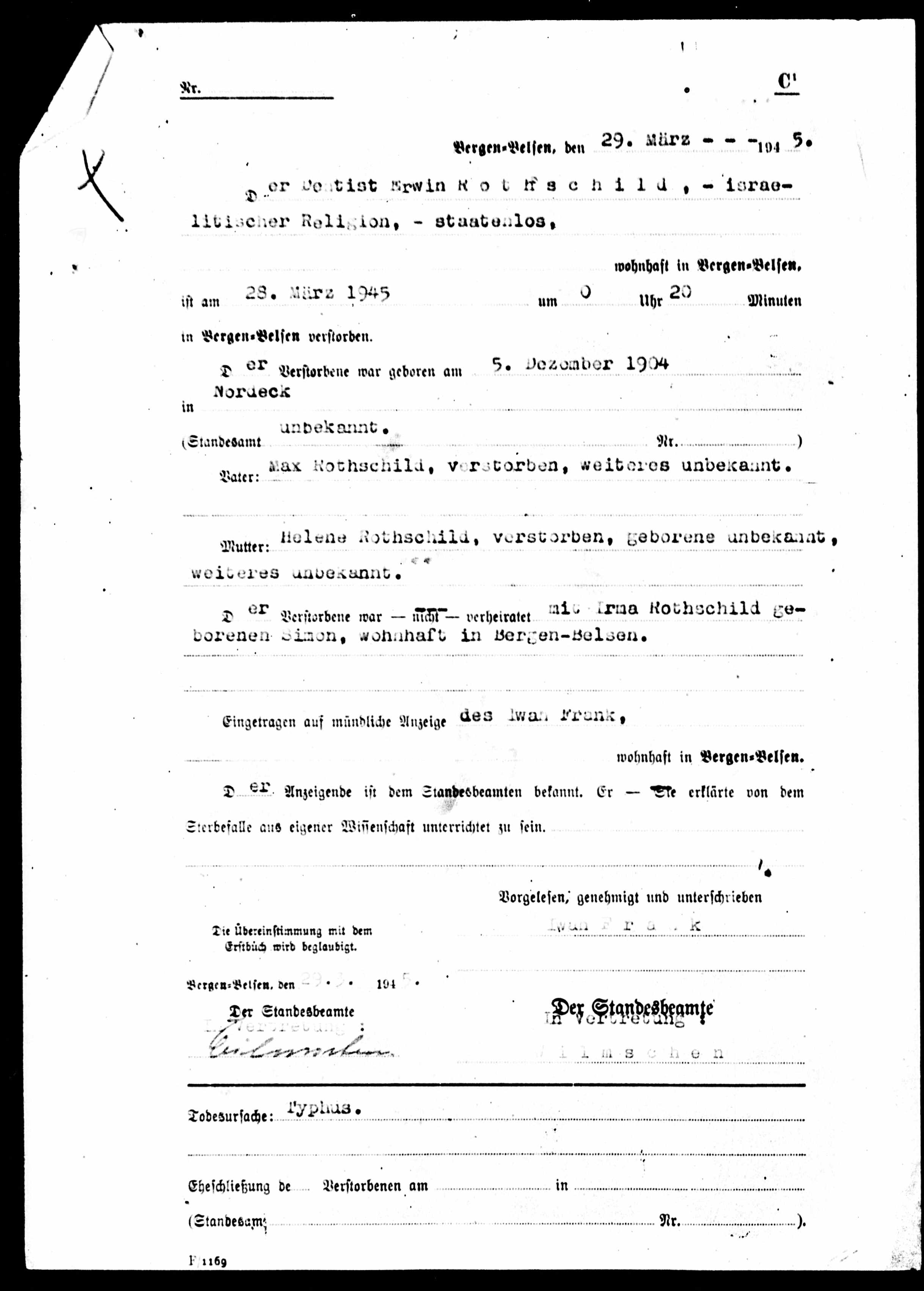
Erwin Rothschild death record from the Bergen Belsen Concentration Camp, The National Archives at College Park; College Park, Maryland; Microfilm: A3355; ARC: 596972; Title: Lists and Registers of German Concentration Camp Inmates, 1946 – 1958; Record Group: 242; Record Group Title: National Archives Collection of Foreign Records Seized, 1675 – 1958
Source Information
Ancestry.com. Germany, Concentration Camp Records, 1937-1945
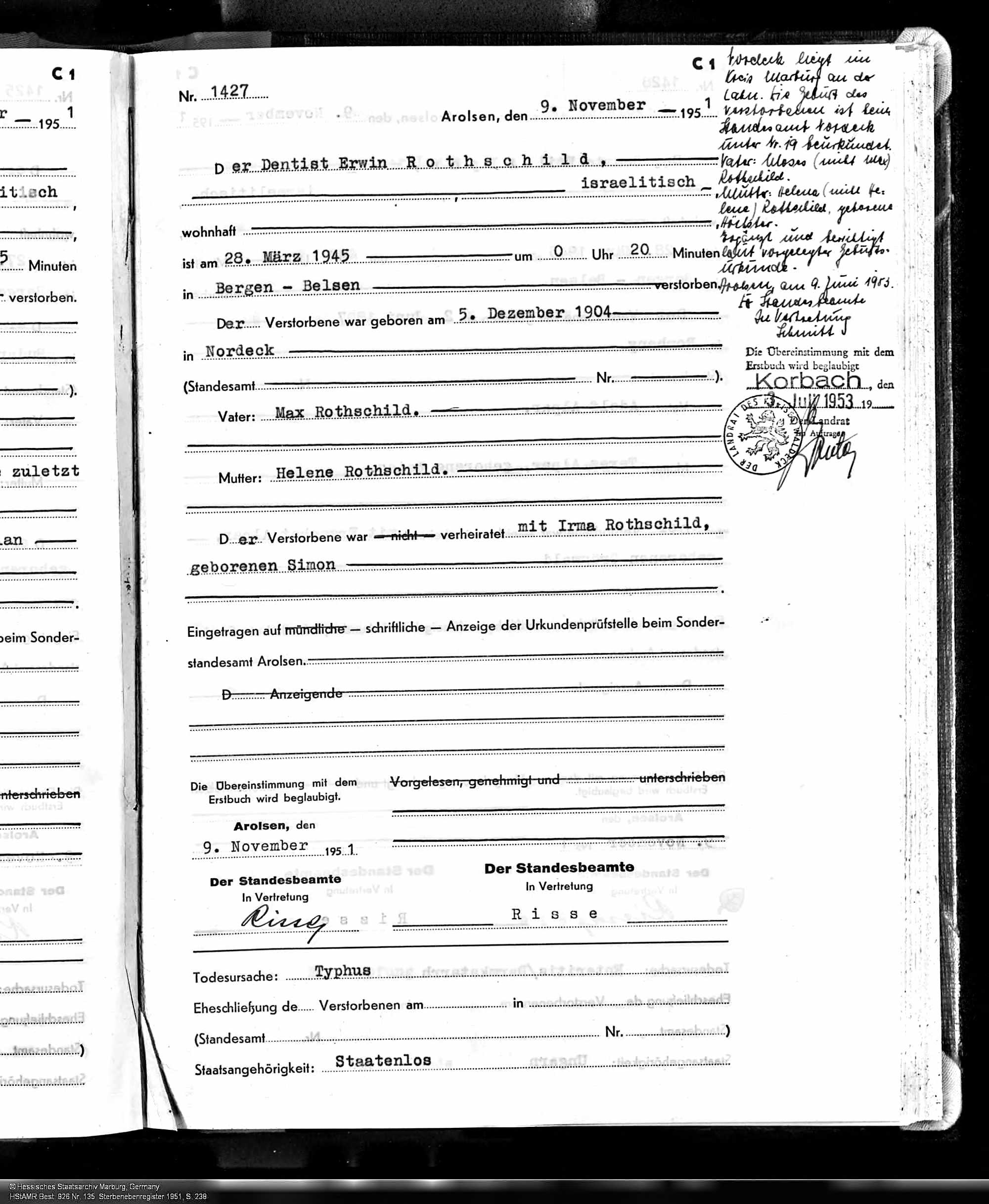
Erwin Rothschild death certificate, Hessisches Hauptstaatsarchiv; Wiesbaden, Deutschland; Personenstandsregister Sterberegister; Signatur: 135; Laufende Nummer: 926
Year Range: 1951, Ancestry.com. Hesse, Germany, Deaths, 1851-1958
Fortunately, Erwin’s widow Irma Simon Rothschild Haas gave testimony to the Shoah Foundation and filled in the details of Erwin’s life as well has her own quite moving and amazing life story. I am so grateful to the Shoah Foundation for recording and preserving these stories.
Irma was 89 years old when she was interviewed on August 4, 1997. But you would never know it from the sharpness of her mind, the depth and precision of her memories, and her ability to answer probing and difficult questions. She was an incredible storyteller, and I felt like I was with her during those awful years of the Holocaust. I started out wanting to learn more about Erwin, but by the end of Irma’s testimony I was moved to tears by not only what I’d learned about Erwin, but by what I’d learned from Irma about the best side of human nature. Find two hours in your busy lives and listen to what Irma has to say. You also will never forget her. 1
Although I cannot do justice to Irma’s testimony in a brief paraphrasing of its content, I want to tell the story of Erwin and Irma as best I can. Irma Simon was born on October 9, 1907, in the small town of Londorf, Germany. Irma had two older brothers, Siegfried and Julius, and a younger sister Hilde.
Irma went to school to become a kindergarten teacher and worked in Cologne, Frankfurt, and Berlin before the Nazi era. She was working in a children’s home for 150 children in 1935 outside of Berlin when the Nuremberg Laws were enacted and the home was no longer able to obtain kosher meat. Irma left the home and found a new job teaching in Berlin. She lived with an unnamed cousin of Erwin Rothschild, and I assume that that is how she met Erwin. He was practicing dentistry in Berlin at that time.
After Kristallnacht in November 1938, the school where Irma had been working closed, and Erwin and Irma and her parents tried to get out of Germany . One of her brothers, Julius, was already in the US, her sister Hilde was married to Simon Eisenmann and living in Amsterdam, and her other brother Siegfried had been arrested after Kristallnacht and sent to Sachsenhausen. With Irma’s help and a visa obtained by her sister Hilde in Holland, Siegfried was released and left for South America. Later, Hilde was also able to get a visa for their parents and for her sister Irma to come to Holland.
Meanwhile, Erwin Rothschild, who was now engaged to Irma Simon, had gotten a ticket to leave Germany on the ill-fated ship, the St. Louis in the spring of 1939. I’ve previously told the story of the St. Louis, the ship that was turned away from Cuba and from the US and had to sail back to Europe in June, 1939, returning its passengers to a likely death in the Holocaust. Erwin ended up in Holland where Irma and her family were living.
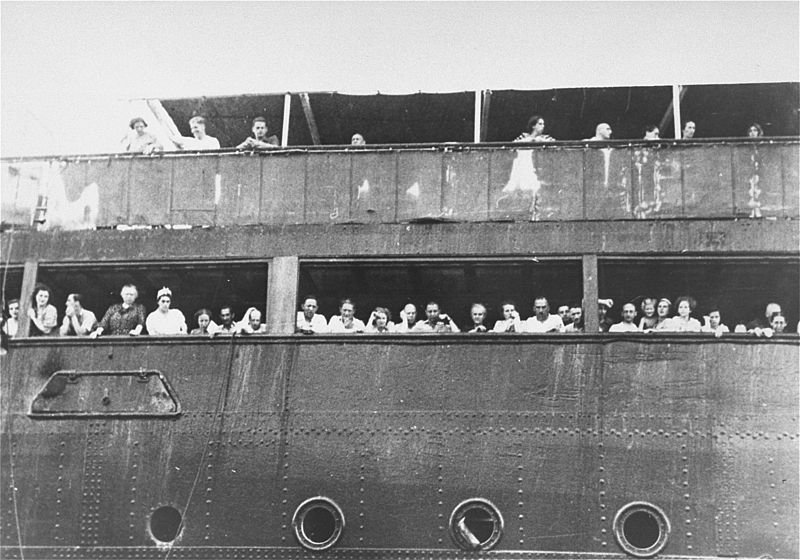
Jewish refugees aboard the SS St. Louis attempt to communicate with friends and relatives in Cuba, who were permitted to approach the docked vessel in small boats. |Source=USHMM, courtesy of National Archives and Records Adminis (public domain)
But Erwin was not able to live in Amsterdam where Irma was living; as a refugee from the St Louis, he was required by the Dutch to live in the internment camp in Westerbork. But he was free to work as a dentist in Amsterdam and to see Irma, who was working at a children’s home in Amsterdam.
However, when the Nazis invaded Holland in May, 1940, the school was forced to close and the children were evicted. Irma helped find homes for 130 of those children with families in Amsterdam. The Nazis also took over the camp at Westerbork where Erwin was living.

Nazi troops and supporters in front of De Bijenkorf, Dam Square, Amsterdam, The Netherlands, 1941 (crop of original 1941 public domain photo). 47thPennVols, CC0, via Wikimedia Commons
In 1942 Erwin and Irma married, but Irma stayed with her parents in Amsterdam because they all believed she would be safer there. But by the end of that year her parents were taken to Westerbork. To avoid being taken to a concentration camp at Vught where conditions were worse, Irma voluntarily moved to Westerbork to be with her husband Erwin as well as her parents and her sister Hilde and brother-in-law Simon. Conditions at Westerbork were at that time not bad at all, and Irma became a dental assistant working with Erwin.
In September 1943, Irma’s parents were put on a transport to Bergen-Belsen, where conditions were much worse. Then Irma’s sister Hilde and her husband Simon Eisenmann were put on a list for transport despite having certificates to go to Palestine, which were supposed to keep them (and Erwin and Irma) off the transport lists. Erwin figured out that there was confusion regarding a different man named Eisenmann and got Hilde and Simon off the list.
In December 1943, they were told that the Westerbork camp was to be dissolved and all those with Palestine certificates would go to a Red Cross camp, but in fact Erwin, Irma, Hilde, and Simon and the others were all sent to Bergen-Belsen, arriving there on February 1, 1944, just a day after Irma’s parents had been transferred from Bergen-Belsen to Theresienstadt. Irma was heartbroken not to have had a chance to see her parents. She never saw them again. They died at Theresienstadt.
The conditions at Bergen-Belsen were terrible. Irma, Erwin, Hilde, and Simon all worked in a quarry, where Erwin feared his hands would be so damaged from smashing rocks that he would never practice dentistry again. But then one of the older camp dentists died, and Erwin was drafted into being a camp dentist. That meant he could live in the hospital with the doctors with better living conditions than being in the barracks.

Women and Children at Bergen Belsen Concentration Camp, 1945, No 5 Army Film & Photographic Unit, Morris (Sgt), Public domain, via Wikimedia Commons
When a young SS officer who was also a dentist needed dental care one day, he asked Erwin to help him. At first Erwin refused, saying he was not allowed to treat Aryans. But the officer insisted, saying the other (non-Jewish) dentist was not as good. So Erwin treated him, and the officer arranged to have Irma become his assistant and to live in the hospital with the nurses.
But Hilde and her husband Simon were still in the barracks, and in November 1944, Simon died from typhoid fever. Hilde was bereft, and Erwin and Irma did everything they could to give her support. But she became very sick, and Erwin, without permission, had her brought to the camp hospital. Although he was caught and punished for doing that, he saved Hilde’s life.
But unfortunately, Erwin could not save his own life. In early 1945, a camp was set up near Bergen-Belsen for women who had been transferred from Auschwitz. Erwin was sent there to provide dental care for these women and contracted typhoid fever from them. He died from the disease on March 28, 1945,2 leaving Irma, like her sister Hilde, a young widow still imprisoned at Bergen-Belsen.
I will tell the rest of Irma and Hilde’s story in my next post. But this post is to honor the memory of my cousin Erwin Rothschild, a man who not only cared for those at Westerbork and Bergen-Belsen, but who managed to keep his wife Irma and her sister Hilde safe. From the way Irma spoke about him more than 50 years after he died, I could tell that theirs was a true love story and that Erwin was a good, decent, courageous, and compassionate man. How tragic that he died caring for others just a few weeks before the war ended in Europe.
- Haas, Irma. Interview 32295. Interview by Miriam Horowitz. Visual History Archive, USC Shoah Foundation, 04 August 1997. https://vha.usc.edu/testimony/32295. Accessed 14 Jan 2024. You do not need to download Irma’s testimony; it is available online at the citation above. All the information in this post came from Irma’s testimony. ↩
- In her testimony Irma said that Erwin died on March 27, 1945, but the death records above both indicate that he died on March 28. I don’t know which is more accurate, but I am using the recorded date. ↩
 Brotmanblog: A Family Journey
Sad story. I don’t know that I could bear hearing Irma herself tell it.
LikeLiked by 1 person
It is really moving, and yet she tells it without falling apart and seemingly without anger or hatred. Remarkable.
LikeLike
I hope she was able to have a good life after the war.
LikeLiked by 1 person
The story will continue in my next post. So stay tuned!
LikeLiked by 1 person
Wow – such a tragedy for all the families involved. The photo of the women and children is chilling…
LikeLiked by 1 person
Yes, and repeated so many millions of times over.
LikeLike
Irma had a deep resilience, sounds like. To endure that and be able to function seems so incredibly difficult.
LikeLiked by 1 person
She struck me as an incredibly strong, smart, resourceful and courageous woman. A true heroine.
LikeLiked by 1 person
A tragic story, so much to be admired. I can’t imagine how Irma managed to carry on.
LikeLiked by 1 person
And yet she did! Stay tuned…
LikeLike
It always just tears me up to see that the Nazis locked a person up for 6 years because he was Jewish, undoubtedly ignored every basic principle of humane treatment, and still had the time to fill out their little bureaucratic forms with a typewriter and record the time of death to the minute. And this was 3 weeks before they surrendered. There are no words I can use to describe how I feel about these sub-human beings.
These same sub-humans forced everyone they imprisoned to change the beneficiary on their life insurance so the government could collect the benefit after they killed the prisoner.
LikeLiked by 1 person
I feel the same, and I find it really upsetting when I realize how close to the end of the war this was. Yet the Nazis were determined to kill every Jewish person they could even as they knew that they were losing the war. Disgusting and heartbreaking.
LikeLike
Erwin’s story touched me deeply. It showed that the light of humanity shines even in the darkest hours. The world needs more people like Erwin.
LikeLiked by 1 person
We sure do, Peter. And like his wife Irma.
LikeLiked by 1 person
Pingback: Irma and Hilde: The Power of Love | Brotmanblog: A Family Journey