Yom Hashoah 2025

Before I started researching my family history back in 2010, I believed that I had no relatives who were killed in the Holocaust. Since then I have learned that there are so many of my cousins who were killed by the Nazis that I have lost count—babies, children, teenagers, mothers and fathers, brothers and sisters, grandparents, the frail and the elderly—innocent people who were put to death for no reason other than their Jewish identity.

Here we are 80 years after the Holocaust and we are still seeing people being despised and targeted because of their identities. There is still widespread antisemitism, but also widespread racism and islamophobia. We seem to have learned nothing.

On Yom Hashoah let’s work for and hope for the end of all kinds of intolerance and hatred.

Another update: Alfred Meyer Survived The Holocaust

Almost five years ago I wrote about Alfred Meyer, son of Regina Goldschmidt and Aaron Meyer and my third cousin, twice removed. He was born in Frankfurt, Germany, on June 16, 1875, and that was almost all I knew about him. The only other records I could find for Alfred were two Holocaust era records on file at the Arolsen Archives. Both indicated that Alfred had left Germany for France on April 24, 1939, and was still there as of November 3, 1939. I couldn’t find any other records for him.

Had he ever married? Did he have children? I didn’t know. Had he died in the Holocaust? There were no records for him at Yad Vashem or at the US Holocaust Memorial and Museum. I was left without any further information.

Until, that is, a few weeks ago when I received an email from another researcher named Ofra Karo. Ofra and I had been in touch over a year ago about a different branch of my tree, but now she was writing to say that she had found additional information about Alfred Meyer. For one thing, she had found a marriage record for Alfred indicating that he had married Augustine Marguerite K/Brat in Paris, France on August 11, 1911.

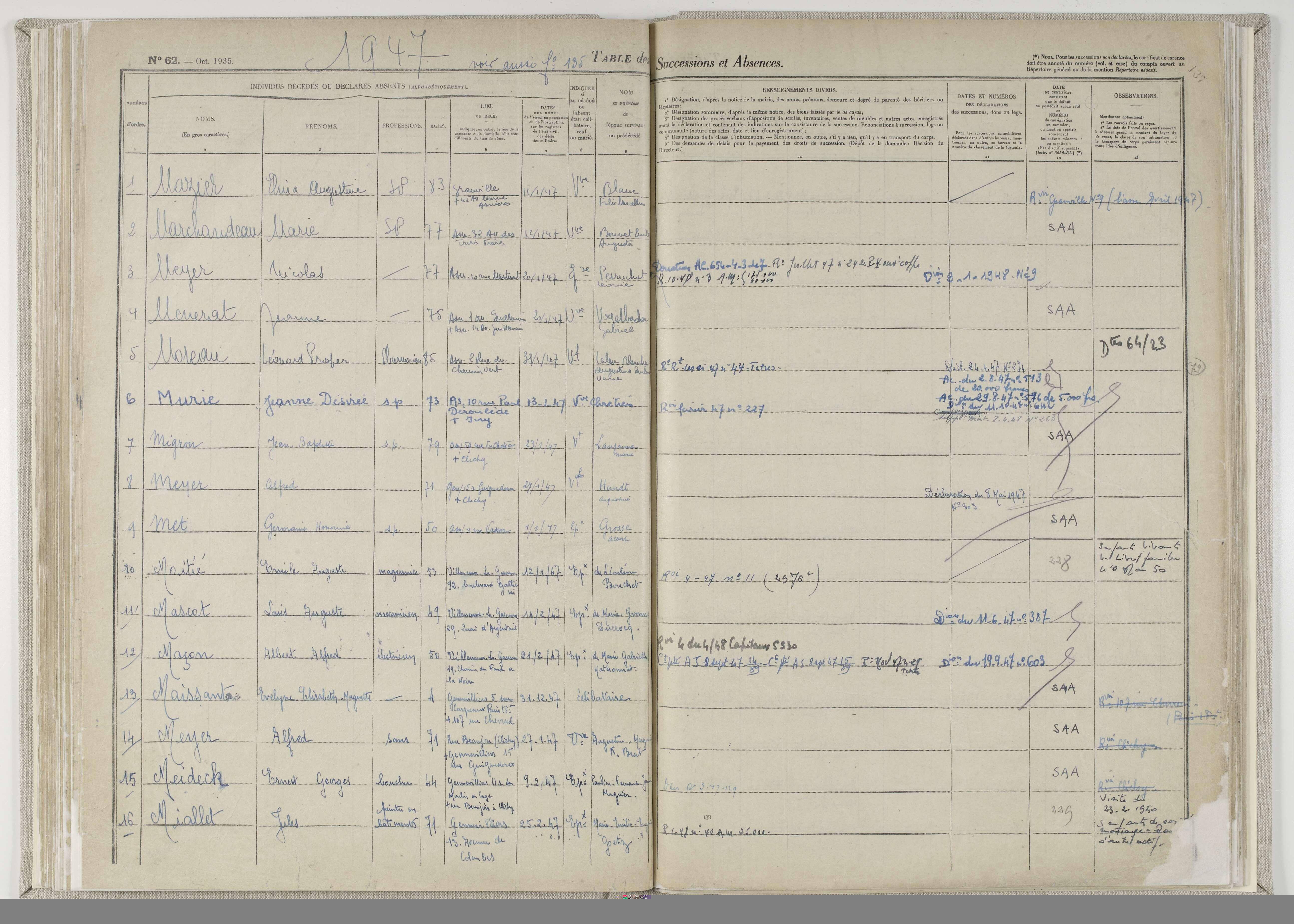
Alfred Meyer marriage record, Archives de Paris; Paris, France; État-Civil 1792-1902, Certificate Number: 0553-0836, Paris, France, Births, Marriages, and Deaths, 1555-1929

At first I was skeptical. What was Alfred doing in France in 1911 if he was in Frankfurt in 1939? Was this the same Alfred Meyer? But after studying the marriage record and relying on my rusty high school French, I saw that this was indeed the same man—-son of Regina Goldschmidt and Aaron Meyer, born in Frankfurt, Germany, on June 16, 1875. And he was at that time residing in Paris. Given that Alfred was a grandson of Jacob Goldschmidt, whose family owned the international art and antiques business, it wasn’t really surprising that Alfred was living in Paris in 1911, perhaps working for the family’s business.

Ofra also directed me to a death record for Alfred. He had not died in the Holocaust, but had lived long enough to die after World War II. He died on January 27, 1947, in Gennevilliers, France, and had been residing in Clichy, France, a suburb of Paris just a few miles from where he died. He was 71 and a widower at the time of his death. No occupation was listed.1

Unfortunately, I have no other sources at this time for Alfred. Ofra found a tree on Ancestry that appears to be created by Alfred’s granddaughter and has many photos of family members. I tried to contact that tree owner through Ancestry without success, and I have looked to see if I could find her outside of Ancestry without success. Because I cannot confirm the information in that tree, I am not comfortable relying on it. If it is accurate, it does appear that Alfred had a son and has living descendants, but I cannot confirm that at this time.

At any rate, I do now know that Alfred did not die in the Holocaust. How he survived remains a mystery.


  1. There are two men named Alfred Meyer on this page—same age, same day of death, both with spouses with the first name Augustine. Ofra suggested that the one on Line 14 is a correction of the one on Line 8. That seems a reasonable assumption. 

Two Updates: Why Didn’t Mathilde Rothschild Leave Germany With Her Family? And How did Albert Alexander Meet His Wife?

Before I continue the stories of the children of Gerson Rothschild and Fanny Kugelmann, I have three updates to earlier posts that I’d like to share. All three are possible because other researchers and family members found this blog and contacted me. These are true gifts from the genealogy village. I am so grateful.

Some of you may recall that back in May 2024, I wrote about my relative Hirsch “Harry” Rothschild and his three children, all of whom escaped from Nazi Germany to the United States before World War II started. But unfortunately Harry’s wife Mathilde did not escape with her family and was ultimately murdered by the Nazis.

In my blog post about this family I wondered why Mathilde had not come with Harry and her children when they left Germany. Was she ill, I speculated? I had no answers.

Now I have more information about the family of Harry Rothschild. A man named Fredo Behrens recently contacted me after seeing my blog post. He lives in Oldenburg, Germany, and as he told me in his email, he worked for the “Nordwestdeutsches Museum für Industriekultur” in Delmenhorst for several years 25 years ago, where his area of responsibility was museum education, exhibitions and a regional “Topography of the Nazi Era.” He also is on the board of the “Friends and Supporters of the Jewish Community of Delmenhorst,” and heads the Delmenhorst City History Working Group. More specifically, he has done research into the history of the Jewish people of Delmenhorst, including the Rothschild family.1

Fredo told me about a monograph by Dr. Enno Meyer from 1985 entitled “Die Geschichte der Delmenhorster Juden 1695-1945”, or the History of the Jews of Delmenhorst 1695-1945. Dr. Meyer was the head of “Gesellschaft für christlich-jüdische Zusammenarbeit” (Society for Christian-Jewish Cooperation) for at least 30 years, according to Fredo. Fredo sent me both a copy of Dr. Meyer’s monograph (in German) and also a copy of an article that Fredo himself wrote about the Jews of Delmenhorst that excerpts parts of Meyer’s monograph and adds to it.2 I was able to use DeepL to translate Fredo’s work and learn more about the Rothschild family’s life in Delmenhorst.

According to the works of Meyer and Behrens, Dr. Harry Rothschild came to Delmenhorst from Hesse in 1914 and was the first Jewish doctor to practice in that town. By 1925, he was one of the top two taxpayers in the town. Harry was not active in the organized Jewish community, however, until after the Nazis came to power.3 According to Fredo’s research, the growing antisemitism in the early 1930s prompted Harry to become more involved. By 1933 he was chairman of the local Zionist organization and on the Jewish community board.

When the Nuremberg Laws were adopted and Jews were no longer allowed to employ Aryans, Harry and his Aryan cleaning woman petitioned the mayor for permission to continue their employment relationship, but their petition was rejected.4

Fredo kindly shared with me this photograph showing the street where the Rothschild family lived in Delmenhorst in 1930. The arrow points to where Harry Rothschild practiced medicine and lived before he left Germany in 1939.

Rothschild house and office in Delmenhorst, 1930, courtesy of Fredo Behrens: Jüdisches Leben in der Langen Straße nach 1933. In: Die Lange Straße in Delmenhorst : Biographie einer alten Straße ; Begleitveröffentlichung zur Ausstellung in den Museen der Stadt Delmenhorst auf der Nordwolle vom 24.6. – 2.9.2001. Hg. vom Stadtmuseum Delmenhorst. Isensee, Oldenburg 2001, p. 60

Then on October 10, 1937, Harry and a number of other Jewish residents of Delmenhorst were arrested by the Gestapo without warning or warrants. According to the observations of a fellow prisoner who became Harry’s cellmate, Harry was particularly humiliated by this experience and was called a “dirty stinking Jew” by one of the Gestapo agents. Harry and his cellmate were in solitary confinement, and Harry remained in prison until the spring of 1938. Harry’s condition had deteriorated greatly during his imprisonment.5

On November 10, 1938 in the aftermath of Kristallnacht, Harry was again arrested and was one of fourteen Jewish men who were arrested and sent to the concentration camp at Sachsenhausen.6

By that time all three of Harry and Mathilde’s children had left Germany for the United States. Harry left in the spring of 1939 and went to Cuba, and he was finally able to join his children in the US in December 1939.

But as we know, Mathilde did not come with him, and she was eventually deported to Minsk and died there. Dr. Meyer shed some light on this in his monograph, also quoted in Fredo Behren’s work. On page 85 of his history of the Delmenhorst Jews, Enno Meyer wrote that Mathilde had stayed behind to try and sell the family house; then when the war started in September 1939, she was trapped in Germany and could not leave.7

If only Mathilde had left with Harry and had not tried to sell the family’s home, this family’s story would have had a much happier ending. There may be more to this story that we will never know, but if this account is accurate, it shows how one decision affected an entire family’s fate during the Holocaust.

I want to thank Fredo Behrens again for providing me with the information and the photograph used in this post and for the work he does to preserve the Jewish history of Delmenhorst.


The second update came from two newly found cousins—my fifth cousin Charles Alexander and his daughter Kate. They also found me through my blog. Charles is the grandson of Theresa Rothschild Alexander, and I wrote about that family here. Check out the update there and learn how Charles’ parents, Albert Alexander and Mary Jane Deiches, actually met. My original speculation proved to be incorrect.

Also, I’ve added to that post a photo Charles gave me from his father’s yearbook. I am also adding it here since I could not place it properly in the original post.


Finally, the third update will have to wait until next week.


  1. Email from Fredo Behrens, March 25, 2025. 
  2. Fredo Behrens, “Jüdisches Leben in der Langen Straße nach 1933. In: Die Lange Straße in Delmenhorst : Biographie einer alten Straße; Begleitveröffentlichung zur Ausstellung in den Museen der Stadt Delmenhorst auf der Nordwolle vom 24.6. – 2.9.2001. Hg. vom Stadtmuseum Delmenhorst. Isensee, Oldenburg 2001. 
  3. Enno Meyer, “Die Geschichte der Delmenhorster Juden 1695-1945,” (1985), pp. 48, 55, 60, as cited in Behrens,  Note 2, supra. 
  4. Behrens, Note 2, supra, citing a letter dated November 14, 1936, response from the mayor dated December 3, 1936. Exhibition “Delmenhorst in National Socialism.   based on a letter dated September 24, 1955, affidavit from Wilhelm Schroers for Dr. Rothschild. Exhibition “Delmenhorst under National Socialism.” 
  5. Letter dated September 24, 1955, affidavit from Wilhelm Schroers for Dr. Rothschild. Exhibition “Delmenhorst under National Socialism.” as quoted in Behrens, Note 2, supra. 
  6. Behrens, Note 2, supra. 
  7. Enno Meyer, “Die Geschichte der Delmenhorster Juden 1695-1945,” (1985), p. 85, as cited in Behrens, Note 2, supra. 

Gerson and Fanny Rothschild’s Children: From A Large Family to Small Families

Gerson Rothschild’s wife Fanny gave birth to eleven children between 1883 and 1901, but three of those babies did not survive. Two died at birth, and one died at seven weeks. That left eight surviving children: Siegmund (1884), Katchen (1885), Max (1886), Auguste (1888), Jenny (1890), Clara (1891), Rosa (1893), and Amalie (1901). Two sons, six daughters.

But from such a large family, only one of those eight surviving children would have more than two children, and they all married at a later age than was typical of those times. They almost all married in their thirties. It made me wonder why these siblings delayed marriage and had so few children after coming from such a large family. Were they so close to each other that they didn’t want to leave home? Were the older ones helping to care for the younger ones? Did the fact that three babies did not survive make them wary of having more that one or two children? Or was it simply a matter of economics or the trend in the 1920s in Germany? I don’t know, but here are the facts.

Siegmund, the first born, was 35 when he married Elise Olga Block on December 22, 1919, in Frankfurt. Elise, the daughter of Max Block and Fanny Schaefer, was born in Ratiburg, Germany, on April 4, 1892.

Siegmund Rothschild and Elsa Block marriage record, Hessisches Hauptstaatsarchiv; Wiesbaden, Deutschland; Bestand: 903, Year Range: 1919, Ancestry.com. Hesse, Germany, Marriages, 1849-1930

Siegmund and Elise had two sons: Ernst, born March 1, 1922,1 and Werner, who is still living as far as I’ve been able to determine. Both were born in Frankfurt.

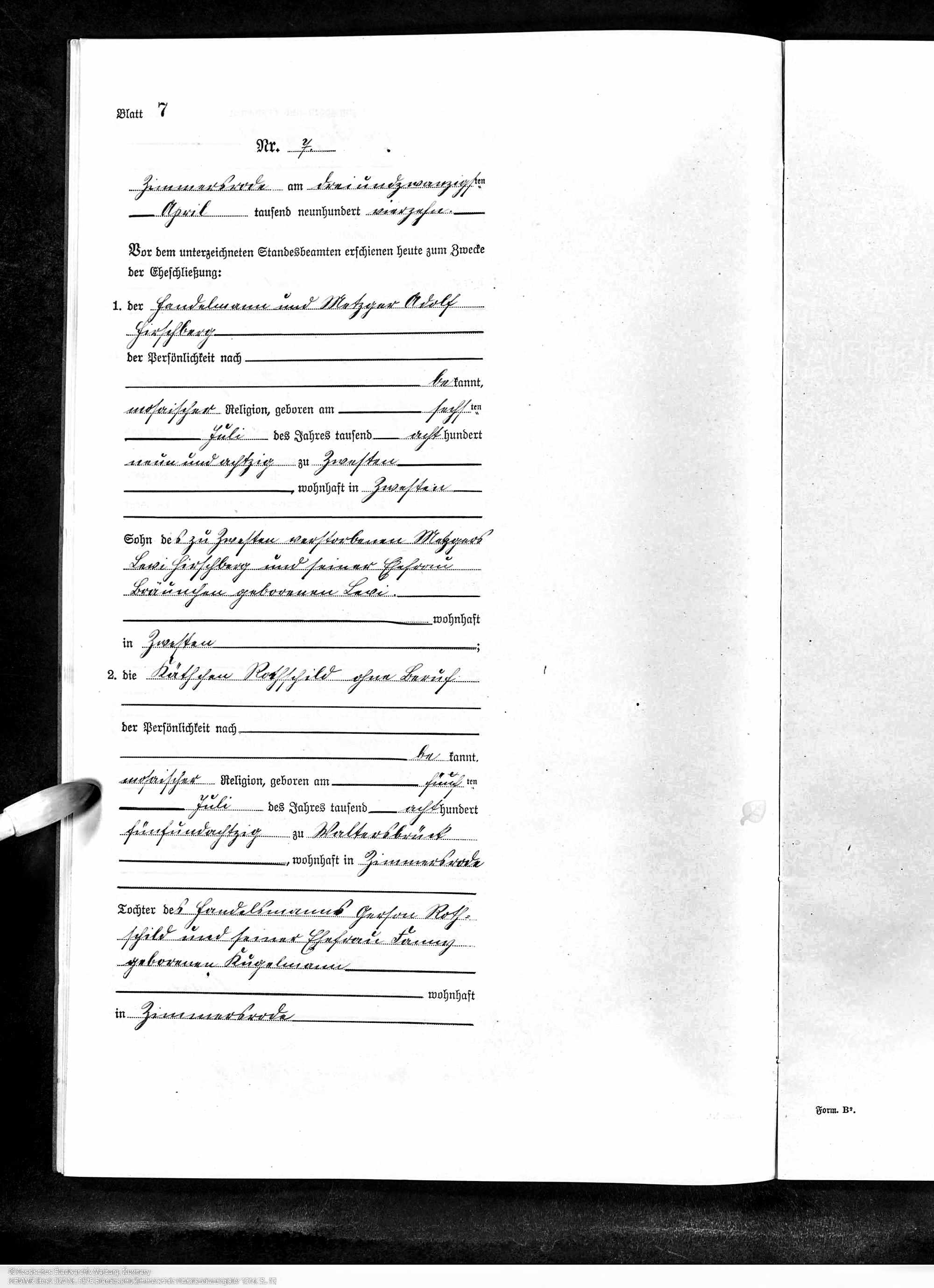
Katchen Rothschild was 28 when she married Adolf Hirshberg on April 23, 1914, in Zimmersrode. Adolf was born July 6, 1889, in Bad Zwesten, Germany, to Levi Hirshberg and Braunchen Levi.

Katchen Rothschild and Adolf Hirschberg marriage record, Hessisches Hauptstaatsarchiv; Wiesbaden, Deutschland; Bestand: 920; Laufende Nummer: 9576, Year Range: 1914, Ancestry.com. Hesse, Germany, Marriages, 1849-1930

Katchen and Adolf had one child, a son Ludwig, born in Kassel, Germany, on February 1, 1920.2

Max Rothschild was 32 when he married Johanna Katz in Zimmersrode on October 19, 1919. Johanna was the daughter of Jacob Katz and Karoline Rosenblatt, and she was born Neuenhain, Germany, on May 1, 1892.

Max Rothschild and Johanna Katz marriage record, Hessisches Hauptstaatsarchiv; Wiesbaden, Deutschland; Bestand: 920; Laufende Nummer: 9581, Year Range: 1919-1920, Ancestry.com. Hesse, Germany, Marriages, 1849-1930

Max and Johanna had two sons: Erich, supposedly born on May 13, 1921, and Richard, supposedly born October 24, 1922, both in Zimmersrode.3

Auguste Rothschild was thirty when she married Wolf Feldheim on March 18, 1919, in Zimmersrode. Wolf was born April 4, 1875 in Graudenz, then part of Prussia, now part of Poland. His parents were Aron Feldheim and Lena London. Wolf had been previously married and had four young children when he married Auguste.

Auguste Rothschild and Wolf Feldheim marriage record, Hessisches Hauptstaatsarchiv; Wiesbaden, Deutschland; Bestand: 920; Laufende Nummer: 9581, Year Range: 1919-1920, Ancestry.com. Hesse, Germany, Marriages, 1849-1930

Auguste and Wolf had one son, Bruno, according to several trees, but I am still looking for a record that ties Bruno to Auguste and Wolf. I did find records for a Bruno Feldheim born in Fulda, Germany, on November 12, 1921, but those records do not identify Bruno as the son of Auguste and Wolf.4

Jenny Rothschild was thirty when she married Salomon Abraham on November 11, 1920, in Zimmersrode. Salomon was born in Durboslar, Germany, on August 14, 1891. I am still looking for a record to confirm the names of his parents.

Jeanette Rothschild and Salomon Abraham marriage record, Hessisches Hauptstaatsarchiv; Wiesbaden, Deutschland; Bestand: 920; Laufende Nummer: 9582, Year Range: 1920-1921, Ancestry.com. Hesse, Germany, Marriages, 1849-1930

Jenny and Salomon had two children, Walter, born September 13, 1921, in Zimmersrode5 and Herta, born August 26, 1928, born in Kassel.6

Clara Rothschild was thirty when she married Moritz Katz in Zimmersrode on November 1, 1921. Moritz was born on November 4, 1894, in Neuenhain, Germany. He was the son of Jakob Katz and Karoline Rosenblatt and the younger brother of Johanna Katz, who had married Clara’s brother Max.

Clara Rothschild and Moritz Katz marriage record, Hessisches Hauptstaatsarchiv; Wiesbaden, Deutschland; Bestand: 920; Laufende Nummer: 9582 Description Year Range: 1920-1921 Source Information Ancestry.com. Hesse, Germany, Marriages, 1849-1930

Clara and Moritz had three children: Otto, born September 5, 1922, in Neuenhain;7 Helmut (later Harold) born in Neuenhain in 1924,8 and Ilse, born on May 19, 1928, in Kassel, Germany.9 Since Harold may still be living, I will not report on his exact birth date.

The last two children of Gerson Rothschild and Fanny Kugelmann, their daughters Rosa and Amalie, married after 1930 and had children after Hitler came to power.  I will write about their husbands and children in a subsequent post.

Isn’t it interesting how late these eight children married and how few children they had after being from such a large family? I’d love to know more about their decisions, but alas, all I have is speculation.

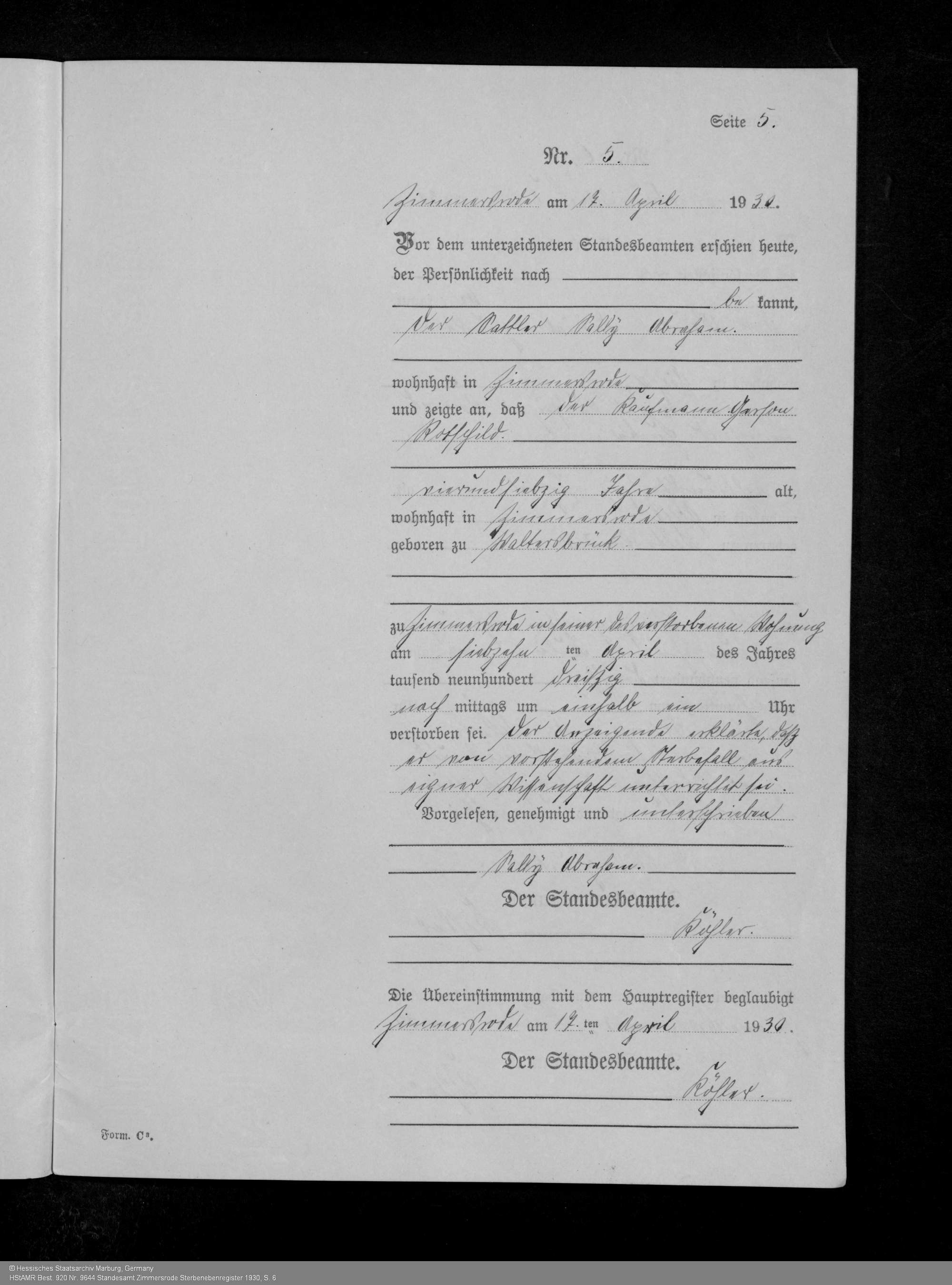
Their father Gerson Rothschild passed away on April 17, 1930, at the age of 74.

Gerson Rothschild death record, LAGIS Hessen Archives, HStAMR Best. 920 Nr. 9644 Standesamt Zimmersrode Sterbenebenregister 1930, S. 6

Gerson had lived to see all eight of his surviving children reach adulthood, and before he died, he saw the six oldest of those children marry and have children of their own. As of his death, Gerson had ten grandchildren. His daughter Rosa would later have one child and his daughter Amalie two, meaning that Gerson and Fanny at one time had thirteen grandchildren from their eight surviving children.

Gerson may have been blessed to die before Hitler came to power and before he would know what would happen to so many of those children and grandchildren.




  1. Ernest Simon Rothschild, Race White, Age 23, Birth Date 1 Mar 1922, Birth Place Frankfort, Germany, Registration Date 30 Jun 1945, Registration Place New York City, New York, Employer Hugo Brand, Next of Kin Siegmund Rothschild,  National Archives at St. Louis; St. Louis, Missouri; Wwii Draft Registration Cards For New York City, 10/16/1940 – 03/31/1947; Record Group: Records of the Selective Service System, 147, Ancestry.com. U.S., World War II Draft Cards Young Men, 1940-1947 
  2. Ludwig Hirschberg J., Gender männlich (Male), Nationality Deutsch Juden
    Record Type Miscellaneous, Birth Date 01 Feb 1920 (1 Feb 1920), Birth Place Kassel
    Residence Place Kassel, Kassel, Notes Lists of judicial and official files concerning foreigners and German Jews, Reference Number 02010101 oS, Document ID 70443311, Arolsen Archives, Digital Archive; Bad Arolsen, Germany; Lists of Persecutees 2.1.1.1, Ancestry.com. Free Access: Europe, Registration of Foreigners and German Persecutees, 1939-1947 
  3. I could not find any actual birth records for Erich Rothschild or Richard Rothschild. There are no online birth records for Zimmersrode for 1921 or 1922. These dates, however, appear on numerous trees on Ancestry. I do not know how reliable that specific information is. I am still searching for birth records for these two sons, but I do have other records for them that place their birthdates as approximately in 1921 and 1922. I will discuss those other records in a later post. In addition, one tree included a third son, Fritz Simon Rothschild, but I have no records that support the existence of that son. 
  4. Bruno Feldheim, Palestine Immigration file, found at the Israel State Archives website at https://search.archives.gov.il/ 
  5. Walter Abraham, Birth Date 13 Sept 1921, Birth Place Zimmerrode, Residence Street Address 26 Johann-Georg-Strasse, Residence Place Berlin, [Halensee]
    Occupation Bãcker [Baker], Description Deportationen, URL https://collections.arolsen-archives.org/de/document/127213170 , Arolsen Archives; Bad Arolsen, Germany; Record Group 1 Incarceration Documents; Reference: 1.2.1.1, Ancestry.com. Germany, Incarceration Documents, 1933-1945 
  6. Herta Abraham, Birth Date 26 Aug 1926, Birth Place Kassel, Residence Kassel
    Camp Riga/Stutthof, Ancestry.com. Poland, German Jews at Stutthof Concentration Camp, 1940-1945 
  7. Otto Katz, Race White, Age 19, Birth Date 5 Sep 1922, Birth Place Neuenhaus [sic], Germany, Registration Date, 15 Feb 1942, Registration Place, New York City, New York, Employer Kenneth Miller, Next of Kin Clara Katz, National Archives at St. Louis; St. Louis, Missouri; Wwii Draft Registration Cards For New York City, 10/16/1940 – 03/31/1947; Record Group: Records of the Selective Service System, 147, Name Range: Katz, Bernard-Katz, Sam, Ancestry.com. U.S., World War II Draft Cards Young Men, 1940-1947 
  8. Helmut Katz [Harold Katz] Race White Age 18 Birth Date 1924, Birth Place Neuenhain, Germany, Registration Date 19 Dec 1942, Registration Place New York City, New York, Employer Student, Next of Kin Clara Katz, National Archives at St. Louis; St. Louis, Missouri; Wwii Draft Registration Cards For New York City, 10/16/1940 – 03/31/1947; Record Group: Records of the Selective Service System, 147, Ancestry.com. U.S., World War II Draft Cards Young Men, 1940-1947 
  9. This date came from Dennis Aron’s Ancestry tree, and Dennis obtained his information from Ilse’s brother, Harold Katz. I have no other source for this, but given that it came from her brother, for now I assume it is accurate.