Clara Rothschild Katz, Part I: Living in and Escaping from Germany

Doing family history research is a labor of love. I have said that many times over the almost fifteen years that I’ve been engaged in this work. Being able to honor the memories of those I never knew but who are somehow related to me is a joy and a privilege. Connecting with and getting to know so many living “long-lost” cousins has given me great joy.

Researching the family of Clara Rothschild and Moritz Katz has led me to a really special opportunity for such joy—-the opportunity to talk to their son Hal Katz, my one-hundred-year-old fourth cousin, once removed. Imagine having lived through an entire century and seeing all the horrors and all the miracles since 1924—the Holocaust, World War II, the creation of the state of Israel, the Cold War, the social activism and unrest of the 1960s and the 1970s, the Vietnam War, all the civil rights movements, the election of the first African-American president, the COVID pandemic, and the introduction of so many scientific inventions good and bad—-the atomic bomb, television, cell phones, the internet, and now AI. It’s mind-boggling how much the world has changed in the last hundred years.

Hal Katz has lived through it all, starting as a small boy in Germany, living in a small town, escaping from Germany in 1938 shortly after his bar mitzvah, settling in New York City as a young teenager, fighting for the US in World War II, building a lifelong career with General Electric, marrying and having children, and now still living on his own, playing bridge, and talking to me on Zoom as if it were the most natural thing in the world. Over the course of three Zoom calls, I have been blessed to talk to Hal as well as his daughter, his nieces, his nephew, and another Rothschild cousin, all of whom are my cousins.

And so now as I turn to the story of the sixth of Gerson and Fanny’s children who lived to adulthood, their daughter Clara Rothschild, I feel so fortunate that I was able to hear her story and the stories of her family from her son Helmut Harold “Hal” Katz. Unless otherwise indicated, the information in this post came from Zoom calls or emails with Hal and members of the family or from interviews with Hal or Hal’s brother Otto done by Otto’s daughter Judy, Hal’s niece.1

As we saw, Clara Rothschild was born on July 15, 1891, in Waltersbrueck, Germany.  According to Hal, this photograph of Clara was probably taken when she was nineteen and working as an apprentice bookkeeper in a dry goods store.

Clara Rothschild c. 1910
Courtesy of the family

On November 1, 1921, she married Moritz Katz, who was born in Neuenhain, Germany, on November 4, 1894. Here is a photograph of Moritz taken in 1912 when he was eighteen, a photograph of Clara in the 1920s, and an undated one of Clara and Moritz taken years later.

Moritz Katz in 1912. Courtesy of the family.
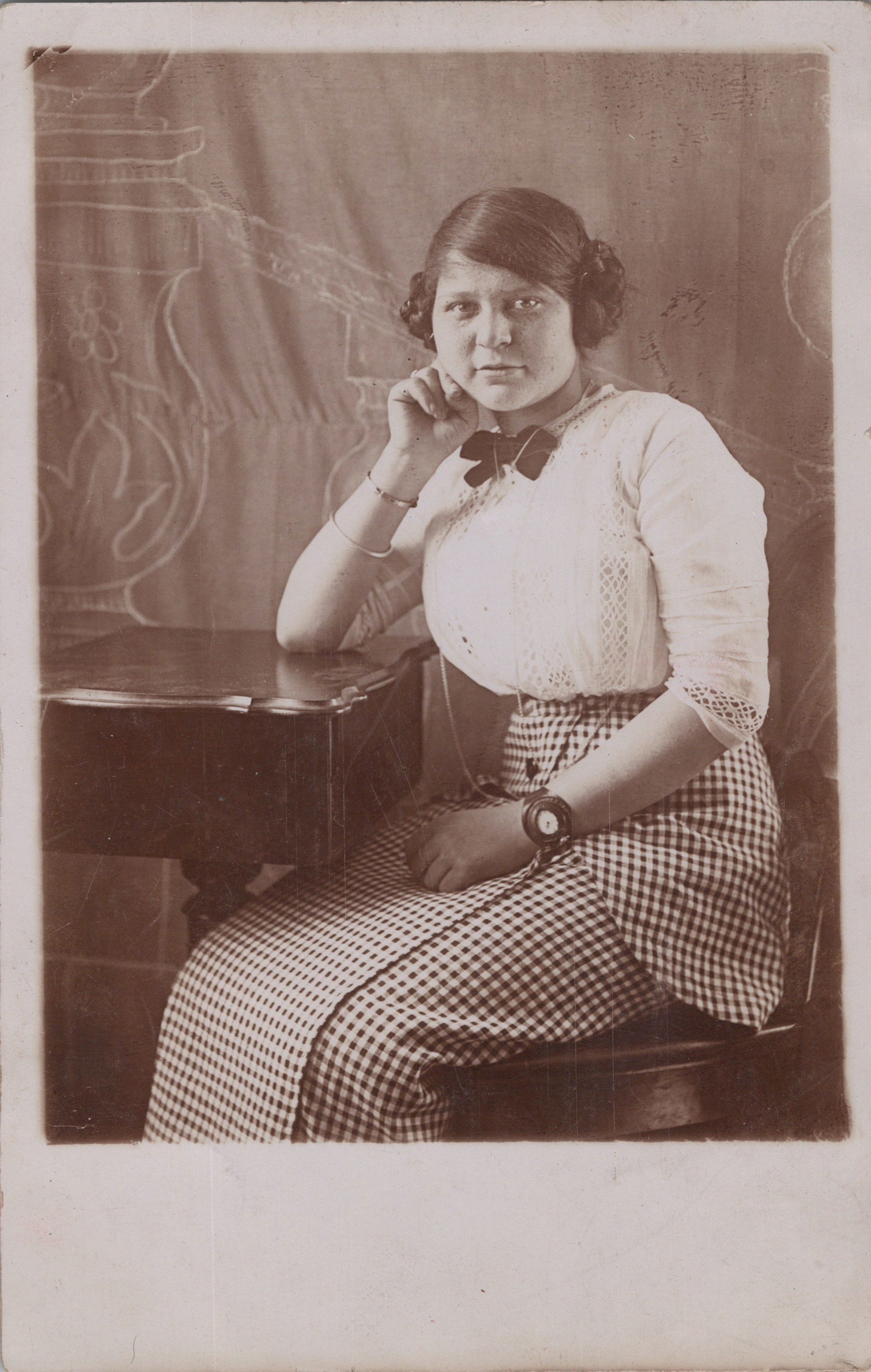
Clara Rothschild in the 1920s. Courtesy of the family.
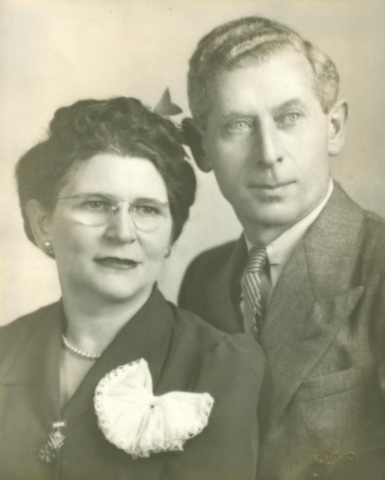
Clara Rothschild and Moritz Katz undated
Courtesy of the family

Clara and Moritz had three children, Otto, born in 1922, Helmut (Hal) born in 1924, and Ilse, born in 1928. Hal told me that until he was six years old, he and his family lived with his paternal grandmother, Caroline Rosenblatt Katz, in Neuenhain. His paternal grandfather Jacob Katz had died many years before in 1899. Neuenhain was a very small village, about two hundred people. Hal’s parents and grandmother ran a grocery business out of their home selling produce grown on their farm. This is a photograph of Hal’s paternal grandmother Caroline in 1930 in Neuenhain.
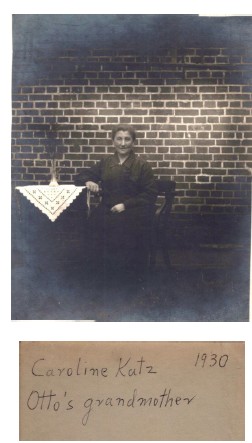
Caroline Katz 1930. Courtesy of the family

Hal said that they were the only Jewish family in the village, and he never understood how his father had become so knowledgeable about Judaism and Hebrew since there was no Hebrew school in Neuenhain. The closest synagogue was within walking distance, but it was a challenge finding the ten men to make a minyan. His father was able to lead services and even acted as the kosher butcher on the side.

Here is a beautiful photograph of Hal with his older brother Otto taken when they lived in Neuenhain. Hal looks no more than two years old, so this photograph was probably taken in about 1925-1926.

Otto and Helmut Katz, c. 1925-1926. Courtesy of the family

I asked Hal what he remembered about his maternal grandfather Gerson Rothschild, and he told me that he was in the coal business. He also said that the first funeral he ever went to was Gerson’s funeral in 1930 when Hal would have been six years old.

When Hal was six, the family moved to a larger town, Borken, which was about six miles from Neuenhain and had a population of about two thousand people and more of a Jewish community than Neuenhain. There his father Moritz had a business selling the raw materials needed to make clothing. Hal compared it to being a peddler. From the way Hal spoke, it sounds like those early years of his life were happy and secure. He had many cousins from his Rothschild side—-all the children of his mother’s siblings—who were living in other towns in the Hessen region. He also had many relatives from his Katz side.

This is a photograph of the three Katz siblings taken in Borken in 1934. It was probably Ilse’s first day of school since she is holding a cone filled with candy traditionally given to children in Germany on their first day of school.

Otto, Ilse, and Hal Katz 1934 in Borken. Courtesy of the family

Of course, everything changed after Hitler came to power. In an interview Judy did with her father Otto, he reported that once the Nazis came to power, the children had to change schools as they were no longer allowed to go to school with Christians, so they went to a Jewish school. In addition, the family was forced to sell their land and their business and lived on the money from those sales until that money ran out.

In 1937 when he was fifteen, Otto left school and was doing an apprenticeship in a retail clothing store in Wolfhagen, a town about 40 miles north of Borken. Apparently this was a common practice—-to send a teenage boy to live with another Jewish family and learn a trade. In an interview with his daughter Judy,  Otto said that the store had so little business that he spent his days gardening. One day Otto was riding his bike in Wolfhagen and a group of Hitler Youths tried to take his bike from him; Otto hit them with the bike pump and escaped. When Otto told the man with whom he was apprenticing what had happened, that man contacted Moritz.

Moritz went to Wolfhagen and took Otto to Kassel to stay with relatives for six months. Fortunately, Moritz had had the foresight to see what was happening with the Nazis, and this gave him the extra incentive to work on getting them out of the country. He was able to get the necessary papers to leave Germany with the help of the Hebrew Immigration Aid Society and a sponsor named Albert Decker. First, Moritz left with Otto and went to Hamburg where the two of them were able to board a ship and travel to America. Leaving Clara, Hal, and Ilse behind was very difficult because none of them knew when they would see each other again.

Hal believes this family photograph was taken not too long before Moritz and Otto left Borken for the US.
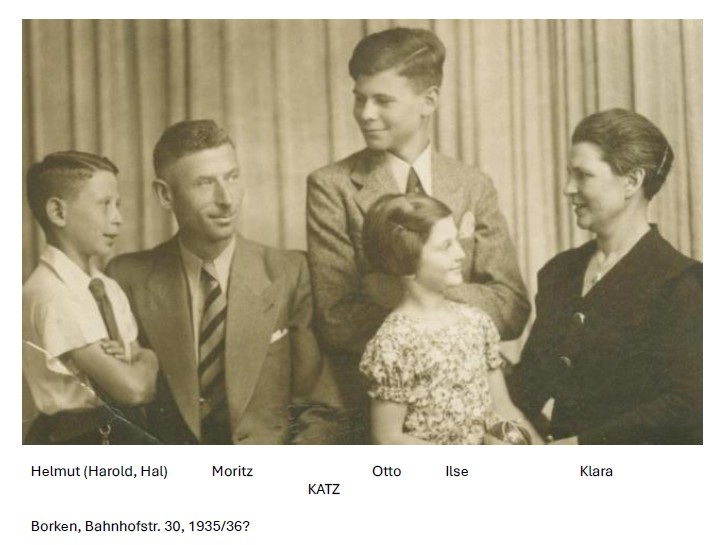
Katz family in Borken, maybe 1936. Courtesy of the family

Moritz and Otto arrived in New York on August 27, 1937.2

Fortunately, Clara was able to leave with Hal and Ilse eight months later, just a few months after Hal celebrated his bar mitzvah in Borken without his father or brother. In an interview Judy did with Hal in 2023, Hal told her that Clara and the children were living with a family from Borken, the Blums, until April 8,1938 when they left to go to the US. First, they took a train to Antwerp, where they stayed with the Tiefenbrunners at the orphanage they were running. (See earlier blog post here.) Then they boarded a freighter, a slower moving form of transport that was crowded with mostly Jewish people escaping Hitler. This photograph was taken before they boarded the ship to leave Germany on April 11, 1938.

Clara, Ilse, and Hal (on the right side of the photo) on the day they left Germany for the US in 1938. Courtesy of the family

They arrived in New York after an uncomfortable eleven day journey on April 21, 1938.3

Thanks to Moritz’s foresight, he and Clara and their children were now safely out of Germany, and they were the first ones in the extended Rothschild family to get out—-before Siegmund and before Max, Clara’s brothers.

And as we have already seen, most of the rest of the family did not escape in time. Hal said that his parents did all they could to get other family members out, but unfortunately as we have seen and as we will see, those efforts did not succeed. Hal said that they eventually lost contact with those still in Germany. When I asked why those who remained—-e.g., Clara’s sisters Katchen, Auguste, Jenny, Rosa and Amalie—-hadn’t also tried to get out of Europe when Moritz and Clara did, Hal said he thought they all just believed it would all blow over and that they would be safe.

But Clara, Moritz, Otto, Hal, and Ilse were now in New York, starting over in a new country.

More on that to come in my next post.


  1. Zoom calls with Hal Katz and family, May and June 2025. Interviews with Hal and Otto over the years by Judy Katz. 
  2. Moritz Katz, ship manifest, Departure Port Hamburg, Germany, Arrival Date 27 Aug 1937, Arrival Port New York, New York, USA, Ship Name Hansa  The National Archives in Washington, DC; Washington, DC, USA; Passenger and Crew Lists of Vessels Arriving at New York, New York, 1897-1957; Microfilm Serial or NAID: T715; RG Title: Records of the Immigration and Naturalization Service, 1787-2004; RG: 85, Ancestry.com. New York, U.S., Arriving Passenger and Crew Lists (including Castle Garden and Ellis Island), 1820-1957 
  3. Clara Katz ship manifest, Place of Origin Germany, Departure Port Antwerp, Belgium, Arrival Date 21 Apr 1938, Arrival Port New York, New York, USA
    Ship Name Gerolstein, The National Archives in Washington, DC; Washington, DC, USA; Passenger and Crew Lists of Vessels Arriving at New York, New York, 1897-1957; Microfilm Serial or NAID: T715; RG Title: Records of the Immigration and Naturalization Service, 1787-2004; RG: 85, Ancestry.com. New York, U.S., Arriving Passenger and Crew Lists (including Castle Garden and Ellis Island), 1820-1957 

Jeanette “Jenny” Rothschild Abraham: An Entire Family Murdered

Turning now to Jeanette or Jenny Rothschild, the fifth of the eight Rothschild children who survived to adulthood, we saw that she married Salomon Abraham on November 11, 1920, and that they had two children: Walter, born in 1921, and Herta, born in 1928.

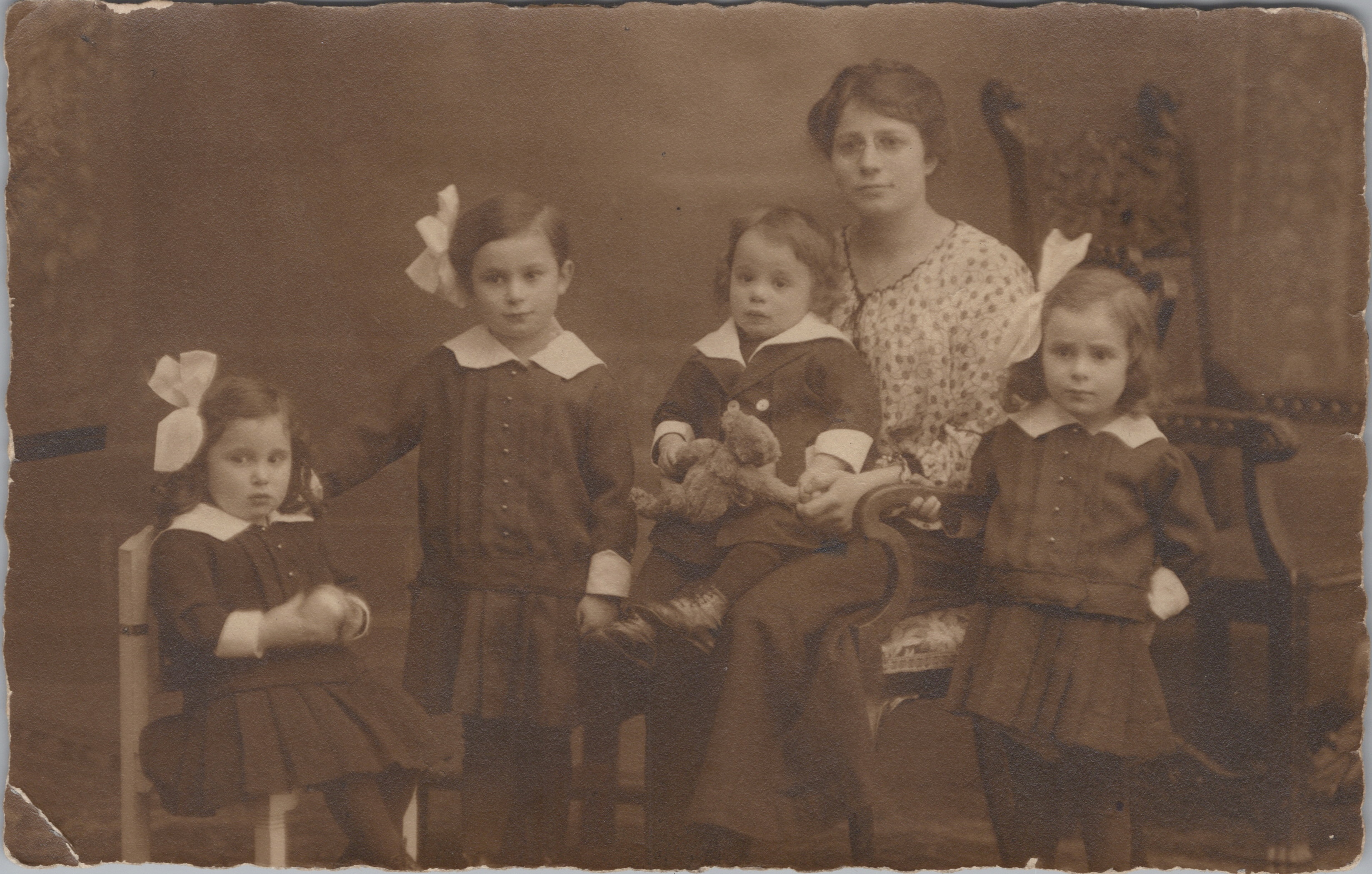
This photograph is possibly of Jenny and Salomon:

Maybe Jenny Rothschild Abraham
Courtesy of the family

Unfortunately, Jenny and her family suffered a fate like those of her older sisters Katchen and Auguste and not like those of her older brothers Siegmund and Max, both of whom survived the Holocaust. Jenny, Salomon, Walter, and Herta were all murdered in the Holocaust.

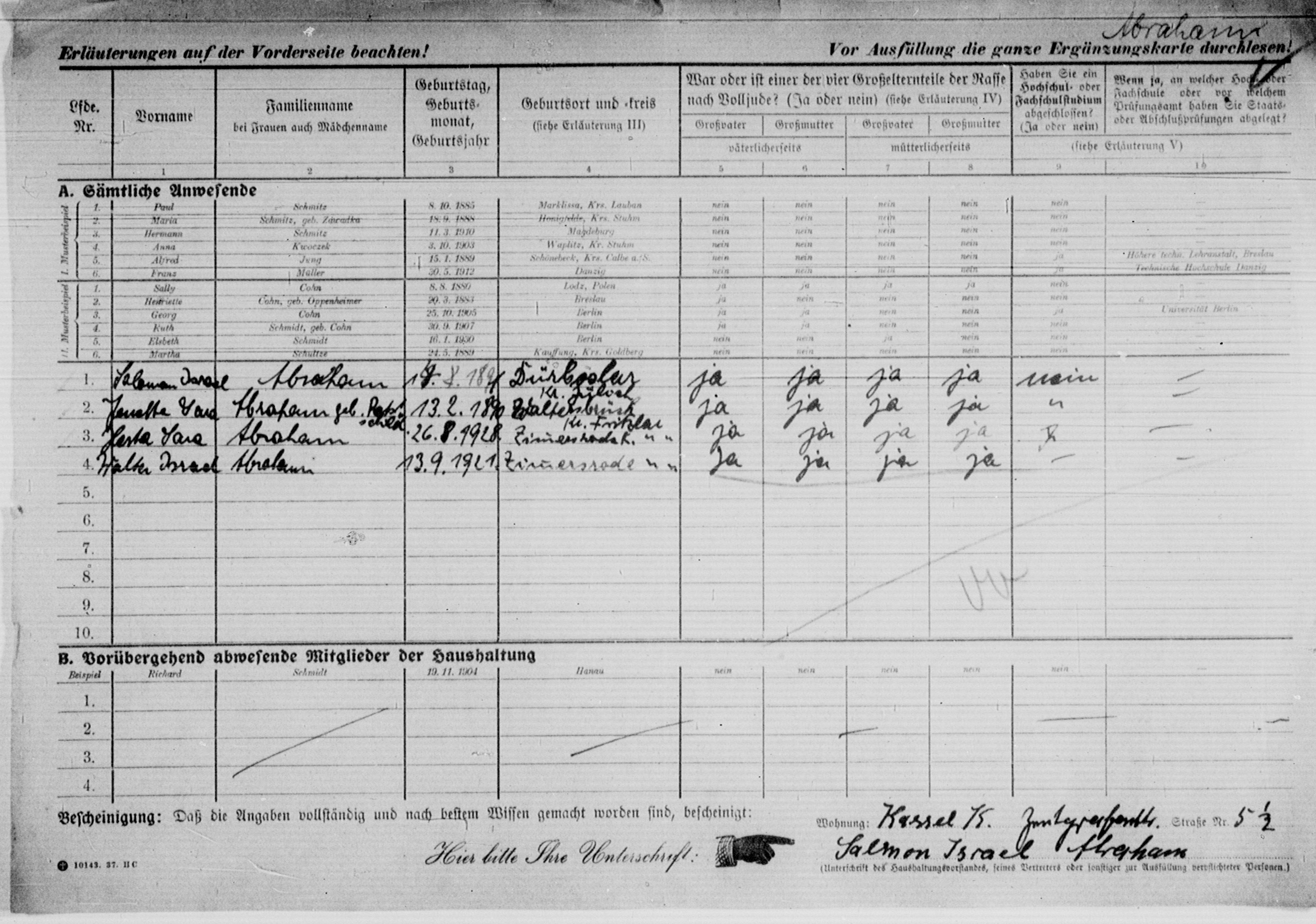
This document from the census taken in 1938-1939 by the Nazis of any household where a resident had at least one Jewish grandparent shows us that Jenny and Salomon and their children were living in Kassel at that time. It also shows that none of them had finished high school or vocational school and that all of them had four Jewish grandparents.

Salomon Abraham and family, RG-14.013M.0216.00000011, German minority census of 1939, United States Holocaust Museum and Memorial, also summarized at MyHeritage at   https://www.myheritage.com/research/record-10901-14585/herta-greta-abraham-in-german-minority-census?fbclid=IwY2xjawJyNahleHRuA2FlbQIxMAABHjMpngFoUVAHvZ8hfTE5lCsMwdc-9bHAeMU5opyaipBCxYmQYX8bXBPReDTp_aem_DvzcPxQysQHhqKjX3STcgw

Another document created by the International Tracing Service reveals that in 1939-1940, Salomon Abraham was working in Kassel for the Georg Sauer railway, road, and underground construction company.1

Yad Vashem files and the Gedenkbuch report that on December 9, 1941, Salomon, Jenny, and their thirteen-year-old daughter Herta were deported along with over a thousand other Jews from Kassel and surrounding towns and sent to the Jewish ghetto established by the Nazis in Riga, Latvia. According to an article about the transport on Yad Vashem, “The deportees were told to bring a sum of 50 Reichmarks, a suitcase, a set of clothes, suitable shoes, bedding, tableware, and food supplies for a few days. They were also required to produce an inventory of all their properties. In the Kassel district, the Jews received notification that all furniture was to be carefully packed and placed in one room of the apartment. Household valuables were to be deposited in a closet together with a list of contents.”

The train took three days to get to Riga, arriving on December 12, 1941; according to one account by a survivor as quoted in the same Yad Vashem article, “The temperature was 40 degrees below freezing. Most of the luggage was left at the train station and we never saw it again. We had to walk to the ghetto while a terrible snow storm was blowing.”

Unfortunately, I do not have any specific information about what happened to Salomon or Jenny after arriving in Riga, except I know that they did not survive. Readers may recall that Jenny’s sisters Auguste and Katchen as well as Katchen’s husband Adolf Hirschberg and their son Ludwig Hirschberg were also deported to Riga on December 9, 1941, and that none of them survived the Holocaust either. According to the Yad Vashem article, “little is known about the further fate of the deportees from Kassel in the Riga ghetto. More than 900 Jews were shot in several “Aktionen” in the Bikerniki forest. Others were transported to Auschwitz-Birkenau or to Stutthof concentration camp for forced labour. According to the historian Monica Kingreen only 137 Jews from this transport survived.”

Records show that little Herta was one of those transported to the Stutthof concentration camp. The report from the ITS on Herta Abraham states that she was sent to Stutthof on October 1, 1944.2  I do not know what happened to Herta after that, but she also did not survive the Holocaust.

As for Walter Abraham, he had moved to Berlin sometime after the 1939 Minority Census was taken and was working as a baker. One document seems to suggest he had left Kassel on April 28, 1940. Unfortunately Walter’s move to Berlin did not save his life. On December 7, 1943, he was deported from Berlin to Auschwitz. I don’t know when exactly Walter was killed there, but like his mother, father, and sister, he was murdered by the Nazis.3

There thus are no descendants of Jenny Rothschild Abraham. Her entire family was wiped out by the Nazis.


  1. Tracing and documentation case no. 416.705 for ABRAHAM, SALOMON born 14.08.1898, Reference Code 06030302.0.382.916, 6 Records of the ITS and its predecessors / 6.3 Inquiry processing / 6.3.3 ITS case files as of 1947 / 6.3.3.2 Repository of T/D cases / Tracing and documentation cases with (T/D) numbers between 250.000 and 499.999 / Tracing and documentation cases with (T/D) numbers between 416.500 and 416.999 ITS Digital Archive, Arolsen Archives 
  2. See Note 1, supra. 
  3. Welle 61 – 47. Osttransport in das KL Auschwitz, 07.12.1943, 1 Inhaftierungsdokumente / 1.2 Verschiedenes / 1.2.1 Deportationen und Transporte / 1.2.1.1 Deportationen / Deportationen aus dem Gestapobereich Berlin /  Signatur 15510056b, Entstehungszeitraum. 1943-12-07 – 1943-12-10, Anzahl Dokumente 4, ITS Digital Archive, Arolsen Archive 

Auguste Rothschild Feldheim: Another Life Destroyed

As I move on now to the next child of Gerson Rothschild and Fanny Kugelmann, I am struck by the differences in the fates of their eight surviving adult children. Siegmund and his wife and all his children left Germany in time to escape death at the hands of the Nazis. Katchen and her husband and son were all killed by the Nazis. Max and his family escaped to Argentina, but their son Erich died shortly after arriving from cholera; that might not have happened if they hadn’t had to leave Germany. Why were some able to escape while others were not? Fate seems so cruel and unpredictable.

Now I turn to the fourth child, Auguste “Gusta” Rothschild Feldheim. And sadly, Auguste’s fate was more like that of her sister Katchen than that of her brothers Siegmund and Max.

As we saw, Auguste married Wolf Feldheim on March 18, 1919, in Zimmersrode. Wolf was a widower. His first wife Johanna Risch died on April 29, 1916,1 less than a week after giving birth on April 23, 1916, to her fourth child with Wolf, their son  Arthur/Aharon.2 Wolf and Johanna also had three daughters born before Arthur/Aharon: Ruth, Selma, and Else, and all were younger than five years old when their mother died.3

Auguste married Wolf three years after Johanna’s death, and thus Johanna’s four children with Wolf were all still very young when Auguste became their stepmother. Here is a photograph of Auguste with her four stepchildren. Look how sad those children look. It’s heartbreaking.

Auguste Rothschild Feldheim with her four stepchildren. Courtesy of the family

And then Wolf and Auguste had their own child together, a son Bruno who was born in Fulda, Germany, on November 12, 1921.4

Auguste’s husband Wolf Feldheim died of a heart attack on October 4, 1940, in Fulda, Germany, where he and Auguste were living. Wolf was 65 years old. Was his death caused directly or indirectly by the Nazi persecution? I don’t know.5

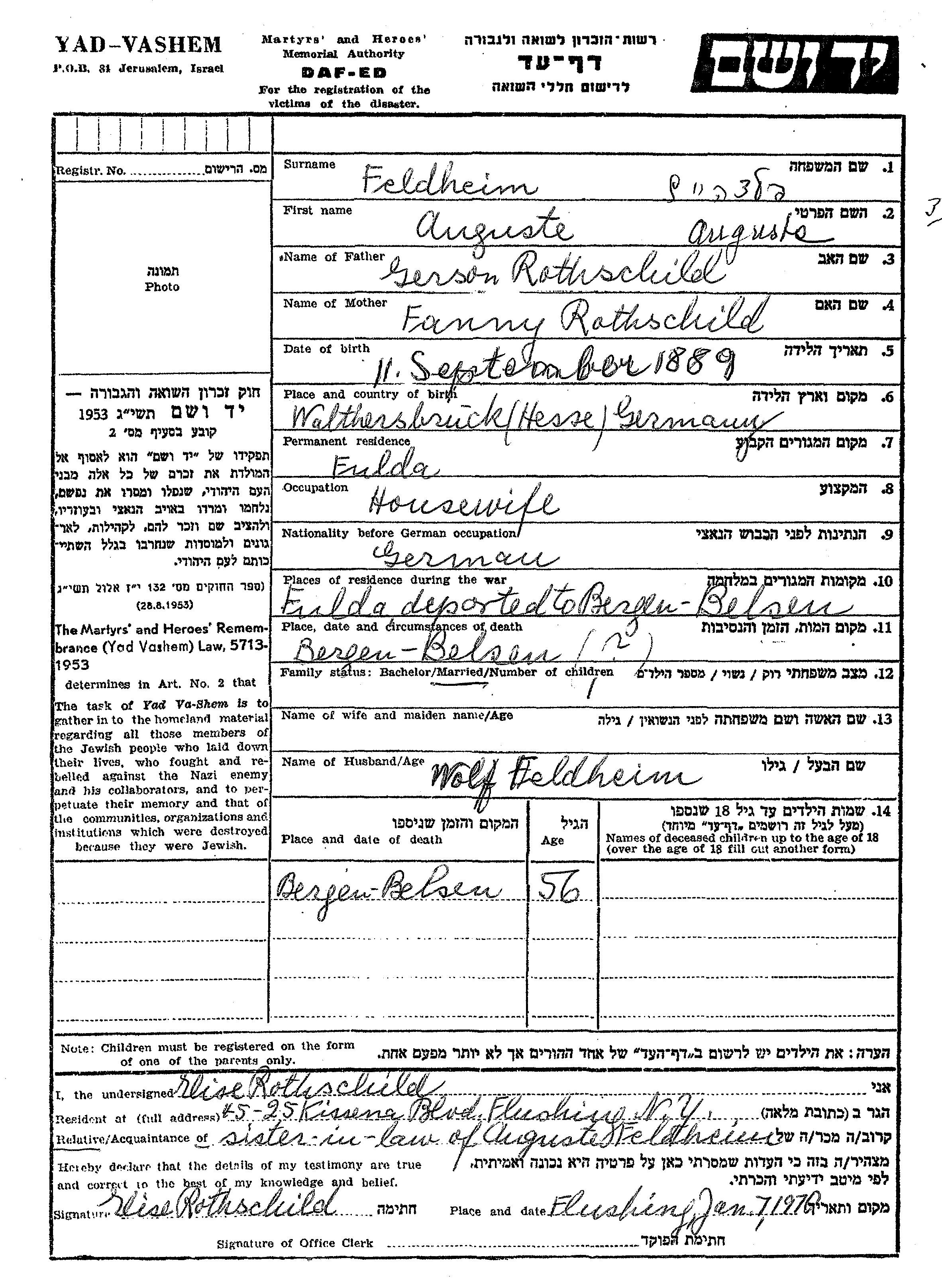
Just over a year later Wolf’s widow Auguste was deported from her home in Fulda to Riga. A Page of Testimony filed at Yad Vashem by her stepson, Aharon Feldheim, reported that he believed she died there on or about December 8, 1941, the day after Pearl Harbor. The Gedenbuch summarized at Yad Vashem says she was deported to Riga on December 9, 1941, and died there in March, 1942.6 And then there is a second Page of Testimony for Auguste filed by her sister-in-law Elise Rothschild, wife of Siegmund Rothschild, saying that Auguste was deported to Bergen-Belsen. I don’t know which date or which place is more accurate. But the bottom line is the same. Auguste Rothschild Feldheim died at the hands of the Nazis.

Page of testimony at Yad Vashem filed by Aharon Feldheim. found at https://collections.yadvashem.org/en/names/13532864

Page of Testimony filed at Yad Vashem by Elise Rothschild, found at https://collections.yadvashem.org/en/names/798469

Bruno Feldheim survived the Holocaust by going to Palestine. His application for citizenship in Palestine in 1946 indicates that he arrived on March 27, 1939, from Fulda.

Bruno Feldheim Palestine immigration papers found at the Israel State Archives at https://search.archives.gov.il/

At some point after the war, Bruno moved to Belgium, where he had a diamond business, according to his cousin Hal Katz. Hal’s tree on Ancestry reports that Bruno died in Belgium on September 16, 2016. He was survived by his children and grandchildren. Here is a photograph of Bruno with his family, courtesy of Judy Katz, his first cousin, once removed.

Bruno Feldheim and family. courtesy of the family

I did not really research in depth the four stepchildren of Auguste, relying primarily on the Ancestry tree created by their stepcousin, Hal Katz. That tree reported that two of those stepchildren, Selma and Aharon, survived the Holocaust and ended up in Israel, but a third, Else, was murdered by the Nazis.

As for the remaining stepchild, Ruth, Wolf and Johanna’s oldest child, I went down a deep rabbit hole to learn what happened to her. It’s a Holocaust story I had not known before and that may not be very widely known.

Ruth was born on October 28, 1912, in Fulda, Germany.7 She married Jonas Tiefenbrunner, who was born in Wiesbaden on June 19, 1914. Sometime after Hitler came to power, Jonas left Germany for Belgium and established a youth home and yeshiva for religious boys in a town near Antwerp. Ruth later also left Germany for Belgium, and she worked as a cook in a different children’s home. According to a recorded interview with their daughter Judith, they had first met in Frankfurter, but reconnected and became a couple in Belgium. Ruth and Jonas were married on May 9, 1940, the day before the Nazis invaded Belgium.8

As told by Jonas and Ruth’s daughter Judith in that interview, after the Nazis invaded, the Queen Mother of Belgium intervened to protect the Jewish children and elderly. She convinced the commandant overseeing the Nazi deportation of Jews back to Germany, purportedly for “work,” that children younger than seventeen and the elderly would not be productive workers and that they should not be sent back to Germany. A number of orphanages and homes for the elderly were established, and Jonas Tiefenbrunner was made the head of one of those orphanages, the one in Brussels and the only one that was observant of Jewish laws and holidays, according to Ruth’s daughter.9

Jonas and Ruth took in up to fifty or sixty children at a time. They faced constant danger of raids by the Nazis, who accused them of hiding children who were over the age of sixteen or children who had not been properly registered with the Nazi regime in Belgium. Jonas was arrested once, but quickly released.10

In 1943, Ruth, Jonas, and their first-born daughter Jeanette had an opportunity to escape from the Nazis and emigrate from Belgium by obtaining what are now known as Mantello certificates. As described on JewishGen:

George Mandel was a Hungarian Jewish businessman who befriended a Salvadoran diplomat, Colonel José Arturo Castellanos, in the years leading up to World War II.  After Castellanos was named El Salvador’s Consul General in Geneva, he appointed Mandel, who had assumed a Spanish-sounding version of his last name, “Mantello,” to serve as the Consulate’s first secretary.  Even in Nazi-occupied Europe, Jews who were citizens of or held official documents from other countries were often able to escape deportation.  With the consent of Castellanos, George Mandel-Mantello used his diplomatic position to issue documents identifying thousands of European Jews as citizens of El Salvador.  He sent notarized copies of these certificates into occupied Europe, in the hope of saving the holders from the Nazis. … Word then spread among representatives of various Jewish organizations, who also approached Mandel-Mantello, each providing data and photographs of the people they wanted to try to save. … In total, Mandel-Mantello may have issued as many as five thousand certificates, many with the names and photographs of several family members.

Jonas and Ruth Tiefenbrunner were among those who received a Mantello certificate, describing them as citizens of El Salvador. They even applied for a Swiss passport relying on the evidence of their Salvadoran citizenship.  They could have left Belgium for a safer country by using those certificates as many others were able to do.

Jonas Tiefenbrunner application for Swiss passport, found at USHMM at https://collections.ushmm.org/search/catalog/pa1169302

But as described by their daughter Judith, they refused. Jonas would not abandon the children he was caring for so the family stayed in Belgium for the duration of the war.11

In August 1944, the Nazis decided to deport all the remaining Jews in Belgium including the children. “Luckily, Jonas received advanced warning and was able to take all the children to a convent run by an acquaintance, Father R.P. Robinet. Two weeks later, Brussels was liberated.”12 In the end, it is estimated that Jonas and Ruth were able to save over one hundred children.

Tragically, Jonas Tiefenbrunner died in Belgium in 1962 from a heart attack when he was only 48 years old. From what I can gather from various sources including Judith’s interview, Ruth and their three daughters all eventually ended up in Israel.13 Unfortunately I have not been able to find further information about Ruth or her daughters.

Although Ruth Feldheim and Jonas Tiefenbrenner were not my genetic relatives, I felt their story was important and wanted to share it with my readers.


  1. Johanna Risch Feldheim death record, Arcinsys Archives of Hessen, HHStAW, 365, 348, p. 11, found at https://digitalisate-he.arcinsys.de/hhstaw/365/348/00011.jpg 
  2. Arthur/Aharon Feldheim immigration papers found in the Israel State Archives at https://search.archives.gov.il/ 
  3. Ruth was born on October 28, 1912, according to this entry at Yad Vashem, https://collections.yadvashem.org/en/names/13474776  Selma was born on April 6, 1913, Selma Feldheim, Enemy Alien Registration card, The National Archives; Kew, London, England; HO 396 WW2 Internees (Aliens) Index Cards 1939-1947; Reference Number: HO 396/172, Piece Number Description: 172: German Internees Released In UK 1939-1942: Fa-Fl, Ancestry.com. UK, World War II Alien Internees, 1939-1945. Else was born on November 5, 1914, Arolsen Archives; Bad Arolsen, Germany; Record Group 1 Incarceration Documents; Reference: 1.1.46.1, Ancestry.com. Germany, Incarceration Documents, 1933-1945 
  4. I still have not found a record linking Bruno to Auguste and Wolf, but Bruno’s first cousin Hal Katz confirmed that Auguste and Wolf did have a son Bruno, and that is certainly a reliable first hand source. Zoom call with Hal Katz on May 8, 2025. 
  5. Wolf Feldheim on a grave registration document found at Arolsen Archives, Digital Archive; Bad Arolsen, Germany; Lists of Persecutees 2.1.1.1, Description
    Reference Code: 02010101 oS, Ancestry.com. Free Access: Europe, Registration of Foreigners and German Persecutees, 1939-1947 
  6. Entry at Yad Vashem for Auguste Rothschild Feldheim, found at https://collections.yadvashem.org/en/names/13532864 
  7. See Note 3, supra. 
  8. The information in this paragraph came from an interview with Ruth and Jonas’ daughter that is available on YouTube at https://www.youtube.com/watch?v=w1q4KCKrMjY Also, see Jonas Tiefenbrunner’s application for a Swiss passport below. 
  9. Ibid. 
  10. Biography of Jonas Tiefenbrunner found at the USHMM website at  https://collections.ushmm.org/search/catalog/pa1144757 
  11. See Note 8, supra. 
  12. See Note 10, supra. 
  13. See Note 8, supra. 

Max Rothschild: Escape to Argentina

Fortunately, the story of the third child of Gerson Rothschild and Fanny Kugelmann, their son Max, does not end as tragically as that of his sister Katchen. Max was born in 1886, and, as we saw, he married Johanna Katz on October 19, 1919, in Zimmersrode, Germany. They had three sons, Erich, Fritz, and Richard. According to his marriage record, Max was a merchant in Zimmersrode.

Max Rothschild and Johanna Katz marriage record, Hessisches Hauptstaatsarchiv; Wiesbaden, Deutschland; Bestand: 920; Laufende Nummer: 9581, Ancestry.com. Hesse, Germany, Marriages, 1849-1930

Max and his family were among those who were able to leave Germany in time and thus survived the Holocaust. Thank you to Donna Levinsohn from the GerSIG Facebook group for finding them on a list of immigrants to Argentina at the CEMLA website. From that website I learned that Max listed his occupation as “agricola” and his sons listed theirs as “practicante agricola,” or in the practice of agriculture. Their date of arrival in Buenos Aires was May 25, 1939, on the ship Cap. Norte. Missing from this list is the third son of Max and Johanna, Fritz. According to Hal Katz. Max’s nephew and first cousin to his sons, Fritz immigrated with his parents and brothers, so I cannot account for the fact that he is missing from this passenger ship manifest index.1

Ship manifest facts for Max Rothschild and family from CEMLA website at https://cemla.com/buscador/

Although the family escaped the tragedy of being murdered by the Nazis, their life was not without tragedy. Just one month after arriving, Erich Rothschild died, perhaps from cholera, according to one tree on Ancestry. He was only eighteen years old. How devastating it must have been for the family to escape safely from Germany only to lose Erich so soon after leaving.

Andra Marx from the GerSIG Facebook group located Erich’s burial record on JewishGen; he was buried in the Jewish section of the cemetery in Moisesville, Argentina.

Erich Rothschild death and burial info from JewishGen, found at https://www.jewishgen.org/databases/cemetery/jowbr.php?rec=J_ARGENTIN_0260737

When I saw the name of the town—-Moisesville—-on that burial record in JewishGen, my immediate reaction was “Moses town,” that is, that it had to be a Jewish settlement in Argentina, and in fact that’s what it was. Interestingly, it was not founded by Jewish refugees from Nazi Germany, but many years before as a refuge for Russian Jews escaping persecution. According to Wikipedia, “Moises Ville was founded by a group of Russian Jewish immigrants who arrived in August 1889 aboard the SS Weser from Kamenetz-Podolsk, Ukraine.” But during the 1930s and 1940s, some German Jewish refugees like my Rothschild cousins were welcomed into that community. At one time there were four synagogues in Moisesville; today there are only 119 Jewish families there.

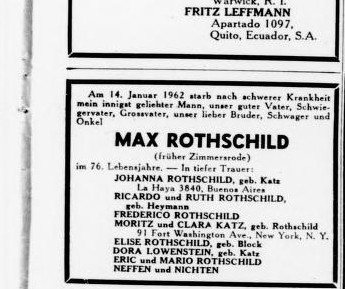
I do not know more about what life was like for Max, Johanna, Fritz (who became Frederico in Argentina), and Richard (who became Ricardo) in Argentina. Andra Marx located a notice in the Aufbau newspaper that announced that Max Rothschild died on January 14, 1962, at the age of 75 after a serious illness. He was mourned by his wife Johanna, who was living in Buenos Aires, his sons Frederico and Ricardo and Ricardo’s wife Ruth Heymann Rothschild, and other family members.

Death notice for Max Rothschild in The Aufbau, January 19, 1962, p. 29, found at https://archive.org/details/aufbau291962germ/page/n46/mode/1up?view=theater

Max is buried in Buenos Aires. His wife Johanna (Juana) survived him by 21 years; she died on December 27, 1983, and is buried next to Max in Buenos Aires. She was 91 years old.

Max Rothschild burial record from JewishGen, found at https://www.jewishgen.org/databases/cemetery/jowbr.php?rec=J_ARGENTIN_0226824

Johanna Katz Rothschild burial record at Jewish Gen, found at https://www.jewishgen.org/databases/cemetery/jowbr.php?rec=J_ARGENTIN_0226822

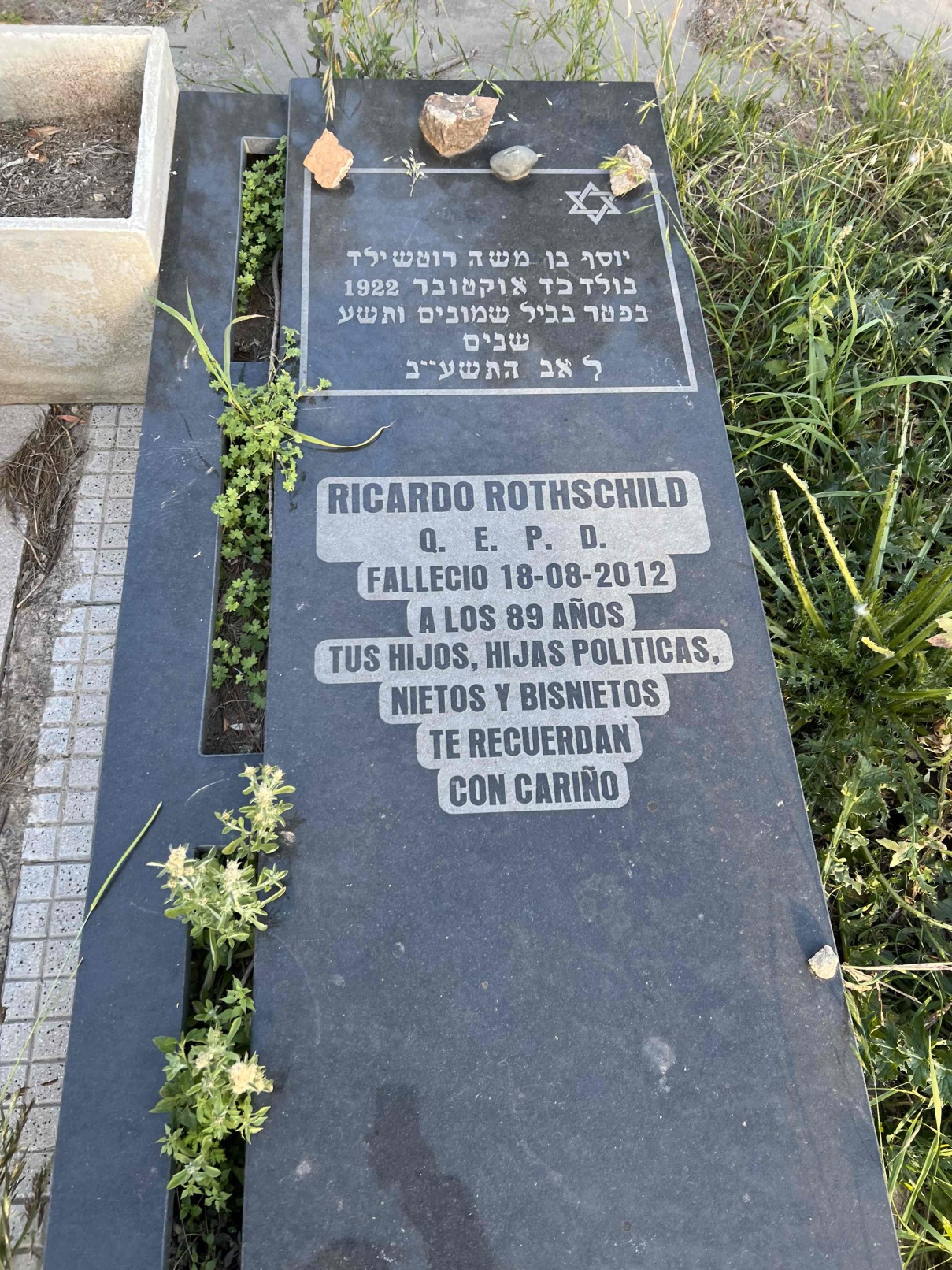
Their son Richard or Ricardo Rothschild died on August 18, 2012, at the age of 89. He is buried in the Jewish cemetery in Palacios Luis, Argentina, where his wife Ruth, who died on April 28, 1995, is also buried.

The inscriptions on both headstones read, “tu esposo/a hijos hijas  politicas y nietos te recuerdan con carino,” or “Your husband/wife, sons, daughters-in-law and grandchildren remember you fondly.” Ricardo and Ruth thus had at least two sons and grandchildren who survived them. I assume the sons are Eric (presumably named for his deceased uncle) and Mario Rothschild, who were named as mourners in the death notice for Max Rothschild.

Judy Katz, Hal Katz’s niece, informed me that Fritz also married and had children and grandchildren. They lived in Argentina and Germany. Fritz died in Germany just a few years ago.2  There are thus living descendants for Max and Johanna and their family.

Thank you again to Donna Levinsohn and to Andra Marx from the GerSIG Facebook group for their help in locating information about the Rothschilds in Argentina. And special thanks to my cousins Hal, Sandy, and Judy for sharing their memories of Max and his family.


  1. Zoom with Hal Katz and family on May 8, 2025. 
  2. Email from Judy Katz, May 8, 2025.