Unknown's avatar

About Amy

I am interested in genealogy and family research, books, movies, cats, dogs, and baseball.

Passover wishes and thoughts


Passover Seder Plate

Passover Seder Plate (Photo credit: Wikipedia)


As we approach the first night of Passover on Monday evening, I am feeling a bit overwhelmed, as I usually am this time of year.  There is the cleaning, shopping, cooking, and all the other details that go into preparing the house for Passover and for the seder.  I am also feeling torn because there are so many things I want to do in connection with my research and the blog.  I have lots of photos to scan and post, both from my Brotman relatives and my Rosenzweig relatives, stories that need to be written, documents to request, people to contact.  But I do not have time.  So while the kugel is baking and before I start turning over the dishes and pots and pans for the holiday, I thought I’d take a few minutes to ponder what Passover means to me this year.


Passover was once my favorite holiday of the year.  I loved the seder because as a child, it was my only formal exposure to Jewish history and Jewish rituals.  I grew up in a secular home.  We did not belong to a synagogue, I did not go to Hebrew school, and there were no bar or bat mitzvahs celebrated in our family when we were children.  It was just fine with me, but I was also very curious about what it meant to be Jewish.  Passover gave me a taste of what being Jewish meant and could mean.  My Uncle Phil, my Aunt Elaine’s husband, had grown up in a traditional Jewish home, and although he was not terribly religious either, he wanted to have a seder.


So every year we had a seder, first only at my aunt’s house, and then my mother started doing a second seder at our house.  My uncle, the only one who knew Hebrew, would chant all the blessings and sing all the songs, and the rest we would read in English from the Haggadah for the American Family (not Maxwell House).  I was enchanted—I loved the music, the stories and all the rituals. I looked forward to it every year.


As an adult, I began my own exploration of what it means to be Jewish.  I married a man from a traditional family, and he wanted to keep the traditions and rituals that were part of his childhood.  I also wanted to learn more and do more.  I took classes, I read, I got involved with the synagogue, and over time the Jewish holidays and rituals and prayers and services became second nature to me and provided me with meaning and comfort and joy.

Passover has become just one small part of my Jewish life and identity now, and over time, it has lost its magic.  It no longer is my favorite holiday of the year.  The matzoh gives me indigestion, the chore of changing the dishes and pots and pans has become tiresome, and the seder is so familiar that it no longer feels fresh and new and exciting.


If I look at it through my grandson’s eyes, I can feel some of that old excitement, but he is still too young to ask questions or to understand the stories.  He just likes the songs and looking for the afikomen and being with his family, which is more than enough for now.  This picture, one of my favorite pictures ever, captures some of that feeling.  From generation to generation, traditions are being preserved.

L'dor v'dor  Harvey and Nate

L’dor v’dor Harvey and Nate


But this Passover I will try to take the time to think about things a little differently.  I will think not just about Moses and the Israelites crossing the Red Sea and going from slavery to freedom.  I will think about all my maternal ancestors who made their own Exodus by leaving poverty and oppression and prejudice and war in Romania and Galicia to come to the place where they hoped to find streets lined with gold.


I will think of my grandfather Isadore, the first Goldschlager to come, leading the way for his father, his mother, his sister and his brother.  I will think of how he traveled under his brother David’s name to escape from the army and come to America.


I will think of his aunt, Zusi Rosenzweig, who met him at the boat at Ellis Island.  I will think of his uncle Gustave Rosenzweig, who was the first Rosenzweig to come to the United States back in about 1888, with his wife Gussie and infant daughter Lillie, a man who stood up for his extended family on several occasions. And I will think of his aunt Tillie Rosenzweig Strolowitz, who came to the US with her husband and her children, who lost her husband shortly after they arrived in the US.  I will remember how she took in my grandfather and his sister Betty when their father, Moritz, died, and their own mother and brother David had not yet arrived.


And I will think about my great-grandfather Joseph Brotman, who came here alone in about 1888 from Galicia, whose sons Abraham and David from his first marriage came next, and whose son Max as just a ten year old boy may have traveled to America all alone.  I will think of Bessie, my great-grandmother for whom I am named, who brought two small children, Hyman and Tillie, on that same trip a few years later, and who had three more children with Joseph between 1891 when she arrived and 1901, when Joseph died.  The first of those three children was my grandmother Gussie Brotman, who married my grandfather Isadore Goldschlager after he spotted her on Pacific Street while visiting his Rosenzweig cousins who lived there as well.


All of these brave people, like the Israelites in Egypt before them, pulled up their stakes, left their homes behind, carrying only what they could carry, to seek a better life.  I don’t know how religious any of them were or whether they saw themselves as brave, as crossing a Red Sea of their own.  But when I sit and listen to the blessings and the traditional Passover songs this year, I will focus on my grandson and see in him all the courage and determination his ancestors had to have so that he could be here, free to live as he wants to live and able to ask us, “Ma Nish Ta Na Ha Leila Ha Zeh?” Why is this night different?


Why is this night different from all other nights? It isn’t because we are free; it’s because on Passover we remember what it was like not to be free and to be grateful for the gifts of those who enabled us to be free.

Happy Passover to all, and thank you to all my  Brotman, Goldschlager and Rosenzweig relatives for making this such an exciting journey for me.


Enhanced by Zemanta

Max and Irving: The Sons of Abraham Rosenzweig

Abraham Rosenzweig was the oldest son of Gustave and Gussie Rosenzweig and my grandfather Isadore’s first cousin.  He was born in New York City on February 12, 1889, apparently the first of their children born in the US.  He served in the Navy before and during World War I, and he worked for a bakery after the war and thereafter.

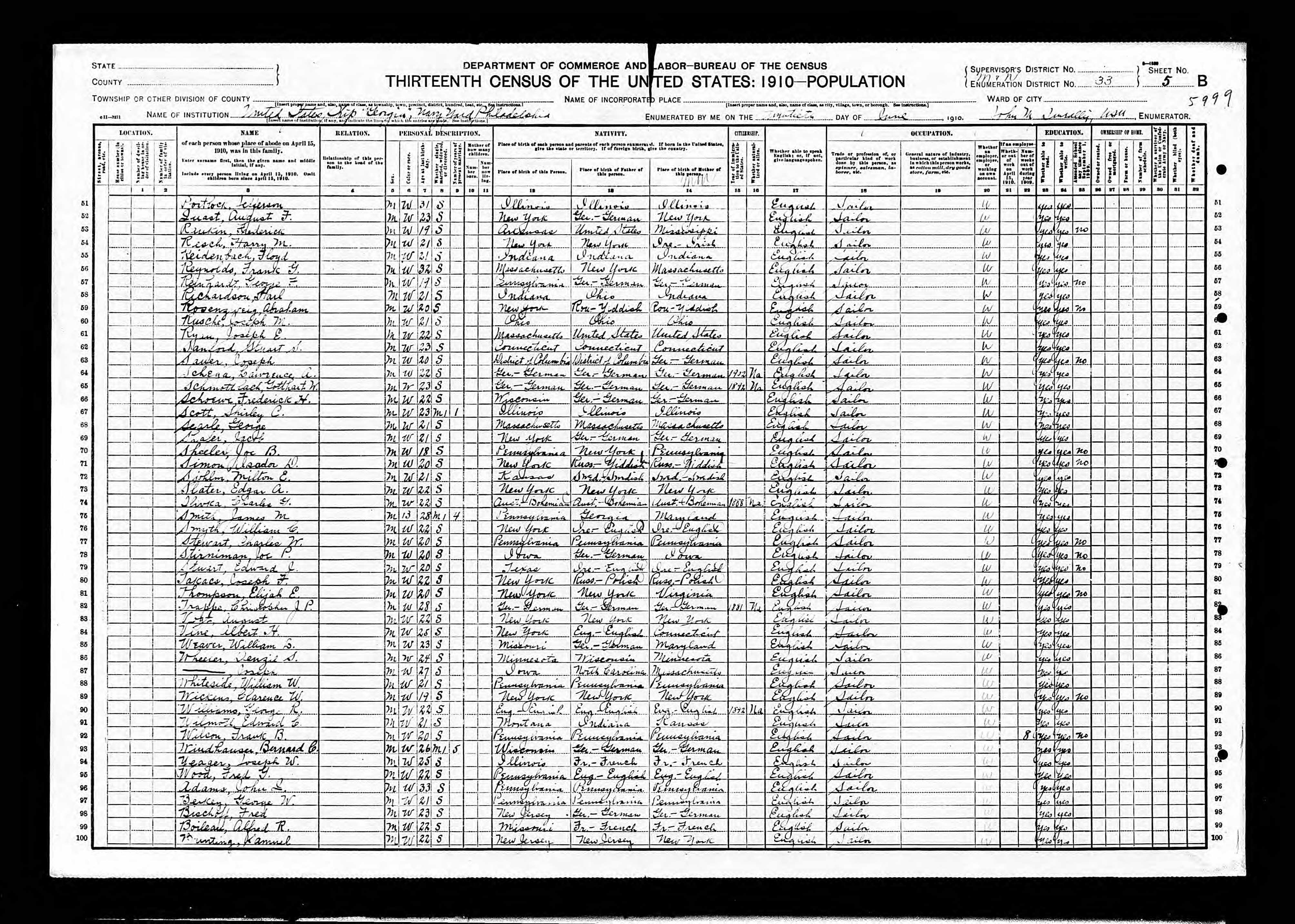
Although I do not have any documentation for Abraham’s marriage, it seems that he probably married in Pennsylvania.  Rebecca Fagles, his wife, was born in Pennsylvania, and Abraham was stationed on the USS Georgia in Philadelphia in 1910.

Abraham Rosenzweig 1910 census US Navy

I assume that that was when and where they met and that they married around 1915 because although Abraham was living with his family and single as of the 1915 census, his first son Maxwell was born April 2, 1916.  Abraham and Rebecca’s second son Irving was born April 26, 1919, and in 1920, they were all living in Brooklyn, according to the 1920 US census.

UPDATE: I was able to find the marriage of Reba Fagles and Abraham Rosenzweig in 1915 on the Philadelphia marriage index.  I am assuming that that is the record for Abraham and Rebecca.

Abraham Rosenzweig and family 1920 census

Abraham Rosenzweig and family 1920 census

Abraham and Rebecca, known as Abe and Beck, lived in Brooklyn for the rest of their lives, where they raised their two sons, Max and Irving.  Max married Sylvia Herrick and had two sons, Joseph and Gerald.

Max and Sylvia Ross

Max and Sylvia Ross

Irving married Irene Rubenstein/Robbins and had two daughters, Jane and Arlene.  Gerry remembers his grandparents very well since he grew up in Brooklyn where they lived.  He remembers that his grandmother Beck served untoasted English muffins and used memorial candle holders as glasses.  Gerry named his two children for his grandparents, his son for Abe and his daughter for Beck.  Abe died in 1961, and Beck died in 1970.

Abe, Sylvia, Ray (Abe's sister) and Beck

Abe, Sylvia, Ray (Abe’s sister) and Beck

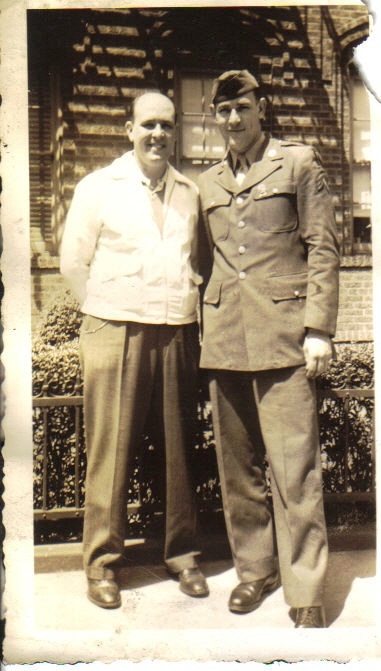
Here are some photographs of Max and Irving and one with their aunt Ray, an aunt I’ve otherwise been unable to locate.

Max and Irving Rosenzweig/Ross

Max and Irving Rosenzweig/Ross

Max and Irving with their aunt Ray

Max and Irving with their aunt Ray

I was able to get some background information about the lives of Max and Irving from Gerry and Arlene.

Max and Sylvia settled in Brooklyn, where Max first was in the egg and poultry business and then in the business of reconditioning steel drums for storing oil.  At some time after World War II while doing business with the army, Max changed his last name from Rosenzweig to Ross, believing that he would have more success with a name that was not obviously Jewish.  Sometime thereafter Irving also changed his last name to Ross for similar reasons and also because their mother Beck did not like the idea of the two brothers having different last names.

Arlene told me that her father Irving had met her mother Irene when her uncle Max went to Sylvia’s house while they were dating and brought his younger brother Irving with him.  One of Sylvia’s friends was there and arranged for Irving to meet her younger sister Irene.  For Irving, it was love at first sight, but not for Irene.  For a year, Irving pursued her.  Irene had joined the Navy, one of the first ten women to become a WAVE, and Irving, himself in the US Army, placed an ad in the Stars and Stripes to find her and to get her attention.  Eventually, Irene agreed to date him and fell in love with him as well.

They were married in 1945, and according to Arlene, to his dying day, her father would do anything to make Irene happy.  Irving and Irene  Irene and Irving lived at 41 Kew Gardens Road, Queens, and their two daughters were born at Kew Gardens General Hospital.  Irving owned a share in a successful hardware business.

In 1957, Irving and Irene and their daughters went to visit Irene’s parents, who had moved to the Miami, FL, area.  Irene was so taken with life in South Florida that within days after returning to Brooklyn, Irving sold his share in the hardware business and bought three tickets to Miami for Irene and his daughters, coming down a few months later himself once his business matters were resolved.  He was, as Arlene said, determined to make Irene as happy as possible.

Within five years, Irving, a man who never graduated from high school, had obtained a license to sell insurance and had established a very successful insurance brokerage business.  He was able to provide his family with a large, custom-built house and a comfortable lifestyle.  Irving and Irene remained in the Miami area thereafter and only occasionally would they return to the New York area.

Sadly, their lives would be marked by tragedy.  In 1968, Irving was admitted to Baptist Hospital in Miami for congestive heart failure.  While he was being admitted, Irene and Arlene went to get something to eat, and while driving down North Kendall Drive, where Baptist Hospital is still located, they were hit head-on by a minibus going northbound on U.S. 1, South Dixie Highway.  The minivan had defective brakes and  had skidded across the median.  Both Irene and Arlene suffered severe injuries, and Arlene underwent numerous surgeries and was laid up for a substantial time after the accident.  For some period of time all three members of the family shared one hospital room.

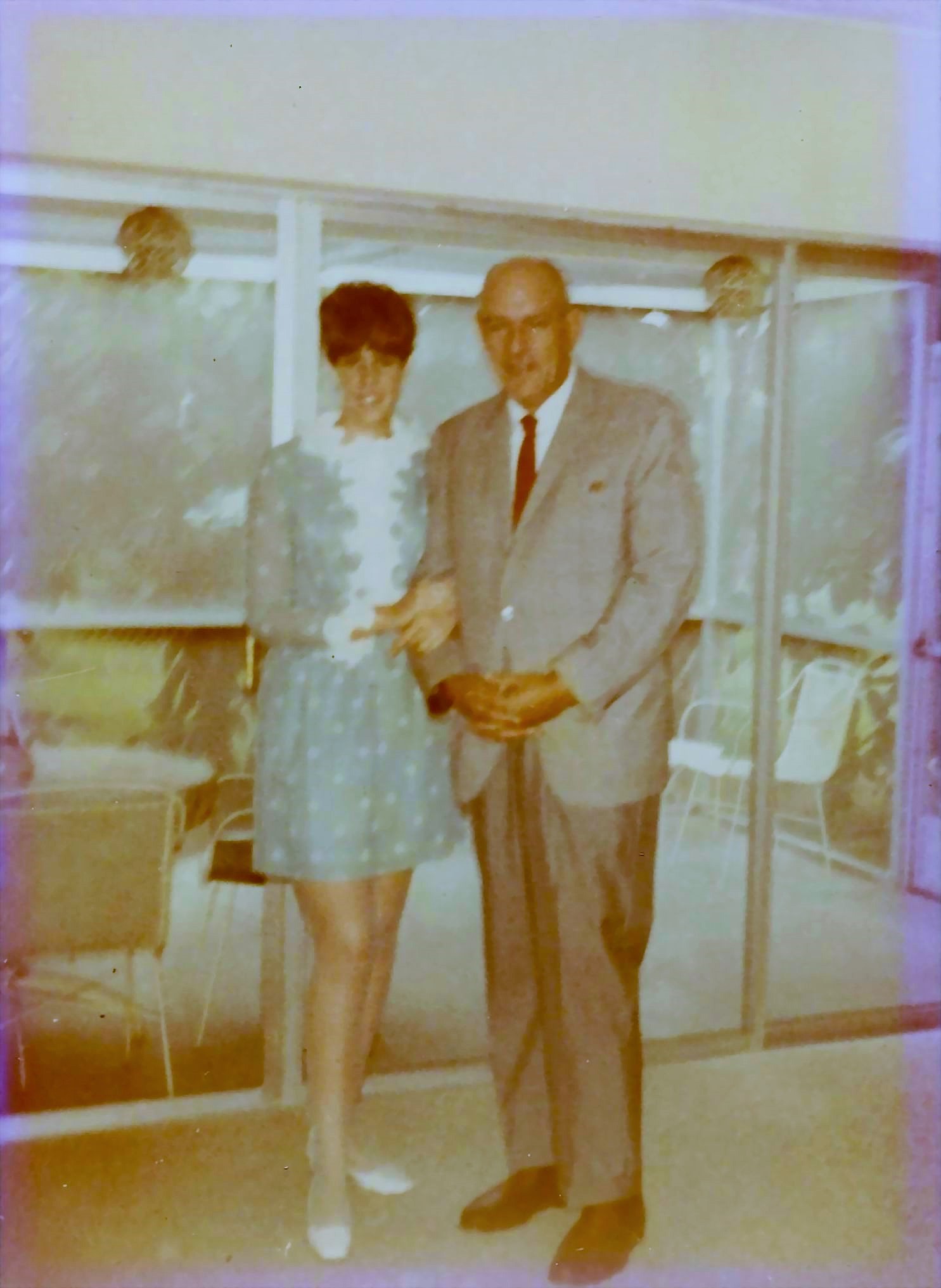
Arlene and Irving Ross August1968

Arlene and Irving Ross August1968

Not long after the accident, Irving was diagnosed with inoperable cancer and died at age 51 on August 5, 1970.  Irene was only 49 when he died.  She had to go to work to support herself and her children and became a purchasing agent at Florida International University, where she worked for many years.  She died January 16, 2009, at age 88.

Irene Ross in 2006

Irene Ross in 2006

Arlene Ross

Arlene Ross

Max also died at a prematurely young age.  His wife Sylvia had a number of medical problems, and while accompanying her for treatment at Massachusetts General Hospital in November, 1975, Max had an aneurysm and died.  He was only 59 years old. Sylvia lived more than twenty years after Max died.

Sylvia Ross

Sylvia Ross

The two sons of Abraham and Rebecca, Max and Irving, thus had many parallels in their lives.  Both were big strong men over six feet tall, both had changed their name to Ross, both had had two children and long marriages to women to whom they were devoted, and both had died before they were sixty years old. Gerry said he speaks to his father daily and has every day since he died in 1975; Arlene also spoke adoringly of her father.  I could tell in speaking with both Gerry and Arlene that each of them loved their fathers dearly and want their memories preserved.   I hope this blog will help to do that.

Enhanced by Zemanta

Sometimes You Win, Sometimes You Lose

I have had some incredible luck  following my hunches when ordering vital records about people who I think are my family members—finding Frieda Brotman’s death certificate and marriage certificates, for example, or finding Susie Mintz and Gustave Rosenzweig and Tillie Strolowitz and their relatives.  But lest anyone think that all my hunches have worked out, I want to give you three recent examples where I just guessed wrong.

The first example involves Gussie Rosenzweig, Gustave’s wife.  Recently I was able to obtain her death certificate and saw that her son Jack had listed her as a widow with a husband named Ben.  I was very puzzled by this as Gussie had not been listed as living with any man in the most recent census reports before she died.  Had she married sometime in the 1920s or 1930s and been widowed in between census reports?  I did a search and found only one Gussie Rosenzweig who had married a man named Benjamin.  I ordered that certificate, and this is what I received:

Rosenzweig - Rosenberg Marriage page 1

Clearly, this is not the right Gussie.  This Gussie was only 27 in 1934, whereas our Gussie would have been in her 70s; this Gussie had different parents who had come from Hungary.  So I still have no idea whether there ever was a Ben who married Gussie after she and Gustave split up.  Strike one.

The next bad guess involved a search for the other children of Gussie and Gustave who did not survive infancy.  I had seen on Rebecca’s birth certificate in 1893 that Gussie and Gustave had had five children, four living at Rebecca’s birth.  Somehow I miscounted and thought there was a missing child, although now when I go back and re-read my blog post, it seems pretty obvious that I had found all four living children (Lillie, Sarah, Abraham, and Rebecca) and the one deceased child (David).  But I thought I had found another—Samuel Rosenzweig—and sent for that death certificate.  Not surprisingly, he was not the child of Gustave and Gussie, as you can see below.  Strike two.

Rosenzweig, Samuel Death

The last example of my bad hunches involved a man named Paskel Rosenzweig who came from Iasi in 1900.  I thought that he might be another Rosenzweig sibling and decided to research his life in the US.  I was able to determine that he had changed his name to Charles and ordered a death certificate, hoping it would show that he was the sibling of Gustave, Tillie, Ghitla and Zusi, but as you can see below, he was not.  Strike three.

Rosenzweig, Charles Death page 1

Perhaps he was a cousin, but it would require some further digging into Romanian documents to see if Charles’ father was related to my great-great grandfather David Rosenzweig.  For now I will accept that my hunch is unproven, if not yet proven wrong.

There are other examples of times I made a bad guess.  Fortunately for the most part these bad guesses are not costly, as the documents usually came for free from the Family History Library.  But even so, every time I open a document, either electronically or in hard copy, my heart is beating, hoping it will provide an important clue or confirm a hunch.  When it does not, it is very disappointing.  Inevitable—what are the odds I will always find the right person?—but nevertheless, disappointing.


Enhanced by Zemanta

Family Photo Album:  Joe and Sadie and Their Daughters Irene and Mildred

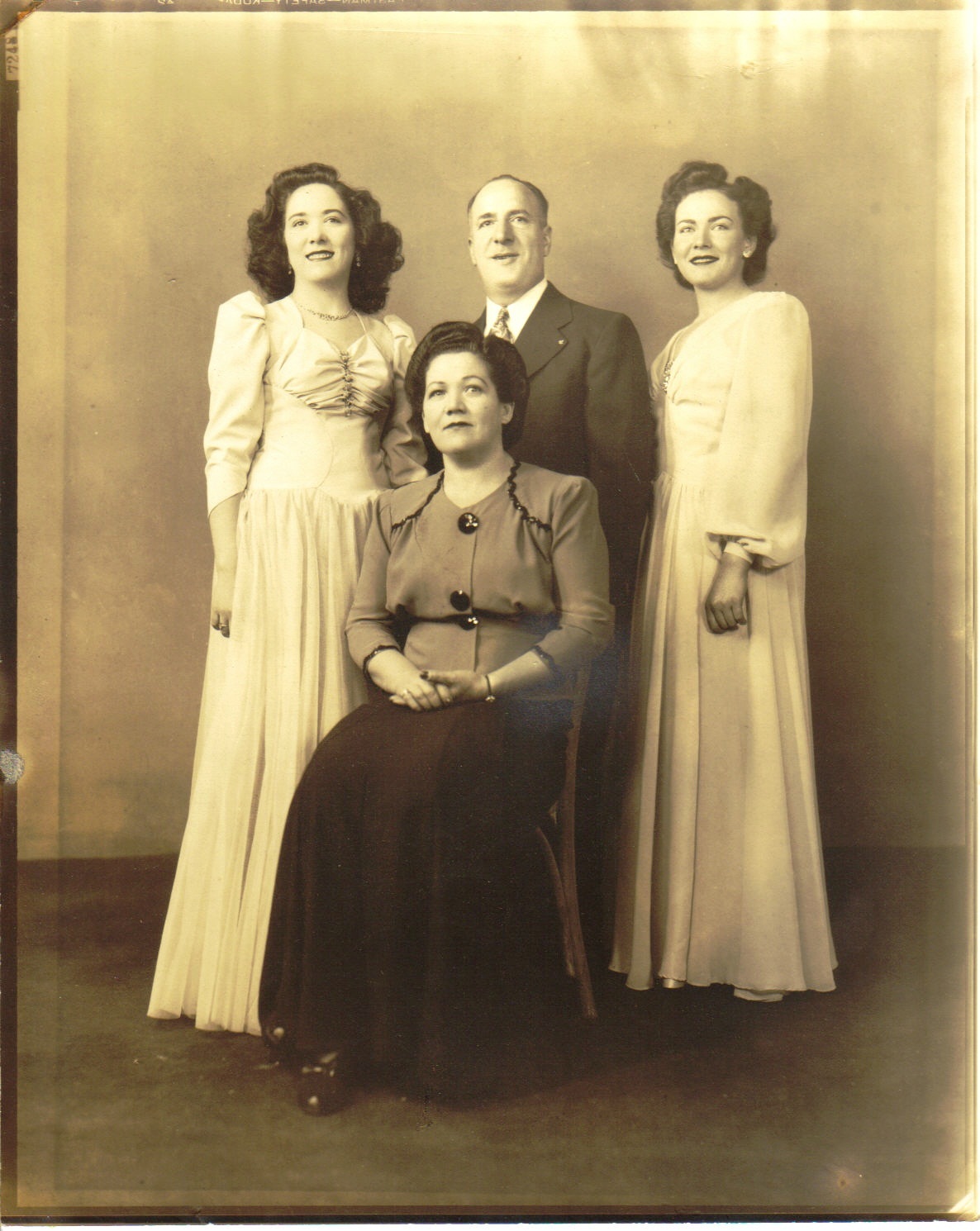
Joe and Sadie and their daughters

Joe and Sadie and their daughters

Photographs can capture so much—a moment in time, a relationship, the style of an era, a mood, an emotion.  Even family snapshots can reveal a lot.  These pictures of Joe and Sadie and their daughters capture a family.  Thank you to the next generation for sharing these pictures of their mothers and grandparents.

These pictures from the early 1940s  of Irene, in her early 20s, and Mildred, a teenager, are so touching.  They show two beautiful sisters who seem close to each other and to their parents.  They both look like they have so much ahead of them.

Ariela described her mother Irene as very outgoing and social like her father Joe, someone who would strike up conversations with total strangers.    Ariela said that Irene loved to dance and ski and sail as a young woman and that she loved jewelry and clothes and other beautiful objects.  She loved dressing up and attending parties, and you can see that love of life and people in her face in these pictures of her as a young woman.

Irene 1941 Rockaway Pkwy

Irene 1941 Rockaway Pkwy

Irene, Joe and Mildred 1941

Irene, Joe and Mildred 1941

Tragically, Mildred’s life was cut short when she died in 1951 at only 25 years old, leaving behind her young husband and fifteen-month old child.  I am hoping to learn more about her, but from these pictures it looks like she was also a young woman who loved life and people and was adored by her sister and her parents.

Mildred

Mildred

Sadie and Mildred 1942

Sadie and Mildred 1942

Mildred 1941

Mildred 1941

Mildred and friend 1943

Mildred and friend 1943

Mildred Rosenzweig and Seymour Sundick 1947

Mildred Rosenzweig and Seymour Sundick 1947


Ron and his mother MIldred Sundick at his first birthday, a few months before she died

Ron and his mother MIldred Sundick at his first birthday, a few months before she died

This is one of my favorite pictures in this group of photos.  It shows both Mildred and Irene surrounding a baby carriage.  Although we cannot see the baby, the descendants of Mildred and Irene and I thought that it is likely that the baby is Ariela, based on the hairstyles dating it in the 1940s and the adoring look on Irene’s face, looking down at what must be her baby.

Mildred and Irene looking at Ariela 1947

Mildred and Irene looking at Ariela 1947

You can also see that same adoring look on Irene’s face many years later as she looks lovingly at her daughter Ariela.

Irene and Ariela

Irene and Ariela

And here is one of Irene with her grandson Aron.  Same loving look—on both of their faces.

Aron and his grandmother Irene

Aron and his grandmother Irene

Here are some photos of Joe and Sadie in the 1940s:

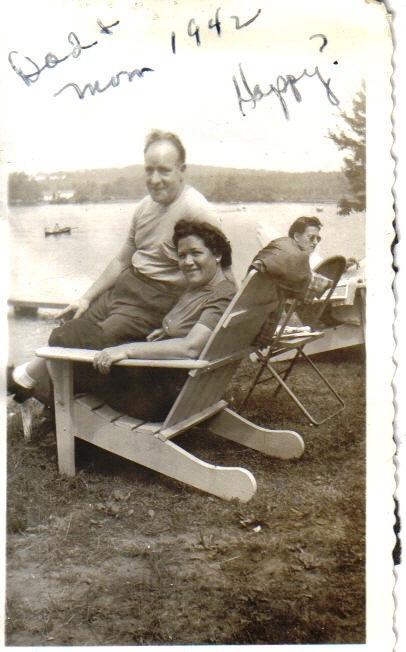
Sadie in cloth coat Joe on boat dock Lake 1942 Joe and Sadie on Chair 1942 Joe and Sadie in Lake 1942 Joe 1941

Here are some from the 1950s and after of Joe, Sadie and Irene:

Irene Joe Sadie in color Sadie and Irene Sadie


This photo  is of Irene and her husband Leo Kohl with her parents Joe and Sadie.

Leo Joe Sadie and Irene

Leo Joe Sadie and Irene

Ariela told me that her mother was madly in love with Leo and missed him dearly until the day she died.  Irene died less than a year and a half ago at age 91.

As I said, photographs capture so much.  These capture a family over time, a family where children adored their parents and vice versa, a family that endured a terrible tragedy, but that survived and thrived and found love and joy in their lives again

Blog Update

The family tree chart for David and Esther Rosenzweig’s descendants was growing to a point where it became illegible unless you had a microscope.  I have now broken the tree into its various branches based on David and Esther’s children and sometimes their grandchildren to make these charts more readable.  I have also placed the charts on a separate page that is password protected to protect the identity of any living descendants.

If you are a member of the family and would like the password, just email me, and I will provide it to you.

I hope this makes the trees more readable and also more secure.

Amy

Romanian birth records

UPDATE:  I’ve updated this post to reflect three more birth records for the Srulovici/Strolowitz/Adler children.  I’ve received these three over the past week or so and thought it best to combine these new ones with the ones I already had.  I’ve rewritten the post to put the records in correct birth order.

Gifts from Doing Genealogy: My Wonderful Cousins

Ten of Joseph and Bessie's great-grandchildren on the Lower East Side

Ten of Joseph and Bessie’s great-grandchildren on the Lower East Side

Lower East Side tenement

Lower East Side tenement (Photo credit: Salim Virji)

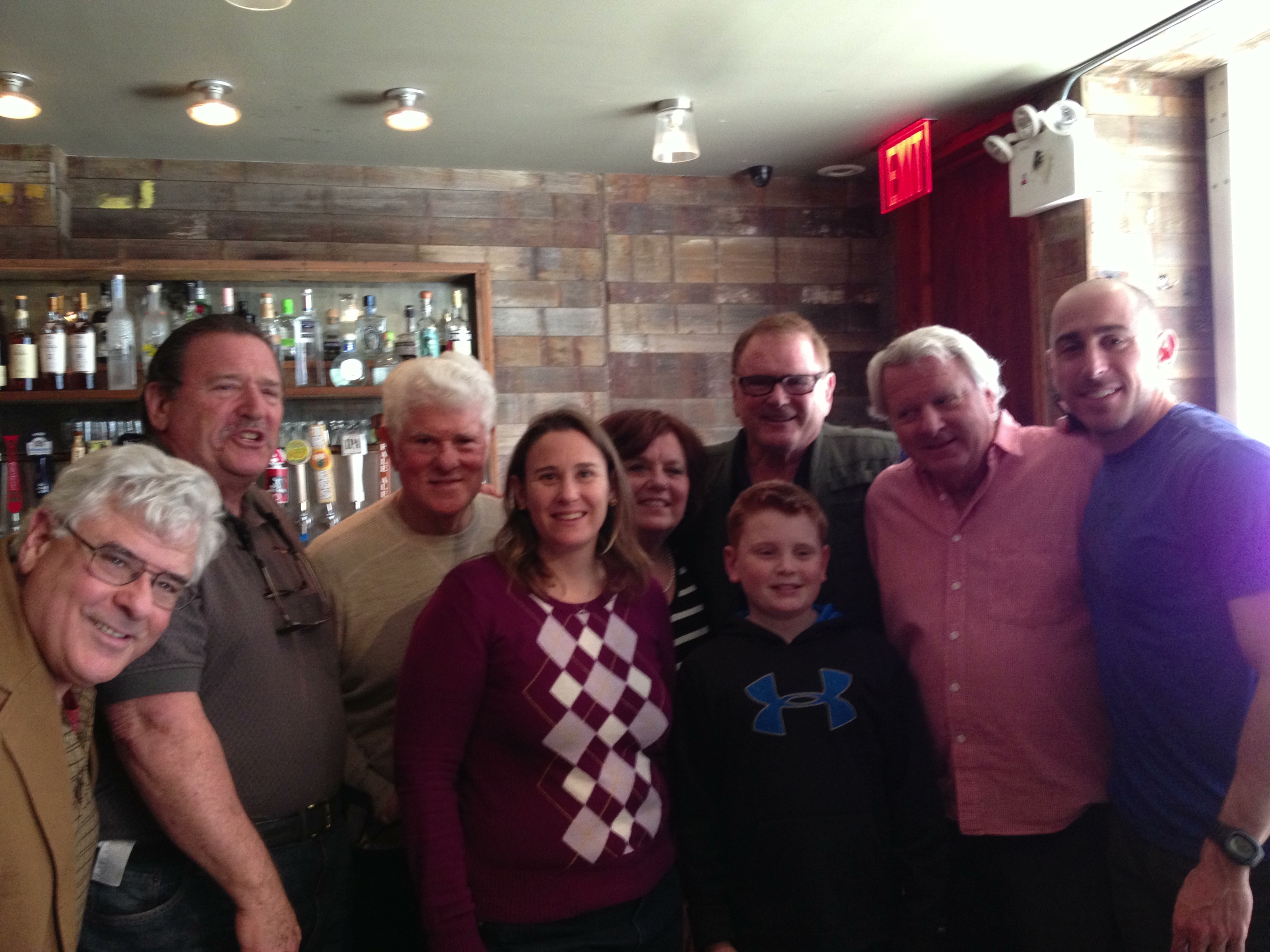
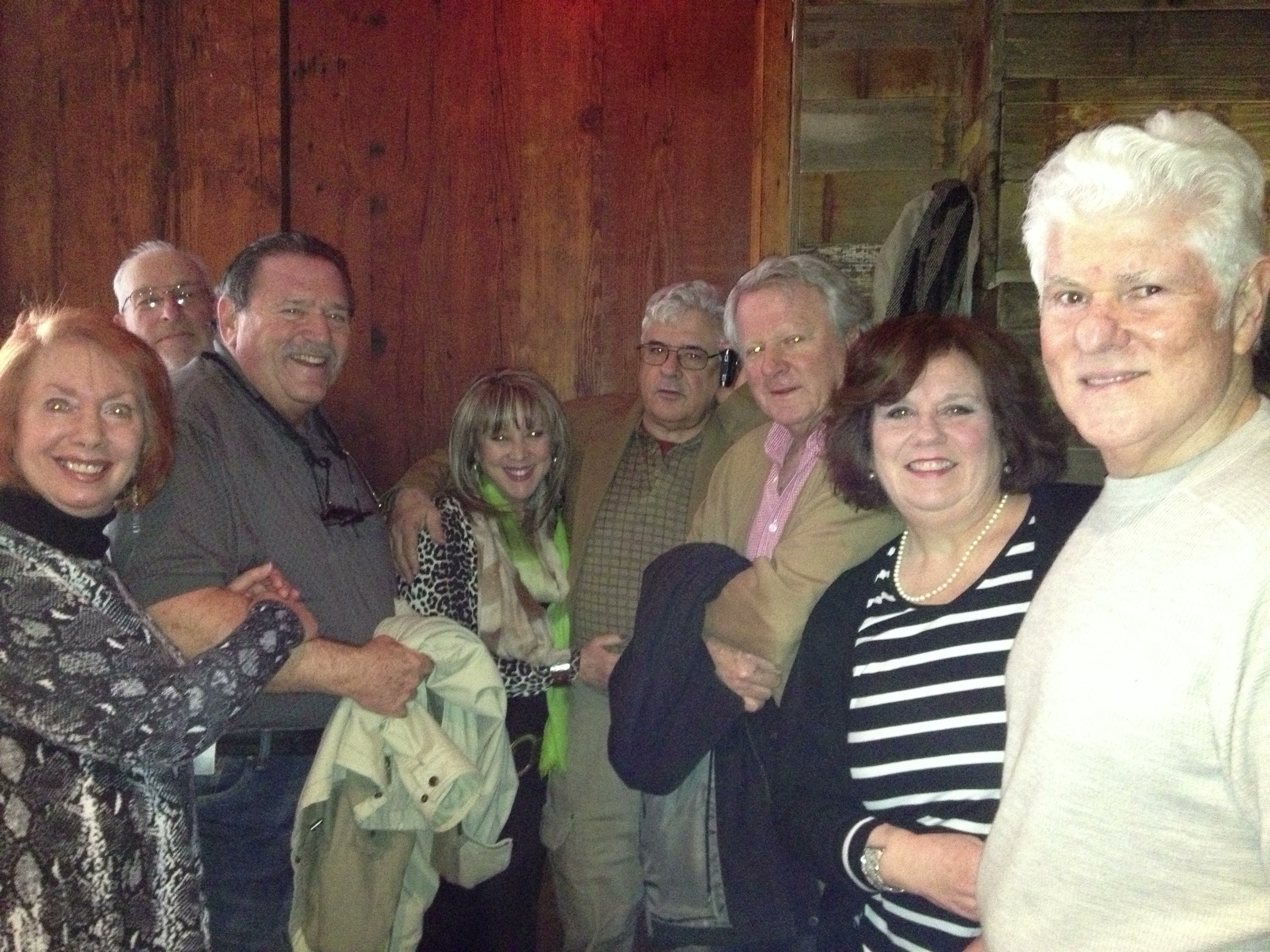
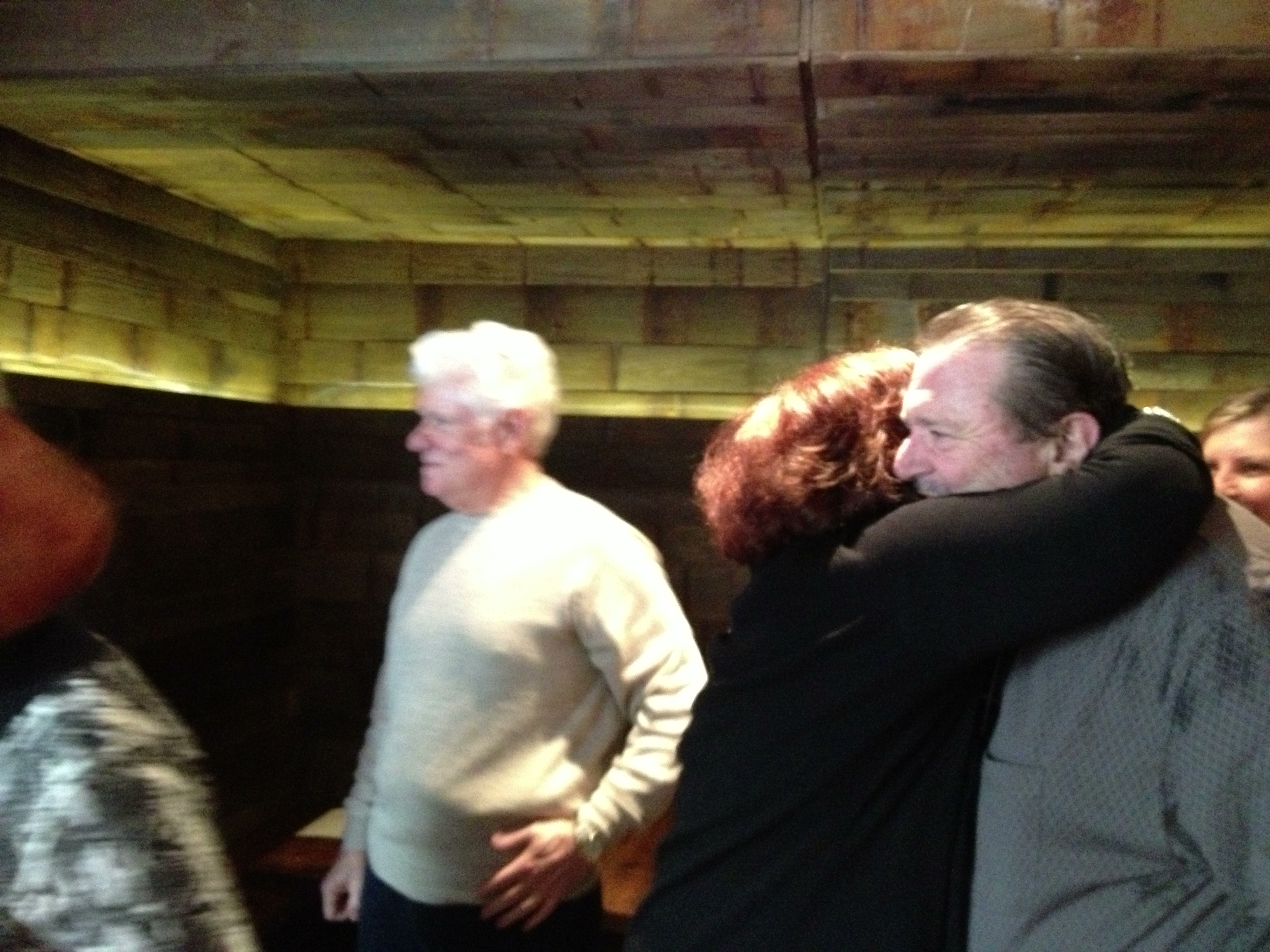
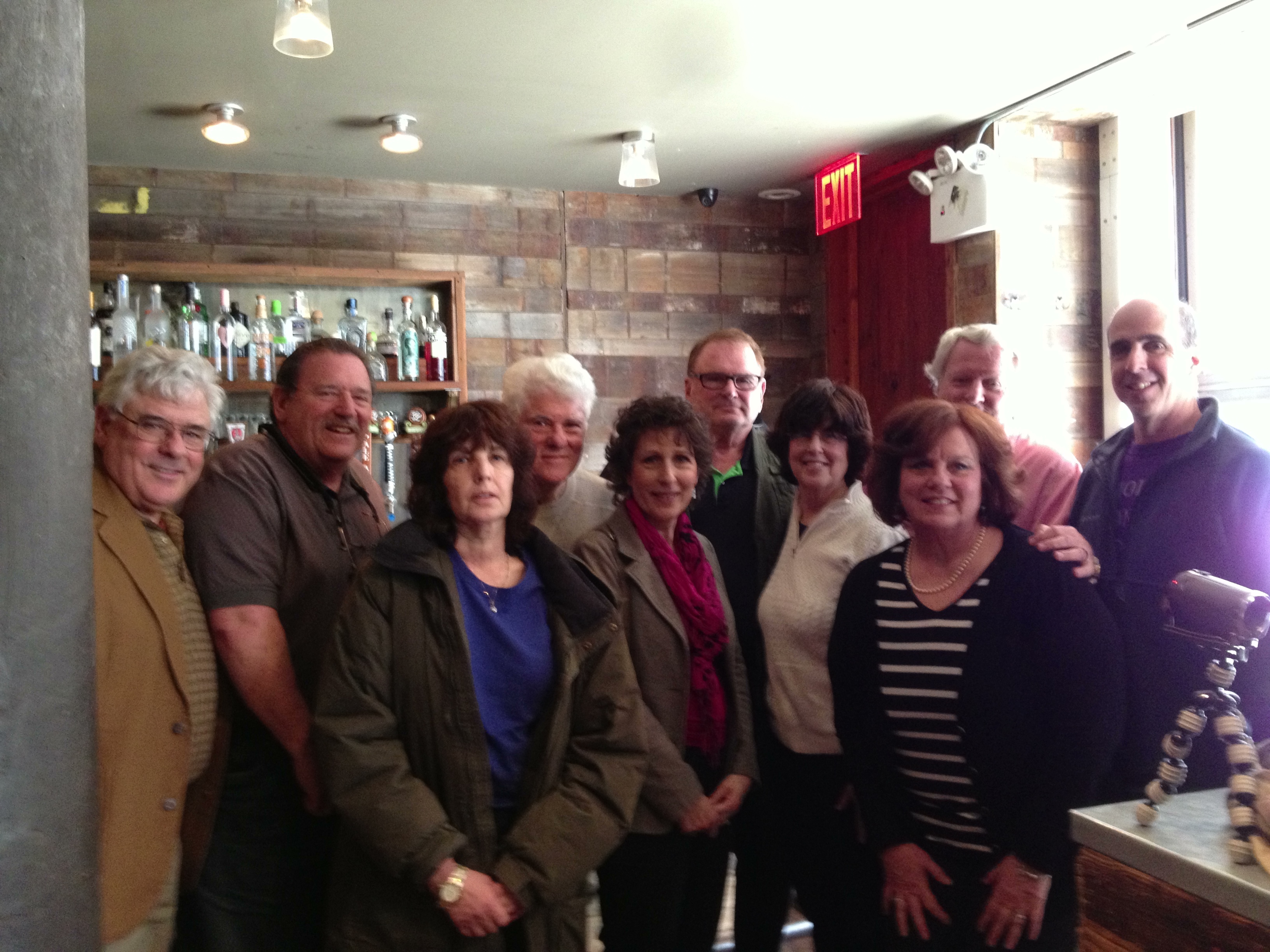
After much planning and anticipation, ten of Joseph and Bessie Brotman’s great-grandchildren, four of their great-great-grandchildren and one great-great-greatgrandchild as well as a number of spouses spent the weekend, talking, eating, laughing and connecting and reconnecting in NYC.  Some of us had known each other all our lives, some had never met at all, and some had not seen each other in many years.  We represented two of Joseph and Bessie’s children, Hyman and Gussie. Although a few people could not make it for various reasons, there were several others who wanted to join us but were unable to do so, including one of Max’s granddaughters and one of hisgreat- granddaughters and one of Abraham’s granddaughters.  We had a wonderful tour of the Tenement Museum and several of us walked along Ridge Street between Rivington and Delancey where our ancestors lived between about 1891 and 1907.

Sign outside Lower East Side Tenement Museum

Sign outside Lower East Side Tenement Museum (Photo credit: Wikipedia)

It was everything I had hoped it would be and more so.  We shared stories about our lives and about our grandparents and parents.  We shared photographs.  We got to know and learned about our children and grandchildren.  We came from as far away as Cleveland and Florida and Massachusetts.   Some lived closer by in New Jersey or even in NYC itself.    There were lots of photos taken. Included here are just a representative few to illustrate the excitement and love that was shared.

Saul and Manny's descendants

Saul and Manny’s descendants

cousins

cousins

photo 4 photo 3

I cannot speak for everyone, but for me it was magical.  A year ago I did not even know I had second cousins.  Through the course of doing family research, I had found all these new wonderful people, people I would have chosen as friends even if they were not my relatives.  We may live far apart, we may have known each other only for a short time, but I know that for me I felt a deep connection.  No, it’s not the same as growing up with a first cousin who shared grandparents and holidays and vacations, but it is nevertheless a real connection.  We all came from the same place, we all are here because Joseph and Bessie decided to leave Galicia and come to America.  We all started somewhere on Ridge Street where our grandparents learned to speak English and the skills that were necessary to rise above the poverty.

Ridge and Broome St

Lower East Side

Lower East Side (Photo credit: InSapphoWeTrust)

I am so grateful for all who were able to make it and all who helped make this dream come true.   I hope that those who were unable to join us will be able to do so another time.  And now I am inspired to starting planning the first Goldschlager-Rosenzweig reunion and then the second Brotman reunion.  These things take time and effort, and I was lucky to have lots of help  with the planning, but I encourage any of my fellow family researchers to reach out and make your family tree more than a two-dimensional document or digital record.  Find a way to meet your cousins and make them a part of your life.


UPDATE: For more photos, click here.

Enhanced by Zemanta

A Romanian Surprise

I am in NYC for the weekend and looking forward to meeting my Brotman cousins.  Pictures and stories to follow.

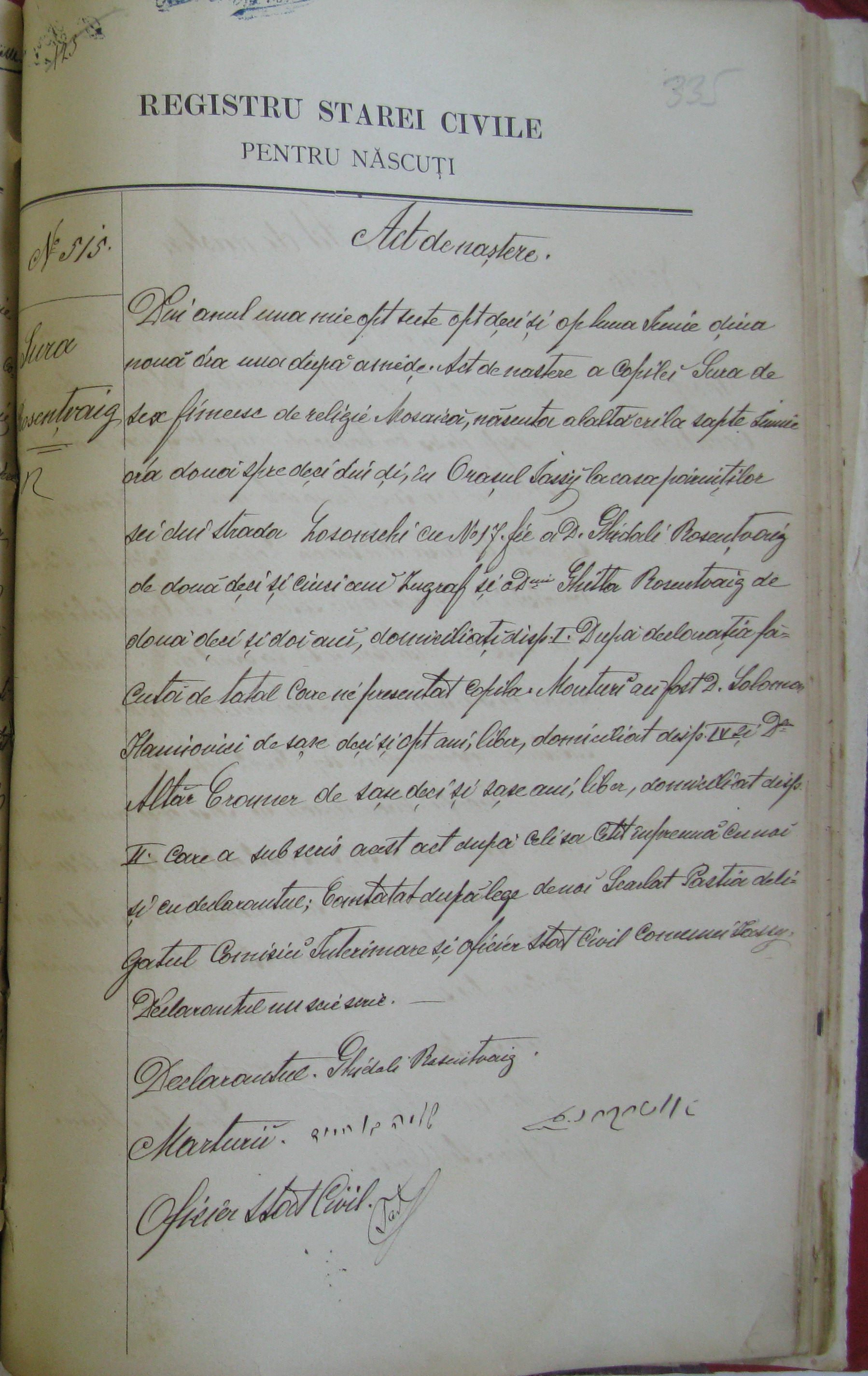
But first, a little Romanian surprise.  I received a few more documents from my Romanian researcher, Marius Chelcu.  One in particular surprised me.  It is a birth record for Sura Rosentvaig, born June 7, 1888, daughter of Ghidale and Ghitla Rosentvaig, of Iasi, Romania.
Sura Rosentvaig birth record

Sura Rosentvaig birth record

Sura Rosentzvaig_Birth record_1888 translation-page-001


The first surprise was that Gustave and Gussie were still living in Iasi as of June, 1888. According to his naturalization papers, Gustave arrived in the US on April 12, 1887.

naturalization petition gustave rosenzweig

naturalization petition gustave rosenzweig

Before 1906, the government did not require strict proof of arrival, and obviously Gustave fudged it a bit.  But when did he actually arrive? I still have not found a ship manifest for him or Gussie or the children, but this will narrow down the dates of my search by assuming they left Romania after June 7, 1888, and arrived before February 12, 1889, when I believe Abraham was born.

One inconsistency here is that according to earlier Romanian records, Gustave was born in 1856 and Gussie in 1864.Ghidale Rosentzveig_Birth record_1856-page-001

translation of marriage record

translation of marriage record

On Sura’s birth record dated 1888, it says Gustave was 25, making his birth year 1863, and Gussie was 22, making her birth year 1866.  I guess it just goes to show that Romanian records are no more reliable than American records.   Gustave and Gussie’s birth records, however, were created at the time of their marriage, not at their birth, whereas Sura’s was created at the time of her birth so presumably is more reliable in terms of her birthdate.
The second surprise is that Sarah, their second daughter, was born in Iasi, not in New York City.  Every census indicates that she was in fact born in New York.  This explains why I could not find a NYC birth record for Sarah, but why is she listed on the census as US-born? Lillie is listed (with one exception) as born in Romania.  Why not Sarah?

Rosenzweig children 1900 census

Rosenzweig children 1900 census

Gustave Rosenzweig family on the 1905 NYS census

Gustave Rosenzweig family on the 1905 NYS census

Rosenzweig family 1910

Rosenzweig family 1910

Kurtz family 1920

Kurtz family 1920

kurtz family 1930

kurtz family 1930

Sam and Sarah Kurtz 1940 census

Sam and Sarah Kurtz 1940 census

I am still searching for Sarah’s descendants and know their names, but have not yet been able to contact them.  I wonder if they know she was born in Romania, not in the US.

Have a good weekend, everyone!


Enhanced by Zemanta

A Small Chink in the Wall

Just last week I wrote that I was putting aside for now my attempt to track Lizzie and Ray Rosenzweig, the two youngest children of Gustave and Gussie Rosenzweig.  I had hit a brick wall and figured I’d never find them.  So I moved on, determined not to keep hitting my head against the wall.

And then I got some clues.  First, Joseph’s grandson sent me a photograph of Lizzie, labeled Lizzie Horowitz.

Lizzie Horowitz

Lizzie Horowitzl


He said that her married name had just come back to him.  Then in an email exchange with one of Rebecca Rosenzweig’s grandsons, he mentioned that he knew that his father Irwin had reconnected with Lizzie in Florida.  Two clues, and I was off and running, back to ancestry, PeopleFinders, Family Search, etc.

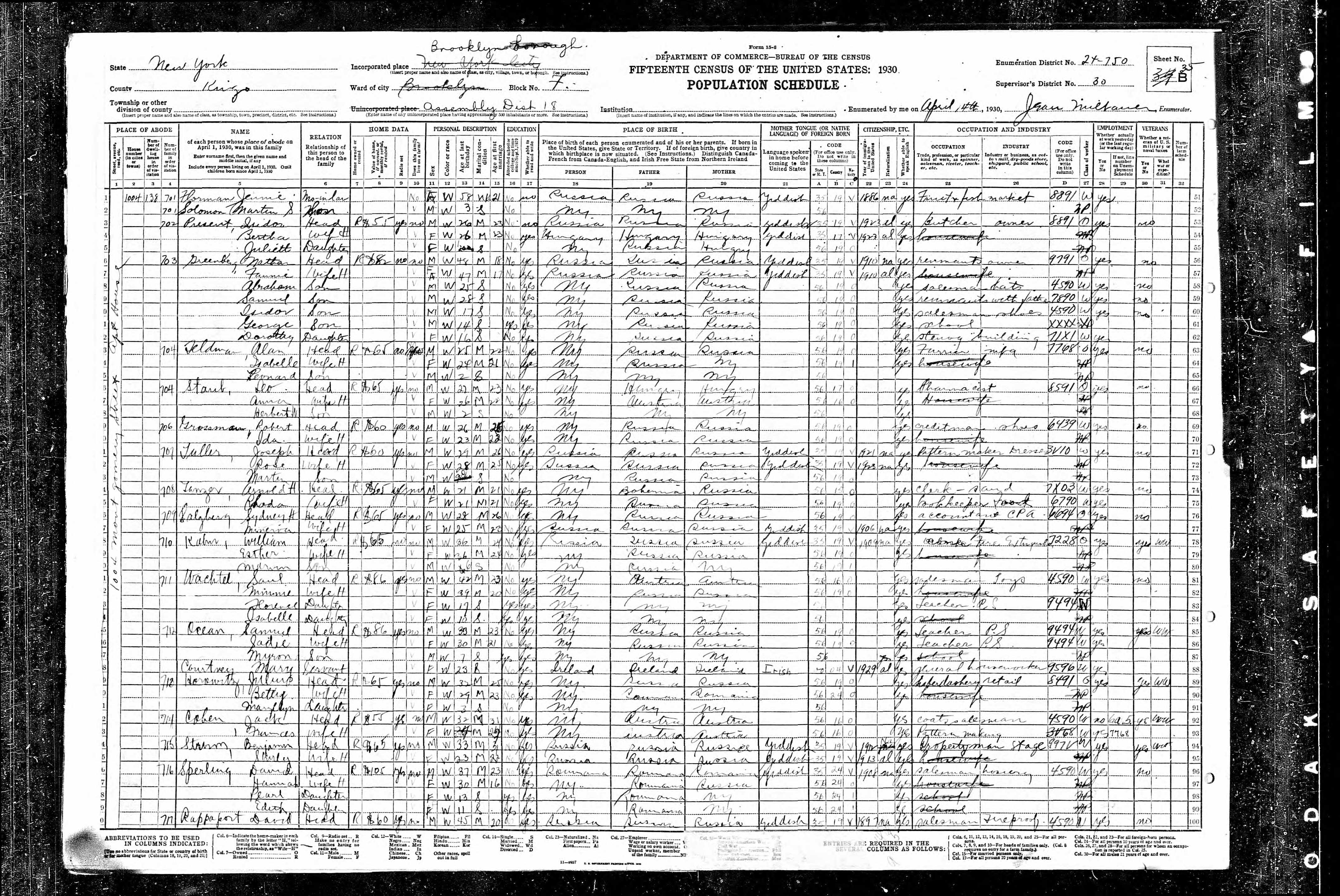
I did not find much, but I did find one 1930 census for a Betty Horowitz whose parents had both been born in Romania.  One of my other cousins had mentioned that Lizzie had also been called Betty.

Horowitz Family 1930

Horowitz Family 1930

She lived in Brooklyn, was married to Julius Horowitz, and had a three year old daughter named Mary Lyn.  I asked my third cousins whether either of those names rang any bells, and one wrote that the names Julius and Marilyn did seem familiar and that she remembered a cousin Marilyn who had moved to Florida.

I located Lizzie, sometimes called Betty, and Julius on the 1925 and 1940 census reports as well.  They had a second daughter born around 1931 named Harriet.

Now I am in the process of trying to find Marilyn and Harriet or their descendants.  I have not yet found a death record for either Lizzie or Julius, but I think I have the birth dates for Marilyn and Harriet from the NYC birth index.  Searching by those birth dates, unfortunately, had not helped much.  There are many women with those first names born on those dates.  I’ve had better luck with Marilyn, and if I limit the search to Florida, I can eliminate a few more.  But now what?

Now it’s a game of trying to contact family members of those Marilyns who remain and hope that one of them is the daughter of Lizzie Rosenzweig and Julius Horowitz.   To be continued…I hope.  Thanks to my newly found third cousins, there is hope.

English: A crack in the wall, Newbridge on Usk...

English: A crack in the wall, Newbridge on Usk This crack is in the east parapet of the road bridge at Newbridge on Usk. (Photo credit: Wikipedia)

Enhanced by Zemanta

More Manna from Heaven: Of Bessie, Joseph, Max and the Brotmanville Brotmans

As I wrote yesterday, the notes of the conversation with my Aunt Elaine about the family history are remarkably accurate.  Although much of what was in there I had learned either from my mother or brother or cousins or from my own research, there were a few stories in the notes, a few comments, that revealed something I had not known for sure before.  Keeping in mind the overall accuracy of the information that my aunt gave to Joel, it is very interesting to think about this additional information.

For example, there are some details about Bessie and Joseph that were revealing.  According to the notes, Bessie and Joseph were first cousins.first cousins  Although family lore did say that Joseph and Bessie were cousins, I did not realize that they were first cousins. Since both Joseph and Bessie had the surname Brotman or Brot, it seems that their fathers must have been brothers. What’s odd about this is that it means that Joseph’s father Abraham had a brother who was also apparently named Joseph, if the records are accurate.  It seems unlikely, given Jewish naming patterns, that Abraham would have named his son the same name as his brother, unless the brother had died.  Since Bessie was younger than Joseph (her husband), that is not possible.  The other possibility is that Bessie’s father and Joseph were both named for the same ancestor.  And, of course, the final possibility is that the records that indicated that Bessie’s father’s name was Joseph were incorrect.

Joel’s notes also indicate that after Joseph’s first wife died, leaving him with four children, “they decided” that Bessie should marry Joseph to help with the children.they decided  The notes don’t indicate who made the decision, but it probably was not Bessie. It’s sad to think of my great-grandmother being put in that situation, and it certainly takes the idea of any romance out of the equation.  But Joseph and Bessie went on to have five children of their own, so I’d like to assume that although it may have started as an arranged marriage for the convenience of Joseph, that love grew with time and the shared experiences and children that Joseph and Bessie had.  Call me a romantic.  I know that I am.

After Joseph himself died in 1901, the notes report that Bessie did laundry work to make money to support herself and her children, including Sam, who was just an infant, Frieda, Gussie, Tillie, and Hyman.  Tillie and Hyman were working in sweatshops, so Gussie, my not-yet-seven year old grandmother, stayed home to take care of Frieda and Sam.  Not long after, out of desperation, Bessie married “the shoemaker Moskowitz,” who my aunt reported to be very stingy.  He had five children of his own. moskowitz

I assume that my aunt’s source for these stories was my grandmother, who obviously resented Philip Moskowitz and chose to live with her sister Tillie in Brooklyn instead of staying with her mother and Sam and Frieda when Bessie remarried, so I know I have to consider the source.  My great-grandmother Bessie lived with Philip for many years, more years than she lived with Joseph, and she was buried near him, not Joseph, when she died. Bessie and Philip Moskowitz headstones As with her marriage to Joseph, her relationship with Philip may have started out of need and convenience, but it also must have developed into something more.  Or at least I hope it did.

Bessie Brotman

Bessie Brotman

Of course, it is also possible that the source of this information was Bessie herself.  Bessie did not die until 1934, when my aunt was seventeen years old.  Knowing my aunt’s interest in the family history, I assume that she must have talked to her grandmother Bessie herself as she grew up, so perhaps the stories are not just my grandmother’s version of the facts, but Bessie’s version as well.

One other comment from these notes is a rather sweet one that I hope Max Brotman‘s grandchildren and great-grandchildren will appreciate:

max mason


Obviously, Max, who was probably the most successful businessman of the Brotman children, was also a very generous man.  He provided food to my mother’s family during the Depression.  Here is a great-uncle I’d never even heard of, someone my mother was too young then to remember, who helped out my grandmother and her family in a time of need.  Thank you, Max.

Max Brotman

Max Brotman


The final tidbit from the notes from Joel’s conversation with my aunt is this one:brotmanville


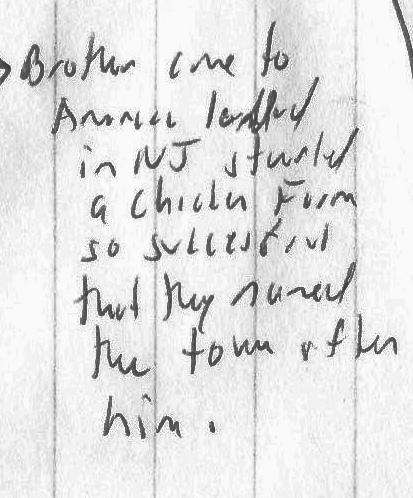
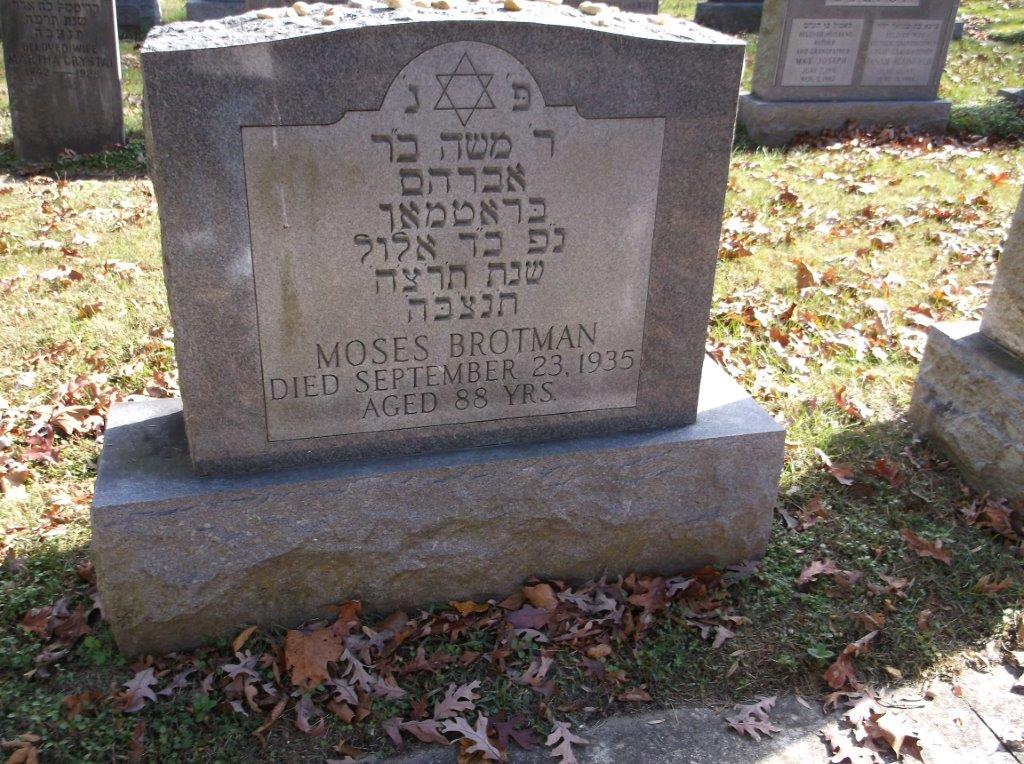
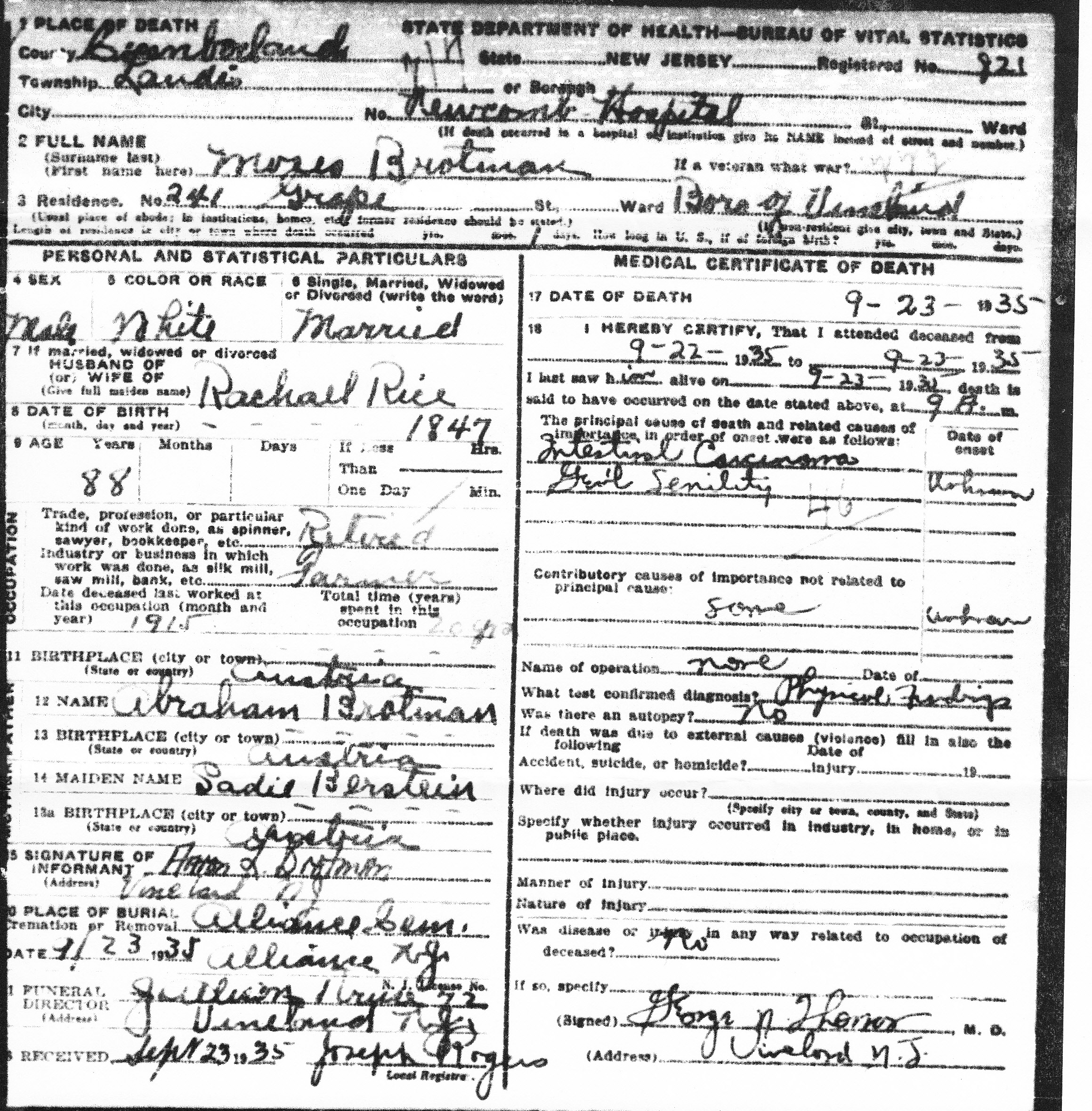
In case you cannot read that, it says, “Brother came to America landed in NJ started a chicken farm. So successful that they named the town after him.”  The quote points back to Joseph.  This is obviously a reference to Brotmanville.  Although it is not entirely accurate—Brotmanville was named for Abraham Brotman, who started a manufacturing business to employ the residents whose farms were failing, not for Abraham’s father Moses, who had the chicken farm—the note nevertheless provides support for the claim that we are in fact related to the Brotmanville Brotmans.  As you may recall, Moses Brotman also had a father named Abraham, as revealed by his headstone and death certificate.Moses Brotman headstone Moses Brotman death certificate_0001_NEW


He was born in 1847 in Galicia, making him a contemporary of Joseph, my great-grandfather.  I cannot rely on these notes alone to assert with any certainty that Moses and Joseph were brothers, but given the overall accuracy of what my aunt told Joel, it is enough evidence for me to start once again to try and find a connection.  If we can find that connection and also learn where Moses Brotman lived in Galicia, it will help to answer a number of lingering questions.

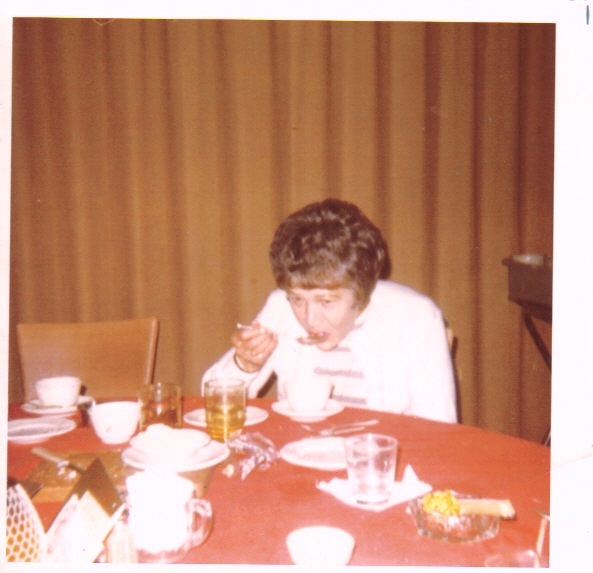
Moses BrotmanHe certainly has the Brotman cheekbones.  Could this be what Joseph looked like also?


Enhanced by Zemanta