Why Did Daniel Meyers Fail to Pay the Beneficiaries of Caroline Dreyfuss Wiler’s Estate?

In my last post, I wrote about the fact that Daniel Meyers, husband of Clara Wiler, had failed to honor the terms of the will of his mother-in-law Caroline Dreyfuss Wiler when he failed to pay Caroline’s grandchildren the money they had been promised.  Why hadn’t Daniel paid? What would have led him to breach his duties as executor and trustee of the estate?

And who was Daniel Meyers? Why was he appointed to be the executor and trustee? Caroline’s husband Moses was still alive when Caroline died as was her son Simon. But Caroline may not have wanted to have her husband or son in charge of the estate in order to have a more “objective” person in charge.  I assume that a woman could not be appointed trustee/executor in 1885, but Caroline had two other sons-in-law, Leman Simon and Joseph Levy.  So why Daniel?  Leman Simon was in Pittsburgh until the mid-1880s; he and Eliza did not move back until around the time or after the time Caroline died, so he was not around.  Perhaps Caroline wanted someone closer to home.  As for Joseph Levy, by 1878, his wife Fanny had died, and he had remarried, so Caroline might not have thought he was an appropriate choice.   Daniel Meyers was in Philadelphia, married to Clara, and in 1885 had a stable business.  He must have seemed like the obvious choice.

Daniel Meyers was, like Leman Simon and Joseph Levy, a German Jewish immigrant.  He was born in 1846 in Bavaria, and according to his passport application, immigrated in 1864.  He and his brother Samuel were in the clothing business together in 1867.  By 1872, a year after marrying Clara Wiler, Daniel was listed in the Philadelphia directory doing business under the firm name D. Meyers and Company in business with Isaac Samler.  The family was living at 718 Fairmount Avenue throughout the 1870s and in 1880, but in 1881, Daniel’s home address is 960 North 7th Street, just a few blocks away.  By 1885 they had moved again to 927 Franklin Street, and then in 1891 to 920 Franklin Street, where they stayed for many years.  In 1886, Isaac Samler retired from the business, and Daniel became the sole propietor of the business that carried his name.

Philadelphia Inquirer December 31, 1886, p. 3

Philadelphia Inquirer December 31, 1886, p. 3

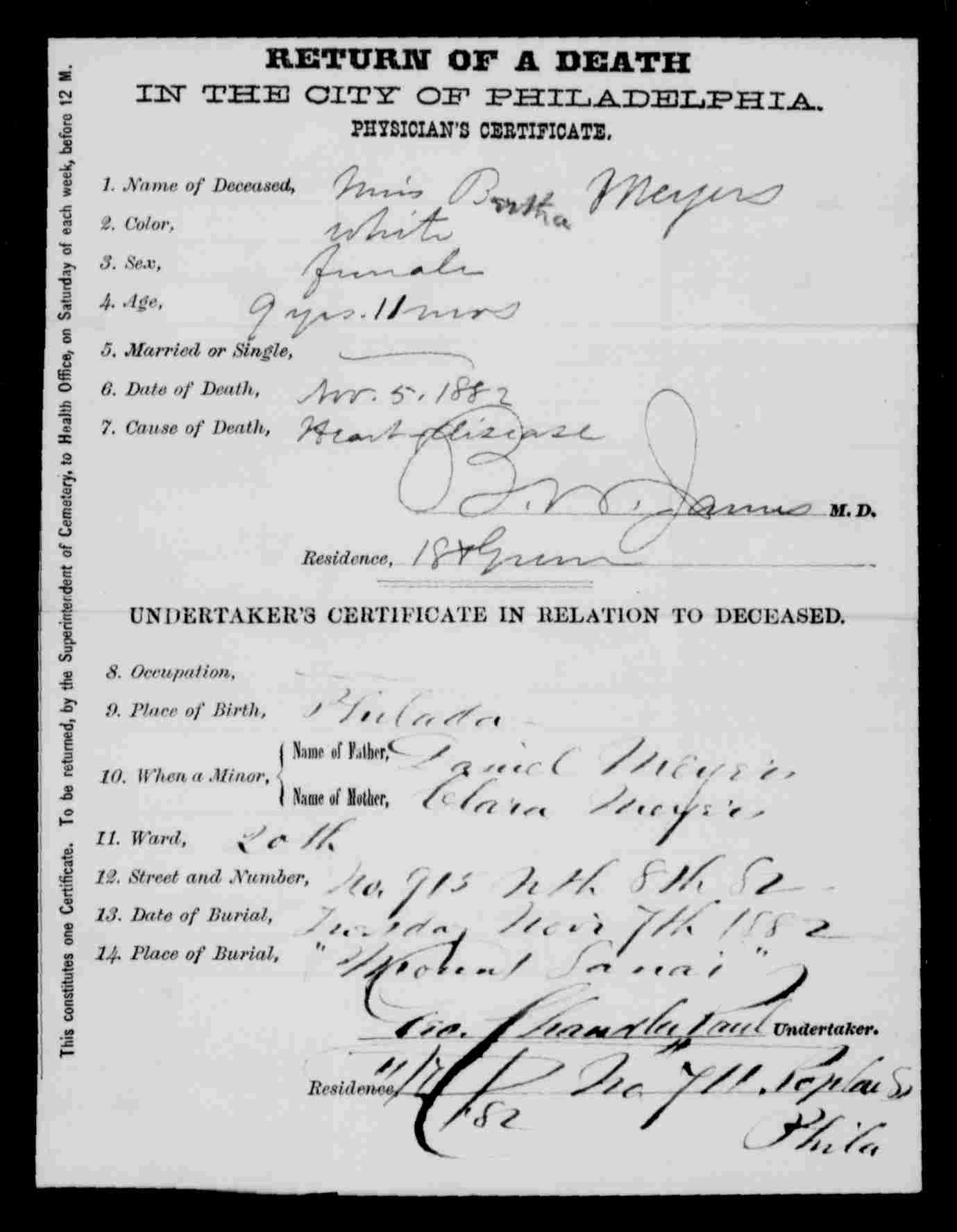
Meanwhile, Daniel and Clara had on average a new baby every year and a half between 1872 and 1896.  Daniel and Clara had five children by 1880 and eight more between 1880 and 1900, but one was stillborn and one, Bertha, died from heart disease before she was ten years old. Thus, Daniel was supporting eleven children as well as Clara and himself in the 1880s and 1890s.  By 1895 the oldest son Leon was working out of house, first as a foreman in 1895 and then as a salesman in 1897, but still living at home. But the other ten children were still at home and not yet working.

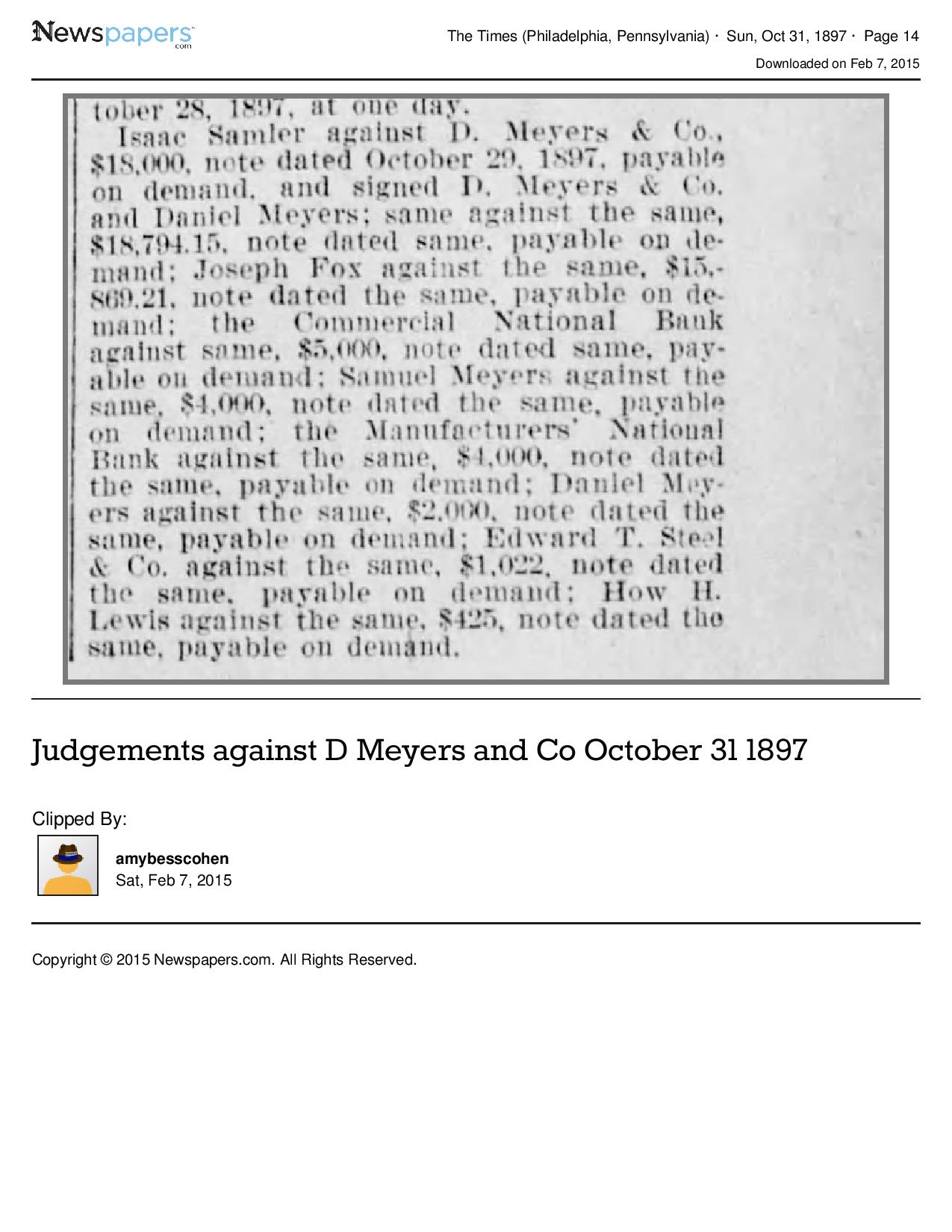
Maybe it was all too much of a financial strain for Daniel. This article from The Philadelphia Times of October 31, 1897, reported a large number of judgments executed against D. Meyers & Co., including two very large ones for over $18,000.  One of those was in favor of Isaac Samler, Daniel’s former partner.  Keep in mind that $18,000 in 1897 would be equivalent to about $500,000 in today’s dollars.

Judgements_against_D_Meyers_and_Co_October_31_1897-page-001

A fellow family historian descended from a relative of Daniel Meyers shared this news story with me that revealed that on November 1, 1897, D. Meyers and Company was forced to close.

Philadelphia Inquirer, November 1, 1897, p. 9

Philadelphia Inquirer, November 1, 1897, p. 9

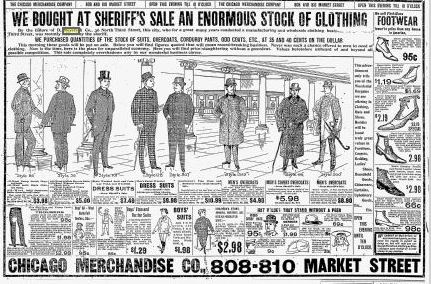
The assets of the business were sold at a sheriff’s sale, as this advertisement, also shared by the fellow family historian, in the Philadelphia Inquirer from November 13, 1897, page 16, revealed:

AD november 13 1897 phil inq p 16

The text says, “We Bought at Sheriff’s Sale an Enormous Stock of Cothing By the failure of D. Meyers & Co., 36 North Third Street, this City, who for a great many years conducted a manufacturing and wholesale clothing business at 36 North Third Street, was recently sold out by the Sheriff.”

There were numerous other attachments brought against Daniel Meyers d/b/a D.Meyers & Co. after the business was closed. I also found the article below indicating that there was a sheriff’s sale of property belonging to Daniel Meyers and D. Meyers and Company in September, 1898, for over $16,000.

Sheriff__039_s_sale_against_Daniel_Meyers-page-001

Perhaps this explains why Daniel did not distribute the principal of Caroline’s estate to her grandchildren as he was legally obligated to do after Eliza Simon died in 1897.   Perhaps that money was gone.

By 1900 six of Daniel and Clara’s sons, Leon, Samuel, Harry, Isadore, Benjamin, and Max, were now working, Samuel as a clothing merchant, Harry as a tailor, Leon, Isadore and Benjamin as salesmen, and Max as a draftsman.  Although this might have alleviated the financial burden carried by Daniel to some extent, it appears not to have been sufficient. The other five younger children were all still at home.  In April, 1902, a judgment was entered against Daniel and Clara in the amount of $5,678, apparently for defaulting on a mortgage loan with a building and loan association.  I can’t help but notice that the amount they owed was almost to the dollar the amount of money that had been the principal in Caroline’s estate.  Had they borrowed this amount to satisfy the attachment obtained by the new trustee of Caroline’s estate and then not had sufficient assets to pay back the lender?

Clara_and_Daniel_Meyers_judgment__against_them_on_mtge-page-001

Six months after this judgment was entered, Daniel Meyers died on October 14, 1902, from “organic disease of the heart, embolism, paralysis, and general atheromas.”  He was sixty years old.  I don’t know what if any relationship there was between his financial troubles, the legal problems, and the resulting family problems, on the one hand, and his health on the other, but I tend to think they were not unrelated.

ennsylvania, Philadelphia City Death Certificates, 1803-1915," index and images, FamilySearch (https://familysearch.org/pal:/MM9.1.1/JD22-R89 : accessed 8 February 2015), Daniel Meyers, 14 Oct 1902; citing cn 7658, Philadelphia City Archives and Historical Society of Pennsylvania, Philadelphia; FHL microfilm 1,853,857.

Pennsylvania, Philadelphia City Death Certificates, 1803-1915,” index and images, FamilySearch (https://familysearch.org/pal:/MM9.1.1/JD22-R89 : accessed 8 February 2015), Daniel Meyers, 14 Oct 1902; citing cn 7658, Philadelphia City Archives and Historical Society of Pennsylvania, Philadelphia; FHL microfilm 1,853,857.


The Mystery of Fanny Wiler, Part III:  A Brick Wall Tumbles


Embed from Getty Images

In my last post, I wrote about the family of Caroline Dreyfuss and Moses Wiler—their four children, Eliza, Simon, Fanny, and Clara—and some of the issues that had come up in trying to track the family up to 1900.  I focused primarily on Eliza Wiler and the issues I had finding her children Joseph, Flora, Nellie, Minnie, and Leon, and her husband Leman Simon on the 1900 census after Eliza died in 1897.  What I found was that they were fairly scattered.   Leman and Leon were living as lodgers in one place, Nellie and Minnie as boarders in another place, and Flora was living with her husband Nathan Strouse and son Lester.  I never found Joseph on the 1900 census, but in 1901 he was listed in Philadelphia living at the same address as his father Leman.

I also briefly mentioned Eliza’s siblings, Simon, Fanny, and Clara.  Simon was a single man working and living in a hotel in Philadelphia, Clara had married Daniel Meyers and by 1900 had had 13 children with him, eleven of whom were still living at home.  And Fanny Wiler was still missing.

Or so it seemed. I had stopped looking for her after hitting a brick wall in late December when I wrote about the mystery of Fanny Wiler.  But while searching for information on the various children of Eliza and Leman Simon, I ran across this strange news article from January 1899.

Phil_Times_jan_31_1899_p_10-page-001


Caroline Dreyfuss W(e)iler (the spelling of the name varied throughout these news stories and documents) had died in 1885, and now fourteen years later three people were challenging the administration of her estate by the executor and trustee, Daniel Meyers, Caroline’s son-in-law and Clara Wiler’s husband.  I knew all the names mentioned but one.  Flora Strouse was Caroline’s granddaughter as was Nellie Simon.  But who was Monroe Levy? That name did not mean anything to me, and although I checked and found one Monroe Levy living in Philadelphia on the 1900 census, he was the 26 year old  son of Joseph and Bella Levy, a couple who had no connection to my family, as far as I could tell.

So I looked for follow-up articles about the challenge to Daniel Meyers as executor and located this second article from May, 1899:

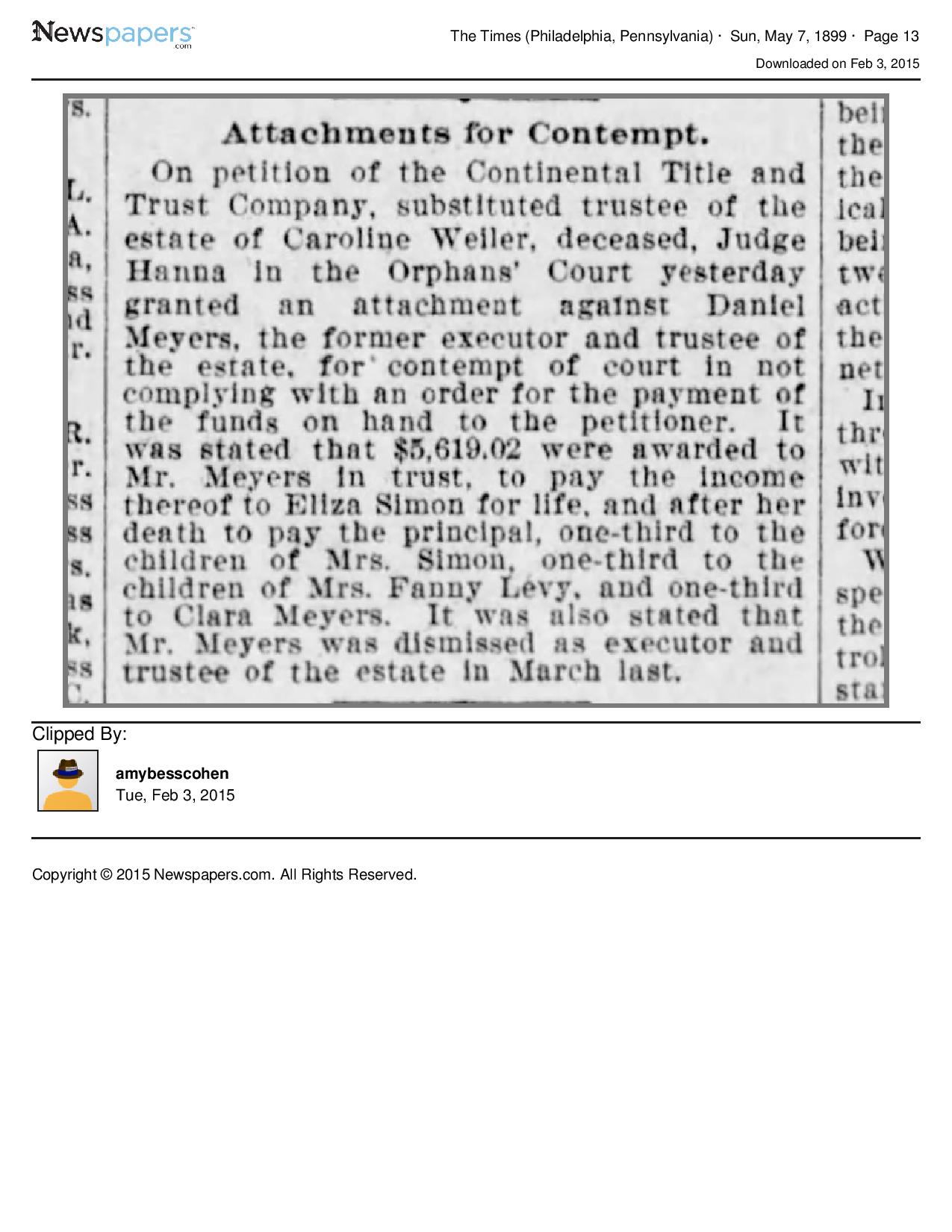
Daniel Meyers executor challenge-page-001

Now I understood why this was being litigated almost fifteen years after Caroline died.  The will had appointed Daniel Meyers to be the executor and trustee of the $5,619 estate [estimated to be equivalent to $160,000 in 2015 dollars] and directed him to pay the income from the estate to Caroline’s daughter Eliza Simon for the duration of Eliza’s life; after that, the principal was to be distributed to the grandchildren of Caroline.[1]  Eliza Simon died in August, 1897, and apparently Daniel Meyers never distributed the money to the grandchildren.  Thus, they sued him in 1899, and they won.  The estate was handed over the Continental Title and Trust Company.

But hidden in this little news item was a huge clue to my Fanny Wiler mystery.  The article identifies the three groups of grandchildren: the children of Eliza Simon, the children of Clara Meyers, and the children of Mrs. Fanny Levy.  Mrs. Fanny Levy?  That had to be Caroline’s third daughter, Fanny Wiler!

But then who was Monroe Levy?  His mother’s name was Bella, not Fanny, according to the 1900 census.  So I searched some more.  And I found this news article dated a month before the last one posted above:

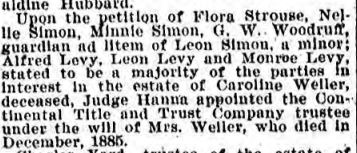
Philadelphia Inquirer April 2, 1899, p. 9

Philadelphia Inquirer April 2, 1899, p. 9

This article named four of Eliza Simon’s children (all but Joseph) and three others who together made up a majority of the parties of interest in the challenge to Daniel Meyer’s handling of the estate: Alfred, Leon and Monroe Levy.  (Obviously Daniel and Clara Meyers’ own children were not a party to the challenge.)  Alfred, Leon, and Monroe Levy—-suddenly the light bulb went on.  These had to be Fanny’s children.  But then where was Fanny? And who was Bella, the reported mother of Monroe Levy on the 1900 census?

So I returned to that 1900 census where I had found Monroe Levy and saw that he had three siblings: Alfred, born in 1868, Leon born in 1872, and then Miriam born in 1879.  Monroe was born in 1874.  Could it be that Fanny had died between Monroe’s birth and Miriam’s birth and that Bella was a second wife?

I could not find a death certificate for Fanny Levy, so I searched for death certificates for the three Levy brothers, and sure enough, each of them had a mother named Fannie or Fanny on their death certificate.  Sure, Monroe’s said her name was Fanny Cohen, and Leon’s just said Fannie.  But Alfred’s, the last I found, quite clearly states that his mother’s maiden name was Fannie Weiler.  I had found her!  Fanny Wiler had married Joseph Levy and had three sons between 1868 and 1874.

Ancestry.com. Pennsylvania, Death Certificates, 1906-1963 [database on-line]. Provo, UT, USA: Ancestry.com Operations, Inc., 2014. Original data: Pennsylvania (State). Death certificates, 1906–1963. Series 11.90 (1,905 cartons). Records of the Pennsylvania Department of Health, Record Group 11. Pennsylvania Historical and Museum Commission, Harrisburg, Pennsylvania

Ancestry.com. Pennsylvania, Death Certificates, 1906-1963 [database on-line]. Provo, UT, USA: Ancestry.com Operations, Inc., 2014.
Original data: Pennsylvania (State). Death certificates, 1906–1963. Series 11.90 (1,905 cartons). Records of the Pennsylvania Department of Health, Record Group 11. Pennsylvania Historical and Museum Commission, Harrisburg, Pennsylvania

But then what happened? Who was Bella, and when did she marry Joseph?  Or was she the same person as Fanny using a very different name? I wasn’t sure, so I searched for Miriam’s death certificate.  I had assumed that Miriam was Bella’s child because of the age gap between Monroe and Bella.  When I found Miriam’s death certificate, it confirmed my hunch.  Miriam’s mother was Bella Strouse, not Fanny Wiler or Fanny anything.

Ancestry.com. Pennsylvania, Death Certificates, 1906-1963 [database on-line]. Provo, UT, USA: Ancestry.com Operations, Inc., 2014. Original data: Pennsylvania (State). Death certificates, 1906–1963. Series 11.90 (1,905 cartons). Records of the Pennsylvania Department of Health, Record Group 11. Pennsylvania Historical and Museum Commission, Harrisburg, Pennsylvania.

Ancestry.com. Pennsylvania, Death Certificates, 1906-1963 [database on-line]. Provo, UT, USA: Ancestry.com Operations, Inc., 2014.
Original data: Pennsylvania (State). Death certificates, 1906–1963. Series 11.90 (1,905 cartons). Records of the Pennsylvania Department of Health, Record Group 11. Pennsylvania Historical and Museum Commission, Harrisburg, Pennsylvania.

Bella Strouse?  Hmmm, I thought.  Was she a relative of Nathan Strouse, the husband of Fanny’s niece, Flora Simon Strouse?  I found Bella Strouse Levy’s death certificate, and although her parents were born in Germany as were Nathan’s parents, they had different names.  Perhaps Bella was a cousin.  I need to dig more deeply to be sure.

But Bella is not my real concern or interest here.  It’s Fanny.  Fanny Wiler Levy.  I’d not yet found a marriage or death record for her, but her sons’ death certificates and the news articles naming them as the grandchildren of Caroline Dreyfuss Wiler were really all I needed.  I’d found her.  And, of course, it was when I wasn’t even looking for her.

Then Lyla from the Philadelphia Genealogy group on Facebook posted this document in response to a question I had posted about Fanny:[2]

Levy Wiler wedding registration 1866

If you look at the one that is fourth from the bottom, you will see the registration of the marriage on January 31, 1866 of Joseph Levy, a 27 year old New York merchant born in Germany, and Fanny Wiler, a 26 year old Philadelphia resident born in Harrisburg(h).  There can be no question that this was the marriage of my Fanny Wiler, the mother of Alfred, Leon, and Monroe Levy.

The odd thing that is still bothering me is that I cannot find the Levy family on either the 1870 census, when Joseph, Fanny, and Alfred would have been together, or on the 1880 census, when Joseph, Bella, Alfred, Leon, Monroe, and Miriam would have been living together.  And there is also a document in the New York City births database on familysearch for a Bertha Levi born in November 1866 in New York to Joseph Levi and Fanny Wieler.  I think this might also have been a child of my Fanny, but I cannot find any other document for Bertha.

So there are still some unresolved questions, but the big question has been answered.  I know what happened to Fanny Wiler. She married in 1866, had three, perhaps four children between 1866 and 1874, and then sometime after that, she must have died.  She would have been not yet forty years old.  And she left behind three little boys all under the age of ten.   It might not have been as gruesome as the story of the other Fanny Wyler and Max Michaels, but it was nevertheless a sad story.

I guess I should be grateful to Daniel Meyers for violating his fiduciary duties as a trustee.  But for the lawsuit against him, I might never have found Fanny Wiler.


Embed from Getty Images


[1] I don’t know why Caroline would have favored Eliza in this way.  Eliza was the oldest child, but when Caroline died, she had at least two other children who were still alive.  And Eliza was not the only one who had had children at that point either.

[2] Lyla subscribes to a paid service for access to Philadelphia records, a service I was not aware of until she posted.  I am now waiting for my own subscription to come through so that I can also find these older vital records from the city where so many of my paternal relatives lived and died.  The copy posted here is not very legible, but I was able to make out the names and other essentials for Joseph Levy and Fanny Wiler.

Those Wily Wilers: Where were They in 1900?

Remember Fanny Wiler, the daughter of Caroline Dreyfuss and Moses Wiler, the one I could not find and thought might have been married to a man who killed himself and a child in a fire? Well, I still had not had any luck finding the real Fanny Wiler despite several more hours of going back over my research and looking more deeply into the sources.   Although I was doing pretty well with the rest of her family up through 1880, they also proved to be elusive as they approached the 20th century.

In 1880, Caroline and Moses Wiler were living in Philadelphia, and Moses had retired from his career as a merchant.  Their son Simon, then 37, was still living with his parents and working as a salesman.  Their daughter Eliza and her husband Leman Simon had moved to Pittsburgh where Leman was in the liquor business, and they had five children, Joseph, Flora, Nellie, Minnie, and Leon. While going back over my research, I discovered that Eliza and Leman had had one other child, Isadore, born in July, 1871, who died at 28 months on August 16, 1873.  I cannot decipher the cause of death.  Can anyone tell what it says?

UPDATE:  My expert says it says “Inflammation Brain.” Apparently doctors are trained to read each other’s awful handwriting.

Isadore A Simon death certificate FHL

“Pennsylvania, Philadelphia City Death Certificates, 1803-1915,” index and images, FamilySearch (https://familysearch.org/pal:/MM9.1.1/JKQ7-78S : accessed 6 February 2015), Isadore A Simon, 16 Aug 1873; citing , Philadelphia City Archives and Historical Society of Pennsylvania, Philadelphia; FHL microfilm 2,021,999.


When I last wrote about Eliza and Leman Simon, I was a bit puzzled by the seemingly impossibly close birth dates of Minnie and Leon, their youngest two children.  Two census reports indicated that Minnie was born in 1877, no earlier than August 1877 and possibly as late as December 1877, and Leon’s death certificate said he was born on June 13, 1878.  It just seemed very unlikely that Leon was born ten months (at most) after Minnie, but it was, of course, entirely possible.

But I went back to look again and realized that while Minnie was listed with the family on the 1880 census, Leon was not.  Further research uncovered this bill from his funeral, indicating that his birth date was June 13, 1881, not 1878, which makes a lot more sense.  Thus, the death certificate was most likely inaccurate (and there are other questions about that document, but I will get to that later).

Leon Simon funeral bill

Historical Society of Pennsylvania; Historic Pennsylvania Church and Town Records


Caroline and Moses Wiler’s youngest child, Clara, and her husband Daniel Meyers, a clothing merchant, were living in Philadelphia with their five children (as of 1880), Bertha, Leon, Samuel, Harry, and Isadore.

Thus, in 1880, I could account for Caroline Dreyfuss and Moses Wiler and three of their four children (all but Fanny) and their ten grandchildren.  Then things start getting a bit more difficult.  Although I found burial records for Caroline indicating that she had died on December 21, 1885, and was buried at Mt. Sinai cemetery in Philadelphia, I cannot locate a death certificate for her in the Philadelphia City Death Certificates 1803-1915 database on familysearch.org.  On the other hand, I was able to locate a death certificate for her husband Moses in that database; he died almost exactly two years later on December 26, 1887, and was also buried at Mt. Sinai.

Moses Wiler death certificate

“Pennsylvania, Philadelphia City Death Certificates, 1803-1915,” index and images, FamilySearch (https://familysearch.org/pal:/MM9.1.1/J6S6-XY5 : accessed 6 February 2015), Moses Simon, 27 Jan 1897; citing cn 15654, Philadelphia City Archives and Historical Society of Pennsylvania, Philadelphia; FHL microfilm 1,869,753.


Moses Wiler was residing at 1638 Franklin Street at the time of his death in 1887, and that is the same address listed for his son-in-law Leman Simon in the 1887 Philadelphia directory.  I don’t know whether Moses had moved in with Leman, Eliza, and their children, or vice versa.  Since Leman and Eliza had been listed in the 1884 directory for Pittsburgh, it could be that they had moved back to Philadelphia sometime around or after Caroline’s death to be with Moses.  Leman’s occupation is listed as “salesman” in that 1887 Philadelphia directory without any indication of whether he was still selling liquor.

Assuming that Eliza and Leman returned to Philadelphia around 1885 or so, their children would have been still relatively young: Joseph 21, Flora 19, Nellie 11, Minnie 7, and Leon 4.  Certainly the youngest three would still have been living at home.  Joseph appears to have been in Pittsburgh until at least 1886, as there is a Joseph L. Simon listed there, selling cigars and tobacco products, a business line that was being practiced by other members of the family during that time, including Joseph’s great-uncle John Nusbaum.  After that, however, he does not appear in the Pittsburgh directory as far as I can tell.

Eliza and Leman’s daughter Flora married Nathan Strouse in Philadelphia in 1888 when she was 22 and he was 46. Their son Lester Nathan Strouse was born on December 15 of that year.  In the 1890 Philadelphia directory, Nathan was listed as associated with Strouse, Loeb, and Company, clothiers.

Leman and Eliza were still living at 1638 Franklin until 1890 when they are listed at 1821 Franklin Street.  Joseph also is listed in the 1890 directory at that address, so he must have been living with his parents at that time along with the three younger children, Nellie, Minnie, and Leon.  Joseph was working as a clerk.  He may have moved out by 1892 because there are two Joseph Simons listed as salesman in the Philadelphia directory for that year, though I cannot be completely certain either is the correct Joseph Simon.

In 1897, Leman and Eliza (Wiler) Simon were living at 1537 Montgomery Street.  Eliza died of apoplexy on August 18, 1897.  She was 55 years old.  Leman continued to live at 1537 Montgomery Street through 1899, according to the Philadelphia directory of that year, which listed him once again as a salesman.

Eliza Simon death certificate 1897

“Pennsylvania, Philadelphia City Death Certificates, 1803-1915,” index and images, FamilySearch (https://familysearch.org/pal:/MM9.3.1/TH-266-11571-16485-19?cc=1320976 : accessed 6 February 2015), 004009659 > image 190 of 1791; Philadelphia City Archives and Historical Society of Pennsylvania, Philadelphia.


Now things get very sticky.  I had a very hard time locating the family of Eliza and Leman Simon on the 1900 census.  The only one I am certain about is Flora and her husband Nathan Strouse and son Lester Strouse.  On the 1900 census, Flora, Nathan, and Lester were living at 913 North 16th Street, and Nathan was 57 years old and did not provide an occupation for the census.  Living with them was a 30 year old woman named Nettie Dreifuss, born in 1870 in Illinois whose parents were born in Germany and Pennsylvania, as were Flora’s parents.  She is identified as the niece of the head of the household, Nathan.

Flora and Nathan Strouse 1900 census

I first wondered whether this was Nellie, Flora’s sister.  But Nellie was born in 1874 in Pennsylvania, not 1870 in Illinois, and she was Nathan’s sister-in-law, not his niece.  I then spent most of a day trying to find out whether Nathan had a sister who married a Dreifuss.  He did have several sisters: Rebecca, who never married; Gussie, who married Joseph DeYoung and had one daughter Harriet; Henrietta, who married Leopold Lewis and had two daughters, Minnie and Fanny; and Rachel, who married Ed Henrinan (?), but apparently was divorced and had no children.  I thought that perhaps it was one of Henrietta and Leopold Lewis’ daughters, but neither was named Nettie, and I located both elsewhere on the 1900 census.  So the “niece” did not appear to be Nathan’s niece.

If Nettie Dreifus was not Nathan’s niece, was she Flora’s niece? None of Flora’s siblings was married in 1900; none of them had had children.   I still don’t know who Nettie was.  But her name was Dreifuss, Caroline Wiler’s birth name.  Could this be a daughter of a Dreifuss/Dreyfuss brother whom I’ve yet to find?  That’s a research path I will need to pursue further.

But at least I knew where Flora and her family were living in 1900.  Her father and her siblings proved much more elusive.  I had a very hard time locating Leman Simon and his son Leon on the 1900 census, but I believe that this is Leman and Leon living together at 1514 Brown Street as Leon, Sr., and Leon, Jr.

Leman and Leon 1900 census

Why do I think this is Leman? Because he is a 64 year old widow born in Germany who immigrated in 1866 and who was working as a salesman.  Although my records show that Leman would have been 65 and that he immigrated in 1856, the numbers are close enough, given the general unreliability of census data.  In addition, Leon, Jr. fits with my Leon roughly also: born in 1880 in Pennsylvania to parents born in Germany and working as a clerk.  Again, it’s not perfect.  Leon was born in 1881, and his mother Eliza was born in Pennsylvania. So I am not at all positive that this is Leman and Leon, but they are the closest matches I can find on the 1900 census.

Despite using as many resources and wildcard searches as I could imagine, I cannot find Joseph at all on the 1900 census.  I even had assistance from Antoinette from the Facebook Pennsylania Genealogy group, but neither of us could find him.  There is a Joseph L. Simon living at 2137 North 18th Street in the 1901 Philadelphia directory, the same address that is given for Le(h)man Simon for that year, so I assume that is the right Joseph, working as a clerk with his father working as a salesman.  But Joseph is not listed at that address in the 1900 census nor is Leman, so they must have moved there in 1901.

As for Minnie and Nellie, I think I found them on the 1900 census, but cannot be 100% sure.  I found a Minnie Simon and a “Millie” Simon living at 2628 Diamond Street on the 1900 census.  Both are listed as boarders.  Minnie is listed as a single woman born in 1877 in Pennsylvania with a mother born in Pennsylvania and a father born in Germany; that matches Minnie correctly.  No occupation is given.

Year: 1900; Census Place: Philadelphia Ward 32, Philadelphia, Pennsylvania; Roll: 1473; Enumeration District: 0809; FHL microfilm: 1241473

Year: 1900; Census Place: Philadelphia Ward 32, Philadelphia, Pennsylvania; Roll: 1473; Enumeration District: 0809; FHL microfilm: 1241473

I was quite certain that this was Minnie, but it took me a while to think that “Millie” was Nellie because although they are both at the same address, Minnie is listed as a boarder in the household of Bertha Lipper, and Millie is listed as the head of household in a boarding house at the exact same address with sixteen boarders.  “Millie” was a single woman born in 1874 in Pennsylvania whose parents are listed as born in Germany, both mother and father.  Although Nellie’s mother was born in Pennsylvania, not Germany, the age and marital status are correct, and the name is quite similar.  Once again, I cannot be completely certain that this is Nellie, but I am pretty sure.  I think it was really one large boarding house where the two sisters were living.  I am not sure why “Millie” was also described as a head of household.

Thus, if my hunches here are all correct about Leman Simon and his children, only Joseph Simon was really missing from the 1900 census.  Leman was living as a boarder with his son Leon; Nellie was living as a boarder with her sister Minnie.  Flora was married and living with her husband Nathan Strouse and son Lester and a mysterious niece.  When I mapped out where they all were living, I realized that Flora was living just a few blocks from where Leman and Leon might have been living, but Minnie and Nellie were about two miles further north.  If Joseph was already living at 2137 North 18th Street sometime during that year, he was less than a mile from Minnie and Nellie.

As for the other children of Caroline Dreyfuss and Moses Wiler, Simon, Fanny, and Clara, Simon was working as a clerk in a hotel where he also resided in 1900 at 152 North 7th Street. He was single and 56 years old.  Clara and her husband Daniel Meyers were now living at 920 North Franklin Street.  Clara and Daniel had had five children as of 1880; between 1880 and 1896 they had had eight more children, including one stillbirth.  But in 1882, they lost their first born child Bertha to heart disease.  She was only nine years old.

"Pennsylvania, Philadelphia City Death Certificates, 1803-1915," index and images, FamilySearch (https://familysearch.org/pal:/MM9.3.1/TH-267-11083-70387-38?cc=1320976 : accessed 6 February 2015), 004058695 > image 726 of 994; Philadelphia City Archives and Historical Society of Pennsylvania, Philadelphia.

“Pennsylvania, Philadelphia City Death Certificates, 1803-1915,” index and images, FamilySearch (https://familysearch.org/pal:/MM9.3.1/TH-267-11083-70387-38?cc=1320976 : accessed 6 February 2015), 004058695 > image 726 of 994; Philadelphia City Archives and Historical Society of Pennsylvania, Philadelphia.

Thus, as of 1900, Clara Wiler and Daniel Meyers had eleven surviving children, all of them still living at home.

And, of course, Fanny Wiler still remained unaccounted for.  Or was she? Stay tuned…


There Were No Survivors: A Tragic Ending to a Family with Plenty of Tragedy

Some families seem to suffer more misfortune than others.  This is one of those families.  It is the story of the family of Mathilde Dreyfuss, sister of my three-times great-grandmother Jeanette, and her family.  Her first husband was  John Nusbaum’s brother Maxwell Nusbaum, making this particular line related to me both on my Dreyfuss side and my Nusbaum side.  That is, Mathilde and Maxwell’s children are my double first cousins, four times removed.

As I have written, Maxwell Nusbaum and Mathilde Dreyfuss had two children, a daughter Flora born in 1848 and a son Albert born in 1851.  Less than seven months after Albert’s birth, Maxwell died in the 1851 Great Fire in San Francisco.  By 1856 Mathilde had married Moses Pollock, with whom she had three more children, Emanuel, Miriam, and Rosia.  The family lived in Harrisburg for many years, but by 1866 had relocated to Philadelphia.

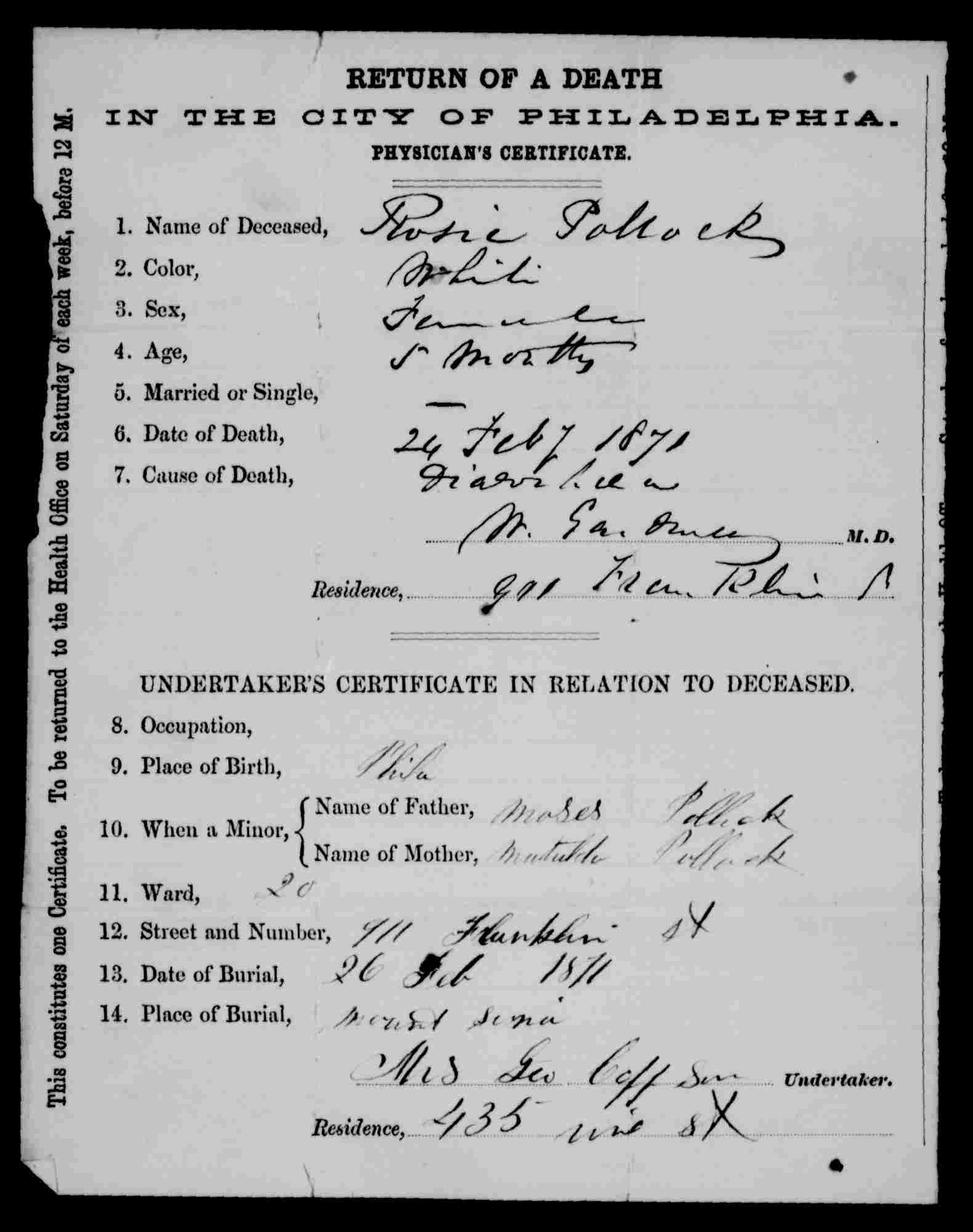
In the 1870s, the Pollocks were living in Philadelphia where Moses was a dry goods merchant.  Their youngest child Rosia died in 1871 when she was just five months old.

Rosie Pollock daughter of Moses and Mathilde death cert 1871

Pennsylvania, Philadelphia City Death Certificates, 1803-1915,” index and images, FamilySearch (https://familysearch.org/pal:/MM9.1.1/JK3P-DBS : accessed 22 January 2015), Rosie Pollock, 26 Feb 1871; citing 1075, Philadelphia City Archives and Historical Society of Pennsylvania, Philadelphia; FHL microfilm 2,020,735.

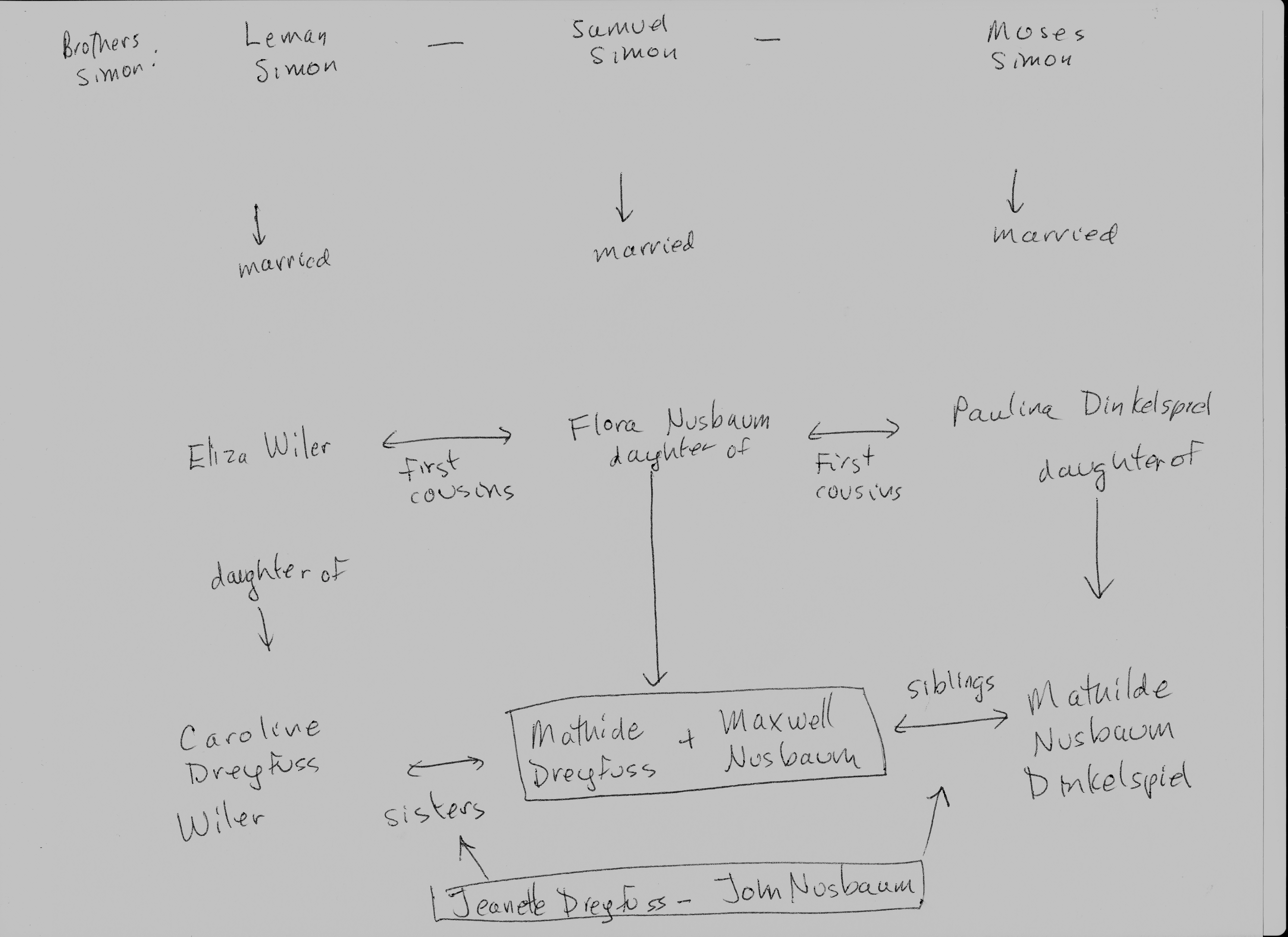
Mathilde’s daughter Flora had married Samuel Simon, one of the three brothers to marry into the Nusbaum/Dreyfuss clan, and they had two children in the 1870s, Meyer (mostly likely named for his grandfather Maxwell) and Minnie.  By 1880, Flora and Samuel had moved to Elkton, Maryland, where Samuel was running a hotel.  Meanwhile, Moses and Mathilde (Dreyfuss Nusbaum) Pollock were still in Philadelphia, and the other surviving children—Albert Nusbaum and Emanuel and Miriam Pollock—were still living at home with them, according to the 1880 census. Moses was in the cloak business, Albert was in the liquor trade, and Emanuel was in the dry goods business.  Moses’ line of trade seemed to change to trimmings or finishings during the 1880s and 1890s with various directories listing his businesses as plaiting, laces, embroidery, school bags, and accordion pleating.

Mathilde’s family was struck by tragedy again on September 1, 1885, when Miriam Pollock, just 26 years old, died from consumption or tuberculosis.  Mathilde had lost her first husband to a fire, her daughter Rosia at five months, and then her daughter Miriam at 26.  Sometimes life is just not fair.
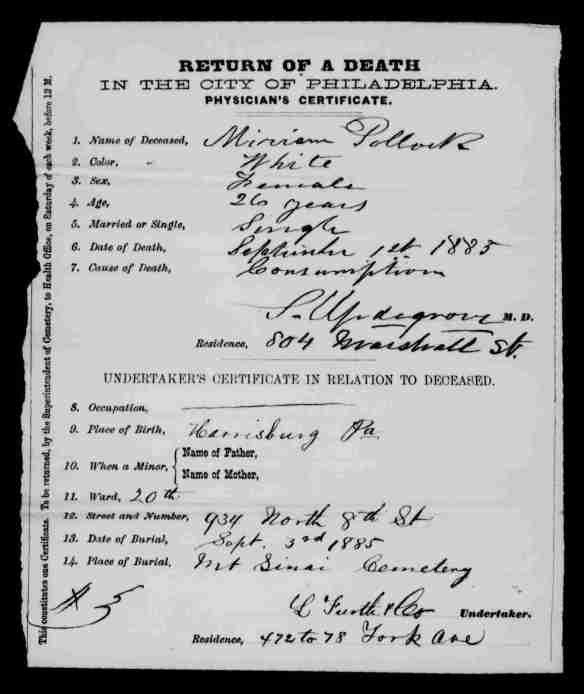
miriam pollock death cert FHL 2070682

“Pennsylvania, Philadelphia City Death Certificates, 1803-1915,” index and images, FamilySearch (https://familysearch.org/pal:/MM9.1.1/JFSV-LHQ : accessed 22 January 2015), Miriam Pollock, 01 Sep 1885; citing , Philadelphia City Archives and Historical Society of Pennsylvania, Philadelphia; FHL microfilm 2,070,682.


Then Moses Pollock died on December 5, 1894 of encephalomalacia, defined in Wikipedia as “localized softening of the brain substance, due to hemorrhage or inflammation.”  Like so many other family members, he was buried at Mt. Sinai cemetery in Philadelphia.  He was 69 years old.
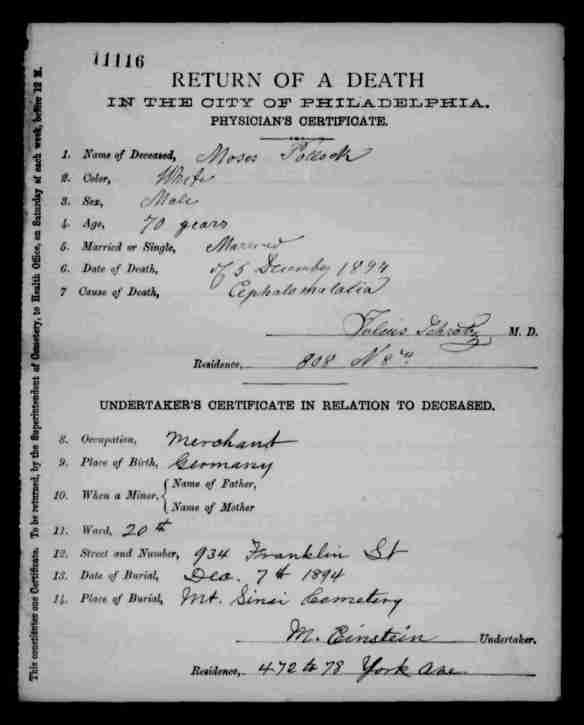
Moses Pollock death cert

“Pennsylvania, Philadelphia City Death Certificates, 1803-1915,” index and images, FamilySearch (https://familysearch.org/pal:/MM9.1.1/JKS4-32N : accessed 22 January 2015), Moses Pollock, 05 Dec 1894; citing cn 11116, Philadelphia City Archives and Historical Society of Pennsylvania, Philadelphia; FHL microfilm 1,872,200.

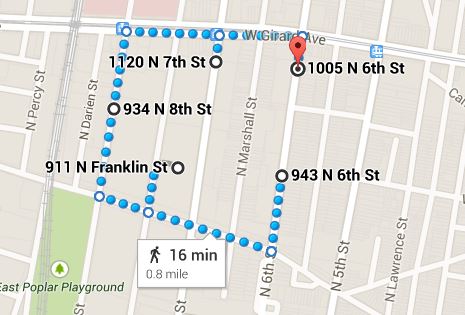
Both Albert Nusbaum and Emanuel Pollock had continued to live with their parents throughout the 1880s and 1890s, and in 1900, they and their mother were still living together at the same address, 934 North Eighth Street.  Mathilde, now widowed twice in addition to losing two children, was working outside the house as a manufacturer of bags—presumably, the school bags listed as one of the items Moses was selling on the last directory entry before his death.  Albert was still a liquor salesman, and Emanuel was selling bicycles.  In addition, Meyer Simon, Flora’s son and Mathilde’s grandson, now 30 years old, was also living with them and was working with his grandmother in the bag manufacturing business as a manager.

Mathilde’s daughter Flora Nusbaum and her husband Samuel Simon, meanwhile, had left Elkton, Maryland, and moved to Baltimore by 1885.  Samuel was in the liquor business, as was his brother Moses, who was married to Paulina Dinkelspiel, Flora’s first cousin.[2]  My hunch is that they were business together.

In 1900, Samuel was still in the liquor business in Baltimore, but his brother Moses had died the year before.  Samuel and Flora still had their daughter Minnie living at home with them, but their son Meyer, as noted above, was living in Philadelphia with his grandmother and uncles Albert and Emanuel and managing the bag manufacturing business.

Although Meyer Simon was listed as single on the 1900 census, the 1910 census reported him as married for 12 years. I figured that this must have been a mistake, especially since he was still living at his grandmother’s address even in the 1901 directory.  It seemed he could not have been married for 12 years in 1910.

But then I found something strange.  After some further research and review, I found in the Pennsylvania, Marriages 1709-1940 data base on familysearch.org a marriage between Meyer Simon and Tillie Perry on September 18, 1897, in Allegheny, Pennsylvania. Meyer’s wife’s name on the 1910 census was Matilda, so I knew this was the correct marriage.  Matilda or Tillie Perry was the daughter of William and Matilda Perry; she was born in Philadelphia in 1876 and baptized in the Episcopal church in 1878. But if Meyer and Matilda were married in 1897, why was Meyer listed as single on the 1900 census, and where was Matilda?[3]

I found Matilda Perry on the 1900 census living with her parents in Philadelphia, and that census report stated that she was married and had been married for three years, which is consistent with the marriage record I found on familysearch. Had Meyer and Matilda married and then lived separately for at least three years?  It seems strange, but perhaps they could not yet afford a place of their own. Or perhaps they were temporarily separated.  Or perhaps the religious differences had made it difficult for those families to support the marriage.    After all, Meyer listed his marital status as single.  I suppose it is also possible that he had kept the marriage a secret from his family.  After all, they were married in Allegheny, not in Philadelphia or in Baltimore where their families lived. Allegheny was a city across the river from Pittsburgh that merged with Pittsburgh in 1907.   It would have been therefore over 300 miles from Philadelphia and about 250 miles from Baltimore.

Thus, as of 1900, Mathilde Dreyfuss Nusbaum Pollock was a widow, living in Philadelphia with her two sons, Albert and Emanuel.  Her daughter Flora was living with her husband Samuel Simon in Baltimore with their daughter Minnie, and their son Meyer was married, but not yet living with his wife Matilda.

The decade that followed must have been a very painful one.  First, on March 21, 1904, Mathilde Pollock died.  She was 79 years old.  The death certificate says she died of old age, which shows you how perspectives on aging and longevity have changed.  It also says that she died from “senile pneumonia,” a term for which I could find no easily understood definition for my non-medical brain to grasp, but which I gather is a form of pneumonia that affects the elderly.  (Feel free to provide a more scientifically accurate definition.)  The death certificate also says that Mathilde had ascites, another term not easily defined but which Wikipedia defines as “gastroenterological term for an accumulation of fluid in the peritoneal cavity.”   Don’t even get me started on trying to understand where the peritoneal cavity is, but from what I read, ascites seems to have something to do with liver disease, often cirrhosis.
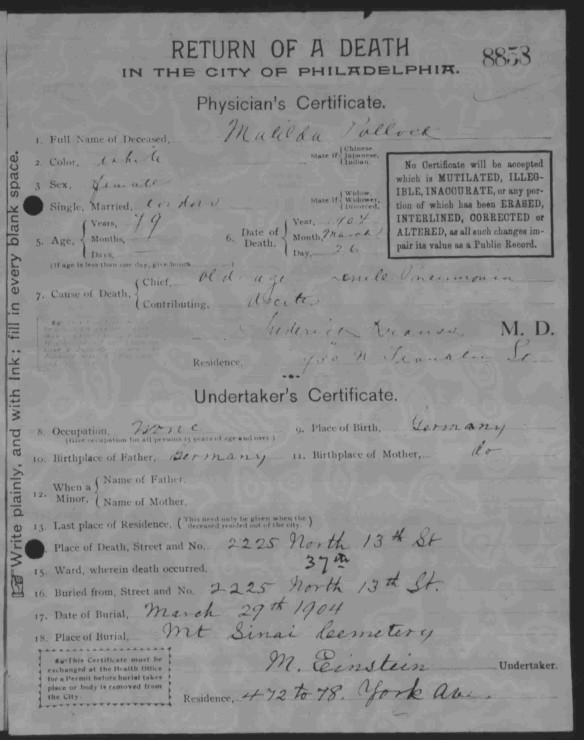
Mathilde Pollock death cert

Mathilde’s death was followed three years later by the death of her son Emanuel Pollock on February 16, 1907.  He was only fifty years old and died of tuberculosis.  Three years after that his half-brother Albert Nusbaum died on August 28, 1910 from apoplexy brought on by arteriosclerosis.  He was 59 years old.  Mathilde and both of her sons were buried at Mt. Sinai cemetery.

That left only Flora Nusbaum Simon as the surviving child of Mathilde Dreyfuss Nusbaum Pollock.  She had lost both of her parents and all four of her siblings.  She was also the only child who had children of her own as none of her siblings ever married or had children. Flora and Samuel appear to have relocated from Baltimore to Philadelphia by 1905, the year after her mother died, as Samuel appears in the Philadelphia directory living at 2225 North 13th Street, the same address where the family is listed in the 1910 and 1920 census reports.

Flora’s brother Albert had been living with them at that address in April when the 1910 census was taken, just four months before he died.  Neither Samuel nor Albert nor anyone else in the household was employed at that time, yet they still had a servant living in the home.  Minnie, Flora and Samuel’s daughter, was 27 and single, living with her parents and uncle.  It feels like it must have been a very sad time for the family.

Flora and Samuel’s son Meyer and his wife Matilda were living about two miles away at 2200 Susquehanna Avenue in 1910.  Meyer was a clothing salesman.  There were two boarders living with them, but no children. When Meyer registered for the World War I draft in 1917, he and Matilda were living at 3904 North Marshall Street, two and a half miles north of his parents and his sister.  Meyer was employed as a clothing salesman for Harry C. Kahn and Son, according to his draft registration.

On February 18, 1919, Flora Nusbaum Simon suffered yet another loss when her husband Samuel Simon died from a cerebral hemorrhage at age 79.  She and her daughter Minnie were living together in 1920 at their home at 2225 North 13th Street.  Flora herself died almost four years to the day after her husband Samuel on February 20, 1923.  She was 74 years old and died from chronic interstitial nephritis.  She had outlived all of her siblings by over 13 years.  She, like all the rest of them, was buried at Mt. Sinai cemetery with her husband Samuel.

Ancestry.com. Pennsylvania, Death Certificates, 1906-1963 [database on-line]. Provo, UT, USA: Ancestry.com Operations, Inc., 2014.

Ancestry.com. Pennsylvania, Death Certificates, 1906-1963 [database on-line]. Provo, UT, USA: Ancestry.com Operations, Inc., 2014.

After her mother Flora died, Minnie Simon lived with her brother Meyer and his wife Matilda in the house on North 13th Street where Flora had died, number 2336, across the street from where they had lived for many years at 2225.  Meyer was employed as a clothing salesman, and his niece Matilda (a fifth Matilda in his life) was also living with them.  Meyer lost his sister Minnie six years later when she died from liver cancer on December 14, 1936; she was 63 years old.

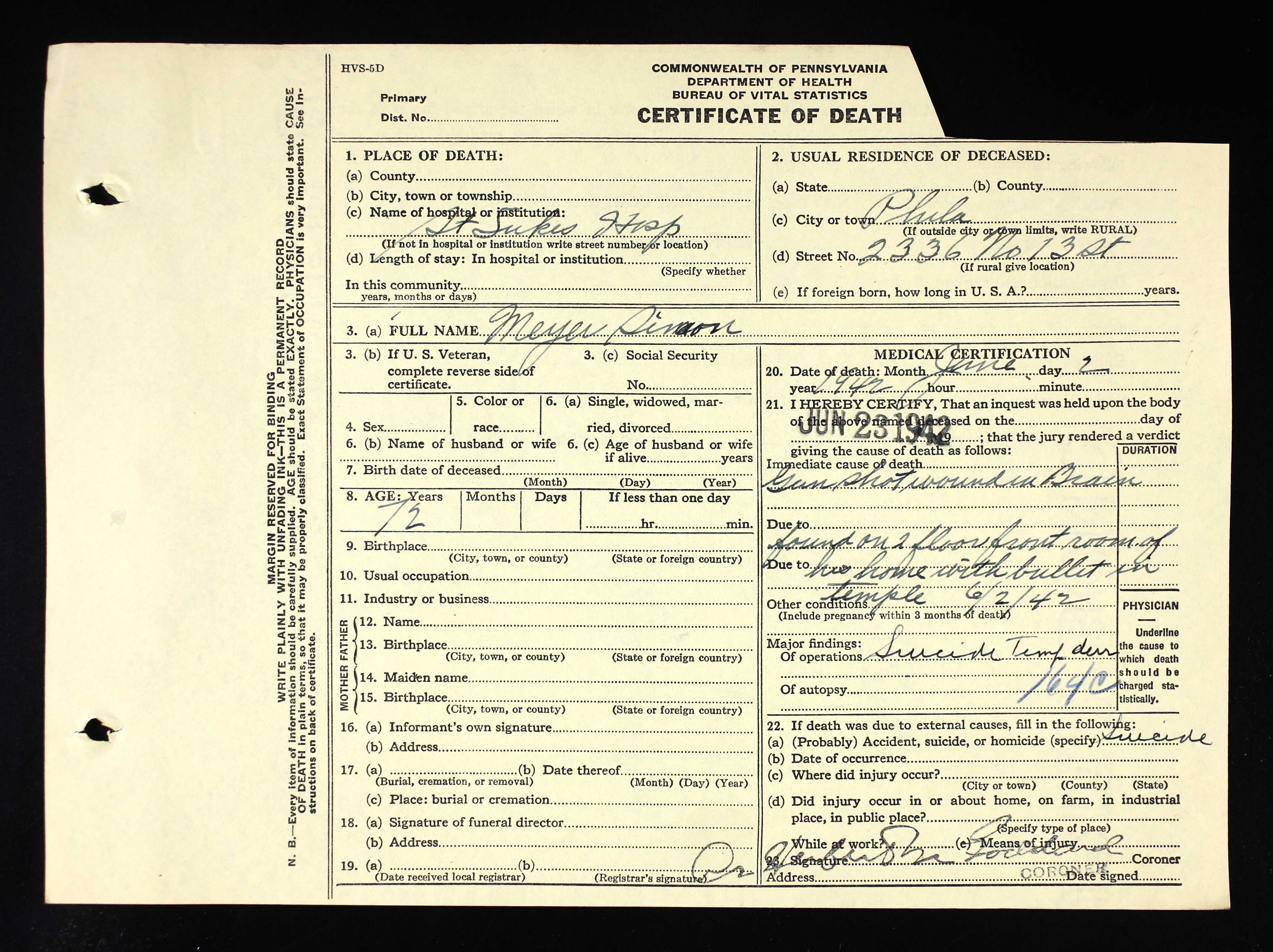
Meyer was the only member of his family left.  He had no siblings, no nieces or nephews on his side.  It must have been just too much for him when his wife Matilda then died on April 27, 1940, at age 63 from cerebral thrombosis and chronic nephritis.  Two years later on June 2, 1942, Meyer took his own life.  He was found on the second floor of his home at 2336 North 13th Street with a gunshot wound to his head.  He had no survivors.  Although Meyer was buried with his family at Mt. Sinai, he was not buried with his wife Matilda.  She was buried at a non-denominational cemetery instead (Northwood); because she was not Jewish, she could not be buried at Mt. Sinai.  How sad.
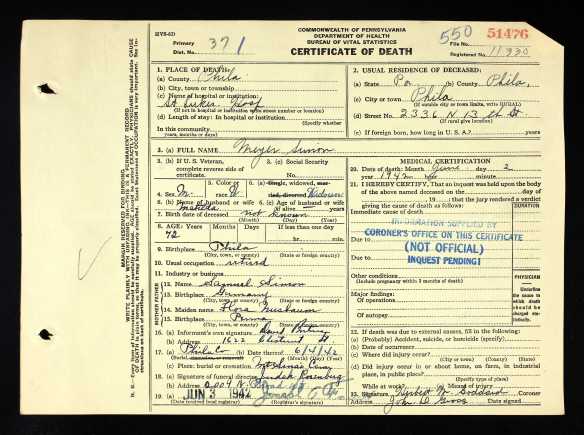
meyer simon death cert pre inquest

Ancestry.com. Pennsylvania, Death Certificates, 1906-1963 [database on-line]. Provo, UT, USA: Ancestry.com Operations, Inc., 2014.
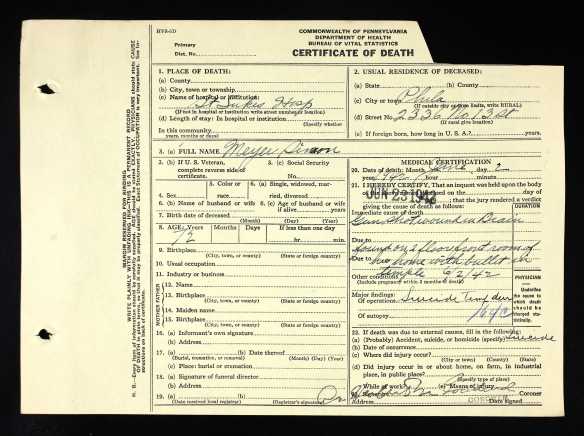
Meyer Simon death cert coroner's inquest

Ancestry.com. Pennsylvania, Death Certificates, 1906-1963 [database on-line]. Provo, UT, USA: Ancestry.com Operations, Inc., 2014.

This story fills me with such sadness.  How lonely Meyer must have been.  He’d lost his grandparents, his parents, his aunts and uncles, his sister, and his wife.  And there were no children or nieces or nephews left to comfort him. Certainly there were other Nusbaum cousins nearby in Philadelphia, but it must not have been enough.

From the start of the story of the life of Meyer’s grandmother Mathilde Dreyfuss, this family suffered such tragedy: Maxwell’s death in the Great Fire of San Francisco and two daughters who died young.  Of Mathilde’s four children who grew to adulthood, only Flora married and had children, and there were no grandchildren to carry on the family line after Flora and Samuel Simon and their two children Meyer and Minnie died.   There are no living descendants of Mathilde Dreyfuss or Maxwell Nusbaum.  No one likely remembers their names.  Except now they have been found and can be remembered for the tough lives they lived and for the courage and hope they must have had when they arrived in Pennsylvania in the middle of the 1800s.


[1] Isaac died without any children in 1870, so unfortunately that was the end of that sibling’s line.

[2] Flora’s father Maxwell Nusbaum was the brother of Paulina Dinkelspiel’s mother, Mathilde Nusbaum Dinkelspiel.

[3] Poor Meyer had at least four Mathilde/Matildas in his life: his mother, his wife, his mother-in-law, and one of his aunts.  And today I don’t know one woman named Mathilde or Matilda or Tillie.

John Nusbaum 1814-1889: The Family Patriarch

By 1880, my three-times great-grandparents, Jeanette (Dreyfuss) and John Nusbaum, and their extended families had not only grown in size but spread across a wider swath of the northeastern United States.  Some were still in Harrisburg or Philadelphia, but others were in Peoria, Baltimore, and Pittsburgh.  Although many were still dry goods merchants, the younger generations were also involved in various aspects of the liquor trade.  The family had endured the economic crisis of the 1870s, seeing some bankruptcies and the closings of several stores and businesses.  A number of young children had died, and by 1880, of the siblings of John and Jeanette Dreyfuss, only Ernst and John were still alive on the Nusbaum side, while Jeanette’s two sisters Caroline and Mathilde were both still living.

The next two decades brought with it more changes, more weddings, more new children, and sadly more deaths.  In my next series of Nusbaum/Dreyfuss posts I will try to bring the various branches up to the 20th century, focusing first on my direct ancestors, John and Jeanette and their children and grandchildren.

As I’ve written, in 1880 John and Jeanette were listed on the census in two different locations, living thousands of miles apart.  John was living with their daughter Frances and her husband Bernard Seligman (my great-great-grandparents) in Santa Fe along with his son Simon.  Jeanette, on the other hand, was living in Philadelphia with their daughter Miriam and her husband Gustavus Josephs along with Lottie Nusbaum, the youngest child of John and Jeanette, and Milton Josephs, the young son of Miriam and Gustavus who would die from bronchial pneumonia just a few months after the 1880 census was taken.  These must have been very hard times for my ancestors, and I will never know whether John moved to Santa Fe for financial reasons or because of marital problems.  I will never know whether he was there for a month or a year.

English: A Areal map of Santa Fe, New Mexico d...

English: A Areal map of Santa Fe, New Mexico during the Railroad era in 1882. (Photo credit: Wikipedia)

But I do know that John is listed in the 1881 Philadelphia directory as residing at 1129 Master Street, the same address where the Josephs family and Jeanette and Lottie were living on the 1880 census.  Whether John was actually back or not is hard to say for sure, but he does not appear again on any Philadelphia directory until 1886, when he is listed as being in the “segar” business and living at 524 North 11th Street, the same address given for his daughter Lottie.  Although Gustavus and his family are not listed in the 1881 directory, they show up in the 1884 directory still living on Master Street, so it would seem that sometime between 1881 and 1886, John and Lottie and presumably Jeanette had moved to their own home on North 11th Street.

I found it puzzling that John, after over forty years in the dry goods business, had entered the cigar business.  But his store had gone bankrupt, and perhaps this seemed to be a good way to make a fresh start in the 1880s.  John was already in his 70s by 1886, so it is even more surprising that he was starting in a new trade instead of just retiring.  I did some reading about the tobacco industry and learned that the John Bonsack invented the cigarette rolling machine in 1881, leading to a widespread increase in cigarette smoking (previously, tobacco was either chewed, smoked in a pipe, or hand rolled into a cigar or cigarette).   I don’t know whether this technological development had any effect on John’s decision to sell cigars, and I don’t know whether he sold only cigars or also cigarettes, but the timing does seem to be enough for me to think this was not just coincidental.  In 1887, John again is listed at the same residence and as being in the “segar” business.

English: Trade card of a cigar dealer after a ...

English: Trade card of a cigar dealer after a photograph of Napoleon Sarony, using Oscar Wilde’s popularity during his American trip of 1882 (Photo credit: Wikipedia)

Meanwhile, the children of John and Jeanette were also finding their way in the 1880s.  Adolphus and Julius were still in Peoria, working in the dry goods business, now called Nusbaum Bros.  Since Julius had been one of his father’s creditors in the bankruptcy proceedings, perhaps the business was now owned by the brothers instead of their father.  Julius was living with his brother Adolphus and sister-in-law Fannie, who had no children.

Simon, meanwhile, had remained in Santa Fe and was still unmarried and living with his sister, my great-great-grandmother Frances Nusbaum Seligman, and her family in 1885 according to the New Mexico Territorial Census of that year.   In 1887 Simon was appointed to be a clerk in the US post office in Santa Fe, a position he continued to hold for many years, being promoted to assistant postmaster by 1889 and ultimately to postmaster in 1898.

Miriam and Lottie, the remaining two children of John and Jeanette, were living in Philadelphia.  Miriam and her husband Gustavus had a third child in 1882, Gertrude, after losing Milton in 1880.  Their second child Florence was then two years old.  On November 28, 1888, Gertrude died from diphtheria (croupus form, according to the death certificate). She had just celebrated her sixth birthday less than a month before.  Eight year old Florence was once again an only child.  The family had lost yet another young child.  For Miriam and Gustavus to lose two young children in the space of eight years must have been completely devastating.

gertrude josephs death certificate

As for Lottie, John and Jeanette’s youngest child, she was just seventeen in 1880 and still living at home, as she did throughout the decade.

The decade drew near a close on another sad note for the family when my three-times great-grandfather John Nusbaum died on January 24, 1889.  He was 74 years old.  According to his death certificate, he died from lobular heart disease, chronic cystitis, and diabetes.  Notice also that the residential address on both Gertrude Josephs’ and John Nusbaum’s death certificates is the same: 1617 North 13th Street.

John Nusbaum death certificate

John Nusbaum was born in Schopfloch, Germany, in 1814, the sixth child of Amson Nusbaum and Voegele Welsch.  He had been one of the pioneers in the family, coming to Pennsylvania in the 1840s, probably starting as a peddler and then establishing himself as a merchant first in Harrisburg and then in Philadelphia.  He had seen much success and some failure in his business; he had helped out his siblings and their widows when his brothers Maxwell and Leopold died.  He and Jeanette had been the common link that brought together many connections between the Nusbaum, Dreyfuss, Dinkelspiel, Wiler, and Simon families.  I imagine that it must have been very hard for the family to lose him.  Sadly, I cannot find one obituary or death notice for him.

John Nusbaum’s name lived on in other ways, however. Four years after he died, his daughter Miriam and her husband Gustavus had one last child on July 26, 1893, five years after they had lost Gertrude and eleven years since Miriam had last given birth.  They named their son Jean, I assume in honor of Miriam’s father.

Two years later in 1895, John Nusbaum’s granddaughter Eva Seligman Cohen had a fourth son whom she and her husband Emanuel Cohen named John Nusbaum Cohen.  He was my grandfather, named for his great-grandfather.  Eva must have known her grandfather John Nusbaum very well, not only when she was a young child living in Philadelphia and not only when he had lived with her family for some period of time in Santa Fe, but also because she had moved to Philadelphia for college and then settled there after marrying my great-grandfather in 1886.  She must have seen a great deal of him in those last few years of his life.

John Nusbaum Cohen c. 1894

John Nusbaum Cohen c. 1895

When Simon Nusbaum married at a late age, he and his wife also named a son for Simon’s father.  John Bernard Nusbaum was born on May 15, 1904, in Santa Fe. (I assume that the Bernard was for Simon’s brother-in-law Bernard Seligman, who had died the year before.)

And, of course, John Nusbaum’s name lives on today through my father, John Nusbaum Cohen, Jr.  It’s a legacy that my three-times great-grandfather well deserved.  We may not have a photograph to remember his face, but we will always remember his name.


The Mystery of Fanny Wiler: A Two Part Saga

Here’s a mystery for you to ponder while I take a short break.  This is Part I, and I will post Part II within a week.  But meanwhile, see if you can solve the mystery.

As I mentioned a few posts back, I was having trouble filling the holes in the story of Fanny Wiler, the daughter of Moses and Caroline (Dreyfuss) Wiler.  I still am.  Let me tell you what I know and what I think I know, and see if you can add your insights.

What I know for sure:  My cousin Fanny Wiler was born in Pennsylvania, probably Harrisburg, in either 1845 or 1846.  She is listed as four years old on the 1850 census, living with her parents in Harrisburg, and as fourteen on the 1860 census, living with her parents in Philadelphia.

That is all I know for certain.

Fanny does not appear on the 1870 census with the rest of her family.  Her siblings Simon and Clara are listed (Eliza was married by this time), but Fanny is not.  Fanny would have been 24 in 1870 and thus possibly married, but I have yet to find a marriage record for her between 1860 and 1870.

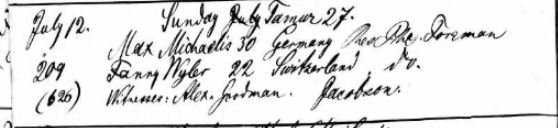
I did find a marriage record for a Fanny WYLER to Max Michaelis, dated 1874.  I was not sure that this was the same Fanny, not only because the name was spelled differently, but also the record says Fanny was born in Switzerland and that her age was 22. My Fanny was born in Pennsylvania.  If Fanny was in fact born in 1846, she would have been 28 in 1874, not 22.   But I thought Fanny might have lied about her age; I have seen that many times on marriage records.  And I thought maybe she put her father’s birthplace, which was Switzerland, by mistake.  So I decided to assume tentatively that this was my Fanny and chase down what I could find about Fanny and Max Michaelis.

Fanny Wyler marriage record

Fanny Wyler marriage to Max Michaelis July 12 1874
Historical Society of Pennsylvania; Historic Pennsylvania Church and Town Records; Reel: 792

But I could not find Fanny and Max on the 1880 census anywhere.  What I did find was a census entry for a Fanny Wiler (correct spelling), aged 24, whose parents were born in Switzerland and Germany.  This certainly matches my Fanny except for the age, which is off by ten years.  But this Fanny was working as a servant in someone’s home.   Could this really be my Fanny? I was not sure.

Fanny Wiler 1880 census  Source Citation Year: 1880; Census Place: Philadelphia, Philadelphia, Pennsylvania; Roll: 1169; Family History Film: 1255169; Page: 243B; Enumeration District: 090; Image: 0495

Fanny Wiler 1880 census
Source Citation
Year: 1880; Census Place: Philadelphia, Philadelphia, Pennsylvania; Roll: 1169; Family History Film: 1255169; Page: 243B; Enumeration District: 090; Image: 0495

So I started to search for Max Michaelis.  The first thing that came up was a second Philadelphia marriage record for a man with that name to a woman named Donice Coyne in 1876.  This was a church record, and it was not at all legible to me.  Could Max and Fanny have divorced already, thus explaining Fanny’s return to her birth name? Did women do that back then? It seemed possible.  But I could not find any other documentation of Max Michaelis with a Donice Coyne or with anyone with a name even close to resembling Donice.  So I put that aside.

When I could not find Max on the 1880, 1900, 1910, etc., census reports in Philadelphia, I started to wonder if he had died. And so I looked for death certificates.  And I found this one:

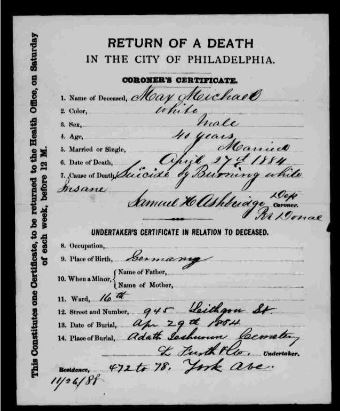
Max Michael death certificate 1884

Max Michael death certificate 1884

I was horrified.  Could this be the Max who married my cousin? I looked for news articles to learn more and found this one:

A Madman's Act. How Max Michael Killed His Child and Committed Suicide Date: Thursday, May 1, 1884  Paper: Trenton Evening Times (Trenton, NJ)   Volume: II   Issue: 70   Page: 5

A Madman’s Act. How Max Michael Killed His Child and Committed Suicide
Date: Thursday, May 1, 1884 Paper: Trenton Evening Times (Trenton, NJ) Volume: II Issue: 70 Page: 5

Although there were many hits for news articles about this horrific event, they all were essentially the same article.  The story was picked up by Associated Press and published in many papers.  But none gave more than these bare facts: Max Michael was 40 years old, so the same age as the Max who married Fanny Wyler in 1874.  He had been a patient at Norristown State Hospital for the Insane (as it was called then).  His wife and three children were living at 945 Leithgow Street in Philadelphia, and one child, Rose, a sixteen month old girl, was killed in the fire.  But not one of the articles revealed the name of the wife of Max Michaels or the names of the other two children.

How could I find out if this was the Max who married Fanny Wyler in 1874?  I searched for information about the child who died. It did not take long to find the death certificate for the child, Rose.  It was heartbreaking to read this certificate.  And it did not provide me with the information I needed.   There was no indication of the mother’s name, not even her first name, let alone her birth name.

Rose Michael death certificate 1884

Rose Michael death certificate 1884 Pennsylvania, Philadelphia City Death Certificates, 1803-1915,” index and images, FamilySearch (https://familysearch.org/pal:/MM9.1.1/JKQJ-T8Z : accessed 17 December 2014), Rose Michael, 27 Apr 1884; citing , Philadelphia City Archives and Historical Society of Pennsylvania, Philadelphia; FHL microfilm 2,069,561.

I then searched for a birth record for Rose.  I found a Rosa Michaels, born December 21, 1882, in Philadelphia.  This had to be the right child.  Right name or close anyway, right age.  Father’s name: Max Michaels. Mother’s name: Farmer.  Farmer?? I did not have the actual document, just the information listed on FamilySearch.  The image itself is not available online, so I ordered the microfilm.  It meant a long wait.

You see, the Family History Library has discontinued its free photoduplication service.  In fact, there is now no photoduplication service even for a fee.  You have to order the microfilm and have it sent to your closest Family History Center.  The one closest to me is in Bloomfield, Connecticut.  It took me an hour to get there the one time I went (yes, I got lost, and yes, I did not take the highway, but it would still take 45 minutes even if I went the fastest way).  And it is only open limited hours during the week.  So I ordered the microfilm, but then received a notification that another user had it and it was not available.  Arggh. It will get there eventually.  But I am not a patient person.  How long would it take until I knew whether Farmer was really Fanny? Or was it the mother’s birth surname?

My next step was to use the address where the fire occurred, 945 Leithgow Street, and see if I could find out who lived there at the time of the 1880 census.  Although I had had no luck finding Max on that census, maybe if I searched by the address, I would find him with some mangled spelling of his name.  I went to stevemorse.org and used his Enumeration District tool, and after many hours of scanning numerous EDs, I finally found 945 Leithgow Street.  No luck.  Someone else was living there in 1880.  Not Max or Fanny or anyone with a name anything like Michael.

Now what? I turned to the Philadelphia city directories.  Perhaps I could track Max through the years by looking at every Philadelphia city directory available online.  Since only a few listings came up by searching under the name “Max Michael” and since I know these directories are indexed by use of an OCR scanner, I knew that the index might not be completely accurate. So I went year by year, looking through the directories for any listing for a name like Max Michael.  Here’s what I found:

1875: Maximilian Michaelis, 140 Noble Street

1876: Maximilian Michaelis, hairworker, on Green Street

1877: no listing found

1878: Max Michaels, laborer, at 2133 East Thompson Street

1879: Same as 1878

1880: Max Michel, peddler, at 1072 Leithgow Stret

1881: Max Michaels, laborer, 2133 East Thompson Street

1882: same

1883: same

1884 through 1889: no listing found

At first I thought that the Max Michel at 1072 Leithgow might be the right Max, but after searching further, I found that there were two different men with similar names, but the Max Michel who lived at 1072 Leithgow was much older and had a wife named Caroline and several children born in the 1860s.  So despite the fact that he was living on Leithgow, I eliminated him from consideration.

That left Max Michaels of 2133 East Thompson Street.  So I started searching for that address through stevemorse.org.  I searched about ten EDs, but not one of them had house numbers even close to 2133.  I was stuck.

I decided to try another approach.  The 1884 news articles said that Max and his wife had three children.  Who were the other two children? Since I had no census reports that included Max for 1880, I had no idea.  I decided to search for all people named Michaels born in the 1870s and 1880s in Philadelphia. Ancestry revealed that there was an Isabella Michaels who died in 1890, whose father’s name was Max, mother’s name was Fannie.  Bingo! I thought all my problems were solved.  I went to Familysearch.org to get the image of that death certificate and was frustrated to see that Fannie’s maiden name was not included.  (I also realized that I was so eager to solve this mystery that I was losing sight of the fact that a sixteen year girl had died.)

Isabella Michael death certificate 1890 Pennsylvania, Philadelphia City Death Certificates, 1803-1915," index and images, FamilySearch (https://familysearch.org/pal:/MM9.3.1/TH-267-12389-23257-67?cc=1320976 : accessed 10 December 2014), 004009728 > image 968 of 1766; Philadelphia City Archives and Historical Society of Pennsylvania, Philadelphia

Isabella Michael death certificate 1890
Pennsylvania, Philadelphia City Death Certificates, 1803-1915,” index and images, FamilySearch (https://familysearch.org/pal:/MM9.3.1/TH-267-12389-23257-67?cc=1320976 : accessed 10 December 2014), 004009728 > image 968 of 1766; Philadelphia City Archives and Historical Society of Pennsylvania, Philadelphia

So was this MY Fanny? It certainly seemed like it was the Max and Fanny who married in 1874, since Isabella was born in 1874.  But was that Fanny Wyler the same as my Fanny Wiler? I still didn’t know.

But now I had another clue.  Isabella’s residence at her time of death was 918 Hutchinson Street in Philadelphia.  But the 1890 US census was destroyed in a fire, so I would not be able to use a census to learn who was living at 918 Hutchinson in 1890 when Isabella died.  My best bet was to use the directory database again.  Max Michaels had disappeared from those directories in 1884 (the year of that terrible fire that killed a man named Max Michaels).  I had been assuming that the Max who had been a laborer and lived as 2133 East Thompson was the one killed in the fire so had stopped searching for him after 1889.

So I started with the 1890 directory this time, and I found a Fannie Michaels, widow of Max, living at 934 Poplar Street (with a separate listing under Max Michaels as a laborer, living at that address, even though he was dead, presumably).  But in 1891 there is a Fannie Michels, widow of Max, living at 918 Hutchinson Street, the address where Isabella Michaels had been living when she died in 1890.  There was the same listing for 1892.  Certainly this was the same Fannie and Max whose daughter Isabella died in 1890.  And Max was dead.  I thought I was getting closer.  Didn’t it all add up? Fannie Michaels had a husband named Max who had died sometime before 1890, and they’d had a daughter Isabella.  That much seemed fairly certain.

But was this MY Fanny? I still wasn’t sure because I had no document that included Fanny’s birth name other than the 1874 marriage record for the Fanny Wyler born in Switzerland.  But I was getting more and more convinced that Fanny Wyler was my Fanny Wiler, despite the discrepancies.  Wouldn’t you have been?

To be continued…

Question mark

Question mark (Photo credit: Wikipedia)

The Long Depression, Part 2: Moving Back Home or Moving Away

In the early 1870s Moses and Caroline (Dreyfuss) Wiler were living at 905 Franklin Avenue, just a few houses down from Caroline’s sister, Mathilde (Dreyfuss Nusbaum) Pollock and just three blocks away from their third sister, Jeanette (Dreyfuss) Nusbaum and her husband John, my three-times great-grandparents.  Ernst Nusbaum and his wife Clarissa were living down the block from his brother John. The area is known as the Poplar neighborhood in North Philadelphia. Plotting all their addresses on the map made me smile.  They must have all been so close, not only geographically but emotionally, to live so close to their siblings.  Imagine all the first cousins (some double first cousins) growing up within a short walk of each other.

map of nusbaum wiler simon homes 1870s

But as I wrote in my last post, things were not quite so idyllic in the 1870s.  The Panic of 1873 and the depression that followed had an impact on the family.  Like Mathilde and Moses Pollock, Caroline and Moses Wiler also must have felt some of that impact.  In 1873 Moses Wiler was listed in the directory without an occupation.  His partnership with his brother-in-law Moses Pollock had ended.  In 1875 he was still listed without an occupation, and they had moved from Franklin Avenue to 920 North 7th Street, still within two blocks of Caroline’s sisters.

Caroline and Moses Wiler’s son Simon also seems to have been affected by the Long Depression.  He had been part of the Simon and Pollock cloak and dry goods partnership of the late 1860s and early 1870s with his father and uncle.  After that business ended, Simon had a separate listing in the 1875 directory as a salesman, living at 701 North 6th Street, again in the same neighborhood as his extended family, just a few blocks south.  Simon was 32 and not married and presumably was doing well enough to afford his own place.  By 1877, however, he had moved back home with his parents at 920 North 7th Street.

In 1879, Moses Wiler was in the dry goods business, and his son Simon was a salesman, both living at 902 North 7th Street, as they were in 1880.  According to the 1880 census, Simon was a paper salesman, and Moses, who was 63, was a retired merchant.  Perhaps Moses had retired as early as 1873 when his listing no longer included an occupation.  Maybe he had done well enough to cope with the economic depression that occurred in 1873.

Poplar Street houses

House on Poplar Street, perhaps like those lived in by the extended Nusbaum-Dreyfuss family in the 1870s https://ssl.cdn-redfin.com/photo/93/bigphoto/440/6336440_0.jpg

By 1880, the three daughters of Caroline and Moses Wiler were no longer living with their parents.  Eliza Wiler had married Leman Simon in 1863, and in 1870 they had two children living with them, Joseph, who was five, and Flora, who was three. Sadly, in 1869, they had had a baby who was still born.   In 1870 they were living at 718 Coates Street, an address that appears not to exist anymore but was located where Fairmount Avenue is now located between the Delaware River and Old York Avenue.  Leman was in business with his brother Samuel, as he was in 1871. That business must have then ended.  According to the 1872 directory, Leman was then in the cloak business with his father Sampson Simon, who was living at the same address on Coates Street.  In 1874, Leman and Eliza had another child, Nellie, born on November 18 of that year.

By 1876, Leman was listed as a salesman, living at 920 North 7th Street with his in-laws, Moses and Caroline Wiler.  Like Simon Wiler, Leman must have been feeling the effects of that Long Depression to have moved in with his in-laws after having his own home.   The next time Leman showed up in my search, he and Eliza were living in Pittsburgh, and Leman was working in the liquor business, like his cousin Albert Nusbaum.  Although I cannot find Leman on an 1877, 1878, or 1879 directory in any city, Leman and Eliza had another child, Leon, who was born in Pittsburgh on June 13, 1878, so the family must have relocated to Pittsburgh from Philadelphia by then.

Leman and Eliza also had a daughter Minnie, who was apparently born in 1877.  I say “apparently” because I cannot find a birth record for her, and there are only two census reports that include her, the 1880 and 1900 census reports.  The first says she was 2, meaning she was born either in 1877 or 1878; the latter says she was born in December, 1877.  But if she was born in December, 1877, then Eliza could not have given birth to Leon in June, 1878, just six months later.  I do have an official record for Leon’s birthdate with Eliza Wiler and Leman Simon named as his parents, so either Minnie was born sometime before September, 1877 or she is not Eliza’s child.

There are no other records I can find to determine Minnie’s precise birthdate; her death certificate also only specified her age, not an exact date of birth, and it also is consistent with a birth year of either 1877 or 1878.  Minnie died on August 5, 1904, at age 26 (more on that in a later post), meaning she was born on or before August 5, 1878, but not any earlier than August 6, 1877.  Somehow it seems quite unlikely that Caroline gave birth in August 1877, got almost immediately pregnant, and then had another child ten months after Minnie, but….stranger things have happened.  Or perhaps Minnie was adopted. Since I cannot find a birth record for a Minnie Simon in Pennsylvania for either 1877 or 1878, that certainly is a possibility.

In any event, in 1880, Eliza (Wiler) and Leman Simon were living far from their families in Pittsburgh with their five children, Joseph, Flora, Nellie, Minnie, and Leon.  Leman was in the liquor sales business, and perhaps life was a little easier out in the western part of Pennsylvania than it was in Philadelphia.

Eliza’s younger sister Fanny Wiler married Max Michaelis on July 12, 1874, in Philadelphia.  I am still working on Fanny’s story, and there are a lot of holes so that will wait for a later post.

The youngest child of Caroline (Dreyfuss) and Moses Wiler was Clara Wiler, born in 1850.  In 1871, she married Daniel Meyers, a German born clothing merchant operating in the 1870s under the firm name D. Meyers and Company.  He and Clara were living at 718 Fairmount Street, and their family grew quickly in the 1870s.  First, their daughter Bertha was born on December 4, 1972.  Less than two years later, their son Leon was born on June 12, 1874, followed the next year by Samuel on December 15, 1875.  A fourth child, Harry, was born January 15, 1878, and Isadore on September 25, 1879.  Five children in seven years.  Wow.

And they were not yet done.  But that would bring us into the 1880s, and I am not there yet.   But Daniel’s firm must have been weathering the storm of the 1870s depression better than most, including many in the extended family.  In 1880, he was supporting five children plus his wife Clara and himself in their house on Fairmount Street.

Thus, the Wiler family like the Pollock family had its ups and downs during the 1870s.  There were marriages and babies, but also some economic struggles for at least some of the members of the family.  Adult children had to move back home, and some had to leave town to find new opportunities for making a living.

The Long Depression:  The Family of Mathilde Dreyfuss Nusbaum Pollock


Embed from Getty Images

If the 1860s were mostly a decade of good things—weddings, babies, prosperity, and little impact from the Civil War, the 1870s were in contrast a more difficult decade for the extended Nusbaum-Dreyfuss-Dinkelspiel-Simon clan, both personally and economically.  This post will focus on the family of Mathilde Dreyfuss Nusbaum Pollock, and the next will focus on the family of Caroline Dreyfuss Wiler, my two three-times great grand aunts, sisters of Jeanette Dreyfuss.  The posts that follow will focus on the family of my three times great-grandparents John and Jeanette (Dreyfuss) Nusbaum and the families of John’s siblings Ernst Nusbaum, Leopold Nusbaum, and Mathilde (Nusbaum) Dinkelspiel during the 1870s.

First, the Pollocks. Mathilde (Dreyfuss Nusbaum) and Moses Pollock had relocated from Harrisburg to Philadelphia in the mid-1860s. Moses was engaged in the retail dry goods business. In June 1870 when the census was taken, the Pollocks had a very full house.  Mathilde’s daughter Flora and her new husband Samuel were living with them along with their new baby Meyer. Samuel was working on the wholesale side of clothing sales. In addition, Mathilde’s son Albert Nusbaum, now 19 and working as a clerk in a dry goods store (presumably his stepfather’s business), was living with them as well as Mathilde and Moses’ children, Emanuel (14) and Miriam (11), who were both in school.  In addition, there were three domestic servants living with them.  Moses must have been doing quite well.

It’s a good thing they had those servants because there were also three young children living with them, Annie (5), Alice (4), and Wilhelmina Jastrow (seven months old) plus another young woman, Augusta Wolfsohn, who was 22 years old.  Annie and Alice were born in Hesse-Darmstadt, but their baby sister Wilhelmina had been born in Pennsylvania in September, 1869.  Who were they? Where were their parents? Augusta was born in Prussia and does not appear to be the mother of the three young girls.  Who was she?  None of these girls was living with the Pollocks as of the 1880 census.

Fortunately, this was a mystery that did not take long to solve.  A little research on Ancestry.com, and I was able to find a happy ending to the story.  The Jastrow girls had parents, Marcus and Bertha (Wolfsohn) Jastrow.  By the second enumeration of the 1870 census in Philadelphia, they and their aunt Augusta Wolfsohn were all under the same roof as their parents and other siblings.  I don’t know why they were with the Pollocks during the earlier enumeration, but I assume that they were very recent immigrants who did not have enough room to accommodate everyone, and Moses and Mathilde were kind enough to take in the three youngest children and their aunt.

But fate was not kind to Moses and Mathilde despite their kindness to the Jastrows.  In September 1870, they had a third child together (a fifth for Mathilde), Rosia, but Rosia did not live long.  On February 26, 1871, she died, only five months old, from diarrhea.  Mathilde was 45 years old when Rosia was born, making me doubt my skepticism about the parentage of Lottie Nusbaum. Perhaps women just kept having babies into the mid to late 40s back then with more frequency than I would have thought.

Rosia Pollock death certificate 1871

Rosia Pollock death certificate 1871

What makes this late birth seem even stranger is that Mathilde had become a grandmother just nine months before Rosia was born when her grandson Meyer was born in January, 1870. Meyer and his parents Flora and Samuel Simon were living with the Pollocks in June of 1870 when Mathilde was pregnant with Rosia.  It is hard to imagine being pregnant and a grandmother, but times were different then.

Flora (Nusbaum) and Samuel Simon were still living with Flora’s family at 911 Franklin Street in 1871, but seem to have moved to their own place in 1872, and I say “seemed to” because their address was 909 Franklin Street, so right next door to Mathilde and Moses Pollock. Then in 1873, they are back at 911 Franklin.   Samuel was in business with his brother Leman in 1871, but seems to be on his own after that. He has no occupation listed in 1873 in the directory. Perhaps Flora and Simon could no longer afford to have their own place and returned to the Pollock residence.

According to the 1871 and 1872 Philadelphia directories, Moses Pollock had gone into business with his brother-in-law Moses Wiler, husband of Caroline Dreyfuss, Mathilde’s sister.  By 1873 it also appears that Moses Pollock and Moses Wiler were no longer in business together.  Moses Wiler is listed in the directories for 1873 and 1875 without an occupation, and Moses Pollock is listed in one as a salesman and another as a clerk.

What was going on around them? Why had these two family business partnerships ended?  It’s always important to keep the historical and socioeconomic context in mind when doing family research, and perhaps the most important development both in the US and worldwide in the 1870s was the so-called “Long Depression.”  The period after the Civil War brought widespread economic growth with railroad construction, technological developments, and expansion of exports to European markets.  However, in a way not dissimilar to more recent economic crashes, the economy tumbled in 1873 when banks and investment firms did not realize the profits they had expected from investing in the railroads and could no longer cover the loans they had made in the frenzy of the post-Civil War boom.[1]  In addition, an economic crisis abroad resulted in decreased demand for American exports.

The credit crisis led to panic with many investors withdrawing their money from the banks, thus worsening the precarious position of the banks.  Although the government intervened to try and stop the crisis, the overall confidence in the economy was gone, jobs dried up, people stopped buying, and railroad construction came to a halt.  There was also evidence of a great deal of corruption that was uncovered during this time.  The effects of this crisis were felt across the United States for at least five years with widespread unemployment, poverty, and social unrest.


It could very well have been this economic downturn that caused Moses Pollock and Moses Wiler to end this business partnership and also caused Leman and Samuel Simon to end their business partnership.

Moses Pollock continued to have some inconsistency in his occupation for the rest of the decade. In 1876 Mathilde and Moses Pollock are listed in business together selling “gentlemen’s furnishings” at 107 North 9th Street and were still living at 911 Franklin Street.  By 1878, they had moved to 934 North 8th Street, where they remained for many years.  Moses is listed as a salesman in the 1878, 1879, and 1880 Philadelphia directories, and according to the 1880 census he was working in a cloak store.  In 1880 he and Mathilde still had Albert Nusbaum, now 28, as well as Emanuel (24) and Miriam (21) living with them at home as well as one servant.  Albert had been working as a liquor salesman since 1873 when he was 21.  Emanuel had been in dry goods sales since 1877 when he was 21. Miriam and her mother Mathilde were “keeping house.”

Mathilde’s other daughter, Flora (Nusbaum) Simon and her husband Samuel meanwhile had had a second child.  Their daughter Minnie was born in 1873 or 1874 (documents vary).  Flora and Samuel seem to have moved out of the Pollock household sometime shortly thereafter and out of Philadelphia altogether by the end of the decade and perhaps even earlier.  It’s hard to know for sure because Samuel Simon was not an uncommon name.

There are three Samuel Simons listed in the 1874 Philadelphia directory: one was a laborer, one a restaurant worker, and a third was working in the ladies’ furnishings business.  None of the addresses line up with other members of the family, so I cannot tell which, if any of these Samuel Simons were married to Flora.  The ladies’ furnishings Samuel seems like the most likely, given the family’s pre-existing businesses, but I cannot be sure.  In 1875, there are two Samuel Simons, a laborer and a gardener.  Neither one seems likely to be Flora’s Samuel.

In 1876, there is only one Samuel Simon listed, a superintendent, and in 1877 again only one, a furrier.  In 1878 there was only Samuel the laborer, but in 1879 there were three Samuels: the laborer, the gardener, and a third selling produce.  My best hunch is that Samuel and Flora (Nusbaum) Simon had left Philadelphia by 1875.  According to the 1880 census, they were then living in Elkton, Maryland, about 50 miles from Philadelphia and 60 miles from Baltimore.  Samuel was working at a hotel there.  Again, my assumption is that the economic slowdown had contributed to this move away from their families in Philadelphia.

As will be evident as I examine each of the families, the Pollock line was not the only one that felt the impact of the Long Depression of the 1870s.


[1] I am greatly oversimplifying the causes and the effects of the Long Depression that began in 1873.  For more information, see http://www.socialwelfarehistory.com/eras/the-long-depression/   http://en.wikipedia.org/wiki/Panic_of_1873   http://macromarketmusings.blogspot.com/2010/05/about-that-long-depression-of-1870s_27.html

Four Weddings and a Funeral: More Twists and Turns

My last post covered the migration of several Nusbaum/Dreyfuss family members to Peoria, Illinois in the 1860s. Meanwhile, back in Pennsylvania, the rest of the Nusbaum/Dreyfuss clan was growing during the 1860s.  In Philadelphia, two of the Nusbaum brothers and two of the Dreyfuss sisters were seeing their families grow and their children grow.  Other family members were still in Harrisburg. By the end of the decade, even more of the family would have relocated to Philadelphia.

The Civil War was having at least some minor financial impact on the family.  For example, John Nusbaum was liable for $26.79 in income tax to the federal government in 1862 under the terms of the Internal Revenue Act of 1862 That law was enacted to raise money to help pay for the expenses incurred by the Union in fighting the Civil War.  It was the first progressive income tax imposed by the federal government.  For anyone whose income exceeded $600 a year, a tax was imposed based on the level of income.

For John Nusbaum, whose income was valued at $892.96 in 1862, that meant a tax of $26.79.  According to one inflation calculator, $892.96 in 1862 would be worth about $20,000 in 2014.     For someone with stores in Philadelphia and Peoria (and possibly still some interest in a store in Harrisburg) and who reported $6000 in real estate and $20,000 in personal property in 1860,[1] that does not seem like a lot of income, but I have no idea how that was determined back then.

Ancestry.com. U.S. IRS Tax Assessment Lists, 1862-1918 [database on-line]. Provo, UT, USA: Ancestry.com Operations Inc, 2008.

Ancestry.com. U.S. IRS Tax Assessment Lists, 1862-1918 [database on-line]. Provo, UT, USA: Ancestry.com Operations Inc, 2008.

By 1863 John and Jeanette (Dreyfuss) Nusbaum, my three-times great-grandparents, had seen their two older sons move to Peoria, but they still had one son, Julius, and two daughters at home in 1863: Frances, my great-great-grandmother, who was eighteen, and Miriam, who was only five years old in 1863.  Plus 1863 had started off with another new baby in the family.  Lottie Nusbaum was born on January 1, 1863.  Jeanette would have been almost 46 years old, and her first born child Adolphus was going on 23.

I have to admit that I have some questions about whether Lottie was actually the child of John and Jeanette.  Jeanette must have been close to the end of her child-bearing years.  They had not had a child in five years.  Could Lottie have been a child of one of their sons, raised as the child of her actual grandparents?  Or a child they adopted?  I have no way of knowing.  Lottie had no children, so even if I could figure out some way to use DNA to answer my doubts, there are no descendants to use for DNA testing.

On Lottie’s death certificate, the informant was Mrs. E. Cohen, that is, my great-grandmother Eva Seligman Cohen, Lottie Nusbaum’s niece and Frances Nusbaum Seligman’s daughter.  Eva filled in the father’s name as John, but put unknown for the mother’s maiden name.  Eva certainly knew her grandmother Jeanette’s name.  (Eva is the one who held and maintained the family bible for many years.) Did she not know her grandmother’s maiden name? Was she too grief-stricken to remember? Or was she suggesting that Jeanette was not in fact Lottie’s real mother?  I do not know, and there is no one left to ask.  But it did not do anything to resolve my doubts about the identity of Lottie’s parents.   Maybe I am too skeptical.  Maybe she was just a menopause baby. Maybe John and Jeanette were missing their boys so much that they decided to have one more child. Or maybe not.  What do you all think?

Lottie Nusbaum death certificate  Ancestry.com. Pennsylvania, Death Certificates, 1906-1963 [database on-line]. Provo, UT, USA: Ancestry.com Operations, Inc., 2014.

Lottie Nusbaum death certificate
Ancestry.com. Pennsylvania, Death Certificates, 1906-1963 [database on-line]. Provo, UT, USA: Ancestry.com Operations, Inc., 2014.

In any event, just as John and Jeanette were emptying their household of their sons, they had a new baby to raise.  The family was still living at 433 Vine Street in 1862, according to the Philadelphia city directory, but in 1864 they are listed at 455 York Avenue.  That address is about two and a half miles north of Vine Street, and as I’ve discussed earlier, Jews began to move north in Philadelphia as their socioeconomic status improved.

By 1865, John and Jeanette’s house on York Avenue was a little emptier.  By that time Julius had joined his brothers in Peoria, and on March 28, 1865, my great-great-grandmother Frances married Bernard Seligman.  For several years they lived in Philadelphia, and Bernard was apparently in business with his brothers-in-law in a firm called Nusbaum Brothers and Company.  They had four children between 1866 and 1869, including my great-grandmother Eva.  Then in 1870, Bernard returned full time to Santa Fe with Frances and their children where Frances and Bernard lived for almost all of the rest of their lives, as discussed in my Seligman blog posts.

Nusbaum Brothers and Company 1867 Philadelphia Directory  Ancestry.com. U.S. City Directories, 1821-1989 [database on-line]. Provo, UT, USA: Ancestry.com Operations, Inc., 2011.

Nusbaum Brothers and Company 1867 Philadelphia Directory
Ancestry.com. U.S. City Directories, 1821-1989 [database on-line]. Provo, UT, USA: Ancestry.com Operations, Inc., 2011.

John’s brother Ernst was also in Philadelphia during the early 1860s.  He was a clothier, working at 55 North Third Street and living at 626 North 6th Street.  He and his wife Clarissa had another child in 1861, Frank, bringing their family up to six children ranging in age from newborn to ten years old.  So both Ernest, who was 45 when Frank was born, and John, who was 49 when Lottie was born, had new babies in their homes in the 1860s.

Jeanette (Dreyfuss) Nusbaum also had a sibling living in Philadelphia.  Her sister Caroline (Dreyfuss) Wiler had also moved from Harrisburg to Philadelphia by 1860.  She and her husband Moses Wiler were living at 466 North 4th Street in 1862 with their four children, who ranged in age from Eliza who was twenty to Clara who was twelve.  Moses was in the cloak business.

The following year the Wiler household became a bit smaller when Eliza Wiler married Leman Simon on September 9, 1863, in Philadelphia.  Yes, Leman Simon.  Do you remember that name? He was the brother of Moses Simon, who married Paulina Dinkelspiel and started the migration of Nusbaums to Peoria.  So once again, my family tree groans and twists a bit.  Eliza and Paulina were already related, at least by marriage.  Eliza’s mother Caroline Dreyfuss was the sister-in-law of John Nusbaum, Paulina Dinkelspiel’s uncle.  Sometimes these people make me want to pull out my hair!  Imagine, I am casually researching Eliza, and I see her husband’s name and think, “Leman Simon.  Hmmm, that sounds familiar.”

So by 1863 the Simons, Nusbaums, Dinkelspiels, and Dreyfusses were all somehow interrelated, often in more than one way.

But it gets worse.

By 1866, Moses Pollock and Mathilde (Dreyfuss Nusbaum) Pollock had also moved to Philadelphia from Harrisburg. In 1868, Flora Nusbaum, the daughter of Mathilde Dreyfuss and Maxwell Nusbaum and step-daughter of Moses Pollock, married Samuel Simon.  I have mentioned this before because Flora Nusbaum is my double first cousin four times removed since both of her parents were siblings of one of my three times great-grandparents, Flora’s father being John Nusbaum’s brother, her mother being Jeanette Dreyfuss Nusbaum’s sister.  Now Flora was marrying her first cousin Paulina’s brother-in-law Samuel Simon, who was also her cousin Eliza’s brother-in law.

Groan…. Maybe this chart will help.

chart_NEW

So all three Simon brothers were now married to someone in the clan: Samuel to Flora Nusbaum, Leman to Eliza Wiler, and Moses to Paulina Dinkenspiel.

The wedding of Samuel Simon to Flora Nusbaum (Pollock) seems to have been a celebration worthy of all that interconnectedness.  Here is an article from the Harrisburg Telegraph of October 20, 1868, republishing an article from the Philadelphia Sunday Mercury that described their Philadelphia wedding.  It’s really worth reading to get the full flavor of both the wedding and “social media” in the 1860s.

flora pollock wedding part 1

flora pollock wedding part 2

flora pollock part 3

The strangest part of this article is not the detailed description of the lavish, extravagant wedding celebration, but the reporter’s mistaken assertion that Flora was not Jewish.  Certainly her parents were both Jewish, and even her stepfather Moses Pollock was Jewish.  The reporter’s statement that “the pure religion of love had broken down all sectarian barriers” seems a bit strange for a wedding announcement, even if it had been an interfaith wedding.  But why would the reporter have thought Flora wasn’t Jewish?

The overlapping branches of the family were well represented in the bridal party: Clara Wiler and Simon Wiler, the children of Moses and Caroline (Dreyfuss) Wiler; Frances Nusbaum, the daughter of John and Jeanette (Dreyfuss) Nusbaum; Arthur Nusbaum, son of Ernst and Clara Nusbaum; and Albert Nusbaum, son of Maxwell and Mathilde (Dreyfuss) Nusbaum and brother of the bride.  I do not know who the Schloss family is or the Goldsmiths, at least not yet, but I fear more double twists yet to be uncovered.

So the extended family was doing quite well, and there were lots of new families being formed and babies born, but unfortunately there also was one big loss in the 1860s.  Leopold Nusbaum, who was still living in Harrisburg in the 1860s, died on December 24, 1866.  He was buried at Mt. Sinai Cemetery in Philadelphia.  His widow Rosa and sixteen year old daughter Francis moved shortly thereafter to Philadelphia, where they moved in with John and Jeanette Nusbaum, whose household had been reduced by two when Julius moved to Peoria and Frances married.

Below is a photo I found while searching for old images of Harrisburg.  I was so excited when I saw the name on the store at the far upper right—Leo Nusbaum!  Although this photo was dated 1889, Leopold Nusbaum’s name was still on the store even though he had died almost 25 years earlier.

Harrisburg Market Square with Leo Nusbaum store

Harrisburg Market Square with Leo Nusbaum store http://explorepahistory.com/displayimage.php?imgId=1-2-EC

The only Nusbaum family members left in Harrisburg by the end of the 1860s were Mathilde (Nusbaum) Dinkenspiel, her husband Isaac, and their daughter Sophia.  Their daughter Paulina (Dinkenspiel) Simon was living in Baltimore, and their son Adolph was in Peoria.  Their youngest child Sophia married Herman Marks, a Prussian born clothing merchant, in 1869, and they settled in Harrisburg as well.  Perhaps they were the ones to keep Mathilde’s brother’s name on the store.

Thus, by the end of the 1860s, most of the extended family was living in Philadelphia, with a small number living in Peoria, a few in Harrisburg, and a few in Baltimore.


[1] $600 in 1860 would be worth about $17,000 today, and $20,000 in 1860 would be worth about $571,000 today.  Not too shabby for someone who had come to America around 1840.

But Will It Play in Peoria?


My father’s family has lived in some places that were surprising to me—Cohens in Des Moines and Kansas City, Seligmans in Santa Fe, and Nusbaums in Harrisburg and other small towns in Pennsylvania.  In the 1860s, some of the Nusbaums and their Dreyfuss, Dinkelspiel and Simon relatives ended up in Peoria.   All I knew about Peoria was the old line, “Will it play in Peoria?” As explained on the official website for Peoria, Illinois:

The phrase “Will It Play in Peoria?” originated in the early ’20s and ’30s during the US vaudeville era. At that time, Peoria was one of the country’s most important stops for vaudeville acts and performances. If an act did well in Peoria, vaudeville companies knew that it would work throughout the nation. The saying was popularized by movies with Groucho Marx, and on radio programs such as Jack Benny and Fibber McGee.  Because of it’s [sic] location and demographics, Peoria has since become a well known test market to gauge the popularity of products and ideas nationwide.

Peoria has become a symbol of mainstream America, a short-hand way of referring to the typical “Middle American,” as Richard Nixon might say.  So perhaps I should not be surprised that my entrepreneurial Nusbaum/Dreyfuss ancestors struck out for Peoria after succeeding in Harrisburg and Philadelphia.  It was a new market to exploit as the US population continued to expand and move west.

Location map of Peoria, Illinois

Location map of Peoria, Illinois (Photo credit: Wikipedia)

But were there Jews there in the 1860s? Surprisingly, there was an established Jewish community. According to the Jewish Virtual Library’s entry for Illinois, “The oldest Jewish community [in Illinois] outside of Chicago is Peoria, where the first Jews arrived in 1847. A benevolent society was organized in 1852 and the first congregation, Anshai Emeth, was formed in 1859.”     The website for Anshai Emeth reveals only a little bit more about the early history of Jews in Peoria:

The first Jewish settlers came to Peoria in approximately 1847. They soon organized themselves into groups and worshiped in private homes. Early settlers included Jacob Liebenstein (1848), Henry Ullman and Leopold Rosenfeld (1849), Abraham Schradski and Leopold Ballenberg (1851), and Aaron, Harry and David Ulman (1852), and Henry Schwabacker. Many of their descendants continue to live in the Peoria community.  Religious school classes were organized by 1852. In the same year, these Jewish settlers organized a burial association and bought a lot for the use as a cemetery. With this purchase grew the first organized Jewish life in Peoria. Religious services were held in various halls including Washington House on North Washington Street.  Abraham Frank, A. Rosenblat, Hart Ancker, A. Ackerland, Arnold Goodheart, and Abraham Solomon formally organized a congregation in 1859 and named themselves “Anshai Emeth,” or “People of Truth.”

Although in 1860 the Nussbaum/Dreyfuss clan was settled either in Harrisburg or Philadelphia, as early as  1862 some of the next generation began moving to Peoria.  Paulina Dinkelspiel, the daughter of Mathilde Nusbaum and Isaac Dinkelspiel, married a man named Moses Simon in 1862.  Moses was born in 1835 in what is now the Hesse region of Germany.  He and his brothers Leman and Samuel had a business in Peoria as early as 1861, as did their father Sampson.

The Simons in Peoria 1861 Peoria directory

The Simons in Peoria 1861 Peoria directory

But as the directory indicated, Moses was residing in Harrisburg in 1861.  Perhaps Moses had a business relationship with the Nusbaum business; perhaps that is how he obtained his merchandise for their business in Peoria.  But while living in Harrisburg, Moses must have met Paulina. And after they were married, they moved to Peoria where their first two children were born, Joseph in 1862 and Francis in 1864.

Not long after, Paulina’s younger brother Adolph Dinkenspiel arrived in Peoria.  Although he is not listed in the 1861 directory, he does appear in the 1863 directory. While the Simon brothers and their father were all living at 95 North Adams Street that year, Adolph was boarding at the corner of North Adams and Hamilton Street, right down the block, and working as a clerk at 73 Main Street.

What was going on at 73 Main Street?  The Simon Brothers business was at 5 North Adams Street, so young Adolph was not working for his sister’s husband.  A look at the 1863 directory for Peoria under N revealed that John Nusbaum, my three-times great-grandfather, had a business at that location as a “fancy and staple dry goods merchant.”  Although John was still residing in Philadelphia, he is listed in the directory as are two of his sons.  His oldest son Adolphus, was residing at Peoria House, a hotel, I assume, and working for a firm called “Adler, N. & Higbie.” A further look through the 1863 directory uncovered a listing for a distillery called Adler, Nusbaum & Higbie.  John’s second son Simon is also listed in the 1863 Peoria directory, working as the business manager of his father’s store at 73 Main Street with his cousin Adolph Dinkenspiel and residing at 36 North Adams Street.

nusbaum 1863 peor

Nusbaums in Peoria 1863 Peoria directory

By 1863, the country was in the throes of the Civil War, yet it appears that my Peoria relatives were not serving in the war.  I did find a document that indicates that both Simon and Adolphus Nusbaum registered for the draft in 1863 for the Civil War, but I cannot find any other documentation of their service in that war.

National Archives and Records Administration (NARA); Consolidated Lists of Civil War Draft Registration Records (Provost Marshal General's Bureau; Consolidated Enrollment Lists, 1863-1865); Record Group: 110, Records of the Provost Marshal General's Bureau (Civil War); Collection Name: Consolidated Enrollment Lists, 1863-1865 (Civil War Union Draft Records); ARC Identifier: 4213514; Archive Volume Number: 2 of 5

National Archives and Records Administration (NARA); Consolidated Lists of Civil War Draft Registration Records (Provost Marshal General’s Bureau; Consolidated Enrollment Lists, 1863-1865); Record Group: 110, Records of the Provost Marshal General’s Bureau (Civil War); Collection Name: Consolidated Enrollment Lists, 1863-1865 (Civil War Union Draft Records); ARC Identifier: 4213514; Archive Volume Number: 2 of 5

Not one of these young men in the family appears in any of the databases listing those who served. I searched not only Ancestry, Fold3, and FamilySearch, but also the National Park Service database, the Civil War Soldiers and Sailors System, found here, and found nothing.

How had they all avoided service?  Simon and Adolphus registered, but I can’t even find registration evidence for Adolph Dinkelspiel.  The Draft Act of 1863 applied to all male citizens between 20 and 45 years old; in 1863 Adolphus was 21 and Simon and Adolph were 20.  Adolphus and Simon were born in the US and were thus citizens, but Adolph Dinkelspiel was born in Baden.  However, the Draft Act also applied to men who intended to become citizens.  Perhaps Adolph avoided registration by not declaring such an intention.  But how would his cousins Adolphus and Simon have avoided service?  Apparently there were two ways to avoid being drafted: hire a substitute or pay $300.  Perhaps that’s what the two Nusbaum brothers did.  Or maybe I just haven’t found the documentation of their service.    See also Michael T. Meier, “Civil War Draft Records: Exemptions and Enrollments,” Prologue Magazine (Winter, 1994) found online here.

All three of John’s sons were listed in the 1865 Peoria directory.  Julius joined Simon as a clerk at the Nusbaum dry goods store, now located at the corner of North Adams and Main Street, two blocks up from its 1863 location.  Adolphus, although still listed in the directory, was reported to be living in Philadelphia in 1865, but still associated with the Adler, Nusbaum & Higbie firm.  In addition, John’s older brother Isaac is listed in the 1865 Peoria directory, boarding at 36 North Adams Street, the same address given for Julius.  This is the first document evidencing Isaac’s presence in the US, so perhaps he was a late arrival and sent to Peoria to keep an eye on his nephews Julius and Simon Nusbaum and Adolph Dinkelspiel, who were single and only 17, 22, and 22 respectively in 1865.

Thus, in 1865, there were four male members of the extended Nusbaum family living in Peoria. Some members of the clan had left by then. Moses and Paulina (Dinkelspiel) Simon and Moses’ brothers Leman and Samuel and their father Sampson were gone from Peoria. Moses and Paulina had relocated to Baltimore where Moses was a “fancy goods” merchant. They had two more children between 1865 and 1870: Leon was born in 1866, and Flora in 1868, both born in Baltimore.  On the 1870 census, Moses described himself as a dealer in all kinds of leather. [1] Thus, Moses Simon who started the migration of the Nusbaums to Peoria was himself gone by 1865.

Adolphus was not listed as living in Peoria in 1865, but he did eventually return to Peoria in 1868.  There is an 1864 IRS tax report that lists the income for Adolphus and for the Adler, Nusbaum & Higbie distillery, so Adolphus was still in business in 1864 in Peoria.   The 1865 Peoria directory reported that he was living in Philadelphia though still in business in Peoria.

In 1867 the only members of the Nussbaum/Dreyfuss/Dinkelspiel/Simon clan listed as living in Peoria were Isaac Nusbaum, Julius Nusbaum, and Adolph Dinkelspiel.  However, the 1868 directory lists Isaac, Julius, S. (Simon?) and A. (Adolphus?) Nusbaum as well as Adolph Dinkelspiel.  The four younger men are also listed in the 1870 directory.  Simon and Adolphus were now in the distillery business together under the name Union Mills Distillery, and Julius was still working in his father’s “staple and fancy dry goods” business along with his cousin Adolph Dinkelspiel.  Thus, three of my great-great-grandmother’s brothers as well as my first cousin four times removed, Isaac Dinkenspiel, were living in Peoria in 1870.

Isaac Nusbaum, their uncle, had died in January, 1870. He was not yet sixty years old.  I could find no actual record of his death aside from the entry in the Nusbaum family bible and this rather peculiar news article from the January 25, 1870 Peoria Daily Transcript.

Peoria Daily Transcript January 25, 1870 p. 3

Peoria Daily Transcript January 25, 1870 p. 3

What does this mean? Why would his brother John have ordered the body returned to Peoria? Why had it first been en route to Philadelphia? How did Isaac die?  There was no obituary.  Isaac is a mystery to me.  I don’t know where he was before 1865.  It appears that he never married or had children.  If it had not been for the family bible, I might never have even known to look for him.

http://www.findagrave.com/cgi-bin/fg.cgi?page=pv&GRid=143048598&PIpi=117463912 Note says he is buried between two unrelated people.

http://www.findagrave.com/cgi-bin/fg.cgi?page=pv&GRid=143048598&PIpi=117463912
Note says he is buried between two unrelated people.

By 1870, the four young Nusbaum descendants were grown men.  Even the youngest, Julius, was 22.  All four would spend the next decade in Peoria as well; two of them would spend most of the rest of their lives there.

So yes, it played well in Peoria for the Nusbaum/Dreyfuss family.


[1] For some reason on the second enumeration of the 1870 census, Moses and his brothers Samuel and Leman are listed with their parents in Philadelphia; I assume that the parents were confused when asked about the members of their family and reported all three sons as living with them when in fact all three sons were married by then and living with their wives and children.