Rebekka and Regina: Sisters with Intertwined Lives

The last two children of Mina Katzenstein and Wolf Katzenstein were Rebekka and Regina, and because their fates are intertwined in several ways, I will discuss both in this post.

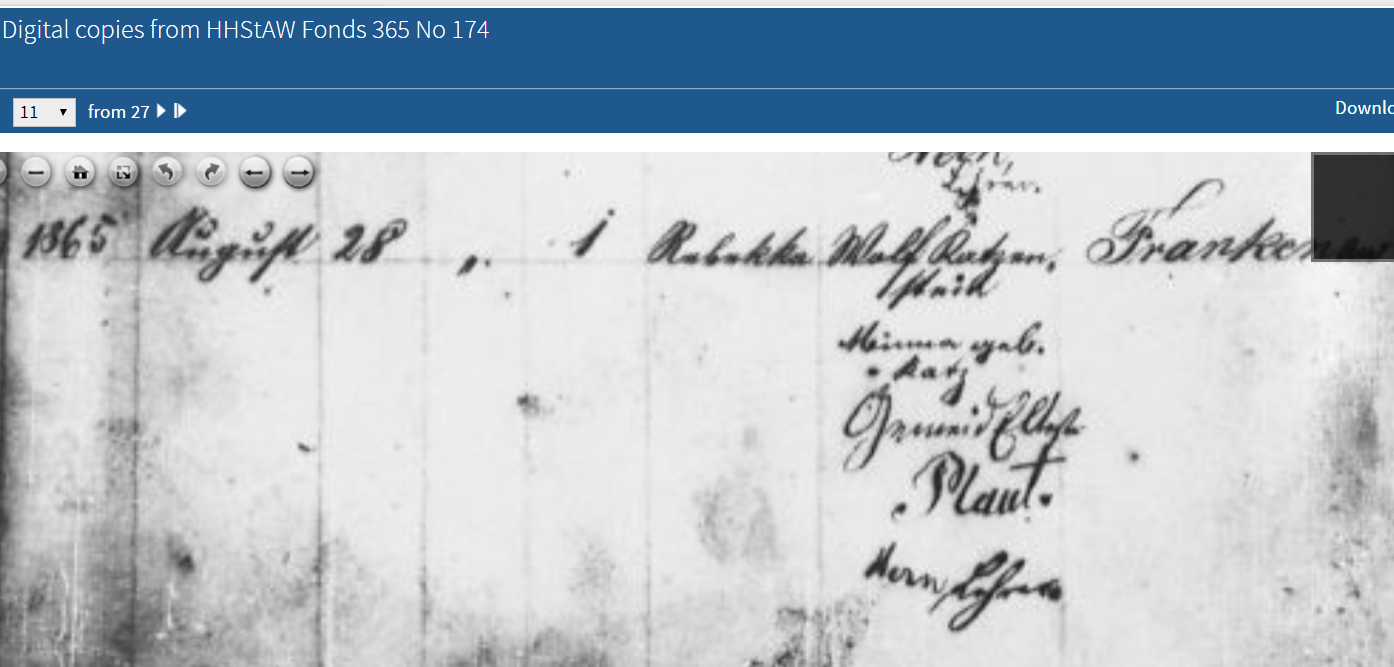
Rebekka was born on August 28, 1865, in Frankenau. Regina was born two years later on September 24, 1867.

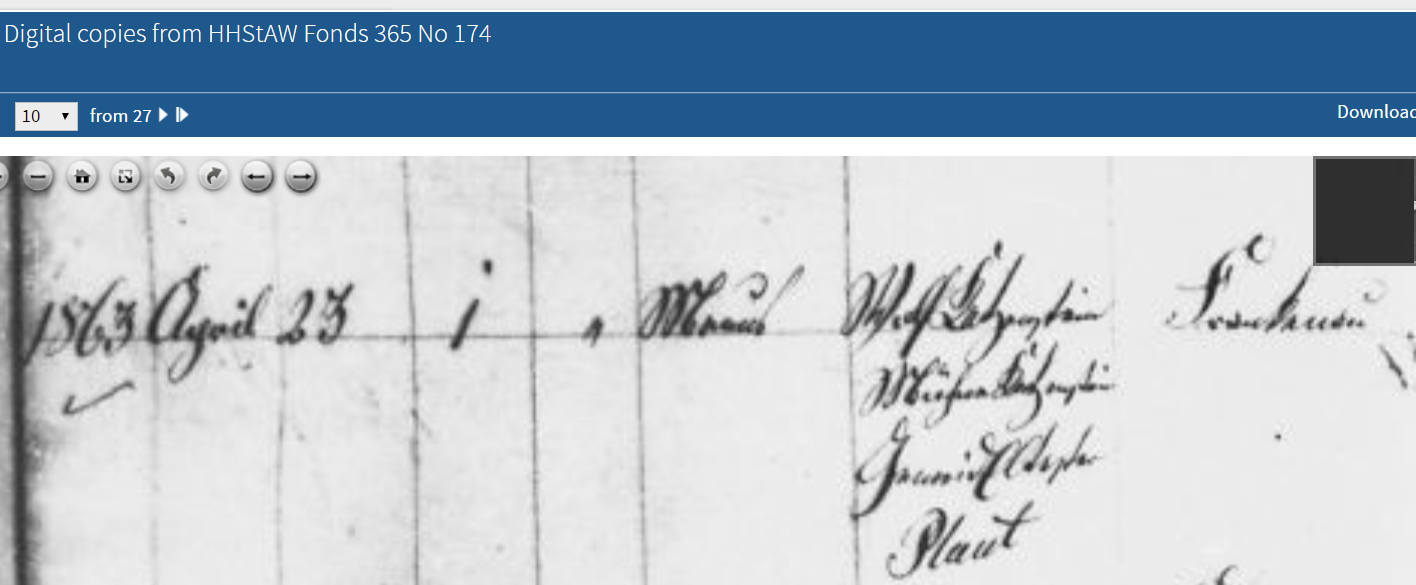
Rebekka Katzenstein birth record Arcinsys
HHStAW Fonds 365 No 174

Regina Katzenstein birth record arcinsys
HHStAW Fonds 365 No 174, p. 8

Rebekka married her cousin Salomon Schalom Kneibel Katz (apparently known as Kneibel) on April 30, 1889, as discussed previously.

Marriage of Rebekka Katzenstein and Salomon Kneibel Katz
Hessisches Hauptstaatsarchiv; Wiesbaden, Deutschland; Collection: Personenstandsregister Heiratsregister; Signatur: 920; Laufende Nummer: 3844

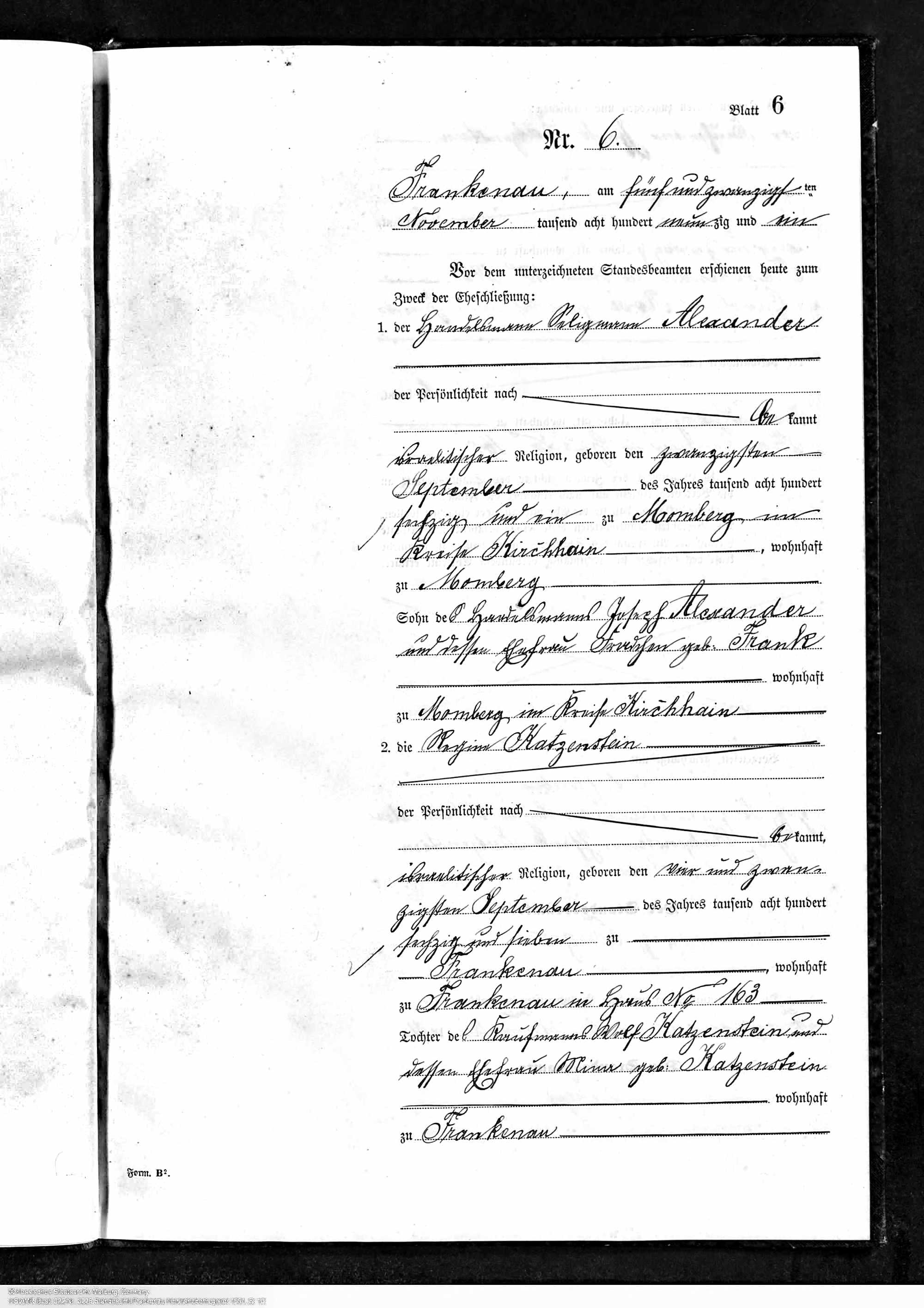
Two and a half years later, on November 25, 1891, Regina Katzenstein married Selig(mann) Alexander in Frankenau. He was born on September 20, 1861, in Momberg, the son of Joseph Alexander and Fradchen Frank.

Marriage of Regina Katzenstein to Selig Alexander
Hessisches Hauptstaatsarchiv; Wiesbaden, Deutschland; Standesamt Frankenau Heiratsnebenregister 1891 (Hstamr Best. 922 Nr. 3226); Collection: Personenstandsregister Heiratsregister; Signatur: 922

Rebekka and Salomon Kneibel Katz had four children, three sons and one daughter. Their first child was Berthold; he was born on May 15, 1890, in Jesberg.

Berthold Katz birth record
HStAMR Best. 920 Nr. 3821 Standesamt Jesberg Geburtsnebenregister 1890, S. 36

Then came Rebekka and Salomon’s only daughter, Therese. She was born November 11, 1891, in Jesberg.

Therese Katz birth record
Hessisches Hauptstaatsarchiv; Wiesbaden, Deutschland; Collection: Personenstandsregister Geburtsregister; Signatur: 920; Laufende Nummer: 3822

Two sons followed Therese. Julius was born May 30, 1893, in Jesberg.

Julius Katz birth record
Hessisches Hauptstaatsarchiv; Wiesbaden, Deutschland; Collection: Personenstandsregister Geburtsregister; Signatur: 920; Laufende Nummer: 3824

And Jakob Katz was born April 14, 1895, in Jesberg.

Jakob Katz birth record
Hessisches Hauptstaatsarchiv; Wiesbaden, Deutschland; Collection: Personenstandsregister Geburtsregister; Signatur: 920; Laufende Nummer: 3826

Meanwhile, Regina and her husband Selig Alexander were also having children in the 1890s. Regina gave birth to seven children, but only four survived infancy. The first child, a girl, was stillborn on January 9, 1893.

Stillborn daughter of Regina Katzenstein and Selig Alexander
Hessisches Hauptstaatsarchiv; Wiesbaden, Deutschland; Personenstandsregister Sterberegister; Bestand: 915; Laufende Nummer: 6560

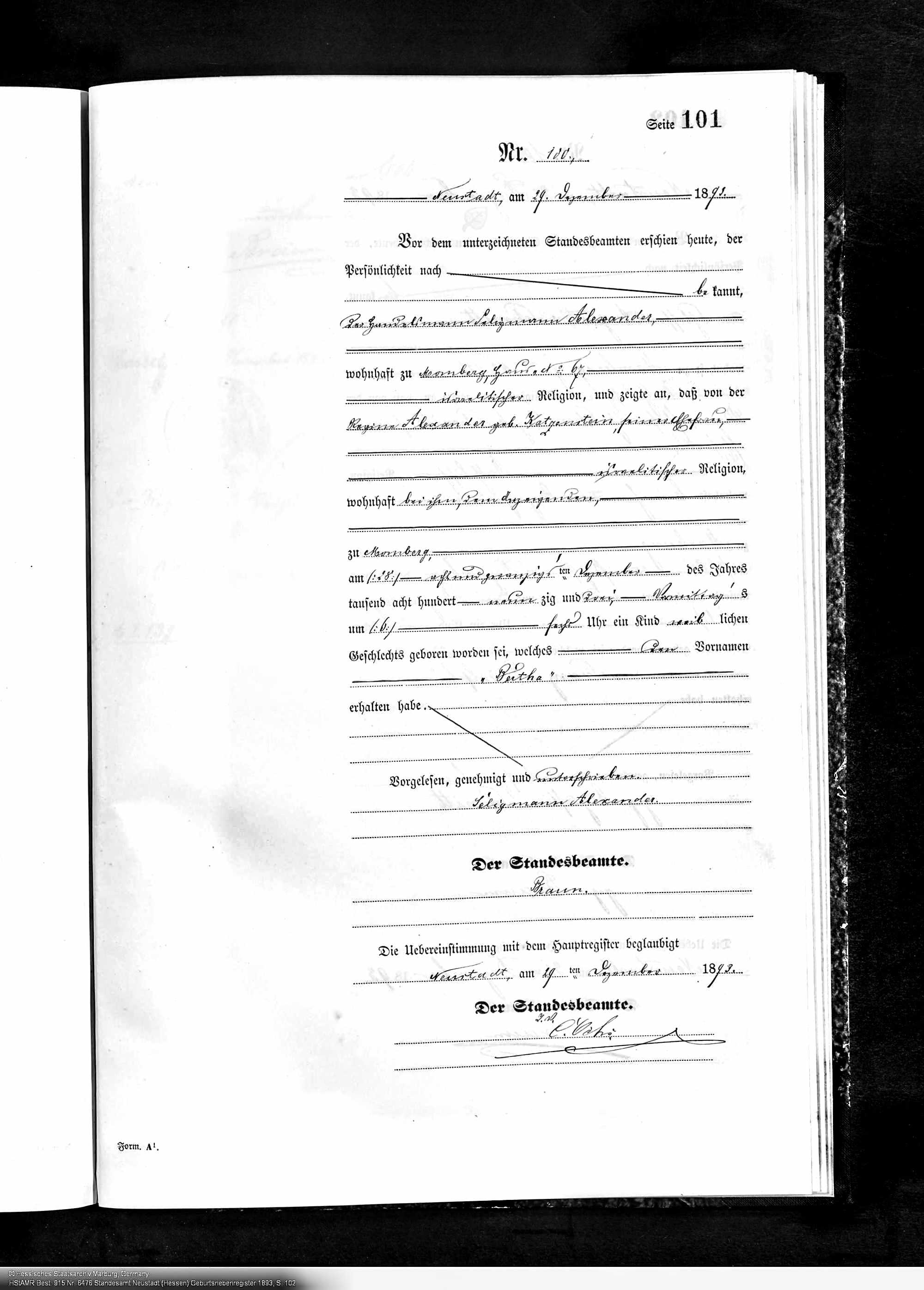
Less than a year later, Regina gave birth to Bertha on December 28, 1893, in Momberg.

Bertha Alexander birth record
Hessisches Hauptstaatsarchiv; Wiesbaden, Deutschland; Collection: Personenstandsregister Geburtsregister; Signatur: 915; Laufende Nummer: 6476

Regina and Selig’s third child was Rosa. She was born in Momberg on January 18, 1896.

Rosa Alexander birth record
Hessisches Hauptstaatsarchiv; Wiesbaden, Deutschland; Collection: Personenstandsregister Geburtsregister; Signatur: 915; Laufende Nummer: 6479

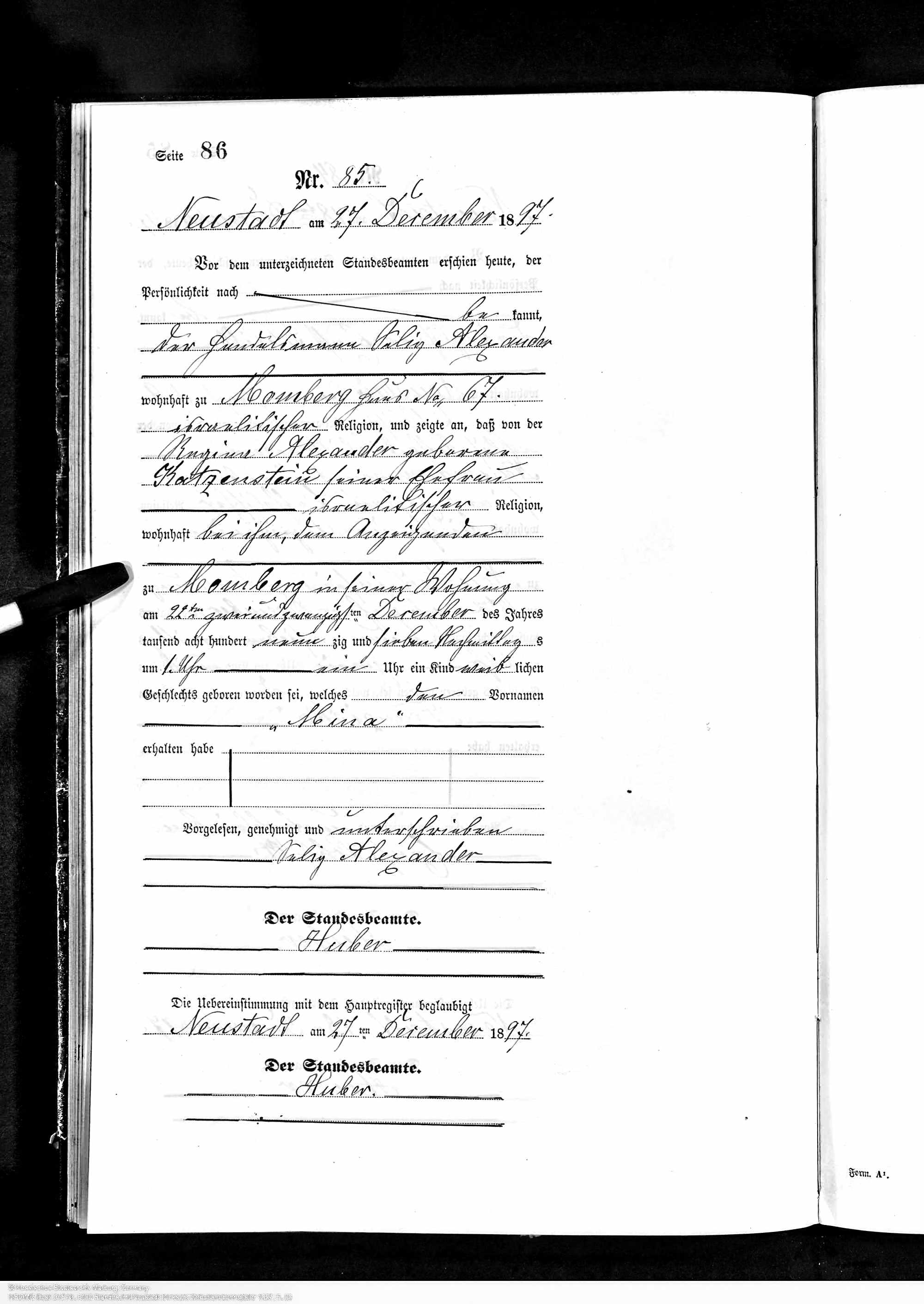
Almost two years after Rosa’s birth, on December 22, 1897, Regina gave birth to her fourth child, Mina, named for Regina’s mother Mina Katzenstein, who had died on September 5, 1896.

Mina Alexander birth record
Hessisches Hauptstaatsarchiv; Wiesbaden, Deutschland; Collection: Personenstandsregister Geburtsregister; Signatur: 915; Laufende Nummer: 6480

After giving birth to Mina, Regina and Selig lost two sons in infancy. Little Joseph Alexander lived only thirteen days, dying on January 24, 1902. His brother Manus lived for two months, dying on March 23, 1903.

Joseph Alexander death record
Hessisches Hauptstaatsarchiv; Wiesbaden, Deutschland; Personenstandsregister Sterberegister; Bestand: 915; Laufende Nummer: 6569

Manus Alexander death record
Hessisches Hauptstaatsarchiv; Wiesbaden, Deutschland; Personenstandsregister Sterberegister; Bestand: 915; Laufende Nummer: 6570

The seventh and last child I have for Regina Katzenstein and Selig Alexander was a son named Samuel, born January 1, 1906, according to a source provided by Barbara Greve, Barbara Haendler-Lachmann’s Schicksale der Juden im alten Landkreis Marburg 1933-1945, Hitzeroth, Marburg 1992, p. 125. Without Barbara Greve’s help, I never would have known about this seventh child as there was no available birth record for him online.

Thus, of the seven children born to Regina and Selig Alexander, only Bertha, Rosa, Mina, and Samuel lived to adulthood.

In many ways the two Katzenstein sisters were following similar paths at the same time, Rebekka in Jesberg, Regina in Momberg, fifteen miles apart. Their lives became even more intertwined on August 21, 1923, when Rebekka’s son Jakob married Regina’s daughter Rosa.

Marriage record of Rosa Alexander and Jakob Katz
Hessisches Hauptstaatsarchiv; Wiesbaden, Deutschland; Collection: Personenstandsregister Heiratsregister; Signatur: 915; Laufende Nummer: 6208

That is, Rosa Alexander married her first cousin, Jakob Katz. They had three daughters who were not only sisters but also second cousins to each other. Rebekka and Regina shared granddaughters who were also their great-nieces. Remember also that Rebekka and her husband Salomon Kneibel were also cousins to each other, so Salomon Kneibel was not only his children’s father but also their cousin and the same for Rebekka.

As for Rebekka and Regina’s other children, they made my life easier by marrying outside of the family.

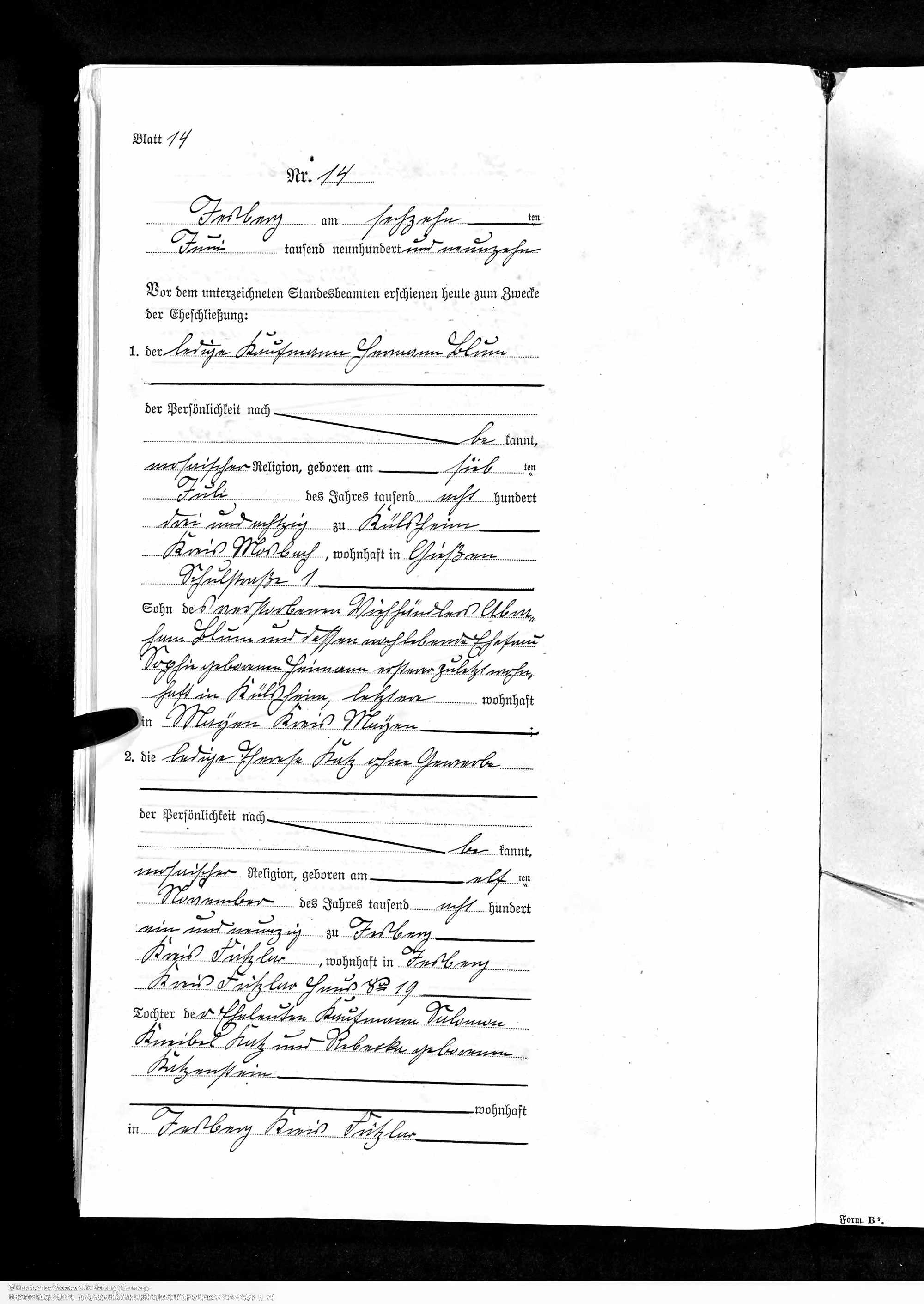
The first to marry was Rebekka’s daughter Therese. On June 16, 1919, she married Hermann Blum, who was born in Kuelsheim on July 7, 1883, son of Abraham and Sophie Blum. I have not been able to identify any children born to Therese and Hermann.

Hessisches Hauptstaatsarchiv; Wiesbaden, Deutschland; Collection: Personenstandsregister Heiratsregister; Signatur: 920; Laufende Nummer: 3872

Rebekka’s oldest son Berthold married Ida Blumenstiel on January 20, 1920. Ida was the daughter of Hugo Blumenstiel and Bertha Weinberg of Mansbach, Germany. She was born July 9, 1893.

Marriage record of Berthold Katz and Ida Blumenstiel
Hessisches Hauptstaatsarchiv; Wiesbaden, Deutschland; Standesamt Hersfeld, Bad Heiratsnebenregister 1920, Eintrags-Nr. 1 – 78; Collection: Personenstandsregister Heiratsregister; Signatur: 907

Berthold and Ida would have two children born in the 1920s, Senta (1921) and Ludwig (1924).

I have not found any marriage record for Rebekka’s son Julius, and, as discussed above, her son Jakob married his cousin Rosa on August 21, 1923, and they had three daughters.

As for Regina’s children, Bertha Alexander married Julius Simon on June 26, 1922, in Momberg. He was the son of Moses Simon and Fanni Katz and was born in Pohl-Goens on May 29, 1891.

Marriage record of Bertha Alexander and Julius Simon
Hessisches Hauptstaatsarchiv; Wiesbaden, Deutschland; Collection: Personenstandsregister Heiratsregister; Signatur: 915; Laufende Nummer: 6207

I have not been able to locate any record of children born to Bertha and Julius, nor do I have any records for them after their marriage, but I am still looking. Thank you to Aaron Knappstein for finding this photograph of Julius Simon on the Vor dem Holocaust – Fotos zum jüdischen Alltagsleben in Hessen website. According to the website, this was taken in 1916 when Julius was a soldier in the Germany army during World War I.

I am still hoping to locate some records that will reveal what happened to Julius Simon and Bertha Alexander.

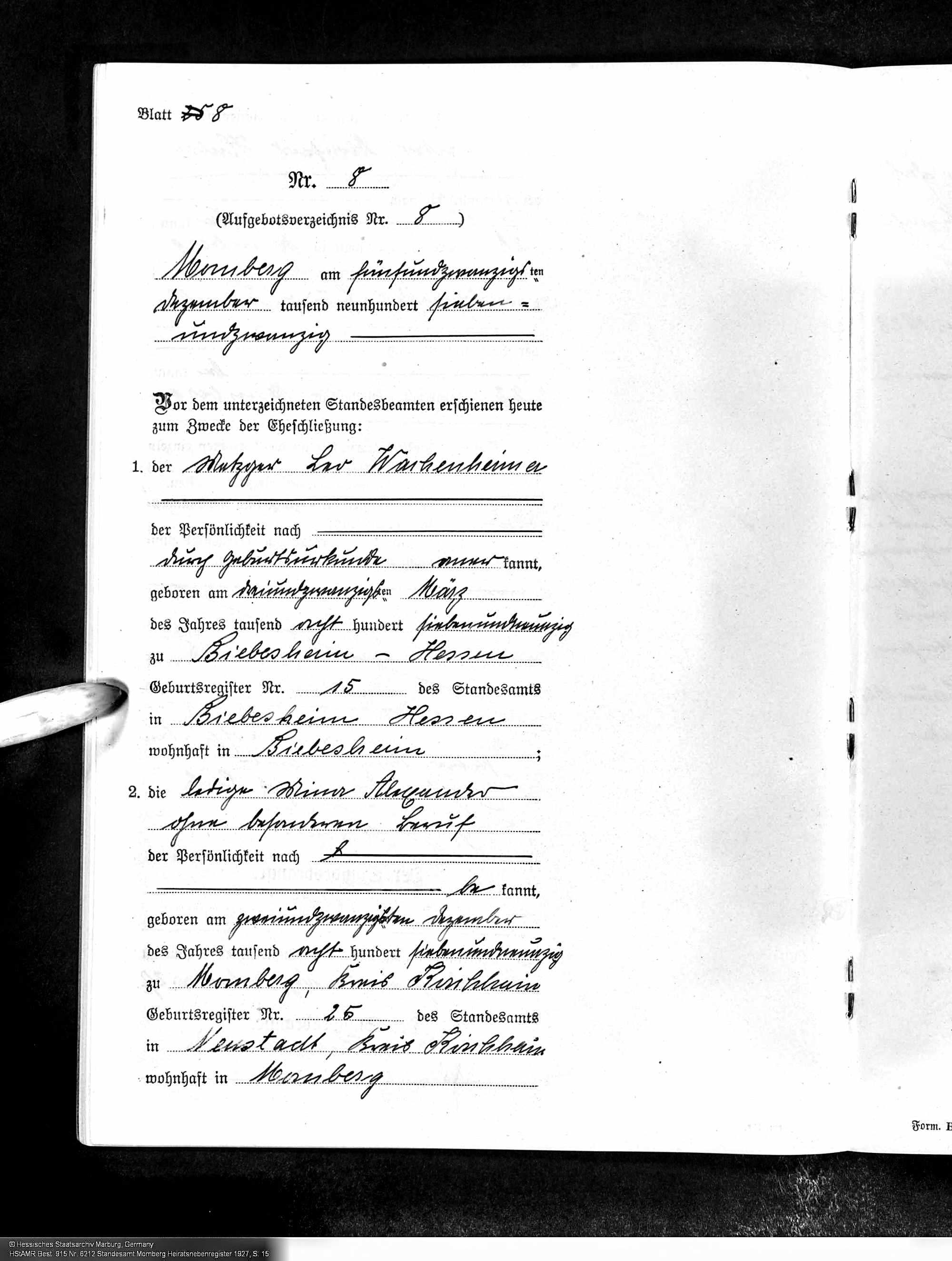
Bertha’s younger sister Rosa Alexander married Jakob Katz, as discussed above. The third sister Mina Alexander married Leo Wachenheimer in Momberg on December 25, 1927. Leo was the son of Meier Wachenheimer and Klara Rothschild; he was born on March 23, 1897, in Biebesheim, Germany. Mina and Leo would have two children.

Marriage record of Mina Alexander and Leo Wacheneimer
Hessisches Hauptstaatsarchiv; Wiesbaden, Deutschland; Collection: Personenstandsregister Heiratsregister; Signatur: 915; Laufende Nummer: 6212

According to Barbara Greve, Regina and Seligmann’s only surviving son, Samuel, married Lottie Weiler in July 1933; Lottie was born in Marburg on January 10, 1913, according to the JOWBR. I do not have names for her parents. Samuel and Lottie had one son, Hans-Joseph Alexander, according to Barbara Greve.

Rebekka Katzenstein Katz died in Jesberg on March 2, 1927; she was only 61 years old. Her husband Salomon Scholum Kneibel Katz died two years later on May 2, 1929.  He was 69.

Death record of Rebekka Katzenstein Katz
Hessisches Hauptstaatsarchiv; Wiesbaden, Deutschland; Personenstandsregister Sterberegister; Bestand: 920; Laufende Nummer: 3918

Here is the photograph I took in the Jesberg cemetery of Rebekka’s grave long before I knew the whole story of their family; sadly, I do not have a photograph of her husband’s gravestone:

The rest of the families of Rebekka and Regina Katzenstein survived into the Nazi era, and it appears that every single one of them left Germany in time—all of Rebekka and Salomon Kneibel’s children and spouses and grandchildren as well as Regina Katzenstein and Selig Alexander and at least three of their four children and spouses and grandchildren. The only couple I’ve been unable to find in any later record or index are Regina’s daughter Bertha and her husband Julius Simon.

Almost all the rest of the families of Rebekka Katzenstein and her sister Regina Katzenstein ended up in Johannesburg, South Africa. Unfortunately, I don’t have any actual records or documents that reveal when the family arrived there or any other information aside from their deaths and burials.

But I was fortunate to connect with John Leach, a relative by marriage of Leo Wachenheimer, husband of Mina Alexander. From John I learned that Leo had been a cattle dealer in Germany and had also worked in his father’s kosher butcher business. Leo was arrested by the Nazis in 1935 for doing business with a non-Jew; when he was released, he escaped from Germany to South Africa, where he opened a kosher butcher shop. Soon many family members followed him, including his wife Mina and their children, his in-laws Regina and Selig Alexander, his sister-in-law Rosa Alexander Katz and her husband Jakob Katz and their three children, and Jakob Katz’s sister Therese Katz and her husband Hermann Blum and Jakob’s brother Julius Katz. They all appear to have spent the rest of their lives in Johannesburg.

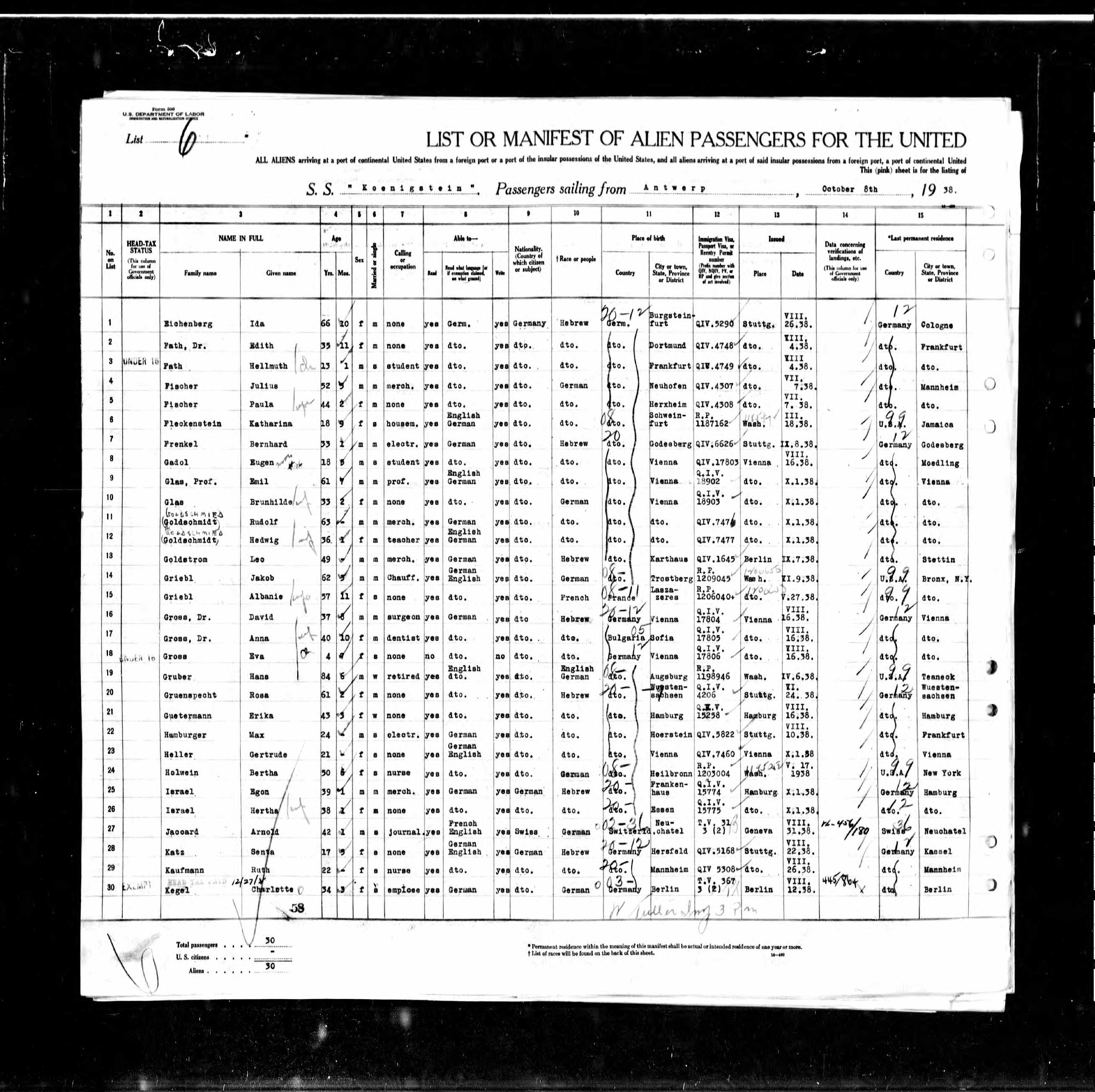
The only descendants of Rebekka or Regina who did not go to South Africa were Rebekka’s son Berthold and his wife Ida and their children, Senta and Ludwig. Instead, they went to the United States. Their daughter Senta arrived first on October 8, 1938, and Berthold, Ida, Ludwig, and Ida’s mother Bertha Blumenstiel arrived on November 25, 1938; they were all going to a cousin, Leo Katzmann in the Bronx:

Senta Katz 1938 passenger manifest
Year: 1938; Arrival: New York, New York; Microfilm Serial: T715, 1897-1957; Microfilm Roll: Roll 6238; Line: 1; Page Number: 176
Ancestry.com. New York, Passenger Lists, 1820-1957

Berthold Katz and family passenger manifest
Year: 1938; Arrival: New York, New York; Microfilm Serial: T715, 1897-1957; Microfilm Roll: Roll 6254; Line: 1; Page Number: 68
Ancestry.com. New York, Passenger Lists, 1820-1957

By 1940, they had settled in Philadelphia where Berthold was working as a salesman for a paper bag company and Senta was working as a packer for a children’s dress company. Bertha’s mother-in-law Bertha Blumenstiel was also living with them.

Berthold Katz and family 1940 US census
Year: 1940; Census Place: Philadelphia, Philadelphia, Pennsylvania; Roll: T627_3733; Page: 1A; Enumeration District: 51-1446

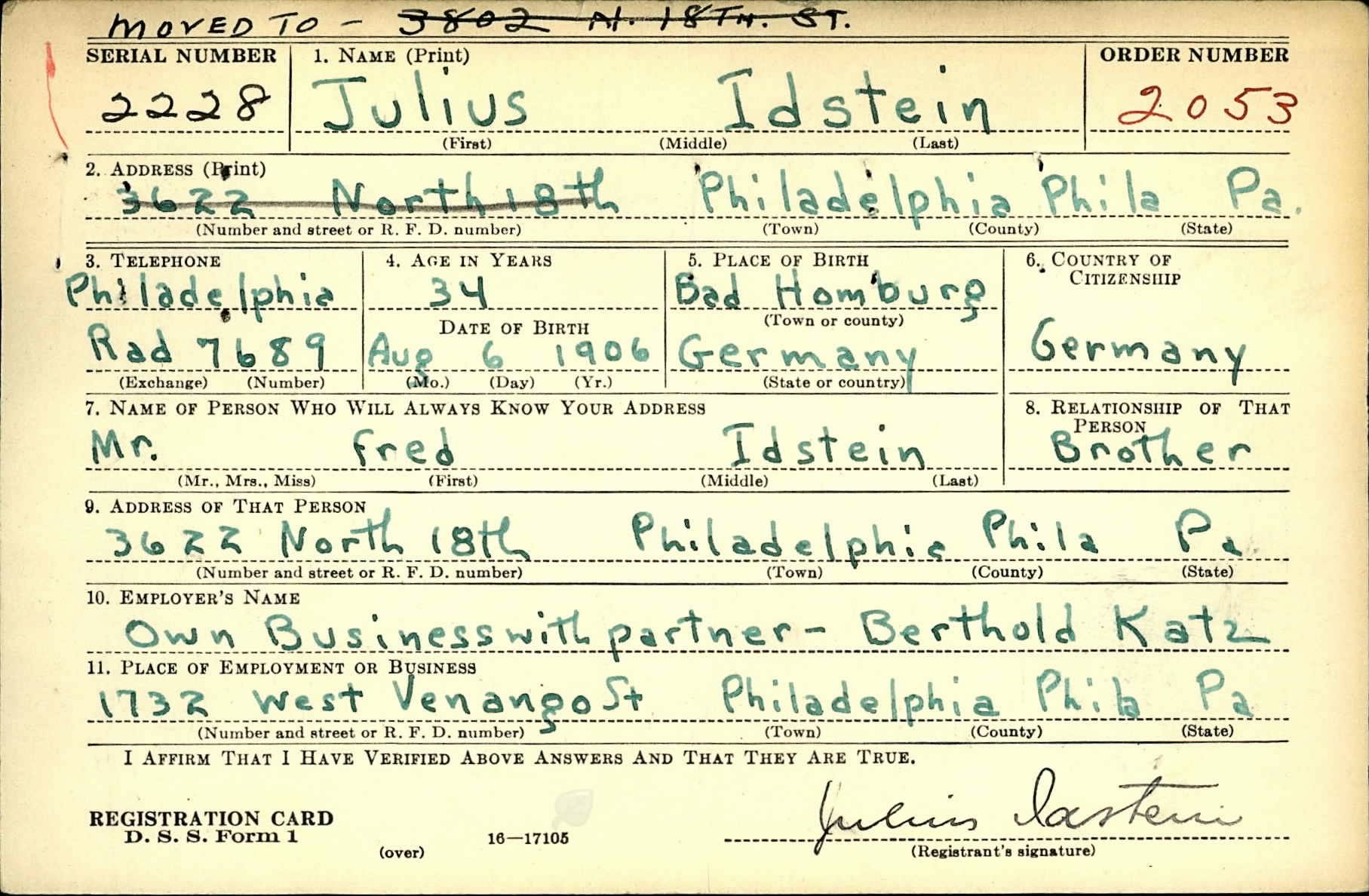
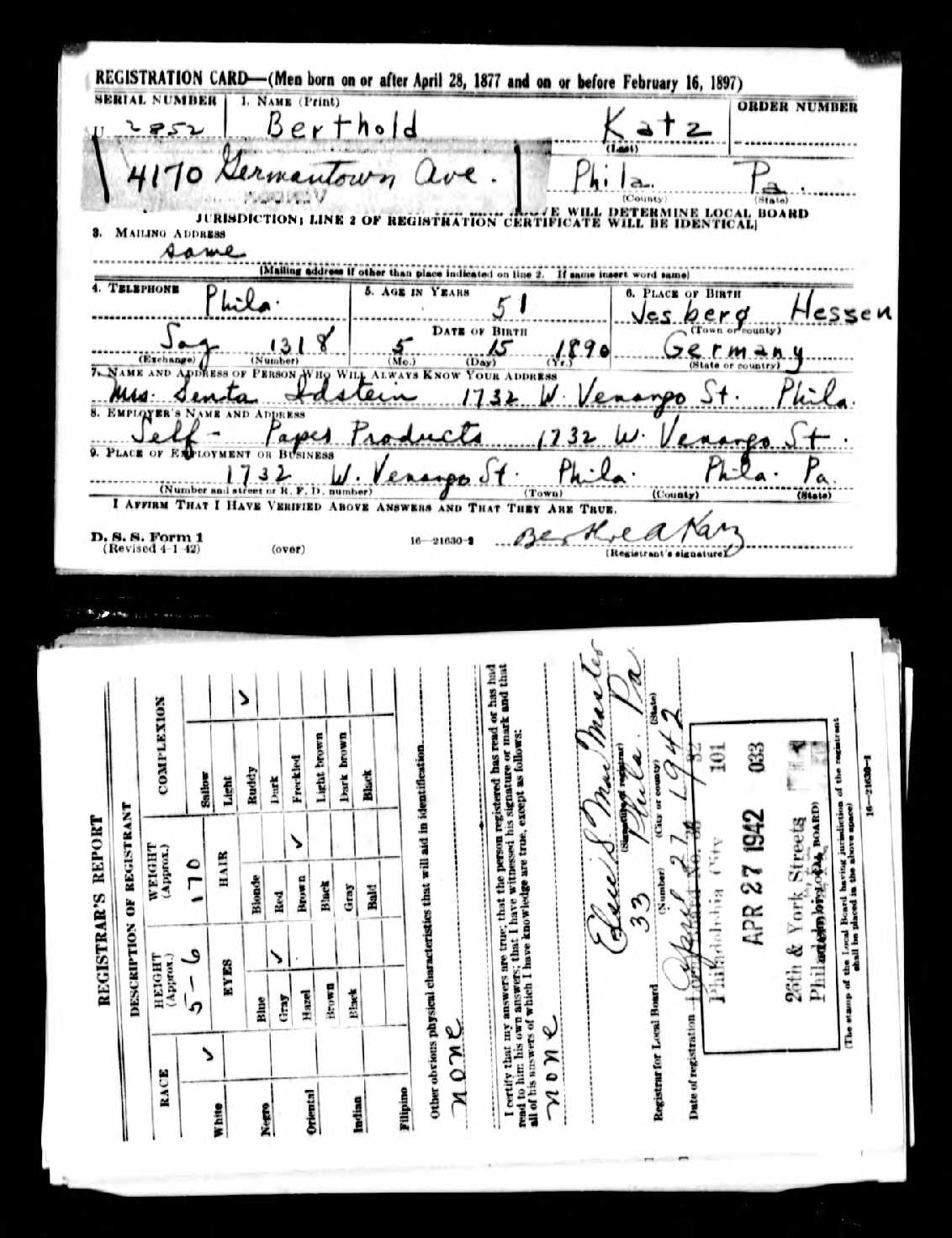
That same year Senta married Julius Idstein, who was also a refugee from Germany. (Philadelphia, Pennsylvania, Marriage Index, 1885-1951)  Julius was born on August 6, 1906, in Bad Homburg, and came to the United States on October 20, 1938. On his World War II draft registration, he reported that he was a partner in business with Berthold Katz, his father-in-law. On Berthold’s registration, he reported that he owned a paper products business. So between his arrival in 1938 and 1942, Berthold had become a business owner in partnership with his son-in-law Julius.

Julius Idstein World War II draft registration
Selective Service Registration Cards, World War II: Multiple Registrations

World War II draft registration for Berthold Katz
The National Archives at St. Louis; St. Louis, Missouri; World War II draft cards (Fourth Registration) for the State of Pennsylvania; Record Group Title: Records of the Selective Service System, 1926-1975; Record Group Number: 147; Series Number: M1951

Sadly, Berthold’s wife Ida died at age 48 of liver cancer on December 29, 1941.

Ida Blumenstiel Katz death certificate
Pennsylvania Historic and Museum Commission; Pennsylvania, USA; Certificate Number Range: 109451-112000

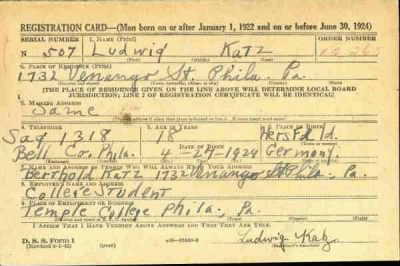
Their son Ludwig was in college at Temple College (now Temple University) in Philadelphia in 1942:

Ludwig Katz World War II draft registration
Selective Service Registration Cards, World War II: Multiple Registrations

In 1943, Berthold remarried; his second wife was Betty Nussbaum, and she also was a German native, born in Mansbach on February 4, 1893. She had come to the US in 1925 on her own; her parents stayed behind where her mother died in 1939 and her father died in the Theriesenstadt concentration camp in 1942. (Philadelphia, Pennsylvania, Marriage Index, 1885-1951)

Berthold died from stomach cancer on March 5, 1959; he was 68 years old; his second wife Betty died in 1977:

Berthold Katz death certificate
Pennsylvania Historic and Museum Commission; Pennsylvania, USA; Certificate Number Range: 026551-029250

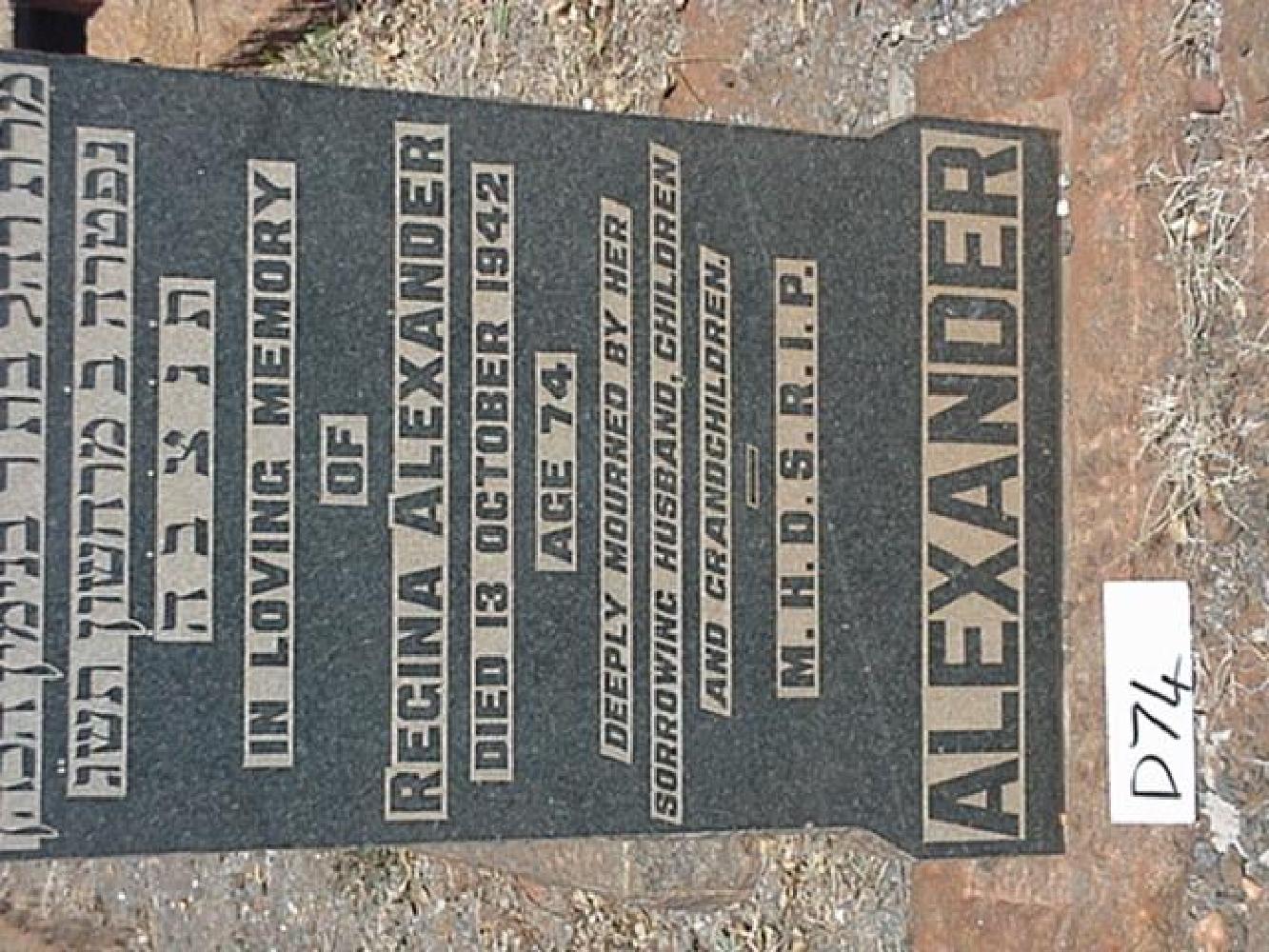
Meanwhile, Berthold’s siblings and first cousins and aunt and uncle were all living in South Africa.  His aunt Regina Katzenstein Alexander died on October 14, 1942, and her husband Selig Alexander died on May 5, 1949; they are buried at West Park Cemetery in Johannesburg. (JewishGen Online World Burial Registry (JOWBR)). Charmaine Rosenberg of the Johannesburg Chevra Kadisha kindly sent me the following photograph of Regina’s headstone:

Headstone of Regina Katzenstein Alexander

Berthold’s daughter Senta and her husband Julius Idstein had five children. Julius died in 1981, and Senta lived until 2003. She was 82 when she died.

Berthold’s son Ludwig became a nuclear physicist and was a senior scientist for Visidyne, Inc. in Burlington, Massachusetts, when he was killed in a car accident on March 18, 1981. He was 57 years old and was survived by his wife and two children. “Ludwig Katz, Swampscott,” Boston Herald (March 25, 1981), p. 40.

As for the family in South Africa, I have no information other than their dates of death and burial place. All those named below are, like Regina Katzenstein and Selig Alexander, buried at the West Park Cemetery in Johannesburg, and all this information comes from the JOWBR on Jewishgen.org and from Charmaine Rosenberg of the Chevra Kadisha in Johannesburg. I am very grateful to Charmaine for providing me with these photographs of the headstones.

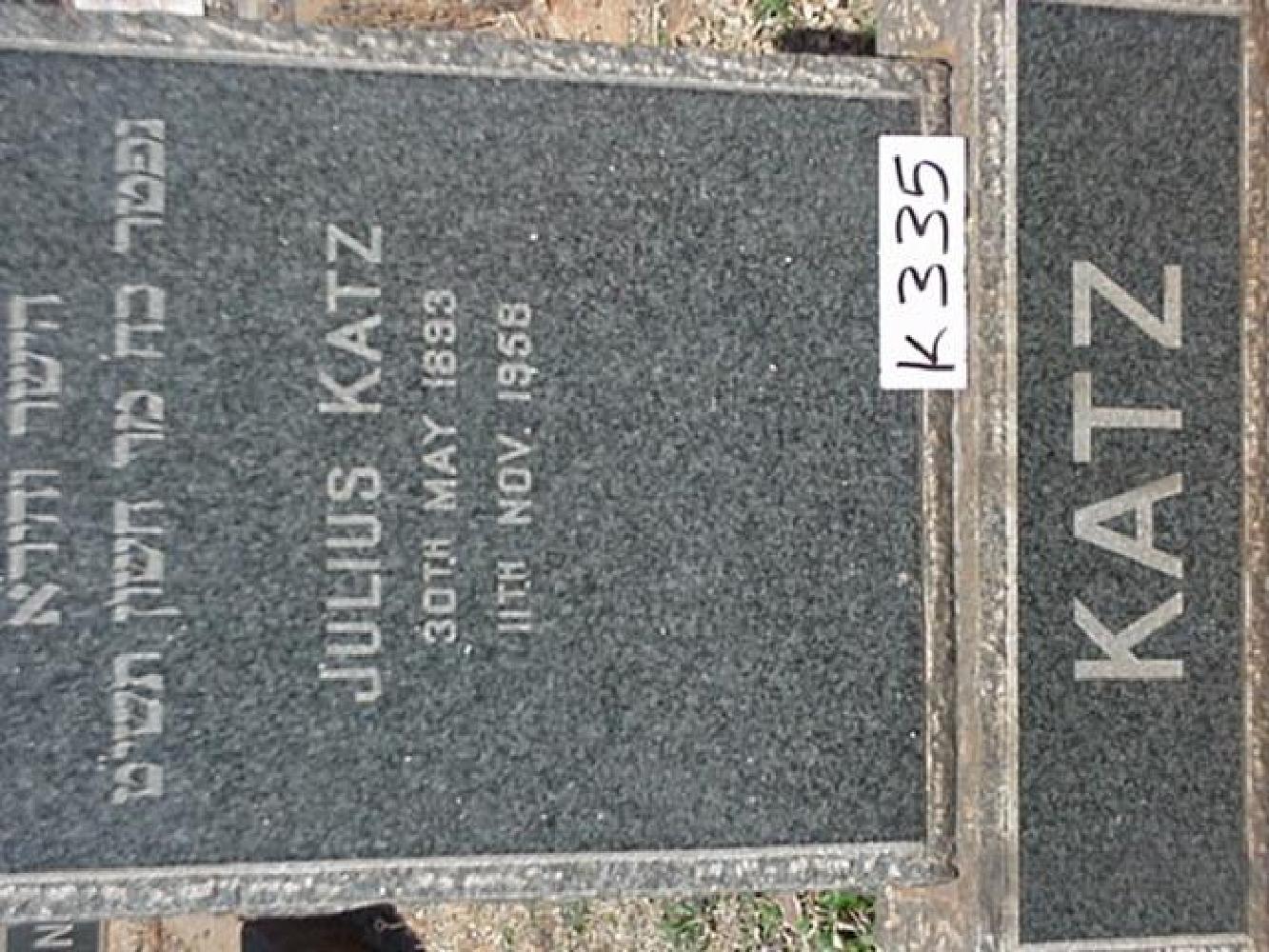
Julius Katz died on November 11, 1958, when he was 65. As far as I know, he never married or had children.

Headstone of Julius Katz

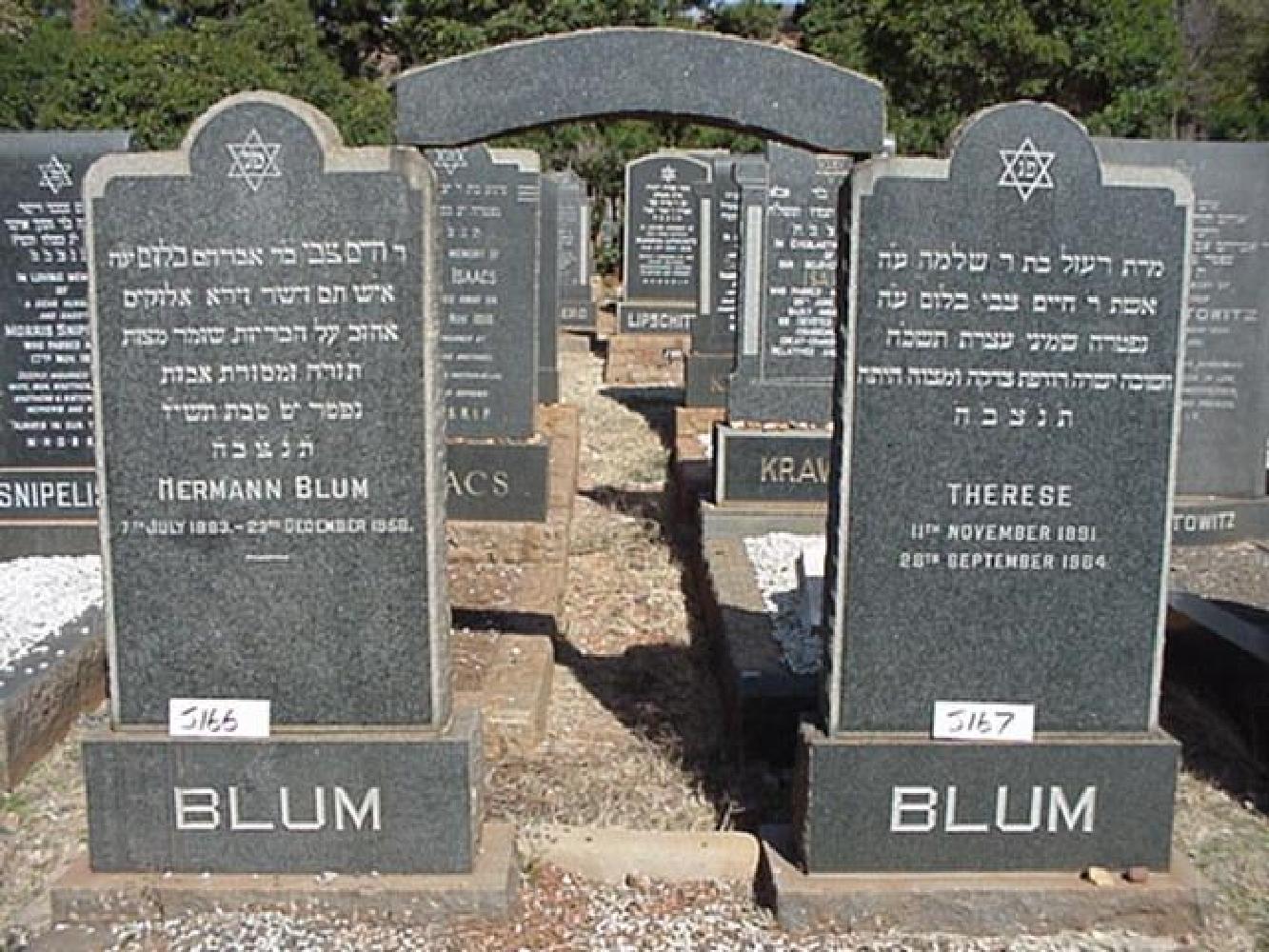
Therese Katz died on September 28, 1964, eight years after her husband Hermann Blum, who died on December 23, 1956. She was 73, he was also 73 when he died. As far as I have been able to determine, they did not have children.

Headstone of Therese Katz Blum and Hermann Blum

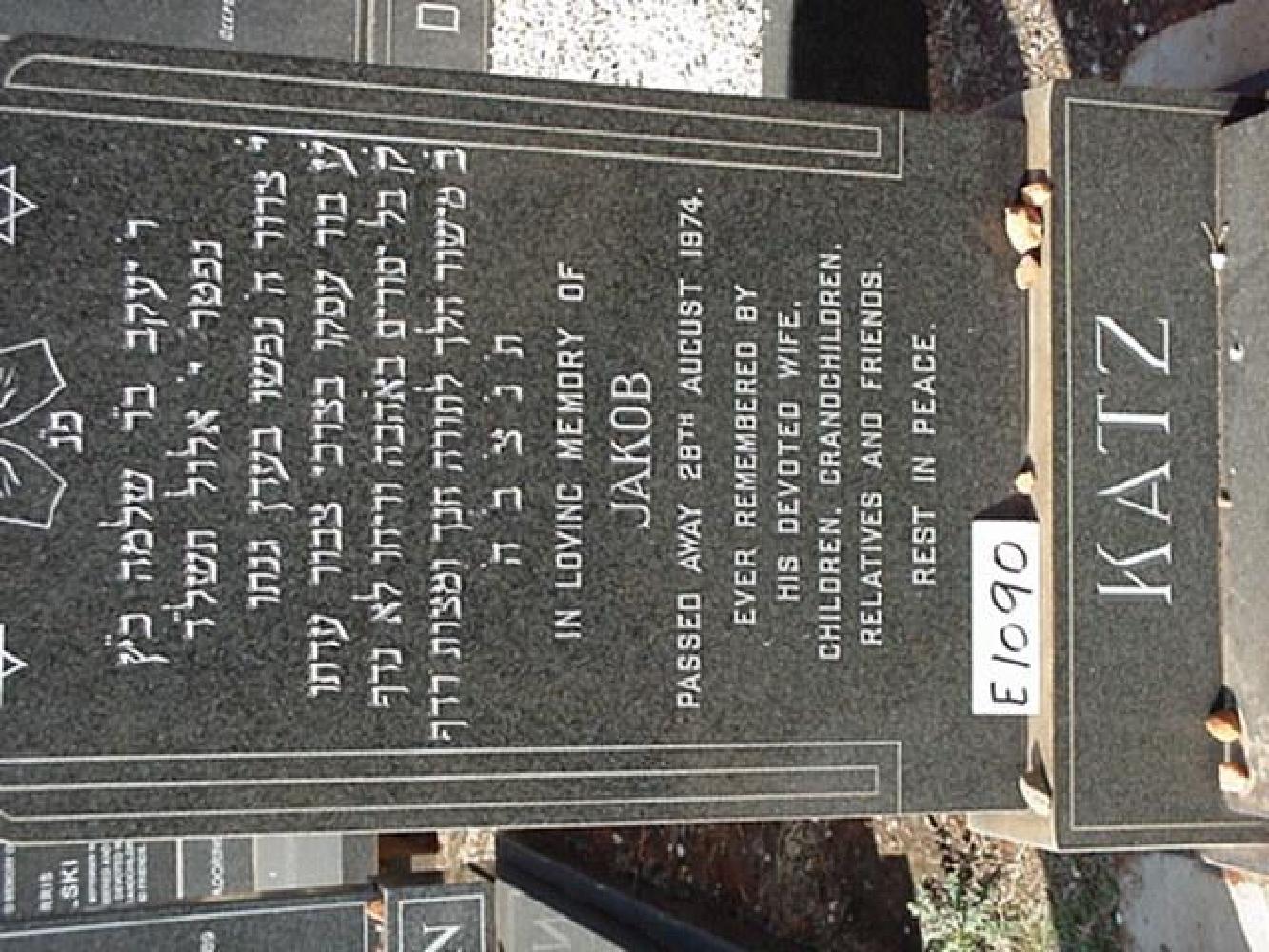
Jakob Katz died on August 24, 1974; he was 79. His wife and first cousin Rosa Alexander Katz outlived him by 23 years. She was almost 101 when she died on June 14, 1997.

Headstone of Jakob Katz

Rosa’s sister Mina Alexander Wachenheimer also outlived her husband by many years. Leo Wachenheimer died on January 23, 1969, when he was 72. Mina survived him by over twenty years, dying on December 23, 1989, when she was 92.

Headstone of Mina (Minna) Alexander Wachenheimer

Headstone of Leo Wachenheimer

Samuel Alexander died on June 21, 1989; he was 83. He had outlived his wife Lotte by seventeen years; she died on January 11, 1972, when she was 59.

Overall, the children of both Rebekka and Regina Katzenstein, daughters of Mina Katzenstein and Wolf Katzenstein, were fortunate to escape from Nazi Germany when they did. Perhaps Leo Wachenheimer’s arrest in 1935 was the key that opened the door to the survival of all of them.


Some Questions Answered and More Raised: Which Manus Katzenstein Killed the Pig?

This is an update on my prior post today about Manus Katzenstein and his wife Fanny Bickhardt. A huge thank you to Aaron Knappstein and Jennifer Sanders Stern who both sent me this website about the Vohl Synagogue, a website I had not found while researching the Frankenau Katzenstein family. The website includes a detailed report on the Jews of Frankenau. Not only does it provide more information about Manus Katzenstein, but it also shed new light on his father, Wolf Katzenstein.

First, with respect to Wolf Katzenstein, husband of my cousin Mina Katzenstein, I learned that he was one of the leaders of the Jewish community in Frankenau who helped plan the construction of the synagogue there in 1862.  In 1869, the teacher at the Jewish school had moved away, and eighteen Jewish children began to attend the Protestant school where the teachers were charging seven Silbergroschen per child. Wolf, as a community leader, protested this, pointing out that the teachers were already being paid by the state, not by the families. By June 1870, a new Jewish teacher had moved to Frankenau. The Vohl synagogue site goes on to describe Wolf’s continuing actions advocating on behalf of the education of the students both in the Jewish school and in the Protestant school which some of the Jewish girls attended in the 1870s. One author described Wolf as a very stubborn man.

Wolf was considered a wealthy man; in 1870 he owned a factory and a grocery store as well as a house and barn on seven acres of land. The site reports that in 1870 there were seven people in his family, including three school age children. That is consistent with my research; in 1870 Mina and Wolf had five children, three of whom were old enough to be attending school.[1]

Regarding Wolf’s son Manus, the Vohl synagogue website also is very informative, but more confusing. First, it’s important to point out that there were two men (first cousins) of almost the same age named Manus Katzenstein in Frankenau; my Manus, son of Wolf, was born in 1863, the other Manus, son of Heinemann, was born in 1864. One or the other of the men named Manus Katzenstein got in trouble for “illegally slaughtering a pig on a Sunday.” This entry appears on the page of both men named Manus Katzenstein with the note that it is not clear which Manus Katzenstein was so charged. Some might ask why was Jewish man killing a pig? For a Christian neighbor, perhaps? At any rate, apparently Manus (whichever one it was) had the mayor’s permission, and even after the prosecutor warned the mayor against doing so in the future, it appears nothing happened to Manus.

By Adriaen van Ostade (Holland, Haarlem, 1610-1685) [Public domain], via Wikimedia Commons

The other area of confusion regarding these two men named Manus is more important.  The website reports that Manus Katzenstein (1863, my Manus) applied for tax relief in 1896 because his son Manus was “nervous” and required expensive care. A footnote to this comment notes that it is not clear whether this child was the son of my Manus Katzenstein (1863) or the other Manus Katzenstein (1864). In any event, it does seem odd that either one would have a son with the same first name as his own father.

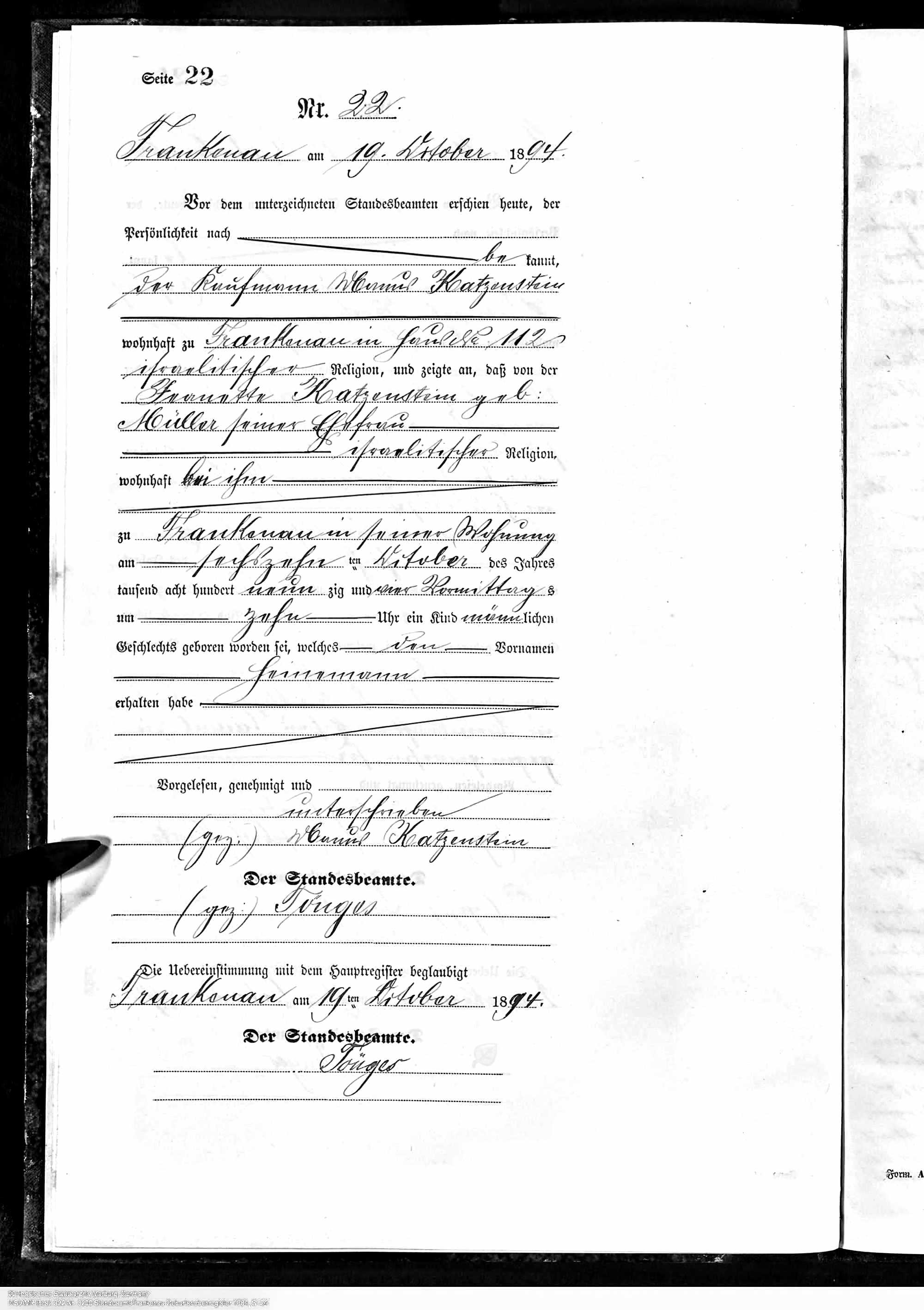
The page for the other Manus Katzenstein (1864) reports that he was married to Jeanette Mueller with whom he had four or five children born between 1900 and 1905, but none named Manus. However, Manus Katzenstein (1864) married Jeanette Mueller on October 5, 1892, and they had a son named Heinemann (for Manus’s father), born on October 16, 1894, and a daughter named Johanna who died when she was three months old on December 23, 1898. These two children are not listed on the Vohl Synagogue website page for Manus (1864).

Birth record of Heinemann Katzenstein, son of Manus Katzenstein (1864) and Jeannette Mueller
Hessisches Hauptstaatsarchiv; Wiesbaden, Deutschland; Standesamt Frankenau Geburtsnebenregister 1894 (Hstamr Best. 922 Nr. 3200); Collection: Personenstandsregister Geburtsregister; Signatur: 922

My theory? Heinemann, born in 1894, was the child who needed medical care for nervousness in 1896. Or perhaps there was another son born before 1896 who needed that care. At any rate, I believe that the child who needed medical care was a child of the other Manus (1864), not my Manus (1863). Heinemann Katzenstein is the only child with the Katzenstein surname born in Frankenau between 1890 and 1900 listed in the Hesse, Germany, Births, 1851-1901 database on Ancestry. I believe this was the child named “Manus” referred to on the Vohl Synagogue website.

One other reason for my conclusion? This page from the Alemannia-Judaica about Frankenau reports on the Jewish families left in Frankenau in 1933; it lists my Manus Katzenstein and his wife Fanny without children. The other Manus is not listed at all, but he had died in 1931, and his children might have left the community by the time this report was made on the Jews in Frankenau. (Thank you to Eran Elijahu of the German Genealogy group for sending me the link to this page.)

At any rate, despite this confusion, which led me down the research rabbit hole today, the Vohl Synagogue page for my Manus Katzenstein (1863) did answer some of the questions that had been left unanswered in my prior post. According to the Vohl Synagogue website, Manus and Fanny moved to Momberg on July 29, 1933, where they lived until January 1, 1940, when they moved to a “retirement home” in Frankfurt. I still don’t know whether that last move was voluntary or required by the Nazis as a preparation for the later deportation of elderly Jews. As stated in my earlier post, Manus died in the Jewish community hospital in Frankfurt on October 15, 1941, and his wife Fanny was deported to Theriesenstadt on September 1, 1942, and died or was killed there on April 15, 1943.

UPDATE: I just received this morning from Barbara Greve these photographs of Manus Katzenstein and Fanny Birkhardt Katzenstein from Barbara Händler-Lachmann’s book, “unbekannt verzogen” oder “weggemacht”.Hitzeroth, Marburg 1992, p 131:

manus-and-fanny-katzenstein-from-b-greve-10-23-17.jpg

Manus and Fanny Katzenstei

Barbara Greve also filled me in a bit about why Manus and Fanny might have left Momberg for Frankfurt in 1940.  She said that Manny and Fanny might have wanted to emigrate, but it would have been very difficult for them to get visas at that point in time, especially given their ages and more so if they lacked funds or were in poor health.  Barbara said that the Jewish home for the elderly in Frankfurt was run at first by the Jewish community as a place for older people leaving the smaller villages in Hesse, many of whom hoped to emigrate and follow their children out of the country. Those who ran the home tried to make it a comfortable place for those living there, but it was overcrowded. Eventually, however, it became a place where the Nazis ordered elderly Jews to go as they forced them out of their homes in other places. (Email from Barbara Greve, October 23, 2017)


____

[1] The source for much of the information about Wolf Katzenstein came from a book by Heinz Brandt, Die Judengemeinde Frankenau zwischen 1660 und 1940. Aus dem Leben jüdischer Landmenschen. Frankenberger Hefte Nr. 1, 1992.  I have just ordered the book; it should be quite a challenge to read with my elementary level of German.

A Story Left Unfinished

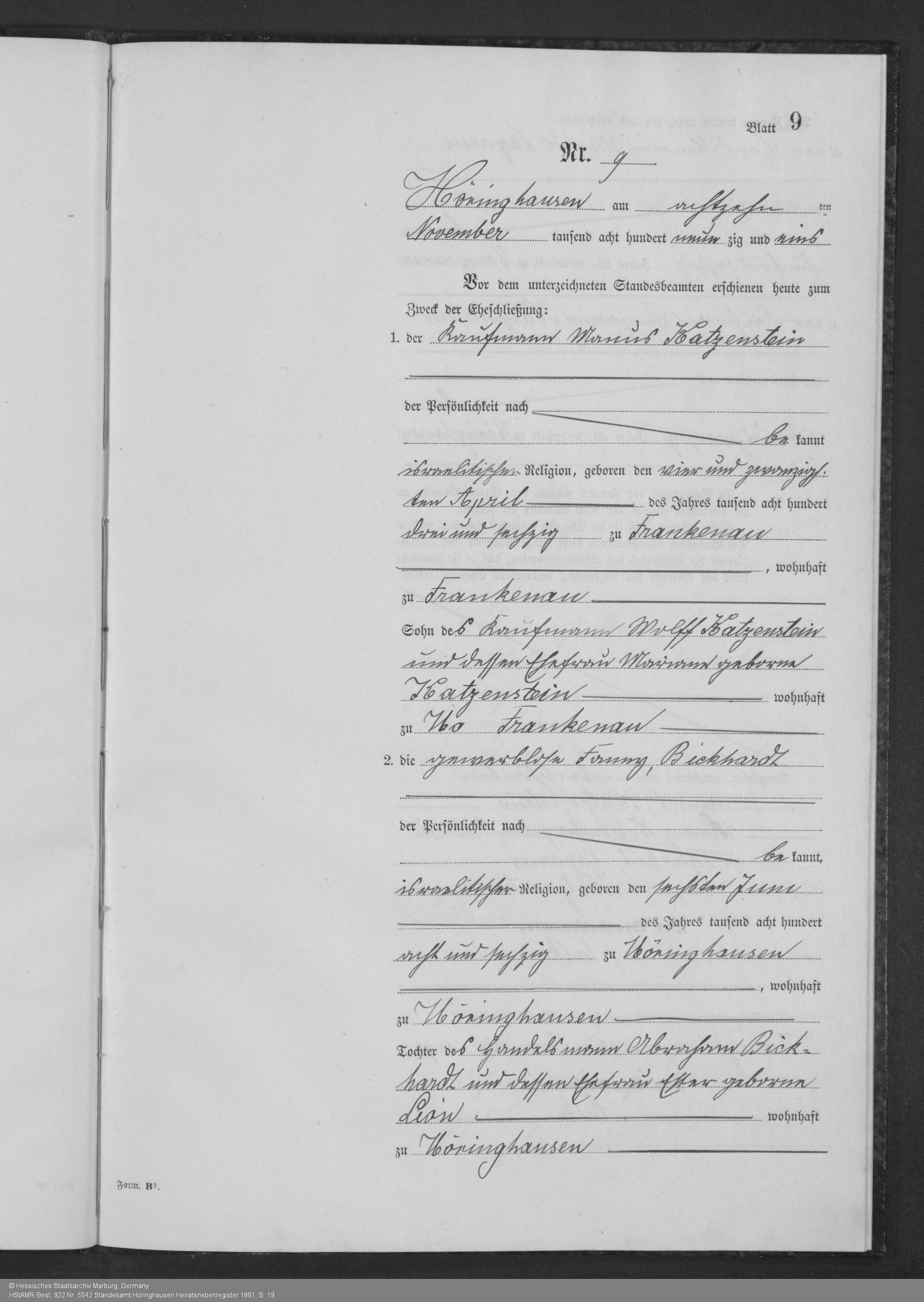
Mina Katzenstein and Wolf Katzenstein had only one son, their middle child, Manus, who was born in Frankenau on April 23, 1863.

Birth record of Manus Katzenstein
Standesamt Höringhausen Heiratsnebenregister 1891 (HStAMR Best. 922 Nr. 5542)AutorHessisches Staatsarchiv MarburgErscheinungsortHöringhausen, p. 19

I have nothing more than the bare facts for Manus: birth, marriage, and death. He married Fanny Bickhardt on November 18, 1891, in Hoeringhausen, Germany.  Fanny was born on June 6, 1868, in Hoeringhausen.  She was the daughter of Abraham Bickhardt and Esther Lion.

Marriage record of Manus Katzenstein and Fanny Bickhardt
HStAMR Best. 922 Nr. 5542 Standesamt Höringhausen Heiratsnebenregister 1891, S. 19

I was not able to locate any children born to Manus and Fanny.  I searched the birth registers for Frankenau, Hoeringhausen, and Momberg, but found nothing. The only other residence I found for Manus and Fanny was Frankfurt, but that was in 1941, long after they would have had children. If they’d moved to Frankfurt early in their marriage and had children there, I was not able to find any such children.

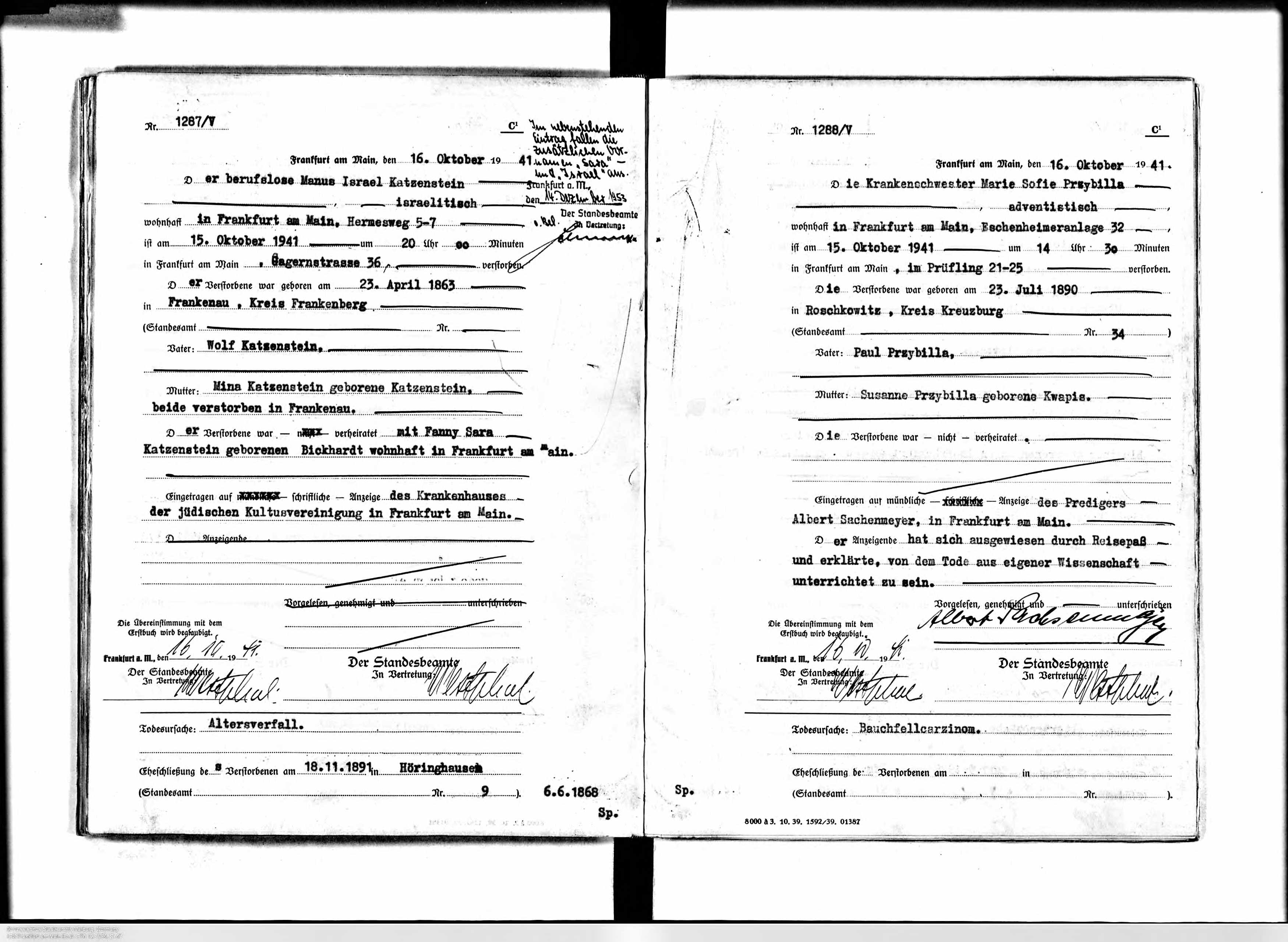
In fact, I could not find any information about either Manus or Fanny between their marriage in 1891 and their deaths. Manus Katzenstein died on October 15, 1941, of Altersverfall—old age. He was without occupation at the time of his death and was living with his wife Fanny in Frankfurt. It appears that he died at the Jewish community hospital in Frankfurt. Notice that both Manus and Fanny had been assigned the middle names used by the Nazis to identify someone as Jewish—-Israel for Manus and Sara for Fanny.

Manus Katzenstein death record
Hessisches Hauptstaatsarchiv; Wiesbaden, Deutschland; Personenstandsregister Sterberegister; Bestand: 903; Signatur: 903_11127

I wish I knew how and why and when Manus and Fanny had ended up in Frankfurt.  Had they moved there of their own free will before the Nazis came to power or even afterwards? Or had they been deported there? Did Manus really die from old age (he was 78 years old), or had he been mistreated and died from abuse, neglect, torture, or worse? I don’t know.

What I do know from the Yad Vashem database is that on September 1, 1942, Fanny Bickhardt Katzenstein was deported from Frankfurt to Theriesenstadt, where she died on April 15, 1943, just seven months after arriving there.  She was 74 years old.

The story of Manus and Fanny is for me a hard one to leave alone. I keep hoping to learn more. Why hadn’t they left Germany like the children of Manus’s sisters Rosa Katzenstein Katz and Karoline Katzenstein Blumenfeld and their other nieces and nephews? What kept Manus and Fanny in Germany if they had no children? Were they just unable to leave? How I wish I could learn more.

But sadly these are the only traces of them that I have—a birth record, a marriage record, a death record, and an entry in Yad Vashem.  It doesn’t feel like nearly enough to honor their lives and their memories.

UPDATE! Once again my friend Aaron Knappstein has come to my rescue.  Aaron found this page for me, and it has a great deal of information about Manus Katzenstein. I am now trying to sort through it and will update again once I understand it.


Update on Rosa Katzenstein Katz and Her Family!

Just a quick update on the family about whom I posted today.  My dear friend and brilliant researcher Aaron Knappstein located Stolpersteine in Selters for Rosa Katzenstein Katz, her daughter Sara Katz Loew, and Sara’s husband Otto Loew.  And the good news is that these are not Stolpersteine for people killed, but for people who escaped—to Argentina in 1936.

Here are their Stolpersteine:

Thank you SO much, Aaron! Now I will see if I can find anything about their lives in Argentina.

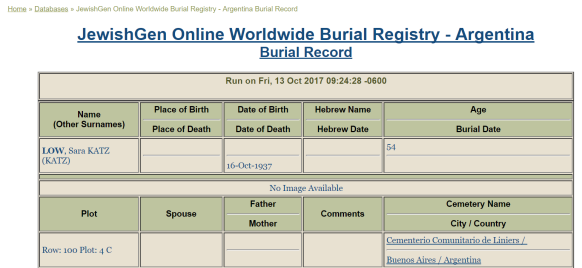
Further update: A search of the JewishGen Online Worldwide Burial Registry turned up burial records for Rosa and for her daughter Sara.  Sadly, neither lived very long after escaping to Argentina. I did not find Otto there so perhaps he left Argentina after Rosa and Sara died.

Burial information for Sara Katz Low

Rosa Katzenstein burial information

FURTHER UPDATE! Well, from Aaron Knappstein’s discovery of the Stolpersteine, I now have found not only where Rosa and her daughter Sara died and are buried; I’ve also found Rosa’s daughters Sophie and Recha and their husbands.  They all ended up in Buenos Aires and are buried in the same cemetery.

Aaron, you knocked down a big brick wall with one blow!

The Brick Wall Surrounding Rosa Katzenstein: Help Wanted!

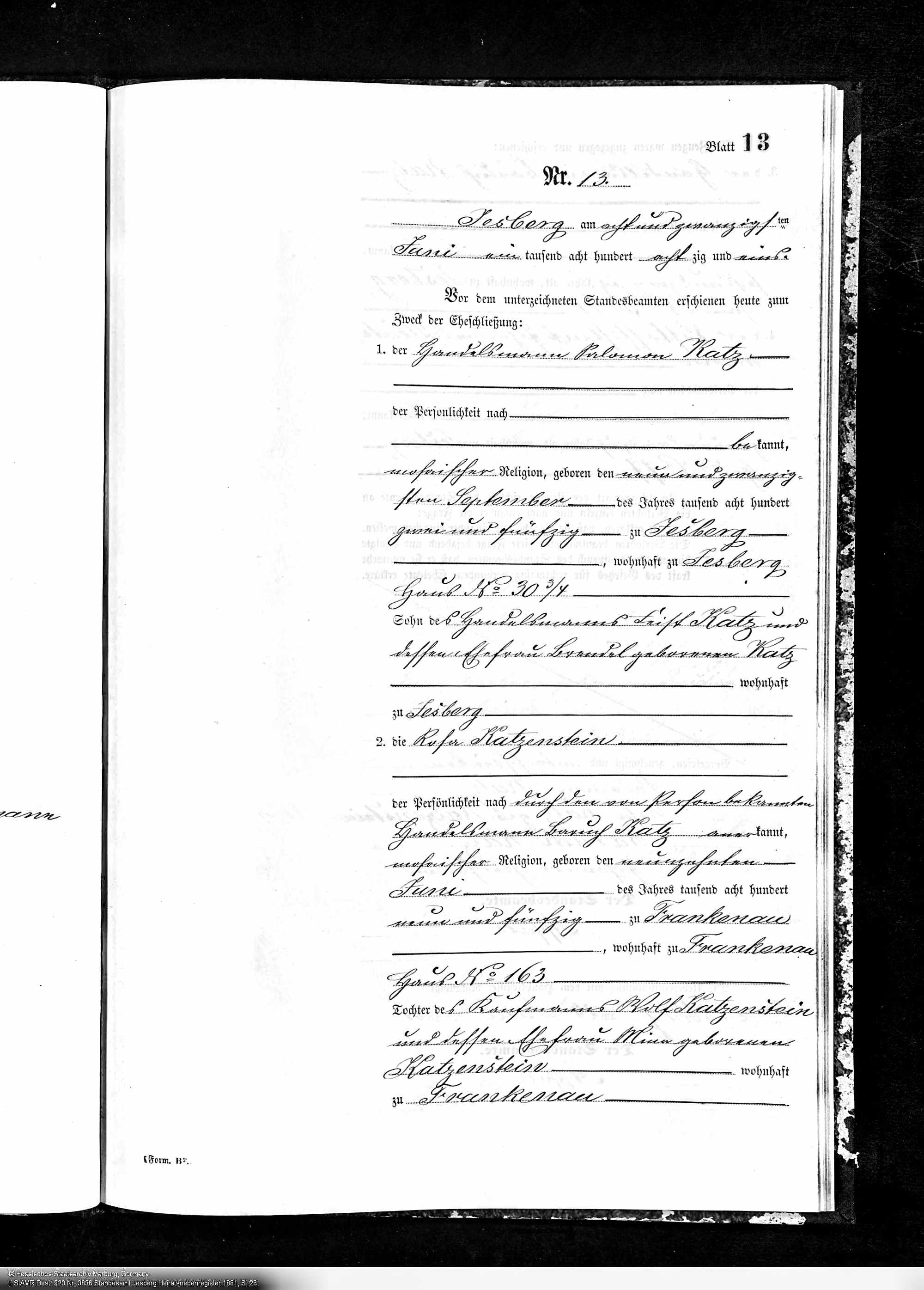
The story of Rosa Katzenstein is largely unrevealed, and I sure could use some help. Rosa was the oldest child of Mina and Wolf Katzenstein, born on June 19, 1859, in Frankenau, Germany, and as I wrote last time, she married her third cousin, once removed, Salomon Feist Katz, son of Joseph Feist Katz and Brendel Katz of Jesberg. Rosa and Salomon were married on June 28, 1881, in Jesberg.

Marriage record of Rosa Katzenstein and Salomon Feist Katz
Hessisches Hauptstaatsarchiv; Wiesbaden, Deutschland; Collection: Personenstandsregister Heiratsregister; Signatur: 920; Laufende Nummer: 3836

Rosa and Salomon had four daughters. The first, Zilli, was born on May 22, 1882, and died just two and a half months later on August 4, 1882.

Zilli Katz birth record
Hessisches Hauptstaatsarchiv; Wiesbaden, Deutschland; Collection: Personenstandsregister Geburtsregister; Signatur: 920; Laufende Nummer: 3813

Zilli Katz death record
Hessisches Hauptstaatsarchiv; Wiesbaden, Deutschland; Personenstandsregister Sterberegister; Bestand: 920; Laufende Nummer: 3880

The second daughter, Sarah, was born a year later in Jesberg on July 14, 1883.

Sarah Katz birth record
Hessisches Hauptstaatsarchiv; Wiesbaden, Deutschland; Collection: Personenstandsregister Geburtsregister; Signatur: 920; Laufende Nummer: 3814

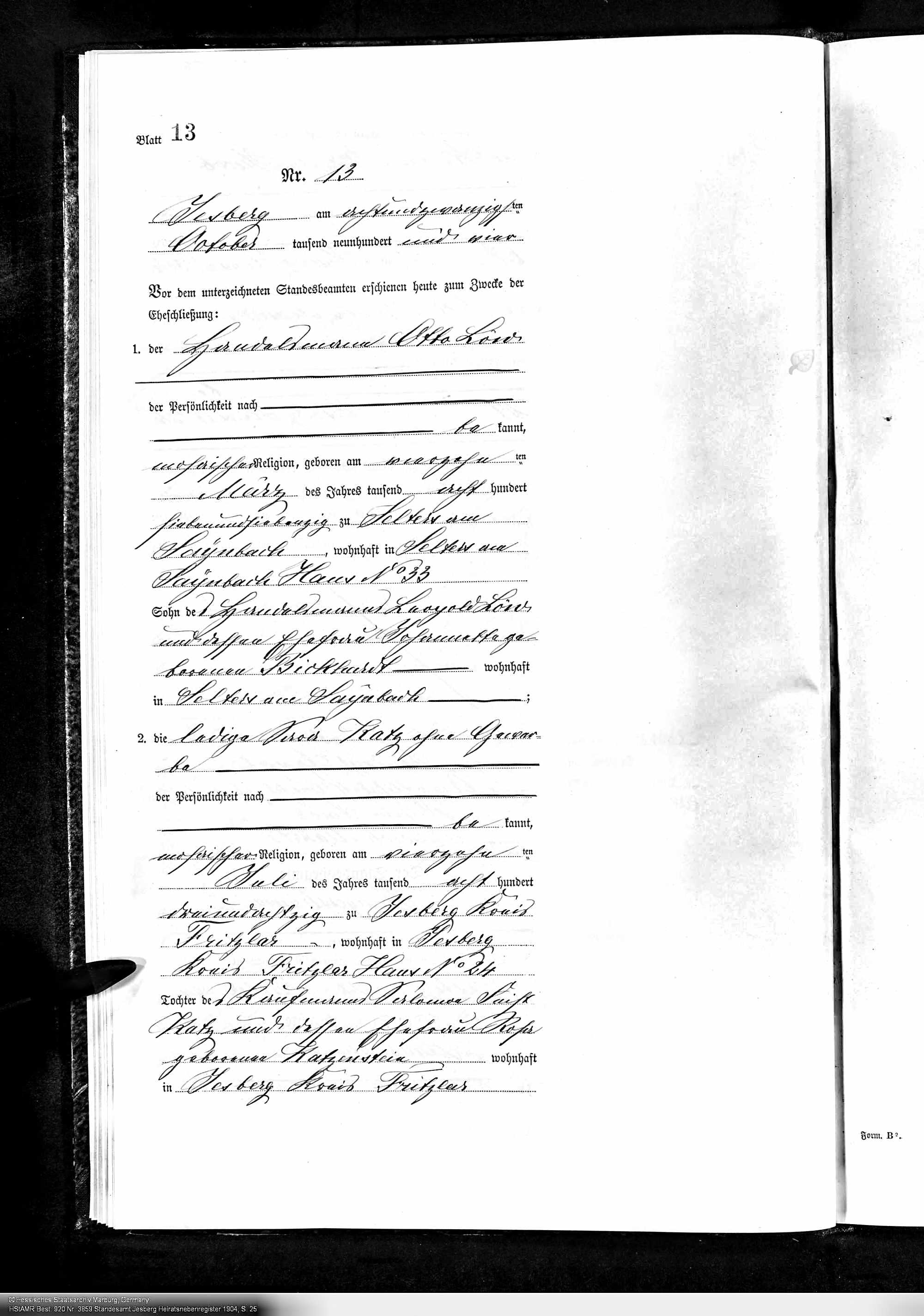
She married Otto Loew on October 28, 1904, in Jesberg. Otto was the son of Leopold Loew and Johanna Bickhardt of Selters, Germany.

Marriage of Sarah Katz and Otto Loew
Hessisches Hauptstaatsarchiv; Wiesbaden, Deutschland; Collection: Personenstandsregister Heiratsregister; Signatur: 920; Laufende Nummer: 3859

Unfortunately, that is all I know about Sara and Otto. I don’t know if they had children. I don’t know if they emigrated from Germany. I don’t know where or when they died. They are not in the Yad Vashem database. They just seem to have disappeared. I searched for hypothetical children, but could find none. The names Sara, Katz, Otto, and Loew are so common that there was no way to determine whether any of the people with those names were my relatives, but I found nothing that would lead me to believe that they were.

I did not have much better luck with Sara’s younger sister Sophie. She was born in Jesberg on July 10, 1885.

Sophie Katz birth record
Hessisches Hauptstaatsarchiv; Wiesbaden, Deutschland; Collection: Personenstandsregister Geburtsregister; Signatur: 920; Laufende Nummer: 3816

On June 9, 1909, she married Isaak Vogel in Marburg, Germany. He was born in Borken, Germany, on November 7, 1878, to Hermann Ephraim Vogel and Betti Trier.

Sophie Katz marriage to Isaak Vogel
Hessisches Hauptstaatsarchiv; Wiesbaden, Deutschland; Collection: Personenstandsregister Heiratsregister; Signatur: 915; Laufende Nummer: 5624

Barbara Greve told me that Sophie and Isaak had two sons, Karl, born in 1910, and Heinz, born in 1912, but I have no records for them, nor do I know what happened to Sophie, Isaak, Karl or Heinz. Once again, the names were so common that there are many people with those names, but none that matched my relatives.

I had a little bit more luck with Rosa and Salomon’s youngest daughter, Recha. She was born on September 25, 1889, in Jesberg.

Recha Katz birth record
Hessisches Hauptstaatsarchiv; Wiesbaden, Deutschland; Collection: Personenstandsregister Geburtsregister; Signatur: 920; Laufende Nummer: 3820

She married Julius Goldschmidt on November 20, 1911. He was the son of David Goldschmidt and Jettchen Rosenblatt of Hebel, Germany, born on November 11, 1886.

Marriage of Recha Katz and Julius Goldschmidt
HStAMR Best. 920 Nr. 3866 Standesamt Jesberg Heiratsnebenregister 1911, S. 29

Thank you once again to the members of the German Genealogy group on Facebook for help in translating this record and to Doris Strohmenger for finding several articles about David Goldschmidt, Julius’ father. David was apparently a leader in the Jewish community, a very knowledgeable and committed Jew:

David Goldschmidt father of Julius Goldschmidt (Jesberg, 3 November David Goldschmidt celebrated 81th birthday  fresh in mind and body.He got the title of Chower by Rabbi Dr. Walter). Courtesy of Doris Strohmenger

Recha Katz and Julius Goldschmidt had a daughter named Lotte born in Jesberg on December 13, 1913. Although I could not find Lotte’s birth record, I know that Lotte was their daughter because Recha and Julius are identified as her parents on her entry in the US Social Security Applications and Claims Index.  David Baron, who was in touch with Lotte’s descendants, informed me that Lotte married Julius Gans in Johannesburg, South Africa, on October 19, 1940.  Eventually Lotte settled in the US where in 1974 she became a naturalized citizen.

Lotte Gans naturalization petition
National Archives at Riverside; Riverside, California; NAI Number: 594890; Record Group Title: 21; Record Group Number: Records of District Courts of the United States, 1685-2009

David Baron also learned from family members that Lotte’s parents both died in Buenos Aires, Argentina, Julius Goldschmidt on August 4, 1961, and Recha Katz on January 14, 1964.

What had happened to the rest of the family? I know that Salomon Feist Katz died in Jesberg on February 16, 1924.

Salomon Feist Katz death record
Hessisches Hauptstaatsarchiv; Wiesbaden, Deutschland; Personenstandsregister Sterberegister; Bestand: 920; Laufende Nummer: 3915

But what had happened to Rosa and her two other daughters Sara and Sophie and their husbands? I just don’t know, and I have looked everywhere I can imagine searching. David Baron and Barbara Greve also had no information about the fates of Rosa, Sara or Sophie. If they did not find anything, perhaps there just is nothing to find.

If anyone has any suggestions as to where else I might look, please let me know.

UPDATE! Please see my next post for important updates to this one.

The Increasingly Twisted Family Tree: Mina and Wolf Katzenstein

I still have some work to do on two of the previously-mentioned descendants of Jakob Katzenstein’s oldest daughter Gelle and her husband Moses Ruelf, and I am working on some leads right now and should have updates soon on both Rosa Abraham Zecherman and Hugo David. But for now I am moving on to Gelle’s younger sister Mina and her descendants.

Once again, my family tree looks more like the roots of a mangrove than the usual image of a tree with outstretched and separate branches.

Mangrove roots
By Steve Hillebrand, U.S. Fish and Wildlife Service [Public domain], via Wikimedia Commons

At first I thought Mina was going to be a tough brick wall because I was researching her under the name Michaela.  The starting point of my research into the family of Jakob Katzenstein and Sarchen Lion was a handwritten document sent to me by Barbara Greve that had been prepared by a Reverend William Bach sometime after 1824; it listed the names of the children of Jakob Katzenstein and Sarchen Lion as follows:

As you can see, Reverend Bach had listed their second child as Michaela with a birthdate of May 29, 1832. But I could not find a birth record or any record for a person with the name Michaela Katzenstein.  And none of the other secondary sources for Jakob Katzenstein and Sarchen Lion listed a daughter named Michaela.

But as I was searching for Michaela on Ancestry.com, I noticed a listing of a death record for a Mina Katzenstein and decided to take a look. My gut instinct proved to be correct: Mina Katzenstein was the daughter of the merchant Jakob Katzenstein and Sarchen geb Lion. She was 64 when she died on September 5, 1896, meaning she was born in 1832, just as “Michaela” supposedly had been. I knew this had to be the same person and that her real name was Mina, not Michaela.

Mina Katzenstein death record
Hessisches Hauptstaatsarchiv; Wiesbaden, Deutschland; Personenstandsregister Sterberegister; Bestand: 922; Signatur: 3290

The death record also revealed that Mina was the wife of Wolf Katzenstein and that she had been living in Frankenau, Germany, at the time of her death.

Now that I knew Mina’s actual first name, I was able to uncover several other important documents, including a marriage record for her marriage to Wolf Katzenstein:

HHStAW Fonds 365 No 175, p.4

They were married in Frankenau on July 27, 1858.  Wolf was not, as far as I can tell, a cousin. His father was Manus Katzenstein, born in Frankenau, and I’ve yet to find a familial connection between the Frankenau Katzensteins and the Jesberg Katzensteins. Wolf’s mother was Roeschen Mannheimer.

When I initially only found two children born to Mina and Wolf, I thought that this part of the family would be much easier to research than that of Mina’s older sister Gelle Katzenstein Ruelf. But the more I looked, the more I found, and things became more and more complex.

Mina and Wolf in fact had five children, all born in Frankenau: Rosa (1859), Karoline (1861), Manus (1863), Rebecca (1865), and Regina (1867). I located them by searching page by page through the birth register for Frankenau starting the year after Mina and Wolf’s marriage up through 1875. If there were others born later or elsewhere, I’ve not yet found them.

All five of those children lived to adulthood and were married, and four had children. And sometimes they married cousins within the Katzenstein family, making the research and the story even more convoluted. So from what I thought would be a simple one-post story of Mina and Wolf Katzenstein, I now have several posts to write about the large, extended family.

This post will outline the growth of the family from 1859 through 1915. Subsequent posts will focus on each of Mina and Wolf’s children and their respective offspring.

Rosa, the oldest child, was born on June 19, 1859, in Frankenau, eleven months after her parents’ marriage.

Rosa Katzenstein birth record arcinsys
HHStAW Fonds 365 No 174, p. 7

She married Salomon Feist Katz on June 18, 1881, when she was 21 years old. Salomon was born on September 29, 1852, to Joseph Feist Katz and Brendel Katz, both of whom were born in Jesberg, as was their son Salomon.

Marriage of Rose Katzenstein and Salomon Feist Katz
Hessisches Hauptstaatsarchiv; Wiesbaden, Deutschland; Collection: Personenstandsregister Heiratsregister; Signatur: 920; Laufende Nummer: 3836

As you might have guessed, Salomon Feist Katz was also related to me and to his wife Rosa. We are all descendants of my 6-times great-grandfather Pinchas (Bonum) Katz.  Rosa was my second cousin, twice removed, and Salomon my third cousin, three times removed.

The numerous familial relationships between Rosa and her husband Salomon Feist were, for some reason, beyond the ability of my Family Tree Maker software to calculate, so I substituted Rosa’s sister Regina for Rosa and compared her to Salomon’s father Joseph Feist, and they came up as second cousins, twice removed, meaning that Regina and Salomon were third cousins, once removed, and thus so were Rosa and Salomon.

Rosa and Salomon would have four children, all born in Jesberg: Zilli (1882), Sara (1883), Sophie (1885), and Recha (1889).

Mina and Wolf’s second child was Karoline. She was born on March 30, 1861, in Frankenau:

Caroline Katzenstein birth record from Arcinsys for Hessen
HHStAW Fonds 365 No 174, p. 8

On October 10, 1884, she married Heinemann Blumenfeld, who, thank goodness, was not her cousin (as far as I can tell). He was born on October 8, 1854, in Momberg, Germany.

Marriage record of Karoline Katzenstein and Heineman Blumenfeld
Hessisches Hauptstaatsarchiv; Wiesbaden, Deutschland; Standesamt Frankenau Heiratsnebenregister 1884 (Hstamr Best. 922 Nr. 3219); Collection: Personenstandsregister Heiratsregister; Signatur: 922

Karoline and Heinemenn had three children born in Momberg: Toni (1885), Moritz (1887), and Bella (1890).

Manus Katzenstein was the middle child and only son of Mina and Wolf. He was born on April 23, 1863, in Frankenau.

Birth record of Manus Katzenstein
Standesamt Höringhausen Heiratsnebenregister 1891 (HStAMR Best. 922 Nr. 5542)AutorHessisches Staatsarchiv MarburgErscheinungsortHöringhausen, p. 19

He married Fanny Bickhardt of Hoeringhausen, Germany, on November 18, 1891.  Fanny was born in Hoeringhausen on June 6, 1868, daughter of Abraham Bickhardt and Esther Lion. Manus and Fanny did not have children as far as I’ve been able to determine.

Marriage record of Manus Katzenstein and Fanny Bickhardt
HStAMR Best. 922 Nr. 5542 Standesamt Höringhausen Heiratsnebenregister 1891, S. 19

Wolf and Mina’s fourth child was Rebecca, born on August 28, 1865, in Frankenau.

Rebekka Katzenstein birth record Arcinsys
HHStAW Fonds 365 No 174

On April 30, 1889, she married Salomon Schalom Kneibel Katz (“Salomon SK Katz”), who was, you guessed it, a cousin. Salomon SK Katz was born in Jesberg on June 28, 1859, to Schneuer Kneibel Katz and Sarchen Rosenblatt. Like his cousin Salomon Feist Katz who married Rebecca’s older sister Rosa, Salomon SK Katz was a grandson of Pinchas Bonum Katz, my six times great-grandfather. Salomon SK Katz and his brother-in-law Salomon Feist Katz were first cousins married to sisters, Rosa and Rebecca Katzenstein. And they were all descended from Pinchas Bonum Katz, as am I.

Marriage of Rebecca Katzenstein and Salomon SK Katz
Hessisches Hauptstaatsarchiv; Wiesbaden, Deutschland; Collection: Personenstandsregister Heiratsregister; Signatur: 920; Laufende Nummer: 3844

Once again, the relationship between Rebecca Katzenstein and Salomon Schalom Kneibel Katz proved too confusing for my software, but when I used Rebecca’s sister Regina again and compared her to Rebecca’s father-in-law, Schneuer Katz, it showed Regina and Schneuer as second cousins, twice removed, meaning that Regina and thus her sister Rebecca were third cousins, once removed, of Salomon SK Katz.

Rebecca Katzenstein and Salomon SK Katz had four children, all born in Jesberg: Berthold (Pinchas) (1890), Theresa (1891), Julius (1893), and Jakob (1895).

Regina Katzenstein was the youngest child of Mina and Wolf Katzenstein; she was born on September 24, 1867, in Frankenau.

Regina Katzenstein birth record arcinsys
HHStAW Fonds 365 No 174, p. 8

She married Selig Alexander, the son of Joseph Alexander and Fradchen Frank of Momberg. Selig (sometimes called Seligmann) was born on September 20, 1861, in Momberg. Regina and Selig were married on November 25, 1891, in Frankenau.

Marriage of Regina Katzenstein to Selig Alexander
Hessisches Hauptstaatsarchiv; Wiesbaden, Deutschland; Standesamt Frankenau Heiratsnebenregister 1891 (Hstamr Best. 922 Nr. 3226); Collection: Personenstandsregister Heiratsregister; Signatur: 922

Regina and Selig Katz had six children: a stillborn child (1893), Bertha (1893), Rosa (1896), Mina (1897), Joseph (1902), and Manus (1903).

As you might have inferred from the names of Regina’s children, her mother Mina had died before the birth of Regina and Selig’s fourth child Mina. Mina Katzenstein died on September 5, 1896, in Frankenau. She was 64 years old.

Mina Katzenstein death record
Hessisches Hauptstaatsarchiv; Wiesbaden, Deutschland; Personenstandsregister Sterberegister; Bestand: 922; Signatur: 3290

Mina’s husband Wolf Katzenstein survived her by almost twenty years. He died at age 85 on March 18, 1915, in Frankenau.  Mina and Wolf were survived by their five children and their grandchildren, whose stories will be told in posts to follow.

Now if I ever discover that Mina and her husband Wolf were also cousins, well, then I may just suffocate in those mangrove roots!

My Double/Triple? Cousins: The Children of Pauline Ruelf and Hirsch Abraham

The youngest child of Gelle Katzenstein and Moses Ruelf to live to adulthood was Pauline Ruelf. Part of Pauline’s story has already been told, as she was the mother of Julius Abraham, who married Senta Katz, the great-granddaughter of Rahel Katzenstein. That is, as I described here, Pauline’s son Julius and his wife Senta Katz were half-third cousins. Julius and Senta were the parents of Fred Abrahams, whose memoirs of his family’s life and departure from Germany were also posted here.

But I am getting a bit ahead of myself, so let me back up and start with Pauline’s birth. She was born on September 25, 1869, in Rauischholzhausen:

Pauline Ruelf birth record,
Geburtsregister der Juden von (Rauisch)Holzhausen (Ebsdorfergrund) 1824-1874 (HHStAW Abt. 365 Nr. 452)AutorHessisches Hauptstaatsarchiv, Wiesbaden, p.15

On December 26, 1891, when she was 22 years old, she married Hirsch Abraham. Hirsch was born on December 4, 1858, in Niederurff, and was the son of Jakob Abraham and Roschen Frank.

Pauline Ruelf marriage to Hirsh Abraham
Hessisches Hauptstaatsarchiv; Wiesbaden, Deutschland; Collection: Personenstandsregister Heiratsregister; Signatur: 915; Laufende Nummer: 7960

Hirsch was a widower when he married Pauline; his first wife was Pauline’s older sister Johanna Ruelf, who had died on August 12, 1890, eleven days after giving birth to a daughter, whose name was originally Rosa but was changed to Johanna (or Hannah) after her mother died.

Birth record of Rosa later Johanna Abraham
Hessisches Hauptstaatsarchiv; Wiesbaden, Deutschland; Collection: Personenstandsregister Geburtsregister; Signatur: 920; Laufende Nummer: 6175

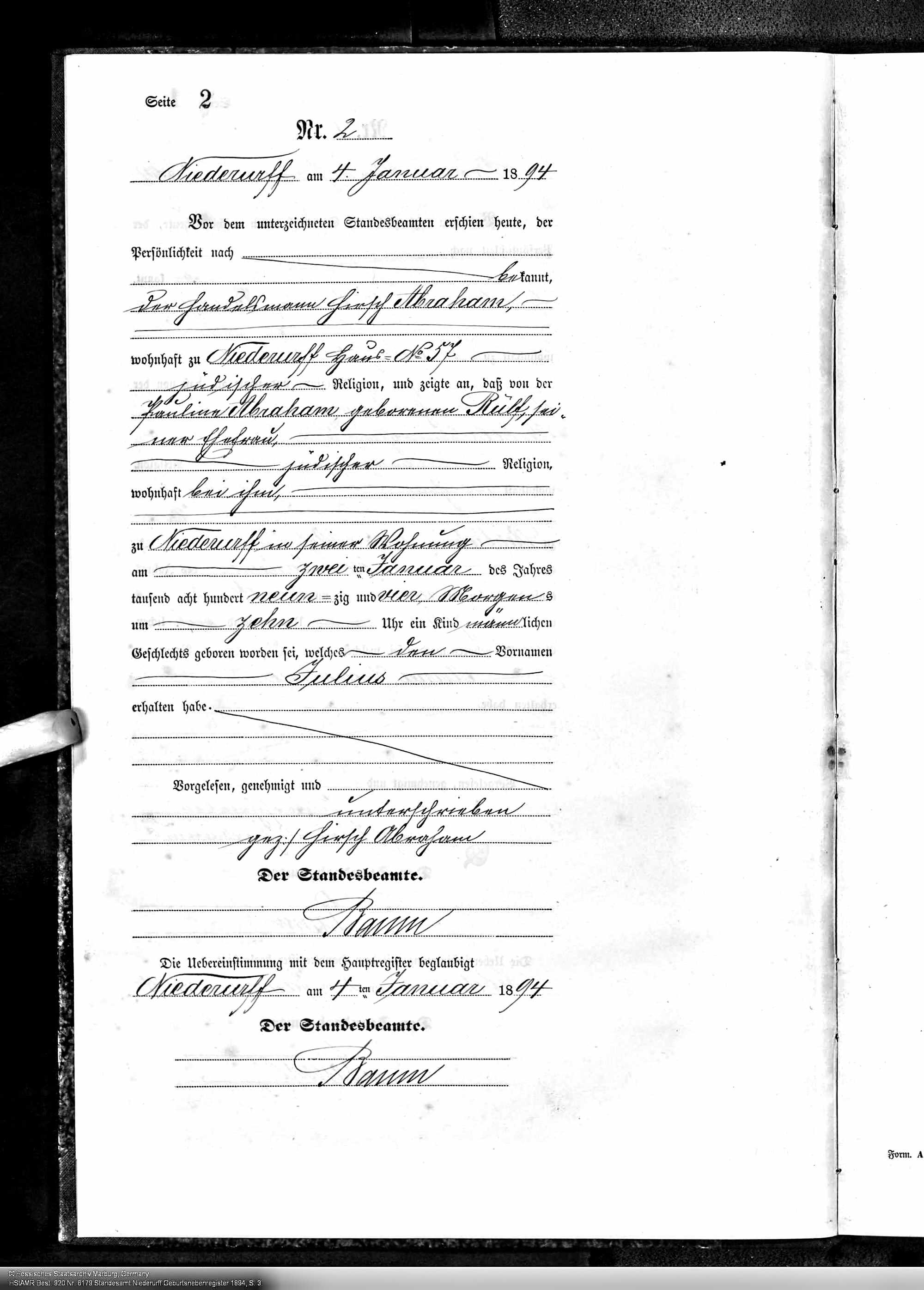
So Pauline took on the responsibility for raising her niece Johanna. She and Hirsch also had six children together: Ricchen Rosa (1892), Julius (1894), Meta (1894), Sarah (1896), Siegfried (1897), and Recha (1900).  Although Julius and Meta were both born in 1894, they were not twins; Julius was born January 2, 1894, and his sister Meta was born almost twelve months later on December 26, 1894, meaning Julius was only three months old when Meta was conceived.

Birth record of Julius Abraham Hessisches Hauptstaatsarchiv; Wiesbaden, Deutschland; Collection: Personenstandsregister Geburtsregister; Signatur: 920; Laufende Nummer: 6179


Birth record of Meta Abraham
Hessisches Hauptstaatsarchiv; Wiesbaden, Deutschland; Collection: Personenstandsregister Geburtsregister; Signatur: 920; Laufende Nummer: 6179

Pauline and Hirsch lost two of their children at young ages. Their daughter Sarah died on June 25, 1910; she was only fourteen.

Death Record for Sarah Abraham
Hessisches Hauptstaatsarchiv; Wiesbaden, Deutschland; Personenstandsregister Sterberegister; Bestand: 920; Laufende Nummer: 6261

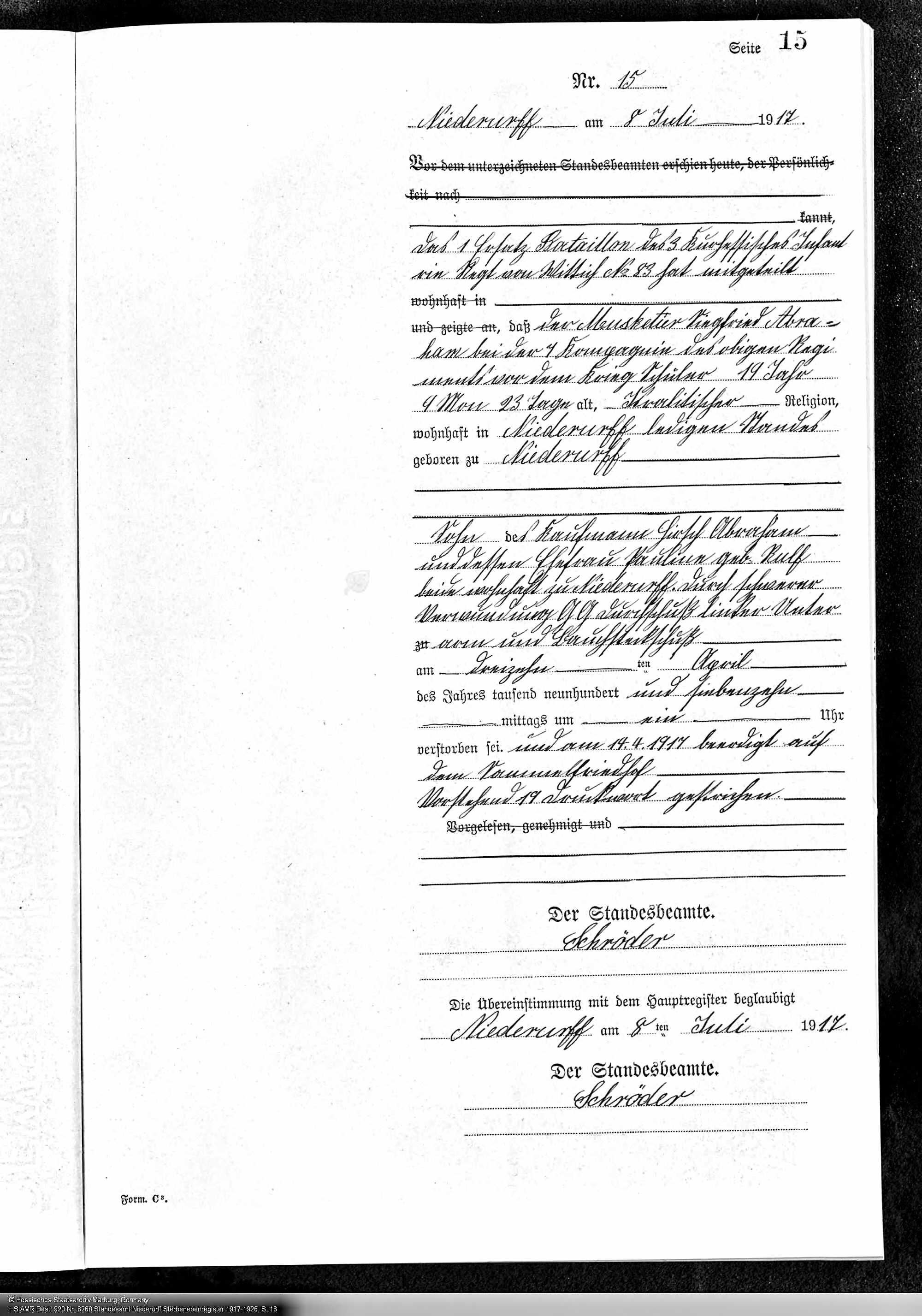
Their son Siegfried was killed fighting for Germany in World War I. He was only nineteen when he was shot in the line of duty on April 13, 1917. According to his death record, he was a musketeer in the Germany infantry and was shot twice, once in the left forearm and once in the chest, and died from his injuries; he was buried in a common grave.

Siegfried Abraham death record
Hessisches Hauptstaatsarchiv; Wiesbaden, Deutschland; Personenstandsregister Sterberegister; Bestand: 920; Laufende Nummer: 6268

The fact that twenty years later Siegfried’s family would be forced to leave Germany to survive makes his death even more tragic. My cousin Fred Abrahams was named for his uncle Siegfried.

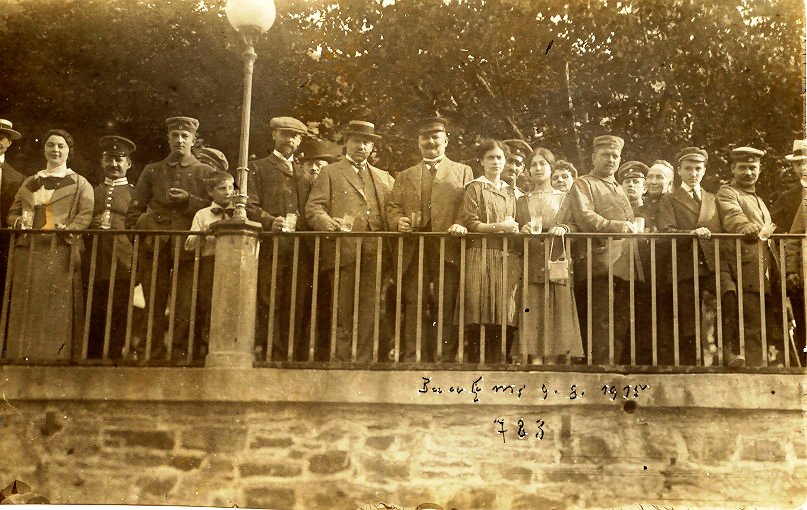
Siegfried’s brother Julius also served in World War I. Here is a photograph of three of Siegfried’s siblings at some gathering in Germany in 1915; first, the overall photograph and then a snip focusing on the three Abraham siblings, Meta, Julius, and Recha. You can see that Julius is in uniform:

Courtesy of Fred and Martin Abrahams

Courtesy of Fred and Martin Abrahams

On September 25, 1921, Johanna Abraham, Pauline’s niece whom she raised after her sister Johanna died, married Jakob Hirschberg of Zwesten, Germany. Jakob was born on April 15, 1893. He and Johanna had one child, a son Martin.

Marriage of Johanna Abraham and Jakob Hirschberg
Hessisches Hauptstaatsarchiv; Wiesbaden, Deutschland; Collection: Personenstandsregister Heiratsregister; Signatur: 920; Laufende Nummer: 6226

Although I have very little information at all about Hirsch and Pauline’s oldest daughter Ricchen Rosa Abraham, one passenger manifest lists her with the married name Zechermann; I don’t know her husband’s first name or when or where she married, nor do I know whether they ever had children.

Ricchen Rosa Abraham passenger card
The National Archives at Washington, D.C.; Washington, D.C.; Series Title: Passenger and Crew Manifests of Airplanes Arriving at Miami, Florida.; NAI Number: 2788541; Record Group Title: Records of the Immigration and Naturalization Service, 1787 – 2004; Record Group Number: 85

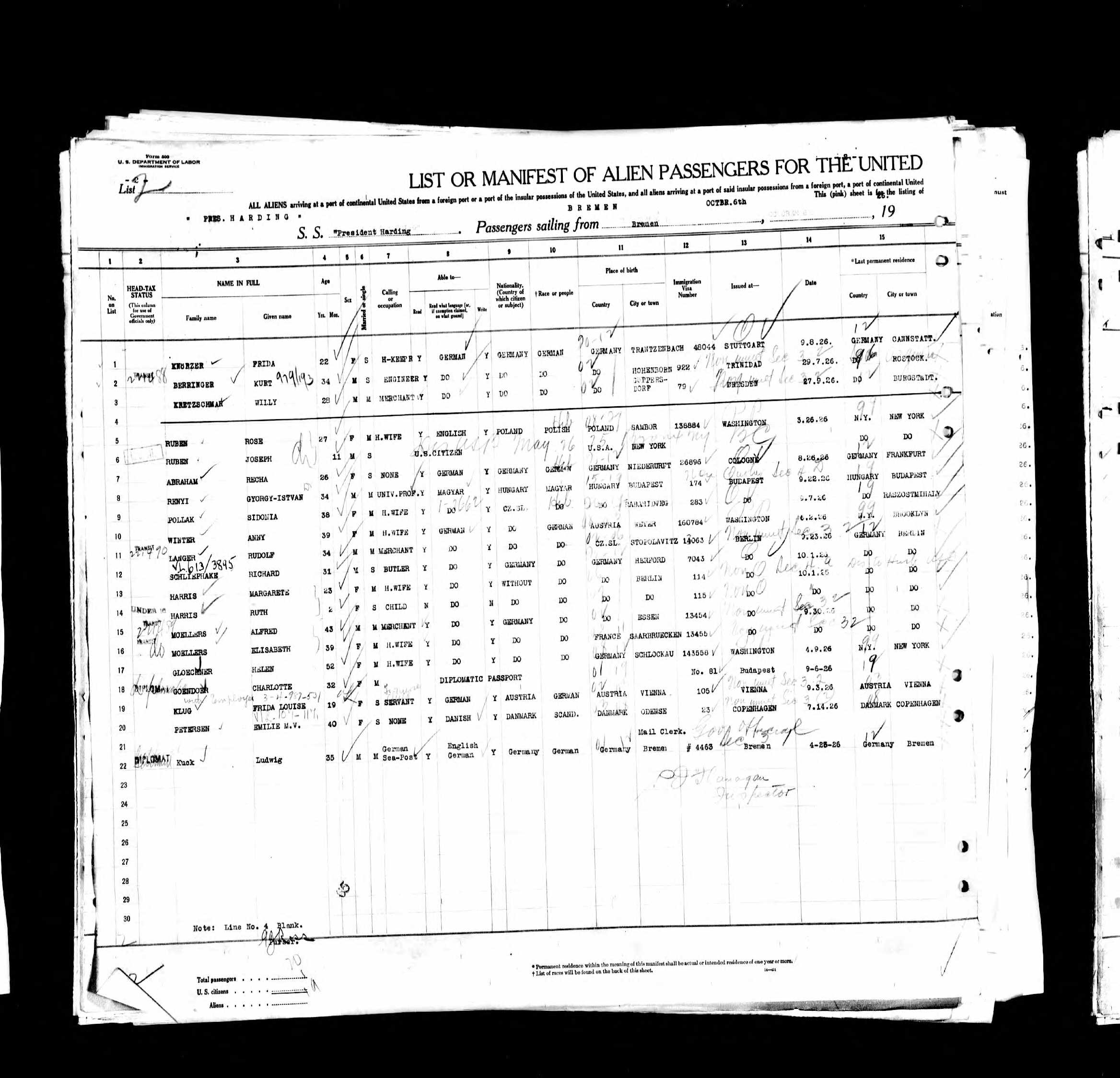
The other surviving daughters of Pauline Ruelf and Hirsh Abraham both immigrated to the United States in the 1920s. Recha, the youngest child, was only 25 when she first left Germany on October 6, 1925, to travel to the US. According to the passenger manifest, she had been last living in Frankfurt and working as a housekeeper and was now traveling to her uncle, Max Abraham, who resided in Davenport, Iowa. Recha stated that she expected to stay for nine months.

Recha Abraham 1925 ship manifest
Year: 1925; Arrival: New York, New York; Microfilm Serial: T715, 1897-1957; Microfilm Roll: Roll 3741; Line: 1; Page Number: 135
Ancestry.com. New York, Passenger Lists, 1820-1957

Max Abraham was Hirsch Abraham’s older brother; he had come to the US from Germany in the 1870s when he was just a teenager. In 1880, he was living in Louisville, Kentucky, and working as a dry goods merchant. He remained in Kentucky for a number of years and after marrying in 1988, he moved to Campbellsburg, Indiana, where he became president of the local bank. After 25 years in Indiana, Max and his family moved to Davenport, Iowa in 1916, where he and his sons started what became a very successful clothing business, Abrahams Brothers. “Max Abrahams, Treasurer of Ready to Wear Store in Davenport, Dies at 82,” Quad-City Times (Davenport, Iowa), 24 Apr 1938, p. 1

I don’t know how long Recha ended up staying with her uncle Max in Iowa on this trip, but on October 15, 1926, she again sailed from Hamburg to New York listing her destination as her uncle Max Abraham’s home in Davenport, Iowa. She listed her last address as Frankfurt. She provided no occupation nor did she indicate this time the length of her stay.

Recha Abraham 1926 ship manifest
Year: 1926; Arrival: New York, New York; Microfilm Serial: T715, 1897-1957; Microfilm Roll: Roll 3947; Line: 1; Page Number: 182
Ancestry.com. New York, Passenger Lists, 1820-1957

On September 23, 1927, her older sister Meta also arrived in the US and also indicated that she was going to her uncle Max Abraham of Davenport, Iowa. Meta stated that she planned to stay in the US permanently. She stated that her occupation was a clerk.

Meta Abraham 1927 passenger manifest
Year: 1927; Arrival: New York, New York; Microfilm Serial: T715, 1897-1957; Microfilm Roll: Roll 4135; Line: 1; Page Number: 94
Ancestry.com. New York, Passenger Lists, 1820-1957

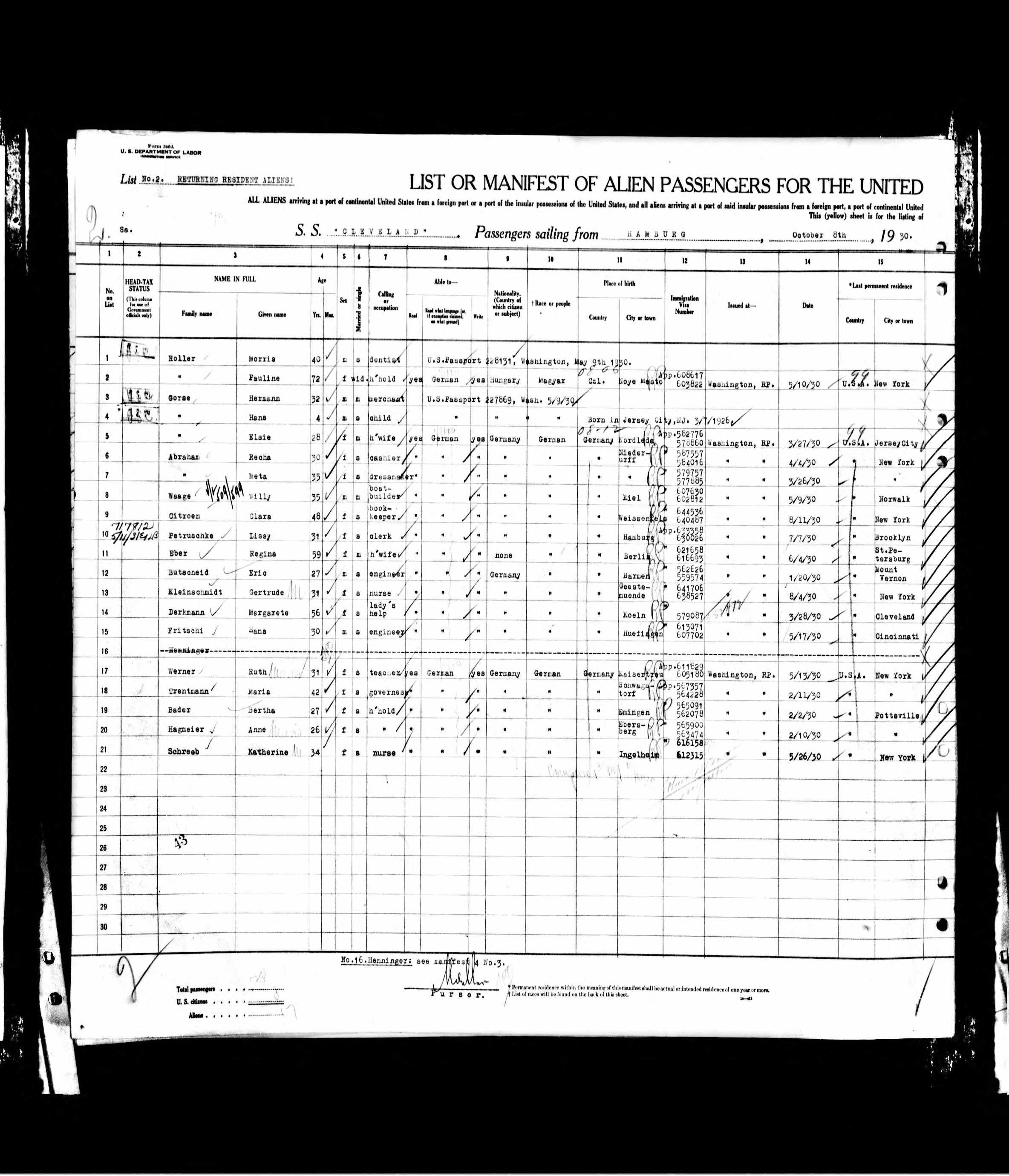
In the fall of 1930, both Meta and Recha must have visited their family in Germany because a passenger manifest for a ship sailing from Hamburg and arriving in New York City on October 8, 1930, lists both sisters as residents of New York City where they were both living at 42 West 89th Street. Recha was working as a cashier and Meta as a dressmaker. Neither had yet become a US citizen. Both reported that they had been in the US since 1927, although Recha obviously had arrived earlier than that.

Meta and Recha Abraham 1930 passenger manifest
Year: 1930; Arrival: New York, New York; Microfilm Serial: T715, 1897-1957; Microfilm Roll: Roll 4854; Line: 1; Page Number: 90
Ancestry.com. New York, Passenger Lists, 1820-1957

Meta and Recha did not show up on the 1930 census when I searched for them on Ancestry and FamilySearch, which puzzled me. I turned to stevemorse.org, using his enumeration district finder tool and the address from the 1930 passenger manifest—42 West 89th Street. There they were, clear as could be.

Meta and Recha Abraham 1930 US census
Year: 1930; Census Place: Manhattan, New York, New York; Roll: 1556; Page: 9A; Enumeration District: 0450; FHL microfilm: 2341291

So why hadn’t they shown up when I searched? For one thing, both had reported themselves as much younger than they were; Meta, who apparently gave the information to the enumerator, said that she was 24 and her sister 22 when in fact Meta was 34 and Recha was 30. That obviously threw off my search even though I thought I’d given fairly wide ranges in my search parameters for their ages. Also, Recha was listed as Rebecca. But this household is clearly that of the Abraham sisters. Meta was working as a cashier for a butcher and Recha was a seamstress at Macy’s. Both are listed with the surname Abrahams, a change that had also been made by their uncle Max in Iowa.

Meanwhile, back in Niederurff, Germany, Pauline and Hirsh’s only surviving son, Julius Abraham, had by 1932 married his half-third cousin Senta Katz of Jesberg, and they had two sons in the 1930s, Martin and Siegfried/Fred. (Julius and Senta were married either on January 10, 1931, or January 10, 1932; their sons were not sure of the year, and I’ve not been able to find an official record.)

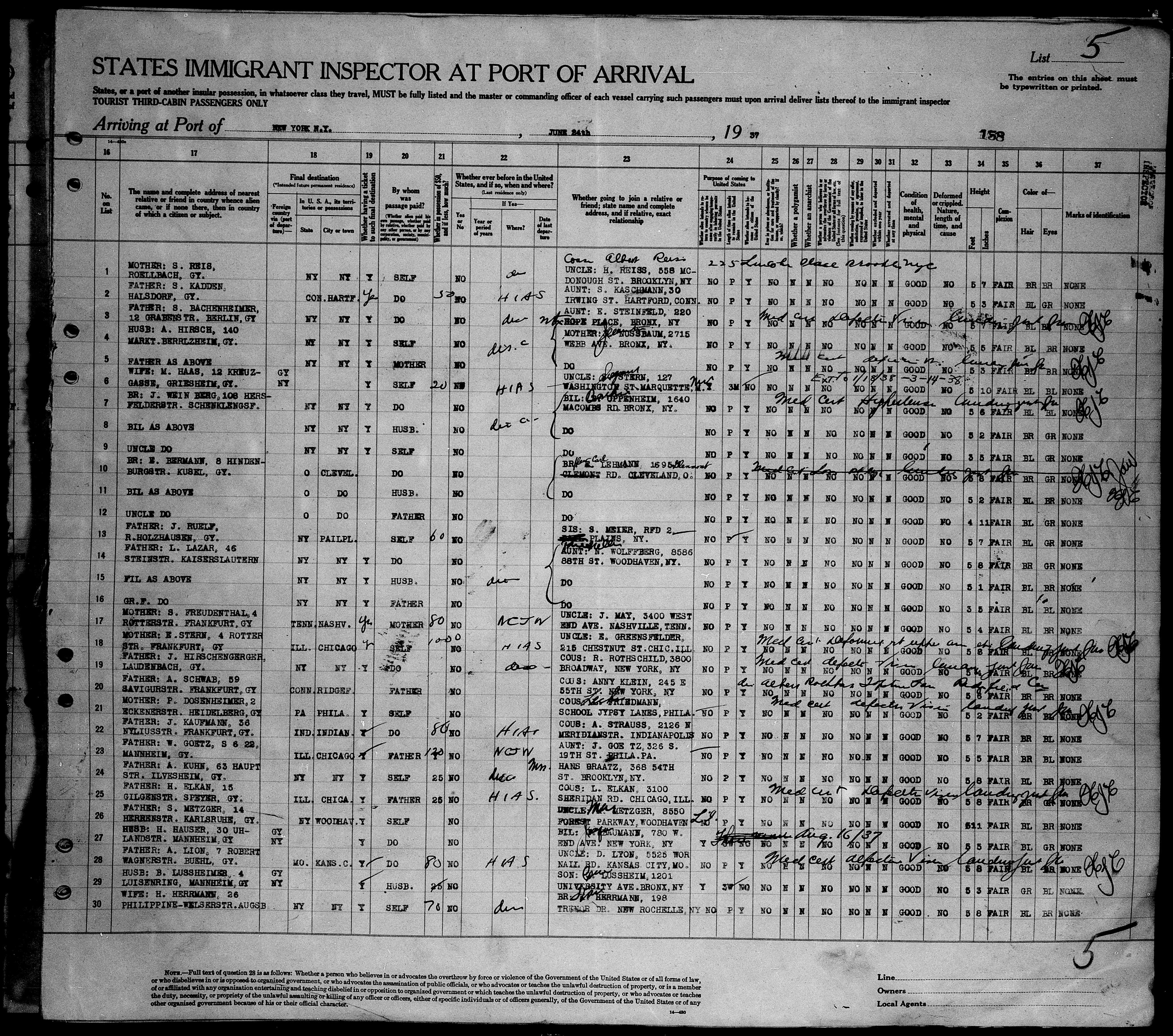
It was not too much longer before Julius and Senta recognized the need to escape from Nazi Germany. As Fred described in his memoir excerpted here and as I wrote about in that same post, Julius and Senta and their two sons left Germany and arrived in New York City on June 24, 1937 . They were going to Julius’ sisters, Meta and Recha, who were then living at 252 West 85th Street. Julius reported his occupation to be a tailor.

Family of Julius and Senta Katz Abraham, passenger manifest, Year: 1937; Arrival: New York, New York; Microfilm Serial: T715, 1897-1957; Microfilm Roll: Roll 6003; Line: 1; Page Number: 18
Description
Ship or Roll Number : Roll 6003
Source Information
Ancestry.com. New York, Passenger Lists, 1820-1957

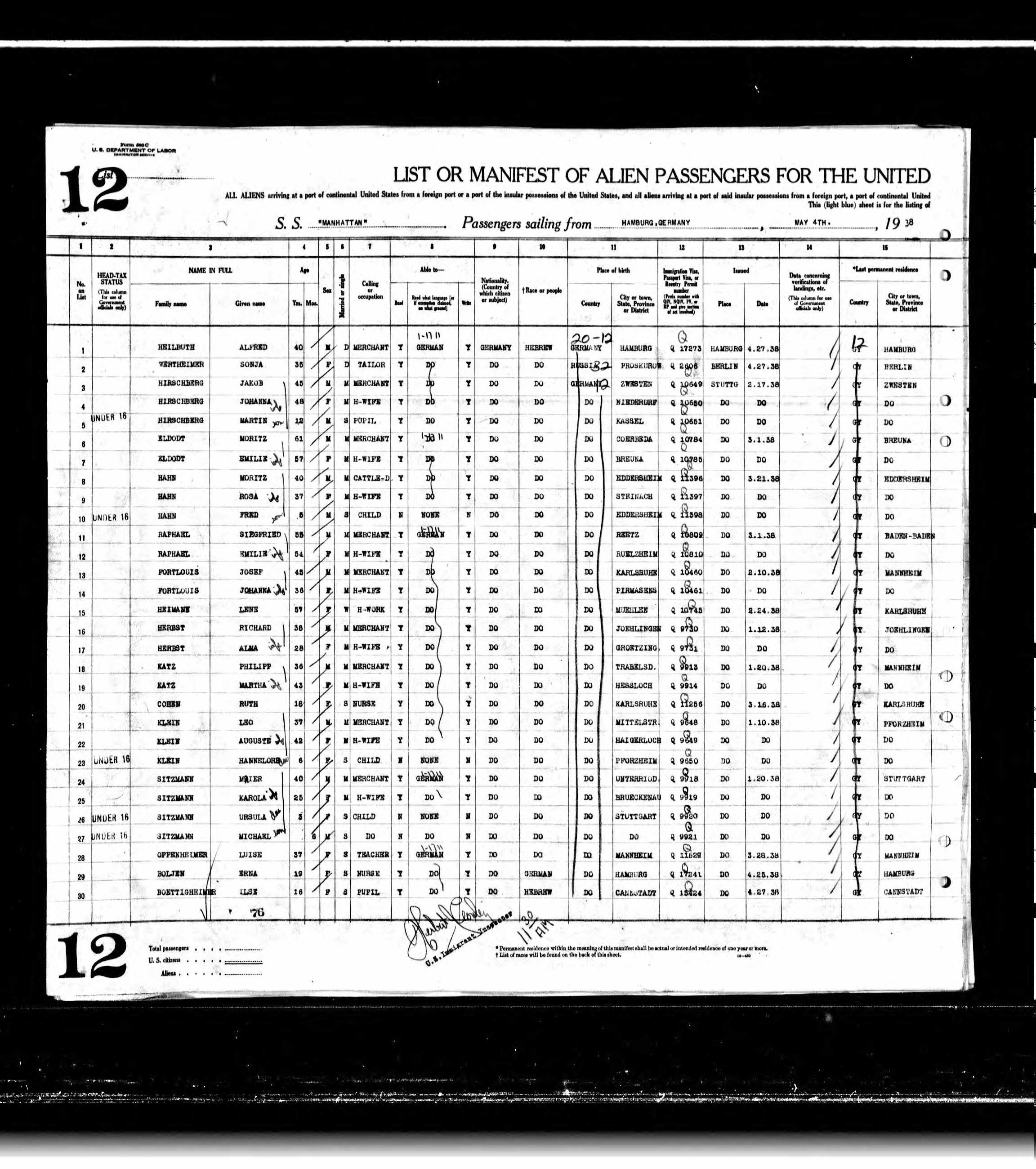
The next family member to arrive from Germany was Johanna Abraham Hirschberg, the half-sister of Meta, Julius, and Recha, daughter of Johanna Ruelf and Hirsch Abraham. Johanna came with her husband Jakob and son Martin on May 4, 1938; they also were going to Meta and Recha’s home at 252 West 85th Street in New York City. Jakob was a merchant. They had been living in Zwesten, Germany, before immigrating to the US.

Johanna Abraham Hirschberg and family on 1938 passenger manifest
Year: 1938; Arrival: New York, New York; Microfilm Serial: T715, 1897-1957; Microfilm Roll: Roll 6152; Line: 1; Page Number: 168
Ancestry.com. New York, Passenger Lists, 1820-1957

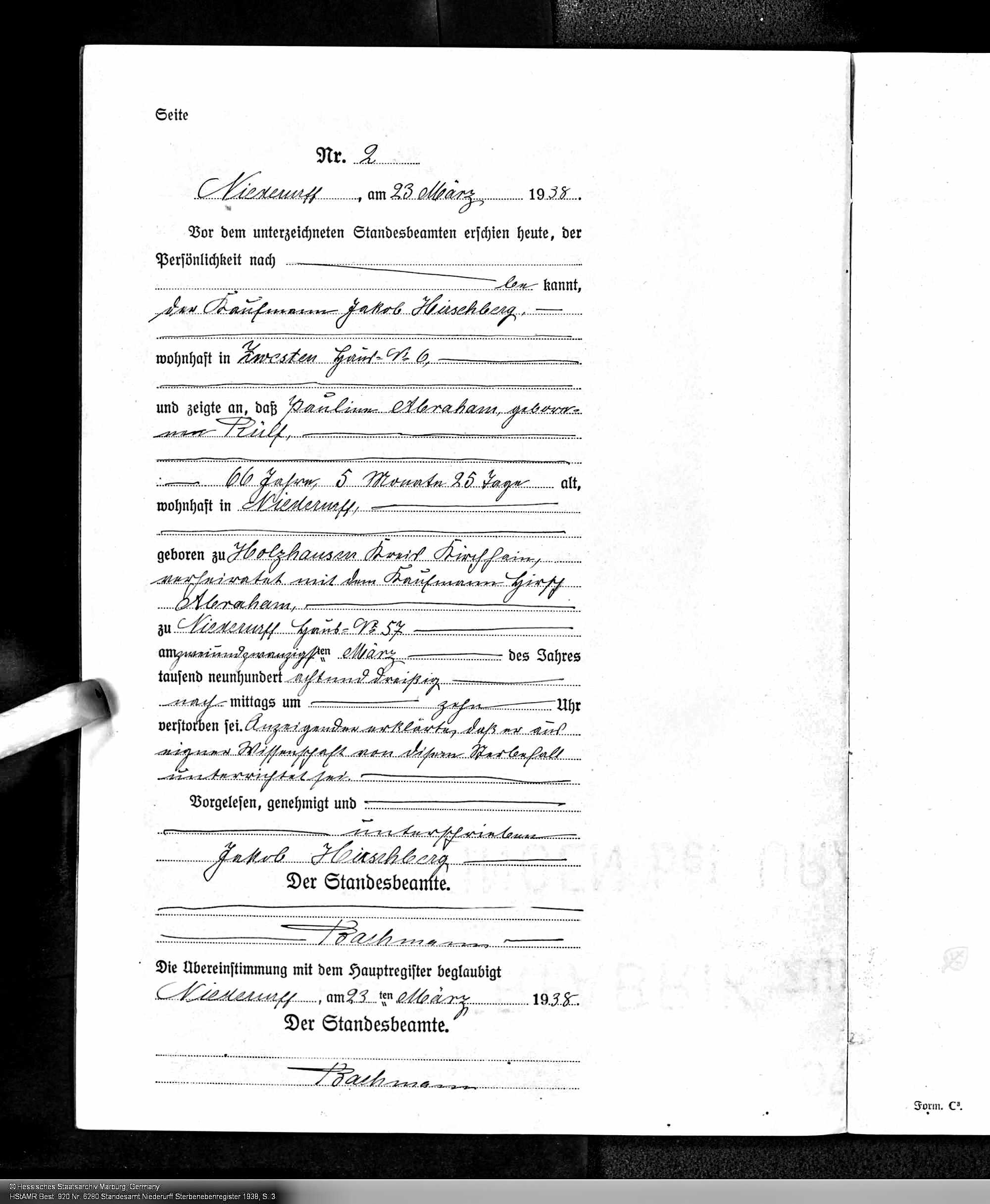
Sadly, Pauline Ruelf Abraham died on March 22, 1938, in Niederurff, and thus did not get to join her children in the United States. She was 68 years old when she died.

Pauline Ruelf death record
Hessisches Hauptstaatsarchiv; Wiesbaden, Deutschland; Personenstandsregister Sterberegister; Bestand: 920; Laufende Nummer: 6280

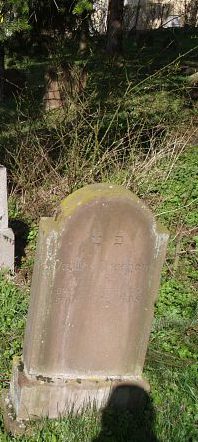
Pauline Ruelf Abraham gravestone

Her husband Hirsch Abraham left Germany a year later, arriving in New York on March 25, 1939. He also was joining his daughters at 252 West 85th Street. He was eighty years old when he left Niederurff, Germany and sailed alone to New York City, leaving behind the only home he’d ever known. He lived only a year in the US, dying on March 9, 1940 at age 81. (New York, New York, Death Index, 1862-1948, on Ancestry.com)

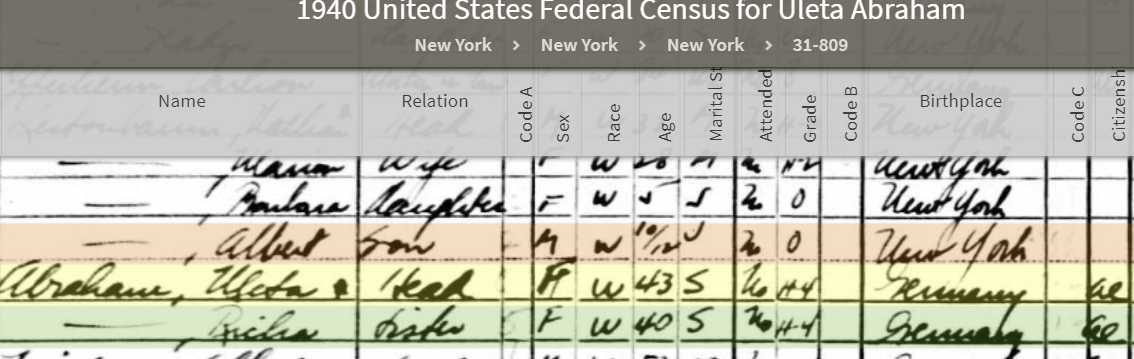
Thus, by March 1939, all but one of the children of Pauline Ruelf and Johanna Ruelf and Hirsch Abraham were living safely in New York City.  On the 1940 census, Meta and Recha were still living at 252 West 85th Street; Meta was a bookkeeper for a women’s clothing manufacturing company, and Recha had no occupation listed. Meta died in New York City on May 18, 1977, and her sister Recha died almost a year to the day later on May 24, 1978. Meta was 83 when she died, and Recha was 78. It appears the two sisters had lived together their entire adult lives once coming to the US in the 1920s.

Meta and Recha Abraham on 1940 census
Year: 1940; Census Place: New York, New York, New York; Roll: T627_2643; Page: 1B; Enumeration District: 31-809

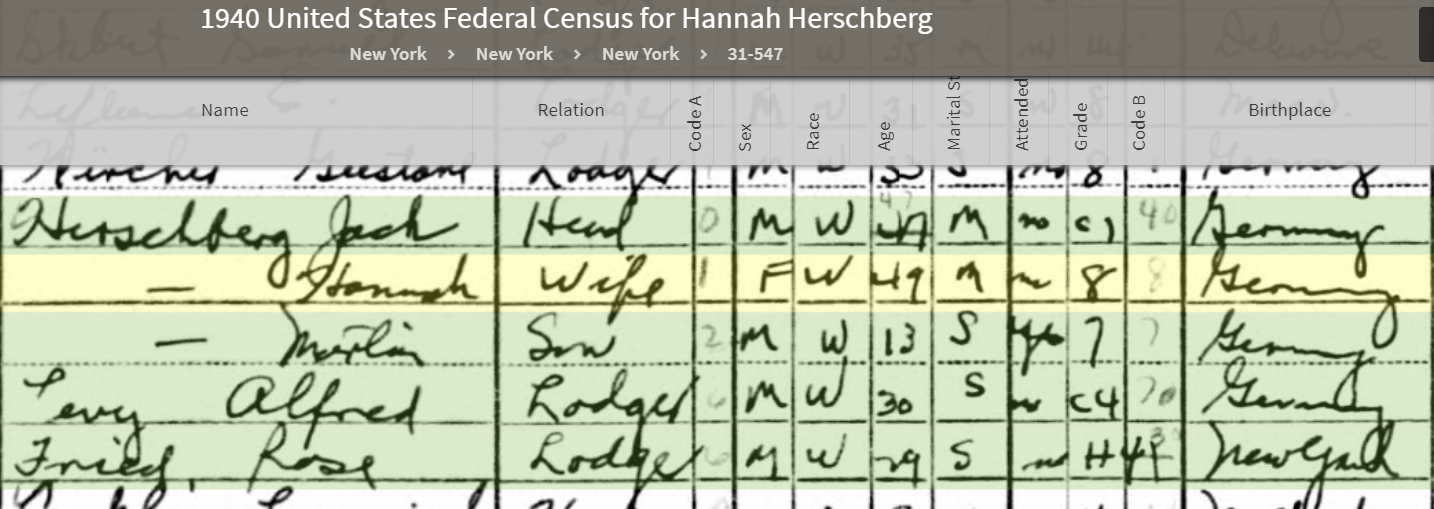
Their half-sister/first cousin Johanna and her husband Jakob (listed as Jack) and son were also still living in New York in 1940; Johanna and Jack were both working as cooks, Jack for the city and Johanna in a private home. By 1955, the family had moved to Davenport, Iowa, where Jack and his son Martin were both working in Max Abrahams’ store. Johanna died August 15, 1955, and Jack died in 1960. They are buried in Davenport.

Johanna Abraham Hirschberg and family on 1940 census
Year: 1940; Census Place: New York, New York, New York; Roll: T627_2636; Page: 13A; Enumeration District: 31-547

Julius Abraham and his wife Senta Katz and their sons were also living in New York City in 1940. As I wrote earlier, the family was living at 325 West 93rd Street, and Julius was working in the family business, Abrahams Brothers, the clothing business started by Max Abrahams and his sons in Davenport, Iowa. The business had grown to about a dozen stores throughout the Midwest. In 1940, Julius was working in the fur department of the New York office, where the administration and buying for the many stores was handled. He continued to work for the business for the rest of his life. Julius died on December 22, 1959; his wife Senta lived to 93, dying on October 15, 2000, in Stamford, Connecticut.

Senta Katz Abrahams and family, 1940 census
Year: 1940; Census Place: New York, New York, New York; Roll: T627_2642; Page: 16A; Enumeration District: 31-777

The only child of Pauline Ruelf Abraham who is unaccounted for is Ricchen Rosa Abraham, Pauline’s first child. I have no records for her aside from her birth record and the 1961 passenger list card depicted above.  I am also only inferring that this is in fact Ricchen in the passenger list card based on the birth date and place of birth and the fact that her nephews Martin and Fred knew that she had ended up in Chile. The family story is that she was unable to gain entry to the US and so went to Chile instead.

I have no records for her in Chile so do not know when she got there, whom she married, whether she had children, or when she died. I have tried finding information about her from sources in Chile, but so far have had no luck. If anyone has any suggestions, please let me know.

But what I do know is that all of the children and grandchildren of both Pauline Ruelf and her sister Johanna Ruelf survived the Holocaust. That in and of itself gives me a happy ending to this last chapter in the story of Gelle Katzensten and Moses Ruelf.


The Family of Juda Ruelf and Lina Bachenheimer

Gelle Katzenstein gave birth to three sons and seven daughters, but only one of her sons survived to adulthood. That was her son Juda, born on October 30, 1867, in Rauischholzhausen. He was her eighth child and the first boy since her firstborn, who had been stillborn and was unnamed.

Juda Ruelf birth record,
Geburtsregister der Juden von (Rauisch)Holzhausen (Ebsdorfergrund) 1824-1874 (HHStAW Abt. 365 Nr. 452)AutorHessisches Hauptstaatsarchiv, Wiesbaden, p. 14

Juda married Lina Bachenheimer on November 19, 1897, in Rossdorf, Germany. He was thirty, and Lina was 24. Lina was the daughter of Seligmann Bachenheimer and Betty Baum, and she was born on New Year’s Day in 1883; she was also the niece of Sussman Bachenheimer, who had married Juda’s oldest sister, Esther. (Schneider, Die Juedischen Familien im ehemaligen Kreise Kirchain, pp. 83 and 344)

Marriage of Juda Ruelf and Lina Bachenheimer
Hessisches Hauptstaatsarchiv; Wiesbaden, Deutschland; Collection: Personenstandsregister Heiratsregister; Signatur: 915; Laufende Nummer: 7966

After posting my first post about Jakob Katzenstein, I was contacted on Facebook by a man whose grandfather was Siegfried Bachenheimer (born in 1900); he told me that the Bachenheimers had once lived next door to the Ruelf family in Rauischholzhausen.  That helped to explain the interconnections between the Bachenheimer and Ruelf families.

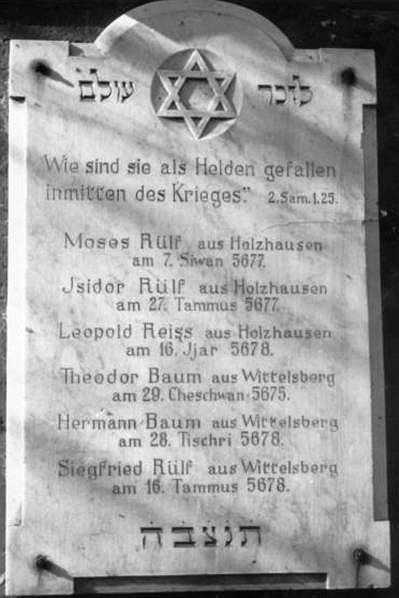
Juda and Lina had five children: Isidor (1898), Selma (1900), Rosa (1901), Leo (1904), and Gottfried (known familiarly as Friedel)(1905). Leo died as a boy on December 14, 1912.  He was only eight years old. (Schneider book, p. 345) Then Isidor, their oldest child, was killed in 1917 while serving Germany in World War I. (Schneider book, p. 345)

World War I memorial in Rauischholzhausen listing Isidor Ruelf among others
Courtesy of Richard Oppenheimer

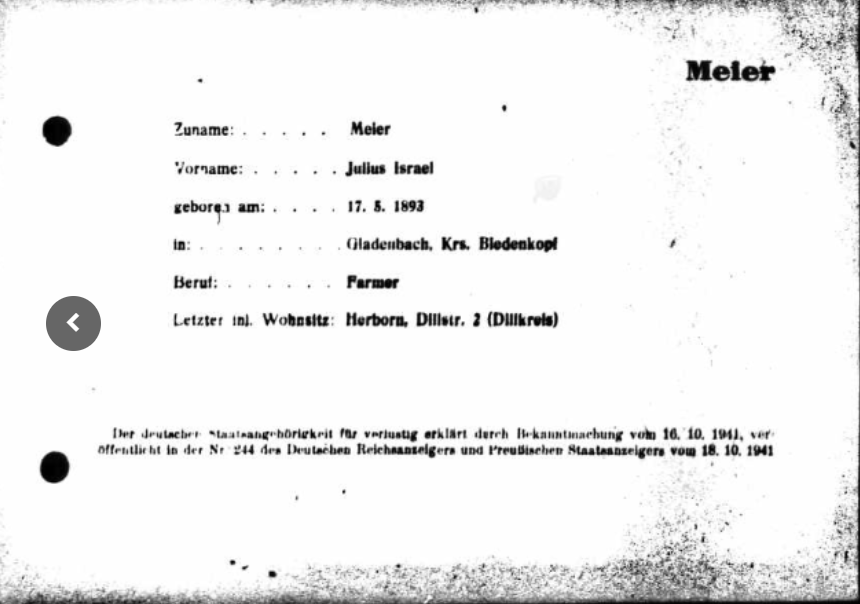
Thus, only Selma, Rosa, and Friedel survived to adulthood. Selma married Julius Meier on November 17, 1922, in Rossdorf; Julius was born May 17, 1898, in Gladenbach. According to the Nazi record nullifying his citizenship, he was a farmer; later records describe him as a cattle dealer. Selma and Julius had two children born in the 1920s.

Ancestry.com. Germany, Index of Jews Whose German Nationality was Annulled by Nazi Regime, 1935-1944 [database on-line]. Original data: Name Index of Jews Whose German Nationality was Annulled by the Nazi Regime (Berlin Documents Center).

Selma’s sister Rosa did not marry, and her brother Friedel did not marry until much later in life and did not have children. Thus, Selma’s two children were the only grandchildren of Juda and Lina Ruelf.

Lina Bachenheimer Ruelf died on October 16, 1930, in Marburg; she was 57 years old.

Lina Bachenheimer Ruelf death record
Hessisches Hauptstaatsarchiv; Wiesbaden, Deutschland; Personenstandsregister Sterberegister; Bestand: 915; Laufende Nummer: 573

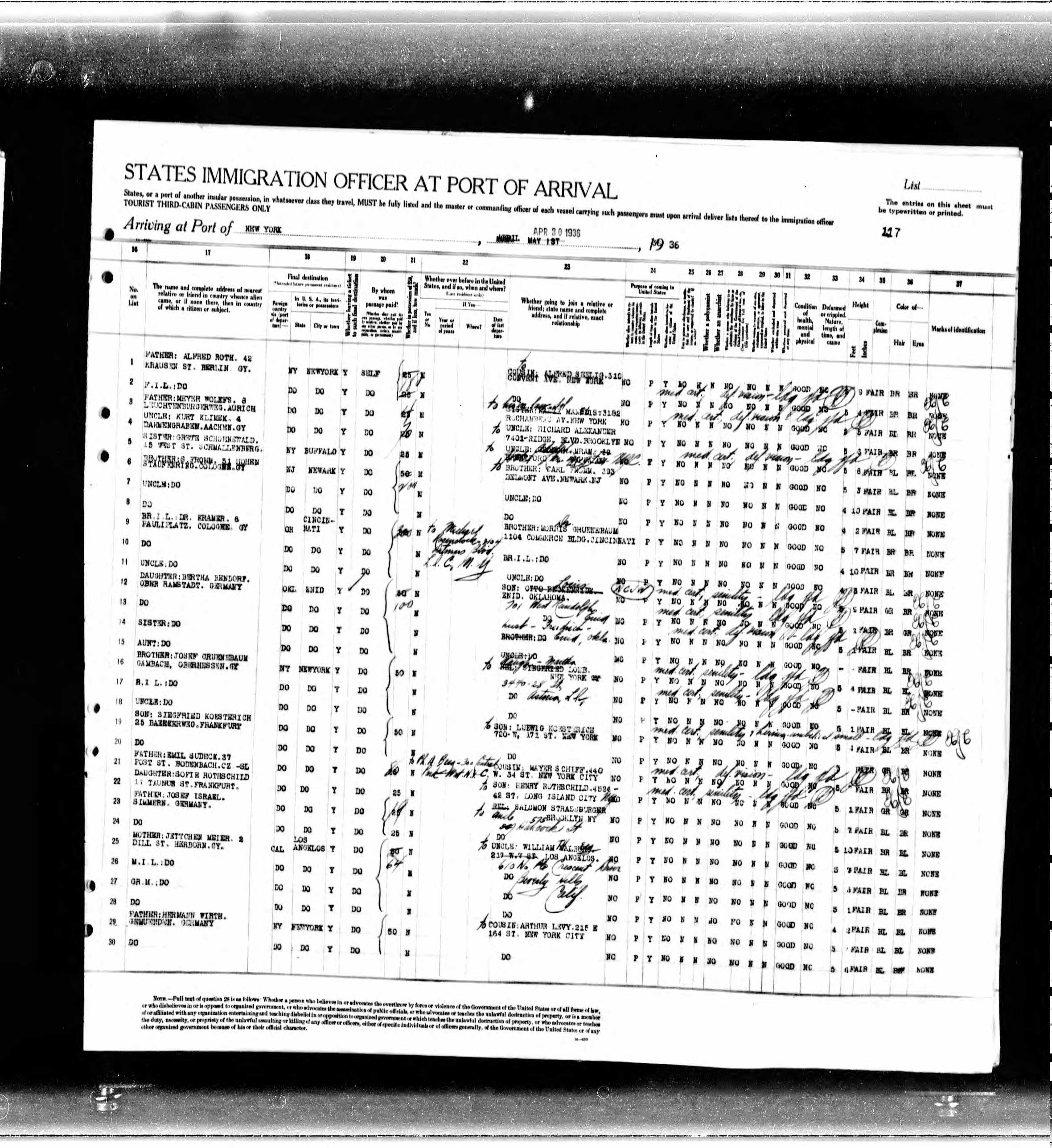
All three of the surviving children and their father Juda Ruelf immigrated to the US after Hitler came to power. Selma and her family left first, arriving in New York on April 30, 1936. The passenger manifest states that they were going to Los Angeles where Julius had an uncle.

Selma Ruelf Meier and family passenger manifest
Year: 1936; Arrival: New York, New York; Microfilm Serial: T715, 1897-1957; Microfilm Roll: Roll 5796; Line: 1; Page Number: 117
Ancestry.com. New York, Passenger Lists, 1820-1957

It doesn’t seem that Selma and Julius ever went to Los Angeles or, if they did, they were not there very long. When Selma’s brother Friedel arrived on June 16, 1937, he listed his sister Selma Meier as the person he was going to stay with and reported her address as Pine Plains, New York, a small town about a hundred miles north of New York City. Friedel reported that he was a horse dealer.

Gottfried Friedel Ruelf passenger manifest
New York, New York Passenger and Crew Lists, 1909, 1925-1957,” database with images, FamilySearch (https://familysearch.org/ark:/61903/3:1:33S7-95FR-1LM?cc=1923888&wc=MFKQ-6WL%3A1030057201 : 2 October 2015), 5997 – vol 12899-12901, Jun 21, 1937 > image 10


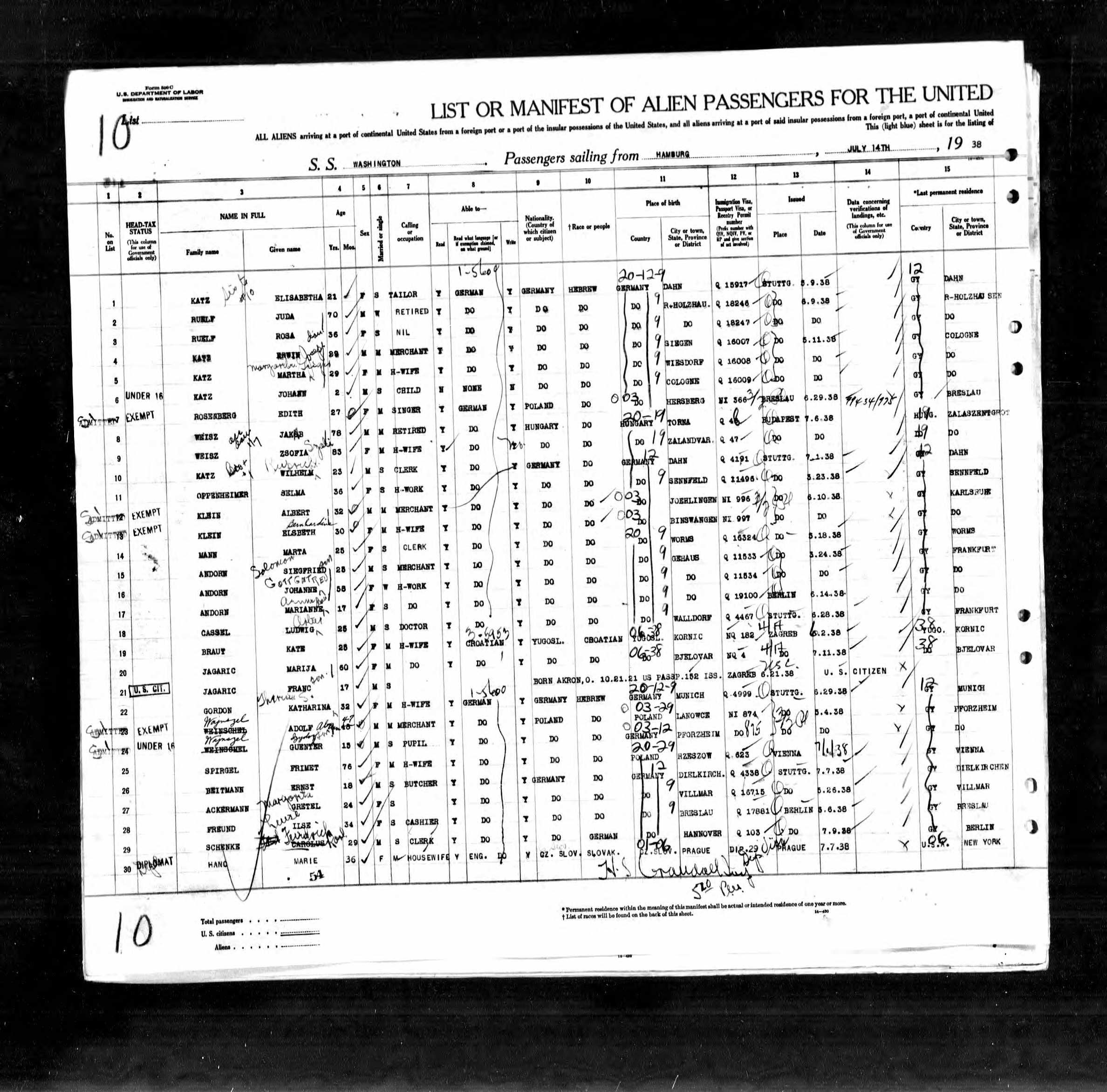
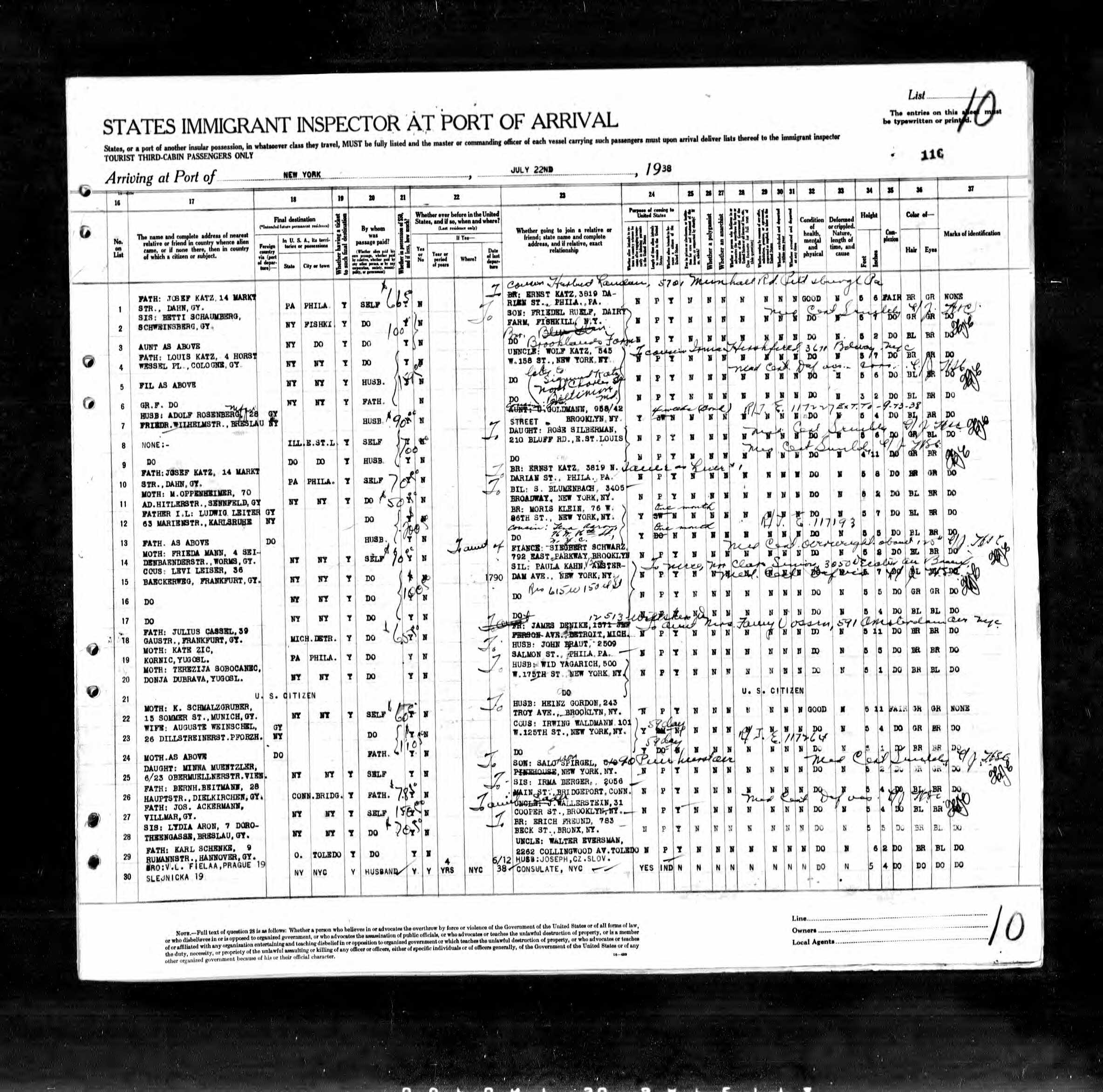
The last family members to arrive were Juda Ruelf and his remaining child, Rosa Ruelf. They arrived on July 14, 1938, and listed Gottfried (“Friedel”) Ruelf, Juda’s son, as the person they were going to see. Friedel’s address was given as “Dairy Farm, Fishkill, New York.” Fishkill, another small town, is about fifty miles south of Pine Plains and fifty miles north of New York City.

Juda Ruelf and daughter Rosa ship manifest
Year: 1938; Arrival: New York, New York; Microfilm Serial: T715, 1897-1957; Microfilm Roll: Roll 6186; Line: 1; Page Number: 116
Ancestry.com. New York, Passenger Lists, 1820-1957

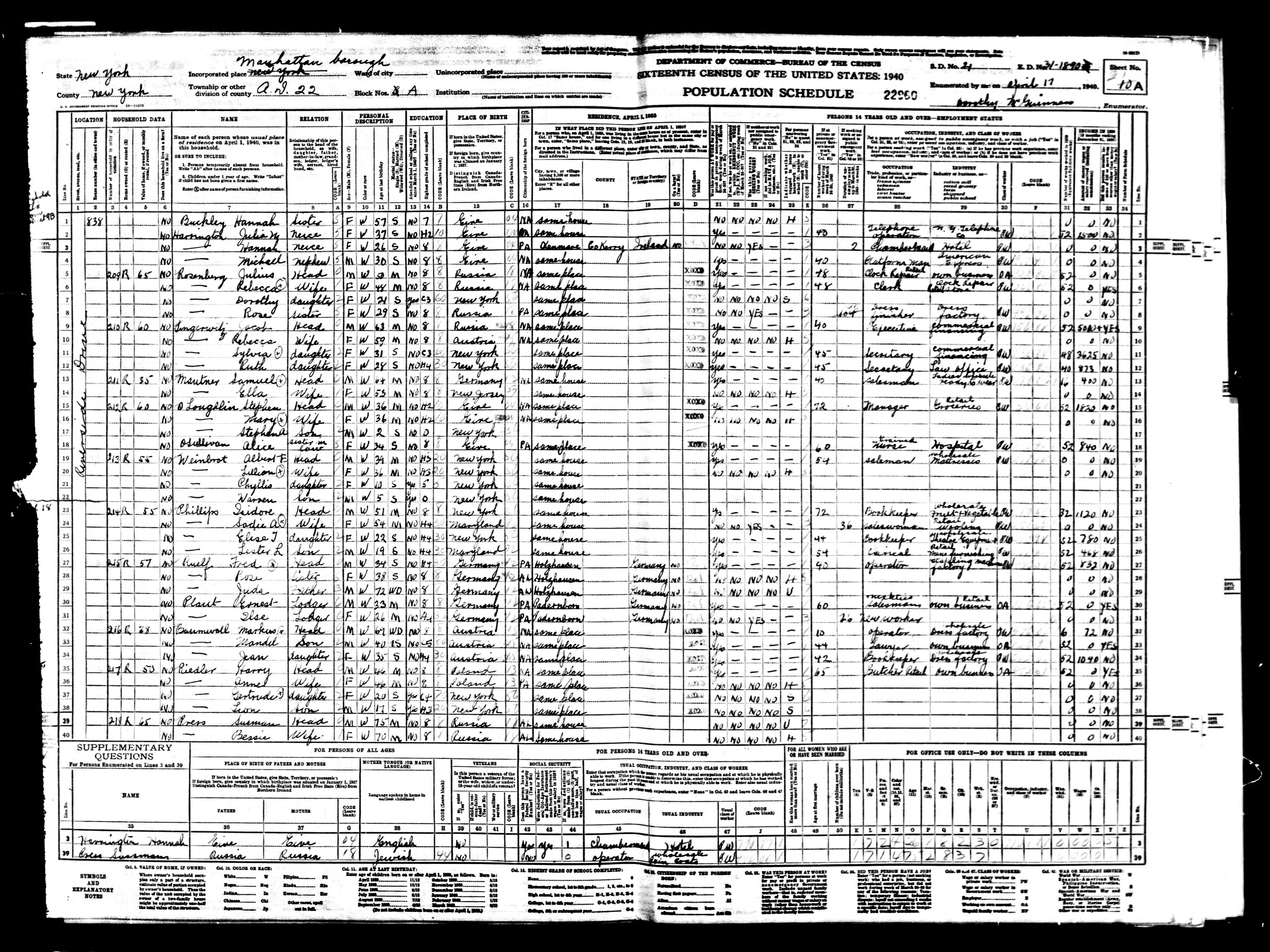
But Juda, Rosa, and Friedel did not remain long in Fishkill. On the 1940 census they were all living together in New York City. Friedel, now going by the Americanized name Fred, was the head of household and working as an operator in a stapling machine factory. Neither his father nor his sister Rosa was employed.  They also had two boarders living with them. Friedel must have been the sole support for his father and sister Rosa.

Friedel Rosa and Juda Ruelf 1940 census
Year: 1940; Census Place: New York, New York, New York; Roll: T627_2670; Page: 21A; Enumeration District: 31-1890

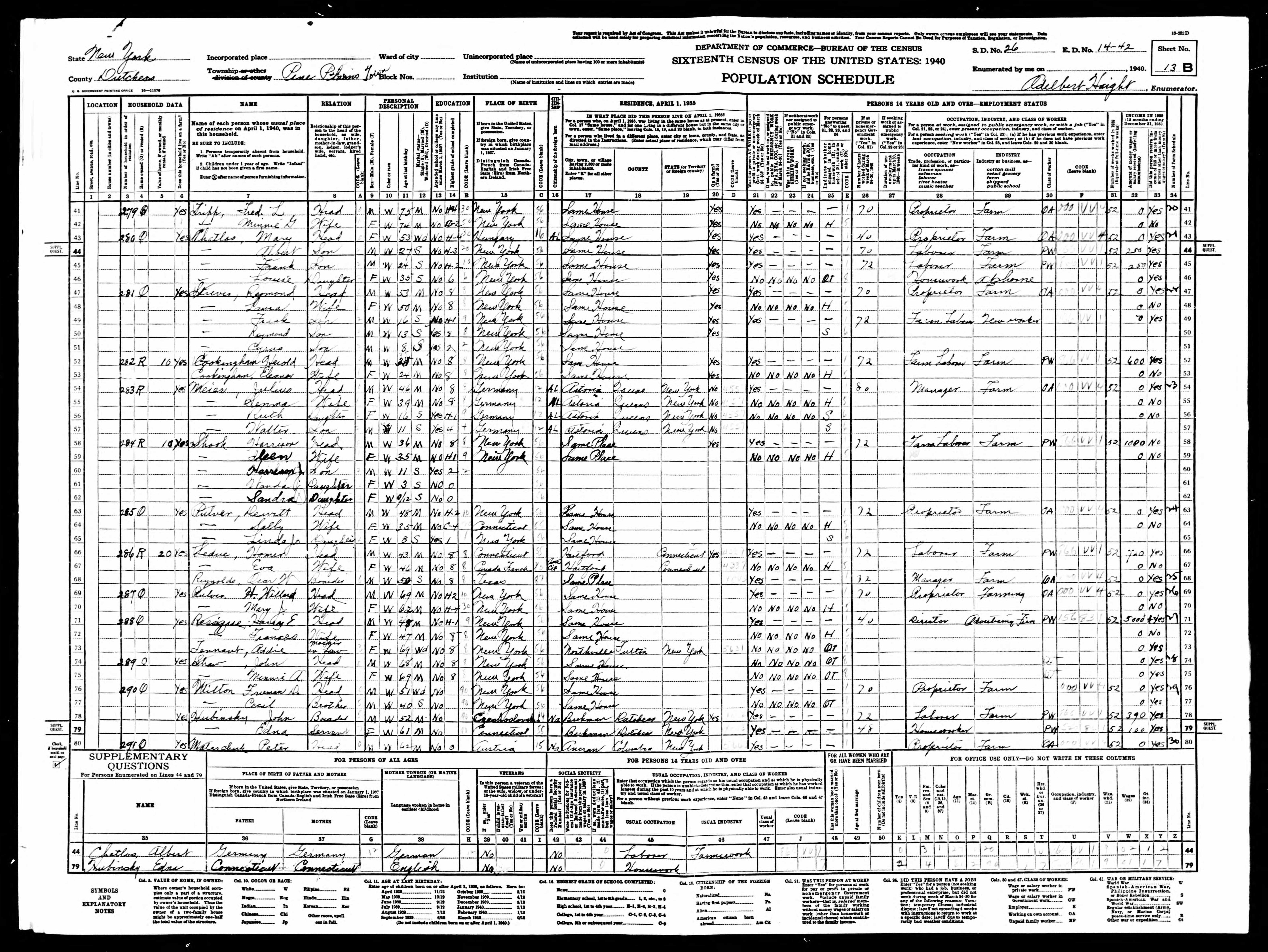
In 1940, his sister Selma and her family were, however, still living in upstate New York in Pine Plains where Julius continued to work as a farmer. Interestingly, the census record indicates that in 1935 they were living in Astoria, Queens, which can’t be correct since they hadn’t even left Germany in 1935.

Julius and Selma Meier and family 1940 census
Year: 1940; Census Place: Pine Plains, Dutchess, New York; Roll: T627_2523; Page: 13B; Enumeration District: 14-42

Friedel Ruelf married late in life. According to the New York City Marriage Index database on Ancestry, he married Claire Lowenstein in 1962 when he was 57 and she was 56.

Juda Ruelf and his children and their spouses are all buried at Cedar Park cemetery in Paramus, New Jersey. The cemetery office told me that Selma Meier died on April 15, 1950, but her death is listed on the New York, New York, death index on Ancestry as April 13, 1950. According to the cemetery, Juda Ruelf died eight months after his daughter Selma on December 12, 1950; he was 83 years old at his death. Julius Meier, widower of Selma Ruelf Meier, died on June 20, 1959, according to the cemetery. Rosa Ruelf’s death is documented by the Social Security Death Index; she died when she was 76 on June 18, 1978, which was confirmed by the cemetery.

Friedel and his wife Claire also are buried at Cedar Park cemetery in Paramus. Claire died July 3, 1999, at age 93; Friedel died just over a year later on August 13, 2000. He was 94 years old. [1]

Two of the members of the Bachenheimer side of the family, both named Steve, had the pleasure of knowing Friedel and his wife Claire personally.  I am looking forward to learning more from them about the family. Both Steves generously shared with me pictures of Friedel and Claire, one outside the Jewish cemetery in Kirchain, Germany,  and one in New York City.

Claire and Friedel Ruelf in Kirchhain, Germany
Courtesy of Steven Bachenheimer

Claire and Friedel Ruelf
Courtesy of Steve North

Thus, unlike the families of his sisters Esther, Betty, and Minna, no members of the immediate family of Juda Ruelf were killed in the Holocaust. His wife Lina died before the Nazis came to power, and Juda and his children all escaped to the US in time. They were among the fortunate ones.


[1] I am now in touch with two people who knew Friedel “Fred” Ruelf, and I am hoping to get more information about him and his life.

Finding Rebekka Ruelf: A Genealogy Adventure

The fourth daughter of Gelle Katzenstein and Moses Ruelf was Rebekka. Finding her story was a bit of a challenge.

She was born on November 7, 1865 in Rauischholzhausen.

Rebekkah Ruelf birth record
Geburtsregister der Juden von (Rauisch)Holzhausen (Ebsdorfergrund) 1824-1874 (HHStAW Abt. 365 Nr. 452)AutorHessisches Hauptstaatsarchiv, Wiesbaden, p. 14

At first, that was the only information I had about Rebekka, and I feared that she might have died as a child like three of her siblings, including Roschen, who was born on April 25, 1864, and died less than eleven months later on March 3, 1865. That meant that Gelle was recently pregnant with Rebekka when Roschen died, and she gave birth to Rebekka just eight months after losing Roschen. I feared that Rebekka also had died, perhaps because her mother was still grieving Roschen.

But then a marriage record popped up as a hint on Ancestry, and I sighed with relief that Rebekka had in fact grown to adulthood.  She married Jakob David on November 24, 1896, in Roßdorf, Germany, near Rauischholzhausen.

Marriage record of Rebecca Ruelf and Jakob David
Hessisches Hauptstaatsarchiv; Wiesbaden, Deutschland; Collection: Personenstandsregister Heiratsregister; Signatur: 915; Laufende Nummer: 7965

Jakob was born December 5, 1866, in Röhrenfurth, Germany, son of David David and Bertha Gottschalk. According to the marriage record, Jakob was a merchant in Moringen in the Lower Saxony region of Germany at the time of the marriage.  (Thank you to Doris Strohmenger for translating the marriage record for me.)


And then once again I was stymied. I could not find anything else about Rebekka and Jakob. I could not find anything more on Ancestry, FamilySearch, the LAGIS website, or Arcinsys for the Hesse region, so I turned to JewishGen, and decided to search in all the possibly relevant towns: Rauischholzhausen, Roßdorf, Röhrenfurth, and Moringen.

And JewishGen turned up this result:

Looking at the date of Hugo David’s birth date of September 25, 1897, ten months after Rebekka and Jacob’s wedding, I figured that this was probably their son. Since the record also suggested that Hugo had gone to the US, I searched for Hugo David on Ancestry and FamilySearch and found a lot more information about him.

First, I found his naturalization records. I knew this was the same Hugo David as that identified by JewishGen by his birth date and place.

Hugo David naturalization index card
Ancestry.com. Rhode Island, Indexes to Naturalization Records, 1890-1992 [database on-line]. Provo, UT, USA: Ancestry.com Operations, Inc., 2012.
Original data: Indexes to Naturalization Records for the District Court, 1906-1991, and the U.S. Circuit Court, 1906-1991, Rhode Island.

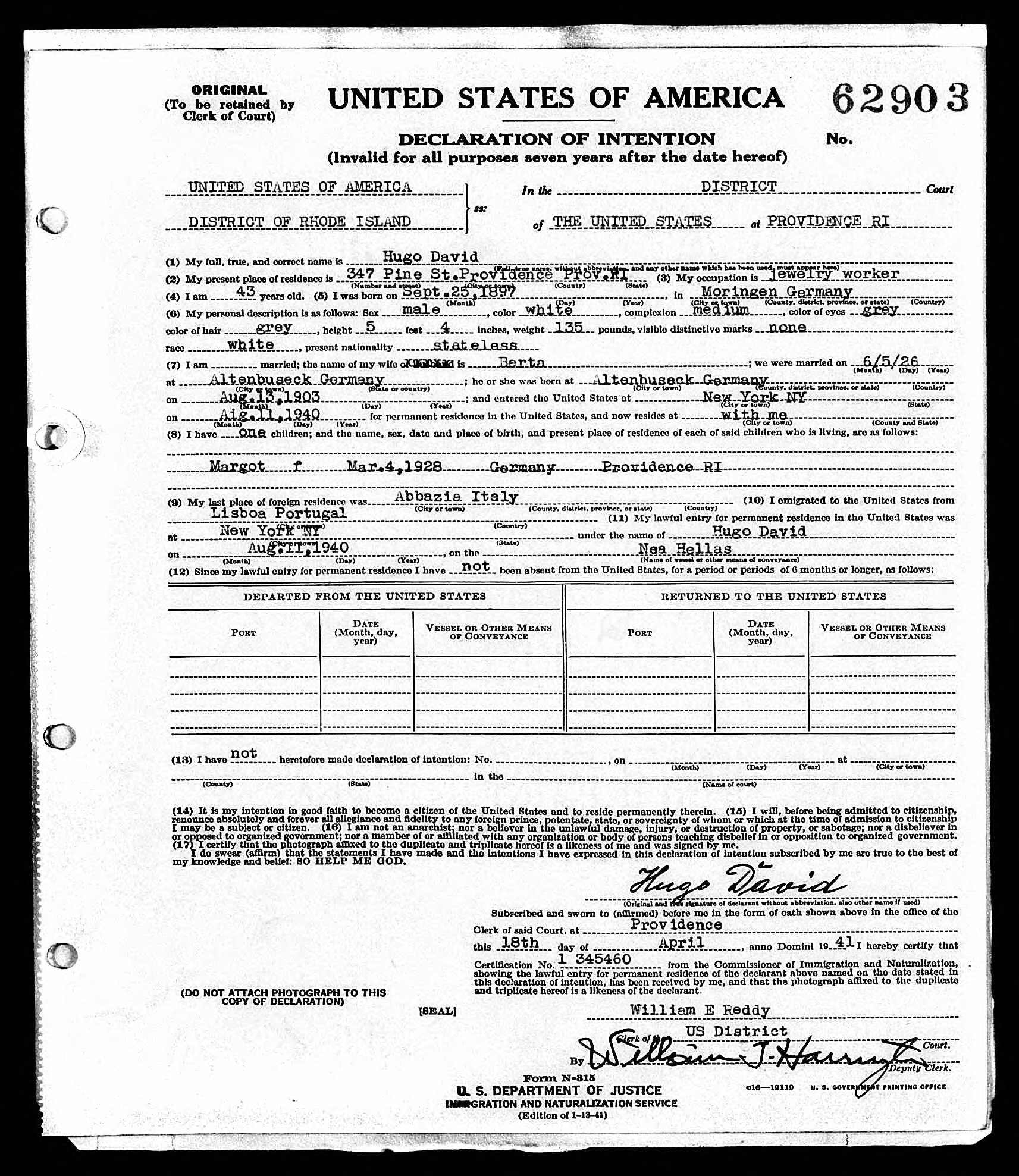
From other naturalization documents I learned that Hugo had lived in Abbazia, Italy, before immigrating to the US, sailing on the Nea Hellas from Portugal to New York in August, 1940.

Hugo David Declaration of Intent
National Archives at Boston; Waltham, Massachusetts; ARC Title: Petitions and Records of Naturalization, 2/1842 – ca. 1991; NAI Number: 3432872; Record Group Title: Records of District Courts of the United States, 1685-2009; Record Group Number: RG 21

With that information, I searched for their passenger manifest.  I still had no proof that Hugo was in fact the son of Rebekka Ruelf and Jakob David, even though the records did support that assumption. I needed to find something that linked him with Rebekka and Jakob. The passenger manifest helped bridge that gap:

Hugo David and family on ship manifest
Year: 1940; Arrival: New York, New York; Microfilm Serial: T715, 1897-1957; Microfilm Roll: Roll 6488; Line: 1; Page Number: 153
Ancestry.com. New York, Passenger Lists, 1820-1957 [database on-line]. Provo, UT, USA: Ancestry.com Operations, Inc., 2010.
Original data: Passenger Lists of Vessels Arriving at New York, New York, 1820-1897.

According to the second page of the manifest, Jakob was going to his cousins Meta and Reka [sic] Abraham. Who were they? They were the daughters of Pauline Ruelf, Rebekka Ruelf’s younger sister.

I now was quite confident that Hugo was in fact the child of Rebekka Ruelf and Jakob David. From the records I’d found, I learned that Hugo had married his wife Berta Loeber on June 5, 1926, in Alten-Buseck, Germany, where she was born. The ship manifest said that Hugo was a merchant.

The naturalization papers revealed that by April 18, 1941, Hugo and his family had settled in Providence, Rhode Island. From a number of Providence city directories from 1943 through 1960, I learned that Hugo had worked as a machine operator in Providence for many years.

But I still did not know what had happened to Hugo’s parents Rebekka Ruelf and Jakob David. Had they been killed in the Holocaust? Escaped from Germany? Died before the Nazi era? That question proved to be much harder to answer.  There were no records for them in the US, they were not listed on the Yad Vashem site or on the US Holocaust Memorial and Museum database of survivors and victims, and there were no death records I could find in Germany.

I searched on the internet for information about the Jewish community of Moringen and for information about death records for that town. Andre Gunther from the German Genealogy group also gave me some good suggestions for learning more.  I wrote emails to the town itself and to a Jewish genealogy society for Lower Saxony. Finally, I was able to connect with a man named Dietrich Feldmann, who contacted the Moringen archives and found three relevant documents.

First, he found Hugo’s birth record:

Second, he found a record for a second child born to Rebekka Ruelf and Jakob David, a baby girl who was stillborn on January 4, 1900:

It says in part, “It appears the merchant Jakob David, resident in Moringen, and notified that by Rebecka nee Rülf, his wife, of mosaic religion, was born in his flat … a stillborn girl.”

And third and most importantly, he located Rebekka Ruelf David’s death record. She had died on September 16, 1929. At least I had closure on Rebekka.

But Herr Feldmann had not been able to find a death record for Rebekka’s husband Jakob David.

Doris Strohmenger, who’d helped me translate Rebekka and Jakob’s marriage record, also helped me try and find more about Rebekka and Jakob and their son Hugo. She found a website about Moringen that included a page on the former Jewish community in Moringen. On that page was a bit of information about the David family. It reported that Hugo David had until 1936/1937 been the owner of a textile business in Moringen, a business he had taken over from his father, and that Hugo and his family had emigrated by 1938. There was also a photograph of the David family’s former home.

Although I still don’t have any information about when or where Jakob David died, there is circumstantial evidence that he died before Rebekka, as Hugo was the one who attested to his mother’s death. Also, I think I can infer from the fact that Hugo had been in charge of the family business until 1936/1937 that his father had passed away before that time.

Hugo David died at age 85 on June 25, 1983, in Warwick, Rhode Island, about six weeks after his wife Berta. She was 79.  They are buried at Sinai Memorial Park in Warwick. Hugo’s obituary named his parents as “the late Jacob and Sarah (Rulf) David.” (Providence Journal”, Rhode Island, GenealogyBank.com (http://www.genealogybank.com/doc/obituaries/obit/152E08B736FE81A8-152E08B736FE81A8 : accessed 10 September 2017)

“Sarah” was obviously a mistake. It’s interesting that whoever supplied this information for the obituary knew Rebekka Ruelf’s birth surname, but not her first name. I would assume this was Hugo’s daughter, who was born a year before her grandmother Rebekka died and whom she thus never really knew.

Perhaps if I can locate Rebekka’s descendants I will learn what happened to her husband, Jakob David.


Walking in Their Footsteps by Jennifer Spier-Stern

I am honored today to share with you an essay written by my fourth cousin, once removed, Jennifer Spier-Stern. Jennifer is the great-granddaughter of Minna Ruelf and Isaak Spier, about whom I wrote in my last post. When Jennifer shared this essay with me, I was so moved that I asked her if I could post it on my blog. She graciously agreed to let me do that, and I hope that you also will feel the way I did—that I was with Jennifer in her footsteps as she walked in the footsteps of her family in Rauischholzhausen, Germany.

Walking in Their Footsteps

by Jennifer Spier-Stern

I was transformed back in time as we drove through the narrow streets of the town called Rauischholzhausen.  We passed old homes with beautiful flower baskets hanging from windows and well manicured gardens. The narrow street was paved and there was even a sidewalk. I wanted to absorb every corner, every home into my mind so I could never forget these images.  I know that 70+ years ago it was not as pristine. I have thought of this day for so many months. Each and every time I envisioned this part of my trip I cried.  The tears were for the people that were no longer here to tell me their tales. My father wasn’t with me to show me the way, to tell me about his memories and to stand with me in front of the home where he was born. To walk with me to the Schloss (castle) and show me the places where he ran, where he played, to show me where his family lived and where the synagogue was.

View of Rauischholzhausen with arrow pointing to synagogue
http://www.alemannia-judaica.de/images/Images%20362/Rauischholzhausen%20Ort%200100.jpg

The reason for this trip started many years ago. My father was born in Rauischholzhausen in 1922, a small town a few minutes drive from Marburg.  Growing up we heard all the stories of Holzhausen and of the early childhood of my father and his four siblings. We used to roll our eyes and laugh with yet another story of “home.” As young adolescents we didn’t appreciate all that he told us.  I wish I had documented everything, but like most young adults, I didn’t.   My father always promised my brother and I a trip back to his roots, but that was never going to happen, he passed away in 1998.  Since my father’s passing I had fleeting thoughts of going to Germany but not until recently did this strong urge possess me that I had to go and see for myself.

Without going into full details of the history of our family, my father’s brother returned to Germany with his wife and son and settled in Bielefeld in 1959.

My aunt, uncle, cousin and his wife met us at our beautiful hotel and drove us to the house that was 16 Lerchengasse. 16 Lerchengasse was the house where my father lived. The house that bore the name I Spier (Isaak Spier) above the front door frame. We parked the car and walked that last few steps down a cul de  sac.  I had the vision of the house from few photos that survived the war. 

My uncle stopped in front of the house and said, “This is it. This is the house where we were born.”  I looked up at this large home, the home of my great-grandfather, grandfather and father. My hands were shaking and the tears rolled down my face.  I heard my father’s voice, I heard his stories, I saw him walking up and down the front stairs. I saw him running around the courtyard with his siblings. I haven’t felt my father’s presence as strongly as I did at that moment.  I wish I could have knocked on the door and introduced myself. I so wanted to go inside, but I know it is far different than the house my father left on November 9, 1938.  I looked at the surrounding homes, and they too were lovely with their planters filled with flowers and lace curtains in the window. Later in the week Hajo (My hero guide) posed the question to me, “Can you imagine this town 65 years ago?”

Spier home in Rauischholzhausen
Courtesy of Jennifer Spier-Stern

The next stop was the Jewish cemetery. We picked up the key at the caretaker and then we walked the grass soaked path towards the cemetery. The rain started and the path became very muddy. The land to the right was a beautiful pasture for grazing cows who seemed very curious and walked over to the fence. It seemed surreal.  As we walked my eyes were looking down at the path, knowing that my grandparents and many other ancestors walked here to enter the cemetery. They came here to bury. They came here on the holidays to remember those that passed. They came here to say Kaddish. I was walking in their footsteps.  

My grandfather Abraham Spier buried his parents, Isaak Spier and Minna Rülf neé Spier. One of the oldest stones in the cemetery is Nathan Spier, my 3rd great grandfather (1792-1866). We stepped into the cemetery where 80% of the graves are family ancestors. I had my dear friend Hajo Bewernick photograph every stone for me. I’ve looked at the photos numerous times and now, I stood before them. I stood there and cried.  Emotions flooded my body that I didn’t know how to react. I wanted to touch every stone and place a rock, I wanted to pray. In years to come how many will walk through the gates to pray for all the souls? However, all I could do was cry. Later on I found out that my husband said the Mourner’s Kaddish, (a Mourner’s Prayer) as he stood over one grave, but he said it for all.
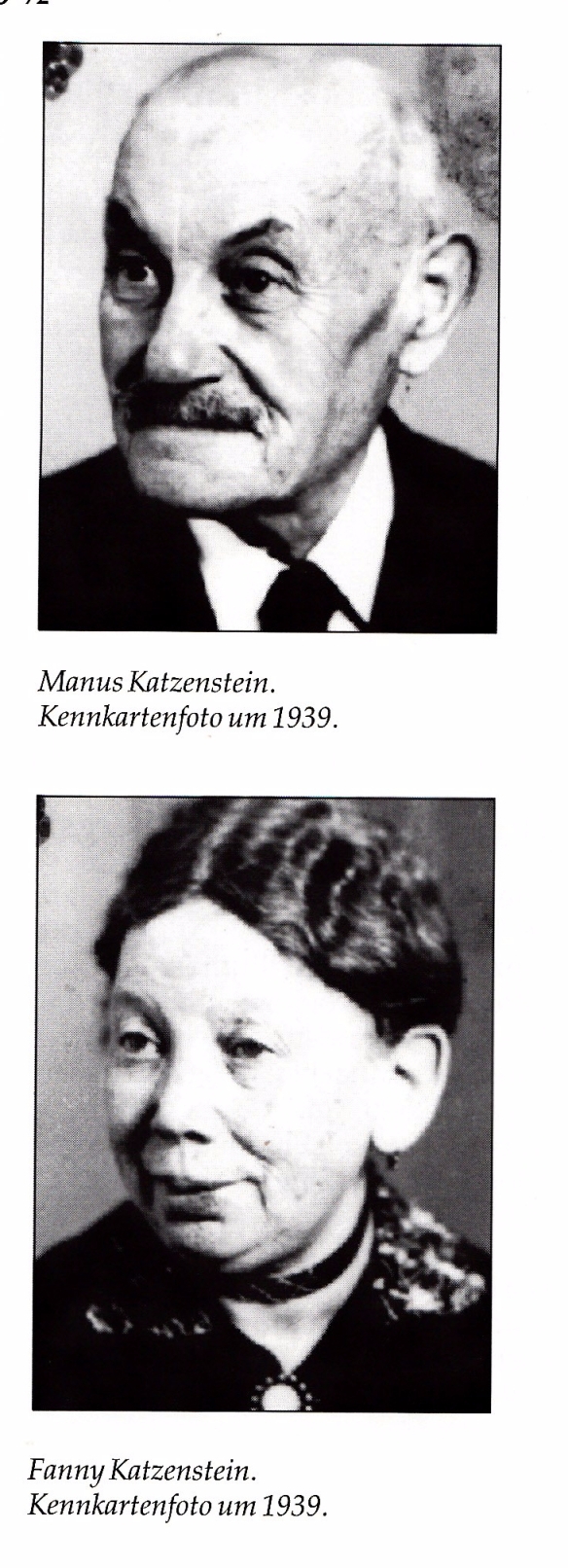
Gravestones of Minna Ruelf Spier and Siegfried Spier in Rauischholzhausen
http://www.alemannia-judaica.de/rauischholzhausen_friedhof.htm

I walked in their footsteps. I was thankful that my family who live in Germany were able to share this experience with me.  Special thanks to Hajo Bewernick who took the time from his busy work and home life to show my husband and I Marburg. I can never thank you enough for explaining the history of your beautiful town as well as showing us the many historical sites and to our many insightfully deep conversations.  You created a three dimensional image for me  of my grandparents, my Oma and Opa, by showing us where they would have been, where they would have walked and the buildings from where they were deported. I do not recall the name of the street corner. Hajo was specific in pointing his finger.

Through my research I have come across generous people who devote their time and efforts to the history of the Jewish people. To everyone we thank you for all your hard work. Special thank you to Barbara Greve for always being there with the answers.

One more person I need to thank with all my heart is my husband, Effy. This trip wouldn’t have happened without him. He knew how important this trip was for me and I am glad he shared it by my side.

I never felt closer to my family and my ancestors as I have during these few days in my family’s home town.   I know I’ll keep these stories alive with my family and I hope they will continue the legacy.