The Schoenthals Come to America: 1866-1880

One of the things that I have found touching in researching many of the lines in my family is the way that families stayed together even after settling in the United States.  Although family members would sometimes move away as their children grew up and the job opportunities changed, brothers and sisters and cousins and others tended to all end up near each other when they first migrated.  In the case of the Schoenthal family, it’s even more striking since almost all of them ended up in a relatively small city, Washington, Pennsylvania.

Washington, PA 1897 By Thaddeus Mortimer Fowler & James B. Moyer [Public domain], via Wikimedia Commons

Washington, PA 1897
By Thaddeus Mortimer Fowler & James B. Moyer [Public domain], via Wikimedia Commons

As I mentioned in my last post, my great-great-uncle Henry Schoenthal was the first sibling of my great-grandfather Isidore to emigrate from Germany to the United States. His aunt Fanny Schoenthal Goldsmith had preceded him with her husband Simon in 1845.  Henry was the second oldest child and the oldest son of Levi Schoenthal and Henrietta Hamberg, born on May 20, 1843, in Sielen.  His German name was Hienemann, named for Levi’s father, Hienemann Schoenthal, but he changed it to Henry after settling in the United States.

According to the Beers biography referred to here, “Henry Schoenthal attended the school of his native village up to his fourteenth year, at the same time learning his father’s trade [shoemaking], beginning when only ten and one-half years old, and working at the same until he was fifteen years old. For two years after this he took private literary instruction, and in the year 1859 was admitted into the Jewish Seminary in Cassel, Germany, an institution where young men were educated to become teachers in Jewish schools, and leaders of the service in the synagogue. At the end of the third year he passed an examination, and then taught school for three years in one place [Trendelburg].”[1]    His role as a teacher is also mentioned on the Alemannia-Judaica page for Trendelburg.

Despite being quite educated and having what would appear to be a good position, Henry must have decided that there were greater opportunities in America where his uncle Simon Goldsmith and his family had moved in 1845. Henry, still using the name Hienemann, sailed on the S.S. Hansa from Bremen, Germany, arriving in New York City on June 18, 1866.

Henry Schoenthal 1866 ship manifest, line 85 Year: 1866; Arrival: New York, New York; Microfilm Serial: M237, 1820-1897; Microfilm Roll: Roll 267; Line: 1; List Number: 679

Henry Schoenthal 1866 ship manifest, line 85
Year: 1866; Arrival: New York, New York; Microfilm Serial: M237, 1820-1897; Microfilm Roll: Roll 267; Line: 1; List Number: 679

As the Beers biography reports, Henry settled in Washington, Pennsylvania. “Selecting as his abiding place in the land of his adoption the thriving town of Washington, this county, he clerked for three years in the clothing store of [his first cousin] Jacob Goldsmith, at the sign of the “Golden Eagle,” in the room now occupied by C. A. House as a music store.”  Henry’s cousin had been well-established in Washington since at least 1854 as this August 23, 1854 article from the Washington Reporter (p. 2) reports:

Jacob Goldsmith ad 1854

On September 23, 1867, Henry’s younger brother Simon, born February 14, 1849, arrived in New York City on the S.S. D.H. Wagen, listing his occupation as a bookbinder and his destination as Pennsylvania.  Sailing with Simon was their sister Amalie, born Malchen on January 1, 1847, in Sielen. She also was headed to Pennsylvania.

Simon Schoenthal and Amalie Schoenthal 1867 ship manifest, lines 230 and 231 Year: 1867; Arrival: New York, New York; Microfilm Serial: M237, 1820-1897; Microfilm Roll: Roll 286; Line: 1; List Number: 1004

Simon Schoenthal and Amalie Schoenthal 1867 ship manifest, lines 230 and 231
Year: 1867; Arrival: New York, New York; Microfilm Serial: M237, 1820-1897; Microfilm Roll: Roll 286; Line: 1; List Number: 1004

The Beers biography continues, “Then in 1869, Mr. Schoenthal bought out the stationery business of Rev. James McFarland, at the “Green Tree Corner,” and has ever since conducted a prosperous and lucrative trade in books, stationery, notions, etc., at the same stand.”

Advertisement Date: Wednesday, June 7, 1871 Paper: Washington Reporter (Washington, Pennsylvania) Volume: LXIII

Advertisement
Date: Wednesday, June 7, 1871 Paper: Washington Reporter (Washington, Pennsylvania) Volume: LXIII

In 1870, Henry (now using Henry) and Simon were living together in Washington in what appears to be a hotel.  Henry was a book merchant, and Simon a bookbinder.

Henry and Simon Schoenthal 1870 census, lines 20 and 21 Year: 1870; Census Place: Washington, Washington, Pennsylvania; Roll: M593_1463; Page: 150B; Image: 290; Family History Library Film: 552962

Henry and Simon Schoenthal 1870 census, lines 20 and 21
Year: 1870; Census Place: Washington, Washington, Pennsylvania; Roll: M593_1463; Page: 150B; Image: 290; Family History Library Film: 552962

Simon book bindery 1870

Henry was also actively involved in the cultural life in Washington, bringing music to the people who lived there:

Henry Schoenthal music


In 1870, their sister Amalie Schoenthal was living in Pittsburgh with their uncle Simon Goldsmith, who had relocated to Pittsburgh by then.  His daughter Hannah had married Joseph Benedict, and they had a five month old baby Jacob at the time of the 1870 census.  Joseph was in the retail business (no product identified), and his father-in-law Simon was listed as a retired tailor.  Amalie’s occupation was reported as a “domestic.”  I don’t know whether that means she was working as a servant for her cousin or in the household of someone else.  I am curious as to who Eliza Brocksmith and her baby Jacob were, also listed in the household, but I’ve not yet found the connection.  Perhaps she was Joseph’s sister.
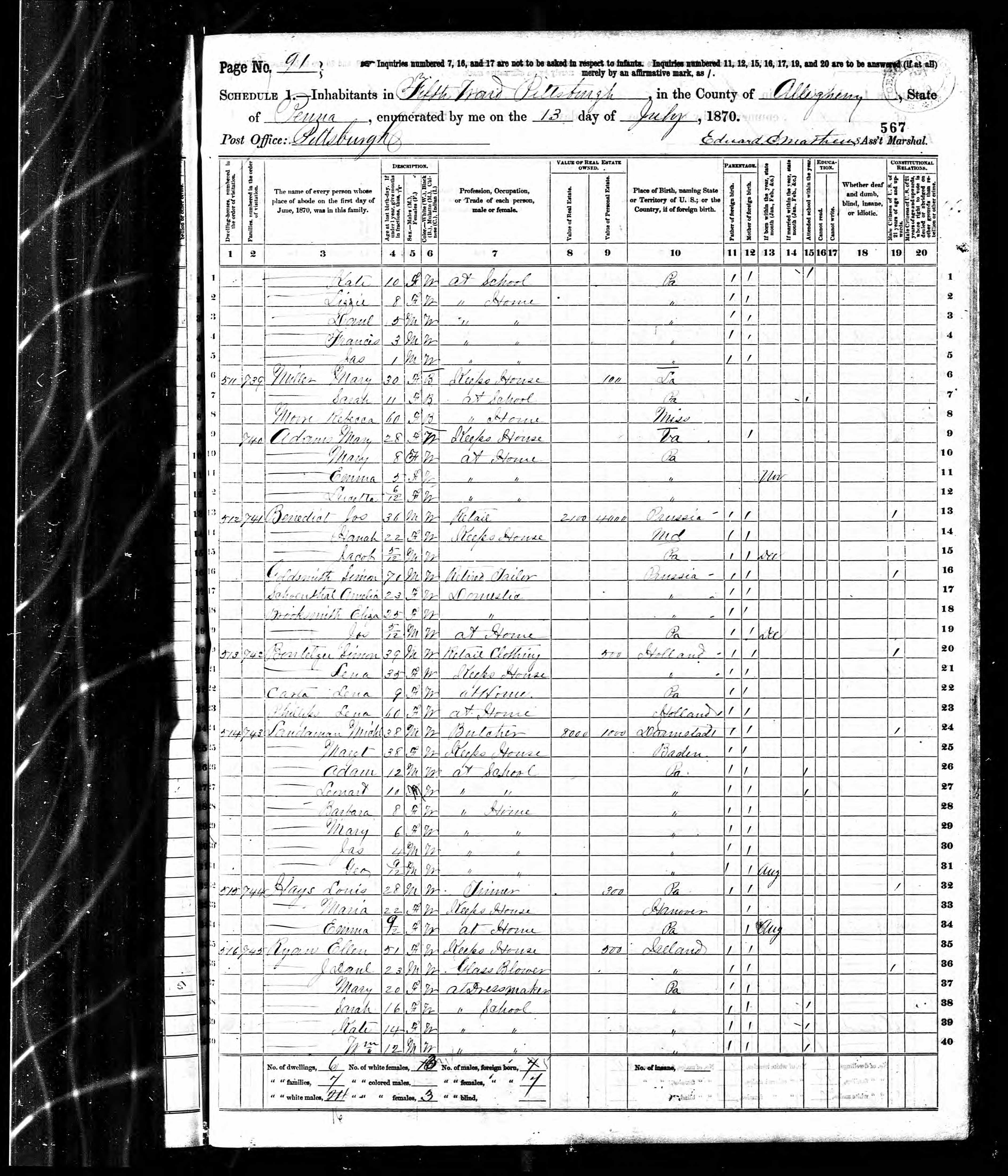
Amalie Schoenthal with Simon Goldsmith and the Benedict family 1870 census Year: 1870; Census Place: Pittsburgh Ward 5, Allegheny, Pennsylvania; Roll: M593_1295; Page: 567A; Image: 439; Family History Library Film: 552794

Amalie Schoenthal with Simon Goldsmith and the Benedict family 1870 census
Year: 1870; Census Place: Pittsburgh Ward 5, Allegheny, Pennsylvania; Roll: M593_1295; Page: 567A; Image: 439; Family History Library Film: 552794

Meanwhile, another sibling, Nathan arrived not long after the 1870 census.  Nathan, who was born August 6, 1854 in Sielen, was only sixteen years old when he sailed on the Frankfurt from Bremen to New York, arriving July 16, 1870.  He also settled in Washington, Pennsylvania, with his two older brothers.

Nathan Schoenthal 1870 ship manifest line 167 Year: 1870; Arrival: New York, New York; Microfilm Serial: M237, 1820-1897; Microfilm Roll: Roll 332; Line: 1; List Number: 683

Nathan Schoenthal 1870 ship manifest line 167
Year: 1870; Arrival: New York, New York; Microfilm Serial: M237, 1820-1897; Microfilm Roll: Roll 332; Line: 1; List Number: 683

In 1872, Henry returned to Germany where on May 8, 1872, he married Hewa (Helen) Lilienfeld of Gudensberg, the daughter of Meyer Lilienfeld and Malchen Engelbert.  Gudensberg is another town in the Kassel district of Hessen located about 55 km from Sielen.  I would love to know how that marriage was arranged.  Henry had been in the US for six years at that point and was 29 years old.  Had his parents made this arrangement for him?

Henry Schoenthal and Hewa Lilienfeld marriage record HHStAW Abt. 365 Nr. 386, S. 37

Henry Schoenthal and Hewa Lilienfeld marriage record
HHStAW Abt. 365 Nr. 386, S. 37

Henry and his new bride returned to the United States on May 24, 1872, sailing from Bremen on the Danae.  Strangely, Helen was listed under her birth name, Lilienfeld, not Schoenthal.  There are also two entries for Amalie Mannsbach, an eighteen year old, listed in between Helen(e) and Henry.  (I assume there were not two women with that name, but an error in the manifest.  Or maybe there were two cousins with the same name and of the same age.)  Since Henry’s brother Simon married a woman named Rose Mansbach in 1872, I am wondering whether Amalie became Rose in the US and whether Henry was bringing this young woman back for his younger brother.  But right now that is just speculation.

Henry Schoenthal and Helene Lilienfeld 1872 ship manifest lines 95 to 98 Year: 1872; Arrival: New York, New York; Microfilm Serial: M237, 1820-1897; Microfilm Roll: Roll 359; Line: 1; List Number: 484

Henry Schoenthal and Helene Lilienfeld 1872 ship manifest lines 95 to 98
Year: 1872; Arrival: New York, New York; Microfilm Serial: M237, 1820-1897; Microfilm Roll: Roll 359; Line: 1; List Number: 484

Meanwhile, a fifth Schoenthal sibling had arrived in western Pennsylvania while Henry was in Germany, getting married.  Felix, born Seligmann Schoenthal on December 15, 1856, in Sielen, arrived on May 11, 1872, according to the passport application he filed in 1919.  Although I scanned the entire ship manifest for the ship that arrived on that date from Bremen, I could not find his name.  Felix also asserted on his passport application that he was naturalized in the Court of Common Pleas in Pittsburgh on August 17, 1878. In 1880, he was living with his wife of two years, Maggie (or Margaret), in West Newton, Pennsylvania, and working as a clerk in the paper mill.  West Newton is about 32 miles east of Washington and about 25 miles southeast of Pittsburgh, so he was not too far from his siblings.

Felix Schoenthal 1880 US census Year: 1880; Census Place: West Newton, Westmoreland, Pennsylvania; Roll: 1204; Family History Film: 1255204; Page: 8C; Enumeration District: 109

Felix Schoenthal 1880 US census
Year: 1880; Census Place: West Newton, Westmoreland, Pennsylvania; Roll: 1204; Family History Film: 1255204; Page: 8C; Enumeration District: 109

A sixth Schoenthal sibling also had arrived from Germany by 1880—Julius.  He, however, has proven to be more difficult to pin down.  I have been unable to locate a passenger manifest that includes him, and if it weren’t for the fact that the Beers biography mentioned a brother named Julius who lived in Washington, DC, I probably would not have assumed that the Julius Schoenthal that I found in DC was related to my Schoenthal family.  When I found Julius on the 1880 census, the only clue I had to support the conclusion that he was related was the fact that, like Levi Schoenthal, he was a shoemaker.

Julius Schoenthal 1880 US census Year: 1880; Census Place: Georgetown, Washington, District of Columbia, District of Columbia; Roll: 121; Family History Film: 1254121; Page: 9A; Enumeration District: 012; Image: 0498

Julius Schoenthal 1880 US census
Year: 1880; Census Place: Georgetown, Washington, District of Columbia, District of Columbia; Roll: 121; Family History Film: 1254121; Page: 9A; Enumeration District: 012; Image: 0498

I didn’t have a German birth record for Julius so I assumed he was born before 1846 when the Breuna birth records that are available online began. Things got even more confusing when I tried to find information about when Julius arrived in the US and what he was doing in the 1870s.  What a hodge-podge of confusing and conflicting clues.

First, the 1910 census reports that Julius arrived in 1869, but the 1900 census said he arrived in 1875.  According to the District of Columbia, Select Marriages, 1830-1921, database on Ancestry, Julius married Minnie Dahl on March 15, 1874, in DC., so I knew Julius had to have been in the US by 1874 and that the 1900 census could not be right.  Then I found an entry for a Julius Schoenthal in the U.S., Civil War Pension Index: General Index to Pension Files, 1861-1934, on Ancestry that indicated that Julius had filed a claim for a pension in 1897 as an invalid; it also indicated that Julius had served in the Signal Corps, but there were no dates of service indicated on the index card in that database.

Julius Schoenthal pension index card U.S., Civil War Pension Index: General Index to Pension Files, 1861-1934

Julius Schoenthal pension index card
U.S., Civil War Pension Index: General Index to Pension Files, 1861-1934

I was confused.  If Julius arrived in 1869 or 1875, how could he have served in the Civil War, which ended in 1865?

I decided to look for news articles, hoping I’d find something to shed light on when Julius had immigrated, and I found an article dated September 14, 1914, from the Washington Evening Star (p. 12) that added one more fact to the mix, bewildering me even further.

Julius Schoenthal news article re Germany WW I

If Julius had served in the Franco-Prussian War in 1870-1871, how could he have served in the US Civil War?  Had he immigrated to the US, enlisted in the US Army, and then returned to Germany to serve in that country’s army against France?  I thought maybe I should order his service file from the National Archives, but  it was fairly expensive, so I decided to hold off and see what else I could find.

I turned once again to the genealogy village and the Ancestry.com Facebook group to see if there was someone who was more expert with the U.S., Civil War Pension Index: General Index to Pension Files, 1861-1934 database.  I was very fortunate to get tremendous help from a member there named Lillian.  First, she informed me that the so-called Civil War Pension Index covers more than just Civil War veterans, a fact that had not been clear to me when I read the database description.  Then Lillian pointed me to a document on Fold3, a genealogy website primarily focused on military records.  That document stated that Julius had enlisted in the US Army in 1873, eight years after the Civil War ended.

I’d seen this document earlier, but had dismissed it for a couple of reasons.  First, it said that Julius was born in Berlin.  That seemed not likely to be the right person since all of my great-grandfather’s other siblings were born in Sielen, not anywhere close to Berlin.  Secondly, it said he enlisted from Chicago.  I couldn’t imagine that my Julius would have enlisted from Chicago since no one else in the family was there, so I had dismissed this record.  Looking a second time at Lillian’s suggestion, I saw that Julius had been discharged in Washington, DC, on June 5, 1874, making it more likely that this could be my Julius.  But I was and am not 100% certain that it is.

It would make more sense, however, for Julius to have enlisted in 1873, not during the Civil War.  Maybe he had arrived in 1869 and had returned home to fight for Germany in the Franco-Prussian War.  Or maybe the 1910 census does not accurately record his arrival date and Julius had arrived after serving in the Franco-Prussian War, perhaps in 1872, and then enlisted in the US Army from Chicago.  He married Minnie Dahl, who was born in Germany, but I don’t know where he met her.  Assuming it was in Washington, that might explain why they settled there once he was discharged from the army in 1874 less than two months after they were married.

English: Pres. U.S. Grant (between 1870 and 18...

English: Pres. U.S. Grant (between 1870 and 1880) Français : Le président américain Ulysses Grant (Photo prise entre 1870 and 1880) (Photo credit: Wikipedia)

Lillian found one more piece of evidence that may provide more answers.  On May 12, 1873, a man named Julius Schoenthal wrote a letter to then US President Ulysses S. Grant, and that letter is in the Ulysses S. Grant Presidential Collection at Mississippi State University.  I have ordered a copy of the letter and hope to receive it within a week or so.  I am hoping that perhaps it will be the right Julius Schoenthal and that it will reveal something about his life before being discharged from the army and marrying Minnie Dahl.  Maybe I will find some clue, some evidence that ties him to my Schoenthals and explains some of the confusing and conflicting evidence I’ve found so far. And now I am curious enough about Julius that I broke down and ordered his pension file, but found someone who could retrieve it for me for a more reasonable price.

Assuming that Julius was in fact my great-grandfather’s brother, it would mean that by 1880 five of the seven surviving sons and one of the three daughters of Levi Schoenthal and Jette Hamberg had left Sielen, Germany, and moved to the United States.  All but Julius were living in western Pennsylvania in 1880. As the Beers biography points out, by 1880, Henry and Helen Schoenthal had had three children, “Madaline, born March 16, 1873, died in infancy; Hilda, born June 25, 1874; Lionel, born April 14, 1877.”  Amalie and her husband Elias Wolfe had had three: Maurice (1873), Florence (1875), and Lionel (Lee) (1877).  I assume the two Lionels were named for their grandfather Levi Schoenthal, who had died back in Sielen in 1874. Simon and his wife Rose had had five children in the 1870s: Ida (1873), Harry (1873), Gertrude (1875), Louis (1877—probably also named for Levi), and Maurice (1878).  Julius and his wife Minnie had four children in the 1870s: Leo (1875—also probably for Levi), Rosalia (1876), Sylvester (1878), and Moretto (1879).  Thus, in one decade the Schoenthal siblings had produced fifteen new American born children.

Levi Schoenthal death record March 1874 HHStAW Abt. 365 Nr. 773, S. 9

Levi Schoenthal death record March 1874
HHStAW Abt. 365 Nr. 773, S. 9


In the next decade, my great-grandfather Isidore would arrive as well as his mother and two other sisters.  There would be only one Schoenthal left in Germany, at least for a while.  Almost all the descendants of Levi and Henrietta (Hamberg) Schoenthal would be born in the United States.


[1] Text taken from page 1057 of:

Beers, J. H. and Co., Commemorative Biographical Record of Washington County, Pennsylvania (Chicago: J. H. Beers & Co., 1893).

Transcribed March 1997 by Neil and Marilyn Morton of Oswego, IL as part of the Beers Project.

Published March 1997 on the Washington County, PA USGenWeb pages at http://www.chartiers.com/.

Another Twisted Family Tree Story: The Goldsmiths/Goldschmidts

One thing that has amazed me before in my research is how often various lines in my family interconnect, like the Hano, Nusbaums, and Cohens in Philadelphia.  In researching the Schoenthals, I’ve once again encountered one of those twists in my family tree.

In my September 25 post I shared the numerous records I was able to find, with the help of several others, for my Schoenthal ancestors, including the marriage record of my great-great-grandparents, Levi Schoenthal and Jhette (or Henrietta) Hamberg in 1839.  That record revealed that Levi’s father was Heinemann Schoenthal and his mother Hendel (or Handel) Beerenstein.  For the moment that is as far back as I’ve been able to go with my Schoenthal line, though I hope to be able to find more about the earlier history of both the Schoenthal line and the Beerenstein line.

Marriage record for Levi Schoenthal and Jhette Hamberg HHStAW, 365, 386

Marriage record for Levi Schoenthal and Jhette Hamberg
HHStAW, 365, 386

Thanks to the research done by David Baron and my third cousin Roger Cibella, I now know that Heinemann and Hendel had at least one other child, a daughter named Fradchen or Fanny, who was born in 1800 in Sielen, making her twelve years older than her brother Levi. (Hans-Peter Klein has uncovered another sibling, Minna, but that’s a story for another day.)

Unfortunately I’ve not yet found a birth record for Fanny, but there is a marriage record to support that conclusion.  David and Roger sent me a copy of this marriage record dated September 10, 1844 from Oberlistingen, a town very close to Breuna (and now one of the districts of the town Breuna).

Marriage of Simon Goldschmidt and Fradchen Schoenthal HHStAW Abt. 365 Nr. 669, S. 11

Marriage of Simon Goldschmidt and Fradchen Schoenthal
HHStAW Abt. 365 Nr. 669, S. 11

As translated for me by Matthais Steinke, the record records the marriage of Fradchen Schoenthal, daughter of Heinemann Schoenthal and Hendel Beerentstein, to Simon Goldschmidt, son of Jacob Goldschmidt and Hewa Seligmann.  (No, I do not think Hewa Seligmann was related to my Seligmanns, but who knows? But that’s not the twist here.)  The record lists Fanny as 37 years old in 1844, thus born in 1807.  Simon is listed as 42 on the marriage record and is described as a master tailor.

According to David and Roger’s research, Simon had been married once before to Edeline or Ella Katzenstein. (I also don’t know if Simon’s first wife was related to my Katzensteins, but I am looking into that.  But that also is not the twist here.)  Simon and Ella had five children before Ella died in 1840. Their children ranged from Jacob, who was 16 when his mother died, down to Josias, who was only a year old when Ella died. There were also two daughters, Lena and Hewa (Eva), and another son, Joseph.  Four years after Ella died, Simon married Fanny.

Almost exactly a year after their wedding, Simon, Fanny, and Simon’s nine year old daughter Eva (Hewa) from his first marriage emigrated from Germany to the United States, arriving in Baltimore on the ship Marianne on September 20, 1845. Simon listed his occupation as a tailor on the ship manifest.

Passenger manifest for Simon Goldschmidt, Fanny Schoenthal and Eva Goldschmidt Ancestry.com. Baltimore, Passenger Lists, 1820-1964 [database on-line]. Provo, UT, USA: Ancestry.com Operations Inc, 2006. Original data: Selected Passenger and Crew Lists and Manifests. National Archives, Washington, D.C.

Passenger manifest for Simon Goldschmidt, Fanny Schoenthal and Eva Goldschmidt
Ancestry.com. Baltimore, Passenger Lists, 1820-1964 [database on-line]. Provo, UT, USA: Ancestry.com Operations Inc, 2006.
Original data: Selected Passenger and Crew Lists and Manifests. National Archives, Washington, D.C.

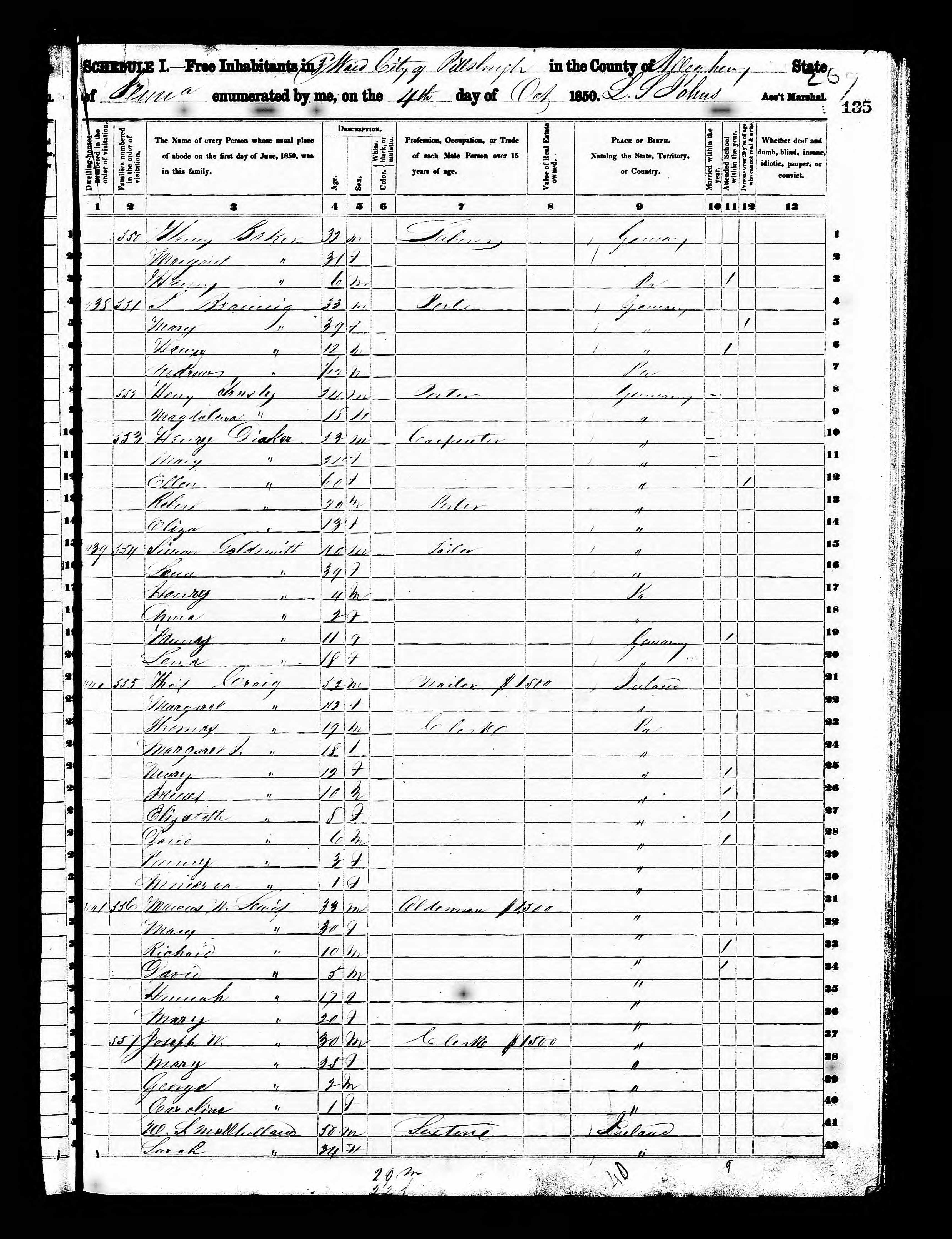
On January 10, 1847, Fanny gave birth to a son, Henry.  One year later Fanny and Simon had another child, a daughter named Hannah, born on June 5, 1848.  Both Henry and Hannah were born in Baltimore, Maryland.[1]  In 1850, the family was living in Pittsburgh along with Simon’s two daughters from his first marriage, Eva and Lena.  (The census record has many errors, but it is clear that this is Simon and Fanny’s family even though the record has the names mixed up and the ages inaccurate.)

Simon Goldsmith 1850 US census

Simon Goldsmith and family 1950 US Census Year: 1850; Census Place: Pittsburgh Ward 3, Allegheny, Pennsylvania; Roll: M432_745; Page: 135A; Image: 274

Tragically for the family, just two years after giving birth to Hannah, Fanny died in 1850.  She was buried at Troy Hill Jewish Cemetery in Pittsburgh.   Some readers might remember that that is also where the elusive Fanny Wiler is buried, another mother who left young children behind after an untimely death.

Fanny Schoenthal Goldsmith Troy Hill Pittsburgh

By 1860, Simon Goldsmith had moved with his two young children to Washington, Pennsylvania, a town about 28 miles to the southwest of Pittsburgh.    Simon, Henry, and Hannah were living with Simon’s son from his first marriage, Jacob, who was now 35 years old, according to the 1860 census, and working as a merchant.  Jacob and his wife had six young daughters of their own by 1860, so it must have been quite a crowded household.[2]

Simon Goldsmith and family 1860 US census Year: 1860; Census Place: Washington, Washington, Pennsylvania; Roll: M653_1192; Page: 1188; Image: 627; Family History Library Film: 805192

Simon Goldsmith and family 1860 US census
Year: 1860; Census Place: Washington, Washington, Pennsylvania; Roll: M653_1192; Page: 1188; Image: 627; Family History Library Film: 805192


Washington, Pennsylvania (called “Little Washington” by some locals) was then a town of 3,587 people, according to the 1860 census reports, and had grown by 34% since the prior census in 1850. There was not yet a railroad line to the town at that time.  What drew all those people to this town?  The town’s website does not provide many clues in its history section:

With immigrants from the west of Scotland and the north of Ireland, and with many transferring their homes from the eastern and central parts of Virginia, the vicinity of Washington was settled in 1768. The Pennsylvania legislature passed an act on March 28, 1781, erecting the County of Washington and naming Catfish Camp as the place for holding the first election. This was the first county in the U.S. to bear the name of Washington.

David Hoge laid out a plan of lots immediately after the action of the legislature. His original plot bears the name “Bassett, alias Dandridge Town,” but before the plot was recorded, lines were drawn through “Bassett, alias Dandridge Town” with ink, and the word “Washington” was written above.

The town started with every evidence of progressive tendencies, as the original plot dedicated a tract of ground to the people for recreational purposes. A lot was given for a courthouse where the current building now stands, and Lots 43 and 102, according to the plan, were presented by Mr. Hoge to “His Excellency, General Washington, and Mrs. Washington.” Part of the townsite had been the camp of Tingoocqua, who was a chief in the Kuskuskee tribe of Indians.

The town was incorporated as a borough on February 13, 1810, and became a city of the third class in 1924.

Map of Washington County, Pennsylvania, United...

Map of Washington County, Pennsylvania, United States Public School Districts (Photo credit: Wikipedia)

There is a very detailed history[3] of Washington, Pennsylvania, available online through the University of Pittsburgh Historic Pittsburgh websiteOne tidbit I picked up from this history was that Jacob Goldsmith served on the town council in 1858.

Unfortunately, most of this text is devoted to describing the political history of the area and the individuals who were political leaders, and I could not get a sense of what drew people to the area initially.  Was it the proximity to Pittsburgh? Was it a good location for trade? Was agriculture the primary source of income? Whatever the reason that drew people there initially, the town had existed for many years by the time my relatives arrived.   From the 1860 census, I know that Jacob was a merchant, and I assume that with a town of over 3,500 people, there would have been a large enough population to support many merchants.

English: Map of Washington Pennsylvania from 1897

English: Map of Washington Pennsylvania from 1897 (Photo credit: Wikipedia)

One thing seems clear, however.  When Simon Goldsmith lived in Washington, Pennsylvania, in 1860, there was no synagogue there.  The first synagogue in all of Washington County, Beth Israel, was not founded until 1891. Although my ancestors had lived in small towns in Germany with very small Jewish communities, they had at least had synagogues and schools and cemeteries for their community.  I am not sure that when Simon arrived, there were any such facilities.

Why, you might wonder, am I dwelling on this town in western Pennsylvania where the widower of my great-great-grandfather’s sister lived with his two children? Because six years later, my great-grandfather’s brother Henry Schoenthal arrived in Washington with his wife and children, and some of his siblings followed in the years after.  Last to come in 1881 was my great-grandfather Isidore, accompanied by his mother Henrietta and his sister Rosalie.  And 23 years later in 1904, my grandmother Eva Schoenthal was born in Washington, Pennsylvania, the youngest child and only daughter of Isidore Schoenthal and Hilda Katzenstein.  It seems to me that Henry did not choose Washington randomly, but rather based on the fact that his first cousin Jacob Goldsmith and his aunt’s widower Simon Goldsmith were living there.

But I promised you a twist, and I still haven’t delivered.  Here it is. Simon Goldsmith was not only my great-great-aunt’s husband; he was also my four-times great-uncle himself.   Simon Goldsmith, husband of Fanny Schoenthal, had a brother named Seligmann Goldschmidt.  Seligmann had a daughter named Eva, just as his brother Simon did (both named for their grandmother, Simon and Seligmann’s mother Hewa).  Seligmann’s daughter Eva Goldschmidt was my great-great-grandmother; she married Gerson Katzenstein, my great-great-grandfather, and they were the parents of Hilda Katzenstein, who married Isidore Schoenthal, nephew of Fanny Schoenthal. Hilda Katzenstein and Isidore Schoenthal were my great-grandparents.

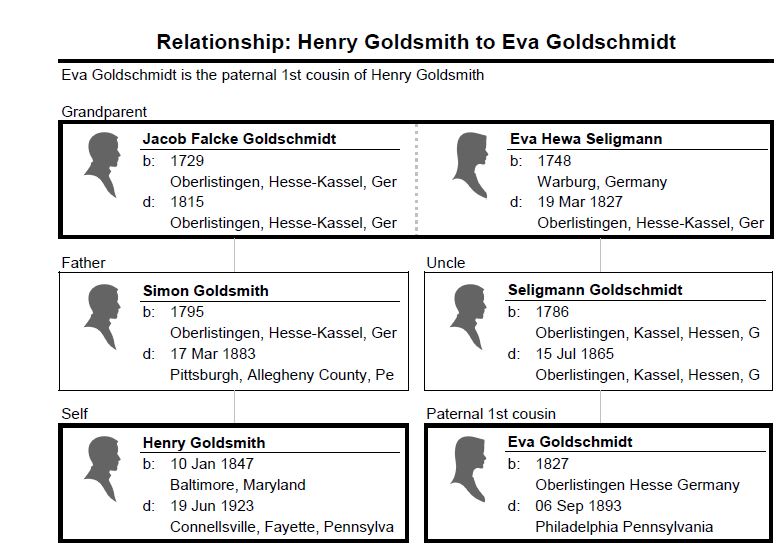
Stated as simply as possible, Simon Goldsmith was my four times great-uncle.  His wife Fanny Schoenthal was my three times great-aunt.   My grandmother Eva Schoenthal was a first cousin once removed from Henry Goldsmith, Simon and Fanny’s son, through her father’s side and his mother’s side:

Relationship_ Henry Goldsmith to Eva Schoenthal

She was also his first cousin twice removed through her mother’s side and his father’s side:

Relationship_ Henry Goldsmith to Eva GoldschmidtRelationship_ Eva Schoenthal to Eva Goldschmidt


They may have all left Germany, but they were still marrying within families they knew from back home.  Just another twist in my increasingly twisted family tree.  And more evidence of the limited gene pool created by endogamy and of the limited value of DNA predictions for Ashkenazi Jews.


[1] Fanny’s headstone says she was born in 1800.  I think it’s unlikely that Fanny had two children at ages 47 and 48, which is what she would have been if born in 1800 as her headstone indicates.  If, as her marriage record and the passenger manifest suggest, she was born in 1807, then she would have been having children at 40 and 41, which seems much more realistic.

[2] One thing that bothers me is that I cannot find out what happened to some of the other children of Simon Goldsmith and Ella Katzenstein.  Lena moved to Columbus, Ohio, after marrying Gustav Basch, and Joseph had died as a baby in Germany even before Ella died.  Eva immigrated with her father and step-mother, but then disappeared after the 1850 census; I assume she married. I’ve no idea what happened to Josias; perhaps he died before Simon left Germany, or maybe Simon left him behind with another family member.  Since they are not directly related to me, I am trying not to get too distracted looking for them, but eventually I will have to try and find out what happened to Josias and Eva.

[3] Title: History of Washington County, Pennsylvania: with biographical sketches of many of its pioneers and prominent men

Authors: Crumrine, Boyd, 1838-1916, Ellis, Franklin, 1828-1885, Hungerford, Austin N.

Collection: Historic Pittsburgh General Text Collection

The Genealogy Village Comes Through Once Again

As I mentioned in my last post, my great-grandfather Isidore Schoenthal was one of twelve children.  He and his siblings were born in Sielen, Germany, the children of Levi Schoenthal and Henrietta Hamberg.  The first helpful source I found about his family was a biography written about Isidore’s older brother Henry in 1893 as part of a commemorative book[1] celebrating Washington County in Pennsylvania, where Henry and Isidore both had settled after immigrating to the United States (the “Beers biography”).  Given that the Beers biography was written while both Henry and Isidore were still living in Washington, Pennsylvania, I was inclined to give it significant weight as a credible summary of Henry’s life to that point and of the background of his family.  I will refer to it in more depth when I focus on Henry himself, but for now I am referring to its assertions regarding the family of Levi and Henrietta (Hamberg) Schoenthal.

English: City Hall in Washington, Pennsylvania...

English: City Hall in Washington, Pennsylvania (in Washington County). (Photo credit: Wikipedia)

According to the Beers biography, Levi Schoenthal was born in 1813 and worked as a shoemaker.  He and his wife Henrietta had twelve children—nine boys and three girls.  Two of their sons died in infancy, but the other ten children survived to adulthood.  Of those ten, nine immigrated to the United States, and eight stayed here.  (The youngest child, Rosalie, returned to Germany to marry, and one son, Jacob, never left Germany.)  Of those who stayed in the United States permanently, my great-grandfather Isidore was the youngest and arrived last, along with his mother and Rosalie, in 1881.

Despite believing that this biography was probably fairly accurate, given that it was written so close to the time of the events reported, I nevertheless wanted to find some original German sources to verify the information.  Fortunately, I was able to verify quite a bit (but not all of it) by searching through the Hessen Archives as well as US records.  I was very lucky to have help from Dorothee Lottmann-Kaeseler (who correctly reminded me after my last post that she had first mentioned Sielen as my Schoenthal ancestral town), Hans-Peter Klein, Matthias Steinke, JewishGen, and the Hessian Archives.

Based first on a search through JewishGen, I was able to find birth records for almost all of the children of Levi and Henrietta in the Hessian State Archives.  The archived birth records available start in 1846, so I could not find records for the three children born before 1846 (Hannah, 1841; Henry, 1843; Julius, 1845), but using JewishGen and then manually scanning through the records, I was able to find birth records for seven of the other nine, including one for one of the two baby boys who had died in infancy.  So far I had not found any birth record for the other baby who died in infancy according to the Beers biography or for Jacob.

The fact that I was able to locate birth records for seven of the children astounded me.  Here are six of the birth records I found:

Amelia (Malchen) Schoenthal birth record January 2, 1847 Hessen Archives HHStAW 365 No 772

Amelia (Malchen) Schoenthal birth record January 2, 1847
Hessen Archives HHStAW 365 No 772


Simon (Sieman) Schoenthal birth record February 14, 1849

Simon (Sieman) Schoenthal birth record February 14, 1849   Hessen Archives HHStAW 365 No 772


Marcus Schoenthal birth record January 26, 1853

Marcus Schoenthal birth record January 26, 1853 Hessen Archives HHStAW 365 No 772

Sadly, Marcus died just ten days later:

Marcus Schoenthal death record Febuary 5, 1853 HHStAW fonds 365 No 773

Marcus Schoenthal death record Febuary 5, 1853
HHStAW fonds 365 No 773


Nathan Schoenthal birth record August 6, 1854

Nathan Schoenthal birth record August 6, 1854 HHStAW 365 No 772


Felix birth for blog

Felix (Seligmann) Schoenthal birth record December 15, 1856 Hessen Archives HHStAW 365 No 772


Rosalie Schoenthal birth record August 17, 1863

Rosalie Schoenthal birth record August 17, 1863 Hessen Archives HHStAW 365 No 772

One of the last birth records I found was the one for my great-grandfather Isidore.  I had scanned through the pages several times looking for his birth record, the one that mattered the most to me, of course.  But I hadn’t seen it, and I started wondering whether he’d been born outside of Sielen.  But then, giving it one last chance, I looked at every baby born in 1858, the birth year I had for Isidore, and saw one with the birth date November 22, 1858.  That date seemed familiar (though first I thought only because that was the day of the year JFK was assassinated in 1963), and when I saw that in fact other records had Isidore’s birth as November 22, 1858, I looked more closely at the record.  The entry was written in more traditional German script than many of the others, but I thought I could make out a word that just might be Levi.

Isidore birth for blog

Isidore (Isaak) Schoenthal birth record November 22, 1858 Hessen Archives HHStAW 365 No 772

So I posted a snapshot of the record to the German Genealogy group on Facebook, and sure enough my always helpful friend Matthias Steinke jumped right in and translated it for me.  Matthias said that for the baby, it says, “Male Gender, Isaac,” and for the parents, “Lewie (??) Schonthal shoemaker and Aesther (??) born Hamberg, legitimate parents.”  It was clear to me that this was the birth record for my great-grandfather.  His Hebrew name must have been Isaac—his secular name Isidore.  My guess is that Henrietta’s Hebrew name was Esther or that it actually says Jhette, which was Henrietta’s name in Germany; and I assume that “Lewie” is actually Levi.  I was very excited that I now had my great-grandfather’s birth record as well as those of most of his siblings.

I was still searching for a birth record for Jacob, however.  I had scoured through the Sielen birth records now multiple times without finding it, but according to a genealogy report prepared by Hans-Peter Klein, Jacob was born in December, 1850.  I went back one more time and found this record:

Jacob Schoenthal birth record December 1850

Jacob Schoenthal birth record December 1850

As you can see, although this reports a baby boy named Jacob born in December, 1850, on the left side of the page, the page with the parents’ information on the right is illegible, at least as scanned by the archives.  But I thought that this must be the record that Hans-Peter relied upon to obtain Jacob’s birthdate.  In addition, however, Hans-Peter located a marriage certificate for Jacob Schoenthal and his wife Charlotte (Lottchen) Lilienfeld, and that also included his birth date as December 22, 1850, as translated by my Facebook friend Matthias Steinke:

Eine Vervielfältigung oder Verwendung dieser Seite in anderen elektronischen oder gedruckten Publikationen und deren Veröffentlichung (auch im Internet) ist nur nach vorheriger Genehmigung durch das Hessische Staatsarchivs Marburg, Friedrichsplatz 15, D-35037 Marburg, Germany gestattet.

Marriage record of Jacob Schoenthal and Charlotte (Lottechen) Lilienfeld HStAMR Best. 920 Nr. 2610 Standesamt Gudensberg Heiratsnebenregister 1879, S. 11

Marriage record of Jacob Schoenthal and Charlotte (Lottechen) Lilienfeld
HStAMR Best. 920 Nr. 2610 Standesamt Gudensberg Heiratsnebenregister 1879, S. 11

5 – Gudensberg the 1st September 1879 – To the below signing registrar came for a marriage 1. the merchant Jacob Schönthal, at the moment shop-assistant in Cologne, identified by the shown certificates and in person by the present Beisen(?) Engelbert, israelic religion, born the 22 December 1850 in Sielen, residing in Cologne, son of the in Sielen deceased shoemaker Levi Schönthal and his wife Jettchen nee Hamberg, residing in Sielen and 2. the Lottchen (called Charlotte) Lilienfeld, known personally, israelic religion, born the 6th April 1855 in Gudensberg in house nr. 215 at her parents. Daughter of the cantor Meyer Lilienfeld I and his wife Hannchen nee Meiberg, residing in Gudensberg. As witnesses were present: 3. the merchant Beisen (?) Engelbert, personally know, 59 years old, residing in Gudensberg in house nr. 218, 4. the shop-assistant Michel Lilienfeld, known personally, 23 years old, residing in Halberstadt. Followed by the sentence whether they intend to marry each other and the signatures.

But it wasn’t over.  Now that I had all these birth records for their children, I wanted to know more about Levi and Henrietta and their parents.  I was very fortunate that Dorothee had recommended that I contact Hans-Peter Klein because he was able to provide me with some of that additional information.  He sent me a copy of the marriage record for Levi Schoenthal and Henrietta Hamberg:

Marriage record for Levi Schoenthal and Jhette Hamberg HHStAW, 365, 386

Marriage record for Levi Schoenthal and Jhette Hamberg
HHStAW, 365, 386

Once again, Matthias came through for me and translated this document:

nr 3, date of marriage 24 July 1839 – groom Levi Schönenthal, shoemaker in Sielen – bride: Jette Hamberg – unmarried in Bräuna(Breuna) age of the groom: 26 years, 9 month and 16 days – age of the bride: 22 years – parents of the groom: Heinemann Schönenthal, merchant in Sielen and Handel nee Beerenstein – parents of the bride: Moses Hamberg, merchant in Bräuna and Gutchen nee Rosenberg. entered in Breuna the 25th July 1839 by Itzig Eichholz

From this record I could now see that Levi (born October 8, 1812)  was the son of Heinemann Schoenthal and Handel Beerenstein, who lived in Sielen, and that Henrietta was the daughter of Moses Hamberg and Guetchen Rosenberg, who lived in Breuna, a town located less than 30 km from Sielen. (More on Breuna and the Hambergs in my next post.)

Now I had another family and three more surnames—Beerenstein, Hamberg, and Rosenberg— to add to my family tree, names I’d never known were those of my ancestors until now.  I now had the names of two more sets of my great-great-great-grandparents.  I now know the names and something about almost half of my great-great-great-grandparents.  I didn’t know any of their names at all when I first started doing genealogy. In fact, I only knew the names of two of my great-great-grandparents.

So thank you from the bottom of my heart to Matthias Steinke, Dorothee Lottmann-Kaeselar, and Hans-Peter Klein for helping me find another generation and another branch of my family.


.


[1] Beers, J. H. and Co., Commemorative Biographical Record of Washington County, Pennsylvania (Chicago: J. H. Beers & Co., 1893). Transcribed March 1997 by Neil and Marilyn Morton of Oswego, IL as part of the Beers Project. Published March 1997 on the Washington County, PA USGenWeb pages at http://www.chartiers.com/.  See http://www.chartiers.com/beers-project/articles/schoenthal-1057.html

The Schoenthals: Where They Came From

Deutsch: Deutsche Bundesländer Karte.

Deutsch: Deutsche Bundesländer Karte. (Photo credit: Wikipedia) (Note the location of Hessen in blue on this map.)

My great-grandfather Isidore Schoenthal came to the United States in 1881; he arrived in New York City on September 3 of that year on the ship Rhein when he was 22 years old.  I had known that he came from Germany, but not exactly where.  His death certificate said he was born in “Celand, Hess, Germany,” and from various other sources about him and his siblings, I concluded that the town where he was born was in fact Sielen, a small town in the Kassel district in the Hesse region of Germany.  Today’s post will focus on what I’ve learned about Sielen, the home town of my Schoenthal ancestors.

Sielen, Germany

Sielen, Germany

It was not that easy to find out very much about Sielen.  The town is so small (510 inhabitants as of 2011[1]) that it doesn’t even have a Wikipedia entry.  The closest major city is Frankfurt, and it is over 200 kilometers away, as are Dusseldorf and Cologne.  From what I can see on Google Maps, Sielen is surrounded for miles and miles by farmland.  The closest town is Trendelburg, which is about four kilometers away. It merits its own Wikipedia page, though that entry is all of three sentences and tells nothing of the history of the town.

Wikipedia reports that the population of Trendelburg was over 5000 people as of 2011, based on this website.  But according to the town’s official website, that number reflects not just the village of Trendelburg itself but the neighboring towns, including Sielen.  Trendelburg proper has just over 1100 residents.   Sielen has 552. Sielen is now considered a district within the larger town of Trendelburg.

Deutsch: Stadt Trendelburg

Deutsch: Stadt Trendelburg (Photo credit: Wikipedia)


From the Trendelburg official website, I was able to learn some information about the history of the town, though relying on Google Translate makes reading the German always somewhat bewildering.  Assuming I am reading most of the general information correctly, the history of Trendelburg as a separate entity began when a castle was built there in the 13th century by Konrad the III, Schoeneburg .  The location was already an important trade center for that region as it was close to a good fording spot on the Diemel River.   Over the next several centuries, the castle was used for many different purposes: a hunting lodge, the offices of the Prussian Forestry Department, and today as a privately-owned hotel and restaurant.

Die Trendelburg - Gesamtansicht, Hessen, Germany

Die Trendelburg – Gesamtansicht, Hessen, Germany (Photo credit: Wikipedia)

The hotel’s website includes some more detailed history of the castle:

With many twists and turns, the Diemel River meanders towards the Weser River. Right by Trendelburg Castle, there is a sharp bend around a rocky ridge which the locals called “Trindirberg” many years ago, probably naming the “mountain” after the village Trende, at the time situated to the west of the ridge but now completely vanished.

Sometime before 1300, Konrad the III of Schöneberg constructed a castle on this “mountain” to protect the main road from Kassel to Bremen. The settlement outside the castle also dates from this period.

Around 1305, Landgrave Heinrich I and the Bishop of Paderborn each purchased one half of the castle. The part belonging to Hessen was a Paderborn fief; the town’s official representatives were the Stoghusens, who lived in the castle for four generations.

In 1443 and 1456, the fortifications were renewed following serious fires. After their reconstruction, Trendelburg Castle was also changed, taking on the shape you see today. The fortifications were extended by a 38 metre high keep with four bretèches and a curtain wall in the shape of a pentagon with four small round towers. In the living quarters, which were erected in the 15th and the 17th century respectively, the remains of a late Gothic chapel with ribbed vaults have been preserved; the Trendelburg register office now uses this space for its civil wedding ceremonies. 

In the Thirty Years’ War, the castle was occupied by Tilly’s troops, and in 1637, it was destroyed by the Croats. In the Seven Years’ War, Trendelburg Castle was occupied by the French until they were driven off by Ferdinand V, the Duke of Brunswick, through artillery fire.

In 1901, military man Oberst Adalbert von Stockhausen, in all likelihood a descendant of the Stoghusens of old, bought the castle.

Taken over by the Dr. Lohbeck Group in 1996, the castle’s long-term future was secured by its conversion into a hotel for discerning visitors.

According to the hotel’s website, this is the castle where Rapunzel lived and let down her hair.  There is even a weekly “re-enactment” of this fairy tale at the castle.


Embed from Getty Images

The Trendelburg official website also contains some information about the history of Sielen itself. The village is bordered on one side by the Diemel River and surrounded by limestone hills. According to the website, a stone ax found in Sielen dated back to 6000 years ago, and a cemetery back to 1000 B.C.E.  A mill dating from 1243 remains as a ruin.

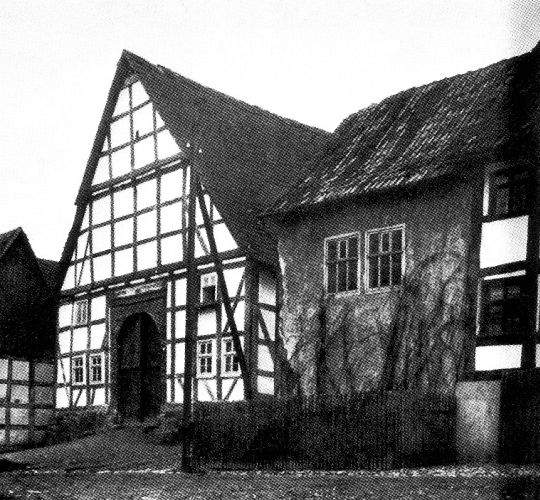
So what were my ancestors doing in this tiny village back in the 19th century and maybe before?  What kind of Jewish life could there have been? According to the Alemannia-Judaica website, there was a very small Jewish community in Sielen at least from the early 19th century.  In 1835, there were 38 Jewish residents; in 1861, there were 48.  By 1905, there were only fourteen Jewish residents, and by 1924, there were just four Jewish residents remaining. Like my own relatives, the Jewish residents either had emigrated outside of Germany or moved to the bigger cities.  During the Nazi era, those few remaining Jews in Sielen either left the area or were killed during the Holocaust.

Despite the tiny size of the Jewish community, there was a synagogue in Sielen from about 1817.  Originally a home owned by Moses Herzbach was used for prayer services, but in 1817, seven Jewish families sought permission from town officials to build a synagogue as an addition to Herzbach’s home.  Permission was granted, and Herzbach financed the construction of the synagogue.

There was also a Jewish school and a cemetery.  According to Alemannia-Judaica, at first Jews were buried in a cemetery in Trendelburg, but around 1846, a separate cemetery was established in Sielen on the road between Sielen and Trendelburg.  There are 26 graves there, including that of my great-great-grandfather Levi Schoenthal, as I will discuss in a later post.

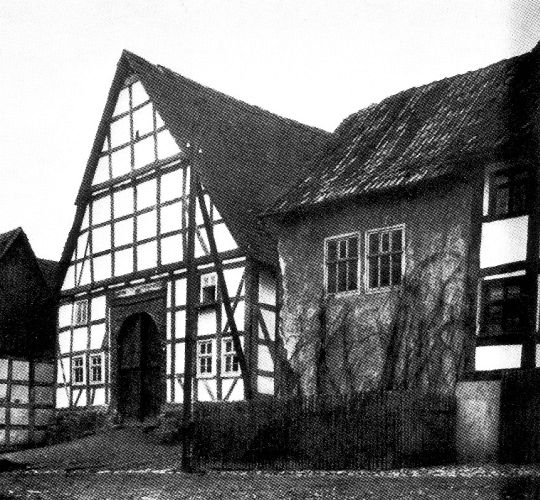
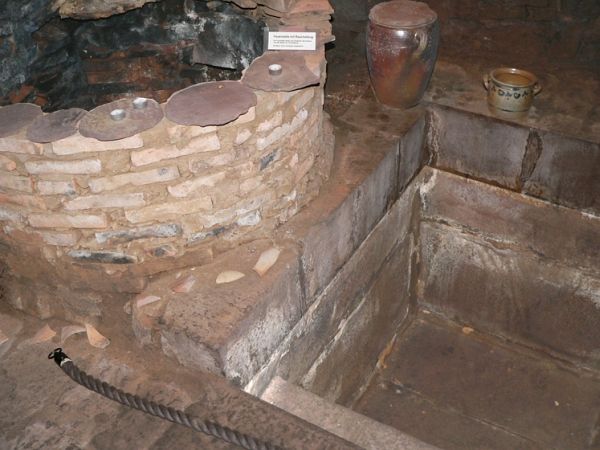
Down the road in Trendelburg there was also a Jewish community with its own synagogue, cemetery, and school.  That community dates back to 1676, but also was quite small.  In 1731 there were 21 Jewish residents; the Jewish population peaked in 1827 at 31, but was down to just 12 by 1895.  There was a Jewish school in Trendelburg, where my great-grandfather’s brother Henry Schoenthal was a teacher before he immigrated to the United States.  There was also a mikveh, the ruins of which were discovered in 2001 during renovations and which can now be seen as a tourist attraction.  By Hitler’s time, there were only a handful of Jews remaining in Trendelburg, and they died in the Holocaust.

How did these Jews make a living in these small towns where the number of Jewish residents was so small? What were their lives like? I can’t say that I am surprised that my great-grandfather Isidore Schoenthal and almost all of his siblings left Sielen by the 1880s; my great-grandfather had ten siblings who survived to adulthood.  What kind of opportunities could they find in this small, rural town? Probably very few, and so they left and ended up all over the United States: Pennsylvania, New York, New Jersey, Colorado, Arizona, California, Illinois, Ohio, Florida, and so on.  They learned English, they worked hard and survived, and they became Americans.    Like Joseph and Bessie Brotman, Isadore Goldschlager, Bernard Seligman, John Nusbaum and Jeanette Dreyfuss, and Jacob Cohen and Sarah Jacobs, they took the risk of leaving behind what they knew so that they could make a better life for themselves and their descendants.  How fortunate I am to be one of those descendants.

English: Location of Trendelburg in district K...

English: Location of Trendelburg in district Kassel, Hesse, Germany Deutsch: Lage von Trendelburg im Landkreis Kassel, Hessen, Deutschland (Photo credit: Wikipedia)


[1]   http://www.citypopulation.de/php/germany-settlements-hessen.php?cityid=06633025_0B18

[i] http://www.citypopulation.de/php/germany-settlements-hessen.php?cityid=06633025_0B18

My Grandmother, Eva Schoenthal Cohen

It’s time to turn another page in the history of my family, or I suppose I should say, to climb another branch on the family tree.  Thus far I have researched my mother’s maternal and paternal sides as far back as I’ve been able (not far enough yet, but as far as I can, given the lack of documentation) and my father’s paternal side as far as I’ve been able.  Now I turn my focus to my father’s maternal side—his mother’s parents and their ancestors.  His mother’s father was Isidore Schoenthal; his mother’s mother was Hilda Katzenstein.  I am going to start with the Schoenthal family and explore and learn what I can about my great-grandfather, his parents, his siblings, and his children, including my paternal grandmother Eva Schoenthal Cohen.

My Grandma Eva

My Grandma Eva

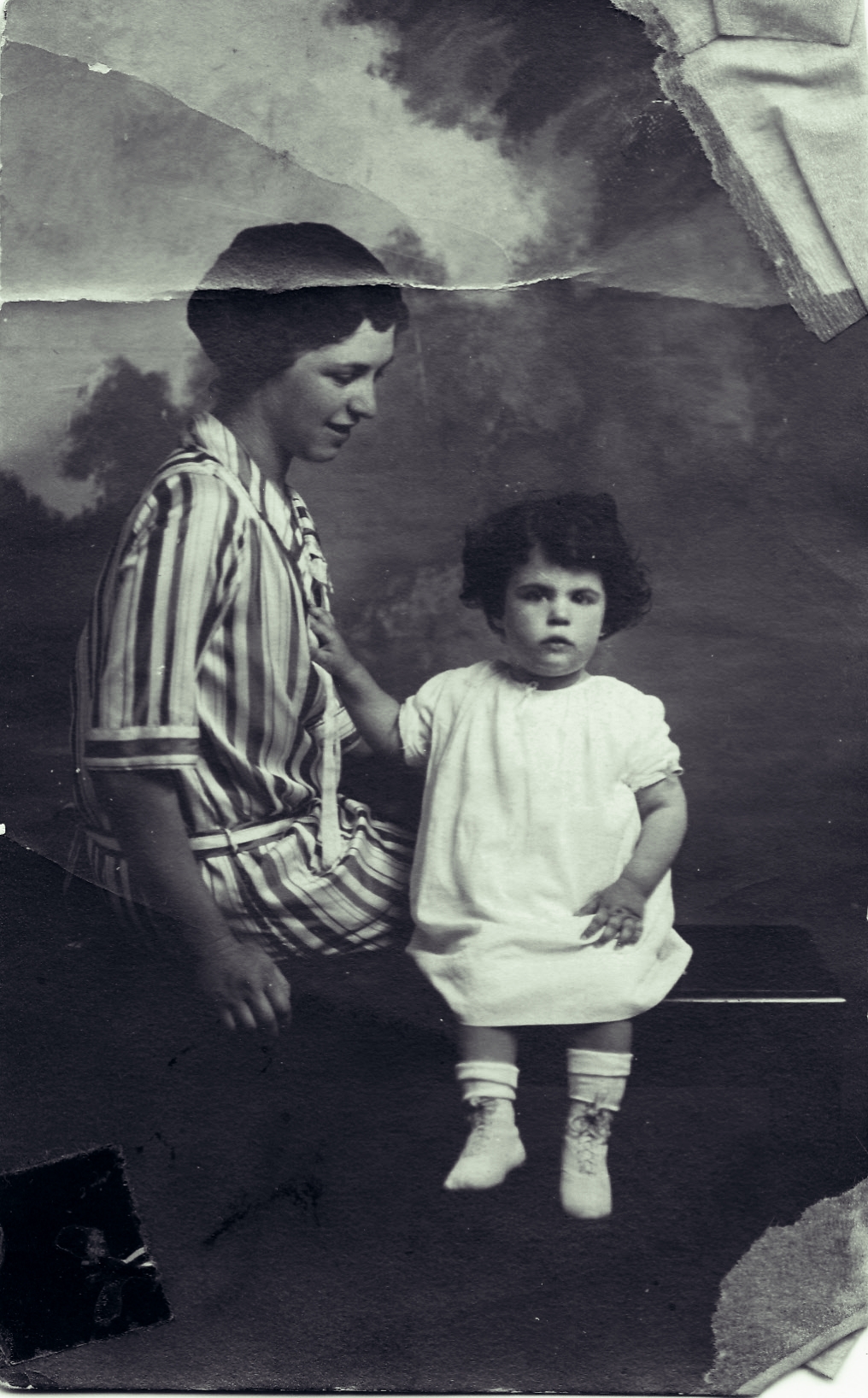
My grandmother Eva was a beautiful and refined woman.  She was born on March 4, 1904, in Washington, Pennsylvania, but the family moved to Denver, Colorado, by the time she was six years old because one of Eva’s brothers had allergies and the doctors had recommended the drier climate out West.  After graduating from high school in Denver in 1922, Eva traveled to Philadelphia to visit with some of her mother’s family who lived there.

Eva Schoenthal high school yearbook picture

Eva Schoenthal high school yearbook picture

My grandfather John Nusbaum Cohen, who was born and raised in Philadelphia, met her at a social event there, and he was so taken with her that he followed her back to Colorado to woo her and ask her to marry him.  She was very young when they met—only eighteen and right out of high school; my grandfather was nine years older.  Eva accepted his proposal, and they settled in Philadelphia after marrying in Denver on January 7, 1923.

Eva Schoenthal and John Cohen, Jr. 1923

Eva Schoenthal and John Nusbaum Cohen, Sr. 1923

John and Eva Cohen c. 1930

John and Eva (Schoenthal) Cohen
c. 1930

Their first child, my aunt Eva Hilda Cohen, was born a year later on January 13, 1924, and my father was born almost three years after that.

My grandmother Eva Schoenthal Cohen and my aunt Eval Hilda Cohen

My grandmother Eva Schoenthal Cohen and my aunt Eva Hilda Cohen

My grandmother and my father

My grandmother and my father

In 1930, they were living at 6625 17th Street in Philadelphia, and my grandfather was a merchant, selling jewelry and clothing at a store called The Commodore, as I’ve written about previously.  They even had a servant living with them named Frances Myers, according to the 1930 census.

Year: 1930; Census Place: Philadelphia, Philadelphia, Pennsylvania; Roll: 2133; Page: 41B; Enumeration District: 1034; Image: 588.0; FHL microfilm: 2341867

Year: 1930; Census Place: Philadelphia, Philadelphia, Pennsylvania; Roll: 2133; Page: 41B; Enumeration District: 1034; Image: 588.0; FHL microfilm: 2341867

But not long afterwards, their life as a family suffered two major blows.  My grandfather was diagnosed with multiple sclerosis, and by 1936 had to be admitted to a veteran’s hospital where he lived the rest of his life.  Meanwhile, my grandmother Eva, a fragile and sensitive woman probably overwhelmed by what was happening to her, had herself been hospitalized and when released was not able to take care of her two young children.  As I’ve written before, my father’s paternal grandmother Eva May Seligman Cohen took care of my father and my aunt for several years.  After my great-grandmother died in 1939, my grandmother was well enough to move back to Philadelphia to live with my father and aunt.  In 1940, the three of them were living at 2111 Venango Street, and my grandmother was employed as a saleswoman in the wholesale china business, according to the 1940 census.

Year: 1940; Census Place: Philadelphia, Philadelphia, Pennsylvania; Roll: T627_3732; Page: 11A; Enumeration District: 51-1431

Year: 1940; Census Place: Philadelphia, Philadelphia, Pennsylvania; Roll: T627_3732; Page: 11A; Enumeration District: 51-1431

The 1940s must have been very difficult for my grandmother.  Her mother died in 1941, her father the following year.  My father and my aunt both served in the military during World War II and went away to college.  My grandmother remarried after World War II.  Her second husband, Frank Crocker, was the only “grandfather” I knew on that side of my family.  He was a kind and talkative man, much more outgoing than my shy, reserved grandmother.

My father and my grandmother at his college graduation in 1952

My father and my grandmother at his college graduation in 1952

Even as a child, I sensed that that my grandmother was a bit insecure and unsure of herself and perhaps uncomfortable around her three grandchildren.  I found her beautiful and refined,  and also somewhat mysterious.  Of course, as a child I knew nothing about her life.  Only by stepping into the family history and asking my father more questions did I develop a better understanding of who she was.

My grandmother died on January 10, 1963, when I was ten years old.  Her death was the first one I ever experienced.  (Although my mother’s father Isadore Goldschlager died when I was four years old, I really have no memory of his death.)  I remember being frightened and worried about my father and also confused because no one really talked about it before she died or after.  We weren’t (and still aren’t) too good at those things.

So as I start to delve now more deeply into her family history, I do it with the perspective of trying to understand who my grandmother was, where she came from, what her family was like, and how that all fits with the woman I remember.

How They Met: The Cohens

In a much earlier post, I wrote about how some of my maternal relatives met—my grandparents, my aunts and uncles, my parents, and others.  When researching my great-grandparents Emanuel and Evalyn Cohen and my grandparents John and Eva Cohen, I wondered how they had met.  Fortunately, my brother had heard the stories years ago and shared them with me.

My great-grandmother Evalyn Seligman Cohen was born in Philadelphia in 1866, but her family had moved to Santa Fe, New Mexico, before 1880 (more on that at a later time).   Evalyn (later Eva May) was probably the first woman in my family to go to college.  She came back to Philadelphia to start college at Swarthmore College and met Emanuel Cohen.  They fell in love and married in 1886, and Evalyn never finished college.  (Maybe if she had, Swarthmore would have accepted me back in 1970 when I applied there. But then again, if she had, I would never have been born.)  She was only twenty years old when they married.  If not for her ambitious and independent spirit, she might never have traveled east and met my great-grandfather.

Swarthmore College

Swarthmore College (Photo credit: Wikipedia)


My grandparents also only met because my grandmother Eva Schoenthal Cohen was willing to make the long trip back east.  She also was born in Pennsylvania, but her parents, Isadore and Hilda Schoenthal, had moved west to Denver, Colorado, by the time Eva was six years old.  Sometime in 1922 when she was eighteen years old (she had graduated from high school that June, so perhaps over the summer), she came east to visit with some of her family in Philadelphia.  She met my grandfather John Cohen at some social event while visiting Philadelphia, and as the family story goes, he was so smitten with her that he followed her back to Colorado to woo her and ask her to marry him.  She accepted his proposal, and they were married on January 7, 1923, when he was 27 and she was 19 years old.  As with her mother-in-law, if my grandmother had not been brave enough to travel from Denver to Philadelphia, my grandparents might never have met.

Denver Capital building

My father, the third Cohen man to fall in love quickly and marry a very young woman, also only met my mother because of her willingness to travel, although not across the country.  As I’ve recounted before, they met at Camp Log Tavern in the Poconos where my father was working as a waiter at an adult camp in the summer of 1950.  My mother, who was nineteen and living in the Bronx, came for a vacation, and my father fell in love with her at first sight.  She was less interested, so he had to track her down in the Bronx phonebook after she left.  They married in 1951 when she was twenty years old and he was twenty-four.  They will be celebrating their 63rd anniversary this September.

Camp Log Tavern Milford, PA

Camp Log Tavern Milford, PA

Do you see a pattern here? Not only the serendipity of how each couple met, but both my father and my grandfather had to pursue the woman they loved, my grandfather by taking a train across the country, my father by searching through phonebooks to find my mother.  Thank goodness for those impulsive and determined Cohen men and the traveling women they met and married, or my siblings and I would not be here today.

Florence and John Cohen 1951

Florence and John Cohen 1951