A Delightful Conversation: Cousin Marjorie 

There are so many joys that come with doing genealogy work: solving family mysteries, learning about your roots, reliving the lives of those who came before you, working with other researchers and learning and teaching each other, and many other benefits.  But perhaps the greatest joy for me has been finding and meeting new cousins.  My reunion with my Brotman cousins last April was more than I’d ever expected, and the phone conversations, email exchanges, and meetings I’ve had with other cousins have also all been so much fun and so rewarding.

But this cousin connection was particularly special to me.  Cousin Marjorie is my father’s first cousin and close to him in age.  They knew each other as children, but have not been in contact for over sixty years.  In order to contact this cousin, I could not rely on email or Facebook.  I had to do it the old-fashioned way, a handwritten letter.  Fortunately, I was able to find her address on line and took a chance that she would still be able to respond and that she would want to respond.

When I did not hear back for nearly two weeks, I assumed that she either could not or did not want to respond, and I resigned myself to the fact that I would not hear from her.  Then one day last week my cell phone rang, and a number came up that was not familiar.  I answered the phone, and a woman who sounded like someone in her 20s said, “Amy?  You will never guess who this is.”  I said that I had no idea, and she said, “This is your cousin Marjorie.”

What then followed was an hour long conversation, followed up with another hour long conversation the other day.  Marjorie’s memory is remarkable; she was able to confirm a number of dates and addresses and stories that I had found online through public documents, but she had them at her fingertips.  She also had memories of my great-grandmother, my grandfather, my great-uncles and great-aunts, stories I had not known before.  And she had wonderful stories about her own life and her parents’ lives as well.   Our conversations ranged from the particular to the universal, discussing everything from Winston Churchill (from whom she has a signed letter), Queen Elizabeth (to whom she sends a birthday card every year and receives a thank you in return), and how she learned to drive, to current politics and social issues like legalizing drugs and sexual mores and her current day-to-day life with her cat Scarlett and her many friends.

Out of respect for her privacy, I do not want to discuss too many of the details of her own life on the blog, but suffice it to say that she is a very bright, articulate, and opinionated woman.  She told me that she had graduated from Trinity College (D.C.) and that she had traveled the world as part of her career working for the American Automobile Association.  She is still volunteering one day a week for the local historical society in her neighborhood.

As for some of the family memories, Marjorie did not remember her grandfather Emanuel well since she was only about three years old when he died, but she does remember her grandmother, Eva May Seligman Cohen, lovingly and clearly.  She said Bebe, as the grandchildren called her, had been a brilliant woman.  Her brother, Arthur Seligman, was the governor of New Mexico (more on that when I get to the Seligman line), and he had been invited to speak one year at Valley Forge.  When he had to cancel his plans, my great-grandmother Eva May spoke as his replacement.  Marjorie had not been able to attend, but wished that she had been there.  Marjorie said that not only was Bebe brilliant, she was kind and giving and would do anything for her family.  I shared with her the fact that Eva May and Emanuel had opened their home to Emanuel’s brother Isaac and his son when his wife died, and she was not surprised.  Like my father, Marjorie remembers exactly when her beloved grandmother passed away in October, 1939.

I also asked Marjorie what she remembers of my grandfather, her Uncle John, and she said that she has no memory of him before he became disabled, but remembers driving with her parents to Coatesville, Pennsylvania, once a month to visit him at the VA hospital there.  She described him as very good looking, thin, with black hair.

She also remembered going to occasional Sunday dinners at her grandmother’s house when my father and my aunt were living there and going to the movies with her cousins.  She said that somewhere she has a street photograph of the three cousins—my father, my aunt, and Marjorie—walking in Philadelphia.  Marjorie also told me that about 25 years ago she got a call out of the blue from her cousin Buddy, Maurice’s son, saying that he was back east from California and wanted to see her.  He and his wife (whom she remembered as being Norwegian) came to visit, and she said she and Buddy stayed in touch until he died in 1995.

Marjorie also spoke adoringly of her parents, Stanley and Bessie Cohen.  She said that although they were brought up in different faiths—her father a Reform Jew, her mother a High Episcopalian, they were an ideal match and had a wonderful marriage for well over 60 years.  She quoted to me several sayings that her mother used to convey her values to her daughter—as Marjorie described them, common sense statements about the value of an education and the importance of good health.  She said her mother was a sweet and kind person who always saw the good in other people.  Her father, my great-uncle Stanley, she described as a broad-minded man who had a bit of a temper, but who adored his wife and daughter.  He lived to be 98 years old and had good health all the way until the very end.   Marjorie said her parents had a very large circle of friends and were very well-regarded in their community.

At the end of our conversation, I told Marjorie that I would stay in touch.  She said that I had made her day, and I told her that she had made mine as well.  And I meant it from the bottom of my heart.

Two of Marjorie’s heroes:

English: Sir Winston Churchill.

English: Sir Winston Churchill. (Photo credit: Wikipedia)


HMTQ Landing Page Burnley

Queen Elizabeth II

Seeing the Forest: In Memory of Jacob and Sarah Cohen and All their Children


When doing genealogy research, I often find I get very focused on one person or one couple or sometimes one nuclear family and forget to think about the bigger picture, the extended family and their history.  This has been particularly true in researching my great-great grandparents Jacob and Sarah Cohen and their thirteen children.  Each one of those children was a story unto itself; each of their nuclear units told a complete story.  Doing the research for each of them brought me into their individual lives—their relationships, their careers, their children, their achievements, and their tragedies.

Leaf lamina. The leaf architecture probably ar...

Leaf lamina. The leaf architecture probably arose multiple times in the plant lineage (Photo credit: Wikipedia)

It was only when I got to child number eleven, my great-grandfather Emanuel, that I realized I had lost the bigger picture.  His life was not only about his adulthood—his wife and his children and grandchildren, but was also shaped by and always affected by what was happening with his extended family—his parents, his siblings, his nieces and nephews. It was then that I looked at the overall timeline to see what was happening outside his nuclear family as well as within it.

Now looking back and trying to get that bigger picture overall, I can make some fairly general observations about these thirteen children and their extended family.  First, they were all very interconnected in their work as well as their personal lives.  Almost all the men, including many of the brothers-in-law and sons-in-law, were pawnbrokers.  I don’t have a very good sense of how many separate stores there were in the Cohen pawnshop industry, but obviously there were enough to support more than a dozen families, including a family as large as that of Reuben Cohen, Sr., with his many children.  Yes, there were some trouble spots and some disputes undoubtedly, but this was a family that worked together and lived together, often within blocks of each other.  One project I have in mind at some point is creating a map to show where they all were living at a given point in time.  This was a family where almost everyone stayed in Philadelphia or perhaps New Jersey for multiple generations at least until the 1930s or 1940s.

Every tragedy—the deaths of so many young children, the premature deaths of so many young adults, the horrible accidents—must have rippled through the entire family in some way.  This was a family that suffered greatly over and over again—perhaps no more than any other of its time, but nevertheless, more than most of us can imagine today.  Almost every one of them lost at least one young child; some lost several.   Reuben and Sally lost ten children.  Some, like my great-grandparents and Reuben, not only lost a young child, but also lost adult children who died too young.

Yet this was also a family that triumphed.  Most of them lived fairly comfortably, if not luxuriously.  They moved to the northern sections of Philadelphia away from the increasingly poor sections where Jacob and Sarah had settled at 136 South Street.  Many had servants living with them, even when they had only a few or even no children.  These were not college-educated people.  Most did not even finish high school.  But they were savvy business people who, as far as I can tell, for the most part operated their businesses honestly but successfully, as the profile of Reuben Cohen described.  They saw themselves as money lenders, as the banks for those who could not borrow money from a traditional, established bank. Some were more successful than others, but overall this was a family that came to America in the 1840s and made a good life for themselves and their descendants.

Looking back on those times makes me wonder what happened.  How did this large, interconnected family lose touch with each other?  It’s not just my father’s immediate line that was disconnected; every Cohen descendant I’ve been able to locate says the same thing—that they had no idea about all these other cousins and Cohen relatives.  My father said he had no idea that his father had cousins.  I counted sixty-nine grandchildren born to Jacob and Sarah Cohen.  Even if you subtract the many who did not survive childhood, there were probably fifty—meaning that my grandfather had fifty living first cousins, mostly living in Philadelphia, yet my father did not know of any of them.

I suppose that that is how it is as families grow, children marry, grandchildren are born.  You no longer can fit everyone around the table even for special occasions.  Other families also need attention—the in-laws and all their relatives.  Especially back then, before the telephone and the automobile and certainly before the internet, Facebook, Google, email, and cellphones, it was just too hard and too expensive to stay in touch if someone was not in your immediate neighborhood and your day-to-day life.  We all know how hard it is to stay in touch even with all those modern means of communication.

So people moved away, grew apart, and lost touch.  At least now we can all benefit from knowing the bigger picture, from looking at our shared history, and knowing that even if we do not know each other, we are all part of the same tree.


Thanks to Rabbi Albert Gabbai of Mikveh Israel Congregation in Philadelphia, I now have photos of the headstones for Jacob and Sarah.

jacob headstone enhanced 2

Headstone for Jacob and Sarah Cohen

Jacob Cohen's headstone enhanced

They are not very legible, but you can clearly see Jacob’s name in English, and with the help of others, I’ve been told that the Hebrew includes Jacob’s name, Yaakov ben Naftali ha Cohen, and his date of death, 13 Iyar 5648, or April 24, 1888.  It also apparently has a reference to London as his birthplace.

Jacob headstone from FB

The side for Sarah (the second one above)  is almost completely eroded, so no one could decipher it.    Rabbi Gabbai also found the stone for Hart Levy Cohen, but he said it was nothing but a plain stone as all the engraving had eroded so he did not take a picture.  I wish that he had, but did not have the heart to ask him to go back to the cemetery.

All that is left is for us to remember them and their children and their grandchildren.


The Eleventh Child of Jacob and Sarah Cohen:  My Great-Grandfather Emanuel (FINALLY!)

About a month ago, my father (who reads the blog regularly) asked me when I was going to get to his grandparents.  Although I wanted to get there also, my linear mind would not let me “skip ahead.”  I knew that if I did, I’d get too caught up in my direct ancestors and not want to return to all the “lateral” relatives.  So I have stuck, more or less, to my plan and taken each of Jacob and Sarah’s children in birth order.  (Yes, I had to skip Reuben and Arthur while waiting to hear from descendants, but otherwise, I went in order.)  There are still two more children to do after my great-grandfather, Jonas and Abraham, so I still have to resist the temptation to move on to my great-grandmother’s Seligman line.  Also, I still have to return to Jacob’s brother Moses and his family and also some of Jacob and Sarah’s grandchildren whom I’ve yet to research or discuss.

But for now, I finally get to talk about my father’s grandfather Emanuel and his family.  Sadly, my father never knew Emanuel because he died just a few months after my father was born.  There is no one else left for me to ask about Emanuel since there are no other descendants still alive who would remember him.  But my father knew his grandmother, Emanuel’s wife Eva May Seligman, very well, and he remembers other family members as well, although he has not seen or been in touch with them for more than 60 years.  And I never knew any of his Cohen relatives other than my aunt, Eva H. Cohen, who died in 2011.  I never met my father’s father or his uncles or his cousins.

Thus, most of what I know about Emanuel and his sons and their families is based on the same kind of resources I’ve relied upon in all my other research, sprinkled with some family stories from my father or indirectly from my aunt as my brother remembers them.  As I was writing this post, my father also sent me copies of pages from a  family bible that revealed some other dates of births, marriages, and deaths.  There is also a suitcase filled with photographs and papers in my parents’ garage that I have not yet had a chance to examine.  I hope to get to that suitcase soon, but it may have to wait until after the summer.

That means that right now I have no pictures of my Cohen great-grandparents and only a few of my grandfather.  I have none of his brothers or their children.  Of course, it is in part because of this lack of knowledge that I started doing this work in the first place.  I knew so little about any of my grandparents, less about my great-grandparents, and nothing about my great-great-grandparents.  Now I am working hard to fill in those gaps.

So let me start to tell the story of my great-grandparents Emanuel and Eva Seligman Cohen, and eventually I will have to come back and add some pictures and other materials, assuming some exist in that suitcase.

My great-grandfather Emanuel was the eleventh child of Jacob and Sarah Cohen, born June 10, 1862, during the Civil War.  (The family bible has a different date—June 14, 1860, but given that I have eight other sources indicating he was born in 1862, including his death certificate, I will stick with the 1862 date.)   In 1870, when he was eight years old, he was living with his parents and ten of his twelve siblings at 136 South Street in Philadelphia. I imagine that his childhood was a happy one.  His father’s business was successful, and he was surrounded by siblings.  His oldest sister Fanny was married when Emanuel was only four, and he had nieces who were only a little older than he was in addition to all his siblings.  His brother Lewis was only two years older and his brother Jonas two years younger.  It must have been quite a household.

Jacob Cohen and family 1870 US census

Jacob Cohen and family 1870 US census

By 1880, his life had changed.  His mother Sarah had died in 1879, and only five of his siblings were still living at home: two of his older sisters, Hannah and Elizabeth, and his three brothers closest to him in age, Lewis, Jonas, and Abraham.  Emanuel was working as a clerk in one of the pawnshops.  He was eighteen years old.

Jacob Cohen and family 1880 US census

Jacob Cohen and family 1880 US census

On January 27,  1886, Emanuel married my great-grandmother, Evalyn Seligman, who was later known as Eva May and as Bebe by her grandchildren after my aunt called her that when she was a toddler.  I don’t know how my great-grandparents met.  He was 24, she was 20.  In 1886, they were living at 404 South Second Street, and Emanuel was working for his father’s pawnbroker business.  Their first child, Herbert S. Cohen, was born on either January 28 (family bible) or March 5, 1887 (Philadelphia birth index). On this one, I will rely on the bible as the entry was made by Herbert’s mother, Eva May, who would best know when her child was born.  Their second child, Maurice Lester Cohen, was born on February 27, 1888 (both sources agree here), and the family was living at 1313 North 8th Street, and Emanuel was working at 901 South 4th Street.

On October 17 (bible) or 22, 1889, two and a half year old Herbert died from typhoid fever, as had several of his little cousins.  Just two weeks later, a third son, Stanley Isaac, was born on November 4, 1989.  How terrible it must have been for my great-grandparents to be mourning one child while another was born.  How did they find a way to celebrate that birth and manage through those difficult, early weeks of infancy while their hearts were broken?

Herbert Cohen death certificate 1889

Herbert Cohen death certificate 1889

In 1890, the family was still living at 1313 North 8th Street, and Emanuel was still working as a pawnbroker at 901 South 4th Street.  They were still there in 1893 because when Emanuel’s uncle, Jonas H. Cohen, died in January, 1893, the funeral took place at Emanuel and Eva May’s residence.  I wonder why, of all the nephews and nieces of Jonas, Emanuel was the one to have the funeral at his home.

funeral at emanuels

(“Mortuary Notice,” Thursday, January 26, 1893, Philadelphia Inquirer (Philadelphia, PA)   Volume: 128   Issue: 26   Page: 6)

By 1895, the family had moved.  Emanuel’s brother Isaac had also lost his wife Emma in 1893, and as of 1895, Emanuel and his family had moved into Isaac’s house at 1606 Diamond Street, presumably to help Isaac take care of his teenage son, Isaac W. On December 6, 1895, my grandfather, John Nusbaum Cohen, was born, completing Emanuel and Eva’s family.  Emanuel continued to work at the 901 South 4th Street pawnshop.
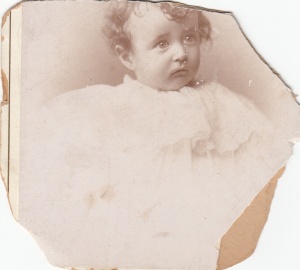
John Cohen as a baby

John Nusbaum Cohen about 1896

As I wrote about previously, Isaac was sixteen years older than Emanuel, so I am not sure why, of all the siblings, he chose to live with his much younger brother Emanuel.  I think it says a lot about what kind of people Emanuel and Eva May were, taking in these two family members while also raising three boys of their own.  Emanuel and Eva had also been the ones who opened their home for the funeral for Emanuel’s uncle Jonas. According to the 1900 census, they did, however, also have two servants helping them in the home so perhaps it was not as onerous as it might seem; perhaps they were the best situated to do these things.

Emanuel Cohen and family 1900 census

Emanuel Cohen and family 1900 census

I would imagine that the 1890s were overall not an easy decade for the extended Cohen family.  First, the family patriarch, Jacob, died on April 24, 1888, just two months after Maurice was born. His brother Jonas H. Cohen, the last of Hart and Rachel’s children, died five years later on 1893. Also, a number of Jacob’s young grandchildren died during this decade, including many of Reuben and Sallie’s children and also Benjamin Levy, Maria’s son. His brother Isaac had lost his wife Emma. On the other hand, there were many children born, many siblings married, and business overall seemed to be thriving for the family pawnshops.

As of 1905, Emanuel and his family had moved down the street to 1441 Diamond Street.  On the 1910 census, they are listed as living at 1431 Diamond Street, and Isaac, Emanuel’s brother, was still part of the household, along with Eva, all three of Emanuel’s sons, and two servants. Maurice, who was 22, was working as a salesman for a clothing business; Stanley (20) and John (14) were not employed outside the home.

Emanuel Cohen and family 1910 census

Emanuel Cohen and family 1910 census

In the 1913 and 1914 city directories Emanuel is listed as a pawnbroker at 1800 South 15th Street.  His brother Isaac died in 1914, and as of 1917 the family had moved again, this time to 2116 Green Street.

His oldest son Maurice married Edna Mayer on January 19, 1915.  Their son Maurice Lester, Jr., was born January 30, 1917.   According to the 1917 city directory, they were living at 4248 Spruce Street, and Maurice was working at the South Philadelphia Loan Office; on his draft registration that same year he described himself as self-employed as a broker.

Maurice Cohen World War I draft registration

Maurice Cohen World War I draft registration


On the 1920 census they were still living on Spruce Street, and Maurice’s occupation was pawnbroker.

Maurice Cohen and family 1920 census

Maurice Cohen and family 1920 census

In 1917 Stanley was still living at home and was the proprietor of a pawnshop at 2527 South 13th Street, according to his World War I draft registration.  In the 1917 city directory he is listed as working at the South Philadelphia Money Loan Office, the same business where his brother Maurice was working and presumably the shop located at 2526 South 13th Street.  He is also listed at the same business in 1921, living at 2114 [sic?] Green Street.

Stanley Cohen World War I draft registration

Stanley Cohen World War I draft registration

In 1917 my grandfather John was also living at home at 2116 Green Street and employed as an advertising salesman for the Morning Bulletin, according to his World War I draft registration.

John Cohen Sr. World War I draft registration

John Cohen Sr. World War I draft registration

According to the 1918 city directory, John was in the United States Navy at that time.  I have not yet found anything more specific about his military service.

In 1920, Emanuel, Eva (listed incorrectly as Edith), Stanley, John, and two servants were living at 2116 Green Street.

Emanuel Cohen and family 1920 census

Emanuel Cohen and family 1920 census

Interestingly, in the 1921 city directory, Emanuel’s business was now classified as watches and jewelry.  Had he left the pawnbroker business between 1920 and 1921, or was this just another way of describing his business?

I didn’t think I would be able to find the answer, but then, to be honest, I stumbled upon it.  I had found my grandfather John’s 1921 passport application almost a year ago and found it interesting that he was applying for a passport to go to Cuba for up to twelve months. I also found the similarity between his signature and my father’s signature rather remarkable.
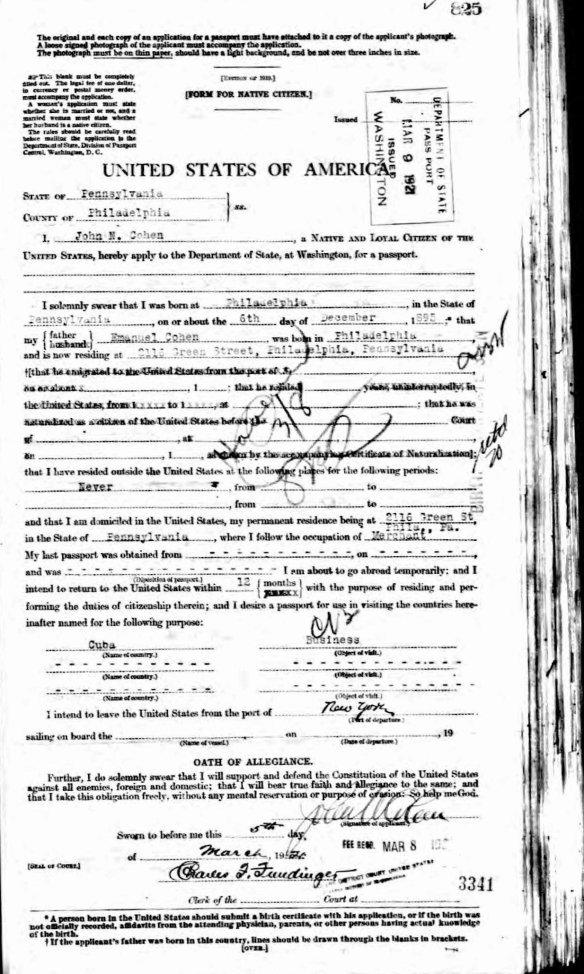
John Cohen passport app cropped

John N. Cohen passport application 1921

I had noticed that the page facing his application had a photograph of someone else, the person whose application preceded his in the database.  So I went to the following page to see if his photograph appeared on that page, and sure enough it did.  It also had a physical description of my grandfather: 5’ 6” tall, with a high forehead, straight nose, grey eyes, regular mouth, round chin, dark brown hair, dark complexion, and an oval face.
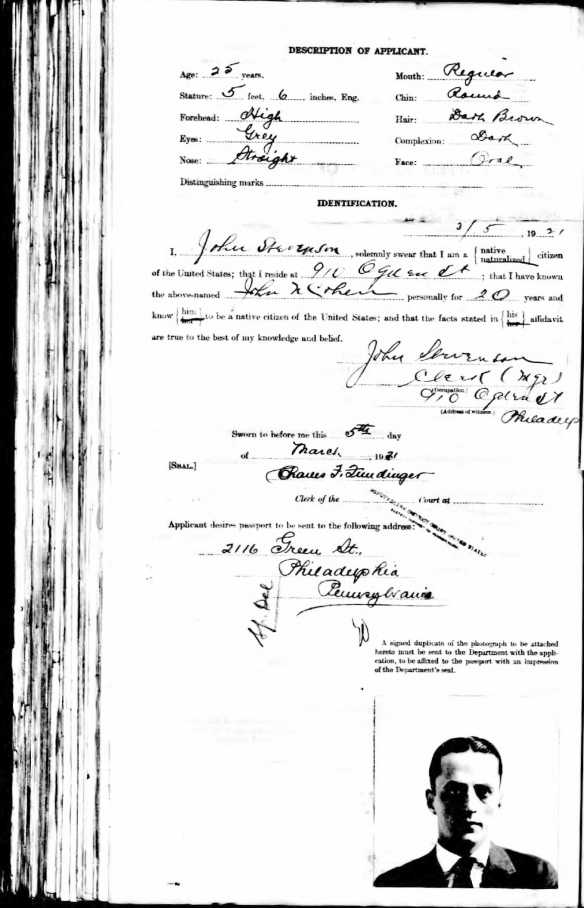
John N Cohen passport application page 2

John N Cohen passport application page 2

What I had not noticed the first time I studied this document was the letter that appears on the facing page—a letter signed by my great-grandfather Emanuel, certifying that his son, John N. Cohen, was going to represent the interests of the “Commodore” in Cuba.  The letter was on the stationery of the Commodore, located at 13th Street and Moyamensing Avenue, with the slogan “Our Policy One Price for All.”  I had never heard this business mentioned or seen it named on any other document.

Letter by Emanuel Cohen  March 5, 1921

Letter by Emanuel Cohen May 21, 1921

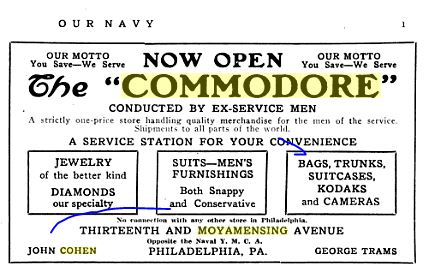
After some work on newspapers.com, genealogybank.com and Google, I finally found an advertisement for the business:

The Commodore ad from Our Navy, vol. 13

This was a business owned or at least managed by my grandfather when he returned from the Navy to provide merchandise to veterans at a fair price. I found this ad interesting in several ways.  First, I love that he sold suits “both snappy and conservative.” I also found it interesting that the ad proclaims that it has “no connection with any other store in Philadelphia.”  Was this my grandfather’s way of asserting his independence from the family pawnshop business?  Or was this some trademark issue involving a store with a similar name?  (I did see ads for a furniture store advertising a living room set as The Commodore.)  My father had never heard the store referred to by this name, but said he did recall that his father had a Navy friend whom he referred to as the Commodore who was his connection to the Navy Yard in Philadelphia.  My father does remember visiting the store years later when his grandmother was managing it and selling only jewelry, not men’s clothing, snappy or otherwise.

The years between 1920 and 1930 were years of growth for Emanuel and Eva’s sons.  In 1922, Maurice and Edna had a second son, Emanuel.  On January 5, 1923, Stanley married Bessie Craig, who was fourteen years younger than Stanley. Their daughter Marjorie was born two years later in 1925.

My grandparents, John Nusbaum Cohen, Sr., and Eva Schoenthal, were married on January 7, 1923, according to the family bible. (I assume they were married outside Pennsylvania since there is no marriage record in the Pennsylvania index for them) My aunt, Eva Hilda Cohen, was born January 13, 1924, and my father John, Jr., was born two years later.  My father recalls that the family was also living on Green Street in 1924 when his sister was born and at 6625 North 17th Street when he was born.  (There were no city directories available online for the years between 1922 and 1926.)  (The fact that there were two Emanuels, two Maurices, three Evas, and two Johns in their family must have created some confusion, though Maurice, Jr, was called Junior and Emanuel II was called Buddy. My father was always called Johnny.)

This is the only picture I have of my grandparents together.  They were certainly a handsome couple.  And they were certainly wearing  “snappy” clothing!  I am struck by the Star of David that my grandmother is wearing; they were not religious people, but obviously she felt a strong enough Jewish connection to be wearing such a large star.
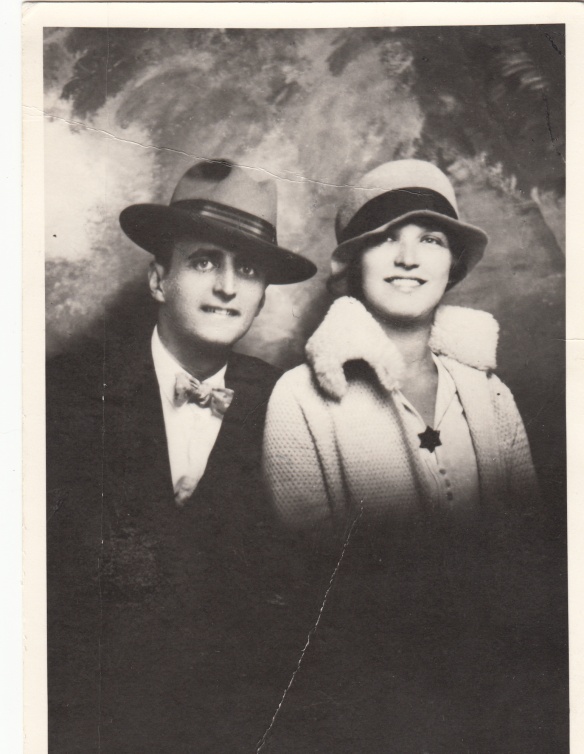
John and Eva Cohen  c. 1930

John and Eva Cohen, My Paternal Grandparents
c. 1930

Eva Hilda Cohen

Eva Hilda Cohen

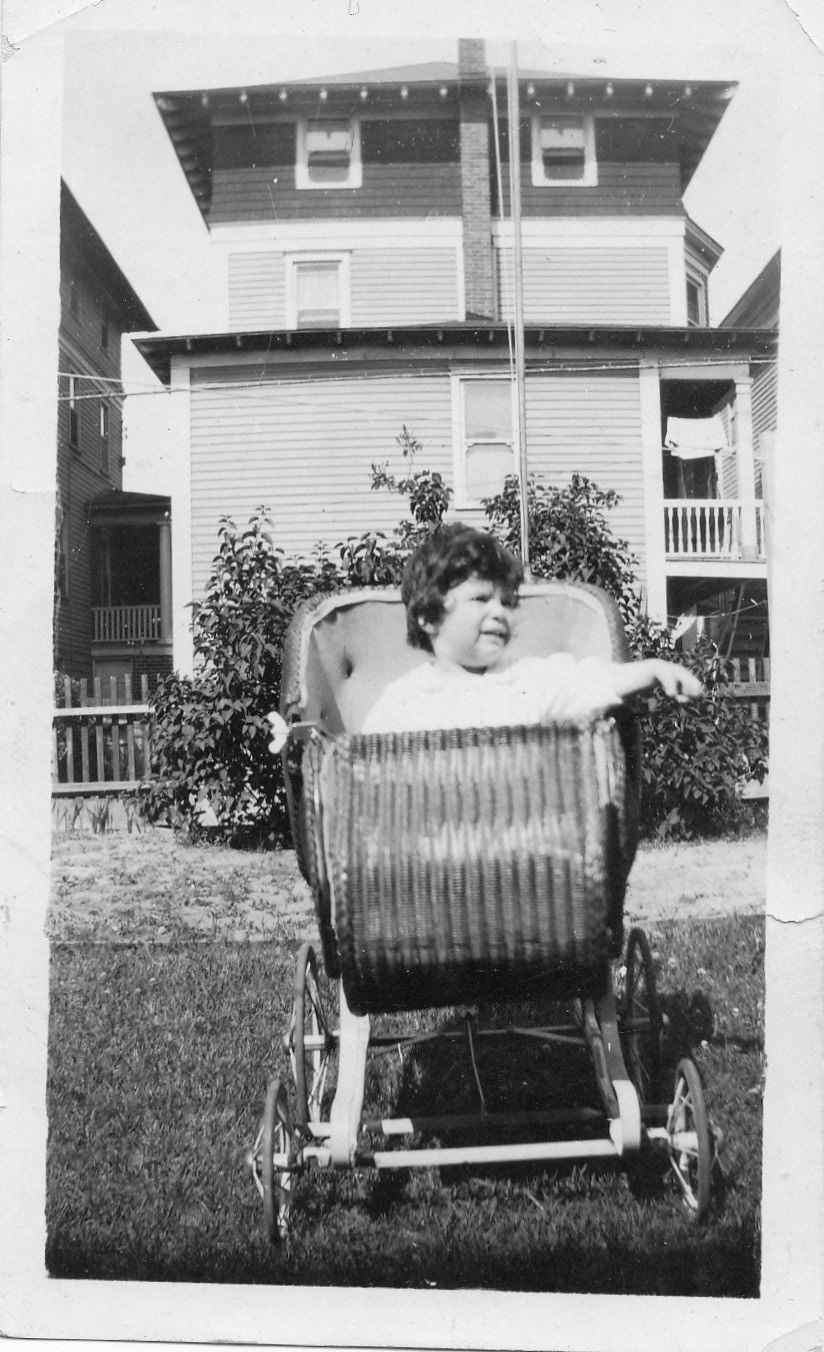
I have always loved this picture of my father; his face really has not changed in many ways.  He still has those beautiful, piercing blue eyes.

My father at 9 months old

My father at 9 months old

Reverse of John Jr at 8 months but 9 months

The reverse side of the photo above—inscribed “Taken a about 9 months, Johnny”

Another wonderful picture, capturing my father as a happy little toddler.

John Jr


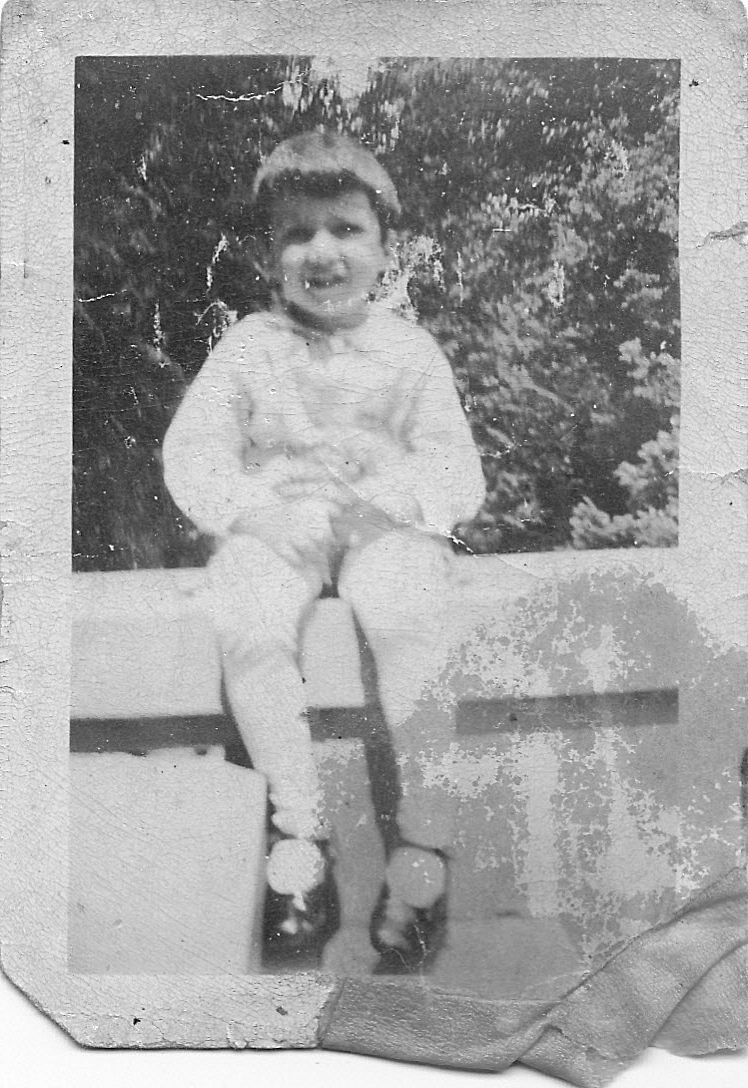
Although the next photograph is badly damaged, I am including it in large part to show the inscription on the back, “Johnny Boy.”  My father said that his grandmother Eva May was the one to label the photographs, just as she was the one who made the entries for her children and grandchildren in the family bible.  I like to think that I have inherited her role as a family historian and photograph archivist.

Johnny Boy reverse of John Jr as child

“Johnny Boy”

John Jr little boy


This photograph below captures my aunt as a young girl.  She was a strong and independent person who always stood up for herself and knew what she wanted.


Eva Hilda Cohen

My Aunt, Eva Hilda Cohen

If the 1920s were years of growth, they were also years of loss.  On February 21, 1927, my great-grandfather Emanuel died after a cholecystectomy (gall bladder removal, according to my ever-reliable medical consultant).  It looks like the principal cause of death was pneumonia and either anemia or a hernia.  It also says he suffered from diabetes mellitus.  He was only 64 years old.

Emanuel Cohen death certificate 1927

Emanuel Cohen death certificate 1927

These were also years of loss for the larger Cohen family; by the time Emanuel died in 1927, he had lost all but two of his siblings, Hannah and Abraham, and Hannah would die just a few months later.  Although Jonas had died in 1902, Hart and Fanny in 1911, and Isaac in 1914, between 1923 and 1927 the family lost eight siblings: Joseph (1923), Elizabeth (1923), Lewis (1924), Maria (1925), Rachel (1925), Reuben (1926), and then Emanuel and Hannah in 1927.  Of the thirteen children of Jacob and Sarah Cohen, only one remained after Emanuel and Hannah died, the baby Abraham.

The next decade, the 1930s, were also very challenging years for Eva, Emanuel’s widow, and her three sons. According to the 1930 census, Stanley was now working as a broker. My grandfather John listed his occupation as a clothing and jewelry merchant on the 1930 census, perhaps still working at The Commodore; he and his family were still living at 6625 North 17th Street at that time, which was about fifteen miles north of the Commodore location.

My grandparents, my aunt and my father on the 1930 census

My grandparents, my aunt and my father on the 1930 census

I could not find Maurice on the 1930 census, unless he is the Maurice L. Cohen listed as living with a wife Celia, a son Lester, and a daughter Nannette.  I dismissed this household many times, but since I cannot find him elsewhere and since his son’s middle name was Lester and his other son was Emanuel, which could have been heard by a census taker as Nanette, I suppose, I am inclined to think that this is probably Maurice’s listing, but perhaps not.  At any rate, I was able to find Maurice’s death certificate.  He died from a self-inflicted gunshot wound to the head on August 14, 1931; family lore is that he had been suffering from cancer.  He was only 43 years old, and his sons were fourteen and nine years old when he died.

Maurice Cohen death certificate 1931

Maurice Cohen death certificate 1931

Some years after Maurice’s death, his widow Edna moved to southern California.  According to the 1940 census, she and her two sons, Maurice, Jr., and Emanuel, now called Philip, were living in Los Angeles, although the census indicates they were all still living in Philadelphia in 1935.  My father recalls going to camp with both of his cousins in 1938, so I assume it was sometime after that that Edna and her sons moved away.  My father said he never saw them again.

Edna Cohen and sons 1940 census

Edna Cohen and sons 1940 census

Maurice was not the only one to face serious medical problems during this time period.  My grandfather John contracted multiple sclerosis also during this period.  My grandmother, a sensitive and fragile person, was herself hospitalized and unable to care for her husband or her children, and so John, Sr., and his two children were taken care of by his mother, Emanuel’s widow, Eva May Seligman Cohen.  Once again my great-grandmother opened her heart and her doors to care for family members as she had done over 25 years earlier for her brother-in-law Isaac and his son.

In 1936, my grandfather was admitted to a Veteran’s Administration facility in Coatesville, Pennsylvania, over forty miles away from Philadelphia.  He lived the rest of his life until he died on May 2, 1946.  He was 50 years old.

John Cohen, Sr. 1940 census

John Cohen, Sr. 1940 census

My great-grandmother continued to care for his children, my father and his sister, until she died on October 31, 1939, from heart disease.  My father and aunt then lived with various other relatives until their mother was able to care for them again.

Eva May Seligman Cohen death certificate

Eva May Seligman Cohen death certificate

Stanley, Maurice and John’s brother, did not face the terrible health issues faced by his brothers.  In 1940 he was working as a pawnbroker, and according to his World War II draft registration in 1942, he was self-employed, calling his business Stanley’s Loan Office.

Stanley Cohen World War II draft registration

Stanley Cohen World War II draft registration

In the 1950s, Stanley and Bessie moved to Atlantic City, where he lived for the rest of his life. Bessie died in April, 1983, and Stanley died in July, 1987.  He was 97 years old.  I have located where his daughter was last residing and hope to find a way to contact her.

As for Maurice’s family, I don’t know very much about what happened to them after they moved to California.  Edna died in 1979, and Maurice, Jr., in 1988.  Both were still living in California when they died.  Emanuel Philip was harder to track down, but I eventually found him as Bud Colton in the California death index.  How, you might wonder, did I know that Bud Colton was the same person as Emanuel Cohen? Well, the death index listed his father’s surname as Cohen and his mother’s birth name as Mayer.  In addition, he was always called Buddy by the family.  Colton is fairly close to Cohen in pronunciation, and there was some family lore that he had in fact changed his name to something else.  Bud served in the army during World War II as Bud Colton.  He married Helga Jorgensen in April, 1957, when he was 34 and she was 49.  Bud died in February, 1995, and is buried as a veteran at Los Angeles National Cemetery.  I did not find any children of either Bud or Maurice, Jr.; although I found a few Maurice Cohens in the California marriage index, only one of those marriages seemed to have resulted in a child, and her birth certificate revealed that her father Maurice Cohen was not the one related to me.  The other two Maurice Cohen marriages would have been fairly late in Maurice’s life (if in fact it was the same Maurice Cohen), and I found no evidence of any children from those marriages.  Given the age of Helga when she married Bud, it also seems unlikely that that marriage resulted in any children.

It is rather sad that we know so little about my father’s paternal first cousins, but this was all I could find up to this point.  I will keep looking and hope that more information will turn up.  Perhaps in that mysterious suitcase I will find more pictures, more documents, more answers.  Nevertheless, I know a great deal more now than I once did about my great-grandparents Emanuel and Eva Cohen and my paternal grandfather John Nusbaum Cohen.

Below is the headstone for my great-grandparents Emanuel and Eva May and for my grandfather, John N. Cohen, Sr., who were buried at Mt. Sinai Cemetery in Philadelphia.  Maurice is also buried there, one section over.

headstone for emanuel, eva and john n cohen


Simon L.B. Cohen 1898-1934: A Story about the Horrors of War

The youngest child of Reuben and Sallie Cohen was Simon L. B. Cohen.  He was born on February 25, 1898, in Philadelphia, and spent his childhood in Philadelphia and Cape May like his siblings.

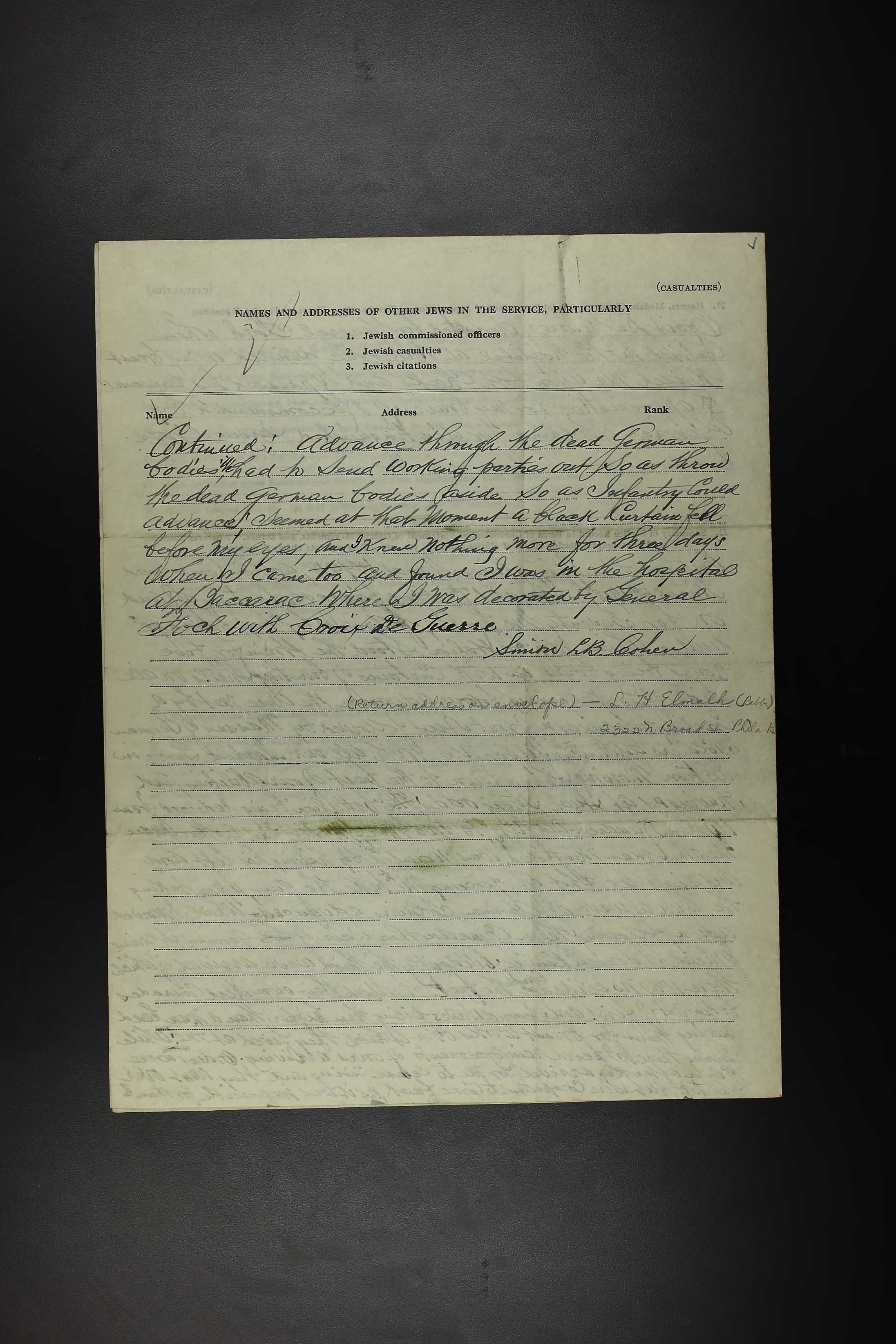
When he was nineteen years old, he voluntarily enlisted in the US Army as a private in the infantry.  According to a questionnaire he completed for the American Jewish Committee, he had been a professional boxer before enlisting.  While in the service, Simon was promoted to sergeant and served in the machine gun battalion.  He was wounded in March, 1918, while fighting with his battalion in France.  In the questionnaire for the American Jewish Committee, he provided this detailed description of the battle in his own hand.

Simon L B Cohen  American Jewish Committee questionnaire

Simon L B Cohen
American Jewish Committee questionnaire

Simon page 4

I will try to transcribe it as best I can, preserving the original spelling and punctuation as well as Simon’s expressive language:

Entered the firing lines March 1, 1918, action commenced March 4, 1918; March 17 gas barrage lasting seventy-two hours, followed by a box barrage under my battalion stood the strain for five hours being boxed in by curtains of bursting shells on all sides of us preparing for an advance.  We were met by a creeping barrage in front of us followed by masses of German soldiers advancing towards us, with all of our machine guns in action mowing them down to the best of our abilities, and having us at such strong odds, our battalion being reduced from twelve hundred and fifty to two men; myself and another man.  The other man mentioned was wounded by having his left arm and right leg shot off, forcing me to take the gun, upon taking the gun, a wave of German soldiers advanced, which I mowed down, following them came another wave of German soldiers which I done likewise; Evidently the third wave arrived of which there was no evidence except the fact they used their own dead comrades bodies out of first and second waves piling them higher than a man head using them for breast works over which they fired at me. While laying there I heard reinforcements of ours arriving. Orders were given after they arrived for me to cease firing, and they went over the top but were compelled to come back, as it was impossible for them to advance through the dead German bodies, had to send working parties out so as throw the dead German bodies aside, So as infantry could advance. Seemed at that moment a black curtain fell before my eyes, and knew nothing more for three days. When I come too and found I was in the hospital at Baccarac where I was decorated by General Foch with Croix de Guerre.

I have read plenty of literature about the horrors of war, from All Quiet on the Western Front by Erich Remarque to The Things They Carried by Tim O’Brien, among many other fictional and factual accounts of battles and the horrible things that young people experience and see when serving as soldiers.  But I have never read one by someone related to me, someone whose family I had been researching and writing about for days and weeks before reading this account.  This was a boy, the baby of his family, one of the few children who had survived to be a young man out of the seventeen children born to his parents.  He grew up with a successful father and lived a life of relative luxury and comfort, spending summers at the seaside in Cape May.  He had many older siblings and his parents who must have treasured him as one of the few who had survived.

And then he volunteered to help his country and was exposed to this:  Being one of two of 1250 young men to survive being mowed down by other young men, seeing his friends and comrades die before him.  Killing probably many, many other young men who happened to be German by “mowing them down” with a machine gun.  Watching them use the bodies of their own dead comrades as protection on the battlefield and then watching his own countrymen throw those bodies aside so that they could advance against those other young men.  How could a nineteen year old boy like Simon watch and experience these things and not be scarred forever? What does something like that do to someone?

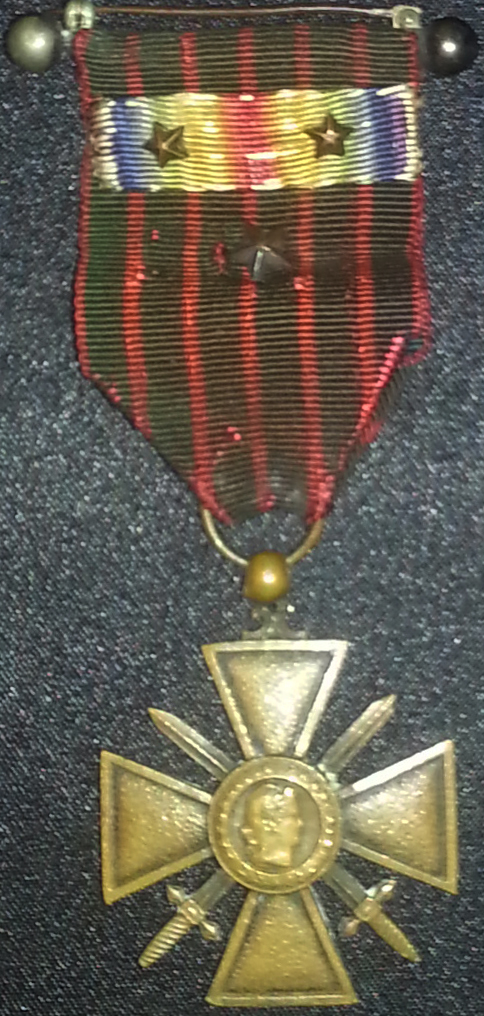
Simon’s story did not end there.  As he mentioned in his account, he was awarded the Croix de Guerre by General Ferdinand Foch, Commander-in-Chief of the Allied Forces,  while in the hospital recovering from his injuries.  As he described that occasion, he was decorated by General Foch, who pinned the medal on his breast, “kissed [him] on both cheeks and expressed his appreciation for [Simon’s] bravery.”  Simon was also recommended by General Pershing for a Distinguished Service Cross.

English: Hand-colored photograph of French Gen...

General Ferdinand Foch, Commander in Chief, Allied Forces, World War I

Do these medals and honors make up for the pain and suffering and mental distress that he endured? Simon recognized that the war had had a psychological effect on him. On the questionnaire, Simon mentioned that he suffered from shell shock or what we today call post-traumatic stress syndrome.  He was rightfully recognized for his service and his sacrifices, but for me, that hardly makes up for the price he paid while engaged in that service.

Croix-de-Guerre awarded to Simon L B Cohen 1918

Croix-de-Guerre awarded to Simon L B Cohen 1918

Croix-de-Gurre-Back Simon LB Cohen

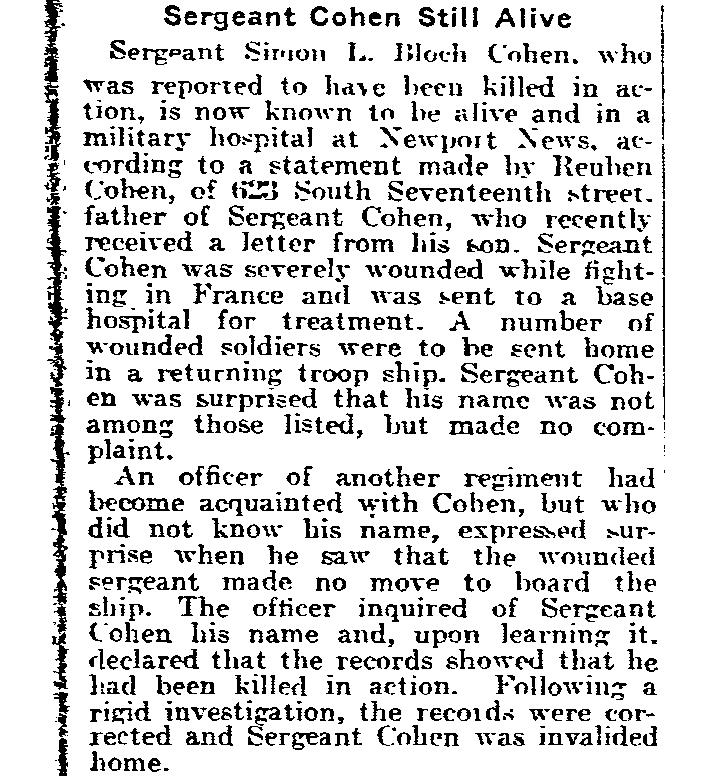
To make matters even worse, his family back home was subjected to extraordinary emotional distress.  As this news article from the Philadelphia Inquirer reports, Simon had been mistakenly reported as killed in action while he was actually recuperating in France.  Only after an officer was surprised to see that Simon was not being sent back home to recover did he and Simon learn that Simon had been thought to be dead.  (“239 Phila. Soldiers Killed during War Two Soldiers Reported Dead Yesterday with 10 Wounded,”  Thursday, September 12, 1918 Paper: Philadelphia Inquirer (Philadelphia, PA) Volume: 179 Issue: 74 Page: 14)

simon alive

Imagine thinking that your youngest son had been killed.  Imagine that after already losing ten of your children you were told that another had died.  Then imagine the shock, the relief, the joy, maybe the anger you would feel when told that he was in fact alive.

So Simon did come home, and by 1920 he was back living with his parents and some of his siblings in Cape May.  The 1920 census reports that he had no occupation.  However, by 1930 he was married, living in Cape May, and working as a clerk for some company I cannot decipher on the census report.  He and his wife Myrtle had only been married for one year.  Simon’s father Reuben, Sr., had died just four years before in 1926.  His mother Sallie died in 1930.  Four years later, Simon himself died on October 24, 1934.  He was only 36 years old.  I plan to order his death certificate from the State of New Jersey, but thus far I have not found any explanation of his cause of death.  I won’t speculate, though I have some thoughts.

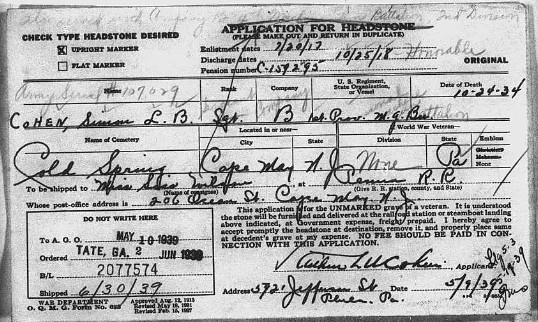
Simon was buried in Cold Spring Presbyterian Cemetery near Cape May. Five years after his death, Simon’s older brother Arthur L.W. Cohen, Sr., applied for a military headstone to mark his brother’s grave.  His short life must be remembered not only because he served his country proudly and bravely, but also because for me it will always be a reminder of the horrible things we do to these brave and proud young people when we send them off to war.

Simon LB headstone request


My Great-Great-Grandparents’ Marriage Certificate: Small Details Reveal So Much

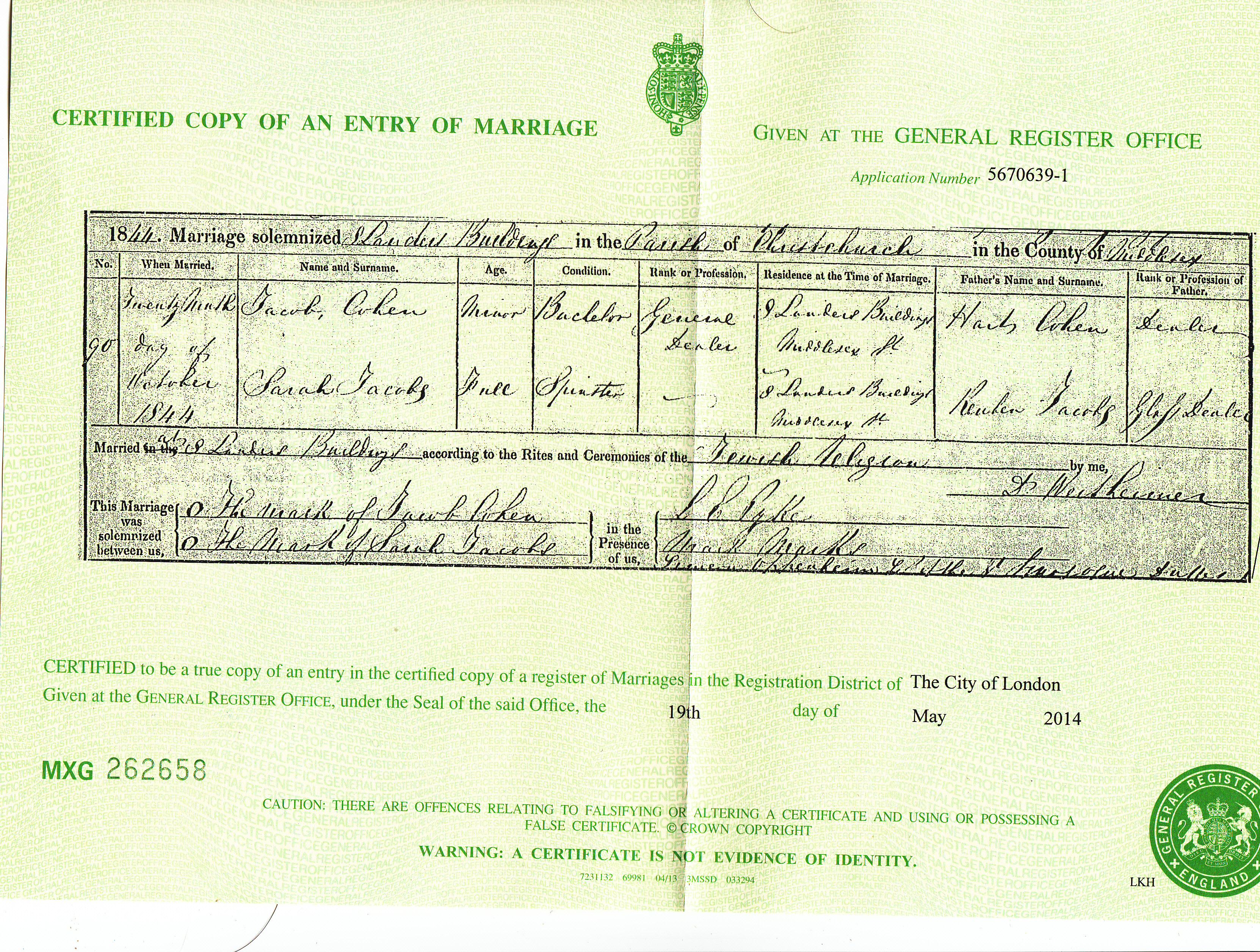
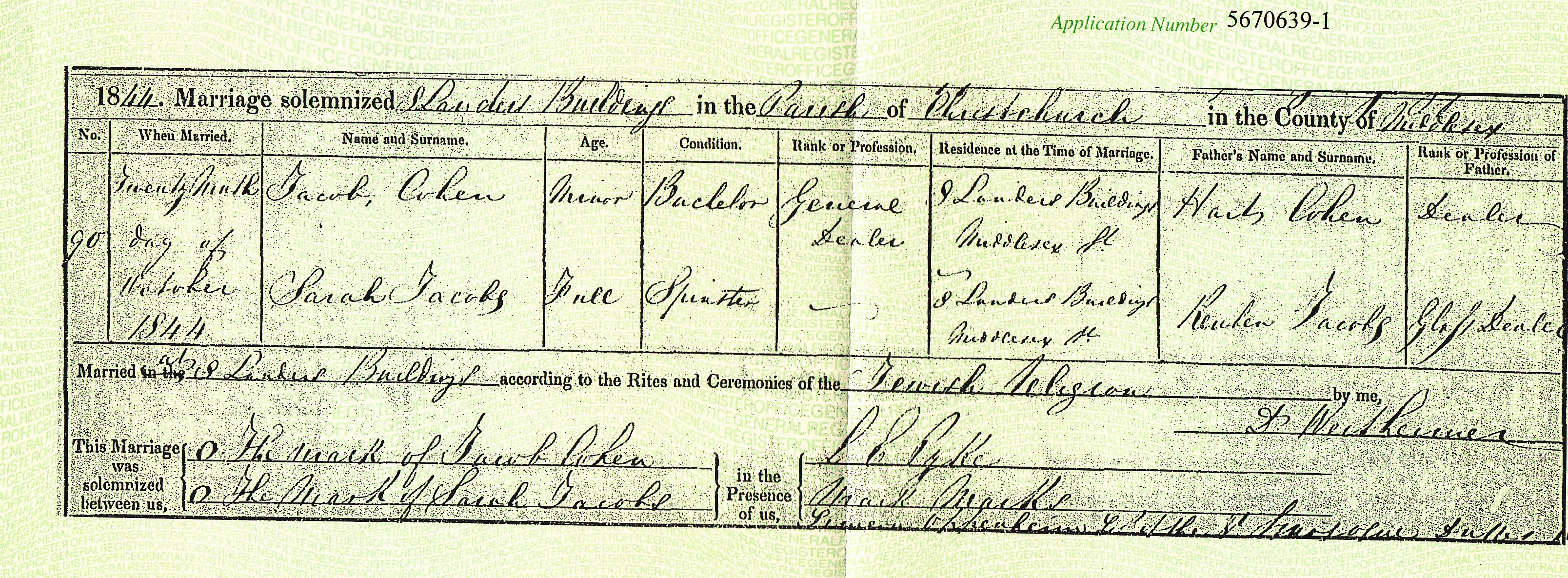
As I celebrate the newest member of my extended family, I am also thinking about my great-great-grandparents, Jacob and Sarah Cohen.  A while back I had sent for their marriage certificate from the General Register Office in England, and the certificate arrived just a few days before Remy was born.  It confirms a number of facts I already knew—that Sarah’s birth name was Jacobs, that her father’s first name was Reuben, that she and Jacob married on October 24, 1844, that Hart, Jacob’s father, was a dealer as was Reuben Jacobs, Sarah’s father (a glass dealer?) and Jacob himself, and that they all lived in Spitalfields, Christchurch, Middlesex County, in England.  But the marriage certificate also revealed a few other interesting details.

Jacob Cohen and Sarah Jacobs marriage certificate

Jacob Cohen and Sarah Jacobs marriage certificate

For example, according to the certificate, Jacob was still a minor, but Sarah was of “full” age.  All the documents I have for Sarah, both from England and the US, place her at least two years younger than Jacob.  I wondered: Was the age of majority younger for women in England in 1844 than it was for men?  The 1841 census puts Rachel’s age that year as 15, meaning she was 18 when she married Jacob, whereas Jacob was only 20.  (When I think about how young they were and then how many children their marriage produced and how many years they were married, it is astounding.)

I did a little research and learned that although a girl could marry at 12 and a boy at 14, parental consent was necessary if either was under 21.  Both men and women were considered minors before they were 21; there was not a double standard.[1] That leaves me perplexed. Was Rachel older or younger than Jacob?  Was the marriage certificate right and all the other documents wrong? One would think that a marriage certificate would be more accurate than census reports, but perhaps this was just a mistake.

Sarah and Jacob marriage cropped

The certificate also indicates that, as with Hart Levy Cohen on his wife Rachel’s death certificate, Jacob and Sarah could not sign the document, but only left their marks on it.  Another question is thus raised: how literate was the population of England at this time?

A little quick research revealed that the literacy rate in England in 1840 was somewhere between 67% and 75% for the working class population.[2]  Another source indicated that based on the ability of brides and bridegrooms to sign their marriage certificates, the literacy rate was even lower among women at that time—around 50%, .  That same source, however, suggested that since writing was taught after reading, simply because someone could not sign his or her name did not mean that he or she could not read.[3]

A third interesting detail on the certificate is that it appears that both Jacob and Sarah were residing at 8 Landers Building at the time they were married.  Since it is not likely they were living together before they were married, this would mean that their families were living in the same building.  Were they childhood friends?  Had their parents as neighbors arranged the marriage? Were they all related in some way? It also appears that the marriage had taken place at this same location, not at a synagogue.  But the record from Synagogue Scribes indicated that they were married at the Great Synagogue, as were Hart and Rachel.  I assume that this was this just a civil certificate completed to comply with civil, not religious, law.  I find it interesting that it states that the ceremony was done “according to the rites and ceremonies of the Jewish religion” despite the fact that it is not a religious document.

It is quite amazing to me how much information and how many questions can be mined from one simple document.  Receiving this document was very exciting, as with receiving Rachel’s death certificate from England.  It ties me directly to my ancestors—people who were born almost 200 years ago, but with whom I have a direct and easily established connection.


[1] See the discussion on RootsChat at http://www.rootschat.com/forum/index.php?topic=643885.0 and also at BritishGenealogy.com at http://www.british-genealogy.com/forums/showthread.php/57256-Age-at-Marriage-Minor

[2]  R.S. Schofield, “Dimensions of Illiteracy in England, 1750-1850) in Literacy and Social Development In the West: A Reader (edited by Harvey J. Graff) (1981), p.201.

[3] “Introduction,” Aspects of the Victorian Book, at http://www.bl.uk/collections/early/victorian/pr_intro.html

Enhanced by Zemanta

Remy Brandon Fischer, Shalev Ezra ben Dov Baer Yaakov v Rivke Gittel

Remy

Remy

Yesterday just before 4 pm, our family grew again with the birth of our grandson Remy.  He weighed 8 pounds and is 19.5 inches long, and he is beautiful.  His big brother Nate whispered in his ear, “You are going to be my best friend,” bringing us all to tears.  It was a magical, wonderful, perfect day.

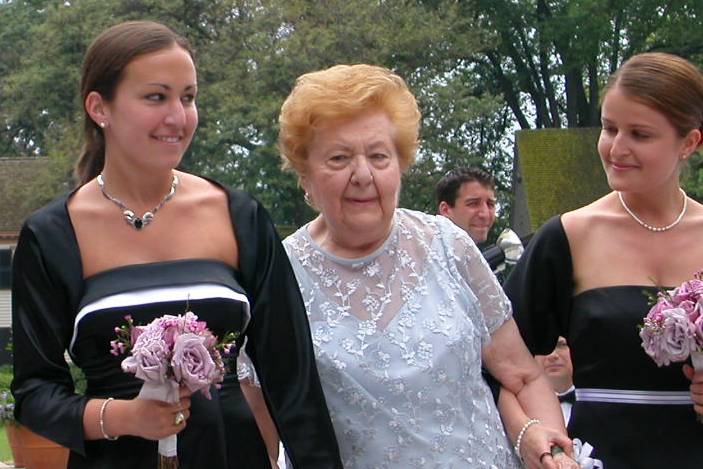
Remy is named for five remarkable women from all sides of his family.  Remy is for Rose, his paternal great-grandmother who passed away just a few months ago.  Brandon is for Bea, his other paternal great-grandmother who lived to be 101 years old.  Here they both are, together at Remy’s parents’ wedding in 2006.  They were both strong, independent women, both widowed far too young, but both women who not only survived, but found continuing  joy and fulfillment in their long lives.  I was honored to get to know them both.

Bea and Rose

Bea and Rose

Remy’s Hebrew name is in honor of three women from his mother’s side.  Shalev is for my mother-in-law Sara, Remy’s maternal great-grandmother, who also lived a long life.  She was the matriarch of her family and a strong, sweet, loving and incredibly funny woman who was adored by all her grandchildren, her nieces, nephews, and, of course, her sons and her daughters-in-law.  She raised two truly wonderful men, one of whom I was fortunate enough to marry.


Sara with Maddy and Rebecca

Sara with Maddy and Rebecca

Ezra is for my two aunts.  My father’s sister Eva, who despite contracting MS as a young woman, lived a long and productive life, working until retirement age for the city of Philadelphia, where she was born and lived almost her whole life.  She was another strong and independent woman who had an incredibly large and yet close circle of friends. (Picture to come once I get back to my scanner.)

Ezra is also for my Aunt Elaine, my mother’s sister, our family’s matriarch, who was yet another incredibly strong and loving and smart and funny woman, our family historian.  As my mother remarked this past weekend, we cannot tell a story about her that does not make us laugh and smile.  She, too, was adored by all.

Phil and Elaine

Phil and Elaine

Remy, you have an incredible foundation to start your young life.  May you be blessed to have the strength, the heart, the independence, and the sense of humor that all five of these women had to help get you through what we hope will be a long, healthy and very happy life.


Enhanced by Zemanta

The Pawnbrokers: Not Reality TV, but Realities

Tradition symbol of pawnbrokers--three connect...

Tradition symbol of pawnbrokers–three connected balls (Photo credit: Wikipedia)

Growing up, I always heard my father’s family’s business referred to as jewelry and/or china dealers; I don’t recall them being described as pawnbrokers.  Maybe I just wasn’t listening (quite likely), or maybe that’s how my father explained it when I was too young to understand what “pawnshop” meant.

Anyway, I never thought of them as pawnbrokers.  My image of a pawnbroker was based on what I saw on crime shows on television, in movies like The Pawnbroker, and through windows as we drove through poor neighborhoods in New York.  The pawnshop was a place for either desperate people in need of money or criminals fencing stolen goods.  The pawnbroker was someone who was thus taking advantage of someone’s misfortune or the willing or unwitting participant in a crime.  I know of two incidents where my ancestors aided the police in solving crimes, so I am hoping that they were not complicit in receiving stolen goods, but were they taking advantage of the misfortunes of others?  Was this just a stereotype promoted in popular culture? Were pawnbrokers actually parasites, usurers, or were they providing a much needed service?

The Pawnbroker (film)

The Pawnbroker (film) (Photo credit: Wikipedia)

Interestingly, I had not really focused on this as I was researching until I could not decipher a word on the 1910 census for Joseph Cohen’s occupation, as I posted earlier this week.  I had asked for help here and elsewhere to decipher the word.  Several people expressed the same opinion—that the word is “loan office.”  As one person commented, it was just a nicer term for a pawnbroker.  Joseph may have been attempting to convey a less controversial image of his occupation.

I decided to do some reading to see what I could learn about pawnbrokers.  First, I wanted to better understand how the pawn business works.  I know that there are now a few reality television shows based on pawnshops, most notably Pawn Stars.  (One of my students brought this up in class this year during a discussion of bailment contracts, and I was sure he had said PORN Stars.  Just shows how uncool I can be….)  I read a few definitions and websites online about how pawning works, and this one seemed to be fairly accurate and concise, from Dictionary.com: “a dealer licensed to lend money at a specified rate of interest on the security of movable personal property, which can be sold if the loan is not repaid within a specified period.”

Wikipedia has a more expanded definition:  “If an item is pawned for a loan, within a certain contractual period of time the pawner may redeem it for the amount of the loan plus some agreed-upon amount for interest. The amount of time, and rate of interest, is governed by law or by the pawnbroker’s policies. If the loan is not paid (or extended, if applicable) within the time period, the pawned item will be offered for sale by the pawnbroker. Unlike other lenders, the pawnbroker does not report the defaulted loan on the customer’s credit report, since the pawnbroker has physical possession of the item and may recoup the loan value through outright sale of the item. The pawnbroker also sells items that have been sold outright to them by customers.”

So a person who needs money but for some reason cannot obtain a bank loan—insufficient credit, time pressure, some other reason that makes a bank an impractical choice—can take their property—jewelry, household items, clothing, whatever—to the pawnshop; the pawnbroker assesses the value of the items and provides a loan of cash to the person who agrees to pay with interest within a set period of time or to forfeit the personal property.

Since the pawnbroker must be licensed and since there are numerous state and federal regulations that apply to the business, there is nothing inherently shady about this business. It is a legal method of loaning money to those who choose not to go to a traditional bank.  So why is there an aura of shadiness often associated with the business?

Wendy A. Woloson wrote a book entitled In Hock, Pawning in America from Independence through the Great Depression (2006) that addressed just this question.  She wrote:

Pawnbrokers were at once essential to the continued well-being of this economic system and important scapegoats for the various social ills that the financial difficulties it brought.  Loans from pawnshops supplemented substandard wages, enabling workers to continue to feed their families and producers to continue to exploit their workers.  Although industrialists indirectly benefited from the services pawnbrokers provided, it was also in their interest to encourage the idea that pawnbrokers were fringe operators whose business had no place in the “mainstream” economic system. (p. 21)

Woloson contended that these capitalists promoted an image of pawnbrokers as hard-hearted, greedy and criminally inclined foreigners who used shady practices to exploit their customers. She also asserted that there was a fair degree of anti-Semitism behind these stereotypes.   Although not all pawnbrokers were Jewish, many were.  As Woloson explains, “Jews’ involvement with pawnbroking resulted not from any inherent character flaws or moral failings, as the popular press often posited. Rather, they took up pawnbroking and like occupations largely because they were barred from other trades, especially the mechanical and artisanal, and so necessarily developed an acumen dealing in consumer goods as peddlers, used clothing dealers, and auctioneers.”  (p. 71)

Of course, the negative stereotype of the Jewish moneylender is far more ancient than 19th century America; Shakespeare’s character Shylock from Elizabethan times is evidence of the way society and popular culture have long depicted Jews who were involved in the lending business.  Woloson elaborated on the role this stereotype and the anti-Semitism in society in general had on the popular assumptions about pawnbrokers—that they were Jewish opportunists taking money from hard working Americans.  (pp. 21-24)

Pawnbrokers were aliens in a commercial world populated by supposedly moral and upright Christian entrepreneurs, and the very nature of the business set it apart from ‘normal’ economic dealings.  The antithesis of merchants, pawnbrokers doled out money instead of taking it in, profiting from customers who lacked capital rather than possessed it. (p. 29)

As Woloson wrote, “Jews’ affiliation with pawnbroking and affiliated trades, such as dealing in used clothing and auctioneering, created among them a cohesive, commercially defined group; yet it also reinscribed outsiders’ perception that they operated beyond the currents of mainstream trade.” (p. 25-26)  Woloson explained that since most Americans in the early 19th century did not know many Jews, their preconceived image of the Jew as a greedy moneylender was reinforced by the fact that many pawnbrokers were Jewish. “It mattered little whether or not individual pawnbrokers were Jewish. Because they were all assumed to be, people scrutinized their business practices and questioned their ethics.” (p. 26)

Even as many Jews achieved substantial economic success through other businesses and finance in the 19th century, there was a common assumption that they had done so illegally, and the stereotype of the greedy, heartless moneylender persisted as part of popular culture. (p.28)  Pawnbrokers became common stock characters in works of popular culture, further promoting the negative and anti-Semitic stereotypes; Woloson catalogs a number of examples of novels and plays using such characters based on this stereotypes (pp. 28-53).

Woloson then provides evidence that in fact pawnshops served important public functions and were set up in ways to prevent exploitation of those who used their services. She describes how as cities grew and people outside the wealthy classes needed access to cash on short notice—to pay taxes or acquire assets they need to live or to work, there was a need for the services of pawnbrokers.  In the early 19th century, cities began to adopt regulations for pawnbroking.  I saw many legal notices in the Philadelphia Inquirer announcing the issuance of pawnbroking licenses to my ancestors and others. These required the posting of an expensive bond and thus ensured a commitment by the pawnbrokers to run their businesses in compliance with the regulations.  (pp.  54-57)

These local regulations controlled both the interest rate a pawnbroker could charge and the period a pawnbroker had to wait before the customer’s goods would be forfeited to the shop and available for sale.  For example, in Philadelphia in the 1860s, the interest rate could not exceed 6% and the pawnshop had to hold collateral for a year before reselling it. (p. 58)

Pawnbrokers hoped that this would add some legitimacy to their business and to their image, but apparently that did not occur.  As Woloson wrote:

Pawnbrokers were hardworking people who offered what was fast becoming a necessary service in maturing American cities, providing short-term loans on modest forms of collateral. Yet their profession, like dogcatching, was not one that people aspired to. Unlike clerks and mechanics, who received education through apprenticelike training and shared social activities, pawnbrokers enjoyed neither professional prestige, identity, specialized education, nor occupational camaraderie.  (p. 58)

According to Woloson, most pawnbrokers learned the trade by starting out as general dealers in goods, learning how to assess the value of those goods.  This is consistent with the experience of my ancestors.  First, they sold used goods and then perhaps newer goods, including china and clothing primarily.  Then they became pawnbrokers.  “A lasting and successful career in pawnbroking rested on one’s ability to identify local market niches and to accurately appraise a miscellany of goods.” (p. 60)

In Woloson’s opinion, these pawnbrokers provided substantial benefits to the people and the cities they lived in.  The money borrowed from the brokers helped not only their customers, but the economy of the city by enabling those people to buy goods and services and thus support local businesses.

She also discusses the typical patterns of the pawnbroking business in various cities, including Philadelphia.  Woloson noted that pawnshops tended to locate in areas that sold used clothing and furniture and other second hand goods rather than in the commercial heart of the cities where more elite retail centers would be located.  In Philadelphia, that meant that most pawnshops were located either north or south of the center of the city in areas, for example, like South Street where my great-grandfather’s pawnshop and home were located for many years.  Woloson provides this insightful description of that neighborhood in the mid-19th century:

Unburdened by any systematic police control, the diverse population and its many activities brought a liveliness to these areas. The very rich and the very poor mingled freely, as did members of various ethnicities and races. While this social mixing may have been scandalous to outside observers, residents themselves shared the collective ambition of getting ahead. The neighborhood’s mixed population at midcentury engaged in many enterprises. They drank, whored, pilfered, and occasionally rioted their way down South Street. By 1839 there were at least sixty-two taverns in the ten-block area.39 Men had their pick of brothels. ….  Some back alleys harbored “houses of prostitution of the lowest grade, the resort of pickpockets and thieves of every description.” Strangers were “earnestly admonished to not go there.” In contrast, another brothel only a few blocks away was home to a respectable “swarm of yellow [mulatto] girls, who promenade up and down Chestnut Street every evening, with their faces well powdered.” The lower sorts needed pawnbrokers to get them through the exigencies of the day and to fund their debauchery at night. Ten of the city’s thirteen pawnbrokers in 1850 were on South Street or within one block of the corridor. Rooted, the shops continued to hem the southern and northern fringes of the city until the end of the century.  (pp. 64-65; footnotes omitted)

H. Williams & Co. Ltd. Pawnbrokers

H. Williams & Co. Ltd. Pawnbrokers (Photo credit: christopher.woo)

This description gave me a far different impression than I previously had about how and where my great-grandfather Emanuel and his many siblings grew up; whereas I had never assumed that this was a wealthy neighborhood, I had assumed it was fairly safe and middle-class since Jacob had servants and a business that supported so many people.  Did my great-grandfather grow up hungry?  Probably not, but neither did he grow up in some swanky suburb or upscale city neighborhood.  He grew up surrounded by thieves, pickpockets, brothels, and bars.

These locations were, in Woloson’s view, business necessities.  The people who needed the services of the pawnbrokers were not the wealthy who shopped at fancy stores, but the working class and poor residents who could not get by without a quick and fairly easy loan.  Woloson opines that in some ways pawnbrokers were more straightforward businesspeople than those who used sales techniques to manipulate customers into buying goods.  In Woloson’s view, “Pawnbrokers made no pretense that they did anything other than loan money, and in this way many may have been more honest professionals than the retailers pushing goods on the other side of the city.” (p. 67-68)

Another pattern observed by Woloson was the tendency of pawnbrokers to expand and pass down their businesses within their families.  “Established, successful pawnshops were often passed down through single families rather than being taken over by outside partners; younger generations grew up in the trade and learned from fathers, uncles, and brothers, thus providing steady income to families over generations and contributing to social and economic stability where pawnbrokers resided.”  (p. 74)

Finally, Woloson also discusses the relative economic success of pawnbrokers, debunking the myth that many were wealthy as a result of the exploitation of those of lesser means.  She wrote:

Like many other businessmen operating in interstitial markets, most pawnbrokers worked the margins. Once they reached their professional apex, they typically did not advance much beyond the class of their customers and failed to accumulate enough capital to invest in larger financial endeavors that would have elevated them socially and economically. A pawnbroker’s profits were tied to the economic fortunes of his customers, and he often suffered losses at auctions of unredeemed collateral, especially during economic crunches. Pawnbrokers running shops in smaller cities necessarily supplemented the lending business with other petty entrepreneurial activities. Average pawnbrokers made enough money to support their families and to keep the business going, but probably not much more.  (p. 75)

I am really glad that I found this book because it has really given me a new perspective on my Cohen ancestors.  Compared to my Brotman and Goldschlager relatives, I’d always imagined that my Cohen relatives were wealthy and established.  Of course, by the late 19th century, early 20th century when my mother’s family started to arrive from Galicia and Romania, the Cohens had already been here for about 50 years and were well-settled, owning their own businesses, speaking English, and American-born.  They had the advantages of being here much earlier and so were far ahead economically when my mother’s family arrived.  But they were not the wealthy elite; they were probably at most middle class business people who were working in unpleasant neighborhoods, subjected to negative stereotypes based on their trade as well as their religion, and engaged in a business that required some risk-taking and business acumen but was not well-regarded.  That must have been very painful and frustrating.

Having this new perspective will help me better understand their lives as I continue to move forward in telling their story.


.

Enhanced by Zemanta

Finding the Ruby Slippers and Getting Back Home to Where It Started: The Brotmans

[for my aunt, Elaine Goldschlager Lehrbaum, 1917-1995]

Elaine 1933

Elaine 1933

Many of you who are more recent followers of the Brotmanblog may wonder why the blog is called the Brotmanblog.  In the past several months I have barely mentioned the name Brotman because I have been focused on searching for my grandfather’s family, the Goldschlagers and Rosenzweigs.  But if you go back to the beginning of the blog, you will see that my original search focused on my grandmother’s family, the Brotmans.  That’s where I started my genealogy adventures.  It made sense.  My grandmother Gussie Brotman Goldschlager, my mother’s mother, was the grandparent I knew best, the only grandparent I knew as an adult.  She was the only grandparent my husband ever met, though she died a year before we were married.  It was only natural that I would start my journey trying to learn as much as I could about her and her siblings and her parents.  Once I had found as much as I could find about the Brotmans, I then moved on to my grandfather’s family.  The next chapter will be my father’s family.  But it all started with the Brotmans.

Why do I bring that up now? Because this weekend I will finally get to meet a number of the Brotman cousins I only learned about through doing this research.  There will be over thirty of us gathering in NYC to meet and eat and to visit the Lower East Side, where our grandparents and great-grandparents (and for some, great-great grandparents or parents) lived in New York.  We will walk to 81/85 Ridge Street where the Brotmans first lived, now a public school, once a tenement building, and then we will tour the Tenement Museum to learn more about what life was like for all of them.

If you have not read any of my posts about the Brotmans, I have provided links here and below to some that will capture the essence of their lives.  Even if you once did read them, you may want to re-read them if you are joining us this weekend and want to remember some of the details and themes I wrote about months ago.  The Brotman story is the classic Jewish American immigration story, a story of poverty and heartbreak as a family moved from Galicia to NYC in the late 1880s to a story of assimilation and success as the future generations built businesses, moved beyond the Lower East Side, became professionals, and moved to the suburbs after World War II.  My Brotman great-grandparents were hard-working realists who did what they needed to do to survive.

Although I was able to piece together a fair amount about their lives through census reports and other documents and through some stories my mother remembered about her grandparents, aunts, uncles and mother, at first there was no one else besides my mother and my brother to whom I could turn for information.  My cousins shared stories about their grandparents, but they also knew little about the early lives of their grandparents and had no one left to ask either.  So mostly I relied on documentation to learn what I could.  I was able to put together a fairly complete history of the Brotman family in America and decided to move on to my grandfather’s family.

Then, like a gift of manna from heaven, about a month ago my cousin Jody sent me some notes that her husband Joel had taken from a conversation he’d had with my Aunt Elaine years ago about her family.  I’ve referred to one part of those notes before—the story of how my grandmother Gussie met my grandfather Isadore on Pacific Street in Brooklyn, where my grandmother was living and where my grandfather’s cousins the Rosenzweigs were living in 1915.  In the next day or two I’d like to share a few more tidbits from Aunt Elaine, via Joel’s notes.

But before I do, I want to point out that these notes are incredibly accurate.  Although the conversation Joel had with my aunt must have taken place in the early 1980s, my aunt’s memory for details was astonishing.  For example, she refers to the fact that Hyman’s son Emanuel worked for Kislack Realty.  I checked with Manny’s children, and they confirmed that in fact  Manny was President of J.I.Kislak Mortgage Corporation in Newark, NJ., which was a subsidiary of J.I.Kislak, Inc., a large residential and commercial Realtor based in Jersey City.kislack realty Also, my aunt knew that David Brotman worked in the coat industry, that Max was in the cigar business, and that Abraham worked for a deli in Coney Island.

All of these are facts that are backed up by my research.Brotman brothers trades

On the Goldschlager side as well, my aunt’s facts are corroborated by the information I found in my research.  David Goldschlager lived in Scranton, PA, for some time and was in the hat business.  Betty married a man in the dry goods business and moved to Arizona. goldschlager siblings I point out how accurate this information is to demonstrate how remarkable my aunt’s memory was and also so that you will trust the other statements she made and their accuracy when I report on those in upcoming posts.

In some ways finding these notes was frustrating.  If I had found them last summer, much of the time I spent trying to figure out who Max was or whether Abraham was related to us or whether there were any other children would have been unnecessary.  My aunt knew it all, and it is in these notes.

But as Glinda the Good Witch tells Dorothy at the end of The Wizard of Oz (the movie) when she reveals to Dorothy that the ruby slippers could take her home and the Scarecrow asks  why Glinda had not told Dorothy that from the beginning:

Glinda : Because she wouldn’t have believed me. She had to learn it for herself.
Tin Man: What have you learned, Dorothy?
Dorothy: Well, I – I think that it – that it wasn’t enough just to want to see Uncle Henry and Auntie Em. And that it’s that – if I ever go looking for my heart’s desire again, I won’t look any further than my own backyard, because if it isn’t there, I never really lost it to begin with. Is that right?
Glinda: That’s all it is!

And then when the Tin Man, Lion and Scarecrow all say that they should have helped Dorothy figure it out, Glinda replies:

She had to find it out for herself.

And so I did as well.  If I had started with Aunt Elaine’s notes, I never would have worked as hard to learn how to research and find these things for myself.  I would never have felt the amazing sense of satisfaction I’ve gotten from putting pieces together and from finding cousins who could help me put those pieces together.

Having my aunt confirm through these notes what I have learned and what I have done is a real gift. She was someone I adored and miss dearly.  It’s like having her here with me again, hearing her say, “You see, Amy Kugel, I always knew you could do anything you wanted.  And I knew some day you would want to know more about your history, your family.”  But, as Glinda told Dorothy, she knew I had to find it out for myself.


Elaine 1926

Elaine 1926

Elaine Gussie Florence 1933

Elaine Gussie Florence 1933

Elaine high school graduation

Elaine high school graduation

Elaine and Phil 1941

Elaine and Phil 1941

Sam with Gussie and Elaine 1945

Sam with Gussie and Elaine 1945

Elaine and Jeff 1949

Elaine and Jeff 1949

Elaine Jeff and Amy 1953

Aunt Elaine with Jeff and me

Phil and Elaine

Phil and Elaine

Enhanced by Zemanta

Brotmans, Resslers, Rosenzweigs, and Goldschlagers: All Roads Meet on Pacific Street in Brooklyn

Gussie and Isadore

Gussie and Isadore

This is probably the most moving discovery yet for me personally.  I am so excited that I don’t know where to start.  This story involves the Brotman family and the Ressler family AND the Rosenzweig family and the Goldschlager family.  It’s the final piece of the puzzle about how my grandparents met.  It came as a posthumous gift from my much beloved Aunt Elaine, who truly was not only our family matriarch, but also our family historian.  Aunt Elaine, you always wanted to tell me these stories, and I was too young and dumb to care.  I know you would be so happy that I am finally interested and recording them for all time.

Fortunately, someone was interested in her stories back then.  It seems that not only did my brother listen to my aunt, so did my cousin Jody’s husband Joel, my aunt’s son-in-law.  He interviewed her about the family and took careful notes.  Jody and Joel just found his notes while going through some boxes in their house, and Jody emailed them to me.  There is so much information in there that it will take me a while to digest it all and write it up for the blog.  Joel’s notes cover stories and anecdotes about the family and reveal some new things as well as things we now know but that I did not know a year ago.  But here’s the story that made me say out loud, “Oh, my God!”  And then to stop and sit in amazement.

You may recall that a while back I wrote a post about how various members of my family met their spouses, including my grandmother and grandfather.  I wrote:  “My grandfather Isadore supposedly saw my grandmother sitting in the window of her sister Tillie’s grocery store in Brooklyn and was taken by her beauty.”  That was the family story passed down the generations.

When I wrote about this story recently, what I couldn’t figure out was what my grandfather was doing in Brooklyn.  He had always lived in East Harlem since arriving in New York and did not live or work in Brooklyn in 1915. So what would have brought him to Brooklyn from East Harlem when he first saw my grandmother?

The answer is revealed in the notes Jody and Joel just sent me.  The story begins with my aunt telling Joel that my grandmother Gussie Brotman used to go to her sister Tillie’s grocery store after school.Gussie at Tillie's storeIn case you cannot read that, it says, “After school on Friday Gussie would go to Tillie’s house in Brooklyn at her grocery store.”

In 1915 Tillie and Aaron were living at 1997 Pacific Street in Brooklyn.    As Joel’s notes continue:

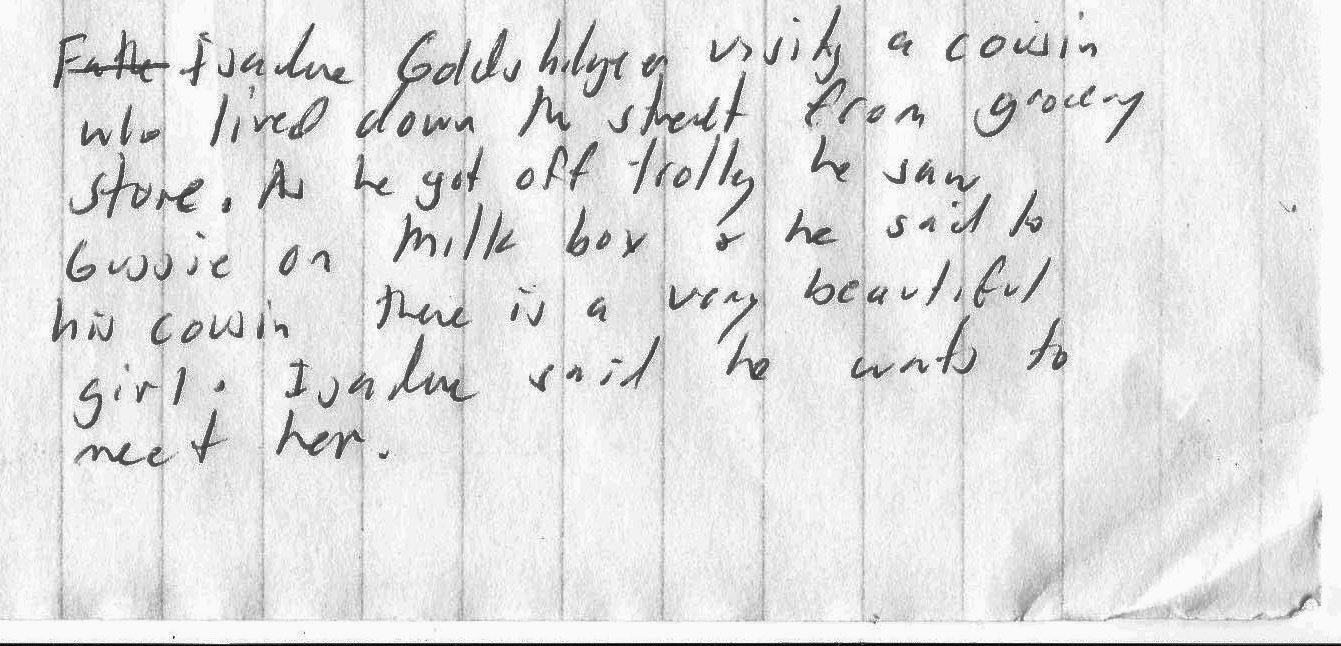
Isadore sees Gussie

“Isidore Goldschlager visiting a cousin who lived down the street from the grocery store. As he got off the trolley he saw Gussie on milk box and said to his cousin there is a very beautiful girl.  Isadore said he wants to meet her.” (emphasis added)

 In  1915, the Rosenzweigs were living at 1914 Pacific Street, right down the block from 1997 Pacific Street where Tillie and Aaron Ressler lived. When I wrote that post back on February 5, I did not yet know about Gustave Rosenzweig and his family.  I had no idea that my grandfather had cousins living in Brooklyn on the same street where my grandmother was living.

Rosenzweigs 1915

Rosenzweigs 1915

Gussie living with TIllie 1915

Gussie living with TIllie 1915

So the cousin that my grandfather was visiting was one of the sons of Gustave Rosenzweig.  In 1915, Abraham was 26, Jacob  was 21, and Joseph was 17.  Abraham and Jacob were in the Navy, and Joseph was working as a driver’s helper.  My grandfather was 27 in 1915, so my guess is that he was hanging out with Abraham, who was closest to him in age.

Isadore age 27

Isadore age 27

I have wondered whether my grandfather ever saw these cousins once they all got to NYC, whether he knew them well.  Well, obviously he did.  If he had not been close to them, he would never have come to Brooklyn.  He would never have seen that beautiful red haired woman sitting on the milk box.  And this would never have happened:

Isadore Goldschlager and Bessie Brotman  marriage certificate

Isadore Goldschlager and Gussie Brotman
marriage certificate

Isadore and Gussie marriage cert 2And if that hadn’t happened, then my Aunt Elaine and my Uncle Maurice and my mother would never have been born, and then all my first cousins and my siblings and I would never have been born.

That little stroll down Pacific Street brought the Rosenzweig/Goldschlager family together with the Brotman family and thus created my family.  How could this not be my favorite story ever?

This is another one of those moments when all the time spent studying census reports pays off.  If I had not found the 1915 census reports for the Resslers and the Rosenzweigs, I would never have known they lived down the street from each other.  If I hadn’t looked at all those other documents, I would never have learned about my grandfather’s cousins and his uncle Gustave.  If I hadn’t started this blog, Jody and Joel might never have found these notes in their boxes of papers and provided the last piece of the puzzle. If Joel hadn’t listened to his mother-in-law, we wouldn’t have her memories and stories to tie it all together.  It should remind us all to ask questions and take notes and listen to our parents, our aunts and uncles, and our grandparents  so that we can learn everything we can while we can.

Thank you, Jody and Joel.  Thank you, Aunt Elaine.  Thank you, Uncle Gustave, for moving to Brooklyn.  Thank you, Aunt Tillie, for taking my grandmother to Brooklyn. And thank you, Abraham Rosenzweig, for taking my grandfather for that walk down Pacific Street so that he could meet and marry my grandmother.

Enhanced by Zemanta

David Rosenzweig and The Reality of Infant Mortality

In the course of researching Abraham Rosenzweig’s life, I discovered a tenth child born to Gustave and Gussie Rosenzweig.  On the 1910 census there were nine children, all but one born in New York City between 1888 and 1904.  (Lillian, the first child, was born in Romania around 1884.) There were four boys, Abraham, Jacob/Jack, Harry and Joseph, and five girls, Lillian, Sarah, Rebecca, Lizzie and Rachel.  The NYC birth index covers those years, so I started my research of Abraham by looking for a birth record.  I had several records indicating that he was born sometime around 1890, but I could not (and still have not) found a record for Abraham’s birth.

Gustave Rosenzweig and family 1900 census

Gustave Rosenzweig and family 1900 census

I expanded my search to look for any Rosenzweig born around 1890-1892, using FamilySearch as my tool as it allows for liberal use of wild card searching and, unlike ancestry.com or other sites, reveals the names of the parents in the search results.  I still did not see any Abrahams or Abes, but in scanning the results, I noticed a child named David who was born to Gadaly and Ghitel Saak Rosentveig.  Before receiving the Romanian records for Gustave and Gussie I might not have recognized that these were their Yiddish names: Ghidale Rosentvaig and Ghitla Zacu on their marriage records from Romania.Ghidale Rosentzveig with Ghitil Zacu_Marriage Record_1884_5  I knew that this could not be a coincidence, that this baby had to be their son, born September 5, 1891.  Since I still have not found Abraham on the birth index, I cannot be sure whether David was born before or after Abraham.  What I did realize was that David must have been named for my great-great-grandfather, David Rosentvaig, who had been alive in 1884 when Gustave married Gussie in Iasi but who must have died sometime before the birth of this new David.

But where was the new David in 1900, only nine years later? Since he was not listed on the 1900 census, I assumed the worst, as I have gotten accustomed to doing, and checked the death index.  Sure enough a one year child named David Rosenzweig had died on December 25, 1892.  Although I have not yet seen the death certificate for this child, I have to assume that this was Gustave and Gussie’s son David.  My great-great-grandfather’s namesake had died before his second birthday.

I have expressed in an earlier post my thoughts and feelings about the impact the deaths of babies and children must have had on their parents and their siblings.  The numbers are staggering.  On the 1900 census Gussie Rosenzweig reported that she had had thirteen children, only eight of whom were then living (Rachel was not yet born).  In 1910, she reported eighteen births and only nine living children.  Had she had five more infants die between 1900 and 1910? My great-grandmother Bessie Brotman reported in 1900 that she had given birth to nine children, only four of whom were living (Sam was not yet born).  We also know that Hyman Mintz died within a month of birth and Max Coopersmith within a day of birth.

These infant deaths were not at all unusual for that time period.  According to a PBS website for a program called The First Measured Century, “[p]rior to 1900, infant mortality rates of two and three hundred [per one thousand births] obtained throughout the world. The infant mortality rate would fluctuate sharply according to the weather, the harvest, war, and epidemic disease. In severe times, a majority of infants would die within one year. In good times, perhaps two hundred per thousand would die. So great was the pre-modern loss of children’s lives that anthropologists claim to have found groups that [did] not name children until they have survived a year.”

This same source reports that most of these deaths were caused by poor infant nutrition, disease and poor sanitary conditions.  In the early 20th century substantial efforts were made to deal with these causes of infant and other deaths.  “Central heating meant that infants were no longer exposed to icy drafts for hours. Clean drinking water eliminated a common path of infection. More food meant healthier infants and mothers. Better hygiene eliminated another path of infection. Cheaper clothing meant better clothing on infants. More babies were born in hospitals, which were suddenly being cleaned up as the infectious nature of dirt became clear. Later in the century, antibiotics and vaccinations join the battle.”  The infant mortality rate began to decline, and today it is well under ten deaths per thousand within the first year of life in the United States.

Infant mortality

But what impact did this high death rate for babies have on their parents?  There have been many books written by sociologists, social historians and psychologists on the history of society’s view and treatment of children.  According to this research, until the 18th century, children were not valued highly by parents, perhaps in part because of the high infant mortality rate.  The likelihood of losing a child was so great that it made it difficult for parents to become too attached.  In Europe often parents did not even attend the funerals of their children and even wealthy parents had their children buried as paupers. See, e.g., Viviana A. Rotman Zelizer, Pricing the Priceless Child: The Changing Social Value of Children (1994); Linda A. Pollock, Forgotten Children: Parent-Child Relations from 1500 to 1900 (1984). Both authors also observe that the attitude towards children changed during the 18th and 19th centuries as people began to be more concerned about their children’s growth and development and families started to become more child-oriented and affectionate.  This change in attitudes contributed to the increased efforts to reduce infant mortality.

It’s so difficult for me to imagine that these parents were indifferent or unaffected by the deaths of so many of their babies.  I know I live in another era, an era when parenting has become not just a part of life, but in some ways an obsession. I plead guilty to being a helicopter parent, to being probably too involved in my children’s lives as they were growing up.   We live in a time of thousands of books on parenting, dealing with every issue imaginable.  There are experts to help you before a baby is born and experts to help you deal with every imaginable childrearing issue that can arise after they are born: doulas, lactation consultants, sleep consultants, life coaches, tutors, college admissions consultants, and probably some I don’t even know about.    So many of us center our lives on our children.  Losing a child is often said to be the worst thing anyone can experience.

Could it really have been so different back then? Were children really seen as disposable and replaceable? Is that why people had so many children—in order to ensure that at least some would survive to adulthood?  Or was it simply the absence of effective birth control, not the desire for so many children, that led to these huge families?  Did those huge families make it easier to accept the loss of so many babies? Were even those who survived devalued and distanced as a defense mechanism against their possible death?  It seems unlikely they were as doted upon and cherished as children of today, given both the cultural attitudes and the economic and environmental conditions of the time.

Maybe that made those children stronger and more self-reliant, less indulged and less entitled.  But it also had to have left its scars.  Maybe it is why so many of them did not want to talk about their families, their childhoods, their feelings.

Enhanced by Zemanta