Meier Rothschild’s son Theodor Rothschild and His Family: How and Where did They Survive the Holocaust? And Who Was Willie Weisbecker?

Although it was hard to find much about the life of Berthold Rothschild and his family after the Nazis came to power in Germany, I was able to scratch together some basics: the death of his ex-wife in a Nazi-run hospital in Herborn, his death in South Africa, his profession (photographer), the marriage of his daughter Adelheid to Manson Samson at Westerbork, and the young couple’s survival of their time in Nazi concentration camps.

Turning to Berthold’s oldest sibling Theodor Rothschild and his family, my research was also less than complete. But I did find out a few things.

First, a file in the Arolsen Archives included the name of Theodor Rothschild.1 A translation of that file reveals its purpose:

To all German universities

Breslau, 12 February 1941

The following named persons have, on the basis of § 2 of the Law on the Revocation of Naturalizations and the Deprivation of German Citizenship of 14 July 1933, been declared to have forfeited German citizenship.

In view of this, the academic doctoral degrees awarded to them by the competent faculties of the University of Breslau have been revoked by resolution of the Dean’s Committee of the Silesian Friedrich-Wilhelms University of Breslau dated 5 February 1941.

The revocation becomes effective with this publication. No legal remedy is permitted.

Theodor Rothschild is listed as one of those whose degree was being revoked. He is grouped with those with a doctorate in dentistry and identified as follows: “Rothschild, Theodor, born 16 Mar. 1891 in Hof, district of Kassel, doctorate 26 Sept. 1929.” This meant that Theodor had lost his citizenship as well as his doctorate.

By doing a full-text search on FamilySearch, I found a letter written by someone named Willie Weisbecker to the US State Department on July 7, 1941, requesting the appropriate forms to apply for visas for eight different families. Theodore Rothschild and his wife and daughters were one of the listed families (#7), as was someone named  Berthold Rothschild and his wife Minna (#2). I learned that Willie Weisbecker was a German-born immigrant to the US who was an attorney and active in helping former German Jews recover compensation for property that was confiscated by the Nazis.2
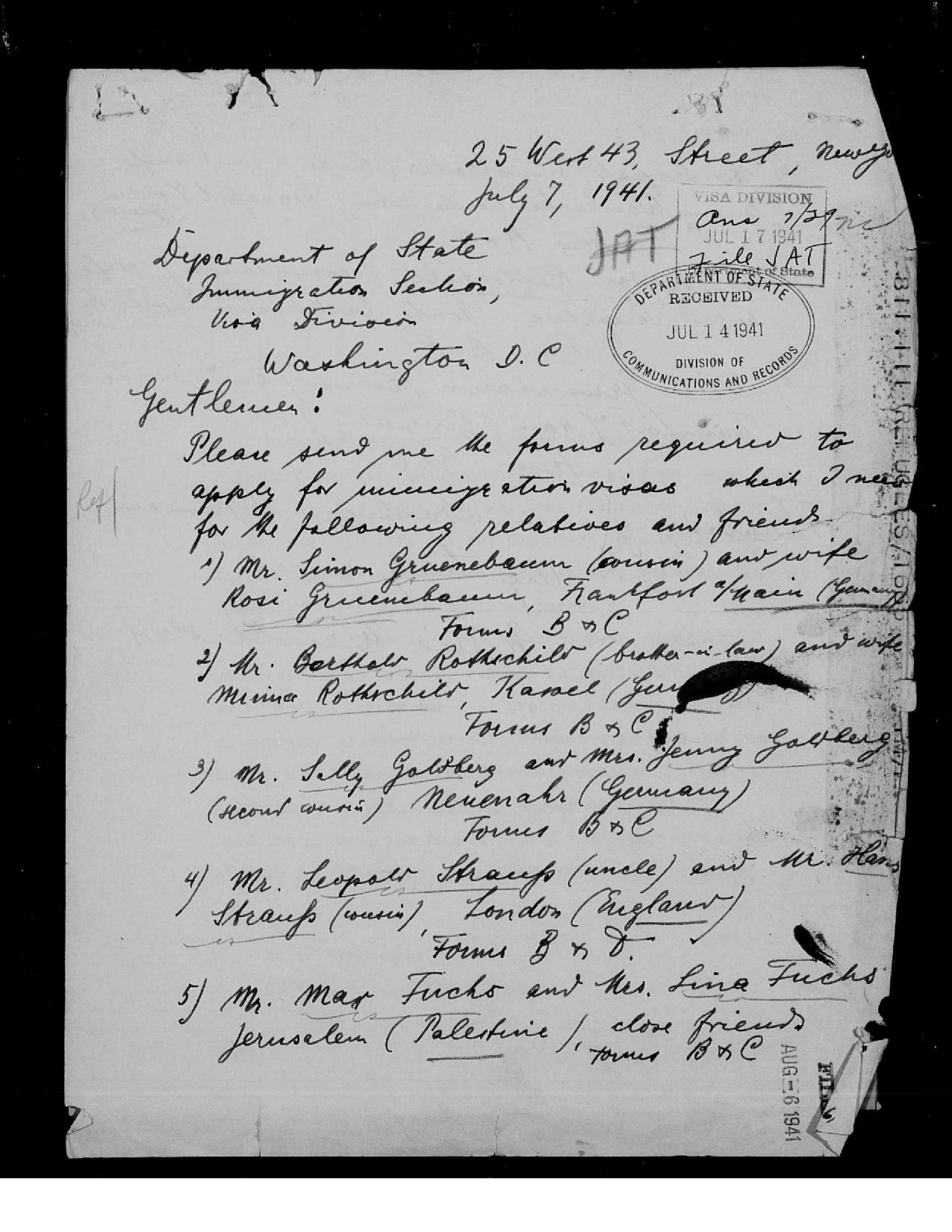
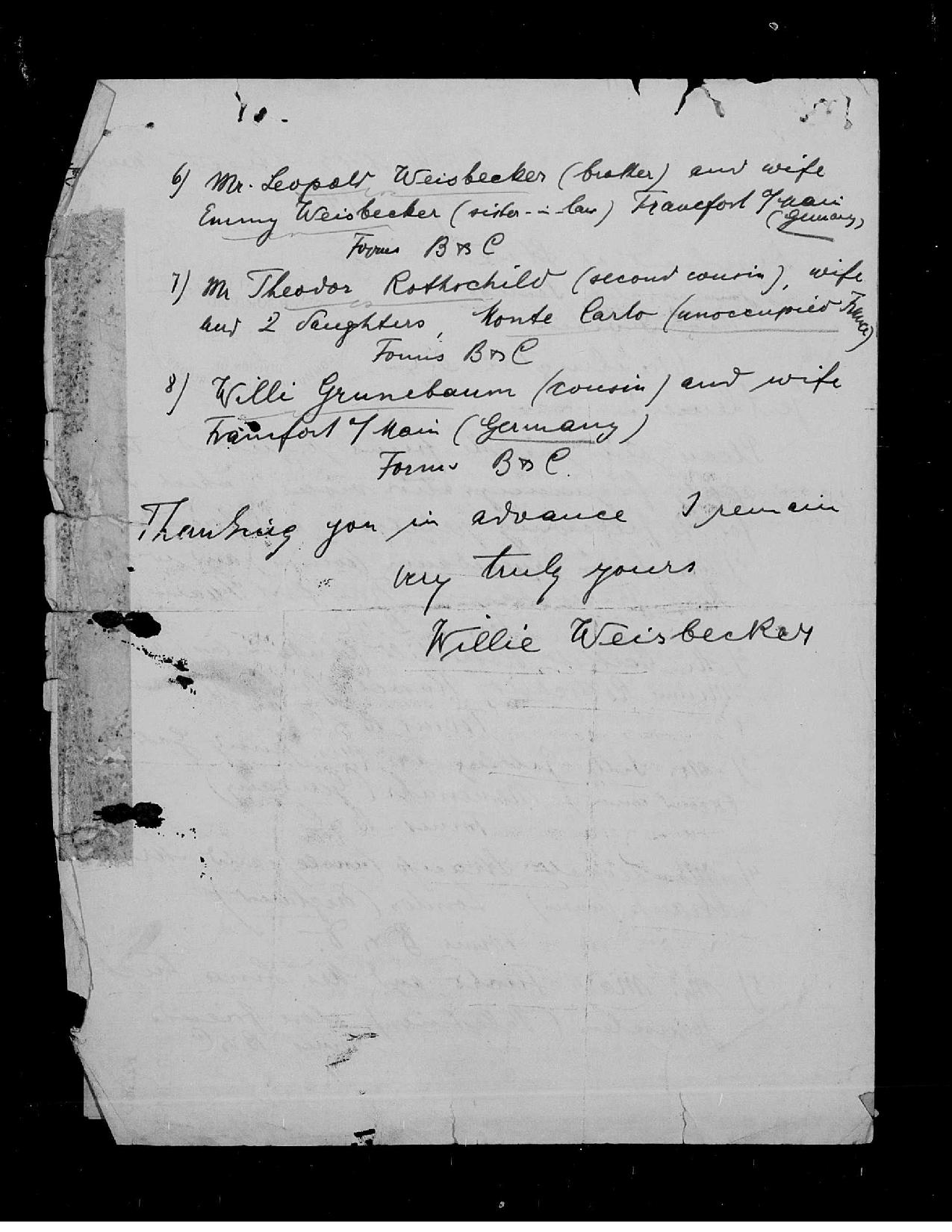
“United States records,” images, FamilySearch (https://www.familysearch.org/
ark:/61903/3:1:3QHV-V386-M93C-G?view=fullText : Feb 6, 2026), image 1058 of 1101;
United States. Department of State. Image Group Number: 008699970
https://www.familysearch.org/ark:/61903/3:1:3QHV-V386-M93C-G?view=fullText

Although Theodore was described as a second cousin to Willie, Berthold was described as his brother-in-law. I have no record of Theodor’s brother Berthold being married to a woman named Minna, though we know that his first wife Sarah had died in 1937. I thus am not sure that the Berthold Rothschild listed was the same person as Theodor’s older brother Berthold. I did find a tree on JewishGen with a different Berthold Rothschild married to a woman named Minna Weisbecker, so assuming that is accurate, the Berthold Rothschild in Willie’s letter is not my relative.

That made me wonder whether the Theodor Rothschild in Willie’s letter was in fact the same Theodor Rothschild on my family tree. I spent a great deal of time down the rabbit hole without any luck, trying to figure out how Willie Weisbecker was a second cousin (or any cousin) to Theodore Rothschild or his wife Bettina Schiff. The fact that Willie listed Theodor as from Monaco and having two daughters supports the assumption that this was the same Theodor Rothschild who was the son of Meier Rothschild and thus my cousin because other documents (discussed below) revealed that Theodor did live in Monaco. And I knew that he did have two daughters, Doris and Ellen.

But if Theodor and Willie were second cousins, they would share great-grandparents; same if Theodor’s wife Bettina and Willie were second cousins. So far, however, I have not found any commonality in the ancestries of Theodor and Willie or Bettina and Willie. I have contacted a person who has an extensive Ancestry tree for the Weisbecker family to see if he can help me find a link.

In any event, the State Department responded to Willie’s letter, agreeing to send the required forms for all the people listed in the letter except for those still in Germany.
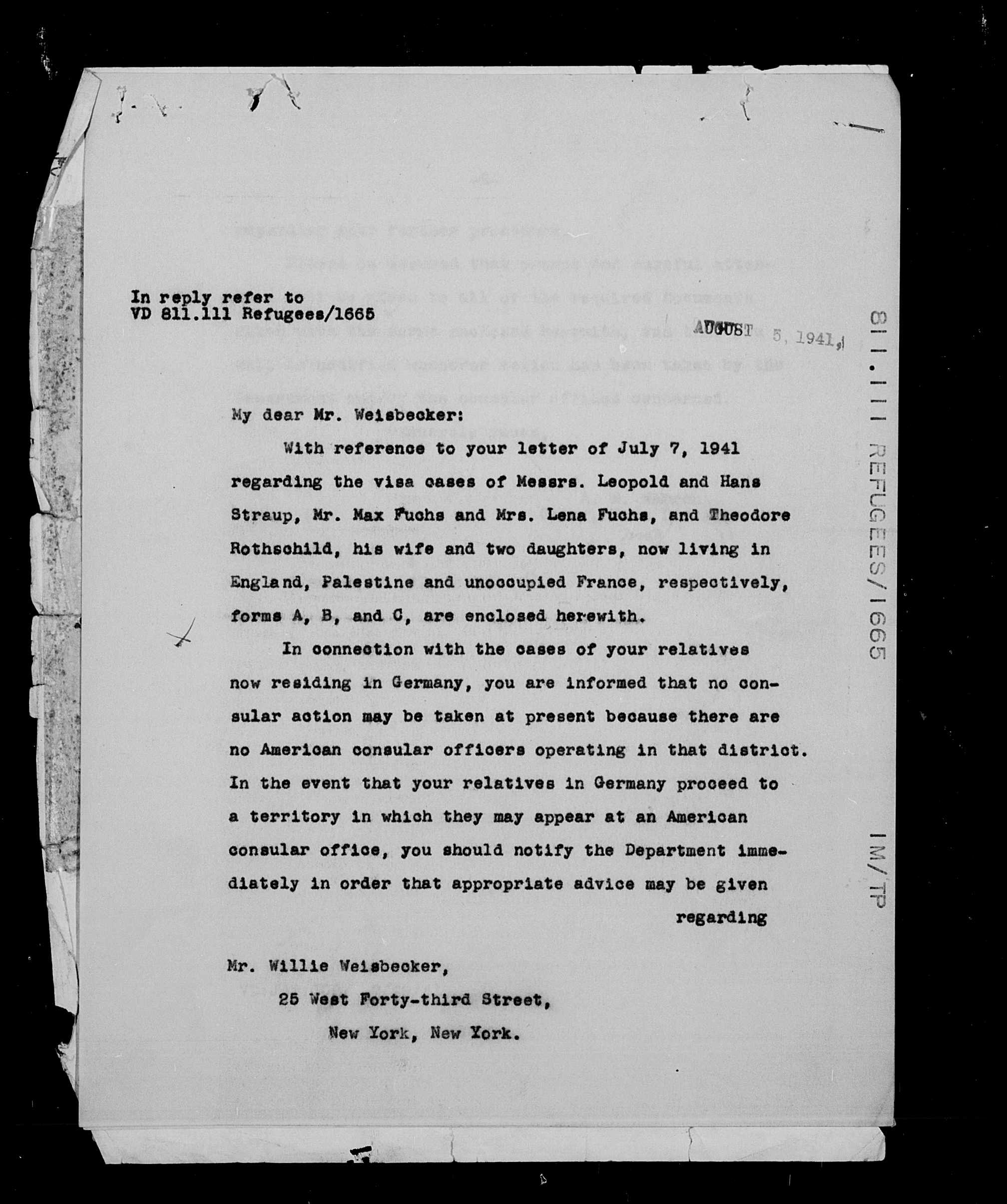
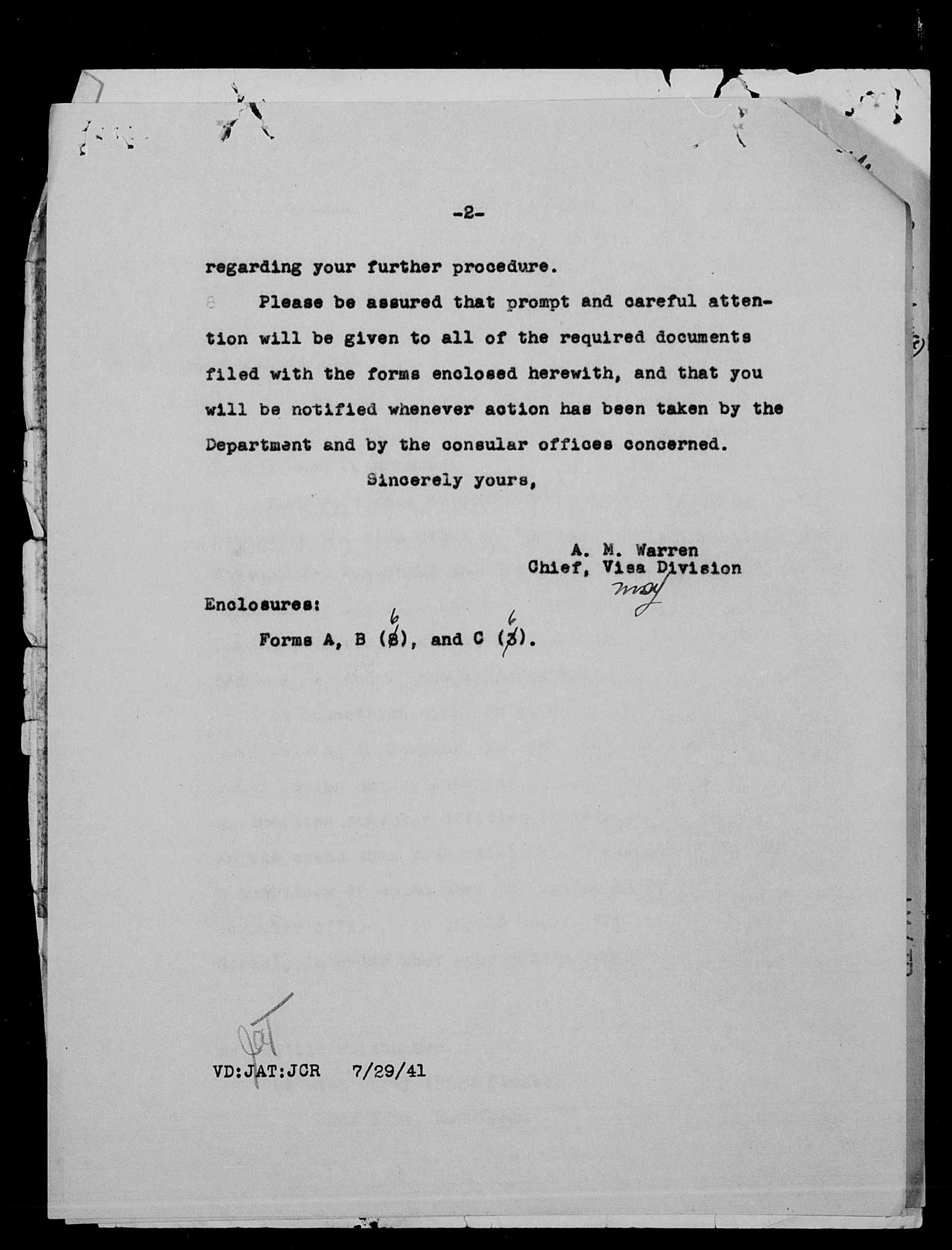
“United States records,” images, FamilySearch (https://www.familysearch.org/
ark:/61903/3:1:3QHV-V386-M97K-M?view=fullText : Feb 6, 2026), image 1060 of 1101;
United States. Department of State. Image Group Number: 008699970
https://www.familysearch.org/ark:/61903/3:1:3QHV-V386-M97K-M?view=fullText

I don’t know whether Theodor ever completed those forms and applied for a visa, but in any event I have no record of him or his family ever coming to the United States.

Rather, I found on MyHeritage references for the French naturalization for both Theodor and his daughter Ellen on May 27, 1949. 3 But I did not find any naturalization references for either Theodor’s wife Bettina or his older daughter Doris. Willie Weisbecker’s letter indicated that Monaco was part of the unoccupied territory of France in July 1941, and I don’t think that’s technically correct since Monaco has always been a separate sovereign country. But France did allow residents of Monaco to become French citizens by decree if certain conditions were met.4

Although I did not find a naturalization record for Theodor’s daughter Doris, I did find a French death record showing that she died in Saint-Gratien, Val-d’Oise, France, on February 13, 2017. She would have been 97 years old.5

For Theodor and Bettina, the only other references I could find are a FindAGrave memorial showing that they both died and are buried in Monaco. Theodor died in 1961, Bettina in 1982.6

I don’t know how accurate those memorials are, but those same dates and locations also appear in an Ancestry family tree that could be that of a descendant. I have written to the tree owner for more information, hoping she knows the story of Theodor and Bettina and their daughters. Her tree has more information about the daughters and their marriages, but I’d prefer to wait to learn more than to rely on a tree alone. For now, this is all I have records for about the lives of Theodor Rothschild and his family.

If and when I learn more, I will update the blog accordingly.


  1.  1 Incarceration Documents / 1.2 Miscellaneous / 1.2.1 Deportations and Transports /, Glatz (Lower Silesia): Minutes and correspondence concerning the collection of Jewish property, compulsory names, expatriation and deportation of the Jewish population (1938-1943), Reference Code 10007588 Creation Date 1938-12-06 – 1943-05-10 
  2. “Willie Weisbecker, Lawyer and Writer,” The New York Times, December 4, 1955, p. 88 
  3. Ellen ROTHSCHILD, Birth Mar 7 1929, Kassel, District de Kassel, Hesse, Allemagne, Naturalization May 27 1949, France, Notes Cette personne était un enfant mineur lorsque ses parents ont bénéficié d’un décret de Naturalisation, de Réintégration ou d’Admission sur lequel elle a été mentionnée, il est donc Français par EFFET COLLECTIF., Source Les naturalisations entre 1900 et 1963, Decree Number 12302-38, Reference Number H002-NAT1056319, Sources Journal Officiel, found at MyHeritage, https://www.myheritage.com/research/record-14015-409204/ellen-rothschild-in-france-naturalizations?s=OYYV67OZ5BWBQ5GHZXDK3ZTZXZLZYQY; Théodore ROTHSCHILD
    Birth Mar 16 1891, Hoof, Schauenburg, District de Kassel, Hesse, Allemagne
    Naturalization May 27 1949, France, Notes A l’origine cette personne était de nationalité étrangère, elle est devenue française en bénéficiant d’un décret de NATURALISATION. Le premier texte concernant les naturalisations d’étrangers en France est un arrêt du Parlement de Paris daté de 1515: “L’enfant né en France de parents étrangers est Français s’il choisit de se fixer définitivement en France”
    Source Les naturalisations entre 1900 et 1963, Decree Number 12302-38
    Reference Number H002-NAT1056334, Sources Journal Officiel, found at https://www.myheritage.com/research/record-14015-765667/theodore-rothschild-in-france-naturalizations 
  4. Ordonnance n° 45-2441, 19 oct. 1945 (Fr.), Code de la nationalité française art. 60–62 (1945). 
  5. Doris Rothschild, Gender femme (Female), Death Age 97, Birth Date févr. 1920 (Feb 1920), Birth Place Kassel, Allemagne (Germany), Death Date 13 févr. 2017 (13 Feb 2017), Death Place Saint-Gratien, Val-D”Oise (Val-d’Oise), France, Certificate Number 27, URL https://www.data.gouv.fr/fr/datasets/fichier-des-personnes-decedees/, Institut National de la Statistique et des Etudes Economiques (Insee); Paris, France; Fichier des personnes décédées; Roll #: deces-2017.txt, Ancestry.com. Web: France, Death Records, 1970-2021 
  6. Find a Grave, database and images (https://www.findagrave.com/memorial/99379564/theodore-rothschild: accessed February 5, 2026), memorial page for Dr Theodore Rothschild (1891–1961), Find a Grave Memorial ID 99379564, citing Cimetière de Monaco and Columbarium, Monaco-Ville, Monaco; Maintained by: Find a Grave

Meier Rothschild’s Son Berthold And An Important Lesson about AI

Although I had a fairly easy time locating the names, birth dates, marriages, and children of the five children of Meier Rothschild and Bertha Lorge and I knew that all five lived beyond World War II, I have had a much harder time finding information about how they survived the Holocaust—did they leave in time or did they get sent to the camps? And where did they go after the war?

Each of those five children presented some research challenges because it appears that none of them ended up in the same place and almost all ended up somewhere other than the United States. So the records are harder to locate—if they exist at all. But I will do my best to trace their histories during the 1930s and thereafter.

Starting with the oldest child, Berthold Rothschild, his wife Sarah Adler, and their daughter Adelheid, one fact I was able to establish was that Sarah died on May 15, 1937, when she was only 43. The death record says she died in Herborn, which is a small town about 60 miles from Frankfurt, where the death record states she was living. So why was she in Herborn and not Frankfurt where Berthold lived? What caused her death? Was it related to the persecution of Jews by the Nazis? I didn’t know.

Sarah Rotschild, Maiden Name Adler, Gender weiblich (Female), Death Age 43, Birth Date Abt 1894, Death Date 15 Mai 1937 (15 May 1937), Death Place Herborn, Hessen (Hesse), Deutschland (Germany), Civil Registration Office Herborn, Certificate Number 74, Hessisches Hauptstaatsarchiv; Wiesbaden, Deutschland; Personenstandsregister Sterberegister; Bestand: 4139; Laufende Nummer: 911, Ancestry.com. Hesse, Germany, Deaths, 1851-1958

I thought that perhaps there was more information in the parts of the death record that I could not read and asked in the GerSIG group on Facebook for help. Ralf, a member there, provided me with this translation:

The management of the state sanatorium has announced that Sara Rothschild, née Adler, without occupation, 43 years old, resident of Frankfurt am Main, born in Rüsselsheim, district of Gross-Gerau, divorced, died in the state sanatorium in Herborn on the afternoon of the fifteenth of May 1937 at five and a half o’clock.

I added the emphasis to two parts here. First, Sarah’s marital status was reported as divorced. I went back to the marriage record for Berthold and Sarah and now saw there was a marginal comment that in fact says that they were divorced as of May 22, 1934.

From the marriage record of Berthold Rothschild and Sarah Adler, Hessisches Hauptstaatsarchiv; Wiesbaden, Deutschland; Bestand: 903
Source Information
Ancestry.com. Hesse, Germany, Marriages, 1849-1930

Then I looked a little further and learned that there was (and is) a psychiatric hospital in Herborn known then as Landesheil- und Pflegeanstalt Herborn (State Healing and Nursing Institution Herborn).  I was disgusted when I learned that this hospital was a place used by the Nazis for forced sterilization; 561 women and 623 men were forcibly sterilized, many after a diagnoses of “feeblemindedness.”  Patients slept on straw sacks instead of mattresses. Later, after Sarah’s death, Jewish patients were deported from the hospital to the concentration camps. I don’t know what circumstances caused Sarah to be sent to Herborn, but I imagine that the conditions there and the Nazi control of the facility were factors in her early death at 43.

As for her ex-husband Berthold, I have not been able yet to locate his whereabouts before 1943. As seen below, I know that in 1943 he was living in Port Elizabeth, South Africa, and in 1957 he traveled from Port Elizabeth, South Africa, to England, reporting that he was a photographer. The passenger manifest indicates that he planned to stay in England permanently.1

But he died on May 17, 1964, in Port Elizabeth, South Africa, not in England. The death certificate reported that he was a photographer, a widower, and wanted to be buried in Jerusalem, Israel. Unfortunately, I have not found any further information yet. I don’t know when he left Germany, when he ended up in South Africa, or anything else about his life between his divorce in 1934 and his travels in 1959 and then his death in 1964.

Berthold Rothschild death certificate, “South Africa, Civil Death Registration, 1953-1967”, FamilySearch (https://www.familysearch.org/ark:/61903/1:1:6Z3Z-F3SN : Wed Jan 15 15:31:44 UTC 2025), Entry for Berthold Rothschild, 17 May 1964.

As for Berthold and Sarah’s daughter Adelheid, I also only have random pieces of information about her life.  I have inferred that she was sent to Westerbork sometime during the Nazi era—that is, the detention camp outside of Amsterdam where Jews were sent before being transported to the death camps. A record on the WieWasWie site includes the marriage certificate of Adelheid Rothschild and Manfred Samson. They were married on November 22, 1943, in the Westerbork camp.

Marriage record for Adelheid Rothschild and Manfred Samson, found at https://www.wiewaswie.nl/nl/detail/111087321

I asked ChatGPT, having been told that AI can be helpful on translations, to transcribe and translate this marriage record. And this is a warning to anyone else who relies on ChatGPT for this type of inquiry. It made several errors. This was the first translation it produced.

Record No. 116. On Thursday, 23 December 1943, before me, Registrar of Civil Status of the municipality of Westerbork, appeared for the purpose of entering into marriage:

Manfred Samson, aged  29, merchant, born in Leipzig, Germany, residing in Westerbork, son of Sami Samson and Berta Samson, both residing in Bielefeld.

Adelheid Rothschild, aged 29, without occupation, born in Frankfurt am Main, Germany, residing in Westerbork, daughter of Siegfried Rothschild, merchant, residing in Port Elizabeth, South Africa, and Paula Rothschild, without occupation, residing in Baden.

After the required announcements and with no impediment having appeared, they declared that they accepted one another as husband and wife.

I knew that the information in bold could not be correct. On the WieWasWie page itself, it had different information based on the same record. After several inquiries about this to ChatGPT, it admitted it had read the handwriting incorrectly and made the changes. The translation now reads:

Manfred Samson, aged  19, merchant, born in Leipzig, Germany, residing in Westerbork, son of Josef Samson and Zerlina Hoelzer, both residing in Bielefeld.

Adelheid Rothschild, aged 22, without occupation, born in Frankfurt am Main, Germany, residing in Westerbork, daughter of Siegfried Rothschild, merchant, residing in Port Elizabeth, South Africa, and Sarah Adler, deceased.

Thus, a word of caution to those relying on ChatGPT or any other AI tool for transcribing records: DO NOT TRUST THEIR WORK!!!

But one thing that I did learn from the translation is that Berthold was already in South Africa in 1943 when his daughter Adelheid was married in Westerbork. Why had she gone to the Netherlands instead of to South Africa with her father? I wish I knew.

Manfred Samson was born on December 2, 1923, in Leipzig and was a student of agriculture and horticulture.2 A record in the Arolsen Archives indicates that Manfred left Leipzig for Holland on November 28, 1938. He was sent to Westerbork on November 7, 1942.3

Manfred Samson registration as Jew in Leipzig, Arolsen Archives, 7 Archival records of microforms (new material / document acquisition) / 7.5 Document acquisition in Germany / 7.5.4 Leipzig, Archiv der Israelitische Religionsgemeinde /Mitgliederkartei, Reference Code
754003

Other Arolsen Archives records, one for Manfred and one for Adelheid, both contain the notation “BB 11.1.44,” I wondered whether that meant that Adelheid and Samson were deported to Bergen Belsen on January 11, 1944.

Manfred Samson, Arolsen Archives, 1 Incarceration Documents / 1.2 Miscellaneous / 1.2.4 Various Organizations /Documents with names from SALOMONS, Eva, Reference Code
01020402 220

Adelheid Samson Arolsen Archives, 1 Incarceration Documents / 1.2 Miscellaneous / 1.2.4 Various Organizations /Documents with names from ROSIANSKI, Jozef, Reference Code
01020402 217

Fortunately both Adelheid and Manfred survived the camps. They are both listed on several documents created after the war by the Joint Distribution Committee that identify Jews who were liberated from the Celle/Frankfurt an der Oder camp.4

I had never heard of this camp before but learned that it was located eleven miles north of Bergen-Belsen, so that reinforces my assumption that BB stood for Bergen Belsen and that Celle was just another way of referring to Bergen-Belsen or a satellite camp nearby.

For a long time I could find no clue as to where Manfred and Adelheid went after being liberated from the camp. Then I saw the reverse of one of the Arolsen Archives documents and noticed this:

Manfred Samson, Arolsen Archives, 7 Archival records of microforms (new material / document acquisition) / 7.5 Document acquisition in Germany / 7.5.4 Leipzig, Archiv der Israelitische Religionsgemeinde /Mitgliederkartei, Reference Code 754003

From this document it appears that Manfred (and perhaps Adelheid) ended up in a kibbutz in Israel. But I haven’t found any other records for them on either the IGRA website or the Israel State Archives website. Kibbutz Schluchoth was the first kibbutz created after the formation of the State of Israel, according to their website, and was founded primarily by Holocaust survivors from Germany and Austria. I sent them an email asking if they had information about Manfred and Adelheid Samson, but have not received a response.

It took hours of work to string together this information about Berthold and his family, and I wish I knew more. But perhaps the biggest lesson I learned from this research is NOT to rely on ChatGPT to transcribe and translate documents accurately.


  1. Berthold Rothschild, passenger manifest, The National Archives in Washington, DC; London, England, UK; Board of Trade: Commercial and Statistical Department and Successors: Inwards Passenger Lists; Class: Bt26; Piece: 1382; Item: 67, Month: Jun, Ancestry.com. UK and Ireland, Incoming Passenger Lists, 1878-1960 
  2.  Arolsen Archives; Bad Arolsen, Germany; Record Group 1 Incarceration Documents; Reference: 1.2.4.2, Ancestry.com. Germany, Incarceration Documents, 1933-1945; https://www.wiewaswie.nl/nl/detail/111087321 
  3. Arolsen Archives, 1 Incarceration Documents / 1.2 Miscellaneous / 1.2.4 Various Organizations /Documents with names from SALOMONS, Eva, Reference Code
    01020402 220 
  4. E.g., Adelheid Samson, Manfred Samson, Arolsen Archives; Bad Arolsen, Germany; Registration of Liberated Former Persecutees at Various Locations (F18 lists); Reference: DE ITS 3.1.1.3 DE, Reference Number: 008804350, Ancestry.com. Registration of Liberated Former Persecutees, 1945-1950 

Sarah Rothschild Adler’s Lost Grandchildren

As we saw, by 1940 all of the eight surviving children of Sara Rothschild and Moses Adler were out of Germany and living in the US, the five youngest all living in Chicago: Grete Caroline, Malchen, Emmi, David Theodore, and Betti Jenny. And all of Sara and Moses’ grandchildren were also safely out of Germany—except the children of David Theodore and their mother Emma Suss.

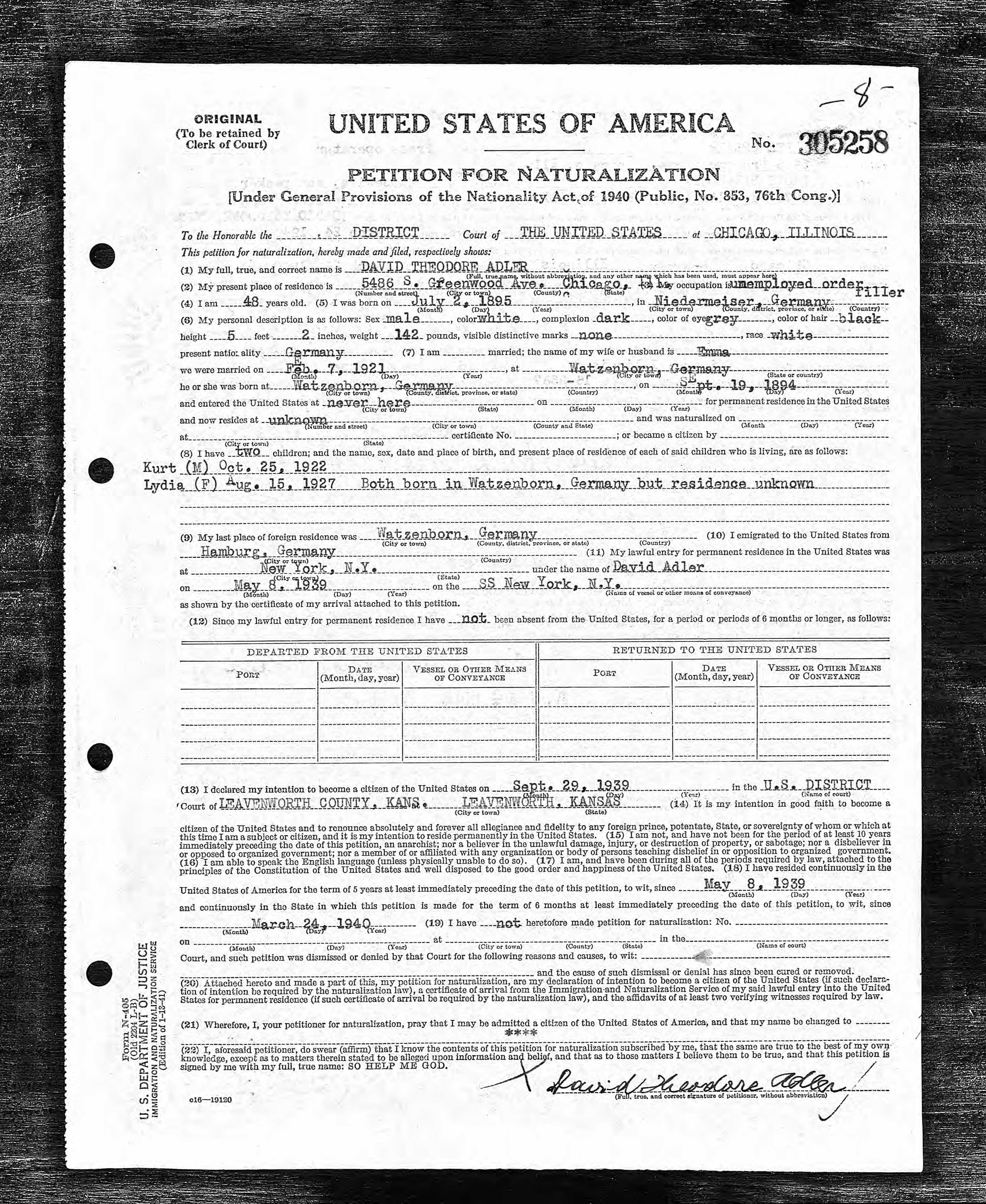
Remember that David Theodore came alone to the US in May, 1939, leaving behind his wife Emma and their two children Kurt and Lydia, presumably so he could get settled and send for them later. Unfortunately, World War II started in Europe on September 1, 1939, just four months later, and his family never got out of Europe. On his petition for naturalization in 1944, he wrote that his wife’s location was unknown and that she had never come to the US and that the residences of his children were unknown.

David Theodore Adler, petition for naturalization, National Archives at Chicago; Chicago, Illinois; ARC Title: Petitions For Naturalization, 1906-1991; NAI Number: M1285; Record Group Title: Records of District Courts of the United States, 1685-2009; Record Group Number: Rg 21, Petitions For Naturalization, V· 1224, No· 305251-305500, Ca· 1943-1944, Ancestry.com. Illinois, U.S., Federal Naturalization Records, 1856-1991

In fact, all three had been murdered in the Holocaust. Emma, Kurt, and Lydia were all deported from Frankfurt on November 22, 1941, to Fort IX, Kaunas, Lithuania, and killed there on November 25, 1941. As described on Wikipedia, “During Nazi occupation, the Ninth Fort was a place of mass murder and 45,000 to 50,000 Jews, most from Kaunas and largely the Kovno Ghetto, were transported to the Ninth Fort and murdered by Nazis and Lithuanian collaborators in what became known as the Kaunas massacre.”

How utterly tragic that this small part of the family were the only ones who did not leave in time. If only they had left with David…

David, or now known as Theodore or Theo, however, did survive and carried on with his life. On March 8, 1946, he married Lea Speier, who was the sister of Robert Speier, the deceased husband of David Theodore’s sister Emma.1 Lea had immigrated with Emma and her two children in 1938. She was born on October 19, 1898, to Levi Speier and Minna Lange.2 In 1950, David (now listed as Theodore) and Lea were living in Chicago where Theodore was the manager of a grocery store and Lea operated an addressograph machine for a department store.3

Grete was the first of the “Chicago Adler siblings” to die; she died on January 22, 1966, and is buried in Cook County, Illinois.4 She was survived by her son Kurt, who died on September 16, 1988, in Cook County,5 and his wife and children.

Malchen and Betty both died in 1970, Malchen on August 23, 1970,6 and Betty on December 4, 1970,7 both in Cook County. Malchen had been preceded in death by her husband Fritz Apolant, who died on December 12, 19638. Betty, who had been a widow for almost thirty years, was survived by her daughter Lucie, who died in February 2011,9 and her son Eric, who died on May 14, 2010.10

David Theodore Adler died in Chicago on October 31, 1976.11 He was survived by his second wife Lea Speier Adler, who died on January 11, 1988.12

Finally, the last remaining child of Sara Rothschild was Emmi Adler Speier. She outlived all  her siblings including Louis, Sigmund, and Julius, the three who came to the US more than thirty years before Emmi and the other “Chicago Adler siblings.” Emmi, who had, like her sisters Malchen and Grete, been a widow for many years, died on October 4, 1979, in Chicago.13 She was survived by her two daughters, Senta, who died on October 24, 2009,14 and Elsie, who died on October 16, 2012.15 Isn’t it a bit eerie that all three died in the month of October?

That brings me to the end of the story of the family of Sara Rothschild and Moses Adler. It was interesting to me that their three oldest children—Louis, Sigmund, and Julius—left home so early and lived such different and challenging lives in the US. But their four daughters and the youngest son—Grete, Malchen, Emmi, Betty, and David Theodore—all waited until the 1930s to leave Germany, after they had married and after their parents had died. But somewhat miraculously all eight of the children who survived to adulthood also survived the Holocaust and made lives in America. But for David Adler’s fateful decision to come to the US before his wife and children, I would have been able to say that none of Sara and Moses’ descendants were killed in the Holocaust.


Before I turn to the next and final child of Gelle Blumenfeld and Simon Rothschild, I have two updates on other branches of my family tree.


  1.  Theo Adler, Marriage Date 8 Mar 1946, Marriage Location Cook, Illinois, USA
    Spouse Lea Speier, Marriage license 1893235, File Number {4bca04a3-4e96-4840-8db8-32454e922980}, Cook County Clerk; Chicago, Il; Cook County Genealogy Records (Marriages), Ancestry.com. Cook County, Illinois Marriage Index, 1930-1960 
  2.  Lea Speier, Gender weiblich (Female), Birth Date 19 Okt 1898 (19 Oct 1898)
    Birth Place Guxhagen, Hessen (Hesse), Deutschland (Germany), Civil Registration Office Guxhagen, Father Levin Speier  Mother Mina Lange, Certificate Number 55, Hessisches Hauptstaatsarchiv; Wiesbaden, Deutschland; Bestand: 920; Laufende Nummer: 2769, Ancestry.com. Hesse, Germany, Births, 1851-1901; Lea Speier, passenger manifest, The National Archives in Washington, DC; Washington, DC, USA; Passenger and Crew Lists of Vessels Arriving at New York, New York, 1897-1957; Microfilm Serial or NAID: T715; RG Title: Records of the Immigration and Naturalization Service, 1787-2004; RG: 85, Ancestry.com. New York, U.S., Arriving Passenger and Crew Lists (including Castle Garden and Ellis Island), 1820-1957 
  3. Theodore and Lea Adler, 1950 US census, National Archives at Washington, DC; Washington, D.C.; Seventeenth Census of the United States, 1950; Year: 1950; Census Place: Chicago, Cook, Illinois; Roll: 3239; Page: 9; Enumeration District: 103-575, Ancestry.com. 1950 United States Federal Census 
  4.  Greta Mandelstein, Death Date 22 Jan 1966, Death Place Cook, Illinois, USA
    File Number 602490, Cook County Clerk; Chicago, IL; Cook County Genealogy Records (Deaths), Ancestry.com. Cook County, Illinois Death Index, 1908-1988 
  5. Kurt Mandelstein, Gender Male, Race White, Birth Date 15 Jul 1916, Birth Place Federal Republic of Germany, Death Date 16 Sep 1988, Father Albert Mandelstein,
    Mother Greta Adler, SSN 360014041, Ancestry.com. U.S., Social Security Applications and Claims Index, 1936-2007 
  6.  Molly Apolant, Death Date 23 Aug 1970, Death Place Cook, Illinois, USA, File Number 624932, Cook County Clerk; Chicago, IL; Cook County Genealogy Records (Deaths), Ancestry.com. Cook County, Illinois Death Index, 1908-1988 
  7.  Betty Jenny Reagan, Death Date 4 Dec 1970, Death Place Cook, Illinois, USA
    File Number 635509, Cook County Clerk; Chicago, IL; Cook County Genealogy Records (Deaths), Ancestry.com. Cook County, Illinois Death Index, 1908-1988 
  8.  Fritz Apolant, Death Date 12 Dec 1963, Death Place Cook, Illinois, USA, File Number 6231161, Cook County Clerk; Chicago, IL; Cook County Genealogy Records (Deaths), Ancestry.com. Cook County, Illinois Death Index, 1908-1988 
  9. “Lucie Sable Sandler,” Chicago Tribune, February 26, 2011. 
  10.  Eric S. Reagen, Social Security Number 328-30-0003, Birth Date 3 Mar 1926
    Issue year 1952-1954, Issue State Illinois, Last Residence 60659, Chicago, Cook, Illinois, Death Date 13 May 2010, Social Security Administration; Washington D.C., USA; Social Security Death Index, Master File, Ancestry.com. U.S., Social Security Death Index, 1935-2014 
  11.  Theodore Adler, Death Date 31 Oct 1976, Death Place Cook, Illinois, USA
    File Number 625441, Cook County Clerk; Chicago, IL; Cook County Genealogy Records (Deaths), Ancestry.com. Cook County, Illinois Death Index, 1908-1988 
  12.  Lea Adler, Death Date 11 Jan 1988, Death Place Cook, Illinois, USA, File Number 6000709, Cook County Clerk; Chicago, IL; Cook County Genealogy Records (Deaths), Ancestry.com. Cook County, Illinois Death Index, 1908-1988 
  13.  Emmi Speier, Social Security Number 341-28-8417, Birth Date 4 Sep 1892, Issue year 1951-1952, Issue State Illinois, Last Residence 60640, Chicago, Cook, Illinois, USA, Last Benefit 60649, Chicago, Cook, Illinois, USA, Death Date Oct 1979
    Social Security Administration; Washington D.C., USA; Social Security Death Index, Master File, Ancestry.com. U.S., Social Security Death Index, 1935-2014; Find a Grave, database and images (https://www.findagrave.com/memorial/181674901/emmi-speier: accessed January 28, 2026), memorial page for Emmi Speier (4 Sep 1892–4 Oct 1979), Find a Grave Memorial ID 181674901, citing Oakridge-Glen Oak Cemetery, Hillside, Cook County, Illinois, USA; Maintained by Klast (contributor 50020942). 
  14.  Senta Ferda, Social Security Number 324-16-1544, Birth Date 7 Sep 1920, Issue year Before 1951, Issue State Illinois, Last Residence 60053, Morton Grove, Cook, Illinois, Last Benefit 60649, Chicago, Cook, Illinois, Death Date 24 Oct 2009
    Social Security Administration; Washington D.C., USA; Social Security Death Index, Master File, Ancestry.com. U.S., Social Security Death Index, 1935-2014 
  15.  Elsie L Carreon, Social Security Number 319-26-0874, Birth Date 23 Aug 1931
    Issue year Before 1951, Issue State Illinois, Death Date 16 Oct 2012, Social Security Administration; Washington D.C., USA; Social Security Death Index, Master File, Ancestry.com. U.S., Social Security Death Index, 1935-2014 

Sara and Moses Adler’s Younger Children: The Chicago Five

As of 1933 when Hitler came to power in Germany, five of Sara Rothschild and Moses Adler’s surviving children were still living in Germany: Caroline (Grete), Malchen, Emmi, David Theodore, and Betty. Their oldest three children—Louis, Sigmund, and Julius—had long ago emigrated to the United States. Fortunately, all five of those still in Germany were able to leave in time.

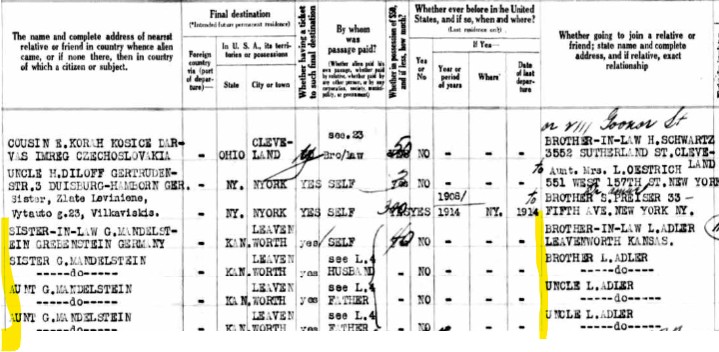
Interestingly, Betti, the youngest of those still in Germany, was the first to leave. She, her husband Marx Regenstein, and their two children Lucie and Erich sailed from Cherbourg, France, on April 29, 1936, and arrived in New York on May 6, 1936. Notice that all the first names were changed on the manifest. Marx became Max, Betti became Jenny, and Lucie was no longer Johanna, Erich no longer Siegfried. Max listed his occupation as a merchant on the ship manifest. They listed their destination as Leavenworth, Kansas, identifying Betti/Jenny’s brother Louis Adler as the person they were going to.

Regenstein family passenger manifest, The National Archives in Washington, DC; Washington, DC, USA; Passenger and Crew Lists of Vessels Arriving at New York, New York, 1897-1957; Microfilm Serial or NAID: T715; RG Title: Records of the Immigration and Naturalization Service, 1787-2004; RG: 85, Ship or Roll Number: Berengaria, Ancestry.com. New York, U.S., Arriving Passenger and Crew Lists (including Castle Garden and Ellis Island), 1820-1957

Regenstein family passenger manifest p 2

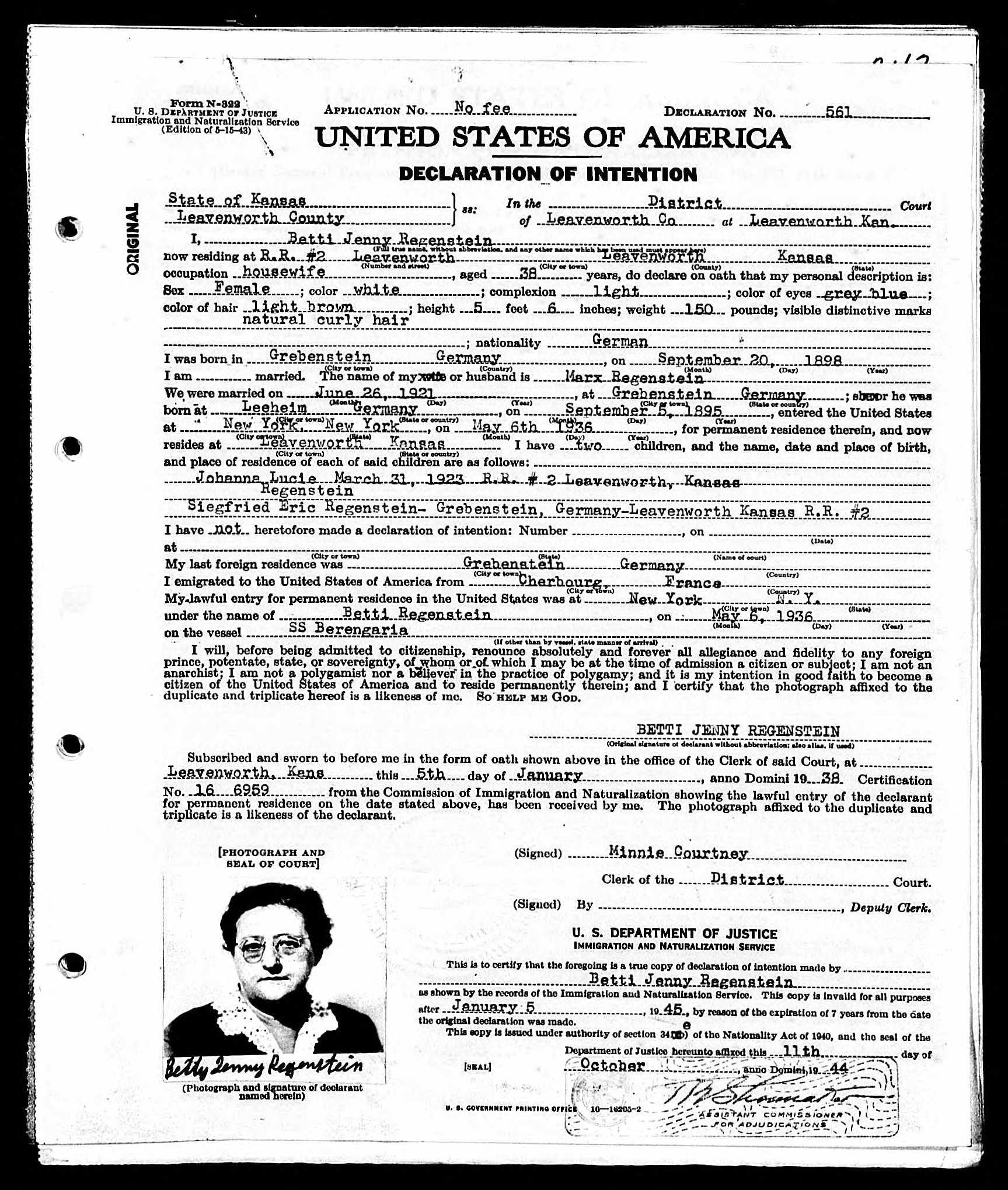
I found it heartwarming to learn that Louis, who had left his family behind in 1900 when he was fifteen, was still in touch with his siblings back home. Just as he had taken in his brother Julius after Julius lost his first wife, Louis once again seemed to take on the role of assisting a sibling. In January 1938, when Betty declared her intention to become a US citizen, she and her family were still living in Leavenworth, Kansas.

Betti Jenny Regenstein Declaration of Intention, National Archives at Chicago; Chicago, Illinois; ARC Title: Petitions For Naturalization, 1906-1991; NAI Number: M1285; Record Group Title: Records of District Courts of the United States, 1685-2009; Record Group Number: Rg 21, Petitions, V· 1243-1245, No· 309401-309950, 1944, Ancestry.com. Illinois, U.S., Federal Naturalization Records, 1856-1991

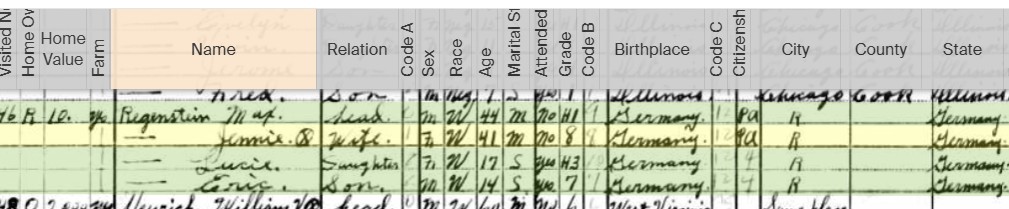
But two years later in 1940, Betti (now listed as Jennie), Marx (now Max), and their children Lucie and Eric were living in Covert, Michigan, where Max was working as a farmer. I don’t know what drew them to that location. In 1935 they’d been living in Chicago, according to the census report. At first I thought it was Betti/Jenny’s brother Sigmund who had drawn them to Michigan since at one point he had been living in Ishpeming, Michigan, but that is very distant from Covert, and besides, by 1940 Sigmund was living in Connecticut.

Regenstein family, 1940 US census, Year: 1940; Census Place: Covert, Van Buren, Michigan; Roll: m-t0627-01822; Page: 3A; Enumeration District: 80-13, Ancestry.com. 1940 United States Federal Census

The next Adler siblings to leave Germany were Caroline Grete and Malchen. They sailed together from Cherbourg on April 14, 1937, with Malchen (Mally)’s husband Fritz Apolant and Caroline (Karoline) Grete’s son Kurt. Caroline’s husband Albert Mandelstein had died on October 20, 1934, in Grebenstein; he was 79.1 Fritz listed his occupation as a manufacturer’s agent, and Kurt Mandelstein, who was twenty, listed his as a merchant. Like Betti before them, they all listed Leavenworth, Kansas, as their destination, and Louis Adler as the person to whom they were going.

Mandelstein and Apolant passenger manifest, The National Archives in Washington, DC; Washington, DC, USA; Passenger and Crew Lists of Vessels Arriving at New York, New York, 1897-1957; Microfilm Serial or NAID: T715; RG Title: Records of the Immigration and Naturalization Service, 1787-2004; RG: 85, Ship or Roll Number: Queen Mary, Ancestry.com. New York, U.S., Arriving Passenger and Crew Lists (including Castle Garden and Ellis Island), 1820-1957

I have to confess that until I saw this ship manifest, I’d had no idea that Sara Rothschild and Moses Adler had a daughter named Caroline Grete. Somehow in my initial search for their children, Caroline had eluded me. It was only when I saw her listed on that ship manifest that I realized I’d missed a child and went back and found her records.

I don’t know whether or not Caroline or Malchen ever actually went to or lived in Leavenworth, Kansas. When Caroline filed her declaration of intention on October 20, 1937, just six months after arriving in New York on April 19, 1937, she and her son Kurt were living in Chicago, Illinois.

Similarly, when Malchen’s husband Fritz Apolant filed his declaration of intention on October 14, 1937, they were living in Chicago.

Fritz David Apolant declaration of intention, National Archives at Chicago; Chicago, Illinois; ARC Title: Petitions For Naturalization, 1906-1991; NAI Number: M1285; Record Group Title: Records of District Courts of the United States, 1685-2009; Record Group Number: Rg 21
Petitions, V· 1079-1081, No· 268890-269400, 1942, Ancestry.com. Illinois, U.S., Federal Naturalization Records, 1856-1991

I don’t know what drew them to Chicago, but I did notice that one of the witnesses on Malchen’s naturalization papers was a man named Benjamin “Nandelstein.” Perhaps that was really Mandelstein, as the signature appears to be, and this was a relative of her sister Caroline’s deceased husband Albert Mandelstein.

Affidavit of Witnesses for Malchen Apolant naturalization, National Archives at Chicago; Chicago, Illinois; ARC Title: Petitions For Naturalization, 1906-1991; NAI Number: M1285; Record Group Title: Records of District Courts of the United States, 1685-2009; Record Group Number: Rg 21, Petitions, V· 1192-1195, No· 297765-298328, 1943, Ancestry.com. Illinois, U.S., Federal Naturalization Records, 1856-1991

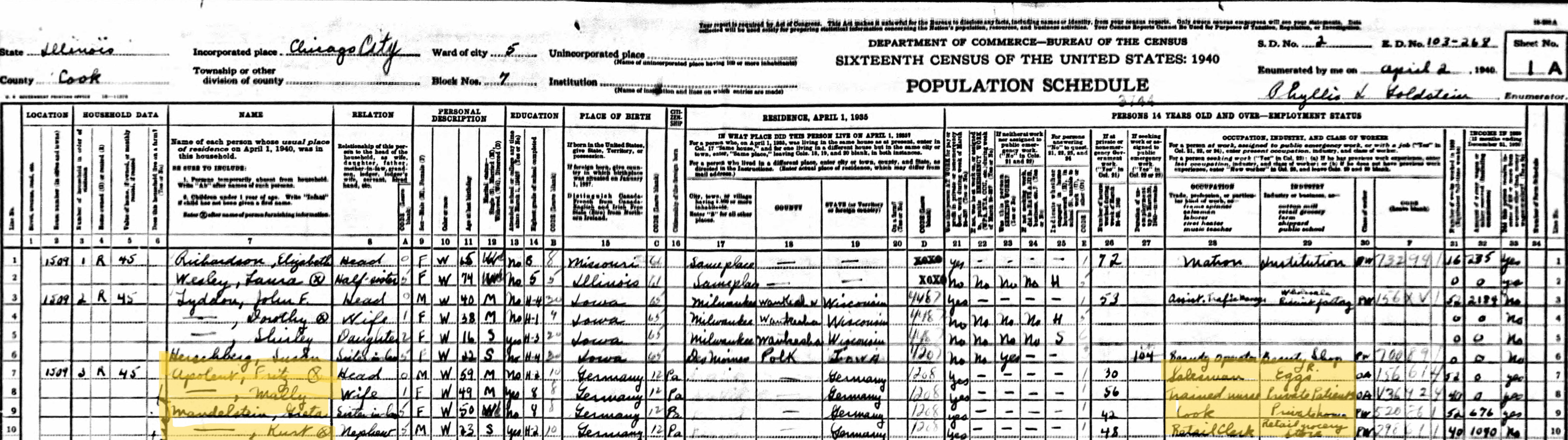
In any event, in 1940, Fritz, Malchen (Mally), Caroline (Grete now), and Kurt were all living together in Chicago, and all four were working. Fritz was an egg salesman, Mally a nurse for a private patient, Grete a cook in a private home, and Kurt a clerk in a retail grocery store.

Apolant and Mandelstein on 1940 US census, Year: 1940; Census Place: Chicago, Cook, Illinois; Roll: m-t0627-00929; Page: 1A; Enumeration District: 103-268, Ancestry.com. 1940 United States Federal Census

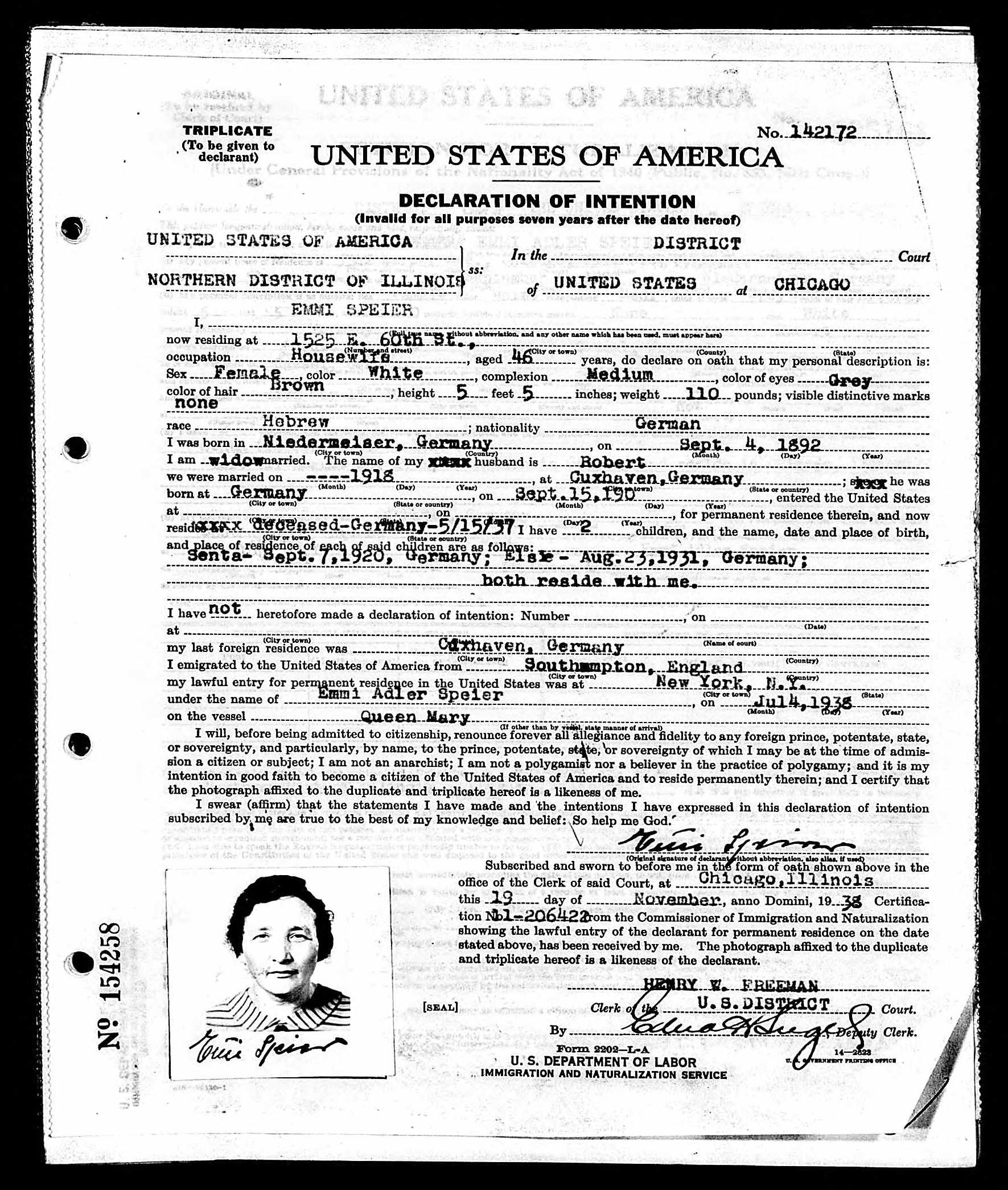
The next sibling to arrive in the US was Emmi Adler Speier. Like her older sister Caroline Grete, Emmi was a widow when she immigrated to the US. Her husband Robert Speier had died on May 15, 1937, in Guxhagen, Germany; he was only 47 when he died.2 Emmi and her two children, Ilse/Elsie and Senta, and her sister-in-law Lea Speier all sailed from Easthampton, England, on June 29, 1938. They arrived in New York on July 4, 1938, an auspicious date to arrive in the US. Like her other sisters, Emmi listed her brother Louis as the person she was going to and Leavenworth, Kansas, as her destination. She listed her brother T. [Theodore] Adler as the person she left behind.

Speier family passenger manifest, The National Archives in Washington, DC; Washington, DC, USA; Passenger and Crew Lists of Vessels Arriving at New York, New York, 1897-1957; Microfilm Serial or NAID: T715; RG Title: Records of the Immigration and Naturalization Service, 1787-2004; RG: 85, Ship or Roll Number: Queen Mary, Ancestry.com. New York, U.S., Arriving Passenger and Crew Lists (including Castle Garden and Ellis Island), 1820-1957

But Emmi and her children also did not end up in Leavenworth for long, if at all. By November 19, 1938, she also was living in Chicago, as were her two daughters.

Emmi Adler Speier declaration of intention, National Archives at Chicago; Chicago, Illinois; ARC Title: Petitions For Naturalization, 1906-1991; NAI Number: M1285; Record Group Title: Records of District Courts of the United States, 1685-2009; Record Group Number: Rg 21
Petitions, V· 1180-1183, No· 295150-295735, 1943, Ancestry.com. Illinois, U.S., Federal Naturalization Records, 1856-1991

In 1940, Emmi was living in Chicago with Ilse and Senta, along with three lodgers. Ilse was working as a dressmaker.3

Finally, the last sibling to arrive was the remaining son of Sara Rothschild and Moses Adler, their son David Theodore Adler. He sailed without his wife Emma on April 30, 1939, arriving in New York on May 8, 1939. He listed his wife Emma as the person he had left behind and his brother Louis Adler in Leavenworth, Texas, as the person he was heading to; his occupation was a dealer.4 David did in fact go to Leavenworth, where on September 29, 1939, he filed his declaration of intention. He listed his occupation as a farmer.

David Theodore Adler declaration of intention, National Archives at Chicago; Chicago, Illinois; ARC Title: Petitions For Naturalization, 1906-1991; NAI Number: M1285; Record Group Title: Records of District Courts of the United States, 1685-2009; Record Group Number: Rg 21
Petitions For Naturalization, V· 1224, No· 305251-305500, Ca· 1943-1944, Ancestry.com. Illinois, U.S., Federal Naturalization Records, 1856-1991

But in 1940, like his other siblings Grete (Caroline), Malchen, Emmi, and Betty, David Theodore (now just using Theodore) was living in Chicago, working as a laborer doing odd jobs.5

All five of the younger children of Sara Rothschild and Moses Adler were reunited in one city. What would their lives in America bring for them and their children?

To be continued.


  1. Albert Mandelstein, Gender männlich (Male), Death Age 79, Birth Date abt 1855
    Death Date 20 Okt 1934 (20 Oct 1934), Death Place Grebenstein, Hessen (Hesse), Deutschland​​​ (Germany), Civil Registration Office Grebenstein, Spouse Grete
    Certificate Number 27, Hessisches Hauptstaatsarchiv; Wiesbaden, Deutschland; Personenstandsregister Sterberegister; Signatur: 3080; Laufende Nummer: 909, Ancestry.com. Hesse, Germany, Deaths, 1851-1958 
  2. Robert Speier, Death Age 48[sic], Birth Date 15 Sept 1889, Death Date 15 Mai 1937 (15 May 1937), Death Place Guxhagen, Hessen (Hesse), Deutschland (Germany, Civil Registration Office Guxhagen, Certificate Number 12, Hessisches Hauptstaatsarchiv; Wiesbaden, Deutschland; Personenstandsregister Sterberegister; Bestand: 2869; Laufende Nummer: 920, Ancestry.com. Hesse, Germany, Deaths, 1851-1958 
  3. Emmi Speier, 1940 US census, Year: 1940; Census Place: Chicago, Cook, Illinois; Roll: m-t0627-00929; Page: 4A; Enumeration District: 103-267, Ancestry.com. 1940 United States Federal Census 
  4. David Adler, passenger manifest, The National Archives in Washington, DC; Washington, DC, USA; Passenger and Crew Lists of Vessels Arriving at New York, New York, 1897-1957; Microfilm Serial or NAID: T715; RG Title: Records of the Immigration and Naturalization Service, 1787-2004; RG: 85, Ship or Roll Number: New York, Ancestry.com. New York, U.S., Arriving Passenger and Crew Lists (including Castle Garden and Ellis Island), 1820-1957 
  5. Theodore Adler, 1940 US census, Year: 1940; Census Place: Chicago, Cook, Illinois; Roll: m-t0627-00930; Page: 7A; Enumeration District: 103-303, Ancestry.com. 1940 United States Federal Census 

Malchen Rothschild Rosenblatt’s Youngest Child, Siegmund

The other surviving son and the youngest child of Malchen Rothschild and Daniel Rosenblatt was their son Siegmund. Like his brother Felix, he escaped from Nazi Germany to Argentina with his wife Else Schwab and their three children, Arno, Ruth, and Margot.

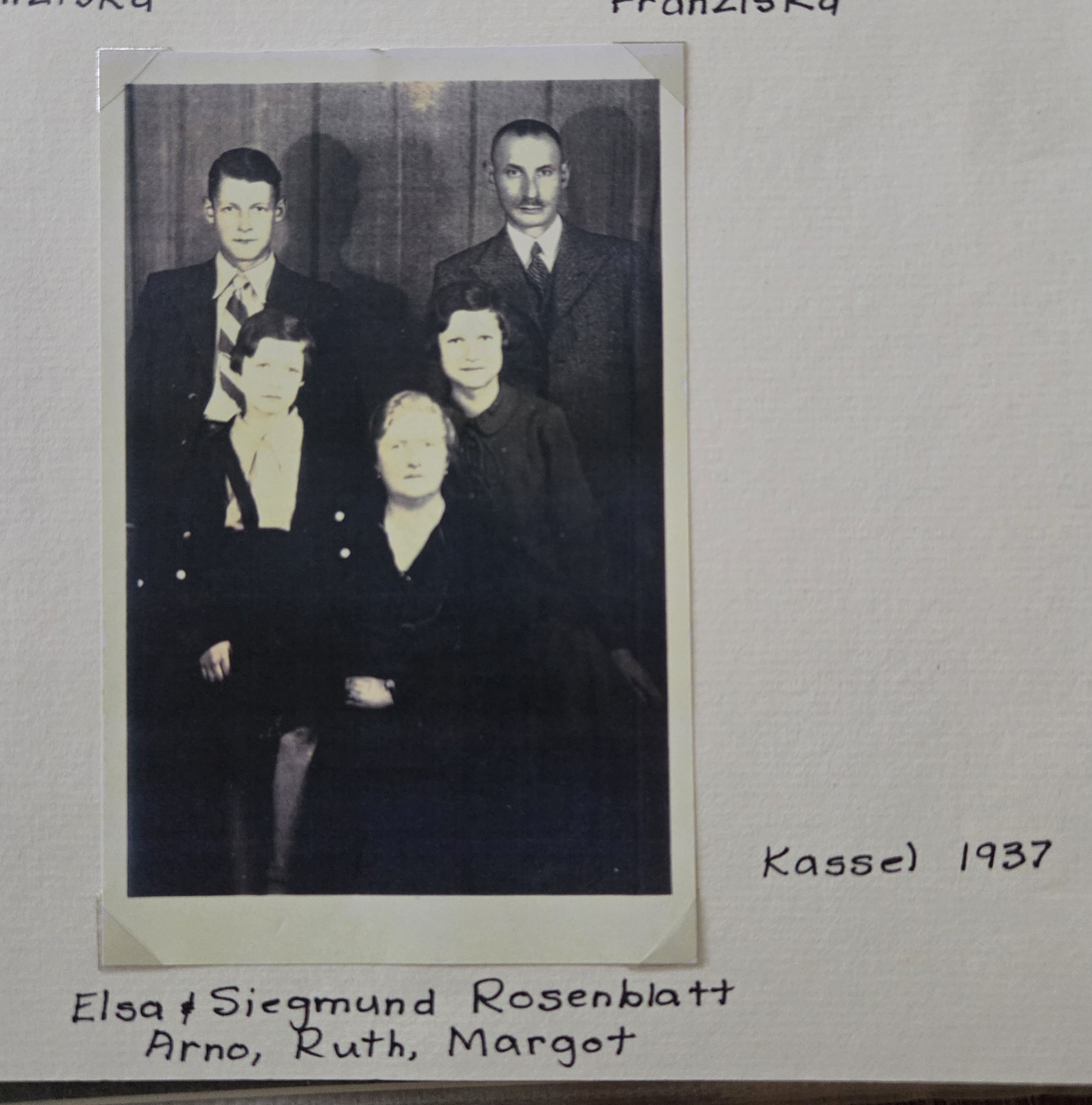
I was very fortunate that Ellie Roden, a first cousin, once removed, of Siegmund’s wife Else, reached out to me through my blog. Ellie wrote that “Siegmund wanted all the family on both sides to leave Germany but before Kristallnacht many hoped and believed that the Nazi reign would end.”1 Unfortunately, as we have seen, Siegmund’s three sisters Julchen, Jette, and Auguste, did not heed that advice. According to Ellie, Siegmund, Else, and their children left Germany for Argentina in July 1937. They joined the same community, Colonia Avigdor, where Siegmund’s brother Felix had settled the year before. According to Siegmund’s great-niece Carmen, Siegmund and his family left Colonia Avigdor in about1955 and moved to Buenos Aires. After receiving compensation from the German government, they could afford to live in the city.2

Ellie shared these wonderful photographs of Siegmund and his family, first a photograph of Siegmund and Else and their children in 1937 before they left their home in Kassel, Germany:

Siegmund Rosenblatt and family in 1937, Kassel, Germany
Courtesy of Ellie Roden

This second photograph is undated, but is of Siegmund and Else. I assume it was taken in Argentina some years later.

Else Schwab and Siegmund Rosenblatt. Courtesy of Ellie Roden

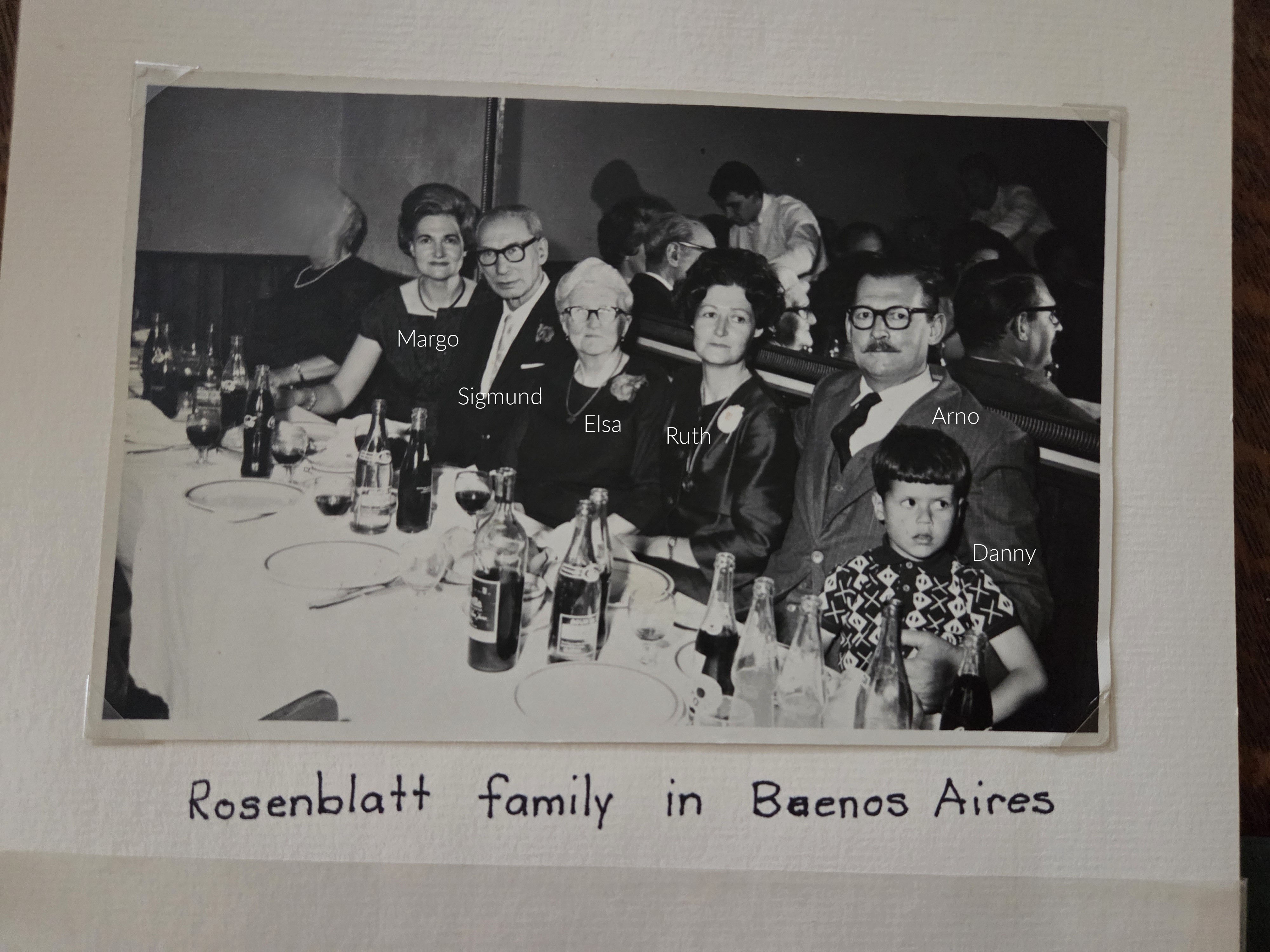
The third photo may have been taken at the same event as the one above; it was taken in Buenos Aires:

The Rosenblatt family in Buenos Aires: Margot, Siegmund, Else, Ruth, Arno, and Danny. Courtesy of Ellie Roden

I don’t have any records for the family’s life in Argentina, but Ellie was able to confirm that Arno, the oldest child, had a son named Danny, presumably named for his grandfather Daniel Rosenblatt; he must be the young boy in the photo above. Margot, the middle child, married someone named Kurt Oppenheimer; I don’t know whether they had children. And Ruth, the youngest child, may have married someone named Arno Kaufman. I don’t know whether they had children.

I was able to find burial records for Siegmund and Else and for two of their three children in the records for Argentina in the JOWBR at JewishGen.org. Siegmund died on November 3, 1982, and is buried in Buenos Aires.3 His wife Else died on August 11, 1984, and is buried in Buenos Aires.4 Their daughter Ruth Rosenblatt Kaufmann died on January 12, 1989, and is also buried in Buenos Aires.5 Finally, their son Arno Rosenblatt died on December 31, 2008, and is buried in Buenos Aires.6 I was not able to locate a burial record or any other record for Margot, but did locate one for her husband, Kurt Oppenheimer, which named her as his spouse. Kurt died on February 13, 2007, and is buried in the same cemetery as his in-laws.7

I am so grateful to my cousins Julio and Carmen and to Ellie Roden for sharing the photographs and information about the families of Malchen Rothschild Rosenblatt’s three sons, Felix, Julius, and Siegmund. Although the family of Malchen Rothschild and Daniel Rosenblatt suffered terrible losses during the Holocaust, it was uplifting to learn that there are still living descendants living in many countries around the world. I am so grateful for that.


I have now completed the stories of the children of Malchen Rothschild Rosenblatt and will move on to Malchen’s younger sister, Sara Rothschild Adler, and her family. But first a few updates on earlier posts.


  1. Email from Ellie Roden, August 13, 2025. 
  2. Email from Carmen Rosenblatt, September 17, 2025. 
  3. Burial record in the JOWBR database at JewishGen, found at https://www.jewishgen.org/databases/cemetery/jowbr.php?rec=J_ARGENTIN_0199329 
  4. Burial record in the JOWBR database at JewishGen, found at https://www.jewishgen.org/databases/cemetery/jowbr.php?rec=J_ARGENTIN_0199309 
  5. Burial record in the JOWBR database at JewishGen, found at https://www.jewishgen.org/databases/cemetery/jowbr.php?rec=J_ARGENTIN_0164434 
  6. Burial record in the JOWBR database at JewishGen, found at https://www.jewishgen.org/databases/cemetery/jowbr.php?rec=J_ARGENTIN_0199303 
  7. Burial record in the JOWBR database at JewishGen, found at https://www.jewishgen.org/databases/cemetery/jowbr.php?rec=J_ARGENTIN_0189236 

Malchen Rothschild Rosenblatt’s Descendants in the Colonia Avigdor in Argentina

As we saw, Malchen Rothschild and Daniel Rosenblatt’s daughters all were killed in the Holocaust. Their son Julius had died as a young man, leaving behind a young widow Julie Rosenblatt and their infant son Fredi. Julie and Fredi escaped to Uruguay, and thanks to Fredi’s son Julio, I’ve been able to learn and share much of their story.

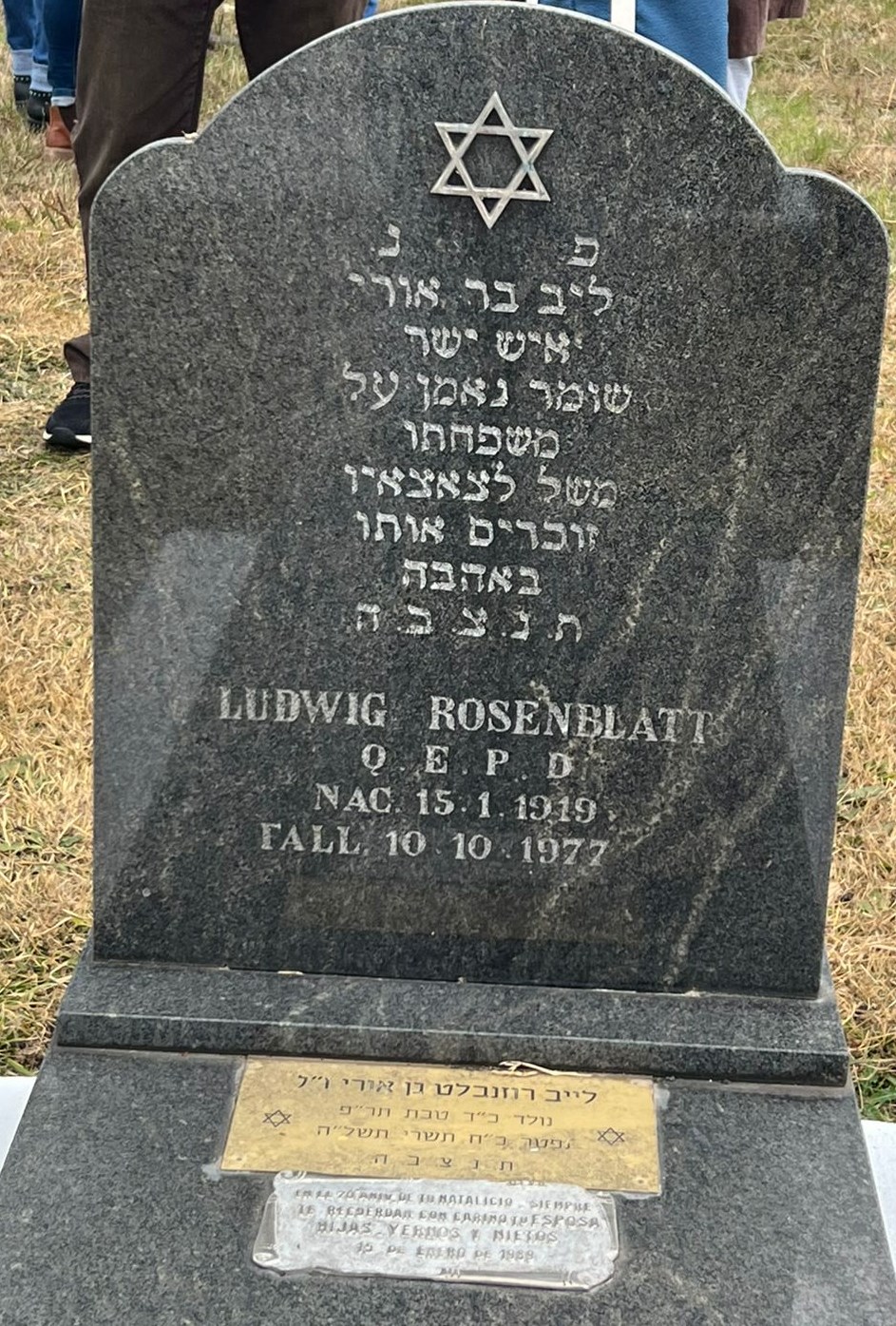
Malchen and Daniel’s other two sons Felix and Siegmund escaped to Argentina, not Uruguay,1 and thanks to the magic of the internet, I am now in touch with Felix’s granddaughter in Argentina, Carmen. I found a photograph of the gravestone of Felix’s son Ludwig Rosenblatt (see below) on JewishGen and posted it on Tracing the Tribe, asking for a translation of the Hebrew inscription. A woman in the TTT group tagged Carmen when she saw my post, and Carmen, Ludwig Rosenblatt’s daughter, responded. Although Carmen doesn’t speak English and I don’t speak Spanish, we’ve managed to communicate, thanks to Google Translate and DeepL.

Carmen shared with me a lecture2 she delivered in 2018 to the Latin American Rabbinical Seminary about the community where her family has lived since 1936 when they immigrated from Germany to Argentina. It is in Spanish, and I’ve used DeepL to translate it and now will paraphrase and take excerpts from the translation to share the story of Carmen’s family and their community. Carmen also filled in other details through email.

As Carmen explained in her lecture, the German philanthropist Baron Maurice de Hirsch formed the Jewish Colonization Association (“JCA”) in the late 19th century to acquire land and create settlements in Argentina for Jews escaping persecution in Russia and Eastern Europe. When Hitler came to power in the 1930s, it became apparent that there was a need for more land and more places for German Jews to escape, so the JCA acquired additional land to create a new settlement called Colonia Avigdor, which is over 300 miles from Buenos Aires.

Thanks to the efforts of the JCA, Jewish families like Carmen’s were able to escape Nazi Germany. I asked Carmen what convinced her grandparents to leave Germany. She wrote that one night her grandfather’s car was confiscated by the Nazis in Zimmersrode, and when it was returned to him the next day, an official in the town told him: “Felix, this is getting very ugly for you Jews, take your family and leave Germany.” Felix replied, “How??? I have to sell my house, my things.” The official replied, “Leave everything, don’t sell anything… nobody is going to pay a Jew.” Felix contacted the JCA and asked for help to leave Germany and move to Argentina.

Carmen’s grandparents Felix and Minna (Goldwein) Rosenblatt and their sons were one of the ten families that first settled in Colonia Avigdor. They arrived in Buenos Aires, Argentina, with their sons Ludwig, then 17, and Siegfried, 20, and their daughter-in-law, Siegfried’s wife Jenny Feilmann, on January 25, 1936. As Carmen explained to me and in her lecture, because the JCA required a family to have five adults to qualify for the settlement program, Siegfried, although only twenty years old, had married Jenny at such a young age in order for the family to qualify.

After a few days in Buenos Aires, Felix, Minna, and their family traveled by train from Buenos Aires to Bovril, the closest train station to Avigdor. From there they traveled the last fifteen miles of the over 300 mile journey “by horse-drawn carts through trees and bushes in the woods along winding paths” to get to their new home. Carmen wrote that they were “full of hope that they would adapt to such a hard life and happy to set foot on land that promised above all FREEDOM and work to build a good future.”

Carmen’s description of their early lives cannot be paraphrased adequately; here is how DeepL translated her words:

Each of the settlers was allocated 75 hectares of land and a poorly constructed house made of mud-covered bricks with a dirt floor, two rooms, one kitchen, one veranda, and a bathroom at the back, about 10-15 meters away from the house. In each house, they found a bag of hard “cookies” (country bread), several days old… as well as some work tools, a few cows, some horses, some chickens… The next day, they got to work, first clearing the yards of wild trees, then the fields so they could plant them, building fences to divide them. It was very hard work, but as I said, they were happy because they had hope for progress. The women devoted themselves more to the tasks in the yard, tending to the chickens and other poultry, milking the cows for the milk they consumed, in addition to their household chores. They had to knead the bread in wood-fired ovens, whose mouths opened into the kitchen…

They say that at first, these women did these tasks crying practically all day (and at night too) because of the precarious conditions around them… there was no electricity, the lamps were kerosene… there were no refrigerators, no appliances whatsoever. And it should be emphasized that they came from an advanced civilization in Germany… Some, those who came from small towns, adapted more easily, but those who came from cities such as Berlin, Munich, Frankfurt, etc., of which there were many… found it extremely difficult, or simply could not get used to it…

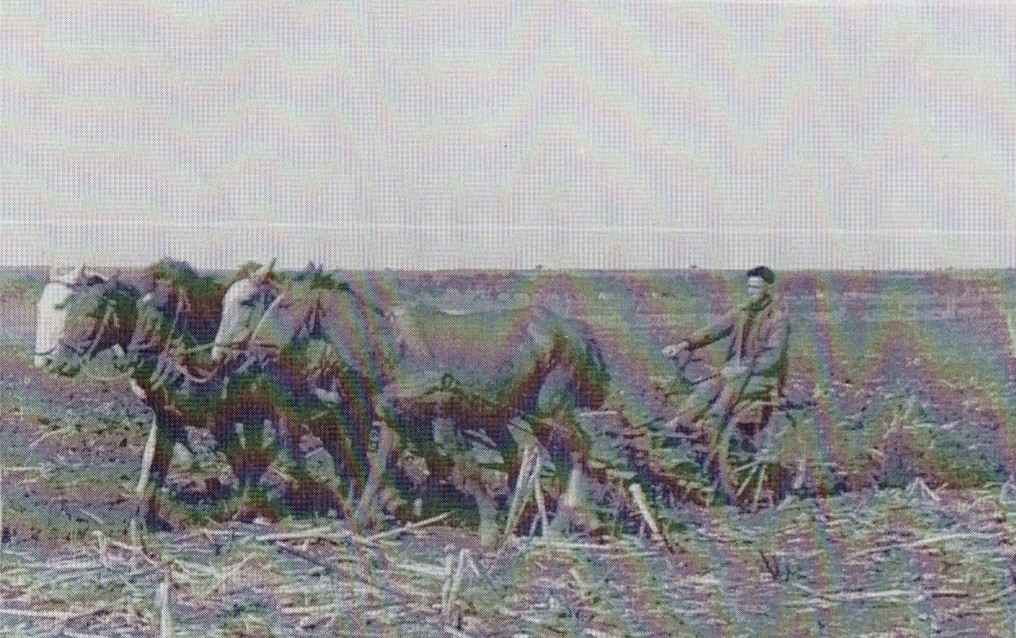
Colonists plowing the land
Courtesy of Carmen Rosenblatt

A colonist’s yard
Courtesy of Carmen Rosenblatt

Children coming to school
Courtesy of Carmen Rosenblatt

The community grew as more and more refugees came from Germany; eventually there were about 120 families. The settlers engaged in many forms of agricultural work: dairy, livestock, farming, gardening, and beekeeping. They established a cooperative to market their products. A school was established by the JCA, and there was a post office, a synagogue, a kosher butcher, and a Hebrew teacher. There was even a small hospital to provide health care to the settlers and a social center for dances, theaters, and orchestral performances. Land was also set aside for a cemetery.

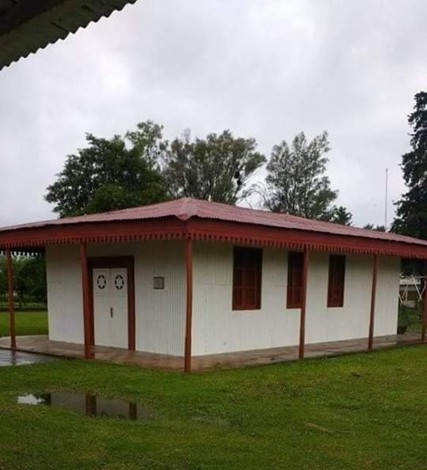
The synagogue in Colonia Avigdor
Courtesy of Carmen Rosenblatt

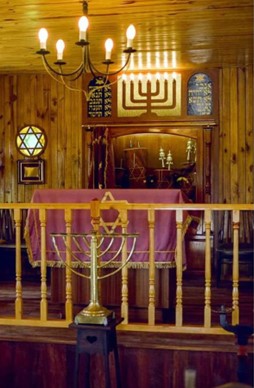
Interior of the synagogue
Courtesy of Carmen Rosenblatt

But conditions remained fairly primitive for a long time. It wasn’t until 1971 that there was electricity in the colony, and there were only dirt roads until 1987. Despite all these challenges, Felix and Minna and their children remained at Colonia Avigdor, working hard to achieve their dreams.

Their younger son Ludwig Rosenblatt married Ruth Plaut, another refugee from Germany, in 1944. They had two children, Carmen and her sister Alicia. Ludwig’s older brother Siegfried and his wife Jenny also had two daughters, Miriam and Lenore.

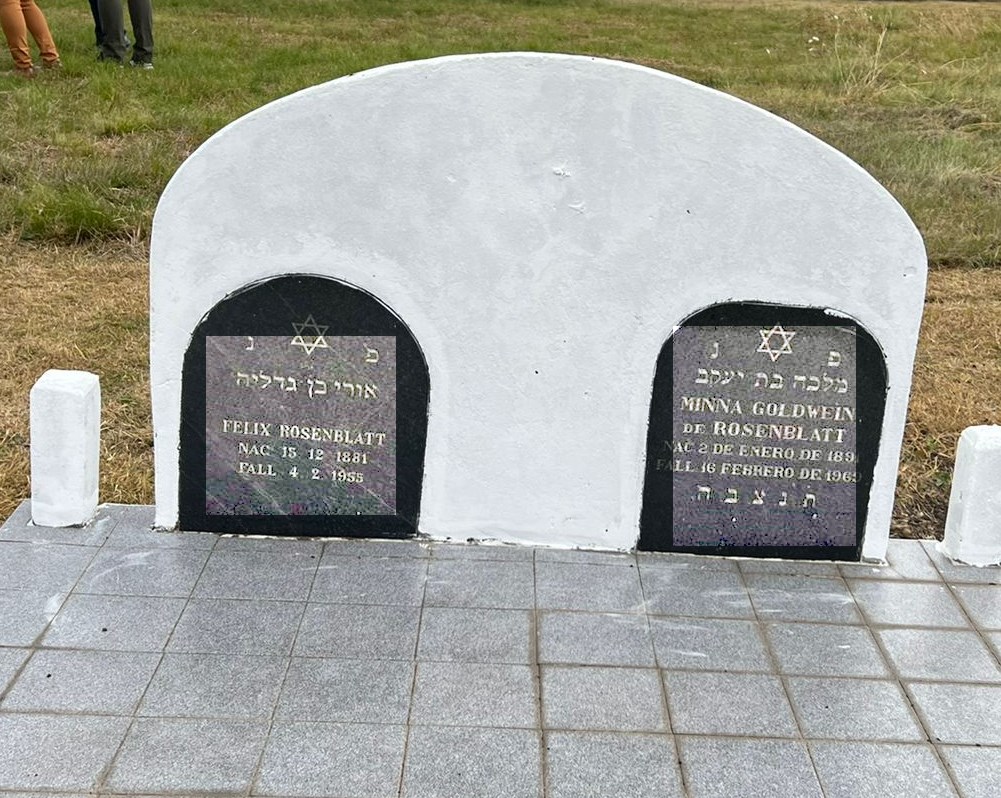
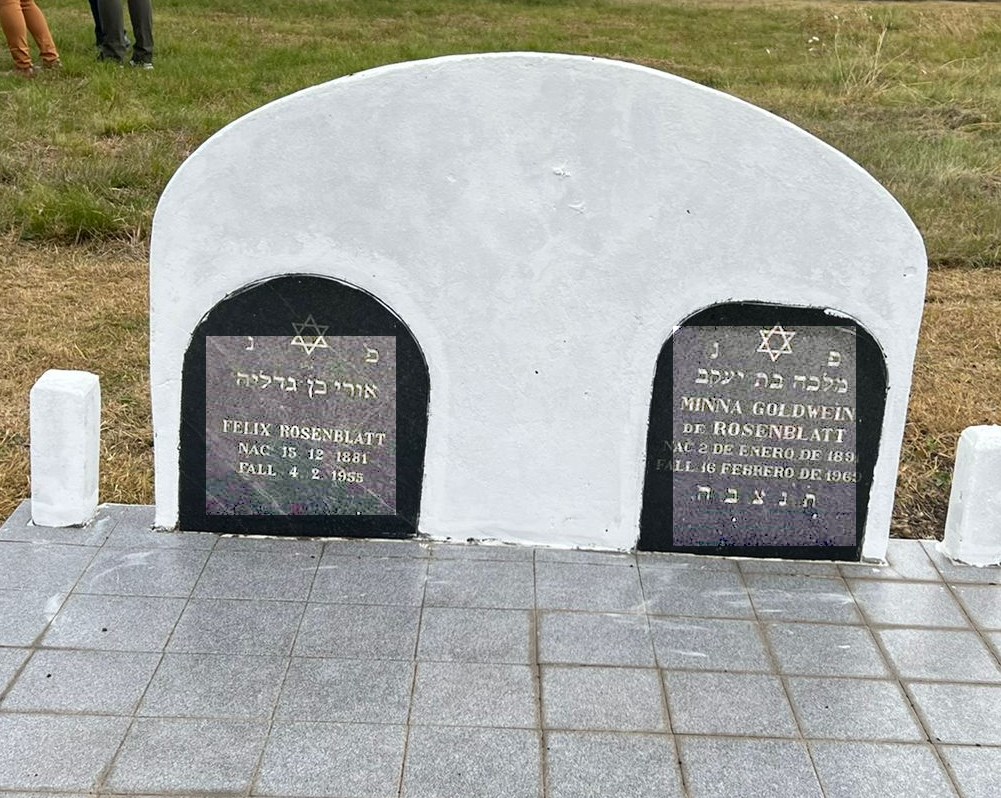
Felix Rosenblatt died on February 4, 1955, and is buried at the Centro Unión Israelita de Colonia Avigdor cemetery in Colonia Avigdor, Argentina, as is his wife Minna Goldwein Rosenblatt, who died on February 16, 1969. Here is a photograph of their gravestones.

Felix and Minna Rosenblatt headstones from JOWBR database, found at https://data.jewishgen.org/imagedata/jowbr/ARG-06046/WA0125.JPG

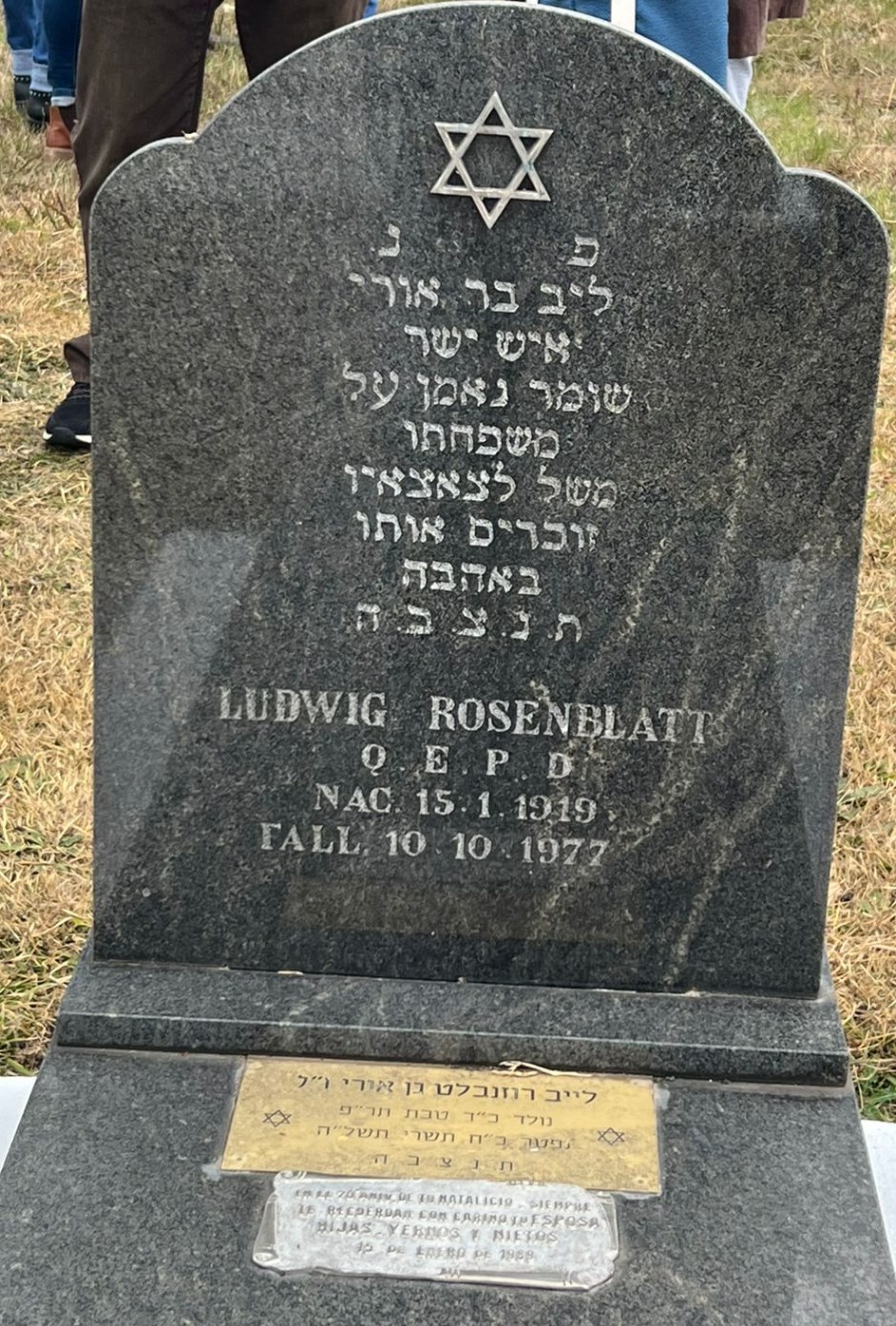
Their son and Carmen’s father Ludwig Rosenblatt died on October 10, 1977, and is buried at the same cemetery as his parents. He was only 57 when he died. As translated by the kind people at Tracing the Tribe, the Hebrew reads: “Here [lies] buried / Leib son of Uri / a reputable man / a faithful protector of / his family / an example for his descendants / [we] remember him with love / may his soul be bound in the bond of [eternal] life.”  The footstone engraving in Spanish mentions his wife, children, and grandchildren; it was placed there on the occasion of what would have been his 70th birthday on November 15, 1989.

Ludwig Rosenblatt headstone at JOWBR database, found at https://data.jewishgen.org/imagedata/jowbr/ARG-06046/WA0143.JPG

As for Siegfried Rosenblatt, Felix’s other son, he died on October 23, 2004, and is buried at Cementerio Israelita De San Vicente Cordoba, in Cordoba, Argentina; he was predeceased by his wife Jenny Feilmann who died on May 23, 1978, and is buried in the same cemetery.3 Their daughter Lenore, who was born on November 2, 1940, died on April 27, 2001.4

Carmen still lives in Colonia Avigdor with her husband Abraham Isaac Kogan, whom she married almost 58 years ago. They had two sons, one of whom passed away; the other still lives in Argentina, but not in Colonia Avigdor. Today there are only about twelve Jewish families left in Colonia Avigdor because many people left long ago to live in the cities. Carmen wrote, “These days, basic services such as electricity, water, roads, television, communications, etc. are practically comparable to those in cities… the precariousness has been overcome… but let’s not forget that since the founding of Avigdor in 1936, 82 years have passed… and the vast majority have left…”

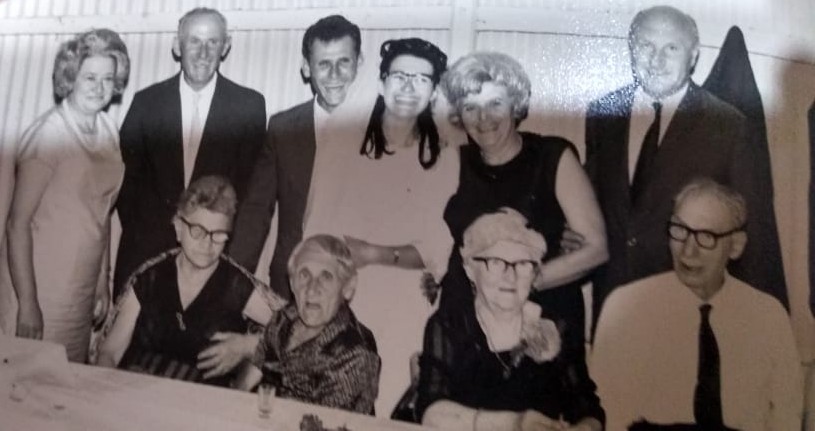
Carmen generously shared with me some photographs of her extended family. This photograph was taken at her wedding in 1967.

Photograph taken at Carmen Rosenblatt’s wedding to Abraham Kogan in 1967, courtesy of Carmen Rosenblatt. Standing from left to right: Ruth Plaut, Carmen’s mother; Ludwig Rosenblatt, Carmen’s father; Abraham Isaac Kogan; Carmen Alexander; Jenny Feilmann, wife of Siegfred Rosenblatt; Siegfried Rosenblatt, Carmen’s uncle Seated: Family friend,\; Minna Goldwein, Carmen’s grandmother; Else Schwab, wife of Sigmund Rosenblatt; Sigmund Rosenblatt, Carmen’s great-uncle.

This more recent photograph was taken in 1981 on the occasion of Carmen’s son’s bar mitzvah. I think it illustrates how Jewish traditions are similar all over the world. This photograph could have been taken at any bar mitzvah in the US in 1981, and it would have looked very much the same.

Abraham Kogan, Andres Kogan, Carmen Rosenblatt, Marcelo Kogan, 1981. Courtesy of Carmen Rosenblatt

Carmen’s story has given me a new perspective on the lives of those who escaped from Nazi Germany. It’s hard to imagine how they adapted to such a hard life—a precarious one, to use Carmen’s word. They were coming from a place where their ancestors had lived for centuries to a primitive place, far from any city, where people spoke a language they didn’t know, and they had to live according to the rules and subject to the authority of the JCA—and yet they were filled with hope and grateful for the chance to survive and live freely.

All this reminds me to be grateful for what I have and to empathize with all those around the world who are forced to abandon their homes in search of a safer and better life.


  1. Although they came from different villages in Germany and ended up in different countries in South America, the Rosenblatts in Uruguay and the Rosenblatts in Argentina have stayed in touch and even visited each other over the years. Julie Rosenblatt was a first cousin to Felix and Siegmund as well as their sister-in-law. 
  2. Carmen Rosenblatt, unpublished lecture, “Immigracion de Judio Perseguidos en Alemania, Colonizados en Los Campos de Colonio Avigdor (Entre Rios),” (September 2018). 
  3. See burial records at the JOWBR database at JewishGen, found at https://www.jewishgen.org/databases/cemetery/jowbr.php?rec=J_ARGENTIN_0036804 and at https://www.jewishgen.org/databases/cemetery/jowbr.php?rec=J_ARGENTIN_0036805 
  4. See burial records at the JOWBR database at JewishGen, found at https://www.jewishgen.org/databases/cemetery/jowbr.php?rec=J_ARGENTIN_0071081 

Zooming with My Cousin Julio Rosenblatt in Uruguay

Since it’s been a while since I wrote about the Blumenfeld clan, let me recap where I was. I was writing about the family of Malchen Rothschild, the ninth child of Gelle Blumenfeld and Simon Rothschild. Malchen and her husband Daniel Rosenblatt had seven children, one of whom died as a child (Betti) and one, Julius, who died in 1920 as a thirty-six year old newlywed whose wife Julie Rosenblatt had just recently given birth to their son, Manfred or Friedel/Fredi (hereinafter “Fredi.”)

Thus, when Hitler came to power in 1933, there were five living children of Malchen and Daniel: their daughters Julchen, Jette, and Auguste, and their sons Felix and Siegmund. Also living was their daughter-in-law Julie and their grandson Manfred/Fredi.

But as we saw, the three daughters were all killed by the Nazis as were some of their family members. Fortunately their two sons and their daughter-in-law Julie survived as did two of the children of Auguste. And that is where we will now pick up.

As I wrote in my last post about this family, I was able to find a descendant of Julius and Julie Rosenblatt, their grandson Julio, named for his grandfather Julius. I finally had a chance to zoom with Julio on September 10, and he was able to fill me on on the story of the surviving branches of Malchen and Daniel’s family.1

As noted above, Julio’s father Fredi was born just three months before his father Julius Rosenblatt died in December 1920. I asked Julio how his grandmother Julie Rosenblatt (wife and first cousin of Julius) coped with raising a baby without her husband. Julio told me that after Julius died, his grandmother moved from Zimmersrode where they’d been living back to Beisefoerth where her father and two of her brothers were still living. Julie and Fredi lived with them and, as Julio said, she not only raised her son but also took care of her father and brothers.

Here is a photograph taken in about 1931 of Fredi and some of his cousins in Beisefoerth. Fredi is the boy in the front, “driving” the motorcycle. The motorcycle belonged to his uncle Ferdinand Rosenblatt, his mother’s brother.

Lothar Rosenblatt, Claire Rosenblatt, Doris Rosenblatt and Fredi Rosenblatt on the motorcycle of Ferdinand Rosenblatt at Beiseförth in about 1931, 1932. Courtesy of Julio Rosenblatt

Once Hitler came to power, the family experienced antisemitism. When Fredi was fourteen or fifteen years old, boys threw rocks and apples at him. After Kristallnacht, Julie knew it was time to leave Germany.

This is a photograph of Fredi taken in Beisefoerth in 1938 the day before he left Germany.

Fredi Rosenblatt c. 1938 Courtesy of Julio Rosenblatt

Julio explained how his grandmother Julie and father Fredi ended up in Uruguay. Julie’s brother Ferdinand Rosenblatt had a sister-in-law, his wife Flori’s sister, who owned a well-known cafe in Frankfurt called Cafe Falk. The Uruguay Consul General Florencio Rivas was a regular customer at the cafe, and after the Nuremberg Laws were enacted, he offered to help the family get visas to immigrate to Uruguay.

Florencio Rivas not only helped the Rosenblatt family; he helped hundreds of German Jews survive the Holocaust. As The New York Times reported:2

While serving as consul general in Germany, Rivas harbored more than 150 Jews on embassy grounds during Kristallnacht in 1938, when Nazi-inspired mobs attacked synagogues and Jews. He then issued them all passports and visas ensuring passage to Uruguay.

Ferdinand Rosenblatt and his wife and son were the first Rosenblatts to leave Germany and go to Uruguay. Fredi left in 1938, and after Kristallnacht in November 1938, Julio’s grandmother Julie Rosenblatt joined them in Montevideo, Uruguay.

This photograph is of Ferdinand Rosenblatt and his wife Flori Goldschmidt. In the middle is their niece, Martha Rosenblatt.

Ferdinand Rosenblatt, Martha Rosenblatt, and Flory Goldschmidt. Courtesy of Julio Rosenblatt

I asked Julio about the family’s transition from Germany to Uruguay, and he told me that Uruguay has always been a very open and accepting country to immigrants. As The New York Times commented:3

Unlike Argentina and many other Latin American countries, Uruguay has been a liberal, secular democracy for much of its history. It became a republic in 1830 and has remained one, with the exception of right-wing dictatorships in the periods of 1932-38 and 1973-85. It separated church and state in 1917. And by 1890, it had enacted a ”policy of the open door,” encouraging immigration by issuing visas free of charge and even providing a hostel for new arrivals.

Julio said that his grandmother quickly found work as a maid in Montevideo and that his father Fredi worked making tapestries to cover furniture. They were welcomed and did not encounter any antisemitism. Julio clearly loves his country and feels deeply grateful that Uruguay took in his grandmother, father, and other relatives and gave them a place to be safe and to prosper.

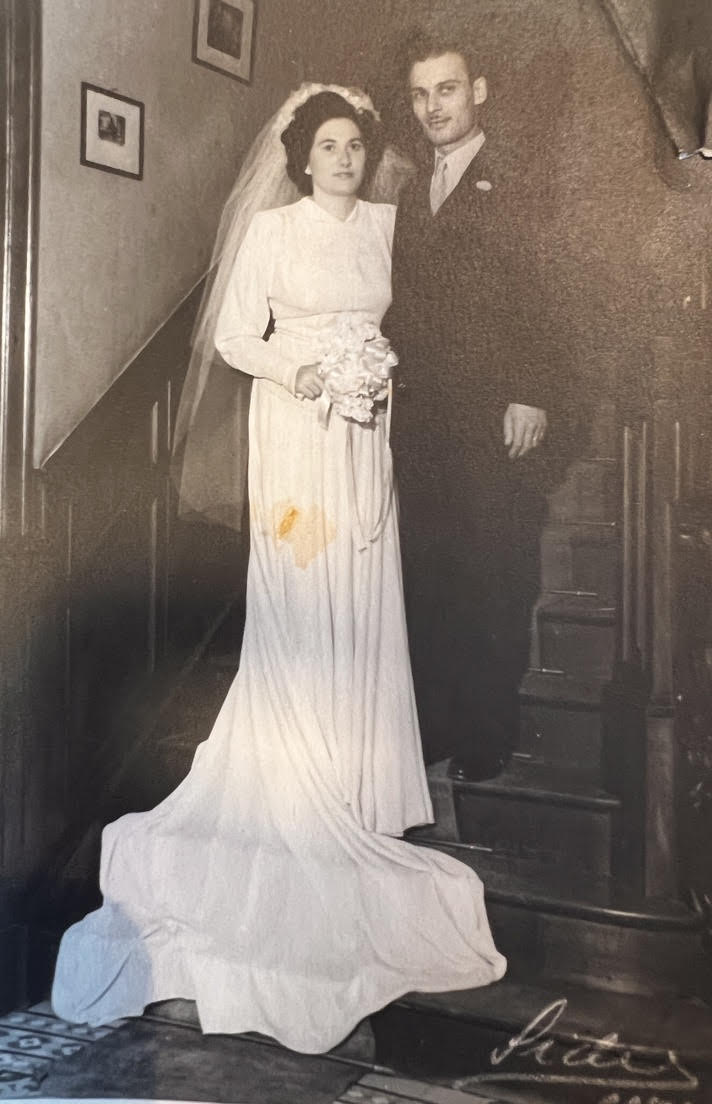
Fredi Rosenblatt married Erika Katz in 1949 in Uruguay. Here they are on their wedding day:

Erika Katz and Friedel Rosenblatt on their wedding day in 1949. Courtesy of Julio Rosenblatt

Erika Katz and Fredi Rosenblatt on their wedding day in 1949. Courtesy of Julio Rosenblatt

wedding of Fredi Rosenblatt and Erika Katz 1949. Courtesy of Julio Rosenblatt

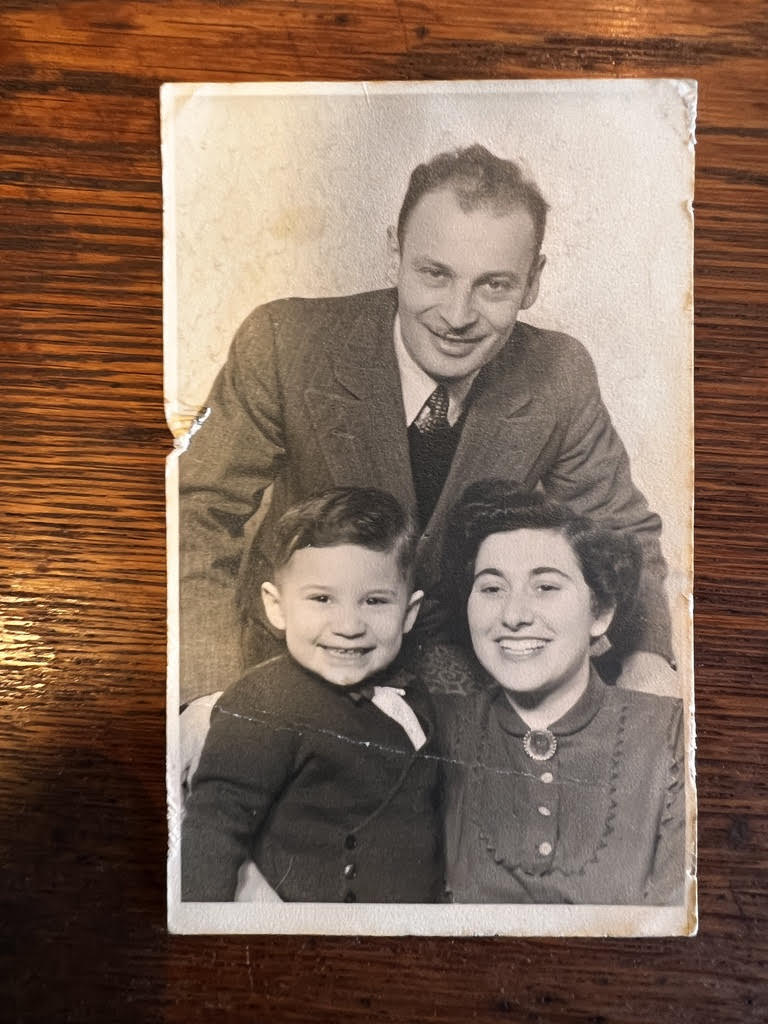
Julio was the only child of Fredi Rosenblatt and Erika Katz. Here is a photo of him with his parents, taken in 1954.

Fredi Rosenblatt, top; Julio Rosenblatt and Erika Katz, bottom. Courtesy of Julio Rosenblatt

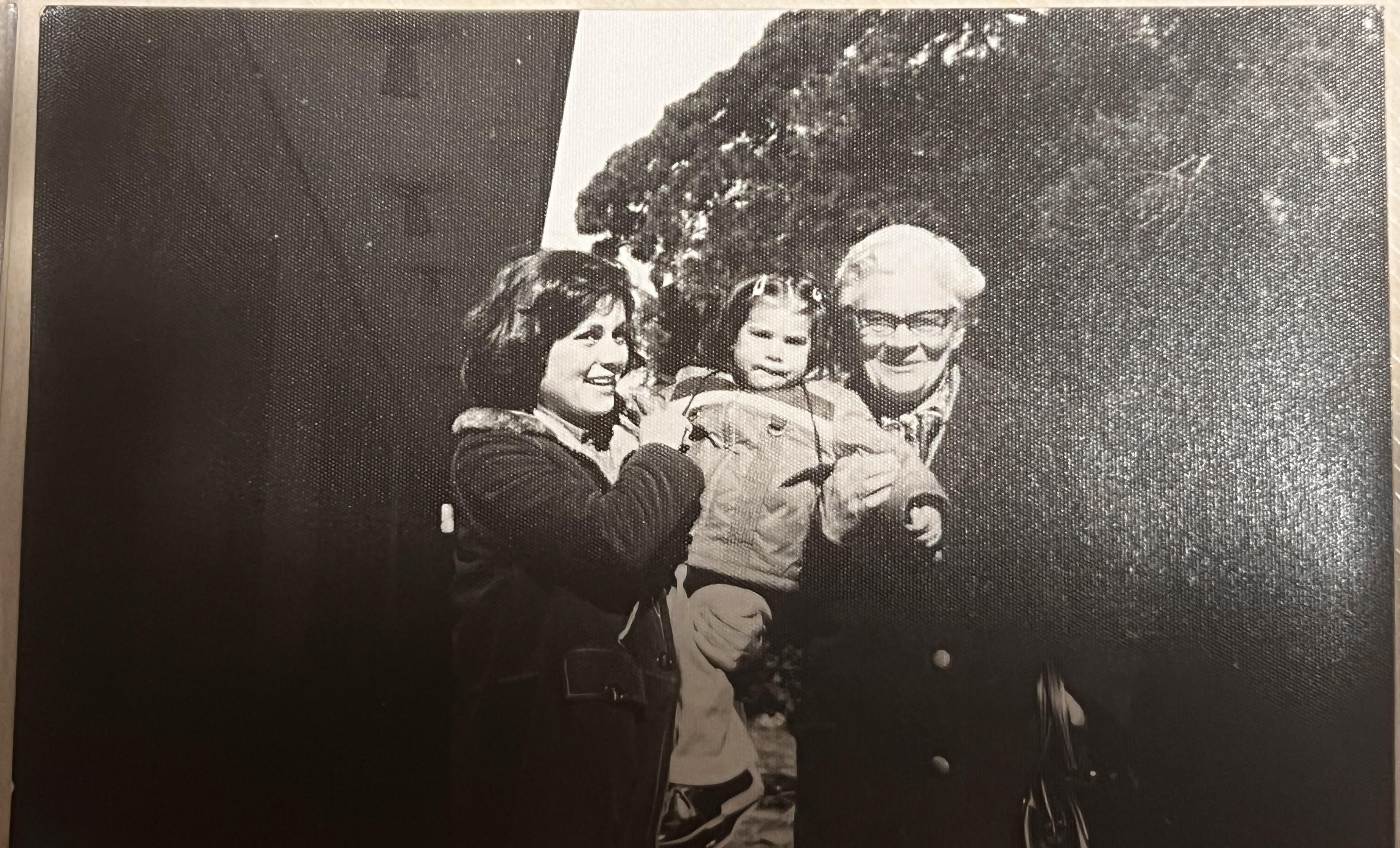
Julio is married to Ana Bogacz, and they have two children. This photograph is of Ana with her daughter Beatriz and Julio’s grandmother, Julie Rosenblatt Rosenblatt.

Ana Bogacz, Beatriz Rosenblatt, and Julie Rosenblatt Rosenblatt, in 1976. Courtesy of Julio Rosenblatt

Julio and Ana have two children. One lives in Uruguay and and the other in England. They also have three grandchildren, one in Uruguay and two in England. So Julius Rosenblatt, who died when his son Fredi was just a baby, and his wife, Julie Rosenblatt, have living great-grandchildren living across the world because Julie Rosenblatt Rosenblatt was smart enough and strong enough and lucky enough to leave Germany when she did.

Thank you to my cousin Julio for sharing his stories and these amazing photographs of his family. I am so glad we connected!


  1. The information about Julie Rosenblatt and her family in this post almost all came from her grandson Julio Rosenblatt during a Zoom on September 10, 2025. 
  2. Samuel Freedman, “A Treasure Hunt for Lost Memories,” The New York Times, August 16, 2003, p. A 15. 
  3. Ibid. 

Malchen Rothschild Rosenblatt, Part III: How I Found Her Great-Grandson Julio

Although the three daughters of Malchen Rothschild and Daniel Rosenblatt were all murdered in the Holocaust, their two surviving sons Felix and Siegmund were able to escape Nazi Germany as was their daughter-in-law Julchen Rosenblatt Rosenblatt, the widow of their son Juda/Julius.

I did not have a great deal of information about Felix or Siegmund because they escaped to Argentina, and I have limited resources for research there. I could not find them or their children on the CEMLA website for ships going to Argentina. All I had were burial records for some of them from the Jewish Online Worldwide Burial Registry (JOWBR) at JewishGen.org.

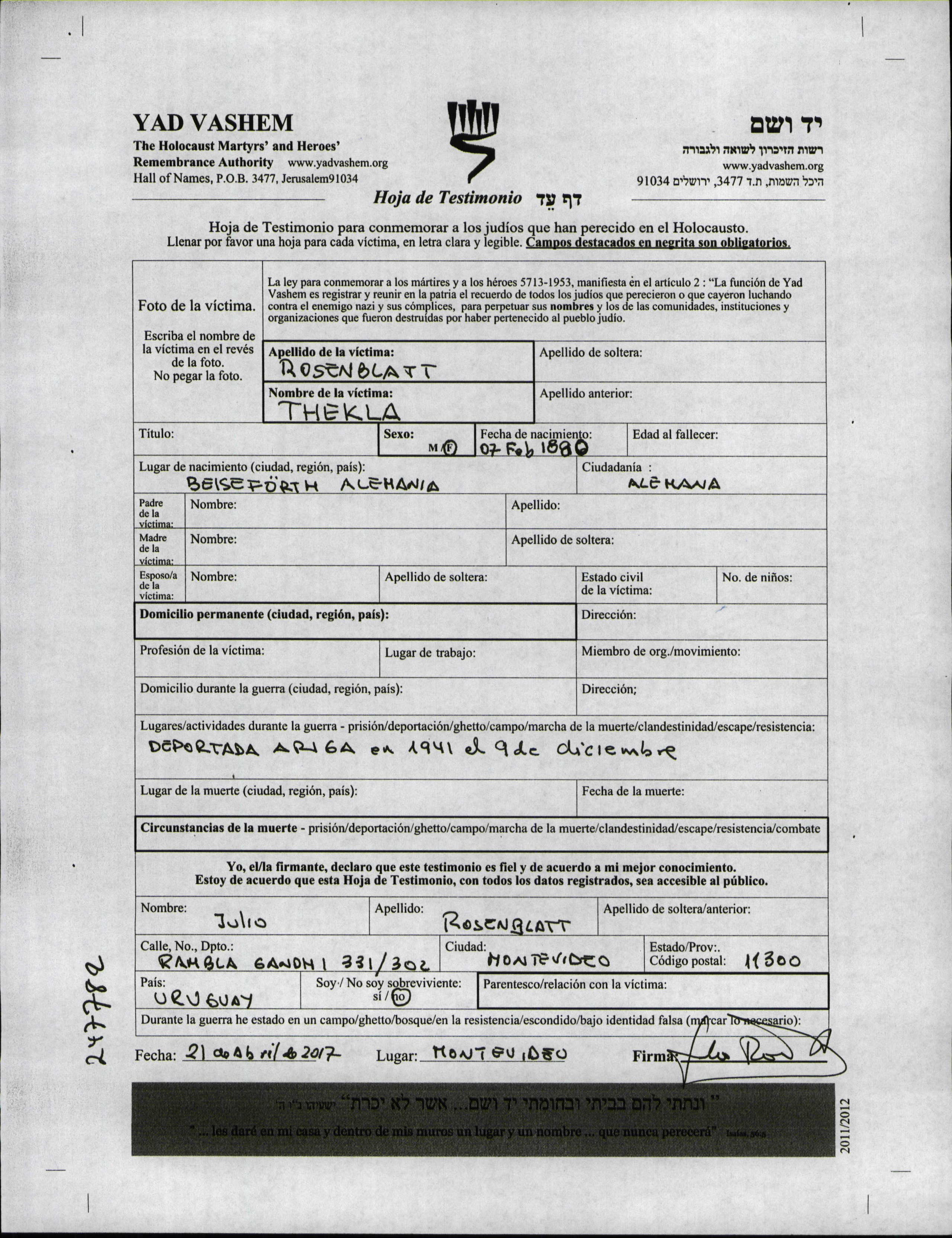
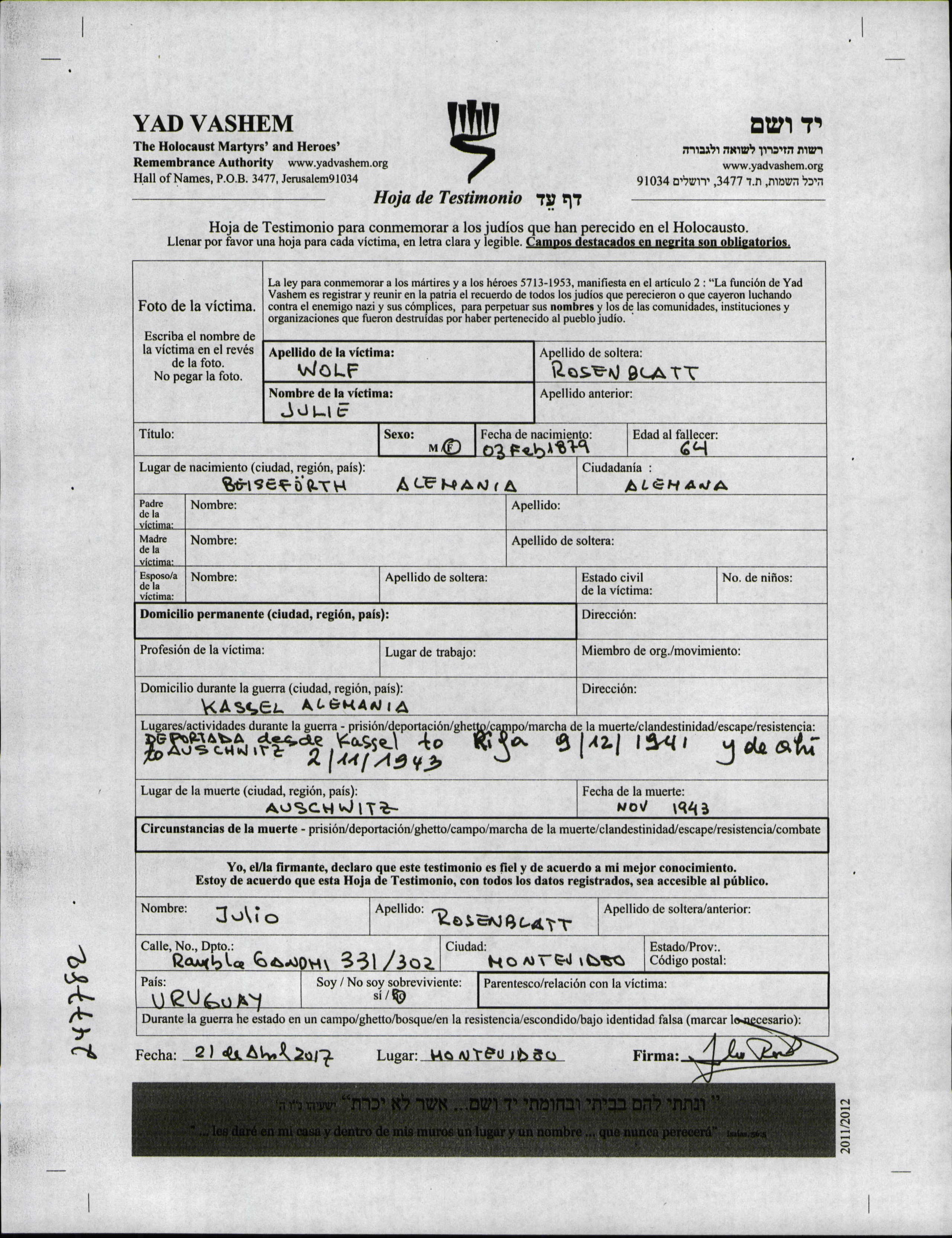
But some of the bricks in this wall crumbled a bit. In looking at the Pages of Testimony for Thekla Rosenblatt and Julie Rosenblatt Wolf, I noticed that both were filed by someone named Julio Rosenblatt. No relationships were given by the submitter, and I had no one in my tree with that name. Julio submitted the pages fairly recently–in 2017–and he lived in Montevideo, Uruguay.

Thekla Rosenblatt page of testimony, found at https://collections.yadvashem.org/en/names/13324460

Julchen Rosenblatt Wolf page of testimony, found at https://collections.yadvashem.org/en/names/13324463

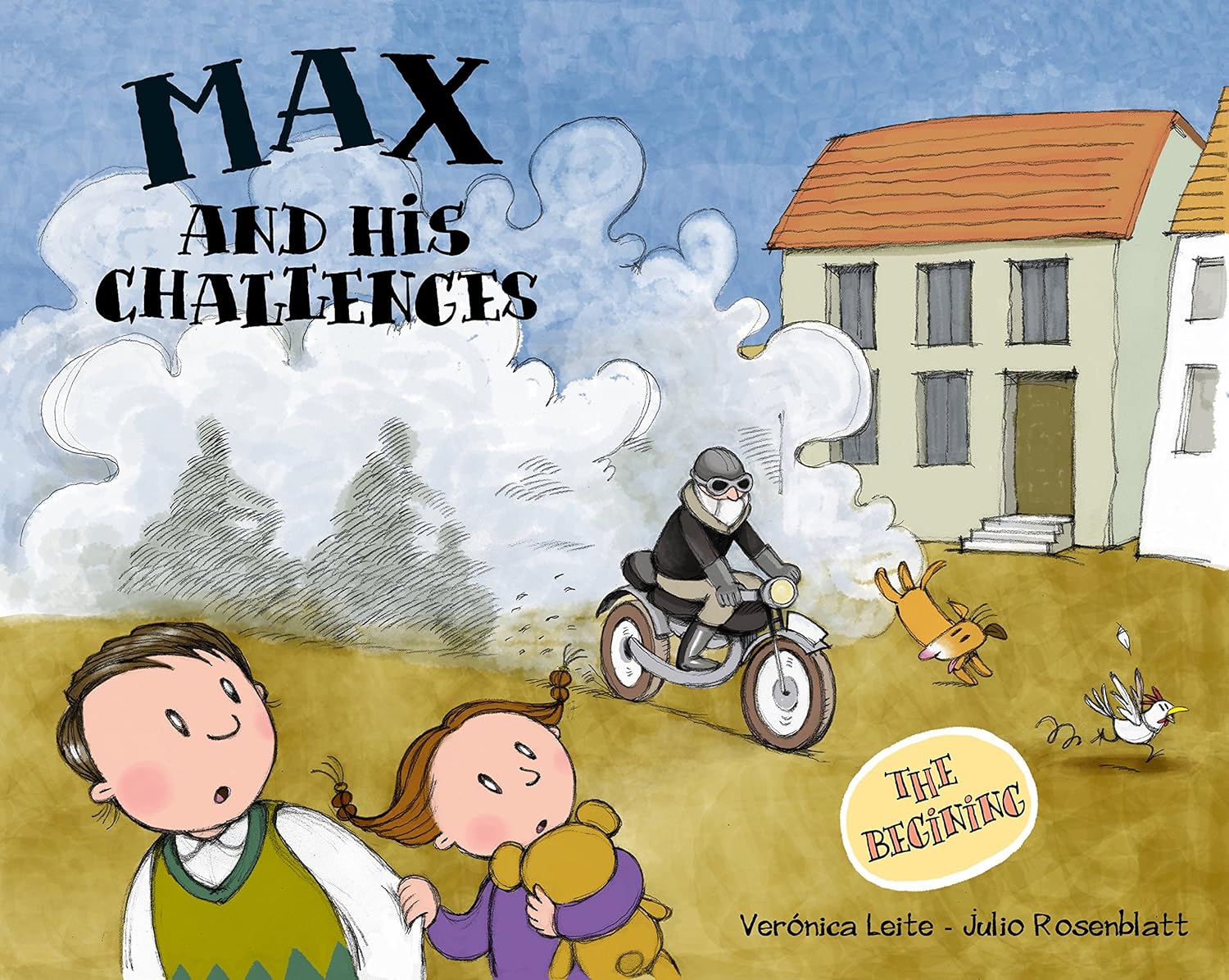
So I googled his name and found two links that helped me figure out who he is and how is he related to the other Rosenblatts and to me. The first page I found was an interview with Julio Rosenblatt of Uruguay that revealed that Julio is the author of several children’s books in the “Max y sus desafíos” series (translated either as Max and His Questions or Max and His Challenges). The books tell the story of Julio’s family in Nazi Germany. “Max” is Julio’s middle name, and he was named in memory of his grandmother’s brother Max. But who was his grandmother? The interview did not reveal.

So I kept digging. And then I found the second website about Julio Rosenblatt, Judische Leben in Beisefoerth, or Jewish Life in Beisefoerth, which was the town where Daniel Rosenblatt was born and where the first two of Daniel and Malchen’s children were born. Seeing that confirmed that I was on the right track. The website had a detailed telling of Julio’s trip to Beisefoerth and his search for his family history there. And from that page I learned Julio’s ancestry and how he is related to me. The page describes his trip to the Jewish cemetery in Haarhausen with Hans Peter Klein, the same man who took me there in 2017. This is what they saw there (see photo accompanying quote below):

Five generations of Julio Rosenblatt’s ancestors from Zimmersrode and Waltersbrück are buried there; the oldest grave of his four-times [sic] great-grandfather, Simon Rothschild from Waltersbrück, dates back to 1811. Julio and his wife Ana were particularly touched by the grave of his grandfather Julius Rosenblatt, who died in 1920 at the age of just 36 and just a few months after the birth of Fredi Rosenblatt, Julio’s father.

Now I know exactly who Julio is. He is my fifth cousin, the four-times great-grandson of Abraham Blumenfeld I and Geitel Katz, my four-times great-grandparents. His father was the baby born to Julius Rosenblatt and Julie Rosenblatt, Manfred; his great-grandmother was Malchen Rothschild Rosenblatt, his great-great-grandmother was Gelle Blumenfeld Rothschild, his great-great-great-grandfather was Moses Blumenfeld I, the older brother of my great-great-great-grandmother Breune Blumenfeld Katzenstein.

Julio’s paternal grandmother was Julie Rosenblatt, the widow and first cousin of Julius Rosenblatt. And Julie had a brother Max Rosenblatt who was killed in the Holocaust and became the name of the character in Julio’s books. But Julie survived and immigrated to Uruguay with her son Manfred (or Fredi), and Julio was born there.

I have gotten in touch with Julio and learned more about the Rosenblatts who survived the Holocaust in South America. Once again connecting with a cousin has allowed me the privilege of better understanding and appreciating my family history.

On top of that, a cousin of Sigmund Rosenblatt’s family, Ellie, found me through the blog, and she has been updating me on that branch of the family.


To be continued in September. My family will be visiting for the next two weeks, so I will see you after Labor Day!


Malchen Rothschild Rosenblatt, Part II: Who Shall Live and Who Shall Die

Of the five children of Malchen Rothschild and Daniel Rosenblatt who were still living when Hitler came to power in 1933, only two survived, the two sons Felix and Siegmund. Their three daughters—Julchen/Julie, Jette/Thekla, and Auguste–were all murdered by the Nazis.

Julchen/Julie and her husband Max Wolf were first deported from Kassel to the Riga ghetto on the December 9, 1941, transport that had deported so many other Rothschild family members. Julie and Max were then deported from Riga to Auschwitz on November 2, 1943, where they were murdered. Since their only child Edgar had died as a toddler, they had no direct descendants.

Julie Rosenblatt Wolf page of testimony, found at https://collections.yadvashem.org/en/names/13324463

Jette/Thekla Rosenblatt was also on the December 9, 1941, transport to Riga, where she did not survive. Since she had never married or had children, she also had no direct descendants.

Thekla Rosenblatt page of testimony, found at https://collections.yadvashem.org/en/names/13324460

Auguste’s husband Samuel Roth died on February 15, 1935, in Breitenbach. He was 52 years old.1 Auguste unfortunately had to face Nazi persecution without him. She was deported to the Sobibor death camp on June 1, 1942, and killed there two days later on June 3, 1942.

As for the four children of Auguste and Samuel, I only have the following information:

Irma Roth married Alfred Moses on December 19, 1934, in Berlin.

Irma Roth and Alfred Moses marriage record, Landesarchiv Berlin; Berlin, Deutschland; Personenstandsregister Heiratsregister, Register Year or Type: 1934 (Erstregister). Ancestry.com. Berlin, Germany, Marriages, 1874-1940

I found Alfred listed on the CEMLA website, immigrating to Argentina on December 30, 1939. I could not find a listing for Irma, but I assume she immigrated there as well since they are both buried together at the Cementerio Comunitario de Berazategui in Buenos Aires, Argentina. Alfred(o) died on March 28, 1980, and Irma died on May 30, 1999. I do not know whether they ever had children.

Alfred Moses CEMLA listing, at https://cemla.com/buscador/

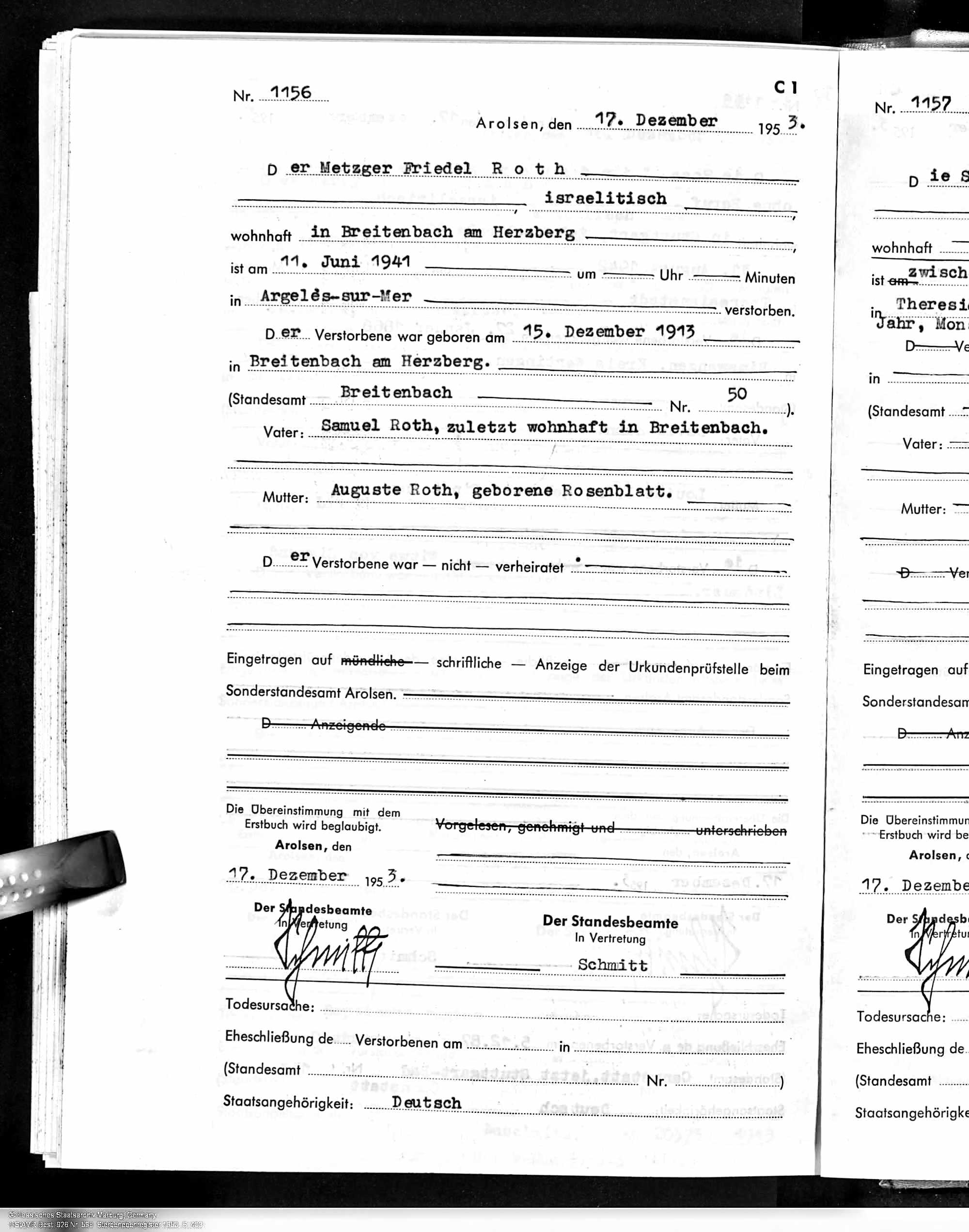
Irma’s sister Friedel never married as far as I can tell. She was living in Luxembourg during World War II and was deported from there to the concentration camp at Argeles-sur-Mer in France. The camp at Argeles-sur-Mer was built by the French in 1939 to house refugees from the Spanish Civil War, and conditions were horrific. “The lack of lodging structures, as well as unsafe water supply and food scarcity, added to the exiled people’s poor health conditions caused the spreading of several diseases that, in turn, led to a dramatic increase in mortality among refugees.” Then during World War II, the camp was used to imprison Jews, gypsies, and other targets of Nazi persecution. Friedel Roth died as a prisoner there on June 11, 1941.

Friedel Roth death record, Hessisches Hauptstaatsarchiv; Wiesbaden, Deutschland; Personenstandsregister Sterberegister; Signatur: 598; Laufende Nummer: 926, Year Range: 1953, Ancestry.com. Hesse, Germany, Deaths, 1851-1958

Lothar Roth, the third child of Auguste Rosenblatt and Samuel Roth, also appears to have never married. The only record I could locate for him was a burial record in Buenos Aires, Argentina, indicating that he died there on July 27, 1992. I could not locate any birth or immigration or marriage record for him.

Auguste and Samuel’s youngest child Gretl was also murdered by the Nazis. I could not find any record of marriage for Gretl. She was deported from Berlin to Auschwitz on March 1, 1943, and was murdered there.

Thus, the three daughters of Malchen Rothschild and Daniel Rosenblatt and some of their children were victims of the Nazi killing machines.

But the two sons of Malchen and Daniel fared better than their sisters. For a long time I was up against a brick wall trying to find more about Felix and Siegmund Rosenblatt. I knew that they had gone to Argentina, but aside from burial records, I could learn nothing more.

And then I looked at the name of the submitter on the Pages of Testimony above for Julie and Thekla Rosenblatt: Julio Rosenblatt of Montevideo, Uruguay. I googled his name, and the bricks on that brick wall began to crumble.


  1. Samuel Roth death record, LAGIS Hessen Archives, TitelStandesamt Breitenbach am Herzberg Sterbenebenregister 1935 (HStAMR Best. 907 Nr. 927)AutorHessisches Staatsarchiv MarburgErscheinungsortBreitenbach am HerzbergErscheinungsjahr1935, p 6, found at https://dfg-viewer.de/show?id=9&tx_dlf%5Bid%5D=https%3A%2F%2Fdigitalisate-he.arcinsys.de%2Fhstam%2F907%2F927.xml&tx_dlf%5Bpage%5D=6 

Rosa and Amalie Rothschild, Gerson and Fanny’s Youngest Daughters

Getting to know Hal Katz and his family and learning the stories about Clara Rothschild and Moritz Katz and their children and grandchildren has been a real highlight of the past few months. Now I turn to Clara’s two younger sisters, the seventh and eighth children of Gerson Rothschild and Fanny Kugelmann of those who survived to adulthood. And unfortunately there is no joy in telling their stories.

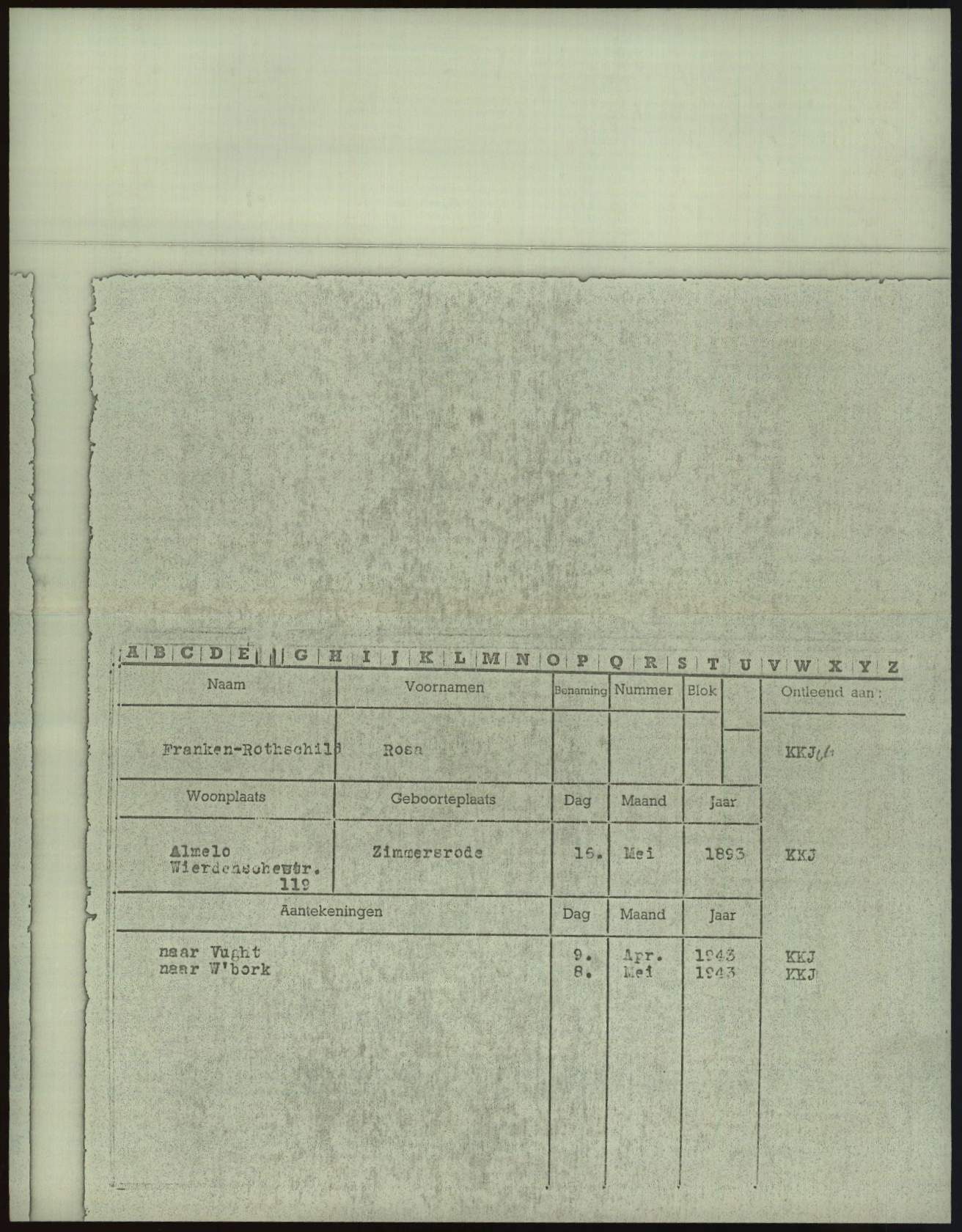
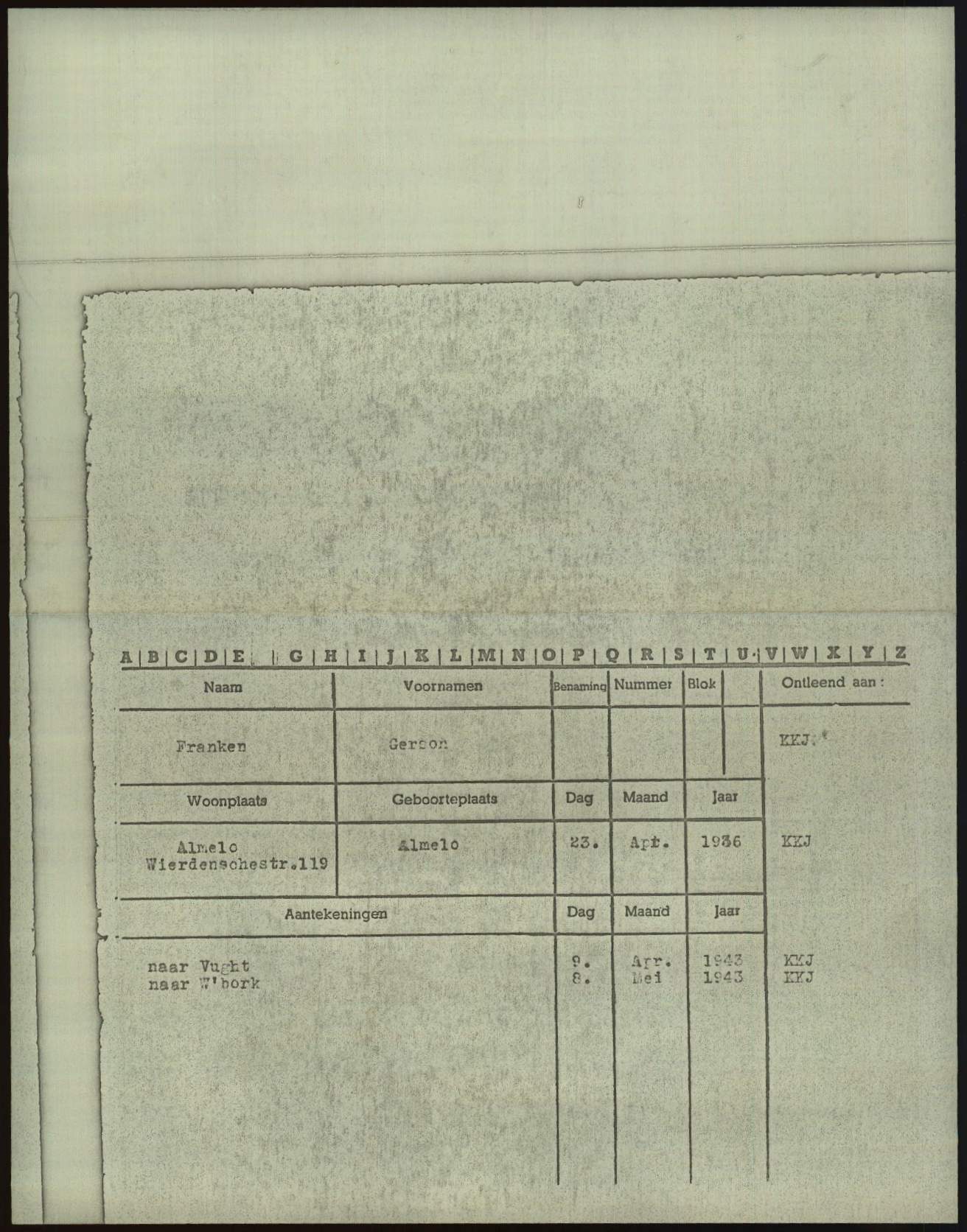
Rosa Rothschild, who was born on May 16, 1893, in Zimmersrode, married Meijer Franken sometime before April 23, 1936, when their son Gerson was born in Almelo, Netherlands. I don’t know whether Rosa married Meijer in the Netherlands or Germany because I cannot find a marriage record in either country.1 Meijer was Dutch, born in Haaksbergen, Netherlands, on March 16, 1873, making him twenty years older than Rosa. His parents were Levij Franken and Antje Goedhardt.2 Meijer had been previously married; his first wife Jeanette Herzog, died in Almela, Netherlands, on November 12, 1923.3

Presumably Rosa married Meijer sometime after November 12, 1923, when his first wife died, and before April 23, 1936, when Gerson was born in Almelo, Netherlands. I don’t know whether Rosa met Meijer before moving to the Netherlands or moved there to escape Hitler and met Meijer thereafter. I think it’s reasonable to assume she moved first sometime after 1933 when Hitler came to power and then met and married Meijer. Her mother Frommet “Fanny” Kugelmann Rothschild also moved to Almelo, Netherlands, either with Rosa or afterwards, and was living with Rosa, Meijer, and and her grandson Gerson, named for Rosa’s father and Fanny’s husband, Gerson Rothschild.4 Hal Katz told me that she came to his bar mitzvah in late 1937, but that she was already living in the Netherlands at that time.

Unfortunately, the move to the Netherlands did not protect Rosa, her mother, her husband, or her son from the scourge of the Nazis. On April 9, 1943, they were sent to the Herzogenbusch concentration camp near Vught in the Netherlands, and then on May 8, they were sent to Westerbork where they were then sent to Sobibor, where they were murdered by the Nazis: all four of them, 86 year old Fanny, 70 year old Meijer, 49 year old Rosa, and seven year old Gerson.

Arolsen Archives, DocID: 402367 (FROMMET ROTSCHILD KUGELMANN)
DeepLink: https://collections.arolsen-archives.org/de/document/402367

Arolsen Archives, DocID: 355979 (ROSA FRANKEN ROTHSCHILD)
DeepLink: https://collections.arolsen-archives.org/de/document/355979

Arolsen Archives, DocID: 355969 (MEIJER FRANKEN)
DeepLink: https://collections.arolsen-archives.org/en/document/355969

Arolsen Archives, DocID: 355947 (GERSON FRANKEN)
DeepLink: https://collections.arolsen-archives.org/en/document/355947

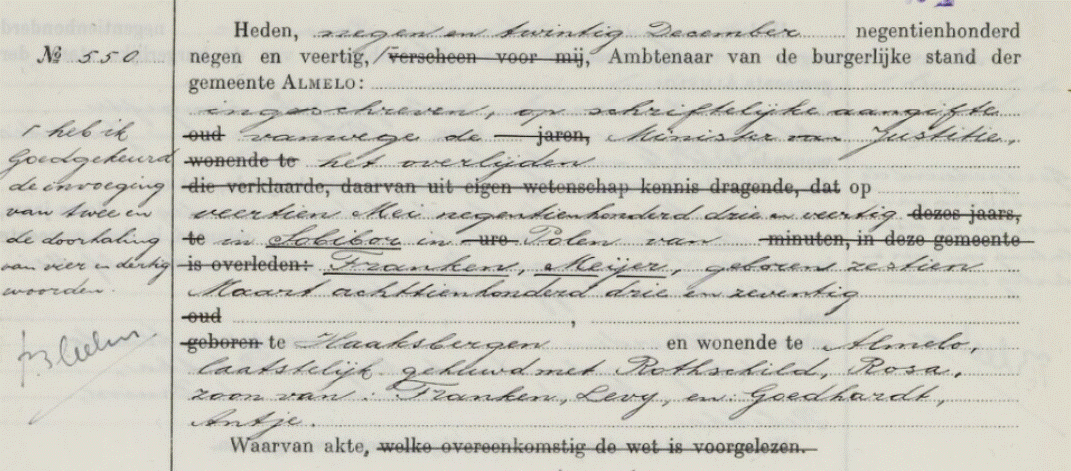
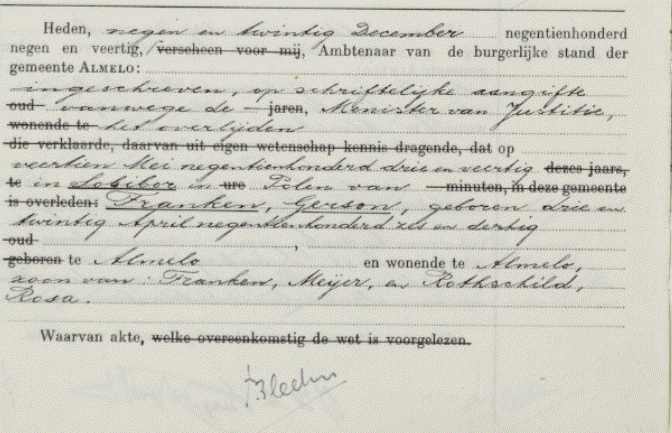
Here are the official Dutch death records for Rosa and her family, showing they were killed at Sobibor :

Rosa Rothschild Franken death record, BS Death Heritage institution Collection Overijssel Institution place Zwolle Collection region Overijssel Archive 0123 Registration number 16645 Sourcenumber 14 Registration date 09-01-1950 Document place Almelo Collection Civil Registry in Overijssel Book

Meijer Franken death record, Collection Overijssel location Zwolle in Zwolle (Netherlands), Civil registration deaths Burgerlijke Stand in Overijssel, Almelo, archive 0123, inventory number 16644, 29-12-1949, Register van overlijden, Almelo, record number 550

Gerson Franken death record, Collection Overijssel location Zwolle in Zwolle (Netherlands), Civil registration deaths Burgerlijke Stand in Overijssel, Almelo, archive 0123, inventory number 16644, 29-12-1949, Register van overlijden, Almelo, record number 549

Frommet Kugelmann Rothschild death record, Register of deaths, Almelo (Overijssel Collection, Zwolle location), Death Frommet Kugelmann, 14-05-1943, Type of deed :
death certificate, Date of deed: 09-01-1950 Location of deed: Almelo, born in Wohra (D); date of birth 11-09-1857, Access number : 0123 Civil Registry in Overijssel Inventory number :
16645 File number : 12

Rosa’s sister Amalie, the youngest of Fanny and Gerson Rothschild’s children, met a similar fate. Amalie, who was born on April 26, 1901, married Jakob Stiefel, who was born January 19, 1893, in Ziegenhain, Germany, and was the son of Michel Stiefel and Emilie Bachrach. As with Rosa Rothschild and Meijer Franken, I don’t have a marriage record for Amalie and Jakob, but according to Holocaust records, they had two children, Eva, born April 3, 1937, in Fritzlar, Germany, and Gerhard, born April 26, 1938, in Kassel, Germany. The family was living in Kassel at that time.

Amalie, Jakob, Eva, and Gerhard were among those who were sent from Kassel on December 9, 1941, to the Riga ghetto. Remember that Amalie’s older sisters Katchen, Auguste, and Jenny were also deported to the Riga ghetto on that same transport. In any event, they all ended up in Riga. In 1942, Jakob died in the Kaiserwald camp near Riga. On November 2, 1943, Amalie and her two young children, six year old Eva and five year old Gerhard were sent from Riga to Auschwitz, where they were murdered. Another family of Rothschild cousins was destroyed by the Nazis.

Thus, of the eight children of Gerson Rothschild and Fanny Kugelmann who had survived to adulthood, five of them were murdered by the Nazis: Katchen, Auguste, Jenny, Rosa, and Amalie, as well as their mother Fanny and almost all of their children. Only Siegmund, Max, and Clara and their families escaped in time, as well as Auguste’s son Bruno Feldheim. That is just one family’s saga, but it was multiplied millions of times over for all the other families who were torn apart and destroyed by the hatred of the Nazis and those who supported them.

What gives me hope after learning all this tragic information about the family of Gerson Rothschild is the incredible strength I’ve seen in the descendants of Siegmund and Clara, those who are here today because their parents or grandparents were able to escape in time. Those descendants are all examples of how good can conquer over evil and love can overcome hatred.


  1. I could not locate a marriage record for Rosa and Meijer in either the Dutch archives at WieWasWie or in the various Hessen archives for Zimmersrode or Waltersbrueck, Germany, where Rosa was presumably living before relocating to the Netherlands. But Rosa and Meijer are listed as Gerson’s parents on his Dutch death record and as each other’s partner on each of their Dutch death records. See images below. 
  2. Meijer Franken, Birth Date 16 mrt. 1873 (16 Mar 1873), Birth Place Haaksbergen
    Father Levij Franken, Mother Antje Goedhardt, Collectie Overijssel; The Hague, Netherlands; Burgerlijke stand. Ancestry.com. Netherlands, Birth Index, 1784-1923 
  3. Jeannette Hertog, Age 52, Birth Date abt 1871, Birth Place Meerssen
    Death Date 12 nov. 1923 (12 Nov 1923), Death Place Almelo, Father Alexander Hertog, Mother Carolina Anschil, Historisch Centrum Overijssel (HCO); Den Haag, Nederland; Burgerlijke stand (overlijdensakten), Ancestry.com. Netherlands, Death Index, 1796-1973 
  4. A document in the Arolsen Archives for Fanny shows that her residence before deported to a concentration camp was Wierdensestr. 119 in Almelo, Netherlands. A similar document in the Arolsen Archives for Rosa shows her living at the same address. See Arolsen Archives, DocID: 402367 (FROMMET ROTSCHILD KUGELMANN) at https://collections.arolsen-archives.org/de/document/402367 and DocID: 355979 (ROSA FRANKEN ROTHSCHILD), at https://collections.arolsen-archives.org/de/document/355979