Malchen Rothschild Rosenblatt’s Youngest Child, Siegmund

The other surviving son and the youngest child of Malchen Rothschild and Daniel Rosenblatt was their son Siegmund. Like his brother Felix, he escaped from Nazi Germany to Argentina with his wife Else Schwab and their three children, Arno, Ruth, and Margot.

I was very fortunate that Ellie Roden, a first cousin, once removed, of Siegmund’s wife Else, reached out to me through my blog. Ellie wrote that “Siegmund wanted all the family on both sides to leave Germany but before Kristallnacht many hoped and believed that the Nazi reign would end.”1 Unfortunately, as we have seen, Siegmund’s three sisters Julchen, Jette, and Auguste, did not heed that advice. According to Ellie, Siegmund, Else, and their children left Germany for Argentina in July 1937. They joined the same community, Colonia Avigdor, where Siegmund’s brother Felix had settled the year before. According to Siegmund’s great-niece Carmen, Siegmund and his family left Colonia Avigdor in about1955 and moved to Buenos Aires. After receiving compensation from the German government, they could afford to live in the city.2

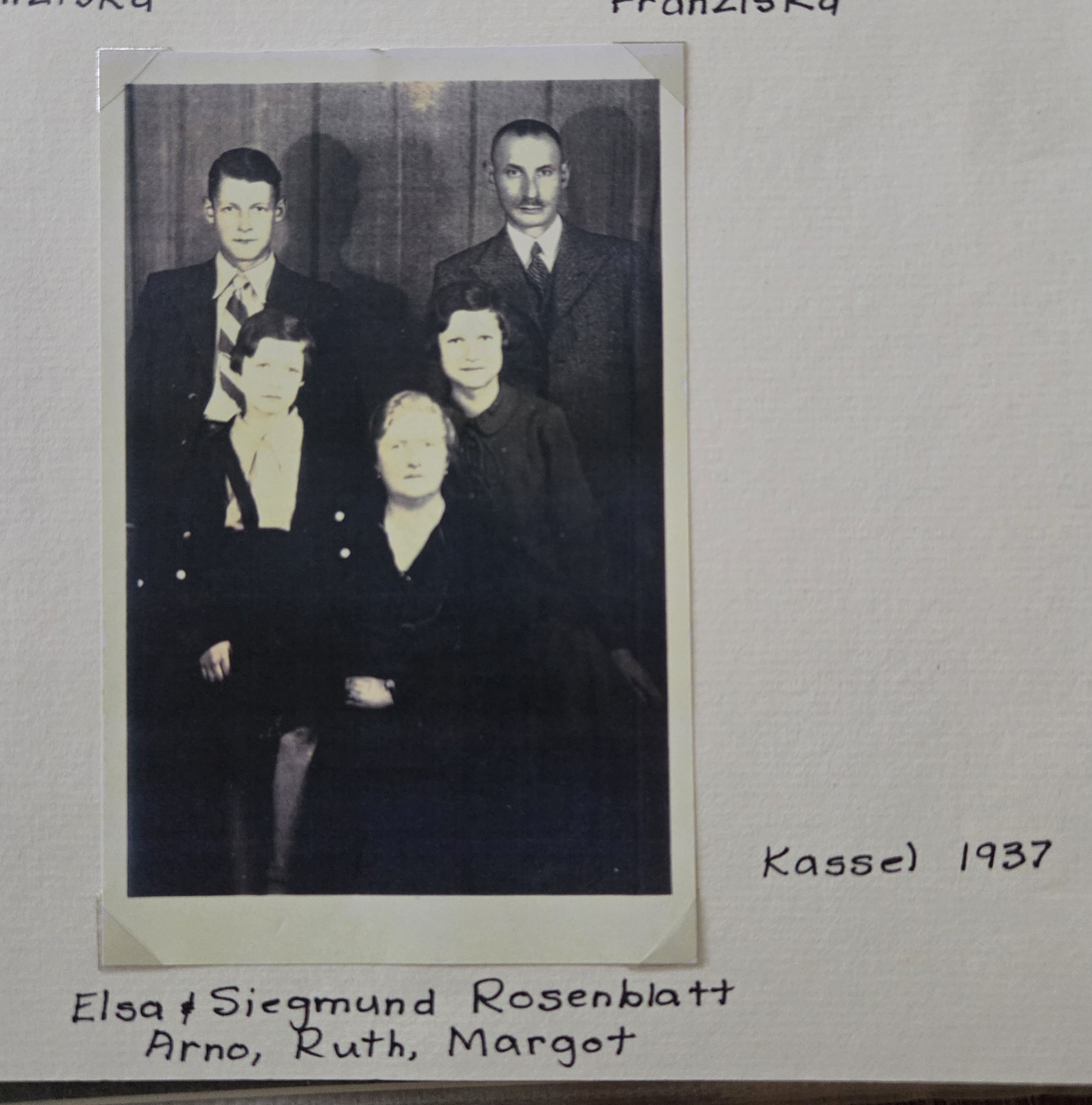
Ellie shared these wonderful photographs of Siegmund and his family, first a photograph of Siegmund and Else and their children in 1937 before they left their home in Kassel, Germany:

Siegmund Rosenblatt and family in 1937, Kassel, Germany
Courtesy of Ellie Roden

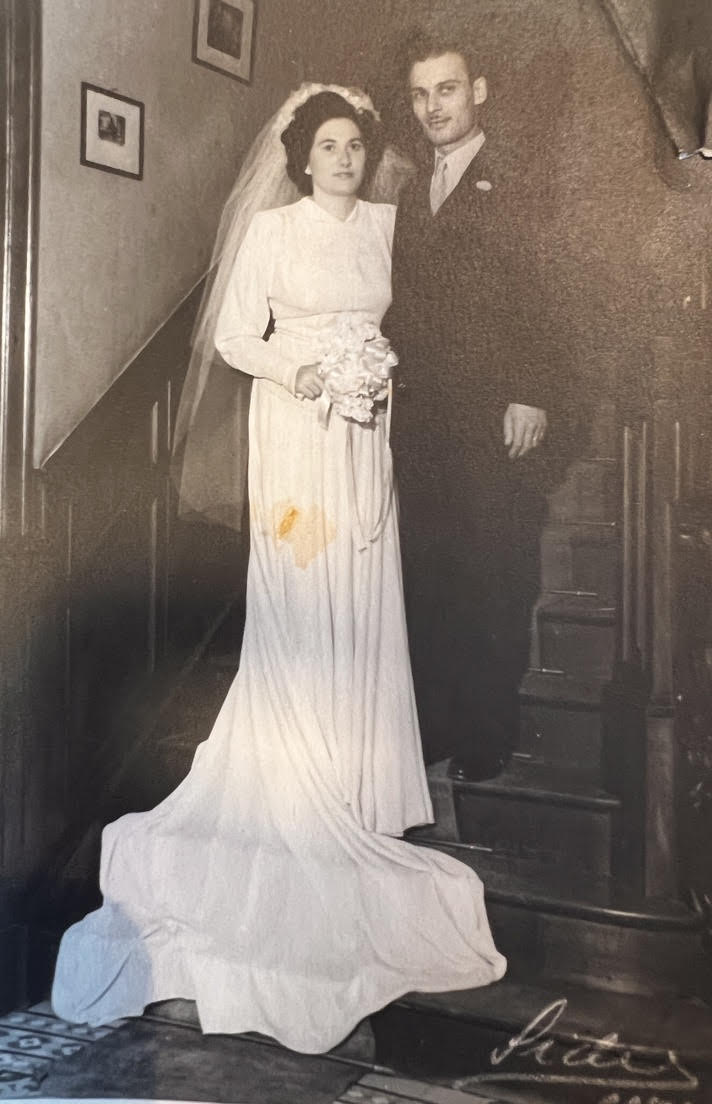
This second photograph is undated, but is of Siegmund and Else. I assume it was taken in Argentina some years later.

Else Schwab and Siegmund Rosenblatt. Courtesy of Ellie Roden

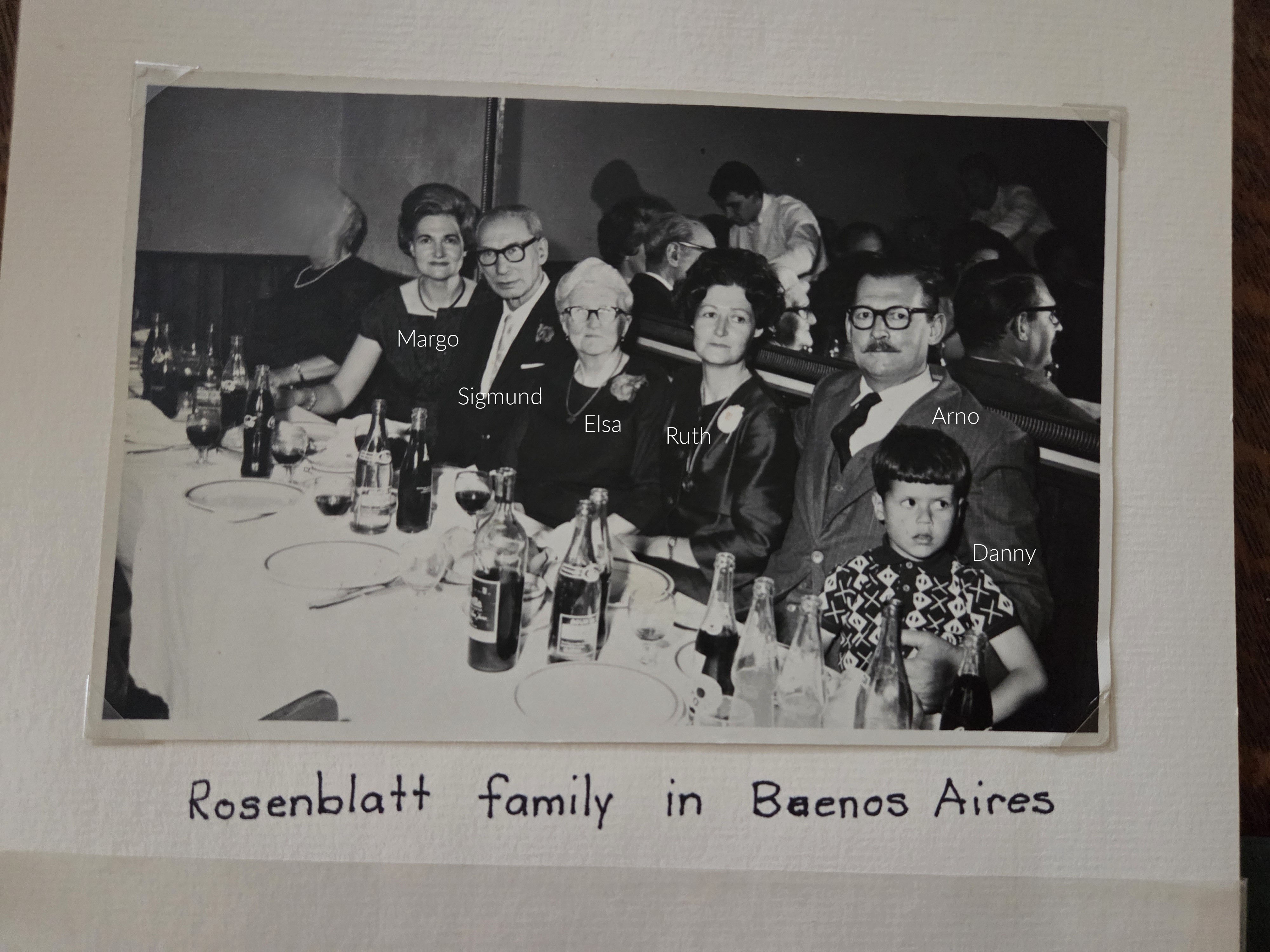
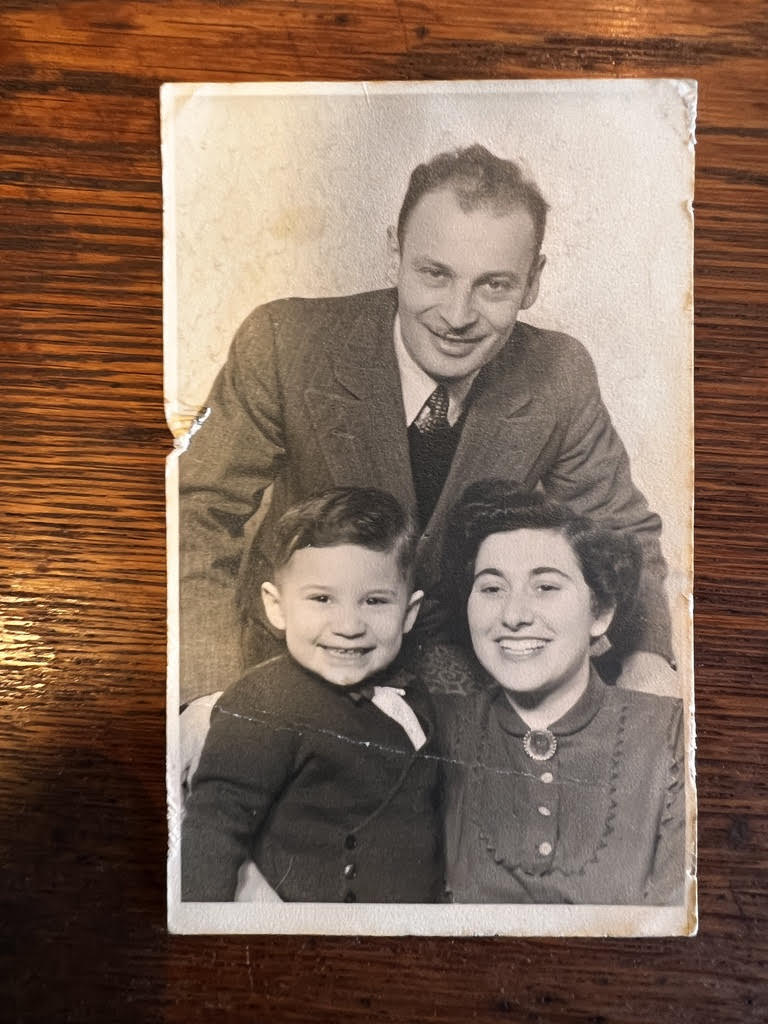
The third photo may have been taken at the same event as the one above; it was taken in Buenos Aires:

The Rosenblatt family in Buenos Aires: Margot, Siegmund, Else, Ruth, Arno, and Danny. Courtesy of Ellie Roden

I don’t have any records for the family’s life in Argentina, but Ellie was able to confirm that Arno, the oldest child, had a son named Danny, presumably named for his grandfather Daniel Rosenblatt; he must be the young boy in the photo above. Margot, the middle child, married someone named Kurt Oppenheimer; I don’t know whether they had children. And Ruth, the youngest child, may have married someone named Arno Kaufman. I don’t know whether they had children.

I was able to find burial records for Siegmund and Else and for two of their three children in the records for Argentina in the JOWBR at JewishGen.org. Siegmund died on November 3, 1982, and is buried in Buenos Aires.3 His wife Else died on August 11, 1984, and is buried in Buenos Aires.4 Their daughter Ruth Rosenblatt Kaufmann died on January 12, 1989, and is also buried in Buenos Aires.5 Finally, their son Arno Rosenblatt died on December 31, 2008, and is buried in Buenos Aires.6 I was not able to locate a burial record or any other record for Margot, but did locate one for her husband, Kurt Oppenheimer, which named her as his spouse. Kurt died on February 13, 2007, and is buried in the same cemetery as his in-laws.7

I am so grateful to my cousins Julio and Carmen and to Ellie Roden for sharing the photographs and information about the families of Malchen Rothschild Rosenblatt’s three sons, Felix, Julius, and Siegmund. Although the family of Malchen Rothschild and Daniel Rosenblatt suffered terrible losses during the Holocaust, it was uplifting to learn that there are still living descendants living in many countries around the world. I am so grateful for that.


I have now completed the stories of the children of Malchen Rothschild Rosenblatt and will move on to Malchen’s younger sister, Sara Rothschild Adler, and her family. But first a few updates on earlier posts.


  1. Email from Ellie Roden, August 13, 2025. 
  2. Email from Carmen Rosenblatt, September 17, 2025. 
  3. Burial record in the JOWBR database at JewishGen, found at https://www.jewishgen.org/databases/cemetery/jowbr.php?rec=J_ARGENTIN_0199329 
  4. Burial record in the JOWBR database at JewishGen, found at https://www.jewishgen.org/databases/cemetery/jowbr.php?rec=J_ARGENTIN_0199309 
  5. Burial record in the JOWBR database at JewishGen, found at https://www.jewishgen.org/databases/cemetery/jowbr.php?rec=J_ARGENTIN_0164434 
  6. Burial record in the JOWBR database at JewishGen, found at https://www.jewishgen.org/databases/cemetery/jowbr.php?rec=J_ARGENTIN_0199303 
  7. Burial record in the JOWBR database at JewishGen, found at https://www.jewishgen.org/databases/cemetery/jowbr.php?rec=J_ARGENTIN_0189236 

Malchen Rothschild Rosenblatt’s Descendants in the Colonia Avigdor in Argentina

As we saw, Malchen Rothschild and Daniel Rosenblatt’s daughters all were killed in the Holocaust. Their son Julius had died as a young man, leaving behind a young widow Julie Rosenblatt and their infant son Fredi. Julie and Fredi escaped to Uruguay, and thanks to Fredi’s son Julio, I’ve been able to learn and share much of their story.

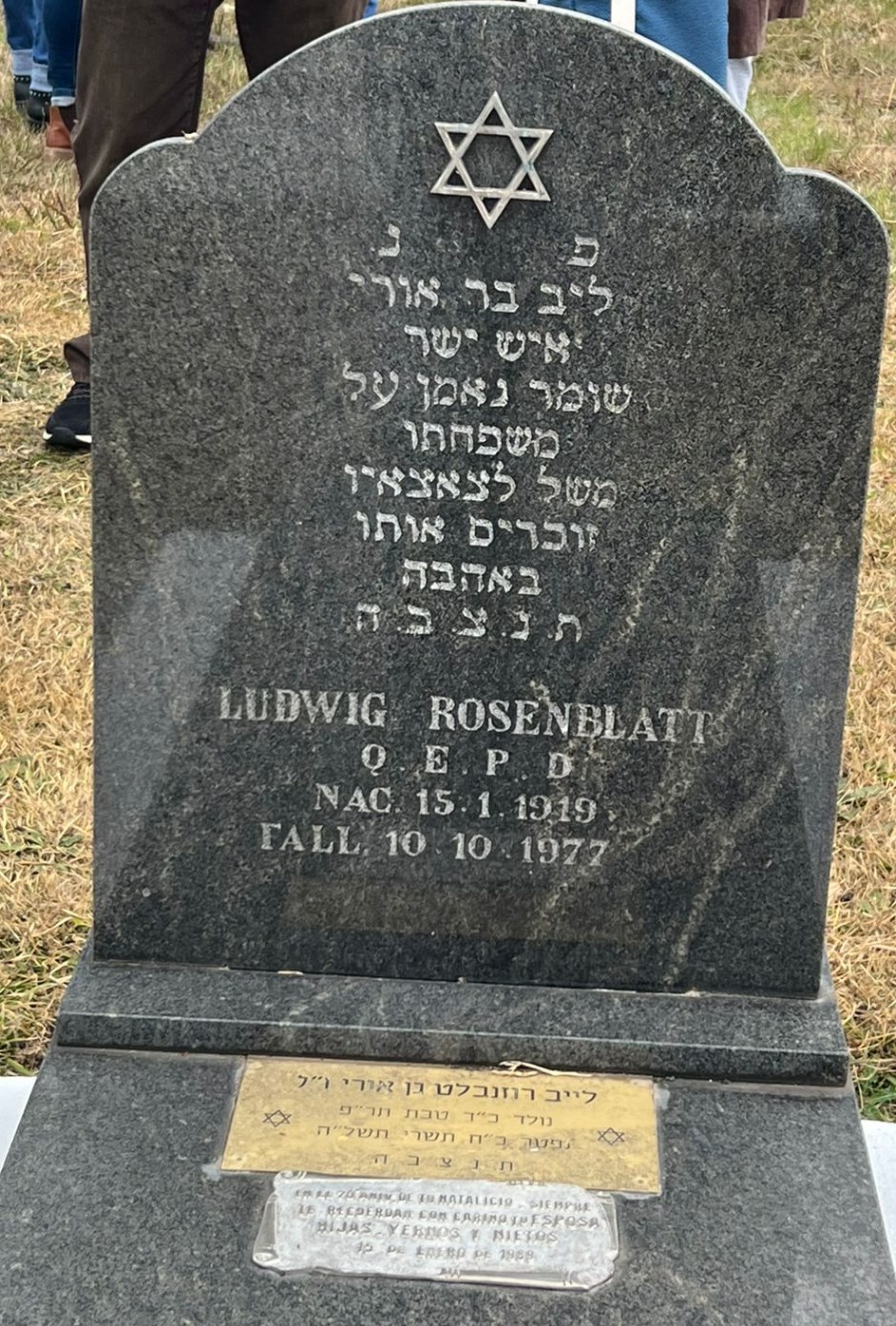
Malchen and Daniel’s other two sons Felix and Siegmund escaped to Argentina, not Uruguay,1 and thanks to the magic of the internet, I am now in touch with Felix’s granddaughter in Argentina, Carmen. I found a photograph of the gravestone of Felix’s son Ludwig Rosenblatt (see below) on JewishGen and posted it on Tracing the Tribe, asking for a translation of the Hebrew inscription. A woman in the TTT group tagged Carmen when she saw my post, and Carmen, Ludwig Rosenblatt’s daughter, responded. Although Carmen doesn’t speak English and I don’t speak Spanish, we’ve managed to communicate, thanks to Google Translate and DeepL.

Carmen shared with me a lecture2 she delivered in 2018 to the Latin American Rabbinical Seminary about the community where her family has lived since 1936 when they immigrated from Germany to Argentina. It is in Spanish, and I’ve used DeepL to translate it and now will paraphrase and take excerpts from the translation to share the story of Carmen’s family and their community. Carmen also filled in other details through email.

As Carmen explained in her lecture, the German philanthropist Baron Maurice de Hirsch formed the Jewish Colonization Association (“JCA”) in the late 19th century to acquire land and create settlements in Argentina for Jews escaping persecution in Russia and Eastern Europe. When Hitler came to power in the 1930s, it became apparent that there was a need for more land and more places for German Jews to escape, so the JCA acquired additional land to create a new settlement called Colonia Avigdor, which is over 300 miles from Buenos Aires.

Thanks to the efforts of the JCA, Jewish families like Carmen’s were able to escape Nazi Germany. I asked Carmen what convinced her grandparents to leave Germany. She wrote that one night her grandfather’s car was confiscated by the Nazis in Zimmersrode, and when it was returned to him the next day, an official in the town told him: “Felix, this is getting very ugly for you Jews, take your family and leave Germany.” Felix replied, “How??? I have to sell my house, my things.” The official replied, “Leave everything, don’t sell anything… nobody is going to pay a Jew.” Felix contacted the JCA and asked for help to leave Germany and move to Argentina.

Carmen’s grandparents Felix and Minna (Goldwein) Rosenblatt and their sons were one of the ten families that first settled in Colonia Avigdor. They arrived in Buenos Aires, Argentina, with their sons Ludwig, then 17, and Siegfried, 20, and their daughter-in-law, Siegfried’s wife Jenny Feilmann, on January 25, 1936. As Carmen explained to me and in her lecture, because the JCA required a family to have five adults to qualify for the settlement program, Siegfried, although only twenty years old, had married Jenny at such a young age in order for the family to qualify.

After a few days in Buenos Aires, Felix, Minna, and their family traveled by train from Buenos Aires to Bovril, the closest train station to Avigdor. From there they traveled the last fifteen miles of the over 300 mile journey “by horse-drawn carts through trees and bushes in the woods along winding paths” to get to their new home. Carmen wrote that they were “full of hope that they would adapt to such a hard life and happy to set foot on land that promised above all FREEDOM and work to build a good future.”

Carmen’s description of their early lives cannot be paraphrased adequately; here is how DeepL translated her words:

Each of the settlers was allocated 75 hectares of land and a poorly constructed house made of mud-covered bricks with a dirt floor, two rooms, one kitchen, one veranda, and a bathroom at the back, about 10-15 meters away from the house. In each house, they found a bag of hard “cookies” (country bread), several days old… as well as some work tools, a few cows, some horses, some chickens… The next day, they got to work, first clearing the yards of wild trees, then the fields so they could plant them, building fences to divide them. It was very hard work, but as I said, they were happy because they had hope for progress. The women devoted themselves more to the tasks in the yard, tending to the chickens and other poultry, milking the cows for the milk they consumed, in addition to their household chores. They had to knead the bread in wood-fired ovens, whose mouths opened into the kitchen…

They say that at first, these women did these tasks crying practically all day (and at night too) because of the precarious conditions around them… there was no electricity, the lamps were kerosene… there were no refrigerators, no appliances whatsoever. And it should be emphasized that they came from an advanced civilization in Germany… Some, those who came from small towns, adapted more easily, but those who came from cities such as Berlin, Munich, Frankfurt, etc., of which there were many… found it extremely difficult, or simply could not get used to it…

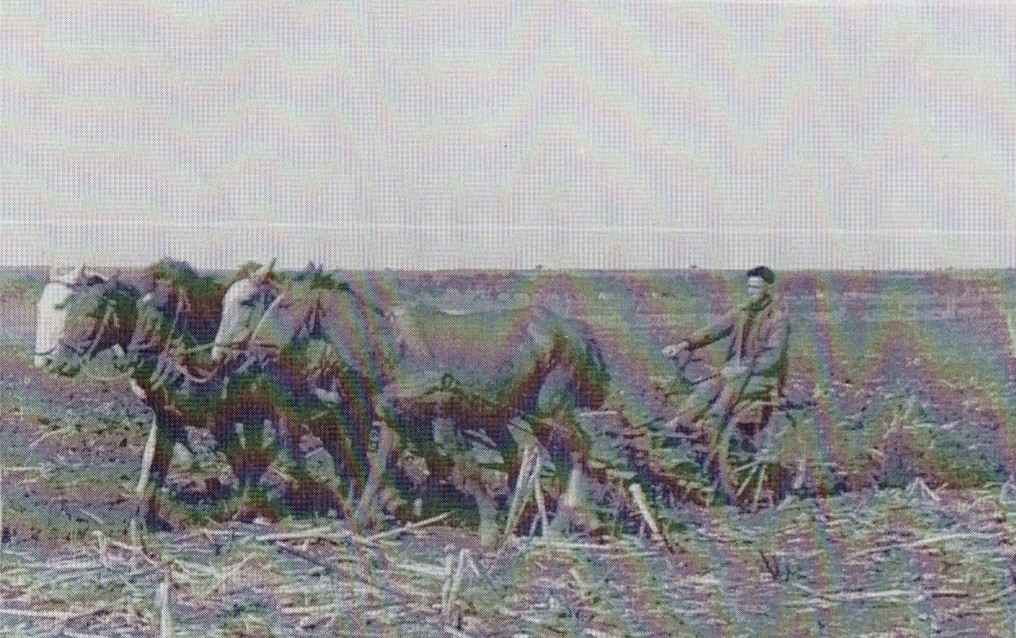
Colonists plowing the land
Courtesy of Carmen Rosenblatt

A colonist’s yard
Courtesy of Carmen Rosenblatt

Children coming to school
Courtesy of Carmen Rosenblatt

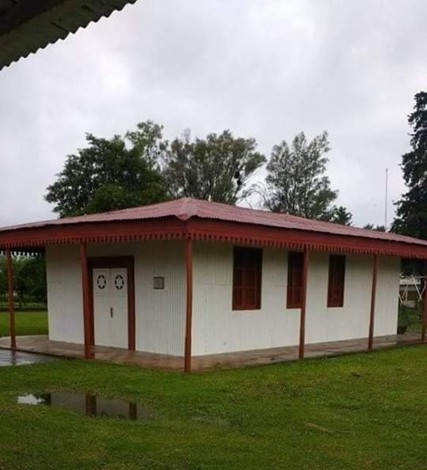
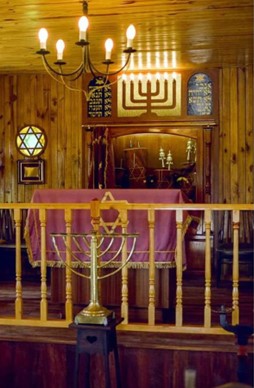
The community grew as more and more refugees came from Germany; eventually there were about 120 families. The settlers engaged in many forms of agricultural work: dairy, livestock, farming, gardening, and beekeeping. They established a cooperative to market their products. A school was established by the JCA, and there was a post office, a synagogue, a kosher butcher, and a Hebrew teacher. There was even a small hospital to provide health care to the settlers and a social center for dances, theaters, and orchestral performances. Land was also set aside for a cemetery.

The synagogue in Colonia Avigdor
Courtesy of Carmen Rosenblatt

Interior of the synagogue
Courtesy of Carmen Rosenblatt

But conditions remained fairly primitive for a long time. It wasn’t until 1971 that there was electricity in the colony, and there were only dirt roads until 1987. Despite all these challenges, Felix and Minna and their children remained at Colonia Avigdor, working hard to achieve their dreams.

Their younger son Ludwig Rosenblatt married Ruth Plaut, another refugee from Germany, in 1944. They had two children, Carmen and her sister Alicia. Ludwig’s older brother Siegfried and his wife Jenny also had two daughters, Miriam and Lenore.

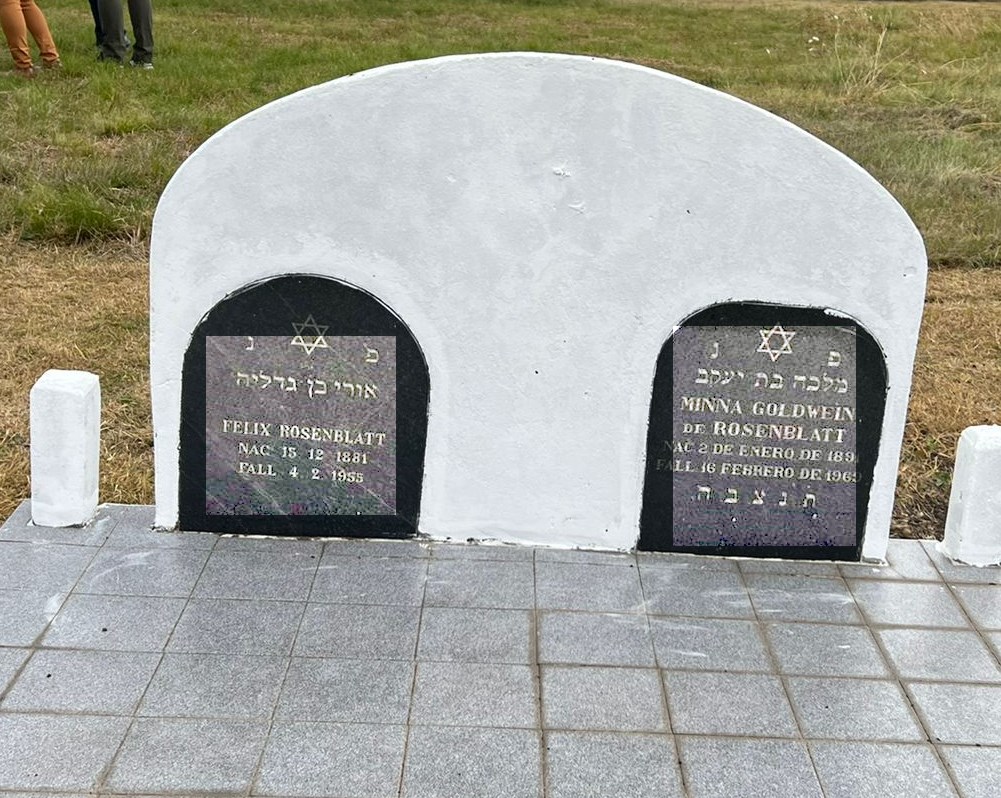
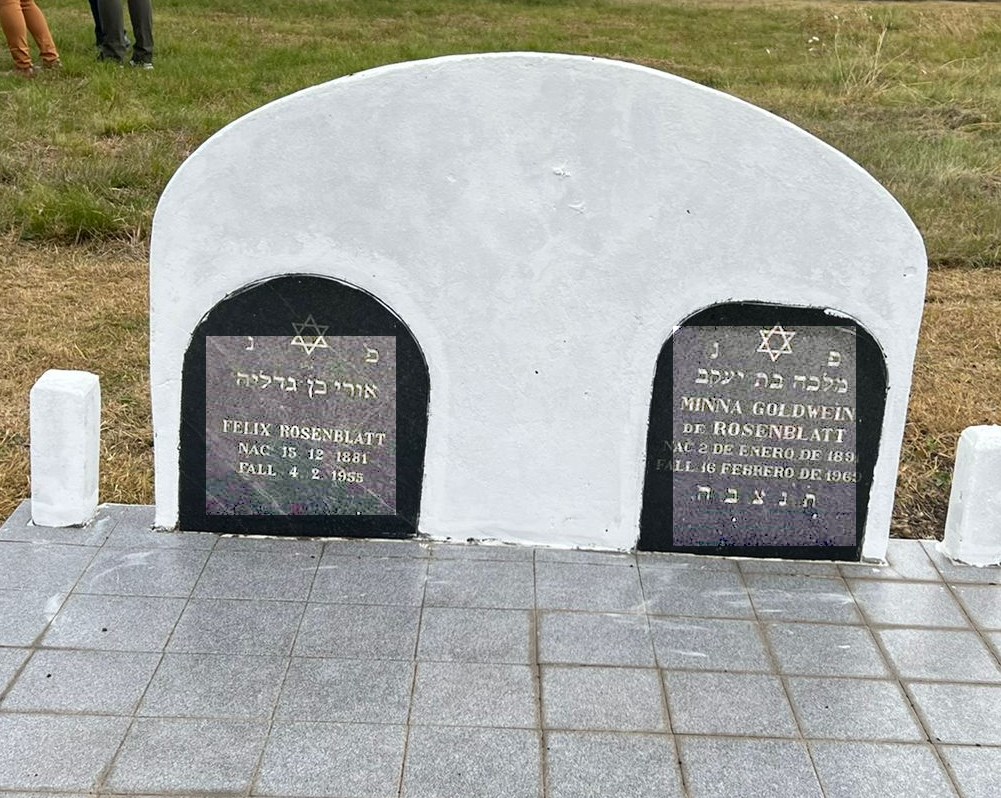
Felix Rosenblatt died on February 4, 1955, and is buried at the Centro Unión Israelita de Colonia Avigdor cemetery in Colonia Avigdor, Argentina, as is his wife Minna Goldwein Rosenblatt, who died on February 16, 1969. Here is a photograph of their gravestones.

Felix and Minna Rosenblatt headstones from JOWBR database, found at https://data.jewishgen.org/imagedata/jowbr/ARG-06046/WA0125.JPG

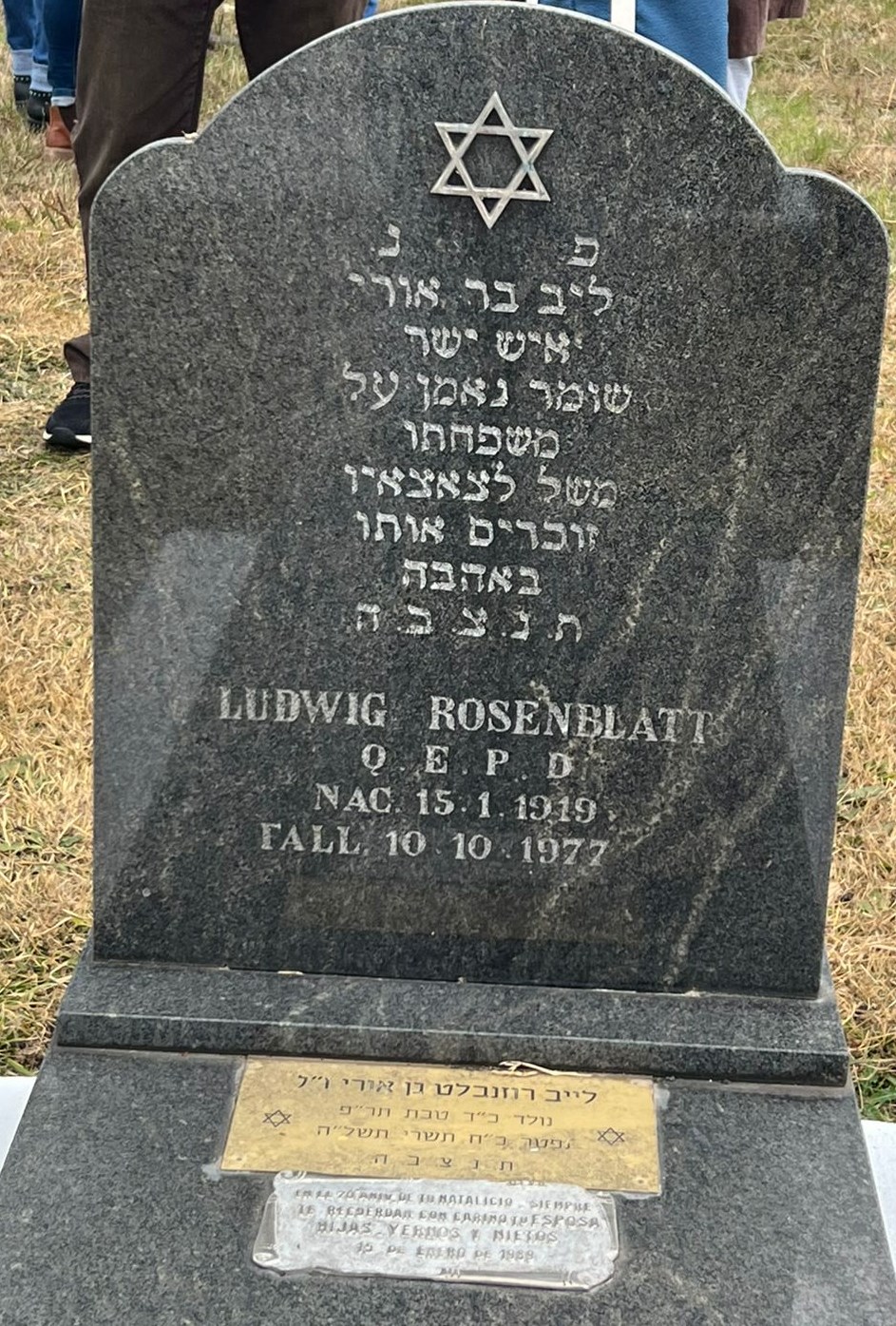
Their son and Carmen’s father Ludwig Rosenblatt died on October 10, 1977, and is buried at the same cemetery as his parents. He was only 57 when he died. As translated by the kind people at Tracing the Tribe, the Hebrew reads: “Here [lies] buried / Leib son of Uri / a reputable man / a faithful protector of / his family / an example for his descendants / [we] remember him with love / may his soul be bound in the bond of [eternal] life.”  The footstone engraving in Spanish mentions his wife, children, and grandchildren; it was placed there on the occasion of what would have been his 70th birthday on November 15, 1989.

Ludwig Rosenblatt headstone at JOWBR database, found at https://data.jewishgen.org/imagedata/jowbr/ARG-06046/WA0143.JPG

As for Siegfried Rosenblatt, Felix’s other son, he died on October 23, 2004, and is buried at Cementerio Israelita De San Vicente Cordoba, in Cordoba, Argentina; he was predeceased by his wife Jenny Feilmann who died on May 23, 1978, and is buried in the same cemetery.3 Their daughter Lenore, who was born on November 2, 1940, died on April 27, 2001.4

Carmen still lives in Colonia Avigdor with her husband Abraham Isaac Kogan, whom she married almost 58 years ago. They had two sons, one of whom passed away; the other still lives in Argentina, but not in Colonia Avigdor. Today there are only about twelve Jewish families left in Colonia Avigdor because many people left long ago to live in the cities. Carmen wrote, “These days, basic services such as electricity, water, roads, television, communications, etc. are practically comparable to those in cities… the precariousness has been overcome… but let’s not forget that since the founding of Avigdor in 1936, 82 years have passed… and the vast majority have left…”

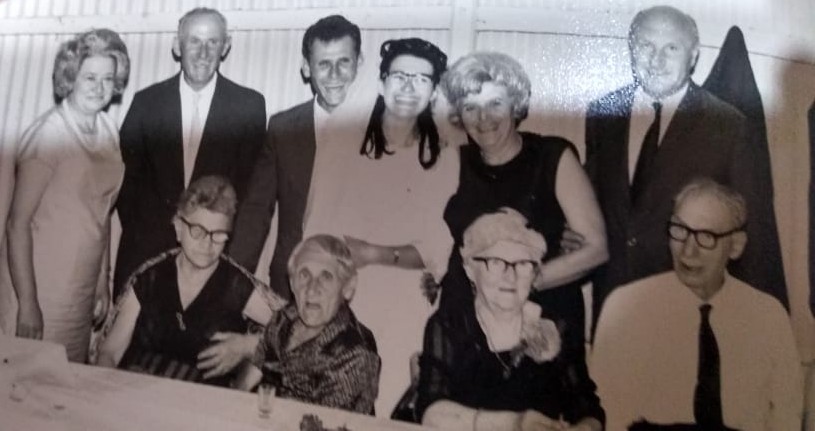
Carmen generously shared with me some photographs of her extended family. This photograph was taken at her wedding in 1967.

Photograph taken at Carmen Rosenblatt’s wedding to Abraham Kogan in 1967, courtesy of Carmen Rosenblatt. Standing from left to right: Ruth Plaut, Carmen’s mother; Ludwig Rosenblatt, Carmen’s father; Abraham Isaac Kogan; Carmen Alexander; Jenny Feilmann, wife of Siegfred Rosenblatt; Siegfried Rosenblatt, Carmen’s uncle Seated: Family friend,\; Minna Goldwein, Carmen’s grandmother; Else Schwab, wife of Sigmund Rosenblatt; Sigmund Rosenblatt, Carmen’s great-uncle.

This more recent photograph was taken in 1981 on the occasion of Carmen’s son’s bar mitzvah. I think it illustrates how Jewish traditions are similar all over the world. This photograph could have been taken at any bar mitzvah in the US in 1981, and it would have looked very much the same.

Abraham Kogan, Andres Kogan, Carmen Rosenblatt, Marcelo Kogan, 1981. Courtesy of Carmen Rosenblatt

Carmen’s story has given me a new perspective on the lives of those who escaped from Nazi Germany. It’s hard to imagine how they adapted to such a hard life—a precarious one, to use Carmen’s word. They were coming from a place where their ancestors had lived for centuries to a primitive place, far from any city, where people spoke a language they didn’t know, and they had to live according to the rules and subject to the authority of the JCA—and yet they were filled with hope and grateful for the chance to survive and live freely.

All this reminds me to be grateful for what I have and to empathize with all those around the world who are forced to abandon their homes in search of a safer and better life.


  1. Although they came from different villages in Germany and ended up in different countries in South America, the Rosenblatts in Uruguay and the Rosenblatts in Argentina have stayed in touch and even visited each other over the years. Julie Rosenblatt was a first cousin to Felix and Siegmund as well as their sister-in-law. 
  2. Carmen Rosenblatt, unpublished lecture, “Immigracion de Judio Perseguidos en Alemania, Colonizados en Los Campos de Colonio Avigdor (Entre Rios),” (September 2018). 
  3. See burial records at the JOWBR database at JewishGen, found at https://www.jewishgen.org/databases/cemetery/jowbr.php?rec=J_ARGENTIN_0036804 and at https://www.jewishgen.org/databases/cemetery/jowbr.php?rec=J_ARGENTIN_0036805 
  4. See burial records at the JOWBR database at JewishGen, found at https://www.jewishgen.org/databases/cemetery/jowbr.php?rec=J_ARGENTIN_0071081 

Zooming with My Cousin Julio Rosenblatt in Uruguay

Since it’s been a while since I wrote about the Blumenfeld clan, let me recap where I was. I was writing about the family of Malchen Rothschild, the ninth child of Gelle Blumenfeld and Simon Rothschild. Malchen and her husband Daniel Rosenblatt had seven children, one of whom died as a child (Betti) and one, Julius, who died in 1920 as a thirty-six year old newlywed whose wife Julie Rosenblatt had just recently given birth to their son, Manfred or Friedel/Fredi (hereinafter “Fredi.”)

Thus, when Hitler came to power in 1933, there were five living children of Malchen and Daniel: their daughters Julchen, Jette, and Auguste, and their sons Felix and Siegmund. Also living was their daughter-in-law Julie and their grandson Manfred/Fredi.

But as we saw, the three daughters were all killed by the Nazis as were some of their family members. Fortunately their two sons and their daughter-in-law Julie survived as did two of the children of Auguste. And that is where we will now pick up.

As I wrote in my last post about this family, I was able to find a descendant of Julius and Julie Rosenblatt, their grandson Julio, named for his grandfather Julius. I finally had a chance to zoom with Julio on September 10, and he was able to fill me on on the story of the surviving branches of Malchen and Daniel’s family.1

As noted above, Julio’s father Fredi was born just three months before his father Julius Rosenblatt died in December 1920. I asked Julio how his grandmother Julie Rosenblatt (wife and first cousin of Julius) coped with raising a baby without her husband. Julio told me that after Julius died, his grandmother moved from Zimmersrode where they’d been living back to Beisefoerth where her father and two of her brothers were still living. Julie and Fredi lived with them and, as Julio said, she not only raised her son but also took care of her father and brothers.

Here is a photograph taken in about 1931 of Fredi and some of his cousins in Beisefoerth. Fredi is the boy in the front, “driving” the motorcycle. The motorcycle belonged to his uncle Ferdinand Rosenblatt, his mother’s brother.

Lothar Rosenblatt, Claire Rosenblatt, Doris Rosenblatt and Fredi Rosenblatt on the motorcycle of Ferdinand Rosenblatt at Beiseförth in about 1931, 1932. Courtesy of Julio Rosenblatt

Once Hitler came to power, the family experienced antisemitism. When Fredi was fourteen or fifteen years old, boys threw rocks and apples at him. After Kristallnacht, Julie knew it was time to leave Germany.

This is a photograph of Fredi taken in Beisefoerth in 1938 the day before he left Germany.

Fredi Rosenblatt c. 1938 Courtesy of Julio Rosenblatt

Julio explained how his grandmother Julie and father Fredi ended up in Uruguay. Julie’s brother Ferdinand Rosenblatt had a sister-in-law, his wife Flori’s sister, who owned a well-known cafe in Frankfurt called Cafe Falk. The Uruguay Consul General Florencio Rivas was a regular customer at the cafe, and after the Nuremberg Laws were enacted, he offered to help the family get visas to immigrate to Uruguay.

Florencio Rivas not only helped the Rosenblatt family; he helped hundreds of German Jews survive the Holocaust. As The New York Times reported:2

While serving as consul general in Germany, Rivas harbored more than 150 Jews on embassy grounds during Kristallnacht in 1938, when Nazi-inspired mobs attacked synagogues and Jews. He then issued them all passports and visas ensuring passage to Uruguay.

Ferdinand Rosenblatt and his wife and son were the first Rosenblatts to leave Germany and go to Uruguay. Fredi left in 1938, and after Kristallnacht in November 1938, Julio’s grandmother Julie Rosenblatt joined them in Montevideo, Uruguay.

This photograph is of Ferdinand Rosenblatt and his wife Flori Goldschmidt. In the middle is their niece, Martha Rosenblatt.

Ferdinand Rosenblatt, Martha Rosenblatt, and Flory Goldschmidt. Courtesy of Julio Rosenblatt

I asked Julio about the family’s transition from Germany to Uruguay, and he told me that Uruguay has always been a very open and accepting country to immigrants. As The New York Times commented:3

Unlike Argentina and many other Latin American countries, Uruguay has been a liberal, secular democracy for much of its history. It became a republic in 1830 and has remained one, with the exception of right-wing dictatorships in the periods of 1932-38 and 1973-85. It separated church and state in 1917. And by 1890, it had enacted a ”policy of the open door,” encouraging immigration by issuing visas free of charge and even providing a hostel for new arrivals.

Julio said that his grandmother quickly found work as a maid in Montevideo and that his father Fredi worked making tapestries to cover furniture. They were welcomed and did not encounter any antisemitism. Julio clearly loves his country and feels deeply grateful that Uruguay took in his grandmother, father, and other relatives and gave them a place to be safe and to prosper.

Fredi Rosenblatt married Erika Katz in 1949 in Uruguay. Here they are on their wedding day:

Erika Katz and Friedel Rosenblatt on their wedding day in 1949. Courtesy of Julio Rosenblatt

Erika Katz and Fredi Rosenblatt on their wedding day in 1949. Courtesy of Julio Rosenblatt

wedding of Fredi Rosenblatt and Erika Katz 1949. Courtesy of Julio Rosenblatt

Julio was the only child of Fredi Rosenblatt and Erika Katz. Here is a photo of him with his parents, taken in 1954.

Fredi Rosenblatt, top; Julio Rosenblatt and Erika Katz, bottom. Courtesy of Julio Rosenblatt

Julio is married to Ana Bogacz, and they have two children. This photograph is of Ana with her daughter Beatriz and Julio’s grandmother, Julie Rosenblatt Rosenblatt.

Ana Bogacz, Beatriz Rosenblatt, and Julie Rosenblatt Rosenblatt, in 1976. Courtesy of Julio Rosenblatt

Julio and Ana have two children. One lives in Uruguay and and the other in England. They also have three grandchildren, one in Uruguay and two in England. So Julius Rosenblatt, who died when his son Fredi was just a baby, and his wife, Julie Rosenblatt, have living great-grandchildren living across the world because Julie Rosenblatt Rosenblatt was smart enough and strong enough and lucky enough to leave Germany when she did.

Thank you to my cousin Julio for sharing his stories and these amazing photographs of his family. I am so glad we connected!


  1. The information about Julie Rosenblatt and her family in this post almost all came from her grandson Julio Rosenblatt during a Zoom on September 10, 2025. 
  2. Samuel Freedman, “A Treasure Hunt for Lost Memories,” The New York Times, August 16, 2003, p. A 15. 
  3. Ibid. 

Clara Rothschild Katz and Her Family, Part II: Life in America

After Moritz Katz and his fifteen year old son Otto arrived in New York in August, 1937, they shared a furnished room in the Bronx that they rented from some cousins of Moritz. Moritz started working in a meat processing plant, and Otto, who was fifteen, went to school during the day and worked at a grocery store after school. In an interview with his daughter Judy in 2000, Otto told her that he didn’t know any English, and the teacher, who would occasionally speak to him in German, was not a good teacher and didn’t care if the students learned or understood the material.1

Otto quit school after that year and got a full-time job working as a delivery boy at Kenneth Miller Company; he then began doing tracing and sketching designs for the company and was promoted. Otto stayed with that company for his entire career, leaving only during his time in the army during World War II but returning to the company (later called Custom Bed Covers) after he was discharged. He eventually made enough money to buy the company and worked there until 1990 when he retired!

When Clara arrived in New York in late April 1938, with Hal and Ilse (who were thirteen and almost ten, respectively), Moritz rented an apartment for the family in Washington Heights, the neighborhood in Manhattan where many German Jews settled after escaping Nazi Germany. The apartment was quite large, but Ilse shared a room with her parents and Otto and Hal shared another room so that the other rooms could be rented to boarders to generate more income to support the family.

Otto remembered that it was still Passover when his mother and siblings arrived on April 21, 1938 (it was the eighth day, the last day, of the holiday). He also remembered that when the family signed up with Con Edison, the electric company in New York City, they were offered three appliances for twenty-five dollars. They selected a toaster, a radio, a floor lamp, and an iron, and paid off the purchases by paying two dollars a month for a year. Otto seemed particularly excited about the radio since they had not had one in Germany and commented on the “five buttons—one for each station” in his interview with his daughter Judy in 2013.

In that same interview, Otto also recalled that the man who delivered and unloaded the crate that Clara had packed and shipped from Germany broke the legs off her sewing machine when he unloaded it, causing Clara to cry. I wonder whether some of Clara’s sadness was not only about the broken sewing machine, but also about leaving her sisters and her mother Fanny behind in Europe and about her worries about what her life in America would be like.

Hal and Ilse started school in New York and much to Hal’s chagrin, they were placed in first grade because they didn’t know English. Hal was fourteen and humiliated to be in a class with six-year-olds. But soon he was able to move up to a class with his peers.

Here is the family on the 1940 US census, living at 535 West 163rd Street in Washington Heights. Moritz is listed as a butcher in a butcher shop and Otto as a cutter in a factory. They were paying $45 a month in rent, and there were two lodgers living in their apartment.

Moritz Katz and family, 1940 census, Year: 1940; Census Place: New York, New York, New York; Roll: m-t0627-02677; Page: 15A; Enumeration District: 31-2144, Ancestry.com. 1940 United States Federal Census

Moritz worked in the meat packing plant until he was able to buy a small retail shop that sold sweets. He and Clara then worked in their sweet shop, which was called “C & M” for Clara and Moritz.

The United States declared war against Japan, Germany, and Italy in December 1941, joining the Allied powers in World War II. Otto registered for the draft on February 15, 1942. Here is his draft registration:

Otto Katz, World War II draft registration, National Archives at St. Louis; St. Louis, Missouri; Wwii Draft Registration Cards For New York City, 10/16/1940 – 03/31/1947; Record Group: Records of the Selective Service System, 147, Ancestry.com. U.S., World War II Draft Cards Young Men, 1940-1947

Here is Hal’s draft registration dated December 19, 1942; he was eighteen and still using the name Helmut at that time, but had already adopted Harold as his Americanized name. He was a student at the Manhattan High School of Aviation Trades.

Helmut Harold Katz, World War II draft registration, National Archives at St. Louis; St. Louis, Missouri; Wwii Draft Registration Cards For New York City, 10/16/1940 – 03/31/1947; Record Group: Records of the Selective Service System, 147, Ancestry.com. U.S., World War II Draft Cards Young Men, 1940-1947

The two brothers both served overseas in Europe during the war. My next post will describe their time in the service, as told to Judy in three separate interviews, one with Otto in 2001 and another in 2016 and one with Hal in 2019.


  1. The stories and information in this post came from a combination of my Zoom calls with the Katz/Rothschild cousins in May and June 2025 and from interviews Judy Katz did with her father Otto and her uncle Hal over the years. Also, see Part I here

Clara Rothschild Katz, Part I: Living in and Escaping from Germany

Doing family history research is a labor of love. I have said that many times over the almost fifteen years that I’ve been engaged in this work. Being able to honor the memories of those I never knew but who are somehow related to me is a joy and a privilege. Connecting with and getting to know so many living “long-lost” cousins has given me great joy.

Researching the family of Clara Rothschild and Moritz Katz has led me to a really special opportunity for such joy—-the opportunity to talk to their son Hal Katz, my one-hundred-year-old fourth cousin, once removed. Imagine having lived through an entire century and seeing all the horrors and all the miracles since 1924—the Holocaust, World War II, the creation of the state of Israel, the Cold War, the social activism and unrest of the 1960s and the 1970s, the Vietnam War, all the civil rights movements, the election of the first African-American president, the COVID pandemic, and the introduction of so many scientific inventions good and bad—-the atomic bomb, television, cell phones, the internet, and now AI. It’s mind-boggling how much the world has changed in the last hundred years.

Hal Katz has lived through it all, starting as a small boy in Germany, living in a small town, escaping from Germany in 1938 shortly after his bar mitzvah, settling in New York City as a young teenager, fighting for the US in World War II, building a lifelong career with General Electric, marrying and having children, and now still living on his own, playing bridge, and talking to me on Zoom as if it were the most natural thing in the world. Over the course of three Zoom calls, I have been blessed to talk to Hal as well as his daughter, his nieces, his nephew, and another Rothschild cousin, all of whom are my cousins.

And so now as I turn to the story of the sixth of Gerson and Fanny’s children who lived to adulthood, their daughter Clara Rothschild, I feel so fortunate that I was able to hear her story and the stories of her family from her son Helmut Harold “Hal” Katz. Unless otherwise indicated, the information in this post came from Zoom calls or emails with Hal and members of the family or from interviews with Hal or Hal’s brother Otto done by Otto’s daughter Judy, Hal’s niece.1

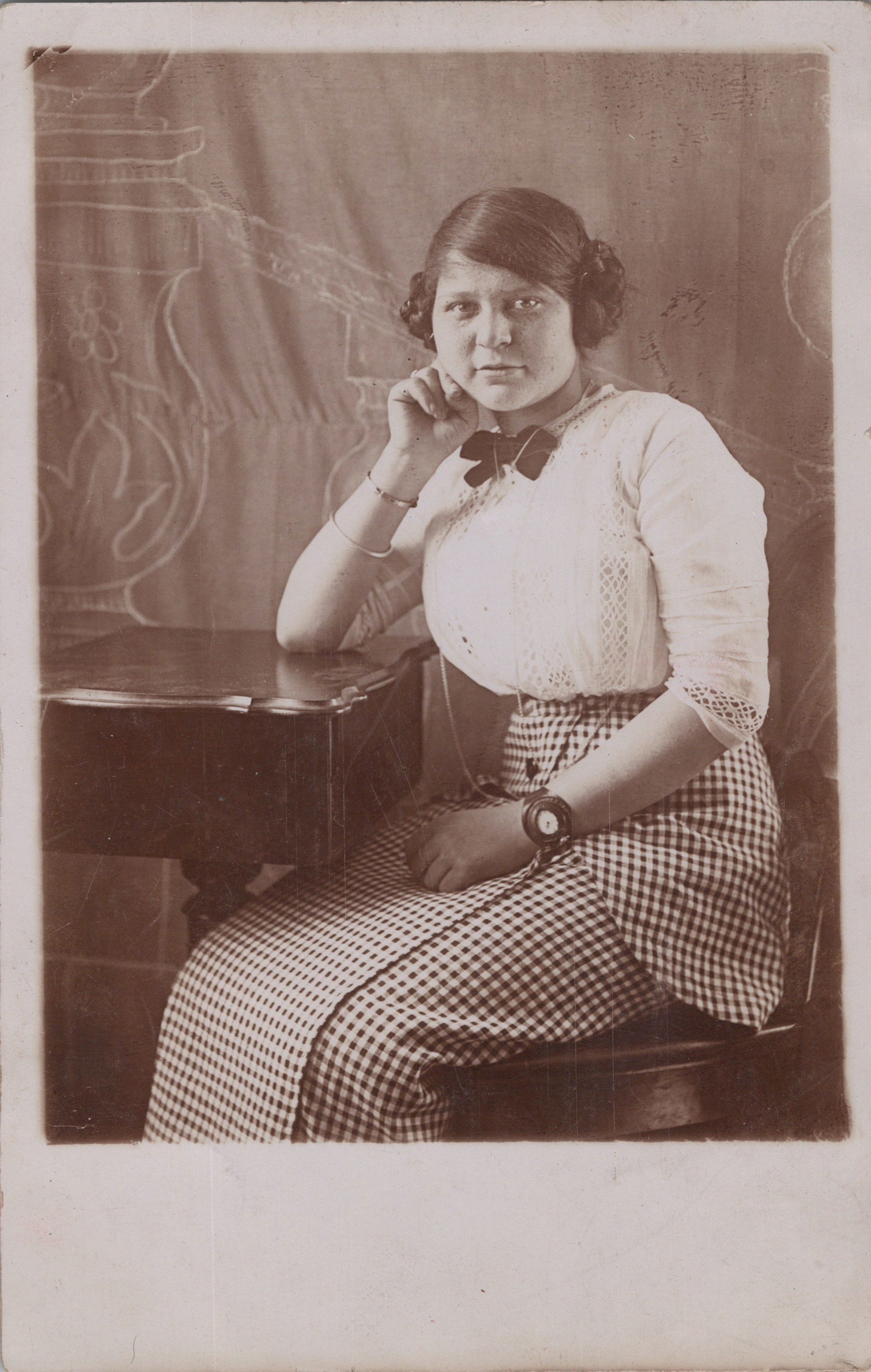
As we saw, Clara Rothschild was born on July 15, 1891, in Waltersbrueck, Germany.  According to Hal, this photograph of Clara was probably taken when she was nineteen and working as an apprentice bookkeeper in a dry goods store.

Clara Rothschild c. 1910
Courtesy of the family

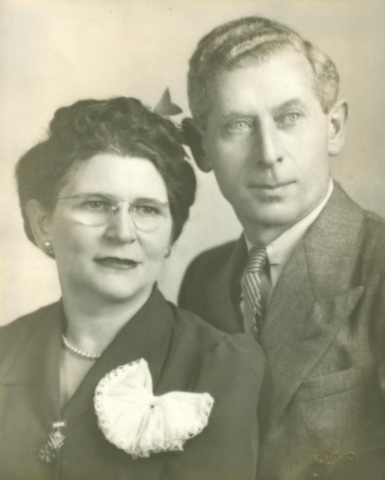
On November 1, 1921, she married Moritz Katz, who was born in Neuenhain, Germany, on November 4, 1894. Here is a photograph of Moritz taken in 1912 when he was eighteen, a photograph of Clara in the 1920s, and an undated one of Clara and Moritz taken years later.

Moritz Katz in 1912. Courtesy of the family.

Clara Rothschild in the 1920s. Courtesy of the family.

Clara Rothschild and Moritz Katz undated
Courtesy of the family

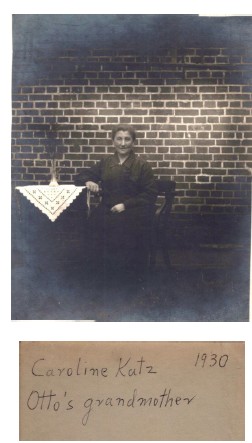
Clara and Moritz had three children, Otto, born in 1922, Helmut (Hal) born in 1924, and Ilse, born in 1928. Hal told me that until he was six years old, he and his family lived with his paternal grandmother, Caroline Rosenblatt Katz, in Neuenhain. His paternal grandfather Jacob Katz had died many years before in 1899. Neuenhain was a very small village, about two hundred people. Hal’s parents and grandmother ran a grocery business out of their home selling produce grown on their farm. This is a photograph of Hal’s paternal grandmother Caroline in 1930 in Neuenhain.

Caroline Katz 1930. Courtesy of the family

Hal said that they were the only Jewish family in the village, and he never understood how his father had become so knowledgeable about Judaism and Hebrew since there was no Hebrew school in Neuenhain. The closest synagogue was within walking distance, but it was a challenge finding the ten men to make a minyan. His father was able to lead services and even acted as the kosher butcher on the side.

Here is a beautiful photograph of Hal with his older brother Otto taken when they lived in Neuenhain. Hal looks no more than two years old, so this photograph was probably taken in about 1925-1926.

Otto and Helmut Katz, c. 1925-1926. Courtesy of the family

I asked Hal what he remembered about his maternal grandfather Gerson Rothschild, and he told me that he was in the coal business. He also said that the first funeral he ever went to was Gerson’s funeral in 1930 when Hal would have been six years old.

When Hal was six, the family moved to a larger town, Borken, which was about six miles from Neuenhain and had a population of about two thousand people and more of a Jewish community than Neuenhain. There his father Moritz had a business selling the raw materials needed to make clothing. Hal compared it to being a peddler. From the way Hal spoke, it sounds like those early years of his life were happy and secure. He had many cousins from his Rothschild side—-all the children of his mother’s siblings—who were living in other towns in the Hessen region. He also had many relatives from his Katz side.

This is a photograph of the three Katz siblings taken in Borken in 1934. It was probably Ilse’s first day of school since she is holding a cone filled with candy traditionally given to children in Germany on their first day of school.

Otto, Ilse, and Hal Katz 1934 in Borken. Courtesy of the family

Of course, everything changed after Hitler came to power. In an interview Judy did with her father Otto, he reported that once the Nazis came to power, the children had to change schools as they were no longer allowed to go to school with Christians, so they went to a Jewish school. In addition, the family was forced to sell their land and their business and lived on the money from those sales until that money ran out.

In 1937 when he was fifteen, Otto left school and was doing an apprenticeship in a retail clothing store in Wolfhagen, a town about 40 miles north of Borken. Apparently this was a common practice—-to send a teenage boy to live with another Jewish family and learn a trade. In an interview with his daughter Judy,  Otto said that the store had so little business that he spent his days gardening. One day Otto was riding his bike in Wolfhagen and a group of Hitler Youths tried to take his bike from him; Otto hit them with the bike pump and escaped. When Otto told the man with whom he was apprenticing what had happened, that man contacted Moritz.

Moritz went to Wolfhagen and took Otto to Kassel to stay with relatives for six months. Fortunately, Moritz had had the foresight to see what was happening with the Nazis, and this gave him the extra incentive to work on getting them out of the country. He was able to get the necessary papers to leave Germany with the help of the Hebrew Immigration Aid Society and a sponsor named Albert Decker. First, Moritz left with Otto and went to Hamburg where the two of them were able to board a ship and travel to America. Leaving Clara, Hal, and Ilse behind was very difficult because none of them knew when they would see each other again.

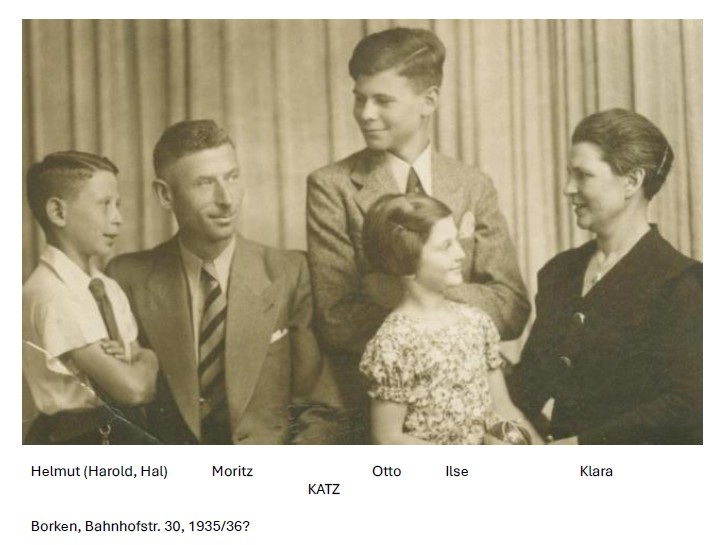
Hal believes this family photograph was taken not too long before Moritz and Otto left Borken for the US.

Katz family in Borken, maybe 1936. Courtesy of the family

Moritz and Otto arrived in New York on August 27, 1937.2

Fortunately, Clara was able to leave with Hal and Ilse eight months later, just a few months after Hal celebrated his bar mitzvah in Borken without his father or brother. In an interview Judy did with Hal in 2023, Hal told her that Clara and the children were living with a family from Borken, the Blums, until April 8,1938 when they left to go to the US. First, they took a train to Antwerp, where they stayed with the Tiefenbrunners at the orphanage they were running. (See earlier blog post here.) Then they boarded a freighter, a slower moving form of transport that was crowded with mostly Jewish people escaping Hitler. This photograph was taken before they boarded the ship to leave Germany on April 11, 1938.

Clara, Ilse, and Hal (on the right side of the photo) on the day they left Germany for the US in 1938. Courtesy of the family

They arrived in New York after an uncomfortable eleven day journey on April 21, 1938.3

Thanks to Moritz’s foresight, he and Clara and their children were now safely out of Germany, and they were the first ones in the extended Rothschild family to get out—-before Siegmund and before Max, Clara’s brothers.

And as we have already seen, most of the rest of the family did not escape in time. Hal said that his parents did all they could to get other family members out, but unfortunately as we have seen and as we will see, those efforts did not succeed. Hal said that they eventually lost contact with those still in Germany. When I asked why those who remained—-e.g., Clara’s sisters Katchen, Auguste, Jenny, Rosa and Amalie—-hadn’t also tried to get out of Europe when Moritz and Clara did, Hal said he thought they all just believed it would all blow over and that they would be safe.

But Clara, Moritz, Otto, Hal, and Ilse were now in New York, starting over in a new country.

More on that to come in my next post.


  1. Zoom calls with Hal Katz and family, May and June 2025. Interviews with Hal and Otto over the years by Judy Katz. 
  2. Moritz Katz, ship manifest, Departure Port Hamburg, Germany, Arrival Date 27 Aug 1937, Arrival Port New York, New York, USA, Ship Name Hansa  The National Archives in Washington, DC; Washington, DC, USA; Passenger and Crew Lists of Vessels Arriving at New York, New York, 1897-1957; Microfilm Serial or NAID: T715; RG Title: Records of the Immigration and Naturalization Service, 1787-2004; RG: 85, Ancestry.com. New York, U.S., Arriving Passenger and Crew Lists (including Castle Garden and Ellis Island), 1820-1957 
  3. Clara Katz ship manifest, Place of Origin Germany, Departure Port Antwerp, Belgium, Arrival Date 21 Apr 1938, Arrival Port New York, New York, USA
    Ship Name Gerolstein, The National Archives in Washington, DC; Washington, DC, USA; Passenger and Crew Lists of Vessels Arriving at New York, New York, 1897-1957; Microfilm Serial or NAID: T715; RG Title: Records of the Immigration and Naturalization Service, 1787-2004; RG: 85, Ancestry.com. New York, U.S., Arriving Passenger and Crew Lists (including Castle Garden and Ellis Island), 1820-1957 

Max Rothschild: Escape to Argentina

Fortunately, the story of the third child of Gerson Rothschild and Fanny Kugelmann, their son Max, does not end as tragically as that of his sister Katchen. Max was born in 1886, and, as we saw, he married Johanna Katz on October 19, 1919, in Zimmersrode, Germany. They had three sons, Erich, Fritz, and Richard. According to his marriage record, Max was a merchant in Zimmersrode.

Max Rothschild and Johanna Katz marriage record, Hessisches Hauptstaatsarchiv; Wiesbaden, Deutschland; Bestand: 920; Laufende Nummer: 9581, Ancestry.com. Hesse, Germany, Marriages, 1849-1930

Max and his family were among those who were able to leave Germany in time and thus survived the Holocaust. Thank you to Donna Levinsohn from the GerSIG Facebook group for finding them on a list of immigrants to Argentina at the CEMLA website. From that website I learned that Max listed his occupation as “agricola” and his sons listed theirs as “practicante agricola,” or in the practice of agriculture. Their date of arrival in Buenos Aires was May 25, 1939, on the ship Cap. Norte. Missing from this list is the third son of Max and Johanna, Fritz. According to Hal Katz. Max’s nephew and first cousin to his sons, Fritz immigrated with his parents and brothers, so I cannot account for the fact that he is missing from this passenger ship manifest index.1

Ship manifest facts for Max Rothschild and family from CEMLA website at https://cemla.com/buscador/

Although the family escaped the tragedy of being murdered by the Nazis, their life was not without tragedy. Just one month after arriving, Erich Rothschild died, perhaps from cholera, according to one tree on Ancestry. He was only eighteen years old. How devastating it must have been for the family to escape safely from Germany only to lose Erich so soon after leaving.

Andra Marx from the GerSIG Facebook group located Erich’s burial record on JewishGen; he was buried in the Jewish section of the cemetery in Moisesville, Argentina.

Erich Rothschild death and burial info from JewishGen, found at https://www.jewishgen.org/databases/cemetery/jowbr.php?rec=J_ARGENTIN_0260737

When I saw the name of the town—-Moisesville—-on that burial record in JewishGen, my immediate reaction was “Moses town,” that is, that it had to be a Jewish settlement in Argentina, and in fact that’s what it was. Interestingly, it was not founded by Jewish refugees from Nazi Germany, but many years before as a refuge for Russian Jews escaping persecution. According to Wikipedia, “Moises Ville was founded by a group of Russian Jewish immigrants who arrived in August 1889 aboard the SS Weser from Kamenetz-Podolsk, Ukraine.” But during the 1930s and 1940s, some German Jewish refugees like my Rothschild cousins were welcomed into that community. At one time there were four synagogues in Moisesville; today there are only 119 Jewish families there.

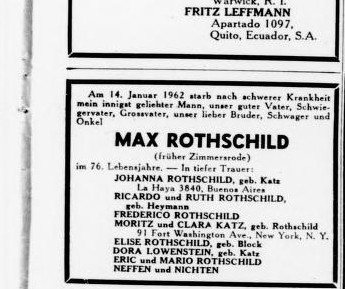
I do not know more about what life was like for Max, Johanna, Fritz (who became Frederico in Argentina), and Richard (who became Ricardo) in Argentina. Andra Marx located a notice in the Aufbau newspaper that announced that Max Rothschild died on January 14, 1962, at the age of 75 after a serious illness. He was mourned by his wife Johanna, who was living in Buenos Aires, his sons Frederico and Ricardo and Ricardo’s wife Ruth Heymann Rothschild, and other family members.

Death notice for Max Rothschild in The Aufbau, January 19, 1962, p. 29, found at https://archive.org/details/aufbau291962germ/page/n46/mode/1up?view=theater

Max is buried in Buenos Aires. His wife Johanna (Juana) survived him by 21 years; she died on December 27, 1983, and is buried next to Max in Buenos Aires. She was 91 years old.

Max Rothschild burial record from JewishGen, found at https://www.jewishgen.org/databases/cemetery/jowbr.php?rec=J_ARGENTIN_0226824

Johanna Katz Rothschild burial record at Jewish Gen, found at https://www.jewishgen.org/databases/cemetery/jowbr.php?rec=J_ARGENTIN_0226822

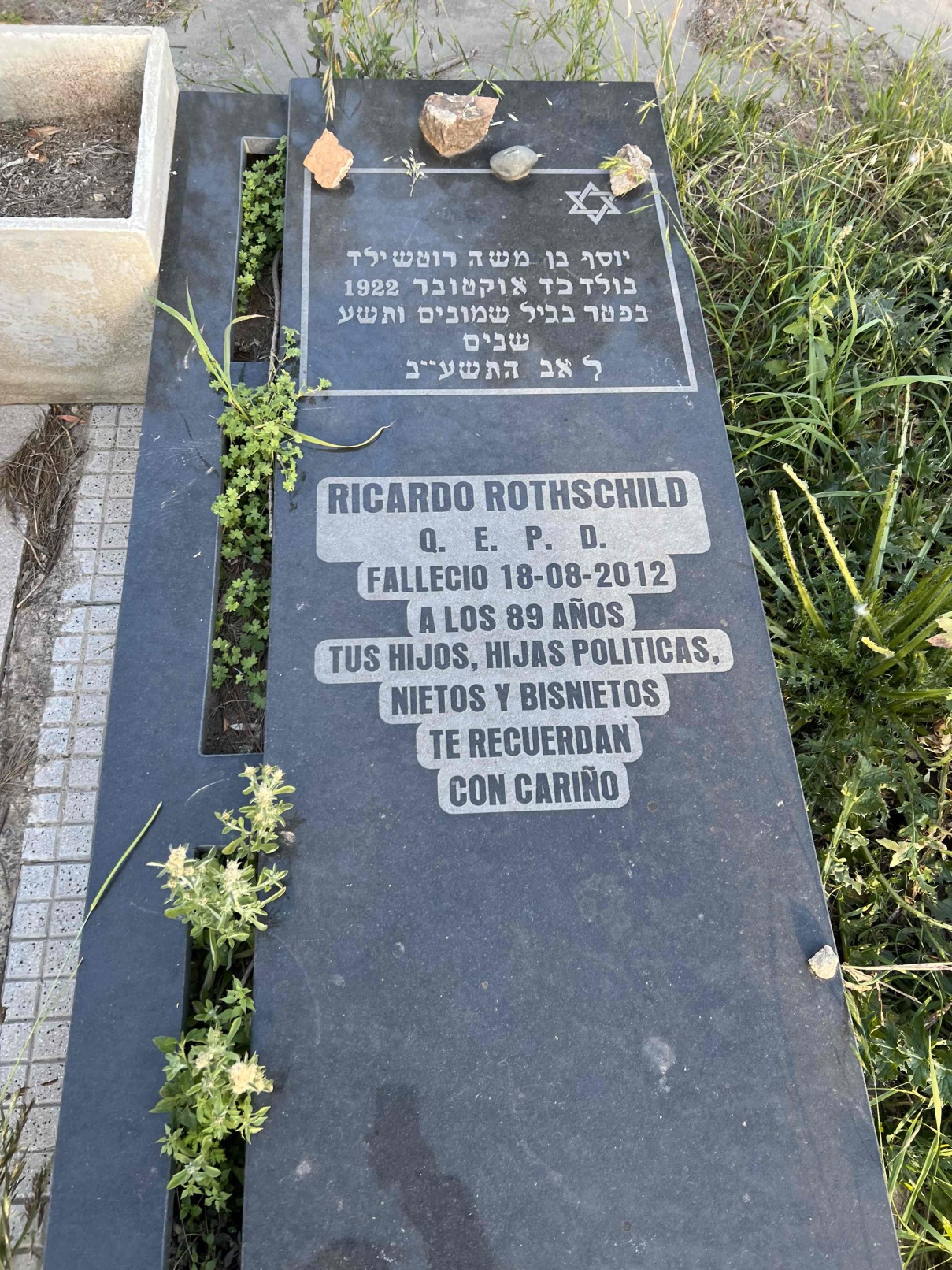
Their son Richard or Ricardo Rothschild died on August 18, 2012, at the age of 89. He is buried in the Jewish cemetery in Palacios Luis, Argentina, where his wife Ruth, who died on April 28, 1995, is also buried.

The inscriptions on both headstones read, “tu esposo/a hijos hijas  politicas y nietos te recuerdan con carino,” or “Your husband/wife, sons, daughters-in-law and grandchildren remember you fondly.” Ricardo and Ruth thus had at least two sons and grandchildren who survived them. I assume the sons are Eric (presumably named for his deceased uncle) and Mario Rothschild, who were named as mourners in the death notice for Max Rothschild.

Judy Katz, Hal Katz’s niece, informed me that Fritz also married and had children and grandchildren. They lived in Argentina and Germany. Fritz died in Germany just a few years ago.2  There are thus living descendants for Max and Johanna and their family.

Thank you again to Donna Levinsohn and to Andra Marx from the GerSIG Facebook group for their help in locating information about the Rothschilds in Argentina. And special thanks to my cousins Hal, Sandy, and Judy for sharing their memories of Max and his family.


  1. Zoom with Hal Katz and family on May 8, 2025. 
  2. Email from Judy Katz, May 8, 2025. 

Siegmund Rothschild and His Family: Life in America

After escaping from Nazi Germany to England, the family of Siegmund Rothschild chose to immigrate from England to the United States in September 1940.

First, Siegmund and his younger son Werner left on August 30, 1940, arriving in Boston on September 14, 1940, and then Elise and their older son Ernst left England on September 18, 1940, arrived in Quebec, Canada, on September 27, 1942, then crossed the border into the United States.1 Elise must have been waiting for Ernst to be released from being interned as an enemy alien in England. Both Siegmund and Elise reported on their respective ship manifests that they were teachers, the profession they had practiced in Frankfurt before the Nazi era.

Siegmund and Werner Rothschild ship manifest, The National Archives in Washington, DC; Washington, DC; Series Title: Passenger Lists of Vessels Arriving At Boston, Massachusetts, 1891-1943; NAI Number: 4319742; Record Group Title: Records of the Immigration and Naturalization Service, 1787-2004; Record Group Number: 85; Series Number: T843; NARA Roll Number: 450, Ancestry.com. Massachusetts, U.S., Arriving Passenger and Crew Lists, 1820-1963

Elise and Ernst Rothschild, ship manifest, The National Archives; Kew, Surrey, England; BT27 Board of Trade: Commercial and Statistical Department and Successors: Outwards Passenger Lists; Reference Number: Series BT27-145937, Month: Sep, Ancestry.com. UK and Ireland, Outward Passenger Lists, 1890-1960

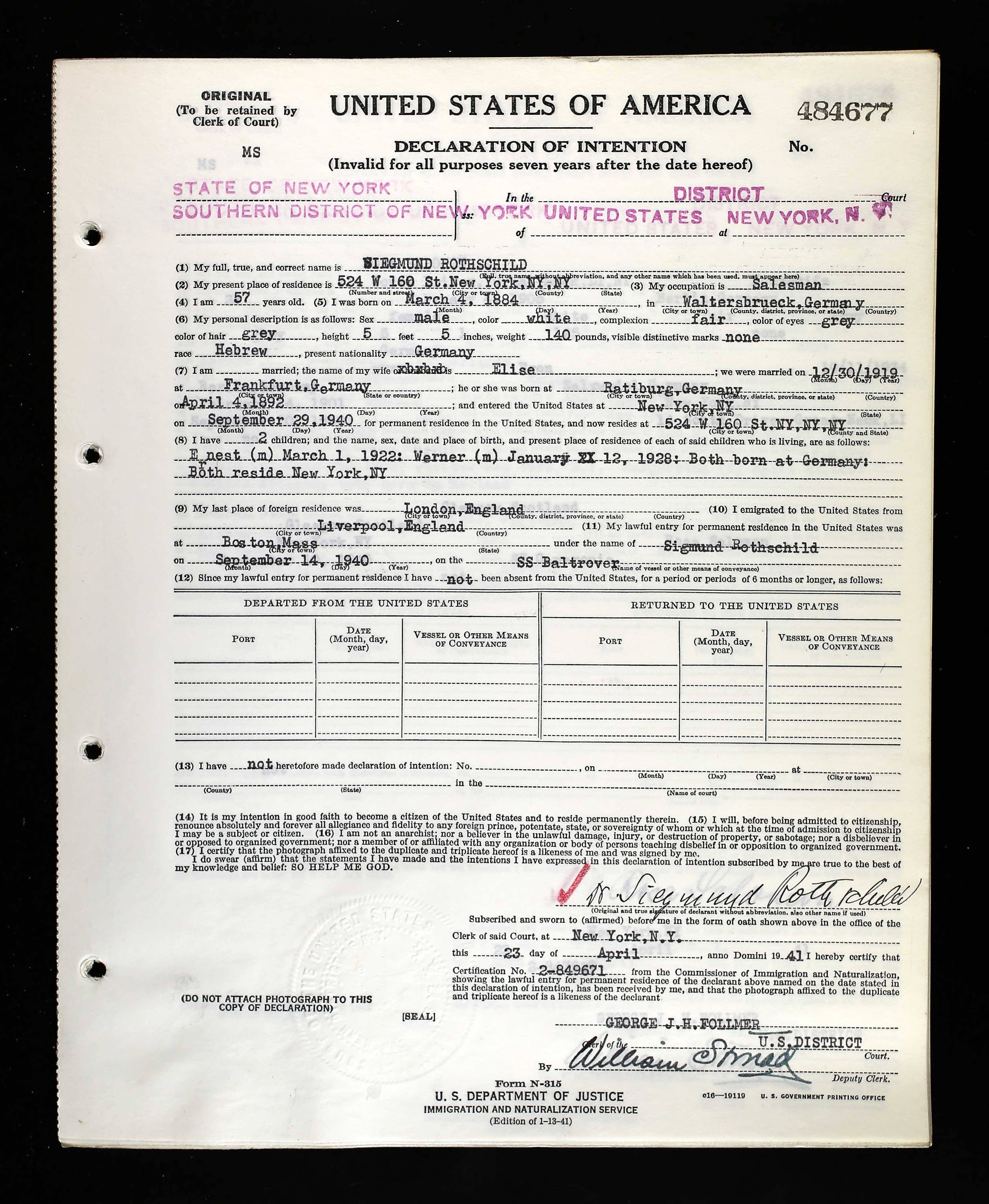
The family settled in New York City where on April 23, 1941, Siegmund filed a Declaration of Intention to become a United States citizen, now listing his occupation as a salesman.

Siegmund Rothschild declaration of intention, The National Archives at Philadelphia; Philadelphia, PA; NAI Title: Declarations of Intention For Citizenship, 1/19/1842 – 10/29/1959; NAI Number: 4713410; Record Group Title: Records of District Courts of the United States, 1685-2009; Record Group Number: 21, Description: (Roll 613) Declarations of Intention For Citizenship, 1842-1959 (No 484001-485000), Ancestry.com. New York, U.S., State and Federal Naturalization Records, 1794-1943

As the Projekt Judische Leben Frankfurt described their early life in America, “The new beginning in the USA was associated with challenging times for the couple. Neither of them could ever be active in the profession they had learned. Siegmund, with a doctorate in philosophy, first worked as a dishwasher. Until the end of his life he mostly kept his head above water with mini jobs.” Imagine how frustrating that must have been for Siegmund and Elise. And what  a waste of their knowledge and skills.

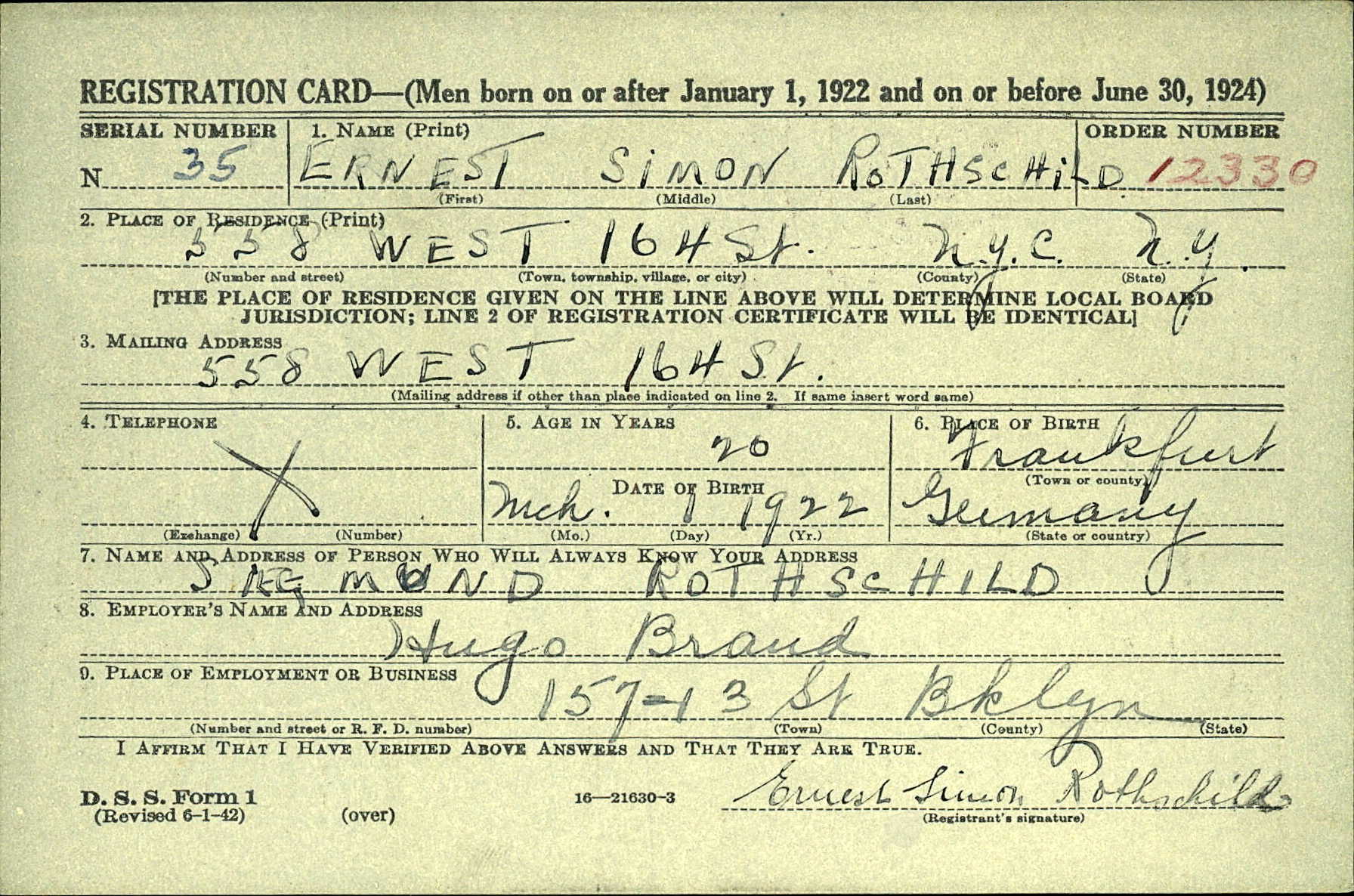
Both Siegmund and his older son Ernst, now using the more Anglicized Ernest, registered for the World War II draft; I haven’t found any evidence that either served in the military during the war. As their registration statements indicate, they were living at 558 West 164th Street in New York City in the Washington Heights neighborhood where so many Jewish refugees from Nazi Germany settled. Siegmund was working for the Gibraltar Manufacturing Company in Jersey City, New Jersey, and Ernest was working for Hugo Brand in Brooklyn.

Siegmund Rothschild, World War II draft registration, The National Archives At St. Louis; St. Louis, Missouri; Record Group Title: Records of the Selective Service System; Record Group Number: 147, Ancestry.com. U.S., World War II Draft Registration Cards, 1942

Ernest Rothschild, World War II draft registration, National Archives at St. Louis; St. Louis, Missouri; Wwii Draft Registration Cards For New York City, 10/16/1940 – 03/31/1947; Record Group: Records of the Selective Service System, 147, Ancestry.com. U.S., World War II Draft Cards Young Men, 1940-1947

Werner may have had the easiest transition to life in the United States. According to the report in the Projekt Judische Leben Frankfurt website, “Werner was 12 years old in 1940 and felt like an American from day one, he emphasized. In order to contribute to the family income, he took various jobs. Early in the morning before school at 5:30 a.m. he delivered bread rolls, delivered meat to the households or brought the clothes from the dry cleaners to the apartments, seven days a week, upstairs and downstairs. He immediately felt like an American in his school too. He studied with 35% Afro-Americans and classmates of different nationalities. Something like normal came back to life.”

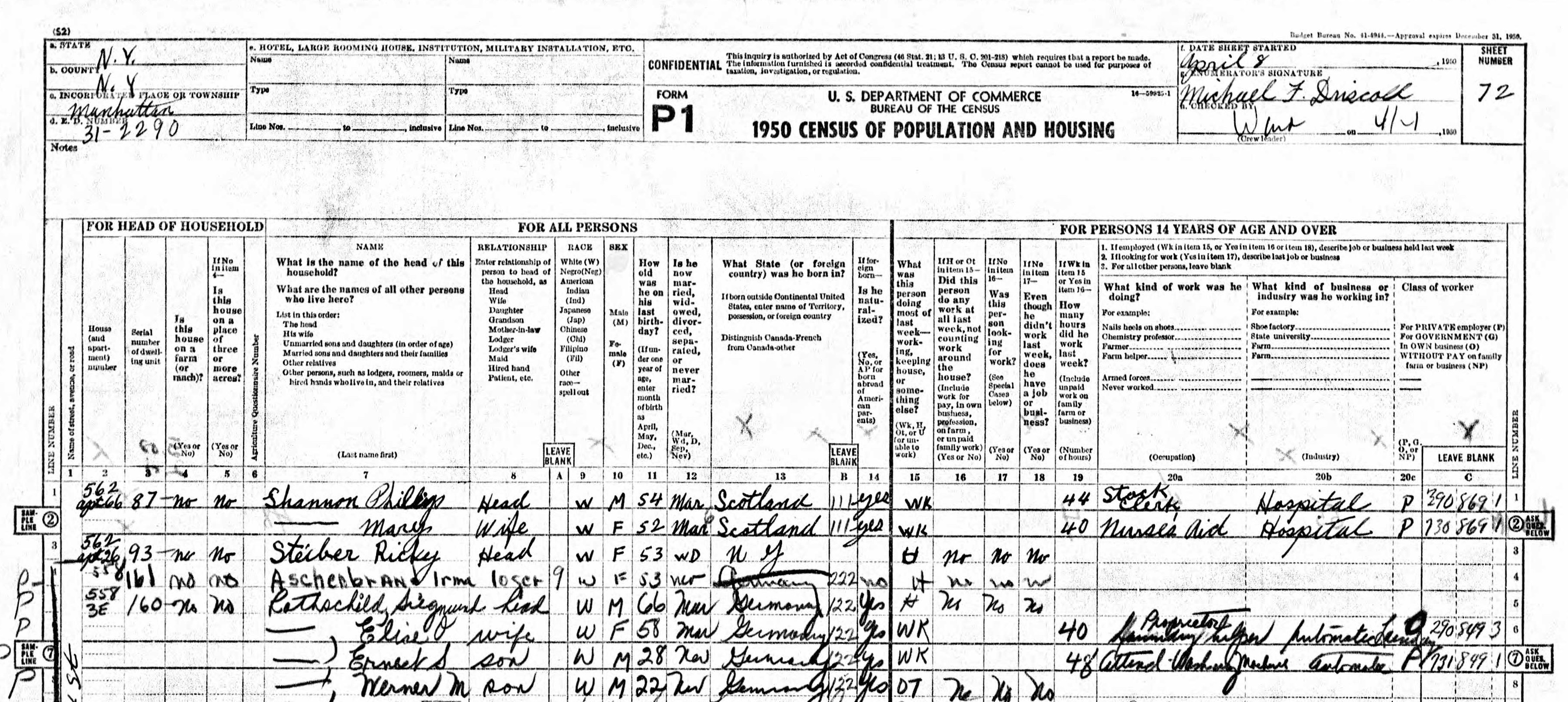
The 1950 US census shows Siegmund without a job, but both Ernst, now 28, and Werner, now 22, were working. Ernst owned a laundry where both young men were working. According to the Projekt Judische Leben Frankfurt website, however, that laundry did not provide much income for the family until a few years later.

Siegmund Rothschild, 1950 US census, National Archives at Washington, DC; Washington, D.C.; Seventeenth Census of the United States, 1950; Year: 1950; Census Place: New York, New York, New York; Roll: 3572; Page: 72; Enumeration District: 31-2290, Ancestry.com. 1950 United States Federal Census

Here is a photograph of Elise and Ernest in their laundromat:

Elise Bloch Rothschild and her son Ernest in their laundromat. Courtesy of the family

Sadly, Siegmund died on October 2, 1952, at the age of sixty-eight.2 According to the Projekt Judische Leben Frankfurt website, he suffered a heart attack after receiving an injection from a contaminated needle.

Ernest Rothschild married Margot Ochs in New York in 1954.3 Margot was born in Duren, Germany, on July 29, 1923,and like her husband Ernest, she had first escaped from Germany to England before immigrating to the US on December 27, 1939.4 Ernest and Margot had one child; he was given the middle name Siegmund presumably in memory of Ernest’s father Siegmund Rothschild.

Werner Rothschild married Audrie Max on December 21, 1958.5 Audrie was born in Allentown, Pennsylvania, on September 18, 1929, to Isadore Max and Minnie Vinkelstein.6 According to the Projekt Judische Leben Frankfurt website, Werner and Audrie met while vacationing in Florida. Werner and Audrie have three children.

The engagement announcement for Audrie and Werner in the Allentown newspaper, The Morning Call, on October 5, 1958 (p. 25) reported that Werner was a graduate of City College of New York and had received a master’s degree in school administration from Columbia University. He was working at that time as a teacher in Levittown, New York. How interesting that Werner pursued the teaching profession, the profession both his parents had lost as a result of Nazi persecution.

Ernest and Werner’s mother Elise Block Rothschild lived to 102, dying on May 2, 1991.7 As reported on the Projekt Judische Leben Frankfurt website, “Elise outlived her husband by 42 years and died very old at 102. She led a very independent life; it wasn’t until the age of 90, after a hip fracture, that she was admitted to the Margaret Tietz Nursing Home. … Elise worked in the family laundromat, taught English to German immigrants, and volunteered at the Young Men’s Hebrew Association, YMHA, library. She fought for compensation for many years and got a small pension from the 1950s onwards. Of course, this amount could not even come close to compensating for the enormous financial losses that had arisen as a result of the Nazi era and emigration and that shaped her life from then on.”

Ernest Rothschild died on December 11, 2011; he was 89 years old.8 His younger brother Werner is living, and I am hoping to be in touch with him soon. His first cousin Hal and Hal’s daughter Sandy and niece Judy are trying to connect me with Werner.

Given what happened to so many of Siegmund’s siblings and their families, Siegmund and his wife and children might by some be considered lucky because they survived. And yes, in some ways that is true. But look at how they also suffered because of Nazi persecution. Both Siegmund and his wife Elise lost their chosen careers as teachers; Ernest never became a dentist. These were psychological losses as well as financial losses. They also lost their homeland and most of their close family members. No one who was touched by Nazi persecution should ever be considered lucky.

For more information and photographs of the family, please see the Projekt Judische Leben Frankfurt website.


  1. Elise and Ernst Rothschild, The National Archives in Washington, DC; Washington, DC, USA; Manifests of Passengers Arriving At St. Albans, Vt, District Through Canadian Pacific and Atlantic Ports, 1895-1954; NAI: 4492490; Record Group: Records of the Immigration and Naturalization Service, 1787 – 2004; Record Group Number: 85; Series Number: M1464; Roll Number: 611, Ancestry.com. U.S., Border Crossings from Canada to U.S., 1895-1960; Elise and Ernst Rothschild, The National Archives at Washington, D.C.; Washington, D.C.; Series Title: Index to Alien Arrivals at Canadian Atlantic and Pacific Seaports; NAI Number: 3000080; Record Group Title: Records of the Immigration and Naturalization Service, 1787-2004; Record Group Number: 85, Ancestry.com. U.S., Index to Alien Arrivals at Canadian Atlantic and Pacific Seaports, 1904-1944 
  2. Siegmund Rothschild, Age 66, Birth Date abt 1886, Death Date 2 Oct 1952
    Death Place Manhattan, New York, New York, USA, Certificate Number 20929, Ancestry.com. New York, New York, U.S., Death Index, 1949-1965 
  3. Ernest Rothschild and Margot Ochs, Marriage License, Ernest Rothschild
    Gender Male, Marriage License Date 1954, Marriage License Place Manhattan, New York City, New York, USA, Spouse Margot Ochs, License Number 7121, New York City Municipal Archives; New York, New York; Borough: Manhattan, Ancestry.com. New York, New York, U.S., Marriage License Indexes, 1907-2018 
  4. Margot Ochs, Declaration of Intention, Margot Ochs, Gender Female, Race
    White, Declaration Age 18 Record Type Naturalization Declaration, Birth Date
    29 Jul 1923, Birth Place Duren, Germany, Departure Place Southampton, England
    Arrival Date, 27 Dec 1939, Arrival Place New York, New York, USA Declaration Date
    24 Apr 1942, Declaration Place New York, Court U.S. District Court for the Southern District of New York, Declaration Number 520250, Box Number 395, The National Archives at Philadelphia; Philadelphia, PA; NAI Title: Declarations of Intention For Citizenship, 1/19/1842 – 10/29/1959; NAI Number: 4713410; Record Group Title: Records of District Courts of the United States, 1685-2009; Record Group Number: 21, Ancestry.com. New York, U.S., State and Federal Naturalization Records, 1794-1943 
  5. Werner Rothschild, Gender Male, Residence Date Abt 1958, Residence Place New York City, Marriage Date 21 Dec 1958, Spouse Audrie Max, The Morning Call; Publication Date: 21/ Dec/ 1958; Publication Place: Allentown, Pennsylvania, USA; URL: https://www.newspapers.com/image/275138958/?article=8c58a828-c766-4dff-8c86-8cceadb65bd&focus=0.38331795,0.5598585,0.4987282,0.6864521&xid=3398
    Ancestry.com. U.S., Newspapers.com™ Marriage Index, 1800s-current 
  6. Audrie M Rothschild, Birth Date 18 Sep 1929, Residence Date 1993, Address 14 Joyce Ln, Residence Woodbury, NY, Postal Code 11797-2115, Ancestry.com. U.S., Public Records Index, 1950-1993, Volume 1; “Rothschild,” South Florida Sun Sentinel (Fort Lauderdale, FL), September 7, 2016, p. B6; Minnie Vinkelstein and Isadore Max marriage announcement, The Times-Tribune, Scranton, PA, November 18, 1919, p. 18; Isadore Max and family, 1930 US census, Year: 1930; Census Place: Allentown, Lehigh, Pennsylvania; Page: 12A; Enumeration District: 0038; FHL microfilm: 2341798, Ancestry.com. 1930 United States Federal Census 
  7. Elise O Rothschild, Birth Date 4 Apr 1892, Death Date 2 May 1994, Claim Date 6 Apr 1957, SSN 080181441, Ancestry.com. U.S., Social Security Applications and Claims Index, 1936-2007 
  8. Ernest Rothschild and Margot Ochs Rothschild gravestones at Find a Grave, database and images (https://www.findagrave.com/memorial/245622521/ernest-rothschild: accessed April 7, 2025), memorial page for Ernest Rothschild (1922–2011), Find a Grave Memorial ID 245622521, citing Beth-El Cemetery, Paramus, Bergen County, New Jersey, USA; Maintained by dalya d (contributor 46972551). 

Siegmund Rothschild: Escape from Nazi Germany

It’s been a few weeks since I wrote about the family of Gelle Blumenfeld Rothschild, given the breaks for some updates, Passover, and our trip to England. Today I return to Gelle’s story, specifically the story of her son Gerson Rothschild. In my last post about Gerson, we saw he died in 1930 and was survived by his wife Fanny Kugelmann and eight children.

In my next series of posts, I will write about the eight surviving children of my cousin Gerson Rothschild and his wife Fanny Kugelmann. Only three of those children survived the Holocaust, making this task a very painful one. But I can start with one of those three who survived, the oldest child of Gerson and Fanny, their son Siegmund.

As we saw, Siegmund married Elise Olga Block on December 22, 1919, in Frankfurt, and they had two sons, Ernst, born March 1, 1922, and Werner, born January 12, 1928, both in Frankfurt. There is a wonderful resource about this family on the Projekt Judische Leben Frankfurt am Main website. Based in part on information obtained during a visit to Frankfurt by Werner Rothschild in 2019, the website details the family’s life before, during, and after the Nazi era. Much of the information in this post came from that website.

According to that website, Siegmund Rothschild moved to Frankfurt in 1911 and was known as “a valued historian with good contacts abroad and president of the liberal main synagogue in Frankfurt.”  He taught at Philanthropin, a free Reform Jewish school founded in 1804 in Frankfurt. An article from the Encyclopedia of Jewish History and Culture abstracted here states that the school was “one of the most significant German Jewish Reform projects in the first half of the 19th century.” Siegmund’s wife Elise also taught at Philanthropin on and off between 1913 and 1939.

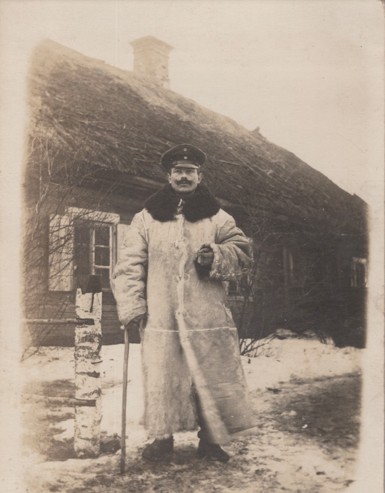
UPDATE: I learned from Siegmund’s grandson Alex that Siegmund fought for Germany during World War I. Here is a photo of him from that time.

Siegmund Rothschild c. 1915
Courtesy of the family

Siegmund and his family were living a good life in Frankfurt, identifying more as German than Jewish, until Hitler came to power in 1933. Siegmund’s son Werner recalled that one friend joined Hitler Youth and stopped talking to him. Another time while visiting family in Borken, he and his cousins were tormented by Hitler Youth.

Here is the family in January 1938:

Siegmund, Werner, Ernst, and Elise (Bloch) Rothschild, January 1938.

As for Ernst, the older son, according to the Projekt Judische Leben Frankfurt website, he had always dreamed of being a dentist, but under Nazi persecution he was not allowed to pursue the studies to reach that goal. Instead he ended up working as an apprentice in a leather dressing business after leaving school in 1937. But when that business was Aryanized in 1938, Ernst lost his job.

The family’s situation became even more dire in November 1938 with Kristallnacht.  As reported on the Projekt Judische Leben website, “For Werner… the worst day of his young life was the so-called “Reichskristallnacht.” He saw furniture fly out of the windows and buildings burn. Immediately afterwards, his father was picked up by the Gestapo. They gave [Siegmund] ten minutes to pack his things, then they deported him to Buchenwald. Fortunately, [Ernst] was not at home or he would have been arrested too.” Elise did everything she could to get Siegmund released; he was released in December 1938 with orders to leave Germany quickly.

The Projekt Judische Leben Frankfurt website continued, “Siegmund was a broken man when he came home and it took weeks and intensive care from his wife before he regained his strength. As soon as his health permitted, he traveled to England with his son Ernst, with ten Marks in his pocket. More was not allowed per person. The only contact there was with two of Elise’s brothers who had emigrated from Ratibor in 1935 and opened a dental practice in London.”

Meanwhile, Elise and Werner remained in Frankfurt until Elise arranged in 1939 for Werner to leave Germany as part of the Kindertransport program. Werner took the train alone to Hamburg and was forced to strip naked so that the Gestapo could check to be sure he wasn’t taking anything prohibited with him. In Hamburg he took a ship to England, where he  was placed in a youth hostel.1

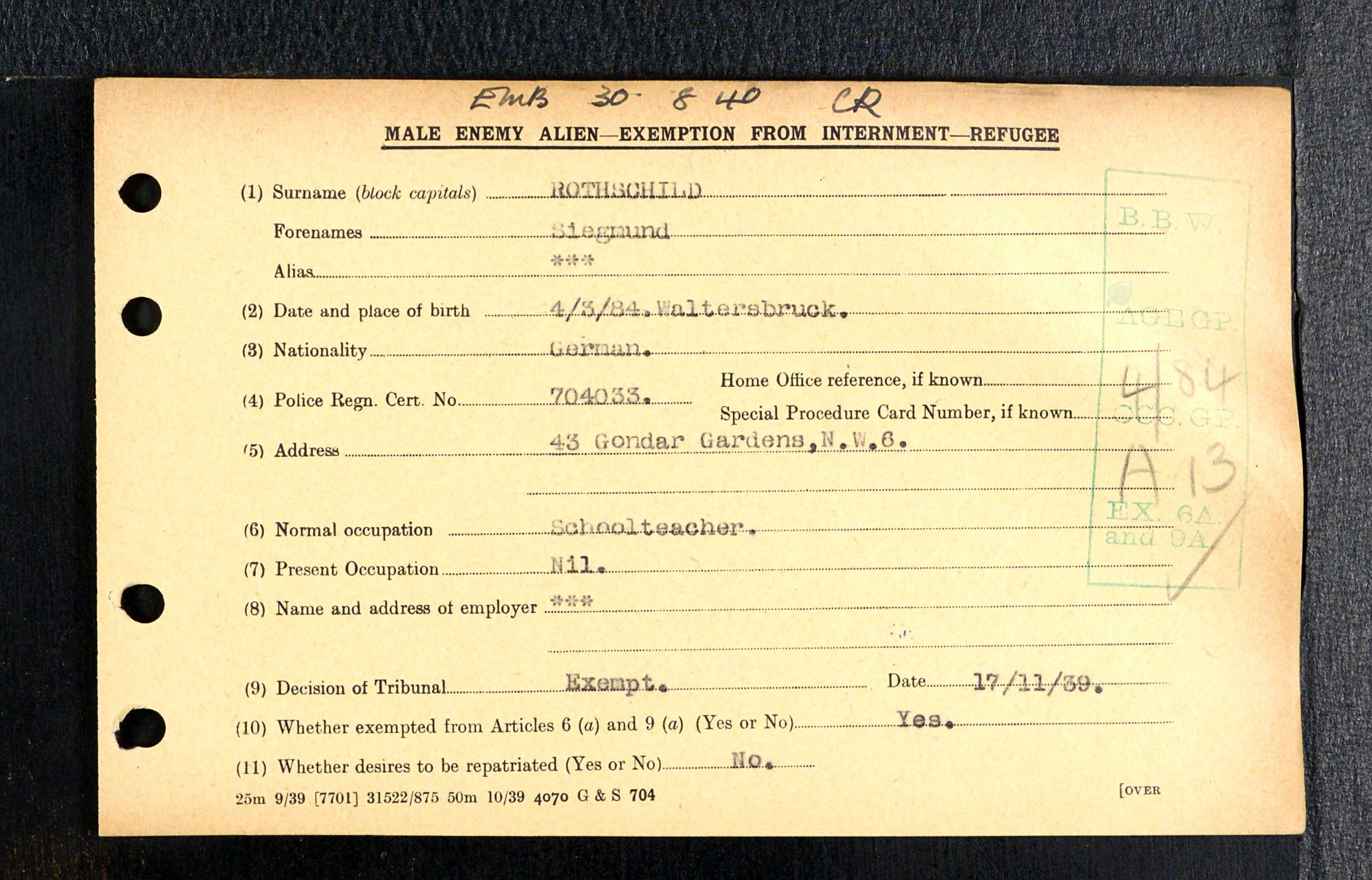
Once Elise also was able to escape to England, the family was reunited in London and Werner was able to attend school.   The 1939 England & Wales Register shows Siegmund and Elise living in London.2 But after the war started against Germany in September 1939, Ernst was interned as an enemy alien; Siegmund and Elise, however, were exempted from internship. Werner was just a child.

Siegmund Rothschild, The National Archives; Kew, London, England; HO 396 WW2 Internees (Aliens) Index Cards 1939-1947; Reference Number: HO 396/238, Piece Number Description: 238: Dead Index (Wives of Germans Etc) 1941-1947: Rosenber-Schitz, Ancestry.com. UK, World War II Alien Internees, 1939-1945

Elise Rothschild, The National Archives; Kew, London, England; HO 396 WW2 Internees (Aliens) Index Cards 1939-1947; Reference Number: HO 396/238, Piece Number Description: 238: Dead Index (Wives of Germans Etc) 1941-1947: Rosenber-Schitz, Ancestry.com. UK, World War II Alien Internees, 1939-1945

Ernst Rothschild, The National Archives; Kew, London, England; HO 396 WW2 Internees (Aliens) Index Cards 1939-1947; Reference Number: HO 396/193, Ancestry.com. UK, World War II Alien Internees, 1939-1945

Ernst was eventually released, and the family was finally able to immigrate to the United States in the summer of 1940, as we will see. Then they had to start their lives all over again. More on their life in the US in the next post.


  1. Werner Rothschild, Gender Male, Record Type Refugee List, Birth Date 12 Jan 1928, Residence Place Frankfurt, Document Date 22 Mär 1939 (22 Mar 1939)
    Permit Number 3813, United States Holocaust Memorial Museum; Washington, D.C.; Series: Selected Records Relating to Kindertransports; Record Group: RG-59.075; File Number: mh55-704.00000088, Ancestry.com. UK, Selected Records Relating to Kindertransport, 1938-1939 (USHMM) 
  2. Siegmund Rothschild, The National Archives; Kew, London, England; 1939 Register; Reference: RG 101/244E, Description Enumeration District: Akde, Ancestry.com. 1939 England and Wales Register 

Two Updates: Why Didn’t Mathilde Rothschild Leave Germany With Her Family? And How did Albert Alexander Meet His Wife?

Before I continue the stories of the children of Gerson Rothschild and Fanny Kugelmann, I have three updates to earlier posts that I’d like to share. All three are possible because other researchers and family members found this blog and contacted me. These are true gifts from the genealogy village. I am so grateful.

Some of you may recall that back in May 2024, I wrote about my relative Hirsch “Harry” Rothschild and his three children, all of whom escaped from Nazi Germany to the United States before World War II started. But unfortunately Harry’s wife Mathilde did not escape with her family and was ultimately murdered by the Nazis.

In my blog post about this family I wondered why Mathilde had not come with Harry and her children when they left Germany. Was she ill, I speculated? I had no answers.

Now I have more information about the family of Harry Rothschild. A man named Fredo Behrens recently contacted me after seeing my blog post. He lives in Oldenburg, Germany, and as he told me in his email, he worked for the “Nordwestdeutsches Museum für Industriekultur” in Delmenhorst for several years 25 years ago, where his area of responsibility was museum education, exhibitions and a regional “Topography of the Nazi Era.” He also is on the board of the “Friends and Supporters of the Jewish Community of Delmenhorst,” and heads the Delmenhorst City History Working Group. More specifically, he has done research into the history of the Jewish people of Delmenhorst, including the Rothschild family.1

Fredo told me about a monograph by Dr. Enno Meyer from 1985 entitled “Die Geschichte der Delmenhorster Juden 1695-1945”, or the History of the Jews of Delmenhorst 1695-1945. Dr. Meyer was the head of “Gesellschaft für christlich-jüdische Zusammenarbeit” (Society for Christian-Jewish Cooperation) for at least 30 years, according to Fredo. Fredo sent me both a copy of Dr. Meyer’s monograph (in German) and also a copy of an article that Fredo himself wrote about the Jews of Delmenhorst that excerpts parts of Meyer’s monograph and adds to it.2 I was able to use DeepL to translate Fredo’s work and learn more about the Rothschild family’s life in Delmenhorst.

According to the works of Meyer and Behrens, Dr. Harry Rothschild came to Delmenhorst from Hesse in 1914 and was the first Jewish doctor to practice in that town. By 1925, he was one of the top two taxpayers in the town. Harry was not active in the organized Jewish community, however, until after the Nazis came to power.3 According to Fredo’s research, the growing antisemitism in the early 1930s prompted Harry to become more involved. By 1933 he was chairman of the local Zionist organization and on the Jewish community board.

When the Nuremberg Laws were adopted and Jews were no longer allowed to employ Aryans, Harry and his Aryan cleaning woman petitioned the mayor for permission to continue their employment relationship, but their petition was rejected.4

Fredo kindly shared with me this photograph showing the street where the Rothschild family lived in Delmenhorst in 1930. The arrow points to where Harry Rothschild practiced medicine and lived before he left Germany in 1939.

Rothschild house and office in Delmenhorst, 1930, courtesy of Fredo Behrens: Jüdisches Leben in der Langen Straße nach 1933. In: Die Lange Straße in Delmenhorst : Biographie einer alten Straße ; Begleitveröffentlichung zur Ausstellung in den Museen der Stadt Delmenhorst auf der Nordwolle vom 24.6. – 2.9.2001. Hg. vom Stadtmuseum Delmenhorst. Isensee, Oldenburg 2001, p. 60

Then on October 10, 1937, Harry and a number of other Jewish residents of Delmenhorst were arrested by the Gestapo without warning or warrants. According to the observations of a fellow prisoner who became Harry’s cellmate, Harry was particularly humiliated by this experience and was called a “dirty stinking Jew” by one of the Gestapo agents. Harry and his cellmate were in solitary confinement, and Harry remained in prison until the spring of 1938. Harry’s condition had deteriorated greatly during his imprisonment.5

On November 10, 1938 in the aftermath of Kristallnacht, Harry was again arrested and was one of fourteen Jewish men who were arrested and sent to the concentration camp at Sachsenhausen.6

By that time all three of Harry and Mathilde’s children had left Germany for the United States. Harry left in the spring of 1939 and went to Cuba, and he was finally able to join his children in the US in December 1939.

But as we know, Mathilde did not come with him, and she was eventually deported to Minsk and died there. Dr. Meyer shed some light on this in his monograph, also quoted in Fredo Behren’s work. On page 85 of his history of the Delmenhorst Jews, Enno Meyer wrote that Mathilde had stayed behind to try and sell the family house; then when the war started in September 1939, she was trapped in Germany and could not leave.7

If only Mathilde had left with Harry and had not tried to sell the family’s home, this family’s story would have had a much happier ending. There may be more to this story that we will never know, but if this account is accurate, it shows how one decision affected an entire family’s fate during the Holocaust.

I want to thank Fredo Behrens again for providing me with the information and the photograph used in this post and for the work he does to preserve the Jewish history of Delmenhorst.


The second update came from two newly found cousins—my fifth cousin Charles Alexander and his daughter Kate. They also found me through my blog. Charles is the grandson of Theresa Rothschild Alexander, and I wrote about that family here. Check out the update there and learn how Charles’ parents, Albert Alexander and Mary Jane Deiches, actually met. My original speculation proved to be incorrect.

Also, I’ve added to that post a photo Charles gave me from his father’s yearbook. I am also adding it here since I could not place it properly in the original post.


Finally, the third update will have to wait until next week.


  1. Email from Fredo Behrens, March 25, 2025. 
  2. Fredo Behrens, “Jüdisches Leben in der Langen Straße nach 1933. In: Die Lange Straße in Delmenhorst : Biographie einer alten Straße; Begleitveröffentlichung zur Ausstellung in den Museen der Stadt Delmenhorst auf der Nordwolle vom 24.6. – 2.9.2001. Hg. vom Stadtmuseum Delmenhorst. Isensee, Oldenburg 2001. 
  3. Enno Meyer, “Die Geschichte der Delmenhorster Juden 1695-1945,” (1985), pp. 48, 55, 60, as cited in Behrens,  Note 2, supra. 
  4. Behrens, Note 2, supra, citing a letter dated November 14, 1936, response from the mayor dated December 3, 1936. Exhibition “Delmenhorst in National Socialism.   based on a letter dated September 24, 1955, affidavit from Wilhelm Schroers for Dr. Rothschild. Exhibition “Delmenhorst under National Socialism.” 
  5. Letter dated September 24, 1955, affidavit from Wilhelm Schroers for Dr. Rothschild. Exhibition “Delmenhorst under National Socialism.” as quoted in Behrens, Note 2, supra. 
  6. Behrens, Note 2, supra. 
  7. Enno Meyer, “Die Geschichte der Delmenhorster Juden 1695-1945,” (1985), p. 85, as cited in Behrens, Note 2, supra. 

Levi Rothschild’s Daughters Thekla Rothschild Weinberg and Frieda Rothschild Phillipsohn: One Survived, One Did Not

This is the story of the last two children of Levi Rothschild and Clara Jacob who lived to adulthood, their daughters Thekla and Frieda. Both have heartbreaking stories though Thekla survived and Frieda did not.

The fifth child of Levi and Clara, their daughter Thekla, married Manuel Edward Weinberg on August 19, 1907, in Borken. Manuel was born in Lichenroth, Germany, to Lazarus Weinberg and Karoline Oppenheimer on October 11, 1880.

Thekla Rothschild and Manuel Weinberg marriage record, Hessisches Hauptstaatsarchiv; Wiesbaden, Deutschland; Bestand: 920; Laufende Nummer: 843, Ancestry.com. Hesse, Germany, Marriages, 1849-1930

Thekla and Manuel had a son Hans Herbert Weinberg born in Frankfurt, Germany, on November 2, 1908.1

After Kristallnacht in November 1938, Manuel Weinberg was imprisoned at Buchenwald for a short time,2 and that may have motivated the family to leave Germany. By 1940 if not before, the family had left Germany for France, and according to Yad Vashem, Thekla’s husband Manuel was deported in 1940 to the internment camp near Toulouse, France known as the Recebedou camp.3

According to one website, the camp of Recebedou was created in July 1940 to receive refugees and those who had been evacuated. It was turned into a hospital camp in February 1941. But conditions in the camp deteriorated over time due to the lack of adequate medical care and a shortage of food. By late 1941, there were 739 interns, many of whom were over 60 and ill; 118 of them died in the winter of 1941-1942. Manuel Weinberg was one of those who died; he died on March 4, 1942.4

I don’t know for certain whether Thekla or their son Herbert, as he came to be known, were also interned at Recebedou because there are no documents I can find that indicate that they were. However, I do know that they must have been in France because Herbert and his wife, Edith Seckbach, had a daughter Yvonne born in Toulouse, France sometime in 1943.5  I could not find a marriage record for Herbert and Edith, but according to other records, Edith was born in Wiesbaden, Germany, in about 1918. 6

Wherever they were in France, somehow Thekla, Herbert, Edith, and their baby daughter survived. A document on Ancestry’s collection of Munich, Vienna and Barcelona Jewish Displaced Persons and Refugee Cards, 1943-1959 (JDC) indicates that as of November 1942, Thekla, Herbert, Edith, and Yvonne were in Vigo, Spain, which is almost seven hundred miles from Toulouse, France. How they got there in the midst of the war is a story I do not know.

Ancestry.com. Munich, Vienna and Barcelona Jewish Displaced Persons and Refugee Cards, 1943-1959 (JDC)

From Vigo they went to Madrid as of December 26, 1943. The Refugee Card lists two people as the “parents,” which I assume really means sponsors in this situation. One was Walter Hirschmann, Thekla’s nephew, the son of her sister Betti Rothschild Hirschmann.7 The other, Jacob Bleibtreu, was a banker and later a governor of the New York Stock Exchange who had immigrated to the US from Germany as a young man in 1909. He also was on the Greater New York Army and Navy Committee of the Jewish Welfare Board. Perhaps he knew Walter from the banking and broker business and agreed to help rescue his aunt and other family members.8

On March 23, 1944, Thekla, Herbert, Edith, and Yvonne all arrived in Philadelphia after sailing from Lisbon, Portugal. The ship manifest shows that they all had last been residing in Madrid, Spain, and were heading to Montreal, Canada under the sponsorship of the Joint Distribution Committee. Herbert reported that he was a chemist by occupation.

Thekla Weinberg and family passenger manifest, The National Archives at Washington, D.C.; Washington, D.C.; Series Title: Passenger Lists of Vessels Arriving at Philadelphia, Pennsylvania; NAI Number: 4492386; Record Group Title: Records of the Immigration and Naturalization Service, 1787-2004; Record Group Number: 85; Series: T840; Roll: 177, Ancestry.com. Pennsylvania, U.S., Arriving Passenger and Crew Lists, 1798-1962

Herbert’s wife Edith must not have lived very long after their voyage from Portugal to Philadelphia because on September 8, 1946, Herbert married his second wife, Anna or Anya Grodzky, in Hochelaga, Quebec, Canada. Anna was born in Russia on June 18, 1910, and was a beautician. Herbert is listed as a widower on their marriage record and as a chemist by trade.

Hans Herbert Weinberg marriage to Anna Grodsky, Marriage Sep 8 1946 Westmount, Québec, Canada, Groom Herbert Hans Weinberg, Groom’s birth 1908 Germany, Bride Anna Goodsky, Certificate number upd46-128967, Quebec Marriage Returns, 1926-1997, found at https://www.myheritage.com/research/record-10723-1831907/herbert-hans-weinberg-and-anna-goodsky-in-quebec-marriage-returns

The family all settled in Montreal, where Thekla died on March 11, 1962, at the age of 76.9 Herbert lost his second wife Anna on July 9, 1976.10 He died February 12, 2001, at the age of 92, and was survived by his third wife Sally Lazoff Bailen.11

I have not found any further information about Herbert’s daughter Yvonne despite searching everywhere I could and receiving help from members of Tracing the Tribe. I don’t know whether she died, married, or moved from Canada and changed her name. There just is no trace of her after a mention in her stepmother Anna’s obituary in 1976. She is not mentioned in her father’s obituary in 2001.12

Although Thekla Rothschild Weinberg survived the Holocaust, she lost her husband, her homeland, and, as we will now see, her sister Frieda to the Holocaust.

Frieda was born May 31, 1993, in Borken, Germany.  As we saw, she first married Leonard Marxsohn and was widowed and then married Paul Phillipsohn, with whom she had a daughter Hannelore, born December 3, 1926.

Unfortunately, I have no happy ending for Frieda, Paul, or Hannelore. On June 11, 1942, they were all deported to Theriesenstadt. None of them survived. According to Yad Vashem, Paul died on December 20, 1942. I have no exact dates for Frieda or Hannelore, only that they also died in about 1942.13

Thus ends the story of Levi Rothschild’s family. Although most of them survived the Holocaust and made it to the US, Israel, or Canada, they were scattered across the globe, and their lives were all forever changed. The family members who were killed must have left holes in their hearts forever.


  1. Hans Herbert Kaufmann Weinberg, Gender männlich (Male), Record Type Inventory, Birth Date 02 Nov 1908 (2 Nov 1908), Birth Place Frankfurt am Main,
    Last Residence Frankfurt am Main, Residence Place Frankfurt am Main, Father
    Edmund Weinberg, Mother Thekla Weinberg, Spouse Edith Seckbach, Notes Inventories of personal estates of foreigners and especially German Jews
    Reference Number 02010101 oS, Document ID 70370883, Arolsen Archives, Digital Archive; Bad Arolsen, Germany; Lists of Persecutees 2.1.1.1, Ancestry.com. Free Access: Europe, Registration of Foreigners and German Persecutees, 1939-1947 
  2. Arolsen Archives, 1 Incarceration Documents / 1.1 Camps and Ghettos / 1.1.5 Buchenwald Concentration Camp / 1.1.5.3 Individual Documents male Buchenwald / Individual Files (male) – Concentration Camp Buchenwald / Files with names from SYS and further sub-structure / Files with names from WECK /, Personal file of WEINBERG, EMANEL, born on 11-Oct-1880, Reference Code, 01010503 002.042.476, Number of documents, 1, found at https://collections.arolsen-archives.org/en/document/7388346 
  3. Yad Vashem entries for Manuel Weinberg, found at  https://collections.yadvashem.org/en/names/13545516 and at https://collections.yadvashem.org/en/names/3229127 
  4. See Note 3, supra. 
  5. Yvonne Miriam Weinberg, passenger manifest, The National Archives at Washington, D.C.; Washington, D.C.; Series Title: Passenger Lists of Vessels Arriving at Philadelphia, Pennsylvania; NAI Number: 4492386; Record Group Title: Records of the Immigration and Naturalization Service, 1787-2004; Record Group Number: 85; Series: T840; Roll: 177, Ancestry.com. Pennsylvania, U.S., Arriving Passenger and Crew Lists, 1798-1962 
  6. Edith Weinberg, passenger manifest, The National Archives at Washington, D.C.; Washington, D.C.; Series Title: Passenger Lists of Vessels Arriving at Philadelphia, Pennsylvania; NAI Number: 4492386; Record Group Title: Records of the Immigration and Naturalization Service, 1787-2004; Record Group Number: 85; Series: T840; Roll: 177, Ancestry.com. Pennsylvania, U.S., Arriving Passenger and Crew Lists, 1798-1962. See also Edith Weinberg geb. Seckbach, Arolsen Archives, Digital Archive; Bad Arolsen, Germany; Lists of Persecutees 2.1.1.1, Description Reference Code: 02010101 oS,
    Ancestry.com. Free Access: Europe, Registration of Foreigners and German Persecutees, 1939-1947 
  7. It was Walter’s name on this card that led me to discover that he was the child of Betti and Emanuel Hirschmann. 
  8. “Jacob Bleibtreu, Former Governor of New York Stock Exchange, 90,” The New York Times, December 6, 1976. 
  9. Thekla Weinberg death notice, The Montreal Star, Montreal, Quebec, Canada, Mon, Mar 12, 1962, Page 16. 
  10. Anna (Anya) Weinberg death notice, The Montreal Star, Montreal, Quebec, Canada, Sat, Jul 10, 1976, Page 10. 
  11. Marriage of Herbert Weinberg to Sally Lazoff, Nov 15 1980, Côte St Luc, Québec, Canada, Groom Herbert Weinberg, Groom’s birth Nov 5 1908, Germany, Groom’s age 72, Bride Sally Lazoff, Bride’s birth Aug 15 1917, Québec, Canada, Bride’s age 63, Groom’s father Manuel Weinberg, Groom’s father’s birth Germany, Groom’s mother Thekla Rothschild, Groom’s mother’s birth Germany, Bride’s father Gedaliah Lazoff
    Bride’s father’s birth Russia, Bride’s mother Telia Brasgold, Bride’s mother’s birth Russia
    Certificate number upd80-141452, Quebec Marriage Returns, 1926-1997, found at https://www.myheritage.com/research/record-10723-2419633/herbert-weinberg-and-sally-lazoff-in-quebec-marriage-returns. Herbert Weinberg death notice, The Gazette
    Montreal, Quebec, Canada, Mon, Feb 12, 2001, Page 35. 
  12. Anna (Anya) Weinberg death notice, The Montreal Star, Montreal, Quebec, Canada, Sat, Jul 10, 1976, Page 10. Herbert Weinberg death notice, The Gazette, Montreal, Quebec, Canada, Mon, Feb 12, 2001, Page 35. 
  13. See Yad Vashem entries at https://collections.yadvashem.org/en/names/11607287 for Frieda, https://collections.yadvashem.org/en/names/14969310 for Paul, and https://collections.yadvashem.org/en/names/11607287 for Hannelore.