There Were No Survivors: A Tragic Ending to a Family with Plenty of Tragedy

Some families seem to suffer more misfortune than others.  This is one of those families.  It is the story of the family of Mathilde Dreyfuss, sister of my three-times great-grandmother Jeanette, and her family.  Her first husband was  John Nusbaum’s brother Maxwell Nusbaum, making this particular line related to me both on my Dreyfuss side and my Nusbaum side.  That is, Mathilde and Maxwell’s children are my double first cousins, four times removed.

As I have written, Maxwell Nusbaum and Mathilde Dreyfuss had two children, a daughter Flora born in 1848 and a son Albert born in 1851.  Less than seven months after Albert’s birth, Maxwell died in the 1851 Great Fire in San Francisco.  By 1856 Mathilde had married Moses Pollock, with whom she had three more children, Emanuel, Miriam, and Rosia.  The family lived in Harrisburg for many years, but by 1866 had relocated to Philadelphia.

In the 1870s, the Pollocks were living in Philadelphia where Moses was a dry goods merchant.  Their youngest child Rosia died in 1871 when she was just five months old.

Rosie Pollock daughter of Moses and Mathilde death cert 1871

Pennsylvania, Philadelphia City Death Certificates, 1803-1915,” index and images, FamilySearch (https://familysearch.org/pal:/MM9.1.1/JK3P-DBS : accessed 22 January 2015), Rosie Pollock, 26 Feb 1871; citing 1075, Philadelphia City Archives and Historical Society of Pennsylvania, Philadelphia; FHL microfilm 2,020,735.

Mathilde’s daughter Flora had married Samuel Simon, one of the three brothers to marry into the Nusbaum/Dreyfuss clan, and they had two children in the 1870s, Meyer (mostly likely named for his grandfather Maxwell) and Minnie.  By 1880, Flora and Samuel had moved to Elkton, Maryland, where Samuel was running a hotel.  Meanwhile, Moses and Mathilde (Dreyfuss Nusbaum) Pollock were still in Philadelphia, and the other surviving children—Albert Nusbaum and Emanuel and Miriam Pollock—were still living at home with them, according to the 1880 census. Moses was in the cloak business, Albert was in the liquor trade, and Emanuel was in the dry goods business.  Moses’ line of trade seemed to change to trimmings or finishings during the 1880s and 1890s with various directories listing his businesses as plaiting, laces, embroidery, school bags, and accordion pleating.

Mathilde’s family was struck by tragedy again on September 1, 1885, when Miriam Pollock, just 26 years old, died from consumption or tuberculosis.  Mathilde had lost her first husband to a fire, her daughter Rosia at five months, and then her daughter Miriam at 26.  Sometimes life is just not fair.

miriam pollock death cert FHL 2070682

“Pennsylvania, Philadelphia City Death Certificates, 1803-1915,” index and images, FamilySearch (https://familysearch.org/pal:/MM9.1.1/JFSV-LHQ : accessed 22 January 2015), Miriam Pollock, 01 Sep 1885; citing , Philadelphia City Archives and Historical Society of Pennsylvania, Philadelphia; FHL microfilm 2,070,682.


Then Moses Pollock died on December 5, 1894 of encephalomalacia, defined in Wikipedia as “localized softening of the brain substance, due to hemorrhage or inflammation.”  Like so many other family members, he was buried at Mt. Sinai cemetery in Philadelphia.  He was 69 years old.

Moses Pollock death cert

“Pennsylvania, Philadelphia City Death Certificates, 1803-1915,” index and images, FamilySearch (https://familysearch.org/pal:/MM9.1.1/JKS4-32N : accessed 22 January 2015), Moses Pollock, 05 Dec 1894; citing cn 11116, Philadelphia City Archives and Historical Society of Pennsylvania, Philadelphia; FHL microfilm 1,872,200.

Both Albert Nusbaum and Emanuel Pollock had continued to live with their parents throughout the 1880s and 1890s, and in 1900, they and their mother were still living together at the same address, 934 North Eighth Street.  Mathilde, now widowed twice in addition to losing two children, was working outside the house as a manufacturer of bags—presumably, the school bags listed as one of the items Moses was selling on the last directory entry before his death.  Albert was still a liquor salesman, and Emanuel was selling bicycles.  In addition, Meyer Simon, Flora’s son and Mathilde’s grandson, now 30 years old, was also living with them and was working with his grandmother in the bag manufacturing business as a manager.

Mathilde’s daughter Flora Nusbaum and her husband Samuel Simon, meanwhile, had left Elkton, Maryland, and moved to Baltimore by 1885.  Samuel was in the liquor business, as was his brother Moses, who was married to Paulina Dinkelspiel, Flora’s first cousin.[2]  My hunch is that they were business together.

In 1900, Samuel was still in the liquor business in Baltimore, but his brother Moses had died the year before.  Samuel and Flora still had their daughter Minnie living at home with them, but their son Meyer, as noted above, was living in Philadelphia with his grandmother and uncles Albert and Emanuel and managing the bag manufacturing business.

Although Meyer Simon was listed as single on the 1900 census, the 1910 census reported him as married for 12 years. I figured that this must have been a mistake, especially since he was still living at his grandmother’s address even in the 1901 directory.  It seemed he could not have been married for 12 years in 1910.

But then I found something strange.  After some further research and review, I found in the Pennsylvania, Marriages 1709-1940 data base on familysearch.org a marriage between Meyer Simon and Tillie Perry on September 18, 1897, in Allegheny, Pennsylvania. Meyer’s wife’s name on the 1910 census was Matilda, so I knew this was the correct marriage.  Matilda or Tillie Perry was the daughter of William and Matilda Perry; she was born in Philadelphia in 1876 and baptized in the Episcopal church in 1878. But if Meyer and Matilda were married in 1897, why was Meyer listed as single on the 1900 census, and where was Matilda?[3]

I found Matilda Perry on the 1900 census living with her parents in Philadelphia, and that census report stated that she was married and had been married for three years, which is consistent with the marriage record I found on familysearch. Had Meyer and Matilda married and then lived separately for at least three years?  It seems strange, but perhaps they could not yet afford a place of their own. Or perhaps they were temporarily separated.  Or perhaps the religious differences had made it difficult for those families to support the marriage.    After all, Meyer listed his marital status as single.  I suppose it is also possible that he had kept the marriage a secret from his family.  After all, they were married in Allegheny, not in Philadelphia or in Baltimore where their families lived. Allegheny was a city across the river from Pittsburgh that merged with Pittsburgh in 1907.   It would have been therefore over 300 miles from Philadelphia and about 250 miles from Baltimore.

Thus, as of 1900, Mathilde Dreyfuss Nusbaum Pollock was a widow, living in Philadelphia with her two sons, Albert and Emanuel.  Her daughter Flora was living with her husband Samuel Simon in Baltimore with their daughter Minnie, and their son Meyer was married, but not yet living with his wife Matilda.

The decade that followed must have been a very painful one.  First, on March 21, 1904, Mathilde Pollock died.  She was 79 years old.  The death certificate says she died of old age, which shows you how perspectives on aging and longevity have changed.  It also says that she died from “senile pneumonia,” a term for which I could find no easily understood definition for my non-medical brain to grasp, but which I gather is a form of pneumonia that affects the elderly.  (Feel free to provide a more scientifically accurate definition.)  The death certificate also says that Mathilde had ascites, another term not easily defined but which Wikipedia defines as “gastroenterological term for an accumulation of fluid in the peritoneal cavity.”   Don’t even get me started on trying to understand where the peritoneal cavity is, but from what I read, ascites seems to have something to do with liver disease, often cirrhosis.

Mathilde Pollock death cert

Mathilde’s death was followed three years later by the death of her son Emanuel Pollock on February 16, 1907.  He was only fifty years old and died of tuberculosis.  Three years after that his half-brother Albert Nusbaum died on August 28, 1910 from apoplexy brought on by arteriosclerosis.  He was 59 years old.  Mathilde and both of her sons were buried at Mt. Sinai cemetery.

That left only Flora Nusbaum Simon as the surviving child of Mathilde Dreyfuss Nusbaum Pollock.  She had lost both of her parents and all four of her siblings.  She was also the only child who had children of her own as none of her siblings ever married or had children. Flora and Samuel appear to have relocated from Baltimore to Philadelphia by 1905, the year after her mother died, as Samuel appears in the Philadelphia directory living at 2225 North 13th Street, the same address where the family is listed in the 1910 and 1920 census reports.

Flora’s brother Albert had been living with them at that address in April when the 1910 census was taken, just four months before he died.  Neither Samuel nor Albert nor anyone else in the household was employed at that time, yet they still had a servant living in the home.  Minnie, Flora and Samuel’s daughter, was 27 and single, living with her parents and uncle.  It feels like it must have been a very sad time for the family.

Flora and Samuel’s son Meyer and his wife Matilda were living about two miles away at 2200 Susquehanna Avenue in 1910.  Meyer was a clothing salesman.  There were two boarders living with them, but no children. When Meyer registered for the World War I draft in 1917, he and Matilda were living at 3904 North Marshall Street, two and a half miles north of his parents and his sister.  Meyer was employed as a clothing salesman for Harry C. Kahn and Son, according to his draft registration.

On February 18, 1919, Flora Nusbaum Simon suffered yet another loss when her husband Samuel Simon died from a cerebral hemorrhage at age 79.  She and her daughter Minnie were living together in 1920 at their home at 2225 North 13th Street.  Flora herself died almost four years to the day after her husband Samuel on February 20, 1923.  She was 74 years old and died from chronic interstitial nephritis.  She had outlived all of her siblings by over 13 years.  She, like all the rest of them, was buried at Mt. Sinai cemetery with her husband Samuel.

Ancestry.com. Pennsylvania, Death Certificates, 1906-1963 [database on-line]. Provo, UT, USA: Ancestry.com Operations, Inc., 2014.

Ancestry.com. Pennsylvania, Death Certificates, 1906-1963 [database on-line]. Provo, UT, USA: Ancestry.com Operations, Inc., 2014.

After her mother Flora died, Minnie Simon lived with her brother Meyer and his wife Matilda in the house on North 13th Street where Flora had died, number 2336, across the street from where they had lived for many years at 2225.  Meyer was employed as a clothing salesman, and his niece Matilda (a fifth Matilda in his life) was also living with them.  Meyer lost his sister Minnie six years later when she died from liver cancer on December 14, 1936; she was 63 years old.

Meyer was the only member of his family left.  He had no siblings, no nieces or nephews on his side.  It must have been just too much for him when his wife Matilda then died on April 27, 1940, at age 63 from cerebral thrombosis and chronic nephritis.  Two years later on June 2, 1942, Meyer took his own life.  He was found on the second floor of his home at 2336 North 13th Street with a gunshot wound to his head.  He had no survivors.  Although Meyer was buried with his family at Mt. Sinai, he was not buried with his wife Matilda.  She was buried at a non-denominational cemetery instead (Northwood); because she was not Jewish, she could not be buried at Mt. Sinai.  How sad.

meyer simon death cert pre inquest

Ancestry.com. Pennsylvania, Death Certificates, 1906-1963 [database on-line]. Provo, UT, USA: Ancestry.com Operations, Inc., 2014.
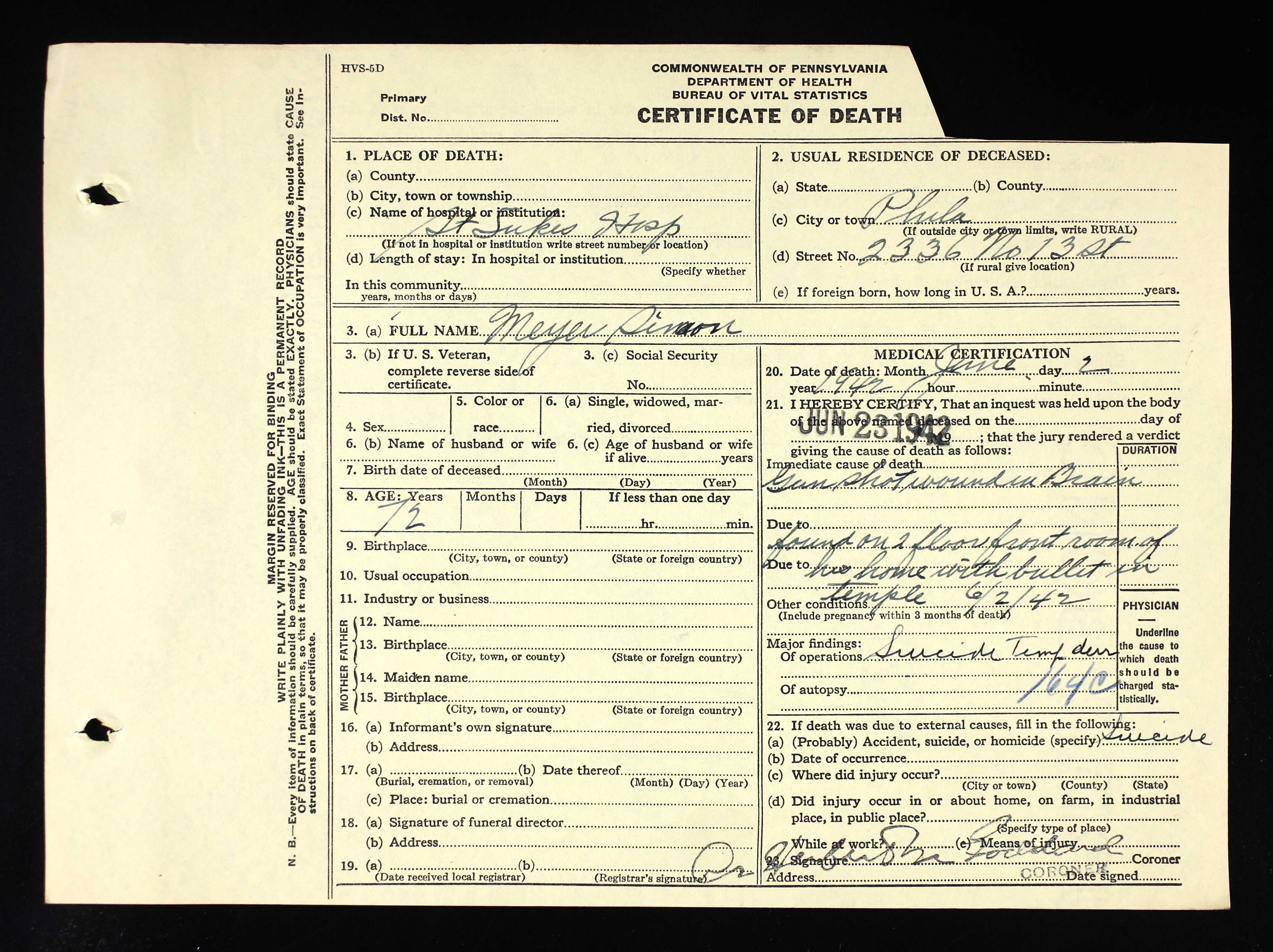
Meyer Simon death cert coroner's inquest

Ancestry.com. Pennsylvania, Death Certificates, 1906-1963 [database on-line]. Provo, UT, USA: Ancestry.com Operations, Inc., 2014.

This story fills me with such sadness.  How lonely Meyer must have been.  He’d lost his grandparents, his parents, his aunts and uncles, his sister, and his wife.  And there were no children or nieces or nephews left to comfort him. Certainly there were other Nusbaum cousins nearby in Philadelphia, but it must not have been enough.

From the start of the story of the life of Meyer’s grandmother Mathilde Dreyfuss, this family suffered such tragedy: Maxwell’s death in the Great Fire of San Francisco and two daughters who died young.  Of Mathilde’s four children who grew to adulthood, only Flora married and had children, and there were no grandchildren to carry on the family line after Flora and Samuel Simon and their two children Meyer and Minnie died.   There are no living descendants of Mathilde Dreyfuss or Maxwell Nusbaum.  No one likely remembers their names.  Except now they have been found and can be remembered for the tough lives they lived and for the courage and hope they must have had when they arrived in Pennsylvania in the middle of the 1800s.


[1] Isaac died without any children in 1870, so unfortunately that was the end of that sibling’s line.

[2] Flora’s father Maxwell Nusbaum was the brother of Paulina Dinkelspiel’s mother, Mathilde Nusbaum Dinkelspiel.

[3] Poor Meyer had at least four Mathilde/Matildas in his life: his mother, his wife, his mother-in-law, and one of his aunts.  And today I don’t know one woman named Mathilde or Matilda or Tillie.
The Dinkelspiel Descendants in the 20th Century

In my last post, I covered four of the five children of Paula Dinkelspiel and Moses Simon.  The remaining child was their fourth child, Flora, born in 1868.  Flora Simon married Charles Mayer in 1889.  Charles was born in Lancaster, Pennsylvania, in 1857, the son of Jacob Mayer and Mathilde Shoyer.  The family had moved to Philadelphia by the time Charles was three.  His father was a merchant on the 1860 census and in the wholesale liquor business on the 1870 census, but by 1880 and thereafter, he listed his occupation as a dentist.  He was a man with eleven children, and that made me wonder how he became a dentist while raising such a large family.

Most early “dentists” were actually barbers, blacksmiths, or apothecaries.  Sometimes physicians would do extractions.  Infection control was minimal, as was anesthesia.  According to the American Dental Association website, the first dental school in the world was established in 1841 in Baltimore.  Alabama enacted the first law to regulate the practice of dentistry also in 1841, but it was never enforced.  The American Dental Association was founded in 1857.  Pennsylvania had three dental schools by 1880, the newest being that established by the University of Pennsylvania.

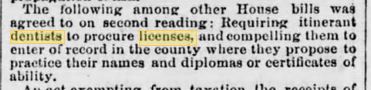
Perhaps Jacob Mayer attended one of these, although I do not know when he would have had the time.  The earliest reference I could find to a Pennsylvania law regulating the practice of dentistry was this April, 16, 1879 article from the Harrisburg Telegraph, describing a bill being considered by the state legislature.

Harrisburg Telegraph April 16, 1879 p.1

Harrisburg Telegraph April 16, 1879 p.1

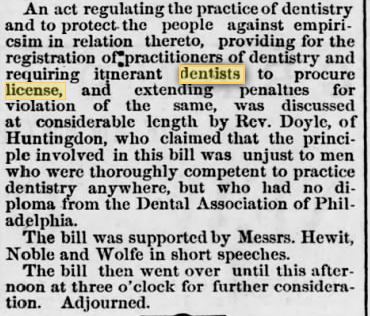
The bill was passed on a second reading, according to a May 16, 1879, article in the same paper (p.1).  Here is a description of that bill as reported the next day:

Harrisburg Telegraph May 17, 1879, p. 4

Harrisburg Telegraph May 17, 1879, p. 4

Thus, by the time Jacob Mayer was practicing dentistry, there was some state regulation of the practice.

At any rate, his son Charles did not follow him in to this practice.  By 1875 when he was eighteen, Charles was working as a salesman, though still living at home.  In the 1879 Philadelphia directory, he is listed as a bookkeeper, and on the 1880 census, he is a clerk, but in the 1880 directory, his occupation is salesman.  He was still living at home with his parents at this time.

After marrying Flora Simon in 1889, Charles and Flora remained in Philadelphia for a few more years and  Charles continued to work as a salesman.  Their first child Jerome was born in 1890, and their second child Madeline was born in 1892.  A third child, Evelyn, was born in October, 1895 according to the 1900 census (although her headstone says 1894), but I am not sure whether she was born in Philadelphia or in Lancaster because by 1896, the family had relocated to Lancaster, where Charles had been born almost forty years earlier.  He is listed in the 1896 Lancaster directory as the proprietor of the Parisian Cloak and Suit Company.  The family remained in Lancaster until at least 1901, when Charles is still listed as the proprietor of the same company.

"Downtown Lancaster, Pennsylvania 1874" by Author unknown. From the personal collection of historian Ronald C. Young of Brownstown, Pennsylvania. Published in the Lancaster Sunday Newspaper in November 2008. - http://articles.lancasteronline.com/local/5/229862/mon2. Licensed under Public Domain via Wikimedia Commons - http://commons.wikimedia.org/wiki/File:Downtown_Lancaster,_Pennsylvania_1874.jpg#mediaviewer/File:Downtown_Lancaster,_Pennsylvania_1874.jpg

“Downtown Lancaster, Pennsylvania 1874” by Author unknown. From the personal collection of historian Ronald C. Young of Brownstown, Pennsylvania. Published in the Lancaster Sunday Newspaper in November 2008. – http://articles.lancasteronline.com/local/5/229862/mon2. Licensed under Public Domain via Wikimedia Commons – http://commons.wikimedia.org/wiki/File:Downtown_Lancaster,_Pennsylvania_1874.jpg#mediaviewer/File:Downtown_Lancaster,_Pennsylvania_1874.jpg

By 1904, however, the family had returned to Philadelphia, and Charles is listed as affiliated with the A.J.S. Bowers Company, also known as the Philadelphia Cloak and Suit Company.  He listed his occupation on the 1910 census as a clothing manufacturer and continued to be associated with A.J.S. Bowers.  By 1914, however, he had started his own business, Charles S. Mayer & Co, and on the 1920 census described his business as a manufacturer of ladies’ dresses.

The three children of Flora and Charles Mayer, all now in their twenties, were still living at home with their parents in 1920.  Jerome was working as a salesman of ladies’ dresses, presumably in his father’s business.  Madeline was a primary school teacher, and so was her sister Evelyn.

Madeline married Gustave Winelander in 1925. Gustave was a 1914 graduate of the University of Pennsylvania with a B.S. in Chemistry.  He served in the US military forces during World War I and then was working as a chemist in 1918 according to the 1918 Philadelphia directory.  The 1920 census records that he and his father Max had their own extract business, and from later census and directory listings I determined that he was selling flavoring extracts used in baking.   Gustave and Madeline would have one daughter, Joan.

Flora and Charles Mayer’s youngest child, Evelyn, married Irving Frank sometime in or before 1922, as their son Irving was born in York, Pennsylvania, in January, 1922.  Irving, Senior, was born in New York City in 1893, but by 1903 he and his parents and siblings had relocated to Lancaster, Pennsylvania, where his younger sister Mildred was born.  In 1910, his father was a milliner, like Flora’s uncle, Joseph Simon.  Since York was only 26 miles from Lancaster, perhaps the two hat merchants knew each other.

Irving attended Lehigh University in 1912 and 1913, as a civil engineering major.  On his World War I draft registration, he listed his occupation as a manager at M. Frank in Lancaster, but by 1920 he was living in York with his aunt and uncle, working as a clerk in a department store.  Maybe he met Evelyn while working there when she was visiting her aunt and uncle, Joseph and Emilie Simon.  After marrying sometime thereafter, Irving and Evelyn settled in York, as Irving is listed a buyer there in the 1925 York directory.  By 1927, however, he was the proprietor of the Fashion Millinery in Lancaster, joining the same trade as his father and Evelyn’s uncle Joseph Simon.

Jerome, Madeline, and Evelyn’s mother Flora Simon Mayer died August 20, 1927, and was buried at Mt. Sinai cemetery in Philadelphia.  She died of bronchial pneumonia.  She was only 59 years old.

Ancestry.com. Pennsylvania, Death Certificates, 1906-1963 [database on-line]. Provo, UT, USA: Ancestry.com Operations, Inc., 2014.

Ancestry.com. Pennsylvania, Death Certificates, 1906-1963 [database on-line]. Provo, UT, USA: Ancestry.com Operations, Inc., 2014.

After Flora died, her husband Charles and her son Jerome continued to live together and work together in the women’s clothing business at least until 1930.  Sometime between 1930 and 1940, Jerome married Mabel Bamberger Sichel, who had a daughter Marion from an earlier marriage.  On the 1940 census, Jerome, Mabel, and Marion are living in the same house on Diamond Street that Jerome had lived in with his parents and sisters, and his father Charles and Mabel’s mother Rose Bamberger were living with them as well.  Jerome was working in the cheese business.

Irving  Frank remained a milliner in Lancaster for many years, at least until the early 1940s.  He died November 14, 1946, and was residing in York at that time. He was only 53 years old.  He was buried at Prospect Hill cemetery in York where Joseph, Emilie, and Moses Joseph Simon were buried.


Charles Mayer outlived his wife Flora by almost thirty years, dying at the age of 98 on July 7, 1955.  He was buried with her at Mt. Sinai cemetery.  His son Jerome died in December 1966 and is also buried at Mt. Sinai with his wife Mabel, who died in 1973.  Jerome’s sister Madeline died in 1968; her husband Gustave lived until 1989 when he was 95 years old; they also are buried at Mt. Sinai in Philadelphia.

For longevity, however, the prize goes to Evelyn Mayer Frank, who died in 2002 at the age of 107.  She is buried with her husband Irving in the Prospect Hill cemetery in York, Pennsylvania.  Imagine the changes she saw in her world between her birth in 1894 and her death in 2002.  I hope that her descendants and her siblings’ descendants had many opportunities to learn from her experiences and to hear her stories.


Back to the Real World and the 1870s…

And I am back from vacation.  We had a wonderful time, and not having reliable internet access may have been a blessing.  I couldn’t do any new research or posting to the blog so my brain had a chance to clear.  Always a good thing.  I did, however, have one more post “in the bank” that I prepared before I left, so here it is. I was awaiting a few more documents, hoping they would answer a few questions, and I received some while away that I have just reviewed.

I wish I could post a somewhat more uplifting post for the holiday season, but I can’t deny the sad fact that some of my relatives suffered considerable sadness in their lives.  On the other hand, researching and writing about the families of Leopold Nusbaum and his sister Mathilde Nusbaum Dinkelspiel only made me appreciate all my blessings.  So in that sense it is perhaps appropriate.  Nothing can make you appreciate all you have more than realizing how little others have.

So here is the story of two of the Nusbaum siblings, one of the brothers and one of the sisters of my three-times great-grandfather John Nusbaum.

Leopold Nusbaum had died in 1866 when he was 58 years old, leaving his widow Rosa and daughter Francis (how she apparently spelled it for most of her life) behind. Leopold and Rosa had lost a son, Adolph, who died when he was just a young boy.  Francis was only 16 when her father died.  After Leopold died, Rosa and Francis moved from Harrisburg to Philadelphia and were living in 1870 with Rosa’s brother-in-law, John Nusbaum.

Late in 1870, Francis Nusbaum married Henry N. Frank.  Henry, the son of Nathan and Caroline Frank, was born in Lewistown, Pennsylvania, where Leopold’s brother Maxwell Nusbaum and his family had once lived before relocating to Harrisburg.  Henry’s father Nathan Frank was in the dry goods business, so the Nusbaums and Franks might have known each other from those earlier times. Nathan, Caroline, and their children had relocated to Philadelphia by 1870 and were living on Franklin Avenue right near the Simons, Wilers, and other members of the Nusbaum/Dreyfuss clan.  Perhaps that is how Francis and Henry met, if not from an earlier family connection.

Not long after they were married, Henry and Francis must have moved back to Lewistown because their first child, Leopold, was born there on August 11, 1871.  Leopold was obviously named for Francis’ father.  A second child, Senie, was born in May 1876, and then another, Cora, was born in 1877.  In 1880, Henry and Francis were living in Lewistown with their three young children as well as Francis’ mother Rosa and Henry’s father Nathan. Maybe Nathan was shuttling back and forth between Lewistown and Philadelphia because he is listed on the 1880 census in both places, once with Henry and Francis and then again with Caroline and their other children.  Both Henry and his father Nathan listed their occupations as merchants.

Lewistown Town Square By KATMAAN (Own work) [CC BY-SA 3.0 (http://creativecommons.org/licenses/by-sa/3.0) or GFDL (http://www.gnu.org/copyleft/fdl.html)], via Wikimedia Commons

Lewistown Town Square
By KATMAAN (Own work) [CC BY-SA 3.0 (http://creativecommons.org/licenses/by-sa/3.0) or GFDL (http://www.gnu.org/copyleft/fdl.html)%5D, via Wikimedia Commons

Unfortunately, there is not much else I can find about Henry, Francis, or their children during the 1870s because Lewistown does not appear to have any directories on the ancestry.com city directory database. Lewistown’s population in 1880 was only a little more than three thousand people, which, while a 17% increase from its population of about 2700 in 1870, is still a fairly small town.  It is about 60 miles from Harrisburg, however, and as I’ve written before, well located for trade, so the Frank family must have thought that it was still a good place to have a business even if the rest of the family had relocated to Philadelphia.

Mathilde Nusbaum Dinkelspiels’ family is better documented.  She and her husband Isaac had settled and stayed in Harrisburg, which is where they were living as the 1870s began. Isaac was working as a merchant.  Both of their children were out of the house.  Adolph was living in Peoria at the same address as his cousin Julius Nusbaum and working with him in John Nusbaum’s dry goods store in that city.  On January 4, 1871, Adolph Dinkelspiel married Nancy Lyon in Peoria, and their daughter Eva was born a year later on January 25, 1872.  Adolph and Nancy remained in Peoria, and by 1875 Adolph was listed as the “superintendent” of John Nusbaum’s store.  (Julius does not appear in the 1875 directory, though he does reappear in Peoria in 1876.)

On November 28, 1879, his daughter Eva died from scarlet fever.  She was not quite eight years old.  Adolph and Nancy did not have other children, and this must have been a devastating loss.

eva dinkelspiel death cert

In fact, shortly thereafter Adolph, who had been in Peoria for over sixteen years, and Nancy, who was born there and still had family there, left Peoria and relocated to Philadelphia.  On the 1880 census, Adolph was working as a clothing salesman and Nancy as a barber.  (At least that’s what I think it says.  What do you think?)  Perhaps Adolph and Nancy left to find better opportunities or perhaps they left to escape the painful memories.  Whatever took them away from Peoria, however, was enough that they never lived there again.

adolph dinkelspiel snip 1880 census

Adolph and Nancy did not remain in Philadelphia for very long, however.  By 1882 Adolph and Nancy had relocated to St. Louis, Missouri, where Adolph worked as a bookkeeper for many years.  They remained in St. Louis for the rest of their lives.  Adolph died on November 25, 1896, and Nancy less than a year and a half later on March 5, 1898. Adolph was only 53, and Nancy was not even fifty years old.

My cousin-by-marriage Ned Lewison sent me a copy of Nancy’s obituary from the March 7, 1898 Peoria Evening Star.  It reported the following information about Nancy and Adolph Dinkelspiel:

“She married Adolph Dinkelspiel, at that time manager of the Philadelphia store on the corner of Main and Adams Street, one of the leading dry goods houses in Peoria.  When the house failed, they removed to St. Louis and lived happily together until the death of Mr. Dinkelspiel, when his widow came to this city.  But she preferred St. Louis for a residence, and although she made frequent visits to Peoria, she did not take up residence here.”

I found two points of interest in this obituary.  One, there is no mention of their daughter Eva.  And two, it reveals that the Nusbaum store in Peoria had closed, prompting Nancy and Adolph to relocate.  Thus, Adolph and Nancy not only suffered a terrible personal loss, like many others in the family and in the country, they were negatively affected by the economic conditions of the 1870s.

Nancy and Adolph are both buried, along with their daughter Eva, in Peoria.  Only death, it seems, could bring them back to Peoria.

dinkelspiel headstone

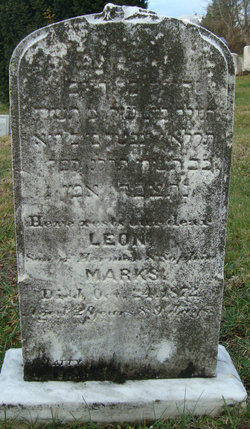
Adolph’s sisters Paulina and Sophia Dinkelspiel did not have lives quite as sad as that of their brother, but they did have their share of heartbreak.  Sophia, who had married Herman Marks in 1869, and was living in Harrisburg, had a child Leon who was born on October 15, 1870.  Leon died when he was just two years old on October 24, 1872.  I do not know the cause of death because the only record I have for Leon at the moment is his headstone.  (Ned’ s research uncovered yet another child who died young, May Marks, but I cannot find any record for her.)

leon marks headstone

Sophia and Herman did have three other children in the 1870s who did survive: Hattie, born May 30, 1873, just seven months after Leon died; Jennie, born August 24, 1876; and Edgar, born August 27, 1879.  Herman worked as a clothing merchant, and during the 1870s the family lived at the same address as the store, 435 Market Street in Harrisburg.

Paulina (Dinkelspiel) and Moses Simon, meanwhile, were still in Baltimore in the 1870s.  In 1870 Moses was a dealer “in all kinds of leather,” according to the 1870 census. At first I thought that Moses and Paulina had relocated to Philadelphia in 1871 because I found a Moses Simon in the Philadelphia directories for the years starting in 1871 who was living near the other family members and dealing in men’s clothing.  But since Moses and Paulina Simon are listed as living in Baltimore for the 1880 census and since Moses was a liquor dealer in Baltimore on that census, I realized that I had been confused and returned to look for Moses in Baltimore directories for that decade.

Sure enough, beginning in 1871 Moses was in the liquor business, making me wonder whether the 1870 census taker had heard “liquor” as “leather.”  After all, who says they deal in all kinds of leather?  All kinds of liquor makes more sense.  Thus, like the other members of the next generation, Adolphus and Simon Nusbaum in Peoria, Leman Simon in Pittsburgh, and Albert Nusbaum in Philadelphia, Moses Simon had become a liquor dealer.


http://www.gettyimages.com/detail/114527609

Moses and Paulina had a fourth child in 1872, Nellie. The other children of Moses and Paulina were growing up in the 1870s.  By the end of the decade, Joseph was eighteen, Leon was fourteen, Flora was twelve, and little Nellie was eight.

Ned Lewison, my more experienced colleague and Dinkelspiel cousin, found a fifth child Albert born in 1875 who died August 25, 1876 and a sixth child Miriam born in July 1877 who died October 30, 1878, both of whom are buried at Oheb Shalom cemetery in Harrisburg, where their parents would also later be buried.  Thus, Paulina lost two babies in the 1870s.  For her parents, Mathilde and Isaac, that meant the deaths of four grandchildren in the 1870s alone.

As for Mathilde and Isaac Dinkelspiel themselves, although they began and ended the decade in Harrisburg, my research suggests that for at least part of that decade, they had moved to Baltimore.  Isaac has no listing in the 1875 and 1876 Harrisburg directories (there were no directories for Harrisburg on line for the years between 1870 and 1874), but he does show up again in the Harrisburg directories for 1877 and 1878.  When I broadened the geographic scope of my search, I found an Isaac Dinkelspiel listed in the Baltimore directories for the years 1872, 1873, 1874, and 1875 as a liquor dealer.  This seemed like it could not be coincidental.  It’s such an unusual name, and Isaac’s son-in-law Moses Simon was a liquor dealer in Baltimore.  It seems that for at least four years, Isaac and Mathilde had left Harrisburg for Baltimore, leaving their other daughter Sophia and her husband Herman Marks in charge of the business at 435 Market Street in Harrisburg, where Isaac and Mathilde lived when they returned to Harrisburg in 1877.

Market Street in Harrisburg 1910  By Wrightchr at en.wikipedia [Public domain], via Wikimedia Commons

Market Street in Harrisburg 1910
By Wrightchr at en.wikipedia [Public domain], via Wikimedia Commons

The extended Dinkelspiel family as well as the Nusbaum family suffered another major loss before the end of the decade.  According to Ned Lewison’s research, Mathilde Nusbaum Dinkelspiel died on June 20, 1878. Another Nusbaum sibling had died, leaving only John and Ernst alive of the original six who had emigrated from Germany to America; Maxwell, Leopold, Isaac, and now Mathilde were gone. Mathilde is buried at Oheb Shalom cemetery in Harrisburg.

What happened to Isaac Dinkelspiel after his wife Mathilde died? Although Isaac appeared in the 1880 Harrisburg directory at 435 Market Street, the same address as his son-in-law Herman and daughter Sophia (Dinkelspiel) Marks, he does not appear with them on the 1880 census at that address.  In fact, I cannot find him living with any of his children or anywhere else on the 1880 census, although he is again listed in the Harrisburg directory at 435 Market Street for every year between 1880 and 1889 (except 1881, which is not included in the collection on ancestry.com).  I assume the omission from the census is just that—an omission, and that Isaac was in fact living with Sophia and Herman during 1880 and until he died on October 26, 1889, in Harrisburg.  He is buried with his wife Mathilde at Oheb Shalom cemetery in Harrisburg.

Thus, the Dinkelspiels certainly suffered greatly in the 18070s.  Five children died in the 1870s—Eva Dinkelspiel, May Marks, Leon Marks, Albert Simon, and Miriam Simon.  And their grandmother, Mathilde Nusbaum Dinkelspiel, also passed away, joining her brothers Maxwell, Leopold, and Isaac, leaving only John and Ernst left of the six Nusbaum siblings who left Schopfloch beginning in the 1840s to come to America.

And so I leave you with this thought as we start looking forward to a New Year.  Don’t take your children or your grandchildren for granted.  Cherish every moment you get to share with them.  And be grateful for modern medicine and the way it has substantially reduced the risks of children being taken from us so cruelly.