
As we saw, Eugen and his family were unable to get to the US on their original German ship, the Hansa, because Hitler recalled all ships leaving Germany in late August, 1939. In addition, their luggage and other possessions were confiscated by Germany in Hamburg.
As the German Maritime Museum explains:
When the war began in September 1939, civilian shipping was largely discontinued. Freight that had not yet been loaded remained in the warehouses, and ships that had already left were ordered back to Germany. From spring 1940, the Gestapo confiscated these unshipped goods in order to “utilize” their contents and allow the proceeds to go to the German Reich. The emigrants’ private possessions were publicly auctioned off to the highest bidder on behalf of the Oberfinanzdirektion (Chief Finance Office).
The LostLift database maintained by the German Maritime Museum includes a document in Eugen Baer’s file (as sorted and translated by Google AI) that listed the inventory of the family’s belongings that at some point had been packed up and brought to Hamburg to be shipped to the United States:1
- Item 1: 1 Large moving crate (1 Kiste)
- Item 2: 2 Bed frames (2 Patentrahmen)
- Item 3: 1 Chair (1 Stuhl)
- Item 60: 5 Laundry/washing boards (5 Wäscheplatten)
- Item 63: A collection of picture frames and 3 family pictures (1 Partie Bilderrahmen / 3 Bilder)
Family Footwear
- Item 7: 1 Pair of ladies’ house shoes/slippers (1 Paar Damen-Hausschuhe)
- Item 8: 1 Pair of men’s leather boots (1 Paar Herrenstiefel)
- Item 9: 1 Pair of men’s shoes (1 Paar Herrenschuhe)
- Item 10: 1 Pair of white ladies’ dress shoes (1 Paar weisse Damenschuhe)
- Items 11–14: 4 Additional pairs of assorted ladies’ shoes (4 Paar Damenschuhe)
- Items 15–16: 2 Pairs of children’s shoes belonging to little Adolf (2 Paar Kinderschuhe)
Eugen’s Clothing & Linens
- Item 4: 3 Pieces of men’s winter underwear (3 Teile Herrenunterwäsche)
- Item 39: 3 Men’s nightgowns (3 Herren-Nachthemden)
- Item 40: 5 Men’s nightgowns (5 Herren-Nachthemden)
- Item 42: 4 Pairs of men’s underpants, noted as mended/patched (4 Herrenunterhosen, teils gestopft u. geflickt)
- Item 43: 3 Men’s undershirts (3 Herrenunterjacken)
- Item 47: 3 Men’s dress shirts (3 Oberhemden)
- Item 48: 2 Men’s dress shirts (2 Oberhemden)
- Item 68: 1 Pair of men’s trousers (1 Herrenhose)
- Item 78: Eugen’s heavy men’s winter coat (1 Herrenwintermantel)
- Item 79: Eugen’s men’s overcoat/ulster (1 Herrenulster)
Hedwig’s Clothing
- Item 5: 3 Ladies’ scarves (3 Schals)
- Item 18: 1 Ladies’ pullover sweater (1 Damen-Pullover)
- Item 22: 3 Ladies’ aprons (3 Damenschürzen)
- Item 24: 1 Ladies’ skirt (1 Damenrock)
- Item 25: 1 Unfinished/in-progress handmade ladies’ wool skirt (1 unfertiger Damenwollrock)
- Items 26–27: 6 Additional ladies’ aprons (6 Damenschürzen)
- Item 29: 1 Black smock/house dress (1 schwarzer Kittel)
- Item 30: 1 Traditional German Dirndl dress (1 Dirndlkleid)
- Item 31: 1 Ladies’ beach/sun suit (1 Strandanzug für Damen)
- Item 34: 4 Pieces of assorted ladies’ underwear (4 Teile Damenwäsche)
- Items 36–37: 4 Ladies’ nightgowns (4 Damen-Nachthemden)
- Item 44: 3 Pieces of ladies’ undergarments (3 Teile Damenunterwäsche)
- Item 45: 2 Pairs of ladies’ wool bloomers/panties (2 wollne Damenschlüpfer)
- Item 66: 1 Ladies’ jacket (1 Damenjacke)
- Items 69–71: 3 Matching sets of a ladies’ blouse and skirt (3 Bluse, 1 Rock)
- Item 72: 2 Ladies’ blouses (2 Blusen)
- Item 73: 1 Ladies’ blouse (1 Bluse)
- Item 74: 1 Ladies’ dress (1 Damenkleid)
- Item 77: 1 Black ladies’ winter coat (1 schwarzer Damenmantel)
Adolf’s Clothing
- Item 20: Adolf’s children’s athletic training suit (1 Kinder-Trainingsanzug)
- Item 32: 2 Pairs of children’s pants (2 Kinderhosen)
- Item 38: 1 Child’s morning robe (1 Kindermorgenrock)
- Item 58: 2 Pieces of children’s underwear and 1 child’s vest (2 Teile Kinderwäsche / 1 Pollunder)
- Item 64: Adolf’s boy’s raincoat (1 Knaben-Regenmantel)
- Item 67: 1 Child’s jacket/blazer (1 Kinderjackett)
- Item 80: 1 Child’s set of pajamas (1 Kinder-Schlafanzug)
Household Textiles & Valuables
- Item 6: 1 Real cat fur blanket/throw (1 Katzenfell)
- Item 23: 2 Wool blankets (2 Wolldecken)
- Item 41: 1 Tablecloth (1 Tischdecke)
- Item 49: 6 Hand towels (6 Handtücher)
- Item 50: 5 Kitchen dish towels (5 Geschirrtücher)
- Item 51: 2 Bed comforter covers (2 Bettbezüge)
- Item 52: 1 Bath towel (1 Badelaken)
- Item 54: 1 Bed sheet (1 Bettlaken)
- Items 55–56: 6 Pillowcases (6 Kissenbezüge)
- Item 57: 7 Hand towels (7 Handtücher)
- Item 61: 1 Handbag containing a 26-piece family silverware set (1 Tasche m. 26 Teilen Besteck)
There were also several items of furniture, including bed frames and a chair.
But these items never made it out of Germany. They were seized by the Nazis in Hamburg after Eugen and his family were turned back to port in August 1939, and later auctioned off, the proceeds being kept by the Nazi government.
According to another document in Eugen Baer’s file in the LostLift database, on November 19, 1942, the government ordered a bailiff in Hamburg to auction off Eugen Baer’s confiscated possessions; the bailiff reported back on May 6, 1943, that the goods had been sold at auction for 655.50 Reichmarks (RM) with an additional 15% added as a “buyer’s premium,” bringing the total proceeds to 753.85 RM.2 One calculation indicates that that would be worth almost $6000 today. After paying fees to the bailiff, the rest of the proceeds went back to the Nazi government in Hamburg.3
When Eugen filed a claim for restitution against the German government in 1958, he claimed compensation for all these items and the cost of shipping them from Bad Nauheim to Hamburg as well as compensation for other losses:4
- The cost of the tickets he had purchased for his family to travel to the United States from Hamburg in 1939 from HAPAG, the Hamburg shipping company, which Eugen claimed he had purchased for 838 RM, which, according to one calculation, would be worth about $8000 today;
- The value of debts he had never been able to collect; and
- The value of the furniture and household belongings that had been destroyed in Griedel as well as some jewelry that had been stolen.
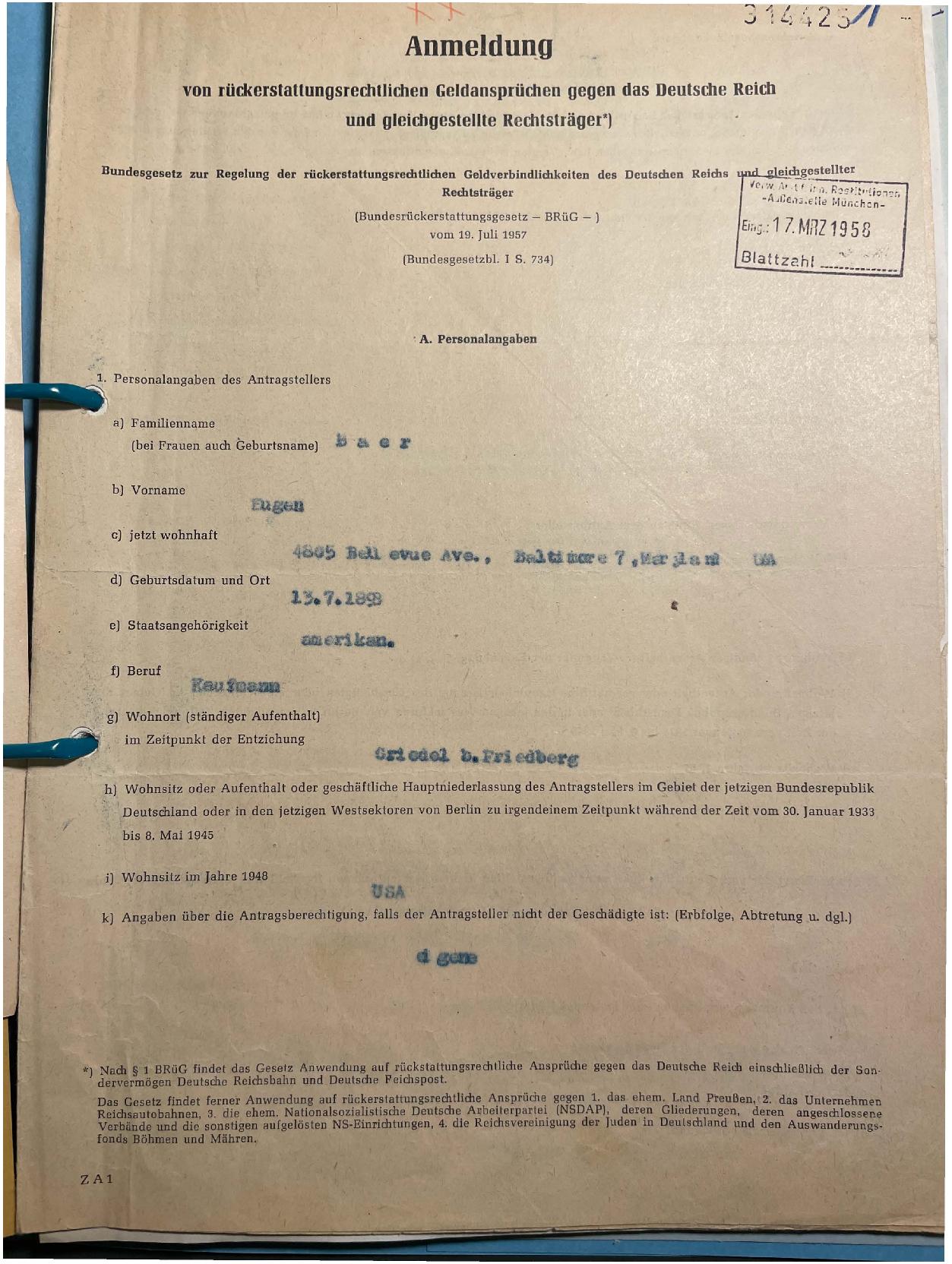
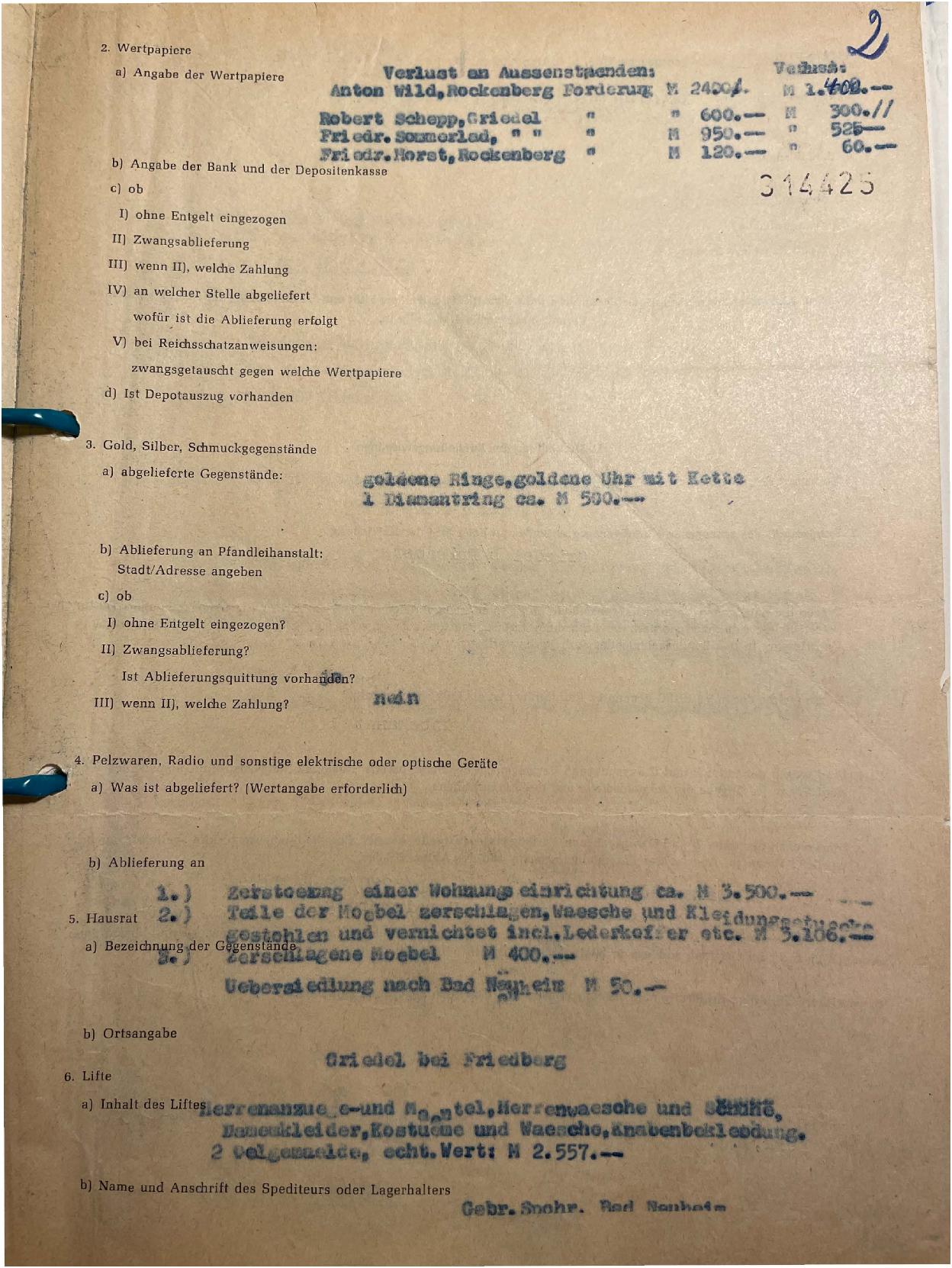
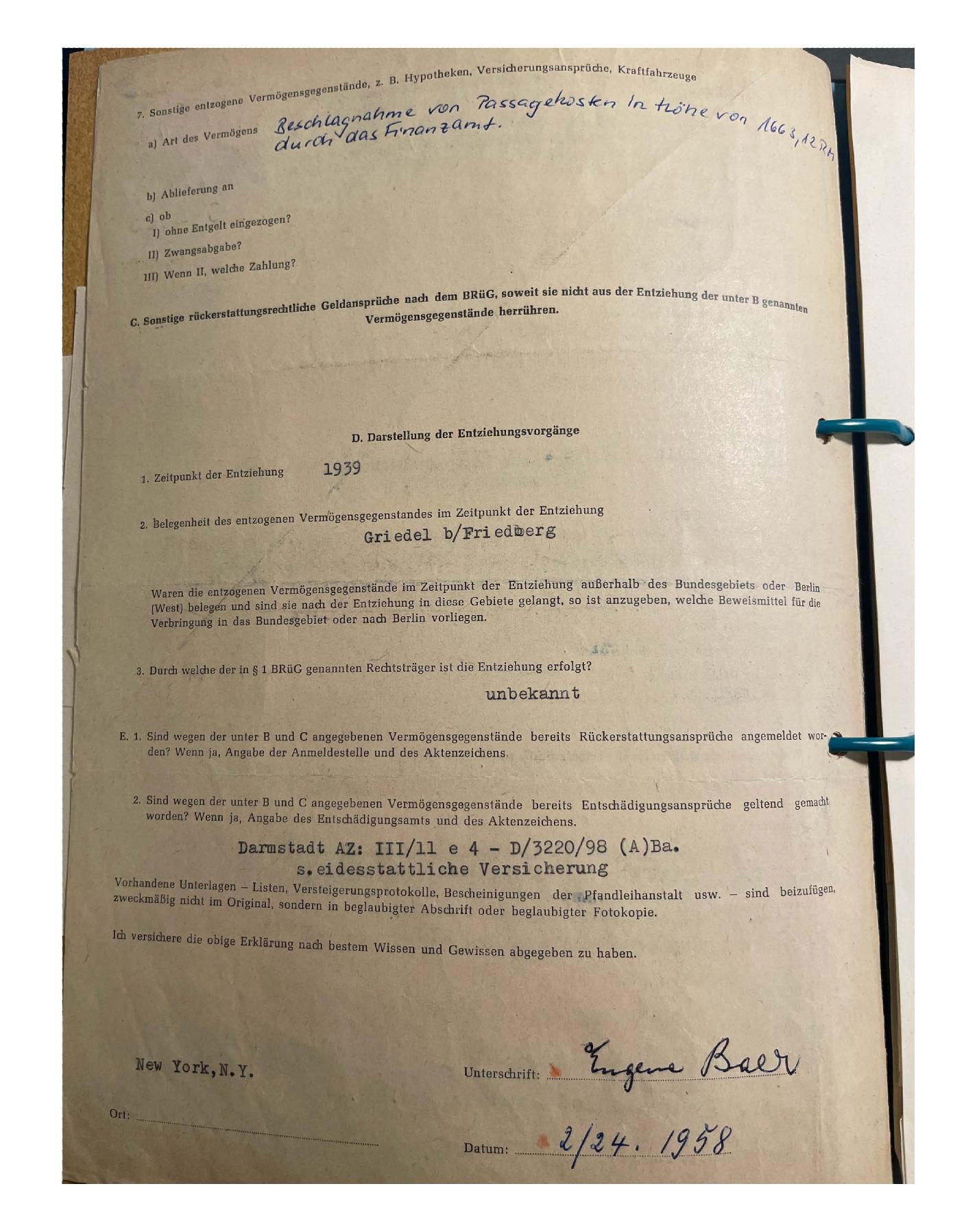
The German government contested these various claims, but in the end provided compensation for the unused tickets and the goods that had been shipped to Hamburg and later sold at auction, but not for the items damaged by the Nazis in Griedel nor for the stolen jewelry and linens and other items that Eugen had lost. He was awarded 1200 DM in 1961. Accounting for inflation, that would be worth about $3350 dollars in 2026.5
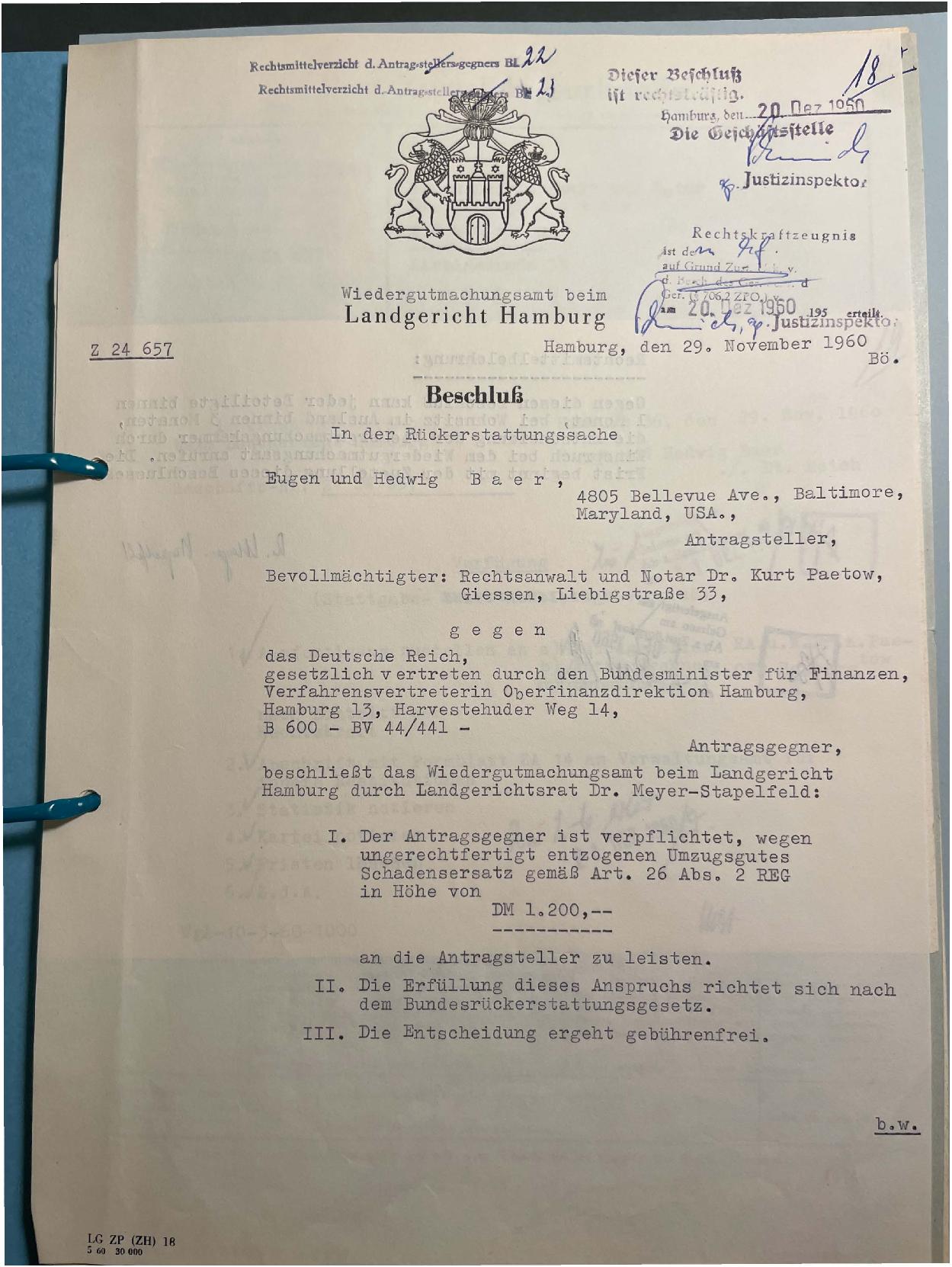
Given that the auctioneer sold the shipped goods for what would now be worth about $6000 and that the unused tickets would be worth about $8000 in today’s US dollars and that the judgment did not include many other valuable items that the Baer family lost, the award obviously did not cover even their material losses.
Having endured so much persecution and abuse—their home vandalized and possessions stolen, their ship to safety being called back, Eugen being sent to a camp in France– no amount of money could compensate them for all the emotional, psychological, and other intangible losses and harm they’d suffered. But fortunately by the end of 1939, Eugen, Hedwig, and Adolf were safe in America along with all of Eugen’s siblings except Julius, who, as we saw, survived the war in France and Switzerland.
- LostLift database, German Maritime Museum – Leibniz Institute for Maritime History, “Removal good: Eugen Baer” (source: Staatsarchiv Hamburg 214-1_124, Baer, Eugen, Bad Nauheim, Bekleidung/Hausrat, Lgb. C 12/43, 1942–1943), https://lostlift.dsm.museum/en/detail/collection/a2f6b9b1-b72f-4649-9389-8d00c303527d. ↩
- LostLift database, German Maritime Museum – Leibniz Institute for Maritime History, “Removal good: Eugen Baer,” https://lostlift.dsm.museum/en/detail/collection/a2f6b9b1-b72f-4649-9389-8d00c303527d (last modified: 2 Aug. 2026). ↩
- RM 753 is converted here using the official 1943 exchange rate of approximately RM 2.50 = $1 (Marcuse, “Historical US Dollars to German Marks Currency Conversion”), then adjusted for inflation using the U.S. Bureau of Labor Statistics’ CPI Inflation Calculator. The resulting figure of almost $6000 is an approximation. ↩
- StAHH 213-13 Nr. 24475 (Z 24657), Eugen Baer, Anmeldung, 24 Feb. 1958. ↩
- Staatsarchiv Hamburg, 314-15 Oberfinanzpräsident, Nr. 885 (Bescheid, 27 March 1961). There was also an award of accumulated interest of 4% a year not included in this figure. ↩

