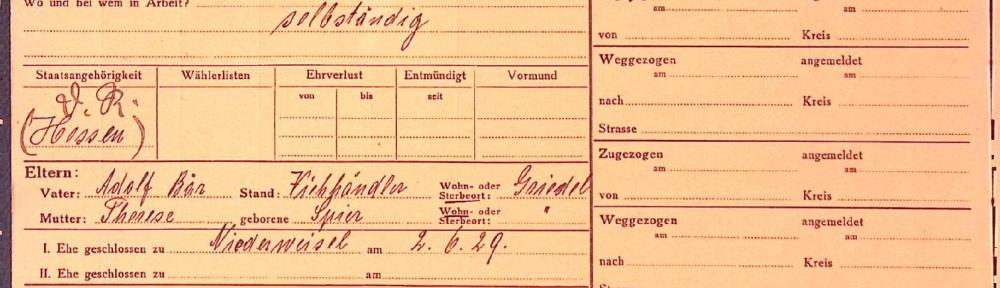
Now that I am back from traveling, I will return to the saga of the Baer siblings, in particular the one remaining Baer sibling, Eugen. And his story, like that of his brother Julius, is quite complicated. Eugen and his wife Hedwig and son Adolf did not arrive in the US until after World War II had started. Hedwig and Adolf arrived on November 15, 1939, and Eugen arrived six weeks later on December 28, 1939.
I was curious as to why they arrived so late and why they arrived separately. Piecing together that story was a challenge. Rather than tell the story in a direct way, I’d like to take you on the roundabout journey I took to figure it out.
The first documents I studied about their departure were the two ship manifests, one for Hedwig and Adolf and one for Eugen. According to the information on the passenger manifest for Hedwig and Adolf, they had obtained US visas in Stuttgart on August 11, 1939, before the war started; they listed their last residence as Griedel, Germany.
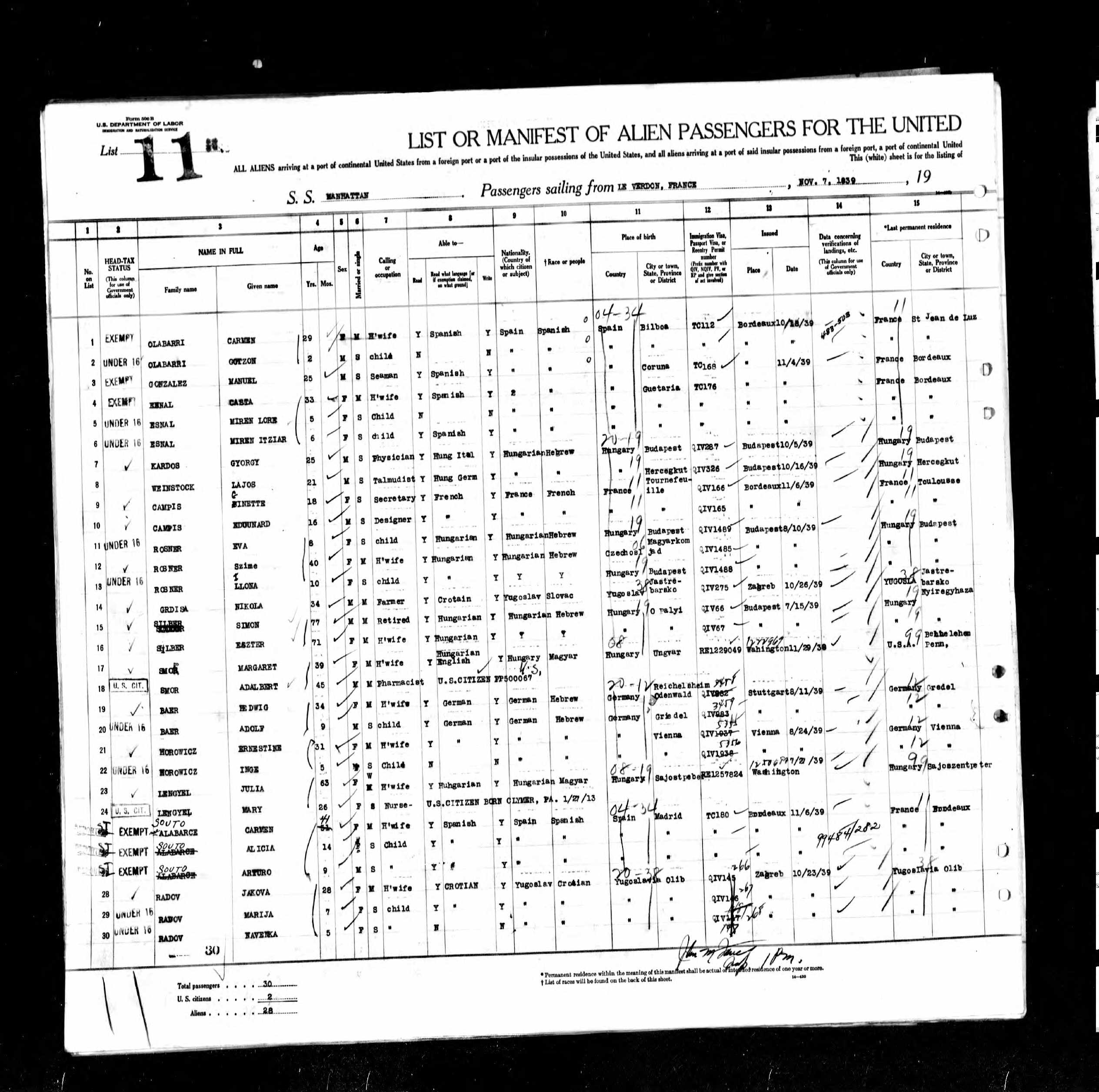
Hedwig and Adolf Baer, ship manifest, The National Archives in Washington, DC; Washington, DC, USA; Passenger and Crew Lists of Vessels Arriving at New York, New York, 1897-1957; Microfilm Serial or NAID: T715; RG Title: Records of the Immigration and Naturalization Service, 1787-2004; RG: 85, Ancestry.com. New York, U.S., Arriving Passenger and Crew Lists (including Castle Garden and Ellis Island), 1820-1957
Looking at the passenger manifest for Eugen, however, I noticed that he did not receive his visa in Stuttgart until October 12, 1939, two months after his wife and son received theirs and six weeks after the war started. But since the US was not yet at war with Germany at that time, Eugen was still able obtain a visa from the US Consul in Stuttgart.
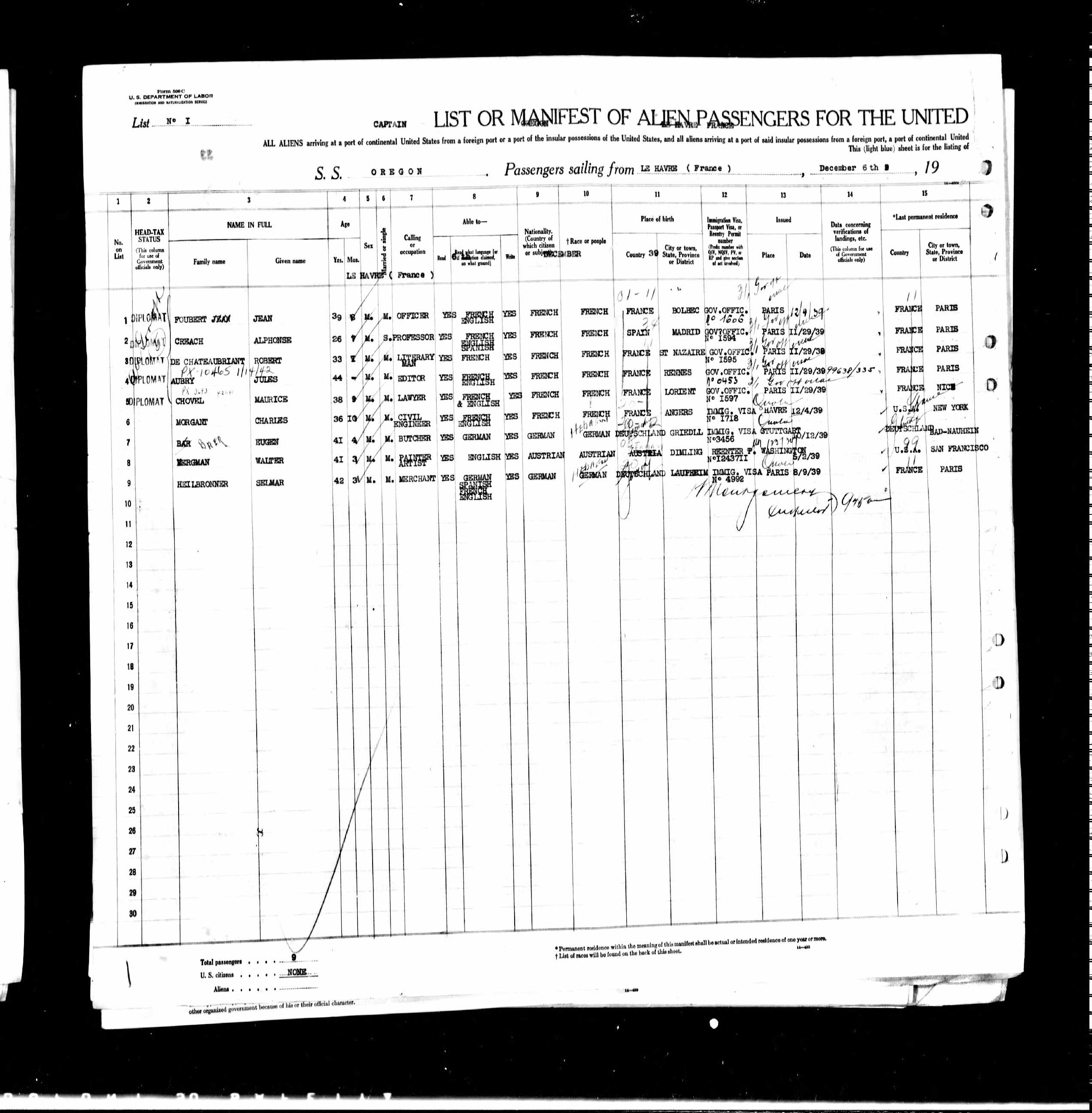
Eugen Baer, ship manifest, The National Archives in Washington, DC; Washington, DC, USA; Passenger and Crew Lists of Vessels Arriving at New York, New York, 1897-1957; Microfilm Serial or NAID: T715; RG Title: Records of the Immigration and Naturalization Service, 1787-2004; RG: 85, Ancestry.com. New York, U.S., Arriving Passenger and Crew Lists (including Castle Garden and Ellis Island), 1820-1957
Unlike Hedwig and Adolf’s manifest, which listed their last residence as Griedel, Eugen’s manifest listed his last residence as Bad Nauheim, a town where there was and is a resort and spa and that is less than ten miles from Griedel (and incidentally the town where his brother Arthur had moved to after his home and business were vandalized). I wondered: Why was Eugen living in Bad Nauheim, not Griedel? Was he ill? Is that why he left later? Is that why he didn’t apply for a visa when his wife and son did? Was the family living separately?
Thus began a search that took me through archives in Germany and France and through many other sources.
I found my next important clues in the LostLift Database, a database created by the German Maritime Museum that contains documents detailing the Nazi expropriation and sale of the belongings of Jewish refugees.1 I located a file in that database for Eugen Baer that included the following comment: “The furnishings of their apartment in Griedel near Friedberg were destroyed. The family then moved to Bad Nauheim and later emigrated to the USA.”
So I learned that the family’s home in Griedel had been ransacked and that the family had fled to Bad Nauheim, but there were no dates included as to when these events occurred. It took until more recently when I acquired files from the Hesse Archives in Wiesbaden2 that I learned more details. These files related to a claim for compensation that Eugen made after the war in part for boat tickets he had purchased for himself, his wife, and his son to leave Germany and immigrate to the United States, just as many of his siblings had already done.
Eugen filed this sworn statement as part of his compensation claim [translation by Claude.ai]: 3
Since 1929 I operated the cattle-trading business and butcher shop that had existed for many years, run by my late father, under the firm name Eugen Baer, Griedel b/Friedberg/Hessen.
After the seizure of power by the Third Reich on 30 January 1933 and the boycott of Jewish businesses, I had no way to continue my livelihood and was forced by measures of the Party to close the butcher shop already in 1933 and to give up the cattle trade in 1935.
The methods used are generally known and I consider it unnecessary to go into them further. However, I cannot fail to mention the following incident:
My son had to be transferred to the Israelite Hospital in Frankfurt/M for an operation, and my wife and I stayed overnight with the boy. The next day we returned to Griedel. When we entered our apartment, we were met with a scene of devastation that can hardly be described. On the evening of the previous day, a number of SS and SA men had forced their way into the house after breaking down the front door, and smashed everything that wasn’t nailed or bolted down. All the cupboards had been torn open and all valuables, clothing, linens, etc. destroyed and largely stolen. All the windowpanes and doors were smashed, nothing was spared. Pepper had been strewn in quantity throughout all the rooms, so that it was impossible to remain in the house. …
As a witness I can name the entire population of Griedel.
Signed: Eugen Baer
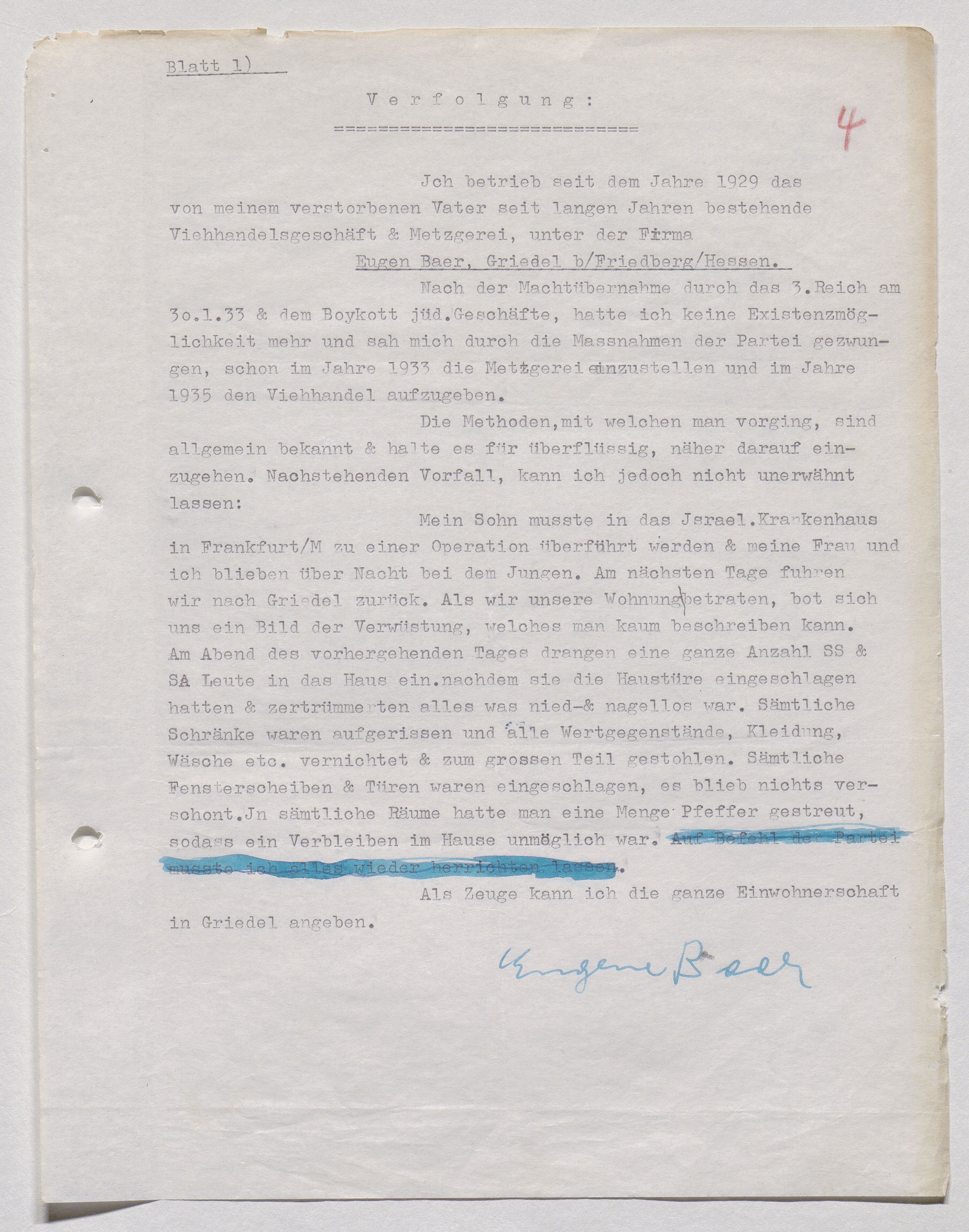
HHStAW Abt. 518 Nr. 23400, Eugen Baer, “Verfolgung,” p. 4.
Eugen did not include the date on which these attacks occurred, but from his statement and the description of the vandalism, I assume that it took place after 1935 and could have been during Kristallnacht on November 8-9, 1938, when many Jewish homes and synagogues were attacked by the Gestapo and SA and heavily vandalized and even destroyed.
An article entitled “A Special Homecoming” about Eugen’s family published on December 7, 2022, in JMore, the Baltimore Jewish community newspaper, provided an indication that this attack had occurred during Kristallnacht. It reported that, “Growing up in the German village of Griedel, Adolph “Ed” Baer [Eugen’s son] was often the victim of antisemitic bullying by his classmates. He witnessed the torching of his town’s synagogue during Kristallnacht, the 1938 “night of broken glass” ….” That language would suggest that the family had not left Griedel until after Kristallnacht.
One additional clue that helps to corroborate this possibility is the fact that Eugen and his family left Griedel by April 26, 1939. That fact appeared in another document in this compensation file. The town of Bad Nauheim reported that Eugen Baer was registered as a resident of Bad Nauheim from April 26, 1939, until August 1, 1939.4
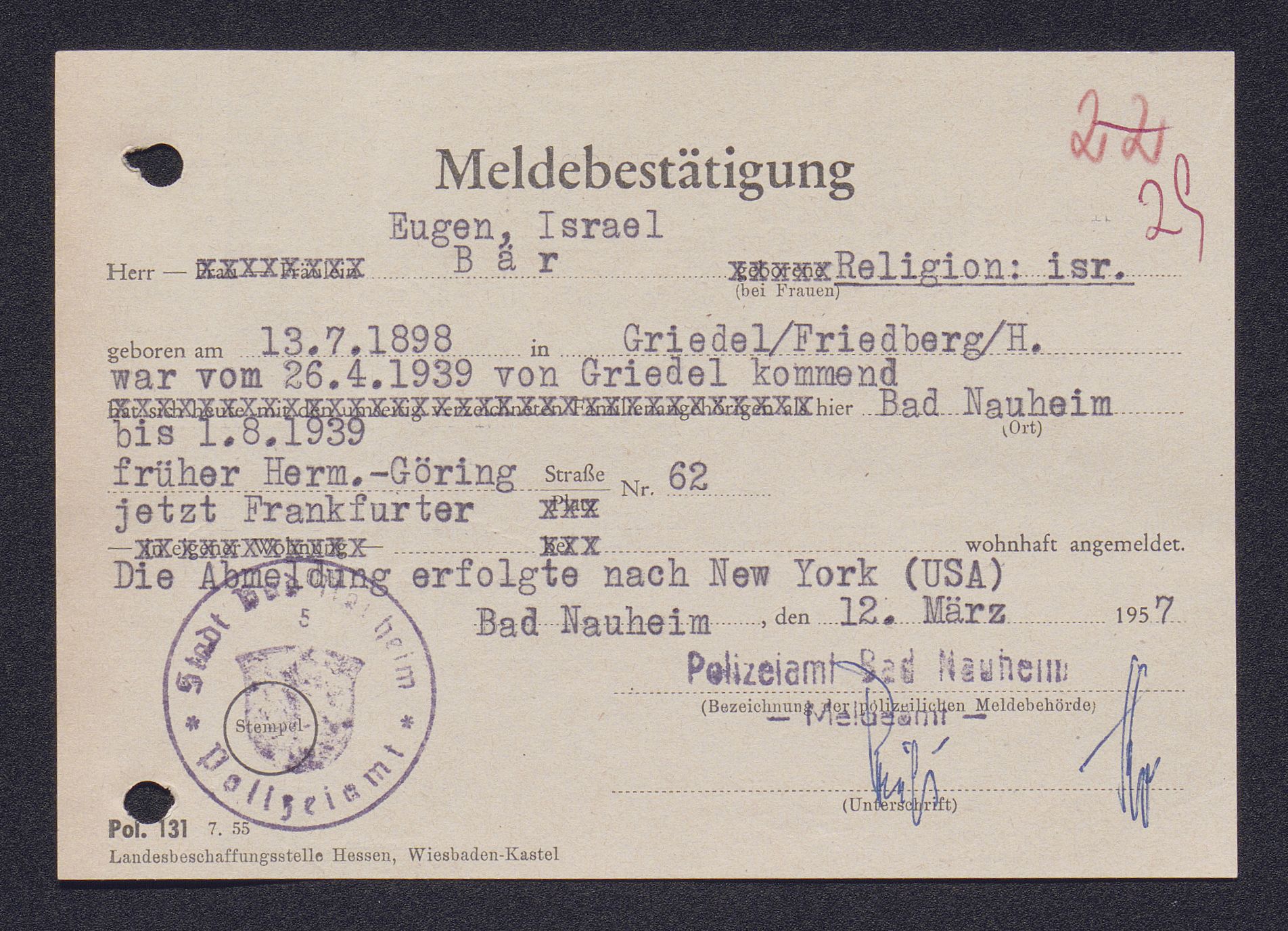
HHStAW Abt. 518 Nr. 23400, Meldebestätigung, Bad Nauheim, 12 March 1957, p. 24.
Why did they choose Bad Nauheim as their refuge? There appear to have been two possible reasons. First, he had family there. Included in the LostLift database was a document that revealed that Eugen and presumably Hedwig and Adolf were living in Bad Nauheim at the address of Berthold Baer, Eugen’s second cousin.5 That may also explain why Eugen’s brother Arthur had also fled to Bad Nauheim.
Also, Bad Nauheim had had a Jewish community for centuries and had three hundred Jewish residents in 1933. Its synagogue was looted and severely damaged during Kristallnacht but not destroyed as was the case for so many other synagogues in Germany.
This article from the Jerusalem Post from November 11, 2017, provides more context:
BAD NAUHEIM, known for its hot springs, attracted many visitors, including Jews, looking for health benefits. There were a number of kosher hotels, and a significant percentage of the doctors who served the townspeople and guests were Jews.
Prior to the Nazi takeover, antisemitism was somewhat muted – the presence of paying guests who were Jews made overt hostility bad for business….The many guests from all over the world – including Dwight Eisenhower, who would later instruct the US Army Air Force to refrain from bombing the town – probably mitigated open antisemitism to a certain degree and may well have played a part in the preservation of the synagogue.….
IN BAD NAUHEIM, as elsewhere, Kristallnacht was traumatic for the Jewish community. On November 10, local Brownshirts gathered at a tavern and set out from there, with the active assistance of other residents, to destroy Jewish homes and shops. They looted and threw merchandise into the street. Hitler Youth joined them in removing clothing and furniture from destroyed homes and burning them.
The vice mayor and head of the local Nazi cell attempted to restrain the mob to some degree, especially when it came to private homes and the synagogue – an attempt that was only partially successful. The hooligans broke into the synagogue and defaced the large Stars of David on the building’s facade. Ritual articles and costly rugs were destroyed, although some holy objects had been removed to a different location for protection.
They set the building aflame – but it was extinguished by town residents recruited for the task. A French Red Cross delegation was visiting Bad Nauheim to observe its spa and therapeutic facilities, and municipal officials did not want foreign visitors to be eyewitnesses to the barbarity.
This is what ultimately saved the synagogue. Yet the damage was significant.
Thus, Eugen likely chose to move to Bad Nauheim because he had relatives there and because it was a safer place for his family to hide. Not that there weren’t Nazis there, but, as the article above indicates, the antisemitism was not as virulent there as in other places in Germany because it was a destination for many foreigners.
But obviously at some point Eugen and Hedwig realized that they had to get out of Germany and by August 1, 1939, one month before the war started, they left Bad Nauheim. But where did they go?
That requires another post.
- LostLift database, German Maritime Museum – Leibniz Institute for Maritime History, Person: Eugen Baer, Permalink: https://lostlift.dsm.museum/en/detail/person/3439a55b-b0da-43a3-8305-20e8d46ee767 (Last modified: 8.9.2025) [translated by Google] ↩
- Hessisches Hauptstaatsarchiv Wiesbaden (HHStAW), Abt. 518, Nr. 23400 (Wiedergutmachungsakte Eugen Baer, 1954–1960) [hereinafter cited as ” HHStAW Abt. 518 Nr. 23400, Eugen Baer” with the appropriate title and page number in the file. ↩
- HHStAW Abt. 518 Nr. 23400, Eugen Baer, “Verfolgung,” p. 4. ↩
- I can’t explain why Hedwig and Adolf’s last residence was given as Griedel on their manifest except to say it seems to be an error. ↩
- LostLift Database (Hamburg State Archives), Eugen Israel Baer file, Order for Auction, Aktz. U.89, Nov. 1942 Eugen’s father Eisemann Adolf Baer was the first cousin of Berthold Baer’s father Meier Baer. Eisemann and Meier were the grandchildren of Eisemann Baer and Breinie Bendheim. Berthold was born in Bad Nauheim. Berthold Bär, Gender männlich (Male), Birth Date 20 Dez 1895 (20 Dec 1895), Birth Place Bad Nauheim, Hessen (Hesse), Deutschland (Germany), Civil Registration Office, Bad Nauheim, Father Meier Bär, Mother Nannÿ Bär, Certificate Number 86, Hessisches Hauptstaatsarchiv; Wiesbaden, Deutschland; Bestand: 924; Laufende Nummer: 1167, Ancestry.com. Hesse, Germany, Births, 1851-1901 ↩

