
To learn what next happened to Julius Baer and his family after Julius was released from the Osthofen prison camp in March 1934, I relied on a combination of a biography written by his son Arnold in 2005 that I obtained from the archives in Darmstadt, a residence registration I received from the archives in Butzbach, and a collection of documents I obtained from the Swiss archives detailing the family’s experiences in Switzerland.
The Butzbach residence registration indicates that Julius left that town for Molsheim, France, on either February 19 or April 19, of 1936. Is that a 4 or a 2 with an ink blob over it?
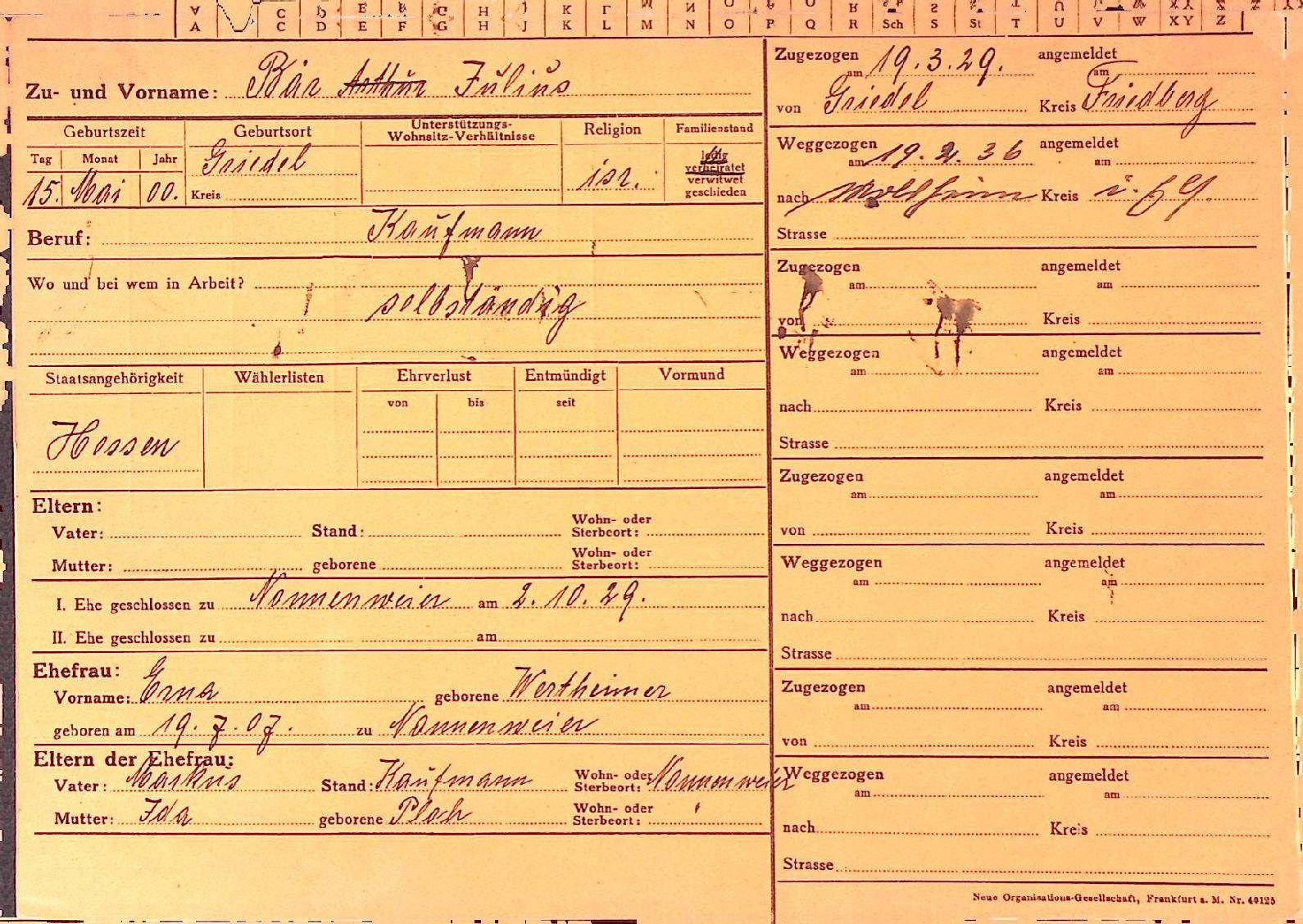
Stadtarchiv Butzbach, Butzbach, Germany. Bestände des Einwohnermeldeamts: Meldekarten der jüdischen Einwohner. Registration card for Julius Bär (born 15 May 1900), recording residential changes and family details.
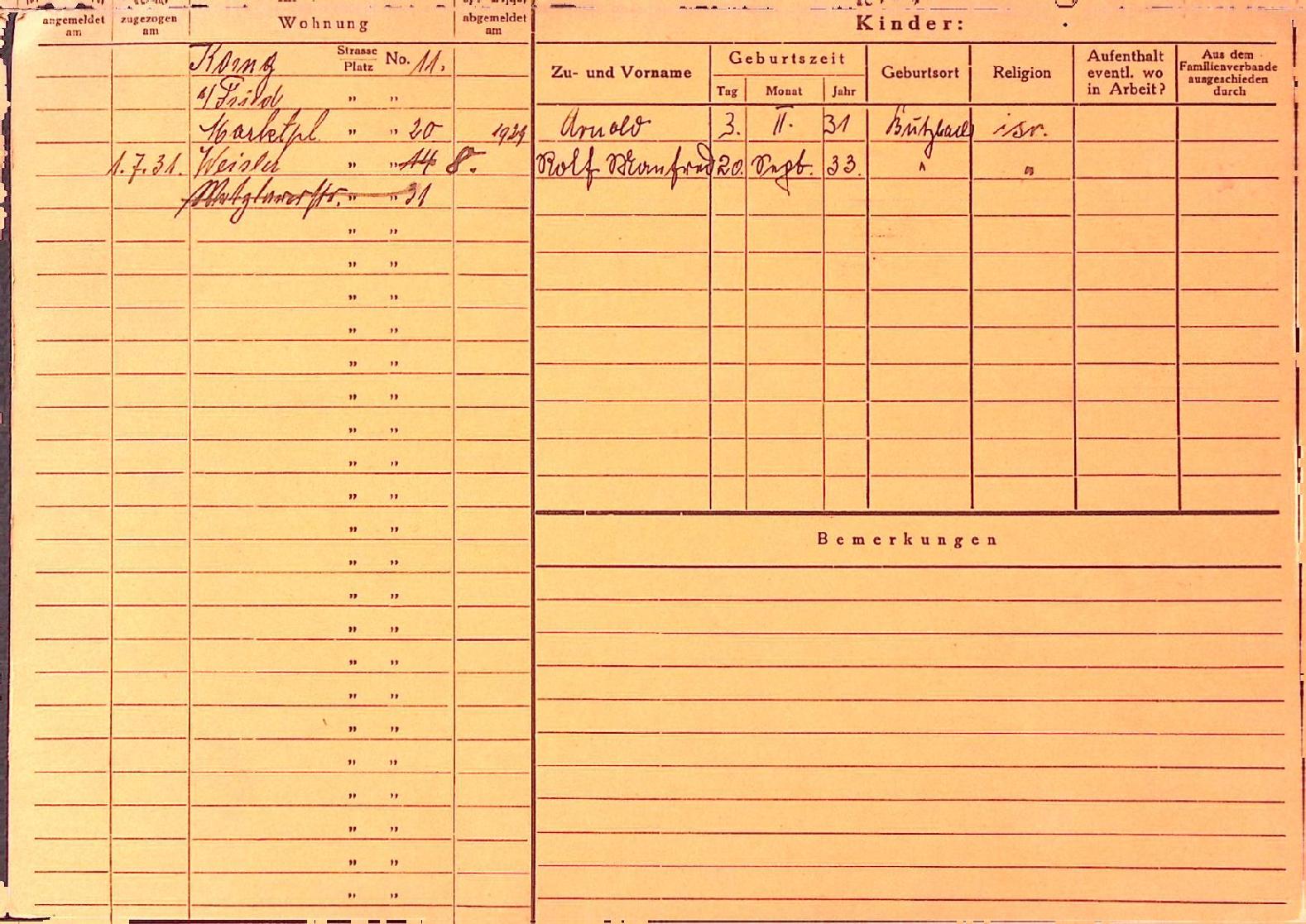
According to the biography written by Arnold Baer in 2005, “In early 1936 our family emigrated to Molsheim (Bas-Rhin), in France, [a town in the Alsace region right near the border with Germany]. There my father opened a new shop, much larger than the one in Butzbach, in partnership with my [maternal] grandfather, Markus Wertheimer. Shortly afterward, German Jews abroad were “denaturalized” (stripped of citizenship). We were now stateless (apatrides).”1
Arnold wrote that his father was twice interned by the French as an enemy alien, first in the fall of 1938 after Germany invaded Czechoslovakia and then again after World War II started in September, 1939. Both times Julius had in fact volunteered to fight with the French army against Germany but nevertheless was treated as an enemy—even though Germany no longer considered him to be a citizen. The family was truly stateless— neither German nor French. 2
After the war broke out, the French soon ordered an emergency evacuation of the Alsace region because of its proximity to the German border. Thus, Julius’ wife and sons were forced to leave their home and move to the southwestern region of France. Along with other residents of the Alsace region, Erna, Arnold, and Rolf were resettled in Périgueux, the capital of the Dordogne province in France.3
Meanwhile, Julius was in an internment camp. As Arnold recounted:4
The French treated the internees — Jews and non-Jews alike — equally badly. After a few months he was assigned to the British allied army, in Nantes, a port city at the mouth of the Loire. His role was as a prestataire, a kind of labor unit. The English, compared with the French gendarmes, behaved rather more like gentlemen.
In May 1940 the Germans overran Holland and Belgium and pushed into northern France. The French army was overrun. The English army left Nantes, but left the prestataires their trucks and food, with the advice to flee south as far as possible. Their column, led by a French non-commissioned officer, reached Toulouse — where we, his family (who had fled from Alsace since May 15, 1940), found him again by chance.
The column continued south, almost to the Spanish border, and we followed. There the column was disbanded and my father was demobilized.
The family, now reunited, lived in Perigueux together, but Arnold wrote that starting in November 1941 his father Julius was forced to join a group of foreign workers (Groupement de Travailleurs Étrangers). He wrote, “There, one either had to go into a camp and be assigned to forced labor, or had to be able to prove that one had a contract for ‘useful’ work. As a result, [my father] hired himself out to various farmers, having to report for work each morning and being able to return home in the evening.”5
The documents I received from Switzerland corroborate the fact that Julius was part of this foreign workers group. The document below, date stamped February 9, 1942, by the French Ministry of Labor, was Julius Baer’s registration card with the foreign worker’s group.
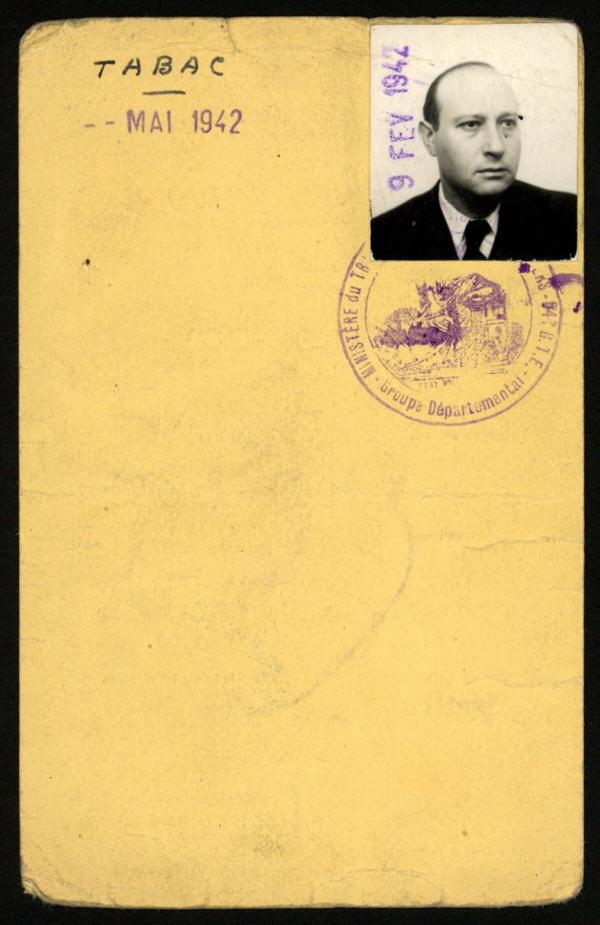
Archives départementales de la Dordogne, Périgueux, France. Series M/W: Groupements de Travailleurs Étrangers (GTE). Group 665/647 (Chancelade), Foreign Worker Identity Card for Jules Baer (Registration No. 665.223), dated 9 February 1942.
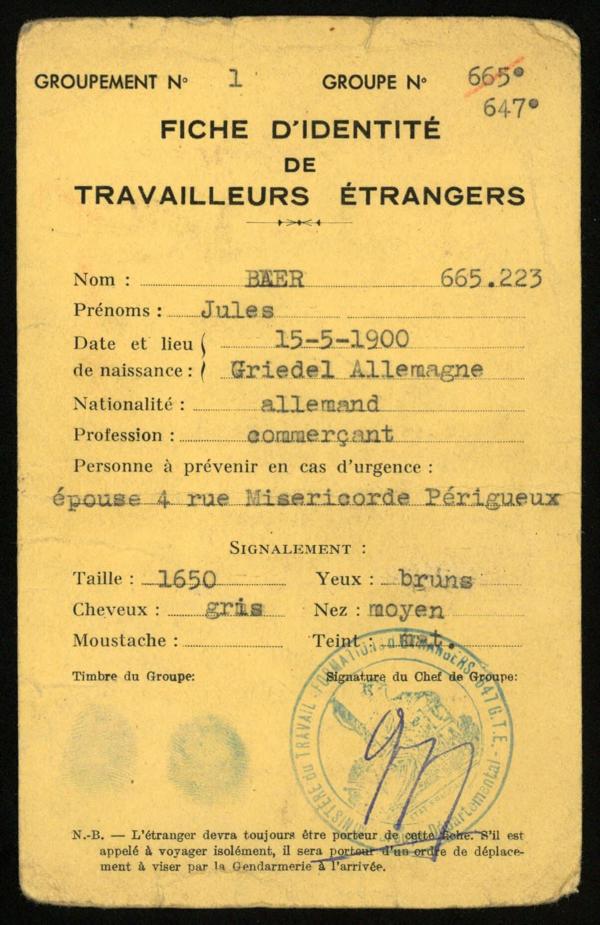
Archives départementales de la Dordogne, Périgueux, France. Series M/W: Groupements de Travailleurs Étrangers (GTE). Group 665/647 (Chancelade), Foreign Worker Identity Card for Jules Baer (Registration No. 665.223), dated 9 February 1942.
The document, as translated by Google, reads as follows:
Groupement No.: 1
Groupe No.: 665 / 647
Identity Card for Foreign Workers
Last Name: BAER (Registration No. 665.223)
First Name: Jules
Date and Place of Birth: 15-5-1900 in Griedel, Germany
Nationality: German
Profession: Merchant (commerçant)
Emergency Contact: Wife, 4 rue Miséricorde, Périgueux
Physical Description (Signalement)
Height: 1.65 m (approx. 5’5″)
Eyes: Brown
Hair: Gray
Nose: Medium
Moustache: [Blank]
Complexion: Swarthy (tanned / mat)
The text at the bottom reads, “The foreigner must always carry this card. If called upon to travel alone, he must carry a movement order to be endorsed by the Gendarmerie upon arrival.”
Erna also was required to have an identity card:
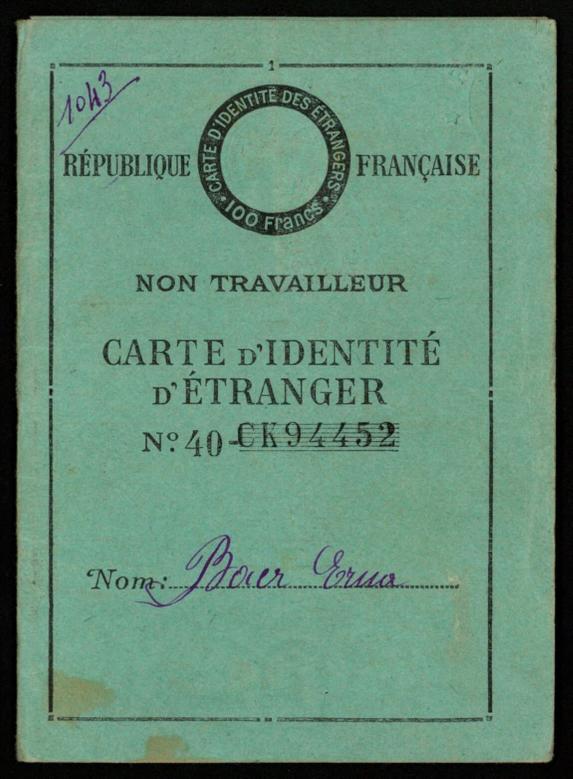
Archives départementales de la Dordogne, Périgueux, France. Series M: Cartes d’identité d’étrangers—Non-Travailleurs. Identity Card No. 40-CK94452 for Erna Baer (née Wertheimer), issued 24 June 1942.
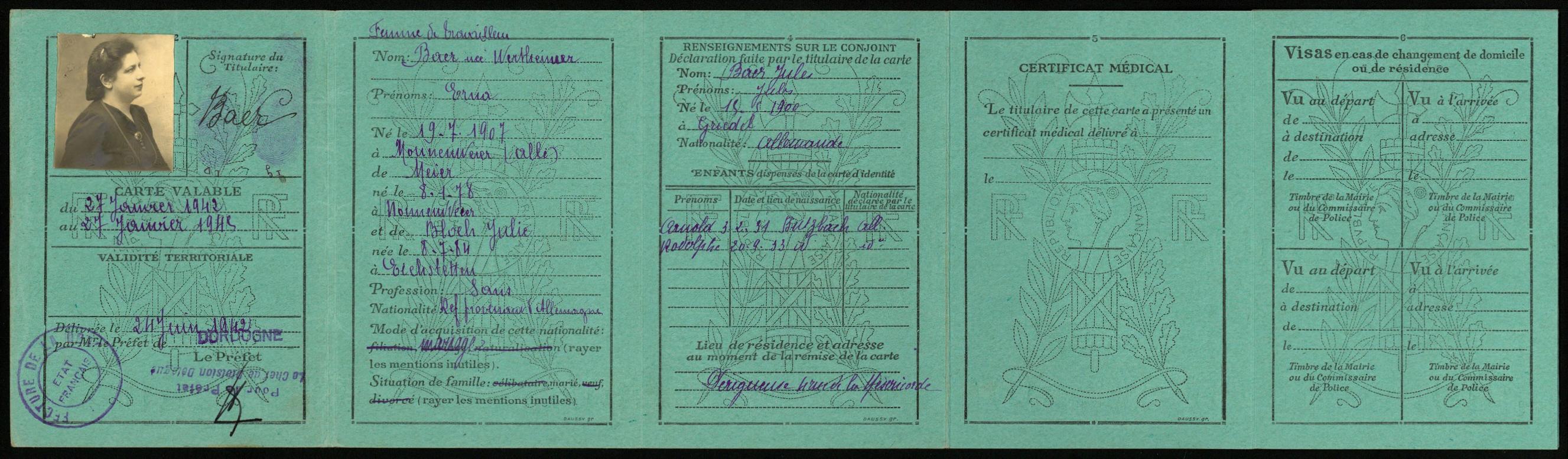
Archives départementales de la Dordogne, Périgueux, France. Series M: Cartes d’identité d’étrangers—Non-Travailleurs. Identity Card No. 40-CK94452 for Erna Baer (née Wertheimer), issued 24 June 1942.
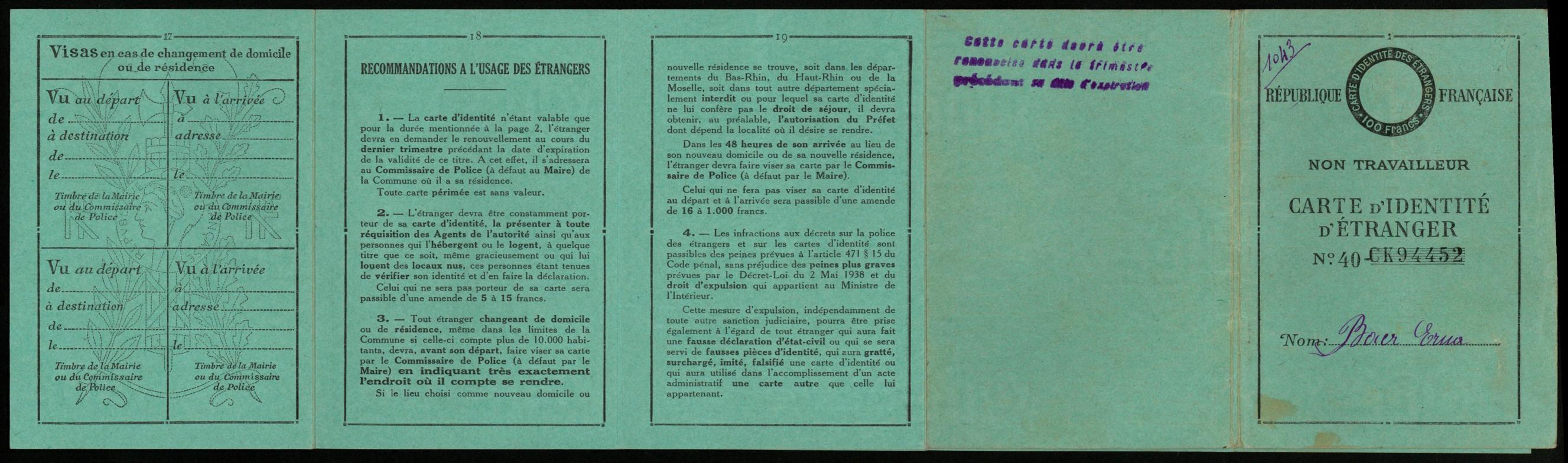
Archives départementales de la Dordogne, Périgueux, France. Series M: Cartes d’identité d’étrangers—Non-Travailleurs. Identity Card No. 40-CK94452 for Erna Baer (née Wertheimer), issued 24 June 1942.
She is identified as a non-worker. The card includes identifying information and facts about Erna and Julius as well as the names and birth dates and places of their two sons.
Arnold Baer, who was just eleven years old at the time, detailed what happened next:6
In July 1942, the Gestapo official responsible for Jewish affairs, Theo Dannecker, accompanied by the police director for Jewish questions, Schweblin, made an inspection tour through “unoccupied” southern France, and was also seen in Périgueux. Immediately afterward, around August 24, large-scale raids were carried out by the Vichy authorities. Father and Mother went into hiding for a time. Whoever was caught was transported to a French holding camp and later deported eastward toward Eastern Europe.
It was at this point in time that Julius and Erna sought refuge in Switzerland. According to the documents I received from the Swiss archives, the family received permission on October 2, 1942, to enter Switzerland and arrived on October 22, 1942, but illegally.
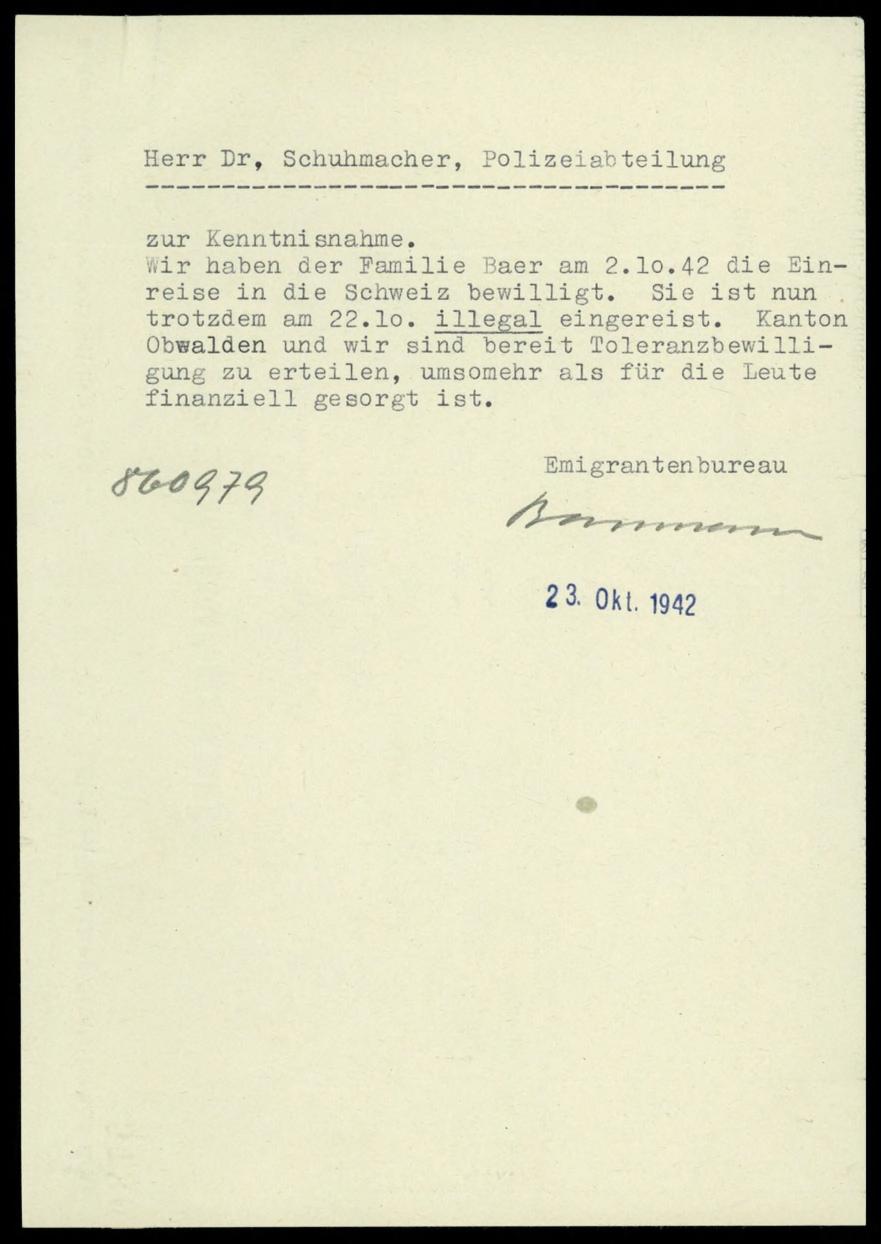
Swiss Federal Archives (BAR), Bern, Switzerland. Federal Alien Police, Dossier N 6485. Emigrant Bureau, Internal Memorandum to Dr. Schuhmacher regarding early illegal entry, 23 October 1942.
[Translation by Google]
To: Mr. Dr. Schuhmacher, Police Department
For your information: We authorized entry into Switzerland for the Baer family on October 2, 1942. Nevertheless, they entered illegally on October 22. Canton Obwalden and we are prepared to grant a tolerance permit, especially since the family’s financial support is taken care of.
— Emigrant Bureau, October 23, 1942
The date is particularly noteworthy because as of August 1942, the Swiss government closed its borders and refused to accept any more Jewish refugees, a decision for which it has since been harshly criticized.7 Arnold Baer wrote that they had family in Switzerland who vouched for the Baer family and helped them get a residence permit and also later provided support to the family.8 I don’t know who those relatives were as Arnold did not name them, but since almost all of Julius’ siblings were in the United States or England by 1942, it was none of them.
Although the family had received permission on October 2 to enter Switzerland, their entry into Switzerland on October 22, 1942, was deemed illegal by the Swiss presumably because they did not cross the border at an established checkpoint. Even Arnold Baer, in his biography of his father, admitted that the family was smuggled across the border illegally.9 Given that the Swiss were generally not allowing refugees into the country, Julius and Erna may have been advised to avoid the checkpoints for fear of being turned away.
Julius and the family were held in an “Auffanglager,” a military camp where refugees who entered the country illegally were retained and interrogated.10. On November 25, 1942, Julius submitted an application for a residence permit.11 According to documents from the Swiss archives, on December 9, 1942, the police in the canton of Obwalden were willing to grant the Baer family permission to reside in Engelberg in that canton, and the Swiss federal police then asked the military whether that was permissible from a military standpoint.12
The military, however, was opposed to granting the Baer family permission.13 Nevertheless, because of various bureaucratic errors and lack of oversight, the family was able to move to Engelberg in late 1942 and safely remained there for the duration of the war.14
After the war, the family returned to France. In his biography of his father, Arnold Baer wrote:15
In May ’45 we went back to Molsheim (Alsace). The house and shop had been occupied by Alsatian “Aryans,” who had bought the “right” to do so from the German Nazis for little money. Furniture had likewise been “sold” in the same manner, or “stolen” by German officials. It took several months of legal proceedings before we could move back into our house. Some furniture could be recovered. Father then rebuilt the business.
As I was reading through these files and those from Darmstadt detailing the arrest and imprisonment of Julius in 1934, I could feel my own heart beating faster. I can only begin to imagine the constant fear and anxiety this family felt with two young boys, first, fighting the 1934 arrest, then escaping to Molsheim, only to have Julius treated as an enemy of France. Then the family was evacuated from Molsheim to southern France for safety, but ultimately had to leave there for Switzerland after the Gestapo arrived. Imagine being smuggled through the Alps into Switzerland in 1942 with two boys, not knowing whether the Swiss would let you enter. And once there, the family was once again detained, forced to stay in a camp and wait to see if they could get permission to live in Engelberg where they had family. Even after the war ended and they could return to Molsheim, they had to live through the heartbreak and aggravation of losing their home there.
And yet. Julius persisted. He got back their home. He rebuilt his business. And his family survived. In fact, they more than survived; they thrived. Arnold ended the 2005 biography of his father with these heartwarming words:16
My parents now have 8 grandchildren, of whom 3 bear the family name BAER. 7 of them live in Israel. These grandchildren together have 26 great-grandchildren, of whom 25 are in Israel.
My parents both died in 1981. They are buried in Rosenwiller (Bas-Rhin).
May their souls be bound up in the bundle of the living (after Samuel 2, 25:29). May their memory be a source of blessing…
Amen.
- Arnold Baer, “My Father Julius Baer (1900–1981),” Hessisches Staatsarchiv Darmstadt, Bestand R 12 P, Nr. 7975HStAD Collection R 12 P No. 7975 (hereinafter referred to as “Arnold Baer’s biography of Julius Baer.”) Translation by Claude.ai. ↩
- Ibid. ↩
- Ibid. For more information about the French evacuation and relocation of the residents of the Alsace region, see here, here, and here. ↩
- Arnold Baer’s biography of Julius Baer. Although Julius used the name Jules in France and is referred to under that name in French records, for clarity’s sake I will refer to him as Julius throughout. That also appears to be his son Arnold’s preference, given that he called his biography of his father “My Father Julius Baer.” ↩
- Ibid. ↩
- Ibid. ↩
- See, e.g., this discussion at Yad Vashem about the Swiss during the Holocaust as well as this discussion by historian Chelsea Sambells. In addition, this 1999 New York Times article discusses the criticism Switzerland faced for this decision. ↩
- Arnold Baer biography of Julius Baer ↩
- Ibid. ↩
- See Swiss Federal Archives (BAR), Bern, Switzerland. Federal Alien Police, Dossier N 6485. Emigrant Bureau, Internal Memorandum to Dr. Schuhmacher regarding early illegal entry, 23 October 1942. ↩
- Swiss Federal Archives (BAR), Bern, Switzerland. Federal Alien Police, Dossier N 6485. Police Directorate of Obwalden, Decision Form for Settlement, Residence, or Tolerance Permit (EFP 860979 B), 25 November 1942. ↩
- Swiss Federal Archives (BAR), Bern, Switzerland. Federal Alien Police, Dossier N 6485 / Sm. Letter from the Chief of the Police Division to Field Post No. 5397, Inquiry regarding military security clearance for Julius Baer, 9 December 1942. ↩
- Swiss Federal Archives (BAR), Bern, Switzerland. Federal Alien Police, Dossier N 6485. Swiss Army Command (Armeekommando), Security Services Division, Official Rejection of Tolerance Permit for Julius Baer, 9 January 1943. ↩
- Swiss Federal Archives (BAR), Bern, Switzerland. Federal Alien Police, Dossier N 6485. Federal Alien Police Emigrant Bureau, Case Review and Internal Audit Report regarding Baer’s unregulated stay in Engelberg, 5 February 1944. ↩
- Arnold Baer biography of Julius Baer ↩
- Arnold Baer, Biography of Julius Baer. Arnold Baer died on August 9, 2007, two years after writing this biography of his father. For more about him and his life, see here. ↩


Good for them!
Amy, I’m pretty sure it’s a 2 for February. Very similar to the 2 in the field above where the arrival in 1929 is noted. Also on the left side, where the date of marriage is listed as 2.10.29. There’s a 4 on the second card and it is quite different from the other 2’s.
LikeLiked by 1 person
Thanks, Cathy! That also is consistent with Arnold writing that they left in early 1936 (although April could be seen as early, February makes more sense).
LikeLiked by 1 person
You’re welcome. BTW, great job writing to all those places for the records!
LikeLiked by 1 person
Thanks! One thing AI has proved helpful for is locating where to write to for records once I find a reference number in the archives. It has greatly enhanced my ability to obtain the underlying records. So it may not be great for transcribing German Kurrent script, but for giving tips on obtaining records it has been a real benefit.
LikeLiked by 1 person
Constant fear and anxiety … but so lucky to survive and thrive!
LikeLiked by 1 person
Yes! An amazing story of survival.
LikeLike
What an incredible story! I was so relieved it had a happy ending…I too can only imagine the extreme fear and stress under which this family lived for over a decade. Thank you for telling us their story…
LikeLiked by 1 person
Thanks, Teresa. BTW, both of your messages came through. It seems you made two similar but slightly different comments so I thought perhaps you weren’t sure that the first one went through.
LikeLike
Yep – they weren’t showing up 🙄I stopped after two on the off-chance they were stuck in the system.
LikeLike
Uch. So annoying!
LikeLike
Hi Amy this is a wonderful story of family strength & endurance, I could hardly wait to finish it. Having to flit around Europe so many times could have broken them but they had the vision.
LikeLiked by 1 person
Yes—they were incredibly brave and strong.
LikeLike