The “Case” Against Julius Baer: A Page out of Kafka’s The Trial

It’s been several weeks since I last posted about my Baer cousins, the children of Therese Spier and Eisenmann Adolf Baer and great-great-grandchildren of Sprintz Blumenfeld, the sister of my three-times great-grandmother, Breine Blumenfeld. I had an incredible couple of weeks with my own children and grandchildren and a chance to re-energize myself for more genealogy research. Discussing my latest novel, The Women Before Us, with my daughter has made me realize once again how important it is to preserve the stories and memories of our ancestors.

And so now I will return to the story of Julius Baer, the youngest child of Therese Spier Baer, and his experiences during the Nazi era.


In my last post I confessed that I had gotten myself into a deep hole by confusing my cousins Julius and Arthur Baer with two unrelated men with the same names and concluding that both of my cousins had been arrested after Kristallnacht in 1938 and sent to Buchenwald concentration camp. But thanks to Bryan Knobloch, who shared with me pages from Hanno Muller’s book Familienbuch Butzbach Band V: Judenfamilien in Butzbach und seinen Stadtteilen (Family Book Butzbach Volume 5: Jewish Families in Butzbach and its Districts), I discovered that mistake and learned that my Julius Baer was not even in Germany in 1938.

Muller’s note on Julius Baer indicated that he had owned a ready-made clothing store in Butzbach, Germany, and that he was “said to have been a communist and was brought to the Osthofen concentration camp near Worms in February 1933 together with Josef Oppenheimer.”  The note further reported that Julius and his family had left Germany for France in 1936, then fled to Switzerland in 1942, returning to France after World War II ended.

Having made one mistake, I wanted to be sure I was more careful before relying on Muller’s report, and so I wrote to the Hesse Archives in Darmstadt for documentation of Julius’ arrest and imprisonment in Osthofen and to Switzerland for documentation of his time there during the war. I also wrote to France for information about Julius’ life in France and asked a cousin in France for further help in that country. I’ve received the documents from Darmstadt and from Switzerland and will now report on some of the German documents.1

The documents from Germany are, of course, in German, so I used claude.ai to translate them. Since most of them were typed, not handwritten, the translations are likely accurate. Rather than post the entire text and images, I will summarize the important points and quote and include the appropriate images of the documents where appropriate.

I immediately noticed two errors in the Muller note about Julius Baer and his arrest and imprisonment. First, it took place in 1934, not 1933, and second, he was arrested with a man named Julius Ehrlich, not Joseph Oppenheimer, as named in the Muller note. Both Julius Ehrlich and Julius Baer were charged with making disparaging remarks about the SA leader Ernst Roehm on January 5, 1934, in Ehrlich’s shoe store. SA is the abbreviation used to refer to the Sturmabteilung, or Stormtroopers, the Nazi’s paramilitary force.

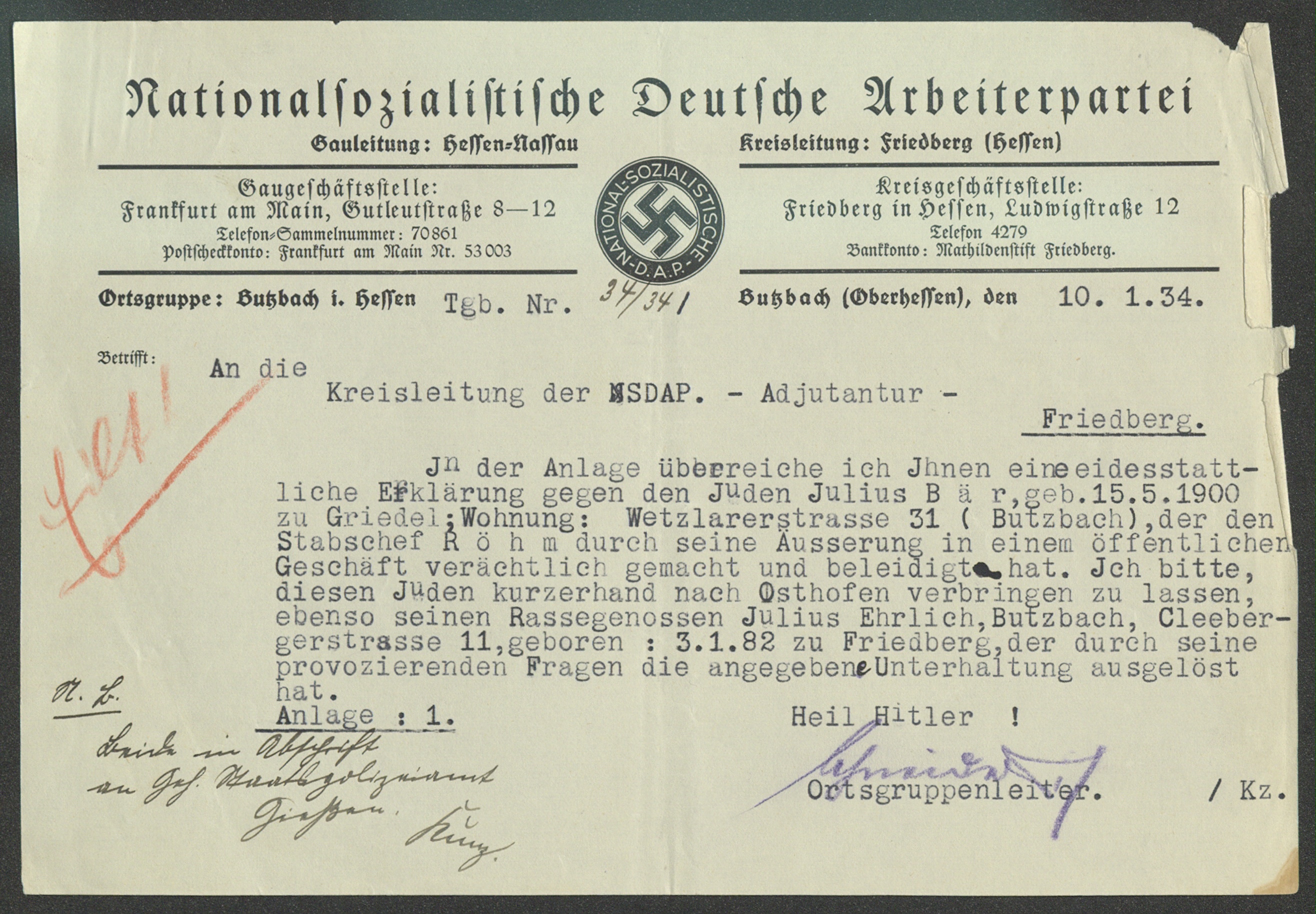
Two women, Luisa Zahrt and Ria Artz, were in the shop at the time and reported Ehrlich and Baer to the local Nazi government, which then issued the following order on January 10, 1934:2

Enclosed I am sending you a sworn statement against the Jew Julius Bär, born 5/15/1900 in Griedel; residence: Wetzlarerstrasse 31 (Butzbach), who disparaged and insulted Chief of Staff Röhm through his remarks in a public shop. I request that this Jew be sent to Osthofen without delay, along with his racial fellow Julius Ehrlich, Butzbach, Cleebergerstrasse 11, born January 3, 1882 in Friedberg, who provoked the conversation in question through his provocative questions.
According to Ria Artz’s sworn statement:3

On Friday, January 5, 1934, after 6 pm, I went with Miss Luise Zahrt, born 8/6/1915 in Lang-Göns, into the Ehrlich shoe shop, Butzbach, Wetzlarerstrasse, to exchange shoes for acquaintances.

On this occasion the shop owner Ehrlich asked: “Do you also need brown SA boots?” The Jew Bär, [of the] textile trade, Butzbach, who was present, then said the following words to us: “From now on the girls will get SA boots too, and Chief of Staff Röhm will become the Führer!”
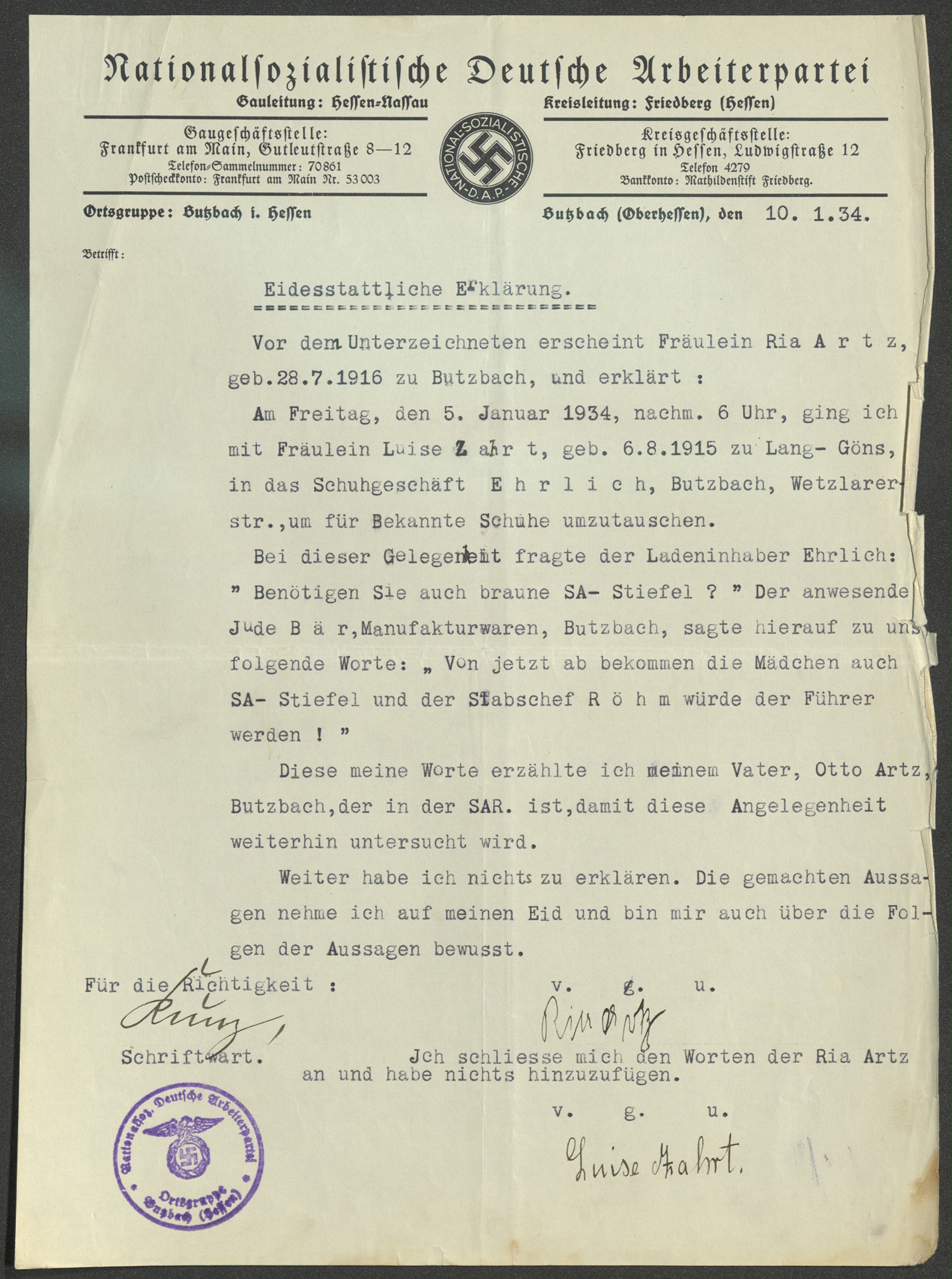
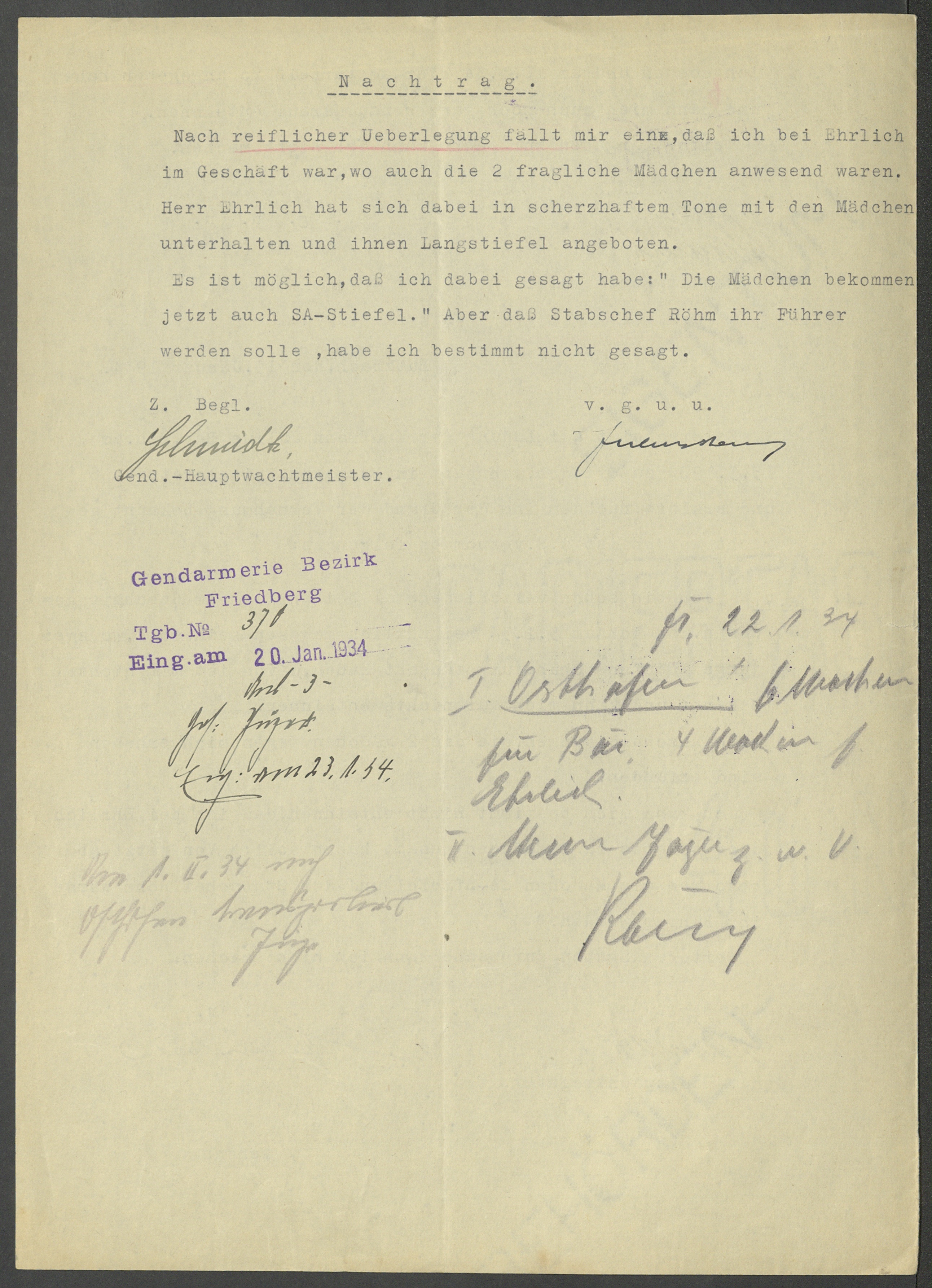
Hessisches Staatsarchiv Darmstadt, Bestand G 15, Nr. Q 149 (Schutzhaftsache Julius Ehrlich, Butzbach, und Julius Baer, Griedel, 1934), p. 7

(Interestingly, Roehm was perceived as a rival and a threat by Hitler and was killed on Hitler’s orders on July 1, 1934, just six months after these charges were filed.)

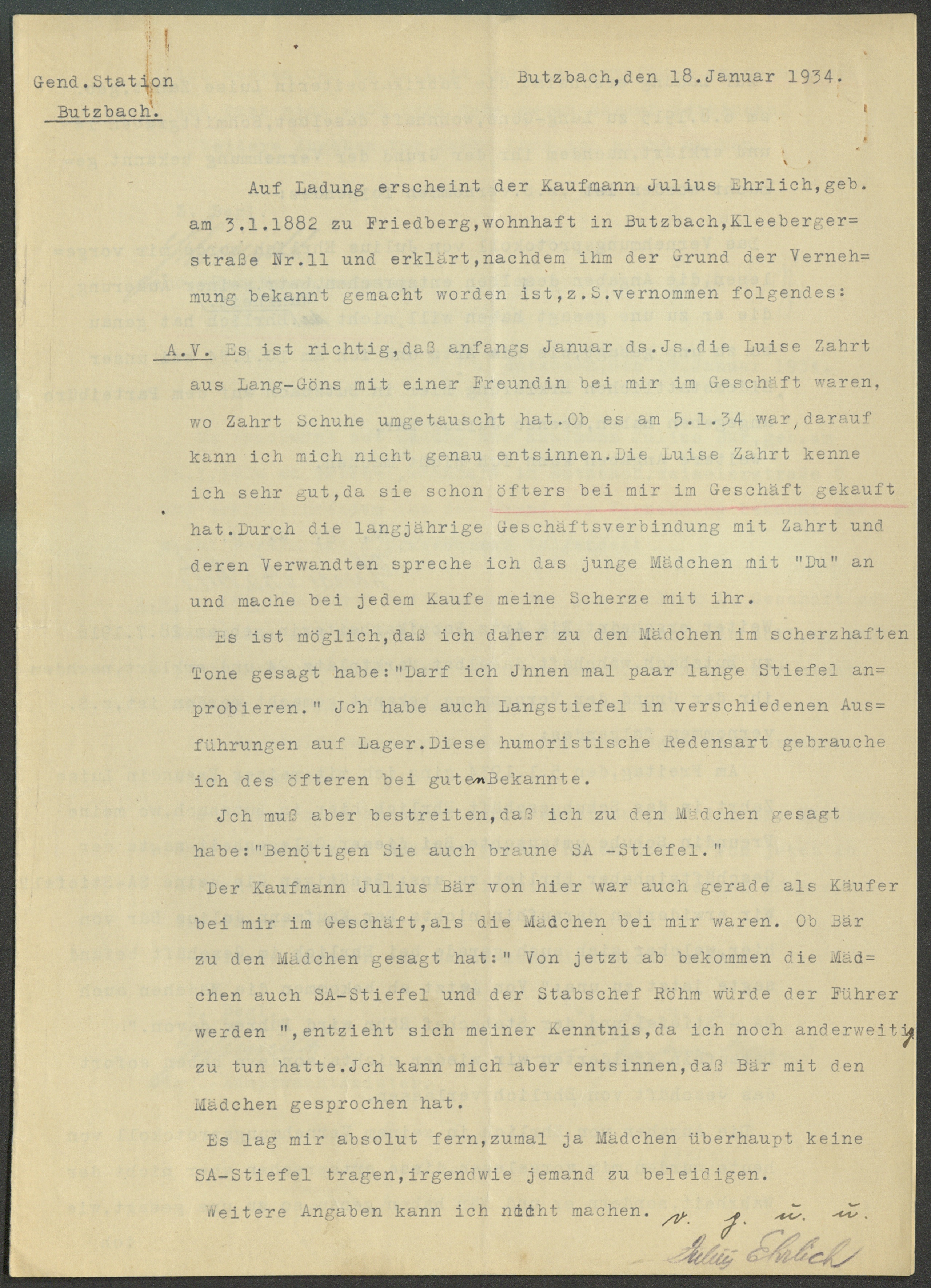
It was those alleged words by Ehrlich and Baer that led to their arrest and interrogation; both denied much of Ria Artz’s story. On January 18, 1934, on being questioned by the police, Julius Ehrlich gave the following sworn statement:4

It is correct that in early January of this year, Luise Zahrt from Lang-Göns was in my shop with a female friend. Zahrt exchanged shoes there. I cannot recall precisely whether it was on 5.1.34. I know Luise Zahrt very well, as she has bought from my shop on several occasions before. Owing to the long-standing business connection with Zahrt and her relatives, I address the young woman informally (“Du”) and make jokes with her whenever she makes a purchase.

It is possible that I therefore said to the girls, jokingly: “May I try some long boots on you?” I also stock long boots in various styles. I use this humorous turn of phrase often with good acquaintances.

However, I must dispute that I said to the girls: “Do you also need brown SA boots?”

The merchant Julius Bär of this town happened also to be in my shop as a customer while the girls were there. Whether Bär said to the girls: “From now on the girls will get SA boots too, and Chief of Staff Röhm will become the Führer,” is not within my knowledge, as I was occupied elsewhere at the time. However, I can recall that Bär did speak with the girls.

It was absolutely far from my intention to insult anyone in any way, especially since girls do not wear SA boots at all.

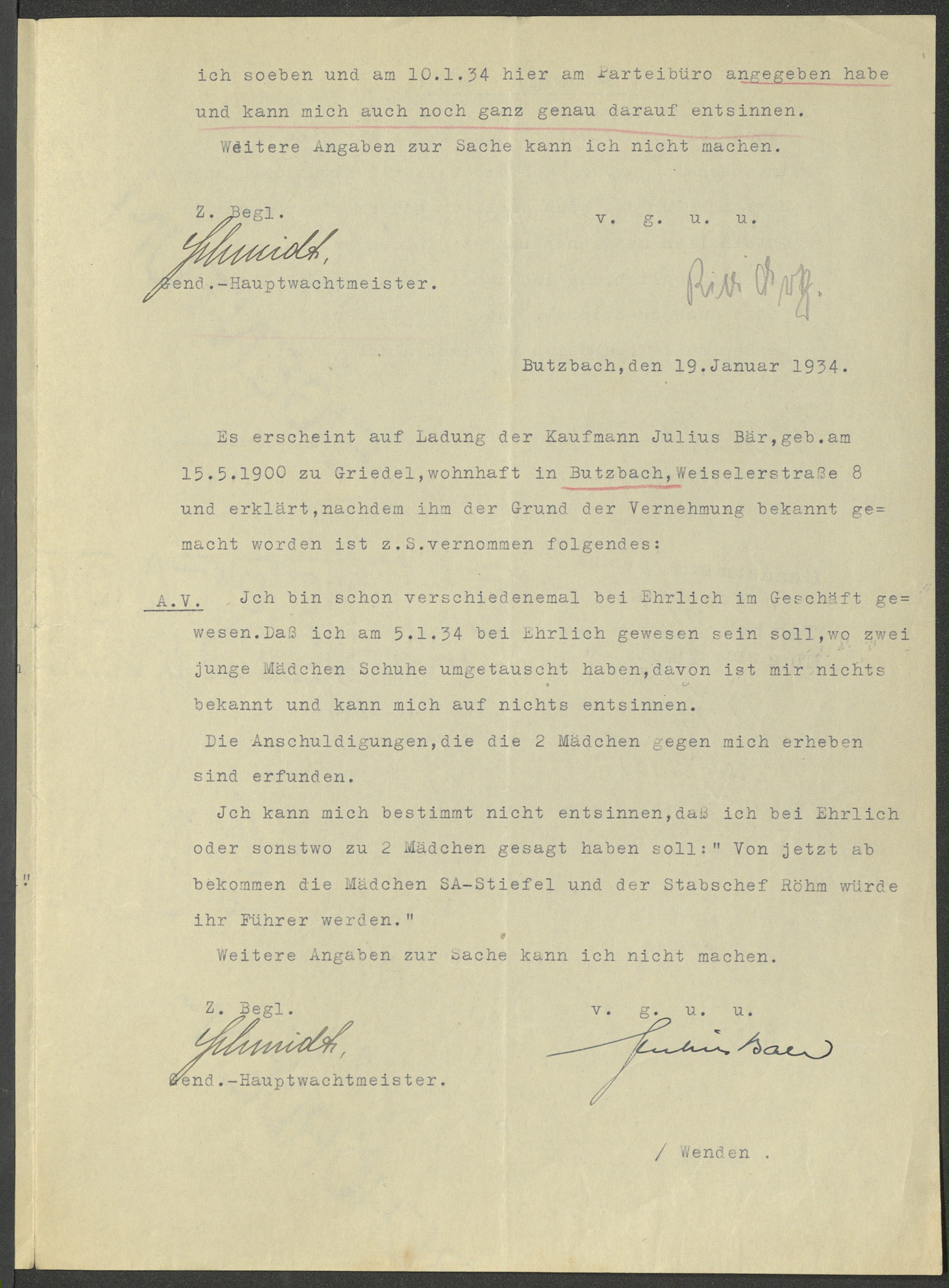
Julius Baer initially gave the following statement on January 19, 1934:5

I have been in Ehrlich’s shop several times before. That I am supposed to have been at Ehrlich’s on 5.1.34, when two young women were exchanging shoes, is not known to me and I cannot recall anything of the sort.

The accusations that the two girls raise against me are invented.

I definitely cannot recall having said to two girls, at Ehrlich’s or anywhere else: “From now on the girls will get SA boots, and Chief of Staff Röhm will become their leader.”

I can give no further information on the matter.

But Julius then amended his statement, saying,6

After careful reflection, it occurs to me that I was in Ehrlich’s shop, where the two girls in question were also present. Mr. Ehrlich, on that occasion, spoke jokingly with the girls and offered them long boots. It is possible that I said, on that occasion: “The girls are getting SA boots now too.” But that Chief of Staff Röhm was to become their leader — that I definitely did not say.
I have to admit that Julius undermined his credibility by his recanting of his initial denial of being in the store, but nevertheless, the question remains, even if Ehrlich and Baer said exactly what the two women claimed, what was the crime? Joking about the SA’s boots? Its leader? Apparently so.

On January 22, 1934, Ehrlich was sentenced to four weeks and Julius Baer to six weeks of “protective custody” in the Osthofen prison camp and were transported there on February 1, 1934.7

Julius Baer’s lawyer petitioned for early release of Julius. He introduced a number of witness statements in support of his client’s release: a letter from a doctor attesting to the poor health of Julius’ mother, Therese Spier Baer, who was suffering from angina pectoris; a statement from the mayor of Griedel attesting to the service of Julius’ father guarding prisoners of war during World War I despite being beyond draft age; a statement from the mayor of Butzbach as to Julius Baer’s good standing in that town; a statement from Julius’ brother Meier listing his service for Germany during World War I, including being wounded at the Battle of Verdun on August 10, 1918; and a statement from the mayor of Griedel about Julius’ own service for Germany during World War I. In exchange for 150 Reichmarks to be donated to the Butzbach Winter Relief Fund, the authorities agreed to release Julius Baer after four weeks in custody on March 1, 1934, the same day that the four-week term of Julius Ehrlich expired.8

So for allegedly making a joke about the SA and its leader, my cousin Julius Baer was sent to a prison camp for a month. Imagine his own fear, imagine how terrified his wife and child must have been. This is how a fascist government operates; it uses fear and force to intimidate its citizens so that they cannot even make jokes about that government without fear of imprisonment. It turns other citizens into informers who rat out their fellow citizens. It makes all of us suspicious of each other and frightened to speak up against those who are persecuted.

The next post will discuss what happened to Julius Baer and his family after he was released from Osthofen on March 1, 1934.


  1. Hessisches Staatsarchiv Darmstadt, Bestand G 15, Nr. Q 149 (Schutzhaftsache Julius Ehrlich, Butzbach, und Julius Baer, Griedel, 1934). There are 28 pages of documents in this folder. I will refer to the relevant pages below. 
  2. Hessisches Staatsarchiv Darmstadt, Bestand G 15, Nr. Q 149 (Schutzhaftsache Julius Ehrlich, Butzbach, und Julius Baer, Griedel, 1934), document 3 
  3. Ibid., p. 7 
  4. Ibid., p. 25 
  5. Ibid., p. 27 
  6. Ibid., p. 28 
  7. Ibid., p. 28 
  8. Hessisches Staatsarchiv Darmstadt, Bestand G 15, Nr. Q 149 (Schutzhaftsache Julius Ehrlich, Butzbach, und Julius Baer, Griedel, 1934)(multiple pages in the file) 

The Children of Therese Spier Baer Marry, and The Family Ends Up with Four Men Named Julius

We saw last time that Therese Spier and her husband Eisemann Adolf Baer (hereinafter just referred to as Adolf, the name he seems to have been known as) had eight children, four girls and four boys, born between 1893 and 1909. By 1919, those children began to marry and have families of their own.

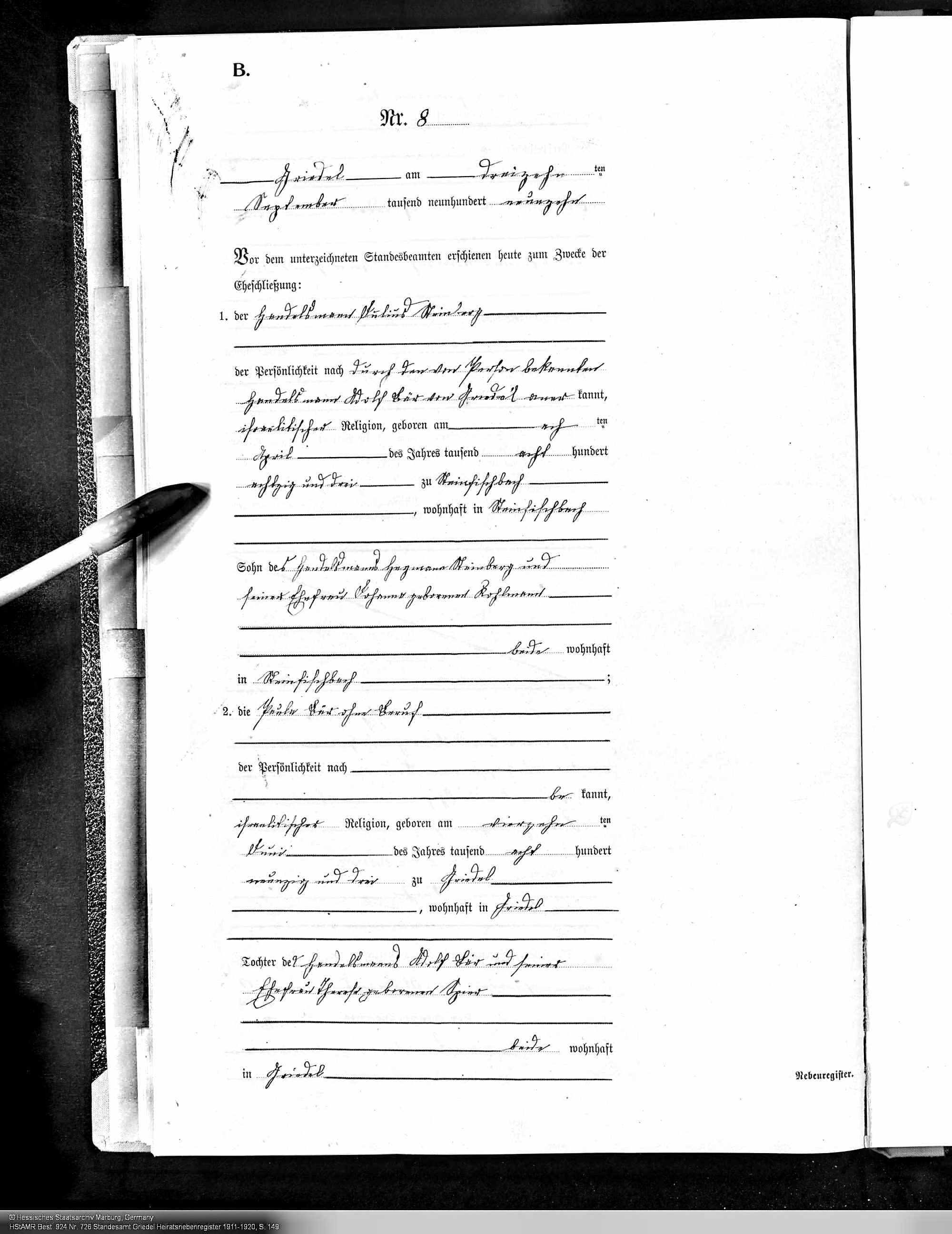
Paula, the oldest child, married Julius Steinberg on September 13, 1919, in Griedel. Julius was born in Steinfischbach, Germany, on April 8, 1883, to Herman Steinberg and Johanna Kohlmann. They had one child, Kurt Steinberg, born on November 26, 1920, in Lamberg, Germany.1

Paula Baer marriage record, Hessisches Hauptstaatsarchiv; Wiesbaden, Deutschland; Bestand: 924; Laufende Nummer: 726, Year Range: 1911-1920, Ancestry.com. Hesse, Germany, Marriages, 1849-1930

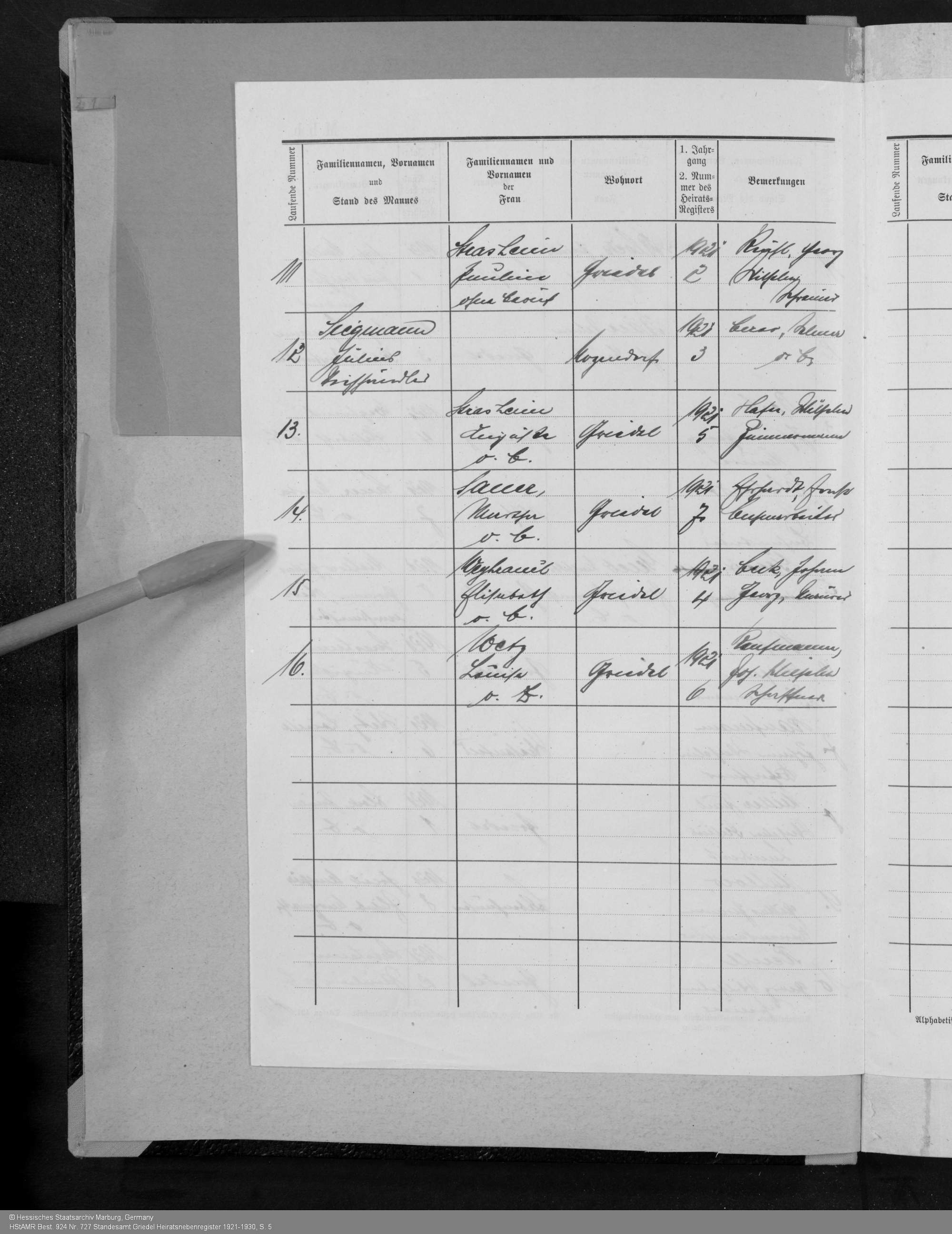
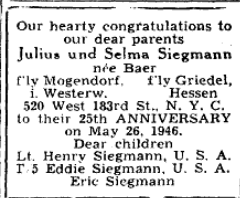
Selma, the second daughter, married Julius Siegmann on May 26, 1921, in Griedel. He was born on May 11, 1886, in Mogendorf, Germany. I was only able to find their marriage record after locating a 25th anniversary announcement for them in the Aufbau newspaper, which gave me their marriage date.

Marriage record of Selma Baer and Julius Siegmann, Arcinsys Archives of Hessen, Standesamt Griedel Heiratsnebenregister 1921-1930 (HStAMR Best. 924 Nr. 727)AutorHessisches Staatsarchiv, p. 5

Aufbau, May 17, 1946, p. 36

I, of course, am wondering how Therese and Adolf felt about having two sons-in-law named Julius in addition to their own son Julius. It must have gotten a bit confusing at times! (And it got even more so—see below!)

Selma and Julius Siegmann had three sons: Heinz (Henry) born on August 24, 1924, in Giessen;2 Edward (Adolph) born on October 20, 1926, in Mogendorf;3 and Erich, born on August 30, 1928, in Mogendorf.4

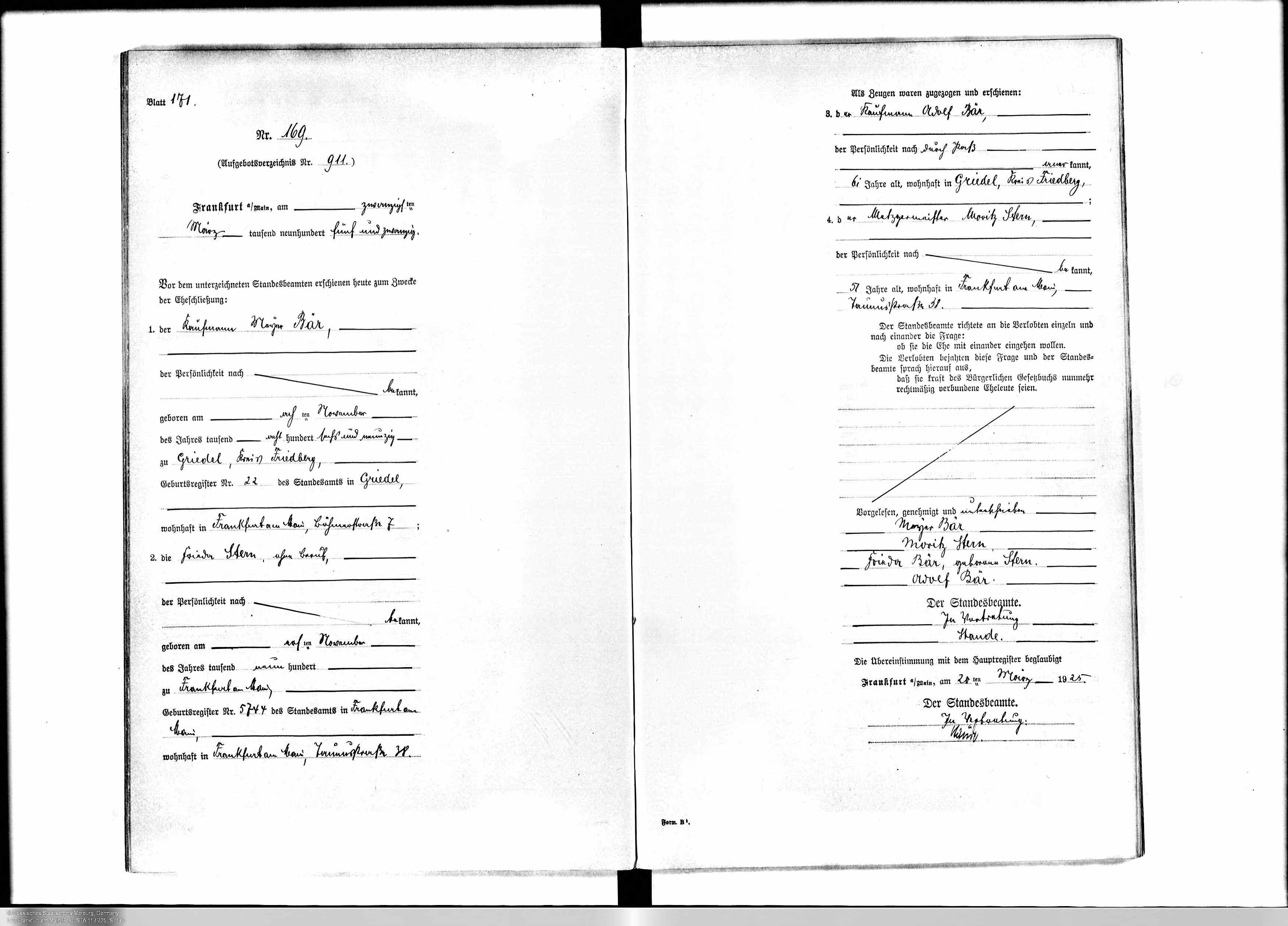
The oldest son, Meyer, married next. He married Friedel Stern, daughter of Moritz Stern and Emma Michels, on March 20, 1925, in Frankfurt. She was born in Frankfurt on November 1, 1900. Meyer and Friedel Baer had one child. Erich Adolf, born in Frankfurt on May 31, 1928.5

Meyer Baer marriage record, Hessisches Hauptstaatsarchiv; Wiesbaden, Deutschland; Bestand: 903, Year Range: 1925, Ancestry.com. Hesse, Germany, Marriages, 1849-1930

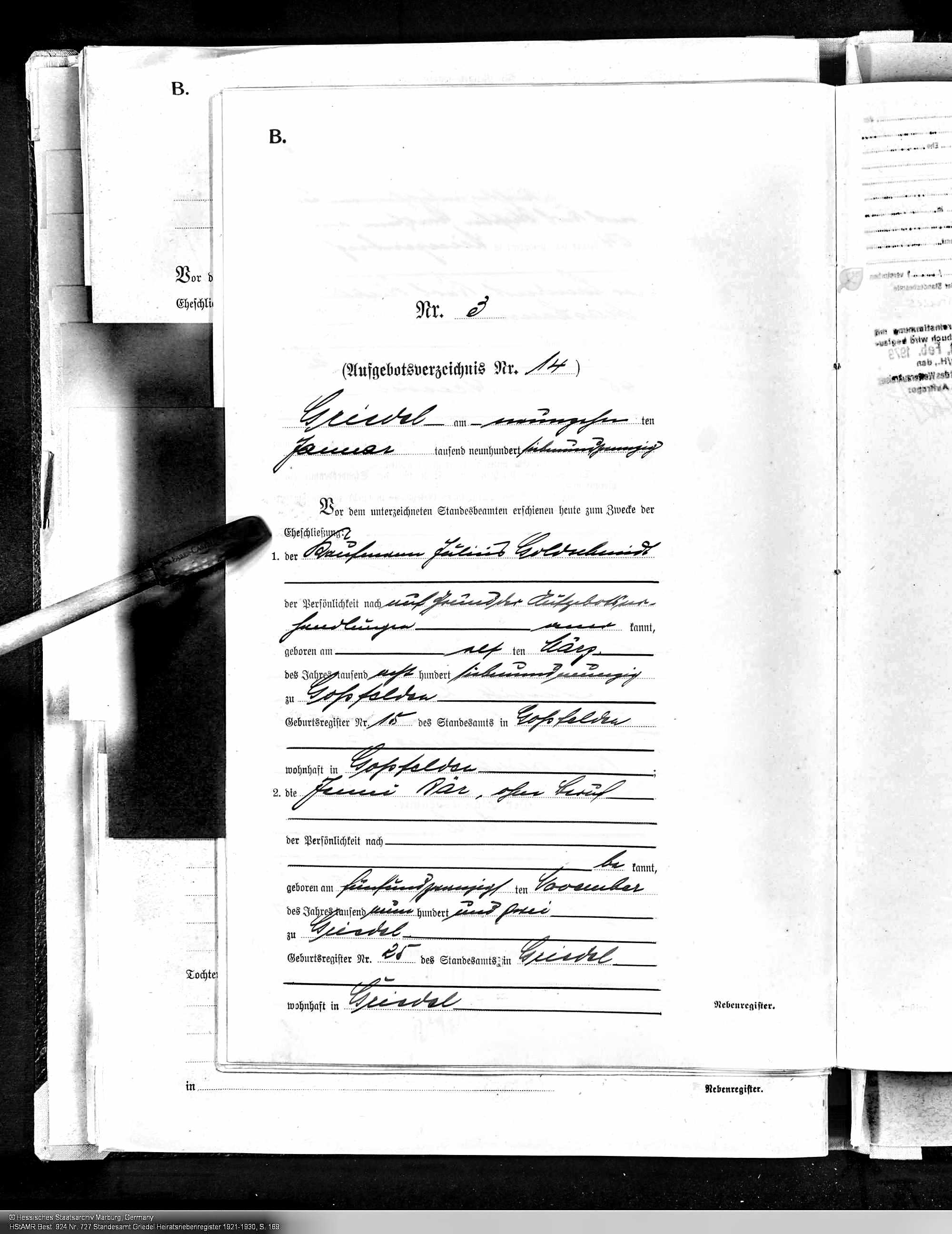
The next of Therese and Adolf’s children to marry were not the two sons next in birth order, but their daughter Jenny. She married—Yikes, another Julius!—Julius Goldschmidt on January 19, 1927, in Griedel. Julius, the son of William Goldschmidt and Lina Isenberg, was born in Gossfelden, Germany, on March 11, 1897. Jenny and Julius Goldschmidt had one child, Lore, born on January 12, 1929, in Marburg, Germany.6

Jenny Baer Marriage record, Hessisches Hauptstaatsarchiv; Wiesbaden, Deutschland; Bestand: 924; Laufende Nummer: 727, Year Range: 1921-1930, Ancestry.com. Hesse, Germany, Marriages, 1849-1930

The remaining four children of Therese and Adolf—Eugen, Julius, Arthur and Klara Baer—-all married in 1929. I know weddings weren’t the lavish affairs we have these days, but can you imagine having four of your children marry in one year?

Eugen married Hedwig Samuel in Reichelsheim, Germany, on January 20, 1929. She was born October 15, 1904, in Reichelsheim, Germany.  Eugen and Hedwig Baer had one child, Adolph, born on January 7, 1930, in Griedel.7

Julius Baer was also married in 1929; he married Erna Wertheimer, who, according to secondary sources, was born July 19, 1907, in Nonnenweier, Baden, Germany. Unfortunately, I’ve yet to find an actual marriage record or a birth record for Erna, and I don’t know her parents’ names. Secondary sources report that Julius and Erna Baer had two children, Arnold, born on February 3, 1931, and Rolf, born on September 20, 1933, both in Butzbach, Germany.8

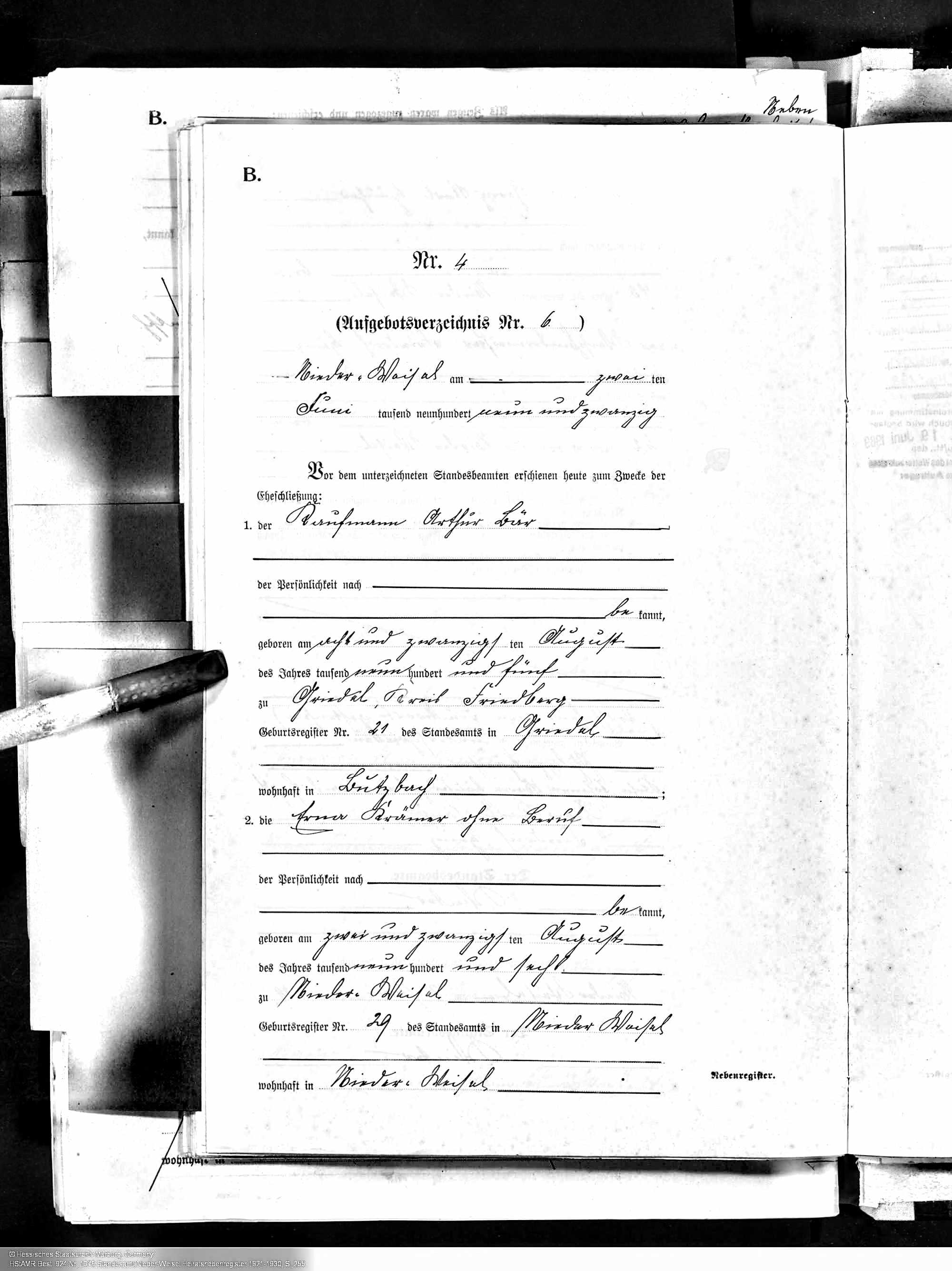
Arthur Baer, the youngest son of Therese and Adolf, also married in 1929. He married Erna Kraemer on June 2, 1929, in Nieder-Weisel, Germany. She was born on August 22, 1906, in Nieder-Weisel; her marriage record did not include her parents’ names, nor could I find a birth record for Erna online. Arthur and Erna Baer had one child, Erich, born in Nieder-Weisel on July 18, 1932.9

Arthur Baer marriage record, Hessisches Hauptstaatsarchiv; Wiesbaden, Deutschland; Bestand: 924; Laufende Nummer: 1376, Year Range: 1921-1930, Ancestry.com. Hesse, Germany, Marriages, 1849-1930

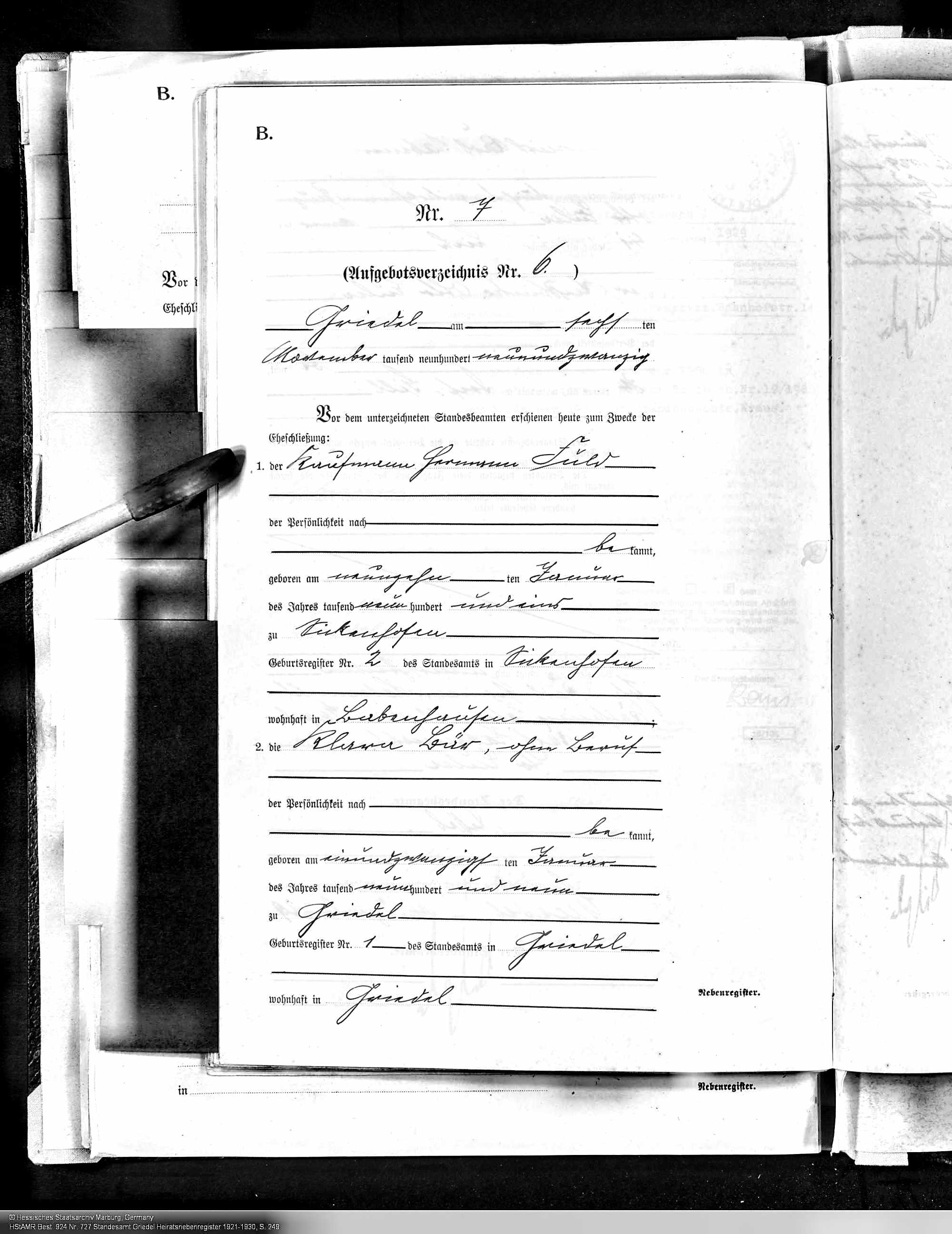
And finally Klara Baer married Hermann Fuld on November 6, 1929, in Griedel. Hermann was born on January 19, 1901, in Sickenhofen, Germany. Klara and Hermann Fuld had one child, Helga, born May 13, 1931, in Frankfurt, Germany.9

Klara Baer marriage record, Hessisches Hauptstaatsarchiv; Wiesbaden, Deutschland; Bestand: 924; Laufende Nummer: 727, Year Range: 1921-1930, Ancestry.com. Hesse, Germany, Marriages, 1849-1930

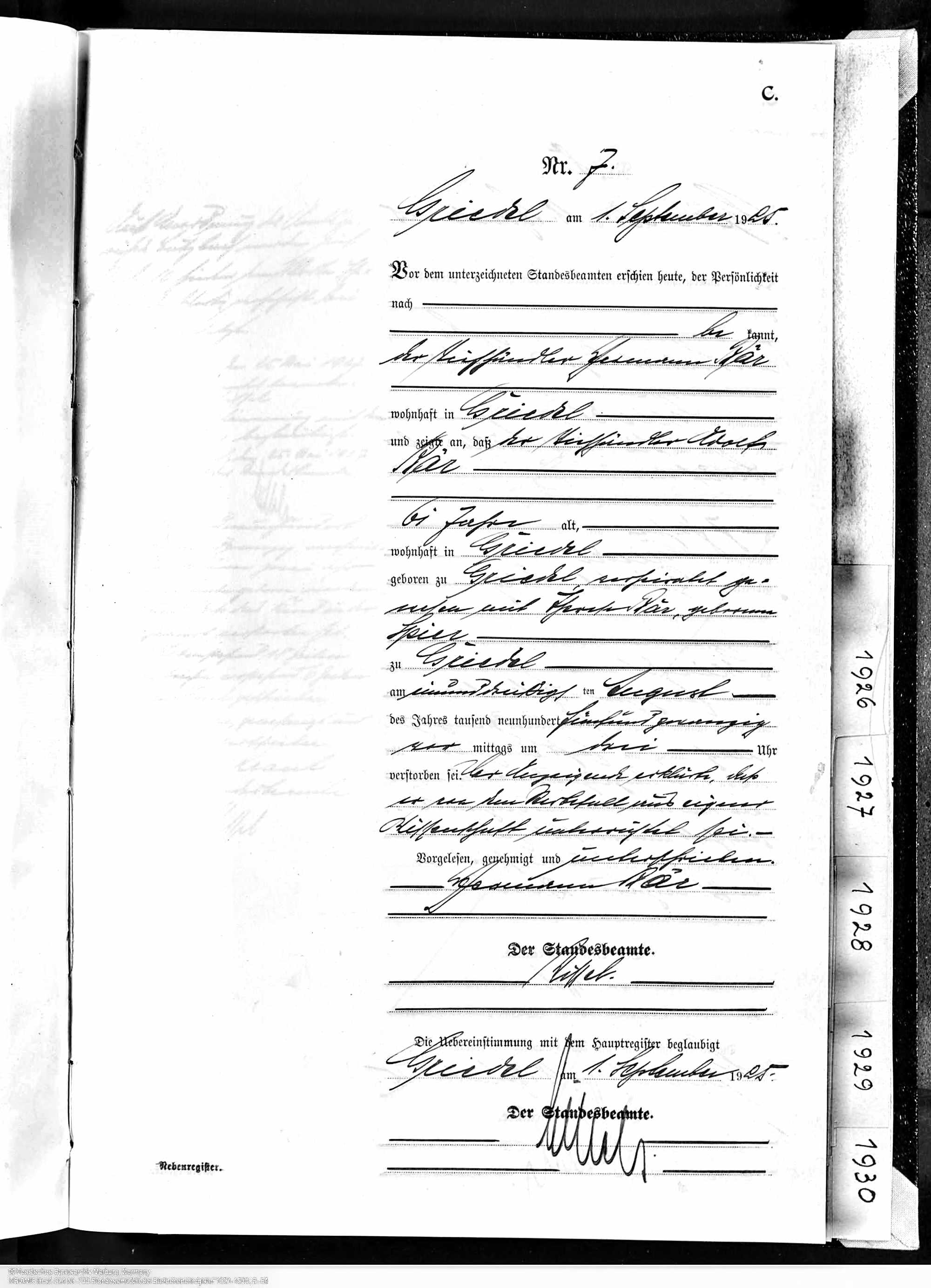
Eisemann Adolf Baer died on August 31, 1925, in Griedel, at age 61.

Adolf Baer death record, Hessisches Hauptstaatsarchiv; Wiesbaden, Deutschland; Personenstandsregister Sterberegister; Bestand: 733; Laufende Nummer: 924, Year Range: 1921-1930, Ancestry.com. Hesse, Germany, Deaths, 1851-1958

Every one of his children who had a son after that date seems to have honored their father by naming a son for him. Selma had two sons Edward (Adolph) and Eric; Meyer had a son Erich Adolf; Eugen’s son was named Adolph; Julius had a son named Arnold; and Arthur had a son named Erich. Only Paula, whose son Kurt was born before her father died, and Jenny and Klara, who did not have any sons, did not have the opportunity to name a child for their father.

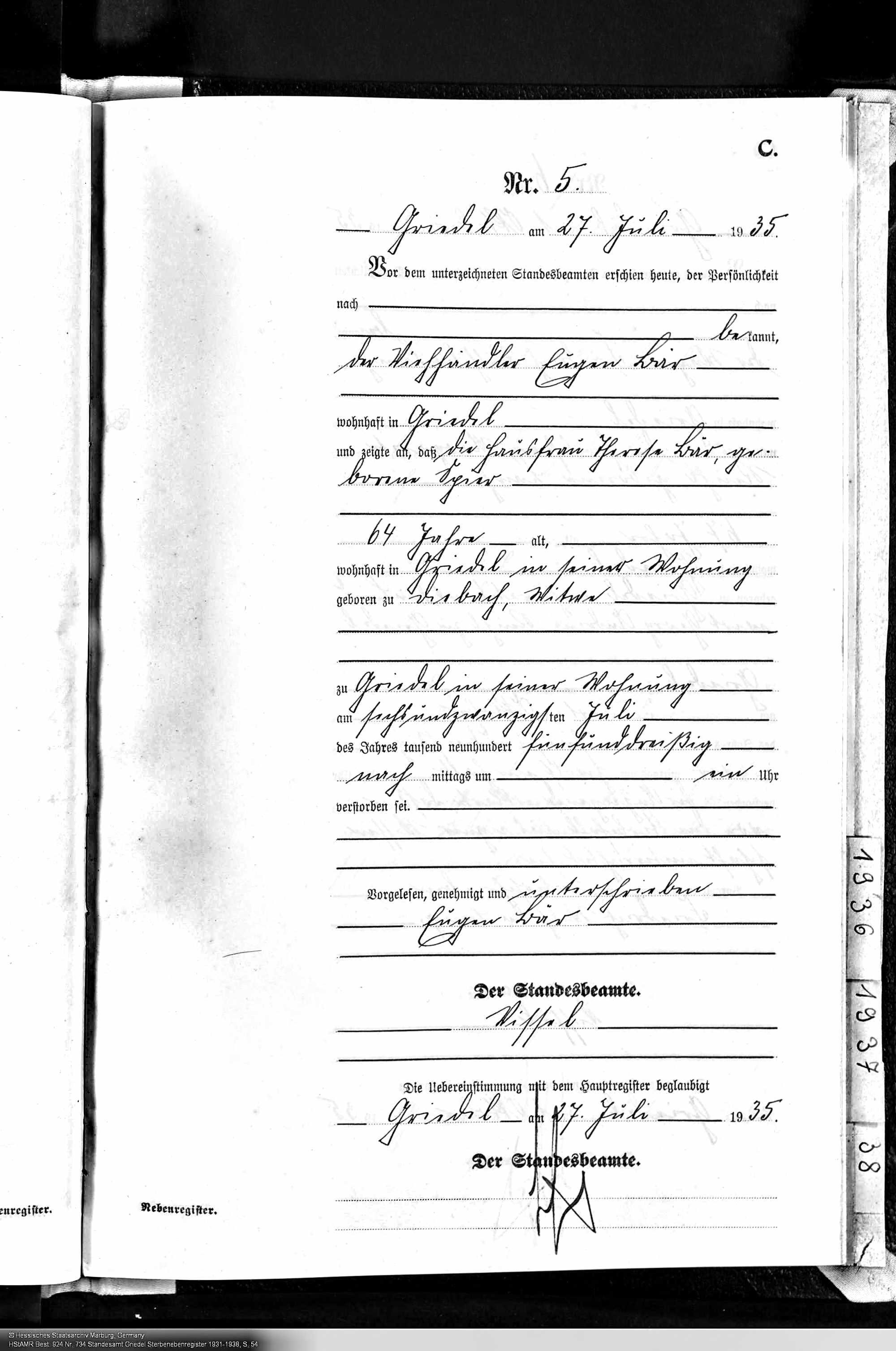
Therese Spier Baer lived long enough to see all those grandchildren born (and thus, none of them was named for her). She died on July 26, 1935, in Griedel, Germany, at the age of 64. (Thank you to Cathy Meder-Dempsey for correcting the Google transcription of this death record that had transcribed it for someone with a different name.)

Therese Spier Baer death record, Hessisches Hauptstaatsarchiv; Wiesbaden, Deutschland; Personenstandsregister Sterberegister; Bestand: 734; Laufende Nummer: 924
Ancestry.com. Hesse, Germany, Deaths, 1851-1958

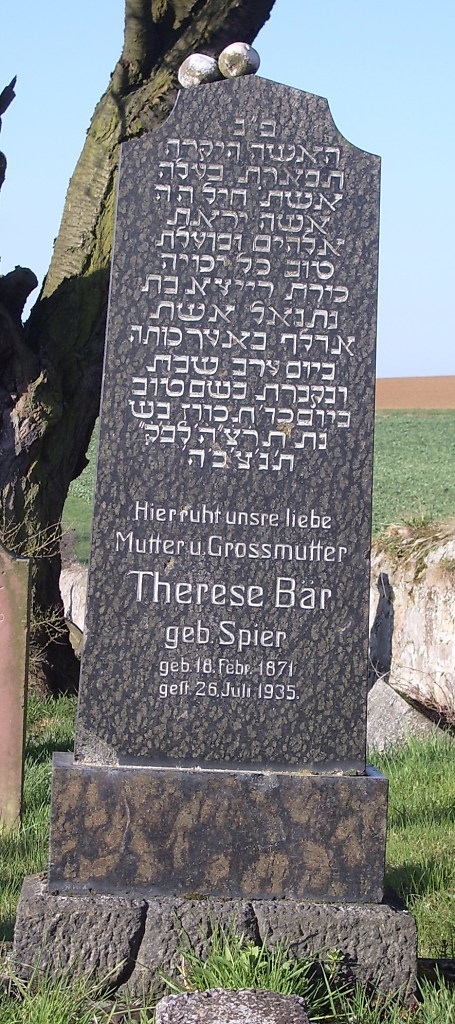
The burial index on LAGIS had a photograph of Therese’s gravestone with other relevant information about her, her family, and her death. In fact, it was here that I discovered the eighth child of Therese and Adolf, their daughter Klara.

Therese Spier Baer headstone, Bär, Therese, née Spier (1935) – Griedel”, in: Jewish Gravesites < https://lagis.hessen.de/de/personen/juedische-grabstaetten/alle-eintraege/18212_baer-therese-geborene-spier-1935-griedel > (accessed on 29.06.2026)

Her gravestone translates to:

Here rests
the precious woman,
the ornament of her husband,
a virtuous woman, that is,
a woman who feared
God and did
good all her days:
Mrs. Reize [short for Therese], the daughter of
Nathanael, the wife of
Adolf Bär. She died
on the eve of Shabbat (=25th Tammuz)
and was buried in good standing
on the 26th Tammuz in the
year 695 according to the Lesser Census. May
her soul be bound up in the bundle of life.

Next. How did those eight children and their families fare during the Nazi era?


  1. Kurt Steinberg, Gender Male, Race White, Birth Date 26 Nov 1920, Birth Place Camberg Taun, Federal Republic of Germany, Death Date 15 Mar 1996, Father
    Julius Steinberg, Mother Paula Baer, SSN 212122078, Ancestry.com. U.S., Social Security Applications and Claims Index, 1936-2007 
  2. Henry Siegmann, Gender Male, Race White, Birth Date 15 Aug 1924, Birth Place Giessen, Federal Republic of Germany, Death Date May 1986, Father Julius Siegmann, Mother Selma Baer, SSN 079188596, Ancestry.com. U.S., Social Security Applications and Claims Index, 1936-2007 
  3. Edward Adolph Siegman, Race White, Age 18, Birth Date 20 Oct 1926, Birth Place Mogendorf, Germany, Registration Date, 20 Oct 1944, Registration Place
    New York City, Bronx, New York, Next of Kin Selma Siegman, National Archives at St. Louis; St. Louis, Missouri; Wwii Draft Registration Cards For New York City, 10/16/1940 – 03/31/1947; Record Group: Records of the Selective Service System, 147, Ancestry.com. U.S., World War II Draft Cards Young Men, 1940-1947 
  4. Eric Siegmann, Race White, Age 18, Birth Date 30 Aug 1928, Birth Place Mogendorf, Germany, Registration Date 30 Aug 1946, Registration Place New York City, New York, National Archives at St. Louis; St. Louis, Missouri; Wwii Draft Registration Cards For New York City, 10/16/1940 – 03/31/1947; Record Group: Records of the Selective Service System, 147, Ancestry.com. U.S., World War II Draft Cards Young Men, 1940-1947 
  5. Erich Adolf Baer, Eric Adolph Baer, Race White, Age 18, Relationship to Draftee Self (Head), Birth Date 31 May 1928, Birth Place Frankfurt, Germany, Residence Place Baltimore, Baltimore, Maryland, USA, Registration Date 1946, Registration Place Baltimore, Baltimore, Maryland, USA, National Archives at St. Louis; St. Louis, Missouri; Wwii Draft Registration Cards For Maryland, 10/16/1940-03/31/1947; Record Group: Records of the Selective Service System, 147; Box: 16, Ancestry.com. U.S., World War II Draft Cards Young Men, 1940-1947 
  6. Naturalization petition of Julius Goldschmidt, stating birth of daughter Lore, The National Archives in Washington, DC; Washington, DC; NAI Title: Index to Petitions For Naturalizations Filed in Federal, State, and Local Courts in New York City, 1792-1906; NAI Number: 5700802; Record Group Title: Records of District Courts of the United States, 1685-2009; Record Group Number: Rg 21, Description: (Roll 1412) Petition No· 419644 – Petition No· 420058, Ancestry.com. New York, U.S., State and Federal Naturalization Records, 1794-1943 
  7. I could not find a marriage record for Eugen and Hedwig online because the online marriage records for Reichelsheim do not go as late as 1929; thus, I have to rely on Hedwig’s statement in her Declaration of Intention for her birthdate, marriage date, and her son Adolf’s birthdate. Hedwig Baer, Declaration of Intention, The National Archives at Philadelphia; Philadelphia, PA; NAI Title: Declarations of Intention For Citizenship, 1/19/1842 – 10/29/1959; NAI Number: 4713410; Record Group Title: Records of District Courts of the United States, 1685-2009; Record Group Number: 21, (Roll 587) Declarations of Intention For Citizenship, 1842-1959 (No 460501-461500), Ancestry.com. New York, U.S., State and Federal Naturalization Records, 1794-1943.  
  8. This information came from family trees on Ancestry that unfortunately did not have citations to any sources. Thus, I cannot be certain about its reliability. I am searching for primary sources. 
  9. Klara Fuld’s Declaration of Intention includes her daughter Helga’s birthdate and birthplace. The National Archives at Philadelphia; Philadelphia, PA; NAI Title: Declarations of Intention For Citizenship, 1/19/1842 – 10/29/1959; NAI Number: 4713410; Record Group Title: Records of District Courts of the United States, 1685-2009; Record Group Number: 21, Roll 486) Declarations of Intention For Citizenship, 1842-1959 (No 364301-365300), Ancestry.com. New York, U.S., State and Federal Naturalization Records, 1794-1943 

Therese Spier Baer and Her Eight Children, Part I

My cousin Therese Spier Baer, the first child of Samuel Spier, had eight children with her husband Eisemann Adolf Baer between 1893 and 1909, and amazingly all eight survived to adulthood, and they all survived the Holocaust as did their children. Almost all of them then lived remarkably long lives.

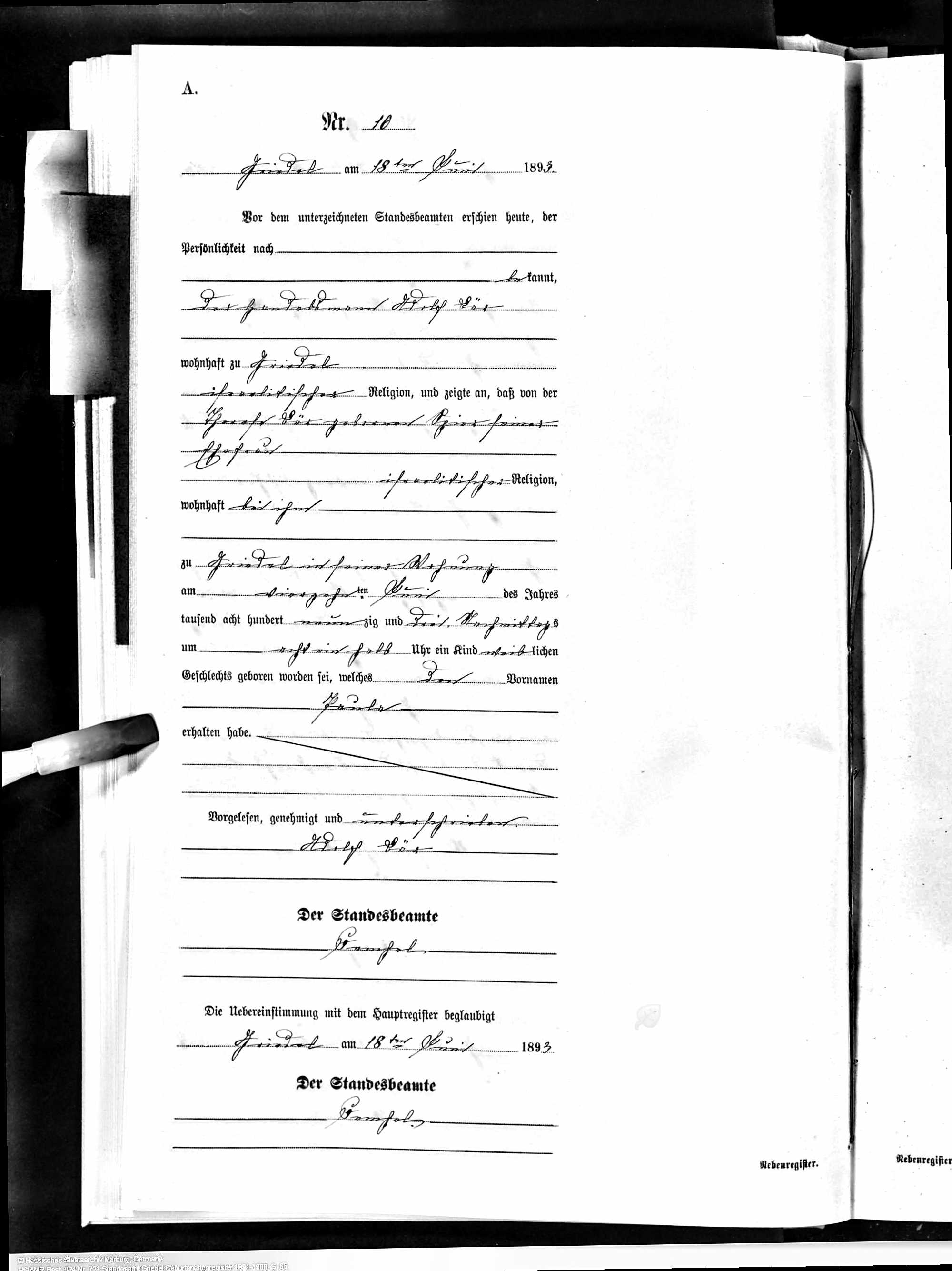
Therese’s first child was her daughter Paula, born on June 14, 1893, in Griedel, Germany.

Paula Baer birth record, Hessisches Hauptstaatsarchiv; Wiesbaden, Deutschland; Bestand: 924; Laufende Nummer: 721, Year Range: 1891-1900, Ancestry.com. Hesse, Germany, Births, 1851-1901

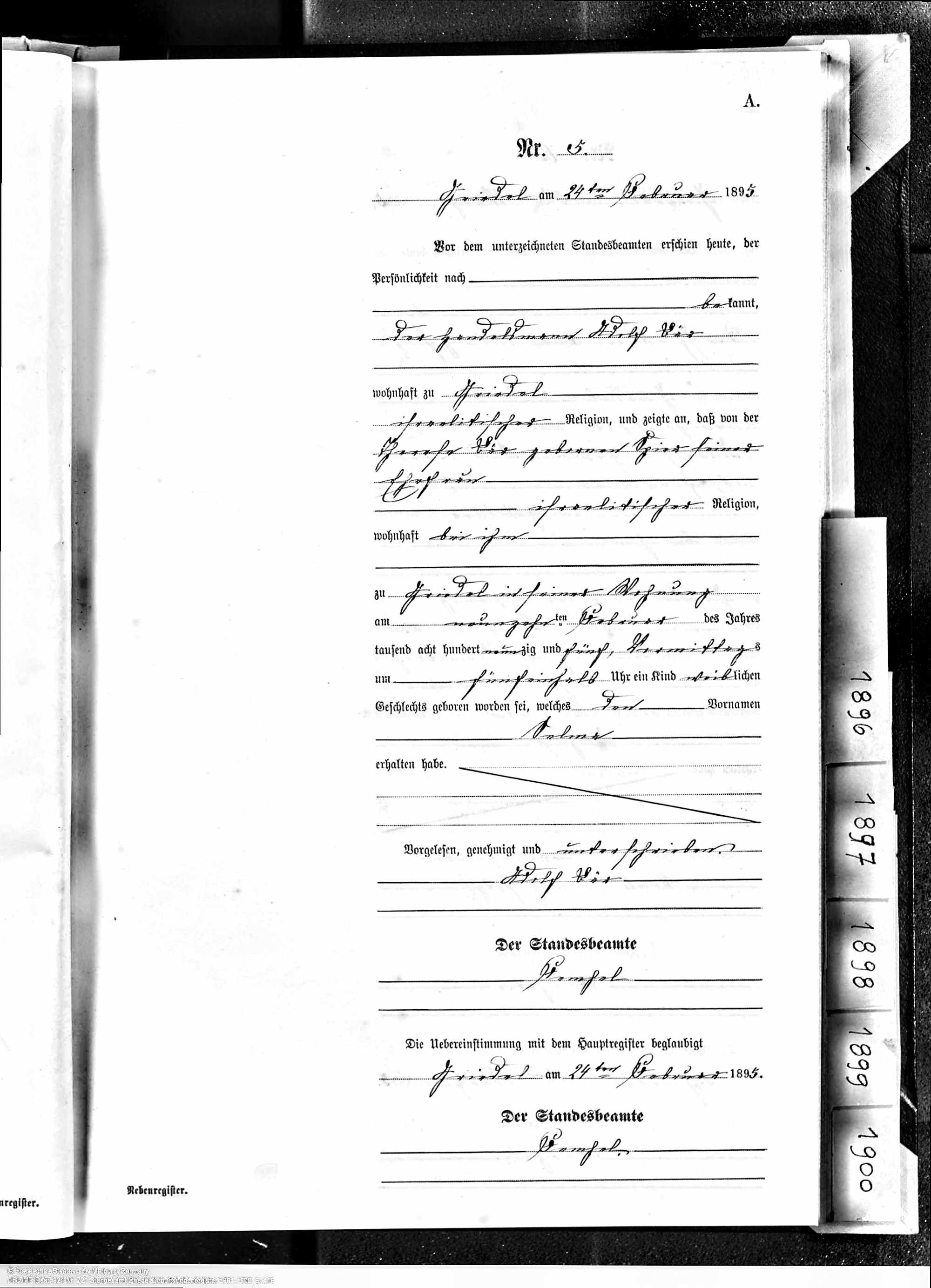
Then came Selma, born February 19, 1895, in Griedel.

Selma Baer birth record, Hessisches Hauptstaatsarchiv; Wiesbaden, Deutschland; Bestand: 924; Laufende Nummer: 721, Year Range: 1891-1900, Ancestry.com. Hesse, Germany, Births, 1851-1901

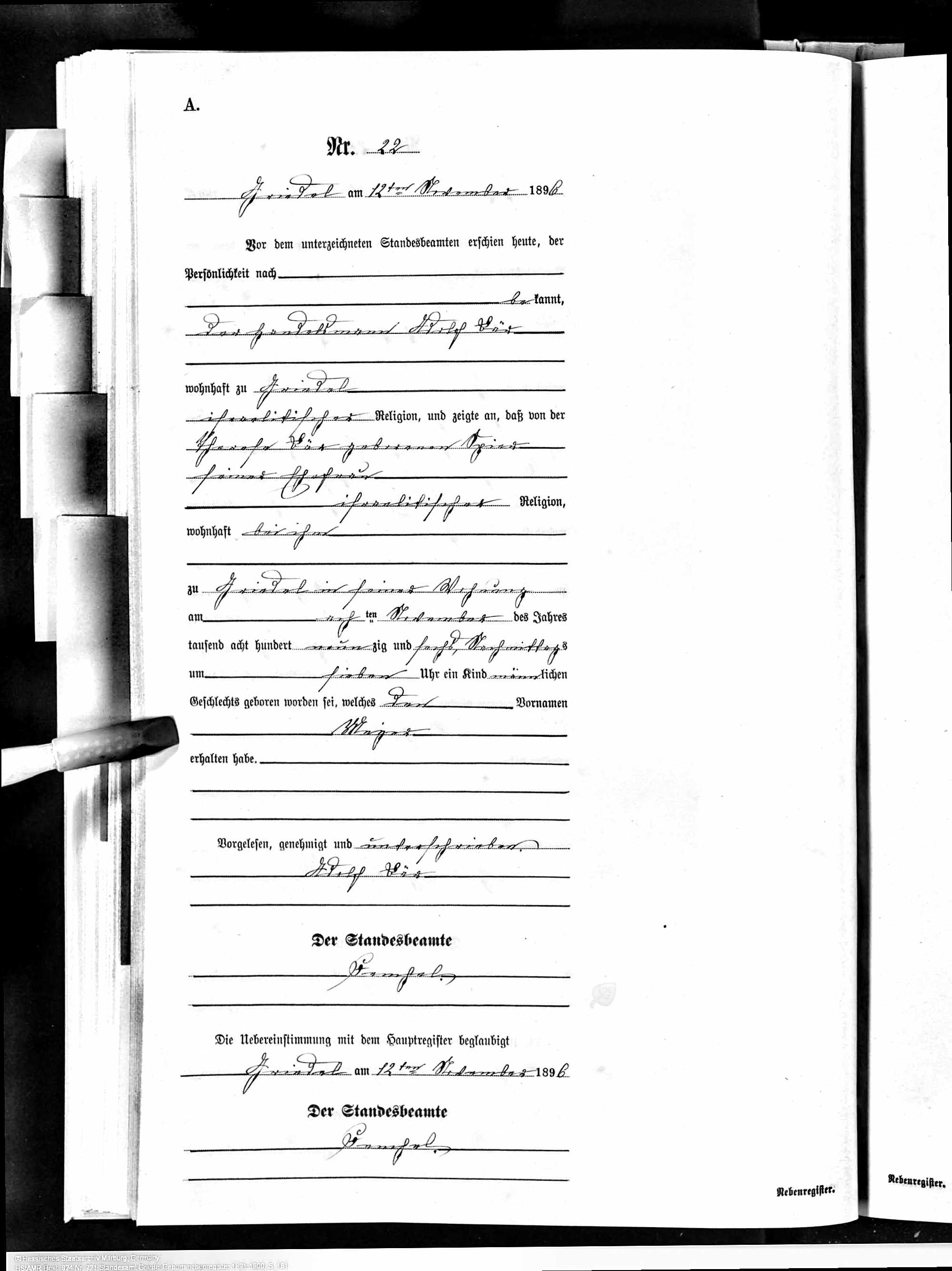
Next was her first son, Meyer Manfred, born on November 8, 1896, also in Griedel.

Meyer Baer birth record, Hessisches Hauptstaatsarchiv; Wiesbaden, Deutschland; Bestand: 924; Laufende Nummer: 721, Year Range: 1891-1900, Ancestry.com. Hesse, Germany, Births, 1851-1901

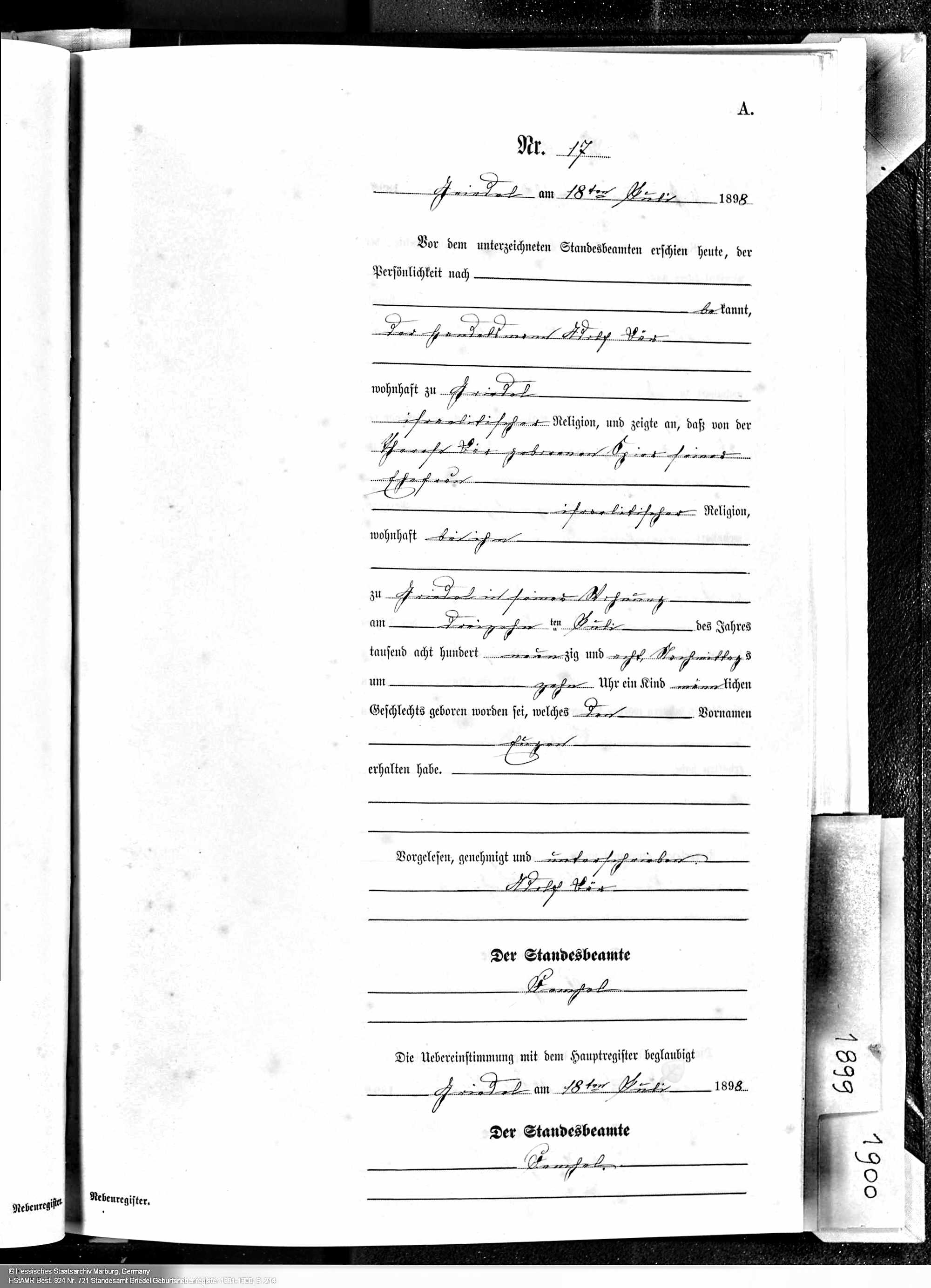
Her fourth child and second son was Eugen, born July 13, 1898, in Griedel.

Eugen Baer birth record, Hessisches Hauptstaatsarchiv; Wiesbaden, Deutschland; Bestand: 924; Laufende Nummer: 721, Year Range: 1891-1900, Ancestry.com. Hesse, Germany, Births, 1851-1901

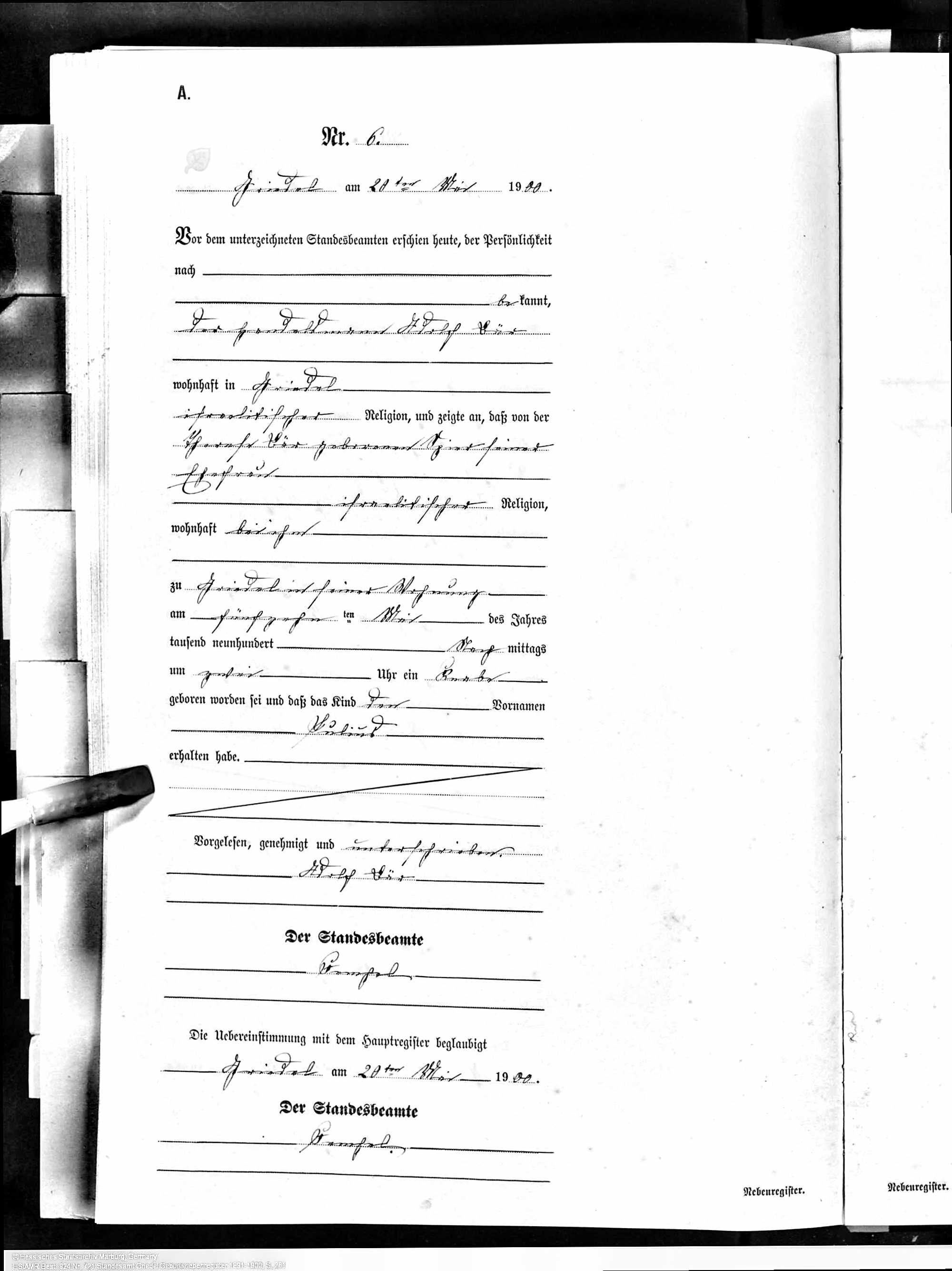
Then came Julius, born May 15, 1900, in Griedel.

Julius Baer birth record, Hessisches Hauptstaatsarchiv; Wiesbaden, Deutschland; Bestand: 924; Laufende Nummer: 721, Year Range: 1891-1900, Ancestry.com. Hesse, Germany, Births, 1851-1901

The third daughter and sixth child, Jenny, was born in Griedel on November 25, 1902.1

A fourth son, Arthur, was born on August 28, 1905, in Griedel.2

And finally a daughter, Klara, was born on January 21, 1909, in Griedel.3

Eight children, four girls and four boys, born in just over fifteen years! Most of the children were born less than two years apart.4

Next we will see who these children married and who their children were.


It’s not too late! Please consider reading and reviewing The Women Before Us, available on Amazon here.


  1. See, e.g., marriage record of Jenny Baer, Jenni Bär, Gender weiblich (Female)
    Age 24, Birth Date 25 Nov 1902, Marriage Date 19 Jan 1927, Marriage Place Griedel, Hessen (Hesse), Deutschland (Germany), Civil Registration Office Griedel, Spouse
    Julius Goldschmidt, Certificate Number 3, Hessisches Hauptstaatsarchiv; Wiesbaden, Deutschland; Bestand: 924; Laufende Nummer: 727, Ancestry.com. Hesse, Germany, Marriages, 1849-1930 
  2. Marriage record of Arthur Baer, Gender männlich (Male), Age 23, Birth Date
    28 Aug 1905, Marriage Date 02 Jun 1929 (2 Jun 1929), Marriage Place Nieder-Weisel, Hessen (Hesse), Deutschland (Germany), Civil Registration Office Nieder-Weisel, Spouse Erna Krämer, Certificate Number 4, Hessisches Hauptstaatsarchiv; Wiesbaden, Deutschland; Bestand: 924; Laufende Nummer: 1376, Year Range: 1921-1930, Ancestry.com. Hesse, Germany, Marriages, 1849-1930 
  3. Marriage record of Klara Baer, Gender weiblich (Female), Age 20, Birth Date
    21 Jan 1909, Marriage Date 06 Nov 1929 (6 Nov 1929), Marriage Place Griedel, Hessen (Hesse), Deutschland (Germany), Civil Registration Office Griedel, Spouse Hermann Fuld, Certificate Number 7, Hessisches Hauptstaatsarchiv; Wiesbaden, Deutschland; Bestand: 924; Laufende Nummer: 727, Year Range: 1921-1930, Ancestry.com. Hesse, Germany, Marriages, 1849-1930 
  4. At first I only had found the first seven children and was surprised that Therese did not have more children after she was 34; then, while searching for a death record for Therese, I found a reference to Klara, who was born when her mother was 37.