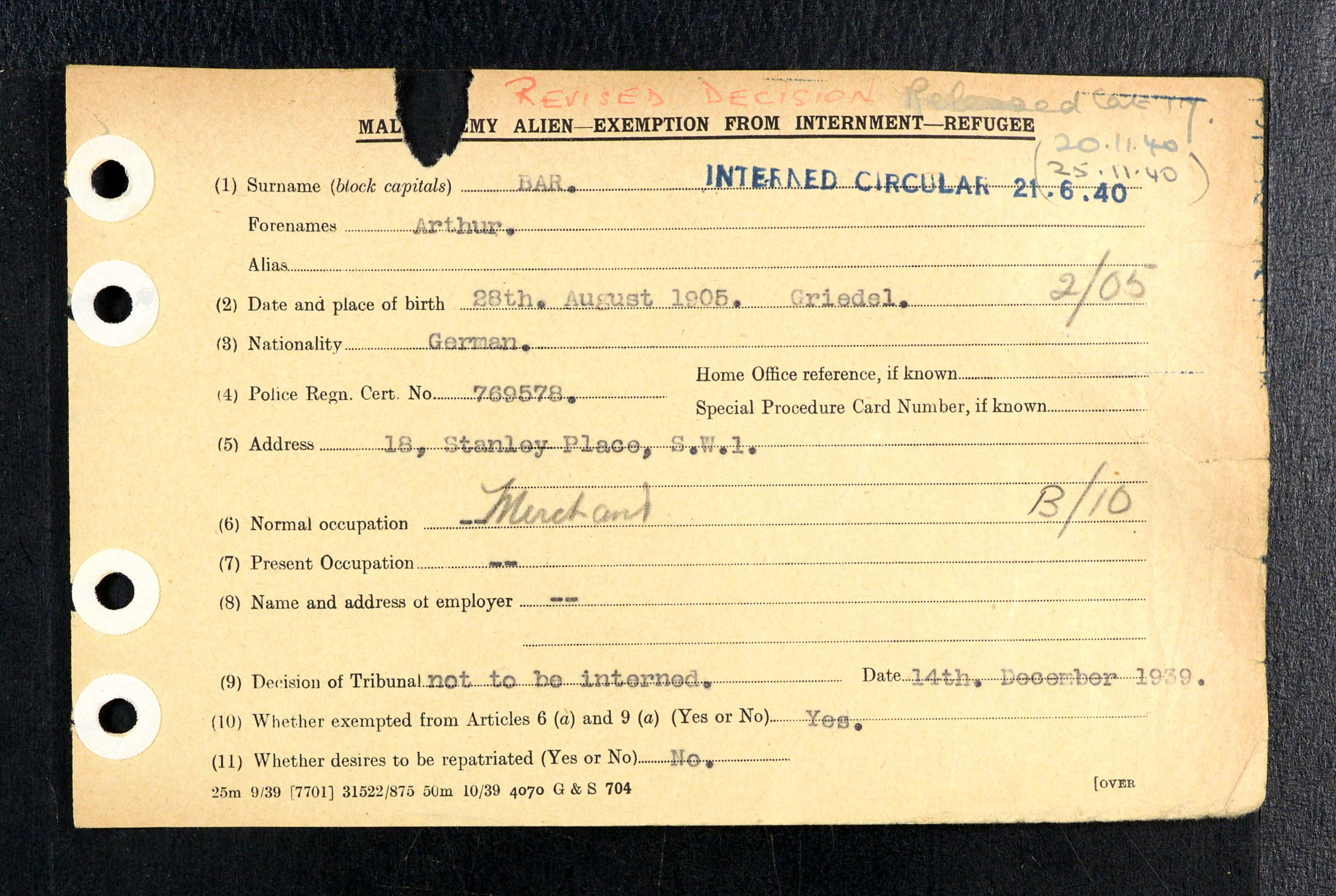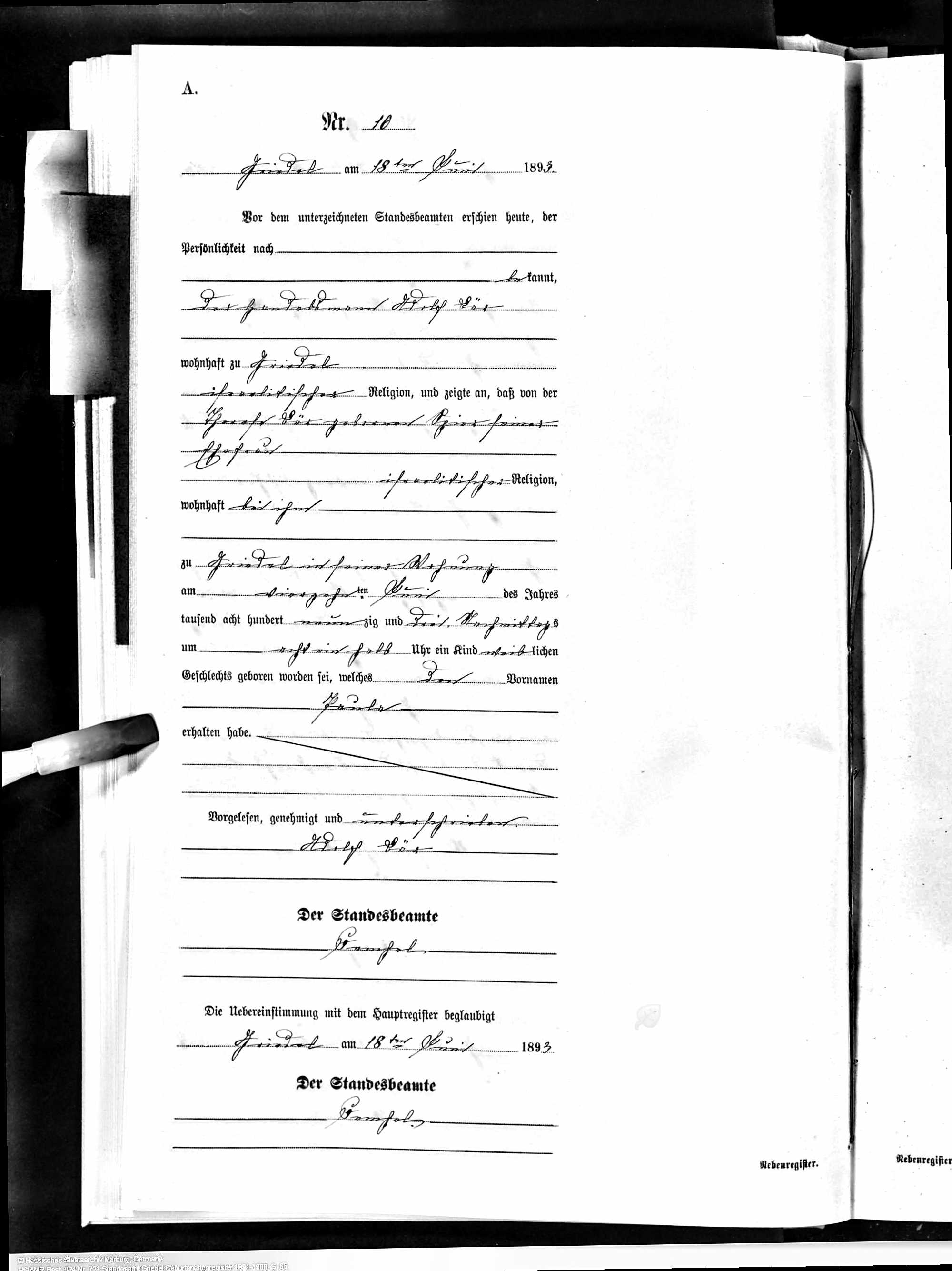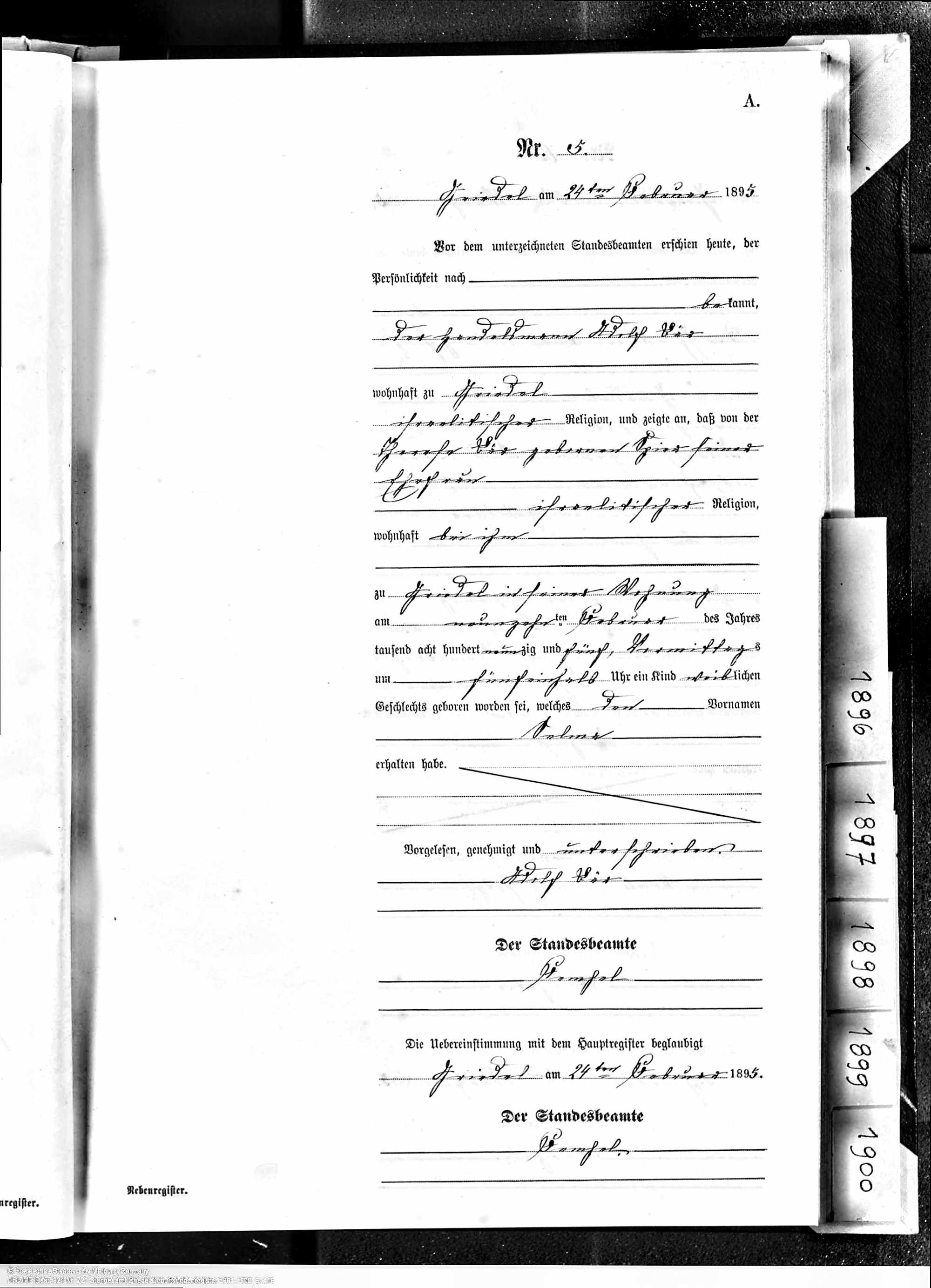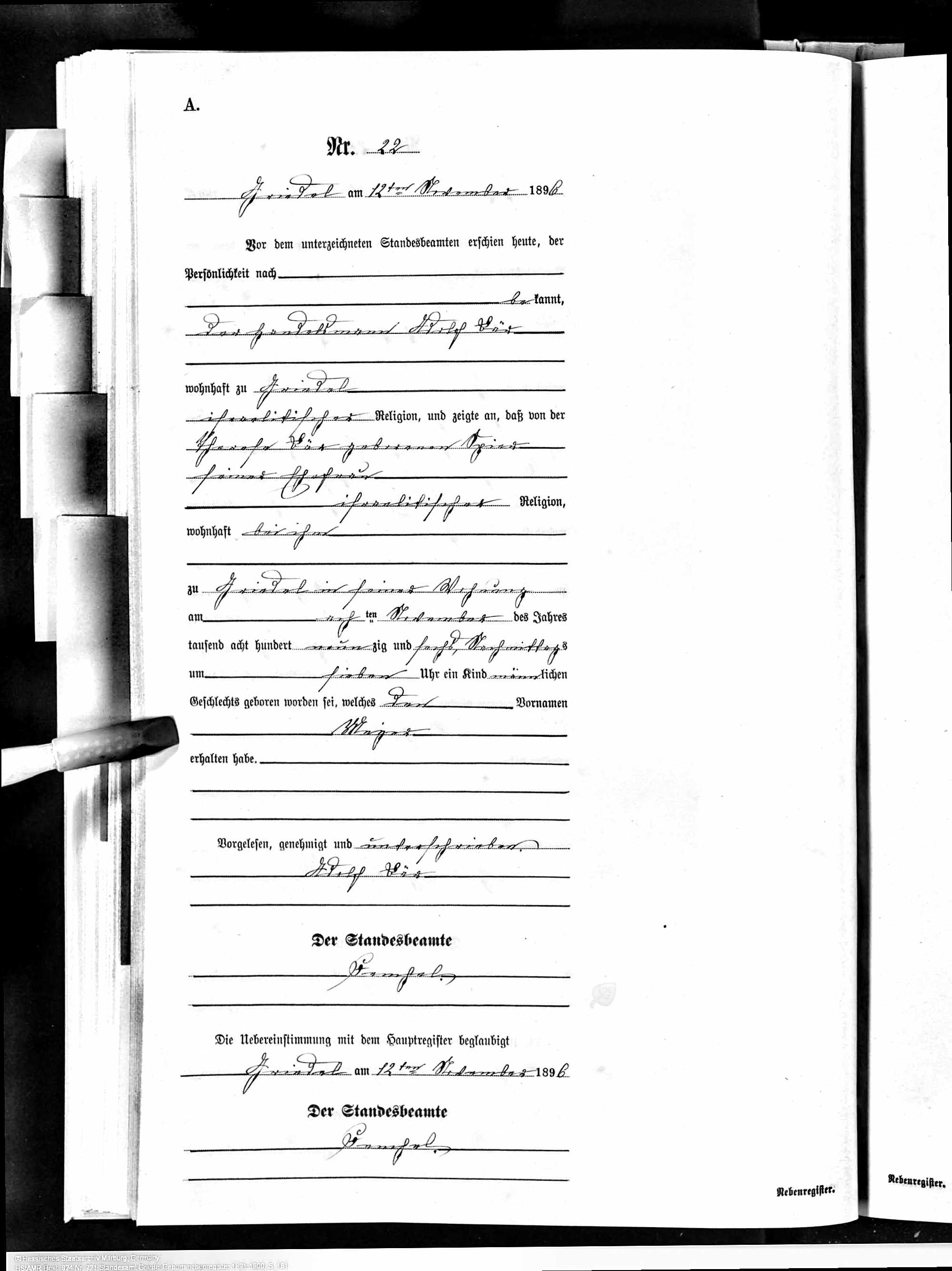
As we saw in the last post, the four daughters and one of the sons of Therese Spier Baer escaped from Germany before Kristallnacht and ended up in the United States. Klara was in Baltimore as was Paula while Jenny and Selma were living in New York. Their brother Meyer/Manfred settled in Baltimore. Another son, Arthur Baer, escaped with his family to England.
But I realized after publishing my last post that I had made an error in my research about Arthur Baer and that he had never spent time in Buchenwald. I have updated my last post to correct this error, and I’ll write more about Arthur Baer’s actual story in a later post. I only realized I’d made that error when I discovered I’d made a similar error in researching Arthur’s brother Julius. In researching both Julius and Arthur, I made stupid assumptions that led me down a deep rabbit hole that led me nowhere for quite a while.
According to records in the Arolsen Archives, a man named Julius Baer was arrested during June 1938 as part of a mass arrest of Jewish men to force their emigration from Germany. The record revealed that he was released from Sachsenhausen concentration camp on July 16, 1938.1 There was no birthdate or birthplace on those records, and I made the fatal novice genealogist error of assuming that this was my Julius Baer. That assumption was unfortunately reinforced when I saw that that a Julius Baer also was sent to Buchenwald and released on the same day as an Arthur Baer.2 I assumed—incorrectly—that the two brothers had been released together after some pressure from their relatives. After all, their names were listed one after the other on one of the Arolsen documents (along with many other names).
But then I hit a dead end on Julius. I knew only that at some point my Julius Baer ended up in France because he died there in 1981.3 But I didn’t know when or how he got to France or anything about his life there during or after World War II.
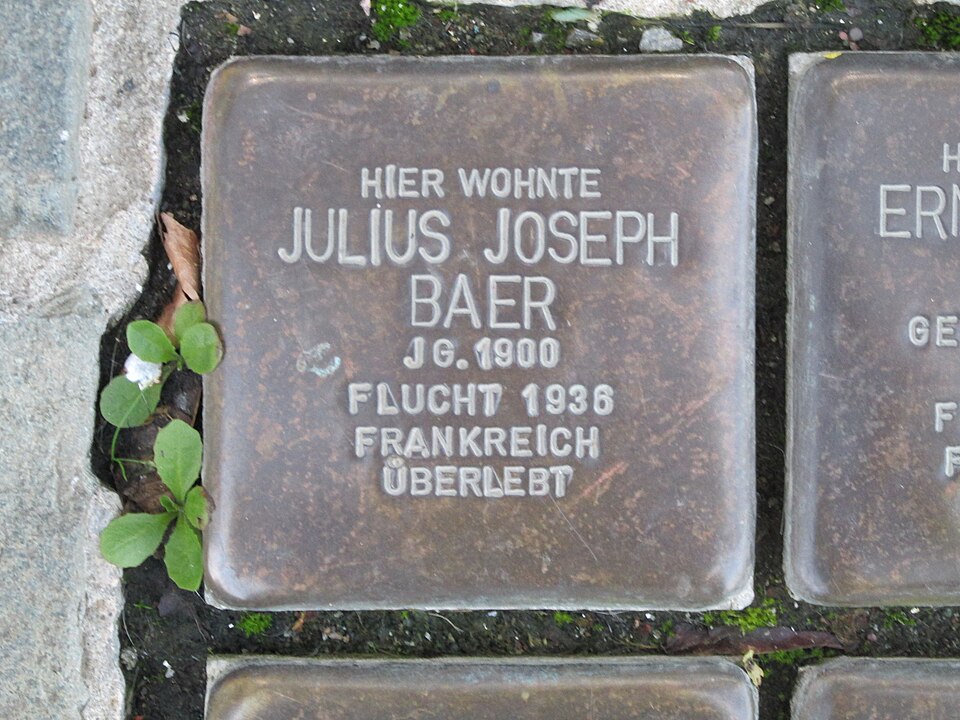
When I found that there were Stolpersteine laid for Julius and his wife and sons in Butzbach, Germany, that report that the family fled to France in 1936, I was confused. How could Julius have been in France in 1936 if he was arrested in Germany and sent to concentration camps in 1938? I dismissed it as an error on the Stolperstein and shrugged.
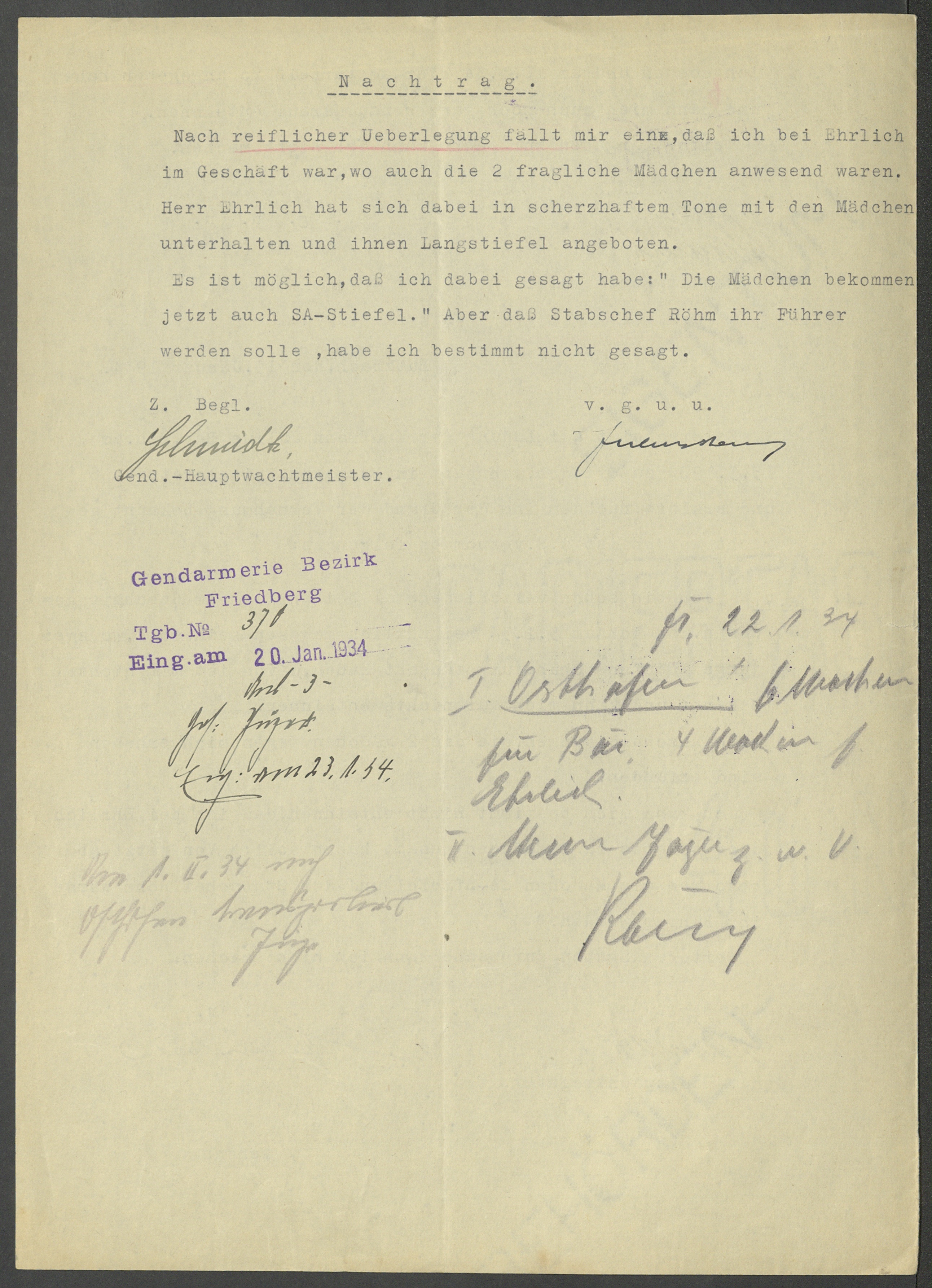
But it turns out that I was the one who’d made errors. And I learned that when Bryan Knobloch, another genealogist, sent me scans of pages from Hanno Muller’s book about the Jews of Butzbach.4 Bryan had seen my first post about the Baer family and commented on my blog about Muller’s book and its content related to the Baer family. I wrote to him and asked if he would scan the relevant pages, and he graciously did so.
On page 50 there was this entry about Julius a/k/a Jules Baer [as translated by Google]:
Baer, Julius
171 | 15.05.1900 | 03.11.1929 | France
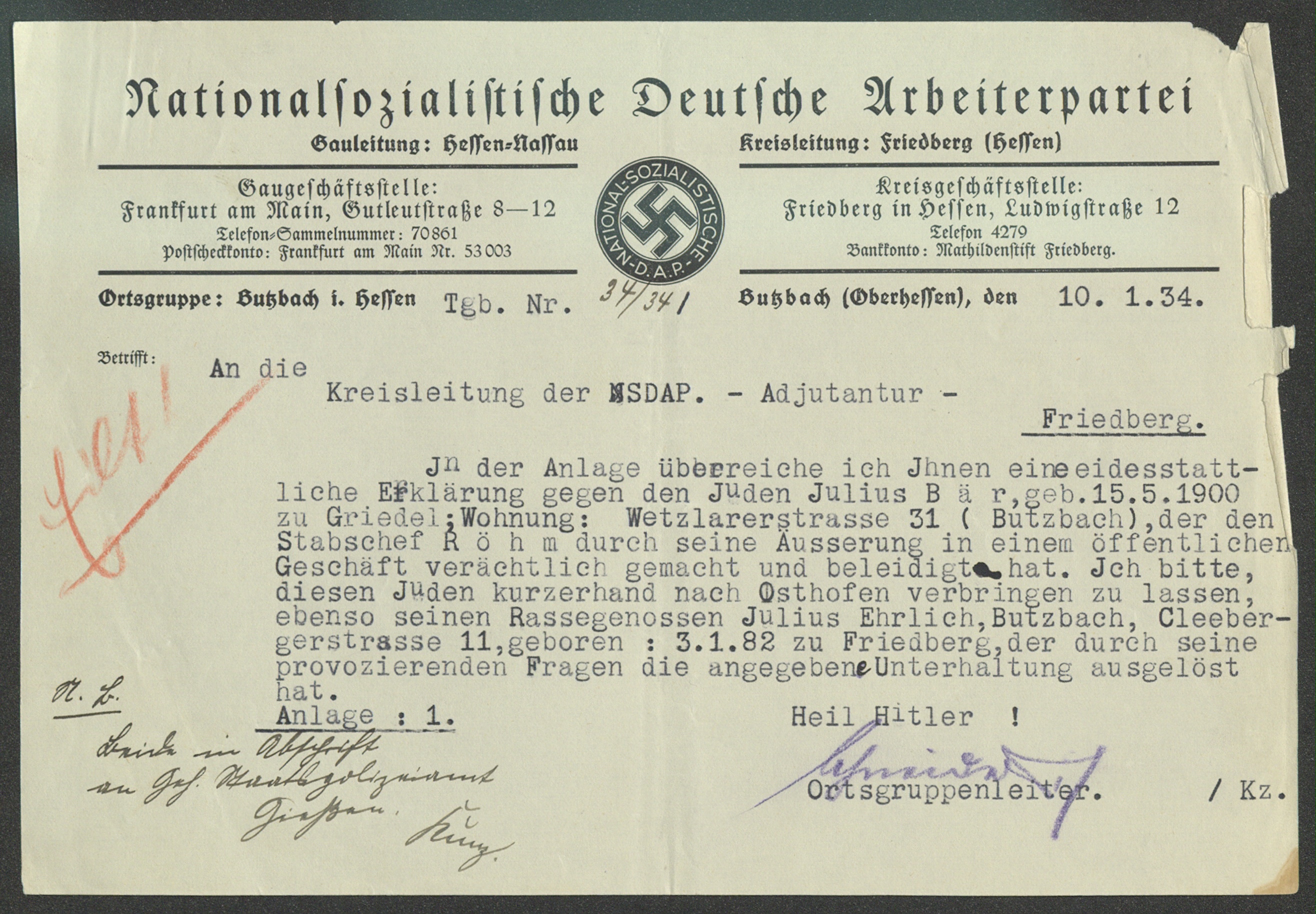
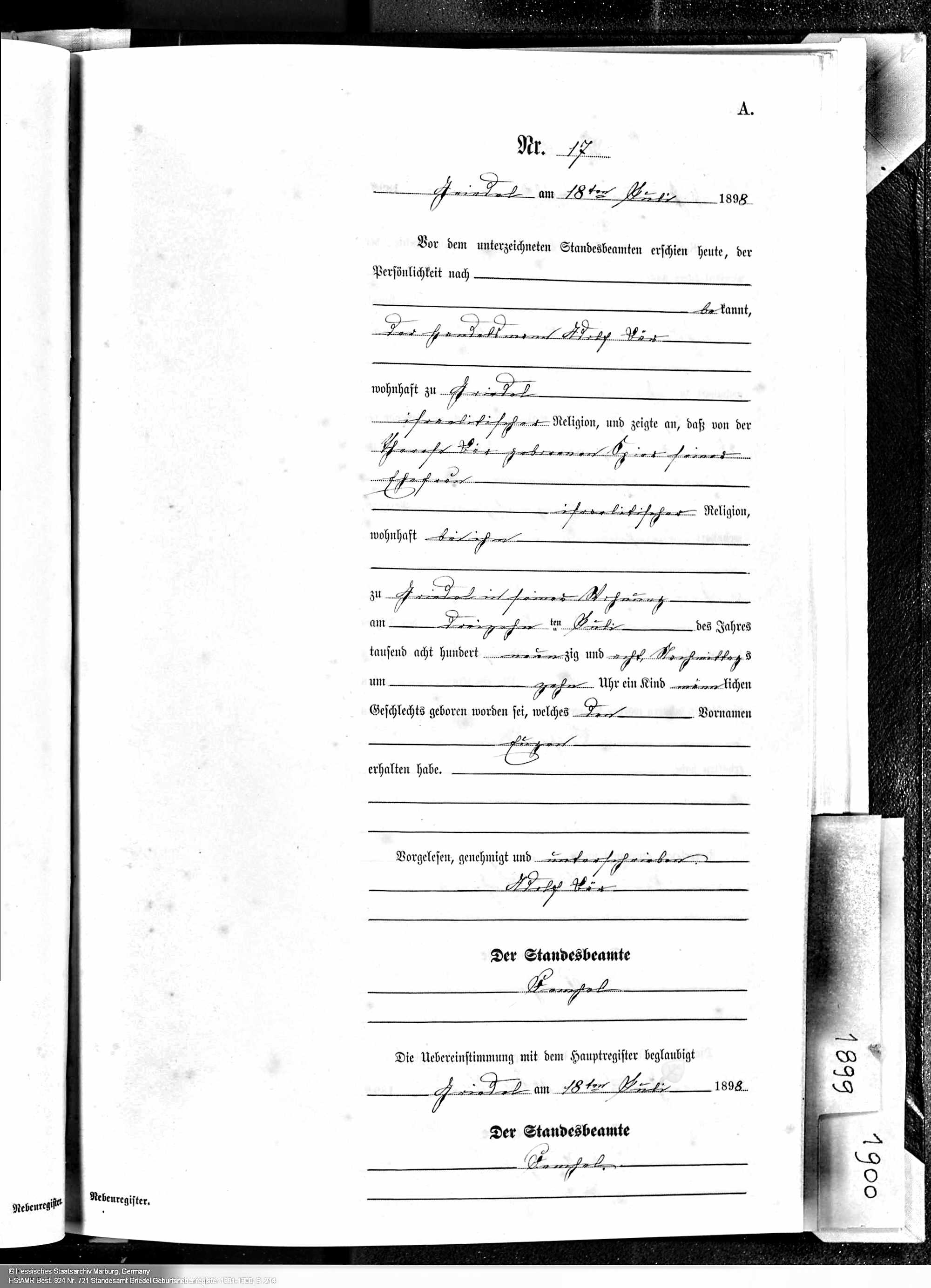
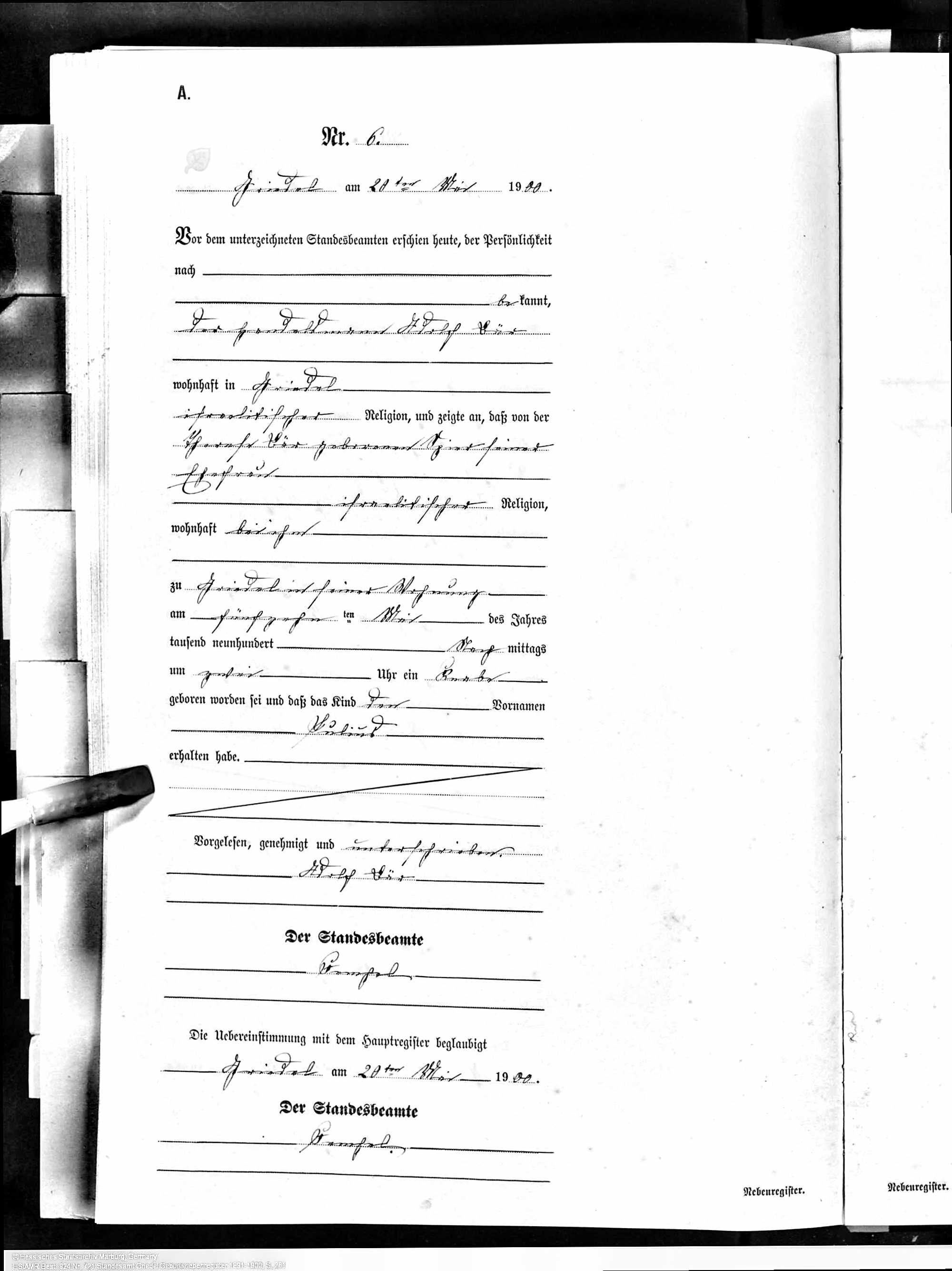
He was born in Griedel, was a merchant (in 1927 he founded a ready-made clothing store together with his brother Arthur Bär; see Chap. 9.3.2: 1926) in Butzbach, Marktplatz 20 and Weiselerstraße 14, and was a marriage witness in 1929 for Arthur Bär; V: Adolf Bär in Griedel. He is said to have been a communist and was brought to the Osthofen concentration camp near Worms in February 1933 together with Josef Oppenheimer [105] (WOLF, 1988 p. 45). His textile business had to close in 1934 as a result of the boycott of Jewish businesses (WOLF, 1988 p. 47). The wife was born in Nonnenweier in Baden, and the marriage took place there too. The family moved to Molsheim in Alsace on February 19, 1936 (HELLRIEGEL, 1968 p. 45). From there they fled to Southern France in 1940 and in early October 1942 to Switzerland (WOLF, 1988 p. 51). After the end of the war, they returned to Molsheim in Alsace, where both died in 1981 (according to Arnold BAER: Mein Vater Julius Baer, Jerusalem 2005, in: Stadtarchiv Butzbach Judaica Familie “Bär”).
oo Wertheimer, Erna | 19.07.1907 | France
That paragraph tells a far different story about Julius. It indicates that the Stolperstein was correct—Julius did flee to France in 1936. And it also reports that once World War II started, they fled to Switzerland, returning to France after the war ended.
It was also Muller’s book that alerted me to the fact that Arthur Baer had not spent time in Buchenwald. As with Julius, I had incorrectly assumed that records for an Arthur Baer in the Arolsen Archives were for my cousin because the two names—Julius and Arthur—were listed together on one of the documents.
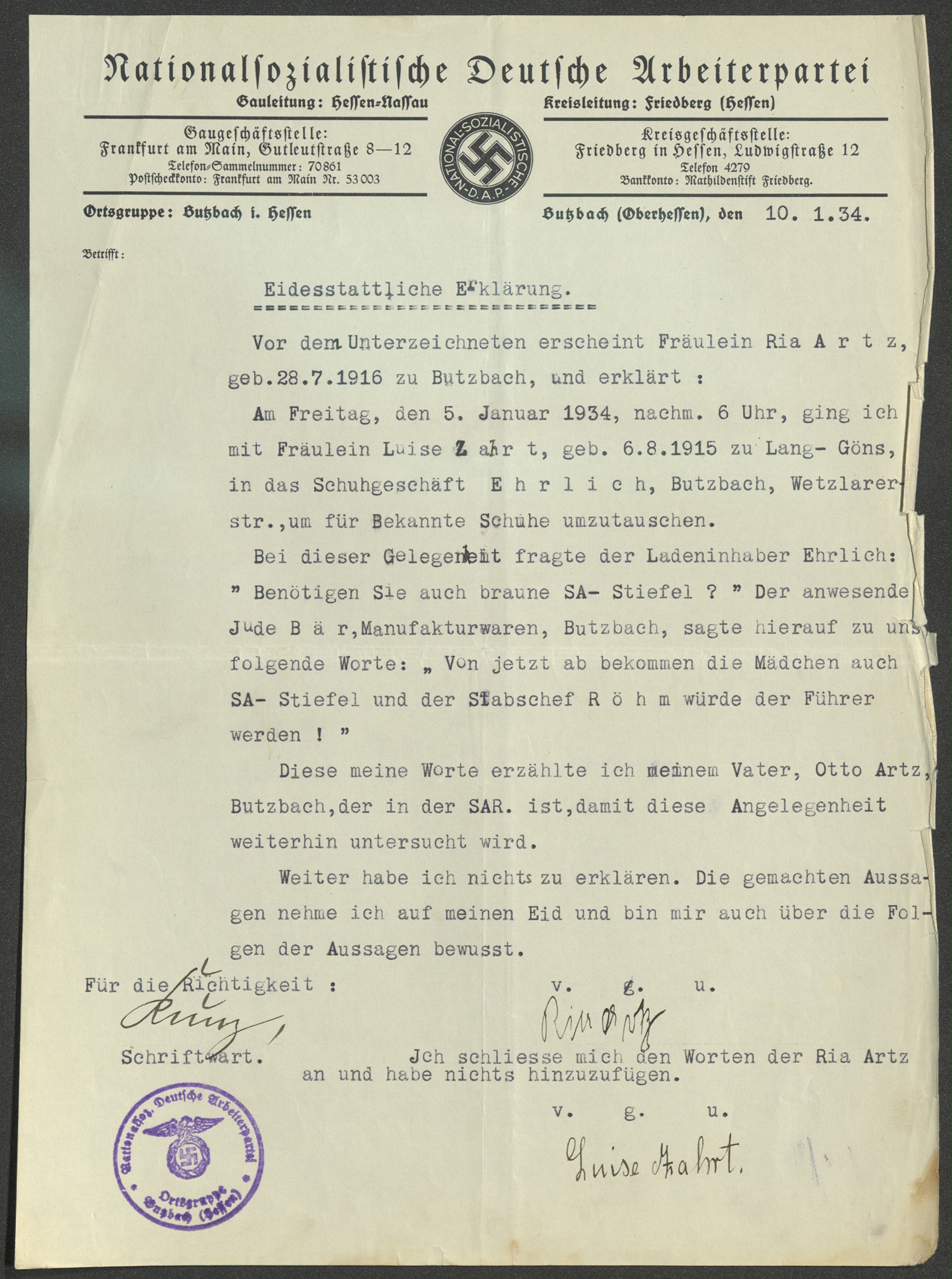
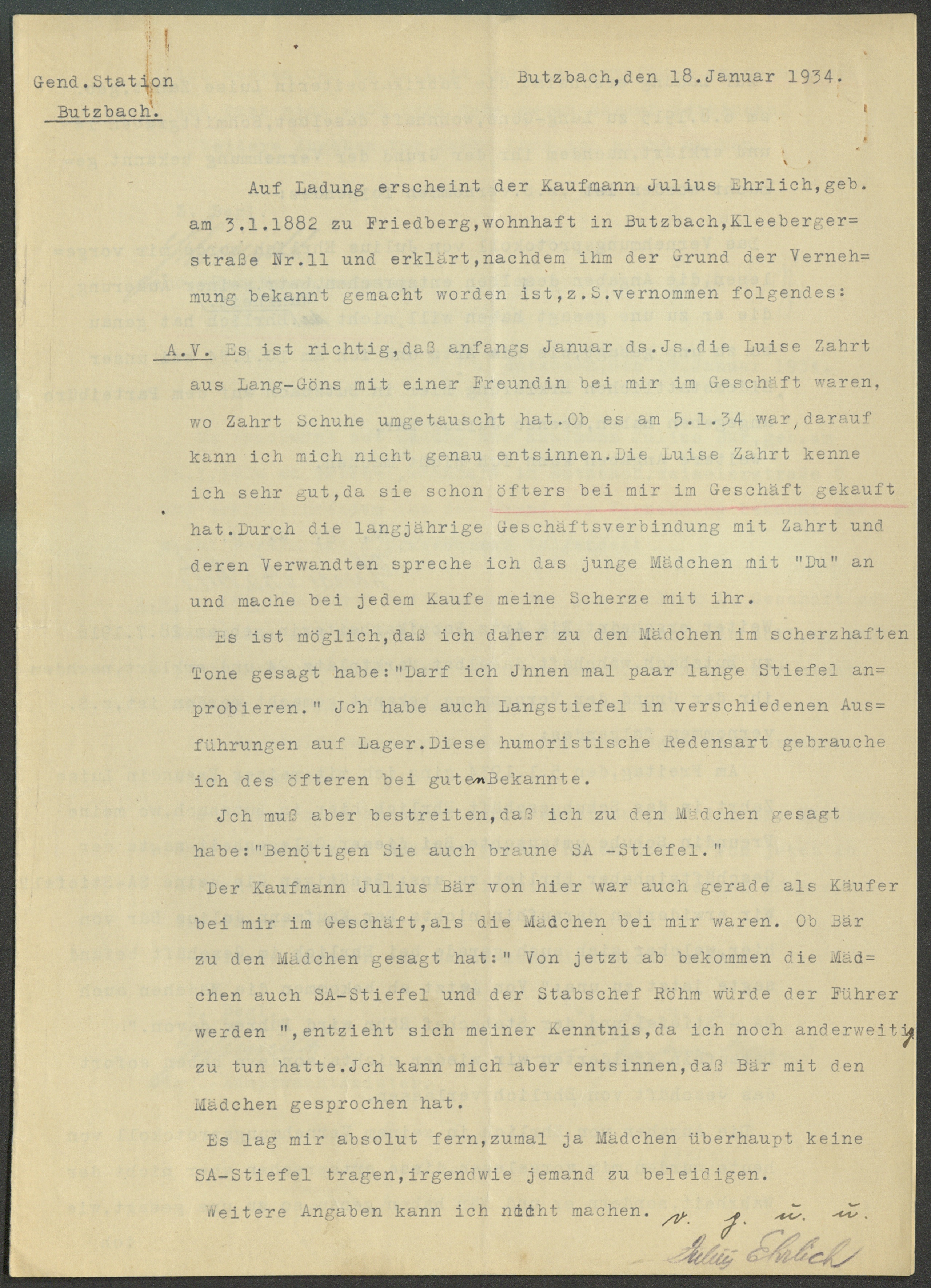
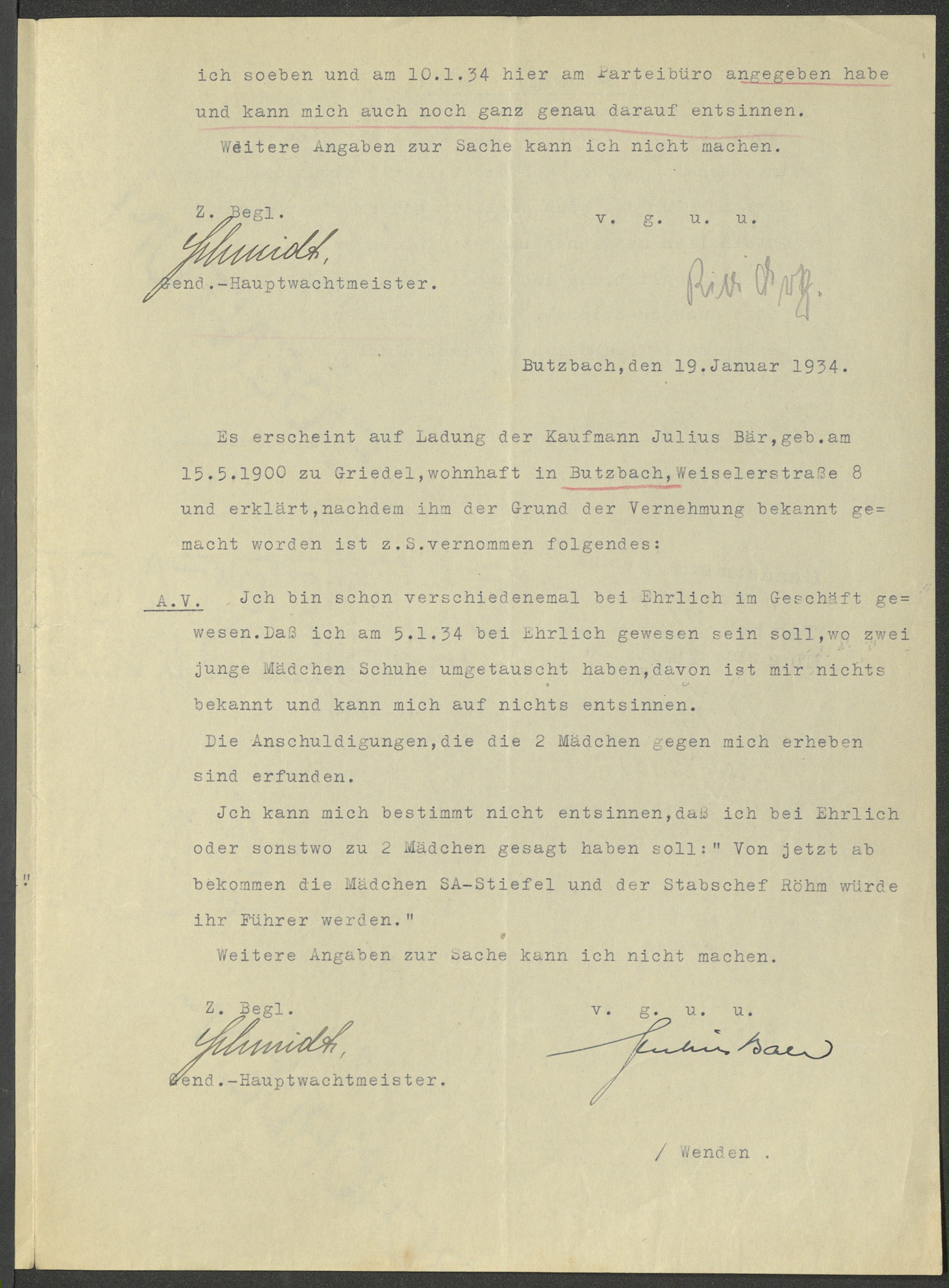
But how could I verify the information in Muller’s book? I requested the original files from Germany regarding Julius’ arrest in 1933 and from Switzerland regarding his time there; I also have asked another researcher to help me find information about his life in France, including possible descendants. In my next post I will report on what I learned from the German documents I’ve received and what really happened to Julius Baer and his family.
I will be taking a break from blogging until after Labor Day to enjoy the next two weeks with my children and grandchildren. Enjoy the last days of summer, everyone! And this might be a great time to read The Women Before Us! It’s available on Amazon here in paperback, ebook, and audiobook formats.
Name Julius Baer, Nationality H., Record Type Register, Departure Date 16 Jul 1938, Prisoner Type A. S. R., Prisoner Number 5268, Reference Number 00115100112, Arolsen Archives; Bad Arolsen, Germany; Group 1 Camp Lists, Reference Number: 00115100112, Ancestry.com. Arolsen Concentration Camp Lists, 1939-1944. ↩

Julius Baer, Religion Jude, Record Type Register, Departure Date 28 Dez 1938 (28 Dec 1938), Prisoner Type Schutzhaft, Prisoner Number 20699, Reference Number 00116100004, Arolsen Archives; Bad Arolsen, Germany; Group 1 Camp Lists, Reference Number: 00116100004, Ancestry.com. Arolsen Concentration Camp Lists, 1939-1944 ↩

Find a Grave, database and images (https://www.findagrave.com/memorial/283584356/jules-baer: accessed 14 Aug 2026), memorial page for Jules Baer (1900–26 Jul 1981), Find a Grave Memorial ID 283584356, citing Cimetière Israélite de Rosenwiller, Rosenwiller, Département du Bas-Rhin, Alsace, France; Maintained by Laura (contributor 48852786). ↩
Hanno Muller, Familienbuch Butzbach Band V: Judenfamilien in Butzbach und seinen Stadtteilen (Family Book Butzbach Volume 5: Jewish Families in Butzbach and its Districts). ↩
Therese Spier Baer, the first child of Samuel Spier, died on July 26, 1935, in Griedel, Germany, at the age of 64, leaving behind all eight of her children and all of her grandchildren. By that time the Nazis had come to power. What was the fate of those eight children and all of their children?
Even before Therese died, her youngest daughter Klara and her husband Hermann Fuld and their two-year-old daughter Helga had left Germany. They arrived in New York on March 22, 1934. On the passenger manifest for their ship, which sailed from Hamburg, they listed their destination as Jackson Heights in Queens, New York, where Hermann’s brother Max Fuld was living. Max had arrived in the US in 1926, long before the Nazi era.1
Klara Baer Fuld and family, passenver manifest, “New York City, New York, United States records,” images, FamilySearch (https://www.familysearch.org/ark:/61903/3:1:33S7-95ZY-W4W?view=explore : Jul 30, 2026), image 161 of 847; United States. National Archives and Records Administration. Image Group Number: 004870034
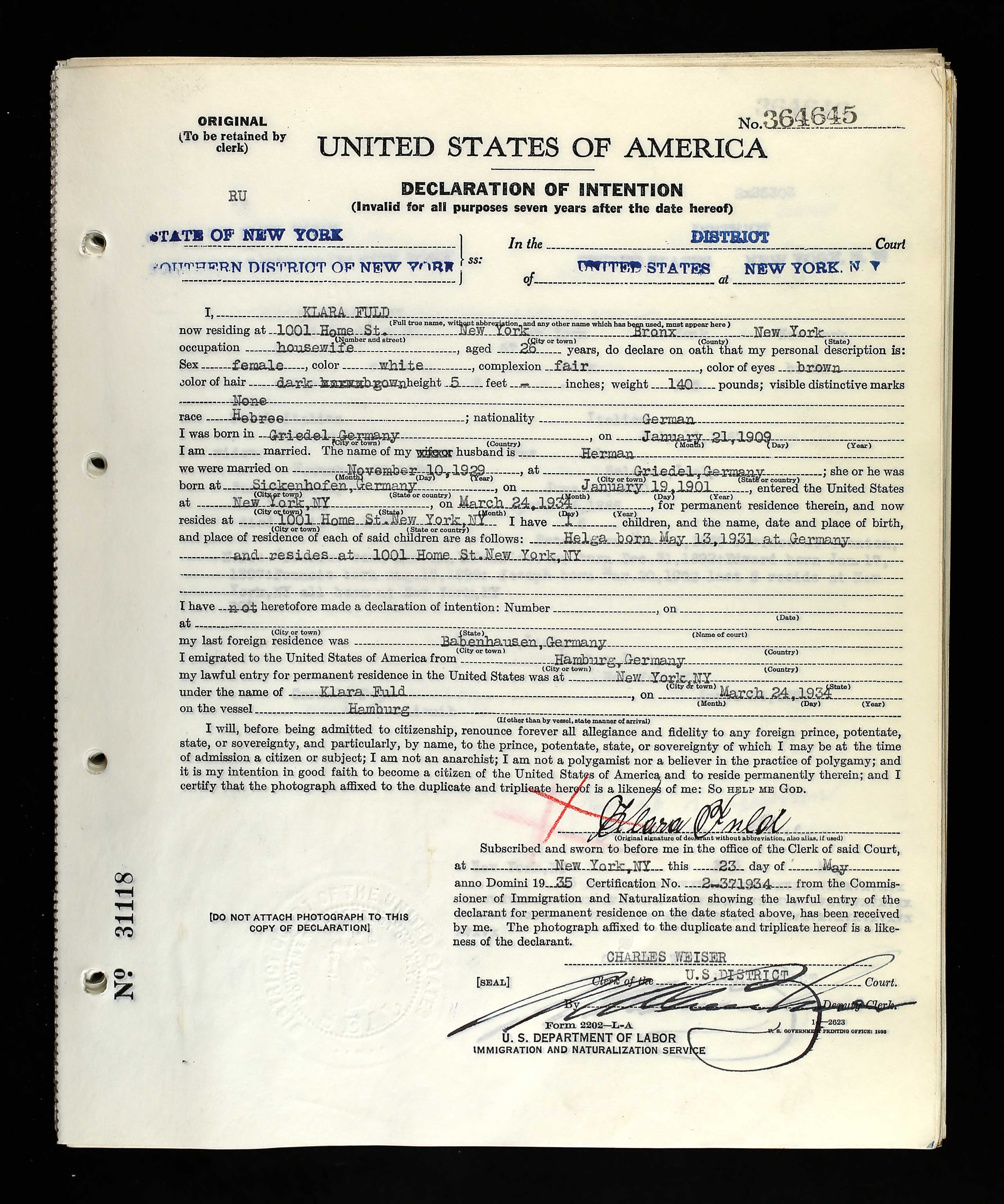
When Klara filed her declaration of intention to become a US citizen on May 23, 1935, the family was living in the Bronx.
Klara Baer Fuld declaration of intention, The National Archives at Philadelphia; Philadelphia, PA; NAI Title: Declarations of Intention For Citizenship, 1/19/1842 – 10/29/1959; NAI Number: 4713410; Record Group Title: Records of District Courts of the United States, 1685-2009; Record Group Number: 21, Description: (Roll 486) Declarations of Intention For Citizenship, 1842-1959 (No 364301-365300), Ancestry.com. New York, U.S., State and Federal Naturalization Records, 1794-1943
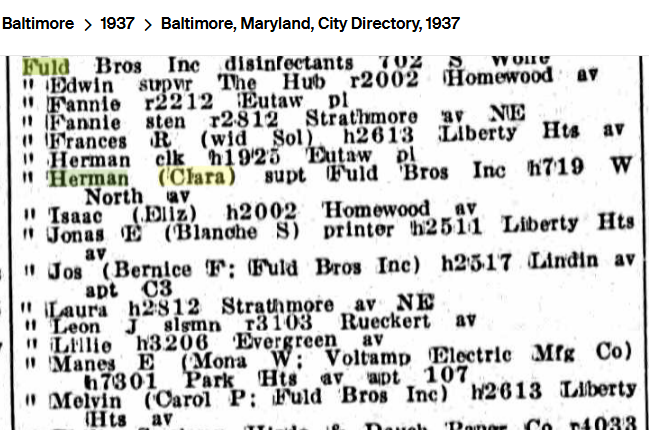
However, by 1937 Herman and Clara (as spelled in the 1937 Baltimore directory) were living in Baltimore; Herman was associated with a disinfectant business called Fuld Brothers Inc. There were two other men listed in that directory, Joseph Fuld and Melvin Fuld, who also listed Fuld Brothers as their business. I assumed they were his relatives and that the business was why he and Clara moved to Baltimore.
Herman Fuld, Maryland, City Directory, 1937, Ancestry.com. U.S., City Directories, 1822-1995
So I researched Joseph and Melvin Fuld and found that they were the sons of Solomon Fuld from Sickenhofen, the same town where Hermann Fuld was born. I then researched Solomon Fuld and found that he was the brother of Lazarus Fuld, Hermann’s father. So Melvin and Joseph Fuld were first cousins of Hermann. Interestingly, Solomon had come to the US back in 1894 and his sons were American born.2
By the time Klara and Herman moved to Baltimore in about 1937, some of Klara’s siblings had also arrived in the US, but all after their mother Therese had died. Jenny Baer and her husband Julius Goldschmidt and their seven-year-old daughter Lore arrived in New York on July 31, 1936, along with Julius’ mother Lina, a widow. They listed Atlantic City as their final destination on the manifest, but on January 25, 1937, when Julius filed his declaration of intention, they were living in the Bronx. Julius, who had listed his occupation on the manifest as a merchant, now listed his occupation as a mechanic.3
Julius Goldschmidt and family, passenger manifest, The National Archives in Washington, DC; Washington, DC, USA; Passenger and Crew Lists of Vessels Arriving at New York, New York, 1897-1957; Microfilm Serial or NAID: T715; RG Title: Records of the Immigration and Naturalization Service, 1787-2004; RG: 85, Ship or Roll Number: Hansa, Ancestry.com. New York, U.S., Arriving Passenger and Crew Lists (including Castle Garden and Ellis Island), 1820-1957
Selma Baer and his husband Julius Siegmann were the next to arrive. They and their three sons, Heinz (later Henry), Adolph (later Edward), and Erich (later Eric) arrived in New York on October 7, 1937. They listed Julius Goldschmidt, Jenny’s husband, as the person they were going to and their destination as the Bronx. Julius Siegmann listed his occupation as a cattle dealer, but clearly there was no opportunity to pursue that in the Bronx!
Selma Baer Siegmann and family, passenger manifest, The National Archives in Washington, DC; Washington, DC, USA; Passenger and Crew Lists of Vessels Arriving at New York, New York, 1897-1957; Microfilm Serial or NAID: T715; RG Title: Records of the Immigration and Naturalization Service, 1787-2004; RG: 85, Ship or Roll Number: Gerolstein, Ancestry.com. New York, U.S., Arriving Passenger and Crew Lists (including Castle Garden and Ellis Island), 1820-1957
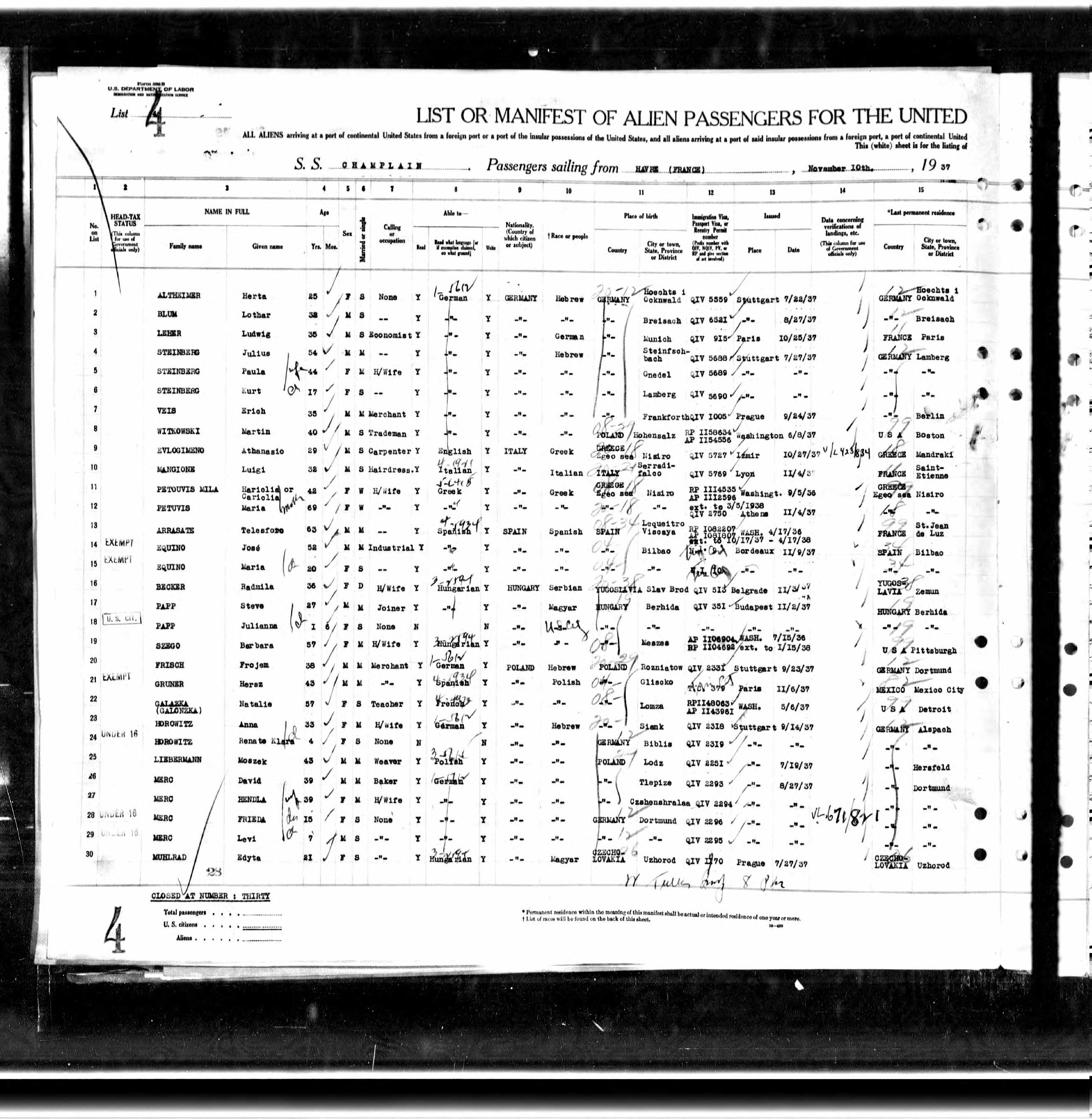
Just a month later the next Baer sibling arrived, Paula, along with her husband Julius Steinberg and their teenage son Kurt. They arrived in New York on November 11, 1937, indicating that they were going to Paula’s sister Clara in Baltimore.
Paula Baer Steinberg and family, passenger manifest, The National Archives in Washington, DC; Washington, DC, USA; Passenger and Crew Lists of Vessels Arriving at New York, New York, 1897-1957; Microfilm Serial or NAID: T715; RG Title: Records of the Immigration and Naturalization Service, 1787-2004; RG: 85, Ship or Roll Number: Champlain, Ancestry.com. New York, U.S., Arriving Passenger and Crew Lists (including Castle Garden and Ellis Island), 1820-1957
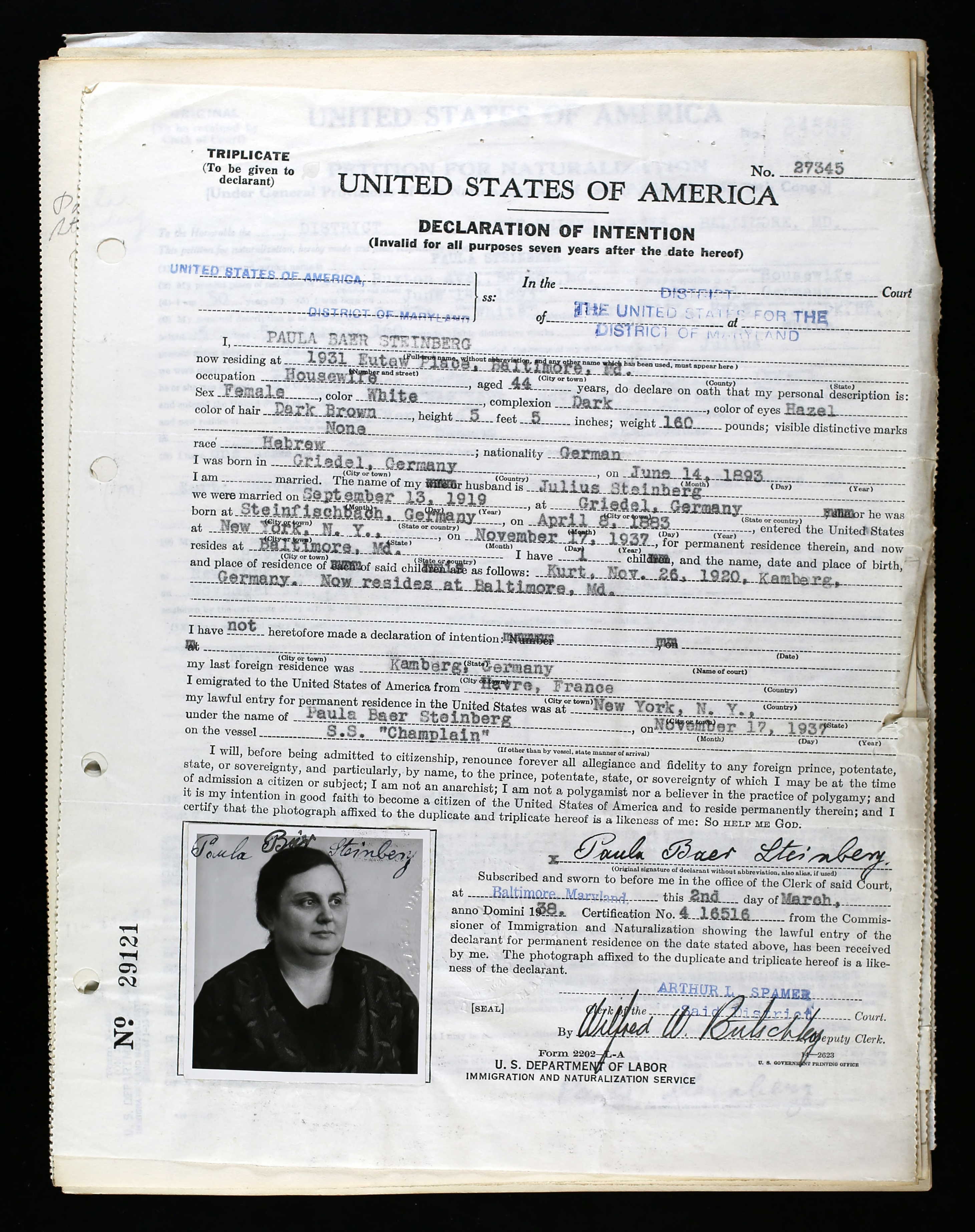
When Paula filed her declaration of intention on March 2, 1938, they were in fact living in Baltimore.
Paula Baer Steinberg declaration of intention, The National Archives at Philadelphia; Philadelphia, Pa; Petitions For Naturalization, 1903-1972; NAI Number: 654310; Record Group Title: Records of District Courts of the United States, 1685-2009; Record Group Number: 21 Petitions 24451-24750, Ancestry.com. Maryland, U.S., Federal Naturalization Records, 1795-1931
Thus, the four sisters—Klara, Jenny, Selma, and Paula—-were all safely in the US and out of Europe before their four brothers. Were the women more able to see the writing on the wall and willing to leave Germany behind or did they marry men who had that foresight?
The oldest brother Meyer Manfred Baer, his wife Friedel, and their son Erich arrived in New York on July 22, 1938, just a few months after Paula. Meyer listed his occupation as a butcher on the manifest.
Meyer Manfred Baer and family, passenger manifest, The National Archives in Washington, DC; Washington, DC, USA; Passenger and Crew Lists of Vessels Arriving at New York, New York, 1897-1957; Microfilm Serial or NAID: T715; RG Title: Records of the Immigration and Naturalization Service, 1787-2004; RG: 85, Ship or Roll Number: Washington, Ancestry.com. New York, U.S., Arriving Passenger and Crew Lists (including Castle Garden and Ellis Island), 1820-1957
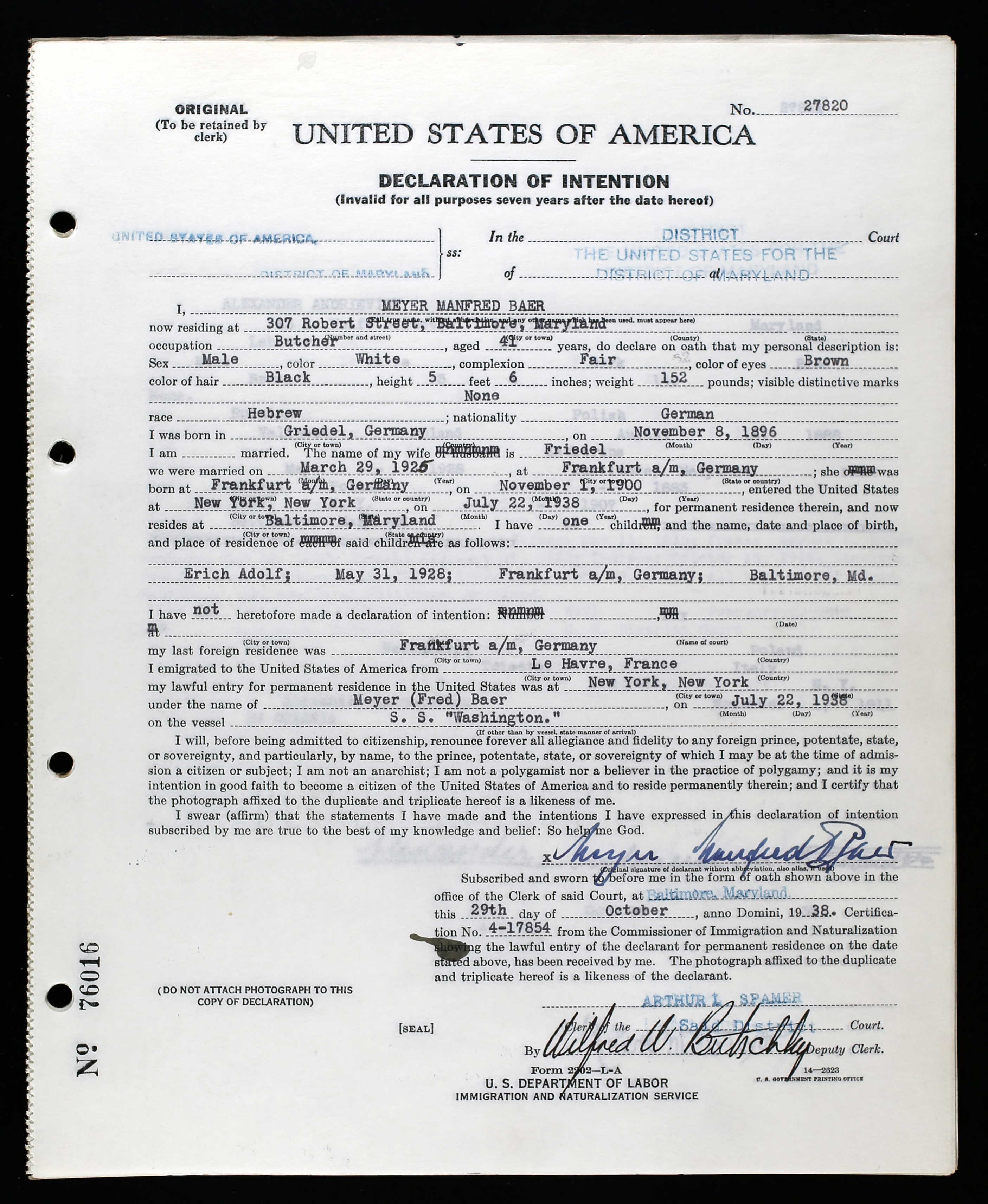
Although the manifest did not indicate their destination, the family ended up in Baltimore like Klara and Paula, as seen on Meyer’s declaration of intention dated October 29, 1938. He was still working as a butcher.
Meyer Manfred Baer declaration of intention, The National Archives at Philadelphia; Philadelphia, Pa; Declarations of Intention For Citizenship, 1911-1967; NAI Number: 573394; Record Group Title: Records of District Courts of the United States, 1685-2009; Record Group Number: 21, Description: Declarations 27401-28200, Ancestry.com. Maryland, U.S., Federal Naturalization Records, 1795-1931
Arthur Baer’s story is not quite as straightforward. In the aftermath of Kristallnacht in November 1938, he was arrested and sent to Buchenwald concentration camp; he was released on December 28, 1938, and like the others arrested after Kristallnacht, he left Germany soon after being released.4
UPDATE: I have now realized that this was a different man named Arthur Baer. My cousin Arthur Baer was not sent to Buchenwald! In fact, as we will see in a subsequent post, he left Griedel before Kristallnacht and was living in Bad Nauheim. More on that to come. The paragraphs below, however, are accurate. Arthur and his family did escape to England.
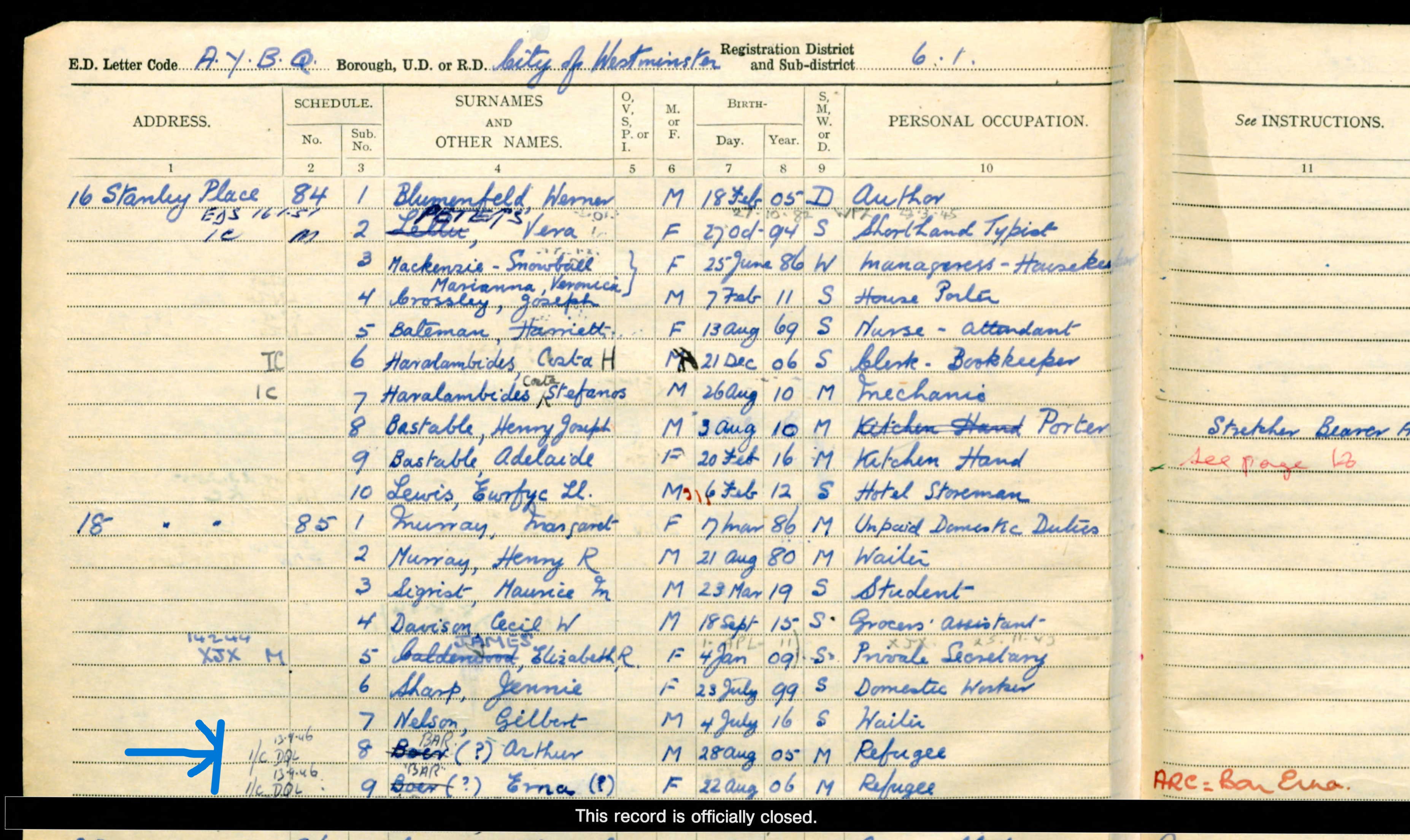
Arthur and his wife Erna and their son Erich escaped to England, where they appear living in London on the 1939 England and Wales Register which identified Arthur and Erna as refugees. Arthur was temporarily interned in England as an alien enemy but was released on November 25, 1940. As we will see, Arthur and his family eventually came to the United States.
Arthur Baer 1939 England and Wales Register, The National Archives; Kew, London, England; 1939 Register; Reference: RG 101/625D, Enumeration District: AYBQ, Ancestry.com. 1939 England and Wales Register
Arthur Baer UK World War II Alien Internees, 1939-1945, The National Archives; Kew, London, England; HO 396 WW2 Internees (Aliens) Index Cards 1939-1947; Reference Number: HO 396/166, Piece Number Description: 166: German Internees Released In UK 1939-1942: Ba-Berg, Ancestry.com. UK, World War II Alien Internees, 1939-1945
The remainingg two siblings, Eugen and Julius, have much more complicated stories that will follow in the posts to come, but as we can see, Paula, Jenny, Selma, Clara, Meyer, and Arthur were safely out of Germany before 1940.
Max Fuld, Petition for Naturalization, The National Archives in Washington, DC; Washington, DC; NAI Title: Index to Petitions For Naturalizations Filed in Federal, State, and Local Courts in New York City, 1792-1906; NAI Number: 5700802; Record Group Title: Records of District Courts of the United States, 1685-2009; Record Group Number: Rg 21, Ancestry.com. New York, U.S., State and Federal Naturalization Records, 1794-1943 ↩
Sol Fuld, Gender Male, Race White, Birth Date 4 Jan 1875, Birth Place Sickenhofen, Federal Republic of Germany, Father Joseph Field Mother Bertha Simon, SSN 212091919, Ancestry.com. U.S., Social Security Applications and Claims Index, 1936-2007; Solomon Fuld and family, 1910 US census, Year: 1910; Census Place: Baltimore Ward 15, Baltimore (Independent City), Maryland; Roll: T624_558; Page: 2b; Enumeration District: 0255; FHL microfilm: 1374571, Ancestry.com. 1910 United States Federal Census ↩
Julius Goldschmidt, declaration of intention, The National Archives in Washington, DC; Washington, DC; NAI Title: Index to Petitions for Naturalizations Filed in Federal, State, and Local Courts in New York City, 1792-1906; NAI Number: 5700802; Record Group Title: Records of District Courts of the United States, 1685-2009; Record Group Number: 21, Description: Petitions For Naturalization From Us District Court For the Southern District of New York, 1897-1944, Ancestry.com. New York, U.S., State and Federal Naturalization Records, 1794-1943 ↩
Arthur Baer, Religion Jude, Record Type Register, Departure Date 28 Dez 1938 (28 Dec 1938), Prisoner Type Schutzhaft, Prisoner Number 22955, Reference Number 00116100004, Arolsen Archives; Bad Arolsen, Germany; Group 1 Camp Lists, Ancestry.com. Arolsen Concentration Camp Lists, 1939-1944 ↩
My cousin Therese Spier Baer, the first child of Samuel Spier, had eight children with her husband Eisemann Adolf Baer between 1893 and 1909, and amazingly all eight survived to adulthood, and they all survived the Holocaust as did their children. Almost all of them then lived remarkably long lives.
Therese’s first child was her daughter Paula, born on June 14, 1893, in Griedel, Germany.
The third daughter and sixth child, Jenny, was born in Griedel on November 25, 1902.1
A fourth son, Arthur, was born on August 28, 1905, in Griedel.2
And finally a daughter, Klara, was born on January 21, 1909, in Griedel.3
Eight children, four girls and four boys, born in just over fifteen years! Most of the children were born less than two years apart.4
Next we will see who these children married and who their children were.
It’s not too late! Please consider reading and reviewing The Women Before Us, available on Amazon here.
See, e.g., marriage record of Jenny Baer, Jenni Bär, Gender weiblich (Female)
Age 24, Birth Date 25 Nov 1902, Marriage Date 19 Jan 1927, Marriage Place Griedel, Hessen (Hesse), Deutschland (Germany), Civil Registration Office Griedel, Spouse
Julius Goldschmidt, Certificate Number 3, Hessisches Hauptstaatsarchiv; Wiesbaden, Deutschland; Bestand: 924; Laufende Nummer: 727, Ancestry.com. Hesse, Germany, Marriages, 1849-1930 ↩
Marriage record of Arthur Baer, Gender männlich (Male), Age 23, Birth Date
28 Aug 1905, Marriage Date 02 Jun 1929 (2 Jun 1929), Marriage Place Nieder-Weisel, Hessen (Hesse), Deutschland (Germany), Civil Registration Office Nieder-Weisel, Spouse Erna Krämer, Certificate Number 4, Hessisches Hauptstaatsarchiv; Wiesbaden, Deutschland; Bestand: 924; Laufende Nummer: 1376, Year Range: 1921-1930, Ancestry.com. Hesse, Germany, Marriages, 1849-1930 ↩
Marriage record of Klara Baer, Gender weiblich (Female), Age 20, Birth Date
21 Jan 1909, Marriage Date 06 Nov 1929 (6 Nov 1929), Marriage Place Griedel, Hessen (Hesse), Deutschland (Germany), Civil Registration Office Griedel, Spouse Hermann Fuld, Certificate Number 7, Hessisches Hauptstaatsarchiv; Wiesbaden, Deutschland; Bestand: 924; Laufende Nummer: 727, Year Range: 1921-1930, Ancestry.com. Hesse, Germany, Marriages, 1849-1930 ↩
At first I only had found the first seven children and was surprised that Therese did not have more children after she was 34; then, while searching for a death record for Therese, I found a reference to Klara, who was born when her mother was 37. ↩
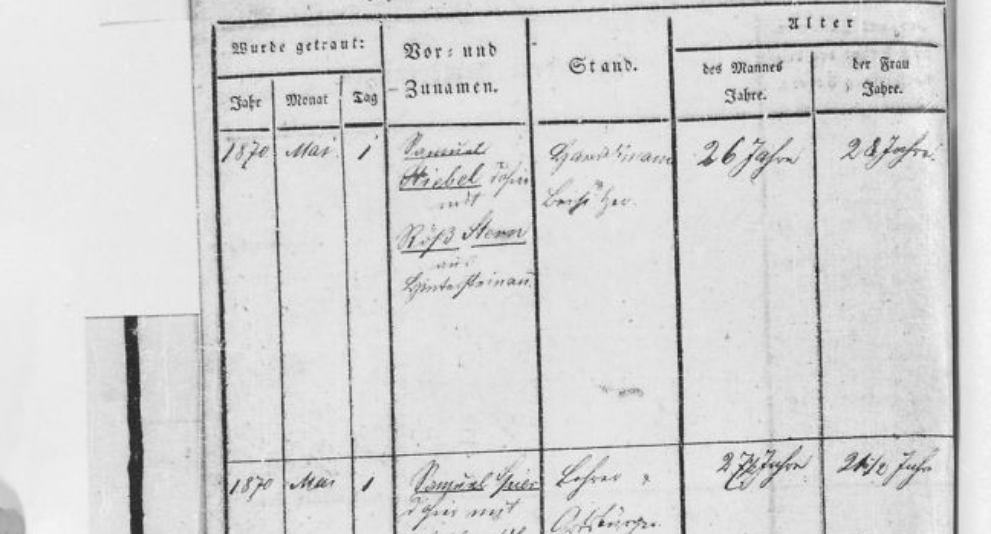
The first born child of Sarchen Frank and Isaac Spier was their son Samuel, born as we saw on December 18, 1842, in Schrecksbach, Germany. On March 1, 1870, in Langendiebach, Germany, Samuel married Amalie (Malchen) Adler, the daughter of Markus Adler and Dolce Rosenstrauch; she was born in Hintersteinau, Germany, in about 1849. 1
Samuel Spier and Amalie Adler marriage record, Arcinsys Archives of Hessen, HHStAW, 365, 515, p. 19
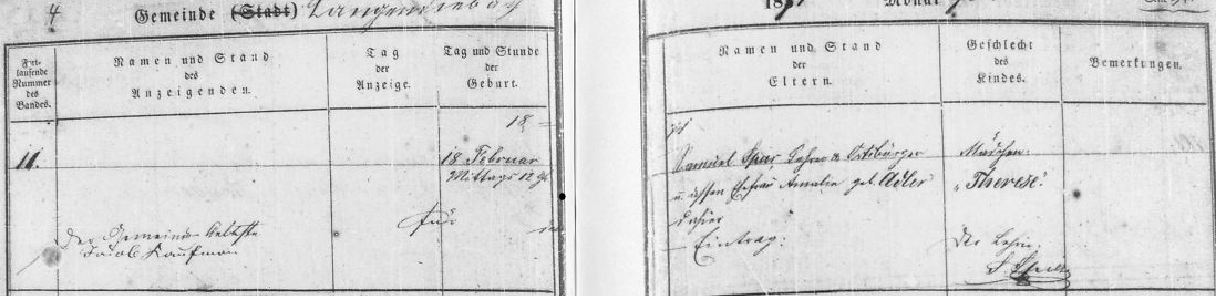
Samuel and Amalie had at least five children. Their first born, Therese, was born on February 18, 1871, in Langendiebach, Germany. (Her marriage record states that she was born in Grosskrotzenburg like some of her later-born siblings so it took some searching to find her actual birthplace and birth record.)
Therese Spier birth record, Arcinsys Archives of Hessen, HHStAW Abt. 365 Nr. 514, S. 6
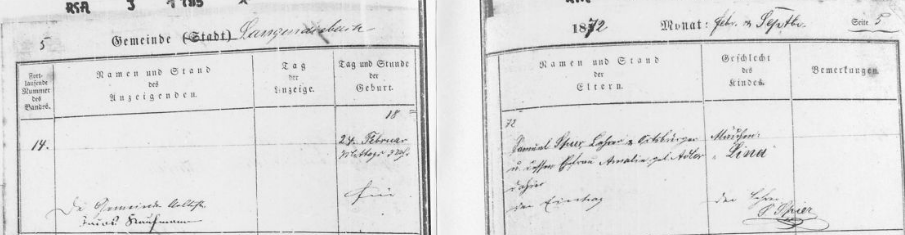
A second child, Lina, was born on February 24, 1872, in Langendiebach. Her birth record reveals that Samuel was a teacher and religious leader in the community:
Lina Spier birth record, Arcinsys Archives of Hessen, HHStAW, 365, 514, p. 7
Samuel and Amalie must have moved from Langendiebach to Grosskrotzenburg sometime between February 27, 1872, and June 29, 1875, because their third child Leopold Saly was born in Grosskrotzenburg on that date.
Leoopold Saly Spier birth record, Hessisches Hauptstaatsarchiv; Wiesbaden, Deutschland Year Range: 1875, Ancestry.com. Hesse, Germany, Births, 1851-1901
Isidor, their fourth child, was born on August 11, 1880, in Grosskrotzenburg.
Given the rather large gaps between Leopold and Isidor and between Isidor and Selma, I am wondering whether there were other children born in between that I’ve missed or miscarriages. I will continue to search for any children I may have missed. There was a male child with the surname Spier who was stillborn in Grosskrotzenburg on January 5, 1888, who could have been another child of Samuel and Amalie, but I can’t be certain of that.
Male Spier stillbirth jan 5 1888, from JOWBR, JewishGen.org
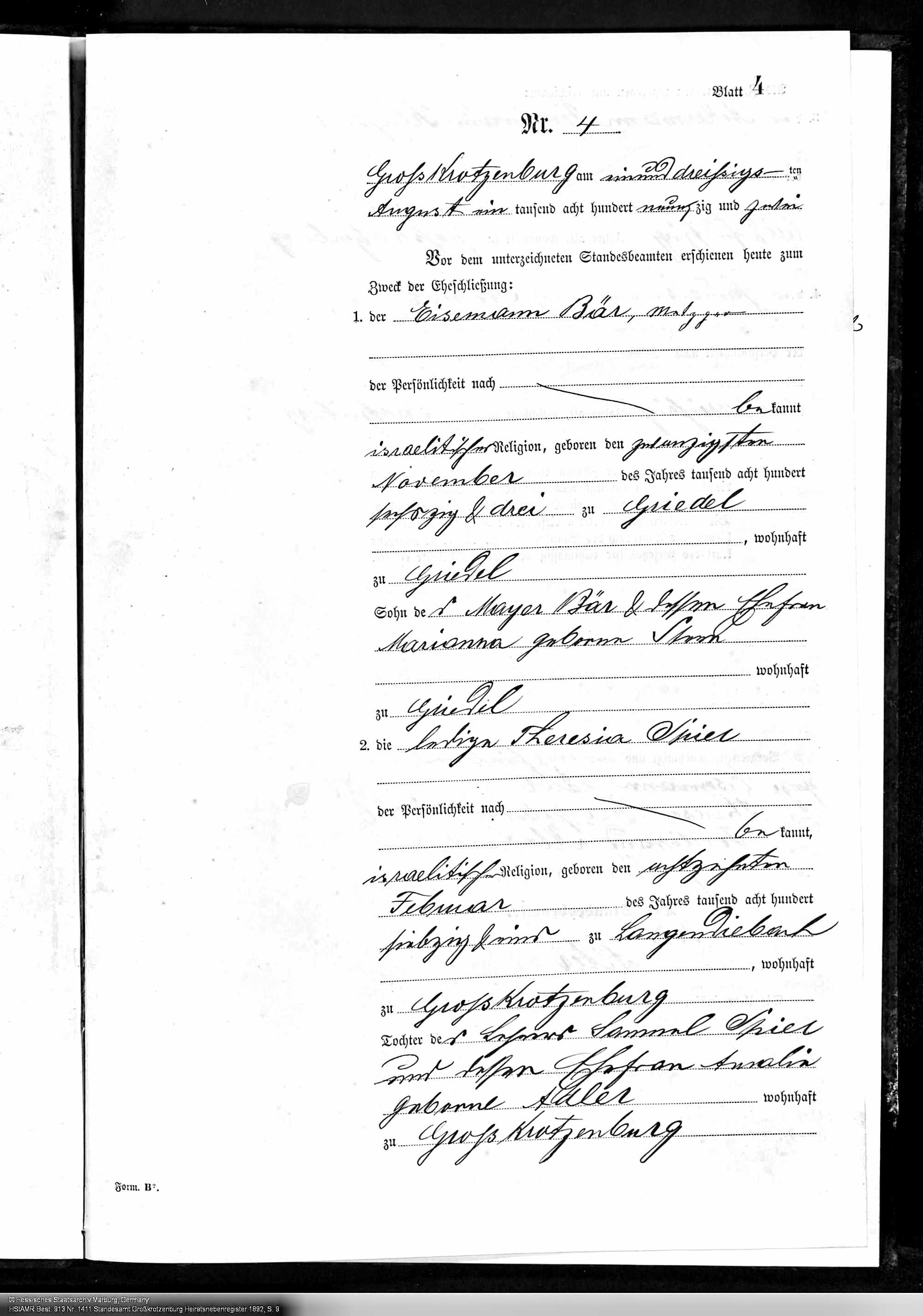
The oldest of these children, Therese Spier, married Eisemann Adolf Baer on August 31, 1892, in Grosskrotzenburg. Known primarily as Adolf, he was born on November 20, 1863, in Griedel, Germany, to Mayer Baer and Marianna Stern. Therese and Eisemann Adolf would have eight children, as we will see in the next post. In fact, all of the sources for the grandchildren of Samuel and Amalie will be discussed in later posts.
Marriage reocrd of Therese Spier and Eisemann Adolf Baer, Hessisches Hauptstaatsarchiv; Wiesbaden, Deutschland, Year Range: 1892, Ancestry.com. Hesse, Germany, Marriages, 1849-1930
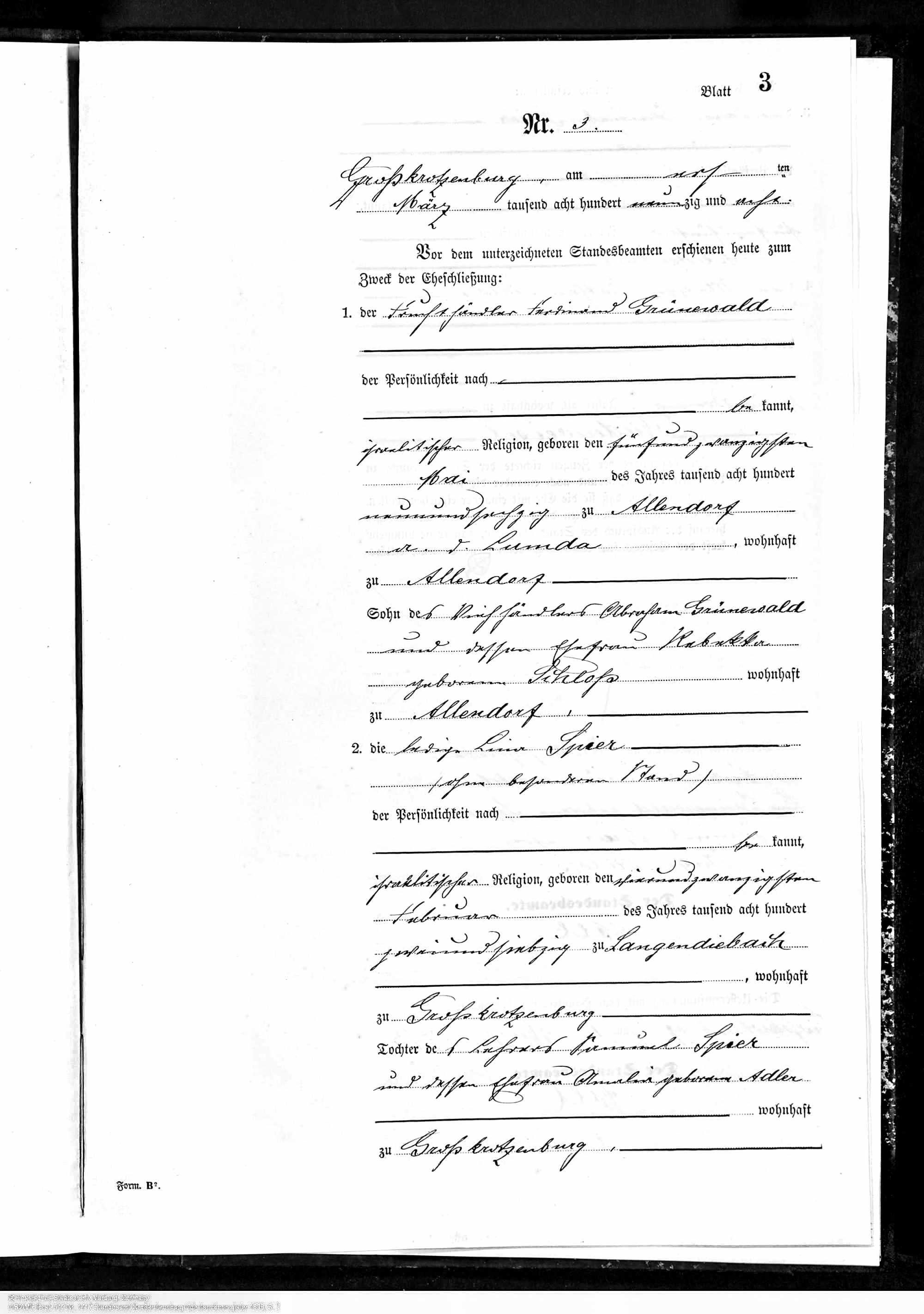
Lina Spier married Ferdinand Gruenwald on March 1, 1898, in Grosskrotzenburg. He was the son of Abraham Gruenwald and Rebekka Schloss and was born in Allendorf, Germany on May 25, 1869. Lina and Ferdinand had one child.
Marriage record of Lina Spier and Ferdinand Gruenwald, Hessisches Hauptstaatsarchiv; Wiesbaden, Deutschland, Year Range: 1898, Ancestry.com. Hesse, Germany, Marriages, 1849-1930
Leopold Saly Spier, known as Saly, married Lina Wrzeszinski in Labischin, Poland, then part of Prussia, allegedly on April 12, 1907. She was born in Labischin on September 18, 1877, to Adolf Wrzeszinski and Ernestine Lewin. I could not find a marriage record for Saly and Lina or Lina’s birth record online, but later immigration documents revealed some of this information. Their marriage date, however, came from another tree that had no sources, and when I asked the tree owner for her source, she could not identify where she got the information. Saly and Lina had two children.2
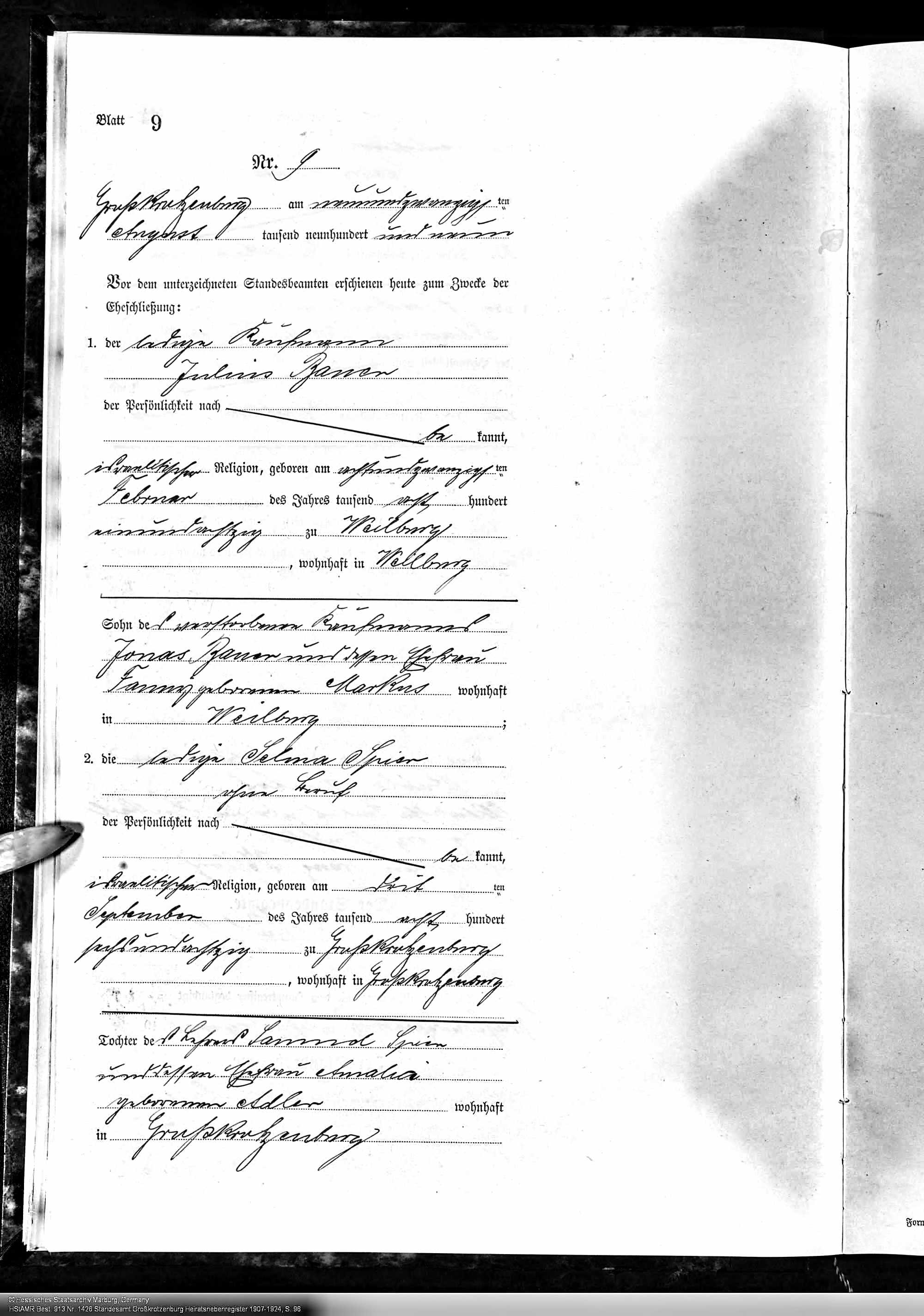
The youngest sibling, Selma Spier, married Julius Bauer on August 29, 1909, in Grosskrotzenburg. Julius, the son of Jonas Bauer and Fanny Markus, was born in Weilburg, Germany, on February 28, 1881. Selma and Julius had four children.
Selma Spier and Julius Bauer marriage record, Hessisches Hauptstaatsarchiv; Wiesbaden, Deutschland; Signatur: 1426, Year Range: 1907, Ancestry.com. Hesse, Germany, Marriages, 1849-1930
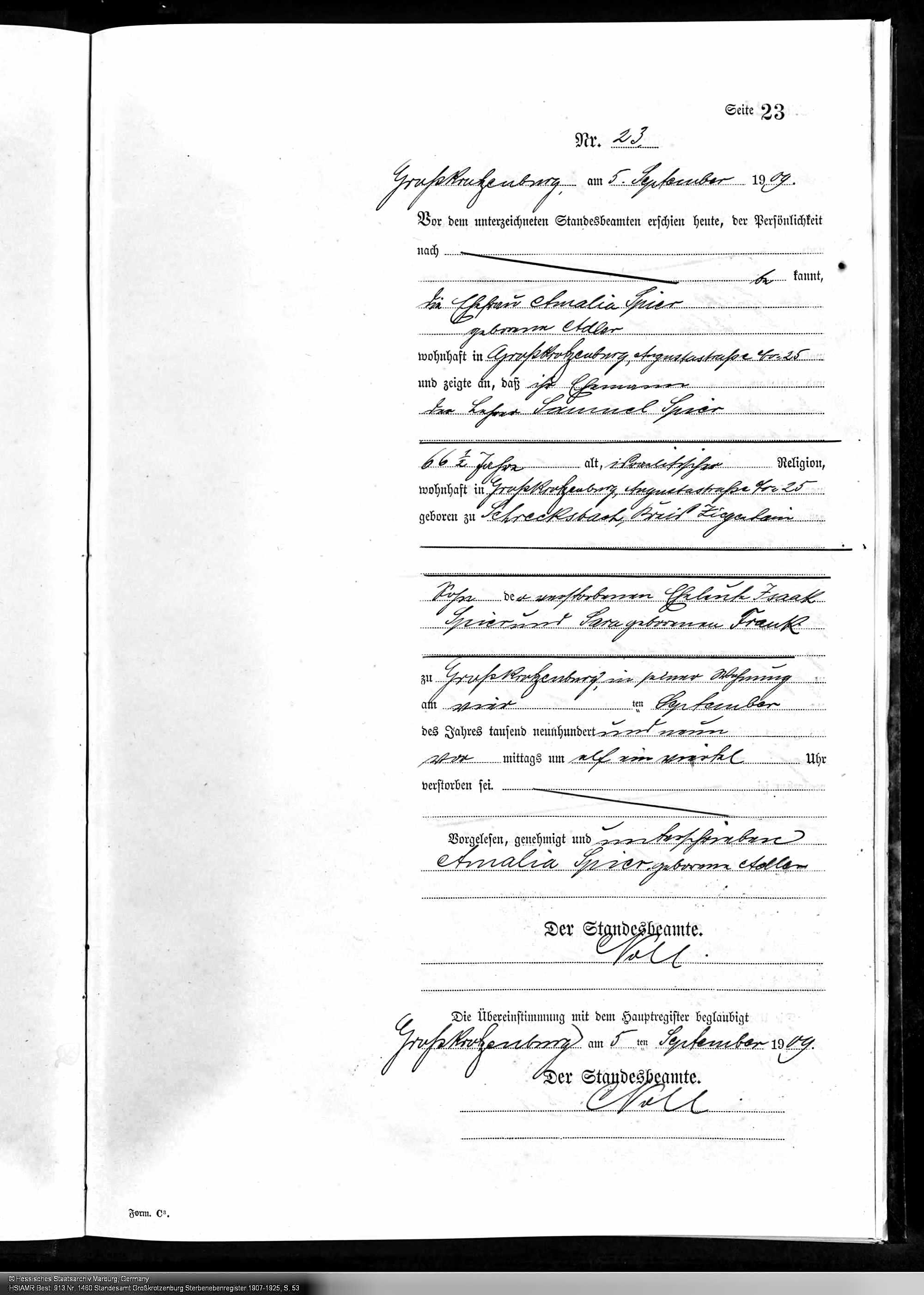
Samuel Spier died on September 4, 1909, in Grosskrotzenburg, less than a week after his youngest daughter Selma was married. He had lived to see all but his son Isidor marry and lived to see the births of most of his grandchildren. He was 66 years old.
Samuel Spier death record, Hessisches Hauptstaatsarchiv; Wiesbaden, Deutschland; Personenstandsregister Sterberegister; Signatur: 1460, Year Range: 1907, Ancestry.com. Hesse, Germany, Deaths, 1851-1958
The last child to marry was Isidor. He married Pauline Mayer on December 14, 1920, in Guntersblum, Germany, where she was born on November 12, 1891, to Simon Mayer and Eva Morgenstern. As with Saly and Lina, I could not locate a marriage record or a birth record for Pauline but am relying on later documents. Isidor and Pauline had one child.3
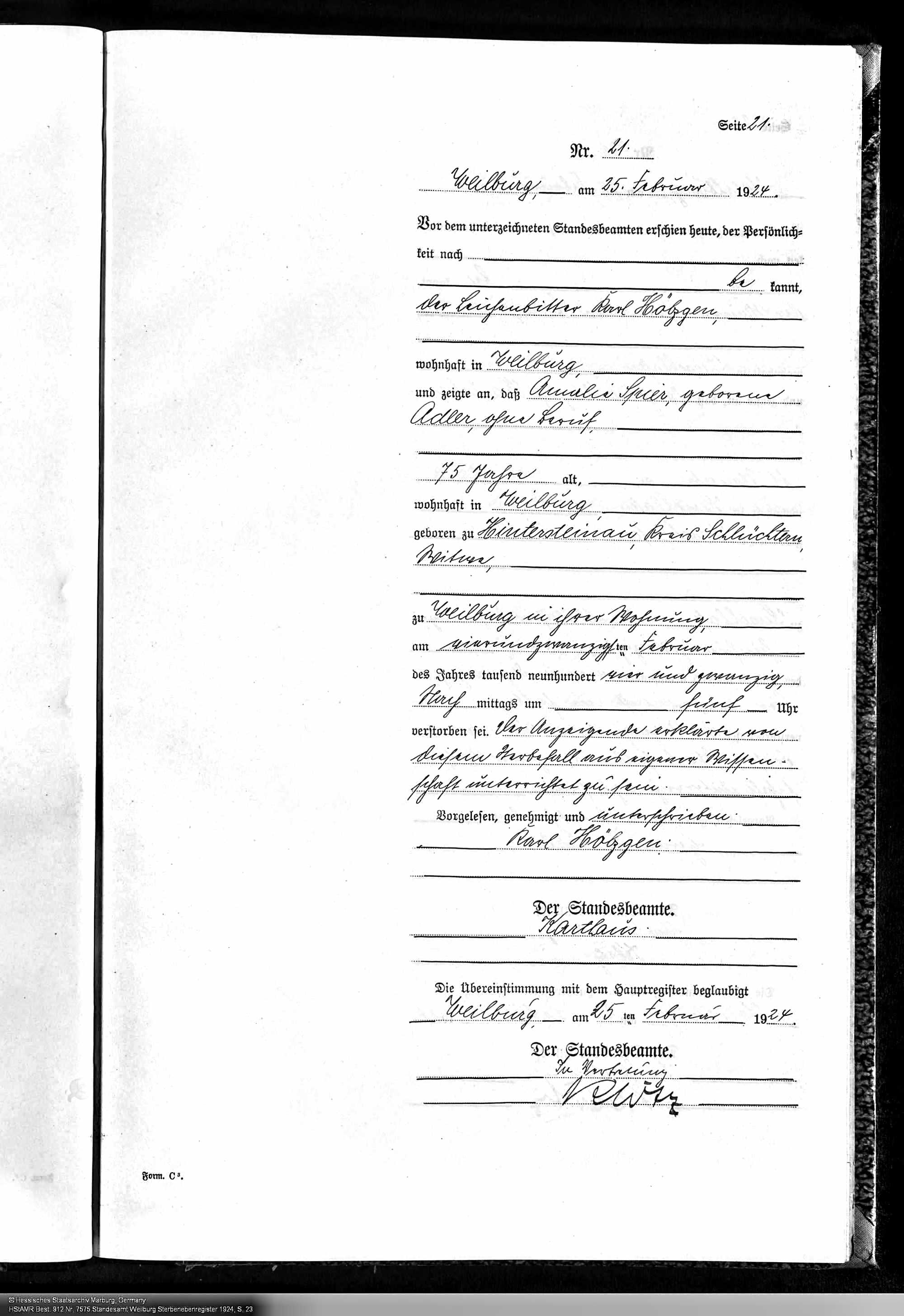
Amalie Adler Spier, the widow of Samuel Spier, died on February 24, 1924, in Weilburg, Germany, where her youngest child Selma had settled after marrying Julius Bauer. She was 75 years old and had lived to see the births of all her grandchildren.
Amalie Adler Spier death record. Hessisches Hauptstaatsarchiv; Wiesbaden, Deutschland; Personenstandsregister Sterberegister, Year Range: 1924, Ancestry.com. Hesse, Germany, Deaths, 1851-1958
The stories of those grandchildren and their parents—-Therese, Lina, Saly, Isidor, and Selma—will be told in the posts that follow.
According to her death record, Amalie was 75 when she died in 1924. I was unable to find a birth record for her. Amalie Spier, Maiden Name Adler, Gender weiblich (Female) Death Age 75, Birth Date abt 1849, Death Date 24 Feb 1924, Death Place Weilburg, Hessen (Hesse), Deutschland (Germany), Civil Registration Office Weilburg, Certificate Number 21, Hessisches Hauptstaatsarchiv; Wiesbaden, Deutschland; Personenstandsregister Sterberegister, Ancestry.com. Hesse, Germany, Deaths, 1851-1958 ↩
Lina Sara Spier, [Lina Sara Wrzeszinski], Gender Female, Marital Status Widowed, Birth Date 18 de set de 1877 (18 Sep 1877), Birth Place Labischin, Arrival Date 1939, Arrival Place Rio de Janeiro, Rio de Janeiro, Brazil, Father Adolf Wrzeszinski, Mother Ernestine Levin, Traveling With Children No, FHL Film Number 004921080, Ancestry.com. Rio de Janeiro, Brazil, Immigration Cards, 1900-1965.↩
Pauline’s birth and marriage information was reported in her naturalization papers, Pauline Spier, Gender Female, Race White, Petition Age 55, Record Type Naturalization Petition, Birth Date 12 Nov 1891, Birth Place Guntersblum, Germany
Marriage Date 14 Dec 1920, Marriage Place Guntersblum, Germany, Departure Place
Kobe, Japan, Petition Date 1946, Petition Place California, USA, Naturalization Place USA, Ship ”nitta Maru” Court District Court, Northern District, California: San Francisco, Relation to Head Self (Head), Spouse Irving Isidor Spier, Child Lotta
Petition Number 87852, The National Archives in Washington, DC; Washington, DC, USA; Petitions For Naturalization, 8/6/1903 – 12/29/1911; NAI Number: 605504; Record Group Title: Records of District Courts of the United States, 1685-2009; Record Group Number: Records of District Courts of the United States, 1685-2009,
Ancestry.com. California, U.S., Federal Naturalization Records, 1888-1991. Her birthname and parents’ names came from secondary sources. ↩
The first-born child of Sprintz Blumenfeld and Samuel Frank was their daughter Sarchen (Sarah) Frank, born in Momberg, Germany, in about 1816, as determined by her age of 78 on her 1894 death record (see below).
Sarchen married Isaac Spier in Momberg on May 25, 1842. Isaac was the son of Samuel Spier and Telsa Katz, and he was born in Schrecksbach, Germany, in about 1812, according to his age of 30 on their marriage record. Sarchen was 26 when they married.
Sarchen Frank and Isaac Spier marriage record, Trauregister der Juden von Merzhausen (Willingshausen) 1828-1907 (HHStAW Abt. 365 Nr. 612)AutorHessisches Hauptstaatsarchiv, WiesbadenErscheinungsjahr1828-1907, p. 5
Sarchen and Isaac had ten children, all born in Schrecksbach. Their first child was Samuel, born on December 18, 1842.
Samuel Spier birth record, Geburtsregister der Juden von Merzhausen (Willingshausen) 1824-1883 (HHStAW Abt. 365 Nr. 610)AutorHessisches Hauptstaatsarchiv, WiesbadenErscheinungsjahr1824-188, p.8
Then came Telsa, born just over a year later on January 2, 1844.
Telsa Spier birth record, Geburtsregister der Juden von Merzhausen (Willingshausen) 1824-1883 (HHStAW Abt. 365 Nr. 610)AutorHessisches Hauptstaatsarchiv, WiesbadenErscheinungsjahr1824-1883, p. 9
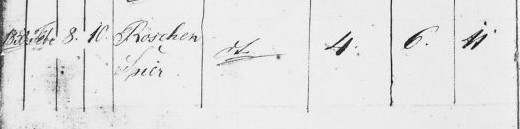
The third child was Roschen, born less than two years after Telsa on July 23, 1845. Sadly, she died before her fifth birthday on February 8, 1850.
Roschen Spier birth record, Geburtsregister der Juden von Merzhausen (Willingshausen) 1824-1883 (HHStAW Abt. 365 Nr. 610)AutorHessisches Hauptstaatsarchiv, WiesbadenErscheinungsjahr1824-1883, p. 10
Roschen Spier death record, Sterberegister der Juden von Merzhausen (Willingshausen)SignaturHHStAW 365 613Hessisches Hauptstaatsarchiv Wiesbaden, p. 8
Beilchen Spier, the fourth child born to Isaac and Sarchen, was born on December 6, 1847.
Beilchen Spier birth record, Geburtsregister der Juden von Merzhausen (Willingshausen) 1824-1883 (HHStAW Abt. 365 Nr. 610)AutorHessisches Hauptstaatsarchiv, WiesbadenErscheinungsjahr1824-1883, p. 12
Her sister Jettchen was born almost two years after Beilchen on November 11, 1849.
Jettchen Spier birth record, Geburtsregister der Juden von Merzhausen (Willingshausen) 1824-1883 (HHStAW Abt. 365 Nr. 610)AutorHessisches Hauptstaatsarchiv, WiesbadenErscheinungsjahr1824-1883, p. 13
A boy came next, Liebmann, born two years after Jettchen on November 22, 1851, but like his sister Roschen, he died before he turned five. He died on June 9, 1856.
Liebmann Spier birth record, Geburtsregister der Juden von Merzhausen (Willingshausen) 1824-1883 (HHStAW Abt. 365 Nr. 610)AutorHessisches Hauptstaatsarchiv, WiesbadenErscheinungsjahr1824-1883, p. 14
Liebmann Spier death record, Sterberegister der Juden von Merzhausen (Willingshausen) 1824-1911 (HHStAW Abt. 365 Nr. 613)AutorHessisches Hauptstaatsarchiv, WiesbadenErscheinungsjahr1824-1911, p. 10
The seventh child of Isaac and Sarchen was their daughter Breinchen, who was born on December 11, 1853.
Breinchen Spier birth record, Geburtsregister der Juden von Merzhausen (Willingshausen) 1824-1883 (HHStAW Abt. 365 Nr. 610)AutorHessisches Hauptstaatsarchiv, WiesbadenErscheinungsjahr1824-1883, p. 15
Then came another boy, Manuel or Emanuel, born April 20, 1856.
Manuel Spier birth record, Geburtsregister der Juden von Merzhausen (Willingshausen) 1824-1883 (HHStAW Abt. 365 Nr. 610)AutorHessisches Hauptstaatsarchiv, WiesbadenErscheinungsjahr1824-1883, p. 16
The ninth child was another girl, Beschen, born June 6, 1858.
Beschen Spier birth record, Geburtsregister der Juden von Merzhausen (Willingshausen) 1824-1883 (HHStAW Abt. 365 Nr. 610)AutorHessisches Hauptstaatsarchiv, WiesbadenErscheinungsjahr1824-1883, p. 18
And then finally on April 12, 1861, Sarchen Frank Spier gave birth to her tenth child, another daughter Fredrike or Rickchen, but that child, like her siblings Roschen and Liebmann, did not survive childhood. She made it just past her fifth birthday and died on April 26, 1866.
Fredrike Rickchen Spier birth, Geburtsregister der Juden von Merzhausen (Willingshausen) 1824-1883 (HHStAW Abt. 365 Nr. 610)AutorHessisches Hauptstaatsarchiv, WiesbadenErscheinungsjahr1824-1883, p. 20
Frederike Spier death record, Sterberegister der Juden von Merzhausen (Willingshausen) 1824-1911 (HHStAW Abt. 365 Nr. 613)AutorHessisches Hauptstaatsarchiv, WiesbadenErscheinungsjahr1824-191, p. 12
Sarchen had given birth to ten babies between 1842 and 1861, roughly a baby every two years. She was 45 years old when she gave birth to Frederike in 1861. She had seen three of her babies die before or just after turning five years old. Five years of loving and caring for a child, only to see them die, while meanwhile probably pregnant or about to be pregnant with yet another child. It’s a life I cannot imagine.
Of the seven children who survived to adulthood, there were two sons, Samuel and Emanuel, and five daughters, Telsa, Beilchen, Jettchen, Breinchen, and Beschen. I am laughing, thinking about how confusing it must have been with all those B names. I would probably be calling out all the girls’ names, hoping that one of them would respond. At least Telsa and Jettchen had names that didn’t start with B.
Although I cannot locate any record to corroborate this, Geneanet.com reports that Isaac Spier died in 1868 when he was 57. If that is in fact the case, he left behind the seven surviving children who ranged in age at that time from Beschen who was ten up to Samuel who was 26, and Sarchen would still have had all those children still at home since even the oldest two did not marry until 1870. Of course, by that time Samuel was likely working and the older daughters were available to help with the household chores and the younger children. But nevertheless, Sarchen endured quite a bit during her life.
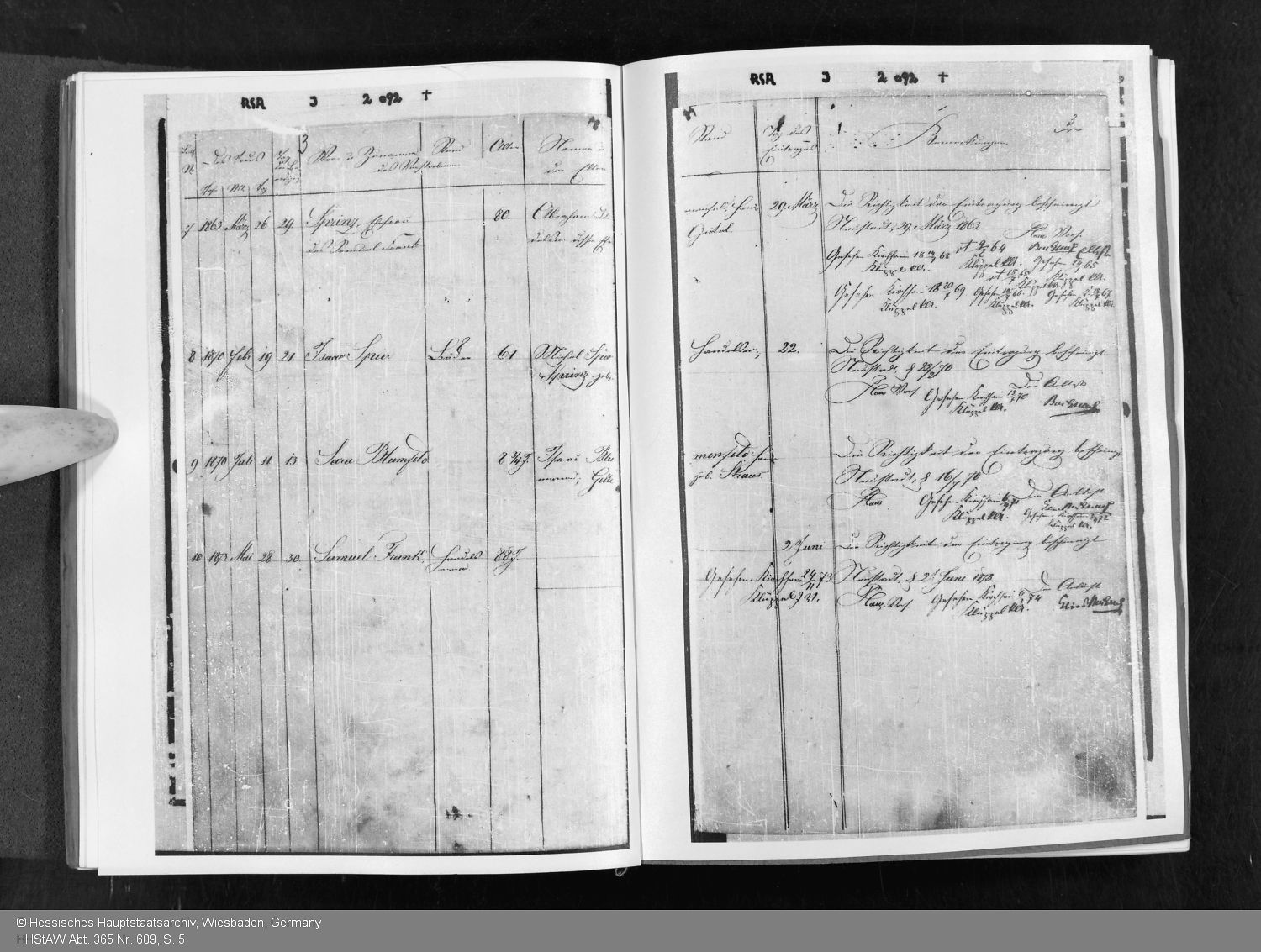
Sarchen lived until she was 78, dying on January 14, 1894, in Frankfurt am Main, Germany.
Sarchen Frank Spier death record, HHStAW Abt. 365 Nr. 609, S. 5
Now I will turn to the lives of her seven surviving children, starting with the oldest, Samuel.
The first review of The Women Before Us, my latest book, has been published on Amazon, and it’s a five star review!
“What a beautiful story, and what a satisfying read! It’s a beautiful book, not too sweet, full of the deep emotions along life’s twisting paths. Cohen used great writing dexterity to blend these women’s stories, revealing that our lives often repeat themselves as long as the ingredients of love, longing and humanity are present.”
I hope you will consider reading it and reviewing it. If you are a blogger or podcaster, I’d love to have you review it on your blog. Alternatively, I am happy to do an author interview for your blog or podcast.
And if you are in a book group and are interested in having me talk to your group by Zoom, I am more than happy to do that also.
I am honored today to share with you an essay written by my fourth cousin, once removed, Jennifer Spier-Stern. Jennifer is the great-granddaughter of Minna Ruelf and Isaak Spier, about whom I wrote in my last post. When Jennifer shared this essay with me, I was so moved that I asked her if I could post it on my blog. She graciously agreed to let me do that, and I hope that you also will feel the way I did—that I was with Jennifer in her footsteps as she walked in the footsteps of her family in Rauischholzhausen, Germany.
Walking in Their Footsteps
by Jennifer Spier-Stern
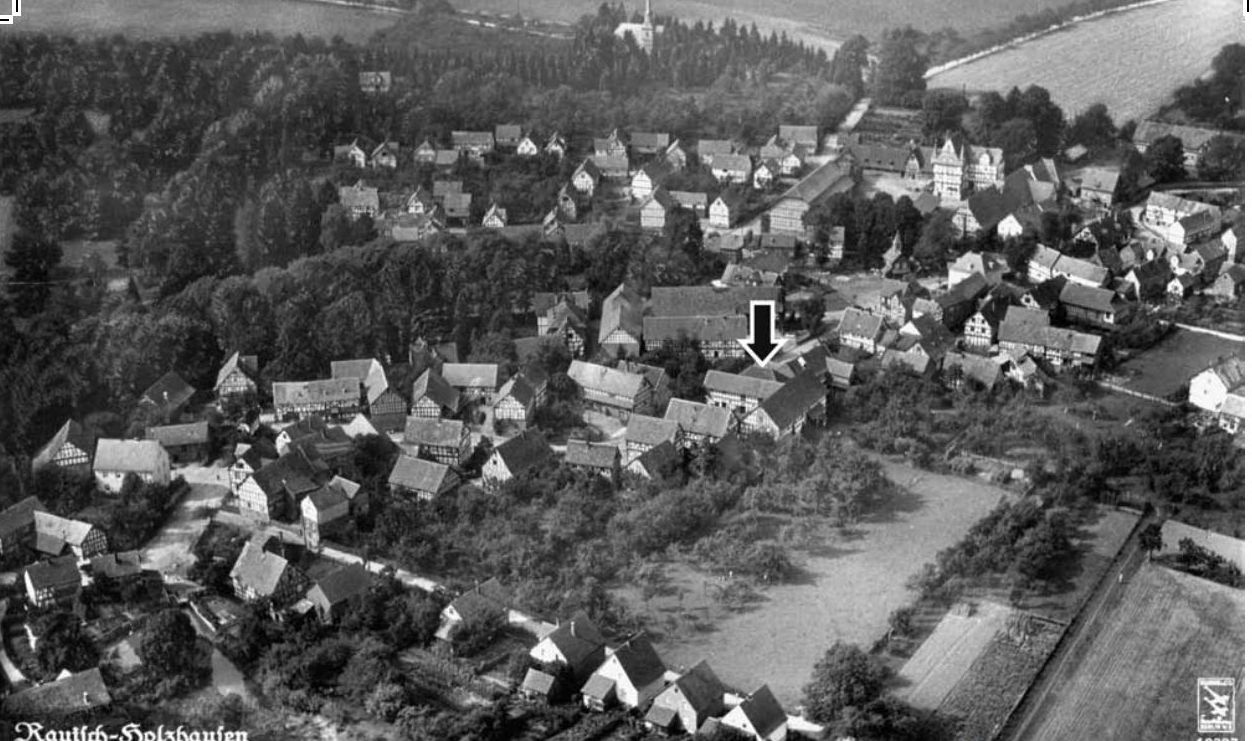
I was transformed back in time as we drove through the narrow streets of the town called Rauischholzhausen. We passed old homes with beautiful flower baskets hanging from windows and well manicured gardens. The narrow street was paved and there was even a sidewalk. I wanted to absorb every corner, every home into my mind so I could never forget these images. I know that 70+ years ago it was not as pristine. I have thought of this day for so many months. Each and every time I envisioned this part of my trip I cried. The tears were for the people that were no longer here to tell me their tales. My father wasn’t with me to show me the way, to tell me about his memories and to stand with me in front of the home where he was born. To walk with me to the Schloss (castle) and show me the places where he ran, where he played, to show me where his family lived and where the synagogue was.
The reason for this trip started many years ago. My father was born in Rauischholzhausen in 1922, a small town a few minutes drive from Marburg. Growing up we heard all the stories of Holzhausen and of the early childhood of my father and his four siblings. We used to roll our eyes and laugh with yet another story of “home.” As young adolescents we didn’t appreciate all that he told us. I wish I had documented everything, but like most young adults, I didn’t. My father always promised my brother and I a trip back to his roots, but that was never going to happen, he passed away in 1998. Since my father’s passing I had fleeting thoughts of going to Germany but not until recently did this strong urge possess me that I had to go and see for myself.
Without going into full details of the history of our family, my father’s brother returned to Germany with his wife and son and settled in Bielefeld in 1959.
My aunt, uncle, cousin and his wife met us at our beautiful hotel and drove us to the house that was 16 Lerchengasse. 16 Lerchengasse was the house where my father lived. The house that bore the name I Spier (Isaak Spier) above the front door frame. We parked the car and walked that last few steps down a cul de sac. I had the vision of the house from few photos that survived the war.
My uncle stopped in front of the house and said, “This is it. This is the house where we were born.” I looked up at this large home, the home of my great-grandfather, grandfather and father. My hands were shaking and the tears rolled down my face. I heard my father’s voice, I heard his stories, I saw him walking up and down the front stairs. I saw him running around the courtyard with his siblings. I haven’t felt my father’s presence as strongly as I did at that moment. I wish I could have knocked on the door and introduced myself. I so wanted to go inside, but I know it is far different than the house my father left on November 9, 1938. I looked at the surrounding homes, and they too were lovely with their planters filled with flowers and lace curtains in the window. Later in the week Hajo (My hero guide) posed the question to me, “Can you imagine this town 65 years ago?”
Spier home in Rauischholzhausen Courtesy of Jennifer Spier-Stern
The next stop was the Jewish cemetery. We picked up the key at the caretaker and then we walked the grass soaked path towards the cemetery. The rain started and the path became very muddy. The land to the right was a beautiful pasture for grazing cows who seemed very curious and walked over to the fence. It seemed surreal. As we walked my eyes were looking down at the path, knowing that my grandparents and many other ancestors walked here to enter the cemetery. They came here to bury. They came here on the holidays to remember those that passed. They came here to say Kaddish. I was walking in their footsteps.
My grandfather Abraham Spier buried his parents, Isaak Spier and Minna Rülf neé Spier. One of the oldest stones in the cemetery is Nathan Spier, my 3rd great grandfather (1792-1866). We stepped into the cemetery where 80% of the graves are family ancestors. I had my dear friend Hajo Bewernick photograph every stone for me. I’ve looked at the photos numerous times and now, I stood before them. I stood there and cried. Emotions flooded my body that I didn’t know how to react. I wanted to touch every stone and place a rock, I wanted to pray. In years to come how many will walk through the gates to pray for all the souls? However, all I could do was cry. Later on I found out that my husband said the Mourner’s Kaddish, (a Mourner’s Prayer) as he stood over one grave, but he said it for all.
I walked in their footsteps. I was thankful that my family who live in Germany were able to share this experience with me. Special thanks to Hajo Bewernick who took the time from his busy work and home life to show my husband and I Marburg. I can never thank you enough for explaining the history of your beautiful town as well as showing us the many historical sites and to our many insightfully deep conversations. You created a three dimensional image for me of my grandparents, my Omaand Opa, by showing us where they would have been, where they would have walked and the buildings from where they were deported. I do not recall the name of the street corner. Hajo was specific in pointing his finger.
Through my research I have come across generous people who devote their time and efforts to the history of the Jewish people. To everyone we thank you for all your hard work. Special thank you to Barbara Greve for always being there with the answers.
One more person I need to thank with all my heart is my husband, Effy. This trip wouldn’t have happened without him. He knew how important this trip was for me and I am glad he shared it by my side.
I never felt closer to my family and my ancestors as I have during these few days in my family’s home town. I know I’ll keep these stories alive with my family and I hope they will continue the legacy.
Although the story of Minna Ruelf Spier is, like that of her sisters Esther and Bette, a story that includes much tragedy and suffering, in its way it is also uplifting for what it reveals about the human spirit and the will to survive. As we move closer to Rosh Hashana and Yom Kippur, I find Minna’s story appropriate for these days and inspiring.
I have been in touch with one of Minna’s direct descendants, my fourth cousin- once removed Jennifer Spier-Stern, and she has shared with me what she knows about the family history as well as some family photographs. I am so very grateful to Jennifer for her help and her generosity.
Minna Ruelf was born on February 16, 1859, in Rauischholzhausen, Germany:
Minna Ruelf birth record Geburtsregister der Juden von (Rauisch)Holzhausen (Ebsdorfergrund) 1824-1874 (HHStAW Abt. 365 Nr. 452)AutorHessisches Hauptstaatsarchiv, Wiesbaden, p. 10
Three days after her 21st birthday, on February 19, 1880, she married Isaak Spier. Isaak was born June 12, 1850, in Leidenhofen, Germany, another town in the Hesse region, the son of Abraham Spier and Esther Schaumberg. Isaak was a merchant. Minna and Isaak settled in Ebsdorf, a small village a mile from Leidenhofen, where they had the first of their three sons, Abraham, who was born on January 18, 1881.
Minna Ruelf and Isaak Spier marriage record Hessisches Hauptstaatsarchiv; Wiesbaden, Deutschland; Collection: Personenstandsregister Heiratsregister; Signatur: 915; Laufende Nummer: 2524
Their two younger sons, Julius (July 26, 1883), and Siegfried (November 29, 1886), were born in Rauischholzhausen.
Isaak Spier died on June 17, 1910, in Rauischholzhausen. He was sixty years old. At that time none of his sons had married.
Isaak Spier Courtesy of Jennifer Spier-Stern
Isaak Spier death record Hessisches Hauptstaatsarchiv; Wiesbaden, Deutschland; Personenstandsregister Sterberegister; Bestand: 915; Laufende Nummer: 8036
Abraham, the oldest son, married nine years later on November 3, 1919; he was 38 years old. He married Jenny Wertheim, who was born on June 4, 1890, in Hatzbach, Germany, to Wolf Wertheim and Sanchen Edelmuth.
Marriage of Abraham Spier and Jenny Wertheim Hessisches Hauptstaatsarchiv; Wiesbaden, Deutschland; Collection: Personenstandsregister Heiratsregister; Signatur: 915; Laufende Nummer: 5047
Abraham Spier, c. 1914 Courtesy of Jennifer Spier-Stern
Jenny Wertheim Spier Courtesy of Jennifer Spier-Stern
Abraham and Jenny had five children, one daughter and four sons: Edith (1920), Julius (1922),[1] Alfred (1924), Martin (1925), and Walter (1927); they were all born in Rauischholzhausen.
Edith, Julius, and Alfred Spier , c. 1926 Courtesy of Jennifer Spier-Stern
Family of Abraham and Jenny Spier, Courtesy of Jennifer Spier-Stern
Just three weeks after Walter’s birth, his grandmother Minna Ruelf Spier died at age 68 on November 5, 1927.
Minna Ruelf Courtesy of her great-granddaughter Jennifer Spier-Stern
Minna Ruelf Spier death record Hessisches Hauptstaatsarchiv; Wiesbaden, Deutschland; Personenstandsregister Sterberegister; Bestand: 915; Laufende Nummer: 8053
The youngest son of Isaak Spier and Minna Ruelf, Siegfried, died when he was 48 years old in Rauischholzhausen on February 21, 1935, just seven months before the Nuremberg Laws were adopted by the Nazis in Germany. Siegfried was unmarried.
Siegfried Spier death record Hessisches Hauptstaatsarchiv; Wiesbaden, Deutschland; Personenstandsregister Sterberegister; Bestand: 915; Laufende Nummer: 8061
Not long after Siegfried’s death, Julius Spier (Abraham’s brother, not his son) left Rauischholzhausen. According to Alfred Schneider’s book, Die Juedischen Familien im ehemaligen Kreise Kirchain (p. 350), Julius was still in Rauischholzhausen in 1935, but as of 1936, his location was unknown. One source says that he went to Frankfurt where he had a seat on the stock exchange. That same source said that he immigrated to England by 1945, perhaps as early as 1938. (The Church of Jesus Christ of Latter-day Saints, “Pedigree Resource File,” database, FamilySearch(https://familysearch.org/ark:/61903/2:2:SB2K-RMP : accessed 2017-09-06), entry for Julius /Spier).
According to Jennifer, Julius Spier married Lucie Henrietta Cohn. According to this website located by Jennifer, Lucie was the daughter of Hugo Cohn and Selma Marcuse of Halberstadt; she was born on October 28, 1897. The website also states that she’d gone to Frankfurt and married (no date or place was given, nor the name of her husband). If futher states that after getting divorced in 1938, Lucie had immigrated to England and worked in the fashion industry. Although I have no marriage record or other document showing her marriage or divorce, Lucie appears on many passenger manifests between 1947 and 1960—first residing in London, later in the US, listed at various times as a commercial traveler, a housewife, and a nurse.
Julius died in London on February 25, 1959. (England & Wales, Civil Registration Death Index, 1916-2007, on Ancestry.com)
UPDATE: Thank you to Anne Callanan of the German Genealogy for sending me some records she found on FindMyPast, a genealogy service to which I do not (yet) subscribe. Anne found Enemy Alien registration cards for several family members including Julius Spier and Lucie Henrietta Spier. From those records, I now know that Julius was in England by November 1939, working as an agent. He was at first granted an exemption from being detained as an enemy alien, but that decision was reversed and he was interned on June 21, 1940, but was released two months later on August 23, 1940.
Lucie also had to register as an enemy alien. She registered on December 8, 1939, when she was living in Manchester, England (thus not with Julius) and working as a house servant for a Mr. M. I. Marks in his home. She was granted an exemption and was not interned. The card does not reveal any information about her marital status.
Julius Spier (son of Minna Ruelf and Isaak Spier) Courtesy of Jennifer Spier-Stern
Abraham and Jenny Spier and their children were still in Germany during the Nazi era, but they were eventually able to get some of their children to England. According to my cousin Jennifer, Edith Spier left Germany on one of the early Kindertransports to England where she worked as au pair; according to the Schneider book (p. 351), Edith left on October 20, 1937, when she was seventeen. She eventually went to New York, where in 1943 she married Alfred Baumann, who was born in Adelsberg, Germany, in 1913, and had immigrated to the US in 1938.
My father, John Sanders (nee Julius Spier) was born in Rauischholtzhausen, Germany on June 17, 1922. At the age of 16, on November 9, 1938 he was arrested in his home by the Gestapo. It should have been my grandfather, but he was in a few towns over at his mother’s home. Rumors around the towns were that the Gestapo were going from house to house to arrest the eldest male.
My father was taken to Buchenwald concentration camp where he remained for 10 weeks. During this time, his mother heard about the organized efforts of the Jewish Agency of Bloomsbury, London to get as many Jewish children, between the ages of four to 17, out of Germany, Austria and Czechoslovakia. She went to the Jewish Agency and the police, where she was told to get all the documents ready, as well as a visa to leave Germany.
Upon release from Buchenwald, my father had only two weeks to leave Germany. His father took him to the Frankfurt train station, where he was to meet the Kindertransport train that would take him to England. At the train station there were other families with children. The parents and their young ones had to say their good-byes inside the train station. The children, regardless of age, had to go onto the platform and then onto the train by themselves. Families with infants gave the infants to the older children. It is difficult to comprehend all sides. How does a parent give up a baby and how does a young adult care for one. My father said goodbye to his father, not realizing that this was the last time he would ever see him. …
After his tenure in Dover Court, my father was taken into the home of an Orthodox family in Westgate, London. He was there until June of 1939 when his brother [Alfred] came over from Germany. Together, they went to a hostel in London. Shortly thereafter they were taken to a farm in Aberdeen, Scotland. An aristocrat owned the farm by the name of Sir Robert Grant. He treated my father and his brother with the utmost of respect and kindness. One memorable time for my father was when the chauffeur-driven Rolls Royce took him and his brother to Harrod’s department store in London and they were able to pick out all that they needed. Sir Robert Grant applied for visas to get my father’s parents and brothers out of Germany. Unfortunately war broke out a few days later and all visas were denied.
Julius Spier, son of Abraham and Jenny (Wertheim) Spier, c. 1935 Courtesy of Jennifer Spier-Stern
That left Abraham and Jenny and their two youngest children, Martin and Walter, stranded in Germany. On September 7, 1942, all four were deported to Theriesenstadt. Then on May 18, 1944, all four were transported to Auschwitz, where Abraham and Jenny were murdered. Martin and Walter survived. Walter Spier talked movingly about his experience in this video. I implore you all to watch it. It’s less then fifteen minutes long, and when you considered what he suffered for years, you know you can spare fifteen minutes to hear him talk.
When I think of the two young men being reunited in Rauischholzhausen in 1945, it moves me to tears.
Meanwhile, their older siblings were for a time in the United Kingdom. But like many other Jews who were sent to England for safety from the Nazis, Julius and Alfred were sent to the Isle of Man as possible “enemies of the state” after England declared war on Germany in September, 1939.
According to this article from B’nai Brith Magazine, the first inmates arrived on the Isle of Man in May, 1940, and by August, 1940, there were over 14,000 men, women, and children imprisoned on the Isle of Man, some being Nazi sympathizers, many others being Jews who’d been born in Germany and thus were considered enemy aliens, ironically. Because of overcrowding, in July, 1940, England decided to send some of the inmates to Canada or to Australia. (Cheryl Klemper, “Imprisoned On The Isle Of Man: Jewish Refugees Classified As “Enemy Aliens”, ” B’nai Brith Magazine, September 19, 2016)
Julius and Alfred Spier were among those sent to Australia. According to Jennifer, they both were on the ship known as the HMT (Hired Military Transport) Dunera. According to the Australian website for the Migration Heritage Centre:
On board the HMT Dunera were about 2,000 male German Jewish refugees aged between 16 and 45, who had escaped from Nazi occupied territories. Also on board were 200 Italian POWs and 250 Nazis. The voyage lasted 57 days. The conditions were appalling. Apart from overcrowding on the ship with the attendant problems of hygiene and harsh treatment by crew members, the journey was also made unpleasant by the fear of torpedo attacks, the uncertainty of the destination, and by tensions between Jewish refugees and Nazi passengers.
After arriving in Australia, Julius and Alfred spent two years interned at camps in Hay and Tatura in Australia. The Migration Heritage Centre website reported this about the Hay camp:
The Hay POW camp was constructed in 1940. The first arrivals were 2036 German and Austrian Jewish refugees who fled the Nazis. They were mostly professionals who had simply fled for their lives. They were placed along side 451 German and Italian POWs many of whom were pro Nazi and fascist.
While awaiting release, the Dunera Boys developed a rich cultural and intellectual programme at their camp, giving concerts and establishing an unofficial university. The small group of strictly Orthodox Jews also managed to organise a kosher kitchen. After a period of time the injustice of their situation was realised and they were permitted to return to Britain.
Here is a record identifying Julius Spier as a POW in Australia during the war:
Courtesy of Jennifer Spier-Stern
According to Jennifer, when Julius and Alfred were finally released, they were given a choice either to return to Germany or join the British Army, so they both joined the British Army, where they served for the duration of the war and then returned to England.
UPDATE: Thanks again to Anne Callanan, I now have enemy alien registration cards for both Edith and Julius Spier. Edith registered on December 12, 1939, and was granted an exemption; she was working as a domestic. Her brother Julius registered as an enemy alien on November 28, 1939, when he was working on Sir Robert Grant’s farm in Scotland. But as we know he was denied an exemption and interned until June 21, 1942, when he was returned to the UK from Australia.
In the years immediately after the war Edith was in New York City, Julius and Alfred were in England, and Martin and Walter were in Germany. Martin and Walter both stayed in Rauischholzhausen for a year after their liberation from the camps in 1945, and then both immigrated to New York City where both of them later married.
In England, Alfred married Hannelore Reimers, who was from Bielefeld, Germany. Hannelore wanted to return to Bielefeld where her family still lived[2], so Alfred and Hannelore ended up back in Germany.
Julius married Helene Trunec in England in 1952; Julius and Helene stayed in England until 1963 when they immigrated to the United States and were reunited with Edith, Martin, and Walter in New York City. Julius and Helene had two children, Jennifer and Mark.
The five children of Abraham Spier and Jenny Wertheim thus all survived the Holocaust, although their parents did not. The five siblings not only suffered the loss of their parents and of their home; two were tortured and suffered terribly in the Nazi concentration camps, and two were imprisoned like criminals by England, the country where they had sought sanctuary. It’s hard to imagine how any of them coped with what they had endured.
But listening to Walter Spier on that video reveals that somehow the human spirit can endure unimaginable suffering and still have faith, hope, and love. All five of the Spier siblings went on to have children after the war, one sign of the incredible power of faith, hope, and love.
[1] I find it interesting that Abraham named a son Julius since his brother Julius was still alive. I assume the son was named for another family member, not his uncle.
[2] Hannelore was not born Jewish, but converted when she married Alfred.