Jeanette “Jenny” Rothschild Abraham: An Entire Family Murdered

Turning now to Jeanette or Jenny Rothschild, the fifth of the eight Rothschild children who survived to adulthood, we saw that she married Salomon Abraham on November 11, 1920, and that they had two children: Walter, born in 1921, and Herta, born in 1928.

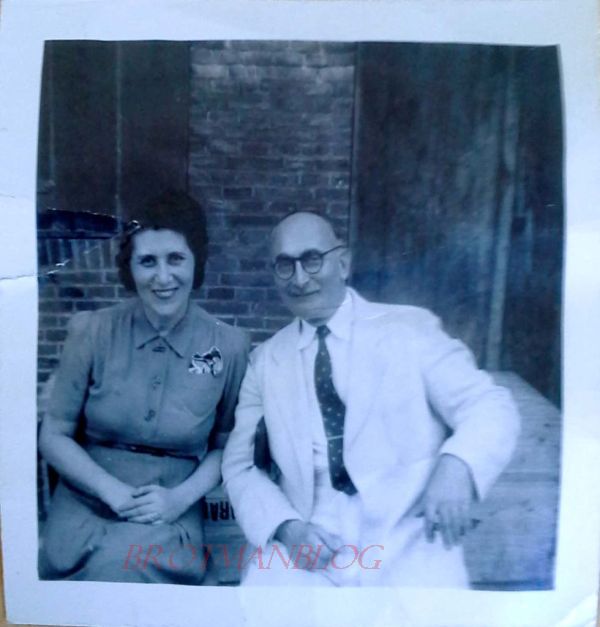
This photograph is possibly of Jenny and Salomon:

Maybe Jenny Rothschild Abraham
Courtesy of the family

Unfortunately, Jenny and her family suffered a fate like those of her older sisters Katchen and Auguste and not like those of her older brothers Siegmund and Max, both of whom survived the Holocaust. Jenny, Salomon, Walter, and Herta were all murdered in the Holocaust.

This document from the census taken in 1938-1939 by the Nazis of any household where a resident had at least one Jewish grandparent shows us that Jenny and Salomon and their children were living in Kassel at that time. It also shows that none of them had finished high school or vocational school and that all of them had four Jewish grandparents.
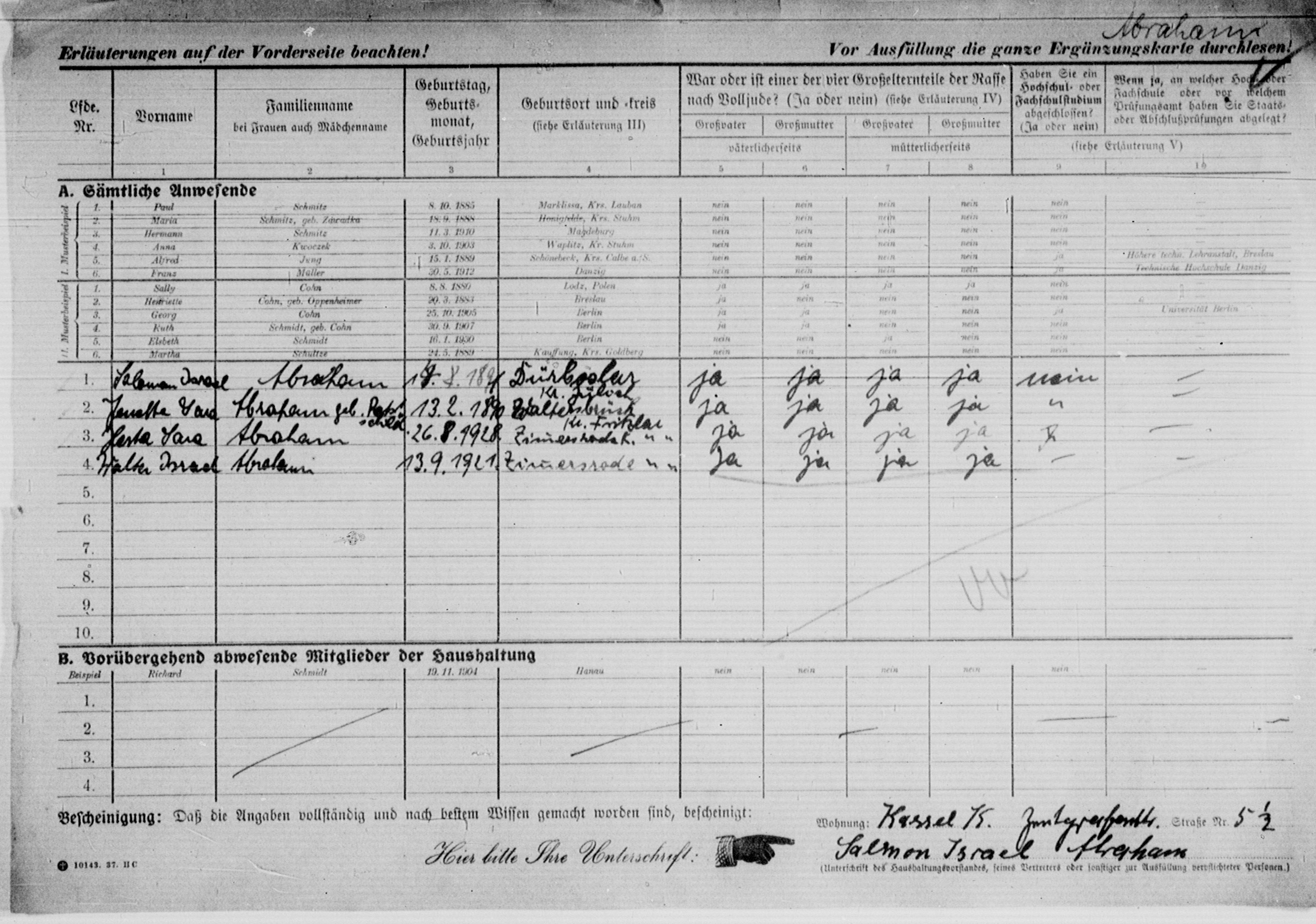
Salomon Abraham and family, RG-14.013M.0216.00000011, German minority census of 1939, United States Holocaust Museum and Memorial, also summarized at MyHeritage at   https://www.myheritage.com/research/record-10901-14585/herta-greta-abraham-in-german-minority-census?fbclid=IwY2xjawJyNahleHRuA2FlbQIxMAABHjMpngFoUVAHvZ8hfTE5lCsMwdc-9bHAeMU5opyaipBCxYmQYX8bXBPReDTp_aem_DvzcPxQysQHhqKjX3STcgw

Another document created by the International Tracing Service reveals that in 1939-1940, Salomon Abraham was working in Kassel for the Georg Sauer railway, road, and underground construction company.1

Yad Vashem files and the Gedenkbuch report that on December 9, 1941, Salomon, Jenny, and their thirteen-year-old daughter Herta were deported along with over a thousand other Jews from Kassel and surrounding towns and sent to the Jewish ghetto established by the Nazis in Riga, Latvia. According to an article about the transport on Yad Vashem, “The deportees were told to bring a sum of 50 Reichmarks, a suitcase, a set of clothes, suitable shoes, bedding, tableware, and food supplies for a few days. They were also required to produce an inventory of all their properties. In the Kassel district, the Jews received notification that all furniture was to be carefully packed and placed in one room of the apartment. Household valuables were to be deposited in a closet together with a list of contents.”

The train took three days to get to Riga, arriving on December 12, 1941; according to one account by a survivor as quoted in the same Yad Vashem article, “The temperature was 40 degrees below freezing. Most of the luggage was left at the train station and we never saw it again. We had to walk to the ghetto while a terrible snow storm was blowing.”

Unfortunately, I do not have any specific information about what happened to Salomon or Jenny after arriving in Riga, except I know that they did not survive. Readers may recall that Jenny’s sisters Auguste and Katchen as well as Katchen’s husband Adolf Hirschberg and their son Ludwig Hirschberg were also deported to Riga on December 9, 1941, and that none of them survived the Holocaust either. According to the Yad Vashem article, “little is known about the further fate of the deportees from Kassel in the Riga ghetto. More than 900 Jews were shot in several “Aktionen” in the Bikerniki forest. Others were transported to Auschwitz-Birkenau or to Stutthof concentration camp for forced labour. According to the historian Monica Kingreen only 137 Jews from this transport survived.”

Records show that little Herta was one of those transported to the Stutthof concentration camp. The report from the ITS on Herta Abraham states that she was sent to Stutthof on October 1, 1944.2  I do not know what happened to Herta after that, but she also did not survive the Holocaust.

As for Walter Abraham, he had moved to Berlin sometime after the 1939 Minority Census was taken and was working as a baker. One document seems to suggest he had left Kassel on April 28, 1940. Unfortunately Walter’s move to Berlin did not save his life. On December 7, 1943, he was deported from Berlin to Auschwitz. I don’t know when exactly Walter was killed there, but like his mother, father, and sister, he was murdered by the Nazis.3

There thus are no descendants of Jenny Rothschild Abraham. Her entire family was wiped out by the Nazis.


  1. Tracing and documentation case no. 416.705 for ABRAHAM, SALOMON born 14.08.1898, Reference Code 06030302.0.382.916, 6 Records of the ITS and its predecessors / 6.3 Inquiry processing / 6.3.3 ITS case files as of 1947 / 6.3.3.2 Repository of T/D cases / Tracing and documentation cases with (T/D) numbers between 250.000 and 499.999 / Tracing and documentation cases with (T/D) numbers between 416.500 and 416.999 ITS Digital Archive, Arolsen Archives 
  2. See Note 1, supra. 
  3. Welle 61 – 47. Osttransport in das KL Auschwitz, 07.12.1943, 1 Inhaftierungsdokumente / 1.2 Verschiedenes / 1.2.1 Deportationen und Transporte / 1.2.1.1 Deportationen / Deportationen aus dem Gestapobereich Berlin /  Signatur 15510056b, Entstehungszeitraum. 1943-12-07 – 1943-12-10, Anzahl Dokumente 4, ITS Digital Archive, Arolsen Archive 

Auguste Rothschild Feldheim: Another Life Destroyed

As I move on now to the next child of Gerson Rothschild and Fanny Kugelmann, I am struck by the differences in the fates of their eight surviving adult children. Siegmund and his wife and all his children left Germany in time to escape death at the hands of the Nazis. Katchen and her husband and son were all killed by the Nazis. Max and his family escaped to Argentina, but their son Erich died shortly after arriving from cholera; that might not have happened if they hadn’t had to leave Germany. Why were some able to escape while others were not? Fate seems so cruel and unpredictable.

Now I turn to the fourth child, Auguste “Gusta” Rothschild Feldheim. And sadly, Auguste’s fate was more like that of her sister Katchen than that of her brothers Siegmund and Max.

As we saw, Auguste married Wolf Feldheim on March 18, 1919, in Zimmersrode. Wolf was a widower. His first wife Johanna Risch died on April 29, 1916,1 less than a week after giving birth on April 23, 1916, to her fourth child with Wolf, their son  Arthur/Aharon.2 Wolf and Johanna also had three daughters born before Arthur/Aharon: Ruth, Selma, and Else, and all were younger than five years old when their mother died.3

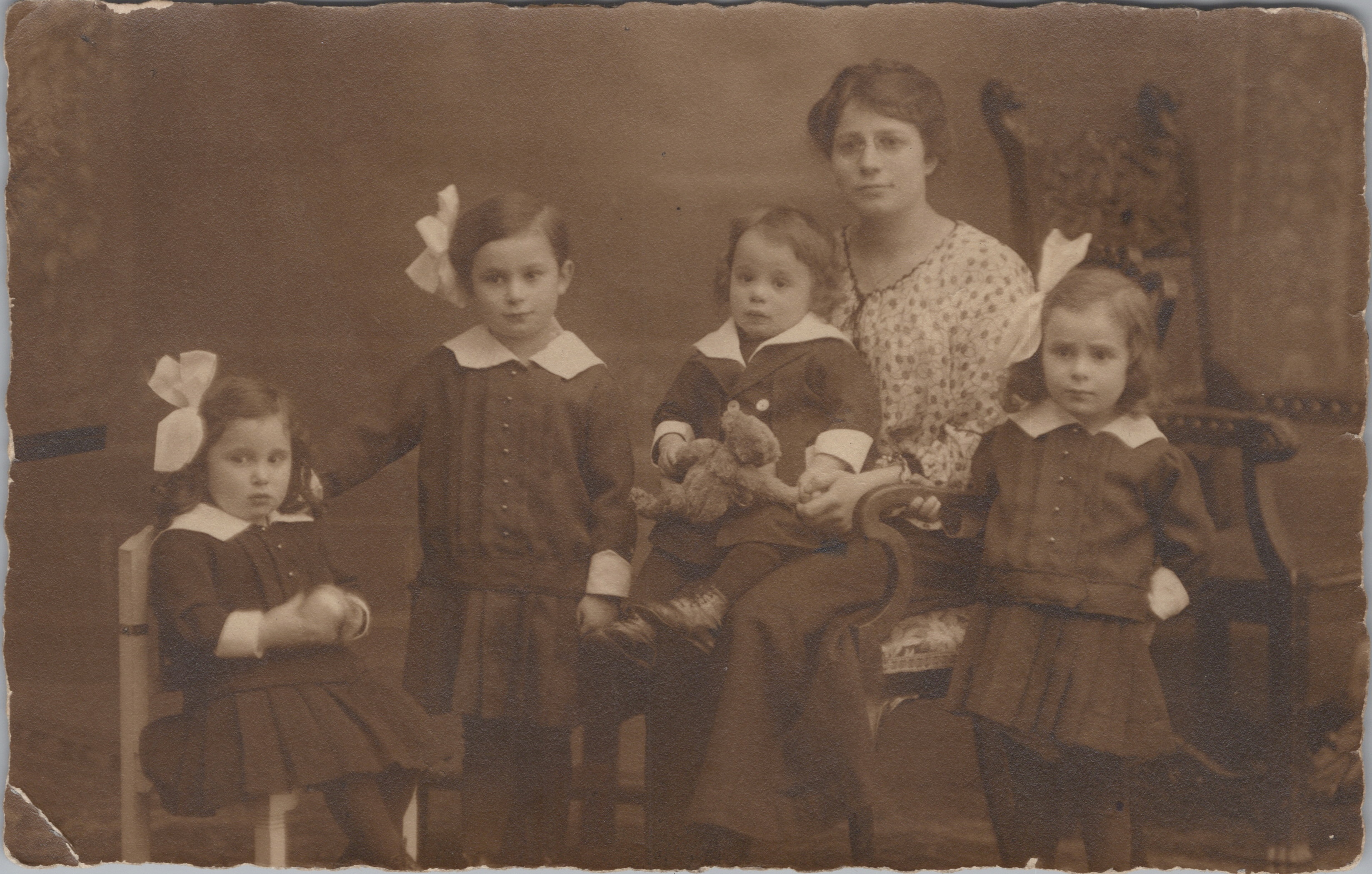
Auguste married Wolf three years after Johanna’s death, and thus Johanna’s four children with Wolf were all still very young when Auguste became their stepmother. Here is a photograph of Auguste with her four stepchildren. Look how sad those children look. It’s heartbreaking.

Auguste Rothschild Feldheim with her four stepchildren. Courtesy of the family

And then Wolf and Auguste had their own child together, a son Bruno who was born in Fulda, Germany, on November 12, 1921.4

Auguste’s husband Wolf Feldheim died of a heart attack on October 4, 1940, in Fulda, Germany, where he and Auguste were living. Wolf was 65 years old. Was his death caused directly or indirectly by the Nazi persecution? I don’t know.5

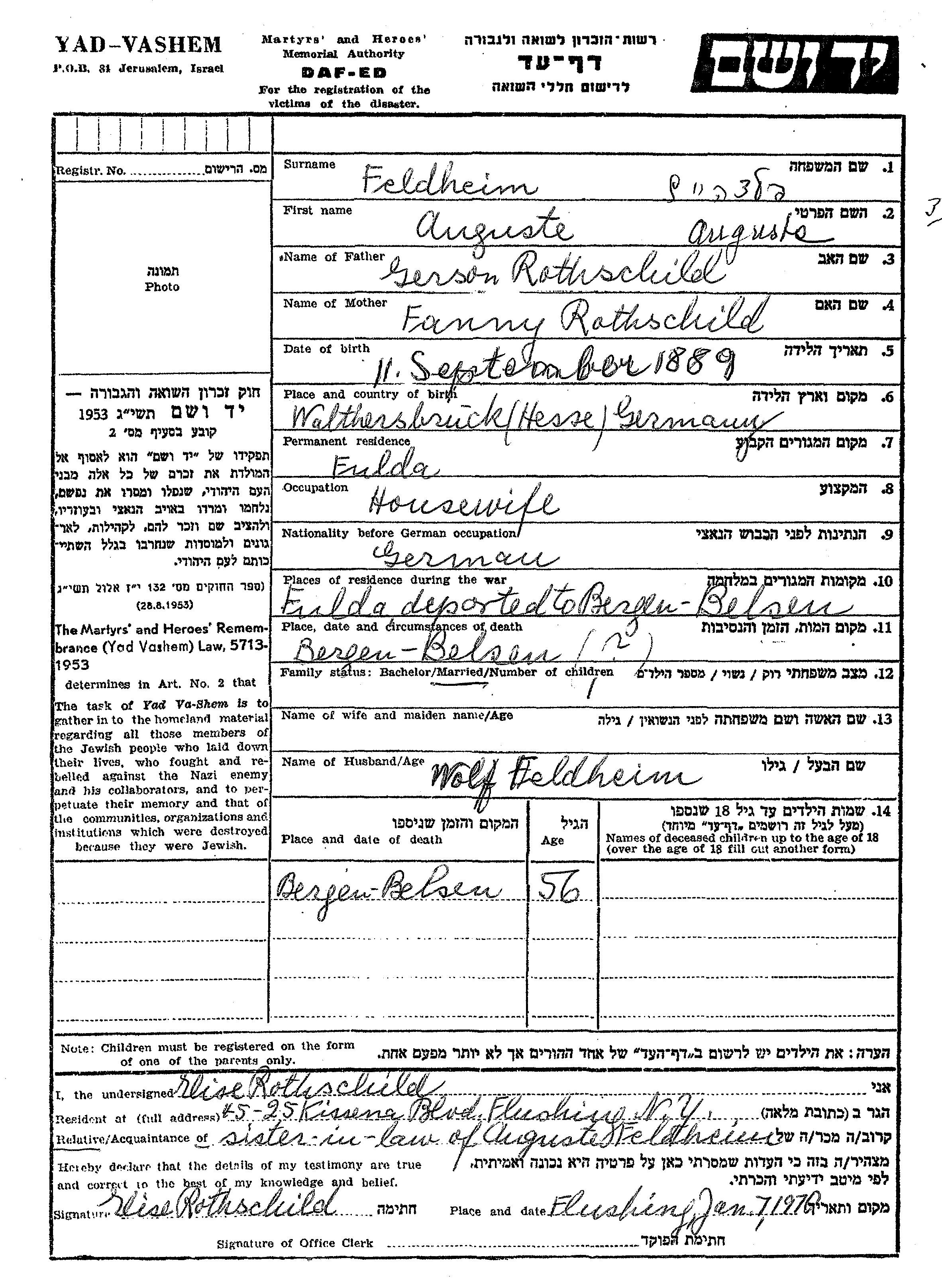
Just over a year later Wolf’s widow Auguste was deported from her home in Fulda to Riga. A Page of Testimony filed at Yad Vashem by her stepson, Aharon Feldheim, reported that he believed she died there on or about December 8, 1941, the day after Pearl Harbor. The Gedenbuch summarized at Yad Vashem says she was deported to Riga on December 9, 1941, and died there in March, 1942.6 And then there is a second Page of Testimony for Auguste filed by her sister-in-law Elise Rothschild, wife of Siegmund Rothschild, saying that Auguste was deported to Bergen-Belsen. I don’t know which date or which place is more accurate. But the bottom line is the same. Auguste Rothschild Feldheim died at the hands of the Nazis.

Page of testimony at Yad Vashem filed by Aharon Feldheim. found at https://collections.yadvashem.org/en/names/13532864

Page of Testimony filed at Yad Vashem by Elise Rothschild, found at https://collections.yadvashem.org/en/names/798469

Bruno Feldheim survived the Holocaust by going to Palestine. His application for citizenship in Palestine in 1946 indicates that he arrived on March 27, 1939, from Fulda.

Bruno Feldheim Palestine immigration papers found at the Israel State Archives at https://search.archives.gov.il/

At some point after the war, Bruno moved to Belgium, where he had a diamond business, according to his cousin Hal Katz. Hal’s tree on Ancestry reports that Bruno died in Belgium on September 16, 2016. He was survived by his children and grandchildren. Here is a photograph of Bruno with his family, courtesy of Judy Katz, his first cousin, once removed.

Bruno Feldheim and family. courtesy of the family

I did not really research in depth the four stepchildren of Auguste, relying primarily on the Ancestry tree created by their stepcousin, Hal Katz. That tree reported that two of those stepchildren, Selma and Aharon, survived the Holocaust and ended up in Israel, but a third, Else, was murdered by the Nazis.

As for the remaining stepchild, Ruth, Wolf and Johanna’s oldest child, I went down a deep rabbit hole to learn what happened to her. It’s a Holocaust story I had not known before and that may not be very widely known.

Ruth was born on October 28, 1912, in Fulda, Germany.7 She married Jonas Tiefenbrunner, who was born in Wiesbaden on June 19, 1914. Sometime after Hitler came to power, Jonas left Germany for Belgium and established a youth home and yeshiva for religious boys in a town near Antwerp. Ruth later also left Germany for Belgium, and she worked as a cook in a different children’s home. According to a recorded interview with their daughter Judith, they had first met in Frankfurter, but reconnected and became a couple in Belgium. Ruth and Jonas were married on May 9, 1940, the day before the Nazis invaded Belgium.8

As told by Jonas and Ruth’s daughter Judith in that interview, after the Nazis invaded, the Queen Mother of Belgium intervened to protect the Jewish children and elderly. She convinced the commandant overseeing the Nazi deportation of Jews back to Germany, purportedly for “work,” that children younger than seventeen and the elderly would not be productive workers and that they should not be sent back to Germany. A number of orphanages and homes for the elderly were established, and Jonas Tiefenbrunner was made the head of one of those orphanages, the one in Brussels and the only one that was observant of Jewish laws and holidays, according to Ruth’s daughter.9

Jonas and Ruth took in up to fifty or sixty children at a time. They faced constant danger of raids by the Nazis, who accused them of hiding children who were over the age of sixteen or children who had not been properly registered with the Nazi regime in Belgium. Jonas was arrested once, but quickly released.10

In 1943, Ruth, Jonas, and their first-born daughter Jeanette had an opportunity to escape from the Nazis and emigrate from Belgium by obtaining what are now known as Mantello certificates. As described on JewishGen:

George Mandel was a Hungarian Jewish businessman who befriended a Salvadoran diplomat, Colonel José Arturo Castellanos, in the years leading up to World War II.  After Castellanos was named El Salvador’s Consul General in Geneva, he appointed Mandel, who had assumed a Spanish-sounding version of his last name, “Mantello,” to serve as the Consulate’s first secretary.  Even in Nazi-occupied Europe, Jews who were citizens of or held official documents from other countries were often able to escape deportation.  With the consent of Castellanos, George Mandel-Mantello used his diplomatic position to issue documents identifying thousands of European Jews as citizens of El Salvador.  He sent notarized copies of these certificates into occupied Europe, in the hope of saving the holders from the Nazis. … Word then spread among representatives of various Jewish organizations, who also approached Mandel-Mantello, each providing data and photographs of the people they wanted to try to save. … In total, Mandel-Mantello may have issued as many as five thousand certificates, many with the names and photographs of several family members.

Jonas and Ruth Tiefenbrunner were among those who received a Mantello certificate, describing them as citizens of El Salvador. They even applied for a Swiss passport relying on the evidence of their Salvadoran citizenship.  They could have left Belgium for a safer country by using those certificates as many others were able to do.

Jonas Tiefenbrunner application for Swiss passport, found at USHMM at https://collections.ushmm.org/search/catalog/pa1169302

But as described by their daughter Judith, they refused. Jonas would not abandon the children he was caring for so the family stayed in Belgium for the duration of the war.11

In August 1944, the Nazis decided to deport all the remaining Jews in Belgium including the children. “Luckily, Jonas received advanced warning and was able to take all the children to a convent run by an acquaintance, Father R.P. Robinet. Two weeks later, Brussels was liberated.”12 In the end, it is estimated that Jonas and Ruth were able to save over one hundred children.

Tragically, Jonas Tiefenbrunner died in Belgium in 1962 from a heart attack when he was only 48 years old. From what I can gather from various sources including Judith’s interview, Ruth and their three daughters all eventually ended up in Israel.13 Unfortunately I have not been able to find further information about Ruth or her daughters.

Although Ruth Feldheim and Jonas Tiefenbrenner were not my genetic relatives, I felt their story was important and wanted to share it with my readers.


  1. Johanna Risch Feldheim death record, Arcinsys Archives of Hessen, HHStAW, 365, 348, p. 11, found at https://digitalisate-he.arcinsys.de/hhstaw/365/348/00011.jpg 
  2. Arthur/Aharon Feldheim immigration papers found in the Israel State Archives at https://search.archives.gov.il/ 
  3. Ruth was born on October 28, 1912, according to this entry at Yad Vashem, https://collections.yadvashem.org/en/names/13474776  Selma was born on April 6, 1913, Selma Feldheim, Enemy Alien Registration card, The National Archives; Kew, London, England; HO 396 WW2 Internees (Aliens) Index Cards 1939-1947; Reference Number: HO 396/172, Piece Number Description: 172: German Internees Released In UK 1939-1942: Fa-Fl, Ancestry.com. UK, World War II Alien Internees, 1939-1945. Else was born on November 5, 1914, Arolsen Archives; Bad Arolsen, Germany; Record Group 1 Incarceration Documents; Reference: 1.1.46.1, Ancestry.com. Germany, Incarceration Documents, 1933-1945 
  4. I still have not found a record linking Bruno to Auguste and Wolf, but Bruno’s first cousin Hal Katz confirmed that Auguste and Wolf did have a son Bruno, and that is certainly a reliable first hand source. Zoom call with Hal Katz on May 8, 2025. 
  5. Wolf Feldheim on a grave registration document found at Arolsen Archives, Digital Archive; Bad Arolsen, Germany; Lists of Persecutees 2.1.1.1, Description
    Reference Code: 02010101 oS, Ancestry.com. Free Access: Europe, Registration of Foreigners and German Persecutees, 1939-1947 
  6. Entry at Yad Vashem for Auguste Rothschild Feldheim, found at https://collections.yadvashem.org/en/names/13532864 
  7. See Note 3, supra. 
  8. The information in this paragraph came from an interview with Ruth and Jonas’ daughter that is available on YouTube at https://www.youtube.com/watch?v=w1q4KCKrMjY Also, see Jonas Tiefenbrunner’s application for a Swiss passport below. 
  9. Ibid. 
  10. Biography of Jonas Tiefenbrunner found at the USHMM website at  https://collections.ushmm.org/search/catalog/pa1144757 
  11. See Note 8, supra. 
  12. See Note 10, supra. 
  13. See Note 8, supra. 

Henriette Katzenstein Schnadig, Part II: Her Daughter Elsa Schnadig Cats, The Survivor

Henriette Katzenstein Schnadig, the third daughter of Amalie Goldschmidt and Juda Katzenstein, died in 1924 in Hamburg at the age of 66. She was survived by her three daughters, Helene, Betty, and Elsa, and ten grandchildren. Twenty years after Henriette’s death in 1924, only one of her daughters was still alive, her youngest daughter, Elsa. I don’t know exactly how Elsa and her husband Salomon Cats survived the Holocaust. But thanks to the amazing help of Bert de Jong of the Tracing the Tribe group, I learned a great deal more about Elsa and Salomon than I had been able to find on my own. UPDATE: According to Elsa’s great-niece Betty, Elsa and Salomon escaped to Suriname during the war. First, in my initial research, I had not found any evidence that Elsa and Salomon had children, but as seen in my last post, thanks to the family register located by Bert de Jong, I now know that they had two sons—Marcel, born February 25, 1916, in Schaerbeek, Belgium, and Harry, born August 20, 1919, in Amsterdam. So it appears that for some time, Elsa and Salomon were in Belgium before returning to Amsterdam.

Family register of Salomon Cats and Elsa Schnadig, Archive cards , archive number 30238 , inventory number 152 Municipality : Amsterdam Period : 1939-1960, Resident registration card
https://archief.amsterdam/indexen/persons?ss=%7B%22q%22:%22marcel%20cats%22%7D
Amstserdam Archives Gemeente Amsterdam Stadsarchiev

But at some point—it’s not clear exactly when—Elsa and Salomon moved back to Belgium. Bert found a death notice for Salomon’s brother Leo Cats dated February 26, 1939, that shows that S.A. Cats and E. Cats-Schnadig were living in Brussels. Since that was more than six months before the start of World War II, it’s not likely that Salomon and Elsa left Holland because of the Nazis. Bert also located a residency card for Elsa and Salomon’s son Marcel that shows that he married Betty Agsteribbe in Tel Aviv on November 20, 1949, and had been residing in Haifa until 1956 when he returned to the Netherlands.1

Marcel’s younger brother Harry married Sipora Englelanger. Sipora was born in Amsterdam on October 9, 1920. Death notices for Sipora’s father Louis Engelander show that Harry and Sipora were living in Antwerp in 1953. In 1981, they were still living in Belgium, now Berchem, when Sipora’s mother Judith Engelander died. According to an index of  Dutch genealogy, Salomon Cats died in Antwerp, Belgium, on June 9, 1978,2 when he was 96 years old. Elsa survived him by nine years, dying on June 8, 1987, also in Antwerp. She was 97.3 I have not found a death record for their son Marcel, but their son Harry died in April 16, 2008 in Strassbourg, France.4

UPDATE: Thank you to a reader named Naftaly who sent me a link to this Leiden, Holland newspaper notice of Marcel Cats’ death in the Netherlands on April 12, 2003. Now I know that Marcel was survived by his wife Betty, two children, and four grandchildren. The death notice translates as, “After a courageous battle my dear husband, our father, father-in-law and grandfather passed away…Respecting his wish, the cremation took place privately.”

Historical Newspapers, Heritage Leiden and Surroundings, Leidsch Dagblad | 2003 | Apr 16, 2003 | page 4, found at https://leiden.courant.nu/issue/LD/2003-04-16/edition/0/page/4

UPDATE: Betty de Liever shared a cemetery listing confirming the dates of death for Elsa and Salomon and also shared this photograph of Elsa and Salomon and of their graves.

Elsa Schnadig and Salomon Cats Courtesy of Betty de Liever

Graves of Salomon Cats and Elsa Schnadig Cats. Courtesy of Betty de Liever

The fact that Salomon Cats and Elsa Schnadig lived such incredibly long lives makes what happened to Elsa’s sisters and their families even more upsetting. I wonder how long the others would have lived and what they would have contributed to our world and to each other if they had not been murdered by the Nazis.


  1. Marcel Cats, Archive cards , archive number 30238 , inventory number 152 Municipality : Amsterdam Period : 1939-1960, Resident registration card, https://archief.amsterdam/indexen/persons?ss=%7B%22q%22:%22marcel%20cats%22%7D Amstserdam Archives Gemeente Amsterdam Stadsarchiev 
  2. Salomon Aron Cats, Gender: Male, Birth Date: 3 jun 1882, Birth Place: Rotterdam, Zh, Nl, Death Date: 9 jun 1978, Death Place: Antwerpen, Antwerpen, België, Death Age: 96, Father: Aron Salomon Cats, Mother: Louisa Friezer, Spouse: Elsa Schnadig Ancestry.com. Web: Netherlands, GenealogieOnline Trees Index, 1000-2015. Original data: GenealogieOnline. Coret Genealogie. http://www.genealogieonline.nl/en/: accessed 31 August 2015. 
  3. Elsa Schnadig, Gender: f (Female), Birth Date: 14 jan 1890, Birth Place: Frankfurt Am Main, Hessen, D, Death Place: Antwerpen, Antwerpen, Belgie, Father: Simon Schnadig, Mother: Henriette Katzenstein, Spouse: Salomon Aron Cats Ancestry.com. Web: Netherlands, GenealogieOnline Trees Index, 1000-2015. Original data: GenealogieOnline. Coret Genealogie. http://www.genealogieonline.nl/en/: accessed 31 August 2015. 
  4. “France, Indice de décès de la sécurité sociale de l’Insee, 1970-2019”, database, FamilySearch (https://familysearch.org/ark:/61903/1:1:C55D-T2W2 : 10 May 2020), Harry Leo Cats, 2008. More on Elsa’s sisters in the posts to follow. Thank you once again to Bert de Jong for his incredible help.