The Children of Augusta Cohen and Julius Selinger


Julius and Augusta Cohen Selinger passport photos 1922

Julius and Augusta Cohen Selinger passport photos 1922

Moses, Jr., and Henrietta’s daughter Augusta celebrated her 25th wedding anniversary with her husband Julius Selinger in 1909, as described in my earlier post.  Their children were all still living at home as of 1910, but the next two decades would see them all finding their own independent paths.  Julius continued to work as a jeweler in his store, Selinger’s, and in 1922, he and Augusta along with their daughter Eleanor traveled to Germany, the British Isles, and France, apparently for health reasons, according to Julius’ passport application.  That application contains photographs of both Augusta and Julius, shown above.

Sydney, their oldest son, had become an optician as early as 1906 when he was 21 years old.  Although he was still living at home in 1910, on September 3, 1917 he married a woman named Grace Bloch.  Although I have not yet found an official marriage record,  I know from other records that Grace, Sydney’s wife, was born November 20, 1895 or 1896 in Danville, Pennsylvania, and I found this newspaper announcement of  the marriage of Sidney Selinger of Washington, DC, and a Ruth Bloch, daughter of Samuel Bloch,  in Danville, Pennsylvania.

Sydney and Grace Selinger marriage announcement 1917

Sydney and Grace Selinger marriage announcement 1917

(Sunday, September 9, 1917, Evening Star (Washington (DC), DC)   Page: 27)

I am not sure why the paper gave her name as Ruth, as every census report shows that Samuel Bloch’s daughter was named Grace.  But since they also spelled Sydney’s name incorrectly, I assume it was just an error.

Sydney and Grace did not have children, and they lived in Washington, DC, at least until 1940.  They both seemed to be working in the retail jewelry business in 1940, and even in 1930 Sydney listed his occupation as in the jewelry business, no longer as an optician, presumably in the family jewelry store, Selinger’s.  By 1956 Sydney and Grace had moved to Hollywood, Florida, where they lived for the rest of their lives.  Sydney died in May, 1967, and Grace three years later in May, 1970.

Selinger ad

Harry, the second son of Augusta and Julius Selinger, was in the Selinger’s jewelry business from at least 1910 when he was 22 until at least 1935, the date of the last record I have for him.  Harry claimed an exemption from the draft for unspecified physical reasons in 1917 and was still single at that time.  He married Mary Jessop on August 22, 1924, when he was 36; it appears that he and Mary did not have children either as there were none listed as living with them on the 1930 census when Mary was 43, six years older than Harry.  I could find no record of either Mary or Harry after 1935.

Both of the next two sons, Jerome and Maurice, became doctors.  I believe these may have been the first descendants of Hart Levy and Rachel Cohen to become doctors.  Both also served in World War I, as depicted in this picture of Jerome and Maurice in the Washington Evening Star in 1919.

Selinger brothers 1919 WW 1

(Sunday, January 5, 1919,Evening Star (Washington (DC), DC), Page: 62 )

Jerome served overseas from August 7, 1917 until March 1, 1919, serving as a doctor in a mobile hospital unit overseas.  Maurice also was already a doctor when he registered for the draft in 1917 and thus also must have served in a medical role during the war.  He graduated from Georgetown Medical School in 1915. (Wednesday, June 16, 1915, Evening Star (Washington (DC), DC)   Page: 11)

Jerome married a widow named Ethel Chase Keith in 1921. Ethel was born Ethel Bird Chase in Mt. Vernon, Ohio, on November 7, 1886, the daughter of Plimpton Beverly Chase and Anna Bird and a descendant of one of the oldest families in central Ohio. (Their home, the Beverly Mansion, is now used as an event venue.)

Ethel was a 1910 graduate of Bryn Mawr College. (Register of Alumnae and Former Students By Bryn Mawr College, Bryn Mawr, 1922, p. 28)      She had married Benjamin Franklin Keith in Washington, DC, on October 19, 1913, when she was 26, and he was 67.  Benjamin F. Keith was a widower, and he died the following year on March 26, 1914, just six months after marrying the much-younger Ethel Bird Chase.   Mr. Keith was a well-known entertainer and theater owner in Boston; the B.F. Keith Opera House was named in his memory (now just known as the Boston Opera House).

So how did Jerome meet Ethel, I wondered.  I found a passenger manifest dated August 23, 1914, just over five months after Keith’s death, listing Ethel Chase Keith as a passenger on a ship sailing from Liverpool, England, to Quebec, Canada.  At first I thought she was traveling alone, but then I noticed that the entries above hers were for a Harold B. Chase, born in Mt. Vernon, Ohio, obviously Ethel’s brother, and Harold’s wife Ruth Caroline Chase.
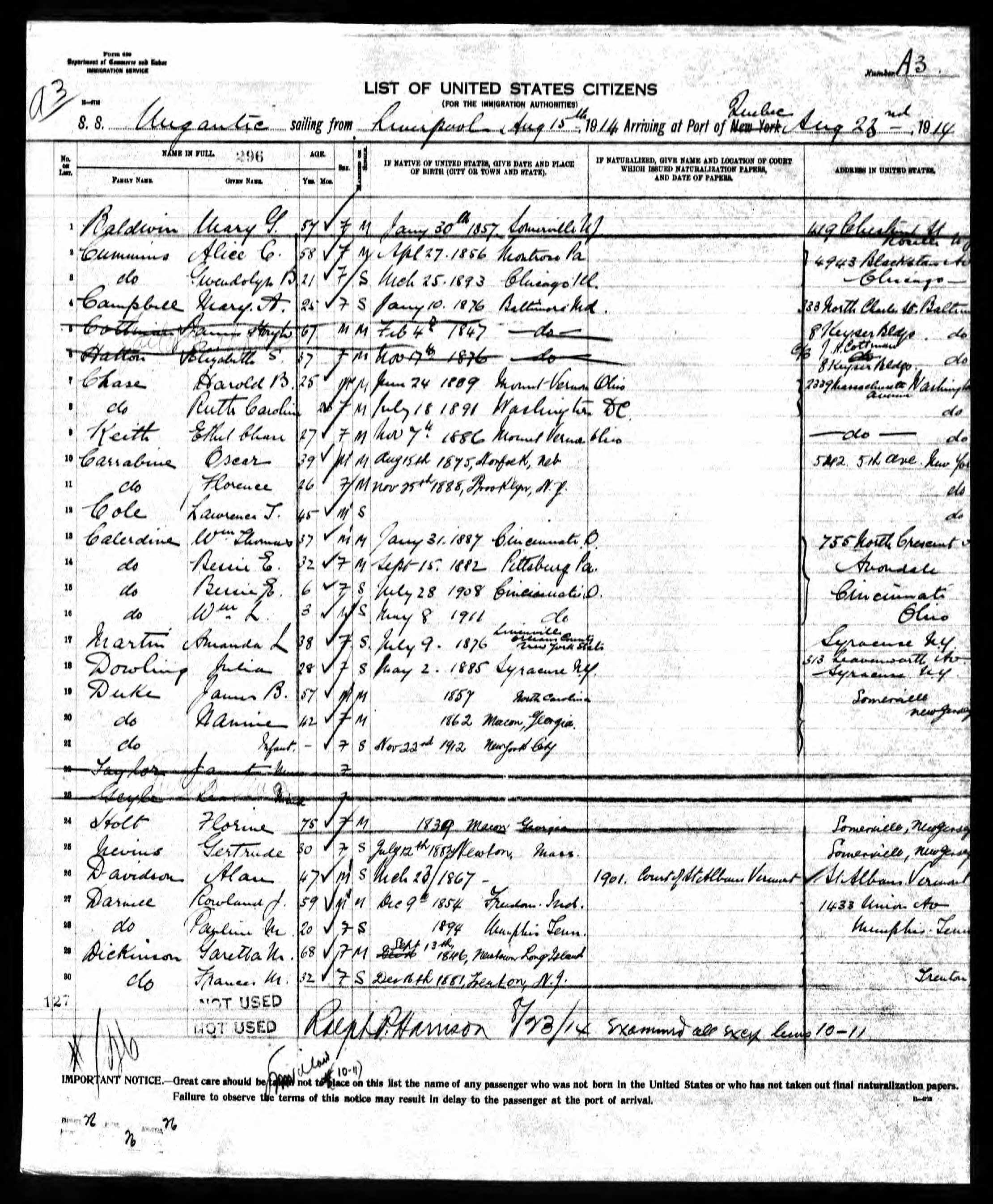
Ship manifest dated August 23, 1914 for the Megantic from Liverpool to Quebec

Ship manifest dated August 23, 1914 for the Megantic from Liverpool to Quebec

The names seemed familiar, so I checked my family tree, and sure enough, Myer Cohen, Sr., Jerome’s uncle, had a daughter Ruth who married a man named Harold Chase just about a year before in October 29, 1913, the same month that Ethel had married Benjamin F. Keith.  So Ethel must have either known Jerome already, as he was Ruth’s first cousin, or she was introduced to him by her brother and sister-in-law.  It appears that Ethel was living with Ruth and Harold at that time as well as traveling with them.  Unlike the case with  her first husband who was more than forty years older than she, this time Ethel married a man three years her junior.

Jerome and Ethel had two daughters, born in 1923 and 1928.  They lived in Huntington on Long Island, NY, then in Manhattan, and then in Fairfield County in Connecticut.  They were active in various charitable activities, and for some time Jerome was the health director for the town of New Canaan, Connecticut.  Jerome and Ethel did a great deal of traveling, according to the numerous passenger manifests.  According to Wikipedia, Ethel died in 1971.  Jerome lived until April, 1984, and was 94 when he died.

His younger brother and fellow doctor Maurice returned to Washington DC after World War I where he practiced medicine (a general practice, according to the 1930 census).  He was living with his parents and sister in 1920 and practicing medicine.  He married a woman named Mildred ( I have not yet located a marriage record for Maurice and Mildred).  Mildred was born December 23, 1899, in Easton, Pennsylvania, according to one ship manifest.  On the 1930 census they reported that they had been married for five years, so I am assuming they were married in 1925 or so.

Maurice Selinger and family 1930 census

Maurice Selinger and family 1930 census

They had two sons, one born in 1926 and the other in 1934.  In 1940, Maurice was still in a private medical practice, and in addition to his wife Mildred and their two sons, his father Julius was living with them.  Julius was now a widower, as Augusta had died in 1936 at age seventy.  Although I cannot find a death record for Julius, he was 87 in 1940, so I imagine that he died sometime in the next decade.  Maurice died on August 26, 1965, and was buried at Arlington National Cemetery.  His wife Mildred died March 27, 1981, and is buried beside him.

The youngest child and only daughter of Augusta and Julius was Eleanor.  Eleanor was still living at home in 1920, working as a bookkeeper at the jewelry store.  During the decade from 1910 to 1920, her comings and goings were recorded regularly in the Washington Evening Star—whether it was visiting her cousin Aimee Cohen in Baltimore or friends or other relatives, there were numerous society tidbits about her visits.  In 1922, she went with her parents to Europe, including England.  In 1924 she was still living at home and working as a bookkeeper.  In 1925 she traveled alone to England, and then I lost all evidence of her on ancestry.com.

Washington Star, January 16, 1916

Washington Star, January 16, 1916

I finally found a marriage record for her in familysearch.org; she married Henry Mortimer Abbot on March 25, 1926.  But then I could not find her as Eleanor Abbot.  A little more digging, and I finally realized that she and Henry were living in London.  Their marriage record said he was born in England, and the passenger manifest dated April 14, 1926, showed Eleanor and Henry Abbot traveling to England.  But then the 1928 directory for Washington, DC, listed Eleanor Abbot as residing in Washington without any listing for Henry.  I thought perhaps she had divorced Henry or perhaps he had died, but then there were many trips by Eleanor alone almost every other year through the 1920s and 1930s between England and the US.  I was quite perplexed.

Fortunately, I was able to find another family tree on ancestry.com which listed both Henry Abbot and Eleanor Selinger.  What was particularly interesting to me was that this tree revealed that Henry Abbot was originally Henry Auerbach, son of Hyams Auerbach and Helen Selinger.  Another Selinger? Helen Selinger was born in 1850 in Germany, according to that tree, making her a contemporary of Julius and Frederick Selinger, who were also born in Germany in the 1850s.  Could Helen be Julius’ sister or cousin? Had she arranged for her son to meet and marry Eleanor, his cousin? I don’t know the answer to those questions just yet, but I have a lead that may help me find out.

I contacted the owner of the Auerbach tree, and she wrote back to me telling me that Henry Auerbach/Abbot was her great-uncle, her father’s brother, and that she had visited Eleanor and Henry many times at their home in London and that they never had children.  She said that her father’s family, the Auerbach/Abbot family, was in the fur business and made many trips back and forth to the United States for business.  I asked her for more information about Henry and Eleanor and am awaiting her response.  Henry died in 1965, and Eleanor died in 1979.

Thus, the five children of Augusta Cohen and Julius Selinger all thrived as adults and seem to have had comfortable lives.  Three of their four sons stayed in Washington, DC, although Sydney eventually retired to Florida.  Two sons ended up in the family jewelry business, Sydney and Harry.  Two sons ended up as doctors, one in Washington and the other in New York and then Connecticut, and their daughter, a bookkeeper, ended up marrying an Englishman and moving to London.  Of the five children, only the two sons who were doctors had children, two each, so that Augusta and Julius had four grandchildren.  Two of their children, Jerome and Eleanor,  seem to have met their spouses through a family connection. Their parents, an immigrant and the daughter of an immigrant, must have been very proud of their children and their accomplishments.


Science versus Inference:  Was Moses Cohen the Brother of Jacob Cohen?

The case for concluding that Moses Cohen, Sr., who lived in Baltimore (1850) and Washington, D.C. (1860), was the brother of my great-great-grandfather Jacob Cohen is built almost entirely on inference.  As I’ve described before, I have tentatively concluded that they were brothers based on the following bits of evidence:

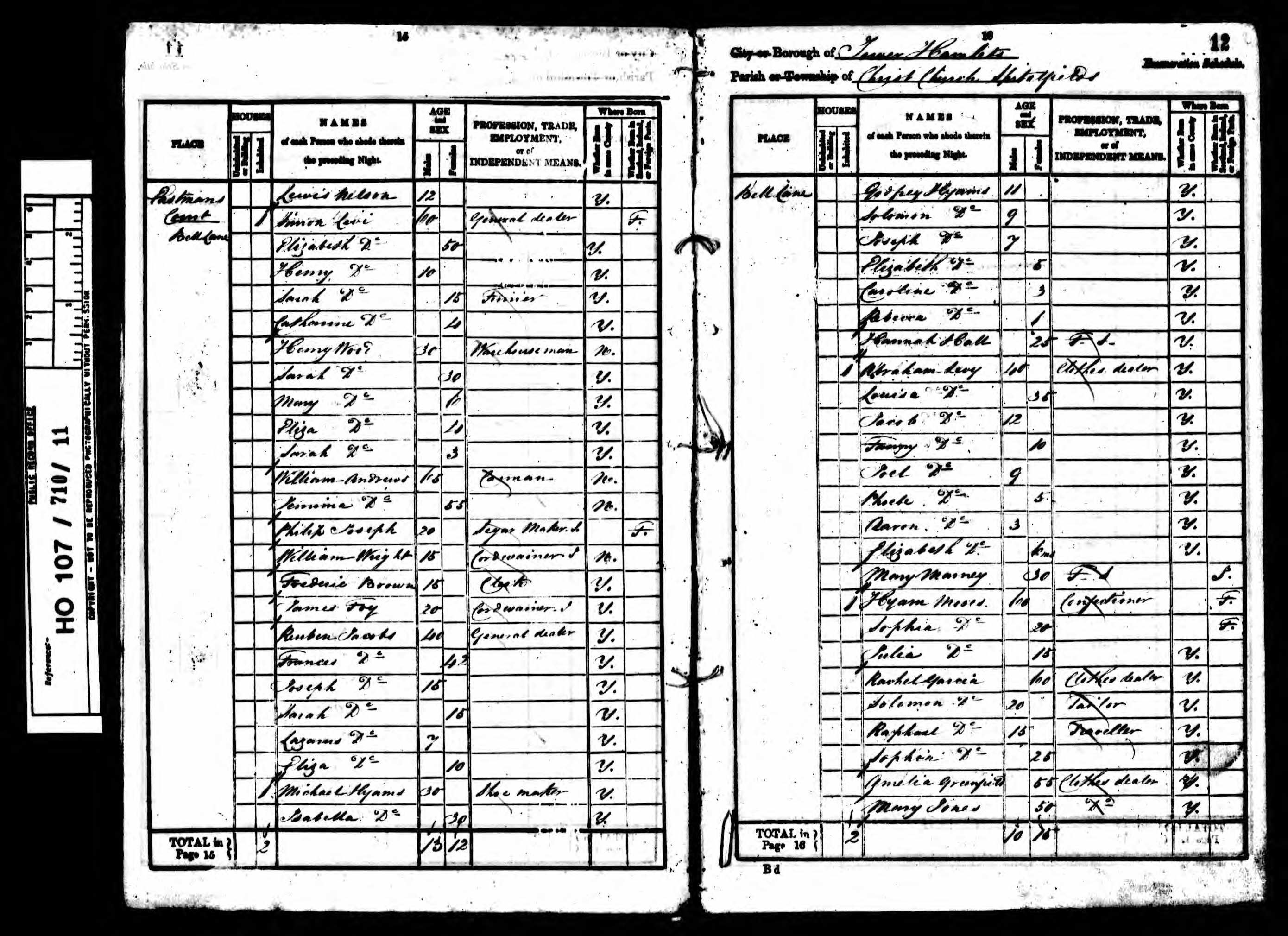
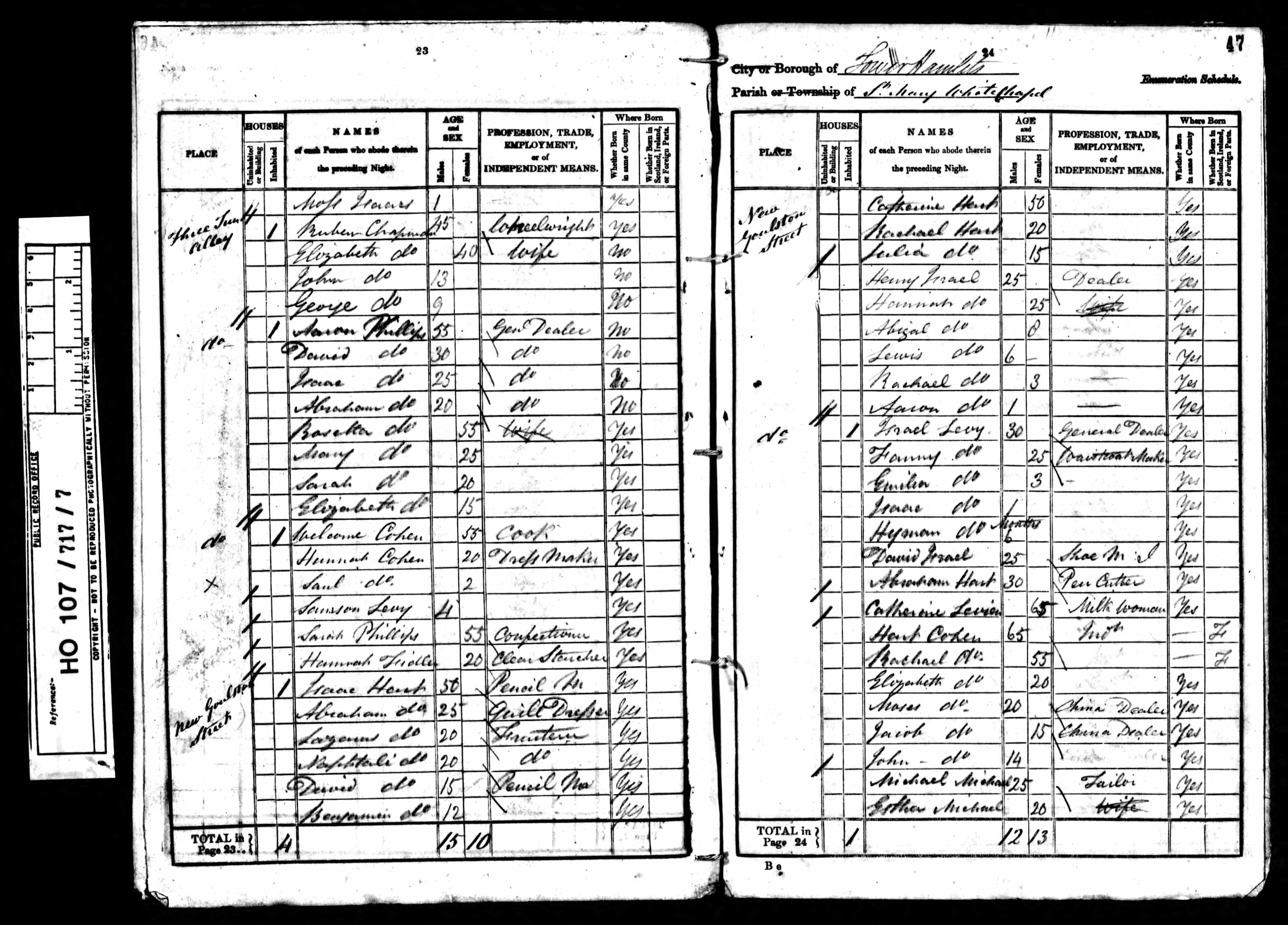
  1. The 1841 English census that lists as the children of Hart and Sarah Cohen the following: Elizabeth (20), Moses (20), Jacob (15), and John (14).

    Hart Cohen and family 1841 English census

    Hart Cohen and family 1841 English census

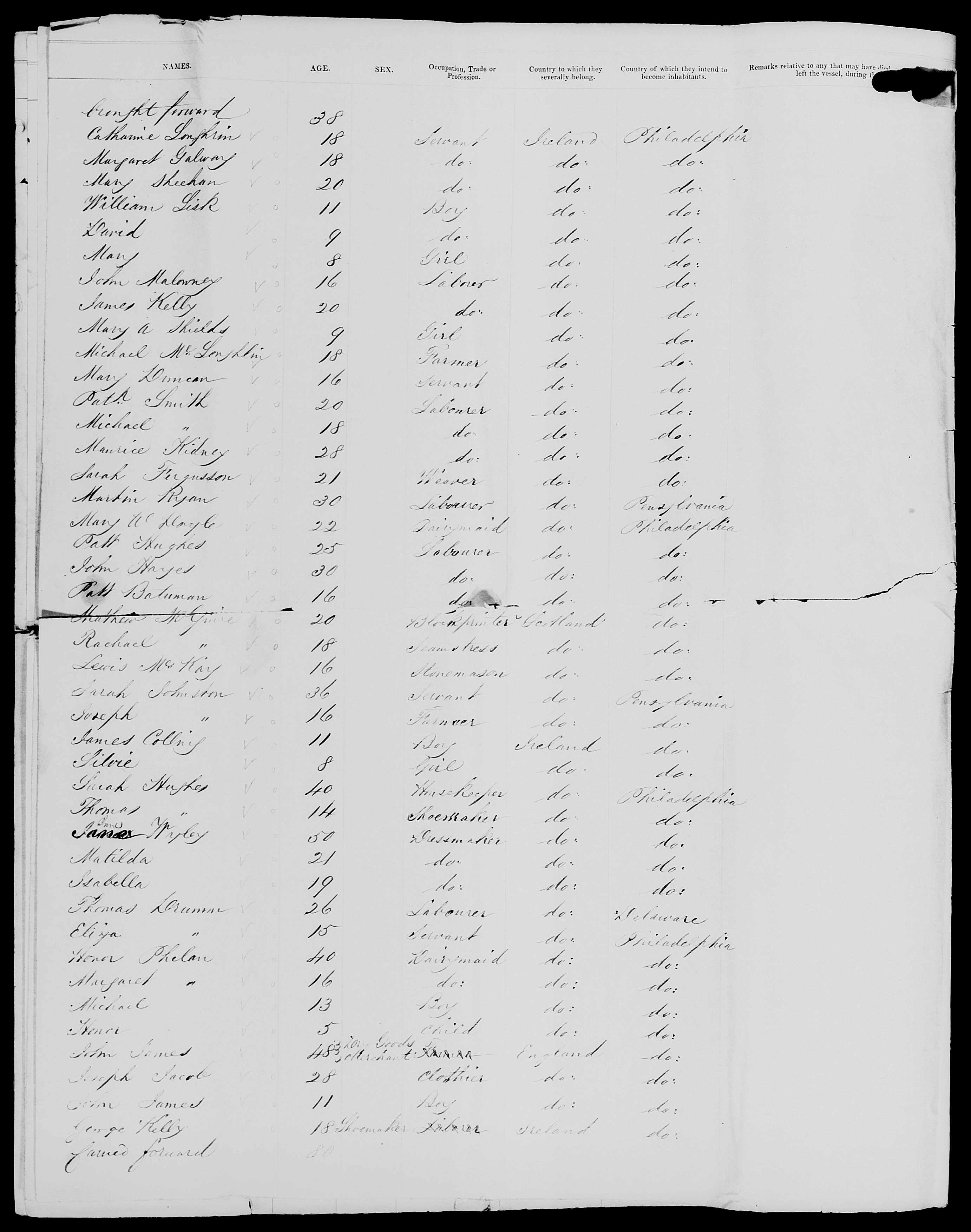
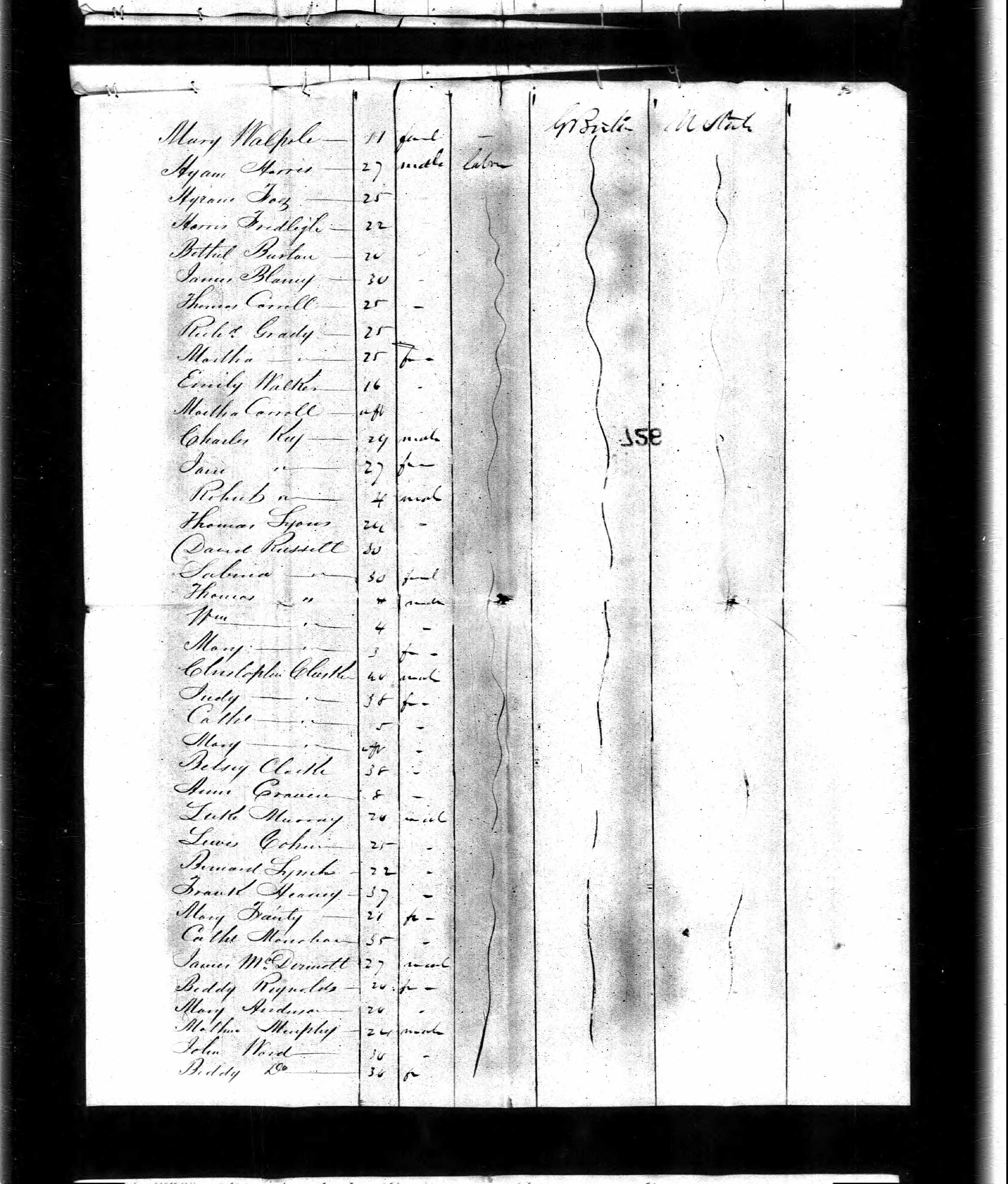
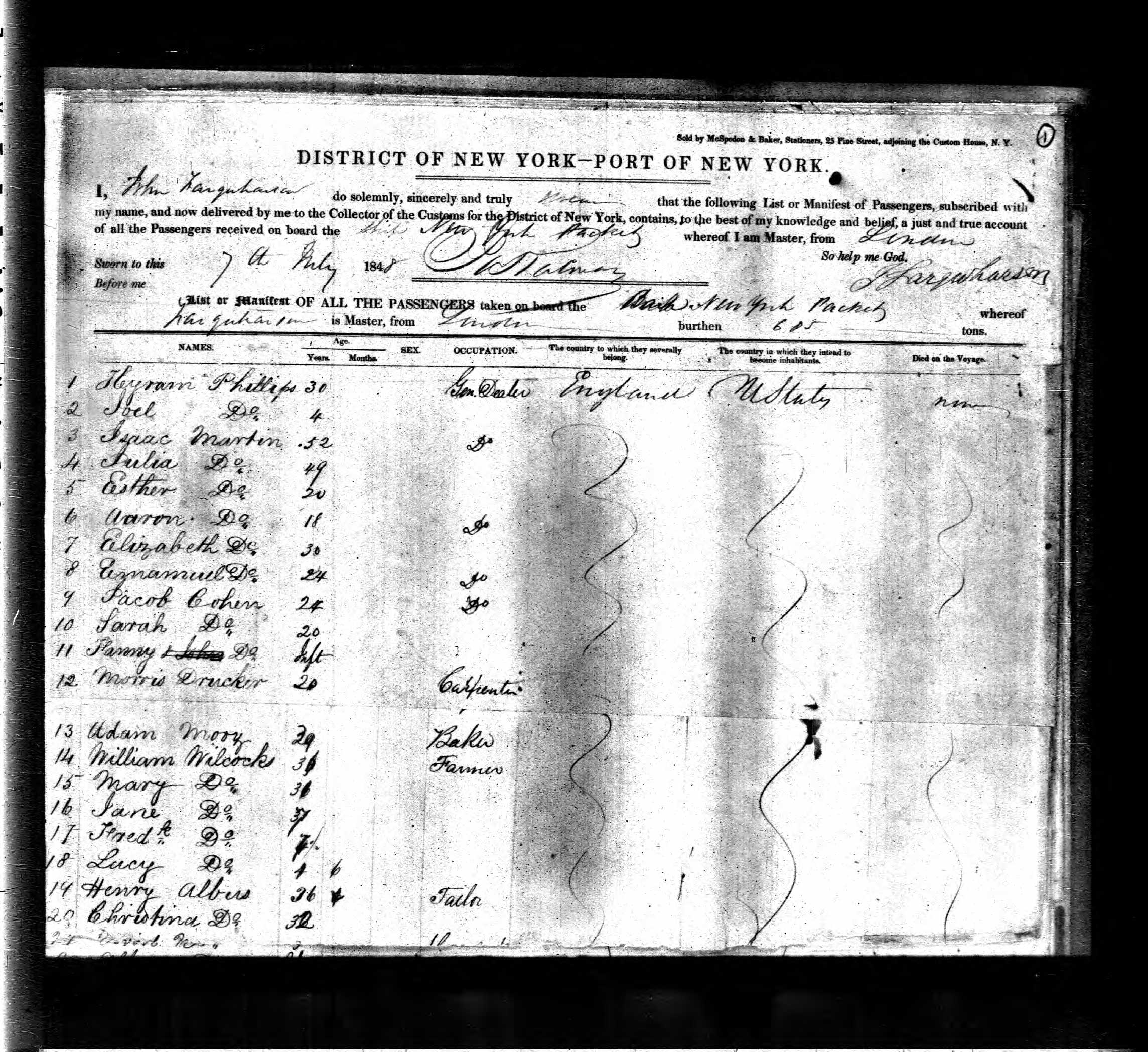
  2. A passenger manifest for the ship New York Packet, dated July 7, 1848, that lists the following passengers: Jacob Cohen, Sarah Cohen, Fanny Cohen, Moses Cohen, and an infant named John Cohen.  Jacob Cohen and family ship manifestMoses Cohen page on ship manifestSource Citation
    Year: 1848
    Description
    Ship or Roll Number : Roll 073
    Source InformationAncestry.com. New York, Passenger Lists, 1820-1957 [database on-line]. Provo, UT, USA: Ancestry.com Operations, Inc., 2010.
    Original data: Passenger Lists of Vessels Arriving at New York, New York, 1820-1897. Microfilm Publication M237, 675 rolls. Records of the U.S. Customs Service, Record Group 36. National Archives at Washington, D.C.Passenger and Crew Lists of Vessels Arriving at New York, New York, 1897-1957. Microfilm Publication T715, 8892 rolls. Records of the Immigration and Naturalization Service; National Archives at Washington, D.C.Supplemental Manifests of Alien Passengers and Crew Members Who Arrived on Vessels at New York, New York, Who Were Inspected for Admission, and Related Index, compiled 1887-1952. Microfilm Publication A3461, 21 rolls. ARC ID: 3887372. RG 85, Records of the Immigration and Naturalization Service, 1787-2004; Records of the Immigration and Naturalization Service; National Archives, Washington, D.C. Index to Alien Crewmen Who Were Discharged or Who Deserted at New York, New York, May 1917-Nov. 1957. Microfilm Publication A3417. ARC ID: 4497925. National Archives at Washington, D.C.Passenger Lists, 1962-1972, and Crew Lists, 1943-1972, of Vessels Arriving at Oswego, New York. Microfilm Publication A3426. ARC ID: 4441521. National Archives at Washington, D.C.
  3. Headstones that identify the Hebrew name of the father of both Jacob and Moses Cohen as Naftali Ha Cohen (Hart being the Dutch and English equivalent of a deer, the tribe symbol for the tribe of Naftali)
    Jacob Cohen headstone cropped and enhanced

    Jacob Cohen’s headstone

    Moses Cohen, Sr. headstone

    Moses Cohen, Sr. headstone

  4. The fact that both Jacob and Moses named a son Hart, the same name as Jacob’s, and presumably Moses,’ father, Hart Levy Cohen.
  5. The fact that Moses had a granddaughter named Grace Cohen and that a bridesmaid of one of Jacob’s granddaughters was a Grace Cohen from Washington, DC.

These five bits of evidence were enough for me to reach the tentative conclusion that Jacob and Moses were brothers and that therefore the descendants of Moses Cohen were also my relatives.  There was also additional “evidence” in my failure to find a Moses Cohen other than the DC Moses who fit as well; there were two Moses Cohens of the right age on the 1851 English census, but neither was the right one.  I sent for marriage certificates for both of them, and they were not the sons of Hart and Rachel. I’ve already dug fairly deeply into the history of Moses Cohen and his children and grandchildren based on that hunch and those bits of evidence.

But I wanted something more scientific and definitive.  I was very fortunate to find someone who was a direct descendant of Moses’ son, Moses, Jr.  He had already done a DNA test with FamilyTreeDNA, so I asked my brother to do the same so that we could compare the results.  That was almost two months ago, and I finally received the results late last week.  I was very disappointed to see that my brother was not in the same haplogroup with the descendant of Moses, Jr., meaning that there was no genetic link between the two.  I was bewildered and discouraged.  I looked at all the hours I had spent researching Moses’ family and felt as if I had wasted a tremendous amount of time.

I am in touch with the wife of the Moses, Jr., descendant who was tested, and she also was disappointed, but not as surprised as I was.  She told me that there was a family story suggesting that Moses, Jr., had been adopted and was not in fact the biological child of Moses, Sr.   Suddenly, other bits of evidence started to make more sense.

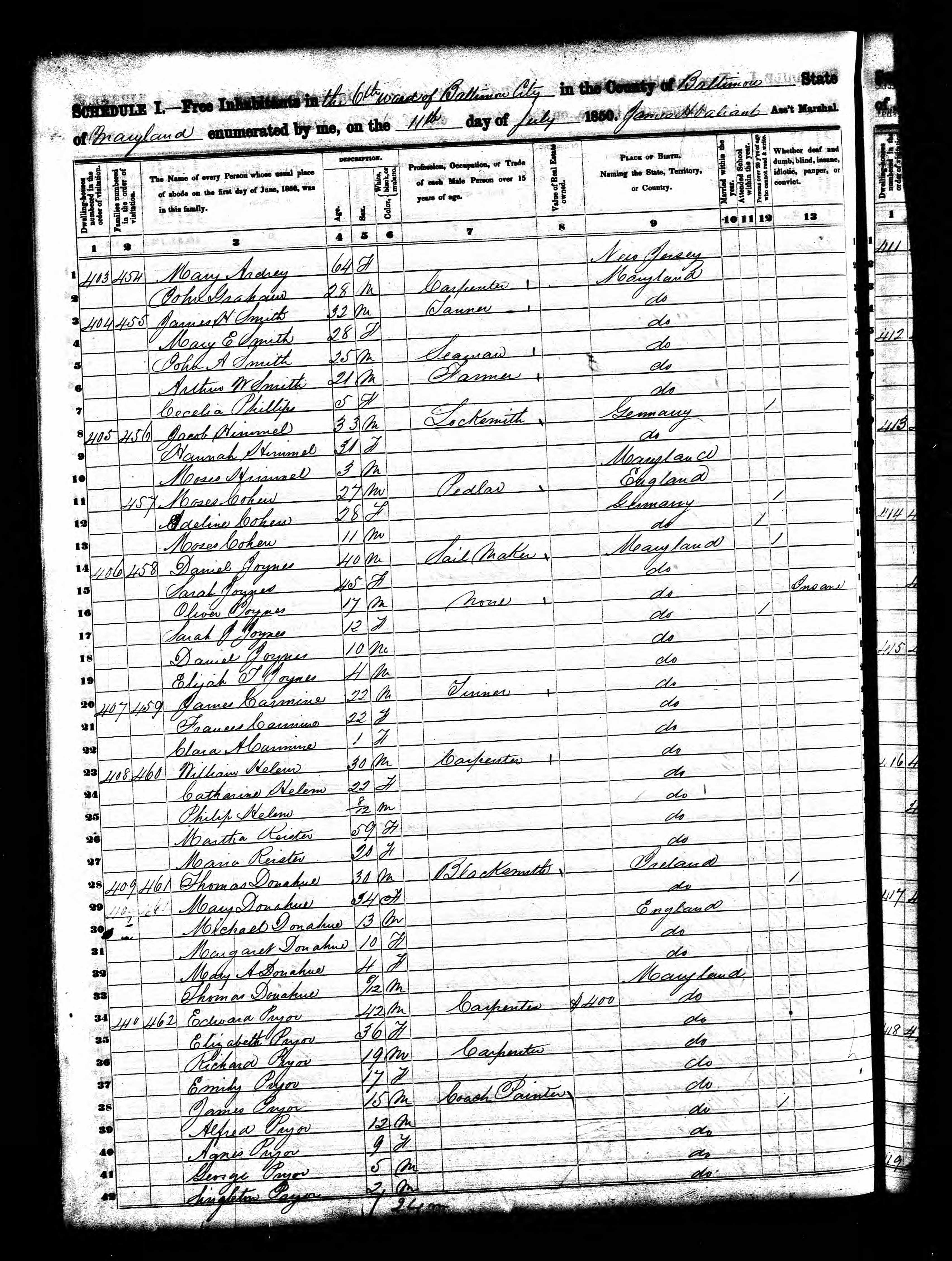
The earliest document I have for Moses, Jr. is the 1850 US census. It lists Moses, Sr., living in Baltimore with his wife Adeline and eleven year old son Moses, Jr. Moses, Jr., is reported to have been born in Germany, and since he was eleven, born in 1839.

Moses Cohen and family 1850 census

Moses Cohen and family 1850 census

Other documents record his year of birth as 1840.  But Moses, Sr., was living in London in 1841, as seen on the English census of that year.  I had been confused by that before, but had assumed it was some error.

Also, Moses, Sr. is variously reported to have been born in years ranging from 1820 to 1828, depending on the document. His headstone says he was 32 in 1860 when he died, giving him a birth year of 1828.  Even assuming it was 1820, he would only have been twenty when Moses, Jr., was born.  How would he have met a German woman at such a young age, had a child with her in Germany, but then been living without her in London a year or more after the child was born? And where were Adeline and Moses, Jr.,  in 1848 when Moses emigrated from London to the US on the same ship with his brother Jacob?

I decided I needed to find out more about Adeline, the woman who married Moses and the mother of Moses, Jr.  I know that her birth name was Himmel from a birth record for their son Hart.  I cannot find a passenger list for Adeline or Moses, Jr., nor can I find a birth record or a marriage record linking Moses, Sr. and Adeline with Moses, Jr.  The earliest document I have found for Adeline is the 1850 US census above.

That 1850 census, seen above, show that living in the home next door to Adeline and Moses was a family with the surname Himmel: Jacob, Hannah and Moses Himmel.  Jacob, like Adeline, was born in Germany.  Both Jacob and Adeline Himmel had sons named Moses.  I am going to guess that Adeline was Jacob’s sister, though I’ve yet to find anything to corroborate that.

So this is my new challenge: to find records that will indicate where and when Moses, Jr., was born and where and when Moses, Sr., married his mother Adeline.  I am also going to focus on finding a biological descendant of Moses, Sr., so that perhaps I can find some scientific evidence to back up my inferences.  In the meantime, I am going to continue to assume that Moses, Sr., was the older brother of my great-great-grandfather and thus to tell his story as best I can as well as the story of his children and grandchildren, including Moses, Jr.


My Great-Great-Grandparents’ Marriage Certificate: Small Details Reveal So Much

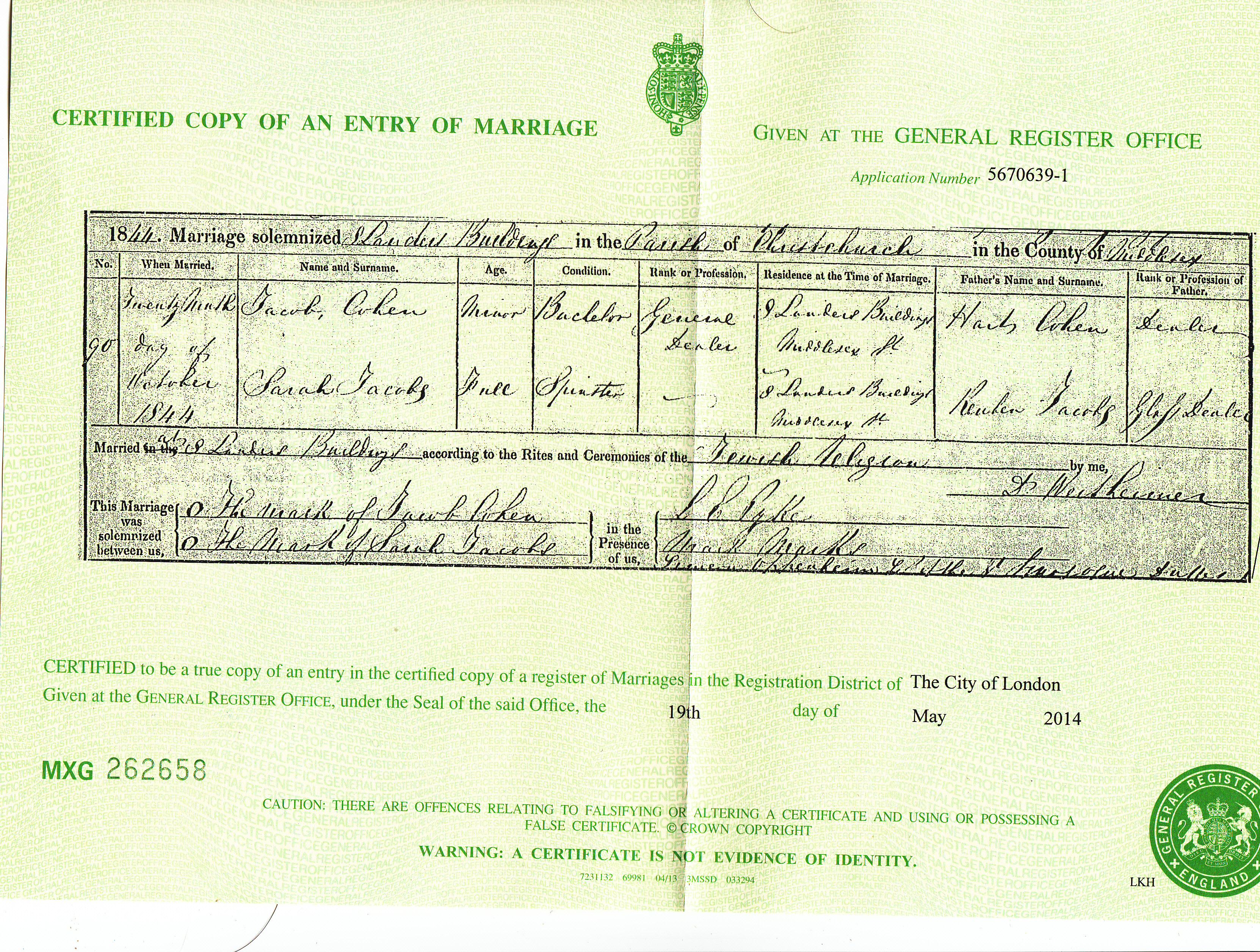
As I celebrate the newest member of my extended family, I am also thinking about my great-great-grandparents, Jacob and Sarah Cohen.  A while back I had sent for their marriage certificate from the General Register Office in England, and the certificate arrived just a few days before Remy was born.  It confirms a number of facts I already knew—that Sarah’s birth name was Jacobs, that her father’s first name was Reuben, that she and Jacob married on October 24, 1844, that Hart, Jacob’s father, was a dealer as was Reuben Jacobs, Sarah’s father (a glass dealer?) and Jacob himself, and that they all lived in Spitalfields, Christchurch, Middlesex County, in England.  But the marriage certificate also revealed a few other interesting details.

Jacob Cohen and Sarah Jacobs marriage certificate

Jacob Cohen and Sarah Jacobs marriage certificate

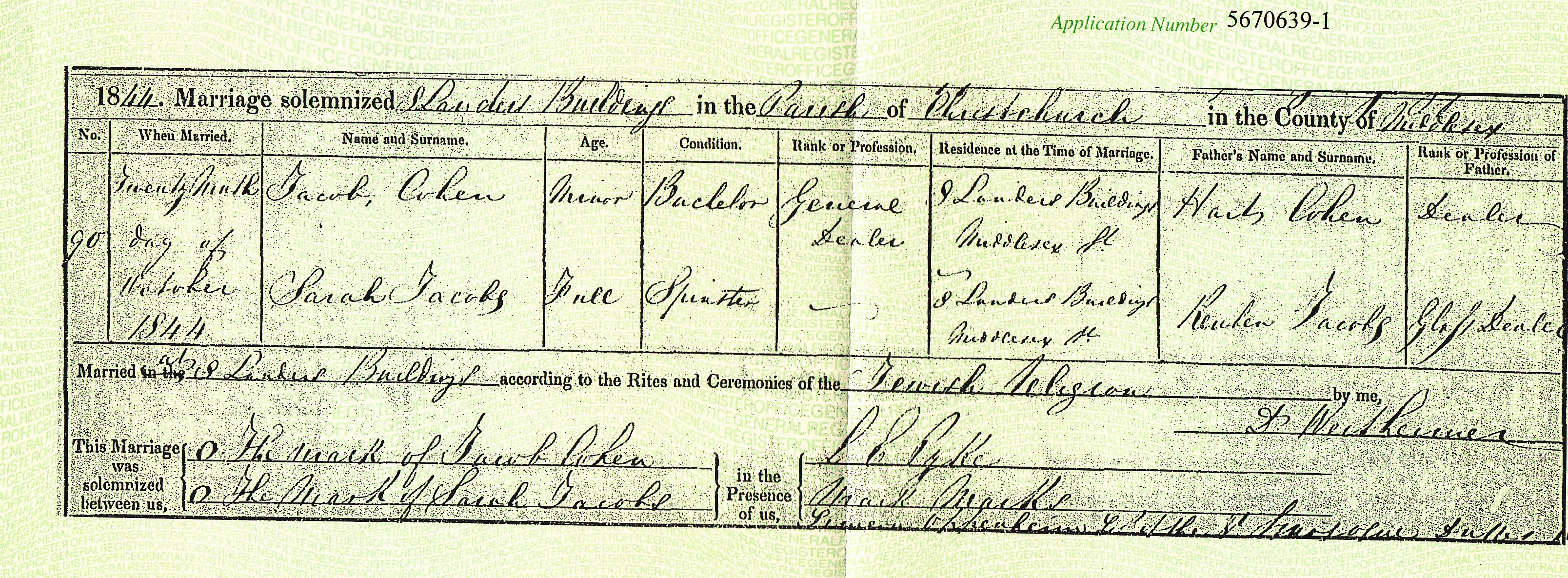
For example, according to the certificate, Jacob was still a minor, but Sarah was of “full” age.  All the documents I have for Sarah, both from England and the US, place her at least two years younger than Jacob.  I wondered: Was the age of majority younger for women in England in 1844 than it was for men?  The 1841 census puts Rachel’s age that year as 15, meaning she was 18 when she married Jacob, whereas Jacob was only 20.  (When I think about how young they were and then how many children their marriage produced and how many years they were married, it is astounding.)

I did a little research and learned that although a girl could marry at 12 and a boy at 14, parental consent was necessary if either was under 21.  Both men and women were considered minors before they were 21; there was not a double standard.[1] That leaves me perplexed. Was Rachel older or younger than Jacob?  Was the marriage certificate right and all the other documents wrong? One would think that a marriage certificate would be more accurate than census reports, but perhaps this was just a mistake.

Sarah and Jacob marriage cropped

The certificate also indicates that, as with Hart Levy Cohen on his wife Rachel’s death certificate, Jacob and Sarah could not sign the document, but only left their marks on it.  Another question is thus raised: how literate was the population of England at this time?

A little quick research revealed that the literacy rate in England in 1840 was somewhere between 67% and 75% for the working class population.[2]  Another source indicated that based on the ability of brides and bridegrooms to sign their marriage certificates, the literacy rate was even lower among women at that time—around 50%, .  That same source, however, suggested that since writing was taught after reading, simply because someone could not sign his or her name did not mean that he or she could not read.[3]

A third interesting detail on the certificate is that it appears that both Jacob and Sarah were residing at 8 Landers Building at the time they were married.  Since it is not likely they were living together before they were married, this would mean that their families were living in the same building.  Were they childhood friends?  Had their parents as neighbors arranged the marriage? Were they all related in some way? It also appears that the marriage had taken place at this same location, not at a synagogue.  But the record from Synagogue Scribes indicated that they were married at the Great Synagogue, as were Hart and Rachel.  I assume that this was this just a civil certificate completed to comply with civil, not religious, law.  I find it interesting that it states that the ceremony was done “according to the rites and ceremonies of the Jewish religion” despite the fact that it is not a religious document.

It is quite amazing to me how much information and how many questions can be mined from one simple document.  Receiving this document was very exciting, as with receiving Rachel’s death certificate from England.  It ties me directly to my ancestors—people who were born almost 200 years ago, but with whom I have a direct and easily established connection.


[1] See the discussion on RootsChat at http://www.rootschat.com/forum/index.php?topic=643885.0 and also at BritishGenealogy.com at http://www.british-genealogy.com/forums/showthread.php/57256-Age-at-Marriage-Minor

[2]  R.S. Schofield, “Dimensions of Illiteracy in England, 1750-1850) in Literacy and Social Development In the West: A Reader (edited by Harvey J. Graff) (1981), p.201.

[3] “Introduction,” Aspects of the Victorian Book, at http://www.bl.uk/collections/early/victorian/pr_intro.html

Enhanced by Zemanta

My Great-Great Grandmother Rachel Jacobs Cohen: Her Death Certificate

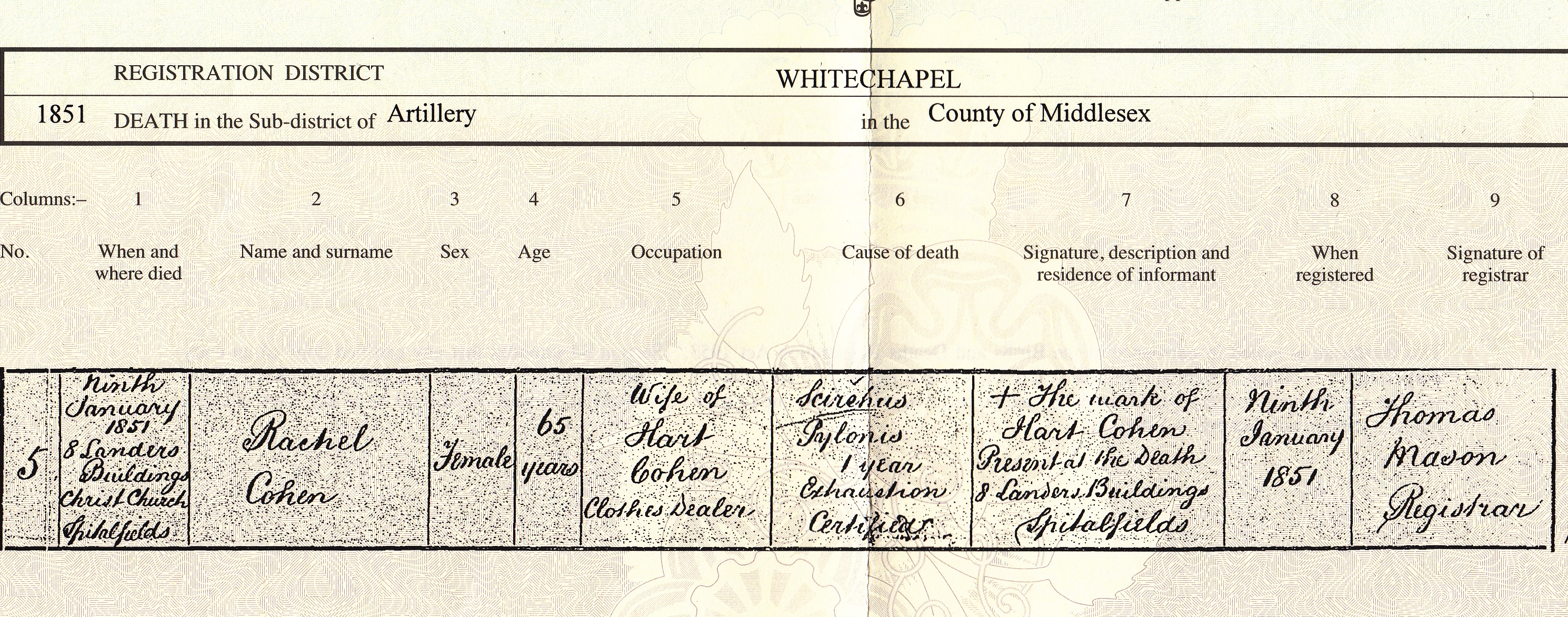
I have received a certified copy of my great-great grandmother’s death certificate from the General Register Office in London.  This is my first English vital record, and I was quite excited to receive it.  It amazes me that I can obtain a record that is over 150 years old from a foreign country just by clicking on the keys of a computer.  Below is a scan of the document and also a cropped version to highlight the actual text on the certificate.

Rachel Jacobs Cohen  death certificate

Rachel Jacobs Cohen death certificate

rachel jacobs cohen death cert 1851 cropped

There are a number of things that interest me about the information on this document.  First is Rachel’s date of death, January 9, 1851.  When I had searched through the BMD Index for this certificate, there were a number of Rachel Cohens who might have been the right person.  I guessed that it was this one based on the date.  Although Lewis and Jacob, Rachel’s sons, had left for the US in 1846 and 1848, respectively, Rachel’s husband and other children, Elizabeth and Jonas, did not leave until 1851.  I had a hunch that they did not leave because Rachel was ill and not able to make the journey, so they waited until after she died.

As the certificate shows, Rachel’s cause of death was “scirehus paylonis” and exhaustion, and it seems she had been ill for a year.  As best I can tell, scrirehus paylonis would be translated to schirrous pylonis or cancer of the stomach.  (My medical expert should feel free to correct this.)  I found some English writings on line in which that term was used to refer to what we would call stomach cancer.

The certificate also indicates where the family was living—in Landers Buildings in Christchurch, Spitalfields, in the Registration District of Whitechapel, County of Middlesex.  It also confirms that Hart Levy Cohen was a clothes dealer.

Perhaps most interesting and surprising to me is that Hart signed the certificate with a mark, an X, not with a signature.  Was he not able to sign his name? Was he illiterate? It’s so hard for me to imagine not being able to read and write that I found this shocking and disturbing.


Enhanced by Zemanta

Who Knew?  My Great-Great Grandmother’s Family, the Jacobs

One of the great surprises I’ve encountered in doing genealogy work is that I have many more surnames in my family than I ever knew.  I knew about Goldschlager and Brotman, on my mother’s side, and I knew about Cohen, Schoenthal, Seligman and Katzenstein, on my father’s side. But I never knew that I was also a Rosenzweig until I found my great-grandmother Ghitla’s maiden name, and now I know that I am also descended from the Jacobs family on my father’s side.  My great-great grandmother was Sarah Jacobs, married to Jacob Cohen.  My great-great-great grandmother was Rachel Jacobs, married to Hart Levy Cohen.  Although I have not yet found any familial connection between Rachel and her mother-in-law Sarah, I have found some evidence of Rachel’s parents and siblings.

First, I noticed that a man named Lazarus Jacobs was living with Rachel and Jacob Cohen in Philadelphia in 1860.  Then yesterday while researching the Cohens in the 1860s, I found a Philadelphia directory that listed Jacob’s business partner as Joseph Jacobs.  I assumed this was another of Rachel’s relatives, but was not sure how they might be related.

After some further searching, I found Joseph Jacobs on the 1841 England census, living with his parents Reuben and Frances and his siblings Rachel, my great-great-grandmother, and Lazarus, the younger brother who was living with Jacob and Rachel in 1860.

Reuben Jacobs and family 1841 England Census

Reuben Jacobs and family 1841 England Census

Joseph married his wife, Rachael, in 1847, whose maiden name may also have been Jacobs.  (The BMDIndex has two Rachels on the registry page for Joseph Jacobs, so until I can obtain the actual records, I am not sure if she was Rachel Levy or Rachael Jacobs.)

Joseph and Rachel had a son, Solomon, born in 1848, and a son Reuben, born in 1850.  Both were living with Rachel on the 1851 England census.  Rachel was listed as the sister of the head of household, whose name was Abraham Abrahams; his wife’s name was Elizabeth.  I cannot find a Rachel Abrahams on the marriage registry on the BMDIndex, and although I did find an Abraham Abrahams married to an Elizabeth Levy, I also wonder whether the census taker took down Abraham’s name incorrectly since there is also an Abraham Jacobs married to an Elizabeth.

Rachel Jacobs and children 1851 England census

Rachel Jacobs and children 1851 England census

At any rate, the bigger question is— where was Joseph?

My guess was that he was in the US, preparing to move the family to Philadelphia.  I could not find him, however, on the 1850 US census nor could I find him on a ship manifest for that time period.  I did, however, find a Joseph Jacobs on the 1851 England census as a visitor in Birmingham, England; he was listed as born in Middlesex, London, and his occupation was as a general dealer, so my guess is that Joseph was simply away on business the day the census was taken.

Joseph Jacobs 1851 England census  a visitor

Joseph Jacobs 1851 England census
a visitor

Joseph and his family left England and, like Joseph’s sister Rachel, settled in Philadelphia.  It appears that Rachel Jacobs and her three children, Solomon (4), Reuben (2) and Emanuel, who was described as an infant, left in 1853 along with her brother-in-law, fourteen year old Lazarus (L. Jacobs on the manifest).

Rachel Jacobs and children 1853 ship manifest

Rachel Jacobs and children 1853 ship manifest “Pennsylvania, Philadelphia Passenger Lists, 1800-1882”, index and images, FamilySearch (https://familysearch.org/pal:/MM9.1.1/K8CH-1V8 : accessed 20 May 2014), Jacobs, 1853.

Her husband Joseph may not have left until 1854.

Joseph Jacobs ship manifest 1854

Joseph Jacobs ship manifest 1854 “Pennsylvania, Philadelphia Passenger Lists, 1800-1882”, index and images, FamilySearch (https://familysearch.org/pal:/MM9.1.1/K8CC-N1Z : accessed 20 May 2014), Joseph Jacob, 1854

These dates make sense because according to the 1860 US census, their daughter Frances or Fanny was born in England and was six at the time of the census in 1860, but their daughter Esther was born in Pennsylvania and was already two years old in 1860.


Joseph Jacobs and family 1860 US census

Joseph Jacobs and family 1860 US census

What seems inconsistent, however, is that Frances/Fanny is not on the ship manifest with either her mother Rachel or her father Joseph.  Perhaps the 1860 census was incorrect, and Frances was born shortly after arriving in the US, but the 1870 census also has her listed as born in England, so more likely she just wasn’t included on the ship manifest. Emanuel Jacobs, however, although listed on the ship manifest, is not included in the 1860 census.  In fact, a later born child was named Emanuel, born in 1866.  So was “Emanuel” on the manifest really Frances? Or did the first Emanuel die?

Sadly, it was the latter.  Emanuel died on May 3, 1860, of heart disease, according to the US Federal Census Mortality Schedule.  The Philadelphia death certificate identifies his father as Joseph Jacobs residing at 150 South Street, so this is definitely the right child since that is where the Jacobs family was living in 1860.  The certificate also says that Emanuel had been in Philadelphia for 2 and 2/3 years, meaning since sometime in 1857 (which seems incorrect unless they lived elsewhere between 1853 and 1857), and although I cannot decipher the age very well, I think it says he was 8+ years, meaning he was born sometime either in 1851 or 1852, which would explain why he was not on the 1851 census, but was on the 1853 manifest.  Apparently, the second Emanuel, born in 1866, was named for the deceased older brother.

Emanuel Jacobs death certificate May 3, 1860

Emanuel Jacobs death certificate May 3, 1860

That does not explain where Frances was, however, when the rest of the family was sailing to Philadelphia.

In 1860 Joseph Jacobs and his family lived at 150 South Street in Philadelphia, not more than a few houses from my great-grandparents who lived at 136 South Street.  He was in business with his brother-in-law, Jacob Cohen, my great-great-grandfather. Although I will track what happened to Joseph and to Lazarus after 1860 as well as research Joseph, Sarah, and Lazarus’ parents in England, for now I will return to the Cohen family and finish their story before returning to my newly discovered family line, the Jacobs.  The tree just keeps on growing.

Enhanced by Zemanta

All Things Considered, I’d Rather Be in Philadelphia

W.C. Fields, who was born in Philadelphia, used to make fun of his birthplace as a staid and boring place by threatening to have the line, “All things considered, I’d rather be in Philadelphia,” as the epitaph on his gravestone.  (Apparently, that threat was never carried out.)  Philadelphia has often been overshadowed by New York to its north and by Washington to its south.  I remember traveling to Philadelphia to visit my relatives when I was a child, my siblings and I fidgeting in the back seat of the car as my father fought through the traffic on the ugly New Jersey Turnpike.

English: W.C. Fields

English: W.C. Fields (Photo credit: Wikipedia)

My grandmother Eva Cohen and her second husband Frank Crocker lived in what I remember as a small apartment in Philadelphia, and somehow it was always hot and humid whenever we visited.  I was only nine when my grandmother died, so my memories are somewhat vague, but I do remember watching a baseball game with Poppy Frank, as we called him, discussing the merits of Sandy Koufax versus Don Drysdale (the Phillies were obviously playing the Dodgers that particular visit).  We would sit and visit for a while, have lunch or dinner, and then pile back in the car, suffer through the Jersey Turnpike again, fidgeting and bickering in the backseat.  So I guess I could relate to W.C. Fields’ sentiments about his hometown.  Somehow I associated Philadelphia with long car rides, being tortured by my siblings, and hot, humid weather.  I wish I could remember more about my grandmother, but as a child, I was focused on childish things. Well, and baseball.  As I wrote before, I remember her as beautiful, reserved, and very dignified, a true gentle-woman in both senses of the word.

So given my somewhat skewed views of the City of Brotherly Love, I did wonder why my Cohen relatives (and in fact all of my father’s lines) ended up in Philadelphia.  They sailed into New York City—why did they leave the Greatest City in the World to go to its poor stepsibling to the south? I asked my father, who was born and raised in Philadelphia, this question the other day, and he said something about William Penn and how Philadelphia was a Quaker city and probably more tolerant of Jews.

I decided to do some research to answer a couple of questions: What was Philadelphia like for Jews in the 1840s and 1850s when the Cohens arrived? Where did they live in the city, and what were the socioeconomic conditions like in those areas? What drew them there instead of New York or some other American city?

I found a wonderful resource, a book by Robert P. Swierenga, a historian who has published several books about the Dutch in the United States.  The book I relied on is titled The Forerunners: Dutch Jewry in the North American Diaspora (Wayne State University Press 1994), and in it Swierenga traced the immigration of Dutch Jews to America and their settlements in several US cities, including Philadelphia.  I read the chapter on Philadelphia and learned not only about the Dutch Jews who settled there, but more generally about the history of Jews in Philadelphia.  After reading this chapter, I better understand why the Cohen family decided to settle there.

Philadelphia had one of the earliest Jewish communities in the United States.  In 1776 it had the third largest Jewish population of American cities, after New York and Charleston; there were 300 Jews living in Philadelphia at that time.  That number grew to 200 families by 1778 as Jews sought refuge there during the Revolutionary War.  The population was largely Sephardic, and the first synagogue was formed in 1782, Congregation Mikveh Israel, an Orthodox Sephardic synagogue.  Once the war ended, however, many of the Jews returned to their prior homes, and by 1790 there were only 25 Jewish families or about 150 people.  (Swierenga, pp. 118-119)

English: Former home of Mikveh Israel Synagogu...

Former home of Mikveh Israel Synagogue

There was a growing number of non-Sephardic Jews settling in Philadelphia after the Revolution, however, as immigrants from Germany, Poland and the Netherlands began to arrive, and in 1790 these people formed a new synagogue, Rodeph Shalom, which would adhere to Ashkenazi practices.  Rodeph Shalom was the first Ashkenazi synagogue in North America, and most of its first congregants were Dutch.  (Swierenga, pp. 119-120)

Rodeph Shalom Synagogue on the NRHP since Augu...

Rodeph Shalom Synagogue on the NRHP since August 7, 2007. At 607–615 North Broad St., in the Poplar neighborhood of Philadelphia. (Photo credit: Wikipedia)

The Jewish population really started to grow in the early 19th century.  In 1820, there were 450 Jews in Philadelphia; in 1830 there were 730.  By 1840, there were 1500, and then there was a huge surge to 6000 by 1850 and to 10,000 by 1860.  This, of course, was the period my Cohen relatives began to arrive in Philadelphia—between about 1848 and 1851.  In fact, according to Swierenga, a substantial number of these Jewish immigrants were Dutch Jews.  (p. 120)

In his discussion of Dutch Jews, Swierenga included not only those who came directly from the Netherlands (meaning primarily Amsterdam), but also those, like my ancestors, who had emigrated from Amsterdam to England before coming to America.  Based on his research, he concluded that for the most part the Dutch Jews who came to Philadelphia tended to come directly from Amsterdam whereas those who had first stopped in London tended to end up in New York.  Swierenga found that in 1850 and 1860 there were only two Dutch Jewish families in Philadelphia who had had children born in England. (Swierenga, p. 125)  Was he counting my relatives? Hart Levy Cohen’s children were born in England, but did they count as “children?” On the other hand, Jacob’s daughter Fannie was born in England, and although his later children were born in the US, his family must have been one of those two families.

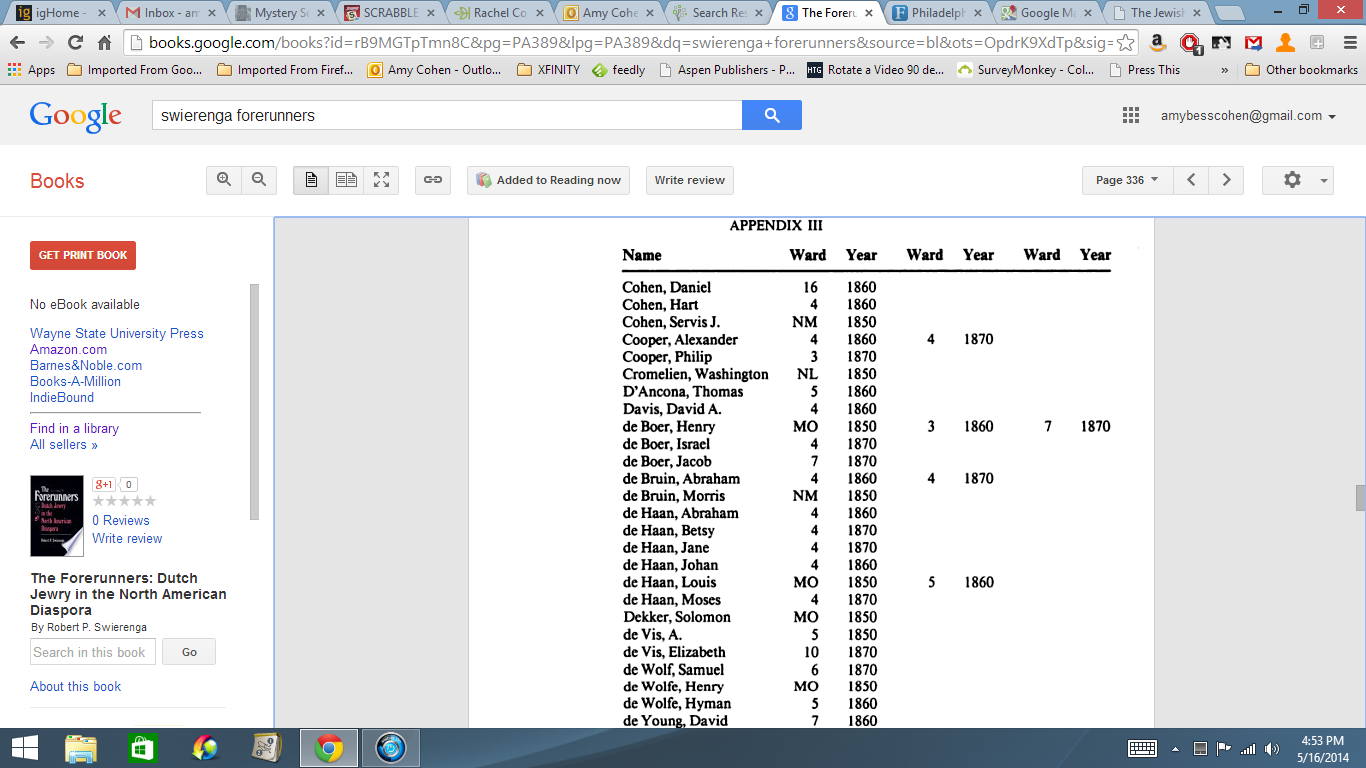
In fact, this screenshot from Appendix III in Swierenga’s book, captioned “Dutch Jewish Household Heads and Working Adults in Philadelphia 1850, 1860 and 1870,” shows that Swierenga did count Hart Cohen as one of those Dutch Jews.

Appendix III from Swierenga. The Forerunners

Appendix III from Swierenga. The Forerunners

Based on this data as compared to his findings that there was a greater number of Dutch Jewish families in New York with children born in England, Swierenga reached the following conclusion: “Clearly, the Dutch Jews in Philadelphia had been better off economically in the Netherlands, and they immigrated earlier than those settling in New York, who out of economic necessity spent a longer sojourn in London.  For the Philadelphia Dutch Jews, a London stopover or two-stage migration was not as necessary or desirable.” (p. 126)

I found this observation very interesting. Obviously, my ancestors did make that two-stage migration.  Did they do that because they could not afford to get directly to the US, or did they originally plan to stay in London?  Does this mean that Hart and Rachel were not as well-off as many of the other young couples who left Amsterdam at the end of the 18th century?

The Dutch Jewish community was located in the south side of Philadelphia. With the large wave of German immigrants in the 1840s, the Dutch Jews had moved south to Wards 1 through 5, and primarily Wards 4 and 5, located between what is now Broad Street and the Delaware River and South Street to the south and 2d Street to the north.  Swierenga described these two wards as slums.  Ward 4 is where Jacob and his family lived for many years at 136 South Street.   Was he living in a slum with his large family and three servants? It seems unlikely.  The neighborhood must have been somewhat economically diverse to attract what Swierenga himself had described as a fairly comfortable Dutch Jewish population.  (pp. 139-146)

This growing community of Dutch Jews eventually decided to form their own synagogue and leave Rodeph Shalom, which had become increasingly made up of congregants who had emigrated from Germany.  Also, Rodeph Shalom and Mikveh Israel as well as a third synagogue, Beth Israel, were all located in the north side of Philadelphia.  (Swierenga, pp. 127-129) Thus, in 1852 the Dutch Jewish families formed their own synagogue, B’nai Israel, on the south side where Jacob and Rachel were living in 1850. (pp. 130-145)

Between the 1850s and 1880, however, the Dutch Jews increasingly left the south side of Philadelphia and moved to neighborhoods further north.  Those who remained could not support their own synagogue, and B’nai Israel was closed in 1879.  By the end of the 19th century, the Dutch Jewish community had integrated into the larger Jewish community and had disappeared as a separate cultural subgroup.  (pp. 135, 320)  As I move forward from 1860 in tracing my Cohen relatives, I will keep in mind this shift to see whether or not they were a part of that trend.

After reading this material and understanding more about the history of the Jewish community in Philadelphia in the first half of the 19th century, I better understand why my ancestors chose Philadelphia.  It had a distinct Dutch Jewish community, which might have been very attractive to them after the Chut experience as outsiders in London.  It had a long history of a diverse but cooperative overall Jewish population.  And perhaps, like today, it seemed less overwhelming and more affordable than New York City.

I now read, “All things considered, I’d rather be in Philadelphia” in a whole new light.

Enhanced by Zemanta

Did My Great-Grandfather’s First Cousin Live Two Separate Lives?

I have started tracking down the lives of the children of Jacob and Sarah Cohen, my great-great-grandparents, and all was going pretty well until I started to research their son Hart.  It seems he might have been living two lives, one in Philadelphia, one in Washington, DC.   Or perhaps not.  Here’s what I have found; see if you have any ideas on how to resolve this one.

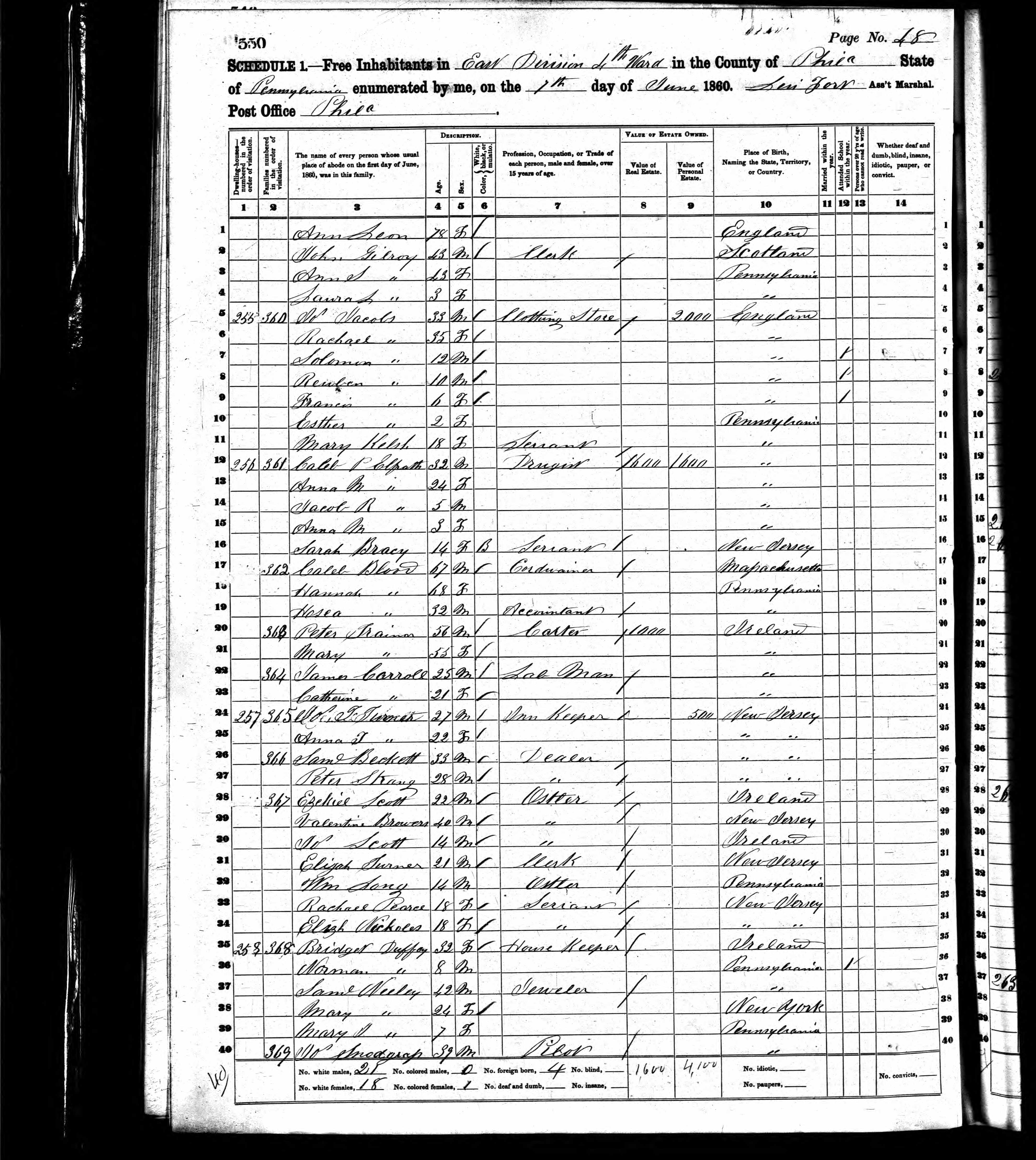
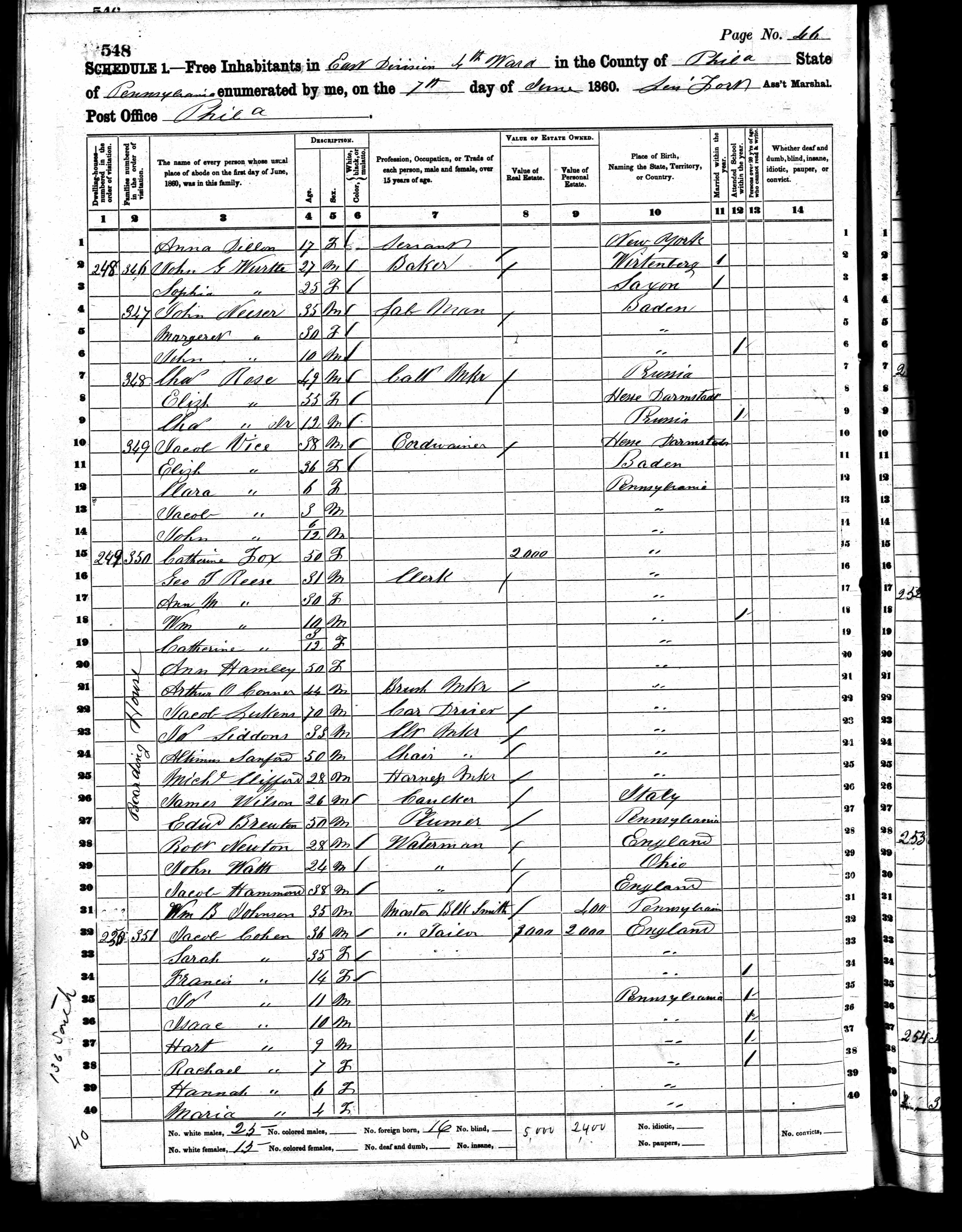
The first mention of Hart, obviously named for his grandfather Hart Levy Cohen who was still alive when he was born, is on the 1860 US census, listing little Hart as nine years old, so born in 1850 or 1851, depending on whether his birthday was before or after June 7th, the date in 1860 when the census was taken.  Since he was not listed on the 1850 census taken on July 25, 1850, he was obviously born sometime between July 25, 1850 and June 7, 1851 if he was actually nine on June 7, 1860.

Jacob and Sarah Cohen and family 1860 US census

Jacob and Sarah Cohen and family 1860 US census

Things start getting weird in 1870.  I found two census reports for Jacob and Sarah and their children for 1870, one taken in June, one in November.  The second one is labeled “Second Enum” for second enumeration so for some reason the census taker went to the neighborhood twice.  What’s odd is that Hart is listed as 20 on the June version and 19 on the November version.  I’ve seen age mistakes so often that this did not faze me in the least, but it does not help pin down Hart’s precise birth date.

It is the 1880 census, however, that really threw me.  In 1880 there are also two census reports for Hart Cohen born in 1850 or 1851.  One is clearly the right Hart:  He was living in Philadelphia, working as a storekeeper, and was born in Pennsylvania of parents born in England. He is 30 years old, giving him a birth year of 1850 or 1851.  This Hart was married to a woman named Henreta or probably Henrietta and had three children, Jacob (6), Sarah (5), and Julia (4).  If Hart and Henrietta had a six year old child, then presumably they would have been married no later than 1873, and in fact I was able to find a record of a marriage of Hart Cohen to a Henrietta Brunswick in Philadelphia on February 12, 1873 in the Pennsylvania marriage index.

Hart Cohen and family Philadelphia 1880 US census

Hart Cohen and family Philadelphia 1880 US census

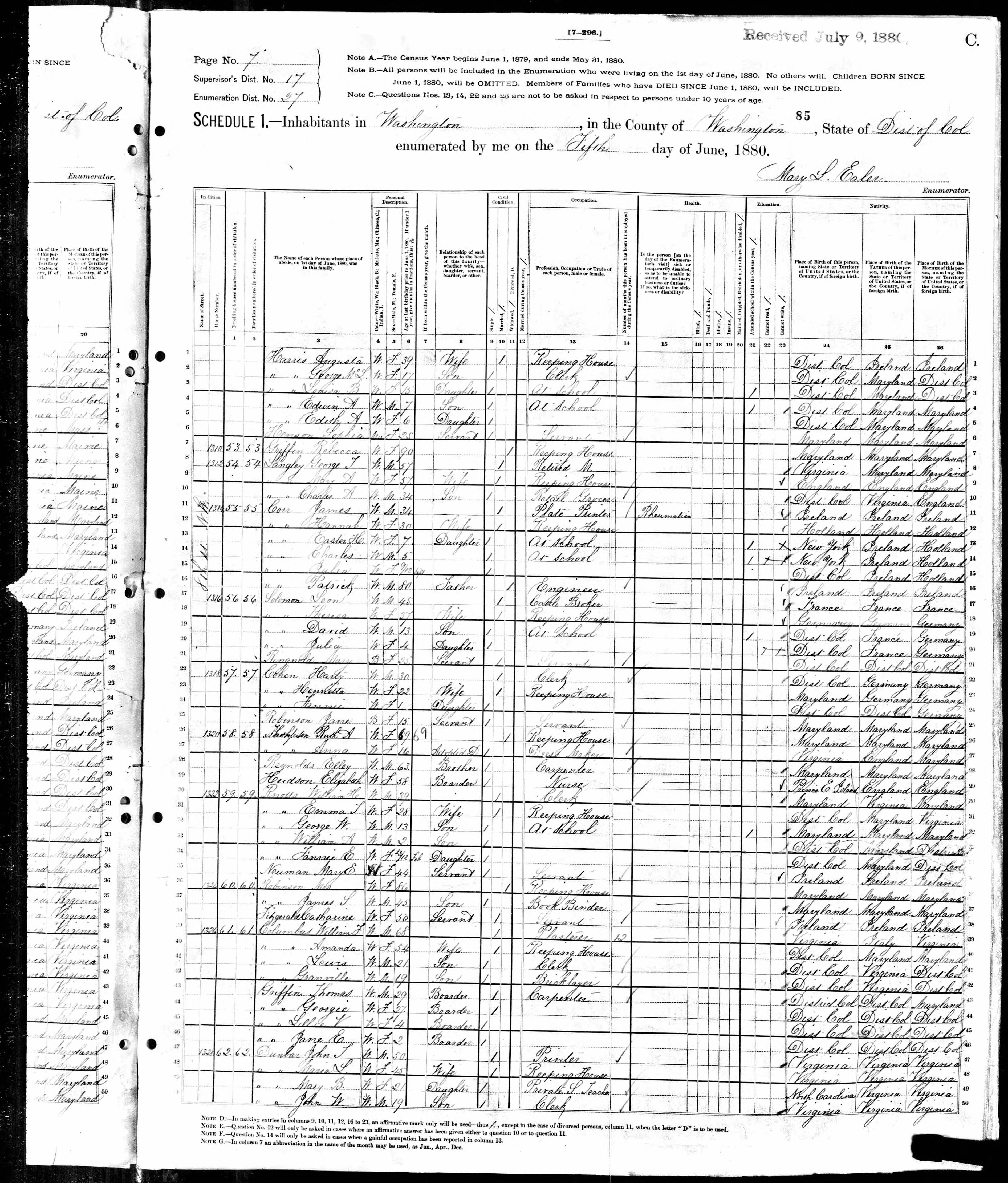
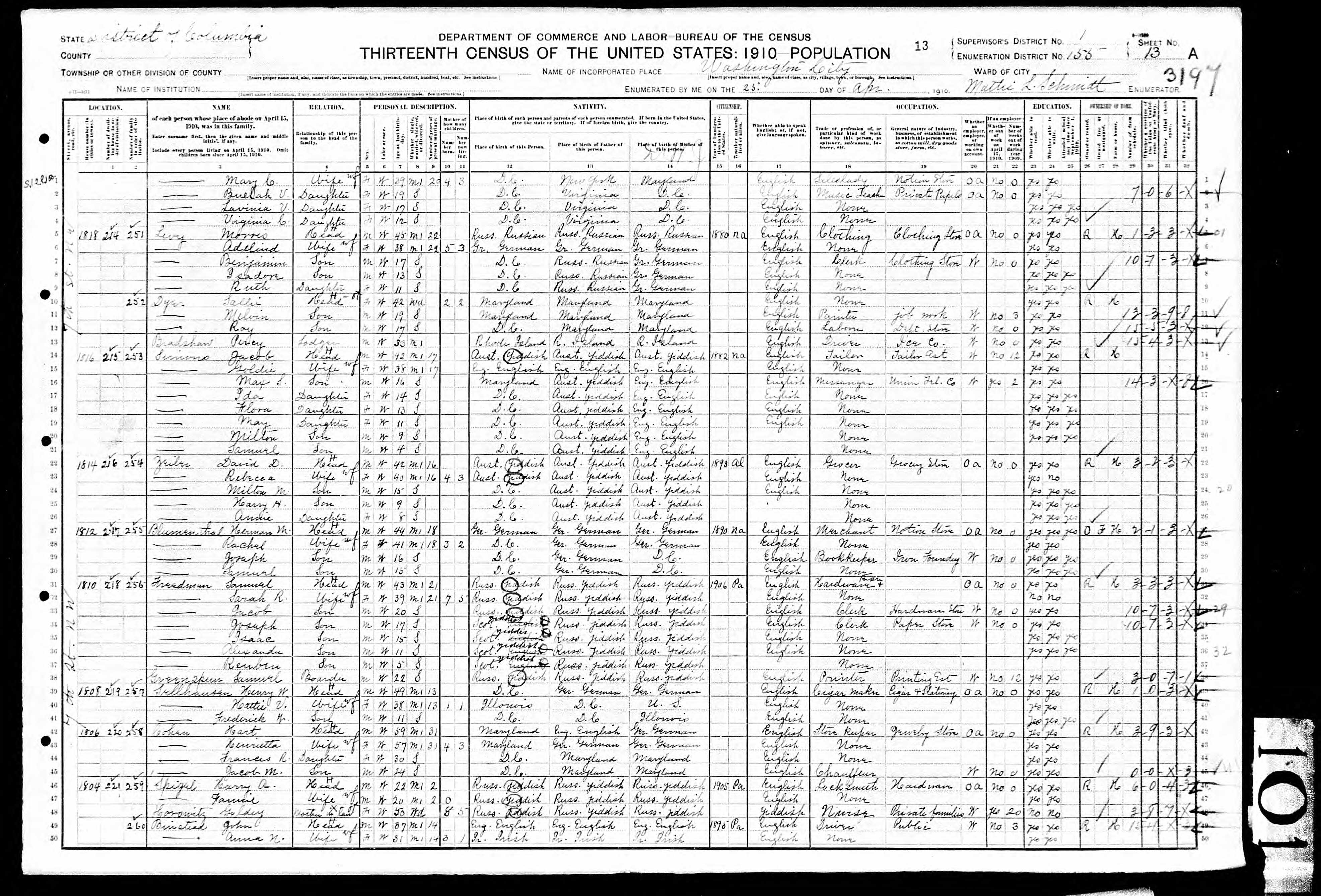
All seemed to be making sense until I found another 1880 census report for a Hart and Henrietta Cohen residing in Washington, DC. This Hart was also 30 years old.  I was ready to dismiss this as just as bizarre coincidence since this Hart was listed as having parents who were born in Germany.  His own birthplace was given as Washington, DC.  This seemed like it had to be a different person.  The DC Hart and Henrietta had one child, a daughter named Fanny who was only a year old.

Hart Cohen and family Washington, DC 1880 US census

Hart Cohen and family Washington, DC 1880 US census

I have a city directory for Philadelphia listing Hart Cohen as a pawnbroker in 1886, so I was convinced that the DC Hart was just a fluky coincidence of someone with the same name and age as my Hart marrying a woman also named Henrietta.  The 1890 census was destroyed by fire, so I had to skip ahead to 1900 to see if I could follow up on the two Hart and Henrietta Cohens.

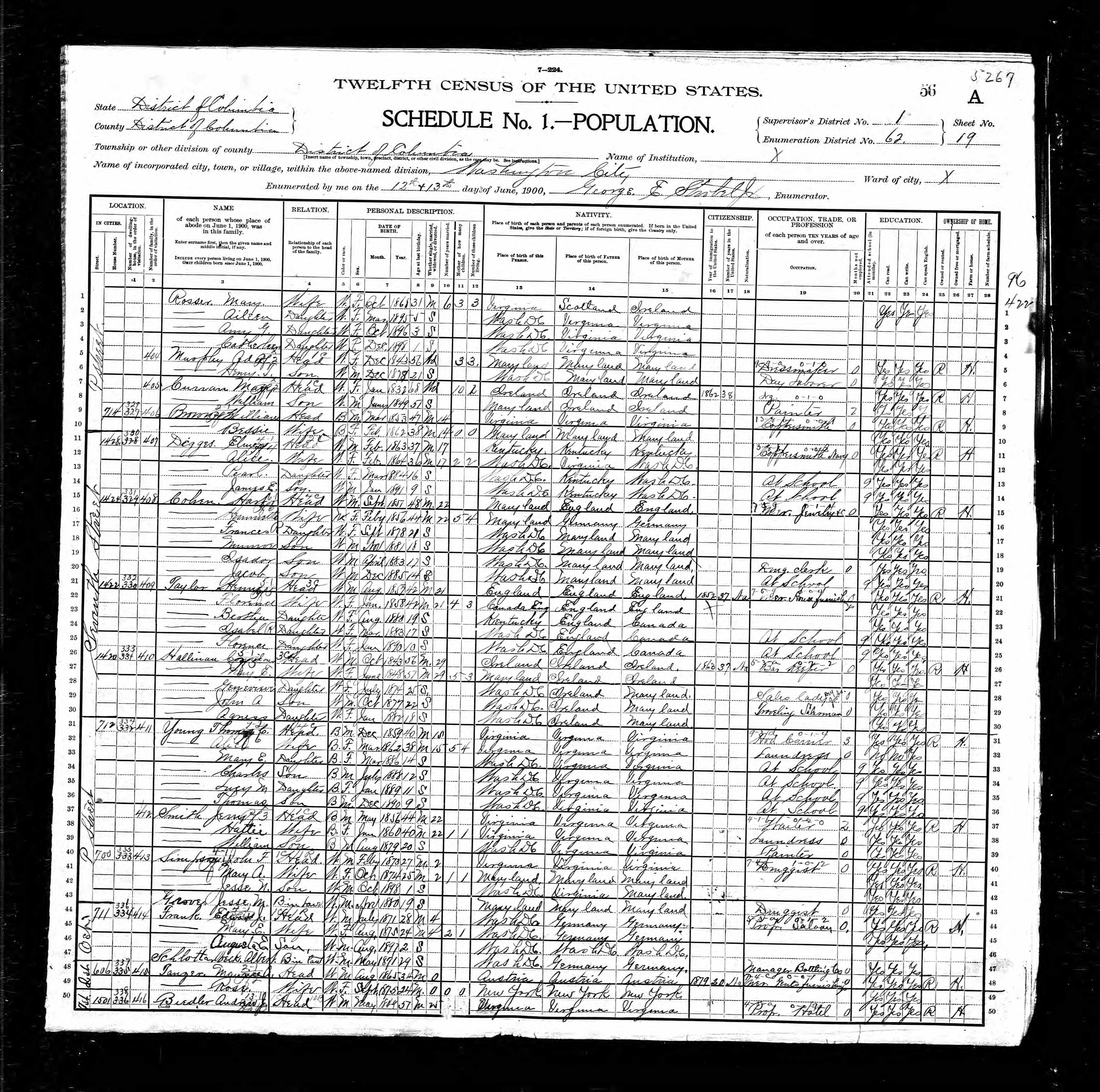
I could not find the Philadelphia Hart and Henrietta on either the 1900 or the 1910 census, but I did find the DC Hart and Henrietta on both.  The 1900 census for the DC Hart provided a more specific birthdate—September, 1851—and had his birth place as Maryland, but this census listed his parents’ birthplace as England, not Germany as on the 1880 census. DC Hart was working in a jewelry store, a retail business not unlike those of my ancestors, so that seemed strange as well. Hart and Henrietta now had four children, Frances, Munroe, Isador and Jacob.  But this Jacob was only 14 in 1900 so could not be the same Jacob who was 6 in 1880 and thus born in 1874.  Once again I felt pretty certain that this was still not the same Hart Cohen who was Jacob and Sarah’s son.  Despite the fact that his parents were now reported to be English-born, that he was a jeweler, that he married a woman named Henrietta and that he was also 30 years old, I again said that this was just a coincidence.

Hart Cohen and family in Washington, DC 1900 US census

Hart Cohen and family in Washington, DC 1900 US census

On the 1910 census report for the DC Hart and Henrietta,  Hart still had a jewelry store and was married to Henrietta and living with Frances and Jacob, two of their children.  His birthplace was listed as Maryland, and now his parents’ birthplaces were reported as England for his father and Germany for his mother.  This also seemed to suggest that this was not the Philadelphia Hart.

Hart Cohen and family Washington, DC 1910 US Census

Hart Cohen and family Washington, DC 1910 US Census

But because I could not find the Philadelphia Hart on the 1900 or the 1910 census, I was a bit perplexed.  Could he have died? Had he moved to DC?   Even if that were the case, it would not explain the two 1880 census reports.  Was he living a double life, having two wives both named Henrietta, one in Philadelphia and one in DC, and two different sets of children?

I decided to search for a death record for any Hart Cohen born around 1850, and I found one dated January 3, 1911.  Since this   record was from the District of Columbia Selected Deaths and Burials database, I assumed that this related to the DC Hart especially since the report said that the deceased was living in DC at the time of his death, but on a closer look I saw that it said that he had been born and was buried in Philadelphia.

I then found a second record in the Philadelphia Death Certificates Index that made it quite clear that this was the Philadelphia Hart, not the DC Hart: it listed his parents’ names as Jacob Cohew (sic) and Rachel Jacobs, both of whom were born in England.

Pennsylvania Death Certificates Index

Pennsylvania Death Certificates Index


Further research revealed that Hart’s body had been moved from its original burial location twice by two of his children, Jesse Cohen and Sarah Cohen Jonas, ending in a move in 1944 to a location in Mt Sinai Cemetery where both his son Jacob H. Cohen and a Ralph Brunswick were also buried.  Since the Henrietta who married Jacob was born Henrietta Brunswick, this seemed (no pun intended) to be the final nail in the coffin establishing that the Jacob who died in January, 1911, was the Philadelphia Hart, son of Jacob and Sarah Cohen, my great-great grandparents.

If that conclusion is correct, then Philadelphia Hart was actually living in Washington, DC, at the time of his death in January, 1911, just nine months after the 1910 census recorded DC Hart (and no other Hart) living with his wife Henrietta and two children Frances and Jacob at 1806 4th Street.  Philadelphia Hart’s residence at his time of death was reported as 1737 N. 15th Street in Washington.  He was also a widower, and I was able to locate a death record for a Henrietta B. Cohen who was born in Lengnau, Switzerland and died in November, 1902.  Had he moved to DC after Henrietta died? If so, why? And what, if any connection, might there be to the “other” Hart and Henrietta?

The other Hart, the DC Hart, was still alive in 1920 and living with his daughter Frances in the District of Columbia.  He also was a widower at this time and retired.  The census report lists his and his parents’ birthplaces as DC, but that is clearly wrong, at least for his parents, whose birthplaces had previously been reported at various times as England and Germany.

Hart Cohen Washington, DC 1920 US Census

Hart Cohen Washington, DC 1920 US Census

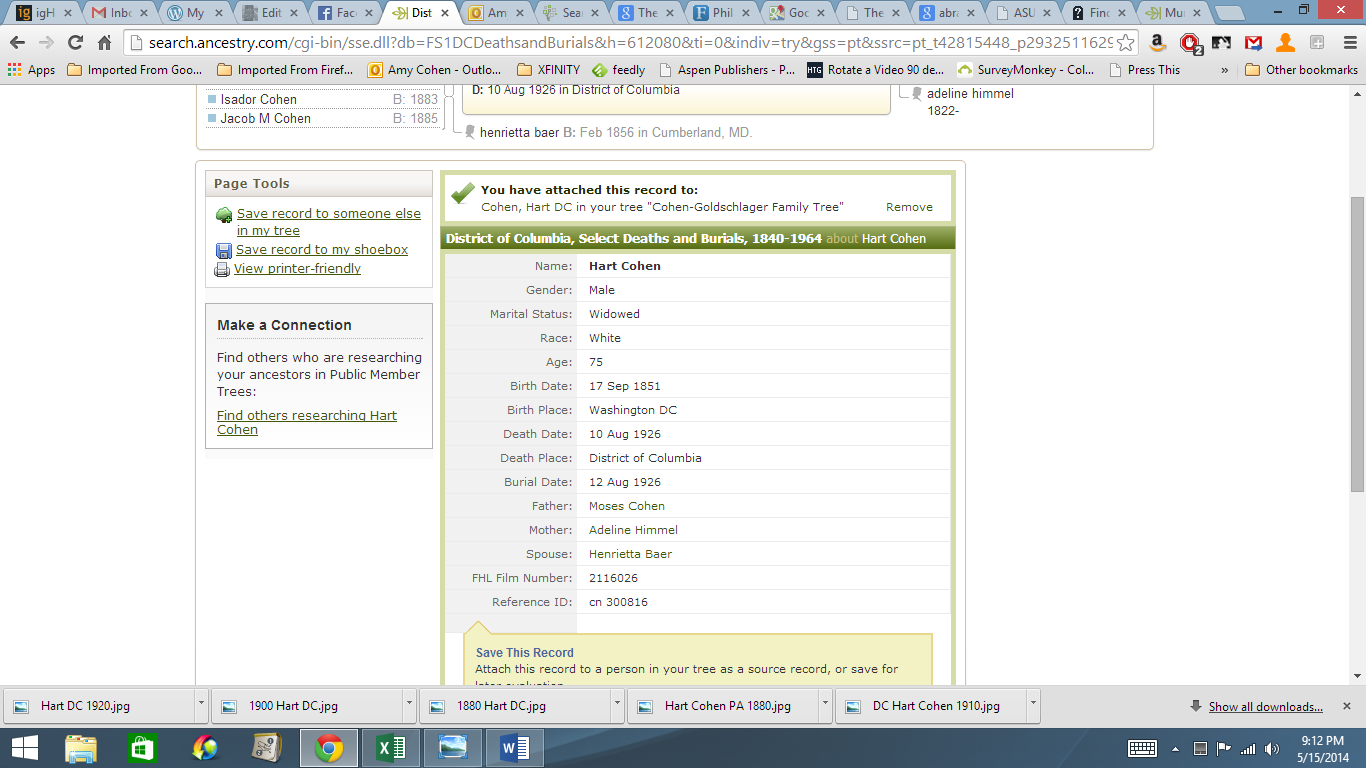
My next find was a record of DC Hart’s death. He died August 10, 1926, in Washington, DC.  His parents’ names were listed on this record: Moses Cohen and Adeline Himmel.  His wife’s name was Henrietta Baer.  So not only did both Philadelphia Hart and  DC Hart marry women named Henrietta, they both married Henriettas  with a birth name that started with a B.  It is no wonder that I was confused, and there are numerous trees on ancestry.com that have mixed together the two Hart and Henrietta Cohen families.

Screenshot (3)

When I saw the name Moses Cohen as DC Hart’s father, it stopped me in my tracks.  Could this be my great-great grandfather Jacob’s brother Moses, the one I thought had stayed behind in England? So far I have not been able to find whether there is a connection.  Although I did find a ship manifest with a Moses Cohen emigrating from England to New York in 1848, the same year Jacob left England, I have no idea whether this is the right Moses Cohen.  Tracking Moses Cohen and Adeline Himmel, I know that they had a son also named Moses before Hart and that Moses the younger was born in Baden, Germany around 1839.  Adeline was born in Germany, and Moses must have gone there, married her, had Moses his son, and then moved sometime between 1839 and 1850 to the United States and settled in Maryland where DC Hart was born.

If this was in fact Moses, the son of Hart Levy Cohen, my three times great grandfather, it would explain why Moses named his son Hart.  It might also explain why Philadelphia Hart was living for some time in Washington.  Perhaps he wanted to be closer to his cousin DC Hart and his family.  On the other hand, if there is no connection, then it is just a very, very strange series of coincidences.

What do you think?


Enhanced by Zemanta

Hart Cohen and Family 1851-1860: Philadelphia

Philadelphia, circa 1860, from the Library of Congress Prints and Photographs Division

By 1860, almost all my Cohen relatives had left England and moved to Philadelphia.  Only Moses Cohen remained behind.  My great-great grandfather Jacob Cohen had emigrated from England to Philadelphia in 1848 with his wife Sarah and his daughter Fannie.  Although I am not certain as to when Lewis, the oldest brother, left England, these naturalization papers dated October 27, 1848, appear to be his, meaning that he had left England earlier than Jacob.

UPDATE:  I now believe that Moses also had left England around 1848.  See my subsequent post.

Lewis H Cohen naturalization ED PA 1848

Lewis H Cohen naturalization ED PA 1848

I have located one 1846 ship manifest from England to New York with the name Lewis Cohen on it.  The ship manifest is for the passenger ship Ward Chipman, sailing from Liverpool to New York, arriving in New York on August 12, 1846.

Lewis Cohen ship manifest 1846

Lewis Cohen ship manifest 1846

Neither the ship manifest  nor the naturalization papers have enough detail for me to be absolutely certain that either or both relate to my relative, but from the 1860 US census I know that by 1860 Lewis was definitely in Philadelphia, living with his father and siblings.

Hart, Elizabeth, Lewis and Jonah Cohen 1860 US census

Hart, Elizabeth, Lewis and Jonah Cohen 1860 US census

Just last night I located the ship manifest for Hart, Elizabeth and Jonah.  They left England together on the ship Julia Richmond and arrived in New York in September, 1851.  Jonah was identified as a dealer, and the manifest indicates that they were coming with only one box.

Hart, Jonas and Elizabeth Cohen ship manifest September 1, 1851

Hart, Jonas and Elizabeth Cohen ship manifest September 1, 1851

Interestingly, I also found a document that indicates that Hart may have made a trip to the Netherlands in June, 1851 from England.  Although the name is only listed as “HL Cohen” and gives his occupation as “schoenmaker,” or shoemaker, it does give his birthplace as Amsterdam, so it could very well have been Hart.  Perhaps he was visiting his birthplace one more time before crossing the Atlantic.  Perhaps he was taking Rachel’s body to be buried there.  Once I locate Rachel’s death record, I may know more about this trip.

H L Cohen arrival in England June 17, 1851

H L Cohen arrival in England June 19, 1851

Thus, by 1860, all of the then living descendants of Hart and Rachel Cohen aside from Moses were living in Philadelphia. (I am assuming that Jonas and the John listed in 1841 were the same person.)  By 1860 my great-grandparents Jacob and Sarah had had many children.  As I have already written, by 1850 they had three children, Fanny, who was born in 1846 in England, and Joseph and Isaac, born in Philadelphia in 1848 and 1850, respectively.  In the next decade, Sarah gave birth to six more children: Hart (1851), Rachel (1853), Reuben (1854), Maria (1856), Hannah (1857) and Elizabeth (1858). All of the children except the youngest three were in school.  That made a grand total of nine children born between 1846 and 1858, and there were several more born in the next decade as well, including my great-grandfather Emanuel.  I find it interesting that contrary to the traditional Jewish practice of naming a child after a deceased relative, Jacob named a son Hart in 1851 before his father Hart had died and named a daughter Elizabeth while his sister Elizabeth was still alive.  Rachel presumably was named for Jacob’s mother who had died before 1853.

Although Jacob’s occupation is listed as a tailor on the 1860 US census, this seems inconsistent with the earlier census in 1850 when he was a dealer in second hand goods and with the 1841 English census when he was working as a china dealer.  Perhaps the census taker heard “dealer” as “tailor”?  Since Jacob also had the most assets of anyone else listed on this page of the census, $1000 in real estate and $2000 in personal property, it seems more likely that he was a merchant than a tailor.  He also had three servants living in the household: Eliza Mackey, Mary McDonough, and Margaret Gallagher.  There was also a 24 year old man named Lazarus Jacobs living with the family; this might have been a cousin through Jacob’s mother and/or his wife Sarah since both were Jacobs by birth.  Jacob thus had nine children, an adult relative, three servants as well as his wife Sarah and himself to support in 1860.  Could he have been making such a good living as a tailor?

Jacob and Sarah Cohen and family 1860 US census

Jacob and Sarah Cohen and family 1860 US census

Interestingly, Lewis and Jonah were also listed as tailors on the 1860 census.  They were living in the same district as Jacob, the 4th Ward, East Division, and the census appears to have been taken by the same census taker, although the signature is hard to decipher.  Were their accents so difficult for this census taker to understand? Or were these three brothers really tailors?  Lewis, Jonah, Elizabeth and their father Hart were all living together and had $1000 in personal assets, more in line with the shop owners on the census pages than the tailors, but perhaps the three Cohen brothers were all very successful tailors. However, according to the 1863 Pennsylvania Septennial Census, a census taken of all taxable residents, Lewis and Jonas were then engaged in sales and Jacob was listed as a dealer, not as tailors, so I am still inclined to think that the 1860 census taker heard “dealer” as “tailor” for all the Cohen men.

Lewis and Jonas Cohen on the 1863 PA Septennial Census

Lewis and Jonas Cohen on the 1863 PA Septennial Census

Jacob Cohen PA Septicentennial Census 1863

Jacob Cohen PA Septicentennial Census 1863

As I puzzled over this particular question of whether or not they were tailors, I became curious about the neighborhood they lived in and the socioeconomic character of that neighborhood. This led me to wonder about the history of Jews in Philadelphia and to ask why this family settled in Philadelphia, not New York, despite having sailed into New York when immigrating to this country. I am now doing some preliminary research into those questions and will report back on what I learn.

What has struck me as particularly interesting as I research and report on the immigration of my Cohen ancestors to Philadelphia is how different it feels from the immigration of my mother’s family, the Brotmans, Goldschlagers and Rosenzweigs.  Unlike the rather desperate conditions that my mother’s family faced in their home countries and the poverty they experienced after coming to the US, my Cohen ancestors left England not because they were oppressed or poor but for better conditions and opportunities here in America.  Although I am sure they faced some anti-Semitism and some isolation as Chuts and were not wealthy but at best middle class merchants, they came to America for less drastic reasons and with far more advantages than my mother’s relatives.  Not only were they more economically secure, they came speaking English.  They did not have to struggle to understand a new language, which must have made their adjustment far easier than it did for my Galician and Romanian ancestors who spoke no English when they arrived.

By 1860, the Cohens were settled in America and some of them were already or soon to be American citizens.  They were here a good 40 years before the Brotmans and some of the Rosenzweigs and about 50 years or more before many of the Goldschlagers and the other Rosenzweigs.   My father’s other lines also arrived here far earlier than my mother’s family.  My parents represent in many ways a merger of the two distinct waves of Jewish immigration to America.  When they were growing up, there was still a distinct class line between the older Jews from Western Europe and the newer Jews from Eastern Europe.  Today we don’t even think about those distinctions, except in historical terms.  But the two groups started differently and arrived under different conditions, creating for many years an economic and cultural gap between them.


Enhanced by Zemanta

Hart Cohen and family 1841-1851: Before the Move to America

be

By 1851, the time of the second English census, my great-great grandfather Jacob Cohen had already moved with his family to Philadelphia.  Much of the rest of his family of origin, however, was still in London.  According to the 1851 census, Hart, my three-times great grandfather, was now a widower and 75 years old, living with two of his children, Elizabeth, now listed as 28 despite having been listed as 20 ten years earlier, and Jonas, who was 22.  Jonas was not even listed as living with the family in 1841 when he would have been only 12 years old.   All three were listed as general dealers and living at 55 Landers Buildings in Spitalfields parish in Tower Hamlets.

Hart, Elizabeth and Jonas Cohen 1851 England Census

Hart, Elizabeth and Jonas Cohen 1851 England Census

Although I thought this might indicate a move to a new neighborhood, my research revealed that Landers Buildings were on Middlesex Street, which was just one blog from New Goulston Street where the family had been living in 1841.  The English genealogy site Genuki indicates that Spitalfields was a district within the parish of Whitechapel for at least some point in London’s history.

I do not know when Rachel, my three-times great grandmother died.  My search of the BMDIndex, the English index of births, marriages and deaths that began to be registered in 1837, revealed quite a few Rachel Cohens who died between 1841 and 1851.  I have ordered one certificate on a hunch that it might be the right one, but I need to do more investigating before I know for certain when she died.

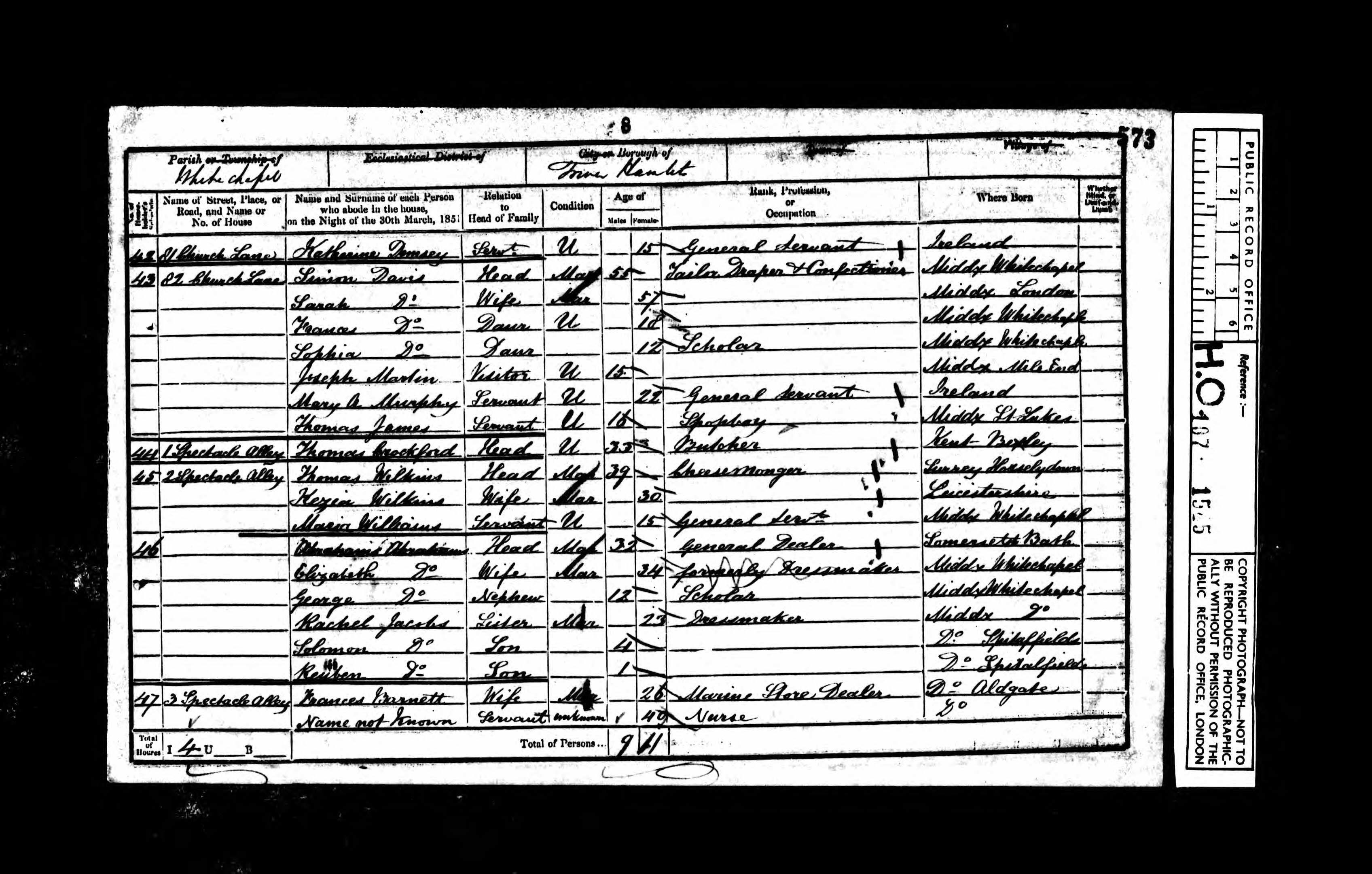
Hart’s son, Moses, now 30 years old, had married Clara Michaels in the fall of 1843, according to the BMDIndex.  I need to obtain a copy of the actual record to be sure, but on the 1851 census, Moses Cohen was married to a woman named Clara and had three daughters, Judith (6), Hannah (2), and Sophia (six months).  He was employed as a general dealer and living at 35 Cobbs Yard in the parish of Christchurch in Tower Hamlets.

UPDATE:  I now know that Moses in fact had left England with Jacob in 1848.  This is not the correct Moses.

Moses Cohen and family 1851 census

Moses Cohen and family 1851 census

This neighborhood is about three miles west of where Moses had been living with his parents in 1841. Moses must have been fairly comfortable as they also had a servant living with them, although the Charles Booth Poverty Map depicted this area as poor in 1898.

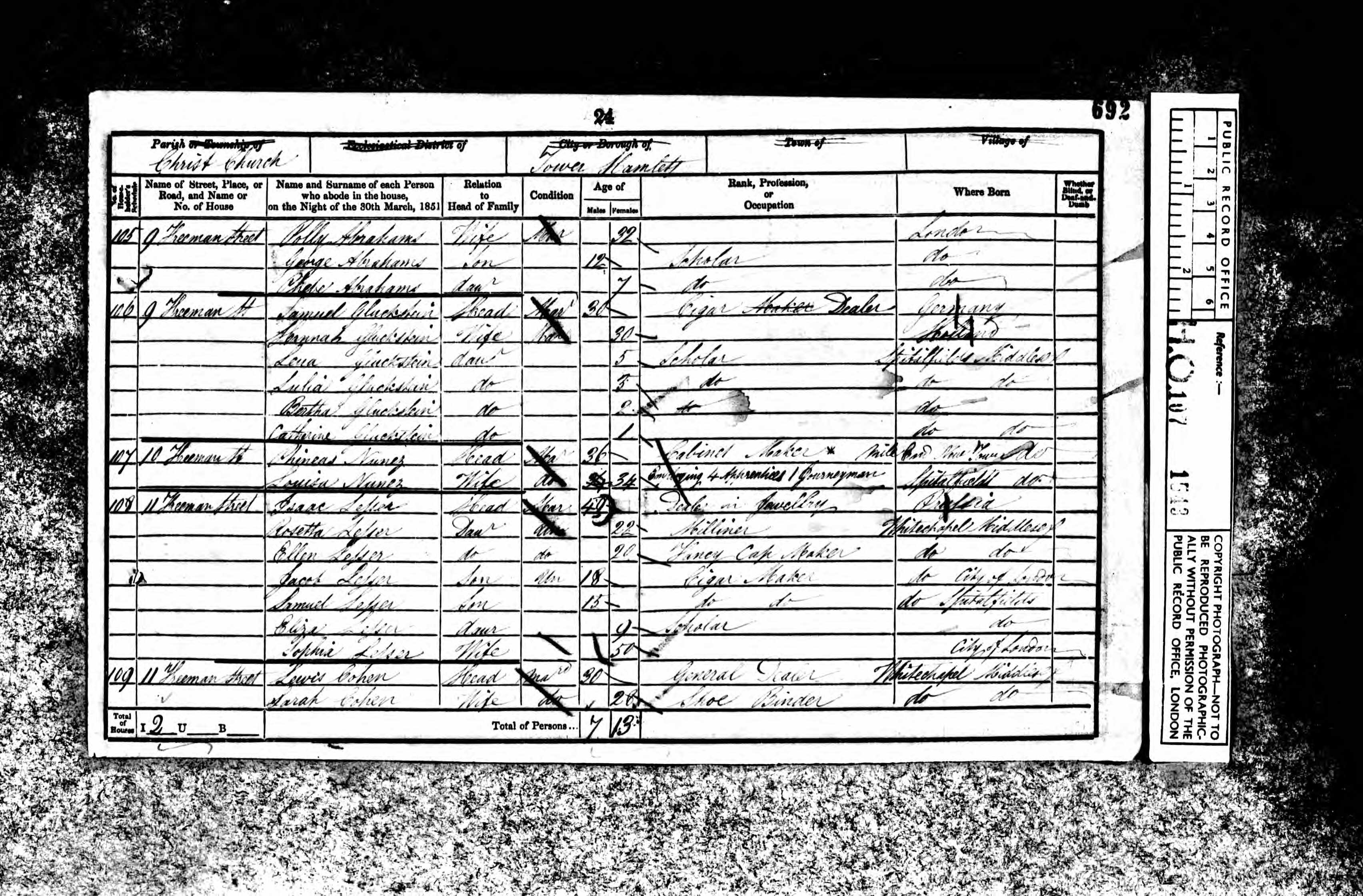
The oldest son, Lewis, has been more difficult to track.  He was not living with the family in 1841 nor was he living with his father and younger siblings in 1851.  I would not even have known that he existed except for the fact that he appears on the 1860 US census reports living with his siblings Elizabeth and Jonas and his father Hart and on the 1880 census living with Elizabeth and Jonas.  So where was he in 1841? 1851?  According to those two US census reports, he was born in 1820, so would have been Hart and Rachel’s second child after Elizabeth.  He might have been living independently in 1841, married, or perhaps just not home.  The FamilySearch website indicates that the 1841 census had many holes; if someone was not staying at a home that night, they were not included in the census for that household.  I found three Lewis Cohens on the 1841 Census, but none of them was a good fit.  One was too old, one was living with different parents, and one was not born in England.  But since the 1841 was the first true census taken in England, I assumed that perhaps Lewis was just not among those counted.

The 1851 English census did not provide any greater information on Lewis.   There were several Lewis Cohens again, but only one who was a possible fit: he was born in Middlesex County in Spitalfields, Christchurch, around 1821 and was married to a woman named Sarah.  They were living with Sarah’s mother, Ann Solomon.

Lewis Cohen 1851 census (not sure this is the correct Lewis)

Lewis Cohen 1851 census (not sure this is the correct Lewis)

I have found a marriage for this Lewis and Sarah in 1848 on the BMD Index and will write away for the record, but since Lewis was single in 1860 according to the US census, if this is the right Lewis, either Sarah had died or divorced him between 1851 and 1860.  I searched for a death record for a Sarah Cohen who died between 1851 and 1860, and there were several on the BMD Index.  I am not sure how to determine which ones might be relevant, but will order any that appear to be possibilities once I know that this was the correct Lewis.

UPDATE:  I know now that Lewis had in fact emigrated from England to the US in 1846.  This is not the correct Lewis.

The other possibility is that Lewis had immigrated to the US before the 1851 census or even the 1841 census.  I cannot find him on either the 1840 or 1850 US census, but I did find some immigration records for a Lewis H. Cohen who was naturalized in Philadelphia in 1848.

Lewis H Cohen naturalization ED PA 1848

Lewis H Cohen naturalization ED PA 1848

Since Lewis is listed on the 1860 US census as Lewis H. Cohen, I am inclined to think that this is the right person.  If so, then I also may have found a passenger ship manifest for Lewis, arriving in the US in 1846, which would have made him the first Cohen to immigrate to the US, not my great-great grandfather Jacob.  I need to check further into this, but it seems quite possible that the reason Lewis is not on the 1851 census in England is that he was already in the US.  But then why can’t I find him on the 1850 US census either?

The other mystery child of Hart and Rachel Cohen is the son identified on the 1841 census as John, the youngest child on that census whose age was given as 14, giving him a birth year of 1827.  In my initial research on the family, I thought that John had become Alfred J. Cohen, who was also born in 1827.  Alfred married Mary A. Cohen and remained in England where eventually they had seven children.

In reviewing my earlier work from last year, however, I am now doubtful that this was in fact the child of Hart and Rachel. Although I will order a marriage record for Alfred to be sure, I now think that the John in the 1841 census was actually Jonas, the youngest son of Hart and Rachel and the son who was living with Hart in 1851 in London and in 1860 in Philadelphia.  My reasoning is that Jonas was not listed on the 1841 census when he would have been only twelve years old.  Where else would he have been if not living with his parents? Also, since Jacob’s age was off by a few years on the 1841 census, it seems quite possible that there was an error in “John’s” age and also his name.  Jonas is close enough to John, at least the first syllable, so a census taker might have just recorded it or heard it incorrectly.  On the US census reports, Jonas’ age jumps around, making it difficult to pinpoint a correct year of birth.  Although I am going to order whatever vital records I can for Alfred and for Jonas, right now my hunch is that Jonas and John were the same person, the youngest son of Hart and Rachel Cohen, born sometime between 1825 and 1830.

UPDATE:  It seems quite clear to me now that “John” was Jonas.

So I have a lot of unanswered questions about my Cohen ancestors between 1841 and 1851. When did Rachel, my three-times great grandmother die?  Where was Lewis in 1841? Did he marry in England?  Did he in fact immigrate to the US in 1846? If so, why isn’t he on the 1850 US census? Are John and Jonas the same person, or were there in fact two sons younger than Jacob?

It will take some time to get the records that may help to answer these questions, so while I am waiting for those documents,  I will move on to the next decade and the story of my Cohen ancestors in the United States.


Hart Cohen and Family Between 1841 and 1851: My Great-Great Grandfather Jacob Cohen

English: Liberty Bell

English: Liberty Bell (Photo credit: Wikipedia)

As reported previously, in 1841 Hart Cohen and his wife Rachel were living with four of their children, Elizabeth, Moses, Jacob and John, on New Goulston Street in the Whitechapel section of London, presumably part of the Chut community and living fairly comfortably with the two older sons working as china dealers.  There was also at least one other son, an older son Lewis, and possibly another younger son, Jonas, although I am now thinking that John was in fact Jonas, but more on that later.  By 1860, only Moses (and John if there was in fact a son named John) was living in England; all the rest were in Philadelphia. I will try to trace in chronological order the major events and moves made by these family members.

In order to get a complete picture of the family and their lives in England, I will need to get copies of the vital records, including their birth certificates and marriage certificates.  I am now trying to learn how to do that.  I have received some extremely helpful tips and information from another of my favorite genealogy bloggers, Alex Cleverley of the blog Root to Tip.  Alex is a very experienced English genealogist, and with the help she has given me, I will now order the records I need.  Unfortunately it appears that there is no fast and easy access to these documents so for now I will have to rely on the 1851 census, a few other secondary sources, and later census reports and infer a number of facts from those documents.  As I receive other documentation, I will report what I find.

I will start with Hart and Rachel’s son Jacob because he is my direct ancestor, my great-great grandfather, and thus the one I have the greatest interest in tracking.  According to the 1841 census, Jacob was 15 that year, giving him a birth year of 1826.

Hart Cohen and family 1841 English census

Hart Cohen and family 1841 English census

This appears, however, to be inaccurate based on later census reports from the United States and from a passenger manifest, all of which indicate a birth year of 1824 or 1825.  That would have made Jacob 16 or 17 in 1841.

This also seems more consistent with the fact that Jacob may have married his wife Rachel Jacobs (possibly a relative of his mother, whose birth name was also Jacobs) on October 24, 1844.  Without an actual marriage certificate I cannot be completely sure, but I found a marriage record on SynagogueScribes for Jacob Cohen, son of Naphtali Hirts HaCohen, to Sarah Jacobs, at the Great Synagogue of London on that date.  The Hebrew name is not identical to what I had earlier found for Hart, Jacob’s father, but it is very close.  I know that Sarah’s maiden name was Jacobs based on the death certificates of two of their children, Isaac and Frances.  Thus, I feel fairly confident that this is in fact their marriage record as transcribed by SynagogueScribes.

COHEN
Forenames Jacob
Hebrew Name Jacob
Event Marriage
Date 1844 [29 Oct]
Occupation
Address
Father
Father’s Hebrew Name Naphtali Hirts HaCohen
Mother’s Family Name
Mother’s Forename
Mother’s Hebrew Name
Spouse JACOBS Sarah

Frances, or Fanny, was Jacob and Sarah’s first child, born around 1847, as inferred from later US census reports.   Within a year of Fanny’s birth, Jacob and Sarah left London and moved to Philadelphia.  On July 7, 1848, Jacob, Sarah and Fanny, an infant, arrived in New York aboard the ship New York Packing.  Jacob’s age was given as 24, consistent with a birth year of 1824, and Sarah was 20, giving her a birth year of 1828.  Jacob’s occupation was given as “General dealer,” as were many other men on the manifest.

Jacob and Sarah Cohen ship manifest 1848

Jacob and Sarah Cohen ship manifest 1848

Jacob was the first of Hart and Rachel’s children to leave London and move to the US.  His siblings and eventually his father began arriving several years later.  I found this interesting, given that Jacob was not the oldest son, but the fourth child and third son.  Why did he go first?  What drew him away from his family and to America with his young wife and baby?  I also found it revealing about my direct line that both Hart and Jacob were the sons who left their families behind and moved to a foreign country.  As far as I can tell, Hart arrived alone and without his family when he immigrated to England, just as his son Jacob did fifty years later when he left England and moved to the US.  I can’t say I inherited this willingness to take risks and move far from home, having never lived more than four hours from where I was born, but I like the idea that my ancestors were such risk-takers and so independent.

I don’t know whether Jacob and his family stayed very long in New York after arrival, but by 1850, Jacob and Sarah were living in Philadelphia.  It was not easy finding Jacob and Sarah on the 1850 US census.  I tried searching for all Jacob Cohens, Sarah Cohens, Fanny Cohens, and variations on each name and wild card searches on each name, but came up empty for a family that fit my relatives.  Then I decided to search just by first names for a Jacob with a wife named Sarah and a daughter Fanny and found them listed as “Coyle,” not “Cohen,” another instance of a mistaken name on a census report.  I am quite certain that these are my relatives despite the Irish surname because all the other facts fit closely enough—names, ages, places of birth for Jacob, Sarah and Francis.  Jacob’s occupation is described as “Dealer in 2d HG,” which I interpret to mean a dealer in second hand goods.  The only inconsistency is that Francis is listed as male, not female, but later census reports correct that mistake and list her as female.


Jacob Cohen and family 1850 US census

Jacob Cohen and family 1850 US census

By 1850, Jacob and Sarah had two additional children born in Pennsylvania.  Joseph was two years old, so presumably born shortly after Jacob and Sarah had arrived in the US in 1848, meaning Sarah was pregnant when they left England.  Isaac was six months old, so presumably born in January, 1850, since the 1850 census was dated July 25, 1850.

There were also two other men living in the household, both twenty years old: Mordecia (Mordecai?) Coyle (Cohen?) and Alexander Kelly.  Unfortunately, the1850 census did not identify the relationship of each individual to the head of household as later census reports did, so I do not know who these two men were.  Mordecai might very well have been a relative since he shared the same surname with the family.  But how might he have been related? None of Jacob’s siblings were old enough to have had a twenty year old son, and Jacob did not have a younger brother named Mordecai.  Also, the census indicates that Mordecai was born in Pennsylvania, meaning that his parents would have been in the US in 1830.  Perhaps Hart had a brother who had emigrated from Holland or Amsterdam or England that early? Or was Mordecai not even related to Jacob?  I have done some preliminary searching for other records for Mordecai, but so far have not had any success.

Thus, by 1850 my great-great grandfather was settled in Philadelphia, a young man with a young wife and three little children, working as a dealer in second hand goods.  His parents and his siblings were all still back in London, but between 1850 and 1860, that would change, and Jacob’s family both in his household and in Philadelphia would expandd many times over.

My next post will describe what the rest of Hart’s family was doing between 1841 and 1860, by which time most of the Cohens had arrived in Philadelphia.


Enhanced by Zemanta